


Abstract
Russula griseocarnosa is a wild edible mushroom with high culinary value, and drying is a major postharvest preservation method. However, the effects of different drying methods on quality trait development and metabolic remodeling remain poorly understood. In this study, four drying methods–natural air drying (AD), hot air drying (HD), vacuum freeze-drying (FD), and microwave drying (MD)–were applied to R. griseocarnosa. The effects of these drying treatments on the microstructure, antioxidant activity, and metabolic changes in R. griseocarnosa were systematically analyzed. FD better preserved the porous microstructure, whereas AD and HD caused tissue shrinkage and localized collapse. FD exhibited higher DPPH and superoxide anion radical scavenging activities than AD, HD, and MD (p < 0.05), with superoxide anion radical scavenging reaching 91.61 ± 0.69%. In contrast, MD showed the highest ferric-reducing antioxidant power (FRAP), reaching 34.36 ± 0.49 μmol Fe2+/g, significantly exceeding FD (21.39 ± 0.85 μmol Fe2+/g), AD, and HD (p < 0.05). Different drying treatments produced distinct metabolomic profiles. Exploratory Mantel tests identified associations between phenols and DPPH radical scavenging activity (r = 0.738, p = 0.033), between benzenoids and FRAP (r = 0.856, p = 0.008), and between alkaloids and derivatives and FRAP (r = 0.918, p = 0.008). Under the tested conditions, vacuum freeze-drying was preferable for preserving the porous microstructure and obtaining higher DPPH and superoxide anion radical scavenging activities, whereas microwave drying was preferable for achieving higher ferric-reducing capacity. These contrasting responses support selecting drying methods according to the desired structural characteristics and specific antioxidant properties of R. griseocarnosa.
1. Introduction
Russula griseocarnosa is a wild edible mushroom found in southern China, known for its high nutritional and economic value. It is rich in bioactive compounds such as ergosterol, flavonoids, and phenolic compounds, and demonstrates significant potential for nutritional applications and commercial development [1]. R. griseocarnosa has a strongly seasonal harvest period and exhibits significant dependence on its geographical origin. Like other wild edible mushrooms, it has a high moisture content and is susceptible to postharvest water loss, tissue softening, and spoilage [2,3]. Drying treatment can reduce the risk of spoilage and extend the shelf life of edible mushrooms, making it an important postharvest processing method for fresh mushrooms [2,3,4]. Common drying methods currently used for edible mushrooms include natural air drying, hot air drying, microwave drying, and vacuum freeze-drying. These methods differ substantially in terms of drying temperature and dehydration rate, and they can alter the color, tissue structure, flavor, nutritional content, antioxidant activity, and metabolite profile of edible mushrooms [2,3,5]. Among these, antioxidant activity is one of the key indicators for evaluating the processing quality and potential functional value of edible mushrooms. Previous studies have compared the effects of freeze-drying and hot air drying on the antioxidant activity of edible mushrooms, finding that different drying processes can lead to varying degrees of change in total phenolic content and antioxidant capacity assessed by DPPH and FRAP assays [6]. These effects are highly species- and processing-condition-dependent. In addition to antioxidant activity, rapid moisture migration and tissue shrinkage during drying may directly alter the microstructure of edible mushrooms. Previous studies have found that hot air drying typically results in pronounced tissue shrinkage, whereas freeze-drying better preserves the porous structures and tissue integrity [5,7]. In recent years, high-throughput analytical technologies such as metabolomics have provided a new research paradigm for elucidating molecular-level changes in the chemical composition of food during processing. Metabolomics has emerged as a powerful tool for uncovering changes in the chemical composition induced by food processing [8]. Untargeted metabolomics based on liquid chromatography–mass spectrometry (LC–MS) enables comprehensive detection of metabolites in food samples and systematic characterization of the impact of different processing treatments on their chemical composition [9]. This method has been widely applied to elucidate changes in metabolites during food processing [10]. Meng used GC-MS and LC-MS to analyze changes in volatile components and Maillard reaction precursors during hot air drying of Dictyophora indusiata, demonstrating that drying temperature regulates the formation of flavor compounds by altering amino acid and reducing sugar contents [11].
Currently, research on edible mushroom drying has primarily focused on the effects of a single drying method or a limited number of methods on flavor compounds, taste-related components, nutritional quality, and non-volatile metabolites, with emphasis on changes in conventional quality attributes after processing [12]. Chen found that the key odor-active compounds and their precursor amino acids and reducing sugars in Lentinula edodes underwent dynamic changes during hot air drying, indicating that the drying process can induce remodeling of its endogenous metabolites [13]. Yang compared the effects of different drying methods on the quality of Hypsizygus marmoreus and found that vacuum freeze-drying better preserved tissue structural integrity, whereas thermal treatment promoted the formation of certain volatile compounds [14]. However, the aforementioned studies mostly characterized the impact of drying on edible mushroom quality from isolated perspectives, and the relationships among microstructure, metabolite profiles, and antioxidant activity underlying quality changes under different drying conditions remain unclear.
In this study, fresh samples were used as the control, and four drying treatments—natural air drying, hot air drying, microwave drying, and vacuum freeze-drying—were applied. By integrating analysis of macroscopic and microscopic structure, antioxidant activity, and untargeted metabolomics, an association framework linking “microstructure–metabolic profile–antioxidant activity” was established in dried R. griseocarnosa. This approach enables a molecular-level investigation of the relationships between different drying methods and product quality, providing evidence to guide the selection of postharvest drying conditions for R. griseocarnosa.
2. Materials and Methods
2.1. Sample Collection
The R. griseocarnosa samples were collected on 29 July 2025, from Jiulianshan National Nature Reserve in Jiangxi Province (114°26′58.29″ E, 24°32′21.86″ N). The specimens were identified as Russula griseocarnosa by Professor Dunyuan Huang using internal transcribed spacer (ITS) sequencing. Voucher material is currently retained at the Key Laboratory of Conservation and Utilization of Pollinator Insect of the Upper Reaches of the Yangtze River, Ministry of Agriculture and Rural Affairs, Chongqing, China. No accession number has been assigned. Intact, closed-cap fruiting bodies without physical damage, pest infestation, disease symptoms, mold, or decay were selected as experimental samples. Only fruiting bodies weighing 20–25 g, with a pileus diameter of 5–7 cm, were selected. The samples were stored at 4 °C until analysis, with excessive compression and light exposure avoided during storage.
2.2. Drying Treatments
The samples were divided into a fresh control group (Control, CK) and four drying treatment groups: natural air drying (AD), hot air drying (HD), vacuum freeze-drying (FD), and microwave drying (MD). Before drying, all samples were equilibrated at room temperature for 0.5 h to ensure a uniform initial temperature prior to their respective drying treatments. Each biological replicate consisted of one individual fruiting body that was processed, ground, extracted, and analyzed separately. Separate sets of fruiting bodies were allocated to the two analyses. Untargeted metabolomic analysis was performed with four biological replicates per group (CK, AD, HD, FD, and MD), whereas antioxidant assays were performed with three biological replicates per group. Both analyses were conducted in parallel using fruiting bodies collected at the same time and location, at the same developmental stage, and selected according to the same criteria. Corresponding drying treatments used the same processing conditions. Replicate numbers were determined before extraction and data acquisition according to sample availability, the sample mass required for metabolomics submission, and the experimental schedule.
AD: The fruiting bodies of R. griseocarnosa were dried outdoors from 9:00 to 18:00 on two consecutive days at ambient temperatures of 20–30 °C, using sunlight exposure and natural air circulation. The cumulative outdoor drying time was 18 h. Between the two daytime drying periods, samples were held overnight in a constant-temperature and humidity incubator (LC-MJX-70BE, Shanghai Lichen Bangxi Instrument Technology Co., Ltd., Shanghai, China) at 25 °C and 45% relative humidity, with the incubator door closed. The samples were weighed every 2 h during outdoor drying, and drying was terminated when the weight change (Δm) between two consecutive measurements was ≤ 0.005 g, indicating that constant weight had been reached.
HD: The forced-air drying oven (GZX-9140MBE, Shanghai Boxun Medical Biological Instrument Co., Ltd., Shanghai, China) was preheated for 0.5 h to reach the set temperature. The fruiting bodies of R. griseocarnosa were then placed in the electric forced-air drying oven and dried at a hot-air temperature of 50 ± 2 °C with an air velocity of 1 m/s. The samples were weighed every 0.5 h, and drying was stopped when the mass difference (Δm) between two consecutive weighing was ≤0.005 g, indicating that constant weight had been reached. The drying duration was 21 h from sample loading, excluding the 0.5 h oven preheating period.
FD: The samples were pre-frozen at −80 °C for 2 h and then placed in a vacuum freeze dryer (FD-1A-50, Beijing Boyikang Experimental Instrument Co., Ltd., Beijing, China) for 48 h at a cold-trap temperature of −50 °C and a vacuum pressure of 20–40 Pa. After drying, the samples were sealed and stored at −20 °C for subsequent analyses.
MD: The fruiting bodies of R. griseocarnosa were placed in a microwave oven (M183GN, Samsung Electronics Co., Ltd., Seoul, Republic of Korea) and dried at a power of 600 W. The samples were weighed every 5 s during drying, and drying was terminated when the mass difference (Δm) between two consecutive weighing was ≤0.005 g, indicating that constant weight had been reached. The cumulative microwave operating time was 85 s, excluding interruptions for weighing.
Initial moisture content and the final moisture content of each drying treatment were not measured.
2.3. SEM Observation
The cross-sectional microstructures of the pileus and stipe were examined using a scanning electron microscope (SEM, SU3500, Hitachi, Tokyo, Japan). Samples from all groups, including CK, AD, HD, FD, and MD, were freeze-dried before SEM observation. The samples were cut into blocks approximately 5 mm × 5 mm × 2 mm in size and sputter-coated with gold. Observations were performed in secondary electron mode at an accelerating voltage of 15 kV, and images were acquired at magnifications of 200× and 1000×. Six specimens per group were examined, comprising three pileus specimens and three stipe specimens (n = 3 per tissue type).
2.4. Determination of Antioxidant Activity
The antioxidant capacity of R. griseocarnosa samples was evaluated based on the DPPH, hydroxyl (OH·), and superoxide anion (O2−·) radical scavenging activities, as well as the ferric reducing antioxidant power (FRAP) [15,16]. DPPH radical scavenging activity, hydroxyl radical scavenging activity, and FRAP were measured using commercial kits from Sangon Biotech (Shanghai, China; catalog Nos. D799007-0050, D799277-0050, and D799275-0050, respectively). Superoxide anion radical scavenging activity was measured using a kit from Macklin (Shanghai, China; catalog No. S931097). For the DPPH assay, samples from all groups, including CK, were oven-dried at 60 °C to constant weight before grinding. A 0.05 g portion of each powdered sample was extracted with 1 mL of the extraction solution supplied with the kit in a water bath at 40 °C for 30 min. The extracts were centrifuged at 10,000 rpm for 10 min at room temperature, and the supernatants were used directly without dilution. For the hydroxyl radical and superoxide anion assays, 0.1 g of fresh tissue for CK or dried material for AD, HD, FD, and MD was homogenized in 1 mL of the corresponding kit extraction solution on ice and centrifuged at 10,000× g for 10 min at 4 °C. For FRAP, 0.1 g of fresh tissue for CK or dried material for AD, HD, FD, and MD was extracted with 1 mL of precooled kit extraction solution and centrifuged at 10,000 rpm for 5 min at 4 °C. The supernatants were used directly without dilution. The nominal concentrations, expressed as the mass of starting material per volume of extraction solution, were 50 mg/mL for DPPH and 100 mg/mL for the other three assays. Aliquots of 50, 150, 30, and 100 μL of supernatant were used for the DPPH, hydroxyl radical, FRAP, and superoxide anion assays, respectively. Absorbance was measured at 515, 536, 593, and 530 nm, respectively. Radical scavenging activities were expressed as percentages calculated according to the respective kit protocols. For the DPPH assay, a sample background control was prepared by mixing 50 μL of supernatant with 950 μL of absolute ethanol without DPPH. The reagent blank contained 50 μL of extraction solution and 950 μL of DPPH working solution. Scavenging activity was calculated as [1 − (A_ test − A_ background)/A_ blank] × 100%, where A_ test, A_ background, and A_ blank represent the absorbances of the sample reaction, sample background control, and reagent blank, respectively. For the hydroxyl radical assay, the sample-free control contained kit reagent IV, whereas the blank contained neither sample nor reagent IV; omitted volumes were replaced with distilled water. Scavenging activity was calculated as (A_ test − A_ control)/(A_ blank − A_ control) × 100%, where A_ test, A_ control, and A_ blank represent the absorbances of the sample reaction, sample-free control, and blank, respectively. For the superoxide anion assay, the sample-free control contained 100 μL of distilled water in place of the sample supernatant. Scavenging activity was calculated as (A_ control − A_ test)/A_ control × 100%, where A_ control and A_ test represent the absorbances of the sample-free control and sample reaction, respectively. FRAP was calculated using an Fe2+ standard curve after subtraction of the reagent blank, in which the 30 μL sample aliquot was replaced with an equal volume of double-distilled water, and expressed as μmol Fe2+ equivalents per gram of sample weighed for extraction. CK was weighed as fresh tissue, whereas AD, HD, FD, and MD were weighed as the respective dried materials. Vitamin C (VC) was used as the positive control. Each antioxidant assay was performed with three biological replicates per group (n = 3), and the results are expressed as mean ± standard deviation.
2.5. Metabolite Annotation and UPLC–MS/MS Analysis
2.5.1. Sample Preparation
Before metabolomics extraction, samples from all groups, including CK, were freeze-dried and individually ground into homogeneous powder. An accurately weighed 100 mg portion of each freeze-dried sample was transferred into a 2 mL centrifuge tube containing one grinding bead (6 mm in diameter). Extraction was based on equal masses of freeze-dried material. Then, 800 μL of extraction solvent (methanol/water, 4:1, v/v both HPLC grade, Fisher Chemical, Fair Lawn, NJ, USA) spiked with four internal standards, including L-2-chlorophenylalanine (0.02 mg/mL), was added for metabolite extraction. The samples were first homogenized using a cryogenic tissue grinder at −10 °C and 50 Hz for 6 min, followed by ultrasonic extraction at 5 °C and 40 kHz for 30 min. After extraction, the samples were placed at −20 °C for 30 min to facilitate protein precipitation and then centrifuged at 4 °C and 13,000× g for 15 min. The supernatants were transferred into autosampler vials equipped with inserts for subsequent instrumental analysis.
2.5.2. UPLC–MS/MS Analysis
Untargeted metabolomics analysis was performed using ultra-high-performance liquid chromatography (UPLC) coupled to an Orbitrap Exploris 240 high-resolution mass spectrometer.
Chromatographic separation was performed on an HSS T3 column (100 mm × 2.1 mm i.d., 1.8 µm; Waters Corporation, Milford, MA, USA) with an injection volume of 3 µL. The mobile phase A consisted of water/acetonitrile (95:5, v/v) containing 0.1% (v/v) formic acid, while mobile phase B consisted of acetonitrile/isopropanol/water (47.5:47.5:5, v/v/v), also containing 0.1% (v/v) formic acid. Water, acetonitrile, isopropanol, and formic acid were all HPLC grade (Fisher Chemical, Fair Lawn, NJ, USA). The flow rate was set at 0.40 mL/min, and the column temperature was maintained at 40 °C. The chromatographic eluate was directly introduced into the mass spectrometer for detection.
Mass spectrometric data were acquired in both electrospray ionization (ESI) positive and negative ion modes, with a scanning range of 70–1050 m/z. The ion source parameters were set as follows: spray voltages of 3.5 kV and −3.0 kV for the positive and negative ion modes, respectively; sheath gas, 50 arb; auxiliary gas, 13 arb; and ion source temperature, 450 °C. MS/MS data were acquired using stepped collision energies of 20, 40, and 60 eV.
To evaluate the stability and reproducibility of the overall analytical process, a quality control (QC) sample was prepared by mixing equal volumes of all samples. One QC sample was injected after every 5–10 analytical samples during instrumental analysis.
2.6. Data Analysis
Raw UPLC–MS/MS data were processed using Progenesis QI (Waters Corporation, Milford, MA, USA) for baseline filtering, peak detection, peak integration, retention time correction, and peak alignment. The resulting data matrix contained retention times, mass-to-charge ratios (m/z), and peak intensities. Metabolites were putatively annotated by matching MS and MS/MS information against HMDB, METLIN, and the in-house database of Majorbio.
Annotation confidence was described using the service provider’s categories: B(i) denotes annotation based on MS/MS spectral-library matching, whereas B(ii) denotes annotation based on matching against computationally predicted MS/MS spectra. The complete annotation dataset is provided in Table S2, including feature identifiers, retention times, m/z values, adducts, molecular formulas, mass errors, available database accession numbers, annotation categories, and matching scores.
The annotated data matrix was uploaded to the Majorbio Cloud Platform (cloud.majorbio.com) for preprocessing. Features with nonzero values in at least 80% of samples in at least one experimental group were retained. Missing values were imputed using the minimum value in the original data matrix. Peak intensities were normalized to the sum of peak intensities within each sample. Features with a relative standard deviation exceeding 30% in quality-control (QC) samples were removed, and the remaining data were log10-transformed before subsequent analyses.
The annotated metabolites were classified at the HMDB superclass level, and the relative abundance of each class was calculated. Pearson correlation analysis was used to examine pairwise relationships among metabolite categories. Mantel tests were used to assess associations between the distance matrices corresponding to each metabolite category and each antioxidant index. Both analyses used treatment-level means. Metabolomics measurements were averaged across four biological replicates per treatment, whereas antioxidant measurements were averaged across three biological replicates per treatment. As metabolomics and antioxidant assays used separate sets of individual fruiting bodies, the two datasets were matched by treatment identity (CK, AD, HD, FD, and MD), yielding five matched treatment-level observations. No multiple-testing correction was applied to the 171 unique pairwise Pearson tests or the 76 Mantel tests. The p-values reported for the Pearson correlations and Mantel tests are unadjusted. These analyses were exploratory, with p < 0.05 used as a nominal threshold for identifying associations for further examination.
The retained metabolites were cross-referenced with NPAtlas to select putative annotations with documented fungal origins or candidate features of fungal natural products. Metabolites belonging to categories with Mantel p < 0.05 for at least one antioxidant index were retained as an exploratory set of 12 candidate metabolites for hierarchical clustering analysis. NPAtlas cross-referencing informed candidate selection but did not independently confirm compound identities. Category-level associations were used for exploratory prioritization and did not establish the antioxidant contributions of individual metabolites.
Differential metabolites were mapped to pathways in the Kyoto Encyclopedia of Genes and Genomes (KEGG) database [17]. Pathway enrichment analysis was performed on the Majorbio Cloud Platform using the hypergeometric test, with the platform-defined complete metabolite set for the study species selected as the background. The resulting p-values were adjusted using the Benjamini–Hochberg method, and pathways with adjusted p < 0.05 were considered significantly enriched. The enrichment factor was calculated as the number of compounds in the differential metabolite set mapped to a given pathway divided by the number of background compounds mapped to that pathway.
2.7. Statistical Analysis
Principal component analysis (PCA) and orthogonal partial least squares discriminant analysis (OPLS-DA) were performed using the ropls package (version 1.6.2) in R. OPLS-DA models were evaluated using seven-fold cross-validation and 200 permutation tests. Between-group differences in metabolite abundance were assessed using Student’s t-test. p-values were adjusted using the Benjamini–Hochberg (BH) procedure on the Majorbio Cloud Platform.
The initial differential-metabolite screening used VIP > 1 and unadjusted p < 0.05. From these results, metabolites with |log2FC| ≥ 1 (FC ≥ 2 or FC ≤ 0.5) in at least one of the four comparisons (AD vs. CK, HD vs. CK, FD vs. CK, and MD vs. CK) were retained for further screening. The fold-change threshold was not required to be met in all four comparisons.
Data organization, statistical analysis, and visualization were performed using Microsoft Excel 2019, SPSS 27, Origin 2024, and Chiplot (https://chiplot.online/#). Statistical significance was assessed using one-way analysis of variance (ANOVA) followed by Duncan’s multiple range test, with the significance level set at p < 0.05.
3. Results and Discussion
3.1. Effects of Different Drying Methods on the Microstructure of Russula griseocarnosa
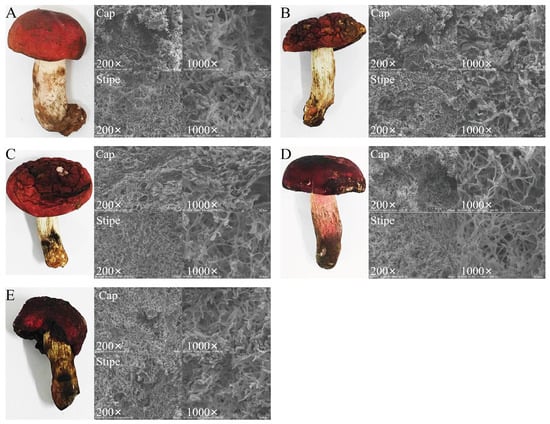
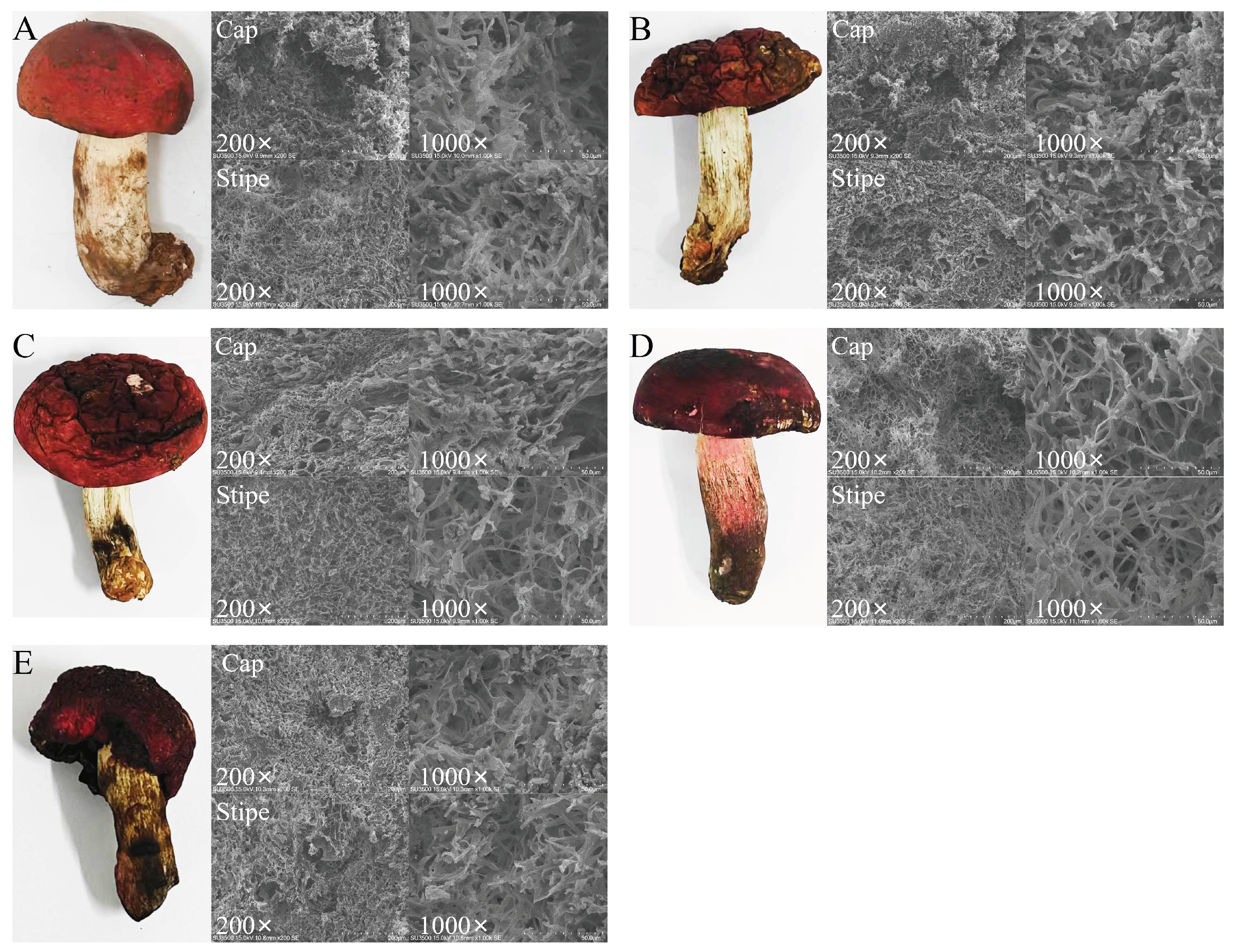
SEM images revealed distinct differences in the microstructures of both the pileus and stipe of R. griseocarnosa among the different drying methods (Figure 1). Among them, the CK group exhibited relatively intact tissue structures with smaller and more uniformly distributed pores. In contrast, the AD group showed obvious shrinkage and collapse, with compressed pore spaces, resulting in a relatively compact structure. The HD group exhibited lamellar shrinkage, irregular pores, and localized hyphal aggregation. This may be attributed to continuous dehydration and hot-air-induced moisture migration during thermal treatment, which induced contraction of the hyphal scaffold, leading to pore collapse and disruption of the tissue structure [18]. The MD group developed numerous irregular pores and larger pore openings; however, pore distribution was heterogeneous and localized structural collapse was still observed, likely due to rapid internal heating and water vapor generation during microwave treatment. Nevertheless, the resulting porous structure may facilitate the release of bioactive antioxidant compounds [19,20,21]. In contrast, the FD group exhibited a relatively intact porous structure, with a clear hyphal framework and clearly visible pore openings. This may be attributed to the ability of low-temperature vacuum conditions to effectively limit liquid water migration and tissue shrinkage, thereby minimizing structural collapse [7,22].
Figure 1.
External appearance and microstructure of the cap and stipe of R. griseocarnosa subjected to different drying methods. (A) CK; (B) AD; (C) HD; (D) FD; (E) MD.
3.2. Effects of Different Drying Methods on the Antioxidant Activity of Russula griseocarnosa
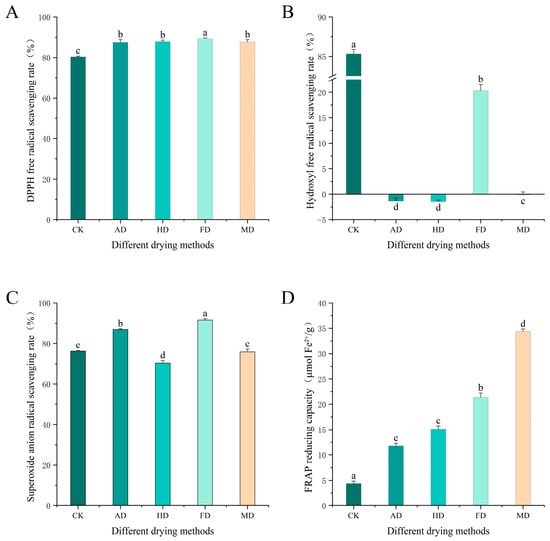
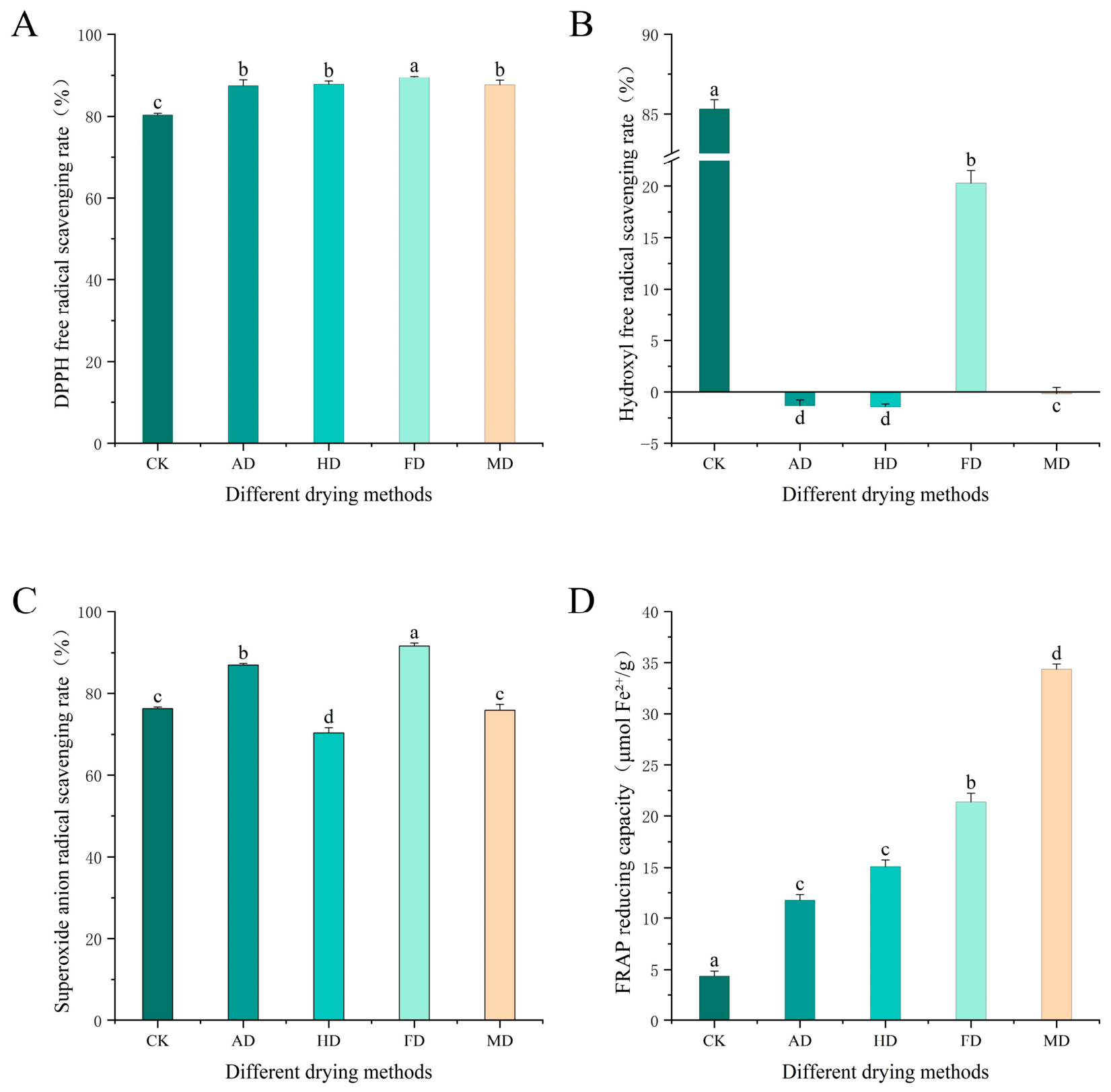
After different drying treatments, R. griseocarnosa exhibited varying trends in its antioxidant indices (Figure 2). FD exhibited the highest DPPH and superoxide anion radical scavenging activities among the five groups (p < 0.05), with superoxide anion radical scavenging reaching 91.61 ± 0.69%. For hydroxyl radical scavenging, CK showed the highest activity, whereas FD had the highest value among the four drying treatments (p < 0.05). The stronger DPPH and superoxide anion radical scavenging responses of FD may reflect the preservation of constituents reactive in these assays under low-temperature drying conditions. A similar advantage of freeze-drying was reported for Coprinus comatus, in which freeze-dried samples showed the highest polyphenol content and radical scavenging ability among the drying methods examined [18]. AD and HD exhibited negative apparent hydroxyl radical scavenging values under the assay conditions, but the cause of these negative responses remains unresolved. Among the drying treatments, MD showed the highest FRAP value (34.36 ± 0.49 μmol Fe2+/g dried sample), followed by FD (21.39 ± 0.85 μmol Fe2+/g dried sample). CK yielded 4.40 ± 0.46 μmol Fe2+/g fresh tissue. For the hydroxyl radical, superoxide anion radical, and FRAP assays, CK was extracted as fresh tissue, whereas the drying treatments were extracted as dried material. Comparisons between CK and the dried samples in these assays may therefore also reflect differences in dry-matter input. FRAP measures the reduction of Fe3+–TPTZ to Fe2+–TPTZ under acidic conditions, whereas the radical scavenging assays evaluate responses in different radical reaction systems. Microwave heating may alter the extractability and chemical composition of reducing constituents, providing a possible explanation for the high FRAP response of MD. Heat-induced increases in reducing power and changes in extractable phenolic compounds have also been reported in citrus peels [23]. In the present study, however, the higher FRAP value of MD was accompanied by lower DPPH and superoxide anion radical scavenging activities than FD (p < 0.05). These contrasting responses indicate assay-dependent effects of drying: FD favored DPPH and superoxide anion radical scavenging, whereas MD favored ferric-reducing capacity.
Figure 2.
Effects of different drying methods on the antioxidant capacity of R. griseocarnosa. (A) DPPH radical scavenging activity; (B) hydroxyl radical (OH·) scavenging activity; (C) superoxide anion radical (O2−·) scavenging activity; (D) ferric reducing antioxidant power (FRAP). Different lowercase letters indicate significant differences among groups (p < 0.05).
Comparisons with previous studies show that the antioxidant responses to drying depend on the processing conditions and the assay used. Sun et al. reported higher DPPH radical scavenging activity after microwave-vacuum drying than after freeze-drying in Flammulina velutipes root, whereas the two treatments showed comparable FRAP values [21]. Their microwave-vacuum treatment was conducted at 50 °C and 1500 W for 20 min, and hot air drying was performed at 60 °C for 6 h. In the present study, microwave drying was performed at 600 W for a cumulative operating time of 85 s, and hot air drying was conducted at 50 ± 2 °C for 21 h; FD showed the highest radical scavenging activities among the dried samples, whereas MD produced the highest FRAP value. These contrasting responses should be considered alongside differences in temperature, drying duration, vacuum conditions, and sample characteristics. Under the conditions examined here, FD and MD therefore offered different advantages for radical scavenging and ferric reducing capacity, respectively.
3.3. Metabolomic Profile of Russula griseocarnosa Under Different Drying Methods
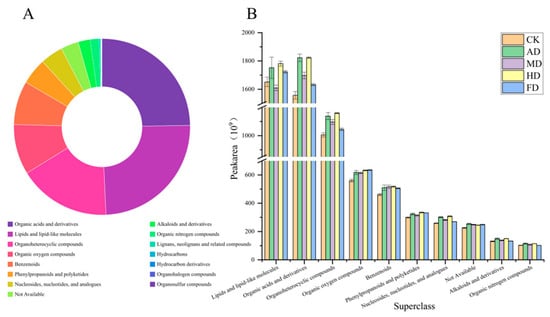
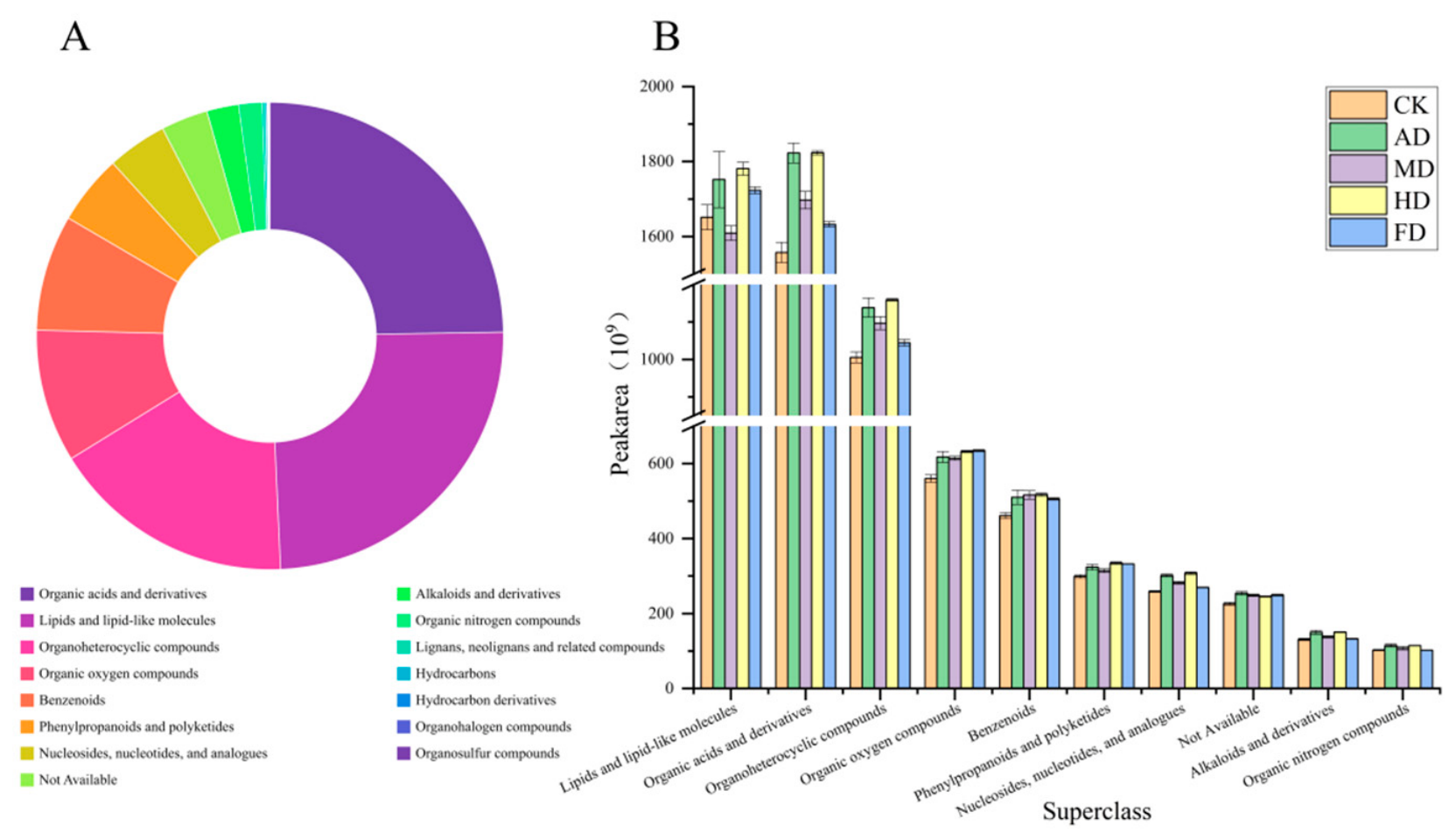
QC analysis showed that 90.74% and 95.74% of peak features in positive and negative ionization modes, respectively, had RSD values < 30%, indicating good stability and reproducibility of the LC–MS data (Figure S1). Based on this, a total of 5240 candidate metabolites were initially annotated and classified, primarily including organic acids and derivatives, lipids and lipid-like molecules, organic heterocyclic compounds, organic oxygen compounds, benzenoids, phenylpropanoids, and polyketides. Among these, organic acids and derivatives and lipids and lipid-like molecules accounted for relatively high proportions (Figure 3A). Across all groups, lipids and lipid-like molecules, organic acids and derivatives, and organic heterocyclic compounds showed relatively high abundance, with the AD and HD groups exhibiting higher abundances across multiple metabolite superclasses (Figure 3B). However, the higher signals across several metabolite superclasses in AD and HD were not accompanied by the strongest antioxidant responses. FD showed the highest DPPH and O2−· scavenging activities, whereas MD exhibited the highest FRAP value (Figure 2). Thus, higher class-level metabolite signals did not translate into consistently greater antioxidant activity. These results indicate that broad metabolite-class abundance alone is insufficient to explain the antioxidant differences among drying treatments and that the composition within each class and the antioxidant endpoint measured also need to be considered. These differences may be associated with cellular disruption and heat-induced transformation during drying, which can alter the extractability and relative abundance of metabolites. Yi et al. reported changes in the non-volatile metabolite profiles of Morchella sextelata after sequential hot air drying at 45 °C for 3 h, 50 °C for 3 h, and finally 60 °C until dry [24]. Their results and the treatment-dependent profiles observed here show that drying alters mushroom metabolite composition. However, their staged heating protocol differed from the constant-temperature HD treatment at 50 ± 2 °C used in this study. Comparisons of metabolite changes should therefore consider the temperature–time conditions, together with species and tissue differences. Changes in extractability and chemical transformations during drying provide possible explanations for the observed abundance differences.
Figure 3.
Metabolomic profiles of R. griseocarnosa in different treatment groups. (A) Classification of annotated metabolites at the HMDB superclass level; (B) relative abundance of the major metabolite superclasses in the CK, AD, HD, MD, and FD groups.
3.4. Correlation Analysis
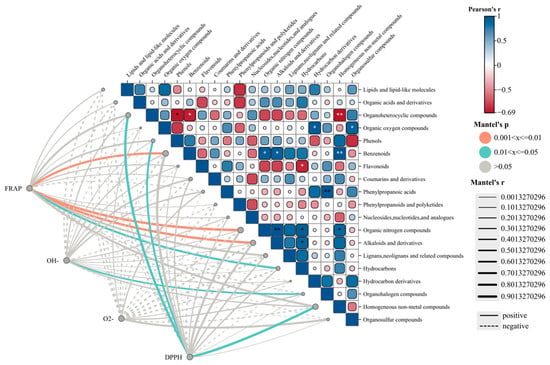
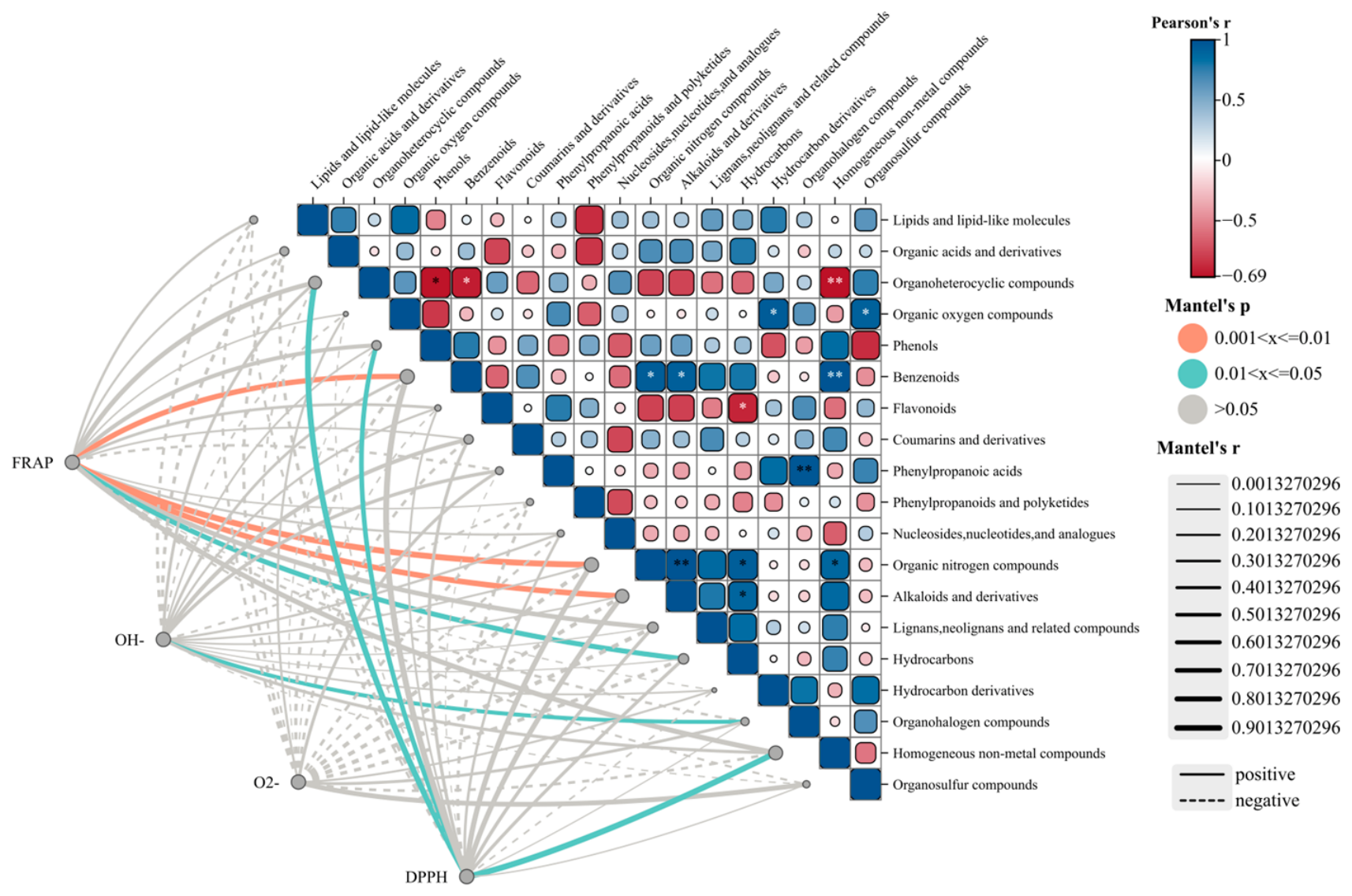
To examine the relationships between antioxidant activity and metabolite composition, Pearson correlations among metabolite categories and Mantel associations between metabolite categories and antioxidant indices were analyzed using the five treatment means (Figure 4, Table S1). The Mantel test indicated an association between phenols and DPPH radical scavenging activity (Mantel r = 0.738, p = 0.0333). Previous studies on wild edible mushrooms have reported positive correlations between phenolic compounds and antioxidant activity [25]. FRAP reducing capacity showed Mantel associations with benzenoids (Mantel r = 0.856, p = 0.00833) and alkaloids and derivatives (Mantel r = 0.918, p = 0.00833). The association between phenols and FRAP reducing capacity did not reach statistical significance (Mantel r = 0.597, p = 0.100). Previous studies have shown that the strong hydrogen-donating and electron-donating capacities of phenolic compounds, along with their conjugated structures, form the fundamental basis for their antioxidant activity [26,27]. Differences in temperature conditions, oxygen exposure, and drying rate may lead to distinct metabolite transformation pathways and metabolite accumulation patterns [28]. The associations of O2−· scavenging activity with phenylpropanoic acids (Mantel r = 0.411, p = 0.0833) and OH· scavenging activity with coumarins and derivatives (Mantel r = 0.594, p = 0.0750) were not statistically significant. Overall, the association patterns differed among antioxidant indices, providing an exploratory basis for the subsequent examination of candidate metabolites.
Figure 4.
Correlations between antioxidant indicators and metabolite categories in R. griseocarnosa under different drying methods. Blue and red indicate positive and negative Pearson correlation coefficients, respectively. Connecting lines represent Mantel test results, with line width indicating the strength of the correlation and line style indicating its direction.
3.5. Multivariate Statistical Analysis and Screening of Differential Metabolites
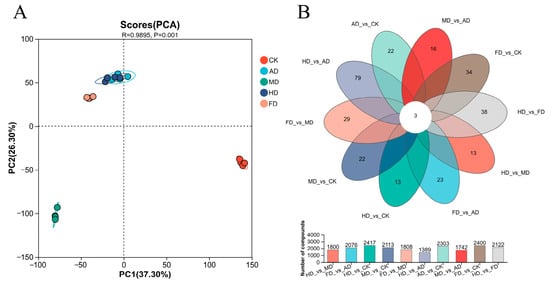
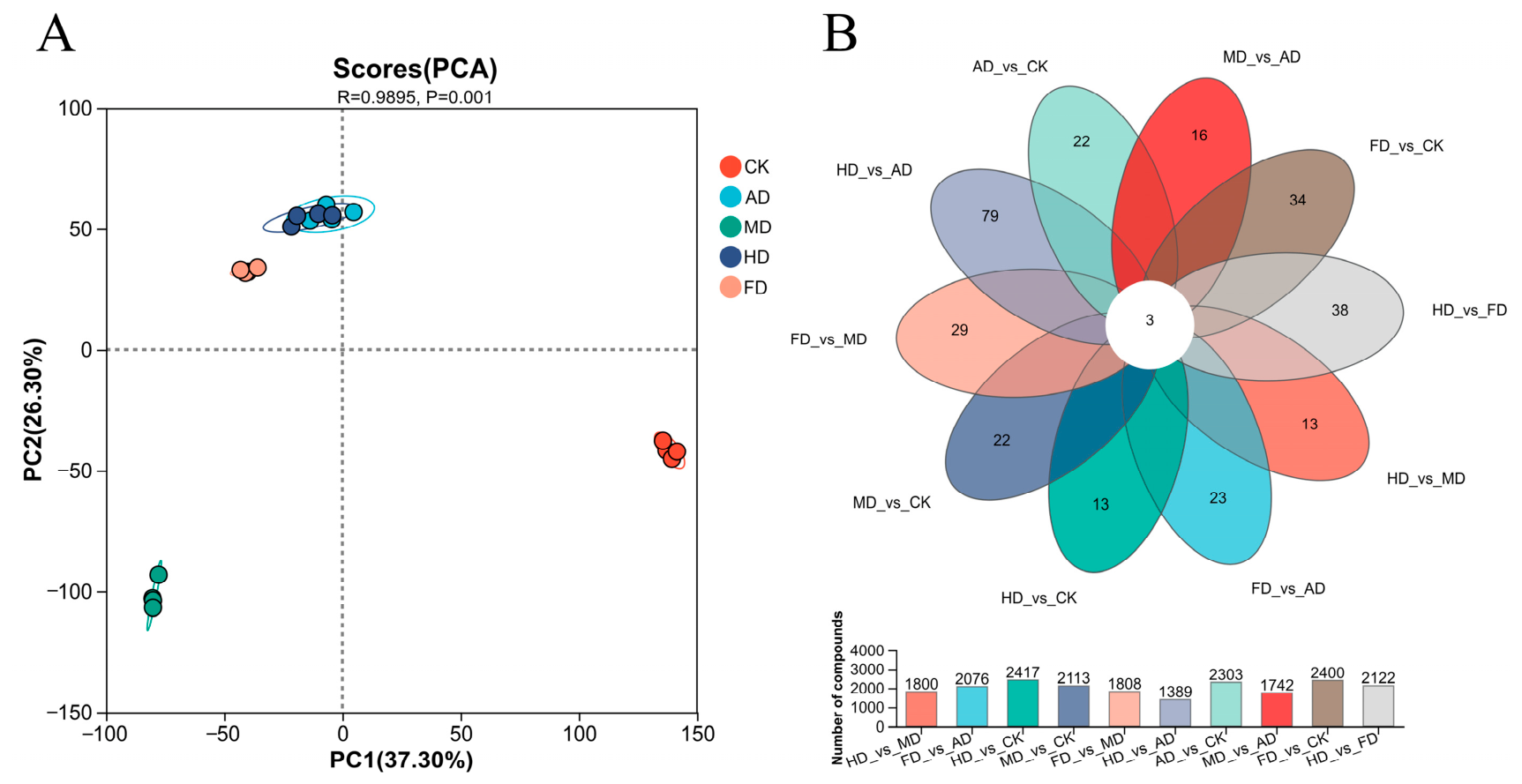
PCA results showed a clear separation trend among samples from different treatment groups, with PC1 and PC2 explaining 37.30% and 26.30% of the total variance, respectively (Figure 5A). Samples within each group were highly clustered, indicating good data stability and reproducibility. Clear separation among the drying treatment groups indicated that the drying methods substantially altered the metabolite composition of R. griseocarnosa. OPLS-DA analysis further revealed that the model exhibited strong discriminatory ability between groups in the current dataset. The OPLS-DA models were evaluated using seven-fold cross-validation and 200 permutation tests. The cumulative R2X, R2Y, and Q2 values were 0.830, 1.000, and 0.996 for AD vs. CK; 0.842, 1.000, and 0.996 for HD vs. CK; 0.873, 1.000, and 0.998 for FD vs. CK; and 0.847, 1.000, and 0.998 for MD vs. CK, respectively. The Q2 regression intercepts from the permutation tests were 0.0243, 0.1714, 0.0606, and −0.0128 for these comparisons, respectively (Figure S2).
Figure 5.
Overall metabolomic profiles and distribution of differential metabolites in R. griseocarnosa under different drying methods. (A) PCA score plot; (B) Venn diagram showing the numbers of differential metabolites among different comparison groups.
The Venn diagram of differential metabolites in dried R. griseocarnosa indicated clear metabolic differences among the various drying treatments (Figure 5B). Among them, the HD vs. AD comparison contained the largest number of comparison-specific differential metabolites (79), followed by HD vs. FD (38) and FD vs. CK (34). Only three differential metabolites were shared across all comparison groups, indicating that the metabolic changes induced by different drying methods were treatment-specific.
3.6. Abundance Patterns and Cluster Analysis of Differential Metabolites Under Different Drying Methods
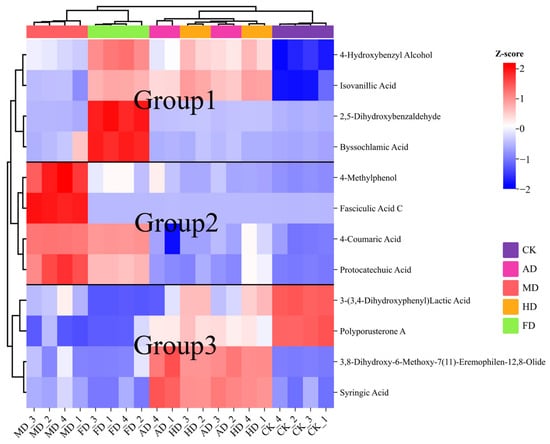
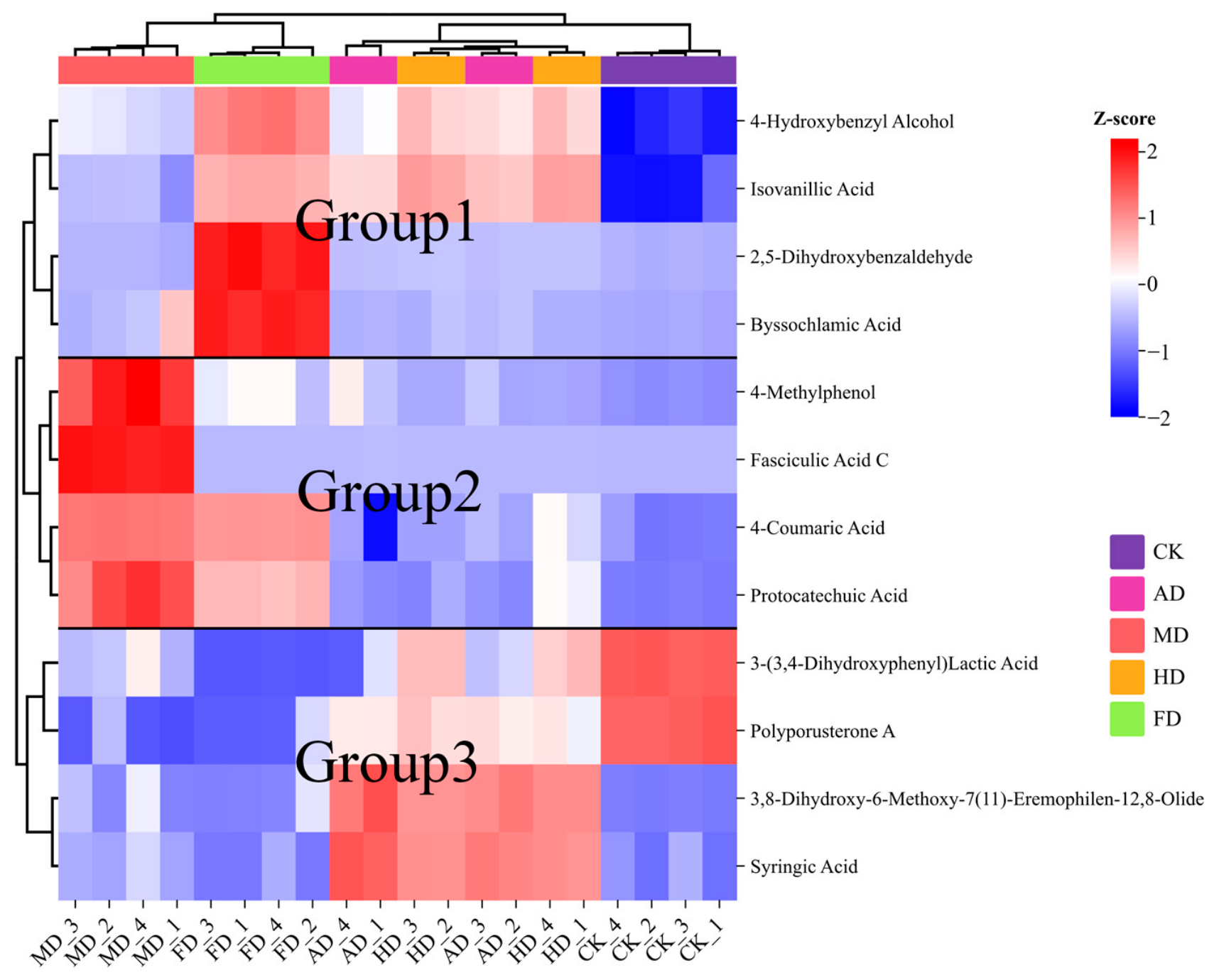
In the FD treatment, phenolic and aromatic metabolites such as 2,5-dihydroxybenzaldehyde, 4-hydroxybenzyl alcohol, and isovanillic acid exhibited relatively high abundances. Differential fold-change analysis revealed that the relative abundances of these metabolites in the FD treatment were 2.00-, 2.07-, and 2.25-fold those in the CK group, respectively (Table 1). Previous studies have shown that 2,5-dihydroxybenzaldehyde possesses free-radical scavenging and antioxidant activities, while 4-hydroxybenzyl alcohol can exhibit free-radical scavenging, iron-reducing, and lipid and protein oxidation-inhibitory activities [29,30]. Although isovanillic acid has reported DPPH, ABTS, and hydroxyl radical scavenging activities [31], its abundance pattern did not distinguish the antioxidant responses of AD, HD, and FD. Its relative abundance was 2.11-, 2.30-, and 2.25-fold that of CK in these treatments, respectively (Table 1), whereas their antioxidant responses differed (Figure 2). In particular, FD showed the highest DPPH and O2−· scavenging activities, while AD and HD exhibited negative apparent OH· scavenging values under the assay conditions. Thus, the similar increases in isovanillic acid cannot alone explain these treatment differences. Likewise, syringic acid was 3.65- and 3.30-fold as abundant as in CK under AD and HD, respectively, compared with 1.19-fold under FD (Table 1). Its higher signal in AD and HD did not correspond to the strongest antioxidant responses. Although syringic acid and 3-(3,4-dihydroxyphenyl)lactic acid have reported antioxidant potential [32], their individual contributions to the extracts cannot be ranked from their abundance patterns alone. The relative abundances of protocatechuic acid and 4-coumaric acid in MD were 2.27- and 2.32-fold those in CK, respectively (Table 1), coinciding with the highest FRAP value among the drying treatments. However, 4-coumaric acid also reached 2.16-fold the CK abundance in FD, whereas FRAP values were 34.36 ± 0.49 and 21.39 ± 0.85 μmol Fe2+/g dried sample in MD and FD, respectively. Thus, the abundance pattern of 4-coumaric acid alone does not account for the difference in reducing capacity. The concurrent enrichment of these phenolic-acid candidates and the higher FRAP response in MD supports their further investigation, but does not establish their individual contributions to the measured response. Among the 12 candidate metabolites, seven had B(i) annotations based on MS/MS spectral-library matching, whereas five had B(ii) annotations based on computationally predicted MS/MS spectra. The supporting annotation records, including feature identifiers, m/z values, retention times, adducts, molecular formulas, mass errors, database accession numbers, and the corresponding fragmentation or theoretical fragmentation scores, are provided in Table S2. Further hierarchical clustering analysis showed that the 12 differential metabolites exhibited distinct abundance variation patterns under different drying methods (Figure 6). In the sample clustering results, the MD, FD, and CK groups each formed distinct clusters, whereas the AD and HD groups were interspersed, indicating relatively similar metabolic profiles between these two groups. Based on the metabolite clustering, the 12 differential metabolites were classified into three major groups. Group 1 exhibited relatively high abundances mainly in the FD treatment. Group 2 exhibited relatively high abundances mainly in the MD treatment. In Group 3, 3-(3,4-dihydroxyphenyl)lactic acid and polyporusterone A showed relatively high abundances in the CK group, whereas 3,8-dihydroxy-6-methoxy-7(11)-eremophilen-12,8-olide and syringic acid exhibited relatively high abundances in the AD and HD groups. Overall, the clusters summarize treatment-related abundance patterns within the selected set of 12 candidate metabolites.
Table 1.
Fold changes in differential metabolites in different drying treatments relative to fresh samples. (FC represents the fold change for each drying treatment relative to CK. The fold-change screening criterion required FC ≥ 2 or FC ≤ 0.5 in at least one of the four comparisons. Values between 0.5 and 2 are also presented to describe the responses of the selected metabolites across treatments; these values do not meet the fold-change threshold in the corresponding comparisons.).
Figure 6.
Hierarchical clustering heatmap of differential metabolites in R. griseocarnosa under different drying methods. Red indicates relatively high abundance, whereas blue indicates relatively low abundance; groups 1–3 represent metabolite clusters obtained by hierarchical clustering based on the similarity of relative abundance patterns of differential metabolites across different treatments.
3.7. KEGG Pathway Enrichment Analysis
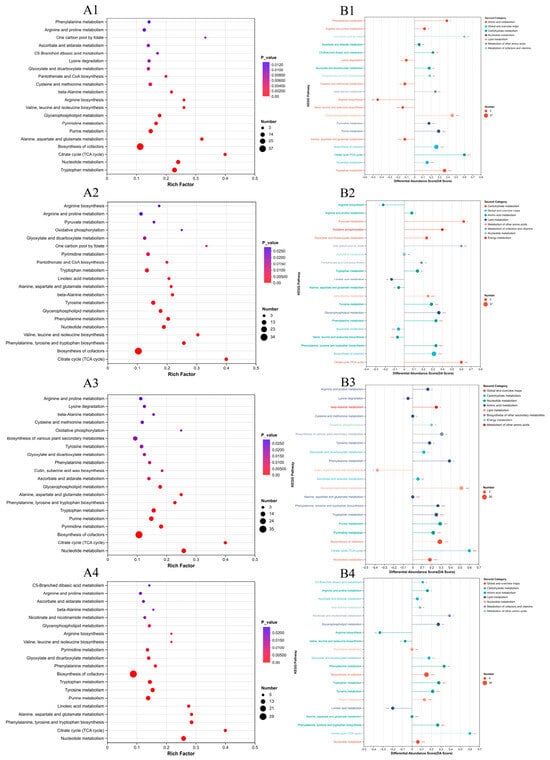
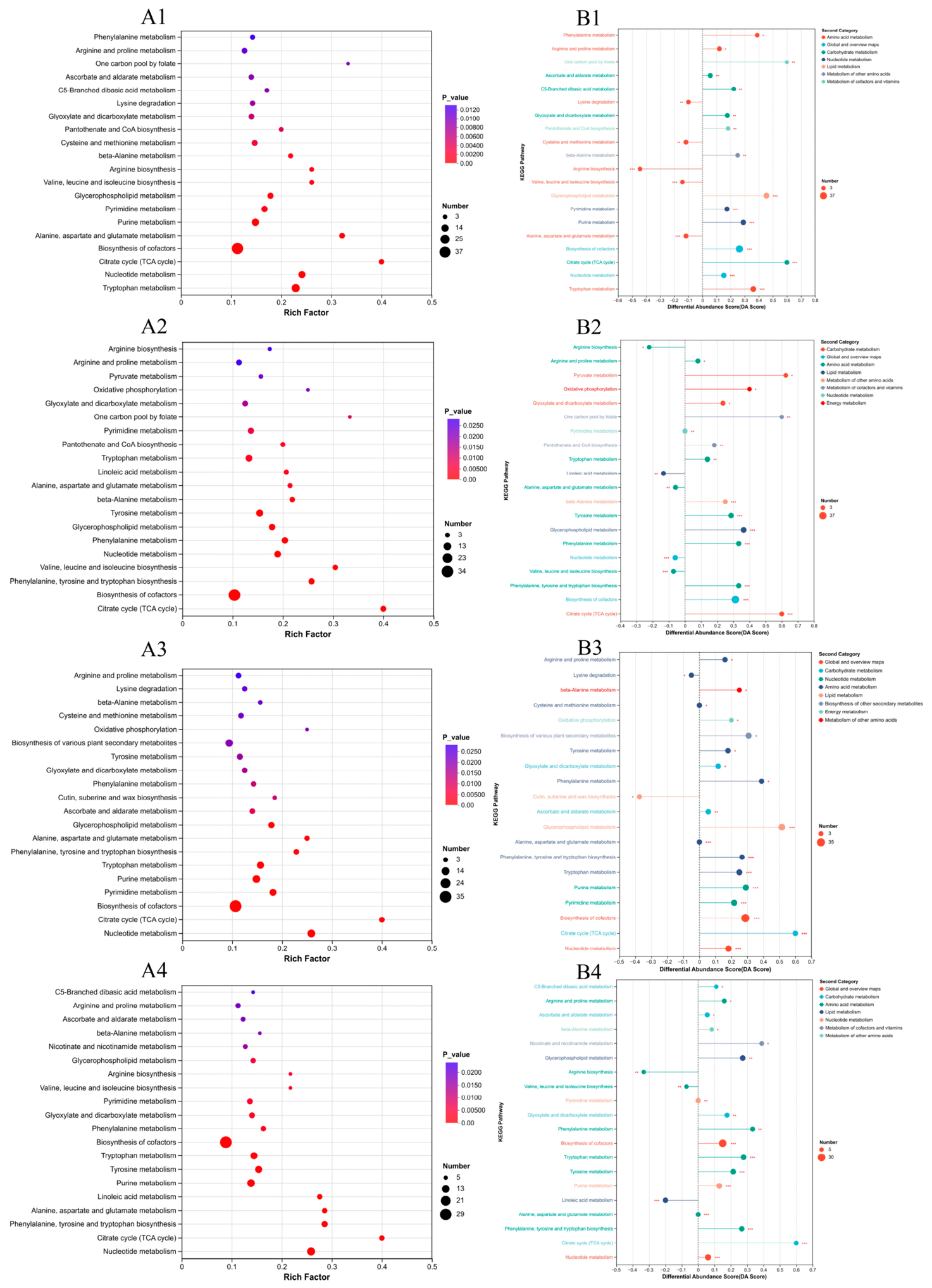
KEGG pathway enrichment analysis revealed that differentially abundant metabolites among the various drying treatment groups were primarily enriched in pathways related to amino acid metabolism, energy metabolism, nucleotide metabolism, lipid metabolism, and cofactor and vitamin metabolism (Figure 7).
Figure 7.
KEGG pathway analysis of differential metabolites in R. griseocarnosa under different drying methods. (A1–A4) Bubble plots of KEGG pathway enrichment analysis; (B1–B4) differential abundance score plots of KEGG pathways. (A1, B1) AD vs. CK; (A2, B2) FD vs. CK; (A3, B3) HD vs. CK; (A4, B4) MD vs. CK.
All four comparison groups were enriched in key metabolic pathways, including the tricarboxylic acid (TCA) cycle, biosynthesis of cofactors, nucleotide metabolism, purine metabolism, pyrimidine metabolism, glycerophospholipid metabolism, phenylalanine metabolism, tryptophan metabolism, arginine and proline metabolism, β-alanine metabolism, and glyoxylate and dicarboxylate metabolism. Among these, the TCA cycle exhibited relatively high enrichment factors across all groups, indicating its strong representation among the differential metabolites. In contrast, the biosynthesis of cofactors involved a large number of differential metabolites. Differences in pathway enrichment were also observed among drying treatments, with FD showing enrichment in pyruvate metabolism.
In addition to the shared pathways, HD showed significant enrichment in the biosynthesis of various plant secondary metabolites and cutin, suberine and wax biosynthesis (adjusted p < 0.05). These plant-associated pathway names arise from compound mapping to KEGG reference pathways [17]. In this fungal dataset, they describe the pathway assignments of the matched compounds rather than demonstrate complete plant-specific biosynthetic processes. MD showed enrichment in nicotinate and nicotinamide metabolism, reflecting differences in metabolites associated with this pathway. Many pathways enriched in AD overlapped with those enriched in the other treatment groups. Pathway differential abundance score analysis showed positive scores for the TCA cycle, glycerophospholipid metabolism, nucleotide metabolism, phenylalanine metabolism, and tryptophan metabolism in most treatment groups, reflecting predominantly increased relative signals among the corresponding differential metabolites. The enrichment of phenylalanine and tryptophan metabolism highlights treatment-dependent differences in aromatic amino acid-related metabolites. Previous studies have characterized phenylpropanoid biosynthesis in plants [33] and the structure-dependent antioxidant properties of flavonoids [27], providing biochemical context for the discussion of aromatic metabolites. The enrichment of glycerophospholipid metabolism indicates treatment-dependent differences in glycerophospholipid-related metabolites. Chemical transformations, including lipid oxidation, may contribute to these differences during drying, with temperature and oxygen exposure influencing lipid stability [34,35]. In contrast, linoleic acid metabolism, arginine biosynthesis, and certain branched-chain amino acid biosynthesis pathways showed negative differential abundance scores in some treatment groups, reflecting predominantly decreased relative signals among the corresponding differential metabolites. Drying-induced changes in tissue structure and metabolite extractability, together with compound degradation and other chemical transformations, may contribute to the observed pathway-associated metabolite patterns.
Metabolite annotations in this study were based on untargeted metabolomics and have not been confirmed using authentic standards. Matrix-related interference may have affected the antioxidant measurements, particularly the negative apparent hydroxyl radical scavenging values in AD and HD. The contributions of individual metabolites to antioxidant activity have not been directly validated. Future work should combine total phenolic content determination, authentic-standard-based identification and targeted quantification of key metabolites, and functional experiments to clarify these contributions.
4. Conclusions
Different drying treatments produced distinct microstructural features, antioxidant responses, and metabolite profiles in R. griseocarnosa. The FD samples exhibited relatively intact porous structures in both the pileus and stipe and the highest DPPH, hydroxyl, and superoxide anion radical scavenging activities among the dried samples, with superoxide anion radical scavenging activity reaching 91.61 ± 0.69%. MD produced the highest FRAP value among the dried samples, reaching 34.36 ± 0.49 μmol Fe2+/g, compared with 21.39 ± 0.85 μmol Fe2+/g for FD. Protocatechuic acid and 4-coumaric acid also showed higher relative abundances in MD than in CK. The 12 selected metabolites exhibited distinct abundance patterns across treatments, with MD, FD, and CK forming separate sample clusters and AD and HD showing relatively similar profiles. Under the conditions tested in this study, FD is preferable when preservation of the porous microstructure and higher DPPH and superoxide anion radical scavenging activities are the principal quality objectives. MD is more suitable when higher ferric-reducing capacity is prioritized, as it produced the highest FRAP value despite lower DPPH and superoxide anion radical scavenging activities than FD. Thus, the choice of drying method for R. griseocarnosa should reflect the specific structural and antioxidant properties required in the dried product.
Supplementary Materials
The following supporting information can be downloaded at https://www.mdpi.com/article/10.3390/antiox15121534/s1, Figure S1: Cumulative distributions of relative standard deviations (RSDs) of peak intensities in quality control (QC) samples under positive and negative ionization modes; Figure S2: OPLS-DA score plots and permutation tests of metabolomic differences between dried and fresh R. griseocarnosa; Table S1: Correlation coefficients (r) and p-values for the analyses presented in Figure 4; Table S2: Complete metabolite annotation dataset and supporting annotation information for the 12 candidate metabolites.
Author Contributions
Conceptualization, F.Z.; methodology, B.Y.; formal analysis, B.Y.; investigation, F.Z.; resources, D.H.; data curation, B.Y.; writing—original draft preparation, B.Y.; writing—review and editing, B.Z., Y.L., Z.X., C.M., Y.H., Y.Z. and D.H.; visualization, B.Y.; supervision, B.Z.; project administration, D.H.; funding acquisition, D.H. All authors have read and agreed to the published version of the manuscript.
Funding
This research was funded by the National Natural Science Foundation of China, grant number 31970484; the Central Financial Forestry Science and Technology Promotion Project (2026-03); the doctoral startup funds of Jiyang College of Zhejiang A&F University (No. RQ2020F18); Chongqing Modern Agricultural Industry Technology System (No. COMAITS202416).
Institutional Review Board Statement
Not applicable.
Informed Consent Statement
Not applicable.
Data Availability Statement
The original contributions presented in this study are included in the article/Supplementary Material. Further inquiries can be directed to the corresponding authors.
Conflicts of Interest
The authors declare no conflicts of interest.
Abbreviations
| FRAP | Ferric-reducing antioxidant power |
| LC–MS | Liquid chromatography–mass spectrometry |
| GC–MS | Gas chromatography–mass spectrometry |
| CK | Fresh control group |
| AD | Natural air drying |
| HD | Hot air drying |
| FD | Vacuum freeze-drying |
| MD | Microwave drying |
| SEM | Scanning electron microscopy |
| UPLC–MS/MS | Ultra-high-performance liquid chromatography–tandem mass spectrometry |
| ESI | Electrospray ionization |
| QC | Quality control |
| NPAtlas | Natural Products Atlas |
| KEGG | Kyoto Encyclopedia of Genes and Genomes |
| RSD | Relative standard deviation |
| TCA | Tricarboxylic acid |
References
- Chen, X.-H.; Xia, L.-X.; Zhou, H.-B.; Qiu, G.-Z. Chemical composition and antioxidant activities of Russula griseocarnosa sp. nov. J. Agric. Food Chem. 2010, 58, 6966–6971. [Google Scholar] [CrossRef] [Scilit]
- Zheng, C.; Li, J.; Liu, H.; Wang, Y. Review of postharvest processing of edible wild-grown mushrooms. Food Res. Int. 2023, 173, 113223. [Google Scholar] [CrossRef] [Scilit]
- Marçal, S.; Sousa, A.S.; Taofiq, O.; Antunes, F.; Morais, A.M.M.B.; Freitas, A.C.; Barros, L.; Ferreira, I.C.F.R.; Pintado, M. Impact of postharvest preservation methods on nutritional value and bioactive properties of mushrooms. Trends Food Sci. Technol. 2021, 110, 418–431. [Google Scholar] [CrossRef] [Scilit]
- Wen, X.; Li, W.; Li, W.; Chen, W.; Zhang, Z.; Wu, D.; Yang, Y. Quality characteristics and non-volatile taste formation mechanism of Lentinula edodes during hot air drying. Food Chem. 2022, 393, 133378. [Google Scholar] [CrossRef] [Scilit]
- Argyropoulos, D.; Heindl, A.; Müller, J. Assessment of convection, hot-air combined with microwave-vacuum and freeze-drying methods for mushrooms with regard to product quality. Int. J. Food Sci. Technol. 2011, 46, 333–342. [Google Scholar] [CrossRef] [Scilit]
- Radzki, W.; Sławińska, A.; Jabłońska-Ryś, E.; Gustaw, W. Antioxidant capacity and polyphenolic content of dried wild edible mushrooms from Poland. Int. J. Med. Mushrooms 2014, 16, 65–75. [Google Scholar] [CrossRef] [Scilit]
- Ratti, C. Hot air and freeze-drying of high-value foods: A review. J. Food Eng. 2001, 49, 311–319. [Google Scholar] [CrossRef] [Scilit]
- Wishart, D.S. Metabolomics: Applications to food science and nutrition research. Trends Food Sci. Technol. 2008, 19, 482–493. [Google Scholar] [CrossRef] [Scilit]
- Zhong, P.; Wei, X.; Li, X.; Wei, X.; Wu, S.; Huang, W.; Koidis, A.; Xu, Z.; Lei, H. Untargeted metabolomics by liquid chromatography-mass spectrometry for food authentication: A review. Compr. Rev. Food Sci. Food Saf. 2022, 21, 2455–2488. [Google Scholar] [CrossRef] [Scilit]
- Gauglitz, J.M.; Aceves, C.M.; Aksenov, A.A.; Aleti, G.; Almaliti, J.; Bouslimani, A.; Brown, E.A.; Campeau, A.; Caraballo-Rodríguez, A.M.; Chaar, R.; et al. Untargeted mass spectrometry-based metabolomics approach unveils molecular changes in raw and processed foods and beverages. Food Chem. 2020, 302, 125290. [Google Scholar] [CrossRef] [Scilit]
- Meng, L.; Nie, Y.; Zhou, Q.; Zheng, T.; Song, J.; Zhang, C.; Chen, H.; Lin, D.; Cao, S.; Xu, S. Effect of hot-air drying processing on the volatile organic compounds and maillard precursors of Dictyophora Rubrovalvata based on GC-IMS, HPLC and LC-MS. Food Chem. 2025, 463, 141074. [Google Scholar] [CrossRef] [Scilit]
- Liu, Y.; Meng, F.; Tang, P.; Huang, D.; Li, Q.; Lin, M. Widely Targeted Metabolomics Analysis of the Changes to Key Non-volatile Taste Components in Stropharia rugosoannulata Under Different Drying Methods. Front. Nutr. 2022, 9, 884400. [Google Scholar] [CrossRef] [Scilit]
- Chen, D.; Sheng, M.; Wang, S.; Chen, X.; Leng, A.; Lin, S. Dynamic changes and formation of key contributing odorants with amino acids and reducing sugars as precursors in shiitake mushrooms during hot air drying. Food Chem. 2023, 424, 136409. [Google Scholar] [CrossRef] [Scilit]
- Yang, B.; Huang, J.; Jin, W.; Sun, S.; Hu, K.; Li, J. Effects of Drying Methods on the Physicochemical Aspects and Volatile Compounds of Lyophyllum decastes. Foods 2022, 11, 3249. [Google Scholar] [CrossRef] [Scilit]
- Brand-Williams, W.; Cuvelier, M.-E.; Berset, C. Use of a free radical method to evaluate antioxidant activity. LWT-Food Sci. Technol. 1995, 28, 25–30. [Google Scholar] [CrossRef] [Scilit]
- Huang, D.; Ou, B.; Prior, R.L. The Chemistry behind Antioxidant Capacity Assays. J. Agric. Food Chem. 2005, 53, 1841–1856. [Google Scholar] [CrossRef] [Scilit]
- Minoru, K.; Miho, F.; Yoko, S.; Yuriko, M.; Mari, I.W. KEGG: Biological systems database as a model of the real world. Nucleic Acids Res. 2024, D1, D672–D677. [Google Scholar] [CrossRef] [Scilit]
- Ren, S.; Zheng, E.; Zhao, T.; Hu, S.; Yang, H. Evaluation of physicochemical properties, equivalent umami concentration and antioxidant activity of Coprinus comatus prepared by different drying methods. LWT 2022, 162, 113479. [Google Scholar] [CrossRef] [Scilit]
- Wang, H.; Zhang, M.; Mujumdar, A.S. Comparison of Three New Drying Methods for Drying Characteristics and Quality of Shiitake Mushroom (Lentinus edodes). Dry. Technol. 2014, 32, 1791–1802. [Google Scholar] [CrossRef] [Scilit]
- Yang, R.-L.; Li, Q.; Hu, Q.-P. Physicochemical properties, microstructures, nutritional components, and free amino acids of Pleurotus eryngii as affected by different drying methods. Sci. Rep. 2020, 10, 121. [Google Scholar] [CrossRef] [Scilit]
- Sun, M.; Ni, L.; Huang, Y.; Yang, M.; Cheng, G.; Zhang, M.; Wu, M.; Ma, C. Effects of different drying treatments on the microstructure, free amino acids, volatile compounds and antioxidant activity of Flammulina velutipes root. Food Chem. X 2023, 18, 100656. [Google Scholar] [CrossRef] [Scilit]
- Ma, L.; Chen, H.; Zhu, W.; Wang, Z. Effect of different drying methods on physicochemical properties and antioxidant activities of polysaccharides extracted from mushroom Inonotus obliquus. Food Res. Int. 2013, 50, 633–640. [Google Scholar] [CrossRef] [Scilit]
- Jeong, S.M.; Kim, S.Y.; Kim, D.R.; Jo, S.C.; Nam, K.C.; Ahn, D.U.; Lee, S.C. Effect of Heat Treatment on the Antioxidant Activity of Extracts from Citrus Peels. J. Agric. Food Chem. 2004, 52, 3389–3393. [Google Scholar] [CrossRef] [Scilit]
- Yi, J.; Guo, H.; Cao, Z.; Yang, R.; Song, Y.; Lin, Y.; Xu, A.; Yu, X. Widely Targeted Metabolomics of Morchella Sextelata After Hot-Air Drying. Food Sci. Nutr. 2025, 13, e70826. [Google Scholar] [CrossRef] [Scilit]
- Yahia, E.M.; Gutiérrez-Orozco, F.; Moreno-Pérez, M.A. Identification of phenolic compounds by liquid chromatography-mass spectrometry in seventeen species of wild mushrooms in Central Mexico and determination of their antioxidant activity and bioactive compounds. Food Chem. 2017, 226, 14–22. [Google Scholar] [CrossRef] [Scilit]
- Rice-Evans, C.; Miller, N.; Paganga, G. Antioxidant properties of phenolic compounds. Trends Plant Sci. 1997, 2, 152–159. [Google Scholar] [CrossRef] [Scilit]
- Heim, K.E.; Tagliaferro, A.R.; Bobilya, D.J. Flavonoid antioxidants: Chemistry, metabolism and structure-activity relationships. J. Nutr. Biochem. 2002, 13, 572–584. [Google Scholar] [CrossRef] [Scilit]
- Patti, G.J.; Yanes, O.; Siuzdak, G. Metabolomics: The apogee of the omics trilogy. Nat. Rev. Mol. Cell Biol. 2012, 13, 263–269. [Google Scholar] [CrossRef] [Scilit]
- Dhiman, S.B.; Kamat, J.P.; Naik, D.B. Antioxidant activity and free radical scavenging reactions of hydroxybenzyl alcohols. Biochemical and pulse radiolysis studies. Chem.-Biol. Interact. 2009, 182, 119–127. [Google Scholar] [CrossRef] [Scilit]
- Estévez Brito, R.; Rodríguez Mellado, J.M.; Ruiz Montoya, M.; Palma, A.; Rodríguez-Amaro, R.; Mayén, M. Spectroscopic determination of the dissociation constants of 2,4- and 2,5-dihydroxybenzaldehydes and relationships to their antioxidant activities. Comptes Rendus Chim. 2017, 20, 365–369. [Google Scholar] [CrossRef] [Scilit]
- Swislocka, R.; Kowalczyk, N.; Dabrowska, A.; Choinska, R.; Lewandowski, W.; Swiderski, G. Spectroscopic, antioxidant and cytotoxicity studies of vanillic acids. Sci. Rep. 2025, 15, 31396. [Google Scholar] [CrossRef] [Scilit]
- Butkhup, L.; Samappito, W.; Jorjong, S. Evaluation of bioactivities and phenolic contents of wild edible mushrooms from northeastern Thailand. Food Sci. Biotechnol. 2018, 27, 193–202. [Google Scholar] [CrossRef] [Scilit]
- Vogt, T. Phenylpropanoid Biosynthesis. Mol. Plant 2010, 3, 2–20. [Google Scholar] [CrossRef] [Scilit]
- Choe, E.; Min, D.B. Mechanisms and factors for edible oil oxidation. Compr. Rev. Food Sci. Food Saf. 2006, 5, 169–186. [Google Scholar] [CrossRef] [Scilit]
- Shahidi, F.; Zhong, Y. Lipid oxidation and improving the oxidative stability. Chem. Soc. Rev. 2010, 39, 4067. [Google Scholar] [CrossRef] [Scilit]

Disclaimer/Publisher’s Note: The statements, opinions and data contained in all publications are solely those of the individual author(s) and contributor(s) and not of MDPI and/or the editor(s). MDPI and/or the editor(s) disclaim responsibility for any injury to people or property resulting from any ideas, methods, instructions or products referred to in the content. |
© 2026 by the authors. Licensee MDPI, Basel, Switzerland. This article is an open access article distributed under the terms and conditions of the Creative Commons Attribution (CC BY) license.