


Abstract
There is increasing interest in the involvement of antioxidative systems in protecting from depression. Among these, Nrf2 occupies a central place. We aimed to review the role of Nrf2 in depression. For this reason, we conducted a PubMed search using as search strategy (psychiatr*[ti] OR schizo*[ti] OR psychot*[ti] OR psychos*[ti] OR depress*[ti] OR MDD[ti] OR BD[ti] OR bipolar[ti] OR Anxiety[ti] OR antidepress*[ti] OR panic[ti] OR obsess*[ti] OR compulsio*[ti] OR “mood disord*”[ti] OR phobi*[ti] OR agoraphob*[ti] OR anorex*[ti] OR anorect*[ti] OR bulimi*[ti] OR “eating disorder*”[ti] OR neurodevelopm*[ti] OR retardation[ti] OR autism[ti] OR autistic[ti] OR ASM[ti] OR adhd[ti] OR “attention-deficit”[ti]) AND nrf2, which on the 9th of March produced 208 results of which 89 were eligible for our purposes. Eligible articles were studies reporting data of Nrf2 manipulations or content by any treatment in human patients or animals with any animal model of depression. Most studies were on mice only (N = 58), 20 on rats only, and three on both rats and mice. There were two studies on cell lines (in vitro) and one each on nematodes and fish. Only four studies were conducted in humans, one of which was post mortem. Most studies were conducted on male animals; however, human studies were carried out on both men and women. The results indicate that Nrf2 is lower in depression and that antidepressant methods (drugs or other methods) increase it. Antioxidant systems and plasticity-promoting molecules, such as those in the Nrf2–HO-1, BDNF–TrkB, and cyclic AMP–CREB pathways, could protect from depression, while glycogen synthase kinase-3β and nuclear factor κB oppose these actions, thus increasing depressive-like behaviours. Since Nrf2 is also endowed with tumorigenic and atherogenic potential, the balance between benefits and harms must be taken into account in designing novel drugs aiming at increasing the intracellular content of Nrf2.
1. Introduction
Recently, much research has been devoted to the study of inflammation and its role in the context of a wide variety of pathological conditions. Inflammation and oxidative stress were found to enhance each other, thus establishing a pathological state [1], which may be found in various psychiatric disorders. The variety of external stimuli to which organisms are subjected triggers adaptive responses, which are designed to restore homoeostasis through a fine balance between oxidation and antioxidant activity [2].
An imbalance between the generation of reactive oxygen species (ROS) and antioxidant defences results in increased oxidative stress [3], with a consequent increase in neuroinflammation, mitochondrial dysfunction, and cell degeneration processes such as apoptosis and ferroptosis, which proved to be crucial in many psychiatric disorders. This is not surprising if we consider that the brain consumes massive doses of oxygen and contains high concentrations of oxidative lipids, thus being extremely vulnerable to oxidative stress-induced damage [2].
In this framework, it is important to draw attention to nuclear factor erythroid-2 (Nrf2), the main endogenous negative regulator of oxidation [4]. Its activation determines the expression of numerous antioxidants and cytoprotective genes capable of modulating oxidative stress. Nrf2 also presides over the regulation of genes involved in the oxidative stress-related pathological processes mentioned above. Consequently, dysregulation in Nrf2 expression with reduced cortical levels may contribute to the aetiopathogenesis of numerous pathological conditions, including psychiatric disorders and neurodegenerative diseases.
Nrf2 is a protein transcription factor composed of 605 amino acids, encoded by the NFE2L2 gene and belonging to the Cap’n’collar (CNC) family of transcription factors [5]. It contains seven highly conserved functional domains called Nrf2-ECH homology 1 (Neh1-Neh7). Neh1 and Neh3 interact with specific DNA sequences called antioxidant response elements (ARE) [6], thus promoting the transcription of enzymes with antioxidant activity. Neh2 interacts with Kelch-like ECH-associated protein 1 (Keap1), the main negative regulator of Nrf2. Neh4 and Neh5 interact with the cyclic adenosine monophosphate (cAMP)-response element-binding protein (CREB), which also promotes transcriptional activation [7]. In contrast, Neh6 can link to β-transducin repeat-containing protein (β-TrCP) and is involved in Keap1-independent degradation of Nrf2. Finally, Neh7 inhibits the Nrf2-ARE signalling pathway by binding to retinoic X receptor alpha (RXRα) [8]. Therefore, the activity of Nrf2 is subjected to both Keap1-dependent and Keap1-independent regulation.
Keap 1 represents the main Nrf2 suppressor; it forms a homodimer capable of binding ETGE and DLG motifs (stronger and weaker binding sites of Keap-1, respectively; the former is located in the loop region of the antiparallel β-sheet, while the latter is N-terminal to the α-helix [9]) included in the Neh2 domain of Nrf2. Under physiological conditions, the Keap1-Nrf2 complex combines with the E3-ubiquitin ligase Cullin 3 (Cul3) complex, leading to ubiquitination and proteasomal degradation of Nrf2 [10]. Negative regulation is also mediated by the phosphorylation of Nrf2 by glycogen synthase kinase-3 beta (GSK-3β) and mitogen-activating protein kinase (MAPK) [11].
When oxidative stress increases and ROS accumulation occurs, there is a dissociation of the Keap1-Nrf2 complex induced by conformational changes of a Keap1 domain, inhibiting ubiquitination and subsequent degradation of Nrf2. Dissociated from Keap1, Nrf2 is free to translocate into the nucleus and bind specific genomic sequences in order to promote antioxidant enzyme transcription. At the same time, there is a positive Keap1-independent regulation mediated by other kinases. The kinases involved in the phosphorylation and subsequent activation of Nrf2 include protein kinase C (PKC), casein kinase II (CK2), protein kinase R (PKR), c-Jun N-terminal kinase (JNK), and extracellular regulated kinases (ERKs) [12,13,14,15]. Finally, brain-derived neurotrophic factor (BDNF) can also promote the activation and subsequent migration of Nrf2 into the nucleus [16].
In addition to its antioxidant activity, Nrf2 is also directly involved in oxidative stress-related pathological processes by regulating their activation. In particular, there is a direct cross-talk between Nrf2 and p62, an autophagy key protein. Nrf2 can promote the expression of genes involved in autophagy, while p62 can compete with Nrf2 in binding to Keap1 in a positive feedback that is associated with cytoprotection [6,17]. In addition, Nrf2 is also involved in a special form of autophagy called mitophagy, the alteration of which allegedly plays an important role in psychiatric disorders. While it preserves mitochondrial integrity, mitophagy entails the elimination of damaged or redundant mitochondria through autophagy [18].
Furthermore, recent studies of Nrf2 found that its inducers promote the suppression of the pro-inflammatory phenotype of microglia through regulating BDNF, the reduction of which is found in many psychiatric disorders characterised by neuroinflammation [16,19,20,21]. The existence of reciprocal regulation has emerged between BDNF and Nrf2; the latter, in connecting with the exon I promoter of bdnf, can activate BDNF; on the other side, BDNF can increase the nuclear translocation of Nrf2, thus promoting its antioxidant activity [16].
Finally, several studies also cast light on the involvement of Nrf2 in ferroptosis, an iron-dependent form of programmed cell death characterised by the accumulation of lipid peroxides (lipids damaged by oxidation). Notably, Nrf2 does not only regulate numerous genes involved in iron metabolism and homoeostasis but also promotes the basal expression of the lipid hydroperoxidase, glutathione peroxidase-4 (GPX4), which converts toxic lipid peroxides to nontoxic lipid alcohols [22].
Impaired response to oxidative stress has been shown in animal models for stress disorders, such as post-traumatic stress disorder (PTSD) [23,24,25,26], but only a few studies have focused on Nrf2 [27,28,29]. PTSD and depression are long considered to represent stress disorders and share common neurobiological patterns [30]. Recently, the Nrf2-depression connection has received attention [2]. We decided to search the literature for studies investigating the ties between depression paradigms in the animal and/or major depressive disorder in humans and Nrf2 as a proxy of a mechanism that counters oxidative stress. Establishing such a relationship would allow us to concentrate on the production of drugs that would promote the search for drugs interfering with intracellular oxidative processes.
2. Methods
To systematically review the ties between depression and Nrf2, we first conducted a PubMed search involving all possible mental and psychiatric disorders and then focused on depression. The inclusion of other than depressive disorders/states was to make sure that depression during the course of other mental disorders was not dealt with. We employed the following search strategy: (psychiatr*[ti] OR schizo*[ti] OR psychot*[ti] OR psychos*[ti] OR depress*[ti] OR MDD[ti] OR BD[ti] OR bipolar[ti] OR Anxiety[ti] OR antidepress*[ti] OR panic[ti] OR obsess*[ti] OR compulsio*[ti] OR “mood disord*”[ti] OR phobi*[ti] OR agoraphob*[ti] OR anorex*[ti] OR anorect*[ti] OR bulimi*[ti] OR “eating disorder*”[ti] OR neurodevelopm*[ti] OR retardation[ti] OR autism[ti] OR autistic[ti] OR ASM[ti] OR adhd[ti] OR “attention-deficit”[ti]) AND nrf2. The choice of the search strategy was based on consultations among all authors.
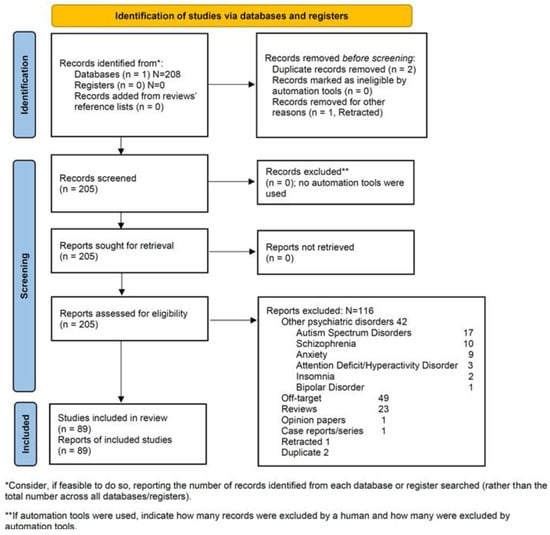
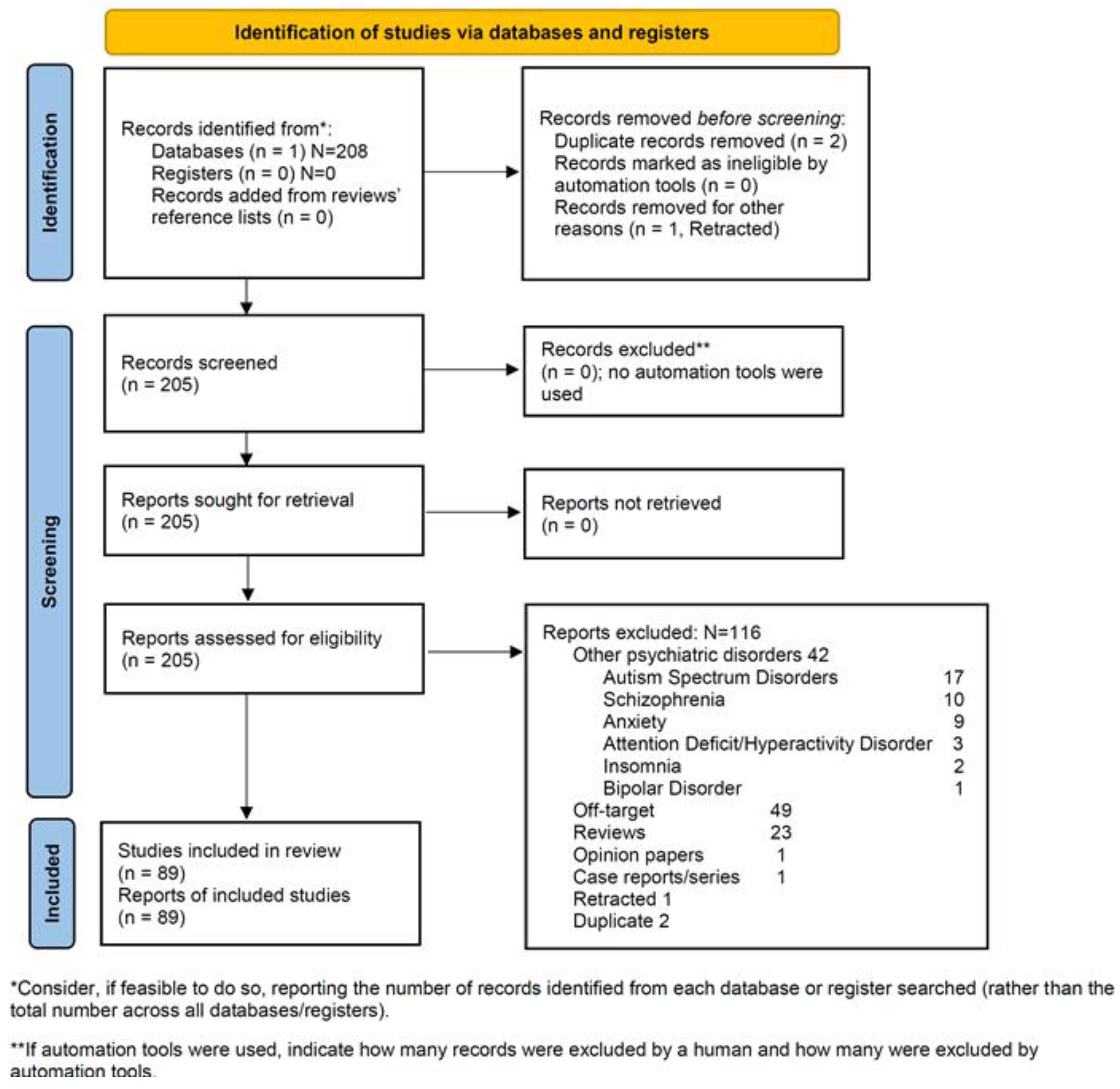
Following search performance, we characterised the nature of all ensuing records and labelled them accordingly. This resulted in their being either included or excluded. The inclusion/exclusion labelling with the reasons for exclusion is shown in the Online Supplemental material and in Figure 1, where the PRISMA flow diagram is displayed. In carrying out our review, we followed the 2020 Preferred Reporting Items for Systematic reviews and Meta-Analyses (PRISMA) statement [31]. The 2020 PRISMA Checklist may be found in the Online Supplement. We assessed the Risk of bias (RoB) of the included studies with the Cochrane RoB 2.0 tool [32]. We performed an evaluation of the RoB for each included study. The results are shown in the Online Supplement.
Figure 1.
PRISMA 2020 flow diagramme (From [31]: Page, M.J.; McKenzie, J.E.; Bossuyt, P.M.; Boutron, I.; Hoffmann, T.C.; Mulrow, C.D.; Shamseer, L.; Tetzlaff, J.M.; Akl, E.A.; Brennan, S.E.; et al. The PRISMA 2020 statement: An updated guideline for reporting systematic reviews. BMJ 2021, 372, n71. https://doi.org/10.1136/bmj.n71. For more information, visit: http://www.prisma-statement.org/ accessed on 12 February 2023) of the review.
Eligibility was based on being an original study on any animal or tissue, including humans, on investigating depression or depression models and providing data on Nrf2 levels. All other studies were excluded. Excluded were case reports, opinion articles, such as editorials, letters to the editor, comments of other work, reviews, and meta-analyses (however, we hand-searched their reference lists to identify other possibly eligible studies), and studies not providing data. Eligibility for each paper was established with the consensus of all authors obtained through Delphi rounds, in which all authors participated, either in-person or online. The same applied to the compilation of the RoB.
3. Results
Our search, eventually conducted on the 10th of March 2023, yielded 208 results on PubMed, of which 89 studies were eligible, as summarised in Table 1 (human studies, of which two used cell lines in vitro) and Table 2 (animal studies). In particular, there were 78 articles labelled Depression and 11 Depression and Anxiety; these amounted to 89 articles. The remaining 116 studies were excluded. Depression-free articles focused on autism (N = 17), schizophrenia (N = 10), anxiety (N = 9), attention-deficit/hyperactivity disorder (N = 3), insomnia (N = 2), and bipolar disorder alone (N = 1). Other articles that did not meet the inclusion criteria were Opinions (N = 1), Case reports (N = 1), and Reviews (N = 23), while many articles were off-target (N = 49) in that they did not focus any psychiatric disorder and were unfocused in their designs or they were unrelated to the subject of our inquiry. Furthermore, there were two duplicates and a retracted paper, but another paper from the same group had not been retracted and dealt with the same issue as the retracted one. Publication dates spanned from 23-March-2006 to 1-March-2023 for the searched papers and 23-April-2013 to 1-March-2023 for the eligible ones. The included and excluded studies with their reasons for exclusion are shown in the Supplement. The selection process and reasons for exclusion are depicted in the PRISMA flowchart (Figure 1).
Of the 89 studies included in this review, most were conducted on mice only (N = 58; 65.17%), 20 were conducted on rats only (22.47%), and three on both rats and mice (3.37%), four on humans (4.49%), two on human cell lines in vitro (2.25%), one on fish and worms each (1.12%). Of the 58 studies carried out on mice only, 50 used only male animals, seven used only female, and one both used animals of both sexes; 31 used C57BL/6 strains; one reported unspecified C57 mice (which were presumably C57BL/6, based on other articles by the same group of authors), 10 used unspecified Swiss strains, five used CD-1, eight used Balb/c, five ICR, four Kunming, one BXD Recombinant Inbred, and one Murphy Roths Large lymphoproliferative Mouse (MRL/lpr); in eight of these studies, investigators used more than one strain. All 20 studies conducted on rats used only male animals, 14 Sprague Dawley and six Wistar, of which two were Hannover and two albino Wistar, while all three studies that employed both mice and rats were conducted using male-only animals, all three used Sprague Dawley rats (1 also Groningen, a strain characterised by high aggression levels [33]) and C57BL/6 mice. The four human studies included patients and matched controls of both sexes, while the only post mortem study did not report the sex or the age of included patients. The study that used fish employed the Japanese rice fish, medaka (Oryzias latipes), both male and female, and the one that used nematodes used Caenorhabditis elegans, while of the two conducted on cell lines, one used the macrophage RAW26.7 line (primary CD14+ monocytes from human donors of both sexes transformed in macrophages through 1-week Colony Stimulation Factor-1 stimulation) and the other used human neuroblastoma SH-SY5Y cells. Of the 85 studies that specified the sex of the animals they used in their experiments, 79 used males (92.94%) and only 12 used females (14.12%). Limiting the sex of animals to the 81 rodent studies, which constituted the bulk of eligible studies included in this review, it results that 73 studies employed male-only animals (90.12%), while only seven studies (9.59%) used female-only animals. This shows a strong bias toward the use of male animals in depression studies of rodent models that cannot be easily translated to humans, given that the majority of people with depression are women [34,35] or female adolescents [36].
Of the eligible studies, most were conducted in China (N = 49, 55.06%; only three were located in Beijing, China’s capital, while six studies were conducted in the Guangdong Province, i.e., three in Shenzhen, two in Guangzhou, and one in Zhanjiang), eight in Brazil (8.99%) and seven in Spain, of which one was a multinational study shared with other four countries (6.97%), five in Japan (5.62%), four in Egypt (4.49%), three in the US (3.37%), two in South Korea and France (2.25% each), two in Germany and Poland, with one multinational shared (1.35% each), one each in India, Iran, Italy, Nigeria, Pakistan, Serbia, and Turkey (1.12% each), and one in both Romania and Sweden, sharing the same multinational study as the other three (0.22% each). Of the 89 included studies, 15 did not use any specific drug to identify its effects on Nrf2 but rather focused on the effects of specific animal depression models on the entire antioxidant system. These 15 studies were conducted in China (N = 8), Spain (N = 3), Serbia, the USA, Brazil, and South Korea (N = 1 each). Plant extracts or animal tissue extracts were tested in 29 Chinese studies, three Japanese studies, one Pakistani, one Nigerian, and one South Korean study, for a total of 35 studies, representing 39.33% of all included studies, with China accounting for 82.86% of these studies and plant extract using studies for 59.18% of all Chinese studies.
Table 1.
Summary of human studies investigating the role of Nrf2 in depression (in vivo, post mortem, in vitro on cell lines).
Table 2.
Summary of animal studies investigating the role of Nrf2 in depression.
4. Discussion
In this review, we collected data on animal and human studies on depression and the role of Nrf2 as a probe of the antioxidant system function and found an antidepressant effect to be the consequence of the activation of the Nrf2-HO-1 pathway, with no studies pointing to the opposite direction. In this context, the role of neuroinflammation in being associated with depressive-like states clearly emerges, as well as the role of antioxidant systems in countering neuroinflammation and its markers, with Nrf2 standing at its crossroad. We may thus suppose that depression involves multiple systems and the antioxidant system, and Nrf2, in particular, counteract many actions of the failing multi-system state associated with depressive behaviour. Many of the substances that help overcome the alterations caused in the organism by depression are of natural origin and constitute long-used remedies for many other conditions. The antioxidant research line in depression that focuses on the actions of Nrf2 is relatively recent, dating back to 2013 [43], although the substance was isolated in 1994 [126], almost three decades ago.
The rate of publications on this issue has considerably increased across the years, with papers focusing on psychiatric disorders increasing almost exponentially from 26 in 2020 to 37 in 2021 and to 58 in 2022, witnessing increased interest and awareness of its importance in the pathophysiology of psychiatric disorders. Studies on depression reflect a similar trend. From eight studies in 2019, which increased to 16 in 2020, 18 in 2021, and 23 in 2022 to the beginning of 2023.
Most of the studies were conducted on rodents, mainly mice and, most importantly, male animals. This limits the extension of results to female animals, but it should be noted that findings in females were not dissimilar from those in males.
The studies included here were based on different animal depression paradigms, with many studies using stress-induced DLB, mostly elicited by LPS [40,43,51,53,58,59,63,65,67,73,75,79,85,88,95,105,106,125], or through corticosterone or cortisol [44,46,80,87,98], while other studies used chronic unpredictable mild stress [61,72,76,83,93,96,97,99,100,101,106,108,111,122,124] or social defeat stress [50,52,88,102,107,120]. Two studies used tumour-related depression models [71,91], while just one study each used post-ovariectomised depression [121], pentylenetetrazol-induced seizures [116], maternal separation [117], and olfactory bulbectomy [113] models (Table 1). Various studies used Nrf2 knock-out animals [49,62,84,88,120] or knock-out of the inflammation and histone methylation modulator protein arginine methyltransferase [67]. Nrf2 knock-out or knock-down apparently impairs neurochemical indexes and behavioural test performance, while protein arginine methyltransferase knock-out decreases depressive indexes [67]. Despite heterogeneity, findings all pointed to the Nrf2-antioxidant pathway restoring impaired neurochemistry and behavioural test performance.
Anti-inflammatory or anti-neuroinflammatory effects of employed antidepressants and putative antidepressant substances, such as the many plant extracts used in the studies we considered here, were shown to be related to various improvements in neurochemical indexes and behavioural tests [43,48,59,71,76,81,85,91,95,108,111,123,125].
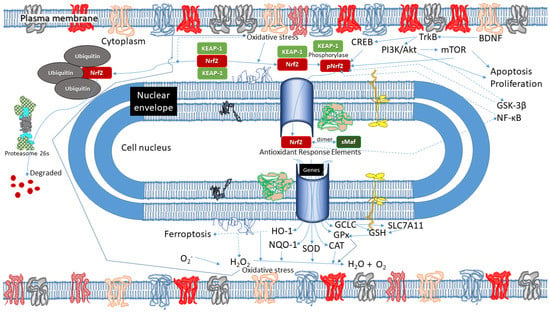
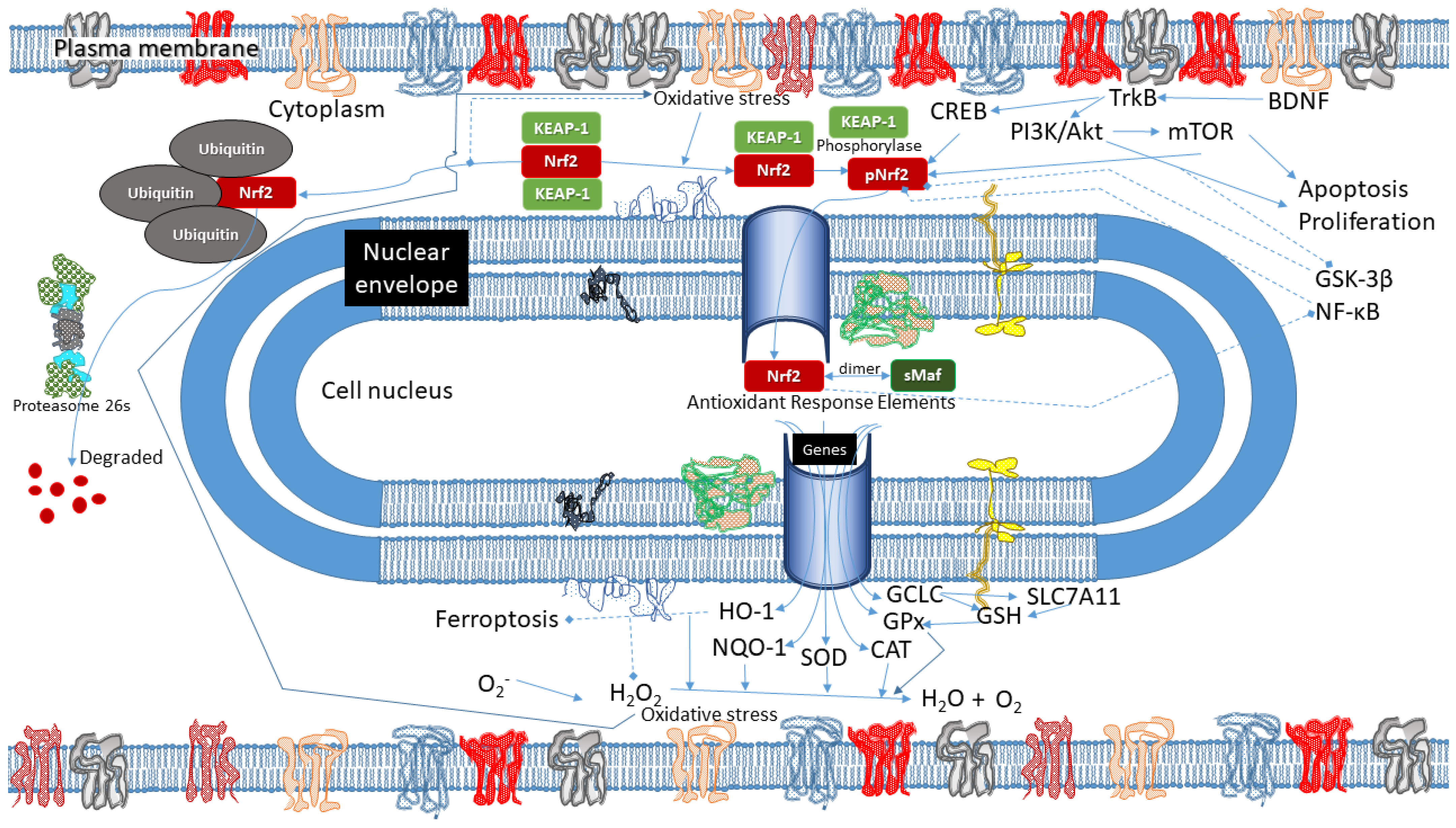
Studies were consistent in measuring cyclic AMP responsive element binding protein (CREB) activity, in that increased phospho-CREB or CREB levels were associated with an antidepressant response [38,46,81,83,103,109,112]; remarkably, studies on peripheral tissues in man [38] and hippocampal content in mice [81] pointed to the same direction. Additionally, studies of BDNF showed that increased BDNF activity was associated with antidepressant effects and that animals displaying depressive features have low BDNF contents in the periphery and the brain [44,52,57,57,58,66,67,69,81,83,85,88,93,111,112,114,121]. It has recently been shown that most, if not all, antidepressant drugs bring about their antidepressant effects by binding the tyrosine kinase receptor 2 (TrkB), a molecule tied to the action of BDNF [127,128]. The findings of the studies reviewed here quite match this concept; increased TrkB/BDNF signalling was related to antidepressant effects, and low levels were associated with depressive behaviour [11,50,66,69,84,93,103,111,120]. Increased activity also of protein kinase B (Akt-1), which is an antioxidant in the wingless-GSK pathway and carries on some of the biological [128,129,130] and clinical [131] actions of lithium, which also inhibits GSK-3β [132,133,134], was found to be associated with antidepressant effects in the studies included in this review [42,45,47,74,75,93,94,110,119]. On the opposite side are found nuclear factor kappa B (NF-κB) and glycogen synthase kinase (GSK) pathways; the higher the NF-κB [38,39,67,69,73,75,80,85,91,98,100,103,113,115] and GSK3β levels [45,79,109], the worse the depressive indexes. Therefore, it appears that on one side, there are antioxidant systems and growth factors promoting plasticity, such as Nrf2–HO-1, BDNF, Akt, TrkB, and CREB, which are protective from depression and, on the other side, GSK-3β and NF-κB, which promote depressive behaviour (Figure 2). Therefore, we may suppose that new antidepressant drug discovery could involve promoting drugs that increase Nrf2–HO-1, BDNF, Akt, TrkB, and CREB activity, while downplaying GSK-3β and NF-κB. However, it is not so simple to identify the characteristics of drugs that act only where they will wishfully carry on the desired effect because drugs acting within cells must cross plasma membranes selectively, reach their intracellular target in those cells needing their actions, and not everywhere. Depression is a multi-system and multi-organ condition but not an all-system derangement, so the presence of an extraordinarily penetrating drug in some cells could be related to undesirable or adverse effects. Furthermore, not all actions of Nrf2 are good for the body. Nrf2 may promote tumours [135,136] and atherogenesis [137,138], so any drug acting on Nrf2 must avoid these two and maybe other unknown potentially harmful actions.
Figure 2.
Simplified depiction of the mechanism of action of Nrf2 and the pathways it interacts with. Arrows, activation; broken lines with rhomboid ending, inhibition. Abbreviations. Akt, Protein kinase B; BDNF, brain-derived neurotrophic factor; CREB, cyclic AMP responsive element binding protein; GCLC, Glutamate-cysteine ligase; GPx, glutathione peroxidase; GSH, glutathione; GSK-3β, glycogen synthase kinase 3-beta; HO-1, haem oxygenase 1; mTOR, mammalian target of rapamycin; NF-κB, nuclear factor kappa B; NQO-1, NAD(P)H quinone dehydrogenase 1; PI3K, phosphatidylinositol-3-kinase; SLC7A11, Solute Carrier Family 7 Member 11 (cystine/glutamate transporter); sMAF, small musculoaponeurotic fibrosarcoma proteins; SOD, superoxide dismutase; TrkB, tropomyosin receptor kinase B.
5. Limitations
This review has several limitations in that the animal studies focused mostly on rodents (mice and rats), and few focused on other animals (fish and nematodes) or cell lines; therefore, the results cannot extend to other animal species. Human studies were only four (one post mortem), and their methodologies were too different from animal protocols; hence the results from the latter are not translatable to the former. Furthermore, a sex bias exists in animal studies (mostly males) and not in the few human studies. Depression is overrepresented in women in humans, so it might be that testing it in male animals is not a good idea, but female rodents pose significant problems in conducting scientific experiments using the paradigms of the studies included in this review. The animal models of depression are not easy to translate to humans and into clinical practice.
6. Conclusions
Nrf2 is at the crossroad of many cellular actions. It directs antioxidant pathways and receives many intracellular signals to which it attempts to respond in a balanced way. Its function appears to be impaired in depression, and it is also possible that its manipulation could prove to be beneficial in human depression; however, there is much to discover. There is hope to discover drugs that cross the blood–brain barrier, or use some phytopharmaca or their derivatives, such as gastrodin, or use drugs stimulating anti-inflammatory cytokines that could counteract neuroinflammation. From the studies included in this review, depression appears to be strictly tied to inflammatory mechanisms. Provided that new drugs acting on the Nrf2 antioxidant pathway can avoid tumorigenesis and atherogenesis, Nrf2 can be a useful target for novel drug development.
Supplementary Materials
The following supporting information can be downloaded at: https://www.mdpi.com/article/10.3390/antiox12040817/s1, Online Supplement.
Author Contributions
G.S., G.D.K., M.M., D.P.R.C. and L.M. (Laura Monti) conceived the review; S.M., A.B. and G.D.K. wrote the introduction; S.M., A.B., O.M.F., L.M. (Lorenzo Moccia), E.B., A.S., D.P.R.C. and G.D.K. wrote the methods, decided eligibility along all others and wrote results and discussion; L.M. (Laura Monti), L.M. (Lorenzo Moccia), M.M., D.J., G.D.K., L.J., S.M., A.B., D.P.R.C. and G.D.K. performed literature searches; S.M., A.B., L.M. (Laura Monti), L.M. (Lorenzo Moccia), M.M. and G.D.K. provided the first draft; A.S., D.J., L.J., L.M. (Lorenzo Moccia), D.P.R.C., G.D.K. and G.S. supervised the writing of the manuscript, wrote the conclusions, and edited the final form. All authors have read and agreed to the published version of the manuscript.
Funding
This research received no external funding.
Institutional Review Board Statement
Not applicable.
Informed Consent Statement
Not applicable.
Data Availability Statement
The data presented in this study are available in the article and Supplementary Materials.
Acknowledgments
The authors are grateful to the Scientific Administration of the Bibliographic and Bibliometric Support Service, Fondazione Policlinico A. Gemelli IRCCS, in particular, Maria Pattuglia, and Mimma Ariano, Ales Casciaro, Teresa Prioreschi, and Susanna Rospo, Librarians of the Sant’Andrea Hospital, Faculty of Medicine and Psychology, Sapienza University of Rome, for rendering precious bibliographical material accessible. They all have consented to the acknowledgement.
Conflicts of Interest
The authors declare no conflict of interest.
References
- Cao, H.; Zuo, C.; Gu, Z.; Huang, Y.; Yang, Y.; Zhu, L.; Jiang, Y.; Wang, F. High frequency repetitive transcranial magnetic stimulation alleviates cognitive deficits in 3xTg-AD mice by modulating the PI3K/Akt/GLT-1 axis. Redox Biol. 2022, 54, 102354. [Google Scholar] [CrossRef] [Scilit]
- Zuo, C.; Cao, H.; Song, Y.; Gu, Z.; Huang, Y.; Yang, Y.; Miao, J.; Zhu, L.; Chen, J.; Jiang, Y.; et al. Nrf2: An all-rounder in depression. Redox Biol. 2022, 58, 102522. [Google Scholar] [CrossRef] [Scilit]
- Betteridge, D.J. What is oxidative stress? Metabolism 2000, 49 (Suppl. 1), 3–8. [Google Scholar] [CrossRef] [Scilit]
- Francisqueti-Ferron, F.V.; Ferron, A.J.T.; Garcia, J.L.; Silva, C.C.V.A.; Costa, M.R.; Gregolin, C.S.; Moreto, F.; Ferreira, A.L.A.; Minatel, I.O.; Correa, C.R. Basic concepts on the role of nuclear factor erythroid-derived 2-like 2 (Nrf2) in age-related diseases. Int. J. Mol. Sci. 2019, 20, 3208. [Google Scholar] [CrossRef] [Scilit]
- Saha, S.; Buttari, B.; Panieri, E.; Profumo, E.; Saso, L. An overview of Nrf2 signaling pathway and its role in inflammation. Molecules 2020, 25, 5474. [Google Scholar] [CrossRef] [Scilit]
- Zhang, W.; Feng, C.; Jiang, H. Novel target for treating Alzheimer’s Diseases: Crosstalk between the Nrf2 pathway and autophagy. Ageing Res. Rev. 2021, 65, 101207. [Google Scholar] [CrossRef] [Scilit]
- Sivandzade, F.; Prasad, S.; Bhalerao, A.; Cucullo, L. NRF2 and NF-κB interplay in cerebrovascular and neurodegenerative disorders: Molecular mechanisms and possible therapeutic approaches. Redox Biol. 2019, 21, 101059. [Google Scholar] [CrossRef] [Scilit] [PubMed]
- Osama, A.; Zhang, J.; Yao, J.; Yao, X.; Fang, J. Nrf2: A dark horse in Alzheimer’s disease treatment. Ageing Res. Rev. 2020, 64, 101206. [Google Scholar] [CrossRef] [Scilit]
- Tong, K.I.; Padmanabhan, B.; Kobayashi, A.; Shang, C.; Hirotsu, Y.; Yokoyama, S.; Yamamoto, M. Different electrostatic potentials define ETGE and DLG motifs as hinge and latch in oxidative stress response. Mol. Cell. Biol. 2007, 27, 7511–7521. [Google Scholar] [CrossRef] [Scilit] [PubMed]
- Mohan, S.; Gupta, D. Crosstalk of toll-like receptors signaling and Nrf2 pathway for regulation of inflammation. Biomed. Pharmacother. 2018, 108, 1866–1878. [Google Scholar] [CrossRef] [Scilit] [PubMed]
- Chowdhry, S.; Zhang, Y.; McMahon, M.; Sutherland, C.; Cuadrado, A.; Hayes, J.D. Nrf2 is controlled by two distinct β-TrCP recognition motifs in its Neh6 domain, one of which can be modulated by GSK-3 activity. Oncogene 2013, 32, 3765–3781. [Google Scholar] [CrossRef] [Scilit] [PubMed]
- Huang, H.-C.; Nguyen, T.; Pickett, C.B. Phosphorylation of Nrf2 at Ser-40 by protein kinase C regulates antioxidant response element-mediated transcription. J. Biol. Chem. 2002, 277, 42769–42774. [Google Scholar] [CrossRef] [Scilit] [PubMed]
- Cullinan, S.B.; Diehl, J.A. PERK-dependent activation of Nrf2 contributes to redox homeostasis and cell survival following endoplasmic reticulum stress. J. Biol. Chem. 2004, 279, 20108–20117. [Google Scholar] [CrossRef] [Scilit] [PubMed]
- Keum, Y.-S.; Yu, S.; Chang, P.P.-J.; Yuan, X.; Kim, J.-H.; Xu, C.; Han, J.; Agarwal, A.; Kong, A.-N.T. Mechanism of action of sulforaphane: Inhibition of p38 mitogen-activated protein kinase isoforms contributing to the induction of antioxidant response element-mediated heme oxygenase-1 in human hepatoma HepG2 cells. Cancer Res. 2006, 66, 8804–8813. [Google Scholar] [CrossRef] [Scilit] [PubMed]
- Pi, J.; Bai, Y.; Reece, J.M.; Williams, J.; Liu, D.; Freeman, M.L.; Fahl, W.E.; Shugar, D.; Liu, J.; Qu, W.; et al. Molecular mechanism of human Nrf2 activation and degradation: Role of sequential phosphorylation by protein kinase CK2. Free Radic. Biol. Med. 2007, 42, 1797–1806. [Google Scholar] [CrossRef] [Scilit] [PubMed]
- Nguyen, C.D.; Yoo, J.; Hwang, S.Y.; Cho, S.Y.; Kim, M.; Jang, H.; No, K.O.; Shin, J.C.; Kim, J.H.; Lee, G. Bee venom activates the Nrf2/HO-1 and TrkB/CREB/BDNF pathways in neuronal cell responses against oxidative stress induced by Aβ1-42. Int. J. Mol. Sci. 2022, 23, 1193. [Google Scholar] [CrossRef] [Scilit]
- Lau, A.; Wang, X.-J.; Zhao, F.; Villeneuve, N.F.; Wu, T.; Jiang, T.; Sun, Z.; White, E.; Zhang, D.D. A noncanonical mechanism of Nrf2 activation by autophagy deficiency: Direct interaction between Keap1 and p62. Mol. Cell. Biol. 2010, 30, 3275–3285. [Google Scholar] [CrossRef] [Scilit]
- Guo, L.; Jiang, Z.-M.; Sun, R.-X.; Pang, W.; Zhou, X.; Du, M.-L.; Chen, M.-X.; Lv, X.; Wang, J.-T. Repeated social defeat stress inhibits development of hippocampus neurons through mitophagy and autophagy. Brain Res. Bull. 2022, 182, 111–117. [Google Scholar] [CrossRef] [Scilit]
- Hashimoto, K. Essential role of Keap1-Nrf2 signaling in mood disorders: Overview and future perspective. Front. Pharmacol. 2018, 9, 1182. [Google Scholar] [CrossRef] [Scilit]
- Björkholm, C.; Monteggia, L.M. BDNF a key transducer of antidepressant effects. Neuropharmacology 2016, 102, 72–79. [Google Scholar] [CrossRef] [Scilit]
- Tang, R.; Cao, Q.-Q.; Hu, S.-W.; He, L.-J.; Du, P.-F.; Chen, G.; Fu, R.; Xiao, F.; Sun, Y.-R.; Zhang, J.-C.; et al. Sulforaphane activates anti-inflammatory microglia, modulating stress resilience associated with BDNF transcription. Acta Pharmacol. Sin. 2022, 43, 829–839. [Google Scholar] [CrossRef] [Scilit] [PubMed]
- Abdalkader, M.; Lampinen, R.; Kanninen, K.M.; Malm, T.M.; Liddell, J.R. Targeting Nrf2 to suppress ferroptosis and mitochondrial dysfunction in neurodegeneration. Front. Neurosci. 2018, 12, 466. [Google Scholar] [CrossRef] [Scilit] [PubMed]
- Wilson, C.B.; McLaughlin, L.D.; Nair, A.; Ebenezer, P.J.; Dange, R.; Francis, J. Inflammation and oxidative stress are elevated in the brain, blood, and adrenal glands during the progression of post-traumatic stress disorder in a predator exposure animal model. PLoS ONE 2013, 8, e76146. [Google Scholar] [CrossRef] [Scilit]
- Sun, X.R.; Zhang, H.; Zhao, H.T.; Ji, M.H.; Li, H.H.; Wu, J.; Li, K.Y.; Yang, J.J. Amelioration of oxidative stress-induced phenotype loss of parvalbumin interneurons might contribute to the beneficial effects of environmental enrichment in a rat model of post-traumatic stress disorder. Behav. Brain Res. 2016, 312, 84–92. [Google Scholar] [CrossRef] [Scilit] [PubMed]
- Alzoubi, K.H.; Al Subeh, Z.Y.; Khabour, O.F. Molecular targets for the interactive effect of etazolate during post-traumatic stress disorder: Role of oxidative stress, BDNF and histones. Behav. Brain Res. 2019, 369, 111930. [Google Scholar] [CrossRef] [Scilit]
- Li, H.; Tofigh, A.M.; Amirfakhraei, A.; Chen, X.; Tajik, M.; Xu, D.; Motevalli, S. Modulation of astrocyte activity and improvement of oxidative stress through blockage of NO/NMDAR pathway improve posttraumatic stress disorder (PTSD)-like behavior induced by social isolation stress. Brain Behav. 2022, 12, e2620. [Google Scholar] [CrossRef] [Scilit]
- Hong, C.; Cao, J.; Wu, C.F.; Kadioglu, O.; Schüffler, A.; Kauhl, U.; Klauck, S.M.; Opatz, T.; Thines, E.; Paul, N.W.; et al. The Chinese herbal formula Free and Easy Wanderer ameliorates oxidative stress through KEAP1-NRF2/HO-1 pathway. Sci. Rep. 2017, 7, 11551. [Google Scholar] [CrossRef] [Scilit]
- Zhou, C.H.; Xue, F.; Xue, S.S.; Sang, H.F.; Liu, L.; Wang, Y.; Cai, M.; Zhang, Z.J.; Tan, Q.R.; Wang, H.N.; et al. Electroacupuncture pretreatment ameliorates PTSD-like behaviors in rats by enhancing hippocampal neurogenesis via the Keap1/Nrf2 antioxidant signaling pathway. Front. Cell. Neurosci. 2019, 13, 275. [Google Scholar] [CrossRef] [Scilit]
- Recinella, L.; Chiavaroli, A.; Orlando, G.; Ferrante, C.; Veschi, S.; Cama, A.; Marconi, G.D.; Diomede, F.; Gesmundo, I.; Granata, R.; et al. Effects of growth hormone-releasing hormone receptor antagonist MIA-602 in mice with emotional disorders: A potential treatment for PTSD. Mol. Psychiatry 2021, 26, 7465–7474. [Google Scholar] [CrossRef] [Scilit]
- McEwen, B.S. Mood disorders and allostatic load. Biol. Psychiatry 2003, 54, 200–207. [Google Scholar] [CrossRef] [Scilit]
- Page, M.J.; McKenzie, J.E.; Bossuyt, P.M.; Boutron, I.; Hoffmann, T.C.; Mulrow, C.D.; Shamseer, L.; Tetzlaff, J.M.; Akl, E.A.; Brennan, S.E.; et al. The PRISMA 2020 statement: An updated guideline for reporting systematic reviews. BMJ 2021, 372, n71. [Google Scholar] [CrossRef] [Scilit] [PubMed]
- Higgins, J.P.T.; Savović, J.; Page, M.J.; Elbers, R.G.; Sterne, J.A.C. Chapter 8: Assessing risk of bias in a randomized trial. In Cochrane Handbook for Systematic Reviews of Interventions; Higgins, J.P.T., Thomas, J., Chandler, J., Cumpston, M., Li, T., Page, M.J., Welch, V.A., Eds.; Version 6.3, updated February 2022; Cochrane: London, UK, 2022; Available online: www.training.cochrane.org/handbook (accessed on 12 February 2023).
- de Boer, S.F.; van der Vegt, B.J.; Koolhaas, J.M. Individual variation in aggression of feral rodent strains: A standard for the genetics of aggression and violence? Behav. Genet. 2003, 33, 485–501. [Google Scholar] [CrossRef] [Scilit]
- Albert, P.R. Why is depression more prevalent in women? J. Psychiatry Neurosci. 2015, 40, 219–221. [Google Scholar] [CrossRef] [Scilit]
- Kuehner, C. Why is depression more common among women than among men? Lancet Psychiatry 2017, 4, 146–158. [Google Scholar] [CrossRef] [Scilit] [PubMed]
- Tang, J.; Zhang, T. Causes of the male-female ratio of depression based on the psychosocial factors. Front. Psychol. 2022, 13, 1052702. [Google Scholar] [CrossRef] [Scilit]
- Lukic, I.; Mitic, M.; Djordjevic, J.; Tatalovic, N.; Bozovic, N.; Soldatovic, I.; Mihaljevic, M.; Pavlovic, Z.; Radojcic, M.B.; Maric, N.P.; et al. Lymphocyte levels of redox-sensitive transcription factors and antioxidative enzymes as indicators of pro-oxidative state in depressive patients. Neuropsychobiology 2014, 70, 1–9. [Google Scholar] [CrossRef] [Scilit]
- Mellon, S.H.; Wolkowitz, O.M.; Schonemann, M.D.; Epel, E.S.; Rosser, R.; Burke, H.B.; Mahan, L.; Reus, V.I.; Stamatiou, D.; Liew, C.C.; et al. Alterations in leukocyte transcriptional control pathway activity associated with major depressive disorder and antidepressant treatment. Transl. Psychiatry 2016, 6, e821. [Google Scholar] [CrossRef] [Scilit] [PubMed]
- Martín-Hernández, D.; Caso, J.R.; Javier, M.J.; Callado, L.F.; Madrigal, J.L.M.; García-Bueno, B.; Leza, J.C. Intracellular inflammatory and antioxidant pathways in postmortem frontal cortex of subjects with major depression: Effect of antidepressants. J. Neuroinflamm. 2018, 15, 251. [Google Scholar] [CrossRef] [Scilit]
- Kubick, N.; Pajares, M.; Enache, I.; Manda, G.; Mickael, M.E. Repurposing zileuton as a depression drug using an AI and in vitro approach. Molecules 2020, 25, 2155. [Google Scholar] [CrossRef] [Scilit]
- Goetzl, E.J.; Wolkowitz, O.M.; Srihari, V.H.; Reus, V.I.; Goetzl, L.; Kapogiannis, D.; Heninger, G.R.; Mellon, S.H. Abnormal levels of mitochondrial proteins in plasma neuronal extracellular vesicles in major depressive disorder. Mol. Psychiatry 2021, 26, 7355–7362. [Google Scholar] [CrossRef] [Scilit] [PubMed]
- Li, X.; Wang, Y.B.; Wang, C.C.; Jing, R.; Mu, L.H.; Liu, P.; Hu, Y. Antidepressant mechanism of kaixinsan and its active compounds based on upregulation of antioxidant thioredoxin. Evid.-Based Complement. Altern. Med. 2022, 2022, 7302442. [Google Scholar] [CrossRef] [Scilit] [PubMed]
- Martín-de-Saavedra, M.D.; Budni, J.; Cunha, M.P.; Gómez-Rangel, V.; Lorrio, S.; Del Barrio, L.; Lastres-Becker, I.; Parada, E.; Tordera, R.M.; Rodrigues, A.L.S.; et al. Nrf2 participates in depressive disorders through an anti-inflammatory mechanism. Psychoneuroendocrinology 2013, 38, 2010–2022. [Google Scholar] [CrossRef] [Scilit] [PubMed]
- Mendez-David, I.; Tritschler, L.; Ali, Z.E.; Damiens, M.H.; Pallardy, M.; David, D.J.; Kerdine-Römer, S.; Gardier, A.M. Nrf2-signaling and BDNF: A new target for the antidepressant-like activity of chronic fluoxetine treatment in a mouse model of anxiety/depression. Neurosci. Lett. 2015, 597, 121–126. [Google Scholar] [CrossRef] [Scilit] [PubMed]
- Cunha, M.P.; Budni, J.; Ludka, F.K.; Pazini, F.L.; Rosa, J.M.; Oliveira, Á.; Lopes, M.W.; Tasca, C.I.; Leal, R.B.; Rodrigues, A.L.S. Involvement of PI3K/Akt signaling pathway and its downstream intracellular targets in the antidepressant-like effect of creatine. Mol. Neurobiol. 2016, 53, 2954–2968. [Google Scholar] [CrossRef] [Scilit]
- Freitas, A.E.; Egea, J.; Buendia, I.; Gómez-Rangel, V.; Parada, E.; Navarro, E.; Casas, A.I.; Wojnicz, A.; Ortiz, J.A.; Cuadrado, A.; et al. Agmatine, by improving neuroplasticity markers and inducing Nrf2, prevents corticosterone-induced depressive-like behavior in mice. Mol. Neurobiol. 2016, 53, 3030–3045. [Google Scholar] [CrossRef] [Scilit] [PubMed]
- Martín-Hernández, D.; Bris, Á.G.; MacDowell, K.S.; García-Bueno, B.; Madrigal, J.L.; Leza, J.C.; Caso, J.R. Modulation of the antioxidant nuclear factor (erythroid 2-derived)-like 2 pathway by antidepressants in rats. Neuropharmacology 2016, 103, 79–91. [Google Scholar] [CrossRef] [Scilit] [PubMed]
- Martín-Hernández, D.; Caso, J.R.; Bris, Á.G.; Maus, S.R.; Madrigal, J.L.; García-Bueno, B.; MacDowell, K.S.; Alou, L.; Gómez-Lus, M.L.; Leza, J.C. Bacterial translocation affects intracellular neuroinflammatory pathways in a depression-like model in rats. Neuropharmacology 2016, 103, 122–133. [Google Scholar] [CrossRef] [Scilit] [PubMed]
- Wojnicz, A.; Avendaño Ortiz, J.; Casas, A.I.; Freitas, A.E.; López, M.G.; Ruiz-Nuño, A. Simultaneous determination of 8 neurotransmitters and their metabolite levels in rat brain using liquid chromatography in tandem with mass spectrometry: Application to the murine Nrf2 model of depression. Clin. Chim. Acta 2016, 453, 174–181. [Google Scholar] [CrossRef] [Scilit]
- Yao, W.; Zhang, J.-c.; Ishima, T.; Dong, C.; Yang, C.; Ren, Q.; Ma, M.; Han, M.; Wu, J.; Suganuma, H.; et al. Role of Keap1-Nrf2 signaling in depression and dietary intake of glucoraphanin confers stress resilience in mice. Sci. Rep. 2016, 6, 30659. [Google Scholar] [CrossRef] [Scilit]
- Yao, W.; Zhang, J.-C.; Ishima, T.; Ren, Q.; Yang, C.; Dong, C.; Ma, M.; Saito, A.; Honda, T.; Hashimoto, K. Antidepressant effects of TBE-31 and MCE-1, the novel Nrf2 activators, in an inflammation model of depression. Eur. J. Pharmacol. 2016, 793, 21–27. [Google Scholar] [CrossRef] [Scilit]
- Bouvier, E.; Brouillard, F.; Molet, J.; Claverie, D.; Cabungcal, J.H.; Cresto, N.; Doligez, N.; Rivat, C.; Do, K.Q.; Bernard, C.; et al. Nrf2-dependent persistent oxidative stress results in stress-induced vulnerability to depression. Mol. Psychiatry 2017, 22, 1701–1713, Erratum in Mol. Psychiatry 2017, 22, 1795. [Google Scholar] [CrossRef] [Scilit] [PubMed]
- Zhang, J.-c.; Yao, W.; Dong, C.; Yang, C.; Ren, Q.; Ma, M.; Han, M.; Wu, J.; Ushida, Y.; Suganuma, H.; et al. Prophylactic effects of sulforaphane on depression-like behavior and dendritic changes in mice after inflammation. J. Nutr. Biochem. 2017, 39, 134–144, Erratum in J. Nutr. Biochem. 2021, 88, 108550; J. Nutr. Biochem. 2021, 89, 108562. [Google Scholar] [CrossRef] [Scilit]
- Zhao, X.-J.; Zhao, Z.; Yang, D.-D.; Cao, L.-L.; Zhang, L.; Ji, J.; Gu, J.; Huang, J.-Y.; Sun, X.-L. Activation of ATP-sensitive potassium channel by iptakalim normalizes stress- induced HPA axis disorder and depressive behaviour by alleviating inflammation and oxidative stress in mouse hypothalamus. Brain Res. Bull. 2017, 130, 146–155. [Google Scholar] [CrossRef] [Scilit] [PubMed]
- López-Granero, C.; Antunes Dos Santos, A.; Ferrer, B.; Culbreth, M.; Chakraborty, S.; Barrasa, A.; Gulinello, M.; Bowman, A.B.; Aschner, M. BXD recombinant inbred strains participate in social preference, anxiety and depression behaviors along sex- differences in cytokines and tactile allodynia. Psychoneuroendocrinology 2017, 80, 92–98. [Google Scholar] [CrossRef] [Scilit] [PubMed]
- Abuelezz, S.A.; Hendawy, N. Insights into the potential antidepressant mechanisms of cilostazol in chronically restraint rats: Impact on the Nrf2 pathway. Behav. Pharmacol. 2018, 29, 28–40. [Google Scholar] [CrossRef] [Scilit]
- Omar, N.N.; Tash, R.F. Fluoxetine coupled with zinc in a chronic mild stress model of depression: Providing a reservoir for optimum zinc signaling and neuronal remodeling. Pharmacol. Biochem. Behav. 2017, 160, 30–38. [Google Scholar] [CrossRef] [Scilit]
- Li, M.; Li, C.; Yu, H.; Cai, X.; Shen, X.; Sun, X.; Wang, J.; Zhang, Y.; Wang, C. Lentivirus-mediated interleukin-1β (IL-1β) knock-down in the hippocampus alleviates lipopolysaccharide (LPS)-induced memory deficits and anxiety- and depression-like behaviors in mice. J. Neuroinflamm. 2017, 14, 190. [Google Scholar] [CrossRef] [Scilit]
- Yang, M.; Dang, R.; Xu, P.; Guo, Y.; Han, W.; Liao, D.; Jiang, P. Dl-3-n-Butylphthalide improves lipopolysaccharide-induced depressive-like behavior in rats: Involvement of Nrf2 and NF-κB pathways. Psychopharmacology 2018, 235, 2573–2585. [Google Scholar] [CrossRef] [Scilit]
- Gao, W.; Wang, W.; Liu, G.; Zhang, J.; Yang, J.; Deng, Z. Allicin attenuated chronic social defeat stress induced depressive-like behaviors through suppression of NLRP3 inflammasome. Metab. Brain Dis. 2019, 34, 319–329. [Google Scholar] [CrossRef] [Scilit]
- Fan, C.; Song, Q.; Wang, P.; Li, Y.; Yang, M.; Yu, S.Y. Neuroprotective effects of ginsenoside-Rg1 against depression-like behaviors via suppressing glial activation, synaptic deficits, and neuronal apoptosis in rats. Front. Immunol. 2018, 9, 2889. [Google Scholar] [CrossRef] [Scilit]
- Chu, C.; Zhang, H.; Cui, S.; Han, B.; Zhou, L.; Zhang, N.; Su, X.; Niu, Y.; Chen, W.; Chen, R.; et al. Ambient PM2.5 caused depressive-like responses through Nrf2/NLRP3 signaling pathway modulating inflammation. J. Hazard. Mater. 2019, 369, 180–190. [Google Scholar] [CrossRef] [Scilit]
- Dang, R.; Guo, Y.-Y.; Zhang, K.; Jiang, P.; Zhao, M.-G. Predictable chronic mild stress promotes recovery from LPS-induced depression. Mol. Brain 2019, 12, 42. [Google Scholar] [CrossRef] [Scilit]
- Gao, W.; Wang, W.; Zhang, J.; Deng, P.; Hu, J.; Yang, J.; Deng, Z. Allicin ameliorates obesity comorbid depressive-like behaviors: Involvement of the oxidative stress, mitochondrial function, autophagy, insulin resistance and NOX/Nrf2 imbalance in mice. Metab. Brain Dis. 2019, 34, 1267–1280. [Google Scholar] [CrossRef] [Scilit]
- Arioz, B.I.; Tastan, B.; Tarakcioglu, E.; Tufekci, K.U.; Olcum, M.; Ersoy, N.; Bagriyanik, A.; Genc, K.; Genc, S. Melatonin attenuates LPS-induced acute depressive-like behaviors and microglial NLRP3 inflammasome activation through the SIRT1/Nrf2 pathway. Front. Immunol. 2019, 10, 1511. [Google Scholar] [CrossRef] [Scilit] [PubMed]
- Cigliano, L.; Spagnuolo, M.S.; Boscaino, F.; Ferrandino, I.; Monaco, A.; Capriello, T.; Cocca, E.; Iannotta, L.; Treppiccione, L.; Luongo, D.; et al. Dietary supplementation with fish oil or conjugated linoleic acid relieves depression markers in mice by modulation of the Nrf2 pathway. Mol. Nutr. Food Res. 2019, 63, e1900243. [Google Scholar] [CrossRef] [Scilit] [PubMed]
- Liu, H.; Jiang, J.; Zhao, L. Protein arginine methyltransferase-1 deficiency restrains depression-like behavior of mice by inhibiting inflammation and oxidative stress via Nrf-2. Biochem. Biophys. Res. Commun. 2019, 518, 430–437. [Google Scholar] [CrossRef] [Scilit] [PubMed]
- Rosa, P.B.; Bettio, L.E.B.; Neis, V.B.; Moretti, M.; Werle, I.; Leal, R.B.; Rodrigues, A.L.S. The antidepressant-like effect of guanosine is dependent on GSK-3β inhibition and activation of MAPK/ERK and Nrf2/heme oxygenase-1 signaling pathways. Purinergic Signal. 2019, 15, 491–504. [Google Scholar] [CrossRef] [Scilit] [PubMed]
- Huang, X.; Fei, G.-Q.; Liu, W.-J.; Ding, J.; Wang, Y.; Wang, H.; Ji, J.-L.; Wang, X. Adipose-derived mesenchymal stem cells protect against CMS-induced depression-like behaviors in mice via regulating the Nrf2/HO-1 and TLR4/NF-κB signaling pathways. Acta Pharmacol. Sin. 2020, 41, 612–619. [Google Scholar] [CrossRef] [Scilit]
- Zborowski, V.A.; Heck, S.O.; Vencato, M.; Pinton, S.; Marques, L.S.; Nogueira, C.W. Keap1/Nrf2/HO-1 signaling pathway contributes to p-chlorodiphenyl diselenide antidepressant-like action in diabetic mice. Psychopharmacology 2020, 237, 363–374. [Google Scholar] [CrossRef] [Scilit]
- Casaril, A.M.; Domingues, M.; Bampi, S.R.; Lourenço, D.A.; Smaniotto, T.Â.; Segatto, N.; Vieira, B.; Seixas, F.K.; Collares, T.; Lenardão, E.J.; et al. The antioxidant and immunomodulatory compound 3-[(4-chlorophenyl)selanyl]-1-methyl-1H-indole attenuates depression-like behavior and cognitive impairment developed in a mouse model of breast tumor. Brain Behav. Immun. 2020, 84, 229–241. [Google Scholar] [CrossRef] [Scilit]
- Tian, L.; Sun, S.S.; Cui, L.B.; Wang, S.Q.; Peng, Z.W.; Tan, Q.R.; Hou, W.G.; Cai, M. Repetitive transcranial magnetic stimulation elicits antidepressant- and anxiolytic-like effect via nuclear factor-E2-related factor 2-mediated anti-inflammation mechanism in rats. Neuroscience 2020, 429, 119–133. [Google Scholar] [CrossRef] [Scilit]
- Li, T.; Zheng, L.N.; Han, X.H. Fenretinide attenuates lipopolysaccharide (LPS)-induced blood-brain barrier (BBB) and depressive-like behavior in mice by targeting Nrf-2 signaling. Biomed. Pharmacother. 2020, 125, 109680. [Google Scholar] [CrossRef] [Scilit]
- Nakayama, T.; Okimura, K.; Shen, J.; Guh, Y.J.; Tamai, T.K.; Shimada, A.; Minou, S.; Okushi, Y.; Shimmura, T.; Furukawa, Y.; et al. Seasonal changes in NRF2 antioxidant pathway regulates winter depression-like behavior. Proc. Natl. Acad. Sci. USA 2020, 117, 9594–9603. [Google Scholar] [CrossRef] [Scilit] [PubMed]
- Ali, T.; Rahman, S.U.; Hao, Q.; Li, W.; Liu, Z.; Ali Shah, F.; Murtaza, I.; Zhang, Z.; Yang, X.; Liu, G.; et al. Melatonin prevents neuroinflammation and relieves depression by attenuating autophagy impairment through FOXO3a regulation. J. Pineal Res. 2020, 69, e12667. [Google Scholar] [CrossRef] [Scilit] [PubMed]
- Wang, W.; Zheng, L.; Xu, L.; Tu, J.; Gu, X. Pinocembrin mitigates depressive-like behaviors induced by chronic unpredictable mild stress through ameliorating neuroinflammation and apoptosis. Mol. Med. 2020, 26, 53. [Google Scholar] [CrossRef] [Scilit]
- Liao, D.; Chen, Y.; Guo, Y.; Wang, C.; Liu, N.; Gong, Q.; Fu, Y.; Fu, Y.; Cao, L.; Yao, D.; et al. Salvianolic acid B improves chronic mild stress-induced depressive behaviors in rats: Involvement of AMPK/SIRT1 signaling pathway. J. Inflamm. Res. 2020, 13, 195–206. [Google Scholar] [CrossRef] [Scilit] [PubMed]
- Severo, L.; Godinho, D.; Machado, F.; Hartmann, D.; Fighera, M.R.; Soares, F.A.; Furian, A.F.; Oliveira, M.S.; Royes, L.F. The role of mitochondrial bioenergetics and oxidative stress in depressive behavior in recurrent concussion model in mice. Life Sci. 2020, 257, 117991. [Google Scholar] [CrossRef] [Scilit] [PubMed]
- Ali, T.; Hao, Q.; Ullah, N.; Rahman, S.U.; Shah, F.A.; He, K.; Zheng, C.; Li, W.; Murtaza, I.; Li, Y.; et al. Melatonin act as an antidepressant via attenuation of neuroinflammation by targeting Sirt1/Nrf2/HO-1 signaling. Front. Mol. Neurosci. 2020, 13, 96. [Google Scholar] [CrossRef] [Scilit] [PubMed]
- Camargo, A.; Dalmagro, A.P.; Rosa, J.M.; Zeni, A.L.B.; Kaster, M.P.; Tasca, C.I.; Rodrigues, A.L.S. Subthreshold doses of guanosine plus ketamine elicit antidepressant-like effect in a mouse model of depression induced by corticosterone: Role of GR/NF-κB/IDO-1 signaling. Neurochem. Int. 2020, 139, 104797. [Google Scholar] [CrossRef] [Scilit]
- Park, B.-K.; Kim, N.-S.; Kim, Y.-R.; Yang, C.; Jung, I.-C.; Jang, I.-S.; Seo, C.-S.; Choi, J.-J.; Lee, M.-Y. Antidepressant and anti-neuroinflammatory effects of bangpungtongsung-san. Front. Pharmacol. 2020, 11, 958. [Google Scholar] [CrossRef] [Scilit]
- Zhu, X.; Liu, H.; Liu, Y.; Chen, Y.; Liu, Y.; Yin, X. The antidepressant-like effects of hesperidin in streptozotocin-induced diabetic rats by activating Nrf2/ARE/Glyoxalase 1 pathway. Front. Pharmacol. 2020, 11, 1325. [Google Scholar] [CrossRef] [Scilit] [PubMed]
- Liao, D.; Lv, C.; Cao, L.; Yao, D.; Wu, Y.; Long, M.; Liu, N.; Jiang, P. Curcumin attenuates chronic unpredictable mild stress-induced depressive-like behaviors via restoring changes in oxidative stress and the activation of Nrf2 signaling pathway in rats. Oxid. Med. Cell. Longev. 2020, 2020, 9268083. [Google Scholar] [CrossRef] [Scilit]
- Qu, Y.; Shan, J.; Wang, S.; Chang, L.; Pu, Y.; Wang, X.; Tan, Y.; Yamamoto, M.; Hashimoto, K. Rapid-acting and long-lasting antidepressant-like action of (R)-ketamine in Nrf2 knock-out mice: A role of TrkB signaling. Eur. Arch. Psychiatry Clin. Neurosci. 2021, 271, 439–446. [Google Scholar] [CrossRef] [Scilit] [PubMed]
- Li, W.; Ali, T.; He, K.; Liu, Z.; Shah, F.A.; Ren, Q.; Liu, Y.; Jiang, A.; Li, S. Ibrutinib alleviates LPS-induced neuroinflammation and synaptic defects in a mouse model of depression. Brain Behav. Immun. 2021, 92, 10–24. [Google Scholar] [CrossRef] [Scilit] [PubMed]
- Yan, T.; Li, F.; Xiong, W.; Wu, B.; Xiao, F.; He, B.; Jia, Y. Nootkatone improves anxiety- and depression-like behavior by targeting hyperammonemia-induced oxidative stress in D-galactosamine model of liver injury. Environ. Toxicol. 2021, 36, 694–706. [Google Scholar] [CrossRef] [Scilit]
- Herbet, M.; Szumełda, I.; Piątkowska-Chmiel, I.; Gawrońska-Grzywacz, M.; Dudka, J. Beneficial effects of combined administration of fluoxetine and mitochondria- targeted antioxidant at in behavioural and molecular studies in mice model of depression. Behav. Brain Res. 2021, 405, 113185. [Google Scholar] [CrossRef] [Scilit]
- Yao, W.; Lin, S.; Su, J.; Cao, Q.; Chen, Y.; Chen, J.; Zhang, Z.; Hashimoto, K.; Qi, Q.; Zhang, J.-C. Activation of BDNF by transcription factor Nrf2 contributes to antidepressant-like actions in rodents. Transl. Psychiatry 2021, 11, 140. [Google Scholar] [CrossRef] [Scilit]
- Salama, A.; Mahmoud, H.A.; Kandeil, M.A.; Khalaf, M.M. Neuroprotective role of camphor against ciprofloxacin induced depression in rats: Modulation of Nrf-2 and TLR4. Immunopharmacol. Immunotoxicol. 2021, 43, 309–318. [Google Scholar] [CrossRef] [Scilit]
- Naß, J.; Abdelfatah, S.; Efferth, T. The triterpenoid ursolic acid ameliorates stress in Caenorhabditis elegans by affecting the depression-associated genes skn-1 and prdx2. Phytomedicine 2021, 88, 153598. [Google Scholar] [CrossRef] [Scilit]
- Yang, S.; Yang, Y.; Chen, C.; Wang, H.; Ai, Q.; Lin, M.; Zeng, Q.; Zhang, Y.; Gao, Y.; Li, X.; et al. The anti-neuroinflammatory effect of fuzi and ganjiang extraction on LPS-induced BV2 microglia and its intervention function on depression-like behavior of cancer-related fatigue model mice. Front. Pharmacol. 2021, 12, 670586. [Google Scholar] [CrossRef] [Scilit]
- Zhu, X.; Zhang, Y.-M.; Zhang, M.-Y.; Chen, Y.-J.; Liu, Y.-W. Hesperetin ameliorates diabetes- associated anxiety and depression-like behaviors in rats via activating Nrf2/ARE pathway. Metab. Brain Dis. 2021, 36, 1969–1983. [Google Scholar] [CrossRef] [Scilit] [PubMed]
- Wang, J.; Chen, R.; Liu, C.; Wu, X.; Zhang, Y. Antidepressant mechanism of catalpol: Involvement of the PI3K/Akt/Nrf2/HO-1 signaling pathway in rat hippocampus. Eur. J. Pharmacol. 2021, 909, 174396. [Google Scholar] [CrossRef] [Scilit] [PubMed]
- Wu, X.; Wang, J.; Song, L.; Guan, Y.; Cao, C.; Cui, Y.; Zhang, Y.; Liu, C. Catalpol weakens depressive-like behavior in mice with streptozotocin-induced hyperglycemia via PI3K/AKT/Nrf2/HO-1 signaling pathway. Neuroscience 2021, 473, 102–118. [Google Scholar] [CrossRef] [Scilit]
- Rahman, S.U.; Ali, T.; Hao, Q.; He, K.; Li, W.; Ullah, N.; Zhang, Z.; Jiang, Y.; Li, S. Xanthohumol attenuates lipopolysaccharide-induced depressive like behavior in mice: Involvement of NF-κB/Nrf2 signaling pathways. Neurochem. Res. 2021, 46, 3135–3148. [Google Scholar] [CrossRef] [Scilit]
- Tao, W.; Hu, Y.; Chen, Z.; Dai, Y.; Hu, Y.; Qi, M. Magnolol attenuates depressive-like behaviors by polarizing microglia towards the M2 phenotype through the regulation of Nrf2/HO-1/NLRP3 signaling pathway. Phytomedicine 2021, 91, 153692. [Google Scholar] [CrossRef] [Scilit]
- Huang, X.; Qu, Q.; Ren, D. Nrf2 alleviates cognitive dysfunction and brain inflammatory injury via mediating Wfs1 in rats with depression-like behaviors. Inflammation 2022, 45, 399–413. [Google Scholar] [CrossRef] [Scilit]
- Song, L.; Wu, X.; Wang, J.; Guan, Y.; Zhang, Y.; Gong, M.; Wang, Y.; Li, B. Antidepressant effect of catalpol on corticosterone-induced depressive-like behavior involves the inhibition of HPA axis hyperactivity, central inflammation and oxidative damage probably via dual regulation of NF-κB and Nrf2. Brain Res. Bull. 2021, 177, 81–91. [Google Scholar] [CrossRef] [Scilit] [PubMed]
- Guan, Y.; Wang, J.; Wu, X.; Song, L.; Wang, Y.; Gong, M.; Li, B. Quercetin reverses chronic unpredictable mild stress-induced depression-like behavior in vivo by involving nuclear factor-E2-related factor 2. Brain Res. 2021, 1772, 147661. [Google Scholar] [CrossRef] [Scilit]
- Sun, D.-C.; Wang, R.-R.; Xu, H.; Zhu, X.-H.; Sun, Y.; Qiao, S.-H.; Qiao, W. A network pharmacology-based study on antidepressant effect of Salicornia europaea L. extract with experimental support in chronic unpredictable mild stress model mice. Chin. J. Integr. Med. 2022, 28, 339–348. [Google Scholar] [CrossRef] [Scilit]
- Cheng, W.-J.; Li, P.; Huang, W.-Y.; Huang, Y.; Chen, W.-J.; Chen, Y.-P.; Shen, J.-L.; Chen, J.-K.; Long, N.-S.; Meng, X.-J. Acupuncture relieves stress-induced depressive behavior by reducing oxidative stress and neuroapoptosis in rats. Front. Behav. Neurosci. 2022, 15, 783056. [Google Scholar] [CrossRef] [Scilit]
- Dang, R.; Wang, M.; Li, X.; Wang, H.; Liu, L.; Wu, Q.; Zhao, J.; Ji, P.; Zhong, L.; Licinio, J.; et al. Edaravone ameliorates depressive and anxiety-like behaviors via Sirt1/Nrf2/HO-1/Gpx4 pathway. J. Neuroinflamm. 2022, 19, 41. [Google Scholar] [CrossRef] [Scilit] [PubMed]
- Xia, B.; Liu, X.; Li, X.; Wang, Y.; Wang, D.; Kou, R.; Zhang, L.; Shi, R.; Ye, J.; Bo, X.; et al. Sesamol ameliorates dextran sulfate sodium-induced depression- like and anxiety-like behaviors in colitis mice: The potential involvement of the gut-brain axis. Food Funct. 2022, 13, 2865–2883. [Google Scholar] [CrossRef] [Scilit] [PubMed]
- Li, J.; Gao, W.; Zhao, Z.; Li, Y.; Yang, L.; Wei, W.; Ren, F.; Li, Y.; Yu, Y.; Duan, W.; et al. Ginsenoside Rg1 reduced microglial activation and mitochondrial dysfunction to alleviate depression-like behaviour via the GAS5/EZH2/SOCS3/NRF2 axis. Mol. Neurobiol. 2022, 59, 2855–2873. [Google Scholar] [CrossRef] [Scilit] [PubMed]
- Muhammad, A.J.; Hao, L.; Al Kury, L.T.; Rehman, N.U.; Alvi, A.M.; Badshah, H.; Ullah, I.; Shah, F.A.; Li, S. Carveol promotes Nrf2 contribution in depressive disorders through an anti-inflammatory mechanism. Oxid. Med. Cell. Longev. 2022, 2022, 4509204. [Google Scholar] [CrossRef] [Scilit] [PubMed]
- Shen, F.; Xie, P.; Li, C.; Bian, Z.; Wang, X.; Peng, D.; Zhu, G. Polysaccharides from Polygonatum cyrtonema Hua reduce depression-like behavior in mice by inhibiting oxidative stress-calpain-1-NLRP3 signaling axis. Oxid. Med. Cell. Longev. 2022, 2022, 2566917. [Google Scholar] [CrossRef] [Scilit]
- Jiang, N.; Zhang, Y.; Yao, C.; Huang, H.; Wang, Q.; Huang, S.; He, Q.; Liu, X. Ginsenosides Rb1 attenuates chronic social defeat stress-induced depressive behavior via regulation of SIRT1-NLRP3/Nrf2 pathways. Front. Nutr. 2022, 9, 868833. [Google Scholar] [CrossRef] [Scilit]
- de Souza, A.G.; Lopes, I.S.; Filho, A.J.M.C.; Cavalcante, T.M.B.; Oliveira, J.V.S.; de Carvalho, M.A.J.; de Lima, K.A.; Jucá, P.M.; Mendonça, S.S.; Mottin, M.; et al. Neuroprotective effects of dimethyl fumarate against depression-like behaviors via astrocytes and microglia modulation in mice: Possible involvement of the HCAR2/Nrf2 signaling pathway. Naunyn Schmiedebergs Arch. Pharmacol. 2022, 395, 1029–1045. [Google Scholar] [CrossRef] [Scilit]
- Fasakin, O.W.; Oboh, G.; Ademosun, A.O.; Lawal, A.O. The modulatory effects of alkaloid extracts of Cannabis sativa, Datura stramonium, Nicotiana tabacum and male Carica papaya on neurotransmitter, neurotrophic and neuroinflammatory systems linked to anxiety and depression. Inflammopharmacology 2022, 30, 2447–2476. [Google Scholar] [CrossRef] [Scilit]
- Tan, L.; Yang, Y.; Peng, J.; Zhang, Y.; Wu, B.; He, B.; Jia, Y.; Yan, T. Schisandra chinensis (Turcz.) Baill. essential oil exhibits antidepressant-like effects and against brain oxidative stress through Nrf2/HO-1 pathway activation. Metab. Brain Dis. 2022, 37, 2261–2275. [Google Scholar] [CrossRef] [Scilit]
- Wu, X.; Liu, C.; Wang, J.; Guan, Y.; Song, L.; Chen, R.; Gong, M. Catalpol exerts antidepressant-like effects by enhancing anti-oxidation and neurotrophy and inhibiting neuroinflammation via activation of HO-1. Neurochem. Res. 2022, 47, 2975–2991. [Google Scholar] [CrossRef] [Scilit]
- Zhao, Y.-T.; Yin, H.; Hu, C.; Zeng, J.; Zhang, S.; Chen, S.; Zheng, W.; Li, M.; Jin, L.; Liu, Y.; et al. Tilapia skin peptides ameliorate cyclophosphamide-induced anxiety- and depression-like behavior via improving oxidative stress, neuroinflammation, neuron apoptosis, and neurogenesis in mice. Front. Nutr. 2022, 9, 882175. [Google Scholar] [CrossRef] [Scilit]
- Bansal, Y.; Singh, R.; Sodhi, R.K.; Khare, P.; Dhingra, R.; Dhingra, N.; Bishnoi, M.; Kondepudi, K.K.; Kuhad, A. Kynurenine monooxygenase inhibition and associated reduced quinolinic acid reverses depression-like behaviour by upregulating Nrf2/ARE pathway in mouse model of depression: In-vivo and In-silico studies. Neuropharmacology 2022, 215, 109169. [Google Scholar] [CrossRef] [Scilit] [PubMed]
- Yu, Y.; Li, Y.; Qi, K.; Xu, W.; Wei, Y. Rosmarinic acid relieves LPS-induced sickness and depressive-like behaviors in mice by activating the BDNF/Nrf2 signaling and autophagy pathway. Behav. Brain Res. 2022, 433, 114006. [Google Scholar] [CrossRef] [Scilit] [PubMed]
- Kang, J.-Y.; Baek, D.-C.; Son, C.-G.; Lee, J.-S. Succinum extracts inhibit microglial- derived neuroinflammation and depressive-like behaviors. Front. Pharmacol. 2022, 13, 991243. [Google Scholar] [CrossRef] [Scilit] [PubMed]
- Wang, X.; Xiao, A.; Yang, Y.; Zhao, Y.; Wang, C.C.; Wang, Y.; Han, J.; Wang, Z.; Wen, M. DHA and EPA prevent seizure and depression-like behavior by inhibiting ferroptosis and neuroinflammation via different mode-of-actions in a pentylenetetrazole-induced kindling model in mice. Mol. Nutr. Food Res. 2022, 66, e2200275. [Google Scholar] [CrossRef] [Scilit]
- Nasehi, L.; Morassaei, B.; Ghaffari, M.; Sharafi, A.; Dehpour, A.R.; Hosseini, M.-J. The impacts of vorinostat on NADPH oxidase and mitochondrial biogenesis gene expression in the heart of mice model of depression. Can. J. Physiol. Pharmacol. 2022, 100, 1077–1085. [Google Scholar] [CrossRef] [Scilit]
- Pei, H.; Zeng, J.; He, Z.; Zong, Y.; Zhao, Y.; Li, J.; Chen, W.; Du, R. Palmatine ameliorates LPS-induced HT-22 cells and mouse models of depression by regulating apoptosis and oxidative stress. J. Biochem. Mol. Toxicol. 2022, 37, e23225. [Google Scholar] [CrossRef] [Scilit]
- Sun, J.Y.; Liu, Y.T.; Jiang, S.N.; Guo, P.M.; Wu, X.Y.; Yu, J. Essential oil from the roots of Paeonia lactiflora pall. has protective effect against corticosterone-induced depression in mice via modulation of PI3K/Akt signaling pathway. Front. Pharmacol. 2022, 13, 999712. [Google Scholar] [CrossRef] [Scilit]
- He, L.; Zheng, Y.; Huang, L.; Ye, J.; Ye, Y.; Luo, H.; Chen, X.; Yao, W.; Chen, J.; Zhang, J.C. Nrf2 regulates the arginase 1+ microglia phenotype through the initiation of TREM2 transcription, ameliorating depression-like behavior in mice. Transl. Psychiatry 2022, 12, 459. [Google Scholar] [CrossRef] [Scilit]
- Samy, D.M.; Mostafa, D.K.; Saleh, S.R.; Hassaan, P.S.; Zeitoun, T.M.; Ammar, G.A.G.; Elsokkary, N.H. Carnosic acid mitigates depression-like behavior in ovariectomized mice via activation of Nrf2/HO-1 pathway. Mol. Neurobiol. 2022, 60, 610–628. [Google Scholar] [CrossRef] [Scilit]
- Si, L.; Xiao, L.; Xie, Y.; Xu, H.; Yuan, G.; Xu, W.; Wang, G. Social isolation after chronic unpredictable mild stress perpetuates depressive-like behaviors, memory deficits and social withdrawal via inhibiting ERK/KEAP1/NRF2 signaling. J. Affect. Disord. 2023, 324, 576–588. [Google Scholar] [CrossRef] [Scilit] [PubMed]
- Wang, J.; Men, Y.; Wang, Z. Polydatin alleviates chronic stress-induced depressive and anxiety-like behaviors in a mouse model. ACS Chem. Neurosci. 2023, 14, 977–987. [Google Scholar] [CrossRef] [Scilit] [PubMed]
- Smaniotto, T.Â.; Casaril, A.M.; de Andrade Lourenço, D.; Sousa, F.S.; Seixas, F.K.; Collares, T.; Woloski, R.; da Silva Pinto, L.; Alves, D.; Savegnago, L. Intranasal administration of interleukin-4 ameliorates depression-like behavior and biochemical alterations in mouse submitted to the chronic unpredictable mild stress: Modulation of neuroinflammation and oxidative stress. Psychopharmacology 2023, 240, 935–950. [Google Scholar] [CrossRef] [Scilit] [PubMed]
- Zhang, J.; Li, L.; Liu, Q.; Zhao, Z.; Su, D.; Xiao, C.; Jin, T.; Chen, L.; Xu, C.; You, Z.; et al. Gastrodin programs an Arg-1+ microglial phenotype in hippocampus to ameliorate depression- and anxiety-like behaviors via the Nrf2 pathway in mice. Phytomedicine 2023, 113, 154725. [Google Scholar] [CrossRef] [Scilit] [PubMed]
- Moi, P.; Chan, K.; Asunis, I.; Cao, A.; Kan, Y.W. Isolation of NF-E2-related factor 2 (Nrf2), a NF-E2-like basic leucine zipper transcriptional activator that binds to the tandem NF-E2/AP1 repeat of the beta-globin locus control region. Proc. Natl. Acad. Sci. USA 1994, 91, 9926–9930. [Google Scholar] [CrossRef] [Scilit]
- Casarotto, P.C.; Girych, M.; Fred, S.M.; Kovaleva, V.; Moliner, R.; Enkavi, G.; Biojone, C.; Cannarozzo, C.; Sahu, M.P.; Kaurinkoski, K.; et al. Antidepressant drugs act by directly binding to TRKB neurotrophin receptors. Cell 2021, 184, 1299–1313.e19. [Google Scholar] [CrossRef] [Scilit]
- Casarotto, P.; Umemori, J.; Castrén, E. BDNF receptor TrkB as the mediator of the antidepressant drug action. Front. Mol. Neurosci. 2022, 15, 1032224. [Google Scholar] [CrossRef] [Scilit]
- Meffre, D.; Massaad, C.; Grenier, J. Lithium chloride stimulates PLP and MBP expression in oligodendrocytes via Wnt/β-catenin and Akt/CREB pathways. Neuroscience 2015, 284, 962–971. [Google Scholar] [CrossRef] [Scilit]
- Mehrafza, S.; Kermanshahi, S.; Mostafidi, S.; Motaghinejad, M.; Motevalian, M.; Fatima, S. Pharmacological evidence for lithium-induced neuroprotection against methamphetamine-induced neurodegeneration via Akt-1/GSK3 and CREB-BDNF signaling pathways. Iran. J. Basic Med. Sci. 2019, 22, 856–865. [Google Scholar] [CrossRef] [Scilit]
- Sani, G.; Perugi, G.; Tondo, L. Treatment of Bipolar Disorder in a Lifetime Perspective: Is Lithium Still the Best Choice? Clin. Drug Investig. 2017, 37, 713–727. [Google Scholar] [CrossRef] [Scilit]
- Rahimi, H.R.; Ghahremani, M.H.; Dehpour, A.R.; Sharifzadeh, M.; Ejtemaei-Mehr, S.; Razmi, A.; Ostad, S.N. The neuroprotective effect of lithium in cannabinoid dependence is mediated through modulation of cyclic AMP, ERK1/2 and GSK-3β phosphorylation in cerebellar granular neurons of rat. Iran. J. Pharm. Res. 2015, 14, 1123–1135. [Google Scholar] [PubMed]
- Li, B.; Ren, J.; Yang, L.; Li, X.; Sun, G.; Xia, M. Lithium Inhibits GSK3β Activity via Two Different Signaling Pathways in Neurons After Spinal Cord Injury. Neurochem. Res. 2018, 43, 848–856. [Google Scholar] [CrossRef] [Scilit] [PubMed]
- Monaco, S.A.; Ferguson, B.R.; Gao, W.J. Lithium inhibits GSK3β and augments GluN2A receptor expression in the prefrontal cortex. Front. Cell. Neurosci. 2018, 12, 16. [Google Scholar] [CrossRef] [Scilit] [PubMed]
- De Nicola, G.M.; Karreth, F.A.; Humpton, T.J.; Gopinathan, A.; Wei, C.; Frese, K.; Mangal, D.; Yu, K.H.; Yeo, C.J.; Calhoun, E.S.; et al. Oncogene-induced Nrf2 transcription promotes ROS detoxification and tumorigenesis. Nature 2011, 475, 106–109. [Google Scholar] [CrossRef] [Scilit]
- Cirone, M.; D’Orazi, G. NRF2 in cancer: Cross-talk with oncogenic pathways and involvement in gammaherpesvirus-driven carcinogenesis. Int. J. Mol. Sci. 2022, 24, 595. [Google Scholar] [CrossRef] [Scilit] [PubMed]
- Barajas, B.; Che, N.; Yin, F.; Rowshanrad, A.; Orozco, L.D.; Gong, K.W.; Wang, X.; Castellani, L.W.; Reue, K.; Lusis, A.J.; et al. NF-E2-related factor 2 promotes atherosclerosis by effects on plasma lipoproteins and cholesterol transport that overshadow antioxidant protection. Arterioscler. Thromb. Vasc. Biol. 2011, 31, 58–66. [Google Scholar] [CrossRef] [Scilit]
- Wu, W.; Hendrix, A.; Nair, S.; Cui, T. Nrf2-mediated dichotomy in the vascular system: Mechanistic and therapeutic perspective. Cells 2022, 11, 3042. [Google Scholar] [CrossRef] [Scilit]
Disclaimer/Publisher’s Note: The statements, opinions and data contained in all publications are solely those of the individual author(s) and contributor(s) and not of MDPI and/or the editor(s). MDPI and/or the editor(s) disclaim responsibility for any injury to people or property resulting from any ideas, methods, instructions or products referred to in the content. |
© 2023 by the authors. Licensee MDPI, Basel, Switzerland. This article is an open access article distributed under the terms and conditions of the Creative Commons Attribution (CC BY) license (https://creativecommons.org/licenses/by/4.0/).