

You are currently viewing a new version of our website. To view the old version click .

Antioxidants, Volume 12, Issue 3

March 2023 - 244 articles

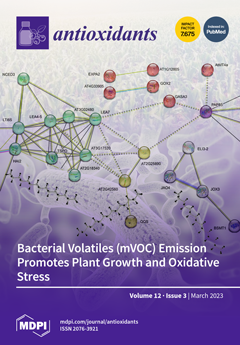
Cover Story: Phytopathogens causes worldwide significant crop losses. However, their exploitation for crop welfare is relatively unknown. Here, we show that the microbial volatile organic compound (mVOC) profile of the bacterial phytopathogen Erwinia amylovora enhances Arabidopsis thaliana shoot and root growth. E. amylovora mVOCs (including 1-nonanol and 1-dodecanol) triggered early signaling events, including plasma transmembrane potential Vm depolarization, cytosolic Ca2+ fluctuation, K+-gated channel activity, and reactive oxygen species (ROS) and nitric oxide (NO) burst from a few minutes to 16 h upon exposure. Our results show that E. amylovora mVOCs affect A. thaliana growth through a cascade of early events and gene regulation that involve phytohormones, ROS and NO. View this paper
  • Issues are regarded as officially published after their release is announced to the table of contents alert mailing list .
  • You may sign up for email alerts to receive table of contents of newly released issues.
  • PDF is the official format for papers published in both, html and pdf forms. To view the papers in pdf format, click on the "PDF Full-text" link, and use the free Adobe Reader to open them.

Articles (244)

  • Article
  • Open Access
5 Citations
4,146 Views
18 Pages

High uric acid is associated with gout, hypertension, metabolic syndrome, cardiovascular disease, and kidney disease. URAT1 (SLC22A12), originally discovered in mice as Rst, is generally considered a very selective uric acid transporter compared to o...

  • Article
  • Open Access
2 Citations
2,443 Views
12 Pages

Effects of Citrus kawachiensis Peel in Frailty-like Model Mice Induced by Low Protein Nutrition Disorders

  • Toshiki Omasa,
  • Satoshi Okuyama,
  • Atsushi Sawamoto,
  • Mitsunari Nakajima and
  • Yoshiko Furukawa

“Frailty” caused by a decline in physiological reserve capacity, chronic inflammation, and oxidative stress in the elderly has recently become a major social issue. The present study examined the effects of the peel of Citrus kawachiensis...

  • Review
  • Open Access
32 Citations
5,985 Views
20 Pages

Activators of Nrf2 to Counteract Neurodegenerative Diseases

  • Rosa Amoroso,
  • Cristina Maccallini and
  • Ilaria Bellezza

Neurodegenerative diseases are incurable and debilitating conditions that result in progressive degeneration and loss of nerve cells. Oxidative stress has been proposed as one factor that plays a potential role in the pathogenesis of neurodegenerativ...

  • Article
  • Open Access
4 Citations
3,497 Views
20 Pages

Nrf2 Activation Does Not Protect from Aldosterone-Induced Kidney Damage in Mice

  • Ronja Brinks,
  • Christoph Jan Wruck,
  • Jutta Schmitz and
  • Nicole Schupp

Nuclear factor erythroid 2-related factor 2 (Nrf2) is downregulated in chronic kidney disease (CKD). Activation of Nrf2 might be a therapeutic option in CKD. Here we investigate the effect of Nrf2 activation on aldosterone (Aldo)-induced renal injury...

  • Communication
  • Open Access
9 Citations
2,353 Views
14 Pages

(1) Background: cystamine and its reduced form cysteamine have radioprotective/antioxidant effects in vivo. In this study, we use an in vitro model system to examine the behavior of cystamine towards the reactive primary species produced during the r...

  • Article
  • Open Access
19 Citations
4,678 Views
16 Pages

In this study, giant kelp was explored under various conventional and ultrasound-assisted extraction (UAE) conditions for the extraction of protein, its hydrolysis, and ultrafiltration to generate multiple fractions. The amino acid composition of all...

  • Article
  • Open Access
22 Citations
4,912 Views
14 Pages

This study aimed to evaluate the hangover relieving effect of ginseng berry kombucha (GBK) fermented with Saccharomyces cerevisiae and Gluconobacter oxydans in in vitro and in vivo models. The antioxidant activity and oxidative stress inhibitory effe...

  • Hypothesis
  • Open Access
5 Citations
4,031 Views
11 Pages

The Combined Treatment of Glutathione Sodium Salt and Ascorbic Acid for Preventing Contrast-Associated Acute Kidney Injury in ST-Elevation Myocardial Infarction Patients Undergoing Primary PCI: A Hypothesis to Be Validated

  • Alessio Arrivi,
  • Giovanni Truscelli,
  • Giacomo Pucci,
  • Francesco Barillà,
  • Roberto Carnevale,
  • Cristina Nocella,
  • Martina Sordi,
  • Marcello Dominici,
  • Gaetano Tanzilli and
  • Enrico Mangieri

The occurrence of Contrast-Associated Acute Kidney Injury (CA-AKI) in patients with ST-Elevation Myocardial Infarction (STEMI) has a negative impact on the length of hospital stay and mortality. Reactive Oxygen Species (ROS) release, along with vasoc...

  • Article
  • Open Access
18 Citations
3,681 Views
17 Pages

Dietary Guanidine Acetic Acid Improves Ruminal Antioxidant Capacity and Alters Rumen Fermentation and Microflora in Rapid-Growing Lambs

  • Wenjuan Li,
  • Zhaoyang Cui,
  • Yaowen Jiang,
  • Ailiyasi Aisikaer,
  • Qichao Wu,
  • Fang Zhang,
  • Weikang Wang,
  • Yukun Bo and
  • Hongjian Yang

Guanidine acetic acid (GAA) has been reported to improve growth performance, nutrient utilization, and meat quality in livestock. This study aimed to investigate whether coated GAA (CGAA) in comparison with uncoated GAA (UGAA) could have different ef...

  • Review
  • Open Access
29 Citations
5,440 Views
28 Pages

Nutriepigenomics in Environmental-Associated Oxidative Stress

  • Karla Rubio,
  • Estefani Y. Hernández-Cruz,
  • Diana G. Rogel-Ayala,
  • Pouya Sarvari,
  • Ciro Isidoro,
  • Guillermo Barreto and
  • José Pedraza-Chaverri

Complex molecular mechanisms define our responses to environmental stimuli. Beyond the DNA sequence itself, epigenetic machinery orchestrates changes in gene expression induced by diet, physical activity, stress and pollution, among others. Important...

of 25

Get Alerted

Add your email address to receive forthcoming issues of this journal.

XFacebookLinkedIn
Antioxidants - ISSN 2076-3921