Efficacy and Safety of Microvascular Decompression in Patients with Trigeminal Neuralgia Previously Treated with Gamma Knife Stereotactic Radiosurgery
 , , , , , , , , , and
Highlights
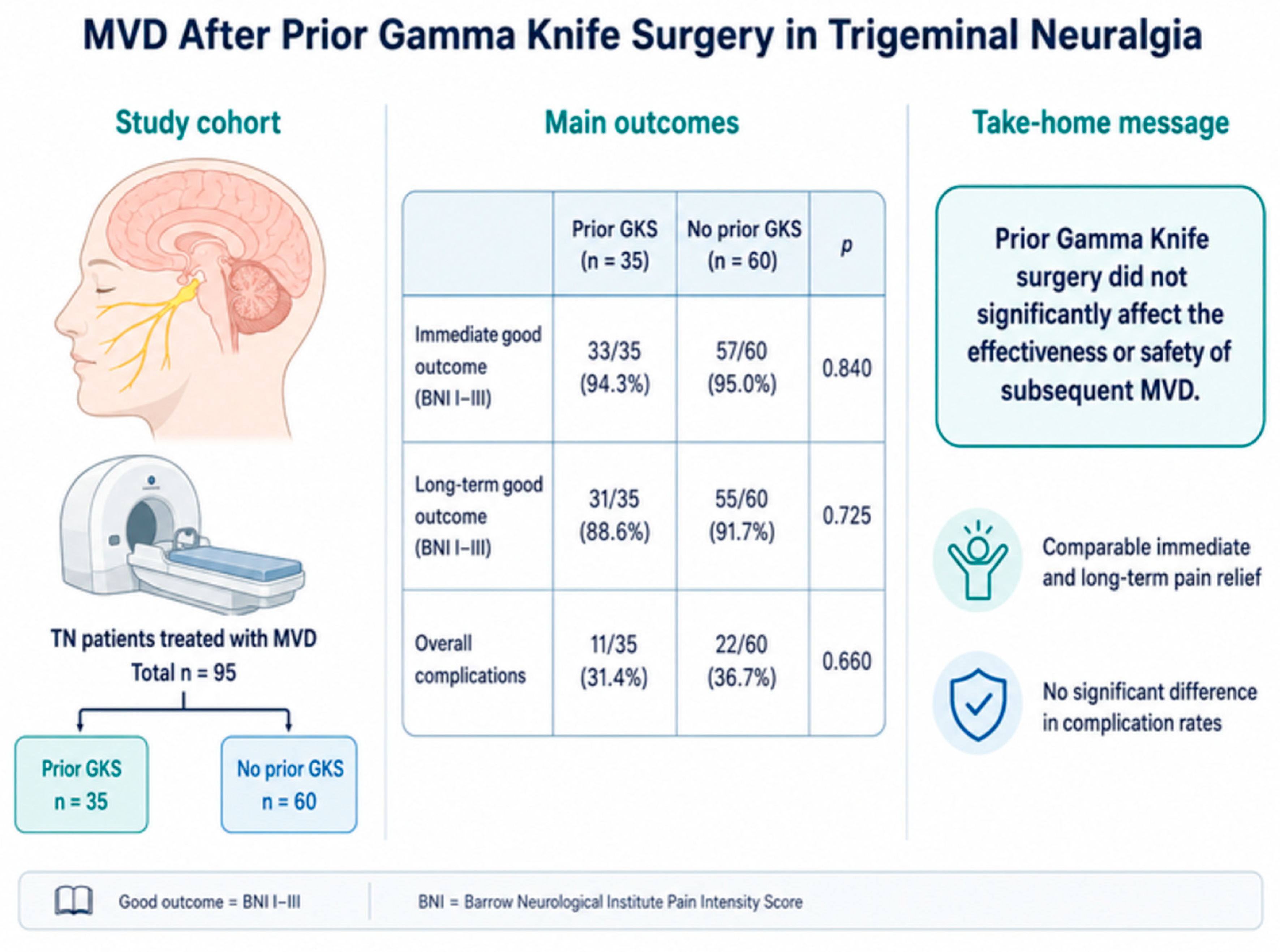
- Microvascular decompression provided comparable long-term pain control in patients with and without prior Gamma Knife stereotactic radiosurgery.
- Radiation-related intraoperative tissue changes were present in every previously irradiated patient and made the dissection more demanding, yet were not associated with a higher rate of non-sensory postoperative complications.
- Microvascular decompression remains a safe and effective rescue treatment for persistent or recurrent trigeminal neuralgia after unsuccessful Gamma Knife radiosurgery.
- Previous Gamma Knife radiosurgery should not be considered a contraindication to subsequent microvascular decompression in appropriately selected patients.
Abstract
1. Introduction
2. Materials and Methods
2.1. Study Design and Patient Population
2.2. Treatment Allocation and Decision-Making
2.3. Radiosurgical Technique
2.4. Surgical Procedure and Intraoperative Monitoring
2.5. Follow-Up and Outcome Assessment
2.6. Statistical Analysis
3. Results
3.1. Clinical Characteristics of the Patients
3.2. Surgical Findings
3.3. Outcomes, Medication Status and Postoperative Adverse Events
4. Discussion
4.1. Comparison with Previously Published Series
4.2. Interpretation and Clinical Implications
4.3. Limitations
5. Conclusions
Author Contributions
Funding
Institutional Review Board Statement
Informed Consent Statement
Data Availability Statement
Acknowledgments
Conflicts of Interest
Abbreviations
| BNI | Barrow Neurological Institute pain intensity scale |
| GKS | Gamma Knife stereotactic radiosurgery |
| GKS+ | group with Gamma Knife surgery |
| GKS− | group without Gamma Knife surgery |
| MVD | Microvascular decompression |
| SRS | Stereotactic radiosurgery |
| TN | Trigeminal neuralgia |
| FN | facial numbness |
| FNP | facial nerve palsy |
| T | tinnitus |
| HW | hearing worsening |
| FH | facial hypoesthesia |
| H | hematoma |
| AP | atherosclerotic plaque |
| TNA | trigeminal nerve atrophy |
| AVN | adhesion vessel-nerve |
| TA | thickened arachnoid |
References
- De Toledo, I.P.; Conti Réus, J.; Fernandes, M.; Porporatti, A.L.; Peres, M.A.; Takaschima, A.; Linhares, M.N.; Guerra, E.; De Luca Canto, G. Prevalence of trigeminal neuralgia: A systematic review. J. Am. Dent. Assoc. 2016, 147, 570–576.e2. [Google Scholar] [CrossRef] [Scilit] [PubMed]
- Maarbjerg, S.; Di Stefano, G.; Bendtsen, L.; Cruccu, G. Trigeminal neuralgia—Diagnosis and treatment. Cephalalgia 2017, 37, 648–657. [Google Scholar] [CrossRef] [Scilit] [PubMed]
- Love, S.; Coakham, H.B. Trigeminal neuralgia: Pathology and pathogenesis. Brain 2001, 124, 2347–2360. [Google Scholar] [CrossRef] [Scilit] [PubMed]
- Cruccu, G.; Di Stefano, G.; Truini, A. Trigeminal Neuralgia. N. Engl. J. Med. 2020, 383, 754–762. [Google Scholar] [CrossRef] [Scilit] [PubMed]
- Holste, K.; Chan, A.Y.; Rolston, J.D.; Englot, D.J. Pain Outcomes Following Microvascular Decompression for Drug-Resistant Trigeminal Neuralgia: A Systematic Review and Meta-Analysis. Neurosurgery 2020, 86, 182–190. [Google Scholar] [CrossRef] [Scilit] [PubMed]
- Xia, L.; Zhong, J.; Zhu, J.; Wang, Y.N.; Dou, N.N.; Liu, M.X.; Visocchi, M.; Li, S.T. Effectiveness and safety of microvascular decompression surgery for treatment of trigeminal neuralgia: A systematic review. J. Craniofac. Surg. 2014, 25, 1413–1417. [Google Scholar] [CrossRef] [Scilit] [PubMed]
- Herta, J.; Schmied, T.; Loidl, T.B.; Wang, W.T.; Marik, W.; Winter, F.; Tomschik, M.; Ferraz-Leite, H.; Rössler, K.; Dorfer, C. Microvascular decompression in trigeminal neuralgia: Predictors of pain relief, complication avoidance, and lessons learned. Acta Neurochir. 2021, 163, 3321–3336. [Google Scholar] [CrossRef] [Scilit] [PubMed] [PubMed Central]
- Bendtsen, L.; Zakrzewska, J.M.; Heinskou, T.B.; Hodaie, M.; Leal, P.R.L.; Nurmikko, T.; Obermann, M.; Cruccu, G.; Maarbjerg, S. Advances in diagnosis, classification, pathophysiology, and management of trigeminal neuralgia. Lancet Neurol. 2020, 19, 784–796. [Google Scholar] [CrossRef] [Scilit] [PubMed]
- Gronseth, G.; Cruccu, G.; Alksne, J.; Argoff, C.; Brainin, M.; Burchiel, K.; Nurmikko, T.; Zakrzewska, J.M. Practice parameter: The diagnostic evaluation and treatment of trigeminal neuralgia (an evidence-based review): Report of the Quality Standards Subcommittee of the American Academy of Neurology and the European Federation of Neurological Societies. Neurology 2008, 71, 1183–1190. [Google Scholar] [CrossRef] [Scilit] [PubMed]
- Yadav, Y.R.; Nishtha, Y.; Sonjjay, P.; Vijay, P.; Shailendra, R.; Yatin, K. Trigeminal Neuralgia. Asian J. Neurosurg. 2017, 12, 585–597. [Google Scholar] [CrossRef] [Scilit] [PubMed] [PubMed Central]
- Zakrzewska, J.M.; Linskey, M.E. Trigeminal neuralgia. BMJ 2014, 348, g474. [Google Scholar] [CrossRef] [Scilit] [PubMed]
- Tronnier, V.M.; Rasche, D.; Hamer, J.; Kienle, A.L.; Kunze, S. Treatment of idiopathic trigeminal neuralgia: Comparison of long-term outcome after radiofrequency rhizotomy and microvascular decompression. Neurosurgery 2001, 48, 1261–1268. [Google Scholar] [CrossRef] [Scilit] [PubMed]
- Wang, X.H.; Zhou, C.; Shen, G.-J.; Xu, M.-H.; Chen, G.-X.; Zou, Y.-W.; Xu, L.-S. Long-term outcomes of percutaneous retrogasserian glycerol rhizotomy in 3370 patients with trigeminal neuralgia. Turk. Neurosurg. 2011, 21, 48–52. [Google Scholar] [CrossRef] [Scilit]
- Liu, J.; Wu, G.; Xiang, H.; Liu, R.; Li, F.; Hei, B.; Qian, W.; Song, H.; Liu, Z. Long-Term Retrospective Analysis of Microvascular Decompression in Patients with Recurrent Trigeminal Neuralgia. Front. Neurol. 2020, 11, 584224. [Google Scholar] [CrossRef] [Scilit] [PubMed] [PubMed Central]
- Leksell, L. The stereotaxic method and radiosurgery of the brain. Acta Chir. Scand. 1951, 102, 316–319. [Google Scholar] [PubMed]
- Gorgulho, A. Radiation mechanisms of pain control in classical trigeminal neuralgia. Surg. Neurol. Int. 2012, 3, S17–S25. [Google Scholar] [CrossRef] [Scilit] [PubMed] [PubMed Central]
- Zhao, H.; Shen, Y.; Yao, D.; Xiong, N.; Abdelmaksoud, A.; Wang, H. Outcomes of Two-Isocenter Gamma Knife Radiosurgery for Patients with Typical Trigeminal Neuralgia: Pain Response and Quality of Life. World Neurosurg. 2018, 109, e531–e538. [Google Scholar] [CrossRef] [Scilit] [PubMed]
- Régis, J.; Metellus, P.; Hayashi, M.; Roussel, P.; Donnet, A.; Bille-Turc, F. Prospective controlled trial of gamma knife surgery for essential trigeminal neuralgia. J. Neurosurg. 2006, 104, 913–924. [Google Scholar] [CrossRef] [Scilit] [PubMed]
- Sheehan, J.; Pan, H.C.; Stroila, M.; Steiner, L. Gamma knife surgery for trigeminal neuralgia: Outcomes and prognostic factors. J. Neurosurg. 2005, 102, 434–441. [Google Scholar] [CrossRef] [Scilit] [PubMed]
- Tuleasca, C.; Régis, J.; Sahgal, A.; De Salles, A.; Hayashi, M.; Ma, L.; Martínez-Álvarez, R.; Paddick, I.; Ryu, S.; Slotman, B.J.; et al. Stereotactic radiosurgery for trigeminal neuralgia: A systematic review. J. Neurosurg. 2019, 130, 733–757. [Google Scholar] [CrossRef] [Scilit] [PubMed]
- Kondziolka, D.; Lunsford, L.D.; Flickinger, J.C.; Young, R.F.; Vermeulen, S.; Duma, C.M.; Jacques, D.B.; Rand, R.W.; Regis, J.; Peragut, J.C.; et al. Stereotactic radiosurgery for trigeminal neuralgia: A multiinstitutional study using the gamma unit. J. Neurosurg. 1996, 84, 940–945. [Google Scholar] [CrossRef] [Scilit] [PubMed]
- Kondziolka, D.; Zorro, O.; Lobato-Polo, J.; Kano, H.; Flannery, T.J.; Flickinger, J.C.; Lunsford, L.D. Gamma Knife stereotactic radiosurgery for idiopathic trigeminal neuralgia. J. Neurosurg. 2010, 112, 758–765. [Google Scholar] [CrossRef] [Scilit] [PubMed]
- Pollock, B.E.; Schoeberl, K.A. Prospective comparison of posterior fossa exploration and stereotactic radiosurgery dorsal root entry zone target as primary surgery for patients with idiopathic trigeminal neuralgia. Neurosurgery 2010, 67, 633–638; discussion 638–639. [Google Scholar] [CrossRef] [Scilit] [PubMed]
- Dandy, W.J. Concerning the cause of trigeminal neuralgia. Am. J. Surg. 1934, 24, 447–455. [Google Scholar] [CrossRef] [Scilit]
- Gardner, W.J.; Miklos, M.V. Response of trigeminal neuralgia to “decompression” of sensory root: Discussion of cause of trigeminal neuralgia. JAMA 1959, 170, 1773–1776. [Google Scholar] [CrossRef] [Scilit] [PubMed]
- Sindou, M.; Leston, J.; Decullier, E.; Chapuis, F. Microvascular decompression for primary trigeminal neuralgia: Long-term effectiveness and prognostic factors in a series of 362 consecutive patients with clear-cut neurovascular conflicts who underwent pure decompression. J. Neurosurg. 2007, 107, 1144–1153. [Google Scholar] [CrossRef] [PubMed]
- Broggi, G.; Broggi, M.; Ferroli, P.; Franzini, A. Surgical technique for trigeminal microvascular decompression. Acta Neurochir. 2012, 154, 1089–1095. [Google Scholar] [CrossRef] [Scilit] [PubMed]
- Oesman, C.; Mooij, J.J. Long-term follow-up of microvascular decompression for trigeminal neuralgia. Skull Base 2011, 21, 313–322. [Google Scholar] [CrossRef] [Scilit] [PubMed] [PubMed Central]
- Patel, S.K.; Markosian, C.; Choudhry, O.J.; Keller, J.T.; Liu, J.K. The historical evolution of microvascular decompression for trigeminal neuralgia: From Dandy’s discovery to Jannetta’s legacy. Acta Neurochir. 2020, 162, 2773–2782. [Google Scholar] [CrossRef] [Scilit] [PubMed]
- Shu, W.; Yang, D.; Ma, K.; Zhang, X.; Yu, T.; Du, T.; Li, J.; Zhu, H. Endoscopic Versus Microscopic Microvascular Decompression for Trigeminal Neuralgia: A Prospective Controlled Study. Pain Physician 2024, 27, E79–E88. [Google Scholar] [CrossRef] [Scilit] [PubMed]
- Toda, K. Operative treatment of trigeminal neuralgia: Review of current techniques. Oral Surg. Oral Med. Oral Pathol. Oral Radiol. Endod. 2008, 106, 788–805.e6. [Google Scholar] [CrossRef] [Scilit] [PubMed]
- Maher, C.O.; Pollock, B.E. Radiation induced vascular injury after stereotactic radiosurgery for trigeminal neuralgia: Case report. Surg. Neurol. 2000, 54, 189–193. [Google Scholar] [CrossRef] [Scilit] [PubMed]
- Leal, P.R.; Barbier, C.; Hermier, M.; Souza, M.A.; Cristino-Filho, G.; Sindou, M. Atrophic changes in the trigeminal nerves of patients with trigeminal neuralgia due to neurovascular compression and their association with the severity of compression and clinical outcomes. J. Neurosurg. 2014, 120, 1484–1495. [Google Scholar] [CrossRef] [Scilit] [PubMed]
- Shetter, A.G.; Zabramski, J.M.; Speiser, B.L. Microvascular decompression after gamma knife surgery for trigeminal neuralgia: Intraoperative findings and treatment outcomes. J. Neurosurg. 2005, 102, 259–261. [Google Scholar] [CrossRef] [Scilit] [PubMed]
- Sekula, R.F., Jr.; Frederickson, A.M.; Jannetta, P.J.; Bhatia, S.; Quigley, M.R. Microvascular decompression after failed Gamma Knife surgery for trigeminal neuralgia: A safe and effective rescue therapy? J. Neurosurg. 2010, 113, 45–52. [Google Scholar] [CrossRef] [Scilit] [PubMed]
- Huang, C.F.; Chuang, J.C.; Tu, H.T.; Chou, M.C. Microsurgical outcomes after failed repeated Gamma Knife surgery for refractory trigeminal neuralgia. J. Neurosurg. 2006, 105, 117–119. [Google Scholar] [CrossRef] [Scilit] [PubMed]
- Chen, J.C. Microvascular decompression for trigeminal neuralgia in patients with and without prior stereotactic radiosurgery. World Neurosurg. 2012, 78, 149–154. [Google Scholar] [CrossRef] [Scilit] [PubMed]
- Zhao, H.; Fan, S.Q.; Wang, X.H.; Zhang, X.; Tang, Y.D.; Zhu, J.; Zhou, P.; Li, S.T. Evaluation of Microvascular Decompression as Rescue Therapy for Trigeminal Neuralgia in Patients with Failed Gamma Knife Surgery. World Neurosurg. 2018, 116, e86–e91. [Google Scholar] [CrossRef] [Scilit] [PubMed]
- Wang, J.J.; Zhao, Z.; Chai, S.S.; Wang, Y.H.; Xiang, W. Microvascular decompression as a second step treatment for trigeminal neuralgia in patients with failed two-isocentre gamma knife radiosurgery. Neurosurg. Rev. 2022, 45, 783–791. [Google Scholar] [CrossRef] [Scilit] [PubMed]
- Cheng, J.; Liu, W.; Hui, X.; Lei, D.; Zhang, H. Microvascular decompression for trigeminal neuralgia in patients with failed gamma knife surgery: Analysis of efficacy and safety. Clin. Neurol. Neurosurg. 2017, 161, 88–92. [Google Scholar] [CrossRef] [Scilit] [PubMed]
- Headache Classification Committee of the International Headache Society (IHS). The International Classification of Headache Disorders, 3rd edition. Cephalalgia 2018, 38, 1–211. [Google Scholar] [CrossRef] [Scilit] [PubMed]
- Xu, R.; Nair, S.K.; Raj, D.; Materi, J.; So, R.J.; Gujar, S.K.; Huang, J.; Blitz, A.M.; Lim, M.; Sair, H.I.; et al. The Role of Preoperative Magnetic Resonance Imaging in Assessing Neurovascular Compression Before Microvascular Decompression in Trigeminal Neuralgia. World Neurosurg. 2022, 168, e216–e222. [Google Scholar] [CrossRef] [Scilit] [PubMed]
- Leal, P.R.; Hermier, M.; Souza, M.A.; Cristino-Filho, G.; Froment, J.C.; Sindou, M. Visualization of vascular compression of the trigeminal nerve with high-resolution 3T MRI: A prospective study comparing preoperative imaging analysis to surgical findings in 40 consecutive patients who underwent microvascular decompression for trigeminal neuralgia. Neurosurgery 2011, 69, 15–25; discussion 26. [Google Scholar] [CrossRef] [Scilit] [PubMed]
- Antonini, G.; Di Pasquale, A.; Cruccu, G.; Truini, A.; Morino, S.; Saltelli, G.; Romano, A.; Trasimeni, G. Magnetic resonance imaging contribution for diagnosing symptomatic neurovascular contact in classical trigeminal neuralgia: A blinded case-control study and meta-analysis. Pain 2014, 155, 1464–1471. [Google Scholar] [CrossRef] [Scilit] [PubMed]
- Régis, J.; Tuleasca, C.; Resseguier, N.; Carron, R.; Donnet, A.; Yomo, S.; Gaudart, J.; Levivier, M. The Very Long-Term Outcome of Radiosurgery for Classical Trigeminal Neuralgia. Stereotact. Funct. Neurosurg. 2016, 94, 24–32. [Google Scholar] [CrossRef] [Scilit] [PubMed]
- Brisman, R.; Khandji, A.G.; Mooij, R.B. Trigeminal nerve–blood vessel relationship as revealed by high-resolution magnetic resonance imaging and its effect on pain relief after gamma knife radiosurgery for trigeminal neuralgia. Neurosurgery 2002, 50, 1261–1266. [Google Scholar] [CrossRef] [Scilit] [PubMed]
- Sheehan, J.P.; Ray, D.K.; Monteith, S.; Yen, C.P.; Lesnick, J.; Kersh, R.; Schlesinger, D. Gamma Knife radiosurgery for trigeminal neuralgia: The impact of magnetic resonance imaging-detected vascular impingement of the affected nerve. J. Neurosurg. 2010, 113, 53–58. [Google Scholar] [CrossRef] [Scilit] [PubMed]
- Soni, P.; Potter, T.; Soni, P.P.; Estemalik, E.; Recinos, P.F.; Kshettry, V.R. Outcomes of microvascular decompression for trigeminal neuralgia with purely venous compression: A systematic review and meta-analysis. Clin. Neurol. Neurosurg. 2020, 198, 106230. [Google Scholar] [CrossRef] [Scilit] [PubMed]
- Wang, J.; Niu, H.; Zhao, K.; Shu, K.; Lei, T. Comparative Analysis of Trigeminal Neuralgia Caused by Sole Arterial and Venous Compression: Clinical Features and Surgical Outcomes from 222 Cases. Front. Neurol. 2021, 12, 634945. [Google Scholar] [CrossRef] [Scilit] [PubMed] [PubMed Central]
- Bendtsen, L.; Zakrzewska, J.M.; Abbott, J.; Braschinsky, M.; Di Stefano, G.; Donnet, A.; Eide, P.K.; Leal, P.R.L.; Maarbjerg, S.; May, A.; et al. European Academy of Neurology guideline on trigeminal neuralgia. Eur. J. Neurol. 2019, 26, 831–849. [Google Scholar] [CrossRef] [Scilit] [PubMed]
- Yang, J.; Huang, M.; Yang, C.; Lu, J.; Li, J.; Li, X. Long-term outcomes of microvascular decompression for trigeminal neuralgia: The prognostic role of age and intraoperative neurovascular compression severity. World Neurosurg. 2026, 211, 125016. [Google Scholar] [CrossRef] [Scilit] [PubMed]
- Rogers, C.L.; Shetter, A.G.; Fiedler, J.A.; Smith, K.A.; Han, P.P.; Speiser, B.L. Gamma knife radiosurgery for trigeminal neuralgia: The initial experience of the Barrow Neurological Institute. Int. J. Radiat. Oncol. Biol. Phys. 2000, 47, 1013–1019. [Google Scholar] [CrossRef] [Scilit] [PubMed]
- Mureb, M.; Golub, D.; Benjamin, C.; Gurewitz, J.; Strickland, B.A.; Zada, G.; Chang, E.; Urgošík, D.; Liščák, R.; Warnick, R.E.; et al. Earlier radiosurgery leads to better pain relief and less medication usage for trigeminal neuralgia patients: An international multicenter study. J. Neurosurg. 2021, 135, 237–244. [Google Scholar] [CrossRef] [Scilit] [PubMed]
- Patel, N.S.; Carlson, M.L.; Sughrue, M.E.; Olson, J.J. Congress of Neurological Surgeons systematic review and evidence-based guidelines update for the role of intraoperative cranial nerve monitoring in the management of patients with vestibular schwannomas. Neurosurgery 2026, 98, 288–292. [Google Scholar] [CrossRef] [Scilit] [PubMed]
- Goldbrunner, R.; Weller, M.; Regis, J.; Lund-Johansen, M.; Stavrinou, P.; Reuss, D.; Evans, D.G.; Lefranc, F.; Sallabanda, K.; Falini, A.; et al. EANO guideline on the diagnosis and treatment of vestibular schwannoma. Neuro-Oncology 2020, 22, 31–45. [Google Scholar] [CrossRef] [Scilit] [PubMed]
- Martinelli, R.; Burattini, B.; D’Ercole, M.; Alessandris, G.Q.D.; Izzo, A.; Montano, N. The role of intraoperative neuromonitoring in microvascular decompression for trigeminal neuralgia: Results from a systematic review of the literature. Neurosurg. Rev. 2025, 48, 569, Correction in Neurosurg. Rev. 2025, 48, 768. [Google Scholar] [CrossRef] [Scilit] [PubMed]
- Bergenheim, A.T.; Asplund, P.; Linderoth, B. Percutaneous retrogasserian balloon compression for trigeminal neuralgia: Review of critical technical details and outcomes. World Neurosurg. 2013, 79, 359–368. [Google Scholar] [CrossRef] [Scilit] [PubMed]

| Variable | GKS+ (n = 35) | GKS− (n = 60) | p |
|---|---|---|---|
| Age (years), mean ± SD | 60.8 ± 10.5 | 58.9 ± 12.0 | 0.378 * |
| Sex (male/female) | 14 (40.0%)/21 (60.0%) | 23 (38.3%)/37 (61.7%) | 1.000 # |
| Side (left/right) | 15 (43.0%)/20 (57.0%) | 23 (38.3%)/37 (61.7%) | 0.826 # |
| Pain distribution | – | ||
| V1 | 0 (0.0%) | 0 (0.0%) | |
| V2 | 8 (22.9%) | 5 (7.7%) | |
| V3 | 6 (17.1%) | 12 (18.5%) | |
| V1 + V2 | 3 (8.6%) | 12 (18.5%) | |
| V2 + V3 | 11 (31.4%) | 20 (30.8%) | |
| V1 + V2 + V3 | 7 (20.0%) | 11 (18.3%) | |
| Preoperative BNI score | 0.405 * | ||
| I/II | 0 (0.0%)/1 (2.8%) | 0 (0.0%)/0 (0.0%) | |
| III | 8 (22.9%) | 14 (23.3%) | |
| IV | 16 (45.7%) | 23 (38.3%) | |
| V | 10 (28.6%) | 23 (38.3%) | |
| Disease duration before surgery (months), median (IQR) | 35 (12–48) | 28 (12–55) | 0.524 * |
| Length of hospital stay (days), mean ± SD | 7.2 ± 2.7 | 8.8 ± 3.2 | 0.009 * |
| Variable | GKS+ (n = 35) | GKS− (n = 60) | p |
|---|---|---|---|
| Vascular conflict | – | ||
| SCA | 15 (42.9%) | 23 (38.3%) | |
| AICA | 2 (5.7%) | 1 (1.7%) | |
| VA/BA | 0 (0.0%) | 0 (0.0%) | |
| Vein | 10 (28.6%) | 17 (28.3%) | |
| Artery + vein | 8 (22.8%) | 19 (31.7%) | |
| Intradural operative time (“dura-to-dura”), min | |||
| Median (IQR) | 37.0 (33.0–39.5) | 29.5 (26.0–36.0) | <0.001 * |
| Mean ± SD | 36.8 ± 4.4 | 30.4 ± 6.0 | |
| Range (observed) | 30–45 | 20–40 | |
| Intraoperative findings (GKS+ only) | |||
| Thickened arachnoid | 22 (62.9%) | – | |
| Adhesion vessel–nerve | 6 (17.1%) | – | |
| Trigeminal nerve atrophy | 4 (11.4%) | – | |
| Atherosclerotic plaque | 3 (8.6%) | – |
| Variable | GKS+ (n = 35) | GKS− (n = 60) | p |
|---|---|---|---|
| Immediate outcome, BNI | 0.840 # | ||
| I–III (good outcome) | 33 (94.3%) | 57 (95.0%) | |
| IV–V (poor outcome) | 2 (5.7%) | 3 (5.0%) | |
| I/II/III | 25 (71.4%)/3 (8.6%)/5 (14.3%) | 37 (61.7%)/6 (10.0%)/14 (23.3%) | |
| IV/V | 2 (5.7%)/0 (0.0%) | 2 (3.3%)/1 (1.7%) | |
| Long-term outcome, BNI | |||
| I–III (good outcome) | 31 (88.6%) | 55 (91.7%) | 0.725 # |
| IV–V (poor outcome) | 4 (11.4%) | 5 (8.3%) | 0.725 # |
| I/II/III | 11 (31.4%)/6 (17.1%)/14 (40.0%) | 33 (55.0%)/3 (5.0%)/19 (31.7%) | |
| IV/V | 4 (11.4%)/0 (0.0%) | 2 (3.3%)/3 (5.0%) | |
| Follow-up (months), mean ± SD | 31.2 ± 27.6 | 39.7 ± 32.1 | 0.332 * |
| Postoperative medication status | |||
| Immediate medication-free (BNI I–II) | 28 (80.0%) | 43 (71.7%) | 0.466 # |
| Immediate medication required (BNI III–V) | 7 (20.0%) | 17 (28.3%) | |
| Long-term medication-free (BNI I–II) | 17 (48.6%) | 36 (60.0%) | 0.294 # |
| Long-term medication required (BNI III–V) | 18 (51.4%) | 24 (40.0%) | |
| Adverse events, composite | 11 (31.4%) | 22 (36.7%) | 0.660 # |
| Trigeminal sensory disturbance | 8 (22.9%) | 15 (25.0%) | 1.000 # |
| Facial numbness | 7 (20.0%) | 9 (15.0%) | 0.588 # |
| Facial hypoesthesia | 1 (2.9%) | 6 (10.0%) | 0.250 # |
| Non-sensory complications | 3 (8.6%) | 7 (11.7%) | 0.741 # |
| Hematoma | 1 (2.9%) | 2 (3.3%) | 1.000 # |
| Tinnitus | 2 (5.7%) | 3 (5.0%) | 1.000 # |
| Hearing deterioration | 0 (0.0%) | 2 (3.3%) | 0.533 # |
| Study (Year) | Cohort | Clinical Outcome | Adverse Events | Intraoperative Findings | ||||||
|---|---|---|---|---|---|---|---|---|---|---|
| N | Age (Years) | Sex (M/F) | Good | Bad | Median Follow-Up (Months) | n (%) | Details | n (%) | Details | |
| Shetter et al. (2005) [34] | 6 | 52 | 2/4 | 6 | 0 | 25.4 | 2 (33.3%) | FN 16.7% FNP 16.7% | 1 (16.7%) | AP 16.7% |
| Huang et al. (2006) [36] | 8 | 59.5 | 3/5 | 7 | 1 | 21 | 2 (25.0%) | FN 25.0% | 1 (12.5%) | AP 12.5% |
| Sekula et al. (2010) [35] | 29 | 63.5 | 10/19 | 25 | 4 | 19.8 | 10 (34.5%) | FN 20.7% | 21 (72.4%) | TNA 48.3% AVN 20.7% TA 3.4% |
| Chen (2012) [37] | 42 | 59.5 | 22/20 | 41 | 1 | 30 | 4 (9.5%) | FN 9.5% | 34 (81.0%) | TA 35.7% TNA 21.4% AP 14.3% AVN 9.5% |
| Cheng et al. (2017) [40] | 36 | 51.3 ± 13.1 | 16/20 | 33 | 3 | 28.5 | 8 (22.2%) | FN 19.4% CSF leak 2.8% | 30 (83.3%) | TNA 36.1% AVN 22.2% TA 16.7% AP 8.3% |
| Zhao et al. (2018) [38] | 32 | 59.9 | 13/19 | 31 | 1 | >60 | 10 (31.2%) | FN 31.2% | 32 (100%) | AP 46.9% TA 31.2% TNA 21.9% |
| Wang et al. (2022) [39] | 19 | 57.6 ± 9.1 | 9/10 | 11 | 8 | 36 | 7 (36.8%) | FN 21.1% CSF leak 5.3% T 5.3% HW 5.3% | 14 (73.7%) | TNA 47.4% TA 15.8% AP 15.8% AVN 5.3% |
| Present study (2026) | 35 | 60.8 ± 10.5 | 14/21 | 31 | 4 | 31.2 ± 27.6 | 11 (31.4%) | FN 20.0% T 5.7% FH 2.9% H 2.9% | 35 (100.0%) | TA 62.9% AVN 17.1% TNA 11.4% AP 8.6% |
| Author (Year) | Group | N | BNI I–III | BNI IV–V | p * |
|---|---|---|---|---|---|
| Chen (2012) [37] | GKS+ | 42 | 41 (98%) | 1 (2%) | 0.055 |
| GKS− | 67 | 59 (88%) | 8 (12%) | ||
| Cheng et al. (2017) [40] | GKS+ | 36 | 33 (92%) | 3 (8%) | 0.798 |
| GKS− | 58 | 54 (93%) | 4 (7%) | ||
| Wang et al. (2022) [39] | GKS+ | 19 | 11 (58%) | 8 (42%) | 0.135 |
| GKS− | 158 | 118 (75%) | 40 (25%) | ||
| Present study (2026) | GKS+ | 35 | 31 (89%) | 4 (11%) | 0.725 |
| GKS− | 60 | 55 (92%) | 5 (8%) |
Disclaimer/Publisher’s Note: The statements, opinions and data contained in all publications are solely those of the individual author(s) and contributor(s) and not of MDPI and/or the editor(s). MDPI and/or the editor(s) disclaim responsibility for any injury to people or property resulting from any ideas, methods, instructions or products referred to in the content. |
© 2026 by the authors. Licensee MDPI, Basel, Switzerland. This article is an open access article distributed under the terms and conditions of the Creative Commons Attribution (CC BY) license.
Share and Cite
Dzierzęcki, S.; Turek, G.; Turek, M.; Mariak, Z.; Czyżewski, W.; Gajewski, J.; Litak, J.; Rybaczek, M.; Ząbek, M.; Giba, A.; et al. Efficacy and Safety of Microvascular Decompression in Patients with Trigeminal Neuralgia Previously Treated with Gamma Knife Stereotactic Radiosurgery. Brain Sci. 2026, 16, 997. https://doi.org/10.3390/brainsci16090997
Dzierzęcki S, Turek G, Turek M, Mariak Z, Czyżewski W, Gajewski J, Litak J, Rybaczek M, Ząbek M, Giba A, et al. Efficacy and Safety of Microvascular Decompression in Patients with Trigeminal Neuralgia Previously Treated with Gamma Knife Stereotactic Radiosurgery. Brain Sciences. 2026; 16(9):997. https://doi.org/10.3390/brainsci16090997
Chicago/Turabian StyleDzierzęcki, Sebastian, Grzegorz Turek, Michał Turek, Zenon Mariak, Wojciech Czyżewski, Jan Gajewski, Jakub Litak, Magdalena Rybaczek, Mateusz Ząbek, Aleksandra Giba, and et al. 2026. "Efficacy and Safety of Microvascular Decompression in Patients with Trigeminal Neuralgia Previously Treated with Gamma Knife Stereotactic Radiosurgery" Brain Sciences 16, no. 9: 997. https://doi.org/10.3390/brainsci16090997
APA StyleDzierzęcki, S., Turek, G., Turek, M., Mariak, Z., Czyżewski, W., Gajewski, J., Litak, J., Rybaczek, M., Ząbek, M., Giba, A., Zabrocka, P., & Ząbek, M. (2026). Efficacy and Safety of Microvascular Decompression in Patients with Trigeminal Neuralgia Previously Treated with Gamma Knife Stereotactic Radiosurgery. Brain Sciences, 16(9), 997. https://doi.org/10.3390/brainsci16090997