


Abstract
Background: Quitting smoking often triggers anxiety and depression, two states that make it hard for people to stay away from tobacco. Studies on lab animals show that time away from nicotine causes these negative behaviors to flare up. Psychiatrists sometimes treat depression and anxiety with mirtazapine, a tetracyclic antidepressant primarily used to treat depression and sometimes anxiety, which has also been shown to improve withdrawal symptoms in drug-dependent patients. Objectives: We investigated whether mirtazapine could alleviate protracted nicotine withdrawal symptoms in animals. Methods: Wistar rats received 0.4 mg/Kg of nicotine daily for 10 days, followed by 30 days of nicotine withdrawal. During withdrawal, we assessed anxiety and depressive-like behaviors using standard laboratory tests: the elevated plus-maze, light-dark box, open field, forced swim test, and locomotor activity monitoring. Results: Our findings showed that mirtazapine, at doses of 30 or 60 mg/Kg/day, reduced anxious and depressive behaviors in nicotine-withdrawn rats, regardless of their prior nicotine exposure levels. Conclusions: This suggests that mirtazapine may mitigate protracted affective responses to nicotine withdrawal by modulating specific neurochemical pathways.
1. Introduction
Tobacco Use Disorder (TUD) is a major global public health concern, primarily due to its severe health and economic impacts. Smoking not only increases the risk of developing other diseases but also raises the likelihood of compulsive use of other illicit substances [1].
Neurobiological research has identified nicotine as the primary psychoactive compound in tobacco [2]. Studies show that nicotine’s reinforcing effects are mainly mediated by its interaction with α4β2 and α6β2 receptors located on neurons within the mesolimbic and nigrostriatal dopaminergic circuits [3].
Similar to other psychostimulants like cocaine and methamphetamine, reducing or ceasing tobacco use can precipitate negative somatic, emotional, and cognitive symptoms, collectively known as tobacco withdrawal syndrome [4]. Depression and anxiety are significant affective withdrawal symptoms that play a crucial role in perpetuating tobacco dependence and contribute to elevated relapse rates [5,6]. Moreover, both clinical and preclinical research indicates that nicotine exposure during pregnancy heightens the likelihood of initiating smoking in adolescence and increases the risk of developing psychiatric disorders. This exposure is linked to higher rates of depression and anxiety, as well as an amplified sensitivity to withdrawal symptoms throughout adolescence and adulthood [7,8]. Thus, there is a clear need for effective therapeutic interventions to treat TUD.
Numerous strategies have been suggested to alleviate tobacco use disorder (TUD) and its related withdrawal symptoms, including nicotine replacement therapies [9], behavioral and psychosocial interventions [10], vaccines [11], monoclonal antibodies [12], and pharmacological treatments [13]. Conventional pharmacological solutions involve varenicline, which acts as a partial agonist at the nicotinic α4β2 receptors, along with antidepressant drugs [14] such as bupropion or nortriptyline, which may be administered alone or in conjunction. Nevertheless, smoking cessation rates remain low, and these antidepressant options have not adequately addressed the emotional disturbances commonly linked with nicotine withdrawal [14].
Mirtazapine (REMERON, Schering-Plough-Organon 3770 USA), an atypical antidepressant approved for treating moderate to severe depression comorbid with anxiety disorders [15], displays a multitarget and complex pharmacological profile [16]. Its therapeutic effects are realized through a two-fold mechanism of action, functioning both as an agonist and antagonist at various serotonergic and noradrenergic receptors. Specifically, mirtazapine acts as an antagonist at the α2 norepinephrine receptor and blocks the 5-HT2A, 5-HT2C, 5-HT3, and histamine H1 receptors [15]. Furthermore, it also shows characteristics of an inverse agonist at the 5-HT2C receptor and acts as an agonist at the 5-HT1A receptor [17,18].
Mirtazapine shows potential in treating cocaine and methamphetamine use disorders. Preclinical and clinical studies indicate its effectiveness in reducing reinforcing and psychomotor effects while easing withdrawal symptoms [19,20,21,22,23]. Furthermore, it has been observed to significantly diminish the reinforcing and psychomotor effects associated with nicotine [24,25].
The serotonergic system plays a crucial role in modulating the adverse effects of nicotine withdrawal [26,27]. Preclinical studies demonstrate that antagonists of 5-HT1A, 5-HT2A, or 5-HT3 receptors, alongside 5-HT2C receptor agonists, can alleviate depression- and anxiety-like responses in rats experiencing nicotine withdrawal [27,28,29,30,31,32]. Clinical evidence also suggests that serotonergic agents such as buspirone, sertraline, fluoxetine, or bupropion have had some success in reducing the aversive symptoms of nicotine withdrawal [33,34,35,36]. Research on mirtazapine supports its efficacy in diminishing the affective symptoms—particularly anxiety and depression—typically observed during withdrawal from substances like cocaine, benzodiazepines, alcohol, amphetamines, and morphine [37,38,39,40,41,42].
Despite this, no structured preclinical or clinical investigation has yet validated mirtazapine’s effectiveness in alleviating the symptoms of depression and anxiety that accompany nicotine withdrawal.
Consequently, this study investigates whether the chronic administration of mirtazapine during nicotine withdrawal can mitigate depression- and anxiety-like behaviors in animal models.
To conduct this research, a spontaneous nicotine withdrawal model will be employed. This model involves the abrupt cessation of nicotine administration following prolonged exposure, reflecting the experiences of individuals who voluntarily quit smoking. The animals will naturally experience the affective symptoms of nicotine withdrawal concurrently with the decline in blood nicotine levels.
To evaluate mirtazapine’s influence on anxiety-like behaviors at various withdrawal phases, the open field test (OFT), elevated plus maze (EPM), light-dark box test (LDT), and spontaneous locomotor activity (SLA) assessments will be utilized. Depression-like behaviors will be examined using the forced swim test (FST) [43,44,45,46].
2. Experimental Procedures
2.1. Animals
To avoid the influence of female hormones, such as estradiol, on anxiety- and depression-like behaviors, male Wistar rats (8–9 weeks old, 250–280 g at the study’s outset) were used. The animals were housed in groups of four in standard plastic rodent enclosures (57 cm × 35 cm × 20 cm). The colony environment was maintained at 21 ± 2 °C with 40–50% humidity, under a 12 h light/dark cycle (lights on at 7:00 AM). Rats had unrestricted access to water and rodent food pellets, except during experimental sessions. All experiments were conducted during the light phase, specifically between 9:00 AM and 3:00 PM. These procedures strictly adhered to the National Institutes of Health (NIH) Guide for the Care and Use of Laboratory Animals, were approved by the Institutional Animal Care Committee and Bioethics Committee of the National Institute of Psychiatry (Protocol # CEI/C/003/IC17056.0/2018) and were reported following ARRIVE guidelines.
2.2. Drugs
Nicotine (nicotine tartrate salt; Sigma-Aldrich, St. Louis, MO, USA) was acquired after obtaining the necessary regulatory approvals, and all substances used in the study complied with official Mexican regulations (COFEPRIS-2016). Specifics regarding drugs and their dosages are presented in the Supplementary Materials.
Dose Selection
The optimal nicotine dosage was established based on previous research. A daily dosage of 0.4 mg/kg of nicotine significantly enhances nicotine-induced locomotor activity and leads to behavioral sensitization [24]. These dosages do not cause seizures or death [24] in humans and correlate to smoking 2 to 4 cigarettes daily [47]. Mirtazapine doses (15, 30, or 60 mg/kg/day) were determined according to prior research findings, which indicate that these doses do not influence basal locomotor activity, cause sedation, or lead to weight gain in rats [19,20,21,22,23,48,49]. Furthermore, both preclinical and clinical studies have suggested that 30 mg/kg/day of mirtazapine reduces cocaine-induced locomotor activity, lessens cocaine-induced place preference, and attenuates cocaine withdrawal symptoms in both rats and humans [19,20,21,22,23]. Treatments, whether saline, nicotine, or mirtazapine, were administered daily during the light phase, between 9:00 AM and 3:00 PM.
2.3. Behavioral Procedure
2.3.1. General Procedure
Anxiety and depression-like behaviors during nicotine withdrawal were evaluated using a standardized method (refer to Supplementary Materials). Five behavioral tasks were utilized: Open Field Test (OFT), Elevated Plus Maze (EPM), Light-Dark Transition (LDT), Forced Swim Test (FST), and Spontaneous Locomotor Activity (SLA). Each behavioral assessment occurred in a separate room and lasted six minutes.
2.3.2. Animal Experimental Strategy
To enhance experimental design, minimize bias, maintain consistent conditions, and adhere to ethical animal research principles (specifically the 3Rs, with a focus on reduction), the following methods were employed:
- Bias Reduction:
- ○
- Animals were randomly assigned to experimental groups using a Latin square design (2 × 2 for Experiment 1; 4 × 4 for Experiment 2) to minimize bias in treatment allocation.
- ○
- The treatment process was single-blind, with only the lead investigator aware of treatment codes.
- Consistent Experimental Conditions: All experiments were conducted simultaneously by the same researchers under uniform conditions (light, humidity, temperature, noise).
- Minimization of Animal Use: To reduce the total number of rodents, experiments 1, 2, and 3 shared common control and treatment groups (receiving saline, 0.4 mg/kg/day nicotine, 30 mg/kg/day mirtazapine, or 30 mg/kg/day mirtazapine plus 0.4 mg/kg/day nicotine).
- Behavioral Assessment Interval: Behavioral assessments were conducted every 15 days.
- Randomized Assessment Sequence: The sequence of behavioral evaluations was randomized using a 5 × 5 Latin square to reduce habituation and stress.
- Exclusion Criteria: Animals exhibiting symptoms of illness at the start or during the study (e.g., weight loss, fur loss, disheveled fur, lethargy) were excluded.
- Inclusion Criteria: Male Wistar rats were eligible if they:
- ○
- Weighed 250–280 g at the experiment’s beginning.
- ○
- Had acclimatized to the facility’s and testing room’s environmental settings (temperature, humidity, and light cycles).
- ○
- Displayed no health issues (e.g., diarrhea, nasal discharge, pain, fur loss, or lethargy) following a veterinary assessment.
These approaches collectively preserved statistical power by managing interindividual and experimental variability, consistent with ARRIVE 2.0 guidelines and the unique limitations of behavioral pharmacology (e.g., stress reduction, preventing residual learning effects or test interference due to repetition).
2.4. Experimental Procedures
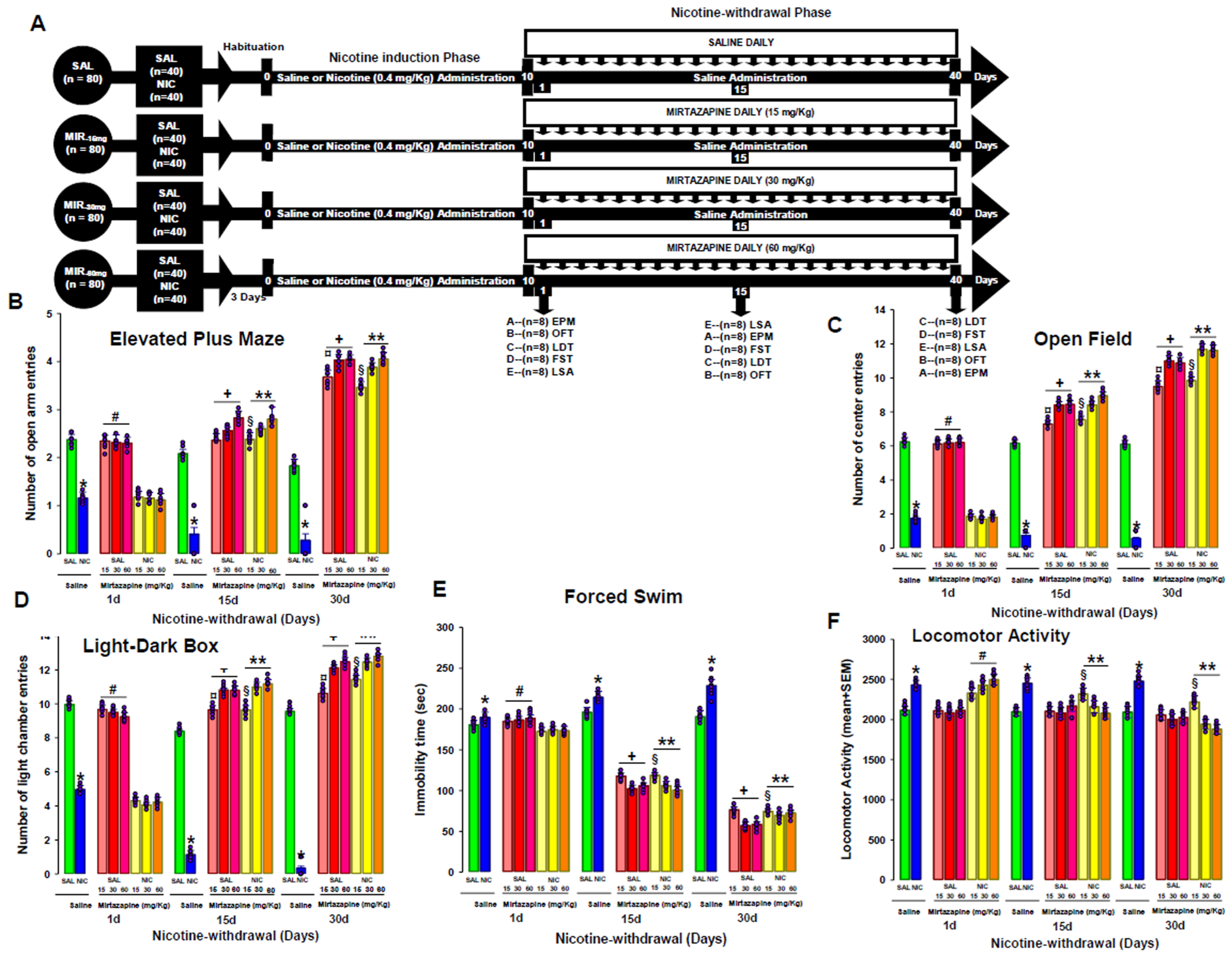
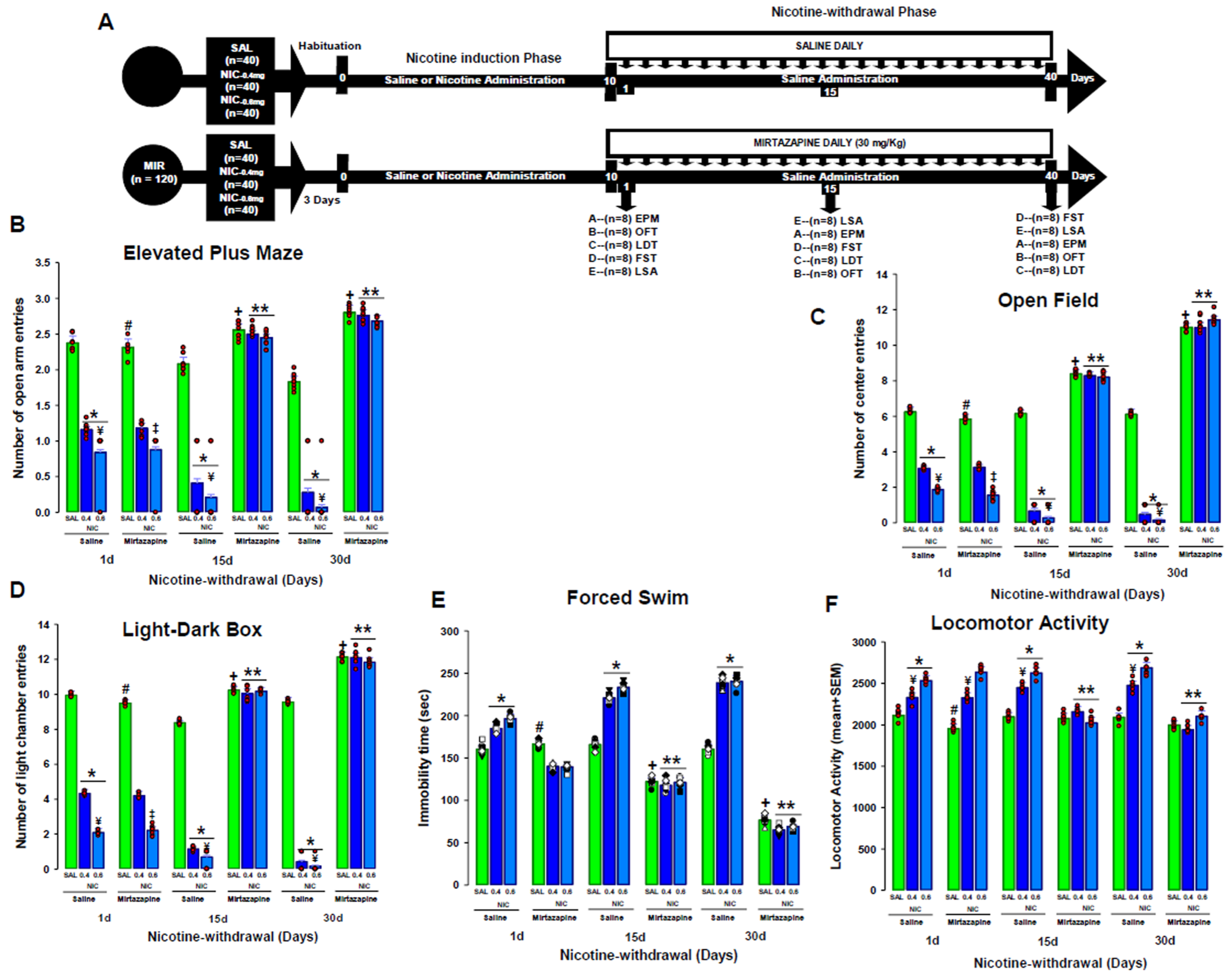
A total of 400 male Wistar rats were employed in this research, allocated across three distinct experiments (see Figure 1). The first experiment involved 160 rats, partitioned into four experimental cohorts (n = 40; refer to Figure 3A). The second experiment also consisted of 160 rats, similarly, divided into four experimental groups (n = 40; see Figure 4A). The third experiment included 80 rats, which were assigned to two groups (n = 40; see Figure 5A). The four groups from the first experiment were utilized in both the second and third experiments. Behavioral evaluations were conducted for each experimental group on eight animals per test (OFT, EPM, LDT, FST, and SLA) on days 1, 15, and 30 of nicotine withdrawal.
Figure 1.
Schematic description of the assignment of animals to experimental groups, also showing which groups were shared. The red arrows indicate that groups from Experiment 1 were shared with Experiment 2, while the green arrows indicate that they were shared with Experiment 3.
Figure 3.
Effects of mirtazapine on number of entries, immobility, and spontaneous locomotor activity as measured by EPM, OFT, LDT, FST, and LSA. Experiment timeline. (A). Rats treated daily with nicotine (0.4 mg/Kg/day, i.p.) decreased entries in EPM (B), OFT (C), and LDT (D), while increasing immobilization in FST (E) and spontaneous locomotor activity (F). Nevertheless, dosing of mirtazapine increased entries in EPM, OFT, and LDT. Each bar represents the mean (±S.E.M.) number of entries, duration of immobility, or locomotor activity per group, recorded over 6 min. * p < 0.01: significant effect of the nicotine treatment compared to the SAL + SAL and the MIR + SAL groups. ** p < 0.01: a significant effect of the mirtazapine treatment compared to the SAL + NIC group. # p < 0.01: significant effect of the mirtazapine treatment compared to the MIR + SAL and the MIR + NIC groups. + p < 0.01: significant effect of the mirtazapine treatment compared to the MIR + SAL and the SAL + SAL groups. All measures were taken on days 1, 15, and 30 after nicotine withdrawal and determined by two-way ANOVA followed by Tukey’s test.
2.4.1. Experiment 1
Experiment 1 aimed to determine whether mirtazapine (30 mg/kg) reduced anxiety- and depression-like behaviors during nicotine withdrawal, lasting up to 30 days. This experiment comprised two phases: a 10-day nicotine induction (Phase I) and a 30-day nicotine withdrawal (Phase II; Figure 3A).
During the 10-day induction phase, treatments were administered as follows:
- The Saline + Saline (SAL + SAL) and Mirtazapine + Saline (MIR + SAL) groups received daily saline solutions (0.9% NaCl, i.p.).
- The Saline + Nicotine (SAL + NIC) and all Mirtazapine + Nicotine (MIR + NIC-1d, MIR + NIC-15d, MIR + NIC-30d) groups received daily nicotine (0.4 mg/kg/day, i.p.).
During the 30-day nicotine withdrawal phase, treatments were:
- The SAL + SAL and SAL + NIC groups received daily saline solution (i.p.).
- The MIR + SAL and all MIR + NIC groups received daily mirtazapine (30 mg/kg/day, i.p.).
Anxiety- and depression-like behaviors (OFT, EPM, LDT, FST, and SLA) were assessed on days 1, 15, and 30 after nicotine withdrawal and recorded for each animal 30 min after mirtazapine (or saline) administration. To minimize error and bias from anticipatory or learning behaviors, the order of behavioral tests was counterbalanced across experimental groups.
2.4.2. Experiment 2
Experiment 2 evaluated the effect of different mirtazapine doses on anxiety- and depression-like behaviors during nicotine withdrawal, following the same general protocol as Experiment 1.
During the 10-day induction phase, treatments were administered as follows:
- The SAL + SAL and the Mirtazapine (MIR-15mg + SAL, MIR-30mg + SAL, MIR-60mg + SAL) groups received daily saline (0.9% NaCl, i.p.).
- The Nicotine (SAL + NIC) and all Mirtazapine + Nicotine (MIR-15mg + NIC, MIR-30mg + NIC, MIR-60mg + NIC) groups received daily nicotine (0.4 mg/kg/day, i.p.).
During the 30-day nicotine withdrawal phase, treatments were:
- The SAL + SAL and SAL + NIC groups received daily saline solution (i.p.).
- The MIR + SAL and MIR + NIC groups received daily mirtazapine at their respective doses (15, 30, or 60 mg/kg/day, i.p.; Figure 4A).
In this experiment, groups were labeled 15 mg, 30 mg, or 60 mg to indicate the mirtazapine dose used. Anxiety- and depression-like behavior testing was performed on days 1, 15, and 30 after nicotine withdrawal. As in Experiment 1, behaviors were assessed and recorded for each animal 30 min after mirtazapine (or saline) administration. To minimize error and bias from anticipatory or learning behaviors, the order of behavioral tests was counterbalanced across experimental groups.
Figure 4.
Effects of different mirtazapine doses on entries, immobility, and spontaneous locomotor activity as measured by EPM, OFT, LDT, FST, and LSA. Experiment timeline. (A). Rats treated daily with nicotine (0.4 mg/Kg/day, i.p.) had behavioral responses like those in Experiment 1. Different mirtazapine doses increased entries in EPN (B), OFT (C), LDT (D), FST (E), and LSA (F). Each bar represents the mean (±S.E.M.) number of entries, duration of immobility, or locomotor activity per group, recorded over 6 min. * p < 0.01: significant effect of the nicotine treatment compared to the SAL + SAL and the MIR + SAL groups. ** p < 0.01: a significant effect of the mirtazapine treatment compared to the SAL + NIC group. # p < 0.01: significant effect of the mirtazapine treatment compared to the MIR + SAL and the MIR + NIC groups. + p < 0.01: significant effect of the mirtazapine treatment compared to the MIR + SAL and the SAL + SAL groups. ¤ p < 0.01: significant effect of 15 mg/kg mirtazapine compared to the MIR-30mg + SAL and the MIR-60mg + SAL groups. § p < 0.01: a significant effect of 15 mg/kg mirtazapine compared to the MIR-30mg + NIC and the MIR-60mg + NIC groups. All measures were taken on days 1, 15, and 30 after drug withdrawal and determined by a two-way ANOVA followed by Tukey’s test.
2.4.3. Experiment 3
Experiment 3 investigated the effect of a fixed dose of mirtazapine (30 mg/kg/day) on anxiety- and depression-like behaviors during nicotine withdrawal, which was induced by different nicotine doses using the protocol described in Experiment 1.
Experimental groups were established following the same treatment schedule as Experiment 1, with specific modifications for nicotine and mirtazapine administration (Figure 5A):
- The SAL (SAL + SAL) and MIR (MIR + SAL) groups received treatments as described in Experiment 1.
- The SAL + NIC-0.4mg and SAL + NIC-0.6mg groups received daily nicotine (0.4 or 0.6 mg/kg/day, i.p., respectively) during the induction phase, followed by daily saline administration during nicotine withdrawal.
- The MIR + NIC-0.4mg and MIR + NIC-0.6mg groups received daily nicotine (0.4 or 0.6 mg/kg/day, i.p., respectively) during induction. During the subsequent nicotine withdrawal phase, these groups received daily mirtazapine (30 mg/kg/day, i.p.).
For this experiment, group abbreviations (0.4 mg, 0.6 mg) indicated the specific nicotine dose used. Anxiety- and depression-like behaviors were assessed as described in Experiment 2. Evaluations for each animal were conducted 30 min after mirtazapine administration. To minimize error and bias from anticipatory or learning behaviors, the order of behavioral tests was counterbalanced across experimental groups (Figure 5A).
Figure 5.
Mirtazapine increased entries, immobility, and spontaneous locomotor activity induced by different nicotine doses, as measured by EPM, OFT, LDT, FST, and LSA. Experiment timeline. (A). The rats treated daily with different nicotine doses (0.4 and 0.6 mg/Kg/day, i.p.) had behavioral responses similar to those in Experiment 1 Different mirtazapine doses increased entries in EPM (B), OFT (C), LDT (D) FST (E), and LSA (F). Each bar represents the mean (±S.E.M.) number of entries, duration of immobility, or locomotor activity per group, recorded over 6 min. * p <0.01: significant effect of the nicotine treatment compared to the SAL + SAL and the MIR + SAL groups. ** p < 0.01: a significant effect of the mirtazapine treatment compared to the SAL + NIC group. # p < 0.01: significant effect of the mirtazapine treatment compared to the MIR + SAL and the MIR + NIC groups. + p < 0.01: significant effect of the mirtazapine treatment compared to the MIR + SAL and the SAL + SAL groups. ¥ p < 0.01: significant effect of 0.6 mg/Kg nicotine compared to the SAL + NIC-0.4mg group. ‡ p < 0.01: significant effect of 0.6 mg/Kg nicotine compared to the MIR + NIC-0.4mg group. All measures were taken on days 1, 15, and 30 after drug withdrawal and determined by a two-way ANOVA followed by Tukey’s test.
2.5. Statistical Analysis
Throughout the study, all animals remained healthy, showing no indications of illness. Consequently, no animals were excluded from statistical evaluations, and all experimental groups-maintained n = 8 for the entire study.
Before statistical analyses, data normality was assessed using the Shapiro–Wilk test and Q-Q plots, while homogeneity of variance was evaluated through Levene’s test. Data conforming to these assumptions (p > 0.05 for both tests) were subsequently analyzed using a two-way repeated-measures ANOVA.
After performing the statistical analysis, Mauchly’s test of sphericity confirmed the equivalence of variances of the differences among all potential group pair combinations. When the sphericity assumption was not met, degrees of freedom were corrected using Greenhouse-Geisser or Huynh-Feldt adjustments, as deemed appropriate (see Supplementary Materials; Tables S1 and S2). The following criteria were applied: if Mauchly’s test yielded a significant result, the sphericity assumption was considered violated, prompting the application of adjusted repeated measures ANOVA. If Mauchly’s test was non-significant, the sphericity assumption was upheld, indicating that corrections were unnecessary. Should the estimated epsilon (ε) be less than 0.75, the Greenhouse-Geisser correction was utilized. Conversely, if the ε value exceeded 0.75, the Huynh-Feldt correction was applied. In Experiment 1, a two-way repeated-measures ANOVA was implemented to ascertain variations in anxiety- and depression-like behaviors. The between-subjects factors included treatment (saline versus mirtazapine) and group (saline versus nicotine), with the time of nicotine withdrawal (1, 15, and 30 days) serving as the repeated measure. Significant interaction effects were explored further using Tukey’s post hoc tests.
For Experiments 2 and 3, a comparable two-way repeated-measures ANOVA was conducted. In this case, the between-subjects factors were treatment (saline versus mirtazapine) and group (saline versus nicotine), with the nicotine withdrawal time (1, 15, and 30 days) functioning as the repeated measure. Post hoc comparisons were executed through Tukey’s test.
Locomotor activity during the induction phase was analyzed using a two-way ANOVA, with the between-subjects factors were treatment (saline versus mirtazapine) and nicotine exposure (saline versus nicotine doses). Post hoc comparisons were also performed via Tukey’s test.
All results are represented as mean ± standard error of the mean (S.E.M.). A significance level of less than 0.05 was established as statistically meaningful. Statistical evaluations were conducted utilizing SPSS version 21 (IBM, Armonk, New York, USA, 2021).
3. Results
3.1. Locomotor Activity Induction
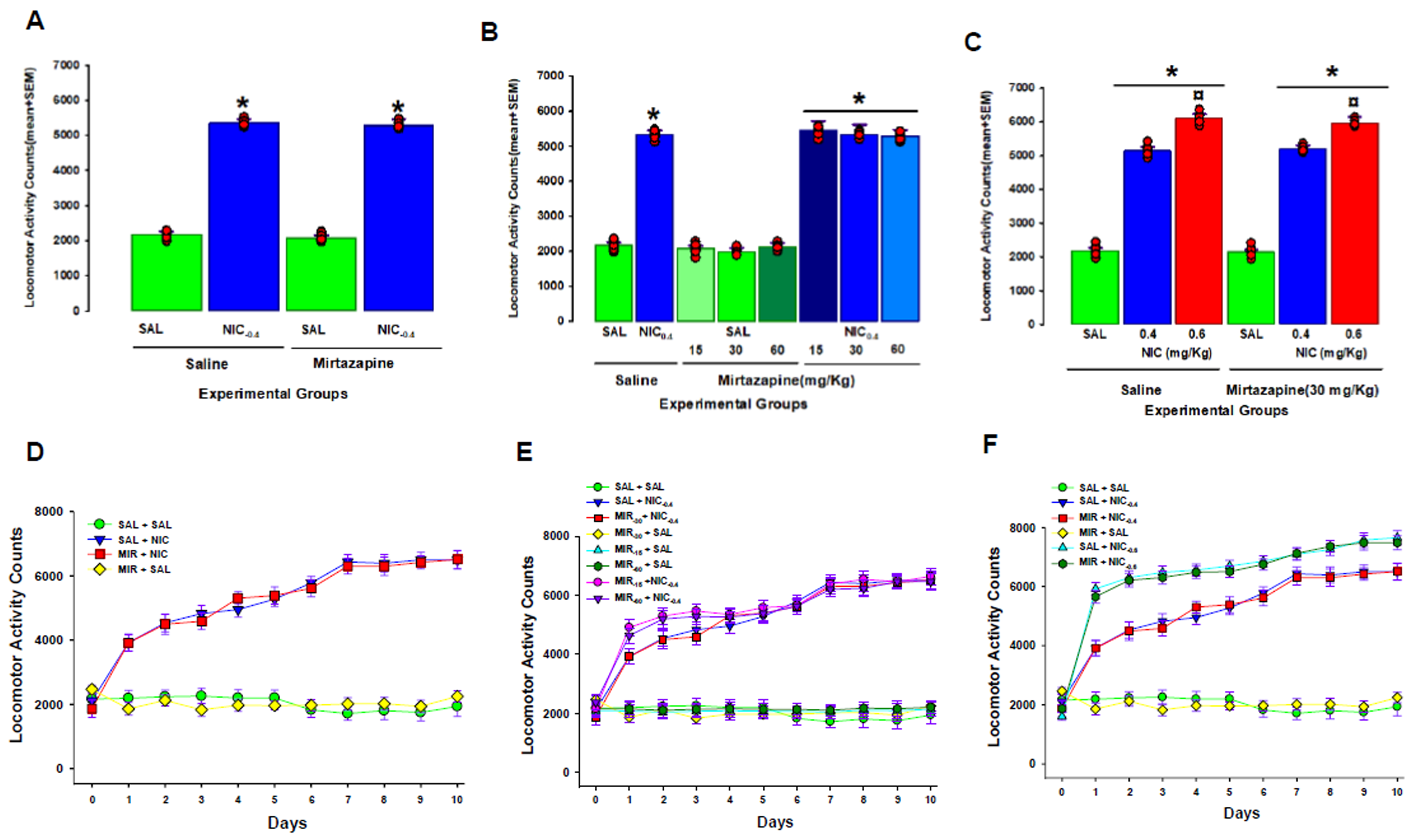
Experiment 1—As shown in Figure 2A, daily dosing nicotine (0.4 mg/Kg/day), increased locomotor activity during the induction phase, compared to the SAL + SAL (p < 0.001) and MIR + SAL (p < 0.001) groups. Two-way ANOVA found differences in the treatment (F (1, 32) = 6.14 p < 0.01) and groups (F (1, 32) = 11,280.69 p < 0.0001) factors; but found no differences in the groups by treatment interaction (F (1, 32) = 0.460 p < 0.5).
Experiment 2—Two-way ANOVA found differences (groups by treatment interaction, F (1. 78) = 156.25 p < 0.0002) in the nicotine-induced locomotor activity shown by the SAL + NIC, MIR-15mg + NIC, the MIR-30mg + NIC, and the MIR-60mg + NIC groups compared to the SAL + SAL (p < 0.001) and MIR + SAL (p < 0.001) groups (Figure 2B).
Experiment 3—The statistical analysis (two-way ANOVA; in the groups by treatment interaction, F (1. 88) = 81.28 p < 0.0001) found that during the induction phase different doses of nicotine increased the locomotor activity in the SAL + NIC-0.4mg, SAL + NIC-0.6mg, the MIR + NIC-0.4mg, and the MIR + NIC-0.6mg groups compared to the SAL + SAL (p < 0.001) and MIR + SAL (p < 0.001) groups (Figure 2C).
Figure 2.
Nicotine increases the nicotine-induced locomotor activity during the induction phase. (A,D) show nicotine-induced locomotor activity and the temporal profile of the activity corresponding to experiment 1 (green-filled for saline-treated groups and blue-filled for nicotine-treated groups). (B,E) show nicotine-induced locomotor activity and the temporal profile of the activity corresponding to experiment 2 (green-filled for saline-treated groups and blue-filled for nicotine-treated groups). (C,F) show nicotine-induced locomotor activity and the temporal profile of the activity corresponding to experiment 3 (green filled for saline-treated groups, blue filled for 0.4 mg/kg nicotine-treated groups, and red filled for 0.6 mg/kg nicotine-treated groups). Mean locomotor activity (±S.E.M.) by group (n = 8 animals per group) during the 10 days of the induction. * p < 0.01 significant effects of nicotine treatment on locomotor activity compared to the SAL + SAL and MIR + SAL groups. determined by two-way ANOVA following Tukey’s tests.
3.2. Experiment 1: Mirtazapine Reduced Anxiety- and Depression-like Behaviors During Nicotine Withdrawal
3.2.1. Anxiety-like Behavior
Figure 3 shows that the SAL + NIC group exhibited significant decreases at 1, 15, and 30 days of nicotine withdrawal compared to the SAL + SAL and MIR + SAL groups (Supplementary Materials; Table S4A,B). Specifically, these decreases were observed in entries (Figure 3B; Table 1A) and time spent in the EPM open arms (Supplementary Materials; Table S3A,A-I), in entries (Figure 3C; Table 1A) and time spent in the center of the OFT (Supplementary Materials; Table S3A,A-I), and in entries (Figure 3D; Table 1A) and time spent in the light compartment of the LDT (Supplementary Materials; Table S3A,A-I).
Table 1.
Comparisons between the groups, treatments, and nicotine-withdrawal time using a two-way repeated measures ANOVA during the nicotine withdrawal in the behavioral parameters evaluated with the EPM (OAEN―Open arm entries number) OFT (CEN—Center entries number), LDT (LEN—Light entries number), FST (IT—Immobility time), and LSA (LAC—Locomotor activity). A corresponds to the treatment factor, B to the groups factor, and A × B refers to the interaction between the treatment and groups factors.
Within the SAL + NIC group, statistical analysis revealed significant differences in entries and time spent in the EPM, OFT, and LDT at 30 days of nicotine withdrawal compared to day 1 (p < 0.001) and day 15 (p < 0.002). Furthermore, differences were also identified between day 1 and day 15 (p < 0.003) of nicotine withdrawal.
In contrast, post hoc analysis indicated that the MIR + NIC group showed an increase in time spent and entries in the EPM open arms, the OFT center, and the LDT light compartment at 15 and 30 days of nicotine withdrawal, compared to the SAL + NIC group. However, no significant differences were found in these tests on the first day of nicotine withdrawal between the MIR + NIC and SAL + NIC groups (Supplementary Materials; Table S4A,B).
Additionally, Tukey’s test demonstrated that within the MIR + NIC group, significant differences in entries and time spent in the EPM, OFT, and LDT were observed at 30 days compared to day 1 (p < 0.001) and day 15 (p < 0.002) of nicotine withdrawal (Figure 3B–D).
For the MIR + SAL group, statistical analysis revealed differences in entries and time spent in the EPM open arms, the OFT center, and the LDT light compartment on the first day of nicotine withdrawal, compared to the MIR + NIC group (Supplementary Materials; Table S4A,B). Nevertheless, post hoc tests found no differences at 15 and 30 days of nicotine withdrawal between the MIR + SAL and MIR + NIC groups (Figure 3B–D; Supplementary Materials; Table S4A,B).
On the other hand, post hoc tests identified differences in the EPM, OFT, and LDT at 15 and 30 days of nicotine withdrawal between the MIR + SAL and SAL + SAL groups, but no differences were found on day 1 of nicotine withdrawal between these groups (Figure 3B–D). Furthermore, within the MIR + SAL group, statistical analysis revealed differences in entries and time spent in the EPM, OFT, and LDT at day 30 compared to day 1 (p < 0.001) and day 15 (p < 0.002) of nicotine withdrawal.
For spontaneous locomotor activity, a two-way repeated-measures ANOVA also revealed significant differences between factors (Table 1A). Tukey’s post hoc test identified differences in spontaneous locomotor activity in the SAL + NIC group compared to the SAL + SAL, MIR + SAL, and MIR + NIC groups at 15 and 30 days of nicotine withdrawal (Figure 3F). Additionally, differences were observed between the MIR + SAL and MIR + NIC groups at 15 and 30 days of nicotine withdrawal (Supplementary Materials; Table S4A).
3.2.2. Depression-like Behavior
A two-way repeated measures ANOVA revealed significant differences between factors for FST immobility (Table 1A). Post hoc analysis indicated that the SAL + NIC group exhibited a significant increase in FST immobility compared to the SAL + SAL and MIR + SAL groups at 1, 15, and 30 days of nicotine withdrawal (Supplementary Materials; Table S4A). Furthermore, within the SAL + NIC group, FST immobility at 30 days of withdrawal was significantly higher than at 1 day (p < 0.001) and 15 days (p < 0.003) of nicotine withdrawal.
Conversely, the MIR + NIC group showed decreased FST immobility compared to both the SAL + NIC and SAL + SAL groups at 15 and 30 days of nicotine withdrawal. However, no significant difference in FST immobility was observed between the MIR + NIC and SAL + NIC groups on the first day of nicotine withdrawal (Supplementary Materials; Table S4A). Within the MIR + NIC group, immobility at 30 days was significantly different from both 1 day (p < 0.001) and 15 days (p < 0.001) of nicotine withdrawal (Figure 3E).
Regarding the MIR + SAL group, post hoc analysis revealed differences in FST immobility compared to the SAL + SAL group at 15 and 30 days of nicotine withdrawal, but not on the first day (Supplementary Materials; Table S4A).
Additionally, the MIR + SAL group showed differences in FST immobility compared to the MIR + NIC group on day 1 of nicotine withdrawal. However, Tukey’s test found no significant differences between the MIR + SAL and MIR + NIC groups at 15 and 30 days of nicotine withdrawal (Figure 3E; Supplementary Materials; Table S4A).
3.3. Experiment 2: Mirtazapine in Different Doses Reduced Anxiety- and Depression-like Behaviors During Nicotine Withdrawal
3.3.1. Anxiety-like Behaviors
For the SAL + NIC group, two-way repeated measures ANOVA revealed significant differences in EPM (Figure 4B), OFT (Figure 4C), and LDT (Figure 4D) performance across days 1, 15, and 30 of drug withdrawal. These results, consistent with findings from Experiment 1 (Figure 4B–D), are detailed in Table 1B, and Supplementary Materials; Tables S3B,B-I, S5 and S6.
In contrast, mirtazapine treatment in the MIR-15mg + NIC, MIR-30mg + NIC, and MIR-60mg + NIC groups led to an increase in entries and time spent in the EPM (open arms; Figure 4B), OFT (center; Figure 4C), and LDT (light compartment; Figure 4D) compared to the SAL + NIC group. This effect was observed at 15 and 30 days after drug withdrawal (Supplementary Materials; Tables S5 and S6). However, on day 1 of nicotine withdrawal, no significant differences were found between these mirtazapine-treated groups and the SAL + NIC group.
Furthermore, Tukey’s post hoc test identified differences in EPM, OFT, and LDT performance between the MIR-15mg + NIC group and both the MIR-30mg + NIC and MIR-60mg + NIC groups at 15 and 30 days after drug withdrawal. Conversely, no significant difference was found between the MIR-30mg + NIC and MIR-60mg + NIC groups at these time points (Supplementary Materials; Tables S5 and S6).
Post hoc analysis comparing the MIR-15mg + SAL, MIR-30mg + SAL, and MIR-60mg + SAL groups to the SAL + SAL group revealed significant differences in entries and time spent in the EPM (open arms), OFT (center), and LDT (light compartment) at 15 and 30 days of drug withdrawal. Nevertheless, no differences were observed on day 1 of nicotine withdrawal (Figure 4B–D).
The statistical analysis also showed differences on day 1 after nicotine withdrawal in the EPM, OFT, and LDT when comparing the MIR-15mg + SAL, MIR-30mg + SAL, and MIR-60mg + SAL groups to their respective MIR-15mg + NIC, MIR-30mg + NIC, and MIR-60mg + NIC counterparts. Conversely, post hoc tests indicated no significant differences between these groups at 15 and 30 days of drug withdrawal (Supplementary Materials; Tables S5 and S6; Figure 4B–D).
Regarding spontaneous locomotor activity, separate two-way repeated measures ANOVA also revealed significant differences between factors (Table 1B). Tukey’s post hoc tests indicated that the SAL + NIC group exhibited differences in locomotor activity compared to the SAL + SAL, MIR-15mg + SAL, MIR-30mg + SAL, and MIR-60mg + SAL groups at 1, 15, and 30 days of withdrawal (Figure 4F). No significant differences were found among the MIR-15mg + SAL, MIR-30mg + SAL, and MIR-60mg + SAL groups regarding locomotor activity these days. However, within the MIR + NIC groups, the MIR-15mg + NIC group showed differences in spontaneous locomotor activity compared to both the MIR-30mg + NIC and MIR-60mg + NIC groups at 15 and 30 days of nicotine withdrawal (Supplementary Materials; Table S5).
3.3.2. Depression-like Behaviors
For the Forced Swim Test (FST), a two-way repeated measures ANOVA revealed significant differences between factors (Table S5B). Post hoc Tukey’s tests showed that the SAL + NIC group exhibited increased immobility time compared to the SAL + SAL group at 15 and 30 days of nicotine withdrawal, though no significant difference was observed between these groups on the first day of withdrawal (Figure 4E).
Conversely, animals in the MIR-15mg + NIC, MIR-30mg + NIC, and MIR-60mg + NIC groups demonstrated a decrease in immobility. These MIR + NIC groups displayed significant differences in immobility time compared to the SAL + NIC group at 1, 15, and 30 days of nicotine withdrawal (Supplementary Materials; Table S5). Furthermore, within the MIR + NIC groups, the MIR-15mg + NIC group differed significantly from both the MIR-30mg + NIC and MIR-60mg + NIC groups in immobility time at 15 and 30 days of withdrawal (Figure 4E).
Comparing the MIR + SAL groups (MIR-15mg + SAL, MIR-30mg + SAL, and MIR-60mg + SAL) to the SAL + SAL group revealed decreased immobility at 15 and 30 days of withdrawal. In contrast, no significant differences in immobility time were found when comparing the MIR + SAL groups to the MIR + NIC groups (MIR-15mg + NIC, MIR-30mg + NIC, and MIR-60mg + NIC) at 15 and 30 days of nicotine withdrawal. However, significant differences were present on the first day of withdrawal among these groups (Figure 4E; Supplementary Materials; Table S5).
3.4. Experiment 3: Mirtazapine Reduced Anxiety- and Depression-like Behaviors
3.4.1. Anxiety-like Behaviors
A two-way ANOVA revealed significant differences across factors for EPM, OFT, and LDT (Table 1C; Figure 5B–D and Supplementary Materials; Table S3C). Post hoc analysis showed that both the SAL + NIC-0.4mg and SAL + NIC-0.6mg groups exhibited a decrease in entries and time spent in the EPM open arms, the OFT center, and the LDT light compartment. This decrease was observed compared to the SAL + SAL and MIR + SAL groups on days 1, 15, and 30 after nicotine withdrawal (Supplementary Material; Tables S7 and S8).
Furthermore, the SAL + NIC-0.6mg group showed significant differences in these measures compared to the SAL + NIC-0.4mg group during nicotine withdrawal (Supplementary Materials; Tables S7 and S8; Figure 5B–D).
Mirtazapine administration to the MIR + NIC-0.4mg and MIR + NIC-0.6mg groups resulted in an increase in entries and time spent in the EPM open arms, OFT center, and LDT light compartment. This effect was observed on days 15 and 30 after nicotine withdrawal, relative to the SAL + NIC-0.4mg and SAL + NIC-0.6mg groups.
However, Tukey’s test indicated differences between the MIR + NIC-0.6mg and MIR + NIC-0.4mg groups only on day 1, with no significant differences found on days 15 and 30 (Supplementary Materials; Tables S7 and S8).
Comparing the MIR + SAL group to the SAL + SAL group, post hoc tests revealed increased entries and time spent in the EPM open arms, OFT center, and LDT light compartment at days 15 and 30, but not on day 1 (Figure 5B–D).
Additionally, statistical analysis indicated differences in the EPM, OFT, and LDT for the MIR + SAL group compared to the MIR + NIC-0.4mg and MIR + NIC-0.6mg groups on day 1 of nicotine withdrawal. However, no differences were found on days 15 and 30 (Supplementary Materials; Tables S7 and S8).
The two-way repeated measures ANOVA revealed significant differences between the different factors (Table 1C). Tukey’s test found differences in spontaneous locomotor activity in the SAL + NIC-0.4mg and the SAL + NIC-0.6mg groups, compared to the SAL + SAL, the MIR + SAL, the MIR + NIC-0.4mg, and the MIR + NIC-0.6mg groups, at 15 and 30 days of nicotine withdrawal (Figure 5F). The statistical analysis found differences in locomotor activity between the SAL + NIC-0.4mg and the SAL + NIC-0.6mg groups, at days 1, 15, and 30 of withdrawal. In addition, Tukey’s test found no differences between the MIR + SAL and the MIR + NIC-0.4mg and the MIR + NIC-0.6mg groups, at days 15 and 30 of drug withdrawal (Supplementary Materials; Table S7).
3.4.2. Depression-like Behaviors
Figure 5E shows that the animals in the SAL + NIC-0.4mg and the SAL + NIC-0.6mg groups showed a significant increase in immobility time during nicotine withdrawal (Table 1C). Further, after the last nicotine injection, the post hoc test revealed that compared to the SAL + SAL and the MIR + SAL groups, the SAL + NIC-0.4mg, and the SAL + NIC-0.6mg groups had a significant nicotine increase in immobility at days 1, 15 and 30 (Figure 5E; Table S7).
In contrast, the rats, in the MIR + NIC-0.4mg and the MIR + NIC-0.6mg groups showed a decrease in immobility time, compared to those in the SAL + NIC-0.4mg and the SAL + NIC-0.6mg groups, at 1, 15, and 30 days of nicotine withdrawal.
The post hoc test did not find differences between the groups that received the different doses of nicotine in both treatments (SAL or MIR) on the drug withdrawal. In addition, at 1, 15, and 30 days of nicotine withdrawal, the post hoc test found differences in the immobility shown by the SAL + NIC-0.4mg and SAL + NIC-0.6mg groups compared to that shown by the MIR + NIC-0.4mg, and MIR + NIC-0.6mg groups (Figure 5E; Table S7).
In addition, the post hoc test found differences in immobility time shown by the MIR + SAL group compared to those in the SAL + SAL group at 15 and 30 days of drug withdrawal. Immobility in the MIR + SAL group compared to that in the SAL + SAL group did not differ on the first day of drug withdrawal.
Similarly, the post hoc test found differences in immobility time when comparing the MIR + SAL to the MIR + NIC-0.4mg and the MIR + NIC-0.6mg groups 1 day after the last nicotine administration. Nonetheless, on 15 and 30 days of drug withdrawal, Tukey’s test did not reveal any differences (Figure 5E; Table S7).
4. Discussion
In this investigation, we discovered that administering mirtazapine at doses of either 30 or 60 mg/Kg/day effectively reduced anxiety- and depression-like behaviors induced by nicotine (0.4 or 0.6 mg/Kg/day) across various withdrawal time points.
Prior rodent studies have consistently shown that nicotine withdrawal elevates anxiety- and depression-like behaviors. These behaviors are typically indicated by a diminished duration and frequency of entries into the open arms of the elevated plus maze (EPM) and by a reduction in both exploration and time spent in the central area of the open field test (OFT) [50,51,52,53,54,55]. Furthermore, research by Jonkman et al. [56] reported a significant reduction in the duration spent within the light chamber during the light/dark transition (LDT) test among DBA/2 mice undergoing nicotine withdrawal. Instances of increased immobility duration in the forced swim test (FST) have also been recorded in rodents experiencing nicotine withdrawal [57,58].
In alignment with these previous observations, our research similarly demonstrated that rats exhibited heightened anxiety- and depression-like behaviors during nicotine withdrawal. This was evidenced by decreased exploration and time allocated to the open arms of the EPM, the center of the OFT, and the light compartment of the LDT, in addition to an increase in immobility observed in the FST, all noticeable from the initial day of withdrawal.
Moreover, we noted that these anxiety- and depression-related behaviors intensified throughout the withdrawal duration, exhibiting greater severity at 30 days compared to 15 days following nicotine cessation.
Research focusing on the long-term assessment of anxiety- and depression-like behaviors in animal studies is limited [28,59]. Nonetheless, existing findings indicate a temporal escalation of such behaviors, wherein the effects of withdrawal manifest more significantly in the fourth week relative to the initial 3 or 10 days of nicotine withdrawal [28]. In humans, similar withdrawal symptoms can surface within 20 min following the cessation of tobacco use and may persist for several months [60]. This suggests that the affective effects associated with nicotine withdrawal are enduring and tend to intensify over time.
Considering the persistent nature of these symptoms, it is essential to alleviate the affective components of nicotine withdrawal to enhance the success of smoking cessation efforts. Antidepressant medications, particularly, have been proposed to alleviate these affective symptoms, consequently reducing the likelihood of relapse [14].
Building upon this rationale, our research specifically examined the effectiveness of mirtazapine in decreasing anxiety- and depression-like behaviors at different nicotine withdrawal time points. We found that mirtazapine, at a dosage of 30 mg/Kg/day, significantly diminished both anxiety-like behaviors (assessed through the EPM, OFT, and LDT) and depression-like behaviors (measured by the FST) in animals previously administered nicotine at 0.4 mg/Kg/day. These effects were observed at both 15 and 30 days following withdrawal.
This finding is a novel contribution to literature, as we are unaware of any prior studies in either rodents or humans that have documented comparable ameliorative impacts of mirtazapine during nicotine withdrawal.
The application of antidepressants to treat affective symptoms linked to nicotine withdrawal is not a new strategy [13]. Human research indicates that bupropion and nortriptyline are among the most prescribed antidepressants for individuals aiming to quit smoking [61,62]. Other antidepressants, including fluoxetine, paroxetine, and sertraline, have also been evaluated [63,64]. In all reported instances, antidepressant administration appears to enhance the likelihood of smoking cessation. However, these studies have not specifically investigated the impact of these antidepressants on symptoms of anxiety and depression in individuals undergoing nicotine withdrawal [14]. A similar research gap exists in animal studies; to our knowledge, no existing investigations have adequately addressed the effects of antidepressants on anxiety- and depression-like behaviors in animals undergoing nicotine withdrawal.
We previously documented that a fixed daily dosage of 30 mg/Kg/day of mirtazapine significantly reduced anxiety- and depression-like behaviors during prolonged (60 days) cocaine withdrawal [37]. The results of the current investigation corroborate these earlier findings, indicating that mirtazapine may alleviate symptoms associated with anxiety and depression that emerge during withdrawal from various illicit substances.
Research conducted on rodents [65,66] has demonstrated that nicotine’s reinforcing and psychomotor effects are influenced by sex. Specifically, these studies have shown that female rats exhibit a heightened response to nicotine, as evidenced by increased nicotine self-administration [67]. Nevertheless, the evidence concerning anxiety- and depression-like behaviors remains ambiguous. Certain studies reveal that male rats display significantly higher levels of anxiety- and depression-like behaviors compared to females, whereas others indicate that female rats have greater anxiety- and depression-like behaviors than their male counterparts [68]. To address these inconsistencies and eliminate the influences of female hormones, the present study was carried out exclusively with male rats. Consequently, a limitation of this research lies in the absence of behavioral evaluations conducted in both female and male rats.
Anxiety represents a psychological, physiological, and behavioral response that naturally arises in reaction to perceived threats, serving a crucial role in species survival [69]. Thus, all mammals display a certain level of intrinsic or natural anxiety. Inadequate regulation of this response can lead to the emergence of affective disorders.
Numerous studies have shown that mirtazapine reduces anxiety-like behavior, measured by the elevated plus maze (EPM), and alleviates depression-like behavior, evaluated in the forced swim test (FST), in saline-treated subjects [70,71,72]. Our findings align with these observations: animals treated with 30 mg/kg/day of mirtazapine for 15 days exhibited reduced anxiety-like behavior (assessed by the elevated plus maze, open field test, and light/dark test) and depression-like behavior (assessed through the forced swim test).
Previous research indicates that mirtazapine’s effects are dose dependent [37,53].
For instance, 15 mg/kg/day of mirtazapine did not decrease cocaine-induced locomotor activity [53], while 60 mg/kg/day did not produce further reductions beyond those achieved with 30 mg/kg/day [53]. Similarly, a daily intake of 60 mg/kg/day did not enhance mirtazapine’s antidepressant effects in depressed patients [73]. Our lab’s prior work on depression- and anxiety-like behaviors also demonstrated that 15 mg/kg/day of mirtazapine effectively reduced both anxiety-like behavior (evaluated in the elevated plus maze, open field test, and light/dark test) and depression-like behavior (assessed in the forced swim test) 15 days post-cocaine withdrawal. Moreover, we reported that 60 mg/kg/day did not lead to additional reductions in these behaviors compared to the improvements observed with 30 mg/kg/day [37].
These findings align with the current study’s observations, where various mirtazapine dosages effectively decreased anxiety- and depression-related behaviors. Notably, the impact of different mirtazapine doses on these behaviors appears independent of baseline locomotor activity, as neither 30 mg/Kg nor 60 mg/Kg daily dosages influence it.
Furthermore, our study revealed that nicotine affected anxiety- and depression-like behaviors, with a more pronounced effect at 0.6 mg/Kg/day compared to 0.4 mg/Kg/day. These results are consistent with research indicating that daily nicotine doses below 0.3 mg/Kg/day are ineffective in eliciting affective responses during withdrawal, while higher doses, such as 0.6 mg/Kg/day, produce more significant affective outcomes than 0.4 mg/Kg/day [74,75].
Previous rodent studies have demonstrated that a fixed daily dose of 30 mg/Kg/day mirtazapine reduced depression- and anxiety-like behaviors induced by withdrawal from 10, 20, and 40 mg/Kg/day cocaine [37].
Our study’s findings align with this, showing that 30 mg/Kg/day mirtazapine decreased these behaviors, as evidenced by increased entries into and time spent in the open arms of the elevated plus-maze (EPM), the center of the open field test (OFT), and the light chamber of the light/dark transition test (LDT).
Pharmacological tolerance is a critical mechanism in smoking, driving tobacco-dependent individuals to consume increasing amounts of nicotine to achieve the initial pleasurable effect. As noted, a fixed daily dose of mirtazapine (30 mg/kg/day) effectively reduced the impact of escalating daily doses of nicotine (0.4–0.6 mg/kg/day). This suggests that mirtazapine may not only diminish nicotine’s reinforcing, psychomotor, and withdrawal-related affective effects but also interfere with the development of the cellular, metabolic, and behavioral mechanisms associated with pharmacological tolerance. However, further research is needed to confirm this hypothesis.
Nicotine withdrawal manifests with a range of affective, physical, and cognitive symptoms, including depressed mood, irritability, anxiety, difficulty concentrating, hyperalgesia, increased appetite, insomnia, fatigue, decreased arousal, and intense craving for nicotine [60]. Increased anxiety and depression are particularly significant withdrawal symptoms, often leading to relapses [6]. Alleviating these symptoms is crucial for smoking cessation [14], which has led to the exploration of anxiolytic and antidepressant agents as adjuncts in treating nicotine withdrawal syndrome [14].
In this context, our finding that mirtazapine, an atypical antidepressant [15], decreased long-term depression- and anxiety-like behaviors during withdrawal induced by various nicotine doses is especially relevant.
Mirtazapine possesses a unique multitarget pharmacological profile [16]. Its therapeutic effects arise from the antagonism of α2-adrenergic receptors and the blockade of 5-HT2A, 5-HT2C, 5-HT3, and histamine H1 (H1R) receptors [15]. Additionally, mirtazapine acts as an inverse agonist of the 5-HT2C receptor and indirectly as an agonist of the 5-HT1A receptor [17,18].
Numerous studies have reported alterations in various signaling pathways, including the serotonergic system, during nicotine withdrawal in both humans and animals [2]. Specifically, these studies indicate decreased basal serotonin release in the limbic system, reduced mRNA expression of the 5-HT transporter, and, notably, increased sensitivity of 5-HT2A receptors [76,77]. Consistent with these findings, antagonists or inverse agonists of 5-HT2A receptors (e.g., M100907 or pimavanserin) reduced some somatic and affective signs of nicotine withdrawal in rats [28]. Similarly, agonists of 5-HT2C receptors (e.g., SB 242,084, Ro 60-0175, and WAY 163,909) attenuated depression-like behaviors, as indicated by decreased immobility time in the forced swim test (FST) during nicotine withdrawal in rats [28]. Conversely, other studies have implicated 5-HT1A receptors in anxiety-like behaviors, with administration of the 5-HT1A receptor antagonist WAY 100,635 decreasing anxiety during nicotine withdrawal [78]. This collective evidence suggests that modulating the serotonergic system through 5-HT receptor antagonism and agonism could be a valuable strategy for treating affective disturbances during nicotine withdrawal, thereby supporting mirtazapine’s potential utility.
Given this context, a plausible hypothesis is that mirtazapine—through its simultaneous pharmacological effects on 5-HT1A, 5-HT2A, and 5-HT2C receptors— likely decreases long-term depression- and anxiety-like behaviors, as assessed in tests such as the EPM, OFT, LDT, and FST.
Furthermore, the histaminergic system has also been implicated in anxiety-like behaviors during nicotine withdrawal. Specifically, H1 and H3 receptor antagonists have been shown to decrease anxiety in this context [79]. Since mirtazapine acts as an antagonist of histamine H1 receptors, another hypothesis could be that this mechanism could also contribute to the anxiolytic effects induced by mirtazapine. However, a limitation of this study lies in the lack of agonism and antagonism studies to determine the participation of each of these receptors in the effects of mirtazapine on depression- and anxiety-like behaviors.
5. Conclusions
Thus, mirtazapine’s complex, multitarget pharmacological profile, involving simultaneous action on serotonergic and histaminergic receptors, has been shown to not only decrease the psychomotor and reinforcing effects of nicotine but also mitigate the affective disturbances (anxiety and depression) characteristic of nicotine withdrawal and on the other hand, it was able to reduce the innate biological anxiety in rodents. While these results are encouraging, they should be interpreted with caution. On one hand, only one behavioral assessment related to depression-like behavior was conducted, which may limit the conclusions that can be drawn regarding the effect of mirtazapine on such behavior. On the other hand, further studies are needed to evaluate the efficacy of mirtazapine in a model of smoking, with the goal of potentially proposing it as a therapy for the treatment of tobacco use disorder.
Supplementary Materials
The following supporting information can be downloaded at: https://www.mdpi.com/article/10.3390/brainsci16121297/s1, Table S1: Verification of whether the variances of the differences between all possible combinations of group pairs were equal using Mauchly’s test of sphericity. Table S2: Verification of whether the variances of the differences between all possible combinations of group pairs were equal using Mauchly'’s test of sphericity. Table S3: Comparisons between the groups, treatments, and nicotine-withdrawal time using a two-way repeated measures ANOVA during the nicotine withdrawal in the behavioral parameters evaluated with the EPM (OAPT―Open arm permanence time), OFT (CPT―Center permanence time), LDT (LPT―Light permanence time). * p <0.05. Table S4: Comparisons between the groups of behavioral parameters were evaluated with the EPM, OFT, LDT, FST, and LSA using a Tukey test during the 1, 15, and 30 days of nicotine withdrawal. A) EPM (OAEN―Open arm entries), OFT (CEN―Center entries number), LDT (LEN―Light entries number), FST (IT―Immobility time), and LSA (LAC―Locomotor activity). B) EPM (OAPT―Open arm permanence time), OFT (CPT―Center permanence time), LDT (LPT―Light permanence time). Table S5: Comparisons between the groups of behavioral parameters were evaluated with the EPM, OFT, LDT, FST, and LSA using a Tukey test during the 1, 15, and 30 days of nicotine withdrawal. EPM (OAEN―Open arm entries), OFT (CEN―Center entries number), LDT (LEN―Light entries number), FST (IT―Immobility time), and LSA (LAC―Locomotor activity). # No significant differences. * Significant differences with p < 0.05. Table S6: Comparisons between the groups of behavioral parameters were evaluated with the EPM, OFT, LDT, FST, and LSA using a Tukey test during the 1, 15, and 30 days of nicotine withdrawal. EPM (OAPT―Open arm permanence time), OFT (CPT―Center permanence time), LDT (LPT―Light permanence time). # No significant differences. * Significant differences with p < 0.05. Table S7: Comparisons between the groups of behavioral parameters were evaluated with the EPM, OFT, LDT, FST, and LSA using a Tukey test during the 1, 15, and 30 days of nicotine withdrawal. A) EPM (OAEN―Open arm entries), OFT (CEN―Center entries number), LDT (LEN―Light entries number), FST (IT―Immobility time), and LSA (LAC―Locomotor activity). # No significant differences. * Significant differences with p < 0.05. Table S8: Comparisons between the groups of behavioral parameters were evaluated with the EPM, OFT, LDT, FST, and LSA using a Tukey test during the 1, 15, and 30 days of nicotine withdrawal. B) EPM (OAPT―Open arm permanence time), OFT (CPT―Center permanence time), LDT (LPT―Light permanence time). # No significant differences. * Significant differences with p < 0.05 [44,48,80,81,82,83,84,85,86].
Author Contributions
Participated in research design: A.S.-J.; Conducted experiments: A.S.-J., S.B.M. Performed data analysis: A.S.-J.; Wrote or contributed to the writing of the manuscript: A.S.-J.; A.S.-J.: Conceptualization, Data curation, Formal analysis, Funding acquisition, Investigation, Methodology, Project administration, Resources, Software, Supervision, Validation, Visualization, Writing—original draft. S.B.M.: Investigation, Methodology, Project administration, Supervision, Writing—original draft. All authors have read and agreed to the published version of the manuscript.
Funding
This study was carried out thanks to grants INP-2000-2040 and CI-IC092020.2.
Institutional Review Board Statement
The study was approved by the Animal Care and Bioethics Committee of the National Institute of Psychiatry in Mexico City (Protocol # CEI/C/003/IC17056.0/2018) in accordance with the Official Mexican Regulation NOM-062-ZOO-1999, Technical specifications for the production, care, and use of laboratory animals, and in strict compliance with the Guide for the Care and Use of Laboratory Animals published by the National Institutes of Health (NIH).
Informed Consent Statement
The authors declare that they give their consent for the publication of this paper.
Data Availability Statement
The raw data supporting the conclusions of this article will be made available by the authors without undue reservation.
Conflicts of Interest
The authors declare no conflicts of interest.
References
- Hahad, O.; Daiber, A.; Michal, M.; Kuntic, M.; Lieb, K.; Beutel, M.; Münzel, T. Smoking and Neuropsychiatric Disease—Associations and Underlying Mechanisms. Int. J. Mol. Sci. 2021, 22, 7272. [Google Scholar] [CrossRef] [Scilit] [PubMed]
- Balfour, D.J. The neuronal pathways mediate the behavioral and addictive properties of nicotine. Handb. Exp. Pharmacol. 2009, 192, 209–233. [Google Scholar] [CrossRef] [Scilit] [PubMed]
- De Biasi, M.; Dani, J.A. Reward, addiction, nicotine withdrawal. Annu. Rev. Neurosci. 2011, 34, 105–130. [Google Scholar] [CrossRef] [Scilit] [PubMed]
- Kenny, P.J.; Markou, A. Neurobiology of the nicotine withdrawal syndrome. Pharmacol. Biochem. Behav. 2001, 70, 531–549. [Google Scholar] [CrossRef] [Scilit] [PubMed]
- Leventhal, A.M.; Ameringer, K.J.; Osborn, E.; Zvolensky, M.J.; Langdon, K.J. Anxiety and depressive symptoms and affective patterns of tobacco withdrawal. Drug Alcohol Depend. 2013, 133, 324–329. [Google Scholar] [CrossRef] [Scilit] [PubMed]
- Nagawa, C.S.; Rigotti, N.A.; Chang, Y.; Levy, D.E.; Streck, J.M.; Ylioja, T.; Lee, S.S.; Tindle, H.A. Association between Smoking Abstinence and Depression and Anxiety Symptoms After Hospital Discharge: The Helping HAND 4 Trial. J. Addict. Med. 2025, 19, 4–11. [Google Scholar] [CrossRef] [Scilit] [PubMed]
- Wells, A.C.; Lotfipour, S. Prenatal nicotine exposure during pregnancy results in adverse neurodevelopmental alterations and neurobehavioral deficits. Adv. Drug Alcohol Res. 2023, 3, 11628. [Google Scholar] [CrossRef] [Scilit] [PubMed]
- Sobrian, S.K.; Marr, L.; Ressman, K. Prenatal cocaine and/or nicotine exposure produces depression and anxiety in aging rats. Prog. Neuro-Psychopharmacol. Biol. Psychiatry 2003, 27, 501–518. [Google Scholar] [CrossRef] [Scilit] [PubMed]
- Aljuhani, O.; Al Sulaiman, K.; Alkofide, H.; AlFaifi, M.; Alshehri, A.A.; Aljohani, S.; Algethamy, H. Evaluating the effectiveness of nicotine replacement therapy in critically ill smokers: A meta-analysis of randomized controlled trials. Tob. Induc. Dis. 2024, 22, 143. [Google Scholar] [CrossRef] [Scilit] [PubMed]
- Livingstone-Banks, J.; Lindson, N.; Hartmann-Boyce, J. Effects of interventions to combat tobacco addiction: Cochrane update of 2021 to 2023 reviews. Addiction 2024, 119, 2101–2115. [Google Scholar] [CrossRef] [Scilit] [PubMed]
- de Oca, M.M.; Laucho-Contreras, M.E. Smoking cessation and vaccination. Eur. Respir. Rev. 2023, 32, 220187. [Google Scholar] [CrossRef] [Scilit] [PubMed]
- Raleigh, M.D.; Beltraminelli, N.; Fallot, S.; LeSage, M.G.; Saykao, A.; Pentel, P.R.; Fuller, S.; Thisted, T.; Biesova, Z.; Horrigan, S.; et al. Attenuating nicotine’s effects with high affinity human anti-nicotine monoclonal antibodies. PLoS ONE 2021, 16, e0254247. [Google Scholar] [CrossRef] [Scilit] [PubMed]
- Lindson, N.; Theodoulou, A.; Ordóñez-Mena, J.M.; Fanshawe, T.R.; Sutton, A.J.; Livingstone-Banks, J.; Hajizadeh, A.; Zhu, S.; Aveyard, P.; Freeman, S.C.; et al. Pharmacological and electronic cigarette interventions for smoking cessation in adults: Component network meta-analyses. Cochrane Database Syst. Rev. 2023, 9, CD015226. [Google Scholar] [CrossRef] [Scilit] [PubMed]
- Hajizadeh, A.; Howes, S.; Theodoulou, A.; Klemperer, E.; Hartmann-Boyce, J.; Livingstone-Banks, J.; Lindson, N. Antidepressants for smoking cessation. Cochrane Database Syst. Rev. 2023, 5, CD000031. [Google Scholar] [CrossRef] [Scilit] [PubMed]
- de Boer, T. The pharmacologic profile of mirtazapine. J. Clin. Psychiatry 1996, 57, 19–25. [Google Scholar] [PubMed]
- Barbosa-Méndez, S.; Becerril-Villanueva, E.; Ponce-Regalado, M.D.; Salazar-Juárez, A. Mirtazapine, Multi-target strategies for treating substance use disorder and depression. In The Neuroscience of Depression, Features, Diagnosis, and Treatment; Elsevier: London, UK; Academic Press: London, UK, 2021; pp. 401–410. [Google Scholar]
- Chanrion, B.; la Cour, C.M.; Gavarini, S.; Seimandi, M.; Vincent, L.; Pujol, J.-F.; Bockaert, J.; Marin, P.; Millan, M.J. Inverse agonist and neutral antagonist actions of antidepressants at recombinant and native 5-hydroxytryptamine2C Receptors: Differential modulation of cell surface expression and signal transduction. Mol. Pharmacol. 2008, 73, 748–757. [Google Scholar] [CrossRef] [Scilit] [PubMed]
- Nakayama, K.; Sakurai, T.; Katsu, H. Mirtazapine increases dopamine release in prefrontal cortex by 5-HT1A receptor activation. Brain Res. Bull. 2004, 63, 237–241. [Google Scholar] [CrossRef] [Scilit] [PubMed]
- Barbosa-Méndez, S.; Leff, P.; Arías-Caballero, A.; Hernández-Miramontes, R.; Heinze, G.; Salazar-Juárez, A. Mirtazapine attenuates cocaine seeking in rats. J. Psychiatr. Res. 2017, 92, 38–46. [Google Scholar] [CrossRef] [Scilit] [PubMed]
- Barbosa-Méndez, S.; Salazar-Juárez, A. Evaluation of multitarget drugs on the expression of cocaine-induced locomotor sensitization in male rats: A comparative study. Heliyon 2024, 10, e29979. [Google Scholar] [CrossRef] [Scilit] [PubMed]
- Barbosa-Méndez, S.; Salazar-Juárez, A. Mirtazapine decreased cocaine-induced c-fos expression and dopamine release in rats. Front. Psychiatry 2024, 15, 1428730. [Google Scholar] [CrossRef] [Scilit] [PubMed]
- Nanni-Alvarado, R.; Gonzalez, M.; Lima, C.; Marín-Navarrete, R.; Barbosa-Méndez, S.; Salazar-Juárez, A. Effect of mirtazapine on craving in cocaine depended on patients. Int. J. Ment. Health Addict. 2021, 20, 2770–2786. [Google Scholar] [CrossRef] [Scilit]
- Salazar-Juárez, A.; Barbosa-Méndez, S.; Merino-Reyes, P.; Matus-Ortega, M.; Hernández-Calderón, J.A.; Antón, B. Chronic dosing with mirtazapine does not produce sedation in rats. Braz. J. Psychiatry 2017, 39, 228–236. [Google Scholar] [CrossRef] [Scilit] [PubMed]
- Barbosa-Méndez, S.; Jurado, N.; Matus-Ortega, M.; Martiñon, S.; Heinze, G.; Salazar-Juárez, A. Mirtazapine attenuates the expression of nicotine-induced locomotor sensitization in rats. Eur. J. Pharmacol. 2017, 812, 28–37. [Google Scholar] [CrossRef] [Scilit] [PubMed]
- Barbosa-Méndez, S.; Salazar-Juárez, A. Mirtazapine attenuates nicotine-seeking behavior in rats. J. Psychopharmacol. 2018, 32, 1010–1017. [Google Scholar] [CrossRef] [Scilit] [PubMed]
- Tiwari, R.K.; Sharma, B.; Sharma, A.K.; Pandey, R. Serotonergic Regulation of Nicotine Addiction: Receptor-specific Mechanisms and Therapeutic Strategies. Curr. Neurovascular Res. 2026, 23, 149–159. [Google Scholar] [CrossRef] [Scilit] [PubMed]
- Slotkin, T.A.; Seidler, F.J. A unique role for striatal serotonergic systems in the withdrawal from adolescent nicotine administration. Neurotoxicol. Teratol. 2007, 29, 10–16. [Google Scholar] [CrossRef] [Scilit] [PubMed]
- Zaniewska, M.; McCreary, A.C.; Wydra, K.; Filip, M. Effects of serotonin (5-HT)2 receptor ligands on depression-like behavior during nicotine withdrawal. Neuropharmacology 2010, 58, 1140–1146. [Google Scholar] [CrossRef] [Scilit] [PubMed]
- Buzzi, B.; AlSharari, S.D.; Walentiny, D.M.; Damaj, M.I. Nelotanserin, a selective 5-HT2A receptor inverse agonist, attenuates aspects of nicotine withdrawal but not reward in mice. Behav. Brain Res. 2024, 467, 115019. [Google Scholar] [CrossRef] [Scilit] [PubMed]
- Rasmussen, K.; Calligaro, D.O.; Czachura, J.F.; Dreshfield-Ahmad, L.J.; Evans, D.C.; Hemrick-Luecke, S.K.; Kallman, M.J.; Kendrick, W.T.; Leander, J.D.; Nelson, D.L.; et al. The novel 5-Hydroxytryptamine(1A) antagonist LY426965: Effects on nicotine withdrawal and interactions with fluoxetine. J. Pharmacol. Exp. Ther. 2000, 294, 688–700. [Google Scholar] [CrossRef] [Scilit]
- Rasmussen, K.; Kallman, M.J.; Helton, D.R. Serotonin-1A antagonists attenuate the effects of nicotine withdrawal on the auditory startle response. Synapse 1997, 27, 145–152. [Google Scholar] [CrossRef] [Scilit]
- Costall, B.; Jones, B.; Kelly, M.; Naylor, R.; Onaivi, E.; Tyers, M. Sites of action of ondansetron to inhibit withdrawal from drugs of abuse. Pharmacol. Biochem. Behav. 1990, 36, 97–104. [Google Scholar] [CrossRef] [Scilit] [PubMed]
- Saeed, S.; Sharif, H.; Bano, S. Effects of bupropion on nicotine withdrawal associated disturbances in circulating corticosterone and brain 5-HT turnover in mice. Pak. J. Pharm. Sci. 2024, 37, 1063–1069. [Google Scholar] [CrossRef] [Scilit]
- A Harrison, A.; Liem, Y.T.; Markou, A. Fluoxetine combined with a serotonin-1A receptor antagonist reversed reward deficits observed during nicotine and amphetamine withdrawal in rats. Neuropsychopharmacology 2001, 25, 55–71. [Google Scholar] [CrossRef] [Scilit] [PubMed]
- Saules, K.K.; Schuh, L.M.; Arfken, C.L.; Reed, K.; Kilbey, M.M.; Schuster, C.R. Double-blind placebo-controlled trial of fluoxetine in smoking cessation treatment including nicotine patch and cognitive-behavioral group therapy. Am. J. Addict. 2004, 13, 438–446. [Google Scholar] [CrossRef] [Scilit] [PubMed]
- Carrão, J.L.; Moreira, L.B.; Fuchs, F.D. The efficacy of the combination of sertraline with buspirone for smoking cessation. A randomized clinical trial in nondepressed smokers. Eur. Arch. Psychiatry Clin. Neurosci. 2007, 257, 383–388. [Google Scholar] [CrossRef] [Scilit] [PubMed]
- Méndez, S.B.; Salazar-Juárez, A. Mirtazapine attenuates anxiety- and depression-like behaviors in rats during cocaine withdrawal. J. Psychopharmacol. 2019, 33, 589–605. [Google Scholar] [CrossRef] [Scilit] [PubMed]
- Chandrasekaran, P.K. Employing mirtazapine to aid benzodiazepine withdrawal. Singap. Med. J. 2008, 49, e166–7. [Google Scholar]
- Kang, L.; Wang, D.; Li, B.; Hu, M.; Zhang, P.; Li, J. Mirtazapine, a noradrenergic and specific serotonergic antidepressant, attenuates morphine dependence and withdrawal in Sprague-Dawley rats. Am. J. Drug Alcohol Abus. 2008, 34, 541–552. [Google Scholar] [CrossRef] [Scilit] [PubMed]
- Cruickshank, C.C.; Montebello, M.E.; Dyer, K.R.; Quigley, A.; Blaszczyk, J.; Tomkins, S.; Shand, D. A placebo-controlled trial of mirtazapine for the management of methamphetamine withdrawal. Drug Alcohol Rev. 2008, 27, 326–333. [Google Scholar] [CrossRef] [Scilit] [PubMed]
- Shoptaw, S.J.; Kao, U.; Heinzerling, K.; Ling, W. Treatment for amphetamine withdrawal. Cochrane Database Syst. Rev. 2009, 2009, CD003021. [Google Scholar] [CrossRef] [Scilit] [PubMed]
- Lalani, E.; Menon, R.; A Mufti, M.; Kumfa, C.; Raji, M. Mirtazapine: A One-Stop Strategy for Treatment of Opioid Withdrawal Symptoms. Cureus 2023, 15, e43821. [Google Scholar] [CrossRef] [Scilit] [PubMed]
- Bahi, A. Sustained lentiviral-mediated overexpression of microRNA124a in the dentate gyrus exacerbates anxiety- and autism-like behaviors associated with neonatal isolation in rats. Behav. Brain Res. 2016, 311, 298–308. [Google Scholar] [CrossRef] [Scilit] [PubMed]
- Crawley, J.; Goodwin, F.K. Preliminary report of a simple animal behavior model for the anxiolytic effects of benzodiazepines. Pharmacol. Biochem. Behav. 1980, 13, 167–170. [Google Scholar] [CrossRef] [Scilit] [PubMed]
- Pellow, S.; File, S.E. Anxiolytic and anxiogenic drug effects on exploration activity in an elevated plus-maze: A novel test of anxiety in the rat. Pharmacol. Biochem. Behav. 1986, 24, 525–529. [Google Scholar] [CrossRef] [Scilit] [PubMed]
- Porsolt, R.D.; Brossard, G.; Hautbois, C.; Roux, S. Rodent models of depression: Forced swimming and tail suspension behavioral despair tests in rats and mice. Curr. Protoc. Neurosci. 2001, Chapter8, Unit8.10A. [Google Scholar] [CrossRef] [Scilit] [PubMed]
- Benowitz, N.L.; Henningfield, J.E. Establishing a nicotine threshold for addiction. The implications for tobacco regulation. N. Engl. J. Med. 1994, 331, 123–125. [Google Scholar] [CrossRef] [Scilit] [PubMed]
- Salazar-Juárez, A.; Barbosa-Méndez, S.; Jurado, N.; Hernández-Miramontes, R.; Leff, P.; Antón, B. Mirtazapine prevents induction and expression of cocaine-induced behavioral sensitization in rats. Prog. Neuro-Psychopharmacol. Biol. Psychiatry 2016, 68, 15–24. [Google Scholar] [CrossRef] [Scilit] [PubMed]
- Bittolo, T.; Raminelli, C.A.; Deiana, C.; Baj, G.; Vaghi, V.; Ferrazzo, S.; Bernareggi, A.; Tongiorgi, E. Pharmacological treatment with mirtazapine rescues cortical atrophy and respiratory deficits in MeCP2 null mice. Sci. Rep. 2016, 6, 19796. [Google Scholar] [CrossRef] [Scilit] [PubMed]
- Adida, M.; Azorin, J.-M. Effectiveness of methylphenidate as augmentation therapy after failure of adjunctive neuromodulation for patients with treatment-refractory bipolar depression: A case report. Neuropsychiatr. Dis. Treat. 2014, 10, 559–562. [Google Scholar] [CrossRef] [Scilit] [PubMed]
- McGregor, C.; Srisurapanont, M.; Mitchell, A.; Wickes, W.; White, J.M. Symptoms and sleep patterns during inpatient treatment of methamphetamine withdrawal: A comparison of mirtazapine and modafinil with treatment as usual. J. Subst. Abus. Treat. 2008, 35, 334–342. [Google Scholar] [CrossRef] [Scilit] [PubMed]
- Zueco Pérez, P.L. Mirtazapine in the treatment of cocaine-dependence in patients with methadone. Actas Esp. Psiquiatr. 2002, 30, 337–342. [Google Scholar] [PubMed]
- Barbosa-Méndez, S.; Matus-Ortega, M.; Flores-Zamora, A.; Jurado, N.; Salazar-Juárez, A. Dose- and time-dependent effects of mirtazapine on the expression of cocaine-induced behavioral sensitization in rats. Psychiatry Res. 2017, 254, 301–310. [Google Scholar] [CrossRef] [Scilit] [PubMed]
- Irvine, E.E.; Cheeta, S.; File, S.E. Tolerance to nicotine’s effects in the elevated plus-maze and increased anxiety during withdrawal. Pharmacol. Biochem. Behav. 2001, 68, 319–325. [Google Scholar] [CrossRef] [Scilit] [PubMed]
- Slawecki, C.J.; Gilder, A.; Roth, J.; Ehlers, C.L. Increased anxiety-like behavior in adult rats exposed to nicotine as adolescents. Pharmacol. Biochem. Behav. 2003, 75, 355–361. [Google Scholar] [CrossRef] [Scilit] [PubMed]
- Jonkman, S.; Henry, B.; Semenova, S.; Markou, A. Mild anxiogenic effects of nicotine withdrawal in mice. Eur. J. Pharmacol. 2005, 516, 40–45. [Google Scholar] [CrossRef] [Scilit] [PubMed]
- Motaghinejad, M.; Fatima, S.; Karimian, M.; Ganji, S. Protective effects of forced exercise against nicotine-induced anxiety, depression and cognition impairment in rats. J. Basic Clin. Physiol. Pharmacol. 2016, 27, 19–27. [Google Scholar] [CrossRef] [Scilit] [PubMed]
- Roni, M.A.; Rahman, S. The effects of lobeline on nicotine withdrawal-induced depression-like behavior in mice. Psychopharmacology 2014, 23115, 2989–2998. [Google Scholar] [CrossRef] [Scilit] [PubMed]
- Hammad, A.M.; Abusara, O.H.; Sunoqrot, S.; Khdair, S.I.; Hall, F.S. Sex Differences in Withdrawal-Induced Anxiety in Rats After Exposure to Tobacco Smoke. Neurosci. Lett. 2024, 833, 137834. [Google Scholar] [CrossRef] [Scilit] [PubMed]
- Reynaga, D.D.; Cano, M.; Belluzzi, J.D.; Leslie, F.M. Chronic exposure to cigarette smoke extract increases nicotine withdrawal symptoms in adult and adolescent male rats. Adv. Drug Alcohol Res. 2023, 3, 11324. [Google Scholar] [CrossRef] [Scilit] [PubMed]
- Rahimi, F.; Massoudifar, A.; Rahimi, R. Smoking cessation pharmacotherapy; varenicline or bupropion? DARU 2024, 32, 901–906. [Google Scholar] [CrossRef] [Scilit] [PubMed]
- Deng, X.; Shang, X.; Guo, K.; Zhou, L.; Wang, Y.; Wu, Y.; Liang, S.; Liu, E.F.W.; Wang, Z.; Li, X.; et al. Efficacy and safety of antidepressants for smoking cessation: A systematic review and network meta-analysis. Addict. Biol. 2023, 8, e13303. [Google Scholar] [CrossRef] [Scilit] [PubMed]
- Brown, R.A.; Abrantes, A.M.; Strong, D.R.; Niaura, R.; Kahler, C.W.; Miller, I.W.; Price, L.H. Efficacy of sequential use of fluoxetine for smoking cessation in elevated depressive symptom smokers. Nicotine Tob. Res. 2013, 16, 197–207. [Google Scholar] [CrossRef] [Scilit] [PubMed]
- Covey, L.S.; Glassman, A.H.; Stetner, F.; Rivelli, S.; Stage, K. A randomized trial of sertraline as a cessation aid for smokers with a history of major depression. Am. J. Psychiatry 2002, 159, 1731–1737. [Google Scholar] [CrossRef] [Scilit] [PubMed]
- Flores, R.J.; Uribe, K.P.; Swalve, N.; O’dell, L.E. Sex differences in nicotine intravenous self-administration: A meta-analytic review. Physiol. Behav. 2019, 203, 42–50. [Google Scholar] [CrossRef] [Scilit] [PubMed]
- Pogun, S.; Yararbas, G. Sex differences in nicotine action. Handb. Exp. Pharmacol. 2009, 192, 261–291. [Google Scholar] [CrossRef] [Scilit] [PubMed]
- Chellian, R.; Behnood-Rod, A.; Bruijnzeel, A.W. Sex differences in nicotine intake and relapse behavior in nicotine-dependent adult wistar rats. Front. Pharmacol. 2024, 15, 1415219. [Google Scholar] [CrossRef] [Scilit] [PubMed]
- Tan, S.; Xue, S.; Behnood-Rod, A.; Chellian, R.; Wilson, R.; Knight, P.; Panunzio, S.; Lyons, H.; Febo, M.; Bruijnzeel, A.W. Sex differences in the reward deficit and somatic signs associated with precipitated nicotine withdrawal in rats. Neuropharmacology 2019, 160, 107756. [Google Scholar] [CrossRef] [Scilit] [PubMed]
- Steimer, T. The biology of fear- and anxiety-related behaviors. Dialogues Clin. Neurosci. 2002, 4, 231–249. [Google Scholar] [CrossRef] [Scilit] [PubMed]
- Rogóż, Z.; Kabziński, M.; Sadaj, W.; Rachwalska, P.; Gądek-Michalska, A. Effect of co-treatment with fluoxetine or mirtazapine and risperidone on the active behaviors and plasma corticosterone concentration in rats subjected to the forced swim test. Pharmacol. Rep. 2012, 64, 1391–1399. [Google Scholar] [CrossRef] [Scilit] [PubMed]
- Rogoz, Z. Effects of co-treatment with mirtazapine and low doses of risperidone on immobility time in the forced swimming test in mice. Pharmacol. Rep. 2010, 62, 1191–1196. [Google Scholar] [PubMed]
- Kaminska, K.; Rogoz, Z. The antidepressant- and anxiolytic-like effects following co-treatment with escitalopram and risperidone in rats. J. Physiol. Pharmacol. 2016, 67, 471–480. [Google Scholar] [PubMed]
- Ueno, F.; Nakajima, S.; Suzuki, T.; Abe, T.; Sato, Y.; Mimura, M.; Uchida, H. Whether to increase or maintain dosage of mirtazapine in early noon improves with depression. J. Clin. Psychiatry 2015, 76, 434–439. [Google Scholar] [CrossRef] [Scilit] [PubMed]
- Ouagazzal, A.-M.; Kenny, P.J.; File, S.E. Modulation of anxiety on trials 1 and 2 in the elevated plus-maze after systemic and hippocampal administration of nicotine. Psychopharmacology 1999, 144, 54–60. [Google Scholar] [CrossRef] [Scilit] [PubMed]
- Ouagazzal, A.; Kenny, P.J.; File, S.E. Stimulation of nicotinic receptors in the lateral septal nucleus increases anxiety. Eur. J. Neurosci. 1999, 11, 3957–3962. [Google Scholar] [CrossRef] [Scilit] [PubMed]
- Danielson, K.; Truman, P.; Kivell, B.M. The effects of nicotine and cigarette smoke on monoamine transporters. Synapse 2011, 65, 866–879. [Google Scholar] [CrossRef] [Scilit] [PubMed]
- Suemaru, K.; Araki, H.; Kitamura, Y.; Yasuda, K.; Gomita, Y. Cessation of chronic nicotine administration enhances wet-dog shake responses to 5-HT2 receptor stimulation in rats. Psychopharmacology 2001, 159, 38–41. [Google Scholar] [CrossRef] [Scilit] [PubMed]
- Cheeta, S.; Kenny, P.J.; File, S.E. The role of 5-HT1A receptors in mediating the anxiogenic effects of nicotine following lateral septal administration. Eur. J. Neurosci. 2000, 12, 3797–3802. [Google Scholar] [CrossRef] [Scilit] [PubMed]
- Patel, D.; Vishwakarma, P.K.; Patel, R.; Jain, N.S. Central histaminergic transmission modulates the expression of chronic nicotine withdrawal induced anxiety-like and somatic behavior in mice. Behav. Brain Res. 2021, 399, 112997. [Google Scholar] [CrossRef] [Scilit] [PubMed]
- Bahi, A.; Al Mansouri, S.; Al Memari, E.; Al Ameri, M.; Nurulain, S.M.; Ojha, S. β-Caryophyllene, a CB2 receptor agonist produces multiple behavioral changes relevant to anxiety and depression in mice. Physiol. Behav. 2014, 135, 119–124. [Google Scholar] [CrossRef] [Scilit] [PubMed]
- Bahi, A.; Schwed, J.S.; Walter, M.; Stark, H.; Sadek, B. Anxiolytic and antidepressant-like activities of the novel and potent non-imidazole histamine H3 receptor antagonist ST-1283. Drug Des. Devel. Ther. 2014, 8, 627–637. [Google Scholar] [CrossRef] [Scilit] [PubMed]
- Pellow, S.; Chopin, P.; File, S.E.; Briley, M. Validation of open, closed arm entries in an elevated plus-maze as a measure of anxiety in the rat. J. Neurosci. Methods. 1985, 14, 149–167. [Google Scholar] [CrossRef] [Scilit] [PubMed]
- Cryan, J.F.; Page, M.E.; Lucki, I. Differential behavioral effects of the antidepressants reboxetine, fluoxetine, and moclobemide in a modified forced swim test following chronic treatment. Psychopharmacol. Berl. 2005, 182, 335–344. [Google Scholar] [CrossRef] [Scilit] [PubMed]
- Porsolt, R.D.; Bertin, A.; Jalfre, M. Behavioral despair in mice, a primary screening test for antidepressants. Arch. Int. Pharmacodyn. Ther. 1977, 229, 327–336. [Google Scholar] [PubMed]
- Porsolt, R.D.; Le Pichon, M.; Jalfre, M. Depression, a new animal model sensitive to antidepressant treatments. Nature 1977, 266, 730–732. [Google Scholar] [CrossRef] [Scilit] [PubMed]
- Porsolt, R.D.; Bertin, A.; Jalfre, M. “Behavioural despair” in rats and mice, strain differences and the effects of imipramine. Eur. J. Pharmacol. 1978, 51, 291–294. [Google Scholar] [CrossRef] [Scilit] [PubMed]
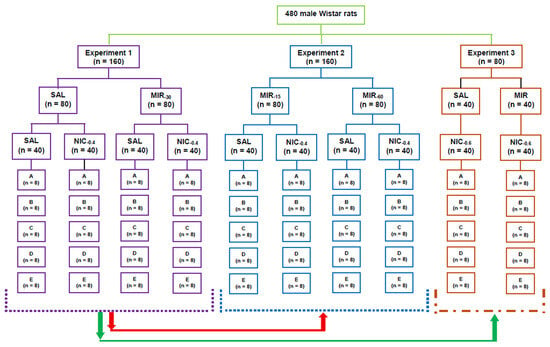
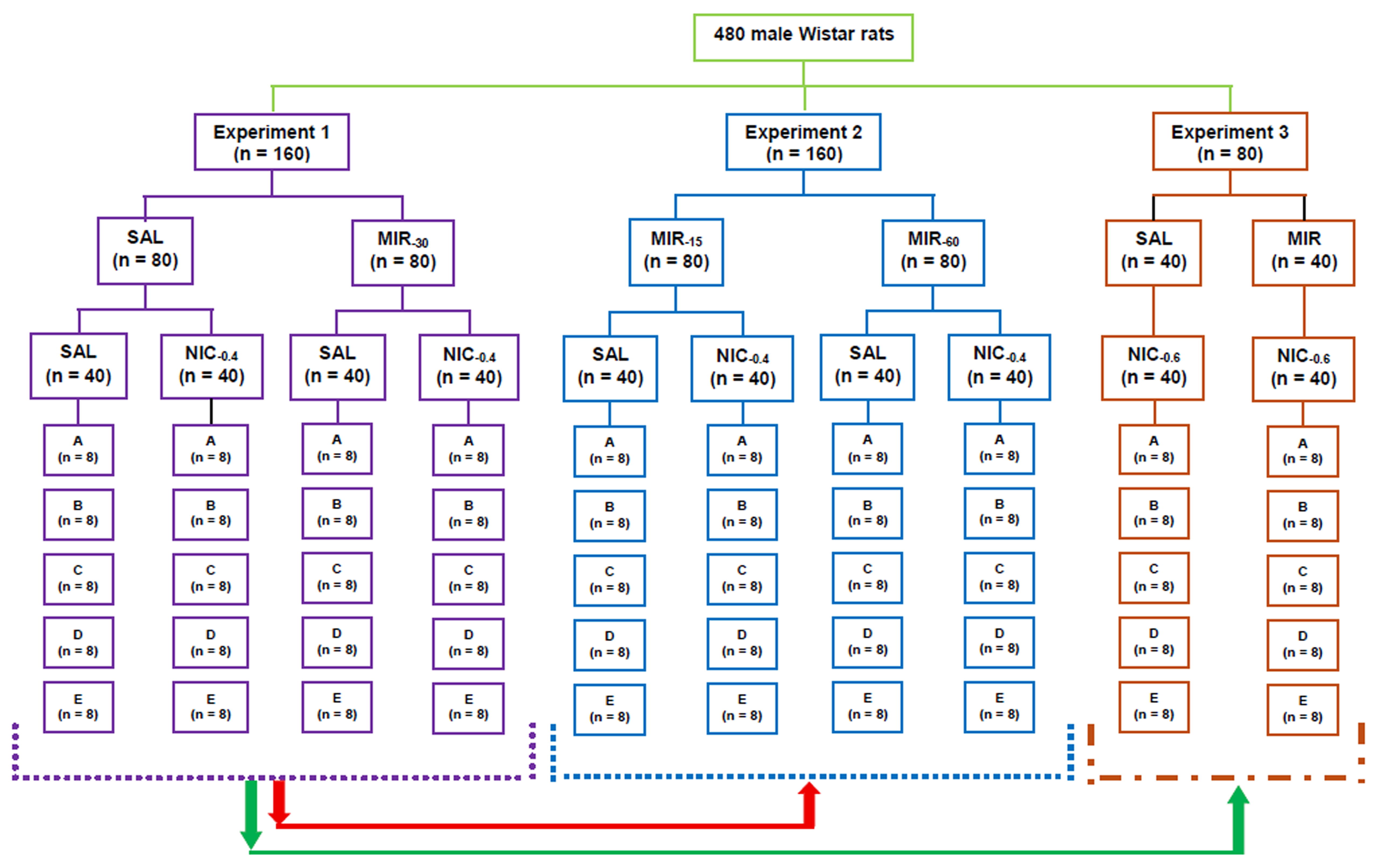
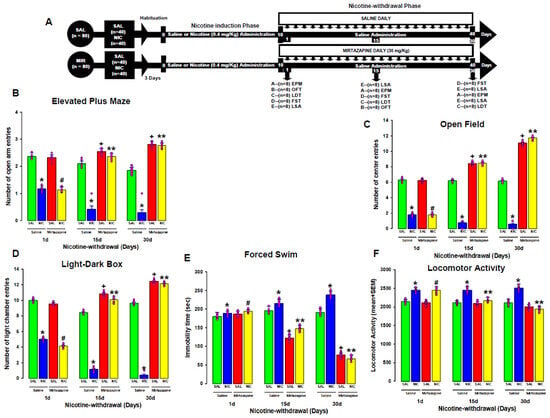
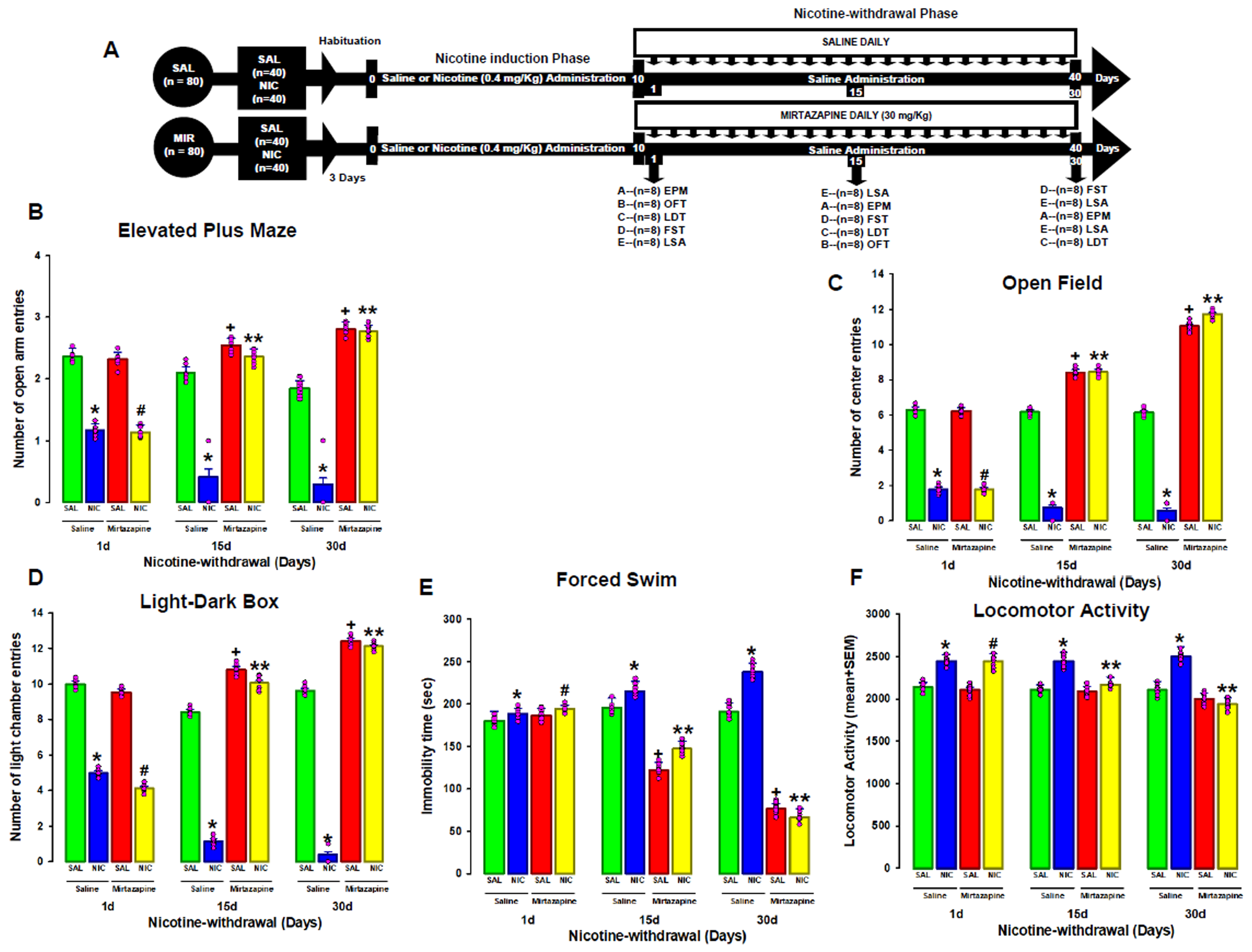

Disclaimer/Publisher’s Note: The statements, opinions and data contained in all publications are solely those of the individual author(s) and contributor(s) and not of MDPI and/or the editor(s). MDPI and/or the editor(s) disclaim responsibility for any injury to people or property resulting from any ideas, methods, instructions or products referred to in the content. |
© 2026 by the authors. Licensee MDPI, Basel, Switzerland. This article is an open access article distributed under the terms and conditions of the Creative Commons Attribution (CC BY) license.