


Abstract
BODIPY derivatives are promising scaffolds for triplet photosensitizers because of their strong absorption and tunable absorption range, but their dominant fluorescence decay and weak spin–orbit coupling hinder efficient intersystem crossing (ISC). Here, we report iodine-substituted BODIPY photosensitizers bearing anthracene, pyrene, and perylene units (BI-Ant, BI-Pyr, and BI-Per), designed to combine the heavy-atom effect with the spin–orbit charge-transfer ISC (SOCT-ISC) process. Spectroscopic and computational analyses revealed charge-transfer character and efficient triplet formation in all three compounds. Transient absorption measurements showed that BI-Ant and BI-Pyr undergo an ISC process to BODIPY-centered triplet state, whereas BI-Per exhibits intermediate strong charge-transfer-state evolution and the fastest ISC process. Solvent-dependent results further indicate that charge-transfer-state stabilization accelerates ISC process, supporting an additional SOCT contribution. These findings provide an effective strategy for developing highly efficient metal-free triplet photosensitizers.
1. Introduction
The electronic excited states of molecular systems are fundamentally categorized into singlet and triplet states based on their spin multiplicity [1]. Unlike singlet excitons, which are primarily governed by radiative and non-radiative decay pathways, triplet excitons exhibit a unique spin-active character due to their parallel spin alignment [2]. This distinct nature enables a variety of sophisticated photophysical phenomena that are inaccessible via singlet excited states, such as thermally activated delayed fluorescence [3,4,5], triplet-triplet annihilation upconversion [6,7,8], and the generation of singlet oxygen for photodynamic therapy [9,10]. Despite these scientific and technological advantages, the direct population of the triplet state from the ground and singlet excited states is quantum mechanically spin-forbidden. Consequently, achieving efficient intersystem crossing (ISC), a transition from singlet to triplet state, is key in the utilization of triplet-mediated processes [11,12,13].
To overcome the spin-forbidden nature of triplet generation, several fundamental strategies have been developed to facilitate ISC in triplet photosensitizers. These primarily include the heavy-atom effect, which introduces metals with a large atomic number to enhance spin–orbit coupling (SOC) [14]. Also, El-Sayed’s rule leverages n→π* transitions to promote spin-flip, where the change in orbital angular momentum between the two different types of orbitals effectively compensates for the spin-flip to satisfy the conservation of total angular momentum [15]. Additionally, spin–orbit charge-transfer intersystem crossing (SOCT-ISC) has emerged as a metal-free pathway for triplet generation through the formation of photoinduced charge transfer (CT) state, and electron density is transferred from donor to acceptor subunits. Because the CT and locally excited (LE) states differ substantially in electronic configuration, their interconversion involves a change in orbital angular momentum that promotes spin-flip and thus enhances ISC [16]. However, their application as practical triplet sensitizers is limited by several challenges. Heavy metals are often restricted by environmental toxicity [17], a tendency to shorten triplet lifetimes and high costs, while systems relying on El-Sayed’s rule suffer from low molar absorption coefficients and high-energy n→π* transitions, which confine their applicability to the UV region, limiting their photoactivity in the visible spectrum [18]. Moreover, SOCT-ISC demands rigorous control over molecular geometry and electronic energy levels, which requires extensive trial-and-error optimization [19].
In this context, significant scientific interest has been focused on 4,4-difluoro-4-bora-3a,4a-diaza-s-indacene (BODIPY) molecule to develop highly efficient triplet photosensitizer [20]. BODIPY derivatives are well-known as outstanding molecular dyes due to their intense visible-light absorption, high fluorescence quantum yields, and excellent photostability. A key advantage of the BODIPY molecular skeleton is its remarkable structural versatility, which allows for precise chemical modification to tune its photophysical properties [21]. Furthermore, the BODIPY core enables strong donor–acceptor interactions with various aromatic units, which facilitates charge-transfer-mediated processes [22]. By strategically integrating multiple ISC-promoting mechanisms, rather than relying on a single pathway, it is possible to exploit synergistic effects to transform the typically fluorescent BODIPY into a highly efficient triplet photosensitizer.
Herein, we focused on a metal-free BODIPY-based photosensitizers that are capable of simultaneously inducing the heavy-atom effect and SOCT-ISC. In BODIPY systems, the introduction of iodine, one of the most widely used non-metal heavy atoms, is known to promote triplet exciton generation efficiently. However, because BODIPY intrinsically exhibits strong fluorescence emission, radiative decay is not completely suppressed even after iodine substitution, which limits the triplet formation quantum yield [23,24]. Overcoming this limitation often requires the incorporation of heavy metals that provide substantially stronger spin–orbit coupling. To address this issue, we introduced arene substituents to additionally induce SOCT-ISC through donor–acceptor interactions with the BODIPY core, thereby enabling more efficient ISC without the use of metals. From this perspective, we thoroughly investigated the ISC processes of iodine-substituted BODIPY photosensitizers bearing anthracene, pyrene, or perylene units. In these systems, the heavy-atom effect and SOCT-ISC can occur simultaneously. Their photophysical behavior was analyzed using time-resolved spectroscopies and DFT calculations. In all three cases, electronic donor–acceptor interactions between BODIPY and the appended arene generated pronounced CT character, which led to enhanced ISC efficiency in polar environments through SOCT-ISC. Notably, the perylene-substituted system exhibited particularly strong electronic coupling with the BODIPY core because of its favorable energetic alignment, which enabled remarkably rapid ISC even in nonpolar toluene. These findings provide a new strategy for designing advanced triplet photosensitizers that overcome the conventional trade-offs in triplet-state engineering.
2. Results and Discussion
2.1. Characterization of Molecular Structures and Photophysical Properties
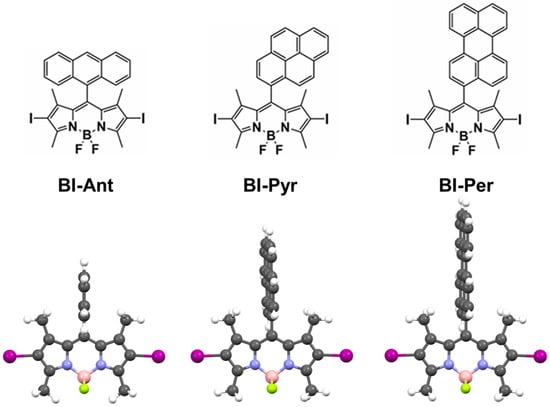
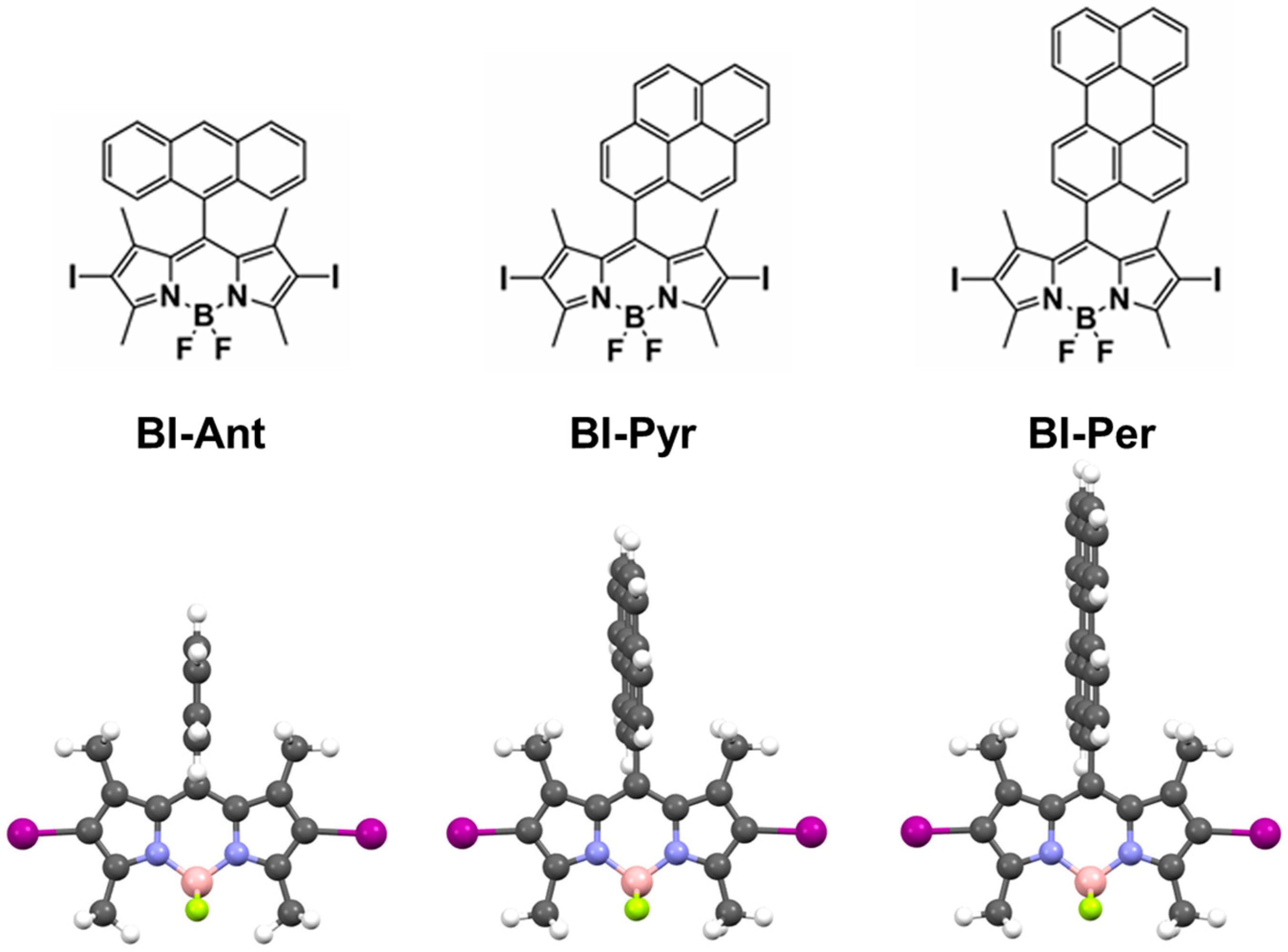
In this study, we synthesized a series of BODIPY-based photosensitizers, BI-Ant, BI-Pyr, and BI-Per, according to previously reported procedures (Figure 1) [25]. In all compounds, iodine atoms are directly introduced at the 2,6-positions of the BODIPY core by which the heavy-atom effect can be most effectively induced. Moreover, the anthracene, pyrene, or perylene moieties are attached at the meso-position, and methyl groups at the 1,7-positions are employed to maintain an orthogonal arrangement between the arene groups and the BODIPY core. These conformations are clearly supported by DFT optimization results, which reveal dihedral angles of 90.0°, 84.1°, and 84.3° for BI-Ant, BI-Pyr, and BI-Per, respectively (Figure S1). These molecular geometries effectively minimize π-conjugative interactions between the BODIPY core and the arene substituents, while facilitating the role of the BODIPY core and arene units as independent intramolecular electron acceptor and donor units.
Figure 1.
Molecular structures of BI-Ant, BI-Pyr, and BI-Per. Carbon, hydrogen, nitrogen, boron, fluorine, and iodine atoms are represented in gray, white, pale blue, apricot, light green, and purple, respectively.
2.2. Absorption and Fluorescence Emission Properties
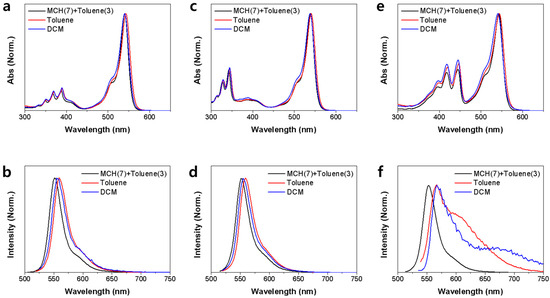
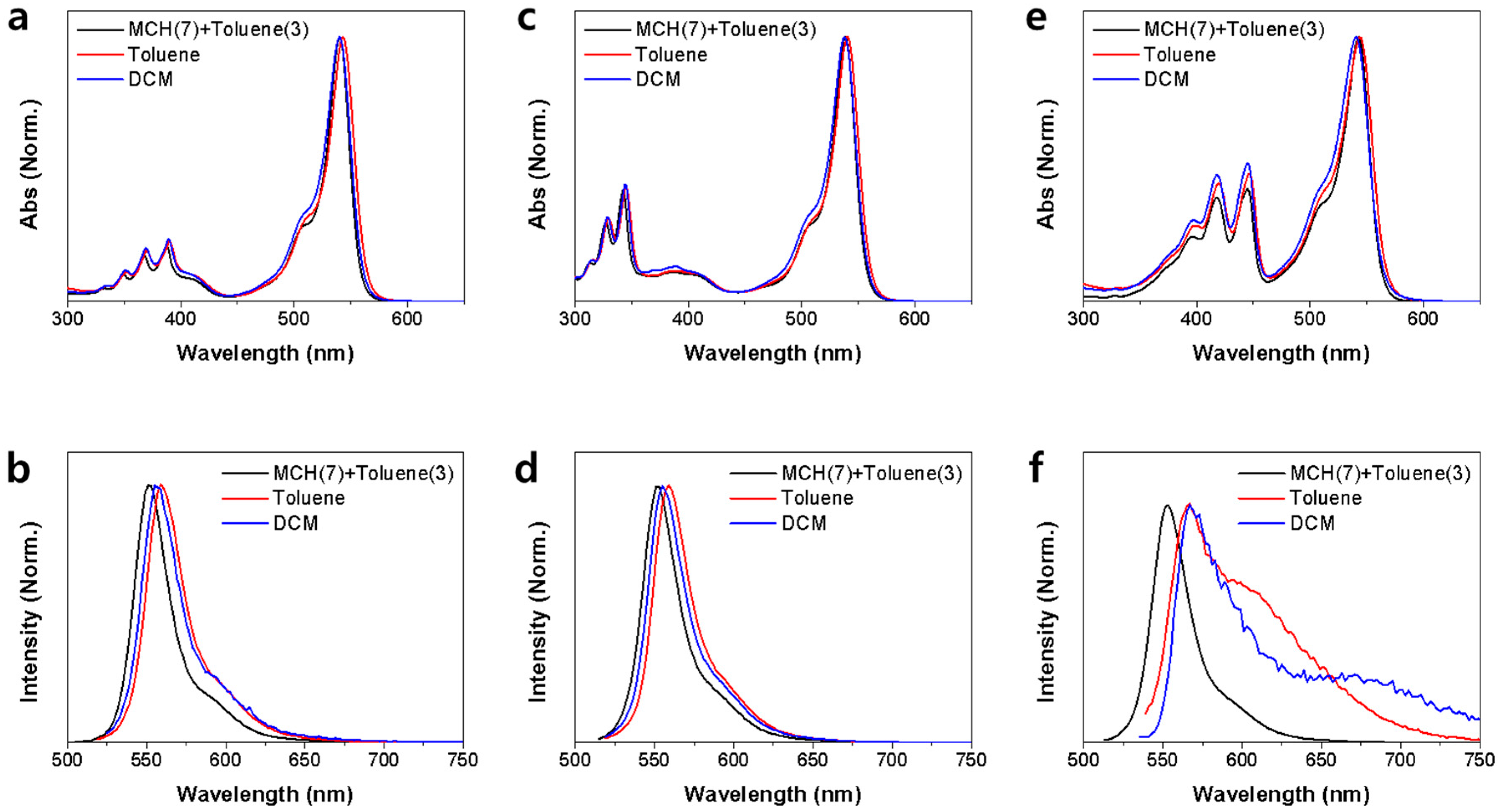
Figure 2 shows the absorption and fluorescence emission spectra of BI-Ant, BI-Pyr, and BI-Per in various solvents. All three compounds exhibit similar overall spectral features despite changes in solvent polarity. In the absorption spectra, a common intense band is observed around 540 nm, which can be assigned to the characteristic absorption of the BODIPY core [26]. In addition, extra absorption bands appear in the 300–450 nm region and gradually shift to shorter wavelengths in the order of BI-Per, BI-Ant, and BI-Pyr. These bands correspond to the absorption of the perylene, anthracene, and pyrene moieties in BI-Per, BI-Ant, and BI-Pyr, respectively. This result clearly indicates that, as suggested by the molecular structures, the orthogonal geometry effectively minimizes π-conjugative interactions between the BODIPY core and the arene groups, which allows their π-electronic structures to remain largely independent [27].
Figure 2.
UV-vis absorption and fluorescence emission spectra of (a,b) BI-Ant, (c,d) BI-Pyr, and (e,f) BI-Per in methylcyclohexane (MCH) and toluene mixture (7:3), toluene, and dichloromethane (DCM). Fluorescence emission spectra were measured with photoexcitation in the 500–520 nm region.
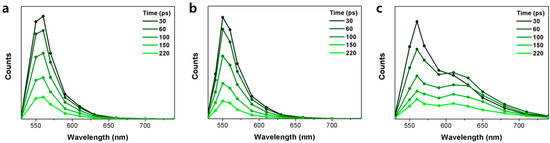
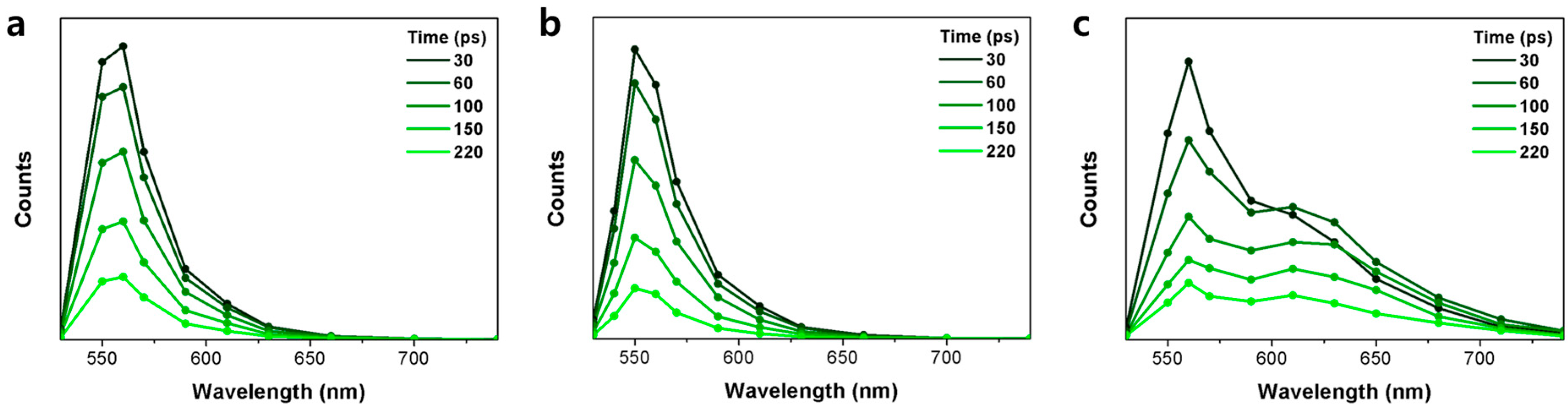
In contrast to their similar absorption spectral features, the three compounds exhibit sharply different emission behaviors. BI-Ant and BI-Pyr show fluorescence maxima around 555 nm regardless of the solvent (Figure 2b,d), which are well matched with the characteristic fluorescence emission of the BODIPY core [28]. By contrast, BI-Per displays BODIPY-centered emission in a mixed solvent of methylcyclohexane (MCH) and toluene (7:3), similar to BI-Ant and BI-Pyr. However, as the solvent polarity increases from toluene to dichloromethane (DCM), an additional emission band emerges at longer wavelengths with a pronounced red shift (Figure 2f). Furthermore, spectral analysis of the time-resolved fluorescence emission in toluene reveals no noticeable time-dependent spectral changes for BI-Ant or BI-Pyr, whereas BI-Per exhibits clear spectral evolution over time, although the earliest changes could not be fully resolved because of the limited time resolution (Figure 3). These polarity- and time-dependent spectral changes in BI-Per clearly indicate the formation of a pronounced photoinduced CT state [29]. In particular, the emergence of a red-shifted emission band in more polar solvents suggests stabilization of the CT state, whereas the time-dependent spectral evolution supports its dynamic formation from the populated LE state to the CT state.
Figure 3.
Time-resolved fluorescence decay spectra of (a) BI-Ant, (b) BI-Pyr, and (c) BI-Per in toluene. The spectra were measured with a photoexcitation at 515 nm.
To further clarify these photophysical features, we measured the fluorescence quantum yields of all compounds. The fluorescence quantum yield analysis reveals that BI-Per shows a substantial decrease in quantum yield value even in nonpolar toluene compared with the MCH/toluene mixed solvent (Table 1). This result strongly indicates the emergence of a CT process in BI-Per [30], due to the orthogonal arrangement between the perylene and BODIPY units. BI-Ant and BI-Pyr also show gradual decreases in fluorescence quantum yield with an increase in solvent polarity. This trend suggests that the anthracene and pyrene moieties, being similar to the perylene moiety, can also interact with the BODIPY unit, which results in the donor–acceptor interactions to generate CT character. In particular, BI-Ant shows a much larger difference in fluorescence quantum yield between toluene and DCM than BI-Pyr, which further indicates that the extent of CT character depends on the interaction between the arene and BODIPY units and becomes stronger as their energy gap between the two moieties decreases.
Table 1.
Fluorescence emission properties.
We also examined the singlet oxygen (1O2) emission and 1O2 quantum yields (ΦΔ) to confirm triplet formation and quantitatively evaluate its efficiency. All compounds display clear singlet oxygen emission at 1270 nm in all solvents (Figures S2–S4). Because singlet oxygen is produced by energy transfer from the triplet excited species to ground-state oxygen [31], this result indicates that all compounds undergo ISC to the triplet state efficiently in all solvent environments. In toluene, the 1O2 quantum yields of BI-Ant, BI-Pyr, and BI-Per were determined to be 86 ± 3%, 86 ± 3%, and 90 ± 2%, respectively (Table S1). All of these values are higher than that of 2,6-diiodo-1,3,5,7-tetramethyl-8-phenyl-BODIPY (ΦΔ = 83%), whose arene unit is simply a benzene ring and is known to show negligible CT character [32]. This suggests that BI-Ant, BI-Pyr, and BI-Per exhibit enhanced ISC through an additional SOCT contribution arising from their CT character, consistent with the fluorescence results. In particular, the highest value observed for BI-Per, which also shows the most pronounced CT character, strongly supports that ISC is most efficiently promoted in this system by an additional SOCT contribution.
2.3. Excited-State Dynamics
To examine the highly efficient ISC behavior of BI-Ant, BI-Pyr, and BI-Per in detail, we carried out femtosecond and nanosecond transient absorption (fs- and ns-TA) measurements. Because TA spectra measure the photoinduced change in absorbance (ΔA), they are generally composed of three major contributions of ground-state bleaching (GSB), excited-state absorption (ESA), and stimulated emission (SE) [33,34]. GSB appears as a negative signal at wavelengths of the steady-state absorption band owing to ground-state depopulation upon photoexcitation, whereas ESA gives positive signals from absorption by excited species and SE gives negative signals from probe-induced emission overlapping with the fluorescence band. Consistent with the singlet oxygen emission results, all compounds exhibited long-lived TA signals beyond 10 μs in the ns-TA spectra, which directly demonstrates the efficient formation of triplet states (Figure S5). Notably, the ns-TA spectra of BI-Per are clearly distinct from those of BI-Ant and BI-Pyr. For BI-Ant and BI-Pyr, the ESA signals appear on the longer wavelength side relative to the GSB band, whereas BI-Per shows ESA signals on the shorter wavelength side of the GSB. The ns-TA spectral features of BI-Ant and BI-Pyr are in good agreement with the reported triplet TA spectrum of iodine-substituted BODIPY [35,36]. In contrast, the ns-TA spectrum of BI-Per matches well with previously reported ns-TA spectra of perylene [37]. These spectral correspondences clearly indicate that the triplet exciton is formed on the BODIPY core in BI-Ant and BI-Pyr, whereas in BI-Per, it is localized on the perylene unit. This assignment is also consistent with the lower triplet-state energy level of perylene [38].
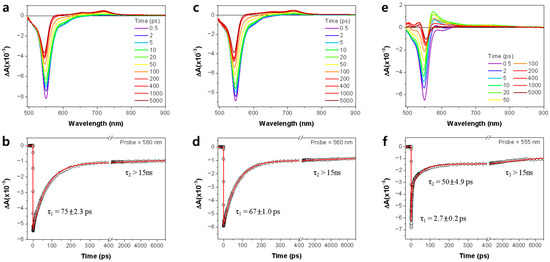
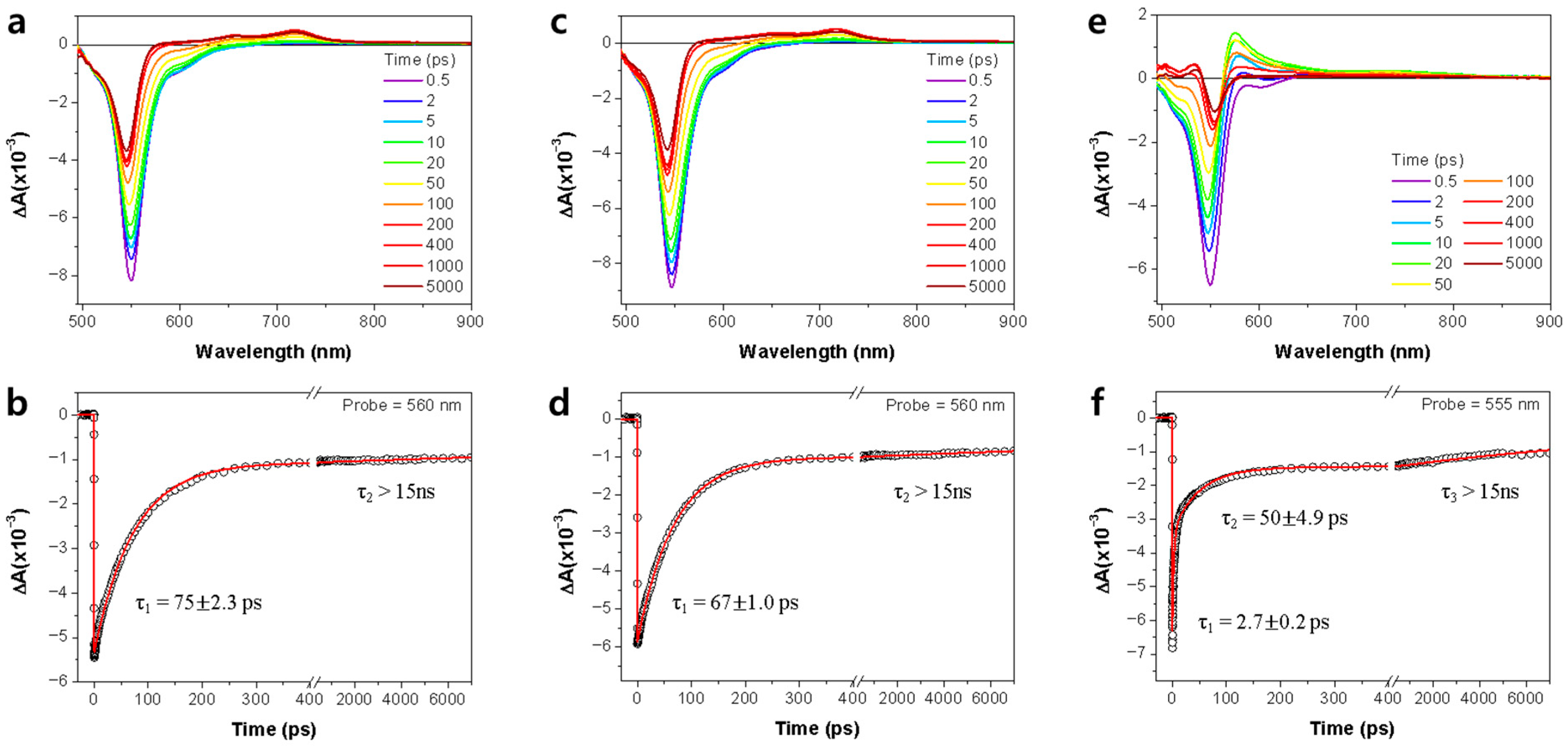
fs-TA measurements in toluene reveal the singlet excited-state dynamics of these compounds as well as the TA spectral evolution associated with the ISC process, in which BI-Ant, BI-Pyr, and BI-Per also exhibit clearly contrasting spectral features (Figure 4). BI-Ant and BI-Pyr show very similar TA behaviors with strong negative signals initially dominating the 500–650 nm region. Based on the spectral matching with their absorption and fluorescence emission spectra, the negative signals can be assigned to a combination of GSB and SE features. As these initial TA spectra evolve into the spectra that are consistent with their ns-TA spectra, the fast decay time constants of 75 and 67 ps for BI-Ant and BI-Pyr, respectively, can be assigned to their ISC time constant. BI-Per also initially exhibits a TA spectrum dominated by negative signals in the 500–650 nm region, similar to BI-Ant and BI-Pyr. Although this initial TA spectrum also evolves into the triplet-exciton TA spectrum observed in the ns-TA measurement, a distinct intermediate spectral change is clearly observed, in which an ESA band with a maximum at 575 nm rises and decays rapidly. The TA decay profile of BI-Per contains two extra decay time constants of 2.7 and 50 ps, together with a long-lived component. Given the fluorescence emission features of BI-Per, these two decay components can be assigned to the strong CT process between BODIPY and perylene units and the subsequent ISC process, respectively. Here, the fastest ISC observed for BI-Per, together with the appearance of a distinct intermediate ESA band at 575 nm and a preceding 2.7 ps CT-related component, indicates that spin conversion is not governed solely by the iodine-induced heavy-atom effect but is further accelerated by an additional SOCT contribution.
Figure 4.
Femtosecond transient absorption spectra and decay profiles of (a,b) BI-Ant, (c,d) BI-Pyr, and (e,f) BI-Per in toluene upon photoexcitation at 540 nm.
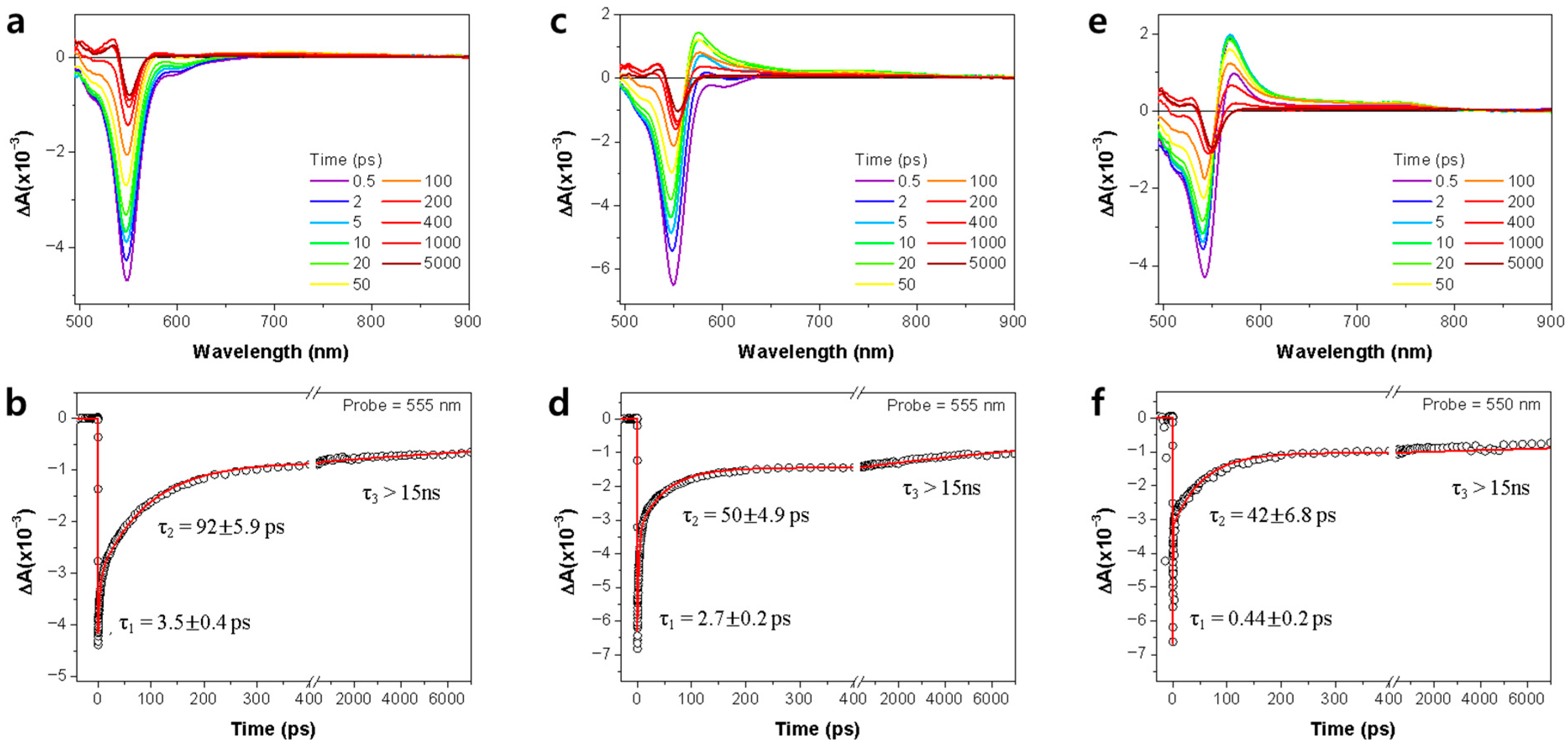
To gain deeper insight into the CT character, fs-TA measurements were performed in solvents of varying polarity. For BI-Per, increasing solvent polarity clearly led to a progressive increase in the amplitude of the ESA band centered at 575 nm (Figure 5). This feature causes the CT and ISC processes to become shorter as solvent polarity increased. These observations suggest that higher solvent polarity stabilizes the CT state more effectively, which increases the difference in π-electron density distribution between the LE and CT states. As a result, SOCT becomes more pronounced and leads to a faster ISC process. A similar polarity-dependent acceleration of the ISC rate was also observed for BI-Ant and BI-Pyr (Figures S6 and S7). In particular, the fs-TA result of BI-Ant in DCM reveals a distinct intermediate spectral evolution accompanied by the appearance of an ESA band with a maximum at 575 nm (Figure S6e), closely resembling the fs-TA results of BI-Per (Figure 4e). This finding clearly indicates that, in a polar environment, strong donor–acceptor interactions between the anthracene and BODIPY units give rise to substantial CT character in BI-Ant. More broadly, it directly demonstrates that sufficiently stabilizing the electronic interaction between the arene and BODIPY units can induce pronounced CT interactions. Moreover, whereas the ISC process in typical 2,6-diiodo-substituted BODIPY derivatives generally occurs with a time constant on hundreds of ps [39,40,41], BI-Ant, BI-Pyr, and BI-Per exhibit much faster ISC on the timescale of several tens of ps, and this process is further accelerated with an increase in solvent polarity. Given the fs-TA result of BI-Ant in DCM, it is strongly suggested that ISC in all three compounds is not governed solely by the heavy-atom effect, but is additionally promoted by SOCT, resulting in markedly enhanced ISC efficiency.
Figure 5.
Femtosecond transient absorption spectra and decay profiles of BI-Per in (a,b) MCH/toluene (7:3) mixture, (c,d) toluene, and (e,f) DCM with a photoexcitation at 540 nm.
2.4. Electronic Structure Analyses
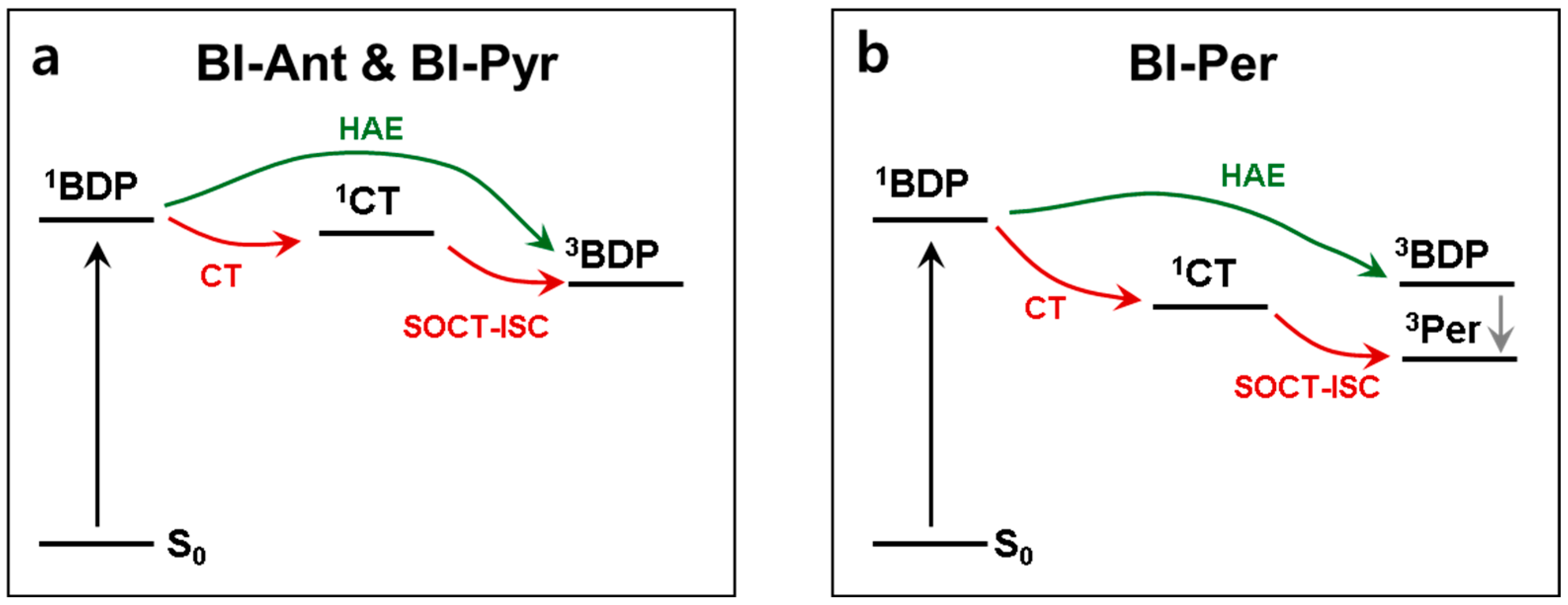
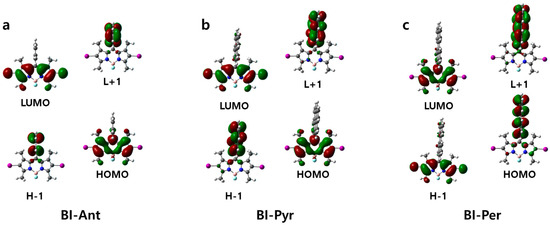
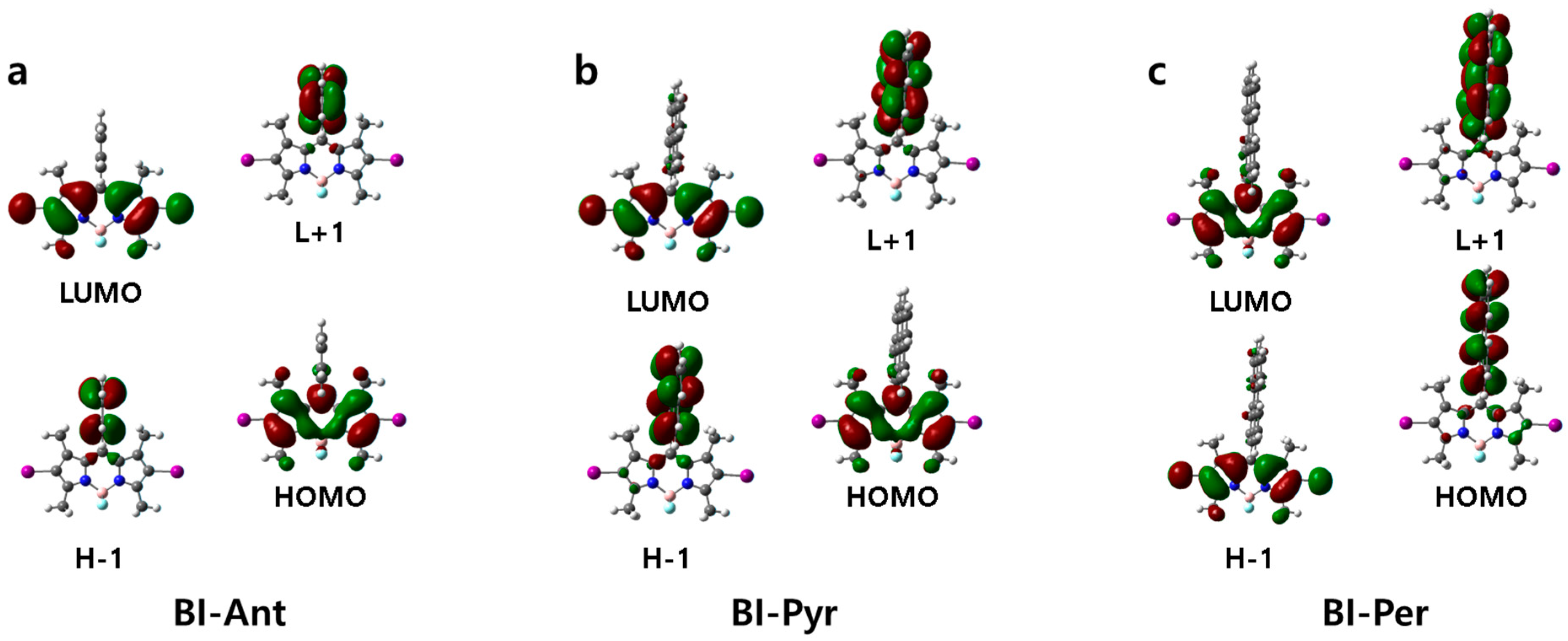
To gain a more precise understanding of the π-electronic structures of these compounds, TD-DFT calculations were performed with the CAM-B3LYP functional and def2-TZV basis set [42,43]. Consistent with the experimental observations, the calculations also reproduced the distinct behavior of BI-Ant and BI-Pyr relative to BI-Per (Figure 6 and Figures S8–S10). For BI-Ant and BI-Pyr, both the HOMO and LUMO are primarily distributed over the BODIPY unit, and their lowest-energy electronic transitions are mainly dominated by the HOMO-to-LUMO excitation (Figures S11 and S12), whereas the HOMO-1-to-LUMO excitations, which correspond to CT character, are estimated to be the second-lowest electronic transitions. These results are in good agreement with their fs-TA spectra in toluene, which are predominantly characterized by spectral evolution associated with the decay of the BODIPY-centered lowest singlet excited state and the subsequent formation of the triplet excited state (Figure 7a).
Figure 6.
Frontier molecular orbitals of (a) BI-Ant, (b) BI-Pyr, and (c) BI-Per. The electron density is represented by red and greend surfaces.
By contrast, in BI-Per, the HOMO and LUMO are predominantly localized on the perylene and BODIPY units, respectively. Although its lowest-energy transition appears at a similar wavelength to BI-Ant and BI-Pyr, it contains two major contributions, HOMO-to-LUMO and HOMO-1-to-LUMO transitions (Figure S13). Here, the HOMO-to-LUMO transition corresponds to electron-density transfer from the perylene unit to the BODIPY core, which clearly indicates its pronounced CT character. These computational results consistently explain both the polarity-dependent changes in its fluorescence measurements and the additional transient spectral evolution observed in the TA spectra (Figure 7b). Therefore, this well-defined CT character enhances SOCT-ISC and causes BI-Per to exhibit the most efficient ISC among the three systems.
Figure 7.
Jablonski diagram illustrating plausible photophysical pathways in (a) BI-Ant and BI-Pyr and (b) BI-Per. BDP and HAE denote BODIPY and the heavy-atom effect, respectively.
3. Materials and Methods
3.1. Sample Preparation
BI-Ant, BI-Pyr, and BI-Per were synthesized and characterized according to previously reported procedures [25].
3.2. UV-Vis Absorption, Fluorescence Emission, and 1O2 Quantum Yield Measurements
Methylcyclohexane, toluene, and dichloromethane were purchased from Sigma-Aldrich. UV-vis absorption spectra were obtained with a UV-VIS spectrometer (V730, Jacso, Tyoko, Japan). Fluorescence emission spectra were measured with a UV-vis-NIR fluorometer (Fluoromax, Horiba, Kyoto, Japan). 1O2 quantum yields were directly measured in toluene-d8 via NIR 1O2 emissions centered at 1270 nm with a reference dye, 2,6-Diiodo-1,3,5,7-tetramethyl-8-phenyl-BODIPY (ΦΔ = 0.83 in toluene) [32]. All measurements were carried out using a 1 cm pathlength cuvette at concentrations of a few micromolars under room temperature.
3.3. Time-Resolved Spectroscopies
Photoluminescence decay was measured using a time-correlated single photon counting (TCSPC) system with a 1 cm pathlength cuvette at concentrations of a few micromolars under room temperature. A femtosecond oscillator with 1030 nm output (FLINT, Light Conversion, Vilnius, Lithuania) was used as an excitation light source, providing an ultrashort pulse with a high repetition rate (11 MHz), which was doubled with a second harmonic generator (Hiro, Light Conversion, Vilnius, Lithuania) (NFEC-2025-03-304293). Fluorescence was collected using a Picoquant TCSPC module (Picoquant, Berlin, Germany) (NFEC-2025-04-305380). To ensure measurement reliability, the experiment was performed in duplicate.
Femtosecond transient absorption (fs-TA) measurements (NFEC-2025-04-305649) were performed using a HARPIA-TA (Light Conversion) driven by a Yb:KGW laser system (Pharos, Light Conversion). The laser system provided 200 fs, 400 μJ pulses at 1030 nm with a 50 kHz repetition rate. The output beam was split into two parts; 90% of the output beam was seeded to an optical parametric amplifier (Orpheus, Light Conversion) to generate a pump pulse, and 10% of the output beam was seeded to a sapphire crystal to generate a white-light continuum (WLC) probe beam covering the spectral range from 490 nm to 910 nm. Following WLC generation, both the pump and probe beams were overlapped on the sample. After interacting with the sample, the pump beam was blocked by an iris aperture, and the transmitted probe beam was detected using a spectrograph (Kymera 193i, Andor, Belfast, United Kingdom). The TA signal was obtained by calculating the differential transmission (ΔT/T) of the probe beam as a function of pump–probe delay and each data point was averaged 1500 times. All measurements were performed at room temperature using a 1 mm pathlength cuvette at concentrations in the tens of micromolar range. To ensure measurement reliability, the experiment was performed in duplicate.
The nanosecond transient absorption (ns-TA) data were measured with the commercial spectrometer (EOS, Ultrafast Systems, Sarasota, FL, USA), where each data point was averaged over 500 times. All measurements were performed at room temperature using a 1 mm pathlength cuvette at concentrations in the tens of micromolar range. To ensure measurement reliability, the experiment was performed in duplicate.
After every time-resolved measurement, the steady-state absorption was carefully checked to confirm no degradation of samples (Z-202312061408 at the Research Support Center for Bio-Bigdata Analysis and Utilization of Biological Resources).
3.4. Computational Methods
Quantum mechanical calculations were performed with the Gaussian 16 program suite (Gaussian, Wallingford, CT, USA). All calculations were carried out using the density functional theory (DFT) method with cam-B3LYP, employing the def2tzv basis set. To simulate the ground-state absorption spectra, we used TDDFT calculations with the same functional and basis set as used in the geometry optimization.
4. Conclusions
In summary, we demonstrated that iodine-substituted BODIPY photosensitizers bearing orthogonally arranged arene donors can achieve highly efficient triplet formation through the cooperative action of the heavy-atom effect and SOCT-ISC. BI-Ant, BI-Pyr, and BI-Per showed clear evidence of CT character, efficient singlet oxygen generation, and long-lived triplet populations. Time-resolved spectroscopic analyses revealed that BI-Ant and BI-Pyr mainly undergo BODIPY-centered ISC, whereas BI-Per exhibits a distinct intermediate strong CT state evolution and perylene-localized triplet formation, which leads to the fastest ISC in the series. The solvent-polarity dependence of the TA behavior further established that stabilization of the CT state enhances SOCT and accelerates the ISC process, indicating that the excited-state dynamics of these systems are not governed solely by iodine-induced spin–orbit coupling. Electronic structure calculations consistently supported the experimental observations and explained the especially strong CT character and superior ISC efficiency of BI-Per. Collectively, this work shows that integrating non-metal heavy-atom substitution with tailored donor–acceptor interactions is a powerful molecular design principle for overcoming the intrinsic fluorescence-dominated nature of BODIPY. More generally, our results suggest that metal-free triplet photosensitizers can be developed more efficiently by designing molecules that combine non-metal heavy-atom substitution with charge-transfer character arising from an orthogonal donor-acceptor geometry, which thereby enables the heavy-atom effect and SOCT to operate cooperatively and effectively accelerate ISC.
Supplementary Materials
The following supporting information can be downloaded at https://www.mdpi.com/article/10.3390/app16094453/s1: Figure S1: Optimized structures of (a) BI-Ant, (b) BI-Pyr, and (c) BI-Per in the side view. Figure S2: Singlet oxygen emission spectra of BI-Ant in (a) MCH/toluene (7:3) mixture, (b) toluene, and (c) DCM upon photoexcitation at 540 nm. Figure S3: Singlet oxygen emission spectra of BI-Pyr in (a) MCH/toluene (7:3) mixture, (b) toluene, and (c) DCM upon photoexcitation at 540 nm. Figure S4: Singlet oxygen emission spectra of BI-Per in (a) MCH/toluene (7:3) mixture, (b) toluene, and (c) DCM upon photoexcitation at 540 nm. Figure S5: Nanosecond transient absorption spectra of of (a) BI-Ant, (c) BI-Pyr, and (e) BI-Per in toluene with a photoexcitation at 540 nm. Figure S6: Femtosecond transient absorption spectra and decay profiles of BI-Ant in (a,b) MCH/toluene (7:3) mixture, (c,d) toluene, and (e,f) DCM upon photoexcitation at 540 nm. Figure S7: Femtosecond transient absorption spectra and decay profiles of BI-Pyr in (a,b) MCH/toluene (7:3) mixture, (c,d) toluene, and (e,f) DCM upon photoexcitation at 540 nm. Figure S8: FMO diagram of BI-Ant. Figure S9: FMO diagram of BI-Pyr. Figure S10: FMO diagram of BI-Per. Figure S11: Calculated electronic transitions of BI-Ant. Figure S12: Calculated electronic transitions of BI-Pyr. Figure S13: Calculated electronic transitions of BI-Per; Table S1: 1O2 quantum yields and ISC time constants; Cartesian coordinates of optimized structures of BI-Ant, BI-Pyr, and BI-Per.
Author Contributions
Conceptualization, J.O., T.H.K. and J.Y.; investigation, analyses and methodology, Y.N., K.M.L. and J.J.; writing—original draft preparation, Y.N. and J.O.; writing—review and editing, J.O., T.H.K. and J.Y. All authors have read and agreed to the published version of the manuscript.
Funding
This work was supported by the Soonchunhyang University research fund and National Research Foundation of Korea (NRF) grant funded by the Korea Government (MSIT) (grant no. RS-2025-00559158 and no. 2021R1A6A1A03039503). This work was also supported by the Korea Basic Science Institute (National Research Facilities and Equipment Center) grant (2022R1A6C101B794). The work at Yonsei University was supported by the National Research Foundation of Korea (NRF) grant funded by the Korean government (MSIT) (No. RS-2025-25418541).
Data Availability Statement
The data presented in this study are available in article and Supplementary Materials.
Conflicts of Interest
The author declares no conflicts of interest.
References
- Pham, T.C.; Nguyen, V.-N.; Choi, Y.; Lee, S.; Yoon, J. Recent Strategies to Develop Innovative Photosensitizers for Enhanced Photodynamic Therapy. Chem. Rev. 2021, 121, 13454–13619. [Google Scholar] [CrossRef] [Scilit] [PubMed]
- Sher, P.-H.; Chen, C.-H.; Chiu, T.-L.; Lin, C.-F.; Wang, J.-K.; Lee, J.-H. Distinct Routes of Singlet Fission and Triplet Fusion: A Fluorescence Kinetic Study of Rubrene. J. Phys. Chem. C 2019, 123, 3279–3284. [Google Scholar] [CrossRef] [Scilit]
- Tchapet Njafa, J.-P.; Kameni Tcheuffa, E.V.; Foumkpou Maghame, A.; Nana Engo, S.G. Data-Driven Design Guidelines for TADF Emitters from a High-Throughput Screening of 747 Molecules. J. Chem. Inf. Model. 2026, 66, 3944–3954. [Google Scholar] [CrossRef] [Scilit]
- Chen, X.-K.; Kim, D.; Brédas, J.-L. Thermally Activated Delayed Fluorescence (TADF) Path toward Efficient Electroluminescence in Purely Organic Materials: Molecular Level Insight. Acc. Chem. Res. 2018, 51, 2215–2224. [Google Scholar] [CrossRef] [Scilit]
- Yang, Z.; Mao, Z.; Xie, Z.; Zhang, Y.; Liu, S.; Zhao, J.; Xu, J.; Chi, Z.; Aldred, M.P. Recent Advances in Organic Thermally Activated Delayed Fluorescence Materials. Chem. Soc. Rev. 2017, 46, 915–1016. [Google Scholar] [CrossRef] [Scilit]
- Bharmoria, P.; Bildirir, H.; Moth-Poulsen, K. Triplet–Triplet Annihilation Based near Infrared to Visible Molecular Photon Upconversion. Chem. Soc. Rev. 2020, 49, 6529–6554. [Google Scholar] [CrossRef] [Scilit]
- Yoon, J.H.; Park, J.-M.; Lee, J.M.; Kim, H.M.; Choi, W.J.; Lee, H.K.; Kim, S.; Kim, W.S.; Kim, M.S.; Kim, Y.S.; et al. Photophysical Properties and Excited-State Dynamics of Donor–Acceptor–Heavy-Atom Molecules and Their Application in Triplet–Triplet Annihilation Upconversion. J. Mater. Chem. C 2024, 12, 9760–9772. [Google Scholar] [CrossRef] [Scilit]
- Naimovicius, L.; Wolek, L.; Zhang, S.K.; Kim, J.E.; Tauber, M.J.; Pun, A.B. Activating Solid-State Triplet–Triplet Annihilation Upconversion via Bulky Annihilators. J. Am. Chem. Soc. 2026, 148, 3811–3819. [Google Scholar] [CrossRef] [Scilit]
- Yudaev, P.; Aleksandrova, Y.; Chugunova, E.; Neganova, M. The Current State of Research in the Field of Photosensitizers and Photoactivators for Photodynamic/Photothermal Cancer Therapy: A Review. Int. J. Mol. Sci. 2025, 26, 10733. [Google Scholar] [CrossRef] [Scilit] [PubMed]
- Bongo, A.M.; Kim, H.; Roh, J.; Park, S.; Mai, D.K.; Kim, S.; Cho, S.; Kim, H. Quaternary Ammonium-modified Water-soluble Boron-dipyrromethene Photosensitizers for Fluorescence Imaging and Photodynamic Therapy. Bull. Korean Chem. Soc. 2026, 47, 342–354. [Google Scholar] [CrossRef] [Scilit]
- Cakmak, Y.; Kolemen, S.; Duman, S.; Dede, Y.; Dolen, Y.; Kilic, B.; Kostereli, Z.; Yildirim, L.T.; Dogan, A.L.; Guc, D.; et al. Designing Excited States: Theory-Guided Access to Efficient Photosensitizers for Photodynamic Action. Angew. Chem. Int. Ed. 2011, 50, 11937–11941. [Google Scholar] [CrossRef] [Scilit]
- Garland, M.J.; Cassidy, C.M.; Woolfson, D.; Donnelly, R.F. Designing Photosensitizers for Photodynamic Therapy: Strategies, Challenges and Promising Developments. Future Med. Chem. 2009, 1, 667–691. [Google Scholar] [CrossRef] [Scilit]
- Zhao, J.; Wu, W.; Sun, J.; Guo, S. Triplet Photosensitizers: From Molecular Design to Applications. Chem. Soc. Rev. 2013, 42, 5323. [Google Scholar] [CrossRef] [Scilit] [PubMed]
- Koziar, J.C.; Cowan, D.O. Photochemical Heavy-Atom Effects. Acc. Chem. Res. 1978, 11, 334–341. [Google Scholar] [CrossRef] [Scilit]
- Alías-Rodríguez, M.; De Graaf, C.; Huix-Rotllant, M. Ultrafast Intersystem Crossing in Xanthone from Wavepacket Dynamics. J. Am. Chem. Soc. 2021, 143, 21474–21477. [Google Scholar] [CrossRef] [Scilit]
- Filatov, M.A. Heavy-Atom-Free BODIPY Photosensitizers with Intersystem Crossing Mediated by Intramolecular Photoinduced Electron Transfer. Org. Biomol. Chem. 2020, 18, 10–27. [Google Scholar] [CrossRef] [Scilit]
- Imran, M.; Liu, D.; Ye, K.; Zhang, X.; Zhao, J. The Rhodamine–Perylene Compact Electron Donor–Acceptor Dyad: Spin-Orbit Charge-Transfer Intersystem Crossing and the Energy Balance of the Triplet Excited States. Photochem 2024, 4, 40–56. [Google Scholar] [CrossRef] [Scilit]
- Rajagopal, S.K.; Mallia, A.R.; Hariharan, M. Enhanced Intersystem Crossing in Carbonylpyrenes. Phys. Chem. Chem. Phys. 2017, 19, 28225–28231. [Google Scholar] [CrossRef] [Scilit] [PubMed]
- Nguyen, V.-N.; Yan, Y.; Zhao, J.; Yoon, J. Heavy-Atom-Free Photosensitizers: From Molecular Design to Applications in the Photodynamic Therapy of Cancer. Acc. Chem. Res. 2021, 54, 207–220. [Google Scholar] [CrossRef] [Scilit] [PubMed]
- Kamkaew, A.; Lim, S.H.; Lee, H.B.; Kiew, L.V.; Chung, L.Y.; Burgess, K. BODIPY Dyes in Photodynamic Therapy. Chem. Soc. Rev. 2013, 42, 77–88. [Google Scholar] [CrossRef] [Scilit]
- Wang, Y.; Li, Y.; Cao, J.; Yang, X.; Huang, J.; Huang, M.; Gu, S. Research Progress of Fluorescent Probes for Detection of Glutathione (GSH): Fluorophore, Photophysical Properties, Biological Applications. Molecules 2024, 29, 4333. [Google Scholar] [CrossRef] [Scilit]
- Wang, Z.; Ma, L.; Zhao, H.; Wan, Y.; Zhang, X.-F.; Li, Y.; Kuang, Z.; Xia, A. Spin–Orbit Charge-Transfer Intersystem Crossing in Heavy-Atom-Free Orthogonal Covalent Boron-Dipyrromethene Heterodimers. Phys. Chem. Chem. Phys. 2023, 25, 24386–24394. [Google Scholar] [CrossRef] [Scilit] [PubMed]
- Zhu, M.; Ma, L.; Liu, R.; Liang, F.; Zhang, Z.; Zhang, G.; Jin, Y.; Wang, X.; Wang, Z. An Iodinated BODIPY-Based Probe for the Selective Mapping and Disassembly of Amyloid-β Aggregates In Vivo. Anal. Chem. 2026, 98, 1718–1725. [Google Scholar] [CrossRef] [Scilit]
- Liu, B.-K.; Teng, K.-X.; Niu, L.-Y.; Yang, Q.-Z. BODIPY-Based Photosensitizer with Outstanding Photocytotoxicity for Deep-Tissue Photodynamic Therapy. ACS Mater. Lett. 2025, 7, 1947–1955. [Google Scholar] [CrossRef] [Scilit]
- Yoon, J.H.; Choi, W.J.; Park, J.-M.; Lee, D.J.; Lee, H.K.; Jang, S.H.; Kim, S.; Kim, W.S.; Kim, Y.S.; Lim, K.M.; et al. Optimizing Intersystem Crossing Dynamics for Triplet–Triplet Annihilation Upconversion: Aromatic Donor Modulation in Donor–Acceptor–Heavy Atom Molecular Architectures. J. Phys. Chem. C 2025, 129, 11851–11866. [Google Scholar] [CrossRef] [Scilit]
- O’Sullivan, S.; Tabrizi, L.; Turzańska, K.; Clark, I.P.; Fitzgerald-Hughes, D.; Pryce, M.T. Photophysical Properties and Protein Binding Studies of Piperazine-Substituted Anthracene-BODIPY Dyads for Antimicrobial Photodynamic Therapy. Molecules 2025, 30, 2727. [Google Scholar] [CrossRef] [Scilit] [PubMed]
- Wang, L.; Qian, Y. Modification of a SOCT-ISC Type Triphenylamine-BODIPY Photosensitizer by a Multipolar Dendrimer Design for Photodynamic Therapy and Two-Photon Fluorescence Imaging. Biomater. Sci. 2023, 11, 1459–1469. [Google Scholar] [CrossRef] [Scilit]
- Deng, R.-H.; Fan, T.; Shi, W.-J.; Cao, Y.; Xie, Y.; Cai, H.; Huo, Z.-J.; Yan, J.; Niu, L. Methyl-Free Meso-Thiazole-Substituted Red-Shifted BODIPY-Based Molecular Rotor for Fluorescence Imaging Viscosity in Mitochondria. Spectrochim. Acta Part A Mol. Biomol. Spectrosc. 2025, 343, 126626. [Google Scholar] [CrossRef] [Scilit]
- Park, J.; Sung, J.; Kim, D. Strong Electronic Coupling-Induced Ultrafast Charge Transfer in Donor–Pyrene–Acceptor Systems. J. Phys. Chem. Lett. 2021, 12, 2226–2231. [Google Scholar] [CrossRef] [Scilit]
- Sung, J.; Kim, P.; Lee, Y.O.; Kim, J.S.; Kim, D. Characterization of Ultrafast Intramolecular Charge Transfer Dynamics in Pyrenyl Derivatives: Systematic Change of the Number of Peripheral N,N-Dimethyaniline Substituents. J. Phys. Chem. Lett. 2011, 2, 818–823. [Google Scholar] [CrossRef] [Scilit]
- Wang, P.; Qin, F.; Zhang, Z.; Cao, W. Quantitative Monitoring of the Level of Singlet Oxygen Using Luminescence Spectra of Phosphorescent Photosensitizer. Opt. Express 2015, 23, 22991. [Google Scholar] [CrossRef] [Scilit]
- Li, Y.; Wei, Y.; Zhou, X. Two new Bodipy-carbazole derivatives as metal-free photosensitizers in photocatalytic oxidation of 1,5-dihydroxynaphthalene. J. Photochem. Photobiol. A 2020, 400, 112713. [Google Scholar] [CrossRef] [Scilit]
- Oh, J.; Sung, Y.M.; Hong, Y.; Kim, D. Spectroscopic Diagnosis of Excited-State Aromaticity: Capturing Electronic Structures and Conformations upon Aromaticity Reversal. Acc. Chem. Res. 2018, 51, 1349–1358. [Google Scholar] [CrossRef] [Scilit] [PubMed]
- Jen, M.; Lim, J.M. Toward Poisson-like Scaling with Synchronized-Clock Transient Absorption Spectroscopy via High-Repetition Rate Pulse Accumulation. J. Anal. Sci. Technol. 2025, 16, 47. [Google Scholar] [CrossRef] [Scilit]
- Dong, Y.; Sukhanov, A.A.; Zhao, J.; Elmali, A.; Li, X.; Dick, B.; Karatay, A.; Voronkova, V.K. Spin–Orbit Charge-Transfer Intersystem Crossing (SOCT-ISC) in Bodipy-Phenoxazine Dyads: Effect of Chromophore Orientation and Conformation Restriction on the Photophysical Properties. J. Phys. Chem. C 2019, 123, 22793–22811. [Google Scholar] [CrossRef] [Scilit]
- Akhuseyin Yildiz, E.; Yabaş, E.; Sözmen, F.; Bozkurt, Y.; Karatay, A.; Boyacioglu, B.; Ünver, H.; Elmali, A. Effects of Heavy Iodine Atoms and π-Expanded Conjugation on Charge Transfer Dynamics in Carboxylic Acid BODIPY Derivatives as Triplet Photosensitizers. ChemPhysChem 2023, 24, e202200735. [Google Scholar] [CrossRef] [Scilit]
- Kumar Jha, K.; Prabhakaran, A.; Cane Sia, R.; Arellano Reyes, R.A.; Kumar Sarangi, N.; Yang, T.; Kumar, K.; Kupfer, S.; Guthmuller, J.; Keyes, T.E.; et al. Triplet Formation and Triplet-Triplet Annihilation Upconversion in Iodine Substituted Non-Orthogonal BODIPY-Perylene Dyads. ChemPhotoChem 2023, 7, e202300073. [Google Scholar] [CrossRef] [Scilit]
- Cui, X.; El-Zohry, A.M.; Wang, Z.; Zhao, J.; Mohammed, O.F. Homo- or Hetero-Triplet–Triplet Annihilation? A Case Study with Perylene-BODIPY Dyads/Triads. J. Phys. Chem. C 2017, 121, 16182–16192. [Google Scholar] [CrossRef] [Scilit]
- Xu, K.; Xie, Y.; Cui, X.; Zhao, J.; Glusac, K.D. DiiodoBodipy-Rhodamine Dyads: Preparation and Study of the Acid-Activatable Competing Intersystem Crossing and Energy Transfer Processes. J. Phys. Chem. B 2015, 119, 4175–4187. [Google Scholar] [CrossRef] [Scilit]
- Sabatini, R.P.; McCormick, T.M.; Lazarides, T.; Wilson, K.C.; Eisenberg, R.; McCamant, D.W. Intersystem Crossing in Halogenated Bodipy Chromophores Used for Solar Hydrogen Production. J. Phys. Chem. Lett. 2011, 2, 223–227. [Google Scholar] [CrossRef] [Scilit]
- Zhao, J.; Xu, K.; Yang, W.; Wang, Z.; Zhong, F. The Triplet Excited State of Bodipy: Formation, Modulation and Application. Chem. Soc. Rev. 2015, 44, 8904–8939. [Google Scholar] [CrossRef] [Scilit] [PubMed]
- Yanai, T.; Tew, D.P.; Handy, N.C. A New Hybrid Exchange–Correlation Functional Using the Coulomb-Attenuating Method (CAM-B3LYP). Chem. Phys. Lett. 2004, 393, 51–57. [Google Scholar] [CrossRef] [Scilit]
- Weigend, F.; Ahlrichs, R. Balanced Basis Sets of Split Valence, Triple Zeta Valence and Quadruple Zeta Valence Quality for H to Rn: Design and Assessment of Accuracy. Phys. Chem. Chem. Phys. 2005, 7, 3297. [Google Scholar] [CrossRef] [Scilit] [PubMed]

Disclaimer/Publisher’s Note: The statements, opinions and data contained in all publications are solely those of the individual author(s) and contributor(s) and not of MDPI and/or the editor(s). MDPI and/or the editor(s) disclaim responsibility for any injury to people or property resulting from any ideas, methods, instructions or products referred to in the content. |
© 2026 by the authors. Licensee MDPI, Basel, Switzerland. This article is an open access article distributed under the terms and conditions of the Creative Commons Attribution (CC BY) license.