


Abstract
Basketball performance is influenced by cardiorespiratory fitness and body composition. However, evidence regarding the ability of maximal oxygen uptake (VO2max) to distinguish between competitive levels remains inconsistent. This study aimed to examine differences in cardiorespiratory fitness and body composition between professional and amateur basketball players and to explore their contribution to variability in relative VO2max. This pilot study also informed sample size estimation for future studies. A cross-sectional study was conducted with 12 professional (21.0 ± 2.3 years; BMI: 25.37 ± 3.04 kg/m2) and 12 amateur (22.6 ± 1.7 years; BMI: 26.83 ± 3.24 kg/m2) male basketball players. Absolute and relative VO2max, ventilatory thresholds, and body composition (five-component fractionation) were assessed. Between-group comparisons were performed using Welch’s t-tests, effect sizes were estimated using Hedges’ g, and covariance analyses were adjusted for height and body fat percentage. No statistically significant differences were observed in relative VO2max between groups. However, the absolute second ventilatory threshold was significantly higher in professional players, and absolute VO2max showed a large effect size favoring this group. Professionals also showed lower body fat percentage and greater fat-free mass (p < 0.01; g ≈ 1.2). These findings suggest that body composition differences may partly explain variability in relative VO2max between competitive levels.
1. Introduction
Basketball is a high-intensity intermittent team sport characterized by repeated actions such as jumping, accelerating, decelerating, and performing changes in direction [1,2]. Although the sport is intermittent by nature, the total number, frequency, and density of these actions during a game may vary substantially according to competitive level, influencing the overall physiological load imposed on players [3,4]. These physiological demands require a high capacity to tolerate repeated efforts and to move efficiently on the court, positioning cardiorespiratory fitness and body composition as key determinants of athletic performance [5]. In this context, these variables are frequently used by coaches, trainers and sport sciences professionals to identify players with greater competitive potential and to guide selection and development processes across professional and amateur leagues [3,4,6,7,8].
Maximal oxygen uptake (VO2max) provides a global assessment of cardiorespiratory fitness [9] and has been widely used to characterize the physiological profile of basketball players [3,10]. However, evidence regarding its ability to discriminate between competitive levels remains inconsistent. While Metaxas et al. [11] reported significantly higher VO2max values in professional compared with amateur players, Sallet et al. [12] also observed higher values in professional players, whereas other studies found no significant differences between professional first- and second-division players in either VO2max or body composition [3,13]. Notably, several indirect field-based protocols used to estimate VO2max, while practical and widely employed, may not consistently agree with direct measurements via cardiopulmonary exercise testing and show substantive individual variability in predicted values [14,15]. These discrepancies suggest that VO2max, particularly when expressed in relative terms, may not independently reflect functionally meaningful differences between competitive levels.
Furthermore, several studies reporting differences in cardiorespiratory fitness did not directly compare professional and amateur levels. For instance, Huldani et al. [16] found higher VO2max values in trained versus untrained adolescent players (37.49 ± 26.1 vs. 28.85 ± 18.8 mL·kg−1·min−1, p < 0.05), while similar findings were reported by Mikić et al. [17] in university-level players. Likewise, Castagna et al. [18] observed significant differences in VO2max between senior and junior players competing within amateur categories (t = 9.039, p < 0.001, d = 3.310). Taken together, these findings indicate that training exposure and competitive experience influence cardiorespiratory fitness, although they do not clearly establish its capacity to differentiate higher competitive levels.
The analysis of VO2max is particularly relevant given that it can be expressed in absolute, relative, or allometrically scaled terms, which is especially important in populations with substantial variability in height and body composition [18,19,20,21]. In this regard, observed differences in relative VO2 (VO2_rel) between groups may be partially or entirely mediated by anthropometric characteristics rather than reflecting cardiorespiratory adaptations per se. In addition, the assessment of ventilatory thresholds (VT1, VT2) and respiratory exchange ratio (RER) allows for a more precise characterization of endurance performance and physiological adaptation to physical exercise [7,22,23]. Notably, these parameters have been suggested to be more sensitive to training than VO2max, as improvements in ventilatory thresholds may occur without concomitant changes in VO2max over a competitive season [11].
With respect to body composition, optimal morphological characteristics are identified as key factors for maximizing performance [24]. Accordingly, the determination of athletes’ body composition profiles and physical fitness levels may be essential for assessing performance efficiency [25,26]. Previous studies have shown that a lower body fat percentage (BFP) and a higher fat-free mass (FFM) are associated with better basketball performance [27,28,29]. In line with this evidence, Metaxas et al. [11] reported a lower BFP in professional compared with amateur players, suggesting that body composition may play a more consistent role than relative VO2max in differentiating competitive level.
Overall, the available evidence is heterogeneous and limited, particularly in competitive contexts with lower levels of professionalization or a less consolidated basketball tradition. It remains unclear whether relative VO2max can consistently differentiate between professional and amateur players. In contrast, existing evidence suggests that cardiorespiratory indicators expressed in absolute terms and body composition, particularly BFP and potentially FFM, may play a more relevant role in differentiating competitive level. Nevertheless, data across diverse competitive contexts remain scarce, highlighting the need for additional evidence to characterize these variables according to competitive level.
Therefore, this pilot study aimed to explore differences in cardiorespiratory fitness and body composition between professional and amateur basketball players and to examine the contribution of these factors to variability in relative maximal oxygen uptake. Secondarily, this study sought to estimate the sample size required for future studies. Three hypotheses were proposed: (i) professional players would exhibit greater cardiorespiratory fitness and a more favorable body composition than amateur players; (ii) lower BFP and higher FFM would be associated with greater cardiorespiratory fitness; and (iii) adjustment for anthropometric covariates would reduce the observed differences in VO2_rel between groups.
2. Materials and Methods
2.1. Study Design
This study was designed as a cross-sectional analytical comparative study, using a non-probabilistic convenience sampling. Reporting followed the Strengthening the Reporting of Observational Studies in Epidemiology (STROBE) guidelines [30]. Two groups of basketball players (professional and amateur) were compared to evaluate differences in cardiorespiratory fitness (VO2max, VO2_rel, VT1, VT2, RER) and body composition (BFP, FFM). All assessments were conducted under controlled conditions in the Exercise Physiology Laboratory of Universidad Autónoma de Chile, Temuco, between January and October 2024. Measurements were performed during 60 min sessions, which all participants completed, without any intervention in their habitual training routines.
2.2. Participants
The study included 24 male participants divided according to competitive level: a professional basketball players group (n: 12; age: 21.00 ± 2.30 years; Body Mass Index [BMI]: 25.37 ± 3.04 kg/m2) and an amateur basketball players group (n: 12; age: 22.58 ± 1.73 years; BMI 26.83 ± 3.24 kg/m2). Professional players were defined as those with an active contract in a first-division basketball club, regular participation in official competitions, and a structured training volume of at least 6 h per week. In contrast, amateur players were defined as individuals participating in university or recreational leagues, without involvement in formal professional divisions, and with a training volume of less than 4 h per week. Professional players were recruited through direct contact with a first-division basketball club, which represents the top competitive level in the country, whereas amateur players were recruited through invitations to university and recreational leagues and did not compete in any formal second or third- division professional leagues. Given the heterogeneous and limited evidence directly comparing amateur and professional basketball players, a pilot study design was adopted, including 12 participants per group [31]. Inclusion criteria for the amateur group were age between 18 and 26 years, participation in basketball at least four times per month in recreational or university leagues, and a training volume of less than 4 h per week. Inclusion criteria for the professional group were professional basketball players aged 18–26 years, active contract with a first-division basketball club, participation in at least one official game per week, and a minimum training volume of 6 h per week in club-organized sessions. Exclusion criteria for both groups were (i) musculoskeletal injuries preventing regular sports practice; (ii) diagnosed cardiovascular conditions or uncontrolled chronic diseases; and (iii) current smoking.
All participants voluntarily provided written informed consent. The study protocol was approved by the Scientific Ethics Committee of Servicio de Salud Araucanía Sur (Approval No. 2, 3 January 2024). All procedures were conducted in accordance with the ethical principles of the Declaration of Helsinki for research involving human subjects.
2.3. Cardiorespiratory Fitness
Cardiorespiratory fitness was assessed using a breath-by-breath stationary metabolic cart (Metalyzer 3B, Cortex, Leipzig, Germany) connected to a motorized treadmill (Mercury® Med, h/p cosmos, Nussdorf-Traunstein, Germany). This method is considered the gold standard for direct measurement of VO2max, with adequate validity and high reliability reported in physically active adult populations [32]. Prior to each test, the metabolic cart was calibrated according to the manufacturer’s instructions using the Cortex Toolbox software (version 5.17.1). Calibration procedures included barometric pressure measurement, gas analyzer verification with a reference gas, and flow sensor calibration using a 3 L syringe. Laboratory air pressure and quality parameters were verified before each test to ensure accurate measurements.
An incremental treadmill protocol was applied, starting with a 3 min warm-up at 6 km·h−1, followed by an increase to 8 km·h−1, with speed increments of 1 km·h−1 every minute until a termination criterion was reached. Test termination criteria included general discomfort, a Borg rating of perceived exertion of 20, or attainment of age-predicted maximal heart rate calculated using the Tanaka equation (HRmax = 208.75 − 0.73 × age) [33]. Heart rate was continuously monitored using a POLAR H10® sensor (Polar Electro Oy, Kempele, Finland), and perceived exertion was assessed every 90 s using the Borg scale. Following test completion, V̇O2max was determined as the highest value obtained when at least two of the following criteria were met: a plateau in oxygen uptake despite increased workload (ΔV̇O2 < 150 mL·min−1), a respiratory exchange ratio (RER) ≥ 1.15, or voluntary exhaustion [34].
Ventilatory thresholds were subsequently determined. The first ventilatory threshold (VT1) was defined as the intensity at which a systematic increase in the ventilatory equivalent for oxygen (V̇E/V̇O2) occurred without a concomitant increase in the ventilatory equivalent for carbon dioxide (V̇E/V̇CO2), accompanied by an increase in end-tidal oxygen pressure (PETO2) without a decrease in end-tidal carbon dioxide pressure (PETCO2). The second ventilatory threshold (VT2) was identified as the intensity at which both V̇E/V̇O2 and V̇E/V̇CO2 increased, with a subsequent decrease in PETCO2 after reaching its peak, while PETO2 continued to rise, indicating enhanced respiratory compensation associated with metabolic acidosis. All measurements were performed by the same evaluator.
2.4. Body Composition
Body mass was measured using a Detecto® platform scale (Detecto Scale Company, Webb City, MO, USA) with a 0.1 kg resolution, and bipedal height was measured to the nearest 0.5 cm using a stadiometer attached to the scale, with participants barefoot. BMI was calculated as body mass in kilograms divided by height squared in meters (kg·m−2). Body composition was assessed following the guidelines of the International Society for the Advancement of Kinanthropometry (ISAK) using a five-component model [35]. Measurements included skinfold thicknesses (triceps, abdominal, subscapular, suprailiac, medial thigh, and maximal calf), bone breadths (biacromial, transverse thorax, anteroposterior thorax, bi-iliocristal, humeral, and femoral), circumferences (head, relaxed and flexed arm, maximal forearm, mesosternal chest, waist, hip, maximal and medial thigh, and maximal calf), and sitting height to assess trunk length. Using previously obtained body mass and bipedal height data, all measurements were entered into an Excel-based spreadsheet developed by Francis Holway to estimate BFP and FFM [36]. All anthropometric assessments were performed by an ISAK Level 3 certified anthropometrist. This methodology has demonstrated good validity and high reproducibility when conducted by certified evaluators, with intra-evaluator technical error of measurement below 5% for skinfolds and high inter-evaluator agreement [37].
2.5. Statistical Analysis
Data were analyzed using R software (version 4.4.0) with the stats, car, and effect size packages. Normality was assessed using the Shapiro–Wilk test, and homoscedasticity was evaluated using Levene’s test. Continuous variables are presented as mean ± standard deviation. Baseline comparisons between professional and amateur basketball players were performed using Welch’s t-test. Group differences were expressed as mean differences with 95% confidence intervals, and effect sizes were estimated using Hedges’ g. An analysis of covariance (ANCOVA) was conducted for VO2_rel, adjusting for height and body fat percentage. Additionally, allometric VO2 was calculated using a body mass exponent of 0.75 (mL·min−1·kg−0.75), based on established biological scaling principles (Kleiber’s law). This exponent is widely used in exercise physiology to account for body mass effects and was applied as a theoretical parameter, not derived from the study sample [18,21]. Height and body fat percentage were selected as covariates due to their well-established influence on relative oxygen uptake, particularly in populations with heterogeneous body size and composition. Given the pilot nature of the study and the limited sample size, the number of covariates was restricted to avoid overfitting and ensure model stability and interpretability. Additionally, relationships between body composition and cardiorespiratory fitness were explored using Pearson correlation coefficients between VO2_rel, BFP and FFM, as well as an exploratory multiple linear regression model accounting for potential collinearity among predictors. Given the pilot nature of the study, no a priori power analysis was conducted. However, sample size requirements for future confirmatory studies were estimated assuming 80% statistical power and a two-sided α level of 0.05. Estimates were based on both the observed effect size and a minimal clinically relevant difference of 3 mL·kg−1·min−1 for relative maximal oxygen uptake, a threshold commonly cited as indicative of meaningful changes in cardiorespiratory performance [32]. For this purpose, effect sizes were expressed as Cohen’s d, assuming comparisons between two independent groups.
3. Results
The sample included 12 professional and 12 amateur basketball players. Participant characteristics are presented in Table 1.
Table 1.
Baseline characteristics of professional and amateurs’ basketball players.
In the baseline analysis, VO2_rel did not show statistically significant differences between groups (see Table 2). However, absolute VO2 and absolute second ventilatory threshold (VT2_abs) exhibited large effect sizes, although statistical significance was not reached. Regarding body composition, significant and large-magnitude differences were observed, with professional basketball players presenting a lower BFP and a higher FFM compared with amateur players (see Table 2).
Table 2.
Baseline comparison of cardiorespiratory fitness and body composition variables between professional and amateur basketball players.
The analysis of covariance (ANCOVA) adjusted for height and BFP markedly attenuated the between-group difference in VO2_rel, reducing the adjusted estimate to values close to zero (Table 3). Although the adjusted model did not reach statistical significance, this attenuation suggests that body composition explains a relevant part of the variability in this indicator. In the sensitivity analysis, allometrically scaled VO2 showed a medium-to-large effect size favoring professional basketball players; however, this difference did not reach statistical significance with the current sample size (Table 2), consistent with the exploratory nature of the study.
Table 3.
Analysis of covariance (ANCOVA) for relative maximal oxygen uptake adjusted for height and body fat percentage.
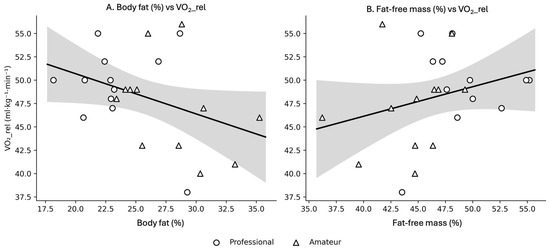
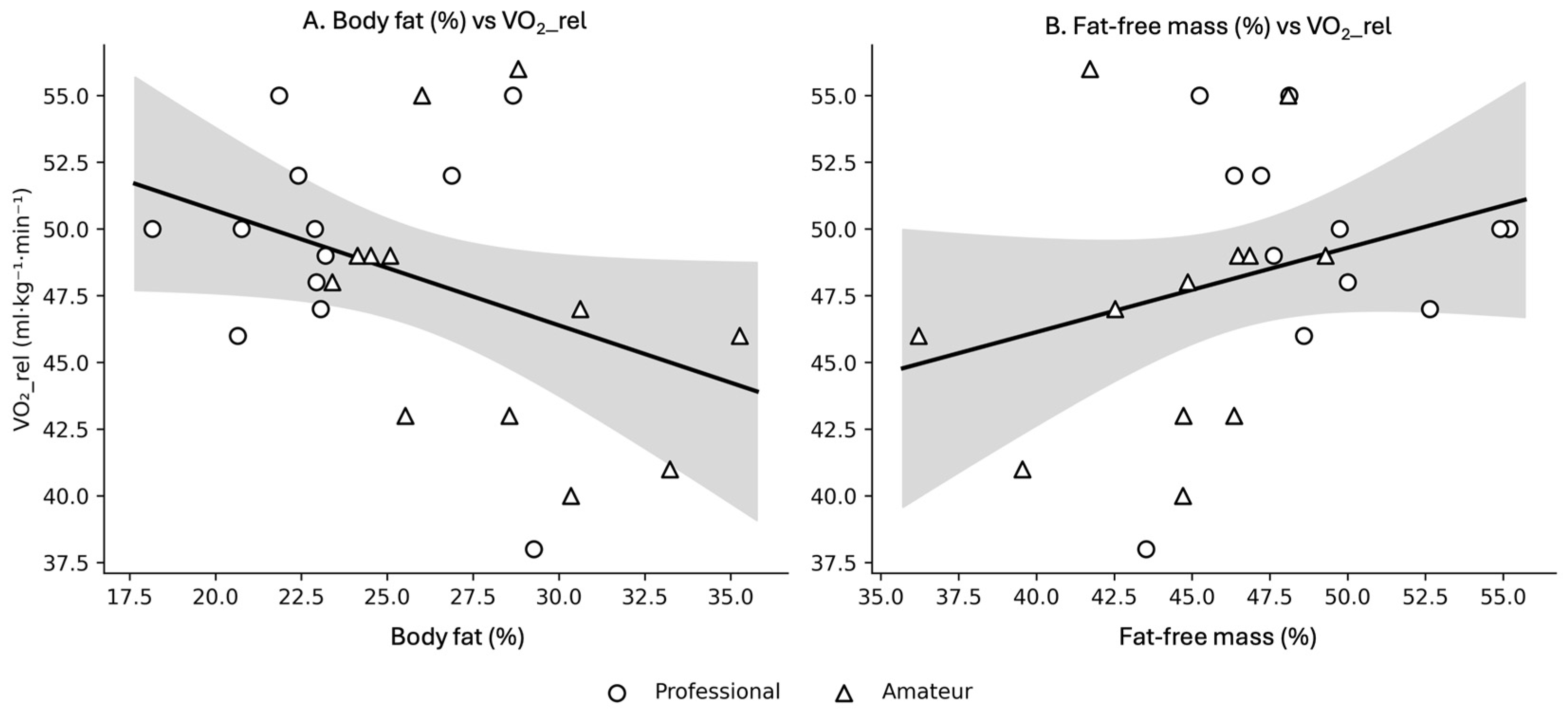
In the correlational analysis, VO2_rel showed a moderate inverse relationship with BFP (r = −0.38; p = 0.07) and a small-to-moderate positive relationship with FFM (r = 0.29; p = 0.17) (See Figure 1). Although these relationships did not reach statistical significance, both were observed in the expected direction. In the multiple linear regression model, body composition components explained approximately 15% of the variability in relative VO2 (R2 = 0.15); however, none of the individual predictors reached statistical significance.
Figure 1.
Associations between body composition and relative maximal oxygen uptake in basketball players: Scatterplots showing the relationships between (A) body fat percentage and relative maximal oxygen uptake (VO2_rel) and (B) fat-free mass percentage and VO2_rel. Circles represent professional players and triangles represent amateur players. Solid lines indicate linear regression fits, and shaded areas represent 95% confidence intervals.
Estimated sample sizes required to achieve adequate statistical power under different scenarios are presented in Table 4 (see Table 4).
Table 4.
Estimated sample size required to achieve 80% statistical power (α = 0.05) under different effect size scenarios.
4. Discussion
This study aimed to explore differences in cardiorespiratory fitness and body composition between professional and amateur basketball players and to examine the contribution of these factors to variability in relative maximal oxygen uptake. Secondarily, this study sought to estimate the sample size required for future studies. In the baseline analysis, no statistically significant differences were observed in VO2_rel between groups. Moreover, after adjustment for height and body fat percentage, the difference in VO2_rel was reduced to values close to zero, suggesting that body composition, particularly lower BFP and higher FFM in professional basketball players, accounts for a substantial proportion of the variability observed in this indicator. Overall, the findings provide partial support for the proposed hypotheses. The first hypothesis was only partially confirmed, as differences were observed in body composition and in the VT2_abs, but not in relative VO2max between groups. The second hypothesis was supported, with body composition variables showing meaningful associations with cardiorespiratory fitness. The third hypothesis was confirmed, as adjusting for anthropometric factors reduced between-group differences in VO2_rel to near zero.
These findings are consistent with previous studies showing that changes in body composition are associated with modifications in players’ physical fitness [24,38]. In sports such as basketball, where body mass and height play a relevant role in performance, VO2 expressed in absolute or allometrically scaled terms may more accurately reflect true cardiorespiratory fitness by avoiding the penalization associated with the exclusive use of VO2_rel in athletes with greater body mass [19]. In this regard, Lee and Zhang [21] demonstrated that allometric scaling of VO2max attenuates the influence of body mass, correcting potential distortions in the interpretation of cardiorespiratory performance in basketball players. Similarly, Castagna et al. [18] reported a significant inverse correlation between body mass and VO2_rel, highlighting the usefulness of allometric scaling in this sport.
In the present study, absolute VO2 showed a large effect size without reaching statistical significance, whereas the VT2_abs was significantly higher in professional basketball players, with a large effect size. In addition, allometrically scaled VO2 demonstrated a moderate-to-large favorable trend. These findings suggest that certain physiological indicators, particularly those related to ventilatory thresholds, may better reflect competitive level differences than unadjusted relative VO2 measures.
Regarding maximal effort criteria, no significant differences were observed in the respiratory exchange ratio (RER) between professional and amateur players, suggesting that both groups reached comparable levels of physiological exertion during the incremental test [39]. This finding supports the validity of between-group comparisons and allows exclusion of insufficient maximal effort as an explanation for the observed differences, or lack thereof, in cardiorespiratory variables. In addition, similar RER values indicate comparable metabolic responses to maximal physical exercise regardless of competitive level [39].
It should be noted that VO2max values observed in both groups were lower than those reported in studies conducted in high-level international competitive contexts [26,40]. These differences may be explained by variations in the degree of professionalization, training load and specificity, as well as contextual factors related to the competitive environment assessed. Accordingly, VO2max values should be interpreted in a contextualized manner rather than as universal performance thresholds, reinforcing the need to generate population-specific evidence in settings with lower competitive tradition or professionalization.
Exploratory analyses further suggest that body composition plays a relevant role in cardiorespiratory fitness. Specifically, bivariate analyses showed a moderate inverse association between VO2_rel and BFP, along with a small-to-moderate positive association with FFM, both in the expected physiological direction. Although these associations did not reach statistical significance, their magnitude is consistent with a meaningful physiological contribution. In the multiple linear regression model, body composition components jointly explained approximately 15% of the variability in VO2_rel; however, none of the individual predictors reached statistical significance. This lack of statistical significance may be attributed to the limited sample size and the inherent collinearity among body composition components, which is expected in the context of a pilot study.
Taken together, these results align with the heterogeneous evidence previously reported when comparing amateur and professional basketball players. The absence of significant differences in VO2_rel observed in this study is consistent with studies reporting limited discrimination between competitive levels [13]. However, when anthropometric adjustments are considered, body composition appears to explain a relevant proportion of the observed variability, in agreement with the findings of Metaxas et al. [11], who reported higher VO2max values and lower BFP in professional players. Additionally, studies reporting higher VO2max in trained versus untrained players or across non-professional competitive levels [16,17,18] reinforce the notion that training exposure and competitive context could influence the expression of cardiorespiratory fitness. These findings should be interpreted with caution given the pilot nature of the study.
4.1. Strengths and Limitations
Among the main strengths of this study was the use of a gold standard method for the assessment of VO2max, which ensured high accuracy and validity in the evaluation of cardiorespiratory fitness. Another important strength was the control of the influence of sex by including only a male population, thereby reducing biological variability and minimizing a major potential confounding factor.
The main limitation of this study is the small sample size, which restricts the external validity of the findings. Nevertheless, given the pilot nature of the study, the identification of moderate-to-large effect sizes in absolute and allometrically scaled cardiorespiratory variables, as well as statistically significant differences in body composition, suggests the presence of potentially meaningful effects that justify further research. Another limitation is the lack of strict control over dietary intake and sleep patterns, factors known to influence body composition and cardiorespiratory fitness performance [34]. However, this limitation reflects the ecological nature of the study design and its applicability to real-world training contexts. Future studies should include larger samples, consider allometrically scaled indicators as primary outcomes, and apply longitudinal designs to confirm the observed trends.
4.2. Practical Applications
From a practical perspective, optimizing body composition may contribute to improvements in both relative and absolute cardiorespiratory indicators. In this regard, coaches should prioritize the systematic monitoring and optimization of body composition through individualized nutrition and conditioning strategies, rather than focusing solely on performance outcomes. Regular assessment of these variables may help to better contextualize cardiorespiratory fitness results and guide training decisions. In turn, athletes can use this information to better understand their physiological performance and seek appropriate professional guidance to optimize their preparation. Furthermore, the use of allometrically scaled VO2 may be more appropriate for comparing athletes with different anthropometric profiles, particularly in sports where body mass is a key component of performance. Finally, the sample size estimates provided by this study indicate that more than 67 players per group would be required to detect the observed effect in VO2_rel, whereas detecting a minimal clinically relevant difference of 3 mL·kg−1·min−1 would require between 36 and 41 participants per group, providing a solid basis for the design of future confirmatory studies.
5. Conclusions
This pilot study indicates that relative maximal oxygen uptake may not meaningfully differentiate between professional and amateur basketball players. In contrast, professional players exhibited clear differences in body composition, significantly higher VT2_abs values, and favorable trends in both absolute and allometrically scaled cardiorespiratory indicators. These findings suggest that body composition plays a central role in the expression of cardiorespiratory fitness and that exclusive reliance on VO2_rel may underestimate functionally relevant differences between athletes with distinct anthropometric profiles. However, given this study’s pilot nature and limited sample size, these findings should be interpreted with caution. Importantly, this study provides data to inform sample size requirements and methodological considerations for future confirmatory research using larger samples and appropriate scaling approaches.
Author Contributions
Conceptualization, C.P.-M. and M.B.-M.; methodology, C.P.-M., M.B.-M., F.G.-I., P.V.-B. and E.V.-C.; validation, F.G.-I., P.V.-B. and E.V.-C.; formal analysis, C.P.-M., M.B.-M., N.V.-S., I.C.-V. and J.H.-M.; investigation, N.V.-S., I.C.-V. and J.H.-M.; data curation, N.V.-S., I.C.-V. and J.H.-M.; writing—original draft preparation, C.P.-M. and M.B.-M.; writing—review and editing, C.P.-M., M.B.-M., F.G.-I., P.V.-B. and E.V.-C. All authors have read and agreed to the published version of the manuscript.
Funding
This research received no external funding.
Institutional Review Board Statement
The study was conducted in accordance with the Declaration of Helsinki and approved by the Ethics Committee of the Servicio de Salud Araucanía Sur (Approval No.2, 3 January 2024).
Informed Consent Statement
Informed consent was obtained from all subjects involved in the study.
Data Availability Statement
The datasets used and analyzed during the current study are available from the corresponding author upon reasonable request.
Acknowledgments
We thank all the participants in this study.
Conflicts of Interest
The authors declare no conflicts of interest.
References
- Bourgeais, Q.; Charrier, R.; Sanlaville, E.; Seifert, L. A temporal graph model to study the dynamics of collective behavior and performance in team sports: An application to basketball. Soc. Netw. Anal. Min. 2024, 14, 94. [Google Scholar] [CrossRef] [Scilit]
- Drinkwater, E.J.; Pyne, D.B.; McKenna, M.J. Design and interpretation of anthropometric and fitness testing of basketball players. Sports Med. 2008, 38, 565–578. [Google Scholar] [CrossRef] [Scilit]
- Ferioli, D.; Rampinini, E.; Bosio, A.; La Torre, A.; Azzolini, M.; Coutts, A.J. The physical profile of adult male basketball players: Differences between competitive levels and playing positions. J. Sports Sci. 2018, 36, 2567–2574. [Google Scholar] [CrossRef] [Scilit]
- Vazquez-Guerrero, J.; Reche, X.; Cos, F.; Casamichana, D.; Sampaio, J. Changes in external load when modifying rules of 5-on-5 scrimmage situations in elite basketball. J. Strength Cond. Res. 2020, 34, 3217–3224. [Google Scholar] [CrossRef] [Scilit] [PubMed]
- Farley, J.B.; Stein, J.; Keogh, J.W.L.; Woods, C.T.; Milne, N. The relationship between physical fitness qualities and sport-specific technical skills in female team-based ball players: A systematic review. Sports Med. Open 2020, 6, 18. [Google Scholar] [CrossRef] [Scilit] [PubMed]
- Castagna, C.; Impellizzeri, F.M.; Rampinini, E.; D’Ottavio, S.; Manzi, V. The Yo-Yo intermittent recovery test in basketball players. J. Sci. Med. Sport 2008, 11, 202–208. [Google Scholar] [CrossRef] [Scilit]
- Ramos-Campo, D.J.; Rubio-Arias, J.A.; Ávila-Gandía, V.; Marín-Pagán, C.; Luque, A.; Alcaraz, P.E. Heart rate variability to assess ventilatory thresholds in professional basketball players. J. Sport Health Sci. 2017, 6, 468–473. [Google Scholar] [CrossRef] [Scilit] [PubMed]
- Stojanović, E.; Stojiljković, N.; Scanlan, A.T.; Dalbo, V.J.; Berkelmans, D.M.; Milanović, Z. The activity demands and physiological responses encountered during basketball match-play: A systematic review. Sports Med. 2018, 48, 111–135. [Google Scholar] [CrossRef] [Scilit]
- Mallett, G.; Schoenfeld, B.; Purdom, T.; Galpin, A. Physiological factors that affect maximal oxygen uptake and lactate threshold during endurance training. Sci. Sports 2025, 40, 10–23. [Google Scholar] [CrossRef] [Scilit]
- Joyner, M.J.; Coyle, E.F. Endurance exercise performance: The physiology of champions. J. Physiol. 2008, 586, 35–44. [Google Scholar] [CrossRef] [Scilit]
- Metaxas, T.I.; Koutlianos, N.; Sendelides, T.; Mandroukas, A. Preseason physiological profile of soccer and basketball players in different divisions. J. Strength Cond. Res. 2009, 23, 1704–1713. [Google Scholar] [CrossRef] [Scilit]
- Sallet, P.; Perrier, D.; Ferret, J.M.; Vitelli, V.; Baverel, G. Physiological differences in professional basketball players as a function of playing position and level of play. J. Sports Med. Phys. Fit. 2005, 45, 291–294. [Google Scholar]
- Köklü, Y.; Alemdaroğlu, U.; Koçak, F.; Erol, A.; Fındıkoğlu, G. Comparison of chosen physical fitness characteristics of Turkish professional basketball players by division and playing position. J. Hum. Kinet. 2011, 30, 99–106. [Google Scholar] [CrossRef] [Scilit] [PubMed]
- Perić, R.; Nikolovski, Z. Validation of four indirect VO2max laboratory prediction tests in soccer players. J. Phys. Educ. Sport 2017, 17, 608–613. [Google Scholar] [CrossRef] [Scilit]
- Dakule, K.; Veseta, U.; Arnis, V.; Grinberga, K.; Kalejs, O.; Tomsone, S. Direct versus indirect submaximal VO2max assessment in masters basketball players. J. Funct. Morphol. Kinesiol. 2025, 10, 431. [Google Scholar] [CrossRef] [Scilit]
- Huldani, H.; Pattelongi, I.; Massi, M.N.; Idris, I.; Bukhari, A.; Sinrang, A.W.; Arsyad, A.; Widodo, A.D.W.; Achmad, H.; Bahar, B. The difference of VO2max and immune profile (HMGB1, cortisol, IL-6, TNF-α, number of leukocytes, neutrophils and monocytes) in adolescents who were trained and untrained in basketball. J. Hum. Sport Exerc. 2021, 16, S1771–S1785. [Google Scholar] [CrossRef] [Scilit]
- Mikić, M.; Stojanović, M.D.M.; Milovančev, A.; Miljković, T.; Bjelobrk, M.; Golubović, M.; Maksimović, N.; Bianco, A.; Drid, P. Aerobic capacity and respiratory patterns are better in recreational basketball-engaged university students than age-matched untrained males. Biomed. Hum. Kinet. 2021, 13, 111–120. [Google Scholar] [CrossRef] [Scilit]
- Castagna, C.; Chaouachi, A.; Rampinini, E.; Chamari, K.; Impellizzeri, F. Aerobic and explosive power performance of elite Italian regional-level basketball players. J. Strength Cond. Res. 2009, 23, 1982–1987. [Google Scholar] [CrossRef] [Scilit]
- Carvalho, H.M.; Coelho-e-Silva, M.J.; Eisenmann, J.C.; Malina, R.M. Aerobic fitness, maturation, and training experience in youth basketball. Int. J. Sports Physiol. Perform. 2013, 8, 428–434. [Google Scholar] [CrossRef] [Scilit]
- Guimarães, E.; Baxter-Jones, A.D.G.; Williams, A.M.; Tavares, F.; Janeira, M.A.; Maia, J. The effects of body size and training environment on the physical performance of adolescent basketball players: The INEX study. Ann. Hum. Biol. 2023, 50, 26–34. [Google Scholar] [CrossRef] [Scilit]
- Lee, J.; Zhang, X. Is there really a proportional relationship between VO2max and body weight? A review article. PLoS ONE 2021, 16, e0261519. [Google Scholar] [CrossRef] [Scilit]
- Anselmi, F.; Cavigli, L.; Pagliaro, A.; Valente, S.; Valentini, F.; Cameli, M.; Focardi, M.; Mochi, N.; Dendale, P.; Hansen, D.; et al. The importance of ventilatory thresholds to define aerobic exercise intensity in cardiac patients and healthy subjects. Scand. J. Med. Sci. Sports 2021, 31, 1796–1808. [Google Scholar] [CrossRef] [Scilit]
- Festa, R.R.; Jofré-Saldía, E.; Candia, A.A.; Monsalves-Álvarez, M.; Flores-Opazo, M.; Peñailillo, L.; Marzuca-Nassr, G.N.; Aguilar-Farias, N.; Fritz-Silva, N.; Cancino-Lopez, J.; et al. Next steps to advance general physical activity recommendations towards physical exercise prescription: A narrative review. BMJ Open Sport Exerc. Med. 2023, 9, e001749. [Google Scholar] [CrossRef] [Scilit]
- Díaz-Martínez, A.S.; Vaquero-Cristóbal, R.; Albaladejo-Saura, M.; Esparza-Ros, F. Effect of pre-season and in-season training on anthropometric variables, somatotype, body composition and body proportion in elite basketball players. Sci. Rep. 2024, 14, 7537. [Google Scholar] [CrossRef] [Scilit]
- Hernandez-Martinez, J.; Perez-Carcamo, J.; Coñapi-Union, B.; Canales-Canales, S.; Negron-Molina, M.; Avila-Valencia, S.; Cid-Calfucura, I.; Herrera-Valenzuela, T.; Cisterna, D.; Branco, B.H.M.; et al. Relationship between body composition and physical performance by sex in professional basketball players. Appl. Sci. 2024, 14, 9165. [Google Scholar] [CrossRef] [Scilit]
- Cengizel, ÇÖ; Cengizel, E.; Öz, E. Somatotype and body composition profiles of children and adolescent male basketball players. Homo 2024, 75, 41–49. [Google Scholar] [CrossRef] [Scilit] [PubMed]
- Abdelkrim, N.; Chaouachi, A.; Chamari, K.; Chtara, M.; Castagna, C. Positional role and competitive-level differences in elite-level men’s basketball players. J. Strength Cond. Res. 2010, 24, 1346–1355. [Google Scholar] [CrossRef] [Scilit]
- Garcia-Gil, M.; Torres-Unda, J.; Esain, I.; Duñabeitia, I.; Gil, S.M.; Gil, J.; Irazusta, J. Anthropometric parameters, age, and agility as performance predictors in elite female basketball players. J. Strength Cond. Res. 2018, 32, 1723–1730. [Google Scholar] [CrossRef] [Scilit] [PubMed]
- Nikolaidis, P.T.; Asadi, A.; Santos, E.J.A.M.; Calleja-González, J.; Padulo, J.; Chtourou, H.; Zemkova, E. Relationship of body mass status with running and jumping performance in young basketball players. Muscles Ligaments Tendons J. 2015, 5, 187–194. [Google Scholar] [CrossRef] [PubMed]
- Vandenbroucke, J.P.; von Elm, E.; Altman, D.G.; Gøtzsche, P.C.; Mulrow, C.D.; Pocock, S.J.; Poole, C.; Schlesselman, J.J.; Egger, M.; Strobe Initiative. Strengthening the reporting of observational studies in epidemiology (STROBE): Explanation and elaboration. PLoS Med. 2007, 4, e297. [Google Scholar] [CrossRef] [Scilit]
- Julious, S.A. Sample size of 12 per group rule of thumb for a pilot study. Pharm. Stat. 2005, 4, 287–291. [Google Scholar] [CrossRef] [Scilit]
- Midgley, A.W.; McNaughton, L.R.; Polman, R.; Marchant, D. Criteria for determination of maximal oxygen uptake. Sports Med. 2007, 37, 1019–1028. [Google Scholar] [CrossRef] [Scilit]
- Hamlin, M.; Draper, N.; Blackwell, G.; Shearman, J.; Kimber, N. Determination of maximal oxygen uptake using the Bruce or a novel athlete-led protocol in a mixed population. J. Hum. Kinet. 2012, 31, 97–104. [Google Scholar] [CrossRef] [Scilit] [PubMed]
- Beltz, N.M.; Gibson, A.L.; Janot, J.M.; Kravitz, L.; Mermier, C.M.; Dalleck, L.C. Graded exercise testing protocols for the determination of VO2max: Historical perspectives, progress, and future considerations. J. Sports Med. 2016, 2016, 3968393. [Google Scholar] [CrossRef] [Scilit]
- Stewart, A.; Marfell-Jones, M.; Olds, T.; de Ridder, J. International Standards for Anthropometric Assessment, 1st ed.; International Society for the Advancement of Kinanthropometry (ISAK): Lower Hutt, New Zealand, 2011. [Google Scholar]
- Bernal-Orozco, M.F.; Posada-Falomir, M.; Quiñónez-Gastélum, C.M.; Plascencia-Aguilera, L.P.; Arana-Nuño, J.R.; Badillo-Camacho, N.; Márquez-Sandoval, F.; Holway, F.E.; Vizmanos-Lamotte, B. Anthropometric and body composition profile of young professional soccer players. J. Strength Cond. Res. 2020, 34, 1911–1923. [Google Scholar] [CrossRef] [Scilit] [PubMed]
- Scafoglieri, A.; Tresignie, J.; Provyn, S.; Marfell-Jones, M.; Reilly, T.; Bautmans, I.; Clarys, J.P. Prediction of segmental lean mass using anthropometric variables in young adults. J. Sports Sci. 2012, 30, 777–785. [Google Scholar] [CrossRef] [Scilit]
- Balady, G.J.; Arena, R.; Sietsema, K.; Myers, J.; Coke, L.; Fletcher, G.F.; Forman, D.; Franklin, B.; Guazzi, M.; Gulati, M.; et al. Clinician’s guide to cardiopulmonary exercise testing in adults. Circulation 2010, 122, 191–225. [Google Scholar] [CrossRef] [Scilit] [PubMed]
- Ramos-Jiménez, A.; Hernández-Torres, R.P.; Torres-Durán, P.V.; Romero-Gonzalez, J.; Mascher, D.; Posadas-Romero, C.; Juárez-Oropeza, M.A. The respiratory exchange ratio is associated with fitness indicators both in trained and untrained men: A possible application for people with reduced exercise tolerance. Clin. Med. Circ. Respir. Pulm. Med. 2008, 2, CCRPM.S449. [Google Scholar] [CrossRef] [Scilit]
- Han, M.; Gómez-Ruano, M.-A.; Lorenzo Calvo, A.; Lorenzo Calvo, J. Basketball talent identification: A systematic review and meta-analysis of the anthropometric, physiological and physical performance factors. Front. Sports Act. Living 2023, 5, 1264872. [Google Scholar] [CrossRef] [Scilit]

Disclaimer/Publisher’s Note: The statements, opinions and data contained in all publications are solely those of the individual author(s) and contributor(s) and not of MDPI and/or the editor(s). MDPI and/or the editor(s) disclaim responsibility for any injury to people or property resulting from any ideas, methods, instructions or products referred to in the content. |
© 2026 by the authors. Licensee MDPI, Basel, Switzerland. This article is an open access article distributed under the terms and conditions of the Creative Commons Attribution (CC BY) license.