


Abstract
Eye movements are difficult to observe and replicate, making them a promising yet understudied modality for behavioral biometrics. This study is the first to examine the feasibility of using eye movement patterns during manga reading as a biometric identifier, leveraging the medium’s rich behavioral data from diverse reading behaviors. Eye movement data from 59 participants were recorded while they read two manga works on a screen. A comprehensive set of gaze features was extracted and evaluated using five machine learning classifiers, among which Random Forest (RF) consistently achieved the best performance. Under constrained experimental conditions, the RF classifier achieved a Rank-1 identification rate of 95.0% and an equal error rate (EER) of 1.9%. Furthermore, this study systematically investigated two critical challenges for practical deployment: stimulus dependency and template aging. Cross-stimulus evaluation revealed substantial performance degradation when training and testing used different manga works, and template aging analysis over an approximately 90-day interval demonstrated notable declines in identification accuracy. These results provide preliminary evidence supporting the potential of natural reading behaviors for biometric continuous authentication systems while highlighting the need for further research into cross-stimulus generalization and temporal stability.
1. Introduction
In the modern era, person authentication has become paramount for safeguarding individuals and their data from cybercrimes and privacy violations. Biometric identification utilizes distinct physical or behavioral characteristics for identity verification [1]. The widely adopted modalities include facial recognition, iris scanning, and fingerprint analysis. Recently, behavioral biometrics based on individual behavioral patterns—such as gestures [2], gait [3], and keystroke patterns [4]—have gained considerable attention, and, among these, eye movement biometrics have emerged as a particularly promising modality.
Eye movement patterns can be passively recorded during natural device use without disrupting the user experience, making them particularly suitable for continuous authentication. The complex combinations of voluntary and involuntary neuromuscular control mechanisms governing saccades, fixations, and smooth pursuit movements create a behavioral fingerprint that is highly distinctive and resistant to spoofing attempts.
The type of gaze behavior required from the user is a critical factor in eye movement biometrics. Kasprowski and Ober [5] conducted one of the earliest studies using a “jumping point” paradigm, and similar moving stimuli have since been adopted in various studies [6,7,8]. Subsequent research employed diverse stimulus materials—including text passages [7,9], facial images [10,11], movies [12], and maps [13]—demonstrating the breadth of approaches used to enhance the accuracy and utility of eye movement biometrics.
Sluganovic et al. [14] categorized gaze-based authentication into two subtypes: methods based on low-level characteristics (e.g., fixation and saccade statistics from simple tasks) and those based on high-level characteristics (e.g., spatial fixation distributions from complex stimuli such as facial images or videos). Low-level approaches offer shorter data collection times but may limit individual variability, whereas high-level approaches better reflect individual characteristics but are susceptible to cognitive and emotional state variations and habituation effects [5]. In practice, the gaze behavior for authentication should be neither too simple nor too complex, balancing discriminability, tracking accuracy, and user burden.
This study proposes a novel approach for user identification that utilizes eye movement data collected during reading. Although eye movement tracking in reading tasks has been widely studied, its application in behavioral biometrics for user identification remains underexplored. Holland and Komogortsev [15] studied scan path characteristics by tracking the eye movements of 32 participants over four sessions, achieving an equal error rate (EER) of 27%. Building on this foundational work, subsequent studies focused on eye movement-based authentication during reading tasks [9,16,17,18,19]. Reading-based eye movement biometrics offer ecological validity, require no specific instructions, and minimize user fatigue compared with traditional approaches that rely on repeated identical stimuli.
Unlike earlier studies that primarily utilized literary excerpts, such as novel passages, as reading materials, this study uniquely employed manga, a genre of Japanese comics, as its focal reading material. Manga was chosen owing to its widespread daily consumption, particularly among younger demographics [20]. Manga integrates diverse visual elements—character illustrations, speech balloons, and panel layouts—that convey dynamic actions and narrative development [21,22,23,24,25,26]. The reading order in a manga is influenced by panel arrangement but is not strictly prescribed, allowing readers to revisit or skip panels as they wish [21,22,23]. Readers exhibit individual differences in gaze behavior when reading manga, yet consistent patterns are observed within individuals [27]. These factors suggest that manga reading captures rich behavioral data indicative of the reader’s individuality.
The primary objective of this study is to evaluate the accuracy of person authentication using eye movements during manga reading. Eye movement biometrics can operate seamlessly during routine digital activities without requiring dedicated authentication procedures, addressing growing needs for both security and convenience. Furthermore, the passive collection of eye movement data offers distinct privacy advantages over modalities such as facial recognition or fingerprint scanning.
Furthermore, the following aspects were investigated: Empirical evidence suggests that if a classifier is trained on eye tracking data from a specific activity (such as reading), its performance deteriorates markedly when applied to a fundamentally different task (such as dot-following). Schröder et al. [28] categorized such cases under a strongly task-independent classification. However, Schröder et al. defined this scenario as a weakly task-independent classification when models are trained on gaze data from observers looking at various images and then evaluated on slightly different images. This distinction highlights the challenges in generalizing eye tracking classifiers across different tasks or stimuli and emphasizes the necessity of recognizing task-specific characteristics in eye movement data classification. This study investigated the impact of differences in training and testing stimuli on identification accuracy by having participants read two distinct manga works. This stimulus setting aligns with what Schröder et al. referred to as a weakly task-independent classification. The study evaluated the generalizability of the predictive performance across manga works under this framework.
This study also aimed to investigate the influence of template aging on the performance of eye movement biometric authentication. Template aging refers to the gradual degradation of biometric authentication performance over time caused by shifts in a user’s registered traits. In eye movement-based systems, such performance degradation occurs when recorded gaze patterns deviate from initial enrollment data, reducing identification accuracy or increasing EER [29,30,31,32]. This study examined the effects of template aging by having a subset of participants perform a manga-reading task twice with a time interval between sessions.
The main contributions of this study are as follows: (1) We demonstrate, for the first time, that eye movement data recorded during manga reading can serve as a viable biometric modality, achieving a Rank-1 identification rate of 95.0% and an EER of 1.9% using Random Forest. (2) We systematically evaluate the impact of stimulus dependency on identification performance by comparing within-manga and cross-manga classification scenarios. (3) We investigate the effect of template aging on biometric performance over an approximately 90-day interval, revealing significant degradation in identification accuracy. (4) We employ SHAP analysis to identify the most discriminative eye movement features, providing interpretable insights into the biometric signal underlying manga reading behavior.
2. Materials and Methods
2.1. Participants
Given the absence of directly comparable prior studies using manga stimuli, participant recruitment was based on analogous eye movement biometric research employing text-reading paradigms. Although two large-scale studies exist (Lohr & Komogortsev [19] and Rigas et al. [10]; N = 322 in both), most comparable studies have utilized more modest sample sizes: Bayat and Pomplun [9] (N = 40), Landwehr et al. [16] (N = 20), and Makowski et al. [18] (N = 62). Considering these benchmarks and the experimental constraints, 70 participants were recruited. All participants provided written informed consent and were informed of their right to withdraw from the study at any time. This study was approved by the Ethics Committee of the Graduate School of Information Sciences at Tohoku University.
This study adopted the same error criteria as Hoppe et al. [33], where erroneous samples were defined as those with undetected pupils or gaze direction estimates exceeding 150% of the valid range. Three participants were excluded because they had >50% erroneous samples in their recordings. Additionally, data from eight participants with Tobii gaze sampling quality below 70% were discarded. The final sample consisted of 59 participants (29 females, 30 males, age = 21.6, SD = 1.3) with complete data.
2.2. Apparatus
A Tobii TX-300 eye tracker (Tobii AB, Stockholm, Sweden) was used to record the gaze data at a frequency of 250 Hz. The eye tracker was paired with a 23-inch monitor with a resolution of 1920 × 1080 pixels and was positioned approximately 57 cm away from the participants.
2.3. Stimuli and Procedure
The stimuli used in this study were excerpts from two commercially published manga stories. The first, from “Burakku Jakku ni Yoroshiku” [34], consisted of 87 panels with 1375 Japanese characters distributed across 89 speech balloons over 18 pages. The second, sourced from “Burakku Jakku” [35], included 139 panels and 3302 characters in 172 speech balloons, extending across 19 pages. These manga works are referred to as Manga A and Manga B, respectively. Despite the shared name “Black Jack” in both titles and the thematic similarity of featuring a young medical doctor as the main protagonist, the narratives and settings of the two stories are distinct. According to post-experiment debriefing reports, all participants stated that they had never read either manga before.
The manga was displayed on a screen in a single-page format, with each page having a resolution of 624 × 880 pixels. Participants were instructed to read the two manga works as they usually read manga in everyday life. They were informed that they could switch to the next page display by clicking on the mouse at their own pace; however, they could not return to the previous page once they flipped forward. To replicate a natural reading environment, no time constraints were imposed on task completion, resulting in varied task completion times among participants. The reading order of Manga A and Manga B was counterbalanced among the participants to ensure variability control. At the beginning of the data collection, a 9-point calibration procedure was conducted to calibrate the eye tracker. Eye movement was measured under ambient lighting conditions. Although controlled laboratory studies often stabilize participants’ heads with a chin rest to ensure accurate and precise eye tracking data, this method is impractical for real-world applications. Experiments were conducted without head stabilization to better approximate natural reading conditions.
To investigate the impact of extended time intervals on the resulting identification accuracy, referred to as the effect of template aging [29,30,31,32], the data collection process was structured into two separate sessions for a subset of participants. Twenty-three participants were initially included, repeating the same eye movement measurements after an average interval of approximately 90.5 (±27.4) days, with the range of intervals spanning from 56 to 158 days. These sessions are referred to as the 1st and 2nd sessions, respectively. Both sessions maintained the same reading order for Manga A and Manga B, as established in the 1st session. However, technical issues with the eye tracker while reading Manga A meant that successful data collection was only possible for 22 participants under this condition.
2.4. Eye Tracking Data Analysis
This study adopted eye tracking indices as input features for machine learning using the Python (version 2.7.18) code proposed by Hoppe et al. [33] for several reasons. First, Hoppe et al.’s feature set is one of the most comprehensive publicly available frameworks, encompassing 207 features spanning fixation statistics, saccade dynamics, blink characteristics, pupil diameter, and spatiotemporal gaze patterns. Second, the code has been validated in prior personality prediction research and provides a standardized, reproducible feature extraction pipeline. Third, its open-source availability facilitates transparency and enables direct comparison with future studies.
Hoppe et al. [33] originally extracted 207 features related to eye movements, including fixation, saccades, blinking information, and pupil diameter. Several modifications were made to adapt the code to the manga-reading context: (1) four features related to pupil diameter during saccades were excluded due to a significant amount of missing data, and (2) the calculation algorithm for “mean saccadic peak velocity” was slightly modified to improve accuracy. Consequently, 203 features were extracted and employed as inputs for the machine-learning classifiers.
The minimum fixation duration was set at 100 ms, following the threshold used by Hoppe et al. [33]. Although the 100 ms threshold in Hoppe et al. was originally designed for analyzing eye movement data in the context of outdoor navigation, and manga reading involves rapid and irregular gaze shifts across panels, characters, and speech balloons, we considered whether a shorter threshold might better capture fine-grained gaze patterns and yield more accurate identification results. Research on eye movements during scene viewing and reading has demonstrated that meaningful cognitive processing can occur during fixations as short as 50–80 ms (Rayner [36]; Inhoff & Radach [37]). Rayner [36] reported that fixation durations during reading typically range from under 100 ms to over 500 ms, with very short fixations occurring as part of normal reading behavior. Inhoff and Radach [37] further recommended excluding fixations below 50 ms on the grounds that such brief fixations are unlikely to reflect on-line cognitive processing. To empirically determine the optimal minimum fixation duration, we conducted supplementary analyses comparing thresholds of 60 ms and 100 ms. The pattern of results was qualitatively consistent across thresholds, with the 100 ms threshold yielding slightly higher identification accuracy overall. On the basis of these findings, we adopted 100 ms as the minimum fixation duration in the present study (for a supplementary analysis using a dataset with the minimum fixation duration set to 60 ms, see Appendix A, Table A5, Table A6, Table A7 and Table A8).
Consistent with Hoppe et al., these features were categorized into three major groups: statistics regarding fixations, saccades, and blinks; statistics regarding the spatial pattern of raw gaze data; and information regarding the temporal progression of saccades and fixations—hereafter referred to as the first, second, and third feature groups, respectively. The first feature group comprised descriptive statistics of fixations, saccades, and blinks, including fixation/saccade rates and mean, variance, and minimum and maximum fixation durations. The second feature group addressed the spatial distribution of gaze calculated on the x- and y-coordinates of fixations and the associated pattern of pupil diameter changes. The third feature group illustrates the global and local patterns of spatiotemporal changes in saccades and fixations. Comprehensive explanations and detailed calculations of these features can be found in the Supplementary Material of Hoppe et al. [33].
SHapley Additive exPlanations (SHAP) was applied to address the interpretability challenges associated with high-dimensional eye movement features, such as saccade dynamics and fixation dispersion [38]. SHAP provides a clear understanding of how individual features contribute to the model decisions. Although the built-in feature importance of random forest (RF), such as Gini impurity reduction, offers a basic ranking of influential features, SHAP analysis was selected. This decision stems from the potential unreliability of RF importance scores in the presence of correlated features, which is a common scenario in eye movement data (e.g., the correlation between saccade amplitude and velocity). SHAP analysis effectively manages these dependencies and maintains consistency.
As no time limit was set for the reading task, the time required to complete it varied among participants. To manage variability in the quantity of data across participants and ensure that sufficient data were collected from each participant, only those participants who recorded a reading time of at least 120 s for both Manga A and Manga B were included. This exclusion criterion led to the exclusion of two participants from further analyses. The rationale for setting the manga reading duration used in the analysis to 120 s is as follows. As described later, the maximum time window size used in this study is 30 s. When the data are segmented into 30 s blocks, a 120 s interval yields four blocks. This allows us to allocate up to three blocks for training, even when one block is reserved for testing. Thus, a 120 s duration was deemed appropriate to ensure a sufficient amount of training data.
A sliding time window approach similar to the method discussed by Liao et al. [13] was employed to segment the recorded data into intervals of equal length. The time windows were applied in the forward mode such that the first 120 s of each recording were analyzed without overlapping the data between segments. The choice of the forward mode was motivated by the following rationale: if the last 120 s were used instead, the manga content being read during that interval could vary substantially between participants with shorter and longer reading times. To minimize inter-participant variability in the presented stimulus content, we therefore adopted the first 120 s from the start of reading as the standardized analysis window.
Five window sizes were tested: 5, 10, 15, 20, and 30 s. For instance, with a window size of 5 s, the 120 s recording was divided into 24 segments. Time windows in which more than half of the samples were erroneous—such as when the pupil was not detected, or the gaze direction fell outside 120% of its expected range—were discarded. Furthermore, windows with fewer than two valid samples or windows without detected fixations or saccades were excluded. No time windows were identified that met the exclusion criteria. Consequently, the number of valid segments retained for data analysis corresponded to twenty-four, twelve, eight, six, and four segments per participant for time windows of 5, 10, 15, 20, and 30 s, respectively. The resulting segments were subsequently subjected to feature extraction, and a comprehensive set of eye movement features was extracted for each time window.
2.5. Machine Learning
Biometric recognition systems have two main modes: authentication or verification and identification [39]. Authentication is a process in which the system checks whether the identity claimed by a user corresponds to a template stored in the database by performing a one-to-one comparison. However, identification does not rely on any identity claim from the user; conversely, the system searches the database to determine the best-matching template among all available candidates, conducting a one-to-many comparison. This study focused exclusively on the identification mode.
This study addresses the user identification task as a multiclass classification problem involving 59 classes, where each class corresponds to a different participant. Predictive models were developed based on eye movement features to reliably identify participants. We evaluated the performance of five widely used classifiers, including RF, XGBoost [40], LightGBM [41], linear SVM [42], and multilayer perceptron (MLP) [43]. For training each classifier, no parameter optimization was performed, and all parameters were set to their default values. The results show that RF consistently outperformed the other classifiers in accuracy across all time window sizes. Although XGBoost and LightGBM trailed closely behind, SVM and MLP exhibited lower accuracy. Based on this, we selected RF as the primary machine learning classifier in this study.
This algorithm was implemented using the Scikit-learn library (version 1.5.2) in Python 3.12.7 [44]. To ensure unbiased prediction performance, the models were evaluated using a four-fold cross-validation procedure with data stratification to achieve an equal representation of training samples across all classes while maintaining consistent sample ratios for each time window size. For instance, for each participant, 120 s of eye movement data were divided into training and test sets at a 3:1 ratio. In the case of a 30 s time window, the data were segmented into four parts, using three for training and one for testing, thereby dedicating 90 s for training for each time window.
Feature selection was embedded within a group-aware nested cross-validation framework to prevent information leakage. In each outer fold, feature standardization was performed using statistics computed exclusively from the outer-training split. A scikit-learn pipeline consisting of SelectKBest (ANOVA F-test, f_classif) followed by the classifier was then trained. The optimal number of selected features () was determined via an inner three-fold StratifiedGroupKFold GridSearchCV, with grouping by time window. The pipeline was subsequently refit on the full outer-training data using the best and evaluated on the held-out outer-test split. This procedure ensured that both standardization and selection were confined to the training data, thereby avoiding optimistic bias. To enhance the stability of the classification performance, the cross-validation procedure was repeated twenty times with different data splits. The average estimate was reported across all runs. Moreover, a standard scaler was applied to the training data, and both the training and test samples were standardized to a mean of 0 and a standard deviation of 1 to improve the performance of the machine learning algorithm.
To evaluate the performance of the classifiers and assess the accuracy of user identification, this study employed the cumulative match characteristic (CMC) curve and EER as key metrics. CMC curves are frequently used in biometric identification studies and depict the recognition rate on the Y-axis against each rank on the X-axis. The rank-k identification rate (Rank-k IR) signifies the number of samples correctly identified within the top-k candidates relative to the total number of samples. The Rank-1 identification rate, often synonymous with “accuracy,” is defined as the ratio of correctly classified samples to the total number of samples. The EER was derived from the receiver operating characteristic (ROC) curve, representing the false positive rate (FPR) versus the true-positive rate (TPR) on the X- and Y-axes, respectively. A curve closer to the top left corner indicates superior classification performance. The EER is the point on the ROC curve where the FPR equals the TPR, representing the likelihood that the user identification system will misclassify a positive sample as negative or vice versa. Notably, the EER is widely adopted as a benchmark metric because of its threshold-invariant nature, facilitating unbiased comparisons across different biometric algorithms or modalities, such as fingerprint versus face recognition, under consistent evaluation criteria.
3. Results
3.1. Identification Results of the Sliding Window Approach
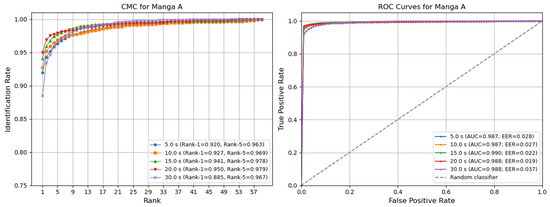
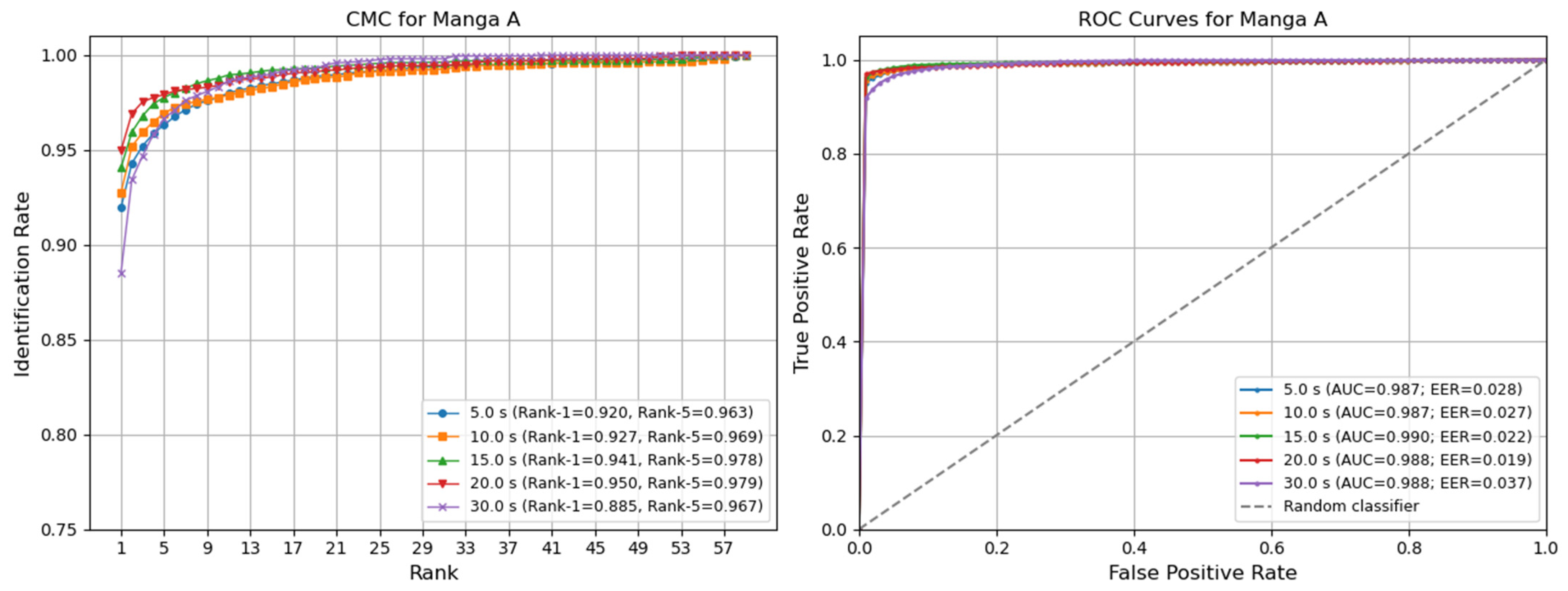
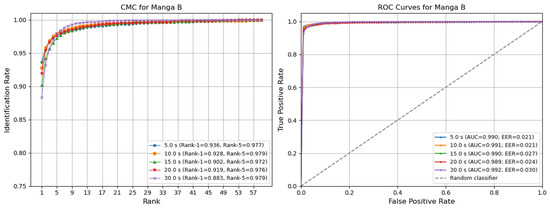
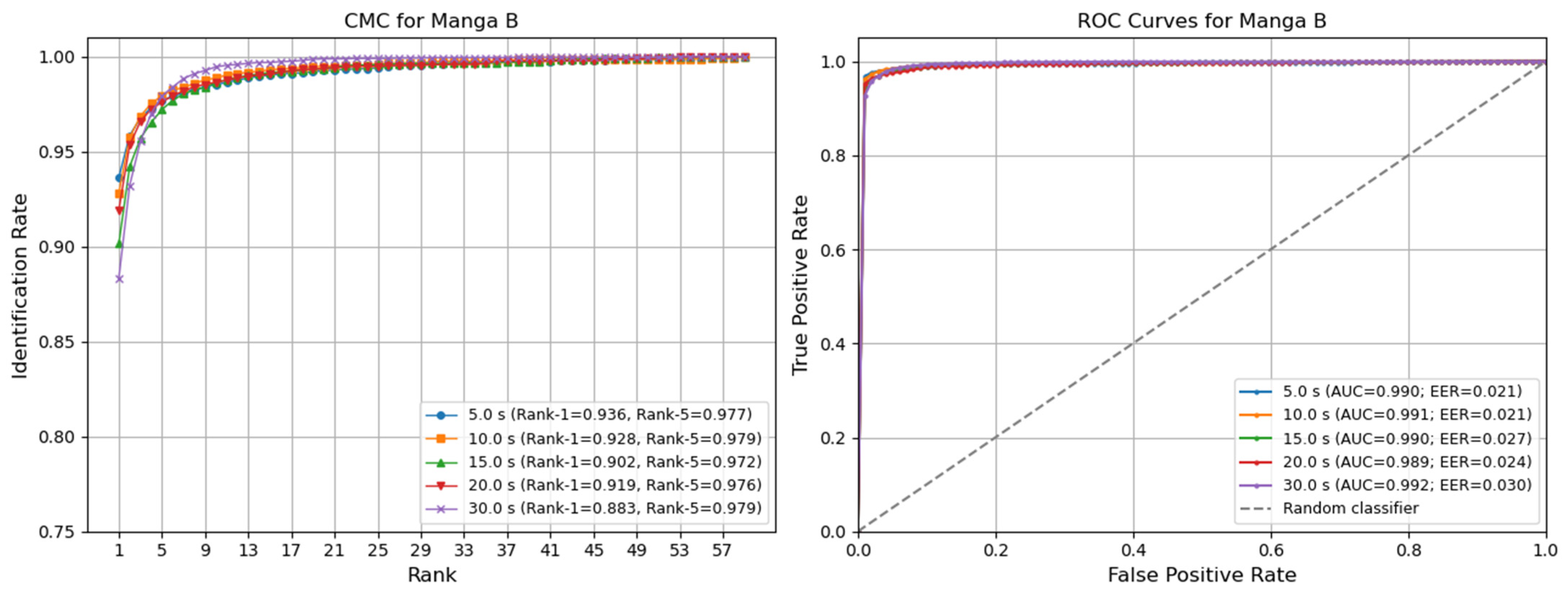
The CMC and ROC curves corresponding to various time window sizes are shown in Figure 1 and Figure 2, respectively. For Manga A, the peak Rank-1 identification rate was 95.0%, and an EER of 1.9% was achieved in a 20 s time window. Manga B demonstrated the best results with a Rank-1 identification rate of 93.6% and an EER of 2.1% observed in a 5 s time window. The lowest Rank-1 identification rate was 88.3% for Manga B at a 30 s time window, which was significantly higher than the chance level of 1.69% (1/59). To characterize model complexity under leakage-free selection, we aggregated the final models across five time-window settings and four outer folds (5 × 4 = 20 per run): the number of retained features () averaged was 36.5 (SD = 3.9) for Manga A and 42.9 (SD = 7.5) for Manga B. As a supplementary summary of the identification performance, Table A1 presents the Rank-1 IR, Rank-5 IR, and EER across all time window conditions for both Manga A and Manga B.
Figure 1.
CMC (left) and ROC (right) curves for each time window condition and for Manga A.
Figure 2.
CMC (left) and ROC (right) curves for each time window condition and for Manga B.
These findings illustrate that, for Manga A, the highest identification performance occurred at the 15 s time window, with performance declining for both shorter and longer durations. For Manga B, in contrast, the best performance was achieved at the 5 s time window. These results suggest that there is an optimal time window for capturing individual differences in manga reading and that this depends on the content of the manga material. The finding that optimal time windows differ across manga materials highlights the importance of selecting appropriate temporal parameters when studying eye movement patterns associated with different reading tasks.
3.2. Examination of Stimulus Independence
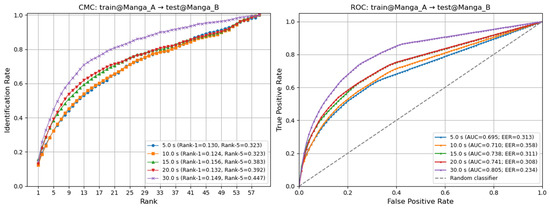
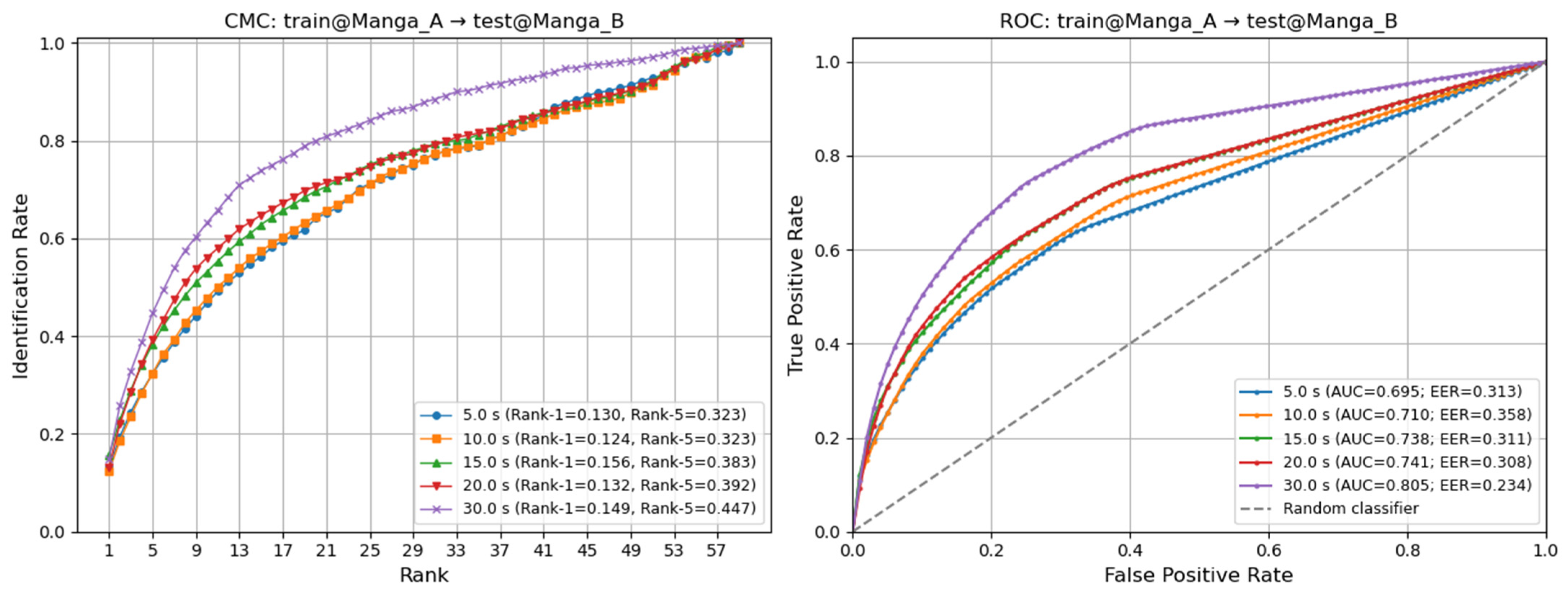
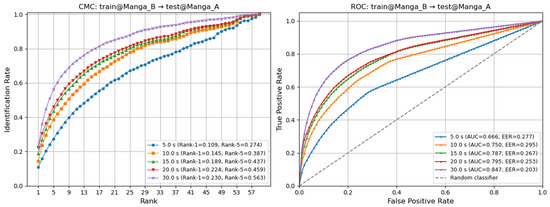
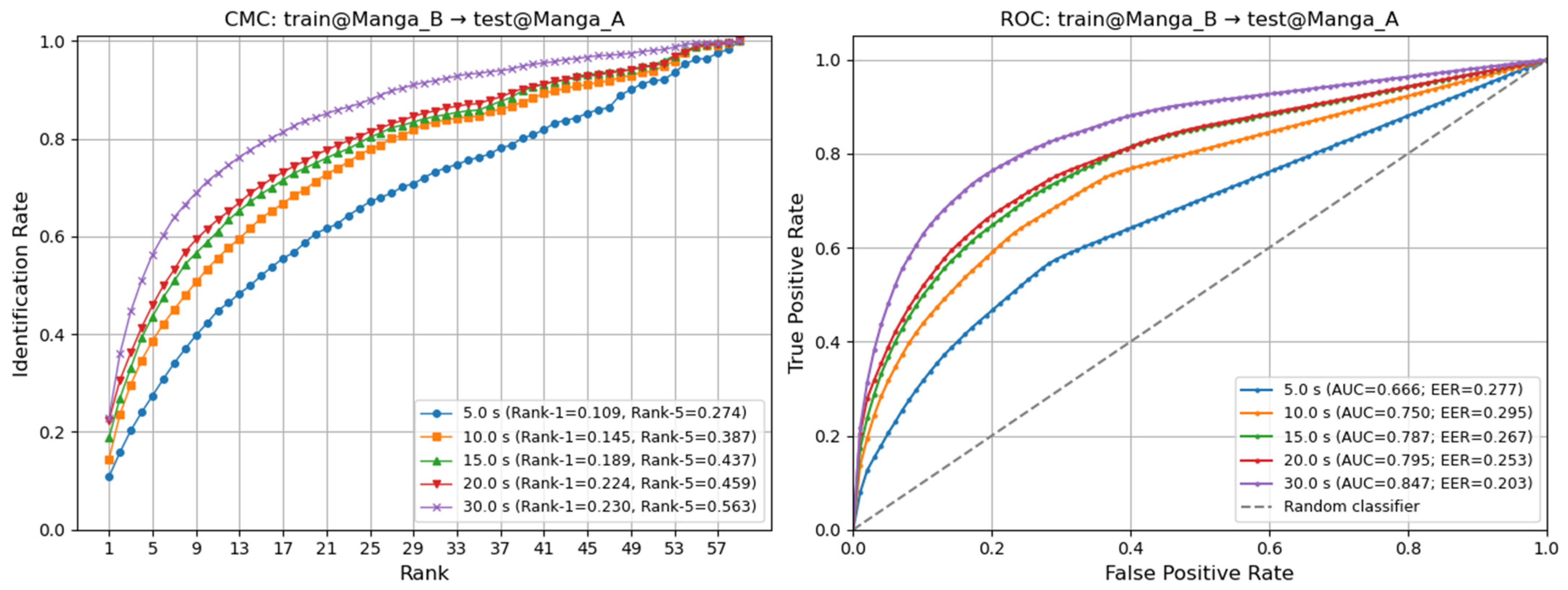
When exploring the classification performance using eye movement data extracted from different stimuli as input features, a change in the results was observed. The results, presented in Figure 3 and Figure 4, demonstrate that when Manga A was used for training and Manga B for testing, the highest Rank-1 identification rate was 15.6% in the 15 s time window, and the EER was 23.4% in the 30 s time window. A similar pattern was observed when the scenarios were reversed, with a Rank-1 identification rate of 23.0% and an EER of 20.3% noted in the 30 s time window. The overall identification performance was significantly poorer when the training and test datasets were derived from different manga types than when they were from the same manga. Although the identification rates surpassed chance levels, they decreased substantially when different manga types were used for training and testing. The number of retained features () averaged was 36.5 (SD = 3.9) for the former condition (Manga A for training and Manga B for testing) and 42.9 (SD = 7.5) for the latter condition (Manga B for training and Manga A for testing). Note that these k values are identical to those reported in Section 3.1 because the feature selection was performed exclusively on the training data using the same cross-validation splits; the choice of test data (same-manga or cross-manga) does not influence the inner cross-validation procedure that determines k. As a supplementary summary of the identification performance, Table A2 presents the Rank-1 IR, Rank-5 IR, and EER across all time window conditions for the two conditions: Manga A for training and B for testing, and vice versa.
Figure 3.
Cross-stimulus classification performance. These figures show CMC (left) and ROC (right) curves when training was performed on Manga A and testing on Manga B across various time windows.
Figure 4.
Cross-stimulus classification performance. These figures show CMC (left) and ROC (right) curves when training was performed on Manga B and testing on Manga A across various time windows.
3.3. Effect of Template Aging
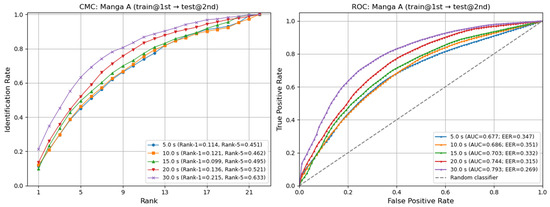
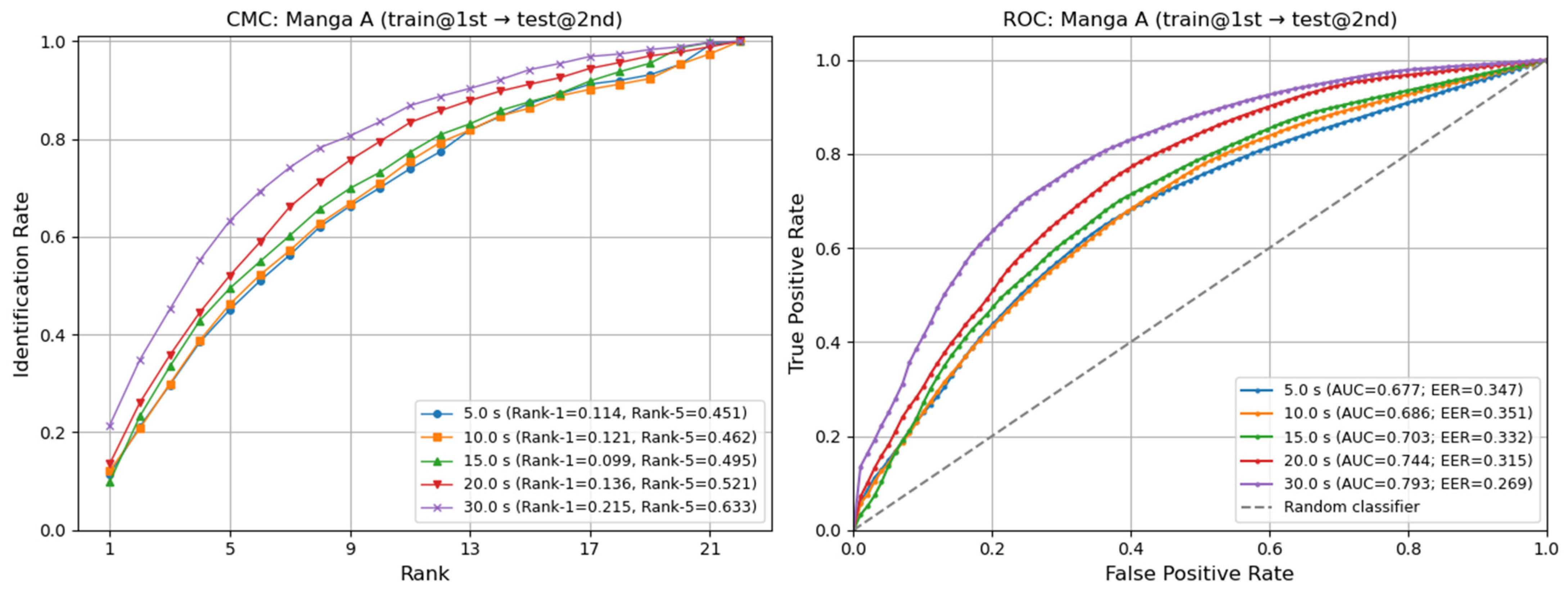
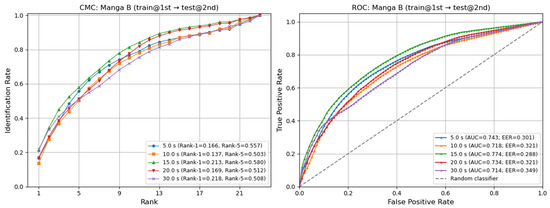
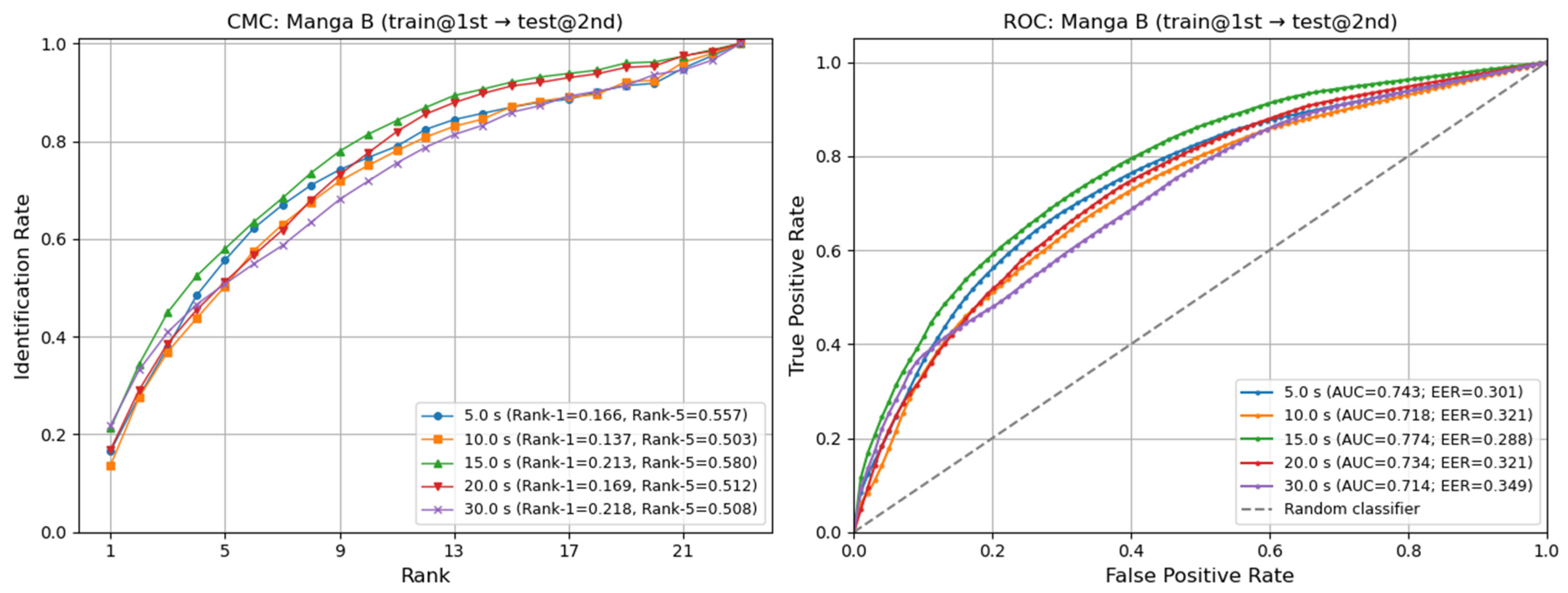
This analysis assessed the performance in scenarios where training and test data were collected at significantly different time points to understand how extended intervals impact the stability and reliability of identifying eye movement patterns. This approach was implemented using the sliding time window method, with the 1st and 2nd session data serving as the training and test data, respectively. To ensure consistency with prior analyses and to equalize the dataset sizes, a predetermined number of instances were randomly sampled from each dataset, with the sample size determined by the time window parameters. The CMC and EER curves are presented in Figure 5 and Figure 6, respectively. For Manga A, the optimal performance was observed with a Rank-1 identification rate of 21.5% and an EER of 26.9% using the 30 s time window. Similarly, for Manga B, the highest Rank-1 identification rate was 21.8% with the 30 s time window, and the EER was 28.8% with the 15 s time window. The number of retained features () averaged was 42.8 (SD = 8.4) for Manga A and 40.6 (SD = 8.6) for Manga B. As a supplementary summary of the identification performance, Table A3 presents the Rank-1 IR, Rank-5 IR, and EER across all time window conditions for both Manga A and Manga B.
Figure 5.
CMC (left) and ROC (right) curves illustrating the effects of template aging for Manga A.
Figure 6.
CMC (left) and ROC (right) curves illustrating the effects of template aging for Manga B.
3.4. Identification Results of the Page-Wise Approach
The sliding time window approach for analyzing eye movements introduces methodological challenges, particularly in creating partial overlaps between the training and test datasets; this overlap may occur because eye movements recorded from identical manga pages are distributed across different temporal segments, potentially affecting the robustness of stimulus independence, a crucial aspect of eye movement biometric research, as indicated by Schröder et al. [28].
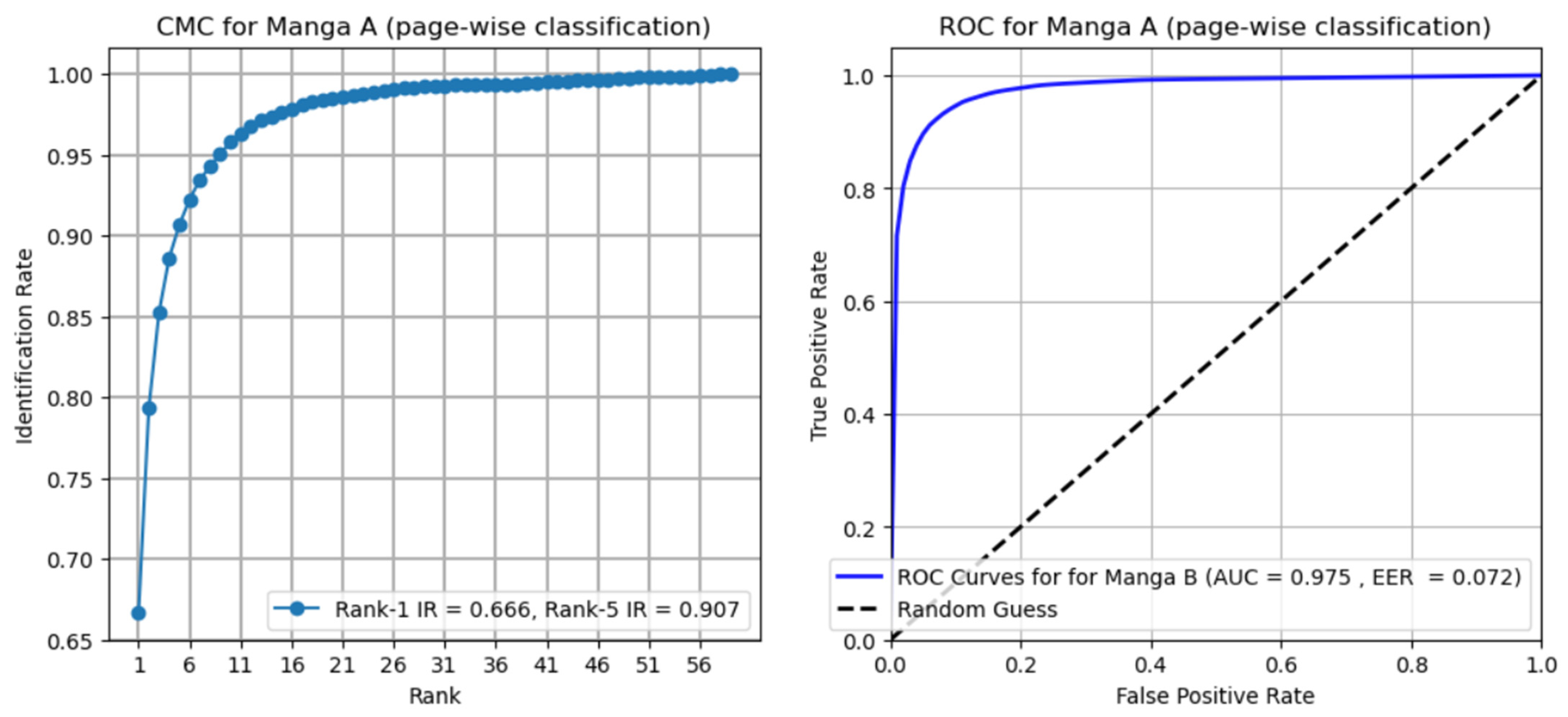
To address this issue, an alternative method called stimulus-disjoint data partitioning was implemented. This method involves extracting eye movement features on a per-page basis as opposed to using sliding temporal windows, thereby creating distinct datasets for each manga page. The datasets were partitioned such that 75% of the pages were used for training and 25% for testing, ensuring complete stimulus segregation during the evaluation phases. Given that Manga A comprised 18 pages and Manga B contained 19 pages, each participant’s eye movement data was correspondingly segmented into 18 and 19 discrete units. We implemented a four-fold cross-validation procedure where three-quarters of these page-based segments were allocated to training and the remainder to testing. Owing to the indivisible page counts (18 and 19 not being multiples of 4), the exact number of segments in training and testing sets varied slightly across folds while maintaining the approximate 3:1 ratio. This stimulus-disjoint partitioning ensured complete separation of training and testing materials while preserving the natural reading experience captured in each full manga page. While this page-wise approach effectively resolves concerns regarding stimulus overlapping by design, it introduces natural variability owing to different recording durations influenced by individual reading styles and page content.
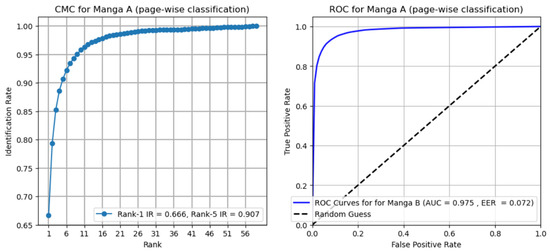
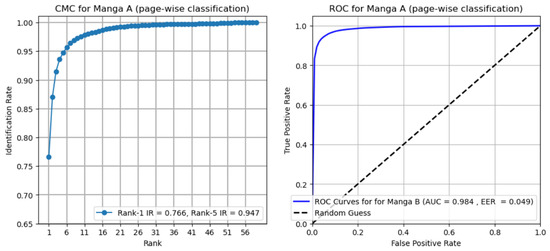
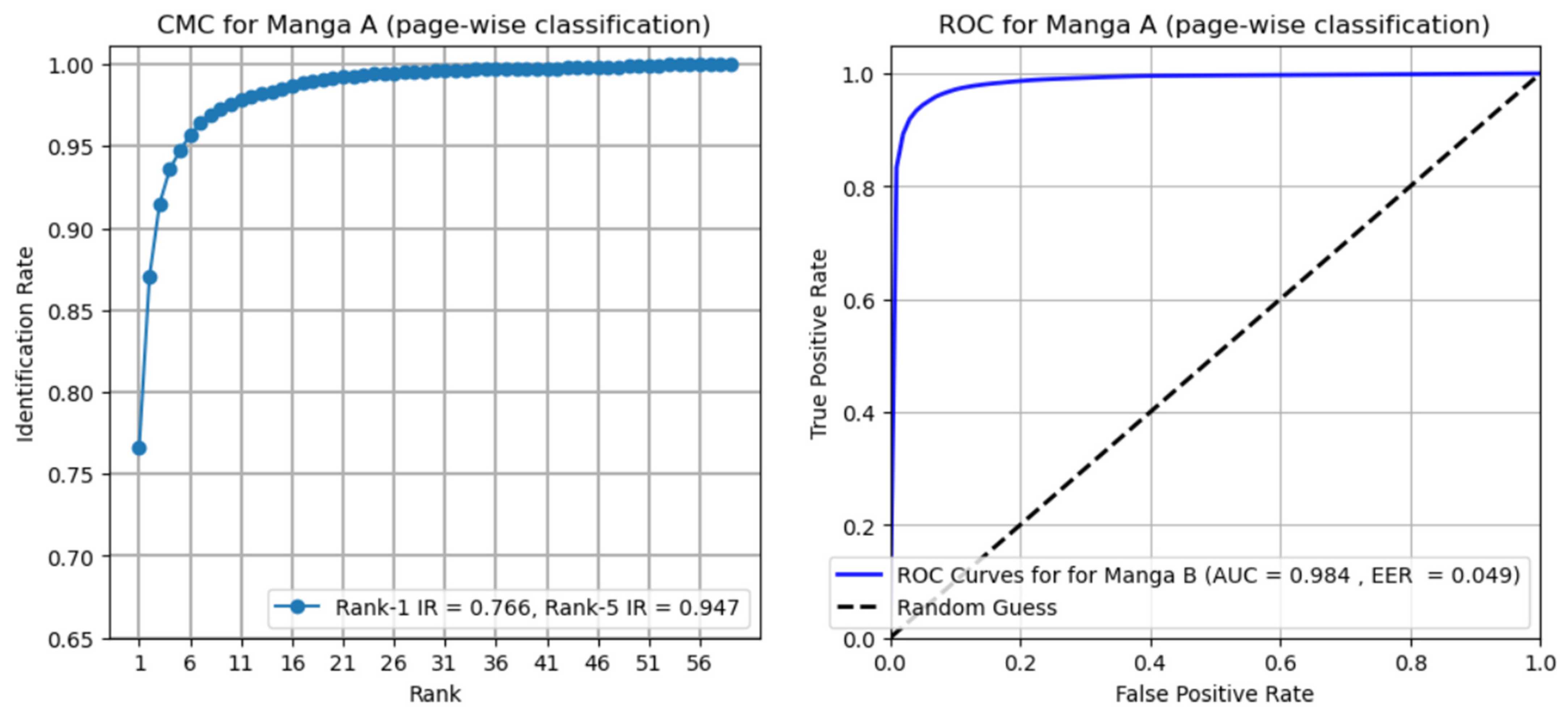
The results depicted in Figure 7 and Figure 8 reveal that the page-wise implementation yielded a Rank-1 identification rate of 66.6% and an EER of 7.2% for Manga A, whereas Manga B achieved a Rank-1 identification rate of 76.6% and an EER of 4.9%. Therefore, despite inherent differences in page content, the page-wise approach maintained substantial levels of accuracy and reliability in classification, albeit with more natural variability across data points. The number of retained features () averaged was 102.8 (SD = 12.6) for Manga A and 72.7 (SD = 13.3) for Manga B. As a supplementary summary of the identification performance, Table A4 presents the Rank-1 IR, Rank-5 IR, and EER for both Manga A and Manga B.
Figure 7.
CMC (left) and ROC (right) curves for the page-wise classification approach using stimulus-disjoint data partitioning for Manga A.
Figure 8.
CMC (left) and ROC (right) curves for the page-wise classification approach using stimulus-disjoint data partitioning for Manga B.
3.5. SHAP Values of Features
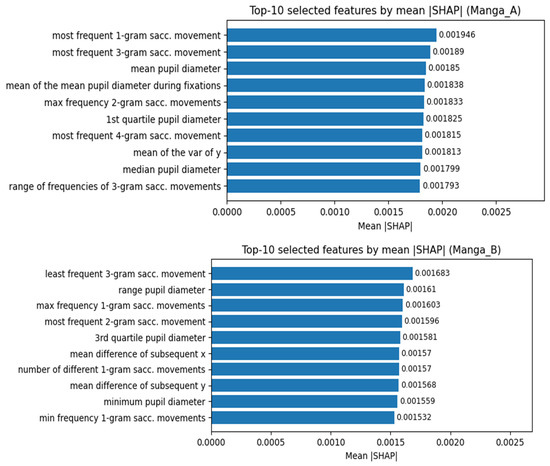
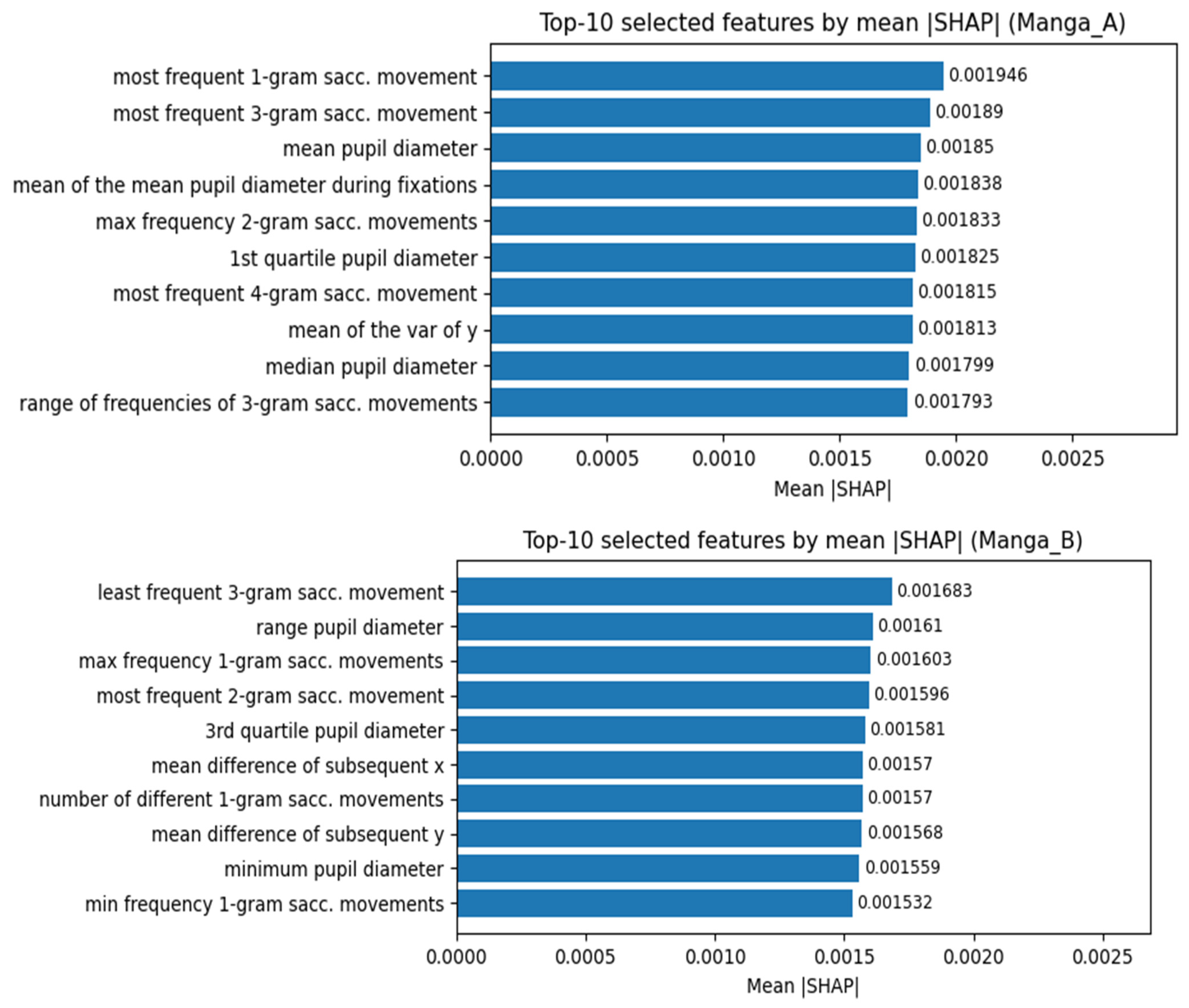
To enhance the interpretability of the classification model, SHAP analysis was employed to assess the influence of each eye movement feature on the model predictions. This technique calculates SHAP values for each feature to represent their relative importance in the predictive model. In this study, the absolute SHAP values of the selected features were averaged across participants in the validation dataset. Owing to the dependence of the prediction results on the random seed used to separate the training and test data, the SHAP values were recalculated for each run of the cross-validation procedure, with the results aggregated over 20 runs. These analyses were conducted using the sliding window method on models for Manga A with a 20 s time window and Manga B with a 5 s time window, which exhibited the best performance. As depicted in Figure 9, the top ten features for predicting each participant or user were sorted by their SHAP values in ascending order, indicating the relative influence of the features on the model’s predictions (larger values denote greater influence). Despite variations in ranking, a notable overlap was observed in the categories of the top ten influential features between the two manga works. Specifically, Figure 9 highlights that most of these top-ranked features pertain to the N-gram statistics that capture unique saccadic movement patterns.
Figure 9.
SHAP summary plots showing the top 10 most influential features for user identification, based on the sliding window approach for Manga A (top) and Manga B (bottom).
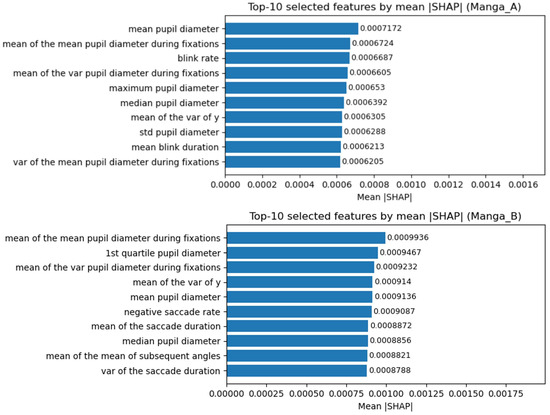
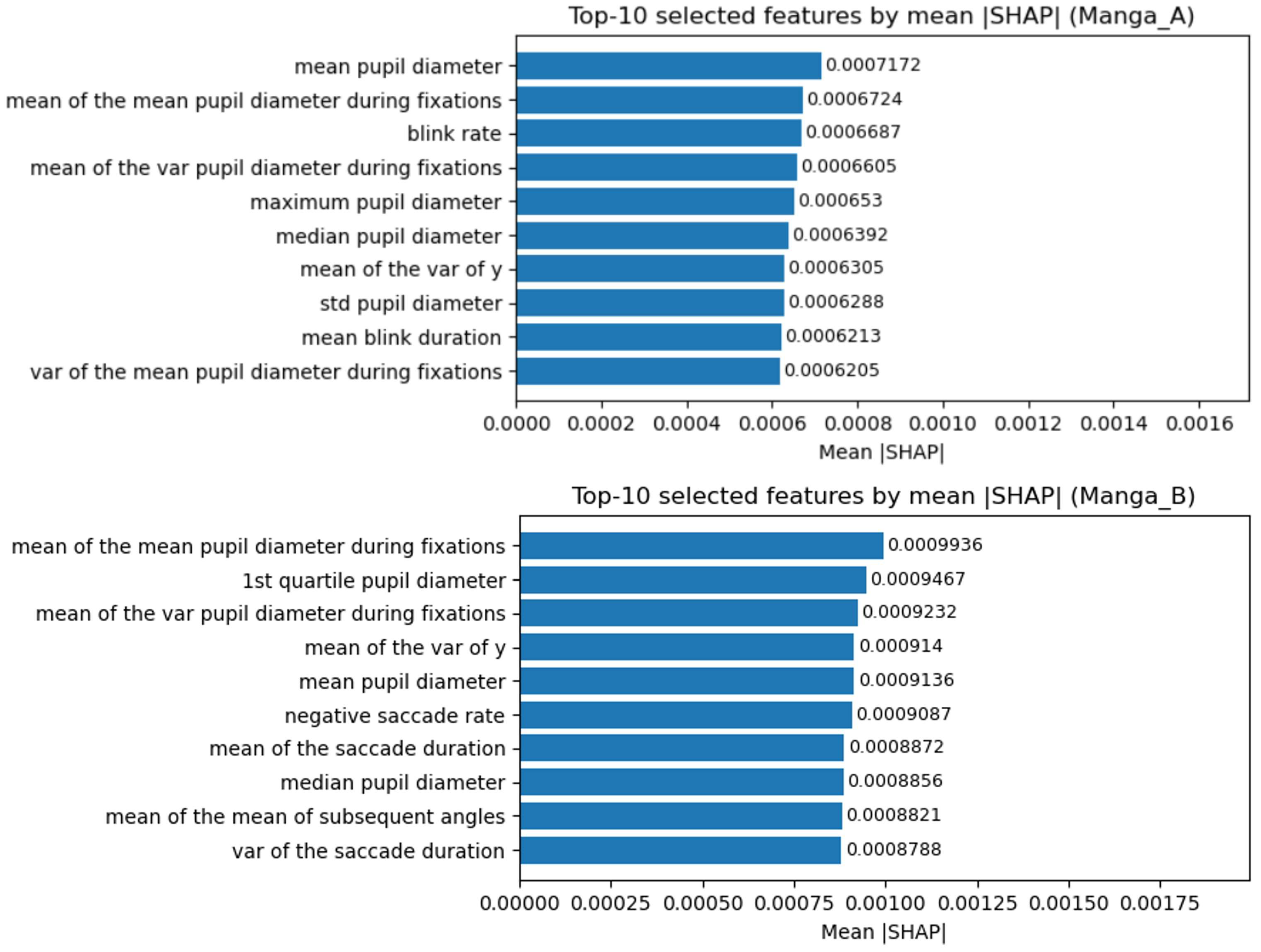
To further validate the effectiveness of the analysis, it is beneficial to compare the SHAP values described above with those derived from the results of the page-wise approach (Figure 10). The comparison underscores that, despite differences in feature ranking, several of the most influential features consistently overlapped between the two approaches. Specifically, pupil-measurement statistics emerged as common contributors in both analyses. The page-wise approach, however, exhibited a contrasting pattern across the two manga titles: while several types of blink statistics contributed to predictions for Manga A, saccade-related features contributed for Manga B, with some overlap in feature categories between the two. This pattern differed from that observed in the alternative approach. Additionally, the page-wise approach selected approximately two to three times as many features as the other approach.
Figure 10.
SHAP summary plots showing the top 10 most influential features for user identification, based on the page-wise approach for Manga A (top) and Manga B (bottom).
4. Discussion
Over the past decade, biometric technologies based on eye movements have significantly evolved, with research efforts focused on data collection, feature extraction, and model development for machine learning in user identification. This study mainly addressed the data collection aspect by introducing a novel type of gaze behavior.
The primary objective was to evaluate the potential of using eye movement data recorded while participants read manga on a screen to identify users. By leveraging a comprehensive set of eye movement features proposed by Hoppe et al. [33], this study achieved a top Rank-1 identification rate of 95.0% with an EER of 1.9% using the 20 s time window. The achieved identification accuracy is comparable to that obtained in several related works that employed identification scenarios for eye movement biometrics extracted from text reading. Table 1 presents a comparative summary of representative eye-movement biometric identification studies using reading-based stimuli. Because EER values were not reported in most prior studies employing the identification scenario, we adopted Rank-1 IR (%) as the primary comparison metric. However, it should be noted that sample sizes—and consequently the number of classes in the identification task—differ considerably across studies (ranging from N = 20 to N = 322), which directly affects the difficulty of the classification problem. Therefore, the numerical values should not be compared at face value, and their interpretation requires careful consideration of these differences. With this caveat in mind, several observations merit discussion. Our Rank-1 IR of 95.0% is comparable to Landwehr et al. [16] (98.25%, N = 20) and Bayat & Pomplun [9] (95.3%, N = 40), and outperforms Rigas et al. [17] (64.29%, N = 322) and Makowski et al. [18] (91.53%, N = 62). Notably, our study uniquely contributes to the evaluation of cross-stimulus generalization and template aging, which are rarely addressed in prior work. Lohr & Komogortsev [19] employed an end-to-end deep learning approach (DenseNet) that processes raw gaze signals without handcrafted feature extraction. Their reported Rank-1 IR (91.38%) is comparable to our result (95.0%), suggesting that our traditional ML approach achieves competitive performance even with a more modest dataset. However, this comparison warrants caution: their substantially larger sample (N = 322) entails a 322-class classification problem, making the identification task inherently more challenging than our 59-class setting, and their approach demonstrated notable robustness against template aging effects over intervals up to 37 months—a property that remains to be verified for our method over comparable time spans. The potential applicability of deep learning methods to the manga-reading paradigm presented in this study will be discussed further below.
Table 1.
Comparison of representative eye-movement biometric identification studies using reading-based or multi-stimulus paradigms. Rank-1 IR = Rank-1 Identification Rate; EER = Equal Error Rate; OPC = Oculomotor Plant Characteristics; CVM = Cramér–von Mises; RF = Random Forest; SVM = Support Vector Machine.
The findings of the present study, on the other hand, revealed a strong dependence of identification performance on the stimulus, indicating poor cross-stimulus generalization and, notably, asymmetric transfer abilities. Specifically, models trained on eye movement features from Manga A and tested on Manga B exhibited substantially lower classification performance than models trained and tested on data from the same manga. This pattern holds in the reverse scenario, with performance declines of a similar magnitude observed across the conditions.
The page-wise approach yielded a lower classification accuracy than the sliding window approach, highlighting important insights related to eye movement biometrics in reading-based identification. The higher accuracy of the sliding window method suggests that eye movement patterns maintain strong temporal consistency within continuous reading segments, indicating that short-term gaze behaviors remain stable when the same reading content is analyzed. As previously noted, the sliding window method introduces partial stimulus content overlapping between training and test data, which may artificially enhance classification accuracy. This occurs because short-term gaze behaviors toward identical manga frames could disproportionately influence model performance. Our SHAP analysis supports this interpretation, revealing that the most influential features were predominantly N-gram saccade movement patterns, with the pattern emerging robustly across both Manga A and Manga B stimuli. The spectrum of influential N-gram features, spanning from first- to fourth-order sequences, strongly suggests that temporal dynamics in saccadic patterns, specifically the characteristic sequences and transitions in eye movement directions during manga reading, serve as particularly discriminative biometric markers. This finding implies that individual differences in the temporal organization of gaze behavior during narrative processing contribute substantially to personal identification. These findings collectively indicate that the adoption of the sliding window method in eye movement-based biometric authentication requires careful consideration of stimulus dependence and cross-stimulus generalization. Although the sliding window approach offers superior accuracy because it captures consistent gaze behaviors over continuous reading segments, it may inadvertently allow content overlap between the training and test phases. This overlap can inadvertently amplify classification accuracy, potentially overestimating the generalizability of the gaze patterns.
Conversely, the page-wise approach ensures complete independence of stimulus content during training and testing, in accordance with the weakly task-independent classification criteria described by Schröder et al. [28]. Although this approach achieves lower classification performance, with approximately a 30% decrease in accuracy when tested across different manga pages compared with same-page segments, it highlights the significant influence of stimulus-dependent factors on identifiable gaze features. This outcome aligns with and extends the prior findings of Schröder et al. [28], demonstrating that stimulus variation impacts recognition rates even within the same reading modality. The observed decline highlights the fact that eye-movement signatures are meaningfully shaped by textual and visual content, thereby limiting generalizability across different manga materials. Furthermore, the set of high-importance features identified through SHAP analysis showed minimal overlap across titles, suggesting that the predictive signal is at least partly stimulus-dependent. Differences in page layout and text-graphic balance elicited distinct gaze patterns, through which individual differences are expressed through different feature metrics. Title-specific layout and information density further reshuffled where the predictive signal resided. Text-heavy pages constrained gaze to a structured reading order, rendering features such as line transitions, regressions, brief fixations, and text-to-image switches more discriminative. In contrast, visually dynamic pages pull gaze to salient elements, rendering saccade direction and amplitude, cross-panel transitions, and directional entropy more informative. These stimulus properties interacted with readers’ control strategies, leading to a reordering of feature importance across titles, even under the same model.
However, the fact that the page-wise approach still attains non-trivial accuracy (e.g., a Rank-1 identification rate of 76.6% and an EER of 4.9% for Manga B) suggests that certain stimulus-independent personal traits are retained across varying content. This partial generalizability implies that while specific stimuli modulate gaze patterns, they may also reflect higher-level individual differences in factors such as attention allocation, oculomotor control, and reading strategies. The SHAP analysis substantiates this interpretation through the inclusion of pupil diameter dynamics and blink rate metrics among the most influential features. These physiological measures, known to correlate with cognitive engagement and attentional allocation, imply that participants’ characteristic patterns of interest distribution across manga elements, including dialogue, character faces, and background details, may contribute significantly to biometric identification. The emergence of these particular features aligns with established psychophysiological literature demonstrating that pupil responses index both cognitive load and emotional valence during visual processing [45], while blink patterns reflect individual differences in attentional engagement [46]. Consequently, our findings suggest that manga reading elicits sufficiently consistent individual variations in both oculomotor behavior and cognitive-affective responses to support biometric discrimination, although the relative contributions of stimulus-driven versus intrinsic individual factors warrant further investigation. These findings have practical implications for real-world applications. The sliding window approach may be better suited for short-term authentication tasks involving repeated or continuous reading, whereas the page-wise approach, despite its lower accuracy, reflects the challenges of cross-content user verification. Future work should explore hybrid models that leverage both temporal stability and content-invariant features or employ domain adaptation techniques to minimize stimulus-specific biases in gaze-based identification systems.
This study investigated the influence of template aging on the performance of eye movement biometric authentication by exploring how the time gap between the training and testing sessions affected the outcomes. The findings reveal that the EER increases when a significant temporal gap, averaging approximately 90 days, exists between the training and testing sessions, compared to when both occur within the same session. This observed effect is consistent with previous research [30,47], which highlighted a reduction in identification accuracy as the temporal distance between training and testing increased. Several potential factors contributing to this degradation in performance have been suggested by earlier studies, including changes in the physiological parameters of the participants, variations in device characteristics, and other unaccounted factors.
In addition to these potential factors, this study highlights that rereading the same manga might have contributed to the observed template aging effect. Given the approximately 90-day interval between the first and second experiments, the participants may have remembered and anticipated the progression of the manga content during the second reading session. Indeed, in the post-experiment debriefing, all participants reported remembering some portions of the manga plot. This familiarity can lead to notable changes in reading behaviors [48,49], such as decreased reading times or a tendency to skip content, thereby inducing template-aging effects. These findings highlight a crucial challenge in eye movement biometric authentication systems that utilize reading materials such as manga as stimuli, mitigating the effects of familiarity with the stimulus or pre-existing knowledge of the content. Lohr and Komogortsev [19] demonstrated substantial robustness against template aging, even with test-retest intervals extending up to 37 months. Therefore, future studies should prioritize the selection of features and classifiers that are inherently resistant to the effects of template aging to enhance the reliability of such systems.
Based on the findings of this study, the potential of using eye movements during manga reading for personal authentication suggests that although it may not be highly effective in scenarios where high authentication accuracy is critical, it can serve as valuable identification information in continuous authentication systems that monitor gaze in real time. Implicit continuous authentication becomes feasible by leveraging the everyday gaze behavior of reading manga for personal authentication. Eye movement-based continuous authentication is a biometric authentication method that leverages the unique patterns of an individual’s eye movements to continuously verify their identity. Users engage with manga as usual, and the identification process is seamlessly integrated into their regular digital activities; this provides a more intuitive and unobtrusive user identification experience, thereby eliminating the need for deliberate gaze action. The significance of this approach lies in its ability to enhance security by continuously monitoring a user’s identity, thereby reducing the risk of unauthorized use. Additionally, eye movement-based continuous authentication enables the identification of individuals without conscious awareness; this improves user experience by eliminating the need for conscious authentication actions, thereby allowing seamless interaction with devices [13]. Recent advancements in eye tracking technology have made the collection of eye movement data more convenient and effective, enabling continuous and non-intrusive user identification in real-world settings. This approach enhances security by offering ongoing verification as users interact with devices, thus supporting user identification during everyday activities [2]. Such systems are expected to enhance personalized and adaptive human-computer interactions.
While our study analyzed relatively short eye-tracking segments (120 s)—an approach that offers practical advantages for real-world implementation by minimizing data collection requirements—several methodological limitations warrant discussion. The constrained analysis window, which necessarily limited the number of trials per participant, may have contributed to model instability and potential accuracy degradation. We addressed these concerns through rigorous validation procedures, with 20 repeats of the entire cross-validation with different data splits, which ensured that performance estimates were not artifacts of a single favorable partition. To mitigate the risk of overfitting arising from the high initial feature dimensionality (203 features for 59 classes), several precautions were implemented. First, a group-aware nested cross-validation framework was employed, wherein feature selection via SelectKBest was performed exclusively within the training splits of each outer fold, preventing information leakage from test data. The optimal number of features () was determined through inner cross-validation, resulting in an average of approximately 37–43 selected features in the sliding window approach—substantially fewer than the initial 203. Second, Random Forest’s built-in feature subsampling mechanism (randomly selecting a subset of features at each tree split) provides inherent robustness against overfitting in high-dimensional settings. However, we acknowledge that the high feature-to-sample ratio raises legitimate concerns about potential overfitting. Additional validation with larger datasets (more participants and longer reading durations) will be essential to confirm our findings. Moreover, scaling challenges should be addressed—real-world deployment would involve thousands of users, potentially degrading conventional RF performance. In large-scale multiclass classification scenarios involving thousands of classes, standard RF algorithms may exhibit degraded performance. A critical challenge lies in maintaining acceptable authentication accuracy under these conditions. As a potential mitigation strategy, adopting extreme multi-label classification (XML) techniques or classifiers [50] could prove effective.
We acknowledge that the sample size of 59 represents a limitation, particularly given the 59-class classification framework. The sample size of 59 participants, while modest for a 59-class classification problem, is consistent with sample sizes in comparable eye movement biometric studies using reading paradigms: Bayat and Pomplun [9] (N = 40), Landwehr et al. [16] (N = 20), and Makowski et al. [18] (N = 62). Furthermore, the sliding window segmentation strategy ensured that multiple training instances (up to 24 segments per participant for the 5 s window) were available, yielding a total of up to 1416 training instances across participants. Importantly, chance-level accuracy in this 59-class problem is approximately 1.69%, making the observed Rank-1 IR of 95.0% substantially above chance. While performance metrics substantially exceeded chance, the generalizability of these findings to larger populations requires further validation, particularly for real-world deployment scenarios involving thousands of users. Future studies should aim to replicate these results with larger and more diverse participant samples.
Recent advances in deep learning, particularly DenseNet-based architectures (e.g., Lohr & Komogortsev [19]) and recurrent neural networks, have demonstrated promising results in eye-movement-based biometric identification. However, several considerations motivated our use of traditional machine learning classifiers in this study. First, deep learning models typically require substantially larger training datasets to avoid overfitting, whereas our sample of 59 participants with limited recording duration per person favors classifiers such as Random Forest that perform robustly with smaller datasets. Second, traditional classifiers paired with handcrafted features offer greater interpretability—our SHAP analysis, for instance, provided actionable insights into which eye movement characteristics contribute most to identification, information that is difficult to obtain from end-to-end deep learning pipelines. Third, traditional methods require considerably less computational resources for both training and inference, which is advantageous for real-time continuous authentication scenarios. Finally, as this study aimed to evaluate the fundamental viability of manga reading as a biometric stimulus, establishing baseline performance with well-understood classifiers provides a solid foundation upon which deep learning approaches can be benchmarked in future work with larger datasets.
To further contextualize the choice of manga as the reading material in this study, it is informative to consider how manga compares to other types of textual or multimedia stimuli in the context of biometric identification. Having the same participants read both manga and conventional texts while recording their eye movements would allow for a more direct assessment of the relative effectiveness of manga-induced eye movement patterns as biometric features. Compared to novels composed solely of text, manga—which integrates diverse modalities such as images and onomatopoeia—may elicit eye movement patterns that more accurately and multidimensionally reflect individual differences. If this assumption holds, eye-tracking features derived from manga could potentially yield higher biometric identification accuracy than those obtained from purely textual materials. From the perspective of cross-genre comparisons, other media formats such as webtoons and short-form visual content on platforms like Instagram, which have recently gained large user bases, also merit consideration as alternative stimuli. These digital media formats can capture user attention within relatively short viewing times, making them particularly well-suited for applications involving continuous and non-intrusive user identification in real-world settings.
This study shares fundamental challenges common to all eye movement-based biometric research. While our findings demonstrate the potential of this approach, several practical constraints should be acknowledged that apply universally across the field. A primary limitation lies in technology’s inherent dependence on specialized eye-tracking equipment requiring precise calibration, which creates significant scalability barriers for real-world applications. Furthermore, the system’s sensitivity to environmental variables, particularly ambient lighting conditions and user-device positioning, presents substantial obstacles for reliable deployment in uncontrolled settings. These technical challenges, while not unique to our study, highlight critical research directions for the field. Future work should focus on developing more robust solutions, including calibration-free or self-calibrating algorithms that could reduce user burden while maintaining accuracy. Equally important will be designing adaptive systems capable of compensating for environmental variability without sacrificing biometric performance. Such advancements, although challenging, represent necessary steps toward making eye movement biometrics practically viable beyond laboratory conditions.
5. Conclusions
This study demonstrated the feasibility of using eye-movement data recorded during manga reading for biometric user identification. The system achieved high identification accuracy, comparable to previous approaches based on conventional text-reading tasks, by leveraging a comprehensive set of gaze features and applying standard machine learning algorithms. These findings confirm that naturalistic reading behaviors, such as those elicited by manga, contain individual-specific patterns suitable for biometric applications. However, the results revealed critical challenges. Identification performance was highly dependent on the stimulus, with limited generalization across different manga content. Moreover, performance degraded over time owing to template aging effects, potentially influenced by participants’ familiarity with previously read content. These findings highlight the need for further research on content-invariant and temporally robust gaze-based authentications. Despite these constraints, this study confirms that eye movement biometrics during natural reading scenarios hold substantial promise for continuous and implicit authentication systems. Several concrete directions for future research emerge from our findings. First, domain adaptation techniques (e.g., transfer learning or adversarial training) should be explored to develop stimulus-invariant feature representations that generalize across different manga titles or reading materials. Second, adaptive template update mechanisms, in which the enrolled biometric template is periodically refreshed using recent gaze data, could mitigate the effects of template aging. Third, comparative studies involving multiple reading modalities—such as conventional text, webtoons, and digital magazines—are needed to determine whether manga elicits more distinctive individual gaze patterns than other formats. Finally, the integration of manga-based eye movement biometrics with other behavioral modalities (e.g., scrolling patterns or touch dynamics) in a multi-modal framework could further enhance authentication robustness.
Funding
This research was supported by JSPS KAKENHI (https://www.jsps.go.jp/j-grantsinaid/ (accessed on 1 April 2026), Grant Number 25K15837), awarded to YW.
Institutional Review Board Statement
This study was approved by the Ethics Committee of the Graduate School of Information Sciences at Tohoku University.
Informed Consent Statement
Informed consent was obtained from all subjects involved in the study.
Data Availability Statement
The original data presented in the study are openly available on OSF at https://osf.io/p3bhr/ (accessed on 1 April 2026).
Conflicts of Interest
The author declares no conflicts of interest. The funders had no role in the study design, data collection and analysis, decision to publish, or preparation of the manuscript.
Abbreviations
The following abbreviations are used in this manuscript:
| CMC | Cumulative match characteristic |
| EER | Equal error rate |
Appendix A
As a supplementary summary of the identification performance, we provide tables in Appendix Table A1, Table A2, Table A3 and Table A4 that summarize the Rank-1 IR, Rank-5 IR, and EER across all time window conditions for both Manga A and Manga B in this study.
Table A1.
The Rank-1 IR, Rank-5 IR, and EER across all time window conditions for both Manga A and Manga B. Note: SD computed across 20 repeated cross-validation trials. IR = Identification Rate; EER = Equal Error Rate.
Table A2.
The Rank-1 IR, Rank-5 IR, and EER across all time window conditions for both Manga A and Manga B for the two conditions: Manga A for training and B for testing, and vice versa. Note: SD computed across 20 repeated cross-validation trials. IR = Identification Rate; EER = Equal Error Rate.
Table A3.
The Rank-1 IR, Rank-5 IR, and EER across all time window conditions for both Manga A and Manga B, with the 1st and 2nd session data (approximately 90 days apart) serving as the training and test data. Note: SD computed across 20 repeated cross-validation trials. IR = Identification Rate; EER = Equal Error Rate.
Table A4.
The Rank-1 IR, Rank-5 IR, and EER across all time window conditions for both Manga A and Manga B for the page-wise classification approach. Note: SD computed across 20 repeated cross-validation trials. IR = Identification Rate; EER = Equal Error Rate.
The Appendix Table A5, Table A6, Table A7 and Table A8 present the results of the analysis conducted using a dataset in which the minimum fixation duration was set to 60 ms, serving as a supplementary comparison to the primary analysis (100 ms threshold).
Table A5.
The Rank-1 IR, Rank-5 IR, and EER across all time window conditions (dataset with minimum fixation duration of 60 ms) for both Manga A and Manga B. Note: SD computed across 20 repeated cross-validation trials. IR = Identification Rate; EER = Equal Error Rate.
Table A6.
The Rank-1 IR, Rank-5 IR, and EER across all time window conditions (dataset with minimum fixation duration of 60 ms) for both Manga A and Manga B for the two conditions: Manga A for training and B for testing, and vice versa. Note: SD computed across 20 repeated cross-validation trials. IR = Identification Rate; EER = Equal Error Rate.
Table A7.
The Rank-1 IR, Rank-5 IR, and EER across all time window conditions (dataset with minimum fixation duration of 60 ms) for both Manga A and Manga B, with the 1st and 2nd session data (approximately 90 days apart) serving as the training and test data. Note: SD computed across 20 repeated cross-validation trials. IR = Identification Rate; EER = Equal Error Rate.
Table A8.
The Rank-1 IR, Rank-5 IR, and EER across all time window conditions (dataset with minimum fixation duration of 60 ms) for both Manga A and Manga B for the page-wise classification approach. Note: SD computed across 20 repeated cross-validation trials. IR = Identification Rate; EER = Equal Error Rate.
References
- de Luis-García, R.D.; Alberola-López, C.; Aghzout, O.; Ruiz-Alzola, J. Biometric identification systems. Signal Process. 2003, 83, 2539–2557. [Google Scholar] [CrossRef] [Scilit]
- Rayani, P.K.; Changder, S. Continuous user authentication on smartphone via behavioral biometrics: A survey. Multimed. Tools Appl. 2023, 82, 1633–1667. [Google Scholar] [CrossRef] [Scilit]
- Sarkar, S.; Phillips, P.J.; Liu, Z.; Vega, I.R.; Grother, P.; Bowyer, K.W. The humanID gait challenge problem: Data sets, performance, and analysis. IEEE Trans. Pattern Anal. Mach. Intell. 2005, 27, 162–177. [Google Scholar] [CrossRef] [Scilit]
- Karnan, M.; Akila, M.; Krishnaraj, N. Biometric personal authentication using keystroke dynamics: A review. Appl. Soft Comput. 2011, 11, 1565–1573. [Google Scholar] [CrossRef] [Scilit]
- Kasprowski, P.; Ober, J. Eye movements in biometrics. In Biometric Authentication; Maltoni, D., Jain, A.K., Eds.; Lecture Notes in Computer Science; Springer: Berlin/Heidelberg, Germany, 2004; Volume 3087, pp. 248–258. [Google Scholar]
- Bednarik, R.; Kinnunen, T.; Mihaila, A.; Fränti, P. Eye movements as a biometric. In Image Analysis; Kalviainen, H., Parkkinen, J., Kaarna, A., Eds.; Springer: Berlin/Heidelberg, Germany, 2005; pp. 780–789. [Google Scholar]
- Holland, C.D.; Komogortsev, O.V. Complex eye movement pattern biometrics: The effects of environment and stimulus. IEEE Trans. Inf. Forensic Secur. 2013, 8, 2115–2126. [Google Scholar] [CrossRef] [Scilit]
- Rigas, I.; Abdulin, E.; Komogortsev, O. Towards a multi-source fusion approach for eye movement-driven recognition. Inf. Fusion 2016, 32, 13–25. [Google Scholar] [CrossRef] [Scilit]
- Bayat, A.; Pomplun, M. Biometric identification through eye-movement patterns. In Advances in Human Factors in Simulation and Modeling; Cassenti, D.N., Ed.; Springer International Publishing: Cham, Switzerland, 2018; pp. 583–594. [Google Scholar]
- Rigas, I.; Economou, G.; Fotopoulos, S. Biometric identification based on the eye movements and graph matching techniques. Pattern Recognit. Lett. 2012, 33, 786–792. [Google Scholar] [CrossRef] [Scilit]
- Cantoni, V.; Galdi, C.; Nappi, M.; Porta, M.; Riccio, D. GANT: Gaze analysis technique for human identification. Pattern Recognit. 2015, 48, 1027–1038. [Google Scholar] [CrossRef] [Scilit]
- Kinnunen, T.; Sedlak, F.; Bednarik, R. Towards task-independent person authentication using eye movement signals. In Proceedings of the 2010 Symposium on Eye-Tracking Research & Applications, Austin, TX, USA, 22–24 March 2010; pp. 187–190. [Google Scholar]
- Liao, H.; Dong, W.; Zhan, Z. Identifying map users with eye movement data from map-based spatial tasks: User privacy concerns. Cartogr. Geogr. Inf. Sci. 2022, 49, 50–69. [Google Scholar] [CrossRef] [Scilit]
- Sluganovic, I.; Roeschlin, M.; Rasmussen, K.B.; Martinovic, I. Using reflexive eye movements for fast challenge-response authentication. In Proceedings of the 2016 ACM SIGSAC Conference on Computer and Communications Security, Vienna, Austria, 24–28 October 2016; ACM: New York, NY, USA, 2016; pp. 1056–1067. [Google Scholar]
- Holland, C.; Komogortsev, O.V. Biometric identification via eye movement scanpaths in reading. In Proceedings of the International Joint Conference on Biometrics (IJCB), Washington, DC, USA, 11–13 October 2011; IEEE: New York, NY, USA, 2011; pp. 1–8. [Google Scholar]
- Landwehr, N.; Arzt, S.; Scheffer, T.; Kliegl, R. A model of individual differences in gaze control during reading. In Proceedings of the Conference on Empirical Methods in Natural Language Processing (EMNLP 2014), Doha, Qatar, 25–29 October 2014; Association for Computational Linguistics: Stroudsburg, PA, USA, 2014; pp. 1810–1815. [Google Scholar]
- Rigas, I.; Komogortsev, O.; Shadmehr, R. Biometric recognition via eye movements: Saccadic vigor and acceleration cues. ACM Trans. Appl. Percept. 2016, 13, 6. [Google Scholar] [CrossRef] [Scilit]
- Makowski, S.; Jäger, L.A.; Abdelwahab, A.; Landwehr, N.; Scheffer, T. A discriminative model for identifying readers and assessing text comprehension from eye movements. In Machine Learning and Knowledge Discovery in Databases; Berlingerio, M., Bonchi, F., Gärtner, T., Hurley, N., Ifrim, G., Eds.; Springer: Cham, Switzerland, 2019; pp. 209–225. [Google Scholar]
- Lohr, D.; Komogortsev, O.V. Eye know you too: A DenseNet architecture for end-to-end eye movement biometrics. arXiv 2022, arXiv:2201.02110. [Google Scholar]
- Clark, C.; Starbuck, B.L.; Cole, A.; Chamberlain, E. Children and Young People’s Engagement with Comics in 2023; National Literacy Trust: London, UK, 2024. [Google Scholar]
- Foulsham, T.; Wybrow, D.; Cohn, N. Reading without words: Eye movements in the comprehension of comic strips. Appl. Cogn. Psychol. 2016, 30, 566–579. [Google Scholar] [CrossRef] [Scilit]
- Nakazawa, J. Analysis of manga (comic) reading processes: Manga literacy and eye movement during manga reading. Manga Kenkyuu 2002, 5, 39–49, (In Japanese with English Abstract). [Google Scholar]
- Nakazawa, J. The development of manga panel reading literacy. Manga Kenkyuu [Manga Stud.] 2005, 7, 6–21, (In Japanese with English Abstract). [Google Scholar]
- Wada, Y.; Funatsu, T.; Miura, K.; Kubo, S. Representing motion in manga: Context manipulation influences memory of manga pictures with implied motion. Manga Kenkyuu [Manga Stud.] 2015, 21, 31–49, (In Japanese with English Abstract). [Google Scholar]
- McCloud, S. Understanding Comics: The Invisible Art; HarperCollins: New York, NY, USA, 1994. [Google Scholar]
- Natsume, F. Manga wa Naze Omoshiroi no ka: Sono Hyōgen to Bunpō [Why Are Manga Fascinating? Their Expressions and Grammar]; NHK Library: Tokyo, Japan, 1997. [Google Scholar]
- Wada, Y. Consistency and stability of gaze behavior when reading manga. Appl. Cogn. Psychol. 2023, 37, 542–557. [Google Scholar] [CrossRef] [Scilit]
- Schröder, C.; Al Zaidawi, S.M.K.; Prinzler, M.H.U.; Maneth, S.; Zachmann, G. Robustness of eye movement biometrics against varying stimuli and trajectory length. In Proceedings of the CHI Conference on Human Factors in Computing Systems, Honolulu, HI, USA, 11–16 May 2024; ACM: New York, NY, USA, 2020; pp. 1–7. [Google Scholar]
- George, A.; Routray, A. A score level fusion method for eye movement biometrics. Pattern Recognit. Lett. 2016, 82, 207–215. [Google Scholar] [CrossRef] [Scilit]
- Komogortsev, O.V.; Holland, C.D.; Karpov, A. Template aging in eye movement-driven biometrics. In Proceedings of the SPIE 9075, Biometric and Surveillance Technology for Human and Activity Identification XI, Baltimore, MD, USA, 29 May 2014; SPIE: Bellingham, WA, USA, 2014; 90750A. [Google Scholar] [CrossRef] [Scilit]
- Komogortsev, O.V.; Rigas, I. BioEye 2015: Competition on biometrics via eye movements. In Proceedings of the IEEE Seventh International Conference on Biometrics: Theory, Applications and Systems (BTAS), Arlington, VA, USA, 8–11 September 2015; IEEE: New York, NY, USA, 2015; pp. 1–8. [Google Scholar]
- Li, C.; Xue, J.; Quan, C.; Yue, J.; Zhang, C. Biometric recognition via texture features of eye movement trajectories in a visual searching task. PLoS ONE 2018, 13, e0194475. [Google Scholar] [CrossRef] [Scilit] [PubMed]
- Hoppe, S.; Loetscher, T.; Morey, S.A.; Bulling, A. Eye movements during everyday behavior predict personality traits. Front. Hum. Neurosci. 2018, 12, 105. [Google Scholar] [CrossRef] [Scilit]
- Sato, S. Tsukareta otona [Exhausted adults]. In Give My Regards, Black Jack; SATO Manga Factory: Tokyo, Japan, 2012; Volume 13, pp. 5–22. [Google Scholar]
- Tezuka, O. Simekukuri (Finish). In The Complete Works of Osamu Tezuka’s Manga; Kodansha: Tokyo, Japan, 1982; Volume 157, pp. 131–152. [Google Scholar]
- Rayner, K. Eye movements in reading and information processing: 20 years of research. Psychol. Bull. 1998, 124, 372–422. [Google Scholar] [CrossRef] [Scilit]
- Inhoff, A.W.; Radach, R. Definition and computation of oculomotor measures in the study of cognitive processes. In Eye Guidance in Reading and Scene Perception; Underwood, G., Ed.; Elsevier: Amsterdam, The Netherlands, 1998; pp. 29–53. [Google Scholar]
- Lundberg, S.M.; Erion, G.G.; Lee, S.-I. Consistent individualized feature attribution for tree ensembles. arXiv 2018. [Google Scholar] [CrossRef] [Scilit]
- Jain, A.K.; Nandakumar, K.; Ross, A. 50 years of biometric research: Accomplishments, challenges, and opportunities. Pattern Recognit. Lett. 2016, 79, 80–105. [Google Scholar] [CrossRef] [Scilit]
- Chen, T.; Guestrin, C. XGBoost: A scalable tree boosting system. In Proceedings of the 22nd ACM SIGKDD International Conference on Knowledge Discovery and Data Mining, San Francisco, CA, USA, 13–17 August 2016; ACM: New York, NY, USA, 2016; pp. 785–794. [Google Scholar]
- Ke, G.; Meng, Q.; Finley, T.; Wang, T.; Chen, W.; Ma, W.; Ye, Q.; Liu, T.-Y. LightGBM: A highly efficient gradient boosting decision tree. In Advances in Neural Information Processing Systems 30; Guyon, I., Luxburg, U.V., Bengio, S., Wallach, H., Fergus, R., Vishwanathan, S., Garnett, R., Eds.; Curran Associates, Inc.: Red Hook, NY, USA, 2017; pp. 3146–3154. [Google Scholar]
- Cortes, C.; Vapnik, V. Support-vector networks. Mach. Learn. 1995, 20, 273–297. [Google Scholar] [CrossRef] [Scilit]
- Rumelhart, D.E.; Hinton, G.E.; Williams, R.J. Learning representations by back-propagating errors. Nature 1986, 323, 533–536. [Google Scholar] [CrossRef] [Scilit]
- Scikit-Learn Developers. Scikit-Learn: Machine Learning in Python; Version 1.4.0; Scikit-Learn Developers: Saclay, France, 2024. [Google Scholar]
- Wang, C.-A.; Munoz, D.P. A circuit for pupil orienting responses: Implications for cognitive modulation of pupil size. Curr. Opin. Neurobiol. 2015, 33, 134–140. [Google Scholar] [CrossRef] [Scilit]
- Ranti, C.; Jones, W.; Klin, A.; Shultz, S. Blink rate patterns provide a reliable measure of individual engagement with scene content. Sci. Rep. 2020, 10, 8267. [Google Scholar] [CrossRef] [Scilit]
- Al Zaidawi, S.M.K.; Prinzler, M.H.U.; Lührs, J.; Maneth, S. An extensive study of user identification via eye movements across multiple datasets. Signal Process. Image Commun. 2022, 108, 116804. [Google Scholar] [CrossRef] [Scilit]
- Hyönä, J.; Niemi, P. Eye movements during repeated reading of a text. Acta Psychol. 1990, 73, 259–280. [Google Scholar] [CrossRef] [Scilit]
- Kaakinen, J.K.; Hyönä, J. Perspective effects in repeated reading: An eye movement study. Mem. Cognit. 2007, 35, 1323–1336. [Google Scholar] [CrossRef] [Scilit] [PubMed]
- Yu, H.-F.; Zhang, J.; Chang, W.-C.; Jiang, J.-Y.; Li, W.; Hsieh, C.-J. PECOS: Prediction for enormous and correlated output spaces. In Proceedings of the 28th ACM SIGKDD Conference on Knowledge Discovery and Data Mining, Washington, DC, USA, 14–18 August 2022; ACM: New York, NY, USA, 2022; pp. 4848–4849. [Google Scholar]

Disclaimer/Publisher’s Note: The statements, opinions and data contained in all publications are solely those of the individual author(s) and contributor(s) and not of MDPI and/or the editor(s). MDPI and/or the editor(s) disclaim responsibility for any injury to people or property resulting from any ideas, methods, instructions or products referred to in the content. |
© 2026 by the author. Licensee MDPI, Basel, Switzerland. This article is an open access article distributed under the terms and conditions of the Creative Commons Attribution (CC BY) license.