


Abstract
Digital transformation is reshaping the education sector, fostering an AI-enabled, learner-centered ecosystem. This shift is characterized by the adoption of large language models (LLMs) in education, which is forging a new paradigm for intelligent teaching. However, the integration of LLMs into K–12 AI education is often hindered by their tendency to generate factually inaccurate and pedagogically misaligned content. To address this, we constructed a knowledge graph (KG) of the K–12 AI curriculum and developed a question-answering system based on KG-augmented LLMs. The system was evaluated on a dedicated AI curriculum dataset comprising 1098 questions categorized into three difficulty levels. The evaluation employed the G-Eval with no-reference metrics. Using DeepSeek-V3 as the scoring model, the system performance was assessed across three mainstream LLMs and measured along five distinct dimensions. Results indicated that the integration of curriculum KG significantly enhanced the factual accuracy and relevance of LLM-generated answers in K–12 AI education. However, this enhancement involves a trade-off, as the incorporation of non-declarative knowledge can negatively affect linguistic fluency and coherence. Performance gains varied across LLMs: Qwen and Baichuan demonstrated the strongest improvements, particularly in complex tasks. This study provides a scalable, knowledge-anchored framework for developing reliable AI teaching assistants, demonstrating a practical pathway to mitigate domain-specific hallucinations in educational applications.
1. Introduction
New-generation information technology is transforming the education sector, giving rise to an innovative education ecosystem empowered by the artificial intelligence (AI) technology [1]. Particularly, the integration of large language models (LLMs) into educational practices is birthing a new paradigm of intelligent teaching and learning [2]. This shift promises adaptive and scalable educational interactions. However, the adoption of general-purpose LLMs in structured, professional teaching scenarios reveals significant limitations, particularly regarding the reliability and transparency of their outputs [3]. Specifically, LLM responses may lack verifiable alignment with formal curricula or domain-specific standards, while their reasoning processes often remain opaque [4]. Thus, overcoming the bottleneck of knowledge credibility and enhancing the interpretability of model reasoning are essential to ensure educational quality and realize the high-quality development of AI-empowered education.
LLMs, such as GPT-4, Qwen, and DeepSeek, are typically pretrained on large-scale corpora and further refined through instruction tuning, enabling them to demonstrate strong capabilities in semantic understanding and contextual reasoning for open-domain QA tasks [5]. In recent years, a growing body of research has explored the application of LLMs in educational contexts, including intelligent tutoring systems [6], formative feedback generation [7], and conversational learning assistants [8]. In particular, some studies have attempted to incorporate external knowledge into educational QA systems to improve the accuracy and consistency of generated responses [9,10,11]. These approaches highlight the potential of LLMs to support conceptual scaffolding, formative assessment, and personalized learning pathways. However, when applied to specialized curricular domains, existing LLM-based systems still exhibit notable limitations [12,13,14]. Due to the fixed nature of model parameters, they struggle to effectively incorporate up-to-date or domain-specific knowledge, often resulting in factual inaccuracies that conflict with authoritative textbook content [15]. Moreover, the probabilistic generation paradigm of LLMs lacks explicit knowledge grounding and reasoning pathways, which limits their ability to meet the requirements for interpretability and traceability in educational settings [16]. In addition, traditional fine-tuning approaches are computationally expensive, inefficient for updating course-specific knowledge, and difficult to scale in response to the rapid evolution of K–12 curricula [17].
Therefore, despite recent advances, existing studies on LLM-based educational QA systems remain limited in several key aspects. First, while knowledge graph (KG)-augmented LLMs have been widely explored, prior work primarily treats KGs as auxiliary retrieval resources, rather than as curriculum-structured representations explicitly aligned with instructional design principles. Second, most approaches focus on improving factual accuracy, with insufficient attention to pedagogical alignment, knowledge organization at the curriculum level, and response traceability to specific learning objectives. These limitations highlight a critical gap in developing AI systems that are not only accurate but also pedagogically grounded and educationally interpretable.
To address this gap, this study proposes an LLM-based QA system augmented with a structured curriculum KG. While sharing the general paradigm of knowledge augmentation with existing KG–LLM and RAG approaches, the proposed method introduces several key distinctions. First, unlike conventional KG-based systems that rely on general or loosely structured domain knowledge, this study constructs a fine-grained, curriculum-aligned KG explicitly derived from K–12 AI textbooks, embedding hierarchical relationships such as learning objectives, knowledge units, and conceptual dependencies. Second, the proposed framework integrates this curriculum structure into the retrieval and generation process, enabling responses to be anchored to specific curricular elements, thereby enhancing both interpretability and traceability. Third, the system is designed with a modular and extensible architecture, allowing curriculum knowledge to be updated or replaced independently of the underlying LLM, which supports scalable adaptation to evolving educational standards. Taken together, this work goes beyond a straightforward application of existing KG-augmented LLM paradigms by reframing knowledge augmentation as curriculum-aware knowledge structuring and alignment, thereby contributing a novel perspective on the design of pedagogically grounded AI systems for K–12 education.
In summary, the main contributions of this study are as follows:
- The QA system, developed based on KG-augmented LLMs in K–12 AI curriculum, effectively enhances the responses of LLMs based on the external injection of curriculum KG.
- We established a dataset of 1098 AI curriculum questions with the aim of evaluating the robustness and knowledge fidelity of LLMs under increasing cognitive complexity. The questions were systematically collected and stratified into three progressive difficulty levels (simple, moderate, and difficult).
- We developed a verifiable curriculum-aligned KG to ground LLM responses in structured educational knowledge, providing a foundation for improving factual consistency and conceptual coherence in curriculum-based QA tasks.
2. Related Works
2.1. LLMs in Education
The advent of LLMs, powered by transformer architectures, large-scale pre-training, and instruction tuning, has revolutionized the field of natural language processing (NLP). The progression from GPT-3 [18] to GPT-4 [19], for example, reflects a dramatic increase in model scale—from 175 billion to 1.8 trillion parameters. GPT-4 exhibits substantially enhanced expressive capacity, generalization, in-context learning, and chain-of-thought reasoning abilities [20,21,22]. Domestically developed LLMs, such as Qwen, GLM, and DeepSeek, further extend these capabilities by incorporating multimodal understanding and reinforcement learning from human feedback. These incorporations enable coordinated processing of text, images, and speech while improving adherence to user instructions [23].
In educational settings, these advances have unlocked new avenues for personalized learning, intelligent tutoring, and automated assessments. LLMs integrated with knowledge-tracing algorithms and item-response theory can act as domain-specific cognitive engines; these LLMs also exhibit the capability to model student abilities [24], adapt content difficulty [25], and generate individualized learning paths [8]. In addition, they dynamically generate tailored instructional interventions and provide real-time guidance, ultimately overcoming the limitations of traditional rule-based approaches within intelligent tutoring systems [6]. Moreover, LLMs facilitate efficient educational content creation, including lesson plans, exercises, and interdisciplinary curricula. By leveraging their contextual learning and reasoning abilities, these models reduce development efforts while improving pedagogical quality [26,27,28]. In addition to their well-documented role in content generation, LLM-powered assessment has advanced beyond scoring objective items to support comprehensive evaluation of open-ended responses. This is achieved by integrating semantic parsing with advanced modeling techniques (e.g., hierarchical scoring networks, graph-based attention) to generate multidimensional feedback encompassing argument coherence, rhetorical style, and authorial intent [29,30].
Despite these transformative capabilities, key challenges persist. The internal knowledge of LLMs is generally fixed at pre-training, making them vulnerable to factual errors and misalignment with rapidly evolving curricular content [31]. To maintain pedagogical relevance and dynamic responsiveness, LLMs must be integrated with robust external knowledge through methods such as real-time retrieval, continual fine-tuning, or hybrid symbolic-neural architectures.
2.2. KG-Augmented Educational QA System Based on LLMs
The integration of LLMs into QA, intelligent tutoring, and adaptive learning systems has considerably enhanced their potential within education. However, LLMs suffer from several inherent limitations, including incomplete knowledge coverage, opaque reasoning processes, and persistent hallucinations; these limitations become particularly pronounced in educational settings where factual precision and interpretability are critical [13]. Consequently, integrating external KGs as structured knowledge supplements and deeply coupling them with the reasoning mechanisms of LLMs have emerged as a promising direction for enhancing the reliability of educational QA systems [9].
In the domain of mathematics education, Bian et al. [32] developed the AutoMathKG system; they integrated heterogeneous sources such as ProofWiki, textbooks, and arXiv and employed vector-based retrieval for entity embedding. The LLMs and vector databases in AutoMathKG enable the automatic construction of a mathematics KG. Thus, AutoMathKG effectively overcomes the issues of insufficient coverage and infrequent updates that hamper the traditional mathematical knowledge bases. Building on this foundation, the system further incorporates mathematics-specific LLMs for knowledge completion, integration, and automatic updating. This design uses the structured relationships among “definitions-theorems-exercises” to: (1) enhance knowledge recall in mathematical QA tasks and (2) strengthen the reasoning capabilities of LLMs. It ultimately offers a feasible basis for constructing KG-enhanced learning systems for mathematics education. To mitigate the limitations of LLMs in deep reasoning and reduce hallucinations, Sun et al. [10] proposed the Think-on-Graph framework. This framework guides LLMs to produce traceable reasoning paths on a KG (via beam search) and integrates expert feedback for correction. Thus, it ultimately enhances deep reasoning capabilities without additional training. This approach enables smaller models to exceed the performance of GPT-4 on specific tasks while providing a promising path toward lightweight, high-reliability educational QA systems. Furthermore, graph-augmented reasoning combines progressive retrieval with stepwise reasoning to construct process-oriented KGs, while employing a reward model to filter noisy information [33]. This design enables frozen, small LLMs to achieve stable performance gains in mathematical reasoning tasks. Under professional education settings, KGs have also been shown to enhance the accuracy of LLM-driven domain-specific QA systems. For instance, Abu-Rasheed et al. [11] incorporated KG-based factual context directly into LLMs’ prompts; this approach effectively reduced hallucination risks while improving the precision and learner relevance of generated explanations. Structured cybersecurity knowledge prompts enable LLMs to automatically generate high-quality QA pairs, thereby alleviating the scarcity of standardized datasets in this domain [34]. Similarly, by integrating ontology-based retrieval and verification mechanisms, KG-augmented QA systems can validate cybersecurity responses and suppress misuse, offering a trustworthy and safe AI-driven solution for cybersecurity education [35].
Overall, embedding structured information from educational KGs yields a semantically constrained framework for instruction tuning based on entity-relation structures. The deep integration of educational KGs with LLMs can substantially improve reasoning accuracy and task performance in domain-specific educational scenarios [36]. Accordingly, curriculum KGs establish a bidirectional enhancement mechanism between structured knowledge representations and LLMs by organizing disciplinary concepts and their pedagogical relationships. This mechanism mitigates knowledge lag caused by the static parameters of pretrained LLMs while reducing the incidence of factual errors inconsistent with established curricular knowledge. However, curriculum KG quality is a key factor affecting the performance of LLMs. When constructing large-scale KGs, one should consider incorporating knowledge extraction and fusion mechanisms assisted by LLMs to enhance the efficiency and quality of KG construction [37].
3. Method
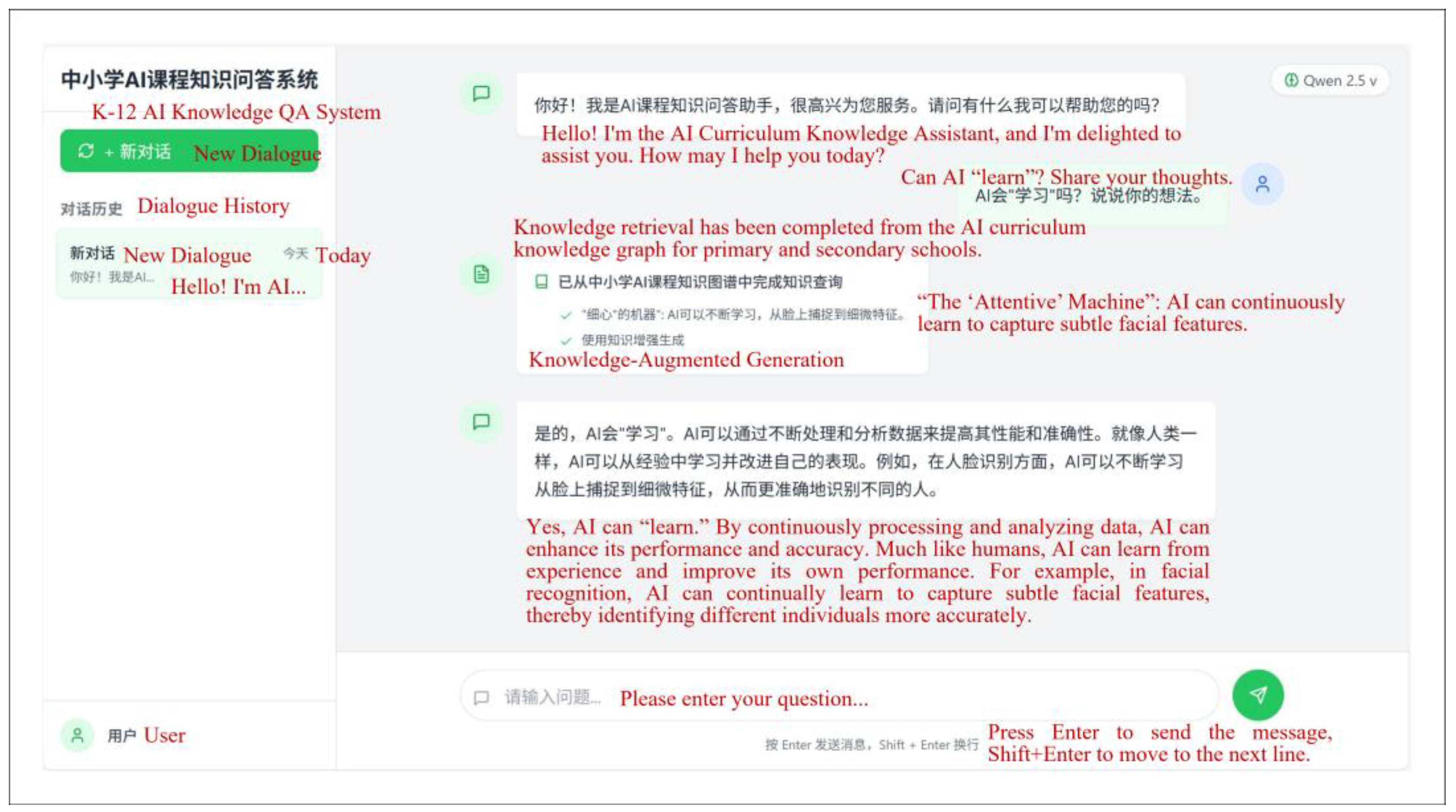
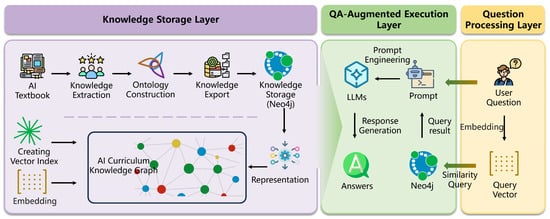
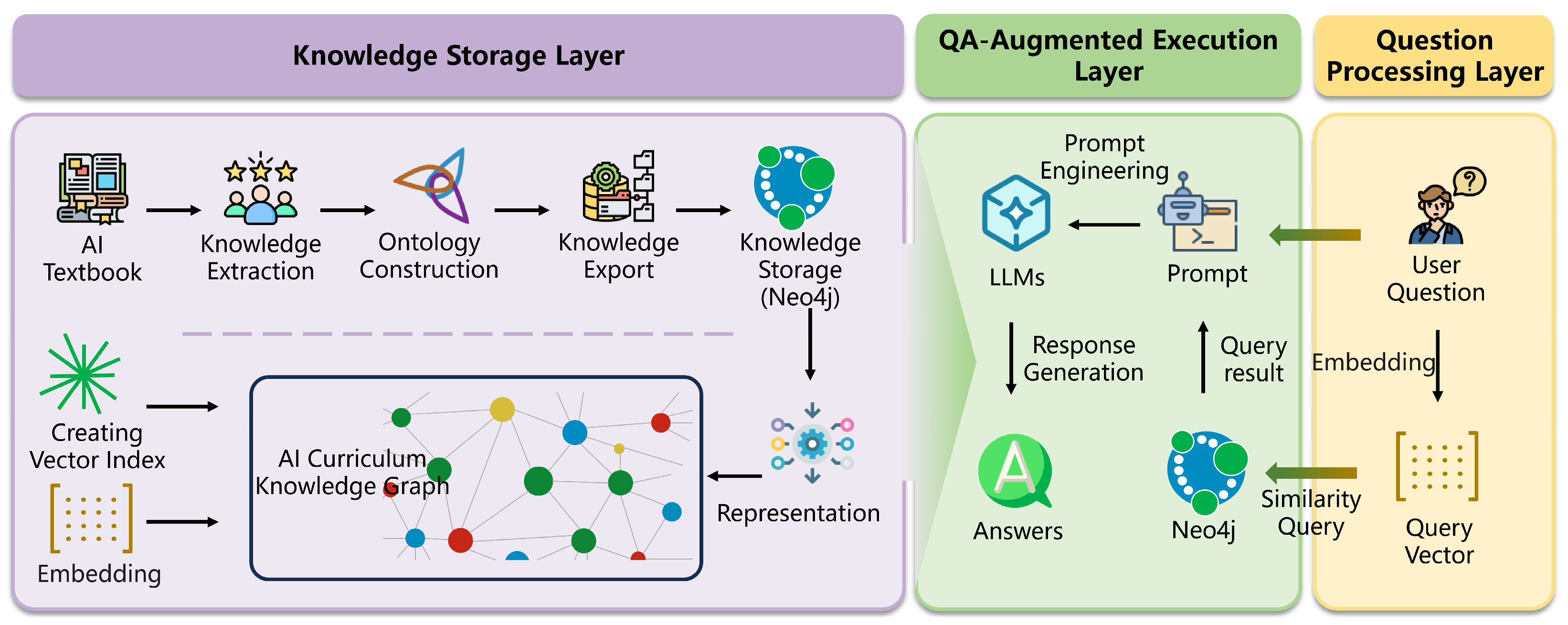
To mitigate factual inaccuracies and insufficient explanations in LLMs’ responses to AI curriculum questions, addressing their lack of verifiable, curriculum-aligned knowledge in K–12 AI education is necessary. Thus, we developed a KG-augmented LLM-based QA system for K–12 AI education, a snapshot as shown in Appendix A. The overall architecture of the proposed system (Figure 1) comprises three tiers: (1) a knowledge storage layer for knowledge persistence, (2) a QA-augmented execution layer for reasoning, and (3) a question processing layer for input parsing. A detailed description of these three modules is provided below.
Figure 1.
Overall architecture of the QA system based on KG-augmented LLMs in K–12 AI curriculum.
3.1. Knowledge Storage Layer
The knowledge storage layer was designed to process, construct, and store a curriculum KG of K–12 AI education. We formalized AI curriculum knowledge derived from Guangzhou K–12 AI textbooks. Recognizing that curriculum KG quality is a key factor dictating the LLM performance, we leveraged LLM-assisted knowledge extraction and fusion mechanisms to enhance the efficiency and quality of the KG construction [37]. Along the same lines, a formal AI curriculum ontology was developed in Protégé v5.6.4 by following the seven-step methodology established by Noy and McGuinnes [38]. This ontology comprised seven entity types and four semantic relations (Appendix B). It provided the formal schema to organize the curriculum knowledge compiled by two domain experts specializing in K–12 AI education with high inter-rater reliability (Cohen’s Kappa = 0.812). The consistency of the resulting curriculum KG was ensured through syntactic and semantic validation using a Protégé’s built-in reasoning engine and SPARQL queries [39], with all detected inconsistencies resolved manually. Subsequently, the ontology and its instantiated curriculum knowledge were imported into a Neo4j database (Neo4j community v5.20.0), yielding a structured KG consisting of 730 unique nodes and 2114 relations. The constructed curriculum KG was deployed as a graph database within Neo4j to support efficient semantic retrieval and querying in the proposed QA system.
The total number of entity instances across categories exceeded the actual node count (Table 1). This discrepancy is attributable to the semantic modeling principle permitting the multi-typed instantiation of curricular entities. This principle dictates that a unitary curricular concept can be instantiated under multiple relevant types to reflect its diverse pedagogical dimensions. It allows the curriculum KG to capture the multidimensional attributes and relationships inherent in curriculum organization. Thus, it supports richer semantic querying and analytic pathways [40]. Consequently, the sum of all typed instances across entity categories was substantially larger, reflecting the layered and interconnected nature of the curriculum knowledge representation.
Table 1.
Statistical distribution of entity and relation instances in the structured curriculum KG.
To enable efficient knowledge retrieval, embedding vectors were generated for each node using a pretrained embedding model (i.e., text2vec-base-Chinese model). This model has demonstrated strong performance in Chinese semantic representation tasks. Vector indexes were subsequently constructed using Cypher v5 queries.
3.2. Question Processing Layer
The question processing layer constitutes the essential first stage in the pipeline of the proposed QA system. It primarily transforms the natural language query of a user from a sequence of tokens into a machine-interpretable, semantic representation. This was achieved by generating a fixed-dimensional embedding vector for each submitted question. This process leveraged the deep contextual understanding of a pre-trained language model. A critical technical stipulation was involved here. Specifically, the pre-trained model employed for question encoding must be the exact same as that used to generate the embedding vectors for all nodes and relations within the Neo4j. This is not an optional optimization but a fundamental requirement for ensuring both dimensional and semantic compatibility across the unstructured questions and structured curriculum KG.
The rationale for this stringent consistency is rooted in the properties of vector space geometry used for semantic search. The structural and semantic properties of an embedding space are determined by training objective and data of models [41]. Therefore, using different models would place queries and graph entities in misaligned vector spaces. This phenomenon would invalidate similarity comparisons and severely degrade retrieval accuracy. A shared model acts as a uniform semantic encoder, ensuring that related concepts and paraphrases in both queries and graph nodes obtain proximate vector representations [42]. Using a rigorous embedding protocol, the question processing layer thus established a consistent semantic bridge enabling effective interactions between the neural retrieval front-end and curriculum KG backend.
3.3. QA-Augmented Execution Layer
The QA-augmented execution layer semantically retrieved relevant knowledge from the KG using the received query embedding vector through a deep semantic retrieval mechanism. First, the hierarchical navigable small world (HNSW) algorithm was applied to search for an approximate nearest neighbor within the KG for preselecting candidate nodes. HNSW is characterized by high query speed, strong recall, and support for dynamic updates, making it particularly suitable for retrieval tasks in high-dimensional KGs [43]. Next, similarities between the query embedding and each candidate node embedding were computed within a shared semantic space to identify the most relevant knowledge nodes.
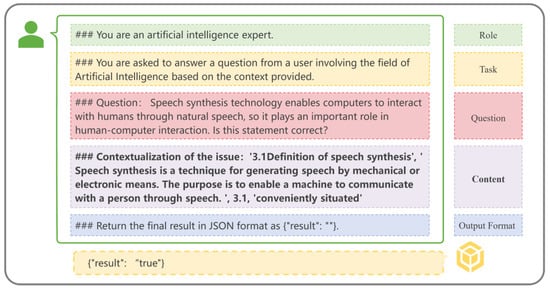
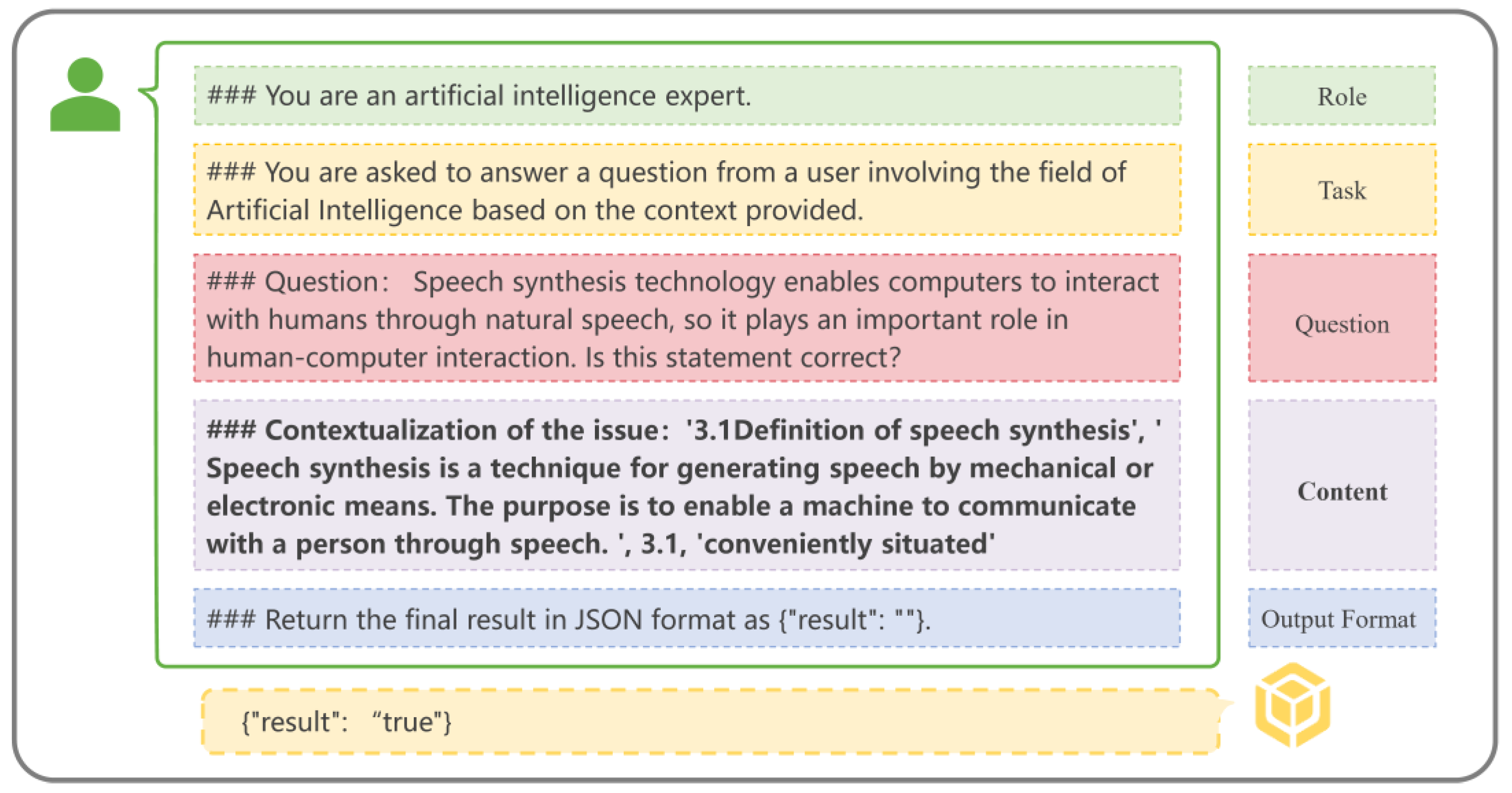
Finally, using a predefined prompt template (as illustrated in Figure 2), the knowledge content most semantically like the user’s query was incorporated into the prompt via structured string concatenation. Specifically, the retrieved knowledge was inserted into the designated context section of the prompt, where the boldfaced text denotes the knowledge identified as most semantically relevant. This template incorporated evidence-based techniques, such as standardized formatting and informed heuristic cues, to improve the factuality, coherence, and pedagogical alignment of the generated answers [44].
Figure 2.
Prompt design of the QA system based on KG-augmented LLMs in the K–12 AI curriculum.
The response-generation process within the QA-augmented execution layer was fundamentally shaped by injecting KG-retrieved knowledge via prompting. Mathematically, the response-generation process can be formalized as a conditional probability model as
where the constructed prompt encodes both the user question q and the retrieved knowledge , and denotes the pretrained model parameters. This method steers the generative mechanisms of LLMs, including their conditional probability distribution over tokens, latent reasoning pathways, and attention structure. Ultimately, it substantially enhances their response accuracy and relevance for AI curriculum QA tasks [45,46,47].
The KGs embedded in the prompt form an external knowledge set , which expands the conditional generation probability as
It enables LLMs to leverage long-tail or domain-specific knowledge that may be underrepresented in pretraining corpora. Thus, it reduces reasoning biases and hallucinations stemming from knowledge gaps [45].
Meanwhile, integrating task-specific information enriched with external knowledge into the prompt affects the reasoning process of the model, which can be formalized as
where denotes a potential reasoning path. The semantic constraints provided by the KG encourage LLMs to select reasoning paths that are logically consistent and aligned with the structural organization of the AI curriculum. Thus, it ultimately enhances factual accuracy, logical coherence, and output consistency [46]. According to Equations (1)–(3), the overall generation process can be defined as a unified conditional probability optimization objective [Equation (4)].
Additionally, incorporating structured knowledge into the prompt modifies the vector representation of input tokens, transforming them from the original to . This directly affects the computation of multi-head attention in transformers, as
where and represent position encodings at positions and , is the query matrix, is the transpose of the key matrix , and is the scaling factor. This process effectively reshapes the attention distribution, guiding LLMs to focus more on key concepts, semantic relations, and knowledge structures derived from the KG during the encoding stage [47].
Overall, the QA-augmented execution layer employed conditional probability modulation, reasoning-path regulation, and attention-structure reconfiguration. Through these, it enabled improvements in the factual accuracy, logical consistency, and generative reliability of LLM-based QA systems for AI curriculum knowledge.
4. Experiment 1: Evaluation of the Knowledge Query
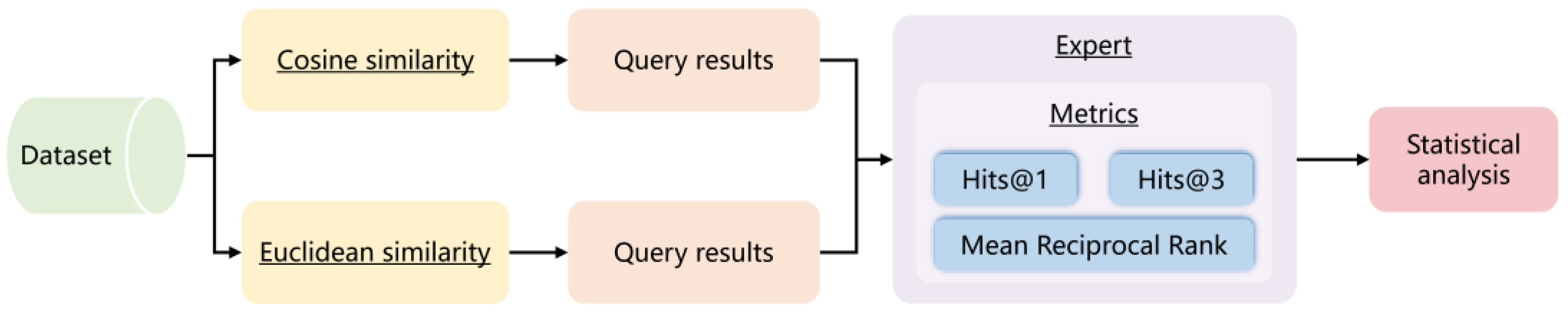
The performance of the proposed QA system was fundamentally contingent upon the effectiveness of the knowledge retrieval process shaped by the similarity query mechanisms available within the Neo4j framework. Consequently, this experiment was designed to systematically evaluate two candidate similarity query methods under the execution framework of Neo4j. The primary objective was to identify the optimal approach for maximizing retrieval precision and efficiency. The evaluation process comprised four main steps (Figure 3): (1) introduction of the evaluation framework tailored to similarity queries in Neo4j; (2) evaluation dataset preparation; (3) manual evaluation and metric selection; and (4) analysis of the results and their comparison.
Figure 3.
Human evaluation process of similarity-based knowledge query methods.
4.1. Evaluation of Similarity Query Methods
Owing to the technical constraints of the Neo4j platform [48], the evaluation utilized the natively supported cosine and Euclidean similarity measures [49]. Cosine similarity is a measure of the similarity between two vectors based on their direction [50]. It can measure the similarity between two vectors irrespective of their magnitudes. In information retrieval, text similarity, and other scenarios, similarity scores are usually required to lie in [0, 1]. Therefore, Equation (6) is commonly used for calculations.
Euclidean similarity is derived from the inverse or negative transformation of the Euclidean distance; it serves as a spatial proximity measure between vector points in a Cartesian coordinate system. It is most appropriately applied when the semantic or geometric relationship between data points is best quantified by their straight-line separation in the multidimensional space [51]. Euclidean similarity can be calculated as
4.2. Dataset Preparation
To achieve the experimental goal, we constructed a dataset comprising 123 questions, each associated with 10 KG entries retrieved via cosine and Euclidean similarity calculations. Using a curriculum-theme coverage strategy, all questions were manually aligned with the specific knowledge points in the Guangzhou K–12 AI textbooks. This construction encompasses the core knowledge distributed across 8 instructional units and 12 lessons. Two educational technology experts specializing in AI education manually verified the validity of each question in terms of content validity, expression clarity, thematic relevance, and pedagogical relevance. The descriptive statistics of this experimental dataset are presented in Table 2.
Table 2.
Descriptive statistics of this experimental dataset.
4.3. Manual Evaluation and Metrics
The HNSW algorithm was employed to retrieve the top 10 knowledge points for each question based on the highest similarity scores. Then, the relevance of these knowledge points was manually analyzed by an expert specializing in AI education (an independent rater). To mitigate bias, the rater was blinded to the pre-computed similarity scores of the knowledge points presented in a randomized order. Subsequently, the median of the 10 relevance ratings for each question was calculated and used as a question-specific threshold. Finally, any knowledge point with a rating equal to or greater than this threshold was designated as a ground truth for that question.
We adopted mean reciprocal rank (MRR) and Hits@n to evaluate the effectiveness of the retrieved knowledge points in the proposed QA system. MRR is an evaluation metric commonly used in information retrieval and QA systems; it is the average of the reciprocal ranks of the first correctly retrieved item across all queries [52]:
where is the total number of queries and is the rank of the first correct answer in the returned list for query.
Hits@n is widely used in KG completion and retrieval tasks [53]. It is a ranking-based evaluation metric that measures the proportion of test cases in which at least one correct answer appears within the top retrieved results, as follows:
where is the indicator function. Another crucial determinant for KG queries is efficiency, which governs system latency and thereby shapes the overall user experience in interactive QA scenarios [54]. We evaluated the query efficiency of the two similarity query methods in terms of average query time (AQT).
4.4. Results and Discussion
The knowledge query performance of Euclidean and cosine similarities on the experimental dataset was analyzed (Table 3). The AQT for cosine similarity was 0.097 s, comparable to 0.099 s for Euclidean similarity, indicating similar query efficiency between the two methods. Overall, cosine similarity demonstrated superior performance: it achieved a higher MRR (0.906) than Euclidean similarity (0.830) and outperformed it in Hits@1 (0.846 vs. 0.724) and Hits@3 (0.959 vs. 0.927).
Table 3.
Human evaluation results.
These results indicated that cosine similarity provides more accurate retrieval of semantically relevant knowledge within the curriculum KG. This finding is consistent with the results reported by Oduntan et al. [55]. From a theoretical perspective, the norm in high-dimensional spaces (such as KGs) suffers from the “distance concentration” phenomenon, where distances between nodes tend to converge, thereby reducing the discriminative power of nearest-neighbor retrieval [56]. In contrast, cosine similarity mitigates this issue by measuring the angular similarity between vectors rather than their absolute magnitudes. By normalizing vector representations and emphasizing directional consistency, cosine similarity is better suited to capturing semantic relationships embedded in high-dimensional vector spaces [57]. Furthermore, it is less sensitive to variations in text length and term frequency, which enhances its robustness in complex knowledge representations [58].
Beyond this technical comparison, these findings have important implications for the overall design and effectiveness of the proposed QA system. Since the quality of knowledge retrieval directly determines the relevance and accuracy of the information injected into the prompt, the superior performance of cosine similarity contributes to more reliable grounding of LLM-generated responses. In other words, improvements at the retrieval stage propagate through the entire pipeline, ultimately enhancing the factual accuracy and contextual appropriateness of the generated answers. This observation is consistent with prior studies in retrieval-augmented generation, which highlight that the effectiveness of downstream text generation is highly dependent on the quality of retrieved evidence [59,60]. Moreover, semantic similarity measures that better capture contextual relevance have been shown to significantly improve knowledge grounding in neural LLMs [42].
From an educational perspective, more precise retrieval of curriculum-aligned knowledge is essential for ensuring that the system provides responses that are not only correct but also pedagogically appropriate. By improving the alignment between retrieved knowledge and instructional content, the use of cosine similarity supports the development of QA systems that better reflect curriculum standards and learning objectives. This is particularly important in K–12 educational settings, where the accuracy and relevance of instructional content directly impact learning outcomes [61]. Furthermore, recent research in the field of AI in Education emphasizes that AI-driven instructional systems must ensure both the validity of content and alignment with pedagogical objectives in order to effectively support learning processes [62]. Therefore, enhancing retrieval precision is not only a technical improvement but also a critical step toward building trustworthy and educationally meaningful AI systems.
Therefore, cosine similarity was selected as the semantic similarity measure for knowledge retrieval in the proposed QA system, as it offers both technical advantages in high-dimensional representation learning and practical benefits for curriculum-aligned educational applications.
5. Experiment 2: Automatic Evaluation of the Proposed QA System
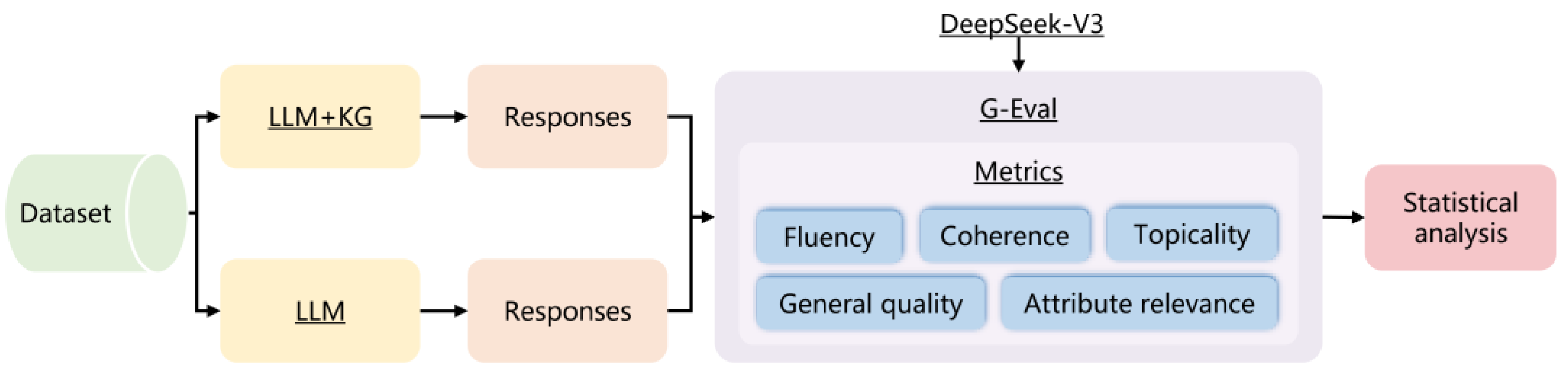
Next, the effectiveness of the proposed KG-augmented LLM-based QA system was evaluated in the context of K–12 AI education. As the experimental dataset consists of open-ended questions without standardized answers, conventional reference-based metrics, such as BLEU and ROUGE, are not applicable. Therefore, we employed the G-Eval framework for automatic assessment. It evaluates the response quality of a model using LLMs with chain-of-thought prompting in a reference-free manner. In dialogue generation tasks, G-Eval achieved a Spearman correlation of 0.588 with human judgments, substantially outperforming conventional metrics and comparable evaluation models [63]. Furthermore, to increase the persuasiveness and rigor of the experimental results, we conducted a small-scale human evaluation. The evaluation process comprised four primary steps (Figure 4): (1) selection of the LLM for G-Eval; (2) evaluation dataset preparation; (3) designing of the automatic evaluation framework and metrics; and (4) result analysis. The experiments were conducted in an Ubuntu 22.04 environment on A10 hardware, involving a total of 32,940 calls to the LLM interface.
Figure 4.
Automatic evaluation process using the G-Eval framework.
5.1. Selection of LLMs
The selection of LLMs followed the theoretical framework prioritizing technological advancement, accessibility, and cost-effectiveness as primary selection criteria [64]. Consequently, we selected three Chinese LLMs: Qwen2.5-7B-Instruct (Alibaba Cloud, Hangzhou, China), Baichuan2-7B-Chat (Baichuan Intelligent Technology, Beijing, China), and ChatGLM3-6B (Zhipu AI, Beijing, China). Qwen2.5-7B-Instruct (Qwen) exhibits superior performance compared to competitors, such as Gemma2-9b-IT and Llama3.1-8B-Instruct, across all tasks in the IFeval benchmark [65]. Baichuan2-7B-Chat exhibits state-of-the-art performance among models of similar size on benchmarks, such as MMLU, CMMLU, and BBH [66]. ChatGLM3-6B (ChatGLM) has surpassed 42 benchmarks across various domains, including semantics, reasoning, and knowledge [67]. For the three models, the following generation parameters were configured: , , , and to .
5.2. Dataset Preparation
The reliability and validity of automated evaluation depend on the scale sufficiency and diversity of the datasets. To address this requirement, the original panel of subject-matter experts was reconvened to expand the dataset from Experiment 1, and Guangzhou K–12 AI textbooks were used as the foundational source. This process yielded a final corpus of 1098 questions that comprehensively covered the curricular knowledge points. Following Bloom’s revised taxonomy [68], the questions were classified into three levels of cognitive difficulty: simple (n = 364), moderate (n = 367), and difficult (n = 367). The descriptive statistics of this experimental dataset are summarized in Table 4. Upon establishing the validity of the compiled problem set, further data expansion was halted. This decision was driven by high computational costs—totaling over 9,226,652 tokens—as well as predefined experimental constraints and allocated computational resource quotas. In addition, 100 samples were randomly selected from the dataset for human evaluation.
Table 4.
Descriptive statistics of this experimental dataset.
5.3. Automatic Evaluation and Metrics
The dataset containing open-ended questions without corresponding reference answers was evaluated using the G-Eval framework. In this study, the G-Eval approach was implemented using DeepSeek-V3 as the underlying LLM. DeepSeek-V3 is a mixture-of-experts model pre-trained on 14.8 trillion tokens. Its strong reasoning capability and scalability align with the structured evaluation demands of the G-Eval approach. Benchmark results show that its performance is competitive with leading closed-source models, such as GPT-4 and Claude-3.5-Sonnet [69]. The robust performance and broad accessibility of DeepSeek-V3 made it an ideal choice for maintaining a high level of methodological consistency throughout our implementation.
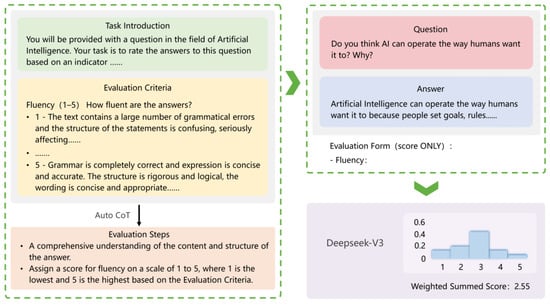
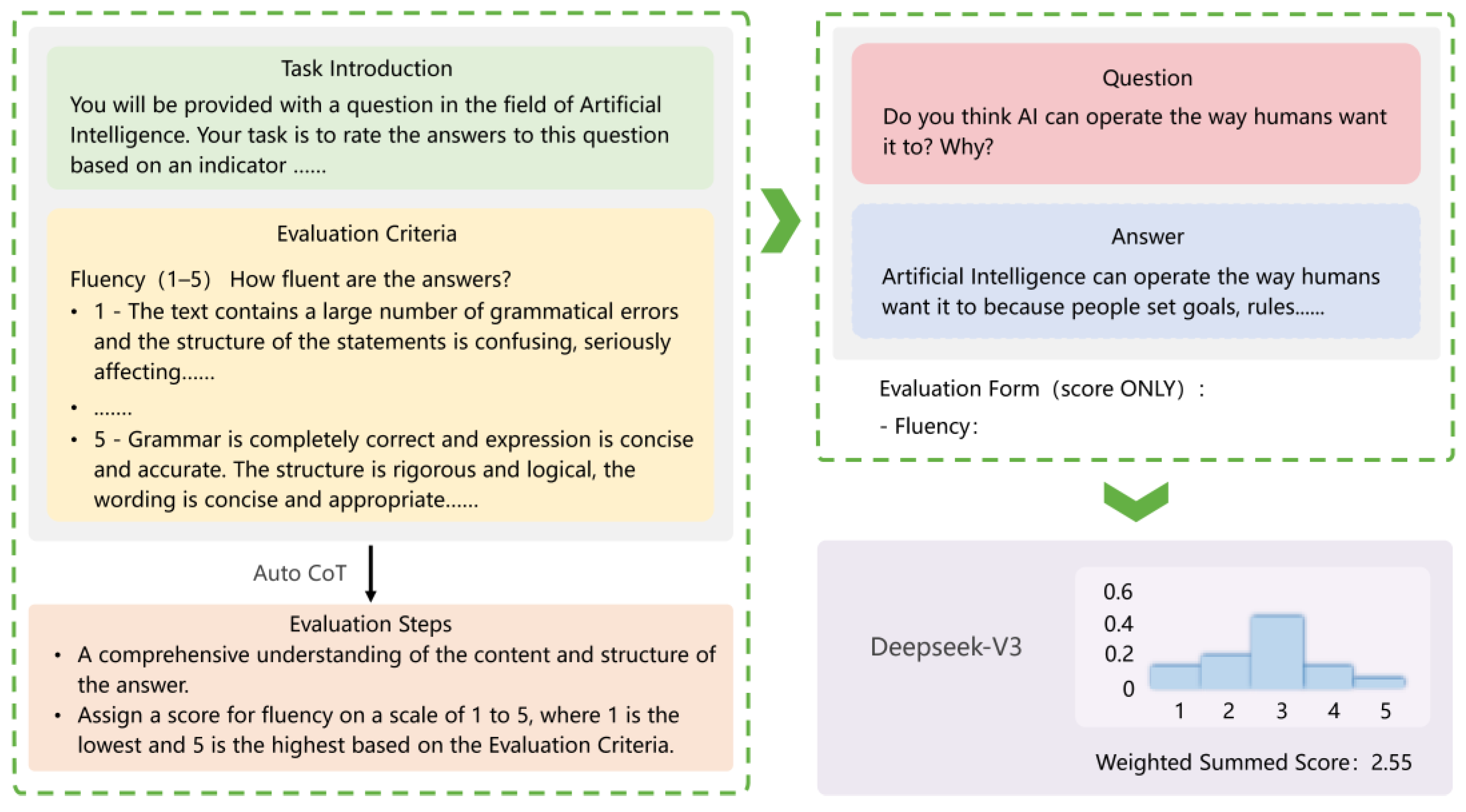
The effectiveness of the proposed QA system was comprehensively assessed using five reference-free evaluation metrics: fluency, coherence, topicality, general quality, and attribute relevance [64]. Descriptions of these metrics are provided in Table 5, and the evaluation prompt template is illustrated in Figure 5.
Table 5.
Detailed descriptions of evaluation metrics.
Figure 5.
Prompt template used for automatic evaluation.
To obtain more precise and continuous scores for each reference-free metric, the probabilistic outputs of the LLM for each rating were utilized to normalize the raw scores. This process effectively smoothed the distribution of the evaluation results. Formally, given a set of rating scores (from 1 to 5) predefined in the prompt , the LLM generated the probability of each score. Next, these probabilities were used to compute the final score as
Meanwhile, we invited three experts in the field of AI to conduct a human evaluation. The average score of the three experts was used as the final score.
5.4. Results and Discussion
We evaluated the three LLMs (Baichuan, ChatGLM, and Qwen) on the AI curriculum QA task using comparative statistical analyses. The performance of KG-augmented and baseline variants was compared across five reference-free metrics, with all assessments grounded in the AI curriculum KG.
The average scores for fluency, coherence, and topicality across all three models incorporating KG decreased consistently following KG augmentation (Table 6), compared to their baseline counterparts. This observation is in contrast with the findings of previous studies, such as those by Wu et al. [70] and Liang et al. [71]. Incorporating non-declarative knowledge into prompt templates may inadvertently disrupt the ability of LLMs to generate relevant responses [72]. For instance, when addressing the question “What are the key applications of speech recognition technology?”, the injected knowledge may include prompts such as “How do mobile phones recognize human language?” and “What is the relationship between speech recognition and AI?”. Such additions, although semantically related, may be misinterpreted by LLMs as part of the original query rather than as contextual guidance, thereby leading to irrelevant or redundant outputs. This misinterpretation can negatively affect fluency, coherence, and topical relevance. This phenomenon reflects a deeper representational–retrieval alignment challenge: the current structuring of non-declarative knowledge in the KG does not adequately match the input expectations of LLM prompting mechanisms [73]. In particular, procedural, inquiry-based, or activity-oriented knowledge is often encoded in forms (e.g., questions or instructional prompts) that are not directly compatible with declarative prompt contexts. To address this issue, several improvements can be considered. First, non-declarative knowledge can be transformed into declarative or semi-structured representations (e.g., converting questions into explanatory statements or instructional summaries) prior to injection, thereby reducing ambiguity during interpretation. Second, prompt engineering strategies can be refined by explicitly separating retrieved knowledge from the user query using structured delimiters or role-based formatting (e.g., “Context:“ vs. “Question:“), ensuring that the model correctly interprets their functional roles. Third, a filtering or re-ranking mechanism can be introduced to prioritize knowledge that is not only semantically similar but also functionally compatible with the target question type. More importantly, improving the quality of the curriculum KG itself is essential. A promising direction is to adopt a human–LLM collaborative paradigm for KG construction, in which LLMs assist in knowledge extraction, normalization, and rewriting, while human experts provide validation and pedagogical alignment. Such collaboration can help standardize heterogeneous knowledge representations, particularly for non-declarative knowledge, and ensure that the resulting KG is better suited for downstream integration with LLM-based systems. Overall, these findings highlight the importance of jointly optimizing knowledge representation and prompt integration strategies, suggesting that future work should move beyond simple knowledge augmentation toward a more tightly coupled design of KG construction and LLM interaction mechanisms. Despite this challenge, the average scores for both general quality and attribute relevance improved consistently across all evaluated models following the KG enhancement. These results echo those of H. Wang et al. [74]: their Chinese medical KG-augmented LLaMA model “Hua Tuo (Ben Cao)” demonstrated improved performance on domain-specific QA tasks. Thus, augmenting LLMs with a curriculum-specific KG offers a viable method for enhancing answer quality and factual grounding in educational QA systems by providing structured domain knowledge.
Table 6.
Performance scores across LLMs with and without KG augmentation.
In addition, the curriculum KG augmentation did not reduce the dispersion of scores (as measured by standard deviation) significantly across the evaluated dimensions for the LLMs. Thus, while the enhancement was generally effective in improving the average quality of responses (e.g., in general quality and attribute relevance), it did not concurrently improve output stability. This phenomenon may stem from a trade-off among multiple factors. First, introducing external knowledge may interfere with the text-generation patterns inherent to LLMs, which are optimized for fluency and coherence. This interference can cause fluctuations in model outputs as the LLM reconciles the pressure to adhere to the injected knowledge with the need for maintaining linguistic naturalness [73]. Second, micro-level variations in the relevance and phrasing of the retrieved curriculum knowledge segments can propagate directly, leading to answers with greater variability. Finally, the way for integrating curriculum knowledge into the prompt may itself introduce uncertainty [75]. Thus, to achieve more reliable and predictable performance gains, future research should focus on: (1) enhancing the accuracy of LLMs through knowledge augmentation and (2) refining the consistency of knowledge retrieval and the stability of its integration process.
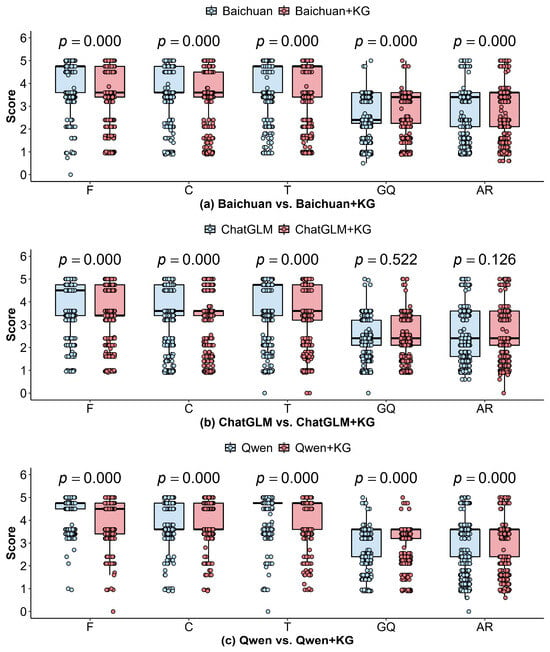
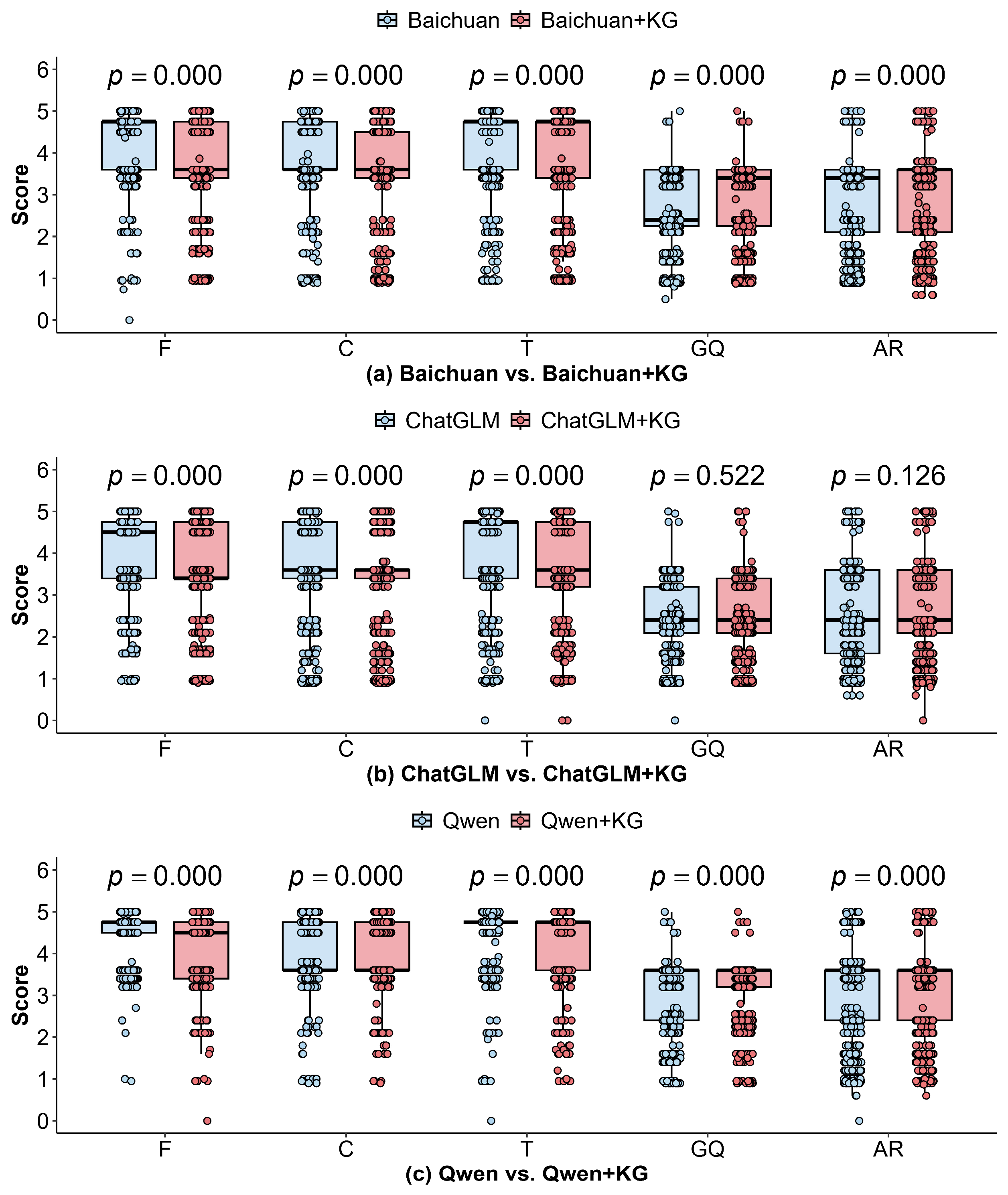
Given the violation of normality and homoscedasticity assumptions (both ), in some groups, subsequent group comparisons were performed using the Mann–Whitney U test (Figure 6). After integrating the AI curriculum KG, both Qwen and Baichuan showed significant gains () in fluency, coherence, topicality, general quality, and attribute relevance. These gains were consistent with prior findings [10,59]. Thus, structured knowledge can enhance the factual accuracy, coherence, and reasoning stability of LLMs. Particularly, KG anchoring has been shown to reduce hallucinations and promote more semantically constrained generation. These findings aligned well with the performance improvements observed in the two models [76]. In contrast, ChatGLM exhibited no significant differences in these metrics, with its general quality and attribute relevance remaining comparable to the baseline. This heterogeneous response to external knowledge augmentation is likely attributable to differences in model architecture, parameter scale, and training configurations [77].
Figure 6.
Performance of the selected LLMs (F: Fluency, C: Coherence, T: Topicality; GQ: General Quality, AR: Attribute Relevance).
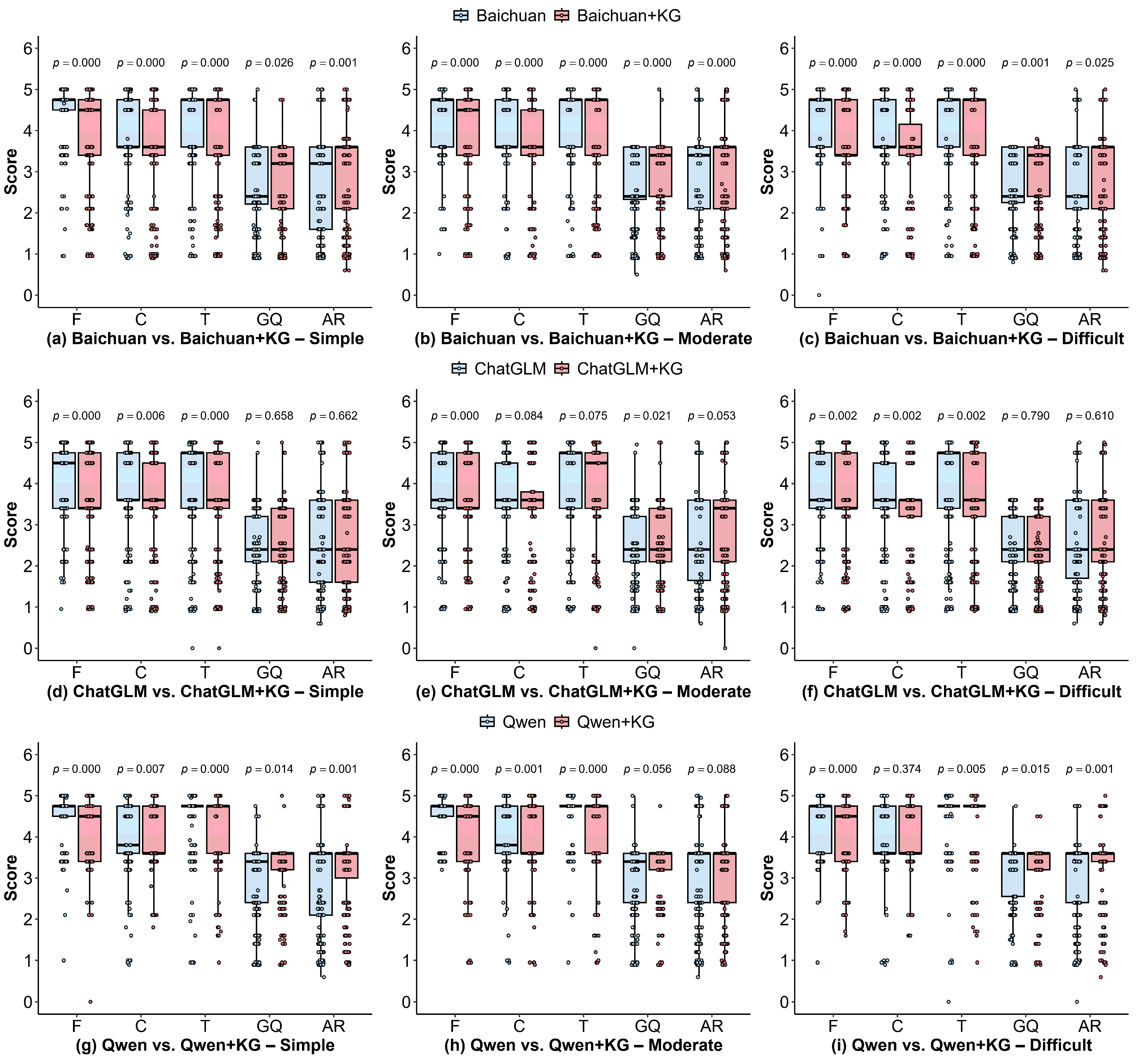
Integrating structured knowledge from the curriculum KG substantially improved the performance of Qwen, Baichuan, and ChatGLM across all QA task difficulty levels (Figure 7). Thus, the consistent gains across difficulty levels supported the previously established view: structured knowledge enhances LLM reasoning [10,59]. While Baichuan and Qwen showed the most pronounced gains in general quality and attribute relevance across all difficulty levels, all three models exhibited declines in fluency, coherence, and topicality relative to their baselines. This contrast suggests a potential trade-off introduced by KG augmentation: the structured semantic constraints that enhance factual grounding may simultaneously limit linguistic flexibility. Specifically, the integration of non-declarative knowledge into prompts weakened the performance on fluency, coherence, and topicality. Shi et al. [72] observed a similar pattern in their study. Moreover, this decline was observed even when the task difficulty decreased. These findings aligned with the view that such constraints can induce a form of output rigidity that cannot be easily mitigated [78]. Importantly, a differentiated pattern emerged in the case of Qwen. Its performance in general quality and attribute relevance strengthened progressively with increasing task complexity. Consequently, KG augmentation yields more significant performance gains as the task complexity increases. This trend supports the theoretical account proposed by Guo et al. [79]: structured knowledge can enhance domain adaptability, narrow the reasoning space, and reduce generative uncertainty. Together, these findings highlight that while KG augmentation may entail certain trade-offs in linguistic dimensions, it offers increasingly effective semantic scaffolding in higher-complexity reasoning tasks.
Figure 7.
Performance of the three LLMs across different difficulty levels (F: Fluency, C: Coherence, T: Topicality; GQ: General Quality, AR: Attribute Relevance).
Given that this study primarily relies on automated scoring, we conducted a human–machine correlation analysis to assess its reliability. Specifically, 100 samples were randomly sampled from the full dataset and rated by humans across five dimensions. Pearson and Spearman correlations were then computed between human and LLM-generated scores. As shown in Appendix C, the overall correlations (AVG) fall within a moderate range (r = 0.343–0.485), indicating a reasonable level of agreement. Although slightly lower than those reported by Liu et al. [63] using G-Eval on the SummEval benchmark (AVG r = 0.514), this difference may stem from variations in scoring models. Overall, the results support the validity of automated scoring in this study. Notably, correlations for the fluency dimension are consistently low, with some negative values. This may be attributed to differences in rating severity: LLMs tend to rely on surface-level linguistic features (e.g., grammatical correctness), yielding more concentrated and conservative scores, whereas humans consider broader aspects such as naturalness and readability, resulting in greater variability [80]. In addition, the generally high fluency of generated responses limits the discriminative power of this dimension. Together, these factors introduce systematic bias and weaken the observed correlations. We thus emphasized that automated evaluation can be a valid and efficient tool for core dimensions in this study, though its application to assessing fluency requires careful calibration to account for systematic human–machine differences.
Therefore, the proposed QA system outperforms the baselines on both general quality and attribute relevance in K–12 AI curriculum QA tasks. This finding demonstrates the effectiveness of curriculum KG in mitigating factual bias and logical inconsistency in LLM-generated domain-specific responses. Specifically, it offers a practical and engineering-ready approach to adapting LLMs in educational settings.
6. Conclusions, Limitations, and Future Work
In this study, we developed a QA system based on KG-augmented LLMs for the K–12 AI curriculum, aiming to address prevalent issues in existing systems, such as factual inaccuracies and limited explainability. A curriculum-specific dataset was constructed, and a semantic retrieval mechanism based on Neo4j was implemented. The system was built upon three open-source LLMs (Baichuan, ChatGLM, and Qwen) and evaluated using the G-Eval framework with DeepSeek-V3 as the scoring model. The experimental results reveal several important findings. First, the integration of a curriculum KG significantly improves the factual accuracy of LLM-generated responses by grounding them in structured and curriculum-aligned knowledge. Second, among the evaluated models, Qwen demonstrates the best overall performance, followed by Baichuan and ChatGLM. Third, KG augmentation exerts a multidimensional influence on response quality, affecting not only correctness but also fluency, coherence, and topical relevance. Notably, the inclusion of non-declarative knowledge in the current KG introduces noise and may lead to misinterpretation during prompt-based integration, thereby negatively affecting response quality. This finding reveals a representational–integration mismatch between certain forms of knowledge and LLM prompting mechanisms.
Despite these contributions, several limitations of this study should be acknowledged. First, the evaluation primarily relies on an automatic framework (G-Eval combined with DeepSeek-V3), and the lack of large-scale human evaluation may limit the robustness of the assessment. Second, the dataset used in this study is derived from K–12 AI textbooks within a specific regional context, which may constrain the generalizability of the findings to other curricula or educational settings. Third, the current approach to KG construction does not fully account for the heterogeneity of non-declarative knowledge, resulting in suboptimal integration into prompt-based reasoning. Finally, although the proposed method demonstrates promising results, the prompt design and knowledge injection strategies remain relatively heuristic and require further systematic optimization.
To address these limitations, future work will focus on several directions. First, we will incorporate human-centered evaluations in authentic instructional settings, involving both teachers and students, to assess pedagogical effectiveness, user acceptance, and alignment with educational objectives. Second, we will expand the benchmark dataset to encompass diverse regions and curriculum standards, thereby enhancing the empirical generalizability and robustness of the proposed system. More importantly, from a conceptual perspective, the proposed framework is designed to be inherently adaptable to different educational environments. This adaptability stems from its modular architecture, in which the curriculum KG serves as a domain-specific component, while the reasoning and QA mechanisms remain largely domain-agnostic. As a result, the system can be transferred across contexts by constructing or aligning curriculum KG with local curriculum standards, subject domains, and pedagogical objectives, without fundamentally altering the underlying model structure. Furthermore, the system will be extended to support the selection and deployment of context-specific curriculum KG, enabling flexible adaptation to varied educational settings. This design allows the framework to function as a generalizable solution for AI-supported curriculum systems, rather than being limited to a single regional implementation. Third, we will improve knowledge representation by transforming non-declarative knowledge into declarative or semi-structured formats and by developing more adaptive knowledge organization strategies. In addition, more refined prompt engineering methods will be explored, such as explicitly separating retrieved knowledge from user queries and designing structured context formats to guide model reasoning. Retrieval mechanisms will also be enhanced by integrating functional relevance alongside semantic similarity.
Overall, this study provides both theoretical insights into KG–LLM integration in educational contexts and a scalable framework for curriculum-aligned QA systems. Future research will further explore the co-design of knowledge representation and LLM interaction mechanisms to develop more reliable, interpretable, and pedagogically effective AI systems.
7. Ethical Considerations
This study did not involve human subjects in a manner requiring formal ethical approval. The dataset used in this research was constructed from publicly available K–12 AI curriculum textbooks, and therefore, did not include any personal or sensitive data.
The curriculum KG was developed by domain experts based on publicly accessible educational materials. No identifiable personal information was collected or used during the data preparation process. Accordingly, formal ethical approval and informed consent procedures were not required.
Nevertheless, given that the proposed system is intended for K–12 educational contexts involving minors, we recognize the importance of responsible AI deployment. In particular, issues such as content reliability, potential bias, and the appropriate role of AI in supporting (rather than replacing) teachers must be carefully considered.
In future work, we will further incorporate human-centered evaluation and ethical safeguards to ensure that the system aligns with pedagogical principles, supports safe and effective learning, and adheres to responsible AI practices in educational settings.
Author Contributions
Conceptualization, J.H. and Y.Z.; methodology, F.L. and Z.Z.; software, F.L. and R.L.; validation, F.L., Z.Z. and R.L.; formal analysis, F.L. and R.L.; resources, Z.Z. and X.C.; data curation, Z.Z. and X.C.; writing—original draft preparation, F.L. and Z.Z.; writing—review and editing, J.H., Y.Z. and J.T.; visualization, F.L.; supervision, J.H.; project administration, Y.Z.; funding acquisition, J.H. All authors have read and agreed to the published version of the manuscript.
Funding
This research was funded by the National Natural Science Foundation of China (Grant Nos. 62207015), and the Guangzhou Basic and Applied Basic Research Special Project (Young Doctor “Qihang” Program, Grant Nos. 2024A04J1597).
Institutional Review Board Statement
Not applicable.
Informed Consent Statement
Not applicable.
Data Availability Statement
The original data presented in the study are openly available at https://github.com/Lflyeo/KGAICQA (accessed on 22 January 2025).
Conflicts of Interest
The authors declare no conflicts of interest.
Appendix A
Figure A1.
A snapshot of the QA system based on KG-augmented LLMs in K–12 AI curriculum.
Appendix B
Table A1.
Entities, relationship types, and their definitions within the ontology.
Appendix C
Table A2.
Correlations between human and LLM scores across different dimensions, including Pearson’s (r) and Spearman’s (ρ).
References
- Quy, V.K.; Thanh, B.T.; Chehri, A.; Linh, D.M.; Tuan, D.A. AI and Digital Transformation in Higher Education: Vision and Approach of a Specific University in Vietnam. Sustainability 2023, 15, 11093. [Google Scholar] [CrossRef] [Scilit]
- Hu, B.; Zhu, J.; Pei, Y.; Gu, X. Exploring the Potential of LLM to Enhance Teaching Plans through Teaching Simulation. npj Sci. Learn. 2025, 10, 7. [Google Scholar] [CrossRef] [Scilit]
- Yu, H. Reflection on Whether Chat GPT Should Be Banned by Academia from the Perspective of Education and Teaching. Front. Psychol. 2023, 14, 1181712. [Google Scholar] [CrossRef] [Scilit]
- Hakizimana, G.; Ledezma Espino, A. Nomological Deductive Reasoning for Trustworthy, Human-Readable, and Actionable AI Outputs. Algorithms 2025, 18, 306. [Google Scholar] [CrossRef] [Scilit]
- DeepSeek-AI; Guo, D.; Yang, D.; Zhang, H.; Song, J.; Wang, P.; Zhu, Q.; Xu, R.; Zhang, R.; Ma, S.; et al. DeepSeek-R1: Incentivizing Reasoning Capability in LLMs via Reinforcement Learning. Nature 2025, 645, 633–638. [Google Scholar] [CrossRef] [Scilit] [PubMed]
- Létourneau, A.; Deslandes Martineau, M.; Charland, P.; Karran, J.A.; Boasen, J.; Léger, P.M. A Systematic Review of AI-Driven Intelligent Tutoring Systems (ITS) in K–12 Education. npj Sci. Learn. 2025, 10, 29. [Google Scholar] [CrossRef] [Scilit] [PubMed]
- Morris, W.; Crossley, S.; Holmes, L.; Ou, C.; Dascalu, M.; McNamara, D. Formative Feedback on Student-Authored Summaries in Intelligent Textbooks Using Large Language Models. Int. J. Artif. Intell. Educ. 2024, 35, 1022–1043. [Google Scholar] [CrossRef] [Scilit]
- Clements, K.A.; Vallone, K.T.; Clements, T.P.; Catania, E.H.; Claiborne, L.L.; Friedman, K.L.; Graham, T.R.; Johnson, H.J.; Starko, S.R.; Todd, T.D.; et al. Impacts of Learning Assistants on Student Belonging and Confidence Vary across Science Disciplines and Course Contexts. CBE—Life Sci. Educ. 2025, 24, ar26. [Google Scholar] [CrossRef] [Scilit]
- Yang, L.; Chen, H.; Li, Z.; Ding, X.; Wu, X. Give Us the Facts: Enhancing Large Language Models with Knowledge Graphs for Fact-Aware Language Modeling. IEEE Trans. Knowl. Data Eng. 2024, 36, 3091–3110. [Google Scholar] [CrossRef] [Scilit]
- Sun, J.; Xu, C.; Tang, L.; Wang, S.; Lin, C.; Gong, Y.; Ni, L.M.; Shum, H.-Y.; Guo, J. Think-on-Graph: Deep and Responsible Reasoning of Large Language Model on Knowledge Graph. arXiv 2024, arXiv:2307.07697. [Google Scholar]
- Abu-Rasheed, H.; Weber, C.; Fathi, M. Knowledge Graphs as Context Sources for Llm-Based Explanations of Learning Recommendations. In 2024 IEEE Global Engineering Education Conference (EDUCON); IEEE: New York, NY, USA, 2024; pp. 1–5. [Google Scholar]
- Kasneci, E.; Seßler, K.; Küchemann, S.; Bannert, M.; Dementieva, D.; Fischer, F.; Gasser, U.; Groh, G.; Günnemann, S.; Hüllermeier, E. ChatGPT for Good? On Opportunities and Challenges of Large Language Models for Education. Learn. Individ. Differ. 2023, 103, 102274. [Google Scholar] [CrossRef] [Scilit]
- Yan, L.; Sha, L.; Zhao, L.; Li, Y.; Martinez-Maldonado, R.; Chen, G.; Li, X.; Jin, Y.; Gašević, D. Practical and Ethical Challenges of Large Language Models in Education: A Systematic Scoping Review. Br. J. Educ. Technol. 2024, 55, 90–112. [Google Scholar] [CrossRef] [Scilit]
- Meyer, J.G.; Urbanowicz, R.J.; Martin, P.C.N.; O’Connor, K.; Li, R.; Peng, P.-C.; Bright, T.J.; Tatonetti, N.; Won, K.J.; Gonzalez-Hernandez, G.; et al. ChatGPT and Large Language Models in Academia: Opportunities and Challenges. BioData Min. 2023, 16, 20. [Google Scholar] [CrossRef] [Scilit] [PubMed]
- Wang, B.; Yue, X.; Sun, H. Can ChatGPT Defend Its Belief in Truth? Evaluating LLM Reasoning via Debate. In Proceedings of the Findings of the Association for Computational Linguistics: EMNLP 2023, Singapore, 6–10 December 2023. [Google Scholar]
- Abishethvarman, V.; Sabrina, F.; Kwan, P. Knowledge Integrity in Large Language Models: A State-of-the-Art Review. Information 2025, 16, 1076. [Google Scholar] [CrossRef] [Scilit]
- Baek, J.; Aji, A.F.; Saffari, A. Knowledge-Augmented Language Model Prompting for Zero-Shot Knowledge Graph Question Answering. In Proceedings of the 1st Workshop on Natural Language Reasoning and Structured Explanations (NLRSE), Toronto, ON, Canada, 13 June 2023; pp. 78–106. [Google Scholar]
- Floridi, L.; Chiriatti, M. GPT-3: Its Nature, Scope, Limits, and Consequences. Minds Mach. 2020, 30, 681–694. [Google Scholar] [CrossRef] [Scilit]
- OpenAI; Achiam, J.; Adler, S.; Agarwal, S.; Ahmad, L.; Akkaya, I.; Aleman, F.L.; Almeida, D.; Altenschmidt, J.; Altman, S.; et al. GPT-4 Technical Report. arXiv 2024, arXiv:2303.08774. [Google Scholar]
- Brown, T.; Mann, B.; Ryder, N.; Subbiah, M.; Kaplan, J.D.; Dhariwal, P.; Neelakantan, A.; Shyam, P.; Sastry, G.; Askell, A. Language Models Are Few-Shot Learners. Adv. Neural Inf. Process. Syst. 2020, 33, 1877–1901. [Google Scholar]
- Wei, J.; Tay, Y.; Bommasani, R.; Raffel, C.; Zoph, B.; Borgeaud, S.; Yogatama, D.; Bosma, M.; Zhou, D.; Metzler, D. Emergent Abilities of Large Language Models. arXiv 2022, arXiv:2206.07682. [Google Scholar]
- Wei, J.; Wang, X.; Schuurmans, D.; Bosma, M.; Xia, F.; Chi, E.; Le, Q.V.; Zhou, D. Chain-of-Thought Prompting Elicits Reasoning in Large Language Models. Adv. Neural Inf. Process. Syst. 2022, 35, 24824–24837. [Google Scholar]
- Ouyang, L.; Wu, J.; Jiang, X.; Almeida, D.; Wainwright, C.; Mishkin, P.; Zhang, C.; Agarwal, S.; Slama, K.; Ray, A. Training Language Models to Follow Instructions with Human Feedback. Adv. Neural Inf. Process. Syst. 2022, 35, 27730–27744. [Google Scholar]
- Li, Q.; Yuan, X.; Sun, J.; Li, X.; Chen, S.; Shen, X.; Liu, S. RCKTE: Toward Global Optimal Causal Explanations for Deep Knowledge Tracing. IEEE Trans. Learn. Technol. 2025, 18, 914–927. [Google Scholar] [CrossRef] [Scilit]
- Doughty, J.; Wan, Z.; Bompelli, A.; Qayum, J.; Wang, T.; Zhang, J.; Zheng, Y.; Doyle, A.; Sridhar, P.; Agarwal, A.; et al. A Comparative Study of AI-Generated (GPT-4) and Human-Crafted MCQs in Programming Education. In Proceedings of the 26th Australasian Computing Education Conference; ACM: Sydney, NSW, Australia, 2024; pp. 114–123. [Google Scholar]
- Jury, B.; Lorusso, A.; Leinonen, J.; Denny, P.; Luxton-Reilly, A. Evaluating LLM-Generated Worked Examples in an Introductory Programming Course. In Proceedings of the 26th Australasian Computing Education Conference; ACM: Sydney, NSW, Australia, 2024; pp. 77–86. [Google Scholar]
- Leiker, D.; Finnigan, S.; Gyllen, A.R.; Cukurova, M. Prototyping the Use of Large Language Models (LLMs) for Adult Learning Content Creation at Scale. arXiv 2023, arXiv:2306.01815. [Google Scholar] [CrossRef] [Scilit]
- Zhou, Z.; Ning, M.; Wang, Q.; Yao, J.; Wang, W.; Huang, X.; Huang, K. Learning by Analogy: Diverse Questions Generation in Math Word Problem. In Proceedings of the Findings of the Association for Computational Linguistics: ACL 2023; ACL: Toronto, ON, Canada, 2023; pp. 11091–11104. [Google Scholar]
- Pinto, G.; Cardoso-Pereira, I.; Monteiro, D.; Lucena, D.; Souza, A.; Gama, K. Large Language Models for Education: Grading Open-Ended Questions Using ChatGPT. In Proceedings of the XXXVII Brazilian Symposium on Software Engineering; ACM: Campo Grande, Brazil, 2023; pp. 293–302. [Google Scholar]
- Xiao, C.; Ma, W.; Song, Q.; Xu, S.X.; Zhang, K.; Wang, Y.; Fu, Q. Human-AI Collaborative Essay Scoring: A Dual-Process Framework with LLMs. In Proceedings of the 15th International Learning Analytics and Knowledge Conference, Dublin, Ireland, 3 March 2025; pp. 293–305. [Google Scholar]
- Huang, L.; Yu, W.; Ma, W.; Zhong, W.; Feng, Z.; Wang, H.; Chen, Q.; Peng, W.; Feng, X.; Qin, B.; et al. A Survey on Hallucination in Large Language Models: Principles, Taxonomy, Challenges, and Open Questions. ACM Trans. Inf. Syst. 2025, 43, 1–55. [Google Scholar] [CrossRef] [Scilit]
- Bian, R.; Geng, Y.; Yang, Z.; Cheng, B. AutoMathKG: The Automated Mathematical Knowledge Graph Based on LLM and Vector Database. Comput. Intell. 2025, 41, e70096. [Google Scholar] [CrossRef] [Scilit]
- Wu, W.; Jing, Y.; Wang, Y.; Hu, W.; Tao, D. Graph-Augmented Reasoning: Evolving Step-by-Step Knowledge Graph Retrieval for LLM Reasoning. arXiv 2025, arXiv:2503.01642. [Google Scholar]
- Agrawal, G.; Pal, K.; Deng, Y.; Liu, H.; Chen, Y.-C. Cyberq: Generating Questions and Answers for Cybersecurity Education Using Knowledge Graph-Augmented Llms. In Proceedings of the AAAI Conference on Artificial Intelligence, Vancouver, BC, Canada, 20–27 February 2024; Volume 38, pp. 23164–23172. [Google Scholar]
- Zhao, C.; Agrawal, G.; Zhang, F.; Kumarage, T.; Tan, Z.; Deng, Y.; Chen, Y.-C.; Liu, H. Ontology-Aware RAG for Improved Question-Answering in Cybersecurity Education. arXiv 2025, arXiv:2412.14191. [Google Scholar]
- Yang, Z.; Yuan, S.; Shao, Z.; Li, W.; Liu, R. A Review on Synergizing Knowledge Graphs and Large Language Models. Computing 2025, 107, 143. [Google Scholar] [CrossRef] [Scilit]
- Ibrahim, N.; Aboulela, S.; Ibrahim, A.; Kashef, R. A Survey on Augmenting Knowledge Graphs (KGs) with Large Language Models (LLMs): Models, Evaluation Metrics, Benchmarks, and Challenges. Discov. Artif. Intell. 2024, 4, 76. [Google Scholar] [CrossRef] [Scilit]
- Noy, N.F.; McGuinness, D.L. Ontology Development 101: A Guide to Creating Your First Ontology. Knowledge Systems Laboratory. 2001. Available online: https://www.researchgate.net/publication/243772462_Ontology_Development_101_A_Guide_to_Creating_Your_First_Ontology/citation/download (accessed on 19 February 2026).
- Wilson, R.S.I.; Goonetillake, J.S.; Indika, W.A.; Ginige, A. A Conceptual Model for Ontology Quality Assessment: A Systematic Review. Semant. Web 2023, 14, 1051–1097. [Google Scholar] [CrossRef] [Scilit]
- Qu, K.; Li, K.C.; Wong, B.T.; Wu, M.M.; Liu, M. A Survey of Knowledge Graph Approaches and Applications in Education. Electronics 2024, 13, 2537. [Google Scholar] [CrossRef] [Scilit]
- Hamilton, W.L.; Ying, R.; Leskovec, J. Representation Learning on Graphs: Methods and Applications. arXiv 2018, arXiv:1709.05584. [Google Scholar] [CrossRef] [Scilit]
- Reimers, N.; Gurevych, I. Sentence-Bert: Sentence Embeddings Using Siamese Bert-Networks. In Proceedings of the 2019 Conference on Empirical Methods in Natural Language Processing and the 9th International Joint Conference on Natural Language Processing (EMNLP-IJCNLP); Association for Computational Linguistics: Hong Kong, China, 2019; pp. 3980–3990. [Google Scholar]
- Malkov, Y.A.; Yashunin, D.A. Efficient and Robust Approximate Nearest Neighbor Search Using Hierarchical Navigable Small World Graphs. IEEE Trans. Pattern Anal. Mach. Intell. 2020, 42, 824–836. [Google Scholar] [CrossRef] [Scilit] [PubMed]
- Hendrycks, D.; Burns, C.; Basart, S.; Zou, A.; Mazeika, M.; Song, D.; Steinhardt, J. Measuring Massive Multitask Language Understanding. arXiv 2021, arXiv:2009.03300. [Google Scholar] [CrossRef] [Scilit]
- Lavrinovics, E.; Biswas, R.; Bjerva, J.; Hose, K. Knowledge Graphs, Large Language Models, and Hallucinations: An Nlp Perspective. J. Web Semant. 2025, 85, 100844. [Google Scholar] [CrossRef] [Scilit]
- Sen, P.; Mavadia, S.; Saffari, A. Knowledge Graph-Augmented Language Models for Complex Question Answering. In Proceedings of the 1st Workshop on Natural Language Reasoning and Structured Explanations (NLRSE); Association for Computational Linguistics: Toronto, ON, Canada, 2023; pp. 1–8. [Google Scholar]
- Dai, X.; Hua, Y.; Wu, T.; Sheng, Y.; Ji, Q.; Qi, G. Large Language Models Can Better Understand Knowledge Graphs than We Thought. Knowl.-Based Syst. 2025, 312, 113060. [Google Scholar] [CrossRef] [Scilit]
- Neo4j Graph Database & Analytics|Graph Database Management System. Available online: https://neo4j.com/ (accessed on 19 February 2026).
- Joishi, J.; Sureka, A. Graph or Relational Databases: A Speed Comparison for Process Mining Algorithm. arXiv 2016, arXiv:1701.00072. [Google Scholar] [CrossRef] [Scilit]
- Chowdhury, G.G. Introduction to Modern Information Retrieval; Facet Publishing: London, UK, 1983; Volume 19. [Google Scholar]
- Danielsson, P.-E. Euclidean Distance Mapping. Comput. Graph. Image Process. 1980, 14, 227–248. [Google Scholar] [CrossRef] [Scilit]
- Voorhees, E.M. The TREC-8 Question Answering Track Report. In Proceedings of the Trec, Gaithersburg, MD, USA, 17–19 November 1999; Volume 99, pp. 77–82. [Google Scholar]
- Bordes, A.; Usunier, N.; Garcia-Duran, A.; Weston, J.; Yakhnenko, O. Translating Embeddings for Modeling Multi-Relational Data. Adv. Neural Inf. Process. Syst. 2013, 26, 2787–2795. [Google Scholar]
- Ali, W.; Saleem, M.; Yao, B.; Hogan, A.; Ngomo, A.-C.N. A Survey of RDF Stores & SPARQL Engines for Querying Knowledge Graphs. VLDB J. 2021, 31, 1–26. [Google Scholar] [CrossRef] [Scilit]
- Oduntan, O.E.; Adeyanju, I.A.; Falohun, A.S.; Obe, O.O. A Comparative Analysis of Euclidean Distance and Cosine Similarity Measure for Automated Essay-Type Grading. J. Eng. Appl. Sci. 2018, 13, 4198–4204. [Google Scholar]
- Aggarwal, C.C.; Hinneburg, A.; Keim, D.A. On the Surprising Behavior of Distance Metrics in High Dimensional Space. In Proceedings of the International Conference on Database Theory; Springer: Berlin/Heidelberg, Germany, 2001; pp. 420–434. [Google Scholar]
- Wang, L.; Luo, J.; Deng, S.; Guo, X. RoCS: Knowledge Graph Embedding Based on Joint Cosine Similarity. Electronics 2023, 13, 147. [Google Scholar] [CrossRef] [Scilit]
- Baumgartner, M.; Dell’Aglio, D.; Paulheim, H.; Bernstein, A. Towards the Web of Embeddings: Integrating Multiple Knowledge Graph Embedding Spaces with Fedcoder. J. Web Semant. 2023, 75, 100741. [Google Scholar] [CrossRef] [Scilit]
- Lewis, P.; Perez, E.; Piktus, A.; Petroni, F.; Karpukhin, V.; Goyal, N.; Küttler, H.; Lewis, M.; Yih, W.; Rocktäschel, T. Retrieval-Augmented Generation for Knowledge-Intensive Nlp Tasks. Adv. Neural Inf. Process. Syst. 2020, 33, 9459–9474. [Google Scholar]
- Izacard, G.; Grave, E. Leveraging Passage Retrieval with Generative Models for Open Domain Question Answering. In Proceedings of the 16th Conference of the European Chapter of the Association for Computational Linguistics: Main Volume, Online, 19–23 April 2021; pp. 874–880. [Google Scholar]
- VanLehn, K. The Relative Effectiveness of Human Tutoring, Intelligent Tutoring Systems, and Other Tutoring Systems. Educ. Psychol. 2011, 46, 197–221. [Google Scholar] [CrossRef] [Scilit]
- Zhu, H.; Sun, Y.; Yang, J. Towards Responsible Artificial Intelligence in Education: A Systematic Review on Identifying and Mitigating Ethical Risks. Humanit. Soc. Sci. Commun. 2025, 12, 1111. [Google Scholar] [CrossRef] [Scilit]
- Liu, Y.; Iter, D.; Xu, Y.; Wang, S.; Xu, R.; Zhu, C. G-Eval: NLG Evaluation Using GPT-4 with Better Human Alignment. arXiv 2023, arXiv:2303.16634. [Google Scholar] [CrossRef] [Scilit]
- Chang, Y.; Wang, X.; Wang, J.; Wu, Y.; Yang, L.; Zhu, K.; Chen, H.; Yi, X.; Wang, C.; Wang, Y.; et al. A Survey on Evaluation of Large Language Models. ACM Trans. Intell. Syst. Technol. 2024, 15, 39. [Google Scholar] [CrossRef] [Scilit]
- Yang, A.; Yang, B.; Zhang, B.; Hui, B.; Zheng, B.; Yu, B.; Li, C.; Liu, D.; Huang, F.; Wei, H.; et al. Qwen2.5 Technical Report. arXiv 2025, arXiv:2412.15115. [Google Scholar]
- Yang, A.; Xiao, B.; Wang, B.; Zhang, B.; Bian, C.; Yin, C.; Lv, C.; Pan, D.; Wang, D.; Yan, D.; et al. Baichuan 2: Open Large-Scale Language Models. arXiv 2023, arXiv:2309.10305. [Google Scholar] [CrossRef] [Scilit]
- Glm, T.; Zeng, A.; Xu, B.; Wang, B.; Zhang, C.; Yin, D.; Zhang, D.; Rojas, D.; Feng, G.; Zhao, H.; et al. ChatGLM: A Family of Large Language Models from GLM-130B to GLM-4 All Tools. arXiv 2024, arXiv:2406.12793. [Google Scholar]
- Krathwohl, D.R. A Revision of Bloom’s Taxonomy: An Overview. Theory Pract. 2002, 41, 212–218. [Google Scholar] [CrossRef] [Scilit]
- DeepSeek-AI; Liu, A.; Feng, B.; Xue, B.; Wang, B.; Wu, B.; Lu, C.; Zhao, C.; Deng, C.; Zhang, C.; et al. DeepSeek-V3 Technical Report. arXiv 2024, arXiv:2412.19437. [Google Scholar]
- Wu, Y.; Hu, N.; Bi, S.; Qi, G.; Ren, J.; Xie, A.; Song, W. Retrieve-Rewrite-Answer: A KG-to-Text Enhanced LLMs Framework for Knowledge Graph Question Answering. arXiv 2023, arXiv:2309.11206. [Google Scholar]
- Liang, X.; Wang, H.; Wang, Y.; Song, S.; Yang, J.; Niu, S.; Hu, J.; Liu, D.; Yao, S.; Xiong, F.; et al. Controllable Text Generation for Large Language Models: A Survey. arXiv 2024, arXiv:2408.12599. [Google Scholar] [CrossRef] [Scilit]
- Shi, F.; Chen, X.; Misra, K.; Scales, N.; Dohan, D.; Chi, E.H.; Schärli, N.; Zhou, D. Large Language Models Can Be Easily Distracted by Irrelevant Context. In Proceedings of the International Conference on Machine Learning, Edmonton, AB, Canada, 30 June–3 July 2023; pp. 31210–31227. [Google Scholar]
- Liu, S.; McCoy, A.B.; Wright, A. Improving Large Language Model Applications in Biomedicine with Retrieval-Augmented Generation: A Systematic Review, Meta-Analysis, and Clinical Development Guidelines. J. Am. Med. Inform. Assoc. 2025, 32, 605–615. [Google Scholar] [CrossRef] [Scilit]
- Wang, H.; Liu, C.; Xi, N.; Qiang, Z.; Zhao, S.; Qin, B.; Liu, T. HuaTuo: Tuning LLaMA Model with Chinese Medical Knowledge. arXiv 2023, arXiv:2304.06975. [Google Scholar]
- Shorinwa, O.; Mei, Z.; Lidard, J.; Ren, A.Z.; Majumdar, A. A Survey on Uncertainty Quantification of Large Language Models: Taxonomy, Open Research Challenges, and Future Directions. ACM Comput. Surv. 2025, 58, 63. [Google Scholar] [CrossRef] [Scilit]
- Logan, R.; Liu, N.F.; Peters, M.E.; Gardner, M.; Singh, S. Barack’s Wife Hillary: Using Knowledge Graphs for Fact-Aware Language Modeling. In Proceedings of the 57th Annual Meeting of the Association for Computational Linguistics, Florence, Italy, 28 July–2 August 2019; pp. 5962–5971. [Google Scholar]
- Bommasani, R.; Liang, P.; Lee, T. Holistic Evaluation of Language Models. Ann. N. Y. Acad. Sci. 2023, 1525, 140–146. [Google Scholar] [CrossRef] [Scilit]
- Ji, S.; Pan, S.; Cambria, E.; Marttinen, P.; Yu, P.S. A Survey on Knowledge Graphs: Representation, Acquisition, and Applications. IEEE Trans. Neural Netw. Learn. Syst. 2021, 33, 494–514. [Google Scholar] [CrossRef] [Scilit]
- Guo, Q.; Cao, S.; Yi, Z. A Medical Question Answering System Using Large Language Models and Knowledge Graphs. Int. J. Intell. Syst. 2022, 37, 8548–8564. [Google Scholar] [CrossRef] [Scilit]
- Bui, N.M.; Barrot, J. Using Generative Artificial Intelligence as an Automated Essay Scoring Tool: A Comparative Study. Innov. Lang. Learn. Teach. 2025, 1–16. [Google Scholar] [CrossRef] [Scilit]

Disclaimer/Publisher’s Note: The statements, opinions and data contained in all publications are solely those of the individual author(s) and contributor(s) and not of MDPI and/or the editor(s). MDPI and/or the editor(s) disclaim responsibility for any injury to people or property resulting from any ideas, methods, instructions or products referred to in the content. |
© 2026 by the authors. Licensee MDPI, Basel, Switzerland. This article is an open access article distributed under the terms and conditions of the Creative Commons Attribution (CC BY) license.