


Abstract
Water resources along mountain railway corridors are characterized by limited availability, high ecological sensitivity, and stringent water quality requirements. These factors render them susceptible to degradation and wastage during construction. To address these challenges, in this study, an integrated dynamic allocation model considering water quantity and quality along mountainous railway sections is developed. The model is established on the basis of a joint allocation framework that considers both water volume and quality parameters holistically. Constrained by sectoral water consumption quotas, the assimilative capacity of water functional zones, and graded water supply standards, the objectives are to maximize the comprehensive benefits of water resource utilization and promote water savings. A gray wolf optimizer (GWO) algorithm is employed to identify high-quality solutions. The model is applied to a case study of water resource allocation in a specific section of a mountain railway. The results indicate that in both the pre- and postoptimization scenarios, total water consumption and water quality are maintained within permissible limits. After optimization, the comprehensive water use efficiency increased by 12.39%, the daily costs decreased by 81.34 USD, and water savings increased by 23.19%. The optimized allocation strategy alleviates water scarcity along the railway corridor, enhances overall water resource efficiency, and provides a reference for addressing quality-induced water shortages in mountainous regions.
1. Introduction
The concept of a “green railway” provides a new path for the extended implementation of sustainable development strategies, especially in terms of water savings and water resource utilization, land savings and land resource protection, energy savings and energy optimization, material savings and resource recycling, and environmental protection. The construction of mountain railways, characterized by a megascale and a long construction duration under complex geological conditions, faces severe challenges, including the dense distribution of sensitive water bodies and stringent water resource protection standards [1]. A promising solution to these challenges lies in developing a water-saving-oriented, multiobjective water quantity–quality joint allocation model for water resources along mountainous railways. By optimizing allocation to alleviate water quality-induced scarcity, this approach can simultaneously increase the sustainability of both the railway project and the regional water system, ensuring that engineering and ecological benefits are synergistically achieved.
A growing body of literature has examined the relationship between railway engineering projects and regional water resource systems, addressing critical issues such as water conservation and the equitable allocation of water along rail routes. Dvanajscak et al. [2,3] demonstrated that tunnel excavation in specific regions depletes aquifers, leading to groundwater decline and compromising long-term water sustainability [4]. On the basis of an analysis of the groundwater environmental impacts from shield tunnel construction on metro operation, Dai employed BP neural networks and the analytical hierarchy process (AHP) to predict groundwater discharge and identify key influencing factors, ultimately proposing critical prevention technologies and a mitigation framework for water and environmental impacts. Ario et al. [5] and Li et al. [6], through an analysis of bridge runoff characteristics under rainfall conditions, systematically developed an integrated enhancement scheme encompassing structural design optimization, construction process improvement, and operational maintenance strategies from a life cycle management perspective, significantly improving safety performance with validated optimizations. Zhang [7] applied biotechnology to treat station wastewater, achieving high chemical oxygen demand (COD) removal and nitrogen elimination rates, which notably enhanced carbon reduction effects and demonstrated significant green benefits. However, existing studies of the interaction between railway engineering and water resources suffer from a fragmented perspective, concentrating predominantly on isolated components (e.g., tunnels, bridges, and stations) and their associated water-saving measures. Systematic research on water conservation theories for mountainous railway corridors is lacking. Additionally, studies of water allocation predominantly address water quantity and quality aspects in agricultural irrigation [8,9,10] and the ecological water demand [11,12,13], while research of the rational allocation of water considering both quantity and quality in engineering construction scenarios remains insufficiently explored.
In this study, water resource allocation is investigated within the context of mountainous railway projects, framed by the dual effects of the stress of railway construction on water resources and the subsequent supportive or constraining feedback on engineering activities. To address this complex interplay, we develop an integrated water quantity–quality allocation framework. Specifically, a multiobjective optimization model is constructed to maximize economic, social, and environmental benefits under water-saving constraints, and the gray wolf optimizer (GWO) algorithm is employed to derive optimal solutions. Finally, taking a certain section of a mountainous railway as an example, a water quantity–quality joint allocation model is applied to optimize water resource allocation during the construction of this railway section. This work provides a reference for reducing water pollution during mountainous railway projects and achieving water conservation and efficient utilization.
2. Dynamic Water Quantity–Quality Joint Allocation Framework for Mountainous Railway Lines
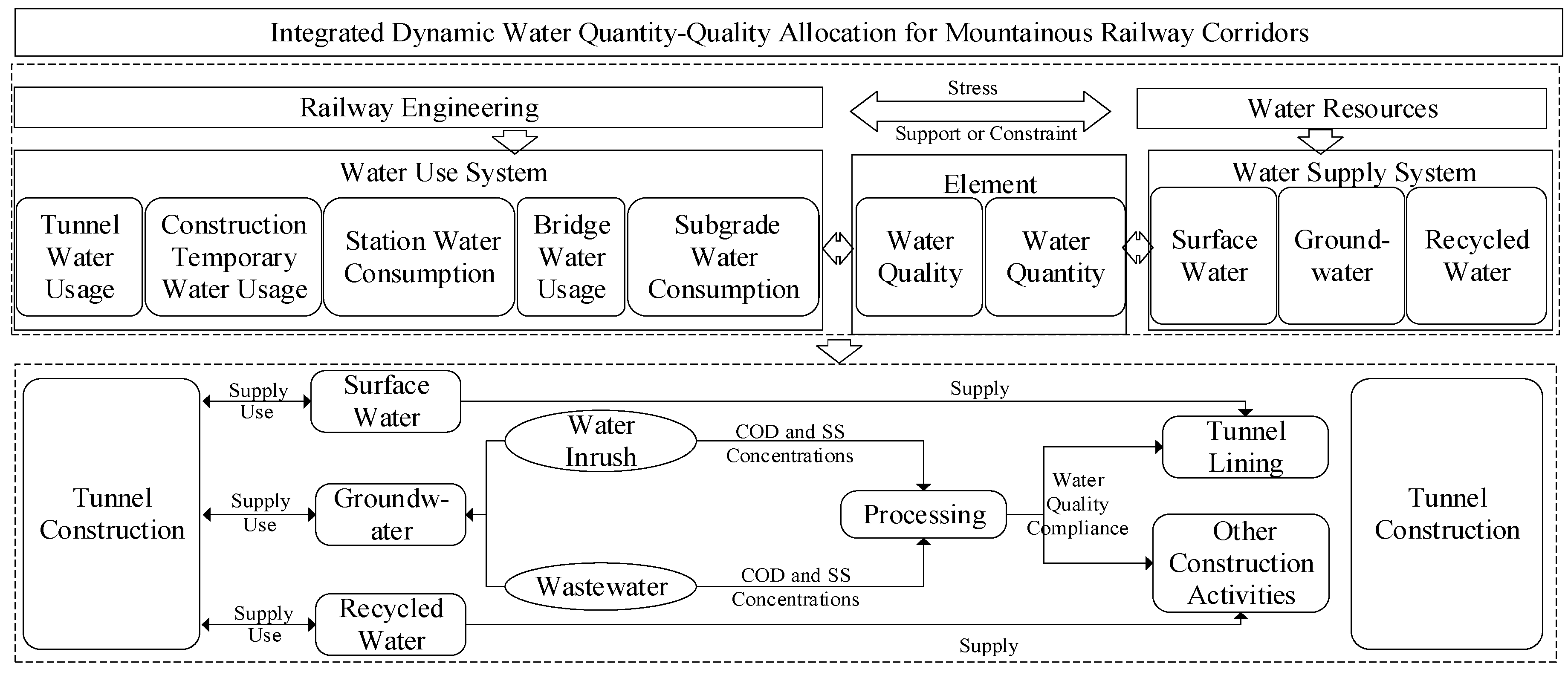
In railway engineering and construction, there are significant differences in the demand for and consumption of water resources among different specialties. To ensure that all specialties in the process of railway construction in mountainous areas can obtain the required water resources in a timely manner and with sufficient quality and quantity and, at the same time, improve the utilization efficiency of water resources and avoid pollution, shortage and waste, it is necessary to carry out scientific planning and dynamically allocate water resources considering the actual construction situation. The construction of railway projects in mountainous areas is restricted by natural conditions such as complex topography, deep canyons and large rivers. It is important to construct a joint dynamic allocation system for water quantity and quality along a line. According to the environmental protection and route selection research report for the Sichuan-Tibet Railway, the southwestern mountainous region of this railway line has a distinct composition of 6.13% embankments and 93.87% bridges and tunnels [14]. Specifically, tunnels are closely connected to bridges, a station may be located on a bridge, and the large temporary facilities providing interspersed specialty services provide support for the construction of roadbeds, bridges, tunnels and stations [15]. On the basis of the structural characteristics of this project, the water system used in railway engineering can be divided into five subsystems: tunnel water, temporary water, station water, bridge water and roadbed water. Moreover, there is a shortage of water resources along the railway in mountainous areas, and the environment is sensitive and fragile [16]. To achieve the goal of “water saving and comprehensive utilization of water resources,” the water supply system of water resources can be further divided into three subsystems: surface water, groundwater and engineering construction reuse water. The above water subsystems and water supply subsystems are interrelated and mutually restricted in terms of water quality and quantity, which together constitute the core elements of water allocation in mountain railway projects. On this basis, in accordance with coupling theory [14,17] and the principle of water resource regulation [14,16], a joint dynamic allocation framework considering water quantity and water quality along mountain railways is constructed (Figure 1).
Figure 1.
Dynamic water quantity–quality joint allocation framework for mountainous railway lines.
A tunnel specialty is shown in Figure 1 as an example. As a key component of railway engineering, the allocation of water of sufficient quantity and quality in tunnel construction involves a closed-loop process of water source supply, wastewater generation, treatment and reuse and engineering reuse. The initial water sources of construction water are divided into three categories: surface water, groundwater and reused water. In accordance with the real-time water demand and water quality characteristics of engineering construction, the dynamic supply and allocation of multiple water sources can be achieved.
In the process of tunnel construction, two kinds of core wastewater are produced, namely, tunnel drainage water and construction operation wastewater. For both, the chemical oxygen demand (COD) and suspended solids (SS) content are the main pollution indicators, and their levels directly determine the choice of the subsequent treatment process. The drainage water and operation wastewater are unified in a processing and treatment link, and the COD and SS contents are reduced through a targeted process. The quality of the treated water needs to meet the water quality standards of tunnel engineering, and water resources should be reused in accordance with the water quality standards. Part of the treated wastewater that meets the water quality standards is used as reused water to recharge the tunnel construction water system and achieve the recycling of water resources. The other part is transported to the tunnel lining and other construction operations to meet the water quantity and water quality requirements of different construction processes. At this point, the joint dynamic configuration of water quantity and water quality in the tunnel construction stage is completed. The water resource allocation scheme for the Sejila Mountain Tunnel is based on the feasibility study of the Ya’an-Linzhi section of the Sichuan-Tibet line. The environmental protection requirements in the tunnel area are extremely stringent, and the tunnel site area is rich in fault water and groundwater. The normal water inflow is predicted to be 73,182.59 m3/d, and the maximum water inflow is 202,880.41 m3/d. During the construction process, excessive water inflow may cause pollution to the surrounding waters. Through the implementation of “sewage diversion” measures, the drainage water is reused for lining maintenance and other construction operations, which not only effectively reduces the risk of pollution from tunnel construction but also achieves water savings and the efficient utilization of water resources.
3. Dynamic Water Quantity–Quality Coupled Allocation Model for Mountainous Railway Lines
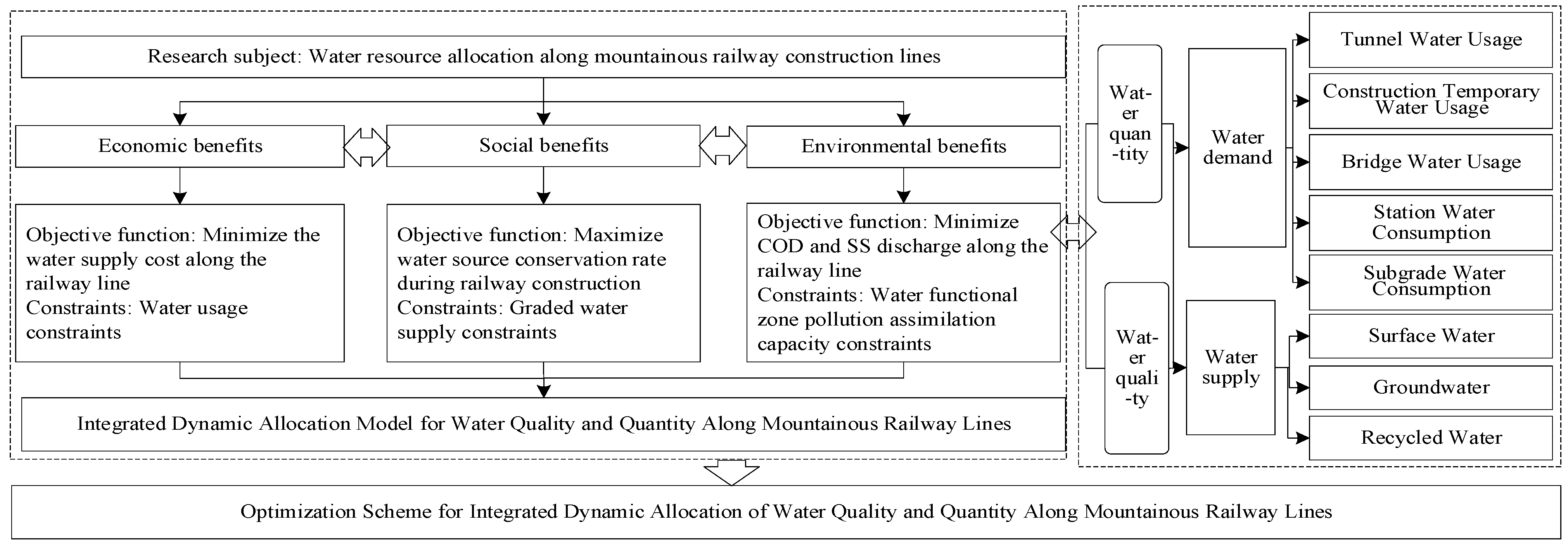
To clarify the framework of the joint dynamic allocation of water considering quantity and quality along railways in mountainous areas—with the goal of maximizing the economic, social and environmental benefits of water resource utilization while conserving water, and considering water consumption, quality, and pollutant carrying capacity of various professional projects as constraints—a “water saving priority” allocation mode is adopted. This model encompasses the relationships among the demand for tunnel water; the large volumes of temporary water, bridge water, station water and roadbed water; and the water supply, which is composed of surface water, groundwater and reused water. A joint dynamic configuration model of water quality and quantity along the mountain railway is subsequently established. Through solving the model, a joint dynamic allocation optimization scheme for water considering quality and quantity along mountain railways is finally obtained (Figure 2), and it integrates economic, social and environmental benefits. In terms of economic benefits, Figure 2 shows the minimum supply cost of water resources along the railway as the objective function, which is limited by water use constraints. In terms of social benefits, the highest water savings rate in the process of railway construction is selected as the basis of the objective function, which is limited by water supply constraints. In terms of environmental benefits, the minimum COD and SS emissions along the line are selected for inclusion in the objective function, which is limited by the pollutant carrying capacity of the water function area.
Figure 2.
Multiobjective model for water allocation considering quantity and quality along mountainous railway lines.
3.1. Objective Function
The objective of water allocation jointly considering quantity and quality allocation along mountainous railway lines is to achieve comprehensive maximization of economic benefits (water usage costs in railway engineering), social benefits (water conservation rate), and environmental benefits (COD and SS emissions from construction activities) [18]. Following the principles of easy quantification and representativeness and ensuring compliance with the inherent requirements for rational water resource allocation, quantitative indicators for various benefits are selected to provide a scientific basis for optimal water resource allocation [19].
3.1.1. Economic Benefits
From the perspective of mountainous railway engineering, construction entities must comply with national and local policy regulations regarding water resource fees for both construction and domestic water use. When recycled water is utilized, additional treatment costs must be considered [20]. Water usage costs directly reflect the economic expenditures incurred during water resource utilization. Therefore, in this study, the maximization of the reciprocal of railway engineering water costs is adopted as the economic benefit objective, aiming to optimize resource allocation and reduce project construction costs. That is,
where xik represents the daily water consumption (in cubic meters) of engineering discipline k from water source i, which may be either surface water or groundwater, along the railway line; bik denotes the unit water cost for engineering discipline k using water source i at 0.36 USD per cubic meter; xjk indicates the daily water consumption (in cubic meters) of engineering discipline k from recycled water source j, including wastewater, runoff or rainwater; and cik specifies the unit water cost for engineering discipline k using recycled water source j at 0.22 USD per cubic meter.
3.1.2. Social Benefits
The social benefit objective requires comprehensive consideration of water usage proportions across all engineering disciplines, with a particular emphasis on water conservation, which can be quantitatively characterized by the water savings rate [21]. Therefore, the maximization of the water savings rate during mountainous railway construction is adopted as the social benefit objective, aiming to achieve efficient utilization and rational allocation of water resources. That is,
where is the reduction in surface water and groundwater withdrawal for professional k; is the recycled water for professional k; Dk is the sum of surface water and groundwater consumption for discipline k; Jk is the daily water savings (in cubic meters) of engineering discipline k; Δf is the change in the water conservation efficiency; f2pre-opt is the water conservation efficiency of the basic scheme; and f2post-opt is the water conservation efficiency of the optimized scheme.
3.1.3. Environmental Benefits
The water allocation results along the railway line have multifaceted effects on the aquatic environment, where different allocation schemes may either promote or hinder ecological improvements. Chemical oxygen demand (COD) and suspended solids (SS) represent the primary pollutants in wastewater that cause environmental contamination [21]. Therefore, in this study, the maximization of the reciprocal of COD and SS emissions along the railway project is adopted as the environmental benefit objective, with the goal of reducing water pollution and promoting sustainable ecological development. That is,
where P0ₖ is the wastewater discharge coefficient of engineering discipline k; ρ0k and ρ1k are the mass concentrations of COD before and after wastewater treatment for discipline k, respectively, in mg/L; ρs0k and ρs1k are the mass concentrations of SS before and after wastewater treatment for discipline k, respectively, in mg/L; r1k = 70%; r1k represents the average wastewater treatment rate for engineering discipline k; and r2ₖ is the wastewater treatment and reuse rate for engineering discipline k, which ranges from 10 to 95%, with the maximum r2ₖ adopted in calculations; and 10−6 is the unit conversion factor.
3.2. Constraints
A water allocation model jointly considering quantity and quality for mountainous railway lines requires, from the perspective of graded water supply, consideration of the regional water supply–demand balance and pollutant discharge control as prerequisites; additionally, constraints, including water consumption requirements for various engineering disciplines and the wastewater assimilation capacity of water functional zones, must be considered to achieve the scientific allocation and efficient utilization of water resources [22].
3.2.1. Water Allocation Constraints for Specialized Engineering Projects
The total water allocated to each specialized engineering project should be capped based on the maximum water volume available for allocation and bounded by the minimum water volume requirement as the lower limit. The water sources considered in this research include surface water, groundwater, and recycled water (inflow water, operational wastewater, etc.). Thus,
where Dkmin and Dkmax are the minimum and maximum water demands, respectively, for specialized engineering project k.
3.2.2. Water Functional Zone Pollution Assimilation Capacity Constraint
During the planning period, the discharge of COD and SS should be strictly controlled to ensure that it does not exceed the total pollution assimilation capacity of the region:
3.2.3. Water Quality-Based Supply Constraints
Water sources of different quality grades should be allocated to users with corresponding water quality requirements. In accordance with the “Environmental Quality Standards for Surface Water of the People’s Republic of China” and other relevant regulations, Class I-III water can be supplied to all sectors; Class IV water cannot be used as a drinking water source but may be supplied for industrial, agricultural, and ecological uses; and Class V water is restricted to agricultural and ecological uses only [23].
3.2.4. Nonnegative Constraint for Decision Variables
The constraint is satisfied as follows:
3.3. Allocation Scheme
Water conservation regulations, in the form of administrative statutes, formalize the national principle of “water conservation priority” and mandate the comprehensive implementation of the National Water Conservation Act to develop a water-saving society [24,25,26,27,28]. Guided by this policy orientation, the “water conservation priority” concept is innovatively applied to water resource allocation schemes for mountainous railway projects to optimize water management through systematic water-saving measures.
Building upon traditional water resource allocation frameworks, this model is restructured with water conservation as its core objective, primarily manifested in two aspects. First, it minimizes direct withdrawals from surface and groundwater sources while maximizing the utilization rate of recycled water. Second, it employs multiobjective decision-making methods to achieve the synergistic optimization of economic, social, and environmental benefits. By establishing a water conservation-oriented allocation mechanism, this model enables each specialized engineering system in railway projects to obtain optimal water allocation solutions that simultaneously meet construction requirements and comply with sustainable water resource utilization principles.
4. Model Solution
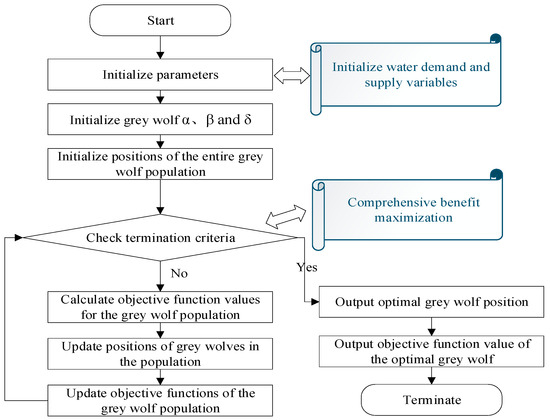
The integrated allocation model considering water quantity and quality for mountainous railway systems established in this study involves numerous variables and complex computations, making it challenging to solve using conventional methods. The gray wolf optimizer (GWO) algorithm demonstrates simplicity, flexibility, derivation-free mechanisms, and local optimum avoidance [27], enabling an effective balance between local refinement and global exploration while exhibiting superior performance in terms of solution accuracy and convergence rate [28]. Accordingly, in this paper, a gray wolf pack scheme adapted for multiobjective to single-objective conversion based on the GWO’s iterative characteristics is proposed; it is specifically designed for solving the regional water quantity–quality joint allocation multiobjective model; the flow chart is presented in Figure 3.
Figure 3.
Gray wolf optimizer (GWO) algorithm.
4.1. Solution Methodology
The joint allocation of water considering quantity and quality along the railways in mountainous areas is aimed at maximizing the comprehensive economic, social and environmental benefits in the region, and a rational allocation scheme for water resources is generated under the condition of meeting various constraints. To facilitate the solution of the model, in this study, the linear weighting method is used to transform the multiobjective problem of maximizing the comprehensive economic-social-environmental benefits into a single-objective problem. Although this method can generate a reasonable allocation scheme for water resources, it has inherent limitations, such as strong subjectivity in weight determination, the use of only one solution from the Pareto front, and difficulty in capturing complex trade-offs between multiple targets. To partially compensate for the above shortcomings, the order relationship analysis method [29] is introduced to enhance the scientific nature of weight determination, to calculate λm and to construct the objective function of the comprehensive benefit of water resources along mountain railways, as follows:
where λm is the weighting coefficient for the m-th objective; F is the standardized objective function for the m-th goal; and a = 1, 2, 3, with fa representing each corresponding subobjective.
4.2. Solution Procedure
Step 1: Design the fitness function as the comprehensive benefit measure f for the integrated water quantity–quality and allocation optimization problem along mountainous railway lines; this function is then maximized.
Step 2: Initialize the wolf population size N and the position Xi of each wolf, and designate the positions Xα, Xβ, and Xδ of α, β and δ wolves, along with their corresponding fitness values fα, fβ, and fδ = inf.
Step 3: Sequentially update the position of each wolf. For the i-th wolf, calculate its position relative to the α, β and δ wolves, and generate movement tendency components in relation to these three wolves.
Step 4: Repeat Step 3 until the position of the α wolf becomes stable.
Step 5: Determine whether the termination conditions are satisfied (either the objective function value reaches its maximum or the maximum number of iterations is reached). If yes, output the optimal gray wolf position and its corresponding objective function value; if no, return to Step 3 and continue executing Steps 4 and 5.
5. Case Study
5.1. Study Area Description
The total length of the studied mountain railway section is 19.380 km, and the time span for construction is 3 years. It includes mainly very large bridges, very long tunnels, typical stations, large temporary projects and corresponding roadbed projects. The environmentally sensitive areas involved along the route include centralized drinking water source protection areas and provincial cultural relic protection units. Through optimized route selection, the line successfully avoids both provincial-level cultural heritage sites and primary/secondary drinking water source protection zones, with only marginal encroachment into quasi-protection zones and the Qingyi River tertiary water source area.
Railway construction requires substantial water resources and may compromise water environments, posing challenges for achieving comprehensive water quality compliance. Given the prevalent issues in mountainous railway development, such as water resource wastage and suboptimal water environmental quality, integrated water allocation considering quantity and quality is imperative for realizing both efficient water utilization and effective aquatic environmental protection.
5.1.1. Water Supply Analysis
The water supply for the studied railway section comprises three primary categories: (i) surface water sourced mainly from the Qingyi River and designated centralized drinking water source protection zones; (ii) groundwater derived from exploitable underground aquifers; and (iii) recycled water, which includes construction wastewater, inflow water, operational wastewater, and harvested rainwater. Following the water quality-based supply principle, the surface water along the route consistently meets the Class I–III standards. Data extracted from the Ya’an Water Resources Bulletin for 2023 reveal that the Qingyi River Basin possesses an annual surface water resource volume of 9.174 billion cubic meters and that groundwater resources amount to 2.584 billion cubic meters. For the railway construction project, the industrial water supply constitutes approximately 29.0971 million cubic meters, while the water allocated to railway construction accounts for approximately 2.3278 million cubic meters. The project strictly complies with groundwater extraction regulations, maintaining extraction volumes well below the permitted limit of 140,000 cubic meters.
With respect to recycled water utilization, actual consumption across all construction components consistently remains below the designed maximum thresholds. Specifically, tunnel inflow totals 3769 cubic meters, versus a design maximum of 30,810 cubic meters; tunnel operational wastewater totals 6290 cubic meters, compared to a design maximum of 11,210 cubic meters; bridge operational wastewater totals 18,290 cubic meters, versus a design maximum of 20,170 cubic meters; station wastewater amounts to 3158 cubic meters, versus a design maximum of 5397 cubic meters; temporary work wastewater totals 2012 cubic meters, relative to a design maximum of 2134 cubic meters; and subgrade wastewater totals 540 cubic meters, compared to a design maximum of 1350 cubic meters. Comprehensive water supply data are systematically presented in Table 1.
Table 1.
Water supply capacities for the studied railway section.
5.1.2. Water Resource Allocation Analysis
The baseline water usage scheme was established with reference to the Water Consumption Design Plan for Railway Engineering in a specific section, the Technical Research Report on Wastewater Treatment During Construction, and the Main Parameter Calculations for Rainwater Harvesting Systems, with the goal of obtaining water demand estimates for tunnel engineering, bridge engineering, station engineering, temporary construction engineering, and subgrade engineering.
(1) Tunnel engineering: Construction water usage primarily includes in dust suppression after blasting, equipment cooling/cleaning, and grouting injection, requiring approximately 10 m3/h of supplementary water for single-track tunnels (calculated on the basis of two 8 h shifts per day). The lining curing water volume is calculated on the basis of a tunnel cross-sectional area of 244,222 m2, with the average production water consumption ranging from 50 to 100 m3/d.
(2) Bridge engineering: Construction operations involve concrete mixing water (96.48 m3/d average, requiring 1–2 m3 water per 10 m3 of concrete without generating wastewater) and slurry preparation water (9.39 m3/d average). Pier curing via concrete spray irrigation requires 59.51 m3/d on average, whereas abutment and slope curing requires 17.46 m3/d.
(3) Station engineering: Construction activities (foundation treatment, structural works, and station building) require 452.800 m3/d. The wall curing requirement is 77.200 m3/d.
(4) Temporary construction engineering: Mixing plants (9000 m2 area, 2 production units, 1000 m3/d concrete output, 8–10 mixer trucks) are used, and the amount of cleaning water ranges from 40 to 90 m3/d. In beam prefabrication yards (60,000 m2 area), 200–300 m3/d of water is produced on average. Processed wastewater is fully recycled, with deficits supplemented by clean water sources. At worker camps (30–150 personnel, 4 m × 2000 m access roads), water use encompasses toilet flushing (1.75 m3/d), road sprinkling (16 m3/d), and miscellaneous uses (18.42 m3/d). Treated domestic wastewater is reused for sanitation, vehicle washing, and irrigation.
(5) In terms of subgrade engineering, earthwork and compaction operations require 187.41 m3/d. A detailed water allocation framework for this project is proposed (detailed in Table 2), and it integrates sectoral demands with sustainable sourcing strategies.
Table 2.
Water resource allocation results for the baseline scenario.
5.2. Optimization of the Basic Scheme
5.2.1. Parameter Determination
(1) Weight coefficients of objectives. The weight coefficients for the economic benefit objective, social benefit objective, and eco-environmental benefit objective were calculated as 0.3, 0.4, and 0.3, respectively, using the order relation analysis method.
(2) The mass concentrations of COD and SS in wastewater and the sewage discharge coefficient. The sewage discharge coefficients for this line project are presented in Table 3. In accordance with the Water Pollutant Discharge Standard [30], the maximum allowable discharge concentrations for COD are 100 mg/L (Level I) and 150 mg/L (Level II), whereas those for SS are 70 mg/L (Level I) and 200 mg/L (Level II). The specific discharge concentrations of COD and SS for this section of the project are detailed in Table 4 and Table 5.
Table 3.
Wastewater discharge coefficients.
Table 4.
COD concentrations before and after wastewater treatment.
Table 5.
SS concentrations before and after wastewater treatment.
(3) Minimum (maximum) water demand for project construction. The minimum (maximum) water consumption for tunnels, bridges, station sites, and large temporary facilities is set at 90% (110%) of the actual water demand, respectively.
(4) The water resource carrying capacity of the studied section [31]. The COD pollution carrying capacity of the water resources in this section is approximately 100~150 t/d, and the SS pollution carrying capacity is approximately 50~100 t/d.
(5) Algorithm parameters.
5.2.2. Optimization Results of the Basic Scheme
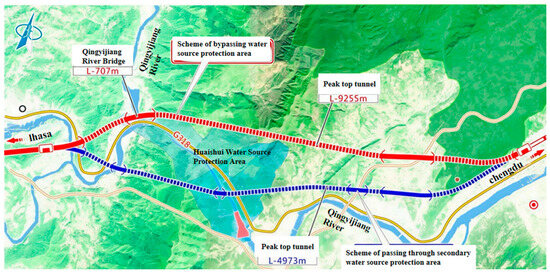
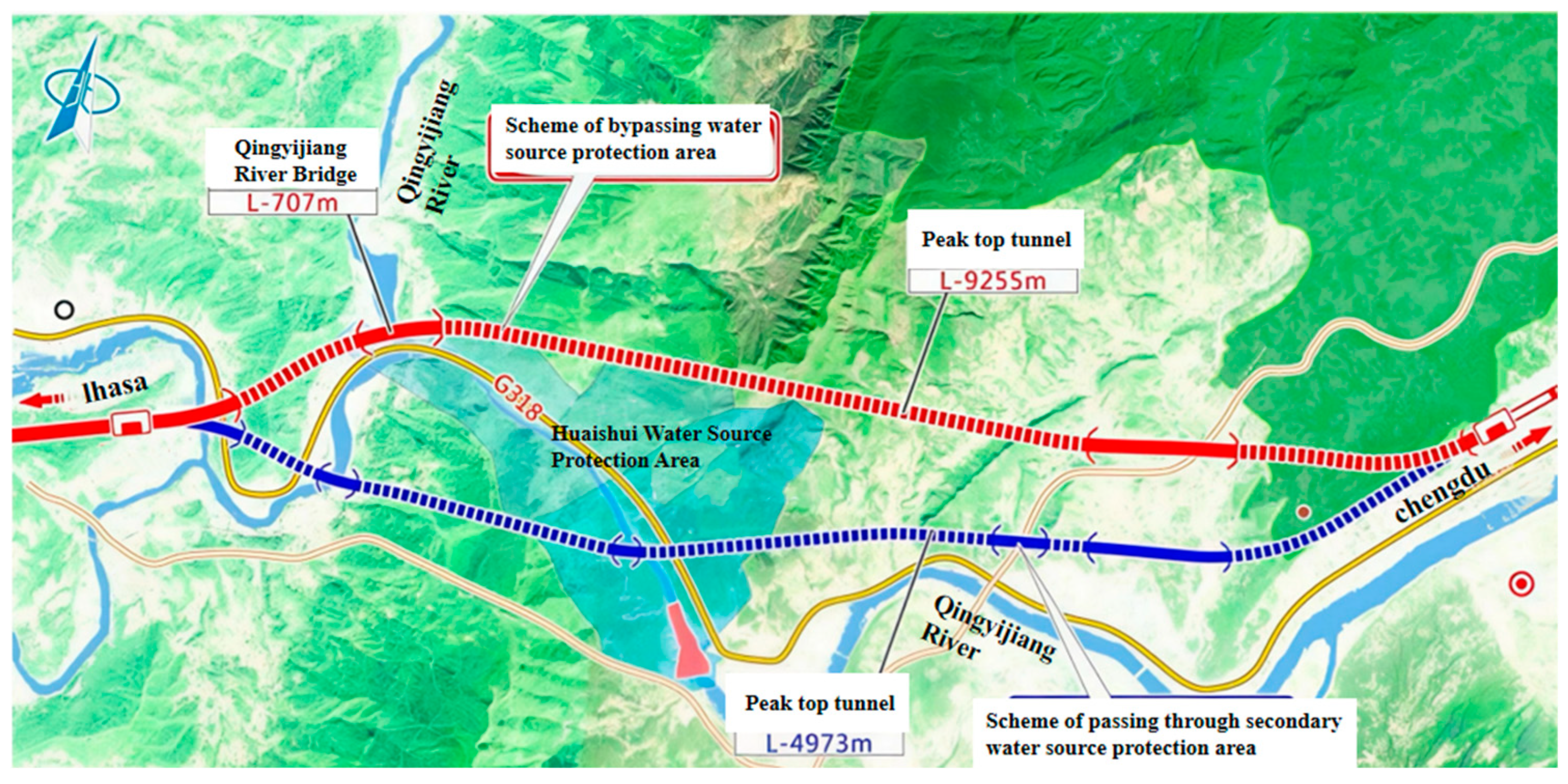
Tunnel water inflow reuse and bridge runoff reuse are positive indicators, whereas surface water supply and groundwater supply are negative indicators. In the allocation model proposed in this study and the GWO algorithm, we set the GWO population size to 50 and the maximum number of iterations to 200. The optimal solution for each specialized water allocation was obtained under the condition of achieving the optimal objective function value, thereby realizing the joint dynamic allocation of water quality and quantity for this project section. The optimization results of water resource allocation for the basic scheme are shown in Figure 4.
Figure 4.
Overview of the study area.
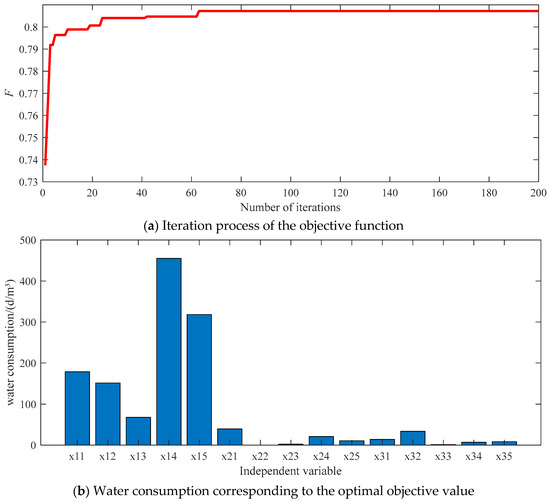
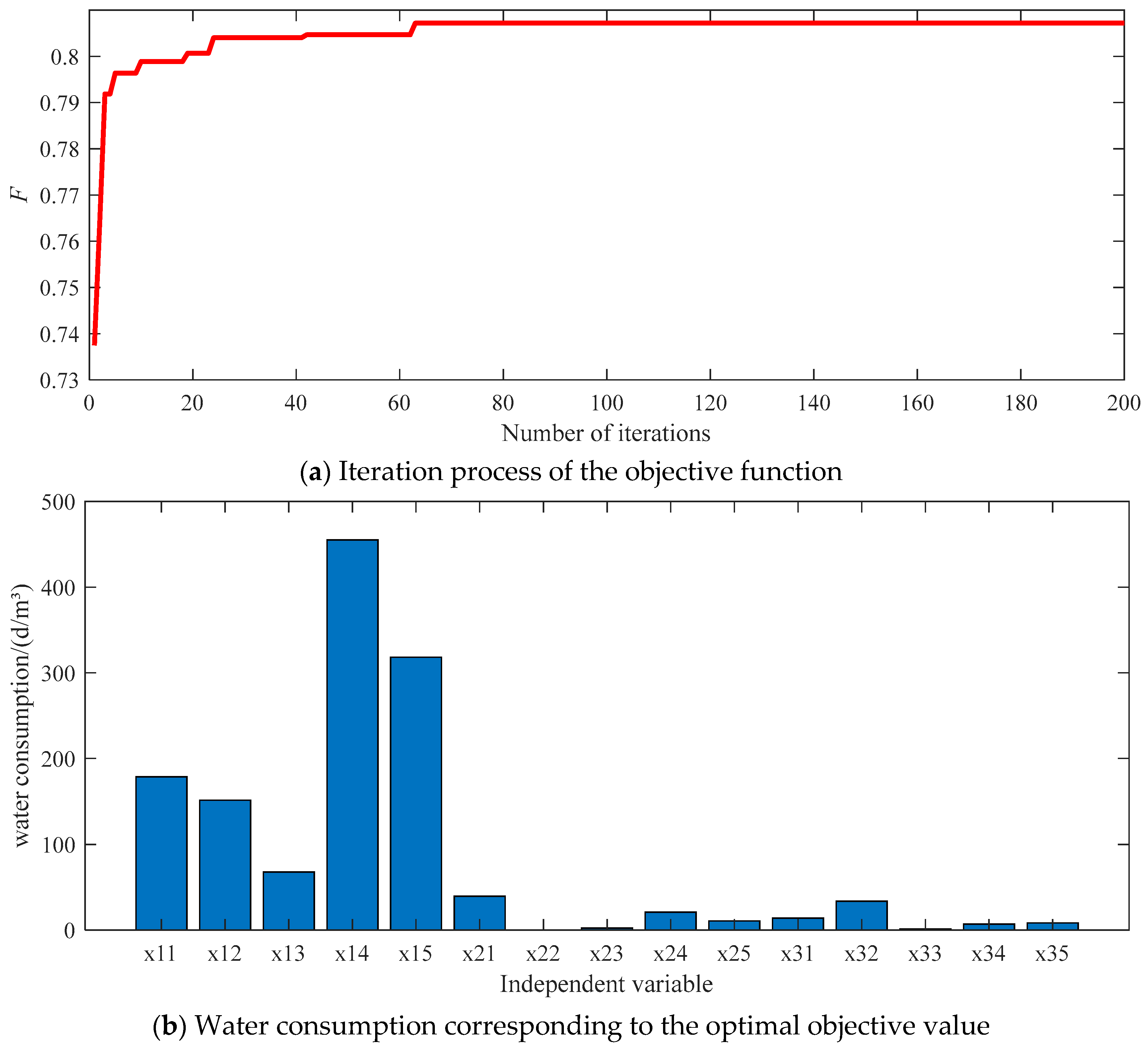
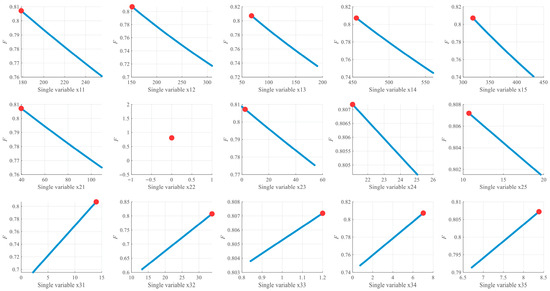
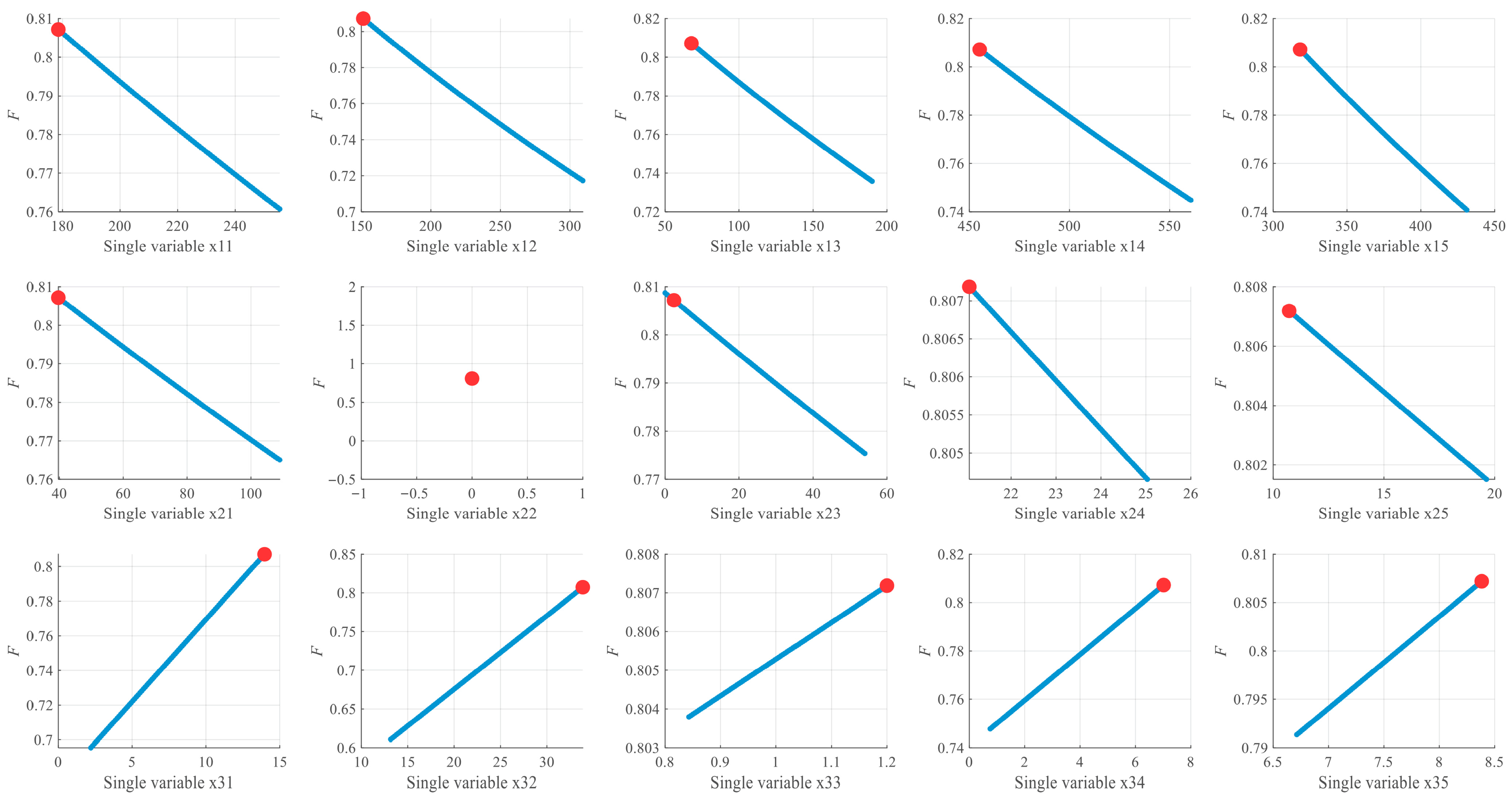
The iteration count stabilizes at approximately 100 cycles, achieving a maximum comprehensive benefit value of 0.807 for water resource allocation (Figure 5), with the corresponding water allocation quantities shown in the left-side box diagram. Through further analysis of Figure 5, the evolutionary pathways of water consumption across various specialties can be obtained, as illustrated in Figure 6.
Figure 5.
Water resource allocation results obtained with the optimized scheme.
Figure 6.
Evolutionary process of water resource allocation in the optimized scenario.
In Figure 6, the red points represent the optimal values for water resource allocation. The diagram reveals a gradual increase in recycled water usage across all specialties, whereas surface water and groundwater usage tend to decrease compared with those in the basic scheme. This phenomenon occurs because (1) parameters such as wastewater reuse rates or allocation patterns implemented in the model construction phase prioritize the use of recycled water by restricting the supply sequence of different water sources and (2) the adoption of water-saving measures for recycled water across specialties may ensure higher treatment and reuse rates for project wastewater.
5.2.3. Comparative Analysis Between the Basic and Optimized Schemes
The water supply costs, water savings rates, and COD/SS emission quantities under both basic and optimized water allocation schemes for this railway project are presented in Table 6.
Table 6.
Comparison of target values between the baseline and optimized scenarios.
The net benefit of the water supply under the water-saving scheme is 81.34 USD lower than that under the basic scheme, and the water-savings rate increases by 23%. The total amounts of COD and SS emissions are controlled within the limits of the pollutant carrying capacities. After optimization, the total combined daily discharge of COD and SS is reduced by 7.811 tons. Notably, the utilization rate of reused water is as high as 90%, which reflects the comprehensive utilization of water resources.
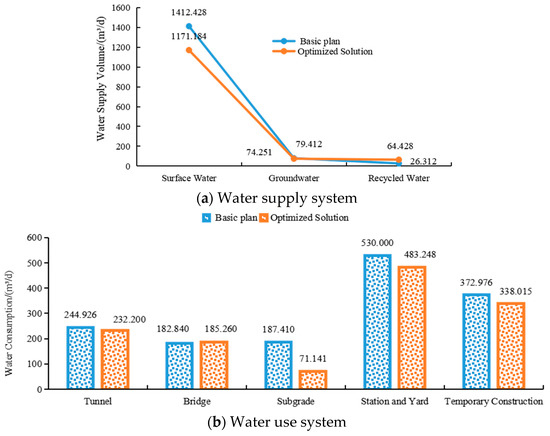
To further clarify the differences in water supply and consumption between the supply and demand systems under the baseline and optimized scenarios, the water allocation quantities for each system under different schemes are plotted, as shown in Figure 7.
Figure 7.
Water supply and consumption of each system under different scenarios.
As shown in Figure 7, in the optimized water supply scheme, surface water and groundwater usage decreases, whereas recycled water usage increases. With respect to the water consumption system, all the specialties show reduced water usage in the optimized scheme. This optimization approach enables the internal water use structure among specialties during railway construction to be optimally adjusted, thereby maximizing comprehensive benefits.
The integrated dynamic water quantity–quality allocation model presented in this study offers a robust solution to water resource allocation challenges in mountainous railway construction under water-saving constraints, thereby alleviating water scarcity issues and enhancing the comprehensive water utilization efficiency in mountainous regions. The study limitations include incomplete consideration of influential variables in engineering water resource allocation and unoptimized interspecialty water use structures. Future research will incorporate additional influencing variables and include in-depth investigations of the railway water use efficiency through the optimization of interspecialty water use structures.
6. Conclusions
From the perspective of two-way interactions between railway engineering and water resources, the typical water use system is divided into five major professional subsystems, which are integrated with multiple water supply subsystems; this approach is used to assess the systematic theory of water resource conservation in mountain railways. Moreover, policy orientation toward “water savings prioritization” is transformed into a quantifiable allocation mode, the supply priority of reused water is determined, and the optimization and reconstruction of the engineering water use structure are performed. The accuracy and feasibility of water resource allocation are improved by integrating the order relation analysis method and gray wolf optimization algorithm. The conclusions are as follows:
(1) Considering the specific characteristics of mountain railway engineering, the water use system was divided into five subsystems: tunnels, large-scale temporary facilities, stations, bridges, and subgrade construction. Concurrently, the water supply system was categorized into three subsystems: surface water, groundwater, and recycled water. By investigating the synergistic mechanism between the water use and water supply systems, a dynamic water quantity–quality joint allocation framework was established.
(2) With the two elements of water quality and water quantity as the starting points, a multiobjective optimization model for the allocation of water jointly considering quantity and quality for mountain railways is established by using the “water saving priority” configuration mode. The maximization of comprehensive benefits is the modeling goal, and engineering water consumption and pollutant carrying capacity constraints are considered for water functional areas. Moreover, the model encompasses quality-based water supply requirements and provides a theoretical basis for the scientific allocation of railway water resources in mountainous areas.
(3) Based on the GWO algorithm, the solution method and calculation process of the joint allocation model considering water quantity and quality are proposed, and supply and demand analyses and the optimal allocation of water resources are carried out with a mountain railway section as an example. The results show that the average daily water cost of the optimization scheme is 81.34 USD lower than that of the basic scheme, and the water savings rate is increased by 23%. After optimization, the total daily emissions of COD and SS are reduced by 7.811 tons, which verifies the feasibility of the model and algorithm.
This study provides a decision-making basis for water resource planning and railway engineering in mountainous areas, effectively alleviating the problem of water shortages caused by poor water quality; additionally, it provides a technical method for similar engineering construction. Notably, assessing the safety of reused water is a problem that must be carefully considered in the configuration process. Because the residual chemical components in reused water may potentially impact the durability of concrete, in practical applications, the reused water must strictly meet the relevant water quality standards, and material compatibility tests must be carried out before it is used for key components to ensure the safety of engineering structures and the coordinated realization of the goal of water resource recycling.
Although this model is based on the case of mountain railways, its core framework and the joint constraint mechanism of water quantity and quality provide strong versatility. The framework can be applied to other transportation line projects and even infrastructure construction or industrial park projects under similar water shortage conditions by adjusting parameters and constraints. Subsequent studies will further investigate various influencing factors and incorporate interannual climate variability to assess fluctuating water demands during the construction phase. In terms of models, multiobjective evolutionary algorithms can be considered to generate a complete Pareto front to provide decision-makers with additional management options.
Author Contributions
Conceptualization, Y.C. and R.L.; methodology, Y.C.; software, Y.C.; validation, W.Z., X.W. and E.H.; formal analysis, E.H.; investiga-tion, W.Z.; resources, X.W.; data curation, W.Z.; writing—original draft preparation, Y.C.; writing—review and editing, Y.C.; visualization, Y.L. (Yinhong Li); supervision, Y.L. (Yuhang Li); project administration, R.L.; funding acquisi-tion, R.L. and Y.C. All authors have read and agreed to the published version of the manuscript.
Funding
This research was funded by the Introduction of Talent Research Initiation Fund of Kashi University (No. GCC2024ZK-018), the Open Project of Xinjiang Key Laboratory of Engineering Materials and Structural Safety (No. XKLEMSS2025B06) and the College Students’ Innovation and Entrepreneurship Training Program (Nos. 202510763147 and 202510763224).
Data Availability Statement
Some or all the data, models, or code that support the findings of this study are available from the corresponding author upon reasonable request.
Conflicts of Interest
Author Yinhong Li is employed by China Railway Urban Development Investment Group Co., Ltd. The remaining authors declare that the research was conducted in the absence of any commercial or financial relationships that could be interpreted as a potential conflict of interest.
Nomenclature
| Symbols | Explanation |
| xik | The daily water consumption (in cubic meters) of engineering discipline k from water source i (m3/d). |
| bik | The unit water cost for engineering discipline k using water source i (USD). |
| xjk | The daily water consumption (in cubic meters) of engineering discipline k from recycled water source j (m3/d). |
| cjk | The unit water cost for engineering discipline k using recycled water source j (USD). |
| The reduction in surface water or groundwater withdrawal for professional k. | |
| Dk | The sum of surface water and groundwater consumption for discipline k. |
| Jk | The daily water savings (in cubic meters) of engineering discipline k. |
| P0k | The wastewater discharge coefficient of engineering discipline k. |
| Δf | The change in water conservation efficiency. |
| f2post-opt | The water conservation efficiency of the optimized scheme. |
| ρ0k, ρ1k | The mass concentration of COD before and after wastewater treatment for discipline k (mg/L). |
| ρs0k, ρs1k | The mass concentration of SS before and after wastewater treatment for discipline k (mg/L). |
| r1k | The average wastewater treatment rate for engineering discipline k. |
| r2k | The wastewater treatment and reuse rate for engineering discipline k. |
| Dkmin, Dkmax | The minimum and maximum water demand values for specialized engineering project k. |
| λm | The weighting coefficient for the m-th objective. |
| F | The standardized objective function for the m-th goal. |
| N | The wolf population size. |
| Xi, Xα, Xβ, Xδ | The position Xi of each wolf. |
| fα, fβ, fδ | Corresponding fitness values. |
| f2pre-opt | The water conservation efficiency of the basic scheme. |
References
- Yao, M. Green design of public building and evaluation. Agro Food Industry Hi-Tech 2017, 28, 26–28. [Google Scholar]
- Dvanajščak, D.; Ratej, J.; Jovičić, V. Sustainability of Water Resources in Karst Undermined by Tunneling: A Case Example. Sustainability 2022, 14, 732. [Google Scholar] [CrossRef] [Scilit]
- Lv, Y.; Jiang, Y.; Hu, W.; Cao, M.; Mao, Y. A review of the effects of tunnel excavation on the hydrology, ecology, and environment in karst areas: Current status, challenges, and perspectives. J. Hydrol. 2020, 586, 124891. [Google Scholar] [CrossRef] [Scilit]
- Dai, C.; Hou, W.; Sui, H. Analysis and prevention of the impacts of metro construction on groundwater environment. Appl. Ecol. Environ. Res. 2019, 17, 4839–4854. [Google Scholar] [CrossRef] [Scilit]
- Ario, I.; Yamashita, T.; Tsubaki, R.; Kawamura, S.; Uchida, T.; Watanabe, G.; Fujiwara, A. Investigation of Bridge Collapse Phenomena due to Heavy Rain Floods: Structural, Hydraulic, and Hydrological Analysis. J. Bridge Eng. 2022, 27, 04022073. [Google Scholar] [CrossRef] [Scilit]
- Li, Q.; Qian, R.; Gao, J.; Huang, J. Environmental impacts and risks of bridges and tunnels across lakes: An overview. J. Environ. Manag. 2022, 319, 115684. [Google Scholar] [CrossRef] [Scilit]
- Zhang, Q.; Liang, Z.; Guan, X.; Liang, J.; Gao, P. Application of iron–carbon microbial galvanic activated sludge combined with MBR process in the treatment of wastewater from comprehensive railway station. Front. Environ. Sci. 2022, 10, 1085386. [Google Scholar] [CrossRef] [Scilit]
- Zhang, W.; He, Y.; Yin, H. Research on Water Rights Allocation of Coordinated Development on Water–Ecology–Energy–Food. Water 2022, 14, 2140. [Google Scholar] [CrossRef] [Scilit]
- Phung, Q.A.; Thompson, A.L.; Baffaut, C.; Costello, C.; John Sadler, E. Assessing Future Water Allocation under Climate Variability and Land Management Change in an Agricultural Watershed. JAWRA J. Am. Water Resour. Assoc. 2022, 58, 1575–1591. [Google Scholar] [CrossRef] [Scilit]
- Li, M.; Sun, H.; Liu, D.; Singh, V.P.; Fu, Q. Multi-scale modeling for irrigation water and cropland resources allocation considering uncertainties in water supply and demand. Agric. Water Manag. 2021, 246, 106687. [Google Scholar] [CrossRef] [Scilit]
- Li, J.; Cui, L.; Dou, M.; Ali, A. Water resources allocation model based on ecological priority in the arid region. Environ. Res. 2021, 199, 111201. [Google Scholar] [CrossRef] [Scilit]
- Lu, Y.; Ding, W.; Li, Z. A new EWM-FCM approach to optimize the allocation of water ecology compensation funds. Water Resour. Manag. 2022, 36, 3779–3795. [Google Scholar] [CrossRef] [Scilit]
- Gao, Y.; Song, Y.; Yang, L.; Hu, Y.; Hao, J.; Tian, J.; Li, Z. Revealing spatiotemporal heterogeneity of water conservation and its drivers: Enlightenment to water ecology protection and restoration. J. Environ. Manag. 2024, 370, 122517. [Google Scholar] [CrossRef] [Scilit] [PubMed]
- Liang, J.; Xie, J.; Wang, X.; Wang, S.; Yu, M. Visualization of Multi Scenario Water Resources Regulation Based on a Dualistic Water Cycle Framework. Water 2022, 14, 1128. [Google Scholar] [CrossRef] [Scilit]
- Wu, R.; Zhang, Y.; Guo, C.; Yang, Z.; Tang, J.; Su, F. Landslide susceptibility assessment in mountainous area: A case study of Sichuan–Tibet railway, China. Environ. Earth Sci. 2020, 79, 157. [Google Scholar] [CrossRef] [Scilit]
- Li, F.; Yan, W.; Zhao, Y.; Jiang, R. The regulation and management of water resources in groundwater over-extraction area based on ET. Theor. Appl. Climatol. 2021, 146, 57–69. [Google Scholar] [CrossRef] [Scilit]
- Wang, Y.; Fu, Q.; Wang, X. A traffic status evaluation method of expressway merging area based on improved coupling theory. Mod. Phys. Lett. B 2022, 36, 2150616. [Google Scholar] [CrossRef] [Scilit]
- Wu, M.; Ge, W.; Wu, Z.; Li, Z. Comprehensive evaluation of water resources utilization benefits based on catastrophe theory. Desalination Water Treat. 2020, 181, 273–277. [Google Scholar] [CrossRef] [Scilit]
- Long, Y.; Liu, Y.; Zhao, T.; Zhang, Z.; Lei, X.; Yang, Y. Optimal allocation of water resources in the middle route of south-to-north water diversion project based on multi-regional input-output model. J. Hydrol. 2024, 637, 131381. [Google Scholar] [CrossRef] [Scilit]
- Feng, S.; Wang, W.; Huang, R.; Su, R. A review of typical water pollution control and cost-benefit analysis in China. Front. Environ. Sci. 2024, 12, 1406155. [Google Scholar] [CrossRef] [Scilit]
- Li, M.; Yang, X.; Wang, K.; Di, C.; Xiang, W.; Zhang, J. Exploring China’s water scarcity incorporating surface water quality and multiple existing solutions. Environ. Res. 2024, 246, 118191. [Google Scholar] [CrossRef] [Scilit]
- Yang, M.; Qin, C.; Zhu, Y.; Zhao, Y.; He, G.; Wang, L. Assessment of Multi-Regional Comprehensive Benefits of the South-to-North Water Diversion Project in China. Water 2024, 16, 473. [Google Scholar] [CrossRef] [Scilit]
- Yang, Z.; Wang, Z.; Yao, Z.; Bao, X. Optimal allocation planning of regional water resources with multiple objectives using improved firefly algorithm. AQUA–Water Infrastruct. Ecosyst. Soc. 2024, 73, 746–770. [Google Scholar] [CrossRef] [Scilit]
- Lv, C.; Li, S.; Ling, M.; Niu, Z.; Yan, D. Assessment of water conservation and water intensification level based on AHP-fuzzy comprehensive evaluation model. Desalination Water Treat. 2024, 319, 100567. [Google Scholar] [CrossRef] [Scilit]
- Chen, L.; Chen, Z.; Liu, Y.; Lichtfouse, E.; Jiang, Y.; Hua, J.; Osman, A.I.; Farghali, M.; Huang, L.; Zhang, Y.; et al. Benefits and limitations of recycled water systems in the building sector: A review. Environ. Chem. Lett. 2024, 22, 785–814. [Google Scholar] [CrossRef] [Scilit]
- Abbaszadegan, M.; Alum, A.; Kitajima, M.; Fujioka, T.; Matsui, Y.; Sano, D.; Katayama, H. Water reuse—Retrospective study on sustainable future prospects. Water 2025, 17, 789. [Google Scholar] [CrossRef] [Scilit]
- Korouzhdeh, T.; Eskandari-Naddaf, H.; Shadnia, R.; Zhang, L. A comparative study between Gray Wolf and particle swarm algorithms use for optimization of cost in composite beam. Soft Comput. 2024, 28, 6571–6593. [Google Scholar] [CrossRef] [Scilit]
- Liu, Y.; As’arry, A.; Hassan, M.K.; Hairuddin, A.A.; Mohamad, H. Review of the grey wolf optimization algorithm: Variants and applications. Neural Comput. Appl. 2024, 36, 2713–2735. [Google Scholar] [CrossRef] [Scilit]
- Fang, G.H.; Wang, X.; Fang, Y.X.; Zhang, Y. Regional water quantity and quality joint allocation model based on improved particle swarm optimization algorithm. J. Water Resour. Prot. 2022, 38, 58–64. [Google Scholar]
- Li, Y. Study on Trans-Boundary Section Water Quality of Min Jiang Area in Le Shan City. Master’s Thesis, Southwest Jiaotong University, Chengdu, China, 2015. [Google Scholar]
- GB 8978-2024; Emission Standard of Water Pollutants. Ministry of Ecology and Environment: Beijing, China, 2024. (In Chinese)

Disclaimer/Publisher’s Note: The statements, opinions and data contained in all publications are solely those of the individual author(s) and contributor(s) and not of MDPI and/or the editor(s). MDPI and/or the editor(s) disclaim responsibility for any injury to people or property resulting from any ideas, methods, instructions or products referred to in the content. |
© 2026 by the authors. Licensee MDPI, Basel, Switzerland. This article is an open access article distributed under the terms and conditions of the Creative Commons Attribution (CC BY) license.