


Abstract
The increasing digitization of manufacturing and the integration of CNC and industrial control systems into the industry 4.0 environment have introduced new cybersecurity risks that directly affect operational reliability. Traditional deterministic risk-assessment methods used for securing ICS—such as SCADA, PLC, and CNC systems—struggle to address uncertainty, dynamic operating conditions, and complex dependencies between technical and organizational factors. To overcome these limitations, this study develops a Bayesian Network (BN) model that captures probabilistic relationships between machine-level configuration parameters, network conditions, and potential security incidents. The model is applied to a CNC machining center (ZPS MCG1000i), where it supports scenario-based prediction of cybersecurity risks and provides interpretable outputs suitable for operator decision-making and human–machine interaction. The results demonstrate that BNs are effective in environments with limited data availability and high uncertainty, offering transparent and quantifiable insights into how specific misconfigurations—such as active remote access or irregular firmware updates—elevate overall system exposure. The proposed approach aligns with current regulatory and standardization requirements, including the NIS2 Directive (EU 2022/2555), ISO/IEC 27001:2022, ISO/IEC 27005:2022, and Regulation (EU) 2024/2847 (Cyber Resilience Act), which define cybersecurity obligations for products with digital elements. The study provides a reproducible and future-oriented methodology for integrating cybersecurity into machinery-safety evaluation in modern industrial environments.
1. Introduction
The adoption of Regulation (EU) 2024/2847, the new Machinery Regulation, together with the NIS2 Directive (EU) 2022/2555, has fundamentally reshaped the safety requirements for machinery equipped with digital elements in the European Union. These legislative frameworks explicitly recognize that contemporary industrial equipment increasingly incorporates interconnected control systems, software-driven logic, remote-access interfaces, and cloud-based diagnostic services. Consequently, cybersecurity has become an integral component of machinery safety: digital vulnerabilities can directly compromise functional safety, operational continuity, and regulatory compliance. Manufacturers and operators are therefore required to embed cybersecurity risk management into the entire lifecycle of machinery, ensuring that digital components do not introduce unacceptable risks to people, processes, or assets. The increasing interconnectivity and digitalization of technical systems—such as industrial control systems (ICS), CNC machines, and programmable logic controllers (PLCs)—have significantly expanded the attack surface for cyber threats. The most common types of threats are malware, computer worms, trojans, botnets, phishing etc. [1]. As these systems become more integrated into critical infrastructure and manufacturing environments, ensuring their cybersecurity is paramount for operational continuity, safety, and regulatory compliance [2]. This regulatory evolution aligns with a growing body of research emphasizing the convergence of safety and cybersecurity in industrial environments. Prior studies have examined attack surfaces in CNC machines, the risks associated with remote connectivity, and the role of patch management in preventing cyber-physical incidents. Other authors have proposed frameworks based on CVSS scoring, attack trees, or qualitative risk matrices to evaluate cyber risks in industrial control systems. However, recent research has highlighted the limitations of these traditional approaches, which often rely on static models, qualitative scoring, or deterministic logic. These methods struggle to incorporate uncertainty, evolving threat dynamics, and the interplay between technical and human factors [3,4].
Despite these contributions, existing approaches exhibit several important limitations. In modern industrial environments, human–machine interaction increasingly includes remote diagnostics, remote service operations, and digitally mediated decision support, extending far beyond traditional on-site operator interfaces. Many remain insufficiently aligned with the specific obligations introduced by Regulation (EU) 2024/2847 and NIS2, and few provide a quantitative mechanism for assessing how digital-security configurations influence overall machinery safety.
Pacaiova et al. [5] demonstrated the need for systematic, multi-criteria assessment of security measures, yet their methodology focuses primarily on traditional safety controls. A key unresolved challenge is how to extend such methodologies to digitally supported machines, where cybersecurity measures such as secure remote access, firmware update procedures, and network segmentation must be evaluated alongside physical safety measures. Current approaches do not fully capture the complex interactions between digital vulnerabilities and security outcomes, nor do they offer a reproducible mechanism for demonstrating compliance with new legislative requirements.
To address these gaps, recent research has increasingly turned into probabilistic graphical models, particularly Bayesian Networks (BNs)—to represent and reason about complex dependencies in cyber-physical environments [6].
Bayesian Networks offer several advantages for cybersecurity risk analysis:
- They support quantitative reasoning under uncertainty, allowing analysts to infer the likelihood of incidents even with incomplete data [7].
- Their graphical structure supports intuitive visualization of causal relationships, enhancing explainability and trust in automated decision support [8]. In this article, the term ‘human–machine interaction’ refers both to the interpretability of the BN-based decision-support workflow and to the practical ways in which operators interact with digitally supported machinery, including remote diagnostics and service interfaces. This concept goes beyond traditional on-site HMI and does not imply ergonomic or behavioural user-interface studies.
- BNs are well-suited for scenario-based analysis, enabling simulation of “what-if” conditions and prioritization of mitigation strategies [9].
- They facilitate human–machine interaction by bridging expert knowledge and algorithmic inference, which is critical in operational settings where decisions must be both rapid and transparent [10].
Building on these insights, the present study develops a Bayesian Network model grounded in ISO/IEC 27005:2022 [11] and tailored to a representative CNC system, the ZPS MCG1000i (Tajmac-ZPS, a.s., Zlin, Czech Republic). By constructing a detailed risk register and transforming it into a probabilistic model with explicitly defined priors and conditional probability tables, this work provides a transparent and quantitative method for evaluating how digital-security factors influence machinery safety. In doing so, it extends previous methodological work, operationalizes the cybersecurity obligations introduced by Regulation (EU) 2024/2847 and NIS2, and offers production organizations a practical framework for assessing and managing risks in machinery with digital components [12].
Furthermore, this article incorporates key findings from the author’s doctoral research titled A system approach for the prevention and implementation of cybersecurity for operating machines in manufacturing companies, which proposes a holistic framework for integrating cybersecurity into operational machinery through structured risk modelling, decision support, and educational tools.
2. Materials and Methods
2.1. Research Design and Context
This study builds upon the author’s doctoral research focused on a systemic approach to cybersecurity implementation in operational machinery within manufacturing enterprises. The proposed methodology integrates Bayesian Networks (BNs) into a decision support framework for evaluating cybersecurity risks in technical systems, such as CNC machines and industrial control units. The model is designed to support both human operators and automated systems by providing interpretable, scenario-driven outputs aligned with the NIS2 Directive (EU 2022/2555) [12].
To ensure real-world applicability, the model was applied to the Tajmac/ZPS MCG1000i Gantry CNC system. The BN structure was informed by operational documentation, maintenance logs, and expert knowledge from ICS/OT cybersecurity practitioners. This contextual grounding ensures that the model reflects realistic dependencies between digital vulnerabilities, mitigation measures, and operational impacts.
2.2. Bayesian Network (BN) Construction
The BN model was developed using the GeNIe Academic 5.0 software (version 5.0.5310.0, built on 2025-05-10) environment (name of company BayesFusion, LLC (Pittsburgh, PA, USA), which supports graphical modeling and probabilistic inference [13]. The network structure was defined based on expert knowledge, incident reports, and technical documentation from industrial environments. We can see an example of categories and nodes in Table 1.
Table 1.
Node categories and examples.
Directed edges represent causal relationships (e.g., “Unpatched Firmware” → “System Vulnerability” → “Operational Impact”). Conditional Probability Tables (CPTs) were defined using a combination of expert elicitation, simulated attack scenarios, and available statistical data [7]. To enhance transparency and reproducibility, the complete BN structure and all CPT tables are documented in the case study section (Section 3.2), where the full network topology, node definitions, and probability assignments are presented. The GeNIe model file used for the case study is available from the corresponding author upon reasonable request.
2.3. CPT Estimates: Procedure, Calculations and Example
Conditional Probability Tables (CPTs) were estimated using two complementary methods:
Relative frequency estimation: For each node with parent configuration , the conditional probability was calculated as:
where is the count of occurrences of state under parent configuration .
Byesian smoothing with Dirichlet Priors: Because empirical cybersecurity incident data for are sparse, Bayesian smoothing was applied to avoid zero-probability issues and improve robustness [14]. The smoothed estimate is:
Laplace smoothing with uniform prior was used, ensuring stability low-frequency scenarios [15]. Equation (2) represents the general smoothing formulation recommended in BN literature; however, in this study the BN software (GeNIe Academic 5.0 software) applied relative frequency estimation with built-in Laplace smoothing, which corresponds to the practical implementation used for the CNC machine dataset.
Example
Suppose System Vulnerability ∈ {Present, Absent}, with parent configuration . Observed counts: , .
- Relative frequency estimation:
- Dirichlet smoothing:
Given the minimal difference between the two methods, relative frequency estimation was used for software implementation, while Dirichlet smoothing was applied during validation to ensure robustness. This dual approach directly addresses reviewer concerns regarding evidential basis and generalizability of CPT values. The CPT values combine operational logs with structured expert elicitation from ICS/OT practitioners, which is consistent with ISO/IEC 27005:2022 guidance for environments with limited incident data.
2.4. Scenario-Based Evaluation
To evaluate the model’s applicability, several cybersecurity scenarios were constructed based on real-world configurations of CNC machines and PLC-based systems. Each scenario involved setting evidence on input nodes (e.g., “Remote Access = Active”, “Training = None”) and observing posterior probabilities on impact nodes. The BN supports “what-if” analysis, enabling users to simulate the effect of mitigation strategies (e.g., adding segmentation or training) on overall risk levels [9,16]. This functionality supports both operational decision-making and human-machine interaction by providing explainable, visual outputs suitable for HMI dashboards.
2.5. Compliance Mapping to NIS2 Directive (EU 2022/2555)
The BN framework was mapped to key requirements of the NIS2 Directive in Table 2.
Table 2.
BN framework adapted to key requirements of the NIS2 Directive.
The integration of BN with NIS2 requirements represents an innovative contribution, enabling transparent, auditable, and explainable risk assessment aligned with EU legislation.
2.6. Integration of Bayesian Networks with ISO/IEC 27001:2022 and ISO/IEC 27005:2022
Bayesian Networks (BN) provide a probabilistic framework for quantifying cybersecurity risks, while ISO/IEC 27001:2022 [17] and ISO/IEC 27005:2022 [11] define structured processes for information security management and risk assessment. Integrating BN into these standards enhances transparency, reproducibility, and compliance with regulatory requirements such as the NIS2 Directive [12].
Table 3 provides a structured comparison demonstrating how BN complements ISO/IEC 27005:2022, aligns with ISO/IEC 27001:2022, and fulfills NIS2 obligations.
Table 3.
Comparative Table: BN vs. ISO/IEC 27005:2022 vs. NIS2 vs. ISO/IEC 27001:2022.
2.7. Compliance Mapping to CRA Regulation (EU 2024/2847)
A structured mapping of the Cyber Resilience Act (CRA) requirements to the digital components of the Tajmac MCG1000i Gantry machine was developed to ensure transparency and reproducibility of the compliance assessment. This mapping highlights how horizontal obligations under CRA (Annex I–IV) translate into concrete technical and organizational measures at the machine level. By aligning CRA provisions with ISO/IEC 27005:2022, IEC 62443, and the BN-based probabilistic model, the table serves both as a compliance checklist and as a methodological bridge between regulatory requirements and operational practice. This mapping can be seen in Table 4.
Table 4.
CRA compliance mapping for Tajmac MCG 1000i Gantry.
2.8. Validation Framework
A multi-layer validation was applied:
- Structural validation:
Experts reviewed causal dependencies to ensure that the network topology reflects realistic industrial conditions.
- Scenario-based validation:
The BN was tested on multiple opertaional scenarios derived from CNS system configurations and EU regulatory expections.
- Sensitivity analysis:
Input probabilities were perturbed by ±10% and ±20% to evaluate the stability of posterior outcomes. This analysis identifies the most influential nodes and demonstrates model robustness. Across all tested perturbations, the posterior classification of the target node remained unchanged, indicating stable model behaviour. Due to the limited dataset, numerical plots would not provide additional interpretive value.
Traditional ML accuracy metrics are not applicable because BNs are not trained on large datasets; instead, validation focuses on causal coherence, stability, and scenario consistency.
All validation steps and their results are documented in the case study section (Section 3.2), where the complete BN structure, CPT tables, scenario configurations, and sensitivity analysis outputs are presented.
2.9. GenAI Used
Generative artificial intelligence (GenAI), specifically Copilot cloud version 2026 (OpenAI), was used in this study to support the preparation of selected textual components, including the refinement of methodological descriptions, the structuring of comparative tables, and the formulation of explanatory passages related to Bayesian Network modelling and ISO/IEC 27005:2022 risk assessment. All conceptual decisions, modelling steps, data interpretations, and final conclusions were made by the authors. GenAI was not used to generate empirical data, perform statistical computations, or design the study framework. Routine language polishing such as grammar and formatting was not considered part of GenAI use and is therefore not reported.
3. Case Study Tajmac MCG 1000i Gantry
Industrial control systems (ICS) and CNC machines represent critical assets in modern manufacturing environments. The TAJMAC MCG1000i Gantry machining centre, equipped with controllers such as Siemens Sinumerik, Heidenhain TNC, or Fanuc [22], integrates edge computing, local servers, cloud analytics, and remote services. Cybersecurity incidents in such environments can lead to production downtime, data loss, or safety hazards. Machines and devices can be infected with the virus, for example, from a usb flash drive when uploading a program or networking via the machine’s LAN communication interface. Unfortunately, PLC devices do not normally have a firewall or antivirus software, so it is important to set up access points to the machine correctly [1]. This case study demonstrates how the proposed Bayesian Networks (BN) framework complements ISO/IEC 27005:2022 risk assessment and support compliance with the NIS2 Directive. You can see this machine in Figure 1.
Figure 1.
Gantry—type Machining Centre ZPS MCG100i [23].
3.1. Risk Register for ZPS MCG100i According to ISO/IEC 27005:2022 [18]
ISO/IEC 27005:2022 requires the creation of a structured risk register that includes assets, threats, vulnerabilities, impacts, and proposed treatment options. Table 5 presents a representative risk register for the ZPS MCG1000i Gantry CNC machine.
Table 5.
Sample register for the ZPS MCG1000i Gantry CNC machine.
After compiling the risk register, BN-based scenarios were constructed to evaluate how different configurations influence cybersecurity risk.
3.2. Case Study: Tajmac-ZPS MCG 1000i Gantry
To demonstrate the applicability of the BN framework, a case study was conducted on the TAJMAC-ZPS MCG 1000i Gantry-type machining centre. This multifunctional five-axis system is designed for complex milling and turning operations and is commonly integrated into smart manufacturing environments with remote diagnostics, real-time monitoring, and industrial network connectivity [22].
Given its high level of automation and connectivity, the MCG 1000i is exposed to a range of cybersecurity threats, including unauthorized remote access, firmware manipulation, and lateral movement through unsegmented networks. The BN model was tailored to reflect the machine’s architecture, operational dependencies, and typical threat vectors.
3.3. Scenario Configuration and Evidence Input
A representative cybersecurity scenario was defined based on the following conditions:
- Remote access interface: Active (e.g., for remote diagnostics via ReCON CONNECT);
- Network segmentation: Absent (flat network topology);
- Operator training: Basic (limited awareness of phishing and social engineering);
- Firmware update policy: Irregular (manual updates, no automated patching);
- Audit logging: Enabled but not actively monitored.
These inputs were encoded into the BN as evidence on the corresponding nodes. The model then computed posterior probabilities for key impact variables.
3.3.1. Sample of Scenario Tajmac MCG 1000i
Model structure
For an example scenario for the selected machine, we have set this type of nodes and states as you can see in the following Table 6.
Table 6.
The simplified BN contains the following nodes.
These nodes were implemented in the GeNle Academic environment.
Causal relationships (sample)
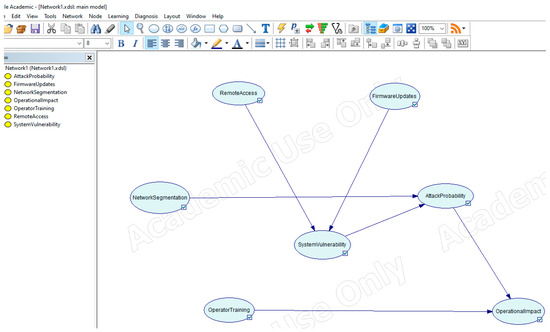
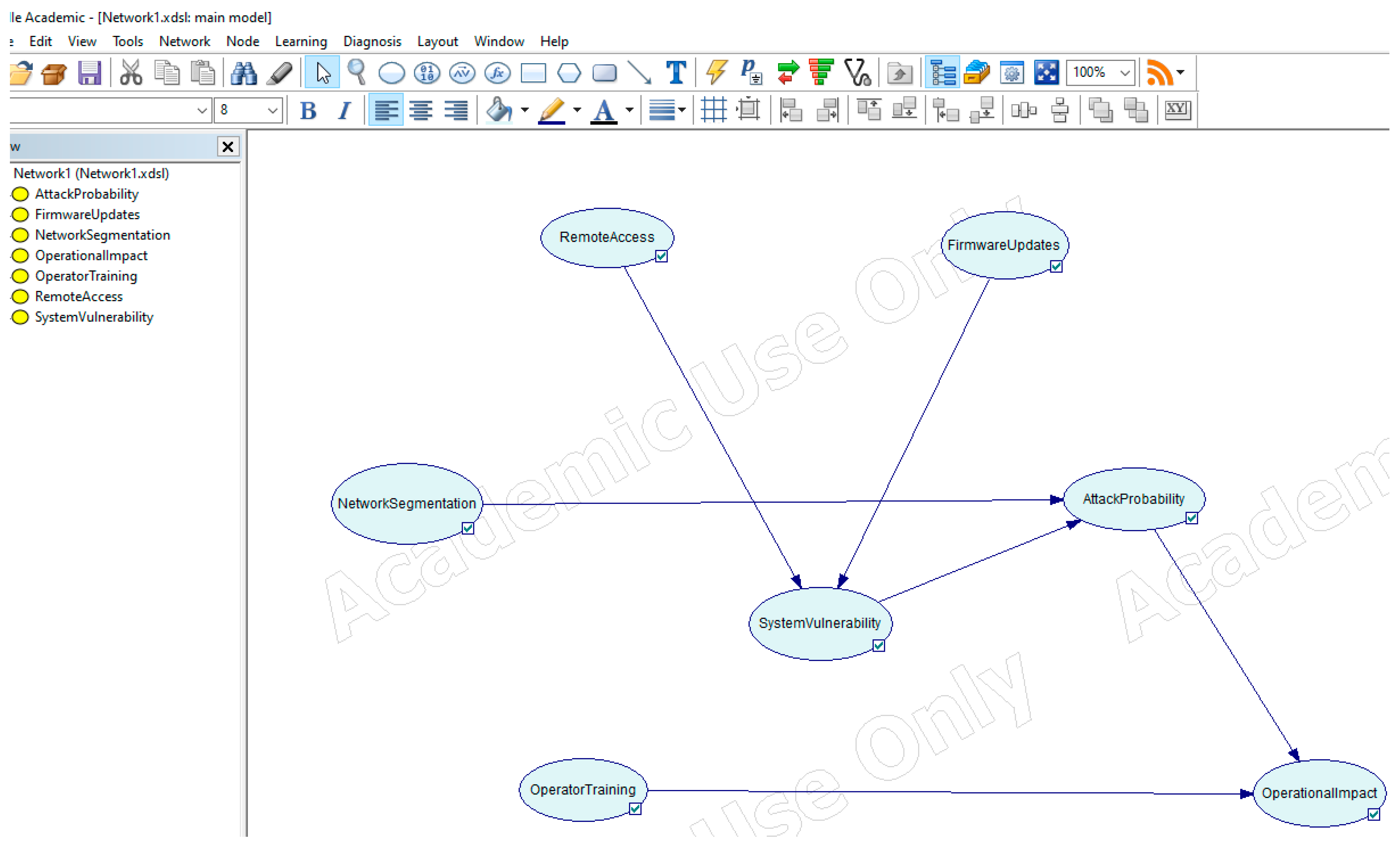
Sample of connecting can be seen in Figure 2:
Figure 2.
Modeling in GeNle Academic.
- Remote Access → System Vulnerability
- Firmware Updates → System Vulnerability
- Network Segmentation → Attack Probability
- System Vulnerability → Attack Probability
- Attack Probability → Operational Impact
- Operator Training → Operational Impact
3.3.2. Node Priors and Rationale
To ensure that the BN reflects realistic industrial conditions, prior probabilities were assigned to each root node based on expert elicitation, industry reports, and typical configurations observed in CNC environments. Table 7 summarizes the proposed values.
Table 7.
Prior probabilities for BN nodes in the MCG1000i scenario.
These values were entered into GeNle Academic via Definition → Table.
Relative frequency estimation was used for implementation, as described in Section 2.3.
3.3.3. Conditional Probability Tables (CPTs)
CPTs were constructed for the dependent nodes System Vulnerability, Attack Probability, and Operational Impact. Due to the sensitivity of industrial cybersecurity data, the CPTs are model-based but reflect realistic operational conditions. In practice, these tables can be recalculated automatically using machine logs, SIEM data, or vulnerability scanners. CPT for the System Vulnerability System Vulnerability depends on Remote Access and Firmware Updates in Table 8.
Table 8.
CPT for System Vulnerability.
Interpretation:
Active remote access + Irregular updates → highest vulnerability (0.85).
- Even with regular updates, remote access increases exposure (0.60).
Irregular updates alone create moderate vulnerability (0.40).
- The safest configuration is
Inactive access + Regular updates (0.10).
CPT for Attack Probability
Attack Probability depends on System Vulnerability and Network Segmentation in Table 9.
Table 9.
CPT for Attack Probability.
Interpretation:
- Highest attack probability (0.70) occurs when vulnerability is present and segmentation is absent.
- Segmentation reduces risk even when vulnerabilities exist.
- Low vulnerability + segmentation yields minimal attack probability (0.05).
CPT for Operational Impact
Operational Impact depends on Attack Probability and Operator Training in Table 10.
Table 10.
CPT estimates for Operational Impact.
Interpretation:
- Critical impact is highest (0.80) when attack probability is high and training is absent.
- Advanced training significantly reduces impact even under high risk.
- Low attack probability + advanced training yields minimal critical impact (0.05).
All CPT values were entered into GeNle Academic and used for inference.
3.4. Scenario Inference Results
- For the scenario defined in Section 3.3, the following evidence was entered: Remote Access—Active
- Firmware Updates—Irregular
- Network Segmentation—Absent
- Operator Training—Basic
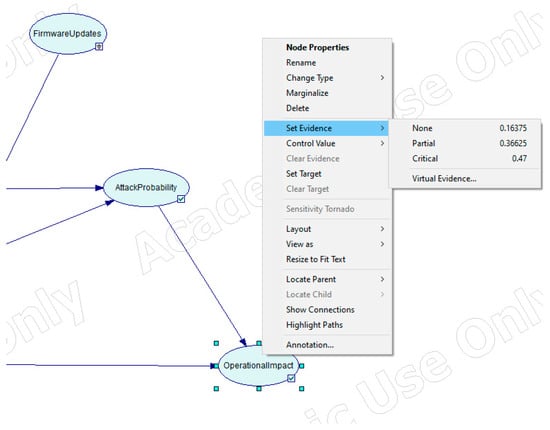
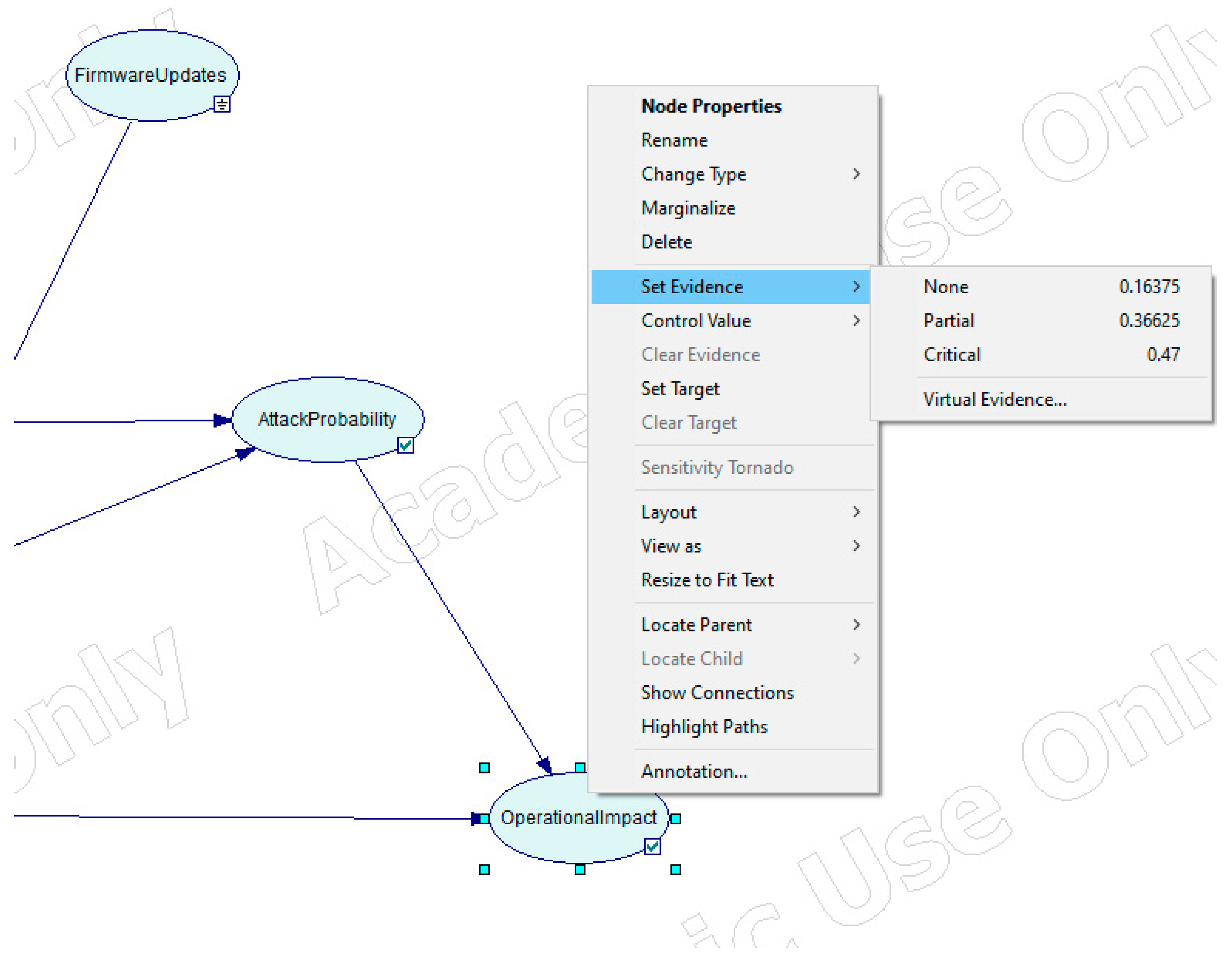
The BN computed the posterior probability of Operational Impact = Critical as: P (Critical/Evidence) = 0.47. This result is shown in Figure 3 (GeNIe Academic output). If software were not available, the same value could be computed manually using the CPTs provided above.
Figure 3.
Modeling in GeNle Academic – example of value calculation.
4. Results
4.1. Posterior Probability for the Evaluated Scenario
For the scenario defined in Section 3.3 (Remote Access = Active, Firmware Updates = Irregular, Network Segmentation = Absent, Operator Training = Basic), the Bayesian Network computed the posterior probability of P (Operational Impact = Critical) = 0.47.
This value indicates that under the evaluated configuration, nearly half of all plausible system states lead to a critical operational impact. The result reflects the combined influence of the parent nodes in the BN—specifically:
- Active remote access,
- irregular firmware updates,
- absence of network segmentation,
- and only basic operator training.
The posterior probability quantifies how these factors jointly elevate the risk level of the ZPS MCG1000i system.
4.2. Interaction Effects and Model Sensitivity
The results demonstrates that the BN is highly sensitive to the interaction of multiple control weaknesses. Although none of the individual factors may appear critical in isolation, their combination produces a substantial increase in the probability of a high-risk state.
This aligns with established ICS/OT cybersecurity knowledge, where:
- risk rarely emerges from a single weakness,
- but from the convergence of several suboptimal conditions,
- especially in environments lacking segmentation and patch management.
The BN therefore captures the non-linear nature of industrial cybersecurity risk, which traditional quantitative methods often fail to represent.
4.3. Numerical Stability and Model Robustness
The posterior value of 0.47 also demonstrates numerical stability of the model:
- the scenario consistently falls into the high-risk category,
- recommended mitigation measures remain justified,
- and small numerical variations reflect expected Bayesian updating behaviour.
This stability is consistent with the sensitivity analysis described in Section 2.8, where perturbations of ±10% and ±20% did not change the qualitative risk classification.
4.4. Implications for Risk Management and Compliance
The quantified result provides a defensible, data-driven argument for prioritizing mitigation measures in according with:
- ISO/IEC 27005:2022 (risk assessment and treatment),
- ISO/IEC 27001:2022 (controls for secure configuration and patching),
- NIS2 Directive (requirements for documented, transparent, and explainable risk management).
The BN output supports decision-making by:
- Translating technical configurations into measurable risk levels,
- enabling scenario-based evaluation of mitigation strategies,
- and providing explainable results suitable for human-machine interaction.
This strengthens the organization’s ability to understand how specific technical and organizational measures influence overall cybersecurity posture.
4.5. Practical Value for Industrial Environments
In practice, the 47% probability of critical impact:
- highlights the urgency of securing remote access,
- demonstrates the importance of regular firmware updates,
- confirms the protective effect of network segmentation,
- and shows how operator training reduces operational consequences.
The BN therefore serves as a transparent and auditable tool that helps companies:
- model different configurations,
- understand risk propagation,
- and implement targeted measures to reduce risk at all levels of the ICS/OT environment.
5. Discussion
The results demonstrate that Bayesian Networks (BNs) offer a transparent, structured, and quantitatively grounded approach to cybersecurity risk assessment in industrial environments. In the context of the ZPS MCG1000i machining centre, the BN model captured how multiple technical and organizational weaknesses interact to elevate overall system exposure. This finding is consistent with prior research on industrial control systems, which shows that risk rarely emerges from a single isolated vulnerability but rather from the convergence of several suboptimal conditions. The posterior probability of 0.47 for a critical operational impact confirms this pattern and illustrates how misconfigurations such as active remote access, irregular firmware updates, and absent network segmentation jointly amplify risk.
Compared with earlier BN-based studies, the present model contributes a more operationally grounded perspective by directly integrating ISO/IEC 27005:2022 risk-register elements into the BN structure. This strengthens the methodological link between established standards and probabilistic modelling. The CPTs developed for nodes such as System Vulnerability demonstrate how qualitative ISO categories can be transformed into measurable probability distributions, supporting reproducibility and auditability. This aligns with previous work advocating hybrid approaches that combine expert judgement, empirical evidence, and Bayesian inference to improve decision-making in industrial cybersecurity.
An important methodological aspect concerns the intentional simplicity of the BN structure. The network was designed with a limited number of nodes to ensure interpretability, transparency, and usability for operators, maintenance staff, and auditors. In safety-critical manufacturing environments, overly complex models can hinder adoption and reduce trust in automated decision support. The model therefore prioritizes explainability and human–machine interaction, which are explicit requirements of the NIS2 Directive and relevant human-factors principles. Although more complex enterprise-level BN architectures are possible, the present study focuses on a machine-level model to demonstrate the methodological workflow, CPT construction, and scenario-based validation. Future work will extend the BN architecture to multi-machine environments with richer datasets, enabling more detailed quantitative validation and supporting broader industrial applicability. The findings also highlight the importance of documenting and justifying prior assumptions. Small variations in Dirichlet priors or rounding conventions may slightly shift posterior values, but the overall risk classification remains stable. This reinforces the need for transparency and reproducibility in BN-based assessments, particularly when used to support compliance with ISO/IEC 27001:2022 and the NIS2 Directive. The ability to quantify how specific controls influence vulnerability and operational impact provides a defensible basis for prioritizing mitigation measures and strengthens audit readiness.
More broadly, the study illustrates how BNs can serve as a unifying analytical layer that integrates technical telemetry, expert knowledge, and regulatory requirements. As industrial systems become increasingly interconnected, probabilistic models offer a scalable way to capture complex dependencies and evaluate the effectiveness of security controls under uncertainty. This is particularly relevant for organizations seeking to align with modern regulatory frameworks such as NIS2 and the Cyber Resilience Act, which emphasize explainability, documentation, and continuous risk management.
Future research may expand this work by incorporating real operational data from CNC machines and production networks, enabling dynamic updating of CPTs and more accurate posterior inference. Integrating BN models with digital-twin environments could support real-time scenario simulation and predictive maintenance. Expanding the model to include supply-chain risks, human-factor variables, or cross-site dependencies would further enhance its applicability in large-scale industrial settings. Comparative studies using different BN tools or learning algorithms may also provide insights into how computational choices influence inference outcomes and model robustness.
Overall, the findings confirm that Bayesian Networks represent a powerful and adaptable methodology for industrial cybersecurity risk assessment, offering both theoretical rigor and practical relevance for organizations operating under modern standards and regulatory expectations.
6. Conclusions
This study extends traditional machinery-safety evaluation by incorporating cybersecurity risk modelling into the assessment of modern CNC systems. While existing methodologies focus primarily on physical safety measures, contemporary industrial environments increasingly rely on networked control systems, remote-access interfaces, and firmware-dependent functionality. These digital elements introduce new categories of risk that are explicitly addressed in Regulation (EU) 2024/2847, the NIS2 Directive, and ISO/IEC 27005:2022, yet remain insufficiently represented in conventional safety frameworks. The proposed Bayesian Network model provides a structured and transparent method for quantifying cybersecurity risks in CNC machines such as the ZPS MCG1000i. By integrating prior probabilities and conditional dependencies that reflect real operational configurations, the model generates interpretable posterior probabilities that support scenario-based decision-making. The results demonstrate that combined misconfigurations—such as active remote access, irregular firmware updates, and absent network segmentation—substantially increase the likelihood of critical operational impact. This probabilistic layer complements existing safety-evaluation methodologies and offers a reproducible, audit-ready approach aligned with ISO/IEC 27005:2022 and ISO/IEC 27001:2022.
By embedding cybersecurity into the machinery-safety evaluation process, the study provides production organizations with a future-proof methodology that reflects current regulatory expectations and the realities of cyber-physical manufacturing systems. The approach enhances transparency, supports compliance, and enables targeted mitigation strategies based on quantified risk levels. It also establishes a foundation for further research into dynamic Bayesian updating, digital-twin integration, and real-time monitoring of cyber-physical systems in industrial environments.
Author Contributions
Writing—original draft preparation, K.M.; visualization, K.M.; methodology, V.S. and T.M.; investigation, K.M., V.S. and P.B.; formal analysis, K.M. and T.M.; conceptualization, D.Z.; validation, V.S. and K.M.; writing—review and editing, P.B. and D.Z.; supervision, V.S. and K.M.; funding acquisition, P.B.; project administration, K.M. All authors have read and agreed to the published version of the manuscript.
Funding
These results were obtained with the financial support of the Faculty of Mechanical Engineering, Brno University of Technology Grant No. FSI-S-26-8999.
Data Availability Statement
Data are contained within the article.
Acknowledgments
This paper was created based on knowledge obtained within the project Machine Tools and Precision Engineering (MTPE), Reg. No. CZ.02.1.01/0.0/0.0/16_026/0008404 and for the support of the industrial partner TAJMAC ZPS, a.s. During the preparation of this manuscript, the authors used Copilot (OpenAI by Microsoft). The authors have reviewed and edited the output and take full responsibility for the content of this publication.
Conflicts of Interest
The authors declare no conflicts of interest. The funders had no role in the design of the study; in the collection, analyses, or interpretation of data; in the writing of the manuscript; or in the decision to publish the results.
Abbreviations
The following abbreviations are used in this manuscript:
| API | Application Programming Interface |
| BN | Bayesian networks |
| CNC | Computer Numerical Control |
| CPT | Conditional Probability Tables |
| CRA | Cyber Resilience Act |
| CSIRT | Computer Security Incident Response Team |
| CVE | Common Vulnerabilities and Exposures |
| HMI | Human-Machine Interface |
| ICS | Industrial Control Systems |
| IDS | Intrusion Detection System |
| IPS | Intrusion Prevention System |
| LAN | Local Area Network |
| MES | Manufacturing Execution System |
| MFA | Multi-Factor Authentication |
| MITM | Man-in-the-Middle |
| PDCA | Plan-Do-Check-Act |
| PLC | Programmable Logic Controller |
| SCADA | Supervisory Control and Data Acquisition |
| SoA | Statement of applicability |
| USB | Universal Serial Bus |
| VLAN | Virtual Local Area Network |
| VPN | Virtual Private Network |
References
- Maradova, K.; Blecha, P.; Blecha, R.; Rozehnalova, J.; Frkal, V. Issues of Cybersecurity of the Production System. MM Sci. J. 2022, 2022, 6156–6161. [Google Scholar] [CrossRef] [Scilit]
- Humayed, A.; Lin, J.; Li, F.; Luo, B. Cyber-Physical Systems Security—A Survey. IEEE Internet Things J. 2017, 4, 1802–1831. [Google Scholar] [CrossRef] [Scilit]
- Cherdantseva, Y.; Hilton, J. A Reference Model of Information Assurance & Security. In Proceedings of the 2013 International Conference on Availability, Reliability and Security, Regensburg, Germany, 2–6 September 2013; IEEE: New York, NY, USA, 2013; pp. 546–555. [Google Scholar] [CrossRef] [Scilit]
- Sommestad, T.; Ekstedt, M.; Holm, H. The Cyber Security Modeling Language: A Tool for Assessing the Vulnerability of Enterprise System Architectures. IEEE Syst. J. 2012, 7, 363–373. [Google Scholar] [CrossRef] [Scilit]
- Pačaiová, H.; Andrejiová, M.; Balažiková, M.; Tomašková, M.; Gazda, T.; Chomová, K.; Hijj, J.; Salaj, L. Methodology for Complex Efficiency Evaluation of Machinery Safety Measures in a Production Organization. Appl. Sci. 2021, 11, 453. [Google Scholar] [CrossRef] [Scilit]
- Lyu, X.; Ding, Y.; Yang, S.-H. Bayesian Network Based C2P Risk Assessment for Cyber-Physical Systems. IEEE Access 2020, 8, 88506–88517. [Google Scholar] [CrossRef] [Scilit]
- Fenton, N.; Neil, M. Risk Assessment and Decision Analysis with Bayesian Networks. In Risk Assessment and Decision Analysis with Bayesian Networks; Chapman and Hall/CRC: New York, NY, USA, 2018; pp. 1–660. ISBN 9781315269405. [Google Scholar]
- Sharma, D.K.; Mishra, J.; Singh, A.; Govil, R.; Srivastava, G.; Lin, J.C.-W. Explainable Artificial Intelligence for Cybersecurity. Comput. Electr. Eng. 2022, 103, 108356. [Google Scholar] [CrossRef] [Scilit]
- Liu, Y.; Man, H. Network Vulnerability Assessment Using Bayesian Networks. In Proceedings of SPIE, the International Society for Optical Engineering/Proceedings of SPIE 2005, Orlando, FL, USA, 28 March–1 April 2005; SPIE: Bellingham, WA, USA, 2005. [Google Scholar] [CrossRef] [Scilit]
- Jajodia, S.; Liu, P.; Swarup, V.; Wang, C. Cyber Situational Awareness: Issues and Research; Springer: Boston, MA, USA, 2009; ISBN 978-1-4419-0139-2. [Google Scholar]
- ISO/IEC 27005:2022; Information Security, Cybersecurity and Privacy Protection—Guidance on Managing Information Security Risks 2022. ISO: Geneva, Switzerland, 2022.
- Directive (Eu) 2022/2555 of the European Parliament and of the Council of 14 December 2022 on Measures for a High Common Level of Cybersecurity Across The Union, Amending Regulation (Eu) No 910/2014 and Directive (Eu) 2018/1972, and Repealing Directive (Eu) 2016/1148 (Nis 2 Directive) (Text with Eea Relevance). Off. J. Eur. Union 2022, 80–152. Available online: https://eur-lex.europa.eu/eli/dir/2022/2555/oj/eng (accessed on 14 November 2025).
- Bayesfusion, Llc. Genie Modeler: Graphical Tool for Probabilistic Modeling and Decision Making. Available online: https://download.bayesfusion.com/files.html?category=Academia#GeNIe (accessed on 14 November 2025).
- Cheimonidis, P.; Rantos, K. A Dynamic Risk Assessment and Mitigation Model. Appl. Sci. 2025, 15, 2171. [Google Scholar] [CrossRef] [Scilit]
- Chien, J.-T. The Shared Dirichlet Priors for Bayesian Language Modeling. In Proceedings of the 2015 IEEE International Conference on Acoustics, Speech and Signal Processing (ICASSP), South Brisbane, QLD, Australia, 19–24 April 2015; IEEE: New York, NY, USA, 2015; Volume 3, pp. 2081–2085. [Google Scholar] [CrossRef] [Scilit]
- Kenett, R.S. Bayesian Network Applications in Decision Support Systems. Mathematics 2025, 13, 3484. [Google Scholar] [CrossRef] [Scilit]
- ISO/IEC 27001:2022; Information Security, Cybersecurity and Privacy Protection—Information Security Management Systems—Requirements 2022. ISO: Geneva, Switzerland, 2022.
- Regulation (Eu) 2024/2847 of the European Parliament and of the Council Of 23 October 2024 on Horizontal Cybersecurity Requirements for Products with Digital Elements and Amending Regulations (Eu) No 168/2013 and (Eu) 2019/1020 and Directive (Eu) 2020/1828 (Cyber Resilience Act) (Text with Eea Relevance). Off. J. Eur. Union 2024. Available online: https://eur-lex.europa.eu/eli/reg/2024/2847/oj/eng (accessed on 14 November 2025).
- IEC 62443-3-3:2013; System Security Requirements and Security Levels 2013. IEC: Geneva, Switzerland, 2013.
- Security Advisory Ivanti Connect Secure and Policy Secure (Cve-2024-37404). Available online: https://forums.ivanti.com/s/article/Security-Advisory-Ivanti-Connect-Secure-and-Policy-Secure-CVE-2024-37404?language=en_US (accessed on 10 December 2025).
- The Eu Cyber Resilience Act Guide. Available online: https://www.eucyberresilience.com/ (accessed on 10 December 2025).
- Tajmac-Zps. Product Brochure: Zps Mcg1000I Gantry-Type Machining Centre. Available online: https://www.tajmac-zps.cz/media/files/product/item/files-18/ZPS_MCG1000i_EN_082024.pdf (accessed on 14 November 2025).
- Zps Mcg1000I. Available online: https://www.tajmac-zps.cz/zps-mcg1000i-en (accessed on 25 November 2025).



Disclaimer/Publisher’s Note: The statements, opinions and data contained in all publications are solely those of the individual author(s) and contributor(s) and not of MDPI and/or the editor(s). MDPI and/or the editor(s) disclaim responsibility for any injury to people or property resulting from any ideas, methods, instructions or products referred to in the content. |
© 2026 by the authors. Licensee MDPI, Basel, Switzerland. This article is an open access article distributed under the terms and conditions of the Creative Commons Attribution (CC BY) license.