


Abstract
Human locomotion relies on a proximal–distal organization of joint mechanical work that adapts to task constraints, such as those imposed by inclined walking. In individuals with transtibial amputation, loss of the biological ankle disrupts this organization, leading to proximal alterations and inter-limb asymmetries. Active mechatronic prosthetic feet have been developed within a biomechanical biomimicry framework to restore distal positive mechanical work. This exploratory study quantified the effects of an active mechatronic prosthetic foot on joint mechanical work during inclined walking. Four individuals with transtibial amputation performed instrumented treadmill walking at −3°, 0°, and +3° using their habitual passive foot and a powered foot. Positive and negative mechanical work at the ankle, knee, and hip were computed using inverse dynamics and compared with a normative reference database (n = 20). The powered foot induced modest, task-dependent modifications, mainly at the ankle and knee. In downhill walking, it promoted a more symmetrical redistribution of negative mechanical work, particularly at the knee, suggesting a partial reduction in contralateral overload. In uphill walking, distal assistance increased prosthetic-side positive work, reflecting slope-dependent reallocation rather than normalization. Although a multivariate deviation score indicated reduced deviation under the powered condition, full convergence toward the asymptomatic organization was not achieved.
1. Introduction
Human locomotion relies on a close interaction between the distribution of joint mechanical work and energy expenditure. Positive mechanical work, primarily generated at the ankle and, to a lesser extent, at the hip, contributes to propulsion and forward progression of the center of mass [1]. In contrast, negative mechanical work, mainly produced at the knee and ankle, enables the absorption of mechanical constraints and the regulation of locomotor dynamics [1]. This joint-level organization adapts to task-specific constraints. During inclined walking, the relative contributions of the lower-limb joints are reorganized: during uphill walking, the increase in positive mechanical work is mainly supported by the ankle and hip, whereas during downhill walking, negative mechanical work increases predominantly at the knee, reflecting its central role in energy absorption [2,3]. Although negative mechanical work plays an essential role in stabilization and movement control, increases in negative work have been associated with higher global metabolic demands during mechanically demanding locomotion [4].
In individuals with transtibial amputation, the loss of the biological ankle profoundly alters the proximal–distal gradient of joint mechanical work during walking. Non-motorized prosthetic feet, based on passive restitution of energy stored during structural deformation (notably carbon-based components), generate little positive mechanical work and primarily contribute during propulsion [5,6]. This distal limitation alters mechanical work contributions at proximal joints and modifies the contralateral limb’s contribution to center-of-mass progression and stability [7,8,9]. The proximal–distal gradient here refers to the relative contribution of lower-limb joints to the production and absorption of mechanical work [10,11]. In transtibial amputees, disruption of this contribution is associated with reduced gait automaticity, suggesting increased reliance on voluntary motor control [12]. These locomotor and postural adaptations result in persistent asymmetries [13], increased energetic cost [14], and, in the long term, a higher degenerative risk for the contralateral limb, including an increased risk of knee osteoarthritis and joint overloading phenomena [15,16].
In this context, the development of lower-limb prostheses increasingly follows a biomechanical biomimicry approach, defined as a bio-inspired strategy aimed at reproducing the mechanical and functional properties of the replaced biological limb, particularly in terms of structure, actuation, and control, rather than its formal appearance [17]. Applied to prosthetics, biomechanical biomimicry relies on reproducing key relationships between joint structure and functional anatomy, including the proximal–distal distribution of joint mechanical work and intersegmental coordination [18,19]. Recent innovations in prosthetic design have led to the development of active mechatronic prosthetic feet that integrate motorized assistance and electronic control systems, aiming to recreate biomechanically meaningful distal positive mechanical work during push-off [20,21]. The use of such devices has been associated with reported improvements in walking speed, inter-limb symmetry, and perceived effort [2]. However, observed effects remain heterogeneous across prosthetic devices and depend on the user’s experience with the system [22]. This variability is partly related to the adaptive control strategies embedded in mechatronic devices, which modulate their mechanical behavior in response to environmental constraints [23,24]. While several studies have quantified joint-level mechanical changes induced by powered prostheses during level and inclined walking, most have focused on isolated joint outputs or metabolic outcomes rather than on the global proximal–distal organization of joint mechanical work relative to an asymptomatic reference pattern.
Within this framework, inclined walking is a particularly relevant experimental model for investigating the biomechanical biomimicry of lower-limb prostheses. Changes in inclination impose a locomotor constraint that modifies the distribution of mechanical work among the ankle, knee, and hip joints [3,5]. By increasing the mechanical demands of the task, inclined walking tends to amplify differences between prosthetic devices, particularly by highlighting the limitations of passive feet under constrained conditions and the specific mechanical contribution of active prosthetic systems [15,25]. In this context, the increase in joint negative mechanical work, identified as a major determinant of energetic demand during constrained locomotion [4], remains insufficiently characterized in individuals with transtibial amputation, and direct comparisons between mechanical and mechatronic prosthetic feet remain scarce [7]. Furthermore, the extent to which powered distal assistance restores, or reduces deviation from the proximal–distal organization of joint mechanical work observed in asymptomatic individuals has not been explicitly operationalized or quantitatively examined.
Accordingly, the primary objective of this study was to quantify the effect of an active prosthetic foot on joint mechanical work in individuals with transtibial amputation. To this end, we conducted a comparative analysis of joint contributions from the prosthetic limb, the contralateral limb, and an asymptomatic reference group used as a physiological biomechanical benchmark during inclined walking. Rather than assuming that an increase in distal positive mechanical work necessarily reflects biomimetic restoration, we sought to examine whether distal assistance was associated with a redistribution of joint mechanical work and with a potential reduction in deviation from an asymptomatic proximal–distal organization. We hypothesized that distal positive mechanical assistance might modify the distribution of joint mechanical work during inclined walking and could be associated with greater proximity to the organization observed in asymptomatic individuals, as well as with a reduction in inter-limb asymmetries.
2. Materials and Methods
2.1. Study Design and Participants
This monocentric observational study is based on a secondary analysis of instrumented gait analysis data collected between January 2024 and July 2025 at the Movement Analysis Laboratory of the Nîmes University Hospital. The study was designed as an exploratory case series aiming to characterize biomechanical adaptations under different prosthetic conditions rather than to provide inferential generalization. The study received approval from the institutional ethics committee. The protocol was registered on ClinicalTrials.gov (NCT06415955). Inclusion criteria were: (i) unilateral transtibial amputation, (ii) ability to walk without assistive devices on level ground and on slopes, including inclinations of +3° and −3° corresponding to French accessibility standards for persons with reduced mobility, and (iii) regulatory eligibility for a trial of a mechatronic prosthetic foot within an insurance-based expert assessment framework. Four participants meeting these criteria were included. Given the small sample size (n = 4) and the individualized nature of prosthetic prescriptions, participants used different habitual passive prosthetic feet prior to testing. This heterogeneity reflects real-world clinical practice and was not experimentally controlled. Consequently, all analyses were interpreted descriptively at the individual and condition levels.
2.2. Prosthetic Equipment: Passive Versus Active
Evaluations were conducted as part of a prescribed comparative clinical instrumented gait analysis, embedded in a functional assessment process preceding a potential insurance reimbursement decision, within the framework of the French national health insurance clinical evaluation procedure required prior to approval of powered prosthetic devices. This comparative analysis aimed to assess the functional performance of a mechatronic prosthetic foot relative to the participant’s habitual passive prosthetic foot.
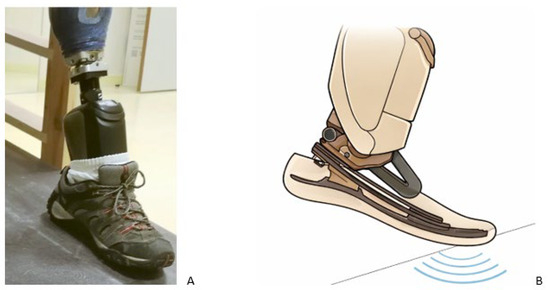
Participants were evaluated under two conditions: (i) with their usual prosthesis equipped with a non-motorized prosthetic foot, and (ii) with an active mechatronic prosthetic foot, the Empower® (Ottobock, Duderstadt, Germany), with the entire prosthetic setup kept identical except for the foot component (Figure 1). This device incorporates an articulated, motorized ankle enabling the active generation of positive mechanical work during terminal stance [26,27,28]. The Empower® foot operates through a microprocessor-controlled architecture with adaptive control features, including automatic slope detection and adjustment of ankle behavior according to walking conditions. The slope-adaptive function was enabled in its default manufacturer configuration, and no modification of firmware or control strategy was performed for the purposes of this study.
Figure 1.
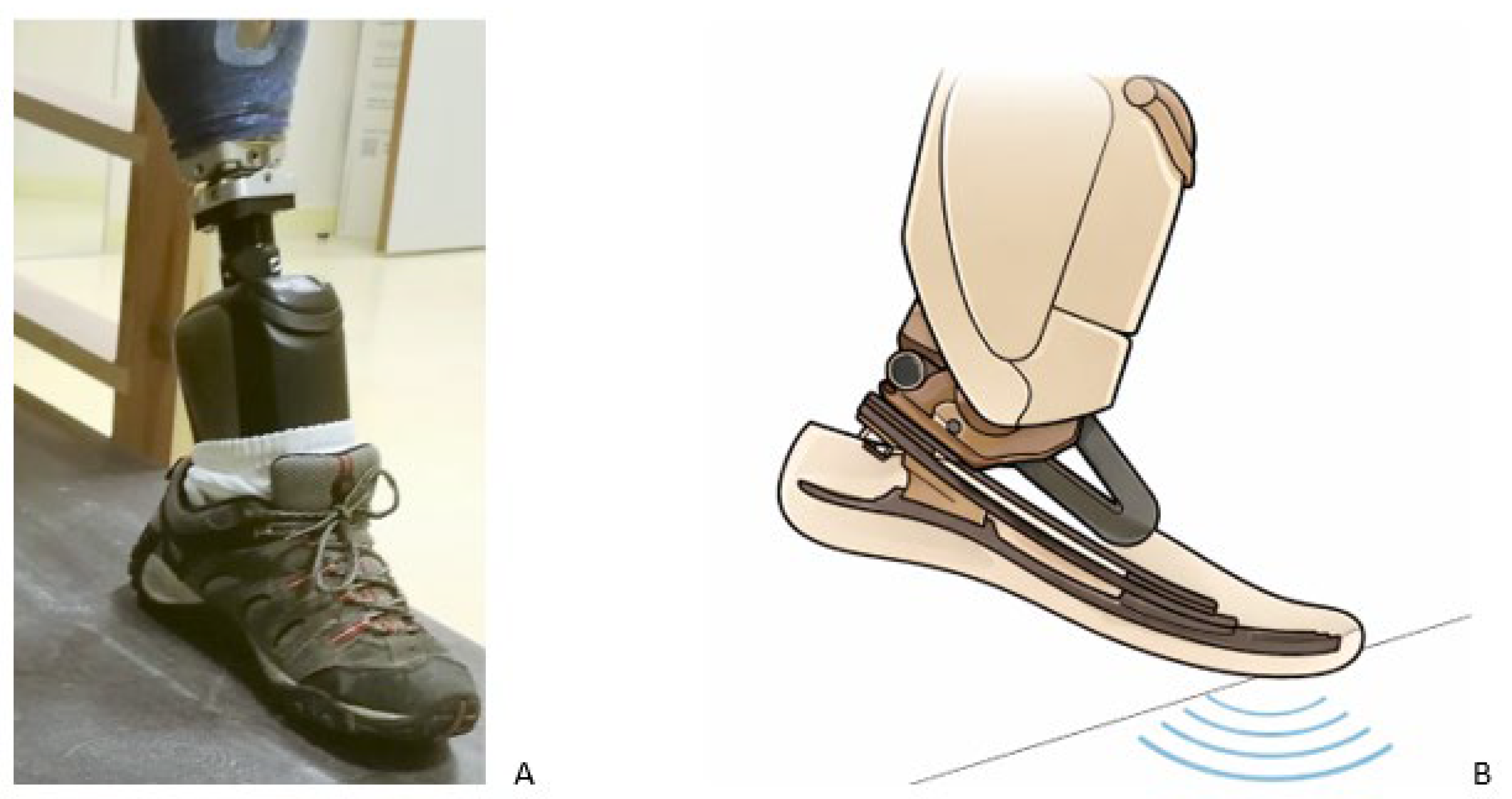
Empower powered prosthetic foot (A) The Empower powered prosthetic foot during uphill walking in a transtibial amputee. (B) Conceptual schematic illustrating distal mechanical work generation and absorption associated with the Empower foot during inclined walking.
Participants completed a minimum four-week accommodation period with the mechatronic foot prior to the instrumented evaluation in order to limit novelty and learning effects [26,29]. During this period, the mechatronic foot directly replaced the participant’s habitual prosthetic foot in daily life. Participants were encouraged to use the device under usual ecological conditions, with a typical daily wearing time ranging between 8 and 12 h. Prosthetic alignment and functional settings (including push-off behavior) were optimized by a certified orthoprosthetist at fitting and adjusted as clinically required during the accommodation phase to ensure comfort, safety, and optimal functional performance. These adjustments were performed according to routine clinical criteria and were not standardized experimentally across participants. No specific experimental training protocol aimed at maximizing push-off exploitation was implemented.
To ensure that observed differences were not attributable to alignment variations, prosthetic alignment was systematically verified in each condition in accordance with established clinical recommendations [30,31,32]. Alignment was considered acceptable when the axial-plane distance between the ground reaction force vector and the joint centers of the hip, knee, and mid-foot remained below 2 cm.
2.3. Instrumented Prosthetic Gait Assessment
The biomechanical assessment of prosthetic gait was conducted on an instrumented treadmill within an immersive virtual environment (GRAIL system, Motek Medical, Amsterdam, The Netherlands), allowing controlled locomotor conditions with different treadmill inclinations. Preferred walking speed was determined from two overground trials performed at self-selected speed on a 12 m instrumented walkway (5 m recording zone, 100 Hz; Zebris Medical GmbH, Isny, Germany). The treadmill walking speed was defined as the mean of these two measurements [33].
Assessments on the GRAIL system comprised a total of 9 min of effective walking and included four standardized conditions: a familiarization phase (0°, 3 min), level walking (0°, 2 min), uphill walking (+3°, 2 min), and downhill walking (−3°, 2 min). Each condition was separated by a 2-min rest period. The ±3° inclinations were selected to represent moderate environmental constraints consistent with accessibility standards and commonly encountered real-world slopes, while remaining compatible with safe treadmill-based assessment. For each condition, one minute of steady-state walking was retained for quantitative analysis, while transition phases were excluded. Gait events (initial contact and toe-off) were identified using vertical ground reaction force thresholds obtained from the instrumented treadmill. Joint mechanical work was computed over the stance phase only, defined from initial contact to toe-off.
Data from an asymptomatic reference group were obtained from the laboratory’s normative database (n = 20). The reference dataset consisted of healthy adults assessed using the same laboratory setup, acquisition system, and processing pipeline, allowing direct biomechanical comparison.
2.4. Biomechanical Data Acquisition and Processing
Motion capture was performed using an optoelectronic system (10 cameras, 100 Hz; Vicon, Oxford, UK), with 26 reflective markers positioned according to the Human Body Model 2 (HBM2) [34]. The HBM implemented within the D-Flow environment (Motek Medical) represents the body as a system of rigid segments connected by anatomical joints, with inertial parameters estimated from anthropometric regression equations. The 26-marker set defined the trunk, pelvis, thigh, shank, and foot segments bilaterally, allowing computation of ankle, knee, and hip joint kinematics and kinetics. The treadmill-integrated force platforms simultaneously recorded three-dimensional ground reaction forces and associated moments. Analyzed parameters included spatiotemporal gait variables, joint kinematics (ankle, knee, hip, pelvis), and joint kinetics (moments and powers).
Joint powers were computed using inverse dynamics based on the HBM2 model as the product of internal joint moments and the corresponding angular velocities in the sagittal plane. Only internal sagittal-plane joint moments and powers at the ankle, knee, and hip were retained for mechanical work analysis. Joint moments therefore represent net mechanical effects at the joint level and do not isolate biological muscle torque or actuator-generated motor torque in the powered prosthetic foot. Mechanical work was computed over the stance phase only, as defined from initial contact to toe-off using vertical ground reaction force thresholds. Positive and negative work were computed as the time integral of the positive and negative portions of the joint power curve, respectively.
Total lower-limb mechanical work was calculated as the sum of ankle, knee, and hip contributions [11,35]. No direct access to internal motor torque or power data from the powered prosthesis was available; consequently, ankle mechanical work reflects the global joint-level mechanical output derived from inverse dynamics rather than the intrinsic actuator contribution of the device.
2.5. Statistical Analysis
Descriptive statistics were used to summarize sociodemographic, clinical, and prosthetic characteristics (Table 1). For mechanical work computation, all valid gait cycles were retained to enhance within-subject robustness. Mechanical work was calculated by integrating joint power over the stance phase (initial contact to toe-off). The effects of prosthetic foot type (MECA vs. CPU), slope, and side (prosthetic vs. contralateral) on joint mechanical work were examined using linear mixed-effects models, applied exclusively to data from participants with amputation. Prosthetic foot type and side were treated as fixed effects. Slope was treated as an ordinal predictor coded −3, 0, and +3 to summarize monotonic trends across inclination levels. Given the exploratory nature of the study and the limited sample size, this approach allowed estimation of global inclination-related tendencies without increasing model complexity. Interaction terms between slope and prosthetic foot type were explored descriptively to identify potential condition-specific effects. A random intercept for each participant was included to account for repeated measures. Given the exploratory nature (n = 4), mixed-model outputs were used descriptively to estimate effect direction and magnitude. Emphasis was placed on β estimates, 95% confidence intervals, and individual-level patterns.
Table 1.
Characteristics of unilateral transtibial subjects (TT) and the healthy group (H). TR: Traumatic.
2.5.1. Quantification of Deviation from Asymptomatic Reference (Biomimicry Index)
To quantify the convergence toward an asymptomatic proximal–distal redistribution of joint work, a Work Deviation Score was calculated [36]. Following the Gait Profile Score framework, this score represents the Z-score normalized Euclidean distance between each participant’s multivariate work profile and the normative reference distribution [36]. For each experimental condition, a 6-dimensional mechanical work vector was defined (p = 6), including positive and negative mechanical work at the ankle, knee, and hip (3 joints × 2 variables). Net mechanical work was not included in the WDS computation, as it represents the algebraic combination of positive and negative components and would therefore introduce redundancy in the multivariate distance calculation:
For each variable i, a z-score was computed relative to the asymptomatic reference group:
where μref,i and σref,i represent the mean and standard deviation of the corresponding variable in the normative database (n = 20).
A work deviation score (WDS) was then computed as the root mean square of the six deviations:
Lower values of WDS indicate greater proximity to the asymptomatic reference organization of joint mechanical work. Because WDS is expressed in standardized units (Z-scores), its magnitude can be directly interpreted relative to normative variability. A WDS value of 0 indicates perfect correspondence with the reference mean, whereas a value of 1 indicates that the participant’s multivariate work profile deviates by one standard deviation from the asymptomatic distribution. This interpretation is conceptually consistent with the Gait Deviation Index (GDI), where gait deviation is also expressed relative to normative standard deviations [37]. Importantly, the WDS itself represents the root mean square of six standardized mechanical work variables (positive and negative work at the ankle, knee, and hip), thereby providing a cumulative multivariate distance that captures the overall proximal–distal organization of joint mechanical work. The WDS was used descriptively to compare passive and mechatronic conditions within each participant and slope condition [36]. To provide an aggregate summary per prosthetic condition and limb side, we computed a root mean square (RMS) value of WDS across slope levels (−3°, 0°, +3°). This second-level RMS summarizes deviation across locomotor constraints while preserving the standardized distance interpretation. Lower RMS-WDS values indicate lower overall deviation across the tested inclinations.
2.5.2. Principal Component Analysis
The asymptomatic group was not included in inferential analyses but was used as a biomechanical reference in an exploratory multivariate analysis based on principal component analysis (PCA). The PCA was performed using positive, negative, and net joint mechanical work at the ankle, knee, and hip (9 variables), centered and scaled prior to analysis. Unlike the WDS, which relied on a 6-dimensional representation (positive and negative work only), the PCA included net mechanical work in order to explore global patterns of joint-level mechanical organization without constraining dimensionality a priori. Variable loadings, percentage of variance explained by each principal component, and individual participant projections were explicitly examined to facilitate interpretation. Individual data points were retained in graphical representations to avoid over-reliance on barycentric projections.
Sociodemographic and experimental variables (slope, group, and side) were introduced as supplementary qualitative variables and projected a posteriori onto the PCA factor space. The modalities of these qualitative variables were represented by the barycenter of the corresponding individuals, allowing a descriptive interpretation of their relative position with respect to the main axes of variability. This representation was used solely as a visualization tool to explore global trends and biomechanical proximities between experimental conditions, without inferential intent. PCA results were primarily interpreted based on variable contributions to the principal components and the geometric proximity between individuals, variables, and projected qualitative modalities.
3. Results
3.1. Participant Characteristics
Four participants with unilateral transtibial amputation were included in the analysis. The demographic, clinical, and prosthetic characteristics of the amputee participants, as well as those of the asymptomatic reference group drawn from the laboratory’s normative database (n = 20), are presented in Table 1.
3.2. Global Lower-Limb Mechanical Work
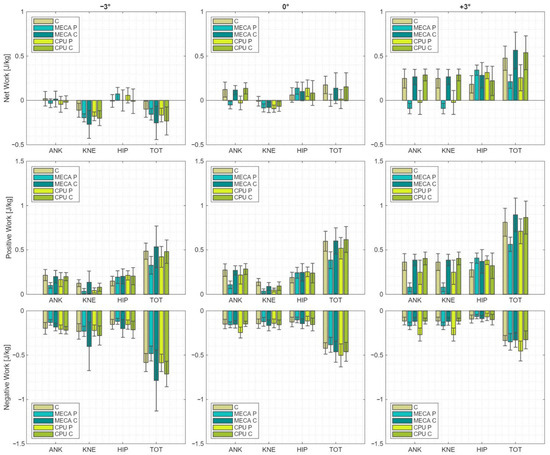
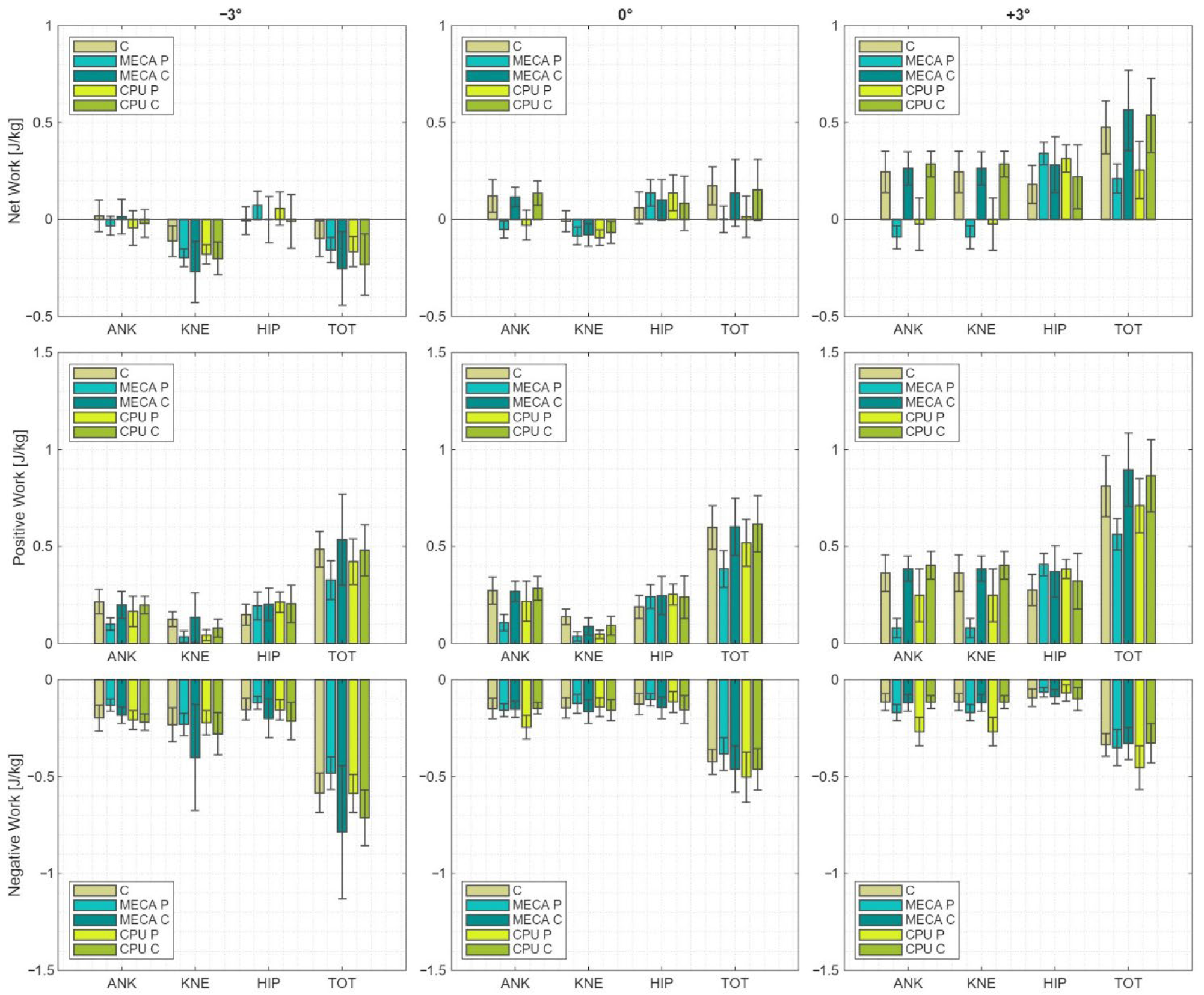
Linear mixed-effects model estimates for total lower-limb mechanical work are presented in Table 2, and joint-level distributions are illustrated in Figure 2.
Table 2.
Effects of prosthetic foot type, side, and slope on joint and total mechanical work. Linear mixed-effects model estimates for joint and total mechanical work (J·kg−1·cycle−1). Values are fixed-effect estimates with 95% confidence intervals.
Figure 2.
Redistribution of lower-limb joint mechanical work according to slope and prosthetic foot type.
Slope showed directional associations with total mechanical work. Increasing inclination was associated with a tendency toward higher total net mechanical work (β = +0.099, 95% CI [0.005; 0.193]), total positive mechanical work (β = +0.053, 95% CI [0.001; 0.105]), and lower total negative mechanical work (β = −0.046, 95% CI [−0.090; −0.002]) (Table 2). Regarding prosthetic foot type, model estimates under the powered condition (CPU) suggested small shifts, including a slight increase in total net work (β = +0.005, 95% CI [0.000; 0.010]) and total negative work (β = +0.021, 95% CI [0.001; 0.041]), whereas total positive work showed only a modest shift (β = +0.026, 95% CI [−0.001; 0.053]). Side-related differences were reflected in the model estimates, indicating variation in total mechanical work between the prosthetic and contralateral limbs. The prosthetic limb showed lower estimated total net work (β = −0.062, 95% CI [−0.124; 0.000]), positive work (β = −0.089, 95% CI [−0.176; −0.002]), and total negative work (β = −0.027, 95% CI [−0.054; −0.000]) compared with the contralateral limb (Table 2).
As illustrated in Figure 2, slope was associated with visible patterns of redistribution of joint mechanical work across ankle, knee, and hip contributions. Uphill walking (+3°) was characterized by relatively greater positive work, whereas downhill walking (−3°) showed relatively greater negative work, particularly at the knee. In comparison, differences between prosthetic foot conditions were smaller in magnitude across most joints.
3.3. Joint-Level Mechanical Work Redistribution
3.3.1. Ankle Joint
At the ankle, model estimates indicated an association between slope and net mechanical work (β = +0.022, 95% CI [0.002; 0.042]) (Table 2), with higher positive work during uphill walking and greater negative work during downhill walking (Figure 2). Under the powered condition, estimates suggested a modest positive shift in distal positive mechanical work (β = +0.028, 95% CI [0.000; 0.063]), accompanied by a small increase in net work (β = +0.007, 95% CI [0.000; 0.014]). Negative ankle work showed a slight numerical increase under CPU (β = +0.024, 95% CI [−0.004; 0.052]). These patterns are illustrated in Figure 2; notably, in the +3° condition, the CPU tended to show higher ankle positive work compared to MECA. Side-related estimates indicated lower net ankle work on the prosthetic limb (β = −0.089, 95% CI [−0.178; 0.000]).
3.3.2. Knee Joint
At the knee, slope was associated with variation in net work (β = +0.034, 95% CI [−0.002; 0.070]) and negative work (β = −0.028, 95% CI [−0.056; 0.000]) (Table 2), reflecting increased energy absorption during downhill walking (Figure 2). The powered condition was associated with a small estimated decrease in negative knee work (β = −0.011, 95% CI [−0.022; 0.000]), whereas changes in net and positive work remained limited. Side-related differences were reflected in lower negative work on the prosthetic side (β = −0.024, 95% CI [−0.048; 0.000]). Overall, knee-level patterns appeared more strongly related to slope than to prosthetic foot type.
3.3.3. Hip Joint
At the hip, slope was associated with variation in net (β = +0.043, 95% CI [0.012; 0.073]), positive (β = +0.028, 95% CI [0.002; 0.054]), and negative work (β = −0.015, 95% CI [−0.029; 0.000]) (Table 2). The powered condition was associated with small estimated reductions in hip net work (β = −0.011, 95% CI [−0.022; −0.002]) and positive work (β = −0.004, 95% CI [−0.008; −0.000]). Side-related estimates suggested higher hip net and positive work on the prosthetic limb compared with the contralateral side. Figure 2 indicates that slope-related changes were more pronounced than differences related to prosthetic foot type.
3.4. Deviation from Asymptomatic Reference (Work Deviation Score)
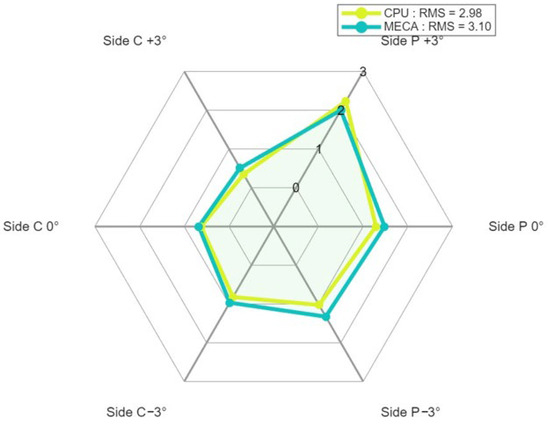
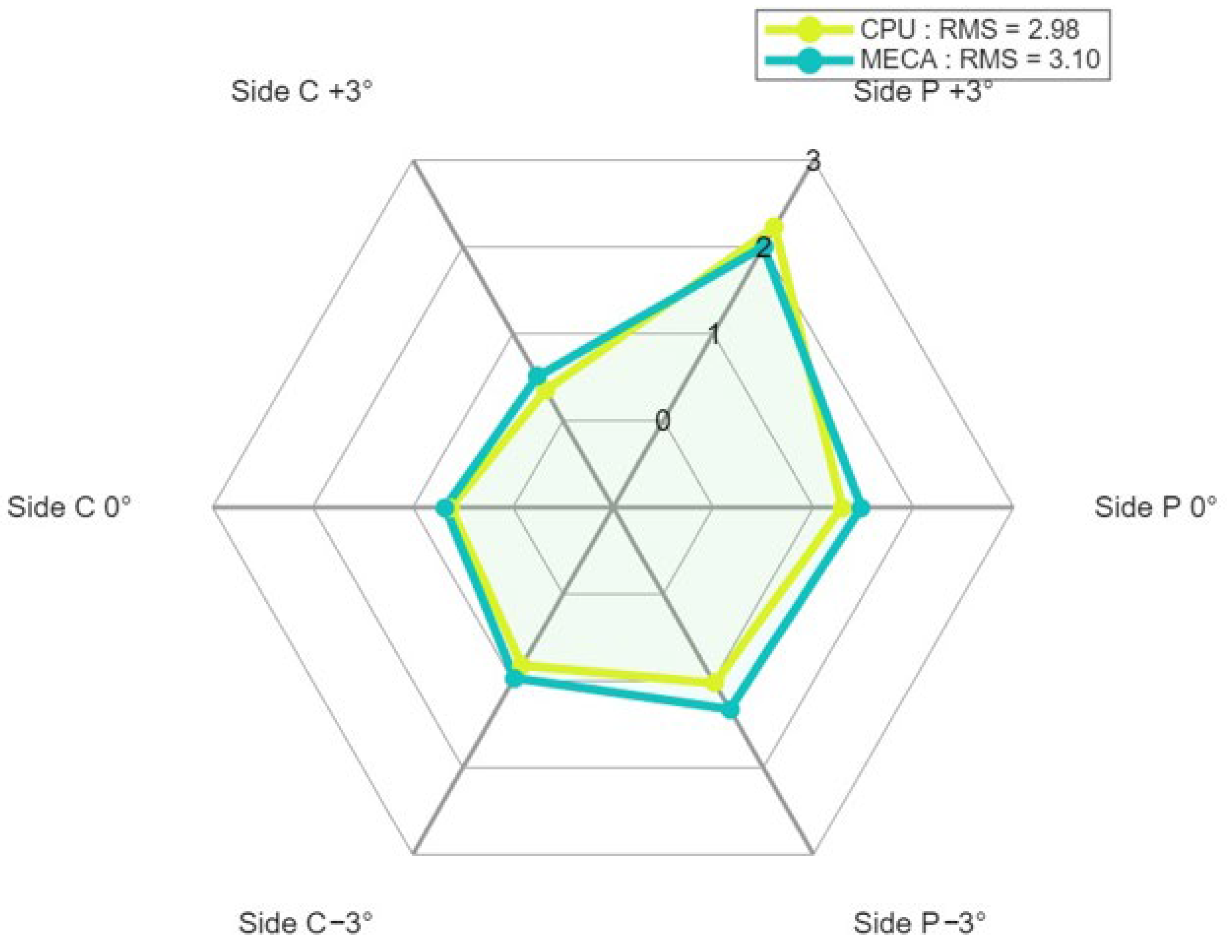
The Work Deviation Score (WDS) quantified the multivariate distance between each experimental condition and the asymptomatic reference organization. Across slope and side configurations, lower global deviation was observed under the powered condition compared with the mechanical condition (Figure 3). The RMS of WDS across slope levels (summed across sides) was lower under CPU (2.98) than under MECA (3.10). Although variability remained across individual configurations, the powered condition tended to exhibit smaller deviation profiles in most slope conditions.
Figure 3.
Work Deviation Score (WDS) across slope conditions for passive (MECA) and powered (CPU) prosthetic feet. The shaded area represents WDS across slope levels; the reported summary value corresponds to RMS across −3°, 0°, and +3°, and sides.
3.5. Principal Component Analysis
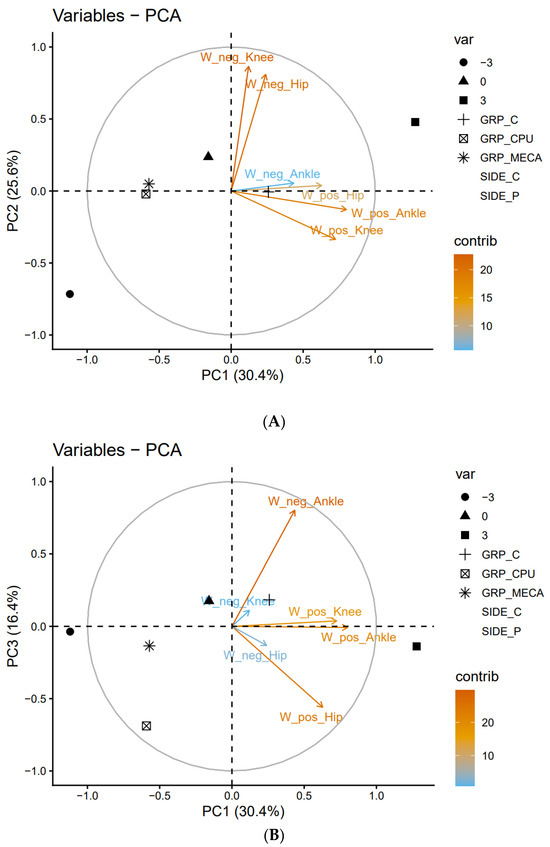
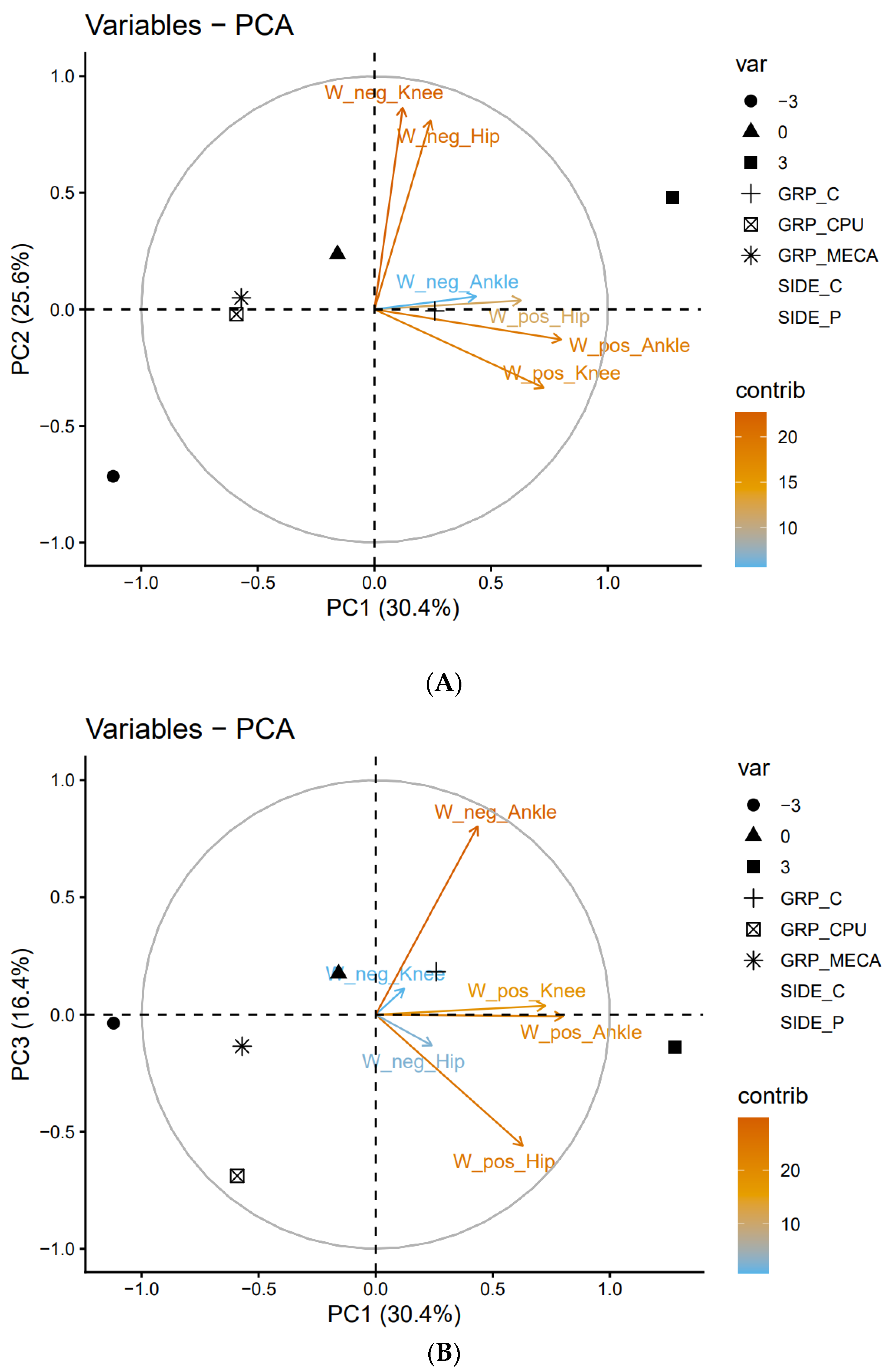
Principal component analysis (PCA) was performed using joint positive, negative, and net mechanical work variables at the ankle, knee, and hip. The first three principal components accounted for 72.5% of the total variance (Dim1: 30.4%, Dim2: 25.6%, Dim3: 16.4%) (Figure 4). Dim1 was primarily structured by positive mechanical work at the ankle, knee, and hip. Dim2 was mainly driven by proximal negative mechanical work, particularly at the knee and hip. Dim3 was predominantly associated with distal negative ankle work. Slope conditions were differentiated along Dim1: uphill walking (+3°) projected toward positive values, whereas downhill walking (−3°) projected toward negative values. Level walking (0°) occupied an intermediate position (Figure 4A).
Figure 4.
Principal component analysis (PCA) of joint mechanical work variables during inclined walking: (A) projection of experimental conditions and biomechanical variables on the first two principal components (PC1–PC2), and (B) projection on the first and third principal components (PC1–PC3), illustrating the respective contributions of positive and negative joint work at the ankle, knee, and hip, as well as the distribution of slope conditions, limb side, and prosthetic foot type within the multivariate mechanical work space. Dashed lines indicate the zero coordinates of the principal component axes (PC1 and PC3).
The asymptomatic group clustered near the origin of the factorial plane defined by the first two axes, without marked projection toward the poles associated with slope conditions or limb side. The prosthetic side projected toward a region characterized by lower positive mechanical work, whereas the contralateral side was located closer to the center of the factorial plane. Prosthetic foot type did not emerge as a major structuring factor on the first two PCA axes. In contrast, along Dim3 (Figure 4B), the mechanical condition projected toward higher distal negative ankle work, while the powered condition was located on the opposite side of this axis.
4. Discussion
This exploratory study aimed to examine changes in joint mechanical work during inclined walking in individuals with transtibial amputation by comparing the use of an active mechatronic prosthetic foot with their habitual passive mechanical foot. The main findings show that the use of an active mechatronic foot was associated with modest modifications in joint mechanical work, primarily at the ankle and, to a lesser extent, at the knee. When quantified using the Work Deviation Score (WDS), active distal assistance was associated with a reduction in multivariate deviation from the asymptomatic reference organization, although complete convergence was not observed. The results also highlight a persistent inter-limb asymmetry, with the prosthetic limb remaining biomechanically distinct from the contralateral limb despite the powered condition. Finally, variations related to terrain inclination appear to be the primary determinant of joint mechanical work organization, irrespective of the prosthetic condition.
These observations suggest limits in the extent to which active mechatronic devices can reproduce a proximal–distal organization fully comparable to asymptomatic locomotion, particularly under mechanically demanding locomotor conditions such as inclined walking. From a biomechanical biomimicry perspective, the challenge is not limited to restoring internal force production, but rather to assessing the extent to which the proximal–distal distribution of joint mechanical work approaches that observed in asymptomatic individuals. In asymptomatic locomotion, the ankle accounts for most of the positive mechanical work, whereas the knee and hip contribute predominantly to negative mechanical work throughout the gait cycle [10,35]. This proximal–distal distribution of joint mechanical work is highly reproducible and reflects a robust organization of human locomotion [11]. In individuals with transtibial amputation, the loss of the biological ankle alters this distribution, with a reduction in distal positive mechanical work and, when mechanical demands increase, different proximal joint contributions, primarily at the knee and, to a lesser extent, at the hip [7,38]. In the present study, the use of an active mechatronic foot induced modifications in joint mechanical work, mainly at the ankle and knee, without significant changes at the hip. These results indicate that active distal assistance alters the contribution of mechanical work across joints. However, despite a measurable reduction in multivariate deviation (WDS), the overall proximal–distal organization remained distinct from the asymptomatic reference pattern. Importantly, these modifications do not solely concern the distribution of mechanical work among joints within the same lower limb. Marked differences were also observed between the prosthetic limb and the contralateral limb. In this context, an analysis limited to a single joint or a single lower limb does not adequately capture the organization observed during prosthetic walking. Moreover, these findings underscore that biomechanical similarity to asymptomatic reference data cannot be assessed solely at the joint level, but must also account for the lateral distribution of mechanical work between the prosthetic and contralateral limbs.
Beyond the proximal–distal distribution of joint mechanical work, biomechanical biomimicry must also be examined at the level of laterality, that is, the ability of the device to reduce asymmetry between the mechanical work organization of the prosthetic limb and that of the contralateral limb, and to situate it relative to a reference organization derived from asymptomatic individuals. In the present study, principal component analysis revealed a persistent lateral asymmetry. The prosthetic limb systematically projected toward lower values of positive mechanical work, whereas the contralateral limb occupied a more central position in the factor space, close to that of asymptomatic reference data. Thus, despite the observed distal mechanical work modifications, the global structure of lateral asymmetry remained unchanged within the factor space. The powered condition was not associated with clear inter-limb symmetrization in this exploratory sample. The persistence of a positive mechanical work deficit on the prosthetic side [38,39], combined with increased contribution of the contralateral limb [7,40], is consistent with the kinetic asymmetries consistently reported following transtibial amputation, regardless of prosthetic foot type [41]. These findings indicate that active distal assistance, although associated with ankle mechanical work modifications, is insufficient to correct inter-limb asymmetries related to the loss of the biological ankle [42]. Task-related mechanical demands thus appear to act as both an amplifier and a revealer of these asymmetries by imposing specific requirements on joint mechanical work contribution.
Analysis of results related to the effect of slope demonstrates that inclined walking modifies both the distribution and proximal–distal organization of joint mechanical work in individuals with transtibial amputation. The increase in mechanical demands associated with terrain inclination does not solely result in changes in the magnitude of mechanical work, but also in modifications of its organization across lower-limb joints. In asymptomatic individuals, several studies have shown that inclined walking is accompanied by adaptations in the proximal–distal organization of joint mechanical work [11,43]. During uphill walking, increases in total positive mechanical work are mainly supported by the ankle and hip [5], whereas during downhill walking, increases in negative mechanical work predominantly involve the knee, reflecting its central role in energy absorption [2]. These findings are consistent with analyses of the laboratory normative database used here as a biomechanical biomimicry reference. In this context, evaluating an active mechatronic prosthetic foot during inclined walking allows assessment of its effect on the proximal–distal organization of joint mechanical work at the scale of the lower limb, rather than solely on distal mechanical work production. In the present study, despite distal ankle modifications, proximal–distal organization of joint mechanical work remained primarily determined by inclination. Consequently, increased distal positive mechanical work was not accompanied by a global reorganization of joint mechanical work comparable to asymptomatic reference data. This limitation became particularly evident when mechanical demands increased, notably during downhill walking, where elevated negative mechanical work during initial double support strongly engaged energy absorption mechanisms, primarily at the knee [44,45]. However, a more nuanced pattern emerged when considering multivariate deviation and inter-limb distribution. Under the powered condition, the increase in distal and knee-related negative mechanical work during downhill walking was accompanied by a more symmetrical inter-limb distribution compared with the mechanical condition. In contrast, the passive foot condition was associated with a more pronounced asymmetrization of knee negative work, particularly reflecting increased reliance on the contralateral limb. This was consistent with the WDS analysis, which showed lower deviation profiles under the powered condition in downhill walking. These findings suggest that convergence toward an asymptomatic organization during mechanically demanding conditions depends not only on the magnitude of distal mechanical input, but also on how this input modulates the lateral and proximal–distal distribution of negative mechanical work. Partial restoration of distal assistance, as observed under the powered condition, may therefore facilitate a redistribution of energy absorption demands across limbs, limiting excessive contralateral knee loading. Nevertheless, this reorganization remained incomplete, and the global proximal–distal structure did not fully converge toward the asymptomatic reference pattern. A distinct pattern was observed during uphill walking. In this condition, the powered foot was associated with a more pronounced distal contribution on the prosthetic side, suggesting a task-dependent reallocation of positive mechanical work. Rather than reflecting a simple normalization toward asymptomatic values, this pattern indicates a reconfiguration of the proximal–distal organization under increased propulsive demands, highlighting that active distal assistance may modify mechanical coordination differently depending on slope direction.
Human walking relies on a proximal–distal organization of joint mechanical work that continuously adapts to internal constraints of the locomotor system, such as fatigue, as well as to external task-related constraints [46,47]. This organization reflects trade-offs between stability, energetic cost, and performance, as described within optimal control frameworks [48,49]. In this context, active distal assistance modifies the distribution of mechanical work at the ankle. It is important to emphasize that ankle mechanical work in the present study reflects net joint-level output derived from inverse dynamics and does not isolate intrinsic motor torque generated by the prosthetic actuator. While distal mechanical assistance was associated with a reduction in multivariate deviation from the asymptomatic reference pattern, particularly in level and downhill walking, it did not systematically induce a full proximal–distal reorganization across all mechanical contexts. The observed decrease in WDS under the powered condition suggests a directional convergence toward the reference organization. However, this convergence remained task-dependent and incomplete, especially under conditions requiring substantial proximal contribution. These findings indicate that the limitations identified are not solely related to the intrinsic mechanical capabilities of the device, but also to how distal assistance is functionally integrated within the existing proximal–distal organization of joint mechanical work. From a clinical perspective, the potential benefit of an active mechatronic prosthetic foot cannot therefore be evaluated exclusively on the basis of its intrinsic mechanical output. It also depends on the individual’s capacity to effectively mobilize distal mechanical assistance within the global coordination of the lower limb. The observed reduction in multivariate deviation suggests that active assistance may provide a biomechanical substrate for improved organization.
From a clinical standpoint, introducing an active mechatronic prosthetic foot, even when biomechanically advanced, was not sufficient in this exploratory case series to restore a proximal–distal organization fully comparable to that observed in asymptomatic reference data [50]. Importantly, no specific experimental training protocol aimed at maximizing push-off exploitation was implemented. The present findings, therefore, reflect biomechanical adaptations observed under routine clinical accommodation and may differ from outcomes obtained after structured training designed to optimize functional use of distal assistance, particularly under mechanically demanding conditions where voluntary motor control and sensorimotor integration processes may play a decisive role [51]. Rehabilitation strategies may thus extend beyond device prescription alone and incorporate task-specific interventions aimed at refining mechanical organization during locomotion. Concretely, this may involve programs targeting (i) increased distal positive mechanical work during terminal stance, (ii) coordinated proximal–distal adaptation to limit knee and hip compensations [45], and (iii) reduction in inter-limb asymmetries during slope negotiation and other mechanically demanding tasks [42]. Given the small sample size (n = 4) and the heterogeneity of habitual passive prosthetic feet, these interpretations should be considered hypothesis-generating rather than generalizable. More broadly, these findings reinforce the notion that biomechanical biomimicry cannot be conceptualized solely in terms of joint-level mechanical work. Integration of neurophysiological dimensions, including sensory feedback, artificial proprioception, and adaptive control mechanisms, may contribute to a more complete reorganization of proximal–distal joint mechanical work [52,53], thereby facilitating closer convergence toward locomotor organizations observed in asymptomatic reference data [54].
Limitations
Several limitations should be considered when interpreting these results. First, the small sample size of the study (n = 4) requires that the findings be regarded as exploratory. Although the within-subject design strengthens the internal consistency of comparisons across conditions, it does not allow generalization of the results to the broader transtibial amputee population. Moreover, the heterogeneity of habitual passive prosthetic feet across participants reflects real-world clinical practice but may have influenced individual responses to the powered condition. Second, the absence of direct measurement of metabolic cost (VO2) limits the energetic interpretation of the observed changes in joint mechanical work. Metabolic efficiency is frequently cited as a key argument in favor of powered prosthetic devices [31]; however, the present results do not allow a direct link to be established between mechanical modifications and energetic cost. Mechanical variables were interpreted strictly as biomechanical descriptors and should not be considered proxies for metabolic efficiency. Third, ankle mechanical work was derived from inverse dynamics and therefore reflects net joint-level mechanical output. Internal actuator torque or motor power data from the powered prosthesis were not available. Consequently, the present analysis does not isolate intrinsic motor contribution, but rather quantifies the global mechanical effect at the joint level. Fourth, mechanical work was calculated using a simplification to a single phase, integrating values over the entire stance phase as a global descriptor of joint contribution. Phase-specific adaptations within stance (e.g., early versus late stance) were not analyzed due to significant inter-subject heterogeneity in sub-phase timing. Analyzing these sub-phases may provide additional insights in future investigations involving larger cohorts. In addition, although the powered condition was associated with increases in distal positive mechanical work, this was accompanied in some configurations by concomitant changes in negative mechanical work at the ankle and knee on the prosthetic side. Such alterations may have contributed to residual asymmetries in the proximal–distal redistribution of joint mechanical work and may partly explain why improvements in distal propulsion did not systematically translate into proportional reductions in the Work Deviation Score. These findings suggest that increasing positive mechanical work alone does not guarantee optimal multivariate organization, and that imbalances in negative mechanical work distribution may influence overall convergence toward the asymptomatic reference pattern. Finally, substantial inter-individual variability exists within the transtibial amputee population. Factors such as time since amputation, physical activity level, and experience with different prosthetic devices may influence the response to distal assistance. These considerations support the need for future studies conducted on larger, ideally stratified cohorts, combining biomechanical analyses, metabolic measurements, and functional assessments.
5. Conclusions
This exploratory study shows that distal assistance provided by an active mechatronic prosthetic foot is associated with task-dependent modifications in joint mechanical work during inclined walking in individuals with transtibial amputation. In downhill walking, the powered condition was accompanied by a more symmetrical redistribution of negative mechanical work, particularly at the knee, suggesting a partial reduction in contralateral overload compared with the passive condition. In uphill walking, distal assistance was associated with a more pronounced mechanical contribution on the prosthetic side, indicating a slope-dependent reallocation of positive mechanical work that may limit compensatory demands on the contralateral limb observed with conventional passive feet. When assessed using a multivariate deviation index (WDS), the powered condition was associated with a reduction in deviation from the asymptomatic reference organization, although full convergence was not observed. Despite mechanically relevant distal restitution, inter-limb asymmetries persist, and the overall proximal–distal organization of mechanical work at the knee and hip remains largely influenced by task constraints rather than prosthetic condition alone. Inclined walking thus highlights both the potential and the limits of a biomechanical biomimicry approach centered exclusively on distal joint mechanical work.
From a clinical perspective, these results indicate that the functional benefit of an active mechatronic prosthetic foot cannot be assessed solely on the basis of its intrinsic mechanical performance. It also depends on how distal assistance is integrated within the global distribution and proximal–distal organization of joint mechanical work across limbs. These observations support the relevance of targeted rehabilitation approaches aimed at optimizing distal propulsion, refining proximal–distal coordination, and reducing inter-limb asymmetries, particularly during mechanically demanding locomotor situations such as inclined walking. Finally, given the exploratory nature of this case series, these findings should be interpreted as hypothesis-generating. They open the way toward broader biomechanical biomimicry approaches integrating neurophysiological dimensions, in order to promote a more durable and functionally integrated reorganization of proximal–distal joint mechanical work.
Author Contributions
Methodology, E.P., N.R. and D.P.; software, Q.D. and D.P.; validation, E.P., N.R., A.D. and D.P.; formal analysis, E.P. and Q.D.; investigation, E.P., N.R. and Q.D.; resources, E.P., A.D. and D.P.; data curation, E.P. and Q.D.; writing—original draft preparation, E.P.; writing—review and editing, E.P., Q.D., N.R., A.D. and D.P.; visualization, E.P. and Q.D.; supervision, A.D. and D.P.; project administration, E.P.; funding acquisition, A.D. and D.P. All authors have read and agreed to the published version of the manuscript.
Funding
This research received no external funding.
Institutional Review Board Statement
The study was conducted in accordance with the Declaration of Helsinki and approved by the Institutional Review Board (IRB CHU de Nîmes), Nîmes University Hospital (CHU de Nîmes) (protocol code: IRB 24.03.08; other study ID: LOCAL/2024/EP-01; date of approval: 8 March 2024). The study was registered on ClinicalTrials.gov (Identifier: NCT06415955).
Informed Consent Statement
Informed consent was obtained from all subjects involved in the study. Written informed consent was obtained from all participants for the use of their anonymized data for research and publication purposes. No identifiable personal data are presented in this manuscript.
Data Availability Statement
The data presented in this study are not publicly available due to ethical and privacy restrictions related to the inclusion of human participants and the sensitive nature of biomechanical and clinical data. Anonymized datasets may be made available from the corresponding author upon reasonable request, subject to approval by the local ethics committee and institutional regulations.
Acknowledgments
During the preparation of this manuscript, the authors used ChatGPT (OpenAI, GPT-5.2) for language editing, structuring of scientific text, and improvement of clarity and academic style. The authors reviewed, edited, and validated all generated content and took full responsibility for the integrity and accuracy of this publication.
Conflicts of Interest
The authors declare no conflicts of interest.
Abbreviations
The following abbreviations are used in this manuscript:
| PCA | Principal component analysis |
| CI | Confidence interval |
| DOF | Degree(s) of freedom |
| GRAIL | Gait Real-time Analysis Interactive Lab |
| GRF | Ground reaction force(s) |
| HBM | Human Body Model |
| MECA | Passive mechanical prosthetic foot condition (habitual passive foot) |
| CPU | Active powered mechatronic prosthetic foot condition (Empower®, Ottobock) |
| PMR | Physical Medicine and Rehabilitation |
| TT | Transtibial (amputation) |
| VO2 | Oxygen uptake |
References
- Hu, Z.; Ren, L.; Hu, D.; Gao, Y.; Wei, G.; Qian, Z.; Wang, K. Speed-Related Energy Flow and Joint Function Change During Human Walking. Front. Bioeng. Biotechnol. 2021, 9, 666428. [Google Scholar] [CrossRef] [Scilit] [PubMed]
- Papachatzis, N.; Takahashi, K.Z. Mechanics of the human foot during walking on different slopes. PLoS ONE 2023, 18, e0286521. [Google Scholar] [CrossRef] [Scilit] [PubMed]
- Nuckols, R.W.; Takahashi, K.Z.; Farris, D.J.; Mizrachi, S.; Riemer, R.; Sawicki, G.S. Mechanics of walking and running up and downhill: A joint-level perspective to guide design of lower-limb exoskeletons. PLoS ONE 2020, 15, e0231996. [Google Scholar] [CrossRef] [Scilit] [PubMed]
- Grant, B.; Charles, J.; Geraghty, B.; Gardiner, J.; D’AOût, K.; Falkingham, P.L.; Bates, K.T. Why does the metabolic cost of walking increase on compliant substrates? J. R. Soc. Interface 2022, 19, 20220483. [Google Scholar] [CrossRef] [Scilit]
- Jeffers, J.R.; Grabowski, A.M. Individual leg and joint work during sloped walking for people with a transtibial amputation using passive and powered prostheses. Front. Robot. AI 2017, 4, 72. [Google Scholar] [CrossRef] [Scilit]
- Cooper, K.J.; Fain, A.; Lee Childers, W. Back squat mechanics in persons with a unilateral transtibial amputation: A case study. Prosthet. Orthot. Int. 2022, 46, 50–53. [Google Scholar] [CrossRef] [Scilit]
- Houdijk, H.; Wezenberg, D.; Hak, L.; Cutti, A.G. Energy storing and return prosthetic feet improve step length symmetry while preserving margins of stability in persons with transtibial amputation. J. Neuroeng. Rehabil. 2018, 15, 76. [Google Scholar] [CrossRef] [Scilit]
- Pröbsting, E.; Altenburg, B.; Bellmann, M.; Krug, K.; Schmalz, T. How does ankle power on the prosthetic side influence loading parameters on the sound side during level walking of persons with transfemoral amputation? Prosthet. Orthot. Int. 2022, 46, 306–313. [Google Scholar] [CrossRef] [Scilit]
- Chen, E.; Shafer, A.; Stack, A.; Pinhey, S.; Gordon, K.E. Persons with Unilateral Transtibial Amputations Modulate Ipsilateral Hip and Contralateral Ankle Joint Work to Accelerate and Decelerate Walking. JPO J. Prosthet. Orthot. 2025, 37, 99–108. [Google Scholar] [CrossRef] [Scilit]
- Donelan, J.M.; Kram, R.; Kuo, A.D. Mechanical and metabolic determinants of the preferred step width in human walking. Proc. R. Soc. B Biol. Sci. 2001, 268, 1985–1992. [Google Scholar] [CrossRef] [Scilit]
- Zelik, K.E.; Adamczyk, P.G. A unified perspective on ankle push-off in human walking. J. Exp. Biol. 2016, 219, 3676–3683. [Google Scholar] [CrossRef] [Scilit] [PubMed]
- Schack, J.; Prippa, A.H.; Mirtaheri, P.; Steen, H.; Güler, E.; Gjøvaag, T. Increased prefrontal cortical activation during challenging walking conditions in persons with lower limb amputation–an fNIRS observational study. Physiother. Theory Pr. 2022, 38, 255–265. [Google Scholar] [CrossRef] [Scilit] [PubMed]
- Bonnet, X.; Villa, C.; Loiret, I.; Lavaste, F.; Pillet, H. Distribution of joint work during walking on slopes among persons with transfemoral amputation. J. Biomech. 2021, 129, 110843. [Google Scholar] [CrossRef] [Scilit] [PubMed]
- Ikeda, A.J.; Smit, J.A.; Simon, A.M.; Anarwala, S.J.; Hargrove, L.J. Measuring metabolic energy expenditure with short duration walking tests for individuals with lower limb amputation. PLoS ONE 2025, 20, e0320384. [Google Scholar] [CrossRef] [Scilit]
- Askew, G.N.; McFarlane, L.A.; Minetti, A.E.; Buckley, J.G. Energy cost of ambulation in trans-tibial amputees using a dynamic-response foot with hydraulic versus rigid “ankle”: Insights from body centre of mass dynamics. J. Neuroeng. Rehabil. 2019, 16, 39. [Google Scholar] [CrossRef] [Scilit]
- Ding, Z.; Jarvis, H.L.; Bennett, A.N.; Baker, R.; Bull, A.M.J. Higher knee contact forces might underlie increased osteoarthritis rates in high functioning amputees: A pilot study. J. Orthop. Res. 2021, 39, 850–860. [Google Scholar] [CrossRef] [Scilit]
- Varaganti, P.; Seo, S. Recent Advances in Biomimetics for the Development of Bio-Inspired Prosthetic Limbs. Biomimetics 2024, 9, 273. [Google Scholar] [CrossRef] [Scilit]
- El Kirat, K. Biomechanics of biomimetic and bioinspired systems: Innovation inspired by nature. In Proceedings of the 2017 Fourth International Conference on Advances in Biomedical Engineering (ICABME), Beirut, Lebanon, 19–21 October 2017; IEEE: New York, NY, USA, 2017; pp. 1–3. [Google Scholar] [CrossRef] [Scilit]
- Li, L.; Liu, X.; Liu, Y. Coordination Patterns and Energy Flow Analysis in Sit-to-Stand Transitions Among Individuals with Different Body Mass Indexes. Life 2025, 15, 464. [Google Scholar] [CrossRef] [Scilit]
- Mazzarini, A.; Fantozzi, M.; Papapicco, V.; Fagioli, I.; Lanotte, F.; Baldoni, A.; Dell’aGnello, F.; Ferrara, P.; Ciapetti, T.; Lova, R.M.; et al. A low-power ankle-foot prosthesis for push-off enhancement. Wearable Technol. 2023, 4, e18. [Google Scholar] [CrossRef] [Scilit]
- Mazzarini, A.; Fagioli, I.; Eken, H.; Livolsi, C.; Ciapetti, T.; Maselli, A.; Piazzini, M.; Macchi, C.; Davalli, A.; Gruppioni, E.; et al. Improving Walking Energy Efficiency in Transtibial Amputees Through the Integration of a Low-Power Actuator in an ESAR Foot. IEEE Trans. Neural Syst. Rehabil. Eng. 2024, 32, 1397–1406. [Google Scholar] [CrossRef] [Scilit]
- Welker, C.G.; Voloshina, A.S.; Chiu, V.L.; Collins, S.H. Shortcomings of human-in-the-loop optimization of an ankle-foot prosthesis emulator: A case series. R. Soc. Open Sci. 2021, 8, 202020. [Google Scholar] [CrossRef] [Scilit] [PubMed]
- Sun, Y.; Tang, H.; Tang, Y.; Zheng, J.; Dong, D.; Chen, X.; Liu, F.; Bai, L.; Ge, W.; Xin, L.; et al. Review of Recent Progress in Robotic Knee Prosthesis Related Techniques: Structure, Actuation and Control. J. Bionic. Eng. 2021, 18, 764–785. [Google Scholar] [CrossRef] [Scilit]
- Abdelbar, M.; Rostamjoud, F.; Lára Ármannsdóttir, A.; Örn Sverrisson, A.; Briem, K.; Brynjólfsson, S. A Comparative Case Study of EMG-Driven Controllers in Transtibial Prostheses. IEEE Trans. Neural Syst. Rehabil. Eng. 2025, 33, 3388–3399. [Google Scholar] [CrossRef] [Scilit] [PubMed]
- Mueller, E.; Major, M.J. The Effects of Slope-Adaptive Prosthetic Ankle-Feet on Sloped Gait Performance and Quality in Unilateral Transtibial Prosthesis Users: A Scoping Review. JPO J. Prosthet. Orthot. 2024, 36, e49–e59. [Google Scholar] [CrossRef] [Scilit]
- Herr, H.M.; Grabowski, A.M. Bionic ankle-foot prosthesis normalizes walking gait for persons with leg amputation. Proc. Biol. Sci. 2012, 279, 457–464. [Google Scholar] [CrossRef] [Scilit]
- Caputo, J.M.; Collins, S.H. Prosthetic ankle push-off work reduces metabolic rate but not collision work in non-amputee walking. Sci. Rep. 2014, 4, 7213. [Google Scholar] [CrossRef] [Scilit]
- Ficanha, E.; Rastgaar Aagaah, M.; Kaufman, K.R. Cable-Driven Two Degrees-of-Freedom Ankle–Foot Prosthesis1. J. Med. Device 2016, 10, 030902. [Google Scholar] [CrossRef] [Scilit]
- Ghillebert, J.; Geeroms, J.; Flynn, L.; De Bock, S.; Govaerts, R.; Lathouwers, E.; Crea, S.; Vitiello, N.; Lefeber, D.; Meeusen, R.; et al. Performance of the CYBERLEGs motorized lower limb prosthetic device during simulated daily activities. Wearable Technol. 2021, 2, e15. [Google Scholar] [CrossRef] [Scilit]
- Schmalz, T.; Blumentritt, S.; Jarasch, R. Energy expenditure and biomechanical characteristics of lower limb amputee gait: The influence of prosthetic alignment and different prosthetic components. Gait Posture 2002, 16, 255–263. [Google Scholar] [CrossRef] [Scilit]
- Hafner, B.J.; Halsne, E.G.; Morgan, S.J.; Morgenroth, D.C.; Humbert, A.T. Effects of prosthetic feet on metabolic energy expenditure in people with transtibial amputation: A systematic review and meta-analysis. PMR 2022, 14, 1099–1115. [Google Scholar] [CrossRef] [Scilit]
- Gailey, R.; Allen, K.; Castles, J.; Kucharik, J.; Roeder, M. Review of secondary physical conditions associated with lower-limb amputation and long-term prosthesis use. J. Rehabil. Res. Dev. 2008, 45, 15–29. [Google Scholar] [CrossRef] [Scilit] [PubMed]
- Resnik, L.; Borgia, M. Reliability of outcome measures for people with lower-limb amputations: Distinguishing true change from statistical error. Phys. Ther. 2011, 91, 555–565. [Google Scholar] [CrossRef] [Scilit] [PubMed]
- van den Bogert, A.J.; Geijtenbeek, T.; Even-Zohar, O.; Steenbrink, F.; Hardin, E.C. A real-time system for biomechanical analysis of human movement and muscle function. Med. Biol. Eng. Comput. 2013, 51, 1069–1077. [Google Scholar] [CrossRef] [Scilit] [PubMed]
- Winter, D.A. Biomechanics and Motor Control of Human Movement; Wiley: Hoboken, NJ, USA, 2009. [Google Scholar]
- Baker, R.; McGinley, J.L.; Schwartz, M.H.; Beynon, S.; Rozumalski, A.; Graham, H.K.; Tirosh, O. The Gait Profile Score and Movement Analysis Profile. Gait Posture 2009, 30, 265–269. [Google Scholar] [CrossRef] [Scilit]
- Schwartz, M.H.; Rozumalski, A. The gait deviation index: A new comprehensive index of gait pathology. Gait Posture 2008, 28, 351–357. [Google Scholar] [CrossRef] [Scilit]
- Darter, B.J.; Wilken, J.M. Energetic consequences of using a prosthesis with adaptive ankle motion during slope walking in persons with a transtibial amputation. Prosthet. Orthot. Int. 2014, 38, 5–11. [Google Scholar] [CrossRef] [Scilit]
- Tacca, J.R.; Colvin, Z.A.; Grabowski, A.M. Greater than recommended stiffness and power setting of a stance-phase powered leg prosthesis can improve step-to-step transition work and effective foot length ratio during walking in people with transtibial amputation. Front. Bioeng. Biotechnol. 2024, 12, 1336520. [Google Scholar] [CrossRef] [Scilit]
- Roussos, T. Effect of Running Environment and Slope Gradient on Lower Limb Muscle Activation. Am. J. Sports Sci. 2019, 7, 20. [Google Scholar] [CrossRef] [Scilit]
- Montgomery, J.R.; Grabowski, A.M. Use of a powered ankle–foot prosthesis reduces the metabolic cost of uphill walking and improves leg work symmetry in people with transtibial amputations. J. R. Soc. Interface 2018, 15, 20180442. [Google Scholar] [CrossRef] [Scilit]
- Prasanna, C.; Realmuto, J.; Anderson, A.; Rombokas, E.; Klute, G. A Data-Driven and Personalized Stance Symmetry Controller for Robotic Ankle-Foot Prostheses: A Preliminary Investigation. IEEE Trans. Neural Syst. Rehabil. Eng. 2023, 31, 4051–4062. [Google Scholar] [CrossRef] [Scilit]
- Montgomery, J.R.; Grabowski, A.M. The contributions of ankle, knee and hip joint work to individual leg work change during uphill and downhill walking over a range of speeds. R. Soc. Open Sci. 2018, 5, 180550. [Google Scholar] [CrossRef] [Scilit] [PubMed]
- Seethapathi, N.; Jain, A.K.; Srinivasan, M. Walking speeds are lower for short distance and turning locomotion: Experiments and modeling in low-cost prosthesis users. PLoS ONE 2024, 19, e0295993. [Google Scholar] [CrossRef] [Scilit] [PubMed]
- Nasri, A.; Abbasi, A.; Hadavi, Z.; Abbasi, S.; Svoboda, Z. Lower-extremity inter-joint coordination variability in active individuals with transtibial amputation and healthy males during gait. Sci. Rep. 2024, 14, 11668. [Google Scholar] [CrossRef] [Scilit] [PubMed]
- Bertram, J.E.A. Constrained optimization in human walking: Cost minimization and gait plasticity. J. Exp. Biol. 2005, 208, 979–991. [Google Scholar] [CrossRef] [Scilit]
- Bruijn, S.M.; Meijer, O.G.; Beek, P.J.; Van Dieen, J.H. Assessing the stability of human locomotion: A review of current measures. J. R. Soc. Interface 2013, 10, 20120999. [Google Scholar] [CrossRef] [Scilit]
- Todorov, E.; Jordan, M.I. Optimal feedback control as a theory of motor coordination. Nat. Neurosci. 2002, 5, 1226–1235. [Google Scholar] [CrossRef] [Scilit]
- Croft, J.L.; Schroeder, R.T.; Bertram, J.E.A. The landscape of movement control in locomotion: Cost, strategy, and solution. Front. Psychol. 2019, 10, 716. [Google Scholar] [CrossRef] [Scilit]
- Maikos, J.T.; Pruziner, A.L.; Hendershot, B.D.; Herlihy, D.V.; Chomack, J.M.; Hyre, M.J.; Phillips, S.L.; Sidiropoulos, A.N.; Dearth, C.L.; Nelson, L.M. Effects of a Powered Ankle-Foot Prosthesis and Physical Therapy on Function for Individuals With Transfemoral Limb Loss: Rationale, Design, and Protocol for a Multisite Clinical Trial. JMIR Res. Protoc. 2024, 13, e53412. [Google Scholar] [CrossRef] [Scilit]
- Fleming, A.; Huang, S.; Huang, H. Proportional Myoelectric Control of a Virtual Inverted Pendulum Using Residual Antagonistic Muscles: Toward Voluntary Postural Control. IEEE Trans. Neural Syst. Rehabil. Eng. 2019, 27, 1473–1482. [Google Scholar] [CrossRef] [Scilit]
- Kalff, M.N.; Hoursch, V.; Jopp, L.; Witowski, V.; Wilke, M.; Gardetto, A.; Eberlin, K.R.; Sehmisch, S.; Ernst, J. Impact of Gait-Synchronized Vibrotactile Sensory Feedback on Gait in Lower Limb Amputees. Appl. Sci. 2024, 14, 11247. [Google Scholar] [CrossRef] [Scilit]
- Schmitt, M.S.; Wright, J.D.; Triolo, R.J.; Charkhkar, H.; Graczyk, E.L. The experience of sensorimotor integration of a lower limb sensory neuroprosthesis: A qualitative case study. Front. Hum. Neurosci. 2023, 16, 1074033. [Google Scholar] [CrossRef] [Scilit]
- Mishra, S.S.; Joshi, D.; Panigrahi, B.K. A Biomimetic Ankle-Foot Prosthesis for Improving Postural Balance in Lower Limb Amputees: A Proof-of-Concept Study. In Proceedings of the 2024 IEEE 17th Dallas Circuits and Systems Conference (DCAS), Richardson, Texas, USA, 19–21 April 2024; IEEE: New York, NY, USA, 2024; pp. 1–6. [Google Scholar] [CrossRef] [Scilit]

Disclaimer/Publisher’s Note: The statements, opinions and data contained in all publications are solely those of the individual author(s) and contributor(s) and not of MDPI and/or the editor(s). MDPI and/or the editor(s) disclaim responsibility for any injury to people or property resulting from any ideas, methods, instructions or products referred to in the content. |
© 2026 by the authors. Licensee MDPI, Basel, Switzerland. This article is an open access article distributed under the terms and conditions of the Creative Commons Attribution (CC BY) license.