


Abstract
Root functional traits are critical predictors for vegetation-mediated slope stabilization in reservoir drawdown zones. This study quantified the biomechanical linkage between single-root tensile traits and macro-scale soil shear strength for three dominant herbaceous species (Cynodon dactylon, Digitaria sanguinalis, and Imperata cylindrica) in the Three Gorges Reservoir. Single-root tests () revealed a robust diameter-dependent trade-off between tensile load capacity () and material efficiency (). Direct shear tests on undisturbed root–soil composites demonstrated that root reinforcement significantly enhanced soil stability, primarily by increasing apparent cohesion (c) rather than internal friction. Cynodon dactylon exhibited the highest reinforcement efficacy, increasing cohesion by >50 kPa compared to root-free soil, supported by its superior tensile strength. These findings establish a trait-based mechanistic framework for species selection, suggesting that prioritizing species with high intrinsic tensile efficiency can effectively mitigate shallow erosion under fluctuating hydrological conditions.
1. Introduction
Vegetation is a fundamental regulator of near-surface soil stability in terrestrial ecosystems, governing erosion resistance, sediment redistribution, and the mechanical integrity of shallow soil layers on slopes [1,2]. Beyond the protective effects of aboveground cover, plant roots constitute the primary biological interface within the soil; they interact with soil particles and pore networks, thereby enhancing the mechanical competence of the soil matrix [3]. Consequently, the stabilizing role of vegetation is increasingly recognized as a function of root-mediated interactions that reinforce shallow soils against deformation and detachment [4].
Reservoir drawdown zones represent a particularly dynamic and disturbance-prone setting for these plant–soil interactions [5]. Periodic water-level fluctuations repeatedly expose and inundate slope surfaces, driving strong temporal variability in soil moisture. These frequent wetting–drying cycles can weaken soil structure, promoting shallow instability and erosion [6,7]. In humid monsoon regions, such hydrological disturbances often coincide with intense rainfall, further exacerbating the susceptibility of near-surface soils to displacement [8]. In this specific zone, the prolonged inundation (up to several months annually) and deep water depths (up to 30 m) impose severe physiological stress that exceeds the tolerance limits of most woody species (trees and shrubs), leading to root rot and mortality. Consequently, herbaceous plants become the sole vegetation barrier capable of surviving these fluctuations to provide mechanical reinforcement against shallow landslides. In this context, vegetation in drawdown zones is not merely a component of ecosystem recovery but a critical determinant of slope functional stability under recurring hydrological stress [9].
Herbaceous plants are widely established on reservoir banks due to their ability to colonize rapidly, tolerate environmental fluctuations, and form dense fibrous root networks within the shallow soil profile [10]. Since many failure and erosion processes initiate in these shallow layers, root functional attributes—such as diameter distribution and tensile resistance—are expected to dictate the efficacy of soil stabilization [11]. Framing herbaceous slope protection through the lens of root functional traits therefore provides an ecological basis for comparing species strategies and linking them to stabilization functions in drawdown-zone environments [12].
From a functional-trait perspective, vegetation effects on soil stability are primarily governed by root traits that control mechanical resistance and deformation tolerance [13]. Root diameter distributions and tensile traits (e.g., maximum tensile force and tensile strength) are commonly used to describe mechanical “capacity” at the organ level, with diameter-dependent scaling relationships serving as a basis for interspecific comparison [14]. In parallel, the root–soil interaction perspective links trait variation to macro-scale mechanical responses by viewing roots as reinforcing elements [15]. Roots intersecting potential shear zones mobilize tensile resistance, interface friction, and anchorage, thereby altering the shear-strength behavior of the root–soil composite [16].
Methodologically, this trait–function linkage is typically assessed through two complementary approaches. At the root scale, single-root tensile tests quantify diameter-dependent failure mechanics, providing fundamental parameters for load-bearing capacity [17]. At the soil scale, direct shear or triaxial tests on root–soil composites quantify changes in the shear-strength envelope (often within the Mohr–Coulomb framework). This allows trait-mediated mechanisms—such as tensile mobilization and root bridging—to be interpreted through shifts in apparent cohesion (c) and internal friction angle () [18].
Despite this progress, critical gaps remain regarding herbaceous vegetation in reservoir-bank environments. First, existing evidence is heavily biased toward woody or shrub species, while quantitative trait data for dominant herbaceous plants in drawdown zones remain scarce [19]. Second, many studies measure root traits or soil responses in isolation, failing to establish a closed-loop linkage between micro-scale tensile traits and macro-scale shear strength parameters [20]. Third, comparative studies under controlled, same-site conditions are rare, which constrains trait-informed vegetation selection for ecological restoration [10,12]. Finally, findings are often presented from a purely engineering perspective, lacking an ecological interpretation of how species-specific strategies translate into ecosystem service delivery [4].
To address these gaps, this study develops a trait-informed framework for herbaceous soil stabilization in the Three Gorges Reservoir drawdown zone. We focus on three dominant species—Cynodon dactylon, Digitaria sanguinalis, and Imperata cylindrica—which are widely used in restoration but lack comprehensive biomechanical characterization. Specifically, this study aims to: (1) quantify and compare diameter-dependent root tensile traits across these species using single-root tensile tests; (2) evaluate how in situ root–soil composites modify Mohr–Coulomb shear-strength parameters (c and ) under varying normal stresses; and (3) integrate root-scale and soil-scale evidence to establish a mechanistic linkage between species-specific traits and soil-strength enhancement. By explicitly coupling root mechanical traits with soil-strength parameterization, this work offers a scientific basis for trait-informed vegetation selection, aiming to enhance shallow stability and ecological resilience in hydrologically disturbed environments.
2. Materials and Methods
2.1. Study Area
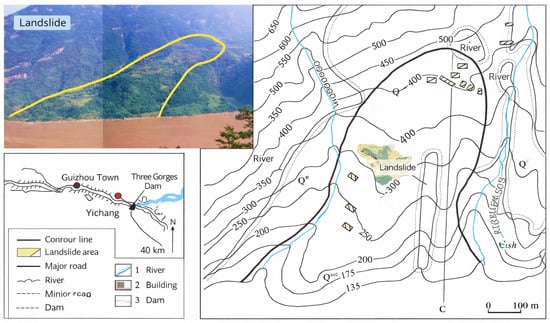
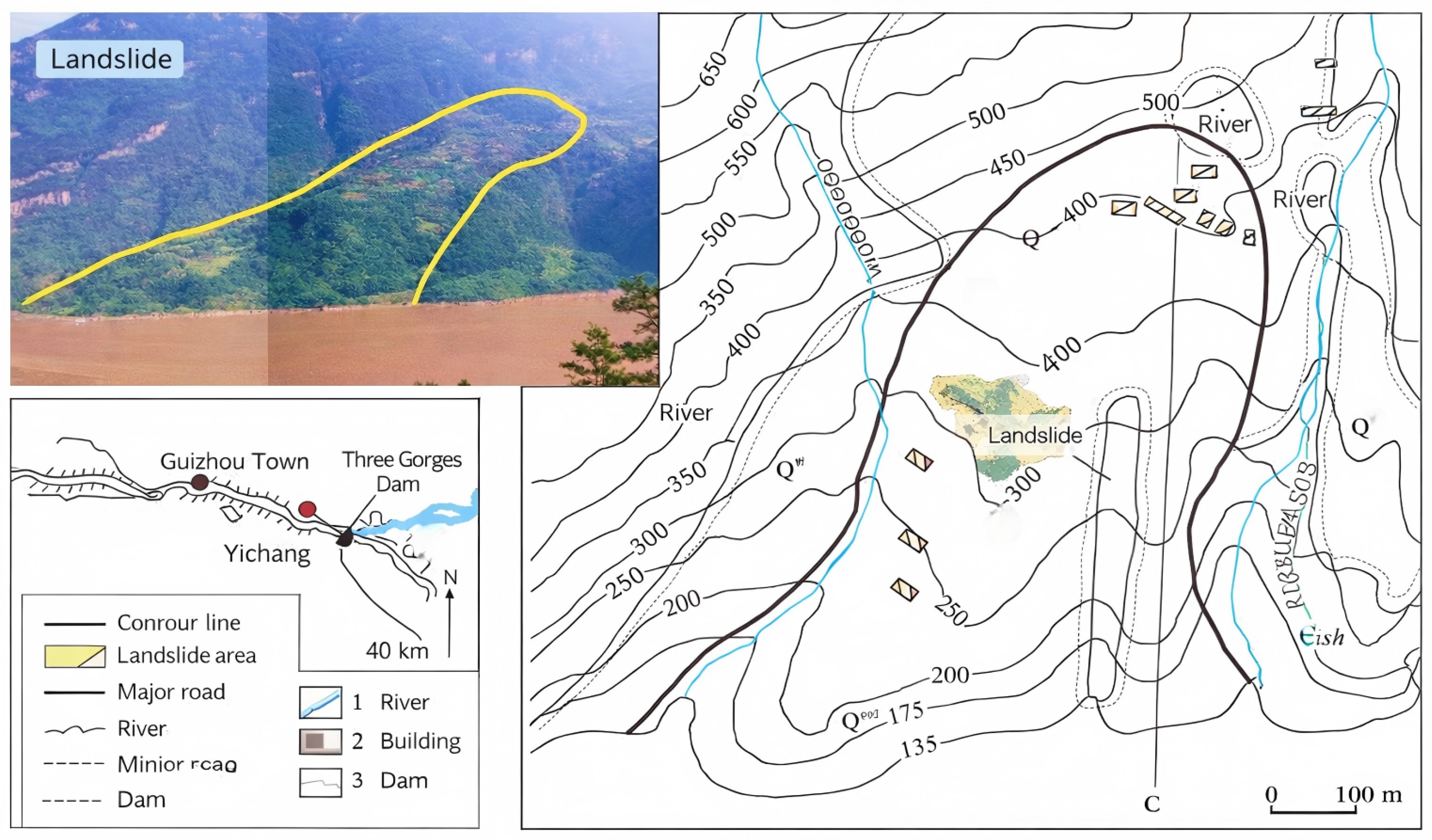
The study was conducted at the Yemaomian landslide site (30°59′08″ N, 110°46′26″ E) in Zigui County, Hubei Province, China, located within the drawdown zone of the Three Gorges Reservoir (TGR). This area experiences seasonal water-level fluctuations between 145 m and 175 m, resulting in periodic inundation–exposure cycles and intense wetting–drying disturbances [21]. The region is characterized by a humid subtropical monsoon climate with an annual precipitation of approximately 1000–1200 mm. The experimental slope is east-facing with a gentle inclination of 5°, and sampling was conducted at elevations ranging from 310 to 390 m during the drawdown period in March 2023 (Figure 1).
Figure 1.
Location and geomorphological setting of the Yemaomian landslide in the Three Gorges Reservoir area, China.
2.2. Target Species and Soil Properties
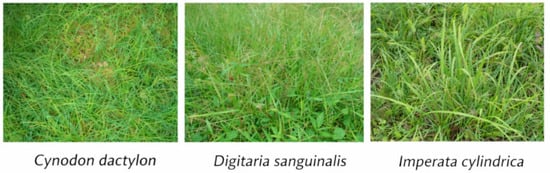
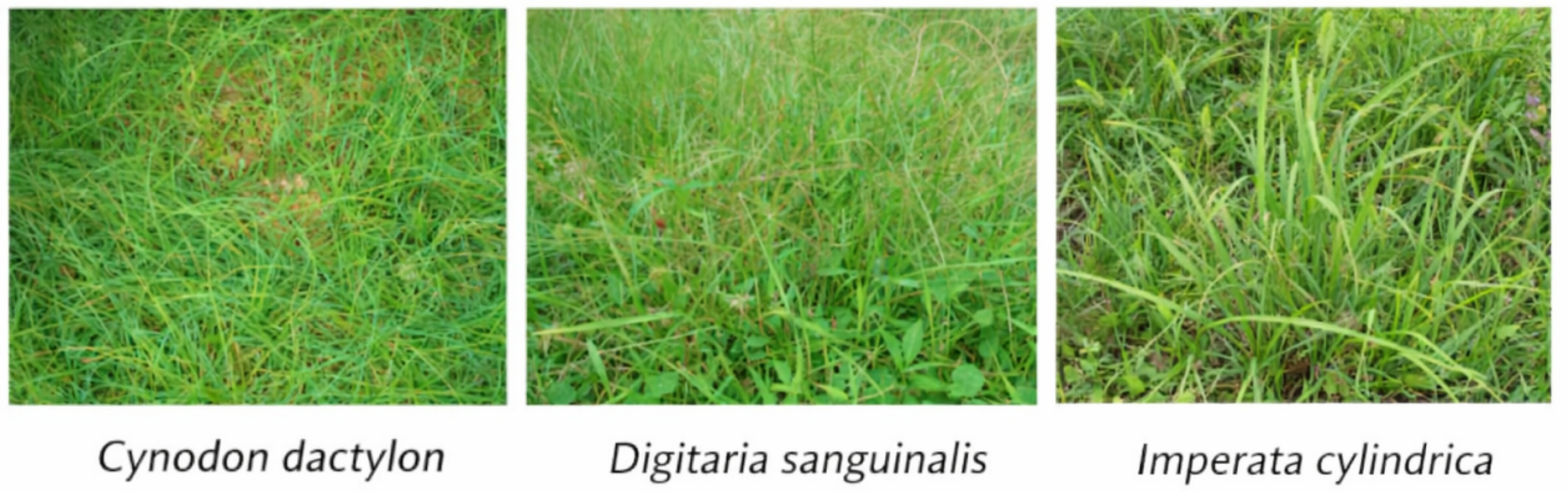
Three dominant herbaceous species, widely distributed on the TGR reservoir banks, were selected for this study: Cynodon dactylon, Digitaria sanguinalis, and Imperata cylindrica (Figure 2). These species are characterized by dense fibrous root systems and rapid colonization capabilities, making them critical for slope protection under hydrological disturbance. To control for environmental heterogeneity, sampling was performed using 1 m × 1 m plots within species dominance patches on the same slope surface to minimize variation in aspect and gradient [22].
Figure 2.
Dominant herbaceous species selected for root tensile and rooted-soil shear tests at the Yemaomian landslide site.
The soil at the sampling site is classified as loam according to the USDA textural classification [23]. To determine baseline physical properties, root-free soil samples were collected from unvegetated areas adjacent to the plant patches. The soil exhibits a wet bulk density of , a specific gravity (particle density) of 2.67, and a natural gravimetric water content of 11.70% (Table 1). Particle-size distribution analysis indicated a composition of 13.81% clay (<0.002 mm), 30.76% silt (0.002–0.05 mm), and 55.43% sand (>0.05–2.00 mm) (Table 2). Atterberg limits were determined for the intact soil matrix to characterize plasticity, yielding a liquid limit (LL) of 26.8 and a plastic limit (PL) of 20.6, determined by the cone penetrometer and rolling-thread methods, respectively [23,24].
Table 1.
Baseline physical properties of the bare-soil material used as the root-free control in direct shear tests.
Table 2.
Particle-size composition of the bare-soil material and USDA textural class.
2.3. Single-Root Tensile Testing
Roots of the three target species were excavated from their respective dominance patches. For each species, 15 individual root specimens () were selected to represent the fibrous, fine-root segments (<2 mm diameter) critical for soil reinforcement. Roots were gently washed and stored at 4 °C to maintain freshness and were tested within 24 h of sampling. Geometric and mechanical properties were quantified using a single-root tensile test system. Root diameter (D) was measured using a digital caliper (0.01 mm resolution) at three points (top, middle, bottom); specimens were discarded if the diameter variation exceeded 0.10 mm to ensure geometric uniformity. Tensile tests were performed under displacement control at a constant rate of using a laboratory loading frame. Rubber pads were used at the clamping interface to prevent stress concentration and slippage. A test was considered valid only if rupture occurred within the middle third of the specimen [14]. The maximum tensile force at failure (, N) was recorded, and the root tensile strength (, MPa) was calculated as:
where is the peak load (N) and D is the mean root diameter (mm) [11]. The relationships between root diameter and tensile properties (–D and –D) were analyzed to establish species-specific power-law scaling functions.
2.4. Direct Shear Testing
2.4.1. Preparation of Root–Soil Composites
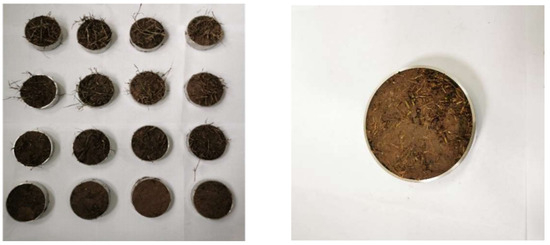
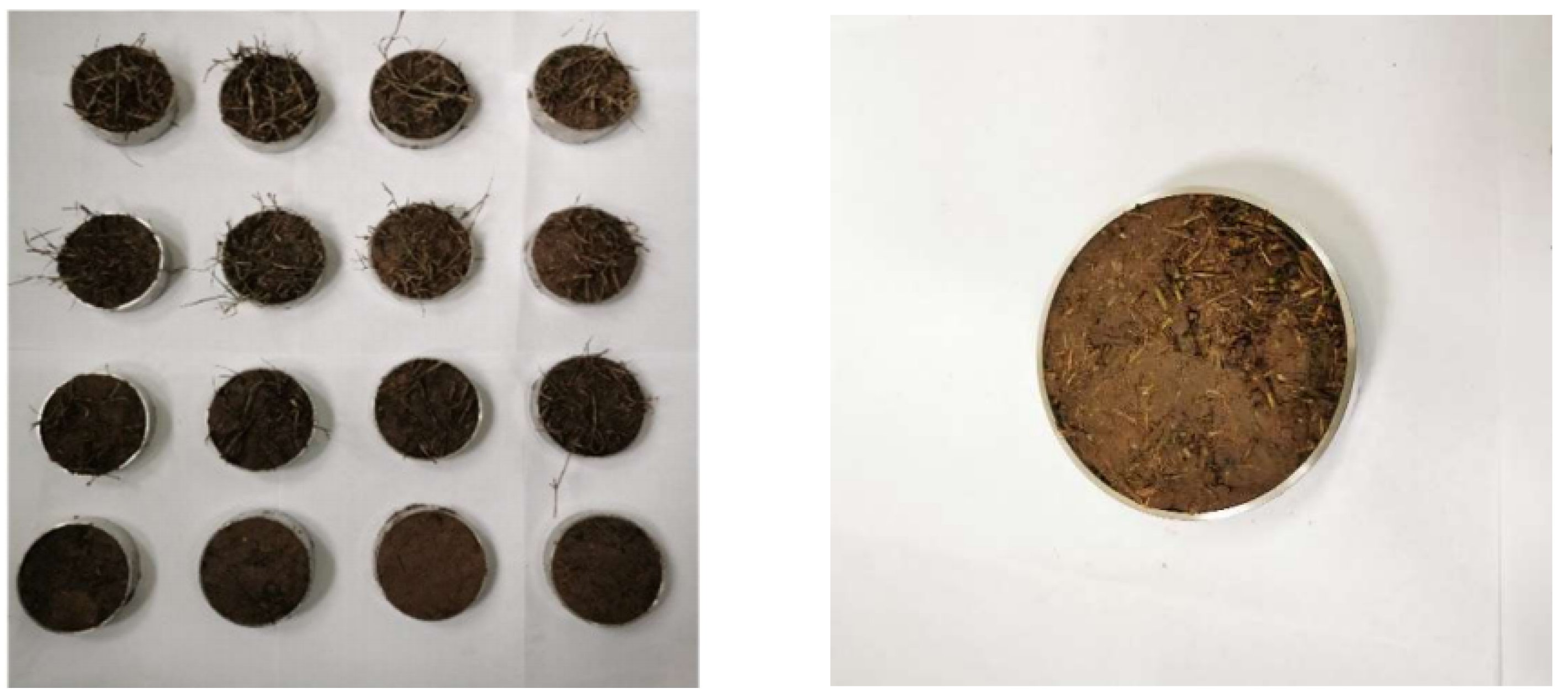
Undisturbed root–soil composites were collected using a standard ring cutter (6.18 cm diameter, 2.0 cm height) directly from the dominance patches of each species [25]. Sampling was restricted to the 0–20 cm depth layer to capture the primary root–soil interaction zone. Four replicates were collected for each species at adjacent locations to minimize spatial heterogeneity. A root-free control group was similarly collected from nearby bare soil. All specimens were sealed with plastic film immediately after extraction to preserve natural moisture content and structure, and were transported to the laboratory at China Three Gorges University, as shown in Figure 3.
Figure 3.
Preparation of undisturbed root–soil composite specimens for direct shear testing.
2.4.2. Shear Test Protocol
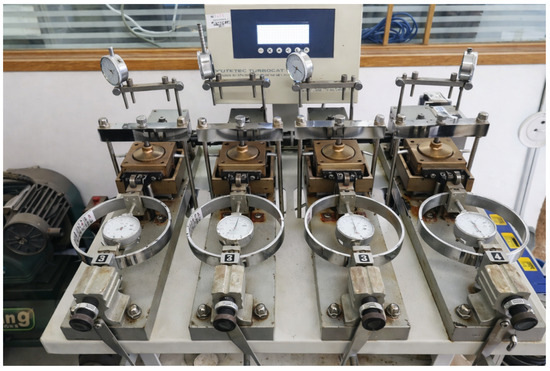
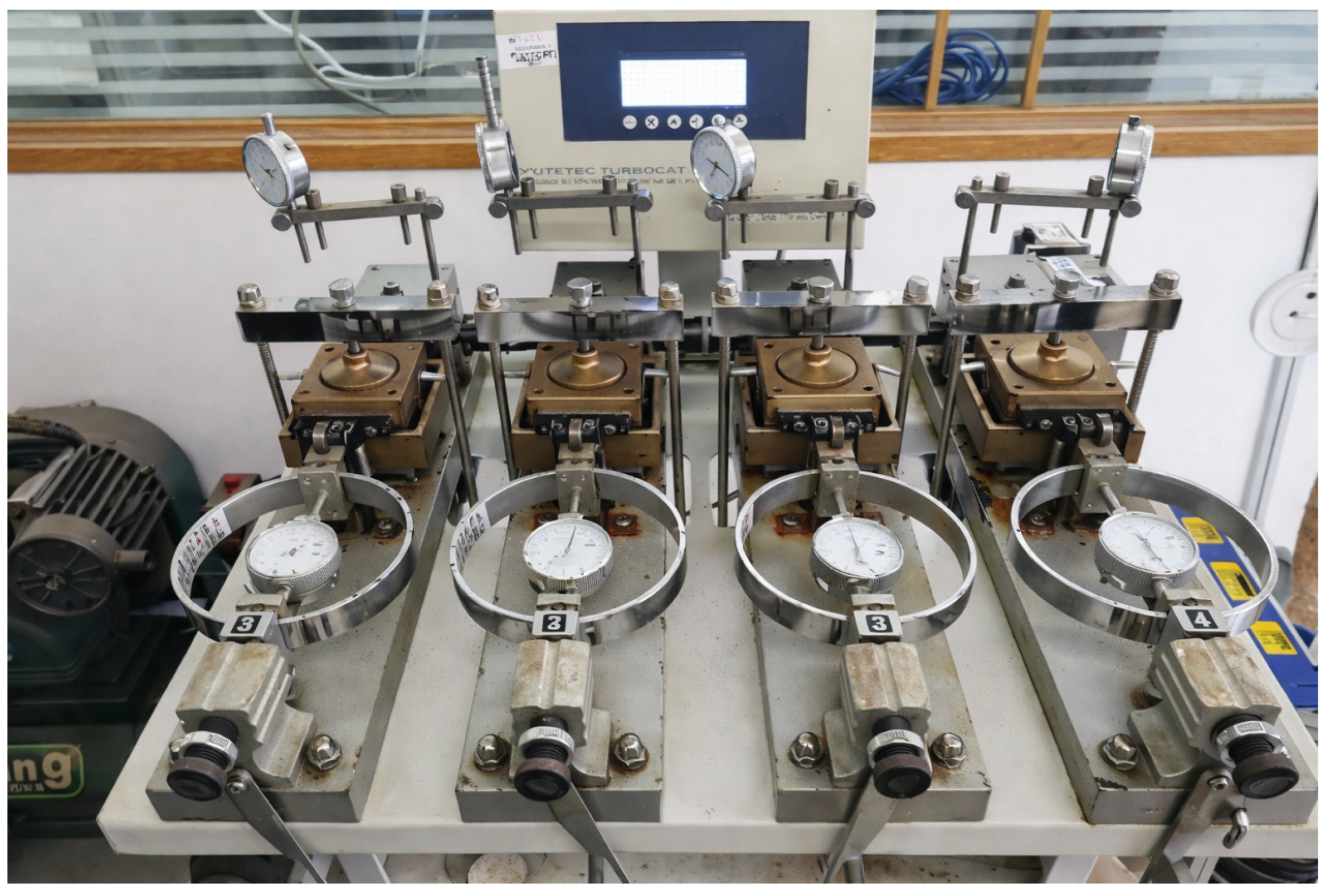
Direct shear tests were conducted using a four-gang strain-controlled direct shear apparatus (Figure 4). The procedure followed a standard rapid-shear protocol [26,27]. Specimens were subjected to four normal stress levels (): 100, 200, 300, and 400 kPa. Prior to shearing, a consolidation period of 10 min was applied. Shearing was then imposed at a constant horizontal displacement rate of . Shear stress was recorded continuously, and the peak shear strength () was defined as the maximum shear stress observed during failure. The shear strength parameters—apparent cohesion (c) and internal friction angle ()—were derived using the Mohr–Coulomb criterion:
Linear regression was performed on the – data for each treatment group (bare soil and three vegetated soils) to quantify the root reinforcement effect.
Figure 4.
Four-gang strain-controlled direct shear apparatus used for testing root–soil composites.
2.5. Data Analysis
Data were processed using Microsoft Excel and SPSS 26.0. For root tensile traits, power-law regression analyses (log-transformed linear regression) were conducted to determine the scaling relationships of and with diameter. Additionally, One-way analysis of variance (ANOVA) followed by Tukey’s HSD post-hoc test was performed to evaluate interspecific differences in root tensile strength. Statistical significance was defined at . For shear tests, the strength parameters (c and ) were derived from the linear envelopes of the shear stress–normal stress relationship. Comparisons were focused on the shifts in regression parameters relative to the root-free control.
3. Results
3.1. Diameter-Dependent Root Tensile Functional Traits
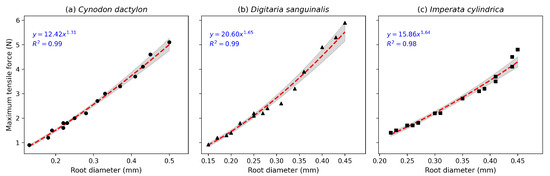
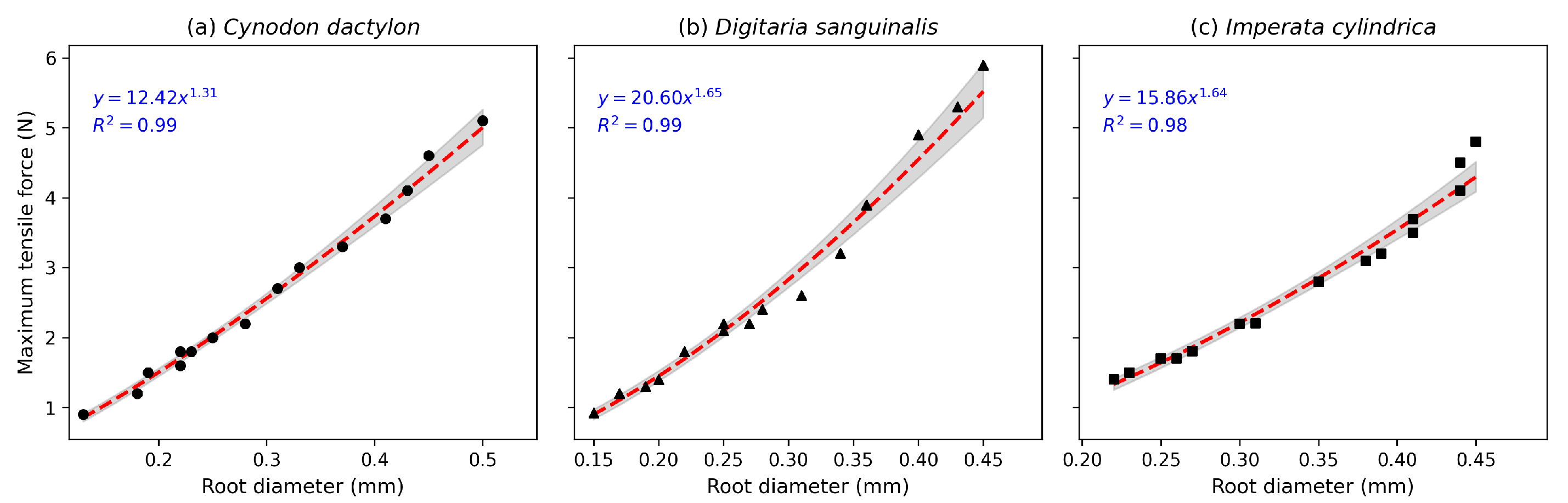
Single-root tensile tests were conducted for the three dominant herbaceous species ( per species) to quantify the relationships between root diameter (D), maximum tensile force (), and tensile strength (). Across all species, exhibited a monotonic increase with root diameter (Figure 5), indicating a consistent power-law scaling of tensile load capacity with size. The fitted regression curves closely tracked the observed data points for each species (Figure 5a–c), confirming a robust, diameter-dependent trait expression over the sampled range ( mm).
Figure 5.
Diameter dependence of maximum tensile force () for three herbaceous species ( per species). Shaded areas represent 95% confidence intervals.
In terms of magnitude, mean values were comparable across species, ranging from 2.63 to 2.81 N (Table 3). Imperata cylindrica possessed the largest mean diameter ( mm), while Digitaria sanguinalis had the smallest ( mm). However, given the significant size dependence, interspecific contrasts are best interpreted through scaling relationships rather than aggregate means.
Table 3.
Summary statistics of root diameter and tensile traits for the three dominant herbaceous species ( per species). Values are mean ± SD; ranges are minimum–maximum. Different lowercase letters (a, b) indicate significant differences in tensile strength between species at (Tukey’s HSD).
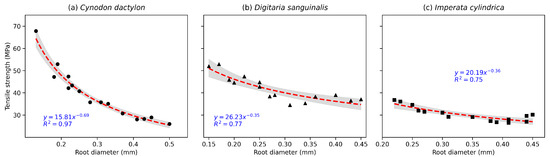
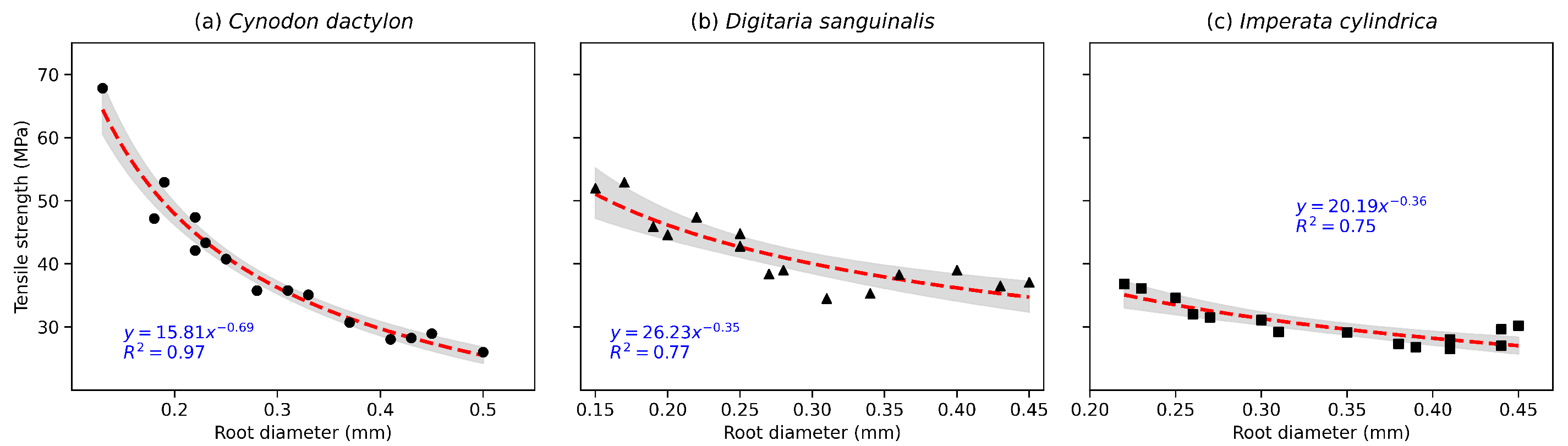
Tensile strength (), which reflects material-level efficiency, decreased with increasing diameter for all three species (Figure 6). Regression analysis revealed a clear negative power-law dependence of on D across the measured size spectrum (Figure 6a–c). Statistical analysis indicated significant interspecific variations in tensile strength (). Tukey’s post-hoc tests revealed that D. sanguinalis ( MPa) and C. dactylon ( MPa) exhibited significantly higher tensile strength compared to I. cylindrica ( MPa), with no significant difference observed between the former two (Table 3). The fitted power-law equations (Table 4) exhibited high coefficients of determination (), providing a quantitative basis for interspecific comparison.
Figure 6.
Diameter dependence of tensile strength () for three herbaceous species ( per species). Shaded areas represent 95% confidence intervals.
Table 4.
Power-law scaling relationships between root diameter (D, mm) and tensile traits (log–log linear regression).
3.2. Peak Shear Strength of In Situ Root–Soil Composites
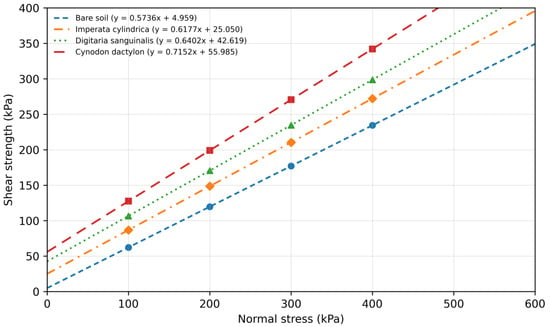
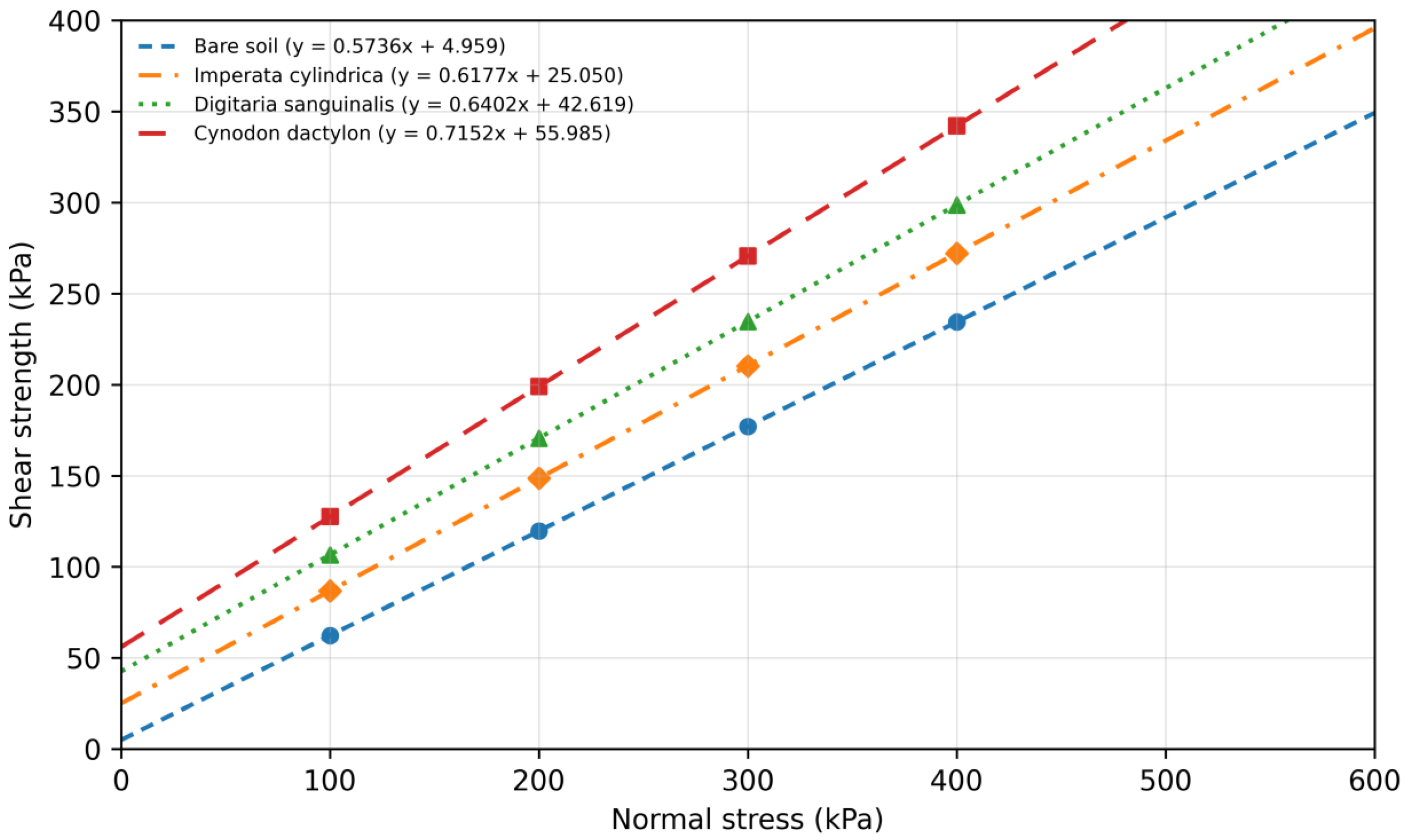
Direct shear tests were performed on root–soil composites of the three species and a root-free control under four normal stress levels ( kPa). The relationship between peak shear strength () and normal stress is presented in Figure 7.
Figure 7.
Peak shear strength–normal stress relationships for root–soil composites and the root-free control.
For all treatments, increased linearly with , exhibiting stable, monotonic failure envelopes. Crucially, at any given normal stress level, all rooted composites exhibited substantially higher than the root-free control (Table 5). The hierarchy of reinforcement efficacy was consistent across all stress levels: Cynodon dactylon > Digitaria sanguinalis > Imperata cylindrica > Bare Soil. Specifically, relative to the bare soil, the presence of roots increased by approximately 22–46 kPa for I. cylindrica, 45–65 kPa for D. sanguinalis, and 67–111 kPa for C. dactylon across the tested stress range. This indicates a species-specific functional contrast in stabilizing performance under identical loading conditions.
Table 5.
Peak shear strength (, kPa) of the root-free control and in situ root–soil composites under different normal stresses. Values are treatment means of four specimens ( per treatment per ).
3.3. Shear-Strength Parameters (c and )
The Mohr–Coulomb shear-strength parameters—apparent cohesion (c) and internal friction angle ()—were derived from the linear regression of the – envelopes (Table 6). All regression fits showed high linearity (), indicating that the Mohr–Coulomb criterion effectively described the failure behavior of both rooted and unrooted soils. The presence of roots primarily enhanced the apparent cohesion of the soil. While the root-free control exhibited a low cohesion of kPa, rooted composites showed substantial increases, with c values reaching 25.05 kPa for I. cylindrica, 42.62 kPa for D. sanguinalis, and peaking at 55.99 kPa for C. dactylon. In contrast, the changes in internal friction angle () were less pronounced, though still positive. The friction angle increased from (bare soil) to a range of – in rooted soils. This suggests that while root networks contribute slightly to frictional resistance, their dominant stabilizing mechanism in these near-surface soils is the significant augmentation of apparent cohesion.
Table 6.
Mohr–Coulomb shear-strength parameters for the root-free control and in situ root–soil composites. Parameters were derived from treatment-level – linear regression.
4. Discussion
4.1. Interspecific Differentiation in Root Tensile Functional Traits
Reservoir drawdown zones impose a disturbance-intensive regime where plant survival and soil stabilization depend heavily on belowground mechanical strategies [5]. In this study, we framed root mechanical properties as functional traits, treating maximum tensile force () as a measure of “load capacity” and tensile strength () as “material efficiency” [3,28].
Our results revealed a robust, size-dependent trait spectrum across all three species. The power-law increase of with diameter indicates that structural investment in root size directly translates to anchorage capacity [29]. Conversely, the negative scaling of with diameter suggests a trade-off where finer roots exhibit higher material efficiency, a pattern commonly attributed to the lower probability of defects in smaller cross-sections and differences in cellulose/lignin ratios [30].
Crucially, when compared within the same diameter range, species exhibited distinct functional profiles. Cynodon dactylon and Digitaria sanguinalis maintained higher tensile efficiency () across the measured spectrum compared to Imperata cylindrica. Although I. cylindrica possessed larger mean diameters, its lower material strength resulted in a less efficient conversion of biomass to tensile resistance [10]. This suggests that while all three species follow general allometric scaling rules, C. dactylon and D. sanguinalis possess superior intrinsic material properties, making their root networks potentially more effective at mobilizing resistance per unit of root biomass invested. This trade-off between diameter and tensile efficiency aligns with findings for Mediterranean herbaceous species reported by De Baets et al. [14], suggesting that the diameter-dependent scaling observed here follows a universal biological pattern across different biogeographical regions.
4.2. Mechanisms of Soil Shear Strength Enhancement
The core contribution of vegetation to slope stability lies in the modification of soil shear-strength parameters. Our direct shear tests on in situ composites confirmed that all rooted soils significantly outperformed the root-free control, with peak shear strength () increasing consistently across the normal stress range (100–400 kPa) [31,32].
The Mohr–Coulomb parameterization revealed that this reinforcement was driven primarily by a substantial increase in apparent cohesion (c), while the internal friction angle () showed only modest increments [19]. Specifically, compared to the control ( kPa), root reinforcement generated a “cohesion-like” gain ranging from ∼20 kPa (I. cylindrica) to over 50 kPa (C. dactylon).
This cohesion-dominant mechanism aligns with the fiber-reinforcement theory, where roots intersecting the shear plane act as tensile anchors [15]. However, it is important to recognize that this macro-scale cohesion gain () represents the integrated outcome of both single-root tensile properties and the root network density within the soil matrix. While C. dactylon’s superior performance is mechanistically supported by its high tensile efficiency (), the magnitude of cohesion enhancement (>50 kPa) suggests that this species also maintains a structurally effective root network in its dominance patches. Therefore, the observed reinforcement validates that C. dactylon successfully translates its intrinsic material competence into aggregate soil-block stability, fulfilling the dual requirements of material quality and structural quantity [16].
4.3. Implications for Ecological Restoration and Management
From an applied perspective, bridging root traits to soil parameters offers a quantitative basis for species selection in the Three Gorges Reservoir [10]. Traditional selection often focuses solely on flood tolerance; however, our results argue for a dual-criteria approach: establishing species that are both physiologically tolerant and mechanically competent.
Among the tested species, Cynodon dactylon emerged as the superior candidate for shallow stabilization, exhibiting the highest tensile efficiency () and the greatest enhancement in soil cohesion ( kPa). Digitaria sanguinalis also performed well, while Imperata cylindrica, despite its prevalence, provided the least mechanical reinforcement [9].
For engineering practice, this suggests that in areas prone to shallow landslides or intense erosion, prioritizing C. dactylon (or assessing other species for high tensile efficiency) could maximize the “safety factor” of the slope. Furthermore, the strong correlation between favorable tensile traits and high soil cohesion supports the use of simple single-root tensile tests as a rapid screening tool to predict the potential stabilization capacity of candidate species before conducting labor-intensive field shear tests [17].
In contrast, the relatively stable values (rising slightly from to –) indicate that the fundamental frictional properties of the soil skeleton (particle interlocking and surface roughness) remained largely unchanged. This distinction is critical for drawdown zones: slope failures here are often triggered by saturation, which reduces effective stress. Since the “frictional” component of strength () diminishes as pore pressure rises, the “cohesive” component provided by roots becomes the last line of defense against shallow sliding [7]. Therefore, the strong cohesive gain observed in C. dactylon identifies it as the most mechanically effective species for this specific hydrological environment.
However, it is worth noting that while C. dactylon offers superior mechanical stabilization, its aggressive growth habit may pose competition risks to native biodiversity. Therefore, its application should be balanced against local ecological constraints, or mixed-planting strategies should be considered to mitigate potential invasiveness issues.
4.4. Limitations and Future Research
Several limitations should be noted. First, this study represents a “snapshot” during the drawdown (exposure) phase. Soil mechanical properties in the drawdown zone are dynamic, fluctuating with moisture history and water-level cycles. Future work should quantify how these reinforcement effects persist or degrade after prolonged inundation.
Second, our analysis focused on linking single-root material traits () directly to the macro-scale composite strength. We did not explicitly quantify root morphological density traits (e.g., RLD or RAR) within the shear box. While RLD is a standard parameter for quantifying biomass, its measurement in undisturbed field blocks is often destructive and incompatible with preserving the delicate soil-root fabric required for valid shear testing. Crucially, our sampling strategy targeted “dominance patches”, thereby capturing the realized reinforcement potential of each species in its typical high-density growth state. Therefore, the observed shear strength enhancement represents the aggregate effect of both material quality (tensile traits) and quantity (density). Although we cannot statistically decouple the contribution of RLD from in this study, the results validly identify C. dactylon as the superior stabilizer at the species level, providing a sufficient evidence base for ecological engineering selection. Future mechanistic models, however, would benefit from coupled measurements to dissect these specific drivers.
Finally, the direct shear results were analyzed at the treatment-mean level. While this successfully identified robust interspecific patterns, future studies employing larger sample sizes could enable rigorous statistical hypothesis testing to further validate these functional differences.
5. Conclusions
This study developed a trait-informed framework to quantify the stabilizing effects of herbaceous vegetation on near-surface soils in the drawdown zone of the Three Gorges Reservoir. By integrating single-root biomechanics with in situ direct shear tests, we linked micro-scale root traits to macro-scale soil strength parameters. The main conclusions are as follows:
1. Distinct Root Tensile Strategies: Root tensile traits exhibited robust diameter-dependent scaling across all three species. While maximum tensile force () increased with diameter, tensile strength () followed a negative power-law decay, indicating a fundamental trade-off between load capacity and material efficiency. Among the tested species, Cynodon dactylon and Digitaria sanguinalis demonstrated superior tensile efficiency compared to Imperata cylindrica.
2. Significant Soil Reinforcement: Vegetation significantly enhanced the stability of shallow drawdown-zone soils. Under normal stresses ranging from 100 to 400 kPa, all rooted composites exhibited consistently higher peak shear strength () than the unrooted control. Cynodon dactylon provided the greatest reinforcement, followed by Digitaria sanguinalis and Imperata cylindrica.
3. Cohesion-Dominant Mechanism: The stabilization effect was primarily manifested as an increase in soil apparent cohesion (c), rather than friction. The presence of roots increased c from ∼5 kPa (bare soil) to values ranging between 25 and 56 kPa. This implies that the in situ root networks effectively mobilize their tensile resistance to compensate for the low cohesion of near-surface soils. The superior cohesion gain in C. dactylon reflects the cumulative benefit of its high tensile strength and effective root distribution within dominance patches.
4. Implications for Ecological Restoration: Based on the coupled trait–function analysis, we propose a dual-criteria screening strategy for reservoir-bank restoration. Species selection should prioritize not only flood tolerance but also mechanical competence—specifically, high root tensile efficiency and the capacity to generate significant cohesive gain. Consequently, Cynodon dactylon is recommended as a priority species for stabilizing shallow slopes in the TGR area.
5. Limitations and Future Work: The current findings are based on a single hydrological stage (drawdown period) and mean-based shear strength assessments. Future research should extend this framework to capture seasonal variations across wetting–drying cycles and incorporate patch-scale morphological traits (e.g., Root Length Density) to develop dynamic, time-integrated models for long-term slope stability management.
Author Contributions
Conceptualization, R.W. and J.L.; methodology, J.L.; validation, R.W.; formal analysis, J.L.; investigation, J.L.; resources, R.W.; data curation, J.L.; writing—original draft preparation, J.L.; writing—review and editing, R.W. and J.L.; visualization, J.L.; supervision, R.W.; project administration, R.W.; funding acquisition, R.W. All authors have read and agreed to the published version of the manuscript.
Funding
This research was funded by the National Natural Science Foundation of China (grant number 51979151); the Natural Science Foundation of Hubei Province Outstanding Youth Project (Grant number 2021CFA090); and the Three Gorges Key Laboratory of Geological Hazards of the Ministry of Education (China Three Gorges University) (Grant number 2020KDZ07).
Institutional Review Board Statement
Not applicable.
Informed Consent Statement
Not applicable.
Data Availability Statement
The datasets used and/or analyzed during the current study are available from the corresponding author, Ruihong Wang, on reasonable request.
Acknowledgments
We thank Xiangyu Zheng and Mingduo Wang for their assistance with field sampling and root excavation at the Yemaomian landslide site. We are also grateful to Yongjia Z for providing technical support during the direct shear tests. We would also like to thank the anonymous reviewers for their constructive comments that improved the quality of this manuscript.
Conflicts of Interest
The authors declare no conflict of interest.
Abbreviations
The following abbreviations are used in this manuscript:
| TGR | Three Gorges Reservoir |
| LL | Liquid Limit |
| PL | Plastic Limit |
| D | Root diameter |
| Maximum tensile force | |
| Root tensile strength | |
| Peak shear strength | |
| Normal stress | |
| c | Apparent cohesion |
| Internal friction angle | |
| SD | Standard Deviation |
References
- Albuja-Sánchez, J.; Solano, J. Bioengineering of Soils for Ground Improvement and Stability: A Review of Nature-Based Technologies. Environ. Chall. 2025, 20, 101293. [Google Scholar] [CrossRef] [Scilit]
- Tardío, G.; Mickovski, S.B. Implementation of eco-engineering design into existing slope stability design practices. Ecol. Eng. 2016, 92, 138–147. [Google Scholar] [CrossRef] [Scilit]
- Niklas, K.J.; Telewski, F.W. Environmental–biomechanical reciprocity and the evolution of plant material properties. J. Exp. Bot. 2022, 73, 1067–1082. [Google Scholar] [CrossRef] [Scilit]
- Capobianco, V.; Fraccica, A.; Anselmucci, F. Nature- and bio-based solutions for ecosystem restoration, landslide hazard mitigation, and ground improvement: Research and application novelties. Ecol. Eng. 2025, 219, 107710. [Google Scholar] [CrossRef] [Scilit]
- Zhou, X.; Wen, Z.; Wu, S. How topographic factors regulate vegetation vigor in reservoir drawdown zones with different levels of hydrological disturbances? Ecol. Indic. 2025, 174, 113180. [Google Scholar] [CrossRef] [Scilit]
- Gu, D.; Liu, H.; Gao, X.; Huang, D.; Zhang, W. Influence of cyclic wetting–drying on the shear strength of limestone with a soft interlayer. Rock Mech. Rock Eng. 2021, 54, 5895–5908. [Google Scholar] [CrossRef] [Scilit]
- Ni, Y.; Xia, Z.; Yang, Y.; Liu, D.; Xiang, R.; Ding, Y. Spatial and temporal evolution and factors influencing soil aggregate stability in the riparian zone during exposure: A case study of the water-level fluctuation zone of the Three Gorges Reservoir, China. Sci. Total Environ. 2024, 957, 177408. [Google Scholar] [CrossRef] [Scilit] [PubMed]
- Ma, Y.; Liu, Y.; Tian, L.; Yang, Y.; Long, Y.; Lei, M.; Zhang, Z. Effects of rainfall pattern and soil surface roughness on surface–subsurface hydrological response and particle size distribution of red soil slope. Catena 2023, 234, 107585. [Google Scholar] [CrossRef] [Scilit]
- Waheed, A.; Qiao, X.; Muhammad, M. Plant root-mediated carbon sequestration and nutrient cycling in grassland ecosystems under land use and climate change. Agronomy 2025, 15, 2765. [Google Scholar] [CrossRef] [Scilit]
- Zhong, R.; He, X.; Bao, Y.; Tang, Q.; Gao, J.; Yan, D. Estimation of soil reinforcement by the roots of four post-dam prevailing grass species in the riparian zone of the Three Gorges Reservoir, China. J. Mt. Sci. 2016, 13, 553–563. [Google Scholar] [CrossRef] [Scilit]
- Mao, Z.; Wang, Y.; McCormack, M.L.; Rowe, N. Mechanical traits of fine roots as a function of topology and anatomy. Ann. Bot. 2018, 122, 1103–1110. [Google Scholar] [CrossRef] [Scilit]
- Rodríguez-Robles, U.; Arredondo, J.T.; Huber-Sannwald, E.; Yépez, E.A.; Ramos-Leal, J.A. Coupled plant traits adapted to wetting/drying cycles of substrates co-define niche multidimensionality. Plant Cell Environ. 2020, 43, 3237–3254. [Google Scholar] [CrossRef] [Scilit]
- Carmona, C.P.; Bueno, C.G.; Toussaint, A.; Träger, S.; Díaz, S. Fine-root traits in the global spectrum of plant form and function. Nature 2021, 597, 683–687. [Google Scholar] [CrossRef] [Scilit]
- De Baets, S.; Poesen, J.; Reubens, B.; Wemans, K. Root tensile strength and root distribution of typical Mediterranean plant species and their contribution to soil shear strength. Plant Soil 2008, 305, 207–226. [Google Scholar] [CrossRef] [Scilit]
- Meijer, G.J. A generic form of fibre bundle models for root reinforcement of soil. Plant Soil 2021, 462, 341–356. [Google Scholar] [CrossRef] [Scilit]
- Zhu, J.; Leung, A.K.; Wang, Y. Modelling root–soil mechanical interaction considering root pull-out and breakage failure modes. Plant Soil 2022, 471, 95–112. [Google Scholar] [CrossRef] [Scilit]
- Hales, T.C.; Cole-Hawthorne, C.; Lovell, L.; Evans, S.L. Assessing the accuracy of simple field-based root strength measurements. Plant Soil 2013, 372, 553–565. [Google Scholar] [CrossRef] [Scilit]
- Mao, Z. Root reinforcement models: Classification, criticism and perspectives. Plant Soil 2022, 472, 441–458. [Google Scholar] [CrossRef] [Scilit]
- Meng, S.; Zhao, G.; Yang, Y. Impact of plant root morphology on rooted-soil shear resistance using triaxial testing. Geoderma 2020, 378, 114620. [Google Scholar] [CrossRef] [Scilit]
- Cohen, D.; Schwarz, M. Tree-root control of shallow landslides. Earth Surf. Dyn. 2017, 5, 451–466. [Google Scholar] [CrossRef] [Scilit]
- Bao, Y.; Gao, P.; He, X. The water-level fluctuation zone of Three Gorges Reservoir—A unique geomorphological unit. Earth-Sci. Rev. 2015, 150, 14–30. [Google Scholar] [CrossRef] [Scilit]
- Kluth, C.; Bruelheide, H. Using standardized sampling designs from population ecology to assess biodiversity patterns of therophyte vegetation across scales. J. Biogeogr. 2004, 31, 363–377. [Google Scholar] [CrossRef] [Scilit]
- Soil Science Division Staff. Soil Survey Manual (USDA Handbook No. 18); Government Printing Office: Washington, DC, USA, 2017. [Google Scholar]
- ASTM D4318-17e1; Standard Test Methods for Liquid Limit, Plastic Limit, and Plasticity Index of Soils. ASTM International: West Conshohocken, PA, USA, 2017.
- ASTM D1587/D1587M-15; Standard Practice for Thin-Walled Tube Sampling of Fine-Grained Soils for Geotechnical Purposes. ASTM International: West Conshohocken, PA, USA, 2015.
- ASTM D3080/D3080M-11; Standard Test Method for Direct Shear Test of Soils Under Consolidated Drained Conditions. ASTM International: West Conshohocken, PA, USA, 2020.
- Ghoreishi, B.; Khaleghi Esfahani, M.; Alizadeh Lushabi, N.; Amini, O.; Aghamolaie, I.; Hashim, N.A.A.N.; Alizadeh, S.M.S. Assessment of geotechnical properties and determination of shear strength parameters. Geotech. Geol. Eng. 2021, 39, 5855–5873. [Google Scholar] [CrossRef] [Scilit]
- Meijer, G.J.; Lynch, J.P.; Chimungu, J.G.; Loades, K.W. Root anatomy and biomechanical properties: Improving predictions through root cortical and stele properties. Plant Soil 2024, 500, 587–603. [Google Scholar] [CrossRef] [Scilit]
- Ji, X.; Chen, L.; Zhang, A. Anchorage properties at the interface between soil and roots with branches. J. For. Res. 2017, 28, 889–899. [Google Scholar] [CrossRef] [Scilit]
- Genet, M.; Stokes, A.; Salin, F.; Mickovski, S.B.; Fourcaud, T.; Dumail, J.F.; Van Beek, R. The influence of cellulose content on tensile strength in tree roots. Plant Soil 2005, 278, 1–9. [Google Scholar] [CrossRef] [Scilit]
- Karimzadeh, A.A.; Leung, A.K.; Gao, Z. Shear strength anisotropy of rooted soils. Géotechnique 2024, 74, 1033–1048. [Google Scholar] [CrossRef] [Scilit]
- Anderson, S.A.; Sitar, N. Shear strength and slope stability in a shallow clayey soil regolith. J. Geotech. Eng. 1995, 121, 529–538. [Google Scholar]

Disclaimer/Publisher’s Note: The statements, opinions and data contained in all publications are solely those of the individual author(s) and contributor(s) and not of MDPI and/or the editor(s). MDPI and/or the editor(s) disclaim responsibility for any injury to people or property resulting from any ideas, methods, instructions or products referred to in the content. |
© 2026 by the authors. Licensee MDPI, Basel, Switzerland. This article is an open access article distributed under the terms and conditions of the Creative Commons Attribution (CC BY) license.