


Featured Application
Auditable release decisions that combine persistent lifecycle vetoes with time-dependent restriction intervals.
Abstract
Management software must preserve lifecycle restrictions while evaluating time-dependent release conditions. This study specifies and verifies a transactional harvest-decision workflow in an event-driven apiary system. Lifecycle vetoes persist independently of treatment intervals, and harvest approvals and guard rejections retain event-linked audit records. The evaluation includes 115 conformance checks, 33 comparisons with a stored-phase decision policy, and 10 mapped batch-release cases. The workflow tests detect all ten requirement-specific faults. Of 131 mutants generated by the PIT mutation testing tool, the baseline workflow suite kills 39 and the extended suite kills 49. The two decision policies differ in six cases where restrictions have expired without a phase refresh. Across 359 visits to 120 colonies, disabling note-derived queen-cell inputs changes the selected output at 38 visits in 31 colonies. Uncertainty intervals account for repeated visits to each colony. A 36-scenario adapter experiment quantifies sensitivity to capacity, honey conversion and Varroa representation. Python 3.12.14 and Java Virtual Machine (JVM) 21.0.8 calculations agree on 19,400 input evaluations. Public source code, case-level outcomes and mutation reports support reproduction.
1. Introduction
When a treatment restriction expires, an independent lifecycle condition can still block a management operation. A hive in wintering remains closed to harvest throughout treatment and after withdrawal ends. The system must preserve that condition across commands and record why the harvest guard refused release.
These requirements connect state modeling, temporal predicates and database transactions. A stored phase can describe the most recently processed observation, while a restriction interval defines whether a condition holds at the decision instant. The relation between these representations becomes observable when an expected intermediate inspection never occurs. In dairy-management software, Strang et al. [1] documented incorrect withdrawal records and downward rounding of release times. Their findings motivate explicit treatment of endpoint precision in management software.
This paper makes a software-engineering contribution through an executable release-decision contract and its verification. The Apiary Management System provides a case study with independent lifecycle vetoes, overlapping half-open restriction intervals, per-hive serialization and committed records of harvest approvals and guard rejections. A stored-phase predicate provides a comparison design with an explicit refresh requirement. A mapped batch-quarantine example exercises the same implementation under a structurally equivalent release contract.
The evaluation addresses three questions.
- How do lifecycle preservation, interval evaluation and the transaction boundary determine observable command outcomes?
- Which faults are exposed by the matrix, sequence tests, requirement-specific mutations and standard PIT operators?
- How do declared input conversions affect a fixed advisory configuration in a secondary inspection-data analysis?
The first two questions concern executable workflow behavior. The third identifies dependencies within an adapter applied to one public dataset. Its biological labels denote configured software states and advisory rules. The analysis supplies explicit hypotheses for subsequent studies of inspection data collection.
Related Work and Positioning
Reviews of precision beekeeping describe sensing and automated interpretation alongside challenges in data integration and application [2,3,4]. Agricultural decision-support research connects data acquisition, interpretation and decisions [5]. Zacepins et al. [6] organize these into data collection, analysis, and application. Continuous monitoring adds temporal detail through measurements of colony activity and hive conditions [7]. Zaman and Dorin [8] distinguish routine observation, investigation of relationships, and predictive inference in their Operational–Investigative–Predictive framework. These perspectives help specify what a system does with its observations: acquiring a measurement, interpreting colony condition, and deciding whether to accept a management operation are separate responsibilities.
The biological interpretation depends on the observation itself and its context. Swarming and queen replacement develop over time [9,10], while work on brood pattern and queen quality demonstrates the importance of interpreting a recorded sign in relation to colony conditions [11]. Standardized research methods and colony-strength assessment procedures provide definitions for the quantities collected during inspections [12,13]. This motivates explicit identification of recorded measurements, derived quantities, and assigned scenario inputs in the present evaluation.
Knowledge-based assessment and event-driven management have concrete precedents in apiculture. Kviesis et al. [14] use temperature-derived inputs and expert-informed fuzzy rules to assess colony state. Kady et al. [15] connect fixed and portable hive-weight observations to event-triggered business rules and BPMN workflows for apiary operations. The HIVEOPOLIS architecture extends decision support across embedded devices, online microservices, sensing, and actuation [16]. Together, these approaches establish a context for examining the execution of management decisions as well as the production of advice.
Structured representations support another part of this connection. Kavishe Mushi et al. [17] formalize bees, devices, monitoring, and observation relationships in a precision-beekeeping ontology, evaluated through competency queries and consistency checks. In dairy supply chains, Chatzinikolaou et al. [18] integrate veterinary evidence into Electronic Product Code Information Services (EPCIS) event records and evaluate provenance-based recall policies in synthetic scenarios. Their decision unit is a product batch and its supply-chain relationships; here, it is a hive command evaluated against recorded treatment intervals. Table 1 summarizes these documented areas of research.
Table 1.
Selected approaches to colony assessment, management workflows, and event-based traceability. The comparison identifies each study’s documented information and decision focus.
The transaction boundary determines how a decision becomes an observable application result. Messaging patterns provide a vocabulary for separating command handling and event consumers [19]. In the present architecture, current relational entities hold authoritative state, and linked events record command provenance; event sourcing instead uses the event sequence as the basis for reconstructing state [20]. Database research explains why transaction isolation must be considered together with the constraints spanning related records [21], and relates coordination requirements to application invariants [22]. Here, the relevant constraint connects a hive’s treatment intervals to harvest permission, motivating a shared per-hive command boundary.
State-based testing provides the methodological basis for examining that boundary through specified inputs and observable outcomes [23]. Model-based testing further distinguishes the behavioral specification, test-selection criteria, and test execution [24]. This study uses a requirement-derived matrix and temporal sequences, with an oracle that checks responses, states, and linked records. Mutation analysis then asks whether the same tests distinguish implementations containing deliberately introduced faults [25]. Empirical research supports mutant detection as a useful complement to conventional test measures [26]. The evaluation combines such requirement-specific changes with the standard bytecode operators of PIT [27]. The design comparison varies whether the decision reads stored phases or evaluates recorded intervals at command time. These experiments examine the implementation of a release decision and the observations needed to detect violations of its contract.
2. Materials and Methods
2.1. Implementation and Research Artifact
The Kotlin 2.1.10 application uses Spring Boot 3.4.3 (VMware, Inc., Palo Alto, CA, USA) and stores events and decisions in PostgreSQL. The verification environment runs on Windows (Microsoft, Redmond, WA, USA) with JDK 21.0.8 (JetBrains s.r.o., Prague, Czech Republic, also the developer of Kotlin), Gradle 9.7.1 (Gradle, Inc., San Francisco, CA, USA) and PostgreSQL 14.22 (PostgreSQL Global Development Group). The independent analysis scripts use CPython 3.12.14 (Python Software Foundation, Beaverton, OR, USA). The integration tests use an isolated database and an HTTP server on a random port. At startup, Flyway 10.20.1 (Redgate Software, Cambridge, UK) applies the migrations, and Hibernate ORM 6.6.8.Final (Hibernate project) validates the schema. A controlled clock sets the workflow evaluation times. The integration tests check committed database records after the relevant HTTP requests.
The public research artifact is identified by commit e30d6fc [28] (https://github.com/MichalAntosiewicz/Apiary-Management-System/tree/e30d6fcda97d30ec5d14e69fb9364b3e27e3dc82, accessed on 18 November 2026). Supplementary Material supplies the same source, test fixtures, analysis scripts and case-level results.
OpenAI Codex (OpenAI, San Francisco, CA, USA) assisted code inspection, test and analysis implementation, manuscript preparation and diagram code. The recorded models were gpt-6-astra (23 October–17 November 2026), gpt-6.1-sol (17–18 November) and gpt-6.2-sol (18 November). Editorial work also used gpt-6.2-astra on 18–19 November. The executable programs in the artifact generated the numerical results.
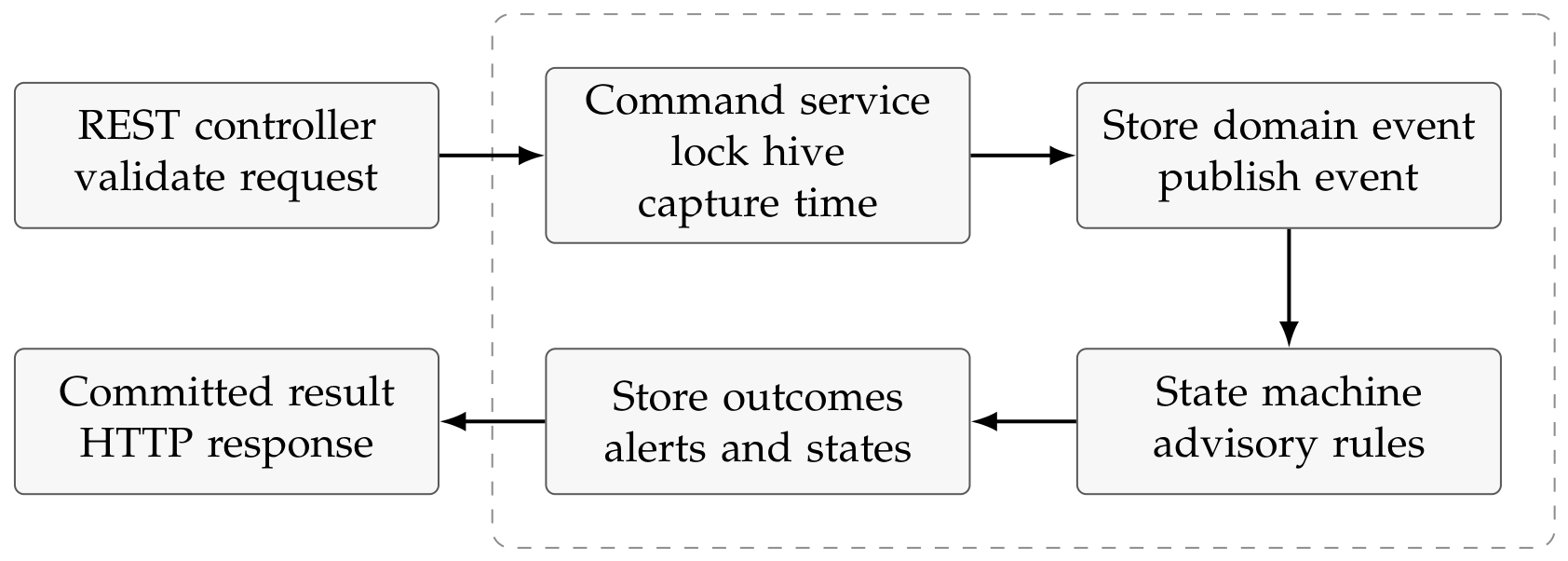
Figure 1 shows the command path. The REST command service locks the hive, captures time, stores the command event and publishes it to synchronous in-process listeners. The listeners evaluate state and guard rules and persist the corresponding outcomes. The service completes its transaction before the controller maps a harvest decision to HTTP 200 or 409. A runtime exception during processing aborts the transaction.
Figure 1.
Synchronous command processing. Arrows show the order of processing. The dashed region is the database transaction. An expected business rejection is stored before the controller returns a conflict response. Technical exceptions retain rollback semantics.
2.2. Workflow Contract and Lifecycle Preservation
For hive h, define the stored workflow representation
where is the biological label, the operational state and the recorded treatment set. A command c at evaluation time t produces
Inspection additionally emits a set of advisory records.
The stored operational vocabulary comprises preparation, active honey flow, treatment in progress, withdrawal, wintering and decommissioned. Wintering is a persistent lifecycle veto. Recording a treatment retains WINTERING and records a linked self-transition. Inspection can update the biological label and advice while retaining this veto. The treatment dates remain available in their own table throughout this sequence. Decommissioned hives reject inspection, treatment and harvest. The experiments initialize wintering and decommissioned as lifecycle conditions before exercising the three supported commands.
Outside those lifecycle vetoes, recording a treatment sets TREATMENT_IN_PROGRESS. Inspection reconciles the stored phase from recorded intervals. Administration takes precedence over withdrawal across overlapping treatments. An inspection after all restrictions expire returns either stored treatment phase directly to PREPARATION. A permitted harvest enters ACTIVE_HONEY_FLOW. A rejected harvest retains the stored state and records the outcome.
The biological state is an ordered rule summary that persists across inspections. Its implemented labels and guards appear in Appendix A. A biological state and an advisory alert are separate outputs with explicit update rules. The state records the applicable transition condition, while alert emission evaluates the full configured score for the current inspection.
2.3. Temporal Decisions and Transaction Semantics
For treatment j, let be its start, its administration end, and its restriction end, with . Define
The command-time harvest predicate is
The predicate evaluates the union of half-open restrictions. At , the course enters withdrawal if . At , its restriction ends, including when withdrawal has zero duration and . Other active courses and lifecycle vetoes can still block harvest. Medicine names and durations are recorded inputs to this software contract.
Inspection, treatment and harvest use the same per-hive PESSIMISTIC_WRITE row lock. The command captures server time after acquiring that lock and truncates it to PostgreSQL microsecond precision. Event listeners, state transitions, alerts and decisions use the captured instant. The relevant coordination and isolation considerations follow established database semantics [21,22].
The inspection contract requires entry at the time of observation. The request carries no separate observation timestamp. The server uses the post-lock timestamp as inspectionDate and event time, which governs treatment-phase reconciliation. The scorer subtracts the active queen’s emergence year from the UTC inspection year and uses zero when no active queen record exists. The event log stores recorded_at as persistence metadata. The offline analyses use field-record dates and explicit age assignments.
A harvest request that passes validation and identifies an existing hive reaches the guard. Its decision records event identity, outcome, reason and decision time. A lifecycle veto takes precedence over treatment conflicts. For a rejection based on treatment, the decision records the latest restriction end among active courses. The service commits a guard rejection and its linked audit transition before HTTP 409. Invalid inputs return HTTP 400 before a harvest event is stored. A runtime exception during processing rolls back the event and partial command effects. A client retry starts a new command.
2.4. Conformance, Design Comparison and Transfer Cases
The conformance oracle specifies HTTP status, stored state and event-linked database effects independently of the executing listener. A 90-case matrix crosses six initialized operational states, five treatment conditions and three commands. Thirteen additional cases cover invalid inputs, durable rejection, rollback, interval boundaries, overlap, locking and microsecond precision. Twelve wintering sequences cross one or two courses, with or without inspections, and three harvest times relative to the final expiry (one second before, exactly at, or one second after). The second course starts 12 h after the first. The sequences with inspections include one just after the last course starts and another at the scheduled harvest time. Nine service and fixture tests complete the executable suite.
The design comparison holds the fixture, lifecycle policy and evaluation instant fixed and varies the decision representation. The interval design executes the production harvest HTTP path. The stored-phase baseline evaluates the pre-request state: preparation and active honey flow permit release, while treatment, withdrawal, wintering and decommissioned block it. The baseline’s contract requires refreshing its phase when time-dependent restrictions expire. Each case explicitly supplies or omits an inspection immediately before the decision. The comparison therefore measures the consequence of this refresh dependency. Both predicates have literal expected outcomes in a 33-row table. Production-path assertions additionally verify the committed event, decision, transition and common timestamp.
Ten structural transfer cases stipulate a generic batch-release contract. An available batch can be released outside every half-open hold interval; suspended and retired batches retain lifecycle vetoes. A test adapter maps batch identity to hive identity, holds to treatment intervals and the three lifecycle conditions to preparation, wintering and decommissioned. Every mapped case executes the production HTTP and persistence path. This provides an executable mapping of the contract to batch quarantine. Operational adoption in a particular domain additionally requires domain rules for creating, amending and ending holds.
2.5. Requirement-Specific and Standard Mutation Experiments
Mutation testing evaluates whether tests distinguish a program from altered implementations [25,26]. Ten single-fault variants challenge endpoint inclusivity, administration precedence, expiry reconciliation, the wintering guard, rejection persistence, locking, time precision and event associations. Each variant runs all 115 cases in WorkflowIntegrationTest against an isolated source copy. A detection requires a complete run with at least one failed test case attributable to the injected change. The report records compilation, timeout and infrastructure outcomes separately.
PIT [27] generates mutations from its standard operator set. The configuration uses PIT 1.30.2, Gradle PIT plugin 1.19.0 and PIT JUnit 5 plugin 1.2.3. It targets HiveStateMachineService, HiveOperationService and InspectionService and their generated nested classes, using WorkflowIntegrationTest. One worker runs with a timeout of four times the measured test duration plus 60 s. The target classes include biological listener bodies that share the state-machine class. Method-level reports identify operational, service and biological locations.
The mutation score divides kills by all generated mutants. The covered-mutant score uses only mutants with a covering test. The analysis traces surviving and uncovered mutants to their source locations. Both workflow suites use the same production code, 115 test identities, targets and operators. The baseline suite checks HTTP responses, stored state and persistence, including links between decisions, events and transitions. Its surviving mutants guided additional checks of decision reasons, messages, expiry times and inspection transitions. The extended suite also repeats delivery of a harvest event and supplies a matching hive identifier in a treatment request body. Each suite is fixed for its run. The separate requirement-specific experiment also covers repository query predicates and the shared lock annotation.
2.6. Fixed Advisory Configuration
The advisory component evaluates each inspection as a snapshot and computes three additive scores from its observations and the recorded queen age. For alert type k, its score is
where indicates a specified input condition, and is its fixed weight. Table 2 specifies the rules. All numerical weights, condition cutoffs and alert thresholds are implementation defaults set heuristically during development, without beekeeper consultation or formal expert elicitation. Each score is an inspectable sum of weighted conditions.
Table 2.
Advisory scoring rules. All weights, numerical cutoffs and alert thresholds are heuristic implementation defaults. Each range supplies at most one contribution.
Swarming, supersedure, and absconding name the three advisory rule sets. The absconding score aggregates parasite load, low food stores, and pest signs into a stress-related alert. Recommendations direct the user to inspect the relevant conditions before acting. The representation experiment holds all weights and alert thresholds fixed. Supersedure alerts have informational severity. Swarming and stress alerts have warning or critical severity according to the thresholds in the table.
Winston describes colony reproduction and queen replacement [9]. Standard colony-strength assessments record adult bees, brood, food stores and queen-cell production [29]. The Liebefeld method provides a protocol for visual estimates [13]. Marking queens allows beekeepers to track their age [12]. Lee et al. found that queens from colonies with poor brood patterns produced better patterns after transfer to colonies with good brood patterns [11]. Zhu et al. describe swarming and supersedure as reasons for queen-cell production and specify mite-sampling procedures [30].
The 359 retained Beewise visits [31] served as development data for tuning the stress-related absconding rule. Each individual contribution falls below the 0.55 alert threshold. The rule adds 0.20 when a mite count of at least 12 coincides with honey stores below 2.5 kg. All representation experiments hold this configuration fixed. Supplementary Material documents the parameter choices in research/rule_parameter_provenance.md.
2.7. Inspection Data and Input-Representation Analysis
The secondary analysis uses Beewise Colony Assessment 2025 [31]. The source trial compared heat treatment, chemical treatment and an untreated control in California. Three assessment rounds cover 120 colonies in March–May 2025. One of 360 scheduled visits lacks a parseable adult-bee estimate, leaving 359 retained visits. Six further visits lack a numerical Varroa count, leaving 353 for the complete quantitative scenarios. Colony identity links repeated observations across rounds.
Table 3 distinguishes recorded fields from assigned inputs. The source README defines Varroa as detected mite count and Mite_per_100 as mites per 100 adult bees. Across the 353 complete visits, the latter equals 100 times the count divided by the accompanying bee count to within 0.005. The denominators range from 144 to 553. The heuristic thresholds 12 and 25 apply to the raw integer count per inspection. The API accepts the count directly and leaves the sampling protocol to the deployment. The dataset README specifies the units of both fields and gives no sampling procedure.
Table 3.
Source fields and assigned inputs for the field-derived experiments.
The inspection endpoint requires nonnegative counts for bee frames, brood frames, queen cells and mites, a nonnegative honey mass, and free comb space between 0 and 100%. It accepts enumerated categories for brood pattern, queen-cell placement and developmental stage. It validates the cell count, placement and stage independently. For marginal placement, the scorer adds the stage contribution independently of the count. The adapter disables both contributions by setting the count to zero and both categories to NONE.
The adapter truncates adult-bee frames B and the summed worker- and drone-brood frames R to integers. Given honey frames H, assigned capacity C and honey factor k, it computes
The adapter computes the free-space fraction before multiplying by 100 and rounds both binary floating-point results to two decimals using half-up rounding. The reference adapter assumes a hive capacity of frames and a honey mass of kg per honey frame. The dataset supplies honey-frame estimates but gives neither constant. Standard assessment methods describe measurement procedures and frame-specific conversions [13,29]. The experiment varies both assumptions while retaining integer truncation for bee and brood frames.
The age–brood grid crosses assigned queen ages 0, 1 and 2 with four brood categories on the 353 complete visits, giving 4236 evaluations. It disables queen-cell contributions with count zero and placement and stage NONE. The paired analysis changes only the queen-cell inputs derived from Notes for all 359 visits. The proxy categories use Notes, AU_reason and adult-bee frame counts. Their shared use of Notes makes agreement a measure of internal consistency. Appendix B gives both mappings.
A 36-scenario factorial sensitivity experiment crosses capacities of 10, 20 and 30 frames; honey factors 1, 2 and 3 kg per frame; and four Varroa representations. The latter use half the raw count, the raw count, twice the raw count, or the recorded per-100 value substituted into the integer count input. All four are truncated to integers before scoring. These are declared numerical perturbations and a unit-substitution case. Queen age is fixed at one, brood is compact, queen-cell contributions are disabled and pest signs are false. This produces 12,708 visit–scenario evaluations. The other three brood categories are checked for alert-set and selected-output stability at that fixed age.
A separate capacity scenario assigns one marginal queen cell open with a larva to each of those visits. Its score contribution of 0.35 puts the swarming rule within reach of the 0.45 threshold. Honey conversion stays at 2 kg per frame and Varroa stays in raw counts. The Python scorer evaluates the three capacities with that same cell assignment, giving 1059 hypothetical visit–capacity pairs.
For summaries, the first emitted class is selected in the order swarming, supersedure, stress, then no alert. The complete alert set is retained. Twenty separately authored development scenarios illustrate individual rule interactions. The Python and JVM implementations are compared on emitted alert sets, their scores and the selected class for the base fixture and the factorial sensitivity inputs. The Python scorer also records scores below the emission thresholds.
Repeated visits are handled through a paired colony-cluster percentile bootstrap [32]. Each of 20,000 replicates samples 120 colony identifiers with replacement and retains all visits of each selected colony. Both adapters use the same replicate. Pooled visit-level changes, internal proxy agreement and macro-F1, together with the fraction of colonies affected, are recomputed in each replicate. The 2.5th and 97.5th empirical percentiles define the intervals, with seed 20261117. Sensitivity counts enumerate the specified records and scenarios directly.
3. Results
3.1. Conformance and Lifecycle Sequences
All 115 HTTP/PostgreSQL workflow conformance cases passed. The complete executable suite also passed 33 design comparisons, ten structural transfer cases and nine service, fixture and smoke tests, giving 167 JUnit cases with zero failures, errors or skips (Table 4).
Table 4.
Executed JUnit cases, including 115 workflow conformance cases. Comparisons, structural transfer and service-level tests complete the suite.
The 90-case matrix had no state mismatches. Its 30 harvest combinations yielded eight approvals and 22 rejections. The remaining matrix cases produced 50 HTTP 201 and ten HTTP 400 responses. The wintering sequences all retained WINTERING after treatment and inspection and returned HTTP 409 with reason OPERATIONAL_STATE_BLOCKED. This held before, at and after the final endpoint, for one or two courses and with or without inspections. Each course and rejection retained its event-linked audit transition.
The durable-rejection test joined the originating event, decision, sanitary alert and transition after HTTP 409 and verified a common event identifier. An injected listener failure after decision persistence instead produced HTTP 500 and left none of those partial records. The controlled concurrency case observed a harvest waiting on the hive row lock, then verified rejection against the treatment committed ahead of it. A fractional clock value of 123,456,789 ns was consistently truncated to 123,456,000 ns in API, JSONB and SQL values.
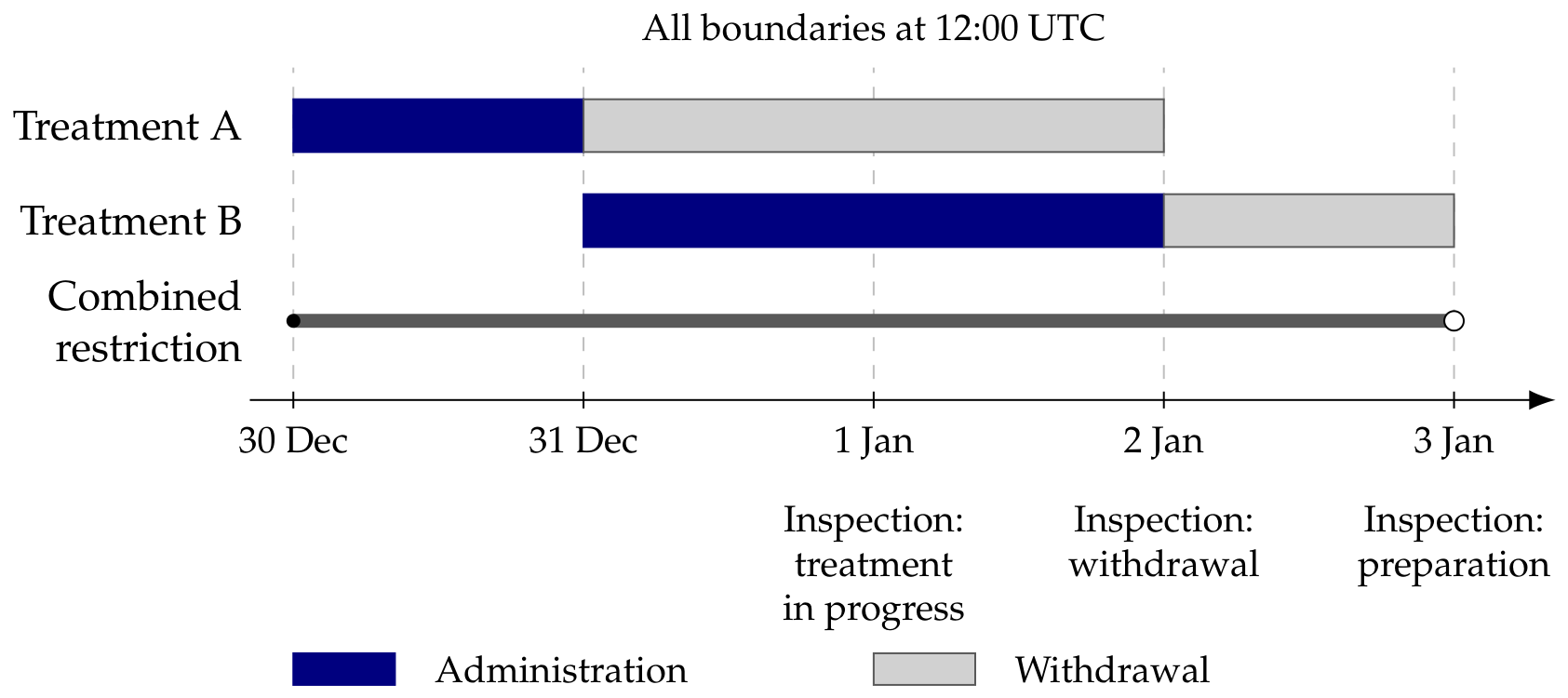
The single-course sequence starts at 12:00 UTC on 1 January 2026. Harvest returns HTTP 409 one second before administration ends, at the transition to withdrawal, and one second before withdrawal ends. It returns HTTP 200 at expiry on 3 January at 12:00 UTC and one second later. Each harvest follows an inspection. In the separate overlapping-course sequence, three inspections return treatment in progress, withdrawal and preparation as the two courses expire (Figure 2).
Figure 2.
Overlapping treatment intervals in the sequence experiment, spanning December 2025–January 2026. The restriction is the union of both half-open intervals. At 1 January, treatment B is being administered while treatment A is in withdrawal, so inspection selects treatment in progress. At 2 January, only withdrawal remains; at 3 January, both restrictions have expired. The open endpoint denotes expiry at that instant.
3.2. Stored-Phase Comparison and Structural Transfer
The interval and stored-phase policies matched their specified outcomes in all 33 cases. They agreed in 27 cases (Table 5). In the six remaining cases, an expired treatment still had a stored treatment phase. The interval policy approved harvest at or after expiry. The stored-phase policy rejected that request until an inspection refreshed the phase. The six cases were D09, D11, D15, D17, D23 and D25. Both policies enforced the lifecycle vetoes.
Table 5.
Decision-policy comparison on the same pre-request fixture. The reference predicate reads the stored phase; the production path evaluates recorded intervals.
The comparison isolates release-time evaluation and the baseline’s refresh requirement. The production path passed its HTTP and committed-audit checks in all 33 cases. The ten mapped batch-release cases also matched their literal release expectations. They cover an empty hold set, start and end boundaries, adjacent instants, overlapping holds, a future hold and two lifecycle vetoes. Both the mathematical release condition and the existing persistence path are exercised through the adapter.
3.3. Requirement-Specific and PIT Mutation Outcomes
All ten requirement-specific variants compiled and executed the 115 workflow integration cases without skips, giving 1150 executions. The matrix detected five variants, and the complete workflow suite detected all ten (Table 6). Each reported detection has failed-case evidence attributable to the injected change. A failed case can stop at a response assertion, a persistence assertion or decoding of a mutation-induced error response. For the lock-removal variant, the concurrency test detected the missing lock wait before it evaluated the harvest outcome.
Table 6.
Failed test cases for each requirement-specific mutation. Each row contains a complete 115-case run. The 25 dedicated cases include twelve wintering sequences.
The baseline workflow suite killed 39 of the 131 PIT mutants (Table 7). Of the remaining mutants, 52 survived and 40 had no covering test. The extended suite killed 49, with 42 survivors and 40 uncovered. Its mutation score is 49/131 (37.40%), or 49/91 (53.85%) among covered mutants. Both runs completed with zero timeouts, run errors, memory errors or non-viable mutants. Mutant identities and production-source hashes match across the two runs.
Table 7.
Standard PIT outcomes for the same production code, operators and 131 mutant identities. Every raw status remains in the reported denominator.
Source-linked review of each remaining mutant is supplied in Supplementary Material. Remaining survivors include checks made redundant by the supported HTTP path, Kotlin non-null or collection implementation instructions, tie selection with an unchanged restriction end, and biological conditions outside the workflow assertions. Biological inspection and intervention bodies account for 31 of the 40 uncovered mutants. Other uncovered locations include exception suppliers and validation-error formatting. The raw denominator retains every mutant. The classification describes its observed context and the declared contract.
3.4. Input Representation and Repeated Colony Visits
The main Python–JVM fixture contains 6672 field-derived executions and 20 development scenarios (Table 8). The numeric-complete group retains 306 visits with all required quantitative fields and a numeric brood-pattern value in the adapter’s 0–5 range. The 4236 age–brood executions are part of the 6672. The 1412 age-one executions repeat one layer of that grid. Deduplicating by visit, date and exact scorer inputs yields 4301 distinct visit–input pairs. All field-derived executions originate from 359 visits to 120 colonies.
Table 8.
Execution groups in the Python–JVM comparison. The age-one/four-brood group repeats one layer of the full grid.
Python and JVM outputs agreed on all 6692 base-fixture evaluations and all 12,708 factorial sensitivity evaluations, for a total of 19,400. The comparison includes complete emitted alert sets, emitted score values and the selected class. Within the age–brood grid, ages zero and one produce eight stress-related selected outputs and 345 no-alert outputs for each brood assignment. At age two, assigning drone-only brood produces a supersedure score of for every visit and selects supersedure in all 353. Eight visits additionally retain stress alerts in their emitted sets.
Disabling only note-derived queen-cell inputs changes 38 of 359 selected outputs, or 10.58% (95% colony-cluster interval 7.24–14.05%). The changes affect 31 of 120 colonies, or 25.83% (18.33–33.33%). Twenty-four colonies have one changed visit and seven have two. By round, the counts are 0/120, 20/120 and 18/119. The paired changes comprise 19 swarming-to-no-alert, 18 supersedure-to-no-alert and one swarming-to-stress selection.
3.5. Sensitivity to Capacity, Honey Conversion and Varroa Representation
The 36 factor combinations give the stress-alert counts in Table 9. The counts are identical across the three assigned capacities for each honey/Varroa pair. At the reference capacity of 20, honey factor of 2 and raw Varroa count, eight visits emit stress alerts. Changing only the honey factor to 1 yields 54 and changes 46 selected outputs in 39 colonies. Changing it to 3 yields three and changes five outputs in five colonies. Substituting the recorded per-100 value into the integer count input at the reference honey factor yields one alert and changes seven outputs in seven colonies.
Table 9.
Stress-alert counts among 353 visits. Each row and Varroa column applies at all three assigned capacities. The per-100 column substitutes a rate into the count input at unchanged thresholds.
Changing capacity from 20 to 10 alters the swarming score at 145 of the 353 visits. Changing it from 20 to 30 alters the score at three. These counts apply at every combination of honey conversion and Varroa input. With queen-cell features disabled (zero count, placement and stage NONE) and age fixed at one year, limited space and colony strength can contribute at most . At age two or older, the same two conditions and the additional age contribution of 0.10 reach the 0.45 warning threshold (Table 2). Across the 12,708 factorial evaluations, the highest swarming score was 0.25. None of the 353 visits met both strength cutoffs of 10 frames of bees and 6 frames of brood. The adapter clips free space to zero when estimated frame occupation exceeds capacity. This occurs in 80 visits at capacity 10, one at 20 and zero at 30.
With one assigned marginal queen cell open with a larva, capacities of 10, 20 and 30 frames yield 147, 3 and 0 swarming alerts, respectively. Relative to 20 frames, the 10-frame setting changes the selected class at 144 visits in 86 colonies. The 30-frame setting changes it at 3 visits in 2 colonies. These results quantify the interaction between assigned capacity and the queen-cell term.
3.6. Persistent Biological State and Inspection Advice
In development case SUP-08, two central queen cells select the persistent state SUPERSEDURE_ACTIVE. The advisory rule assigns for those cells, for a three-year-old queen and for compact brood. The supersedure score is , below its emission threshold. The swarming and stress scores are and , also below their thresholds. The corresponding inspection response therefore has currentBiologicalState equal to SUPERSEDURE_ACTIVE and an empty alertsGenerated list. The state records the condition selected by the ordered guards, while the list reports the advisories emitted for this inspection.
Nineteen of twenty development scenarios match their assigned classes. Their labels comprise ten supersedure, five swarming and five nominal cases. All twenty yield a stress score of zero.
4. Discussion
4.1. Lifecycle and Time as Independent Decision Inputs
The release contract combines a persistent lifecycle veto with the union of time-dependent intervals. Wintering remains in force through treatment, inspection and expiry. This property depends on the transitions leading to the decision as well as the guard evaluated at the final request. The twelve wintering sequences observe both dimensions and their linked audit records across the complete command history.
The design comparison makes the refresh dependency explicit. A stored-phase policy reaches the same decisions when the phase is refreshed at the relevant boundary. Command-time interval evaluation makes that boundary available directly from the restriction records. The six disagreements identify delayed release caused by retained phases in the selected scenarios. They concern decision freshness under these two contracts. Both predicates can be used with several persistence and event-processing architectures.
The committed decision record adds a separate property. An HTTP 409 response has a durable reason and causal event, while an unexpected failure leaves an aborted transaction. Per-hive locking orders treatment and harvest before time capture and guard evaluation. These observations connect interval semantics to database visibility and persisted outcomes. They complement the practical withdrawal-record concerns identified by Strang et al. [1].
4.2. Test Adequacy and the Fault Model
A state matrix organizes individual command combinations, while a sequence observes whether one command preserves information needed by a later command. The mutation experiments expose a further distinction between contract-specific faults and bytecode-level changes. The handwritten variants cover repository query predicates, lock removal, rollback and event links. PIT supplies operators selected independently of those particular requirements and reports surviving and uncovered locations alongside detections.
The extended suite killed 10 mutants that survived the baseline suite. They affect the rejection reason, selected expiry, explanation text, inspection transition, duplicate-event handling and request identity. The inventories identify the killing tests and the locations that survive or lack coverage.
The tests, implementation and manual fault sample share author knowledge. Standard operators broaden the sample of syntactic changes, while their results remain conditional on target classes, reachable paths, tests and mutation operators. The exact mutant inventory and source-linked analysis make that condition inspectable. Coverage, killed mutants and complete sequence observations provide separate evidence about the executable contract.
4.3. Transfer Conditions
The mapped batch-quarantine cases exercise the same structural predicate: entity identity, independent lifecycle vetoes, half-open hold intervals, a decision instant and an event-linked outcome. The transfer applies when a command has a defined release instant and the relevant constraints can be read consistently within an entity’s transaction boundary. A particular batch, veterinary or supply-chain application would supply its own authority for restriction durations, amendment policy, identity mapping and release permissions [18].
The per-entity transaction boundary requires further design when constraints span several entities, when authorization changes concurrently, or when release depends on external evidence that is updated asynchronously. High-frequency telemetry also requires a separate ingestion and aggregation design. Where eventual release is acceptable or a single static invariant determines permission, a simpler synchronization contract can suffice. The batch cases demonstrate the structural mapping through the executing guard, with domain adoption as a separate engineering task.
4.4. Adapter Decisions and Inspection-Design Hypotheses
The source file provides repeated colony visits, quantitative frame estimates, mite counts and rates. The adapter assigns capacity and honey conversion, generates cell morphology from selected phrases, and supplies age and categorical brood scenarios. The 38 paired changes and the factorial counts describe the combined computation on this dataset.
Capacity changes can alter a score even when the alert set stays fixed. The assigned queen-cell scenario shows when that score difference reaches the alert threshold. Honey and Varroa scenarios show how changing the input conversion changes which visits cross a fixed threshold. Recording units, conversions and the complete alert set makes these calculations reproducible. Other beekeeping datasets document measurement protocols and linked hive identities [30,33]. Photographic auditing offers a way to retain the underlying observations [34].
These results motivate the hypothesis that separately recorded queen-cell count, position, developmental stage, queen age and brood category would reduce ambiguity in this adapter’s inputs. Testing that hypothesis calls for comparisons of forms, datasets or user entry under defined protocols. Agricultural DSS adoption research also identifies relevance, clarity and usable information as priorities for operators [35,36]. A separate study could use the best–worst method [37] to elicit the relative importance beekeepers assign to inspection findings, then test the resulting alert rules against independently observed colony outcomes.
The source data group the 120 colonies under 15 BeeHome identifiers, with eight colonies per identifier. The bootstrap keeps each colony’s visits together and samples colonies individually, so its intervals represent between-colony variation under that sampling scheme. Dependence among colonies sharing a BeeHome lies outside this calculation. The proxy statistics quantify internal agreement because label and feature construction share text. Beewise also supplied the development observations for the stress rule’s heuristic tuning. The software-verification evidence concerns response, timing, persistence and lifecycle behavior.
5. Conclusions
The study specifies an auditable release-decision workflow with persistent lifecycle vetoes, half-open treatment intervals and a shared transaction boundary. Wintering survives treatment and inspection, while harvest evaluates recorded intervals at its own command time. Database-backed tests verify durable rejection and rollback of technical failures. The stored-phase comparison locates the release delay introduced by an unmet refresh requirement, and mapped batch cases exercise the same structural contract.
The requirement-specific fault set and PIT report complementary observations about test adequacy, including surviving and uncovered code locations. Secondary input analysis accounts for 359 visits to 120 colonies and quantifies the effects of note-derived features, capacity assignments, honey conversion and Varroa representation. The public artifact connects each reported outcome to its input case, executed command or mutation record.
Supplementary Materials
The following supporting information can be downloaded at: https://www.mdpi.com/article/10.3390/app162311825/s1, Supplementary Material contains the complete code and verification artifact, including conformance cases, design comparisons, structural transfer cases, mutation reports, data adapters, per-visit results and reproduction instructions.
Author Contributions
Conceptualization, F.K.; methodology, M.A. and F.K.; software and writing—original draft, M.A.; writing—review and editing, M.A. and F.K.; supervision, F.K. All authors have read and agreed to the published version of the manuscript.
Funding
This research received no external funding.
Institutional Review Board Statement
Not applicable. The study consists of software verification and secondary analysis of a publicly available dataset.
Informed Consent Statement
Not applicable.
Data Availability Statement
The colony assessment data and their README are publicly available at https://doi.org/10.5281/zenodo.21907271. Complete source, executable tests, analysis scripts, case-level outputs and mutation reports are supplied as Supplementary Material and are available in the public repository at commit e30d6fc [28] (https://github.com/MichalAntosiewicz/Apiary-Management-System/tree/e30d6fcda97d30ec5d14e69fb9364b3e27e3dc82, accessed on 18 November 2026).
Acknowledgments
OpenAI Codex (OpenAI) assisted code inspection, test implementation, computational analysis, manuscript preparation and diagram code. The recorded models were gpt-6-astra (23 October–17 November 2026), gpt-6.1-sol (17–18 November) and gpt-6.2-sol (18 November). Editorial work also used gpt-6.2-astra on 18–19 November. Executable programs generated the numerical results. The authors take responsibility for the methods, results, interpretation and manuscript content.
Conflicts of Interest
The authors declare no conflicts of interest.
Abbreviations
| API | Application programming interface |
| BPMN | Business Process Model and Notation |
| DSS | Decision support system |
| EPCIS | Electronic Product Code Information Services |
| FSM | Finite-state machine |
| HTTP | Hypertext Transfer Protocol |
| IoT | Internet of Things |
| JVM | Java Virtual Machine |
Appendix A. Biological State Guards
The inspection listener applies the first matching guard in Table A1 and otherwise retains the biological state. The swarm-intervention listener clears swarm preparation when its specified intervention condition holds, and the queen-replacement listener clears the SUPERSEDURE_ACTIVE state. These are executable labels and transition rules. The stored swarmed label has no incoming transition in the implemented command paths.
Table A1.
Ordered biological guards for an inspection. If no row matches, the previous biological state is retained. Current denotes the state before the inspection.
Appendix B. Note-Derived Adapter and Proxy-Label Agreement
The proxy mapping searches combined Notes and AU_reason text in a fixed order: a substring containing swarm gives the swarming proxy; abscond, deadout, dead, or empty hive gives the absconding proxy; queen-related terms give supersedure unless adult bees occupy fewer than three frames, in which case they give absconding. The queen-related list includes supersedure, new queen, nq, ql, queenless, virginq, qcell, and queen cell. The subsequent terms foul brood, excluded, weak, and infestation also give the absconding proxy. Remaining records receive the nominal proxy. The fewer-than-three-frame criterion applies to the adult-bee estimate at the current visit.
The note-derived adapter constructs inspection features from Notes: a swarm phrase generates seven sealed marginal queen cells; selected queen-related phrases generate two central cells open with larvae. The numerical brood field is mapped to absent at zero, spotty between zero and four, and compact at four or above; missing or unparseable entries default to compact. Missing Varroa values default to zero, and queen age is fixed at one year. The paired ablation removes the generated queen-cell features and preserves every other assignment.
Table A2 yields 282 matching labels out of 359, giving internal agreement of 78.55% (95% colony-cluster interval 74.37–82.68%) and four-class macro-F1 of 0.539 (0.470–0.601). Removing the note-derived queen-cell inputs yields 249 matches, or 69.36% (64.07–74.65%), and macro-F1 of 0.248 (0.205–0.293). These statistics describe agreement between the deterministic constructions. Macro-F1 gives equal weight to the per-class F1 values [38]. A constant nominal output matches 250 of the 359 proxies (69.64%).
Table A2.
Agreement matrix for the note-derived adapter on 359 records. Rows are textual proxy labels; columns are selected rule outputs. Both constructions use the inspection notes.
References
- Strang, C.; Alarcon, P.; Cardwell, J.M.; Brunton, L. Assessing antibiotic usage data capture accuracy on dairy farms in England and Wales. Vet. Rec. 2023, 193, e3505. [Google Scholar] [CrossRef] [Scilit] [PubMed]
- Danieli, P.P.; Addeo, N.F.; Lazzari, F.; Manganello, F.; Bovera, F. Precision Beekeeping Systems: State of the Art, Pros and Cons, and Their Application as Tools for Advancing the Beekeeping Sector. Animals 2024, 14, 70. [Google Scholar] [CrossRef] [Scilit] [PubMed]
- Turyagyenda, A.; Katumba, A.; Akol, R.; Nsabagwa, M.; Mkiramweni, M.E. IoT and Machine Learning Techniques for Precision Beekeeping: A Review. AI 2025, 6, 26. [Google Scholar] [CrossRef] [Scilit]
- Šabić, J.; Perković, T.; Šolić, P.; Šerić, L. Buzzing with Intelligence: A Systematic Review of Smart Beehive Technologies. Sensors 2025, 25, 5359. [Google Scholar] [CrossRef] [Scilit] [PubMed]
- Zhai, Z.; Martínez, J.F.; Beltran, V.; Martínez, N.L. Decision support systems for agriculture 4.0: Survey and challenges. Comput. Electron. Agric. 2020, 170, 105256. [Google Scholar] [CrossRef] [Scilit]
- Zacepins, A.; Brusbardis, V.; Meitalovs, J.; Stalidzans, E. Challenges in the development of Precision Beekeeping. Biosyst. Eng. 2015, 130, 60–71. [Google Scholar] [CrossRef] [Scilit]
- Meikle, W.G.; Holst, N. Application of continuous monitoring of honeybee colonies. Apidologie 2015, 46, 10–22. [Google Scholar] [CrossRef] [Scilit]
- Zaman, A.; Dorin, A. A framework for better sensor-based beehive health monitoring. Comput. Electron. Agric. 2023, 210, 107906. [Google Scholar] [CrossRef] [Scilit]
- Winston, M.L. The Biology of the Honey Bee; Harvard University Press: Cambridge, MA, USA, 1987. [Google Scholar]
- Fell, R.D.; Ambrose, J.T.; Burgett, D.M.; De Jong, D.; Morse, R.A.; Seeley, T.D. The Seasonal Cycle of Swarming in Honeybees. J. Apic. Res. 1977, 16, 170–173. [Google Scholar] [CrossRef] [Scilit]
- Lee, K.V.; Goblirsch, M.; McDermott, E.; Tarpy, D.R.; Spivak, M. Is the Brood Pattern within a Honey Bee Colony a Reliable Indicator of Queen Quality? Insects 2019, 10, 12. [Google Scholar] [CrossRef] [Scilit] [PubMed]
- Human, H.; Brodschneider, R.; Dietemann, V.; Dively, G.; Ellis, J.D.; Forsgren, E.; Fries, I.; Hatjina, F.; Hu, F.L.; Jaffé, R.; et al. Miscellaneous standard methods for Apis mellifera research. J. Apic. Res. 2013, 52, 1–53. [Google Scholar] [CrossRef] [Scilit]
- Dainat, B.; Dietemann, V.; Imdorf, A.; Charrière, J.D. A scientific note on the ’Liebefeld Method’ to estimate honey bee colony strength: Its history, use, and translation. Apidologie 2020, 51, 422–427. [Google Scholar] [CrossRef] [Scilit]
- Kviesis, A.; Komasilovs, V.; Komasilova, O.; Zacepins, A. Application of fuzzy logic for honey bee colony state detection based on temperature data. Biosyst. Eng. 2020, 193, 90–100. [Google Scholar] [CrossRef] [Scilit]
- Kady, C.; Chedid, A.M.; Kortbawi, I.; Yaacoub, C.; Akl, A.; Daclin, N.; Trousset, F.; Pfister, F.; Zacharewicz, G. IoT-Driven Workflows for Risk Management and Control of Beehives. Diversity 2021, 13, 296. [Google Scholar] [CrossRef] [Scilit]
- Komasilovs, V.; Mills, R.; Kviesis, A.; Mondada, F.; Zacepins, A. Architecture of a decentralised decision support system for futuristic beehives. Biosyst. Eng. 2024, 240, 56–61. [Google Scholar] [CrossRef] [Scilit]
- Kavishe Mushi, P.; Seleman Mussa, I.; Horváth, T.; Várkonyi, D.T.; Alexy, M. A Precision Beekeeping Ontology. Appl. Ontol. 2026, 21, 339–347. [Google Scholar] [CrossRef] [Scilit]
- Chatzinikolaou, S.; Vassiliou, G.; Gianniou, M.; Vassalos, M.; Papadakis, N. Integrating Veterinary Public Health Data into EPCIS-Based Digital Traceability for Dairy Supply Chains. Foods 2026, 15, 1566. [Google Scholar] [CrossRef] [Scilit] [PubMed]
- Hohpe, G.; Woolf, B. Enterprise Integration Patterns: Designing, Building, and Deploying Messaging Solutions; Addison-Wesley Professional: Boston, MA, USA, 2003. [Google Scholar]
- Fowler, M. Event Sourcing. 12 December 2005. Available online: https://martinfowler.com/eaaDev/EventSourcing.html (accessed on 31 October 2026).
- Berenson, H.; Bernstein, P.; Gray, J.; Melton, J.; O’Neil, E.; O’Neil, P. A critique of ANSI SQL isolation levels. In Proceedings of the 1995 ACM SIGMOD International Conference on Management of Data, San Jose, CA, USA, 22–25 May 1995; pp. 1–10. [Google Scholar] [CrossRef] [Scilit]
- Bailis, P.; Fekete, A.; Franklin, M.J.; Ghodsi, A.; Hellerstein, J.M.; Stoica, I. Coordination avoidance in database systems. Proc. VLDB Endow. 2014, 8, 185–196. [Google Scholar] [CrossRef] [Scilit]
- Chow, T.S. Testing Software Design Modeled by Finite-State Machines. IEEE Trans. Softw. Eng. 1978, SE-4, 178–187. [Google Scholar] [CrossRef] [Scilit]
- Utting, M.; Pretschner, A.; Legeard, B. A taxonomy of model-based testing approaches. Softw. Test. Verif. Reliab. 2012, 22, 297–312. [Google Scholar] [CrossRef] [Scilit]
- Jia, Y.; Harman, M. An Analysis and Survey of the Development of Mutation Testing. IEEE Trans. Softw. Eng. 2011, 37, 649–678. [Google Scholar] [CrossRef] [Scilit]
- Just, R.; Jalali, D.; Inozemtseva, L.; Ernst, M.D.; Holmes, R.; Fraser, G. Are mutants a valid substitute for real faults in software testing? In Proceedings of the 22nd ACM SIGSOFT International Symposium on Foundations of Software Engineering, Hong Kong, China, 16–22 November 2014; pp. 654–665. [Google Scholar] [CrossRef] [Scilit]
- Coles, H.; Laurent, T.; Henard, C.; Papadakis, M.; Ventresque, A. PIT: A Practical Mutation Testing Tool for Java (Demo). In Proceedings of the 25th International Symposium on Software Testing and Analysis, Saarbrücken, Germany, 18–20 July 2016; pp. 449–452. [Google Scholar] [CrossRef] [Scilit]
- Antosiewicz, M.; Krużel, F. Apiary Management System: Workflow Verification and Computational Research Artifact. Commit e30d6fc. 2026. Available online: https://github.com/MichalAntosiewicz/Apiary-Management-System/tree/e30d6fcda97d30ec5d14e69fb9364b3e27e3dc82 (accessed on 18 November 2026).
- Delaplane, K.S.; van der Steen, J.; Guzman-Novoa, E. Standard methods for estimating strength parameters of Apis mellifera colonies. J. Apic. Res. 2013, 52, 1–12. Available online: https://bees.caes.uga.edu/content/dam/caes-subsite/bee-program/images/research-archives/JARStandardmethodscolonystrength.1.03.pdf (accessed on 2 November 2026). [CrossRef] [Scilit]
- Zhu, Y.; Abdollahi, M.; Maucourt, S.; Coallier, N.; Guimarães, H.R.; Giovenazzo, P.; Falk, T.H. MSPB: A longitudinal multi-sensor dataset with phenotypic trait measurements from honey bees. Sci. Data 2024, 11, 860. [Google Scholar] [CrossRef] [Scilit] [PubMed]
- Demi, S.; Goldberg, I.; Giaciobino, A.; Tokach, R.; Seltzer, R.; Williams, G.R. Beewise Colony Assessment 2025. Version 1 [Dataset]. Zenodo, 12 August 2026. Available online: https://doi.org/10.5281/zenodo.21907271 (accessed on 2 November 2026).
- Field, C.A.; Welsh, A.H. Bootstrapping clustered data. J. R. Stat. Soc. Ser. B Stat. Methodol. 2007, 69, 369–390. [Google Scholar] [CrossRef] [Scilit]
- Abdollahi, M.; Zhu, Y.; Guimarães, H.R.; Coallier, N.; Maucourt, S.; Giovenazzo, P.; Falk, T.H. UrBAN: Urban Beehive Acoustics and PheNotyping Dataset. Sci. Data 2025, 12, 536. [Google Scholar] [CrossRef] [Scilit] [PubMed]
- Cook, D.; Hauxwell, C. Providing rigor in bee colony strength auditing methods. J. Econ. Entomol. 2024, 117, 410–416. [Google Scholar] [CrossRef] [Scilit] [PubMed]
- Rose, D.C.; Sutherland, W.J.; Parker, C.; Lobley, M.; Winter, M.; Morris, C.; Twining, S.; Ffoulkes, C.; Amano, T.; Dicks, L.V. Decision support tools for agriculture: Towards effective design and delivery. Agric. Syst. 2016, 149, 165–174. [Google Scholar] [CrossRef] [Scilit]
- Sattler, C.; Barron, A.B.; Colin, T. Beekeeping in the digital age: Prospects and pitfalls of hive sensors in commercial beekeeping. J. Apic. Res. 2026, 65, 52–62. [Google Scholar] [CrossRef] [Scilit]
- Rezaei, J. Best-worst multi-criteria decision-making method. Omega 2015, 53, 49–57. [Google Scholar] [CrossRef] [Scilit]
- Sokolova, M.; Lapalme, G. A systematic analysis of performance measures for classification tasks. Inf. Process. Manag. 2009, 45, 427–437. [Google Scholar] [CrossRef] [Scilit]

Disclaimer/Publisher’s Note: The statements, opinions and data contained in all publications are solely those of the individual author(s) and contributor(s) and not of MDPI and/or the editor(s). MDPI and/or the editor(s) disclaim responsibility for any injury to people or property resulting from any ideas, methods, instructions or products referred to in the content. |
© 2026 by the authors. Licensee MDPI, Basel, Switzerland. This article is an open access article distributed under the terms and conditions of the Creative Commons Attribution (CC BY) license.