


Abstract
Peer-to-peer (P2P) energy trading can improve the local use of distributed generation within energy communities. However, several operational formulations restrict each prosumer to a single trading counterpart per time period, limiting local energy allocation when multiple buyers and sellers are simultaneously active. This work proposes a mixed-integer linear programming (MILP) framework for multi-P2P energy trading in which each participant can interact simultaneously with multiple counterparties while preserving the traceability and consistency of bilateral transactions. The formulation jointly coordinates grid exchanges, bilateral P2P transactions, and battery operation, incorporates minimum transaction thresholds, and applies an ex-post settlement procedure to determine individual prosumer bills. The proposed formulation is compared with a conventional one-to-one P2P benchmark under identical operating conditions in two energy-community configurations. In the five-member community, multi-P2P trading reduces the collective net cost by 14.69%, decreases grid imports and exports by 19.78% and 10.77%, respectively, and increases P2P energy exchanges by 20.71%. In the twenty-member community, the collective net cost decreases by 2.21%, P2P energy increases by 10.11%, and active bilateral transactions increase by 70.43%, with up to eight simultaneous trading partners per prosumer. Sensitivity and seasonal assessments further show that the benefits depend on the transaction threshold and operating conditions. Overall, relaxing the single-counterparty restriction provides greater flexibility for local energy allocation and can improve the aggregate economic performance of energy communities.
1. Introduction
The transition towards a more sustainable and decentralized energy system is driving the increasing integration of distributed energy resources, particularly small-scale renewable generation and energy storage systems. In this context, energy communities have gained increasing relevance as a means of promoting the active participation of consumers in the power system. In fact, the European regulatory framework explicitly recognizes both renewable energy communities and citizen energy communities, encouraging users to participate in activities related to energy generation, consumption, storage, sharing, and selling [1,2]. As a result, consumers are no longer limited to a passive role and can become prosumers capable of managing and coordinating their own energy resources within the community [3]. In this context, local energy markets and peer-to-peer (P2P) trading mechanisms have emerged as promising tools to facilitate direct transactions among prosumers and promote a more efficient use of locally available energy resources [4].
Against this background, considerable research attention has been devoted to the development of optimization methods and market mechanisms for coordinating the operation of energy community participants [5]. Existing P2P trading approaches differ mainly in how transactions are represented, how participants are coordinated, and how the market is cleared. Centralized optimization models are particularly suitable for operational scheduling because they can jointly represent local demand, distributed generation, energy storage systems, grid exchanges, and internal energy trading. Several contributions combine photovoltaic generation and battery scheduling with local trading mechanisms [6], while others incorporate Nash-based pricing schemes for residential and commercial multi-energy systems within MILP formulations [7]. Other centralized approaches jointly schedule batteries, grid exchanges, and P2P transactions but restrict each prosumer to a single trading counterpart per time period [8]. Household-pairing strategies have also been proposed to promote local self-consumption while balancing the reduction in grid exchanges and operating costs [9].
Other centralized formulations focus on the heterogeneity of participants and distributed resources. Community-level scheduling models have been developed to coordinate heterogeneous households and controllable loads, showing that a reduction in aggregate cost does not necessarily translate into an economic improvement for every individual participant [10]. P2P and grid-only operation have also been compared for communities comprising consumers, prosumers, and industrial users, although local trading prices are predefined [11]. These studies demonstrate the ability of centralized optimization approaches to obtain detailed operational schedules. However, the representation of bilateral interactions among participants remains an important modeling choice, particularly when multiple buyers and sellers are simultaneously active within the same time period.
Alternative approaches have addressed this coordination problem through game-theoretic, auction-based, and distributed mechanisms. Non-cooperative and hierarchical formulations have been used to represent bidding, bargaining, and pricing decisions among participants [12,13,14,15,16,17]. Cooperative approaches instead focus on the formation of trading groups and the allocation of benefits among participants [18,19]. Bilateral energy trading has also been formulated as an assignment game that explicitly distinguishes between single-contract and multi-contract arrangements [20]. Auction-based mechanisms have been proposed to determine trading allocations and prices [21,22,23], while distributed optimization methods based on the alternating direction method of multipliers (ADMM) and generalized Nash formulations have been used to incorporate network constraints and decentralized decision-making [24,25,26,27]. Although these approaches address different aspects of P2P market coordination, the explicit representation of simultaneous bilateral transactions among multiple participants remains a relevant modeling issue, particularly in operational scheduling formulations.
Despite these advances, the explicit representation of multiple simultaneous bilateral transactions has received comparatively limited attention in operational MILP-based P2P scheduling models. Many existing formulations either restrict each prosumer to a single trading counterpart within each time period or represent internal energy exchanges at the aggregate community level. Although these assumptions simplify market coordination and reduce computational complexity, they may limit the allocation of locally available energy when multiple buyers and sellers are active at the same time. Moreover, optimization models may generate residual transactions with very small power values that are mathematically feasible but have limited practical relevance from operational, metering, settlement, or control perspectives.
To address these limitations, this work develops a MILP formulation for the coordinated energy scheduling of a local energy community in which each prosumer can simultaneously engage in P2P transactions with multiple participants. The proposed framework jointly optimizes grid purchases and sales, bilateral P2P exchanges, and the operation of available energy storage systems. Unlike one-to-one formulations, the number of counterparties associated with each prosumer is not restricted within a given time period, allowing locally available generation surpluses to be allocated among several participants whenever this improves the overall economic performance of the community.
The proposed multi-P2P structure preserves the traceability and consistency of scheduled energy exchanges through constraints that enforce both overall P2P market balance and bilateral consistency between trading pairs. Minimum operating thresholds are also introduced for grid and P2P exchanges to prevent residual transactions with negligible power values. The objective function minimizes the aggregate net energy cost associated with exchanges between the community and the external grid. Since P2P payments represent internal economic transfers among participants, they are not directly included in the community-level objective. Instead, P2P exchanges enable the redistribution of locally generated energy within the community and may reduce both grid dependence and aggregate energy costs. The formulation also incorporates battery operation through charging and discharging power limits, the temporal evolution of stored energy, and state-of-charge constraints.
The main contributions of this work can be summarized as follows:
- A unified MILP formulation is developed for the joint scheduling of grid exchanges, bilateral P2P transactions, and energy storage operation within an energy community. The resulting model can be solved using standard mathematical programming solvers and provides verifiable optimal solutions through the corresponding optimality gap.
- A multi-P2P trading structure is introduced that allows each prosumer to simultaneously interact with multiple counterparties within the same time period, overcoming the single-counterparty restriction adopted in conventional one-to-one formulations while preserving the traceability of individual bilateral exchanges.
- Market-balance and bilateral-consistency constraints are incorporated to ensure coherent coordination of simultaneous P2P transactions among multiple participants.
- Minimum operating thresholds are introduced for both grid and P2P transactions to avoid residual exchanges with negligible power values and limited operational relevance.
- The proposed multi-P2P formulation is evaluated against a one-to-one P2P benchmark under equivalent operating conditions, allowing its economic, energy, trading, and computational performance to be assessed.
The remainder of the paper is organized as follows. Section 2 presents the proposed methodology and the mathematical formulation of the multi-P2P framework. Section 3 describes the data and case studies used to evaluate the model. Section 4 presents and discusses the main results, while Section 5 summarizes the main conclusions of the work.
2. Proposed P2P Trading Model
This section presents the optimization model used to determine the coordinated operation of an energy community composed of a set of prosumers over a discrete scheduling horizon. Each participant is characterized by an electricity demand profile and may also have local renewable generation and battery energy storage, while remaining connected to the external grid. The formulation jointly considers grid exchanges, peer-to-peer (P2P) transactions among participants, and the operation of the available energy storage systems, and is formulated as a mixed-integer linear programming (MILP) problem.
The model receives as input the demand and generation profiles of the prosumers, grid purchase and selling prices, and the technical parameters associated with P2P trading and energy storage. Based on this information, it determines the grid exchanges, bilateral P2P transactions, and battery operation required to minimize the aggregate net energy cost of the community. Unlike one-to-one formulations, the proposed model allows each prosumer to simultaneously exchange energy with several counterparties within the same time period while preserving the traceability of the individual bilateral transactions.
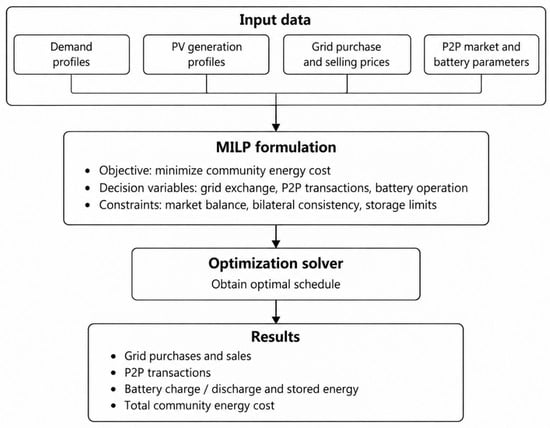
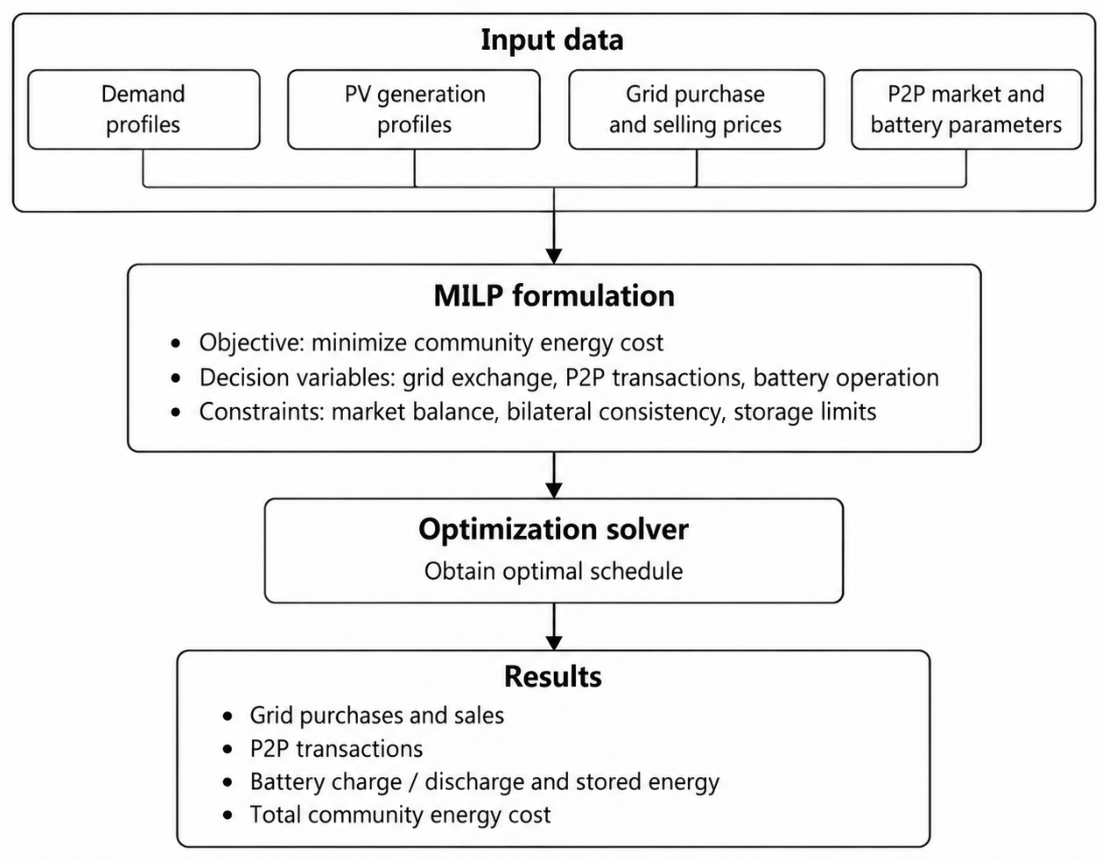
Figure 1 schematically illustrates the overall structure of the proposed methodology. As input data, the model requires the estimated demand and generation profiles of the prosumers, the electricity purchase and selling prices associated with the grid, as well as the technical parameters related to the P2P market and the energy storage systems. Based on this information, a mixed-integer linear programming (MILP) optimization problem is formulated with the objective of minimizing the community-wide energy cost associated with grid exchanges. To this end, the model jointly determines energy purchases from and sales to the grid, P2P transactions among prosumers, and the operation of the energy storage systems, promoting internal energy exchanges whenever they contribute to reducing the aggregate energy bill of the community. Finally, for each prosumer and time period, the model provides the power purchased from and sold to the grid, the P2P transactions carried out with the other participants, and, when storage is available, the battery charging and discharging power and the evolution of its state of charge. These variables are also used to determine the total energy cost associated with the community’s exchanges with the grid.
Figure 1.
Flowchart of the proposed multi-P2P energy trading framework.
The objective function of the model aims to minimize the net energy cost of the community associated with energy exchanges with the grid. Reducing this cost improves the overall economic outcome of the participating prosumers. To this end, the cost of the energy purchased from the grid by each prosumer and the revenues obtained from the energy sold to the grid during each time period are considered. Therefore, the proposed objective function optimizes the economic performance of the community as a whole and does not explicitly guarantee an individual economic improvement for every participating prosumer:
In this way, the model determines the joint operation of the prosumers with the objective of reducing the aggregate energy bill of the community associated with its exchanges with the grid. P2P transactions are not directly included in the objective function, since they represent internal economic exchanges among the participants and, at the aggregate level, the costs associated with energy purchases are offset by the revenues obtained from the corresponding sales. Nevertheless, these exchanges enable the local utilization of the available energy and, when economically advantageous, reduce the community’s dependence on energy exchanges with the grid.
The energy exchanges between each prosumer and the grid are constrained by the operational limits associated with its point of connection. In addition to the maximum admissible exchange capacity, a minimum operational power threshold is introduced to avoid the activation of negligible transactions that may not be reliably measurable or implementable in practice. This threshold can be defined according to the resolution of the metering infrastructure, the sensitivity of the monitoring and control equipment, or the minimum power level required for the reliable execution of an energy exchange. Therefore, whenever a grid transaction is activated, its power must remain between the corresponding minimum and maximum operating limits. Constraints (2) and (3) impose these conditions for purchasing and selling operations, respectively.
Likewise, the operation of each prosumer with respect to the grid must be constrained to prevent simultaneous energy purchases and sales within the same time period. This condition is imposed by constraint (4).
Thus, in each time period, a prosumer can act either as a buyer or as a seller with respect to the grid, but cannot perform both operations simultaneously. Furthermore, when an exchange is activated, its associated power cannot take arbitrarily small values, thereby preventing mathematically feasible but operationally insignificant transactions.
Similarly to grid exchanges, P2P transactions are constrained by the operational capability of each prosumer’s point of connection. Since these exchanges take place through the same point of connection, no specific maximum capacity is defined for P2P transactions. Therefore, is used as the upper limit for purchasing operations, whereas is used for selling operations, with the latter corresponding to the maximum permitted injection capacity of the prosumer. Minimum operational thresholds are also imposed on bilateral P2P exchanges to ensure that every activated transaction corresponds to a power level that can be reliably measured and implemented in practice. Constraints (5) and (6) define the admissible operating range of each bilateral transaction and relate the exchanged power to the corresponding binary activation variable.
When multiple P2P transactions are simultaneously scheduled for the same prosumer, the aggregate exchanged power must also remain within the capacity of its point of connection. Therefore, in addition to the limits imposed on each individual bilateral transaction, the total power imported and exported by each prosumer is constrained by its corresponding maximum connection capacity. These conditions are imposed by Constraints (7) and (8).
Accordingly, when the corresponding binary variable is equal to zero, the exchanged power is forced to zero. Conversely, when a transaction is activated, the exchanged power must be at least equal to the predefined minimum operational threshold. In addition, the aggregate capacity constraints ensure that, regardless of the number of simultaneous P2P counterparties, the total power imported or exported by each prosumer does not exceed the admissible capacity of its point of connection.
To ensure the consistency of the energy exchanges carried out within the P2P market, two complementary balance conditions are imposed. First, the overall P2P market must be balanced in each time period, so that the total power purchased by the prosumers is equal to the total power sold within the community. This market-clearing condition is established by Constraint (9).
In addition to the overall market balance, consistency must be preserved for each bilateral transaction. Therefore, for every pair of prosumers and time period, the power purchased by prosumer i from prosumer j must be equal to the power sold by prosumer j to prosumer i. This directional consistency condition is imposed by Constraint (10).
Furthermore, simultaneous P2P transactions in opposite directions between the same pair of prosumers are not permitted. This condition prevents redundant or contradictory exchanges and is imposed by Constraint (11).
Together, Constraints (9)–(11) ensure the consistency of the P2P market when several bilateral exchanges are simultaneously carried out among the participants. The market-balance constraint guarantees the overall balance of the local market, the bilateral-consistency constraint ensures an exact correspondence between each buyer and seller, and the mutual-exclusivity constraint prevents simultaneous exchanges in opposite directions between the same pair of prosumers.
The energy balance must be satisfied for each prosumer at every time period, accounting for all the available sources and destinations of power. Thus, local generation, energy purchased from the grid, energy acquired through P2P transactions, and the power discharged from the storage system must balance the local demand, energy sold to the grid, energy sold through P2P transactions, and the power used to charge the storage system. This condition is imposed by Constraint (12).
Renewable generation curtailment is not considered in the proposed formulation. Consequently, the available generation must be fully allocated within the energy balance. Any surplus remaining after satisfying the local demand can be stored, when storage capacity is available, or exported through the grid or the P2P market. For prosumers without storage, the entire surplus must therefore be sold either to the grid or to other participants in the community. The optimization model determines the corresponding allocation according to the alternative that contributes to minimizing the aggregate energy cost of the community.
For prosumers equipped with an energy storage system, the charging and discharging power must remain within the corresponding operating limits. Constraints (13) and (14) impose the maximum charging and discharging power, respectively, through binary variables that determine the operating state of the storage system.
Simultaneous charging and discharging of the storage system are not permitted. Therefore, the corresponding operating modes are mutually exclusive, as imposed by Constraint (15).
The operation of the battery associated with each prosumer is defined by Constraints (16)–(19), which describe its initial condition, the temporal evolution of the stored energy, and its operating limits. The battery is initialized according to the predefined initial state of charge, . A common efficiency parameter, , is assumed for both charging and discharging operations. The stored energy in each subsequent time period depends on the energy available in the previous period and on the charging and discharging power, accounting for the corresponding efficiency. Likewise, the stored energy must remain within the minimum and maximum state-of-charge limits throughout the scheduling horizon. Finally, the stored energy at the end of the horizon is constrained to return to its initial value, thereby preventing any artificial economic benefit derived from the initial energy content of the battery.
Although P2P payments are not included in the community-level objective function because they represent internal economic transfers among participants, an ex-post settlement procedure is considered to determine the individual net energy cost of each prosumer. This settlement does not modify the optimal scheduling obtained from the MILP, but provides an economic allocation of the resulting P2P exchanges among the community members.
For this purpose, an internal price is defined for each bilateral P2P transaction. In particular, for a transaction in which prosumer i purchases energy from prosumer j, the P2P price is defined as the midpoint between the price that buyer i would pay to purchase the same energy from the grid and the remuneration that seller j would receive by exporting it to the grid:
where represents the internal P2P trading price for a transaction in which prosumer i purchases energy from prosumer j during time period t. In this way, the internal price lies between the economic alternatives available to both parties: purchasing energy from the grid for the buyer and exporting energy to the grid for the seller. In the case studies considered in this work, the same grid purchase and selling price profiles are applied to all participants. Therefore, the resulting P2P trading price is common to all bilateral transactions carried out within the same time period.
Once the optimization problem has been solved, the individual net energy cost of each prosumer is calculated by considering both its exchanges with the external grid and its transactions with the other community participants. Grid purchases and P2P purchases represent costs for the prosumer, whereas grid exports and P2P sales represent revenues. Accordingly, the individual bill over the complete scheduling horizon is calculated as
where represents the net energy cost of prosumer i over the scheduling horizon. A positive value therefore represents a net payment, whereas a negative value represents a net economic revenue.
The proposed settlement procedure is consistent with the community-level objective function. Since every P2P purchase performed by one participant corresponds to a P2P sale performed by another participant, and both sides of the transaction are settled using the same bilateral price, the associated internal payments cancel when the individual bills of all community members are aggregated. Consequently,
Therefore, the introduction of the internal settlement mechanism does not modify the aggregate net energy cost optimized by the proposed formulation. Instead, it provides an explicit procedure for allocating the economic outcome among the individual prosumers and enables the verification of the bill obtained by each participant.
3. Case Study Description
Two energy-community configurations are considered to evaluate the proposed formulation. Demand and PV generation profiles are obtained using the CREST Demand Model [28], while grid purchase prices are obtained from OMIE [29]. The remuneration for electricity exported to the grid is set to 50% of the corresponding purchase price. In accordance with the Spanish self-consumption framework established by Royal Decree 244/2019 [30], surplus renewable generation can be exported to the grid; therefore, renewable generation curtailment is not considered. The same input data and economic assumptions are applied to the one-to-one and multi-P2P formulations.
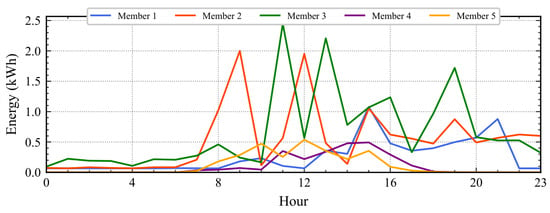
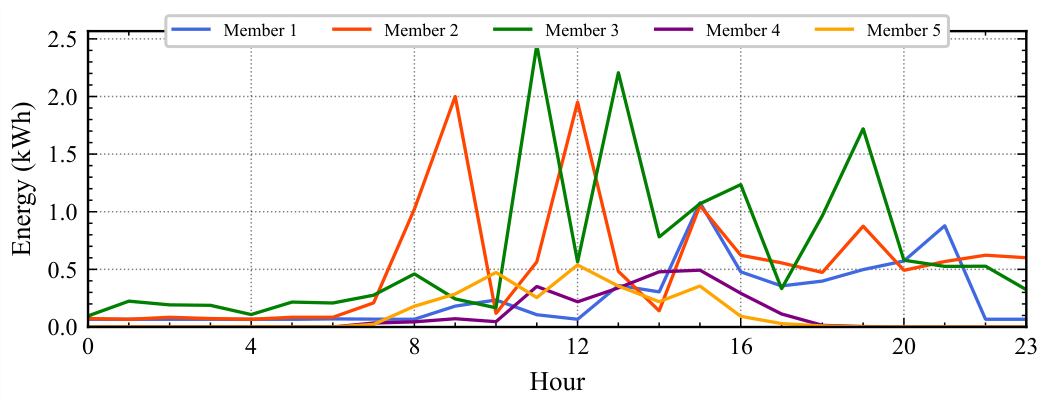
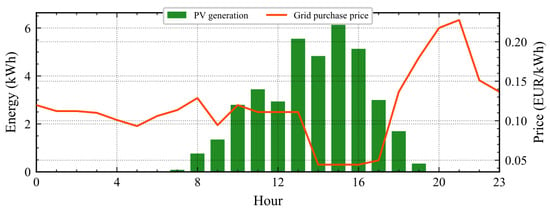
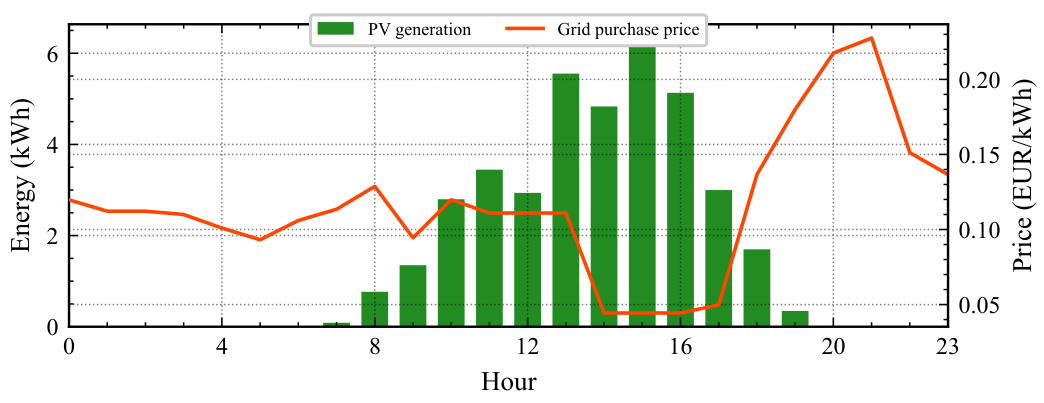
Scenario A considers a five-member energy community composed of four passive consumers and one prosumer equipped with PV generation and a 5 kWh battery energy storage system. The community is first evaluated over a 24-h horizon with one-hour time periods. Figure 2 and Figure 3 show the demand and generation profiles considered for this case.
Figure 2.
Consumption profiles of the community members in Scenario A.
Figure 3.
PV generation profile considered in Scenario A.
Scenario B considers a larger and more heterogeneous community consisting of twenty members, including prosumers with PV generation and 10 kWh batteries, prosumers with PV generation but without storage, and passive consumers. One of the passive consumers (Member 14) is assigned a substantially higher demand than the remaining participants in order to introduce a more demanding and heterogeneous operating condition.
In addition to the 24-h analysis, both scenarios are evaluated under different seasonal conditions using four independent representative 24-h days corresponding to winter, spring, summer, and autumn, resulting in a total of 96 evaluated hours for each community configuration. These profiles are intended to capture representative seasonal operating conditions rather than to provide an exhaustive statistical characterization of the complete year. Therefore, advanced representative-day selection techniques, such as clustering, are outside the scope of this work.
4. Results and Discussion
The results obtained for the two case studies are presented and discussed in this section. For each community configuration, the analysis first examines the optimal scheduling and the resulting grid and P2P exchanges, then quantifies the improvements provided by the proposed multi-P2P formulation with respect to the one-to-one benchmark, and finally evaluates its performance under different representative seasonal conditions.
The one-to-one benchmark corresponds to a representative MILP-based P2P formulation from the literature [8]. Both formulations are evaluated under identical input data and operating conditions, allowing the effects of relaxing the single-counterparty restriction to be directly assessed.
The case studies were implemented in Python 3.13 [31], using Pyomo 6.10 [32] as the optimization modeling framework and HiGHS [33] as the MILP solver. Both the one-to-one and multi-P2P formulations were solved using the same solver configuration, with a relative MIP-gap tolerance of 0%. This criterion was adopted so that the reported comparisons are based on globally optimal MILP solutions whenever optimality is certified by the solver.
4.1. Scenario A
Scenario A is first used to examine the operational and economic effects of allowing multiple simultaneous P2P transactions in the five-member community. The results obtained with the proposed multi-P2P formulation are compared throughout the analysis with those of the one-to-one benchmark under identical operating conditions.
4.1.1. Optimal Scheduling and Comparison with the One-to-One Formulation
The main economic, energy, and trading results for Scenario A are summarized in Table 1.
Table 1.
Comparison of the main economic, energy, and P2P trading indicators obtained with the one-to-one and multi-P2P formulations in Scenario A.
The greater trading flexibility provided by the multi-P2P formulation reduces the collective net cost from EUR 0.90 to EUR 0.77, corresponding to a reduction of 14.69% with respect to the one-to-one benchmark. This improvement is accompanied by a reduction in the interaction with the external grid. Grid imports decrease from 12.80 to 10.27 kWh, whereas grid exports decrease from 24.80 to 22.13 kWh, representing reductions of 19.78% and 10.77%, respectively.
At the same time, the energy exchanged internally among community members increases from 15.75 to 19.01 kWh, i.e., by 20.71%. The increase in P2P exchanges should not be interpreted as a direct one-to-one replacement of grid exports, since the additional trading flexibility also modifies battery operation. In particular, the additional 3.26 kWh exchanged through P2P transactions results from a 2.67 kWh reduction in grid exports together with an additional 0.59 kWh of battery discharge. From the demand side, the same increase in P2P energy is reflected in a 2.53 kWh reduction in grid imports and an additional 0.73 kWh of battery charging. The aggregated energy balance is therefore preserved in both formulations.
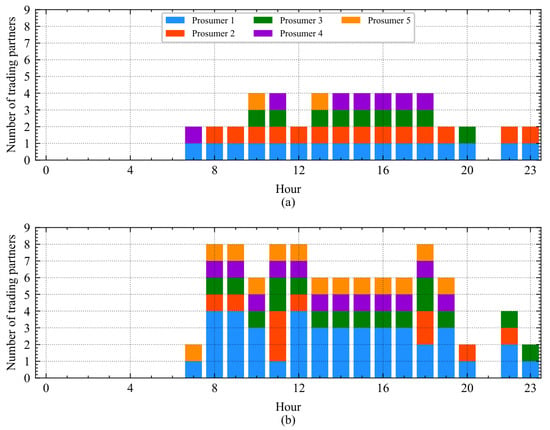
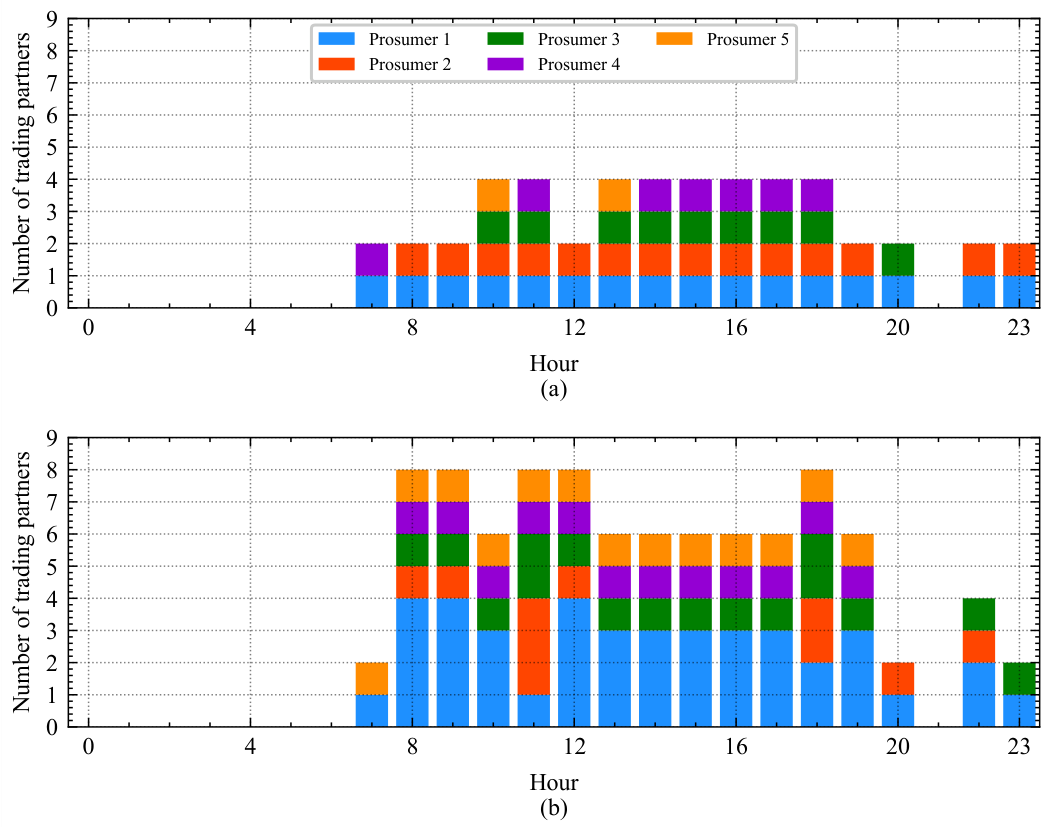
The difference between both approaches is also evident in the structure of the P2P market. The number of active bilateral transactions increases from 24 to 46, while the maximum number of simultaneous trading partners per prosumer increases from one, as imposed by the one-to-one formulation, to four with the proposed multi-P2P model. This result directly illustrates the additional coordination capability introduced by the proposed formulation, which allows locally available energy to be distributed among several community members within the same time period.
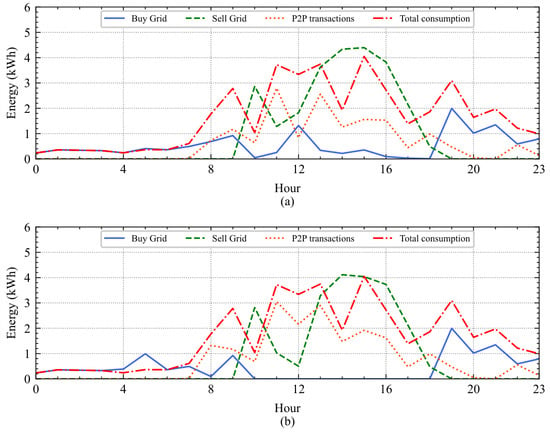
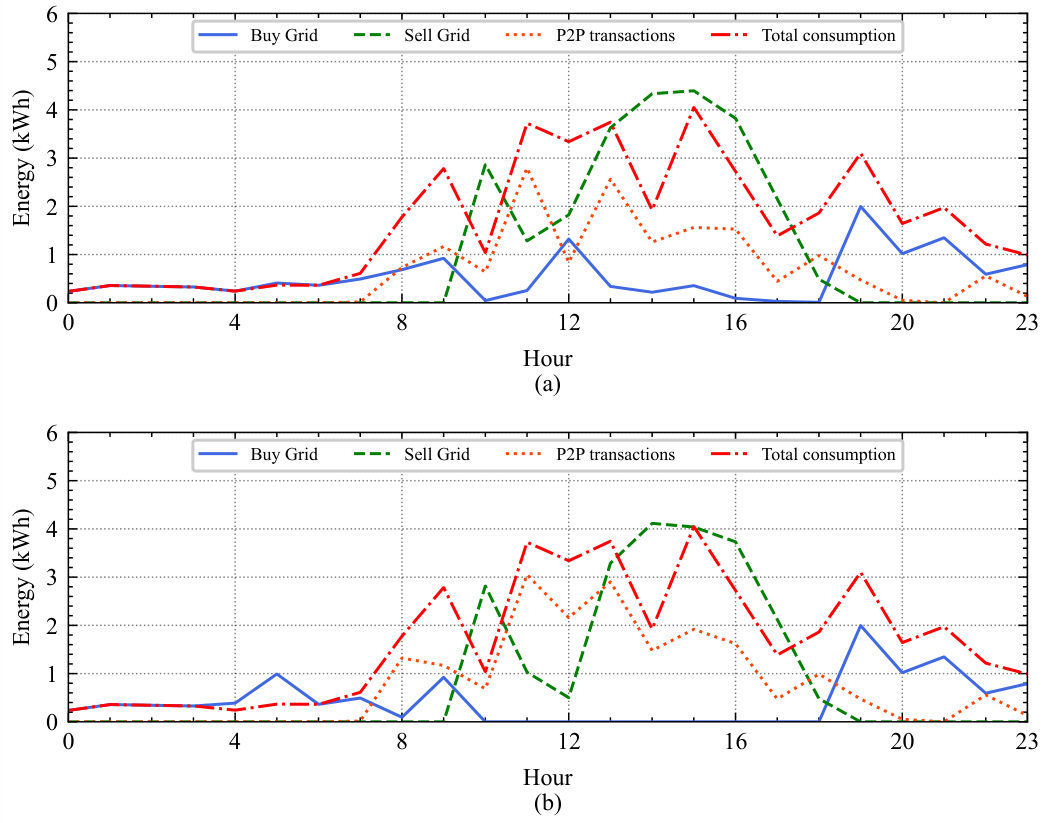
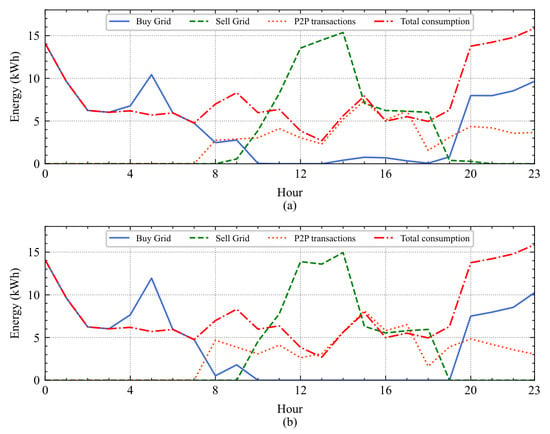
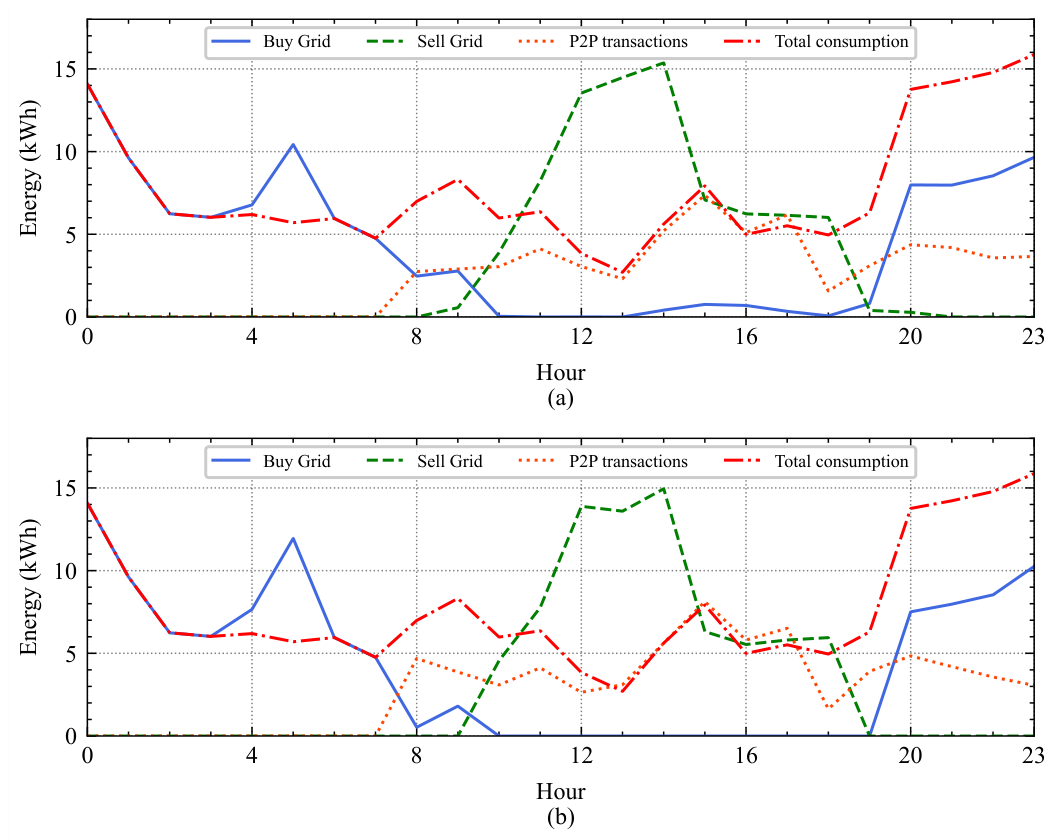
Figure 4 shows that the increase in P2P trading is concentrated mainly during periods with simultaneous local generation surpluses and demand. The most noticeable differences between both formulations occur around hour 8 and, particularly, between hours 11 and 15, when the multi-P2P formulation enables higher local energy exchanges than the one-to-one benchmark. Outside these periods, the P2P profiles remain comparatively similar.
Figure 4.
Hourly energy exchanges with the external grid and the local P2P market in Scenario A for (a) the one-to-one formulation and (b) the proposed multi-P2P formulation.
To assess how the community-level improvement is distributed among participants, Table 2 compares the individual net bills obtained without P2P trading, with the one-to-one formulation, and with the proposed multi-P2P formulation.
Table 2.
Individual net bills for Scenario A under the no-P2P, one-to-one, and multi-P2P cases. The variation is calculated with respect to the one-to-one formulation.
A negative net bill indicates that the revenues obtained from energy sales exceed the corresponding energy purchase costs. The variation in the last column is calculated relative to the one-to-one formulation using the absolute value of its net bill as the reference. Thus, a negative variation represents a more favorable economic outcome under multi-P2P, whereas a positive value indicates a higher net cost. For P1, whose net bill is negative, a more negative value corresponds to higher net revenue.
Prosumers P1, P3, P4, and P5 improve their economic outcome under the multi-P2P formulation. P2 is the only participant whose net bill increases, from EUR 0.45 to EUR 0.55. Under the one-to-one formulation, P2 obtains a particularly favorable outcome, whereas the single-counterparty restriction limits the set of trading opportunities available within the community. By removing this restriction, the multi-P2P formulation enables a broader use of the local market, improving the overall community result and the outcome of the other four prosumers. Nevertheless, P2 still performs better than in the no-P2P case (EUR 0.64).
These results show that the reduction in the aggregate community cost is not necessarily distributed uniformly among all participants. This is consistent with the adopted objective function, which minimizes the total community cost rather than imposing individual improvement for every prosumer. Benefit-allocation or compensation mechanisms could therefore be incorporated when individual rationality is required.
Figure 5 further illustrates the structural difference between both trading formulations by showing the number of simultaneous P2P trading partners for each prosumer. Under the one-to-one formulation, each participant is restricted to a single counterparty in each time period. In contrast, the multi-P2P formulation enables several prosumers to interact simultaneously with multiple participants, particularly during the hours with higher local energy availability and P2P activity.
Figure 5.
Number of simultaneous P2P trading partners per prosumer in Scenario A for (a) the one-to-one formulation and (b) the proposed multi-P2P formulation.
This greater connectivity allows locally available energy to be distributed among a broader set of community members within the same period, explaining the higher P2P energy exchange and the reduction in the aggregate community cost observed previously.
To assess the effect of the minimum transaction requirement, the P2P threshold was progressively increased in both formulations. Table 3 summarizes the main results, with the percentage variations calculated relative to the one-to-one formulation evaluated at the same threshold.
Table 3.
Sensitivity to the minimum P2P transaction threshold in Scenario A.
The results show that increasing the minimum transaction threshold progressively restricts the flexibility of the P2P market. For low threshold values, the multi-P2P formulation preserves most of its economic and trading advantages. However, as the threshold increases, small bilateral exchanges are excluded and the results of both formulations become progressively closer. The cost reduction provided by multi-P2P decreases from 14.69% to 5.85%, while the increase in P2P energy falls from 20.71% to 8.79%. Likewise, the difference in the number of active transactions narrows from 24 versus 46 to 11 versus 13.
Overall, higher minimum transaction thresholds reduce the additional flexibility provided by multi-P2P trading, although the proposed formulation maintains an advantage over the one-to-one benchmark throughout the analyzed range.
4.1.2. Seasonal Assessment
To assess whether the advantages of the proposed formulation are maintained under different operating conditions, four independent representative 24-h days corresponding to winter, spring, summer, and autumn were evaluated. Table 4 summarizes the comparison between the one-to-one and multi-P2P formulations.
Table 4.
Seasonal comparison between the one-to-one and multi-P2P formulations in Scenario A.
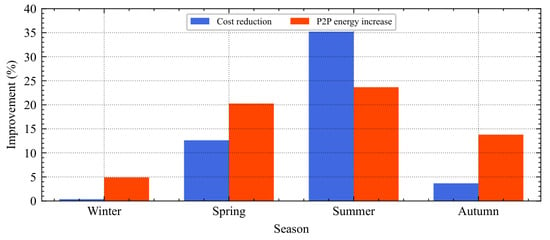
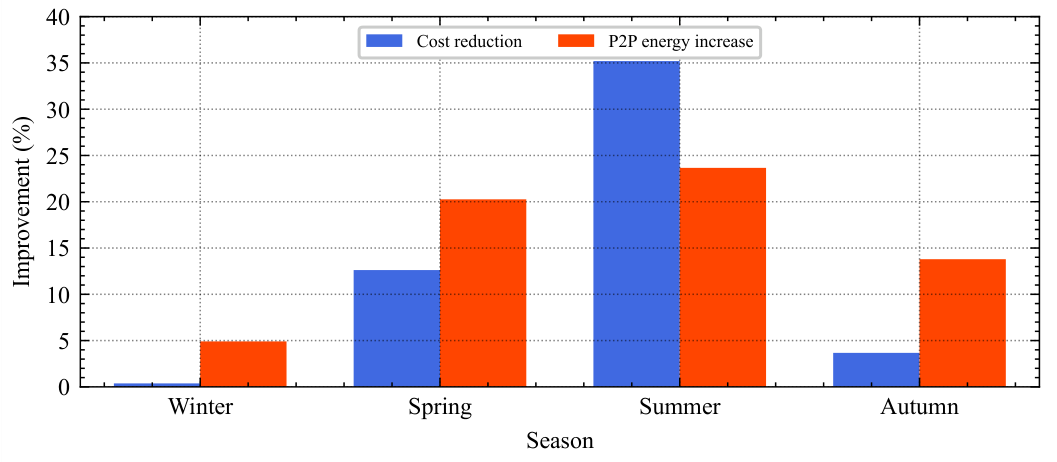
The multi-P2P formulation reduces the collective net cost in all four seasonal cases, although the magnitude of the improvement varies considerably. The smallest reduction is obtained in winter, at 0.37%, whereas the largest benefit is observed in summer, where the collective cost decreases by 35.20%. Intermediate improvements are obtained in spring and autumn, with reductions of 12.62% and 3.67%, respectively. A similar pattern is observed for local trading, since the energy exchanged through the P2P market increases in every season, from 4.91% in winter to 23.66% in summer.
Considering the complete set of 96 evaluated hours, the multi-P2P formulation reduces the collective net cost from EUR 7.54 to EUR 7.08, corresponding to an overall reduction of 6.15%, while total P2P energy increases by 17.30%. These results show that the additional flexibility provided by allowing multiple simultaneous trading partners remains beneficial under all the representative seasonal conditions considered, although its impact depends on the available local trading opportunities.
Figure 6 provides a graphical comparison of the improvements achieved by the multi-P2P formulation across the four representative seasonal conditions.
Figure 6.
Seasonal variation in the cost reduction and P2P energy increase achieved by the multi-P2P formulation with respect to the one-to-one benchmark in Scenario A.
As shown in Figure 6, the advantage of the multi-P2P formulation varies considerably with the seasonal operating conditions. Winter exhibits only a limited improvement over the one-to-one benchmark, with a 0.37% cost reduction and a 4.91% increase in P2P energy. In contrast, the benefits become substantially larger in spring and especially in summer. The summer case presents the highest cost reduction, 35.20%, together with a 23.66% increase in locally exchanged energy. In autumn, the increase in P2P energy remains significant at 13.79%, although its effect on the collective cost is more moderate, at 3.67%.
These results indicate that a higher volume of P2P trading does not necessarily translate proportionally into economic savings. Rather, the economic value of the additional multi-P2P flexibility depends on the specific balance between local generation, demand, storage operation, and the grid prices prevailing during each representative day.
4.2. Scenario B
Scenario B evaluates the proposed multi-P2P formulation in the larger twenty-member community described in the previous section. While Scenario A provides a detailed analysis of the operational behavior of the proposed approach, Scenario B is intended to examine its performance when the community size and heterogeneity increase, with particular attention to aggregate economic and energy results and trading activity.
4.2.1. Optimal Scheduling and Comparison with the One-to-One Formulation
The main economic, energy, and trading results obtained for Scenario B are summarized in Table 5.
Table 5.
Comparison of the main economic, energy, and P2P trading indicators obtained with the one-to-one and multi-P2P formulations in Scenario B.
The multi-P2P formulation reduces the collective net cost from EUR 10.43 to EUR 10.20, corresponding to a reduction of 2.21% with respect to the one-to-one benchmark. This economic improvement is accompanied by a reduction in the interaction with the external grid. Energy imported from the grid decreases from 106.46 to 102.92 kWh, representing a reduction of 3.32%, while grid exports decrease from 82.23 to 78.37 kWh, corresponding to a reduction of 4.69%.
At the same time, the total energy exchanged through the P2P market increases from 62.49 to 68.80 kWh, i.e., by 10.11%. The structural difference between both formulations is particularly evident in the trading activity. The number of active bilateral transactions increases from 115 to 196, corresponding to an increase of 70.43%, while the maximum number of simultaneous trading partners per prosumer increases from one to eight.
Therefore, although the reduction in the collective net cost is more moderate than in Scenario A, the proposed formulation substantially expands the set of simultaneous trading opportunities available within the larger and more heterogeneous community.
Figure 7 illustrates the hourly evolution of the aggregate grid and P2P energy exchanges obtained with both formulations.
Figure 7.
Hourly energy exchanges with the external grid and the local P2P market in Scenario B for (a) the one-to-one formulation and (b) the proposed multi-P2P formulation.
As shown in Figure 7, the multi-P2P formulation modifies the temporal allocation of local energy exchanges throughout the day. The most noticeable differences occur during periods in which local generation and demand coexist, particularly around hours 8–9 and during several afternoon periods. In these intervals, the multi-P2P formulation enables a greater use of local exchanges and, consequently, reduces the energy purchased from or exported to the external grid with respect to the one-to-one benchmark.
Although the overall temporal patterns remain similar in both formulations, the proposed multi-P2P structure provides additional flexibility to redistribute locally available energy among multiple participants within the same time period. This behavior is consistent with the aggregate results reported in Table 5, where P2P energy increases by 10.11% while grid imports and exports decrease by 3.32% and 4.69%, respectively.
The increase in trading activity is substantially larger than the increase in the total amount of energy exchanged through the P2P market. While P2P energy increases by 10.11%, the number of active bilateral transactions rises by 70.43%. Consequently, the average energy exchanged per active transaction decreases from approximately 0.54 kWh in the one-to-one formulation to 0.35 kWh under multi-P2P. This result reflects a more distributed allocation of local energy across a larger number of bilateral trading relationships, which is consistent with the ability of the proposed formulation to coordinate multiple counterparties simultaneously.
4.2.2. Seasonal Assessment
To complement the detailed 24-h analysis, the proposed multi-P2P formulation was evaluated under four representative daily conditions corresponding to winter, spring, summer, and autumn. Each case consists of an independent 24-h scheduling problem; therefore, the results reported below correspond to 96 evaluated hourly periods in total rather than to a continuous 96-h scheduling horizon.
As shown in Table 6, the multi-P2P formulation provides economic benefits under all four representative seasonal conditions. The reduction in community cost with respect to the case without P2P trading ranges from 15.63% in winter to 24.68% in summer. Across the four independent daily assessments, the aggregate community cost decreases from EUR 64.24 to EUR 51.08, corresponding to an overall saving of 20.49%.
Table 6.
Seasonal assessment of the multi-P2P formulation in Scenario B using four independent representative 24-h days.
The P2P market transfers a total of 275.09 kWh over the 96 evaluated hours through 831 active bilateral transactions. These results indicate that the proposed formulation maintains a high level of local trading activity under different combinations of demand and renewable generation, while the magnitude of the economic benefit varies with the seasonal operating conditions.
5. Conclusions
This work has proposed a mixed-integer linear programming formulation for the coordinated scheduling of grid exchanges, bilateral peer-to-peer transactions, and battery energy storage systems within an energy community. The main contribution of the proposed multi-P2P framework is the possibility for each participant to simultaneously interact with several counterparties within the same time period while preserving the traceability and consistency of bilateral exchanges. Minimum transaction thresholds are also incorporated to avoid residual exchanges with limited operational relevance, while an ex-post settlement procedure enables the resulting individual prosumer bills to be evaluated without modifying the community-level optimal schedule.
In Scenario A, the proposed formulation reduces the collective net cost by 14.69% with respect to the one-to-one benchmark. Grid imports and exports decrease by 19.78% and 10.77%, respectively, while P2P energy exchanges increase by 20.71%. The maximum number of simultaneous counterparties increases from one to four. The individual bill analysis also shows that the aggregate improvement is not necessarily distributed uniformly among all participants, which highlights the relevance of complementary benefit-allocation or compensation mechanisms. In addition, the threshold sensitivity analysis shows that increasing the minimum transaction size progressively reduces the additional flexibility and economic advantage provided by multi-P2P trading.
Scenario B extends the analysis to a larger and more heterogeneous twenty-member community. In this case, the collective net cost is reduced by 2.21%, P2P energy increases by 10.11%, and the number of active bilateral transactions increases by 70.43%, with up to eight simultaneous trading partners per prosumer. The seasonal assessments further show that the benefits of the proposed formulation are maintained under different representative operating conditions, although their magnitude depends on the balance between local generation, demand, storage operation, and grid prices.
Overall, the results show that relaxing the single-counterparty restriction provides greater flexibility for allocating locally available energy, increases local trading opportunities, and can reduce both aggregate energy costs and interaction with the external grid. The proposed formulation therefore provides a consistent framework for representing simultaneous bilateral energy exchanges in local energy communities.
Future work will focus on extending the analysis to larger and more diverse communities, incorporating uncertainty and distribution-network constraints, and developing benefit-allocation or compensation mechanisms that improve individual economic outcomes while preserving the collective advantages of multi-P2P trading.
Author Contributions
Conceptualization, D.G.-D. and C.G.-S.; methodology, C.G.-S.; software, D.G.-D.; validation, D.G.-D., C.G.-S. and E.G.-D.; formal analysis, C.G.-S.; investigation, D.G.-D.; resources, E.G.-D.; data curation, D.G.-D.; writing—original draft preparation, D.G.-D.; writing—review and editing, C.G.-S.; visualization, C.G.-S.; supervision, E.G.-D. and C.G.-S.; project administration, E.G.-D.; funding acquisition, E.G.-D. and C.G.-S. All authors have read and agreed to the published version of the manuscript.
Funding
This research was conducted as an extension of a Bachelor’s Degree Final Project (Trabajo Fin de Grado) developed at the Universidad de Sevilla, Spain. No specific external funding was received for this work.
Institutional Review Board Statement
Not applicable.
Informed Consent Statement
Not applicable.
Data Availability Statement
The data supporting the findings of this study are available from the corresponding author upon reasonable request.
Conflicts of Interest
The authors declare no conflicts of interest.
Nomenclature
| Sets | |
| Set of prosumers, . | |
| Set of time periods, . | |
| Parameters | |
| Power demand of prosumer i in time period t (kW). | |
| Available generation power of prosumer i in time period t (kW). | |
| Grid energy purchase price for prosumer i in time period t (EUR/kWh). | |
| Grid energy selling price for prosumer i in time period t (EUR/kWh). | |
| Minimum operational power for energy purchases from the grid (kW). | |
| Maximum power for energy purchases from the grid (kW). | |
| Minimum operational power for energy sales to the grid (kW). | |
| Maximum power for energy sales to the grid (kW). | |
| Minimum operational power associated with a P2P purchasing transaction | |
| (kW). | |
| Minimum operational power associated with a P2P selling transaction (kW). | |
| Binary variables | |
| Binary variable indicating energy purchase from the grid by prosumer i in | |
| time period t. | |
| Binary variable indicating energy sale to the grid by prosumer i in time period t. | |
| Binary variable indicating the activation of a P2P selling transaction from | |
| prosumer i to prosumer j in time period t. | |
| Maximum charging power of the battery associated with prosumer i (kW). | |
| Maximum discharging power of the battery associated with prosumer i (kW). | |
| Energy capacity of the battery associated with prosumer i (kWh). | |
| Initial state of charge of the battery associated with prosumer i. | |
| Minimum admissible state of charge of the battery associated with prosumer i. | |
| Maximum admissible state of charge of the battery associated with prosumer i. | |
| Charging and discharging efficiency of the battery associated with prosumer i. | |
| T | Final time period of the scheduling horizon. |
| Power purchased from the grid by prosumer i in time period t (kW). | |
| Power sold to the grid by prosumer i in time period t (kW). | |
| Power purchased by prosumer i from prosumer j through a P2P transaction in | |
| time period t (kW). | |
| Power sold by prosumer i to prosumer j through a P2P transaction in time | |
| period t (kW). | |
| Charging power of the battery associated with prosumer i in time period t | |
| (kW). | |
| Discharging power of the battery associated with prosumer i in time period t | |
| (kW). | |
| Energy stored in the battery associated with prosumer i in time period t (kWh). | |
| Binary variable indicating the activation of a P2P purchasing transaction from | |
| prosumer j to prosumer i in time period t. | |
| Binary variable indicating the charging operation of the battery associated with | |
| prosumer i in time period t. | |
| Binary variable indicating the discharging operation of the battery associated | |
| with prosumer i in time period t. |
References
- European Parliament and Council of the European Union. Directive (EU) 2018/2001 of the European Parliament and of the Council of 11 December 2018 on the promotion of the use of energy from renewable sources. Off. J. Eur. Union 2018, L 328, 82–209. [Google Scholar]
- European Parliament and Council of the European Union. Directive (EU) 2019/944 of the European Parliament and of the Council of 5 June 2019 on common rules for the internal market for electricity and amending Directive 2012/27/EU. Off. J. Eur. Union 2019, L 158, 125–199. [Google Scholar]
- Barabino, E.; Fioriti, D.; Guerrazzi, E.; Mariuzzo, I.; Poli, D.; Raugi, M.; Razaei, E.; Schito, E.; Thomopulos, D. Energy communities: A review on trends, energy system modelling, business models, and optimisation objectives. Sustain. Energy Grids Netw. 2023, 36, 101187. [Google Scholar] [CrossRef] [Scilit]
- Gorbatcheva, A.; Watson, N.; Schneiders, A.; Shipworth, D.; Fell, M.J. Defining characteristics of peer-to-peer energy trading, transactive energy, and community self-consumption: A review of literature and expert perspectives. Renew. Sustain. Energy Rev. 2024, 202, 114672. [Google Scholar] [CrossRef] [Scilit]
- Tushar, W.; Saha, T.K.; Yuen, C.; Smith, D.; Poor, H.V. Peer-to-peer trading in electricity networks: An overview. IEEE Trans. Smart Grid 2020, 11, 3185–3200. [Google Scholar] [CrossRef] [Scilit]
- Huang, H.; Nie, S.; Lin, J.; Wang, Y.; Dong, J. Optimization of peer-to-peer power trading in a microgrid with distributed PV and battery energy storage systems. Sustainability 2020, 12, 923. [Google Scholar] [CrossRef] [Scilit]
- Jing, R.; Xie, M.N.; Wang, F.X.; Chen, L.X. Fair P2P energy trading between residential and commercial multi-energy systems enabling integrated demand-side management. Appl. Energy 2020, 262, 114551. [Google Scholar] [CrossRef] [Scilit]
- Faia, R.; Soares, J.; Pinto, T.; Lezama, F.; Vale, Z.; Corchado, J.M. Optimal model for local energy community scheduling considering peer-to-peer electricity transactions. IEEE Access 2021, 9, 12420–12430. [Google Scholar] [CrossRef] [Scilit]
- Al-Sorour, A.; Fazeli, M.; Monfared, M.; Fahmy, A.; Searle, J.R.; Lewis, R.P. Enhancing PV self-consumption within an energy community using MILP-based P2P trading. IEEE Access 2022, 10, 93760–93772. [Google Scholar] [CrossRef] [Scilit]
- Dinh, H.T.; Kim, D.; Kim, D. MILP-based optimal day-ahead scheduling for a system-centric community energy management system supporting different types of homes and energy trading. Sci. Rep. 2022, 12, 18305. [Google Scholar] [CrossRef] [Scilit] [PubMed]
- Mog, U.; Gope, S.; Bhowmik, A.R. Peer-to-peer energy trading in a microgrid with distributed PV power generation. In Proceedings of the 2024 IEEE Students Conference on Engineering and Systems (SCES), Prayagraj, India, 21–23 June 2024; pp. 1–5. [Google Scholar] [CrossRef] [Scilit]
- Zhang, C.; Wu, J.; Zhou, Y.; Cheng, M.; Long, C. Peer-to-peer energy trading in a microgrid. Appl. Energy 2018, 220, 1–12. [Google Scholar] [CrossRef] [Scilit]
- Cadre, H.L.; Jacquot, P.; Wan, C.; Alasseur, C. Peer-to-peer electricity market analysis: From variational to generalized Nash equilibrium. Eur. J. Oper. Res. 2020, 282, 753–771. [Google Scholar] [CrossRef] [Scilit]
- Chen, Y.; Park, B.; Kou, X.; Hu, M.; Dong, J.; Li, F.; Amasyali, K.; Olama, M. A comparison study on trading behavior and profit distribution in local energy transaction games. Appl. Energy 2020, 280, 115941. [Google Scholar] [CrossRef] [Scilit]
- Anchu, T.; Mathew, P.A.; Arya, M.G. Analysis of peer-to-peer energy trading in a dynamic environment using Stackelberg game. In Proceedings of the 2021 Seventh Indian Control Conference (ICC), Mumbai, India, 20–22 December 2021; pp. 412–417. [Google Scholar] [CrossRef] [Scilit]
- Dong, J.; Song, C.; Liu, S.; Yin, H.; Zheng, H.; Li, Y. Decentralized peer-to-peer energy trading strategy in energy blockchain environment: A game-theoretic approach. Appl. Energy 2022, 325, 119852. [Google Scholar] [CrossRef] [Scilit]
- Yao, H.; Xiang, Y.; Gu, C.; Liu, J. Peer-to-peer coupled trading of energy and carbon emission allowance: A stochastic game-theoretic approach. IEEE Internet Things J. 2024, 11, 24364–24375. [Google Scholar] [CrossRef] [Scilit]
- Tushar, W.; Saha, T.K.; Yuen, C.; Azim, M.I.; Morstyn, T.; Poor, H.V.; Niyato, D.; Bean, R. A coalition formation game framework for peer-to-peer energy trading. Appl. Energy 2020, 261, 114436. [Google Scholar] [CrossRef] [Scilit]
- Malik, S.; Duffy, M.; Thakur, S.; Hayes, B.; Breslin, J.G. Cooperative game theory based peer-to-peer energy trading algorithm. In Proceedings of the 12th Mediterranean Conference on Power Generation, Transmission, Distribution and Energy Conversion (MEDPOWER 2020), Virtual, 9–12 November 2020; pp. 135–142. [Google Scholar] [CrossRef] [Scilit]
- Raja, A.A.; Grammatico, S. Bilateral peer-to-peer energy trading via coalitional games. IEEE Trans. Ind. Inform. 2023, 19, 6814–6824. [Google Scholar] [CrossRef] [Scilit]
- Yu, A.; Tang, X.; Zhang, Y.J.; Huang, J. Continuous group-wise double auction for prosumers in distribution-level markets. IEEE Trans. Smart Grid 2021, 12, 4822–4833. [Google Scholar] [CrossRef] [Scilit]
- Haggi, H.; Sun, W. Multi-round double auction-enabled peer-to-peer energy exchange in active distribution networks. IEEE Trans. Smart Grid 2021, 12, 4403–4414. [Google Scholar] [CrossRef] [Scilit]
- Liyanage, K.K.G.H.; Islam, S.N. Comparative analysis of market clearing mechanisms for peer-to-peer energy market based on double auction. Energies 2024, 17, 5708. [Google Scholar] [CrossRef] [Scilit]
- Ullah, M.H.; Park, J.-D. Peer-to-peer energy trading in transactive markets considering physical network constraints. IEEE Trans. Smart Grid 2021, 12, 3390–3403. [Google Scholar] [CrossRef] [Scilit]
- Guo, Z.; Pinson, P.; Chen, S.; Yang, Q.; Yang, Z. Online optimization for real-time peer-to-peer electricity market mechanisms. IEEE Trans. Smart Grid 2021, 12, 4151–4163. [Google Scholar] [CrossRef] [Scilit]
- Belgioioso, G.; Ananduta, W.; Grammatico, S.; Ocampo-Martinez, C. Operationally-safe peer-to-peer energy trading in distribution grids: A game-theoretic market-clearing mechanism. IEEE Trans. Smart Grid 2022, 13, 2897–2907. [Google Scholar] [CrossRef] [Scilit]
- Oliveira, C.; Simões, M.; Bitencourt, L.; Soares, T.; Matos, M.A. Distributed network-constrained P2P community-based market for distribution networks. Energies 2023, 16, 1520. [Google Scholar] [CrossRef] [Scilit]
- McKenna, E.; Thomson, M.; Barton, J. CREST Demand Model; Dataset; Loughborough University: Loughborough, UK, 2015. [Google Scholar] [CrossRef]
- Operador del Mercado Ibérico de Energía (OMIE). Operador del Mercado Ibérico de Energía. Available online: https://www.omie.es/ (accessed on 27 September 2026).
- Ministerio para la Transición Ecológica. Real Decreto 244/2019, de 5 de abril, por el que se regulan las condiciones administrativas, técnicas y económicas del autoconsumo de energía eléctrica. Boletín Of. Estado 2019, 83, 35674–35719. [Google Scholar]
- Python Software Foundation. Python Language Reference. Available online: https://www.python.org/ (accessed on 29 September 2026).
- Bynum, M.L.; Hackebeil, G.A.; Hart, W.E.; Laird, C.D.; Nicholson, B.L.; Siirola, J.D.; Watson, J.-P.; Woodruff, D.L. Pyomo—Optimization Modeling in Python, 3rd ed.; Springer: Cham, Switzerland, 2021; Volume 67. [Google Scholar]
- HiGHS Developers. HiGHS: High-Performance Software for Linear Optimization. Available online: https://highs.dev/ (accessed on 29 September 2026).

Disclaimer/Publisher’s Note: The statements, opinions and data contained in all publications are solely those of the individual author(s) and contributor(s) and not of MDPI and/or the editor(s). MDPI and/or the editor(s) disclaim responsibility for any injury to people or property resulting from any ideas, methods, instructions or products referred to in the content. |
© 2026 by the authors. Licensee MDPI, Basel, Switzerland. This article is an open access article distributed under the terms and conditions of the Creative Commons Attribution (CC BY) license.