


Abstract
Dietary behaviours may be associated with physical development in children with autism spectrum disorder (ASD), but their relationship with longitudinal outcomes during inclusive sports programmes remains uncertain. We examined parent-reported dietary habits and repeated assessments during a 10-month inclusive judo programme involving 100 children aged 7–14 years (50 with ASD and 50 neurotypical), with two 60-min sessions weekly. Dietary habits were assessed once; body composition (n = 80), serum biochemical markers (n = 49) and EUROFIT performance (n = 100) were evaluated at three time points. Mean EUROFIT total scores increased from 361.00 to 405.74 points in the ASD group (+44.74; +12.4%) and from 403.02 to 433.44 points in neurotypical children (+30.42; +7.5%); the descriptive between-group difference narrowed from 42.02 to 27.70 points. Mean fat mass percentage decreased by 1.46 and 0.93 percentage points, respectively. Mean serum folate changed from 6.54 to 7.62 ng/mL in the ASD group and from 6.42 to 5.80 ng/mL in neurotypical children. Fifteen time × habit and 13 time × group × habit interactions reached nominal significance for biochemical and fitness outcomes, whereas none were reported for body composition. Fitness interaction effect sizes were small (partial η2 = 0.03–0.07). Improvements in standardized motor scores may reflect developing balance, coordination, strength and flexibility, but growth, practice effects and other activities cannot be excluded. Serum marker changes do not establish altered nutrient intake or improved nutritional status. Given single-time-point dietary reporting, multiple testing, incomplete biochemical data and the absence of a non-training control group, these associations are exploratory rather than causal.
1. Introduction
Children with autism spectrum disorder (ASD) may encounter difficulties with motor coordination and participation in organised physical activity. These difficulties can affect everyday movement and access to sport. A 2023 meta-analysis reported improvements in locomotor, object-control and stability skills following exercise interventions, although the certainty of the evidence varied across outcomes [1]. This supports providing opportunities for structured practice while recognising that children vary in their abilities and support needs.
The intervention literature also raises the question of which outcomes respond to exercise. Jia et al. (2024) reported a favourable pooled effect on social skills, whereas Wang et al. (2025) found improvements in motor coordination but no statistically significant overall effect on social skills. These findings caution against treating physical, behavioural and social outcomes as a single response. For a study focused on fitness, changes in motor performance provide the most relevant comparison; broader psychosocial benefits require separate measurement. Differences between reviews also highlight the importance of specifying the participants, intervention and outcome rather than assuming that all forms of exercise have equivalent effects [1,2].
Judo offers a setting in which balance, changes in direction, strength and controlled partner interaction can be practised within a predictable session structure. A 2024 review of judo programmes for individuals with neurodevelopmental disorders described promising physical and psychosocial findings, but also considerable variation in study design and limited controlled evidence [3]. A small parent-report study published in 2023 similarly suggested behavioural and social benefits [4]. These studies provide a rationale for studying adapted and inclusive judo; they do not establish that judo produces better outcomes than other sports or that changes in fitness are accompanied by changes in nutritional status.
An inclusive programme provides a common setting for comparing physical trajectories, although baseline abilities, attendance and support needs may vary [3]. This setting does not remove the influence of family routines or other activities outside training. Such factors need to be considered when interpreting associations between parent-reported dietary habits and physical outcomes.
Dietary behaviour adds another dimension to the interpretation of physical development. Food refusal, restricted food repertoires and sensitivity to texture or taste can occur in autistic children, including those with typical intellectual functioning. A 2024 systematic review found that food selectivity was common in this population and there was substantial variation in its definition and measurement [5]. Consequently, a broad parent-reported question about food acceptance should not automatically be treated as a diagnosis of clinically significant restrictive eating.
Food selectivity also varies in its presentation. A child may reject foods because of texture, smell, unfamiliarity or distress at mealtimes, while another may avoid eating because of discomfort or a medical problem. The narrative clinical review by Esposito et al. (2023) recommends assessing medical, sensory and behavioural dimensions before choosing an intervention. Ferrara et al. (2025) also describe food selectivity in relation to sensory processing and mealtime behaviour. This distinction matters for research: a question about difficulty accepting food captures a parent-reported observation but does not identify the reason for refusal, the range of accepted foods or the nutritional importance of the excluded items [5].
Recent evidence also distinguishes dietary intake from anthropometric and biochemical indicators. A 2025 meta-analysis comparing autistic and typically developing children reported differences in selected nutrient intakes and micronutrient measures, without consistent group differences in weight or body mass index [6]. A systematic review published online in 2025 and included in a 2026 journal issue further examined the relationship between food selectivity and health outcomes, emphasising the need for standardised assessment and longitudinal research [7]. These findings justify examining dietary characteristics alongside several physical outcomes rather than assuming that a single measure of body size captures nutritional vulnerability.
Consequently, eating behaviour, dietary adequacy and nutritional status should be considered related but distinct constructs. A limited food repertoire can coexist with adequate energy intake, while sufficient weight gain does not establish adequate intake of every nutrient. Recent reviews support assessing the foods consumed and the consequences of restriction rather than using body size alone as a nutritional proxy [6,7]. In a physically active cohort, this distinction is essential: better fitness can occur without a detectable change in a biochemical marker, and a change in a marker does not necessarily explain improved performance.
Meal timing, reported sugar restriction, use of dietary advice and beverage intake may distinguish children with different daily routines. In an inclusive sports programme, these characteristics could be associated with physical trajectories observed during participation. They may also reflect parental involvement, access to support or pre-existing health concerns. Their interpretation therefore depends on how they were measured and on whether exposure preceded the observed change. A questionnaire administered only once cannot establish that habits remained stable throughout training, quantify nutrient intake or show that nutritional education altered behaviour.
Mealtime routines also involve the wider household. [8] compared eating and mealtime experiences in families of children with autism, ADHD or both diagnoses, highlighting differences in routines, food-related behaviour and caregiver experiences. Such observations place meal regularity and food acceptance in the wider context of family resources and daily demands. They do not establish that a particular parental practice causes a nutritional or fitness outcome. In addition, Blennerhassett et al. (2025) found that caregiver-implemented feeding interventions can improve food-related outcomes, while their nutritional significance and acceptability require closer evaluation. Parent education and improvements in food acceptance should therefore be evaluated separately from changes in nutritional status.
Body composition, blood measurements and fitness tests provide complementary information, but each has limitations that affect its interpretation. Bioelectrical impedance analysis (BIA) estimates tissue compartments indirectly. A 2025 paediatric review comparing BIA with dual-energy X-ray absorptiometry found that agreement depended on the device and population [9]. Percentages derived from BIA should therefore be distinguished from absolute changes in tissue mass. Similarly, circulating biochemical measures cannot, on their own, establish the quantity or quality of food consumed.
The unresolved issue is how these dietary characteristics relate to repeated physical assessments in children who participate in the same inclusive sports programme. Exercise reviews principally address intervention effects, whereas feeding reviews focus on food selectivity, intake or family-mediated treatment [7,10,11]. Bringing these domains together can help generate more specific research questions. The parent reports allow for an exploratory comparison of physical trajectories across dietary categories. They do not establish whether a reported habit preceded the observed changes, changed during training or had a causal nutritional effect.
The present study examined whether parent-reported dietary habits were associated with changes in body composition, selected serum markers and physical fitness over a 10-month inclusive judo programme in children with and without ASD. The principal questions were whether trajectories differed according to the reported dietary habit and whether these associations differed between groups. We expected that some dietary characteristics would be associated with variation in physical outcomes, but treated these analyses as exploratory because multiple habits and outcomes were examined. The study was designed to describe associations during participation, rather than to isolate training effects from growth or to establish a causal nutritional mechanism.
2. Materials and Methods
2.1. Participants
The study sample comprised 100 children and adolescents (girls and boys) aged 7–14 years. At baseline, the ASD group consisted of 50 participants (mean age, 8.98 ± 1.83 years), while the neurotypical group comprised 50 participants (mean age, 9.31 ± 2.08 years). Baseline age is reported by group, but the sex distribution, height, body mass, previous sports participation, pharmacotherapy and dietary supplement use are not provided in the available baseline summary. The distributions and potential confounding effects of these characteristics therefore cannot be assessed from the reported data.
Eligible participants had typical intellectual functioning and no medical contraindications to physical activity. The inclusion criteria were: (1) age between 7 and 14 years; (2) for the ASD group, a diagnosis of ASD according to DSM-5 criteria, confirmed by a licensed psychiatrist or clinical psychologist; (3) typical intellectual functioning; (4) absence of contraindications to physical exercise; (5) the ability to follow instructions during group sessions; and (6) enrolment in the inclusive judo programme. Exclusion criteria included acute illness, severe intellectual disability, musculoskeletal limitations, and concurrent participation in another structured sports programme. The instrument, assessor and threshold used to establish typical intellectual functioning, together with the operational definition and screening procedure for the neurotypical group, are not specified in this report. The group labels should therefore be interpreted in the context of the recruitment description rather than as evidence of a standardised assessment excluding other neurodevelopmental conditions.
This longitudinal study included two groups participating in the same inclusive judo programme and did not include a non-training comparison group. It therefore describes changes during programme participation and associations with dietary characteristics. It cannot distinguish training-related changes from growth, biological maturation or other concurrent influences.
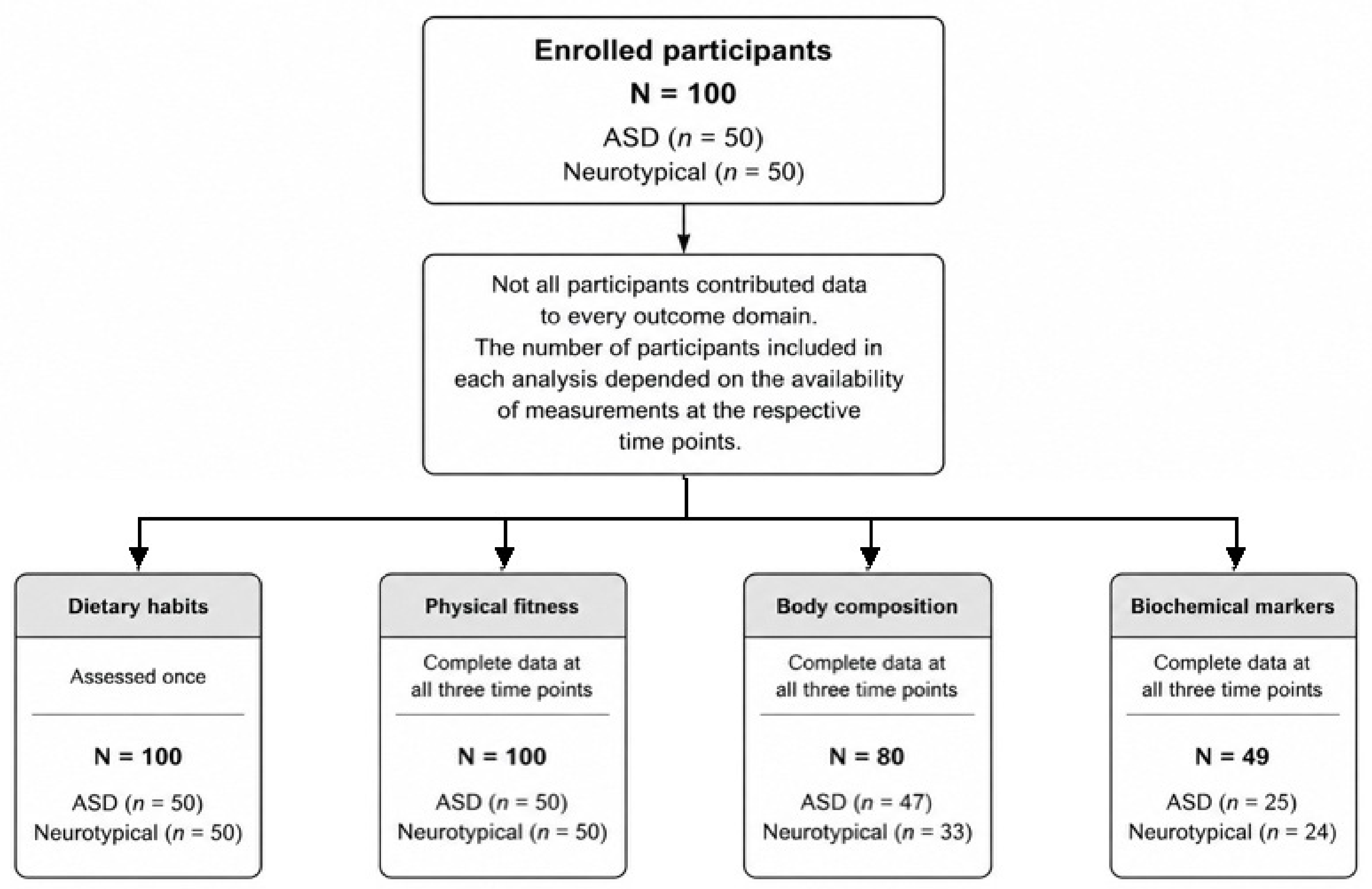
Some participants did not complete all assessments. The number of participants included in each analysis depended on the availability of measurements at the relevant time points. Dietary habits were assessed once, and complete questionnaire data were obtained from all 100 participants (ASD, 50; neurotypical, 50). Physical fitness measurements were complete at all three time points for all participants (ASD, 50; neurotypical, 50). Longitudinal body composition analyses were restricted to participants who completed assessments at all three time points. In this study, 3 participants from the ASD group and 17 from the neurotypical group did not participate in all assessments, resulting in a final sample of 80 participants for the body composition analysis (ASD, 47; neurotypical, 33). A total of 49 participants completed biochemical assessments at all time points (ASD, 25; neurotypical, 24). Thus, body composition data were incomplete for 6% of the ASD group and 34% of the neurotypical group; biochemical data were incomplete for 50% and 52%, respectively. These figures indicate incomplete series of outcome measurements, rather than withdrawal from the programme, because all participants completed fitness testing. Missing body-composition and biochemical measurements resulted from participants’ absence from scheduled assessment visits. Attendance at these visits was outside the research team’s control.
Participant flow is presented in Figure 1.
Figure 1.
Participant flow and the numbers of participants included in the analyses.
2.2. Abbreviation: ASD, Autism Spectrum Disorder
Ethics and Consent
The study was approved by the Bioethics Committee at the Poznan University of Medical Sciences (approval no. 416/24, 27 June 2024) and was conducted in accordance with the Declaration of Helsinki. Written informed consent covering participation in the study and venous blood sampling was obtained from the parents or legal guardians of all participants. Written assent was also obtained from the children, as appropriate to their age and understanding. The blood-collection procedure is described in the Biochemical Markers Subsection.
2.3. Judo Training Programme
Participants took part in a 10-month judo training programme, delivered as two 60-min sessions per week on traditional judo mats. Each session comprised a 12–15-min general warm-up, a 35–40-min main component, and a 5–8-min cool-down, framed by the traditional opening and closing judo ceremony. The programme was delivered by two coaches: a head coach and an assistant.
The programme was organised into two five-month phases. The first phase focused on introducing the principles and etiquette of judo, mat movement, tolerance of physical contact, safe falling techniques (ukemi), and basic groundwork techniques (ne-waza), including holds and escapes. The second phase introduced standing techniques (tachi-waza), restricted to foot throws (ashi-waza), reinforced previously learned skills, and incorporated simplified sparring (randori). Throughout both phases, exercises targeting balance, jumping, strength, flexibility, and agility were incorporated through game-based and structured activities to develop overall physical fitness.
The judo training programme also included nutritional education sessions involving a qualified dietitian. During each five-month phase, two sessions were provided for the participating children and two sessions for their parents or legal guardians. The sessions addressed the principles of healthy nutrition, appropriate dietary habits, the importance of a balanced diet, matching food and fluid intake to physical activity levels, and regular meal timing, with particular emphasis on the nutritional needs of children and adolescents. Participation in the nutritional education sessions was voluntary.
2.4. Dietary Habits Questionnaire
Participants’ dietary habits were assessed once at the conclusion of the 10-month training programme (in June 2025) using a study-specific questionnaire completed by the participants’ parents or legal guardians. The questionnaire covered selected aspects of the children’s dietary behaviours, including: (1) the number of meals consumed per day; (2) adherence to regular, predetermined meal times; (3) restriction of sugar intake in the child’s diet; (4) the frequency of consumption of fast food or ready-to-eat meals; (5) difficulties with consuming selected foods, including difficulties related to their texture, smell, or taste; (6) the use of specialist advice about the child’s diet received during the training programme; (7) the total volume of beverages consumed by the child throughout the day; and (8) the type of beverage most frequently consumed by the child.
Advice received during the programme cannot be considered a baseline exposure.
2.5. Body Composition
Body composition was assessed in the morning, before the first meal. Measurements were performed under standardised laboratory conditions using bioelectrical impedance analysis with octapolar electrodes and dual-frequency current (6.25 and 50 kHz; Tanita MC-580 S MA, Tanita, Tokio, Japan). Fat mass, fat-free mass, muscle mass, total body water, and bone mass were recorded in kilograms and subsequently expressed as percentages of total body mass. Percentage values were used in all statistical analyses to express relative body composition. These percentages do not directly quantify absolute tissue gains or eliminate the potential influence of growth or maturation.
2.6. Biochemical Markers
Fasting venous blood samples were collected from the antecubital vein between 7:00 and 9:00 AM by qualified nursing staff, with participants seated in a relaxed position. The samples were then analysed by qualified specialists at a certified laboratory. Serum concentrations of iron (μg/dL), vitamin B12 (pg/mL), total protein (g/dL), magnesium (mg/dL) and folate (ng/mL) were determined.
The biochemical panel complemented anthropometry and fitness testing by providing information on nutrient-related processes relevant to growth and physical function. Restricted food repertoires can affect micronutrient intake without producing a corresponding difference in body size, supporting the assessment of multiple domains [6,7,8,9,10]. The panel was used for exploratory comparisons of circulating markers, rather than as a comprehensive diagnostic assessment of nutritional status or a direct measure of dietary intake.
Iron is involved in haemoglobin-mediated oxygen transport and myoglobin-dependent muscle metabolism, providing a physiological link to growth and physical activity [12]. Vitamin B12 contributes to nervous system function, red blood cell formation and DNA synthesis, whereas folate supports one-carbon metabolism, nucleic acid synthesis and cell division. These roles are relevant to children’s development, although serum concentrations do not measure the functional capacity of these processes directly [13]. Magnesium contributes to energy metabolism, muscle contraction and nerve function, making it relevant to the physiological context of fitness assessment [14]. Total protein reflects the combined concentration of circulating albumin and globulins and provides broader biochemical context, but it is influenced by non-dietary factors, including fluid balance and hepatic, renal and immune processes; it is not a measure of muscle protein synthesis or dietary protein intake [15].
These measurements have important limitations. Serum iron alone cannot quantify iron stores or establish a diagnosis of iron-deficiency anaemia; serum vitamin B12 without functional biomarkers cannot fully characterise B12 status; serum folate is sensitive to recent intake; and serum magnesium does not reliably represent total-body magnesium stores [12,13,14,15,16]. Accordingly, changes in these markers were not interpreted as proof of nutrient deficiency, its correction, or a metabolic adaptation caused by judo. The panel does not establish whether the reported dietary habits were associated with adequate energy or nutrient intake.
2.7. Physical Fitness
Physical fitness was evaluated using the EUROFIT test battery, comprising eight standardised tests assessing balance (Flamingo Balance Test), speed of limb movement (Plate-Tapping Test), explosive lower-body power (Standing Broad Jump), trunk flexibility (Sit-and-Reach Test), static grip strength (Handgrip Test), abdominal muscular endurance (Sit-Up Test), functional upper-body strength (Bent-Arm Hang), and running speed and agility (Shuttle Run 10 × 5 m). All tests were administered by trained coaches according to standardised EUROFIT procedures.
To allow for comparisons of performance across participants of different ages and sexes, the raw results of each subtest were converted into standardised scores using age- and sex-specific scoring tables developed for the Polish paediatric population.
2.8. Statistical Analysis
Descriptive statistics were calculated for each assessment time point (T1, T2, and T3). Continuous variables are presented as means ± standard deviations (SDs), and dietary habit variables as counts (n) and percentages. Responses from the single questionnaire assessment defined fixed analytical categories; this did not imply that the underlying behaviours were stable or establish temporal precedence. For the analysis, responses were dichotomised: number of meals per day (≤3 vs. >3), regular meal times (yes vs. no), sugar restriction (no vs. yes or sometimes), fast food or ready-made meals (rarely vs. sometimes or regularly), food acceptance difficulties (no vs. yes or sometimes), and dietary advice during the programme (no vs. yes). Daily fluid intake was coded as an ordinal score (1 = ≤1000 mL, 2 = 1000–1500 mL, 3 = 1500–2000 mL, 4 = >2000 mL) and entered into the analysis as a continuous covariate.
The association between dietary habits and changes in body composition, biochemical markers, and physical fitness over the 10-month programme was tested using mixed-design analysis of variance (ANOVA), with time (T1, T2, T3) as the within-subject factor, and group (ASD vs. neurotypical) and the dietary habit under consideration as between-subject factors. A separate model was fitted for each outcome and each dietary habit. Only participants with complete data at all three time points were included (body composition, n = 80; biochemical markers, n = 49; physical fitness, n = 100). Type III sums of squares were used because of unequal group sizes. The time × dietary habit interaction and the time × group × dietary habit interaction were the principal inferential tests of whether the trajectory of an outcome differed according to dietary habit, overall and between groups, respectively. Effects are reported as F statistics with degrees of freedom, p-values, partial eta-squared (ηp2), and observed power. Complete-case analysis enabled the same participants to contribute measurements at each time point within an outcome domain. It does not correct for selective missingness, and Type III sums of squares address unequal cell sizes rather than missing-data bias. No imputation or model using incomplete outcome series is described. Although missing measurements resulted from absence at scheduled visits, this does not establish that the missingness was unrelated to participant characteristics or outcomes. Comparisons of complete and incomplete cases are not available, and the assumption that data were missing completely at random cannot be justified. The estimates describe participants with complete measurements and may not represent the full enrolled cohort, particularly for body composition, for which data completeness differed substantially between groups.
For daily fluid intake, the ordinal score was entered as a continuous covariate rather than a categorical between-subject factor. The corresponding time × score and time × group × score terms were interpreted as exploratory associations with trajectories.
When the time × group × dietary habit interaction was statistically significant, post hoc comparisons between time points (T1 vs. T2, T1 vs. T3, and T2 vs. T3) were performed separately in each group within each category of the dietary habit under consideration, using the paired t-test or the Wilcoxon signed-rank test, according to the normality of the paired differences, assessed using the Shapiro–Wilk test. Post-hoc comparisons were performed only for categories with at least seven participants with complete data. Smaller categories were not tested. For daily fluid intake, the association between the fluid intake score and the change between time points was assessed using Spearman’s rank correlation. The p-values for post hoc comparisons were adjusted using the Bonferroni method (three comparisons). The significance level was set at p < 0.05. The analyses were exploratory, and no correction for multiple testing was applied across outcomes and dietary habits. All statistical analyses were performed using Statistica software (version 13.3, StatSoft, Inc., Tulsa, OK, USA). Bonferroni adjustment was limited to the three pairwise time comparisons within each tested subgroup. The interaction p-values in Table 5 were not adjusted across the full set of outcome-by-habit models. They therefore represent nominal, hypothesis-generating findings with an increased risk of false-positive results, rather than confirmatory evidence.
3. Results
3.1. Dietary Habits
More than three meals per day were reported for 76% of participants with ASD and 96% of neurotypical participants. Sugar restriction was reported as “yes” or “sometimes” for 74% and 80%, respectively, while rare consumption of fast food or ready-made meals was reported for 60% and 66% of participants. Food acceptance difficulties were reported for 50% of the ASD group and 78% of the neurotypical group. Most participants had not used dietary advice during the programme (80% and 60%, respectively), and water was the most frequently consumed beverage (90% and 98%). Regular meal times were reported for 34% and 70%, respectively. The most frequent fluid-intake category was 1000–1500 mL/day (44% and 50%). Beverage type was analysed descriptively because the numbers of participants in the categories were highly unequal (Table 1).
Table 1.
Dietary habits in the ASD (n = 50) and neurotypical (n = 50) groups.
3.2. Body Composition
Between T1 and T3, mean fat mass percentage decreased by 1.46 percentage points in the ASD group and by 0.93 percentage points in the neurotypical group. Mean fat-free mass, total body water and muscle mass percentages increased in both groups. Estimated bone mass percentage changed little in the ASD group (4.20% to 4.26%) and remained at 4.25% in neurotypical participants. These are descriptive changes and do not establish statistically significant training effects (Table 2).
Table 2.
Descriptive statistics of body composition at T1, T2 and T3.
3.3. Biochemical Markers
Mean serum magnesium, iron, total protein and vitamin B12 concentrations were higher at T3 than at T1 in both groups. Mean serum folate concentration increased from 6.54 to 7.62 ng/mL in the ASD group and decreased from 6.42 to 5.80 ng/mL in neurotypical participants. Several markers followed non-monotonic trajectories across the three assessments. These descriptive differences should not be interpreted as evidence of improved nutritional status without reference ranges and appropriate inferential comparisons (Table 3). The unusually low minimum total protein concentrations in Table 3 remain unverified against individual laboratory records; the related descriptive and interaction results therefore require particular caution.
Table 3.
Descriptive statistics of biochemical markers at T1, T2 and T3.
3.4. Physical Fitness
Mean scores increased between T1 and T3 in both groups for all eight EUROFIT subtests and the total score. Neurotypical participants had higher mean scores in every subtest at T1 and retained a higher mean total score at T3. The total score increased from 361.00 to 405.74 points in the ASD group and from 403.02 to 433.44 points in the neurotypical group. The descriptive between-group difference narrowed from 42.02 to 27.70 points. For the Sit-and-Reach Test, the ASD group had a higher mean score at T3 (49.92 vs. 47.76 points). These mean differences do not establish significant between-group effects (Table 4).
Table 4.
Descriptive statistics of physical fitness at T1, T2 and T3.
3.5. Longitudinal Analyses According to Dietary Habits
Fifteen time × dietary habit interactions reached nominal significance: five for biochemical markers and ten for physical fitness. Thirteen time × group × dietary habit interactions reached nominal significance: two for biochemical markers and eleven for physical fitness. No significant interactions were reported for body composition. Partial eta-squared values ranged from 0.03 to 0.07 for fitness and from 0.07 to 0.39 for biochemical markers. The largest reported interaction involved total protein and sugar restriction (Table 5). The complete analysis results are referenced in Supplementary Tables S1–S3. These analyses were exploratory, with no adjustment across outcomes and dietary habits; the interactions therefore require cautious interpretation.
Table 5.
Nominally significant interactions for longitudinal changes in body composition, biochemical markers and physical fitness in the ASD and neurotypical groups (time × dietary habit and time × group × dietary habit).
The reported post hoc comparisons show increases over time in the EUROFIT total score within several dietary habit categories in both groups (Table 6). Significant changes in Handgrip Test scores were reported in ASD participants without food acceptance difficulties. Additional analyses include comparisons involving sit-ups, plate tapping, sugar restriction and daily fluid intake; these are not all displayed in Table 6. For fluid intake, the reported association was a negative correlation between the ordinal intake score and the change in Sit-and-Reach performance from T2 to T3 in neurotypical participants (Spearman’s ρ = −0.38). Within-category changes do not demonstrate that one dietary habit caused improvement or that the change differed from that in another category. The complete post hoc results are referenced in Supplementary Table S4.
Table 6.
Reported significant post hoc comparisons between time points within dietary habit categories for physical fitness (Bonferroni-adjusted p < 0.05).
4. Discussion
This study examined dietary characteristics in relation to physical trajectories during a 10-month inclusive judo programme. The main descriptive finding was an increase in mean EUROFIT performance in both groups. Associations with dietary habits were observed primarily for fitness and selected biochemical markers, whereas no significant dietary-habit interactions were reported for body composition. The pattern suggests that dietary characteristics may help describe variation within a sports cohort, but it does not identify a causal dietary determinant of training response. Because dietary habits were assessed once and no non-training control group was included, the observed trajectories cannot be separated from growth, maturation, repeated testing or other concurrent influences, nor can their temporal relationship with dietary behaviour be established.
4.1. Physical Fitness During Inclusive Judo
The mean total EUROFIT score rose by 44.74 points in the ASD group and 30.42 points in neurotypical participants. The initially lower mean score in the ASD group provides greater scope for improvement, so the larger numerical gain should not itself be interpreted as greater responsiveness to judo. Regression to the mean, test familiarity and maturation could contribute. Establishing a difference in overall response would require a direct group × time comparison with an effect estimate and confidence interval, rather than a comparison of separate within-group p-values.
The direction of these descriptive changes is compatible with evidence that exercise can improve motor skills in autistic children [1]. Repeated practice of falling, getting up, maintaining balance and working with a partner offers plausible opportunities to develop movement competence. However, the outcomes pooled in exercise reviews are not interchangeable with age- and sex-standardised EUROFIT points. The present scores therefore cannot be directly compared with pooled standardised effect sizes.
The comparison with recent meta-analyses is more informative in terms of the direction than the magnitude of change. Ji et al. (2023) examined fundamental movement skills, while Wang et al. (2025) synthesised motor, behavioural and social measures. The EUROFIT battery covers several fitness components and expresses performance as point scores in this study. Improvement in this composite score may reflect different combinations of strength, balance, speed and flexibility in different children. An increase in the mean total score is therefore compatible with heterogeneous individual responses. Reporting changes in individual components and the uncertainty around those changes would help determine whether the programme was associated with broad improvement or with larger changes in a smaller set of tasks.
The discrepancy between the favourable social-skills estimate reported by Jia et al. (2024) and the non-significant overall estimate reported by Wang et al. (2025) is also relevant to interpretation. It shows that evidence of exercise benefits should be interpreted in relation to the specific outcome assessed. The present data support a description of fitness changes, but do not establish improved social communication, emotional regulation or participation outside training. These may be worthwhile outcomes for a subsequent study, with measures selected in advance and reports from children and caregivers where appropriate.
Judo research provides useful context but does not resolve the design limitations of this cohort. Descamps et al. (2024) reported promising findings but also highlighted heterogeneity among programmes and a shortage of rigorous controlled studies. Lockard et al. (2023) examined parent-reported behavioural and social outcomes, which differ from the physical measures used here. Social benefits, sensory adaptation and improved engagement are plausible explanations for participation, but were not measured in the present analysis and cannot be presented as demonstrated mechanisms.
The judo literature does not provide a direct benchmark for the dietary interactions examined here. Descamps et al. (2024) reviewed programmes across neurodevelopmental disorders, while Lockard et al. (2023) examined caregiver-perceived behaviour and social skills. These studies support the rationale for studying judo participation but do not establish a nutritional mechanism for the present fitness trajectories. Repeated practice, engagement with instructors and caregiver support remain possible influences for future research, rather than measured mediators in this cohort.
4.2. Dietary Characteristics and Differing Fitness Trajectories
Regular meal times, food acceptance difficulties and sugar restriction were associated with nominally significant three-way interactions for the EUROFIT total score. Their effect sizes were small. Meal routines might be related to family organisation, energy availability or support for participation, but the questionnaire did not quantify these pathways. In particular, reported sugar restriction does not indicate total energy intake, carbohydrate availability, food quality or the degree of restriction. This finding should not be translated into advice to restrict carbohydrate intake in active children.
Family-level explanations deserve particular attention because the dietary characteristics were reported by parents. Meal regularity may identify households with more predictable schedules, while seeking dietary advice may reflect an existing concern rather than successful adoption of recommendations. [8] place eating behaviour within family mealtime experiences; Blennerhassett et al. (2025) show that the outcomes of caregiver-led feeding approaches should be assessed beyond acceptance of individual foods. In this study, caregiver burden, the content of dietary advice and its uptake were not measured. Consequently, the observed interactions cannot distinguish nutritional exposure from family organisation or support for training attendance.
Food acceptance difficulties could also influence participation indirectly, but the direction of any such pathway is uncertain. For example, sensory discomfort might affect both meals and tolerance of a sports environment, whereas support tailored to the child could facilitate participation despite restricted eating. The sensory and behavioural dimensions described by Esposito et al. (2023) and Ferrara et al. (2025) make this a plausible research question. Our single broad item cannot test it. Future analyses should measure food repertoire, sensory experiences and attendance separately before proposing that food acceptance modifies a training response.
The post hoc comparisons show that improvement occurred within several categories, including categories defined by both the presence and absence of some reported habits. Such comparisons describe when change occurred; they do not directly test a difference in change between categories. A significant result in one subgroup and a non-significant result in another is also insufficient evidence that those subgroups differ. The interaction estimates are the relevant starting point, followed by direct comparisons of changes where justified. Because many models were fitted without a correction across outcomes, these patterns are better regarded as hypotheses for replication than as a basis for ranking dietary habits.
The reported fluid-intake correlation also requires cautious interpretation. The score represents broad beverage-volume categories, rather than physiological hydration, fluid intake per kilogram or fluid consumed around training. The negative correlation with a change in flexibility in one group over one interval does not show that greater fluid intake impairs performance. Age, body size, baseline flexibility and other unmeasured factors could explain the association. Its practical significance remains uncertain without the sample size, uncertainty interval and full analysis.
4.3. Food Acceptance and Biochemical Markers
Parents reported food acceptance difficulties more often in neurotypical participants than in the ASD group. This differs from the pattern described in the review by Mørdre et al. (2024). The discrepancy may reflect recruitment into sport, the broad questionnaire item or reporting differences, but none of these explanations was tested. The tabulated proportions correspond to 25 of 50 children with ASD and 39 of 50 neurotypical children and agree with the subgroup counts for food acceptance difficulties in Table 6. This internal consistency does not verify the original questionnaire responses or the assignment of group labels. The reported difference therefore cannot support a conclusion that food acceptance difficulties are more prevalent in neurotypical children generally.
The unexpectedly higher frequency of reported difficulties in neurotypical participants illustrates the importance of definitions. The item may capture ordinary preferences, intermittent refusal or more persistent restriction without distinguishing them. Reviews describe variation in assessment and in the expression of food selectivity [5,17]. Recruitment through a sports programme may also yield a sample unlike a clinic-based feeding cohort, although this possibility remains untested. A useful follow-up would compare responses to the broad item with a validated assessment and a record of accepted foods. That comparison could establish whether the group pattern reflects measurement, selection or a substantive difference in this sample.
The meta-analysis by Alhrbi et al. (2025) supports considering nutrient intake and biochemical indicators separately from weight or body mass index (BMI). Our questionnaire, however, did not measure nutrient amounts, and we did not estimate the prevalence of deficiency using laboratory reference limits. Higher mean concentrations at the final assessment therefore cannot be interpreted as correction of a nutritional deficiency. Serum iron alone is insufficient to characterise iron stores, while total protein is not a direct measure of dietary protein adequacy.
This distinction is consistent with the separate questions addressed by Alhrbi et al. (2025) and Conti et al. (2026): what autistic children consume, and how selective eating relates to health outcomes. Our measurements cannot connect those questions directly because intake was not quantified. A change in a laboratory measurement could coincide with training, growth, illness or supplement use, while the relevant dietary exposure remains unknown. Linking repeated food records to verified laboratory values would provide a stronger basis for studying nutritional mechanisms than a dietary habit categorised as yes or no. Until then, the biochemical results should remain descriptive and exploratory rather than being interpreted as evidence that one reported habit improved nutritional adequacy.
The largest reported interaction involved total protein and sugar restriction. Table 3 reports minimum total-protein concentrations of 1.00 g/dL at T1 in both groups, and 2.68 and 2.46 g/dL at T2 and T3 in the ASD group. This report does not include verification against individual laboratory reports, checks of units and data entry, or an analysis of the influence of these observations. The robustness of the total protein interactions therefore remains uncertain, and these results cannot be interpreted as evidence of a relationship between sugar restriction and protein status. Supplement use, medication, illness and laboratory variability also remain potential explanations for biochemical differences.
Food selectivity can have different health consequences depending on the foods excluded, the severity of restriction and the child’s circumstances [7]. A response of “yes” or “sometimes” cannot distinguish mild preferences from a severely limited repertoire. Assessment of dietary diversity and quantified intake would make future analyses more informative and help identify children who need individual dietetic support.
A practical implication is that children with the same questionnaire response may need different support. Esposito et al. (2023) emphasise assessment of the causes of feeding difficulty, and Blennerhassett et al. (2025) identify uncertainty about the broader nutritional significance of improvements achieved in caregiver-implemented interventions. For this cohort, asking which foods are avoided and whether eating causes distress would be more informative than treating food acceptance difficulties as a uniform exposure. The study does not evaluate feeding treatment and should not imply that participation in judo resolves restrictive eating or removes the need for individual assessment.
4.4. Body Composition and Practical Implications
Mean fat mass percentages decreased and relative fat-free mass and muscle mass percentages increased from T1 to T3. These quantities are related: a lower fat percentage can produce a higher fat-free percentage without demonstrating an independent gain in absolute lean tissue. BIA estimates also depend on measurement conditions, and agreement with reference methods varies across devices and populations [9]. The estimated bone mass output should not be interpreted as bone mineral density. The absence of nominally significant habit interactions does not demonstrate equivalence between dietary categories, particularly in the smaller complete-case sample.
The programme included voluntary nutritional education, while the questionnaire asked about the use of dietary advice. These exposures are not necessarily the same. Families seeking advice may already have concerns about eating or health, creating confounding by indication. The available design cannot determine whether education changed habits or improved outcomes. In practice, an inclusive sports setting may offer a convenient opportunity to ask families about eating difficulties and access to advice, with support tailored to individual needs rather than diagnostic group alone.
The potential value of combining sport with nutritional support therefore lies in accessibility and coordination rather than in a demonstrated treatment effect. Families may find a familiar programme a useful setting for discussing concerns, but the content of education should respond to the child’s actual intake and needs. Recent feeding reviews support individualised assessment and caution against equating acceptance of additional foods with a proven improvement in nutritional status [11,18]. In research, uptake of education, dietary changes and physical outcomes should each be recorded so that their relationships can be examined rather than assumed.
4.5. Strengths, Limitations and Future Research
The cohort combines autistic and neurotypical participants within a common training setting and includes repeated fitness, body-composition and biochemical measurements. Complete fitness data were available for all 100 participants. These features allow for a broader description of physical trajectories than a single endpoint assessment. They do not overcome the absence of randomisation or a non-training comparison group. Development, seasonal effects, test familiarity and activities outside the programme remain alternative explanations for change. Eligibility required typical intellectual functioning and the ability to follow group instructions. The findings therefore concern a selected group able to participate in this programme and cannot be extended to the full spectrum of autistic children, including those with intellectual disability or more substantial support needs.
Dietary habits were assessed only once using a study-specific questionnaire completed by parents. Using the responses as fixed analytical categories does not establish stable exposure or prospective prediction. Combining “yes” and “sometimes” responses also loses information about frequency and severity. Detailed measures of energy and nutrient intake, food repertoire and hydration would reduce ambiguity.
Complete-case samples differed substantially between domains. Body-composition analyses retained 47 participants with ASD and 33 neurotypical participants, while biochemical analyses retained only 25 and 24. Missing data may therefore affect comparability and introduce selection bias. Missing measurements resulted from participants’ absence at scheduled assessment visits, which the research team could not control. Absence alone does not demonstrate random missingness. Without comparisons of retained and excluded participants, the risk of selection bias cannot be quantified. Small and unequal dietary subgroups further limit precision, and a minimum category size of seven does not ensure a stable interaction estimate.
The principal statistical limitation is the number of exploratory tests. Bonferroni adjustment of three post hoc time comparisons does not control multiplicity across all outcomes, dietary habits and interaction models. Small nominal effects require replication, while larger biochemical effects require checks for influential observations. Future reports should specify primary outcomes, provide effect estimates with confidence intervals and document model assumptions. A controlled study with repeated validated dietary assessment, recorded training attendance and relevant developmental and clinical covariates would better distinguish nutritional associations from programme and maturation effects.
A future study could define a small number of primary fitness and nutritional outcomes and assess diet at the same three visits as physical fitness. Attendance and exposure to education should be recorded prospectively, alongside age, sex, growth, medication and relevant clinical factors. A comparison group would help separate programme-associated changes from development; repeated dietary measures would help establish temporal order. Analyses could then examine whether changes in intake precede changes in performance, rather than assigning a fixed dietary category throughout the 10-month period. This design would address limitations of the present cohort while building on the distinct exercise and feeding evidence bases [1,3,6].
5. Conclusions
In this cohort of 100 children aged 7–14 years participating in a 10-month inclusive judo programme, mean EUROFIT total scores rose from 361.00 to 405.74 points in the ASD group (an increase of 44.74 points, 12.4%) and from 403.02 to 433.44 points in the neurotypical group (30.42 points, 7.5%). The descriptive difference between groups narrowed from 42.02 points at T1 to 27.70 points at T3. Mean scores increased across all eight EUROFIT components in both groups. These standardized-score changes are consistent with improvements in measured motor performance, including balance, muscular endurance and flexibility; however, they cannot be attributed specifically to judo because maturation, repeated testing and other concurrent influences were not controlled.
Body-composition trajectories were more modest: mean fat mass percentage fell by 1.46 percentage points in the ASD group (23.19% to 21.73%) and by 0.93 percentage points in neurotypical participants (22.33% to 21.40%). These relative BIA-derived measures should not be interpreted as direct evidence of absolute fat loss or muscle accretion in growing children. No statistically significant time × dietary habit or time × group × dietary habit interactions were reported for body composition.
Biochemical measurements showed heterogeneous patterns rather than a uniform nutritional response. For example, mean serum folate rose from 6.54 to 7.62 ng/mL in the ASD group but declined from 6.42 to 5.80 ng/mL in the neurotypical group. Folate participates in nucleotide synthesis and cell division, while iron contributes to oxygen transport, vitamin B12 to neurological and haematological function, and magnesium to neuromuscular processes. Nevertheless, the observed serum concentrations cannot establish dietary adequacy, deficiency correction or physiological adaptation to exercise.
Across the exploratory analyses, 15 time × dietary habit and 13 time × group × dietary habit interactions were nominally significant for biochemical and fitness measures. The fitness interaction effects were small (partial η2 = 0.03–0.07), and the biochemical effects require particular caution because only 49 participants had complete longitudinal measurements. These associations may identify hypotheses about differences in developmental trajectories but do not show that meal timing, sugar restriction, food acceptance or nutritional advice caused the observed changes.
Interpretation is constrained by a single parent-reported dietary assessment of uncertain timing relative to outcome measurements, multiple comparisons without study-wide adjustment, missing biochemical and body-composition assessments, and the lack of a non-training comparison group. Generalizability is limited to children who met the programme eligibility criteria, including typical intellectual functioning and ability to follow group instructions. These findings do not justify dietary restriction or supplementation as a means of improving judo performance. Future controlled investigations should prospectively measure dietary intake and training attendance, repeat nutritional assessments, verify laboratory values, and predefine primary outcomes with appropriate multiplicity control and confidence intervals.
Supplementary Materials
The following supporting information can be downloaded at https://www.mdpi.com/article/10.3390/app162311565/s1.
Author Contributions
Conceptualization, A.P. and K.S.-L.; methodology, A.P.; validation, A.P., K.S.-L.; formal analysis, A.P.; investigation, A.P.; resources, A.P.; data curation, A.P.; writing—original draft preparation, A.P.; writing—review and editing, A.P. and K.S.-L.; visualization, A.P.; supervision, A.P.; project administration, A.P.; funding acquisition, A.P. All authors have read and agreed to the published version of the manuscript.
Funding
This research was funded by the National Science Centre, Poland, grant number 2024/08/X/NZ5/00942.
Institutional Review Board Statement
The study was conducted in accordance with the Declaration of Helsinki and was approved by the Bioethics Committee at the Poznan University of Medical Sciences (protocol code 416/24; 27 June 2024) for studies involving humans. This article is part of a broader research project based on the same 10-month inclusive judo intervention cohort (N = 100). Data from this cohort are also used in other planned or ongoing publications from the same project.
Informed Consent Statement
Written informed consent for study participation and venous blood sampling was obtained from the parents or legal guardians of all participants. Written assent was also obtained from the children, as appropriate to their age and understanding.
Data Availability Statement
The data presented in this study are available on request from the corresponding author. The data are not publicly available due to privacy and ethical restrictions involving minors and sensitive data.
Conflicts of Interest
The authors declare no conflicts of interest. The funders had no role in the design of the study; in the collection, analyses, or interpretation of data; in the writing of the manuscript; or in the decision to publish the results.
References
- Ji, Y.-Q.; Tian, H.; Zheng, Z.-Y.; Ye, Z.-Y.; Ye, Q. Effectiveness of exercise intervention on improving fundamental motor skills in children with autism spectrum disorder: A systematic review and meta-analysis. Front. Psychiatry 2023, 14, 1132074. [Google Scholar] [CrossRef] [Scilit] [PubMed]
- Wang, Y.; Qian, G.; Mao, S.; Zhang, S. The impact of physical exercise interventions on social, behavioral, and motor skills in children with autism: A systematic review and meta-analysis of randomized controlled trials. Front. Pediatr. 2025, 13, 1475019. [Google Scholar] [CrossRef] [Scilit] [PubMed]
- Descamps, G.; Campos, M.J.; Rizzo, T.; Pečnikar Oblak, V.; Massart, A.G. Benefits of Judo Practice for Individuals with Neurodevelopmental Disorders: A Systematic Literature Review. Sports 2024, 12, 182. [Google Scholar] [CrossRef] [Scilit] [PubMed]
- Lockard, B.S.; Dallara, M.; O’Malley, C. A Short Report on the Impact of Judo on Behaviors and Social Skills of Children With Autism Spectrum Disorder. Cureus 2023, 15, e41516. [Google Scholar] [CrossRef] [Scilit] [PubMed]
- Mørdre, M.; Ørbeck, B.; Hoel, R.E.; Øvergaard, K.R. Food selectivity in children and adolescents with autism spectrum disorders—A systematic literature review. Tidsskr. Nor. Laegeforen. 2024, 144. [Google Scholar] [CrossRef] [Scilit] [PubMed]
- Alhrbi, A.; Vlachopoulos, D.; Healey, E.-M.; Massoud, A.T.; Morris, C.; Revuelta Iniesta, R. Nutritional Status of Children Diagnosed With Autism Spectrum Disorder: A Systematic Review and Meta-Analysis. J. Hum. Nutr. Diet. 2025, 38, e70099. [Google Scholar] [CrossRef] [Scilit] [PubMed]
- Conti, M.V.; Breda, C.; Basilico, S.; Ruggeri, S.; Scalvedi, M.L.; Cena, H. Unlocking the Link: Exploring the Association Between Food Selectivity and Health Outcome in Autism Spectrum Disorder—A Systematic Review. Nutr. Rev. 2026, 84, 584–599. [Google Scholar] [CrossRef] [Scilit] [PubMed]
- Matthews, Z.; Pigden-Bennett, D.; Tavassoli, T.; Snuggs, S. Comparing eating and mealtime experiences in families of children with autism, attention deficit hyperactivity disorder and dual diagnosis. Autism 2025, 29, 518–535. [Google Scholar] [CrossRef] [Scilit] [PubMed]
- Manole, L.M.; Ghiga, G.; Iftinchi, O.; Boca, L.O.; Donos, M.A.; Țarcă, E.; Ionuț, N.; Revenco, N.; Margasoiu, I.; Trandafir, L.M. Bioelectrical Impedance Analysis Versus Dual X-Ray Absorptiometry for Obesity Assessment in Pediatric Populations: A Systematic Review. Diagnostics 2025, 15, 1505. [Google Scholar] [CrossRef] [Scilit] [PubMed]
- Jia, M.; Zhang, J.; Pan, J.; Hu, F.; Zhu, Z. Benefits of exercise for children and adolescents with autism spectrum disorder: A systematic review and meta-analysis. Front. Psychiatry 2024, 15, 1462601. [Google Scholar] [CrossRef] [Scilit] [PubMed]
- Blennerhassett, C.; Richards, M.; Clayton, S. Caregiver-Implemented Feeding Interventions for Autistic Children with Food Selectivity: A Systematic Review. Rev. J. Autism Dev. Disord. 2025, 12, 224–242. [Google Scholar] [CrossRef] [Scilit]
- NIH Office of Dietary Supplements. Iron: Fact Sheet for Health Professionals. Available online: https://ods.od.nih.gov/factsheets/Iron-HealthProfessional/ (accessed on 10 November 2026).
- NIH Office of Dietary Supplements. Vitamin B12: Fact Sheet for Health Professionals. Available online: https://ods.od.nih.gov/factsheets/VitaminB12-HealthProfessional/ (accessed on 10 November 2026).
- NIH Office of Dietary Supplements. Magnesium: Fact Sheet for Health Professionals. Available online: https://ods.od.nih.gov/factsheets/Magnesium-HealthProfessional/ (accessed on 10 November 2026).
- National Library of Medicine. Total Protein and Albumin/Globulin (A/G) Ratio. MedlinePlus. Available online: https://medlineplus.gov/lab-tests/total-protein-and-albumin-globulin-a-g-ratio/ (accessed on 10 November 2026).
- NIH Office of Dietary Supplements. Folate: Fact Sheet for Health Professionals. Available online: https://ods.od.nih.gov/factsheets/Folate-HealthProfessional/ (accessed on 10 November 2026).
- Ferrara, R.; Iovino, L.; Ricci, L.; Avallone, A.; Latina, R.; Ricci, P. Food selectivity and autism: A systematic review. World J. Clin. Pediatr. 2025, 14, 101974. [Google Scholar] [CrossRef] [Scilit] [PubMed]
- Esposito, M.; Mirizzi, P.; Fadda, R.; Pirollo, C.; Ricciardi, O.; Mazza, M.; Valenti, M. Food Selectivity in Children with Autism: Guidelines for Assessment and Clinical Interventions. Int. J. Environ. Res. Public Health 2023, 20, 5092. [Google Scholar] [CrossRef] [Scilit] [PubMed]

Disclaimer/Publisher’s Note: The statements, opinions and data contained in all publications are solely those of the individual author(s) and contributor(s) and not of MDPI and/or the editor(s). MDPI and/or the editor(s) disclaim responsibility for any injury to people or property resulting from any ideas, methods, instructions or products referred to in the content. |
© 2026 by the authors. Licensee MDPI, Basel, Switzerland. This article is an open access article distributed under the terms and conditions of the Creative Commons Attribution (CC BY) license.