


Abstract
Small, weak flames can blend into warm-colored backgrounds and be missed during externally caused fires in underground coal mines. Limited computing power also makes it hard to balance detection accuracy and model complexity. This study proposes STL-YOLO, a lightweight fire source detection network based on YOLOv11n, to address these problems. First, the backbone adopts Spatial and Channel Reconstruction Convolution (SCConv) to reduce redundancy in both spatial and channel dimensions and suppress false-positive responses triggered by warm-toned backgrounds. Second, a Texture Contrast Enhancement Module (TCEM) is developed by integrating learnable Sobel texture gradients, parameter-free center-surround local contrast, and multi-kernel contextual gating. TCEM enhances the representation of low-contrast flames and flames obscured by texture similarity, thereby reducing missed detections. Finally, a Lightweight Shared Convolutional Detection head (LSCD) substantially lowers the head’s parameter count while preserving detection accuracy. Experiments on the self-constructed firemix-v6 fire source dataset show that, compared with the YOLOv11n baseline, STL-YOLO improves mAP@0.5 and Recall by 2.5 and 7.0 percentage points, respectively, while reducing the parameter count and theoretical computational cost by 10.12% and 14.29%. These findings demonstrate that STL-YOLO achieves a favorable balance between detection accuracy and model complexity, showing potential for fire source detection on resource-constrained edge platforms such as firefighting robots.
1. Introduction
Mine fires caused by external sources are among the major hazards to the lives of underground coal mine workers. They can start suddenly, spread quickly, and damage large areas. If these fires are not dealt with in time, they often cause irreparable losses. Mine roadways, working faces, and underground chambers are enclosed or partly enclosed spaces. Evacuation is difficult in these areas, conditions are complex, and rescue work carries high risks. These conditions make rapid fire detection and accurate fire source localization more urgent. With recent advances in intelligent sensing and robotics, firefighting robots equipped with visual sensors have become an important tool for fire inspection, fire source localization, and emergency response in hazardous environments [1]. However, these robots are generally deployed on edge platforms with limited computing power, storage capacity, and energy budgets. Fire source detection algorithms must therefore maintain high detection accuracy while limiting model complexity and inference overhead to achieve an appropriate balance between detection performance and deployment efficiency.
Early fire source detection mainly relied on features such as flame color, shape, and texture. Visible-light images provide these features and show the location and extent of flame regions within the scene, offering a visual reference for checking detection results [2]. Methods based on these features performed reasonably well under stable lighting and simple backgrounds, but were susceptible to changes in illumination, warm-colored objects, and dynamic backgrounds in complex scenes, resulting in limited robustness and high false alarm rates. With the development of deep learning, object detection methods based on convolutional neural networks have gradually become an important technical approach to visual fire detection because of their strong feature-learning ability. Among them, two-stage detectors represented by Faster R-CNN [3] usually achieve good detection accuracy, but the additional computational overhead introduced by the region proposal network limits their application on resource-limited platforms. In contrast, single-stage detectors represented by YOLO combine object classification and bounding box regression in an end-to-end network, achieving a good balance between detection accuracy and inference efficiency [4]. YOLOv11 adopts structures such as C3k2 and C2PSA and performs multi-scale context aggregation using SPPF, showing good potential in feature representation and computational efficiency [5]. Its lightweight variant, YOLOv11n, has a small parameter count and provides a suitable baseline model for fire source detection on firefighting robots.
Despite extensive improvements to YOLO-based flame detectors, fire source detection for firefighting robots in complex scenes still faces several challenges. First, weak flames during the early stages of a fire generally exhibit low brightness and blurred boundaries and can easily blend into lights, highly reflective regions, and warm-toned objects. Such targets may produce responses in the feature maps but remain undetected because of large intra-class variations, high foreground–background similarity, and insufficient class-discriminative information. This type of failure can be regarded as a recognition-related missed detection in which the target has been perceived but not correctly recognized. Second, in dense multi-fire scenes, the colors, textures, and edges of adjacent flames may become connected, causing feature coupling between different instances. Consequently, multiple fire sources may be enclosed within a single merged bounding box, or interference between adjacent targets may result in missed detections. In addition, rescue scenes generally contain large background regions and relatively small effective flame regions. Model compression may further weaken the representation of flame boundaries, textures, and local morphological variations. Therefore, enhancing weak-flame recognition, improving dense-instance separation, and suppressing warm-toned background interference while controlling model complexity remain important challenges in complex fire source detection.
To address these challenges, this study uses YOLOv11n as the baseline and introduces coordinated improvements to the backbone, neck, and detection head, resulting in STL-YOLO, a lightweight fire source detection network for firefighting robots. The three proposed modules perform background redundancy suppression, texture-difference enhancement, and detection-head parameter reduction, respectively, and are complementary in terms of both network stage and function. The main contributions of this study are as follows.
- (1)
- Spatial and Channel Reconstruction Convolution (SCConv) [6] is introduced into the backbone. Its Spatial Reconstruction Unit suppresses redundant spatial features, while its Channel Reconstruction Unit reduces duplicated information across channels. This design directs the limited representation capacity toward informative regions and reduces erroneous responses caused by complex backgrounds and warm-toned interference.
- (2)
- A Texture Contrast Enhancement Module (TCEM) is developed. Drawing on texture modeling, local–global feature fusion, and multi-scale contextual interaction in camouflaged object detection [7,8], TCEM integrates learnable texture gradients initialized with Sobel operators, parameter-free center–surround local contrast, and multi-kernel contextual gating. It enhances fine-grained differences between low-contrast flames and warm-toned backgrounds and improves the representation of local structures associated with adjacent flames in dense scenes. Its residual scaling factor is initialized to zero, reducing disturbance to the original feature distribution when the module is incorporated into a pretrained network and improving the stability of pretrained-weight transfer.
- (3)
- A Lightweight Shared Convolutional Detection head (LSCD) [9] is employed. Cross-scale convolutional weight sharing reduces duplicated parameters across detection branches, while Group Normalization improves training stability under small-batch conditions. LSCD consequently reduces the parameter count and computational cost of the detection head while maintaining detection performance.
- (4)
- Ablation and comparative experiments are conducted on the self-constructed firemix-v6 fire source dataset. Compared with the YOLOv11n baseline, STL-YOLO improves mAP@0.5 by 2.50 percentage points while reducing the parameter count and computational cost by 10.12% and 14.29%, respectively. These results demonstrate the combined advantages of the proposed method in detection accuracy, model complexity, and edge-deployment potential.
2. Related Work
2.1. Fire and Fire Source Detection in Complex Scenes
To address small flame scales, severe occlusion, strong background interference, and irregular flame boundaries in complex scenes, existing studies have mainly improved YOLO models through lightweight feature extraction, multi-scale feature fusion, attention mechanisms, and bounding-box regression. In FEDS-YOLOv11n, Zhou et al. [10] reconstruct the backbone and neck C3k2 modules using FasterBlock. EMA is embedded in the backbone C3k2-Faster modules to compensate for features potentially lost during model compression. The neck uses DySample instead of its original upsampling operation. SEAMHead further improves detection of small-scale and occluded targets. Although this design addresses both model compression and detection accuracy, its feature-enhancement components focus mainly on small targets and occlusion.
DSS-YOLO, developed by Wang et al. [11], substitutes DynamicConv for C2f in the YOLOv8 backbone and uses SPPELAN in place of the original SPPF module. Its detection head also incorporates SEAM. These changes lower computational overhead and improve recognition of flames at different scales and under occlusion. Lu et al. [12] introduce FCMI-YOLO by replacing the C3 modules of the YOLOv5s backbone with FasterNext. Within the neck, a Cross-scale Feature Fusion Module (CCFM) works with Mixed Local Channel Attention (MLCA) to integrate shallow and deep features more effectively, strengthening the representation of small-scale flames. Inner-DIoU is also employed to optimize bounding-box regression for irregular flames at different scales. The model was further validated on edge devices, demonstrating the practical value of lightweight fire detection methods.
Pan et al. [13] proposed YOLO-FireAD, which uses an Attention-guided Inverted Residual (AIR) module to integrate channel and spatial attention, enhancing flame features and suppressing environmental noise while reducing model complexity. Its Dual-Pooling Downsampling Fusion (DPDF) module combines max-pooling and average-pooling outputs to alleviate the loss of small-scale flame information during downsampling. Zhou et al. [14] proposed YOLOv8n-SMMP, which employs a SlimNeck composed of GSConv and VoV-GSCSP, introduces MCA between the neck and head, and combines MPDIoU with selective channel pruning. The method improves forest fire detection accuracy while reducing the parameter count and computational cost. These studies demonstrate that lightweight convolution, multi-scale fusion, attention mechanisms, and bounding-box loss optimization can improve flame detection in complex scenes.
In addition to visible-light flame detection, multimodal perception has been used to improve object recognition in low-visibility fire environments. GLAFC-YOLO, proposed by Hou and Liu [15], combines near-infrared imagery with thermal-infrared imagery. It improves personnel detection in smoke-obscured environments through feature alignment at global and local levels, channel attention in the frequency domain, and confidence-aware cross-attention. Although this study focuses on personnel localization rather than fire source detection, its cross-modal alignment, complementary information fusion, and smoke-noise suppression strategies provide useful references for visual perception in complex fire environments.
Overall, representative studies have primarily focused on small targets, occlusion, information loss during downsampling, and model compression. Comparatively limited attention has been paid to recognition-related missed detections in which a target produces a feature response but is not correctly recognized because of insufficient class-discriminative information. Furthermore, conventional multi-scale enhancement methods mainly improve the visibility of targets at different scales but do not directly guarantee the effective separation of adjacent flame instances in dense scenes. Enhancing fine-grained differences between weak flames and warm-toned backgrounds and alleviating merged bounding boxes and missed detections caused by feature coupling between adjacent flames therefore remain open research problems.
2.2. Lightweight Networks, Feature Enhancement, and Attention Mechanisms
Lightweight network design is an important foundation for edge deployment. MobileNet [16] uses depthwise separable convolution to decompose standard convolution into depthwise convolution and pointwise convolution, thus significantly reducing the number of parameters and computation; GhostNet [17] first generates a small number of intrinsic feature maps and then generates more features through low-cost linear transformations, maintaining feature representation capacity at a low computational cost. However, the reduction in floating-point operations does not necessarily lead to a proportional decrease in actual inference latency. The operating efficiency of the model is also affected by factors such as memory access, hardware parallelism, and operator support. Chen et al. [18] proposed FasterNet, whose partial convolution (PConv) only performs spatial convolution on some input channels, reducing memory access and redundant computation and providing new ideas for hardware-friendly lightweight network design. For fire source detection, excessive compression may weaken the model’s representation of flame edges, textures, and local morphological changes, so lightweight structures need to be used in conjunction with targeted feature enhancement mechanisms.
Attention mechanisms highlight useful information through adaptive recalibration. SENet [19] uses global information to establish inter-channel dependencies; CBAM [20] applies channel attention and spatial attention in turn; and Coordinate Attention [21] retains directional and positional information during channel modeling by encoding features along two spatial directions. EMA [22] enhances pixel-level relationships and multi-scale feature representation with low parameter overhead through channel grouping, multi-branch feature extraction, and cross-spatial interaction. However, these methods are attention mechanisms designed for general visual tasks, and their design goals do not specifically address the weak contrast, dynamic textures, and similarity to warm-colored backgrounds associated with flames. When directly applied, attention modules may enhance real flames and background areas with similar color responses at the same time, and their structures do not necessarily ensure the effective separation of continuously distributed adjacent flames.
From the perspective of visual representation, weak flames against warm-colored backgrounds and camouflaged objects share characteristics such as high foreground–background similarity, blurred boundaries, and limited fine-grained differences. Wang et al. proposed CTHINet, which uses a context encoder and a texture encoder to extract multi-scale semantic and texture information, respectively, and captures subtle differences between camouflaged objects and their backgrounds through the Multi-head Feature Aggregation Module (MFAM) and the Hierarchical Mixed-scale Interaction Module (HMIM). Khan et al. proposed LiteCOD, which enhances the representation of weak targets through local–global feature integration, multi-scale feature fusion, and efficient spatial attention while controlling model complexity. Related research shows that texture information, local structure, and multi-scale context can provide effective cues for distinguishing between visually similar foregrounds and backgrounds, and also provide transferable design ideas for recognizing weak flames against warm-colored backgrounds.
Existing lightweight networks, attention mechanisms, and camouflaged object detection methods have made progress in reducing redundant computation, enhancing salient regions, and separating visually similar foregrounds from their backgrounds, respectively. However, they have not yet jointly addressed background redundancy, weak-flame recognition, and dense-instance localization in fire source detection. Accordingly, this study improves YOLOv11n at three levels: spatial–channel redundancy suppression in the backbone network, texture and local-difference enhancement in the neck network, and cross-scale parameter sharing in the detection head, to balance detection accuracy, model complexity, and adaptability to complex fire scenarios.
3. Methods
3.1. STL-YOLO
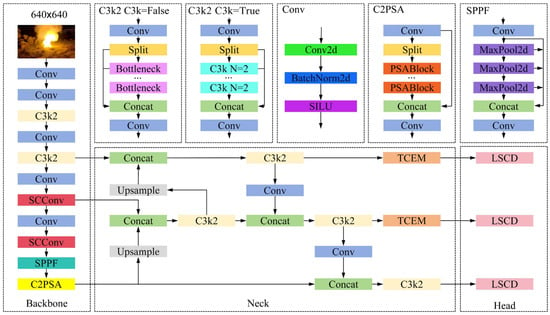
YOLOv11n consists of a backbone, a neck, and a detection head. The backbone extracts features using convolutional and C3k2 blocks, with spatial pyramid pooling–fast (SPPF) and a two-convolution module with position-sensitive attention (C2PSA) providing contextual information and attention-based feature enhancement, respectively. The neck fuses features at different scales through upsampling and concatenation before passing them to the detection head.
In order to balance detection accuracy, model size, and computational cost, and to meet the deployment needs of rescue robot platforms, this paper uses YOLOv11n as the baseline to build a lightweight fire source detection network, STL-YOLO, with improvements at three levels: the backbone, neck, and head. Its overall structure is shown in Figure 1. The input image is downsampled step by step by the backbone network to obtain multi-scale semantic representations; in the deeper P4 and P5 stages of the backbone, Spatial and Channel Reconstruction Convolution (SCConv) is used to replace the bottleneck structures in C3k2, suppressing false-positive responses caused by warm-colored backgrounds while reducing spatial and channel redundancy. TCEM follows the P3 and P4 output branches to reduce misses caused by low-contrast flames blending into warm-toned distractors. Finally, LSCD replaces the original decoupled detection head and substantially reduces the head parameter count through cross-scale weight sharing. Positioned at different stages, the three modules complement one another in function. Their combined effects are evaluated through ablation experiments.
Figure 1.
Overall architecture of STL-YOLO.
3.2. SCConv-Based Spatial and Channel Reconstruction Backbone
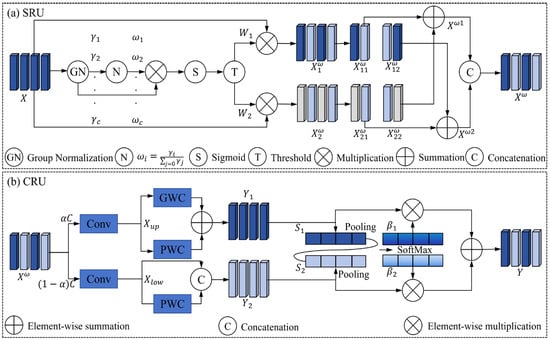
In fire source images, particularly those captured indoors, warm-toned background elements such as lighting and warm-colored objects often occupy a large proportion of the image, whereas real flames account for a relatively small area. The limited channel capacity of a lightweight backbone can easily be occupied by highly correlated redundant responses, making it difficult to represent small but discriminative flame regions adequately. To address this issue, SCConv is introduced by cascading a Spatial Reconstruction Unit (SRU) and a Channel Reconstruction Unit (CRU). The two units reduce spatial and channel redundancy, respectively, enabling the limited representation capacity to focus more strongly on flame regions. Figure 2 illustrates the SCConv structure.
Figure 2.
SCConv Structure: (a) Spatial Reconstruction Unit (SRU); (b) Channel Reconstruction Unit (CRU).
To suppress spatial redundancy, SRU measures the spatial information carried by each channel using the learnable scaling factor γ from Group Normalization (GN). A larger γ indicates richer spatial information in the corresponding channel. The normalized channel weight wγ is calculated by dividing each channel’s scaling factor by the sum across all channels. Subsequently, wγ is multiplied element-wise by the group-normalized feature and passed through a sigmoid function to generate soft gating weights. Finally, following the experimental setting of the original SCConv study, the gating weights are divided using a threshold of τ = 0.5, thereby separating the features into information-rich and redundant components, as expressed in Equation (1):
In Equation (1), denotes the group-normalized feature, and wγ denotes the normalized channel weight derived from the GN scaling factor γ. The gating threshold τ is fixed at 0.5 in this study. U denotes the information mask, while X1 and X2 represent the information-rich and redundant features separated by the mask, respectively. To promote information reuse between these subsets and further reduce redundancy, SRU splits each subset equally along the channel dimension. Cross-addition and concatenation are then applied to the corresponding parts to produce spatially reconstructed features. This cross-reconstruction process preserves discriminative responses while facilitating the reuse of information obscured by redundant features.
The CRU is designed to suppress channel redundancy and follows a split-transform-fuse paradigm. First, the spatially reconstructed features are divided proportionally into an information-rich branch and a lightweight branch, followed by channel compression using 1 × 1 convolutions. The information-rich branch jointly employs group convolution and pointwise convolution to extract high-level representations, whereas the lightweight branch supplements information at a low cost through pointwise convolution and feature reuse. The two branches are then concatenated, and channel-attention weights derived from global average pooling and Softmax are used to adaptively reweight the concatenated features. The two weighted parts are finally added to obtain the channel-reconstructed feature. SCConv is formed by cascading the SRU and CRU operators (denoted by FS and FC, respectively). To maintain compatibility with the pretrained weights, the channel-preserving SCConv is inserted between the two 3 × 3 convolutional mappings of the original bottleneck structure to construct the SCConvBottleneck, as expressed in Equation (2):
Y = X + φ2(C(S(φ1(X))))
In Equation (2), X and Y denote the input and output features of the SCConvBottleneck, respectively; φ1 and φ2 denote the two 3 × 3 convolutional mappings in the original bottleneck structure; and FS and FC denote the SRU and CRU operators, respectively. Because φ1 and φ2 retain the tensor shapes and parameter names of the original structure, their corresponding pretrained weights can be loaded directly from yolo11n.pt, whereas the internal parameters of SCConv are newly initialized. This design introduces feature-reconstruction capability while allowing most pretrained weights to be retained.
3.3. Texture Contrast Enhancement Module
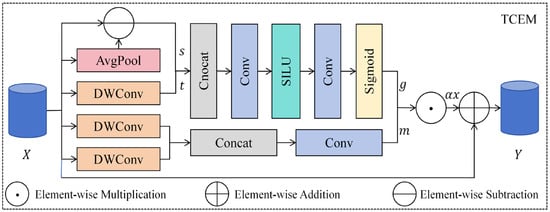
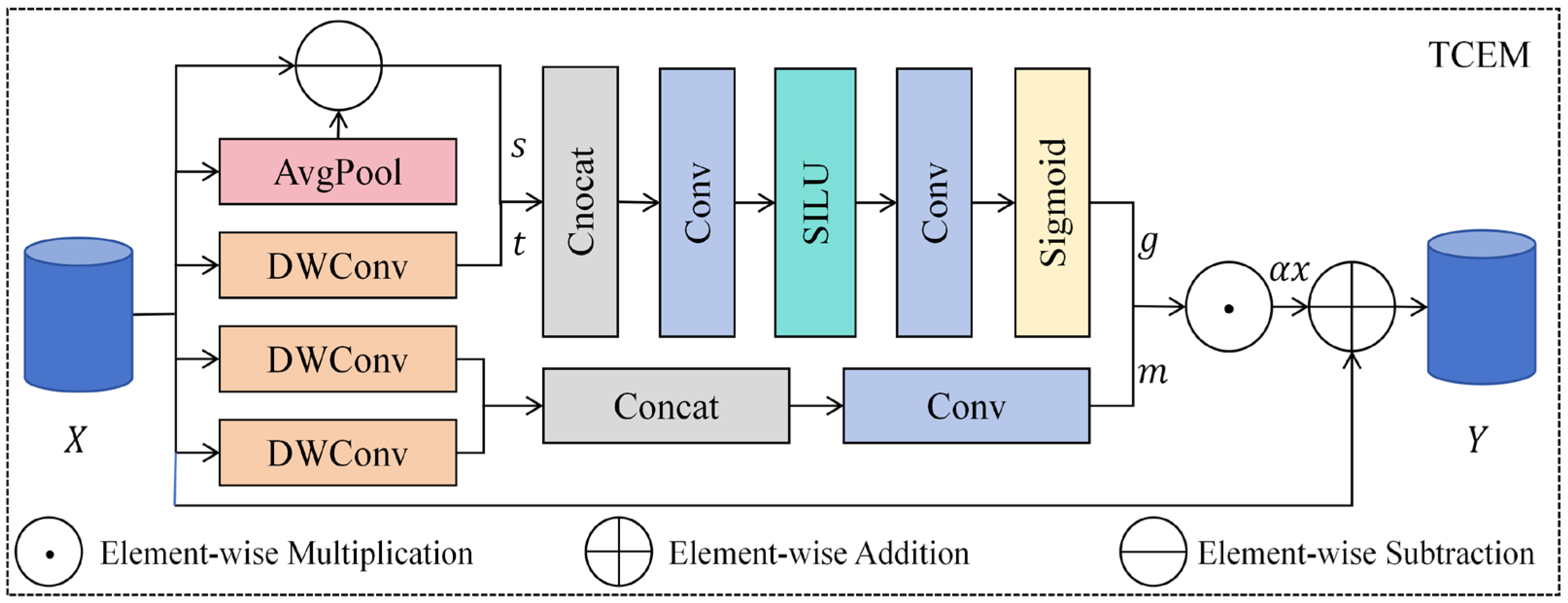
Although SCConv is introduced to suppress warm-toned background interference, some weak flames may still be missed because their indistinct texture contours make them visually similar to background distractors such as lighting, strongly reflective regions, and warm-colored objects. This problem is essentially associated with low contrast and texture camouflage rather than conventional small-object detection. Inspired by texture cues and local-contrast modeling in camouflaged object detection, a channel-preserving Texture Contrast Enhancement Module (TCEM) is designed, as shown in Figure 3. The module consists only of depthwise convolutions, 1 × 1 convolutions, average pooling, and element-wise operations.
Figure 3.
Structure of the Texture Contrast Enhancement Module.
TCEM extracts three complementary cues in parallel. The first is a texture-gradient cue, denoted by T, which is extracted using learnable depthwise convolutions initialized with Sobel operators. The channels are cyclically initialized using horizontal, vertical, and diagonal Sobel kernels scaled by 1/4, providing stable initial edge responses while allowing the kernels to adapt during training. The second cue is the local-contrast feature S, which represents the contrast between a target and its surrounding background using a parameter-free center-surround difference, as expressed in Equation (3):
The neighborhood background feature in Equation (3) is obtained by average-pooling the input X within a local window. The default pooling window is 5 × 5, providing a broader neighborhood reference than a 3 × 3 window while keeping the contrast measurement local. S denotes the local-contrast feature obtained from the difference between the central feature and its neighborhood background. This operation emphasizes regions with abrupt local intensity variations, thereby helping the model detect low-texture and weak flames. The third cue is the multi-kernel contextual feature M, which aggregates contextual information from different receptive fields through parallel multi-scale depthwise convolutions with kernel sizes of 3 and 5. The resulting features are fused using a 1 × 1 convolution, combining local spatial patterns from the 3 × 3 branch with broader contextual information from the 5 × 5 branch.
The texture-gradient and local-contrast features are then concatenated and passed through the bottleneck gating mapping g(⋅), which first compresses and then restores the channel dimension. A sigmoid function generates the position- and channel-wise modulation weight G, which selectively enhances the contextual feature. Finally, the enhanced feature is weighted by a learnable scalar α and added to the input through a residual connection, as expressed in Equations (4) and (5):
G = σ(g([T, S]))
Y = X + α(G ⊙ M)
In Equations (4) and (5), T and S denote the texture-gradient and local-contrast features, respectively; g(⋅) denotes the bottleneck gating mapping; G denotes the position- and channel-wise modulation weight generated by the sigmoid function; M denotes the multi-kernel contextual feature; and α denotes the learnable residual scaling factor. TCEM takes X as its input feature and produces Y as its output. At the beginning of training, α is initialized to zero so that TCEM approximates an identity mapping, thereby reducing disturbance to the pretrained feature distribution. As training proceeds, α adaptively adjusts the intensity of feature enhancement.
Finally, TCEM is applied to the P3 and P4 output branches. Their relatively high spatial resolutions provide finer spatial representations for texture-gradient and local-contrast modeling. Restricting enhancement to these two levels is intended to balance the preservation of spatial detail and the additional computational cost.
3.4. Lightweight Shared Convolutional Detection Head
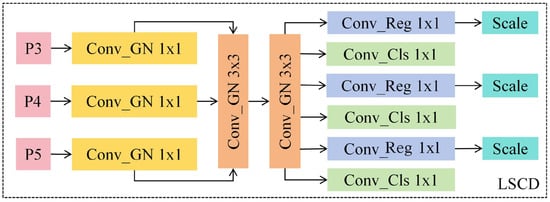
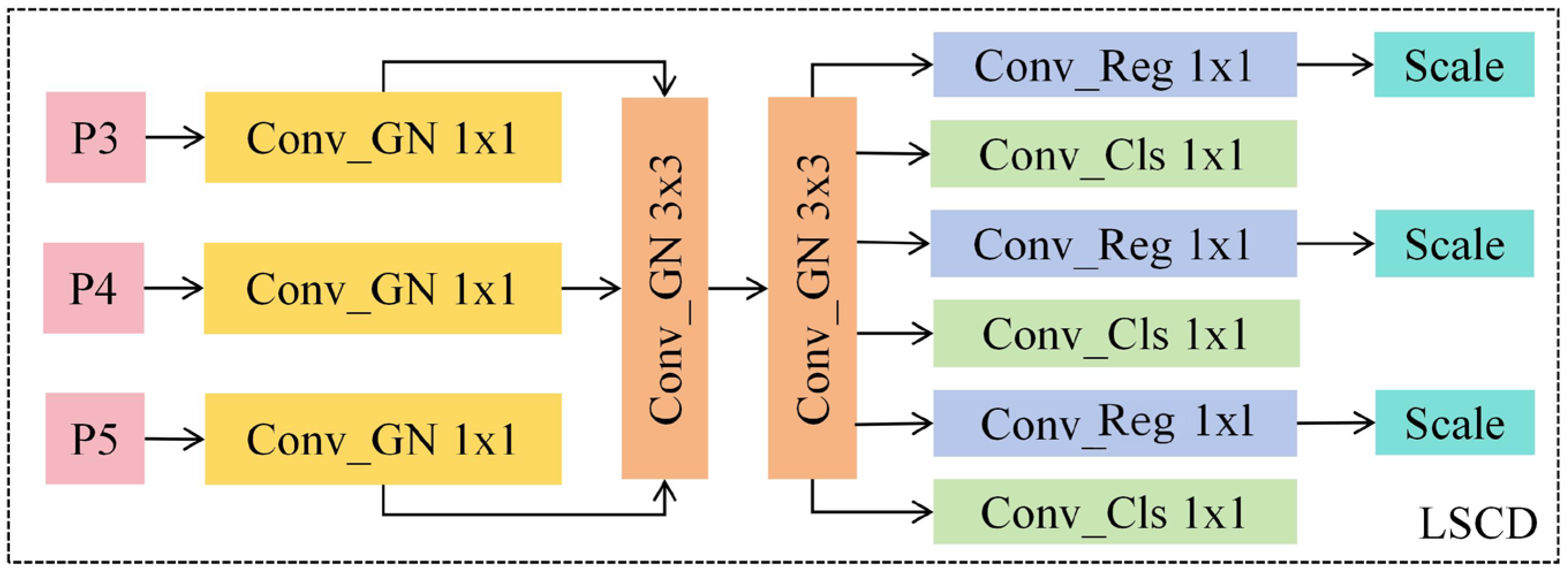
The original YOLOv11n decoupled detection head uses independent regression and classification branches at each of the three scales: P3, P4, and P5. The detection head alone contains about 0.43 M parameters, accounting for about 17% of the 2.59 M parameters in the baseline model. In order to reduce this overhead while maintaining detection accuracy, this paper adopts a Lightweight Shared Convolutional Detection Head (LSCD), and its structure is shown in Figure 4.
Figure 4.
Structure of the LSCD head.
LSCD first uses scale-specific 1 × 1 alignment mappings φi to project the three input features Pi into a unified hidden dimension. The features then pass through a two-layer 3 × 3 depthwise convolutional trunk Φs shared across scales. Activation statistics differ across scales, but the same convolutional weights are used for all of them. Group Normalization is therefore used instead of Batch Normalization. It normalizes each sample and improves training stability when convolutional weights are shared. Equation (6) expresses this operation:
In Equation (6), Pi denotes the input feature at the i-th scale, φi denotes the corresponding 1 × 1 channel-alignment mapping, Φs denotes the cross-scale shared convolutional trunk, and denotes the feature at the i-th scale after channel alignment and shared convolution. Predictions are subsequently generated using the shared regression mapping ψbox and classification mapping ψcls. An FCOS-style learnable scale factor si is introduced for each scale to adjust the dynamic range of the regression output, as expressed in Equation (7):
In Equation (7), the shared mapping ψbox performs regression, while ψcls performs classification. The learnable scaling factor for the i-th scale is si. Here, Bi is the bounding-box regression prediction used for Distribution Focal Loss (DFL), and Ci is the classification prediction. Under the single-class configuration with a hidden dimension of 128, the number of detection-head parameters is reduced from approximately 0.43 M to approximately 0.07 M, accompanied by a corresponding reduction in computational cost. The reductions in model parameters and computational overhead are therefore primarily attributable to LSCD. Its implementation is based on the Ultralytics Detect base class. The existing anchor-decoding and loss-computation mechanisms are retained, ensuring compatibility with the training framework.
4. Experiments
4.1. Experimental Environment and Parameter Settings
All experiments shared the hardware and software configuration detailed in Table 1 to ensure a fair comparison. The models were implemented using Python 3.10.16, PyTorch 2.2.2, and CUDA 12.1. With YOLOv11n serving as the baseline, training and evaluation were both carried out on an NVIDIA A10G GPU equipped with 24 GB of memory.
Table 1.
Experimental environment.
All models followed the same training protocol to avoid unfair comparisons caused by differences in hyperparameter tuning. We used stochastic gradient descent (SGD) with an initial learning rate (lr0) of 0.01, momentum of 0.937, and weight decay of 5 × 10⁻⁴. A batch size of 64 was used, the input resolution was 640 × 640 pixels, and linear learning-rate warm-up was applied during the first five epochs. Given the size of firemix-v6, training ran for 150 epochs. Mosaic augmentation was switched off for the last 30 epochs to stabilize the later training stage. These settings were applied to all compared models. The proposed model followed exactly the same optimizer, augmentation procedure, and learning-rate schedule as YOLOv11n; neither received model-specific tuning, ensuring a fair comparison. In addition, the model loads pretrained weights into compatible layers to retain existing feature representations and provide an initialization basis for training. The residual scaling factor in TCEM is initialized to zero, making the module equivalent to an identity mapping at initialization and limiting the initial perturbation of pretrained features by the new enhancement branch. During training, this factor adaptively adjusts the enhancement intensity. Group Normalization in SCConv and LSCD calculates statistics within each sample, avoiding reliance on batch-level statistics. These settings are intended to support stable optimization during model adaptation.
4.2. The Firemix-v6 Dataset
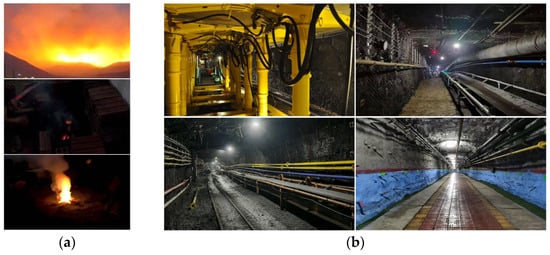
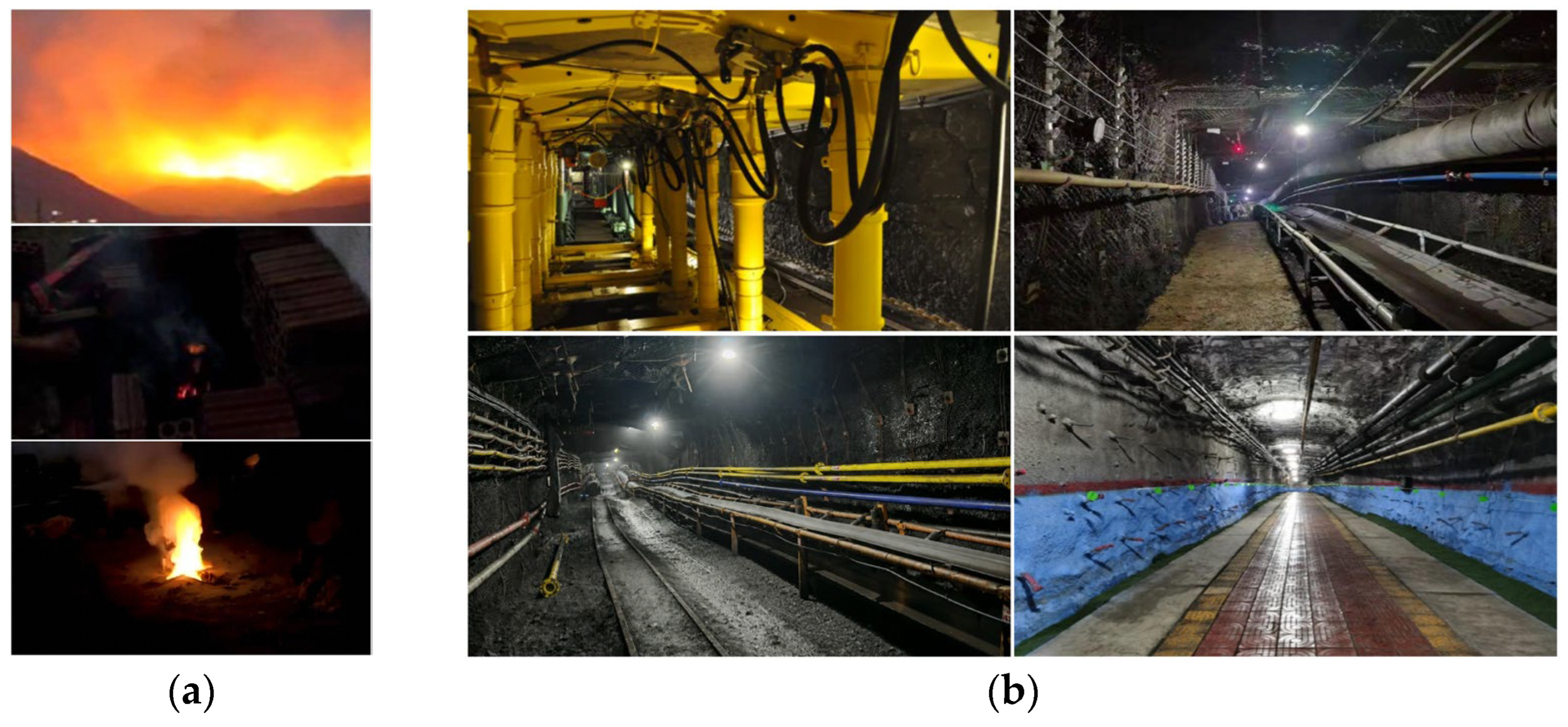
The firemix-v6 fire source detection dataset was used for the main experiments. Images from the publicly available FASDD_CV [23] and Indoor_Fire [24] datasets were selected to increase visual relevance to complex underground environments. Positive samples mainly consisted of outdoor open flames and indoor fire sources. Difficult negative samples, including warm-toned distractors, smoke, and reflective regions, were incorporated to reduce false-positive responses in rescue environments. Because differences in annotation granularity among data sources may introduce contradictory supervisory signals, a unified cleaning procedure was applied, including the removal of out-of-bounds boxes, merging of highly overlapping boxes, and single-class normalization. This processing improved consistency in bounding-box density and object-scale distributions among the different sources. The difference hash (DHash) algorithm was also used for image deduplication to reduce redundancy caused by duplicate and visually similar images. The dataset contains only one target class, fire, and comprises 5714 images. It was divided into training, validation, and test sets at an approximate ratio of 8:1:1, containing 4572, 571, and 571 images, respectively. Additionally, to reduce the risk of data leakage between the training and test sets, scene-level separation was applied to the test set, ensuring that its scenes did not appear in either the training or validation set. Representative samples are shown in Figure 5.
Figure 5.
(a) Fire images; (b) images of complex mine environments.
To improve model generalization, 524 underground coal-mine images obtained from publicly available online sources were incorporated into the dataset. Given the difficulty of obtaining images of actual underground fires and the limited availability of publicly accessible positive samples, all of these images are fire-free negative samples. Figure 5b shows representative examples of complex underground environments, including working faces and transportation roadways, where interference from light sources, dust, and water mist is common. These images were included to help the model learn the characteristics of fire-like distractors, such as miners’ headlamps and roadway lamps, with the aim of reducing false-positive responses to underground backgrounds.
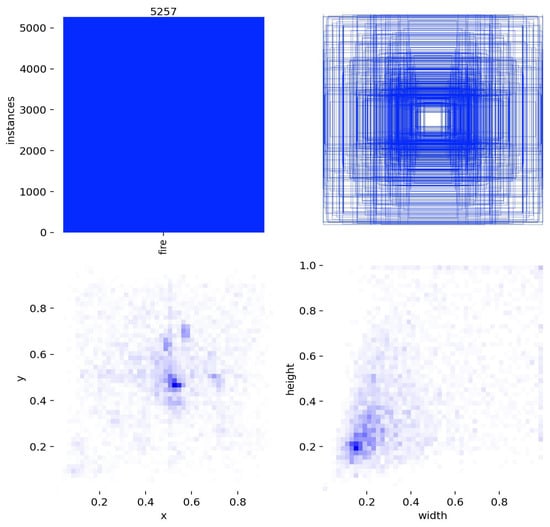
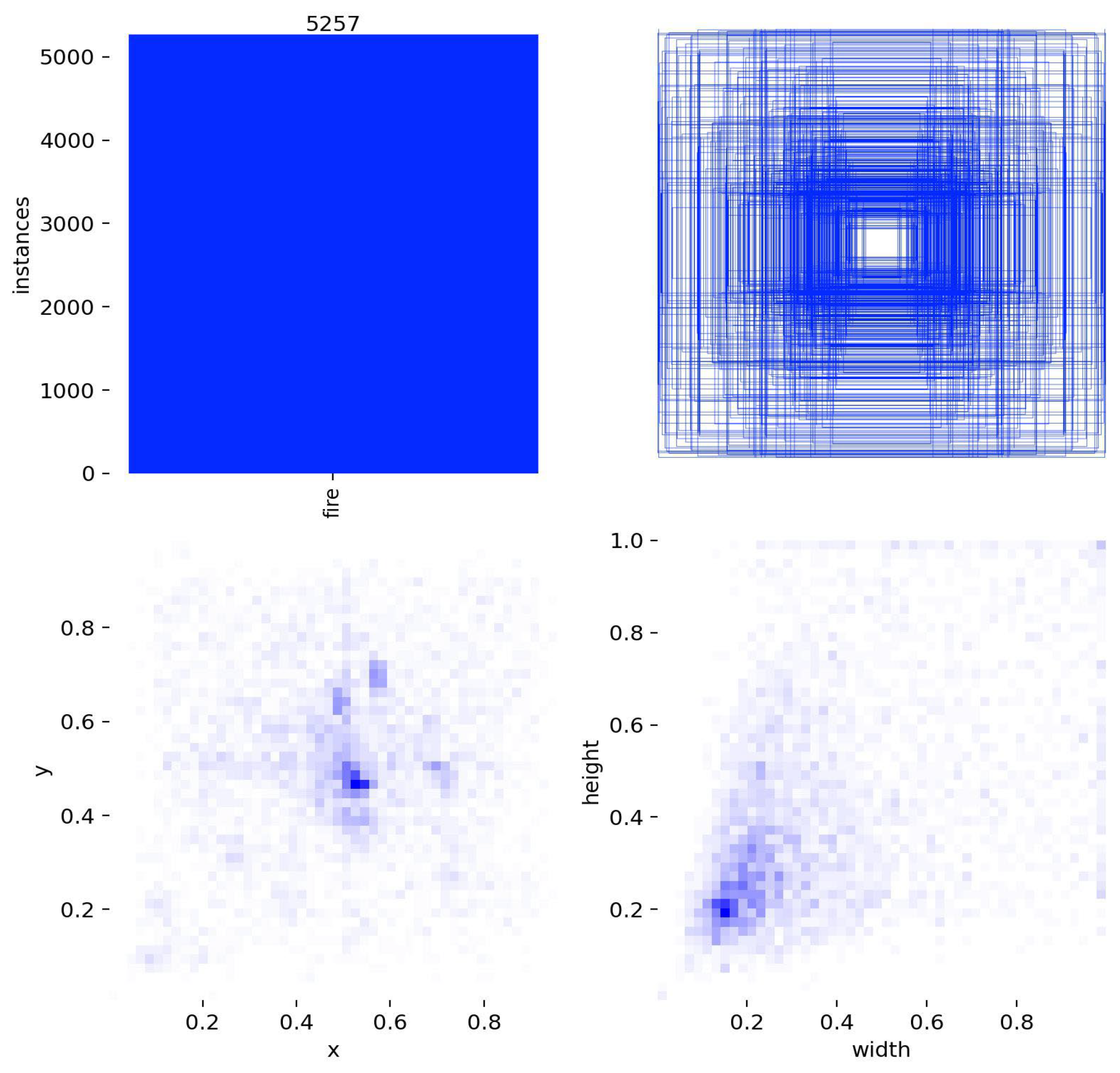
To further characterize the annotations in firemix-v6, Figure 6 presents the distribution of the 5257 fire instances in the training set. The flames are primarily located in the images’ central regions while also appearing in other areas. The normalized widths and heights of the bounding boxes are generally small but span a relatively broad range of scales. These distributions indicate that the training set contains fire sources with diverse positions, scales, and shapes, providing data support for learning multi-scale fire source features.
Figure 6.
Distribution of fire source annotations in the training set.
4.3. Evaluation Metrics
In order to comprehensively evaluate the detection performance and deployment feasibility of the proposed method, this paper adopts precision (P), recall (R), F1-score, mAP@0.5, mAP@0.5:0.95, parameter count (Params), floating-point operation count (GFLOPs), and frames per second (FPS) as evaluation metrics. mAP summarizes precision–recall performance across the evaluated classes and provides a comprehensive measure of detection quality. Params and GFLOPs represent the parameter count and theoretical computational cost of the model, respectively. FPS measures the number of images processed per second and is used to evaluate inference speed. These metrics are defined as follows:
In Equations (8)–(12), TP, FP, and FN denote the numbers of true positives, false positives, and false negatives, respectively; C denotes the total number of target classes; and APi denotes the Average Precision of the i-th class. mAP@0.5 denotes the mean Average Precision at an IoU threshold of 0.5, whereas mAP@0.5:0.95 denotes the average result over IoU thresholds ranging from 0.5 to 0.95 in increments of 0.05, providing a stricter evaluation of localization quality.
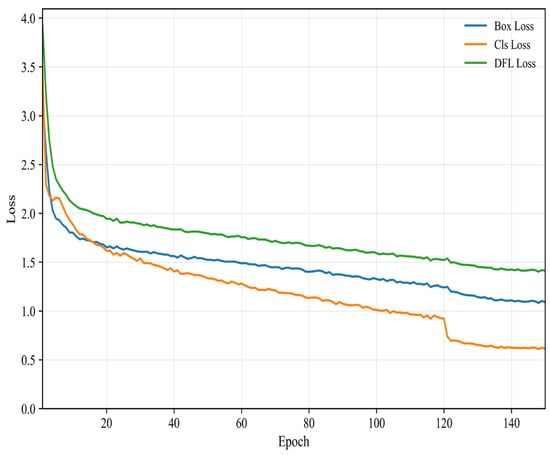
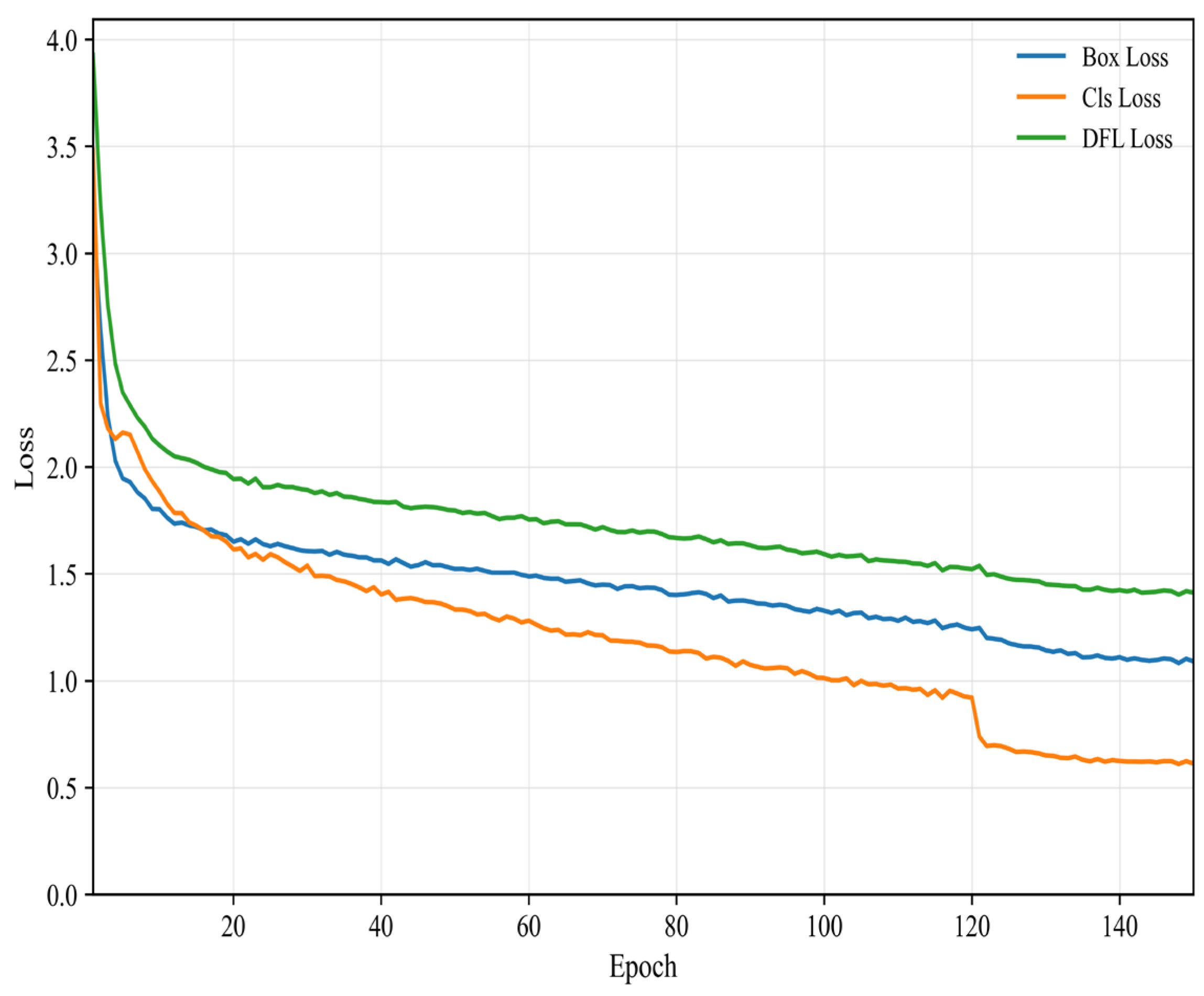
To examine the stability of the training process, the variations in Box Loss, Cls Loss, and DFL Loss were recorded, as shown in Figure 7. Among them, Box Loss is used to measure the localization deviation between the predicted box and the ground-truth box, Cls Loss reflects the classification error of the fire source class, and DFL Loss is used to impose fine-grained constraints on the distribution of bounding box positions. It can be seen from the figure that the three losses decreased rapidly in the early stage of training, and then the rate of decline gradually slowed down. After the 120th epoch, disabling Mosaic data augmentation changed the sample distribution, and Cls Loss decreased further. The changes in the losses during the later stage of training were relatively small, indicating that the optimization process of the model under the current training settings was stabilizing.
Figure 7.
Training loss curves.
4.4. Ablation Experiments
In order to test the independent contribution of each component to detection performance, this paper takes YOLOv11n as the baseline, gradually introduces the SCConv, TCEM, and LSCD modules, and systematically evaluates their individual and combined effects on the firemix-v6 test set. The results are shown in Table 2.
Table 2.
Ablation results.
The single-module results show that each component improves a different aspect of baseline performance. After SCConv is introduced, gains of 1.1 and 3.1 percentage points are obtained in mAP@0.5 and mAP@0.5:0.95, respectively, while Precision and Recall improve by 2.8 and 1.8 percentage points. The parameter count and computational cost increase only slightly. These results indicate that SCConv can reduce spatial and channel redundancy and improve the quality of flame-feature representation. TCEM increases Recall from 78.3% to 81.3%, an improvement of 3.0 percentage points, representing the largest Recall gain among the single-module configurations. This result indicates that TCEM enhances the recognition of difficult flame targets and reduces missed detections. LSCD improves mAP@0.5 and mAP@0.5:0.95 by 0.9 and 2.5 percentage points, respectively, while reducing the parameter count from 2.590 M to 2.229 M and GFLOPs from 6.44 to 5.08, equivalent to decreases of approximately 13.94% and 21.12%, respectively. These findings demonstrate the effectiveness of LSCD in reducing model complexity.
The dual-module experiments further demonstrate that the components complement one another in function. Combining SCConv with TCEM yields an mAP@0.5 of 86.7% and a Recall of 82.4%, indicating that the joint application of feature reconstruction and target enhancement can further reduce missed flame detections. With relatively low computational cost, the TCEM + LSCD configuration reaches 40.2% mAP@0.5:0.95. This suggests that the lightweight detection structure effectively preserves the informative features extracted by TCEM. Notably, although all dual-module configurations achieve higher detection accuracy metrics than the YOLOv11n baseline, SCConv + TCEM and SCConv + LSCD yield lower mAP@0.5:0.95 than SCConv alone. These reductions may reflect a change in the balance between classification and regression. TCEM reweights features used by both tasks, while LSCD constrains scale-specific predictions through shared weights; these modifications therefore do not necessarily produce uniform gains across IoU thresholds. Joint optimization of all three modules may have achieved a better balance, with the complete model reaching 40.9% mAP@0.5:0.95, exceeding all single- and dual-module configurations. For the warning-oriented task considered here, recall, false-alarm control, and mAP@0.5 are emphasized, while mAP@0.5:0.95 is retained as part of the overall evaluation.
After SCConv, TCEM, and LSCD are simultaneously introduced, STL-YOLO achieves the best overall performance. Its mAP@0.5, mAP@0.5:0.95, Precision, and Recall reach 87.7%, 40.9%, 87.7%, and 85.3%, respectively, representing improvements of 2.5, 3.6, 3.7, and 7.0 percentage points over the YOLOv11n baseline. The substantial improvement in Recall indicates that the proposed model recognizes more flame targets that are missed by the baseline and is more adaptable to dense flames, weak-feature flames, and difficult samples in complex backgrounds. Meanwhile, STL-YOLO requires just 2.328 M parameters and 5.52 GFLOPs. These values are approximately 10.12% and 14.29% lower than those of the baseline, respectively.
To further analyze TCEM’s performance on difficult samples, the baseline and the model incorporating TCEM were compared on weak-flame and low-texture flame samples. The quantitative results are presented in Table 3.
Table 3.
Comparative detection results of the TCEM module on difficult samples.
It can be seen from Table 3 that in the two types of difficult samples analyzed, after the addition of TCEM, Precision and Recall improved, and the numbers of false positives and false negatives decreased. For weak flames, Precision and Recall increased by 1.1 and 2.3 percentage points, respectively, while FP decreased from 60 to 59 and FN from 59 to 55. For low-texture flames, the improvement was more pronounced. Precision and Recall increased by 3.3 and 7.8 percentage points, respectively, while FP decreased from 40 to 38 and FN from 81 to 66. These results show that TCEM improved flame detection in the analyzed samples, particularly by reducing missed detections of low-texture flames without increasing false positives.
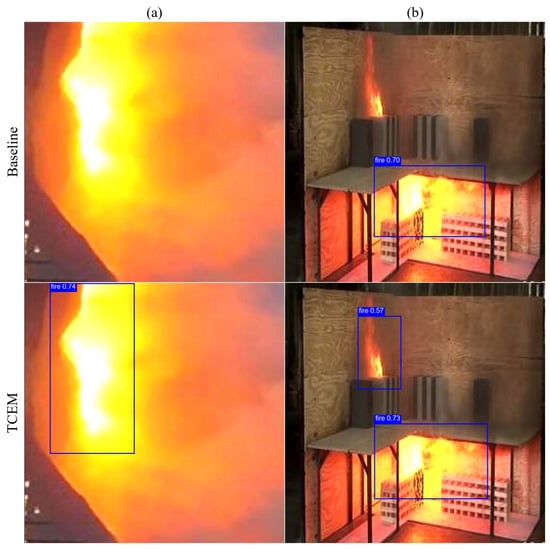
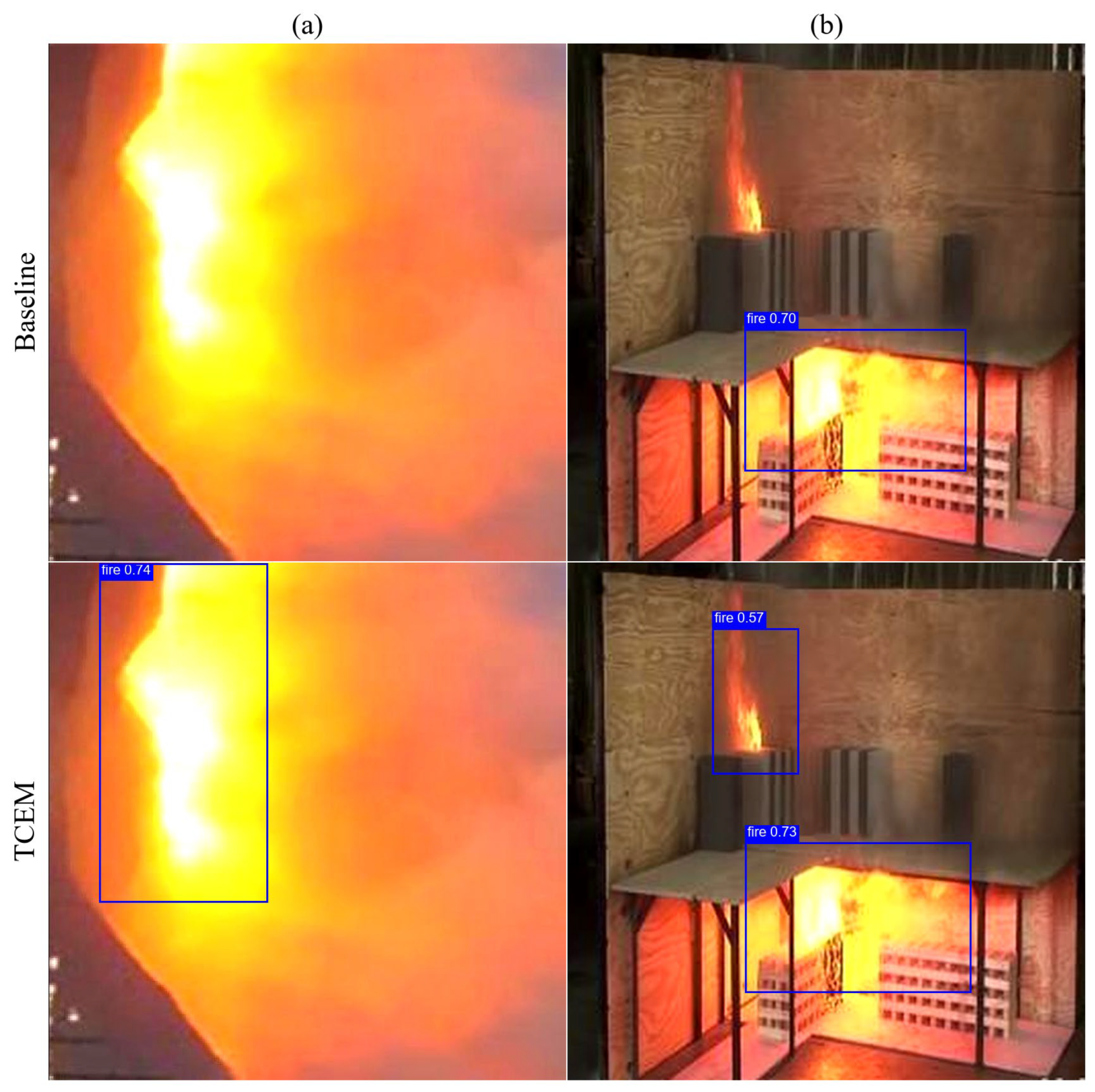
To more clearly illustrate TCEM’s detection performance in challenging scenarios, Figure 8 compares the detection results of the baseline and the TCEM-augmented model in two scenarios: (a) low-texture flames and (b) weak flames.
Figure 8.
Comparison of detection results in challenging scenarios. (a) Low-texture flame scene; (b) Weak-flame scene.
In the low-texture flame scene shown in Figure 8a, the flame region is bright, its local texture details and contours are indistinct, and the surrounding large orange-yellow area further increases the difficulty of distinguishing the flame from the background. The baseline failed to detect the flame. In contrast, after incorporating TCEM, the model detected the flame with a confidence score of 0.74, and the bounding box covered the main flame region. This case shows that incorporating TCEM helps improve target detection when flame texture details are indistinct and warm-colored background interference is present.
In the weak-flame scene shown in Figure 8b, the flame in the lower part of the image is large and bright, whereas the upper flame is relatively small and lies next to a warm-colored wall, making it more difficult to identify. The baseline detected only the prominent lower flame, with a confidence score of 0.70, missing the weak upper flame. After incorporating TCEM, the model detected both the upper and lower flames, with confidence scores of 0.57 and 0.73, respectively. It continued to detect the lower flame while also detecting the upper flame missed by the baseline. Taken together, Figure 8a,b show that TCEM reduced missed detections in both cases, consistent with the increased Recall and reduced false negatives for weak and low-texture flames reported in Table 3.
Overall, SCConv primarily improves feature-representation quality, TCEM focuses on enhancing the detection of difficult targets, and LSCD reduces model size and computational cost. Their coordinated use compensates for the limitations of certain dual-module combinations in localization accuracy or Recall and achieves a favorable balance among detection accuracy, recall capability, and lightweight design, supporting the effectiveness and structural rationality of the overall improvement strategy.
4.5. Comparative Experiments
To evaluate the performance of the proposed method, STL-YOLO was benchmarked against mainstream lightweight one-stage detectors: YOLOv5n [25], YOLOv8n [26], YOLOv10n [27], YOLOv11n, and YOLOv12n [28]. Each model in Table 4 used its corresponding official pretrained initialization and the same firemix-v6 partition. A common training protocol specified an input resolution of 640 × 640 pixels, a batch size of 64, 150 training epochs, and five warm-up epochs. SGD used lr0 = 0.01, momentum = 0.937, and weight decay = 5 × 10⁻⁴, with consistent data augmentation across models. The hardware platform was identical for all experiments. In particular, the proposed model matched YOLOv11n in optimizer choice, augmentation procedure, and learning-rate scheduling to ensure a fair comparison. Table 4 reports the quantitative results.
Table 4.
Comparative experimental results.
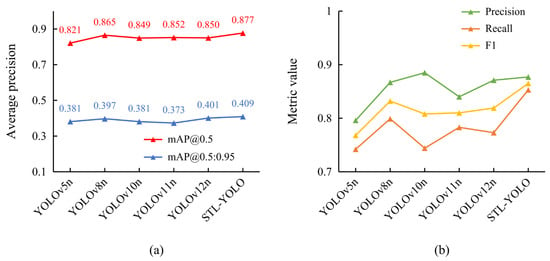
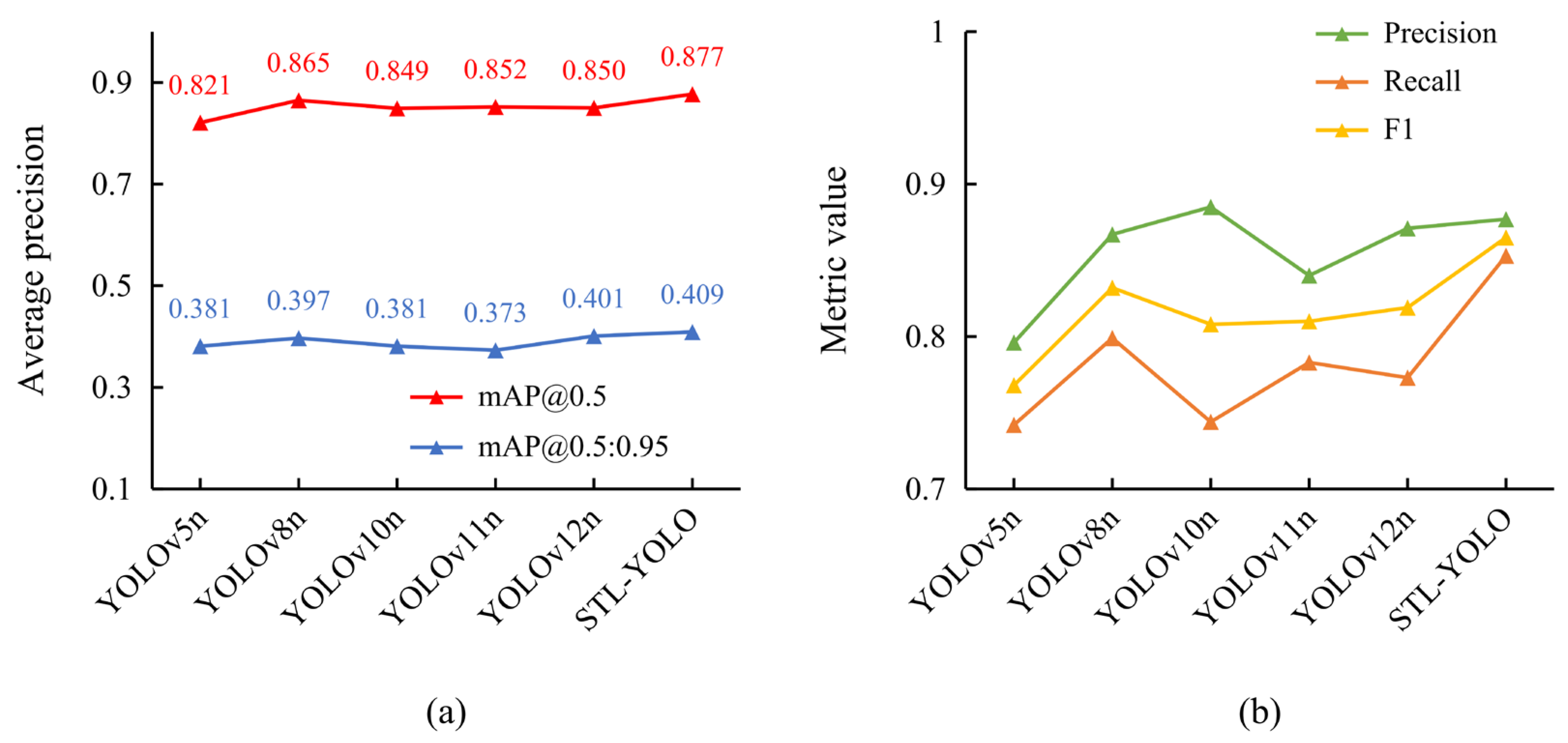
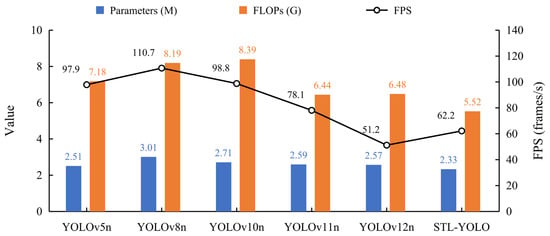
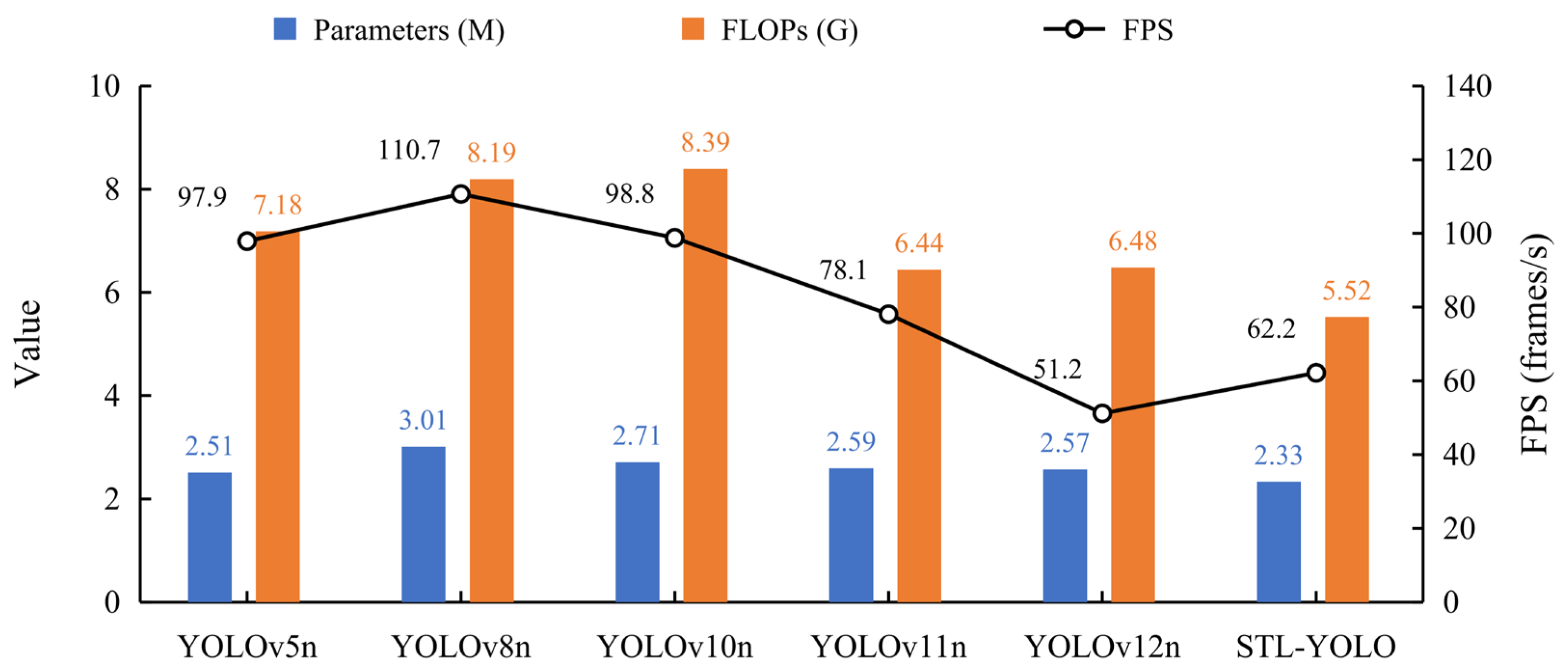
To provide a more intuitive comparison of detection accuracy and computational complexity, Figure 9 presents the detection metrics of the models using line charts, whereas Figure 10 compares their parameter counts and computational costs using bar charts. As shown in Figure 9a,b, STL-YOLO demonstrates strong competitiveness across multiple accuracy metrics. Its mAP@0.5 and mAP@0.5:0.95 are 87.7% and 40.9%, respectively, the highest among the compared models. Compared with YOLOv8n, which provides the second-highest mAP@0.5 of 86.5%, STL-YOLO improves this metric by 1.2 percentage points, demonstrating favorable detection accuracy and localization capability among the selected models.
Figure 9.
Comparison of model performance. (a) mAP@0.5 and mAP@0.5:0.95; (b) Precision, recall, and F1 score.
Figure 10.
Comparison of model parameter counts, computational costs, and inference speeds. (In the legend, M denotes 106 parameters, and G denotes 109 floating-point operations per input image).
As shown in Figure 9b, STL-YOLO achieves the top values for both Recall and F1-score. Although YOLOv10n provides the best Precision, its Recall is relatively low, indicating conservative predictions and the presence of missed flame detections. In contrast, STL-YOLO achieves the highest Recall and F1-score while maintaining high Precision, resulting in a more balanced precision–recall performance. These results indicate that STL-YOLO can recognize more flame targets that are missed by other models without introducing a large number of false positives as Recall increases, making it more suitable for multi-fire-source, dense-flame, and complex-background scenarios.
Figure 10 further shows a comparison of the parameter counts, computational costs, and inference speeds of different models. The parameter count of STL-YOLO is only 2.33 M, and its computational cost is 5.52 GFLOPs, both of which are the lowest among all compared models. Compared with the baseline model YOLOv11n, its parameter count and computational cost are reduced by about 10.12% and 14.29%, respectively. In terms of processing speed, YOLOv11n achieves 78.1 FPS, whereas STL-YOLO achieves 62.2 FPS. Since underground coal-mine surveillance video typically operates at 25 FPS, STL-YOLO retains sufficient average processing capacity to support this input frame rate, with some remaining processing headroom on the tested NVIDIA A10G platform, despite being slower than the baseline. Overall, STL-YOLO improves detection performance while reducing parameter count and theoretical computational cost, achieving a better balance between detection accuracy and model complexity.
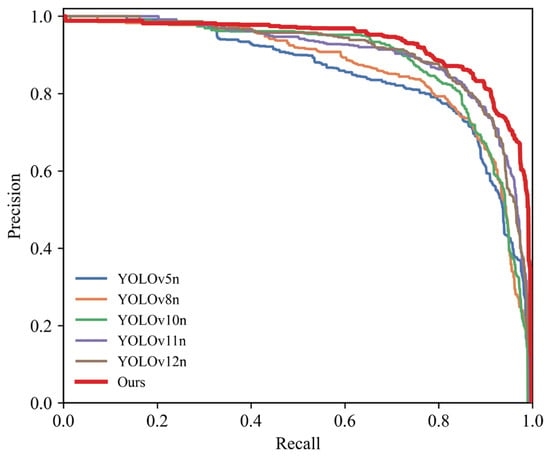
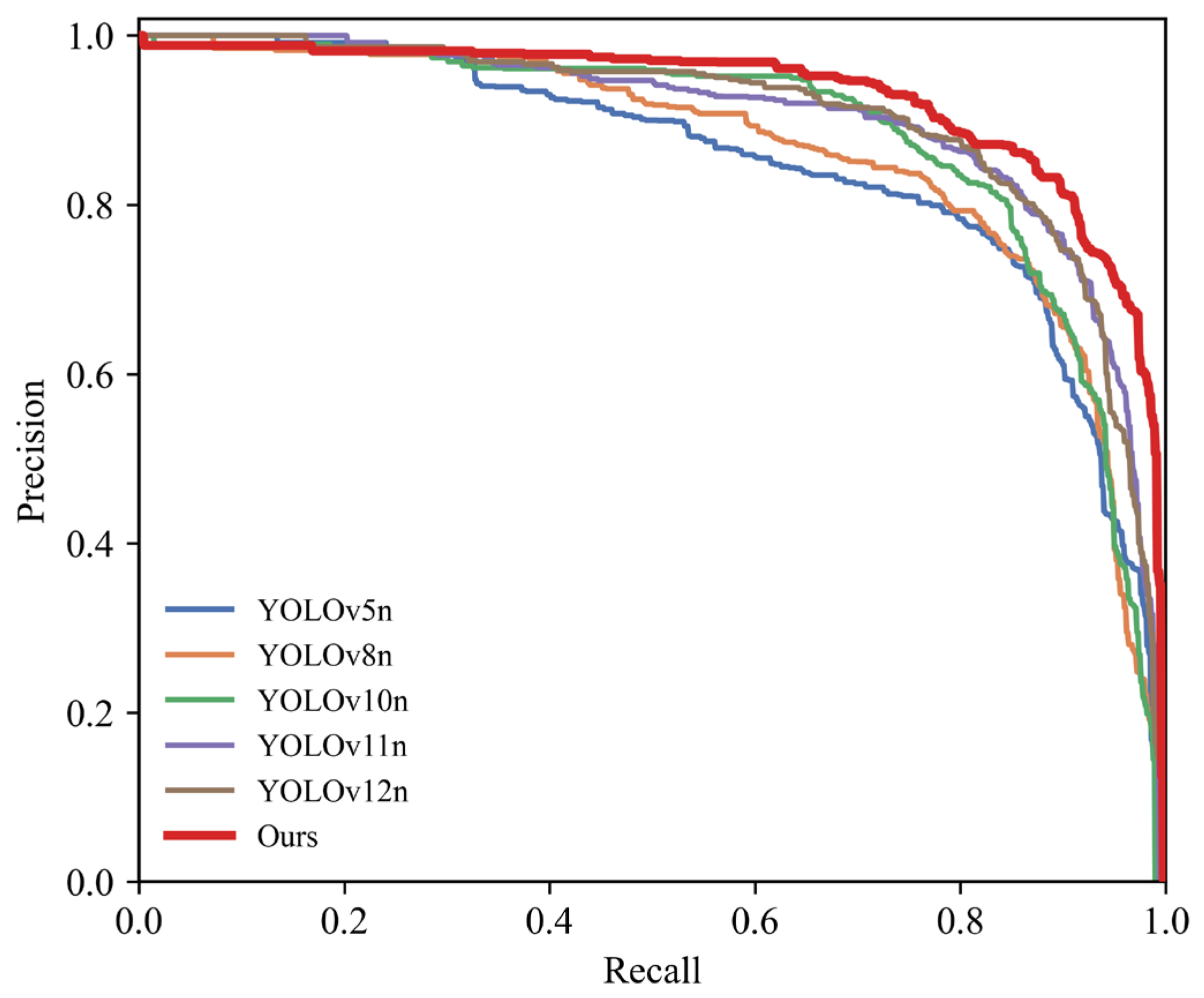
In order to evaluate the overall performance of the STL-YOLO model, the PR curves are plotted with Precision on the vertical axis and Recall on the horizontal axis. As shown in Figure 11, each model maintains high Precision in the low-Recall region, but performance differences between the models gradually become apparent as Recall increases. The curve of STL-YOLO proposed in this paper is generally closer to the upper-right corner of the plot and has the largest area under the curve. Its corresponding mAP@0.5 reaches 0.877, which is 5.6, 1.2, 2.8, 2.5, and 2.7 percentage points higher than those of YOLOv5n, YOLOv8n, YOLOv10n, YOLOv11n, and YOLOv12n, respectively. In particular, the PR curve of STL-YOLO declines more gently in the medium- and high-Recall regions. When Recall reaches about 0.80 or higher, the Precision of other models begins to decline markedly, while the model proposed in this paper still maintains high Precision, indicating that it can suppress false positives caused by background interference while detecting more flame targets. This advantage is particularly useful for difficult samples with multiple fire sources, dense flames, and weak visual features: the model can identify more flame instances that are easily missed without introducing a large number of false positives as Recall increases. Although STL-YOLO does not outperform other models at every confidence threshold, its full PR curve and the area under it show a better Precision–Recall balance in the main operating range. Together with its highest mAP@0.5, these results show that the improvement of the model proposed in this paper is not limited to a fixed confidence threshold but also reflects more stable overall detection performance across different thresholds, further verifying the effectiveness and robustness of the proposed improvements in complex fire scenarios.
Figure 11.
Precision–Recall curves of the compared models.
4.5.1. Visual Comparison of Detection Results
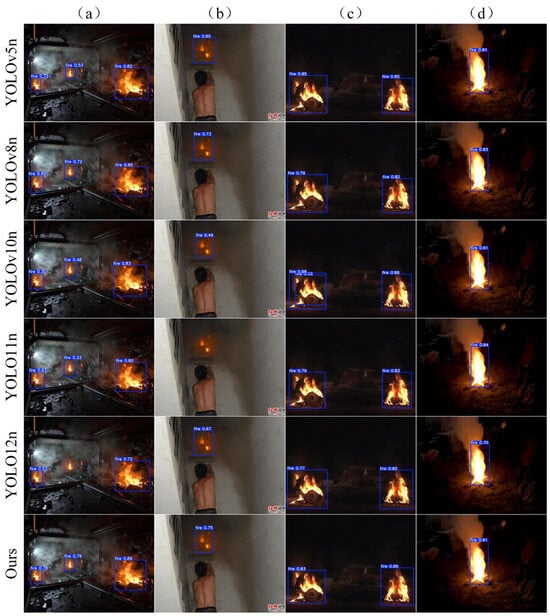
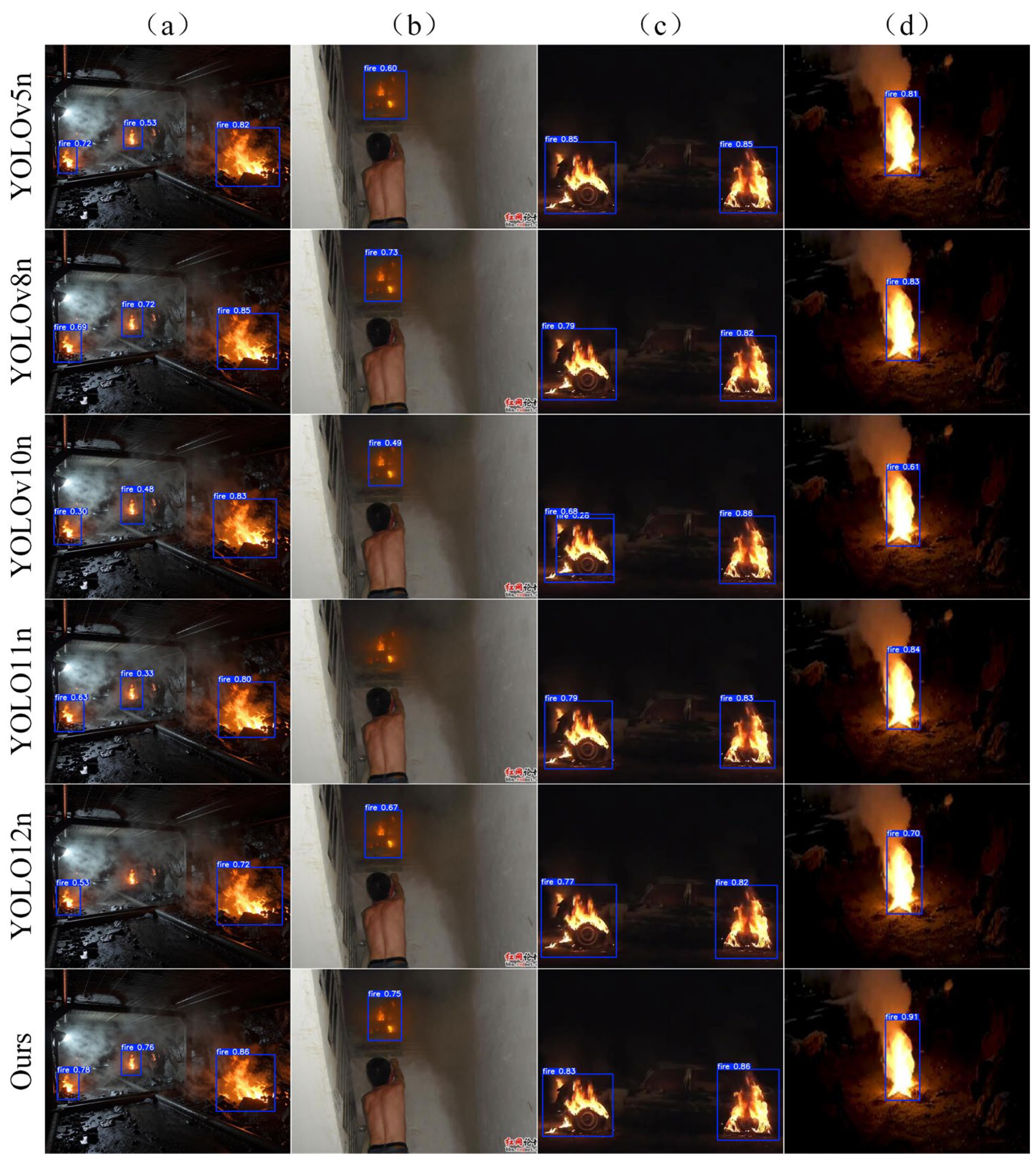
In order to visually evaluate the actual detection performance of each model in complex fire scenarios, Figure 12 compares the detection results of various algorithms in four typical scenarios, including (a) multi-scale fire sources in a simulated mine roadway, (b) low-contrast flames that are difficult to distinguish from human skin tones and warm-colored walls in an indoor corridor, (c) two fire sources at night, and (d) an isolated flame under low nighttime illumination.
Figure 12.
Comparison of detection results in four representative fire source scenarios. (a) Multi-scale fire sources in a simulated mine roadway; (b) Low-contrast flames that are difficult to distinguish from human skin tones and warm-colored walls in an indoor corridor; (c) Two fire sources at night; (d) An isolated flame under low nighttime illumination.
For the simulated multi-scale scene in Figure 12a, YOLOv5n, YOLOv8n, YOLOv10n, and YOLOv11n detect all three fire sources, although their confidence scores differ markedly across target scales. YOLOv10n yields confidence scores of only 0.30 and 0.48 for the small fire source on the left and the weak fire source in the center, respectively, whereas YOLOv11n produces a confidence score of only 0.33 for the central weak fire source. Although these models detect the targets, their confidence scores are relatively low for some weak and small-scale fire sources. YOLOv12n detects only the left and right fire sources and misses the weak target in the center. In contrast, STL-YOLO detects all three fire sources with confidence scores of 0.78, 0.76, and 0.86 for the left, central, and right targets, respectively, exceeding the corresponding results of the other models. In particular, STL-YOLO correctly localizes the central weak fire source with relatively high confidence, demonstrating more stable recognition of less-salient fire sources and targets at different scales in complex backgrounds.
In the warm-colored interference scene shown in Figure 12b, the flame is located at the far end of the corridor, the target is small, and there are surrounding distractors such as human skin tones, warm-colored walls, and low-contrast lighting. YOLOv5n, YOLOv8n, YOLOv10n, and YOLOv12n can all detect the flame near the window, with confidence scores of 0.60, 0.73, 0.49, and 0.67, respectively, but YOLOv11n fails to output a valid detection box and completely misses the target. STL-YOLO not only correctly locates the distant flame but also produces a detection box that covers the adjacent bright flame regions. There are no false positives in the areas containing the person or the warm-colored wall. Its confidence score reaches 0.75, the highest among all models in this scene. Figure 13b further shows that the high-response regions of the model proposed in this paper form a double-peak structure corresponding to the adjacent bright flame regions. This shows that STL-YOLO can not only correctly locate the fire source but also provide a more detailed representation of the local flame morphology and spatial distribution, demonstrating good foreground–background discrimination against visually similar warm-colored backgrounds.
Figure 13.
Comparison of Grad-CAM heatmaps generated by different models. (a) Multi-scale fire sources in a simulated mine roadway; (b) Low-contrast flames that are difficult to distinguish from human skin tones and warm-colored walls in an indoor corridor; (c) Two fire sources at night; (d) An isolated flame under low nighttime illumination.
In the nighttime two-fire-source scene shown in Figure 12c, most models can detect the two real fire sources on the left and right, but the stability of their detection results differs. YOLOv10n outputs two overlapping detection boxes for the same fire source on the left, one of which has a low confidence score. This duplicate detection indicates that its boundary estimation for a single fire source instance is not stable enough. Although the other baseline models can correctly detect both fire sources, their confidence scores fluctuate between targets. STL-YOLO outputs one detection box for each of the left and right fire sources, with confidence scores of 0.83 and 0.86, respectively. The number of detection boxes matches the number of real fire sources, with no missed or duplicate detections. It should be noted that YOLOv5n has a confidence score of 0.85 for the left fire source, slightly higher than the 0.83 of the model proposed in this paper. Therefore, STL-YOLO cannot be considered to have the highest confidence for every fire source. However, considering the overall results for both fire sources, the model proposed in this paper maintains high confidence and a stable one-to-one correspondence, showing more balanced separation of multiple fire source instances.
In the nighttime low-light isolated-flame scene shown in Figure 12d, all six models can correctly detect the fire source without producing obvious false positives in the surrounding dark background, but their prediction confidence scores differ markedly. The confidence scores of YOLOv5n, YOLOv8n, YOLOv10n, YOLOv11n, and YOLOv12n are 0.81, 0.83, 0.61, 0.84, and 0.70, respectively, while STL-YOLO reaches 0.91, the highest among all models. This result shows that when the flame itself is relatively clear but the overall ambient illumination is low, the model proposed in this paper can still effectively extract discriminative flame features and maintain high prediction confidence.
It can be seen from the four types of scenarios that STL-YOLO detects all real fire sources in the test samples selected in Figure 12. The number of detection boxes matches the number of real fire sources, with no missed detections, duplicate detections, or obvious background false positives. In contrast, YOLOv12n misses the central weak fire source in scene (a), YOLOv11n completely misses the distant flame in scene (b), and YOLOv10n produces a duplicate detection box for the same fire source in scene (c). Among the seven real fire sources, STL-YOLO achieves or jointly achieves the highest confidence score for every target except the left fire source in scene (c). Scene (a) reflects the model’s response completeness for multi-scale and weak fire sources, scene (b) reflects its fine-grained discrimination against visually similar warm-colored backgrounds, scene (c) reflects its stable separation of multiple fire source instances, and scene (d) reflects its detection stability under low-light conditions.
The above results are consistent with the Precision, Recall, and mAP metrics in Table 4 and the feature-response distributions in Figure 13, indicating that STL-YOLO can maintain relatively stable detection performance in complex backgrounds, across different target scales, and under multi-fire-source and low-light conditions.
4.5.2. Comparison of Grad-CAM Heatmaps
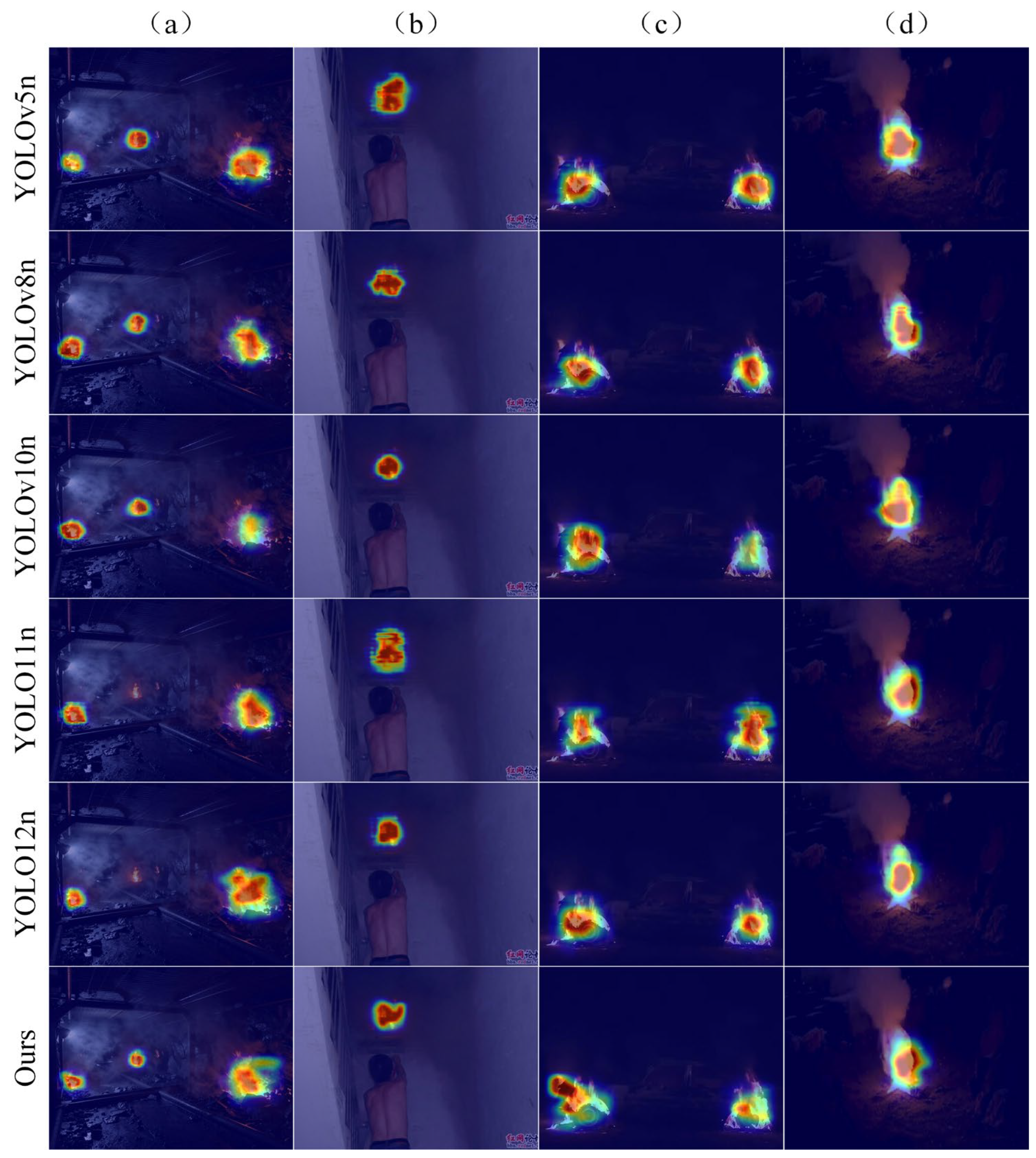
Grad-CAM is a post hoc visualization technique based on gradients that highlights spatial regions in convolutional features that contribute strongly to a target prediction. To compare the attention distributions of different models over flame regions, class-activation heatmaps were generated from their backbone output features using the same input images and a unified visualization procedure. The results are shown in Figure 13, where warm-colored regions indicate locations that contribute strongly to the current flame prediction.
As shown in Figure 13a, in the simulated underground mine scene containing three fire sources at different scales, YOLOv5n, YOLOv8n, and YOLOv10n respond to all three targets, whereas YOLOv11n and YOLOv12n exhibit weak responses to the central fire source. In contrast, STL-YOLO produces independent responses to the left, central, and right fire sources and, in particular, retains attention to the central weak target. This demonstrates better response completeness for multiple fire sources and is consistent with the complete detection of differently scaled fire sources in Figure 12a.
In the scene shown in Figure 13b, the main response of each model is located in the flame area near the window. However, there are differences in how different models represent the local shape of the flame. Some baseline models combine the responses of adjacent flames into a single region, and YOLOv11n also shows striped and spatially diffused responses. The high-response region of STL-YOLO presents a double-peak structure corresponding to the adjacent bright flame regions. The local morphology and spatial distribution of the flame are represented in greater detail, and the heatmap aligns more closely with the actual flame region. This shows that the model proposed in this paper can not only correctly locate the fire source but also focus more accurately on discriminative local structures within the flame.
In the nighttime two-fire-source scene shown in Figure 13c, each model can respond to the left and right fire sources, but there are differences in response shape and coverage. Among them, the response of YOLOv10n to the right fire source is relatively weak, and the response of YOLOv11n extends in the vertical direction. STL-YOLO can produce a clear and independent response to each of the two fire sources, which shows that it can maintain attention to different flame instances at the same time in multi-fire-source scenarios and reduce response confusion caused by feature interference between adjacent fire sources.
In the nighttime low-light isolated-flame scene shown in Figure 13d, the main response regions of each model generally overlap the actual flame, and no obvious high-intensity responses appear in the surrounding dark background. The response of STL-YOLO covers the main flame region and maintains a clear foreground–background boundary, indicating that the model proposed in this paper can still consistently extract the main discriminative flame features under low-illumination conditions.
Overall, STL-YOLO maintains relatively stable performance in responding completely to multiple sources, attending to weak flames, and representing local flame morphology. In scene (a), the heatmap shows responses to all three fire sources of different scales. In scene (b), its dual-peak response more closely matches the actual spatial distribution of adjacent flames. These observations are consistent with the design objectives of SCConv in suppressing redundant features and TCEM in enhancing local textures and center-neighborhood contrast, providing visual support for their roles in flame-feature extraction and multi-scale information focusing.
4.6. Performance Evaluation and Discussion
4.6.1. Robustness Analysis
Weak, low-contrast fire sources at the early stage of a fire can easily be confused with warm-toned backgrounds, leading to missed detections and constituting a major challenge in rescue environments. To further evaluate detection performance on additional test data, we use the separately reserved warm-fire test set. Both STL-YOLO and the YOLOv11n baseline were trained on firemix-v6, while warm-fire was used only for testing and did not participate in training, model selection, threshold selection, or parameter adjustment. The test set contains 571 images, comprising 499 fire-containing images and 72 fire-free negative images, with a total of 685 annotated fire instances. Fire is the only target category. Table 5 reports the evaluation results obtained using the trained checkpoints without additional training or fine-tuning on warm-fire.
Table 5.
Cross-dataset testing results on warm-fire.
As shown in Table 5, STL-YOLO achieves an mAP@0.5 of 80.4%, an mAP@0.5:0.95 of 44.0%, a Precision of 79.1%, and a Recall of 76.1% on this dataset. These values exceed those of the YOLOv11n baseline by 2.8, 2.4, 3.2, and 4.3 percentage points, respectively. The results indicate that the discriminative features learned by the proposed method possess a degree of transferability to a dataset dominated by warm-toned background interference. These results, together with those in Figure 12b and Figure 13b, further show that STL-YOLO achieves good recall and stable detection of flames with weak texture features under warm-toned background interference.
4.6.2. Multi-Scale Object Detection Performance
In rescue scenes, fire source scales vary widely, and large nearby flames and small distant flames often appear in the same image. SCConv alleviates the representation bottleneck of lightweight backbone networks under conditions of high background redundancy through spatial and channel feature reconstruction, so that the limited feature representation capacity is more focused on discriminative flame regions. After SCConv was introduced alone, the model’s Precision increased from 84.0% to 86.8%, an increase of 2.80 percentage points; mAP@0.5:0.95 increased from 37.3% to 40.4%, an increase of 3.10 percentage points, indicating that spatial–channel redundancy suppression helps improve the localization and classification quality of fire source features. TCEM mainly enhances texture and local differences for low-contrast, less-salient, and small-scale fire sources. After it was introduced alone, Recall increased from 78.3% to 81.3%, an increase of 3.00 percentage points, indicating that the module can reduce missed fire source detections in complex backgrounds. LSCD adjusts the dynamic range of features at different levels through cross-scale convolutional weight sharing and scale-specific learnable scaling factors. While maintaining detection performance, it reduces the parameter count from 2.590 M to 2.229 M and the computational cost from 6.44 GFLOPs to 5.08 GFLOPs, corresponding to reductions of 13.94% and 21.12%, respectively. When the three modules were combined, the mAP@0.5:0.95 of the complete STL-YOLO model reached 40.9%, which is 3.60 percentage points higher than the baseline; Precision, Recall, and mAP@0.5 reached 87.7%, 85.3%, and 87.7%, respectively, all of which were the highest values in the ablation experiments. At the same time, the parameter count and computational cost of the complete model are 2.328 M and 5.52 GFLOPs, respectively, representing reductions of 10.12% and 14.29% compared with the baseline. The multi-fire-source scenes in Figure 12a,c and Figure 13a,c further show that the method proposed in this paper can accurately locate fire sources at different positions in the same image and produce more concentrated responses to low-contrast and small-scale fire sources; in contrast, some baseline models still show missed detections and diffuse responses for less-salient or small-scale fire sources. In summary, STL-YOLO maintains low model complexity while improving the accuracy and recall of multi-scale fire source detection, achieving a good balance between detection performance and computational overhead and showing potential for deployment on resource-limited firefighting and rescue platforms.
5. Conclusions
Using YOLOv11n as the baseline, this study proposed STL-YOLO, a lightweight fire source detection network for enclosed and semi-enclosed firefighting environments. It aims to reduce missed detections of low-contrast flames and false positives caused by warm-toned backgrounds while balancing detection accuracy and model complexity on resource-constrained edge platforms. The network introduces Spatial and Channel Reconstruction Convolution (SCConv), a Texture Contrast Enhancement Module (TCEM), and LSCD at the backbone, neck, and detection-head levels, respectively. The three modules perform background-redundancy suppression, weak-flame texture-difference enhancement, and detection-head lightweighting and are complementary in terms of network location and function.
On the self-built firemix-v6 dataset, STL-YOLO’s mAP@0.5 and mAP@0.5:0.95 reached 87.7% and 40.9%, respectively, representing increases of 2.50 and 3.60 percentage points over the baseline; Recall increased from 78.3% to 85.3%, an increase of 7.00 percentage points. At the same time, the model’s parameter count was reduced from 2.590 M to 2.328 M, and its computational cost was reduced from 6.44 GFLOPs to 5.52 GFLOPs, representing decreases of 10.12% and 14.29%, respectively. Among the selected comparison models, STL-YOLO achieved the best overall detection performance and the lowest parameter count and computational cost. The ablation experiments verified the effectiveness of each improved module, and the cross-dataset experiments on warm-fire further show that the proposed method has good adaptability and detection stability under warm-colored background interference.
The method proposed in this paper still has limitations: at present, only flame detection based on visible-light images has been validated. The underground mine images included in the dataset are all fire-free negative samples. Therefore, detection performance on actual underground mine fires has not yet been validated. Early warning before flame appearance and detection performance when image quality declines due to heavy dust and lens contamination have not been evaluated. In the future, we will focus on exploring the integration of RGB images with thermal-infrared images and gas-sensor measurements to provide complementary information when visible flame cues are weak or absent. We will also consider constructing a simulated mine roadway to evaluate detection performance under dust and lens contamination conditions and further assess deployment reliability.
Author Contributions
Conceptualization, Y.Z. and X.M.; methodology, Y.Z.; software, Y.Z.; validation, Y.Z. and C.Y.; formal analysis, Y.Z.; investigation, Y.Z.; resources, X.M. and C.Y.; data curation, Y.Z.; writing—original draft preparation, Y.Z.; writing—review and editing, X.M. and C.Y.; visualization, Y.Z.; supervision, X.M. and C.Y.; project administration, X.M.; funding acquisition, X.M. All authors have read and agreed to the published version of the manuscript.
Funding
This research was partially funded by the National Natural Science Foundation of China (Grant Number: 52374074).
Institutional Review Board Statement
Not applicable.
Informed Consent Statement
Not applicable.
Data Availability Statement
The dataset used in this study is not publicly available but is available from the corresponding author upon reasonable request.
Conflicts of Interest
The authors declare no conflict of interest.
References
- Yang, T.; Ding, W.; Wang, Y.; Chen, T.; Mu, D. Real-time flame detection and localization for firefighting robots. Robot. Auton. Syst. 2025, 194, 105147. [Google Scholar] [CrossRef] [Scilit]
- Chen, T.-H.; Wu, P.-H.; Chiou, Y.-C. An early fire-detection method based on image processing. In Proceedings of the 2004 International Conference on Image Processing (ICIP 2004), Singapore, 24–27 October 2004; Volume 3, pp. 1707–1710. [Google Scholar]
- Ren, S.; He, K.; Girshick, R.; Sun, J. Faster R-CNN: Towards real-time object detection with region proposal networks. In Proceedings of the 28th International Conference on Neural Information Processing Systems (NIPS 2015), Montreal, QC, Canada, 7–12 December 2015; pp. 91–99. [Google Scholar]
- Redmon, J.; Divvala, S.; Girshick, R.; Farhadi, A. You only look once: Unified, real-time object detection. In Proceedings of the IEEE Conference on Computer Vision and Pattern Recognition (CVPR), Las Vegas, NV, USA, 27–30 June 2016; pp. 779–788. [Google Scholar]
- Khanam, R.; Hussain, M. YOLOv11: An overview of the key architectural enhancements. arXiv 2024, arXiv:2410.17725. [Google Scholar] [CrossRef] [Scilit]
- Li, J.; Wen, Y.; He, L. SCConv: Spatial and channel reconstruction convolution for feature redundancy. In Proceedings of the IEEE/CVF Conference on Computer Vision and Pattern Recognition (CVPR), Vancouver, BC, Canada, 17–24 June 2023; pp. 6153–6162. [Google Scholar]
- Wang, Z.; Deng, Y.; Shen, C.; Zhang, M.; Lu, X. Camouflaged object detection via context and texture-aware hierarchical interaction. Sci. Rep. 2026, 16, 9328. [Google Scholar] [CrossRef] [Scilit] [PubMed]
- Khan, A.; Ullah, H.; Munir, A. LiteCOD: Lightweight camouflaged object detection via holistic understanding of local-global features and multi-scale fusion. AI 2025, 6, 197. [Google Scholar] [CrossRef] [Scilit]
- Yin, B. Lightweight fire detection algorithm based on LSCD-FasterC2f-YOLOv8. In Proceedings of the 5th International Conference on Big Data & Artificial Intelligence & Software Engineering (ICBASE 2024), Wenzhou, China, 20–22 September 2024; pp. 64–67. [Google Scholar]
- Zhou, K.; Jiang, S. Forest fire detection algorithm based on improved YOLOv11n. Sensors 2025, 25, 2989. [Google Scholar] [CrossRef] [Scilit] [PubMed]
- Wang, H.; Fu, X.; Yu, Z.; Zeng, Z. DSS-YOLO: An improved lightweight real-time fire detection model based on YOLOv8. Sci. Rep. 2025, 15, 8963. [Google Scholar] [CrossRef] [Scilit] [PubMed]
- Lu, J.; Zheng, Y.; Guan, L.; Lin, B.; Shi, W.; Zhang, J.; Wu, Y. FCMI-YOLO: An efficient deep learning-based algorithm for real-time fire detection on edge devices. PLoS ONE 2025, 20, e0329555. [Google Scholar] [CrossRef] [Scilit] [PubMed]
- Pan, W.; Xu, B.; Wang, X.; Lv, C.; Wang, S.; Duan, Z. YOLO-FireAD: Efficient fire detection via attention-guided inverted residual learning and dual-pooling feature preservation. arXiv 2025, arXiv:2505.20884. [Google Scholar] [CrossRef] [Scilit]
- Zhou, N.; Gao, D.; Zhu, Z. YOLOv8n-SMMP: A lightweight YOLO forest fire detection model. Fire 2025, 8, 183. [Google Scholar] [CrossRef] [Scilit]
- Hou, C.; Liu, P. GLAFC-YOLO: Multimodal object detection of personnel for indoor fire rescue in smoke-obscured environments. Fire 2026, 9, 182. [Google Scholar] [CrossRef] [Scilit]
- Howard, A.G.; Zhu, M.; Chen, B.; Kalenichenko, D.; Wang, W.; Weyand, T.; Andreetto, M.; Adam, H. MobileNets: Efficient convolutional neural networks for mobile vision applications. arXiv 2017, arXiv:1704.04861. [Google Scholar] [CrossRef] [Scilit]
- Han, K.; Wang, Y.; Tian, Q.; Guo, J.; Xu, C.; Xu, C. GhostNet: More features from cheap operations. In Proceedings of the IEEE/CVF Conference on Computer Vision and Pattern Recognition (CVPR), Seattle, WA, USA, 13–19 June 2020; pp. 1580–1589. [Google Scholar]
- Chen, J.; Kao, S.-H.; He, H.; Zhuo, W.; Wen, S.; Lee, C.-H.; Chan, S.-H.G. Run, don’t walk: Chasing higher FLOPS for faster neural networks. In Proceedings of the IEEE/CVF Conference on Computer Vision and Pattern Recognition (CVPR), Vancouver, BC, Canada, 17–24 June 2023; pp. 12021–12031. [Google Scholar]
- Hu, J.; Shen, L.; Sun, G. Squeeze-and-excitation networks. In Proceedings of the IEEE Conference on Computer Vision and Pattern Recognition (CVPR), Salt Lake City, UT, USA, 18–22 June 2018; pp. 7132–7141. [Google Scholar]
- Woo, S.; Park, J.; Lee, J.-Y.; Kweon, I.S. CBAM: Convolutional block attention module. In Proceedings of the European Conference on Computer Vision (ECCV), Munich, Germany, 8–14 September 2018; pp. 3–19. [Google Scholar]
- Hou, Q.; Zhou, D.; Feng, J. Coordinate attention for efficient mobile network design. In Proceedings of the IEEE/CVF Conference on Computer Vision and Pattern Recognition (CVPR), Nashville, TN, USA, 19–25 June 2021; pp. 13713–13722. [Google Scholar]
- Ouyang, D.; He, S.; Zhang, G.; Luo, M.; Guo, H.; Zhan, J.; Huang, Z. Efficient multi-scale attention module with cross-spatial learning. In Proceedings of the IEEE International Conference on Acoustics, Speech and Signal Processing (ICASSP), Rhodes Island, Greece, 4–10 June 2023; pp. 1–5. [Google Scholar]
- Wang, M.; Yue, P.; Jiang, L.; Yu, D.; Tuo, T.; Li, J. An open flame and smoke detection dataset for deep learning in remote sensing based fire detection. Geo-Spat. Inf. Sci. 2025, 28, 511–526. [Google Scholar] [CrossRef] [Scilit]
- Putra, A.K. Indoor Fire Smoke Dataset; Zenodo: Geneva, Switzerland, 2025. [Google Scholar] [CrossRef]
- Terven, J.; Córdova-Esparza, D.M.; Romero-González, J.A. A comprehensive review of YOLO architectures in computer vision: From YOLOv1 to YOLOv8 and YOLO-NAS. Mach. Learn. Knowl. Extr. 2023, 5, 1680–1716. [Google Scholar] [CrossRef] [Scilit]
- Hussain, M. YOLO-v1 to YOLO-v8, the rise of YOLO and its complementary nature toward digital manufacturing and industrial defect detection. Machines 2023, 11, 677. [Google Scholar] [CrossRef] [Scilit]
- Wang, A.; Chen, H.; Liu, L.; Chen, K.; Lin, Z.; Han, J.; Ding, G. YOLOv10: Real-time end-to-end object detection. In Proceedings of the 38th Conference on Neural Information Processing Systems (NeurIPS 2024), Vancouver, BC, Canada, 10–15 December 2024; Volume 37, pp. 107984–108011. [Google Scholar]
- Tian, Y.; Ye, Q.; Doermann, D. YOLOv12: Attention-centric real-time object detectors. In Proceedings of the 39th Conference on Neural Information Processing Systems (NeurIPS 2025), San Diego, CA, USA, 2–7 December 2025; Volume 38, pp. 78433–78457. [Google Scholar]

Disclaimer/Publisher’s Note: The statements, opinions and data contained in all publications are solely those of the individual author(s) and contributor(s) and not of MDPI and/or the editor(s). MDPI and/or the editor(s) disclaim responsibility for any injury to people or property resulting from any ideas, methods, instructions or products referred to in the content. |
© 2026 by the authors. Licensee MDPI, Basel, Switzerland. This article is an open access article distributed under the terms and conditions of the Creative Commons Attribution (CC BY) license.