


Featured Application
The tested benzothiadiazole-based systemic acquired resistance inducers can be developed as foliar plant activators supporting the integrated management of fungal diseases in spring barley. Following optimization of application timing and frequency, they may complement conventional fungicide programs while maintaining grain yield and physical grain-quality parameters.
Abstract
Foliar diseases reduce barley productivity and may impair physical grain quality, while repeated activation of plant defense can impose metabolic costs. This two-year field study evaluated whether two previously characterized benzothiadiazole-based systemic acquired resistance (SAR) inducers—N-methoxy-N-methylbenzo[1,2,3]thiadiazole-7-carboxamide (BTHWA) and didecyldimethylammonium benzo[1,2,3]thiadiazole-7-carboxylate ([N111010][BTHCOO])—could suppress foliar diseases without compromising crop yield. Each year, the experiment was established as a randomized complete block design with four blocks, with all six treatments represented once per block. Both compounds were applied six times at 5 or 10 g a.i. ha−1 per application; an untreated control and a two-application fungicide program served as references. Disease severity was assessed at BBCH 59 and 77, while grain yield, thousand-grain weight, hectolitre weight, and moisture were determined at harvest. Both compounds reduced disease severity relative to the untreated control, although statistical significance depended on compound, application rate, pathogen, and assessment date. The 10 g a.i. ha−1 treatments generally provided stronger disease suppression than the corresponding 5 g a.i. ha−1 treatment of the same compound and resulted in significantly higher grain yield than the untreated control and the corresponding lower-dose treatments. The fungicide program generally provided the strongest disease control and highest yield. Neither compound adversely affected thousand-grain weight or hectolitre weight. These findings support development of benzothiadiazole-based SAR inducers in integrated barley protection, with optimization focused on application timing, frequency, and reduced-fungicide programs.
1. Introduction
Barley (Hordeum vulgare L.) ranks among the most important cereal crops worldwide, valued both for its agronomic versatility and its pivotal role in malting, feed and food industries [1,2]. Ensuring an appropriate level of barley yields is increasingly challenged by the intensification of fungal diseases, which are capable of inflicting substantial economic losses and compromising grain quality parameters critical for industrial utilization [3,4]. Contemporary cereal cultivation has long relied on chemical fungicides as the principal line of defense against such pathogens [5]. Nevertheless, the sustainability of this approach is increasingly questioned, as excessive fungicide deployment has been associated with the emergence of resistant pathogen populations, perturbation of biodiversity, and mounting risks for human and environmental health [6,7,8].
Among the various alternatives to conventional disease management, the exploitation of natural defense mechanisms of plants has attracted considerable attention [9,10]. Induced resistance relies on the capacity of plants to potentiate their innate defense machinery upon exposure to natural or synthetic elicitors, thereby enhancing preparedness against pathogen infection [11,12]. Such elicitors, often termed resistance inducers, typically mimic signaling molecules and orchestrate complex physiological responses. A central component of this phenomenon is systemic acquired resistance (SAR), a long-lasting and broad-spectrum defensive state intricately associated with salicylic acid (SA) accumulation and transcriptional activation of pathogenesis-related (PR) genes [13].
The SAR inducer that has been most thoroughly investigated to date is benzo[1,2,3]thiadiazole-7-carboxylic acid S-methyl ester (BTH, ASM, CGA245704), the active ingredient of the commercial formulations Actigard 50 WG and Bion 50 WG developed by Syngenta (Basel, Switzerland) [14,15,16]. Structurally, BTH is composed of a thiadiazole ring conjugated with a benzene ring that is substituted by a carboxyl functional group on the C-7 carbon atom. Due to its pronounced aromatic and nonpolar character, the compound exhibits only limited solubility in water (approximately 7 mg L−1) [17].
In our earlier research efforts, we focused on the design and synthesis of new derivatives of BTH, including both neutral and ionic salts (ionic liquids), with the aim of improving aqueous solubility while retaining or enhancing biological activity [18]. Among these, the most efficient inducers of SAR—demonstrated by their ability to suppress tobacco mosaic virus infection in tobacco—were subjected to detailed molecular analyses. Plants treated with N-methoxy-N-methylbenzo[1,2,3]thiadiazole-7-carboxamide (BTHWA) and didecyldimethylammonium benzo[1,2,3]thiadiazole-7-carboxylate ([N111010][BTHCOO]) exhibited pronounced upregulation of SAR marker genes, including PAL, NPR1, and PR-1b. In addition, viral RNA analysis demonstrated that the replication process was significantly suppressed in plants treated with the tested derivatives, not only when compared to untreated controls but also relative to those receiving the parent compound, BTH [19].
Ionic modification can substantially alter physicochemical properties relevant to agrochemical formulation and application, including aqueous solubility, polarity, and stability [20,21]. Moreover, counterion selection provides an additional opportunity to tune the properties of the resulting compounds [22,23,24]. However, such physicochemical changes do not necessarily translate into improved biological activity. Each newly designed ionic derivative should therefore be regarded as a distinct substance whose biological performance and agronomic usefulness require experimental validation, ultimately under field conditions.
These findings provided a strong rationale for subsequent agronomic trials with the newly synthesized derivatives, in which their capacity to confer protection against a broader spectrum of pathogens was systematically evaluated. Moreover, field experiments provide a more realistic assessment of compound performance than strictly controlled greenhouse studies. Under field conditions, plants are simultaneously exposed to multiple interacting environmental and biological factors. Therefore, final efficacy should be evaluated under naturally variable conditions to confirm the practical utility of the tested compounds [25]. To the best of our knowledge, studies investigating the use of SAR inducers under field conditions remain scarce, despite their importance for assessing the effectiveness of these compounds under practical application conditions.
However, activation of plant defense is not necessarily agronomically neutral. A strong or improperly timed defense response may alter the allocation of plant resources and, under some conditions, create a risk of reduced crop productivity [26]. Importantly, this effect depends not only on the biological activity of the inducer itself but also on how it is applied, including dose, treatment frequency, and timing relative to crop development and pathogen pressure. Therefore, field evaluation of plant activators should consider not only disease suppression but also their effects on yield and grain-quality traits.
The present study aimed to evaluate the field efficacy of two previously characterized benzothiadiazole-based SAR inducers, BTHWA and [N111010][BTHCOO], in spring barley under natural disease pressure. Because the effectiveness of resistance inducers may depend strongly on application regime, the compounds were applied repeatedly at approximately 14-day intervals. Two application rates, 5 and 10 g a.i. ha−1 per application, were investigated to determine whether field efficacy was dose-dependent. Previous studies have shown that SAR-inducing compounds such as SA and BTH can affect plant defense responses at relatively low concentrations and that the magnitude of the response depends on inducer concentration and physiological context [27,28]. We therefore formulated three hypotheses. First, both compounds were expected to reduce foliar disease severity relative to the untreated control. Second, the higher application rate was expected to provide stronger and more consistent disease suppression. Third, repeated application of the SAR inducers was not expected to impose an agronomically detectable penalty on grain yield or physical grain-quality parameters.
2. Materials and Methods
2.1. Tested Substances
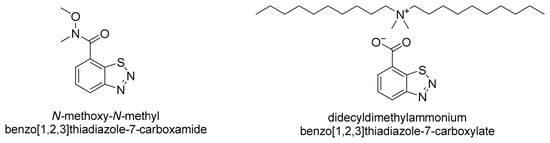
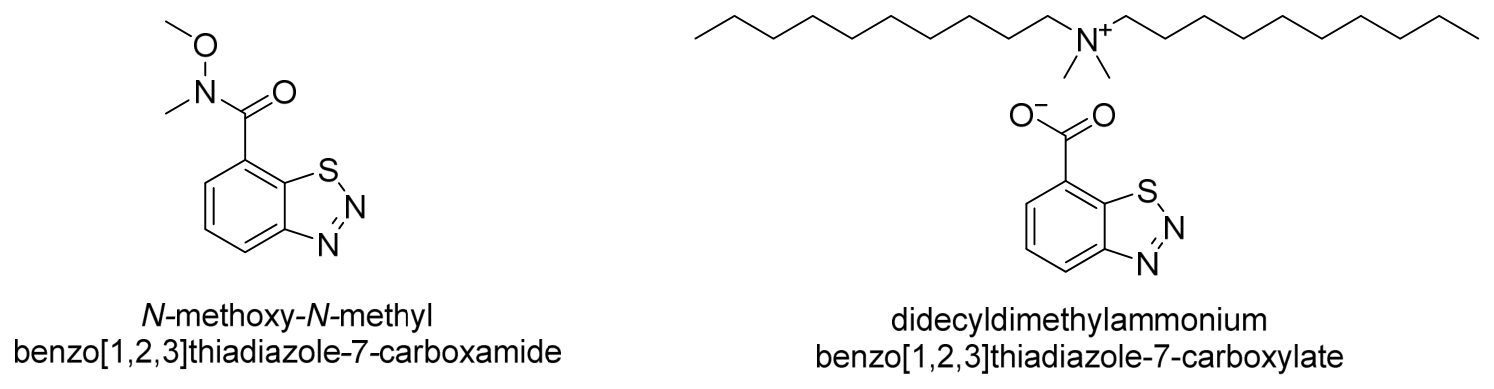
The substances studied were N-methoxy-N-methylbenzo[1,2,3]thiadiazole-7-carboxamide (BTHWA) [29] and didecyldimethylammonium benzo[1,2,3]thiadiazole-7-carboxylate ([N111010][BTHCOO]) [30], which were designed and synthesized in our laboratory (Figure 1). Both compounds are derivatives of the first commercially available SAR inducer benzo[1,2,3]thiadiazole-7-carbothioic acid (benzo[1,2,3]-thiadiazole-7-carboxylic acid S-methyl ester; acibenzolar-S-methyl ester; ASM; BTH; CGA245704).
Figure 1.
Chemical structures of BTH-based compounds used in the experiment.
Because of its limited aqueous solubility, BTHWA was formulated as a suspension concentrate (SC) containing 10 g of active substance per litre. The formulation consisted of an aqueous medium supplemented with an adjuvant, thickeners, stabilizers, and dispersing agents to obtain a stable and homogeneous dispersion suitable for preparation of spray solutions and uniform foliar application.
In contrast, the substantially greater water compatibility of [N111010][BTHCOO] allowed the compound to be formulated as an aqueous solution containing 10 g of active substance per litre together with an adjuvant [31]. Thus, the different formulation types reflected the physicochemical properties of the two compounds, while the auxiliary formulation components served technological functions related to dispersion, stability, and application of the active substance. For both formulations, the appropriate amount of product was incorporated into the spray liquid to obtain application rates of 5 or 10 g a.i. ha−1 per application. These application rates were selected based on the results of previous greenhouse studies and on dose ranges used for the parent SAR inducer, BTH.
2.2. Locations of the Experimental Fields and Their Characteristics
The experiment was performed on spring barley var. Iron cultivated in experimental plots located at the Research and Education Center of Poznań University of Life Sciences in Gorzyń.
The parameters characterizing the experimental sites are provided in Table 1. Fertilizers and plant protection products other than fungicides used during the experiments are listed in Table 2. Meteorological data were obtained from the weather station in Brody and are presented in Section 3.1.
Table 1.
Description of experimental sites.
Table 2.
Schedule of fertilizers and other plant protection products applied in both experimental years.
2.3. Experimental Design
In each growing season, the field experiment was established as a randomized complete block design (RCBD) with four complete blocks. Each block contained one plot of each of the six treatment variants: untreated control (UTC), fungicide reference, [N111010][BTHCOO] at 5 and 10 g a.i. ha−1 per application, and BTHWA at 5 and 10 g a.i. ha−1 per application. Thus, each treatment was represented by four independent experimental plots per year (n = 4), resulting in a total of 24 plots in each experimental year.
Treatment positions were independently randomized within each block and separately in each experimental year to minimize systematic positional effects associated with spatial variability within the field. The individual plot was considered the experimental unit.
Each plot covered an area of 24 m2 (10 m × 2.4 m). Sowing was performed in the second week of April at a rate of 185 kg ha−1, with a sowing depth of 3 cm and a row spacing of 15 cm. The plants were harvested in the first week of August, using a Wintersteiger harvester (WINTERSTEIGER Holding AG, Ried im Innkreis, Austria), from an area of 15 m2 (10 m × 1.5 m). The schedule of treatments with standard plant protection products and those with the tested SAR inducers is provided in Table 3.
Table 3.
The detailed schedule of treatments performed in the experiments in 2015 and 2016.
All plant protection products and tested active substances were applied using a plot sprayer with a spray volume of 230 L ha−1. An adjuvant, Trend 90 EC, was added to all spray solutions at a concentration of 0.05% (v/v). The UTC plots were sprayed with the same volume of water containing Trend 90 EC but without fungicide or either of the tested SAR inducers. Thus, all treatment variants received an equivalent amount of the adjuvant. The application schedule for the resistance inducers was based on treatments performed at approximately 14-day intervals. The first SAR-inducer treatment was intended to precede the initial fungicide application in order to activate plant defense mechanisms prior to the anticipated onset of pathogen pressure.
2.4. Disease Assessment
Disease severity was assessed visually according to EPPO Standard PP 1/26(3) [32], “Foliar and ear diseases on cereals”. For each pathogen, 30 leaves were randomly selected from each plot and assessed individually. Disease severity was estimated directly as the percentage of leaf area showing characteristic disease symptoms, using the reference diagrams provided in the EPPO standard as visual aids. The values obtained for the 30 leaves were subsequently averaged to obtain a single plot-level disease-severity value for each pathogen and assessment date. Thus, individual leaves were treated as subsamples, whereas the plot was the experimental unit (n = 4 plots per treatment).
In the event of mixed infections, pathogen identification was confirmed through microscopic examination of infected plant tissues to ensure accurate disease diagnosis.
2.5. Assessment of Yield-Related Parameters
The grain yield was determined by harvesting each plot with a small-plot combine harvester at physiological maturity (BBCH 89). The harvested grain was weighed and adjusted to a constant moisture content of 15% according to EPPO guidelines. Harvested grain mass was retained as a plot-level variable (kg plot−1), while grain yield was standardized to 15% moisture and expressed as t ha−1. Thousand-grain weight (TGW) was determined from a representative grain sample collected separately from each plot. Hectolitre weight (HLW; mass of 100 L of grain) was determined using a standard grain balance and expressed as kg hL−1.
Harvested grain mass was recorded separately for each 15 m2 harvest area and expressed as kg plot−1 at the measured grain moisture content. Standardized grain mass at 15% moisture was calculated as:
where Mharvest is the harvested grain mass (kg plot−1) and W is the measured grain moisture content (%).
M15 = Mharvest × (100 − W)/(100 − 15)
The corrected mass was then converted from the 15 m2 harvest area to t ha−1. Thus, harvested grain mass represents the directly measured plot-level variable, whereas standardized grain yield represents the corresponding area-based yield corrected to 15% moisture.
2.6. Statistical Analysis
Harvested grain mass, grain moisture, grain yield adjusted to 15% moisture, thousand-grain weight (TGW), and hectolitre weight (HLW) were analyzed using a combined analysis of variance appropriate for an RCBD conducted over two growing seasons. Year, treatment, and the year × treatment interaction were treated as fixed effects, whereas block was nested within year and treated as a random blocking factor. When a significant treatment effect was detected, treatment means were compared using Tukey’s HSD test at α = 0.05. For interpretation of dose-dependent responses, comparisons between the 5 and 10 g a.i. ha−1 treatments were considered separately within each compound, i.e., [N111010][BTHCOO] 5 versus 10 g a.i. ha−1 and BTHWA 5 versus 10 g a.i. ha−1.
Effect sizes were expressed as eta squared (η2), calculated as SS_effect/SS_total, where SS_total represents the total corrected sum of squares.
where SS_effect represents the sum of squares attributable to the specific effect being evaluated (e.g., year, treatment, or year × treatment interaction), and SS_total represents the total corrected sum of squares, reflecting the overall variability in the analyzed response variable around its grand mean.
η2 = (SS_effect/SS_total)
Thus, η2 represents the proportion of the total observed variability attributable to a given effect. The same calculation approach was applied consistently to all analyzed variables. Calculations were performed using Statistica 12.0 software (TIBCO, Palo Alto, CA, USA).
Disease-severity data were analyzed separately for each experimental year. This approach was used because disease development resulted from natural infection and the disease spectrum differed between years: net blotch and leaf scald of cereals were assessed in 2015, whereas net blotch and powdery mildew were assessed in 2016. Consequently, the two seasons represented distinct disease environments, and only net blotch was common to both years. Separate year-specific analyses therefore allowed treatment effects to be evaluated for each pathogen within the disease environment in which it occurred, without combining non-equivalent disease-response variables across years. For each pathogen and assessment date, disease severity was analyzed using ANOVA appropriate for the randomized complete block design, with treatment as a fixed factor and block as the blocking factor. The individual plot was the experimental unit. When a significant treatment effect was detected, treatment means were compared using Tukey’s HSD test at α = 0.05. For disease severity, statistical analyses were performed exclusively on the four plot-level means per treatment; individual leaf observations were treated as subsamples and were not entered into the ANOVA as independent replicates. Statistical analyses were performed using OriginLab 2022 software for Windows (OriginLab Corp., Northampton, MA, USA).
3. Results
3.1. Weather Conditions
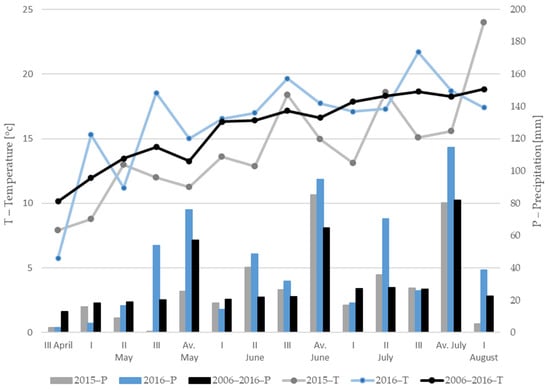
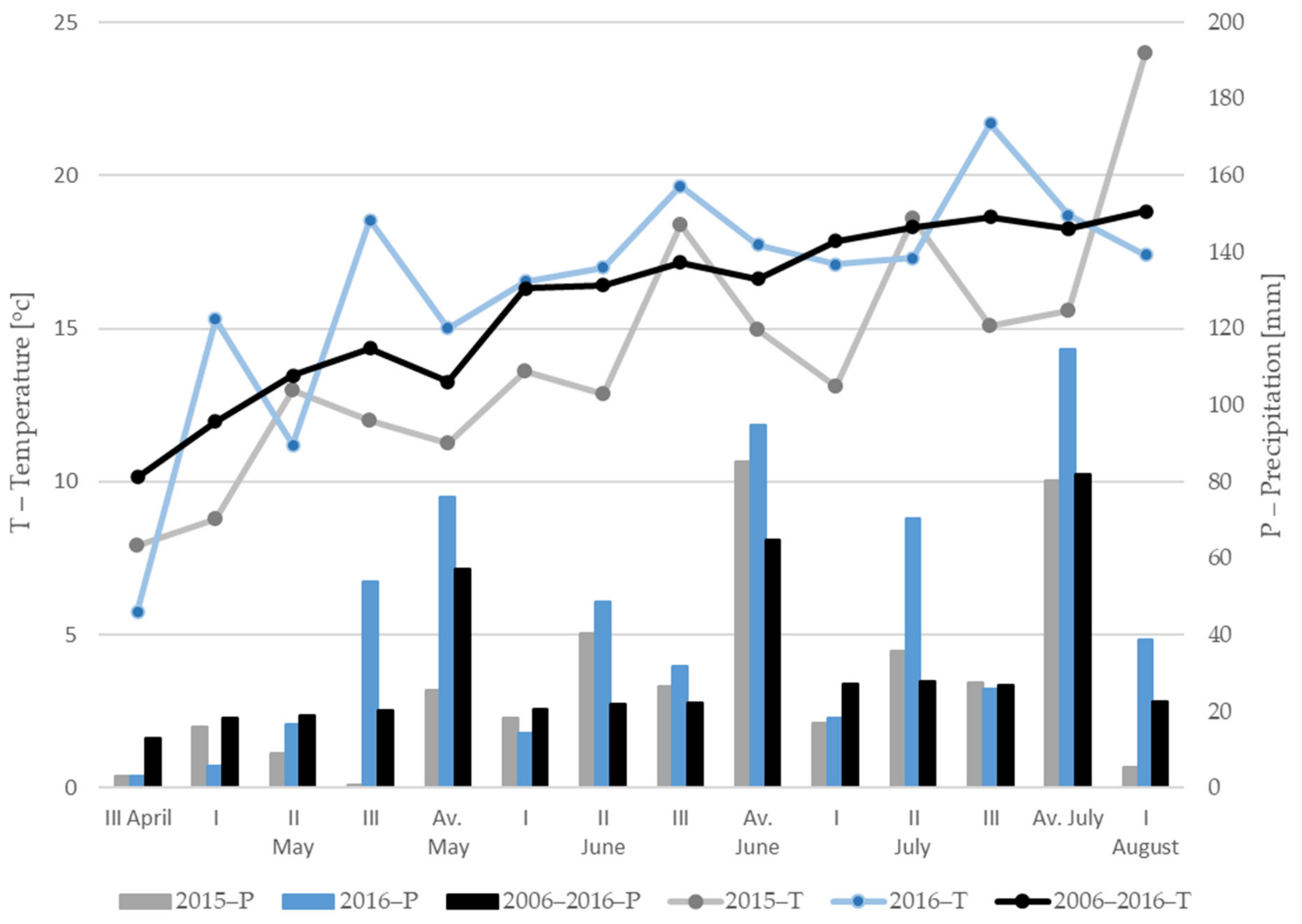
Weather conditions during the 2015 and 2016 growing seasons are presented in Figure 2. The two seasons differed markedly in temperature and precipitation patterns relative to the long-term average. The 2015 season was warm and relatively dry, with periods of limited rainfall, whereas 2016 was wetter and more humid, with frequent rainfall events. The greater precipitation in 2016 may have favored the development of some foliar pathogens, although disease composition and severity also differed between years.
Figure 2.
Meteorological conditions during the growing seasons of spring barley in 2015 and 2016 (Brody Research Station).
3.2. Assessment of Disease Severity
The spectrum of foliar diseases identified on barley plants differed between the two experimental years, which necessitated separate analyses of disease severity for each season (Table 4 and Table 5). In the first year, Pyrenophora teres (net blotch of barley) and Rhynchosporium secalis (leaf blotch of cereals) were the predominant pathogens, whereas in the second year, Pyrenophora teres (net blotch of barley) and Blumeria graminis f. sp. hordei (powdery mildew) were observed. Despite these differences in disease occurrence, the results obtained in both years showed similar overall trends in the response of plants to the tested treatments.
Table 4.
Summary of the results for disease severity for the field experiment conducted in 2015.
Table 5.
Summary of the results for disease severity for field experiment conducted in 2016.
At the first assessment in 2015, all tested treatments significantly reduced the severity of both diseases relative to the untreated control. For both diseases, the lowest severity was recorded in the fungicide treatment. At BBCH 59, net blotch severity differed significantly between the two SAR inducers applied at 5 g a.i. ha−1, revealed significant differences between these two treatments. BTHWA applied at 5 g a.i. ha−1 resulted in significantly lower disease severity than [N111010][BTHCOO] applied at the same rate. No significant differences in disease severity caused by leaf blotch were observed between these two treatment variants. For both analyzed diseases, no statistically significant differences were observed between variants [N111010][BTHCOO] 10 g a.i. ha−1 and BTHWA 10 g a.i. ha−1. At BBCH 59, the 10 g a.i. ha−1 treatment of each compound resulted in significantly lower disease severity than the corresponding 5 g a.i. ha−1 treatment for both assessed diseases. No statistically significant differences in disease severity were detected between these treatments and the fungicide treatment.
At the second assessment in 2015 (BBCH 77), the relative efficacy of the tested SAR inducers was lower than at BBCH 59. BTHWA applied at 5 g a.i. ha−1 significantly reduced the severity of both diseases relative to the untreated control. For [N111010][BTHCOO] applied at 5 g a.i. ha−1, a significant reduction was detected only for net blotch. At BBCH 77, [N111010][BTHCOO] applied at 10 g a.i. ha−1 resulted in significantly lower disease severity than [N111010][BTHCOO] applied at 5 g a.i. ha−1 for both assessed diseases. Similarly, BTHWA applied at 10 g a.i. ha−1 resulted in significantly lower disease severity than BTHWA applied at 5 g a.i. ha−1 for both diseases. However, the efficacy of these higher-dose treatments remained significantly lower than that achieved after the application of the fungicide treatment.
At the first assessment in 2016, all tested treatments significantly reduced the severity of both powdery mildew and net blotch relative to the untreated control. For both diseases, the lowest severity was recorded in the fungicide treatment.
For net blotch, the effect of application rate depended on the compound and assessment date. At BBCH 59, [N111010][BTHCOO] applied at 10 g a.i. ha−1 resulted in significantly lower disease severity than the corresponding 5 g a.i. ha−1 treatment. The same significant dose-related difference was observed for BTHWA. At BBCH 77, BTHWA applied at 10 g a.i. ha−1 resulted in significantly lower disease severity than BTHWA applied at 5 g a.i. ha−1, whereas no significant difference was detected between the two application rates of [N111010][BTHCOO]. At both assessment dates, however, disease severity in all SAR-inducer treatments remained significantly higher than in the fungicide treatment.
For powdery mildew, no significant differences in disease severity were detected between the 5 and 10 g a.i. ha−1 treatments of [N111010][BTHCOO] at either assessment date. In contrast, BTHWA applied at 10 g a.i. ha−1 resulted in significantly lower disease severity than BTHWA applied at 5 g a.i. ha−1 at both BBCH 59 and BBCH 77. Nevertheless, disease severity in all SAR-inducer treatments was significantly higher than in the fungicide treatment at both assessment dates.
3.3. Assessment of Grain Yield and Physical Grain-Quality Parameters
Mean values of harvested grain mass, grain moisture, grain yield adjusted to 15% moisture, thousand-grain weight (TGW), and hectolitre weight (HLW) are presented in Table 6.
Table 6.
Grain yield and physical grain-quality parameters as affected by year and treatment.
Year significantly affected grain moisture, grain yield adjusted to 15% moisture, TGW, and HLW, whereas harvested grain mass did not differ significantly between years. Grain yield, TGW, and HLW were significantly higher in 2015 than in 2016. In contrast, grain moisture at harvest was significantly lower in 2015 (11.92%) than in 2016 (18.45%).
Concerning the effect of treatment, the lowest harvested grain mass and grain yield adjusted to 15% moisture were observed for the UTC, [N111010][BTHCOO] 5 g a.i. ha−1, and BTHWA 5 g a.i. ha−1 treatments. Both compounds applied at 10 g a.i. ha−1 per application resulted in significantly higher harvested grain mass and adjusted grain yield than the corresponding 5 g a.i. ha−1 treatments and the untreated control. The highest values for both parameters were observed for the fungicide treatment. A small but statistically significant overall effect of treatment was also detected for grain moisture (F(5,30) = 3.08, p = 0.023, η2 = 0.019), although Tukey’s HSD test did not distinguish individual treatment means. TGW and HLW were not significantly affected by treatment.
3.3.1. Harvested Grain Mass [kg plot−1]
Experimental year did not significantly affect harvested grain mass [F(1,6) = 2.28, p = 0.182, η2 = 0.023]. In contrast, treatment had a highly significant effect [F(5,30) = 43.35, p < 0.001, η2 = 0.792] and accounted for the largest share of total observed variability in harvested grain mass. The year × treatment interaction was not significant [F(5,30) = 0.84, p = 0.531, η2 = 0.015 (Table 7).
Table 7.
Combined ANOVA results for harvested grain mass.
3.3.2. Moisture Content
Year had a strong effect on grain moisture [F(1,6) = 203.12, p < 0.001, η2 = 0.902]. Treatment also had a statistically significant effect [F(5,30) = 3.08, p = 0.023], but its contribution to total observed variability was small (η2 = 0.019). However, subsequent Tukey’s HSD testing did not identify significant differences among individual treatment means (Table 6). The year × treatment interaction was not significant [F(5,30) = 2.45, p = 0.056, η2 = 0.015] (Table 8).
Table 8.
Combined ANOVA results for grain moisture.
3.3.3. Grain Yield Adjusted to 15% Moisture [t ha−1]
Both year and treatment significantly affected grain yield adjusted to 15% moisture. The year effect was significant [F(1,6) = 18.29, p = 0.005, η2 = 0.181], whereas treatment had a markedly larger effect [F(5,30) = 40.06, p < 0.001, η2 = 0.653]. Thus, treatment accounted for 65.3% of the total observed variability in standardized grain yield, compared with 18.1% attributable to year. The year × treatment interaction was not significant [F(5,30) = 0.56, p = 0.727, η2 = 0.009], indicating a consistent relative treatment response across the two growing seasons (Table 9).
Table 9.
Combined ANOVA results for grain yield adjusted to 15% moisture.
3.3.4. Thousand-Grain Weight (TGW)
Year significantly affected TGW [F(1,6) = 56.26, p < 0.001, η2 = 0.657] and accounted for the largest share of total observed variability in this parameter. Neither treatment [F(5,30) = 0.93, p = 0.473, η2 = 0.034] nor the year × treatment interaction [F(5,30) = 0.50, p = 0.775, η2 = 0.018] was significant (Table 10).
Table 10.
Combined ANOVA results for thousand-grain weight.
3.3.5. Hectolitre Weight (HLW)
Year had a very strong effect on HLW [F(1,6) = 407.24, p < 0.001, η2 = 0.971]. Treatment [F(5,30) = 1.62, p = 0.184, η2 = 0.003] and the year × treatment interaction [F(5,30) = 1.31, p = 0.286, η2 = 0.002] were not significant (Table 11).
Table 11.
Combined ANOVA results for hectolitre weight.
4. Discussion
The present study evaluated the field performance of two previously characterized benzothiadiazole-based systemic acquired resistance (SAR) inducers under natural disease pressure in spring barley. Both [N111010][BTHCOO] and BTHWA reduced foliar disease severity relative to the untreated control, although the magnitude of the response depended on application rate, pathogen, and assessment date. In general, the 10 g a.i. ha−1 per application rate provided stronger and more consistent disease suppression than the corresponding 5 g a.i. ha−1 rate. Importantly, the higher application rate was also associated with increased grain yield, whereas thousand-grain weight and hectolitre weight were not adversely affected. The fungicide program remained the most effective disease-control strategy and resulted in the highest grain yield. Therefore, the present results support the use of benzothiadiazole-based SAR inducers primarily as complementary components of integrated protection programs rather than as direct replacements for conventional fungicides.
A substantial body of evidence indicates that the application of SAR inducers provides protection against a broad spectrum of pathogens occurring across a wide range of plant species [33,34,35,36,37,38,39]. BTH has also been shown to enhance resistance to diseases of cereal crops [17,40]. An important feature of SAR inducers is that their primary target is the host plant rather than a single pathogen-specific biochemical target. Consequently, their use is expected to impose a different and potentially lower direct selection pressure for pathogen resistance than single-site fungicides [41,42]. This distinction is increasingly important in cereal protection, where fungicide resistance and the decreasing availability of active substances with distinct modes of action complicate long-term disease management [43,44,45].
4.1. Dose-Dependent Field Efficacy
The comparison of the two application rates within each compound provides one of the clearest outcomes of the present study. Overall, the 10 g a.i. ha−1 rate generally provided stronger and more consistent disease suppression than the corresponding 5 g a.i. ha−1 rate of the same compound, although the statistical significance of this within-compound dose response depended on pathogen and assessment date. The lower rate should therefore not be regarded as ineffective; rather, its performance was generally less consistent than that of the corresponding higher rate. This distinction is relevant to the biology of resistance induction. Relatively low concentrations of defense-inducing compounds may establish a primed physiological state in which plants respond more rapidly to subsequent pathogen challenge, whereas stronger stimulation can result in more pronounced activation of defense-related pathways [10,26,27]. For example, low salicylic acid concentrations can enhance subsequent elicitor-induced expression of phenylalanine ammonia-lyase, whereas higher concentrations are required to induce stronger defense responses in the absence of an additional elicitor [27]. The present experiment did not measure defense-gene expression in barley, and the differences between the two application rates cannot therefore be attributed directly to different molecular states of SAR activation. Nevertheless, the field response is consistent with the broader concept that resistance-inducing activity depends strongly on inducer concentration and physiological context.
The effectiveness of the treatments also depended on the disease and assessment date. At the earlier assessment in 2015, no statistically significant differences in disease severity were detected between either of the 10 g a.i. ha−1 SAR treatments and the fungicide reference treatment. However, this finding should not be interpreted as equivalence between the treatment programs, because the SAR inducers were applied six times, whereas the fungicide reference consisted of two applications. The fungicide treatment therefore served as a practical reference for disease control rather than as a treatment directly comparable in terms of application frequency. At the later assessment, the relative efficacy of the SAR treatments was lower. A similar tendency toward reduced relative protection at later growth stages was observed for some disease–treatment combinations in 2016. This pattern suggests that successful use of SAR inducers may require greater precision in application timing than a fixed calendar-based treatment schedule can provide.
4.2. Treatment Response Under Contrasting Growing Seasons
The two experimental seasons differed substantially in weather conditions and disease composition. The 2015 season was relatively warm and dry, whereas 2016 was characterized by higher rainfall and humidity. Moreover, the accompanying foliar disease complex differed between years, and late-season net blotch severity in the untreated control was considerably greater in 2015 than in 2016. Therefore, the two seasons should be regarded as contrasting disease environments rather than as seasons with comparable pathogen pressure.
Despite these differences, the response of grain yield to treatment was remarkably consistent. Treatment accounted for the largest proportion of total observed variation in grain yield (η2 = 0.653), whereas year accounted for a substantially smaller proportion (η2 = 0.181). Moreover, the year × treatment interaction was negligible (η2 = 0.009) and statistically non-significant. Thus, although absolute yield differed between seasons, the relative response of spring barley to the experimental treatments remained similar.
This finding is particularly important from an applied perspective. A treatment that performs well only under a narrow set of environmental conditions has limited agronomic value, even if its efficacy is high in an individual experiment. The low year × treatment interaction observed here indicates that the relative ranking of treatments was maintained despite differences in weather and disease pressure. Although validation across additional locations, cultivars, and seasons is required before broader recommendations can be formulated, the observed stability provides an important basis for further development of these compounds as plant activators for field use.
4.3. Disease Suppression, Grain Yield, and the Growth-Immunity Balance
One of the major concerns associated with repeated activation of plant defense is the potential growth–immunity trade-off. Strong or prolonged activation of plant defense may negatively affect plant growth and reproductive performance under some conditions [46]. Such effects have been observed for BTH in several plant species, although their magnitude is strongly dependent on species, genotype, dose, and environmental conditions [47].
This issue is particularly relevant in the present experiment because the SAR inducers were applied six times during the growing season. If repeated stimulation of defense had imposed a substantial metabolic penalty, a reduction in grain yield or in physical grain-quality parameters could have been expected. Instead, both BTHWA and [N111010][BTHCOO] applied at 10 g a.i. ha−1 per application significantly increased grain yield relative to the untreated control and the corresponding 5 g a.i. ha−1 treatments. At the same time, neither thousand-grain weight nor hectolitre weight was negatively affected.
These findings indicate that, under the conditions of the present experiment, repeated treatment did not result in an agronomically detectable yield penalty. However, they should not be interpreted as evidence that activation of SAR occurred without any physiological cost. Grain yield, TGW, and HLW represent final agronomic outcomes, whereas physiological changes occurring during the growing season were not assessed in this study. Therefore, transient effects of defense activation cannot be excluded.
The positive yield response observed at the higher application rate may result from several non-exclusive mechanisms. One plausible explanation is that reduced disease severity may have contributed to preservation of functional leaf area during grain formation and filling, potentially supporting assimilate supply to developing grains. However, leaf photosynthetic activity and assimilate allocation were not directly measured in the present study, and this mechanism therefore cannot be confirmed.
At the same time, benzothiadiazole derivatives and salicylic acid-related signaling are known to influence physiological processes beyond pathogen defense, including photosynthesis, antioxidant metabolism, stomatal regulation, and plant growth [48,49]. Such effects could therefore also have contributed to the observed yield response. Nevertheless, their contribution cannot be distinguished from the indirect effects associated with reduced disease severity on the basis of the present experiment.
Our previous studies provide some support for this possibility. In tulip, repeated application of BTHWA reduced Fusarium oxysporum f. sp. tulipae infection while simultaneously increasing plant height and fresh and dry shoot biomass [50]. These findings showed that activation of resistance by BTHWA does not necessarily result in a detectable growth penalty when dose and application regime are appropriately selected. Nevertheless, the physiological basis of the yield response observed in barley remains unresolved and should be investigated directly in future studies using parameters such as chlorophyll content, photosynthetic efficiency, gas exchange, oxidative stress markers, and SAR-associated gene expression.
4.4. Application Regime and Practical Optimization
The number of applications represents another important consideration for practical implementation. In the present study, the SAR inducers were applied six times, whereas the reference fungicide program consisted of only two treatments. The fungicide treatment was therefore included primarily as a practical benchmark for the level of disease control achieved by a conventional protection program, rather than as a treatment matched to the SAR program in terms of application frequency. At this stage of development, the relationship between application frequency and field efficacy has not yet been fully defined, and further studies are required to determine the minimum number and optimal timing of SAR-inducer applications needed to achieve disease suppression comparable to that provided by the conventional fungicide program.
Although the 10 g a.i. ha−1 treatments provided substantial disease suppression and increased grain yield, six applications would not necessarily represent an economically or operationally optimal field strategy.
Our previous field studies with BTHWA in sugar beet provide an example of the importance of treatment frequency [51]. In the first year of those experiments, seven BTHWA applications reduced Cercospora leaf spot severity relative to the untreated control, although fungicide protection remained more effective. In subsequent experiments, reducing the number of BTHWA applications from seven to four allowed both disease control and technological sugar yield to reach levels comparable with fungicidal protection. These observations suggest that the relationship between application frequency and agronomic benefit is not necessarily linear.
Repeated activation of resistance may reach a point at which additional applications provide little additional protection while increasing operational costs and potentially increasing physiological burden. Therefore, optimization should not focus exclusively on increasing the number or dose of treatments. A more appropriate strategy may be to identify critical crop-development stages at which resistance induction provides the greatest benefit and to combine SAR inducers with a reduced number of conventional fungicide treatments. Such integrated programs could exploit the complementary modes of action of plant activators and fungicides while reducing dependence on repeated conventional chemical control.
Most research on SAR inducers is conducted under controlled conditions with limited environmental variability [52]. This restricts the direct applicability of such findings to field conditions. From both scientific and practical perspectives, it is advisable to initiate field trials aimed at identifying the most effective treatment regimes, followed by more detailed physiological assessments focused on SAR-related parameters.
The six-application schedule used in the present study should therefore be regarded as an initial field-validation regime rather than as a proposed commercial application program. A meaningful cost–benefit assessment should follow determination of the minimum effective application frequency and should account for application costs, yield response, disease suppression, and the potential reduction in conventional fungicide use.
4.5. From Chemical Design to Field Application
An important aspect of the present work is that the tested compounds were not selected from commercially available plant activators but were developed through targeted chemical modification of the benzothiadiazole scaffold. Earlier studies within this research program focused on the design and synthesis of BTH derivatives with altered physicochemical properties and enhanced biological performance [18]. Subsequent experiments identified BTHWA and [N111010][BTHCOO] as particularly active compounds in the tobacco–TMV model, where their biological activity was associated with the induction of SAR-related molecular markers and suppression of viral RNA accumulation [19].
The present study therefore represents a further step in the development pathway of these compounds: from rational chemical modification and controlled biological screening to agronomic validation under natural field conditions. This transition is particularly important because activity demonstrated in simplified laboratory or greenhouse systems does not necessarily translate into consistent performance under field conditions. Under field conditions, compounds must remain effective despite variation in temperature, precipitation, crop developmental stage, pathogen population, canopy structure, and spray deposition.
Both BTHWA and the ionic derivative [N111010][BTHCOO] retained substantial biological activity under these conditions. This finding confirms that the chemical modifications used to generate these derivatives were compatible with field-level biological efficacy. However, direct comparison between the neutral and ionic derivatives should be interpreted cautiously. The compounds differ not only in chemical structure but also in molar application rate and formulation. Therefore, the present study cannot determine whether differences in field efficacy resulted specifically from ionic versus neutral character. Instead, the results demonstrate that both chemically modified benzothiadiazole derivatives remained functional when transferred from controlled experiments to field application.
The different formulations used for BTHWA and [N111010][BTHCOO] reflected their different physicochemical properties. Because BTHWA exhibits considerably lower aqueous solubility, it required formulation as a suspension concentrate to ensure stable dispersion and uniform field application, whereas [N111010][BTHCOO] could be formulated as an aqueous solution. The auxiliary formulation components were included for technological purposes related to dispersion, stability, and application. However, formulation-matched blank controls containing the corresponding auxiliary components without the active substances were not included in the present experiment. Therefore, a minor contribution of these formulation components to the observed biological response cannot be completely excluded. Accordingly, differences in field performance between BTHWA and [N111010][BTHCOO] should not be attributed exclusively to the active substances or to their neutral versus ionic character. At the same time, the different formulation requirements represent a practical consequence of the physicochemical properties of the two compounds and are therefore relevant to their further development for field application.
4.6. Study Limitations and Future Perspectives
Several limitations should be considered when interpreting the present results. The study was conducted at a single experimental station and with one spring barley cultivar. Therefore, broader validation across different locations, soil conditions, cultivars, and disease environments will be required. In addition, disease pressure resulted from natural infection. This increased the agronomic realism of the experiment, but it also introduced year-to-year variation in pathogen composition and epidemic development. The study also focused primarily on agronomic endpoints and did not include direct physiological or molecular measurements in barley. Consequently, the contribution of individual SAR-associated pathways to the observed field response cannot be quantified at this stage. A further limitation is the absence of the parent compound BTH/ASM as a reference treatment in the field experiment. The present study was designed as a field-validation step for BTHWA and [N111010][BTHCOO], which had previously been selected on the basis of controlled experiments including direct comparison with BTH [19]. Therefore, the objective was to assess the agronomic performance of these preselected candidates under natural disease pressure rather than to repeat the initial comparative screening. Nevertheless, the lack of a BTH treatment means that the present results do not allow conclusions regarding the relative field efficacy of the tested derivatives and the parent compound.
Although the field experiments were conducted in 2015–2016, their value lies primarily in validating the agronomic applicability of SAR induction under natural field conditions rather than in representing current pathogen pressure. Because these compounds act through host defense responses, the findings remain relevant as a basis for further optimization of their field use. Contemporary multi-location validation will nevertheless be required before current agronomic recommendations can be formulated.
Despite these limitations, the present study represents an important intermediate step in the development of the tested benzothiadiazole derivatives. At this stage, the main objective was to identify the most promising compound and dose combinations under field conditions and to determine how application rate and treatment schedule influence disease suppression and crop performance. More detailed physiological, molecular, and multi-location studies would be most informative once the number of candidate treatments has been narrowed. This approach makes it possible to characterize the selected compound more comprehensively without excessively increasing the number of experimental combinations. The present results indicate that both compounds retained field activity, with the higher application rate providing the most consistent disease suppression and yield response without adverse effects on TGW or HLW. Future studies should therefore focus on selecting the most promising compound, defining the minimum effective number and optimal timing of applications, and subsequently validating the optimized treatment strategy across additional cultivars, locations, and environments. Integrated programs combining SAR induction with conventional fungicides applied at full or reduced rates should also be evaluated.
5. Conclusions
The present study demonstrated that two previously characterized benzothiadiazole-based SAR inducers, BTHWA and [N111010][BTHCOO], retained biological activity under natural field conditions in spring barley. Both compounds reduced foliar disease severity relative to the untreated control. The 10 g a.i. ha−1 per application rate generally provided stronger and more consistent disease suppression than the corresponding 5 g a.i. ha−1 treatment of the same compound, although the significance of this dose-related response depended on the pathogen and assessment date. Importantly, the higher application rate also increased grain yield without adversely affecting thousand-grain weight or hectolitre weight. Thus, repeated activation of plant defense under the applied treatment regime did not result in an agronomically detectable growth or yield penalty.
Treatment was the dominant source of variation in grain yield, accounting for 65.3% of the total observed variability, compared with 18.1% attributable to year. The negligible year × treatment interaction indicated that the relative yield response was consistent across the two growing seasons despite differences in environmental conditions and disease pressure. These results represent an important step in translating chemically designed benzothiadiazole derivatives previously selected through biological screening into practical field applications. Further development should focus on selecting the most promising compound, optimizing application dose, timing, and number of treatments, and evaluating integrated protection programs combining SAR inducers with conventional fungicides at full or reduced rates. Broader validation across additional cultivars, locations, and growing conditions should follow once the optimal treatment strategy has been established.
Author Contributions
Conceptualization, R.K., M.S. (Marcin Smiglak) and Z.S.; methodology, R.K., M.S. (Marcin Smiglak) and Z.S.; software, M.S. (Maciej Spychalski), R.K. and Z.S.; formal analysis, R.K., M.S. (Maciej Spychalski), M.S. (Marcin Smiglak), S.Ś. and Z.S.; investigation, R.K., M.S. (Maciej Spychalski) and M.S. (Marcin Smiglak); resources, R.K., M.S. (Marcin Smiglak) and Z.S.; data curation, R.K., M.S. (Maciej Spychalski), S.Ś. and J.M.; writing—original draft preparation, R.K., M.S. (Maciej Spychalski) and B.H.-J.; writing—review and editing, M.S. (Maciej Spychalski), Z.S., J.M., M.S. (Marcin Smiglak), B.H.-J. and R.K.; visualization, M.S. (Maciej Spychalski); supervision, R.K., M.S. (Marcin Smiglak) and Z.S.; project administration, R.K. and M.S. (Marcin Smiglak); funding acquisition, M.S. (Marcin Smiglak). All authors have read and agreed to the published version of the manuscript.
Funding
The project “New biologically active ionic liquids as inducers of plant resistance” was funded under the HOMING PLUS programme (HOMINGPLUS/2012-5/13) of the Foundation for Polish Science and co-financed by the European Union through the European Regional Development Fund.
Institutional Review Board Statement
Not applicable.
Informed Consent Statement
Not applicable.
Data Availability Statement
The raw data supporting the conclusions of this article will be made available by the authors on request.
Conflicts of Interest
Authors Rafał Kukawka and Maciej Spychalski are shareholders of ATI Sp. z o.o., while Marcin Śmiglak is a shareholder of Innosil Sp. z o.o. The remaining authors declare that the research was conducted in the absence of any commercial or financial relationships that could be construed as a potential conflict of interest.
References
- Szczygieł, T.; Koziróg, A.; Otlewska, A. Synthetic and Natural Antifungal Substances in Cereal Grain Protection: A Review of Bright and Dark Sides. Molecules 2024, 29, 3780. [Google Scholar] [CrossRef] [Scilit] [PubMed]
- Różewicz, M.; Wyzińska, M.; Grabiński, J. The Most Important Fungal Diseases of Cereals—Problems and Possible Solutions. Agronomy 2021, 11, 714. [Google Scholar] [CrossRef] [Scilit]
- Walters, D.R.; Avrova, A.; Bingham, I.J.; Burnett, F.J.; Fountaine, J.; Havis, N.D.; Hoad, S.P.; Hughes, G.; Looseley, M.; Oxley, S.J.P. Control of Foliar Diseases in Barley: Towards an Integrated Approach. Eur. J. Plant Pathol. 2012, 133, 33–73. [Google Scholar] [CrossRef] [Scilit]
- Henriksen, B.; Elen, O. Natural Fusarium Grain Infection Level in Wheat, Barley and Oat after Early Application of Fungicides and Herbicides. J. Phytopathol. 2005, 153, 214–220. [Google Scholar] [CrossRef] [Scilit]
- Poole, N.F.; Arnaudin, M.E. The Role of Fungicides for Effective Disease Management in Cereal Crops. Can. J. Plant Pathol. 2014, 36, 1–11. [Google Scholar] [CrossRef] [Scilit]
- Jørgensen, L.N.; Oliver, R.P.; Heick, T.M. Occurrence and Avoidance of Fungicide Resistance in Cereal Diseases. In Integrated Disease Management of Wheat and Barley; Burleigh Dodds Science Publishing: Cambridge, UK, 2018; pp. 255–280. [Google Scholar] [CrossRef] [Scilit]
- Minadakis, N.; Jigisha, J.; Cornetti, L.; Kunz, L.; Müller, M.C.; Torriani, S.F.F.; Menardo, F. Genomic Surveillance and Molecular Evolution of Fungicide Resistance in European Populations of Wheat Powdery Mildew. Mol. Plant Pathol. 2025, 26, e70071. [Google Scholar] [CrossRef] [Scilit] [PubMed]
- Zulak, K.G. Molecular Monitoring of Fungicide Resistance in Crop Phytopathogens. Mol. Plant-Microbe Interact. 2025, 38, 160–172. [Google Scholar] [CrossRef] [Scilit] [PubMed]
- Shittu, H.O.; Aisagbonhi, E.; Obiazikwor, O.H. Plants’ Innate Defence Mechanisms against Phytopathogens. J. Microbiol. Biotechnol. Food Sci. 2019, 9, 314–319. [Google Scholar] [CrossRef] [Scilit]
- Hönig, M.; Roeber, V.M.; Schmülling, T.; Cortleven, A. Chemical Priming of Plant Defense Responses to Pathogen Attacks. Front. Plant Sci. 2023, 14, 1146577. [Google Scholar] [CrossRef] [Scilit] [PubMed]
- Fu, Z.Q.; Dong, X. Systemic Acquired Resistance: Turning Local Infection into Global Defense. Annu. Rev. Plant Biol. 2013, 64, 839–863. [Google Scholar] [CrossRef] [Scilit] [PubMed]
- Shine, M.B.; Xiao, X.; Kachroo, P.; Kachroo, A. Signaling Mechanisms Underlying Systemic Acquired Resistance to Microbial Pathogens. Plant Sci. 2019, 279, 81–86. [Google Scholar] [CrossRef] [Scilit] [PubMed]
- Naz, M.; Zhang, D.; Liao, K.; Chen, X.; Ahmed, N.; Wang, D.; Zhou, J.; Chen, Z. The Past, Present, and Future of Plant Activators Targeting the Salicylic Acid Signaling Pathway. Genes 2024, 15, 1237. [Google Scholar] [CrossRef] [Scilit] [PubMed]
- Friedrich, L.; Lawton, K.; Ruess, W.; Masner, P.; Specker, N.; Gut Rella, M.; Meier, B.; Dincher, S.; Staub, T.; Uknes, S.; et al. A benzothiadiazole derivative induces systemic acquired resistance in tobacco. Plant J. 1996, 1, 61–70. [Google Scholar] [CrossRef] [Scilit]
- Lawton, K.; Friedrich, L.; Hunt, M.; Weymann, K.; Delaney, T.; Kessmann, H.; Staub, T.; Ryals, J. Benzothiadiazole induces disease resistance in Arabidopsis by activation of the systemic acquired resistance signal transduction pathway. Plant J. 1996, 10, 71–82. [Google Scholar] [CrossRef] [Scilit] [PubMed]
- Görlach, J.; Volrath, S.; Knauf-Beiter, G.; Hengy, G.; Beckhove, U.; Kogel, K.H.; Oostendorp, M.; Staub, T.; Ward, E.; Kessmann, H.; et al. Benzothiadiazole, a novel class of inducers of systemic acquired resistance, activates gene expression and disease resistance in wheat. Plant Cell 1996, 8, 629–643. [Google Scholar] [CrossRef] [Scilit] [PubMed]
- Kunz, W.; Schurter, R.; Maetzke, T. The chemistry of benzothiadiazole plant activators. Pestic. Sci. 1997, 50, 275–282. [Google Scholar] [CrossRef]
- Smiglak, M.; Kukawka, R.; Lewandowski, P.; Budziszewska, M.; Obrępalska-Stęplowska, A.; Krawczyk, K.; Zwolińska, A.; Pospieszny, H. New Dual Functional Salts Based on Cationic Derivative of Plant Resistance Inducer Benzo[1,2,3]thiadiazole-7-carbothioic Acid S-Methyl Ester. ACS Sustain. Chem. Eng. 2016, 4, 3344–3351. [Google Scholar] [CrossRef] [Scilit]
- Frąckowiak, P.; Pospieszny, H.; Smiglak, M.; Obrępalska-Stęplowska, A. Assessment of the Efficacy and Mode of Action of Benzo(1,2,3)-Thiadiazole-7-Carbothioic Acid s-Methyl Ester (BTH) and Its Derivatives in Plant Protection against Viral Disease. Int. J. Mol. Sci. 2019, 20, 1598. [Google Scholar] [CrossRef] [Scilit] [PubMed]
- Trapp, S. Bioaccumulation of Polar and Ionizable Compounds in Plants. In Ecotoxicology Modeling; Springer: New York, NY, USA, 2009; pp. 299–335. [Google Scholar]
- Zajac, A.; Kukawka, R.; Pawlowska-Zygarowicz, A.; Stolarska, O.; Smiglak, M. Ionic Liquids as Bioactive Chemical Tools for Use in Agriculture and the Preservation of Agricultural Products. Green Chem. 2018, 20, 4764–4789. [Google Scholar] [CrossRef] [Scilit]
- Marcinkowska, K.; Praczyk, T.; Gawlak, M.; Niemczak, M.; Pernak, J. Efficacy of Herbicidal Ionic Liquids and Choline Salt Based on 2, 4-D. Crop Prot. 2017, 98, 85–93. [Google Scholar] [CrossRef] [Scilit]
- Kukawka, R.; Czerwoniec, P.; Lewandowski, P.; Pospieszny, H.; Smiglak, M. New Ionic Liquids Based on Systemic Acquired Resistance Inducers Combined with the Phytotoxicity Reducing Cholinium Cation. New J. Chem. 2018, 42, 11984–11990. [Google Scholar] [CrossRef] [Scilit]
- Nordness, O.; Brennecke, J.F. Ion Dissociation in Ionic Liquids and Ionic Liquid Solutions. Chem. Rev. 2020, 120, 12873–12902. [Google Scholar] [CrossRef] [Scilit] [PubMed]
- Walters, D.R.; Ratsep, J.; Havis, N.D. Controlling crop diseases using induced resistance: Challenges for the future. J. Exp. Bot. 2013, 64, 1263–1280. [Google Scholar] [CrossRef] [Scilit] [PubMed]
- Karasov, T.L.; Chae, E.; Herman, J.J.; Bergelson, J. Mechanisms to Mitigate the Trade-Off between Growth and Defense. Plant Cell 2017, 29, 666–680. [Google Scholar] [CrossRef] [Scilit] [PubMed]
- Conrath, U. Systemic Acquired Resistance. Plant Signal. Behav. 2006, 1, 179–184. [Google Scholar] [CrossRef] [Scilit] [PubMed]
- Thulke, O.; Conrath, U. Salicylic Acid Has a Dual Role in the Activation of Defence-related Genes in Parsley. Plant J. 1998, 14, 35–42. [Google Scholar] [CrossRef] [Scilit] [PubMed]
- Smiglak, M.; Pospieszny, H.; Kukawka, R.; Lewandowski, P.; Stolarska, O.; Maciejewski, H. Application of 7-Carboxybenzo[1,2,3]thiadiazole Amides as Plant Stimulants. PCT/IB2016/054491, 26 July 2016. [Google Scholar]
- Smiglak, M.; Pospieszny, H.; Maciejewski, H.; Kukawka, R.; Lewandowski, P. Środek do Ochrony Roślin. PL Patent 231217, 1 October 2013. [Google Scholar]
- Smiglak, M.; Lewandowski, P.; Kukawka, R.; Budziszewska, M.; Krawczyk, K.; Obrępalska-Stęplowska, A.; Pospieszny, H. Dual Functional Salts of Benzo[1,2,3]Thiadiazole-7-Carboxylates as a Highly Efficient Weapon Against Viral Plant Diseases. ACS Sustain. Chem. Eng. 2017, 5, 4197–4204. [Google Scholar] [CrossRef] [Scilit]
- PP 1/26(3); Foliar Diseases on Cereals. EPPO: Paris, France, 1998.
- Obradovic, A.; Jones, J.B.; Momol, M.T.; Balogh, B.; Olson, S.M. Management of Tomato Bacterial Spot in the Field by Foliar Applications of Bacteriophages and SAR Inducers. Plant Dis. 2004, 88, 736–740. [Google Scholar] [CrossRef] [Scilit] [PubMed]
- Frąckowiak, P.; Wrzesińska, B.; Wieczorek, P.; Sanchez-Bel, P.; Kunz, L.; Dittmann, A.; Obrępalska-Stęplowska, A. Deciphering of Benzothiadiazole (BTH)-Induced Response of Tomato (Solanum lycopersicum L.) and Its Effect on Early Response to Virus Infection through the Multi-Omics Approach. Plant Soil 2022, 481, 511–534. [Google Scholar] [CrossRef] [Scilit]
- Goodwin, P.H.; Trueman, C.L.; Loewen, S.A.; Tazhoor, R. Variation in the Response of Tomato (Solanum lycopersicum) Breeding Lines to the Effects of Benzo (1, 2, 3) Thiadiazole-7-carbothioic Acid S-methyl Ester (BTH) on Systemic Acquired Resistance and Seed Germination. J. Phytopathol. 2017, 165, 670–680. [Google Scholar] [CrossRef] [Scilit]
- Peerzada, S.H.; Viswanath, H.S.; Bhat, K.A. Effect of Chemical Inducers of Systemic Acquired Resistance (SAR) for the Management of Late Blight Disease of Potato. Int. Res. J. Pure Appl. Chem. 2020, 21, 26–41. [Google Scholar] [CrossRef] [Scilit]
- Godard, J.-F.; Ziadi, S.; Monot, C.; Le Corre, D.; Silué, D. Benzothiadiazole (BTH) Induces Resistance in Cauliflower (Brassica Oleracea Var Botrytis) to Downy Mildew of Crucifers Caused by Peronospora Parasitica. Crop Prot. 1999, 18, 397–405. [Google Scholar] [CrossRef] [Scilit]
- Rostás, M.; Turlings, T.C.J. Induction of Systemic Acquired Resistance in Zea Mays Also Enhances the Plant’s Attractiveness to Parasitoids. Biol. Control 2008, 46, 178–186. [Google Scholar] [CrossRef] [Scilit]
- Sekhon, P.S. Biochemical Basis of Systemic Acquired Resistance Induced by Different Systemic Acquired Resistance (SAR) Elicitors in Brassica Cultivars Challenge Inoculated with Downy Mildew Pathogen. J. Appl. Nat. Sci. 2021, 13, 301. [Google Scholar] [CrossRef] [Scilit]
- Li, H.; Wu, J.; Shang, X.; Geng, M.; Gao, J.; Zhao, S.; Yu, X.; Liu, D.; Kang, Z.; Wang, X. WRKY Transcription Factors Shared by BTH-Induced Resistance and NPR1-Mediated Acquired Resistance Improve Broad-Spectrum Disease Resistance in Wheat. Mol. Plant-Microbe Interact. 2020, 33, 433–443. [Google Scholar] [CrossRef] [Scilit] [PubMed]
- Reglinski, T.; Havis, N.; Rees, H.J.; de Jong, H. The practical role of induced resistance for crop protection. Phytopathology 2023, 113, 719–731. [Google Scholar] [CrossRef] [Scilit] [PubMed]
- Romanazzi, G.; Orçonneau, Y.; Moumni, M.; Davillerd, Y.; Marchand, P.A. Basic Substances, a Sustainable Tool to Complement and Eventually Replace Synthetic Pesticides in the Management of Pre and Postharvest Diseases: Reviewed Instructions for Users. Molecules 2022, 27, 3484. [Google Scholar] [CrossRef] [Scilit] [PubMed]
- Hillocks, R.J. Farming with Fewer Pesticides: EU Pesticide Review and Resulting Challenges for UK Agriculture. Crop Prot. 2012, 31, 85–93. [Google Scholar] [CrossRef] [Scilit]
- Creemers, P.; Van Laer, S. Key Strategies for Reduction of the Dependence on Fungicides in Integrated Fruit Production. Phytopathol. Pol. 2006, 39, 19–29. [Google Scholar]
- Hobbelen, P.H.F.; Paveley, N.D.; Van Den Bosch, F. The Emergence of Resistance to Fungicides. PLoS ONE 2014, 9, e91910. [Google Scholar] [CrossRef] [Scilit] [PubMed]
- van Butselaar, T.; Van den Ackerveken, G. Salicylic Acid Steers the Growth–Immunity Tradeoff. Trends Plant Sci. 2020, 25, 566–576. [Google Scholar] [CrossRef] [Scilit] [PubMed]
- Azami-Sardooei, Z.; Seifi, H.S.; de Vleesschauwer, D.; Höfte, M. Benzothiadiazole (BTH)-induced resistance against Botrytis cinerea is inversely correlated with vegetative and generative growth in bean and cucumber, but not in tomato. Australas. Plant Pathol. 2013, 42, 485–490. [Google Scholar] [CrossRef] [Scilit]
- Faize, L.; Faize, M. Functional Analogues of Salicylic Acid and Their Use in Crop Protection. Agronomy 2018, 8, 5. [Google Scholar] [CrossRef] [Scilit]
- Ekinci, D.; Şentürk, M.; Küfrevioğlu, Ö.İ. Salicylic Acid Derivatives: Synthesis, Features and Usage as Therapeutic Tools. Expert Opin. Ther. Pat. 2011, 21, 1831–1841. [Google Scholar] [CrossRef] [Scilit] [PubMed]
- Jarecka-Boncela, A.; Spychalski, M.; Ptaszek, M.; Włodarek, A.; Smiglak, M.; Kukawka, R. The Effect of a New Derivative of Benzothiadiazole on the Reduction of Fusariosis and Increase in Growth and Development of Tulips. Agriculture 2023, 13, 853. [Google Scholar] [CrossRef] [Scilit]
- Kiniec, A.; Spychalski, M.; Kukawka, R.; Pieczul, K.; Zajac, A.; Smiglak, M. The Use of a New Benzothiadiazole Derivative for the Control of Cercospora Leaf Spot in Sugar Beet and Its Effect on the Yield. Agriculture 2025, 15, 605. [Google Scholar] [CrossRef] [Scilit]
- Urban, L.; Lauri, F.; Ben Hdech, D.; Aarrouf, J. Prospects for Increasing the Efficacy of Plant Resistance Inducers Stimulating Salicylic Acid. Agronomy 2022, 12, 3151. [Google Scholar] [CrossRef] [Scilit]

Disclaimer/Publisher’s Note: The statements, opinions and data contained in all publications are solely those of the individual author(s) and contributor(s) and not of MDPI and/or the editor(s). MDPI and/or the editor(s) disclaim responsibility for any injury to people or property resulting from any ideas, methods, instructions or products referred to in the content. |
© 2026 by the authors. Licensee MDPI, Basel, Switzerland. This article is an open access article distributed under the terms and conditions of the Creative Commons Attribution (CC BY) license.