


Abstract
This paper reports on the UK’s first public trial of wireless power transfer (WPT) for electric taxis at a live taxi rank in Nottingham, UK. Across a four-month testing period, 18 professional drivers individually spent four weeks using WPT-enabled vehicles, generating 72 semi-structured interviews analysed thematically. Findings highlight that, despite early technical challenges, drivers perceived significant benefits in convenience, time savings and improved charging access. Crucially, adoption depended on a behavioural shift towards frequent ‘top-up’ charging, with WPT considered too slow when used as a substitute for rapid cable charging. The study also reveals the importance of pad placement in taxi ranks, reliable in-vehicle alignment interfaces, and billing flexibility. By situating WPT within drivers’ existing work patterns, the trial demonstrates the potential of this technology to support the electrification of high-mileage fleets. The results provide actionable guidance for policymakers, city authorities, and technology providers seeking to accelerate the Net-Zero transition of urban taxi services.
1. Introduction
The combustion of petrol and diesel in internal combustion engine (ICE) vehicles produces carbon dioxide (CO2), which contributes to climate change, alongside pollutants such as nitrogen oxides (NOx) and particulate matter that affect local air quality. Exposure to traffic-related air pollution (TRAP) is associated with adverse health outcomes. A recent systematic review and meta-analysis identified associations between long-term exposure to traffic-related pollutants and increased all-cause, cardiovascular and respiratory mortality [1]. These environmental and health impacts provide a strong rationale for reducing fossil-fuel use in road transport.
Taxis are an important target for emissions reduction because their frequent journeys and high annual mileage concentrate vehicle activity within urban environments. Transport for London’s (2025) action plan forecasts that taxis would account for 29% of NOx emissions from road transport in central London in 2025 [2]. Drivers also experience prolonged occupational exposure to traffic pollution. In a London field study, Bos et al. (2021) [3] found that average in-vehicle black carbon and nitrogen dioxide exposure was almost twice as high in diesel taxis as in the range-extender electric taxis studied.
1.1. Electrification of Transport
Electrification offers a means of reducing emissions from taxi operations, particularly at the point of use. Battery electric vehicles eliminate exhaust emissions during driving, while range-extender vehicles provide this benefit when operating without their combustion engine. Šimaitis et al. (2025) [4] found that battery electric vehicles had the lowest carbon footprints across the passenger-car configurations and energy-decarbonisation scenarios they modelled, while emphasising the importance of manufacturing emissions and changes in electricity supply.
Electrification nevertheless leaves some sources of urban pollution unresolved. Trifunović et al. (2026) [5] developed a framework for assessing environmental burdens along individual road segments under electrification scenarios, incorporating tyre wear, road abrasion, particle resuspension and local dispersion conditions. Their analysis highlights the need to consider these remaining operational impacts when evaluating environmental benefits. Electrification therefore offers substantial opportunities to reduce exhaust emissions and climate impacts, while complementary measures remain necessary to address non-exhaust pollution.
Despite these benefits, several barriers can constrain taxi electrification. Firstly, vehicle acquisition and charging costs affect the financial viability of switching, particularly for owner-drivers. Fahrner et al. (2026) [6] identified financial concerns and charging availability as major influences on electric-taxi acceptance in Berlin, despite their total-cost-of-ownership analysis indicating advantages for electric vehicles across the scenarios examined. This suggests that potential savings over a vehicle’s lifetime do not automatically resolve drivers’ concerns about the initial investment and day-to-day operating costs.
Secondly, the suitability of an electric taxi depends on how its usable range and charging opportunities fit the driver’s workload. Fahrner et al. (2026) [6] found that almost all surveyed taxi operations could be accommodated by electric vehicles, challenging the assumption that their range is inherently inadequate. Nevertheless, drivers need confidence that they can complete their shifts and respond to changes in passenger demand. This makes access to charging during the working day an important consideration alongside vehicle range.
Thirdly, charging can interrupt revenue-earning activity. Its operational cost includes travelling to a charger and waiting for an available bay, as well as the charging session itself. In the related context of electric ride-hailing, Shao et al. (2026) [7] found that drivers differed substantially in their sensitivity to charging prices and uncertain waiting times, with those facing stronger time and price constraints particularly affected. These findings support charging provision that reflects professional drivers’ operating conditions, rather than relying on assumptions drawn solely from private vehicle use.
The location of infrastructure is therefore critical. Liu and He (2025) [8] showed that the built environment, time-related factors and passenger demand influenced electric taxi drivers’ use of charging stations. Complementary evidence from Nizamabad, India, linked limited charging availability, uneven station distribution and waiting times with disruptions to commercial electric-vehicle operations [9]. Whilst the study included two- and three-wheelers rather than UK taxis, it reinforces the importance of locating chargers around activity hubs and transport nodes that match professional users’ working patterns.
Recent UK evidence also indicates that infrastructure expansion does not necessarily ensure convenient access. Transport for London (2025) reported that 60% of taxi drivers and 70% of private-hire drivers surveyed perceived insufficient public charging near their operating areas [2]. The same action plan recognised the dependence of drivers without home charging on accessible public provision. Consequently, charger numbers alone are an incomplete measure of provision: location, reliability, affordability and availability when needed determine whether infrastructure supports daily operations.
These challenges make taxi electrification a human-centred infrastructure issue as well as a vehicle-technology transition. New technologies such as conductive charging, wireless power transfer and battery swapping, highlight the need to coordinate charging technologies with transport planning and energy networks [10]. For taxis, this supports investigating charging approaches that can be integrated into existing stops and work locations. Wireless charging at taxi ranks is one such approach, with the potential to enable charging during waiting periods and reduce the disruption associated with seeking charging elsewhere.
1.2. Wireless Chargers
A continuing limitation of charging-infrastructure planning is the difficulty of representing how charging fits within drivers’ activities. Recent work emphasises the importance of incorporating realistic travel patterns and charging behaviour when estimating demand and selecting charger locations [11]. For electric taxis, this requires attention to the relationship between charging and passenger service. Liu and He (2025) [8], for example, found that charging-station use was associated with interacting effects of the built environment, time and taxi ridership. Locations where vehicles stop for longer periods can offer useful charging opportunities, but dwell duration alone is insufficient to establish their suitability for taxi operations.
Recent empirical research also indicates that electric taxi drivers do not follow a single charging pattern. Cai (2025) [12] identified five distinct charging patterns within a Shenzhen taxi fleet and examined their associations with service characteristics. These findings suggest that charging provision should accommodate differences in operating schedules and passenger demand, rather than assume a universal preference for either full charging or frequent top-ups. For rank-based taxi services, repeated waits between passengers nevertheless provide a potential opportunity for smaller, more frequent charging sessions. The rationale is to integrate energy replenishment into existing pauses in work, reducing the need to interrupt service specifically to recharge.
The attractiveness of a short charging session depends on more than its duration. In the related context of electric ride-hailing, Shao et al. (2026) [7] found that drivers valued shorter waiting times and lower prices, but differed substantially in their sensitivity to uncertainty and cost. This suggests that the usefulness of brief charging opportunities should be assessed in relation to operational circumstances, rather than a universal minimum dwell time. For taxi ranks, the effort of connecting and disconnecting a cable, uncertainty about the next fare, and the need to move forwards through a queue provide reasons to investigate charging methods that require less driver intervention.
Wireless power transfer (WPT) offers a means of charging an electric vehicle without a physical cable connection. Most wireless EV charging systems use resonant magnetic coupling between a ground-based transmitter and a receiver mounted beneath the vehicle [13]. Removing the need to leave the vehicle and handle a cable could make short, repeated charging sessions easier to incorporate into taxi work. Ground-mounted or embedded charging pads can also remove trailing charging cables from the immediate parking area and reduce the need for charging posts beside each vehicle. However, WPT still requires electrical supply and associated equipment; its potential advantage is reduced obstruction at the charging position, rather than the elimination of infrastructure.
Comparisons with cable charging should therefore distinguish the capabilities of the specific systems being evaluated. For a particular rank installation, however, practical value depends on the energy delivered during usable waiting periods and the charging time that drivers can avoid elsewhere. We therefore posit that convenient, repeated top-ups could compensate for a lower charging rate in some operating contexts, while recognising that this depends on actual utilisation and performance.
A distinction can be drawn between static WPT, which transfers energy while a vehicle is stationary, and dynamic WPT, which enables charging while the vehicle is moving over equipped infrastructure [14]. Static WPT is directly relevant to charging during stops at taxi ranks. A taxi moving successively between charging pads would receive energy during its stationary intervals; the movement of the queue does not itself make this dynamic charging. This approach allows charging opportunities to be distributed along a rank while retaining drivers’ ability to advance or depart when required.
Vehicle positioning nevertheless remains an important technical and human-factors consideration. Misalignment between the transmitter and receiver can reduce coupling and charging performance, with acceptable positioning dependent on system design [13]. Recent work has evaluated dedicated alignment methods, including differential inductive positioning and ultra-wideband ranging, to support interoperable wireless charging [15]. The practical alignment task therefore depends on both the tolerances of the installed system and the guidance available to the driver. Clear feedback also remains important: interface research with electric taxi drivers identified uncertainty about charging performance and limited system feedback as practical difficulties [16]. Although that research addressed fast charging more broadly, it reinforces the case for WPT interfaces that help drivers understand alignment, charging status and interruptions.
For rank-based taxi services, WPT could therefore enable charging at locations already used to wait for passengers, potentially reducing charging-related detours and interruptions to earning opportunities. Recent field evidence demonstrates WPT in taxi operations, while also showing why its benefits should be assessed in context. In a three-year study involving 20 electric taxis in Gothenburg, wireless charging supplied 13.5% of total fleet energy, while charging location, availability and driver preferences influenced use [17]. This supports treating WPT as a potential complement to other charging methods, with benefits that depend on how well infrastructure matches drivers’ routines.
Further field research is therefore needed to establish how reliably these potential benefits are realised in taxi ranks where vehicles repeatedly stop and move forwards. Relevant questions include how alignment, activation delays, interrupted charging sessions, infrastructure availability and driver adaptation affect the energy obtained and the disruption to everyday work. Understanding these interactions is necessary to determine whether WPT can reduce charging-related downtime and support the wider adoption of electric taxis.
1.3. Aim and Objectives
This study aimed to investigate the experiences of taxi drivers in using WPT for their taxi trade and determine the changes in perception, operational barriers and acceptance over time as familiarity with the system increases.
This was achieved by:
- The operation of a real-world four-month user trial in which taxi drivers could access WPT at any time as part of their regular workday (an individual driver trialled the taxi for 4 weeks).
- Conducting longitudinal semi-structured interviews with drivers throughout the public trial.
- Conducting a thematic analysis of the results to understand the impact of WPT on electric taxi usage.
The complexity involved in installing real-world WPT was made possible through the Wireless Charging of Electric Taxis (WiCET) project, which is described in Section 2.
2. Methodology
2.1. Wicet Project Overview
To develop understanding in this novel area, the Innovate UK-funded (106160) Wireless Charging of Electric Taxis (WiCET) Project installed five WPT transmitter pads (11 kW) at a high-profile taxi rank in Nottingham, UK, in August 2022. The project consortium consisted of a range of partners including the Centre of Excellence for Low Carbon and Fuel Cell Technologies (CENEX), Nottingham City Council, Shell R&D, Hanger19 and Sprint Power.
The WPT solution chosen was developed by the Australian company ‘Lumen Freedom’ [18]. The WPT speed was restricted to 11 kW to ensure compliance with SAE standard J2954 (2020) [19] to protect against over-emission of electromagnetic radiation. The charger was rated WPT3 to ensure interoperability with different wireless charging systems, the Z-gap class was rated as 100 to 250 mm, alignment tolerance was stated as x = ±75 mm and y = ±100 mm and the power transfer frequency was rated with a nominal frequency of 85 ± 0.05 kHz. As a comparison, an 11 kW charging speed would provide the vehicle with around 3.5 kWh of charge in 20 min (8–12 miles of range). In comparison, a plug-in 50 kW rapid charger would achieve around 16 kWh of charge in the same time (36–54 miles of range).
Nine taxis (five LEVC TX and four Nissan Dynamo taxis) were purchased and retrofitted with Lumen’s WPT capability. The project centred on the creation of a bespoke WPT system, supported by an in-vehicle alignment interface and automatic billing for the charging (based on Automatic Number Plate Recognition technology). The high-profile taxi rank chosen was located at Trent Street, Nottingham (UK). It was the largest and busiest taxi rank in the city, and its location was determined based on a mixed methods evaluation of taxi driving patterns [20].
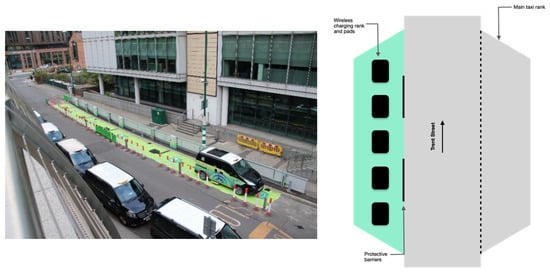
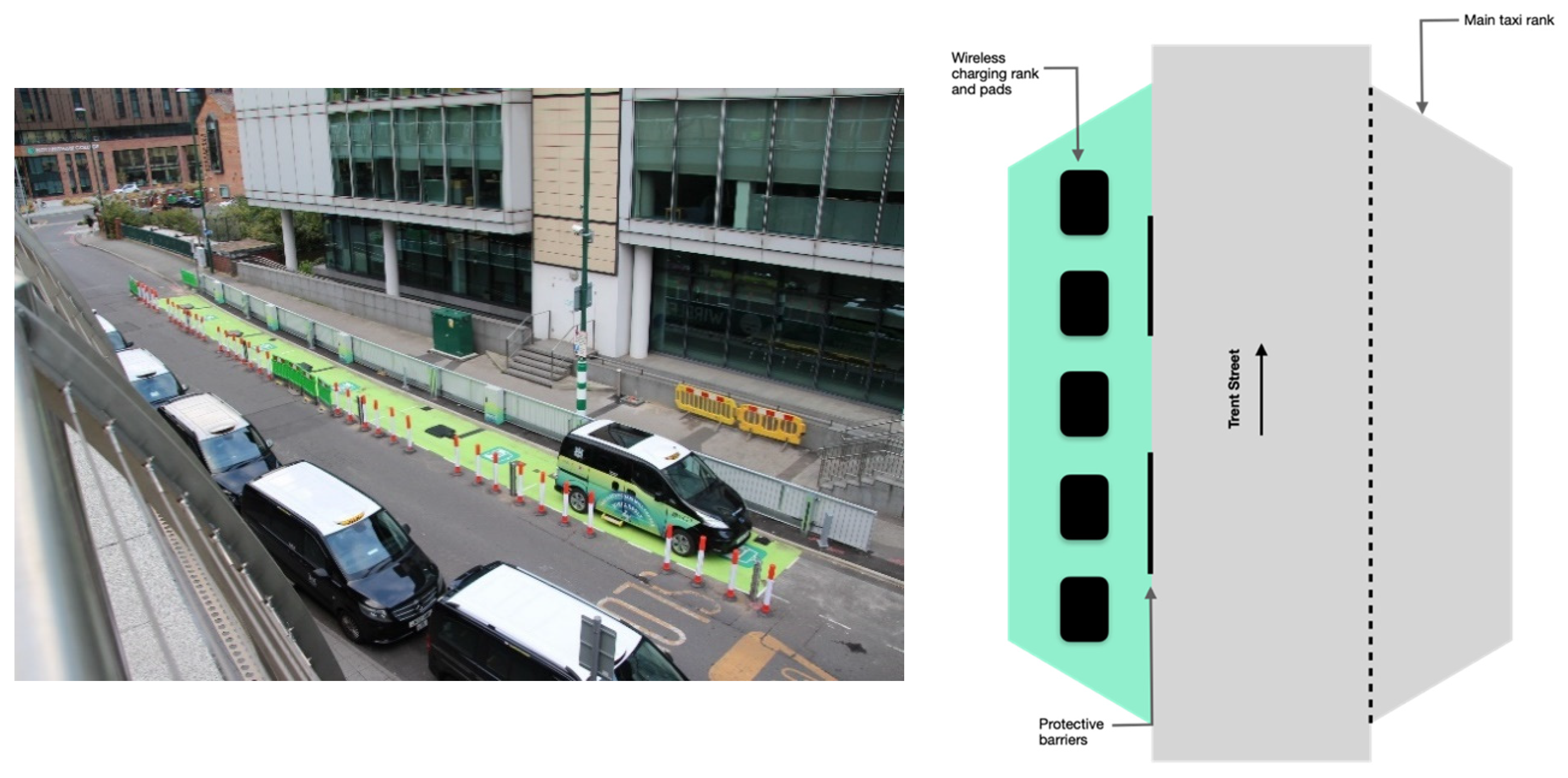
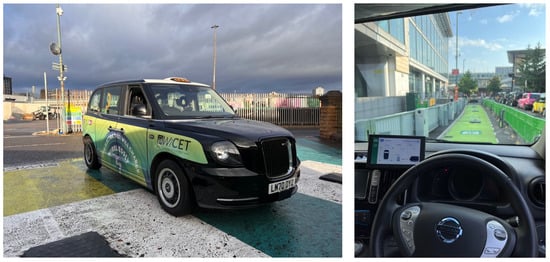
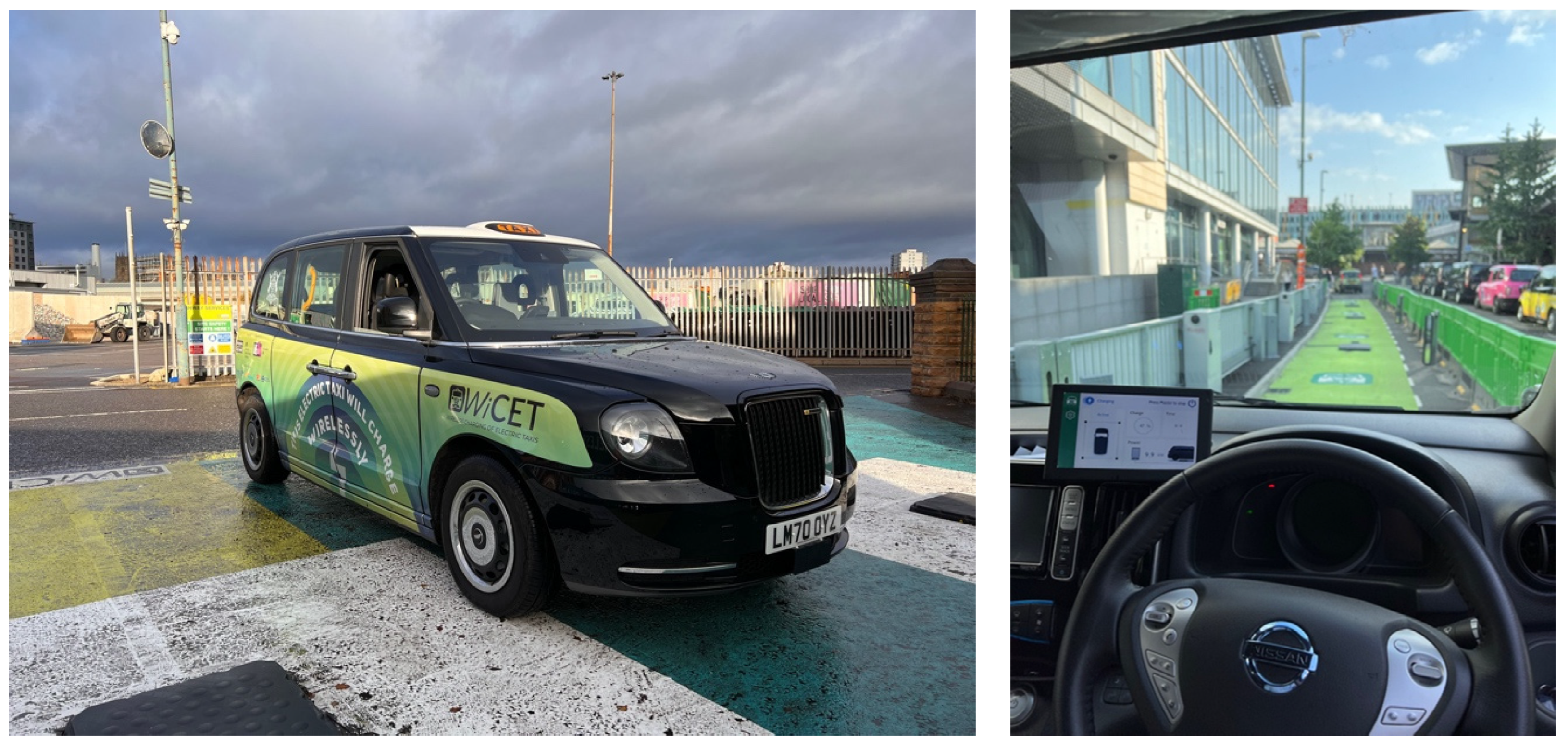
As pictured in Figure 1, the ranks were installed opposite to the main rank at Trent Street. On the left side, the taxis queuing in the main rank can be seen, meaning drivers using the WPT pads were parked opposite the main rank. To ensure the plans were aligned with taxi driver expectations, detailed interview studies were conducted with taxi drivers prior to installation, which confirmed acceptance of the proposed installation plans [21]. To protect the installation, two protective barriers were erected, positioned to allow taxis to enter and drive down the rank, and leave in the middle or at the end. Figure 2 shows the final design of the taxi and the interior interface.
Figure 1.
Completed installation of wireless chargers at Trent Street, Nottingham (UK). Schematic on the right depicts the positing of the pads with respect to the main taxi rank (not to scale). The dashed line represents the partitioning line between the rank and the main road (Trent Street).
Figure 2.
(Left) LEVC taxi retrofitted with WPT capability. (Right) Interior of Nissan Dynamo with a view of the in-vehicle alignment assistance display.
2.2. Study Design
Once installation of the chargers was complete, taxi drivers were able to sign up to swap their existing taxi (whether it was diesel or electric) to a WPT-enabled WiCET electric taxi. They were assigned randomly either the LEVC (a range-extender taxi) or a Nissan Dynamo (a battery electric vehicle). When the driver arrived for the collection of their vehicle, they were provided with an in-depth overview of the system, given a demonstration of the system and had the opportunity to ask any questions. Once the driver was comfortable with how the system operated and were setup with the online account required for the automatic billing of the charging, they were free to leave and resume their regular taxi shift work. All vehicles were fully insured and approved for use as a licenced taxi, meaning there were no operational changes to the driver’s intended workday.
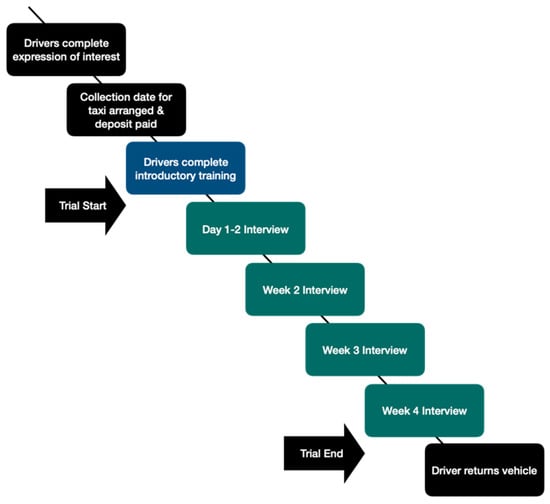
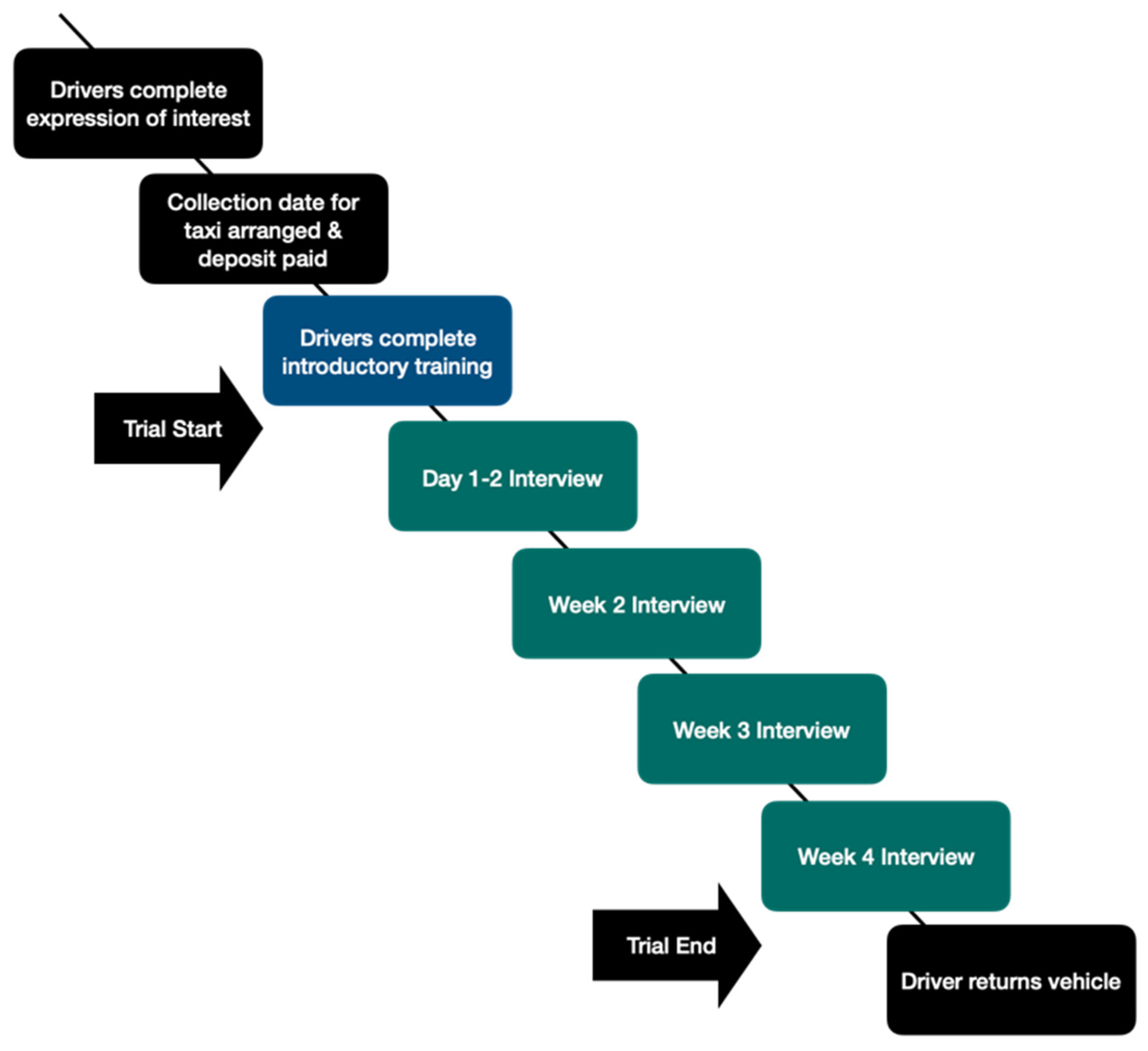
Taxi drivers were given the vehicle for four weeks and were asked to use the WPT available at Trent Street as they wished, according to the needs of their taxi business. A four-week trial length for each participant was chosen to enable them enough time to familiarise themselves with the system and vehicle, as visualised in Figure 3. After a four-week trial was completed, the taxi would be returned and given to a new driver. This repeated until the end of the four-month user trial phase. All interviews were conducted between 16 October 2026 to 16 December 2026.
Figure 3.
Study schedule for real-world public trial for each driver participant.
If a driver required technical support at any point in the trial, a dedicated phone line had been setup which would direct the driver to a specialist engineer, who could provide support.
2.3. Sample and Recruitment
All participants in the trial and therefore the interview study had to be licenced taxi drivers. Private-hire drivers who drive their own personal vehicles for Uber or other ride-sharing apps were excluded from this study. Given the 30-day length of an individual trial and the limitations on the period of time the WPT pads would remain installed at the taxi rank (4 months), there were limitations on the total number of taxi drivers who could take part. In total, 18 drivers took part. Of the nine taxis commissioned, technical issues with some of the vehicles meant they could not be deployed in time for the trial start date. However, given that taxi drivers can be considered experts in their trade, with all the drivers being in the trade for more than five years, and that most of the drivers were interviewed longitudinally over the trial period, the sample was considered appropriate [22].
Recruitment was supported by communications through Nottingham City Council, who could access their record of taxi drivers to help promote the trial and interview study. In addition, the trial was promoted on social media directly to the taxi drivers. All taxi drivers who partook in the interviews were verified licenced black cab drivers in Nottingham, all male, all between the ages of 30–50 years old.
2.4. Semi-Structured Interviews
During this trial period, telephone interviews were conducted with the drivers at the end of each week. The interview schedule can be found in Appendix A. The first interview took place 1–2 days after they received their taxi. This was to ensure there were no immediate barriers to the driver accessing the WPT at Trent Street. Following this, interviews were conducted on a weekly basis to capture their perceptions and opinions longitudinally throughout the trial. Interviews were semi-structured to allow for the interviewer to respond and follow-up on emergent themes from the participant’s responses. Interviews lasted approximately 30–40 min.
2.5. Analysis
The analytical approach adopted was thematic analysis [23]. This methodology has been widely used both in the literature and by the authors in the context of transport research [24,25]. The analytical procedure consists of six steps:
- Familiarisation. In this step, the transcriptions are reviewed and read through prior to beginning any coding process.
- First and second cycle coding. The initial codes are generated from the transcripts, in this case, using in vivo and descriptive coding [26].
- Theme searching. Initial codes are reviewed to understand groupings and themes in the data.
- Reviewing themes. Themes generated are reviewed to ensure consistency with the coded data.
- Defining and naming themes. Themes are named and given a definition to help with the interpretation of the results
- Reporting out. Final themes are reported.
All interviews were audio-recorded then transcribed using Otter.ai. The transcripts were manually reviewed for accuracy. Transcriptions were then exported and then imported into Nvivo for Mac to facilitate the analytical procedure detailed previously. The process was iterative and multiple cycles of coding, theme searching and review were conducted to ensure the themes generated were an appropriate reflection of the responses. The lead researcher led the development of the codes; however, the first cycle codes were reviewed by a second researcher and compared to the interview transcripts. Any disagreements were discussed so that the final list of themes was a result of collaborative development between two experienced qualitative researchers. All codes were organised according to the date of the interview to track the longitudinal changes over time.
This research complied with the American Psychological Association Code of Ethics and was approved by the Institutional Review Board at Coventry University (P106527). Informed consent was obtained from each participant.
3. Results
3.1. Overview
In total, 72 interviews were transcribed, coded and analysed (18 drivers, each interviewed four times). The LEVC taxi was used by 14 of the drivers, and the Nissan Dynamo was used by four drivers, though no effect of vehicle type was observed. Of the 18 drivers in the trial, 11 were users of a Euro 6 Diesel taxi, and seven were existing EV taxi drivers. After the initial first cycle coding, 262 codes were finalised. From this, four key themes were identified from the analysis, along with 11 sub-themes. Considering the longitudinal design of the study (with each driver being given four weeks of taxi ownership within the total four-month project period) and the participant sample being highly experienced, professional taxi drivers, the total number of drivers interviewed was considered appropriate. Further, the analysis of the data revealed a saturation of themes after seven completed driver trials, suggesting that the most salient issues and opinions on WPT had been uncovered by this sample. This was determined collaboratively by the two researchers conducting the thematic analysis of the data when new interviews being coded generated no new codes. However, this was not considered a stopping point, but rather an observation that suggests strength in the results. These are detailed below in Table 1.
Table 1.
Overview of main themes and sub-themes for all weeks of the interviews (numbers in brackets represent the frequency of that theme, sub-theme or code).
In the next section, several of the themes will be discussed in greater detail. A few of the themes will be discussed within the context of other themes, as they are strongly related.
3.2. Wireless Charging
‘Wireless charging’ collected codes and sub-themes that focussed on the experience and practicalities of the charging process itself.
3.2.1. Vehicle Charging
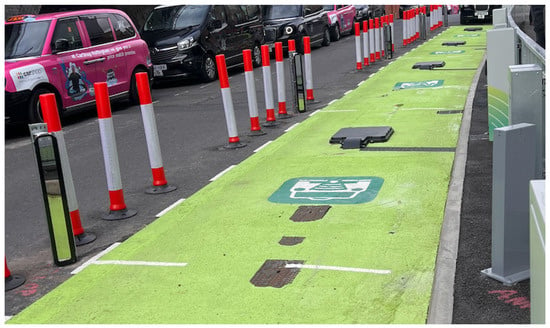
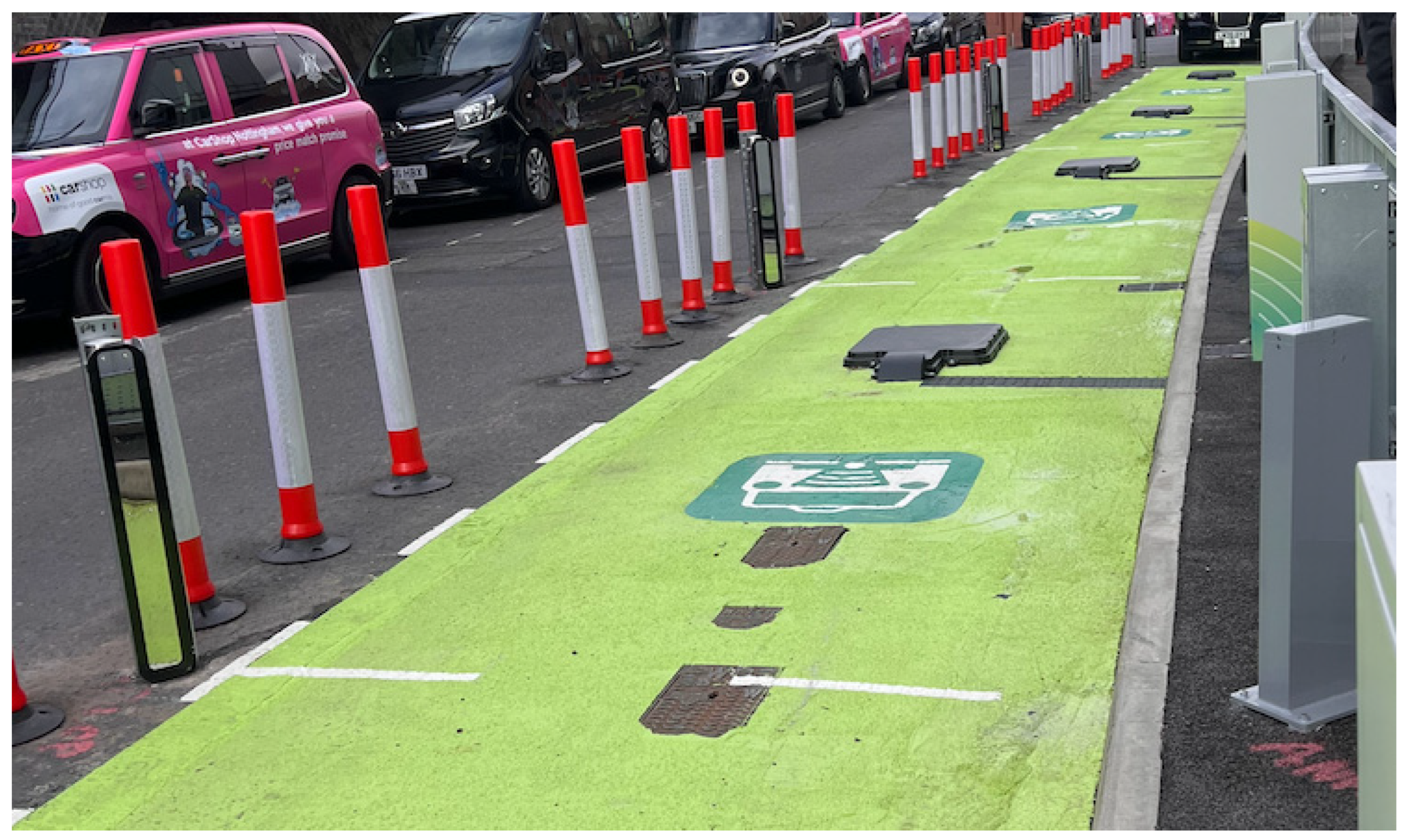
Looking at the charging process itself, ‘challenges’ represented the largest category within the sub-theme. Drivers experienced a range of challenges using the WPT system, largely involving technical implementation for the WiCET trial. For example, to comply with safety regulations around electromagnetic emissions, the WPT system featured a Foreign/Live Object Detection (FOD) system which would prevent or cancel charging if a person, object, or animal is detected on or close to the pad (Figure 4). For this trial, a series of light gates were implemented around the vehicle, where if the beams were broken, charging would stop. Drivers reported, however, that the FOD light gates would trigger randomly in response to pedestrians, rain or for no apparent reason, “a pedestrian walked too close, then I had to reset the system” (P4) and “Someone walked past, and it disconnected” (P15). Once the FOD had been triggered and the charging disconnected, the system required the driver to step out of their vehicle to press a reset button on a post situated next to the wireless charger. Once reset, the driver was required to reverse and try realigning or moving forward onto the next available charging pad. This led to frustrations, “it would be good if it worked” (P9) and “sometimes I left it parked up charging, and it’s cut off and I don’t know it did” (P16). There appeared to be no difference between LEVC (range-extender taxi) and Dynamo (EV) drivers with regard to issues faced; however, looking longitudinally across the interviews, there was a notable fall in the number of codes related to vehicle charging challenges (18 in week one to 8 in week four).
Figure 4.
Light gates (mirrored posts) surrounding the FOD system. Oversensitivity of the protection system caused the system to initiate protective shut-down.
While it is recognised that issues related to FOD will be specific to this trial, technology readiness for WPT appears to vary significantly across the industry, with some systems such as those from Qualcomm-Halo and WiTricity achieving TRL6 (successful controlled demos), and others such as IPT technology, being ranked around TRL9 (working in the operational environment) [27]. In the case of this demonstration project, the LUMEN system used had only been tested on private sites; therefore, it was likely that technical challenges were going to arise. Any technical issues that arose with the system were fed back from drivers to Nottingham Council who were able to deploy fixes. This highlights the importance of providing a direct line of support to capture and act on challenges as they arise with the system, particularly where the technology is new. In a study investigating the adoption of new ride-sharing apps by taxi drivers, it was found that perceived usefulness, word of mouth and peer adoption were some of the most influential factors [28]. Notably from their study, perceived ease of use was an insignificant factor, which appears to align with the responses from this study, as the next largest category within the vehicle charging sub-theme was ‘positive’. Overall, drivers were positive about the charging experience, despite the technical challenges faced. Looking longitudinally, the number of positive responses to WPT rose from two in week one to 17 in week four, for example, “brilliant idea, useful. Every time I charged while I was waiting for a job” (P17) and “comfortable and satisfied, it’s the best thing to put on the rank because we can just top up” (P9). Praise for the system focussed on the time savings, convenience, and increased access to more charging options.
Hence, despite initially experiencing difficulties with the system, there was an appreciation of the utility and benefits provided by on-rank, wireless charging. This aligns with the technology adoption theory, stating that adoption and continued use of technology occur when the utility of the technology outweighs the cost of adoption [29]. In this case, it was observed that despite the range of technical issues, drivers evidently saw a benefit in the technology to continue to persist with using the WPT.
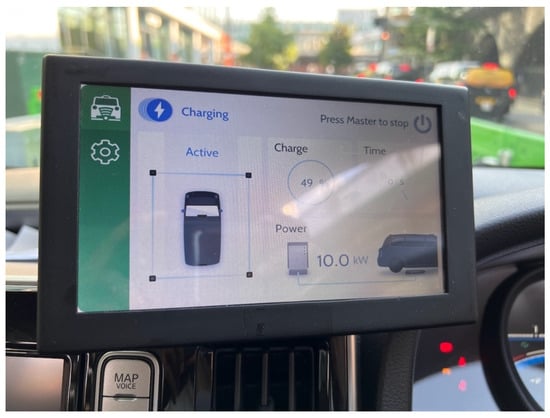
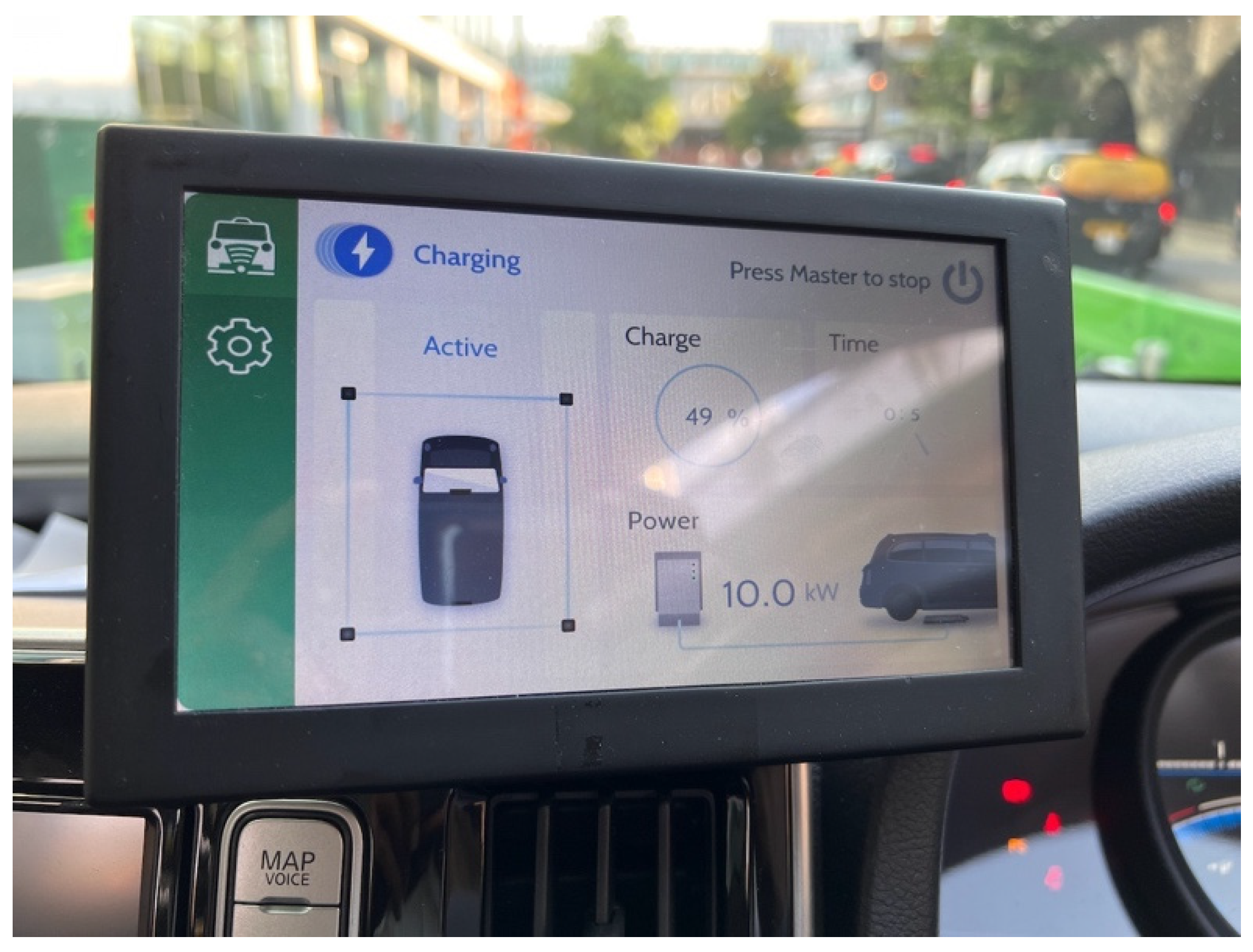
Aside from the technical challenges of using the system, one persistent code across all the weeks was that WPT was ‘too slow’. The WPT system was capable of 11 kW of power transfer (with perfect vehicle alignment with the ground pad) (Figure 5). At this speed, by UK standards, this places it within the threshold for ‘fast’ charging [30]; however, it is notably slower than the rapid cable charging (50 kW) the drivers have access to in Nottingham. Drivers compared the speeds capable on wireless to the rapid charging and were underwhelmed, “a good idea, but just needs to be faster” (P10) and “it’s very slow charging though” (P18). When drivers were asked about their usage of the wireless chargers, it became evident that some drivers were using it as a direct substitute for cable charging, as opposed to adopting ‘top-up’ behaviour, “I only got 3–4% charge from my charging session” (P16). During the system’s design, it was expected that the average charge gained would be around 2–3 kWh (based on an average 20 min waiting time at the rank) which would provide enough charge to complete a job and return back to the rank to top-up again. However, driver responses suggested some utilised WPT for their single midday charge (as they would do on the rapid charger) and not have to return for charging. This was compounded by another finding from the response in which most drivers appeared not to use Trent Street as their main taxi rank, “I only go to Trent Street to charge, not for fares” (P4) and “there’s not enough work on that side of the city” (P16). Evidence from the 2018 initial feasibility study for this project quantitatively indicated that Trent Street was the most-used rank in Nottingham [20]; furthermore, as part of the sign-up process for this trial, drivers were asked to confirm that Trent Street was their primary rank, which was confirmed by all drivers on the trial. It therefore appears that not all drivers used Trent Street as their main rank, and so were not maximising the opportunistic nature that WPT possesses. Therefore, if the WPT was being used as a direct substitute for cable charging and the driver only travelled to the rank for charging and not as the hub for their taxi business, then the slower speeds of WPT would be perceived as inadequate. For example, “I would prefer cable, it’s faster” (P6) and “I still try and find cable charging- just faster” (P4).
Figure 5.
In-vehicle interface supporting the driver with alignment. In this photo, the interface provides information on the charging rate (10 kW) and state of charge.
There are several reasons posited for this behaviour. First, the initial study into rank locations was conducted prior to the COVID-19 pandemic. Taxis and trains were perceived as the highest risk forms of transport for contracting the virus, significantly impacting their usage [31]. Given that Trent Street primarily serves train passengers arriving at Nottingham City train station, this has had a lingering effect on where taxi drivers are now collecting their customers. Furthermore, industrial strike action from train operators also significantly impacted rail usage during the trial period [32]. These external factors provide an understanding as to why drivers shifted their primary business away from Trent Street during this time, highlighting the speed limitations of WPT. In contrast, those drivers who did use Trent Street as their main rank did not raise an issue concerning charging speed: “it saves me a lot of time compared to driving out to the cable charging” (P9), “it’s a brilliant idea, every time I charged while I was waiting there” (P17).
The key learning point from this result is that the utility of WPT in taxi ranks crucially relies on its placement being where the driver would be locating themselves for their primary customer collection. In this case, as Trent Street became less attractive to drivers, the utility of the WPT fell. But for those where Trent Street remained their hub, its utility was well-supported through facilitating small but frequent top-up charging. This also highlights a gap in the charge point location modelling literature, which needs to consider changing work and social trends to secure the best long-term locations.
3.2.2. Vehicle Alignment
Vehicle alignment codes were the second largest sub-theme identified from the analysis. Some drivers appeared indifferent to the alignment process, and overall, there was no longitudinal effects of continued use of the WPT on the theme of alignment. This was in-line with previous research, which found that alignment accuracy when assisted by an in-vehicle display (as was the case for the drivers) was 100% [33]. For example, “it’s easy, no problems with alignment” (P5) and “no problems, it’s intuitive and easy to judge” (P1). However, on the contrary, some drivers found the alignment challenging, “alignment still takes a few times, it’s difficult” (P14) and therefore this was investigated further. Matrix analysis in Nvivo found that aligning with the ground pad was primarily linked with the category of ‘HMI issues’, where drivers had issues with a time lag between the vehicle moving and the screen updating in response, “Lining up wasn’t too bad, the screen was slow and took a long time” (P16). This was an unexpected technical issue with the in-vehicle display which was not recognised in the initial testing of the vehicle prior to the trial. It may have been the case that the large number of codes concerning alignment challenges could have been related to the lag on the in-vehicle display. In technical testing, the lag was inconsistent, ranging from none perceived to approximately 500 ms. Looking longitudinally at the HMI issues code, the number of codes did moderately increase towards the end of the trial, suggesting that drivers became more familiar with the system, suggesting they recognised that alignment issues were related to the display and not their ability. While the issues related to the HMI are specific to this trial, the importance of the in-vehicle display in reliably supporting the alignment process has been recognised in the literature, with work being undertaken to understand how alignment feedback can be provided at greater distances away on approach to the charging pad and with greater accuracy [34], as providing feedback to the driver on vehicle alignment at least 50 cm prior to the pad was deemed most beneficial [35].
3.2.3. Pad Preferences
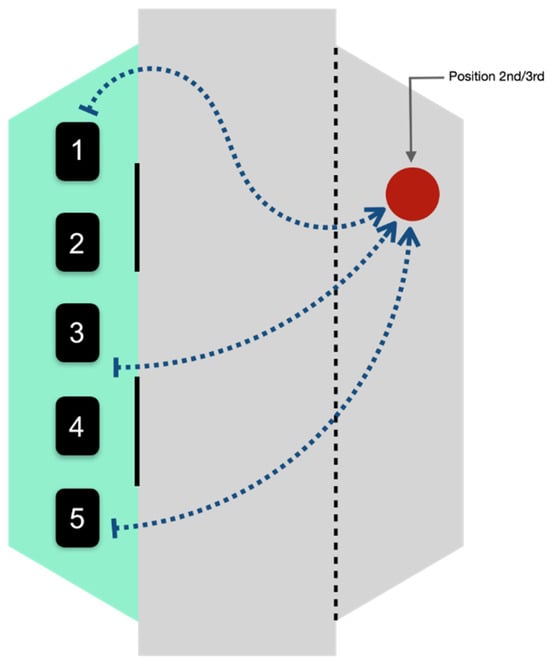
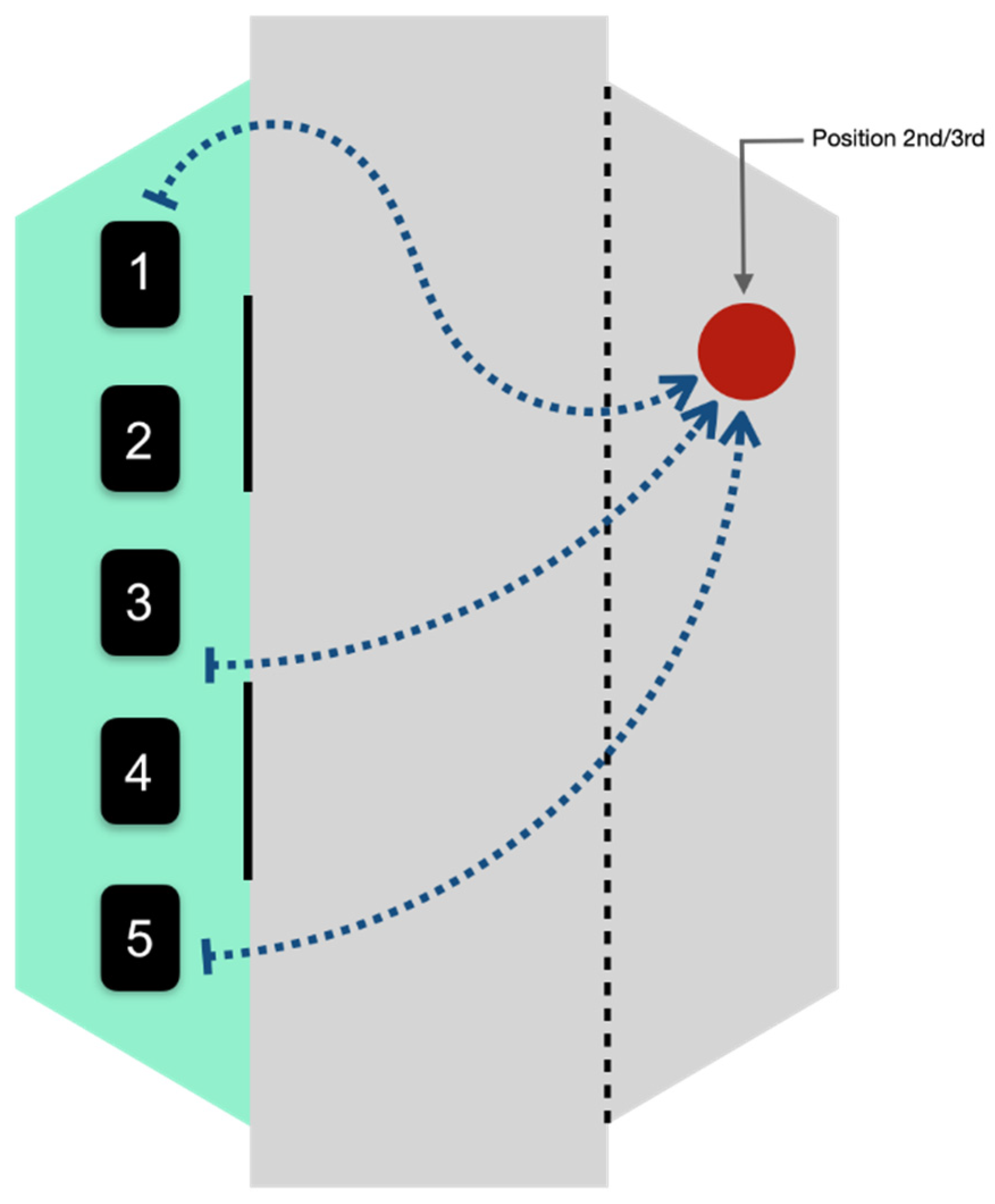
It was noted through anecdotal observation by support staff at the taxi rank that drivers did not use the pads in chronological order, this was evidenced by the code ‘Pad accessed non-chronologically’ and driver feedback. For example, “I mostly just use the first or third one” (P13). This was a result of the WPT rank being opposite the main rank, requiring drivers to leave and join the main rank when they were ready to pick up fares, “I prefer the first and third one, because it’s easy to join the queue straight away” (P9). This was an important learning point for the positioning of WPT pads. As discussed previously, the positioning of the pads was primarily to minimise disruption to the main rank from installation works. This meant drivers had to re-join the main rank when they wished to pick up fares. From previous scoping work [21], drivers had confirmed that they would manage to keep their place in the queue by communicating with drivers in the main rank and that they would only re-join the main rank when they were next to pick up fares. However, in practice, drivers explained that they preferred to re-join when in second or third in the queue, “I joined when in 2nd or 3rd position and just let the driver [in the main rank queue] know” (P16). This meant the pad positioned most advanced in the charging rank was too far forward to manoeuvre the vehicle to join the main rank in 2nd or 3rd position; this is depicted in Figure 6.
Figure 6.
Schematic depicting manoeuvre required to join main rank from different charging positions. The black dashed line represents the partition between the taxi rank and the main road (Trent Street). The blue dashed line indicates the manoeuvre required to join the main rank from different charging post locations. The numbers indicate the position of each wireless charging pad.
This is an important consideration in future installations and a demonstrable benefit of conducting human factors research on a predominately technical vehicle integration and hardware installation project. Without speaking to the drivers about how they use the rank and how we can co-design the solution optimally, it could have resulted in only one of the five WPT pads being ‘usable’ from the drivers’ point of view. A solution could be to ensure the pads are placed towards the rear to allow for the necessary space to manoeuvre to the second or third position in the main rank.
The second key category within this sub-theme concerned the distribution of pads, with drivers commenting that the pads should be placed around the city rather than focussed on one rank, “I would support having this on every rank” (P10) and “The idea needs to be on every rank. I work all ranks and don’t stick to one rank” (P17). In the previous section, the changing nature of the taxi trade because of the pandemic and industrial strike action meant the intended top-up usage of wireless chargers were less applicable to some drivers. This raises an important point on catering for different taxi business styles. Those drivers whose primary fare involves train commuters were well-served by the pads. However, other drivers who work on nightlife journeys, airports or other inter-city journeys use other ranks and therefore could not adopt the top-up charging behaviour. Trent Street was chosen for its popularity; however, evidently more important is ensuring the distribution of pads cover the varying types of taxi journeys, rather than focussing only on the rank popularity statistics. Installing WPT in multiple locations around the city would come with obvious financial and technical challenges, but would ensure a broader uptake of wireless charging and facilitate the transition to net-zero transport within our urban areas.
3.3. Billing
Most drivers had no issues with the billing for their use of the wireless chargers, “the online portal [for payment] is excellent” (P1). In the case where issues arose, this involved incorrect billing or a request for more billing options. For example, an option to register a card to have automatic debiting could have alleviated some issues like vehicle charging stopping unexpectedly when the balance on the driver’s account reached zero, “But when charging, and it stops. It doesn’t charge if you only had £2/3 left. A notification for low money value would be useful, nothing is there for that.” (P18). This had a practical implication, as drivers often like to leave their vehicles whilst at the rank, either to use toilet facilities or socialise with other drivers, “it’s very common for drivers to leave [their taxi] whilst it’s charging” (P18). Allowing for an option for continued charging through direct debiting of funds or a negative balance would be an important consideration for future WPT installations.
3.4. Taxi Rank Behaviour
As discussed previously, a key process in the use of the wireless charger was the need for the driver to re-join the main rank when their place in the queue reached the second or third position in line. Overall, most drivers experienced challenges with other drivers when attempting to re-join the main rank. The code was present several times, for example, “Sometimes there’s queue arguments, it happens quite a bit. They need reminding, they have arguments because of the layout.” (P16) and “Sometimes there were issues joining the main rank and they say it’s not fair and you have to explain.” (P18). This is an important learning in the value of real-world testing, where aspects that were previously unproblematic became challenges. In this situation, Nottingham Council intervened to deliver communications to the drivers regarding the queuing system, which overall appeared to alleviate the issues, “No problems with moving into the main rank after they [diesel drivers using the main rank] received the letter about it.” (P9). An important learning was the importance of having governmental support in the operation of the trial, given the real-world implications of the system and research.
3.5. Key Learnings
The real-world trials provided a unique and novel opportunity to engage with drivers to understand the impact of WPT on their taxi business and the adoption of electric vehicles in the sector. Learnings could be separated into knowledge-based and implementation-based learnings. It should be emphasised that these results are founded on the experiences and perceptions of the drivers and future work must now link this to measured behaviour change.
3.5.1. Knowledge-Based Learnings
From the qualitative data analysis, several key learnings regarding the impact of WPT on the taxi trade were gathered:
- Despite initial technical issues, WPT was beneficial, with taxi drivers highlighting the time savings, convenience and increased charging access; in alignment with the technology adoption theory, the utility outweighed the issues and costs of adoption.
- Adoption of ‘top-up’ behaviour is critical to the usage of WPT, as opposed to current behaviour which is to achieve as large a charge as possible in a single session. Without this behavioural shift, WPT is considered too slow by drivers.
- Ensuring charge access is based on different driver business types as opposed to rank popularity. Selection for the pad locations were based initially on rank popularity for this study, making the choice sensitive to the changing patterns of driver behaviour. Drivers communicated that other, less popular ranks became more used because of external influences; hence, it is important to ensure charging access accounts for the ‘human factor’ in future implementations.
- The in-vehicle display was confirmed to be critical for successful alignment between the ground pad and the vehicle. When technical issues prevented the smooth operation of the display feedback, driver issues with alignment rose notably.
- It is likely future implementations for the taxi trade may also adopt the approach of installing pads adjacent to the main taxi rank, to avoid disruption at the high traffic location. Hence, it is important to consider that drivers preferred to join the main rank at second or third position and ensure adequate space is accounted for regarding the manoeuvring requirements of the taxi drivers.
- Drivers noted the importance of being able to continue to charge whilst they were away from their vehicle. Situations where their account balance depletes whilst charging should allow for alternative automatic billing options, rather than the system stopping the charge.
3.5.2. Practical Implementation Learnings
Given the practical challenges involved in running a real-world public trial, several learnings were gathered from the operation of the trial:
- Support from the local government (in this case, Nottingham City Council) proved crucial in engaging with taxi drivers and alleviating both technical and social problems as they arose.
- Engagement with key voices within the taxi driver community allowed for stronger engagement from the drivers when the public trial was run, in line with the technology adoption theory model stating word of mouth and peer adoption as the strongest influences on new technology adoption [28].
- Public trials are more exposed to changes in the external environment, in this case, a pandemic and significant industrial action disruption. This is an important methodological consideration and the provision of a private trial may have helped investigate certain aspects of WPT in greater detail and in a more controlled environment, than the public trial allowed.
3.5.3. Limitations and Considerations
This study involved 18 male (Nottingham had no licenced female drivers at the time of the trial) licenced taxi drivers at a single location in Nottingham, limiting the transferability of the findings to other driver groups, private-hire services and operating environments. Although repeated interviews captured changes in perceptions, each driver participated for only four weeks, leaving sustained changes in charging behaviour and longer-term adoption uncertain. Voluntary participation may also have introduced self-selection bias, favouring drivers with greater interest in electric vehicles or wireless charging.
The analysis also relied on self-reported experiences, meaning that perceived improvements in convenience and time savings cannot establish measurable reductions in charging downtime or improvements in business performance. Furthermore, participants’ experiences were shaped by the specific 11 kW installation, technical interruptions, the rank layout and changes in local passenger demand. Consequently, some challenges identified may reflect this particular deployment rather than characteristics of WPT more broadly. Longer trials across multiple locations, involving a more diverse sample and combining interviews with charging and operational data, would help establish how these findings translate into sustained use.
4. Conclusions
This paper has reported on the UK’s first public trial of wireless charging at a live taxi rank. This unique context allowed for highly contextualised and rich data collection. With each driver taking part in four interviews, the data collection was extensive and thematic analysis allowed for several significant themes to be identified that influence our understanding as to how WPT can benefit the taxi trade in the transition to Net Zero, but also practical guidance as to how WPT should be implemented in the future.
It is encouraging to see drivers sharing the benefits to their trade of expanding the range of charging opportunities available, particularly by locating WPT at their place of work. However, there remain challenges around:
- Communication of the change in charging mindset to best utilise WPT.
- Ensuring WPT pads are distributed according to differing taxi business styles.
- Continued refinement of the in-vehicle displays that support WPT alignment, particularly around ensuring the HMI updates in response to the vehicle’s movement with minimised lag.
Future research should consider the testing of WPT capability across different urban settings and use cases, and explore how the option could be offered by vehicle OEMs in the future. Despite the challenges, the real-world trials have provided the evidence and support to continue developing WPT for electric taxis for helping them navigate the upcoming green transition.
Author Contributions
A.U., Methodology, Formal Analysis, Investigation, Data Curation, Writing—Original Draft, Review and Editing, Project administration. R.S., Conceptualisation, Supervision, Project administration. S.B., Conceptualisation, Methodology, Writing—Review and Editing, Supervision, Project administration, Funding acquisition. All authors have read and agreed to the published version of the manuscript.
Funding
The WiCET project upon which this study was based was supported by Innovate UK (project number 106160) and funded by the Office for Zero Emissions Vehicles (OZEV).
Institutional Review Board Statement
This research complied with the American Psychological Association Code of Ethics and was approved by the Institutional Review Board at Coventry University (P106527) on 24 June 2020.
Informed Consent Statement
Informed consent was obtained from each participant.
Data Availability Statement
The data that support the findings of this study are available from the corresponding author, AU, upon reasonable request.
Acknowledgments
We wish to also acknowledge our project partners, Cenex, Nottingham City Council, Sprint Power, Hanger 19, Transport for London and Shell Research UK.
Conflicts of Interest
The authors declare no conflicts of interest.
Appendix A
Day 2–3 Interview Schedule
Aim
To determine any usability or accessibility issues with the wireless charging system early, to minimise the risk of inadequate data collection.
Preamble
Hi XX, how are you? I’m well thanks, thanks for your time and offering to take part in this interview. My name is Arun, thanks for taking the time to talk to me about your early impressions of the wireless charging system.
As you know, I will be audio-recording this interview. The audio recordings are anonymous, and we will not be able to personally identify you from them.
Interview
- How many times have you used the wireless charging system in the last x days and have you had any issues?
- What has been your experience of aligning your taxi with the wireless charging ground pad?
- Have you experienced any challenges in aligning?
- Does this change for different times of day? How is this process like at night vs. the day?
- What has been your experience of using the charging in the rank?
- Have there been any times when you haven’t been able to access the wireless charging?
- How have you managed moving back into the main rank after using the wireless charger?
- Have there been any issues with other drivers with this process?
- If you haven’t been able to align correctly, what did you do?
- Have you experienced any times where the FOD and LOP system were activated?
- What has been your experience of paying for your wireless charging?
- What are your opinions of the online payment portal for top-up?
- Have any of your customers commented on the taxi?
- Looking forward, how easy do you think it will be to use?
- Looking forward, do you see any risks or problems?
Weekly Interview Schedule
Aim
To determine the wider impacts of wireless charging on the driver’s driving behaviour and attitudes towards EVs and the wider aspects of sustainability (in addition to continuing to track usability issues).
Preamble
Hi XX, how are you? I’m well thanks, thanks for your time and offering to take part in this interview. My name is Arun, thanks for taking the time to talk to me about your impressions of the wireless charging system.
I will be audio-recording this interview. The audio recordings are anonymous and we will not be able to personally identify you from them.
Interview
- How many times have you used the wireless charging system in the last week?
- What has been your experience of aligning your taxi with the wireless charging ground pad?
- Have you experienced any challenges in aligning?
- How do you feel about the process of alignment?
- How long did it take you to feel confident using the system?
- Does this change for different times of day? How is this process like at night vs. the day?
- How easy would you say it’s been to align the taxi? (1–10)
- Why?
- What has been your experience of using the charging in the rank?
- Have there been any times when you haven’t been able to access the wireless charging?
- How have you managed moving back into the main rank after using the wireless charger?
- Have there been any issues with other drivers with this process?
- If you haven’t been able to align correctly, what did you do?
- Have you experienced any times where the FOD and LOP system were activated?
- On a scale of 1–10 how would you rate the experience of charging in the rank?
- Why?
- What has been your experience of paying for your wireless charging?
- What are your opinions of the online payment portal for top-up?
- Do you feel using an EV has had any impact on your weekly expenditure?
- On a scale of 1–10 how would you rate your experience using the online account management?
- Why?
- Have any of your customers commented on the taxi?
- Do you feel having access to in-rank wireless charging gives Hackney Carriages any benefits over Private Hire Vehicles?
- Has using a wireless charging EV changed your attitude towards other ‘green’/sustainable initiatives like recycling, waste, emissions?
- Recycling more, reducing food waste, turning heating off, saving heating bills
Final Interview Schedule
- Thinking back over the last 4 weeks, can you summarise your experience of using the wireless charging system?
- How would you describe your experience of learning to align with the wireless charging pad over the last 4 weeks?
- What did you think was the main challenge of aligning the taxi?
- Thinking back to the first times you aligned with the charging pad—can you summarise how you felt about learning to use the system?
- Did you learn faster than you expected? Slower?
- If you had any advice for future drivers of the system for the first time, what would you say?
- Do you have any final thoughts on the experience of using the charging pads at different times of the day?
- Overall, what is your opinion of being able to wirelessly charge your taxi in the rank?
- Over the last 4 weeks, how many times would you say you weren’t able to access the wireless charging for any reason?
- Over the last 4 weeks, what have been your experiences of moving back into the main rank? Did you run into any issues with the other drivers?
- If you haven’t been able to align correctly, what did you do?
- Have you experienced any times where the FOD and LOP system were activated?
- On a scale of 1–10 how would you rate the experience of charging in the rank?
- Why?
- What has been your experience of paying for your wireless charging?
- What are your opinions of the online payment portal for top-up?
- Do you feel using an EV has had any impact on your weekly expenditure?
- On a scale of 1–10 how would you rate your experience using the online account management?
- Have any of your customers commented on the taxi?
- Thinking back to the customers you’ve had; do you think customers would pay a higher fare to ride in an electric taxi?
- If yes, or maybe—do you think this would be a strong enough incentive for existing diesel drivers to switch to an electric taxi?
- Do you feel having access to in-rank wireless charging gives Hackney Carriages any benefits over Private Hire Vehicles?
- Has using a wireless charging EV changed your attitude towards other ‘green’/sustainable initiatives like recycling, waste, emissions?
- Recycling more, reducing food waste, turning heating off, saving heating bills
- Finally, if we imagine that wireless charging is on your future vehicle—how likely are you to use the feature in the future?
- Do you think you’ve reduced your use of rapid charging, with access to wireless charging? [For current ULEVs]
- Does having wireless charging improve access to charging facilities?
- Does wireless charging help you manage your range?
- Do you find it more or less convenient than cable charging?
- Having used wireless charging, can you see yourself more/less likely to consider getting a ULEV taxi?
References
- Hou, Y.; Liu, J.; Tang, X.; Yi, H.; Li, T.; Zhu, T. Review of long-term exposure to road traffic-related air pollution and mortality: Mechanism, exposure, and meta-analysis. Environ. Impact Assess. Rev. 2026, 119, 108380. [Google Scholar] [CrossRef] [Scilit]
- Transport for London. Taxi and Private Hire Action Plan 2025, Transport for London. 2025. Available online: https://content.tfl.gov.uk/taxi-private-hire-action-plan-2025.pdf (accessed on 10 October 2026).
- Bos, B.; Lim, S.; Hedges, M.; Molden, N.; Boyle, S.; Mudway, I.; Barratt, B. Taxi drivers’ exposure to black carbon and nitrogen dioxide in electric and diesel vehicles: A case study in London. Environ. Res. 2021, 195, 110736. [Google Scholar] [CrossRef] [Scilit] [PubMed]
- Šimaitis, J.; Lupton, R.; Vagg, C.; Butnar, I.; Sacchi, R.; Allen, S. Battery electric vehicles show the lowest carbon footprints among passenger cars across 1.5–3.0 °C energy decarbonisation pathways. Commun. Earth Environ. 2025, 6, 476. [Google Scholar] [CrossRef] [Scilit] [PubMed]
- Trifunović, A.; Ivanović, I.; Marković, N.; Vidović, Z.; Ivanišević, T. Assessing Road-Segment-Level Operational Environmental Burdens of Electric Vehicles: A Composite Index for Urban Transportation Planning. Urban Sci. 2026, 10, 446. [Google Scholar] [CrossRef] [Scilit]
- Fahrner, V.M.; Jäkel, K.; Lücke, W. How to win taxi drivers for electromobility: Potentials and barriers in Berlin. J. Urban Mobil. 2026, 9, 100179. [Google Scholar] [CrossRef] [Scilit]
- Shao, M.; Chen, C.; Feng, T. Exploring preference heterogeneity of electric ride-hailing drivers’ charging decisions under time uncertainty. Transp. Res. Part D Transp. Environ. 2026, 151, 105166. [Google Scholar] [CrossRef] [Scilit]
- Liu, M.; He, S.Y. E-taxi drivers’ charging behavior: Effects of the built environment, temporal factors, and ridership. J. Transp. Geogr. 2025, 123, 104118. [Google Scholar] [CrossRef] [Scilit]
- Madhavedi, S.; Kumar, B.S.; Regalla, R.; Hoo, W.C. Electric Vehicle Charging Infrastructure and Urban Mobility Performance: Evidence from a Tier-II City in India. Int. J. Transp. Dev. Integr. 2026, 10, 288–307. [Google Scholar] [CrossRef] [Scilit]
- Madhavedi, S.; Algot, K.K.; Vodnala, V.P.; Soppari, S.; Hoo, W.C.; Varala, R. Electric Vehicles and Charging Infrastructure in Sustainable Transport Systems: Technologies, Integration Challenges, and Optimisation Pathways. Int. J. Transp. Dev. Integr. 2026, 10, 353–372. [Google Scholar] [CrossRef] [Scilit]
- Lin, W.; Wei, H.; Yang, L.; Zhao, X. Technical review of electric vehicle charging distribution models with considering driver behaviors impacts. J. Traffic Transp. Eng. (Engl. Ed.) 2024, 11, 643–666. [Google Scholar] [CrossRef] [Scilit]
- Cai, H.; Li, B.; Li, W.; Wang, J. Heterogeneity in electric taxi charging behavior: Association with travel service characteristics. Travel Behav. Soc. 2025, 38, 100917. [Google Scholar] [CrossRef] [Scilit]
- Bouanou, T.; El Fadil, H.; Abbade, H. Wireless charging for electric vehicles: A comprehensive review of technologies, challenges, and solutions. J. Power Sources 2025, 660, 238501. [Google Scholar] [CrossRef] [Scilit]
- Nguyen, D.M.; Kishk, M.A.; Alouini, M.-S. Dynamic charging as a complementary approach in modern EV charging infrastructure. Sci. Rep. 2024, 14, 5785. [Google Scholar] [CrossRef] [Scilit] [PubMed]
- Schneider, J.; Sealy, K.; Boettigheimer, M.; Laemmle, T.; Teerlinck, I.; Hollenbach, M.; Rappholz, B.; Wendt, A.; Joos, S. Validation and Comparison of Alignment Methodologies for the SAE Wireless Power Transfer, J2954 Standard. In WCX SAE World Congress Experience; SAE Technical Paper; SAE International: Warrendale, PA, USA, 2024. [Google Scholar] [CrossRef] [Scilit]
- El Jabaoui, A.; Sjöblad, S.; Nilsson, M.; Obaid, M. In-Car Interface Design to Support Electric Taxi Drivers’ Charging Decisions. In Proceedings of the 16th Biannual Conference of the Italian SIGCHI Chapter; Association for Computing Machinery: New York, NY, USA, 2025; pp. 1–2. [Google Scholar] [CrossRef] [Scilit]
- Eriksson, R.; Piegsa, A.; Petersson, A.; Olsson, P.; Samuelsson, G.; Galled, S. Three years of experience with wireless charging fleet in Gothenburg Green City Zone. In Proceedings of the 38th International Electric Vehicle Symposium and Exhibition (EVS38), Goteborg, Sweden, 15–18 June 2025. [Google Scholar]
- Carroll, S. Electric Vehicles: EV charging, no strings attached. Electrical Connection, 6 August 2022; pp. 46–47. Available online: https://electricalconnection.com.au/ev-charging-no-strings-attached/ (accessed on 10 October 2026).
- SAE J2954; Wireless Power Transfer for Light-Duty Plug-in/Electric Vehicles and Alignment Methodology. SAE International: Warrendale, PA, USA, 2024. [Google Scholar] [CrossRef] [Scilit]
- Oliveira, L.; Ulahannan, A.; Knight, M.; Birrell, S. Wireless charging of electric taxis: Understanding the facilitators and barriers to its introduction. Sustainability 2020, 12, 8798. [Google Scholar] [CrossRef] [Scilit]
- Ulahannan, A.; Knight, M.; Doel, R.; Birrell, S. Look, No Cables! An Interview Study into Guiding the Practical Implementation of Wireless Chargers for Electric Taxis. In Advances in Human Aspects of Transportation; Stanton, N., Ed.; Springer International Publishing: Cham, Switzerland, 2021; pp. 269–276. [Google Scholar] [CrossRef] [Scilit]
- Dworkin, S.L. Sample size policy for qualitative studies using in-depth interviews. Arch. Sex. Behav. 2012, 41, 1319–1320. [Google Scholar] [CrossRef] [Scilit] [PubMed]
- Braun, V.; Clarke, V. Using thematic analysis in psychology. Qual. Res. Psychol. 2006, 3, 77–101. [Google Scholar] [CrossRef] [Scilit]
- Alyavina, E.; Nikitas, A.; Njoya, E.T. Mobility as a service and sustainable travel behaviour: A thematic analysis study. Transp. Res. Part F Traffic Psychol. Behav. 2020, 73, 362–381. [Google Scholar] [CrossRef] [Scilit]
- Pettigrew, S.; Nelson, J.D.; Norman, R. Autonomous vehicles and cycling: Policy implications and management issues. Transp. Res. Interdiscip. Perspect. 2020, 7, 100188. [Google Scholar] [CrossRef] [Scilit] [PubMed]
- Saldaña, J. The Coding Manual for Qualitative Researchers, 2nd ed.; SAGE: Thousand Oaks, CA, USA, 2013. [Google Scholar] [CrossRef] [Scilit]
- Majhi, R.C.; Ranjitkar, P.; Sheng, M.; Covic, G.A.; Wilson, D.J. A systematic review of charging infrastructure location problem for electric vehicles. Transp. Rev. 2020, 41, 432–455. [Google Scholar] [CrossRef] [Scilit]
- Liu, X.; Xu, W.W. Adoption of ride-sharing apps by Chinese taxi drivers and its implication for the equality and wellbeing in the sharing economy. Chin. J. Commun. 2018, 12, 7–24. [Google Scholar] [CrossRef] [Scilit]
- Lin, C.A. An interactive communication technology adoption model. Commun. Theory 2003, 13, 345–365. [Google Scholar] [CrossRef]
- Chen, T.; Zhang, X.-P.; Wang, J.; Li, J.; Wu, C.; Hu, M.; Bian, H. A Review on Electric Vehicle Charging Infrastructure Development in the UK. J. Mod. Power Syst. Clean Energy 2020, 8, 193–205. [Google Scholar] [CrossRef] [Scilit]
- Shamshiripour, A.; Rahimi, E.; Shabanpour, R.; Mohammadian, A. How is COVID-19 reshaping activity-travel behavior? Evidence from a comprehensive survey in Chicago. Transp. Res. Interdiscip. Perspect. 2020, 7, 100216. [Google Scholar] [CrossRef] [Scilit] [PubMed]
- Dong, K.; Tse, Y.K. Examining public perceptions of UK rail strikes: A text analytics approach using Twitter data. Inf. Dyn. Appl. 2023, 2, 101–114. [Google Scholar] [CrossRef] [Scilit]
- Ulahannan, A.; Zdanowicz, K.; Bowie, C.; Birrell, S. Making wireless charging a reality: A real-world mixed methods evaluation of vehicle alignment. In Proceedings of the IHSI 2022; Ahram, T., Karwowski, W., Di Bucchianico, P., Taiar, R., Casarotto, L., Costa, P., Eds.; AHFE International: New York, NY, USA, 2022. [Google Scholar] [CrossRef] [Scilit]
- Dahal, A.; Kumar, V.R.; Yogamani, S.; Eising, C. An Online Learning System for Wireless Charging Alignment Using Surround-View Fisheye Cameras. IEEE Trans. Intell. Transp. Syst. 2022, 23, 20553–20562. [Google Scholar] [CrossRef] [Scilit]
- Birrell, S.A.; Wilson, D.; Yang, C.P.; Dhadyalla, G.; Jennings, P. How driver behaviour and parking alignment affects inductive charging systems for electric vehicles. Transp. Res. Part C Emerg. Technol. 2015, 58, 721–731. [Google Scholar] [CrossRef] [Scilit]

Disclaimer/Publisher’s Note: The statements, opinions and data contained in all publications are solely those of the individual author(s) and contributor(s) and not of MDPI and/or the editor(s). MDPI and/or the editor(s) disclaim responsibility for any injury to people or property resulting from any ideas, methods, instructions or products referred to in the content. |
© 2026 by the authors. Licensee MDPI, Basel, Switzerland. This article is an open access article distributed under the terms and conditions of the Creative Commons Attribution (CC BY) license.