


Abstract
Multimodal entity alignment identifies equivalent entities referring to the same real-world object across heterogeneous multimodal knowledge graphs and is essential for multi-source knowledge integration. Existing methods often rely on manually labeled seed alignments and multimodal feature similarity, limiting their ability to capture implicit semantic equivalence under heterogeneous attribute and relation expressions. Large language models (LLMs) offer strong semantic understanding and reasoning capabilities for unsupervised alignment, but their direct application remains challenging because of the large entity search space, redundant knowledge graph information, and the stochasticity of LLM inference. To address these challenges, we propose MEA-LLM, an LLM-based fully unsupervised multimodal semantic-enhanced entity alignment method. MEA-LLM first pre-screens candidate entities by jointly exploiting multimodal similarities derived from visual, attribute, and relational information. It then selects discriminative attributes and relations based on degree of freedom, candidate frequency, and discriminability for LLM reasoning. Multiple inference and result aggregation are further employed to improve robustness. Experiments on FB-DB15K and FB-YAGO15K show that MEA-LLM outperforms existing methods across multiple evaluation metrics. Further ablation studies, hyperparameter analyses, experiments with different model-scales, and efficiency evaluations demonstrate the effectiveness of the core components and indicate that MEA-LLM achieves a favorable trade-off between entity alignment performance and inference cost.
1. Introduction
Multimodal knowledge graphs (MMKGs) such as Dbpedia and Yago [1,2], provide a unified representation and integration framework for heterogeneous information associated with entities, including textual attributes, relational structures, and images, and have become an important foundation for downstream intelligent applications such as question answering [3,4] and recommender systems [5,6]. However, MMKGs are often independently constructed by different organizations and therefore exhibit substantial heterogeneity in data sources, modeling conventions, and representation schemes. Such heterogeneity results in inconsistent entity descriptions, incompatible schemas, and fragmented knowledge, making it difficult to directly reuse and complement knowledge across different graphs. Establishing correspondences between equivalent entities across heterogeneous knowledge graphs is therefore essential for bridging semantic gaps and facilitating cross-graph knowledge integration. Multimodal entity alignment (MMEA) aims to identify entities in different MMKGs that refer to the same real-world object and serves as a fundamental prerequisite for multi-source knowledge graph integration. By jointly exploiting multimodal information, including entity attributes, relational structures, and associated images, MMEA can characterize entities from complementary semantic perspectives, thereby providing essential support for establishing cross-graph entity correspondences and enabling subsequent knowledge integration and intelligent applications [7,8,9].
Existing MMEA methods have gradually evolved from early paradigms that primarily relied on graph structural information to multimodal representation learning approaches that jointly incorporate attribute, relational, and visual information. These methods typically encode different modalities separately, map entities into a shared or comparable low-dimensional representation space, and subsequently perform entity matching according to the distances or similarities between entity representations. Although the incorporation of multimodal information enriches entity representations, existing approaches still largely rely on representation-level similarity and remain limited in their ability to model complex implicit semantic equivalence. In real-world heterogeneous knowledge graphs, the same semantic concept may be expressed differently across data sources. For example, as shown in Figure 1, at the attribute level, birthPlace and place of birth differ lexically but convey the same semantic meaning. At the relation level, directed and directedBy may represent equivalent semantic associations through opposite relation directions. Such heterogeneous expressions can differ substantially in their surface forms while remaining highly consistent at the semantic level, which may lead to biased or inconsistent entity representations. Beyond semantic heterogeneity, MMKGs also differ in the amount and distribution of multimodal information associated with each entity. As illustrated in Figure 1, entities are characterized by their relational connections to neighboring entities, attribute-value pairs, and associated images. However, the types and numbers of these associated records may vary across MMKG-1 and MMKG-2, resulting in differences in the availability of multimodal evidence for entity alignment. Moreover, the availability and combination of these modalities may vary across individual entities, affecting both candidate retrieval and subsequent semantic reasoning. Therefore, considering the quantity, distribution, and complementary nature of multimodal evidence is important for improving the accuracy and reliability of entity alignment.
Figure 1.
Examples of Semantic Heterogeneity in Attributes and Relations across Knowledge Graphs.
These limitations motivate the research problem of accurately aligning semantically equivalent entities across heterogeneous knowledge graphs with diverse attribute, relational, and visual representations. Directly applying LLMs faces challenges such as a large search space, redundant multimodal evidence, long prompts, and heterogeneous attribute and relation expressions, indicating the need for effective candidate and knowledge filtering. Accordingly, we aim to develop an efficient and fully unsupervised multimodal entity alignment framework that combines candidate retrieval, discriminative evidence selection, and LLM-based semantic reasoning. Specifically, our objectives are to reduce the candidate search space, retain informative attribute and relation evidence, and enhance alignment through separate multimodal reasoning and high-confidence iterative refinement.
In addition, existing MMEA methods generally rely on a certain number of pre-aligned entity pairs as supervision to establish correspondences between different knowledge graphs [10,11]. However, obtaining high-quality seed entity pairs requires substantial manual annotation, resulting in high annotation costs, long acquisition cycles, and limited cross-domain transferability, particularly in large-scale and multi-domain knowledge integration scenarios. Therefore, unsupervised MMEA, which discovers cross-graph entity correspondences solely from the multimodal information contained in the knowledge graphs without requiring manually provided seed alignments, has greater practical applicability. Compared with supervised settings, unsupervised entity alignment lacks explicit cross-graph semantic anchors provided by seed entity pairs, making it more difficult to establish reliable semantic correspondences across knowledge graphs in the presence of inconsistent attribute naming, heterogeneous relational structures, and discrepancies in visual information. Under such circumstances, methods relying mainly on local feature similarity are more susceptible to heterogeneous expressions and noisy information, thereby imposing higher requirements on cross-graph semantic understanding, implicit relational reasoning, and entity equivalence assessment.
Large language models (LLMs) acquire extensive linguistic knowledge and external common-sense knowledge through large-scale pretraining and exhibit strong capabilities in contextual understanding and semantic reasoning [12,13,14]. These capabilities provide a promising alternative to conventional representation learning methods that primarily depend on surface-level feature similarity. In particular, in fully unsupervised settings where manually annotated seed entities are unavailable as semantic anchors, LLMs can leverage their pretrained knowledge to recognize latent semantic equivalence among different attribute names, relation expressions, and entity descriptions, thereby offering a potential means of bridging the semantic gap between heterogeneous knowledge graphs. Recently, several LLM-based entity alignment approaches, such as LLM-Align and ZeroEA, have emerged. Nevertheless, directly applying LLMs to unsupervised MMEA still faces three major practical challenges. First, knowledge graphs usually contain a large number of entities. Directly invoking an LLM to evaluate all possible cross-graph entity combinations would incur prohibitively high inference costs and fail to satisfy the efficiency requirements of large-scale entity alignment. For example, exhaustive pairwise matching on the FB-DB15K and FB-YAGO15K datasets would involve approximately 187 million and 225 million cross-graph entity combinations, respectively, highlighting the substantial search space associated with direct LLM-based alignment. Second, entities in knowledge graphs are often associated with numerous repetitive, weakly discriminative, or noisy attributes and relations. Feeding such information directly into an LLM without appropriate filtering may dilute critical discriminative evidence and interfere with semantic reasoning. This challenge is also reflected in hyperparameter analysis, where increasing the number of selected attribute or relation triples beyond three yields only marginal improvements in alignment performance. These observations suggest that incorporating more knowledge does not necessarily lead to proportional performance gains, while increasing the prompt length and inference overhead. Therefore, identifying and retaining informative semantic evidence is essential for effective and efficient LLM-based entity alignment. Third, because LLMs rely on probabilistic generation, different inference runs may produce inconsistent judgments when multiple candidate entities are highly similar in semantics. Consequently, entity alignment results obtained from a single inference run may fluctuate, compromising prediction stability and reliability. Our experimental results further demonstrate the limitations of single-pass inference. Specifically, increasing the number of independent inference runs from one to five, together with result aggregation, improves Hits@1 from 0.7468 to 0.8194 on FB-DB15K and from 0.6074 to 0.6563 on FB-YAGO15K. These improvements suggest that repeated inference and consistency-based aggregation can enhance alignment reliability and mitigate the uncertainty associated with individual LLM predictions.
Motivated by these challenges, we addresses the central research question of how to effectively integrate multimodal information and LLM-based semantic reasoning in a fully unsupervised setting to overcome the inefficiency of large-scale entity matching, the difficulty of identifying implicit semantic equivalence under heterogeneous representations, and the instability of LLM inference. The overall research objective is to achieve accurate, efficient, and reliable alignment of semantically equivalent entities across heterogeneous MMKGs. To this end, we propose MEA-LLM, an LLM-based multimodal semantic-enhanced entity alignment method that exploits the semantic understanding and reasoning capabilities of LLMs to enhance conventional multimodal entity matching without manually annotated seed alignments. The proposed method comprises three interconnected stages—candidate entity selection, LLM-based semantic reasoning, and iterative refinement—corresponding to three specific research tasks. First, we investigate multimodal candidate entity selection by integrating visual, attribute, and relational similarities to construct a high-quality candidate set for each source entity, thereby reducing the entity search space and subsequent LLM inference cost. Second, we investigate discriminative knowledge selection and semantic reasoning by evaluating attributes and relations using degree of freedom and candidate frequency, selecting informative semantic evidence, and incorporating visual similarity scores into separate attribute-based and relation-based prompts to identify implicit semantic equivalence under heterogeneous expressions. Finally, we investigate multiple inference and iterative refinement by aggregating predictions from independent inference runs and using high-confidence alignment pairs to enhance subsequent prompts, with the aim of improving alignment accuracy and prediction stability.
To evaluate the effectiveness of the proposed approach, extensive experiments are conducted on two public MMEA benchmark datasets, FB-DB15K and FB-YAGO15K [7]. Comparative results demonstrate that MEA-LLM outperforms conventional representation learning approaches and existing LLM-based entity alignment baselines on key evaluation metrics, including Hits@1, Hits@10, and mean reciprocal rank (MRR), demonstrating the effectiveness of incorporating LLM-based semantic reasoning into unsupervised multimodal entity alignment. Furthermore, ablation studies are conducted to assess the contributions of candidate entity retrieval, heuristic attribute–relation selection, multiple inference, and prompt-enhanced iterative refinement. Hyperparameter analyses further investigate the effects of the number of candidate entities, the number of selected triples, and the number of inference runs on alignment performance. In addition, experiments with LLMs of different scales are performed to examine the impact of model size on entity alignment performance. Finally, the proposed method is analyzed in terms of inference efficiency and computational cost to investigate the trade-off between alignment accuracy and computational overhead, providing practical insights into the deployment of LLM-driven entity alignment methods in real-world scenarios.
The main contributions of this work are summarized as follows:
- We propose MEA-LLM, a fully unsupervised multimodal entity alignment framework that integrates multimodal candidate retrieval, attribute-level and relation-level semantic reasoning, multiple inference, and iterative refinement. The proposed framework enables cross-graph entity equivalence matching without relying on manually annotated seed entity pairs.
- We develop a multimodal evidence-guided semantic reasoning and iterative enhancement mechanism that integrates multimodal candidate retrieval, heuristic attribute–relation selection, and visual similarity-assisted reasoning. Furthermore, multiple inference runs, result aggregation, and feedback from high-confidence alignment pairs are employed to iteratively enhance prompts, improving the accuracy and stability of unsupervised entity alignment.
- Extensive comparative experiments, ablation studies, hyperparameter analyses, model-scale experiments, and efficiency evaluations on FB-DB15K and FB-YAGO15K demonstrate that the proposed approach achieves competitive entity alignment performance in a fully unsupervised setting and validate the effectiveness of its core components.
The rest of this paper is organized as follows. Section 2 reviews related work on multimodal entity alignment. Section 3 formally defines the unsupervised MMEA problem and presents the overall architecture and individual components of MEA-LLM in detail. Section 4 reports the experimental results and analyses, including the datasets, experimental settings, comparative experiments, ablation studies, hyperparameter analyses, model-scale experiments, and efficiency evaluation. Finally, Section 5 concludes the paper and discusses directions for future research.
2. Related Work
2.1. Multimodal Entity Alignment
Since Liu et al. [7] formally introduced research tasks related to multimodal knowledge graphs, the rapid development of multimodal learning techniques has stimulated increasing interest in entity alignment with visual information, making multimodal entity alignment an active research direction in the knowledge graph community. A substantial body of research has advanced MMEA from various perspectives, including modality fusion, feature modeling, and bias mitigation. Among these studies, MMEA [15] was the first to systematically formulate the multimodal entity alignment task and summarize its key challenges. It developed a multimodal knowledge representation framework to jointly learn relational, visual, and numerical features of entities and subsequently fuse these representations, thereby improving alignment accuracy. From a causal inference perspective, CDMEA [16] constructs a causal graph and disentangles the direct bias effect of the visual modality, alleviating modality bias and visual shortcut learning in multimodal entity alignment. KGMEL [17] projects image, textual, and graph-structural information into a shared semantic space to enhance unified entity representations. MEAformer [10] employs a multimodal Transformer architecture to achieve fine-grained and dynamic modality fusion, whereas MSNEA [11] adopts a multimodal Siamese network to jointly model information from multiple sources, improving the consistency of cross-modal feature representations. In addition, OTMEA [18] leverages optimal transport to align modal and structural distributions, thereby mitigating multimodal heterogeneity. GSIEA [19] and SGMEA [20] enhance the exploitation of topological information during multimodal interaction by incorporating structural information into attention mechanisms and performing structure-guided feature fusion, respectively. MCLEA [21] employs both intra-modal and inter-modal contrastive learning to obtain robust multimodal joint representations. Moving beyond conventional similarity-based matching paradigms, ME3A [22] reformulates entity alignment as a semantic entailment classification task, further improving semantic matching between entities. Despite continuous improvements in MMEA performance from different perspectives, existing approaches still exhibit two common and fundamental limitations. First, most methods follow a supervised learning paradigm and rely heavily on manually annotated aligned entity pairs as training supervision. The acquisition of such labeled data is costly and labor-intensive, while high-quality alignment annotations are often scarce. Consequently, these methods are difficult to apply to real-world heterogeneous knowledge graphs in low-resource or unlabeled settings, which limits their generalizability and practical applicability. Second, the modeling mechanisms of existing approaches remain largely centered on observable entity features and explicit feature similarity. Entity matching is typically performed according to distances or similarities in learned representation spaces, resulting in limited capability to capture complex and implicit semantic equivalence across heterogeneous knowledge graphs. For instance, semantically synonymous attributes with different names and equivalent relations expressed in opposite directions may exhibit considerable discrepancies at the representation level despite conveying the same underlying semantics. Such approaches therefore have difficulty adequately resolving semantic heterogeneity in real-world knowledge graphs. This dependence on representation-level similarity constitutes an important bottleneck that restricts further improvements in multimodal entity alignment performance.
2.2. Semi-Supervised and Unsupervised Entity Alignment
Compared with relatively mature supervised multimodal entity alignment approaches, semi-supervised and unsupervised alignment paradigms remain at an early stage of development. The number of relevant studies is still limited, and substantial technical limitations and performance bottlenecks remain.
Specifically, semi-supervised methods typically rely on a small number of seed entity pairs and progressively expand the available supervision by generating pseudo-labels. For example, BootEA [23] iteratively assigns labels to potential aligned entity pairs to augment the supervision available for model training. PCMEA [24] proposes a semi-supervised multimodal entity alignment model equipped with a pseudo-label calibration mechanism and employs momentum contrastive learning to effectively exploit both labeled and unlabeled data. In contrast, unsupervised methods assume no access to pre-aligned entity pairs and instead derive supervision signals from the structural or multimodal information inherent in the knowledge graphs themselves. EVA [25], for instance, is one of the early representative studies to incorporate visual information into entity alignment and supports alignment under an unsupervised setting. It exploits the visual semantics contained in entity images to identify potential aligned entity pairs, thereby alleviating the impact of textual semantic discrepancies in cross-lingual scenarios. High-confidence matching results are subsequently selected as initial alignment signals for further entity alignment.
Although these approaches reduce the dependence on large-scale manually annotated data, they still suffer from several inherent limitations. First, semi-supervised methods that iteratively expand supervision through pseudo-labeling are vulnerable to variations in pseudo-label quality and the progressive accumulation and propagation of noisy supervision, which may substantially compromise the stability and accuracy of entity alignment. Second, existing semi-supervised and unsupervised multimodal entity alignment methods remain limited in modeling cross-modal representation consistency and still largely rely on surface-level feature similarity for entity matching. As a result, they struggle to move beyond shallow representation-level matching and are insufficiently capable of discovering deep and implicit semantic equivalence in complex heterogeneous scenarios, such as differently named but semantically synonymous attributes and equivalent relations expressed in opposite directions. These limitations substantially constrain both the performance ceiling and the generalization capability of unsupervised multimodal entity alignment methods.
2.3. LLM-Based Entity Alignment
In recent years, large language models (LLMs), empowered by extensive pretrained knowledge, strong contextual understanding, and semantic reasoning capabilities, have provided a new technical paradigm for entity alignment that differs fundamentally from conventional representation learning approaches. Recent studies have begun to transform entity attributes, relations, and neighborhood structures in knowledge graphs into natural-language representations, enabling pretrained language models or LLMs to directly reason about semantic associations between entities. For example, LLM-Align [26] exploits the instruction-following and zero-shot reasoning capabilities of LLMs. It employs heuristic strategies to select discriminative attribute and relation triples and feeds them into an LLM for entity equivalence assessment. A multi-round voting mechanism is further introduced to alleviate hallucination and position bias in LLM outputs. ZeroEA [14] proposes a Graph2Prompt module that converts knowledge graph topology and neighborhood information into textual prompts suitable for pretrained language models. Combined with a neighborhood filtering mechanism that removes redundant neighboring information, ZeroEA enables entity alignment without additional model training. MM-ChatAlign further introduces multimodal large language models into the entity matching process. It first adopts an embedding-based method to narrow the candidate entity space and then leverages a multimodal LLM to jointly reason over visual and other modality-specific information. A reasoning-and-reflection mechanism is subsequently employed to improve final alignment performance.
Despite these advances, research on LLM-based multimodal entity alignment remains at a relatively early stage and still exhibits several limitations. On the one hand, directly performing pairwise matching across all entities in large-scale knowledge graphs with LLMs results in an enormous search space and substantial inference overhead. On the other hand, knowledge graph entities are often associated with large amounts of attribute and relational information. Directly converting all available knowledge into prompts not only introduces constraints related to context length and computational cost, but may also incorporate substantial redundant, weakly discriminative, or noisy information, thereby distracting the model from critical semantic evidence. In addition, LLMs inherently suffer from output stochasticity, hallucination, and position bias, making the results of single-pass inference difficult to guarantee in terms of stability and reliability. Therefore, reducing inference cost, selecting high-value multimodal knowledge, and improving the robustness of entity equivalence judgments remain key challenges for applying LLMs to unsupervised multimodal entity alignment.
3. LLM-Based Multimodal Entity Alignment Approach
3.1. Problem Formulation
A multimodal knowledge graph (MMKG) is represented as
where E, R, I, and A denote the sets of entities, relations, images, and attributes, respectively. denotes the set of relational triples, which can be represented as
where e and denote the head entity and tail entity, respectively, and r denotes the relation between them. denotes the set of attribute triples, defined as
where a denotes the attribute and v denotes the corresponding attribute value.
Given two MMKGs,
and
The objective of multimodal entity alignment is to identify all entity pairs that refer to the same real-world entity , where and .
3.2. Framework Overview
From an architectural perspective, the proposed MEA-LLM framework consists of three major stages: (1) Candidate entity selection. This stage jointly exploits visual, attribute, and relational similarities to retrieve a compact set of candidate entities for each source entity, thereby transforming global entity matching into local matching within a restricted candidate space and reducing the computational cost of subsequent LLM inference. (2) Large language model reasoning. This stage heuristically selects highly discriminative attributes and relations based on their degree of freedom and candidate frequency, and constructs structured prompts incorporating the selected semantic evidence and visual similarity scores for attribute-level and relation-level semantic reasoning. This stage performs multiple independent inference runs and consistency-based result aggregation to improve prediction robustness, and further leverages high-confidence alignment results as prompt-enhanced demonstrations for iterative refinement, thereby progressively improving the accuracy and stability of entity alignment. (3) Iterative refinement. These stages are sequentially interconnected, forming a closed-loop optimization framework that proceeds from candidate-space restriction to semantic reasoning and subsequently to iterative feedback. The overall architecture of the proposed LLM-based multimodal semantic-enhanced entity alignment method is illustrated in Figure 2.
Figure 2.
Model Diagram of Multimodal Semantic-Enhanced Entity Alignment Method Based on Large Language Models.
3.3. Candidate Entity Selection
Before LLM-based reasoning, it is necessary to effectively reduce the target entity search space and construct a high-quality candidate entity set, thereby keeping the input size of each inference operation manageable while improving the efficiency and accuracy of subsequent semantic reasoning.
To this end, we design a Candidate Entity Selection module. During this stage, visual, attribute, and relational information are jointly employed as the primary discriminative signals. Attribute and relational information directly characterize the semantic properties of entities, whereas visual information captures their appearance-level characteristics. These three modalities provide complementary evidence from different perspectives and therefore contribute to more accurate candidate retrieval. Compared with relying on a single modality or local structural information alone, multimodal information provides a more comprehensive characterization of entities, thereby improving candidate coverage in semantically complex scenarios.
Specifically, let the visual, attribute, and relation embeddings of a source entity e be denoted by , , and , respectively. Similarly, the corresponding visual, attribute, and relation embeddings of a target entity are denoted by , , and , respectively.
The three modality-specific embeddings are extracted as follows. For the visual modality, each entity-associated image is encoded by a pretrained visual backbone, ResNet-50, to obtain a fixed-dimensional visual embedding . For the attribute modality, the attribute triples associated with each entity are first serialized into textual sequences containing attribute names and values, which are subsequently encoded by a pretrained sentence encoder, SBERT, to obtain the attribute embedding . For the relational modality, the relational triples and the local neighborhood structure are encoded by a graph neural network, GCN, to obtain the relational embedding .
To ensure that similarities are computed on a consistent scale, all modality-specific embeddings are independently normalized. In this work, we adopt L2 normalization:
where denotes the normalized embedding of modality m. After normalization, the cosine similarity between a source entity e and a target entity under modality m is computed as
Cosine similarity matrices are independently computed for the visual, attribute, and relation modalities.
For each source entity e, the top-K target entities with the highest similarities under the three modalities are selected, yielding the candidate sets , , and , respectively. The three candidate sets are subsequently merged with duplicates removed to obtain the final candidate entity set :
In this manner, the original exhaustive matching problem with a complexity of is reduced to a local candidate matching problem with a complexity of .
3.4. Large Language Model Reasoning
3.4.1. Heuristic Attribute-Relation Selection
Knowledge graph entities are often associated with numerous attributes and relations, not all of which contribute equally to entity alignment. Directly incorporating these triples into LLM prompts may introduce redundant information, increase inference costs, and interfere with the identification of critical semantic evidence. Therefore, selecting informative attributes and relations is essential for constructing concise and effective reasoning prompts. Thus, we further prune attributes and relations to preserve exclusively those structural elements that are highly informative and discriminative. This strategy reduces prompt length while preserving the semantic evidence required for reliable entity alignment.
To achieve this objective, we design a Heuristic Attribute-Relation Selection mechanism that adopts three closely related indicators, namely degree of freedom, candidate frequency, and discriminability, to evaluate the suitability of attribute and relational evidence for entity alignment. These indicators are motivated by two complementary considerations: the structural characteristics of a predicate across knowledge graphs and its availability within the current candidate entity set. Specifically, degree of freedom characterizes the extent to which an attribute or relation is single-valued across entities. A higher value indicates lower average value multiplicity, suggesting that the predicate may provide relatively concise and consistent evidence for entity comparison. Candidate frequency measures the proportion of entities possessing a particular attribute or relation within the candidate set, reflecting the availability of comparable information for the current alignment task. Neither criterion independently guarantees that a predicate can distinguish candidate entities. Therefore, their product is employed as a heuristic discriminability score to prioritize evidence that simultaneously exhibits high single-valuedness and broad candidate-set coverage. This design aims to balance evidence usefulness and prompt compactness rather than directly measure the semantic uniqueness of attribute values or relational objects.
Let an attribute triple in the knowledge graphs be represented as
where e, a, and v denote an entity, an attribute, and the corresponding attribute value, respectively. and denote the attribute triple sets of the source and target knowledge graphs, respectively. Given the candidate entity set , we first calculate the degree of freedom of each attribute.
The attribute degree of freedom is used to measure the global stability of an attribute and is defined as
The numerator represents the number of entities possessing attribute a, whereas the denominator represents the number of pairs associated with a. When , attribute a has a high degree of freedom, indicating that most entities have only one value for this attribute. Typical examples include attributes such as “date of birth” and “height”. Such attributes generally exhibit stronger uniqueness and discriminative capability and are therefore more informative for entity alignment.
Conversely, when , attribute a tends to be multi-valued. For example, an entity may be associated with multiple “works acted in” or multiple “awards”. Such attributes generally contain more noise and provide weaker discriminative information.
The degree of freedom for relations is calculated analogously. Let a relational triple be represented as
where e denotes the head entity, r denotes the relation, and denotes the tail entity. and denote the relational triple sets of the source and target knowledge graphs, respectively.
The degree of freedom of a relation is calculated as
This metric characterizes the global single-valuedness of a relation. For example, a relation such as “parent” generally exhibits a relatively high degree of freedom, whereas a relation such as “author of a paper” tends to have a lower degree of freedom. A higher degree of freedom indicates stronger discriminative capability, whereas a lower value indicates that the relation may introduce more ambiguous or noisy information.
The candidate frequency of an attribute measures its coverage within the current candidate entity set:
This quantity measures the proportion of entities in that possess attribute a. A higher candidate frequency indicates broader coverage of the attribute within the candidate set, allowing it to provide comparable semantic information for more candidate entities and making it more informative for entity alignment. Conversely, an attribute with a low candidate frequency is absent from most candidate entities and therefore contributes relatively little to entity comparison and discrimination.
Similarly, the candidate frequency of a relation is defined as
A relation with a higher candidate frequency is more useful as evidence for entity alignment, whereas a relation with a lower candidate frequency provides relatively limited discriminative information.
Based on the above two indicators, the discriminability scores of attributes and relations are defined as
and
The three indicators characterize complementary aspects of evidence suitability for entity alignment. Degree of freedom reflects global predicate functionality, whereas candidate frequency captures local evidence availability within the candidate entity set. The degree of freedom and candidate frequency are combined multiplicatively rather than additively. Multiplication imposes a stricter filtering criterion: an attribute or relation can obtain a high discriminability score only when it simultaneously exhibits high global stability and broad candidate-set coverage. If either factor is low, the resulting product decreases substantially, allowing low-value attributes and relations to be effectively filtered out. In contrast, additive aggregation may produce a moderate score even when both indicators are individually weak, potentially leading to inaccurate assessments of attribute or relation quality.
Importantly, the resulting discriminability score should be interpreted as a heuristic estimate of evidence usefulness. For example, an attribute may exhibit high functionality and broad candidate coverage while still taking identical values across multiple candidate entities. Conversely, a relatively rare attribute may provide highly distinctive evidence for a particular entity. Therefore, the proposed selection procedure does not independently determine entity equivalence. Instead, it identifies structurally suitable and sufficiently available evidence, leaving the interpretation of attribute values, relation semantics, and cross-graph correspondences to the subsequent LLM reasoning stage. Within MEA-LLM, this heuristic selection strategy is applied to candidate entity sets obtained by combining visual, attribute, and relational retrieval results. The selected attributes and relations are incorporated into separate semantic reasoning prompts, together with precomputed visual similarity scores as complementary evidence. In this way, heuristic evidence filtering and LLM-based multimodal semantic reasoning serve different but complementary purposes: the former controls information redundancy and prompt size, while the latter assesses semantic consistency among candidate entities.
To clarify the calculation of the discriminability scores, we provide a numerical example for both attributes and relations. Consider a candidate entity set containing five entities. For an attribute a, suppose that 80 distinct entities in the knowledge graphs possess this attribute, with a total of 100 corresponding entity–value pairs. According to Equation (8), its degree of freedom is calculated as . If four of the five candidate entities possess this attribute, its candidate frequency, according to Equation (11), is . Therefore, using Equation (13), the attribute discriminability score is .
Similarly, consider a relation r. Suppose that this relation involves 60 distinct head entities and 120 relational triples in the knowledge graphs. According to Equation (10), its degree of freedom is . If three of the five candidate entities have at least one outgoing triple involving this relation, its candidate frequency is , as defined in Equation (12). Consequently, its discriminability score is , according to Equation (14).
These examples illustrate that the discriminability score jointly evaluates the global single-valuedness of an attribute or relation and its coverage within the current candidate entity set. A high discriminability score can be achieved only when both factors exhibit relatively high values. Based on their respective discriminability scores, attributes and relations are ranked independently, and the top-ranked attributes and relations are selected as informative semantic evidence for subsequent LLM-based reasoning. By prioritizing information with high discriminative capability, this mechanism effectively filters out redundant or less informative attributes and relations while preserving essential semantic evidence for accurate entity alignment.
3.4.2. Attribute-Based Reasoning
During attribute-based reasoning, the importance of the attributes associated with the source entity and its candidate entity set is evaluated according to the previously defined attribute discriminability score .
The top- attributes with the strongest discriminative capability are then selected as the primary evidence for semantic reasoning. The discriminability score reflects the effectiveness of an attribute in distinguishing entities within the candidate set: the higher the score, the stronger its capability to differentiate among candidate entities.
This selection mechanism prioritizes attributes that are most informative for determining the semantic identity of an entity. Consequently, it substantially reduces the length of the input text, alleviates the context burden of the LLM, and improves both inference efficiency and stability.
After attribute selection, the structured attribute triples are converted into a unified natural-language prompt. As illustrated in Figure 3a, the attribute information of both the source entity and candidate target entities is represented in the form of triples. For example, the prompt may contain information describing the location of Beijing Capital International Airport or the opening time of Shanghai Hongqiao International Airport.
Figure 3.
Attribute-Based and Relation-Based Reasoning Process.
In addition, because the visual modality can provide complementary discriminative evidence, the visual similarities between the source entity and candidate entities, which are precomputed from visual embeddings, are incorporated into the prompt as numerical scores. These scores serve as auxiliary evidence during the subsequent reasoning process.
The constructed prompt is then fed into the LLM for semantic consistency assessment. The model jointly analyzes similarities in attribute values, semantic expressions, and overall attribute structures between the source entity and each candidate entity, while also taking the visual similarity scores into account. Based on the degree of attribute matching, semantic similarity, and overall consistency, the LLM ultimately predicts the target entity that is most likely to be aligned with the source entity.
3.4.3. Relation-Based Reasoning
To compensate for potentially insufficient semantic information at the attribute level, structural information from the knowledge graph is further incorporated for relation-based reasoning. Compared with attribute information, relational information characterizes the semantic role of an entity within the graph structure as well as its association patterns with neighboring entities. It therefore provides important complementary evidence for entity identification and alignment.
During relation-based reasoning, the importance of relations in the candidate set is evaluated according to the relation discriminability score , and the top- relational triples with the strongest discriminative capability are selected as the primary reasoning evidence. Similar to attribute-based reasoning, this selection strategy prioritizes structural information that is most informative for distinguishing entity identities, thereby controlling the input size while improving reasoning stability and effectiveness.
After relation selection, the selected relational triples are organized into a unified natural-language prompt. As illustrated in Figure 3b, the prompt contains key relational information between entities, such as geographic-location relations between airports and cities. Likewise, visual similarity scores between the source entity and candidate entities are incorporated into the prompt as auxiliary evidence for relation-based reasoning.
3.5. Iterative Refinement
3.5.1. Multiple Inference and Robustness Enhancement
To mitigate the potential instability of LLM outputs during inference and improve the consistency and reliability of entity alignment results, we perform multiple independent inference runs to stabilize the predictions. By examining the consistency across multiple inference outcomes, this strategy reduces accidental errors or biases introduced by a single inference run and therefore yields more robust alignment predictions.
The instability of LLMs in entity alignment mainly arises from their generative reasoning paradigm and underlying probabilistic modeling mechanism. On the one hand, LLM outputs are generated sequentially according to conditional probability distributions. When candidate entities are semantically similar or the available evidence is insufficiently discriminative, multiple candidates may have comparable alignment probabilities, resulting in different decisions across attribute-based or relation-based inference runs.
On the other hand, when the input contains complex information or a long context, the allocation of model attention may fluctuate. The importance assigned to different modalities or feature types is therefore not completely fixed, which introduces additional uncertainty into the reasoning process.
As a consequence of these factors, LLM inference inherently exhibits a certain degree of stochasticity. Even under identical input conditions, different inference runs may produce different outputs. Such variations become more pronounced for semantically similar candidates or ambiguous instances with unclear decision boundaries, resulting in unstable alignment predictions.
To address this issue, we employ multiple independent inference and perform consistency-based filtering over the resulting predictions. This strategy reduces accidental errors caused by stochastic generation and probabilistic fluctuations, thereby improving overall prediction stability and reliability.
Specifically, for each source entity, the LLM is independently invoked n times, where , to obtain n alignment predictions. Let denote the number of times that a target candidate entity c appears in the n inference results. A target entity is regarded as the final aligned entity if
This condition indicates that achieves majority agreement across the multiple inference runs and therefore exhibits relatively high prediction consistency. If no candidate satisfies this condition, no alignment result is produced for the source entity, thereby reducing erroneous matches caused by occasional or uncertain judgments.
Overall, this mechanism can be interpreted as a consistency-based filtering strategy over multiple independent inference results. When model outputs fluctuate, simple statistical aggregation and filtering can substantially improve prediction stability. Moreover, the strategy adopts a relatively conservative decision criterion and does not require any modification to the underlying LLM. It therefore suppresses anomalous predictions caused by generation stochasticity or local semantic bias and enhances the overall reliability of entity alignment results.
3.5.2. Prompt Enhancement
Building upon the above framework, we further introduce an iterative optimization mechanism based on Prompt Enhancement to progressively improve the reasoning performance of the model. The key idea is to automatically identify high-confidence entity alignments generated during the current inference stage and feed them back to the LLM as structured demonstrations in subsequent inference rounds. These reliable alignment results provide additional contextual evidence and facilitate more stable and accurate semantic judgments.
The entire procedure requires neither manually annotated data nor human intervention. Consequently, reliable alignment information can be continuously accumulated in a fully unsupervised manner, enabling iterative improvement of entity alignment performance.
Specifically, in each inference iteration, multiple independent reasoning runs followed by consistency filtering are first performed to obtain relatively stable entity alignment pairs , where denotes an entity in the source knowledge graph and denotes the corresponding entity selected from the candidate entity set. Because these alignments are automatically determined according to statistical agreement across multiple inference runs, they are generally more reliable than predictions obtained from a single inference run.
On this basis, the confidence of each candidate alignment pair is further modeled according to its occurrence frequency across multiple inference runs. Only alignment results whose confidence reaches or exceeds a predefined threshold are retained to construct the high-confidence alignment set P.
The voting-based confidence score is defined as
where denotes the number of times that the target entity is predicted as the aligned entity across the n independent inference runs. This score quantifies the decision consistency of the LLM across repeated inference runs, with a higher value indicating a more stable prediction.
Based on this confidence score, high-confidence entity pairs satisfying are automatically selected and incorporated into P, thereby reducing the influence of noisy predictions on subsequent reasoning. The confidence threshold can be adjusted according to practical requirements or experimental results. For example, when and , although at least 3 consistent predictions are sufficient to satisfy the majority-voting criterion, a candidate alignment pair must receive at least 4 votes to be included in the high-confidence alignment set. This stricter selection criterion helps reduce the risk of introducing uncertain predictions into subsequent inference rounds.
During subsequent inference iterations, the high-confidence alignment set P is automatically transformed into alignment demonstrations and incorporated into the input prompt as auxiliary contextual information. This enables the LLM to refer to previously established alignment correspondences when performing semantic analysis over attributes and relations, thereby strengthening its capability to model semantic mappings across heterogeneous knowledge graphs.
To balance entity alignment performance and computational efficiency, the maximum number of prompt-enhancement iterations T can be specified according to practical requirements. For example, when , the refinement process performs at most three iterations. The iterative process terminates when either (1) the maximum number of refinement iterations T is reached, or (2) no new high-confidence alignment pairs are identified in the current iteration. The second stopping criterion allows the algorithm to terminate early when the high-confidence alignment set no longer expands, thereby avoiding unnecessary LLM inference costs.
Through this mechanism, the original single-pass pipeline of
is extended into an automatic closed-loop iterative optimization process. As high-confidence alignment results are progressively accumulated, the LLM is provided with increasingly sufficient and reliable contextual evidence during inference, thereby continuously improving the accuracy and stability of entity matching.
4. Experiments
4.1. Datasets
We conduct experiments on three public datasets widely used in multimodal entity alignment, namely FB15K, DB15K, and YG15K, from which two cross-KG entity alignment tasks, FB-DB15K and FB-YAGO15K, are constructed. FB15K is derived from Freebase and primarily contains encyclopedic entities and their relational information. DB15K is extracted from DBpedia and contains relatively standardized structured encyclopedic knowledge. YG15K is constructed from a broader range of knowledge sources, including Wikipedia, WordNet, and GeoNames, and covers encyclopedic, lexical, and geographical knowledge. The detailed statistics of the source and target knowledge graphs, including the numbers of entities, relational triples, attribute triples, and images, are summarized in Table 1.
Table 1.
Statistics of the three multimodal knowledge graphs.
FB-DB15K takes FB15K as the source knowledge graph and DB15K as the target knowledge graph. Specifically, the source knowledge graph FB15K contains 14,591 entities, while the target knowledge graph DB15K contains 12,842 entities, with 12,846 aligned entity pairs (as shown in the seed column of Table 1) provided for evaluation. Similarly, FB-YAGO15K uses FB15K as the source knowledge graph and YG15K as the target knowledge graph, comprising 14,591 source entities and 15,404 target entities, with 11,119 aligned entity pairs (as shown in the seed column of Table 1). Thus, both alignment tasks share the same source knowledge graph but differ in the size and characteristics of their target knowledge graphs.
Beyond the absolute counts of entities, relational triples, attribute triples, images and entity pairs, three normalized per-entity metrics are included to characterize the structural and multimodal properties of each dataset: Rel/Ent (relation triples per entity), Attr/Ent (attribute triples per entity), and Img/Ent (images per entity). The statistics in Table 1 reveal substantial differences in the structural density and multimodal information distribution of the three knowledge graphs. In terms of relational information, FB15K contains 592,213 relational triples, corresponding to 40.59 triples per entity, which is substantially higher than DB15K (6.95) and YG15K (7.98). Regarding attribute information, DB15K exhibits the highest attribute density, with 3.74 attribute triples per entity, compared with 2.01 for FB15K and 1.53 for YG15K. For visual information, the image-to-entity ratios are 0.92, 1.00, and 0.73 for FB15K, DB15K, and YG15K, respectively, indicating relatively lower image availability in YG15K. These differences suggest that the alignment tasks vary not only in graph size but also in the relative abundance of structural, attribute, and visual evidence, which may affect the effectiveness of modality-specific candidate retrieval and subsequent semantic reasoning.
Compared with datasets that have undergone more extensive cleaning and exhibit relatively regular alignment correspondences, FB-DB15K and FB-YAGO15K present greater heterogeneity in entity descriptions, relational structures, and the completeness of multimodal information. These characteristics make them challenging benchmarks for evaluating entity alignment in complex cross-knowledge-graph scenarios.
4.2. Experimental Settings
We implement MEA-LLM in Python and conduct all experiments on a Linux server. The experimental environment consists of Python 3.10.9 and PyTorch 1.8, with NVIDIA A100 GPUs serving as the primary computational devices. The LLM used in the main experiments is a locally deployed Qwen3-32B model. To maintain consistency across LLM inference runs, the temperature is set to , top-p is set to , and the maximum number of output tokens is set to 32.
During candidate entity selection, we jointly exploit similarity information from the visual, attribute, and relation modalities to independently rank target entities. For each modality, the top target entities are retained. The three candidate sets are subsequently merged with duplicates removed to construct the final candidate set for each source entity, thereby controlling the input size while retaining as many high-quality candidates as possible.
More specifically, visual, attribute, and relation similarities between source and target entities are independently calculated, and the top K target entities under each modality are selected. Based on the subsequent hyperparameter analysis, we set .
This strategy preserves potential counterparts from complementary semantic perspectives and reduces the complexity of global entity search while increasing the probability that the ground-truth counterpart is included in the candidate set.
During semantic reasoning, attribute and relation triples are independently ranked according to their discriminability scores, and highly discriminative information is selected to construct LLM prompts. Let the numbers of selected attribute and relation triples be denoted by and , respectively. We set .
This configuration preserves the primary semantic evidence while constraining prompt length and reducing interference from redundant or weakly discriminative information.
To mitigate instability caused by the stochasticity of single-pass generative inference, multiple independent inference runs are performed for each source entity, followed by consistency-based aggregation. Let n denote the number of independent inference runs. We set .
For prompt enhancement, the confidence threshold is set to , and only high-confidence predictions satisfying this threshold are incorporated into subsequent prompts. The maximum number of prompt-enhancement iterations is set to . The iterative process terminates when either the maximum number of iterations is reached or no new high-confidence entity pairs are identified in the current iteration.
Further increasing the number of iterations yields only limited performance gains while continuously increasing LLM inference costs. Therefore, the above configuration is adopted to balance alignment performance and computational efficiency.
4.3. Evaluation Metrics
We adopt Hits@K, Mean Reciprocal Rank (MRR), and Mean Rank (MR), which are commonly used in entity alignment, to evaluate ranking performance. Let N denote the number of source entities to be evaluated, and let denote the rank of the ground-truth target entity corresponding to the i-th source entity in the predicted ranking list.
1. Hits@
Hits@K measures the proportion of source entities whose ground-truth counterparts are ranked within the top K positions:
where denotes the indicator function, which equals 1 when the condition is satisfied and 0 otherwise.
We select Hits@1, Hits@5, and Hits@10 as the evaluation metrics in our experiments. A higher Hits@K indicates that the model is more effective at ranking the ground-truth counterpart near the top of the candidate list.
2. Mean Reciprocal Rank
MRR measures the overall tendency of ground-truth counterparts to appear at high positions in the predicted rankings:
MRR assigns greater weight to correctly matched entities ranked closer to the top of the list. A higher MRR therefore indicates better overall ranking performance.
3. Mean Rank
MR measures the average rank of the ground-truth counterparts:
Unlike Hits@K and MRR, a lower MR indicates better performance. A smaller MR means that the ground-truth counterparts are, on average, ranked closer to the top of the predicted lists.
4.4. Baseline Methods
To comprehensively evaluate the entity alignment performance of MEA-LLM, we compare it with representative methods from four categories: conventional entity alignment methods, supervised multimodal entity alignment methods, semi-supervised or unsupervised multimodal entity alignment methods, and language-model-based entity alignment methods.
1. Conventional Entity Alignment Methods. These methods primarily learn entity representations from knowledge graph structural information and perform cross-KG entity alignment through representation matching.
GCN-Align [26] is a graph-convolutional-network-based entity alignment method that learns entity representations by aggregating neighborhood structural information. Entities from different KGs are projected into a unified vector space, and cross-KG matching is performed using distance-based constraints.
IPTransE [27] is a joint-embedding-based entity alignment method that embeds multiple knowledge graphs into a unified semantic space to enhance representational consistency across KGs.
2. Supervised Multimodal Entity Alignment Methods. These approaches jointly exploit structural, attribute, textual, and visual information for representation learning and entity matching based on available seed entity pairs.
MEAformer [10] is a Transformer-based entity alignment method that dynamically integrates structural, visual, and textual features through cross-modal attention and models correlations among different modalities.
MSNEA [11] employs a multimodal Siamese network to jointly model information from different modalities, enhancing the collaborative representation capability of cross-modal features and improving the consistency and stability of joint entity representations.
MMEA [15] is a multimodal knowledge embedding method that independently learns relational, visual, and numerical representations of entities and integrates them through a multimodal fusion module.
CDMEA [16] addresses modality bias in multimodal entity alignment from a causal inference perspective. It models the effects of different modalities on entity matching and mitigates modality bias by suppressing direct bias effects introduced by the visual modality.
OTMEA [18] formulates multimodal entity alignment as an optimal transport problem and mitigates multimodal heterogeneity by aligning modality-specific feature distributions and structural distributions.
GSIEA [19] is a structure-guided multimodal entity alignment method that incorporates knowledge graph structural information into cross-modal interactions, enabling the model to exploit entity topology during multimodal feature fusion.
MCLEA [21] employs multimodal contrastive learning to jointly model intra-modal and inter-modal interactions, enhancing semantic consistency across modalities and learning more robust multimodal joint representations.
3. Semi-Supervised and Unsupervised Multimodal Entity Alignment Methods. These methods reduce dependence on manually annotated aligned entity pairs and construct cross-KG supervision signals using pseudo-labels, self-supervision, or visual semantics.
BootEA [23] is a semi-supervised entity alignment method based on bootstrapping. It iteratively generates high-confidence entity alignments and incorporates them as additional supervision to progressively expand the training set and improve entity representations and alignment results.
PCMEA [24] is a semi-supervised multimodal entity alignment method equipped with a pseudo-label calibration mechanism. It expands supervision through pseudo-labels and employs momentum contrastive learning to exploit both labeled and unlabeled data.
EVA [25] is an unsupervised entity alignment method that exploits visual semantic information contained in entity images to discover potential cross-KG correspondences. High-confidence matching results are subsequently selected as initial alignment signals, enabling entity alignment without manually annotated entity pairs.
4. LLM-Based Entity Alignment Methods These methods exploit the semantic understanding and reasoning capabilities of LLMs by transforming entity attributes, relations, and neighborhood structures into natural-language representations and performing semantic reasoning for entity equivalence assessment.
ZeroEA [14] is a zero-shot entity alignment method based on pretrained language models. It converts knowledge graph topology and neighborhood information into natural-language prompts and employs neighborhood filtering to reduce redundant information, enabling entity alignment without additional training.
LLM-Align [26] is an LLM-based semantic reasoning method that heuristically selects highly discriminative attribute and relation information and employs an LLM to assess entity equivalence. A multi-round voting mechanism is further introduced to improve alignment stability.
4.5. Experimental Results and Discussion
4.5.1. Comparison Experiments
The experimental results on FB-DB15K and FB-YAGO15K are shown in Table 2 and Table 3, respectively. A dash indicates that the corresponding metric was not reported by the original method. Higher values are better for Hits@1, Hits@5, Hits@10, and MRR, whereas lower values are better for MR.
Table 2.
Entity alignment results on FB-DB15K. The best results are highlighted in bold, and the second-best results are underlined.
Table 3.
Entity alignment results on FB-YAGO15K. The best results are highlighted in bold, and the second-best results are underlined.
On FB-DB15K, MEA-LLM achieves the best results across all five evaluation metrics. Specifically, it obtains Hits@1, Hits@5, Hits@10, and MRR scores of 0.8194, 0.8755, 0.9034, 0.8420, respectively, while reducing MR to 27.6218.
Compared with the strongest baseline result for each metric, MEA-LLM improves Hits@1, Hits@5, Hits@10, and MRR by , respectively. Moreover, MR decreases from achieved by LLM-Align to , corresponding to a relative reduction of approximately .
These results indicate that MEA-LLM not only increases the probability of ranking the ground-truth counterpart at the first position but also substantially improves the overall quality of the complete candidate ranking.
On FB-YAGO15K, MEA-LLM also achieves the best performance on most evaluation metrics. Its Hits@1, Hits@5, MR, and MRR are 0.6563, 0.7826, 83.1578, and 0.7223, respectively.
Compared with the strongest baseline results on the corresponding metrics, MEA-LLM improves Hits@1, Hits@5, and MRR by , respectively. Its MR is further reduced from , achieved by MSNEA, to .
For Hits@10, MEA-LLM achieves , which differs from the best result of 0.8347 obtained by PCMEA by only .
These results show that MEA-LLM maintains robust ranking performance even on the more challenging FB-YAGO15K benchmark.
Across the two datasets, most methods perform worse on FB-YAGO15K than on FB-DB15K. For instance, the Hits@1 score of PCMEA decreases from to , while that of LLM-Align decreases from to .
As shown in Table 1, YG15K contains only attribute triples, whereas DB15K contains . Given their comparable entity scales, FB-YAGO15K provides relatively less attribute evidence for fine-grained semantic comparison. In addition, differences in knowledge sources introduce greater semantic heterogeneity, further increasing the difficulty of entity matching.
Nevertheless, MEA-LLM maintains strong performance on FB-YAGO15K, indicating that multimodal candidate selection, attribute- and relation-level semantic reasoning, and multiple inference provide complementary evidence from different perspectives and help mitigate the limitations of relying solely on representation similarity for identifying complex semantic equivalence.
Overall, MEA-LLM achieves the best results on most metrics across both datasets, demonstrating that multimodal information can effectively reduce the candidate entity space, while LLM-based reasoning over highly discriminative attributes and relations further improves the accuracy and ranking quality of cross-KG entity matching.
4.5.2. Ablation Experiments
To analyze the contribution of each component in MEA-LLM, we construct model variants by independently removing the attribute reasoning module (w/o AR), relation reasoning module (w/o RR), repeated inference mechanism (w/o RI), and prompt enhancement module (w/o PE), while keeping all other components and parameter settings unchanged.
The candidate entity generation module is responsible for compressing the global search space and satisfying the context-window constraints of the LLM. Since candidate entity selection is a prerequisite for subsequent LLM-based semantic reasoning, we retain this stage throughout the ablation experiments. We first evaluate the contributions of the reasoning and refinement components by removing them individually, as shown in Table 4. We then investigate the influence of different modality configurations within the candidate selection stage, while keeping the downstream components unchanged.
Table 4.
Ablation study results of MEA-LLM. The best results are highlighted in bold, and the second-best results are underlined.
Removing any component leads to performance degradation to varying degrees, demonstrating that each module contributes to entity alignment from a different perspective.
The attribute reasoning module makes the most substantial contribution. After removing AR, Hits@1 decreases from 0.8194 to 0.7385 on FB-DB15K and from 0.6563 to 0.5869 on FB-YAGO15K, corresponding to absolute decreases of and , respectively. MRR decreases by and , respectively. These results indicate that attribute information provides relatively direct semantic descriptions of entities and serves as an important source of evidence for identifying cross-KG semantic equivalence.
Removing the relation reasoning module results in Hits@1 decreases of and on FB-DB15K and FB-YAGO15K, respectively, while MRR decreases by and 0.0433.
Although its contribution is smaller than that of attribute reasoning, relational information complements attribute descriptions by capturing neighborhood-level and graph-structural semantics, and therefore provides consistent improvements in final alignment performance.
After removing the repeated inference mechanism, Hits@1 decreases by and , while MRR decreases by and on FB-DB15K and FB-YAGO15K, respectively. These results indicate that single-pass LLM inference is susceptible to stochastic generation and local decision bias, whereas multiple independent inference runs followed by result aggregation improve prediction consistency and stability.
Removing the prompt enhancement module produces a comparatively smaller but consistent performance degradation. Hits@1 decreases by on FB-DB15K and on FB-YAGO15K. This indicates that incorporating high-confidence alignment results into subsequent prompts can further refine model decisions, although its contribution is mainly incremental relative to the semantic reasoning capabilities already established by the preceding modules.
Overall, the components of MEA-LLM contribute complementary benefits through attribute-level semantic modeling, relation-level semantic supplementation, inference stabilization, and iterative prompt refinement, collectively forming an effective entity alignment reasoning framework.
Effect of Different Modalities on Candidate Entity Selection. To further evaluate the contribution of different modalities to candidate entity selection, we compare four retrieval strategies: visual-only (V), attribute-only (A), relation-only (R), and combined multimodal selection (V+A+R). In the single-modality settings, the top-K target entities are retrieved using only the corresponding modality-specific similarity scores. In the combined setting, the top-K candidates retrieved independently from the three modalities are merged with duplicates removed, as defined in Equation (6). Following the original experimental configuration, K is set to 10 for each modality, Consequently, each single-modality configuration contains at most 10 candidates, whereas the combined configuration contains at most 30 candidates. All subsequent procedures, including LLM-based semantic reasoning, repeated inference, and iterative refinement, remain unchanged. To evaluate the effectiveness of these retrieval configurations, we report candidate recall alongside final alignment accuracy (Hits@1). Candidate recall is defined as
where denotes the ground-truth counterpart of the source entity e, and denotes the retrieved candidate set.
To assess this effect, we compare candidate recall and final alignment performance under the four settings, as reported in Table 5. Candidate recall measures the proportion of source entities whose ground-truth counterparts are included in the retrieved candidate sets. This comparison distinguishes the effectiveness of multimodal candidate retrieval from the contribution of downstream LLM reasoning and provides a more direct evaluation of the proposed candidate selection mechanism.
Table 5.
Ablation results of different modality configurations for candidate entity selection. The best results are highlighted in bold.
The results in Table 5 indicate that different modalities contribute differently to candidate entity retrieval across the two datasets. On FB-DB15K, visual information provides relatively strong retrieval signals, whereas relational information plays a more prominent role on FB-YAGO15K. This difference may be related to variations in image availability and the informativeness of relational information across the datasets. Attribute-based retrieval also contributes useful semantic evidence, although its effectiveness may be influenced by heterogeneous attribute descriptions.
These differences can be explained by the complementary characteristics of the three modalities. Visual similarity captures appearance-related information, attribute similarity reflects entity-specific semantic properties, and relational similarity characterizes associations with neighboring entities. When information from a particular modality is missing, ambiguous, or inconsistent across knowledge graphs, relying exclusively on that modality may exclude the correct counterpart from the retrieved candidate set. By merging candidates independently retrieved from all three modalities, the combined strategy preserves potential matches identified through different sources of evidence, thereby reducing the risk of excluding correct counterparts before LLM-based semantic reasoning.
Furthermore, the comparison between candidate recall and Hits@1 highlights the distinction between candidate retrieval quality and final alignment accuracy. Although combining modality-specific candidate sets can improve the coverage of potential counterparts, the final alignment performance also depends on the LLM’s ability to distinguish semantically similar candidates during subsequent reasoning.
The modality-wise ablation results further illustrate the importance of the differences in the structural density and multimodal information distribution. Visual-based retrieval achieves the highest Hits@1 among the individual modalities on FB-DB15K, whereas relation-based retrieval performs best among the individual modalities on FB-YAGO15K. Combining visual, attribute, and relational information achieves Hits@1 scores of 0.8194 and 0.6563 on the two datasets, respectively. These results highlight the complementary contributions of different modalities and support the use of multimodal candidate selection to accommodate variations in knowledge graph characteristics.
4.5.3. Hyperparameter Analysis
To investigate the effects of key hyperparameters on MEA-LLM and determine appropriate configurations that balance alignment accuracy and computational cost, we analyze the number of candidate entities, the numbers of input attributes and relations, and the number of independent inference runs.
(1) Effect of the Number of Candidate Entities
During candidate entity generation, target entities are independently ranked according to attribute, relation, and visual similarities. For each modality, we select the top K entities, where , and merge the resulting candidate sets after removing duplicates.
Figure 4 presents the changes in Hits@1 and MRR under different values of K.
Figure 4.
Effect of candidate size on Hits@1 and MRR. The horizontal axis shows the number of candidates retained per modality (K = 5, 10, 15, 20, or 25), and the vertical axis shows the metric value.
The results show that performance first increases and then decreases as K increases. When K is small, only a limited number of candidates are retained for each modality, and the merged candidate set may fail to include the ground-truth counterpart, thereby constraining the upper bound of subsequent semantic reasoning.
When , candidate coverage is substantially improved, resulting in favorable Hits@1 and MRR values. Further increasing K introduces more semantically irrelevant distractor entities, which increases both the difficulty of candidate discrimination for the LLM and the prompt length and inference cost.
We therefore set to achieve an appropriate balance among candidate coverage, noise control, and computational efficiency.
(2) Effect of the Number of Candidate Attributes and Relations
When constructing LLM prompts, attribute and relation triples are independently ranked according to their discriminability, and the top M attributes or relations are selected as semantic reasoning inputs, where .
Figure 5 and Figure 6 show the effects of different numbers of attributes and relations on model performance, respectively.
Figure 5.
Effect of the number of selected attributes on Hits@1. The horizontal axis shows the number of selected attributes , and the vertical axis shows Hits@1.
Figure 6.
Effect of the number of selected relations on Hits@1. The horizontal axis shows the number of selected relations , and the vertical axis shows Hits@1.
When only a small number of attributes or relations are provided, the entity descriptions available to the LLM are insufficient to comprehensively characterize entity semantics, resulting in relatively poor performance. As the input size increases, additional highly discriminative attribute and relation information becomes available, and model performance progressively improves.
When the number of input triples reaches approximately 3, the performance improvement becomes substantially smaller. Further increasing the number of triples yields only limited gains while introducing less discriminative redundant information and increasing prompt length.
Accordingly, we set , rather than pursuing marginal improvements obtained by introducing additional triples, thereby achieving a more favorable performance–efficiency trade-off.
(3) Effect of the Number of Independent Inference Runs
The repeated inference mechanism reduces uncertainty in single-pass predictions by independently invoking the LLM multiple times. We evaluate .
The experimental results are shown in Table 6.
Table 6.
Effect of the number of independent inference runs on entity alignment performance. The best results are highlighted in bold, and the second-best results are underlined.
As n increases from 1 to 5, overall performance improves substantially on both datasets, demonstrating that multiple independent inference runs can effectively mitigate fluctuations caused by LLM generation stochasticity.
When n is further increased to 7, the performance changes become marginal. On FB-DB15K, Hits@1 increases only from to , while MRR slightly decreases from to .
On FB-YAGO15K, Hits@1 and MRR also exhibit only minor improvements. Because computational cost increases approximately proportionally with the number of LLM inference runs, we set to achieve a more appropriate balance between prediction stability and inference efficiency.
4.5.4. Effect of LLM Scale
To investigate how different LLM configurations affect entity alignment performance, we compare Qwen models of different parameter scales, including 1.5B, 7B, 14B, and 32B, while keeping the number of candidate entities, the numbers of attribute and relation inputs, and the number of inference runs unchanged. The results are shown in Figure 7.
Figure 7.
Impact of Large Model Parameter Scale on Alignment Accuracy.
The results show that the relatively small 1.5B model exhibits limited entity alignment performance. Increasing the model size from 1.5B to 7B leads to substantial improvements in Hits@1 on both datasets. Further scaling the model to 14B and 32B continues to improve alignment performance, although the marginal gains gradually diminish.
These observations suggest that stronger language understanding and reasoning capabilities help the model interpret complex semantics encoded in entity attributes and relations, thereby improving the accuracy of cross-KG entity equivalence assessment.
Furthermore, models of all scales consistently achieve better performance on FB-DB15K than on FB-YAGO15K, which is consistent with the previously discussed differences in attribute information density and semantic heterogeneity between the two benchmarks.
4.5.5. Practical Efficiency Analysis
Since MEA-LLM does not require additional parameter training, its primary computational cost arises from LLM inference after candidate entity generation. To investigate practical applicability under different computational resource constraints, we compare the GPU memory requirements, total inference time, and Hits@1 performance of different Qwen configurations. All LLMs are uniformly deployed and managed using Xinference, with vLLM serving as the underlying inference engine.
From Table 7, we can see that entity alignment accuracy generally improves as model scale and capability increase, but inference time and GPU memory consumption increase correspondingly. For example, the total inference time of Qwen2.5-1.5B is approximately , whereas Qwen3-32B requires approximately .
Table 7.
Comparison of computational cost and entity alignment performance of LLMs with different parameter scales. The best results are highlighted in bold, and the second-best results are underlined.
These results demonstrate that stronger semantic modeling capabilities of larger LLMs can improve entity alignment accuracy, but at the cost of substantially higher computational resource consumption.
Accordingly, model configuration should be selected according to the specific requirements of accuracy, latency, and computational budget in practical applications. For computationally constrained or latency-sensitive scenarios, medium-scale models can provide a favorable performance–efficiency trade-off. In contrast, for offline knowledge integration scenarios with sufficient computational resources and a stronger emphasis on final alignment accuracy, larger models can be adopted to achieve better performance.
5. Conclusions
This paper addresses several key challenges in unsupervised multimodal entity alignment, including heterogeneous semantic expressions across knowledge graphs, large entity search spaces, redundant knowledge inputs, and the stochasticity of large language model (LLM) inference. To this end, we propose MEA-LLM, an LLM-based unsupervised multimodal semantic-enhanced entity alignment method. By leveraging the extensive pretrained knowledge and strong semantic understanding capabilities of LLMs, MEA-LLM enhances conventional multimodal entity matching, which primarily relies on feature-level similarity, without requiring manually annotated seed entity pairs. Specifically, the proposed method first integrates visual, attribute, and relational information to perform multimodal candidate entity selection, transforming global entity search into local matching within a restricted candidate set and thereby reducing both the search space and subsequent LLM inference cost. It then introduces a heuristic attribute–relation selection mechanism that employs degree of freedom, candidate frequency, and discriminability to identify highly informative attributes and relations, reducing the interference caused by redundant and low-information knowledge. Entity equivalence reasoning is subsequently conducted from both attribute-level and relation-level semantic perspectives. Finally, multiple inference and result aggregation are incorporated, while high-confidence predictions are further exploited for prompt enhancement and iterative refinement, thereby mitigating prediction fluctuations induced by probabilistic generation and improving the accuracy and stability of entity alignment.
Experiments on FB-DB15K and FB-YAGO15K show that MEA-LLM outperforms conventional representation learning and existing LLM-based entity alignment methods on major evaluation metrics. On FB-DB15K, MEA-LLM obtains Hits@1, Hits@5, Hits@10, and MRR of 0.8194, 0.8755, 0.9034, and 0.8420, respectively, with an MR of 27.6218; it achieves the best result among the compared methods on all five metrics. On FB-YAGO15K, it obtains a Hits@1 of 0.6563, a Hits@5 of 0.7826, a Hits@10 of 0.8344, an MRR of 0.7223, and an MR of 83.1578. It achieves the best result on four of the five metrics; PCMEA has a slightly higher Hits@10 of 0.8347, a difference of 0.0003. Ablation and hyperparameter studies evaluate the semantic reasoning components and parameter choices, while model-scale and efficiency results show that higher Hits@1 is accompanied by greater runtime and memory use. These findings support the effectiveness of the integrated method on the evaluated benchmarks while delimiting the near-tie in FB-YAGO15K Hits@10. Efficiency analysis further demonstrates that candidate and knowledge filtering effectively reduce inference costs. Overall, MEA-LLM effectively integrates multimodal information with LLM-based semantic reasoning for fully unsupervised entity alignment, particularly for cross-KG entities that are representationally heterogeneous but semantically equivalent.
Despite the promising entity alignment performance achieved by MEA-LLM, several limitations remain. First, although candidate retrieval and discriminative evidence selection effectively reduce the search space and input size, repeated LLM inference and iterative prompt refinement still incur considerable computational overhead, particularly when larger language models are employed. Second, incomplete, sparse, or noisy multimodal information may compromise candidate retrieval quality and weaken the semantic evidence available for alignment, potentially excluding correct counterparts before LLM reasoning. Third, iterative refinement relies on automatically generated high-confidence alignment pairs. Although confidence-based filtering reduces uncertain predictions, incorrect alignments may still be incorporated into subsequent prompts, leading to error propagation across iterations. Furthermore, the current model configuration and key hyperparameters are primarily determined empirically, which may limit adaptability across different datasets and application scenarios.
To address these limitations, future research will focus on improving inference efficiency, enhancing robustness to incomplete multimodal information, and extending the proposed framework to more complex multimodal scenarios. First, more efficient inference strategies and improved confidence calibration mechanisms will be investigated to reduce computational overhead and mitigate error propagation during iterative refinement. Metaheuristic optimization algorithms, such as the Seagull Optimization Algorithm (SOA), could also be explored to automate hyperparameter selection and improve model adaptability. Second, generative approaches, such as Generative Adversarial Networks (GANs), could be investigated for multimodal data augmentation to alleviate data sparsity, incompleteness, and imbalance, thereby improving alignment robustness in low-resource settings. Furthermore, as emerging modalities such as audio and video become increasingly incorporated into knowledge graphs, future work will explore multimodal large language models and unified fusion mechanisms to jointly integrate textual, structural, visual, audio, and video information. By more effectively exploiting complementary semantic information across modalities, these directions are expected to further enhance the accuracy, efficiency, reliability, scalability, and generalization capability of LLM-driven unsupervised multimodal entity alignment in large-scale heterogeneous knowledge graph environments.
Author Contributions
Conceptualization, B.Z. and Y.W.; methodology, B.Z., Y.W. and Z.G.; validation, Y.W. and Y.M.; investigation, Y.W.; data curation, Y.M.; writing—original draft preparation, B.Z.; writing—review and editing, B.Z., Z.G. and F.L.; supervision, Z.G. and F.L.; project administration, F.L. All authors have read and agreed to the published version of the manuscript.
Funding
This research was funded by Shandong Laboratory of Aerospace Information Research.
Institutional Review Board Statement
Not applicable.
Informed Consent Statement
Not applicable.
Data Availability Statement
The data that support the findings of this study are openly available on Github at https://github.com/mniepert/mmkb (accessed on 1 September 2025) reference number [7].
Conflicts of Interest
The authors declare no conflicts of interest.
References
- Lehmann, J.; Isele, R.; Jakob, M.; Jentzsch, A.; Kontokostas, D.; Mendes, P.N.; Hellmann, S.; Morsey, M.; Van Kleef, P.; Auer, S.; et al. Dbpedia–a large-scale, multilingual knowledge base extracted from wikipedia. Semant. Web. 2015, 6, 167–195. [Google Scholar] [CrossRef] [Scilit]
- Suchanek, F.M.; Kasneci, G.; Weikum, G. Yago: A core of semantic knowledge. In Proceedings of the 16th International Conference on World Wide Web, Banff, AB, Canada, 8–12 May 2007; pp. 697–706. [Google Scholar] [CrossRef] [Scilit]
- Cao, Y.; Wang, X.; He, X.; Hu, Z.; Chua, T.S. Unifying knowledge graph learning and recommendation: Towards a better understanding of user preferences. In Proceedings of the World Wide Web Conference, San Francisco, CA, USA, 13–17 May 2019; pp. 151–161. [Google Scholar] [CrossRef] [Scilit]
- Ding, Y.; Yu, J.; Liu, B.; Hu, Y.; Cui, M.; Wu, Q. MuKEA: Multimodal knowledge extraction and accumulation for knowledge-based visual question answering. In Proceedings of the IEEE/CVF Conference on Computer Vision and Pattern Recognition, New Orleans, LA, USA, 18–24 June 2022; pp. 5079–5088. [Google Scholar] [CrossRef] [Scilit]
- Han, X.; Liu, Z.; Sun, M. Neural knowledge acquisition via mutual attention between knowledge graph and text. In Proceedings of the 32nd AAAI Conference on Artificial Intelligence, New Orleans, LA, USA, 2–7 February 2018; pp. 4832–4839. [Google Scholar] [CrossRef] [Scilit]
- Ding, L.; Shen, D.; Wang, C.; Wang, T.; Zhang, L.; Zhang, Y. Dgr: A general graph desmoothing framework for recommendation via global and local perspectives. arXiv 2024, arXiv:2403.04287. [Google Scholar]
- Liu, Y.; Li, H.; Garcia-Duran, A.; Niepert, M.; Onoro-Rubio, D.; Rosenblum, D.S. MMKG: Multi-modal knowledge graphs. In Proceedings of the European Semantic Web Conference, Portorož, Slovenia, 2–6 June 2019; pp. 459–474. [Google Scholar] [CrossRef] [Scilit]
- Xu, D.; Xu, T.; Wu, S.; Zhou, J.; Chen, E. Relation-enhanced negative sampling for multimodal knowledge graph completion. In Proceedings of the 30th ACM International Conference on Multimedia, Lisbon, Portugal, 10–14 October 2022; pp. 3857–3866. [Google Scholar] [CrossRef] [Scilit]
- Xu, D.; Zhou, J.; Xu, T.; Xia, Y.; Liu, J.; Chen, E.; Dou, D. Multimodal biological knowledge graph completion via triple co-attention mechanism. In Proceedings of the 2023 IEEE 39th International Conference on Data Engineering (ICDE), Anaheim, CA, USA, 3–7 April 2023; pp. 3928–3941. [Google Scholar]
- Chen, Z.; Chen, J.; Zhang, W.; Guo, L.; Fang, Y.; Huang, Y.; Zhang, Y.; Geng, Y.; Pan, J.Z.; Song, W.; et al. Meaformer: Multi-modal entity alignment transformer for meta modality hybrid. In Proceedings of the 31st ACM International Conference on Multimedia, Ottawa, ON, Canada, 29 October–3 November 2023; pp. 3317–3327. [Google Scholar] [CrossRef] [Scilit]
- Chen, L.; Li, Z.; Xu, T.; Wu, H.; Wang, Z.; Yuan, N.J.; Chen, E. Multi-modal siamese network for entity alignment. In Proceedings of the 28th ACM SIGKDD Conference on Knowledge Discovery and Data Mining, Washington, DC, USA, 14–18 August 2022; pp. 118–126. [Google Scholar] [CrossRef] [Scilit]
- Jin, X.; Wang, Z.; Chen, J.; Yang, L.; Oh, B.; Hwang, S.W.; Li, J. HLMEA: Unsupervised Entity Alignment Based on Hybrid Language Models. In Proceedings of the AAAI Conference on Artificial Intelligence, Philadelphia, PA, USA, 25 February–4 March 2025; Volume 39, pp. 11888–11896. [Google Scholar]
- Zhang, R.; Su, Y.; Trisedya, B.D.; Zhao, X.; Yang, M.; Cheng, H.; Qi, J. Autoalign: Fully automatic and effective knowledge graph alignment enabled by large language models. IEEE Trans. Knowl. Data Eng. 2023, 36, 2357–2371. [Google Scholar] [CrossRef] [Scilit]
- Huo, N.; Cheng, R.; Kao, B.; Ning, W.; Haldar, N.A.H.; Li, X.; Li, J.; Najafi, M.M.; Li, T.; Qu, G. Zeroea: A zero-training entity alignment framework via pre-trained language model. Proc. VLDB Endow. 2024, 17, 1765–1774. [Google Scholar] [CrossRef] [Scilit]
- Chen, L.; Li, Z.; Wang, Y.; Xu, T.; Wang, Z.; Chen, E. MMEA: Entity alignment for multi-modal knowledge graph. In Proceedings of the International Conference on Knowledge Science, Engineering and Management, Hangzhou, China, 28–30 August 2020; pp. 134–147. [Google Scholar] [CrossRef] [Scilit]
- Su, T.; Sheng, J.; Ma, D.; Li, X.; Yue, J.; Song, M.; Tang, Y.; Liu, T. Mitigating Modality Bias in Multi-modal Entity Alignment from a Causal Perspective. In Proceedings of the 48th International ACM SIGIR Conference on Research and Development in Information Retrieval, Padua, Italy, 13–18 July 2025; pp. 1186–1196. [Google Scholar] [CrossRef] [Scilit]
- Kim, J.; Lee, G.; Kim, T.; Shin, K. KGMEL: Knowledge Graph-Enhanced Multimodal Entity Linking. In Proceedings of the 48th International ACM SIGIR Conference on Research and Development in Information Retrieval, Padua, Italy, 13–18 July 2025; pp. 3015–3019. [Google Scholar] [CrossRef] [Scilit]
- Wang, C.; Wang, W.; Li, X.; Liang, Q.; Bao, F. OTMEA: Multi-modal Entity Alignment via Optimal Transport. In Proceedings of the ICASSP 2025–2025 IEEE International Conference on Acoustics, Speech and Signal Processing (ICASSP), Hyderabad, India, 6–11 April 2025; pp. 1–5. [Google Scholar] [CrossRef] [Scilit]
- Zhang, Y.; Luo, X.; Hu, J.; Zhang, M.; Xiao, K.; Li, Z. Graph structure prefix injection transformer for multi-modal entity alignment. Inf. Process. Manag. 2025, 62, 104048. [Google Scholar] [CrossRef] [Scilit]
- Cheng, J.; Guo, M.; Zhang, F. SGMEA: Structure-Guided Multimodal Entity Alignment. In Proceedings of the 31st International Conference on Computational Linguistics, Abu Dhabi, United Arab Emirates, 19–24 January 2025; pp. 7851–7861. [Google Scholar]
- Lin, Z.; Zhang, Z.; Wang, M.; Shi, Y.; Wu, X.; Zheng, Y. Multi-modal contrastive representation learning for entity alignment. arXiv 2022, arXiv:2209.00891. [Google Scholar]
- Zhao, Y.; Zhang, Y.; Sui, X.; Cai, X. Me3a: A multimodal entity entailment framework for multimodal entity alignment. Inf. Process. Manag. 2025, 62, 103951. [Google Scholar] [CrossRef] [Scilit]
- Sun, Z.; Hu, W.; Zhang, Q.; Qu, Y. Bootstrapping entity alignment with knowledge graph embedding. In Proceedings of the 27th International Joint Conference on Artificial Intelligence (IJCAI), Stockholm, Sweden, 13–19 July 2018; pp. 4396–4402. [Google Scholar] [CrossRef] [Scilit]
- Wang, L.; Qi, P.; Bao, X.; Zhou, C.; Qin, B. Pseudo-label calibration semi-supervised multi-modal entity alignment. In Proceedings of the AAAI Conference on Artificial Intelligence, Vancouver, BC, Canada, 20–27 February 2024; Volume 38, pp. 9116–9124. [Google Scholar] [CrossRef] [Scilit]
- Liu, F.; Chen, M.; Roth, D.; Collier, N. Visual pivoting for (unsupervised) entity alignment. In Proceedings of the AAAI Conference on Artificial Intelligence, Virtually, 2–9 February 2021; Volume 35, pp. 4257–4266. [Google Scholar] [CrossRef] [Scilit]
- Chen, X.; Lu, T.; Wang, Z. LLM-Align: Utilizing Large Language Models for Entity Alignment in Knowledge Graphs. arXiv 2024, arXiv:2412.04690. [Google Scholar]
- Zhu, H.; Xie, R.; Liu, Z.; Sun, M. Iterative Entity Alignment via Joint Knowledge Embeddings. In Proceedings of the 26th International Joint Conference on Artificial Intelligence (IJCAI), Melbourne, Australia, 19–25 August 2017; Volume 17, pp. 4258–4264. [Google Scholar] [CrossRef] [Scilit]
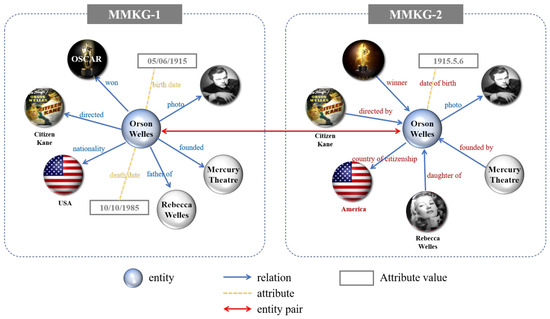
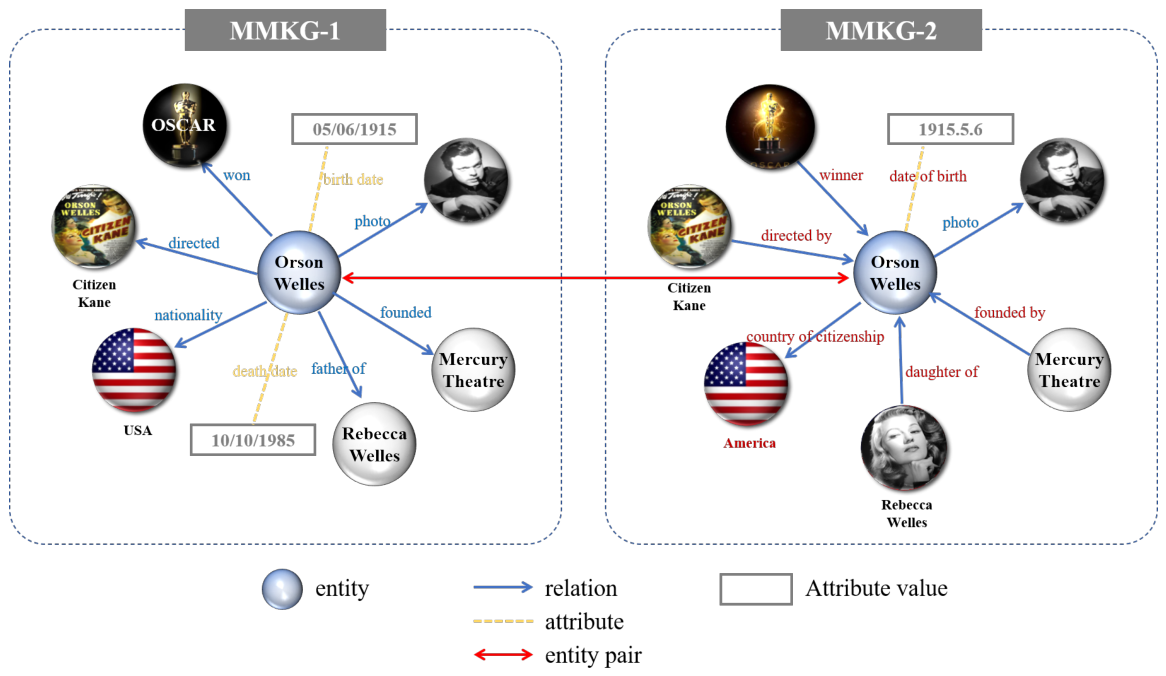
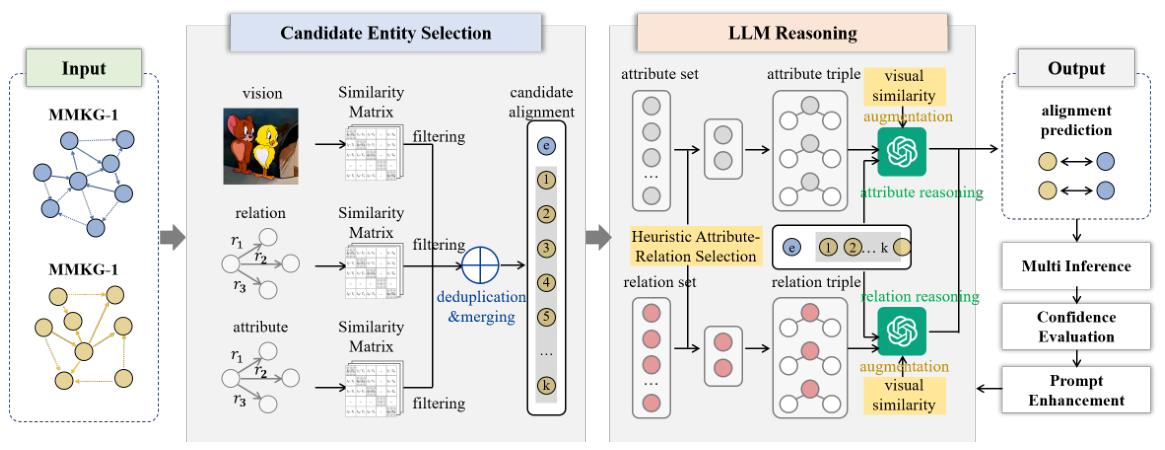
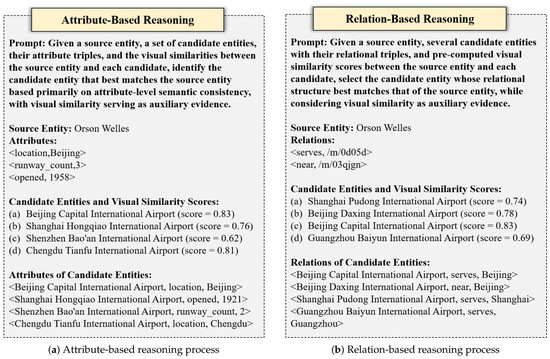
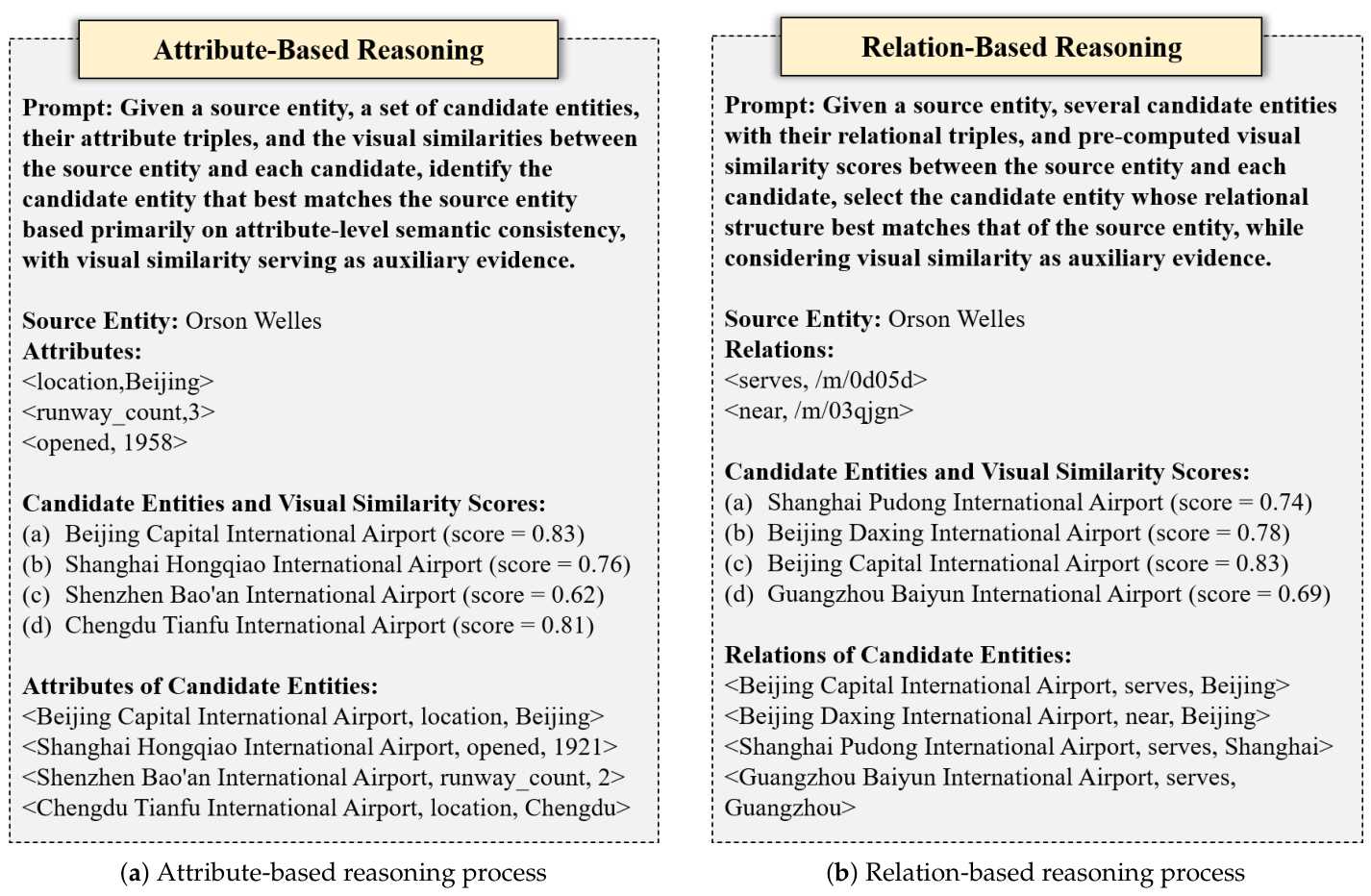
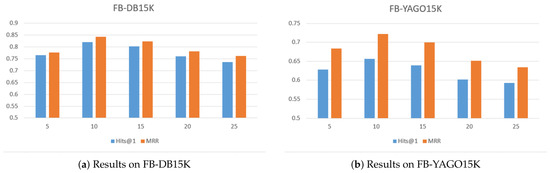
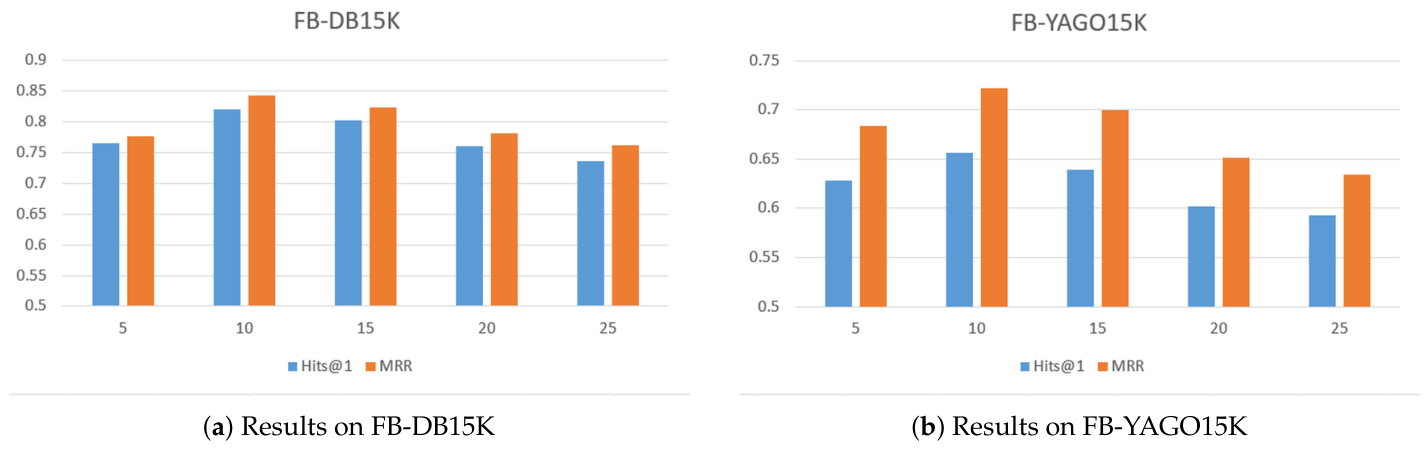
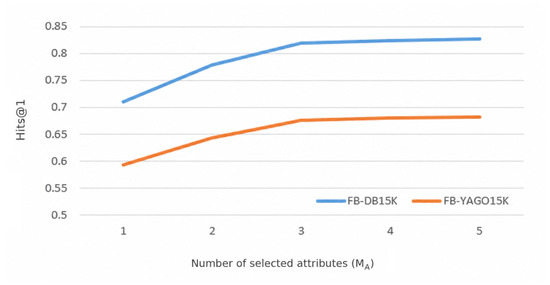
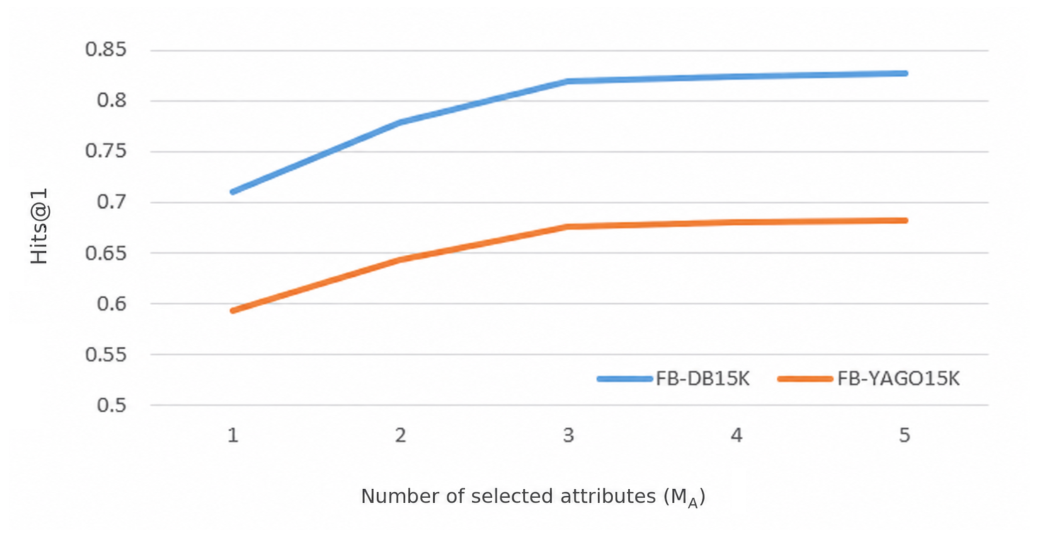
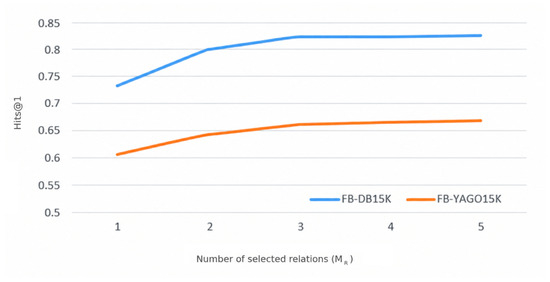
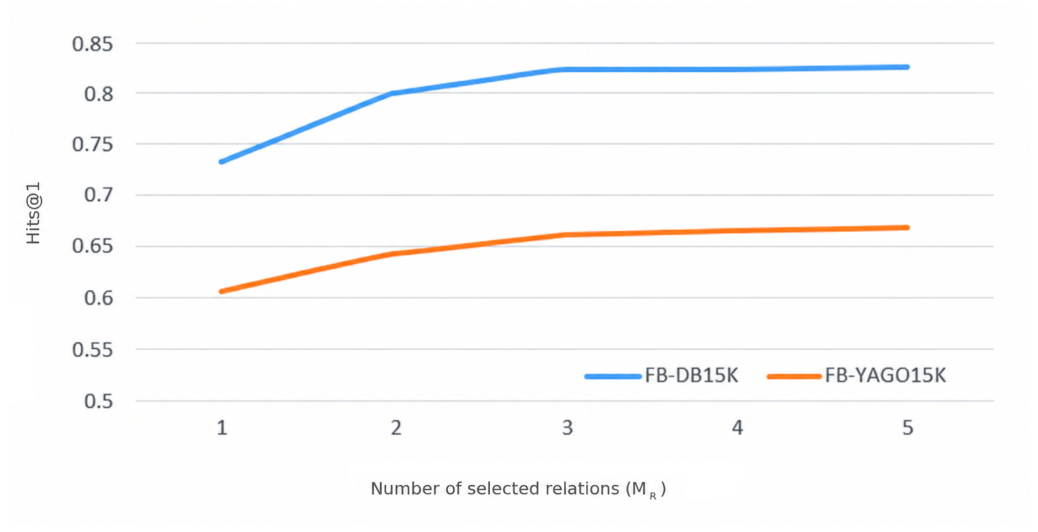
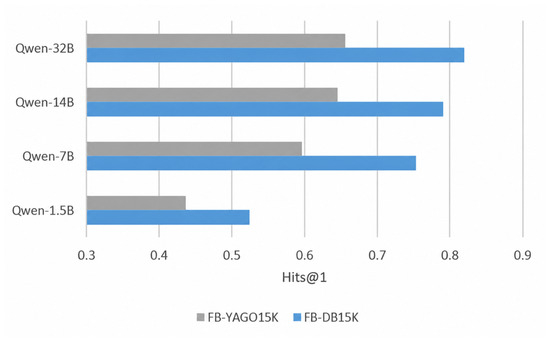
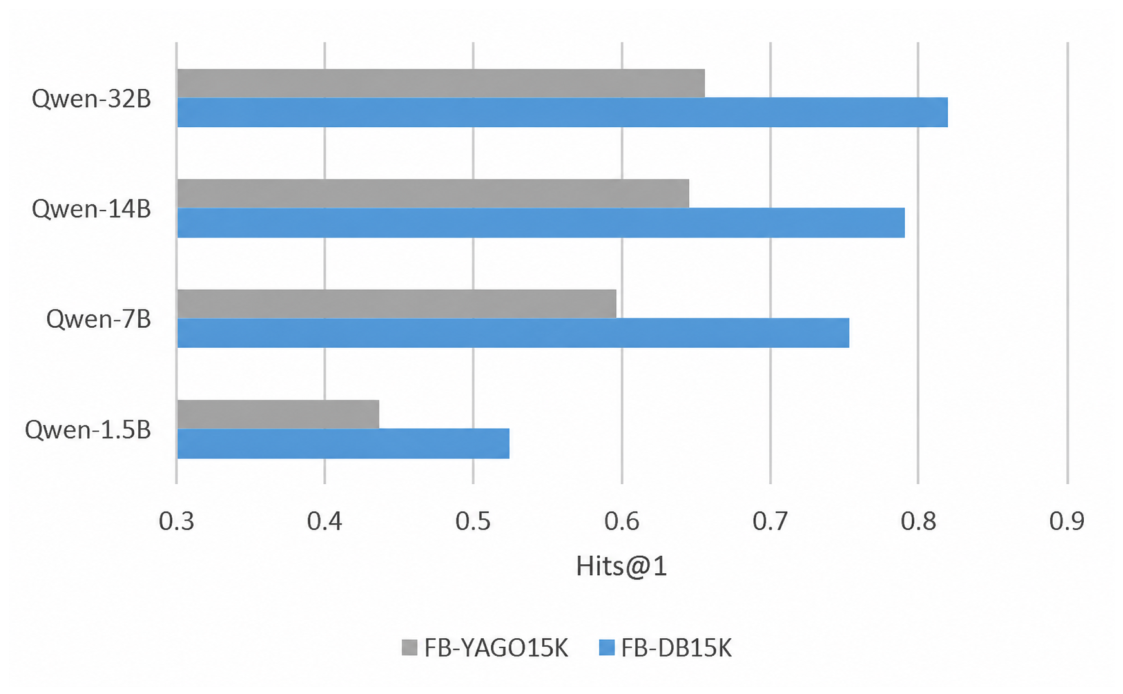

Disclaimer/Publisher’s Note: The statements, opinions and data contained in all publications are solely those of the individual author(s) and contributor(s) and not of MDPI and/or the editor(s). MDPI and/or the editor(s) disclaim responsibility for any injury to people or property resulting from any ideas, methods, instructions or products referred to in the content. |
© 2026 by the authors. Licensee MDPI, Basel, Switzerland. This article is an open access article distributed under the terms and conditions of the Creative Commons Attribution (CC BY) license.