


Abstract
Conventional local planners treat obstacles as uniform geometric entities, regardless of whether an object is deformable, fragile, or a person. This paper presents SOCA (Semantic Object-Class-Aware), a semantic costmap layer for an unmodified Dynamic Window Approach (DWA) planner. Given externally supplied object identity or Semantic Safety Class (SSC) and planar geometry, SOCA converts five navigation-safety attributes into a class-dependent exclusion core and graded cost band. SOCA was compared with DWA and two class-blind baselines in 750 Gazebo runs and 300 physical trials, including 120 logged trials. With one obstacle, SOCA maintained clearances of 0.35, 0.40, and 0.91 m from a plastic bag, glassware, and a mannequin, respectively, compared with 0.23–0.28 m for DWA. With three objects, SOCA maintained greater person-class clearance than DWA in every label permutation (p = 0.002), with 0.3–0.8 s longer traversal times. On the robot, SOCA maintained greater clearance than DWA for every object class in all 30 paired blocks and was faster than the uniform baseline. Forced labels shifted clearance toward the assigned class, and the class ordering was preserved for the tested speed coefficients and enlarged preferred clearances. These results apply to stationary objects with supplied labels; moving entities remain outside the present scope.
1. Introduction
Conventional obstacle-avoidance methods represent obstacles mainly by their position, size, and distance from the robot. Local planners such as the Dynamic Window Approach (DWA) [1], Vector Field Histogram (VFH) [2], and Timed Elastic Band (TEB) [3] generate collision-free motion from geometric and kinematic information. They do not, however, distinguish a deformable package from fragile glassware or a person.
This distinction matters in indoor environments. A light plastic bag may tolerate minor contact, whereas glassware at the same location requires a larger clearance. A person requires greater separation, particularly a child or an older adult. A uniform obstacle cost cannot express these different consequences and may also impose unnecessary detours at every encounter during continuous operation.
SOCA is deliberately perception-agnostic. It assumes that an external source provides an object or track identity, planar pose and extent, and either an SSC label or the corresponding navigation-safety attributes. The source may be a simulator model ID, a semantic map, a QR/ID tag, or a learned detector. This study evaluates how the local planner uses supplied semantic information; the accuracy and latency of acquiring that information are outside its scope.
A useful semantic label must tell the planner what approaching the labeled object implies. Semantic mapping systems such as SemanticFusion [4] and Kimera [5] attach labels to geometry but do not encode the consequences of contact. The Semantic Modeling Framework of Joo et al. [6,7] provides a suitable representation through its Triplet Ontological Semantic Model (TOSM), which separates symbolic identity, sensor-measurable quantities, and implicit knowledge. Its DK-SMF extension [8] can populate the implicit layer from domain knowledge and open-vocabulary perception. SOCA adds navigation-safety properties to this implicit layer and makes them available to the local planner.
This study examines three questions. First, can externally supplied semantic information be incorporated without modifying the local planner? Second, can deformability, fragility, and living status determine different safety margins? Third, how does the resulting behavior compare with geometric, uniformly inflated, and class-blind graded alternatives in simulation and on the physical robot?
The principal contributions of this work are as follows:
(i) A navigation-safety extension of the TOSM implicit model [6,7], comprising deformability, fragility, living status, preferred clearance, and risk weight, from which a three-level Semantic Safety Class (SSC) is derived (an SSC supplied without attributes is resolved to a canonical attribute profile);
(ii) A perception-agnostic semantic input contract that accepts an externally supplied object identity, SSC label or attribute vector, planar geometry, and validity information, thereby separating semantic acquisition from planner evaluation;
(iii) A semantic costmap layer that turns the implicit attribute vector directly into a class-dependent exclusion core and graded cost band, without modifying the trajectory generation of the local planner;
(iv) An explicit, predefined SSC-2 fallback policy for unknown or invalid semantic inputs, together with controlled label-perturbation experiments that characterize the planner-level consequence of an incorrect supplied class;
(v) Two static evaluation designs, a class-swapped single obstacle and a label-permuted in-line arrangement, in a single ROS 1 Noetic (Open Robotics, Mountain View, CA, USA) and Gazebo 11 (Open Robotics) arena and in a matching physical room, on a differentially driven platform, extended by a class-blind graded ablation, a misclassification cost matrix and a parameter sensitivity sweep.
All experimentally evaluated contributions are planner-level contributions. Section 4 supplies oracle labels or controlled label perturbations to isolate the causal effect of class-dependent cost assignment.
2. Related Work
2.1. Geometry-Based Local Obstacle Avoidance
Geometry-based local planners operate on obstacle position, shape, distance, and robot kinematics. DWA [1] samples admissible linear and angular velocities and scores candidate trajectories by path adherence, goal progress, and obstacle clearance. VFH [2] constructs a polar obstacle-density map and steers toward a low-density sector, whereas TEB [3] optimizes a deformable trajectory under kinematic and clearance constraints. None of these methods represents the type of object occupying a region. SOCA uses DWA because DWA already evaluates a costmap: the class-dependent margins can therefore be added without changing trajectory sampling or scoring. The same layer cannot be transferred directly to TEB because TEB evaluates clearance within its own trajectory optimization after extracting obstacle geometry from the costmap. A fair TEB comparison would require a planner-specific semantic obstacle formulation and would not isolate the effect of the SOCA costmap layer. For this reason, TEB was not used as a baseline in Section 4.1.
2.2. Semantic and Object-Aware Navigation
Semantic navigation systems can obtain object labels from image detectors [9], three-dimensional LiDAR detectors [10], or persistent semantic maps such as SemanticFusion [4] and Kimera [5]. Any of these systems could provide upstream input to SOCA. More directly related methods convert semantic information into navigation costs. The Social Type-Aware Costmap (STAC) assigns asymmetric Gaussian personal spaces from human social types and implements them as an ROS costmap layer [11]. MakeWay builds object-aware affordance costmaps from 3D-LiDAR detections for proactive indoor navigation [12]. SOCA instead represents human and non-human objects through one safety-attribute model, maps those attributes to an exclusion core and bounded graded band, and uses a class-blind ablation to distinguish class-dependent margins from graded enforcement.
2.3. Ontological and Domain-Knowledge-Based Environment Modeling
Ontological environment models represent what an object label implies, not only what the label names. The Semantic Modeling Framework of Joo et al. [6,7] introduces TOSM, which separates symbolic identity, explicit sensor-measurable quantities, and implicit knowledge. DK-SMF [8] provides one way to populate the implicit layer using domain knowledge and open-vocabulary perception [13,14,15,16]. SOCA extends this layer with five navigation-safety properties (Section 3.2) and uses them during local planning. Encoding the properties as OWL datatype properties [17] preserves compatibility with other TOSM-based mapping and task-planning modules.
2.4. Motion Prediction and Human-Aware Navigation
A static, identity-dependent margin may be sufficient for a stationary obstacle, but a moving person requires time-dependent clearance. Human-aware navigation addresses this problem with motion prediction. Social-force models [18,19] represent pedestrian motion through attractive and repulsive forces, while learned models such as Trajectron++ [20] predict multimodal trajectories from observation histories. Because a costmap has no time axis, the present SOCA layer cannot represent these predictions. Moving-person behavior is therefore reserved for future work (Section 5.2), and the current evaluation is limited to stationary objects.
Previous work provides semantic labels, social and object-aware cost fields, ontological representations, and motion prediction. The planner-level question addressed here is more specific: can one safety-attribute model generate different margins for deformable objects, fragile objects, and people without changing the local planner? SOCA contributes a mapping from five safety attributes to a two-zone cost field and evaluates that mapping with controlled comparisons against generic inflation and class-blind graded costs. Table 1 compares SOCA with both method families and two directly related systems.
Table 1.
Comparison of SOCA with the surveyed families of obstacle-avoidance and semantic-navigation methods.
3. Materials and Methods
3.1. System Architecture
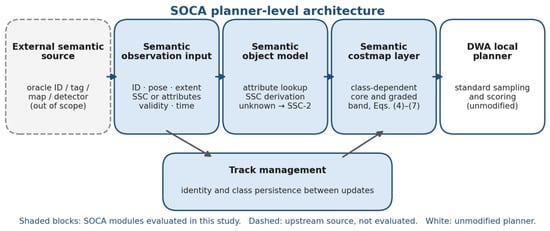
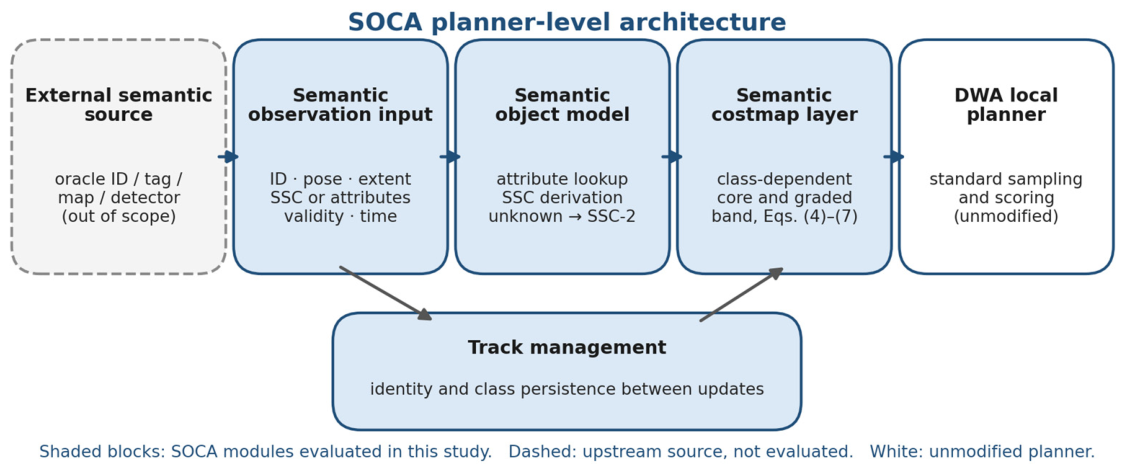
Figure 1 shows the planner-level architecture. An external source supplies object identity or SSC, planar geometry, and validity information. The semantic object model resolves the five navigation-safety attributes and applies the predefined policy for unknown input. The semantic costmap layer converts the attributes into a class-dependent exclusion core and graded band. An otherwise unchanged DWA planner then evaluates its standard objective on the resulting costmap. Track management preserves object identity between semantic updates. The evaluation covers only the SOCA modules to the right of the external-source boundary.
Figure 1.
Planner-level architecture of SOCA and its boundary from external semantic acquisition.
SOCA has five stages, summarized in Figure 1 and Table 2. The external source produces a semantic observation, and the input validator checks its identity, class or attributes, geometry, and validity. The semantic object model returns the resolved attribute vector and SSC. The semantic costmap layer writes the corresponding core and graded band. Finally, DWA-S selects a velocity command using the unchanged DWA trajectory generator and scoring function.
Table 2.
SOCA processing pipeline.
3.2. Semantic Object Model
SOCA represents semantic information with the Triplet Ontological Semantic Model (TOSM) [6,7]. TOSM describes objects, places, and robots through symbolic, explicit, and implicit models. The symbolic model provides a common identifier for robots and people. The explicit model contains measured quantities such as pose, geometry, and image features. The implicit model contains knowledge inferred from models or databases, including facts and relations that cannot be obtained from geometry alone. SOCA places its navigation-safety information in this implicit model.
The original TOSM implicit model includes properties such as isKeyObject, isMovable, isOpen, and canBeOpen [6,7]. These properties describe an object’s role or possible use. Safe navigation instead requires information about the consequences of approaching or touching the object. SOCA therefore adds the five navigation-safety properties listed in Table 3 while retaining the original symbolic and explicit fields. Encoding these properties as OWL datatype properties [17] keeps them compatible with existing TOSM-based mapping and task-planning modules.
Table 3.
Datatype properties of an obstacle as used by SOCA.
The symbolic, explicit, and implicit fields of [6,7] are reproduced unchanged; the five navigation-safety properties and the derived class are introduced in this work.
Two observation-level items are intentionally excluded from Table 3. TOSM represents relations between environmental elements as OWL object properties [6,7], but SOCA neither modifies nor uses those relations. Similarly, confidence supplied by an upstream semantic source describes an observation rather than the object itself and is not stored as a TOSM object property.
TOSM also represents the robot and the place [6,7]. The robot’s explicit velocity provides vrob in Equation (5), and its size defines the footprint used for collision checking and for the clearance metric in Section 4.1. The local planner queries only the navigation-safety properties in Table 3 and does not depend on how the database entries were produced.
The five navigation-safety properties form the attribute vector of Equation (1), which is what the cost function of Section 3.5 consumes:
Here, sdef and sfra are deformability and fragility scores in [0, 1], sliv is a binary living-entity flag, dpref is the preferred added clearance in meters, and αcost is the semantic cost weight. The preferred clearance is expressed as a cost rather than a hard constraint (Section 3.5). The interface permits an attribute vector for each object o. In the reported experiments, however, the attributes were resolved by class and were therefore constant within each class.
When the attribute vector is supplied, the Semantic Safety Class is not an independent label but a coarse summary (Table 4) derived from the same implicit properties, as stated in Equation (2):
Table 4.
Semantic Safety Class definitions.
The attribute vector may be authored from domain knowledge or supplied by an external semantic system. The planner uses the same interface in either case; online attribute extraction is not part of the method evaluated here.
These values are design priors rather than calibrated physical-risk estimates. Section 4.2.5 therefore reports a controlled sensitivity analysis for the preferred-clearance and speed coefficients, and Section 5 limits the interpretation accordingly.
3.3. Semantic Attribute Provision and Scope Boundary
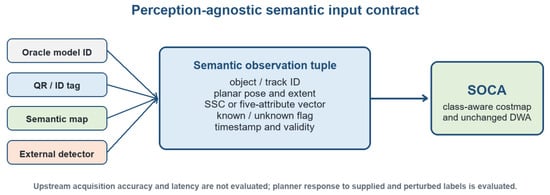
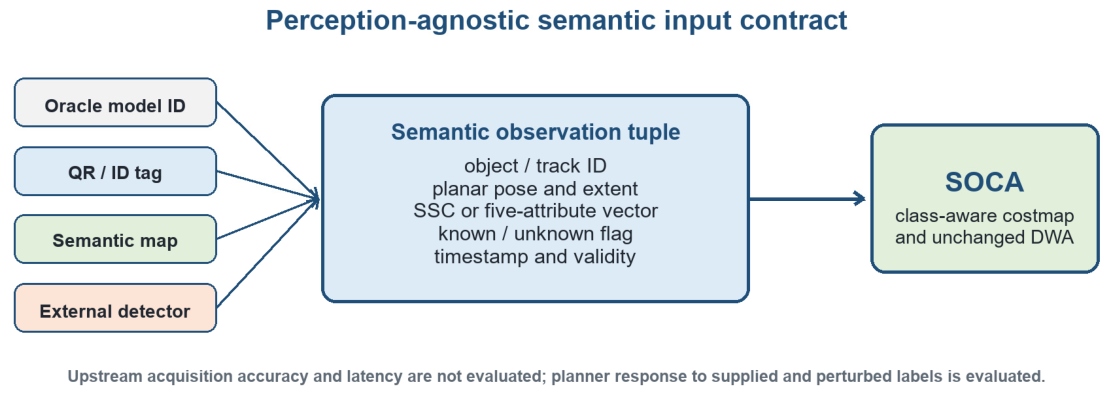
SOCA requires one semantic observation for each tracked obstacle (Figure 2) but does not depend on a specific sensing modality. The observation may come from simulator identity, a pre-registered map, an ID or QR tag, or an external detector. The source must provide a stable object or track ID, planar pose and extent, and either an SSC label or the five-attribute vector in Table 3. If only an SSC is supplied, SOCA uses the most conservative Table 5 entry within that class: unloaded cardboard for SSC-1, electronics or equipment for SSC-2, and a child, older adult, or mobility-impaired adult for SSC-3. The unknown policy uses the SSC-2 profile (deformability 0.05, preferred clearance 0.50 m, and risk weight 0.80). The reported experiments supplied object identity; Section 4.2.4 instead forced other database entries, including the unknown entry. The direct SSC-only input path was therefore not evaluated.
Figure 2.
Perception-agnostic semantic input contract used by SOCA.
Table 5.
Navigation-safety attribute entries used in the reported experiments.
The experiments use the pre-populated attribute entries of Table 5. This isolates the navigation consequence of class-aware costs from the properties of any particular semantic source.
For obstacle o at time t, the common interface is zo(t) = {ido, po, ro, φsaf(o), qo, t}. The fields specify identity, planar position, geometric extent, an SSC or safety-attribute vector, known or unknown validity qo, and a timestamp. Their meaning does not depend on how the upstream system acquired them.
In Gazebo, model identity supplies ido and Table 5 supplies the corresponding class attributes. In the physical round, the known test object and its measured position are entered before each trial. The controlled perturbation experiment in Section 4.2.4 replaces only the assigned SSC while holding geometry and all other conditions fixed.
3.4. Semantic Input Assignment in the Evaluation
The evaluation supplies the semantic tuple directly. Gazebo model names provide persistent object identity and ground-truth poses provide planar geometry; a database lookup maps identity to the attribute vector and SSC in Table 5. This oracle-label protocol isolates the local-planning mechanism.
If identity, class, or validity is unavailable, the input validator assigns the SSC-2 fallback profile defined in Section 3.3. Section 4.2.4 separately forces each true object to each possible SSC, producing a planner-level cost matrix for wrong labels.
In Equation (3), ido is the persistent object or track identifier, po and ro are planar position and extent, φsaf(o) is either the SSC or the five-attribute vector, qo denotes known/unknown validity, and t is the observation timestamp.
For the static living-class case, the same assignment rule is used as for other stationary objects: the supplied identity selects the SSC-3 attribute entry, and the semantic costmap applies the largest margin.
3.5. Semantic Costmap Layer
SOCA leaves the local planner’s trajectory generation unchanged. A semantic layer writes the class-dependent margins into the costmap, and the planner’s existing obstacle-cost function reads the resulting values. This representation is suitable for stationary objects because their margins do not depend on arrival time. A moving person’s future position is time-dependent and cannot be represented by the static costmap used here; that case is deferred to Section 5.2.
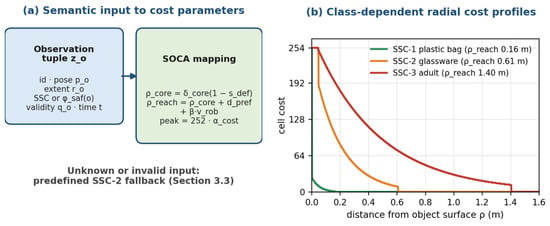
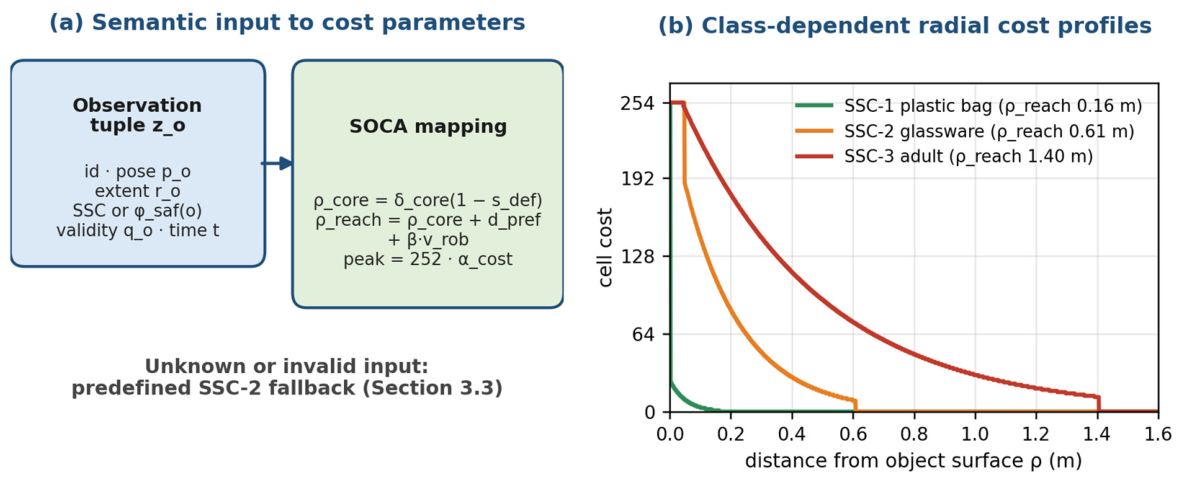
Two radii are defined for an obstacle o, both measured from the object surface. Equation (4) gives the physical exclusion core and Equation (5) gives the reach of the graded band (Figure 3).
Figure 3.
(a) Common semantic input mapped to SOCA cost parameters; (b) illustrative SSC-dependent radial cost profiles of Equation (6) before the inflation layer is applied.
In Equations (4) and (5), δcore = 0.05 m is the rigid-body exclusion buffer, sdef is the deformability score in Table 5, dpref is the preferred clearance, and β = 0.20 s converts the robot speed vrob into an additional margin. Deformability reduces the core: a plastic bag (sdef = 0.95) retains a 3 mm core, whereas glassware (sdef = 0.02) retains almost the full buffer. The equations omit the robot radius because the planner already checks the complete footprint; adding the radius again would count it twice. The implementation measures both radii from the object’s circumscribed circle because each object is supplied as a pose and bounding radius rather than a polygon. For the objects used here, this approximation can overestimate the local surface distance by about 0.08 m. The semantic layer is added to the existing obstacle and inflation layers, so it can only increase geometric cost. The inflation layer also makes the lethal boundary compatible with the robot footprint. Section 4.1 uses the same circumscribed geometry to calculate clearance. A small negative clearance therefore indicates penetration of this geometric approximation, not necessarily physical contact; contact is reported separately.
The layer writes the cell values of Equation (6), with the decay constant of Equation (7).
In Equations (6) and (7), ρ is the distance from the cell to the object surface, αcost ∈ [0, 1] is the class risk weight in Table 5, and ε = 0.05 is the fraction of the peak cost remaining at the outer edge. The parameter bmin = 0.02 m bounds the decay constant for narrow bands but does not create a band. Thus, the band has zero width when dpref = 0 and the robot is stationary. The implementation also writes cost 252 in a 0.28 m ring immediately outside the core. In the reported configurations, the inflation layer runs afterward and overwrites this ring with its inscribed cost of 253, so the ring does not change the final costmap. It would affect only a stack without an inflation layer. Overlapping objects are combined by taking the maximum cell cost. Because Equation (5) depends on vrob, the semantic costs are updated at every costmap cycle.
Equation (6) has two important properties. The parameters αcost and dpref set the amplitude and reach of the graded band directly. In addition, the band is capped at 252, below the inscribed and lethal values of 253 and 254. The graded band therefore expresses a preference and cannot by itself invalidate a trajectory; only the core in Equation (4) can do so. This distinction allows a corridor to remain traversable even when a large pedestrian margin covers much of its width.
The semantic layer is also monotonic and non-clearing. It is max-composed with the geometric obstacle layer, so it can raise a cell’s cost but cannot make the cell cheaper than it would be under default DWA. In all reported layouts, the executed SOCA trajectories likewise maintained clearance at or above that of default DWA. A future subtractive formulation could introduce a traversable class, SSC-0, by clearing geometric costs over an object considered safe for controlled contact, such as an empty plastic bag. Such a design would carry an asymmetric risk: overestimating a hazard causes a detour, whereas a false traversable label can permit collision. The present non-clearing formulation therefore preserves the underlying geometric obstacle cost regardless of semantic-label accuracy. Section 5 discusses the additional validation that SSC-0 would require.
3.6. Track Management for Class Persistence
Track management maintains a persistent ID, geometry estimate, and supplied class between semantic updates. When an update is stale or invalid, the track transitions to the predefined unknown policy rather than retaining an unverified lower-risk class indefinitely.
The present implementation uses only stationary tracks. A confirmed SSC-3 track with speed at or below vstill receives the margin in Section 3.5 at its current position, as do SSC-1 and SSC-2 objects. A moving person requires prediction at the robot’s arrival time, which the static costmap cannot represent. Section 5.2 outlines a possible constant-velocity predictor and stop-observe-resume policy, but neither component is part of the evaluated system.
4. Experiments
4.1. Robot Platform, Simulation Environment and Experimental Design
ROS 1 Noetic was used because the target platform and its experimental stack are built on costmap_2d.
For every evaluated run, the object class was provided as an experimental input: Gazebo model identity in simulation and the known staged object in the physical round. Thus, the reported endpoints measure the behavior of the class-aware local planner conditional on a supplied class.
All experiments use a 6.3 m × 9.9 m arena without interior structures, matching the usable free space of the physical test room. The start pose is (3.15, 0.6) m, and the goal is (3.15, 9.2) m, giving an 8.6 m centerline route. The start lies outside both the south wall’s inflation band and the largest object margin used by any planner: the 1.705 m uniform core around the first object in Design II. Thus, no planner starts inside a cost band. Table 6 summarizes what changes and what remains fixed in the two experimental designs.
Table 6.
Evaluation designs.
The designs answer complementary questions and are analyzed separately. Design I tests whether the margin changes with the object class. Design II tests whether label assignment, rather than obstacle geometry, produces the change. A single obstacle gives Design I greater separation between classes. Design II places all three classes in one corridor, where the largest margin influences the path around the other objects.
The largest possible reach constrains the geometry of both designs. At the maximum platform speed in Table 7, Equation (5) gives ρreach = 1.705 m for the most demanding Table 5 entry. The uniform baseline applies this value as a lethal core around every object. The inflation layer adds a 0.28 m inscribed band, so the footprint center cannot enter a region extending 1.985 m from the object’s circumscribed surface. In Design II, the three objects are located at y = 3.25, 4.95, and 6.65 m with 1.7 m spacing. The resulting region extends to y = 1.015 m below the first object and y = 8.885 m above the last. The chosen start and goal positions leave 0.415 m and 0.315 m, respectively, beyond these regions.
Table 7.
SOCA framework parameters.
Each object is placed on the corridor centerline so that the planner must deviate from the direct path. In preliminary layouts with laterally offset objects, the direct path remained outside every graded band and did not distinguish the planners. The offline concept illustrations in Section 4.2 are therefore used to select a pilot layout that reveals class-dependent behavior. The limitations of this discriminability-tuned design and the need for held-out layouts are discussed in Section 5.4.
The simulation therefore represents a controlled planner experiment. Geometry, labels, and object placement are known, allowing the effect of class-dependent cost assignment to be separated from localization and semantic-acquisition errors.
In the physical round, each staged object was assigned its Table 5 entry before the trial and the object position was measured in the map frame. This preserves the same conditional evaluation as in simulation while testing whether the planned qualitative behavior transfers to the robot platform.
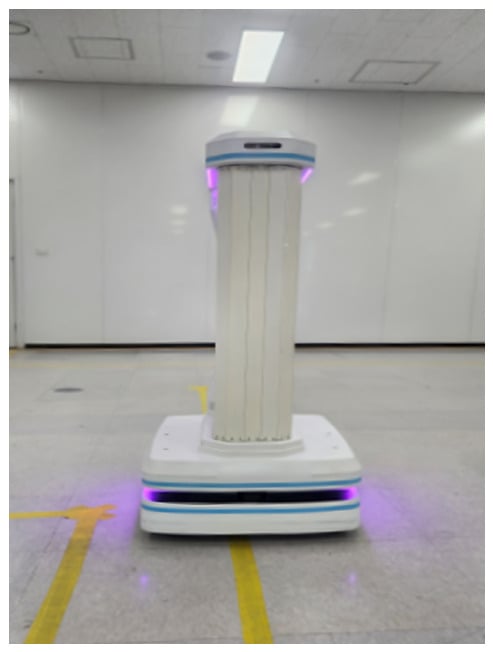
The platform of Figure 4 is a differentially driven mobile robot developed in-house with a planar LiDAR, a single front-facing camera, and ultrasonic rangefinders, shown on the floor of the test room. The platform identifier visible on the chassis in the source photograph has been redacted.
Figure 4.
The physical-round platform.
For the physical experiments, the class and position of each staged object were specified before each trial, following the same protocol used in simulation. This enabled a consistent evaluation of the class-dependent behavior of SOCA on the robot platform.
Three baselines are compared with SOCA. Default DWA uses dwa_local_planner with the platform parameters in Table 7 and the standard obstacle and inflation layers; the local inflation radius is 0.6 m with a cost-scaling factor of 8. The uniform baseline adds the same lethal core around every object. Its radius is 1.705 m, obtained from Equation (5) for the most demanding Table 5 entry at the maximum platform speed: a 0.045 m core, 1.50 m preferred clearance, and 0.16 m speed term. The Uniform-graded baseline instead assigns every object the most conservative Table 5 profile and applies the same 1.705 m nominal reach as a graded band. Comparing the two uniform baselines measures lethal versus graded enforcement, including the larger effective support created when the inflation layer processes a lethal core. Comparing Uniform-graded with SOCA measures the contribution of class-dependent attributes. All four configurations use the same DWA implementation, parameters, and geometric costmap. In this paper, “default DWA” refers to the platform configuration without the semantic layer, not to the ROS package’s stock parameters. The inflation layer runs after the semantic layer in all four configurations. STAC [11] was also evaluated in Design I as a human-aware reference. Its published age-based layer replaced the SOCA layer and received only the adult person track because STAC represents social types of people rather than general object classes. TEB [3] was not evaluated because it would require a planner-specific semantic obstacle formulation and would not directly consume the graded scalar field used by SOCA.
The evaluation uses four metrics. In Gazebo, contact is a contact-sensor event; on the physical robot, which has no contact sensor, the operator observed every run. Clearance is the minimum surface-to-surface distance between the robot footprint and an object. Path efficiency is the shortest collision-free path length in the static map divided by the executed path length, so values below one indicate a longer route. Completion means reaching the goal within the fixed timeout. Design I uses 20 seeds for each planner-world cell, and Design II uses 10. Each seed represents an independent restart of Gazebo and the navigation stack. Results are reported as means and standard deviations. The planners are paired by seed within each world and metric. Comparisons use two-sided Wilcoxon signed-rank tests, rank-biserial correlations, and bootstrap 95% confidence intervals for paired median clearance differences. All statistics were computed in Python 3.13 (Python Software Foundation, Wilmington, DE, USA) with SciPy 1.18. The primary endpoint is SOCA’s minimum clearance relative to the uniform baseline. Secondary endpoints comprise time and path efficiency against the uniform baseline and all three metrics against default DWA and Uniform-graded. Holm correction is applied to these secondary comparisons within each world, although the tables show unadjusted p-values. Every significance statement in Section 4.2 remains significant after adjustment. Timed-out runs count as incomplete and are excluded from clearance and efficiency statistics, with exclusions reported.
Per-object attribute values are given in Table 5; this table lists the parameters that are common to all objects.
The preferred-clearance and speed coefficients that directly set the margin are evaluated in the sensitivity analysis of Section 4.2.5. The remaining values are design settings chosen for the reported arena; Section 4.2.5 shows which of them the results depend on.
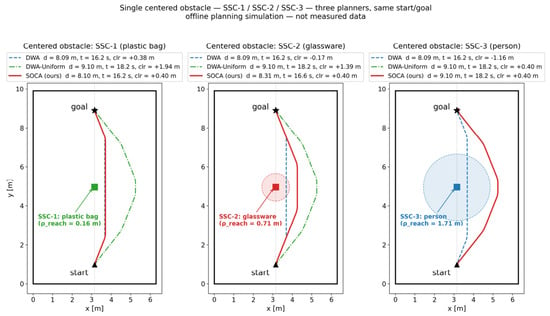
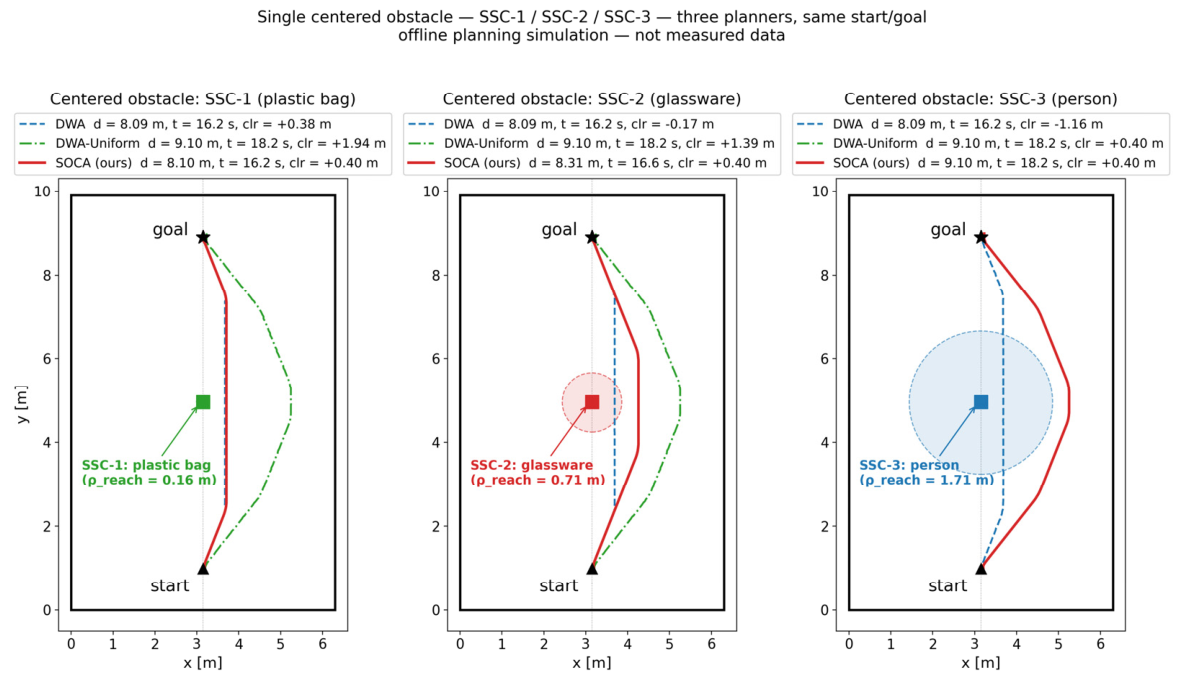
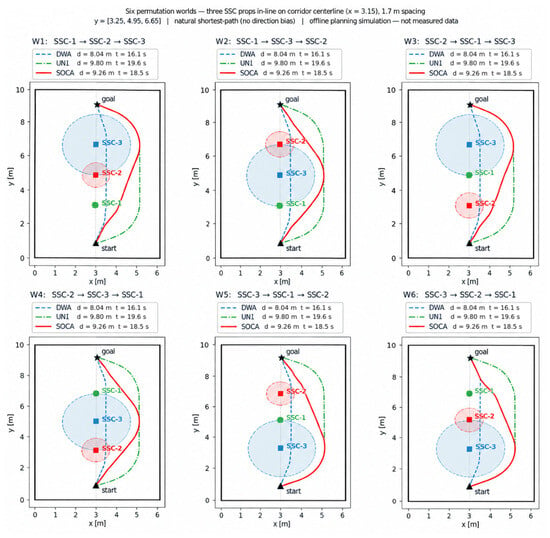
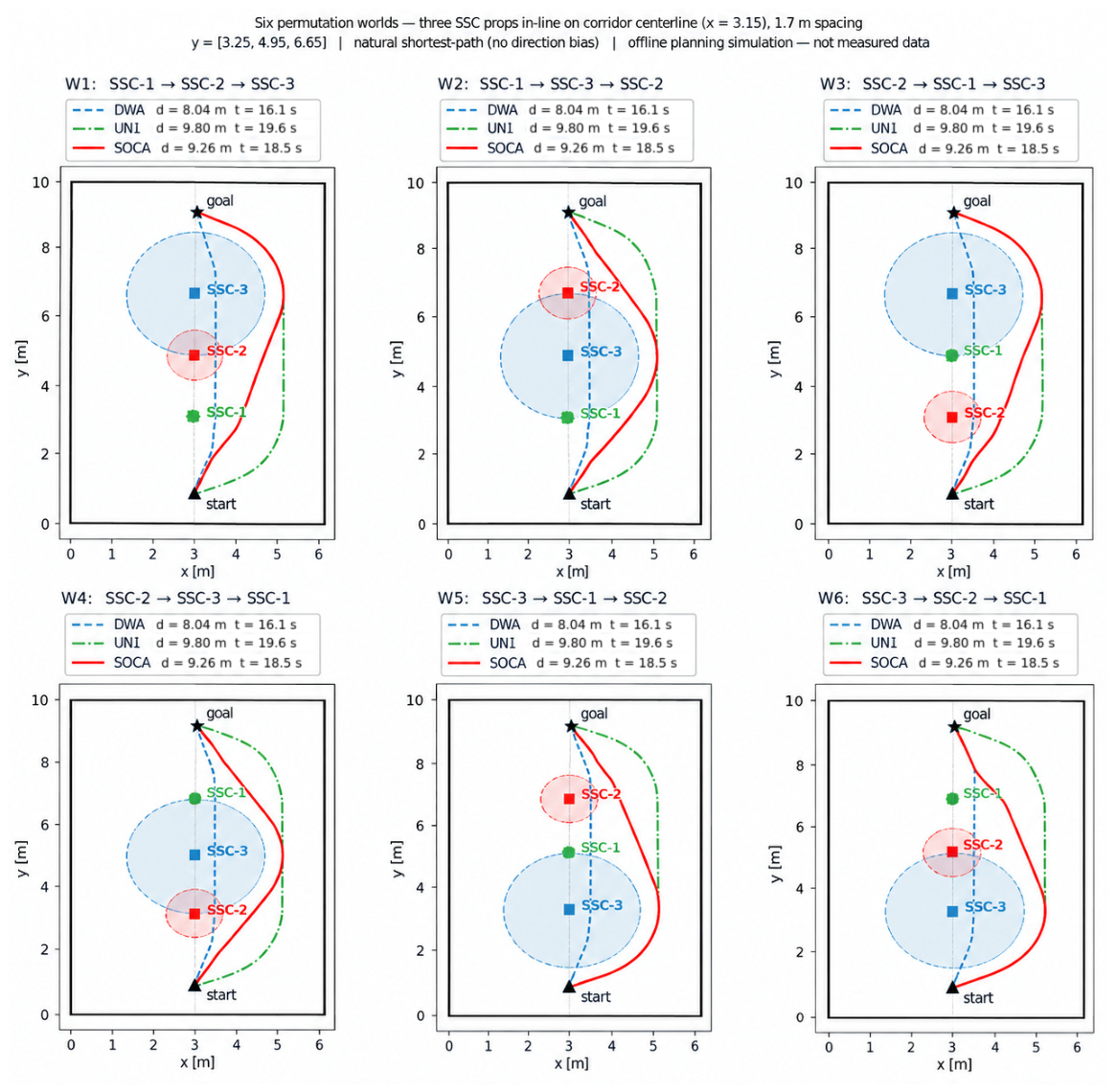
Figure 5 and Figure 6 illustrate three visually distinct configurations: default DWA, the uniformly inflated lethal baseline, and SOCA. The class-blind Uniform-graded ablation is omitted from these conceptual diagrams for clarity but is included in every quantitative comparison.
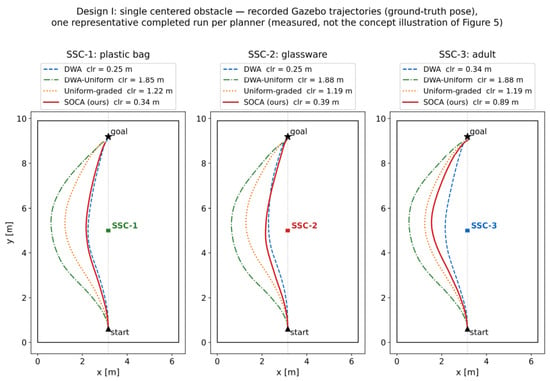
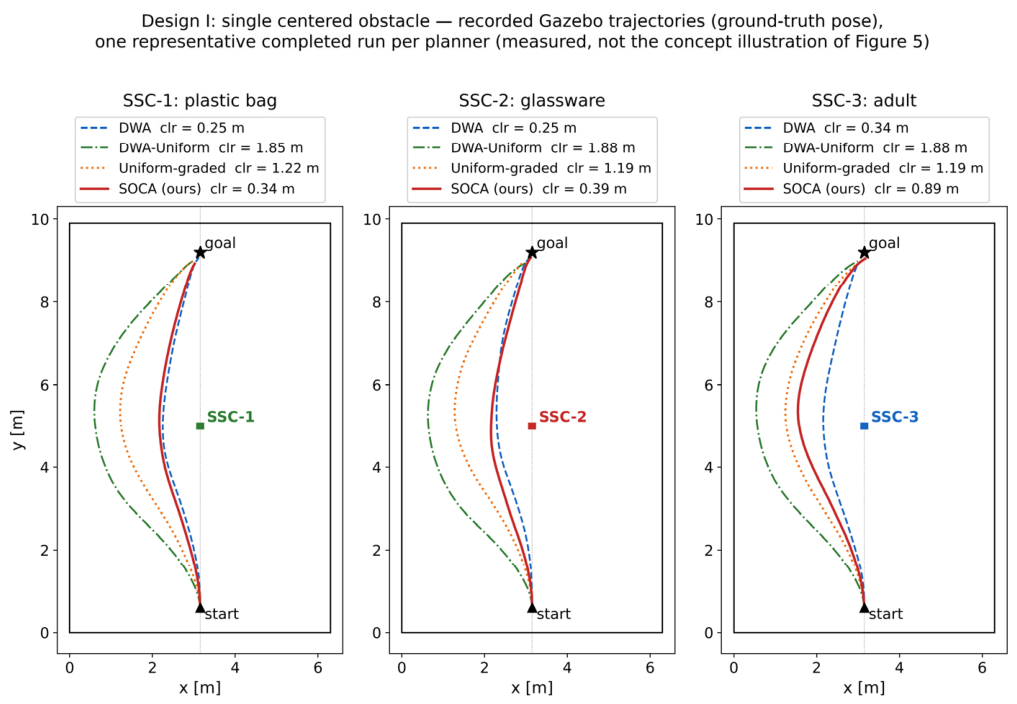
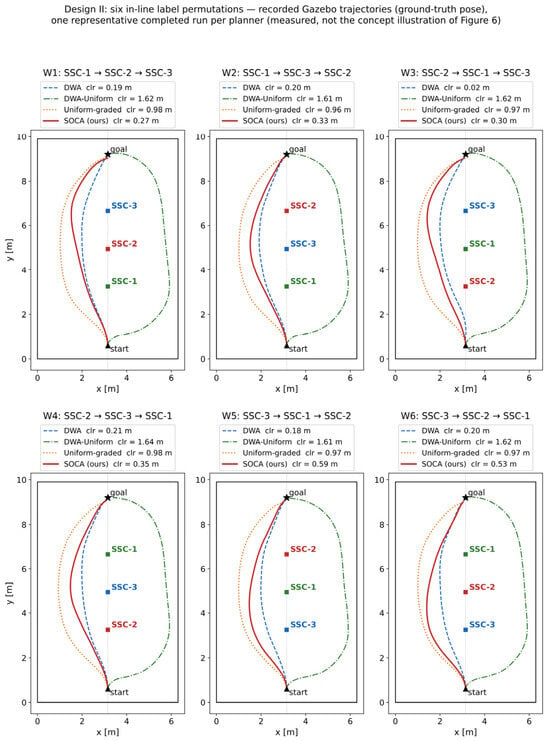
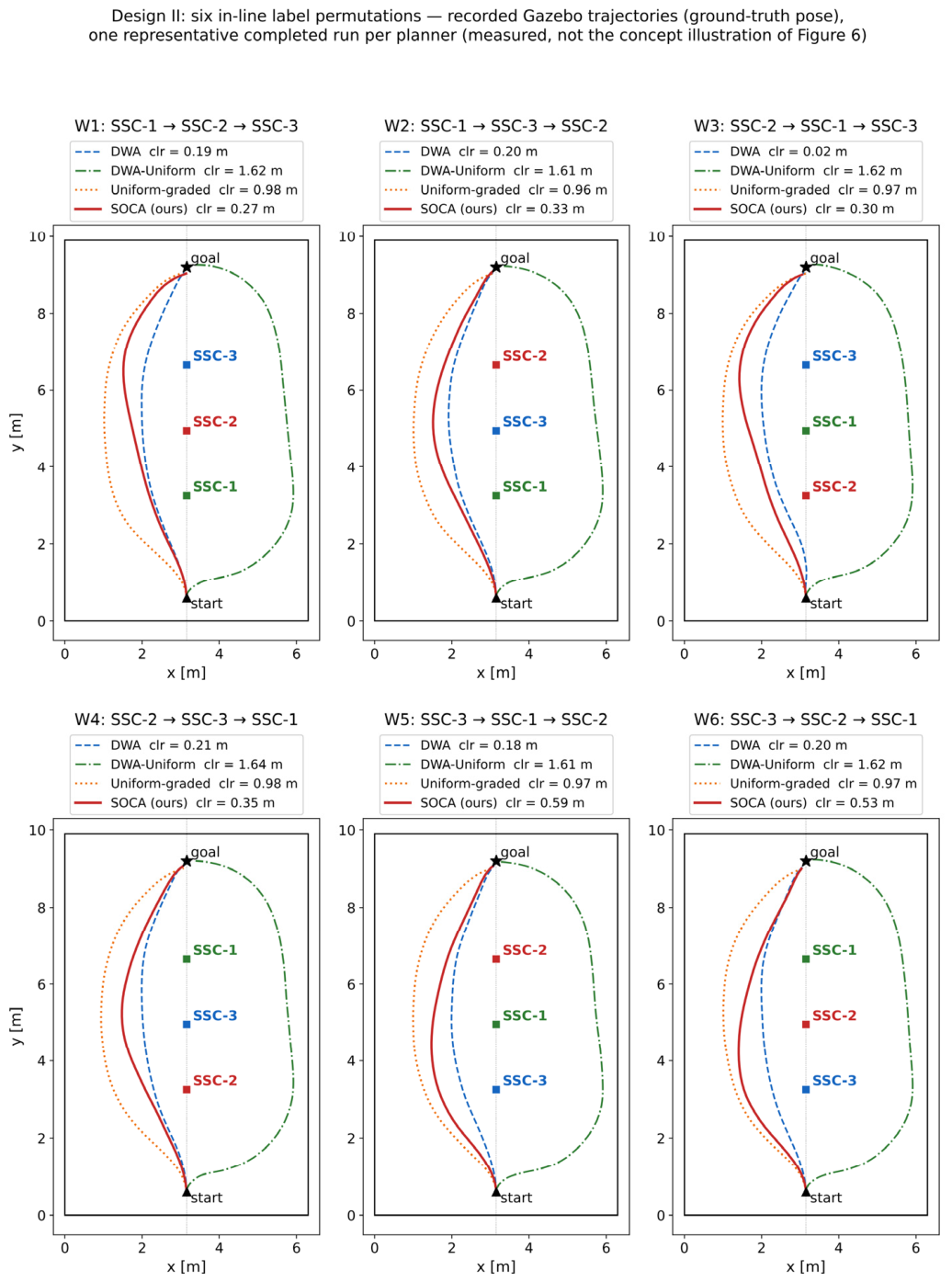
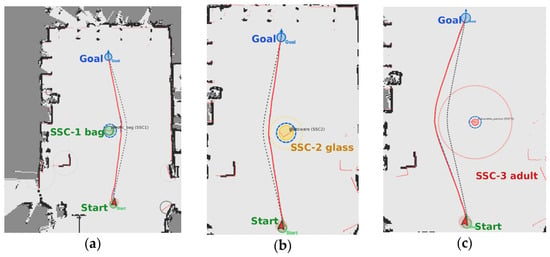
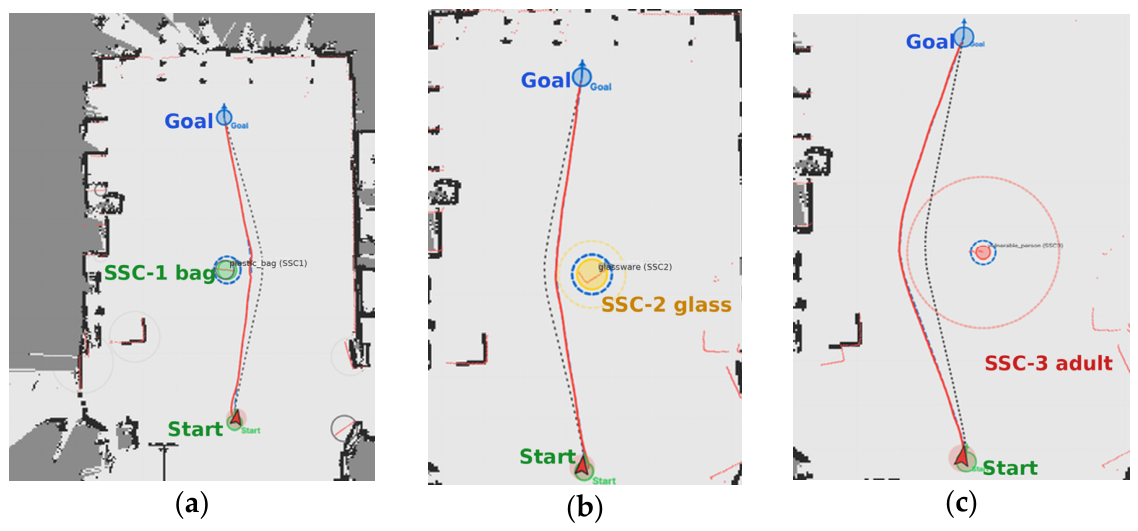
Figure 5 and Figure 6 illustrate the expected behavior in Designs I and II, respectively, whereas Figure 7 and Figure 8 show representative trajectories recorded in the corresponding Gazebo experiments. Table 8, Table 9 and Table 10 provide the four-planner quantitative results, including the Uniform-graded baseline.
Figure 7.
Design I, Gazebo round: representative trajectories.
Figure 8.
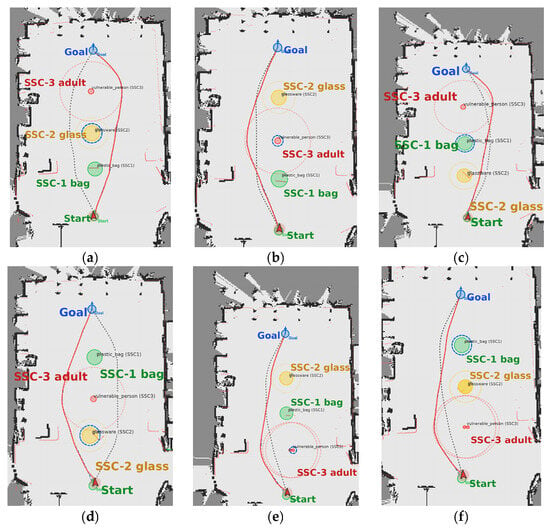
Design II, Gazebo round: representative trajectories.
Table 8.
Design I, Gazebo round. UG = Uniform-graded; STAC = STAC [11] with its published default parameters (its comparison with SOCA is reported in the text).
Table 9.
Design II, Gazebo round.
Table 10.
Design II, Gazebo round: per-object ground-truth clearance.
Planning rollouts past three collinearly placed obstacles on the corridor centerline at y = 3.25, 4.95 and 6.65 m are shown, over the six orderings of the three classes. The obstacle poses are identical in all panels and only the labels are permuted, so the two illustrated baselines are invariant across panels while the SOCA trajectory is not. Because every permutation contains an SSC-3 object, the achievable path length is dominated by that class and the per-class spread is smaller than in Figure 5.
4.2. Results
Section 4.1 specifies the full evaluation. The four-planner comparison covered three Design I worlds with 20 seeds per planner and six Design II worlds with 10 seeds, for 480 Gazebo runs. The 120 Uniform-graded runs were executed as a separate batch with the same worlds and seeds. Label perturbation and sensitivity testing added 210 Design I runs, and the STAC comparison added 60 runs, giving 750 simulated runs. All planners used the Table 7 parameters, a nominal 20 Hz controller setting, and the same containerized environment. Oracle labeling left no object unclassified by construction. Simulation clearance and trajectories use ground-truth pose; the AMCL estimate differed by up to 0.37–0.44 m within a run and was recorded separately. Gazebo results are analyzed by world. Section 4.2.3 reports the physical results and an exploratory aggregate test across its 30 paired blocks.
4.2.1. Gazebo Round, Design I: Single Obstacle, Class Swapped
Table 8 reports the four Design I metrics. Figure 5 and Figure 7 show the same geometry but serve different purposes. Figure 5 illustrates the expected behavior using the platform parameters of Table 7, whereas Figure 7 shows one recorded Gazebo trajectory per planner. Their agreement is therefore an experimental result. Every planner completed all 20 runs in each world. Stalls, defined as no progress for 10 s, occurred only in the class-blind baselines: two uniform runs in the glassware world and seven Uniform-graded runs across the plastic-bag and adult worlds. No contact occurred, and every ground-truth clearance remained above the geometric contact threshold. The comparison therefore focuses on clearance, traversal time, and path efficiency.
Table 8 reports mean ± SD over 20 seeds. The p-values and rank-biserial correlations compare seed-matched pairs with two-sided Wilcoxon signed-rank tests. The text also reports bootstrap 95% confidence intervals for paired median clearance differences and the SOCA versus Uniform-graded comparison. Ground-truth clearance is measured from the robot footprint circumradius rrob (Table 7) to the object’s circumscribed surface. The comparison with Uniform is the primary endpoint. UG denotes the Uniform-graded baseline.
The class ordering predicted in Section 3.5 appeared in all three worlds. For SSC-1, SOCA increased minimum clearance over default DWA by 0.10 m (95% CI 0.05–0.16, p < 0.001, r = 0.98) without a measurable change in time (p = 0.911) or path efficiency (p = 0.784). The uniform baseline added 1.49 m of clearance but reduced path efficiency by 0.14 and added 1.80 s. Uniform-graded achieved 1.20 m, between Uniform and SOCA, with a paired SOCA–Uniform-graded median difference of −0.85 m (p < 0.001, r = −1.00). For SSC-2, SOCA increased clearance over DWA by 0.09 m (95% CI 0.07–0.17, p < 0.001, r = 0.96) and reached the 0.40 m preferred clearance on average. Its time and path-efficiency differences from DWA were 0.04 s and −0.004. Uniform-graded achieved 1.19 m. For SSC-3, SOCA increased clearance over DWA by 0.65 m (95% CI 0.62–0.68, p < 0.001, r = 1.00), while adding 0.99 s and reducing path efficiency by 0.068. Uniform added another 0.93 m of clearance but required 0.97 s more than SOCA and reduced path efficiency by a further 0.086. Uniform-graded again achieved 1.19 m; its smaller gap from SOCA in this world reflects the similarity between the adult preferred clearance (1.20 m) and the 1.705 m uniform reach. Overall, SOCA clearance increased from SSC-1 to SSC-3 (0.35, 0.40, and 0.91 m), whereas DWA remained between 0.23 and 0.28 m and Uniform remained between 1.84 and 1.86 m. Figure 7 shows one representative completed run per planner, selected by the path length closest to that planner’s median. The legend reports path length, traversal time, and minimum clearance.
STAC [19] was evaluated on the same Design I worlds and seeds with the authors’ published parameters. All 60 runs were completed without contact. For the plastic bag and glassware, STAC remained close to default DWA (0.25 and 0.27 m) because it represents social types of people rather than general object classes. SOCA exceeded STAC on glassware in every seed (paired median difference +0.13 m, p < 0.001, r = 1.00). For the mannequin, STAC increased clearance to 0.67 m, compared with 0.26 m for DWA and 0.91 m for SOCA. It also incurred less time and path-efficiency cost than SOCA (20.3 s and 0.966 versus 21.1 s and 0.935). Because the size of each method’s person margin is a design choice, this comparison concerns representational scope rather than the superiority of one margin value. STAC protects a recognized person, whereas SOCA also distinguishes fragile and deformable non-human objects.
4.2.2. Gazebo Round, Design II: Three Obstacles, Labels Permuted
Table 9 reports results for the six label permutations in Design II. All 240 runs were completed. The three class-blind baselines showed no label-dependent pattern, as expected from the fixed geometry. Across worlds, DWA’s pooled minimum clearance ranged from 0.14 to 0.18 m and its traversal time from 20.2 to 20.5 s. Uniform ranged from 1.61 to 1.62 m and 24.6 to 25.7 s. Uniform-graded ranged from 0.96 to 0.98 m and 21.5 to 21.8 s, except for one slow seed that increased the W6 time to 24.3 ± 7.9 s. These ranges are descriptive consistency checks, not equivalence tests. The uniform baseline achieved 1.6–2.1 m clearance from every object, but its path efficiency was 0.75 compared with 0.97 for DWA. It added 2.5 m of path and 4.0–5.3 s because the three 1.705 m cores left only the two corridors along the walls.
Values are mean ± SD over 10 seeds per world; statistics are as in Table 8. Clearance is the ground-truth minimum over all three objects. Worlds are identified by the class ordering along the corridor from the start pose.
SOCA maintained greater clearance from the SSC-3 object than default DWA in all six worlds (Table 10). The paired median differences ranged from +0.44 to +0.59 m, with p = 0.002 and r = 1.00 in each world. Across permutations, SOCA maintained 0.91 ± 0.11 m (range 0.72–1.05), whereas DWA maintained 0.36 ± 0.16 m (range −0.05–0.57). Thus, the smallest SSC-3 clearance under SOCA exceeded the largest under DWA. DWA clearance varied with object position; SOCA imposed a label-dependent lower range. SOCA also exceeded DWA for SSC-2 in every world (median differences +0.10 to +0.53 m) and for SSC-1 (+0.09 to +0.53 m). The SSC-1 difference partly reflects the detour created by the SSC-3 object in the same corridor. Accordingly, SOCA’s pooled minimum clearance exceeded DWA’s in all six worlds by +0.09 to +0.45 m and remained 1.0–1.4 m below Uniform (p = 0.002). Uniform-graded lay between Uniform and SOCA, with pooled clearance of 0.96–0.98 m and path efficiency of 0.86–0.87, compared with 0.92–0.94 for SOCA. Its per-object clearance depended on position rather than label. Relative to DWA, SOCA reduced path efficiency by 0.037–0.047, corresponding to 0.32–0.45 m of additional path, and added 0.3–0.8 s. Figure 8 shows one representative trajectory per planner in each permutation, selected as in Figure 7. The two wall-side routes are geometrically equivalent, so the side chosen by the uniform baseline is a global-planner tie-break and does not affect the reported metrics.
Table 10 separates the pooled minimum in Table 9 into clearance from each object. This view makes the label effect visible because the pooled minimum is determined by the closest pass, which for SOCA is usually a lower-class object. The table reports mean ± SD over 10 seeds for DWA, Uniform-graded, and SOCA, together with the paired SOCA–DWA median difference, bootstrap 95% confidence interval, Wilcoxon p-value, and rank-biserial correlation. Uniform is omitted because it maintained 1.6–2.1 m from every object. Uniform-graded provides a class-blind reference: its clearance depended on corridor position and remained unchanged when labels were permuted, whereas SOCA clearance followed the assigned class.
4.2.3. Physical Round
The physical evaluation repeated both designs on the target robot in the room described in Section 4.1. It comprised 300 runs in two parts. The qualitative part used SOCA and default DWA in both designs for 180 trajectory-only runs. The quantitative part used all four planners in Design II for 120 runs with per-trial logging. Before each trial, the plastic bag, glassware, and mannequin were assigned the corresponding Table 5 entries for plastic bag, glassware, and adult pedestrian.
In the qualitative part, every planner-world cell was repeated 10 times, and all 180 runs reached the goal. Figure 9 and Figure 10 show representative trajectories overlaid on the room’s SLAM map. Per-trial clearance, time, and path efficiency were recorded only in the quantitative part and are reported in Table 11.
Figure 9.
Design I, physical round. (a) Plastic bag (SSC-1): SOCA passes near-tangentially, comparable to default DWA. (b) Glassware (SSC-2): SOCA takes an intermediate detour that respects the preferred-clearance ring. (c) Adult mannequin (SSC-3): SOCA takes the widest detour of the three, skirting the SSC-3 band, while default DWA passes at close range.
Figure 10.
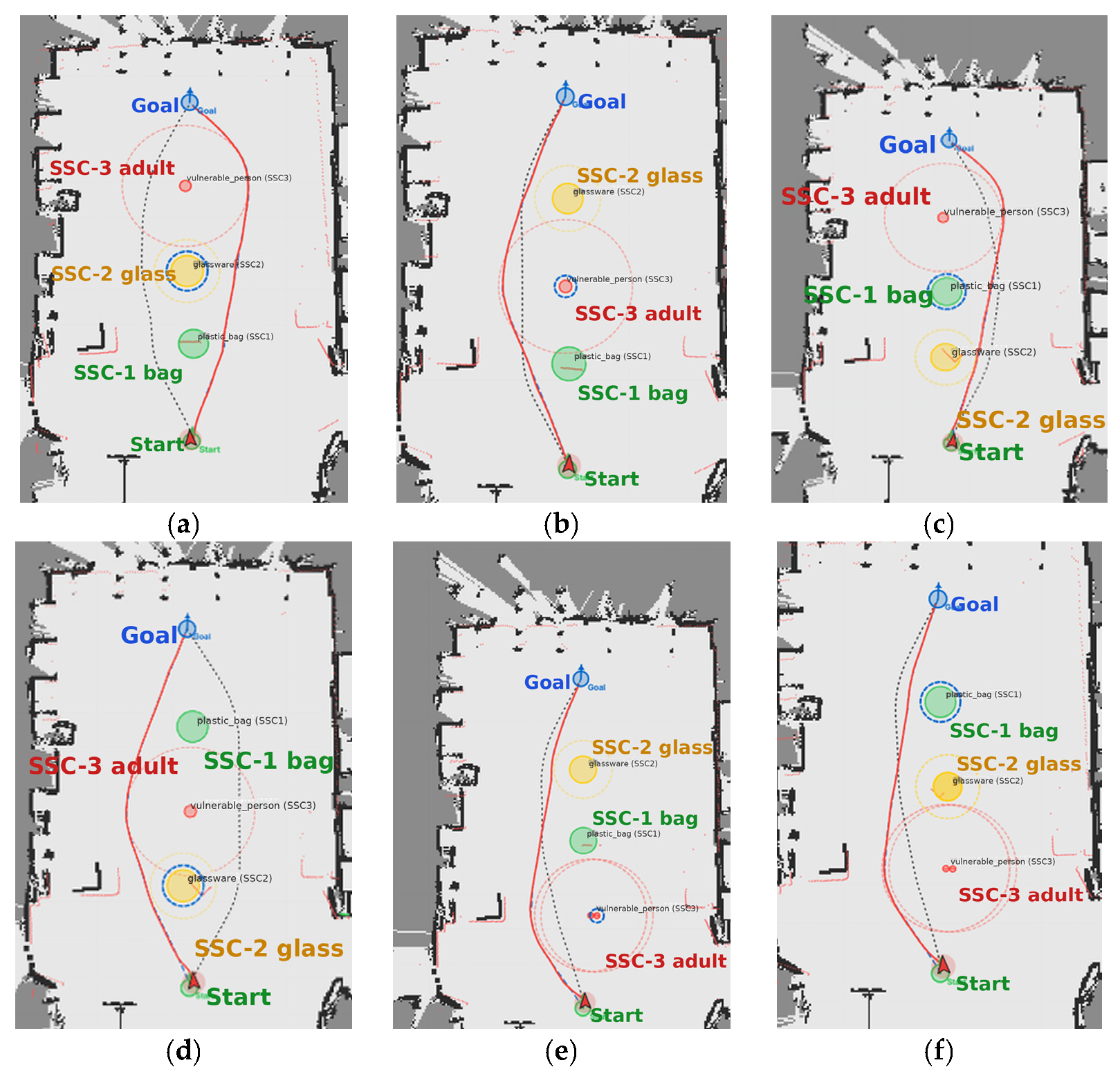
Design II, physical round. (a) W1: SSC-1→SSC-2→SSC-3. (b) W2: SSC-1→SSC-3→SSC-2. (c) W3: SSC-2→SSC-1→SSC-3. (d) W4: SSC-2→SSC-3→SSC-1. (e) W5: SSC-3→SSC-1→SSC-2. (f) W6: SSC-3→SSC-2→SSC-1. Class ordering (start→goal): SSC-1 = plastic bag (green), SSC-2 = glassware (yellow/orange), SSC-3 = adult mannequin (red dashed rings).
Table 11.
Design II, physical round with per-trial logging. Each permutation was run in five blocks, each block running the four planners once (120 runs); velocity limit 0.3 m/s. Values are mean ± SD; clearance is the minimum surface-to-surface distance over the three objects, computed from the AMCL pose as in Section 4.1; clearance and path efficiency use completed runs and time uses all runs. P (r): two-sided exact Wilcoxon signed-rank test on the five block pairs and the rank-biserial correlation; with five pairs the smallest attainable p is 0.063. The aggregate sign test over all 30 blocks is reported in the text.
Figure 9 shows one arbitrarily selected run per planner for each Design I object. The solid red line is the executed SOCA trajectory, the dashed red line is SOCA’s global plan, and the dashed black line is the executed default-DWA trajectory. Shaded disks indicate the class-specific preferred-clearance regions. The physical trajectories reproduce the qualitative ordering observed in Gazebo. SOCA passed close to the plastic bag, made an intermediate detour around the glassware, and took its widest detour around the mannequin. Default DWA passed the mannequin at close range, as it did in simulation.
Figure 10 shows the six Design II permutations. The physical objects were rearranged between permutations, so their residual geometric differences moved with their labels. The isolation of label effects is therefore approximate, unlike the exact geometric control in Gazebo. In every permutation, the SOCA trajectory deviated most near the mannequin: near the start in panels (e) and (f), at mid-corridor in panels (b) and (d), and near the goal in panels (a) and (c). It remained comparatively close to the plastic bag. SOCA and DWA sometimes used opposite sides of the centerline, but the two routes are geometrically equivalent in this open room. The side choice is therefore a global-planner tie-break rather than an experimental effect. The movement of the larger detour with the mannequin is the physical counterpart of the label effect in Table 10.
The quantitative part repeats Design II with per-trial logging, so that clearance, traversal time, and path efficiency can be stated on the platform for all four planners.
Table 11 reports the 120 quantitative physical runs. Each of the six permutations was tested in five blocks, and each block ran all four planners once at a velocity limit of 0.3 m/s. Clearance uses the 0.396 m footprint circumradius and measured prop radii of 0.15 m for the plastic bag, 0.18 m for the glassware, and 0.23 m for the mannequin. All runs reached the goal without observed contact. DWA had the smallest pooled minimum clearance in every permutation (0.10–0.18 m), followed by SOCA (0.18–0.41 m), Uniform-graded (0.68–1.43 m), and Uniform (1.69–1.88 m). Uniform-graded’s low value in W5 resulted from slowing near the final glassware object rather than taking a longer path: it maintained a 9.7 m path but required 47.2 s, compared with 36.8–39.7 s elsewhere. SOCA showed no comparable time anomaly; its traversal time remained between 32.7 and 33.9 s and its path efficiency between 0.943 and 0.970. An exploratory exact sign test combined the 30 paired blocks because every permutation contributed five differences in the same direction. SOCA remained below Uniform in clearance (median difference −1.52 m) and above DWA (+0.16 m) in all 30 pairs (both p < 0.001). It was also faster than Uniform by 9.8 s with 0.16 higher path efficiency. Relative to DWA, SOCA added 1.5 s and reduced path efficiency by 0.030.
Table 12 reports clearance by object. SOCA exceeded DWA for every object class in all 30 paired blocks (sign test, p < 0.001 for each class). Across permutation means, clearance ranged from 0.18 to 0.85 m for the plastic bag, 0.31 to 0.59 m for the glassware, and 0.44 to 0.72 m for the mannequin. The corresponding DWA ranges were 0.14–0.22, 0.10–0.26, and 0.14–0.30 m. The mannequin had the largest SOCA clearance in W1, W2, and W4. In W5 and W6, its early detour carried over to later objects; in W3, the plastic bag was passed farther than the mannequin. SOCA’s absolute clearances were smaller than in Gazebo. The two rounds differed in three relevant respects: the physical speed limit shortened Equation (5)’s speed term by about 0.1 m, physical clearance relied on AMCL rather than ground truth, and the props and placements differed from their simulated counterparts.
Table 12.
Design II, physical round: per-object clearance (m, mean ± SD over five blocks) for default DWA and SOCA. Δ median: median of the five block differences SOCA–DWA; p (r): exact Wilcoxon signed-rank test on the five block pairs (smallest attainable p 0.063) and rank-biserial correlation. Over all 30 blocks SOCA exceeded default DWA for every object class (exact sign test, p < 0.001).
4.2.4. Robustness to Label Errors: Misclassification Cost Matrix
This experiment measures the planner’s response to an incorrect supplied class. In each single-object world, the label was forced to the other two evaluated classes and to the unknown class, while geometry and logging retained the true object identity. This design provides the complete consequence of each wrong assignment; a nominal error rate would only vary how often a run was corrupted. Ten seeds for each off-diagonal cell produced 90 additional runs. Table 13 combines these runs with the oracle diagonal from Table 8. Every run completed without contact.
Table 13.
Design I, misclassification cost matrix: ground-truth minimum clearance (m, mean ± SD) when the object’s label is forced to each class. * = oracle (true label, Table 8, n = 20); off-diagonal cells n = 10. The last row is the default DWA on the same world (W1, W2, W3 in column order) for reference.
Changing only the supplied label moved clearance toward the assigned SSC regime. No forced label produced less clearance than default DWA under the same geometry, consistent with the max-composition rule in Section 3.5. However, an adult assigned to the unknown label received the SSC-2 policy and its clearance fell from 0.91 to 0.38 m. The fallback class therefore determines how a missing person label is treated. Table 13 also shows the cost of a more cautious alternative: assigning the adult entry increased clearance for the plastic bag and glassware to 0.93 and 0.96 m, respectively, while adding about 0.6 s. These results characterize the planner-side consequences of class-assignment errors.
4.2.5. Sensitivity to the Margin Parameters
The preferred clearance dpref in Table 5 and the speed coefficient β in Equation (5) determine the size of the graded band. Sensitivity was evaluated by scaling all dpref values to 0.5 and 1.5 times their nominal values and by setting β to 0.10 and 0.30 s. Each configuration was tested with 10 seeds in the three Design I worlds for 120 additional runs. Table 14 compares these results with the oracle configuration.
Table 14.
Design I, parameter sensitivity: ground-truth minimum clearance (m, mean ± SD, n = 10 per cell; oracle n = 20) under scaled preferred clearances and alternative speed coefficients.
The intended class ordering was preserved for both tested β values and when preferred clearances were increased by 50%. It was not preserved when all preferred clearances were halved: adult-world clearance fell to 0.383 m, slightly below the 0.402 m glassware result. Absolute clearance also varied with β, especially for SSC-3. The nominal parameters are therefore design priors rather than universal settings. Each deployment requires calibration, and a denser sweep would be needed to locate the transition at which the SSC-3 ordering fails.
4.2.6. Summary
The experiments support six findings. First, all planners completed the tested layouts. Second, SOCA produced class-dependent clearance, whereas DWA and the two class-blind baselines did not. Third, the Uniform-graded ablation showed separate contributions from lethal versus graded enforcement and class-dependent assignment. Fourth, the physical results reproduced the planner ordering from simulation: SOCA remained below Uniform and above DWA in all 30 paired blocks and passed every object class farther than DWA. Fifth, forced labels shifted clearance toward the assigned class in the single-obstacle worlds. Sixth, the class ordering persisted for the tested β values and for 50% larger preferred clearances. It failed when all preferred clearances were halved because the person-class band no longer extended beyond the geometric inflation radius. These findings are based on 750 simulated runs and the 120-run quantitative physical round; the physical evaluation also included 180 trajectory-only runs.
5. Discussion
SOCA is designed to make one local planner apply different clearance policies to objects with different semantic and physical properties. Section 4 tested whether it achieved this objective and measured the associated changes in traversal time and path length. The results support the intended behavior for stationary objects in the reported simulated and physical layouts. The following discussion defines the limits of that evidence and identifies the assumptions that require further validation.
5.1. Status of the Semantic Attribute Layer
The reported results are conditional on a valid semantic input. The contribution under test is the mapping from supplied object-safety information to local-planner behavior. Section 4.2.4 gives the planner-side cost of each class error; a deployment combines it with the error profile of its chosen semantic source and with the fallback policy reported here.
Two limitations remain even when the semantic input is correct. The deformability, fragility, clearance, and cost values are design priors rather than calibrated physical-risk estimates. In addition, class-level attributes assign the same properties to objects that may differ in material, mass, or condition. The same interface can accept instance-level attributes when an upstream system provides them.
5.2. Moving Living Entities: Scope and Future Evaluation
Section 3.5 applies the largest static margin to a stationary living entity. Moving people require a different treatment because the relevant clearance changes with predicted arrival time and cannot be represented on a static costmap. A future extension could combine a constant-velocity Kalman predictor with a predicted-gap risk index and a gated stop-observe-resume policy. These components were neither implemented nor evaluated in the present study.
Evaluating that extension requires a separate study. Constant-velocity prediction should be compared with social-force navigation [18,19] and learned predictors such as Trajectron++ [20]. The risk index and thresholds must also be calibrated, and tests around moving people require an appropriate human-participant protocol. Until then, the empirical claims of this paper remain limited to stationary objects.
5.3. Computational Load and Reproducibility
SOCA adds no learning-based inference to the navigation loop. Its additional computation evaluates Equations (4)–(7) over the cells in each semantic cost band. All four planners used the same controller configuration and containerized environment (Section 4.2), but the achieved controller frequency and layer update time were not measured. Profiling these quantities on the onboard computer remains part of the integration work identified in Section 6. The cost of semantic recognition depends on the selected upstream source and is outside SOCA’s computational budget.
A per-run probe checked two configuration details before each batch. The obstacle layer had to read observation sources from its own parameter namespace, and the planar LiDAR had to exclude the robot chassis from returns inside the footprint. The probe and configuration files are available with the run data on request.
5.4. Interpretation and Required Validation
The matched baselines identify two components of the observed behavior. The difference between Uniform and Uniform-graded reflects lethal versus graded enforcement of the same nominal reach, including the lethal core’s larger effective support after inflation (1.985 versus 1.705 m). The difference between Uniform-graded and SOCA reflects class-dependent attributes. These conclusions apply only to the reported layouts and supplied semantic inputs. The sensitivity analysis further showed that the intended ordering requires the person-class band to extend beyond the geometric inflation radius. The physical experiment reproduced the ordering at 0.3 m/s using AMCL-based clearance and five blocks per permutation. Broader validation requires held-out layouts, physical trials at the nominal speed, and evaluation of the semantic source selected for deployment.
Completion was uninformative because every simulated run succeeded. Per-class clearance therefore provides the main paired endpoint. In Design II, the pooled minimum understates the label effect because it records only the closest pass; Table 10 consequently reports clearance for each object. A pre-registered per-object endpoint would have been preferable. Pose estimation is another limitation. AMCL differed from simulation ground truth by up to 0.4 m within a run, which is comparable to the clearance differences between planners for lower-class objects. The simulation statistics therefore use ground-truth pose and retain AMCL values only as secondary records. The physical experiment has no equivalent ground truth, so the Table 11 clearances include AMCL localization uncertainty.
5.5. Extending the Additive Formulation: A Traversable Class
The deployed formulation can only add cost (Section 3.5). For the plastic bag, SOCA avoided the 1.5 m detour of Uniform and maintained 0.1 m more clearance than DWA without a measurable performance cost. It cannot deliberately pass closer than DWA because the original obstacle and inflation layers remain active. A subtractive layer would be required to permit controlled contact, together with a contact model, validated sensing, and footprint-aware feasibility checks. A preliminary configuration without the inflation layer allowed closer passage but caused frequent stalls and was not included in the reported evaluation.
A traversable SSC-0 class could clear geometric cost over objects considered safe for controlled contact, such as an empty bag or curtain strip. The attribute model would require a traversability property, and costmap_2d could apply the clearing operation after the obstacle layer. The principal risk is a false traversable label, which could permit collision rather than merely alter the margin. SSC-0 would therefore require a characterized semantic source, stricter confirmation, and close-range revalidation. It is not evaluated in this paper.
5.6. Implications for Long-Term Autonomy
During continuous operation, a uniformly inflated planner applies the same deceleration and detour policy to every encounter. A class-dependent margin applies these costs mainly to fragile or living objects. The present experiments did not measure whether this policy reduces hard decelerations, rerouting, or mechanical loading over a full duty cycle; these outcomes remain future work.
5.7. Possible Extension with Fuzzy Logic and Soft Computing
In this work, attributes are converted to costs with fixed rules. Equation (2) uses two fixed thresholds, θfra and θdef, to assign the SSC, and Table 5 gives one attribute vector to each class. Fuzzy logic and other soft-computing methods [21] may help make these rules more flexible. For example, an object whose deformability or fragility is close to a threshold could be given a margin between those of the two neighboring classes, instead of being placed in only one of them. When an upstream source reports how confident it is in a label, this confidence could also be used to combine the attribute values of the likely classes, rather than applying the SSC-2 profile directly. Fuzzy logic has been combined with data-driven models for decision-making under uncertainty in other fields [22], and a similar approach might be useful here. In addition, Section 4.2.5 showed that dpref and β need to be calibrated for each deployment, and soft-computing methods could possibly support this tuning using recorded clearance data. We have not yet tested these ideas. Because Equations (4)–(7) take only the attribute vector as input, these changes would affect how the vector is produced, but not the costmap layer or the planner. We plan to study them in future work.
6. Conclusions
This paper presented SOCA, a perception-agnostic framework for class-dependent local obstacle avoidance. An external source provides object identity or SSC, planar geometry, and validity. SOCA resolves five navigation-safety properties, converts them into an exclusion core and bounded graded band, and supplies the resulting costmap to an otherwise unchanged DWA planner. The 480-run four-planner simulation showed that SOCA clearance increased with class: 0.35 m for the plastic bag, 0.40 m for glassware, and 0.91 m for the mannequin. DWA remained between 0.23 and 0.28 m, and the class-blind baselines did not follow the labels. In the six label permutations, SOCA maintained greater clearance from the person-class object than DWA, while adding 0.3–0.8 s and reducing path efficiency by 0.04–0.05. The physical evaluation comprised 300 trials, including 120 with per-trial logging. In those 120 trials, SOCA remained below Uniform and above DWA in clearance for all 30 paired blocks (p < 0.001). These findings apply to the reported layouts, stationary objects, and supplied semantic inputs.
Three additional analyses define the result more precisely. The Uniform-graded baseline separates lethal versus graded enforcement from class-dependent attributes. The forced-label matrix shows how class-assignment errors change planner clearance in the single-obstacle worlds. The sensitivity sweep shows that the intended ordering persisted for the tested speed coefficients and for 50% larger preferred clearances, but depended on the person-class band extending beyond the geometric inflation radius. The next steps are physical tests at the nominal speed and in held-out layouts, measurement of SOCA’s onboard computation time, and validation with the semantic source selected for deployment. Moving-person prediction and a traversable-object class require separate studies. Fuzzy logic and soft-computing methods for setting the attribute vector (Section 5.7) may also be studied in future work.
Author Contributions
Conceptualization, D.S. and T.K.; methodology, D.S.; software, D.S.; validation, D.S. and K.J.; formal analysis, D.S.; investigation, D.S. and K.J.; resources, D.S.; data curation, D.S.; writing—original draft preparation, D.S.; writing—review and editing, D.S., K.J. and T.K.; visualization, D.S.; supervision, T.K.; project administration, T.K. All authors have read and agreed to the published version of the manuscript.
Funding
This research received no external funding.
Data Availability Statement
The data presented in this study are available on request from the corresponding author.
Acknowledgments
During the preparation of this manuscript, the authors used Claude (Anthropic) to assist with English-language editing and proofreading. The authors have reviewed, verified, and edited all output and take full responsibility for the content of this publication.
Conflicts of Interest
The authors declare no conflicts of interest.
Abbreviations
The following abbreviations are used in this manuscript:
| DWA | Dynamic Window Approach |
| DWA-S | Dynamic Window Approach on the SOCA semantic costmap |
| DK-SMF | Domain Knowledge-Driven Semantic Modeling Framework |
| SSC | Semantic Safety Class |
| TOSM | Triplet Ontological Semantic Model |
| VQA | Visual Question Answering |
| SOCA | Semantic Object-Class-Aware |
References
- Fox, D.; Burgard, W.; Thrun, S. The dynamic window approach to collision avoidance. IEEE Robot. Autom. Mag. 1997, 4, 23–33. [Google Scholar] [CrossRef] [Scilit]
- Borenstein, J.; Koren, Y. The vector field histogram—Fast obstacle avoidance for mobile robots. IEEE Trans. Robot. Autom. 1991, 7, 278–288. [Google Scholar] [CrossRef] [Scilit]
- Rösmann, C.; Hoffmann, F.; Bertram, T. Integrated online trajectory planning and optimization in distinctive topologies. Robot. Auton. Syst. 2017, 88, 142–153. [Google Scholar] [CrossRef] [Scilit]
- McCormac, J.; Handa, A.; Davison, A.; Leutenegger, S. SemanticFusion: Dense 3D semantic mapping with convolutional neural networks. In Proceedings of the IEEE International Conference on Robotics and Automation (ICRA), Singapore, 29 May–3 June 2017; pp. 4628–4635. [Google Scholar]
- Rosinol, A.; Abate, M.; Chang, Y.; Carlone, L. Kimera: An open-source library for real-time metric-semantic localization and mapping. In Proceedings of the IEEE International Conference on Robotics and Automation (ICRA), Paris, France, 31 May–31 August 2020; pp. 1689–1696. [Google Scholar]
- Joo, S.-H.; Manzoor, S.; Rocha, Y.G.; Bae, S.-H.; Lee, K.-H.; Kuc, T.-Y.; Kim, M. Autonomous navigation framework for intelligent robots based on a semantic environment modeling. Appl. Sci. 2020, 10, 3219. [Google Scholar] [CrossRef] [Scilit]
- Joo, S.; Bae, S.; Choi, J.; Park, H.; Lee, S.; You, S.; Uhm, T.; Moon, J.; Kuc, T. A flexible semantic ontological model framework and its application to robotic navigation in large dynamic environments. Electronics 2022, 11, 2420. [Google Scholar] [CrossRef] [Scilit]
- Joo, K.; Jeong, Y.; Kwon, S.; Jeong, M.; Kim, H.; Kuc, T. DK-SMF: Domain Knowledge-Driven Semantic Modeling Framework for Service Robots. Electronics 2025, 14, 3197. [Google Scholar] [CrossRef] [Scilit]
- Jocher, G.; Chaurasia, A.; Qiu, J. Ultralytics YOLOv8, version 8.0.0. 2023. Available online: https://github.com/ultralytics/ultralytics (accessed on 22 August 2026).
- Lang, A.H.; Vora, S.; Caesar, H.; Zhou, L.; Yang, J.; Beijbom, O. PointPillars: Fast encoders for object detection from point clouds. In Proceedings of the IEEE/CVF Conference on Computer Vision and Pattern Recognition (CVPR), Long Beach, CA, USA, 15–20 June 2019; pp. 12697–12705. [Google Scholar]
- Kang, S.; Yang, S.; Kwak, D.; Jargalbaatar, Y.; Kim, D. Social Type-Aware Navigation Framework for Mobile Robots in Human-Shared Environments. Sensors 2024, 24, 4862. [Google Scholar] [CrossRef] [Scilit] [PubMed]
- Xu, B.; Tao, A.; Thomas, H.; Zhang, J.; Barfoot, T.D. MakeWay: Object-Aware Costmaps for Proactive Indoor Navigation Using LiDAR. In Proceedings of the 22nd Conference on Robots and Vision, Calgary, AB, Canada, 26–30 May 2025. [Google Scholar] [CrossRef] [Scilit]
- Antol, S.; Agrawal, A.; Lu, J.; Mitchell, M.; Batra, D.; Zitnick, C.L.; Parikh, D. VQA: Visual question answering. In Proceedings of the IEEE International Conference on Computer Vision (ICCV), Santiago, Chile, 7–13 December 2015; pp. 2425–2433. [Google Scholar]
- Liu, S.; Zeng, Z.; Ren, T.; Li, F.; Zhang, H.; Yang, J.; Jiang, Q.; Li, C.; Yang, J.; Su, H.; et al. Grounding DINO: Marrying DINO with grounded pre-training for open-set object detection. In Proceedings of the European Conference on Computer Vision (ECCV), Milan, Italy, 29 September–4 October 2024; pp. 38–55. [Google Scholar]
- Zhang, J.; Huang, J.; Jin, S.; Lu, S. Vision-language models for vision tasks: A survey. IEEE Trans. Pattern Anal. Mach. Intell. 2024, 46, 5625–5644. [Google Scholar] [CrossRef] [Scilit] [PubMed]
- Dong, Q.; Li, L.; Dai, D.; Zheng, C.; Ma, J.; Li, R.; Xia, H.; Xu, J.; Wu, Z.; Chang, B.; et al. A survey on in-context learning. In Proceedings of the 2024 Conference on Empirical Methods in Natural Language Processing (EMNLP), Miami, FL, USA, 12–16 November 2024; pp. 1107–1128. [Google Scholar] [CrossRef] [Scilit]
- McGuinness, D.L.; van Harmelen, F. OWL Web Ontology Language Overview. W3C Recommendation, 10 February 2004. Available online: https://www.w3.org/TR/owl-features/ (accessed on 22 August 2026).
- Helbing, D.; Molnar, P. Social force model for pedestrian dynamics. Phys. Rev. E 1995, 51, 4282–4286. [Google Scholar] [CrossRef] [Scilit] [PubMed]
- Ferrer, G.; Garrell, A.; Sanfeliu, A. Robot companion: A social-force based approach with human awareness-navigation in crowded environments. In Proceedings of the IEEE/RSJ International Conference on Intelligent Robots and Systems (IROS), Tokyo, Japan, 3–7 November 2013; pp. 1688–1694. [Google Scholar] [CrossRef] [Scilit]
- Salzmann, T.; Ivanovic, B.; Chakravarty, P.; Pavone, M. Trajectron++: Dynamically-feasible trajectory forecasting with heterogeneous data. In Proceedings of the European Conference on Computer Vision (ECCV), Glasgow, UK, 23–28 August 2020; pp. 683–700. [Google Scholar]
- Fortuna, L.; Rizzotto, G.; Lavorgna, M.; Nunnari, G.; Xibilia, M.G.; Caponetto, R. Soft Computing: New Trends and Applications; Springer: London, UK, 2001. [Google Scholar]
- Murari, A.; Vagliasindi, G.; Arena, P.; Fortuna, L.; Barana, O.; Johnson, M.; JET-EFDA Contributors. Prototype of an adaptive disruption predictor for JET based on fuzzy logic and regression trees. Nucl. Fusion 2008, 48, 035010. [Google Scholar] [CrossRef] [Scilit]

Disclaimer/Publisher’s Note: The statements, opinions and data contained in all publications are solely those of the individual author(s) and contributor(s) and not of MDPI and/or the editor(s). MDPI and/or the editor(s) disclaim responsibility for any injury to people or property resulting from any ideas, methods, instructions or products referred to in the content. |
© 2026 by the authors. Licensee MDPI, Basel, Switzerland. This article is an open access article distributed under the terms and conditions of the Creative Commons Attribution (CC BY) license.