


Abstract
Inter-limb differences may be observed after anterior cruciate ligament reconstruction (ACLR), even after return to professional sport. This study examined whether anterior–posterior (AP) and medial–lateral (ML) ground reaction force impulses provide information complementary to vertical metrics during bilateral and unilateral jump-landing tasks in professional football players after ACLR, and whether inter-limb asymmetry profiles vary according to task type and movement phase. Twelve male professional football players assessed 12–40 months after primary ACL reconstruction were initially enrolled. One player was excluded before analysis because of insufficient signal quality, leaving 11 players in the final analytical sample. They completed bilateral and unilateral countermovement jumps, drop jumps, and a multi-rebound jump on three-dimensional force platforms. Vertical (V), AP, and ML impulses were analyzed during braking and propulsion together with jump height, reactive strength index, contact time, power, and stiffness. No operated-versus-non-operated difference remained significant after correction for multiple comparisons. Under the prespecified exploratory criteria, cross-direction discordance was observed in 73% of players and occurred more frequently during unilateral than bilateral assessments. AP or ML was the direction of greatest asymmetry in 89% of pooled athlete–task–phase observations; these repeated observations were interpreted descriptively. Vertical asymmetry was not consistently associated with AP or ML asymmetry, and comparable jump performance could coexist with directional force differences. Unilateral tasks and multiplanar analysis therefore provided complementary information, but the clinical relevance of these findings requires validation in larger controlled studies.
1. Introduction
Return to sport after anterior cruciate ligament reconstruction (ACLR) does not necessarily indicate complete restoration of function. Although approximately 72% of soccer players return to play, only about 53% regain their preinjury performance level [1]. Common return-to-sport measures also have limitations: jump height or distance does not show how loading is distributed, and the Limb Symmetry Index may overestimate recovery when both limbs are affected [2,3,4]. Accordingly, performance outcomes and symmetry indices should be interpreted together with absolute limb values and the strategy used to complete the task [5,6]. The Limb Symmetry Index (LSI) remains a useful clinical measure; however, it may overestimate functional recovery when the non-operated limb is also impaired. High LSI values may result from a comparable reduction in the performance of both limbs rather than from true restoration of function [4,5]. Bilateral adaptations and compensatory strategies further limit the interpretation of symmetry in isolation [6,7,8]. Accordingly, LSI should be complemented by the absolute values obtained for each limb, external reference data, and multidirectional assessment of mechanics in the vertical (V), anterior–posterior (AP), and medial–lateral (ML) directions.
Jump height or distance describes the final performance outcome but does not directly indicate how loading is distributed between the limbs and individual joints. Trigsted et al. [9] reported a mean single-hop LSI of approximately 96.8%, despite reduced knee flexion and altered joint moments after ACLR. These discrepancies appear particularly evident during vertical tasks: Kotsifaki et al. [10] reported a distance LSI of approximately 97%, whereas the height LSI was only approximately 83% during the single-leg vertical jump and 77% during the single-leg drop jump. Furthermore, countermovement jump (CMJ), drop jump (DJ), single-leg countermovement jump (SLCMJ), and single-leg drop jump (SLDJ) assessments may reveal different deficits in performance, kinetics, and landing mechanics [11]. These findings support the use of a complementary test battery and the separate assessment of braking and propulsion phases, V, AP, and ML impulses, contact time, and the contribution of each limb, thereby distinguishing the final performance outcome from the strategy used to achieve it.
Time elapsed since ACLR is clinically relevant, but it does not provide a sufficient indication of functional recovery. In professional soccer players assessed more than nine months after ACLR, asymmetries in concentric impulse, peak vertical ground reaction force (vGRF), eccentric deceleration impulse, and eccentric rate of force development (RFD) remained greater than those observed in healthy players [12]. Altered movement strategies have also been reported at a median of 16 months after ACLR, while changes in drop-jump landing mechanics have been observed more than two decades after injury [13,14]. The passage of time alone therefore does not ensure normalization of neuromuscular control, supporting the assessment of persistent functional deficits in athletes 12–40 months after ACLR. Force-plate outcomes should nevertheless be interpreted as measures of current function rather than as stand-alone predictors of subsequent injury [15,16].
Bilateral and unilateral tasks are not interchangeable because they differ in both the opportunities for compensation and the demands placed on movement control. During CMJ and DJ tasks, athletes may redistribute loading between the limbs and maintain an acceptable whole-body outcome despite asymmetrical limb contributions. Two independent force plates enable this strategy to be identified by analyzing each limb separately during propulsion and landing [12,17]. Unilateral tasks limit the possibility of directly unloading the operated limb, while increasing the demands on balance and control of the pelvis and trunk. Following ACLR, these tasks are characterized by lower peak knee flexion angles and smaller internal knee extension moments, and asymmetry in knee flexion excursion may be associated with subsequent patient-reported function [18,19]. SLCMJ and SLDJ may therefore reveal deficits that remain undetected during less demanding tasks. However, their ability to do so depends on the phase, variable, and population examined; consequently, unilateral tasks should not be expected to invariably produce greater asymmetry [10,11].
The biomechanics of dynamic movement are task-specific. A bilateral drop jump does not reproduce the loading profile of a change-of-direction maneuver [20], while a side-cut may generate a greater external knee abduction moment and a different pattern of muscle activation than single-leg jump tasks [21]. The measured response is also influenced by the cutting angle, approach velocity, movement-planning condition, task instructions, and fatigue [22,23,24]. It cannot therefore be assumed that a CMJ outcome represents the mechanics of an SLDJ or an unanticipated change of direction. A battery comprising CMJ, DJ, multi-rebound jump (MRJ), SLCMJ, and SLDJ tasks permits the assessment of different functional demands, ranging from force production and bilateral compensation to reactive braking, unilateral control, and the response to repeated ground contacts [11,25]. The results of these tests should therefore be interpreted as complementary, because each task challenges a different combination of physical capacities and movement strategies.
A single peak value simplifies a complex loading response and may fail to represent differences occurring within specific phases of movement. Taylor et al. [26] demonstrated that peak relative ACL strain during landing occurred approximately 55 ± 14 ms after initial ground contact, highlighting the importance of the early landing phase. Read et al. [12], in turn, identified different asymmetry patterns during eccentric deceleration, concentric propulsion, and landing. Analysis of the force–time curve may also reveal differences in the timing and shape of the response that remain undetected when only maximum values are considered [27,28]. This supports the separate assessment of force impulse during the braking and propulsion phases, because impulse represents the cumulative effect of force over the duration of a given phase and may reveal asymmetries that are not apparent from a single peak value.
Evidence concerning the application of MRJ after ACLR remains limited. Repeated landings may nevertheless reveal changes in loading strategy that are not apparent during a single jump, providing a rationale for analyzing successive contacts in the V, AP, and ML directions [29,30]. In the present study, MRJ was therefore treated as an exploratory task that complemented the CMJ, DJ, SLCMJ, and SLDJ assessments.
Persistent neuromuscular and functional deficits may remain after ACLR even in athletes who have returned to competition and satisfied the return-to-sport criteria used in practice. Assessment based solely on jump performance, LSI, or the vertical component of the ground reaction force may fail to identify bilateral reductions in function, compensatory redistribution of loading, or differences in AP and ML force control. In addition, bilateral, unilateral, and repeated tasks, as well as the braking and propulsion phases, may challenge different elements of the movement strategy. However, studies in professional soccer players after ACLR have not yet combined a consistent battery of CMJ, DJ, MRJ, SLCMJ, and SLDJ assessments with comparisons of the operated and non-operated limbs using phase-specific V, AP, and ML force measures.
The aim of this study was to determine whether the analysis of anterior–posterior and medial–lateral ground reaction force impulses provides information complementary to vertical metrics during bilateral and unilateral jump-landing tasks in professional football players assessed 12–40 months after ACL reconstruction. We additionally examined whether the asymmetry profile depended on task type and movement phase, as well as on whether the task was performed bilaterally or unilaterally. We hypothesized that low vertical asymmetry would not necessarily be accompanied by low AP and ML asymmetries and that the magnitude and direction of inter-limb differences would depend on the specific task and movement phase analyzed. The analysis of the repeated reactive jump series was considered exploratory.
2. Materials and Methods
2.1. Study Participants
Twelve male professional football players who had undergone primary ACL reconstruction were initially enrolled. Following the quality-control procedure described below, one player was excluded, leaving a final analytical sample of 11 players aged 19–30 years (body mass, 64.2 ± 8.5 kg; height, 1.75 ± 0.12 m; mean ± SD). All players had sustained a complete ACL rupture accompanied by a meniscal injury requiring surgical repair. ACL reconstruction was performed using an autologous hamstring tendon graft.
At the time of testing, all players were 12–40 months post-ACLR, had returned to professional competition, had met the return-to-sport (RTS) criteria applied by their clubs’ medical and strength and conditioning staff, and were fully participating in team training and official matches. None of the participants reported symptoms related to the previous reconstruction that limited their current participation in training or competition.
All participants provided written informed consent prior to participation. The study protocol was approved by the Ethics Committee of the Regional Medical Chamber in Kraków (No. 35/KBL/OIL/2024) and was conducted in accordance with the Declaration of Helsinki and its subsequent amendments.
2.2. Study Design
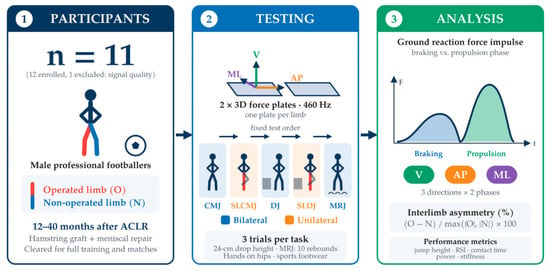
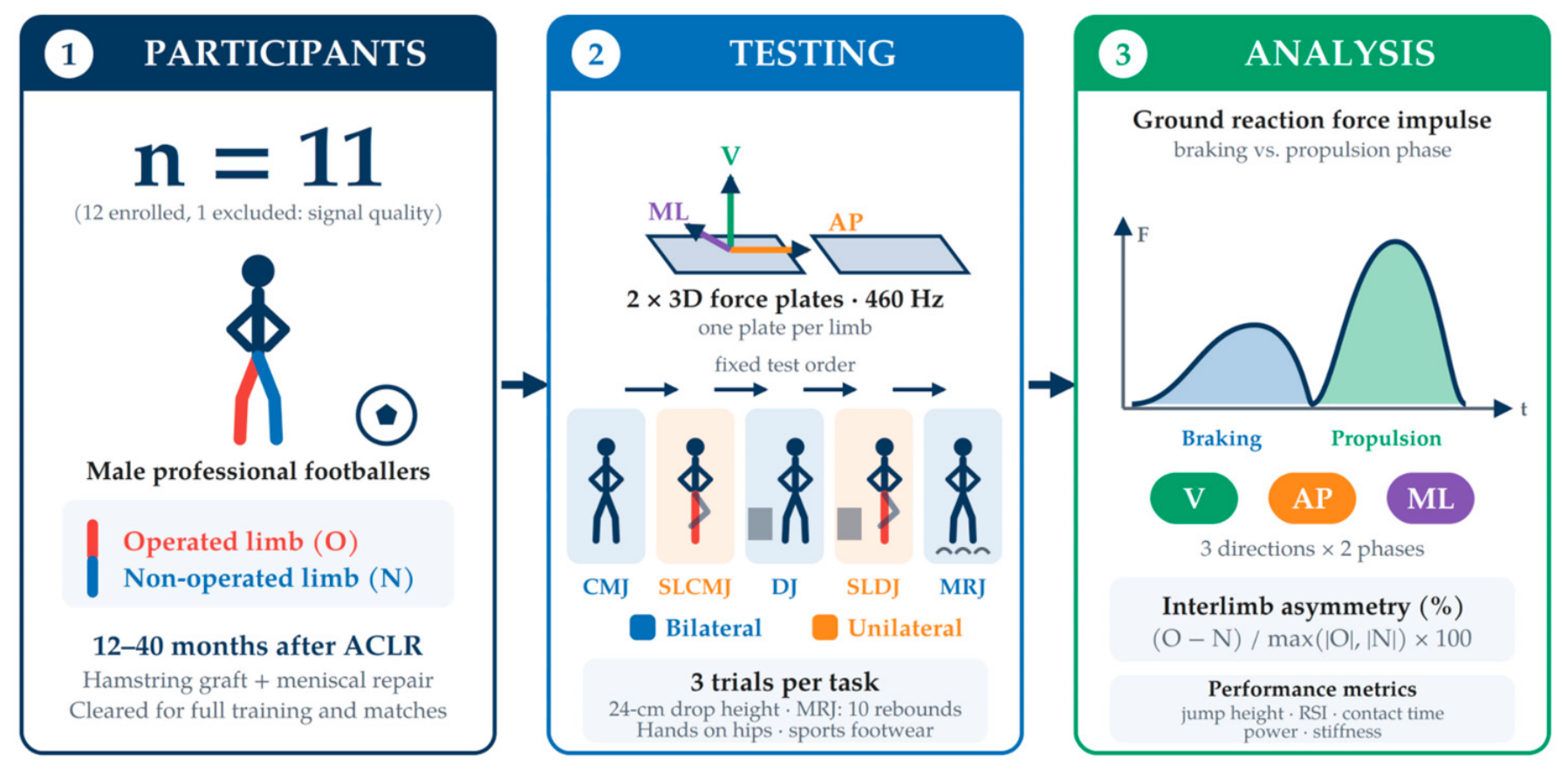
This was an observational, cross-sectional study. Each participant attended a single laboratory testing session. All measurements were performed by the same team of experienced researchers. Body mass and height were recorded before testing. Participants completed a standardized 10 min warm-up before the measurements. Both lower limbs were included in the analysis (Figure 1).
Figure 1.
Study design and primary measures. ACLR, anterior cruciate ligament reconstruction; AP, anterior–posterior; CMJ, countermovement jump; DJ, drop jump; F, force; ML, medial–lateral; MRJ, multi-rebound jump; N, non-operated limb; O, operated limb; RSI, reactive strength index; SLCMJ, single-leg countermovement jump; SLDJ, single-leg drop jump; t, time; V, vertical.
2.3. Eligibility Criteria and Quality Control
The inclusion criteria were male sex, participation in professional football, a first-time complete ACL rupture treated surgically, reconstruction using an autologous hamstring tendon graft, full return to training and competition after successful completion of the RTS process, and the absence of symptoms related to the reconstruction that limited current sports participation. Participants were also required to have completed at least 12 months of postoperative rehabilitation and training before testing.
Quality control included assessment of signal completeness, the presence of visible artifacts, and correct identification of movement phases. One player was excluded from the entire analysis because the quality of the recorded data was insufficient to permit reliable identification of movement phases and comparison between limbs. The final analytical sample therefore comprised 11 players.
2.4. Experimental Procedure
Three-dimensional ground reaction force data were recorded at a sampling frequency of 460 Hz using two synchronized Launch Pad force platforms (Axioforce, Lawrence, KS, USA). The platforms recorded the vertical (V), anterior–posterior (AP), and medial–lateral (ML) components of the ground reaction force. During bilateral tasks, each foot was positioned on a separate force platform, allowing the contribution of each limb to be assessed independently. Unilateral trials were performed separately with the operated and non-operated limbs. All tasks were performed in sports footwear, with the players keeping their hands on their hips throughout the entire task, from movement initiation until completion of the final landing. This standardized arm position was used to minimize the influence of arm movement on jump height and ground reaction force distribution. The tests were performed in the following fixed order: bilateral countermovement jump (CMJ), single-leg countermovement jump (SLCMJ), bilateral drop jump (DJ), single-leg drop jump (SLDJ), and multi-rebound jump (MRJ). The fixed order was used to ensure that all players completed the assessment according to the same standardized sequence and were exposed to identical procedural conditions. Three recorded trials were completed for each task. A 15 s recovery interval was provided between successive trials and a 60 s recovery interval between different jump tasks. During the SLCMJ and SLDJ, the non-operated limb was always tested first. Successive trials were alternated between limbs in the following order: non-operated, operated, non-operated, operated, non-operated, and operated, resulting in three recorded trials for each limb. For each task and limb, the mean of all valid trials was used for statistical analysis; neither a single trial nor the best-performing trial was selected. During the CMJ, players performed a maximal bilateral vertical jump from a standing position using a self-selected countermovement. Each foot remained on a separate force platform during the preparatory phase, propulsion, and final landing. The SLCMJ was performed using an analogous procedure, separately with the operated and non-operated limbs. During the DJ, players stepped from a 24 cm box, landed bilaterally on the two force platforms, and performed a maximal vertical jump immediately after ground contact. The SLDJ was performed from the same box height, with the landing and subsequent take-off completed on the same limb. The MRJ comprised 10 consecutive reactive jumps performed without interruption during each recorded trial. Mean values obtained from successive valid contacts, their variability, and the change in asymmetry between the initial and final portions of the series were included in the analysis.
2.5. Data Analysis
Force signals from the three axes were exported from the Axioforce software (https://www.axioforce.com/) and processed in MATLAB R2025b (version 25.2; The MathWorks, Natick, MA, USA). The signals were recorded at a sampling frequency of 460 Hz and converted from kilogram-force (kgf) to newtons using a conversion factor of 9.80665. The vertical, anterior–posterior, and medial–lateral force components corresponded to Fz, Fy, and Fx, respectively. Before event detection and calculation of the outcome variables, all three force components were low-pass filtered using a fourth-order, zero-lag Butterworth filter with a cut-off frequency of 50 Hz. For bilateral trials, event detection was based on the summed vertical force recorded by both platforms, whereas the vertical force recorded by the supporting platform was used for unilateral trials. The thresholds used for event detection were task-specific. For the CMJ and SLCMJ, movement onset was defined as the first sustained decrease in filtered vertical force below 95% of body weight. Take-off was identified when vertical force decreased below T = max(20 N, 0.05·BW), and landing was identified when vertical force subsequently increased above the same threshold. For the DJ and SLDJ, initial contact was defined as the first sustained increase in vertical force above 20 N, take-off as the subsequent decrease below 20 N, and landing as the next sustained increase above 20 N. In the MRJ, individual rebound contacts were defined as periods in which total filtered vertical force exceeded 50 N for at least 80 ms; the crossing of the same threshold was used to identify the beginning and end of each contact. Center-of-mass vertical acceleration was calculated as a_COM = (Fz − mg)/m, and center-of-mass vertical velocity was obtained by numerical integration. In the CMJ and SLCMJ, the unweighting phase extended from movement onset to minimum downward center-of-mass velocity. The braking phase extended from minimum downward velocity until center-of-mass vertical velocity returned to zero. In the DJ, SLDJ, and MRJ, the braking phase extended from initial contact until center-of-mass vertical velocity changed from negative to non-negative. For reactive tasks, touchdown velocity was reconstructed from the net vertical contact impulse and take-off velocity. In all tasks, the propulsion phase extended from the zero-velocity instant to take-off. Propulsion time was therefore calculated as: t_prop = t_TO − t_v = 0, where t_TO denotes take-off and t_v = 0 denotes the instant at which center-of-mass vertical velocity returned to zero. Force was normalized to body mass and expressed as N/kg or multiples of body weight (BW), impulse as N·s/kg, and power as W/kg. Vertical net impulse was calculated as: J_V,net = ∫(Fz − BW)dt. The original algebraic signs of the AP and ML signals were retained throughout signal processing. Signed net impulses, J_net = ∫Fdt, were retained to describe force direction and for quality-control purposes. However, the primary AP and ML impulse outcomes used in the interlimb comparisons were absolute impulses: J_abs = ∫|F|dt. This approach prevented forces acting in opposite directions from canceling one another and reduced the influence of platform-axis orientation and the laterality of the operated limb. Consequently, AP and ML impulses reported in the primary analyses represent absolute impulses unless explicitly identified as signed net impulses.
For the MRJ, the initial and final portions of the series were defined as the mean values obtained from the first three and last three valid ground contacts, respectively. Absolute interlimb asymmetry was calculated separately for the braking and propulsion phases and for the V, AP, and ML directions. For each of these six phase–direction combinations, the change in asymmetry was calculated as the absolute asymmetry in the final portion minus the corresponding value in the initial portion. For each player, the largest of the six change scores was defined as the greatest increase in asymmetry across the series.
2.6. Variables
The primary outcome variables were the force impulses of the operated and non-operated limbs in the vertical (V), anterior–posterior (AP), and medial–lateral (ML) directions, calculated separately for the braking and propulsion phases of each task. Impulse was calculated as the area under the force–time curve within the boundaries of the respective phase and was normalized to body mass. The signs of the AP and ML force components were retained during signal processing. For each variable, the values obtained for the operated and non-operated limbs, the paired inter-limb difference, and both the directional and absolute asymmetry indices were retained. Depending on the task, the analysis also included variables describing jump performance and execution strategy. For the CMJ and SLCMJ, these variables comprised jump height, modified reactive strength index (mRSI), propulsion time, peak positive power, and peak vertical ground reaction force during landing. For the DJ and SLDJ, jump height, reactive strength index (RSI), ground-contact time, vertical stiffness, and peak vertical ground reaction force were analyzed. For the MRJ, mean jump height, mean RSI, mean ground-contact time, the coefficients of variation of these variables, and the V, AP, and ML impulses during successive braking and propulsion phases were calculated. The change in asymmetry between the initial and final portions of the MRJ series was also analyzed. Jump height was calculated from the recorded flight time using the flight-time equation: h = g × t_f2/8, where h is jump height in meters, g is gravitational acceleration (9.80665 m·s−2), and t_f is the time interval between take-off and the subsequent landing. For the DJ, SLDJ, and MRJ, the reactive strength index was calculated as: RSI = h/t_c, where t_c is the ground-contact time from initial contact to take-off. RSI was expressed in m·s−1. For the CMJ and SLCMJ, the modified reactive strength index was calculated as: mRSI = h/t_m, where t_m is the movement time from the detected onset of the countermovement to take-off. Thus, mRSI represents jump height relative to the total time available to produce the jump and differs from the traditional drop-jump RSI. Propulsion time was defined as the duration of the propulsion phase and was calculated as: t_prop = t_take-off − t_transition, where t_transition represents the transition from braking to propulsion, identified when vertical center-of-mass velocity returned to zero after the downward phase, and t_take-off represents the instant of take-off. Vertical stiffness during the DJ and SLDJ was calculated as: K_vert = F_z,peak/|Δz_COM|, where F_z,peak is the peak vertical ground reaction force during the reactive ground-contact phase and |Δz_COM| is the maximum downward displacement of the center of mass during the braking phase. Center-of-mass displacement was obtained by integrating center-of-mass vertical velocity. Vertical stiffness was initially expressed in N·m−1 and, when normalized to body mass, in N·m−1·kg−1.
2.7. Statistical Analysis
Because of the small sample size and the variable availability of data, non-parametric methods were used. Continuous variables were presented as the median and interquartile range [Q1–Q3], whereas categorical variables were presented as counts and percentages. A sensitivity analysis indicated that, with a sample size of 11, a two-sided α of 0.05, and 80% power, the minimum detectable effect sizes were approximately (d_z = 0.94) for paired comparisons and (|r| = 0.72) for correlations. These estimates are approximate because they are based on parametric equivalents of the statistical tests used. Therefore, non-significant findings do not exclude smaller effects that may still be clinically relevant.
For each variable, the paired difference was calculated as Δ = O − N, and directional asymmetry was calculated using the following equation:
where O denotes the value obtained for the operated limb, N denotes the value obtained for the non-operated limb, and max(|O|, |N|) represents the larger absolute value of the two measurements. Positive asymmetry values indicate a higher value for the operated limb, whereas negative values indicate a higher value for the non-operated limb. The absolute value of asymmetry was used to describe its magnitude irrespective of direction.
The operated and non-operated limbs were compared using the Wilcoxon signed-rank test, separately for each task, movement phase, and force axis. The same test was used to compare absolute asymmetry between force axes and between the corresponding bilateral and unilateral tasks. The median difference, bootstrap 95% confidence interval, and rank-biserial correlation coefficient (r_rb) were reported. Associations among V, AP, and ML asymmetries and their relationships with jump-performance variables and time since ACLR were assessed using Spearman’s rank correlation coefficient (ρ).
Continuous directional and absolute asymmetry values were treated as the primary outcomes. For a prespecified exploratory classification, cross-direction discordance was defined as an observation within a given task and movement phase in which absolute vertical impulse asymmetry was <10%, whereas absolute AP or ML impulse asymmetry was ≥20%. The 10% criterion was selected with reference to the commonly used ≥90% limb symmetry convention in return-to-sport strength and hop testing after ACL reconstruction. However, this convention has not been validated for phase-specific force-plate impulse variables. The 20% criterion was selected as a deliberately more conservative exploratory threshold—twice the vertical criterion—to identify observations with a clearly larger AP or ML interlimb difference. These operational thresholds were not derived from normative data, measurement error, receiver operating characteristic analysis, or a healthy reference group and should not be interpreted as clinical cut-offs or diagnostic criteria. Paired classification rates were compared using the exact McNemar test, whereas within-player differences between bilateral and unilateral tasks were assessed using the Wilcoxon signed-rank test.
For the MRJ, asymmetry was compared between the initial and final portions of the series, and its associations with jump height, RSI, contact time, and the variability of these parameters were assessed. These analyses were considered exploratory. The p-values for the prespecified paired comparisons were adjusted using the Holm procedure to control the family-wise error rate within each family of tests. For the larger set of exploratory correlations, p-values were adjusted using the Benjamini–Hochberg procedure to control the false discovery rate while retaining greater sensitivity than more conservative family-wise error rate corrections. Statistical significance was defined as p_Holm < 0.05 for paired comparisons and q < 0.05 for correlations. The primary statistical analyses were performed using STATISTICA 13.0 (TIBCO Software Inc., Palo Alto, CA, USA). Bootstrap confidence intervals, rank-biserial effect sizes, the exact McNemar test, and the Holm and Benjamini–Hochberg corrections were calculated in Python 3.12.13 using the NumPy and SciPy libraries.
3. Results
3.1. Interlimb Differences and Directional Asymmetry
Normalized impulse values were first compared between the operated and non-operated limbs. Analyses were performed separately for each jump task, the braking and propulsion phases, and the V, AP, and ML directions. No interlimb difference remained statistically significant after Holm correction. Thus, at the group level, the operated limb did not consistently produce lower or higher impulse values than the non-operated limb. However, the direction of the interlimb difference was not consistent across players (Table 1).
Table 1.
Comparison of normalized impulses between the operated and non-operated limbs across jump tasks, movement phases, and force directions. Values are presented as median [Q1–Q3].
The magnitude of interlimb asymmetry was then compared between force directions, irrespective of which limb produced the higher value. The only statistically significant difference was observed during the propulsion phase of the MRJ. Absolute AP asymmetry was greater than absolute V asymmetry, with median values of 10.2% and 7.9%, respectively (Holm-adjusted p = 0.012). No significant differences between V, AP, and ML asymmetry were observed for the remaining tasks and phases. The MRJ finding does not indicate that the operated limb produced a lower or higher AP impulse; it indicates only that the interlimb difference during propulsion was greater in the anterior–posterior than in the vertical direction (Table 2).
Table 2.
Absolute interlimb impulse asymmetry according to jump task, movement phase, and force direction. Values are presented as median [IQR].
3.2. Incremental Detection of Interlimb Asymmetry Using Multiplanar Impulse Assessment
Each assessment represented the result obtained by one athlete in a specific jump task and movement phase. An asymmetry undetected by vertical-only assessment was defined as an absolute vertical impulse asymmetry below 10% (|V| < 10%) accompanied by an AP or ML impulse asymmetry of at least 20% (|AP| ≥ 20% or |ML| ≥ 20%). At least one such result was identified in 8/11 players (73%). Across all tasks and movement phases, this pattern occurred in 22/110 observations (20.0%). It was descriptively more frequent during unilateral tasks, occurring in 18/44 SLCMJ and SLDJ observations (41%), compared with 4/66 bilateral-task observations (6%). During the SLCMJ, it was present in 5/11 observations (45.5%) during both braking and propulsion. During the SLDJ, the corresponding proportion was 4/11 observations (36.4%) during both phases. No such cases were observed during the MRJ (0/11 during braking and 0/11 during propulsion), because increased AP or ML asymmetry was accompanied by increased vertical asymmetry. Because each player contributed repeated observations, these pooled task- and phase-specific frequencies were interpreted descriptively (Table 3).
Table 3.
Incremental detection of interlimb asymmetry using multiplanar impulse assessment. An asymmetry undetected by vertical-only assessment was defined as |V| < 10% accompanied by |AP| ≥ 20% or |ML| ≥ 20%.
3.3. Associations Between Vertical and AP/ML Asymmetry
For each athlete, absolute interlimb impulse asymmetry in the V, AP, and ML directions was compared separately for each jump task and for the braking and propulsion phases. Across 110 athlete–task–phase observations, the AP direction represented the greatest asymmetry in 50/110 observations (45.5%), the ML direction in 48/110 observations (43.5%), and the V direction in 12/110 observations (11%). Thus, the greatest interlimb difference occurred in the AP or ML direction in 98/110 observations (89%). This indicates that an assessment restricted to vertical impulse could omit the direction showing the greatest interlimb asymmetry. For each jump task and movement phase, the association between absolute vertical impulse asymmetry and AP or ML impulse asymmetry was also assessed across athletes. The median of the task- and phase-specific Spearman correlation coefficients was 0.27 for the V–AP associations and 0.09 for the V–ML associations. None of the correlations calculated separately for a specific task and phase remained statistically significant after false discovery rate correction. Therefore, a small vertical impulse asymmetry did not reliably indicate that AP or ML asymmetry was also small (Table 4).
Table 4.
Associations between vertical and horizontal interlimb impulse asymmetry according to jump task and movement phase. Spearman rank correlations were calculated across athletes separately for each task and phase using the absolute magnitudes of interlimb asymmetry.
3.4. Direct Comparison of Interlimb Asymmetry Between Bilateral and Unilateral Tasks
Within the same athletes, the magnitude of interlimb asymmetry was compared between the CMJ and SLCMJ and between the DJ and SLDJ, separately for the braking and propulsion phases and for the V, AP, and ML directions. None of these comparisons remained statistically significant after Holm correction. Therefore, it could not be concluded that unilateral tasks produced systematically greater asymmetry than bilateral tasks.
Greater asymmetry during unilateral tasks was observed under selected conditions. For example, ML asymmetry during propulsion increased from 6.1% in the CMJ to 25.7% in the SLCMJ, while during braking it increased from 9.1% in the DJ to 28.9% in the SLDJ. However, these differences did not remain statistically significant after adjustment for multiple comparisons. In other directions, asymmetry was similar or lower during the unilateral task. The value of unilateral tasks therefore did not arise from a consistent increase in asymmetry across the group. Rather, they more frequently identified AP or ML asymmetries in individual athletes that were not apparent in the vertical direction. These tasks should therefore be considered as providing additional information about individual interlimb differences rather than as uniformly more demanding (Table 5).
Table 5.
Direct comparison of absolute interlimb impulse asymmetry between bilateral and corresponding unilateral jump tasks. Comparisons were performed within the same athletes for CMJ versus SLCMJ and DJ versus SLDJ, separately for each movement phase and force direction. Values in the bilateral and unilateral columns represent median absolute asymmetry expressed as a percentage.
3.5. Supplementary Jump-Performance Variables
No differences between the operated and non-operated limbs in jump height, RSI, contact time, power, stiffness, or the remaining performance variables remained statistically significant after Holm correction. Similarly, no association between these variables and impulse asymmetry in the V, AP, or ML directions remained statistically significant after false discovery rate correction.
Individual-level analysis nevertheless demonstrated that a similar jump-performance outcome did not always indicate a similar execution strategy. During the SLCMJ, 50% of the assessed players showed similar vertical impulse and jump height between limbs, while AP or ML impulse asymmetry was at least 20%. A comparable pattern was observed for mRSI, whereby similar V impulse between limbs coexisted with AP or ML impulse asymmetry.
During the braking phase of the SLDJ, similar jump height between limbs and low vertical asymmetry coexisted with substantial AP or ML asymmetry in 25% of the players. The corresponding proportion for RSI was 37.5%. Thus, similar jump height or RSI values between limbs did not exclude asymmetry in the anterior–posterior or medial–lateral direction. Jump-performance variables and multiplanar impulse analysis therefore provided different but complementary information.
3.6. Multi-Rebound Jump Results
During the MRJ, 40% of the players demonstrated at least one AP or ML impulse asymmetry greater than 20% between the operated and non-operated limbs. In each of these cases, vertical asymmetry was also increased. Thus, during this task, AP or ML asymmetry was not observed more frequently than V asymmetry.
Impulse asymmetry was subsequently compared between the initial and final portions of the jump series, separately for the braking and propulsion phases and for the V, AP, and ML directions. None of the analyzed conditions showed a significant change after Holm correction. Therefore, asymmetry did not increase systematically across successive rebounds.
For each player, the greatest increase in absolute asymmetry was defined as the largest change between the initial and final portions of the series across six phase–direction combinations: braking and propulsion in the V, AP, and ML directions. Among all players (n = 11), longer mean contact time was associated with a greater maximum increase in asymmetry (ρ = 0.92; q = 0.037). Because the outcome represented the maximum selected from several phase–direction combinations, this association was considered exploratory and should be interpreted cautiously.
3.7. Association of Time Since ACL Reconstruction with Interlimb Asymmetry
No significant association was found between time since ACLR and any of the analyzed asymmetry indices, including impulse asymmetry in the V, AP, and ML directions and the number of asymmetries undetected by vertical-only assessment. Time since surgery was also not associated with jump height, RSI, contact time, power, stiffness, or the remaining jump-performance variables. Within the study group, players assessed later after reconstruction did not therefore demonstrate consistently more symmetrical results. The number of months since ACLR did not explain the observed functional differences.
4. Discussion
The aim of the present study was to determine whether unilateral jump-landing tasks and multiplanar ground reaction force analysis provide additional information on lower-limb function in professional football players after ACLR. At the group level, the operated limb did not demonstrate systematically poorer outcomes in either force impulses or jump-performance variables, including jump height, RSI, contact time, power, and stiffness. Individual-level analysis, however, revealed marked heterogeneity in interlimb asymmetry according to the athlete, task, movement phase, and force direction. In some players, comparable jump height, RSI, and vertical impulse between limbs coexisted with differences in the AP or ML component. Thus, a similar jump outcome was not necessarily achieved through the same force-generation and absorption strategy. This discordance was particularly evident during unilateral tasks, which more frequently identified differences that were not apparent when assessment was limited to the vertical component, although these tasks did not produce consistently greater asymmetry across all analyzed conditions. Multiplanar and phase-specific analysis therefore provided complementary descriptive information about task execution, particularly during unilateral tasks. These results do not establish abnormality, causation by ACLR, or greater diagnostic sensitivity.
No uniform pattern was observed in which the operated limb consistently generated or absorbed less impulse than the non-operated limb. The direction of asymmetry differed between players, and opposing individual patterns may therefore have offset one another in the group-level analysis. Accordingly, the absence of group differences does not demonstrate limb equivalence or complete restoration of function. A similar discrepancy between group-level findings and individual profiles was reported by Collings et al. [17]. Memain et al. [31] further showed that deficits after ACLR may involve different aspects of strength, muscle activation, and landing performance, whereas Norouzi et al. [32] identified altered landing kinematics in football players who had met return-to-sport (RTS) criteria. Together, these findings suggest that the absence of a systematic interlimb difference may reflect heterogeneous adaptive strategies rather than uniform functional recovery. Interpretation of limb symmetry is further limited by the fact that the non-operated limb does not always provide a normal reference. A high limb symmetry index (LSI) may coexist with reduced performance of both limbs relative to healthy athlete norms or estimated preinjury capacity [4,5]. Bilateral adaptations may occur after a unilateral injury [6], and the non-operated limb may contribute to compensatory strategies and differ from healthy control limbs [7,8]. Because reference values also depend on sex, sport, and performance level, LSI should not replace the reporting of absolute values [33]. Outcomes for both limbs should therefore be presented together with the magnitude and direction of asymmetry and the individual athlete-level pattern.
Cross-direction discordance—low vertical asymmetry accompanied by a larger AP or ML asymmetry—was observed more often during SLCMJ and SLDJ than during bilateral tasks, whereas no such pattern occurred during MRJ. This does not mean that unilateral tasks were universally more sensitive; rather, they provided complementary information under the prespecified operational criteria. The threshold-based classification should be interpreted as exploratory. The 10% criterion reflects the commonly used 90% limb symmetry convention in return-to-sport testing but has not been validated for phase-specific force-plate impulse variables. The 20% criterion was deliberately selected as a more conservative operational threshold to identify substantially larger AP or ML interlimb differences. Because neither threshold was derived from normative data, measurement error, receiver operating characteristic analysis, or a healthy reference group, observations meeting these criteria should not be interpreted as evidence of abnormality, functional impairment, or diagnostic status. Accordingly, the continuous asymmetry values remain the primary findings. This finding is consistent with studies showing that separate analysis of directional components preserves information that may be lost when signals are combined. Head et al. [34] demonstrated that landing direction affected directional stability indices after ACLR despite the absence of differences in a composite score. Direction-specific AP and ML demands during landing were also reported by Wikstrom et al. [35] and Patterson and Delahunt [36]. Markström et al. [37] further showed that the rebound side hop imposed greater frontal- and transverse-plane demands than vertically or horizontally directed jumps. Although these studies assessed outcomes other than phase-specific AP and ML impulses, they support the task- and direction-specific nature of functional assessment.
The analysis of associations between force directions did not demonstrate a consistent relationship between vertical asymmetry and AP or ML asymmetry. Strong correlations observed in individual tasks and phases did not remain significant after adjustment for multiple comparisons. ML asymmetry, in particular, was weakly associated with V asymmetry, while the greatest interlimb difference most frequently occurred in the AP or ML direction. A small vertical asymmetry therefore did not indicate that symmetry was also preserved in the remaining directions. These findings suggest that the V, AP, and ML components describe partly distinct aspects of the loading strategy and should be reported in parallel. This interpretation is consistent with Donelon et al. [23], who showed that knee loading during change-of-direction tasks results from the interaction between body-segment positioning and the magnitude and direction of the ground reaction force. Donelon et al. [24] further demonstrated that kinematic differences do not necessarily correspond to differences in joint moments. AP and ML components therefore provide additional information on the external force profile; however, without concurrent kinematic analysis and inverse dynamics, they cannot be interpreted as direct measures of joint moments, ACL loading, or reinjury risk. Future longitudinal studies should combine synchronized force-platform measurements with three-dimensional motion capture at successive stages of rehabilitation and return to sport. The application of inverse dynamics would allow knee, hip, and ankle joint moments and mechanical work to be quantified and would help determine whether AP and ML impulse asymmetries are accompanied by changes in knee flexion, abduction, or rotation, as well as by altered trunk and pelvic strategies. Repeated assessments would also clarify whether these force and movement profiles change with rehabilitation and accumulated training and competition exposure. However, neither ground reaction forces nor conventional inverse dynamics provide a direct measurement of ACL strain. Validated musculoskeletal models or complementary imaging-based methods would therefore be required to test the proposed links between external force profiles, joint loading, and ACL strain more directly.
Direct comparison of bilateral and unilateral tasks did not show that the SLCMJ and SLDJ consistently produced greater asymmetry than the CMJ and DJ across all force directions and movement phases. The larger ML differences observed under selected conditions did not remain significant after adjustment for multiple comparisons and should therefore be considered exploratory. The additional value of unilateral tasks was evident primarily at the individual level, because they more frequently revealed AP or ML differences that were not apparent in the vertical component. This finding may be explained by the distinct demands of the analyzed tasks. Bilateral jumps allow load to be redistributed between limbs, whereas unilateral tasks restrict this mechanism while increasing the demands placed on balance and trunk and pelvic control. This does not, however, imply that every variable must show greater asymmetry during unilateral performance. Following ACLR, unilateral landings more commonly reveal reduced knee flexion, a lower knee extensor moment, and unloading of the operated limb [19,38]. Peebles et al. [39], however, showed that a bilateral task may better reveal loading impulse asymmetry, whereas a unilateral task may better identify asymmetry in knee motion. This supports the view that the two task types provide complementary information. Kotsifaki et al. [10,11] similarly demonstrated that the CMJ, DJ, SLCMJ, and SLDJ identify different aspects of function after ACLR, with the SLDJ particularly revealing kinetic and performance differences and the CMJ providing information on landing asymmetry. Task specificity of biomechanical outcomes was also demonstrated by Kristianslund and Krosshaug [20] and Nedergaard et al. [21], who showed that findings obtained in one task cannot be directly generalized to other movement conditions. The present results extend these observations by incorporating AP and ML analysis: the greatest incremental detection was observed during the SLCMJ and SLDJ, whereas the MRJ did not identify cases that were undetected in the V direction. The individual tests should therefore be regarded as complementary components of a test battery rather than interchangeable versions of the same task.
At the group level, no systematic interlimb differences were observed in jump height, RSI, contact time, propulsion time, power, stiffness, or peak force variables. These outcomes were also not consistently associated with V, AP, or ML impulse asymmetry. Of particular relevance was the discordance between the final jump outcome and the strategy used to achieve it. During the SLCMJ, similar jump height, modified RSI, and vertical impulse could coexist with AP or ML asymmetry during propulsion. During the SLDJ, comparable jump height, RSI, and vertical impulse did not exclude directional differences during braking. Similarly, during the CMJ and DJ, the global task outcome did not always reflect asymmetry in peak landing load. Comparable jump performance may therefore be achieved through different force-generation and absorption strategies. Without kinematic analysis and inverse dynamics, however, it is not possible to determine whether this finding resulted from redistribution of mechanical work among the knee, hip, and ankle joints. These observations are consistent with systematic reviews indicating that the functional profile after ACLR depends on the task performed. During the bilateral CMJ, differences in force and impulse have been reported more frequently, whereas unilateral tasks have more commonly demonstrated reduced jump height, lower RSI, and longer contact time, with less consistent findings for peak vertical ground reaction force (vGRF) [40]. Vertical unilateral tasks may also reveal differences that remain undetected in jumps assessed using horizontal distance [10], and SLDJ asymmetry may coexist with incomplete return to the preinjury level of competition [41]. Conversely, the absence of CMJ differences reported by Cabarkapa et al. [42] illustrates that a normal result in a bilateral task may reflect either a high level of recovered function or the opportunity for compensation. These findings support the use of a diverse test battery but do not establish a universal advantage of unilateral tasks [11].
During the Multi-Rebound Jump, players maintained relatively stable mean contact time and jump height across successive rebounds, whereas greater variability was observed for RSI. The MRJ therefore provided information on within-series performance consistency and the maintenance of a loading strategy across repeated landing–propulsion cycles, rather than solely on average jump performance. Some players demonstrated AP or ML asymmetry; however, AP or ML asymmetry at or above the operational threshold was accompanied by vertical asymmetry at or above its corresponding threshold. Consequently, no cross-direction discordance was observed during the MRJ. No systematic increase in asymmetry occurred between the initial and final portions of the series. In an exploratory analysis involving 11 players, longer mean contact time was associated with a greater maximum increase in asymmetry across the series (ρ = 0.92; q = 0.037). However, this outcome was selected as the maximum of six within-player phase–direction change scores. This procedure may have preferentially retained extreme values and increased the observed magnitude of the correlation. The finding should therefore be considered hypothesis-generating and requires confirmation in a larger independent sample. Evidence regarding the use of the MRJ after ACLR remains limited. The MRJ should therefore be regarded as a supplementary, exploratory assessment of variability and the maintenance of a loading strategy during repeated contacts, rather than as an established method for determining the clinical relevance of direction-specific asymmetry.
Within the study group, time since ACL reconstruction was not associated with the magnitude of V, AP, or ML asymmetry or with jump height, RSI, contact time, power, or stiffness. Players assessed later after surgery did not therefore demonstrate consistently more symmetrical outcomes. This is consistent with evidence indicating that recovery of individual functional domains does not follow a uniform trajectory. Calendar-based timing of return, sport exposure, and the risk of subsequent injury represent distinct aspects of the rehabilitation process [2,15]. The number of months since ACLR was therefore insufficient to explain the current functional profile. However, because of the small sample and cross-sectional design, this finding does not demonstrate that the observed asymmetries are persistent or unaffected by rehabilitation or training. From a practical perspective, the present findings support a stepwise testing approach. The SLCMJ and SLDJ may be prioritized when assessment time is limited because they provide complementary information on unilateral propulsion, braking, and landing control. Bilateral CMJ and DJ testing may then be added to examine load redistribution between the limbs, whereas the MRJ may be used selectively to assess repeated-contact consistency. This hierarchy should be regarded as a pragmatic proposal rather than a validated clinical protocol.
The study has several limitations. The small sample size limited statistical power and precision, and the cross-sectional design, absence of a healthy control group, and lack of preinjury data prevent causal interpretation of the observed asymmetries. The wide postoperative interval of 12–40 months, club-specific return-to-sport criteria, and concomitant meniscal repair in all participants further limit the generalizability of the findings. The fixed test order may have introduced learning or fatigue effects, while data availability varied across some analyses. In addition, pooled task- and phase-specific observations were not independent and were therefore interpreted descriptively. The 10% and 20% asymmetry thresholds were exploratory rather than validated clinical cut-offs. Finally, force-platform data describe external loading but cannot determine joint-specific mechanics or ACL strain without concurrent kinematic analysis and inverse dynamics.
5. Conclusions
The functional profiles of professional football players after ACL reconstruction were heterogeneous and varied according to the athlete, task, movement phase, and force direction. The absence of systematic group-level differences did not establish complete symmetry, as low vertical asymmetry could coexist with larger AP or ML interlimb differences under the prespecified exploratory criteria. AP and ML impulse analysis therefore provided complementary descriptive information on directional braking, force generation, and landing-control strategies that was not captured by vertical metrics alone. In return-to-sport assessment, AP and ML force analysis should complement, rather than replace, strength testing, jump height, RSI, and vertical force measures. In time-constrained settings, the SLCMJ and SLDJ performed with both limbs could form a core assessment, with separate analysis of the braking and propulsion phases in the V, AP, and ML directions. The CMJ and DJ may provide additional information on load distribution during bilateral tasks, whereas the MRJ may be reserved for assessing performance consistency across repeated contacts. The proposed testing hierarchy is preliminary. The findings do not establish diagnostic validity, abnormality, or a direct consequence of ACLR, and the adopted asymmetry thresholds should not be interpreted as clinical cut-offs. Larger prospective studies including healthy controls are required before this approach can be incorporated into clinical or return-to-sport decision algorithms.
Author Contributions
All authors contributed to the conception and design of the study, data acquisition, analysis or interpretation of the data, and drafting or critical revision of the manuscript. All authors have read and agreed to the published version of the manuscript.
Funding
This research received no external funding.
Institutional Review Board Statement
Approval of the Ethical Committee of the Regional Medical Chamber in Kraków was obtained for this study (protocol number 35/KBL/OIL/2024, approval date 29 April 2024). All procedures were performed in accordance with the 1964 Declaration of Helsinki and its later amendments.
Informed Consent Statement
Informed consent was obtained from all subjects involved in this study.
Data Availability Statement
The data supporting the findings of this study are available from the corresponding author upon reasonable request.
Conflicts of Interest
The authors declare no conflicts of interest.
References
- Manojlovic, M.; Ninkovic, S.; Matic, R.; Versic, S.; Modric, T.; Sekulic, D.; Drid, P. Return to Play and Performance after Anterior Cruciate Ligament Reconstruction in Soccer Players: A Systematic Review of Recent Evidence. Sports Med. 2024, 54, 2097–2108. [Google Scholar] [CrossRef] [Scilit] [PubMed]
- Battaglia, M.; Arner, J.W.; Midtgaard, K.S.; Haber, D.B.; Peebles, L.A.; Peebles, A.M.; Ganokroj, P.; Whalen, R.J.; Provencher, M.T.; Torre, G.; et al. Early versus Standard Return to Play Following ACL Reconstruction: Impact on Volume of Play and Career Longevity in 180 Professional European Soccer Players: A Retrospective Cohort Study. J. Orthop. Traumatol. 2025, 26, 29. [Google Scholar] [CrossRef] [Scilit] [PubMed]
- Longstaffe, R.; Leiter, J.; Gurney-Dunlop, T.; McCormack, R.; MacDonald, P. Return to Play and Career Length after Anterior Cruciate Ligament Reconstruction among Canadian Professional Football Players. Am. J. Sports Med. 2020, 48, 1682–1688. [Google Scholar] [CrossRef] [Scilit] [PubMed]
- Gokeler, A.; Welling, W.; Benjaminse, A.; Lemmink, K.; Seil, R.; Zaffagnini, S. A Critical Analysis of Limb Symmetry Indices of Hop Tests in Athletes after Anterior Cruciate Ligament Reconstruction: A Case-Control Study. Orthop. Traumatol. Surg. Res. 2017, 103, 947–951. [Google Scholar] [CrossRef] [Scilit] [PubMed]
- Wellsandt, E.; Failla, M.J.; Snyder-Mackler, L. Limb Symmetry Indexes Can Overestimate Knee Function after Anterior Cruciate Ligament Injury. J. Orthop. Sports Phys. Ther. 2017, 47, 334–338. [Google Scholar] [CrossRef] [Scilit] [PubMed]
- Slater, L.V.; Hart, J.M.; Kelly, A.R.; Kuenze, C.M. Progressive Changes in Walking Kinematics and Kinetics after Anterior Cruciate Ligament Injury and Reconstruction: A Review and Meta-Analysis. J. Athl. Train. 2017, 52, 847–860. [Google Scholar] [CrossRef] [Scilit] [PubMed]
- Warathanagasame, P.; Sakulsriprasert, P.; Sinsurin, K.; Richards, J.; McPhee, J.S. Comparison of Hip and Knee Biomechanics during Sidestep Cutting in Male Basketball Athletes with and without Anterior Cruciate Ligament Reconstruction. J. Hum. Kinet. 2023, 88, 17–27. [Google Scholar] [CrossRef] [Scilit] [PubMed]
- Xue, B.; Yang, X.; Wang, X.; Yang, C.; Zhou, Z. Limb Dominance Influences Landing Mechanics and Neuromuscular Control during Drop Vertical Jump in Patients with ACL Reconstruction. Front. Physiol. 2024, 15, 1488001. [Google Scholar] [CrossRef] [Scilit] [PubMed]
- Trigsted, S.M.; Post, E.G.; Bell, D.R. Landing Mechanics during Single Hop for Distance in Females Following Anterior Cruciate Ligament Reconstruction Compared with Healthy Controls. Knee Surg. Sports Traumatol. Arthrosc. 2017, 25, 1395–1402. [Google Scholar] [CrossRef] [Scilit] [PubMed]
- Kotsifaki, A.; Van Rossom, S.; Whiteley, R.; Korakakis, V.; Bahr, R.; Sideris, V.; Jonkers, I. Single Leg Vertical Jump Performance Identifies Knee Function Deficits at Return to Sport after ACL Reconstruction in Male Athletes. Br. J. Sports Med. 2022, 56, 490–498. [Google Scholar] [CrossRef] [Scilit] [PubMed]
- Kotsifaki, R.; Sideris, V.; King, E.; Bahr, R.; Whiteley, R. Performance and Symmetry Measures during Vertical Jump Testing at Return to Sport after ACL Reconstruction. Br. J. Sports Med. 2023, 57, 1304–1310. [Google Scholar] [CrossRef] [Scilit] [PubMed]
- Read, P.J.; Auliffe, S.M.; Wilson, M.G.; Graham-Smith, P. Lower Limb Kinetic Asymmetries in Professional Soccer Players with and without Anterior Cruciate Ligament Reconstruction: Nine Months Is Not Enough Time to Restore “Functional” Symmetry or Return to Performance. Am. J. Sports Med. 2020, 48, 1365–1373. [Google Scholar] [CrossRef] [Scilit] [PubMed]
- Markström, J.L.; Grip, H.; Schelin, L.; Häger, C.K. Individuals with an Anterior Cruciate Ligament-Reconstructed Knee Display Atypical Whole-Body Movement Strategies but Normal Knee Robustness during Side-Hop Landings: A Finite Helical Axis Analysis. Am. J. Sports Med. 2020, 48, 1117–1126. [Google Scholar] [CrossRef] [Scilit] [PubMed]
- Grip, H.; Tengman, E.; Liebermann, D.G.; Häger, C.K. Kinematic Analyses Including Finite Helical Axes of Drop Jump Landings Demonstrate Decreased Knee Control Long after Anterior Cruciate Ligament Injury. PLoS ONE 2019, 14, e0224261. [Google Scholar] [CrossRef] [Scilit] [PubMed]
- Beischer, S.; Gustavsson, L.; Hamrin Senorski, E.; Karlsson, J.; Thomeé, C.; Samuelsson, K.; Thomeé, R. Young Athletes Who Return to Sport Before 9 Months after Anterior Cruciate Ligament Reconstruction Have a Rate of New Injury 7 Times That of Those Who Delay Return. J. Orthop. Sports Phys. Ther. 2020, 50, 83–90. [Google Scholar] [CrossRef] [Scilit] [PubMed]
- Webster, K.E.; Feller, J.A.; Klemm, H.J. Second ACL Injury Rates in Younger Athletes Who Were Advised to Delay Return to Sport until 12 Months after ACL Reconstruction. Orthop. J. Sports Med. 2021, 9, 2325967120985636. [Google Scholar] [CrossRef] [Scilit] [PubMed]
- Collings, T.J.; Diamond, L.E.; Barrett, R.S.; Timmins, R.G.; Hickey, J.T.; du Moulin, W.S.; Gonçalves, B.A.M.; Cooper, C.; Bourne, M.N. Impact of Prior Anterior Cruciate Ligament, Hamstring or Groin Injury on Lower Limb Strength and Jump Kinetics in Elite Female Footballers. Phys. Ther. Sport 2021, 52, 297–304. [Google Scholar] [CrossRef] [Scilit] [PubMed]
- Ithurburn, M.P.; Paterno, M.V.; Ford, K.R.; Hewett, T.E.; Schmitt, L.C. Young Athletes After Anterior Cruciate Ligament Reconstruction with Single-Leg Landing Asymmetries at the Time of Return to Sport Demonstrate Decreased Knee Function 2 Years Later. Am. J. Sports Med. 2017, 45, 2604–2613. [Google Scholar] [CrossRef] [Scilit] [PubMed]
- Johnston, P.T.; McClelland, J.A.; Webster, K.E. Lower Limb Biomechanics during Single-Leg Landings Following Anterior Cruciate Ligament Reconstruction: A Systematic Review and Meta-Analysis. Sports Med. 2018, 48, 2103–2126. [Google Scholar] [CrossRef] [Scilit] [PubMed]
- Kristianslund, E.; Krosshaug, T. Comparison of Drop Jumps and Sport-Specific Sidestep Cutting: Implications for Anterior Cruciate Ligament Injury Risk Screening. Am. J. Sports Med. 2013, 41, 684–688. [Google Scholar] [CrossRef] [Scilit] [PubMed]
- Nedergaard, N.J.; Dalbø, S.; Petersen, S.V.; Zebis, M.K.; Bencke, J. Biomechanical and Neuromuscular Comparison of Single- and Multiplanar Jump Tests and a Side-Cutting Maneuver: Implications for ACL Injury Risk Assessment. Knee 2020, 27, 324–333. [Google Scholar] [CrossRef] [Scilit] [PubMed]
- Marques, J.B.; Paul, D.J.; Graham-Smith, P.; Read, P.J. Change of Direction Assessment Following Anterior Cruciate Ligament Reconstruction: A Review of Current Practice and Considerations to Enhance Practical Application. Sports Med. 2020, 50, 55–72. [Google Scholar] [CrossRef] [Scilit] [PubMed]
- Donelon, T.A.; Dos’Santos, T.; Pitchers, G.; Brown, M.; Jones, P.A. Biomechanical Determinants of Knee Joint Loads Associated with Increased Anterior Cruciate Ligament Loading during Cutting: A Systematic Review and Technical Framework. Sports Med. Open 2020, 6, 53. [Google Scholar] [CrossRef] [Scilit] [PubMed]
- Donelon, T.A.; Edwards, J.; Brown, M.; Jones, P.A.; O’Driscoll, J.; Dos’Santos, T. Differences in Biomechanical Determinants of ACL Injury Risk in Change of Direction Tasks Between Males and Females: A Systematic Review and Meta-Analysis. Sports Med. Open 2024, 10, 29. [Google Scholar] [CrossRef] [Scilit] [PubMed]
- McBurnie, A.J.; Dos’Santos, T.; Jones, P.A. Biomechanical Associates of Performance and Knee Joint Loads during a 70–90° Cutting Maneuver in Subelite Soccer Players. J. Strength Cond. Res. 2021, 35, 3190–3198. [Google Scholar] [CrossRef] [Scilit] [PubMed]
- Taylor, K.A.; Terry, M.E.; Utturkar, G.M.; Spritzer, C.E.; Queen, R.M.; Irribarra, L.A.; Garrett, W.E.; DeFrate, L.E. Measurement of In Vivo Anterior Cruciate Ligament Strain during Dynamic Jump Landing. J. Biomech. 2011, 44, 365–371. [Google Scholar] [CrossRef] [Scilit] [PubMed]
- Markström, J.L.; Liebermann, D.G.; Schelin, L.; Häger, C.K. Atypical Lower Limb Mechanics during Weight Acceptance of Stair Descent at Different Time Frames after Anterior Cruciate Ligament Reconstruction. Am. J. Sports Med. 2022, 50, 2125–2133. [Google Scholar] [CrossRef] [Scilit] [PubMed]
- Cassiolas, G.; Di Paolo, S.; Marchiori, G.; Grassi, A.; Della Villa, F.; Bragonzoni, L.; Visani, A.; Giavaresi, G.; Fini, M.; Zaffagnini, S.; et al. Knee Joint Contact Forces during High-Risk Dynamic Tasks: 90° Change of Direction and Deceleration Movements. Bioengineering 2023, 10, 179. [Google Scholar] [CrossRef] [Scilit] [PubMed]
- Shultz, S.J.; Schmitz, R.J.; Cone, J.R.; Henson, R.A.; Montgomery, M.M.; Pye, M.L.; Tritsch, A.J. Changes in Fatigue, Multiplanar Knee Laxity, and Landing Biomechanics during Intermittent Exercise. J. Athl. Train. 2015, 50, 486–497. [Google Scholar] [CrossRef] [Scilit] [PubMed]
- Calisti, M.; Mohr, M.; Federolf, P. Motion Capture Data of Six Jump-Landings, Fatigued and Non-Fatigued, after Anterior Cruciate Ligament Injury. Sci. Data 2025, 12, 1645. [Google Scholar] [CrossRef] [Scilit] [PubMed]
- Memain, G.; Carling, C.; Bouvet, J.; Maille, P.; Tamalet, B.; Fourcade, P.; Yiou, E. Evaluation of the impact of a 3-week specific-sport rehabilitation program on neuromotor control during single-leg countermovement-jump tests in professional soccer players with lower-limb injuries. Front. Sports Act. Living 2024, 6, 1448401. [Google Scholar] [CrossRef] [Scilit] [PubMed]
- Norouzi, S.; Esfandiarpour, F.; Mehdizadeh, S.; Kiani Yousefzadeh, N.; Parnianpour, M. Lower extremity kinematic analysis in male athletes with unilateral anterior cruciate reconstruction in a jump-landing task and its association with return to sport criteria. BMC Musculoskelet. Disord. 2019, 20, 492. [Google Scholar] [CrossRef] [Scilit] [PubMed]
- van Melick, N.; van der Weegen, W.; van der Horst, N. Quadriceps and hamstrings strength reference values for athletes with and without anterior cruciate ligament reconstruction who play popular pivoting sports, including soccer, basketball, and handball: A scoping review. J. Orthop. Sports Phys. Ther. 2022, 52, 142–155. [Google Scholar] [CrossRef] [Scilit] [PubMed]
- Head, P.L.; Kasser, R.; Appling, S.; Cappaert, T.; Singhal, K.; Zucker-Levin, A. The influence of jump-landing direction on dynamic postural stability following anterior cruciate ligament reconstruction. Clin. Biomech. 2024, 112, 106195. [Google Scholar] [CrossRef] [Scilit] [PubMed]
- Wikstrom, E.A.; Tillman, M.D.; Schenker, S.M.; Borsa, P.A. Jump-landing direction influences dynamic postural stability scores. J. Sci. Med. Sport 2008, 11, 106–111. [Google Scholar] [CrossRef] [Scilit] [PubMed]
- Patterson, M.R.; Delahunt, E. A diagonal landing task to assess dynamic postural stability in ACL-reconstructed females. Knee 2013, 20, 532–536. [Google Scholar] [CrossRef] [Scilit] [PubMed]
- Markström, J.L.; Tengman, E.; Häger, C.K. Side-hops challenge knee control in the frontal and transversal plane more than hops for distance or height among ACL-reconstructed individuals. Sports Biomech. 2023, 22, 142–159. [Google Scholar] [CrossRef] [Scilit] [PubMed]
- Lepley, A.S.; Kuenze, C.M. Hip and knee kinematics and kinetics during landing tasks after anterior cruciate ligament reconstruction: A systematic review and meta-analysis. J. Athl. Train. 2018, 53, 144–159. [Google Scholar] [CrossRef] [Scilit] [PubMed]
- Peebles, A.T.; Miller, T.K.; Queen, R.M. Landing biomechanics deficits in anterior cruciate ligament reconstruction patients can be assessed in a non-laboratory setting. J. Orthop. Res. 2022, 40, 150–158. [Google Scholar] [CrossRef] [Scilit] [PubMed]
- Dutaillis, B.; Diamond, L.E.; Lazarczuk, S.L.; Timmins, R.G.; Bourne, M.N. Vertical jump testing after anterior cruciate ligament reconstruction: A systematic review and meta-analysis. Med. Sci. Sports Exerc. 2024, 56, 181–192. [Google Scholar] [CrossRef] [Scilit] [PubMed]
- Ohji, S.; Aizawa, J.; Hirohata, K.; Ohmi, T.; Kawasaki, T.; Koga, H.; Yagishita, K. Relationship between single-leg vertical jump and drop jump performance, and return to sports after primary anterior cruciate ligament reconstruction using hamstring graft. Int. J. Sports Phys. Ther. 2024, 19, 1204–1215. [Google Scholar] [CrossRef] [Scilit] [PubMed]
- Cabarkapa, D.; Cabarkapa, D.V.; Fry, A.C.; Song, Y.; Gisladottir, T.; Petrovic, M. Comparison of vertical jump force–time metrics between ACL-injured and healthy semi-professional male and female soccer players. Sports 2024, 12, 339. [Google Scholar] [CrossRef] [Scilit] [PubMed]

Disclaimer/Publisher’s Note: The statements, opinions and data contained in all publications are solely those of the individual author(s) and contributor(s) and not of MDPI and/or the editor(s). MDPI and/or the editor(s) disclaim responsibility for any injury to people or property resulting from any ideas, methods, instructions or products referred to in the content. |
© 2026 by the authors. Licensee MDPI, Basel, Switzerland. This article is an open access article distributed under the terms and conditions of the Creative Commons Attribution (CC BY) license.