


Abstract
Earth dams’ upstream slopes suffer from reservoir water-level fluctuations and long-term immersion, triggering soil softening and disintegration and endangering structural safety. Enzyme-Induced Carbonate Precipitation (EICP) is an eco-friendly technique for enhancing clayey soil disintegration resistance, but its performance and multi-factor responses under complex service conditions are not fully understood. Using clayey soil from Bozhou embankment upstream slopes, we conducted laboratory immersion disintegration tests to simulate field service conditions. The effects of the number of surface-spraying applications, curing age and dry–wet cycle number on cumulative disintegration mass were analyzed. A Box–Behnken Design (BBD) quadratic regression model was established to evaluate main and interaction effects, and the water resistance mechanism was explored via surface-wetting tests and micro-structure observation. The results showed that after one dry–wet cycle, the cumulative disintegration mass of EICP-treated soil was only 1.71% of that of untreated soil. The influence degrees of the three factors were ordered as follows: number of surface-spraying applications> curing age > dry–wet cycle number. Five sprayings and ≥14 d of curing were recommended as optimal practical parameters, with 14 d serving as the minimum curing age balancing performance and construction efficiency, while 21 d curing yielded the minimum cumulative disintegration (1.4 g) mass within the investigated experimental range. Calcium carbonate precipitates filled soil pores and formed a vaterite protective layer, effectively blocking water infiltration. EICP mixing reinforcement combined with surface spraying significantly improved the disintegration resistance and water barrier capacity of embankment clay. The response surface model provides a technical basis for reinforcement design regarding earth dams’ upstream slopes.
1. Introduction
Earth dams are critical infrastructure in the flood control and disaster reduction systems of water conservancy projects. The soil on dams’ upstream slopes is chronically subjected to the alternating action of reservoir water-level fluctuations and rainfall [1,2], undergoing repeated water absorption swelling and dehydration shrinkage that lead to gradual structural deterioration. Under long-term immersion, the upstream slope soil softens, disintegrates, and even triggers shallow landslides, seriously threatening the safe operation of a dam [3,4]. Numerous river embankments are distributed across the Huaihe River Basin in China. The embankments in the Bozhou area are mainly composed of low-liquid-limit clay, which exhibits high hydrophilicity and poor water stability. Due to frequent water level fluctuations during flood seasons, the soil disintegration problem under the coupling effect of dry–wet cycles and long-term immersion is particularly prominent [5,6]. Meanwhile, surface defects and internal cracks induced by soil disintegration provide pathways for termite invasion, and termite activity further damages the soil structure and endangers dams [7]. Accordingly, adopting effective measures to improve the disintegration resistance of upstream slope clay is of great engineering significance for ensuring the safety and stability of embankments.
Enzyme-Induced Calcium Carbonate Precipitation (EICP) technology utilizes urease to catalyze the hydrolysis of urea to generate carbonate ions, which combine with calcium ions in solution to form calcium carbonate precipitates. These precipitates cement soil particles and fill internal pores, thereby improving the mechanical properties and water stability of soil [8,9]. Zhang [10] and Tao [11] investigated the application of EICP technology in dust suppression and verified the cementing-protective effect of calcium carbonate precipitates on soil particle surfaces. Li [12] systematically studied the mechanical properties of EICP-treated sand and found that calcium carbonate precipitates could significantly improve soil strength and erosion resistance. Wu [13] elucidated the mechanism by which calcium carbonate precipitates improve the physical and mechanical properties of soil through tests on EICP-treated sand. Prabhakar [14] combined EICP with polyvinyl alcohol (PVA) to reinforce aeolian sand, which further enhanced soil durability. Shi [15] studied the water stability of Yellow River sediment stabilized by enzyme-induced calcium carbonate precipitation. Zhang [16] discussed the water stability characteristics of silt solidified with EICP combined with lignin and confirmed the effectiveness of EICP technology in improving soil water stability.
In studies on soil disintegration characteristics, the hydrostatic immersion test is most commonly adopted to evaluate the disintegration resistance of soil. Previous studies have mainly focused on the disintegration mechanism and influencing factors of special soils such as expansive soil and red clay [17]. Wang [18] developed an improved disintegration test device and conducted quantitative observations of the disintegration process. Agarwal [19] investigated the influence of dry–wet cycles on the disintegration characteristics of expansive soil and revealed the coupling relationship between crack development and disintegration evolution. In terms of the water resistance of soil, surface wettability can quantitatively reflect the ability of the soil surface to resist water penetration, which is closely related to the soil’s disintegration resistance. Due to the high hydrophilicity of clay, water spreads rapidly and infiltrates internal pores when dropped onto the surface of clay, thereby accelerating soil softening and disintegration [20]. For EICP-treated clay, the internal pores are filled and cemented with calcium carbonate precipitates, which can effectively reduce the hydrophilicity and permeability of the soil.
Previous studies have mainly focused on mechanical properties and erosion resistance. While it has been confirmed in several studies that EICP treatment can improve the disintegration resistance of soil, most existing investigations into the water stability of EICP-treated soil have been limited to the disintegration mass under a single immersion condition. For EICP-treated clay on dams’ upstream slopes, its performance is generally subject to the coupled effects of multiple factors, including mixing reinforcement, surface spraying, curing, dry–wet cycles and long-term immersion. Accordingly, considerable uncertainty remains regarding the key factors and underlying mechanisms governing the disintegration behavior of EICP-treated clay. Most existing studies have adopted either mixing reinforcement or surface-spraying reinforcement in isolation, while the combined process of applying mixing reinforcement followed by secondary surface-spraying reinforcement has rarely been reported. In particular, few studies have addressed the disintegration characteristics of EICP-treated clay under the coupled effects of multiple factors (number of surface-spraying applications, curing age and dry–wet cycles) or the internal relationship between water-blocking performance and disintegration resistance as revealed by surface-wetting tests and microscopic structural analysis. Therefore, it is necessary to investigate the disintegration characteristics, response laws and water-blocking characteristics of EICP-treated clay on embankment upstream slopes under complex service conditions.
Based on the above analysis, a series of laboratory tests were carried out. Firstly, long-term immersion disintegration tests (70 d) were performed on EICP-treated clay from upstream slopes of dams in Bozhou, covering mixing reinforcement, secondary surface-spraying reinforcement, different curing ages, and different numbers of dry–wet cycles. On the one hand, the effects of the number of surface-spraying applications, curing age and dry–wet cycles on the cumulative disintegration mass of EICP-treated clay were investigated. On the other hand, the response surface method was adopted to establish a prediction model for soil disintegration under multi-factor coupling. Specifically, a quadratic regression model between cumulative disintegration mass and the three influencing factors was constructed via the Box–Behnken Design (BBD) response surface method, and the interactions among factors were analyzed to determine reinforcement parameter combinations suitable for different service conditions. Finally, along with surface-wetting tests and microscopic structural analysis, the water-blocking mechanism of EICP-treated soil and its internal correlation with disintegration characteristics were revealed. The test results can provide an experimental basis and theoretical support for the design and construction of EICP reinforcement projects on the upstream slopes of dams.
2. Materials and Methods
2.1. Test Materials
The soil used in this study was collected from the upstream slope of an embankment dam in Bozhou, Anhui Province, and was yellowish-brown. Basic physical properties of the soil specimen were tested in accordance with the Unified Soil Classification System (USCS) (ASTM D2487) [21]. The soil was classified as low-liquid-limit clay (CL), with an optimum moisture content of 18.6%, a maximum dry density of 1.63 g/cm3, a specific gravity of 2.71, a liquid limit of 35.6%, a plastic limit of 15.3%, and a plasticity index of 20.3. The soil specimen was air-dried, crushed, and passed through a 2 mm sieve for subsequent analysis and testing.
The EICP cementing solution was prepared with soybean-extracted urease solution, urea and calcium chloride. The urease solution had a concentration of 100 g/L. Urea and calcium chloride were mixed in an equimolar ratio, and the concentration of the cementing solution was set at 1.5 mol/L. This mix ratio was determined based on preliminary proportioning tests, which ensured high utilization efficiency for both calcium chloride and urea.
All specimens were statically compacted in one layer under a pressure of 200 kPa, with one layer maintained under pressure for 5 min to ensure uniform compaction. The compacted specimens had a diameter of 61.8 mm and a height of 20 mm. EICP-treated soil specimens were prepared by mixing dried soil with EICP cementing solution at an optimal moisture content of 18.6% and then employing compaction. Untreated soil specimens were prepared by mixing dried soil with deionized water and compacting to the same dimensions. After preparation, all specimens were sealed with plastic film and cured.
2.2. Immersion Disintegration Test
2.2.1. Test Apparatus
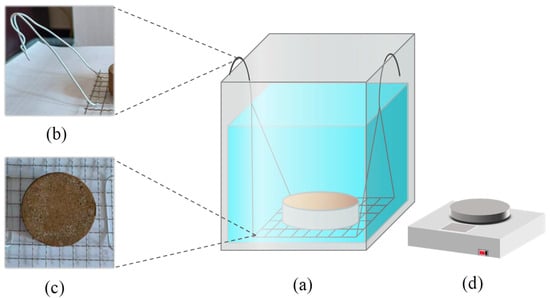
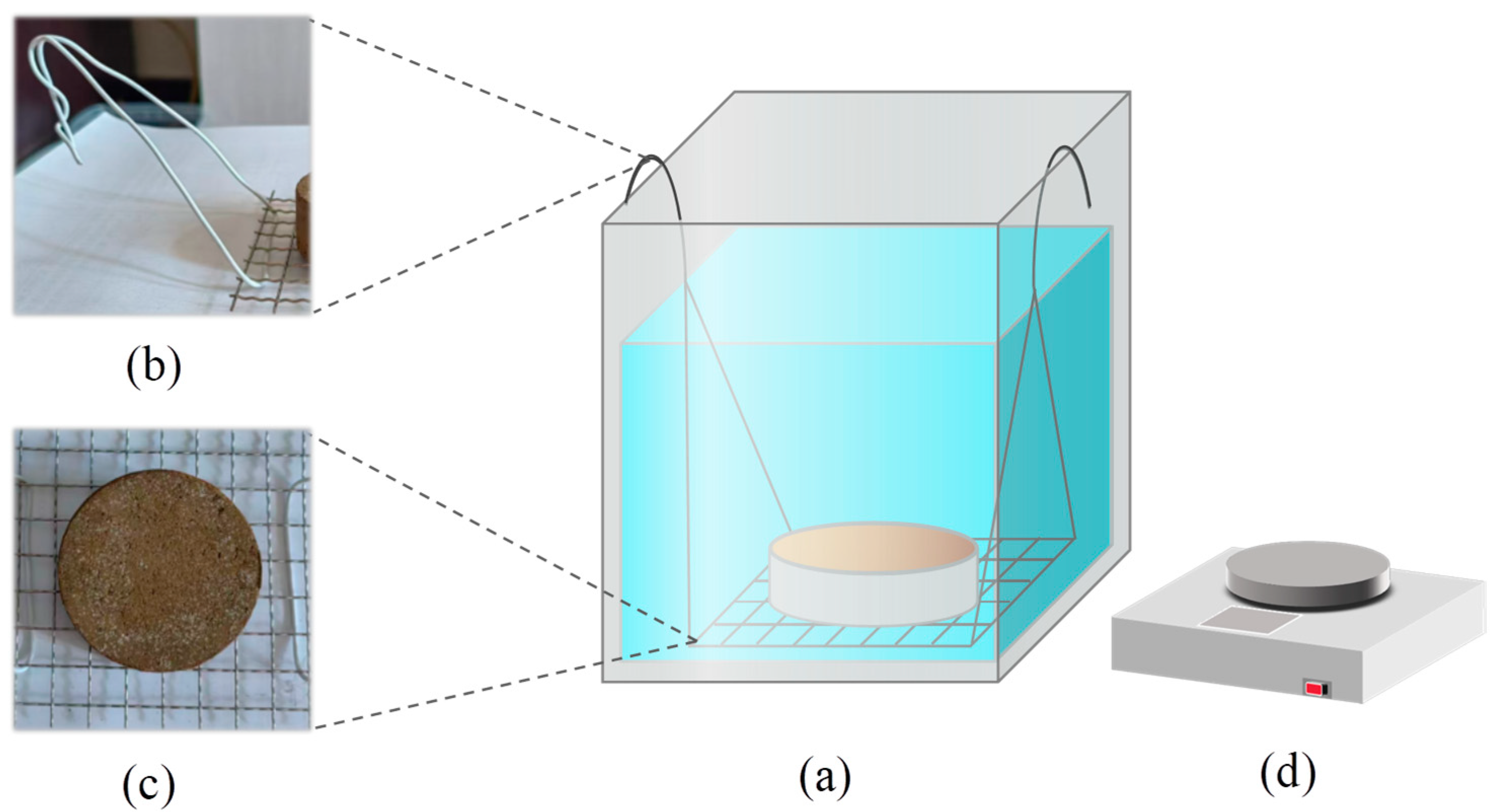
The immersion disintegration test apparatus was developed by referring to the designs reported by Zhang [22] and Xu [23] and is mainly composed of a disintegration bucket and a 316 stainless steel wire mesh, as shown in Figure 1. The wire mesh had an aperture size of 1 cm × 1 cm, with hooks attached to its edges for convenient placement and removal of specimens during testing. The disintegration bucket was made of transparent polymethyl methacrylate (PMMA), which facilitated observation and recording of the soil specimen disintegration process.
Figure 1.
Schematic diagram of the disintegration test apparatus: (a) bucket for soil disintegration; (b) hook; (c) stainless steel wire mesh; and (d) weighing scale.
2.2.2. Test Procedure
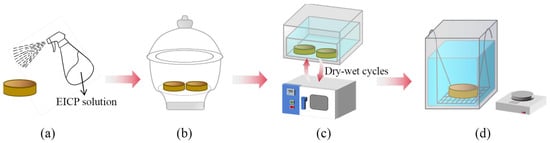
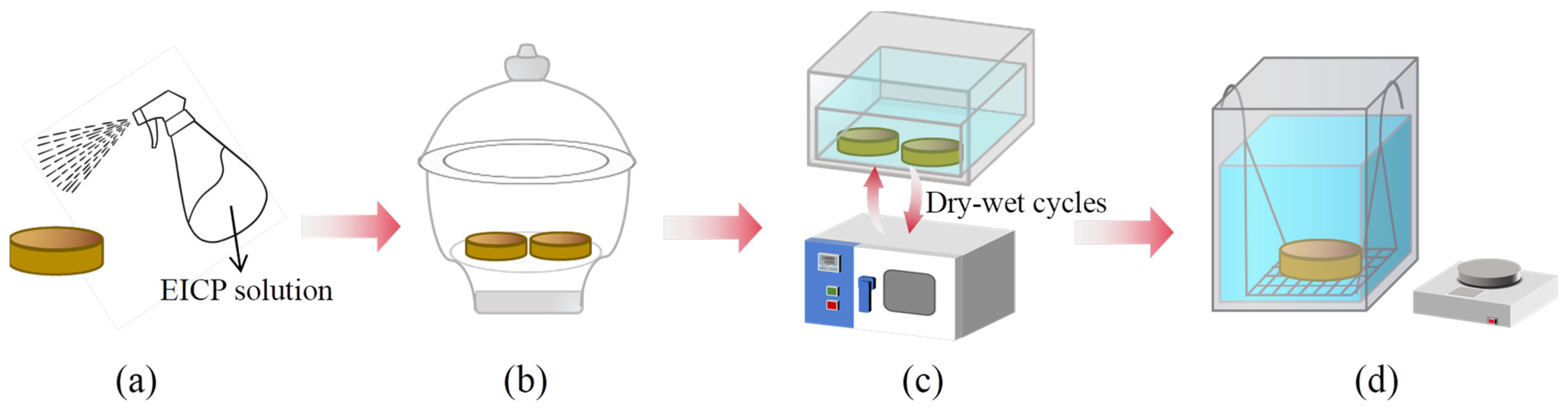
The test procedure consisted of sequential treatments applied to the specimens, including surface spraying of EICP cementing solution, curing, dry–wet cycles, and immersion disintegration testing, as shown in Figure 2. For clarity, three soil treatment types are defined consistently in this study: (1) untreated soil—soil specimens compacted with deionized water without EICP addition; (2) EICP-mixed treated soil—soil specimens prepared by mixing EICP cementing solution with soil and compaction, without subsequent surface spraying; and (3) surface-sprayed EICP-treated soil: EICP-mixed treated soil with additional surface spraying of EICP solution as secondary reinforcement. Unless otherwise specified, EICP-treated soil in the following sections refers to EICP-mixed treated soil. The detailed experimental steps are described as follows.
Figure 2.
Flow chart of the disintegration test simulating reinforcement, curing, and water-level fluctuations: (a) surface spraying; (b) curing; (c) dry–wet test; and (d) disintegration test.
As shown in Figure 2a,b, the prepared specimens were taken out after 1 d of curing. EICP solution was sprayed onto the top surface of each specimen using a sprayer. The spray volume was controlled such that it was identical for each application, with an interval of no less than 30 min between consecutive sprays to ensure sufficient infiltration of urease and cementing solution and complete cementation reaction. After the preset number of spraying applications was reached, the specimens were re-sealed with plastic film, placed in a moisture chamber, and cured to the target curing age.
As shown in Figure 2c, the specimens were placed in a disintegration bucket filled with water to conduct dry–wet cycle tests. To ensure complete immersion of the specimens, the water level in the bucket was maintained at 2~3 cm above the top surfaces of the specimens. Each specimen was immersed in water for 12 h and then taken out and dried for 12 h; this process constituted one dry–wet cycle. After the specimens has undergone the preset number of dry–wet cycles, soil particles that disintegrated and fell off during the cyclic process were collected by filtration. After drying, the mass of the collected soil particles was measured and recorded as the initial disintegration mass m0.
As shown in Figure 2d, the specimens were immediately subjected to immersion disintegration testing after the dry–wet cycles. Each specimen was placed on a stainless steel wire mesh and carefully lowered into the disintegration bucket. After disintegration for the specified duration, the specimens were carefully retrieved. Soil particles that had dispersed in the disintegration bucket were collected by filtration, dried, and weighed, with the mass recorded as the disintegration mass mi. Subsequently, the disintegration bucket was refilled with deionized water. Each specimen was carefully placed back into the bucket and left to continue disintegrating. The above procedure was repeated at preset time intervals, and the cumulative disintegration mass ∑mi was calculated from successive weighing.
2.3. Single-Factor Test Scheme
A single-factor immersion disintegration test was designed to simulate the complex service conditions of EICP-treated soil on the upstream slopes of dams, covering EICP mixing reinforcement, surface-spraying reinforcement, curing, dry–wet cycles, and immersion disintegration. Three influencing factors were selected, namely, the number of surface-spraying applications, curing age, and number of dry–wet cycles, each at three levels. A total of 10 test groups were included in the single-factor test scheme, as detailed in Table 1. Immersion durations of 1, 3, 7, 14, 28, 42, 56 and 70 d were selected for testing.
Table 1.
Single-factor immersion disintegration test scheme.
Groups 1 and 2 were compared to examine the effect of surface-sprayed EICP solution on the immersion disintegration characteristics of untreated soil. The difference in immersion disintegration performance between untreated and EICP-treated soil was investigated by comparing Groups 1 and 3. Further comparison between Groups 3 and 5 was conducted to evaluate how surface spraying of EICP solution affects the disintegration behavior of EICP-treated soil under immersion. For single-factor analysis, Groups 4, 5 and 6 were compared to examine the influence of the number of surface-spraying applications; Groups 5, 7 and 8 were compared to assess the effect of curing age; and Groups 5, 9 and 10 were compared to analyze the influence of dry–wet cycles.
2.4. Multi-Factor Response Surface Test Scheme
Single-factor tests revealed the influence of each factor on the disintegration characteristics of EICP-treated soil. However, single-factor experiments failed to capture the interactions among factors, and it was also difficult to obtain reinforcement parameter combinations suitable for service conditions. A three-factor three-level experiment was designed using the Box–Behnken Design (BBD) based on the response surface method (RSM), with the cumulative disintegration mass after 70 d of immersion as the response variable. A multiple quadratic regression model was constructed between the experimental factors and the response variable. The response surface method (RSM) fits the nonlinear functional relationship between experimental factors and the response variable via a multiple quadratic regression equation, which is shown in Equation (1).
where y is the response variable cumulative disintegration mass, xi is the coded value of each experimental factor, β0 is the constant term, βi is the first-order (linear) coefficient, βii is the quadratic coefficient, βij is the interaction term coefficient, and ε is the error term.
The coding of factor levels is shown in Table 2. A total of 17 test groups were included in the BBD experimental design, of which 5~9 groups were replicated center-point test groups created for estimating the experimental error, as detailed in Table 3.
Table 2.
Experimental factors and level coding.
Table 3.
BBD response surface test scheme.
2.5. Surface-Wetting Test
As a typical porous medium, soil exhibits a close correlation between its surface wettability and disintegration resistance. Clay is inherently highly hydrophilic. When water droplets impinge on the surface of clay, an initial contact angle is rapidly formed at the solid–liquid interface. Subsequently, water spreads across the surface and infiltrates the internal soil matrix via pore networks, which accelerates the softening and disintegration of the soil mass. The ability of soil surfaces to resist water infiltration can be quantitatively characterized by the surface-wetting rate [24]. The surface-wetting rate is defined as the percentage of the initial specimen surface area occupied by the spread-out water droplet at a specific time, and its calculation formula is presented in Equation (2).
where It is defined as the surface-wetting rate of the specimen at time t, as a %; St denotes the wetted area of the specimen at time t, in pixels; and S0 is defined as the initial area of the specimen, in pixels.
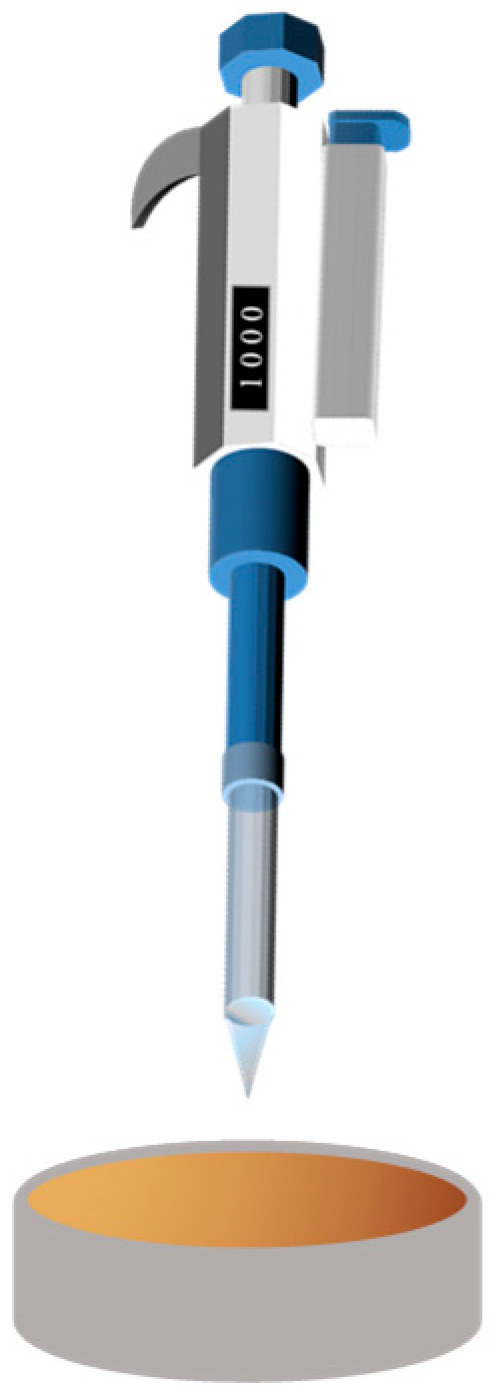
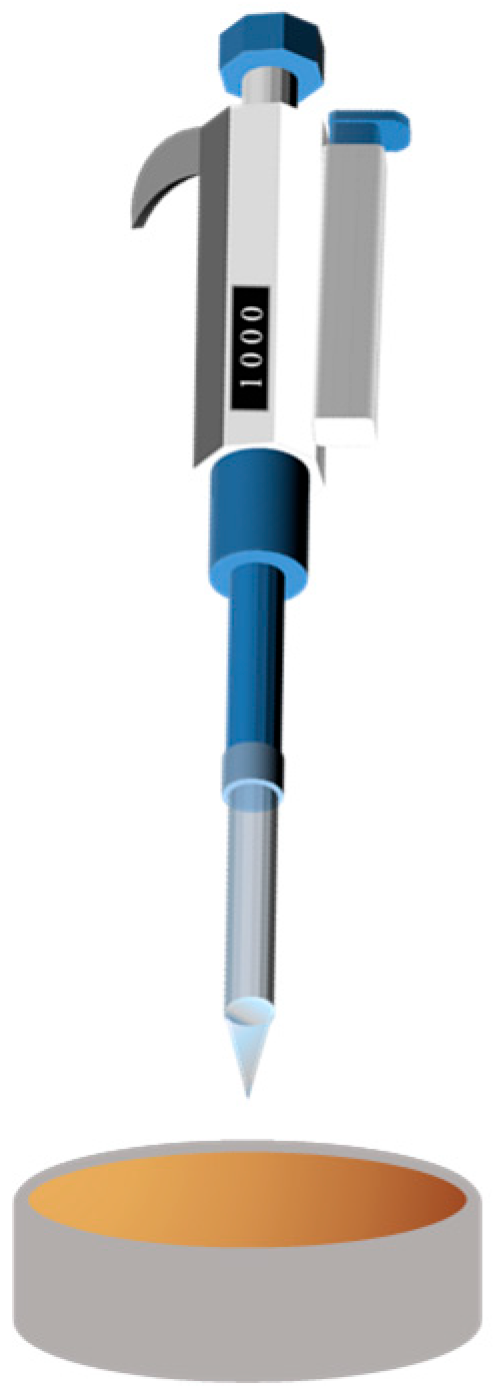
To verify the improvement effect of EICP reinforcement and surface spraying on the water infiltration resistance of cohesive soil, a controlled comparative experimental design was adopted. Three types of specimens were prepared for the surface-wetting test, namely, untreated soil specimens that did not undergo surface spraying, EICP-treated soil specimens that did not undergo surface spraying, and EICP-treated soil specimens that underwent surface spraying. Meanwhile, to comparatively investigate the degradation effect of dry–wet cycles on water infiltration resistance, surface-wetting tests were performed on all three types of specimens both in the initial state before dry–wet cycling and after 5 dry–wet cycles. A schematic diagram of the surface-wetting test is presented in Figure 3.
Figure 3.
Schematic diagram of the surface-wetting test.
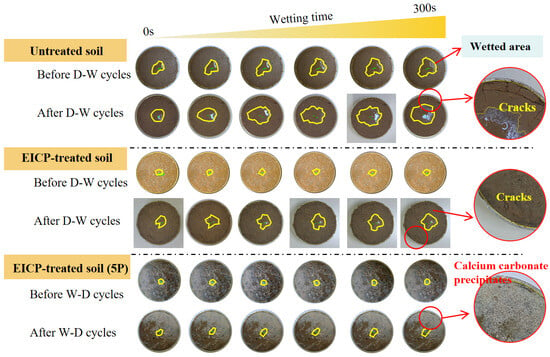
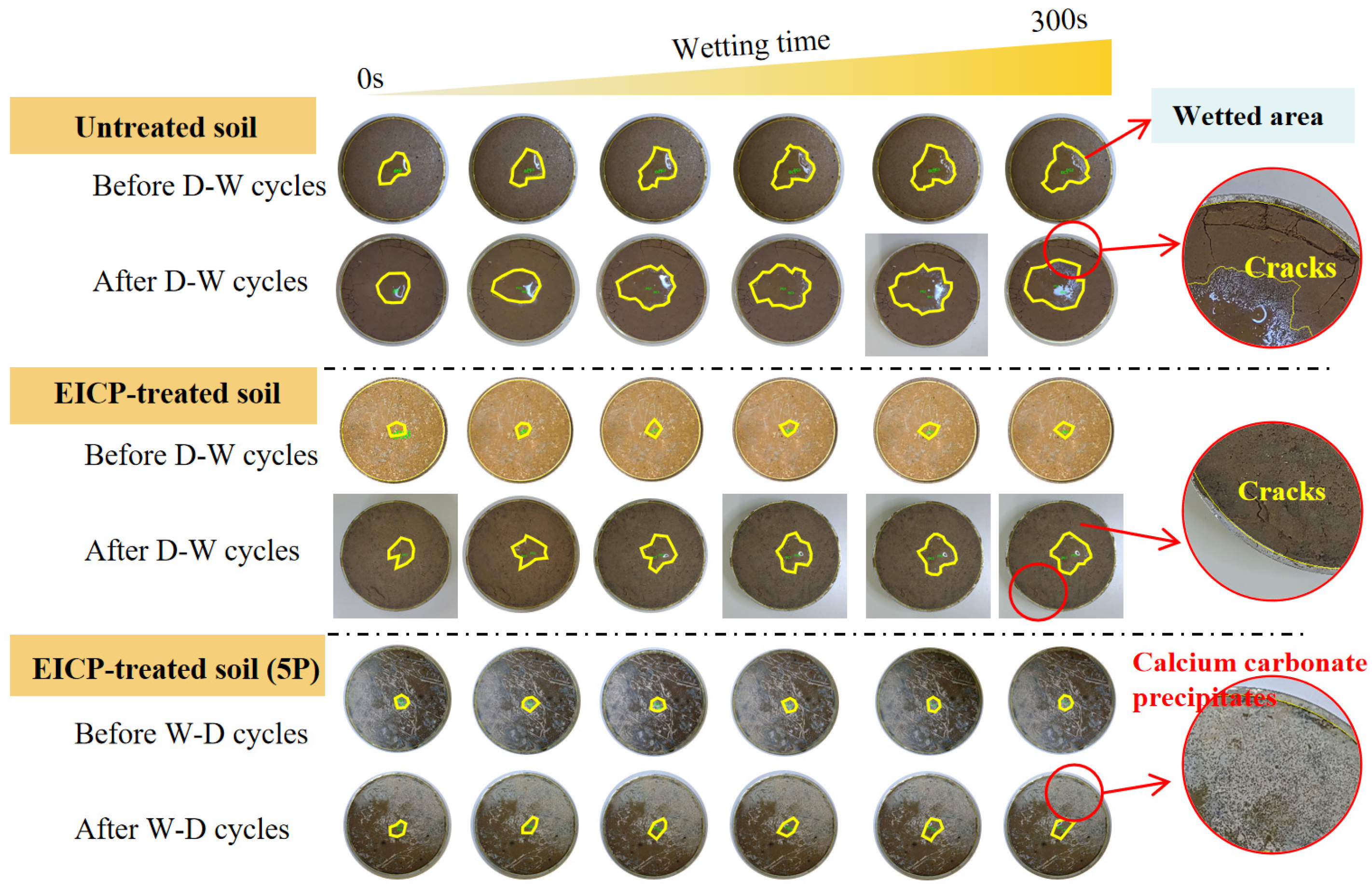
The surface-wetting test was conducted following the procedures described below. A total of 100 μL of deionized water was aspirated by a pipette and vertically dispensed onto the center of the specimen surface. Upon completion of the dispensing, morphological variations of the water droplet at 10 s, 30 s, 60 s, 120 s and 300 s were recorded using a camera. Subsequently, preprocessing operations including grayscale conversion and noise reduction were performed on the acquired images via image-processing software. The spreading contour of the water droplet and the surface contour of the specimen were identified, and the surface-wetting rate at each time point was calculated accordingly. It should be noted that the surface wettability evaluation in this study is targeted at the shallow surface layer of the upstream slope under low infiltration pressure, as induced via rainfall immersion and small-amplitude water-level fluctuation, which is consistent with the service scenario of the studied earth dam slope.
3. Results and Discussion
3.1. Study on Disintegration Characteristics of EICP-Treated Earth Dam Slope Soil Mass Under Complex Service Conditions
3.1.1. Comparison of Disintegration Characteristics Between EICP-Treated Soil and Untreated Soil
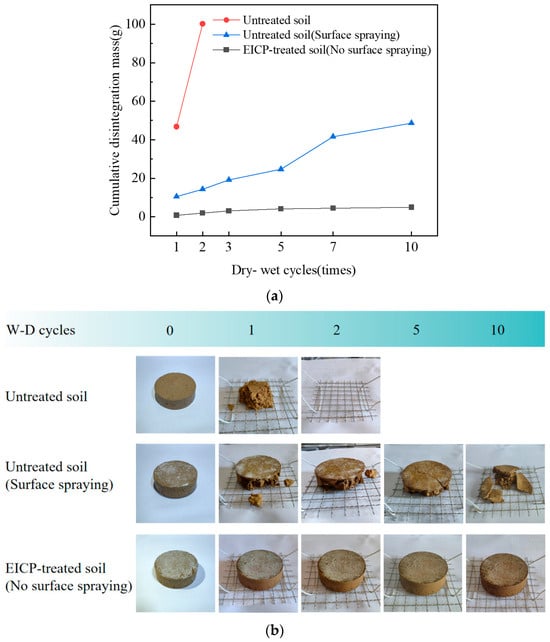
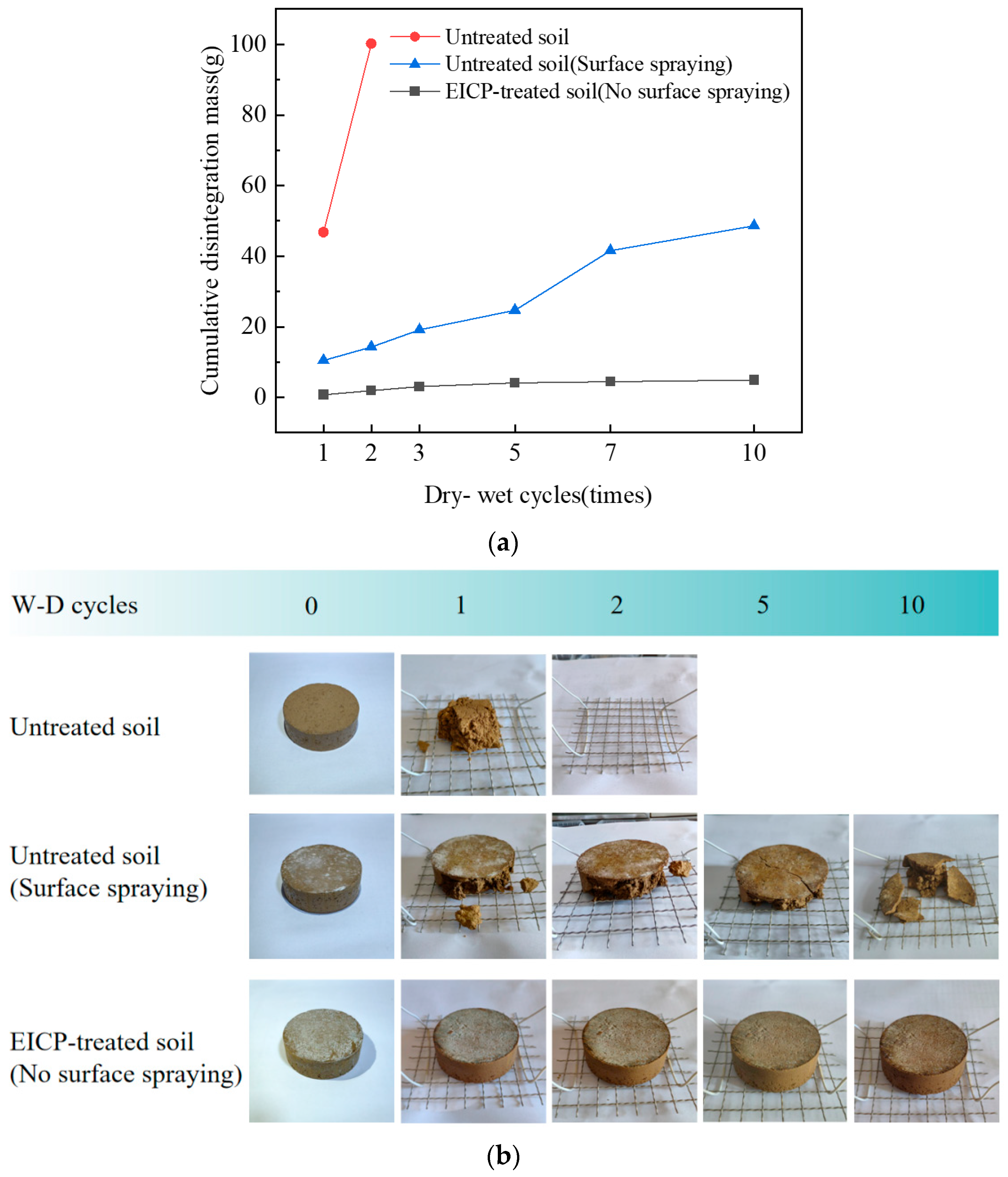
The variation curves of cumulative disintegration mass as a function of dry–wet cycles and the corresponding disintegration characteristics for three types of specimens, namely, untreated soil, untreated soil with surface-sprayed EICP solution, and EICP-treated soil without surface-sprayed EICP solution, are presented in Figure 4. It should be noted that EICP-treated soil refers to the specimen prepared by mixing EICP solution with soil. As can be observed in Figure 4, nearly complete disintegration of the untreated soil was achieved after two dry–wet cycles. Hence, to compare the disintegration characteristics of the three types of specimens, we subjected the test results obtained after the dry–wet cycles to analysis based on the experimental data.
Figure 4.
The cumulative disintegration mass and disintegration characteristics of three types of specimens: (a) relationship between cumulative disintegration mass and number of dry–wet cycles, and (b) disintegration characteristics.
As shown in Figure 4a, significant differences in cumulative disintegration mass were detected between the three types of specimens after one dry–wet cycle. The cumulative disintegration mass ranked in descending order, untreated soil, untreated soil with surface-sprayed EICP solution, and EICP-treated soil that did not undergo surface spraying. The cumulative disintegration mass of the untreated soil was found to be 46.74 g, while that of the untreated soil with surface-sprayed EICP solution accounted for only 22.51% of the above value. The cumulative disintegration mass of the EICP-treated soil was less than 1.0 g, making up merely 1.71% of that of the untreated soil. These results indicate that the dry–wet resistance of the soil mass was effectively improved and the disintegration mass was reduced by surface spraying of EICP solution on the soil surface. Meanwhile, it was demonstrated that the deterioration resistance of the soil mass was significantly enhanced by preparing EICP-treated soil specimens through mixing EICP solution with soil. With the increase in the number of dry–wet cycles, a marked increase in cumulative disintegration mass was observed for the untreated soil treated with surface-sprayed EICP solution, whereas no obvious growth was detected for the EICP-treated soil, which exhibited stable resistance to deterioration induced by dry–wet cycles.
As shown in Figure 4b, nearly complete disintegration of the untreated soil specimens was attained after two dry–wet cycles. For the untreated soil specimens treated with surface-sprayed EICP solution, the specimen surface remained intact at the initial stage of dry–wet cycles following the spraying treatment, while the lower portion beneath the surface gradually disintegrated owing to the lack of internal reinforcement. Cracks formed on the specimen surface after five dry–wet cycles. After ten dry–wet cycles, complete disintegration was not achieved, and massive soil blocks still remained. The test results again demonstrate that the dry–wet disintegration resistance of the soil mass was significantly enhanced after reinforcement via surface spraying of EICP solution. Compared with the two aforementioned specimen types, the structure of the EICP-treated soil specimens was intact after ten dry–wet cycles, with only a small quantity of fine particles dispersed on the surface, which exhibited excellent resistance to deterioration induced by dry–wet cycles.
The differences observed in the above test results are associated with the adopted reinforcement methods. A cemented protective layer with a certain thickness only formed on the surface layer of the soil mass via surface-spraying reinforcement, and the disintegration resistance of the soil mass could be improved to a certain extent. However, since this method only achieved shallow surface reinforcement, the internal soil within the specimens was not effectively cemented. Therefore, under the action of repeated dry–wet cycles, water absorption swelling and water loss cracking continuously occurred in the untreated regions, which further resulted in gradual disintegration. Accordingly, the cumulative disintegration mass was maintained at a relatively high level. For the EICP-mixed treated soil specimens prepared by mixing EICP solution with soil materials, calcium carbonate precipitates induced by urease were uniformly distributed inside the soil mass. Bridges were formed at the contact points of soil particles, and discrete particles were bonded into an integral structure. Meanwhile, inter-particle pores were filled, and pore connectivity was reduced, which fundamentally improved the water stability characteristics of the soil mass, which is consistent with the research conducted by Zhang [8]. Consequently, an extremely low disintegration mass was observed under both dry–wet cycle conditions and long-term water immersion conditions.
3.1.2. Effect of Number of Surface-Spraying Applications on Disintegration Characteristics of EICP-Treated Soil
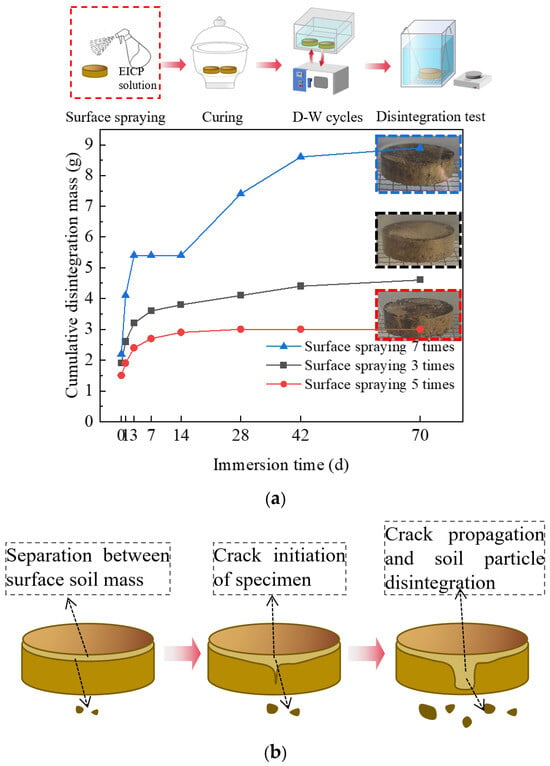
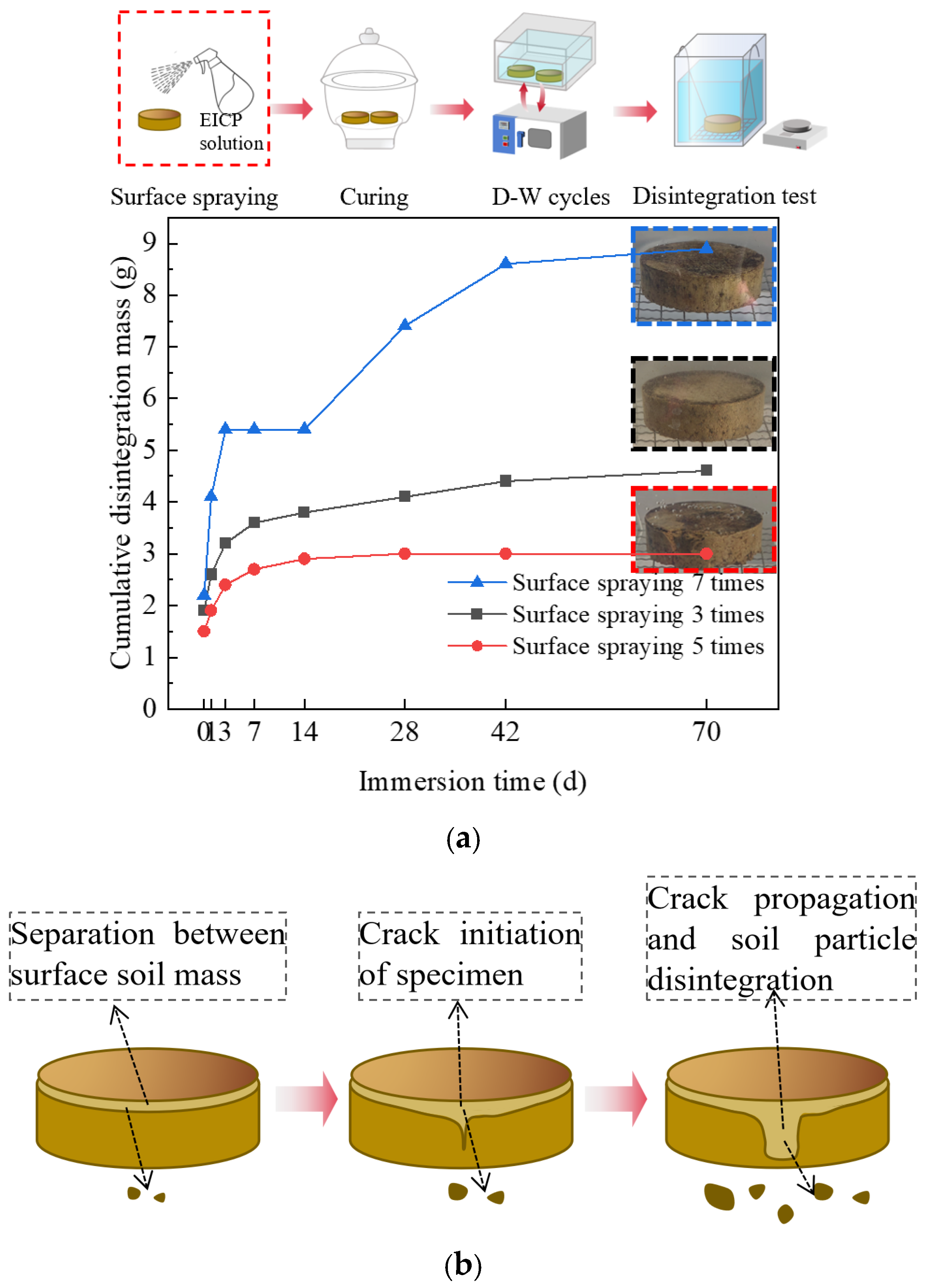
EICP solution was sprayed onto the surfaces of EICP-mixed treated soil specimens at three application levels (three, five and seven times). After 14 days of curing and 10 dry–wet cycles, immersion disintegration tests were performed, and the results are presented in Figure 5. When the test results of the EICP-treated soil that did not undergo surface spraying were compared with those of the EICP-treated soil subjected to three surface-spraying applications, the cumulative disintegration mass of the former after 10 dry–wet cycles was found to be higher than that of the latter after 70 days of water immersion. This result indicates that the disintegration resistance of the soil mass could be further enhanced by supplementary surface-spraying treatment following EICP mixing reinforcement.
Figure 5.
Effect of number of surface-spraying applications on soil disintegration characteristics: (a) results of immersion disintegration tests on EICP-treated soil under different quantities of surface-spraying applications; (b) immersion disintegration process.
As shown in Figure 5a, with the increase in the number of surface-spraying applications, the cumulative disintegration mass of the specimens presented a trend of first decreasing and then increasing. The cumulative disintegration masses were ranked in descending order as follows: the specimens subjected to seven surface-spraying applications, the specimens subjected to three surface-spraying applications, and the specimens subjected to five surface-spraying applications. The underlying mechanisms were analyzed. When three surface-spraying applications were conducted, the calcium carbonate generated on the specimen surface was sparsely distributed with relatively low thickness, resulting in a weak protective layer on the specimen surface. Soil pores were liable to infiltration by water, and disintegration was induced accordingly. The soil specimens’ resistance to damage caused by dry–wet cycles was relatively poor, and thus the cumulative disintegration mass was higher than that of the specimens treated with five surface-spraying applications. With the number of spraying applications increased to five, the calcium carbonate precipitates formed on the soil surface gradually became continuous and compact, and a protective layer with a certain thickness and strength was formed. Water infiltration was effectively blocked, and the disintegration mass was reduced to the minimum level. When the number of spraying applications was further increased to seven, as illustrated in Figure 5b, excessive calcium carbonate accumulated in the surface layer, and a hard crust layer with greater thickness and higher strength was formed. The brittleness of this hard crust layer was enhanced, while its deformation capacity was weakened. Under the action of dry–wet cycles, stress concentration was generated between the hard crust and the underlying unsprayed region due to incompatible deformation induced by wet swelling and dry shrinkage. Cracking and separation of the hard crust along its edges were caused by such stress concentration.
The immersion disintegration process of the specimens subjected to seven surface-spraying applications could be divided into three stages, as illustrated in Figure 5b. In the first stage, cracks were generated between the hard crust layer formed on the top surface of the soil specimen and its side surfaces, and fine particles spalled/fell off at the crack positions. When the number of surface-spraying applications reached seven, under dry–wet cycle conditions, a deformation-incompatible region formed between the thicker surface reinforcement layer and the unsprayed portion due to wet swelling and dry shrinkage, and stress concentration was induced, which resulted in cracking and separation. In the second stage, with the increase in immersion time, large-scale disintegration of the specimen gradually initiated at the crack positions, which indicated that the structure of the specimen was damaged by stress concentration. Water gradually infiltrated the cracks, and internal disintegration was aggravated. In the third stage, after the completion of large-scale disintegration, the remaining structure of the soil mass tended to be stable, and the growth rate of the disintegration mass slowed down.
From the perspective of immersion time evolution, rapid growth in cumulative disintegration mass was observed for all three types of specimens subjected to a different number of surface-spraying applications at the initial immersion stage. Compared with the non-immersed state, the rates of increase in cumulative disintegration mass for the specimens subjected to three, five and seven surface-spraying applications after 7 d of immersion were 89.47%, 80% and 145.45%, respectively. For specimens subjected to five surface-spraying applications, the rate of increase in cumulative disintegration mass at 28 d, 42 d and 70 d of immersion was only 11.1% relative to that at 7 d of immersion. This result indicated that the disintegration of the specimens had basically stabilized after 7 d of immersion, and the growth in disintegration mass was extremely slow in the subsequent immersion process. With the prolongation of immersion time, the cumulative disintegration mass of specimens subjected to five surface-spraying applications exhibited a growth pattern characterized by rapid disintegration at the early stage, decelerated growth at the middle stage and gradual stabilization at the late stage. The rapid disintegration at the early stage was induced by water infiltration and dry–wet cycle damage, which triggered fast disintegration and spalling on the specimen surface and shallow layer. At the middle stage, the structure of the remaining undisintegrated portion gradually stabilized, and the increment in disintegration mass gradually reduced. At the late stage, the cumulative disintegration mass grew at a slow rate, a relatively stable structure formed inside the specimens, and the disintegration process basically stagnated.
3.1.3. Effect of Curing Age on Disintegration Characteristics
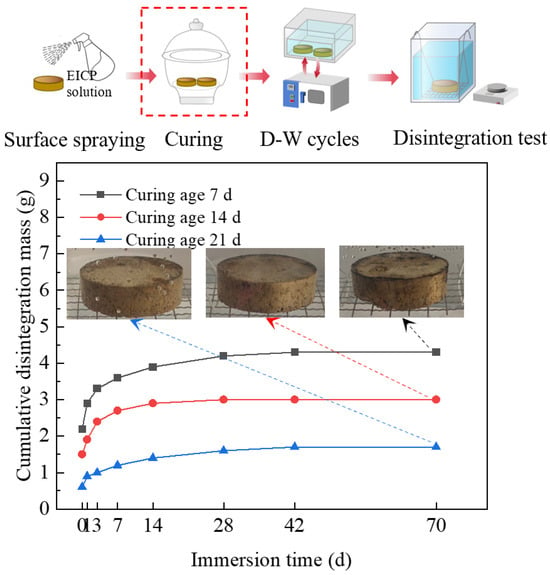
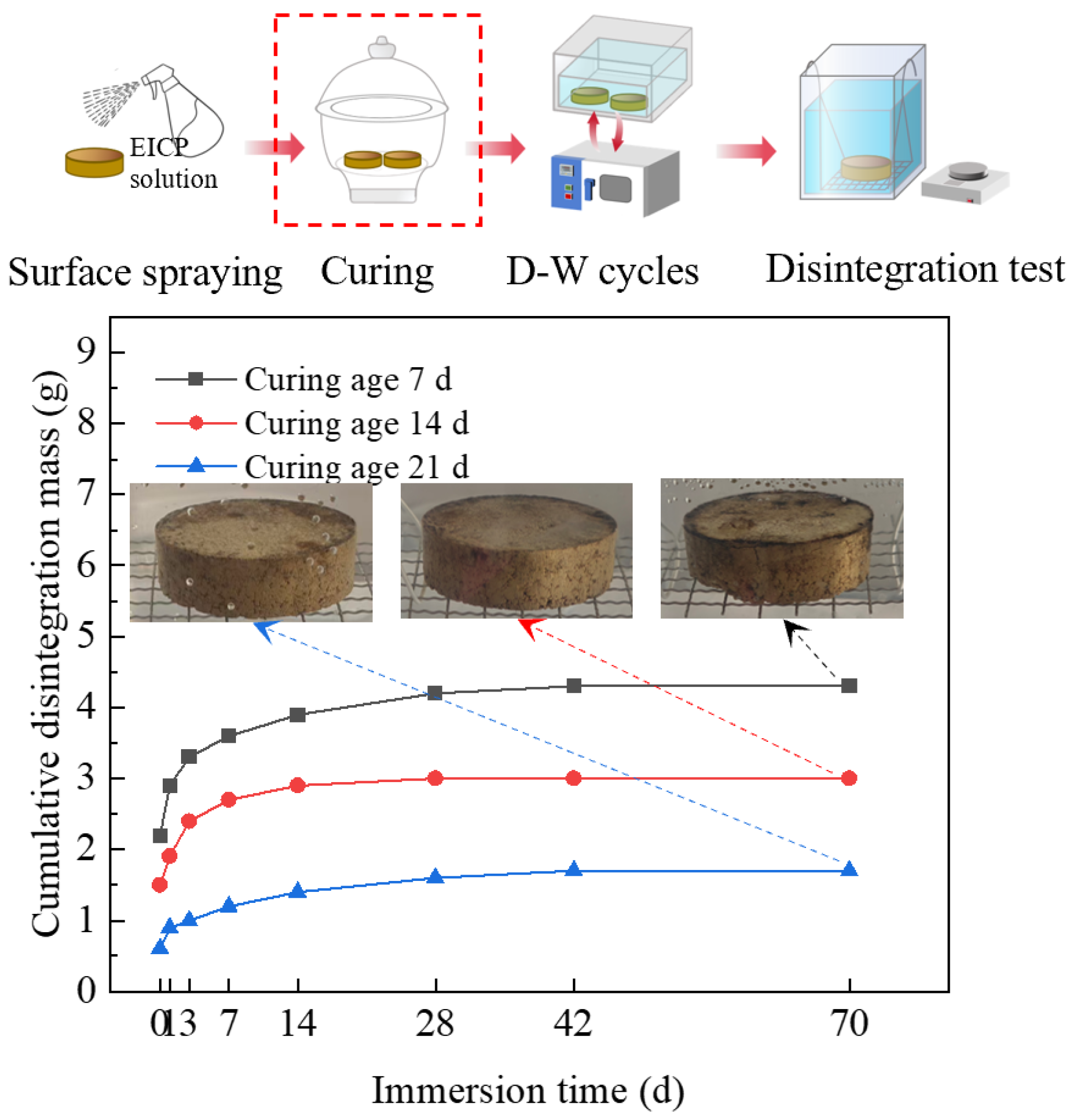
EICP solution was sprayed onto the surfaces of EICP-mixed treated soil specimens for five applications. After different curing periods (7 d, 14 d and 21 d) and 10 dry–wet cycles, immersion disintegration tests were performed, and the results are shown in Figure 6.
Figure 6.
Results of immersion disintegration tests conducted on EICP-treated soil over different curing periods.
As shown in Figure 6, the cumulative disintegration mass of the specimens gradually decreased with the increase in curing age, and the corresponding values were ranked in descending order as follows: 7 d curing age, 14 d curing age and 21 d curing age. At 70 d of immersion, the cumulative disintegration masses of specimens cured for 14 d and 21 d had reduced by 30.23% and 60.47%, respectively, compared with those of the specimens cured for 7 d. This result indicates that the specimens cured for 21 d exhibited optimal disintegration resistance.
As shown in Figure 6, edge cracking occurred in EICP-treated soil specimens cured for 7 d after 70 d of immersion, and extensive disintegration was detected at the lower portion of the specimens. In contrast, for EICP-treated soil specimens cured for 14 d and 21 d, the structure remained intact, and no large-scale disintegration phenomenon was observed. The test results indicate that at less than 7 d of curing, a continuous and stable cemented skeleton had not formed inside the soil mass. The yield of calcium carbonate precipitates was limited, and the inter-particle cementation strength was relatively low. Stress concentration was readily induced under the action of dry–wet cycles, which further resulted in cracking and large-scale disintegration of the specimens. When the curing age exceeded 14 d, no obvious disintegration or cracking was found in EICP-treated soil. This illustrates that the urease-catalyzed urea hydrolysis reaction was relatively sufficient at this point. Calcium carbonate precipitates were continuously generated and filled the pores, inter-particle cementation was constantly strengthened, a continuous and stable cemented skeleton was formed inside the soil mass, and disintegration resistance significantly enhanced.
From the perspective of immersion time evolution, a rapid increase in disintegration mass was detected for specimens cured for 7 d at the initial immersion stage. After 7 d of immersion, the growth rate was moderately reduced but still maintained a continuous upward trend, and the cumulative disintegration mass remained at a relatively high level by the 70th day of immersion. For specimens cured for 14 d and 21 d, the disintegration mass tended to stabilize after 7 d of immersion, with extremely slow growth during the subsequent immersion period. This result indicates that when the curing age reached 14 d or longer, EICP-treated soil could maintain satisfactory structural stability under long-term immersion conditions.
3.1.4. Effect of Number of Dry–Wet Cycles on Disintegration Characteristics
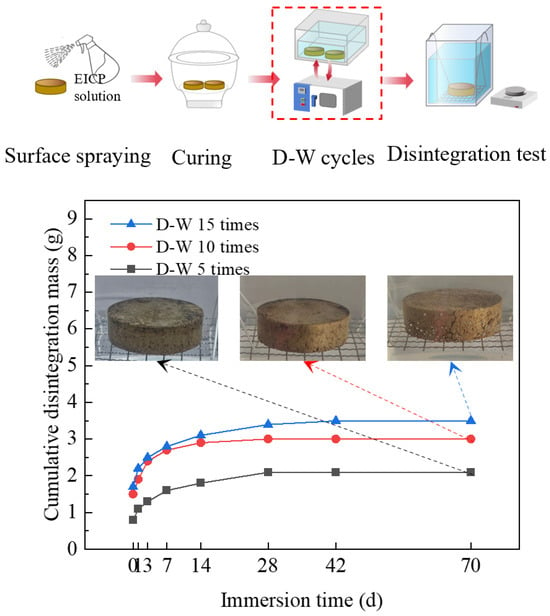
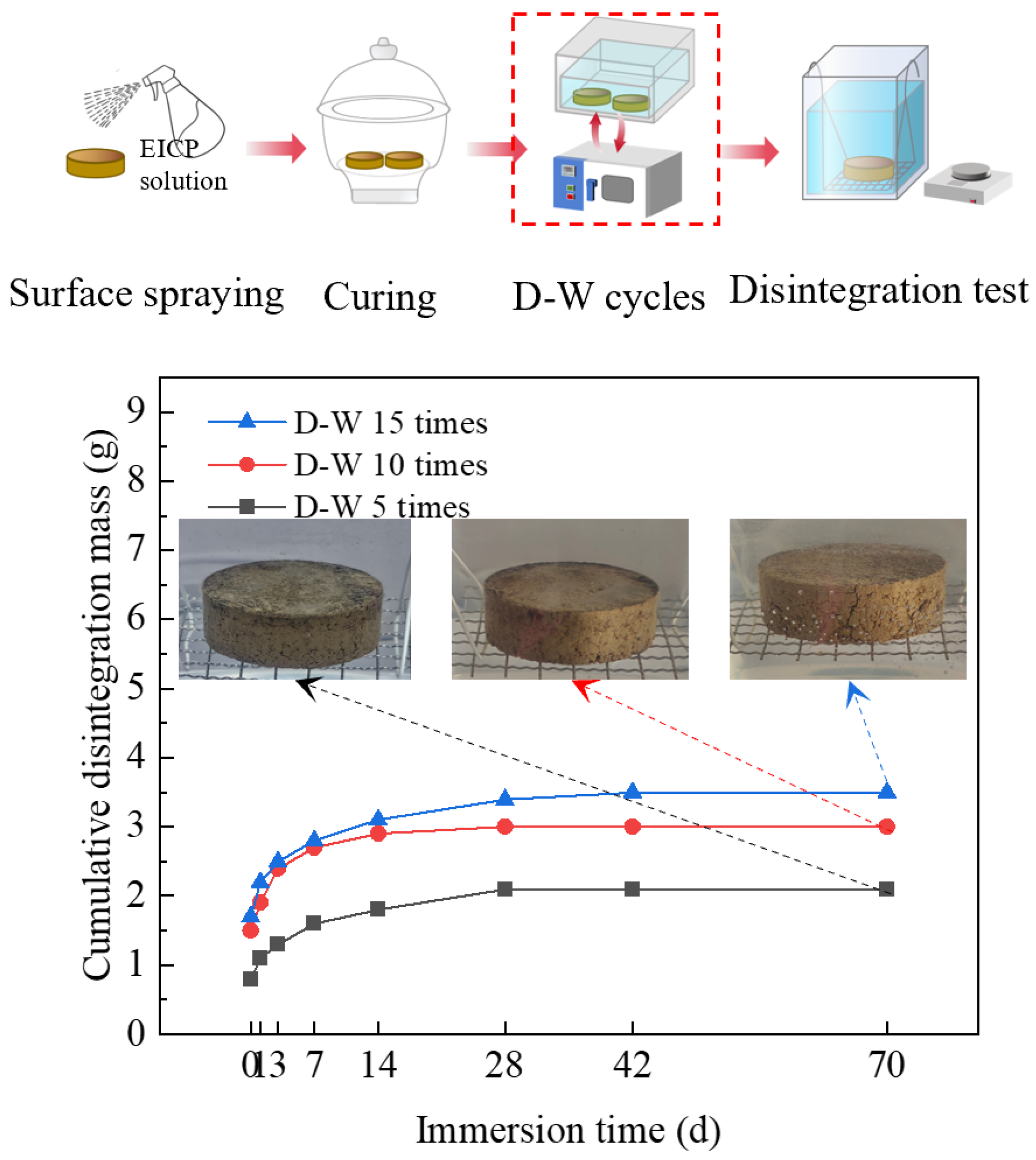
EICP solution was sprayed onto the surfaces of EICP-mixed treated soil specimens for five applications. After 14 d of curing and a different number of dry–wet cycles (5, 10 and 15), immersion disintegration tests were performed, and the results are presented in Figure 7.
Figure 7.
Results of immersion disintegration tests conducted on EICP-treated soil under a different number of dry–wet cycles.
As shown in Figure 7, the cumulative disintegration mass of the three types of specimens gradually increased with the increase in the number of dry–wet cycles. At 70 d of immersion, the cumulative disintegration masses of specimens subjected to 10 and 15 dry–wet cycles increased by 42.86% and 66.67%, respectively, compared with those subjected to 5 dry–wet cycles, while the value for specimens subjected to 15 dry–wet cycles only increased by 16.67% relative to those subjected to 10 dry–wet cycles. This indicates that with the increase in the number of dry–wet cycles, the growth rate of the cumulative disintegration mass of the specimens gradually decreased, and the deterioration effect of dry–wet cycles on EICP-treated soil presented a marginal diminishing characteristic.
As shown in Figure 7, the structure of specimens subjected to five dry–wet cycles remained intact during the immersion process, with only a small number of fine particles scattered on the surface. For specimens subjected to 10 dry–wet cycles, minor cracks appeared on the surface, but no large-scale disintegration occurred. For specimens subjected to 15 dry–wet cycles, the number of surface cracks increased, and a small amount of blocky spalling was detected at the edges, while the overall structure still remained intact. During the dry–wet cycle process, the soil mass repeatedly experienced swelling from water absorption and shrinkage from water loss. The inter-particle cementation was gradually damaged, and microcracks continuously initiated and propagated, which led to the deterioration of the soil structure. The calcium carbonate cementation generated by EICP could mitigate the structural damage caused by dry–wet cycles to a certain extent. However, when the number of cycles reached 15, the cumulative damage effect became significant, and the disintegration resistance of the soil mass exhibited a relatively obvious decline.
From the perspective of immersion time evolution, major disintegration of all three types of specimens was complete within 7 d of immersion, and the growth in disintegration mass tended to level off after 7 d. The greater the number of dry–wet cycles, the greater the initial disintegration mass (at 0 d of immersion) and the larger the absolute increment in disintegration mass at the initial immersion stage. However, the relative increase rate decreased with the increase in the number of dry–wet cycles. This result indicates that dry–wet cycles increased the initial disintegration mass mainly through cumulative damage, rather than significantly changing the disintegration rate during the immersion process.
3.2. Study on Disintegration Response Law of EICP-Treated Embankment Slope Soil Under Complex Service Conditions
3.2.1. Establishment of Quadratic Regression Model and Analysis of Variance and Factor Significance
According to the BBD response surface test scheme, multiple linear regression fitting was performed on 17 sets of experimental data, and a quadratic multiple regression model was established to describe the relationship between the response value of cumulative disintegration mass after 70 d of immersion and the number of surface-spraying applications, curing age, and the number of dry–wet cycles.
The analysis-of-variance results for cumulative disintegration mass are presented in Table 4. The significance of the model was determined by the F-value and p-value. The larger F-values and smaller p-values indicate higher significance of the factors. As can be seen from Table 4, the F-value of the regression model was 345, and the p-value was less than 0.0001, indicating that the regression model was highly significant. The p-value of the lack-of-fit term was 0.6328, which is greater than 0.05, indicating that the lack of fit of the model was not significant. Therefore, the regression equation could be applied to the analysis and prediction of experimental results.
Table 4.
Analysis of variance regarding cumulative disintegration mass of EICP-treated soil after 70 d of immersion.
As can be seen from Table 4, the linear terms of the three factors all reached an extremely significant level (p < 0.0001), with F-values of 976.79, 354.66 and 117.04, respectively. The order of influence degree was ranked as follows: x1 > x2 > x3. This result indicates that under long-term immersion disintegration conditions, the water-blocking protective effect of the surface hard crust formed by surface spraying was the most critical, followed by the internal cementation degree controlled by curing age, while the cumulative deterioration effect of dry–wet cycles was weaker.
Among the quadratic terms, the quadratic term of the number of surface-spraying applications was extremely significant (p < 0.0001), that of curing age was significant (p = 0.0119), and that of the number of dry–wet cycles was not significant (p = 0.9107). The high significance of the quadratic term of the number of surface-spraying applications further confirms the nonlinear law that there exists an optimal value (five times) for the spraying number, and either insufficient or excessive spraying application resulted in an increase in the cumulative disintegration mass.
With the significance level of α = 0.05 adopted in this study, the interaction between surface-spraying times and curing age (p = 0.0578) was close to significant but did not reach the statistical significance threshold, while the interaction between curing age and dry–wet cycles (p = 0.5886) showed no statistically significant effect on cumulative disintegration mass. The influences of pairwise interaction effects among the three factors on the cumulative disintegration mass were ranked in descending order as follows: x1x3 > x1x2 > x2x3. The significant interaction effect between the number of surface-spraying applications and the number of dry–wet cycles indicated that the water-blocking protective effect of the surface hard crust was strongly affected by the deterioration degree of dry–wet cycles. The greater the number of dry–wet cycles, the more critical the controlling effect of surface spraying on disintegration became.
3.2.2. Response Surface Analysis of Factor Interaction Effects
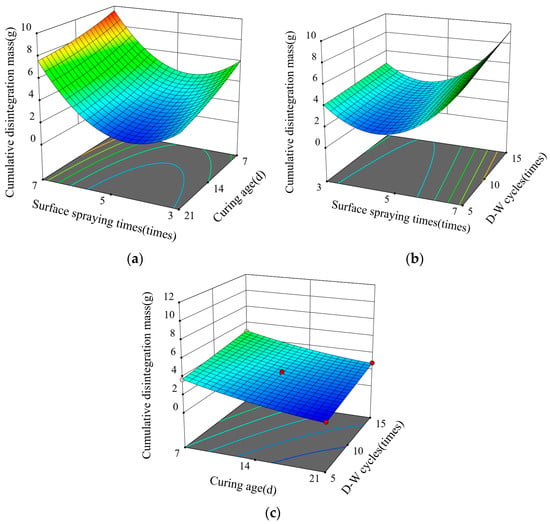
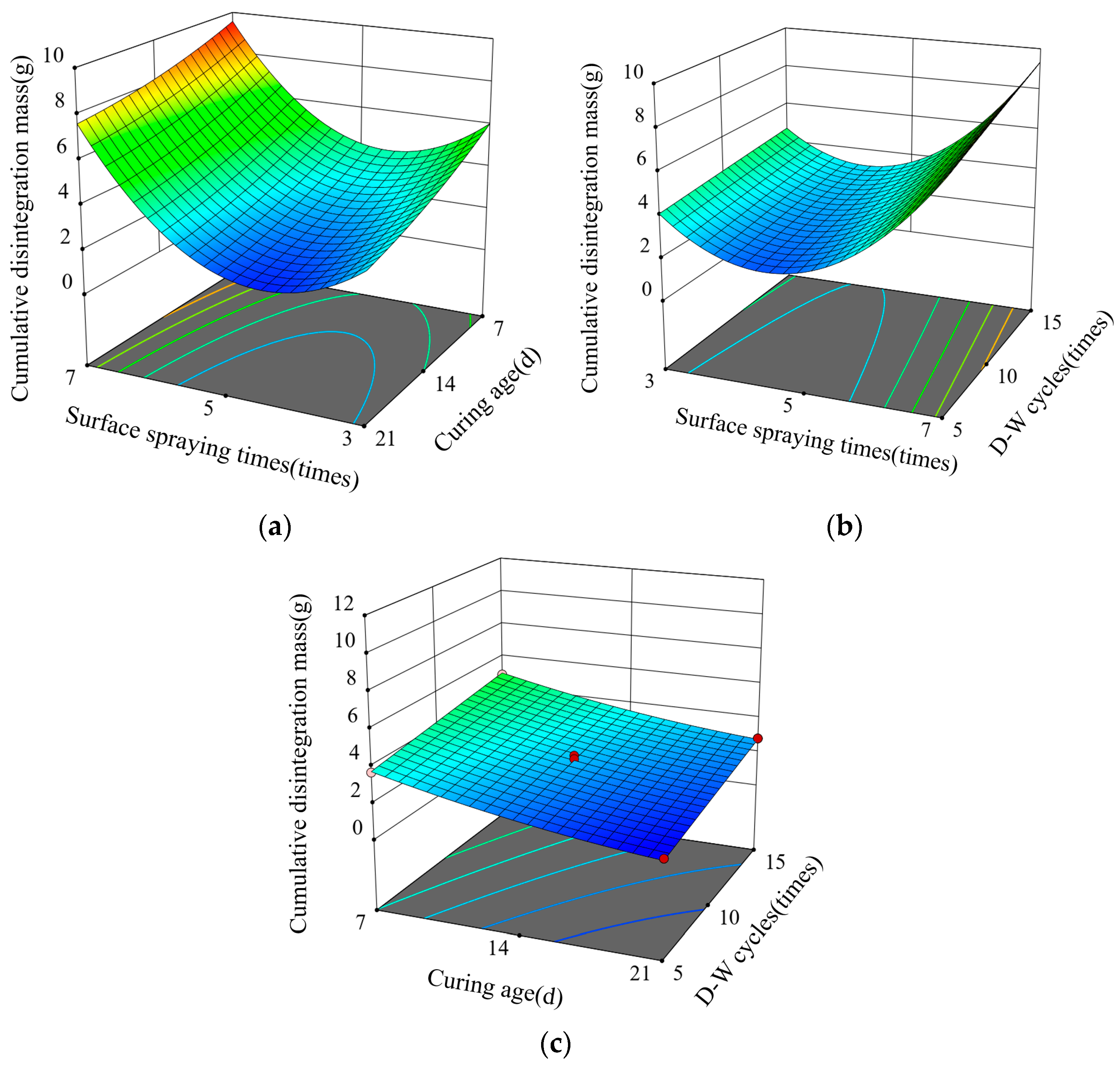
Response surface plots illustrating the interaction effects of the three factors (the number of surface-spraying applications, curing age, and the number of dry–wet cycles) on the cumulative disintegration mass were generated using Design-Expert software, as presented in Figure 8.
Figure 8.
Response surface plots for three-factor interaction effects on cumulative disintegration mass of EICP-treated soil: (a) interaction between number of surface-spraying applications and curing age and its effect on cumulative disintegration; (b) interaction between number of surface-applications and number of D-W cycles and its effect on cumulative disintegration; and (c) interaction between curing age and number of D-W cycles and its effect on cumulative disintegration.
Figure 8a illustrates the interaction effect of the two factors (the number of surface-spraying applications and curing age) and their influence law with respect to the cumulative disintegration mass at the medium level of 10 dry–wet cycles. When the number of surface-spraying applications increased from three to seven, the cumulative disintegration mass decreased with a rising curing age, indicating that the synergistic effect of curing age and surface spraying could significantly improve the disintegration resistance of the soil mass. The cumulative disintegration mass reached a minimum value at five surface-spraying applications and 21 d of curing age. The sensitivity of cumulative disintegration mass to the number of surface-spraying applications increased with an increasing curing age. This demonstrates that under a longer curing period, the internal cementation induced by EICP was more sufficient, the hard crust formed by surface spraying bonded more firmly with the internally cemented soil matrix, and the enhancement effect on disintegration resistance was more prominent.
Figure 8b presents the effect of the interaction between the number of surface-spraying applications and the number of dry–wet cycles on the cumulative disintegration mass of EICP-treated soil at a curing age of 14 d. The sensitivity of the cumulative disintegration mass of EICP-treated soil to the number of dry–wet cycles first increased and then decreased with the increase in the number of surface-spraying applications, reaching the highest sensitivity at five surface-spraying applications. The sensitivity of the cumulative disintegration mass of EICP-treated soil to the number of surface-spraying applications rose slowly with the increase in the number of dry–wet cycles. When the number of dry–wet cycles was relatively large, surface spraying played an important role in improving the disintegration resistance of the soil mass. This result is consistent with the conclusion that there was a significant interaction effect, as obtained from the analysis of variance.
Figure 8c presents the effect of the interaction between curing age and the number of dry–wet cycles on the cumulative disintegration mass at five surface-spraying applications. When the curing age was relatively high, the cumulative disintegration mass increased slowly with the increase in the number of dry–wet cycles, with a small growth amplitude. When the number of dry–wet cycles was relatively large, the cumulative disintegration mass was negatively correlated with curing age, with a large decrease amplitude, which indicated that curing age had a greater influence on the cumulative disintegration mass. The cumulative disintegration mass of EICP-treated soil reached a minimum value of 1.4 g at a curing age of 21 d and five dry–wet cycles, which was a factor combination with relatively excellent disintegration resistance in this study. The sensitivity of the cumulative disintegration mass of EICP-treated soil to curing age increased gradually with the increase in the number of dry–wet cycles, which demonstrates that under intense dry–wet cycle conditions, extending the curing age has a more significant benefit for improving the disintegration resistance.
3.2.3. Matched Parameter Combinations for Disintegration Resistance
As gleaned from the above analyses, the upstream slope of the embankment was located in the dynamic environment of water-level fluctuation in the reservoir area and was subjected to dry–wet cycles for a long period of time. The number of dry–wet cycles mostly corresponded to the medium-high level (10~15 cycles), which was the main inducement of soil disintegration and deterioration. In practical engineering, the core requirement for soil disintegration resistance is to keep the cumulative disintegration mass at a low level, and construction economy needs to be balanced at the same time. Specifically, excessive surface-spraying applications would increase material costs, and an overly long curing time would extend the construction period. Combined with the interaction law of the three factors and practical engineering demands, the matched parameter combinations for EICP reinforcement of the embankment upstream slope were derived and classified into two categories: a high-disintegration-resistance type and an economic adaptation type.
For the working condition featuring obvious periodic fluctuation in reservoir water levels during the flood season, priority was given to the disintegration resistance of the soil mass, and the parameter combination of five surface-spraying applications and a 21 curing age was selected. Under this combination, the sensitivity of the soil mass to dry–wet cycle deterioration was significantly reduced, and the cumulative disintegration mass remained at a low level after 15 dry–wet cycles. Meanwhile, this combination was the minimum point under the interaction between the number of surface-spraying applications and curing age. Their synergistic effect could effectively counteract the deterioration effect caused by many dry–wet cycles. This parameter combination could be applied to local reinforcement of key termite-damaged areas and areas with severe seepage deterioration on the upstream slope of the embankment and meet the disintegration resistance requirements of the embankment upstream slope under working conditions featuring obvious reservoir water-level fluctuations.
For the conventional working condition featuring minor daily fluctuations in reservoir water levels, construction economy was considered on the premise of ensuring disintegration resistance, and the parameter combination of five surface-spraying applications and a 14 d curing age was selected. This combination could effectively shorten the construction period, and five surface-spraying applications exhibited strong sensitivity to both dry–wet cycles and curing age. Under medium-level dry–wet cycles and a medium-to-long curing age, this combination can not only maintain the cumulative disintegration mass within the acceptable range for engineering practice but also effectively control material and construction period costs, meeting the reinforcement requirements of the embankment upstream slope under conventional working conditions. It should be noted that the above parameter recommendations were proposed based on laboratory tests within the ranges of 3–7 spraying applications, a 7–21 d curing age, and 5–15 dry–wet cycles, and further field verification is required for practical engineering applications.
3.3. Analysis of Microscopic Water-Blocking Characteristics of EICP-Treated Slope Soil
3.3.1. Surface-Wetting-Test Results
The surface-wetting-test results for three types of specimens, namely, untreated soil, EICP-treated soil (which did not undergo surface spraying), and EICP-treated soil (which was subjected to five surface-spraying applications), are presented in Figure 9. It can be observed in Figure 9 that the surfaces of all three specimens were free of cracks before the dry–wet cycles. After five dry–wet cycles, soil particle spalling and cracking occurred at the surface edges of the untreated soil specimens. The analysis attributed this phenomenon to pore water erosion, which induced cracking at the weak cemented positions in the soil matrix. In contrast, the surfaces of both the EICP-treated soil (which did not undergo surface spraying) specimens and the EICP-treated soil (which underwent surface spraying) specimens remained relatively intact.
Figure 9.
Results of surface-wetting test.
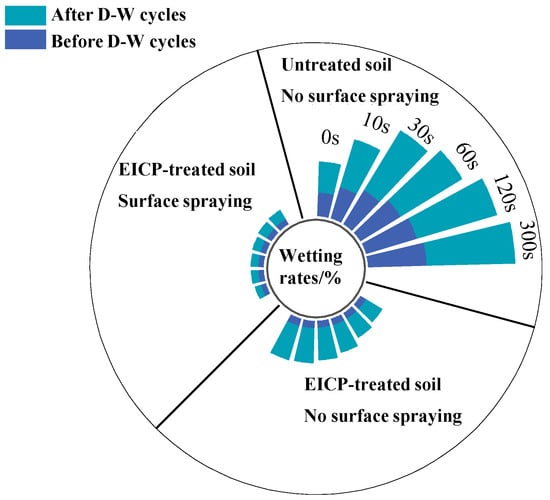
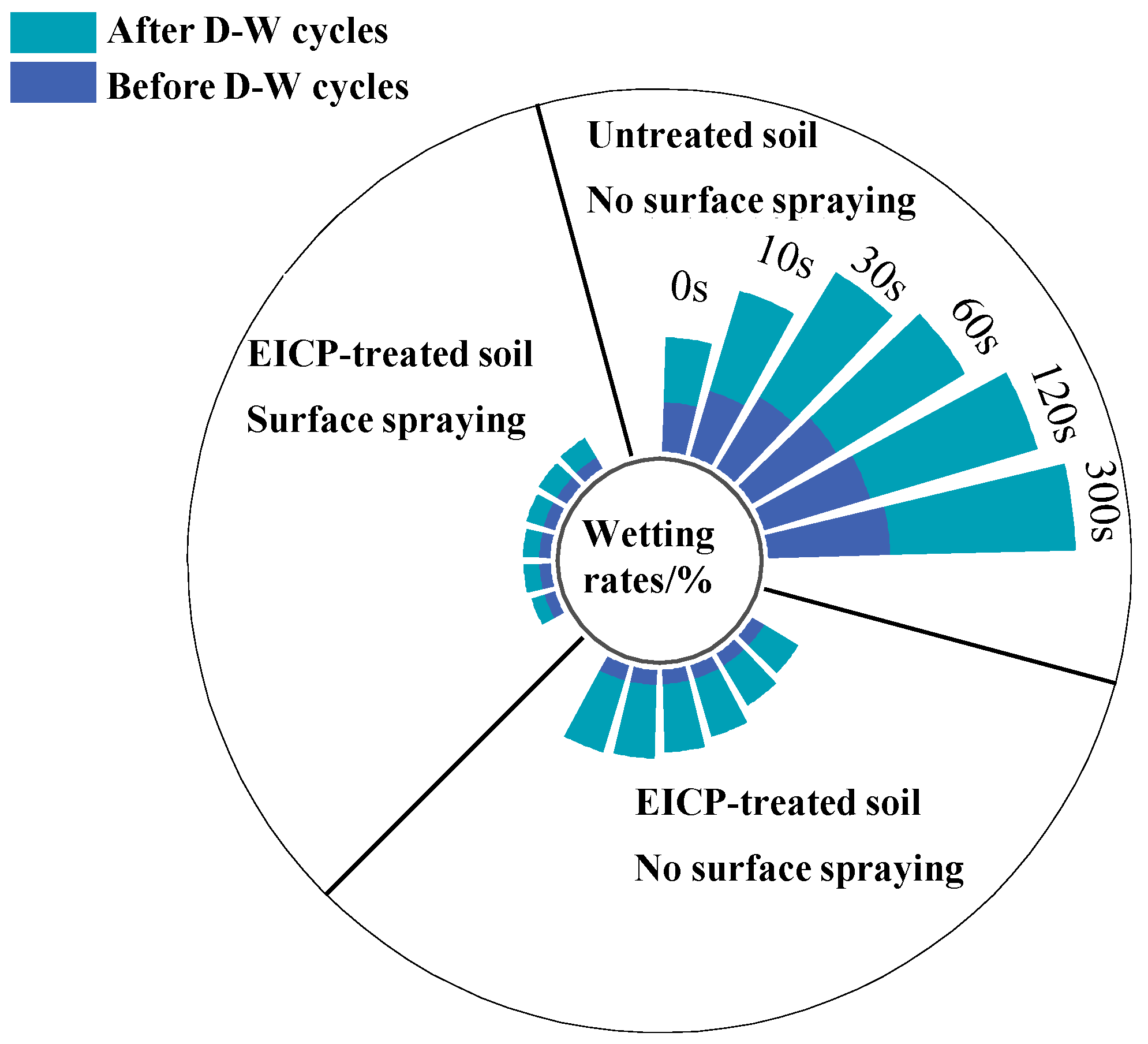
The results of comparing the wetting rates of the three types of specimens before and after five dry–wet cycles are presented in Figure 10. As can be seen in Figure 10, the wetting rates of all three specimens after dry–wet cycles were higher than those before the cycles, which indicates that dry–wet cycles had a deterioration effect on the water-blocking performance of the soil mass. In terms of the overall wetting rate level of the specimens before and after dry–wet cycles, the untreated soil had the highest value, followed by the EICP-treated soil (which was not subjected to surface spraying), while the EICP-treated soil (which underwent surface spraying) had the lowest.
Figure 10.
Results of wetting rates.
Taking the wetting time of 60 s as an example, we can note that the surface-wetting rates of the EICP-treated soil specimens that did not undergo surface spraying were only 15% and 45% of those of the untreated soil before and after the dry–wet cycles, respectively, while those of the EICP-treated soil specimens that underwent surface spraying were only 12.3% and 11.6%, respectively. This indicates that the EICP reinforcement technology can effectively reduce water infiltration in the soil matrix and enhance its water-blocking performance. Furthermore, the surface-spraying approach created an effective protective layer on the specimen surface and strengthened the EICP curing effect, but it failed to penetrate the internal soil mass for reinforcement.
Notably, the change in the wetting rate of the EICP-treated soil specimens that underwent surface spraying before and after dry–wet cycles was negligible. This indicates that the calcium carbonate protective layer formed by surface spraying still maintained favorable water-blocking performance under the action of dry–wet cycles, and the deterioration effect of dry–wet cycles on its water-blocking capacity was weak. In contrast, the wetting rate of the EICP-treated soil specimens that did not undergo surface spraying increased significantly after dry–wet cycles compared with that before the cycles (from 15% to 45%). This demonstrates that when only mixing reinforcement was adopted without surface spraying, the deterioration effect of dry–wet cycles on the water-blocking performance of the soil mass was more prominent.
3.3.2. Microscopic Structure and Water-Blocking Mechanism
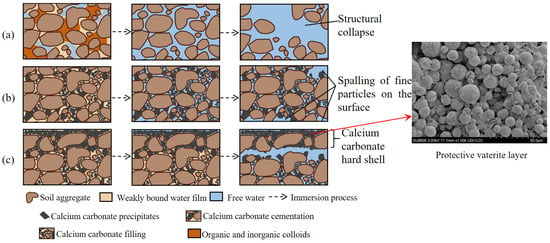
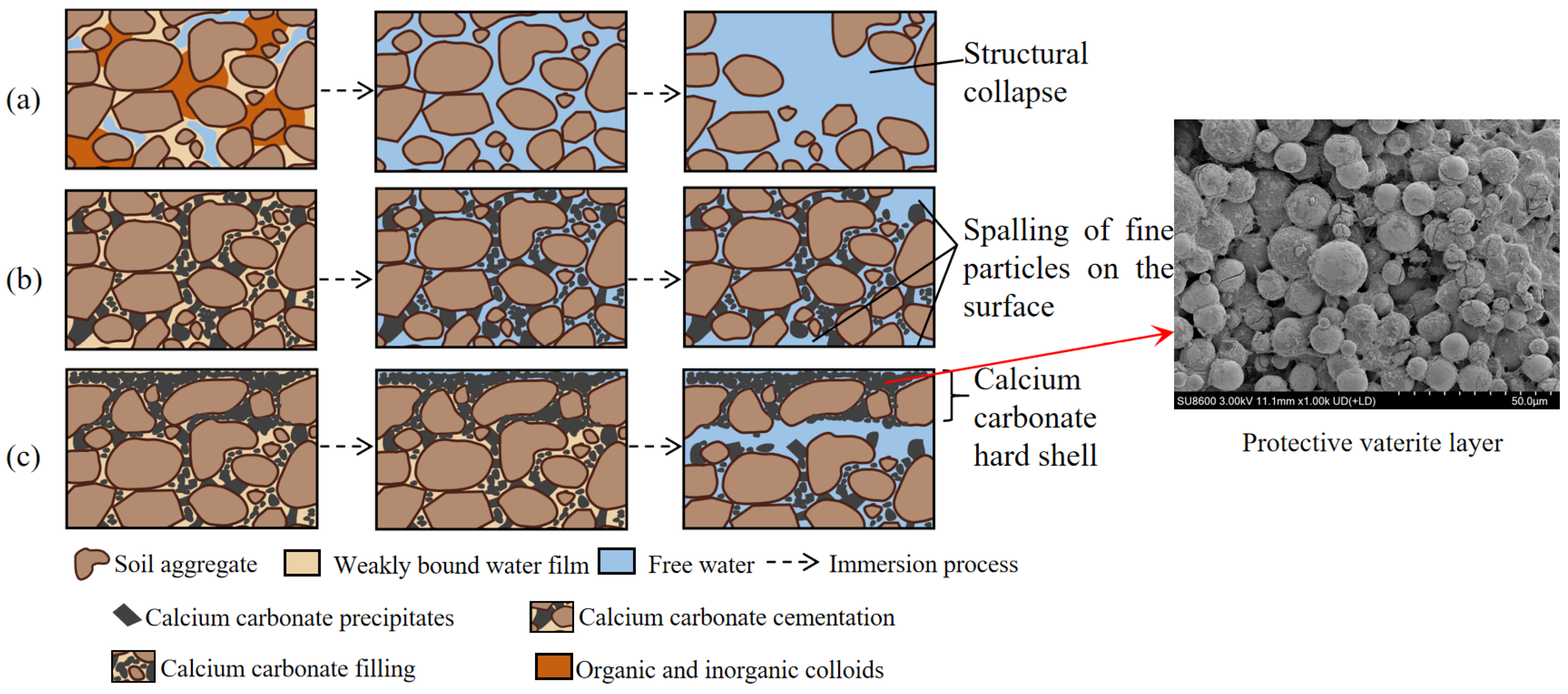
In addition to the above test results, a microscopic structure analysis was carried out on the water-blocking characteristics of the untreated soil, EICP-treated soil that did not undergo surface spraying, and EICP-treated soil treated with surface spraying with EICP solution, as shown in Figure 11.
Figure 11.
Analysis of microscopic water resistance characteristics of EICP-treated soil. (a) Untreated soil; (b) EICP-treated soil; (c) Surface-sprayed EICP-treated soil.
It can be observed in Figure 11a that the particle arrangement of the untreated soil was relatively loose. One fraction of the soil particles was cemented via electrostatic attraction, with the weakly bound water film on clay particle surfaces serving as the medium; the other fraction was cemented by organic and inorganic colloids present in the soil. Owing to the large quantity of pores within the soil matrix, the soil exhibited a relatively high surface energy and was more susceptible to water adsorption. The micropores and cracks in the soil propagated after water absorption and swelling. Under the dissolution and erosion effects of water, the inter-particle cementing agents gradually softened and leached out, which caused damage to the soil structure as well as particle dispersion and disintegration. This microscopic structural characteristic was the underlying reason that the untreated soil had a high wetting rate and a large cumulative disintegration mass.
It can be observed in Figure 11b that during the EICP reinforcement process, the calcium carbonate generated by the reaction was uniformly deposited inside the soil pores, creating a dual structural optimization effect. On the one hand, as a cementing substance with extremely high stability, calcium carbonate has significantly improved dissolution resistance and leaching resistance compared with the natural cementing agents in the soil. It can effectively cement soil particles, fill the micropores and cracks inside the soil matrix, greatly enhance the cohesion between soil aggregates, and reduce the seepage and erosion of pore water. Only the uncemented fine particles on the soil surface underwent slight disintegration, which did not affect the overall water-blocking structure. On the other hand, calcium carbonate precipitation reduced the porosity and pore connectivity of the soil, prolonged the water infiltration path, and slowed down the infiltration rate, thereby improving the water-blocking performance of the soil mass.
As shown in Figure 11c, a dense calcium-carbonate-enriched layer formed on the specimen surface after surface spraying. The precipitates exhibited a typical spherical morphology, which corresponded to the characteristic micro-features of vaterite in previous studies [25]. These microscopic observations provide qualitative morphological evidence supporting the proposed water-blocking mechanism. The surface calcium carbonate layer, together with internally precipitated calcium carbonate filling inter-particle pores, jointly retarded water infiltration and improved the disintegration resistance of the soil. However, after 15 dry–wet cycles, the specimens underwent multiple drying processes. Positions with different degrees of compactness were subjected to different magnitudes of pore water suction, which might induce microcracks at the interface between the surface-protective layer and the internal soil matrix and adversely affect long-term water-blocking performance.
4. Conclusions
The following conclusions were obtained.
- (1)
- EICP technology significantly improved the water immersion disintegration resistance of the clay. After one dry–wet cycle, the disintegration mass of the treated soil was only 1.71% of the untreated soil. Untreated soil fully disintegrated after two cycles, while treated soil remained intact after 10 cycles, due to calcium carbonate pore filling inside and a surface-protective layer.
- (2)
- The optimal number of surface-spraying applications was five. After seven applications, the surface of the specimen exhibited increased crust brittleness and cracking, worsening disintegration. Extending the curing age from 7 d to 14 d and 21 d reduced disintegration mass by 30.23% and 60.47%, respectively, with 14 d recommended as the minimum. More dry–wet cycles increased disintegration, but with a marginally diminishing effect.
- (3)
- The BBD-based quadratic regression model for cumulative disintegration mass was highly significant (p < 0.0001). Factor influence corresponded to the following order: number of surface-spraying applications > curing age > dry–wet cycle number. The highly significant quadratic term number of spraying applications was confirmed to have an optimal value. In this study, the minimum cumulative disintegration mass, 1.4 g, was achieved at five sprayings, a 21 d curing period, and five cycles.
- (4)
- Two categories of reinforcement parameter combinations were determined. The high-disintegration-resistance type (five surface-spraying applications and 21 d of curing) achieved the minimum cumulative disintegration mass of 1.4 g within the tested range, applicable to severe service conditions. The economic type (five surface-spraying applications and 14 d of curing) is recommended as the practical minimum scheme for large-scale reinforcement, balancing disintegration resistance and construction duration.
- (5)
- The surface-wetting rate of the soil specimen was significantly reduced after the surface spraying of EICP cementing solution on the soil mass. These structures collectively constitute the water-blocking mechanism of the soil, achieving a synergistic effect of water blocking and termite prevention.
Author Contributions
Writing—original draft preparation: F.Y.; writing—review and editing: F.Y. and J.Y.; conceptualization—J.Y. and Y.M.; validation—J.Y., W.Z., W.W. and Y.M.; funding acquisition: F.H.; methodology: F.Y., W.Z., W.W. and Y.M.; investigation—W.Z. and W.W.; resources—F.H.; supervision—F.H. All authors have read and agreed to the published version of the manuscript.
Funding
This research was supported by the Project for Major Industrial Key Technical Breakthrough of Henan Province: the Open Competition Mechanism to Select the Outstanding Candidates (No. 251000320100) and the APC was funded by Fangchan He.
Institutional Review Board Statement
Not applicable.
Informed Consent Statement
Not applicable.
Data Availability Statement
The data used to support the findings of this study are available from the corresponding authors upon request.
Conflicts of Interest
The authors declare no conflicts of interest.
References
- Wang, S.; Li, D.Q.; Du, W.Q. Recent advances in the investigation of a slow-moving landslide in the Three Gorges Reservoir area, China. River 2022, 1, 91–103. [Google Scholar] [CrossRef] [Scilit]
- Mayassah, M.; Koch, E. Numerical Modeling of Hydraulic Failure Mechanisms in Levees, River Embankments, and Earth Dams Under Climate-Induced Flood Conditions: A Systematic Literature Review. Appl. Sci. 2026, 16, 5572, Correction in Appl. Sci. 2026, 16, 7690. [Google Scholar] [CrossRef] [Scilit]
- Charrak, H.; Smail, N.; Rouissat, B.; Basri, H.; Alsamawi, I.B. Analysis of upstream slope stability during rapid drawdown—Sidi Abdelli dam as a case Study. J. Geomech. Geoengin. 2024, 2, 1–6. [Google Scholar] [CrossRef] [Scilit]
- Li, D.; Li, L.; Xu, L.; Li, C.; Meng, K.; Gao, Y.; Yang, Z. Stability Analysis of Upstream and Downstream Dam Slopes with Water Level Drawdown Using Response Surface Function. Geotech. Geol. Eng. 2022, 40, 3107–3123. [Google Scholar] [CrossRef] [Scilit]
- Geng, H.L.; Zhao, W.Q.; Yang, X.D.; Zha, H.; Wang, Y.P. Application of MICP in ameliorating erosion resistance of soil on reservoir banks. River 2025, 4, 445–461. [Google Scholar] [CrossRef] [Scilit]
- Cheng, J.; Ma, G.; Zhang, G.; Wang, Q.; Zhou, W. Deterioration of Mechanical Properties of Rockfill Materials Subjected to Cyclic Wetting–Drying and Wetting. Rock Mech. Rock Eng. 2022, 56, 2633–2647. [Google Scholar] [CrossRef] [Scilit]
- Farhan, A.; Hatem, F.; Liang, S.; Hu, Y.; Mo, J. Termites and Chinese agricultural system: Applications and advances in integrated termite management and chemical control. Insect Sci. 2019, 28, 2–20. [Google Scholar] [CrossRef] [Scilit] [PubMed]
- Zhang, S.; Ding, J.; Wang, S.; Li, C. Evaluation of calcium carbonate production and cementitious characteristics of enzymatically induced carbonate precipitation during environmental adjustment. Constr. Build. Mater. 2024, 449, 138415. [Google Scholar] [CrossRef] [Scilit]
- Zhang, S.; Zhang, Z.; Wang, K.; Cui, C.; Yu, L. Performance and Mechanism of Enzyme-Induced Carbonate Precipitation (EICP) for Fine-Grained Saline Soil Stabilization. Appl. Sci. 2026, 16, 1057. [Google Scholar] [CrossRef] [Scilit]
- Zhang, J.; Jia, H.; Li, J.; Chen, X.Y.; Wang, L.; Wang, S.L.; Liu, L. Bio-Gel Formation Through Enzyme-Induced Carbonate Precipitation for Dust Control in Yellow River Silt. Gels 2025, 11, 452. [Google Scholar] [CrossRef] [Scilit] [PubMed]
- Tao, H.; Zhou, Y.; Deng, J.; Du, C.; Yi, F.; Huang, H. Plant-derived urease-induced calcium carbonate precipitation for solidifying limestone dust: Preparation, performance, and mechanism. Int. J. Biol. Macromol. 2025, 309, 142758. [Google Scholar] [CrossRef] [Scilit] [PubMed]
- Li, Z.Y.; Wu, C.Z.; Zhang, S.; Zhang, J.L.; Zhang, S.X. Interfacial bonding and erosion resistance mechanisms of EICP-treated sand layers for rock slope protection under rainfall and seepage. Acta Geotech. 2026, 1–18. [Google Scholar] [CrossRef] [Scilit]
- Wu, C.Z.; Zhang, S.X.; Liu, Z.Y.; Li, Z.Y.; Zhang, Y.J. Spatial evolution of mechanical and hydraulic properties of EICP-treated sand under different initial saturation condition: 1-D model tests. Acta Geotech. 2026, 21, 5153–5168. [Google Scholar] [CrossRef] [Scilit]
- Prabhakar; Annadurai, R. Synergistic effect of Polyvinyl Acetate (PVA) and Enzyme-Induced Carbonate Precipitation (EICP) on the mechanical properties of natural sands. Case Stud. Constr. Mater. 2024, 20, e03323. [Google Scholar] [CrossRef] [Scilit]
- Shi, W.; Miao, L.C.; Lu, W.; Chen, C. Optimization of enzyme-induced carbonate precipitation for yellow river silty sand stabilization: A strategy combining urease inhibitor regulation and pre-mixing process. Front. Struct. Civ. Eng. 2026, 20, 1331–1347. [Google Scholar] [CrossRef] [Scilit]
- Zhang, J.W.; Wang, X.J.; Shi, L.; Yin, Y. Enzyme-induced carbonate precipitation (EICP) combined with lignin to solidify silt in the Yellow River flood area. Constr. Build. Mater. 2022, 339, 127792. [Google Scholar] [CrossRef] [Scilit]
- Sun, Y.L.; Yu, C.; Jiang, S.S.; Chen, Y.; Wang, Z.T. Disintegration behaviors of red clay under wet-dry cycles. J. Rock Mech. Geotech. Eng. 2025, 17, 5875–5892. [Google Scholar] [CrossRef] [Scilit]
- Wang, H.M.; Liu, Z.K.; Li, S.M.; Yang, H.J. Experimental study on disintegration of unsaturated red clay in Ca2+ solution environment. Sci. Rep. 2024, 14, 30018. [Google Scholar] [CrossRef] [Scilit] [PubMed]
- Agarwal, K.B.; Sachan, A. X-ray CT-based 3D characterization of desiccation cracking in compacted expansive soil under varying vertical stress states. Acta Geotech. 2025, 20, 5221–5242. [Google Scholar] [CrossRef] [Scilit]
- Shi, K.Y.; Chen, J.Q.; Pang, X.Q.; Jiang, F.J.; Hui, S.S.; Zhao, Z.C.; Wang, Y.Y. Wettability of different clay mineral surfaces in shale: Implications from molecular dynamics simulations. Pet. Sci. 2023, 20, 689–704. [Google Scholar] [CrossRef] [Scilit]
- ASTM D2487; Standard Practice for Classification of Soils for Engineering Purposes (Unified Soil Classification System). ASTM: West Conshohocken, PA, USA, 2017.
- Zhang, J.; Liao, M.; Zhu, Z.D. Immersion test on the mixed sliding zone soil in tuff formation considering environmental factors in evolution process. Environ. Earth. Sci. 2026, 85, 253. [Google Scholar] [CrossRef] [Scilit]
- Xu, X.; Chu, H.; Wang, Q.; Li, J.; Yuan, X.; Niu, C.; Yu, Z. Dispersion, mechanical, hydrophysical properties and mechanistic analysis of improved dispersive soil using guar gum. Bull. Eng. Geol. Environ. 2025, 84, 56. [Google Scholar] [CrossRef] [Scilit]
- Cruz, B.C.; Furrer, J.M.; Guo, Y.-S.; Dougherty, D.; Hinestroza, H.F.; Hernandez, J.S.; Gage, D.J.; Cho, Y.K.; Shor, L.M. Pore-scale water dynamics during drying and the impacts of structure and surface wettability. Water Resour. Res. 2017, 53, 5585–5600. [Google Scholar] [CrossRef] [Scilit]
- Zhang, J.K.; Su, P.D.; Li, L. Microbial induced carbonate precipitation modified steel slag: Mechanical improvement and erosion resistance to sulfate attack. J. Clean. Prod. 2023, 405, 136982. [Google Scholar] [CrossRef] [Scilit]

Disclaimer/Publisher’s Note: The statements, opinions and data contained in all publications are solely those of the individual author(s) and contributor(s) and not of MDPI and/or the editor(s). MDPI and/or the editor(s) disclaim responsibility for any injury to people or property resulting from any ideas, methods, instructions or products referred to in the content. |
© 2026 by the authors. Licensee MDPI, Basel, Switzerland. This article is an open access article distributed under the terms and conditions of the Creative Commons Attribution (CC BY) license.