


Abstract
This study examined the relationship between ball advancement (BA) starting and termination locations and the influence of termination location on offensive outcomes during basketball fast breaks. Using an observational design, 1024 fast breaks following defensive rebounds were analyzed from 132 games involving 12 teams in the 2025 Kanto University Basketball League Division 1 for men. Video footage was coded using Hudl Sportscode, and statistical analyses were performed using IBM SPSS Statistics 31. The significance threshold was set at p < 0.05 for Pearson’s chi-square tests and p < 0.00208 for coefficient tests in multinomial logistic regression following Bonferroni correction. Significant associations were found between BA starting and termination locations (χ2(24) = 206.025, p < 0.001, V = 0.224) and between BA termination location and offensive outcomes (p < 0.001, V = 0.249). Compared with the paint (Zone E), Zone D showed higher odds of made three-point field goals relative to made two-point field goals (OR = 10.833, 95% CI: 3.707–31.658). These findings may inform the evaluation of BA starting and termination locations alongside offensive outcomes.
1. Introduction
Basketball is a sport in which two teams compete to score more points than their opponents within a fixed playing time. Coaches and players continually develop technical skills and tactical strategies to maximize shooting efficiency and improve game performance. Initiating a fast break is one way to increase the likelihood of scoring [1]. In basketball, a fast break refers to an offensive transition completed before the opposing defense has sufficient time to establish its defensive formation [2]. Consequently, it is considered an important offensive strategy because it increases the likelihood of obtaining high-quality scoring opportunities.
Previous studies have consistently identified fast breaks as one of the key factors influencing game outcomes [3,4,5,6,7,8]. Indeed, fast breaks have been shown to produce more efficient scoring opportunities and higher field-goal percentages than other offensive situations [1,9,10,11].
Fast breaks are typically initiated after gaining possession through defensive rebounds or opponent turnovers [12,13,14,15]. Following ball recovery, the ball is advanced into the frontcourt by either passing or dribbling (hereafter referred to as ball advancement [BA]), while teammates simultaneously fill the appropriate lanes before the possession concludes with a finishing action. Thus, a fast break can be viewed as a sequence of interconnected offensive phases. Because these phases are interdependent, understanding the effectiveness and underlying structure of fast breaks requires examining how each phase contributes to the eventual offensive outcome. In particular, BA performed immediately after securing a defensive rebound or receiving an outlet pass is likely to influence subsequent offensive actions depending on whether the ball is advanced by passing or dribbling. Furthermore, the relationship between the starting and ending locations of BA may alter the numerical balance and spatial positioning of defenders, thereby affecting the final offensive outcome, including successful field goals and turnovers.
In basketball game analysis, notational analysis and systematic observation are used to record and evaluate game actions. Procedures such as operationally defining variables, training observers, and assessing agreement are employed to evaluate the consistency of observational data [16,17]. However, clear operational definitions alone do not guarantee reliability, and intra-observer agreement alone cannot establish objectivity [18]. Therefore, particularly when data are collected by a single observer, it is important to explicitly describe the procedures implemented to minimize observer bias and coding inconsistencies, as well as the methods used to assess intra-observer agreement and their limitations.
Previous research on fast breaks has examined the conditions under which they occur, the characteristics of each phase, and their associations with offensive outcomes. During the initiation phase, studies have investigated how rebound location, the direction of the outlet pass—the first pass following a rebound—and the time until its reception are associated with fast break occurrence [12,19]. During the ball advancement phase, the first action after gaining possession, the method of advancing the ball, and the number of passes have been analyzed, with passing as the first action reported to be associated with fast break success [4]. Furthermore, the interrelationships among the circumstances of gaining possession, the numerical relationship between offensive and defensive players throughout the ball advancement (BA) sequence, and offensive outcomes have been examined [20]. During the finishing phase, associations between finishing location, defensive responses, and offensive outcomes have been reported [15]. A study defining success as scoring or drawing a foul also reported a higher success rate for fast breaks ending in the paint [21]. These studies have contributed to our understanding of the characteristics of each fast break phase and their associations with offensive outcomes. However, research focusing on BA as the link between fast break initiation and finishing, and examining its starting and termination locations together with shot types and other offensive outcomes, remains limited.
Meanwhile, fast breaks require brief, high-intensity sprints, and the ATP–CP system is likely to play an important role in supplying energy for these repeated efforts during a game [22]. In addition, physical and mental fatigue may affect players’ performance and tactical behavior. In basketball, fatigue following high-intensity exercise has been suggested to reduce passing accuracy [23], while mental fatigue has been reported to affect certain aspects of tactical performance [24]. During fast breaks, players must monitor the relative positions of teammates and opponents while moving and advance the ball within a limited time. Therefore, clarifying the relationship between BA and offensive outcomes in actual games may provide evidence to support players’ decision-making and assessment of game situations.
Accordingly, this study aimed to examine the relationship between BA starting and termination locations and the influence of termination location on offensive outcomes during fast breaks following defensive rebounds. We hypothesized that BA termination location would differ according to its starting location and that fast breaks in which BA terminated in the paint would result in a higher proportion of made two-point field goals than those in which BA terminated in other zones. The findings may inform coaches’ practice planning and offer performance analysts an additional perspective for evaluating fast breaks, thereby contributing to the further development of offensive tactics.
2. Materials and Methods
2.1. Samples and Variables
This study employed an observational methodology [25]. Data were collected from 132 games involving 12 teams competing in a double round-robin format in the 2025 Kanto University Basketball League, a top-level collegiate basketball league in Japan.
This study focused on fast breaks following rebounds, a common means of gaining possession in basketball. Fast breaks were defined as offensive sequences ranging from 1-on-0 to 3-on-3 that culminated in a finishing action or another offensive outcome while the offense had numerical superiority or was judged to have an advantage because the defense was not yet set [12,26]. The numbers of offensive and defensive players were determined when the ball crossed the center line through a pass or dribble. Players were counted if they were positioned between an imaginary line passing through the ball carrier perpendicular to the sidelines and the opponents’ endline [12].
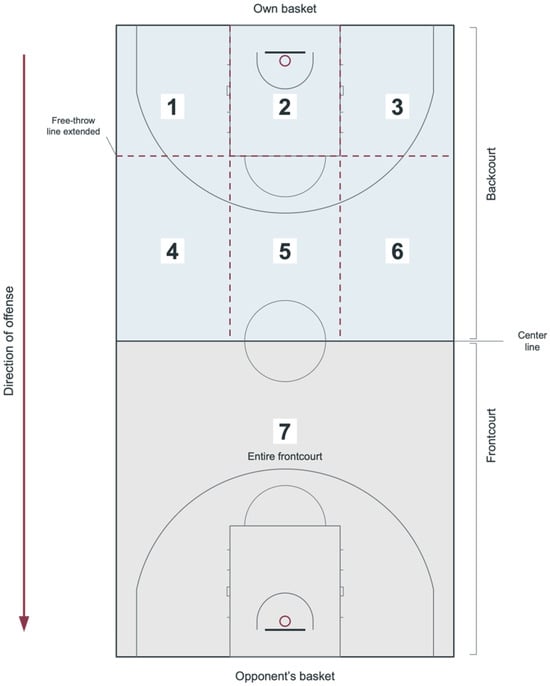
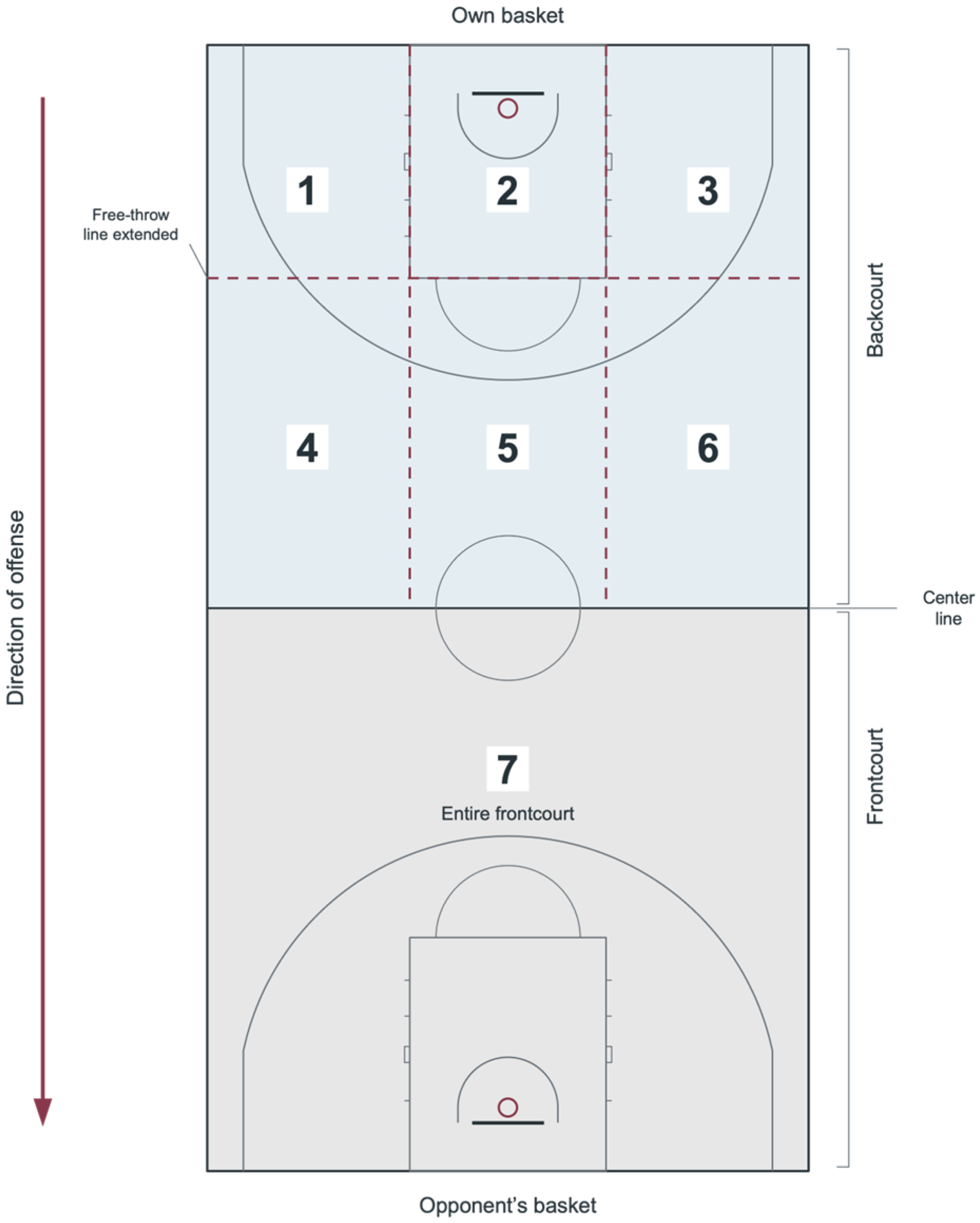
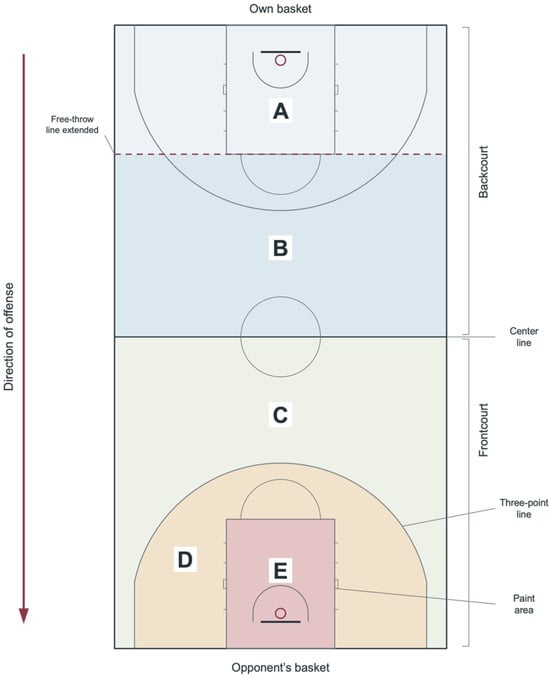
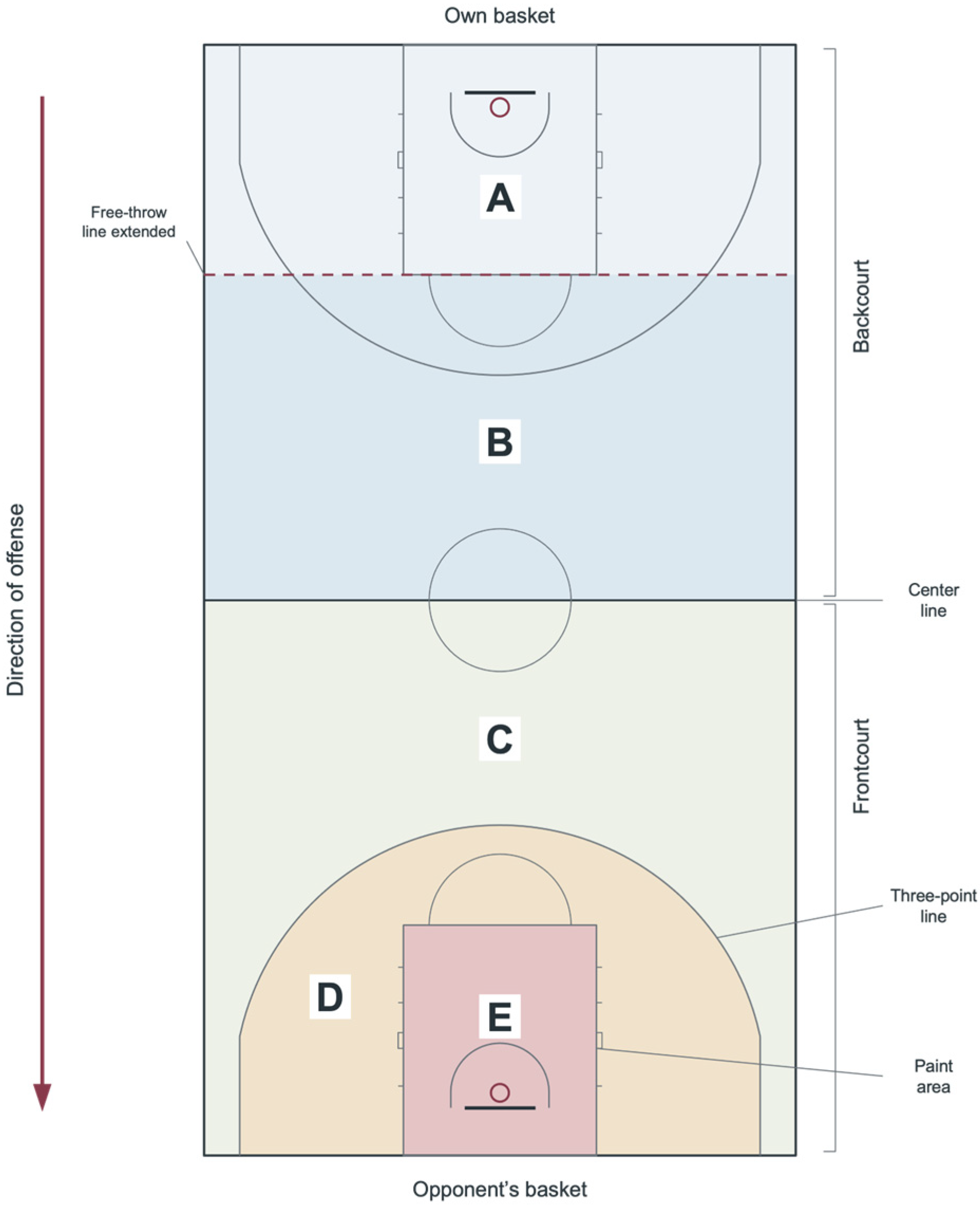
Figure 1 and Figure 2 illustrate the BA starting and termination zones, respectively. These zones were defined with reference to the court divisions used in previous studies examining ball trajectories during fast breaks [3,15,16,21]. Seven BA starting zones were defined: six zones in the backcourt and the entire frontcourt as the seventh zone. When an outlet pass was made following a rebound, the location where the pass was received was recorded as the BA starting zone. When a push was performed, the rebound location was recorded as the BA starting zone. An outlet pass was defined as choosing to pass following a rebound, whereas a push was defined as advancing the ball with at least two dribbles after securing the rebound [12]. The BA termination zone was recorded as the location where the player advancing the ball released a pass, committed a turnover, drew a foul, or performed a finishing action. Accordingly, when the ball carrier passed, the BA termination zone was defined as the pass release location rather than the location of the subsequent action. Five BA termination zones were defined: two zones in the backcourt and three in the frontcourt, comprising the area outside the three-point line, the area inside the three-point line but outside the paint, and the paint.
Figure 1.
BA start zone.
Figure 2.
BA termination zone.
Fast breaks initiated through means other than rebounds were excluded from the analysis. Possessions involving a turnover or a foul drawn before the ball crossed the center line were also excluded because they could not be classified as fast breaks using the operational criteria. In addition, possessions were excluded if either the BA starting or termination location was outside the camera’s field of view.
Table 1 presents the eight offensive outcome variables together with their operational definitions. All variables were selected based on the play classifications and statistical categories provided on the official NBA statistics website [27]. A two-point field goal attempted by the player advancing the ball, a player receiving a pass from that player, or another teammate involved in the subsequent offensive sequence was coded as 2FGM if successful and 2FGA if unsuccessful. Similarly, successful three-point field goals were coded as 3FGM, whereas unsuccessful attempts were coded as 3FGA. Fouls drawn that resulted in free throws were coded as FT, while those that did not result in free throws were coded as Foul. Passes or dribbles disrupted by a defender and resulting in a throw-in were coded as Deflection. Losses of possession before a shot attempt were coded as TO.
Table 1.
Definitions of offensive outcomes.
2.2. Procedures
Game data were coded using the performance analysis software Hudl Sportscode (version 12.82.0). To minimize variability between raters, all coding was performed by a single expert with specialized knowledge and more than five years of experience as a basketball coach and video analyst. Because it was difficult to recruit a second rater with both experience in basketball video analysis and the skills required to perform coding using the software, coding by multiple raters and an assessment of inter-rater reliability could not be conducted. When difficulties in classification arose during coding, the rater and a co-researcher reviewed the relevant footage and discussed the case with reference to the operational definitions before reaching a final coding decision. To assess the reliability of the coding procedure, one coach with specialized knowledge of basketball and experience as a performance analyst independently coded a sample of 100 fast break possessions on two separate occasions. The interval between the first and second coding sessions was four weeks. Intra-rater reliability was assessed using Cohen’s kappa coefficient. A The obtained Cohen’s kappa coefficient (0.942) indicated almost perfect agreement based on commonly used interpretive criteria [28], demonstrating excellent reliability of the coding procedure.
The study was approved by the Ethics Review Committee on Research with Human Subjects of Waseda University (Approval No. 2026-256).
2.3. Statistical Analysis
BA starting zone, BA termination zone, offensive outcome, and action following rebound acquisition were coded as categorical variables. Descriptive statistics were used to summarize the absolute and relative frequencies of each variable.
Pearson’s chi-square tests were conducted to examine the associations between BA starting and termination zones, between BA termination zone and offensive outcome, and between action following rebound acquisition and offensive outcome. Before conducting these tests, expected cell frequencies were checked to confirm that no cells had expected frequencies below 1 and that no more than 20% of cells had expected frequencies below 5. Cramer’s V was used to quantify the strength of the associations. For the association between BA starting and termination zones, residual analysis using adjusted standardized residuals was performed to identify cells with significantly higher or lower observed frequencies than expected. Cells with residuals greater than 1.96 were considered significantly more frequent than expected, whereas those with residuals below −1.96 were considered significantly less frequent than expected.
The association between BA termination zone and offensive outcome was also examined using multinomial logistic regression. Offensive outcome was the dependent variable, with 2FGM as the reference category. BA termination zone was entered as a categorical explanatory variable, with Zone E as the reference category. The forced-entry method was used to fit the model. Overall model fit was assessed using the likelihood-ratio test, with Nagelkerke’s pseudo-R2 reported as a supplementary measure. Odds ratios, 95% confidence intervals, and p-values were reported for comparisons between each offensive outcome and the reference outcome. A Bonferroni correction was applied to control the family-wise Type I error rate. The four BA termination-zone comparisons against Zone E for each of the six offensive-outcome comparisons against 2FGM were treated as a single family of 24 comparisons. Accordingly, the significance threshold was set at p < 0.05/24 (approximately 0.00208). As an additional analysis, the interaction between post-rebound action and BA termination zone in relation to offensive outcome was examined (Supplementary Table S1). To account for the non-independence of observations within teams and games, separate mixed-effects models with a random intercept for team or game were fitted and evaluated (Supplementary Table S2). Finally, to assess the stability of parameter estimates in the presence of potential sparse-data bias, a sensitivity analysis was conducted using mean bias-reduced multinomial logistic regression with the brmultinom function in the brglm2 package in R version 4.6.1 (type = “AS_mean”). This analysis used the same observations, explanatory variable, and reference categories as the conventional multinomial logistic regression model (Supplementary Tables S3 and S4). Details and results of these analyses are provided in the Supplementary Materials. All analyses except the sensitivity analysis were performed using IBM SPSS Statistics version 31.0.2.
3. Results
3.1. Frequency of Fast Breaks
The frequencies of fast breaks for each analysis variable are presented in Table 2.
Table 2.
Frequency of fast breaks across the analyzed variables.
3.2. Relationship Between the BA Start Zone and the BA Termination Zone
Pearson’s chi-square test revealed a significant association between BA starting and termination zones, with a small-to-moderate effect size (χ2(24) = 206.025, p < 0.001, V = 0.224). Residual analysis indicated that, for BA start Zones 1–3, the frequencies of BA termination Zones A and B were significantly higher than expected, whereas the frequency of BA termination Zone E was significantly lower than expected. In contrast, BA termination Zone D occurred significantly more frequently for BA start Zone 4, BA termination Zone C occurred significantly more frequently for BA start Zone 6, and BA termination Zone E occurred significantly more frequently for BA start Zone 7 (Table 3).
Table 3.
Residual analysis of the relationship between the BA start zone and BA termination zone.
3.3. Relationships Between the Explanatory Variables and the Dependent Variable
3.3.1. Relationship Between the BA Termination Zone and Offensive Outcomes
As shown in Table 4, Pearson’s chi-square test revealed a significant association between BA termination zone and offensive outcome, with a small-to-moderate effect size (χ2(28) = 253.250, p < 0.001, V = 0.249). Two cells (5.0%) had expected frequencies below 5. No cells had expected frequencies below 1, and no more than 20% of cells had expected frequencies below 5.
Table 4.
Relationship between the BA termination zone and offensive outcomes.
3.3.2. Relationship Between the Play Following the Defensive Rebound and Offensive Outcomes
As shown in Table 5, Pearson’s chi-square test revealed no significant association between the type of play following the defensive rebound (outlet pass or push) and offensive outcomes (χ2(7) = 9.497, p = 0.219, V = 0.096).
Table 5.
Relationship between the play following the defensive rebound and offensive outcomes.
3.4. Association Between the BA Termination Zone and Offensive Outcomes: Multinomial Logistic Regression Analysis
To evaluate the effect of the BA termination zone on offensive outcomes, the BA termination zone was entered as the explanatory variable and offensive outcome as the dependent variable in the multinomial logistic regression analysis. Zone E, which had the highest frequency of observations, was selected as the reference category for the explanatory variable. For the dependent variable, 2FGM, the most frequently observed scoring outcome, was selected as the reference category. Because the Deflection category contained an insufficient number of observations, resulting in unstable parameter estimates, it was excluded from the analysis.
The multinomial logistic regression model including BA termination zone as an explanatory variable provided a significantly better fit than the intercept-only model (likelihood-ratio χ2(24) = 254.345, p < 0.001). Nagelkerke’s pseudo-R2 was 0.230. Compared with Zone E, the odds of 3FGA relative to 2FGM were significantly higher in Zones B, C, and D (ORs = 3.370, 8.942, and 10.111, respectively; all p < 0.001). The odds of 3FGM relative to 2FGM were significantly higher in Zones A, B, C, and D (ORs = 6.500, 4.983, 5.030, and 10.833, respectively; all p < 0.001). The odds of Foul relative to 2FGM were also significantly higher in Zone A (OR = 10.400, p = 0.00155), Zone C (OR = 73.254, p < 0.001), and Zone D (OR = 54.889, p < 0.001). The odds of TO relative to 2FGM were significantly higher in Zone D (OR = 5.778, p < 0.001). None of the remaining comparisons met the Bonferroni-adjusted significance threshold (Table 6).
Table 6.
Association between the BA termination zone and offensive outcomes.
4. Discussion
4.1. Relationship Between the BA Start Zone and the BA Termination Zone
Although Pearson’s chi-square test revealed a statistically significant association between BA starting and termination zones, the strength of the association was small to moderate (V = 0.224). Residual analysis indicated that, when BA began between the free-throw line and the endline in the backcourt, the frequencies of BA termination in Zones A and B were significantly higher than expected, whereas the frequency in Zone E was significantly lower than expected. These findings should be interpreted in light of the operational definition of BA termination used in this study. Because the location where the player advancing the ball released a pass was also recorded as the BA termination zone, termination in Zones A and B may reflect passes released in the backcourt. A player initiating BA deep in the backcourt would need to cover a considerable distance to reach the paint by dribbling. Thus, the higher frequencies of BA termination in Zones A and B may reflect sequences in which the ball carrier passed to a teammate before reaching the paint, allowing that teammate to continue the offense.
When BA started between the free-throw line and the half-court line, termination in Zone A occurred significantly less frequently than expected, indicating that BA seldom terminated in a zone behind its starting zone. Previous research has reported that fast breaks lasted approximately five seconds on average [29] Given this time constraint, the observed pattern may reflect an emphasis on advancing the ball quickly.
Furthermore, when BA started in the frontcourt following a long outlet pass, termination in Zone E occurred significantly more frequently than expected, whereas termination in Zones A and B occurred significantly less frequently than expected. These findings suggest that an outlet pass delivered into the frontcourt after a rebound may facilitate penetration into the paint. When players receive a long, fast pass downcourt, they may face few or no defenders. This may allow them to penetrate the paint in pursuit of a high-percentage shot.
4.2. Relationship Between Action Following Rebound Acquisition and Offensive Outcome
Pearson’s chi-square test revealed no significant association between the type of action following rebound acquisition and offensive outcome. One possible explanation is that the initial distinction between an outlet pass and a push did not translate into differences in subsequent offensive development. For example, both actions may have involved advancing the ball through similar zones. Defenders may retreat along the shortest route through the middle of the court, potentially discouraging offensive players from advancing the ball through this area because of the associated risk. Fast breaks are also subject to time constraints, as taking too long may allow the defense to recover and eliminate the offensive advantage. Together, these factors may help explain why no significant association was observed between the choice of an outlet pass or a push and offensive outcome.
4.3. Relationship Between the BA Termination Zone and the Offensive Outcomes
The multinomial logistic regression analysis showed that the odds of 3FGA relative to 2FGM were higher in BA termination Zones B, C, and D than in Zone E. Previous studies have reported high scoring efficiency for two-point field goals during fast breaks [1] and a higher probability of success for fast breaks ending in the paint [21]. In addition, previous research on fast-break termination locations has reported that approximately 82% of fast breaks ended in the paint area [14]. These findings provide context for understanding the relationship between fast break finishing location and offensive outcome.
In the present study, however, BA terminated in Zone E, the paint, in 32.7% of cases. This percentage included both cases in which the player advancing the ball performed a finishing action in Zone E and cases in which that player passed to a teammate from Zone E. Moreover, BA could terminate outside the paint before a teammate subsequently finished in Zone E. Therefore, this percentage cannot be directly compared with the proportions of fast breaks ending in the paint reported in previous studies. This study focused on fast breaks following defensive rebounds, whereas previous research included fast breaks initiated by other means, such as steals [14]. Their sample comprised games from the Greek men’s A1 league and the men’s European Championship. Differences in playing quality and offensive and defensive intensity between these competitions and the present sample may also have contributed to differences in offensive outcomes.
The odds of 3FGM relative to 2FGM were also higher in BA termination Zones A, B, C, and D than in Zone E. One possible explanation is the evolution of tactical approaches in recent years. In modern basketball, greater emphasis is often placed on playing at a faster pace and creating wider spacing, and 3FGs have been reported to help stretch the defense and create space for ball movement and drives [30]. It has also been suggested that coaching staffs have steadily increased the number of long-range shot attempts because of their potential to generate more points [31]. Furthermore, given that 3FGs have been reported to be an important factor in determining game outcomes in fast-paced games [32], BA may be performed while maintaining 3FGs as a shooting option in addition to seeking 2FG opportunities. Taken together, these findings suggest that although teams primarily aim to generate high-percentage two-point field goals during fast breaks, three-point field goals remain an important offensive option depending on the defensive situation.
Compared with BA termination Zone E, Zones A–D were associated with a higher proportion of Fouls relative to 2FGM. This finding suggests that Fouls were more likely to occur before the ball carrier reached the paint area. In particular, Fouls occurred more frequently after the ball had been advanced into the frontcourt.
An increasing proportion of intentional and tactical fouls has been reported as a means of stopping fast breaks and preventing opponents from scoring easily [33]. In addition, according to the official basketball rules [34], an unsportsmanlike foul is awarded when a defender fouls the ball handler during a fast break while no defender is positioned between the offensive player advancing toward the basket and the basket itself. Consequently, to interrupt a fast break without being penalized for an unsportsmanlike foul, at least one defender must first establish a legal defensive position against the ball handler while the remaining defenders recover toward their own basket. Executing these defensive actions requires a certain amount of time, which may explain why fouls occurred more frequently after the ball had been advanced into the frontcourt.
Compared with BA termination Zone E, Zones C and D were associated with a higher proportion of TOs relative to 2FGM. In a study of the Greek Women’s Basketball Championship, most TOs were reported to occur in the perimeter area, followed by the 3FG area [35].
During a fast break, players must make rapid decisions while maintaining the temporary numerical advantage of the offense. Once the ball has been advanced into the frontcourt, the ball handler is presented with additional offensive options, including not only passing but also attempting a shot. Failure to make appropriate decisions while considering the positioning and numerical balance of both offensive and defensive players may increase the likelihood of a turnover. Therefore, the higher frequency of turnovers observed in the frontcourt may reflect decision-making or execution errors occurring during the final phase of the fast break, when players attempt to create a scoring opportunity.
It should be noted that, in the present study, fast breaks were identified according to the numbers of offensive and defensive players at the moment the ball crossed the center line by either passing or dribbling. Consequently, possessions in which a turnover occurred before the ball crossed the center line (i.e., in the backcourt) were not classified as fast breaks and were therefore excluded from the analysis.
Defensive positioning at the time an offensive advantage was established may also have been associated with offensive outcomes. For example, if no defenders were ahead of the ball toward the attacking basket when the ball reached the frontcourt, penetration into the paint might have been easier. Conversely, defenders positioned near the basket might have prompted the ball carrier to pass from outside the paint. Thus, defensive positioning may have been related to both BA termination location and offensive outcome.
When interpreting the association between BA termination zone and offensive outcome, the operational definition of BA termination should be considered. When BA terminates with a pass, another player is involved in the subsequent offensive outcome. In contrast, when the player advancing the ball performs the finishing action, draws a foul, or commits a turnover, the BA termination location coincides with the location of the offensive outcome. Because this study did not distinguish among these types of BA termination during coding, the definitions of BA termination location and offensive outcome partially overlap.
5. Limitations
Building on previous research on fast breaks, this study examined various offensive outcomes in relation to BA. However, several limitations should be considered when interpreting the findings.
First, all fast breaks were coded by a single rater, potentially allowing systematic bias to persist across observations. Although intra-rater reliability was assessed, the reproducibility of coding across different raters was not verified, and observer bias cannot be ruled out. In addition to situations of numerical superiority, possessions were classified as fast breaks when the offense was judged to have an advantage based on the defensive situation. Consequently, some classifications involved observer judgment, which may have influenced the selection of possessions identified as fast breaks.
Second, possessions involving turnovers or fouls in the backcourt were excluded from the sample, which may have biased the association between BA termination zone and offensive outcome. Caution is therefore warranted when generalizing the findings to offensive possessions following rebounds more broadly.
Third, although various offensive outcomes were recorded, some combinations of BA termination zone and offensive outcome contained few observations, resulting in extremely large odds ratios and very wide 95% confidence intervals in the multinomial logistic regression analysis. Furthermore, multiple possessions were collected from the same games and teams, potentially introducing non-independence among observations. Accordingly, the estimated associations, their magnitudes, and their statistical significance should be interpreted cautiously given the uncertainty surrounding these estimates.
6. Conclusions
This study examined the association between BA starting and termination locations and the association between BA termination location and offensive outcome during fast breaks following defensive rebounds in a Japanese men’s collegiate basketball league.
A significant association was observed between BA starting and termination zones (p < 0.001, V = 0.224), supporting the first hypothesis that termination location differs according to starting location. However, the association was small to moderate and does not indicate that starting location alone determines how BA develops.
BA termination zone was also associated with offensive outcome (p < 0.001, V = 0.249). In the multinomial logistic regression analysis, after Bonferroni correction, the odds of 3FGA relative to 2FGM were significantly higher in Zones B–D than in Zone E (ORs ranging from 3.370 to 10.111). The odds of 3FGM relative to 2FGM were also significantly higher in Zones A–D than in Zone E (ORs ranging from 4.983 to 10.833). These findings were partially consistent with the second hypothesis that BA termination in the paint is associated with 2FGM. However, no significant differences were observed in the odds of 2FGA relative to 2FGM. Therefore, the findings do not establish whether BA termination in the paint is associated with a higher two-point field-goal success rate.
The observed associations should be interpreted cautiously, given the potential non-independence of possessions within the same games and teams and the uncertainty of estimates based on small numbers of observations.
This study highlights the value of examining BA starting and termination locations alongside offensive outcomes during fast breaks. However, because BA termination location includes the location from which a pass is made, it should be distinguished from the finishing location of the entire fast break. These findings may provide a basis for coaches and performance analysts to review the ball advancement process and inform practice planning and the selection of variables for performance analysis.
Supplementary Materials
The following supporting information can be downloaded at: https://www.mdpi.com/article/10.3390/app162010083/s1, Table S1. Likelihood-ratio test for the interaction between post-rebound action and BA termination zone, Table S2. Specifications and estimation status of the separate random-intercept models, Table S3. Mean bias-reduced multinomial logistic regression, Table S4. Comparison of conventional and bias-reduced estimates. The analysis was performed using the brmultinom function in the brglm2 package [36].
Author Contributions
Data curation, formal analysis, project administration, writing—original draft, T.B.; methodology, resources, O.K.; supervision, writing—review and editing, O.K. and T.M. All authors have read and agreed to the published version of the manuscript.
Funding
This research received no external funding.
Institutional Review Board Statement
The study was conducted in accordance with the Declaration of Helsinki, and the protocol was approved by the Ethics Review Committee on Research with Human Subjects of Waseda University (Approval No. 2026-256) on 13 July 2026.
Informed Consent Statement
Not applicable.
Data Availability Statement
The data that support the findings of this study are available from the corresponding author upon reasonable request. The original match footage is not publicly available due to copyright and licensing restrictions.
Conflicts of Interest
The authors declare no conflicts of interest.
References
- Matulaitis, K.; Bietkis, T. Prediction of offensive possession ends in elite basketball teams. Int. J. Environ. Res. Public Health 2021, 18, 1083. [Google Scholar] [CrossRef] [Scilit] [PubMed]
- Japan Basketball Association. Basketball Coaching Theory, Revised ed.; Taishukan Publishing: Tokyo, Japan, 2016; Volume 2, p. 238. [Google Scholar]
- Cárdenas, D.; Piñar, M.; Llorca-Miralles, J.; Ortega, E.; Courel, J. Influence of the form of use of space on fastbreak effectiveness in high performance male basketball. J. Sport Health Res. 2012, 4, 181–190. [Google Scholar]
- Cárdenas, D.; Ortega, E.; Llorca, J.; Courel, J.; Sánchez-Delgado, G.; Piñar, M.I. Motor characteristics of fast break in high level basketball. Kinesiology 2015, 47, 208–214. [Google Scholar]
- Karipidis, A.; Fotinakis, P.; Taxildaris, K.; Fatouros, J. Factors characterizing a successful performance in basketball. J. Hum. Mov. Stud. 2001, 41, 385–398. [Google Scholar]
- Ortega, E.; Palao, J.M.; Gómez, M.Á.; Lorenzo, A.; Cárdenas, D. Analysis of the efficacy of possessions in boys’ 16-and-under basketball teams: Differences between winning and losing teams. Percept. Mot. Ski. 2007, 104, 961–964. [Google Scholar] [CrossRef] [Scilit] [PubMed]
- Raval, K.M.R.; Pagaduan, J.C. Factors that differentiate winning and losing in men’s university basketball. Montenegrin J. Sports Sci. Med. 2021, 10, 13–17. [Google Scholar] [CrossRef] [Scilit]
- Tsamourtzis, E.; Karipidis, A.; Athanasiou, N. Analysis of fast breaks in basketball. Int. J. Perform. Anal. Sport 2005, 5, 17–22. [Google Scholar] [CrossRef] [Scilit]
- Ciampolini, V.; Ibáñez, S.J.; Nunes, E.L.G.; Borgatto, A.F.; Nascimento, J.V.D. Factors associated with basketball field goals made in the 2014 NBA Finals. Mot. Rev. Educ. Fis. 2017, 23, e1017105. [Google Scholar] [CrossRef] [Scilit]
- Mattakottil, A.T.; Kumar, D.; Perumal, J.S.R.; Sundar, V.; Narayanasamy, K.V. Game-related statistics and performance trends in the FIBA Under-17 Basketball World Cup. J. Hum. Sport Exerc. 2025, 20, 867–882. [Google Scholar] [CrossRef] [Scilit]
- Vázquez-Estévez, C.; Prieto-Lage, I.; Reguera-López-de-la-Osa, X.; Gutiérrez-Santiago, J.A.; Toledo-González, M.; Gutiérrez-Santiago, A. Offensive patterns and performance analysis in one-possession scenarios during the last minute and overtime in the EuroLeague. Appl. Sci. 2025, 15, 1928. [Google Scholar] [CrossRef] [Scilit]
- Baba, T.; Kuraishi, O.; Matsui, T. A study on the conditions for the occurrence of fast breaks in basketball: Focusing on outlet passes. Jpn. J. Coach. Stud. 2026, 39, 129–135. [Google Scholar] [CrossRef] [PubMed]
- Fotinakis, P.; Karipidis, A.; Taxildaris, K. Factors characterising the transition game in European basketball. J. Hum. Mov. Stud. 2002, 42, 305–316. [Google Scholar]
- Garefis, A.; Tsitskaris, G.; Mexas, K.; Kyriakou, D. Comparison of the effectiveness of fast breaks in two high level basketball championships. Int. J. Perform. Anal. Sport 2007, 7, 9–17. [Google Scholar] [CrossRef] [Scilit]
- Refoyo, I.; Romarís, I.U.; Sampedro, J. Analysis of men’s and women’s basketball fast-breaks. Rev. Psicol. Deport. 2009, 18, 439–444. [Google Scholar]
- Fernandez, J.; Camerino, O.; Anguera, M.T.; Jonsson, G.K. Identifying and analyzing the construction and effectiveness of offensive plays in basketball by using systematic observation. Behav. Res. Methods 2009, 41, 719–730. [Google Scholar] [CrossRef] [Scilit] [PubMed]
- Vaquera, A.; Cubillo, R.; García-Tormo, J.V.; Morante, J.C. Validation of a tactical analysis methodology for the study of pick and roll in basketball. Rev. Psicol. Deport. 2013, 22, 277–281. [Google Scholar]
- O’Donoghue, P. Reliability issues in performance analysis. Int. J. Perform. Anal. Sport 2007, 7, 35–48. [Google Scholar] [CrossRef] [Scilit]
- Monteiro, I.; Tavares, F.; Santos, A. Comparative study of the tactical indicators that characterize the fast break in male and female under-16 basketball teams. Rev. Psicol. Deport. 2013, 22, 239–244. [Google Scholar]
- Kawazura, T.; Yaita, A.; Oyama, Y.; Aoyagi, O.; Imamura, R. Correlational study on the sequence and relation of plays and situations in a fast-break-aiming play in basketball. Jpn. Res. J. Phys. Arts 2015, 20, 25–44. [Google Scholar]
- Conte, D.; Favero, T.G.; Niederhausen, M.; Capranica, L.; Tessitore, A. Determinants of the effectiveness of fast break actions in elite and sub-elite Italian men’s basketball games. Biol. Sport 2017, 34, 177–183. [Google Scholar] [CrossRef] [Scilit] [PubMed]
- Ulupınar, S.; Özbay, S.; Gençoğlu, C.; Ouergui, I.; Öget, F.; Kishalı, N.F.; Kıyıcı, F.; Yılmaz, H.H.; Ardigò, L.P. Evaluating bioenergetic pathway contributions from single to multiple sprints. Sci. Rep. 2024, 14, 27295. [Google Scholar] [CrossRef] [Scilit] [PubMed]
- Lyons, M.; Al-Nakeeb, Y.; Nevill, A. The impact of moderate and high intensity total body fatigue on passing accuracy in expert and novice basketball players. J. Sports Sci. Med. 2006, 5, 215–227. [Google Scholar] [PubMed]
- Cao, S.; Liu, J.; Geok, S.K.; Sun, H.; Wang, X. Effects of brief mindfulness intervention on mental fatigue and recovery in basketball tactical performance. PLoS ONE 2024, 19, e0306815. [Google Scholar] [CrossRef] [Scilit] [PubMed]
- Anguera, M.T.; Blanco-Villaseñor, A.; Losada, J.L.; Portell, M. Pautas para elaborar trabajos que utilizan la metodología observacional. Anu. Psicol. 2018, 48, 9–17. [Google Scholar] [CrossRef] [Scilit]
- Uchiyama, H.; Takei, M.; Oga, K.; Otaka, T.; Sasaki, K. A case study on “transition” as collective tactics in basketball: Based on game analysis of the 18th Asian basketball championship for women. Bull. Inst. Health Sport Sci. Univ. Tsukuba 2001, 24, 107–120. (In Japanese) [Google Scholar]
- NBA. NBA Advanced Stats. Available online: https://www.nba.com/stats (accessed on 9 September 2026).
- Landis, J.R.; Koch, G.G. The measurement of observer agreement for categorical data. Biometrics 1977, 33, 159–174. [Google Scholar] [CrossRef] [Scilit]
- Cárdenas, D.; Moreno, M.I.; Almendral, P. Análisis de los factores que inciden en la eficacia del contraataque en baloncesto. Rev. Entren. Deport. 1996, 9, 11–16. [Google Scholar]
- Foteinakis, P.F.; Pavlidou, S.P. Evolution of three-point field goals shooting trends in EuroLeague basketball. Trends Sport Sci. 2024, 31, 207–213. [Google Scholar] [CrossRef]
- Zając, T.; Mikołajec, K.; Chmura, P.; Konefał, M.; Krzysztofik, M.; Makar, P. Long-term trends in shooting performance in the NBA: An analysis of two- and three-point shooting across 40 consecutive seasons. Int. J. Environ. Res. Public Health 2023, 20, 1924. [Google Scholar] [CrossRef] [Scilit] [PubMed]
- Chen, R.; Zhang, M.; Xu, X.; Liu, Y. Game-related statistics for distinguishing winning and losing teams in Olympic basketball: The impact of game pace. J. Sports Sci. 2024, 42, 2541–2552. [Google Scholar] [CrossRef] [Scilit] [PubMed]
- Štrumbelj, E.; Vračar, P.; Robnik-Šikonja, M.; Dežman, B.; Erčulj, F. A decade of EuroLeague basketball: An analysis of trends and recent rule change effects. J. Hum. Kinet. 2013, 38, 183–189. [Google Scholar] [CrossRef] [Scilit] [PubMed]
- FIBA. Official Basketball Rules 2024; Version 1.0a; FIBA: Mies, Switzerland, 2024; Available online: https://assets.fiba.basketball/image/upload/documents-corporate-fiba-official-rules-2024-v10a.pdf (accessed on 9 September 2026).
- Fylaktakidou, A.; Tsamourtzis, E.; Zaggelidis, G. The turnovers analysis to the women’s national league basketball games. Sport Sci. Rev. 2011, 20, 69. [Google Scholar] [CrossRef] [Scilit]
- Kosmidis, I. brglm2: Bias Reduction for Multinomial Response Models. Package Documentation, brmultinom. Available online: https://github.com/ikosmidis/brglm2/blob/main/R/brmultinom.R (accessed on 8 October 2026).

Disclaimer/Publisher’s Note: The statements, opinions and data contained in all publications are solely those of the individual author(s) and contributor(s) and not of MDPI and/or the editor(s). MDPI and/or the editor(s) disclaim responsibility for any injury to people or property resulting from any ideas, methods, instructions or products referred to in the content. |
© 2026 by the authors. Licensee MDPI, Basel, Switzerland. This article is an open access article distributed under the terms and conditions of the Creative Commons Attribution (CC BY) license.