


Featured Application
CECRA supports fine-grained candidate reranking in legal case retrieval systems, particularly when global semantic representations are insufficient to distinguish candidates and local factual and reasoning evidence is required. The method is intended to assist legal professionals in case retrieval and ranking, rather than to make judicial decisions automatically.
Abstract
Legal case retrieval requires identifying relevant cases from lengthy judicial documents based on factual and legal similarities. Existing methods often match cases through global semantic representations. When candidates are semantically similar, global representations may underrepresent discriminative factual details and judicial reasoning. We propose CECRA, a structured evidence-aware reranking method that uses Qwen3-32B to construct Summary, Fact Evidence, and Reasoning Evidence offline. CECRA combines global Summary matching with fixed, charge-independent Fact Evidence and Reasoning Evidence via validity-masked slot-level local interaction; Agreement remains a secondary matching component with auxiliary supervision. On LeCaRDv2 under the fixed-candidate-pool evaluation protocol, mean average precision (MAP), averaged over three seeds, was 72.95 for CECRA, 70.72 for fine-tuned SAILER (SAILER-FT), and 67.32 for KELLER. Jointly removing both local views and associated Agreement calculations reduced MAP by 2.24 percentage points, consistent with a contribution from structured local evidence but not isolating Agreement’s independent effect. Pairwise diagnostics showed the largest gains for candidates with similar global semantics but different local evidence. These results indicate that local structured evidence can complement case-level semantic representations in distinguishing highly similar candidates.
1. Introduction
Legal case retrieval research spans case-level representation and structured local modeling. SAILER uses document structure and key legal elements to improve case representations [1]. Elem4LCR and DELTA introduce legal elements and structured word alignment, respectively [2,3]. KELLER reconstructs cases as charge-related sub-facts [4], FLAME models relationships among legal factors [5], and GLIER generates latent legal variables while combining structural and lexical signals [6]. These methods use different structures to preserve finer relevance cues beyond overall case semantics.
These approaches organize different information units, including legal elements, charge-related sub-facts, factor relationships, and generated legal variables. It remains unclear whether fixed, charge-independent Fact Evidence and Reasoning Evidence views can improve slot-level discrimination among candidates with highly similar global semantics (Figure 1). A fixed organization could be shared across case types without compressing all discriminative information into a single case vector.
Figure 1.
Global semantic ambiguity in legal case retrieval. Although Candidate A is ranked first by the global-semantic baseline, Candidate B shows closer correspondence with the query in structured Fact Evidence and Reasoning Evidence. CECRA, the structured evidence-aware reranker proposed in this study, reranks Candidate B from third to first and Candidate A from first to fifth.
We study supervised reranking over a fixed candidate pool and propose CECRA, a structured evidence-aware reranker. A frozen Qwen3-32B model constructs and caches Summary, Fact Evidence, and Reasoning Evidence offline. CECRA combines global Summary matching with a fixed, charge-independent organization of Fact Evidence and Reasoning Evidence. It uses validity-masked slot-level local interaction over these views. Agreement between the two local views is retained as a secondary matching component with auxiliary supervision.
We train CECRA on 512 queries, select checkpoints on a separate 128-query development set, and reserve the official 160-query test split for final evaluation under the fixed-candidate-pool evaluation protocol.
We use fine-tuned SAILER (SAILER-FT) as a supervised semantic control and KELLER as a knowledge-guided reranker under the same protocol.
Ablation and diagnostic experiments examine the sources of CECRA’s gains.
LeCaRD is used only for cross-dataset evaluation and is not involved in training, hyperparameter tuning, or model selection.
CECRA achieves higher mean average precision (MAP) than both SAILER-FT and KELLER on LeCaRDv2, with gains concentrated among candidates that have similar global semantics but different local evidence. The transfer experiment examines whether this advantage extends beyond the training distribution.
The main contributions are as follows:
- We define fixed, charge-independent Fact Evidence and Reasoning Evidence views that provide a common organization for local evidence across case types.
- We combine global Summary matching with slot-level interaction under a Validity Mask, allowing local evidence to supplement global semantics when distinguishing highly similar candidates.
- We evaluate CECRA under a unified fixed-candidate-pool protocol using matched supervised controls, a comparison with KELLER, component ablations, global semantic ambiguity analysis, and cross-dataset evaluation.
2. Related Work
2.1. Legal Case Retrieval
Legal case retrieval identifies historical judicial decisions that are relevant to a query case. Existing approaches include lexical matching, neural representation, long-document modeling, and legal knowledge integration. Recent surveys summarize task definitions, datasets, and methodological developments [7,8].
Early methods such as BM25 match cases through legal terms and keywords [9], but have limited capacity to capture complex semantic relationships. Pretrained language models subsequently became a common basis for case representation. Bidirectional Encoder Representations from Transformers (BERT) provides a general semantic encoding framework [10]. BERT-PLI models paragraph-level interaction, Lawformer extends representation learning to long Chinese legal documents [11,12], and Encoded Summarization compresses a case into a continuous vector for case-level similarity estimation [13].
Domain knowledge and document structure have further changed how cases are encoded. SAILER designs pretraining tasks around these signals [1], CaseEncoder incorporates fine-grained legal knowledge [14], and other work directly models relevance from document structure [15]. DELTA uses structured word alignment to emphasize key facts [3]. LeCaRD and LeCaRDv2 provide graded relevance judgments [16,17]. Synthetic query-candidate pairs have been used to expand supervised data [18].
Methods that compress a case into a single representation remain susceptible to information loss. When candidates have highly similar global semantics, this compression may obscure the local differences distributed across long documents.
2.2. Structured Legal Representations
A second line of work uses legal knowledge, information extraction, or large language models to construct structured case representations instead of directly compressing the full text.
Some methods organize information around facts and legal elements within a case. PromptCase extracts legal facts and issues, and uses key legal features to support case representation [19]. MUSER provides case and legal-element views for multi-view similar-case retrieval [20]. Elem4LCR explicitly predicts legal elements and either uses them directly for relevance modeling or transfers them through knowledge distillation [2]. Related extraction methods have also supported other legal text tasks, including outcome prediction from claims and evidence extraction from case law [21].
Other methods introduce statutes or inter-case relationships. Statute-enhanced approaches incorporate legal provisions into similar-case matching [22]. CaseLink models case relations through inductive graph learning [23], SKYPER represents higher-order relations between cases using hypergraphs [24], and CFGL-LCR applies counterfactual graph learning to legal case retrieval [25].
Large language models are also used to generate structured representations. An inverse optimal transport approach extracts rationales for case matching [26]. LegalSearchLM reformulates retrieval as legal-element generation [27], while a multi-view approach generates event chains and aggregates role information [28].
For complex cases, KELLER uses charges and statutes to guide a large language model in reconstructing charge-specific key sub-facts. It then performs multi-granularity matching through maximum-similarity interaction (MaxSim) and aggregation [4]. FLAME extracts legal factors and models their relationships [5]. GLIER generates latent legal variables and combines generated information, structural signals, and lexical signals for ranking [6].
Existing methods use legal elements, charge-related sub-facts, factor relationships, or generated legal variables as local units, but what constitutes local evidence and how evidence units are organized and interact are not unified across these methods. We address a narrower question: whether fixed, charge-independent Fact Evidence and Reasoning Evidence views can improve the ranking of candidates with similar global semantics but different local evidence under comparable supervision and evaluation protocols.
Table 1 contrasts the evidence units, charge dependence, matching, and supervision of the closest structured approaches. CECRA’s distinction lies in its fixed, charge-independent organization of Fact Evidence and Reasoning Evidence for local interaction alongside global Summary matching; neither MaxSim nor the auxiliary Agreement signal alone is claimed as novel.
Table 1.
Comparison of structured legal case retrieval approaches. MUSER is a dataset with evaluated legal-element baselines rather than a single reranker. Charge dependence describes the representation or matching design, not whether a source document can mention a charge; CECRA has no charge-specific slot or matching template, although its offline source fields may contain charge information. MaxSim denotes maximum-similarity interaction.
2.3. Fine-Grained Interaction and Evidence-Aware Reranking
Fine-grained interaction provides an alternative to compressing a case into a single representation. ColBERT separately encodes queries and documents and performs late interaction through local maximum-similarity aggregation, delaying information compression until the matching stage [29].
KELLER applies maximum-similarity aggregation to charge-specific sub-facts and performs case comparison through local interaction [4]. Its local units are organized by charge, while the separate roles of Fact Evidence and Reasoning Evidence among candidates with similar global semantics have not been modeled directly.
Input interventions can alter selected input cues and thereby provide additional constraints for model learning [30]. Our query-side evidence masking follows this general idea, but it is used only as structured-input augmentation and is not interpreted as a complete counterfactual intervention in the legal sense.
CECRA adopts local maximum-similarity interaction without claiming MaxSim itself as a contribution. The interaction operates on fixed, charge-independent Fact Evidence and Reasoning Evidence slots and uses a Validity Mask to ignore missing evidence. The resulting local signal is combined with global Summary matching for fixed-candidate-pool reranking. Its contribution lies in modeling the complementary roles of Fact Evidence and Reasoning Evidence among candidates with similar global semantics.
3. Methodology
3.1. Task Definition and Method Overview
Legal case reranking identifies the cases in a given candidate pool that are most relevant to a query case. For a query case q, let its candidate pool be
Each query-candidate pair has a relevance label
CECRA performs supervised reranking over a given candidate pool and does not retrieve directly from the complete case collection. The experimental candidate-pool construction is described in Section 4.1.1.
Dense retrieval commonly represents an entire case as a single vector. Because factual evidence and judicial reasoning are distributed across long documents, cases with similar global representations may still differ in local evidence needed for ranking.
CECRA adds two local views, Fact Evidence and Reasoning Evidence, to the global Summary representation and computes global and local matching separately. The framework has three stages:
- offline structured evidence construction;
- joint modeling of global and local evidence; and
- multi-objective ranking with query-side tail-evidence masking augmentation.
3.2. Offline Structured Evidence Construction
Each query or candidate case is processed once by a frozen Qwen3-32B large language model (LLM) [31] to organize distributed factual and reasoning information into a fixed structure. Offline generation uses no query-candidate relevance labels or CECRA predictions. The query evidence cache and candidate evidence cache are used for both training and inference.
3.2.1. Input Fields and Generation Settings
The query prompt uses the original query field from LeCaRDv2. The main candidate prompt uses qw (full text), reason (judicial reasoning), result (judgment result), charge, and article in a fixed order. A candidate qw-only control is evaluated in Section 4.9.
Offline generation uses fixed decoding settings for all queries and candidates; the complete configuration is reported in Appendix B. The local evidence constructor is a frozen Qwen3-32B model. Its local metadata records “Revision: master” but does not preserve an immutable upstream commit. Secure Hash Algorithm (SHA)-256 fingerprints of the local configuration, tokenizer, generation configuration, prompts, and four weight shards are provided in the public reproducibility record linked in the Data Availability Statement. The formal query and candidate evidence caches are reused across training seeds 42, 123, and 2026 rather than regenerated for each seed.
3.2.2. Output Structure and Parsing
The system prompt restricts the model to the input text and specifies a fixed JavaScript Object Notation (JSON) schema. Appendix A provides the complete system prompt, query-case template, and candidate-case template. CECRA reads the following evidence:
- Summary: abstract, core_fact, and legal_issue;
- Fact Evidence: five fixed slots for the subject, subjective intent, objective conduct, harm or threshold result, and post-crime conduct, each containing semantic and raw_text;
- Reasoning Evidence: four fixed slots for fact determination, element matching, charge determination, and sentencing circumstances, each containing step_type and conclusion.
Outputs are parsed according to the fixed schema. Missing fields are normalized to empty values with validity indicators, and unparsable outputs are reprocessed. The evidence remains a model-generated silver-standard representation rather than a manually curated gold-standard legal annotation.
3.2.3. Reranking Text and Validity Mask
Structured fields are serialized in a fixed order before shared encoding. The Summary branch concatenates abstract, core_fact, and legal_issue; each Fact Evidence and Reasoning Evidence slot encodes its defined fields.
Every Fact Evidence and Reasoning Evidence slot has a validity indicator. The Validity Mask excludes missing slots from maximum-similarity interaction (MaxSim), so local evidence is computed only from valid slots.
3.3. Evidence-Aware Relevance Modeling
As shown in the central part of Figure 2, CECRA uses a shared text encoder to model global Summary matching, local evidence interaction, and a lightweight Agreement signal between Fact Evidence and Reasoning Evidence. Agreement remains a secondary matching component with auxiliary supervision, not the primary source of discrimination.
Figure 2.
CECRA architecture and inference workflow. (A) A frozen Qwen3-32B model constructs and caches Summary, Fact Evidence, and Reasoning Evidence offline. (B) A shared SAILER encoder computes the global Summary score , the Validity-masked MaxSim local evidence score , and the Fact Evidence and Reasoning Evidence Agreement score , combined as . (C) At inference, CECRA loads cached evidence for the query and the dataset-provided candidate pool and reranks the pool. Drop-tail and the joint ranking objectives are used only during training.
3.3.1. Shared Encoding and Global Semantic Matching
All text views are encoded by a shared SAILER encoder and projection layer, followed by L2 normalization. For any text fragment x, its representation is
where Enc is the SAILER encoder, P is the shared projection layer, and Norm denotes L2 normalization.
The query and candidate Summary representations are denoted by and , respectively. Their global semantic matching score is
where is a learned scale parameter.
3.3.2. Local Evidence Interaction
Cases with similar global semantics may still differ in key evidence. CECRA performs separate query-candidate interactions for Fact Evidence and Reasoning Evidence slots.
For Fact Evidence, each valid query slot i is compared with every valid candidate slot, and its highest similarity is selected:
where is the set of valid Fact Evidence slots in candidate d. Invalid query and candidate slots do not participate.
The highest values of among valid query slots are then selected, where
Let denote their index set. Negative similarities are truncated to zero only during top-k aggregation, and the selected values are averaged. The local Fact Evidence score is
The main model uses . Figure 3 schematically illustrates the Fact Evidence branch, from query and candidate validity masks through row-wise slot-level maximum similarity to top-k aggregation. The Reasoning Evidence branch is computed identically, and Section 4.11 examines development-set sensitivity to k.
Figure 3.
Slot-level maximum-similarity interaction in the Fact Evidence branch; the Reasoning Evidence branch is computed identically. (a) Fact Evidence slots and query and candidate validity masks. (b) Illustrative validity-masked slot similarities and row-wise maxima, with and masked. (c) Selection and averaging of the top-k query-slot maxima after non-negative truncation; the example uses and yields .
The Reasoning Evidence branch is computed identically to obtain . If either the query or candidate has no valid slot for an evidence type, the corresponding local score is set to zero.
The Fact Evidence and Reasoning Evidence scores are internally rescaled and averaged to produce the local evidence score:
where and are learned internal branch scales, is a learned overall scale, and .
3.3.3. Fact Evidence and Reasoning Evidence Agreement Interaction
Fact Evidence describes case facts, while Reasoning Evidence organizes structured legal reasoning. After separate matching, their all-slot scores are combined to estimate joint support for the current query-candidate match.
Let and denote the all-slot mean matching scores for Fact Evidence and Reasoning Evidence. For a query-candidate pair with at least one valid query slot and one valid candidate slot for each evidence type, these scores are defined as
Here, and are the valid query-slot sets, and and are raw maxima over valid candidate slots. Unlike and , and use all valid slots without top-k selection or non-negative truncation. Partial missing slots are excluded by the Validity Mask.
A gate is computed from the two scores, and the weaker matching side provides the basis for their common support:
where , , and are learned parameters, is the sigmoid function, and is the Agreement interaction term.
The final Agreement score is , where is a learned scale parameter.
The Agreement term is treated as a soft matching signal rather than a hard legal-logic constraint.
The final score is the mean of these three components:
where , , and are the global semantic, local evidence, and Agreement scores, respectively.
Equal outer weights are used because relative branch scales are learned within the individual components; the factor (1/3) does not affect candidate ordering for a fixed query.
3.4. Query-Side Tail-Evidence Masking Augmentation
Post-crime conduct and sentencing fields may provide strong surface cues for relevance. During training, Drop-tail masks the query-side post-crime conduct and sentencing-circumstances reasoning slots. The subject, subjective intent, objective conduct, harm or threshold result, and remaining reasoning slots are retained. The masked query inherits the original relevance labels as a structured-input augmentation assumption. Drop-tail is training-only and does not imply that the masked evidence is irrelevant to case relevance; no masked query is constructed at inference.
3.5. Multi-Objective Learning-to-Rank
CECRA jointly optimizes listwise ranking, pairwise ranking, and an auxiliary Agreement objective under case-level relevance supervision.
3.5.1. Listwise Ranking
For the listwise training objective, LeCaRDv2 labels 0, 1, 2, and 3 are mapped to gains 0, 0.25, 1, and 2, respectively. Let contain candidates with relevance labels and cached structured evidence. Missing evidence slots do not invalidate a candidate and are handled by the Validity Mask; only batch-padding positions are excluded. For candidate with label and gain , the gain and score are normalized to target and predicted distributions:
The listwise loss is
Queries with no nonzero gain are excluded from the listwise loss, which is averaged over the remaining queries in the training batch.
3.5.2. Pairwise Ranking
Pairwise supervision follows the dynamic relevance rule used by the final evaluation. If any candidate has label 3, label-3 candidates are positive; otherwise, label-2 candidates are positive. The remaining valid candidates are negative.
For any positive candidate and negative candidate , the margin-based pairwise ranking loss is
where the margin is . The pairwise loss is averaged over all positive-negative candidate pairs in the training batch.
3.5.3. Agreement Auxiliary Supervision and Overall Objective
The Agreement core in Equation (6) receives auxiliary supervision.
When both evidence types contain valid slots, the internally scaled local branch scores are
For labels 2 and 3, the target is ; for labels 0 and 1, it is 0. Sample weights are 1.0 and 0.1, respectively.
The target uses and , whereas and remain all-slot inputs to the Agreement interaction. The auxiliary loss supervises , not the outer-scaled Agreement score .
For each valid candidate of query q in a training batch, denote the target and sample weight by and :
stopgrad treats the target as a constant during optimization. The auxiliary Agreement loss is a weighted mean squared error normalized by the sum of the valid-candidate weights:
Only batch-padding positions are excluded; the auxiliary loss includes all candidates valid under the candidate mask. Partial missing slots are handled upstream by the Validity Mask.
The final training objective is
where , , and are the listwise, pairwise, and auxiliary Agreement losses. Their weights are 1.0, 0.5, and 0.1, respectively; listwise ranking is primary, pairwise ranking is secondary, and Agreement supervision remains auxiliary.
During training, both the original and Drop-tail queries participate in ranking optimization. At inference, no masked input is constructed; CECRA reads cached evidence, computes relevance scores, and reranks the candidates.
4. Experiments and Results
4.1. Experimental Setup
4.1.1. Datasets and Evaluation Protocol
The main experiments use LeCaRDv2, with 800 query cases and 55,192 candidate cases. We deterministically divide the official 640 training queries into a 512-query training set and a separate 128-query development set. The official 160-query test set is reserved for final evaluation. Trainable methods are trained on the 512-query training set, and checkpoint selection on the 128-query development set is finalized before any evaluation on the official test set. Final performance is evaluated on all 4795 annotated query-candidate pairs in the official test set. Each query is reranked over a fixed candidate pool of at most 30 annotated candidates. Pool membership is determined solely by the official judged query-candidate pairs; BM25 scores and evidence-slot validity do not affect pool membership. All 4795 official test pairs are retained; no pair is removed because of Fact Evidence or Reasoning Evidence slot validity, and each pair has at least one valid Fact Evidence slot and one valid Reasoning Evidence slot after evidence construction. The primary cross-dataset transfer evaluation uses LeCaRD, with 107 query cases and 3228 annotated query-candidate pairs. All supervised models reuse their LeCaRDv2-trained parameters; LeCaRD is not used for training, hyperparameter tuning, or model selection.
The training-development partition is fixed before training. CECRA, SAILER-FT, and KELLER are each trained for ten epochs, with six prespecified, approximately equally spaced checkpoints evaluated on the 128-query development set for each seed. For each seed, checkpoint selection is based on the highest MAP on the development set and is finalized before any evaluation on the official test set. The final epoch-10 checkpoint is reported separately as a fixed-epoch sensitivity analysis. Table 2 reports validation MAP across the six selection points.
Table 2.
Validation mean average precision (MAP) at six prespecified training-progress checkpoints. Values are mean ± standard deviation over seeds 42, 123, and 2026 on the 128-query development set using a 0–100 scale. CECRA and fine-tuned SAILER (SAILER-FT) are evaluated at steps 13, 26, 39, 52, 65, and 78 of 80, whereas KELLER is evaluated at steps 23, 46, 69, 92, 115, and 138 of 140. For each seed, the checkpoint with the highest MAP on the 128-query development set is selected before evaluation on the official test set. The final epoch-10 checkpoint is evaluated separately as a fixed-epoch sensitivity analysis.
We report MAP, mean reciprocal rank (MRR), precision at ranks 1 and 3 (P@1, P@3), and normalized discounted cumulative gain at ranks 3, 5, and 10 (NDCG@3, NDCG@5, NDCG@10). For MAP, MRR, P@1, and P@3, only label 3 is treated as relevant when a query contains at least one label-3 candidate; otherwise, labels 2 and 3 are treated as relevant. NDCG uses graded relevance gains , whereas the listwise training loss uses for its supervision target. These evaluation and training gains are distinct; training gains do not affect metric calculation. All results are recomputed with one evaluation program so that candidate pools, labels, and metric definitions remain identical.
For MAP, MRR, P@1, and P@3, label 3 is the relevant class whenever it is present; otherwise, labels 2 and 3 are relevant. If a query has no candidate labeled 2 or higher, it has no positive under this rule, so the evaluator assigns average precision (AP) = 0 and retains the query in the query-macro MAP mean. The training and test splits each contain one such query; the development split contains none. A query with no candidate labeled 1 or higher (no nonzero-gain candidate) has zero ideal discounted cumulative gain (DCG), so the evaluator returns NDCG = 0 and retains the query in the query-macro NDCG mean. No query in the current pools falls in this category. The training query without a label 2 or higher also has no positive–negative pair for pairwise training but retains a nonzero listwise gain from label 1.
Table 3 summarizes the fixed judged candidate pools, including candidate-count distributions, relevance-label counts, and special-query counts across the training, development, and test splits.
Table 3.
Statistics of the fixed judged candidate pools. Each pool comprises all official judged query–candidate pairs retained for evaluation. Candidate-count entries report candidates per query, followed in parentheses by the number of queries with that count. Label counts are ordered by label 0, 1, 2, and 3. The final column lists counts for queries with no label 3, no label 2 or higher, and no nonzero-gain candidate, respectively; nonzero gain corresponds to label .
4.1.2. Comparison Methods
The comparisons cover lexical retrieval, general semantic representations, legal-domain pretraining, and structured legal retrieval. BM25. We rerun this lexical baseline over the fixed candidate pool using a project-owned, dependency-free BM25 implementation with a tokenizer based on Chinese character unigrams and contiguous runs of American Standard Code for Information Interchange (ASCII) characters, , and . Candidate text uses qw from the local corpus.
BGE, Lawformer, SAILER, and DELTA. BGE denotes BAAI General Embedding; BAAI denotes the Beijing Academy of Artificial Intelligence. We evaluate these public or official encoders without task-specific LeCaRDv2 or LeCaRD supervision; BGE uses BAAI/bge-large-zh-v1.5 [32], Lawformer is designed for long Chinese legal documents, and for DELTA, similarity is computed from its output representations.
KELLER. We reproduce the public knowledge-enhanced reranker, retain its charge- and legal-knowledge-guided sub-fact construction, and retrain it under the unified evaluation protocol.
SAILER-FT. SAILER-FT is the supervised semantic control. Initialized from SAILER, it encodes the cached Summary rather than raw case text with attention-mask mean pooling and L2 normalization, without CECRA’s projection or learned branch scales. It uses the same listwise and pairwise ranking objectives but excludes Fact Evidence, Reasoning Evidence, Agreement, and Drop-tail.
CECRA. CECRA is the structured evidence-aware legal case reranker proposed in this study.
GLIER and FLAME are discussed in Related Work but omitted from the main tables because official implementations that can be executed directly are unavailable.
Table 4 distinguishes the raw source fields used for offline evidence construction from the inputs scored at retrieval time. Under the full condition, SAILER-FT and CECRA use cached Summary evidence on both the query-side and candidate-side, constructed by the same frozen Qwen3-32B pipeline. CECRA additionally uses five Fact Evidence slots and four Reasoning Evidence slots on each side; Validity Masks determine which slots participate in local interaction. The candidate-side cache is constructed offline from qw, reason, result, charge, and article; neither SAILER-FT nor CECRA directly scores these raw source fields at retrieval time. KELLER retains its charge-specific case-decomposition pipeline. In the candidate qw-only control, only the candidate-side cache is rebuilt from qw, while the query-side cache remains unchanged.
Table 4.
Retrieval-time input access. Under the full condition, SAILER-FT and CECRA use the same cached Summary evidence constructed by the same frozen Qwen3-32B pipeline; CECRA additionally uses Fact Evidence and Reasoning Evidence slots. Validity masks control slot participation and are not scored as semantic evidence. In the candidate qw-only controls, only the candidate-side evidence cache is rebuilt from qw. The Training column denotes task-specific supervised fitting on LeCaRDv2. BGE denotes BAAI General Embedding; BAAI denotes the Beijing Academy of Artificial Intelligence.
4.1.3. Implementation Details
CECRA uses SAILER as its encoder and AdamW for optimization. Table A1 reports the key training and offline evidence-construction settings, together with the software and hardware environment.
Qwen3-32B constructs and caches Summary, Fact Evidence, and Reasoning Evidence offline, without access to query-candidate relevance labels. Training and online reranking use this cache, and the reranker does not invoke Qwen3-32B. The main model uses ; development-set sensitivity to k is reported in Section 4.11.
CECRA, SAILER-FT, and KELLER are each trained independently with three random seeds: 42, 123, and 2026. Main results report the mean and standard deviation over the three seeds. Statistical analyses use per-query metric differences, 20,000 bootstrap resamples clustered by query, and a two-sided paired randomization test; all three seed-level results for a given query are kept within the same resampling cluster. The prespecified primary comparisons are CECRA versus SAILER-FT on MAP and NDCG@10, with Holm adjustment across these two tests. All other metric and ablation comparisons are treated as exploratory. The reported confidence intervals (CIs) and p-values are conditional on the prespecified checkpoint-selection procedure using the separate 128-query development set.
4.2. Main Results
Table 5 reports results on the official 160-query test set using checkpoints selected on the separate 128-query development set. All metrics use a 0–100 scale; aggregation and significance notation are summarized in the table note.
Table 5.
Main results on LeCaRDv2. MRR denotes mean reciprocal rank; P@k denotes precision at rank k; NDCG@k denotes normalized discounted cumulative gain at rank k. Trainable methods use checkpoints selected on the 128-query development set and report results on the official 160-query test set as mean ± standard deviation over seeds 42, 123, and 2026; non-trainable baselines report one result from the unified evaluation. Standard deviations are rounded to two decimal places; values below 0.005 percentage points appear as 0.00. The † symbol indicates the two prespecified CECRA–SAILER-FT comparisons on MAP and NDCG@10. Their p-values come from two-sided paired randomization tests clustered by query and are Holm-adjusted across these two tests; each adjusted p-value is below 0.05. Boldface indicates the highest result in each metric column.
SAILER obtains a MAP of 64.60 in the zero-shot raw-text setting, whereas task-adapted, Summary-based SAILER-FT reaches 70.72. Because these settings differ in both task-specific training and input representation, this difference is descriptive rather than an isolated effect of supervised training. SAILER-FT is the closest task-adapted Summary-based control: it shares Summary inputs and the primary listwise and pairwise ranking supervision used by CECRA. The CECRA–SAILER-FT comparison therefore provides the most direct evidence for the incremental value associated with CECRA’s structured local evidence and local interaction. CECRA achieves a MAP of 72.95, a gain of 2.23 percentage points over SAILER-FT (query-clustered 95% CI: [0.46, 4.15], Holm-adjusted ). NDCG@10 increases by 1.23 points (query-clustered 95% CI: [0.54, 1.97], Holm-adjusted ).
CECRA also obtains a higher mean MAP than KELLER (72.95 versus 67.32). Because the two systems use different evidence-construction and ranking pipelines, this comparison is descriptive rather than a controlled component comparison.
Table 6 compares the development-selected checkpoints with the prespecified final epoch-10 checkpoints. The three systems retain the same MAP ordering under both checkpoint-selection rules, and the MAP differences between the two rules are at most 0.09 points. The fixed-epoch results are reported only as a prespecified sensitivity analysis and are not used to replace the development-selected checkpoints in the primary evaluation.
Table 6.
Sensitivity to checkpoint selection. Each value is the mean ± standard deviation on the official 160-query test set over three seeds. For primary results, the checkpoint with the highest MAP on the separate 128-query development set is selected from six prespecified checkpoints for each seed. The final epoch-10 checkpoint is reported only as a prespecified fixed-epoch sensitivity analysis and does not replace the development-selected checkpoint used for primary results. Both checkpoint-selection rules were prespecified before any test-set results were compared.
4.3. Ablation Studies
Each variant is trained on the 512-query training set under its recorded configuration, with six prespecified, approximately equally spaced checkpoint-selection points evaluated on the separate 128-query development set for each seed. For each seed, the checkpoint with the highest development-set MAP is selected before evaluation on the official test set.
4.3.1. Structured Evidence View Ablation
Table 7 reports the structured evidence-view ablations under the same training, development, and test protocol used for the main experiments. Removing either Fact Evidence or Reasoning Evidence also disables the corresponding Agreement calculation. These variants therefore measure joint view-level effects rather than isolated effects of individual components.
Table 7.
Structured evidence-view ablation. Values are mean ± standard deviation over three seeds (42, 123, and 2026) using development-selected checkpoints. Standard deviations are rounded to two decimal places; values below 0.005 percentage points appear as 0.00. ΔMAP is computed relative to full CECRA using unrounded values. Here, w/o denotes without. The w/o Summary variant retains both local evidence views and their associated Agreement calculation, whereas the w/o Local Evidence variant retains only Summary. Removing either local evidence view also disables its associated Agreement calculation and renormalizes the active components. Each variant is retrained independently. Boldface marks the full CECRA reference results.
Removing Summary lowers MAP by 1.73 percentage points. Jointly removing the two local evidence views and disabling their associated Agreement calculations lowers MAP by 2.24 points. This joint ablation does not isolate the contribution of local interaction or Agreement. Removing Reasoning Evidence and Fact Evidence lowers MAP by 2.04 and 0.81 points, respectively; each removal also disables the corresponding Agreement calculation. These results are joint view-level effects rather than independent component contributions.
Summary remains the basis for case-level matching, whereas the two local views add information beyond the global representation. The larger decrease after removing Reasoning Evidence is a numerical comparison under these configurations, not evidence that reasoning is intrinsically more important than facts. Overall, the ablations support the contribution of structured local evidence beyond Summary matching without establishing an independent contribution from Agreement.
4.3.2. Ablation of Model Components and Training Mechanisms
Table 8 reports ablations that remove, in turn, the Agreement component between Fact Evidence and Reasoning Evidence, pairwise supervision, the auxiliary Agreement loss, and Drop-tail; Figure 4 summarizes the corresponding MAP changes.
Table 8.
Ablation of model components and training mechanisms. Values are mean ± standard deviation on the official test set over seeds 42, 123, and 2026, using development-selected checkpoints. Standard deviations are rounded to two decimal places; values below 0.005 percentage points appear as 0.00. The w/o Agreement variant removes both the Agreement score and its auxiliary Agreement loss, whereas the w/o Auxiliary Loss variant retains the Agreement score and removes only . The w/o Pairwise Loss and w/o Drop-tail variants remove only and the Drop-tail augmentation, respectively. Each variant is trained independently. ΔMAP is the mean paired difference between each variant and its matched same-seed full CECRA result, computed from unrounded values. Boldface marks the full CECRA reference results.
Figure 4.
MAP changes relative to full CECRA using development-selected checkpoints. (a) Structured evidence-view ablations; removing a view also changes its associated Agreement calculation. (b) Agreement, pairwise loss, auxiliary loss, and Drop-tail ablations. Markers show the MAP difference between each variant and full CECRA on the official test set; filled and open circles denote intervals excluding and including zero, respectively. All ablation results use seeds 42, 123, and 2026. Error bars are exploratory, unadjusted 95% query-clustered bootstrap intervals based on 20,000 resamples; for each query, paired average precision (AP) differences are averaged over the three seeds before resampling by query. pp denotes percentage points.
Removing the Agreement component decreased MAP by 0.06 points (95% CI: [−0.73, +0.77]), while removing only the auxiliary Agreement loss decreased MAP by 0.13 points (95% CI: [−0.53, +0.37]). Both exploratory intervals include zero, so these ablations do not provide evidence of a stable independent MAP contribution from Agreement or its auxiliary supervision. Agreement is therefore retained as a secondary matching component with auxiliary supervision rather than treated as a primary source of CECRA’s gains. Removing pairwise supervision lowered MAP by 0.20 points, while removing Drop-tail lowered it by 0.42 points; these results characterize the tested training mechanisms but do not establish a stable independent contribution from either mechanism.
4.4. Global Semantic Ambiguity Analysis
Candidate pairs are grouped by the SAILER-FT Summary score gap to test whether CECRA gains concentrate where global semantics are ambiguous.
Global score proximity is used only as a diagnostic grouping variable: it does not alter candidate labels or retrain either model. The analysis asks where local comparison changes the ordering most, rather than whether CECRA improves first-stage retrieval.
4.4.1. Construction of Globally Ambiguous Candidates
For query q, let be a relevant candidate and a non-relevant candidate. Their SAILER-FT Summary score gap is
where is the SAILER-FT Summary similarity. A small indicates greater global ambiguity; grouping uses only SAILER-FT scores and not CECRA predictions.
4.4.2. Pairwise Accuracy Across Ambiguity Levels
Table 9 compares CECRA and SAILER-FT across three ambiguity levels for all three seeds. To maintain consistent group definitions across seeds, the tertile thresholds are determined from the seed 42 SAILER-FT Summary score gaps and then applied unchanged to seeds 123 and 2026. Smaller score gaps indicate greater ambiguity.
Table 9.
Pairwise-accuracy differences between CECRA and SAILER-FT across three ambiguity levels on the official test set. Results are based on 16,217 relevant–non-relevant candidate pairs per seed. Groups are defined using only the SAILER-FT Summary score gap, with the seed 42 tertile thresholds fixed at 0.02031 and 0.07835 across all seeds. Each cell reports the CECRA–SAILER-FT pairwise-accuracy difference in percentage points and its exploratory 95% query-clustered bootstrap interval based on 20,000 resamples. Boldface highlights the high-ambiguity gains.
For the high-ambiguity group, CECRA improves pairwise accuracy over SAILER-FT by 6.47, 6.33, and 6.30 percentage points for seeds 42, 123, and 2026, respectively; all three exploratory query-clustered intervals exclude zero. Differences in the medium-ambiguity group are small. In the low-ambiguity group, the query-level pairwise-accuracy difference is exactly zero for all three seeds, causing the query-clustered bootstrap intervals to collapse to [0.00, 0.00]. As a threshold-sensitivity check, recomputing the tertiles separately for each seed yields high-ambiguity gains of 6.47, 6.60, and 6.59 points, consistent with the fixed-threshold results. These diagnostics indicate that CECRA’s gains are concentrated among highly ambiguous candidate pairs, but they do not establish a causal contribution from any particular evidence slot.
4.4.3. Analysis of Difficult Queries
For each seed, we define a difficult query as one for which SAILER-FT’s top-ranked candidate does not belong to the primary relevant class. The subsets contain 46, 47, and 47 queries for seeds 42, 123, and 2026. Across these seeds, CECRA achieves MAP values of 34.02, 34.18, and 34.25 on the difficult-query subsets, compared with 25.11, 25.52, and 25.55 for SAILER-FT, corresponding to gains of 8.90, 8.67, and 8.70 percentage points, respectively. These differences are computed from unrounded values and may therefore differ slightly from differences between the displayed MAP values. Figure 5 shows these differences alongside the ambiguity groups. Because the subsets are defined from SAILER-FT errors and vary slightly across seeds, they should be interpreted as a diagnostic analysis rather than as an estimate of performance on an independently defined population.
Figure 5.
Three-seed diagnostic analyses. (a) CECRA–SAILER-FT MAP differences on the full official test set and on the difficult-query subset defined for each seed. (b) CECRA and SAILER-FT pairwise accuracies across SAILER-FT Summary score-gap tertiles using the fixed seed 42 thresholds; labels show the mean paired differences. (c) Corrected errors, introduced errors, and net corrections over 16,217 candidate pairs per seed. Values are averaged over seeds 42, 123, and 2026, with error bars showing between-seed standard deviations. The difficult-query subset varies across seeds. Query-clustered intervals for panel (b) are reported in Table 9.
Across the evaluated candidate pairs, CECRA corrects more SAILER-FT ordering errors than it introduces, yielding a positive net number of corrections.
4.5. Evidence Sensitivity and Error Analysis
We apply controlled structured-evidence perturbations to the three development-selected CECRA models without retraining. Table 10 reports mean performance on the official test set together with paired differences relative to each seed’s unperturbed input.
Table 10.
Three-seed sensitivity to controlled perturbations of the constructed evidence. Each perturbation is applied to the development-selected CECRA checkpoints without retraining. ΔMAP and ΔNDCG@10 denote the perturbation score minus the unperturbed score in percentage points. Δ values are computed from unrounded scores and may therefore differ slightly from differences between the displayed values. MAP confidence intervals (CIs) are exploratory, unadjusted 95% query-clustered bootstrap intervals based on 20,000 resamples, with the three seed-level results for each query kept within the same resampling cluster. These interventions do not rerun the Qwen3-32B extractor. Boldface marks the unperturbed reference scores and the differences and MAP interval for jointly masking Fact and Reasoning Evidence.
Masking both local evidence views lowers MAP by 2.06 points, while masking Reasoning Evidence lowers it by 1.25 points; both exploratory query-clustered intervals exclude zero. Masking Fact Evidence lowers MAP by 0.60 points, but its interval includes zero. Because the type-mismatch condition does not alter the active scored inputs in this implementation, its zero difference should not be interpreted as robustness to type mismatches. The remaining perturbations have small or positive MAP point estimates, with intervals that include zero. These fixed-model interventions characterize sensitivity to the supplied evidence rather than the reliability of Qwen3-32B evidence extraction. Figure 6 summarizes the MAP differences.
Figure 6.
MAP sensitivity to seven controlled structured-input perturbations across three seeds. Markers show the difference between perturbed and unperturbed MAP; error bars denote exploratory, unadjusted 95% query-clustered bootstrap intervals based on 20,000 resamples. The type-mismatch condition does not alter the active scored inputs in this implementation.
The official test set contains 122 single-charge and 38 multi-charge queries. For single-charge queries, CECRA and SAILER-FT achieve mean MAP values of 72.52 and 69.68, respectively, corresponding to a paired difference of 2.84 points (exploratory query-clustered 95% CI [0.60, 5.26]). For multi-charge queries, the corresponding MAP values are 74.32 and 74.03, with a difference of 0.29 points (95% CI [−1.35, 1.89]). These subgroup results are descriptive and do not isolate a charge-specific mechanism.
4.6. Case Analysis
For a loan-fraud query from the official test set, SAILER-FT ranks the only label-3 candidate third and a partially relevant candidate second. CECRA reranks the label-3 candidate to first place and the partially relevant candidate to fifth. The query-level AP increases from 0.33 to 1.00 across all three development-selected runs.
The cached structured evidence shows that the label-3 candidate captures the fraudulent means and the resulting institutional loss, whereas the partially relevant candidate shares the general topic but lacks the full chain of harm. The query also contains incidental facts such as forged property-ownership documents and unlawful detention. This contrast illustrates why candidates with similar overall topics can receive different relevance labels. The observed reranking is consistent with these local evidence differences. This example illustrates how local evidence can help distinguish candidates with similar overall semantics, without attributing the ranking change to any individual evidence slot.
4.7. Cross-Dataset Evaluation
Table 11 reports cross-dataset transfer to LeCaRD. For each supervised method, the checkpoint selected on the separate LeCaRDv2 development set is transferred directly to LeCaRD and kept fixed; LeCaRD is not used for training, target-domain adaptation, or model selection.
Table 11.
Cross-dataset transfer results on LeCaRD. For trainable methods, the LeCaRDv2 development-selected checkpoints are kept fixed during transfer. Results are reported as mean ± standard deviation over seeds 42, 123, and 2026 on the 107-query judged pool. Standard deviations are rounded to two decimal places, and values below 0.005 percentage points are displayed as 0.00. Bold numerical entries indicate the highest mean in each metric column; the bold method name identifies CECRA.
CECRA has higher mean values than SAILER-FT on all seven LeCaRD metrics, including MAP (63.06 versus 61.63). KELLER has higher MAP, MRR, and all three NDCG values than CECRA, whereas CECRA has higher P@1 and P@3. Because no paired significance tests are reported for these comparisons, they are descriptive. The LeCaRDv2 result therefore does not establish a general advantage over structured rerankers after cross-dataset transfer.
We also conduct an exploratory zero-shot transfer evaluation on EUR-LexRD, an English Court of Justice of the European Union (CJEU) similar-case retrieval dataset [33]. All methods are evaluated on the same 100 queries and 12,365 judged query–candidate pairs from the qrels, covering 6146 unique candidates. CECRA uses one seed-42 checkpoint selected on the separate LeCaRDv2 development set and frozen before transfer; EUR-LexRD relevance labels are not used for training or checkpoint selection. Structured evidence is constructed automatically using the frozen Qwen3-32B extractor. Table 12 reports the seven evaluation metrics.
Table 12.
Exploratory zero-shot transfer results on the English EUR-LexRD judged pool (CJEU: Court of Justice of the European Union) (100 queries and 12,365 judged pairs; metrics on a 0–100 scale). All methods use the same judged pool and evaluator. CECRA uses one frozen seed-42 checkpoint selected on the separate LeCaRDv2 development set. Structured evidence is constructed automatically using the frozen Qwen3-32B extractor. Results are descriptive and do not include multi-seed uncertainty estimates or full-corpus retrieval.
For EUR-LexRD, SAILER-FT and CECRA are evaluated using representations derived from the same frozen Qwen3-32B evidence cache, while BM25, BGE, and zero-shot SAILER operate on the same underlying raw documents. Because the prompt in Appendix A contains assumptions specific to Chinese criminal law, EUR-LexRD uses a jurisdiction-neutral English variant that preserves the Summary, five Fact Evidence slots, and four Reasoning Evidence slots used by CECRA.
On EUR-LexRD, CECRA obtains a MAP of 27.99, compared with 31.94 for BM25 and 24.29 for SAILER-FT. Given the single transferred checkpoint, judged-pool setting, and absence of full-corpus retrieval, these results are exploratory and do not establish broad transfer across languages or jurisdictions.
4.8. Extractor Sensitivity
To assess sensitivity to the offline evidence constructor, we replace the Qwen3-32B evidence cache with evidence constructed by GLM-4-32B. Under GLM-4-32B input shift, the original Qwen3-32B-trained, development-selected checkpoints are kept fixed and only the evidence cache is replaced. Under GLM-4-32B retraining, CECRA and SAILER-FT are trained for ten epochs on GLM-4-32B evidence using the 512-query training set, checkpoints are selected on the separate 128-query development set, and final evaluation uses the official 160-query test set with the corresponding GLM-4-32B evidence cache. The resulting development-selected checkpoints are also transferred to LeCaRD without target-domain training or reselection. Table 13 reports three-seed mean MAP and NDCG@10 for all conditions.
Table 13.
Exploratory extractor-sensitivity results over three seeds (mean MAP/NDCG@10, 0–100 scale). The Qwen3-32B evidence cache is the original setting. Under GLM-4-32B input shift, the original development-selected checkpoints are kept fixed and only the evidence cache is replaced. Under GLM-4-32B retraining, models are retrained using GLM-4-32B evidence and checkpoints are selected on the separate development set. LeCaRD transfer uses the corresponding LeCaRDv2-selected checkpoints without target-domain training or reselection.
On LeCaRDv2, CECRA’s mean MAP changes from 72.95 with the Qwen3-32B evidence cache to 72.58 under GLM-4-32B input shift and 72.85 under GLM-4-32B retraining. On LeCaRD, the corresponding CECRA MAP values are 63.06, 60.82, and 61.17, while SAILER-FT obtains 61.63, 59.34, and 59.58. Under GLM-4-32B retraining and subsequent transfer, NDCG@10 is 81.69 for CECRA and 81.21 for SAILER-FT. On LeCaRD, for both CECRA and SAILER-FT, the query-clustered 95% CIs for MAP and NDCG@10 differences relative to the Qwen3-32B evidence cache include zero under both GLM-4-32B conditions. The LeCaRD MAP CIs for CECRA under GLM-4-32B input shift and GLM-4-32B retraining are [−5.36, +0.76] and [−4.92, +1.05], respectively; for SAILER-FT, the corresponding intervals are [−4.86, +0.14] and [−4.67, +0.45].
On the official 160-query LeCaRDv2 test set, GLM-4-32B replaced all 160 query-side records and 4654 of 4655 candidate-side evidence-cache records, with one candidate retaining Qwen3-32B evidence. On LeCaRD, it replaced 2609 of 2611 judged candidate-side evidence records, with two records retaining Qwen3-32B evidence. Although the mean MAP difference between CECRA and SAILER-FT remains positive under the tested conditions, evaluation with only two evidence extractors, together with the documented cache fallbacks, does not establish extractor independence or equivalence.
4.9. Input-Access Sensitivity Analysis
The full candidate-side evidence cache is constructed offline by Qwen3-32B from five source fields: qw, reason, result, charge, and article. In the candidate qw-only control, only the candidate-side evidence cache is reconstructed from qw, while the query-side evidence cache remains unchanged. CECRA and SAILER-FT are trained separately under each cache condition, with checkpoints selected on the separate 128-query development set. At retrieval time, SAILER-FT and CECRA both use cached Summary evidence on the query and candidate sides, while CECRA additionally uses cached Fact Evidence and Reasoning Evidence slots, with Validity Masks controlling their participation in local interaction. Neither reranker directly scores the underlying raw source fields. Table 14 reports the same seven metrics as the main results.
Table 14.
Full versus candidate qw-only evidence-cache conditions. Values are mean ± standard deviation over seeds 42, 123, and 2026 on the official test set and are reported on a 0–100 scale. In the candidate qw-only condition, only the candidate-side evidence cache is rebuilt from qw, while the query-side evidence cache remains unchanged. Each method is trained on the 512-query training set and checkpoint-selected on the separate 128-query development set under its corresponding evidence-cache condition.
The mean CECRA–SAILER-FT MAP difference is 2.23 points under the full candidate-side evidence cache and 2.09 points under the candidate qw-only condition, based on unrounded three-seed means; differences computed from the displayed rounded values may therefore vary slightly. When the candidate-side cache is restricted to evidence reconstructed from qw, CECRA’s MAP decreases from 72.95 to 71.34, while SAILER-FT decreases from 70.72 to 69.24. The similar mean gap under the candidate qw-only condition suggests that CECRA’s observed advantage is not explained solely by access to the additional candidate-side source fields. However, this control does not isolate the contribution of any individual source field and does not make the query-side and candidate-side inputs fully symmetric.
4.10. Efficiency Analysis
Table 15 compares reranking-stage efficiency for SAILER-FT and CECRA under different representation-caching conditions.
Table 15.
Reranking-stage efficiency with and without candidate representation caching. Measurements use the 160-query, 4795-pair LeCaRDv2 judged test pool on a single NVIDIA GeForce RTX 4090. “Uncached” denotes reranking without a candidate representation cache; Qwen3-32B evidence extraction is excluded from the timed reranking measurements. The uncached measurements include local representation encoding during prediction, whereas the cached CECRA measurement begins after candidate representations have been prepared. Reranking large language model (LLM) calls count online calls made during the measured reranking stage. GPU denotes graphics processing unit.
For a fixed candidate collection, offline candidate preprocessing is a one-time cost: the candidate-side evidence cache and candidate representation cache can be reused across multiple queries. The judged candidate sets used for offline extraction contain 23,911 dataset-scoped candidate records in total—2611 for LeCaRD and 21,300 for LeCaRDv2—with candidates deduplicated within each dataset. An independent candidate-pool extraction audit recorded 119.05 graphics processing unit (GPU) hours of memory-resident GPU telemetry across eight NVIDIA GeForce RTX 4090 GPUs. Because the telemetry is not labeled by dataset, this quantity cannot be attributed separately to LeCaRD and LeCaRDv2. The per-dataset generation-call GPU-hours in Table 16 are derived from logged generation times using tensor parallelism of two and include generation calls only; they should not be interpreted as a decomposition or dataset allocation of the 119.05 GPU-hour telemetry quantity. For the 160-query, 4795-pair LeCaRDv2 test pool, post-extraction preparation required 20.16 s for data collation and 85.11 s for encoding the 4655 unique candidate representations. The four JSON evidence-cache files for the query-side and candidate-side evidence occupy 200,817,734 bytes (191.51 MiB). Peak single-GPU memory observed in the independent Qwen3-32B candidate-pool telemetry was 22,408 MiB.
Table 16.
Offline Qwen3-32B extraction cost by dataset and object type. Input and output token totals are measured from the complete extraction records, and mean total tokens per record are computed as (input + output)/N. Generation-call GPU-hours are derived from logged generation times using tensor parallelism of two and include generation calls only, excluding model loading and other processing. Latency is reported as mean, the fiftieth percentile (P50), and the ninety-fifth percentile (P95) from independent batch-size-one samples of 100 queries or 200 candidates per dataset, with prompts capped at 12,000 input tokens. Candidate counts refer to the judged-candidate sets used for offline extraction accounting: 21,300 LeCaRDv2 candidates across all 800 judged queries, rather than only the 4655 unique candidates in the 160-query test pool or the full 55,192-candidate collection.
Table 16 summarizes offline Qwen3-32B extraction costs by dataset and object type, including token counts, generation-call GPU-hours, and independent batch-size-one latency measurements.
For candidate cases, the corresponding mean batch-size-one extraction latencies are 17.52 s on LeCaRD and 16.03 s on LeCaRDv2. For a previously unseen query, Qwen3-32B first constructs the structured evidence, introducing a seconds-scale front-end cost. The independent batch-size-one measurements in Table 16 show mean extraction latencies of 13.56 s for LeCaRD queries and 15.58 s for LeCaRDv2 queries, based on 100 sampled queries per dataset with prompts capped at 12,000 input tokens. These measurements describe evidence construction rather than cached reranking.
Once the query evidence and candidate representations have been prepared, CECRA reranks the fixed candidate pool without invoking Qwen3-32B. With the candidate representation cache, reranking takes 22.74 ms per query (Table 15). This measurement represents cached reranking after query evidence and candidate representations are available, rather than end-to-end latency from a raw unseen query. Table 15 also reports uncached reranking latencies of 957.70 ms per query for CECRA and 71.38 ms per query for SAILER-FT. Because the cached and uncached measurements have different preparation and timing boundaries, they should not be interpreted as a direct end-to-end speedup comparison.
4.11. Development-Set Sensitivity to Local Top-k
To examine the local top-k setting, we compared on the separate development set. Each setting was trained independently on the 512-query training set under the same training protocol. For each seed, the checkpoint with the highest MAP among the same six prespecified checkpoints was selected using only the separate 128-query development set. Across seeds 42, 123, and 2026, achieved the highest mean development-set MAP (73.254 ± 0.084) and NDCG@10 (90.828 ± 0.028), with all other k settings yielding lower values on both metrics. These results provide development-set support for the configuration. The official test set was not evaluated in this comparison.
Figure 7 summarizes the development-set sensitivity of MAP and NDCG@10 to the local top-k setting.
Figure 7.
Development-set comparison of independently trained local top-k settings. Panels (a,b) report MAP and NDCG@10, respectively, as three-seed development-set means ± one standard deviation over seeds 42, 123, and 2026. Each k setting was trained independently on the 512-query training set under the same protocol, with checkpoint selection based on MAP on the separate 128-query development set using the same six prespecified checkpoints. The diamond marker denotes the existing main configuration, . The official test set was not evaluated in this comparison.
4.12. Human Audit of Structured Evidence
We audited 100 frozen Qwen3-32B evidence records against the complete source input provided to the extractor. The sample comprised 59 candidate records and 41 query records, including 40 randomly sampled and 60 risk-focused records. The risk-focused group included 18 multi-charge-binding and 18 numeric-support candidate records, together with 12 multi-charge and 12 numeric-dense query records. Where specified by the sampling scripts, records within the targeted strata were ranked by numeric density or charge-category diversity. Two master’s students in law independently rated the same source inputs and Qwen3-32B outputs using separate annotation workbooks. The ten-dimensional rubric in Appendix C covers Summary grounding, Fact Evidence grounding, Reasoning Evidence grounding, numeric grounding, information completeness, functional slot assignment, legal consistency, charge correctness, statutory grounding, and multi-charge binding. Charge correctness, statutory grounding, and multi-charge binding are auxiliary audit dimensions and are not CECRA ranking inputs. Each dimension was rated as Support, Partial, Unsupported, or not applicable (N/A). Support indicates material content grounded in the source. Partial indicates a minor deviation without a material change in meaning. Unsupported indicates a material contradiction, invention, misassignment, or omission, as applicable to the dimension. N/A indicates that the dimension could not be evaluated for the record.
Table 17 summarizes the record-level audit results and inter-annotator agreement across the ten dimensions.
Table 17.
Audit of 100 records. For each dimension, A and B report the percentages rated Support or Partial among applicable records. Exact agreement is computed from the two annotators’ independent ratings for all 100 paired judgments per dimension. Linearly weighted Cohen’s excludes pairs containing not applicable (N/A); overall is based on 921 comparable pairs. Charge correctness, statutory grounding, and multi-charge binding are auxiliary audit dimensions and are not CECRA ranking inputs. The em dash denotes not applicable; the overall row summarizes agreement across dimensions rather than annotator-specific Support/Partial rates.
The annotators agreed exactly on 854 of 1000 dimension-level ratings. Linearly weighted Cohen’s was 0.734 across 921 comparable ordinal pairs. Following rubric clarification, both annotators independently re-evaluated only statutory grounding, information completeness, and the numeric N/A rule because the clarification affected only these three dimensions. The remaining seven dimensions retain their original independent ratings. Direct functional slot-assignment accuracy, computed over applicable evidence units, was 814/897 (90.7%) for annotator A and 844/892 (94.6%) for annotator B. Unit-level accuracy counts each applicable evidence unit, whereas the rating-based result in Table 17 assigns one judgment per record. Both annotators independently rated the same 59 of the 100 records as Unsupported for information completeness. These comprised 52 of the 59 candidate records and 7 of the 41 query records. Within the overlapping 40-record random subgroup, 20 records (18 candidate records and 2 query records) were also rated Unsupported. Because the random/risk-focused sampling strata and the candidate/query roles represent different partitions of the same sample, these subgroup counts are not additive. Across Summary, Fact Evidence, Reasoning Evidence, and numeric grounding, the Support/Partial rates range from 88.0% to 98.0% across the two annotators, whereas information completeness is 41.0% for both annotators. This pattern suggests that information omission, particularly for sentencing or disposition details, is the main weakness observed in this audit. The mixed random and risk-focused sample is not intended to estimate full-cache prevalence. The reported agreement statistics are based on the annotators’ independent ratings. The audit provides direct human assessment of the quality and consistency of the generated evidence. Broader validation by legal professionals across additional datasets remains future work.
5. Discussion
5.1. Complementarity of Global Semantics and Local Evidence
CECRA separates global and local evidence paths, whose complementary roles are suggested by the results. Summary retains case-level context, whereas Fact Evidence and Reasoning Evidence compare local conduct, outcomes, and structured legal reasoning. The view ablations are consistent with this division of labor, but removing a local view also disables its associated Agreement calculation, so these ablations do not isolate the view’s independent effect. The complementarity is functional rather than causal: global representations provide broad similarity, whereas local views preserve distinctions attenuated during compression. Local evidence is not treated as legally decisive or sufficient without case-level context.
The ambiguity analysis identifies where this pattern appears: gains concentrate when SAILER-FT Summary scores provide limited separation and are small when global scores already distinguish candidates. The loan-fraud example is consistent with this pattern and illustrates how local evidence differences align with the observed reranking behavior, without attributing the change to any individual evidence slot. Agreement-related ablations produced small paired mean MAP decreases, and both exploratory confidence intervals included zero. These results do not establish a stable independent contribution from Agreement or its auxiliary supervision, so Agreement remains a secondary matching component with auxiliary supervision rather than a primary source of CECRA’s gains. The pairwise-supervision and Drop-tail ablations likewise do not establish intrinsic component importance.
The full CECRA model was prespecified as the primary model; ablations on the official test set were diagnostic only and did not retrospectively redefine it.
5.2. Structured Evidence Quality and Input Conditions
CECRA converts long judicial documents into fixed Summary, Fact Evidence, and Reasoning Evidence representations. These views separate information by function but may omit details outside the predefined slots. In the traffic-accident failure case, accident location, driving behavior, and responsibility may have been compressed into the fixed slots, making similar candidates difficult to distinguish. The available structured input constrains the reranker’s evidence but does not establish the legal importance of missing or noisy slots. Without human judgments on whether each perturbation materially changes legal relevance, differences across perturbation conditions cannot be interpreted as evidence that one evidence type is intrinsically more important than another.
Raw candidate source fields are used offline to construct the candidate evidence cache, while the rerankers score cached evidence representations at retrieval time. The candidate qw-only control clarifies the input restriction on the candidate evidence cache, but it does not isolate individual omitted fields or make query and candidate inputs fully symmetric.
5.3. Relationship to Structured Legal Retrieval Methods
KELLER organizes cases around charge- and statute-guided sub-facts and performs charge-specific local matching. CECRA instead uses fixed Fact Evidence and Reasoning Evidence views without a charge-specific matching template; the same evidence organization is designed to apply across case types. The comparison concerns evidence organization and matching granularity rather than a universal preference; both systems also depend on input fields and candidate-pool composition.
CECRA has higher MAP than KELLER on LeCaRDv2, but it does not retain an overall advantage after direct transfer to LeCaRD. The transfer difference may reflect case composition, available fields, relevance distributions, or model inductive biases. The current experiments cannot separate these factors, so the LeCaRD transfer results are descriptive and define the current empirical scope of the method; they do not establish a general advantage over structured rerankers.
5.4. Deployment Implications
CECRA is a second-stage reranker for an existing candidate pool. Once query evidence and candidate representations have been prepared, CECRA reranks the fixed candidate pool in 22.74 ms per query without invoking Qwen3-32B. This figure measures online fixed-pool scoring rather than end-to-end search latency. Uncached candidate representation encoding is a separate preparation cost. Qwen3-32B evidence extraction for a new query is a separate front-end cost. First-stage retrieval adds a separate cost. For a relatively stable candidate pool, offline preprocessing can be amortized across repeated queries. Changes to the collection reduce this benefit and require the candidate evidence and representation caches to be refreshed.
Structured representations may support comparisons of factual content and legal reasoning, but model scores are not legal judgments. CECRA is intended to support case retrieval and review, not to replace original decisions or professional legal judgment.
5.5. Limitations and Future Work
Several limitations constrain the scope of these findings.
Models are trained on 512 queries, checkpoints are selected on a separate 128-query development set, and final performance is evaluated on the official 160-query test set. The confidence intervals and randomization tests quantify test-query variation conditional on this prespecified selection procedure; they do not cover alternative development splits or untested model choices.
The query evidence cache is derived from the original query text, whereas the full candidate evidence cache is constructed from multiple source fields. The candidate qw-only control rebuilds only the candidate evidence cache and leaves the query evidence cache unchanged; it therefore does not make query and candidate inputs fully symmetric. The effects of individual candidate fields remain unresolved.
Both annotators independently rated the same 59 of the 100 records as Unsupported for information completeness. These omissions often involved final sentencing or disposition details. The mixed random and risk-focused sample is not intended to estimate full-cache prevalence. The audit is based on independent ratings from two master’s students in law; validation by legal professionals was beyond the scope of the present study. It therefore provides a focused assessment of evidence quality rather than comprehensive legal validation. Broader validation by legal professionals across additional datasets remains future work.
The GLM-4-32B experiment evaluates one additional evidence extractor on the Chinese datasets, includes a small number of documented cache fallbacks, and tests only this alternative extractor. It does not establish that CECRA’s evidence schema or ranking behavior is independent of extractor choice.
CECRA reranks a fixed candidate pool and cannot recover relevant cases omitted by first-stage retrieval. End-to-end evaluation should jointly assess first-stage recall, reranking quality, latency, and cache cost. The primary experiments use Chinese criminal cases. The exploratory English EUR-LexRD comparison (Table 12) uses one frozen checkpoint and a fixed judged pool. Its structured evidence was constructed automatically using the frozen Qwen3-32B extractor. It does not establish broad cross-language or cross-jurisdiction generalization. The fixed evidence slots and the SAILER encoder may require adaptation and validation in other legal systems.
6. Conclusions
CECRA represents evidence with a global Summary view and two fixed local views: Fact Evidence and Reasoning Evidence. It combines global Summary matching with validity-masked slot-level local interaction. Agreement between the two local views is retained as a secondary matching component with auxiliary supervision. On LeCaRDv2, under the fixed-candidate-pool evaluation protocol, CECRA achieved a mean MAP of 72.95 over three seeds and a mean NDCG@10 of 90.01. SAILER-FT and KELLER achieved MAPs of 70.72 and 67.32, respectively. Jointly removing the two local views and their associated Agreement calculations reduced MAP by 2.24 percentage points relative to full CECRA. This result is consistent with a contribution from structured local evidence but does not isolate the independent effect of Agreement or any individual local view.
A frozen Qwen3-32B model constructs the structured evidence offline, and the evidence cache is reused across training seeds. Online reranking does not invoke Qwen3-32B. Evaluation is limited to fixed judged candidate pools and therefore does not assess first-stage recall or end-to-end retrieval effectiveness. The structured evidence is a model-generated silver-standard representation rather than a manually curated gold-standard legal annotation. The generalizability of these findings beyond the tested input conditions, evidence extractors, and legal domains remains to be established. CECRA is intended to support legal case retrieval and review rather than judicial decision-making.
Author Contributions
Conceptualization, H.M. and Y.S.; methodology, H.M. and Y.S.; software, Y.S.; validation, Y.S.; formal analysis, Y.S.; data curation, Y.S.; visualization, Y.S.; writing—original draft preparation, Y.S.; writing—review and editing, H.M. and Y.S.; supervision, H.M. All authors have read and agreed to the published version of the manuscript.
Funding
This research was funded by the National Culture and Tourism Science and Technology Innovation Research and Development Project, “Research, Development, and Application Demonstration of Key Technologies for Precision Public Cultural Services Based on Data Elements” (no grant number), and the Hangzhou Science and Technology Development Program Major Science and Technology Innovation Project, “Research, Development, and Application of a Digital Intelligent Governance Service Platform” (grant number 2022AIZD0145).
Institutional Review Board Statement
Not applicable.
Informed Consent Statement
Not applicable.
Data Availability Statement
The LeCaRD and LeCaRDv2 datasets are publicly available at LeCaRD (https://github.com/myx666/LeCaRD; accessed on 5 October 2026) and LeCaRDv2 (https://github.com/THUIR/LeCaRDv2; accessed on 5 October 2026), respectively. The EUR-LexRD benchmark is available from the KU Leuven Research Data Repository (https://doi.org/10.48804/TK4IER; accessed on 5 October 2026). The evaluation scripts, deterministic data-split and checkpoint-selection utilities, experimental configuration, and Qwen3-32B snapshot fingerprint are publicly available on GitHub (commit 15d5e848) (https://github.com/fejxc/CECRA; accessed on 5 October 2026).
Acknowledgments
The authors thank Yuhang Lu and Hui Dong for their assistance with validation and for their comments on an earlier version of the manuscript. During the preparation of this manuscript, the authors used ChatGPT (GPT-5.6 Sol, OpenAI) to improve the language and readability. The authors have reviewed and edited the output and take full responsibility for the content of this publication.
Conflicts of Interest
The authors declare no conflicts of interest.
Appendix A. Prompts for Offline Structured Evidence Extraction
This appendix provides the system prompt, query-case template, and candidate-case template used to construct the CECRA structured evidence cache for the Chinese datasets. The original Chinese prompts are reproduced verbatim because they were applied directly to Chinese judicial documents; the exploratory EUR-LexRD evaluation uses the jurisdiction-neutral English variant described in Section 4.7.
Appendix A.1. System Prompt
你是一名资深的法律案例分析专家。请根据“证据裁判原则”,对给定的裁判文书片段进行深度结构化解析,并严格按照指定的 JSON 格式输出结果。### 核心反幻觉纪律(最高优先级):1. 绝对忠于卷宗:所有提取和归纳的内容,必须 100% 基于给定文本的字面依据。2. 严禁捏造裁判结果:若提供的文本不完整,绝对不可凭借经验自行臆造、推测或补齐具体的刑罚!在任何字段中,只需说明“构成某罪”及“具有某量刑情节(如自首)”即可。3. 严禁脑补案件事实:原文未明确提及的情节,绝对不能画蛇添足。### 解析要求:1. 元数据(meta_data):案号、案名(“被告人 + 主要罪名 + 案”)、审理法院、裁判年份、主要罪名(case_category)、案件复杂度(简单/中等/复杂)、3 个核心标签(tags)。2. 案情摘要(case_summary):abstract(2–3 句,无明确刑期绝不乱写)、core_fact(一句话核心事实)、legal_issue(核心法律争点)。3. 事实本体(fact_ontology):按刑法四要件 + 事后行为分解,每维度含 raw_text 和 semantic 两个字段: - subject_fact / subjective_fact / objective_action / harm_result / post_crime_behavior4. 推理链条(reasoning_chain):司法三段论,step_type 严格固定为 4 个:事实确认 / 要件匹配 / 罪名确定 / 量刑情节(只陈述情节,绝不编造刑期)。### 输出规范:严格输出纯净 JSON,不含任何 Markdown 标记或解释性文字,可直接被 json.loads() 解析。### JSON 模板:{"meta_data": {"case_id": "", "case_name": "", "court": "", "judgment_year": "","case_category": "", "complexity": "", "tags": []},"case_summary": {"abstract": "", "core_fact": "", "legal_issue": ""},"fact_ontology": {"subject_fact": {"raw_text": "", "semantic": ""},"subjective_fact": {"raw_text": "", "semantic": ""},"objective_action": {"raw_text": "", "semantic": ""},"harm_result": {"raw_text": "", "semantic": ""},"post_crime_behavior": {"raw_text": "", "semantic": ""}},"reasoning_chain": [{"step_type": "事实确认", "conclusion": ""},{"step_type": "要件匹配", "conclusion": ""},{"step_type": "罪名确定", "conclusion": ""},{"step_type": "量刑情节", "conclusion": ""},]}
Appendix A.2. Query-Case Template
请解析以下法律案例,输出 JSON 格式的结构化推理链:{query_text}
The query template takes the original LeCaRDv2 query field as input.
Appendix A.3. Candidate-Case Template
请根据以下裁判文书字段,输出 JSON 格式的结构化推理链。=== qw (全文) ==={qw}=== reason (裁判理由) ==={reason}
=== result (判决结果) ==={result}
=== charge (罪名) ==={charge}
=== article (法条) ==={article}请输出 JSON 格式:
The candidate qw-only control uses the same template but leaves reason, result, charge, and article empty. The final reranker uses the Summary, Fact Evidence, and Reasoning Evidence constructed from the generated output.
Appendix B. Training Configuration
Table A1 summarizes the key CECRA training and offline evidence-construction settings, together with the shared software and hardware. The reported generation settings are fixed for all query and candidate cases.
Table A1.
Key CECRA training and offline evidence-construction settings. SAILER-FT and KELLER are also trained for ten epochs and use the same development-set checkpoint-selection protocol, while retaining their respective batch configurations.
Appendix C. Human Audit Rubric
Annotators compared each cached evidence record with the complete source input provided to the extractor and rated the ten dimensions in Table A2. Support required material agreement with the source input; Partial allowed minor omissions or deviations that did not alter the core meaning; Unsupported denoted a material contradiction, unsupported claim, incorrect functional assignment, or consequential omission, as applicable to the dimension. N/A was used when a dimension could not be evaluated for a given record. The reported ratings are the annotators’ independent judgments and are used directly for the inter-annotator agreement analysis. No consensus labels are used in the reported agreement statistics.
Table A2.
Operational dimensions of the structured-evidence audit. Statutory grounding is determined by support in the source input rather than by external legal knowledge. Available final sentencing and disposition information contributes to information completeness; query cases without a final judgment are not penalized for its absence.
References
- Li, H.; Ai, Q.; Jia, C.; Dong, Q.; Wu, Y.; Liu, Y.; Chen, C.; Tian, Q. SAILER: Structure-aware Pre-trained Language Model for Legal Case Retrieval. In Proceedings of the 46th International ACM SIGIR Conference on Research and Development in Information Retrieval, Taipei, Taiwan, 23–27 July 2023; pp. 1035–1044. [Google Scholar] [CrossRef] [Scilit]
- Deng, C.; Dou, Z.; Zhou, Y.; Zhang, P.; Mao, K. An Element is Worth a Thousand Words: Enhancing Legal Case Retrieval by Incorporating Legal Elements. In Proceedings of the Findings of the Association for Computational Linguistics: ACL, Bangkok, Thailand, 11–16 August 2024; pp. 2354–2365. [Google Scholar] [CrossRef] [Scilit]
- Li, H.; Ai, Q.; Han, X.; Jia, C.; Dong, Q.; Liu, Y. DELTA: Pre-Train a Discriminative Encoder for Legal Case Retrieval via Structural Word Alignment. Proc. AAAI Conf. Artif. Intell. 2025, 39, 27072–27080. [Google Scholar] [CrossRef] [Scilit]
- Deng, C.; Mao, K.; Dou, Z. Learning Interpretable Legal Case Retrieval via Knowledge-Guided Case Reformulation. In Proceedings of the Conference on Empirical Methods in Natural Language Processing, Miami, FL, USA, 12–16 November 2024; pp. 1253–1265. [Google Scholar] [CrossRef] [Scilit]
- Du, P.; Ren, Y.; Liao, H.; Li, H.; Xiong, H.; Wang, C. FLAME: Improving Legal Case Retrieval through Factor-aware Graph Modeling and Mixture-of-Experts. Front. Comput. Sci. 2026. [Google Scholar] [CrossRef]
- Li, M.; Lv, T.; Zhang, C.; Zhou, G. GLIER: Generative Legal Inference and Evidence Ranking for Legal Case Retrieval. In Proceedings of the 64th Annual Meeting of the Association for Computational Linguistics (Volume 1: Long Papers), San Diego, CA, USA, 2–7 July 2026; pp. 29561–29572. [Google Scholar] [CrossRef] [Scilit]
- Feng, Y.; Li, C.; Ng, V. Legal Case Retrieval: A Survey of the State of the Art. In Proceedings of the 62nd Annual Meeting of the Association for Computational Linguistics (Volume 1: Long Papers), Bangkok, Thailand, 12–14 August 2024; pp. 6472–6485. [Google Scholar] [CrossRef] [Scilit]
- Yang, G.; Zhang, X.; Yao, F. Further Exploration of Legal Case Retrieval: A Survey. Appl. Sci. 2026, 16, 7605. [Google Scholar] [CrossRef] [Scilit]
- Robertson, S.E.; Zaragoza, H. The Probabilistic Relevance Framework: BM25 and Beyond. Found. Trends Inf. Retr. 2009, 3, 333–389. [Google Scholar] [CrossRef] [Scilit]
- Devlin, J.; Chang, M.W.; Lee, K.; Toutanova, K. BERT: Pre-training of Deep Bidirectional Transformers for Language Understanding. In Proceedings of the NAACL-HLT, Minneapolis, MN, USA, 3–5 June 2019; pp. 4171–4186. [Google Scholar] [CrossRef] [Scilit]
- Shao, Y.; Mao, J.; Liu, Y.; Ma, W.; Satoh, K.; Zhang, M.; Ma, S. BERT-PLI: Modeling Paragraph-Level Interactions for Legal Case Retrieval. In Proceedings of the Twenty-Ninth International Joint Conference on Artificial Intelligence, Yokohama, Japan, 11–17 July 2020; pp. 3501–3507. [Google Scholar] [CrossRef] [Scilit] [PubMed]
- Xiao, C.; Hu, X.; Liu, Z.; Tu, C.; Sun, M. Lawformer: A Pre-trained Language Model for Chinese Legal Long Documents. AI Open 2021, 2, 79–84, Erratum in AI Open 2025, 6, 331–332. [Google Scholar] [CrossRef] [Scilit]
- Tran, V.; Nguyen, M.L.; Tojo, S.; Satoh, K. Encoded Summarization: Summarizing Documents into Continuous Vector Space for Legal Case Retrieval. Artif. Intell. Law 2020, 28, 441–467. [Google Scholar] [CrossRef] [Scilit]
- Ma, Y.; Wu, Y.; Su, W.; Ai, Q.; Liu, Y. CaseEncoder: A Knowledge-enhanced Pre-trained Model for Legal Case Encoding. In Proceedings of the Conference on Empirical Methods in Natural Language Processing, Singapore, 6–10 December 2023; pp. 7134–7143. [Google Scholar] [CrossRef] [Scilit]
- Ma, Y.; Wu, Y.; Ai, Q.; Liu, Y.; Shao, Y.; Zhang, M.; Ma, S. Incorporating Structural Information into Legal Case Retrieval. ACM Trans. Inf. Syst. 2024, 42, 1–28. [Google Scholar] [CrossRef] [Scilit]
- Ma, Y.; Shao, Y.; Wu, Y.; Liu, Y.; Zhang, R.; Zhang, M.; Ma, S. LeCaRD: A Legal Case Retrieval Dataset for Chinese Law System. In Proceedings of the 44th International ACM SIGIR Conference on Research and Development in Information Retrieval, Virtual Event, 11–15 July 2021; pp. 2342–2348. [Google Scholar] [CrossRef] [Scilit]
- Li, H.; Shao, Y.; Wu, Y.; Ai, Q.; Ma, Y.; Liu, Y. LeCaRDv2: A Large-Scale Chinese Legal Case Retrieval Dataset. In Proceedings of the 47th International ACM SIGIR Conference on Research and Development in Information Retrieval, Washington, DC, USA, 14–18 July 2024; pp. 2251–2260. [Google Scholar] [CrossRef] [Scilit]
- Gao, C.; Xiao, C.; Liu, Z.; Chen, H.; Liu, Z.; Sun, M. Enhancing Legal Case Retrieval via Scaling High-quality Synthetic Query-Candidate Pairs. In Proceedings of the Conference on Empirical Methods in Natural Language Processing, Miami, FL, USA, 12–16 November 2024; pp. 7086–7100. [Google Scholar] [CrossRef] [Scilit]
- Tang, Y.; Qiu, R.; Li, X. Prompt-Based Effective Input Reformulation for Legal Case Retrieval. In Databases Theory and Applications: Proceedings of the 34th Australasian Database Conference; Springer Nature: Cham, Switzerland, 2023; pp. 87–100. [Google Scholar] [CrossRef] [Scilit]
- Li, Q.; Hu, Y.; Yao, F.; Xiao, C.; Liu, Z.; Sun, M.; Shen, W. MUSER: A Multi-View Similar Case Retrieval Dataset. In Proceedings of the 32nd ACM International Conference on Information and Knowledge Management, Birmingham, UK, 21–25 October 2023; pp. 5336–5340. [Google Scholar] [CrossRef] [Scilit]
- Jung, C.w.; Kim, J.j.; Lee, J.s. Natural Language Processing-Based Model for Litigation Outcome Prediction: Decision-Making Support for Residential Building Defect Alternative Dispute Resolution. Appl. Sci. 2025, 15, 11565. [Google Scholar] [CrossRef] [Scilit]
- Sun, Z.; Xu, J.; Xiao, Z.; Dong, Z.; Wen, J.R. Law Article-Enhanced Legal Case Matching: A Causal Learning Approach. In Proceedings of the 46th International ACM SIGIR Conference on Research and Development in Information Retrieval, Taipei, Taiwan, 23–27 July 2023; pp. 1549–1558. [Google Scholar] [CrossRef] [Scilit]
- Tang, Y.; Qiu, R.; Yin, H.; Li, X.; Huang, Z. CaseLink: Inductive Graph Learning for Legal Case Retrieval. In Proceedings of the 47th International ACM SIGIR Conference on Research and Development in Information Retrieval, Washington, DC, USA, 14–18 July 2024; pp. 2199–2209. [Google Scholar] [CrossRef] [Scilit]
- Yan, S.; Zhang, Z. SKYPER: Legal Case Retrieval via Skeleton-aware Hypergraph Embedding in the Hyperbolic Space. Inf. Sci. 2024, 682, 121162. [Google Scholar] [CrossRef] [Scilit]
- Zhang, K.; Chen, C.; Wang, Y.; Tian, Q.; Bai, L. CFGL-LCR: A Counterfactual Graph Learning Framework for Legal Case Retrieval. In Proceedings of the 29th ACM SIGKDD Conference on Knowledge Discovery and Data Mining, Long Beach, CA, USA, 6–10 August 2023; pp. 3332–3341. [Google Scholar] [CrossRef] [Scilit]
- Yu, W.; Sun, Z.; Xu, J.; Dong, Z.; Xu, C.; Xu, H.; Wen, J.R. Explainable Legal Case Matching via Inverse Optimal Transport-based Rationale Extraction. In Proceedings of the 45th International ACM SIGIR Conference on Research and Development in Information Retrieval, Madrid, Spain, 11–15 July 2022; pp. 657–668. [Google Scholar] [CrossRef] [Scilit]
- Kim, C.; Lee, J.; Hwang, W. LegalSearchLM: Rethinking Legal Case Retrieval as Legal Elements Generation. In Proceedings of the Conference on Empirical Methods in Natural Language Processing, Suzhou, China, 4–9 November 2025; pp. 4521–4554. [Google Scholar] [CrossRef] [Scilit]
- Yang, C.; Gao, W.; Yu, S.; Chen, Y.; Qin, Y.; Huang, R.; Lin, C. LLM-guided Multi-view Representation Learning for Legal Case Retrieval via Structured Event Chains and Role-aware Aggregation. Inf. Process. Manag. 2026, 63, 104816. [Google Scholar] [CrossRef] [Scilit]
- Khattab, O.; Zaharia, M. ColBERT: Efficient and Effective Passage Search via Contextualized Late Interaction over BERT. In Proceedings of the 43rd International ACM SIGIR Conference on Research and Development in Information Retrieval, Virtual Event, 25–30 July 2020; pp. 39–48. [Google Scholar] [CrossRef] [Scilit]
- Kaushik, D.; Hovy, E.; Lipton, Z.C. Learning the Difference that Makes a Difference with Counterfactually-Augmented Data. In Proceedings of the International Conference on Learning Representations, Virtual, 26 April–1 May 2020. [Google Scholar]
- Yang, A.; Li, A.; Yang, B.; Zhang, B.; Hui, B.; Zheng, B.; Yu, B.; Gao, C.; Huang, C.; Lv, C.; et al. Qwen3 Technical Report. arXiv 2025, arXiv:2505.09388. [Google Scholar] [CrossRef] [Scilit]
- Xiao, S.; Liu, Z.; Zhang, P.; Muennighoff, N.; Lian, D.; Nie, J.Y. C-Pack: Packed Resources For General Chinese Embeddings. In Proceedings of the 47th International ACM SIGIR Conference on Research and Development in Information Retrieval, Washington, DC, USA, 14–18 July 2024; pp. 641–649. [Google Scholar] [CrossRef] [Scilit]
- Koolen, C. The EUR-Lex Retrieval Dataset, Version 1.0. KU Leuven Res. Data Repos. 2026. [Google Scholar] [CrossRef]
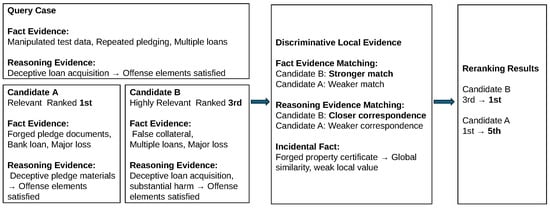
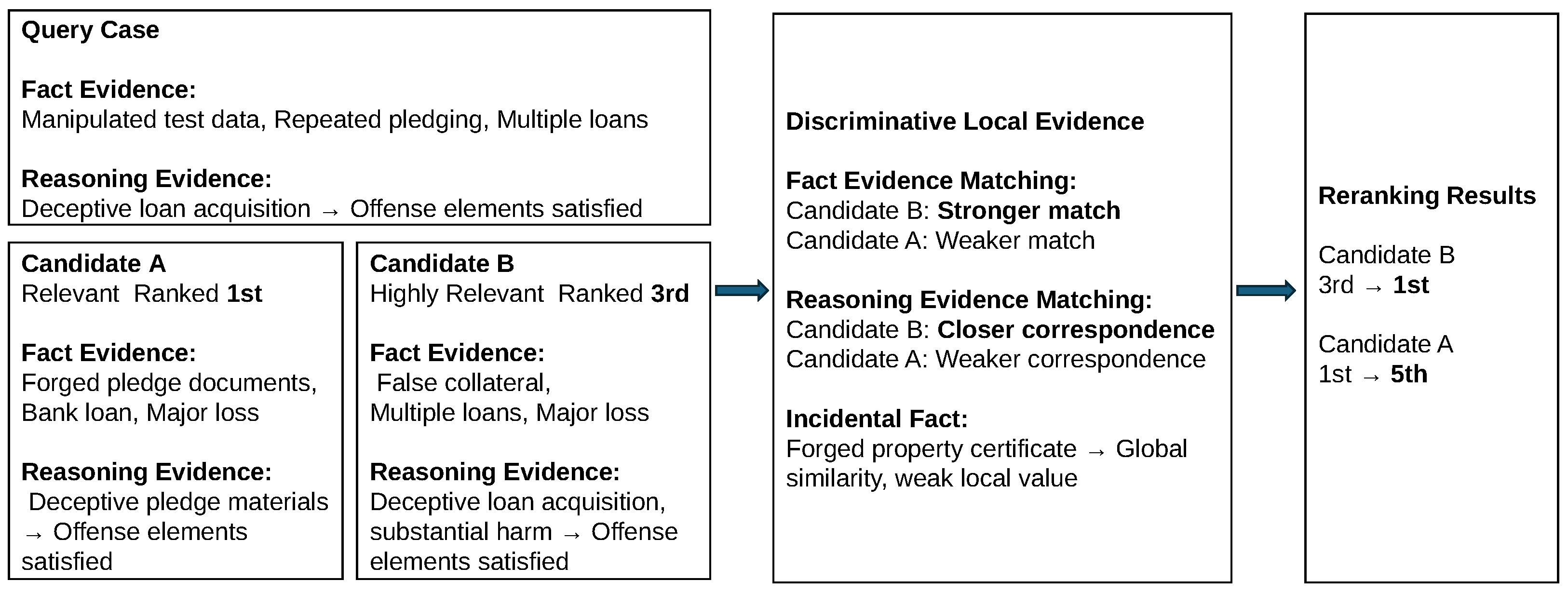
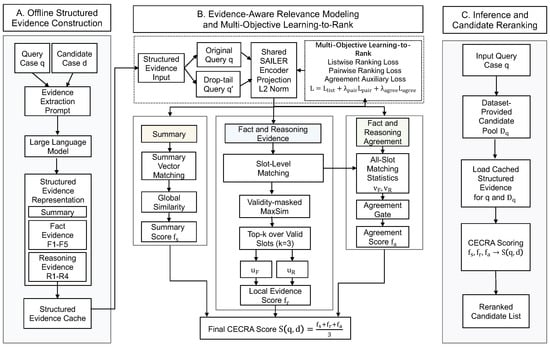
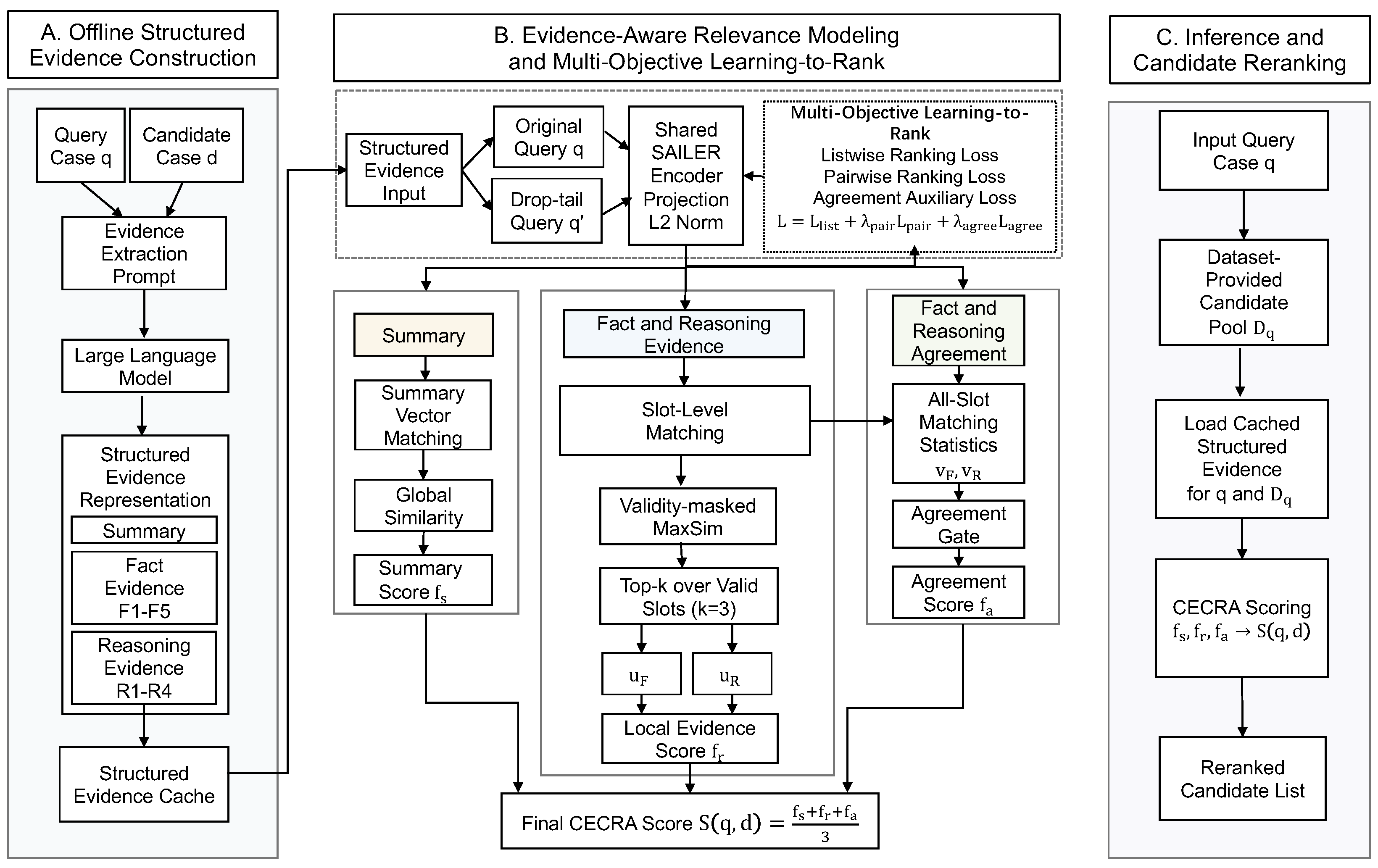
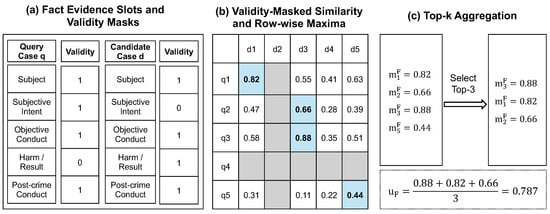
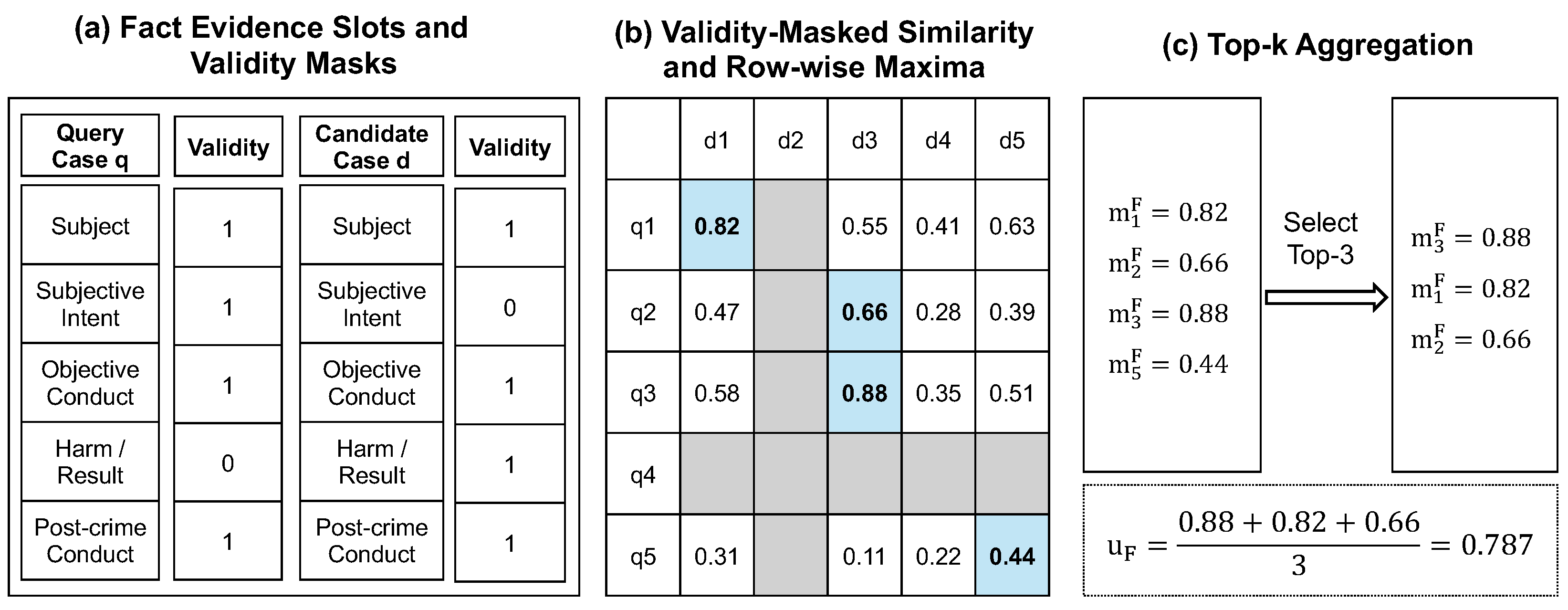
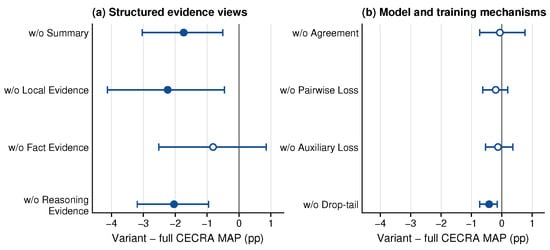
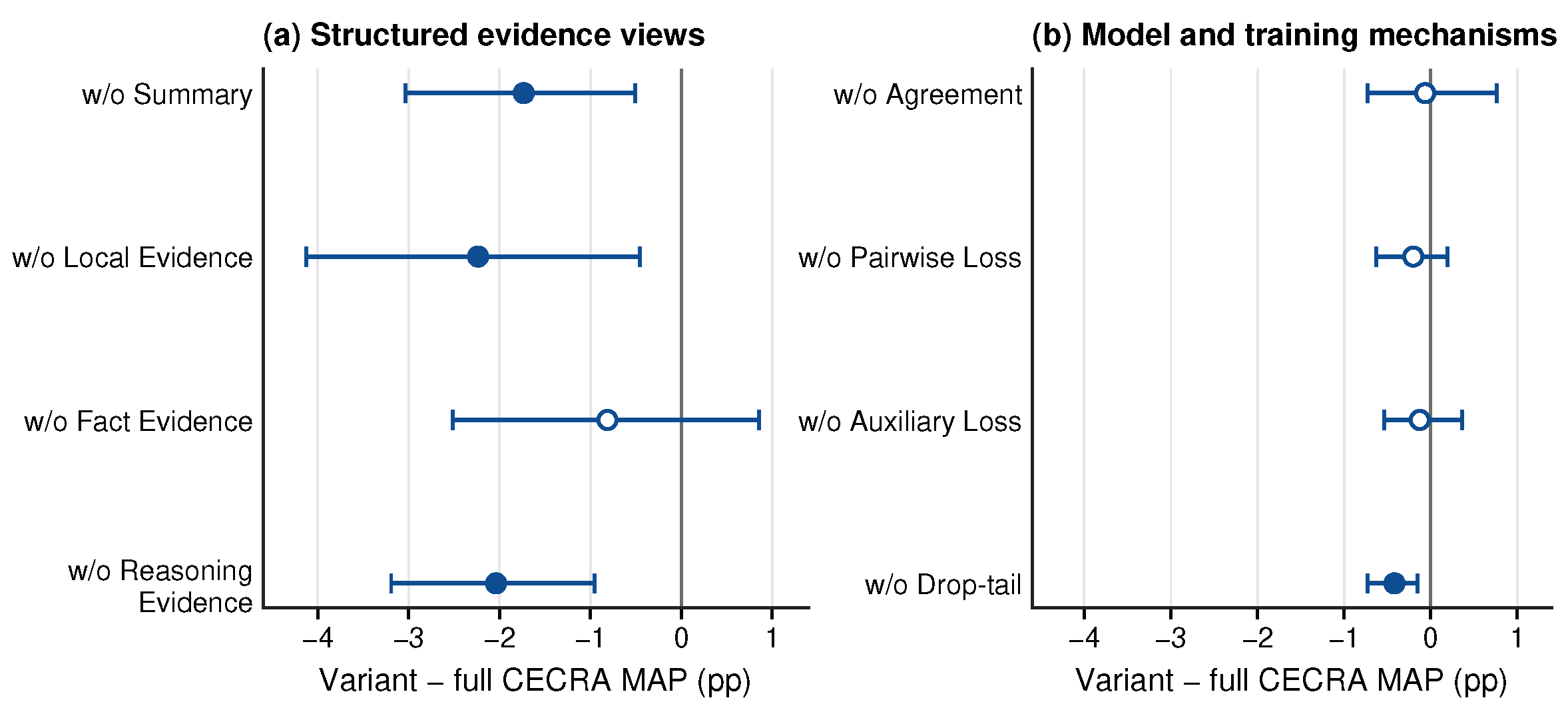
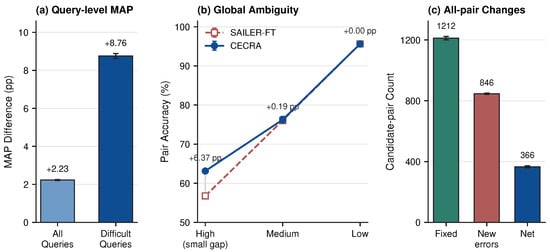
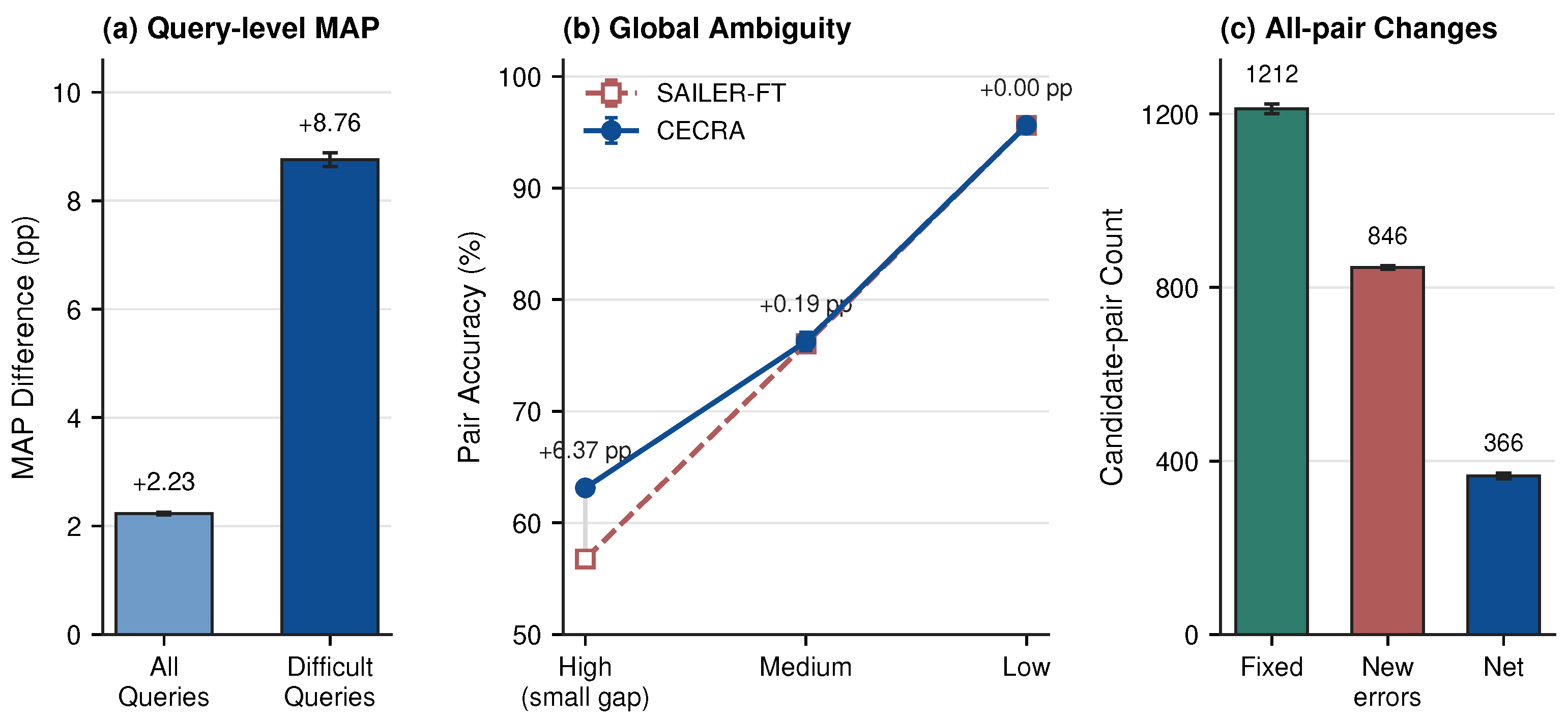
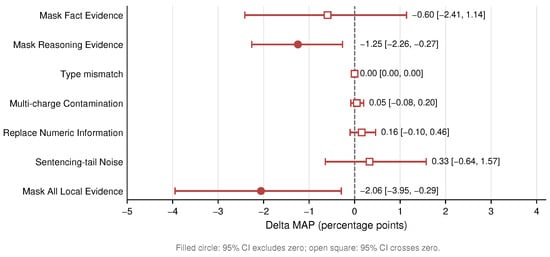
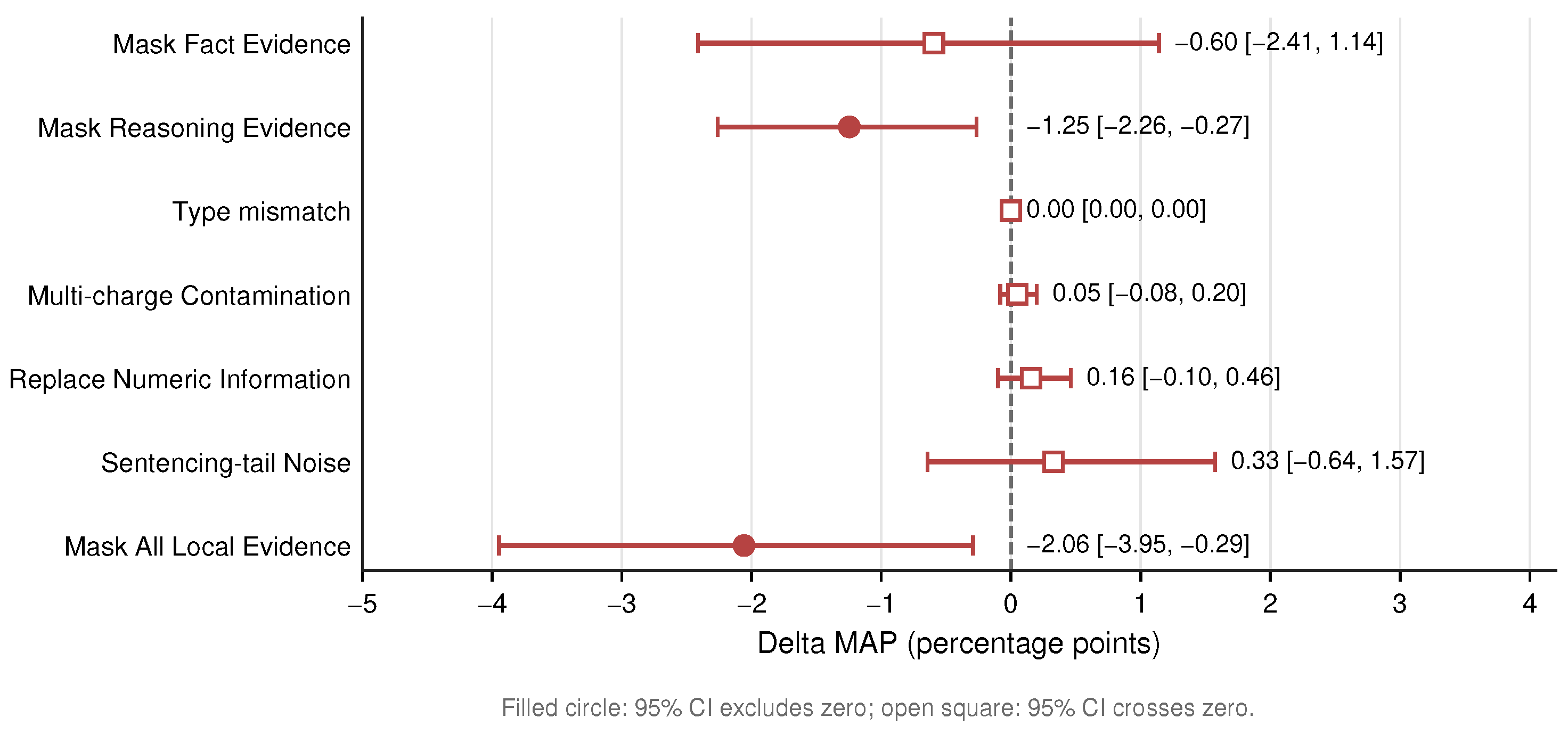
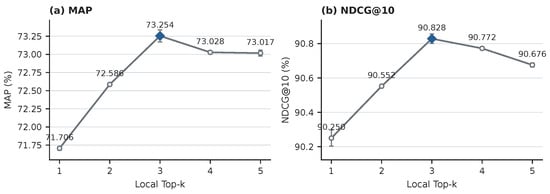
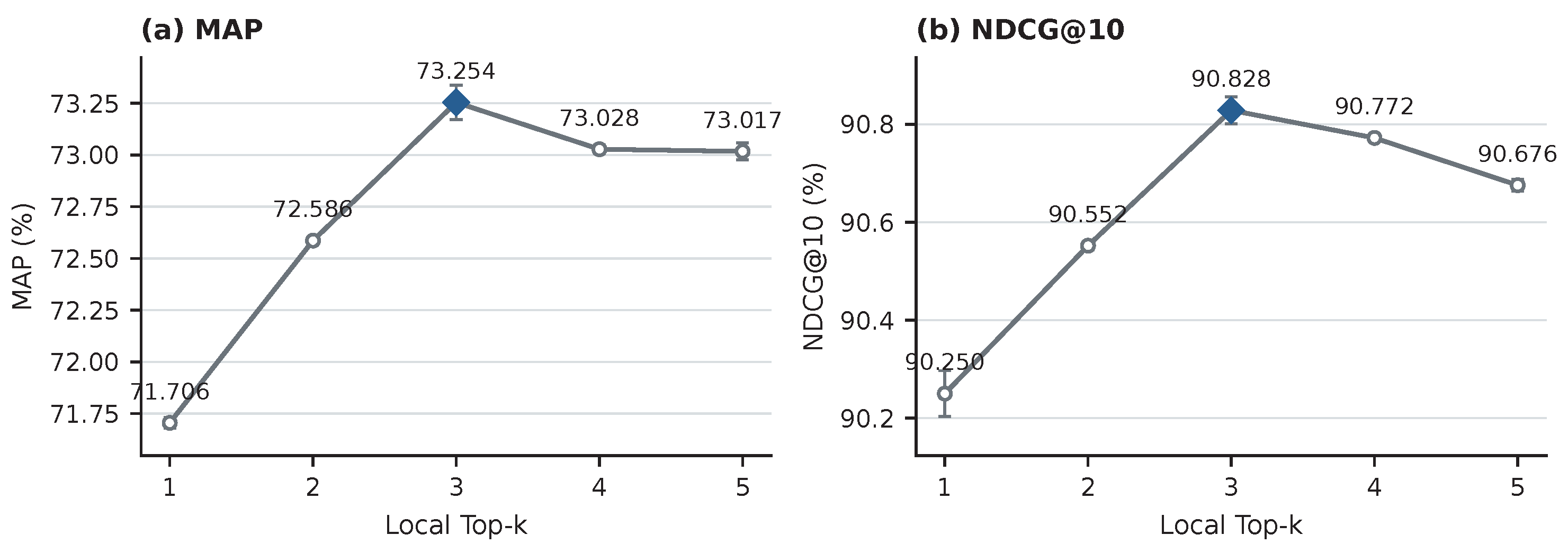

Disclaimer/Publisher’s Note: The statements, opinions and data contained in all publications are solely those of the individual author(s) and contributor(s) and not of MDPI and/or the editor(s). MDPI and/or the editor(s) disclaim responsibility for any injury to people or property resulting from any ideas, methods, instructions or products referred to in the content. |
© 2026 by the authors. Licensee MDPI, Basel, Switzerland. This article is an open access article distributed under the terms and conditions of the Creative Commons Attribution (CC BY) license.