


Abstract
Falls from chairlifts are rare but can have catastrophic consequences. Unseated passengers may attempt to prevent a fall by holding onto a chairlift structure, yet little is known about how long this can be sustained, particularly while wearing snow sport gloves. This study investigated the effects of snow sport gloves on straight-arm hang endurance, maximum grip strength, and grip endurance. Thirty-eight adults (19 females, 19 males; 35 ± 10 years) completed straight-arm hang endurance, maximum grip strength, and grip endurance tests under barehanded and gloved conditions. Overall, mean straight-arm hang endurance decreased from 61.1 ± 35.0 s barehanded to 28.8 ± 22.7 s when wearing winter gloves (p < 0.001). Males demonstrated longer straight-arm hang endurance and greater grip strength than females; however, the detrimental effects of gloves were similar between the sexes. Multiple linear regression identified normalized maximum grip strength (grip strength/body weight), followed by sex, as the strongest predictors of straight-arm hang endurance for both gloved and barehanded conditions. Winter gloves substantially reduced the ability to support body weight during a straight-arm hang. Although endurance varied considerably among participants, the mean gloved hang times were less than 30 s under the evaluated conditions.
1. Introduction
Ski areas use chairlifts to transport patrons, and although falls from chairlifts are rare [1,2], the consequences can be catastrophic [3]. Even though most chairlifts at U.S. ski areas are equipped with restraint bars to prevent passengers from becoming unseated, falls during transport still occur [1]. Restraint bars must be lowered to provide any benefit and compliance with lowering the restraint bar varies regionally across the U.S. from 9% to 80% [4]. The majority of incidents involving unseated passengers occur near the loading or unloading areas [1] when the restraint bar is often in the up position to allow passengers to embark or disembark.
Unseated chairlift passengers may attempt to grab a chair structure (such as an armrest or restraint bar) to prevent or delay their fall. Ski area operators and ski patrol need to know generally how much (or how little) time would be available to conduct a rescue; this information is important to develop and implement rescue procedures. The goal of this study was to determine reasonable estimates of how much time is available to rescue an unseated passenger who is holding onto a chairlift chair component.
While unseated passengers may use different approaches to hold onto a carrier, one strategy can be approximated with a “straight-arm hang” (also called a dead hang). This exercise is performed by grasping a cylindrical bar with the arms extended straight overhead, the torso and legs hanging vertically, and the feet off the ground. While unseated passengers may be assisted by others, typical straight-arm hang endurance times provide a lower bound estimate of how much time may be available for rescue. Because most snow sport participants wear gloves to protect their hands from the cold, determining the influence of winter gloves on straight-arm hang endurance needs to be considered. The current body of scientific literature has explored the effect of gloves on grip strength, grip endurance, and breakaway force for cylindrical handholds, but not on straight-arm hang endurance.
Previous studies on straight-arm hang endurance in adults have reported mean times ranging from 58 to 111 s [5,6,7]. Elkus et al. [5] reported that most subjects described pain in their fingers and palms and tightness in the forearms during straight-arm hangs. The subjects reported that they let go when their grip slipped off the bar because their fingers began to give way uncontrollably. Brantner et al. [6] found that straight-arm hang endurance improved over the course of their nine-day study and theorized that a psychological adaptation to better endure pain and/or increased muscle strength may account for the improvement in endurance times. Gabbard et al. [7] measured straight-arm hang endurance in 18- to 21-year-old males and found that on average, using an underhand or partially supinated grip with the thumb under the bar yielded better results than an overhand grip. While Elkus et al. and Brantner et al. included both female and male subjects in their studies, neither examined the differences in straight-arm hang endurance between the sexes [5,6].
Researchers have examined how gloves affect handhold breakaway strength [8,9], maximum grip strength [10,11,12,13,14,15,16,17], and grip endurance [18]. Young et al. [8] investigated the effects of wearing gloves on the ability to hold onto a cylindrical handle and found that gloves can increase or decrease the breakaway force depending on friction; when the friction was greater, the breakaway force to decouple the hand from the cylindrical handle increased. Studies examining the effect of work gloves on grip strength have shown that grip strength decreases with increased glove thickness and stiffness. [11,12,13,14,15,16] The decrease in grip strength when wearing gloves has been associated with the effort imparted to deform the glove [14], increases in the inner grasp diameter [12,14], changes in friction between the glove and object [7,12], and decreased tactile feedback [12,14]. To our knowledge, only England et al. [10] have studied the effect of snow sport specific gloves on grip strength. They found that maximum grip strength decreased by an average of 20% when wearing snow sport gloves [10].
The effect of wearing gloves on grip endurance has also been investigated. Grip endurance, the time a person can maintain a particular level of grip force, has been found to correlate to the percentage of the maximum grip strength being applied [18,19]. As the percentage of the maximum grip force exerted increased, the time one can sustain the grip force decreased exponentially [15]. Cochran et al. [18] found that wearing work gloves did not change this relationship and concluded that the reduction in grip endurance would be similar to the reduction in maximum grip strength when wearing gloves. To our knowledge, there have been no studies that have investigated the effect of wearing commercially available gloves (including snow sport gloves) on straight-arm hang endurance.
There are limited data in the published literature on straight-arm hang endurance [5,6,7] and it is unknown how straight-arm hang endurance relates to maximum grip strength and endurance. If a strong correlation exists, it would allow the use of normative grip strength values to estimate straight-arm hang endurance in different populations. In this study we aim to: (1) quantify straight-arm hang endurance under barehanded and gloved conditions; (2) compare the effects of snow sport gloves on straight-arm hang endurance, maximum grip strength, and grip endurance; and (3) identify physiological metrics and anthropometric characteristics related to straight-arm hang endurance. To our knowledge, this is the first study to directly quantify straight-arm hang endurance while participants wore commercially available snow sport gloves and to examine its relationship with grip performance and body-weight-normalized grip strength.
We hypothesize that: (1) both grip strength and grip endurance are correlated positively with longer straight-arm hang endurance, (2) wearing snow sport gloves will have a detrimental effect on straight-arm hang endurance similar to the degradation in maximum grip strength and grip endurance, and (3) the degradation in straight-arm hang endurance while wearing gloves will be similar for males and females. To test our hypotheses and determine how long a skier or snowboarder can reasonably support their weight while hanging by their hands from a chairlift structure, maximum grip strength, grip endurance, and straight-arm hang endurance were examined when barehanded and when wearing snow sport gloves.
2. Materials and Methods
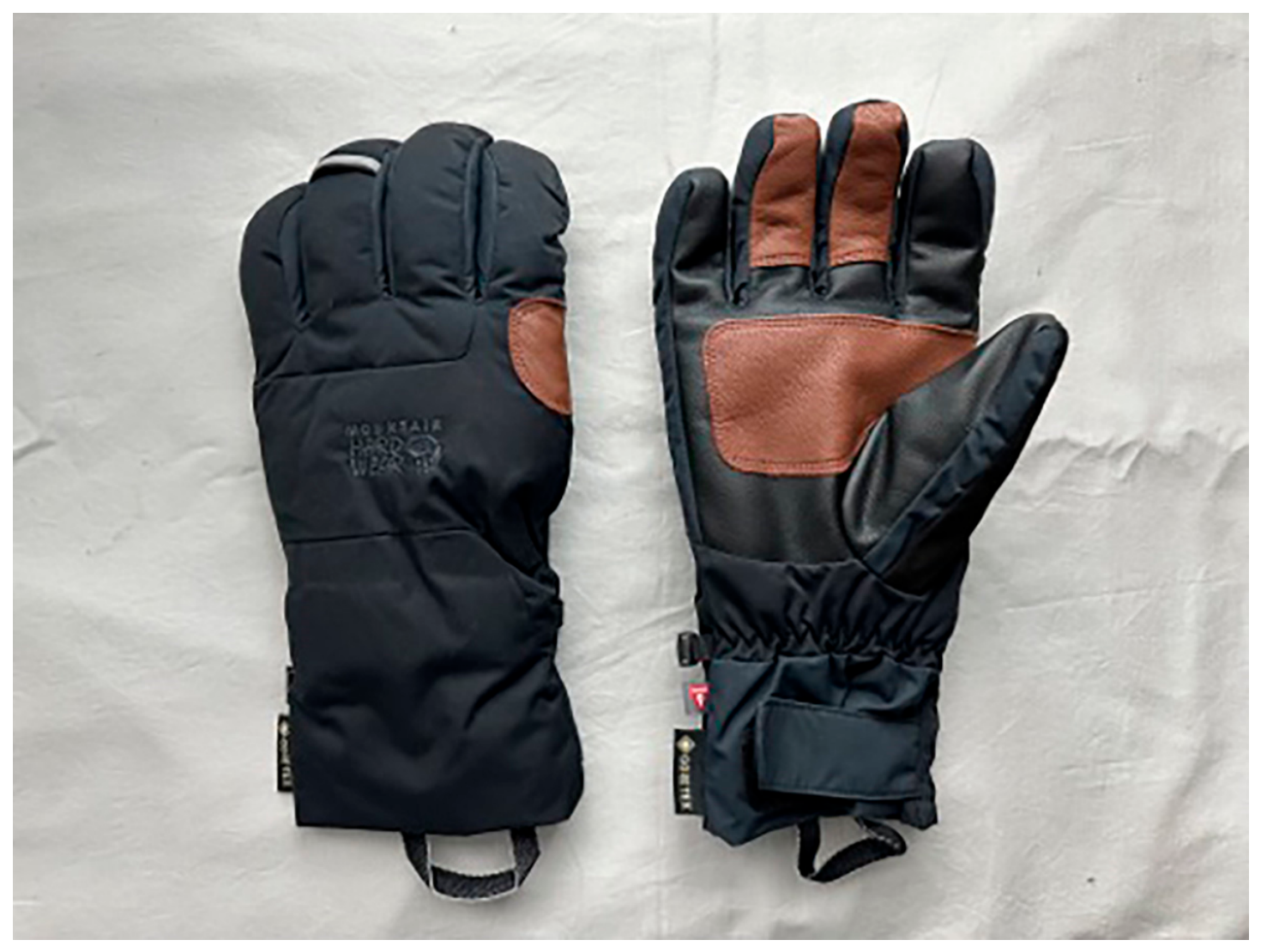
Adult participants over the age of 18 years and without prior shoulder injuries were recruited from the community surrounding a large US ski area. Each participant’s age, sex, and hand dominance were documented, and their height, weight, and hand dimensions (length, breadth, and circumference) were measured. Winter snow sport gloves (Mountain Hardwear Cloud Bank™ Gore-Tex Gloves; Richmond, CA, USA) were provided for participant use during the study (Figure 1). The outer shell of the glove consisted of a nylon fabric with goat skin covering the palmar surface. All men’s (S, M, L, XL) and women’s sizes (S, M, L) were available for use and the participants were allowed to try on and select their preferred size. The self-selected snow sport glove size was recorded for each participant. Before taking part in the study, all procedures were explained to each participant and informed written consent was obtained as approved by the Institutional Review Board at Guidance Engineering and Applied Research (IRB No. 22BMCH137).
Figure 1.
Mountain Hardwear Cloud Bank™ Gore-tex gloves used in the study. The outer shell of the glove consisted of a nylon fabric with goat skin covering the palmar surface. All women’s and men’s sizes available from the manufacturer were offered for study participants to use.
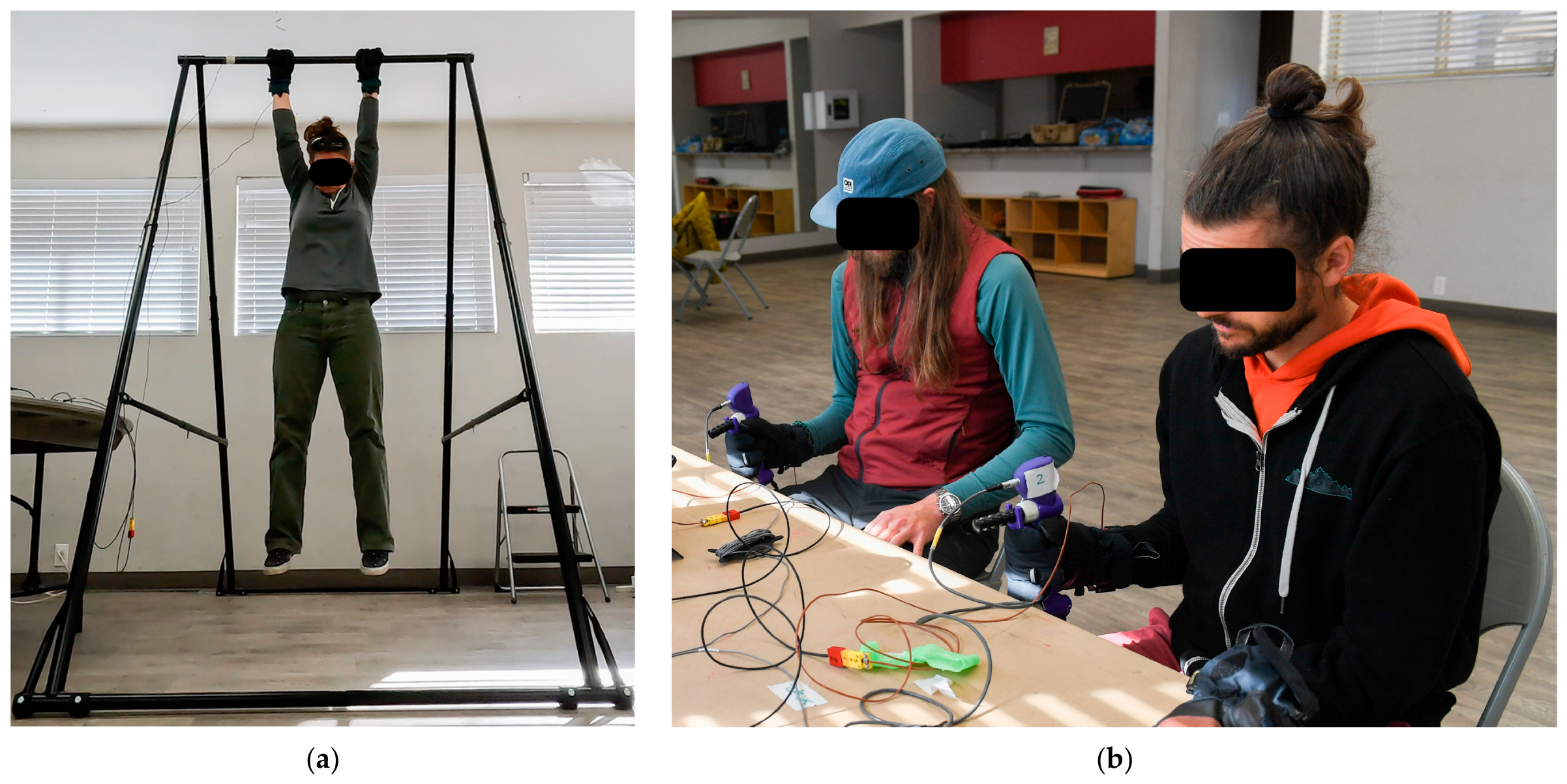
Straight-arm hangs were performed from an adjustable-height, free-standing metal pull-up bar (Model KT1.1518, Khanh Trinh; Hanoi, Vietnam). The bare metal bar was 3.5 cm in diameter and was similar in shape and size to armrests and other structures measured by the authors on chairlifts. The bar height was adjusted for each participant to assure that the participant’s feet did not touch the ground, but were less than 30 cm above the ground, when performing a straight-arm hang. A step was provided for participants to access the bar. Straight-arm hang endurance time was measured with a stopwatch, starting when both feet were no longer in contact with the step, and ending when the participant’s hands released the bar. Participants were instructed to use an overhand pronated grip and hold on as long as they could (Figure 2a). Throughout each trial, subjects were verbally encouraged to continue holding onto the bar. Each participant performed two straight-arm hangs with bare hands and two straight-arm hangs wearing snow sport gloves, with at least five minutes of rest between each trial.
Figure 2.
Gloved participants performing (a) a straight-arm hang from an adjustable free-standing pull up bar; and (b) grasping dynamometers during maximum grip strength trials.
Maximum grip strength was measured using a Jamar hand grip dynamometer (G2000 Hand Grip Dynamometer, Biometrics Ltd.; Ladysmith, VA, USA) set at position 1. The span at position 1 was approximately 3.5 cm and was chosen because it closely resembled the diameter of the metal bar used in the straight-arm hang trials. Maximum grip strength testing was conducted with the participant seated with their elbows by their side and flexed at a 90-degree angle (Figure 2b), in accordance with the American Society of Hand Therapists’ recommendation [20]. Participants were instructed to squeeze the dynamometer as hard as they could with their dominant hand for 3 to 5 s. Each participant performed three trials barehanded and three trials gloved with at least one minute of rest between trials. Similar to the straight-arm hang trials, participants were verbally encouraged to exert greater force on the dynamometer during all the maximum grip strength trials.
To measure grip endurance, participants viewed a real-time display of the dynamometer output and were instructed to apply a grip force to the dynamometer until exhaustion. A stopwatch was used to measure how long the participants could hold 70% of the average maximum grip strength calculated from their three barehanded trials. Participants were verbally encouraged to squeeze the dynamometer more forcefully when their output fell below 70% of their maximum grip strength. The time was stopped when the force on the grip dynamometer dropped below 60%. Each participant performed one grip endurance trial barehanded and one trial with snow sport gloves with at least five minutes of rest in between.
The order of the maximum grip strength, grip endurance, and straight-arm hang trials, as well as the barehanded and gloved conditions, were randomized for each participant. To prevent fatigue, the participants rested at least 5 min between the different tests.
The data were analyzed using a mixed ANOVA model in R (R 4.6.0, R Foundation for Statistical Computing, Vienna, Austria) to determine if there were significant differences between males and females and the gloved and barehanded conditions for maximum grip strength, grip endurance, and straight-arm hang endurance. For tests with repeated trials, only the maximum value obtained for each participant was analyzed. The percent change between the barehanded and gloved trials for each participant was also calculated and analyzed. Multiple linear models were used to find relationships between maximum grip strength, grip endurance, straight-arm hang endurance, and body weight and the effects of sex and hand dimensions on straight-arm hang endurance. A significance level of 0.05 was used for all statistical comparisons.
3. Results
Thirty-eight participants (19 females, 19 males), ranging in age from 24 to 62 years, participated in the study. A summary of participant age and measurements is provided in Table 1. While male participants were typically taller and heavier than females, there was no significant difference in body mass index (t(33.8) = 0.48, p = 0.64). For males, the mean hand length was 2.0 cm longer, the mean hand breadth was 1.1 cm wider, and mean hand circumference was 2.6 cm greater than those measured for females.
Table 1.
Mean ± standard deviation of participants’ age and measured anthropometry.
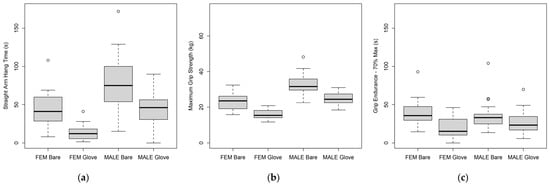
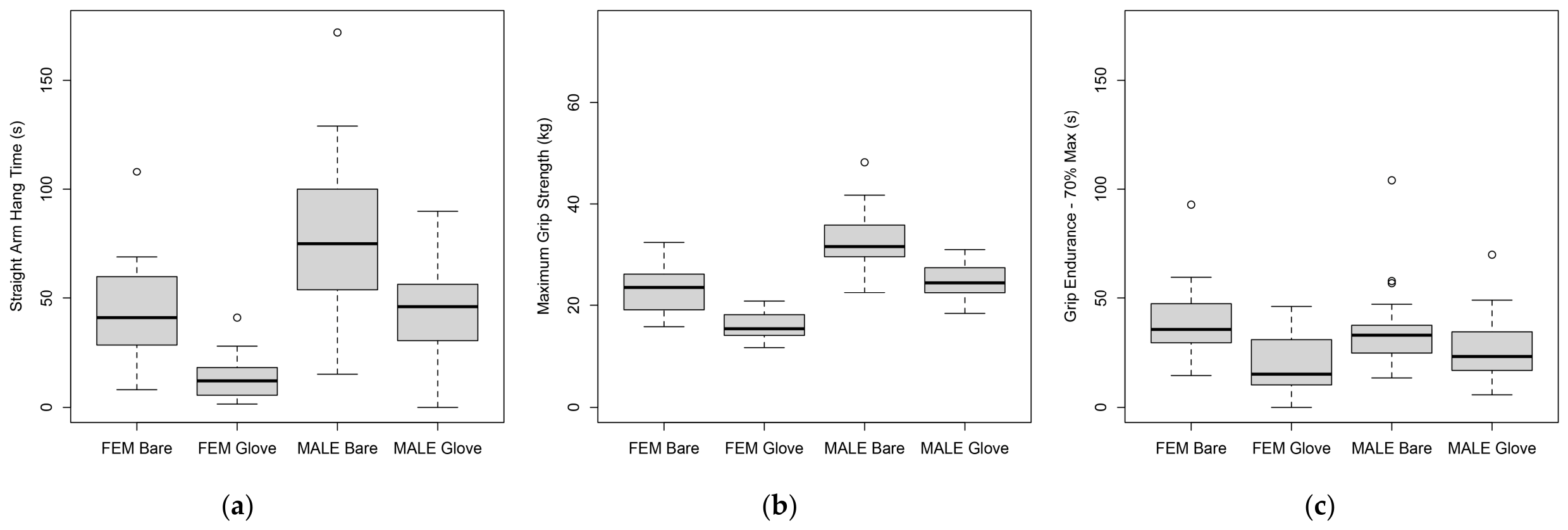
The maximum straight-arm hang endurance, maximum grip strength, and grip endurance results for both the barehanded and gloved conditions for males and females are summarized in Table 2 and displayed as boxplots in Figure 3.
Table 2.
Mean ± standard deviation (95% confidence interval) for straight-arm hang endurance, maximum grip strength, and grip endurance for female and male participants under the gloved and barehanded conditions.
Figure 3.
Boxplots showing female and male, and barehanded and gloved results for: (a) straight-arm hang endurance; (b) maximum grip strength; and (c) grip endurance.
3.1. Straight-Arm Hang Endurance
Wearing snow sport gloves substantially impaired the mean straight-arm hang endurance from 61.1 ± 35.0 s barehanded to 28.8 ± 22.7 s when gloved (F(1, 36) = 86.1, p < 0.001, η2G = 0.30). Although males achieved significantly longer straight-arm hang times than females (F(1, 36) = 18.6, p < 0.001, η2G = 0.30), the detrimental effect of glove use was similar between the sexes (F(1, 36) = 0.23, p = 0.63, η2G = 0.001). Wearing snow sport gloves decreased the mean straight-arm hang times by 30.6 ± 20.4 s in females and 33.9 ± 22.5 s in males. Of note, one male participant was unable to straight-arm hang when wearing snow sport gloves; his time was recorded as 0 s for the gloved trials.
3.2. Maximum Grip Strength
Similar to straight-arm hang endurance, maximum grip strength was significantly lower when participants wore snow sport gloves than when tested barehanded (F(1, 36) = 110.7, p < 0.001, η2G = 0.43). Males exhibited greater maximum grip strength than females across glove conditions (F(1, 36) = 52.8, p < 0.001, η2G = 0.52). However, there was no significant interaction between glove condition and sex (F(1, 36) = 0.77, p = 0.38, η2G = 0.005), indicating that glove-related reductions in grip strength were similar in males and females. Across all participants, wearing gloves reduced maximum grip strength by an average of 7.8 ± 4.6 kg.
3.3. Grip Endurance
Grip endurance was significantly reduced when participants wore snow sport gloves compared to the barehanded condition (23.3 ± 15.2 s vs. 37.9 ± 18.9 s; F(1, 36) = 33.0, p < 0.001, η2G = 0.16). Unlike the straight-arm hang endurance and maximum grip strength results, grip endurance did not differ between males and females overall (F(1, 36) = 0.18, p = 0.67, η2G = 0.019). A trend toward a larger glove-related reduction in grip endurance among females was observed; however, the sex × glove condition interaction was not statistically significant (F(1, 36) = 3.4, p = 0.07, η2G = 0.019).
3.4. Statistical Relationships
Multiple linear regression identified normalized maximum grip strength (grip strength/body weight), grip endurance, and sex as significant predictors of barehanded straight-arm hang endurance (R2 = 0.44, F(3, 34) = 10.7, p < 0.001). For gloved straight-arm hang endurance, only normalized maximum grip strength and sex remained significant predictors (R2 = 0.54, F(2, 35) = 22.8, p < 0.001). Normalized maximum grip strength was the strongest predictor for the barehanded and gloved conditions. Although both models were significant, they explained only a moderate proportion of the variance in straight-arm hang endurance. Hand dimensions, glove size, and BMI were not significant predictors and reduced fit when incorporated into the model.
4. Discussion
In this study, we measured maximum grip strength, grip endurance, and straight-arm hang endurance of adult participants when barehanded and when wearing snow sport gloves. Snow sport gloves impaired maximum grip strength, grip endurance, and straight-arm hang endurance in both sexes, with generally similar reductions observed in males and females. The ability to detect interaction effects may have been limited by sample size. While gloves produced a similar absolute decline in performance in both sexes, the relative decrease was greater in females due to their lower barehanded performance. The individual percent reduction between the barehanded and gloved conditions for straight-arm hang endurance, maximum grip strength, and grip endurance were calculated separately for each participant and then averaged across all participants. When examining the percent decrease, snow sport gloves were more detrimental to straight-arm hang endurance than to maximum grip strength and grip endurance.
Our barehanded results agree well with those of previous studies and support our methodology. For all participants, the average barehanded straight-arm hang endurance time measured in this study was 61 s, similar to the mean initial endurance time of 58 s reported by Brantner et al. [6], but lower than the mean of 92 s reported in Elkus et al. [5]. Overall, the subjects in Elkus et al. were younger and included at least two competitive gymnasts that may have contributed to the higher average endurance time in that study. The longest straight-arm hang time measured in the current study was 173 s for a male rock-climbing enthusiast, and close to the maximum time of 183 s reported by Elkus et al.; in both the current study and Elkus et al., most participants could straight-arm hang for substantially less time. Elkus et al. and Brantner et al. did not examine the influence of sex on straight-arm hang endurance, which this study found to have a significant influence on hang times.
In the present study, straight-arm hang endurance had only a moderate correlation with normalized maximum grip strength, grip endurance, and sex, leaving much of the variance unexplained. This was unexpected, as we hypothesized that grip performance would most closely reflect the conditions of the straight-arm hanging task. The limited predictive ability of grip strength suggests that other muscle groups (for example, upper arm, shoulder, and back muscles) may have a larger influence on straight-arm hang endurance times. Because no measurements of these other muscle groups were performed in the present study, the specific contribution of individual muscle groups cannot be determined. Future studies should incorporate biomechanical, physiological, or electromyographic assessments to better characterize the relative contributions of hand and proximal musculature to straight-arm hang endurance.
Snow sport gloves considerably lowered straight-arm hang endurance, maximum grip strength, and grip endurance; absolute differences between the barehanded and gloved conditions were statistically insignificant when comparing females and males for all three metrics. In the current study, snow sport gloves reduced maximum grip strength on average by 24% for males. This reduction was consistent with the results of England et al.’s [10] that showed a 20% reduction in grip strength with snow sport gloves. England et al. did not report the sex of the three participants tested in their study, but stated that the three subjects wore size large gloves; in the present study, size large gloves typically fit male participants.
While the difference in barehanded maximum grip strength between males and females has been well documented [21,22,23,24,25,26,27,28], few studies have examined whether gloves affect grip strength differently for males and females. Sudhakar et al. [13] found that males and females had similar degradation in maximum grip strength (~20%) when wearing suede leather construction gloves. Zhao et al. [14] found the average percent reduction in maximum grip strength when wearing work gloves between males and females was dependent on grip span. At a grip span of 45 mm, work gloves reduced grip strength by up to 21% for females and 17% for males. Although the mean individual percent reduction in maximum grip strength was greater for both males (24.2%) and females (29.6%) in this study, the disparity between males and females was similar. Using the method of characterizing glove stiffness described by Zhao et al., the snow sport gloves used in the present study had a higher stiffness angle than the work gloves used in the Zhao et al. study [14], likely contributing to the larger impairment.
Cochran et al. [18] found that wearing work gloves did not change the relationship between grip endurance and the percent maximum grip strength exerted and concluded that the reduction in grip endurance would be the same as the degradation of maximum grip strength. We found this to hold true when examining the mean of individual percent reduction in maximum grip strength (24.2%) and grip endurance (22.7%) for males, but not females. For females, the mean of individual percent reduction in grip endurance (47.5%) was 1.6 times higher than that for maximum grip strength (29.6%) when wearing snow sport gloves.
The individual percent reduction in straight-arm hang endurance when wearing snow sport gloves was higher than would be predicted from the reduction in maximum grip strength; the mean individual percent reduction in straight-arm hang endurance was twice that for maximum grip strength. This difference is likely due to the involvement of body weight during straight-arm hangs that produces a downward force that acts to unravel the grip around the bar [8]; maximum grip strength when normalized by body weight was the strongest predictor of straight-arm hang endurance. The frictional interface between the hand or glove and the bar may also influence hanging endurance. Because the downward force due to body weight is tangential to the metal bar being gripped, the coefficient of friction between the hand or glove may play a larger role during straight-arm hangs than when gripping a dynamometer to measure maximum grip strength and grip endurance.
Chairlift ride times at ski areas in the United States typically range between 2 and 10 min with an average ride time of just under 5 min [29,30]. Based on the results of this study, ski area personnel may have less than 30 s to rescue an unseated passenger who is holding onto a chair with gloved hands and with no support from other passengers; however, available rescue time will vary substantially among individuals. According to the National Ski Areas Association, the most falls from chairlifts occur near the loading or unloading areas; that is, when a chairlift passenger becomes unseated, the event usually occurs near the bottom terminal after loading the chairlift or near the top terminal where passengers prepare to disembark. Based on the results of this study, if a passenger becomes unseated near the beginning of the ride, it would be unlikely that they would be able to use only their hands to support their weight until the chair arrives at the top terminal. In these situations, lift operators may need to consider stopping the chair to prevent it from ascending, but would have limited time to execute a rescue before the unseated passenger can no longer hold on and falls to the ground. When a passenger becomes unseated close to the top terminal, it may be unnecessary (or even disadvantageous) for lift operators to stop the chairlift immediately, as an unseated passenger may be able to hold onto the chair long enough to reach the unloading area.
All straight-arm hangs were conducted on a 3.5-cm diameter metal bar and only one snow sport glove model was tested. Snow sport gloves or mittens are worn by most snow sport participants to protect their hands from the cold temperatures associated with outdoor mountain winter environments. While there are many types of snow sport gloves and mittens worn for snow sports, the gloves chosen for use in this study are representative of one type of fingered glove that many snow sport participants wear based on the authors’ observations of skiers and snowboarders at ski areas in the United States. The present study did not measure glove-bar friction, glove stiffness, tactile feedback, or glove fit; therefore, the individual contributions of these mechanisms cannot be distinguished. These factors should be considered plausible explanations for the deterioration in performance requiring direct experimental evaluation.
Brantner et al. [6] found that straight-arm hang endurance improved over the short course of their study and theorized that this improvement was not due to increases in muscular strength, but rather was the result of psychological adaptations to endure pain and discomfort. While subjects in the present research were instructed and encouraged verbally to hold on to the bar as long as they could throughout each trial, they were not in any physical danger. Unseated passengers on a chairlift are likely aware of the possibility of catastrophic consequences if they fall and may have physiological and psychological responses that may increase their straight-arm hang endurance.
Other factors that may influence straight-arm hang endurance, such as the additional weight of ski or snowboarding equipment, other passengers holding onto the unseated passenger, other hanging positions and grips, glove fit, different bar diameters and geometries, and the effects of environmental conditions, were not investigated in this study.
Under the controlled conditions tested, mean gloved straight-arm hang endurance was less than 30 s, although substantial inter-individual variability was observed. These findings indicate that the duration of unsupported hanging by the hands may be limited and that chairlift incidents involving an unseated passenger can be highly time-sensitive. The results should not be interpreted as defining a universal rescue window because actual endurance will depend on individual passenger characteristics, glove properties, and assistance from others.
Author Contributions
Conceptualization, L.S. and I.S.; methodology, L.S. and D.M.; formal analysis, L.S.; investigation, L.S., D.M. and G.P.; writing—original draft preparation, L.S.; writing—review and editing, D.M. and I.S. All authors have read and agreed to the published version of the manuscript.
Funding
This research received no external funding.
Institutional Review Board Statement
The study was conducted in accordance with the Declaration of Helsinki, and approved by the Institutional Review Board of Guidance Engineering and Applied Research (protocol code IRB No. 22BMCH137 approved on 27 October 2023).
Informed Consent Statement
Informed consent was obtained from all subjects involved in the study.
Data Availability Statement
The datasets presented in this article are not readily available because the data are part of an ongoing study. Requests to access the datasets should be directed to stepan@guidanceengineering.com.
Acknowledgments
During the preparation of this manuscript/study, the authors used Microsoft 365 Copilot Premium for the purposes of formatting and revising language for portions of the text. The authors have reviewed and edited the output and take full responsibility for the content of this publication.
Conflicts of Interest
The authors have conducted unrelated research for sports industry associations and some of the authors have acted as expert witnesses in sports-related lawsuits (hired by injured individuals, equipment manufacturers, or sports facilities/resorts).
References
- National Ski Areas Association. NSAA Aerial Ropeway and Surface Lift Fact Sheet; National Ski Areas Association: Lakewood, CO, USA, 2025; Available online: https://nsaa.org/webdocs/Media_Public/IndustryStats/Aerial_Ropeway_Fact_Sheet_2025.pdf (accessed on 23 September 2026).
- Shealy, J.E.; Ettlinger, C.F.; Scher, I.S.; Johnson, R.J. 2010/2011 NSAA 10-year interval injury study. In Skiing Trauma and Safety: 20th Volume; ASTM International: West Conshohocken, PA, USA, 2015; pp. 93–111. [Google Scholar] [CrossRef] [Scilit]
- Smartt, P.; Chalmers, D. Searching for ski-lift injury: An uphill struggle? J. Sci. Med. Sport 2010, 13, 205–209. [Google Scholar] [CrossRef] [Scilit] [PubMed]
- Harley, E.M.; Stepan, L.L.; Scher, I.S. Factors that influence chairlift restraint bar use in the United States. JSAMS Plus 2023, 2, 100031. [Google Scholar] [CrossRef] [Scilit] [PubMed]
- Elkus, R.; Basmajian, J.V. Endurance in hanging by the hands: Why do people hanging by their hands let go? Am. J. Phys. Med. 1973, 52, 124–127. [Google Scholar] [PubMed]
- Brantner, J.; Basmajian, J.V. Effects of training on endurance in hanging by the hands. J. Mot. Behav. 1975, 7, 131–134. [Google Scholar] [CrossRef] [Scilit] [PubMed]
- Gabbard, C.; Patterson, P.; Elledge, J. Grip and forearm position effects on tests of static and dynamic upper body endurance. Res. Q. Exerc. Sport 1981, 52, 174–179. [Google Scholar] [CrossRef] [Scilit] [PubMed]
- Young, J.G.; Woolley, C.; Ashton-Miller, J.A.; Armstrong, T.J. The effect of handhold orientation, size, and wearing gloves on hand-handhold breakaway strength. Hum. Factors 2012, 54, 316–333. [Google Scholar] [CrossRef] [Scilit] [PubMed]
- Young, J.G.; Woolley, C.; Armstrong, T.J.; Ashton-Miller, J.A. Hand-handhold coupling: Effect of handle shape, orientation, and friction on breakaway strength. Hum. Factors 2009, 51, 705–717. [Google Scholar] [CrossRef] [Scilit] [PubMed]
- England, S.A.; Benson, E.A.; Melsoh, M.; Thompson, S.; Rajulu, S.L. Application of spacesuit glove requirements tools to athletic and personal protective equipment. In Proceedings of the 34th Annual Meeting of the American Society of Biomechanics, Providence, RI, USA, 18–21 August 2010. [Google Scholar]
- Cochran, D.J.; Albin, T.J.; Bishu, R.R.; Riley, M.W. An analysis of grasp force degradation with commercially available gloves. Proc. Hum. Factors Ergon. Soc. Annu. Meet. 1986, 30, 852–855. [Google Scholar] [CrossRef] [Scilit]
- Bishu, R.R.; Batra, S.R.; Cochran, D.J.; Riley, M.W. Glove effect on strength: An investigation of glove attributes. Proc. Hum. Factors Ergon. Soc. Annu. Meet. 1987, 31, 901–905. [Google Scholar] [CrossRef] [Scilit]
- Sudhakar, L.R.; Schoenmarklin, R.W.; Lavender, S.A.; Marras, W.S. The effects of gloves on grip strength and muscle activity. Proc. Hum. Factors Ergon. Soc. Annu. Meet. 1988, 32, 647–650. [Google Scholar] [CrossRef] [Scilit]
- Zhao, C.; Li, K.; Yi, C. Assessments of work gloves in terms of the strengths of hand grip, one-handed carrying, and leg lifting. Appl. Sci. 2021, 11, 8294. [Google Scholar] [CrossRef] [Scilit]
- Wimer, B.M.; McDowell, T.W.; Xu, X.S.; Welcome, D.E.; Warren, C.M.; Dong, R.G. Effects of gloves on the grip strength applied to cylindrical handles. In Proceedings of the Third American Conference on Human Vibration, Iowa City, IA, USA, 1–4 June 2010; University of Iowa: Iowa City, IA, USA, 2010; pp. 45–46. [Google Scholar]
- Khanlari, P.; Ghasemi, F.; Heidarimoghdam, R. Protective gloves, hand grip strength, and dexterity tests: A comprehensive study. Heliyon 2023, 9, e13592. [Google Scholar] [CrossRef] [Scilit] [PubMed]
- Rock, K.; Mikat, R.P.; Foster, C. The effects of gloves on grip strength and three-point pinch. J. Hand Ther. 2001, 14, 286–290. [Google Scholar] [CrossRef] [Scilit] [PubMed]
- Cochran, D.J.; Bishu, R.R.; Riley, M.W. The effects of gloves on maximum holding time. Proc. Hum. Factors Ergon. Soc. Annu. Meet. 1987, 31, 894–897. [Google Scholar] [CrossRef] [Scilit]
- Rohmert, W. Ermittlung von Erholungspausen für statische Arbeit des Menschen. Int. Z. Angew. Physiol. 1960, 18, 123–164. [Google Scholar] [CrossRef] [Scilit]
- Bohannon, R.W.; Peolsson, A.; Massy-Westropp, N.; Desrosiers, J.; Bear-Lehman, J. Reference values for adult grip strength measured with a Jamar dynamometer: A descriptive meta-analysis. Physiotherapy 2006, 92, 11–15. [Google Scholar] [CrossRef] [Scilit]
- Crosby, C.A.; Wehbé, M.A. Hand strength: Normative values. J. Hand Surg. Am. 1994, 19, 665–670. [Google Scholar] [CrossRef] [Scilit] [PubMed]
- Massy-Westropp, N.M.; Gill, T.K.; Taylor, A.W.; Bohannon, R.W.; Hill, C.L. Hand grip strength: Age and gender stratified normative data in a population-based study. BMC Res. Notes 2011, 4, 127. [Google Scholar] [CrossRef] [Scilit] [PubMed]
- Wang, Y.C.; Bohannon, R.W.; Li, X.; Sindhu, B.S.; Kapellusch, J.M. Hand-grip strength: Normative reference values and equations for individuals 18 to 85 years of age residing in the United States. J. Orthop. Sports Phys. Ther. 2018, 48, 685–693. [Google Scholar] [CrossRef] [Scilit] [PubMed]
- Incel, N.A.; Ceceli, E.; Durukan, P.B.; Erdem, H.R.; Yorgancioglu, Z.R. Grip strength: Effect of hand dominance. Singap. Med. J. 2002, 43, 234–237. [Google Scholar]
- Peolsson, A.; Hedlund, R.; Oberg, B. Intra- and inter-tester reliability and reference values for hand strength. J. Rehabil. Med. 2001, 33, 36–41. [Google Scholar] [CrossRef] [Scilit] [PubMed]
- Petersen, P.; Petrick, M.; Connor, H.; Conklin, D. Grip strength and hand dominance: Challenging the 10% rule. Am. J. Occup. Ther. 1989, 43, 444–447. [Google Scholar] [CrossRef] [Scilit] [PubMed]
- Schlüssel, M.M.; dos Anjos, L.A.; Vasconcellos, M.T.L.; Kac, G. Reference values of handgrip dynamometry of healthy adults: A population-based study. Clin. Nutr. 2008, 27, 601–607. [Google Scholar] [CrossRef] [Scilit] [PubMed]
- Sella, G.E. The hand grip: Gender, dominance and age considerations. Eur. J. Phys. Rehabil. Med. 2001, 37, 161–170. [Google Scholar]
- Landsman, P. The Ten Longest Lift Rides in North America. Lift Blog, 19 September 2015. Available online: https://liftblog.com/2015/09/19/the-ten-longest-lift-rides-in-north-america (accessed on 22 January 2025).
- Landsman, P. The Ten Shortest Detachable Lifts in North America. Lift Blog, 4 September 2015. Available online: https://liftblog.com/2015/09/04/the-ten-shortest-detachable-lifts-in-north-america (accessed on 22 January 2025).

Disclaimer/Publisher’s Note: The statements, opinions and data contained in all publications are solely those of the individual author(s) and contributor(s) and not of MDPI and/or the editor(s). MDPI and/or the editor(s) disclaim responsibility for any injury to people or property resulting from any ideas, methods, instructions or products referred to in the content. |
© 2026 by the authors. Licensee MDPI, Basel, Switzerland. This article is an open access article distributed under the terms and conditions of the Creative Commons Attribution (CC BY) license.