


Featured Application
For manually fed juvenile Penaeus vannamei under the present flow-through conditions, increasing the daily feeding schedule from two to four times improved growth and feed utilization, whereas five or six daily feedings produced no further significant improvement. Because the treatments also differed in feeding times and intervals, these results apply to the feeding schedules tested and should be validated under commercial culture conditions.
Abstract
Feeding schedule is an important management factor in shrimp culture, but responses to increasing meal frequency vary with ration, shrimp size, feeding method, and culture system. We evaluated five daily schedules (2–6 meals d−1) for juvenile Pacific white shrimp, Penaeus vannamei, using the same biomass-based daily feeding-rate schedule in a filtered-seawater flow-through system. Shrimp (1.40 ± 0.01 g) were stocked at 20 per 300-L tank and reared for 8 weeks with three replicate tanks per treatment. Final body weight, weight gain, specific growth rate, and feed conversion ratio (FCR) differed among schedules (p < 0.05). Shrimp fed four to six times daily (FF4–FF6) showed higher growth and lower FCR than those fed twice daily (FF2), whereas the three-feeding treatment was intermediate. Compared with FF2, FF4 increased final body weight from 10.20 to 13.87 g and reduced FCR from 1.84 to 1.26. No significant differences in growth or FCR were detected among FF4, FF5, and FF6. Linear regression detected significant relationships between meal frequency and all four variables (p ≤ 0.0025). Whole-body proximate composition was evaluated descriptively because one pooled sample per treatment was analyzed in duplicate, and hemolymph AST, ALT, and total protein did not differ significantly. Under the conditions tested, four daily feedings were the lowest schedule associated with improved growth and feed utilization; however, feeding times and intervals also differed among treatments and feed leaching was not quantified.
1. Introduction
Pacific white shrimp, Penaeus vannamei, is one of the most important crustacean species in global aquaculture [1]. In the Republic of Korea, preliminary national statistics reported 7901 tonnes of P. vannamei aquaculture production in 2025 [2]. This production level underscores the commercial importance of the species and the need for efficient feed-management practices. In manually managed systems, the feeding schedule is particularly relevant because fewer feeding rounds concentrate the daily ration into larger meals, whereas more frequent feeding distributes the ration into smaller portions and can alter feed availability and utilization [3,4,5].
The temporal distribution of feed is biologically relevant because penaeid shrimp do not necessarily consume all available feed immediately after delivery. Feeding behavior is influenced by body size, social interactions, feed availability, and time of day [6]. Behavioral studies have shown increased feeding and substrate exploration after feed provision [7,8], a predominantly nocturnal self-feeding rhythm under controlled conditions [9], and rapid aggregation and increased movement around feeding areas after feed delivery in an experimental pond [10]. These findings do not by themselves establish an optimal feeding frequency, but they show that the timing and repeated availability of feed can influence when shrimp encounter and consume feed. Consequently, daily feeding schedules should be evaluated as combinations of meal number, meal size, and temporal distribution rather than as meal count alone.
Previous feeding-frequency experiments in P. vannamei have reported variable responses. Growth improved when feeding frequency increased from one to two and four meals d−1 in pond pens [3], whereas a wider range of frequencies did not consistently improve performance when ration size was considered [4]. In pond enclosures, two to six daytime feedings produced comparable growth and FCR under the conditions tested [5], while laboratory studies found that three to four feedings could support performance as well as or better than a higher seven-meal schedule [11]. Biofloc studies have likewise produced different outcomes, including favorable responses at moderate frequencies [12,13], little difference among one, three, and six meals d−1 [14], and progressive improvement from three to six and twelve meals d−1 under high-density zero-exchange conditions [15]. Feeding frequency also changes activity patterns across the day [16]. Collectively, these studies indicate that a single universal frequency is unlikely to apply across shrimp sizes, ration levels, culture systems, and feeding methods.
Automatic and demand-based feeding systems have changed the practical meaning of feeding frequency because they can deliver many small meals without the same constraints as manual feeding [17,18,19,20]. However, results obtained with automated or demand-based systems are not directly comparable with manually fed schedules. A controlled comparison of practical manual schedules therefore remains relevant even though feeding frequency itself has been studied previously.
The objective of the present study was to evaluate the effects of five practical daily feeding schedules on growth performance and feed utilization of juvenile P. vannamei. We hypothesized that increasing a low feeding frequency would improve growth and feed utilization, but that the additional benefit would decrease at higher frequencies under the present controlled conditions.
2. Materials and Methods
2.1. Experimental Shrimp and Rearing Conditions
Juvenile P. vannamei produced at the West Sea Fisheries Research Institute, National Institute of Fisheries Science, Republic of Korea, were acclimated to the experimental conditions for 2 weeks. After acclimation, shrimp with an initial mean body weight of 1.40 ± 0.01 g were randomly distributed among fifteen circular 300-L tanks at 20 shrimp per tank. Five feeding-schedule treatments were established, corresponding to 2, 3, 4, 5, or 6 feeding events d−1, with three independent replicate tanks per treatment. The feeding trial lasted 8 weeks (56 d).
The experiment was conducted in a filtered-seawater flow-through system. Filtered seawater was continuously supplied to each tank at a rate equivalent to approximately 8.6 nominal tank volumes d−1, and continuous aeration was provided. A 12 h light:12 h dark photoperiod was maintained, with the light phase from 09:00 to 21:00 h and the dark phase from 21:00 to 09:00 h. Mean water temperature, dissolved oxygen, salinity, and pH during the trial were 27.2 ± 1.4 °C, 6.4 ± 0.3 mg L−1, 30.2 ± 1.6 psu, and 7.8 ± 0.1, respectively.
2.2. Experimental Feed and Feeding Management
A commercial shrimp feed manufactured by Sajo DongAOne Co., Ltd. (Dangjin-si, Republic of Korea), containing 47.49% crude protein and 9.13% crude lipid, was used throughout the trial. Feed was supplied manually according to the five schedules shown in Table 1. The feeding times were selected to represent schedules that could be implemented under manual feeding conditions. Therefore, the treatments differed in both daily feeding frequency and feeding times, and the intervals between feedings were not identical among treatments.
Table 1.
Daily feeding schedules used in the 8-week feeding trial.
The same daily feeding-rate schedule was applied to all treatments. The feeding rate was initially 13% of shrimp biomass and was progressively reduced to 6% by the final week according to the routine juvenile P. vannamei feeding practice used at our facility. Shrimp biomass in each tank was determined at 2-week intervals, and the daily ration was recalculated accordingly. Routine observations of uneaten feed were used as an additional practical check; any ration adjustment prompted by uneaten feed was made using the same criterion across all treatments, with no treatment-specific feeding-rate target or adjustment rule. The calculated daily ration for each tank was divided equally among the assigned feedings.
Each tank was equipped with a mesh screen at the end of the drain outlet to retain uneaten pellets and feed fragments carried by the continuous water flow. Feed offered to each tank was recorded, and uneaten feed was recovered 1 h after each feeding, oven-dried, and weighed. Estimated dry feed intake was calculated as dry feed offered minus recovered dry uneaten feed. No leaching correction factor was applied, and dissolved nutrients or fine feed particles lost during water exposure were not quantified.
2.3. Growth Performance and Feed Utilization
At the end of the 8-week trial, all surviving shrimp in each tank were counted and weighed. Weight gain (WG), feed conversion ratio (FCR), specific growth rate (SGR), and survival were calculated at the tank level as follows:
WG (%) = 100 × (final mean body weight − initial mean body weight)/initial mean body weight
FCR = estimated dry feed intake/wet biomass gain
SGR (% d−1) = 100 × [ln(final mean body weight) − ln(initial mean body weight)]/56
Survival (%) = 100 × final number of shrimp/initial number of shrimp
2.4. Whole-Body Proximate Composition
At the end of the feeding trial, whole-body samples from replicate tanks within each treatment were pooled before analysis to obtain one pooled sample per treatment. Moisture, crude protein, crude lipid, and crude ash were determined according to standard AOAC procedures [21]. Moisture was determined by oven drying at 105 °C, crude protein by the Kjeldahl method, crude lipid by solvent extraction using a Tecator 1046 extraction system (Tecator AB, Munkedal, Sweden), and crude ash by incineration. Each pooled treatment sample was analyzed in duplicate. Because these duplicate measurements were analytical replicates of a single pooled sample rather than independent biological replicates, whole-body composition was evaluated descriptively and was not subjected to inferential statistical analysis.
2.5. Hemolymph Sampling and Biochemical Analysis
At the end of the trial, two shrimp were randomly sampled from each tank for hemolymph biochemical analysis. Hemolymph sampling was conducted at approximately 10:00 h on the final sampling day before any feed was provided that morning. The final meal had been administered according to each treatment schedule on the previous day, resulting in fasting intervals of approximately 17 h for FF2–FF4 and 14 h for FF5 and FF6. Shrimp were immobilized by chilling on ice, and hemolymph was withdrawn from the ventral sinus using a 1-mL syringe and immediately mixed with Alsever’s solution at a 1:1 ratio (hemolymph:Alsever’s solution). Samples were centrifuged at 5000× g for 10 min at 4 °C, and the supernatant was collected. Aspartate aminotransferase (AST), alanine aminotransferase (ALT), and total protein (TP) were measured using a FUJI DRI-CHEM NX500i analyzer (FUJIFILM Co., Tokyo, Japan). The two individual measurements obtained within each tank were averaged to produce one tank-level value; individual shrimp were subsamples and tanks were the independent experimental units.
2.6. Statistical Analysis
The tank was considered the independent experimental unit for growth performance, feed utilization, survival, and hemolymph biochemical parameters. These variables were analyzed by one-way analysis of variance (ANOVA). Homogeneity of variance was assessed using Levene’s test, and normality of residuals was evaluated using the Shapiro–Wilk test. When a significant treatment effect was detected, Duncan’s multiple range test was used for comparisons among treatment means. Because feeding frequency was the quantitative experimental factor and growth and feed utilization were the primary outcomes, linear regression analysis was additionally performed using the 15 independent tank observations for final body weight, weight gain, SGR, and FCR. Quadratic models were also examined, but the quadratic terms were not significant (p > 0.05); therefore, linear models were retained. For the principal FF4−FF2 and FF6−FF4 comparisons, 95% confidence intervals for differences in final body weight and FCR were calculated using the pooled residual variance from the ANOVA. Whole-body proximate composition was analyzed descriptively because samples from replicate tanks were pooled within each treatment before duplicate chemical analysis. ANOVA and Duncan’s multiple range test were performed using SPSS Statistics for Windows, version 26.0 (IBM Corp., Armonk, NY, USA). Statistical significance was accepted at p < 0.05.
3. Results
3.1. Growth Performance, Feed Utilization, and Survival
Feeding schedule significantly affected final body weight, WG, SGR, and FCR (p < 0.05; Table 2), but not initial body weight or survival (p > 0.05). Shrimp in FF4–FF6 had higher final body weight, WG, and SGR and lower FCR than those in FF2, whereas FF3 showed an intermediate response. No significant differences in these variables were detected among FF4, FF5, and FF6.
Table 2.
Growth performance, feed utilization, and survival of juvenile Penaeus vannamei fed according to different daily feeding schedules for 8 weeks.
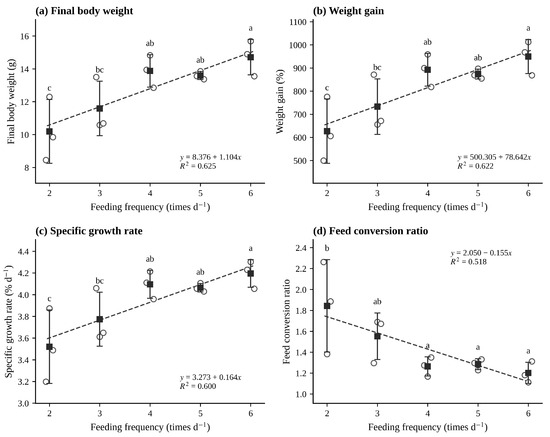
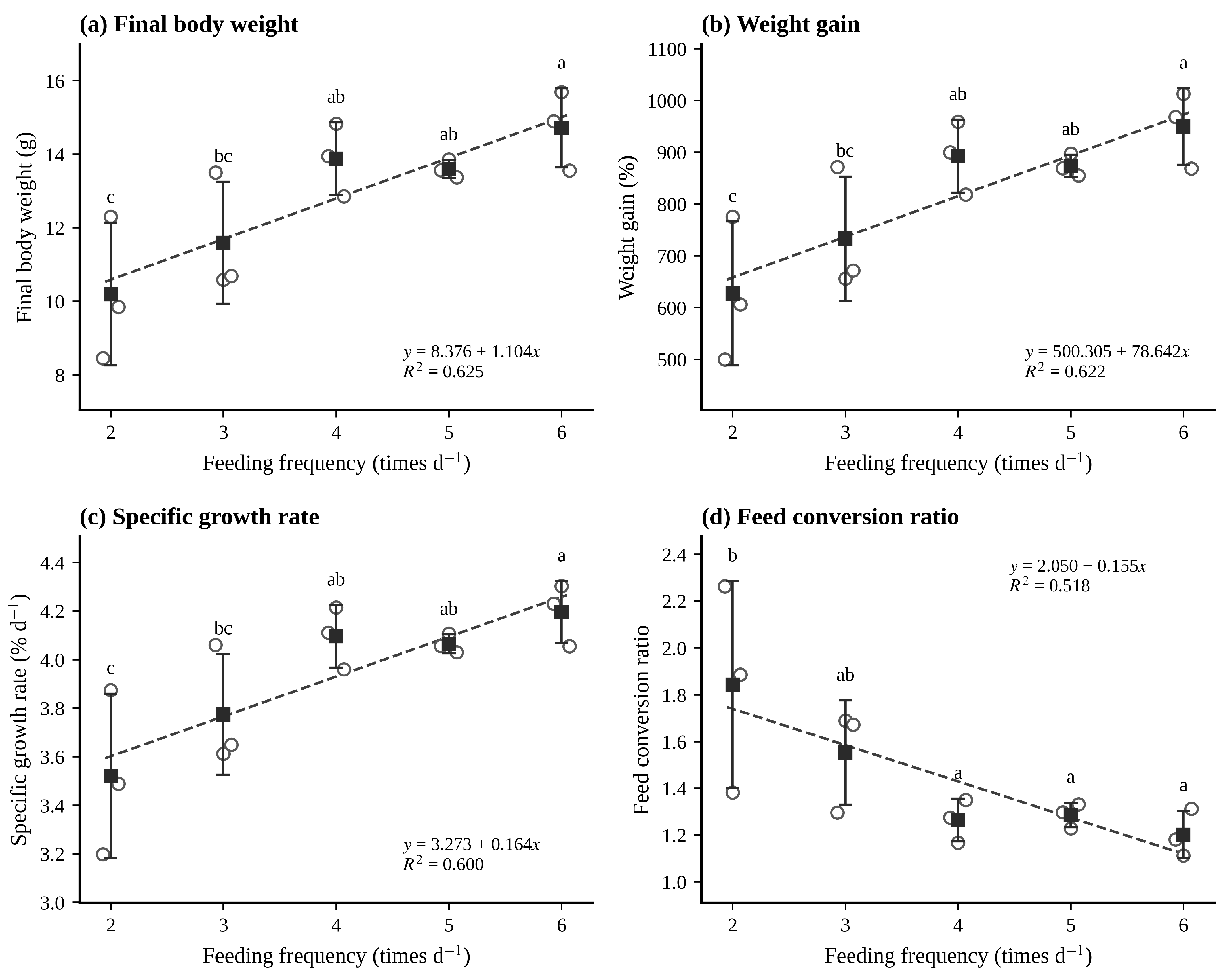
Linear regression showed significant relationships between daily feeding frequency and final body weight (R2 = 0.625, p < 0.001), WG (R2 = 0.622, p < 0.001), SGR (R2 = 0.600, p < 0.001), and FCR (R2 = 0.518, p = 0.0025; Figure 1). For the principal comparison, the FF4−FF2 difference was 3.68 g for final body weight (95% CI: 1.27–6.08) and −0.58 for FCR (95% CI: −1.00 to −0.16). In contrast, the 95% CIs for the FF6−FF4 differences included zero for both final body weight [0.84 g (95% CI: −1.56–3.24)] and FCR [−0.06 (95% CI: −0.48–0.36)].
Figure 1.
Relationships between daily feeding frequency and (a) final body weight, (b) weight gain, (c) specific growth rate, and (d) feed conversion ratio of juvenile Penaeus vannamei. Open circles represent individual tank observations (n = 3 per treatment), and filled squares with vertical bars represent treatment means ± SD. Dashed lines indicate linear regressions based on all 15 tank observations; regression equations and R² values are shown in each panel. Different lowercase letters indicate significant differences among feeding treatments according to Duncan’s multiple range test (p < 0.05).
3.2. Whole-Body Proximate Composition
Whole-body proximate composition is presented descriptively in Table 3. Because one pooled sample per treatment was analyzed in duplicate, no inferential statistical comparison was performed among treatments.
Table 3.
Whole-body proximate composition (%) of juvenile Penaeus vannamei after the 8-week feeding trial.
3.3. Hemolymph Biochemical Parameters
No significant differences were observed among feeding treatments in hemolymph AST, ALT, or TP (p > 0.05; Table 4).
Table 4.
Hemolymph biochemical parameters of juvenile Penaeus vannamei after the 8-week feeding trial.
4. Discussion
The principal finding was that increasing the tested feeding schedule from two to four daily feedings improved growth and feed utilization. FF4–FF6 performed better than FF2, whereas no significant differences were detected among FF4, FF5, and FF6. Regression analysis also showed significant overall relationships between feeding frequency and the principal growth and feed-utilization variables. However, the absence of significant differences among the higher-frequency treatments does not establish their equivalence. Thus, four daily feedings represent the lowest tested schedule associated with improved performance relative to twice-daily feeding under the present conditions, rather than a definitive optimum.
Previous studies in P. vannamei have reported variable responses to feeding frequency. Robertson et al. [8] observed improved growth as feeding frequency increased, whereas Velasco et al. [9] showed that the response depended on ration size. Carvalho and Nunes [10] reported comparable growth and FCR across two to six daytime feedings, and Pontes et al. [11] found similar weight gain at three and four feedings but lower growth at seven feedings. Studies in biofloc systems have likewise reported different responses [15,16,17,18]. These differences indicate that the effect of feeding frequency depends on the feeding regime and culture conditions under which it is tested.
Ration level is particularly relevant because feeding frequency determines how the daily ration is partitioned among meals. Nunes et al. [22] showed that feed amount and availability period affected P. vannamei growth, while Espinoza-Ortega et al. [23] reported that the FCR response to two versus four daily feedings depended on ration level. The present study applied the same biomass-based daily feeding-rate schedule to all treatments; therefore, the observed differences primarily reflect the tested schedules under this ration regime and should not be extrapolated to other feeding rates without validation.
Feeding time and interval remain important limitations of the experimental design. The light phase was 09:00–21:00 h; therefore, the 20:00 feeding in FF5 and FF6 occurred during the light phase, whereas all treatments included a 06:00 feeding during the dark phase. Nevertheless, feeding times and intervals differed among treatments. Because P. vannamei feeding activity can vary with time of day [4,5,6,7,13], the differences among schedules cannot be attributed to meal number alone.
Feed recovery also introduces uncertainty into FCR estimates. Uneaten feed was recovered 1 h after feeding, but nutrient leaching and unrecovered fine particles were not quantified. Because lower-frequency treatments received larger portions per meal, these losses could have caused uneaten feed to be underestimated and FCR to be overestimated [5,24,25,26]. The magnitude of this potential bias cannot be quantified retrospectively.
The secondary endpoints did not provide additional evidence of treatment effects. Hemolymph AST, ALT, and TP did not differ significantly among treatments. Whole-body proximate composition was based on one pooled sample per treatment with analytical duplicates; consequently, these data have limited evidentiary weight and are interpreted descriptively only. The principal evidence from this study therefore concerns growth performance and feed utilization.
5. Conclusions
Under the present flow-through conditions, four daily feedings were the lowest tested schedule associated with improved growth and feed utilization relative to twice-daily feeding, while no significant additional improvement was detected at five or six feedings. Because feeding times and intervals differed among treatments and feed leaching was not quantified, the result should be interpreted as specific to the feeding schedules tested rather than as a universal optimum.
Author Contributions
Conceptualization, S.K.; methodology, S.K.; formal analysis, S.K.; investigation, S.K., H.G.O., M.G.S., K.Y.K., M.G.J., and H.M.J.; data curation, S.K.; writing—original draft preparation, S.K.; writing—review and editing, S.K. and H.M.J.; project administration, S.K.; supervision, H.M.J. All authors have read and agreed to the published version of the manuscript.
Funding
This research was supported by the National Institute of Fisheries Science, Republic of Korea, through the project “Development of farming technology to secure sovereignty and improve self-sufficiency of shrimp seed” (Grant No. R2026039).
Institutional Review Board Statement
Ethical review and approval were not required because Penaeus vannamei is an invertebrate and falls outside the definition of laboratory animals subject to the Laboratory Animal Act of the Republic of Korea, which applies to vertebrate animals used for experimental purposes. Accordingly, this study was not subject to institutional animal ethics review under the applicable national regulation.
Informed Consent Statement
Not applicable.
Data Availability Statement
The data supporting the findings of this study are available from the corresponding author upon reasonable request.
Conflicts of Interest
The authors declare no conflicts of interest.
References
- Food and Agriculture Organization of the United Nations. The State of World Fisheries and Aquaculture 2026: Blue Transformation—Turning Vision Into Impact; FAO: Rome, Italy, 2026. [Google Scholar] [CrossRef] [Scilit]
- Ministry of Data and Statistics. Preliminary Results of the Fishery Production Survey in 2025; Ministry of Data and Statistics: Daejeon, Republic of Korea, 2026. Available online: https://mods.go.kr/board.es?act=view&bid=11715&list_no=444911&mid=a20102080000 (accessed on 3 September 2026).
- Darodes de Tailly, J.B.; Keitel, J.; Owen, M.A.G.; Alcaraz-Calero, J.M.; Alexander, M.E.; Sloman, K.A. Monitoring methods of feeding behaviour to answer key questions in penaeid shrimp feeding. Rev. Aquac. 2021, 13, 1828–1843. [Google Scholar] [CrossRef] [Scilit]
- Pontes, C.S.; Arruda, M.F. Behavior of Litopenaeus vannamei (Boone) (Crustacea, Decapoda, Penaeidae) in relation to artificial food offer along light and dark phases in a 24 h period. Rev. Bras. Zool. 2005, 22, 648–652. [Google Scholar] [CrossRef] [Scilit]
- Pontes, C.S.; Arruda, M.F.; Menezes, A.A.L.; Lima, P.P. Daily activity pattern of the marine shrimp Litopenaeus vannamei (Boone 1931) juveniles under laboratory conditions. Aquac. Res. 2006, 37, 1001–1006. [Google Scholar] [CrossRef] [Scilit]
- Santos, A.A.; López-Olmeda, J.F.; Sánchez-Vázquez, F.J.; Fortes-Silva, R. Synchronization to light and mealtime of the circadian rhythms of self-feeding behavior and locomotor activity of white shrimps (Litopenaeus vannamei). Comp. Biochem. Physiol. A Mol. Integr. Physiol. 2016, 199, 54–61. [Google Scholar] [CrossRef] [Scilit] [PubMed]
- Darodes de Tailly, J.B.; Martinez Alpiste, I.; Owen, M.A.G.; Keitel, J.; Alcaraz-Calero, J.M.; Sloman, K.A.; Alexander, M.E. Monitoring shrimp behavior in relation to feed provision, location and time of day in an experimental aquaculture pond. Appl. Anim. Behav. Sci. 2025, 287, 106636. [Google Scholar] [CrossRef] [Scilit]
- Robertson, L.; Lawrence, A.L.; Castille, F.L. Effect of feeding frequency and feeding time on growth of Penaeus vannamei (Boone). Aquac. Res. 1993, 24, 1–6. [Google Scholar] [CrossRef] [Scilit]
- Velasco, M.; Lawrence, A.L.; Castille, F.L. Effect of variations in daily feeding frequency and ration size on growth of shrimp, Litopenaeus vannamei (Boone), in zero-water exchange culture tanks. Aquaculture 1999, 179, 141–148. [Google Scholar] [CrossRef] [Scilit]
- Carvalho, E.A.; Nunes, A.J.P. Effects of feeding frequency on feed leaching loss and grow-out patterns of the white shrimp Litopenaeus vannamei fed under a diurnal feeding regime in pond enclosures. Aquaculture 2006, 252, 494–502. [Google Scholar] [CrossRef] [Scilit]
- Pontes, C.S.; de Lima, P.P.; Arruda, M.F. Feeding responses of juvenile shrimp Litopenaeus vannamei (Boone) fed at different frequencies under laboratory conditions. Aquac. Res. 2008, 39, 1416–1422. [Google Scholar] [CrossRef] [Scilit]
- Peixoto, S.; Silva, E.; Costa, C.B.; Nery, R.C.; Rodrigues, F.; Silva, J.F.; Bezerra, R.; Soares, R. Effect of feeding frequency on growth and enzymatic activity of Litopenaeus vannamei during nursery phase in biofloc system. Aquac. Nutr. 2018, 24, 579–585. [Google Scholar] [CrossRef] [Scilit]
- Cavalcanti Nery, R.; Costa, C.B.; Rodrigues, F.; Soares, R.; Bezerra, R.S.; Peixoto, S. Effect of feeding frequency on growth and digestive enzyme activity in Litopenaeus vannamei during the grow-out phase in biofloc system. Aquac. Nutr. 2019, 25, 577–584. [Google Scholar] [CrossRef] [Scilit]
- Wasielesky, W., Jr.; Bezerra, A.; Poersch, L.; Hoffling, F.B.; Krummenauer, D. Effect of feeding frequency on the white shrimp Litopenaeus vannamei during the pilot-scale nursery phase of a superintensive culture in a biofloc system. J. World Aquac. Soc. 2020, 51, 1175–1191. [Google Scholar] [CrossRef] [Scilit]
- Xu, W.; Xu, Y.; Su, H.; Hu, X.; Xu, Y.; Li, Z.; Wen, G.; Cao, Y. Effects of feeding frequency on growth, feed utilization, digestive enzyme activity and body composition of Litopenaeus vannamei in biofloc-based zero-exchange intensive systems. Aquaculture 2020, 522, 735079. [Google Scholar] [CrossRef] [Scilit]
- Lima, P.P.; Pontes, C.S.; Arruda, M.F. Activity pattern of the marine shrimp Litopenaeus vannamei (Boone 1931) in laboratory as a function of different feeding frequencies. Aquac. Res. 2010, 41, 53–60. [Google Scholar] [CrossRef] [Scilit]
- Liang, Q.; Liu, G.; Luan, Y.; Niu, J.; Li, Y.; Chen, H.; Liu, Y.; Zhu, S. Impact of feeding frequency on growth performance and antioxidant capacity of Litopenaeus vannamei in recirculating aquaculture systems. Animals 2025, 15, 192. [Google Scholar] [CrossRef] [Scilit] [PubMed]
- Ullman, C.; Rhodes, M.; Hanson, T.; Cline, D.; Davis, D.A. Effects of four different feeding techniques on the pond culture of Pacific white shrimp, Litopenaeus vannamei. J. World Aquac. Soc. 2019, 50, 54–64. [Google Scholar] [CrossRef] [Scilit]
- Jescovitch, L.N.; Ullman, C.; Rhodes, M.; Davis, D.A. Effects of different feed management treatments on water quality for Pacific white shrimp Litopenaeus vannamei. Aquac. Res. 2018, 49, 526–531. [Google Scholar] [CrossRef] [Scilit]
- Strebel, L.M.; Nguyen, K.; Araujo, A.; Corby, T.; Rhodes, M.; Beck, B.H.; Roy, L.A.; Davis, D.A. On demand feeding and the response of Pacific white shrimp (Litopenaeus vannamei) to varying dietary protein levels in semi-intensive pond production. Aquaculture 2023, 574, 739698. [Google Scholar] [CrossRef] [Scilit]
- AOAC. Official Methods of Analysis, 16th ed.; Association of Official Analytical Chemists: Arlington, VA, USA, 1995. [Google Scholar]
- Nunes, A.J.P.; Sá, M.V.C.; Carvalho, E.A.; Sabry Neto, H. Growth performance of the white shrimp Litopenaeus vannamei reared under time- and rate-restriction feeding regimes in a controlled culture system. Aquaculture 2006, 253, 646–652. [Google Scholar] [CrossRef] [Scilit]
- Espinoza-Ortega, M.; Molina-Poveda, C.; Civera-Cerecedo, R.; Jover-Cerdá, M. Combined feeding frequency and ration size effects on juvenile Penaeus vannamei performance fed diets supplemented with fish hydrolysates. Lat. Am. J. Aquat. Res. 2026, 54, 39–52. [Google Scholar] [CrossRef] [Scilit]
- Guo, J.; Davis, R.; Starkey, C.; Davis, D.A. Efficacy of various coated materials to prevent nutrient leaching for Pacific white shrimp Litopenaeus vannamei commercial diets. J. World Aquac. Soc. 2021, 52, 195–203. [Google Scholar] [CrossRef] [Scilit]
- Obaldo, L.G.; Divakaran, S.; Tacon, A.G. Method for determining the physical stability of shrimp feeds in water. Aquac. Res. 2002, 33, 369–377. [Google Scholar] [CrossRef] [Scilit]
- Ullman, C.; Rhodes, M.A.; Davis, D.A. The effects of feed leaching on the growth of Pacific white shrimp Litopenaeus vannamei in a green-water tank system. Aquac. Res. 2019, 50, 3074–3077. [Google Scholar] [CrossRef] [Scilit]

Disclaimer/Publisher’s Note: The statements, opinions and data contained in all publications are solely those of the individual author(s) and contributor(s) and not of MDPI and/or the editor(s). MDPI and/or the editor(s) disclaim responsibility for any injury to people or property resulting from any ideas, methods, instructions or products referred to in the content. |
© 2026 by the authors. Licensee MDPI, Basel, Switzerland. This article is an open access article distributed under the terms and conditions of the Creative Commons Attribution (CC BY) license.