


Abstract
Federated learning can support privacy-conscious student performance prediction by enabling collaborative model training across educational institutions without centralizing sensitive student records. However, existing educational federated learning research is dominated by FedAvg, while alternative strategies such as FedProx are mainly explored in studies explicitly addressing non-independent and identically distributed (non-IID) educational data. This study addresses this gap through a controlled comparison of seven federated learning strategies, including FedAvg, FedAvgM, FedProx, FedAdagrad, FedAdam, FedYogi, and FedMedian, using the Open University Learning Analytics Dataset. A Flower-based simulated federated learning framework was developed to evaluate these approaches across multiple student outcome prediction tasks. For Pass/Withdrawn prediction, FedMedian achieved the highest mean late-round accuracy and macro-. Hochberg corrected p-value showed significant differences between FedMedian and all six alternative methods for mean accuracy. For Pass/Fail prediction, FedMedian had the highest observed mean performance, but its advantage over the leading alternatives FedProx, FedAvgM, and FedAvg was not statistically confirmed under the corrected paired comparisons. FedProx had the highest observed late-round means for Fail/Distinction prediction but was not statistically distinguishable from FedAvg, FedAvgM, or FedAdagrad after Hochberg correction. None of the evaluated strategies achieved satisfactory balanced performance for the highly imbalanced Pass/Distinction prediction task, demonstrating the challenges of applying federated learning to complex educational outcomes. These findings indicate that FedAvg, despite being the most commonly adopted approach in educational federated learning, is not consistently optimal under heterogeneous educational data distributions. Instead, selecting federated optimization strategies according to task characteristics can improve model stability and prediction reliability. The study highlights the importance of responsible federated learning deployment in educational settings, where privacy-conscious analytics can support more reliable identification of student learning outcomes and inform evidence-based interventions.
1. Introduction
Student performance prediction is an important application of educational data mining and learning analytics. Predictive models can help institutions identify students who may fail a course, withdraw from a program, or require additional academic support. Most traditional studies assume that all student records can be collected in a centralized database. In practice, educational data are distributed across institutions, campuses, departments, courses, and learning platforms. Privacy regulations and institutional policies can make direct data sharing difficult or impossible. Centralized storage also increases the consequences of unauthorized access or data breaches.
Federated learning addresses these concerns by allowing participants to train models locally. Each participant sends model parameters or updates to an aggregation server rather than transmitting raw student records. The server combines the updates to construct a global model, which is then broadcast to the participating clients. Guo et al. [1] propose FEEDAN, an early federated learning framework to collaboratively analyze pedagogical data without directly exchanging student records. In their case study, logistic regression models are trained across simulated institutions using FedAvg [2] for student dropout prediction. FEEDAN outperforms institution-only training and approaches centralized performance. Fachola et al. [3] investigate horizontal cross-silo federated learning for student-dropout prediction. They train a three-hidden-layer neural network on 225,642 student course records from KDD Cup 2015, using Adam locally and FedAvg to aggregate client models. FedAvg can reach performance close to the centralized model when sufficiently trained, but the experiments reveal that non-IID distributions can disadvantage minority schools.
Zhang et al. [4] propose FLPADPM, a federated dropout-prediction model for distributed MOOC activity data. The model combines a one-dimensional CNN, BiLSTM, course-specific learnable matrices, and attention, while using partial-model FedAvg to aggregate only the shared dropout-prediction component. But the authors acknowledged unresolved issues involving cross-platform heterogeneity. van Haastrecht et al. [5] compare local, federated, and centralized machine learning across OULAD learning-outcome prediction, EdNet question-correctness prediction, and KDD Cup 2015 dropout prediction. Using FedAvg, they find that federated models generally remain stable and competitive as data are divided among up to 100 clients.
Zhang et al. [6] propose FecMap, a personalized federated-learning framework for predicting future course-grade categories. FecMap applies equal-weight partial-model FedAvg only to the global network component. Lamsiyah et al. [7] combine federated learning and explainable AI to predict student dropout. Using weighted cross-entropy and feed-forward neural networks, they compare FedAvg and FedProx on OULAD, KDD Cup 2015, and UCI data, finding that FedProx [8] generally performs slightly better and that both federated methods are comparable with centralized learning. Chen and Qi [9] propose EADP-FedAvg, an entropy-adaptive differentially private federated-learning method for classifying student performance in a Python programming course. The method trains an MLP across ten IID clients and adds Gaussian noise to FedAvg-aggregated parameters, dynamically adjusting the noise according to average prediction entropy. Tertulino [10] compares centralized XGBoost with a FedProx-trained federated neural network for predicting above- versus below-median mathematics proficiency using more than two million SAEB student records and 50 simulated school clients. A simulation in health-professional education finds that FedProx did not significantly improve logistic-regression performance over FedAvg but improved the stability of a nonlinear MLP under data-quality heterogeneity [11]. Recent work also combines FL with differential privacy, verifiable logging, and explainability for multi-school at-risk prediction [12].
The existing literature is dominated by FedAvg, while FedProx is primarily adopted in studies that explicitly address non-independent and identically distributed (non-IID) educational data. This creates an important research gap. To the best of our knowledge, a controlled comparison of FedAvg, FedAvgM [13], FedProx, FedAdagrad [14], FedAdam [14], FedYogi [14], FedMedian [15] on the same student-performance datasets and identical client partitions has not been identified in the literature. Adaptive optimizers may improve convergence under heterogeneous data, while median-based methods may improve robustness against anomalous, unreliable, or malicious institutional updates. However, these benefits must be evaluated empirically in educational settings rather than assumed from other application domains. Adaptive federated optimizers and robust median aggregation were originally developed outside education and remain largely untested for student performance prediction.
To address this gap, this study conducts a controlled comparison of seven federated learning algorithms, including FedAvg, FedAvgM, FedProx, FedAdagrad, FedAdam, FedYogi, and FedMedian, using the Open University Learning Analytics Dataset (OULAD) under consistent experimental settings and client partitions. A reproducible Flower-based federated learning simulation framework was implemented for student performance prediction, in which each client performs local model training and shares only model parameters and evaluation metrics with the central server. The framework supports Pass/Fail, Pass/Withdrawn, Fail/Distinction, and Pass/Distinction prediction tasks using OULAD-derived features, reflecting different educational decision-making scenarios, such as identifying students who may require timely support, understanding diverse learning outcomes, and improving targeted intervention strategies. By evaluating federated learning approaches under heterogeneous educational data conditions, this study provides practical insights into how responsible and privacy-conscious learning analytics systems can be designed to support reliable student outcome prediction and evidence-based decision-making in real educational environments.
The remainder of this paper is organized as follows. Section 2 presents the Flower-based federated learning methodology and tabular ResNet prediction model. Section 3 reviews the seven federated aggregation strategies, including FedAvg, FedAvgM, FedProx, FedAdagrad, FedAdam, FedYogi, and FedMedian. Section 4 describes the OULAD data, binary student-outcome prediction tasks, client partitioning procedure, and experimental configuration. Section 5 reports and analyzes the results for Pass/Fail, Pass/Withdrawn, Fail/Distinction, and Pass/Distinction prediction. Finally, Section 6 discusses the findings, limitations, and implications of federated learning for privacy-conscious educational analytics.
2. Methodology
We implemented a federated learning framework for student performance prediction using the Flower framework. The task is formulated as a supervised classification problem on the OULAD dataset, where each learner record is represented by tabular features and the model predicts the corresponding educational outcome labels. Instead of centralizing all training data, the dataset is distributed across multiple simulated clients, allowing each client to train locally while only model parameters and evaluation metrics are exchanged with the server.
Our system follows a standard client-server federated learning architecture. The server is implemented using Flower ServerApp, while each participant is represented by a Flower ClientApp. At the beginning of training, the server initializes a global neural network model and broadcasts its parameters to selected clients. Each client updates the model using its local data and returns the updated parameters to the server. The server then aggregates these updates according to the selected federated optimization strategy. We evaluate several federated optimization algorithms, including FedAvg, FedAvgM, FedProx, FedAdagrad, FedAdam, FedYogi, and FedMedian. The implementation allows these methods to be selected individually or compared in a single experimental run.
The prediction model is a ResNet neural network designed for tabular data. As Alnasyan et al. [16] show that ResNet delivered the best results for binary classification using OULAD dataset in experiments with behavioral features alone and both the demographic and behavioral features. The model first projects the input feature vector into a hidden representation with width 64, followed by layer normalization and ReLU activation. It then passes through 32 residual blocks. Each residual block contains two fully connected layers, layer normalization, ReLU activation, dropout, and an identity skip connection. The dropout rate is set to 0.3. A final linear output layer maps the learned representation to the class logits.
After each training round, the server sends the updated global model to the clients for evaluation. Each client evaluates the model on its local evaluation subset and returns loss, accuracy, macro- score, and the number of evaluation examples. The server aggregates client-side evaluation metrics using sample-size weighting, so clients with more evaluation samples contribute proportionally more to the final metric.
3. Federated Learning Strategies
This section reviews the federated learning strategies considered in this study. We focus on server-side aggregation and optimization methods implemented in modern federated learning frameworks, including standard averaging methods, adaptive server optimizers, robust aggregation rules. Let K clients indexed by . Client k owns a private dataset with samples. The total number of samples is . The local empirical objective on client k is
where w denotes the model parameters and is the training loss. The standard global objective is
At communication round t, the server selects a subset of clients , broadcasts the current global model , receives locally trained models or updates, and applies a strategy-specific aggregation rule to obtain .
3.1. Federated Averaging
Federated Averaging, or FedAvg, is the canonical algorithm for cross-device federated learning [2]. In each communication round, the server broadcasts the current model to a subset of clients . Each selected client performs multiple local stochastic gradient descent steps on its private dataset and returns the updated model to the server. The server then computes a weighted average of client models:
Equivalently, if denotes the client pseudo-gradient, the server update can be written as
FedAvg reduces communication cost by allowing clients to perform several local optimization steps before communicating with the server. However, its performance can degrade under severe statistical heterogeneity because local objectives may point toward different optima.
3.2. Federated Averaging with Server Momentum
FedAvg with server momentum, commonly denoted FedAvgM, extends FedAvg by adding a momentum term to the server update [13]. Let be the weighted average pseudo-gradient obtained from client updates. Instead of applying directly, the server maintains a velocity vector :
where is the server momentum coefficient. The global model is then updated as
Server momentum smooths the sequence of global updates across communication rounds. This can improve stability and convergence when client data distributions are non-identical, especially when the selected clients in each round produce highly variable updates.
3.3. FedProx
FedProx was proposed to address both statistical heterogeneity and systems heterogeneity in federated networks [8]. It modifies the local client objective by adding a proximal regularization term that penalizes deviation from the current global model. At round t, client k solves
where controls the strength of the proximal term. When , FedProx reduces to FedAvg. The proximal term constrained local updates to remain close to the global model. This makes FedProx particularly useful in settings with non-IID data and variable local computation across clients.
3.4. Adaptive Federated Optimization
FedAdagrad, FedAdam, and FedYogi belong to the family of adaptive federated optimization methods [14]. These methods interpret the aggregated client update as a server-side pseudo-gradient and apply an adaptive optimizer at the server. Let
be the aggregated pseudo-gradient at round t. The server first updates the first-moment estimate
The different adaptive methods vary mainly in how they update the second-moment estimate .
For FedAdagrad, the second moment accumulates squared updates:
For FedAdam, the second moment uses an exponential moving average:
For FedYogi, the second moment is updated as
The global model is then updated by
where is the server learning rate and is a small constant for numerical stability. These methods generalize FedAvg by allowing the server to adapt the step size coordinate-wise. FedAdam is often effective when update magnitudes vary across coordinates, FedAdagrad can be useful when accumulated gradient history is informative, and FedYogi controls second-moment growth more conservatively than Adam.
3.5. Coordinate-Wise Robust Aggregation
FedMedian are coordinate-wise robust aggregation methods designed to reduce the influence of outlier or Byzantine client updates [15]. Unlike FedAvg, which averages all received updates, these methods aggregate each model coordinate independently.
In FedMedian, the server computes the coordinate-wise median of client updates. For coordinate r, the aggregated update is
Because the median is insensitive to extreme values, FedMedian is more robust than the arithmetic mean when some clients return abnormal updates.
The reviewed methods differ mainly in how the server transforms client-side computation into a global model update. FedAvg provides the baseline weighted averaging rule. FedAvgM improves FedAvg by introducing server momentum. FedProx modifies the client objective to stabilize local training under heterogeneity. FedAdagrad, FedAdam, and FedYogi apply adaptive optimization at the server, using accumulated first- and second-order update statistics. FedMedian improve robustness through coordinate-wise robust statistics.
4. Data and Experimental Setup
The Open University Learning Analytics Dataset (OULAD) is a publicly available benchmark dataset that has been widely used in educational data mining, learning analytics, and machine learning research [17]. It was released by researchers at The Open University to facilitate the development and evaluation of predictive models for student learning and academic performance.
OULAD contains anonymized information from 22 online course presentations offered by The Open University between 2013 and 2014. The dataset includes records for 32,593 students and more than 10 million interactions with the university’s virtual learning environment (VLE). Each course presentation corresponds to a specific module delivered during a particular academic term. The dataset integrates demographic information, assessment results, and detailed online learning behaviors, enabling researchers to investigate the relationships between student engagement and learning outcomes.
The canonical target variable for student performance prediction is the student’s final outcome in a module-presentation. Many existing studies formulate this task as a four-class classification problem, with the following class distribution, distinction (3024, 9.28%), pass (12,361, 37.93%), fail (7052, 21.64%), and withdrawn (10,156, 31.16%). Following the data preprocessing approaches adopted in [5,18], we reformulate the original four-class classification problem into four binary classification tasks. First, the combined “pass/distinction” category is compared with the “fail” category to predict students at risk of failure. This produces a binary classification dataset containing 22,437 unique students, where class 0 represents “pass” and class 1 represents “fail”. Second, for withdrawal prediction, “withdrawn” cases are compared with the combined “pass/distinction” cases. This results in another binary classification dataset containing 25,541 unique students, with “withdrawn” and “pass” as the two class labels. Similarly, students who achieve a distinction are predicted by comparing the “distinction” category with the “pass” and “fail” categories. Through this transformation, the original four-class student performance prediction problem is converted into four binary classification tasks, each designed to address a specific prediction objective, which are overall failure risk, withdrawal risk, distinction achievement, and student outcome prediction.
Table 1 presents the outcome distributions for four binary OULAD prediction tasks. The pass/withdrawn task is the largest and most balanced dataset, containing 25,541 samples, including 15,385 successful outcomes (pass or distinction) and 10,156 withdrawn outcomes. The pass/distinction task is the most imbalanced, containing 12,361 pass outcomes and 3024 distinction outcomes, corresponding to a class ratio of 4.09:1.
Table 1.
Class distributions of the four binary OULAD prediction tasks. In the pass/withdrawn and pass/fail tasks, successful outcomes combine the original Passand Distinction categories.
The fail/distinction and pass/fail tasks exhibit moderate imbalance. The fail/distinction dataset contains 7052 fail outcomes and 3024 distinction outcomes, whereas the pass/fail dataset contains 15,385 successful outcomes (pass or distinction) and 7052 fail outcomes. These class distributions motivate the use of Macro- in addition to accuracy, since accuracy can favour the majority outcome, particularly in the pass/distinction task.
The 79 input features consist of four groups. Student clicks are grouped by activity type, such as homepage, forum, glossary, quiz, resource, URL, wiki, and page. For each activity type, clicks are summed separately before the start of the presentation (date < 0) and from the start of the presentation onward (date ≥ 0). For overall engagement features, three aggregate variables are created based on all VLE clicks throughout the recorded presentation, all clicks before day 0, and all clicks on or after day 0. Assessment-related engagement features sum each student’s VLE clicks occurring one day before an assessment, on the assessment date, and one day after the assessment date.
The features also include region, IMD band, highest education level, age band, gender, disability status, number of previous attempts, and studied credits. Region, Index of Multiple Deprivation (IMD) band, highest education level, and age band were transformed through one-hot encoding, producing binary indicator variables for each category. Gender was encoded as one for female students and zero otherwise, while disability status was encoded as one for students reporting a disability and zero otherwise. The number of previous attempts and the number of studied credits were retained as numerical variables.
The preprocessing procedure preserved all enrollments listed in demographic and registration information table, including students with no VLE records. Aggregated click features were merged with the complete enrollment list, and missing values caused by the absence of a relevant interaction record were replaced with zero. Consequently, a zero in an engagement feature indicates that no clicks were recorded for that activity type or time period. No explicit imputation was applied to other student-profile variables, and no normalization or standardization was performed. The original scale of click counts and numerical attributes were retained. Because the activity features aggregate interactions across the recorded presentation, including activity occurring after the course start and around assessments, the present experiments do not establish early-warning performance at a defined point during course delivery.
All available samples are assigned to federated clients, no separate centralized holdout set is reserved. The current implementation supports the region-based partitioning modes. In the region-based setting, clients are constructed according to region dummy variables. Each region dummy column defines one client, resulting in 13 clients representing the East Anglian, East Midlands, Ireland, London, North, North Western, Scotland, South East, South, South West, Wales, West Midlands, and Yorkshire regions. Within each client, the local partition is further split into training and evaluation subsets. The current client-side evaluation ratio is 0.2, meaning 80% of each client’s local data is used for training and 20% is used for client-side evaluation.
To ensure a controlled comparison, all federated aggregation methods used the same model architecture, local training procedure, client partitioning scheme, and communication protocol. The common configuration consisted of 50 server communication rounds. The local loss function was unweighted cross-entropy loss. Local training is performed using mini-batch optimization with batch size 256. Each selected client trains for 2 local epochs per communication round using cross-entropy loss and the Adam optimizer with learning rate 0.02. The local Adam optimizer used the PyTorch default values for parameters.
FedAvg has no additional method-specific hyperparameter and uses sample-size-weighted model averaging. FedAvgM additionally requires the server learning rate and server momentum, with server momentum set to 0.1. FedProx requires the proximal coefficient , set to 0.0001. FedAdagrad requires the server learning rate and the numerical-stability term , set to the current Flower default values are , and . FedAdam requires and , with the current values and . FedYogi uses the same parameter types as FedAdam but has . Finally, FedMedian has no additional aggregation hyperparameter because it replaces weighted averaging with coordinate-wise median aggregation. To improve reproducibility, the implementation includes separate random seeds for data partitioning, model initialization and PyTorch randomness, and mini-batch ordering.
5. Results
5.1. Results for Pass/Fail Prediction
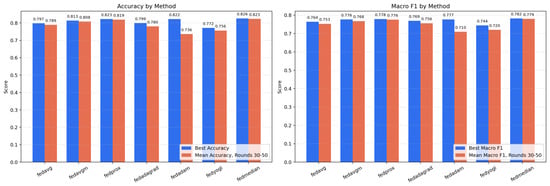
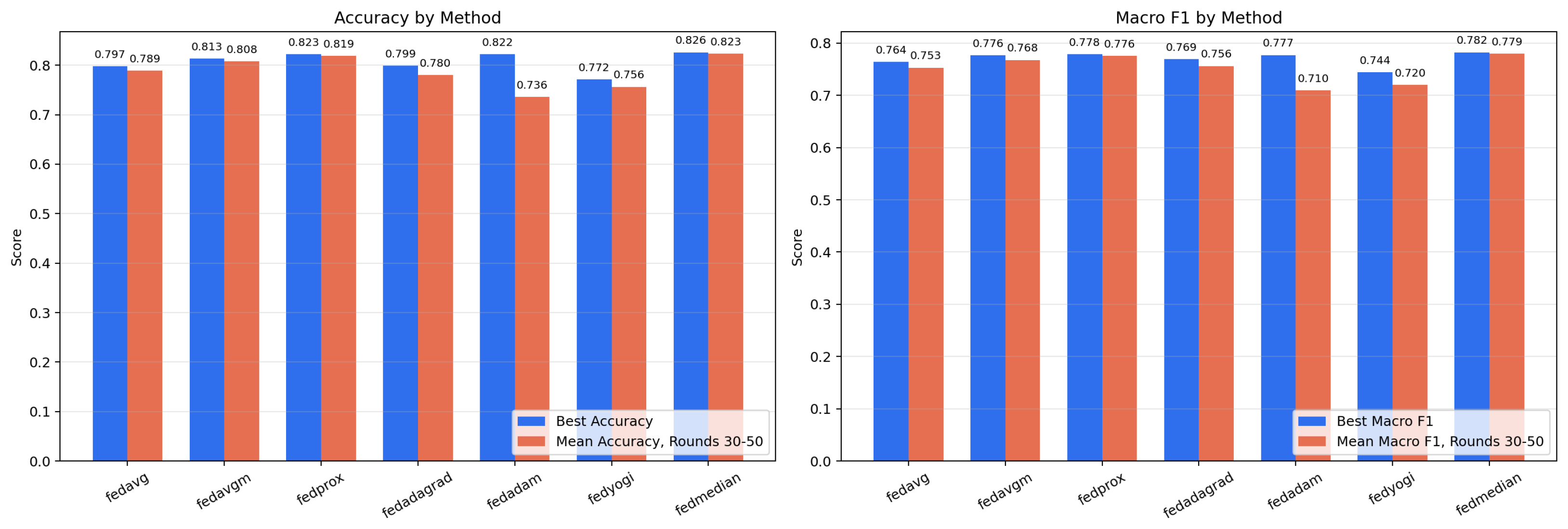
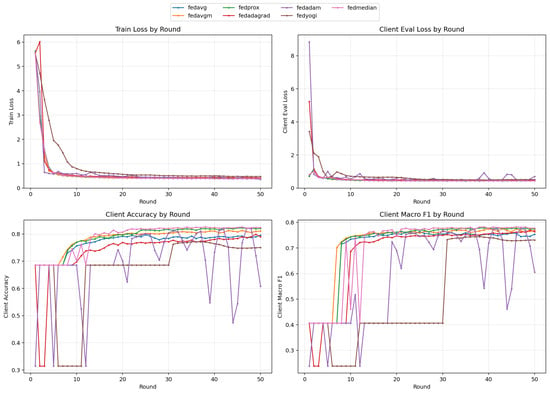
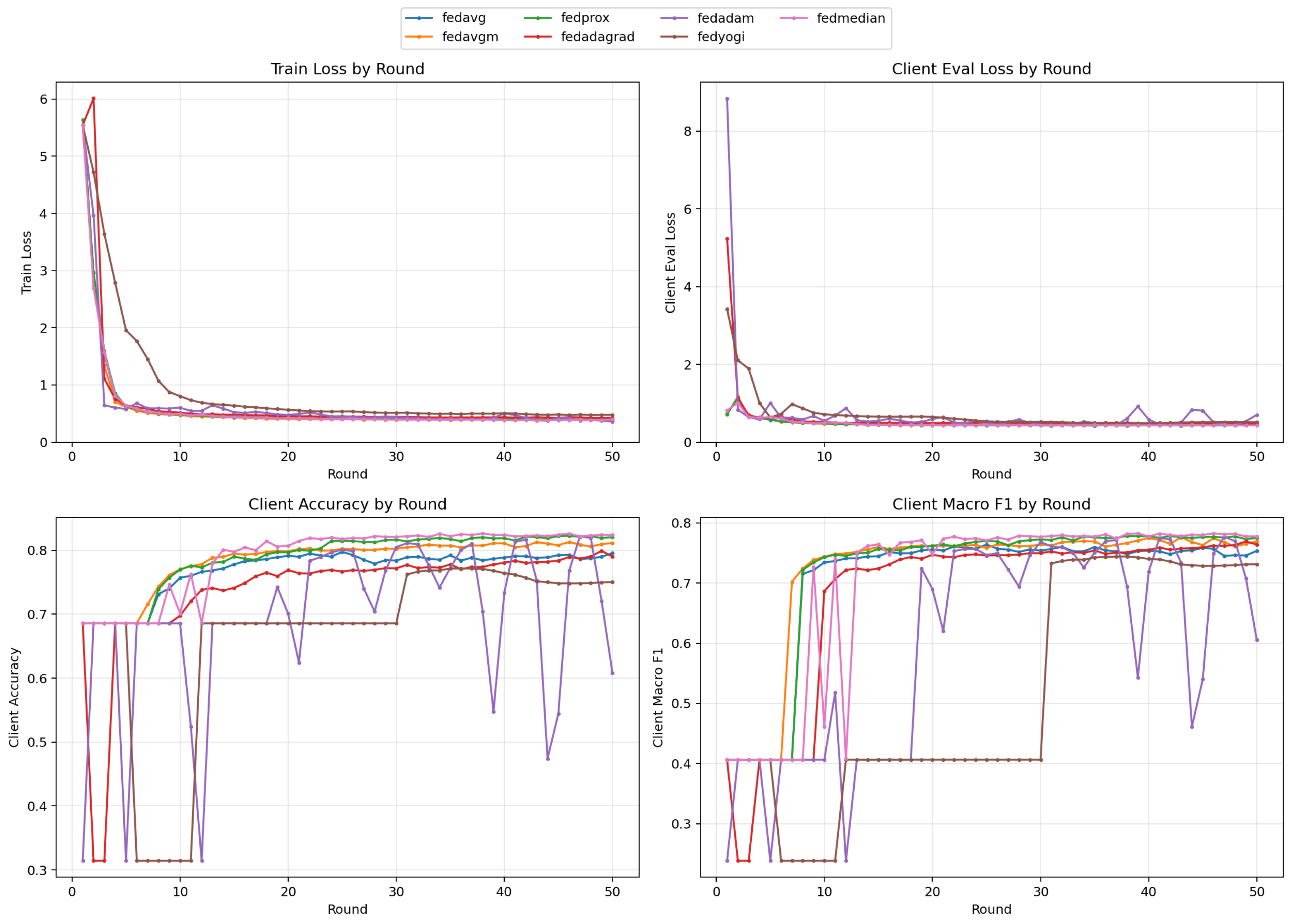
Figure 1 and Figure 2 present a detailed comparison of the federated optimization strategies for pass/fail prediction under one fixed random seed. The bar chart (Figure 1) summarizes the best client-side evaluation results obtained over 50 communication rounds and the mean performance over rounds 30–50. The latter is used as an indicator of late-stage convergence stability, because it is less influenced by an isolated peak value. Selecting the best communication round may produce optimistic performance estimates, the late-round means over rounds 30–50 reduce reliance on a single peak round. The convergence curves (Figure 2) further show the evolution of training loss, client evaluation loss, accuracy, and Macro- during the federated training process.
Figure 1.
Fixed-seed comparison of federated learning methods for pass/fail prediction (seed 2). Blue bars show the best client-side evaluation accuracy and Macro- achieved over 50 communication rounds. Orange bars show the mean accuracy and Macro- over rounds 30–50, representing late-stage convergence stability. FedMedian achieves the strongest and most stable overall performance, followed closely by FedProx. Although FedAdam reaches competitive peak values, its substantially lower late-round mean performance indicates unstable convergence.
Figure 2.
Training and client-side evaluation trajectories for the fixed-seed experiment (seed 2) over 50 communication rounds. The upper panels present weighted training loss and client evaluation loss, while the lower panels show aggregated client accuracy and Macro-. FedMedian and FedProx converge rapidly and maintain stable late-round performance. FedAdam exhibits substantial loss spikes and fluctuations in accuracy and Macro-, whereas FedYogi converges more slowly and remains below the leading methods.
FedMedian achieved the strongest overall performance in this fixed-seed experiment. It obtained the highest best accuracy () and the highest mean accuracy over rounds 30–50 (). Similarly, FedMedian achieved the best Macro- score () and the highest stable Macro- score (). The small difference between its best and late-round mean metrics indicates that FedMedian converged to a stable solution and maintained its performance during the final communication rounds.
FedProx was the closest competing method. It achieved a best accuracy of and a stable accuracy of , together with a best Macro- score of and a stable Macro- score of . The convergence curves show that FedProx improved rapidly during the early rounds and subsequently remained stable. FedAvgM also showed reliable convergence, with a stable accuracy of and a stable Macro- score of , outperforming the standard FedAvg baseline.
FedAdam illustrates the importance of distinguishing peak performance from stable performance. Although it achieved a best accuracy of and a best Macro- score of , its mean performance during rounds 30–50 decreased to accuracy and Macro-. The convergence curves reveal substantial fluctuations in both evaluation loss and classification metrics (accuracy and macro-), including large loss spikes and repeated drops in accuracy and Macro-. Thus, FedAdam reached strong performance temporarily but did not maintain a stable global model under this experimental configuration.
FedYogi exhibited slower convergence than the other strategies. Its accuracy and Macro- remained close to the majority-class baseline during the initial rounds, followed by improvement after approximately round 30. However, its final stable performance remained below that of FedMedian, FedProx, and FedAvgM, with mean accuracy and Macro- values of and , respectively.
The fixed-seed results show that FedMedian provides the best balance between predictive performance and convergence stability. FedProx is a close alternative, while FedAvgM offers an improvement over standard FedAvg. Since these figures represent a single random seed, the conclusions should be interpreted together with the multi-seed analysis to assess robustness across stochastic training conditions. We implemented 20 random seeds for data partitioning, model initialization and PyTorch randomness, and mini-batch ordering.
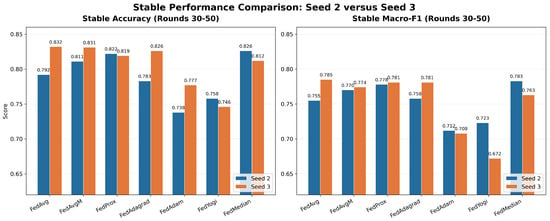
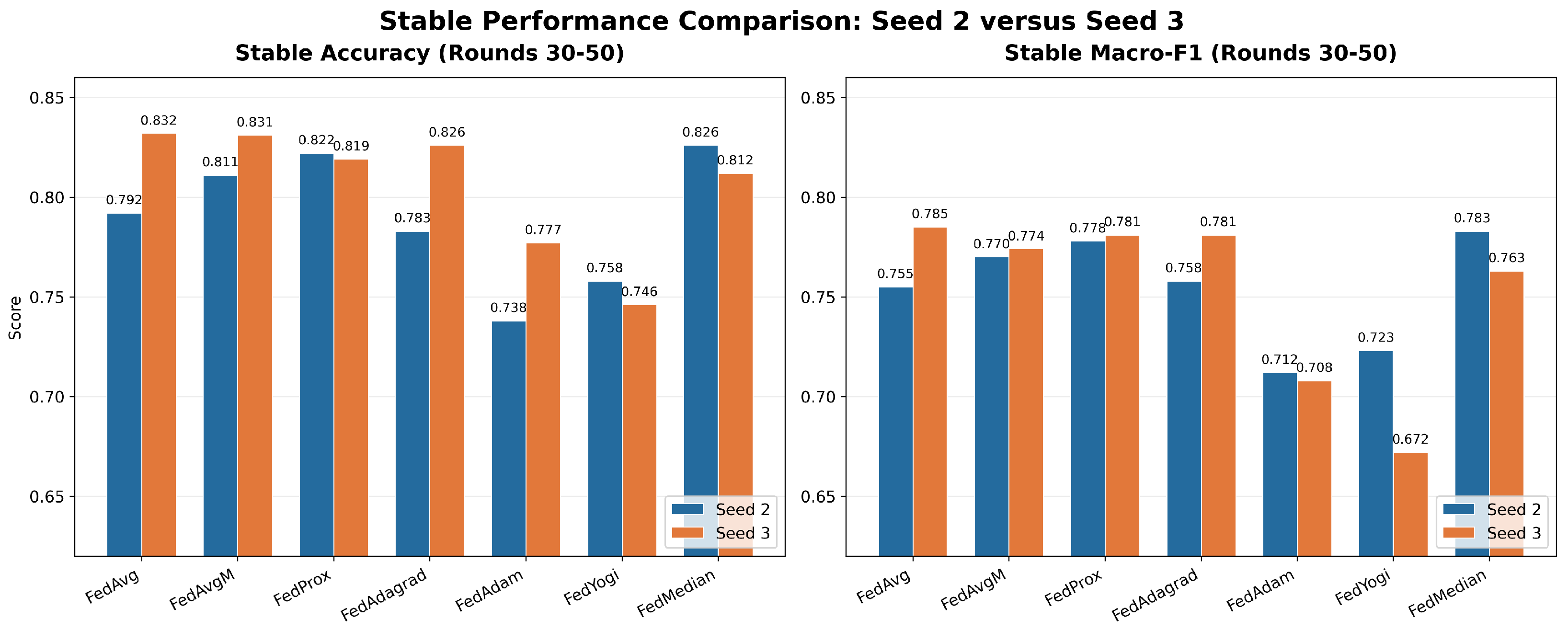
Figure 3 compares the stable accuracy and stable Macro- of the seven federated learning methods for pass/fail prediction under Seed 2 and Seed 3. Stable metrics are calculated by averaging client-side evaluation results over communication rounds 30–50. The figure shows that random seed selection affects not only the absolute metric values but also the relative ranking of all evaluated methods.
Figure 3.
Comparison of stable client-side evaluation performance under Seed 2 and Seed 3. Stable accuracy and stable Macro- are calculated as the mean values across communication rounds 30–50. The figure shows that method rankings can vary across random seeds, particularly for FedAvg, FedAdagrad, and FedMedian.
Under Seed 2, the stable accuracy ranking was FedMedian (0.826), FedProx (0.822), FedAvgM (0.811), FedAvg (0.792), FedAdagrad (0.783), FedYogi (0.758), and FedAdam (0.738). The stable Macro- ranking followed a similar pattern. Under Seed 3, the ranking changed substantially. FedAvg achieved the highest stable accuracy (0.832) and the highest stable Macro- (0.785). FedAvgM ranked second in stable accuracy (0.831), while FedAdagrad ranked second jointly in stable Macro- (0.781) and third in stable accuracy (0.826). FedProx remained competitive, ranking fourth in stable accuracy (0.819) and jointly second in stable Macro- (0.781). FedMedian decreased to fifth in both stable accuracy (0.812) and stable Macro- (0.763). FedAdam ranked sixth in stable accuracy (0.777) and sixth in stable Macro- (0.708), whereas FedYogi ranked seventh in both metrics, with stable accuracy of 0.746 and stable Macro- of 0.672.
These ranking changes demonstrate that selecting a federated aggregation method from a single random seed can lead to an unreliable conclusion. Therefore, the final comparison should be based on mean and variability measures across multiple seeds, rather than on the ranking observed in an individual run.
Table 2 compares seven federated optimization strategies over 20 independent random-seed runs. For each run, we report the peak client-side evaluation performance achieved during training (Best Accuracy and Best Macro-) and the mean performance over communication rounds 30–50 (Stable Accuracy and Stable Macro-). The latter is emphasized because it better reflects convergence stability than a single peak result. All values are reported as the mean and sample standard deviation across the 20 runs.
Table 2.
Performance of pass/fail prediction across 20 random-seed runs. Values are mean ± sample standard deviation. Stable metrics are averaged over communication rounds 30–50.
FedMedian achieved the strongest and most stable performance. It obtained the highest mean best accuracy () and the highest stable accuracy over rounds 30–50 (). FedMedian also achieved the highest stable Macro- score (). FedProx was the closest competitor to FedMedian. Its mean best accuracy () and mean best Macro- () were numerically very similar to those of FedMedian. However, FedProx showed greater variability in stable accuracy () than FedMedian. Therefore, although FedProx demonstrated competitive peak performance, FedMedian provided more consistent late-round performance across random seeds.
FedAvgM also performed competitively, achieving a stable accuracy of and a stable Macro- of . This result suggests that the selected server momentum setting enabled reliable convergence. FedAdagrad and FedAvg were also stable across all runs, but their mean accuracy and Macro- values were lower than those of FedMedian, FedProx, and FedAvgM. In particular, FedAvg exhibited the largest variability among the consistently successful methods, with a stable accuracy standard deviation of .
In contrast, the adaptive server optimization methods FedYogi and FedAdam were substantially less robust under the selected hyperparameter settings. FedYogi showed high variability in Macro- ( for the best Macro-). FedAdam was the least reliable approach with markedly lower average accuracy and Macro-. These results indicate that FedAdam, and to a lesser extent FedYogi, were highly sensitive to random initialization and stochastic local training in the present non-IID federated setting.
The results identify FedMedian as the preferred strategy for this task because it combines strong predictive performance with the most consistent convergence behavior. FedProx can be considered a competitive alternative when peak performance is the primary objective, whereas FedAdam and FedYogi require further hyperparameter tuning before being used as reliable baselines.
5.2. Results for Pass/Withdrawn Prediction
Table 3 compares the federated optimization strategies on the pass/withdrawn prediction task over 20 random-seed runs. FedMedian achieved the strongest overall performance. It obtained the highest mean best accuracy of and the highest mean stable accuracy of . FedMedian also achieved the highest best Macro- score of and the highest stable Macro- score of . The small differences between its best and late-round mean metrics indicate that FedMedian converged to a stable solution and maintained this performance throughout the later communication rounds.
Table 3.
Federated learning performance for pass/withdrawn prediction over 20 random-seed runs. Values are mean ± sample standard deviation. Stable metrics are averaged over communication rounds 30–50.
FedAvg, FedAvgM, and FedProx were close competitors. Their stable accuracy values were approximately , and their stable Macro- values were approximately . Although FedMedian was numerically superior across all reported metrics, the differences between these leading methods were small. FedAdagrad achieved consistent but slightly lower performance, with stable accuracy and Macro- values of and , respectively. FedYogi converged reliably without baseline-level failures but achieved weaker results, particularly in its stable Macro- score of . FedAdam was the least reliable method under the selected hyperparameter configuration.
5.3. Results for Fail/Distinction Prediction
Table 4 compares seven federated optimization strategies for the fail/distinction prediction task over 20 random-seed runs. FedProx achieved the strongest overall performance. It obtained the highest mean best accuracy of and the highest stable accuracy of . FedProx also achieved the highest best Macro- score of and the highest stable Macro- score of . Its relatively low standard deviations indicate that the method converged consistently across different random seeds.
Table 4.
Federated learning performance for fail/distinction prediction over 20 random-seed runs. Values are mean ± sample standard deviation. Stable metrics are averaged over communication rounds 30–50.
FedAdagrad was the second most reliable method, achieving a stable accuracy of and a stable Macro- score of . FedAvg and FedMedian also produced competitive results, with stable accuracy values of and , respectively. Although the peak metrics of FedAvg, FedAvgM, FedMedian, and FedProx were numerically close, FedProx maintained the highest late-round performance. FedAvgM achieved competitive peak performance, with a mean best accuracy of and a mean best Macro- score of . However, its stable accuracy and Macro- scores decreased to and , respectively. The substantially larger standard deviations indicate that FedAvgM was sensitive to stochastic training conditions and sometimes degraded during later communication rounds. FedYogi and FedAdam produced weaker and less stable results. FedYogi achieved a stable accuracy of and a stable Macro- score of . FedAdam showed the greatest instability, with stable accuracy of and stable Macro- of .
5.4. Results for Pass/Distinction Prediction
Table 5 shows that none of the evaluated federated learning methods achieved acceptable stable performance for imbalanced Pass/Distinction prediction. Although FedYogi and FedAdam obtained the highest stable accuracies, 0.801 and 0.800, respectively, their stable Macro- scores were only 0.445 and 0.447. These values are approximately equivalent to the majority-class baseline of the imbalanced dataset, where the Pass class represents about 80% of observations. Consequently, the apparently high accuracy of FedYogi and FedAdam is likely explained by majority-class-dominated predictions rather than reliable identification of Distinction outcomes.
Table 5.
Pass/Distinction prediction performance across 20 random seeds. Values are mean ± standard deviation. Stable metrics are the mean client-side evaluation results over communication rounds 30–50.
The remaining methods did not provide a satisfactory alternative. FedProx and FedAdagrad achieved lower stable accuracy (0.564 and 0.552) and stable Macro- (0.423 and 0.422), respectively. While these methods occasionally achieved stronger outcomes in individual runs, their relatively large standard deviations indicate substantial seed-dependent variability. FedMedian, FedAvg, and FedAvgM produced still lower stable accuracy and Macro- values, with FedAvgM showing the weakest stable Macro- (0.329).
Overall, the stable accuracy and Macro- results indicate that the current federated training configuration does not provide reliable balanced classification performance. Future experiments should incorporate imbalance-aware local training, such as Synthetic Minority Oversampling Technique (SMOTE) [16].
5.5. Paired Statistical Comparison Across Random Seeds
To assess whether the observed numerical differences between federated strategies were consistent across repeated runs, we conducted paired statistical comparisons using the 20 random-seed replications. Each seed defined a matched stochastic experimental condition for all strategies, including the same seed-specific data split, model initialization protocol, and mini-batch ordering. Therefore, comparisons were paired within each seed. These replications use the same underlying OULAD dataset and should be interpreted as repeated stochastic evaluations under the same experimental configuration, rather than as evaluations on 20 independent datasets or institutions.
For each strategy and seed, we used the mean client-side accuracy and mean macro- over communication rounds 30–50 as the evaluation outcomes. These late-round mean metrics were selected because they better represent convergence stability than the highest metric observed in an individual communication round. For each prediction task, we compared the numerically leading strategy with the other six strategies using two-sided paired Wilcoxon signed-rank tests. The Hochberg procedure was applied separately to the six comparisons for each outcome to control for multiple testing. Statistical significance was evaluated at a significance level of 0.05 using Hochberg-adjusted p-values.
For Pass/Fail prediction, FedMedian achieved the highest mean late-round accuracy and macro- across the 20 seed-based replications. Paired Wilcoxon signed-rank tests with Hochberg correction showed that FedMedian differed significantly from FedAdam and FedYogi for both mean accuracy and mean macro- over rounds 30–50. FedMedian also differed significantly from FedAdagrad in mean accuracy, but not in mean macro- after correction. The differences between FedMedian and FedAvg, FedAvgM, and FedProx were not statistically significant for either metric. Therefore, FedMedian had the highest observed mean performance, but its advantage over the leading alternatives FedProx, FedAvgM, and FedAvg was not statistically confirmed under the corrected paired comparisons (see results in Table 6).
Table 6.
Paired Wilcoxon signed-rank tests comparing FedMedian with the other federated strategies for Pass/Fail prediction. Metrics are mean client-side evaluation results over communication rounds 30–50 across 20 paired random-seed replications. Hochberg correction was applied separately to the six comparisons for each metric.
For Pass/Withdrawn prediction, FedMedian achieved the highest mean late-round accuracy and macro- across 20 seed-based replications. Hochberg corrected p-value showed significant differences between FedMedian and all six alternative methods for mean accuracy over rounds 30–50. For mean macro-, FedMedian differed significantly from FedAdam, FedYogi, FedAdagrad, FedAvg, and FedProx, whereas its difference from FedAvgM was not statistically significant. Thus, FedMedian showed the strongest and most consistently supported late-round performance for this task, although FedAvgM remained statistically comparable in macro- (See Table 7).
Table 7.
Paired Wilcoxon signed-rank tests comparing FedMedian with the other federated strategies for Pass/Withdrawn prediction. Metrics are the mean client-side evaluation results over communication rounds 30–50 across 20 paired random-seed replications. Hochberg correction was applied separately to the six comparisons for each metric.
For Fail/Distinction prediction, FedProx achieved the highest mean late-round accuracy and macro- across the 20 seed-based replications. The results in Table 8 showed that FedProx differed significantly from FedAdam, FedYogi, and FedMedian for both mean accuracy and mean macro- over rounds 30–50. However, FedProx was not statistically distinguishable from FedAvgM, FedAvg, or FedAdagrad after correction. Therefore, FedProx had the highest observed late-round performance, but its numerical advantage over FedAvgM, FedAvg, and FedAdagrad was not statistically confirmed under the corrected paired comparisons.
Table 8.
Paired Wilcoxon signed-rank tests comparing FedProx with the other federated strategies for Fail/Distinction prediction. Metrics are mean client-side evaluation results over communication rounds 30–50 across 20 paired random-seed replications. Hochberg correction was applied separately to the six comparisons for each metric.
For Pass/Distinction prediction, FedAdam achieved one of the highest observed late-round accuracy values and the highest observed macro- value across the 20 seed-based replications. The results in Table 9 showed that FedAdam differed significantly from FedMedian, FedAdagrad, FedAvg, FedAvgM, and FedProx in mean accuracy over rounds 30–50, but it was not statistically distinguishable from FedYogi. For mean macro-, FedAdam differed significantly from FedAvg and FedAvgM, whereas its differences from FedMedian, FedAdagrad, FedYogi, and FedProx were not statistically significant after correction. These results indicate that the apparent performance advantage of FedAdam should be interpreted cautiously, particularly for macro-, because it was not statistically supported against several alternative methods.
Table 9.
Paired Wilcoxon signed-rank tests comparing FedAdam with the other federated strategies for Pass/Distinction prediction. Metrics are mean client-side evaluation results over communication rounds 30–50 across 20 paired random-seed replications. Hochberg correction was applied separately to the six comparisons for each metric.
6. Educational Implications for Responsible Learning Analytics
The findings provide several implications for the development of responsible AI systems in education. First, federated learning enables institutions to collaboratively develop predictive models while reducing the need to exchange sensitive student records, supporting privacy-aware educational analytics across distributed learning environments. Second, the results show that algorithm selection is an important consideration for reliable educational AI deployment. FedMedian demonstrated strong and stable performance for general student outcome prediction tasks, while FedProx was more effective for specific heterogeneous prediction scenarios. This suggests that educational institutions should select federated optimization strategies according to the characteristics of their learning analytics objectives rather than adopting a default approach. Third, responsible deployment requires careful interpretation of predictive outputs. Federated learning models should be used to support evidence-based decision-making, such as identifying students who may benefit from additional support, rather than replacing educators’ professional judgment. Furthermore, evaluation procedures should explicitly consider class imbalance and minority outcomes to reduce the risk that learning analytics systems systematically favor majority student groups. By combining privacy-conscious collaboration, robust model evaluation, and context-aware deployment strategies, federated learning can contribute to more trustworthy and responsible educational AI systems.
7. Discussion
This study evaluated federated learning strategies for four student-outcome prediction tasks, which are Pass/Fail, Pass/Withdrawn, Fail/Distinction, and Pass/Distinction prediction. Across all tasks, the results demonstrate that federated learning can support privacy-conscious student performance prediction without requiring educational institutions to centralize raw student records. This capability is particularly valuable in real educational environments where student data may be distributed across institutions, departments, or learning platforms and where data-sharing constraints may limit collaborative analytics. However, the results also demonstrate that the effectiveness of federated learning depends on the prediction objective, data distribution, and class characteristics. Therefore, educational institutions should avoid assuming that a single federated learning strategy will provide optimal performance for all learning analytics applications.
FedMedian achieved the highest observed mean late-round performance for Pass/Fail and Pass/Withdrawn prediction. For Pass/Fail, however, its differences from FedAvg, FedAvgM, and FedProx were not statistically significant for either accuracy or macro- after Hochberg correction. For Pass/Withdrawn, FedMedian differed significantly from all six alternatives in accuracy, whereas its macro- did not differ significantly from FedAvgM. A plausible explanation is that regional clients produced some locally atypical model updates because their sample sizes, learner characteristics, behavioural features, and outcome frequencies differed. Sample-size-weighted averaging gives every update an influence proportional to its client data size, whereas coordinate-wise median aggregation is less affected by unusually large parameter changes from individual clients. This can yield a more stable global trajectory when the majority of client updates point in broadly compatible directions but a small number differ substantially. The advantage of FedMedian should not be interpreted as demonstrated Byzantine robustness. No malicious-client or backdoor attacks were introduced in these experiments. Rather, the results suggest that median aggregation was empirically well suited to the naturally heterogeneous updates created by the regional OULAD partition in the Pass/Fail and Pass/Withdrawn tasks.
FedProx achieved the highest observed mean late-round performance for Fail/Distinction prediction. However, although it differed significantly from FedAdam, FedYogi, and FedMedian for both accuracy and macro-, its differences from FedAvgM, FedAvg, and FedAdagrad were not statistically significant after Hochberg correction. From an educational perspective, this indicates that federated learning systems may require task-specific optimization strategies when supporting more complex outcome analyses, such as distinguishing between students experiencing academic difficulties and those demonstrating exceptional achievement.
The Pass/Distinction task produced a substantially different outcome. Although FedAdam and FedYogi achieved stable accuracy values close to 0.80, their stable Macro- values remained approximately 0.45. Because the Pass class represents approximately 80% of observations in this dataset, these results indicate that high accuracy may primarily reflect majority-class prediction rather than meaningful identification of distinction-level achievement. This limitation is particularly important for responsible learning analytics, as models that perform well according to accuracy alone may fail to recognize smaller but educationally important student groups. Therefore, deploying federated learning systems in educational settings requires evaluation metrics that consider minority outcomes and ensure that predictions do not overlook students with less frequent but significant learning trajectories. These findings also underline the importance of a data-centric perspective. When the label distribution and training objective are poorly aligned with the intended minority-class outcome, changes to the optimization algorithm alone may not yield reliable performance. Data-centric interventions, together with appropriate model and optimization choices, are therefore essential for robust predictive systems [19].
The 20 paired seed-based replications provide a more robust basis for comparing strategies than a single experimental run. However, because the replications reuse the same underlying OULAD dataset, the paired statistical results should be interpreted as evidence of differences under the present experimental configuration, rather than as evidence of general superiority across educational datasets. In educational decision-support systems, inaccurate predictions may influence resource allocation, intervention priorities, and institutional planning. Therefore, model selection should consider not only predictive performance but also stability, reliability, and the potential consequences of prediction errors. The observed variation across random seeds further demonstrates that selecting a federated learning strategy based on a single experimental run may lead to unreliable conclusions. Multi-seed evaluation provides a more robust basis for determining whether a model is suitable for practical learning analytics deployment.
This study has several limitations. First, the study did not apply formal privacy-enhancing mechanisms such as secure aggregation or differential privacy. Although federated learning reduces raw-data sharing, it does not by itself provide complete privacy guarantees. Future work should investigate additional privacy-conscious mechanisms, including differential privacy [12,20] and secure aggregation [21], to further strengthen responsible educational AI deployment. Second, the highly imbalanced Pass/Distinction task was evaluated without dedicated imbalance-aware optimization. Future research should incorporate imbalance-aware learning strategies, such as Synthetic Minority Oversampling Technique (SMOTE), cost-sensitive training, or other approaches designed to improve minority-class recognition. In addition, the reported evaluation metrics are derived from held-out local subsets within the participating regional clients and are aggregated across clients. Although these records do not contribute to local model updates, this evaluation protocol is not an independent external test and does not measure performance in a previously unseen geographical region. Therefore, the findings should be interpreted as a comparison of federated strategies within the studied regional partitioning setting, rather than evidence of cross-region or cross-institutional generalizability. Finally, the reported results reflect one fixed set of strategy-specific hyperparameters. In particular, the observed instability of FedAdam and FedYogi may depend partly on the selected server-learning-rate configuration and should not be interpreted as an inherent property of these strategies.
The present study compares seven established aggregation strategies under a common region-partitioned OULAD setting. Future work should extend this comparison to methods designed for specific forms of non-IID data rather than treating heterogeneity as a single phenomenon. SCAFFOLD uses client and server control variates to reduce local client drift [22], whereas FedBN retains batch-normalization statistics locally to address client-specific feature-distribution shift [23]. Dynamic-regularization and model-contrastive methods, including FedDyn and MOON, respectively align local optimization objectives and learned representations with the global model [24,25]. These approaches may be informative when regional differences reflect behavioural-feature shift or divergent local learning dynamics, rather than only unequal class proportions. Personalized federated learning is another important direction when a single global model is not equally suitable for all regions or institutions. Methods such as pFedMe, Ditto, and FedRep retain client-specific model components while exploiting shared information across clients [26,27,28]. Clustered federated learning can similarly learn separate models for groups of clients with related distributions [29]. Future experiments should also evaluate class-aware aggregation, knowledge-distillation, and privacy-aware synthetic-data approaches for rare educational outcomes.
Author Contributions
Conceptualization, Y.Z. and Q.C.; methodology, Y.Z.; formal analysis, Y.Z. and Q.C.; writing—original draft preparation, Y.Z.; writing—review and editing, Y.Z., Q.C. and M.M.; visualization, Y.Z., Q.C. and M.M. All authors have read and agreed to the published version of the manuscript.
Funding
This study was supported by the National Natural Science Foundation of China (12201351) and the Shandong Provincial Natural Science Foundation (ZR2022QA013).
Data Availability Statement
The data presented in this study are openly available from the Open University Learning Analytics Dataset (OULAD). The source code, Flower experimental configuration, and instructions for reproducing the federated-learning experiments are available at https://github.com/yanyan-zhao/flower-oulad (accessed on 9 August 2026).
Conflicts of Interest
The authors declare no conflicts of interest. The funders had no role in the design of the study; in the collection, analyses, or interpretation of data; in the writing of the manuscript; or in the decision to publish the results.
References
- Guo, S.; Zeng, D.; Dong, S. Pedagogical Data Analysis Via Federated Learning Toward Education 4.0. Am. J. Educ. Inf. Technol. 2020, 4, 56–65. [Google Scholar] [CrossRef]
- McMahan, B.; Moore, E.; Ramage, D.; Hampson, S.; Agüera y Arcas, B.A. Communication-Efficient Learning of Deep Networks from Decentralized Data. In Proceedings of the 20th International Conference on Artificial Intelligence and Statistics, Fort Lauderdale, FL, USA, 20–22 April 2017; Volume 54, pp. 1273–1282. [Google Scholar]
- Fachola, C.; Tornaría, A.; Bermolen, P.; Capdehourat, G.; Etcheverry, L.; Fariello, M.I. Federated Learning for Data Analytics in Education. Data 2023, 8, 43. [Google Scholar] [CrossRef] [Scilit]
- Zhang, T.; Liu, H.; Tao, J.; Wang, Y.; Yu, M.; Chen, H.; Yu, G. Enhancing Dropout Prediction in Distributed Educational Data Using Learning Pattern Awareness: A Federated Learning Approach. Mathematics 2023, 11, 4977. [Google Scholar] [CrossRef] [Scilit]
- van Haastrecht, M.; Brinkhuis, M.; Spruit, M. Federated Learning Analytics: Investigating the Privacy-Performance Trade-Off in Machine Learning for Educational Analytics. In ArtificialIntelligence in Education; Lecture Notes in Computer Science; Springer: Cham, Switzerland, 2024; Volume 14830, pp. 62–74. [Google Scholar] [CrossRef] [Scilit]
- Zhang, Y.; Li, Y.; Wang, Y.; Wei, S.; Xu, Y.; Shang, X. Federated Learning-Outcome Prediction with Multi-Layer Privacy Protection. Front. Comput. Sci. 2024, 18, 186604. [Google Scholar] [CrossRef] [Scilit]
- Lamsiyah, S.; Nourbakhsh, A.; El-Amrany, S. Privacy-Preserving Federated Learning for Student Dropout Prediction: Enhancing Model Transparency with Explainable AI. In Artificial Intelligence in Education; Springer: Cham, Switzerland, 2025; pp. 324–332. [Google Scholar] [CrossRef] [Scilit]
- Li, T.; Sahu, A.K.; Zaheer, M.; Sanjabi, M.; Talwalkar, A.; Smith, V. Federated Optimization in Heterogeneous Networks. In Proceedings of the Machine Learning and Systems, Austin, TX, USA, 2–4 March 2020; Volume 2, pp. 429–450. [Google Scholar]
- Chen, S.; Qi, X. Entropy-Adaptive Differential Privacy Federated Learning for Student Performance Prediction and Privacy Protection: A Case Study in Python Programming. Front. Artif. Intell. 2025, 8, 1653437. [Google Scholar] [CrossRef] [Scilit] [PubMed]
- Tertulino, R. Centralized vs. Federated Learning for Educational Data Mining: A Comparative Study on Student Performance Prediction with SAEB Microdata. arXiv 2025. [Google Scholar] [CrossRef] [Scilit]
- Kovor, D.K.; Osei, E.O.; Agyemang, E.N. Federated Learning for Privacy-Preserving At-Risk Student Prediction in Health Professional Education: A Multi-Scenario Evaluation of FedAvg and FedProx. Comput. Educ. Artif. Intell. 2026, 11, 100660. [Google Scholar] [CrossRef] [Scilit]
- Jodayree, M.; Ghafi, A.K.; Atashafrouz, M.; Shafiabadi, M.H. Privacy-Preserving Federated Learning for Interpretable Student At-Risk Prediction Across Schools. Sci. Rep. 2026, 16, 26448. [Google Scholar] [CrossRef] [Scilit] [PubMed]
- Hsu, T.M.H.; Qi, H.; Brown, M. Measuring the Effects of Non-Identical Data Distribution for Federated Visual Classification. arXiv 2019. [Google Scholar] [CrossRef] [Scilit]
- Reddi, S.J.; Charles, Z.; Zaheer, M.; Garrett, Z.; Rush, K.; Konečný, J.; Kumar, S.; McMahan, H.B. Adaptive Federated Optimization. In Proceedings of the International Conference on Learning Representations, Virtual, 3–7 May 2021. [Google Scholar]
- Yin, D.; Chen, Y.; Ramchandran, K.; Bartlett, P. Byzantine-Robust Distributed Learning: Towards Optimal Statistical Rates. In Proceedings of the 35th International Conference on Machine Learning, Stockholm, Sweden, 10–15 July 2018; Volume 80, pp. 5650–5659. [Google Scholar]
- Alnasyan, B.A.; Basheri, M.; Alassafi, M.O. A Comprehensive Comparative Analysis of Deep Learning Models for Student Performance Prediction in Virtual Learning Environments: Leveraging the OULA Dataset and Advanced Resampling Techniques. IEEE Access 2025, 13, 75953–75972. [Google Scholar] [CrossRef] [Scilit]
- Kuzilek, J.; Hlosta, M.; Zdrahal, Z. Open University Learning Analytics dataset. Sci. Data 2017, 4, 170171. [Google Scholar] [CrossRef] [Scilit] [PubMed]
- Waheed, H.; Hassan, S.U.; Aljohani, N.R.; Hardman, J.; Alelyani, S.; Nawaz, R. Predicting academic performance of students from VLE big data using deep learning models. Comput. Hum. Behav. 2020, 104, 106189. [Google Scholar] [CrossRef] [Scilit]
- Hamid, O.H. Data-Centric and Model-Centric AI: Twin Drivers of Compact and Robust Industry 4.0 Solutions. Appl. Sci. 2023, 13, 2753. [Google Scholar] [CrossRef] [Scilit]
- El Ouadrhiri, A.; Abdelhadi, A. Differential Privacy for Deep and Federated Learning: A Survey. IEEE Access 2022, 10, 22359–22380. [Google Scholar] [CrossRef] [Scilit]
- Liu, Z.; Guo, J.; Yang, W.; Fan, J.; Lam, K.Y.; Zhao, J. Privacy-Preserving Aggregation in Federated Learning: A Survey. IEEE Trans. Big Data 2024. Early Access. [Google Scholar] [CrossRef] [Scilit]
- Karimireddy, S.P.; Kale, S.; Mohri, M.; Reddi, S.J.; Stich, S.U.; Suresh, A.T. SCAFFOLD: Stochastic Controlled Averaging for Federated Learning. In Proceedings of the 37th International Conference on Machine Learning, Virtual, 13–18 July 2020; Volume 119, pp. 5132–5143. [Google Scholar]
- Li, X.; Jiang, M.; Zhang, X.; Kamp, M.; Dou, Q. FedBN: Federated Learning on Non-IID Features via Local Batch Normalization. In Proceedings of the International Conference on Learning Representations, Virtual, 3–7 May 2021. [Google Scholar]
- Acar, D.A.E.; Zhao, Y.; Matas, R.; Mattina, M.; Whatmough, P.N.; Saligrama, V. Federated Learning Based on Dynamic Regularization. In Proceedings of the International Conference on Learning Representations, Virtual, 3–7 May 2021. [Google Scholar]
- Li, Q.; He, B.; Song, D. Model-Contrastive Federated Learning. In Proceedings of the IEEE/CVF Conference on Computer Vision and Pattern Recognition, Nashville, TN, USA, 20–25 June 2021; pp. 10713–10722. [Google Scholar] [CrossRef] [Scilit]
- Dinh, C.T.; Tran, N.H.; Nguyen, T.D. Personalized Federated Learning with Moreau Envelopes. Adv. Neural Inf. Process. Syst. 2020, 33, 21394–21405. [Google Scholar]
- Li, T.; Hu, S.; Beirami, A.; Smith, V. Ditto: Fair and Robust Federated Learning Through Personalization. In Proceedings of the 38th International Conference on Machine Learning, Virtual, 18–24 July 2021; Volume 139, pp. 6357–6368. [Google Scholar]
- Collins, L.; Hassani, H.; Mokhtari, A.; Shakkottai, S. Exploiting Shared Representations for Personalized Federated Learning. In Proceedings of the 38th International Conference on Machine Learning, Virtual, 18–24 July 2021; Volume 139, pp. 2089–2099. [Google Scholar]
- Ghosh, A.; Chung, J.; Yin, D.; Ramchandran, K. An Efficient Framework for Clustered Federated Learning. Adv. Neural Inf. Process. Syst. 2020, 33, 19586–19597. [Google Scholar]

Disclaimer/Publisher’s Note: The statements, opinions and data contained in all publications are solely those of the individual author(s) and contributor(s) and not of MDPI and/or the editor(s). MDPI and/or the editor(s) disclaim responsibility for any injury to people or property resulting from any ideas, methods, instructions or products referred to in the content. |
© 2026 by the authors. Licensee MDPI, Basel, Switzerland. This article is an open access article distributed under the terms and conditions of the Creative Commons Attribution (CC BY) license.