


Abstract
The present study numerically investigates the effects of wall radiation on the flow instability and heat and mass transfer of double-diffusive natural convection in a rectangular cavity under opposing thermal–solutal buoyancy conditions. The governing equations are solved with the finite volume method, and dynamic mode decomposition is employed to uncover the underlying instability mechanisms. Two representative regimes are examined, namely a nearly balanced buoyancy regime and a thermal-buoyancy-dominated regime. In the nearly balanced regime, wall radiation suppresses flow instability by reconstructing the thermal boundary conditions and redistributing perturbation energy, whereas the intrinsic oscillatory double-diffusive instability originating from buoyancy balance remains unchanged. By contrast, in the thermal-buoyancy-dominated regime, wall radiation promotes flow instability by inducing Rayleigh–Bénard-type thermal stratification near the horizontal walls, which triggers secondary vortices that couple nonlinearly with the global circulation and accelerate its inertial instability. Moreover, increasing wall emissivity substantially enhances wall heat transfer, which becomes dominated by the radiative component, while the convective Nusselt number remains nearly unchanged, and the Sherwood number decreases once wall radiation is activated. These findings offer theoretical insights into flow stability control and heat and mass transfer regulation, with potential implications for high-temperature thermal systems.
1. Introduction
Double-diffusive convection (DDC) is a typical natural-convection phenomenon driven by the coupling of temperature and species concentration gradients. This physical process widely occurs in natural environments and engineering scenarios, such as oceanography geophysics, nuclear reactors, crystal growth, and combustion chambers.
DDC has been extensively investigated, with research focusing primarily on rectangular cavities of various orientations (horizontal, vertical, and inclined) under different boundary conditions. These studies generally aim either to establish correlations for the Nusselt (Nu) or Sherwood (Sh) number as functions of the governing parameters [1,2,3,4] or to explore flow instabilities and identify distinct flow regimes [5,6,7,8]. Previous studies have revealed that DDC systems exhibit strong flow instabilities and readily produce complex oscillatory flow behaviors. For example, Wang et al. [5] numerically investigated DDC in a horizontal cavity and demonstrated that, as the buoyancy ratio increases, the flow evolves successively from steady convection-dominated flow through periodic and quasi-periodic oscillations to chaotic flow, before eventually reverting to periodic oscillation. Subsequently, Liang et al. [6,7] investigated DDC in a slim rectangular enclosure. They also observed a complex flow transition from periodic to quasi-periodic, chaotic, periodic and finally laminar with an increasing buoyancy ratio, which showed similarities to the phenomena reported by Wang et al. [5]. Furthermore, they identified periodic solutions with subharmonic components and analyzed the enhancement effect of multi-cell vortex structures on heat and mass transfer efficiency. In particular, Beaume [8] investigated DDC in a large-aspect-ratio 3D enclosure and reported a route to chaos distinct from those reported by Wang et al. [5] and Liang et al. [6]. He found that chaos is generated at a crisis bifurcation beyond the primary bifurcation owing to twist instability. In addition, Sharifi et al. [9,10] published a series of reviews that systematically summarize how parameters such as cavity geometry, magnetic field, rotation conditions and porous medium boundaries modulate the flow stability and heat and mass transfer efficiency of DDC. Their work offers a valuable reference for multiparameter and multi-condition investigations within this field.
More recently, double-diffusive convection coupled with thermal radiation has attracted considerable research attention. In high-temperature systems, radiative heat transfer becomes important alongside convection and conduction. For example, the walls of thermal systems are prone to interfacial degradation including coating spallation, high-temperature oxidation, surface fouling, and hot corrosion. Such interfacial variations can directly modify wall emissivity. Alterations in radiative boundary conditions perturb the near-wall boundary layer flow, which in turn redistributes the temperature, velocity, and species concentration fields and induces complex multi-field coupling effects. Accordingly, investigating the effects of wall emissivity on the flow instabilities and heat and mass transport characteristics of DDC systems is of great importance for system stability control and the regulation of heat and mass transfer processes.
Numerous investigations have addressed coupled convection–radiation heat transfer across various geometries under zero-concentration-gradient conditions. Ridouane et al. [11] examined flows within a bottom-heated square cavity and demonstrated that increasing wall emissivity reduces the critical Rayleigh number for oscillatory instability, thereby promoting the onset of flow destabilization. Similarly, Soucasse et al. [12] confirmed the destabilizing effect of wall radiation using a side-heated cavity configuration. Employing modal analysis techniques, namely dynamic mode decomposition (DMD) and proper orthogonal decomposition (POD), their work revealed that wall radiation triggers Rayleigh–Bénard-type thermal instabilities and further facilitates the onset of instability. Bahlaoui et al. [13] reported multiple steady-state flow solutions in a discretely heated horizontal rectangular enclosure under coupled natural convection and wall radiation. Each solution is characterized by a specific flow structure, and its appearance and existence range depend strongly on the parameters Ra and . The amount of heat evacuated through the cold surface is dependent on the type of flow solution. Many researchers have further explored how wall emissivity governs wall heat transfer during natural convection. Boukendil et al. [14] studied natural convection coupled with wall radiation in a square cavity containing a partially heated inner circular cylinder. Their results reveal that the convective Nusselt number is nearly independent of wall emissivity, and wall radiation contributes up to 50% of the total heat transfer. Miroshnichenko et al. [15] investigated the effect of wall radiation on conjugate turbulent natural convection in a cavity with a discrete heater and demonstrated that increasing wall emissivity tends to reduce the convective Nusselt number. Hernández-Castillo et al. [16] numerically studied coupled natural convection–radiation in a 3D differentially heated cavity. Noticeable variations in the convective Nusselt number occur only when the emissivities of all inner cavity walls are modified simultaneously. With uniform over all walls, radiation accounts for up to 83% of the total heat transfer.
Compared with natural convection under zero-concentration-gradient conditions, DDC is driven by coupled thermal and solutal buoyancy forces and exhibits far more complex flow behaviors. Limited available studies [17,18,19,20,21,22] mainly focus on gas radiative effects on DDC. These investigations confirm that gaseous volumetric radiation exerts a significant influence on the temperature field, which in turn modifies the flow and concentration fields. The underlying regulation mechanisms strongly depend on the relative magnitude and direction of thermal and solutal buoyancy.
Among the abovementioned investigations, only Moufekkir et al. [18] distinguished between volumetric radiation and wall radiation effects. They found that under aiding buoyancy conditions (), volumetric radiation contributes to flow stabilization. By contrast, for opposing buoyancy cases (), radiation tends to trigger multi-cell flow structures and aggravate flow instability. With regard to wall radiation, under aiding buoyancy conditions, emissivity mainly modifies wall heat transfer while exerting a limited influence on the overall flow pattern. Nevertheless, in opposing buoyancy systems, variations in emissivity can significantly perturb the local flow field and alter the flow state. Furthermore, Hamimid et al. [23] investigated wall radiation effects on DDC within low-Mach-number compressible H2 air mixtures. They revealed that wall radiation modifies the buoyancy field by altering wall thermal boundary conditions, ultimately governing the heat and mass transfer characteristics. Moreover, the influence of wall radiation on multiphysical fields becomes more prominent with an increasing average molecular weight of the gas.
In summary, although a small number of existing studies have addressed the coupling between wall radiation and DDC, systematic investigations into wall radiation effects on flow transitions and instability mechanisms in DDC systems remain lacking. Accordingly, numerical simulations are performed to investigate the flow transitions of DDC systems inside the cavity under different wall emissivities. Focusing on opposing buoyancy flows (), which are more prone to oscillatory behaviors, the present study mainly concentrates on two regimes, a nearly balanced buoyancy regime and a regime dominated by thermal buoyancy. The expected research outcomes provide a theoretical basis for flow stability analysis and heat and mass transport regulation in high-temperature thermal systems. These results also offer theoretical insights with potential implications for wall coating design and thermal protection optimization.
2. Physical Problem and Governing Equations
2.1. Problem Description
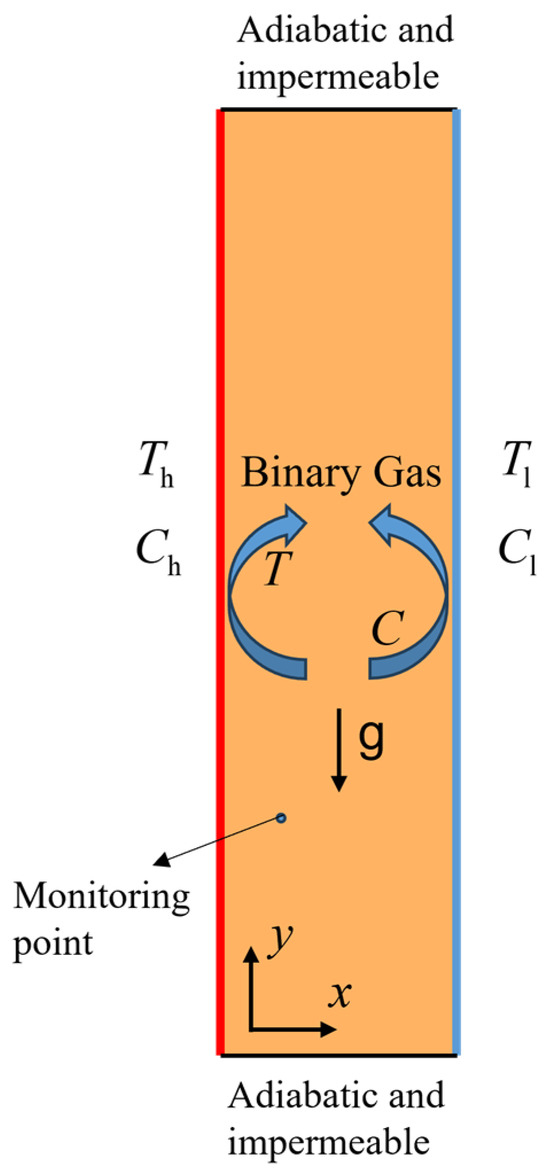
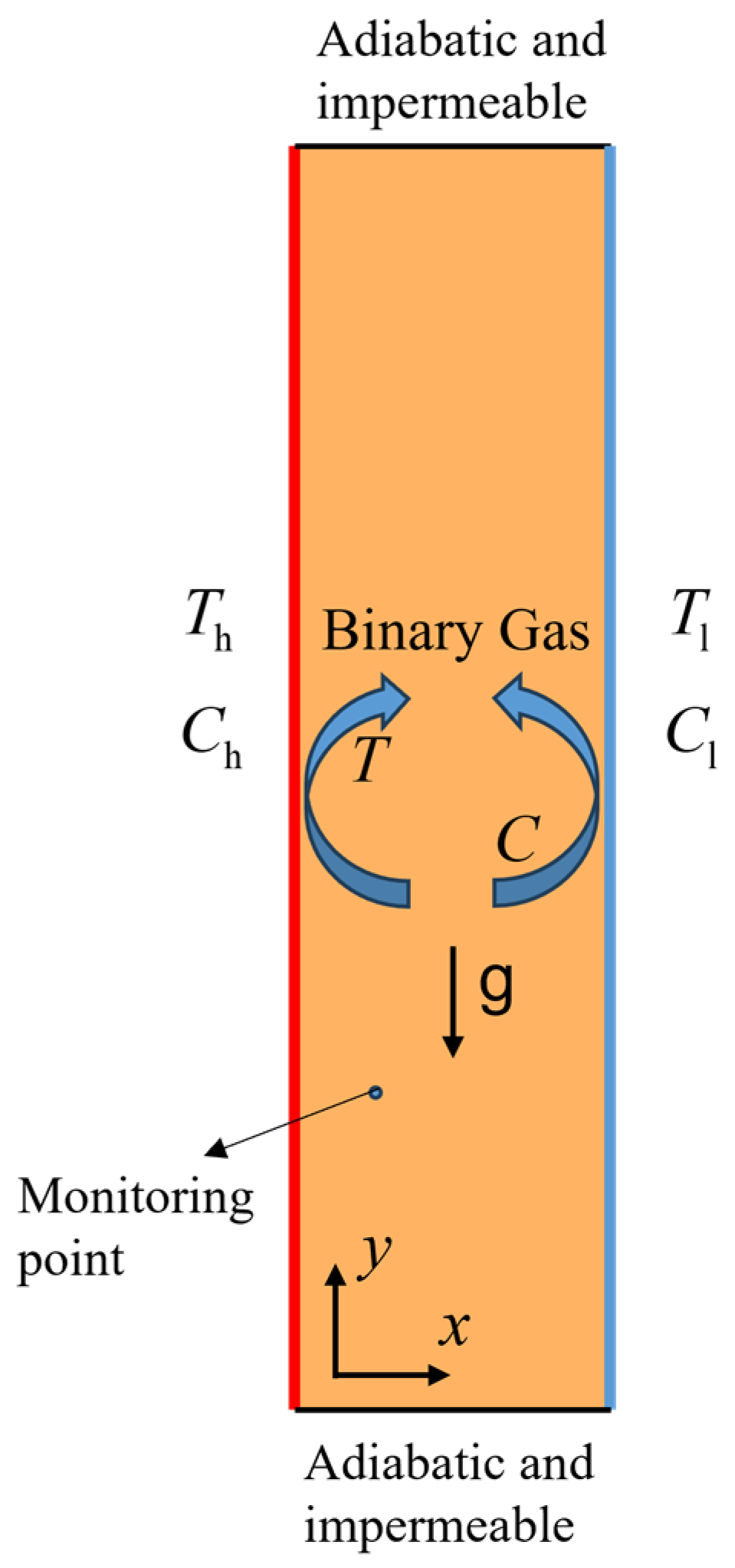
Figure 1 schematically illustrates the physical model and boundary conditions. The computational domain is a two-dimensional rectangular cavity with an aspect ratio of , filled with a radiatively non-participating gas [6]. The two vertical walls are prescribed with Dirichlet boundary conditions; the left wall is maintained at a high temperature and high concentration (, ), while the right wall is kept at a low temperature and low concentration (, ). The top and bottom walls are adiabatic and impermeable. The fluid is initially at rest, with a uniform temperature and a uniform concentration . All walls are treated as diffuse surfaces with defined emissivity (), and no-slip conditions are imposed on the entire boundary. Note that under the most severe operating conditions examined in this work, the mixture density varies between 0.597 kg/m3 and 0.602 kg/m3. Accordingly, the global density variation within the fluid does not exceed 1% relative to the reference density of 0.6 kg/m3 (evaluated at the averaged temperature and concentration). Hence, the Boussinesq approximation is reasonably valid for all test cases considered in the present study. In addition, Soret and Dufour cross-diffusion terms are neglected to isolate the influence of wall radiation on flow instability.
Figure 1.
Geometric model.
2.2. Governing Equations
The dimensionless conservation equations for mass, momentum, energy and species under the Boussinesq approximation are
Here, denote the dimensionless coordinates normalized by the cavity width , and represents the corresponding dimensionless velocity components scaled by diffusive velocity , where is thermal diffusivity. The dimensionless temperature is defined as with and the dimensionless concentration as with . The dimensionless effective pressure is expressed as
The state equation is
where , , and respectively represent reference temperature, concentration and density.
Some of the main dimensionless parameters are listed in Table 1.
Table 1.
The main dimensionless parameters adopted in the present work.
In the present work, thermal and solutal buoyancy forces act in opposite directions. Although the conventional definition gives a negative buoyancy ratio , we introduce a minus sign in the momentum equation such that N is defined as positive. With this convention, flow is dominated by thermal buoyancy for and by solutal buoyancy for . The regime with N close to unity represents near balance between thermal and solutal buoyancy.
In addition, to quantify the heat transfer characteristics of the cavity, the convective and radiative heat fluxes at the isothermal walls are evaluated, from which the convective and radiative Nusselt numbers at the hot wall are defined as follows:
where is the net radiative heat flux at the hot wall defined as
where is the Stefan–Boltzmann constant, is the wall temperature, is the inward-pointing unit normal vector at the wall, is the unit direction vector, is the solid angle around , and is the spectral intensity incident on the hot wall from direction .
Thus, the total Nusselt number can be expressed as
The wall-averaged Sherwood number, which characterizes convective mass transfer relative to diffusive mass transfer, is defined as
3. Numerical Modeling
3.1. Numerical Methods
The governing equations are discretized and solved with the finite volume method (FVM) implemented in CFD software ANSYS Fluent 2021 R2. In space, the convective terms in the momentum equations are approximated by a second-order linear upwind scheme, whereas the temperature and concentration equations are discretized with a central conservative second-order scheme. In time, integration is carried out with a first-order implicit Euler scheme. Pressure–velocity coupling is resolved through the SIMPLEC algorithm (Semi-Implicit Method for Pressure-Linked Equations Consistent), a well-established predictor corrector technique. The radiative exchange is solved with the discrete ordinates method (DOM) with S4 angular discretization (24 directions). The fluid medium is assumed transparent, meaning that radiation travels along straight lines without attenuation, and incident intensity comes exclusively from enclosure walls. Accordingly, fluid absorption and emission are omitted.
The computational domain is discretized using a structured uniform mesh. A grid independence study is carried out for two representative unsteady cases at and : one excluding wall radiation (periodic oscillatory flow) and the other including wall radiation with (aperiodic oscillatory flow). Three mesh resolutions (21 × 81, 31 × 121, and 51 × 201) are tested. For both cases, the time-averaged convective Nusselt number <Nuc> and Sherwood number <Sh> on the hot wall are adopted as evaluation metrics. For the periodic case without radiation, the fundamental oscillation frequency is additionally included to verify the grid convergence of the dynamic flow characteristics. As summarized in Table 2 and Table 3, the coarse 21 × 81 mesh exhibits considerable relative errors compared with the finest 51 × 201 grid. The intermediate 31 × 121 mesh yields small relative errors less than 1.3% for <Nuc>, <Sh>, and the fundamental frequency . Balancing numerical accuracy and computational cost, the 31 × 121 mesh is selected for all subsequent simulations.
Table 2.
Grid independence study based on time-averaged convective Nusselt and Sherwood numbers and fundamental frequency for case without wall radiation at and .
Table 3.
Grid independence study based on time-averaged convective Nusselt and Sherwood numbers for case with wall radiation () at and .
Temporal independence is validated for the aperiodic oscillatory case with wall radiation (, , ). Three time step values (, , ) are compared using the time-averaged <Nuc> and <Sh> on the hot wall. As shown in Table 4, the time step yields relative errors below against the finest time step. Therefore, a constant dimensionless time step is adopted for temporal discretization across all simulations in the present work.
Table 4.
Temporal independence study based on time-averaged convective Nusselt and Sherwood numbers for case with wall radiation () at and .
3.2. Code Validation
To validate the present numerical model, a classic DDC case is first reproduced based on the study of Liang et al. [7], who systematically investigated DDC over a wide range of buoyancy ratios. From that study, the case with and is adopted, for which the convective Nusselt and Sherwood numbers at the hot wall are compared. The literature reports reference values of and , whereas the present computations yield and , corresponding to relative errors below 0.6% in both quantities. The good agreement between the present results and the reference data confirms the accuracy of the present numerical model for DDC.
Furthermore, the present model is validated against the benchmark case of Soucasse et al. [24] for natural convection coupled with wall radiation in a cubic cavity. Following configuration B of the reference, the computed radiative Nusselt number at the hot wall is 118.83, whereas the reference value is 120.58, corresponding to a relative error of only 1.45%. This verifies the accuracy of the present numerical method in solving the coupled natural convection and wall radiation problem.
4. Results and Discussion
In the present work, the computational parameters are set to or , and . The parameter indicates that thermal diffusion proceeds twice as fast as species diffusion, and heat and species are transported at markedly different rates. The effects of wall radiation on the flow instability of double-diffusive natural convection are investigated for two representative regimes with opposing thermal–solutal buoyancy forces: one with nearly balanced buoyancy magnitudes and another in which thermal buoyancy dominates. Based on the results computed in the present paper, four distinct dynamic regimes of cavity flow are identified: (1) The first is steady flow (S). (2) The second involves integer multiples of fundamental frequency periodical flow (MP). The solution consists of fundamental frequency (FF) and its integer multiple of frequencies (INTMF). (3) The third comprises subharmonic and integer multiples of FF co-existing with periodical flow (SMP). (4) The final regime is aperiodic flow (NP), characterized by the excitation of abundant subharmonic components.
4.1. Flow Instability
4.1.1. Nearly Balanced Buoyancy Regime
With a fixed Rayleigh number (), three cases of nearly balanced thermal–solutal buoyancy (, 1.014 and 1.06) are selected to systematically investigate how variations in wall emissivity () govern flow regime evolution inside the cavity. The thermal-buoyancy-dominated case at is also adopted for comparison.
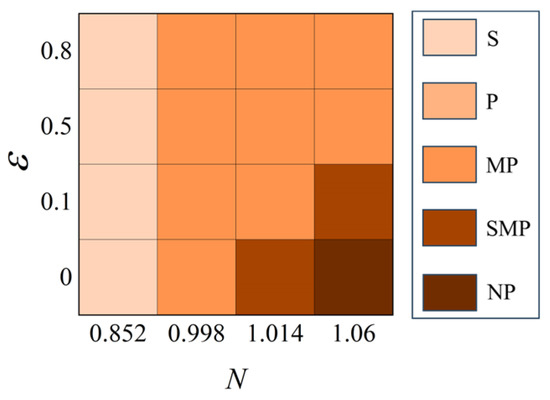
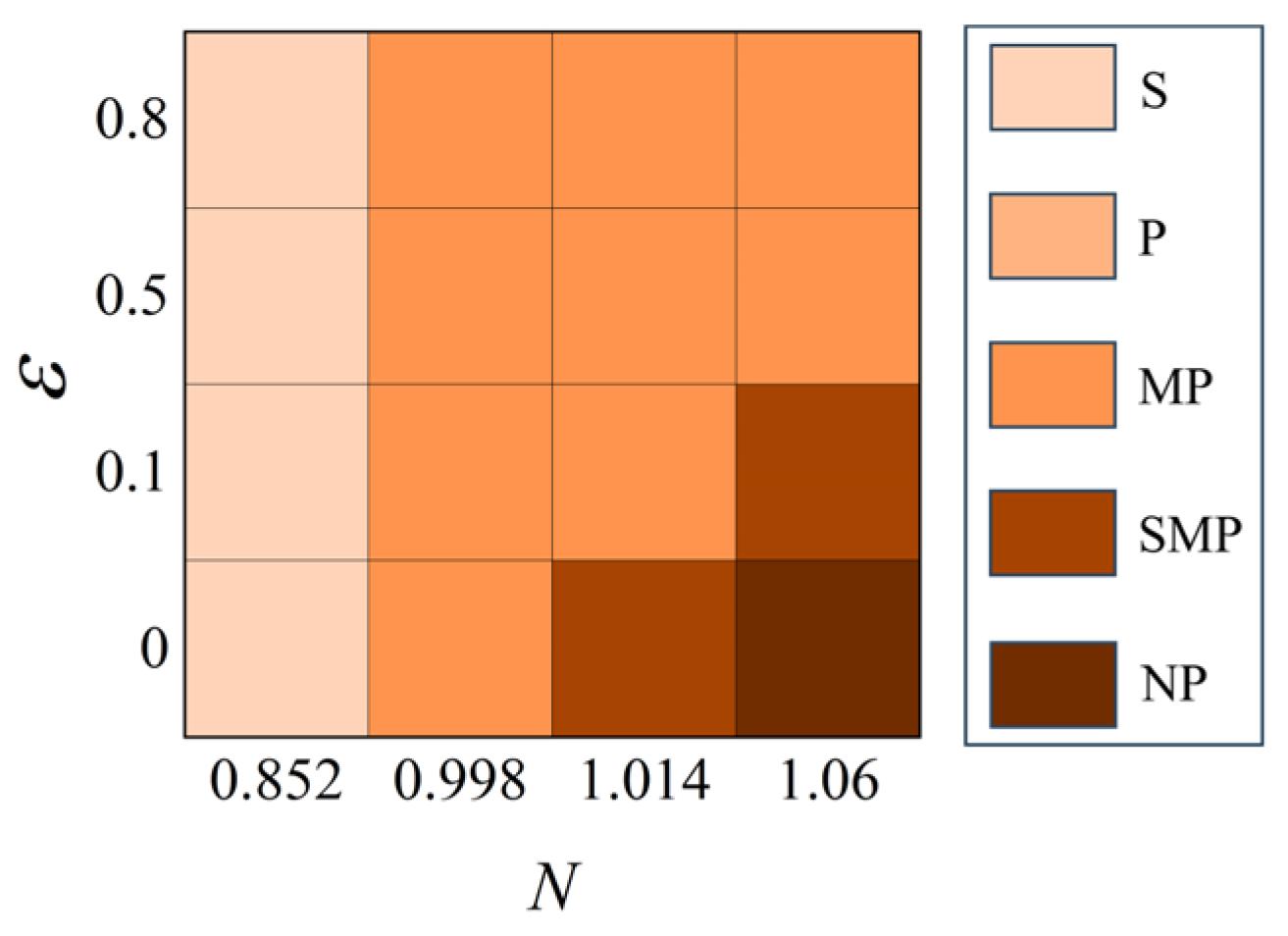
Figure 2 summarizes flow transitions driven by wall emissivity for buoyancy ratio values of , 0.998, 1.014 and 1.06 at . The numerical results show that for , laminar steady-state flow persists for all simulations regardless of wall emissivity. For , MP flow develops both with and without wall radiation. This behavior arises from the early onset of oscillatory instability as N approaches unity, which is also reported by Liang et al. [6,7]. At , flow instability occurs in all runs, and wall radiation suppresses SMP flow into MP flow. For , wall radiation can even modulate NP flow into MP flow. These findings reveal that wall radiative heat transfer can effectively suppress flow instability in double-diffusive natural convection.
Figure 2.
Flow transitions driven by wall emissivity for , 0.998, 1.014 and 1.06 at .
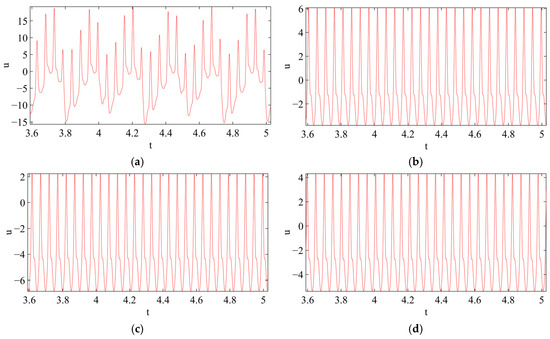
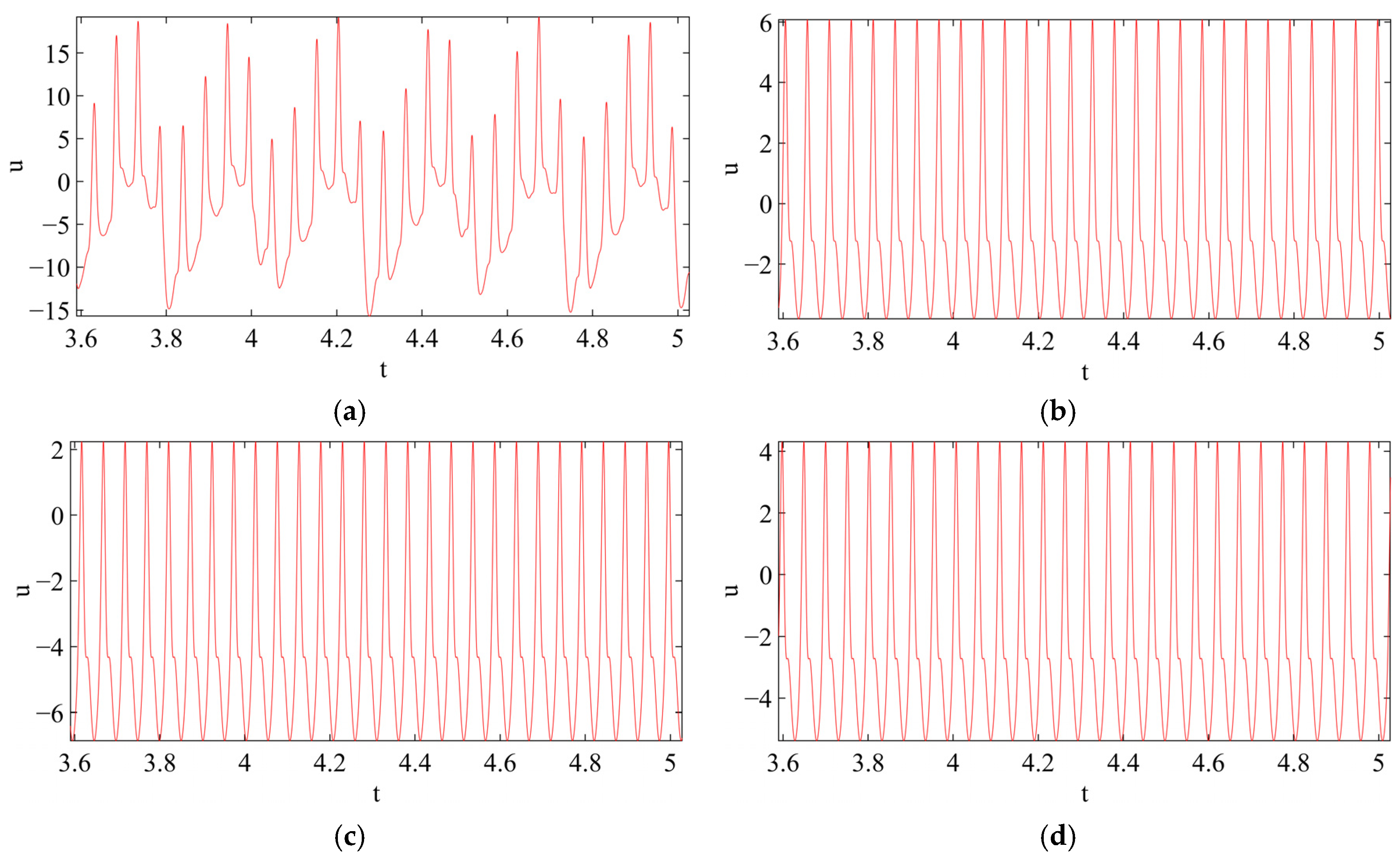
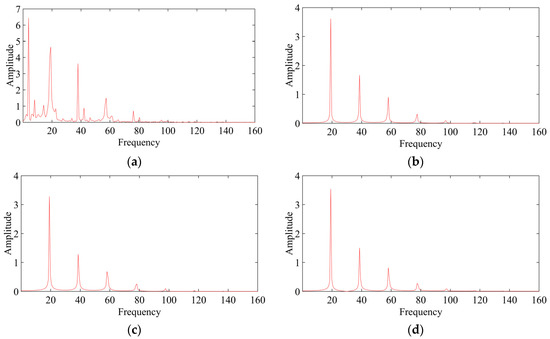
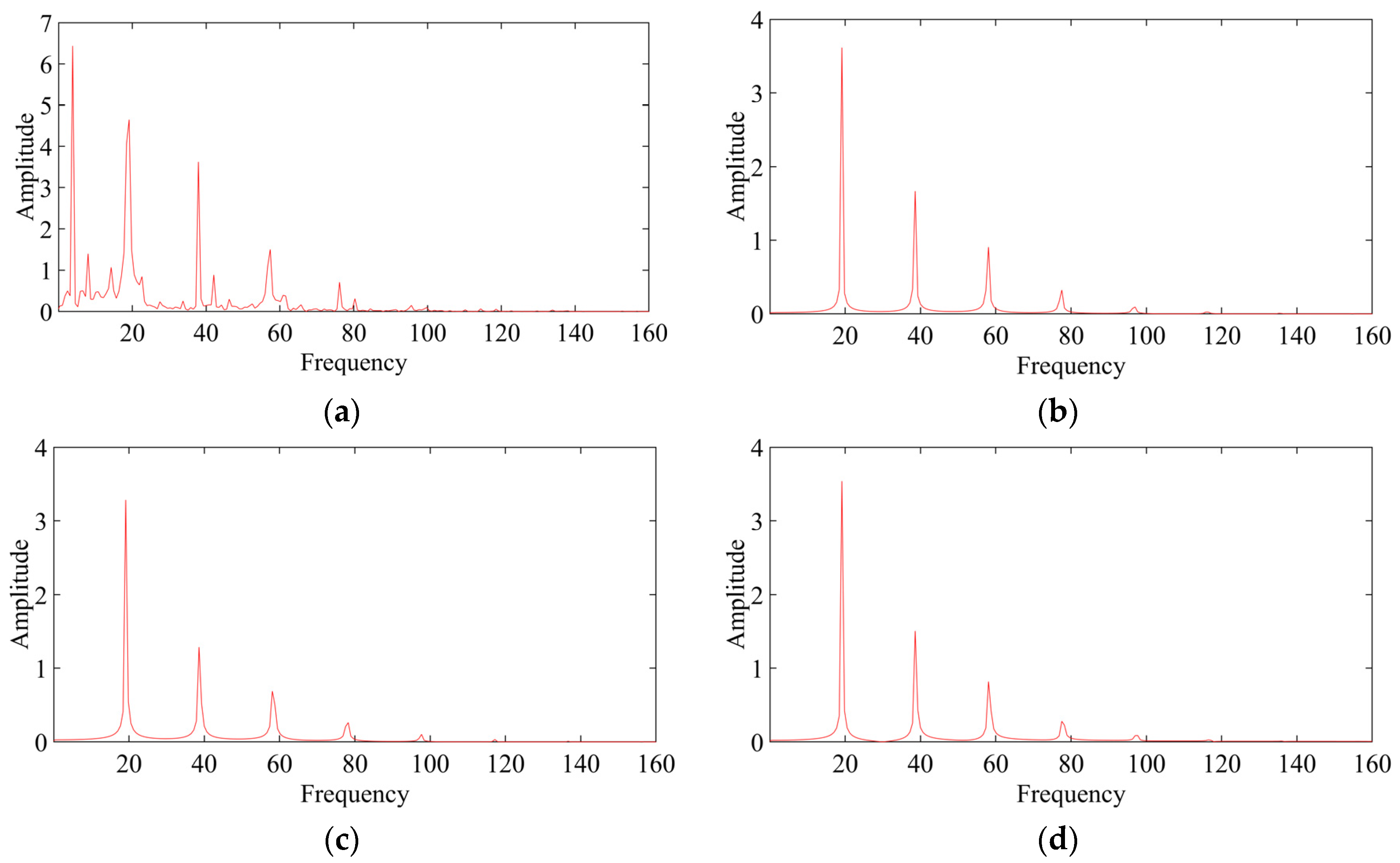
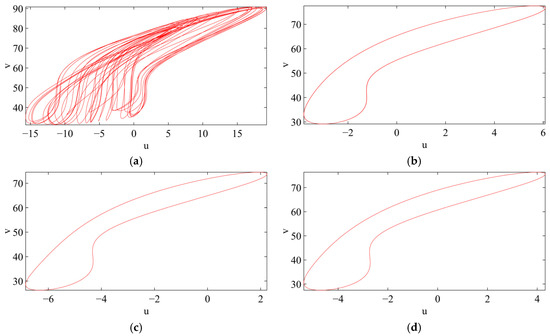
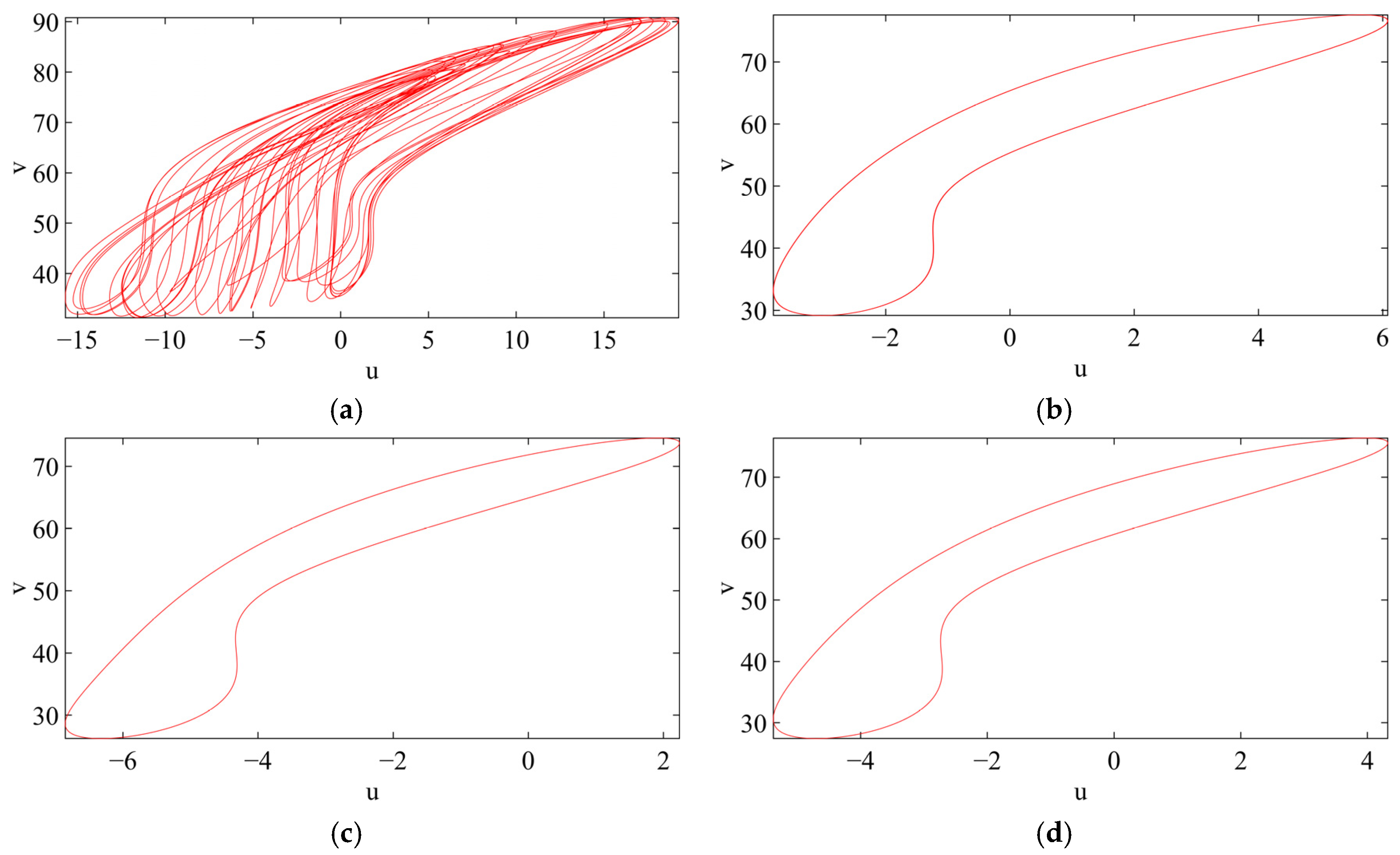
We next examine the case to further illustrate the influences of wall emissivity on flow instability behavior within a DDC system. Figure 3, Figure 4 and Figure 5 sequentially show the time evolution, Fourier spectra, and phase space trajectories of instantaneous velocity obtained at the dimensionless monitoring point for varying wall emissivity conditions. The time evolution of u indicates that for case (a) in the absence of wall radiation, the system exhibits periodic oscillatory motion characterized by multiple distinct oscillation amplitudes arising from harmonic superposition. Upon introducing wall radiation (cases b–d), velocity oscillations become far more regular. It can be seen from the Fourier spectra that subharmonic components appear for the no-radiation case, which is a signature feature of SMP flow. With wall radiation activated, subharmonics vanish across cases (b) to (d). Only the fundamental frequency and its integer-order harmonics remain in the spectrum, corresponding to MP flow. Meanwhile, the fundamental frequency stabilizes around for cases b–d, indicating that the modulating effect of wall radiation on the flow regime approaches saturation. Flow instability is further explored via phase space trajectories. For the no-radiation case, the phase trajectory consists of multiple offset and overlapping limit cycle orbits. By contrast, under wall radiation conditions, the trajectory converges to a single, well-defined closed limit cycle, demonstrating markedly enhanced flow periodicity and stability.
Figure 3.
The time evolution of the instantaneous horizontal velocity u for cases (a) , (b) , (c) and (d) under the nearly balanced buoyancy regime.
Figure 4.
The Fourier spectra of the instantaneous horizontal velocity u for cases (a) , (b) , (c) and (d) under the nearly balanced buoyancy regime.
Figure 5.
The phase space trajectories of v vs. u for cases (a) , (b) , (c) and (d) under the nearly balanced buoyancy regime.
To reveal the intrinsic mechanism underlying the modulation of flow instability by wall radiation, dynamic mode decomposition (DMD), which relies on singular value decomposition (SVD), is adopted in this work. Snapshots are extracted only after the flow reaches a fully developed state, discarding the initial transient evolution. The modal energy of each DMD mode is evaluated using both the squared amplitude of the modal expansion coefficient and the squared L2-norm of the corresponding spatial mode. The relative energy contribution of each mode is calculated by normalizing its modal energy against the total energy of all DMD modes. For the cases with wall radiation () and without wall radiation at and , snapshots are sampled at a constant interval of , yielding an effective sampling frequency . A total of 100 snapshots are collected to achieve a good spectral resolution of .
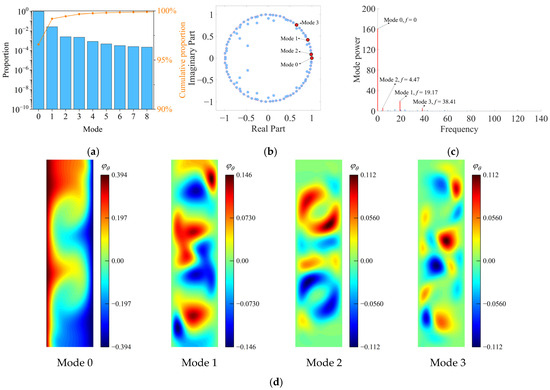
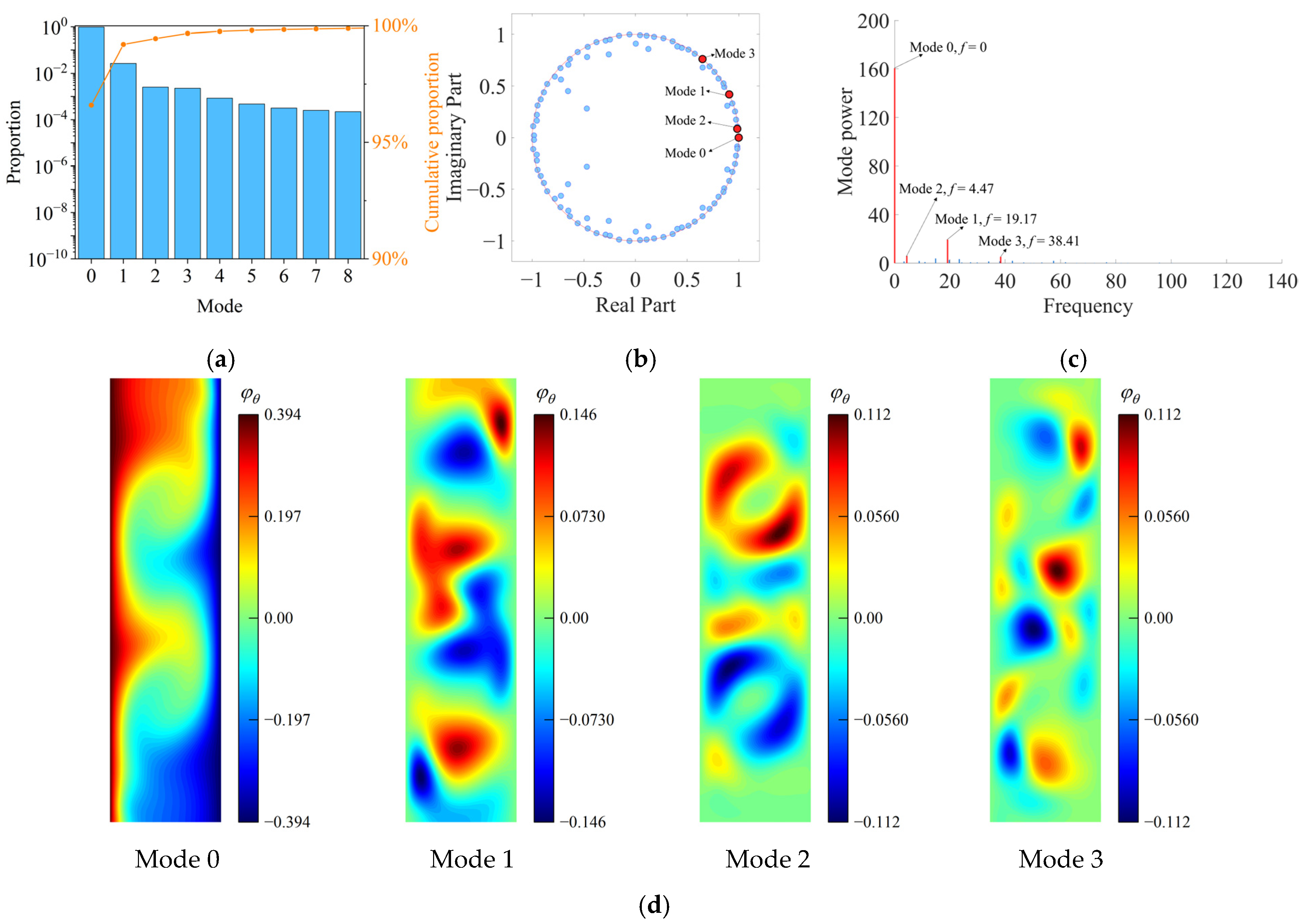
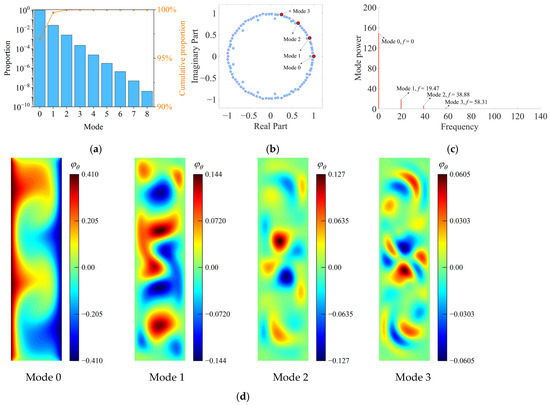
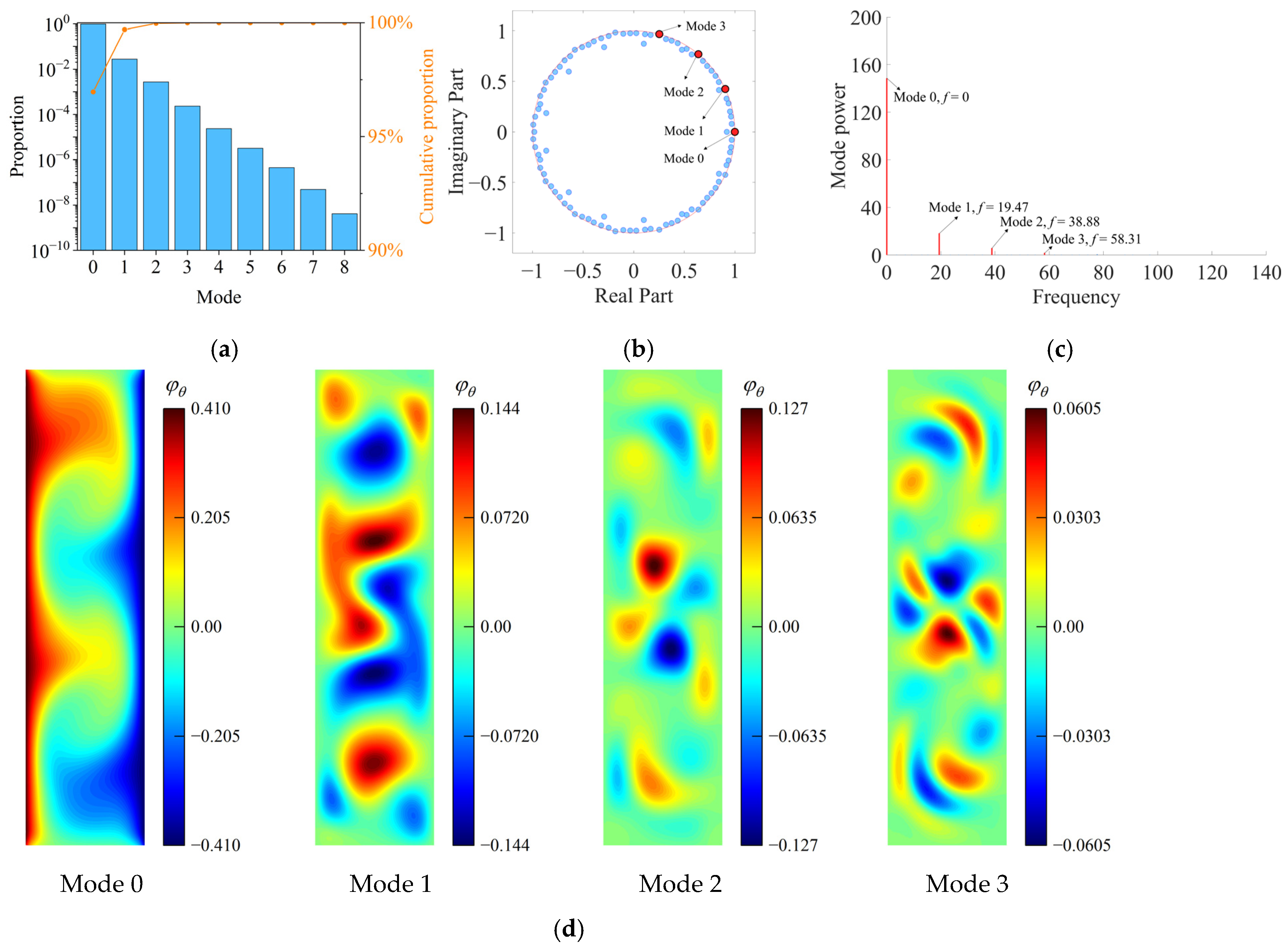
The DMD modal energy distribution is presented in Figure 6a. It shows that the energy proportion of each mode declines as the mode number increases, with Mode 0 carrying the dominant energy fraction at 96.5%. The DMD eigenvalue distribution shown in Figure 6b exhibits symmetry about the imaginary axis of the complex plane, where eigenvalues occur as complex conjugate pairs. The spatial location of eigenvalues relative to the unit circle in Figure 6b provides insights into the unsteady behavior of associated modes. Eigenvalues lying on or inside the unit circle denote convergent modes, whereas those outside indicate divergent behavior [25]. It is observed that all eigenvalues reside on or inside the unit circle for the no-radiation case, demonstrating that all DMD modes are convergent. In addition, Mode 0 yields a real part of unity and zero imaginary part, representing the time-averaged flow field [26].
Figure 6.
DMD analysis for no-radiation case () at and : (a) cumulative energy distribution and mode energy proportion, (b) complex plane distribution of eigenvalues, (c) mode frequency spectrum, and (d) spatial structures of first four dominant DMD modes.
As shown in Figure 6c, the frequency spectrum of DMD modes is plotted to identify the dominant modes. Four distinct spectral peaks correspond to the first four DMD modes. Mode 0 possesses the largest amplitude and represents the time-averaged flow field. It acts as the dominant steady structure with a frequency of 0. Modes 1–3 yield frequencies of 19.17 (fundamental frequency), 4.47 (low-frequency perturbation), and 38.42 (second harmonic), respectively. According to Liang et al. [6], the low perturbation frequency of 4.47 is approximately equal to . The flow field comprises a family of subharmonic and harmonic components of the fundamental frequency, which can be expressed as .
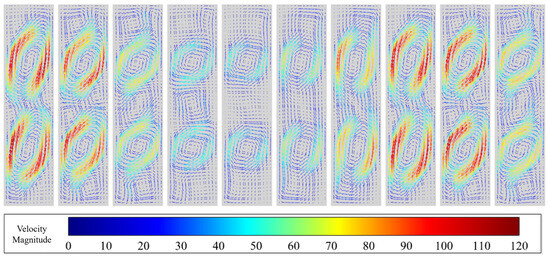
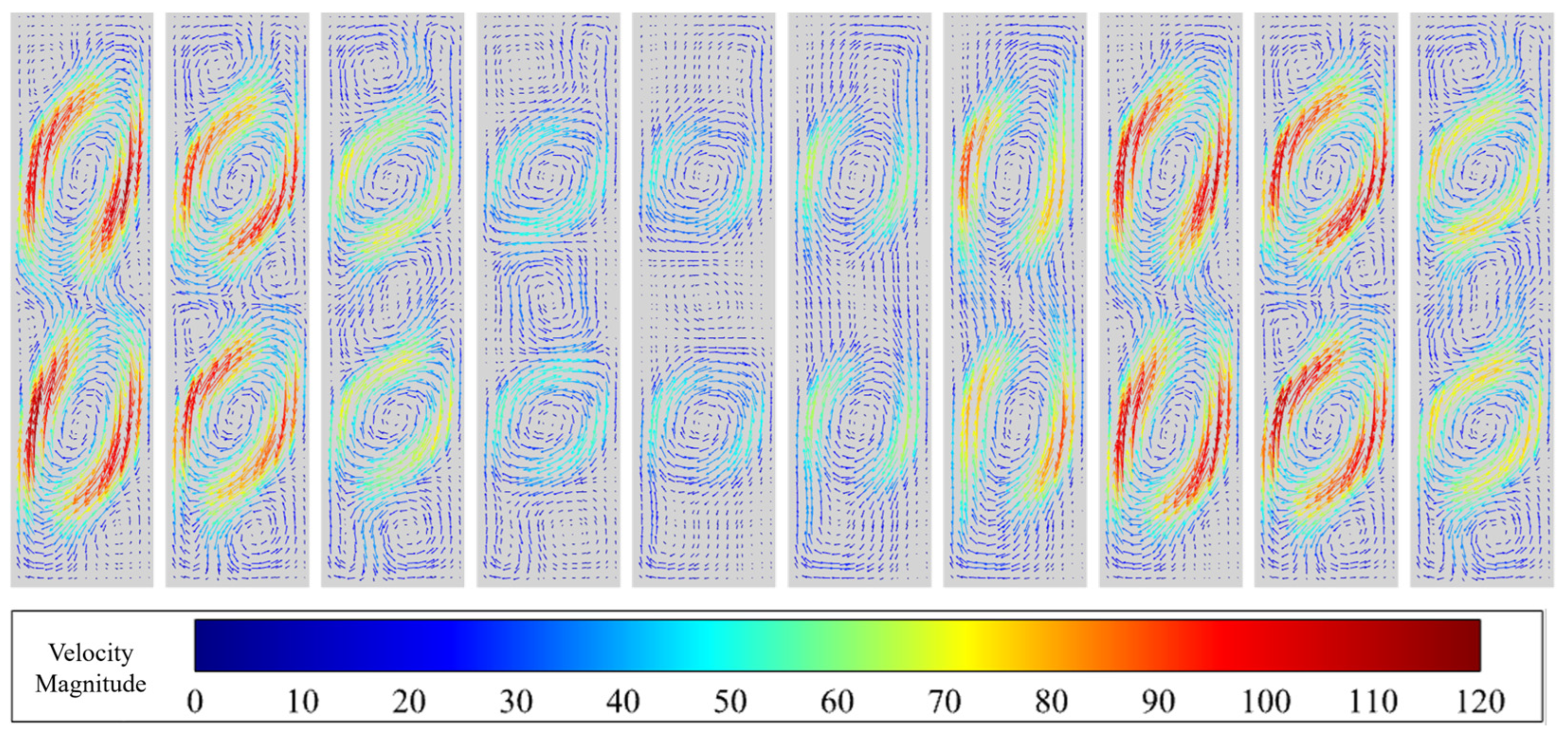
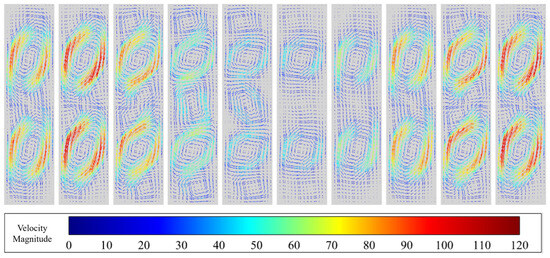
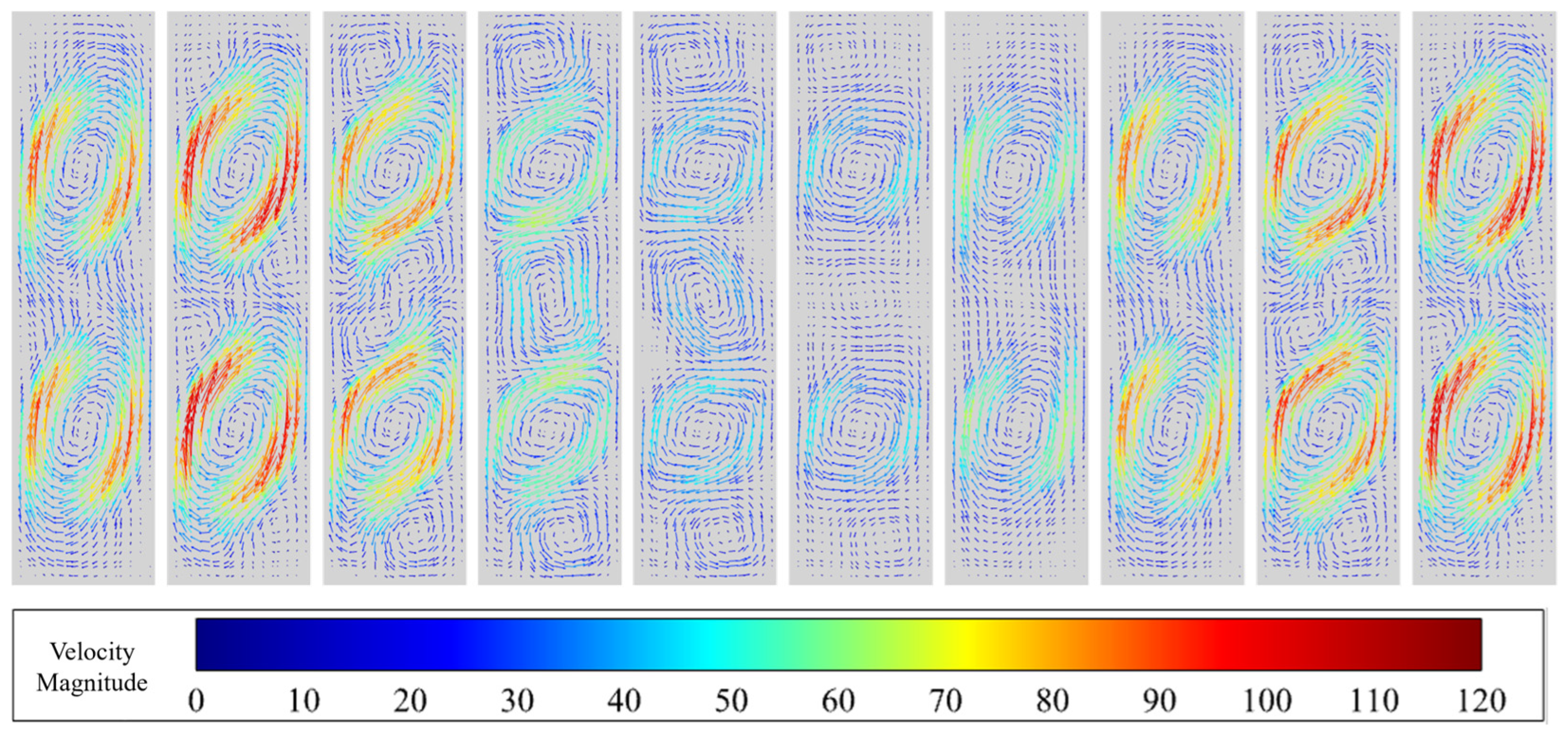
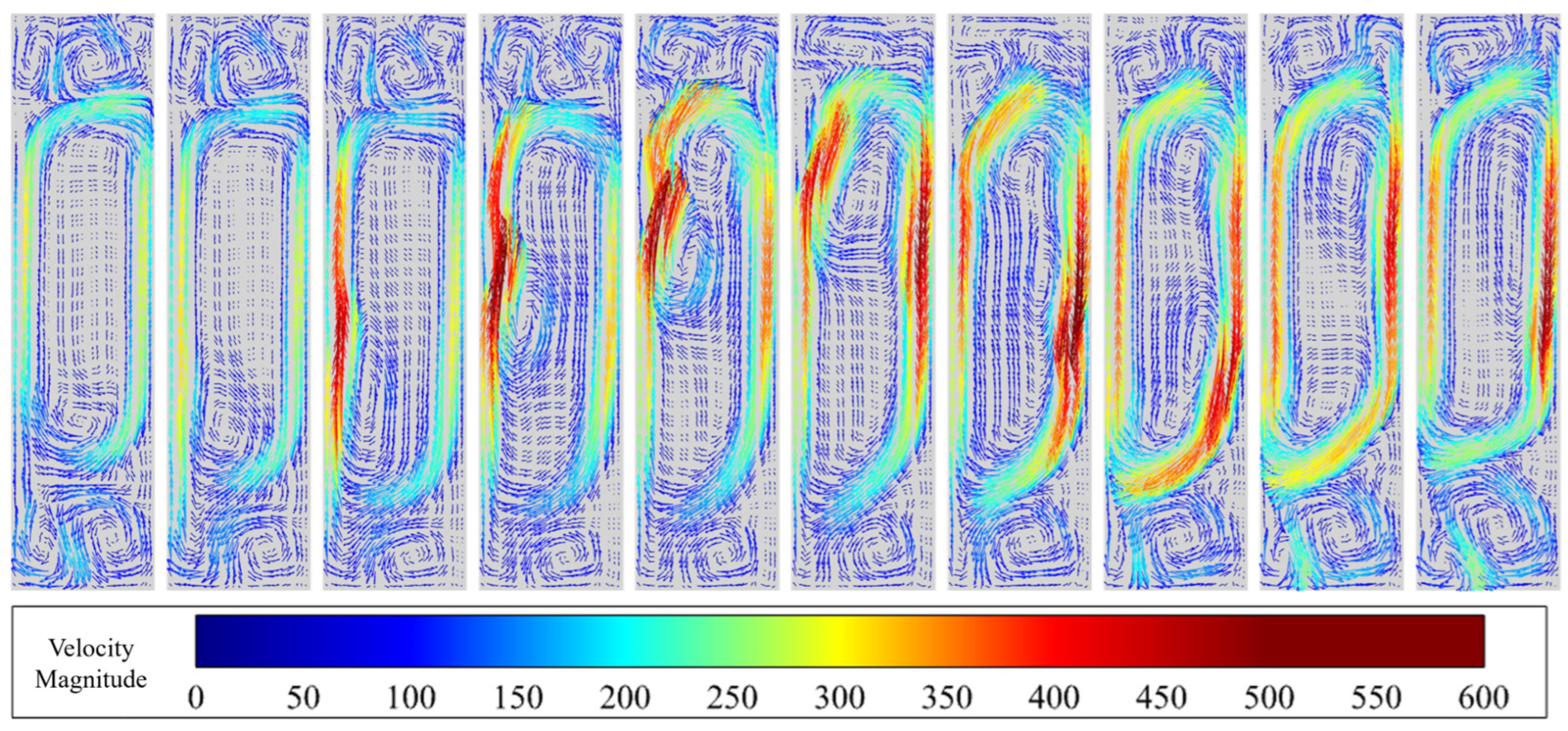
The spatial distributions of the first four DMD modes are shown in Figure 6d. As mentioned earlier, Mode 0 represents the time-averaged flow field. For the no-radiation case, the time-averaged temperature field within the cavity exhibits several horizontal thermal bulges along the active sidewalls. Figure 7 shows the corresponding instantaneous velocity vectors, revealing multi-cell flow oscillations within the cavity. This behavior is characteristic of oscillatory double-diffusive instability, whose fundamental physical origin lies in buoyancy balance. Mode 1 is the perturbation mode governed by the fundamental frequency, displaying alternating positive- and negative-sign perturbation distributions in the vertical direction. Mode 2 denotes the low-frequency subharmonic mode, whereby two large-scale perturbation features develop in the central cavity, while perturbation amplitudes diminish toward zero near the upper and lower sidewall regions. Mode 3 corresponds to the second harmonic frequency mode and evolves from Mode 1. Relative to the first two modes, this mode produces abundant spatial perturbation features with substantially smaller characteristic spatial scales.
Figure 7.
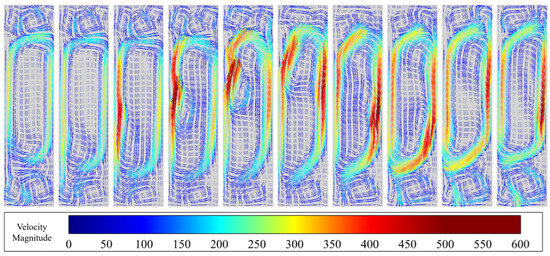
Snapshots of instantaneous velocity vector field for no-radiation case () at and .
Figure 8 summarizes the DMD analysis for the wall radiation case (). Figure 8a displays the energy proportion of each DMD mode. Compared with the no-radiation case, energy is transferred from higher-order modes toward lower-order modes, with Mode 0 accounting for 96.9% of the total energy. All eigenvalues in the complex plane representation fall inside or lie closely along the unit circle (see Figure 8b). Furthermore, Figure 8c shows that upon introducing wall radiation, Modes 1–3 yield frequencies of 19.47, 38.88, and 58.31, respectively. These frequencies show good agreement with the spectral results derived from the monitoring point signals.
Figure 8.
DMD analysis for wall radiation case () at and : (a) cumulative energy distribution and mode energy proportion, (b) complex plane distribution of eigenvalues, (c) mode frequency spectrum, and (d) spatial structures of first four dominant DMD modes.
Figure 8d presents the spatial distributions of the first four DMD modes for the wall radiation case. The time-averaged temperature field of Mode 0 features a multi-bulge thermal pattern along the active sidewalls, which is broadly similar to that observed for the no-radiation case. Nevertheless, wall radiation heat transfer substantially modifies the cavity thermal boundary conditions and produces local temperature stratification near the horizontal walls, resembling the thermal stratification in Rayleigh–Bénard (RB) convection. Figure 9 further plots snapshots of the instantaneous velocity vector field, which also reveal multi-cell flow oscillations within the cavity. Regarding the perturbation modes, Mode 1 is the fundamental frequency perturbation mode. Its global alternating positive- and negative-sign temperature perturbation distributions remain oriented along the vertical direction, with spatial extents and characteristic scales nearly identical to those obtained for the no-radiation condition. This demonstrates that wall radiation does not alter the intrinsic instability mechanism governing the double-diffusive convection system. Mode 2 corresponds to the second harmonic mode, which exhibits numerous sparsely distributed perturbation features with substantially reduced characteristic scales. Mode 3 denotes the third harmonic mode, for which perturbation distributions within the cavity become further fragmented and localized.
Figure 9.
Snapshots of instantaneous velocity vector field for wall radiation case () at and .
Comparisons of the DMD results obtained with and without wall radiation reveal that, within opposing flow where thermal and solutal buoyancy forces are nearly balanced, wall radiation does not alter the system’s intrinsic instability mechanism. Instead, it reconstructs the cavity thermal boundary conditions, thereby modifying the global buoyancy field. This further tunes the growth and dissipation behaviors of perturbations at different frequencies, drives the redistribution of perturbation energy, and ultimately yields the stabilization of the cavity flow.
4.1.2. Thermal-Buoyancy-Dominated Regime
This section further investigates how wall radiation modulates the flow instability behavior of double-diffusive convection within the regime dominated by thermal buoyancy. Under this condition, the competing effect between thermal and solutal buoyancy is substantially weakened, and the critical Rayleigh number for the onset of instability rises considerably relative to cases where . Accordingly, the Rayleigh number is fixed at for the simulations presented herein. Three test cases of the thermal-buoyancy-dominated regime (, 0.7, 0.852) are selected to explore flow regime evolution driven by changes in wall emissivity. An extra reference case with N near unity () is also included for comparison.
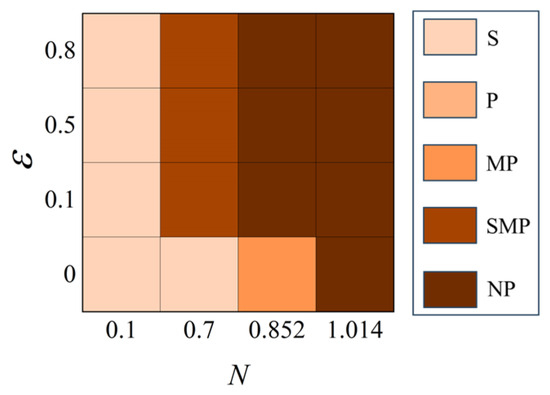
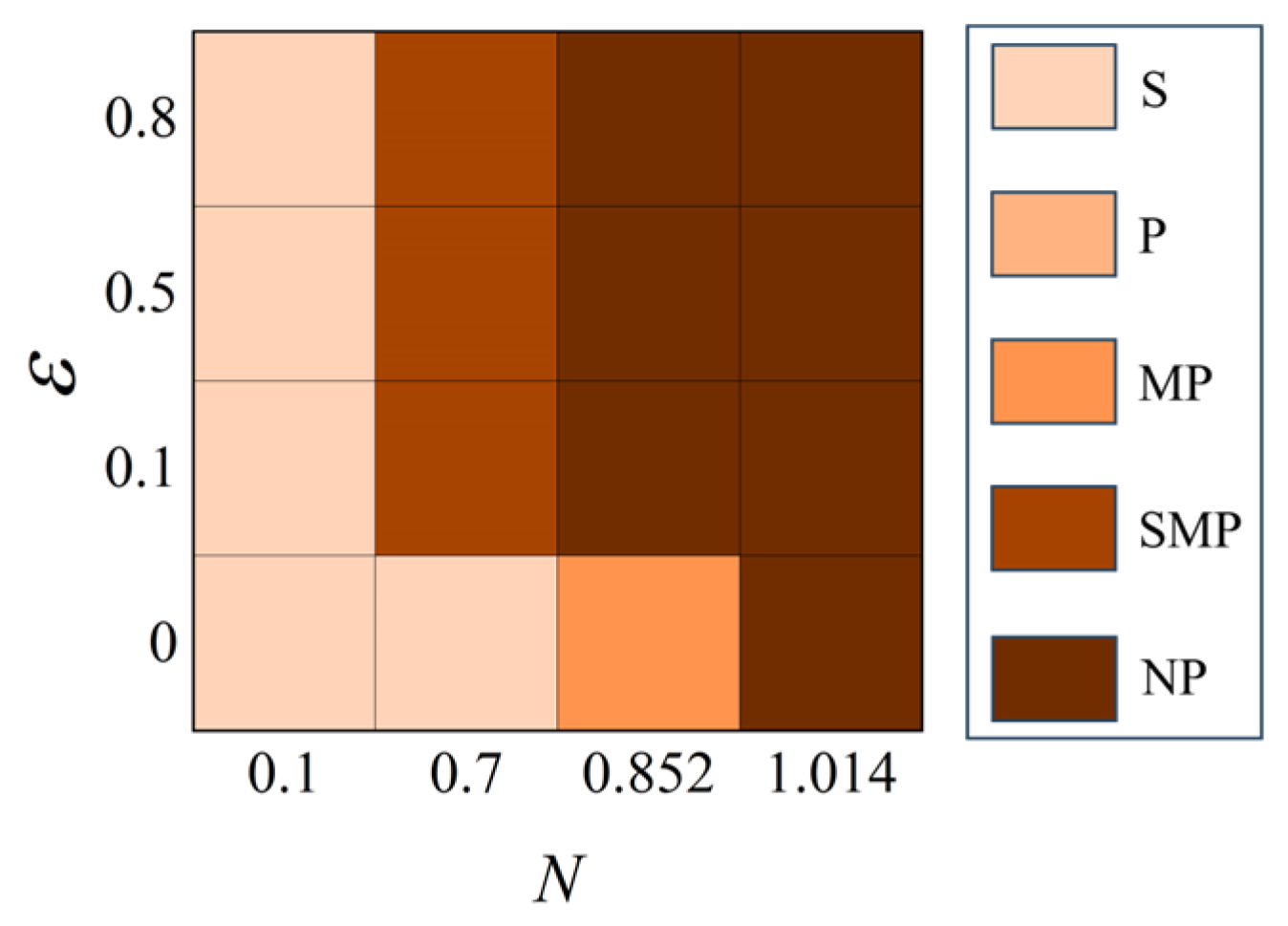
Figure 10 summarizes flow transitions driven by wall emissivity for buoyancy ratio values of , 0.7, 0.852 and 1.014 at . All test cases yield steady-state flow for . For , the introduction of wall radiation triggers a transition from steady-state flow to the SMP regime. At , wall radiation heat transfer induces a flow transition from the MP regime to the NP regime. These observations demonstrate that wall radiation promotes flow instability under the thermal-buoyancy-dominated regime, a modulating effect completely opposite to the behavior found for the near-balanced buoyancy regime. For the reference case, intense competition between thermal and solutal buoyancy forces produces highly unstable NP flow across all simulation runs.
Figure 10.
Flow transitions driven by wall emissivity for , 0.7, 0.852 and 1.014 at .
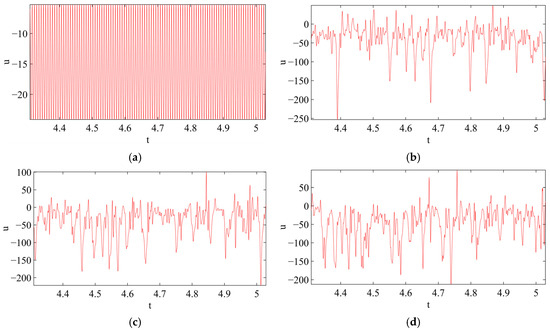
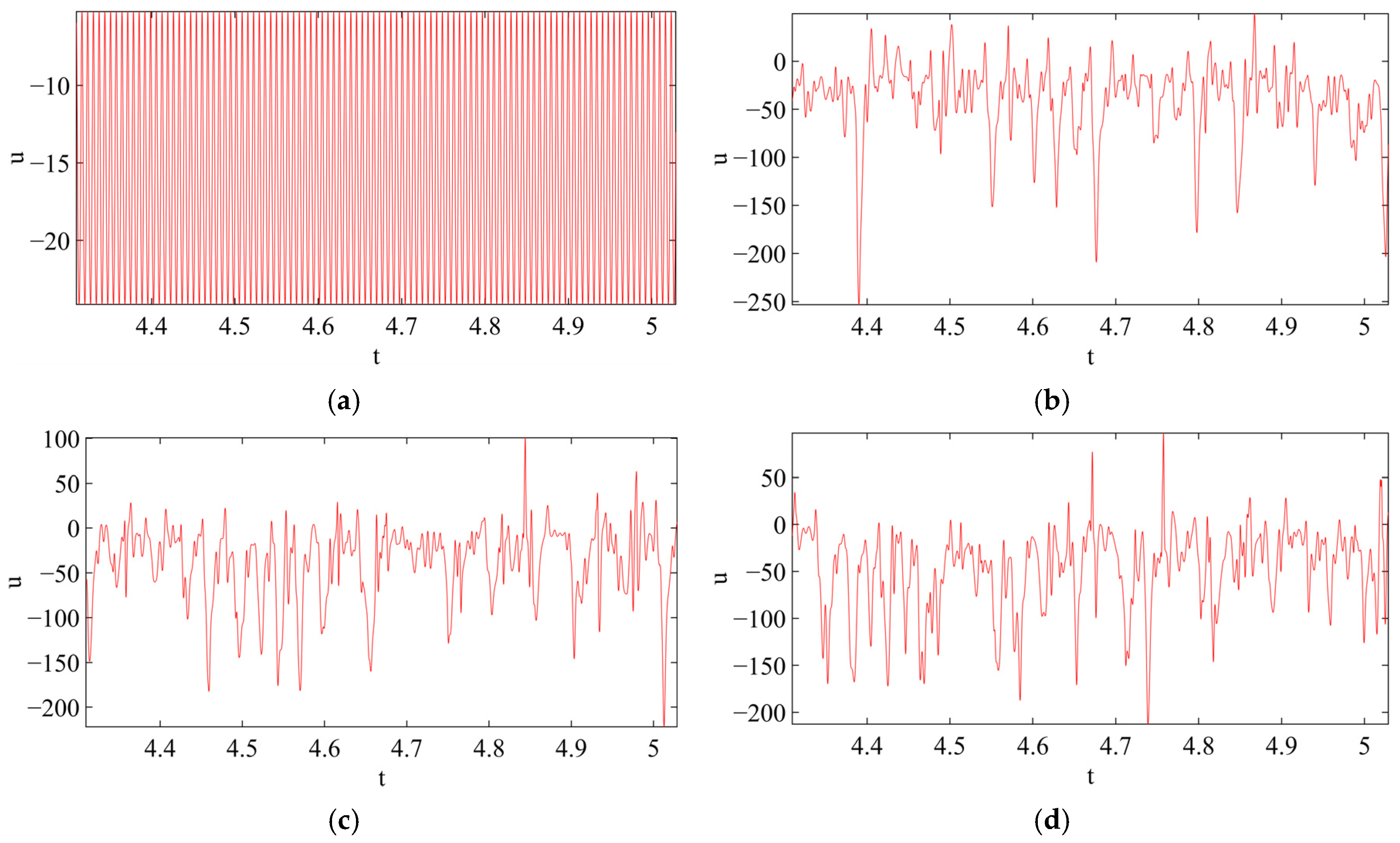
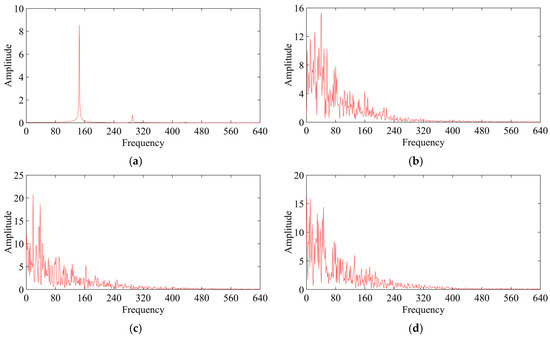
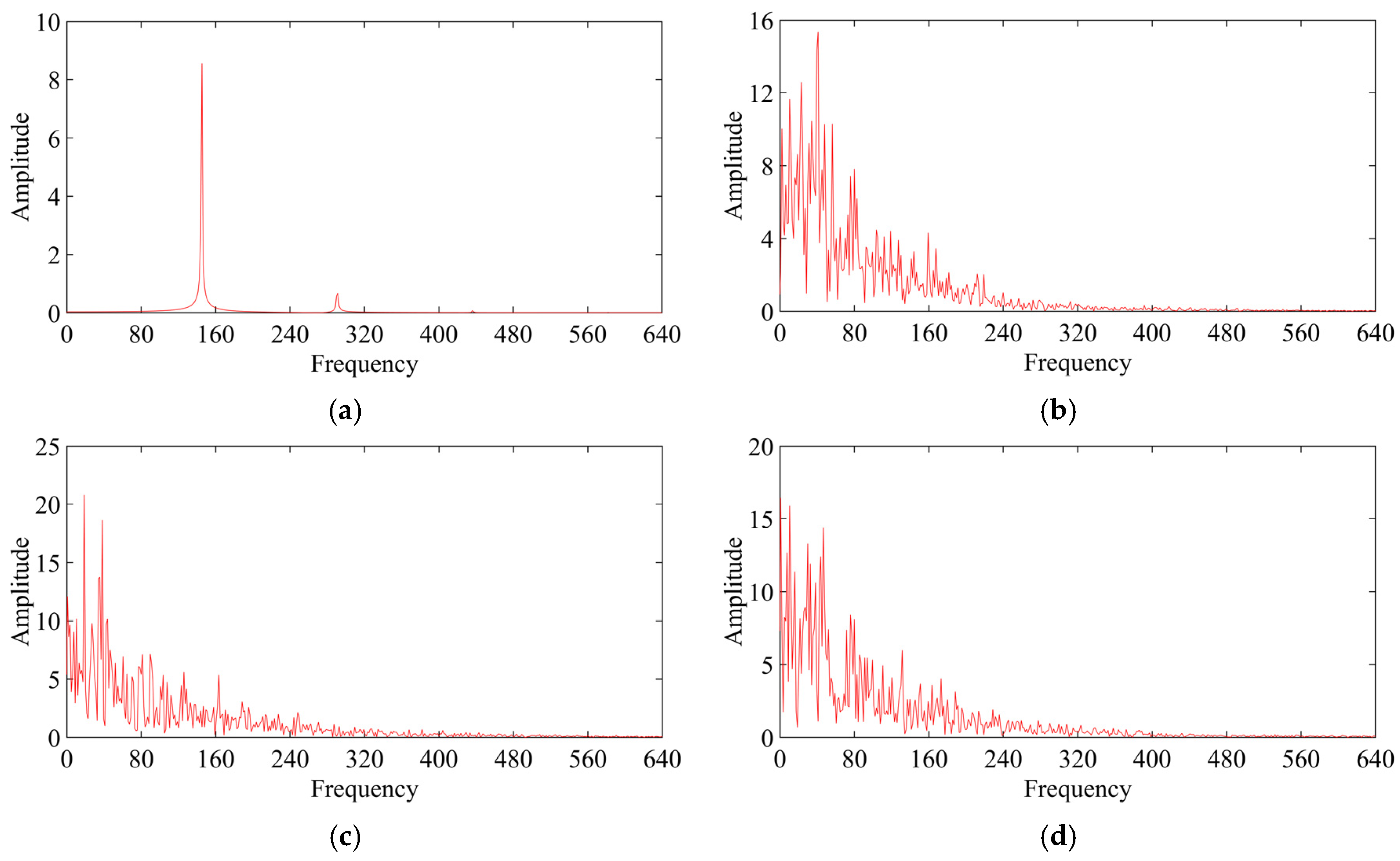
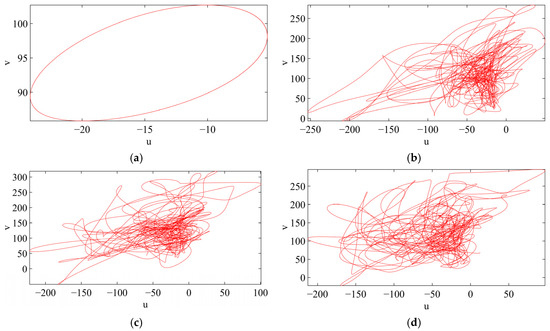
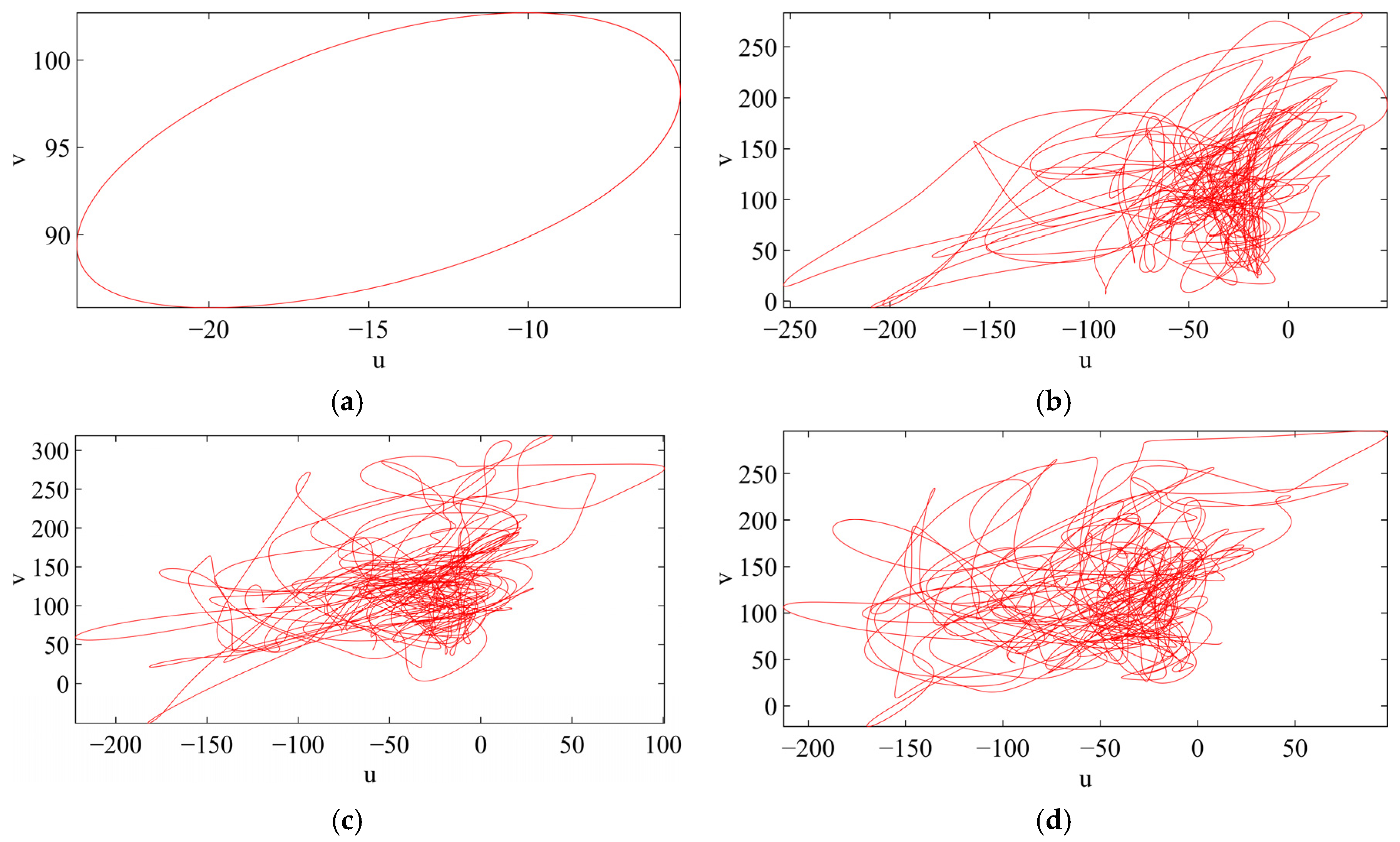
The case is selected as a representative example to analyze flow transitions. Figure 11, Figure 12 and Figure 13 show the time evolution, Fourier spectra, and phase trajectories of the instantaneous velocity at the monitoring point, respectively. For the no-radiation case (panel a), highly regular periodic oscillations are observed. The spectrum contains only the FF component and its second harmonic. The phase trajectory forms a simple closed limit cycle orbit, corresponding to the MP flow regime. With the introduction of wall radiation, the flow characteristics change considerably. The time evolution of u exhibits abundant aperiodic oscillations and irregular sharp peaks, while the spectrum displays a broadband superposition of multiple frequency components. Meanwhile, the phase trajectory develops multiple irregular limit cycle orbits, signifying a gradual transition to aperiodic flow. These results demonstrate that wall radiation can substantially promote flow instability under the thermal-buoyancy-dominated regime, representing a mechanism opposite to that for the near-balanced thermal–solutal buoyancy regime.
Figure 11.
The time evolution of the instantaneous horizontal velocity u for cases (a) , (b) , (c) and (d) under the thermal-buoyancy-dominated regime.
Figure 12.
The Fourier spectra of the instantaneous horizontal velocity u for cases (a) , (b) , (c) and (d) under the thermal-buoyancy-dominated regime.
Figure 13.
The phase space trajectories of v vs. u for cases (a) , (b) , (c) and (d) under the thermal-buoyancy-dominated regime.
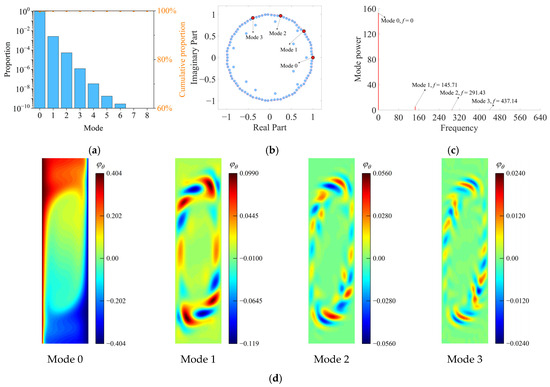
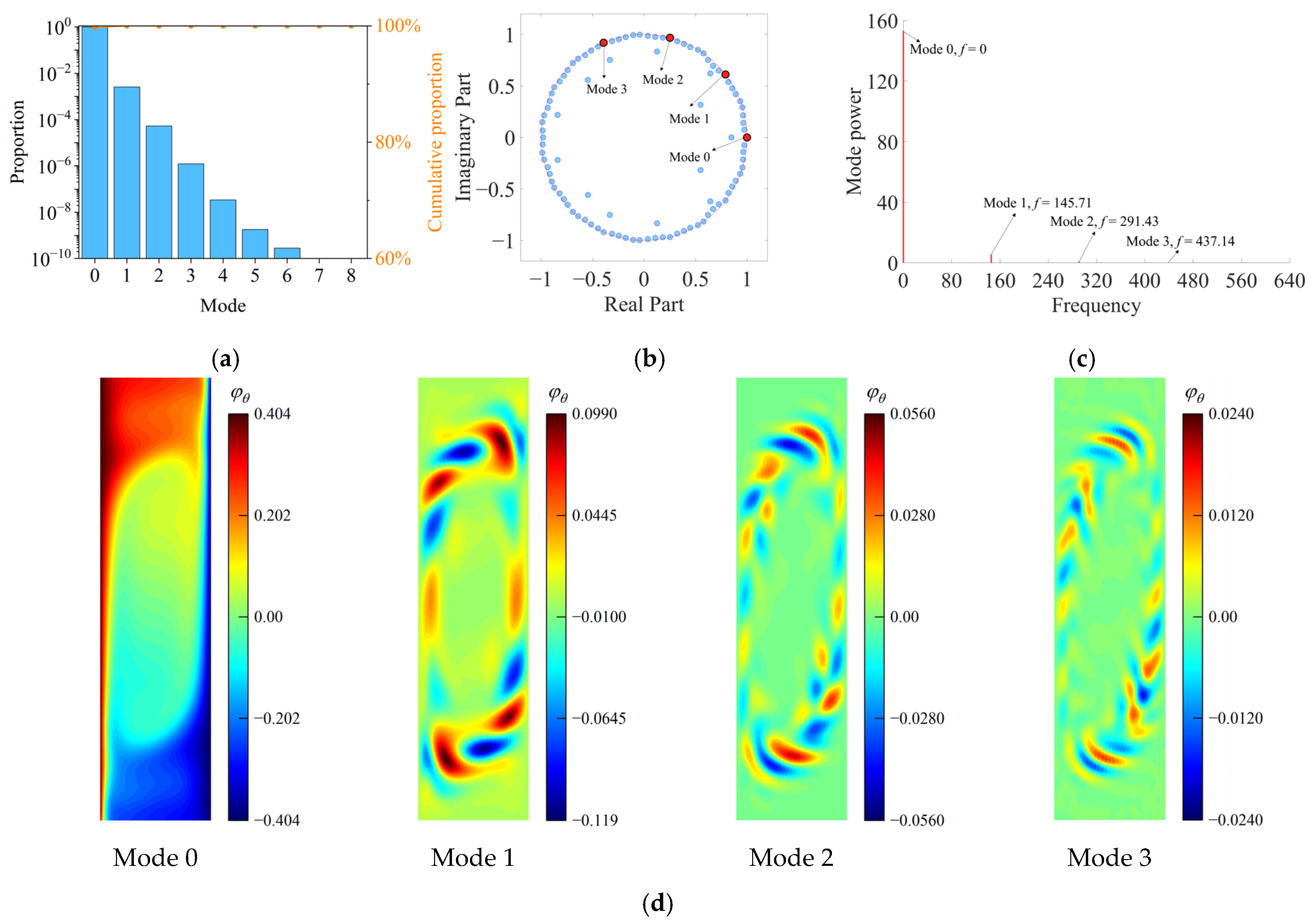
Next, dynamic mode decomposition (DMD) analysis is carried out for the cases with wall radiation () and without wall radiation at and . For , DMD is performed on 100 snapshots of the temperature field sampled at an interval of , yielding an effective sampling frequency and a spectral resolution . For , DMD is performed on 400 snapshots of the temperature field with an identical sampling interval of , yielding the same effective sampling frequency and a spectral resolution .
Figure 14 presents the DMD results for the no-radiation case with and . It is observed that energy is highly concentrated in low-order modes, where Mode 0 accounts for more than 99% of the total energy. In terms of eigenvalue distribution on the complex plane, the eigenvalues of all modes lie either closely along the unit circle boundary or inside the unit circle, indicating convergent behavior for all DMD modes. Figure 14c further lists the frequencies of Modes 1–3, which are 145.71, 291.43 and 437.14, respectively. These values are consistent with the characteristics of MP flow and agree well with the spectral results obtained from the monitoring point signals.
Figure 14.
DMD analysis for no-radiation case () at and : (a) cumulative energy distribution and mode energy proportion, (b) complex plane distribution of eigenvalues, (c) mode frequency spectrum, and (d) spatial structures of first four dominant DMD modes.
Figure 14d shows the spatial distributions of the first four DMD modes. It can be seen that the time-averaged temperature field exhibits curved hot regions spreading toward the top wall and curved cold regions propagating toward the bottom wall. When combined with the instantaneous velocity vector distributions (Figure 15), the results reveal that a large-scale single clockwise circulation forms inside the cavity, driven by dominant thermal buoyancy.
Figure 15.
Snapshots of instantaneous velocity vector field for no-radiation case () at and .
As for the perturbation modes, Mode 1 is the perturbation mode associated with the fundamental frequency. It features an annular alternating pattern of positive- and negative-sign temperature perturbations, reflecting the instability mechanism governed by the inertia of the global circulating flow. Mode 2 and Mode 3 correspond to the second and third harmonic modes, respectively. They inherit the overall spatial distribution of Mode 1, while their perturbation features exhibit progressively reduced spatial scales.
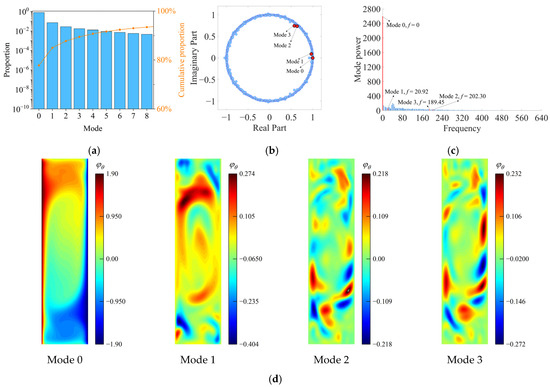
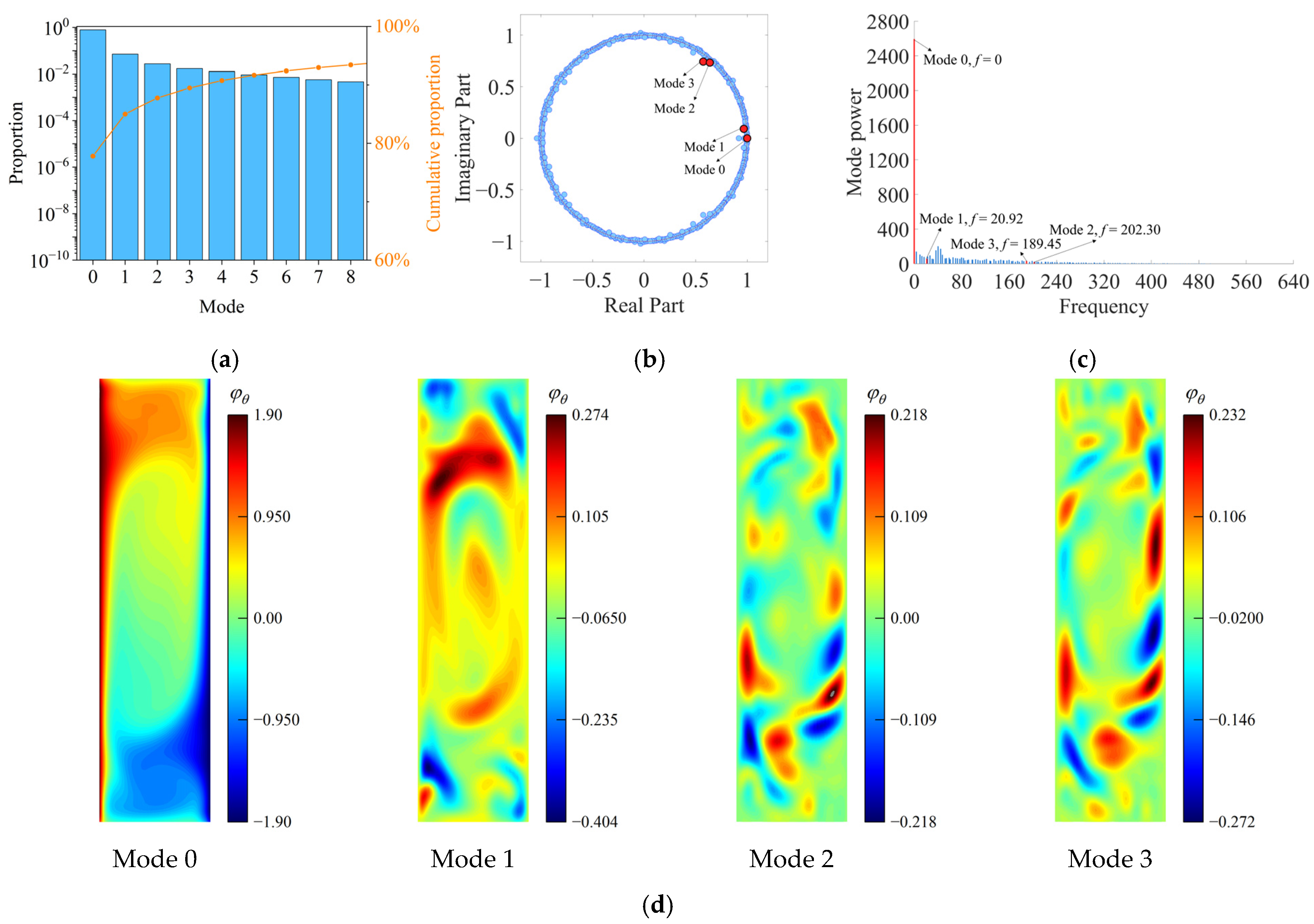
Figure 16 presents the DMD results for the wall radiation case () with and . In the modal energy proportion distribution, it is observed that wall radiation effects induce a substantial energy transfer from low-order modes to higher-order modes. Mode 0 accounts for 77.8% of the total energy, and the cumulative energy proportion of the first four modes is less than 90%. In terms of eigenvalue distribution on the complex plane, although the eigenvalues of the first four modes remain close to the unit circle boundary or lie inside the unit circle, a small number of eigenvalues fall outside the unit circle. Meanwhile, the frequency spectrum obtained from DMD contains numerous irregular frequency components. The frequencies corresponding to Modes 1–3 are 20.92, 202.30 and 189.45, and no integer–harmonic relationships exist among these dominant dynamic modes.
Figure 16.
DMD analysis for wall radiation case () at and : (a) cumulative energy distribution and mode energy proportion, (b) complex plane distribution of eigenvalues, (c) mode frequency spectrum, and (d) spatial structures of first four dominant DMD modes.
Furthermore, quantitative statistics are performed for the four DMD cases considered in this study: (1) , without wall radiation; (2) , with wall radiation (); (3) , without wall radiation; and (4) , with wall radiation (). An energy fraction threshold of 0.1% is applied to the top 10 energetic DMD modes to count those with non-negligible contributions. The resulting numbers are 4, 3, 2 and 10 for the four cases, respectively. For the first three cases, only a small number of modes exceed this threshold, indicating that fluctuation energy concentrates within a limited set of dynamic components. In contrast, all ten modes in the fourth case exceed 0.1%, demonstrating that fluctuation energy is broadly distributed across many modes rather than confined to a few dominant ones. This distinctive spectral energy distribution distinguishes the fourth case as the NP regime.
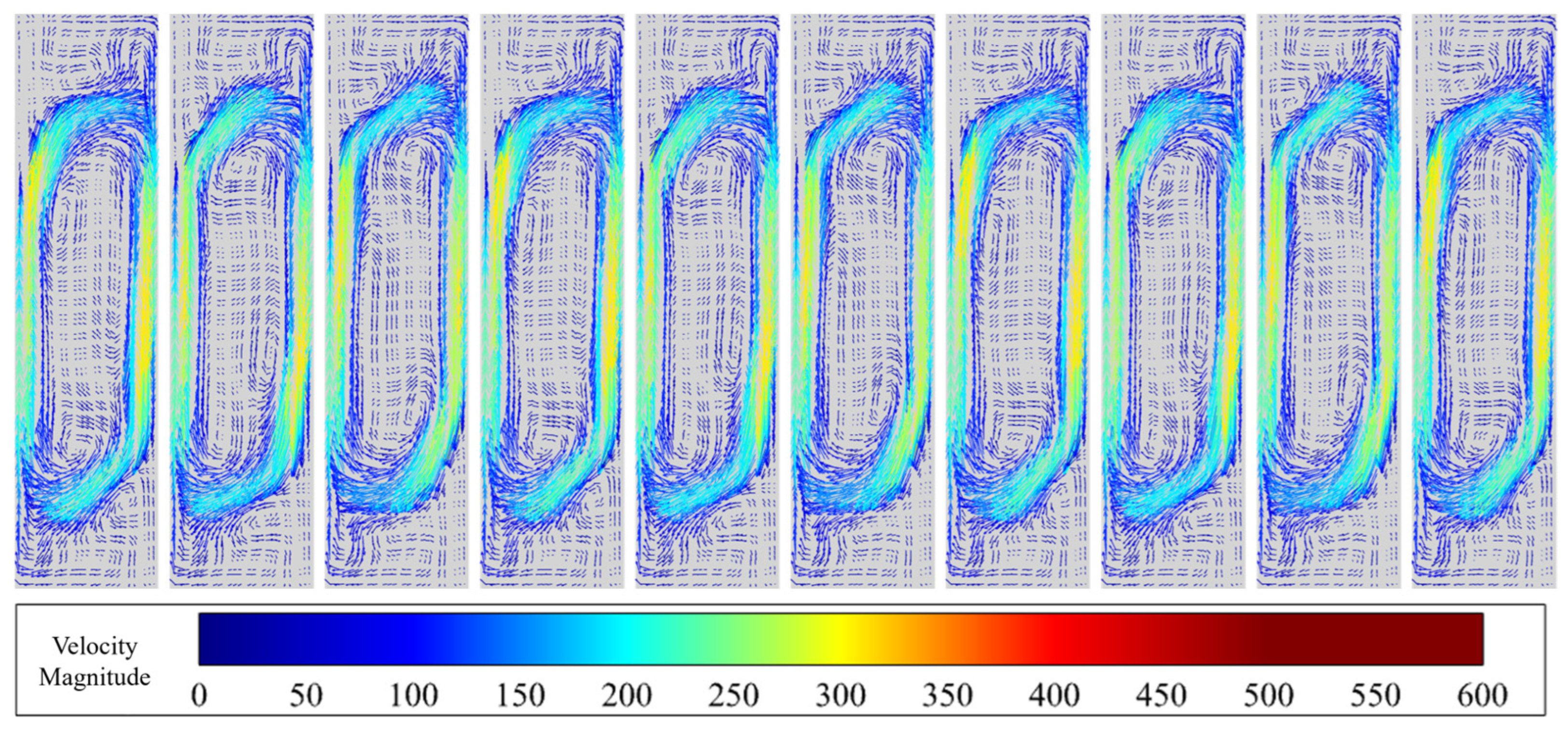
The spatial distributions of the first four DMD modes for the wall radiation case are presented in Figure 16d. It can be observed that the time-averaged temperature field within the cavity still exhibits smoothly curved contours. Nevertheless, under the effect of wall radiation, Rayleigh–Bénard (RB)-type thermal stratification forms in the near-wall regions adjacent to the top and bottom walls. Meanwhile, snapshots of the instantaneous velocity vector field reveal that the large-scale clockwise circulation still persists in the core region of the cavity, while the intensity of vortex structures near the horizontal walls is markedly enhanced, indicating enhanced flow disorder (see Figure 17). For Mode 1, the original annular alternating structure of positive- and negative-sign perturbations becomes diffuse and poorly delineated. Mode 2 and Mode 3 exhibit disordered perturbation distributions with mixed spatial scales.
Figure 17.
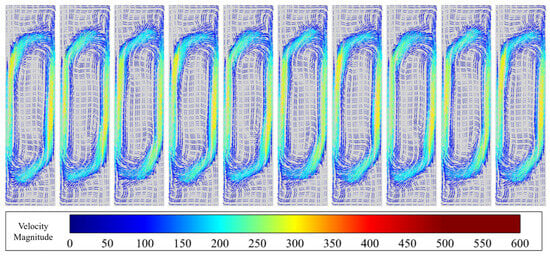
Snapshots of instantaneous velocity vector field for wall radiation case () at and .
The destabilizing effect of wall radiation under this thermal-buoyancy-dominated regime originates from RB-type thermal stratification induced within the near-wall regions at the top and bottom of the cavity. This local thermal stratification triggers secondary vortices that undergo strong nonlinear coupling with the global circulation and advance the inertial instability process of the large-scale circulation. Notably, wall radiation can also generate RB-type thermal stratification under the nearly balanced buoyancy regime, yet secondary vortices are not induced in this case. Accordingly, the effects of RB-type thermal stratification depend on the system’s intrinsic instability mechanism: either the inertial instability of large-scale circulation or the oscillatory double-diffusive instability originating from buoyancy balance. This constitutes an important distinction between double-diffusive convection and purely thermal convection.
4.2. Heat and Mass Transfer
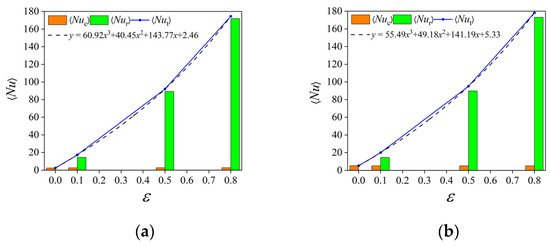
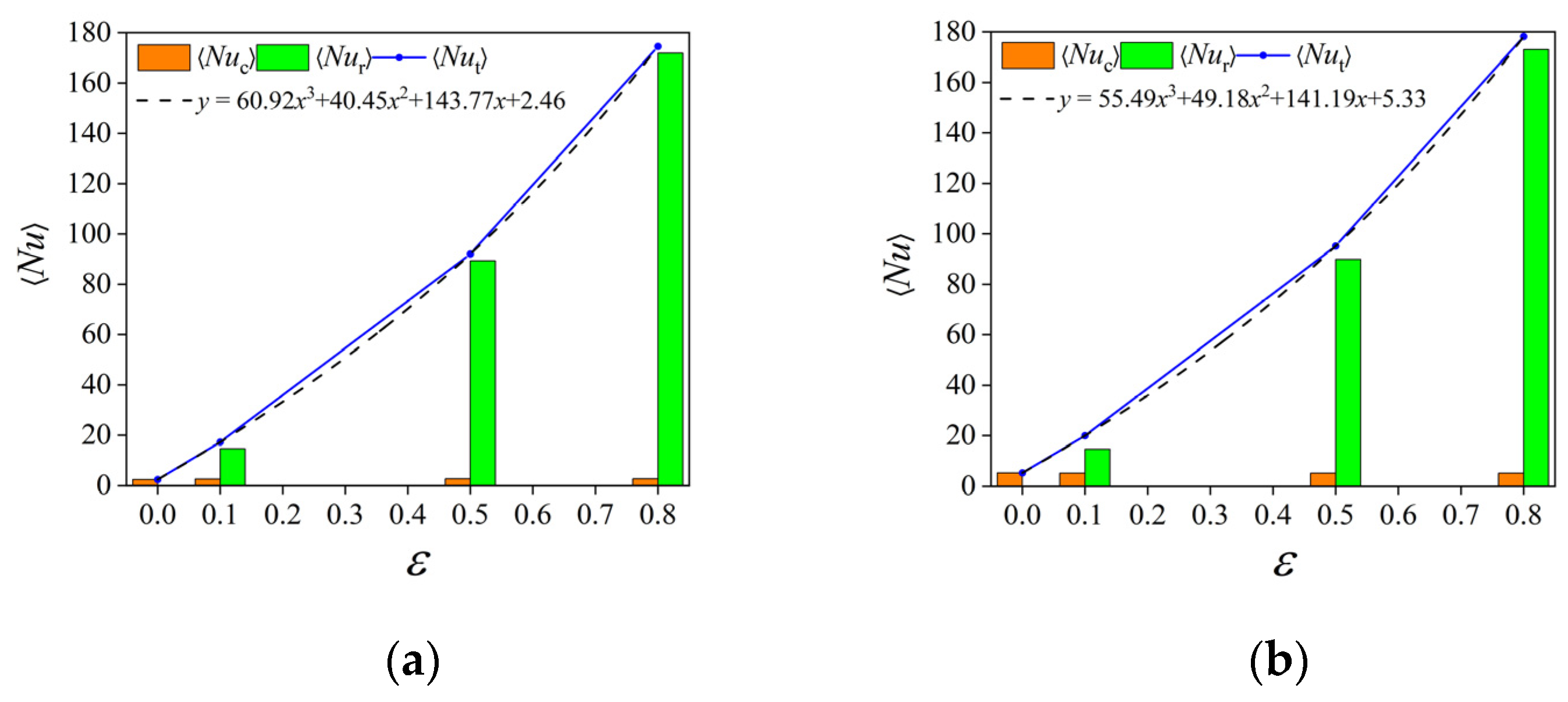
This section further analyzes how wall emissivity influences the heat and mass transfer at the cavity walls. The variations in the time-averaged Nusselt numbers , , and with wall emissivity are presented for the nearly balanced buoyancy regime (, ) and the thermal-buoyancy-dominated regime (, ), as shown in Figure 18. It is observed that increasing wall emissivity produces a substantial enhancement in wall heat transfer under both buoyancy regimes. As the wall emissivity rises from 0 to 0.8, the total heat transfer () grows following a polynomial trend. Furthermore, wall radiation becomes the dominant component of wall heat transfer once it is activated in both cases.
Figure 18.
Variations in the time-averaged Nusselt numbers with wall emissivity for (a) the nearly balanced buoyancy regime (, ) and (b) the thermal-buoyancy-dominated regime (, ).
It is further observed that the convective Nusselt number () exhibits low sensitivity to changes in wall emissivity. For case (a), stays within a narrow band of 2.4~2.7, while for case (b), it stabilizes between 5.1 and 5.3. This arises because the net buoyancy driving force within the cavity, jointly determined by temperature and solute concentration, remains essentially unchanged as Ra and N are fixed. The extra heat transfer associated with elevated wall emissivity originates almost entirely from the radiative component. While wall-radiation-modified boundary thermal conditions can modify flow stability, these dynamic alterations exert only a limited influence on the time-averaged magnitude of fully established buoyancy-driven convection.
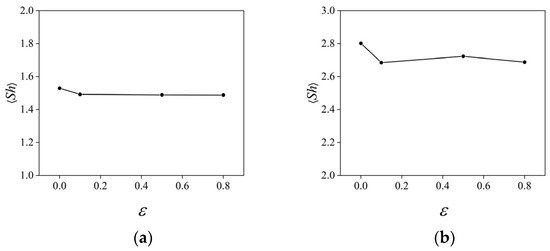
Figure 19 shows variations in the time-averaged Sherwood number with wall emissivity. For both buoyancy regimes, the time-averaged Sherwood number decreases after wall radiation is activated compared with the no-radiation case, and weak oscillations in Sh develop as wall emissivity increases further. Mass transfer is governed purely by convection–diffusion, with no direct radiative contribution. It can be inferred that wall radiation modifies the thermal boundary conditions and introduces unsteady flow disturbances, which tend to suppress solute transport. As a result, the system exhibits non-synergistic transport behavior characterized by enhanced heat transfer accompanied by weakened mass transfer.
Figure 19.
Variations in the time-averaged Sherwood numbers with wall emissivity for (a) the nearly balanced buoyancy regime (, ) and (b) the thermal-buoyancy-dominated regime (, ).
5. Conclusions
This study numerically investigated the effects of wall radiation on the flow instability and heat and mass transfer of double-diffusive natural convection in a rectangular cavity under opposing thermal–solutal buoyancy conditions. Two representative regimes were examined, namely a nearly balanced buoyancy regime and a regime dominated by thermal buoyancy. The numerical results demonstrate that the modulating role of wall radiation on flow instability is regime-dependent and can even be opposite in character.
In the nearly balanced buoyancy regime, wall radiation suppresses flow instability. The dynamic mode decomposition analysis indicates that wall radiation does not alter the intrinsic oscillatory double-diffusive instability originating from buoyancy balance. Instead, it reconstructs the thermal boundary conditions of the cavity, modifies the global buoyancy field, and redistributes perturbation energy among different frequency components, thereby stabilizing the cavity flow. By contrast, in the regime dominated by thermal buoyancy, wall radiation promotes flow instability. It induces Rayleigh–Bénard-type thermal stratification adjacent to the horizontal walls, which triggers secondary vortices that couple nonlinearly with the global circulation and accelerate the inertial instability of the large-scale flow. This regime-dependent contrast highlights that the effect of wall radiation is governed by the intrinsic instability mechanism of the system, an important distinction between double-diffusive convection and purely thermal convection.
Regarding heat and mass transfer, increasing wall emissivity substantially enhances wall heat transfer, which becomes dominated by the radiative component, whereas the convective contribution remains essentially unchanged because the net buoyancy driving force is preserved. In contrast, the time-averaged mass transfer is weakened once wall radiation is activated, reflecting the non-synergistic transport behavior of enhanced heat transfer accompanied by suppressed solute transport.
These findings provide theoretical insights that may inform flow stability control and wall coating optimization in high-temperature thermal systems. For systems dominated by thermal buoyancy, radiating walls promote local thermal stratification and increase flow unsteadiness. In contrast, when thermal and solutal buoyancy are nearly balanced and the flow is prone to oscillations, radiating walls contribute to flow stabilization. Future work will extend the present analysis to three-dimensional enclosures and gas mixtures with volumetric radiation.
Author Contributions
Conceptualization, Y.W.; Investigation, X.M. and X.Q.; Data curation, X.M.; Writing—original draft, Y.W., X.M. and X.Q.; Writing—review & editing, Y.W.; Funding acquisition, Y.W. All authors have read and agreed to the published version of the manuscript.
Funding
This work was supported by National Natural Science Foundation of China (No. 12602432) and Tianjin Municipal Education Commission (No. 2024KJ105).
Institutional Review Board Statement
Not applicable.
Informed Consent Statement
Not applicable.
Data Availability Statement
The raw data supporting the conclusions of this article will be made available by the authors on request.
Conflicts of Interest
The authors declare no conflict of interest.
References
- Beghein, C.; Haghighat, F.; Allard, F. Numerical study of double-diffusive natural convection in a square cavity. Int. J. Heat Mass Transf. 1992, 35, 833–846. [Google Scholar] [CrossRef] [Scilit]
- Qin, Q.; Xia, Z.A.; Tian, Z.F. High accuracy numerical investigation of double-diffusive convection in a rectangular enclosure with horizontal temperature and concentration gradients. Int. J. Heat Mass Transf. 2014, 71, 405–423. [Google Scholar] [CrossRef] [Scilit]
- Yang, J.Q.; Zhao, B.X. Numerical investigation of double-diffusive convection in rectangular cavities with different aspect ratio I: High-accuracy numerical method. Comput. Math. Appl. 2021, 94, 155–169. [Google Scholar] [CrossRef] [Scilit]
- Rekha, D.R.S.; Jawali, V.; Alshehri, M.; Chung, J.D.; Shah, N.A.; Prabhakar, S.V.; Kumar, R.N.; Verma, A.; Varshney, G.; Manjunath, B.T. The analytical study of double diffusive convection in a rectangular enclosure bounded by porous lining with thermal radiation. Sci. Rep. 2024, 14, 17095. [Google Scholar] [CrossRef] [Scilit] [PubMed]
- Wang, J.; Yang, M.; He, Y.-L.; Zhang, Y. Oscillatory double-diffusive convection in a horizontal cavity with Soret and Dufour effects. Int. J. Therm. Sci. 2016, 106, 57–69. [Google Scholar] [CrossRef] [Scilit]
- Liang, X.; Peng, B.; Tian, Z. Complex transition of double-diffusive convection in a rectangular enclosure with height-to-length ratio equal to 4: Part II. Int. J. Heat Mass Transf. 2019, 135, 247–261. [Google Scholar] [CrossRef] [Scilit]
- Liang, X.; Li, X.; Fu, D.; Ma, Y. Complex transition of double-diffusive convection in a rectangular enclosure with height-to-length ratio equal to 4: Part I. Commun. Comput. Phys. 2009, 6, 247–268. [Google Scholar] [CrossRef] [Scilit]
- Beaume, C. Transition to doubly diffusive chaos. Phys. Rev. Fluids 2020, 5, 103903. [Google Scholar] [CrossRef] [Scilit]
- Sharifi, M. Effects of various instabilities on heat and mass transfer characteristics and their analysis in practical multidiffusive flow systems: A comprehensive review. Int. Commun. Heat Mass Transf. 2025, 162, 108685. [Google Scholar] [CrossRef] [Scilit]
- Sharifi, M.; Rasouli, N. A comprehensive review of double diffusive convection: Effects of flow geometries, external forces, and porous media. Int. Commun. Heat Mass Transf. 2025, 160, 108380. [Google Scholar] [CrossRef] [Scilit]
- Ridouane, E.H.; Hasnaoui, M.; Amahmid, A.; Raji, A. Interaction between natural convection and radiation in a square cavity heated from below. Numer. Heat Transf. 2004, 45, 289–311. [Google Scholar] [CrossRef] [Scilit]
- Soucasse, L.; Rivière, P.; Soufiani, A.; Xin, S.; Le Quéré, P. Transitional regimes of natural convection in a differentially heated cubical cavity under the effects of wall and molecular gas radiation. Phys. Fluids 2014, 26, 024105. [Google Scholar] [CrossRef] [Scilit]
- Bahlaoui, A.; Raji, A.; Ayachi, R.E. Coupled natural convection and radiation in a horizontal rectangular enclosure discretely heated from below. Numer. Heat Transf. 2007, 52, 1027–1042. [Google Scholar] [CrossRef] [Scilit]
- Boukendil, M.; Moutaouakil, L.E.; Zrikem, Z.; Abdelbaki, A. Coupled thermal radiation and natural convection heat transfer in a cavity with a discretely heated inner body. Mater. Today Proc. 2020, 27, 3065–3070. [Google Scholar] [CrossRef] [Scilit]
- Miroshnichenko, I.V.; Sheremet, M.A. Radiation effect on conjugate turbulent natural convection in a cavity with a discrete heater. Appl. Math. Comput. 2018, 321, 358–371. [Google Scholar] [CrossRef] [Scilit]
- Hernández-Castillo, P.; Castillo, J.A.; Huelsz, G. Heat transfer by natural convection and radiation in three dimensional differentially heated tall cavities. Case Stud. Therm. Eng. 2022, 40, 102529. [Google Scholar] [CrossRef] [Scilit]
- Ibrahim, A.; Lemonnier, D. Numerical study of coupled double-diffusive natural convection and radiation in a square cavity filled with a N2-CO2 mixture. Int. Commun. Heat Mass Transf. 2009, 36, 197–202. [Google Scholar] [CrossRef] [Scilit]
- Moufekkir, F.; Moussaoui, M.A.; Mezrhab, A.; Bouzidi, M.; Lemonnier, D. Combined double-diffusive convection and radiation in a square enclosure filled with semitransparent fluid. Comput. Fluids 2012, 69, 172–178. [Google Scholar] [CrossRef] [Scilit]
- Cherifi, M.; Laouar-Meftah, S.; Benbrik, A.; Lemonnier, D.; Saury, D. Interaction of radiation with double-diffusive natural convection in a three-dimensional cubic cavity filled with a non-gray gas mixture in cooperating cases. Numer. Heat Transf. A 2016, 69, 479–496. [Google Scholar] [CrossRef] [Scilit]
- Nia, M.F.; Nassab, S.A.G. Thermohydrodynamic characteristics of combined double-diffusive radiation convection heat transfer in a cavity. C. R. Mec. 2019, 347, 406–422. [Google Scholar] [CrossRef] [Scilit]
- Nee, A. Hybrid approach to modeling the process of convective radiative heat and mass transfer in closed differentially heated cavities. J. Eng. Phys. Thermophys. 2021, 94, 1008–1019. [Google Scholar] [CrossRef] [Scilit]
- Laouar-Meftah, S.; Lemonnier, D.; Laouti, A. Impact of wall temperature difference on heat and mass transfers in gray and non-gray gas mixtures. Numer. Heat Transf. 2023, 83, 19–36. [Google Scholar] [CrossRef] [Scilit]
- Hamimid, S.; Fenni, M.; Guellal, M. Effect of wall radiation on double diffusion convection in a low Mach number compressible gaseous mixture (H2-air). Phys. Fluids 2023, 35, 116105. [Google Scholar] [CrossRef] [Scilit]
- Soucasse, L.; Riviere, P.; Xin, S.; Le Quere, P.; Soufiani, A. Numerical study of coupled molecular gas radiation and natural convection in a differentially heated cubical cavity. Comput. Therm. Sci. 2012, 4, 335–350. [Google Scholar] [CrossRef] [Scilit]
- Hong, A.; Xu, Q.; Ma, X.; Guo, L. Investigations of flow structures and dynamical behaviors of steam jet condensation in crossflow based on dynamic mode decomposition and proper orthogonal decomposition. Energy 2025, 333, 137540. [Google Scholar] [CrossRef] [Scilit]
- Liu, M.; Tan, L.; Cao, S. Dynamic mode decomposition of gas-liquid flow in a rotodynamic multiphase pump. Renew. Energy 2019, 139, 1159–1175. [Google Scholar] [CrossRef] [Scilit]

Disclaimer/Publisher’s Note: The statements, opinions and data contained in all publications are solely those of the individual author(s) and contributor(s) and not of MDPI and/or the editor(s). MDPI and/or the editor(s) disclaim responsibility for any injury to people or property resulting from any ideas, methods, instructions or products referred to in the content. |
© 2026 by the authors. Licensee MDPI, Basel, Switzerland. This article is an open access article distributed under the terms and conditions of the Creative Commons Attribution (CC BY) license.