


Abstract
To address the problems of uneven illumination distribution, missing edge details, and noise interference in underground coal mine images, a mine image enhancement algorithm based on local perception and multi-domain guided fusion is proposed. First, the algorithm constructs a dynamic nonlinear luminance mapping function based on local luminance features to adaptively adjust the enhancement amplitude. This addresses the issues of overexposure in strong light areas and missing details in dark areas caused by uneven illumination. Second, an adaptive gradient enhancement strategy is introduced to construct a gradient weight matrix. This matrix dynamically allocates enhancement weights according to local luminance differences, thereby suppressing noise and sharpening edges while maintaining luminance balance, achieving the collaborative optimization of luminance and details. Finally, a saturation stretching module based on color drift perception is designed to correct color deviations. Combined with a non-local means (NLM) denoising mechanism in the YUV space, it further improves the overall perceptual quality and color naturalness of the images. Extensive experimental validations were conducted on the public Low-Light(LOL) test set and a self-built coal mine image dataset. Quantitative evaluation results show that the proposed method achieves the best overall performance in both full-reference metrics (e.g., Peak Signal-to-Noise Ratio(PSNR), Structural Similarity Index Measure(SSIM)) and no-reference metrics (e.g., Blind/Referenceless Image Spatial Quality Evaluator (BRISQUE)). Compared with the evaluated methods, it more effectively improves image contrast, preserves structural details, and suppresses noise. Ultimately, this method effectively improves the luminance uniformity, contrast, and edge detail resolution of images in low-light environments, providing a feasible theoretical reference for downstream tasks such as image enhancement and target detection in coal mine intelligent monitoring systems.
1. Introduction
Video surveillance systems are a crucial tool for coal mine safety monitoring, playing a vital role in scenarios such as underground personnel tracking and equipment status inspection [1]. However, constrained by the enclosed underground roadway structures and non-uniform artificial lighting, surveillance images frequently suffer from insufficient illumination, blurred details, and color distortion. This degradation not only reduces the visual recognizability of the images but also severely impairs the accuracy and robustness of downstream intelligent analysis algorithms, such as object detection [2,3]. Under the complex illumination conditions of coal mines, existing image enhancement methods generally struggle to strike a balance between recovering details in dark regions and suppressing local overexposure. When processing such degraded images, these methods are prone to causing noise amplification and color distortion. Therefore, conducting research on low-light image enhancement tailored for underground mine scenarios is of great significance for improving the quality of visual surveillance and the reliability of intelligent analysis systems.
In recent years, deep learning methods [4,5,6,7,8,9] have made significant progress in luminance restoration, contrast enhancement, and color recovery. However, these approaches suffer from high model complexity, low inference efficiency, and heavy reliance on large-scale paired training data that is difficult to obtain in underground mining environments; public datasets are insufficient for generalization across complex scenarios. In contrast, traditional methods offer advantages such as computational efficiency, simple structures, and strong interpretability, making them better suited to the real-time and reliability requirements of mine monitoring. Therefore, traditional methods still hold substantial research value in this field. Currently, traditional approaches mainly include histogram equalization [10,11] and Retinex-based methods [12,13,14,15,16,17,18,19]. The former tends to cause over-enhancement and loss of detail, while the latter, although capable of modeling illumination to some extent, still produces halo artifacts and structural blurring. To address these issues, numerous researchers have proposed various improvements focusing on luminance restoration, contrast enhancement, and color correction. Lei et al. [20] proposed an improved multi-scale Retinex algorithm based on the HSV color space, incorporating filtering and correlation-adaptive techniques in the frequency domain, effectively enhancing luminance balance and color naturalness. Sun et al. [21] introduced a multi-weight algorithm combining luminance enhancement and illumination equalization, utilizing gamma correction and multi-scale Gaussian estimation of illumination distribution, along with an improved two-dimensional gamma function for adaptive illumination adjustment. Dong et al. [22] developed an adaptive image enhancement method for underground coal mine images based on no-reference image quality assessment. By constructing an image quality evaluation model tailored to the special conditions of underground coal mines and integrating an improved sparrow search algorithm for intelligent optimization of enhancement parameters, they significantly improved enhancement performance. Tian et al. [23] proposed an enhancement method based on improved Retinex fusion, combining homomorphic filtering with bilateral filtering and multi-scale Retinex, and applying luminance gamma correction, histogram equalization, and saturation nonlinear stretching to achieve coordinated improvement in brightness, contrast, and color. Tian et al. [24] introduced a low-light enhancement algorithm based on an improved Retinex approach, integrating multi-scale guided filtering with the Weber-Fechner law to optimize the brightness, reflectance, and saturation components separately in the HSV space, effectively suppressing halos and noise while preserving details. Although existing methods have achieved certain advances in luminance and color restoration, most algorithms lack sufficient perception of local features, making it difficult to perform region-specific enhancement based on variations in brightness, texture, or lighting conditions, which often leads to overexposure in bright areas and loss of dark-region details under complex underground conditions.
To address these challenges, this paper proposes a novel mine image enhancement algorithm based on local perception and multi-domain guidance fusion. The main contributions of this paper are summarized as follows:
1. A dynamic non-linear luminance adjustment scheme is proposed. We develop a mapping function based on local luminance features to adaptively adjust enhancement levels, effectively addressing the overexposure in bright areas and detail loss in dark regions caused by uneven mine illumination.
2. An adaptive gradient enhancement strategy is introduced. By constructing a gradient weight matrix, we dynamically allocate enhancement weights based on local luminance differences, achieving a synergistic optimization of luminance balance, noise suppression, and edge sharpening.
3. A color correction and denoising mechanism is designed. We designed a color drift perception-based saturation stretching module, combined with a Non-Local Means (NLM) denoising mechanism in the YUV color space, to correct color deviations and significantly improve the overall visual quality and color naturalness.
2. Mine Image Enhancement Algorithm Based on Local Perception and Multi-Domain Guided Fusion
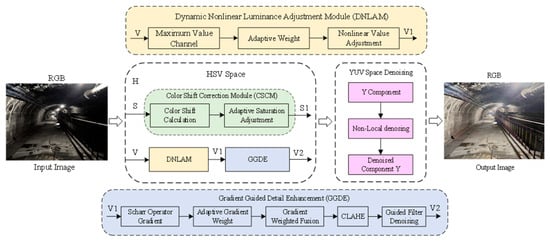
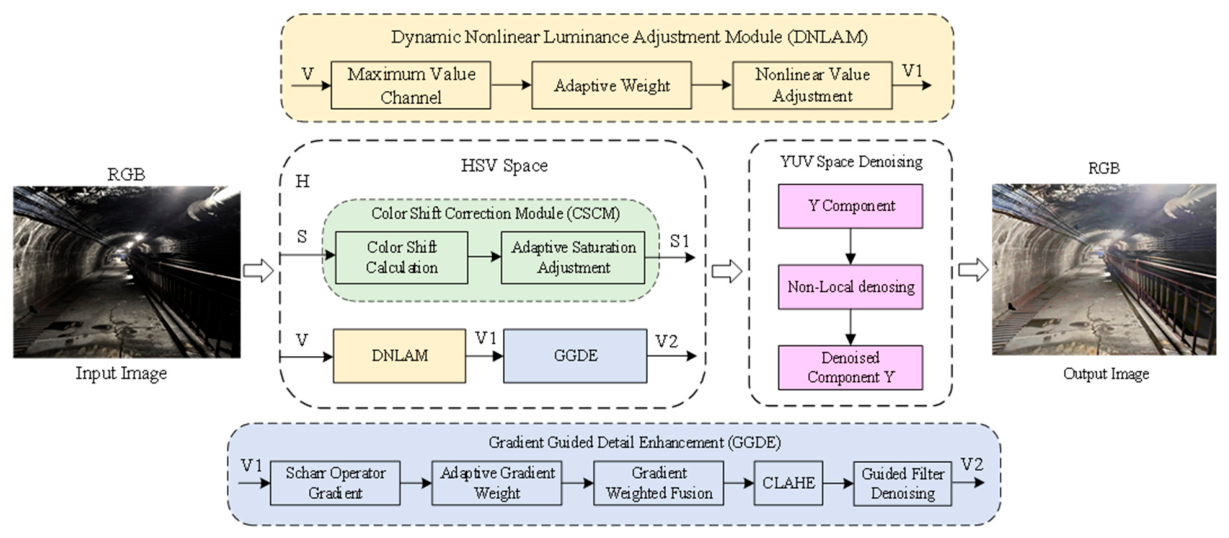
To address the issues of local overexposure, dark-region detail loss, and color deviation caused by uneven mine illumination, this section proposes a novel image enhancement algorithm, DNLA-AGW, which integrates dynamic nonlinear luminance adjustment with adaptive gradient weighting. The overall architecture of the proposed method is illustrated in Figure 1.
Figure 1.
Overall structure diagram of the algorithm.
A low-light RGB image is first transformed into the HSV color space and then processed through two parallel branches that adaptively correct the Value and Saturation components, respectively. For the Value component, a dynamic nonlinear luminance adjustment module (DNLAM) is employed to enhance color rendition and luminance uniformity. Subsequently, a gradient-guided detail enhancement (GGDE) scheme is introduced to reinforce edge and fine-structure features. By jointly exploiting the corrected luminance and gradient cues, both global visibility and local structural clarity are simultaneously improved. For the Saturation channel, a color-shift-aware correction mechanism is incorporated to restore color naturalness and vividness. Finally, denoising and color correction strategies are performed in the YUV color space to further elevate the overall perceptual quality and visual appeal of the resulting image.
2.1. Dynamic Nonlinear Luminance Adjustment
Due to the complex illumination in underground coal mines, image luminance distribution is inherently non-uniform. Conventional linear or global adjustments tend to cause simultaneous detail loss in dark regions and overexposure in bright areas. Therefore, we introduce a dynamic non-linear luminance adjustment mechanism that employs an adaptive mapping function for the differential processing of various luminance ranges. This strategy achieves global luminance balance while preventing the over-smoothing and blurring of edge details.
First, the input RGB image is converted to the HSV color space, from which the V (Value) channel is extracted and normalized to the [0, 1] range. Subsequently, a Gaussian filter is applied to the normalized V component to derive the local luminance mean .
Among them, σ represents the standard deviation of the Gaussian filter, which is used to smooth the local luminance distribution and reduce noise interference.
To enhance the V component adaptively, an enhancement factor k is computed from as follows:
Here, and denote the lower and upper bounds of the enhancement factor, respectively, confining the adaptation within a feasible range to avoid over-enhancement and under-enhancement. The rationale behind Equation (2) is twofold: for dark regions with low local luminance, a larger k is assigned to boost detail visibility; conversely, for bright regions with high local luminance, a smaller k is preferred to preserve natural tones and prevent saturation. Notably, the term serves as an attenuation factor, which monotonically reduces the enhancement strength as luminance increases, thereby aligning the adjustment with the perceptual characteristics of the human visual system (HVS) across varying luminance levels.
To enable region-adaptive enhancement, we design a luminance-dependent mapping function that modulates the enhancement strength according to local luminance characteristics [25]. Given the local luminance, this function first computes the enhancement coefficient k and then applies a nonlinear mapping to the input V channel. Specifically, a square-root operation amplifies the perceived luminance in dark regions, while a sinusoidal component emulates the nonlinear response of the human visual system (HVS) to luminance changes, leading to perceptually natural and smooth enhancement. The formulation of is motivated by the Weber-Fechner law: the HVS is more sensitive to luminance variations in dark areas and less responsive in bright regions, thereby aligning the enhancement with human visual perception.
where V is the input V component normalized to the [0, 1] range. It should be noted that the additive structure of the mapping function might cause the intermediate value to exceed the theoretical upper bound. To ensure strict boundary preservation and prevent over-exposure artifacts, a clipping operation is applied immediately after the mapping. The final output is constrained as . Finally, this bounded is rescaled back to the standard [0, 255] integer range for subsequent image reconstruction.
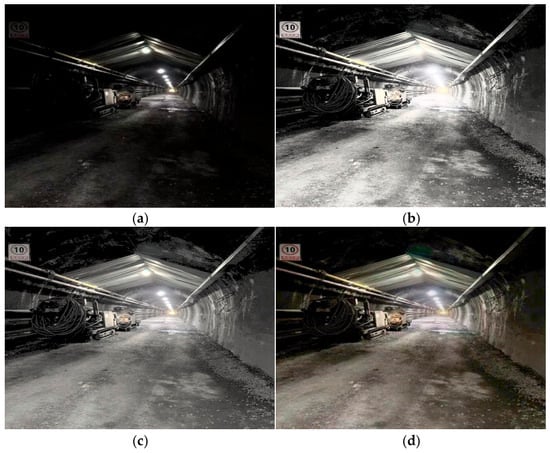
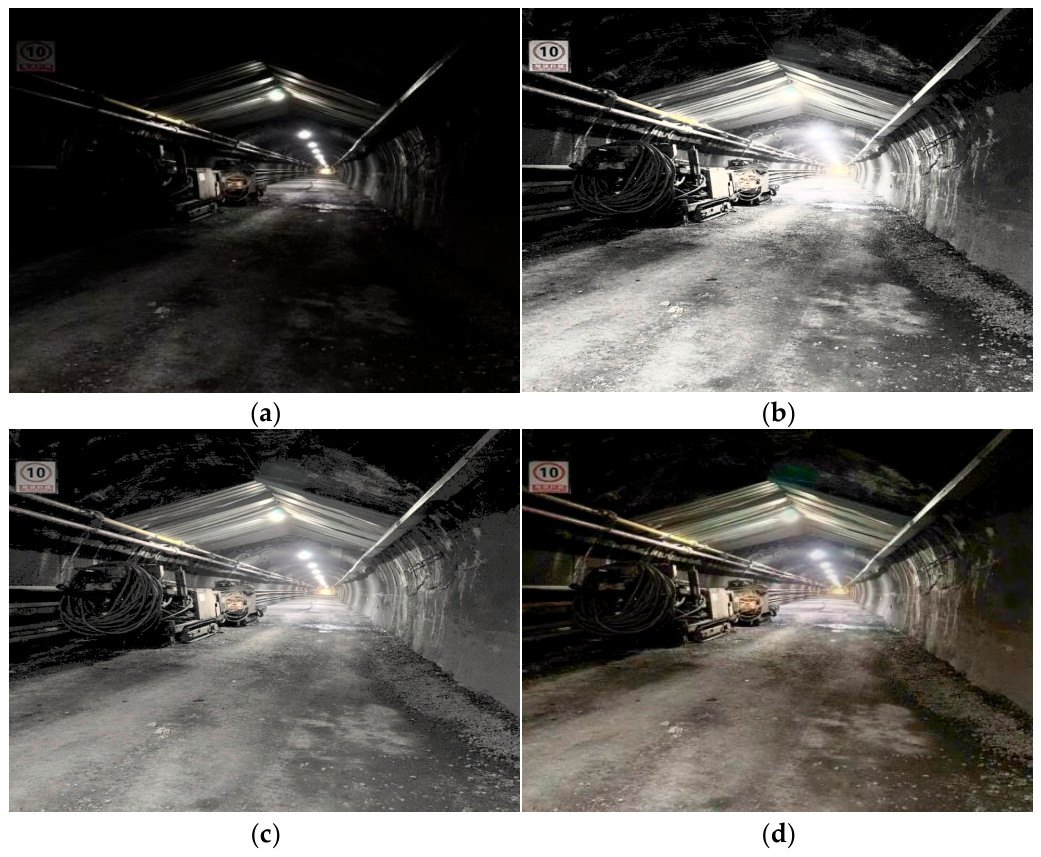
To validate the effectiveness of the proposed adaptive brightness adjustment method, comparative experiments were conducted against two conventional brightness enhancement techniques, namely histogram equalization and Gamma correction, from both subjective and quantitative perspectives. For quantitative evaluation, several metrics were adopted, including mean, standard deviation, information entropy, Lightness Order Error (LOE), and BRISQUE. The subjective and quantitative comparison results are presented in Figure 2 and Table 1, respectively.
Figure 2.
Comparison Results of Different Luminance Enhancement Methods: (a) Original Image; (b) Histogram Equalization; (c) Adaptive Gamma Correction; (d) Adaptive Luminance Adjustment.
Table 1.
Quantitative comparison of different luminance enhancement methods.
The results in Table 1 demonstrate that the proposed adaptive luminance adjustment method outperforms the benchmark approaches across all evaluation metrics. In particular, it achieves the highest information entropy, indicating that the method effectively enhances brightness while preserving image details. In terms of luminance naturalness, the proposed method yields the lowest LOE value, which is substantially lower than those of histogram equalization and adaptive Gamma correction, suggesting that its brightness adjustment closely aligns with human visual perception. Furthermore, the BRISQUE score confirms that the proposed method delivers the best no-reference image quality among all compared methods. Collectively, these findings demonstrate that the proposed method achieves effective brightness enhancement while maintaining image naturalness, and provides superior overall visual quality relative to the competing techniques.
2.2. Gradient-Guided Detail Enhancement
Conventional low-light image enhancement methods tend to prioritize global luminance adjustment while treating brightness enhancement and detail preservation as separate processes, typically employing a single global mechanism to brighten dark regions without jointly accounting for detail fidelity and noise suppression. This often leads to detail loss, edge blurring, and noise amplification [26]. To address these issues, this paper presents an edge enhancement strategy based on adaptive gradient weighting (AGW). By incorporating local contrast-aware weight assignment and multi-stage detail fusion, the proposed approach effectively improves the visibility of weak edges while simultaneously suppressing noise, thereby enabling coordinated optimization of luminance enhancement and detail preservation.
The current methods overly focus on global luminance enhancement, treating luminance adjustment and detail protection separately—only using a single global mechanism to brighten the dark areas, but not simultaneously considering detail fidelity and noise control. This can easily lead to detail loss, edge blurring, and noise amplification problems [26]. To address these shortcomings, this paper proposes an edge enhancement strategy based on adaptive gradient weighting (AGW). Through local contrast perception-based weight allocation and multi-stage detail fusion, it effectively enhances the visibility of weak edges while suppressing noise, achieving the coordinated optimization of brightness enhancement and detail protection.
The core idea of the adaptive gradient weighting method is to combine gradient information with an adaptive weight strategy, enabling the image to enhance the luminance of the dark areas while preserving the details of the high-contrast regions during the enhancement process. Considering that the Scharr operator has higher accuracy in edge detection, this paper first uses the Scharr operator to extract the gradient information. The gradient is mainly used to extract the edge information of the image. It should be noted that V1 (as shown in Figure 1) represents the V channel (HSV) after luminance enhancement processing, which is used for gradient calculation and edge extraction. The gradient calculation formula is as follows:
Among them, Gx and Gy are the horizontal and vertical gradients, respectively, and Gscharr is the final gradient amplitude map. This gradient information provides important structural features for subsequent processing.
Then, on the basis of gradient extraction, an adaptive gradient weight mechanism is introduced. The enhancement intensity is dynamically adjusted by analyzing the difference between the pixel intensity and the local mean. The adaptive weight is calculated as follows:
where is the parameter controlling the magnitude of gradient enhancement, which is set to 0.8 in this paper; Vmean represents the average intensity of the local region, used to measure the luminance difference between a pixel and its surrounding environment. When a pixel’s luminance approaches the local mean (indicating low-contrast smooth regions), the assigned weight increases, thereby preventing the over-amplification of background noise during low-light enhancement. Conversely, in the presence of significant luminance variations (indicating high-contrast edge structures), the weight decreases to relax the smoothness constraint. This precisely preserves edge details from blurring and effectively avoids halo artifacts. Such an adaptive strategy shares a similar philosophy with Retinex theory, which leverages edge-preserving properties to accurately decouple and dynamically adjust the illumination component. After calculating the adaptive weight, the gradient is enhanced using the following formula:
To address the issue of amplitude attenuation in the weighted gradient map within low-contrast regions, Contrast Limited Adaptive Histogram Equalization (CLAHE) is employed to enhance the gradient map, and guided filtering is utilized to suppress noise interference. By restricting the stretching limit of local contrast, CLAHE effectively prevents overexposure in light source regions. Meanwhile, guided filtering takes the CLAHE-processed image as the input image, and as the guidance, yielding a filtered output that suppresses noise while preserving sharp edge details. The corresponding implementation formulas are given as follows [27].
where tilesize denotes the local histogram block size, and cliplimit represents the histogram clipping threshold. In this experiment, they are set to 4 and 1.8, respectively. i denotes the pixel index, represents the local filtering window centered at pixel k, with a window radius set to 5, and is the number of pixels in . and are the mean and variance of V1 in , and is the mean of in . ζ is a regularization parameter set to 10 based on the image gray-level range and algorithm requirements. This value is experimentally validated to yield optimal edge-preserving smoothing for the gradient map. denotes the mean value of in . and are the average coefficients of all windows overlapping i.
Finally, a linear weighted fusion approach is adopted to optimally combine the enhanced gradient information with . This strategy significantly enhances image details while effectively suppressing noise interference. The final fusion formula is given as follows:
To verify the effectiveness of the adaptive gradient enhancement module, three comparative experiments were designed: (1) using only CLAHE for contrast enhancement to observe the improvement in local contrast; (2) using only adaptive gradient enhancement to analyze its capability in enhancing image details; and (3) combining adaptive gradient enhancement with CLAHE to evaluate the comprehensive enhancement performance under their synergistic effect. To more comprehensively assess the actual contribution of adaptive gradient weighting in low-light image enhancement, a multi-dimensional quantitative analysis was conducted on four images: the original image and the results from the three aforementioned enhancement methods. Specifically, five metrics—Average Gradient (AG), Information Entropy (IE), Tenengrad (TE), Edge Preservation Index (EPI), and BRISQUE—were selected for performance comparison, and the experimental results are presented in Table 2. Among these metrics, AG reflects the intensity of grayscale variations and is commonly used to measure image clarity and detail sharpness; TE is calculated based on image gradient energy to evaluate overall sharpness and edge strength; EPI characterizes the retention degree of edge details during the enhancement process, with a higher value indicating less loss of edge information; IE measures the information complexity of an image, where a larger value signifies richer textures and details; and BRISQUE is a no-reference image quality assessment metric, where a lower score represents higher visual perceptual quality.
Table 2.
Quantitative comparison of adaptive gradient enhancement and CLAHE combinations.
As shown in Table 2, the original image exhibits low values in the AG, TE, and EPI metrics, indicating limited detail and edge information, as well as poor overall image quality. After applying CLAHE alone, although the local contrast of the image is improved, the AG, Information Entropy (IE), and TE metrics experience a slight decrease. This is primarily attributed to the clipping limit mechanism of CLAHE: while stretching the contrast of bright and dark regions, it over-suppresses some weak texture gradients, resulting in limited improvement or even slight loss of detail sharpness. Upon adopting the adaptive gradient weighting method, both the TE and EPI metrics increase significantly. Notably, the EPI rises from 0.1438 to 0.1488, demonstrating that this method effectively strengthens the edge structures of the image. Concurrently, the Information Entropy increases from 7.6101 to 7.6172, reflecting an increase in the overall richness of image details. When CLAHE is combined with adaptive gradient weighting, all evaluation metrics are further optimized. Specifically, TE, EPI, and Information Entropy reach their highest levels, while the BRISQUE score decreases. This indicates that, building upon the enhanced contrast, the detail hierarchy, edge clarity, and visual perceptual quality of the image are comprehensively improved. Comprehensive analysis reveals a complementary relationship between CLAHE and the gradient enhancement module: CLAHE focuses on improving local contrast, whereas the gradient weighting module further reinforces details and suppresses noise, thereby ultimately achieving a superior enhancement performance.
2.3. Color Drift Correction
In the special environment of a coal mine underground, due to the influence of multiple factors such as dust scattering, non-uniform illumination, and foggy water vapor, the saturation of the collected images shows a significant attenuation feature, resulting in the degradation of color information. Under low-light conditions, the color drift in different areas varies, and simply adjusting the global saturation uniformly may lead to color distortion or uneven enhancement. Therefore, this paper proposes an adaptive saturation adjustment method based on color drift [28] estimation. By calculating the degree of local color drift in the image, the saturation is adaptively corrected, thereby enhancing the color gradation and visual realism of the image.
First, calculate the degree of color drift ΔS, as shown in the formula below:
Among them, S represents the saturation component of the input image, and is the saturation component smoothed by a local mean, obtained through Gaussian smoothing, which is used to characterize the color distribution trend of the local area and serves as the benchmark for color drift estimation.
Based on the above color drift estimation, we introduce an adaptive color correction strategy by adjusting the saturation component S to reduce the color drift phenomenon caused by low illumination. Specifically, the following formula is used for adaptive saturation adjustment:
where λ is an adjustment coefficient used to control the intensity of color correction, thereby ensuring a visually balanced enhancement effect.
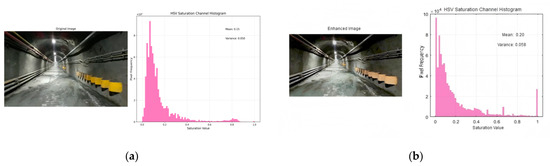
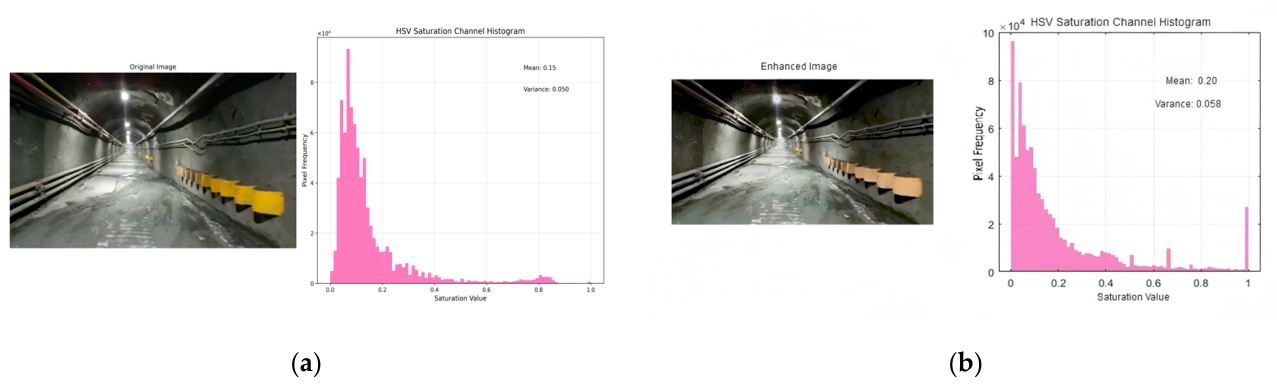
To verify the effectiveness of the saturation enhancement module in improving color representation, statistical analysis of saturation was conducted on the images before and after enhancement, and histograms of the S channel in the HSV color space were plotted. Two primary metrics were evaluated: the mean and the variance of saturation. The mean reflects the overall color vividness of the image, while the variance measures the breadth and hierarchical richness of the color distribution. The comparative results are illustrated in Figure 3.
Figure 3.
Histograms of the HSV saturation channel before and after color correction. (a) Original image; (b) After color correction.
As indicated by the statistical results in Figure 3, the mean saturation of the original image is 0.190 with a variance of 0.050. Following enhancement, the mean and variance increase to 0.200 and 0.058, respectively. These results demonstrate that the enhanced image exhibits fuller overall colors and a richer color hierarchy, thereby effectively improving the visual perceptual quality. Furthermore, observing the saturation histogram, the distribution range is slightly expanded, and the proportion of pixels in the mid-to-high saturation regions increases. This further validates that the proposed method can effectively enhance the overall color representation of the image without introducing obvious color distortion.
2.4. Denoising in YUV Space
In the task of low-light image enhancement, noise is a critical factor affecting image quality [29]. Previous studies have demonstrated that, compared to the RGB color space, the YUV color space can more effectively separate luminance and chrominance information. This separation allows for effective noise suppression while maximizing the preservation of the original image’s color characteristics during the denoising process [30]. Specifically, the Y component represents luminance information, while the U and V components primarily carry chrominance signals. Leveraging this characteristic, after completing the Value-channel-based intensity and saturation enhancements, we convert the image from the RGB color space to the YUV color space and apply the Non-Local Means (NLM) denoising algorithm exclusively to the Y channel. This strategy aims to ensure noise removal while maintaining color naturalness. The NLM algorithm utilizes not only the information within a local pixel neighborhood but also computes a weighted average using similar pixel patches across the entire image. Consequently, it achieves effective noise reduction while better preserving the structural details and edge features of the image.
First, we define the weight function as follows:
where and denote the pixel patches centered at pixels i and j, respectively, and represents the Euclidean distance between these two patches. The parameter h is a filtering parameter that controls the decay rate of the weights, which is set to 4 in this paper.
Based on this, for a given pixel i in the image, its denoised value is computed as follows:
Here, Ω(i) denotes the search window centered at pixel i, I(j) is the original value of pixel j, and w(i,j) represents the weight coefficient, indicating the contribution of pixel j to pixel i.
The Non-Local Means (NLM) denoising ensures a smooth transition of pixel luminance values while preserving crucial edge information. Compared with traditional mean filtering or Gaussian filtering, this method effectively suppresses noise in low-light images while maintaining structural integrity, thereby significantly enhancing the overall clarity and visual depth of the image.
3. Experiments and Results
3.1. Experimental Settings
3.1.1. Datasets
To comprehensively verify the effectiveness of the proposed algorithm, this paper conducts an evaluation combining the public LOL dataset and a custom underground mine dataset. The raw images of the custom dataset were collected from an intelligent coal mine in Yulin, Shaanxi, captured by fixed underground explosion-proof industrial surveillance cameras with a resolution of 1280 × 960. The scenes cover typical workplaces such as electromechanical chambers, electrical stations, and main roadways. Considering the need to simultaneously calculate full-reference metrics (e.g., PSNR, SSIM) and multiple no-reference image quality metrics, during the data acquisition and screening phase, we specifically selected surveillance videos captured during well-lit periods across the various scenes. By extracting frames at 10 s intervals and manually filtering out invalid frames with motion blur or high redundancy, we obtained 500 clear, normal-light samples to serve as ground truth (GT) images. Since the true underground environment exhibits a massive illumination span, typically containing dark shadow areas relying on faint scattering and localized glare areas caused by direct explosion-proof lighting, we artificially simulated the degradation process on the GT images to generate corresponding low-light samples to realistically reproduce these visual degradation characteristics. Specifically, non-linear Gamma mapping was first applied to simulate light attenuation in the tunnels. Next, light source regions were extracted, and halos were injected to reproduce localized glare effects. Finally, coal dust scattering effects and low-variance noise were superimposed. The low-light images generated through this pipeline effectively restored typical underground features such as uneven illumination, glare, and shadows. Ultimately, we selected 150 representative mine image pairs from this synthesized set, which, alongside the LOL test set, constituted the final experimental evaluation set, uniformly used for the quantitative assessment of all objective metrics.
3.1.2. Comparison Methods
For comparative purposes, several representative algorithms, encompassing both general low-light image enhancement and mine-specific image enhancement, are selected as baselines for comparative evaluation. Specifically, the evaluated methods include the Structure-and-Texture Aware Retinex (STAR) [31], Multi-Scale Retinex (MSR), Multi-Scale Retinex with Color Restoration (MSRCR), Plug-and-Play Retinex (PnPRetinex) based on shrinkage mapping [19], as well as the approaches proposed in [9,20,22].
3.1.3. Experimental Environment and Implementation Details
The experimental evaluations were performed on a hardware platform configured with an Intel Core i9-14900HX CPU (2.20 GHz), an NVIDIA GeForce RTX 4060 GPU, and 16 GB of RAM. All algorithms were implemented using Python 3.11 within the Windows 11 environment.
The hyperparameters in our proposed method were not selected arbitrarily but rigorously derived from classical theories and specific properties of coal mine scenes. Specifically, to balance contrast enhancement and inherent noise amplification in heavily degraded environments, the CLAHE clip limit was strictly constrained to 1.8, rather than the higher values (e.g., 2.0–3.0) commonly used in standard datasets. For structural parameters, we followed classical literature [27,32], setting the CLAHE tile size to 4 × 4 and Guided Filter parameters to radius = 5, ζ = 10 (where radius denotes the window radius of the guided filter, and ζ is the regularization parameter of the Guided Filter). Furthermore, a 0.05 residual weight of the original gradient was retained during fusion, acting as a structural regularization term to fundamentally prevent gradient reversal and halo artifacts.
3.2. Subjective Validation
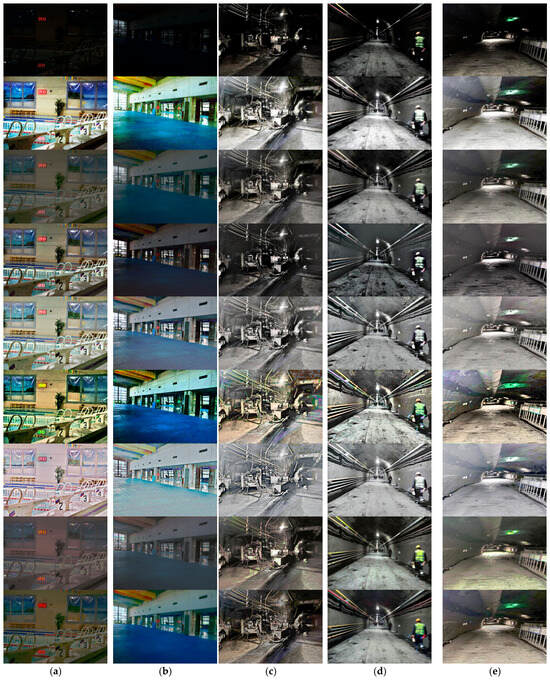
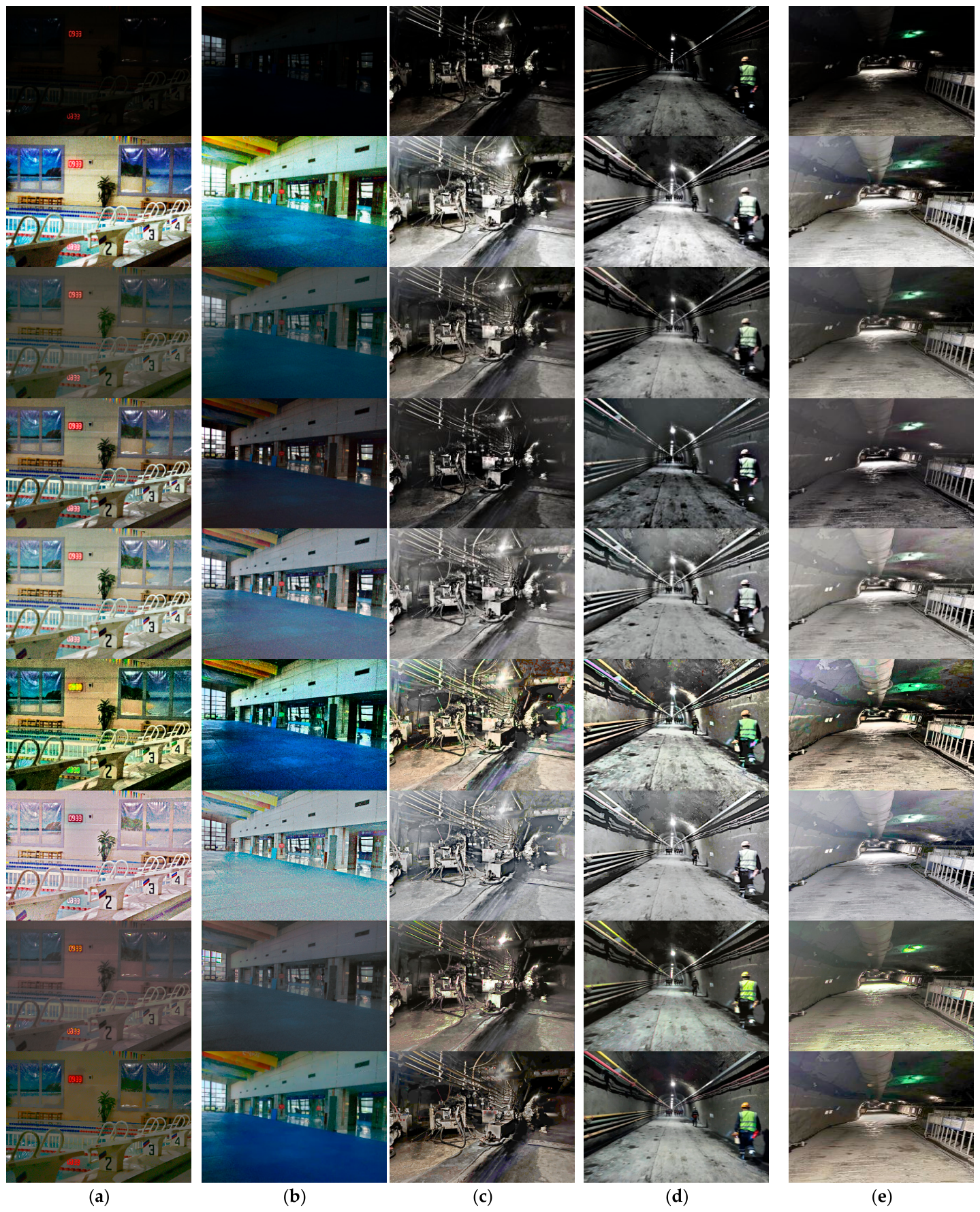
To evaluate the enhancement performance of various algorithms, representative scenes were selected from both the LOL dataset and the customized mine dataset for visual comparison, as illustrated in Figure 4. Specifically, Scenes 1 and 2 are sourced from the LOL dataset, while Scenes 3 to 5 are taken from the mine dataset. The first row displays the original low-light inputs, and the subsequent rows present the enhanced results generated by PnPRetinex, STAR, MSR, MSRCR, [9,20,22], and the proposed method, respectively. By qualitatively comparing these approaches in terms of illumination enhancement, detail preservation, color fidelity, and noise suppression, the effectiveness of the proposed algorithm is evaluated.
Figure 4.
Visual enhancement results of different algorithms on the LOL and Mine datasets. (a) Scene 1; (b) Scene 2; (c) Scene 3; (d) Scene 4; (e) Scene 5.
Scenes 1 and 2 present typical low-light images from the LOL dataset, which generally suffer from insufficient global illumination, reduced contrast, and degraded texture details. Although illumination can be improved to some extent by various algorithms, slight chromatic noise and blurred local edges are observed in the results of PnPRetinex. STAR and [22] exhibit limited brightness enhancement, resulting in relatively dark images with inadequate color saturation. MSR performs adequately on images with uniform light distribution, but its generalization capability is limited in complex scenes containing extensive dark areas. Noticeable graininess is present in the results of MSRCR, indicating insufficient noise suppression. Furthermore, [20] causes color distortion in the enhanced images, while [22] fails to effectively suppress noise during its brightness and color recovery process. In contrast, when processing the LOL dataset, the proposed algorithm effectively restores brightness and color while suppressing noise, achieving a more balanced visual outcome.
Scenes 3, 4, and 5 illustrate typical underground degradation scenarios, including severe non-uniform illumination, central glare, and complex high reflections, respectively. As observed in Figure 4, although traditional algorithms improve illumination to a certain degree, PnPRetinex is prone to overexposure in light-source regions and noise amplification in dark areas. While STAR and MSR balance the overall lighting, they generally suffer from low contrast and limited detail recovery in dark regions. Additionally, MSRCR is accompanied by a noticeable decrease in color saturation and local over-enhancement artifacts. Regarding recently proposed methods, despite their progress in improving global brightness, certain limitations remain: halo artifacts and color shifts are generated around light sources by [20]; color loss and a grayish appearance occur in [22]; and although fundamental colors are well preserved by [9], distinct chromatic grain noise is introduced, leading to the over-smoothing of some textures. By comparison, the proposed method effectively mitigates highlight clipping and halo diffusion when handling non-uniform illumination and strong glare, successfully maintaining the depth-dependent brightness gradient. Concurrently, in complex reflection scenes, it significantly recovers the texture details of pipelines, equipment, and the ground while preserving a naturally balanced global brightness.
Based on the visual analysis, existing methods generally struggle to balance illumination enhancement, artifact suppression, and color fidelity under complex underground lighting. In contrast, the proposed method maintains relatively stable enhancement results across varying scenes. This is primarily attributed to its cross-color space processing mechanism: in the HSV space, dynamic balancing and edge enhancement are applied to the V component, while the S component is adaptively corrected to prevent a grayish appearance; concurrently, independent denoising is executed exclusively on the Y component in the YUV space to preserve color channels. Through these targeted operations, the algorithm effectively integrates dynamic range control, detail protection, and noise suppression, demonstrating practical adaptability to complex underground environments.
3.3. Objective Evaluation
To quantitatively evaluate the algorithm’s performance, this study constructs a comprehensive evaluation system comprising eight metrics: Mean, Variance, Information Entropy, RMS Contrast, BRISQUE, PIQE, PSNR, and SSIM. Specifically, Mean and Variance characterize the luminance distribution and dynamic range of the image, respectively; Information Entropy reflects the richness of details; RMS Contrast measures the enhancement effect of local features; BRISQUE and PIQE serve as no-reference (NR) metrics to evaluate visual quality; and PSNR and SSIM are utilized as full-reference (FR) metrics to quantify image fidelity and structural similarity, respectively. We conducted an evaluation of images from three distinct scenarios in the mine. The quantitative results for the three low-light mine scenes are presented in Table 3, Table 4 and Table 5.
Table 3.
Comparison of evaluation metrics for different algorithms in Scene 3.
Table 4.
Comparison of evaluation metrics for different algorithms in Scene 4.
Table 5.
Comparison of evaluation metrics for different algorithms in Scene 5.
As shown in Table 3, Table 4 and Table 5, quantitative evaluations demonstrate the superiority of the proposed method across key objective metrics. Regarding illumination, it naturally elevates the mean luminance (0.312–0.385) without inducing the overexposure typical of MSRCR, while achieving optimal variance and RMS contrast to effectively expand the visual dynamic range. Benefiting from the integrated gradient weighting and denoising mechanisms, the method significantly boosts Information Entropy (up to 7.588), recovering rich textures without amplifying noise. Furthermore, it attains the best no-reference quality scores (lowest BRISQUE and PIQE), reflecting superior perceptual naturalness. For full-reference metrics, the proposed method consistently yields the highest PSNR (up to 27.088 dB) and SSIM (up to 0.942) across evaluated scenes, outperforming the second-best approach by a notable margin (0.725–1.529 dB in PSNR). This confirms its prominent capability in noise suppression and structural preservation.
Beyond the qualitative visual comparisons on single images mentioned above, we further validated the generalization ability of the proposed method through quantitative analysis. Specifically, we conducted evaluations on 150 images selected from our custom mine dataset and the standard LOL test set. The average quantitative metrics are detailed in Table 6 and Table 7, respectively.
Table 6.
Evaluation metric comparison of different algorithms on the self-built mine dataset.
Table 7.
Evaluation metric comparison of different algorithms on the LOL test dataset.
Table 6 presents the quantitative comparison results on our self-built dataset. The data demonstrates the overall superiority of the proposed method. It is worth noting that for the Mean metric, rather than yielding an excessively high value that could lead to overexposure, our method achieves a moderate level, indicating proper exposure control. Specifically, our method surpasses the second-best method ([20]) by 0.1812 in Entropy and 0.0274 in RMS Contrast, indicating its superior performance in detail recovery and clarity enhancement. In terms of no-reference metrics, the proposed method obtains the lowest BRISQUE (3.0413) and PIQE (28.4738) scores; notably, the PIQE score is substantially lower than that of [9] (51.9442). Furthermore, our method achieves the highest values in the full-reference metrics, PSNR and SSIM. These objective results align well with the subjective evaluations, thereby validating the effectiveness of the designed cross-domain processing strategy.
Following the evaluations on the self-built mine image dataset, as shown in Table 7, the proposed method also achieves favorable overall performance on the widely used LOL public test set, further verifying its generalization capability. Specifically, our method obtains the best values in Variance, RMS Contrast, PSNR, and SSIM, indicating its effectiveness in improving image contrast, preserving structural details, and reducing distortion. In addition, it reaches the lowest scores in the no-reference metrics BRISQUE and PIQE, reflecting that the enhanced images possess better visual perceptual quality with well-suppressed noise. Although its Information Entropy ranks second, just behind the method proposed by [20], it still effectively retains rich image information. Overall, the proposed method strikes a reasonable balance between detail recovery and overall visual quality enhancement.
Synthesizing the performance across all evaluated metrics, the proposed algorithm achieves balanced improvements in luminance control, contrast enhancement, detail restoration, and structure preservation. Compared with existing algorithms, this method not only effectively improves the visual quality of low-light images, but also demonstrates excellent capabilities in maintaining image authenticity and structural integrity. Consequently, it can provide a higher-quality image data foundation for downstream high-level vision tasks, such as object detection and safety monitoring in low-light mine environments.
3.4. Object Detection Experiment
Recently, deep learning-based object detection frameworks, particularly YOLO variants, have shown remarkable success in complex industrial safety monitoring, such as multi-category PPE non-compliance monitoring [33] and safety helmet detection [34] on construction sites. Drawing inspiration from these advancements, and considering that our practical application explicitly focuses on coal mine safety, we aim to demonstrate how improved illumination and contrast can benefit detection performance in such challenging environments.
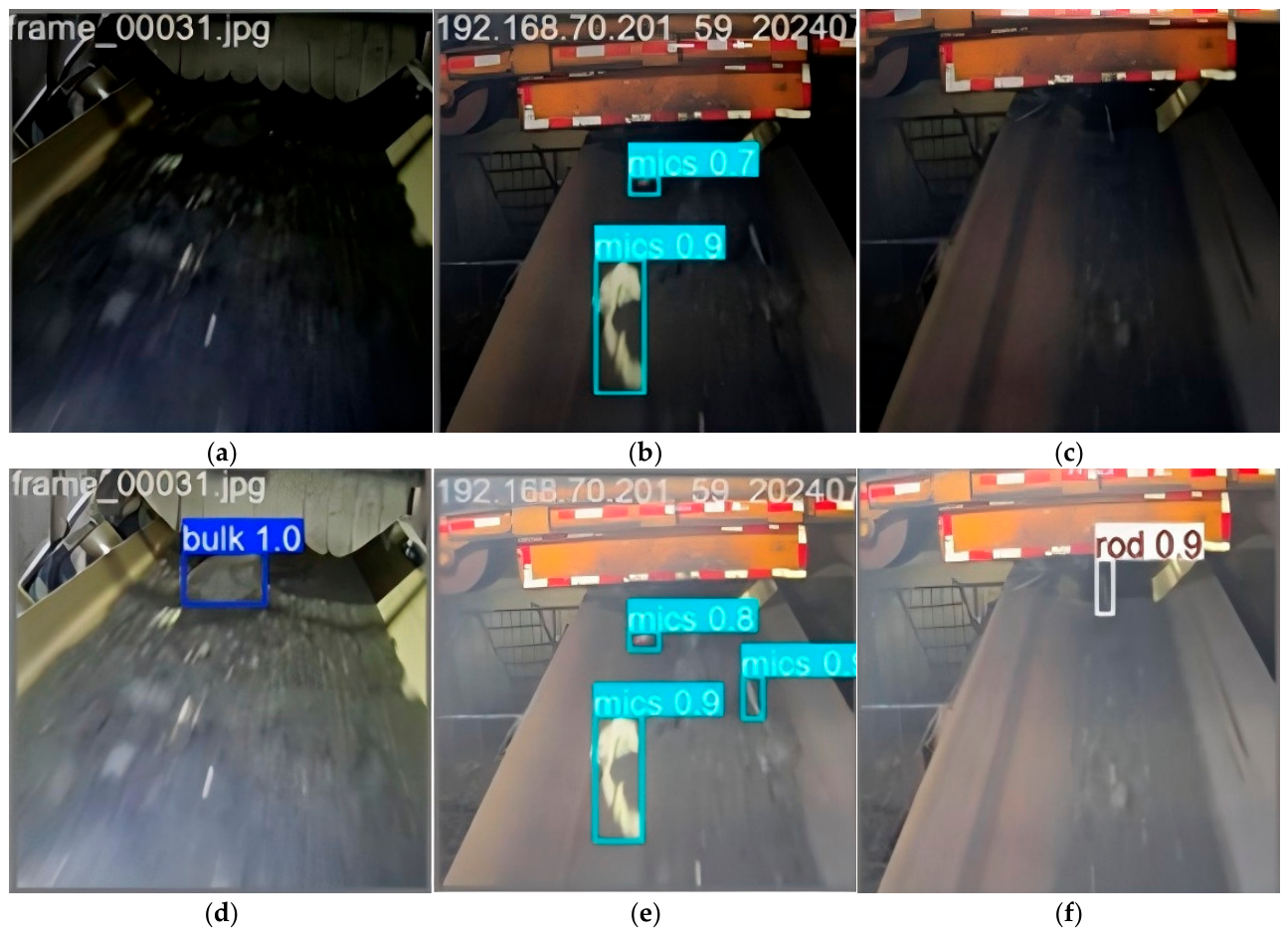
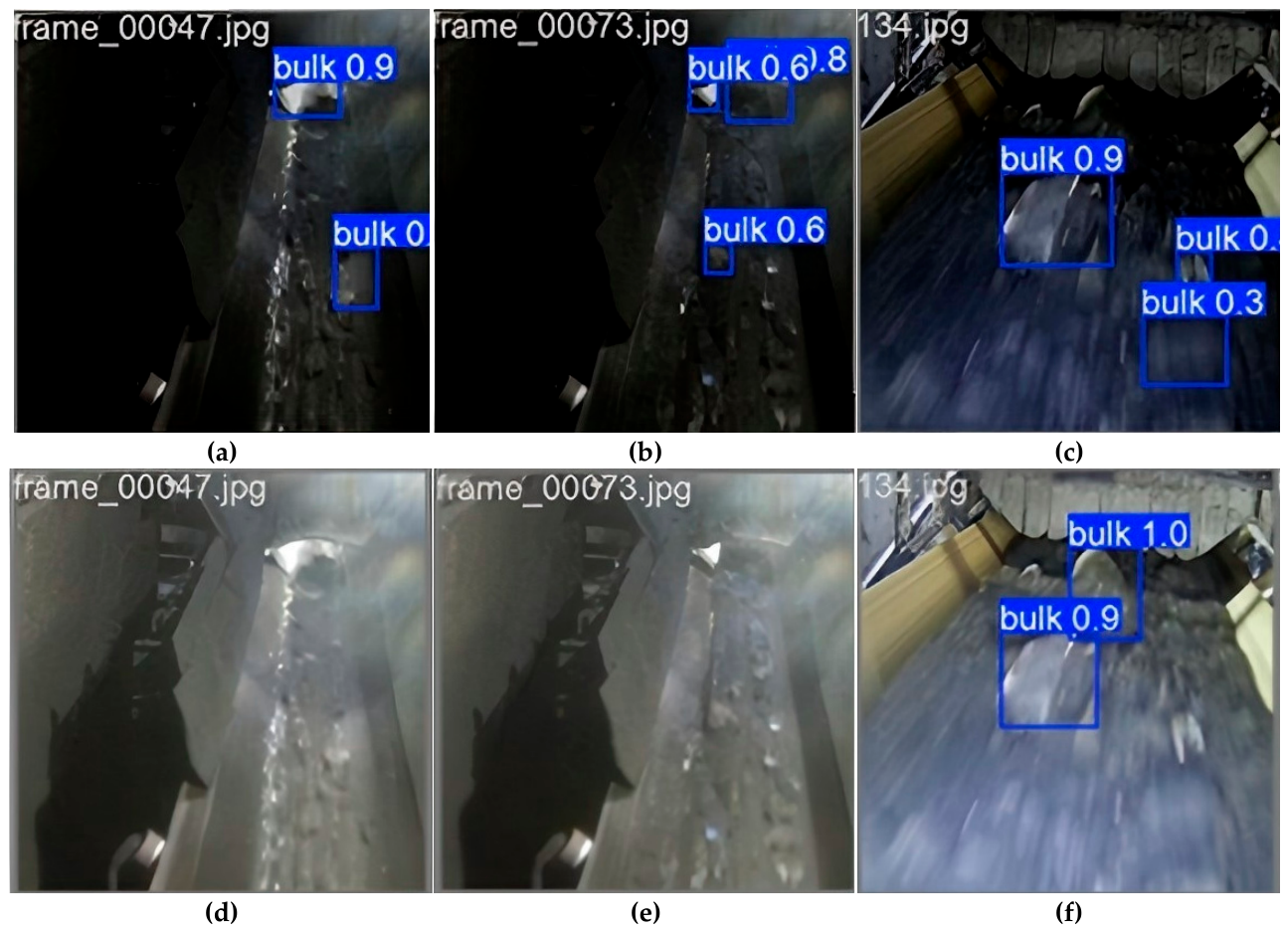
To effectively validate the practical contribution of the proposed algorithm, we evaluated its impact on a specific downstream task: foreign object detection on coal conveyor belts. In our experiments, images before and after applying our enhancement method were fed into the YOLOv12n model for comparative testing. The quantitative and qualitative results, which confirm the downstream benefits of our method, are presented in Table 8 and Figure 5 and Figure 6, respectively.
Table 8.
Comparison of detection performance.
Figure 5.
Comparison of object detection results before and after image enhancement (missed-detection cases). (a–c) Detection results before enhancement; (d–f) Detection results on the corresponding enhanced images.
Figure 6.
Comparison of object detection results before and after image enhancement (false- positive cases). (a–c) Detection results before enhancement; (d–f) Detection results on the corresponding enhanced images.
In the raw low-light images, insufficient illumination and imbalanced contrast obscure the texture features of foreign objects. Consequently, the targets are heavily confused with the complex background, making it difficult for the model to extract discriminative features, which directly leads to noticeable missed detections, false positives, and inaccurate localization. In contrast, the images processed by our algorithm exhibit well-adjusted luminance and effectively restored edge contours and texture details, significantly improving the distinctiveness between targets and the background. Benefiting from these high-quality feature inputs, YOLOv12n achieves remarkably better detection performance: missed and false detections are effectively suppressed, and bounding box localization becomes much more precise. Quantitative evaluations (Table 6) further corroborate these visual improvements, showing that the mAP@0.5 and mAP@0.5:0.95 metrics on the enhanced images are boosted by 3.7% and 3.0%, respectively.
These results demonstrate that the proposed enhancement algorithm effectively improves the feature representation quality of targets in low-light environments, thereby significantly boosting object detection performance. Furthermore, it can serve as a reliable image preprocessing solution to enhance the accuracy and robustness of downstream high-level vision tasks in complex industrial scenarios.
4. Discussion
To address the complex and diverse lighting conditions in underground mines, the proposed method utilizes a modular processing pipeline to effectively improve image quality. First, the dynamic non-linear luminance adjustment module suppresses overexposure in brightly lit areas and recovers texture details in dark regions. Building on this, the adaptive gradient weighting strategy resolves the issue of edge detail blurring that often occurs during drastic brightness adjustments. Regarding color and noise control, the saturation correction based on local color drift estimation mitigates the color bias caused by global processing, restoring the naturalness and consistency of the colors. Finally, by performing independent denoising on the luminance (Y) channel in the YUV color space, the algorithm effectively suppresses noise while ensuring color fidelity. Overall, this method specifically addresses common degradation issues in mine images, such as uneven illumination, blurred edge details, and noise interference, achieving a balanced performance improvement across brightness control, contrast enhancement, detail recovery, and structure preservation.
Although the proposed method achieves favorable enhancement results under various complex lighting conditions, it still has certain limitations. First, the algorithm involves several hyperparameters. When applied to operational scenarios with drastically different characteristics, manual fine-tuning may sometimes be required to achieve optimal visual quality, indicating room for improvement in fully adaptive capabilities. Second, for severely degraded conditions (such as extremely low-light environments approaching total darkness), the enhancement effect is limited. Because the sensor captures very little valid information in these scenarios, the proposed method struggles to effectively reconstruct the underlying texture details in deep dark regions. Third, the dataset used in our experiments is relatively limited. Due to practical collection constraints, the images were primarily acquired from a single underground mine, lacking diverse samples from multiple different mining sites, which slightly limits the comprehensive validation of cross-scene generalization.
To address these shortcomings, our future work will consider integrating deep learning techniques to achieve adaptive parameter learning and optimization. Furthermore, we plan to construct a more comprehensive and diverse multi-mine dataset to further evaluate and enhance the generalization capability of the method.
5. Conclusions
Aiming at the inherent degradations of mine images, namely uneven illumination, detail blurring, noise interference, and color distortion, this study proposes a novel image enhancement algorithm driven by local perception and multi-domain guided fusion. Through a dynamic non-linear illumination adjustment module, the phenomena of highlight overexposure and dark-region detail loss are effectively ameliorated. Building upon this, an adaptive gradient weighting strategy is incorporated to strictly prevent detail degradation during illumination mapping. Concurrently, a saturation correction mechanism based on local color shift estimation mitigates the inherent bias of global correction, thereby reviving color naturalness and consistency. By integrating luminance-channel denoising within the YUV color space, the algorithm successfully suppresses noise without compromising color authenticity. The experimental results demonstrate that the proposed method achieves favorable performance compared to existing related methods, yielding improved PSNR and SSIM metrics alongside a notably reduced PIQE score. These quantitative evaluations verify that the proposed framework specifically tackles uneven lighting, edge blurring, and noise issues, significantly boosting the clarity and discernibility of target details while harmonizing global brightness. Notably, relying exclusively on traditional image processing paradigms (e.g., luminance mapping, gradient enhancement, color correction, and channel-wise denoising) rather than computationally exhaustive deep neural network training, the proposed method guarantees low computational complexity and excellent engineering practicability. Finally, experiments on a foreign object detection task for coal conveyor belts show that the proposed method is beneficial to downstream vision tasks.
Author Contributions
Conceptualization, X.L.; methodology, X.L. and Y.W.; software, X.L. and Y.W.; validation, X.L.; formal analysis, X.L.; investigation, Y.W.; resources, F.T.; data curation, Y.W.; writing—original draft preparation, X.L. and Y.W.; writing—review and editing, X.L. and F.T.; visualization, Y.W.; supervision, F.T.; project administration, F.T.; All authors have read and agreed to the published version of the manuscript.
Funding
This research received no external funding.
Institutional Review Board Statement
Not applicable.
Informed Consent Statement
Not applicable.
Data Availability Statement
The dataset used in this study is sourced from cooperative coal mining enterprises, and is not publicly available. Relevant research data can be obtained from the corresponding author upon reasonable request for legitimate scientific research.
Conflicts of Interest
The authors declare no conflicts of interest.
References
- Zhang, L.Y.; Hao, B.N.; Ma, Z.; Yang, Z. Review of critical image enhancement technologies for underground coal mine applicatuons. Coal Sci. Technol. 2025, 53, 110–113. [Google Scholar] [CrossRef]
- Pan, S.; Yu, T.; Chen, W.; Tian, Z.; Yue, Z. Underground low-light self-supervised image enhancement method based on structure and texture perception. J. China Coal Soc. 2025, 50, 2310–2320. [Google Scholar] [CrossRef]
- Li, J.H.; Si, L.; Wang, Z.B.; Wei, D.; Gu, J. Coal-gangue recognition for top coal caving face based on electromagnetic detection. Measurement 2025, 241, 115730. [Google Scholar] [CrossRef] [Scilit]
- Wu, C.; Wang, D.; Huang, K.; Wu, L. Enhancement of Mine Images through Reflectance Estimation of V Channel Using Retinex Theory. Processes 2024, 12, 1067. [Google Scholar] [CrossRef] [Scilit]
- Cheng, J.; Song, Z.; Li, H.; Ma, Y.; Li, H.; Sun, D. A novel image enhancement method via dual-branch coupled transformer network for underground coal mine. J. China Coal Soc. 2024, 49, 4027–4037. [Google Scholar] [CrossRef]
- Wang, Y.; Zhao, X. Coal Mine Underground Image Enhancement Method Based on Efficient Multi-Scale Transformation Cycle Generative Adversarial Network. Signal Image Video Process. 2025, 19, 1334. [Google Scholar] [CrossRef] [Scilit]
- Wang, Z.; Yang, S.; Zhang, J.; Ji, Z. An Effective Underground Image Enhancement Approach Based on Improved KinD Network. Signal Image Video Process. 2024, 18, 7473–7486. [Google Scholar] [CrossRef] [Scilit]
- Zhang, J.; Xu, W.; Lu, Y.; Chen, Z.; Yang, D. Multi-View Adaptive Image Enhancement with Hierarchical Attention for Complex Underground Mining Scenes. Expert Syst. Appl. 2025, 294, 128761. [Google Scholar] [CrossRef] [Scilit]
- Wei, D.; Wang, P.; Wang, Z.; Si, L.; Zou, X.; Gu, J.; Dai, J.; Long, C. Adaptive Image Enhancement Method for Coal-Mine Underground Image Based on No-Reference Quality Evaluation. IEEE Trans. Instrum. Meas. 2024, 73, 5036417. [Google Scholar] [CrossRef] [Scilit]
- Li, C.; Liu, J.; Zhu, J.; Zhang, W.; Bi, L. Mine image enhancement using adaptive bilateral gamma adjustment and double plateaus histogram equalization. Multimed. Tools Appl. 2022, 81, 12643–12660. [Google Scholar] [CrossRef] [Scilit]
- Jebadass, J.R.; Balasubramaniam, P. Low contrast enhancement technique for color images using interval-valued intuitionistic fuzzy sets with contrast limited adaptive histogram equalization. Soft Comput. 2022, 26, 4949–4960. [Google Scholar] [CrossRef] [Scilit]
- Su, B.; Li, C.; Wang, L. Mine image enhancement algorithm based on retinex using multi-weight fusion strategy. J. China Coal Soc. 2023, 48, 813–822. [Google Scholar] [CrossRef]
- Jobson, D.J.; Rahman, Z.; Woodel, G.A. Properties and performance of a center/surround retinex. IEEE Trans. Image Process. 1997, 6, 451–462. [Google Scholar] [CrossRef] [Scilit] [PubMed]
- Jobson, D.J.; Rahman, Z.; Woodel, G.A. A multiscale retinex for bridging the gap between color images and the human observation of scenes. IEEE Trans. Image Process. 1997, 6, 965–976. [Google Scholar] [CrossRef] [Scilit] [PubMed]
- Rahman, Z.U.; Jobson, D.J.; Woodell, G.A. Retinex processing for automatic image enhancement. J. Electron. Imaging 2004, 13, 100–110. [Google Scholar] [CrossRef] [Scilit]
- Pan, X.; Li, C.; Pan, Z.; Yan, J.; Tang, S.; Yin, X. Low-light image enhancement method based on retinex theory by improving illumination map. Appl. Sci. 2022, 12, 5257. [Google Scholar] [CrossRef] [Scilit]
- Yang, J.; Wang, J.; Dong, L.; Chen, S.; Wu, H.; Zhong, Y. Optimization algorithm for low-light image enhancement based on retinex theory. IET Image Process. 2023, 17, 505–517. [Google Scholar] [CrossRef] [Scilit]
- Ma, Q.; Wang, Y.; Zeng, T. Retinex-based variational framework for low-light image enhancement and denoising. IEEE Trans. Multimed. 2023, 25, 5580–5588. [Google Scholar] [CrossRef] [Scilit]
- Lin, Y.H.; Lu, Y.C. Low-light enhancement using a plug-and-play retinex model with shrinkage mapping for illumination estimation. IEEE Trans. Image Process. 2022, 31, 4897–4908. [Google Scholar] [CrossRef] [Scilit] [PubMed]
- Lei, S.; Zhang, J.; Li, Y. Research on image restoration algorithm of uneven illumination in coal mine based on HSV space. Coal Sci. Technol. 2024, 52, 384–392. [Google Scholar] [CrossRef]
- Sun, L.; Chen, S.; Yao, X.; Zhang, Y.; Tao, Z.; Liang, P. Image enhancement methods and applications for target recognition in intelligent mine monitoring. Meitan Xuebao/J. China Coal Soc. 2024, 49, 495–504. [Google Scholar] [CrossRef]
- Tian, F.; Chen, T.; Zhang, J. Research on Improved Retinex-Based Image Enhancement Method for Mine Monitoring. Appl. Sci. 2023, 13, 2672. [Google Scholar] [CrossRef] [Scilit]
- Tian, F.; Wang, M.J.; Liu, X.P. Low-Light Mine Image Enhancement Algorithm Based on Improved Retinex. Appl. Sci. 2024, 14, 2213. [Google Scholar] [CrossRef] [Scilit]
- Yan, Q.; Feng, Y.; Zang, Z.; Pang, G.; Shi, K.; Wu, P.; Dong, W.; Sun, J.; Zhang, Y. HVI: A new color space for low-light image enhancement. In Proceedings of the Computer Vision and Pattern Recognition Conference, Nashville, TN, USA, 10–17 June 2025; IEEE: New York, NY, USA, 2025; pp. 5678–5687. [Google Scholar]
- Qu, J.; Liu, R.; Gao, Y.; Guo, Y.; Zhu, F.; Wang, F. Double domain guided real-time low-light image enhancement for ultra-high definition transportation surveillance. IEEE Trans. Intell. Transp. Syst. 2024, 25, 9550–9562. [Google Scholar] [CrossRef] [Scilit]
- Li, Y.; Xu, K.; Hancke, G.; Lau, R. Color shift estimation-and-correction for image enhancement. In Proceedings of the IEEE/CVF Conference on Computer Vision and Pattern Recognition, Seattle, WA, USA, 16–22 June 2024; IEEE: New York, NY, USA, 2024; pp. 25389–25398. [Google Scholar]
- He, K.; Sun, J.; Tang, X. Guided Image Filtering. IEEE Trans. Pattern Anal. Mach. Intell. 2013, 35, 1397–1409. [Google Scholar] [CrossRef] [Scilit] [PubMed]
- Xiang, D.; He, D.; Wang, H.; Qu, Q.; Shan, C.; Zhu, X.; Zhong, J.; Gao, P. Attenuated color channel adaptive correction and bilateral weight fusion for underwater image enhancement. Opt. Lasers Eng. 2025, 184, 108575. [Google Scholar] [CrossRef] [Scilit]
- Abbass, M.; Kasban, H.; Elsharkawy, Z. Low-light image enhancement via improved lightweight YUV attention network. Comput. Graph. 2025, 127, 104170. [Google Scholar] [CrossRef] [Scilit]
- Wei, C.; Wang, W.; Yang, W.; Liu, J. Deep Retinex Decomposition for Low-Light Enhancement. arXiv 2018, arXiv:1808.04560. [Google Scholar]
- Xu, J.; Hou, Y.; Ren, D.; Liu, L.; Zhu, F.; Yu, M.; Wang, H.; Shao, L. STAR: A Structure and Texture Aware Retinex Model. IEEE Trans. Image Process. 2020, 29, 5022–5037. [Google Scholar] [CrossRef] [Scilit] [PubMed]
- Zuiderveld, K.J. Contrast Limited Adaptive Histogram Equalization. In Graphics Gems; Academic Press: Cambridge, MA, USA, 1994. [Google Scholar]
- Wang, S.; Kim, H.; Yeo, J.; Kim, J. YOLOv10-based multi-scale variant object detection for multi-category PPE non-compliance monitoring on construction sites. Sci. Rep. 2026, 16, 24591. [Google Scholar] [CrossRef] [Scilit] [PubMed]
- Wang, S.; Zhang, E.L.; Hong, R.L.; Kim, J. An enhanced YOLOv10 framework for small-object safety helmet detection on construction sites. Sci. Rep. 2026, in press. [Google Scholar] [CrossRef] [Scilit] [PubMed]

Disclaimer/Publisher’s Note: The statements, opinions and data contained in all publications are solely those of the individual author(s) and contributor(s) and not of MDPI and/or the editor(s). MDPI and/or the editor(s) disclaim responsibility for any injury to people or property resulting from any ideas, methods, instructions or products referred to in the content. |
© 2026 by the authors. Licensee MDPI, Basel, Switzerland. This article is an open access article distributed under the terms and conditions of the Creative Commons Attribution (CC BY) license.