


Abstract
The article presents the results of a study on the growth, development, response to mineral nutrition and yield stability of 16 varieties of spring barley on chernozem soils of Northern Kazakhstan, cultivated under three backgrounds of mineral nutrition—without fertilizers, half of the calculated dose (N30P35) and the full calculated dose (N60P70) of fertilizers. The reserves of productive moisture, the content of nitrate nitrogen, mobile phosphorus, exchangeable potassium, pH of the water extract in the soil, phenological development of plants, plant density, elements of crop structure, yield, ecological plasticity to mineral nutrition and stability of yield of barley varieties were studied. It was found that the use of mineral fertilizers increased the average grain yield by 0.29–0.46 t/ha (24.0–38.0%) compared to the unfertilized background. The varieties Kudesnik (+0.77 t/ha; +98.7%), Prairie (+0.80 t/ha; +63.0%) and Arna (+0.64 t/ha; +66.0%) showed the greatest response to fertilizers; the maximum yield was achieved by the varieties KWS Salome (2.30 t/ha) and Vakula (2.28 t/ha) with the full calculated dose of fertilizers. Correlation analysis showed that, against an unfertilized background, yield was most closely related to the 1000-grain weight (r = 0.75), the number of plants before harvesting (r = 0.63), and the number of productive stems (r = 0.53), indicating the leading role of these traits in yield formation. The values of the ecological plasticity coefficient (bi) varied from 0.6 to 1.7, and the yield stability index (Hom) varied from 3.4 to 6.9, which reflects significant differences in the adaptive response of varieties to changes in the level of mineral nutrition. According to the type of adaptability, the following varieties were selected for extensive technology: Velikan, Slavny, Divny, Abalak, Kerzhak, for resource-saving: Astana 2000, Arna, Tselinny-60, Grace, Eifel and intensive technology: KWS Salome, Vakula, Prairie, Paustiana, Ara, Kudesnik, recommended for the corresponding cultivation technologies.
Keywords:
spring barley; varieties; black soil; mineral fertilizers; yield; stability; response to nutrition 1. Introduction
Barley is a leading forage crop, grown throughout the world. The area under barley cultivation in the world is about 60 million hectares. Among grain crops, barley occupies a leading place after corn, wheat and rice [1]. In Kazakhstan, barley is the main grain feed crop. The area under barley cultivation in the Republic is about 2 million hectares. The average yield of barley grain ranges from 0.87 to 1.20 t ha−1 [2]. Low barley yields necessitate the search for reserves to increase yield and grain quality. The leading role in this direction is given to varieties, since their share in the increase in yield accounts for twenty percent or more [3].
In recent years, Kazakhstan has seen a trend towards increasing the area under spring barley. In 2019, the area under cultivation reached approximately 3.0 million hectares, which was one of the highest figures in the last decade. The expansion of crops is associated with the diversification of the crop production structure and the growing demand of livestock for feed grain, as provided for by state programs for the development of the agro-industrial complex. The main areas of barley cultivation are concentrated in the northern regions of Kazakhstan [4].
Agricultural producers place high demands on varieties: in addition to high yields and stability over the years, they must have a high level of adaptability to environmental stress factors. For the arid conditions of Northern Kazakhstan, it is important to develop spring barley varieties characterized by high drought resistance and stable yields over the years [5].
Barley has a relatively short growing period, ripening in 90–100 days, and is very popular in regions where there are physical limitations in terms of temperature and moisture deficiency. The geographical conditions for growing barley are almost the same as for wheat, but barley is more tolerant of dry conditions. It is grown in a wide range of climatic, topographic and soil conditions where wheat or other cereals cannot survive [6]. Breeders place great importance on the adaptability of barley varieties for stable yields in conditions of insufficient moisture, which is typical for Northern Kazakhstan. The incomplete adaptability of zoned varieties is primarily associated with their low adaptive capacity, which is expressed in insufficient resistance to drought, heat, diseases and pests, and instability of the size and quality of the harvest from year to year [7,8].
The existing set is represented mainly by grain fodder varieties, which do not fully meet the requirements for the response of yield to mineral nutrition and yield stability [9]. This study is devoted to the selection of barley varieties adaptive to the conditions of Northern Kazakhstan. The solution to this problem is to select the most suitable variety from existing barley varieties for a specific soil and climate zone [10].
According to the Republican Scientific and Methodological Center of the Agrochemical Service of the Republic of Kazakhstan, 57.4% of the country’s arable land area is characterized by low nitrogen supply. For the conditions of Northern Kazakhstan, where grain production is concentrated primarily on chernozem soils, optimizing nitrogen nutrition is of particular importance. In our study, the nitrate nitrogen content before sowing also corresponded to a low level of supply, which led to high efficiency of nitrogen fertilizer application.
An equally important limiting factor in the productivity of spring barley is the supply of plants with phosphorus. Thus, 47.2% of arable land in Northern Kazakhstan is characterized by low availability of mobile phosphorus. In our study, the content of available phosphorus before sowing also corresponded to a low level of supply. The application of phosphorus fertilizers promotes the development of the root system, accelerates the early stages of plant development, increases the efficiency of nitrogen use and ensures the formation of higher crop yields [11].
The response of spring barley varieties to mineral nutrition depends significantly on their genetic characteristics. Genotypes differ in their ability to absorb nutrients, effectively use nitrogen and phosphorus, form productive stems and realize potential yields in various agroecological conditions. Therefore, the study on the interaction of the factors “genotype × mineral nutrition level” is of significant practical interest in the selection of varieties for resource-saving and intensive cultivation technologies.
In the conditions of Northern Kazakhstan, spring barley varieties differ significantly in their ecological plasticity, stability and ability to realize their yield potential under different growing conditions. The results of ecological variety testing in Northern and North-Eastern Kazakhstan indicate that the response of varieties to growing conditions varies significantly, which necessitates assessing their adaptability and selecting the most productive genotypes for specific soil and climatic conditions of the region [10].
The realization of the genetic potential of a variety depends not only on its adaptive characteristics, but also on the provision of plants with mineral nutrients. However, the volumes of application of mineral fertilizers in agriculture in Kazakhstan remain low—on average 5–6 kg/ha of arable land; the imbalance of nitrogen–phosphorus nutrition is considered as one of the factors limiting the increase in the yield of grain crops.
Regional studies confirm the positive impact of improved nutritional regime on spring barley productivity. In the conditions of Northern Kazakhstan, the use of fertilizers that increase the availability of nutrients contributed to the improvement in nitrogen–phosphorus nutrition of plants and an increase in the yield of spring barley [12].
Thus, the effectiveness of mineral fertilizers must be assessed taking into account the genotypic characteristics of varieties. Differences in the formation of productive stems and the redistribution of nutrients determine the unequal response of varieties to fertilizers. Therefore, a two-factor experimental design, including the “variety” and “mineral nutrition level” factors, allows us to determine not only the overall efficiency of fertilizers, but also to identify genotypes that are most suitable for extensive, resource-saving and intensive cultivation technologies.
Despite the availability of research on the mineral nutrition of grain crops in Kazakhstan, information on the combination of yield, yield response to mineral nutrition and yield stability of modern spring barley varieties on the chernozem soils of Northern Kazakhstan remains limited.
The aim of the study is to investigate the growth, development, response to mineral nutrition and yield stability of spring barley varieties on the chernozem soils of Northern Kazakhstan.
2. Materials and Methods
The research was conducted at the experimental field of the “Elit” educational, scientific and production complex of the Sh. Ualikhanov Kokshetau University, Vasylkovka village, Akmola Region, Republic of Kazakhstan. Coordinates: 53°10′9.12″ N, 69°7′37.57″ E, 53.1692°, 69.127103°.
The soil of the experimental plot is ordinary chernozem, shallow, medium-humus, heavy loamy. According to the World Reference Base of Soil Resources (WRB, FAO, 2022), the studied soil is classified as chernozem (Ch)—powerful, rich in humus with high natural fertility. According to the USDA Soil Taxonomy, it belongs to the Mollisols order, which includes soils with high organic matter content and near-neutral pH, high natural potential fertility, good water holding capacity and favorable physicochemical properties. However, the provision of plants with available forms of nitrogen and phosphorus is determined by their level in the arable horizon and the fertilization system.
In the 0–40 cm soil layer, the organic matter content was 4.4%, which corresponds to the average content according to the Tyurin grouping, low nitrate nitrogen—11.5 mg/kg (according to Kachinsky); low mobile phosphorus—7.5 mg/kg; high exchangeable potassium—512 mg/kg (according to Machigin); pH of the aqueous extract is neutral—7.0, the content of calcium cations in the soil absorption complex is 92%, the cation exchange capacity is 27 mol/kg, which makes them well suited for growing grain crops.
The research was conducted on a stationary experimental field of the educational, scientific and production complex “Elite”, which has been used for a long time for the cultivation of primarily grain crops in a crop rotation system. The predecessor of spring barley was spring wheat. Mineral fertilizers were not used at all in previous crop rotations, which is typical and representative of most production fields in Northern Kazakhstan, meaning that the region’s chernozem soils are subject to degradation. This results in low yields of grain crops, in particular spring barley.
A field experiment entitled “Ecological testing of spring barley varieties at different levels of mineral nutrition” was conducted. The varieties were studied according to the following scheme: 1. Astana-2000—standard, 2. Arna, 3. Tselinny—60, 4. KWS Salome, 5. Vakula, 6. Velikan, 7. Grace, 8. Eifel, 9. Prairie, 10. Paustiana, 11. Ara, 12. Kudesnitsa, 13. Slavny, 14. Divny, 15. Abalak, 16. Kerzhak. The numbers of barley varieties correspond to the variants in the experiment.
Plot area is 50 m2, accounting area is 25 m2, three repetitions. The area of each experimental plot was 50 m2, while the yield calculation was carried out on the accounting (net) area of the plot of 25 m2. The experiment is two-factorial: factor A—barley varieties, factor B—doses of mineral fertilizers—no fertilizers, half of the calculated dose, full calculated dose.
Agricultural practices for this area are standard. The preceding crop was fallow land. In late April, early spring harrowing was performed using 3BZT harrows—1 pass in 2 tracks; in May, pre-sowing soil cultivation was carried out with a KPP-4.0 cultivator to a depth of 8–10 cm, followed by harrowing; sowing was performed with an SZS 2.1 seeder to a depth of 6–7 cm; sowing date: 30 May; seeding rate: 3.2 million viable seeds per hectare. Fertilizer doses were calculated based on the actual content of essential nutrients in the soil using the balance method. The full calculated dose of fertilizer was N60P70 and half dose N30P35. Add double granulated superphosphate and ammonium nitrate during sowing in the doses indicated above.
A brief description of the varieties, information about the breeding institution and the country are given in Table 1.
Table 1.
Origin and registration status of the spring barley cultivars used in the experiment.
2.1. Research Methodology
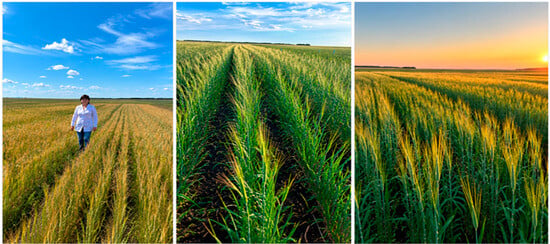
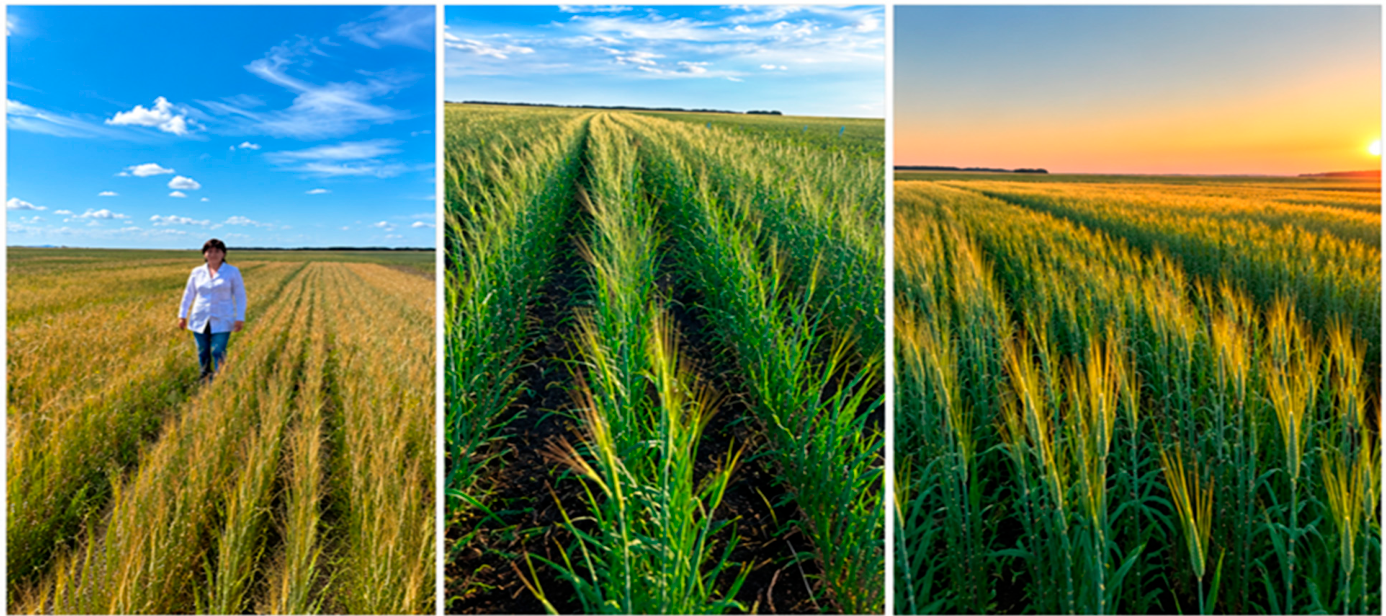
Field and laboratory studies were carried out using generally accepted methods. Productive moisture reserves were determined using the thermostat-weight method. Phenological observations were carried out according to the Methodology of the State Variety Testing of Agricultural Crops, approved by the Ministry of Agriculture of the Republic of Kazakhstan dated 13 May 2011 No. 06-2/254. The density of plants in the phase of full emergence and before harvesting, as well as the structure of the crop, were determined using the same method. The yield was taken into account using a continuous method (Figure 1). The reaction of crop yield to mineral nutrition is according to V.V. Hangeldin [21]; crop yield stability (Hot) is according to the method of S.A. Eberhart, W.H. Russell as presented by V.Z. Pakudin [22,23]. Statistical processing of research results using the Fisher analysis of variance method is as presented by Dospekhov (Dospekhov B.A., 1985) [24], correlation and regression analysis was carried out on a PC using the statistical processing program “AgStat” and “Statistica”.
Figure 1.
Spring barley crops during the growing period in the experimental field of the UNPC Elit, 2025.
2.2. Agrometeorological Conditions for 2025
Agrometeorological conditions during the 2025 growing period were generally favorable for the growth and development of grain crops. From May to September, 275 mm of precipitation fell, which is 70.0 mm or 34.0% higher than the norm (the norm is 205 mm). During the critical phases of grain crop development, May and June saw 65 mm of precipitation, which is 34 and 21 mm, or 112 and 47%, above the norm; in July, the amount of precipitation was close to the norm—67.5 mm, with the norm being 63.9 mm, the excess was only 3.6 mm, or 5.6%. In September, 21.8 mm of precipitation fell, which is 5.2 mm or 19.2% less than the norm.
The temperature conditions were also favorable. The average air temperature for the months of May–September was 16.6 °C with a norm of 15.3 °C, the deviation from the norm was 1.3 °C or 8.4%. In May and June, the air temperature was 12.7 and 18.7 °C, which is 1.0 and 1.7 °C, or 8.5 and 10.0% higher than the norm. The month of July was very hot—22.8 °C with the norm of 18.8 °C, the excess was 4.0 °C or 21.2%. In August, the air temperature was 1.0 °C or 5.8% higher than normal, and in September it was 1.5 °C or 12.5% lower than normal.
3. Results and Discussion
3.1. Productive Moisture Reserves in the Soil
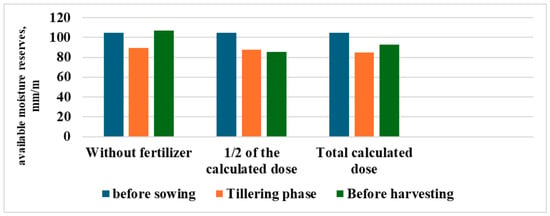
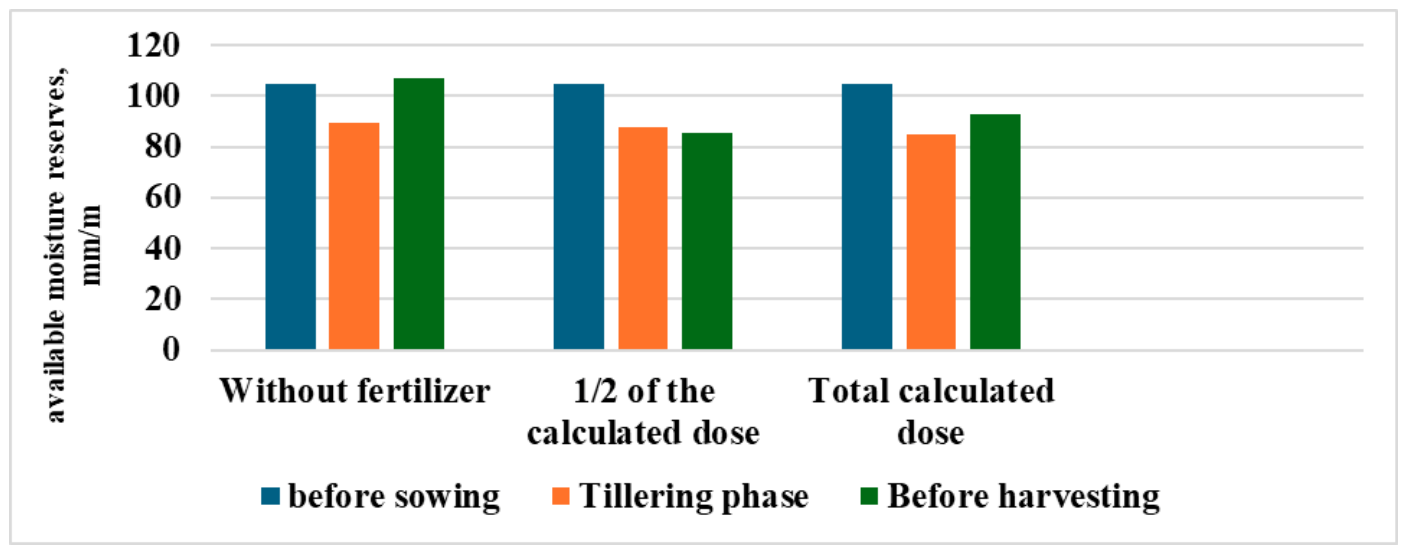
Under the conditions of 2025 before sowing (30 May 2025), the reserves of productive moisture in the meter-thick soil layer amounted to 105 mm/m, which corresponds to the average reserves. In the tillering phase of spring barley (27 June 2025), against a background without the use of fertilizers, they were low at 89.5 mm/m, and against the background of mineral nutrition, they did not differ significantly from the zero background; against the background of half the calculated dose of fertilizer, reserves were 87.9 mm/m and against the background of the full calculated dose, reserves were 85.0 mm/m. Before harvesting (29 August 2025), against the background of no fertilizer application, the value of productive moisture reserves was average at 107.0 mm/m, and against the background of half and the full calculated dose of fertilizer, their value was low at 85.5 mm/m and 92.9 mm/m. This is due to the high consumption of moisture for the formation of additional crops (Figure 2).
Figure 2.
Productive moisture reserves in the soil during the growing period according to mineral nutrition backgrounds in spring barley crops, mm/m, 2025.
The decrease in productive moisture reserves on fertilized backgrounds is associated with more intensive use of water by plants. Improved nitrogen and phosphorus nutrition contributed to a more intensive accumulation of above-ground biomass, which was accompanied by a greater consumption of soil moisture. A similar pattern has been repeatedly noted in the cultivation of grain crops, when an increase in the supply of nutrients is accompanied by an increase in total water consumption due to higher plant productivity [25].
For the northern grain-producing regions of Kazakhstan, characterized predominantly by rainfed agriculture, moisture deficiency is considered a key factor limiting the realization of potential wheat yields [26]. Water is a key abiotic factor limiting crop productivity in Kazakhstan. For barley crops, drought is the main cause of yield reduction, and varieties must be resistant to fluctuations in precipitation [27].
In connection with the above, one of the priority areas of selection and seed production is the creation of drought-resistant barley varieties adapted to the conditions of risky farming.
It should be noted that this article does not claim to establish the degree of drought resistance of the studied varieties. It provides an assessment of the response to mineral nutrition and the stability of the yield of barley varieties in years with favorable meteorological conditions.
3.2. Nitrate Nitrogen
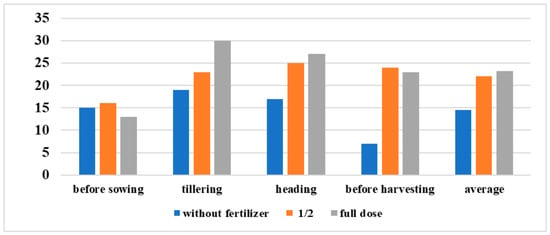
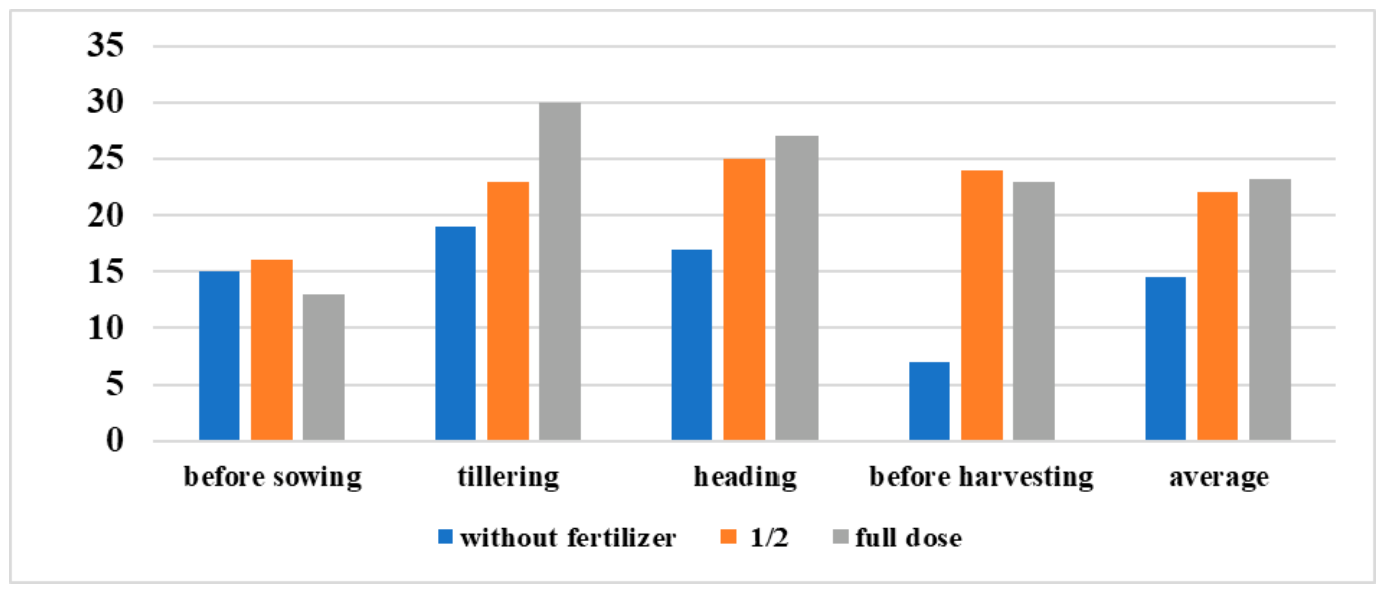
Studies have shown a significant influence of the level of mineral nutrition on the content of nitrate nitrogen in ordinary chernozem during the cultivation of spring barley. In the spring before sowing, without the use of fertilizers (control), the nitrate nitrogen content was 15 mg/kg, with the application of half the dose of fertilizers at 16 mg/kg, with the full calculated dose, it was 13 mg/kg, that is, they did not differ significantly and were within the average level. During the tillering period of spring barley, an increase in the nitrate nitrogen content was observed against the background of a half dose up to 23 mg/kg and against the background of a full calculated dose up to 30 mg/kg (in the control 19 mg/kg). During the heading phase, its content decreased somewhat, but remained quite high and amounted to 17 mg/kg in the control, 25 mg/kg at half and 27 mg/kg at full doses of fertilizers. Before harvesting, a significant decrease in nitrate nitrogen reserves was observed, which is associated with the active consumption of the element by plants. Its content decreased to 7 mg/kg in the control, 24 mg/kg at half and 23 mg/kg at the full calculated dose. On average, during the growing period, the nitrate nitrogen content was 14.5 mg/kg in the control, 22 mg/kg with half doses and 23.25 mg/kg with full doses of fertilizers, which indicates a positive effect of mineral nutrition on the nitrogen regime of the soil (Figure 3).
Figure 3.
The influence of mineral nutrition level on the content of nitrate nitrogen in ordinary chernozem during the cultivation of spring barley.
Agriculture in Kazakhstan has a high demand for nitrogen fertilizers, which confirms the role of nitrogen in crop nutrition [12]. Optimization of mineral nutrition, including nitrogen and phosphorus, is one of the key factors in increasing the productivity of spring barley. Insufficient supply of mineral nutrients to plants limits crop yield and reduces crop productivity. The deficiency of available forms of phosphorus and nitrogen is accompanied by a deterioration in the nutritional status of ordinary chernozem and a decrease in barley yield [28].
Our research examined the responsiveness of barley varieties to mineral nutrition levels, which allowed us to determine the effectiveness of varieties and fertilizers in the genotype + fertilizer system. At the same time, the nitrogen regime is one of the key factors limiting the productivity of grain crops in the black soil zone of Northern Kazakhstan, especially with insufficient application of fertilizers.
3.3. Mobile Phosphorus
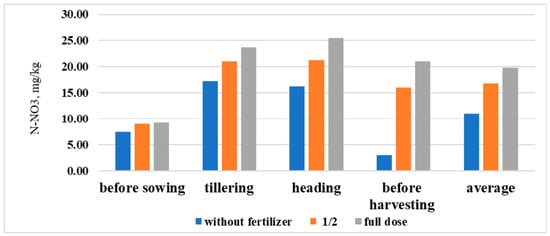
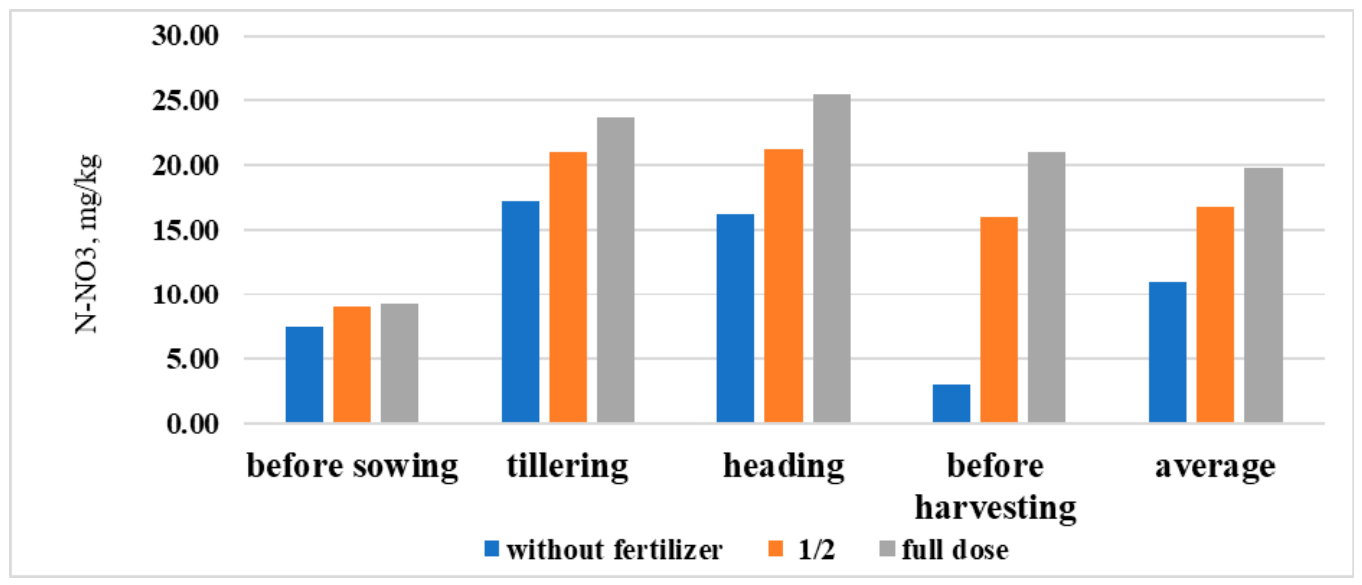
The content of available phosphorus also varied depending on the level of mineral nutrition and the phase of crop development. Before sowing, its content was very low and amounted to 7.50 mg/kg in the control, 9.00 mg/kg at half doses and 9.25 mg/kg at full doses of fertilizers, that is, they did not differ significantly. During the tillering phase, a significant increase in the content of mobile phosphorus was observed up to 17.25 mg/kg in the control, 21.00 mg/kg at half doses and 23.75 mg/kg at full doses of fertilizers; during the heading phase, the phosphorus content remained at a fairly high level and amounted to 16.25 mg/kg, 21.25 mg/kg and 25.50 mg/kg, respectively, according to the experimental background, that is, the soil supply with phosphorus increased to an average level. Before harvesting, a decrease in the content of mobile phosphorus was observed, which was due to its use by plants for crop formation. The values were 3.00 mg/kg for the control, 16.00 mg/kg for half doses and 21.00 mg/kg for full doses of fertilizers. On average, during the growing period, the content of mobile phosphorus was 11.00 mg/kg for the control, 16.81 mg/kg for the half dose and 19.88 mg/kg for the full dose of fertilizers (Figure 4).
Figure 4.
Influence of mineral nutrition level on the content of mobile phosphorus in ordinary chernozem during the cultivation of spring barley.
Chernozem soils of Northern Kazakhstan are characterized by a low soil supply of mobile phosphorus [29,30]. The use of phosphorus fertilizers contributed to the positive dynamics of mobile phosphorus in the chernozem soils of Northern Kazakhstan during the growing period [31].
In our studies, the use of half and full calculated doses of mineral fertilizers on ordinary chernozem allowed us to maximize the genetic potential of varieties, especially intensive varieties.
3.4. Exchangeable Potassium
The soil has a high level of exchangeable potassium. Its content without fertilizer averaged 422 mg/kg, with half the calculated dose of 520 mg/kg, and with the full calculated dose of 542 mg/kg.
In the chernozem soils of Northern Kazakhstan, potassium is present in sufficient or increased quantities, and therefore is not a limiting factor in crop yield. The content of exchangeable potassium in ordinary carbonate chernozem is very high. The content of exchangeable potassium in ordinary carbonate chernozem is characterized by increased availability. This indicates a favorable potassium status of the studied soil [32].
3.5. pH
The soil reaction is neutral, in the range of 7.0–7.2, which is favorable for the cultivation of grain crops. Most authors indicate that the chernozem soils of Northern Kazakhstan are characterized by a neutral or slightly alkaline reaction of the soil environment [33,34,35].
In our experiment, increasing the level of mineral nutrition contributed to an increase in the content of nitrate nitrogen and mobile phosphorus in ordinary chernozem, especially during the most active phases of spring barley development—tillering and heading. The highest values of the indicators were noted when applying the full calculated dose of mineral fertilizers, which indicates a more favorable nutritional regime of the soil.
3.6. Phenology
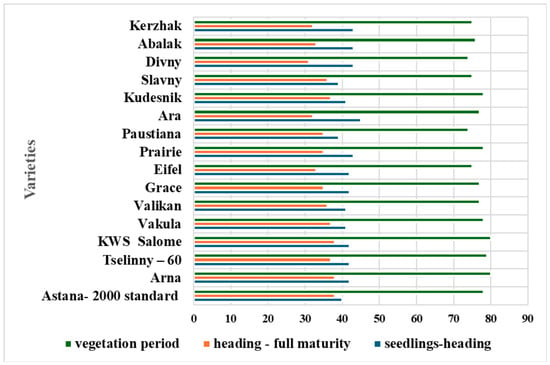
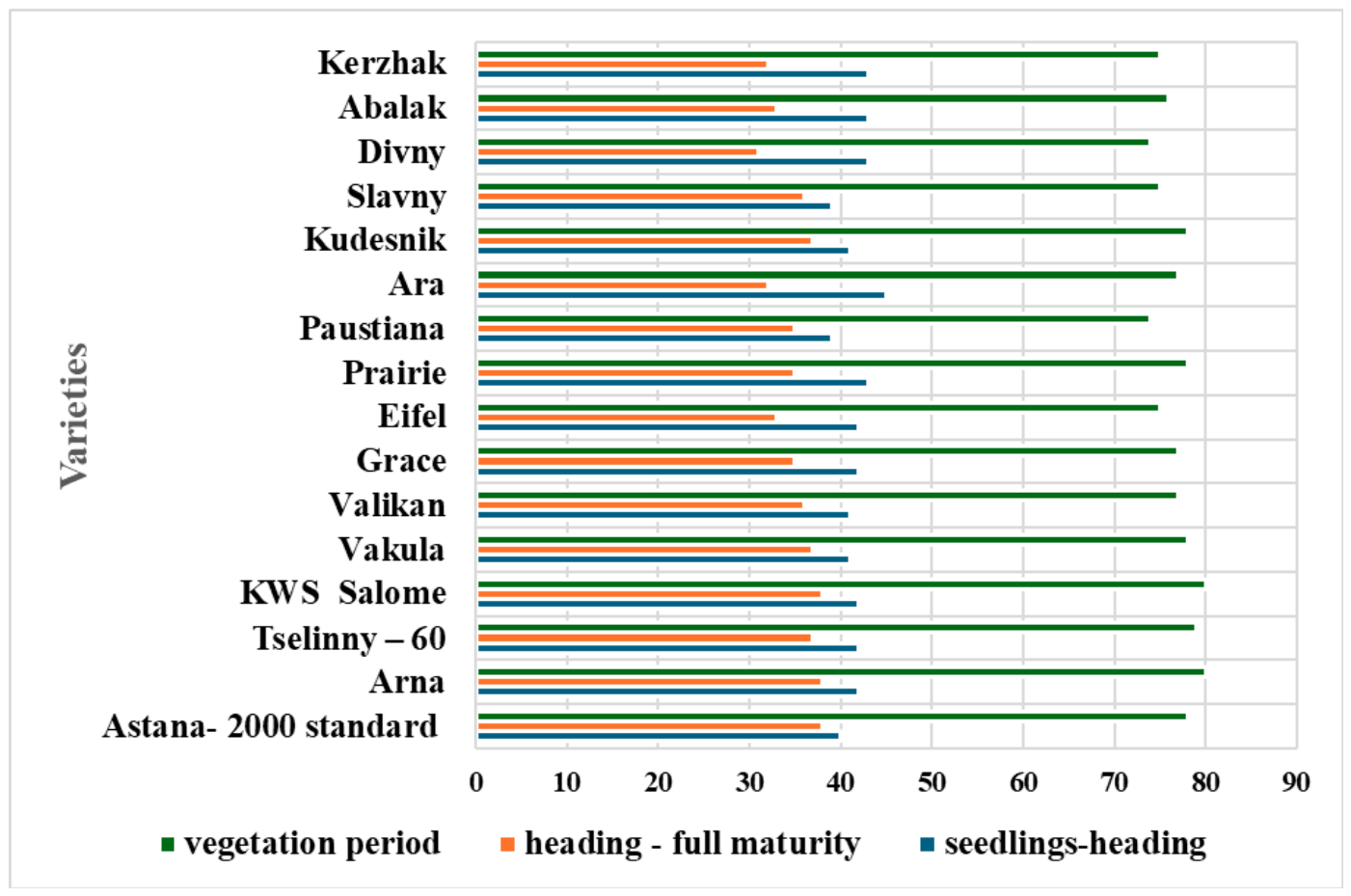
The date of the full germination phase onset in the standard Astana-2000 variety was as follows: seedlings appeared on June 8; for the varieties Arna, Tselinny-60, KWS Salome, Vakula, Prairie and Ara, seedlings appeared 1–2 days earlier than the standard, 6–7 June; for the Paustiana and Slavny varieties, it was later (9 June) and for the other varieties, they did not differ from the standard. The tillering phase for most varieties began around 18–20 June. Early tillering was noted in the varieties Astana-2000 (standard), Arna, Tselinny-60, Vakula, Prairie and Slavny (18 June), in KWS Salome, Paustiana and Abalak (19 June) and in the remaining varieties (20 June). The tube emergence phase was recorded from 29 June to 2 July. Earlier development (29 June) is typical for the varieties Astana-2000 (standard), Arna, Tselinny-60, Prairie and Slavny, while later dates (1–2 July) are noted for the varieties Velikan, Eifel, Kudesnik, Grace, Ara, Divny and Kerzhak. The heading phase began on 12–15 July. For the standard variety Astana-2000 and for the varieties Arna, KWS Salome, Prairie, Paustiana and Slavny, it occurred on 12 July, for the varieties Tselinny-60 and Vakula, on 13 July, for the varieties Velikan, Eifel, Kudesnik and Abalak, on 14 July, for the varieties Grace, Ara, Divny and Kerzhak, on 15 July. The flowering phase took place between 18 and 21 July. The varieties Astana (standard), Arna, KWS Salome, Prairie and Slavny started flowering on 18 July; Tselinny-60, Vakula, Paustiana and Kudesnik on 19 July; Velikan, Grace and Eifel on 20 July; and Ara, Divny, Abalak and Kerzhak on 21 July. The milk ripeness phase was recorded in the period from 30 July to 1 August. The Arna, Vakula, Eifel, Prairie, Ara, Divny, Abalak and Kerzhak varieties were harvested on 30 July; the Astana-2000 (standard), Velikan, Paustiana, Kudesnik and Slavny varieties were harvested on July 31st; and the remaining varieties were harvested on August 1st. The wax ripeness phase was observed from 13 to 15 August, for the standard variety Astana—2000, Arna, Tselinny-60, KWS Salome, Velikan and Abalak, on 14 August, for the Vakula variety, on 15 August and for the remaining varieties, it began on 13 August. Full grain maturity occurred between 21 and 26 August. For the varieties Divny, maturity occurred on 21 August, for Eifel, Paustiana, Ara and Kerzhak, it was 22 August, for Grace, Prairie, Slavny and Abalak, it was 23 August, for Tselinny-60 and Vakula, it was 24 August, for the standard variety Astana-2000, Arna, Velikan and Kudesnik, it was 25 August, for KWS Salome, it was 26 August (Figure 5).
Figure 5.
Duration of the growing period of spring barley varieties, days.
The duration of the “germination-tillering” period was on average 11–12 days, varying from 9 days for the Slavny variety to 14 days for Ara. The periods of “tillering–booting” lasted on average 11–12 days; “booting–heading” varied within 12–14 days; “heading–flowering” was 5–7 days; “flowering-milk ripeness” was 11–14 days; “milk-wax ripeness” was 13–15 days; “wax-full ripeness” took on average 8–11 days. The length of the “germination-heading” period was in the range of 39–45 days, depending on the variety. For the standard Astana-2000 variety, it was 40 days, while for the Paustiana and Slavny varieties, it was shorter at 39 days. For other varieties, this period was longer than the standard, in the range of 42–45 days. The length of the period from heading to full maturity ranged from 31 to 38 days. For the standard variety, Astana-2000 and for the varieties Arna and KWS Salome, it was 38 days; for the varieties Tselinny-60, Vakula and Kudesnik, it was 37 days and for Velikan and Slavny, it was 36 days; for Grace, Prairie and Paustiana, it was 35 days; for Eifel and Abalak, it was 33 days; for Ara and Kerzhak, it was 32 days; and for Divny, it was 31 days.
The length of the growing period for the standard Astana-2000 variety and the Vakula, Prairie and Kudesnik varieties was 78 days; for the varieties Arna, Tselinny-60, KWS Salome, it was longer than the standard at 79–80 days, and for the other varieties, it was shorter than the standard, at 74–77 days. That is, spring barley varieties differed in the length of the growing period, by up to 6 days.
Under the conditions of the 2025 growing period, the level of mineral nutrition did not have a significant impact on the onset timing of the main phenological phases of the studied spring barley varieties. It should be noted that this conclusion applies only to the conditions of the year of research under consideration, which was characterized by favorable moisture, and requires confirmation based on the results of long-term observations under various weather conditions.
3.7. Field Germination and Plant Survival
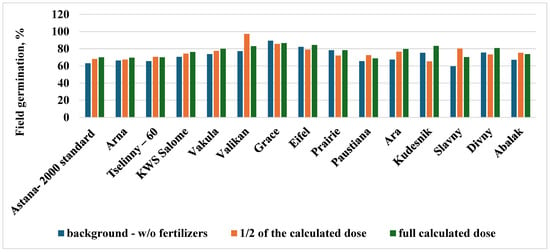
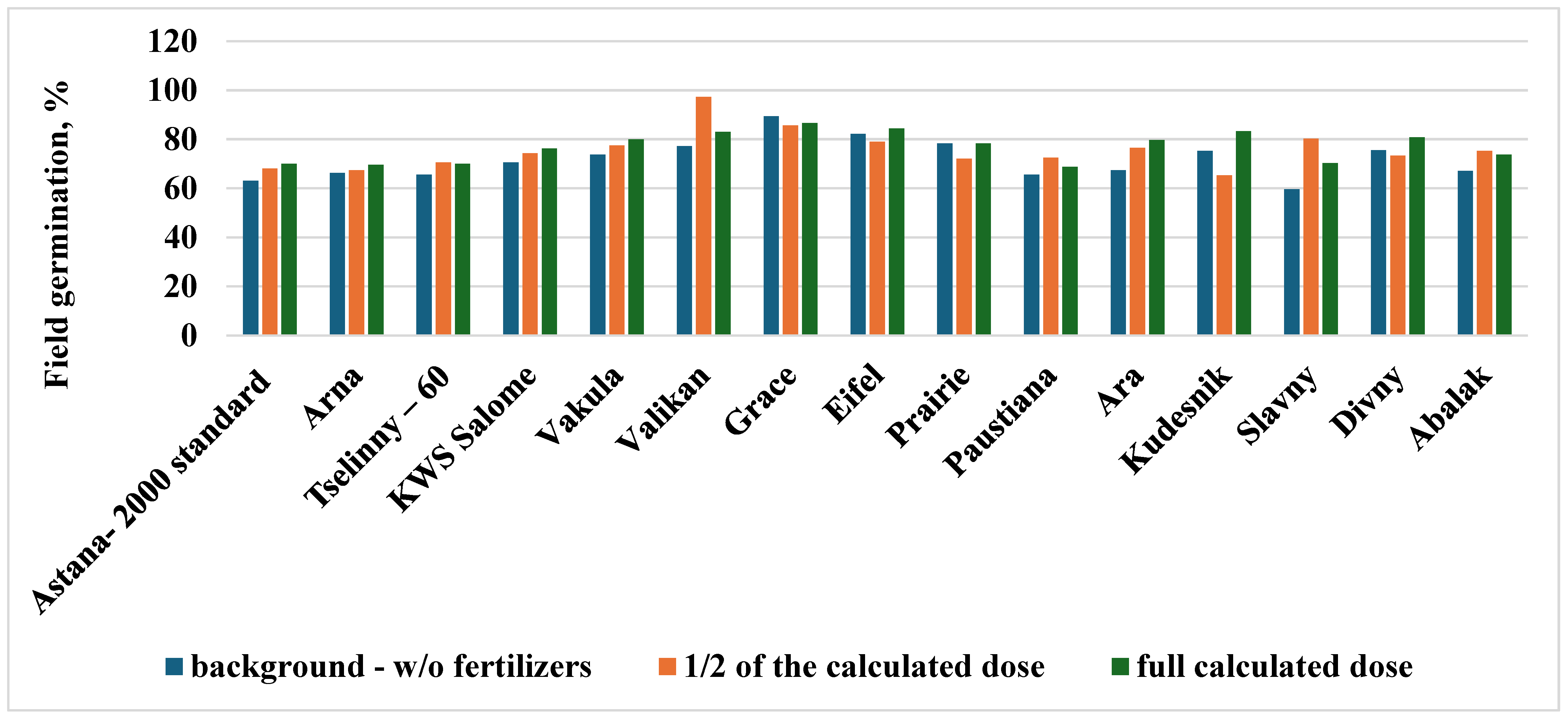
The density of barley plants in the full germination phase without fertilization in the standard was 202 pcs/m2 with a seeding rate of 3.2 million viable seeds per 1 ha, which corresponds to a field germination rate of 63.1%. In the studied variants, depending on the variety and planting density, the yield ranged from 191 to 286 pcs/m2, and germination in field conditions from 59.7 to 89.4%. The range of variation R was 95 pcs/m2, the coefficient of variation V was 10.7%, that is, the variation was weak (<30%), HSR05 = 17.5 pcs/m2. The highest plant density and germination in field conditions were observed in the Grace variety at 286 pcs/m2 and 89.4% and Eifel at 263 pcs/m2 and 82.2%. The plant density in the full germination phase for most of the studied varieties was significantly higher than the standard, while for the varieties Arna, Tselinny 60, Paustiana, Ara, Slavny, Abalak and Kerzhak, it did not differ significantly from the control one (Figure 6).
Figure 6.
Germination of spring barley varieties in field conditions depending on the level of mineral nutrition, %.
Against the background of half of the calculated dose of fertilizers, the density of barley plants in the control was 218 pcs/m2, and germination in field conditions was 68.1%. In the studied variants, these indicators ranged from 209 to 274 pcs/m2 and from 65.3 to 85.6%. The range of variation R was 65 pcs/m2, the coefficient of variation V was 7.6%, that is, the variation is weak, HSR05 = 14.8 pcs/m2. The highest plant density was achieved by the Grace and Eiffel varieties at 274 pcs/m2 with germination in field conditions of 85.6%. In most varieties, the density of barley plants was significantly higher than the standard, while in the varieties Arna, Tselinny 60, Paustiana, Ara and Slavny, it did not differ significantly from the control.
Against the background of the full calculated dose, the density of barley plants in the standard was 224 pcs/m2, germination in field conditions was 70.0%. In the studied variants, these indicators ranged from 220 to 277 pcs/m2 and from 68.8 to 86.6% with HSR05 = 13.1 pcs/m2. The range of variation R was 57 pcs/m2, the coefficient of variation V was 7.5%, that is, the variation is weak. The highest plant density was achieved by the Grace and Eiffel varieties at 277 pcs/m2 and 270 pcs/m2 with germination in field conditions of 86.6% and 84.4%.
It should be noted that on fertilized backgrounds, the plant density in the full germination phase was higher than on an unfertilized background (229 pcs/m2) and amounted to 240 and 246 pcs/m2, and germination in field conditions was 75.0 and 77%, respectively (in the standard 71.4%).
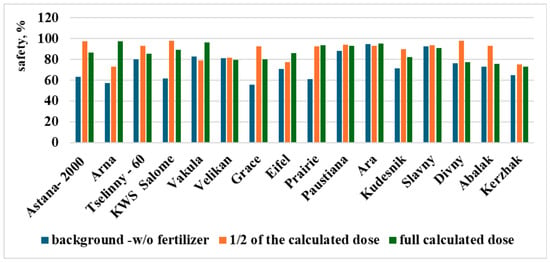
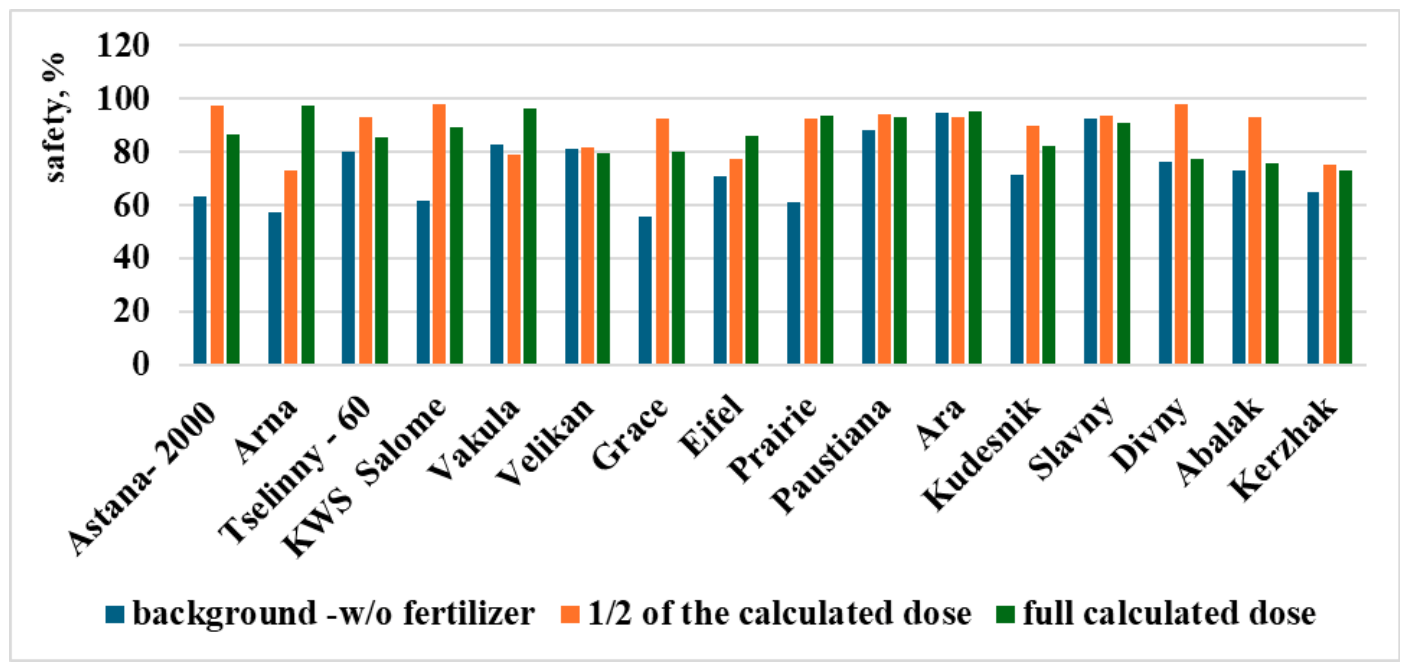
The plant density before harvesting and the survival rate of barley plants without the use of mineral fertilizer in the Astana-2000 (standard) variant was 170 pcs/m2, the proportion of surviving plants was 84.2%. In the studied varieties, their number varied within the range of 125–205 pcs/m2 and survival rate of 59.0–86.9%, depending on the variety. The maximum number of plants before harvesting was established for the Vakula and Ara varieties at 205 pcs/m2 and Velikan at 201 pcs/m2, with survival rates of 86.9%, 94.9 and 81.4%, respectively (Figure 7).
Figure 7.
Survival rate of spring barley varieties at different levels of mineral nutrition, %.
With half the calculated dose of mineral fertilizer, the number of plants before harvesting in the standard version was 173 plants m−2. In the studied variants, their number was significantly higher at 177–251 plants m−2, and the survival rate was 75.1–95.7%. The maximum number of plants was noted in the varieties of Grace with 251 plants m−2 and a survival rate of 91.6%, Prairie with 237 plants m−2 and 93.7% survival rate, Paustiana with 221 plants m−2 and 95.7% survival rate, Ara with 216 plants m−2 and 93.1% survival rate, Slavny with 193 plants m−2, and 92.3% survival rate, Divny with 235 plants m−2 and 91.4% survival rate and Abalak with 219 plants m−2 and a survival rate of 93.2%. The survival rate of plants in other varieties was also higher than the control one, with the exception of the Aina variety, where survival did not differ significantly from the standard.
Against the background of the full calculated dose of mineral fertilizer, the number of plants before harvesting in the control variant was 176 pcs/m, and the survival rate was 78.6%. The studied variants exceeded the standard in these indicators, where their number was 176–235 plants m−2, and the preservation rate was 72.8–93.6%. The maximum number of plants before harvesting was noted for the Eifel variety (232 plants m−2) and Prairie (235 plants m−2), with a survival rate of 85.9 and 93.6%.
It should be noted that on fertilized backgrounds, the number of plants before harvesting was on average higher with 207 and 206 plants m−2 and a survival rate of 86.3 and 83.6%, than on an unfertilized background with 173 plants m−2 and standard survival rate of 76.3%.
In this zone, the recommended barley seeding rate is 3.2 million/ha, which we followed [36]. Different varieties differ in germination in field conditions, survival rate and response to fertilizers [37]. Increasing the seeding rate increases the density of productive stems and reduces the survival rate of grain crops [38]. The use of fertilizers improves plant growth, development of the root system and increases the survival rate of crops until harvesting [39].
In our experience, mineral fertilizers significantly increased the yield of varieties, but the effectiveness depended on the variety and the availability of nitrogen and phosphorus in the soil.
3.8. Crop Structure
Analysis of the crop structure showed that the height of spring barley plants varies in comparison to the unfertilized conditions. For the standard variety Astana-2000, it was 74 cm, with an average background height of 58 cm, with fluctuations of 50–74 cm, and a variation range of 24 cm. The height of plants of all studied varieties was below the standard of 50–69 cm, shorter than the standard by 14–22 cm. The average height of plants with half the calculated dose of fertilizer was 60 cm, while for the standard Astana variety, it was 74 cm. The varieties with the shortest stems were Slavny, Kerzhak, Grace and Velikan at 52–53 cm. The greatest head length was noted in the Arna, Ara and Tselinny varieties: 60–67–70 cm. The average height of plants with the full calculated dose of fertilizer was 63 cm, while for the standard Astana variety, it was 79 cm. The studied varieties were also shorter than the standard by 7–25 cm. The varieties with the shortest stems were Velikan, Slavny, Kerzhak and Grace at 53–55 cm. The greatest ear length was noted in the Ara, Arna and Tselinny varieties: 60–71–73 cm (Table 2).
Table 2.
Yield structure of spring barley varieties against the background without fertilizer.
The ear length without the use of fertilizers for the standard Astana-2000 variety and the Arna, Tselinny 60 and KWS Slalome varieties was 8 cm. In other varieties, it was shorter at 5–7 cm. With half the calculated dose of fertilizers, the ear length of the standard Astana 2000 variety was 6 cm. In the varieties Arna, Tselinny 60, Velikan, Prairie, Paustiana and Kudesnik, it was longer, at 4.8 cm. Against the background of the full calculated dose of fertilizers, the ear length of the standard variety Astana 2000 was also 6 cm, while the varieties Arna, Tselinny 60, KWS Slalome, Velikan, Grace, Prairie, Paustiana, Ara, Kudesnik, Slavny and Divny were longer than the standard of 7–9 cm.
The highest ratio of ear length to stem length without the use of fertilizers was noted in the varieties Velikan of 0.15, Arna and KWS Slalome of 0.14, Tselinny 60, Grace, Paustiana and Ara of 0.13 (in the standard of 0.12); against the background of half of the calculated dose, Prairie and Paustiana (0.16), Velikan (0.15), Kudesnik (0.14), Grace and Slavny (0.13) (in the standard of 0.09); against the background of the full calculated dose of fertilizer, for the varieties Velikan (0.20), Paustiana (0.17), Grace and Slavny (0.15), Prairie and KWS Slalome (0.14), Arna, Kudesnik and Divny (0.13) (in the standard of 0.08), which increases their attractiveness for forage use. The number of productive stems in the standard Astana 2000 variety without fertilizer was 177 pcs/m2.
The maximum number of productive stems was found in the Vakula, Paustiana and Slavny varieties (231 pcs/m2) and KWS Salome (222 pcs/m2). In the remaining studied varieties, the number of productive stems was also significantly higher than the standard. The exceptions were the Arna and Kerzhak varieties, where the number of productive stems does not differ significantly from the standard. The number of productive stems against the background of half the calculated dose of fertilizer for the standard variety Astana 2000 was 185 pcs/m2. In the studied varieties, it was significantly higher than the standard. The highest number of productive stems was noted in the varieties Ara (264) pcs/m2, Grace (263 pcs/m2), Prairie (257 pcs/m2) and Paustiana (253 pcs/m2). The number of productive stems against the background of the full calculated dose for the standard variety Astana 2000 was 189 pcs/m2. The studied varieties had a significantly higher number of these plants: 210–275 pcs/m2. The maximum value was found in the KWS Salome varieties at 275 pcs/m2, and Vakula and Prairie at 271 pcs/m2 (Table 3).
Table 3.
Yield structure of spring barley varieties with ½ fertilizer.
Tillering without fertilization varied within the range of 1.0–1.5; for the standard Astana variety, it was 1.0, while for the studied varieties, it was higher at 1.1–1.5. The Prairie variety demonstrated maximum tillering at 1.5. Good tillering was achieved by the Kerzhak variety at 1.4, Paustiana at 1.3 and Slavny at 1.3 varieties. Productive tillering with half of the calculated dose of fertilizer was 1.0–1.2. The standard Astana variety had 1.1, while the bushiness of the other varieties did not differ significantly from the standard. The exceptions were the varieties Arna, KWS Salome and Kerzhak, where it was higher than the standard of 1.2. The productive tillering against the background of the full calculated dose of fertilizer for the standard Astana variety was 1.1. The studied varieties did not differ significantly from the standard of 1.1. The exceptions were the varieties Arna, Abalak and Kerzhak, where the productive tillering was higher than the standard of 1.2 (Table 4).
Table 4.
Yield structure of spring barley varieties with a full dose of fertilizer.
The number of grains in an ear without fertilizer varied between 11 and 15 pieces, while for the standard Astana variety, it was 15 pieces. The studied varieties were inferior to the standard in the number of grains per ear at 12–14 pieces, with the exception of the Tselinny 60 variety, where the number of grains was also 15 pieces, as in the standard. The number of grains in an ear with half of the calculated dose of fertilizer varied within the range of 12–16 pieces; for the standard Astana variety, it was 16 pieces. The studied varieties were inferior to the standard in the number of grains per ear at 12–15 pieces. The number of grains in an ear against the background of the full calculated dose of fertilizer varied within the range of 13–17 pieces; for the standard Astana variety, it was 17 pieces. The studied varieties were inferior to the standard in the number of grains per ear at 13–16 pcs.
The weight of 1000 grains without fertilizer for the standard Astana variety was 52.0 g. In the KWS Salome and Vakula varieties, it was higher than the standard at 53 and 54 g, and in the Velikan variety, the weight of 1000 grains did not differ significantly from the control, and in the remaining varieties it was less than the standard of 34–50 g. The weight of 1000 grains with half the calculated dose of fertilizer for the standard Astana variety was 53 g. The Arna varieties yield 54 g, KWS Salome yield 55 g, Vakula yield 55 g and Velikan yield 58 g, i.e., above the standard. The remaining varieties were inferior to the standard in terms of the weight of 1000 grains at 34–52 g. The weight of 1000 grains against the background of the full calculated dose of fertilizer for the standard Astana variety was 54 g. For the Arna and Vakula varieties, it was 55 g, KWS Salome and Velikan were 58 g, higher than the standard. The remaining varieties were inferior to the standard in terms of the weight of 1000 grains at 36–54 g.
Analysis of the variation coefficients showed that the degree of variability of the elements of the spring barley yield structure depended on both the studied trait and the level of mineral nutrition. Against the background without the use of fertilizers, the variation coefficient (V) ranged from 7.87 to 19.14%. The highest variability was observed in the length of the spike (19.14%), the ratio of the length of the spike to the length of the stem (14.35%) and the number of plants per 1 m2 (14.16%). Moderate variability was noted for 1000-grain weight (12.85%), plant height (12.16%), number of productive stems (11.08%) and productive tillering (10.87%). The most stable trait was the number of grains per ear, the coefficient of variation of which was 7.87%. When applying half dose of mineral fertilizers, the variation coefficients ranged from 5.02 to 18.84%. The maximum variability was noted for the ratio of ear length to stem length (18.84%) and ear length (14.52%). The coefficient of variation of 1000-grain weight was 11.94%, plant height was 10.97% and the number of plants was 10.93%. The number of productive stems (9.26%), the number of grains per ear (7.58%) and productive tillering (5.02%) were characterized by lower variability. At a full dose of mineral fertilizers, the range of the variation coefficient was from 3.49 to 22.11%. The greatest intervarietal variability was revealed in the ratio of ear length to stem length (V = 22.11%). The ear length was characterized by a variation coefficient of 15.40%, plant height of 11.73% and 1000-grain weight of 10.99%. The variability in the number of productive stems was 9.81%, the number of plants was 9.04%, the number of grains in the ear was 8.40%. The most stable feature against this background was productive tillering (V = 3.49%).
In general, an increase in the level of mineral nutrition was accompanied by a decrease in intervarietal variability in the number of plants (from 14.16 to 9.04%), productive tillering (from 10.87 to 3.49%) and 1000-grain weight (from 12.85 to 10.99%). At the same time, the variability of the ratio of ear length to stem length increased from 14.35% in an unfertilized background to 18.84% with the application of half dose and to 22.11% with the full dose of fertilizers. The number of grains per ear was characterized by relatively low and stable variability in all three backgrounds (7.58–8.40%). Thus, the level of mineral nutrition had an uneven effect on the variability of individual elements of the crop structure, with the most stable traits under the experimental conditions being productive tillering and the number of grains per ear.
Differences between barley varieties are manifested in the formation of crop structure elements and their responsiveness to fertilization [40]. Barley yield is closely related to productive stem size, 1000-grain weight and other elements of crop structure [41]. The use of nitrogen–phosphorus fertilizers contributed to an improvement in the structure of the spring barley crop by increasing the productive stem and the mass of grain per main spike, which ensured an increase in yield [42]. Similar results were obtained in our studies.
3.9. Yield
The results of the analysis of variance of the two-factor experiment confirmed the significant influence of the variety (F = 46.99; p < 0.0001) and the background of mineral nutrition (F = 194.52; p < 0.0001) on the yield of spring barley. The highest value of the Fisher criterion for factor B “nutrition background” indicates that the level of mineral nutrition was the main factor increasing the barley yield in the experiment. The significant interaction of the AxB factors “variety × nutrition background” (F = 2.94; p < 0.0001) indicates different responsiveness of the studied spring barley varieties to the application of mineral fertilizers. The mean square error was 0.0140, which indicates the high accuracy of the experiment.
The yield of spring barley grain without fertilization in the standard variant Astana 2000 was 1.30 t/ha, a reliable increase in yield was provided by the varieties KWS Salome at 0.35 t/ha or 26.7%, Vakula at 0.40 t/ha or 30.8% and Velikan at 0.20 t/ha or 15.1%. The yield of the varieties Tselinny 60 and Ara did not differ significantly from the standard, and the other varieties were even inferior to the standard (Table 5).
Table 5.
Responsiveness of spring barley varieties to the level of mineral nutrition.
The grain yield with half the calculated dose of fertilizer in the standard variant Astana 2000 was 1.49 t/ha, a reliable increase in yield was provided by the varieties KWS Salome at 0.35 t/ha or 23.5%, Vakula at 0.45 t/ha or 30.2%, Prairie at 0.21 t/ha or 14.3%, Paustiana at 0.17 t/ha or 11.2%, Ara at 0.24 t/ha or 15.9% and Grace at 0.11 t/ha or 7.4%. The yield of the varieties Tselinny 60, Velikan, and Eifel did not differ significantly from the standard, while for the other varieties, it was even lower than the standard.
The grain yield against the background of the full calculated dose of fertilizer in the standard version of Astana 2000 was 1.65 t/ha. A significant increase in yield was achieved by the following varieties: KWS Salome at 0.65 t/ha or 39.4%, Vakula at 0.63 t/ha or 38.2%, Prairie at 0.42 t/ha or 25.4%, Velikan at 0.24 t/ha or 14.6%, Paustiana at 0.11 t/ha or 6.7%. The yield of the varieties Arna, Tselinny 60, Grace and Ara did not differ significantly from the standard, while that of the remaining varieties was even lower than the standard.
The yield variability of barley varieties was moderate to high: minimal with a 0.5 dose of fertilizers (14.96%) and more pronounced without fertilizers (20.02%) and at the full dose (19.43%).
The responsiveness of spring barley varieties to the level of mineral nutrition varied significantly depending on the genotype, both in terms of yield and the magnitude of the increase from the use of fertilizers. On average, for the studied varieties, the yield increased from 1.23 t/ha without fertilizers to 1.51 t/ha with the application of the 0.5 dose and to 1.68 t/ha with the full dose of mineral nutrition.
The highest relative increase in yield with a full dose of mineral nutrition was found in the Kudesnik variety at0.77 t/ha, or 98.72% relative to the unfertilized background. Significant responsiveness was also noted in the varieties Arna (65.98%), Prairie (62.99%) and KWS Salome (40.24%). At the same time, the high relative increase in the Kudesnik variety was also due to the low initial yield on an unfertilized background (0.78 t/ha).
It should be noted that the main limiting factor in the yield was the low supply of nitrate nitrogen (11.5 mg/kg) and mobile phosphorus (7.5 mg/kg), caused by the long-term absence of systematic application of mineral fertilizers. Therefore, the high responsiveness of barley varieties to fertilizers was achieved by eliminating nutrient deficiencies and can be scaled up in the production conditions of Northern Kazakhstan.
Studies have shown that mineral fertilizers increased the yield of spring barley varieties by an average of 0.29 and 0.46 t/ha or by 24.0 and 38.0%. However, the responsiveness of varieties to the level of mineral nutrition varies. Under the influence of mineral fertilizers, the yield, depending on the variety, against the background of the full calculated dose of fertilizer, increased for the Kudesnik varieties by 0.77 t/ha or 98.7%, for Prairie, by0.80 t/ha or 63.0% and for Arna, by 0.64 t/ha or 66.0%.
On chernozem soils, the use of phosphorus fertilizers increases the yield of spring barley [43]. Improved soil nutrition led to an increase in barley yield. The response of barley varieties to nutrition varies depending on the genotype and environmental conditions [43,44]. The widespread distribution of the Astana 2000 variety in Northern Kazakhstan indicates its high adaptability to the soil and climatic conditions of the region [44]. In our experiments, the Astana 2000 variety was adopted as the standard.
3.10. Mathematical Model
Against the background of no fertilizer application, a strong positive correlation was established between the yield of spring barley and the weight of 1000 grains (r = 0.75) and the number of plants before harvesting (r = 0.63); a significant relationship with the number of productive stems (r = 0.53); moderate relationship with the number of grains per ear (r = 0.49), duration of the growing period (r = 0.35), plant height (r = 0.33) and ear length (r = 0.35). Here, the decisive factors in yield were the grain size and the density of the productive stem stand. Against this background, a close positive relationship was noted between the number of plants before harvesting and the number of productive stems (r = 0.73), the height of plants with the length of the ear and the number of grains in the ear (r = 0.73), a noticeable positive relationship between the length of the growing period and the length of the ear (r = 0.65) and the weight of 1000 grains (r = 0.55); plant survival with the number of productive stems (r = 0.61). That is, a stable system of relationships has been formed, where productivity is determined by the seeding density and the weight of 1000 grains (Table 6).
Table 6.
Mathematical model of correlations between the grain yield of barley varieties and their growth and development indicators without the use of fertilizers.
With an insufficient level of mineral nutrition, crop yield is largely determined by the density of plant growth, since a limited supply of nitrogen and phosphorus reduces field germination, productive tillering and plant survival. As nutritional conditions improve, the influence of plant density decreases as the optimal density of productive plants is formed. Under these conditions, the role of elements of the crop structure associated with ear productivity and grain filling increases, including the mass of 1000 grains, which makes a significant contribution to the formation of the final yield [45,46].
Against the background of half the calculated dose of fertilizers, a noticeable correlation was established between barley yield and the weight of 1000 grains (r = 0.65) and the length of the growing period (r = 0.55); moderate correlation—with the number of grains in the ear (r = 0.42), ear length (r = 0.38), number of productive stems (r = 0.35) and plant height (r = 0.34)—Table 7.
Table 7.
Mathematical model of correlations between the grain yield of barley varieties and their growth and development indicators against the background of half the calculated dose of fertilizer.
It should be noted that with improved nutrition, the role of the biological potential of the variety (duration of vegetation, grain content of the ear) increased, and the influence of plant density decreased. A strong correlation was established between the number of plants and productive stems (r = 0.88); a noticeable relationship between the survival of plants and the number of grains in an ear (r = 0.63), the duration of vegetation with the weight of 1000 grains (r = 0.63) and a negative noticeable relationship was obtained between the number of plants and productive tillering (r = −0.68). Consequently, at an average level of nutrition, compensatory mechanisms were strengthened and the importance of generative traits increased.
Against the background of the full calculated dose of fertilizers, a positive strong relationship was established between yield and the weight of 1000 grains (r = 0.79); a noticeable relationship with the number of productive stems (r = 0.69) and the number of plants before harvesting (r = 0.69), with the length of the growing period (r = 0.61) and the survival of plants before harvesting (r = 0.60). A significant relationship was calculated between the length of the growing period and the 1000-grain weight (r = 0.67), between field germination and the number of plants before harvesting (r = 0.55), and the number of productive stems (r = 0.51); moderate relationship between plant survival, plant height (r = 0.42) and the number of plants before harvesting (r = 0.41), between plant height and the number of grains per ear (r = 0.43)—Table 8.
Table 8.
Mathematical model of correlations between the grain yield of barley varieties and their growth and development indicators against the background of the full calculated dose of fertilizer.
It follows that, with full nutritional provision, the dominant role in the formation of yield was played by the morphobiological characteristics of the plant and the weight of 1000 grains, while cenotic factors (density, tillering) faded into the background.
Thus, at all levels of mineral nutrition, the leading element of the crop structure remained the mass of 1000 grains. Against an unfertilized background, the decisive factor was the density of productive stems. As the nutrition level increased, the role of the duration of the growing period and the grain content of the ear increased. The application of fertilizers led to a redistribution of correlation links from cenotic characteristics to individual plant morphological indicators. With sufficient nutrition, the structure of the correlation network became more ordered and biologically determined.
3.11. Yield Response to Mineral Nutrition and Yield Stability of Spring Barley Varieties
The calculation results of the regression coefficient (bi), residual dispersion (S2di) and yield stability (Hom) based on spring barley yield data showed a wide range of adaptive responses of the studied varieties. The values of the regression coefficient varied from 0.6 to 1.7, the residual variance from 0.002 to 0.073 and the yield stability index from 3.4 to 6.9. This range confirms the varying degrees of resistance of spring barley varieties to changes in the level of mineral nutrition. The regression coefficients showed positive values, indicating a positive effect of the studied factors on the response variable. The residual variance values indicated relatively low random variability in the experimental data and good reproducibility of the results across replicates. The yield stability indices demonstrated differences among the studied treatments in the stability of yield formation. Lower values of the stability index characterized treatments with more stable yields, whereas higher values indicated greater yield variability (Table 9).
Table 9.
Response to mineral nutrition and yield stability of spring barley varieties.
More flexible barley varieties are distinguished by their ability to more effectively utilize changing environmental conditions due to the architectural features of the root system, more efficient absorption of mineral nutrients and optimal distribution of assimilates between vegetative and generative organs. Due to this, such varieties are able to maintain relatively high productivity with both limited and increased levels of mineral nutrition [47].
The varieties Velikan, Slavny, Divny, Abalak and Kerzhak turned out to be stress resistant to mineral nutrition (extensive) with low bi values (<1.0). They were characterized by high yield stability (Hom > 6) and low residual dispersion, which indicates their sustainability and ability to maintain yield without the use of fertilizers. The Divny and Kerzhak varieties stood out in particular, with the highest Hom values (6.9 and 6.7).
Varieties with normal nutritional plasticity (bi ≈ 1.0)—Astana 2000, Arna, Tselinny-60, Grace, Eifel—were distinguished by a balanced response to changes in the level of mineral nutrition, moderate stability (S2di = 0.019–0.031) and average yield stability (Hom about 5). They can be considered as universal and suitable for cultivation under different mineral nutrition conditions.
The intensive type (bi > 1.0) is represented by the varieties KWS Salome, Vakula, Prairie, Paustiana, Ara and Kudesnik. They showed high responsiveness to increased mineral nutrition levels, but were characterized by lower yield stability (Hom3.4–5.0) and higher residual dispersion values. The Kudesnik variety has the greatest plasticity (bi = 1.67) and requires a high agricultural background for maximum realization of potential.
That is, spring barley varieties differed in the type of adaptive response to the level of mineral nutrition. Three groups were identified: stress resistant (bi < 1, Hom > 6), universal (bi ≈ 1, Hom5–6) and intensive (bi > 1, Hom < 5). The obtained data allow us to recommend stress-resistant varieties for unfertilized conditions: Velikan, Slavny, Divny, Abalak, Kerzhak; universal ones for resource-saving technology: Tselinny 60, Paustiana and Ara, Astana 2000, Arna, Tselinny-60, Grace, Eifel; and intensive ones: KWS Salome, Vakula, Prairie, Paustiana, Ara, Kudesnik for a high background of mineral nutrition of chernozem soils of Northern Kazakhstan.
The ecological plasticity of spring barley varieties in terms of yield and grain quality depending on growing conditions was studied by Bagan A. V. and Barat Yu. M., 2019 [48] and Eroshenko L. M., Romakhin M. M., et al., 2020–2022 [49]. They note that ecological plasticity reflects the ability of a genotype to change grain yield and quality in response to changing environmental conditions, which is an important condition for plant adaptation. Ecological plasticity of grain yield and quality traits depends on climatic and agronomic factors.
The parameters of response to mineral nutrition and yield stability of spring barley varieties that we calculated allowed us to identify genotypes with high adaptability under different mineral nutrition backgrounds.
The authors express their gratitude to the Committee of Science and Higher Education of the Ministry of Science and Higher Education of the Republic of Kazakhstan for the opportunity to conduct this research within the framework of program-targeted financing under the AR project “Increasing productivity and greening dairy farms based on the intensification and digitalization of forage production, crop production and rational use of resources to improve the economic and environmental sustainability of the Akmola region” for 2026–2028.
4. Conclusions
In 2025, under favorable agrometeorological conditions in terms of heat and moisture supply, the nitrogen nutrition regime of spring barley plants with insufficient application of fertilizers was a key factor limiting their productivity on chernozem soils. And mobile phosphorus is a deficient nutrient. The use of half and full calculated doses of mineral fertilizers on ordinary chernozem allowed for the maximum use of the genetic potential of varieties, especially intensive varieties. An increase in the level of mineral nutrition contributed to an increase in the content of nitrate nitrogen and mobile phosphorus in ordinary chernozem, especially during the most active phases of spring barley development—tillering and heading. The highest values of the indicators were noted when applying the full calculated dose of mineral fertilizers, which indicates a more favorable nutritional regime of the soil.
Under 2025 conditions, the level of mineral nutrition did not have a significant impact on the timing of the onset of the main phenological phases of the studied varieties. However, to confirm the absence of a stable effect of fertilizers on phenological development, studies over several growing periods are necessary.
Differences between barley varieties are expressed through crop structure elements and response to fertilizers. Mineral nutrition increased the density of plants, the number of productive stems, the number of grains per ear and the weight of 1000 grains.
The studied varieties had different yields and responses to fertilizers. Against the background without fertilization, a reliable increase in yield was provided by the varieties KWS Salome at 26.7%, Vakula at 30.8% and Velikan at 15.1% (yield of the Astana 2000 standard is 1.30 t/ha). Against the background of half of the calculated dose of fertilizer, a reliable increase in yield was provided by the varieties KWS Salome at 23.5%, Vakula at 30.2%, Prairie at 14.3%, Paustiana at 11.2%, Ara at 15.9% and Grace at7.4% (the yield of the standard variety Astana 2000 is 1.49 t/ha). Against the background of the full calculated dose of fertilizer, a reliable increase in yield was given by the varieties KWS Salome at 39.4%, Vakula at 38.2%, Prairie at 25.4%, Velikan at 14.6%, Paustiana at 6.7% and Ara at 6.1% (the yield of the standard variety Astana 2000 is 1.65 t/ha). Mineral fertilizers increased the yield of spring barley varieties by an average of 0.29 and 0.46 t/ha or by 24.0 and 38.0%. The varieties Kudesnik, Prairie and Arna turned out to be the most responsive to mineral fertilizers, where, against the background of the full calculated dose of fertilizer, their yield increased by 98.7%, 63.0% and 66.0%, respectively.
The varieties Velikan, Slavny, Divny, Abalak and Kerzhak, which are intended for extensive cultivation technologies, were considered stable in terms of yield (bi < 1, Hom > 6), and were used. Based on their response to mineral nutrition, Astana 2000, Arna, Tselinny-60, Grace and Eifel, which are intended for resource-saving technology, were classified as universal (bi ≈ 1, Hom 5–6). KWS Salome, Vakula, Prairie, Paustiana, Ara and Kudesnik varieties were classified as intensive (bi > 1, Hom < 5), which are intended for high mineral nutrition.
Against a background without fertilizers, a stable system of relationships was formed, where the productivity of spring barley was determined by field germination and 1000-grain weight. Against the background of half the calculated dose of fertilizers, the role of the biological potential of the variety (duration of vegetation, grain content of the ear) increased, and the influence of field germination decreased; at an average level of nutrition, compensatory mechanisms were strengthened and the importance of generative traits increased. With full nutrition, the dominant role in determining yield was played by the morphobiological characteristics of the plant and the weight of 1000 grains, while cenotic factors (density, bushiness) faded into the background.
Author Contributions
Conceptualization, A.T.K.; methodology, A.T.K. and T.Z.A.; formal analysis, P.B.R. and G.M.N.; resources, P.B.R.; data curation, A.S.A., G.M.N. and T.Z.A.; writing—review and editing, A.S.A. All authors have read and agreed to the published version of the manuscript.
Funding
This research is funded by the Committee of Science of the Ministry of Science and Higher Education of the Republic of Kazakhstan (Grant No. BR28712213).
Institutional Review Board Statement
Not applicable.
Informed Consent Statement
Not applicable.
Data Availability Statement
The original data presented in the study are openly available at https://doi.org/10.3390/environments13050259.
Acknowledgments
The authors sincerely thank the Ministry of Science and Higher Education of the Republic of Kazakhstan for providing the opportunity to participate in a large-scale research project, as well as the University administration for its support of our research activities and assistance in conducting this study. The authors also express their special gratitude to the management of Vishnevskoye LLP for their support and assistance during the research. We are grateful to all members of the research team for their collaborative work, professional contributions, and efforts toward achieving our shared scientific results. Finally, the authors sincerely thank the journal editors and reviewers for considering the manuscript, for their time, and for their valuable comments, which helped improve the quality of the paper.
Conflicts of Interest
Author Pavel Bronislavovich Rafalsky was employed by the Vishnevskoye LLP. The remaining authors declare that the research was conducted in the absence of any commercial or financial relationships that could be construed as a potential conflict of interest.
References
- Baik, B.-K.; Ullrich, S.E. Barley for food: Characteristics, improvement, and renewed interest. J. Cereal Sci. 2008, 48, 233–242. [Google Scholar] [CrossRef] [Scilit]
- Food and Agriculture Organization of the United Nations (FAO). FAOSTAT Statistical Database. 2024. Available online: https://www.fao.org/faostat/ (accessed on 26 August 2026).
- Government of the Republic of Kazakhstan. On Approval of the National Project for the Development of the Agro-Industrial Complex of the Republic of Kazakhstan for 2021–2025 (Resolution No. 732, 12 October 2021). 2021. Available online: https://adilet.zan.kz/rus/docs/P2100000732 (accessed on 26 August 2026).
- Government of the Republic of Kazakhstan. On Amendments and Additions to the Resolution of the Government of the Republic of Kazakhstan No. 945 Dated December 30, 2020 “On Approval of the Development Strategy of National Company Food Contract Corporation JSC for 2021–2030”. Resolution No. 443 of June 28, 2022. Available online: https://adilet.zan.kz/rus/docs/P2200000443 (accessed on 26 August 2026).
- Genievskaya, Y.; Almerekova, S.; Sariev, B.; Chudinov, V.; Tokhetova, L.; Sereda, G.; Ortaev, A.; Tsygankov, V.; Blake, T.; Chao, S.; et al. Marker-trait associations in two-rowed spring barley accessions from Kazakhstan and the USA. PLoS ONE 2018, 13, e0205421. [Google Scholar] [CrossRef] [Scilit]
- Elakhdar, A.; Solanki, S.; Kubo, T.; Abed, A.; Elakhdar, I.; Khedr, R.; Hamwieh, A.; Capo-chichi, L.J.A.; Abdelsattar, M.; Franckowiak, J.D.; et al. Barley with improved drought tolerance: Challenges and perspectives. Environ. Exp. Bot. 2022, 201, 104965. [Google Scholar] [CrossRef] [Scilit]
- Abdelghany, A.M.; Lamlom, S.F.; Naser, M. Dissecting the resilience of barley genotypes under multiple adverse environmental conditions. BMC Plant Biol. 2024, 24, 16. [Google Scholar] [CrossRef] [Scilit]
- Baidyussen, A.; Jatayev, S.; Khassanova, G.; Abugalieva, S.; Sereda, G.; Sereda, S.; Gupta, N.K.; Gupta, S.; Schramm, G.; Anderson, P.; et al. Expression of specific alleles of zinc-finger transcription factors, HvSAP8 and HvSAP16, and corresponding SNP markers, are associated with drought tolerance in barley populations. Int. J. Mol. Sci. 2021, 22, 12156. [Google Scholar] [CrossRef] [Scilit]
- Genievskaya, Y.A.; Almerekova, S.S.; Abugalieva, A.I.; Chudinov, V.A.; Abugalieva, S.I. Genotype × environment interactions in grain quality traits and yield of barley grown in Kostanay and Almaty regions. Eurasian J. Ecol. 2021, 68, 44–54. [Google Scholar] [CrossRef] [Scilit]
- Mergalimov, D.B.; Bekenova, L.V.; Shamanin, V.P. Evaluation of ecological plasticity of the varieties and lines of spring barley in North-East Kazakhstan conditions. Mod. Probl. Sci. Educ. 2015, 1–2, 287. [Google Scholar]
- Ministry of Agriculture of the Republic of Kazakhstan. Information on the Agrochemical State of Soils for 2021. 2022. Available online: https://www.gov.kz/memleket/entities/moa/documents/details/297762?lang=ru (accessed on 26 August 2026).
- Kenenbaev, S.B.; Ramazanova, S.B.; Gusev, V.N. State and prospects of mineral fertilizers use in agriculture of Kazakhstan. SABRAO J. Breed. Genet. 2023, 55, 886–895. [Google Scholar] [CrossRef] [Scilit]
- Ministry of Agriculture of the Republic of Kazakhstan. On Approval of the State Register of Breeding Achievements Recommended for Use in the Republic of Kazakhstan and the List of Promising Varieties of Agricultural Plants; Order No. 181, May 8, 2026. Information and Legal System of Regulatory Legal Acts of the Republic of Kazakhstan “Adilet”. Available online: https://adilet.zan.kz/rus/docs/G26F0000181 (accessed on 26 August 2026).
- Salome: Spring Malting Barley: Variety Information. SAATEN-UNION GmbH. Available online: https://www.scandinavia.saaten-union.com/index.cfm/action/varieties/cul/587/v/4584.html (accessed on 26 August 2026).
- Eryashev, A.P.; Eryashev, P.A. Effect of optimal area and mineral feed level on obtaining high yields of malting barley (Grace). J. Agric. Crops 2022, 8, 340–344. [Google Scholar] [CrossRef] [Scilit]
- Secobra Recherches, S.A.S. Eifel (EIFEL) Spring Barley Variety: Characteristics and Agronomic Description. Direct.Farm. Available online: https://direct.farm/knowledge/plant/yachmen-yarovoj/110 (accessed on 26 August 2026).
- Agroprogress. Spring Barley Variety Prairie: Characteristics of the Variety. Available online: https://www.agroprogress.ru/upcp_product/preriya (accessed on 26 August 2026).
- Direct.Farm. Paustian (Paustian)-Spring Barley (Hordeum vulgare L.) Variety Description, Characteristics and Adaptation. Available online: https://direct.farm/knowledge/plant/yachmen-yarovoj/1152 (accessed on 26 August 2026).
- The State Register of Varieties and Hybrids of Agricultural Plants Approved for Use: The Official Publication; Rosinformagrotech: Moscow, Russia, 2024; 620p, Available online: https://gossortrf.ru/upload/iblock/00a/clri6obhudueqx6t1f6awcrsp6vm6psk.pdf (accessed on 26 August 2026).
- Nomenclature Standards of Barley Varieties of the Northern Trans—Urals Research Institute of Agriculture, a Branch of the Tyumen Scientific Center of the Siberian Branch of the Russian Academy of Sciences. AGRIS: International System for Agricultural Science and Technology. Available online: https://agris.fao.org/search/en/providers/124084/records/69e22744920f500389b275c4 (accessed on 26 August 2026).
- Khangildin, V.V.; Litvinenko, N.A. Homeostaticity and adaptability of winter wheat varieties. Nauchno-Tekhnicheskii Byulleten Vsesoyuznogo Sel.-Genet. Instituta 1981, 1, 8–14. [Google Scholar]
- Eberhart, S.A.; Russell, W.A. Stability parameters for comparing varieties. Crop Sci. 1966, 6, 36–40. [Google Scholar] [CrossRef] [Scilit]
- Pakudin, V.Z. Parameters for Assessing the Ecological Plasticity of Varieties and Hybrids. In The Theory of Selection in Plant Populations; Publishing House: Novosibirsk, Russia, 1976; pp. 178–189. [Google Scholar]
- Dospekhov, B.A. Methodology of Field Experience (with the Basics of Statistical Processing of Research Results), 5th ed.; Agropromizdat: Moscow, Russia, 1985; 351p. [Google Scholar]
- Yang, Y.; Zou, J.; Feng, B.; Hu, S.; Qiao, B.; Huang, W.; Zhang, L.; Zheng, H.; Harrison, M.T.; Liu, K.; et al. Long-term N fertilization increases water use and use-efficiency of winter wheat. Field Crops Res. 2025, 325, 109808. [Google Scholar] [CrossRef] [Scilit]
- Tajibayev, D.; Yusov, V.S.; Chudinov, V.A.; Mal’chikov, P.N.; Rozova, M.A.; Shamanin, V.P.; Shepelev, S.S.; Sharma, R.; Tsygankov, V.I.; Morgounov, A.I. Genotype by environment interactions for spring durum wheat in Kazakhstan and Russia. Ecol. Genet. Genom. 2021, 21, 100099. [Google Scholar] [CrossRef] [Scilit]
- Wang, D.; Gao, G.; Li, R.; Toktarbek, S.; Jiakula, N.; Feng, Y. Limiting factors and environmental adaptability for staple crops in Kazakhstan. Sustainability 2022, 14, 9980. [Google Scholar] [CrossRef] [Scilit]
- Islamzade, R.; Islamzade, T.; Hasanova, G.; Huseynova, S.; Babayeva, T. Effect of NPK fertilization and seed rate on barley (Hordeum vulgare) yield, yield component and nitrogen dynamics in semi-arid conditions. J. Agric. Fac. Ege Univ. 2024, 61, 307–319. [Google Scholar] [CrossRef] [Scilit]
- Grinets, L.V. Mobile compounds of phosphoric acid and their dynamics in ordinary chernozems of Northern Kazakhstan. Izv. Orenbg. State Agrar. Univ. 2011, 4, 42–44. [Google Scholar]
- Seidalina, K.K. Current State of Fertility of Chernozem Soils in Northern Kazakhstan. Ph.D. Thesis, Tyumen State Agricultural Academy, Tyumen, Russia, 2009. [Google Scholar]
- Kalyaskarova, A.E. Investigation of the application of phosphorus-dissolving fertilizers on the chernozems of the forest-steppe zone of the North Kazakhstan region. Bull. Sci. Kazakh Agrotech. Sci. Res. Univ. Named After S. Seifullin Interdiscip. 2025, 3, 118–125. [Google Scholar] [CrossRef] [Scilit]
- Zhumabek, B.; Mukhametkarimov, K.; Ramazanova, R.K. Agrochemical, Physical and Physicochemical Characteristics of Ordinary Chernozems under Forest Plants in the Steppe Zone of Northen Kazakhstan. Int. Res. J. 2017, 11, 115–122. [Google Scholar] [CrossRef]
- Rukavitsina, I.; Nelis, O.; Nazdrachev, Y.; Mamykin, Y.; Kunanbayev, K. Soil Microbiota and Particulars of Formation thereof under Traditional and Organic Farming on Chernozem Soils of Northern Kazakhstan. Fundam. Exp. Biol. 2024, 11529, 65–78. [Google Scholar] [CrossRef] [Scilit]
- Zueva, N.B.; Zhloba, L.D.; Kunanbayev, K.K.; Popolzukhina, N.A. Ecological assessment of the condition of the arable layer with the No-till technology on different types of soils of Northern Kazakhstan. Bull. L.N. Gumilyov Eurasian Natl. Univ. Chem. Geogr. Ecol. Ser. 2022, 138, 45–52. [Google Scholar] [CrossRef] [Scilit]
- Solovyov, O.; Shvidchenko, V.; Zaika, V.; Capo-Chichi, L.; Kadyrov, B. Spring wheat productivity and profitability under various crop rotations in Northern Kazakhstan’s chernozem. Int. J. Des. Nat. Ecodyn. 2024, 19, 137–146. [Google Scholar] [CrossRef] [Scilit]
- Suleimenov, M.; Kaskarbayev, Z. Cultural practices: Focus on major barley-producing regions. In Barley: Production, Improvement, and Uses; Ullrich, S.E., Ed.; Wiley-Blackwell: Ames, Iowa, 2011; pp. 223–243. [Google Scholar] [CrossRef] [Scilit]
- Chen, Z.; Li, L.; Halford, N.G.; Xu, H.; Huang, L.; Gao, R.; Lu, R.; Liu, C. Advances in barley breeding for improving nitrogen use efficiency. Agronomy 2022, 12, 1682. [Google Scholar] [CrossRef] [Scilit]
- Scapino, M.; Meloni, R.; Blandino, M. A comparison of the agronomic management of a winter barley hybrid and a conventional genotype: Effect of the seeding rate, soil tillage and nitrogen fertilization. Front. Agron. 2025, 7, 1546989. [Google Scholar] [CrossRef] [Scilit]
- Nauanova, A.; Shaikhin, S.; Ospanova, S.; Makenova, M.; Shumenova, N.; Bostubayeva, M. Enhancing spring barley grain yield with local biofertilizers in the semi-arid steppe zone of Northern Kazakhstan. Int. J. Des. Nat. Ecodyn. 2024, 19, 371–378. [Google Scholar] [CrossRef] [Scilit]
- Tobiasz-Salach, R.; Augustyńska-Prejsnar, A. Response of spring barley to foliar fertilization with Cu and Mn. Acta Sci. Pol. Agric. 2020, 19, 29–39. [Google Scholar] [CrossRef] [Scilit]
- Blokhin, V.I.; Nikiforova, I.Y.; Ganieva, I.S.; Lanochkina, M.A.; Malafeeva, Y.V.; Durbin, D.S. Elements of yield structure and grain productivity of spring barley varieties. Legum. Groat Crops 2023, 4, 123–130. [Google Scholar] [CrossRef]
- Bakaeva, N.P.; Vasiliev, A.S.; Kutilkin, V.G. The influence of tillage and fertilizer systems on the yield structure and grain quality of spring barley. Bull. Samara State Agric. Acad. 2023, 8, 3–9. [Google Scholar] [CrossRef] [Scilit]
- Khussainov, A.; Sarsenova, A.; Ayapbergenova, A.; Kyzdarbekova, G.; Bazilevskaya, E. Improving Chernozem Fertility and Barley Yield Through Combined Application of Phosphorus Fertilizer and Ash–Carbon Amendment. Soil Syst. 2025, 9, 114. [Google Scholar] [CrossRef] [Scilit]
- Turuspekov, Y.; Sariev, B.; Chudinov, V.; Sereda, G.; Tokhetova, L.; Ortaev, A.; Tsygankov, V.; Doszhanov, M.; Volis, S.; Abugalieva, S. Genotype × environment interaction patterns for grain yield of spring barley in different regions of Kazakhstan. Russ. J. Genet. 2013, 49, 196–205. [Google Scholar] [CrossRef] [Scilit]
- Klikocka, H.; Narolski, B.; Michałkiewicz, G. The effects of tillage and soil mineral fertilization on the yield and yield components of spring barley. Plant Soil Environ. 2014, 60, 255–261. [Google Scholar] [CrossRef] [Scilit]
- Serrago, R.A.; García, G.A.; Savin, R.; Miralles, D.J.; Slafer, G.A. Relevance of grain number and grain weight on barley yield responses to environmental and genetic factors. Field Crops Res. 2025, 328, 109922. [Google Scholar] [CrossRef] [Scilit]
- Giles, C.D.; Brown, L.K.; Adu, M.O.; Mezeli, M.M.; Sandral, G.A.; Simpson, R.J.; Wendler, R.; Shand, C.A.; Menezes-Blackburn, D.; Darch, T.; et al. Response-based selection of barley cultivars and legume species for complementarity: Root morphology and exudation in relation to nutrient source. Plant Sci. 2017, 255, 12–28. [Google Scholar] [CrossRef] [Scilit]
- Bagan, A.V.; Barat, Y.M. Ecological Plasticity of Spring Barley Varieties in Terms of Yield and Grain Quality. Vestn. Beloruss. Gos. Sel’skokhozyaystvennoy Akad. 2019, 65–69. Available online: https://dspace.pdau.edu.ua/bitstreams/d16c04ef-5aef-4ef2-a5a9-cbe6046b74cc/ (accessed on 26 August 2026).
- Eroshenko, L.M.; Romakhin, M.M.; Eroshenko, N.A.; Dedushev, I.A.; Romakhina, V.V.; Boldyrev, M.A. Yield, plasticity, stability and homeostasis of spring barley cultivars in the Non-Black Earth Region. Proc. Appl. Bot. Genet. Breed. 2022, 183, 38–47. [Google Scholar] [CrossRef] [Scilit]

Disclaimer/Publisher’s Note: The statements, opinions and data contained in all publications are solely those of the individual author(s) and contributor(s) and not of MDPI and/or the editor(s). MDPI and/or the editor(s) disclaim responsibility for any injury to people or property resulting from any ideas, methods, instructions or products referred to in the content. |
© 2026 by the authors. Licensee MDPI, Basel, Switzerland. This article is an open access article distributed under the terms and conditions of the Creative Commons Attribution (CC BY) license.