


Abstract
The objective of this study was to evaluate forage yield, chemical composition, canopy characteristics, and lamb performance in Massai and Marandu grass pastures grown as monocultures or as a multispecies pasture under intermittent stocking. Lambs, with an initial body weight (BW) of 21.59 ± 0.12 kg, were allocated to three production systems: Massai grass monoculture, Marandu grass monoculture, and a multispecies pasture composed of both grasses. Forage production, canopy structure, chemical composition, nutritive value, animal performance, and system productivity were evaluated. At pre-grazing, the multispecies system and the Marandu monoculture had similar values for forage mass (4232.30 kg ha−1), stem mass (1355.35 kg ha−1), and dead material mass (1548.04 kg ha−1). In contrast, leaf blade mass and the leaf:stem ratio were higher in the Massai monoculture. Stocking rate was greater in the multispecies system (12.70 AU ha−1) than in the Marandu monoculture (9.22 AU ha−1); whereas, Massai monoculture (11.10 AU ha−1) did not differ from either system. Gain per area did not differ among systems, averaging 1267.10 g ha−1. The multispecies pasture composed of Massai and Marandu grasses supported a greater stocking rate than the Marandu monoculture while maintaining gain per area similar to that of the monoculture systems.
1. Introduction
Pastures constitute the foundation of ruminant production systems and are key determinants of both productive and economic efficiency. For this reason, pasture management is a key factor in pasture-based systems, as it directly affects forage availability, nutritional value, and grazing behaviour [1,2]. In tropical regions, particularly in northeastern Brazil, where rainfall distribution is irregular and prolonged periods of water deficit occur, variability in forage yield intensifies the challenges associated with maintaining animal performance throughout the year.
In arid and semi-arid environments, rainfall variability directly affects forage availability and livestock dynamics, making grazing systems highly dependent on the timing and intensity of precipitation events. Under these conditions, irregular or delayed rainfall can reduce forage supply and compromise animal production, reinforcing the need for adaptive management strategies that enhance system resilience and stability [3]. In this context, the performance of tropical grasses depends on the interaction between rainfall patterns, soil management, and plant density, directly affecting herbage mass production, water use efficiency, and forage quality [4].
Traditionally, pasture-based animal production systems rely on monocultures of grasses, a condition that results in high dependence on environmental variability. In such systems, the homogeneity of plant morphophysiological characteristics limits the ability of the sward to respond to climatic changes [5], making forage yield more susceptible to seasonal fluctuations. In addition, low functional diversity increases system vulnerability to pests and diseases, potentially compromising large production areas [6]. Multispecies grass pastures have therefore been proposed as an alternative based on the potential complementarity among species or cultivars with different resource requirements and growth patterns. Such association may improve resource use efficiency, reduce production risks, and promote a more uniform distribution of forage yield over time [7,8].
Grasses belonging to the genera Urochloa spp. (syn. Brachiaria spp.) and Megathyrsus maximus (syn. Panicum maximum) are widely used in tropical production systems due to their adaptation to acidic soils and high forage yield [9,10]. Despite differences in growth dynamics and canopy structure, their use in semi-arid regions of northeastern Brazil has been associated with favourable productive and animal performance [11,12]. Similarly, studies conducted in African environments have demonstrated the high agronomic performance and forage production potential of Urochloa cultivars under tropical conditions, reinforcing their relevance for forage-based systems in these regions [13].
Megathyrsus cultivars, such as Massai grass, are characterised by high tillering capacity, resulting in swards with greater tiller density and a higher proportion of leaf blades within the canopy [14,15]. In contrast, Urochloa cultivars, such as Marandu grass, are recognised for their persistence and ability to maintain production under adverse conditions, and traits associated with high productivity, efficient nutrient extraction, high water and nitrogen-use efficiency, and adaptability to tropical and subtropical environments [16], promoting greater carcass weight and leg yield [12]. Studies conducted in semi-arid regions indicate that these cultivars, Massai and Marandu grasses, are associated with high animal performance, including greater carcass weight and commercial cut yield [12], as well as high stocking rate and production per unit area [11].
According to Fernandes et al. [17], although these grasses differ in their structural characteristics, they are able to grow simultaneously, demonstrating phenotypic plasticity that enables their adaptation to multispecies systems. In addition, the association of functionally distinct groups may alter canopy structure and the vertical distribution of morphological components, with direct implications for ingestive behaviour and forage harvesting efficiency by grazing animals.
However, although there is evidence that multispecies systems may enhance forage yield and system stability, information remains limited regarding how this association affects canopy structure and, consequently, ingestive behaviour and animal performance. Costa et al. [18], in a review on the use of grass mixtures and their effects on ruminant production, reported that this strategy may increase animal productivity and improve resource use efficiency. However, they also highlighted gaps concerning the effects of these associations on grazing dynamics and animal responses, particularly under tropical conditions. Understanding animal responses in multispecies systems is essential to assess the impact of this strategy on the productivity of pasture-based systems in tropical environments.
Therefore, the hypothesis of this study was that the association between Megathyrsus maximus cv. Massai (Massai grass) and Urochloa brizantha cv. Marandu (Marandu grass) would modify canopy structure and ingestive behaviour, resulting in changes in animal performance and system productivity relative to the respective monocultures.
The objective was to evaluate forage yield, chemical composition, canopy structure, ingestive behaviour, and lamb performance in pastures of Megathyrsus maximus cv. Massai monoculture, Urochloa brizantha cv. Marandu monoculture, and a multispecies pasture composed of both grasses managed under intermittent stocking.
2. Materials and Methods
2.1. Ethics Statement
This study was conducted in accordance with the guidelines of the National Council for the Control of Animal Experimentation (CONCEA). According to protocol no. 029/2023, the experiment was approved and carried out in compliance with the regulations of the Animal Ethics Committee (CEUA) of the Federal University of Rio Grande do Norte (UFRN).
2.2. Experimental Site
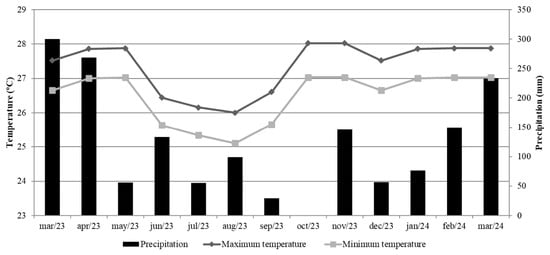
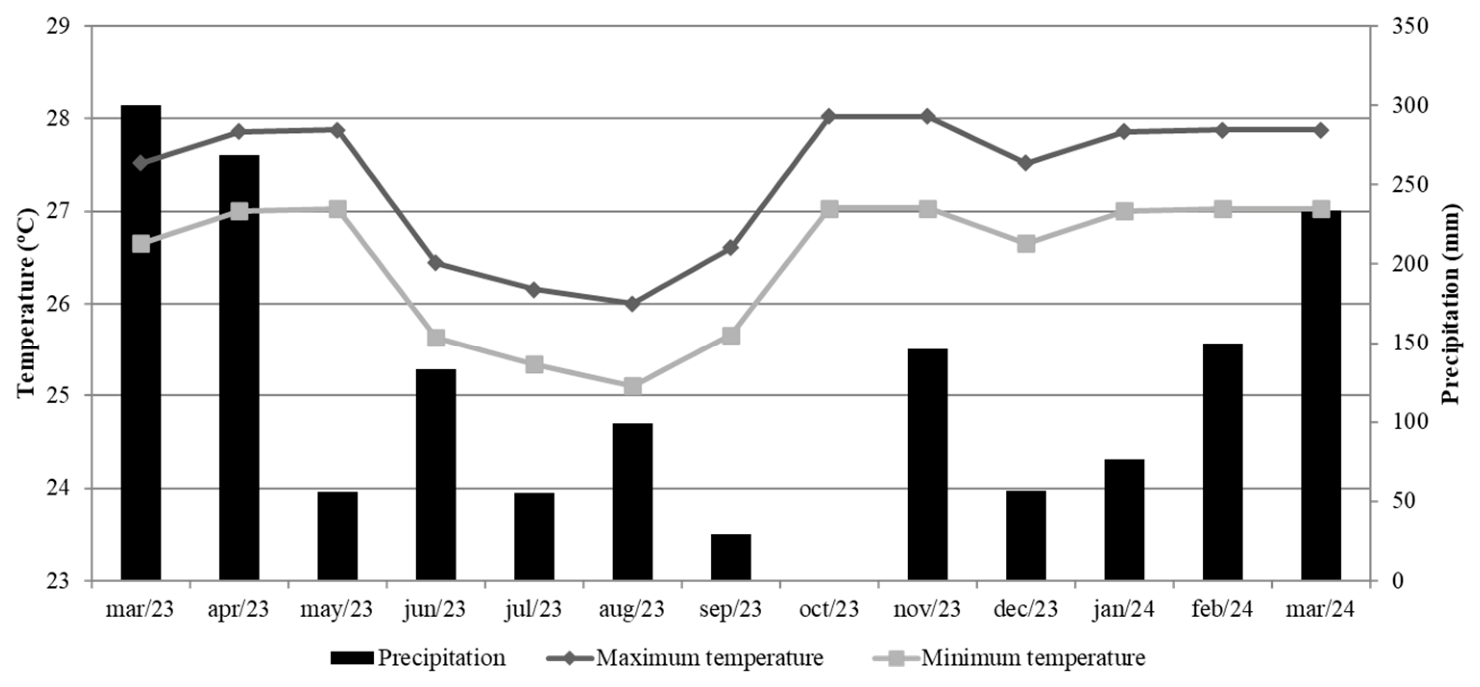
The experiment was conducted at the Agricultural Sciences Campus of the Federal University of Rio Grande do Norte (GEFORP–UFRN), located in Macaíba, Rio Grande do Norte, Brazil (5°53′33.29″ S; 35°21′49.57″ W; 47 m above sea level). According to the Köppen classification, the regional climate is a transition between As′ (tropical savanna) and BSh′ (hot semi-arid). The experimental period extended from March 2023 to March 2024 (Figure 1).
Figure 1.
Monthly accumulated precipitation and minimum (T. min) and maximum (T. max) temperatures from March 2023 to March 2024 in the experimental area.
The soil in the experimental area was classified as Quartzipsamment, with a sandy texture [19]. Before the establishment of the experimental area, soil samples were collected from the 0–20 cm layer for chemical characterisation (Table 1).
Table 1.
Chemical characteristics of the soil in the experimental area at 0–20 cm depth.
The soil in the experimental area was conventionally prepared by ploughing and harrowing in January 2022. Sowing of the monocultures and the multispecies system (50% Massai grass and 50% Marandu grass) was carried out by broadcasting in March of the same year, followed by light soil compaction to achieve a sowing depth of 2–3 cm. Seeding rates for each treatment were defined according to recommendations for each cultivar, considering the cultural value of the seeds used. In the multispecies system, a 50:50 proportion of Massai and Marandu grasses was adopted, corresponding to 50% of the recommended seeding rate for each cultivar when grown in monoculture, i.e., each species was sown at half of its recommended rate, based on an equitative sowing strategy previously evaluated in earlier studies [8].
At sowing, basal fertilisation was applied using 40 kg ha−1 of P2O5 (single superphosphate), incorporated into the soil. Topdressing fertilisation consisted of 100 kg ha−1 of N (urea), split into two applications: the first applied 50 days after sowing and the second after the first grazing event.
2.3. Experimental Design
A completely randomised design was used. The treatments corresponded to the three production systems: a multispecies pasture composed of Megathyrsus maximus cv. Massai and Urochloa brizantha cv. Marandu, Massai grass monoculture, and Marandu grass monoculture. Each experimental unit measured 0.36 ha and was subdivided into three 0.12-ha paddocks, grazed under intermittent stocking. The total experimental area was 1.08 ha. Pastures were managed under intermittent stocking, with grazing initiated when the canopy reached the pre-grazing target of 40 cm and terminated when it reached the post-grazing target of 20 cm.
A total of 24 intact male Santa Inês lambs, with an initial body weight (BW) of 21.59 ± 0.12 kg and an average age of 84 ± 5 days, were allocated evenly across treatments based on body weight. Each experimental unit included eight test animals, and stocking rate was adjusted using put-and-take animals. Animals were individually identified using ear tags and collars for experimental monitoring.
Lambs grazed during the daytime (07:00 to 15:00 h) with ad libitum access to water and were housed in collective pens during the night (15:00 to 07:00 h), where they received concentrate supplementation equivalent to 1% of body weight. Concentrate intake was not measured individually, and refusals, when present, were collected. The amount of concentrate offered was adjusted after each weighing based on the animals’ body weight. The concentrate consisted of 65% maize, 25% soybean meal, 8% mineral salt, 1% common salt, 0.9% urea, and 0.1% ammonium sulphate.
2.4. Measurements
The occupation period (OP, days) was defined as the number of days required for animals to reduce canopy height from the pre-grazing target (40 cm) to the post-grazing target (20 cm). The rest period (RP, days) corresponded to the time required for canopy height to regrow from 20 to 40 cm, at which point animals re-entered the paddock.
Canopy height (CH, cm) was measured every four days to monitor pre-grazing (40 cm) and post-grazing (20 cm) targets, using a graduated ruler. A total of 40 random points per paddock were measured, and each reading corresponded to the average canopy height around the ruler.
Leaf area index (LAI) and light interception (LI, %) were measured using a canopy analyser (Ceptometer model Accupar LP-80® of METER group, Pullman, WA, USA) under both pre- and post-grazing conditions. Measurements were taken at 10 points per paddock. At each point, one reading was taken above the canopy and another at ground level to estimate LAI and LI.
Forage mass (FM, kg ha−1) at pre- and post-grazing was estimated by harvesting forage at ground level using a 1 m2 quadrat at three representative points per paddock. Samples were individually weighed to determine fresh weight and subsequently separated into leaf blade, stem, and dead material fractions. These fractions were dried in a forced-air oven at 55 °C for 72 h to determine dry weight. Based on these data, leaf blade mass (LBM, kg ha−1), stem mass (SM, kg ha−1), and dead material mass (DMM, kg ha−1) were estimated, as well as the leaf:stem ratio (LSR).
After drying, leaf blade and stem samples were ground in a Wiley mill for analysis of dry matter (DM; method 930.15), ash (method 942.05), and crude protein (CP; method 976.05), according to AOAC [20]. Neutral detergent fibre (NDF) and acid detergent fibre (ADF) were determined following the methodology described by Detmann et al. [21]. In vitro dry matter digestibility (IVDMD) was determined according to Tilley and Terry [22], adapted for the Ankom DaisyII system (Ankom Technology Corp., Macedon, NY, USA).
Animals were weighed every seven days using an analogue scale to determine body weight (kg). Average daily gain (ADG, g animal−1 day−1) was calculated from the change in body weight between consecutive weighings, adjusted for the number of days between measurements. Stocking rate (AU ha−1) was calculated based on the average body weight of test animals and put-and-take animals within each treatment, expressed as animal units (AU), considering 1 AU equivalent to 30 kg of live weight. Each treatment included eight test animals, which remained constant throughout the experimental period. Stocking rate was adjusted weekly according to forage availability by adding or removing put-and-take animals, ensuring a minimum of eight animals per paddock. Gain per area (GPA, g ha−1) was obtained by multiplying the ADG of the test animals by the number of animals maintained per hectare in each grazing cycle for each treatment.
Ingestive behaviour was evaluated through continuous observations over 24 h for three consecutive days, totalling 72 h of assessment, with records taken every 10 min. Each trained observer monitored four animals. Lambs were identified using coloured collars to facilitate individual monitoring. The behavioural activities recorded were grazing time (GT), rumination time (RT), and idle time (IT), expressed in minutes per day [23]. Bite rate (BR) was determined as the time required to perform 20 bites and subsequently converted to bites per minute, following the methodology described by Forbes and Hodgson [24].
2.5. Statistical Analysis
For each variable analysed, residual plots were examined to assess independence, normality, and homogeneity of variance. When these assumptions were met, data were subjected to analysis of variance (ANOVA), considering the production systems (multispecies pasture of Massai and Marandu grasses, Massai grass monoculture, and Marandu grass monoculture) as a fixed effect. When treatment effects were detected, means were compared using Tukey’s test at a 5% probability level, using the Statistical Analysis System (SAS® OnDemand for Academics; SAS Institute Inc., Cary, NC, USA).
The statistical model adopted was:
where Yijk is the observed value of the response variable under the i-th production system and k-th experimental unit; μ is the overall mean; Si is the fixed effect of the i-th production system and eijk is the random error associated with the observations, assumed to be normally distributed with mean zero and constant variance (eijk ~ N(0, σ2)).
Yik = μ + Si + eik,
3. Results
Massai grass monoculture showed the highest values for occupation period (OP; p < 0.0001) and rest period (RP; p < 0.0001), as well as for leaf area index (LAI; p = 0.0005) and light interception (LI; p = 0.0010), compared with the other production systems (Table 2).
Table 2.
Grazing dynamics (occupation and rest periods) and canopy characteristics (leaf area index and light interception) of Massai and Marandu grass pastures under monoculture and multispecies systems managed under intermittent stocking during one year of evaluation.
At pre-grazing, Massai grass monoculture showed lower forage mass (FM; p = 0.0005), higher leaf blade mass (LBM; p = 0.0001), lower stem mass (SM; p < 0.0001), lower dead material mass (DMM; p < 0.0001), and a higher leaf:stem ratio (LSR; p < 0.0001) compared with the other production systems (Table 3).
Table 3.
Productive and structural canopy characteristics of Massai and Marandu grass pastures under monoculture and multispecies systems managed under intermittent stocking at pre- and post-grazing during one year of evaluation.
At post-grazing, no effect of production systems was observed (p = 0.1338) on forage mass (FM) (Table 3). Massai grass showed higher leaf blade mass (LBM; p < 0.0001) and leaf:stem ratio (LSR; p < 0.0001), and lower stem mass (SM; p < 0.0001) compared with the other systems. Dead material mass (DMM) was greater (p = 0.0306) in Marandu grass pastures than in Massai grass, with intermediate values observed in the multispecies system.
Production systems did not affect (p > 0.05) leaf blade dry matter (DM), ash, or crude protein (CP) contents (Table 4), with mean values of 33.18, 7.39, and 9.77%, respectively. Massai grass leaf blades showed higher neutral detergent fibre (NDF; p = 0.0014) and acid detergent fibre (ADF; p < 0.0001) contents. Dry matter digestibility was higher in the Marandu grass monoculture (p = 0.0036).
Table 4.
Chemical composition and digestibility of leaf blade and stem of Massai and Marandu grass pastures under monoculture and multispecies systems managed under intermittent stocking during one year of evaluation.
For the stem fraction, no effect of production systems (p > 0.05) was observed on dry matter (DM; 28.20%), crude protein (CP; 5.72%), neutral detergent fibre (NDF; 75.99%), or in vitro dry matter digestibility (IVDMD; 58.55%) (Table 4). The multispecies system showed higher ash (p < 0.0001) and acid detergent fibre (ADF; p = 0.0026) contents in the stem fraction.
Rumination time was greater in the multispecies system (p = 0.0225), with no differences between monocultures (Table 5). Animals grazing Massai grass showed higher grazing time (p < 0.0001) and bite rate (p < 0.0001) compared to the other production systems. No effect of production systems was observed on idle time (p = 0.0631), with a mean of 9.89 h day−1.
Table 5.
Ingestive behaviour and performance of lambs grazing Massai and Marandu grass pastures under monoculture and multispecies systems managed under intermittent stocking during one year of evaluation.
Regarding animal performance and production, production systems affected stocking rate and average daily gain, but not gain per area (Table 5). Stocking rate was higher in the multispecies system compared to Marandu grass monoculture (p = 0.0092), with intermediate values observed for Massai grass. ADG was higher in animals grazing Marandu grass monoculture compared to those grazing Massai grass (p = 0.0276), with intermediate values in the multispecies system. No effect of production systems was observed on gain per area (p = 0.1386), with a mean of 1267.11 g ha−1.
4. Discussion
Production systems influenced grazing dynamics, canopy structure, ingestive behaviour, and animal performance. Under the same defoliation level (50%), Marandu grass monoculture showed shorter occupation and rest periods, indicating that the canopy was reduced more rapidly and recovered the pre-grazing height sooner, which favours a higher number of grazing cycles over time. In contrast, Massai grass required a longer period to reach the pre-grazing height and a longer time for canopy reduction by the animals, even with a higher proportion of leaf blades in the canopy. The multispecies system showed an intermediate response, resulting from the combination of characteristics of both grasses, indicating that the association between Massai and Marandu grasses allowed both species to coexist during the experimental period.
These results are consistent with the principle that combining grasses with different requirements and growth strategies can promote structural adjustment of the canopy [25]. The association between grasses may alter competition for light within the canopy, with species, particularly Massai grass, adjusting traits such as leaf angle, leaf elongation rate, number of leaves per tiller, and leaf area index to coexist with other species [26]. In addition, Medeiros-Neto et al. [27] reported that the inclusion of species with greater tolerance to water stress in multispecies systems improves the distribution of forage yield over time, which may contributing to production stability and sustainability of the forage system, even without maximising productivity at specific periods. Therefore, the results indicate that the multispecies system promotes an intermediate canopy functioning, highlighting the phenotypic plasticity of grasses and their capacity to integrate complementary traits.
In this context, the results indicate that the multispecies system composed of Massai and Marandu grasses promoted an intermediate canopy functioning, in which dynamic characteristics, such as occupation and rest periods, and structural attributes, such as forage mass and leaf blade proportion, showed intermediate responses compared with monocultures (Table 2 and Table 3).
This suggests that both Massai and Marandu grasses exhibit phenotypic plasticity that enables their use in multispecies systems, allowing flexibility and the integration of beneficial traits from both species. In addition, the greater structural heterogeneity observed in multispecies systems may favour more balanced defoliation patterns greater flexibility in forage selection, as more heterogeneous swards allow greater selectivity and more efficient forage utilisation by animals over time, contributing to the sustainability of grazing systems [28].
Although the multispecies system and Marandu grass monoculture showed higher forage mass (Table 3), this increase was associated with greater accumulation of stem and dead material; whereas, Massai grass showed higher leaf blade mass and a greater leaf:stem ratio. This result indicates that greater forage mass does not necessarily correspond to improved canopy structural quality. These differences are related to the morphological characteristics of the cultivars, as Marandu grass is associated with greater stem development and a higher contribution of structural components to the canopy [29]; whereas, Massai grass is characterised by greater leaf production and lower stem contribution, resulting in a high leaf:stem ratio [10]. This interpretation is supported by the botanical composition of the multispecies canopy at pre-grazing.
Marandu grass was the main contributor to total FM, accounting for 55.2% (2341.3 kg ha−1) of the 4243.2 kg ha−1 recorded in the multispecies system; whereas, Massai grass contributed 44.8% (1901.9 kg ha−1). However, the contribution to LBM was slightly greater for Massai grass, which represented 52.6% (722.1 kg ha−1) of the total 1371.9 kg ha−1, while Marandu grass accounted for 47.4% (649.8 kg ha−1). In contrast, Marandu grass contributed more markedly to SM, representing 65.5% (857.8 kg ha−1) of the total 1310.3 kg ha−1, compared with 34.5% (452.5 kg ha−1) for Massai grass. For DMM, Marandu grass also showed a greater contribution, accounting for 53.3% (831.4 kg ha−1) of the total 1561.1 kg ha−1; whereas, Massai grass contributed 46.7% (729.7 kg ha−1). Therefore, the greater FM observed in the multispecies system was mainly supported by the contribution of Marandu grass to stem and dead material, while Massai grass contributed proportionally more to the leaf component.
This pattern remained after grazing, with Massai grass maintaining higher leaf blade mass and leaf:stem ratio, while Marandu grass showed reduced values, characterising a structurally more limited residual canopy. However, the ability of Megathyrsus maximus to perform under semi-arid conditions has also been demonstrated in African environments, where its productivity and water use efficiency are strongly influenced by management strategies, indicating its potential suitability for integration into forage systems under water-limited conditions [4]. Furthermore, the use of grass mixtures has been reported as a viable strategy to improve forage availability and grazing potential in degraded or low-fertility environments, supporting the adoption of multispecies systems as a means to enhance forage production and system resilience [30].
The magnitude of removal of morphological components highlighted differences in pasture utilisation among systems. In Marandu grass monoculture, the 76.11% reduction in leaf blade mass resulted in a marked decline in the leaf:stem ratio at post-grazing, indicating intensive utilisation of the leaf stratum. This pattern may indicate lower opportunities for leaf selection towards the end of the occupation period and greater reliance on less digestible plant components.
According to Tontini et al. [31], the leaf:stem ratio (LSR) is one of the main structural variables influencing grazing time in tropical pastures, with values below 0.37 associated with increased grazing time, which may rise by up to 28% compared with swards with a higher leaf proportion. In addition, greater biomass removal may be associated with increased nutrient export from the system, requiring more intensive nutrient replacement strategies to maintain soil fertility [32].
In the multispecies system, the reduction in leaf blade mass was more moderate (48.06%), with lower stem utilisation (19.48%), indicating a more balanced pattern of canopy utilisation. In Massai grass, although leaf reduction reached 52.94%, greater maintenance of residual structure was observed, with a higher proportion of leaves at post-grazing. This pattern suggests that structural diversity in the multispecies system resulted in a more heterogeneous vertical canopy organisation, allowing greater flexibility in forage harvesting by animals.
Although canopy structure plays a central role in animal response, forage chemical composition also influences utilisation efficiency. In the present study, Massai grass showed higher neutral detergent fibre (NDF; 70.99%) and acid detergent fibre (ADF; 38.69%) contents in the leaf blade, along with lower digestibility (67.72%); whereas, Marandu grass showed lower fibre content and higher digestibility (73.61%). A higher proportion of leaves did not ensure greater nutritional value, indicating that forage quality is a key determinant of utilisation efficiency by animals. In addition, anatomical characteristics of Massai grass, such as a greater presence of Girder I-type structures, may increase leaf blade resistance to fragmentation and digestion [33,34], contributing to lower utilisation efficiency despite greater leaf availability.
Responses in ingestive behaviour reflect the interaction between canopy structure and forage chemical composition. Traditionally, rumination time is associated with ADF content [35]. However, in multispecies systems, differences in leaf structure must also be considered, as they influence rumination dynamics and particle size reduction. As ADF content increases, the number of chews per bolus also increases, intensifying the mechanical processing required for swallowing.
In the multispecies system, the longer rumination time cannot be explained solely by chemical composition or by stem and dead material content, as these variables were intermediate. This response may be associated with greater structural heterogeneity of the canopy, resulting from the combination of species with distinct architectures, which may increase variability in ingested particle size and the demand for ruminal processing.
In Massai grass monoculture, the longer grazing time and higher bite rate indicate greater effort for forage acquisition, possibly reflecting a compensatory strategy in response to lower diet quality. In contrast, in Marandu grass monoculture, higher digestibility and greater forage availability favoured shorter grazing time and lower bite rate. Although dry matter intake and bite mass were not measured, the combination of higher forage digestibility, greater forage availability, shorter grazing time, and lower bite rate may suggest greater intake efficiency in this system.
These differences were directly reflected in animal performance. The higher average daily gain observed in Marandu grass monoculture is associated with better forage quality and greater intake efficiency. Despite a higher proportion of leaves, Massai grass showed lower individual performance, indicating that canopy structure alone does not determine animal performance. The multispecies system supported a higher stocking rate without increasing individual gain, resulting in similar gain per area across systems. This indicates that the multispecies system does not maximise individual performance but contributes to overall system efficiency.
Sousa et al. [8] reported that multispecies systems composed of tropical grasses may not surpass monocultures in terms of peak productivity but can promote greater production stability, particularly in environments with climatic variability. Garcia-Carvalho et al. [36] observed that such systems allow species coexistence with relatively stable botanical composition, as well as forage yield and stability comparable to those observed in monocultures throughout the year.
This study was limited by the number of experimental units at the area level, which should be considered when interpreting and extrapolating the results. Nevertheless, by evaluating an association between tropical grasses under sheep grazing, the study expands applied knowledge on coexistence, functional complementarity, and plant–animal interactions in multispecies pastures.
These findings are relevant to the ecology of pastoral systems because they help clarify how species with distinct structural traits may share canopy space and influence forage use by grazing animals. Future studies with a greater number of experimental units, longer evaluation periods, and contrasting environmental conditions may further elucidate the ecological mechanisms related to competition, persistence, and the functioning of these systems. Thus, the study contributes to Ecology and Applied Agricultural Sciences by providing experimental evidence that may guide future research and pasture diversification strategies in tropical environments.
5. Conclusions
Massai and Marandu cultivars can be used in multispecies systems under intermittent stocking, demonstrating phenotypic plasticity and the ability to coexist without compromising the productive characteristics of the grasses. The multispecies system maintains animal productivity comparable to monoculture systems, representing a viable alternative for pasture-based animal production. The adoption of multispecies grass systems may contribute to greater production stability and system reliability, representing a promising strategy for the sustainability of livestock systems in tropical environments.
Author Contributions
Conceptualization, A.B.G.d.C. and J.V.E.N.; methodology, A.B.G.d.C., A.C.R.L.d.S. and J.C.d.N.; software, F.P.T.d.C., A.L.C.G., C.A.T.M., G.d.S.D. and S.A.U.; validation, J.C.S.S. and J.V.E.N.; formal analysis, A.B.G.d.C.; investigation, A.C.R.L.d.S. and J.C.d.N.; resources, F.P.T.d.C., A.L.C.G., C.A.T.M. and S.A.U.; data curation, A.B.G.d.C.; writing—original draft preparation, J.C.S.S.; writing—review and editing, J.V.E.N.; visualisation, J.C.S.S. and J.V.E.N.; supervision, F.P.T.d.C., A.L.C.G., C.A.T.M., G.d.S.D. and S.A.U.; project administration, S.A.U. and J.V.E.N.; funding acquisition, J.V.E.N. All authors have read and agreed to the published version of the manuscript.
Funding
The last author thanks the Conselho Nacional de Desenvolvimento Científico e Tecnológico (CNPq) for the research productivity grant—level 2 (process No. 314544/2023-2) and the Fundação de Amparo à Ciência e Tecnologia do Estado de Pernambuco (FACEPE)—grant number (process No. 1450-5.04/22).
Institutional Review Board Statement
The animal study protocol was approved by the Animal Ethics Committee of the Federal University of Rio Grande do Norte (UFRN), Brazil, on 6 July 2023 (protocol code 029/2023). The study was conducted in accordance with the guidelines of the National Council for the Control of Animal Experimentation (CONCEA).
Informed Consent Statement
Not applicable.
Data Availability Statement
The raw data supporting the conclusions of this article will be made available by the authors on request.
Acknowledgments
The authors thank the Coordenação de Aperfeiçoamento de Pessoal de Nível Superior (CAPES, Finance Code 001), Federal University of Vale do São Francisco (UNIVASF), the Federal University of Rio Grande do Norte (UFRN), and the Conselho Nacional de Desenvolvimento Científico e Tecnológico (CNPq) and the Fundação de Amparo à Ciência e Tecnologia do Estado de Pernambuco (FACEPE).
Conflicts of Interest
The authors declare no conflicts of interest.
Abbreviations
The following abbreviations are used in this manuscript:
| ADF | Acid Detergent Fibre |
| ADG | Average Daily Gain |
| AU | Animal Unit |
| BR | Bite rate |
| CH | Canopy height |
| CP | Crude protein |
| DM | Dry matter |
| DMM | Dead material mass |
| FM | Forage mass |
| GPA | Gain per area |
| GT | Grazing Time |
| IT | Idle time |
| IVDMD | In vitro dry matter digestibility |
| LAI | Leaf area index |
| LBM | Leaf blade mass |
| LI | Light interception |
| LSR | Leaf:stem ratio |
| NDF | Neutral Detergent Fibre |
| RT | Rumination Time |
| SM | Stem mass |
| SR | Stocking rate |
References
- Wróbel, B.; Zielewicz, W.; Staniak, M. Challenges of Pasture Feeding Systems—Opportunities and Constraints. Agriculture 2023, 13, 974. [Google Scholar] [CrossRef] [Scilit]
- Izidro, J.L.P.S.; de Mello, A.C.L.; da Cunha, M.V.; da Silva, V.J.; Dubeux Júnior, J.C.B.; de Miranda Costa, S.B.; dos Santos, J.R.; do Nascimento, D.B.; de Aquino Rodrigues, M.T.; Soares, G.S.C.; et al. Forage Mass, Nutritional Value, Cattle Performance and Economic Indicators in Urochloa decumbens Pastures in Monocrop or Silvopastoral Systems. Grass Forage Sci. 2026, 81, e70038. [Google Scholar] [CrossRef] [Scilit]
- Nketsang, T.S.; Kassa, S.M.; Kgosimore, M.; Tsidu, G.M. Understanding the Impacts of Rainfall Variability on Natural Forage–Livestock Dynamics in Arid and Semi-Arid Environments. Appl. Sci. 2025, 15, 3918. [Google Scholar] [CrossRef] [Scilit]
- Mohamed, H.I.; Ahmed, S.M.; Mohamed, A.D. Rainfed-based production of Megathyrsus maximus in sub-Saharan Africa: The case of the semi-arid environment of Sudan. Afr. J. Range Forage Sci. 2023, 40, 247–256. [Google Scholar] [CrossRef] [Scilit]
- Gelley, C.; Nave, R.L.G.; Bates, G. Forage nutritive value and herbage mass relationship of four warm-season grasses. Agron. J. 2016, 108, 1603–1613. [Google Scholar] [CrossRef] [Scilit]
- Zhang, Y.; Bohan, D.A.; Zhang, C.; Cong, W.F.; Munier-Jolain, N.; Bedoussac, L. Crop diversity reduces pesticide use more efficiently with refined diversification strategies. Commun. Earth Environ. 2025, 6, 460. [Google Scholar] [CrossRef] [Scilit]
- Lange, M.; Eisenhauer, N.; Sierra, C.A.; Bessler, H.; Engels, C.; Griffiths, R.I.; Mellado-Vázquez, P.G.; Malik, A.A.; Roy, J.; Scheu, S.; et al. Plant diversity increases soil microbial activity and soil carbon storage. Nat. Commun. 2015, 6, 6707. [Google Scholar] [CrossRef] [Scilit] [PubMed]
- Sousa, F.I.L.; Emerenciano Neto, J.V.; Costa, A.B.G.; Fernandes, P.B.; Urbano, S.A.; Gurgel, A.L.C.; Santos, R.S.; Silva, Y.S.; Nascimento, P.V.J.; Néo, D.M.M. The adoption of intercropping practices with tropical grasses aims at optimising forage production performance in the semi-arid region. N. Z. J. Agric. Res. 2025, 68, 914–928. [Google Scholar] [CrossRef] [Scilit]
- Euclides, V.P.B.; Macedo, M.C.M.; Zimmer, A.H.; Jank, L.; Oliveira, M.P.D. Evaluation of Panicum maximum cvs. Mombaça and Massai under grazing. Rev. Bras. Zootec. 2008, 37, 18–26. [Google Scholar] [CrossRef] [Scilit]
- Miranda, B.E.C.; Rodrigues, R.C.; dos Santos Costa, C.; da Silva, E.C.; de Paula Lana, R.; de Jesus, A.P.R.; Marinho, I.R.; da Costa, K.A.P.; de Araujo Ribeiro, I.G.; Araujo, J.S.; et al. Structural and production characteristics and nutritive value of two tropical grasses submitted to different levels of nitrogen. Aust. J. Crop Sci. 2022, 16, 1117–1126. [Google Scholar] [CrossRef] [Scilit]
- Emerenciano Neto, J.V.; Difante, G.S.; de Aguiar, E.M.; Fernandes, L.S.; Oliveira, H.C.B.; da Trindade Silva, M.G. Performance of meat sheep, chemical composition and structure of tropical pasture grasses managed under intermittent capacity. Biosci. J. 2014, 30, 834–842. [Google Scholar]
- Araújo, C.G.F.; Costa, M.G.; Difante, G.S.; Emerenciano Neto, J.V.; Gurgel, A.L.C.; Costa, C.M.; Araújo, I.M.M.; Silva, M.G.T.; Medeiros, M.C. Carcass characteristics, meat quality and composition of lambs finished in cultivated pastures. Food Sci. Technol. 2021, 42, e71420. [Google Scholar] [CrossRef] [Scilit]
- Uzayisenga, B.; Mutimura, M.; Muthomi, J.W.; Mwang’ombe, A.W.; Ghimire, S.R. Response of improved Brachiaria (Urochloa) grass cultivars to foliar diseases and their agronomic performances in Rwanda. Afr. J. Range Forage Sci. 2021, 38, S14–S27. [Google Scholar] [CrossRef] [Scilit]
- Montagner, D.B.; Nascimento Júnior, D.D.; Vilela, H.H.; Sousa, B.M.L.; Euclides, V.P.B.; Silva, S.C.; Carloto, M.N. Tillering dynamics in pastures of guinea grass subjected to grazing severities under intermittent stocking. Rev. Bras. Zootec. 2012, 41, 544–549. [Google Scholar] [CrossRef] [Scilit]
- Cunha, A.M.Q.; Macedo, V.H.M.; de Oliveira, J.K.S.; Melo, D.d.M.; Domingues, F.N.; Cândido, E.P.; Faturi, C.; do Rêgo, A.C. Nitrogen fertilisation as a strategy for intensifying production and improving the quality of Massai grass grown in a humid tropical climate. J. Plant Nutr. 2022, 45, 2213–2227. [Google Scholar] [CrossRef] [Scilit]
- Pereira, L.E.T.; Herling, V.R.; Tech, A.R.B. Current Scenario and Perspectives for Nitrogen Fertilization Strategies on Tropical Perennial Grass Pastures: A Review. Agronomy 2022, 12, 2079. [Google Scholar] [CrossRef] [Scilit]
- Fernandes, P.B.; Barbosa, R.A.; Morais, M.G.; Medeiros-Neto, C.; Sbrissia, A.F.; Fernandes, H.J.; Difante, G.S. Defoliation Dynamics on Grazing Horizons in Pastures Intercropped by Panicum maximum, Brachiaria brizantha, and Brachiaria decumbens. Trop. Anim. Sci. J. 2020, 43, 314–323. [Google Scholar] [CrossRef] [Scilit]
- Costa, A.B.G.; Emerenciano Neto, J.V.; Costa, C.M.; Nascimento, P.V.J.; Gurgel, A.L.C.; Fernandes, P.B.; Urbano, S.A.; Difante, G.S.; Santos, R.S.; Silva, Y.S.; et al. Intercropped grasses for ruminant feeding. Arq. Bras. Med. Veterinária Zootec. 2024, 76, e13147. [Google Scholar] [CrossRef] [Scilit]
- FAO. International Soil Classification System for Naming Soils and Creating Legends for Soil Maps; World Soil Resources Reports No. 106; FAO: Rome, Italy, 2015; p. 188. [Google Scholar]
- AOAC. Official Methods of Analysis of AOAC International, 19th ed.; Association of Official Analytical Chemists: Gaithersburg, MD, USA, 2012. [Google Scholar]
- Detmann, E.; Souza, M.A.; Valadares Filho, S.C.; Queiroz, A.C.; Berchielli, T.T.; Saliba, E.O.S.; Cabral, L.S.; Pina, D.S.; Ladeira, M.M.; Azevedo, J.A.G. Métodos para Análise de Alimentos; Suprema: Visconde do Rio Branco, Brazil, 2012. [Google Scholar]
- Tilley, J.M.A.; Terry, R.A. A two-stage technique for the in vitro digestion of forage crops. J. Br. Grassl. Soc. 1963, 18, 104–111. [Google Scholar] [CrossRef] [Scilit]
- Jamieson, W.S.; Hodgson, J. The effect of daily herbage allowance and sward characteristics upon the ingestive behaviour and herbage intake of calves under strip-grazing management. Grass Forage Sci. 1979, 34, 261–271. [Google Scholar] [CrossRef] [Scilit]
- Forbes, T.D.A.; Hodgson, J. Comparative studies of the influence of sward conditions on the ingestive behaviour of cows and sheep. Grass Forage Sci. 1985, 40, 69–77. [Google Scholar] [CrossRef] [Scilit]
- Duchini, P.G.; Guzatti, G.C.; Ribeiro Filho, H.M.; Sbrissia, A.F. Tiller size/density compensation in temperate climate grasses grown in monoculture or in intercropping systems under intermittent grazing. Grass Forage Sci. 2014, 69, 655–665. [Google Scholar] [CrossRef] [Scilit]
- Silva, A.M.S.; Silva, S.C.; Otaviano, E.K.S.; Gomes, C.M.; Mammana, A.F.; Carvalho, L.F.G.; Sbrissia, A.F.; Frak, E.; Louarn, G. Functional plant species traits that shape canopy light interception and agronomic performance of perennial forage grasses cultivated in monoculture and association. Grass Forage Sci. 2025, 80, e12716. [Google Scholar] [CrossRef] [Scilit]
- Medeiros-Neto, C.; Barbosa, R.A.; Schmitt, D.; Miqueloto, T.; da Silva, S.C.; Sbrissia, A.F. Mixtures of grasses: An alternative to traditional pasture monocultures in the tropics. Grass Forage Sci. 2023, 78, 296–305. [Google Scholar] [CrossRef] [Scilit]
- Casalás, F.; Caram, N.; Soca, P.; Wallau, M.; Boggiano, P. Vegetation structure and defoliation patterns in heterogeneous grasslands under two herbage allowance levels. Afr. J. Range Forage Sci. 2025, 42, 207–215. [Google Scholar] [CrossRef] [Scilit]
- Rodrigues, R.C.; Sousa, T.V.; Melo, M.A.; Araújo, J.S.; Lana, R.P.; Costa, C.S.; Oliveira, M.E.; Parente, M.O.M.; Sampaio, I.B. Agronomic, morphogenic and structural characteristics of tropical forage grasses in northeast Brazil. Trop. Grassl.-Forrajes Trop. 2014, 2, 214–222. [Google Scholar] [CrossRef] [Scilit]
- Cele, E.N.; Rapiya, M.; Sanders, W.; Truter, W. Pastures established on rehabilitated surface coal mined land: An assessment of forage production and implications for livestock grazing. Afr. J. Range Forage Sci. 2025, 42, 294–310. [Google Scholar] [CrossRef] [Scilit]
- Tontini, J.F.; Poli, C.H.E.C.; Hampel, V.S.; Farias, M.S.; Fajardo, N.M.; Silva, J.A.; Farinatti, L.H.E.; Muir, J.P. Influence of tropical upright pasture structural and chemical characteristics on lamb grazing time. PLoS ONE 2021, 16, e0242642. [Google Scholar] [CrossRef] [Scilit] [PubMed]
- Whitehead, D.C. Nutrient Elements in Grassland: Soil-Plant-Animal Relationships; CABI: Wallingford, UK, 2000. [Google Scholar]
- Lempp, B.; Euclides, V.P.B.; Morais, M.G.; Victor, D.M. Digestion residue evaluation of three cultivars of Panicum maximum. In Proceedings of the 37th Reunião Anual da Sociedade Brasileira de Zootecnia, Viçosa, Brazil, 24–27 July 2000. [Google Scholar]
- Paciullo, D.S.C. Anatomical traits related with nutritive value of forage grasses. Cienc. Rural. 2002, 32, 357–364. [Google Scholar] [CrossRef] [Scilit]
- Welch, J.G.; Smith, A.M. Influence of forage quality on rumination time in sheep. J. Anim. Sci. 1969, 28, 813–818. [Google Scholar] [CrossRef] [Scilit] [PubMed]
- Garcia-Carvalho, L.F.; Congio, G.F.S.; Barro, G.C.; Silva, A.M.S.; Otaviano, E.K.S.; Gomes, C.M.; Mammana, A.F.; Sbrissia, A.F.; Duchini, P.G.; Barbosa, R.A.; et al. Yield and stability of three tropical forage grasses cultivated as pure or mixed stands. Grass Forage Sci. 2025, 80, e12717. [Google Scholar] [CrossRef] [Scilit]

Disclaimer/Publisher’s Note: The statements, opinions and data contained in all publications are solely those of the individual author(s) and contributor(s) and not of MDPI and/or the editor(s). MDPI and/or the editor(s) disclaim responsibility for any injury to people or property resulting from any ideas, methods, instructions or products referred to in the content. |
© 2026 by the authors. Licensee MDPI, Basel, Switzerland. This article is an open access article distributed under the terms and conditions of the Creative Commons Attribution (CC BY) license.