


Abstract
Autonomous combine harvesters may improve harvesting timeliness, reduce labor dependence, and support data-driven grain production, but deployment depends on whether they can complete harvesting missions reliably under variable soil–crop–machine interactions and at acceptable lifecycle cost. This scoping review was reported in accordance with PRISMA 2020 and PRISMA-ScR. The Web of Science Core Collection was searched for English-language peer-reviewed publications from 2006 to 30 May 2026, supplemented by backward reference screening and forward citation tracking. Of 281 records identified, 138 studies were included in a framework-based thematic synthesis. Representative platforms and enabling technologies were compared, the reviewed studies were descriptively grouped according to their reported validation settings, reliability was assessed at component, system, and mission levels, and feasibility was examined across economic, operational, infrastructural, regulatory, and organizational dimensions. The evidence shows progress in positioning, navigation, crop-boundary recognition, speed regulation, component monitoring, fault diagnosis, and remote supervision, but repeated long-duration validation of complete autonomous harvesting missions remains limited. Current evidence therefore supports function-specific automation and supervised autonomy more strongly than unrestricted driverless operation. Future research should prioritize bounded operating domains, graceful degradation, standardized safety assessment, multi-scenario field validation, and reliable single-machine autonomy before fleet-level deployment.
1. Introduction
Food security, agricultural sustainability, and the declining availability of skilled rural labor are accelerating the development of intelligent and autonomous agricultural machinery. Among field machines, the combine harvester is particularly complex because it integrates cutting, feeding, threshing, separation, cleaning, grain collection, and unloading into a continuous operation. Its performance directly affects harvesting timeliness, grain loss, grain quality, energy consumption, and production cost. Improving the intelligence and autonomy of combine harvesters has therefore become an important component of modern grain-production systems and the broader development of agricultural robotics [1,2,3,4,5,6].
Recent advances in positioning, machine vision, LiDAR, inertial sensing, embedded computing, and intelligent control have enabled combine harvesters to progress from isolated automatic functions toward more integrated autonomous operation [4,7,8]. Demonstrated functions include crop-boundary recognition, field mapping, visual SLAM–inertial navigation, feed-rate prediction, adaptive forward-speed control, and autonomous path generation [9,10,11,12,13,14,15,16]. Nevertheless, the available evidence remains concentrated on individual functions, and the extent to which these functions can be integrated into reliable complete harvesting missions has not been sufficiently established.
Reliable autonomous harvesting is particularly challenging because combine harvesters operate under strongly coupled soil–crop–machine interactions. Crop density, moisture content, lodging condition, terrain undulation, soil trafficability, dust concentration, illumination, and feed rate may vary continuously during harvesting. These variations affect not only perception and navigation but also the loads acting on the header, chassis, threshing cylinder, cleaning sieve, bearings, transmissions, and bolted joints. Mechanical vibration and structural degradation may reduce sensor stability, while perception or control errors may cause uneven feeding, excessive component loads, blockage, grain loss, or unsafe machine behavior. Operational reliability must therefore be evaluated at component, system, and harvesting-mission levels rather than being limited to the durability of individual mechanical parts [17,18,19,20,21,22,23,24,25,26,27,28].
Field deployment also depends on whether reliability-enhancing technologies are economically and operationally feasible. Additional sensors, redundant controllers, reinforced structures, computing platforms, and remote-supervision systems may improve robustness but also increase capital cost, energy consumption, calibration requirements, and maintenance complexity. Application feasibility consequently depends on lifecycle cost, annual machine utilization, farm scale, labor substitution, infrastructure availability, technical-service capacity, regulatory compliance, and user acceptance [29,30,31,32,33,34,35,36,37,38,39,40,41]. Operational reliability is necessary for autonomous harvesting, but it does not guarantee large-scale adoption unless the associated deployment requirements remain acceptable.
Previous reviews have examined intelligent combine harvester systems, agricultural-machinery automation, autonomous navigation, fatigue reliability, agricultural-machine safety, and structural fault diagnosis [4,5,7,17,28,34]. Nevertheless, four important gaps remain. First, representative autonomous combine harvester platforms and field demonstrations have rarely been compared systematically in terms of autonomous functions, operating conditions, reported performance, human supervision, and practical limitations. Second, navigation, perception, component control, fault diagnosis, and maintenance are often studied separately, while failure propagation across mechanical, sensing, decision-making, and execution subsystems remains insufficiently synthesized. Third, simulation results, laboratory experiments, prototype trials, and field evidence are not always clearly distinguished, making the strength and practical relevance of the available validation evidence difficult to compare. Fourth, operational reliability and application feasibility are frequently discussed independently, although decisions concerning redundancy, control performance, maintenance, safety, and infrastructure directly influence lifecycle economic viability.
To address these gaps, this study conducts a scoping review with a framework-based thematic synthesis of autonomous combine harvesters and related technologies relevant to major grain-crop harvesting scenarios. It compares representative platforms and field demonstrations, distinguishes subsystem-level results from complete-machine evidence, evaluates reliability at component, system, and mission levels, and assesses whether reliability-enhancing technologies remain feasible in terms of lifecycle cost, infrastructure, safety, maintenance, and organizational support. On this basis, an author-developed reliability–feasibility framework is used to identify the evidence required for safe and practically scalable autonomous harvesting.
A scoping-review approach was adopted because the available evidence is heterogeneous in machine type, crop, autonomous function, validation environment, experimental scale, and reported performance indicators. Accordingly, this review addresses two questions: (1) What autonomous functions, machine platforms, reliability methods, and levels of validation evidence have been reported for autonomous combine harvesters ? (2) What technical, economic, operational, infrastructural, regulatory, safety, and organizational factors currently limit their reliable and scalable deployment ?
2. Review Methodology and Reliability–Feasibility Framework
2.1. Review Design and Literature Search Strategy
This study was designed as a scoping review with a framework-based thematic synthesis. A quantitative meta-analysis was not conducted because the included sources differed substantially in machine type, crop, field environment, autonomous function, validation scale, and reported indicators. This scoping review was reported in accordance with the PRISMA 2020 statement and the PRISMA extension for Scoping Reviews (PRISMA-ScR). The review was not prospectively registered, and no formal review protocol was prepared or published.
The Web of Science Core Collection was searched using the Topic field, which covers titles, abstracts, author keywords, and Keywords Plus. Publications available from 2006 to 30 May 2026 were considered. English-language peer-reviewed journal articles and review articles were eligible. Standards, regulatory documents, and authoritative technical reports were used only to support the safety and regulatory discussion and were not treated as evidence of autonomous-harvester performance. Editorials, news items, book reviews, patents, theses, and non-peer-reviewed web materials were excluded. No restriction was applied to country or crop type. Backward reference screening and forward citation tracking were used to identify additional relevant publications.
The search strategy combined four concept groups: the research object, autonomous-operation technologies, reliability and maintenance, and application feasibility. The principal Boolean combinations were as follows:
- (1)
- (“autonomous combine harvester” OR “unmanned combine harvester” OR “intelligent combine harvester” OR “combine harvester”) AND (“autonomous navigation” OR “path planning” OR “path tracking” OR “machine vision” OR “LiDAR” OR “SLAM” OR “sensor fusion”);
- (2)
- (“combine harvester” OR “grain harvester”) AND (“operational reliability” OR “structural reliability” OR “fatigue life” OR “vibration” OR “fault diagnosis” OR “condition monitoring” OR “blockage detection” OR “predictive maintenance”);
- (3)
- (“autonomous agricultural machinery” OR “robotic agricultural machinery” OR “autonomous field machinery”) AND (“economic feasibility” OR “lifecycle cost” OR “safety assessment” OR “risk assessment” OR “regulation” OR “user adoption”);
- (4)
- (“combine harvester” OR “autonomous agricultural machinery”) AND (“digital twin” OR “edge–cloud collaboration” OR “remote operation” OR “multi-machine coordination” OR “fleet scheduling”).
2.2. Literature Screening, Data Charting, and Descriptive Grouping of Validation Settings
Studies were included when they met at least one of the following criteria: (1) they directly investigated autonomous or intelligent combine harvesters; (2) they addressed combine harvester perception, navigation, motion control, adaptive regulation of working components, condition monitoring, fault diagnosis, structural reliability, or predictive maintenance; (3) they evaluated the economic, infrastructural, regulatory, safety, or organizational feasibility of autonomous agricultural machinery with clear relevance to combine harvesting; or (4) they proposed methods for other agricultural machines that were demonstrably transferable to autonomous combine harvester operation.
Studies were excluded when they: (1) addressed only general agricultural digitalization, artificial intelligence, the Internet of Things, or smart farming without a clear relationship to autonomous harvesting; (2) focused exclusively on post-harvest processing or machinery unrelated to field harvesting; (3) lacked sufficient technical, methodological, experimental, or validation information; (4) duplicated or substantially overlapped with another publication; or (5) fell outside the operational reliability and application-feasibility scope of this review.
The screening procedure comprised record identification, duplicate removal, title and abstract screening, full-text eligibility assessment, and final inclusion. A total of 213 records were identified through the Web of Science Core Collection, and 68 additional records were identified through backward reference screening and forward citation tracking. The combined search therefore produced 281 records. After 42 duplicate records were removed, 239 records underwent title and abstract screening. Sixty-eight records were excluded at this stage because they did not meet the scope and relevance criteria applied in this review. The full texts of the remaining 171 publications were assessed for eligibility. Thirty-three full-text publications were subsequently excluded because they were not directly relevant to autonomous combine harvesters, addressed only general digital agriculture without clear methodological transferability, lacked sufficient technical or validation information, substantially overlapped with another publication, or fell outside the reliability–feasibility scope. Finally, 138 studies were retained for qualitative synthesis. The identification, screening, full-text eligibility assessment, and final inclusion of sources of evidence are presented in the PRISMA 2020 flow diagram shown in Figure 1.
Figure 1.
PRISMA 2020 flow diagram of the identification and selection of sources of evidence included in the scoping review.
All stages of study selection, including title-and-abstract screening and full-text eligibility assessment, were conducted manually by one reviewer (J.X.). No automated screening, machine-learning, or study-selection software was used. Because screening was conducted by a single reviewer, no inter-reviewer disagreement-resolution procedure was applicable.
Data charting was conducted manually by one reviewer (J.X.), without the use of automated extraction tools or independent duplicate verification. For each included publication, information was charted on the research object, machine or platform type, crop and field condition, autonomous function, sensing and control method, target mechanical component, validation environment, reported performance, reliability contribution, implementation requirement, practical limitation, and identified research gap. When available, information on human supervision, intervention frequency, field-test duration, operating scale, infrastructure dependence, and economic implications was also recorded. Information that was not explicitly reported in the original publication was recorded as “not reported” and was not inferred.
No formal critical-appraisal or risk-of-bias tool was applied because the purpose of this scoping review was to map and compare heterogeneous technological evidence rather than to estimate pooled intervention effects. For narrative interpretation only, the included studies were considered in relation to their direct relevance to autonomous combine harvesting, completeness of the reported methods and results, realism of the validation environment, duration and repeatability of testing, and consistency of performance across machines, crops, and field conditions. These considerations were not used to generate numerical scores or formal study-level risk-of-bias ratings.
To describe the extent and setting of validation reported in the literature, the included studies were descriptively grouped into six categories: Conceptual studies: studies proposing architectures, frameworks, operating concepts, or analytical models without experimental validation. Simulation-based studies: studies evaluated primarily through numerical simulation, virtual environments, digital modeling, co-simulation, or model-based analysis. Laboratory-based studies: studies validated using test benches, controlled environments, component experiments, laboratory datasets, or indoor experimental platforms. Prototype-based studies: studies implemented on an experimental machine or modified combine harvester but not yet validated through representative and complete harvesting missions. Field-validated studies: studies tested under real field conditions for one or more autonomous functions, working-component controls, reliability methods, or harvesting operations. Extended-deployment studies: studies reporting repeated, long-duration, multi-field, multi-season, or operational-scale deployment under representative production conditions.
The included studies were organized into eight thematic groups: autonomous platforms and field demonstrations; perception and navigation; motion control and adaptive component regulation; structural reliability and fault diagnosis; digital twins and predictive maintenance; economic feasibility and user adoption; safety and regulation; and farm-level and multi-machine management. These groups were used to organize the comparative analysis in the subsequent sections. Because some publications addressed more than one topic, the thematic categories were not mutually exclusive. The charted data were synthesized descriptively and thematically. Studies were first grouped according to their principal research focus and were then compared in terms of machine or platform type, autonomous function, validation environment, degree of system integration, reported performance, human-supervision requirements, reliability contribution, and feasibility limitation. Studies addressing more than one topic could be assigned to multiple thematic groups. Because the included evidence differed substantially in research design, machine type, crop, validation scale, and reported indicators, no statistical pooling or meta-analysis was performed. Publication bias and selective-reporting bias were not formally assessed. The evidence categories were used only as descriptive groupings of validation settings and did not constitute a formal certainty-of-evidence assessment. The thematic classification of the included literature is summarized in Table 1.
Table 1.
Thematic classification of the literature included in the review.
The thematic classification was used to distinguish combine harvester-specific evidence from transferable studies on other agricultural machines and to compare validation methods, reliability contributions, implementation constraints, and research gaps.
2.3. Definition and System Boundary of Autonomous Combine Harvesters
In this review, an autonomous combine harvester is defined as a cyber–physical agricultural machine capable of coordinating vehicle motion and harvesting processes with minimal direct human intervention. Remote supervision, emergency takeover, and maintenance intervention may still be required. The term “intelligent combine harvester” refers more broadly to machines equipped with sensing, decision-support, monitoring, or automatic-control functions; whereas, “unmanned combine harvester” refers to operation without an onboard driver.
Autonomous harvesting extends beyond automatic steering and includes perception, localization, path planning, motion control, adaptive regulation of working components, condition monitoring, safety protection, remote supervision, and operational data management. To distinguish isolated automatic functions from integrated autonomy, the reviewed systems were classified into four analytical categories: function-specific automation, partially autonomous operation, integrated single-machine autonomy, and fleet-level autonomy, as summarized in Table 2. These categories are used only for comparative analysis and do not represent formal certification grades.
Table 2.
Analytical categories used to classify autonomy in combine harvester studies.
The internal system boundary includes onboard sensing, computing, decision-making, steering, propulsion, harvesting components, condition monitoring, communication, and safety control. The external boundary includes field conditions, positioning and communication infrastructure, remote supervision, maintenance services, farm-management platforms, regulations, and organizational support.
For analysis, the system is divided into four interacting layers: perception, decision and planning, execution, and management and supervision. This structure allows autonomous combine harvesters to be evaluated as integrated systems rather than as separate navigation, control, or mechanical modules.
2.4. Reliability–Feasibility Analytical Framework
Operational reliability is defined as the ability of an autonomous combine harvester to complete a specified harvesting mission continuously, safely, and within acceptable performance limits under defined field conditions. It is assessed at three levels: component reliability, system reliability, and mission reliability.
Component reliability concerns failures such as fatigue, wear, vibration, loosening, blockage, sensor contamination, and actuator degradation. System reliability concerns the coordinated stability of perception, localization, decision-making, control, communication, diagnosis, and safety functions. Mission reliability concerns the ability of the complete machine to finish harvesting with acceptable grain loss, path-tracking accuracy, intervention frequency, downtime, energy consumption, and safety performance.
Application feasibility refers to whether autonomous combine harvesters can be economically acquired, practically operated, maintained, regulated, accepted, and scaled. Five dimensions are considered: economic, operational, infrastructural, regulatory and safety, and user and organizational feasibility [29,30,31,32,33,34,35,36,37].
Based on the reviewed evidence, this study proposes an author-developed reliability–feasibility framework, as shown in Figure 2. The framework compares technologies according to their reliability contribution, implementation cost, maintenance and infrastructure requirements, validation setting, and remaining validation needs.
Figure 2.
Author-developed reliability–feasibility coupling framework for autonomous combine harvesters. Original figure developed by the authors.
Condition monitoring, predictive maintenance, digital twins, reliability-constrained control, edge–cloud collaboration, and multi-machine coordination are treated as coupling mechanisms within this framework [22,27,82,83,84,85,86,87,90,91,92]. Their practical value is assessed by whether they improve mission reliability without imposing disproportionate lifecycle cost, maintenance requirements, or infrastructure dependence.
3. Demonstrated Autonomous Combine Harvester Systems and Enabling Technologies
This chapter reviews autonomous functions that have been implemented on actual combine harvester platforms. The analysis focuses on the machine or experimental platform, crop and field condition, demonstrated function, reported performance, remaining human involvement, and limitations of the validation. Methods developed for tractors, field robots, or general agricultural vehicles are discussed only when they directly support a combine harvester function and are clearly identified as transferable rather than combine-specific evidence.
3.1. Representative Autonomous Combine Harvester Platforms and Field Demonstrations
The reviewed combine harvester studies show a progression from automatic guidance toward limited coordination between vehicle motion and harvesting processes. However, this progression has not yet produced extensive evidence of fully integrated, driverless harvesting. Existing platforms mainly demonstrate one or several functions, including visual–inertial localization, GPS-based path generation and tracking, operating-speed regulation, fault-aware speed reduction, crawler-chassis leveling, and threshing-speed control. Table 3 compares these demonstrations using the actual machine or experimental platform, crop and field condition, validation scale, autonomous function, reported validation setting, autonomy category, reported performance, and remaining limitation. This distinction is important because implementation on a combine harvester does not necessarily mean that the complete harvesting mission was autonomous.
Table 3.
Field and prototype demonstrations on actual combine harvester platforms.
Figure 3 provides an example of an actual tracked combine harvester platform equipped with positioning, onboard computing, steering-control, and electro-hydraulic actuation components. It illustrates the hardware integration required to implement autonomous functions on a complete harvesting machine.
Figure 3.
Overall structure of the combine harvester system. Reproduced from [93] under the terms of the Creative Commons Attribution License (CC BY).
The platform evidence shows that navigation and vehicle guidance are currently the most frequently demonstrated autonomous functions. Lee et al. [16] combined dual-GPS positioning with path generation, turning, and field tracking on a robotic combine harvester; whereas, Zhu et al. [13] demonstrated visual–inertial localization on an experimental combine platform. Other studies extended autonomy beyond guidance: Chen et al. [14] regulated operating speed according to predicted harvesting conditions, Zhang et al. [42] linked fault prediction with forward-speed reduction, Hu et al. [53] implemented automatic crawler-chassis leveling, and Zhu et al. [51] controlled threshing-drum speed during field operation. Nevertheless, these machines did not autonomously perform every stage of the harvesting mission. Obstacle response, headland handling, crop-intake regulation, blockage recovery, unloading, emergency takeover, and maintenance intervention were generally evaluated separately or retained under human supervision. The reviewed evidence therefore describes a set of increasingly capable autonomous combine harvester functions rather than a widely validated, fully integrated driverless combine harvester.
3.2. Perception and Localization Demonstrated on Combine Harvester Platforms
The perception layer provides information on machine position, heading, field boundaries, crop conditions, obstacles, terrain, and machine state. RTK-GNSS and dual-antenna systems provide accurate absolute positioning and heading information in open fields, but their performance depends on satellite visibility and correction-signal availability [16,46]. Near trees, field margins, shelterbelts, or uneven terrain, satellite signals may deteriorate and reduce localization continuity.
Vision-based methods provide local environmental information that absolute positioning alone cannot supply. Stereo vision has been applied to ego-motion estimation and dense three-dimensional crop-field mapping for combine harvesters [9,10]. An example of a combine harvester platform, the corresponding crop field, and the reconstructed depth information is shown in Figure 4.
Figure 4.
A dense 3D mapping example of a real crop field. (a) Experimental platform; (b) real crop field; (c) depth map. The color gradient represents relative depth, with warm colors (red and yellow) indicating shorter distances from the camera and cool colors (cyan and blue) indicating longer distances. Reproduced from [10] under the terms of the Creative Commons Attribution License (CC BY).
Deep-learning-based semantic segmentation supports navigation-line and harvesting-boundary recognition under complex crop backgrounds [11,12]. Stereo-vision-based multi-crop edge detection can further reduce boundary ambiguity in dense canopies [94]. Visual SLAM–inertial fusion provides an alternative localization source when GNSS information becomes unstable [13,95].
Multi-sensor information fusion can reduce dependence on a single positioning or perception source [45,46]. Nevertheless, adding sensors does not automatically ensure reliable perception. Cameras remain vulnerable to dust, lens contamination, variable illumination, crop occlusion, and vibration. LiDAR performance may also deteriorate in dense airborne dust, while inertial and odometric methods accumulate drift. Sensor fusion further increases calibration effort, computing demand, hardware cost, and maintenance complexity.
For autonomous harvesting, perception should therefore be evaluated by more than average recognition accuracy or positioning error. Relevant indicators include localization availability, boundary-tracking continuity, obstacle missed-detection rate, recovery after GNSS loss, confidence-estimation quality, inference delay, and the frequency of safety intervention. Evidence obtained during full-day harvesting, progressive sensor contamination, changing illumination, and repeated crop transitions remains limited.
The main technical need is therefore not simply a larger sensor suite, but an uncertainty-aware perception architecture. Such an architecture should detect declining confidence, switch between complementary localization sources, reduce machine speed when uncertainty increases, and initiate a safe stop when the operating environment exceeds the validated domain. This approach provides a more practical balance between perception robustness, system cost, and maintenance burden.
3.3. Coordinated Vehicle and Harvest-Process Control
The decision and planning layer converts perception and machine-state information into route, speed, turning, component-regulation, and safety commands. Unlike an autonomous transport vehicle, a combine harvester must coordinate vehicle motion with crop intake and internal material flow. Excessive forward speed may cause overload, blockage, increased grain loss, structural vibration, and unstable cleaning; whereas, overly conservative operation reduces field capacity and economic value.
Model predictive control, sliding-mode control, adaptive estimation, fuzzy control, and reinforcement-learning methods have been investigated for agricultural-machine path tracking [49,93,96,97,98,99,100]. These studies provide transferable methods for disturbance rejection and trajectory control. However, results obtained from tractors or general agricultural vehicles should not be interpreted as direct evidence of autonomous combine harvester readiness because they do not reproduce the continuously varying crop flow and internal processing loads of a combine harvester.
Combine harvester motion control should be linked directly to crop and machine states. Deep-learning-based operating-speed control and pre-harvest feed-quantity prediction allow the machine to adjust its speed before crop-flow disturbances reach the threshing system [14,15]. Crop-height estimation and three-dimensional crop information may provide additional advance information for regulating crop intake [101]. Fault-aware speed control can further reduce forward speed when abnormal loads or blockage risks are detected [42]. These approaches are more relevant to autonomous harvesting than speed control based only on path geometry.
Terrain adaptation is also necessary because chassis attitude affects steering, header height, sensor orientation, crop intake, and material distribution on the cleaning sieve. Adaptive leveling systems and attitude-adjustable crawler chassis can improve stability on uneven or sloping fields [53,54,102]. Their practical value must nevertheless be balanced against increased actuator number, hydraulic or electrical demand, control complexity, and maintenance requirements.
The execution layer controls the steering system and the mechanical harvesting processes. Existing studies have investigated electric or variable-diameter threshing drums, coordinated threshing and cleaning control, distributed electric drives, grain-loss sensing, impurity and breakage detection, and blockage monitoring [51,52,55,56,57,58,59,103,104,105,106,107,108,109]. Full-condition monitoring can further provide feedback on machine state and harvesting quality [110]. Field-based modeling of the threshing–cleaning subsystem by Li et al. [52] covered rice, wheat, corn, soybean, and rapeseed, with verification VAF values of at least 81.7% and RMSE values no greater than 0.602. Because the study did not demonstrate vehicle-level autonomy, it is treated here as enabling process-control evidence rather than as an autonomous-harvester platform.
These studies demonstrate that the main sensing and actuation elements required for closed-loop harvesting control are increasingly available. However, most systems optimize one component or one indicator, such as forward speed, drum speed, grain loss, blockage, or cleaning performance. Evidence of coordinated closed-loop control across vehicle speed, crop intake, header operation, threshing, cleaning, grain-tank status, and unloading remains limited.
Consequently, these methods should be interpreted as enabling technologies rather than evidence of complete autonomy. A convincing integrated system should demonstrate that perception outputs are converted into coordinated vehicle and process commands, that abnormal crop or machine states lead to an appropriate degraded mode, and that harvesting can continue or stop safely without frequent human intervention.
3.4. Safety Supervision, Unloading, and Cooperative Operation
The management and supervision layer supports operating-domain monitoring, fault reporting, maintenance, remote intervention, and coordination with other machines. Because combine harvesters contain cutting, conveying, rotating, threshing, and unloading mechanisms, autonomous operation requires obstacle detection, emergency stop, power disengagement, safe-speed limitation, degraded operating modes, and remote takeover [34,35,36,111].
Remote operation and maintenance platforms can transmit machine states, alarms, and diagnostic information to supervisory personnel [27]. Such platforms are valuable when a machine encounters an abnormality or leaves its validated operating domain. However, remote supervision depends on communication availability, latency, and operator workload. It should therefore supplement rather than replace onboard fail-safe control. A communication failure should trigger a predefined degraded mode or safe stop instead of leaving the machine dependent on delayed remote intervention.
Autonomous harvesting is also a farm-level logistics problem. Combine harvesters must coordinate with grain carts, transport vehicles, other harvesters, and farm-management platforms. Vehicle-routing methods and collaborative path planning can reduce waiting time and field-completion time [86,88]. Unmanned-farm operation-control platforms support task allocation and remote machine management [87], while farm-management information systems integrate field maps, machine status, yield information, and operation schedules [112]. Unoccupied tracked grain vehicles may further support coordinated unloading [113].
These technologies can improve machine utilization and reduce interruptions caused by unloading and transport. However, they introduce additional requirements for communication stability, data-interface compatibility, task-conflict resolution, fleet-level safety, and supervisory organization. Current evidence mainly demonstrates routing methods, control platforms, or supporting vehicles rather than repeated commercial-scale cooperative harvesting.
Fleet-level autonomy should therefore be evaluated by field-completion time, harvester waiting time, unloading coordination, communication interruptions, task-reallocation success, human supervisory workload, and fleet-level safety events. Without these indicators, a multi-machine demonstration cannot establish that cooperative harvesting is operationally reliable or scalable.
3.5. Comparison of Enabling Technologies and Reported Validation Evidence
Table 4 compares the main enabling technologies in terms of their functions, principal advantages, limitations under harvesting conditions, and the validation evidence reported in the reviewed literature. The comparison is descriptive and does not assign numerical ratings or certification grades.
Table 4.
Comparison of key perception and reliability-management methods for autonomous combine harvesters.
Table 4 indicates that several positioning, perception, control, and diagnostic technologies have been validated at the prototype or function-specific field level. However, the reviewed literature provides insufficient repeated, long-duration, complete-mission evidence of extended operational deployment. The principal gap is therefore not the absence of individual enabling technologies, but the lack of dependable system integration and repeated mission-level validation under representative crop, terrain, soil, environmental, and communication conditions.
4. Evidence of Operational Reliability: From Failure Chains to Mission Completion
This chapter evaluates what the reviewed literature directly demonstrates about the operational reliability of autonomous combine harvesters. General reliability methods are discussed only when they have been applied to combine harvester components or when they explain a clearly identified failure path affecting autonomous harvesting. The analysis therefore distinguishes component-level detectability from system-level fault management and from the stronger requirement of completing a harvesting mission with limited interruption and human intervention.
4.1. Combine Harvester-Specific Failure Chains
The most important reliability problem is not an isolated component fault but the propagation of disturbances across the soil–crop–machine and cyber-physical system. Dust, changing illumination, crop occlusion, and vibration can reduce perception or localization confidence. Resulting path deviation may produce uneven crop intake, which increases threshing and cleaning loads and may lead to blockage, grain loss, excessive vibration, or an emergency stop [13,17,42,45,107,110,114,115]. Conversely, mechanical vibration, looseness, or structural degradation can disturb cameras, inertial sensors, connectors, and actuators, thereby converting a mechanical abnormality into a sensing or control failure.
Crop-flow variation is another combine-specific failure source. Increased crop density, moisture, lodging, or forward speed can raise feed rate and internal material-flow load. Field studies have shown that operating-speed prediction, fault-aware speed reduction, and threshing-drum regulation can reduce selected overload or performance deviations [14,42,51]. However, these studies generally validated one control function over short trials and did not trace the complete sequence from disturbance detection to degraded operation, recovery, and mission completion.
The reviewed evidence therefore supports the existence of credible cross-layer failure chains, but only a limited number of studies have reproduced these chains experimentally on an autonomous combine harvester. Relationships inferred from separate perception, structural, diagnosis, and process-control studies are identified here as system-level hypotheses rather than direct evidence of complete autonomous-harvesting failure propagation.
4.2. What Component and Subsystem Studies Demonstrate
Combine harvester research provides substantial component-level evidence on frame and chassis vibration, cleaning-sieve fatigue, bearing faults, threshing-cylinder imbalance, bolted-joint looseness, blockage, and transmission abnormalities [17,18,19,20,21,22,23,24,25,26,28,69,70,71,72,73,74,75,76,77,78,107,108,109,115,116,117,118]. Recent studies have further examined metal-surface wear and protection [119], wear distribution on the header platform [120], and the dynamic vibration characteristics of the cantilevered conveyor trough [121]. Vibration-source tracing and external-excitation damping [122], together with prestressed composite-beam damping for the threshing system [123], provide additional evidence that structural vibration can be identified and mitigated at the component level. Measured-load analysis, durability testing, vibration monitoring, signal processing, and data-driven diagnosis have identified weak components and detectable abnormal states. These results are relevant because failure of these components can interrupt harvesting during a narrow operational window.
Nevertheless, most component studies were conducted through simulation, test benches, controlled experiments, or limited field measurements. Reported outcomes commonly include stress, fatigue life, vibration amplitude, classification accuracy, or prediction error. They rarely report whether detection provided sufficient warning, prevented a blockage or severe failure, reduced repair time, or allowed an autonomous machine to complete the remaining field. High component-level accuracy should therefore not be interpreted as demonstrated mission-level reliability.
The same limitation applies to sensing and process-control subsystems. Vision, GNSS, visual-inertial localization, speed regulation, chassis leveling, and threshing control have been demonstrated on actual machines [13,14,16,42,46,51,53]. Yet the evidence is mainly function-specific. Long-duration performance under progressive sensor contamination, repeated crop transitions, component degradation, and simultaneous faults remain insufficiently reported.
4.3. System Coordination, Degraded Operation, and Safety
System-level reliability requires the machine to recognize an abnormal state, identify its operational significance, select an appropriate response, and either recover or stop safely. Existing combine harvester studies provide partial evidence for this sequence. Multi-source localization can maintain positioning when one information source deteriorates [9,10,11,12,13,45,46,51]; predictive or fault-aware speed control can reduce crop intake when load or fault risk increases [14,42]; and component monitoring can identify abnormal vibration, imbalance, looseness, or blockage [22,23,24,25,26,27,28,75,76,77,78].
What remains largely unverified is the integration of these functions. The reviewed literature does not provide repeated field demonstrations in which an autonomous combine detected a perception, communication, actuator, or crop-flow fault; isolated the cause; entered a validated degraded mode; and then recovered or stopped safely without inappropriate restart. Safety claims based only on normal-operation accuracy are therefore insufficient. Evidence is needed from sensor-contamination tests, GNSS and communication loss, actuator degradation, abnormal crop-flow scenarios, emergency-stop verification, and closed-loop fault injection [34,35,36,111].
A practical degraded mode may include reduced forward speed, restricted crop intake, increased clearance margins, switching localization sources, suspension of unloading, remote assistance, or controlled stopping. However, the value of such responses should be demonstrated through lower intervention frequency, avoided blockage or damage, reduced downtime, and successful mission completion rather than through architectural description alone.
4.4. Mission-Level Evidence and Reliability Conclusion
Mission-level reliability is the strongest evidence requirement because it reflects the combined performance of perception, localization, planning, vehicle control, harvesting-component regulation, fault management, communication, and safety. The relevant outcomes are mission completion rate, autonomous operating proportion, human-intervention frequency, uninterrupted operating time, blockage and failure frequency, downtime, repair time, grain loss, field capacity, energy use, and safety events. These indicators should be reported together with crop condition, field area, terrain, soil, weather, positioning and communication availability, activated autonomous functions, and the level of supervision.
The representative platform studies reviewed in Section 3 demonstrate short-distance navigation, path tracking, speed regulation, fault-aware control, chassis leveling, and threshing-speed control [13,14,16,42,51,53,124]. Only limited studies coordinated several vehicle functions, and unloading, obstacle response, blockage recovery, maintenance intervention, or emergency takeover frequently remained under human control. No reviewed study provided repeated, long-duration, multi-field or multi-season evidence of an unrestricted driverless combine completing the full harvesting mission.
Table 5 summarizes the strength and boundary of the available reliability evidence.
Table 5.
Evidence map for operational-reliability claims in autonomous combine harvesters.
Overall, evidence strength decreases sharply from component and function validation to complete-mission reliability. The literature supports function-specific automation and supervised autonomy, but it does not yet establish reliable unrestricted driverless harvesting. The principal research gap is dependable integration and recovery under representative field variability, not the absence of individual sensing, control, or diagnostic methods.
5. Deployment Evidence and Feasibility Boundaries
Application feasibility is evaluated here according to what the reviewed evidence can support, rather than through a generic checklist of economic and organizational factors. The central question is whether demonstrated reliability can be reproduced within a defined operating domain at an acceptable lifecycle cost and with realistic maintenance, supervision, infrastructure, and regulatory support.
5.1. Operating-Domain Evidence
The strongest combine-specific demonstrations were conducted in selected rice fields, short test routes, or controlled operating conditions with known positioning and supervision arrangements [13,14,16,42,53]. These studies show that autonomous functions can operate in bounded environments, but they do not justify generalization to all crops, terrains, soils, field geometries, weather conditions, or communication environments.
Hilly fields, wet paddy soils, lodged crops, dense or uneven crop stands, narrow headlands, fragmented fields, and unstable GNSS or communication increase the likelihood of mobility loss, rollover risk, sensing degradation, uneven feeding, blockage, and human intervention [9,10,11,12,44,45,53,102,125,126,127,128,129,130,131,132]. Some of these effects have been measured on combine harvesters; whereas, others are inferred from component, mobility, or transferable agricultural-machinery studies. Consequently, each deployment claim should specify the validated crop, terrain, soil, field layout, visibility, positioning availability, communication availability, speed range, and supervision level.
Current evidence most strongly supports bounded operation in relatively regular fields with stable positioning, accessible maintenance, and remote or nearby supervision. Evidence is substantially weaker for unattended operation in difficult terrain, highly variable crop conditions, or infrastructure-poor environments.
5.2. Lifecycle Economic Evidence and Uncertainty
Autonomy adds positioning, perception, computing, communication, actuation, safety, software, calibration, and technical-service costs. Potential benefits include lower dependence on skilled drivers, reduced overlap, more timely harvesting, improved scheduling, and lower grain loss. Powertrain-level energy-management strategies have also been investigated for extended-range hybrid combine harvesters, indicating the potential to reduce energy consumption through coordinated power-demand estimation and control [133]. However, their contribution to the lifecycle economic performance of autonomous harvesting remains insufficiently validated under long-term field conditions. Nevertheless, the reviewed literature contains limited long-term commercial cost data for integrated autonomous combine harvesters [29,30,31,38,134].
The platform studies in Section 3 report technical performance but generally do not provide annual utilization, depreciation, sensor replacement, software and communication fees, supervision labor, maintenance cost, downtime cost, insurance, residual value, or multi-year return. A general payback period or cost advantage therefore cannot be calculated from the present combine-specific evidence. Economic conclusions should remain conditional on farm scale, annual harvested area, labor prices, harvesting-window risk, machine utilization, maintenance response, and the amount of supervision that autonomy actually removes.
Digital monitoring or predictive maintenance may create economic value only when the cost of additional sensing and support is lower than the avoided interruption, damage, or unnecessary maintenance. Until these outcomes are reported in cost per hectare, cost per operating hour, avoided downtime, or marginal benefit per autonomous function, economic feasibility remains a scenario assumption rather than an established result.
5.3. Maintenance, Organization, Users, and Infrastructure
Autonomous combines retain the mechanical maintenance requirements of conventional harvesters while adding cameras, positioning units, computers, communication modules, electronic actuators, software, and calibration procedures. Remote diagnosis may support fault interpretation, but it cannot replace local cleaning, repair, spare parts, technicians, and safe recovery [27]. The reviewed studies rarely report calibration frequency, service response time, software-support duration, spare-parts availability, or the proportion of failures resolved remotely.
Evidence on user acceptance and organizational feasibility is also mainly derived from agricultural robotics, intelligent machinery, or farm-management research rather than repeated autonomous-combine deployment [32,33,39,40,41,135]. Labor demand may shift from onboard driving to remote supervision, maintenance, fleet coordination, sensor cleaning, and data management. Claims of labor saving should therefore distinguish removed driving hours from newly required technical and supervisory work.
Communication, positioning services, field maps, secure software updates, interoperable data interfaces, and farm-management platforms may improve utilization and coordination [86,87,88,135]. They also create dependencies. Deployment is less feasible when safety-critical behavior depends on unstable rural communication or when service and data interfaces are proprietary, incompatible, or unavailable locally.
5.4. Safety, Regulation, and Staged Deployment
Safety and regulatory feasibility cannot be inferred from path-tracking or recognition accuracy. Certification and operational approval require a defined operating domain, verified obstacle and emergency responses, controlled behavior under sensor or communication loss, safe takeover and restart procedures, and clear responsibility among manufacturers, software providers, owners, supervisors, and service organizations [34,35,36,37]. The reviewed literature contains relevant risk and safety frameworks, but limited certification-grade evidence for integrated autonomous combines.
Table 6 summarizes the deployment conclusions that can currently be supported and the principal uncertainties that prevent broader claims.
Table 6.
Evidence-based feasibility boundaries for autonomous combine harvester deployment.
A staged pathway is therefore more defensible than immediate universal autonomy. Near-term deployment should emphasize function-specific automation and supervised single-machine autonomy in clearly reported operating domains. Expansion to difficult scenarios, unattended operation, and fleet coordination should depend on repeated evidence of acceptable intervention frequency, harvesting quality, downtime, safety response, maintenance burden, and lifecycle cost. Practical readiness should be judged by complete-mission and service-system evidence, not by the number of autonomous functions installed.
6. Emerging Support Mechanisms: Evidence and Limitations
Digital twins, predictive maintenance, reliability-constrained control, edge-cloud systems, and cooperative operation are frequently proposed as mechanisms for linking reliability with deployment value. In the reviewed literature, however, their evidence maturity is lower than that of function-specific navigation or control. This chapter therefore evaluates them as emerging support mechanisms rather than established solutions.
6.1. Digital Twins and Predictive Maintenance
Combine-related studies have examined structural state modeling, fault diagnosis, degradation prediction, remote maintenance, and digital representations of machine condition [22,23,24,25,26,27,78,82,83,84,85,136]. These studies show that vibration, strain, temperature, torque, load, and operating data can support state estimation or fault prediction. Nevertheless, much of the digital-twin literature remains conceptual, simulation-based, laboratory-based, or transferable from general agricultural machinery.
No reviewed study demonstrated that a digital twin reduced intervention frequency, unplanned downtime, maintenance cost, or harvesting loss during repeated complete autonomous-harvesting missions. Similarly, fault-diagnosis accuracy was rarely connected to warning lead time, avoided failure, repair duration, spare-parts decisions, or successful completion of the remaining field. Current evidence therefore supports condition monitoring and selected fault prediction more strongly than a fully validated predictive-maintenance system.
The most defensible development direction is a minimum mission-oriented model rather than a comprehensive virtual replica. Additional sensing and model complexity should be justified only when they improve a measurable decision, such as continued operation, reduced-load operation, scheduled maintenance, or immediate shutdown. Evaluation should compare the proposed system with simpler baselines and report avoided interruption, false and missed alarms, maintenance cost, calibration demand, and transferability across machines, crops, seasons, and component replacement.
6.2. Reliability-Constrained Control and Graceful Degradation
Field and prototype studies provide direct combine harvester evidence that forward speed, crop intake, fault risk, chassis attitude, and threshing speed can be regulated [14,42,51,52,53]. These results support the principle that productivity should be constrained by blockage risk, vibration, grain loss, component load, localization confidence, and safety-system availability rather than maximized independently.
However, an integrated reliability-constrained controller has not yet been demonstrated across a complete mission. Existing studies generally optimize one variable or component and do not verify how the machine selects among normal operation, reduced speed, restricted harvesting functions, remote assistance, controlled stopping, and manual recovery. Graceful degradation should therefore be treated as a testable system requirement, not as an established capability.
Its value should be assessed through mission outcomes: fewer blockages and emergency stops, lower human-intervention frequency, acceptable harvesting quality during degradation, successful recovery, and reduced total downtime. A temporary reduction in field capacity may be beneficial when it prevents a longer interruption, but this trade-off requires field evidence and lifecycle-cost analysis.
6.3. Edge-Cloud and Cooperative Operation
Remote maintenance platforms, unmanned-farm control systems, scheduling methods, and cooperative vehicles provide useful transferable evidence for data management and farm-level coordination [27,86,87,88,113,137,138]. Their direct validation on repeatedly operating autonomous combine fleets remains limited. Communication delay, inaccurate state sharing, incompatible interfaces, route conflicts, and supervisory workload introduce additional failure paths.
Safety-critical perception, steering, actuator control, fault containment, and emergency stopping should remain available onboard unless equivalent communication and latency guarantees are demonstrated. Cloud services are more appropriate for historical storage, model updating, scheduling, maintenance planning, and lifecycle analysis. Under communication loss, the machine should retain local safety functions and enter a defined degraded mode.
Cooperative operation should follow, rather than precede, reliable single-machine autonomy. Fleet-level benefits must be demonstrated against additional communication, interoperability, supervision, and organizational costs. Overall, the preferred architecture is the least complex configuration that satisfies a defined mission-reliability and safety requirement at an acceptable lifecycle cost.
The limited maturity identified in this chapter leads directly to the research priorities in Section 7: complete-mission validation, cross-layer fault management, lifecycle evidence, and scenario-specific safety and interoperability.
To consolidate the distributed findings in Table 4, Table 5 and Table 6, Table 7 links each major technology to its demonstrated reliability contribution, practical feasibility burden, unresolved evidence gap, and the next validation step required for autonomous combine harvester deployment.
Table 7.
Cross-technology synthesis of reliability benefits, feasibility limitations, research gaps, and priority directions for autonomous combine harvesters.
7. Research Gaps and Priority Directions
The reviewed evidence identifies four priorities: complete-mission validation, cross-layer fault management, lifecycle and deployment evidence, and scenario-specific safety and interoperability.
7.1. Complete-Mission Field Validation
Most existing studies evaluate one autonomous function, one component, or one field condition. Navigation, speed regulation, path generation, and fault prediction have been demonstrated on combine harvester platforms, but repeated completion of full harvesting missions remains insufficiently documented [13,14,16,42,43].
Future trials should integrate perception, localization, motion control, header operation, threshing, cleaning, blockage response, unloading, fault management, and safety intervention within the same machine. Validation should cover different crops, crop densities, moisture contents, lodging conditions, terrain, soil trafficability, dust, illumination, and communication conditions.
At minimum, studies should report autonomous operating proportion, mission completion rate, intervention frequency, uninterrupted operating time, blockage and fault frequency, downtime, repair time, grain loss, field capacity, energy consumption, and safety-related events. Simulation, laboratory tests, prototype trials, and production-scale deployment should be distinguished clearly. Successful validation of one subsystem should not be treated as evidence of complete autonomous harvesting.
7.2. Cross-Layer Reliability and Safe Degradation
Future research should investigate cross-layer failure propagation through sensor-contamination tests, communication-loss scenarios, actuator degradation, abnormal crop-flow conditions, and closed-loop fault-injection experiments. These tests should determine whether faults can be detected, isolated, contained, and recovered before they cause unacceptable harvesting loss, unsafe behavior, or mission interruption.
The practical objective should be fault-tolerant mission completion rather than the complete elimination of all faults. Research should define decision thresholds for reduced-speed operation, restricted autonomous functions, remote assistance, controlled stopping, and manual recovery. The reliability and economic value of graceful degradation should also be compared with extensive hardware redundancy, because additional sensors, controllers, and actuators may increase cost, calibration effort, energy consumption, and maintenance requirements.
7.3. Lifecycle and Deployment Evidence
Digital twins, predictive maintenance, and intelligent monitoring should be evaluated against simpler baseline methods and through measurable reductions in unplanned downtime, severe failure, unnecessary maintenance, intervention frequency, or lifecycle cost [22,78,82,83,84,85,136]. Their assessment should include sensor and calibration costs, computing and data requirements, software maintenance, specialist support, and model transferability across machines, crops, seasons, and component replacements.
Deployment studies should jointly report technical reliability, annual operating area, labor and supervision requirements, field fragmentation, harvest-window duration, maintenance response time, software and communication fees, insurance, residual value, and user-support requirements [29,30,31,32,33,38,39,40,41]. Further evidence is particularly needed on farmer and contractor acceptance, safe takeover, interpretation of faults, training, and the redistribution of labor from onboard driving to supervision and technical support. Contractor, cooperative, leasing, and shared-service models should be compared with individual ownership for small and medium-sized farms.
7.4. Safety, Standards, and Fleet-Level Operation
Safety validation should be linked to a clearly defined operational design domain covering crop type, terrain, soil condition, visibility, dust, positioning and communication availability, operating speed, and supervision level [34,35,36,37]. Minimum evidence should include obstacle-detection performance under degraded conditions, emergency-stop distance, communication-loss response, remote-takeover delay, safe restart, and the outcomes of injected sensor and actuator faults. Responsibility among manufacturers, software providers, machine owners, operators, remote supervisors, and service organizations should also be clarified.
Fleet-level autonomy should follow rather than precede reliable single-machine operation. Although multi-machine coordination may reduce unloading delays and improve machine utilization [86,87,88,113], it introduces additional risks involving communication delay, incompatible interfaces, route conflict, inaccurate state sharing, and unclear priority rules. Future work should therefore establish interoperable machine-state descriptions, task interfaces, safety messages, communication-loss behavior, and maintenance records before operational-scale fleet deployment.
7.5. Limitations of the Review
This scoping review has several methodological limitations. First, the Web of Science Core Collection was used as the principal bibliographic database; therefore, relevant studies indexed exclusively in other databases may have been missed. Second, only English-language peer-reviewed journal and review articles were eligible, which may have introduced language and publication bias. Backward reference screening and forward citation tracking may also have been affected by database indexing and citation coverage, and publication or selective-reporting bias was not formally assessed. Third, title-and-abstract screening, full-text eligibility assessment, data charting, and evidence classification were conducted by one reviewer, which may have increased the risk of selection or interpretation bias. Fourth, no formal critical-appraisal or risk-of-bias tool was applied because the review aimed to map heterogeneous technological evidence rather than estimate pooled intervention effects. Fifth, the included studies differed substantially in machine type, crop, autonomous function, validation environment, test duration, and reported indicators, preventing statistical synthesis. Finally, the thematic grouping of heterogeneous studies involved reviewer judgment.
8. Conclusions
This review examined autonomous combine harvesters through a reliability–feasibility framework linking component, system, and mission reliability with economic, operational, infrastructural, regulatory, and organizational conditions. The reviewed evidence indicates substantial progress in individual functions, including positioning, navigation, crop-boundary recognition, speed regulation, harvesting-component monitoring, fault diagnosis, and remote supervision. However, repeated and long-duration validation of complete autonomous harvesting missions remains limited, and the available evidence currently supports function-specific automation and supervised autonomy more strongly than unrestricted driverless operation.
A major remaining barrier is not merely the availability of individual algorithms, but their dependable integration under variable soil–crop–machine interactions. Practical deployment should therefore be evaluated through complete-mission outcomes, including task completion, intervention frequency, harvesting quality, downtime, fault recovery, energy use, and safety performance, rather than through isolated tracking, recognition, or fault-classification accuracy. At the same time, reliability-enhancing technologies should be evaluated against their additional acquisition, calibration, maintenance, computing, communication, and infrastructure requirements. The value of digital twins, predictive maintenance, redundancy, and reliability-constrained control should be demonstrated through measurable reductions in mission interruption, safety risk, or lifecycle cost rather than assumed from increased system complexity.
The synthesis therefore supports bounded and verifiable single-machine autonomy within clearly defined operating domains as the most realistic near-term development target. Wider unattended and fleet-level deployment will require stronger evidence of complete-mission reliability, safe degradation, standardized safety assessment, interoperability, maintenance support, and lifecycle economic value. Ultimately, autonomous combine harvesters should be judged by two connected questions: whether they can complete representative harvesting missions continuously and safely under variable field conditions, and whether the technologies required to achieve this performance remain economically and practically feasible throughout the machine lifecycle.
Author Contributions
Methodology, writing—original draft, data curation, investigation, J.X.; writing—review and editing, supervision, funding acquisition, Z.L. All authors have read and agreed to the published version of the manuscript.
Funding
This research was funded by the National Key Research and Development Program of China (2025YFE0152100); A Project Funded by the Priority Academic Program Development of Jiangsu Higher Education Institutions (PAPD-2023-87).
Data Availability Statement
All information synthesized in this review was obtained from the cited publications. No separate dataset or analytical code was generated for this study.
Conflicts of Interest
The authors declare that they have no known competing financial interest or personal relationships that could have appeared to influence the work reported in this paper.
Correction Statement
This article has been republished with a minor correction to the Document Type. This change does not affect the scientific content of the article.
References
- Walter, A.; Finger, R.; Huber, R.; Buchmann, N. Smart farming is key to developing sustainable agriculture. Proc. Natl. Acad. Sci. USA 2017, 114, 6148–6150. [Google Scholar] [CrossRef] [Scilit] [PubMed]
- Fountas, S.; Mylonas, N.; Malounas, I.; Rodias, E.; Santos, C.H.; Pekkeriet, E. Agricultural robotics for field operations. Sensors 2020, 20, 2672. [Google Scholar] [CrossRef] [Scilit] [PubMed]
- Shamshiri, R.R.; Weltzien, C.; Hameed, I.A.; Yule, I.J.; Grift, T.E.; Balasundram, S.K.; Pitonakova, L.; Ahmad, D.; Chowdhary, G. Research and development in agricultural robotics: A perspective of digital farming. Int. J. Agric. Biol. Eng. 2018, 11, 1–14. [Google Scholar] [CrossRef]
- Jiang, L.; Wang, G.Q.; Xu, B.Y.; Husnain, N.; Wang, Q. Intelligent systems for combine harvesters: A comprehensive review of technologies and trends. IEEE Access 2025, 13, 189074–189095. [Google Scholar] [CrossRef] [Scilit]
- Jiang, L.; Xu, B.Y.; Husnain, N.; Wang, Q. Overview of agricultural machinery automation technology for sustainable agriculture. Agronomy 2025, 15, 1471. [Google Scholar] [CrossRef] [Scilit]
- Tang, Z.; Li, Y.M.; Cheng, C. Development of multi-functional combine harvester with grain harvesting and straw baling. Span. J. Agric. Res. 2017, 15, e0202. [Google Scholar] [CrossRef] [Scilit]
- Wu, H.; Wang, X.; Chen, X.; Zhang, Y.; Zhang, Y. Review on key technologies for autonomous navigation in field agricultural machinery. Agriculture 2025, 15, 1297. [Google Scholar] [CrossRef] [Scilit]
- Liu, Q.C.; Yu, R.H.; Suo, H.D.; Cai, Y.F.; Chen, L.; Jiang, H.B. Autonomous driving in agricultural machinery: Advancing the frontier of precision agriculture. Actuators 2025, 14, 464. [Google Scholar] [CrossRef] [Scilit]
- Chen, H.W.; Chen, J.; Guan, Z.H.; Li, Y.M.; Cheng, K.; Cui, Z.H. Stereovision-based ego-motion estimation for combine harvesters. Sensors 2022, 22, 6394. [Google Scholar] [CrossRef] [Scilit] [PubMed]
- Chen, H.W.; Chen, J.; Guan, Z.H.; Li, Y.M.; Cheng, K.; Cui, Z.H.; Zhang, X.X. Toward real-time and accurate dense 3D mapping of crop fields for combine harvesters using a stereo camera. Sci. Prog. 2023, 106, 00368504231215974. [Google Scholar] [CrossRef] [Scilit] [PubMed]
- Cheng, G.; Jin, C.Q.; Chen, M. DeepLabV3+-based navigation line extraction for the sunlight-robust combine harvester. Sci. Prog. 2024, 107, 00368504231218607. [Google Scholar] [CrossRef] [Scilit] [PubMed]
- Wang, Q.; Qin, W.C.; Liu, M.N.; Zhao, J.J.; Zhu, Q.Z.; Yin, Y.X. Semantic segmentation model-based boundary line recognition method for wheat harvesting. Agriculture 2024, 14, 1846. [Google Scholar] [CrossRef] [Scilit]
- Zhu, F.; Chen, J.; Guan, Z.; Zhu, Y.; Shi, H.; Cheng, K. Development of a combined harvester navigation control system based on visual simultaneous localization and mapping–inertial guidance fusion. J. Agric. Eng. 2024, 55, 1583. [Google Scholar]
- Chen, J.; Ji, J.; Ji, K.; Chen, Y. Deep learning-driven predictive control method for optimizing combine harvester operation speed. Eng. Agríc. 2025, 45, e20240150. [Google Scholar] [CrossRef] [Scilit]
- Zhang, Q.; Chen, Q.S.; Xu, W.J.; Xu, L.Z.; Lu, E. Prediction of feed quantity for wheat combine harvester based on improved YOLOv5s and weight of single wheat plant without stubble. Agriculture 2024, 14, 1251. [Google Scholar] [CrossRef] [Scilit]
- Lee, K.; Choi, H.; Kim, J. Development of path generation and algorithm for autonomous combine harvester using dual GPS antenna. Sensors 2023, 23, 4944. [Google Scholar] [CrossRef] [Scilit] [PubMed]
- Tang, Z.; Wang, H.Y.; Tian, L.Q.; Lao, L.Y.; Sun, H.Y. Enhancing grain harvester fatigue reliability to support sustainable agriculture: A review of research status and prospects. Sci. Prog. 2025, 108, 00368504251400813. [Google Scholar] [CrossRef] [Scilit] [PubMed]
- Chen, S.R.; Zhou, Y.P.; Tang, Z.; Lu, S.N. Modal vibration response of rice combine harvester frame under multi-source excitation. Biosyst. Eng. 2020, 194, 177–195. [Google Scholar] [CrossRef] [Scilit]
- Chai, X.Y.; Hu, J.P.; Ma, T.L.; Liu, P.; Shi, M.L.; Zhu, L.J.; Zhang, M.; Xu, L.Z. Construction and characteristic analysis of dynamic stress coupling simulation models for the attitude-adjustable chassis of a combine harvester. Agronomy 2024, 14, 1874. [Google Scholar] [CrossRef] [Scilit]
- Ma, Z.; Zhang, Z.L.; Zhang, Z.H.; Song, Z.Q.; Liu, Y.B.; Li, Y.M.; Xu, L.Z. Durable testing and analysis of a cleaning sieve based on vibration and strain signals. Agriculture 2023, 13, 2232. [Google Scholar] [CrossRef] [Scilit]
- Pan, Y.; Ma, Z.; Wu, Z.P.; Wang, S.; Zhu, Y.L.; Li, Y.M. Fatigue life analysis for the cleaning sieve box of a combine harvester based on measured loads. INMATEH-Agric. Eng. 2025, 77, 181–192. [Google Scholar] [CrossRef] [Scilit]
- Almeida, R.O.; da Silva, R.B.G.; Simoes, D. Harvester maintenance prediction tool: Machine learning model based on mechanical features. AgriEngineering 2025, 7, 97. [Google Scholar] [CrossRef] [Scilit]
- Yang, G.; Cheng, Y.; Xi, C.; Liu, L.; Gan, X. Combine harvester bearing fault-diagnosis method based on SDAE-RCmvMSE. Entropy 2022, 24, 1139. [Google Scholar] [CrossRef] [Scilit] [PubMed]
- Yu, Z.W.; Li, Y.M.; Du, X.X.; Liu, Y.B. Threshing cylinder unbalance detection using a signal extraction method based on parameter-adaptive variational mode decomposition. Biosyst. Eng. 2024, 244, 26–41. [Google Scholar] [CrossRef] [Scilit]
- Jiang, W.; Shan, Y.; Xue, X.; Ma, J.; Chen, Z.; Zhang, N. Fault diagnosis for rolling bearing of combine harvester based on composite-scale-variable dispersion entropy and self-optimization variational mode decomposition algorithm. Entropy 2023, 25, 1111. [Google Scholar] [CrossRef] [Scilit] [PubMed]
- Gu, X.Y.; Wang, B.Z.; Tang, Z.; Wang, H.Y. Sensor-based monitoring of bolted joint reliability in agricultural machinery: Performance and environmental challenges. Sensors 2025, 25, 5098. [Google Scholar] [CrossRef] [Scilit] [PubMed]
- Bai, S.H.; Yuan, Y.W.; Niu, K.; Zhou, L.M.; Zhao, B.; Wei, L.G.; Liu, L.J.; Liu, Y.C.; Pang, Z.X.; Wang, F.Z.; et al. Design and implementation of the remote operation and maintenance platform for the combine harvester. Appl. Sci. 2022, 12, 7637. [Google Scholar] [CrossRef] [Scilit]
- Wang, H.; Lao, L.; Zhang, H.; Tang, Z.; Qian, P.; He, Q. Structural fault detection and diagnosis for combine harvesters: A critical review. Sensors 2025, 25, 3851. [Google Scholar] [CrossRef] [Scilit] [PubMed]
- Shockley, J.M.; Dillon, C.R.; Shearer, S.A. An economic feasibility assessment of autonomous field machinery in grain crop production. Precis. Agric. 2019, 20, 1068–1085. [Google Scholar] [CrossRef] [Scilit]
- Lowenberg-DeBoer, J.; Franklin, K.; Behrendt, K.; Godwin, R. Economics of autonomous equipment for arable farms. Precis. Agric. 2021, 22, 1992–2006. [Google Scholar] [CrossRef] [Scilit] [PubMed]
- Al-Amin, A.; Lowenberg-DeBoer, J.; Erickson, B.J.; Evans, J.T.; Langemeier, M.R.; Franklin, K.; Behrendt, K. Economics of strip cropping with autonomous machines. Agron. J. 2024, 116, 572–589. [Google Scholar] [CrossRef] [Scilit]
- Barnes, A.P.; Soto, I.; Eory, V.; Beck, B.; Balafoutis, A.; Sánchez, B.; Vangeyte, J.; Fountas, S.; van der Wal, T.; Gómez-Barbero, M. Exploring the adoption of precision agricultural technologies: A cross regional study of EU farmers. Land Use Policy 2019, 80, 163–174. [Google Scholar] [CrossRef] [Scilit]
- Klerkx, L.; Jakku, E.; Labarthe, P. A review of social science on digital agriculture, smart farming and agriculture 4.0: New contributions and a future research agenda. NJAS-Wagen. J. Life Sci. 2019, 90–91, 100315. [Google Scholar]
- Aby, G.R.; Issa, S.F. Safety of automated agricultural machineries: A systematic literature review. Safety 2023, 9, 13. [Google Scholar] [CrossRef] [Scilit]
- Konya, H.; Kikuchi, Y. Risk analysis, safety assurance requirements, and safety evaluation test for robotic agricultural machinery. JARQ-Jpn. Agric. Res. Q. 2024, 58, 141–150. [Google Scholar] [CrossRef] [Scilit]
- Shutske, J.M.; Issa, S.F.; Khorsandi, F.; Pate, M.L.; Gorucu, S.; Walsh, J.; Yoder, A.M.; Aby, G.R.; Li, S.H. SaferAg—Engineering safety in emerging agricultural machinery: Risk assessment, data needs, and standards. J. Agric. Saf. Health 2025, 31, 311–324. [Google Scholar] [CrossRef] [Scilit] [PubMed]
- Shockley, J.; Dillon, C.; Lowenberg-DeBoer, J.; Mark, T. How will regulation influence commercial viability of autonomous equipment in US production agriculture? Appl. Econ. Perspect. Policy 2022, 44, 865–878. [Google Scholar]
- Pedersen, S.M.; Fountas, S.; Have, H.; Blackmore, B.S. Agricultural robots—System analysis and economic feasibility. Precis. Agric. 2006, 7, 295–308. [Google Scholar] [CrossRef] [Scilit]
- Rusmono, M.; Wardani, I.K.; Khotimah, A.H.; Erniati, E. Strategies for enhancing the implementation of combine harvesters in rice harvesting in Indramayu Regency, Indonesia. Int. J. Adv. Appl. Sci. 2026, 13, 162–173. [Google Scholar] [CrossRef] [Scilit]
- Carolan, M. Automated agrifood futures: Robotics, labor and the distributive politics of digital agriculture. J. Peasant. Stud. 2020, 47, 184–207. [Google Scholar]
- Sparrow, R.; Howard, M. Robots in agriculture: Prospects, impacts, ethics, and policy. Precis. Agric. 2021, 22, 818–833. [Google Scholar]
- Zhang, S.; Zang, C.; Yang, Z.; Tang, L.; Wang, K.; Wang, A.; Chen, W.; Song, Q.; Wei, X. Research on fault prediction and speed control system for unmanned combine harvesters based on IPSO-SVM and fuzzy logic. Front. Plant Sci. 2025, 16, 1577175. [Google Scholar] [CrossRef] [Scilit] [PubMed]
- Sun, L.; Wang, Q.L.; Kong, Z.Y.; Feng, W.F.; Xu, T.; Yu, G.H. Dynamics simulation and autonomous driving algorithm integration of unmanned harvester based on TruckSim/Simulink. Front. Plant Sci. 2026, 17, 1754703. [Google Scholar] [CrossRef] [Scilit] [PubMed]
- Gu, X.; Tang, Z.; Wang, B. Sensor-centric intelligent systems for soybean harvest mechanization in challenging agro-environments of China: A review. Sensors 2025, 25, 6695. [Google Scholar] [CrossRef] [Scilit] [PubMed]
- Zhang, Y.Y.; Zhang, B.; Shen, C.; Liu, H.L.; Huang, J.C.; Tian, K.P.; Tang, Z. Review of the field environmental sensing methods based on multi-sensor information fusion technology. Int. J. Agric. Biol. Eng. 2024, 17, 1–13. [Google Scholar] [CrossRef] [Scilit]
- Cui, B.; Zhang, J.; Wei, X.; Cui, X.; Sun, Z.; Zhao, Y.; Liu, Y. Improved information fusion for agricultural machinery navigation based on context-constrained Kalman filter and dual-antenna RTK. Actuators 2024, 13, 160. [Google Scholar] [CrossRef] [Scilit]
- Liu, W.; Hu, J.P.; Liu, J.X.; Yue, R.C.; Zhang, T.F.; Yao, M.J.; Li, J. Method for the navigation line recognition of the ridge without crops via machine vision. Int. J. Agric. Biol. Eng. 2024, 17, 230–239. [Google Scholar] [CrossRef] [Scilit]
- Chen, J.; Song, J.; Guan, Z.H.; Lian, Y. Measurement of the distance from grain divider to harvesting boundary based on dynamic regions of interest. Int. J. Agric. Biol. Eng. 2021, 14, 226–232. [Google Scholar] [CrossRef] [Scilit]
- Sun, Y.; Cui, B.; Ji, F.; Wei, X.; Zhu, Y. The full-field path tracking of agricultural machinery based on PSO-enhanced fuzzy Stanley model. Appl. Sci. 2022, 12, 7683. [Google Scholar] [CrossRef] [Scilit]
- Li, Y.; Iida, M.; Suyama, T.; Suguri, M.; Masuda, R. Implementation of deep-learning algorithm for obstacle detection and collision avoidance for robotic harvester. Comput. Electron. Agric. 2020, 174, 105499. [Google Scholar] [CrossRef] [Scilit]
- Guan, Z.; Li, Y.; Mu, S.; Zhang, M.; Jiang, T.; Li, H.; Wang, G.; Wu, C. Tracing algorithm and control strategy for crawler rice combine harvester auxiliary navigation system. Biosyst. Eng. 2021, 211, 50–62. [Google Scholar] [CrossRef] [Scilit]
- Li, Y.; Xu, L.Z.; Lv, L.Y.; Shi, Y.; Yu, X. Study on modeling method of a multi-parameter control system for threshing and cleaning devices in the grain combine harvester. Agriculture 2022, 12, 1483. [Google Scholar] [CrossRef] [Scilit]
- Hu, J.P.; Pan, J.H.; Dai, B.W.; Chai, X.Y.; Sun, Y.X.; Xu, L.Z. Development of an attitude adjustment crawler chassis for combine harvester and experiment of adaptive leveling system. Agronomy 2022, 12, 717. [Google Scholar] [CrossRef] [Scilit]
- Jiang, Y.; Sun, Z.Y.; Wang, R.C.; Ding, R.K.; Ye, Q. Design and control of a new omnidirectional levelling system for hilly crawler work machines. Comput. Electron. Agric. 2024, 218, 108711. [Google Scholar] [CrossRef] [Scilit]
- Chen, J.; Shi, T.; Li, Y.; Zhu, Y.; Niu, C. A method for monitoring rice seed loss based on WOA-BP algorithm. Eng. Agríc. 2025, 45, e20240064. [Google Scholar] [CrossRef] [Scilit]
- Wang, F.Z.; Liu, Y.B.; Li, Y.M.; Ji, K.Z. Research and experiment on variable-diameter threshing drum with movable radial plates for combine harvester. Agriculture 2023, 13, 1487. [Google Scholar] [CrossRef] [Scilit]
- Lian, Y.; Chen, J.; Guan, Z.; Song, J. Development of a monitoring system for grain loss of paddy rice based on a decision tree algorithm. Int. J. Agric. Biol. Eng. 2021, 14, 224–229. [Google Scholar] [CrossRef] [Scilit]
- Wang, L.H.; Chai, X.Y.; Huang, J.; Hu, J.P.; Cui, Z.H. Efficient and low-loss cleaning method for non-uniform distribution of threshed materials based on multi-wing curved combination air screen in computational fluid dynamics/discrete element method simulations. Agriculture 2024, 14, 895. [Google Scholar] [CrossRef] [Scilit]
- Jin, M.; Zhao, Z.; Chen, S.; Chen, J. Improved piezoelectric grain cleaning loss sensor based on adaptive neuro-fuzzy inference system. Precis. Agric. 2022, 23, 1174–1188. [Google Scholar] [CrossRef] [Scilit]
- Chen, Z.H.; Qian, Z.J.; Jin, C.Q.; Yang, T.X. Research progress on control algorithms for grain combine harvesters. Appl. Sci. 2025, 15, 9176. [Google Scholar] [CrossRef] [Scilit]
- Zhao, J.; Fan, S.; Zhang, B.; Wang, A.; Zhang, L.; Zhu, Q. Research status and development trends of deep reinforcement learning in the intelligent transformation of agricultural machinery. Agriculture 2025, 15, 1223. [Google Scholar] [CrossRef] [Scilit]
- Hu, J.P.; Zong, C.Y.; Shi, M.L.; Wang, L.Y.; Bi, Q.S.; Xu, L.Z. A robust ensemble surrogate model and its application in the in situ data modelling and analysis of a combine harvester. Eng. Optim. 2024, 56, 1929–1949. [Google Scholar]
- Liu, Y.B.; Li, Y.M.; Zhang, T.; Huang, M.S. Effect of concentric and non-concentric threshing gaps on damage of rice straw during threshing for combine harvester. Biosyst. Eng. 2022, 219, 1–10. [Google Scholar] [CrossRef] [Scilit]
- Qing, Y.R.; Li, Y.M.; Yang, Y.; Xu, L.Z.; Ma, Z. Development and experiments on reel with improved tine trajectory for harvesting oilseed rape. Biosyst. Eng. 2021, 206, 19–31. [Google Scholar] [CrossRef] [Scilit]
- Zhang, Q.; Hu, J.P.; Xu, L.Z.; Cai, Q.B.; Yu, X.; Liu, P. Impurity/breakage assessment of vehicle-mounted dynamic rice grain flow on combine harvester based on improved DeepLabv3+ and YOLOv4. IEEE Access 2023, 11, 49273–49288. [Google Scholar] [CrossRef] [Scilit]
- Ren, H.; Tang, Z.; Li, X.; Li, Y.; Liu, X.; Zhang, B.; Li, Y. Method for measuring rice grain internal damage degree undergoing threshing force. Int. J. Agric. Biol. Eng. 2021, 14, 63–73. [Google Scholar] [CrossRef] [Scilit]
- Zhang, T.; You, G.L.; Li, Y.M. Numerical simulation of a hot-air cleaning fan for the combine harvester. PLoS ONE 2026, 21, e0344780. [Google Scholar] [CrossRef] [Scilit] [PubMed]
- Chai, X.Y.; Zhou, Y.; Xu, L.Z.; Li, Y.; Li, Y.M.; Lv, L.Y. Effect of guide strips on the distribution of threshed outputs and cleaning losses for a tangential-longitudinal flow rice combine harvester. Biosyst. Eng. 2020, 198, 223–234. [Google Scholar] [CrossRef] [Scilit]
- Hu, J.P.; Yu, Y.; Ma, T.L.; Liu, P.; Xu, L.Z. Design of attitude-adjustable chassis and dynamic stress analysis of key components for crawler combine harvester. J. Agric. Eng. 2024, 56, 1685. [Google Scholar]
- He, Q.; Tian, L.; Qian, P.; Tang, Z.; Zhang, Z.; Lu, T. Vibration characteristics analysis of the header assembly of combine harvester under multi-source coupled excitation. Agriculture 2025, 15, 2488. [Google Scholar] [CrossRef] [Scilit]
- Gu, X.; Zhang, B.; Tang, Z.; Zhang, H.; Wang, H. Structural optimization of combine harvester plate-shell undergoing multi-source excitation. Appl. Sci. 2022, 12, 5930. [Google Scholar] [CrossRef] [Scilit]
- Huang, S.C.; Yang, Z.H.; Song, Z.H.; Yu, Z.W.; Guo, X.B.; Chen, D. An accelerated editing method for stress signal on combine harvester chassis using wavelet transform. Sensors 2025, 25, 4100. [Google Scholar] [CrossRef] [Scilit] [PubMed]
- Gu, X.; Wang, B.; Tang, Z.; Zhang, H.; Zhang, H. Automatic vibration balancing system for combine harvester threshing drums using signal conditioning and optimization algorithms. Agriculture 2025, 15, 1564. [Google Scholar] [CrossRef] [Scilit]
- Tang, Z.; Li, X.Y.; Liu, X.; Ren, H.; Zhang, B. Dynamic balance method for grading the chain-drive double threshing drum of a combine harvester. Appl. Sci. 2020, 10, 1026. [Google Scholar] [CrossRef] [Scilit]
- Xu, J.J.; Jing, T.T.; Fang, M.; Li, P.C.; Tang, Z. Failure state identification and fault diagnosis method of vibrating screen bolt under multiple excitation of combine harvester. Agriculture 2025, 15, 455. [Google Scholar] [CrossRef] [Scilit]
- Chen, J.; Lian, Y.; Zou, R.; Zhang, S.; Ning, X.; Han, M. Real-time grain breakage sensing for rice combine harvesters using machine vision technology. Int. J. Agric. Biol. Eng. 2020, 13, 194–199. [Google Scholar] [CrossRef] [Scilit]
- Yuan, L.L.; Sun, M.Y.; Yan, G.E.; Que, K.X.; Wang, B.Z.; Xu, S.J.; Lian, Y.; Tang, Z. Experimental study on loosening and vibration characteristics of vibrating screen bolts of combine harvester. Agriculture 2025, 15, 749. [Google Scholar] [CrossRef] [Scilit] [PubMed]
- Qiu, Z.M.; Shi, G.X.; Zhao, B.; Jin, X.; Zhou, L.M.; Ma, T.F. Fault prediction of combine harvesters based on stacked denoising autoencoders. Int. J. Agric. Biol. Eng. 2022, 15, 189–196. [Google Scholar] [CrossRef] [Scilit]
- Ma, Z.; Zhu, Y.; Li, J.; Song, Z.; Yu, J.; Li, Y.; Xu, L. Study on the performance of detection air duct and evaluation index of agricultural cleaning centrifugal fans. Biosyst. Eng. 2024, 239, 81–97. [Google Scholar] [CrossRef] [Scilit]
- Zhao, Z.; Huang, H.; Yin, J.; Yang, S.X. Dynamic analysis and reliability design of round baler feeding device for rice straw harvest. Biosyst. Eng. 2018, 174, 10–19. [Google Scholar] [CrossRef] [Scilit]
- Xu, L.; Chai, X.; Gao, Z.; Li, Y.; Wang, Y. Experimental study on driver seat vibration characteristics of crawler-type combine harvester. Int. J. Agric. Biol. Eng. 2019, 12, 90–97. [Google Scholar] [CrossRef] [Scilit]
- Zhang, C.P.; Song, J.R.; Yin, X.Y.; Cai, J.; Liang, Y.C.; Lu, J.Z. Digital twin-based approaches for agricultural machinery damage prediction and maintenance: A review. J. Comput. Des. Eng. 2025, 12, 87–117. [Google Scholar] [CrossRef] [Scilit]
- Verdouw, C.; Tekinerdogan, B.; Beulens, A.; Wolfert, S. Digital twins in smart farming. Agric. Syst. 2021, 189, 103046. [Google Scholar] [CrossRef] [Scilit]
- Guo, D.; Du, Y.; Wu, X.; Hou, S.; Li, X.; Zhang, Y.A.; Chen, D. Digital twin for agricultural machinery: From concept to application. Smart Agric. 2023, 5, 149–160. [Google Scholar]
- Yin, Y.; Ma, B.; Meng, Z.; Chen, L.; Liu, M.; Zhang, Y.; Zhang, B.; Wen, C. Construction method and case study of digital twin system for combine harvester. Comput. Electron. Agric. 2024, 226, 109395. [Google Scholar] [CrossRef] [Scilit]
- Seyyedhasani, H.; Dvorak, J.S. Using the vehicle routing problem to reduce field completion times with multiple machines. Comput. Electron. Agric. 2017, 134, 142–150. [Google Scholar] [CrossRef] [Scilit]
- Wang, P.; Yue, M.; Yang, L.; Luo, X.; He, J.; Man, Z.; Feng, D.; Liu, S.; Liang, C.; Deng, Y.; et al. Design and test of intelligent farm machinery operation control platform for unmanned farms. Agronomy 2024, 14, 804. [Google Scholar] [CrossRef] [Scilit]
- Shi, M.; Feng, X.; Pan, S.; Song, X.; Jiang, L. A collaborative path planning method for intelligent agricultural machinery based on unmanned aerial vehicles. Electronics 2023, 12, 3232. [Google Scholar] [CrossRef] [Scilit]
- Pang, B.; Zhang, Z.; Song, Y.; Yuan, X.; Xu, Q. Dynamic response threshold model for self-organized task allocation in a swarm of foraging robots. Appl. Sci. 2023, 13, 9107. [Google Scholar] [CrossRef] [Scilit]
- Awais, M.; Wang, X.Q.; Hussain, S.; Aziz, F.; Mahmood, M.Q. Advancing precision agriculture through digital twins and smart farming technologies: A review. AgriEngineering 2025, 7, 137. [Google Scholar] [CrossRef] [Scilit]
- Nasirahmadi, A.; Hensel, O. Toward the next generation of digitalization in agriculture based on digital twin paradigm. Sensors 2022, 22, 498. [Google Scholar] [CrossRef] [Scilit] [PubMed]
- Tagarakis, A.C.; Benos, L.; Kyriakarakos, G.; Pearson, S.; Sorensen, C.G.; Bochtis, D. Digital twins in agriculture and forestry: A review. Sensors 2024, 24, 3117. [Google Scholar] [CrossRef] [Scilit] [PubMed]
- Chen, Z.J.; Yin, J.J.; Farhan, S.M.; Lin, Z.H.; Zhou, M.L. Adaptive path tracking control of unmanned agricultural machinery with fixed-time super-twisting sliding mode based on RLS-ELM. Front. Plant Sci. 2025, 16, 1678648. [Google Scholar] [CrossRef] [Scilit] [PubMed]
- Luo, Y.; Wei, L.; Xu, L.; Zhang, Q.; Liu, J.; Cai, Q.; Zhang, W. Stereo-vision-based multi-crop harvesting edge detection for precise automatic steering of combine harvester. Biosyst. Eng. 2022, 215, 115–128. [Google Scholar] [CrossRef] [Scilit]
- Rahman, M.M.; Ishii, K. Heading estimation of robot combine harvesters during turning maneuveres. Sensors 2018, 18, 1390. [Google Scholar] [CrossRef] [Scilit] [PubMed]
- Cui, B.; Li, H.; Li, Z.; Ma, Z.; Zhu, Y. Path-tracking control for agricultural machinery by integrating the sideslip angle into a kinematic MPC. Electronics 2026, 15, 396. [Google Scholar] [CrossRef] [Scilit]
- Liu, F.; Chen, W.; Zhao, H. Adaptive model prediction of unmanned agricultural machinery for tracking control in mountain environment. IEEE Access 2024, 12, 132175–132185. [Google Scholar] [CrossRef] [Scilit]
- Ji, X.; Ding, S.H.; Wei, X.H.; Mei, K.Q.; Cui, B.B.; Sun, J.L. Path tracking control of unmanned agricultural tractors via modified supertwisting sliding mode and disturbance observer. IEEE/ASME Trans. Mechatron. 2024, 29, 4051–4062. [Google Scholar] [CrossRef] [Scilit]
- Lu, E.; Xue, J.L.; Chen, T.T.; Jiang, S. Robust trajectory tracking control of an autonomous tractor-trailer considering model parameter uncertainties and disturbances. Agriculture 2023, 13, 869. [Google Scholar] [CrossRef] [Scilit]
- Zhang, L.; Zhang, R.; Zhang, D.; Yi, T.; Ding, C.; Chen, L. Path curvature incorporated reinforcement learning method for accurate path tracking of agricultural vehicles. Comput. Electron. Agric. 2025, 234, 109139. [Google Scholar] [CrossRef] [Scilit]
- Sun, Y.; Luo, Y.; Zhang, Q.; Xu, L.; Wang, L.; Zhang, P. Estimation of crop height distribution for mature rice based on a moving surface and 3D point cloud elevation. Agronomy 2022, 12, 836. [Google Scholar] [CrossRef] [Scilit]
- Hu, J.; Shi, M.; Ma, T.; Liu, P.; Chai, X.; Cao, G.; Xu, L. Adaptive synchronous sliding mode levelling system for combine harvester considering track circumference: Co-simulation and experimental verification. Biosyst. Eng. 2026, 264, 104396. [Google Scholar] [CrossRef] [Scilit]
- Qian, Y.; Quan, L. Cooperative control strategy of multi-component speed of distributed electric drive combine harvester. Appl. Eng. Agric. 2025, 41, 205–215. [Google Scholar] [CrossRef] [Scilit]
- Zhu, Z.; Chai, X.; Xu, L.; Quan, L.; Yuan, C.; Tian, S. Design and performance of a distributed electric drive system for a series hybrid electric combine harvester. Biosyst. Eng. 2023, 236, 160–174. [Google Scholar] [CrossRef] [Scilit]
- Zhu, Z.; Chai, X.; Xu, L.; Quan, L.; Yuan, C.; Lu, E.; Weng, S. Design and performance analysis of an electric threshing drum and its speed control system for combine harvester. Biosyst. Eng. 2025, 260, 104313. [Google Scholar] [CrossRef] [Scilit]
- Zhang, G.; Yang, T.; Chen, M.; Wang, J.; Jin, C. Research on a combine harvester grain loss detection sensor based on vibration characteristic optimization. Sensors 2025, 25, 6740. [Google Scholar] [CrossRef] [Scilit] [PubMed]
- Zhu, Y.; Ma, Z.; Wu, Z.; Zhang, Z.; Li, Y.; Wang, L.; Pan, Y. Monitoring and blockage diagnosis in axial-flow threshing and separation device under variable feed conditions. Biosyst. Eng. 2025, 258, 104262. [Google Scholar] [CrossRef] [Scilit]
- Liu, Y.; Li, Y.; Ji, K.; Yu, Z.; Ma, Z.; Xu, L.; Niu, C. Development of a hydraulic variable-diameter threshing drum control system for combine harvester part II: Controller Controller design and field performance. Biosyst. Eng. 2025, 254, 104160. [Google Scholar] [CrossRef] [Scilit]
- Jing, J.; Yan, G.; Tang, Z.; Chen, S.; Liang, R.; Chen, Y.; He, X. Response prediction and experimental validation of vibration noise in the conveyor trough of a combine harvester. Agriculture 2025, 15, 1099. [Google Scholar] [CrossRef] [Scilit]
- Zhang, W.; Guo, H.; Zhao, B.; Zhou, L.; Wang, F.; Wang, D.; Liu, Y. Full-condition monitoring and intelligent yield prediction and decision-making technology for wheat combine harvesters. Int. J. Agric. Biol. Eng. 2025, 18, 202–211. [Google Scholar] [CrossRef] [Scilit]
- Chen, Z.; Yin, J.; Farhan, S.M.; Liu, L.; Zhang, D.; Zhou, M.; Cheng, J. A comprehensive review of obstacle avoidance for autonomous agricultural machinery in multi-operational environment. Artif. Intell. Agric. 2025, 16, 139–163. [Google Scholar] [CrossRef] [Scilit]
- Ji, K.Z.; Li, Y.M.; Liu, Y.B.; Yu, Z.W.; Cheng, J.H. Vibration signal extraction and analysis of combine harvester based on low-pass filter–EEMD combination. Eng. Agríc. 2024, 44, e20240006. [Google Scholar] [CrossRef] [Scilit]
- Pan, J.; Xu, L.; Lu, E.; Dai, B.; Chen, T.; Sun, W.; Cui, Z.; Hu, J. Design and experiment of an unoccupied control system for a tracked grain vehicle. Sensors 2024, 24, 2715. [Google Scholar] [CrossRef] [Scilit] [PubMed]
- Chen, Y.; Chen, L.; Wang, R.; Xu, X.; Shen, Y.; Liu, Y. Modeling and test on height adjustment system of electrically-controlled air suspension for agricultural vehicles. Int. J. Agric. Biol. Eng. 2016, 9, 40–47. [Google Scholar]
- Hao, S.; Tang, Z.; Guo, S.; Ding, Z.; Su, Z. Model and method of fault signal diagnosis for blockage and slippage of rice threshing drum. Agriculture 2022, 12, 1968. [Google Scholar] [CrossRef] [Scilit]
- Chen, J.; Wu, P.; Xu, K. Remote fault information acquisition and diagnosis system of the combine harvester based on LabVIEW. In Applied Mechanics, Mechatronics and Intelligent Systems: Proceedings of the 2015 International Conference on Applied Mechanics, Mechatronics and Intelligent Systems (AMMIS2015), Nanjing, China, 19–20 June 2015; Qin, S., Li, X., Eds.; World Scientific: Singapore, 2016; pp. 285–292. [Google Scholar]
- Gao, Y.; Hu, Y.; Yang, Y.; Feng, K.; Han, X.; Li, P.; Zhu, Y.; Song, Q. Optimization of operating parameters for straw returning machine based on vibration characteristic analysis. Agronomy 2024, 14, 2388. [Google Scholar] [CrossRef] [Scilit]
- Liu, Y.; Li, Y.; Ji, K.; Yu, Z.; Ma, Z.; Xu, L.; Niu, C. Development of a hydraulic variable-diameter threshing drum control system for combine harvester part I: Adaptive monitoring method. Biosyst. Eng. 2025, 250, 174–182. [Google Scholar] [CrossRef] [Scilit]
- Dong, Y.T.; Gao, Y.X.; Qiao, Y.Y.; He, Q.; Tang, Z. Research status on metal surface wear and protection of grain combine harvesters: A review. Lubricants 2026, 14, 136. [Google Scholar] [CrossRef] [Scilit]
- Zhang, H.L.; Tang, Z.; Tian, L.Q.; Jing, T.T.; Zhang, B. An analytical and numerical study of wear distribution on the combine harvester header platform: Model development, comparison, and experimental validation. Lubricants 2025, 13, 482. [Google Scholar] [CrossRef] [Scilit]
- He, Q.; Su, Z.; Qian, P.; Tang, Z.; Zhang, Z.; Shen, J.; Lu, T. Research on the dynamic mechanism and multi-parameter collaborative optimization of a cantilevered conveyor trough in combine harvesters for vibration suppression. Sensors 2025, 25, 7397. [Google Scholar] [CrossRef] [Scilit] [PubMed]
- Ji, K.; Liu, Y. Vibration tracing analysis and external excitation damping method of combine harvester based on short-time Fourier. Appl. Sci. 2025, 15, 10134. [Google Scholar] [CrossRef] [Scilit]
- Tang, Z.; Zhang, B.; Wang, M.; Zhang, H. Damping behavior of a prestressed composite beam designed for the thresher of a combine harvester. Biosyst. Eng. 2021, 204, 130–146. [Google Scholar] [CrossRef] [Scilit]
- Zhang, X.; Xin, Y.; Yue, Q.; Godana, E.A.; Gao, L.; Dou, M.; Zhou, H.; Li, J.; Zhao, L.; Zhang, H. Insight into the mechanisms involved in the improved antagonistic efficacy of Pichia caribbica against postharvest black spot of tomato fruits by combined application with oligochitosan. Postharvest Biol. Technol. 2024, 213, 112968. [Google Scholar] [CrossRef] [Scilit]
- Liu, S.; Tang, Z.; Shen, C.; Wang, T.; Liang, Y. Effect of rice stubble on soil compaction properties of a crawler undergoing combine harvester harvesting. Eng. Agríc. 2023, 43, e20230057. [Google Scholar] [CrossRef] [Scilit]
- Jiang, Y.; Wang, R.; Ding, R.; Sun, Z.; Jiang, Y.; Liu, W. Research review of agricultural machinery power chassis in hilly and mountainous areas. Agriculture 2025, 15, 1158. [Google Scholar] [CrossRef] [Scilit]
- Jing, T.T.; Tang, Z.; Ding, Z.; Liang, Y.Q.; Fang, M.; Wang, T. Paddy soil compaction effect undergoing multi-dimensional dynamic load of combine harvester crawler. Agriculture 2024, 14, 202. [Google Scholar] [CrossRef] [Scilit]
- Tu, T.P.; Hu, L.; Luo, X.W.; He, J.; Wang, P.; Tian, L.; Chen, G.L.; Man, Z.X.; Feng, D.W.; Cen, W.R.; et al. Method and experiment for quantifying local features of hard bottom contours when driving intelligent farm machinery in paddy fields. Agronomy 2023, 13, 1949. [Google Scholar] [CrossRef] [Scilit]
- Xing, S.; Yu, Y.; Cao, G.; Hu, J.; Zhu, L.; Liu, J.; Wu, Q.; Li, Q.; Xu, L. Design and parametric optimization study of an eccentric parallelogram-type uprighting device for ratoon rice stubbles. Agriculture 2024, 14, 534. [Google Scholar] [CrossRef] [Scilit]
- Liu, Y.; Zhang, T.; Zeng, L. Study on detachment mechanism of rice wet extruded mixtures adhering to cleaning sieve for combine harvester. Sci. Rep. 2026, 16, 13330. [Google Scholar] [CrossRef] [Scilit] [PubMed]
- Wei, C.C.; Xu, L.Z.; Wang, J.T.; Li, Y.M. Inertial force balance and ADAMS simulation of the oscillating sieve and return pan of a rice combine harvester. Int. J. Agric. Biol. Eng. 2018, 11, 129–137. [Google Scholar] [CrossRef] [Scilit]
- Cui, L.; Mao, H.; Xue, X.; Ding, S.; Qiao, B. Optimized design and test for a pendulum suspension of the crop spray boom in dynamic conditions based on a six DOF motion simulator. Int. J. Agric. Biol. Eng. 2018, 11, 76–85. [Google Scholar] [CrossRef] [Scilit]
- Weng, S.; Yuan, C.; He, Y.; Shen, J.; Xu, L.; Zhu, Z.; Yu, Q.; Yang, X. Energy optimization control of extended-range hybrid combine harvesters based on quasi-cycle power demand estimation. J. Agric. Eng. 2025, 56, 1819. [Google Scholar] [CrossRef] [Scilit]
- O’Brien, D.; Lanigan, G.; Tresise, M.; Wynn, S.; Kealy, J.; Ryan, P.; Spink, J. A life cycle assessment model of Irish grain cropping systems focused on carbon footprint. Ir. J. Agric. Food Res. 2025, 64, 1–21. [Google Scholar] [CrossRef] [Scilit]
- Fountas, S.; Carli, G.; Sorensen, C.G.; Tsiropoulos, Z.; Cavalaris, C.; Vatsanidou, A.; Liakos, B.; Canavari, M.; Wiebensohn, J.; Tisserye, B. Farm management information systems: Current situation and future perspectives. Comput. Electron. Agric. 2015, 115, 40–50. [Google Scholar] [CrossRef] [Scilit]
- Zhizdyuk, A.A.; Builov, V.N.; Chumakova, S.V.; Akhilbekov, M.N. Application of digital twins of agricultural machinery for operation and maintenance. Tech. Phys. Lett. 2025, 51, 400–403. [Google Scholar] [CrossRef] [Scilit]
- Kim, H.-G. Case study on integrating edge and cloud computing for smart farms. J. Startup Converg. Consult. 2024, 3, 9–18. [Google Scholar] [CrossRef] [Scilit]
- Yu, Y.; Li, Z.; Dai, B.; Pan, J.; Xu, L. High-precision mapping and real-time localization for agricultural machinery sheds and farm access roads environments. Agriculture 2025, 15, 2248. [Google Scholar] [CrossRef] [Scilit]
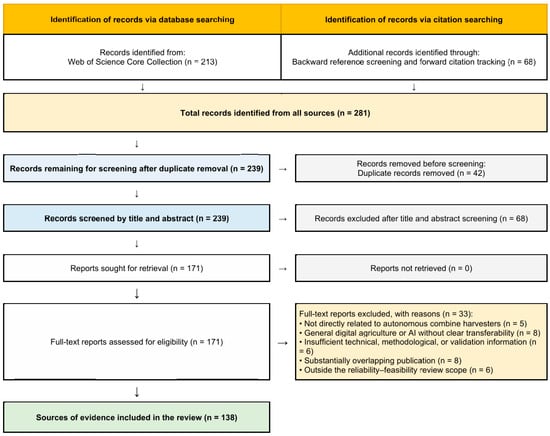
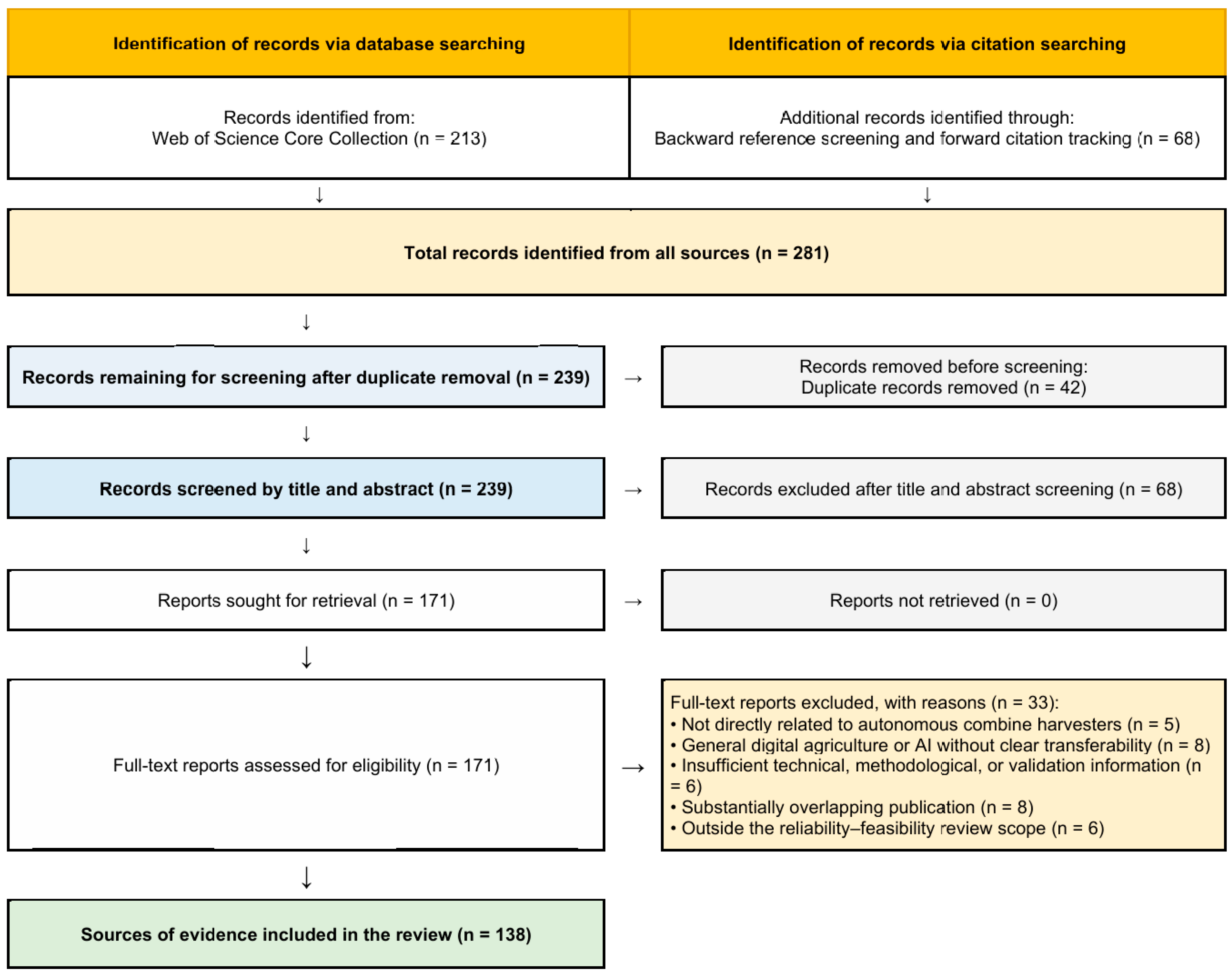
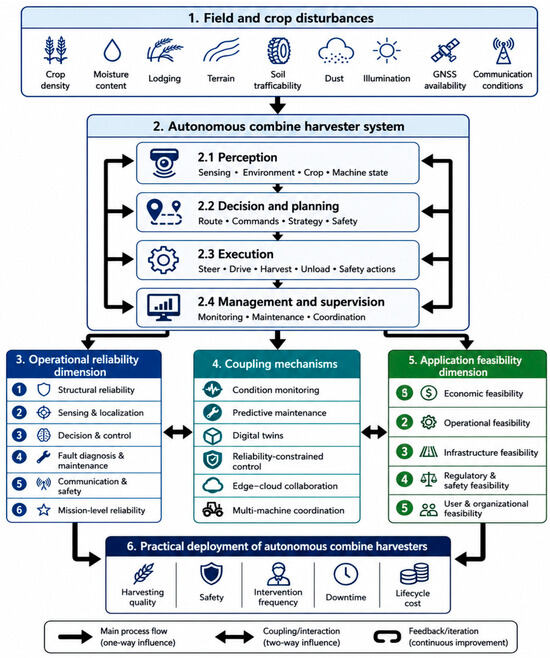
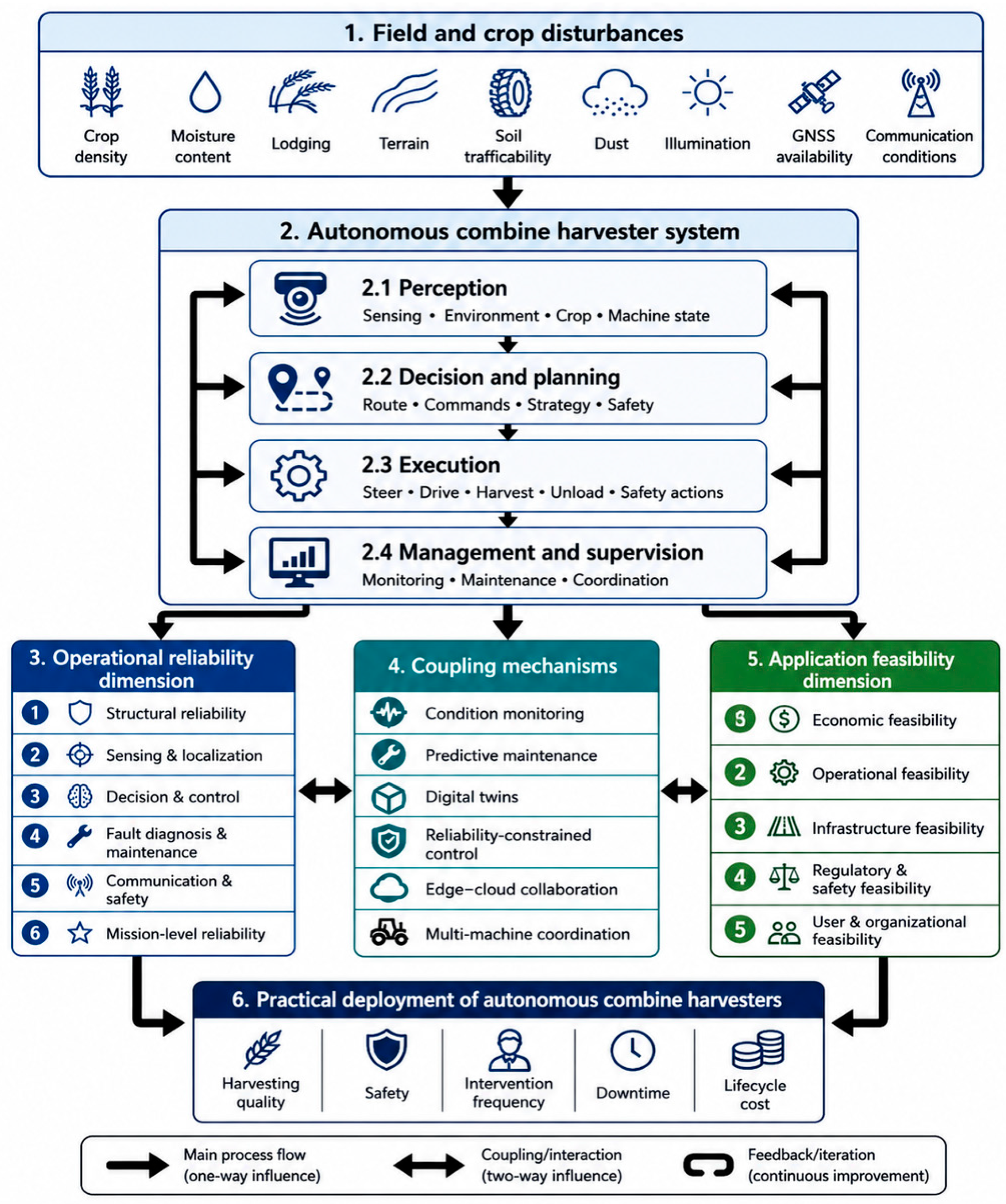
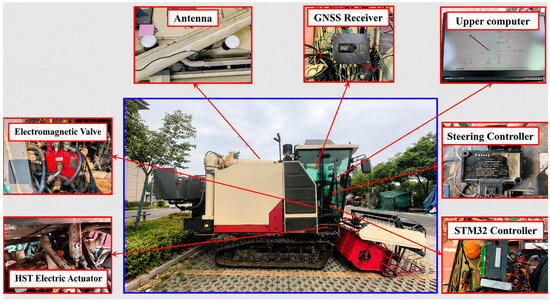
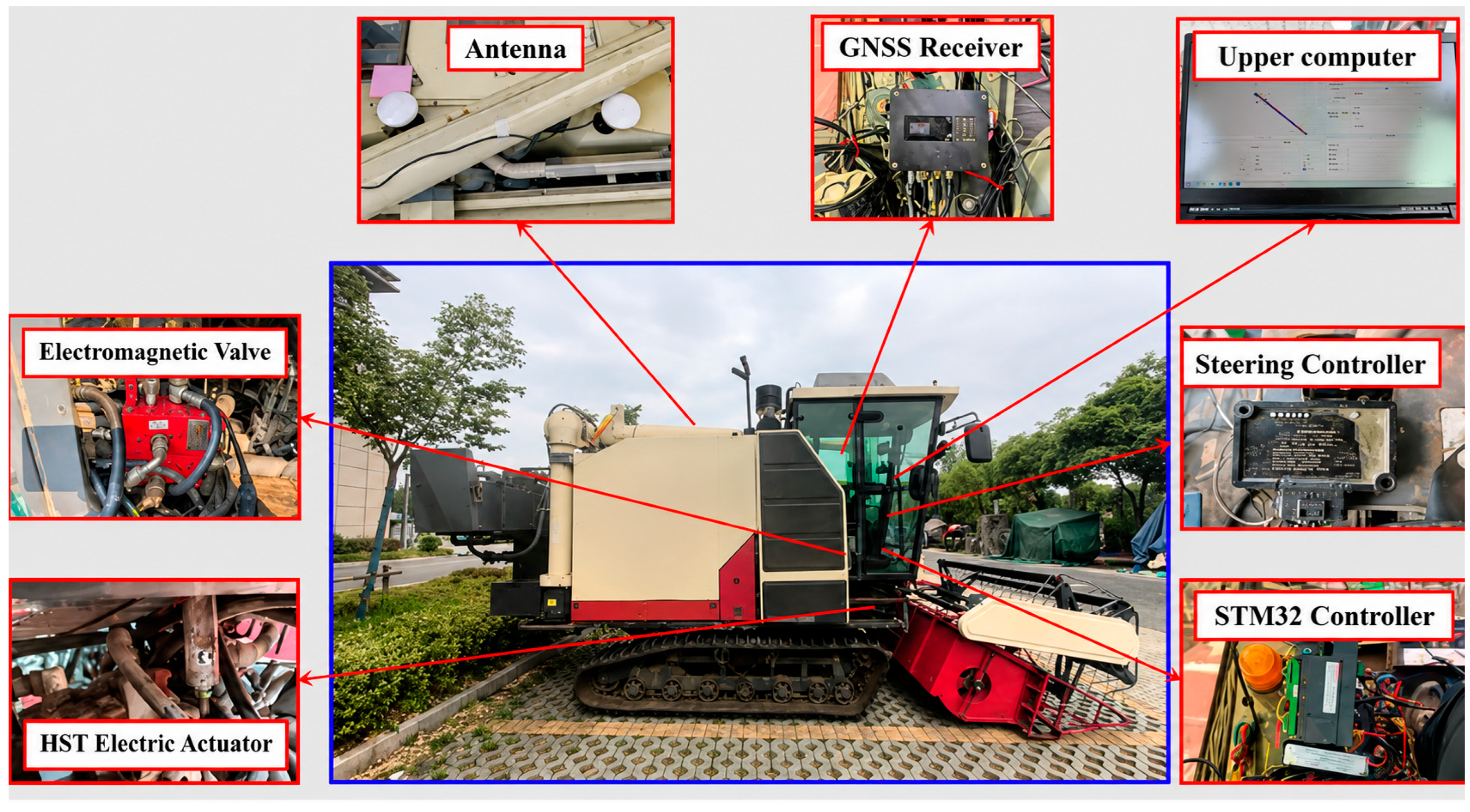
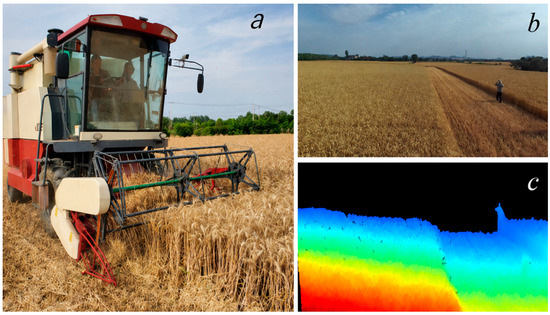
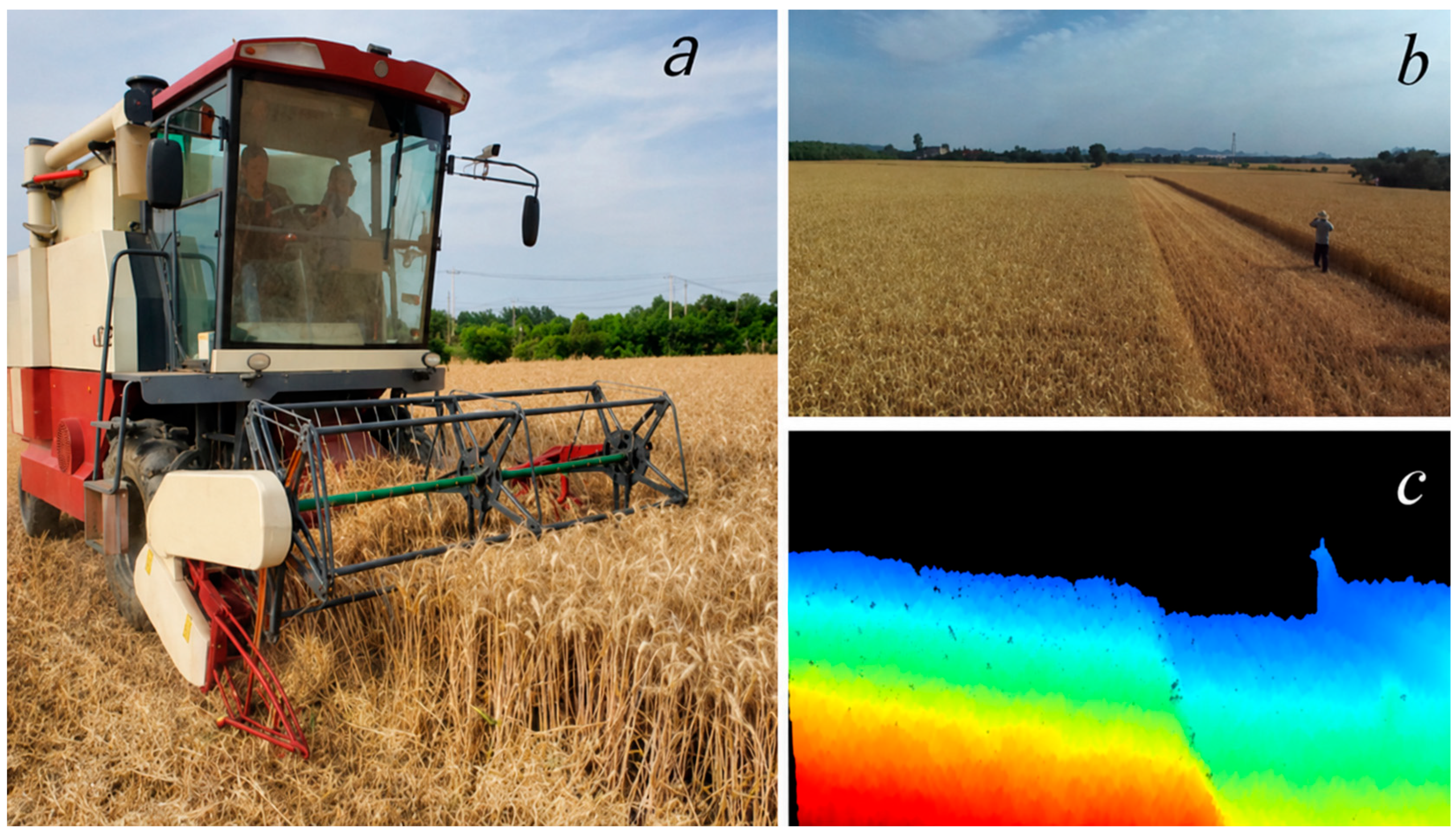

Disclaimer/Publisher’s Note: The statements, opinions and data contained in all publications are solely those of the individual author(s) and contributor(s) and not of MDPI and/or the editor(s). MDPI and/or the editor(s) disclaim responsibility for any injury to people or property resulting from any ideas, methods, instructions or products referred to in the content. |
© 2026 by the authors. Licensee MDPI, Basel, Switzerland. This article is an open access article distributed under the terms and conditions of the Creative Commons Attribution (CC BY) license.