


Abstract
This study presents a comparative thermodynamic assessment of four widely used CO2 refrigeration configurations, namely, the basic cycle (BC), internal heat exchanger cycle (IHEX), mechanical subcooling cycle (MSC), and ejector cooling cycle (ECS), operating under both subcritical and transcritical conditions. The investigated systems were analyzed using validated numerical models developed in the Engineering Equation Solver (EES) under evaporating temperatures ranging from −30 °C to +5 °C and gas cooler temperatures ranging from 30 °C to 50 °C. For each operating condition, the refrigeration cycles were thermodynamically optimized in order to maximize the coefficient of performance (COP). The results indicate that an increasing gas cooler temperature significantly reduces the COP of all investigated systems, whereas an increasing evaporating temperature improves cycle performance. Among the investigated configurations, the MSC system exhibited the highest thermodynamic performance improvement, particularly under severe transcritical operating conditions characterized by high gas cooler temperatures and low evaporating temperatures. The ECS configuration also provided considerable performance enhancement by reducing throttling-related thermodynamic losses and compressor pressure ratio. In contrast, the IHEX configuration yielded comparatively moderate but relatively stable performance improvement with lower system complexity. In addition to the thermodynamic comparison, a simplified engineering-oriented practical assessment framework based on a relative cost index (RCI) was introduced to comparatively evaluate implementation complexity, control requirements, maintenance considerations, and relative investment burden of the investigated systems. The results indicate that, although the MSC configuration provides the highest thermodynamic performance, it is also associated with the highest implementation complexity and relative investment requirement, whereas the IHEX configuration offers a simpler and lower-cost alternative with moderate performance enhancement. The present study provides engineering-oriented comparative guidance regarding the thermodynamic performance, practical applicability, and operational suitability of advanced CO2 refrigeration systems under varying climatic and operational conditions.
1. Introduction
Over the past few decades, the widespread use of synthetic refrigerants like hydrofluorocarbons (HFCs), hydrochlorofluorocarbons (HCFCs), and chlorofluorocarbons (CFCs) in the refrigeration and air conditioning industries has greatly contributed to climate change and global warming [1]. Hydrofluorocarbons (HFCs) are powerful greenhouse gases that greatly contribute to climate change, although they do not directly harm the ozone layer [2]. Increasing environmental regulations and international agreements have expedited the shift towards environmentally sustainable refrigeration technologies with low global warming potential (GWP) [3,4,5,6]. This transition aims to mitigate environmental impacts and promote long-term sustainability [7]. This resurgence to its roots is not just necessary; it is essential for a sustainable future. Therefore, there is an urgent necessity to identify and implement environmentally friendly alternative refrigerants [1]. Carbon dioxide (CO2, R744) has emerged as one of the most promising natural refrigerants due to its negligible ozone depletion potential (ODP = 0), very low global warming potential (GWP = 1), non-toxicity, non-flammability, and cost-effectiveness [2,3]. It is an attractive working fluid because it has favorable thermophysical properties, such as high vapor density, specific heat, latent heat, thermal conductivity, and volumetric cooling capacity, as well as low liquid viscosity [4,5,6]. The innovative research by Lorentzen [4,5] revived the use of CO2 as a practical refrigerant for modern applications, where it can substitute high-GWP fluids. Subsequent works confirmed its benefits in terms of safety, availability, and environmental sustainability despite the problems related to high operating pressures and a relatively low critical temperature of 30.98 °C [6,7]. The increasing application of CO2 systems in industrial and commercial refrigeration is due to the development of technology and environmental regulations [8,9]. Although the market for CO2-based refrigeration is not yet mainstream, it has grown substantially over the past several decades [8,9,10,11,12,13,14,15,16]. However, the lack of deep technical knowledge and design expertise still remains a barrier to further adoption [17].
Several experimental and theoretical studies have examined the performance of CO2 systems under various conditions. Among these, internal heat exchangers, ejectors, expanders, parallel compression, and two-stage compression cycles have demonstrated notable COP improvements [18]. Wang et al. [19] compared R744 and R134a in heat pump systems and found that R744 cycles could achieve comparable cooling and higher heating capacities. Ma et al. [6] summarized the thermodynamic characteristics of basic transcritical CO2 cycles and emphasized the importance of optimizing the system’s high-side pressure. Subcritical CO2 cycles perform efficiently at moderate ambient conditions, whereas transcritical operation becomes essential at higher temperatures [20]. The efficiency of transcritical CO2 cycles depends strongly on the gas cooler outlet temperature and high-side pressure [20,21]. While efficiency decreases with rising ambient temperatures, strategies such as ejectors, parallel compression, and dedicated mechanical subcooling (DMS) help CO2 systems remain competitive. Llopis et al. [22] reported the possibilities of enhancing the energy performance of CO2 transcritical refrigeration systems using an integrated mechanical subcooling cycle to reduce the gas cooler outlet temperature. They showed COP improvements up to 20% and capacity gains up to 28.8%. Llopis et al. [23] experimentally analyzed a transcritical CO2 plant and confirmed that compressor and expansion device losses dominate system inefficiency. An experimental supermarket study by Nebot-Andrés et al. [24] validates that DMS is especially beneficial under high ambient conditions where baseline CO2 systems otherwise struggle. Mastrowski et al. [25] reported an experimental study on the effects of heat transfer between the capillary tube or ejector wall and the ambient environment on the performance of the expansion devices. An experimental comparison between the standard CO2 expansion valve refrigeration cycle and the ejector refrigeration cycle was performed by Lucas and Kohler [26]. Compared to the maximal COP of the expansion valve cycle, COP improvements of the ejector cycle of 17% were reached in their study. Cecchinato et al. [27] proposed robust control strategies for the optimal cycle discharge pressure. Singh et al. [28] emphasized that optimization must consider both COP and exergy efficiency, particularly under warm ambient temperatures where system efficiency declines. Nonetheless, the performance of transcritical systems generally lags behind that of HFC-based systems, motivating numerous studies on efficiency improvements [20,29,30,31,32,33].
Recent studies (2020–2025) have deepened the understanding of CO2 systems through advanced experimental and numerical investigations. The application status and the latest progress of transcritical CO2 refrigeration cycle systems were reviewed and discussed in the review papers by Ji et al. [34] and Yang et al. [35]. Moreover, extensive reviews, e.g., Boupda et al. [36] and Song et al. [37], point out the importance of system-level design and component optimization to overcome the limitation of CO2’s low critical temperature. Further studies by Khaldi et al. [38], El-barghthi et al. [39] and Ierin et al. [40] have highlighted the effect of ejector geometry, vortex tubes, and hybrid subsystems on the performance of the transcritical cycle, which offer promising directions for future studies.
The results indicate that the choice of proper operating conditions and careful system design are of critical importance for improving the performance of R744 refrigeration systems. In practice, the refrigeration systems working with CO2 can work in subcritical and transcritical conditions depending on the cooling demand and ambient temperature. Therefore, refrigeration configurations must be evaluated over a wide range of operating conditions to ensure reliable and efficient operation under varying climatic and operating conditions. To meet this demand, the present work comparatively investigates four commonly used CO2 refrigeration configurations, namely, the basic cycle (BC), internal heat exchanger cycle (IHEX), mechanical subcooling cycle (MSC), and ejector cooling cycle (ECS). Many studies have been carried out on individual enhancement techniques for transcritical CO2 refrigeration systems. Most of the previous studies were investigated based on a single configuration, limited operating conditions, fixed evaporating temperatures, or specific application scenarios. Therefore, the relative thermodynamic benefits, operational applicability, and practical compromises of these arrangements at different evaporating and gas cooler temperatures are not yet well understood.
The present study does not aim to propose an entirely new refrigeration architecture but to establish a unified engineering-oriented comparative thermodynamic and practical assessment framework to evaluate the advanced CO2 refrigeration configurations over a broad operating range. The MSC and ECS systems were added as more advanced thermodynamic enhancement techniques for more severe transcritical operating conditions. The BC and IHEX systems were deliberately kept as references and relatively simple configurations. The systems under investigation were analyzed for evaporating temperatures from −30 °C to +5 °C and gas cooler temperatures from 30 °C to 50 °C, resulting in forty different operating cases. The refrigeration cycles were thermodynamically optimized for each operating condition using the most suitable operating pressures and characteristic cycle parameters to maximize the coefficient of performance (COP). In addition to the comparative thermodynamic analysis, a simplified engineering-oriented practical assessment framework based on a relative cost index (RCI) was also proposed to comparatively evaluate implementation complexity, control requirements, maintenance considerations, and relative investment burden of the investigated systems. The comparison was performed using numerical models developed in the Engineering Equation Solver (EES) [41] and validated by experimental data published in the literature. The results obtained clearly indicate the relative merits, limitations, and practical applicability of each of the refrigeration configurations and thus provide engineering-oriented guidance for the selection of appropriate CO2 refrigeration systems in different climatic and operational conditions.
2. Materials and Methods
2.1. Evaluated CO2 Refrigeration Cycle Systems
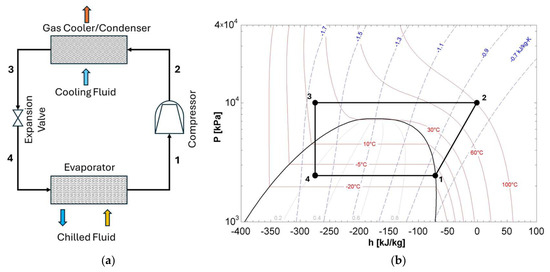
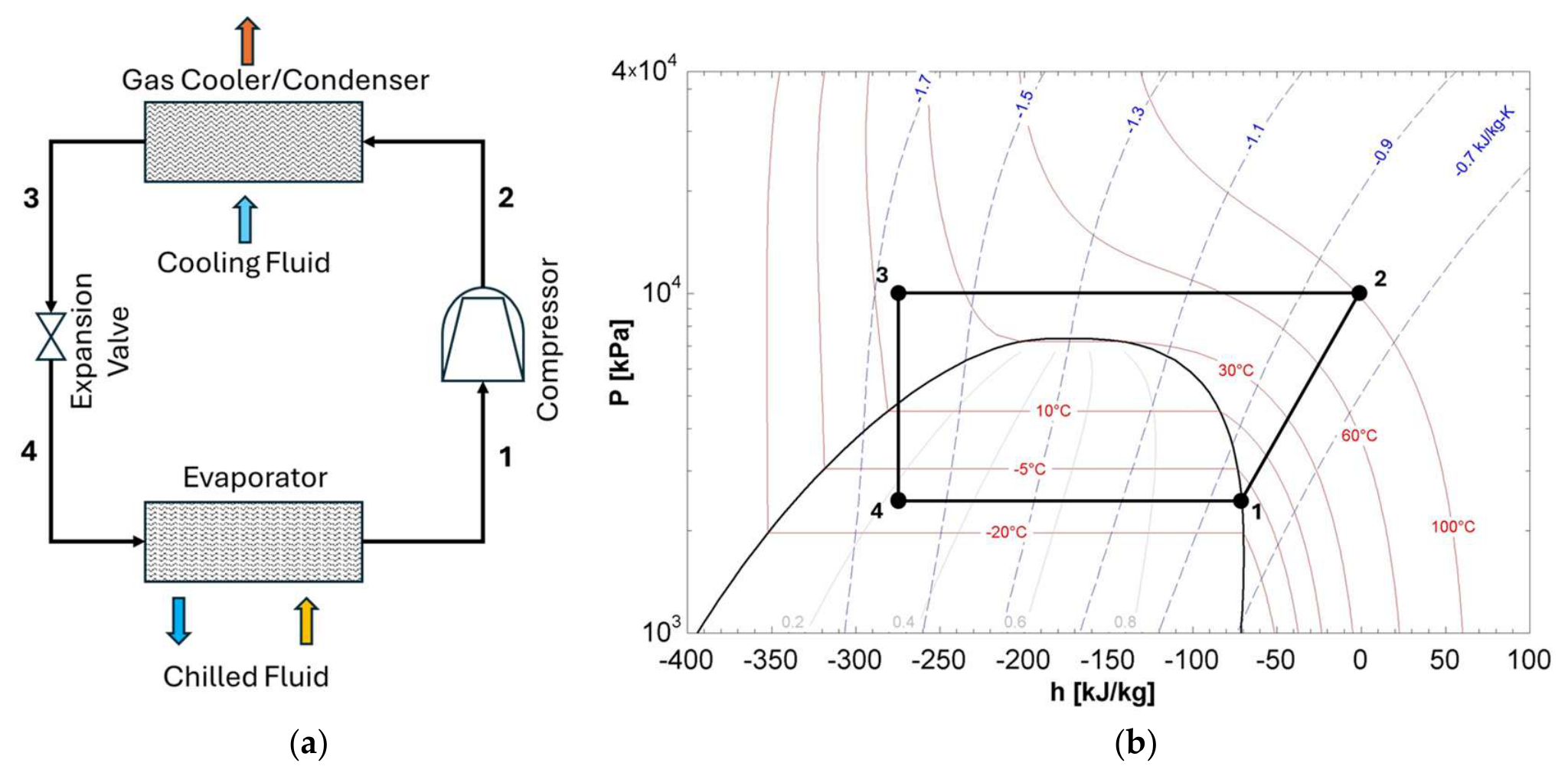
The schematic representation of a basic CO2 refrigeration system and its respective P-h diagram are given in Figure 1a,b, respectively. For the subcritical conditions, the working states are the same as the conventional refrigeration cycles. For the transcritical working conditions, heat rejection in the gas cooler occurs above the critical temperature and critical pressure of CO2. Therefore, CO2 does not turn into a liquid phase after heat rejection.
Figure 1.
Schematic of the basic CO2 refrigeration system: (a) configuration, (b) P-h diagram.
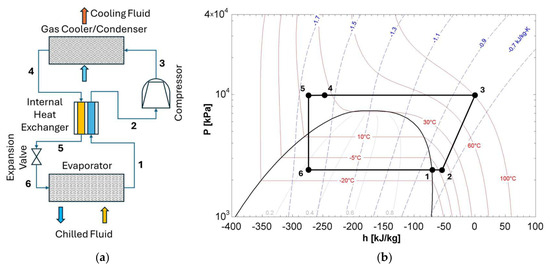
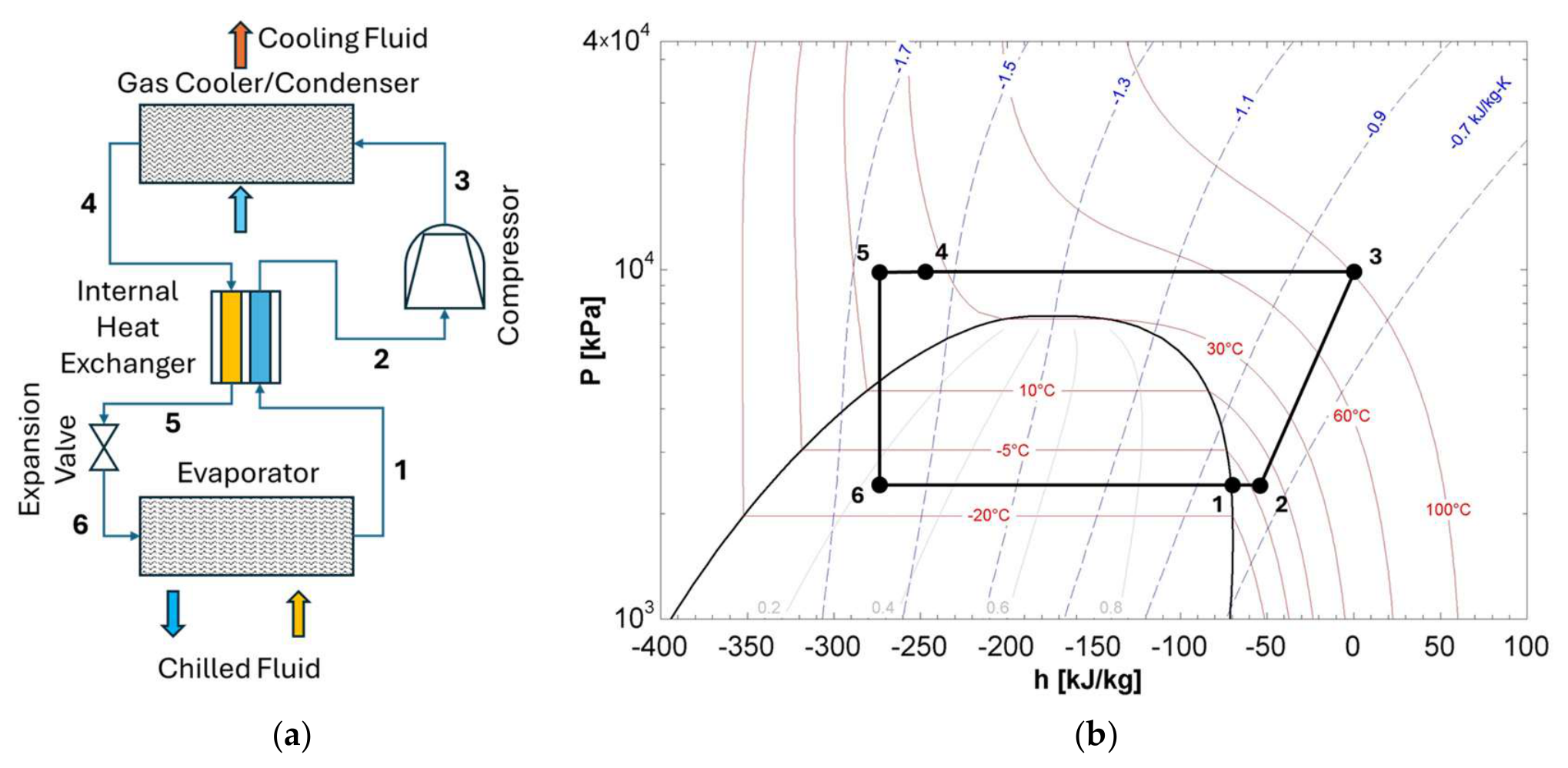
The schematic representation of a refrigeration cycle with an internal heat exchanger (IHEX) and its respective P-h diagram are given in Figure 2a,b, respectively. The internal heat exchanger uses the saturated cold vapor from the evaporator to further cool the exiting fluid from the gas cooler. An integrated internal heat exchanger reduces the inlet temperature to the throttle valve and makes sure that the entry point to the compressor is filled with superheated steam. The increased cooling capacity of the evaporator leads to an increase in COP, but the extra superheating leads to increased work consumption in the compressor.
Figure 2.
Schematic of the CO2 refrigeration system with an internal heat exchanger: (a) configuration, (b) P-h diagram.
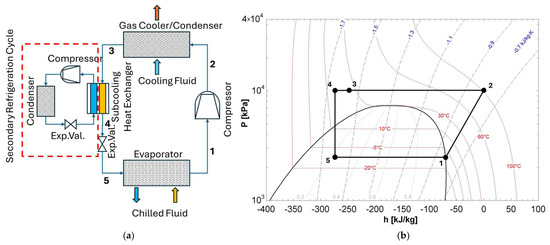
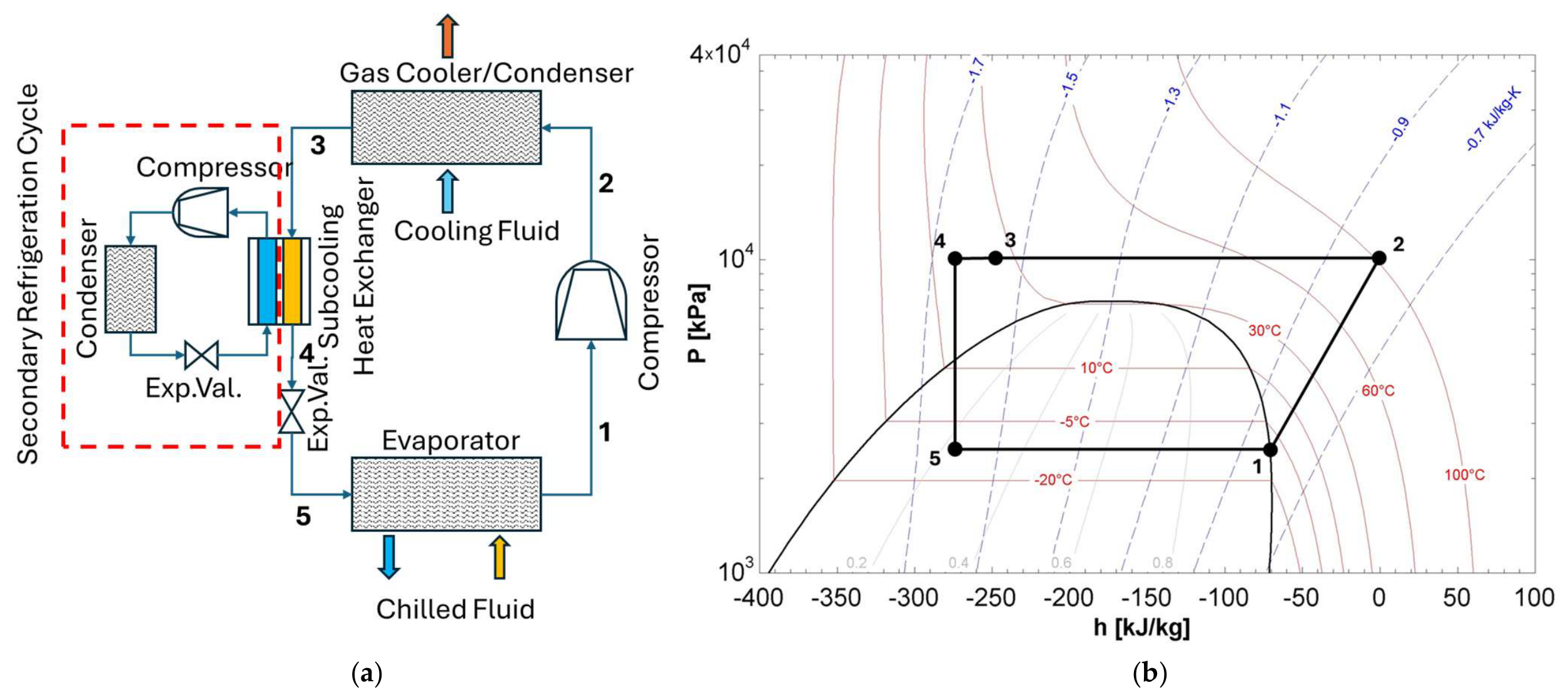
The third examined system is the one with extra mechanical subcooling (MSC) after the gas cooler. Schematic of the CO2 refrigeration system with an auxiliary mechanical refrigeration cycle for the subcooling is shown in Figure 3. The extra system operates with another refrigerant (R1234yf is used in this study), and it consumes electricity in order to perform the proper subcooling. The advantages of this configuration, compared to the subcooling with the heat exchanger of Figure 2, are the greater subcooling rate and that there is no extra superheating in the compressor inlet. The disadvantage is the extra need for work in the compressor of the secondary cycle. In this system, it is essential to optimize both the maximum pressure and the subcooling temperature difference in order to maximize the system’s coefficient of performance (COP). It is worth stating that greater subcooling increases not only the cooling capacity but also the work consumption in the secondary compressor, and these facts create an optimum subcooling value in every case.
Figure 3.
Schematic of the CO2 refrigeration system with an auxiliary mechanical refrigeration cycle for the subcooling: (a) configuration, (b) P-h diagram.
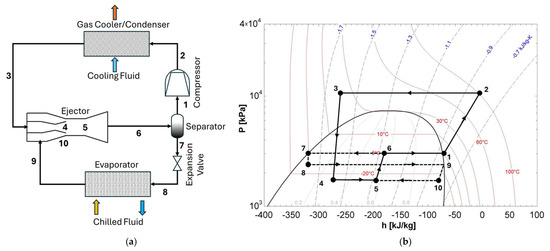
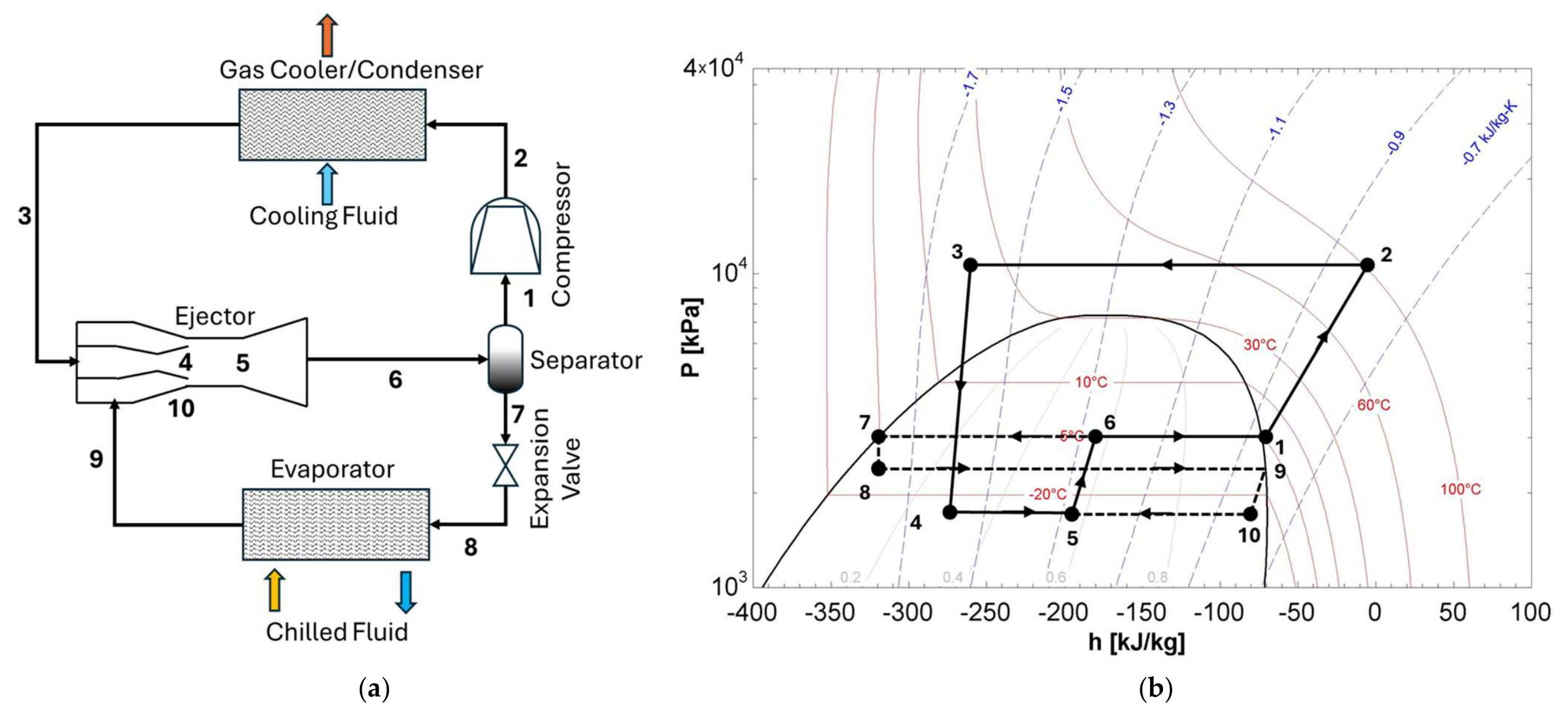
The fourth examined system is the one with an ejector (ECS). A layout diagram of the CO2 refrigeration system with an ejector (ECS) can be seen in Figure 4a, and the corresponding P-h diagram can be seen in Figure 4b. In the ejector, the high-pressure fluid (motive) stream at state 3 is sent through a converging–diverging nozzle and expanded to the low pressure at state 4. The enthalpy reduces, and the velocity increases. Since the exit pressures of both motive and suction streams from the nozzles at states 4 and 10 are the same, this low pressure is used to entrain the suction stream from state 9 to 10. The suction stream also expands in the suction nozzle from the pressure at states 9 and 10. The enthalpy of the suction stream reduces, and the suction stream velocity increases. These two streams mix in the mixing section and become one stream at state 5. Then, it enters the diffuser, where it is decelerated and compressed to a pressure higher than the initial pressure of the suction stream and exits from the ejector as a two-phase fluid at state 6; the result is a pressure increase provided to the low-pressure vapor that is being pumped by the high-pressure liquid. Ejectors contribute to a higher COP in refrigeration systems. By efficiently recycling and compressing low-pressure refrigerant, they enable the system to achieve more cooling output per unit of energy input. In the end, it enhances the overall performance. Fangtian’s and Yitai’s [42] ejector model is considered in this study.
Figure 4.
Schematic of the CO2 refrigeration system with an ejector: (a) configuration, (b) P-h diagram.
2.2. Mathematical Modeling of CO2 Refrigeration Cycle Systems
This section presents the details of the mathematical model used for the computations. The following assumptions were made for the thermodynamic analysis of the CO2 refrigeration cycle.
- There are no kinetic and potential energy changes in the cycle and cycle elements, except ejector modeling.
- Heat transfer and friction losses in the pipes between the basic elements are neglected.
- The state changes in the compressor, expansion valve, internal heat exchanger, and ejector are adiabatic.
- The liquid–vapor separator in the two-phase ejector cycle has perfect separation efficiency, and the vapor and liquid at the outlets of the separator are at saturated conditions.
- The compressor operates with a specified isentropic efficiency.
- All valves operate isenthalpically.
- For the transcritical calculations, the exit pressure of the compressor is optimized for the maximum COP.
Heat flow rates for each component can be calculated as follows:
Pressure ratio, PR, is defined as given in Equation (11), in which Pcomp,in and Pcomp,out represent the compressor inlet and exit pressures, respectively.
The isentropic efficiency of a compressor is affected by the pressure ratio, and it could be defined as a function of the pressure ratio as given in Equation (12) [32,43]:
where A and B are empirical constants, which are determined by using the experimental data given in the validation section of the present study as A = 0.93 and B = 0.075. These A and B values are consistent with the range of values reported in the literature [32,43].
Compressor mechanical efficiency is taken as follows [44]:
An important parameter used to describe the performance of an ejector is “an entrainment ratio”. It can be defined as follows [26]:
Subcooling, , from the gas cooler outlet temperature in the MSC is defined as [23]:
The subcooling ratio, SCR, is defined as follows:
where Tc and Te represent the gas cooler exit and evaporator temperatures, respectively. The compressor power and the coefficient of performance (COP) of the refrigeration system are obtained as:
2.3. Validation of the Models
It is essential to evaluate the model against existing research in the literature to verify the accuracy and reliability of the produced thermodynamic model. The experimental data from Llopis et al. [23] are utilized and compared with the outcomes of the created simulation for the BC and MSC models. Table 1 illustrates the comparative results. The COP deviations range from 0.27% to 5.39%, with a mean of 2.72% and a standard deviation of 1.7. The observed errors are permissible and demonstrate that the created model can compute the system’s coefficient of performance (COP) with an accuracy of approximately 3%. The initial eight validation examples pertain to the reference system (ΔTsc = 0 °C), whereas the final eight correspond to the system with mechanical subcooling.
Table 1.
Comparisons of the present calculations with the experimental data of Llopis et al. [23].
In order to verify the present model, experimental data from Lucas et al. [26] is used for an ejector with a circular cross-section. For the validation, entrainment rate and COP are compared under the same operating conditions with the experimental study of Lucas et al. [26]. As can be seen from Table 2, the present study demonstrates very good agreement with the experimental data. It can be seen that the deviations of the COP range from 0.36% to 1.92% with a mean value of 1.25%, and the deviations of the ω range from 0% to 3.9% with a mean value of 0.6%. These deviations are acceptable and indicate that the developed model can calculate the system COP and ω with a reasonable accuracy of about 1.25% and 1%, respectively.
Table 2.
Comparisons of the present calculations with the experimental data for ECS system.
3. Results and Discussion
3.1. Comparative Thermodynamic Performance Analysis
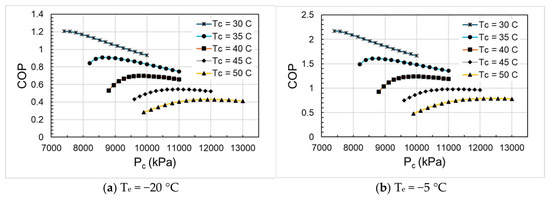
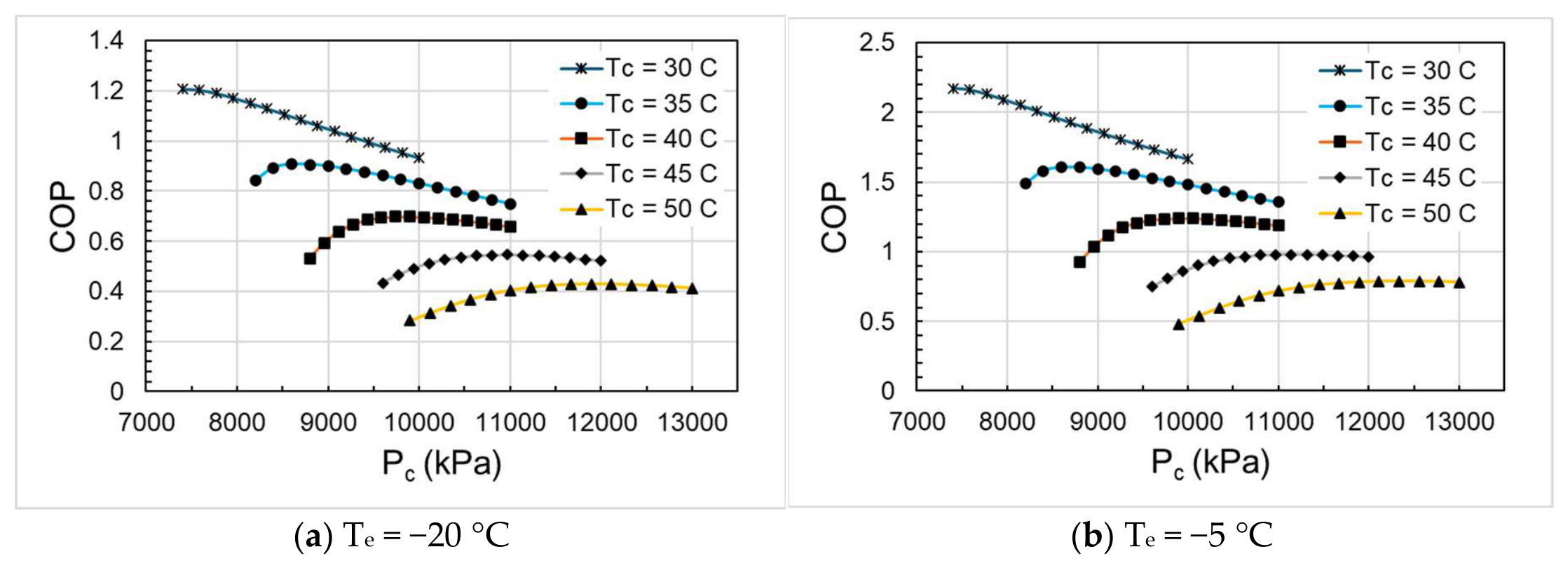
Given that the critical pressure of carbon dioxide is 7300 kPa, the calculations are conducted under transcritical operating circumstances for the condenser pressure exceeding the critical pressure of R744. Figure 5a,b present the variation in basic cycle COP with the condenser pressure for the different condensation temperatures and the evaporation temperatures of (a) Te = −20 °C and (b) Te = −5 °C, respectively. The maximal COP value is around 1.2 at Tc = 30 °C and Pc = 7400 kPa, according to the results in Figure 5a. However, at Tc = 50 °C and Pc = 12,400 kPa, the maximum COP value is approximately 0.4. As the condensation temperature and pressure in the gas cooler rise, the maximum COP falls. In contrast, Figure 5b shows that when the evaporator temperature varies, the condensation pressure values that correspond to the highest COP values for the same condensation temperatures, as indicated in Figure 5a, are not as variable. The results indicate that the optimal condensation pressure values for the reference system are mostly affected by the heat rejection temperature and are marginally influenced by the evaporator temperature. Similar to the results presented in Figure 5, each system considered in the present study undergoes testing throughout a range of evaporation temperatures from −30 °C to +5 °C in 5 °C increments and heat rejection temperatures from 30 °C to 50 °C, likewise in 5 °C intervals. For each case considered, the condenser pressure was optimized for maximum performance at each condenser temperature, and it is presented in Table 3. It should be noted that in all operating conditions discussed in this section, the evaporator cooling load was assumed to be 10 kW.
Figure 5.
Variation in the COP of the basic refrigeration system with the condensation temperature in the condenser for the different condenser/gas cooler pressures. Evaporation temperatures are (a) Te = −20 °C and (b) Te = −5 °C.
Table 3.
Gas cooler/condenser pressures used in the calculations.
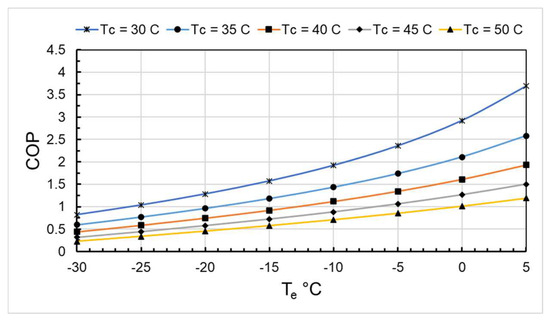
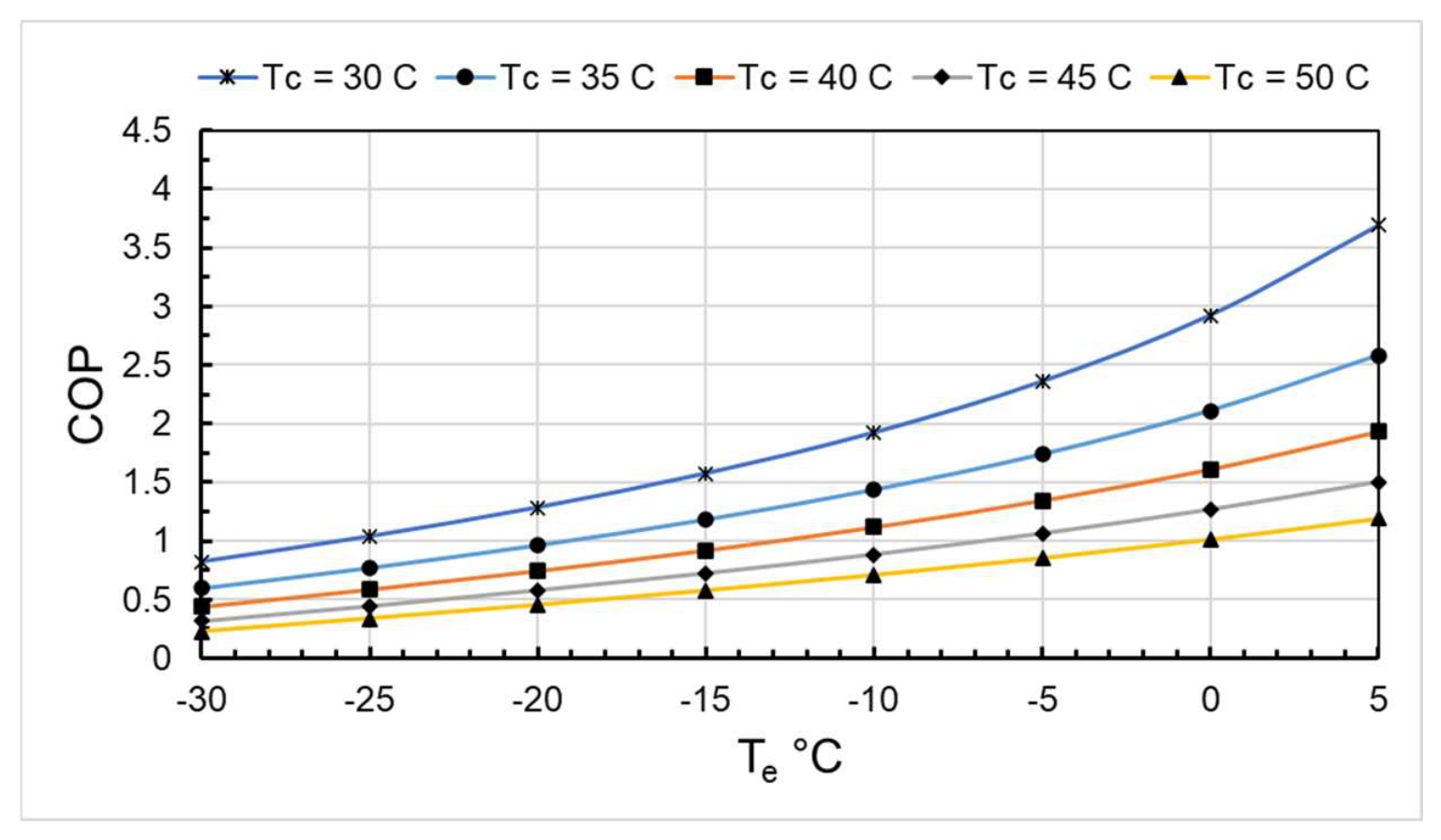
Figure 6 shows the variation in the COP of the refrigeration system with the evaporation temperature in the evaporator for the different condenser/gas cooler temperatures. The evaporation temperature also has a strong effect on the COP for all working conditions. For a specific gas cooler temperature, the coefficient of performance (COP) consistently increases as the evaporation temperature rises. This trend can be attributed to a reduction in the compressor pressure ratio and compression work as the evaporator temperature rises, which directly improves the thermodynamic efficiency of the cycle. In contrast, increasing the condenser or gas cooler temperature leads to a noticeable decrease in the COP across the entire range of evaporating temperatures. The combined effect of evaporating and gas cooler temperatures highlights the strong sensitivity of transcritical CO2 systems to operating conditions. The highest COP values were obtained at the evaporator temperature of 5 °C, while the COP values for gas cooler temperatures of 30 °C, 35 °C, 40 °C, 45 °C, and 50 °C were 3.7, 2.6, 1.9, 1.5, and 1.2, respectively. At low evaporating temperatures and high gas cooler temperatures, the basic cycle exhibits its lowest COP values, emphasizing the limitations of the reference system under severe operating conditions and motivating the use of advanced configurations to enhance performance. The observed decrease in COP with the increasing gas cooler temperature is consistent with the findings reported by Ma et al. [6] and Ge et al. [20], who demonstrated that transcritical CO2 systems are highly sensitive to heat rejection conditions because of the low critical temperature of CO2. Similar thermodynamic trends were also reported by Wang et al. [19], where the increasing ambient temperature significantly reduced the cycle efficiency due to increased compressor work and gas cooler irreversibility.
Figure 6.
Variation in the COP of the basic refrigeration system with the evaporation temperature in the evaporator for the different condenser/gas cooler temperatures.
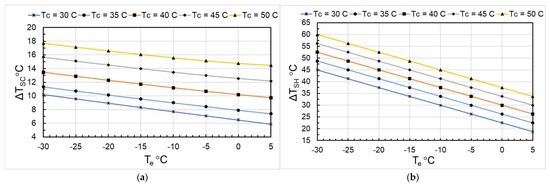
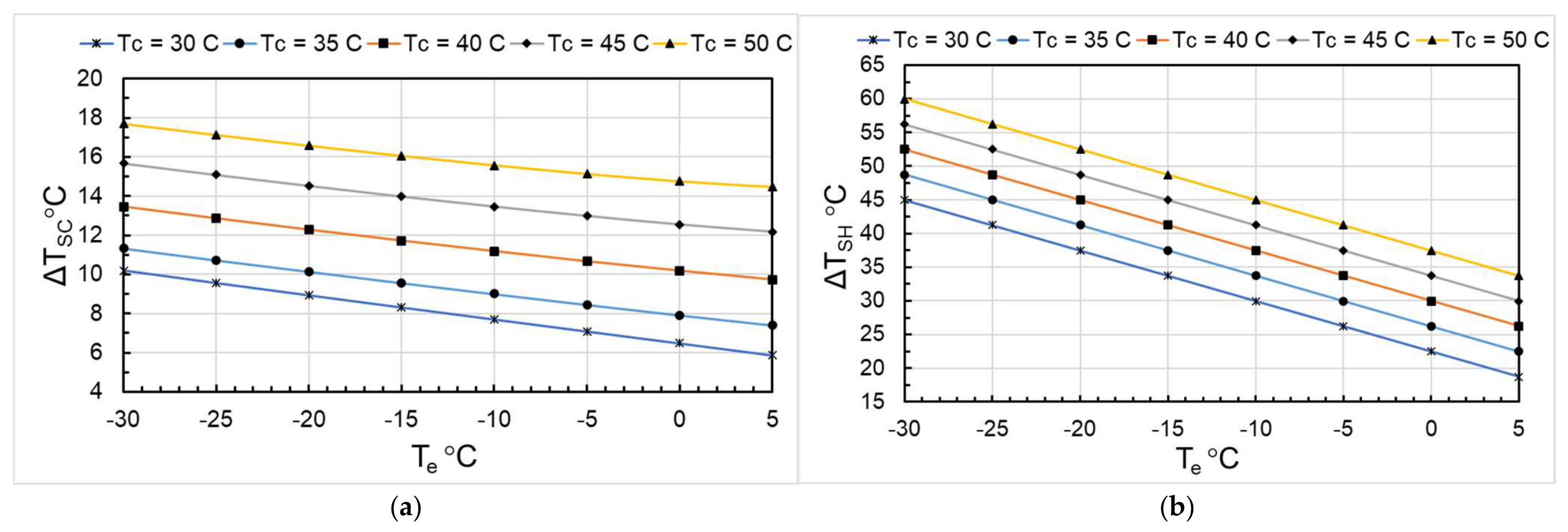
Figure 7 shows the subcooling (a) and the superheating (b) value variations by using an internal heat exchanger (IHEX) in the CO2 refrigeration system. It should be noted that the internal heat exchanger efficiency of 0.75 was used in the calculations. The IHEX results indicate a temperature decrease of 6 to 18 °C in the gas cooler outlet temperature, while there is a temperature increase of 18 to 60 °C in the evaporator outlet temperature. Here, the specific heat value of the hot fluid side (condenser side) is higher than that of the cold fluid side (evaporator side), because the pressure of the hot fluid side in the heat exchanger is higher than that of the cold fluid side. This causes the subcooling degree, ΔTSC, to be lower than the superheating degree, ΔTSH, which is inversely proportional to the ratio of specific heats. The highest ΔTSC and ΔTSH values were obtained at the evaporator temperature of −30 °C, while ΔTSC and ΔTSH values for gas cooler temperatures of 30 °C, 35 °C, 40 °C, 45 °C, and 50 °C were (10.2 and 45), (11.3 and 49), (13.5 and 52.5), (15.7 and 56.2), and (17.7 and 60), respectively. Subcooling and superheating degrees decrease linearly with increasing condenser and evaporator temperatures. The lowest ΔTSC and ΔTSH values were obtained at the evaporator temperature of 5 °C, while ΔTSC and ΔTSH values for gas cooler temperatures of 30 °C, 35 °C, 40 °C, 45 °C, and 50 °C were (5.9 and 18.7), (7.4 and 22.5), (9.7 and 26.2), (12.2 and 30), and (14.5 and 33.7), respectively.
Figure 7.
Variation in the subcooling (a) and the superheating (b) of the IHEX refrigeration system with the evaporation temperature for the different gas cooler temperatures.
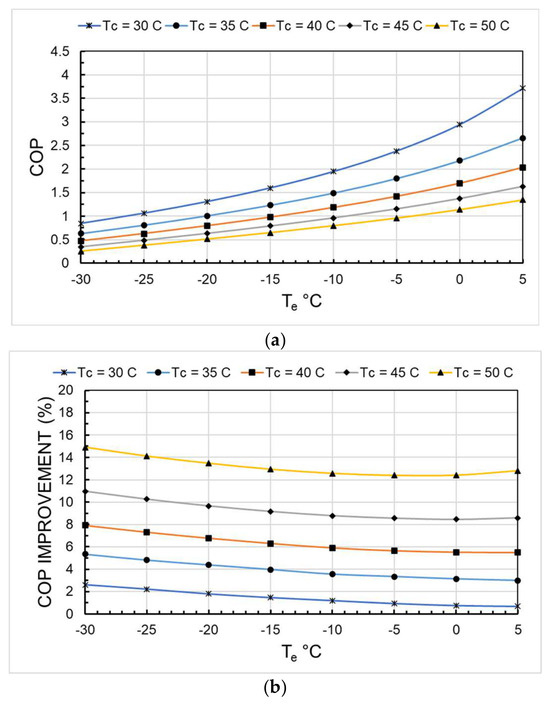
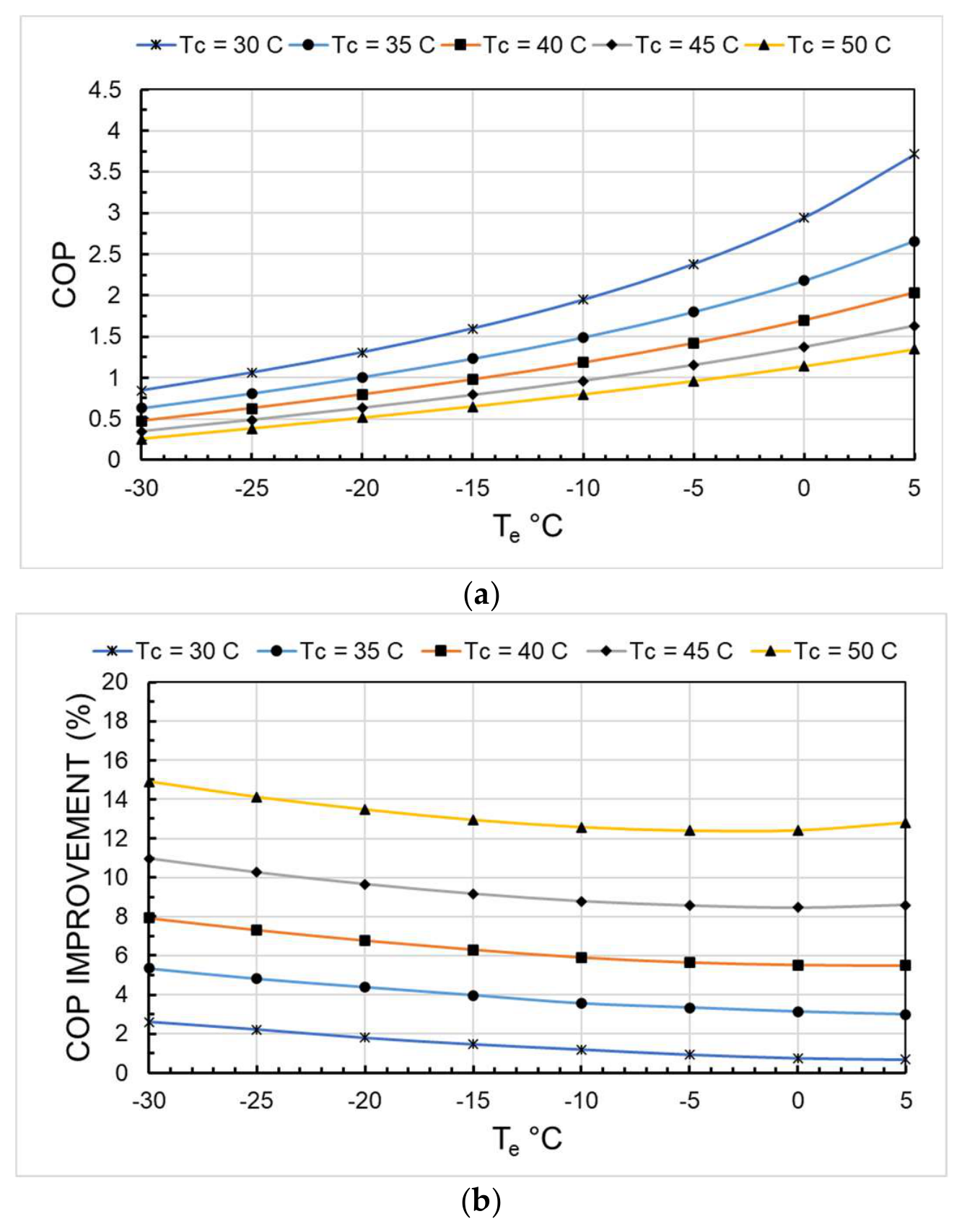
Figure 8a presents the variation in the COP of the CO2 refrigeration system with an internal heat exchanger (IHEX) as a function of the evaporating temperature for different gas cooler temperatures. Like the basic cycle, the COP increases with the increasing evaporating temperature for all levels of gas cooler temperatures. This is mainly associated with a reduction in the compressor pressure ratio and compression work at higher evaporating temperatures. The highest COP values were obtained at the evaporator temperature of 5 °C, while the COP values for gas cooler temperatures of 30 °C, 35 °C, 40 °C, 45 °C, and 50 °C were 3.7, 2.7, 2.03, 1.6, and 1.35, respectively. As the temperature of the gas cooler rises, the COP of the IHEX system decreases at all evaporating temperature ranges. Figure 8b illustrates the relative improvement in the COP of the IHEX system compared to the basic cycle. The COP improvement is more significant at low evaporating temperatures, where the internal heat exchanger effectively recovers thermal energy by subcooling the refrigerant at the expansion valve inlet while simultaneously superheating the suction vapor. As the evaporating temperature increases and the gas cooler temperature decreases, the relative improvement gradually diminishes, indicating that the performance advantage of the IHEX is strongly dependent on operating conditions. Primarily, the IHEX offers limited but consistent performance enhancements, making it a straightforward and effective solution for improving system efficiency, particularly in low-temperature operating conditions. The highest COP improvement ratios were obtained at the evaporator temperature of −30 °C, while the COP improvement ratios for gas cooler temperatures of 30 °C, 35 °C, 40 °C, 45 °C, and 50 °C were 2.6%, 5.3%, 7.9%, 11%, and 15%, respectively.
Figure 8.
Variation in the COP (a) and the COP improvement (b) of the IHEX refrigeration system with the evaporation temperature for the different gas cooler temperatures.
The moderate COP improvements obtained with the IHEX configuration are in agreement with the general trends reported in previous studies. Ge et al. [20] and Cecchinato et al. [27] similarly reported that internal heat exchangers provide limited but stable performance enhancement in transcritical CO2 systems. The relatively modest improvement is mainly associated with the competing effects of refrigerant subcooling and suction gas superheating. While subcooling increases the refrigeration effect, excessive superheating simultaneously increases compressor work, thereby limiting the overall thermodynamic benefit.
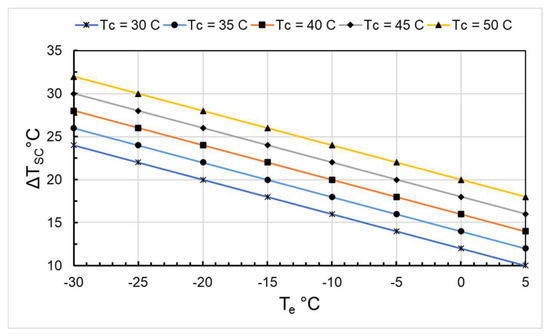
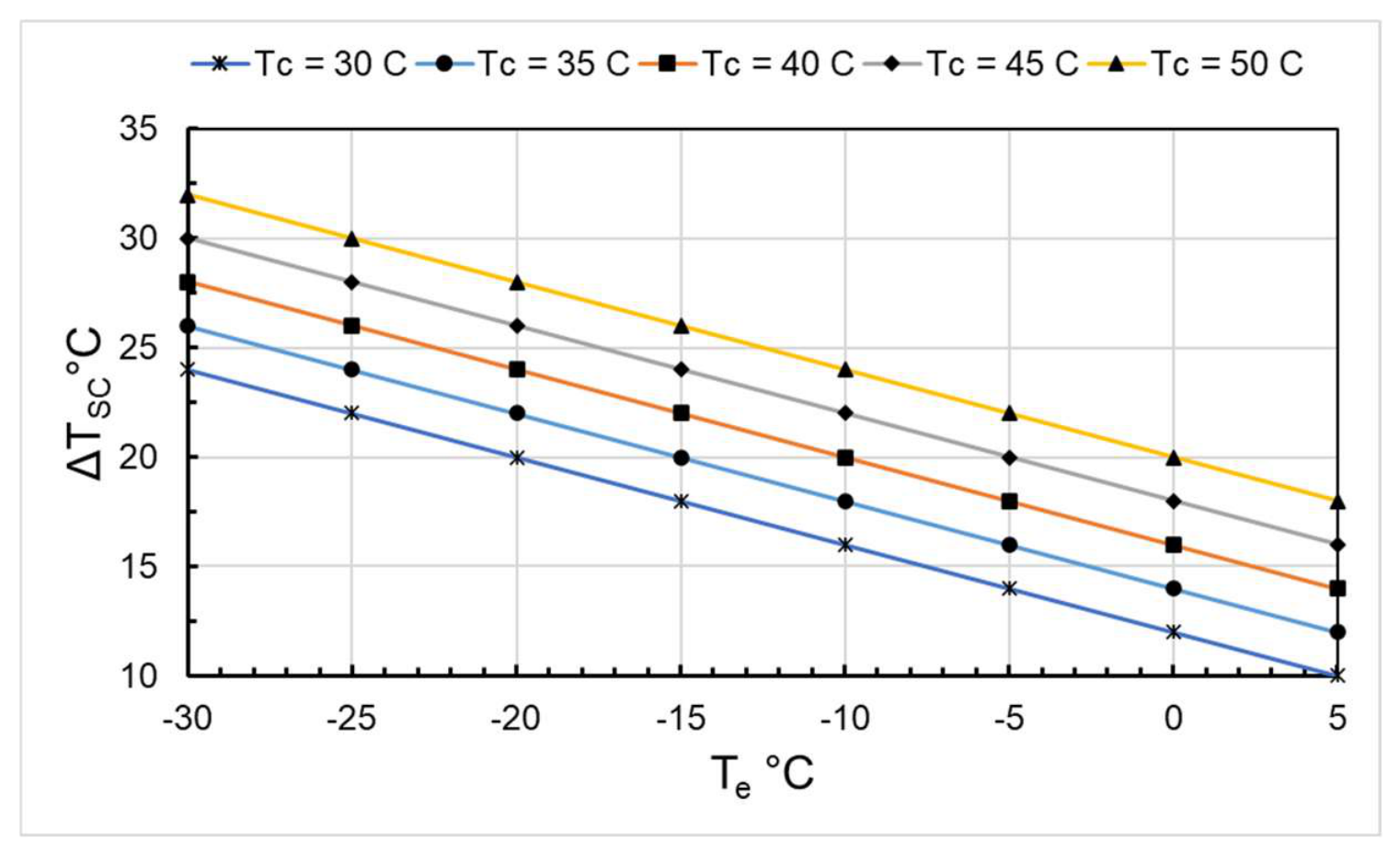
Since the size and capacity of the auxiliary mechanical refrigeration system should be smaller than the main refrigeration system, the subcooling ratio (SCR given in Equation (16)) was taken as 0.4 in the calculations. Figure 9 presents the variation in the subcooling of the CO2 refrigeration system with mechanical subcooling (MSC) as a function of the evaporating temperature for different gas cooler temperatures. The highest ΔTSC values were obtained at the evaporator temperature of −30 °C, while ΔTSC values for gas cooler temperatures of 30 °C, 35 °C, 40 °C, 45 °C, and 50 °C were 24 °C, 26 °C, 28 °C, 30 °C, and 32 °C, respectively.
Figure 9.
Variation in the subcooling of the MSC refrigeration system with the evaporation temperature for the different gas cooler temperatures.
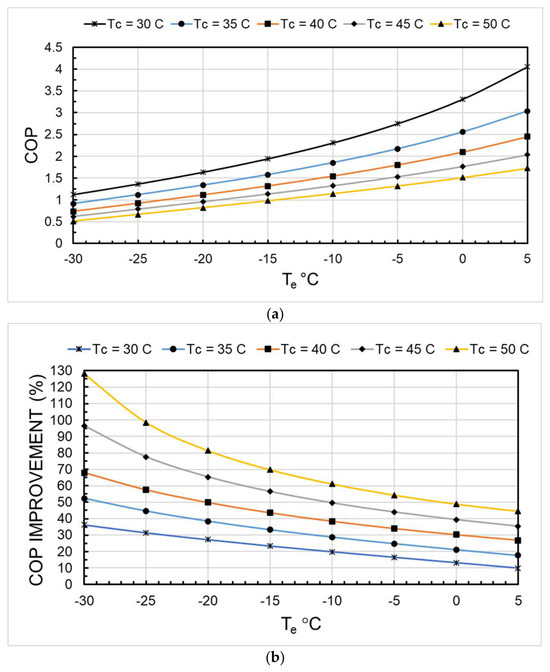
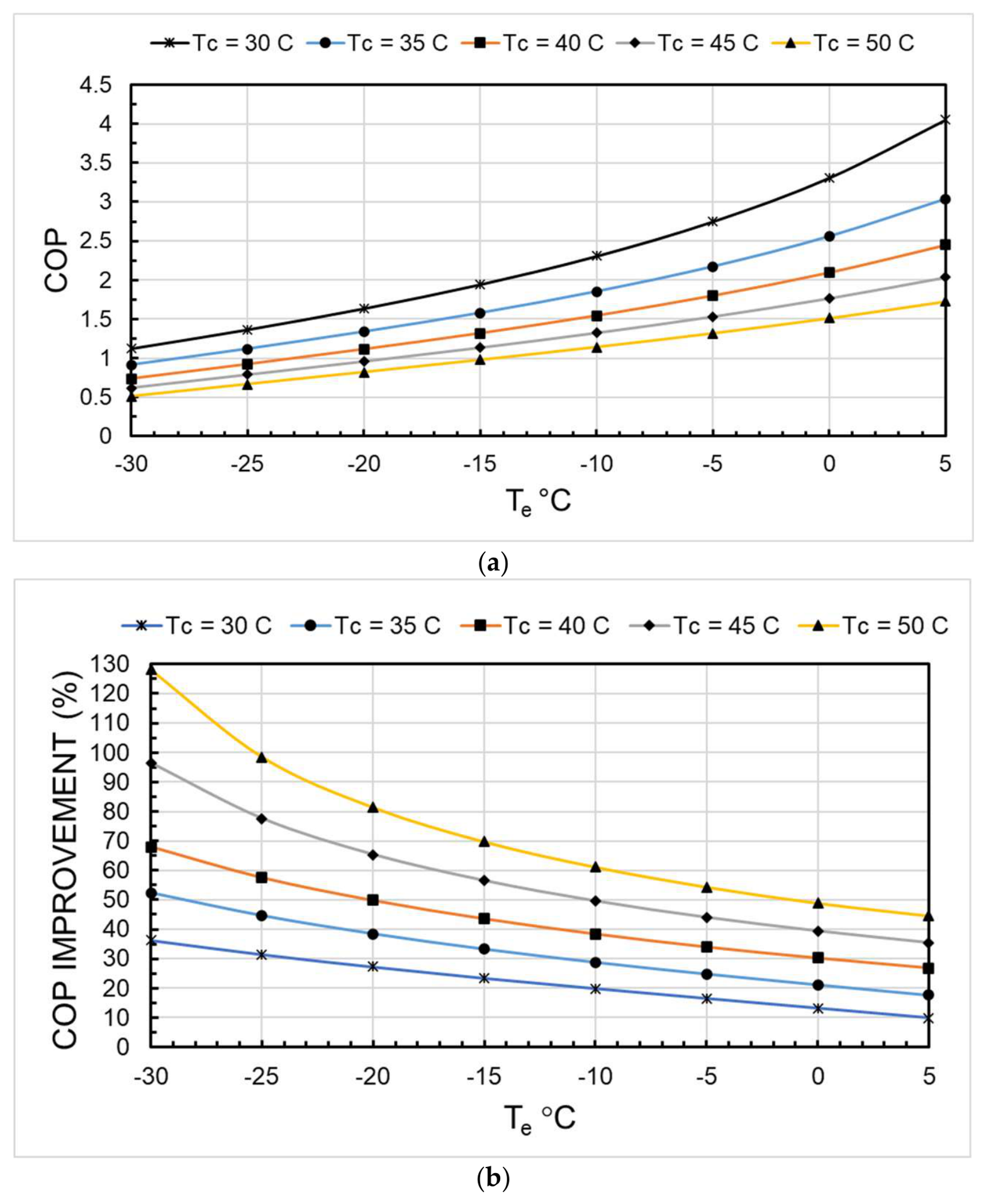
Figure 10a illustrates the variation in the COP of the CO2 refrigeration system with mechanical subcooling (MSC) as a function of the evaporating temperature for different gas cooler temperatures. Compared to the basic and IHEX configurations, the MSC system exhibits substantially higher COP values over the entire operating range. For all heat rejection conditions, the COP increases with the increasing evaporating temperature. The highest COP values were obtained at the evaporator temperature of 5 °C, while the COP values for gas cooler temperatures of 30 °C, 35 °C, 40 °C, 45 °C, and 50 °C were 4.1, 3.0, 2.4, 2.0, and 1.7, respectively. As the gas cooler temperature increases, a reduction in COP is observed for all evaporating temperatures. Figure 10b shows the corresponding COP improvement of the MSC system relative to the basic cycle. The COP improvement remains high across the entire evaporating temperature range and becomes especially pronounced at higher gas cooler temperatures. The highest COP improvement ratios were obtained at the evaporator temperature of −30 °C, while the COP improvement ratios for gas cooler temperatures of 30 °C, 35 °C, 40 °C, 45 °C, and 50 °C were 36.4%, 52.3%, 68.0%, 96.5%, and 128.2%, respectively. This trend highlights the ability of the MSC configuration to sustain superior performance under severe operating conditions, where conventional transcritical CO2 systems typically experience substantial efficiency degradation. Overall, the results highlight that mechanical subcooling is one of the most effective strategies for enhancing the performance of transcritical CO2 refrigeration systems. The substantial COP improvements achieved by the MSC system are consistent with the experimental findings reported by Llopis et al. [22], who observed COP improvements up to approximately 20% in transcritical CO2 systems with dedicated mechanical subcooling. However, the improvement ratios obtained in the present study are considerably higher under severe operating conditions. This difference is mainly attributed to the broader operating range investigated in the present work, particularly the inclusion of high gas cooler temperatures up to 50 °C and low evaporating temperatures down to −30 °C, where the thermodynamic limitations of the basic transcritical CO2 cycle become more pronounced. Similar trends were also emphasized by Nebot-Andrés et al. [24], who reported that mechanical subcooling becomes increasingly beneficial under warm climatic conditions.
Figure 10.
Variation in the COP (a) and the COP improvement (b) of the MSC refrigeration system with the evaporation temperature for the different gas cooler temperatures.
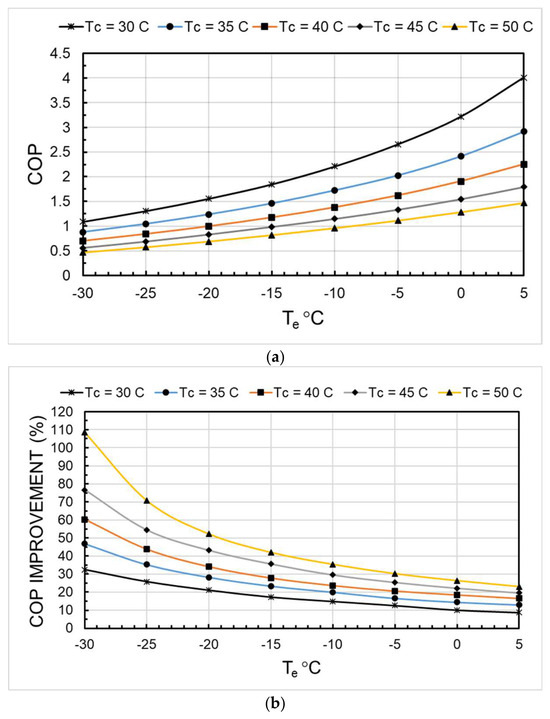
Figure 11a shows the variation in the COP of the CO2 refrigeration system employing an ejector cooling system (ECS) as a function of the evaporating temperature for different gas cooler temperatures. For all heat rejection conditions, the COP increases with the increasing evaporating temperature, following the general trend observed in the other system configurations. The highest COP values were obtained at the evaporator temperature of 5 °C, while the COP values for gas cooler temperatures of 30 °C, 35 °C, 40 °C, 45 °C, and 50 °C were 4.0, 2.9, 2.3, 1.8, and 1.5, respectively. The ECS consistently performs better than the basic cycle across the entire operating range, demonstrating the beneficial effect of ejector-based expansion on system efficiency. By partially recovering the expansion work and increasing the suction pressure at the compressor inlet, the ejector effectively reduces the compressor pressure ratio and associated power consumption. As the temperature of the gas cooler rises, the COP of the ECS decreases for all evaporating temperatures; however, this reduction is less pronounced than in the basic and IHEX systems. Figure 11b presents the relative COP improvement of the ECS compared to the basic refrigeration system. The highest COP improvement ratios were obtained at the evaporator temperature of −30 °C, while the COP improvement ratios for the gas cooler temperatures of 30 °C, 35 °C, 40 °C, 45 °C, and 50 °C were 36.5%, 46.9%, 60.2%, 76.6%, and 108.6%, respectively. The COP improvement is more significant at higher gas cooler temperatures and lower evaporating temperatures, where the performance of the reference cycle is most limited. Overall, the results confirm that the ejector cooling system offers a solution for improving the performance of transcritical CO2 refrigeration systems, especially in applications subject to high ambient temperatures and low evaporating temperatures. The ejector-based configuration demonstrated considerable performance enhancement under severe operating conditions, which agrees well with the experimental observations of Lucas and Köhler [26], who reported COP improvements of approximately 17% for ejector-assisted transcritical CO2 systems. The higher improvement ratios obtained in the present study are primarily associated with the broader operating range and the optimization of operating pressures for each investigated condition. Similar conclusions were also reported by Elbarghthi et al. [39], who emphasized that ejector systems become increasingly advantageous at high ambient temperatures because of their capability to recover expansion losses and reduce the compressor pressure ratio.
Figure 11.
Variation in the COP (a) and the COP improvement (b) of the ECS refrigeration system with the evaporation temperature for the different gas cooler temperatures.
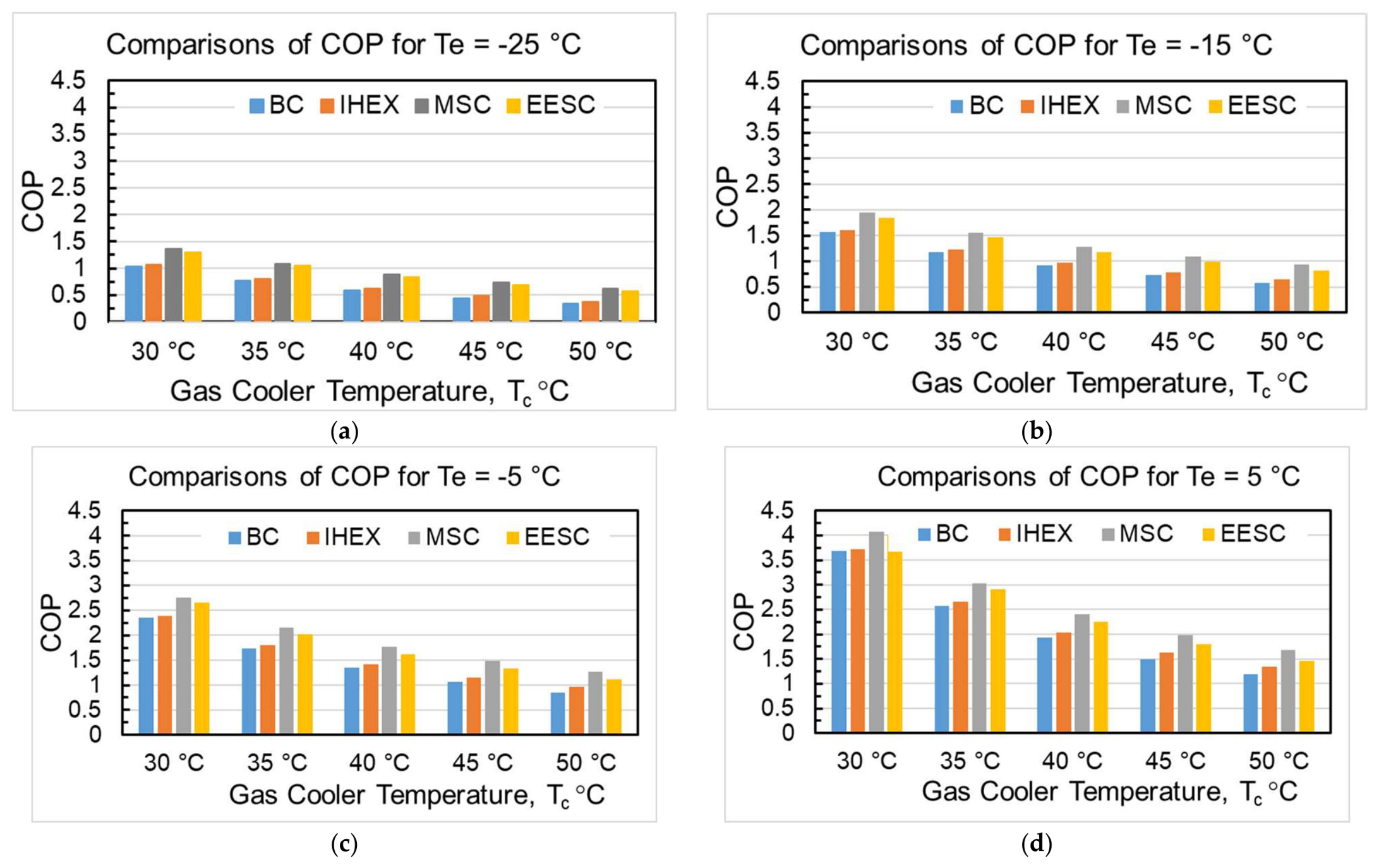
Figure 12 compares the COP of the four investigated CO2 configurations (BC, IHEX, MSC, and ECS) as a function of the gas cooler temperature for selected evaporating temperatures: (a) −25 °C, (b) −15 °C, (c) −5 °C, and (d) +5 °C. Across all investigated cases, a consistent trend is observed: the COP decreases as the gas cooler temperature increases, reflecting the sensitivity of transcritical CO2 systems to heat rejection conditions. This trend is most visible for the basic cycle, confirming that the reference configuration suffers substantial performance degradation under warm ambient conditions. At each evaporating temperature, the advanced configurations offer noticeable improvements in COP compared to the basic cycle. The IHEX system exhibits modest yet generally consistent enhancements, whereas the ECS and, in particular, the MSC configuration achieve significantly higher COP values. The superiority of the MSC system becomes increasingly evident as the gas cooler temperature rises, indicating that mechanical subcooling is highly effective in mitigating the adverse effect of elevated heat rejection temperatures. The benefit of the ejector system is also clearly visible, especially at lower evaporating temperatures, where the compressor pressure ratio is high, and the pressure lift provided by the ejector becomes more valuable.
Figure 12.
Comparisons of the COP for the different gas cooler temperatures with the evaporator temperatures: (a) Te = −25 °C; (b) Te = −15 °C; (c) Te = −5 °C; and (d) Te = 5 °C.
Figure 12 illustrates that system selection has to be tightly coupled to the operating conditions. The MSC system is the best configuration among all, especially for high ambient temperatures, because it always provides the highest COP over the whole range of operating conditions. Although not better than MSC, the ejector configuration still provides significant and practical improvement under severe operating conditions, with high heat rejection and low evaporating temperatures. In general, the comparative trends found in this study are consistent with the general consensus in the literature that advanced CO2 refrigeration architectures are becoming more beneficial under severe transcritical operating conditions. IHEX systems provide relatively modest but economically attractive improvements, whereas MSC and ECS arrangements provide significantly higher thermodynamic enhancement by reducing throttling losses and improving cycle pressure management. Similar comparative observations were noted in the review studies by Ji et al. [34] and Yang et al. [35], who highlighted the fact that the optimal configuration of the CO2 cycle is very sensitive to climatic conditions, the complexity of the system, and the operational demands.
The results obtained show that the relative advantages of the CO2 refrigeration configurations studied are highly dependent on the operating severity, especially the gas cooler temperature and the evaporating temperature. The IHEX system shows moderate and fairly stable improvements with a small increase in complexity. The MSC and ECS configurations are more advantageous under severe transcritical operating conditions, as they potentially mitigate thermodynamic losses associated with throttling.
3.2. Second-Law Interpretation of Thermodynamic Trends
The thermodynamic behavior of the studied CO2 refrigeration systems can also be interpreted from a second-law point of view. In transcritical CO2 refrigeration systems, thermodynamic irreversibilities are normally large in the throttling process, compressor work, and heat transfer in the gas cooler. The increase in gas cooler temperature leads to an increase in entropy generation and thermodynamic losses, which results in the decrease in the cycle performance.
The MSC configuration enhances the system performance by offering extra refrigerant subcooling prior to the expansion process, thus reducing the thermodynamic losses due to throttling and increasing the effective refrigeration capacity. Likewise, the ECS configuration partially recovers the expansion work that would otherwise be lost during the throttling process, contributing to a lower compressor pressure ratio and reduced thermodynamic irreversibility under transcritical operating conditions.
In contrast, the IHEX configuration, by providing additional subcooling, reduces throttling-related losses, but the increase in the superheating of the suction gas simultaneously increases the compressor work and associated thermodynamic losses. Thus, the overall performance enhancement of the IHEX system is still relatively moderate.
These observations indicate that the better performance of the MSC and ECS configurations under severe operating conditions can also be attributed to their ability to reduce the system irreversibilities and improve the effective utilization of the available energy.
3.3. Practical and Economic Considerations
While the thermodynamic performance of the MSC configuration is the best among the investigated systems, practical implementation issues should also be taken into account. The improved performance of the MSC system is achieved at the cost of an additional refrigeration loop, secondary compressor, and auxiliary heat exchanger, which necessarily increase system complexity, capital cost, maintenance requirements, and control difficulty. So, the choice of the most suitable refrigeration architecture must not solely be based on thermodynamic efficiency.
In addition to the thermodynamic comparison, a simplified relative cost assessment was performed in order to provide a more transparent engineering-oriented evaluation of the investigated CO2 refrigeration systems. Since a detailed techno-economic analysis strongly depends on application-specific factors such as the cooling capacity, operating conditions, equipment manufacturer, installation requirements, and local energy prices, a simplified relative cost index (RCI), as given in Equation (26), was introduced instead of the exact investment cost calculations:
where
RCI = Ccomp + Cctrl + Cmaint
- Ccomp: Component-related complexity contribution;
- Cctrl: Control system complexity contribution;
- Cmaint: Maintenance and integration contribution.
The relative cost index was estimated qualitatively based on the number of additional components, auxiliary compressor requirements, additional heat exchanger requirements, control complexity, expected maintenance effort, and practical integration difficulty of each configuration. The basic cycle (BC) was selected as the reference configuration because of its simple structure and minimal component requirement. The IHEX configuration was assigned a relatively low cost increase due to the addition of only an internal heat exchanger. The ECS configuration was associated with a moderate increase in relative cost because of the ejector, separator, and more complex pressure control requirements. The MSC configuration exhibited the highest relative cost index owing to the auxiliary refrigeration loop, additional compressor, heat exchanger, and increased control complexity. A comparative cost assessment of the CO2 systems is given in Table 4.
Table 4.
Comparative relative cost assessment of the CO2 systems.
Although the proposed relative cost index does not represent an exact economic analysis, it provides a practical and transparent basis for comparing the relative implementation complexity and expected investment burden of the investigated refrigeration systems. The obtained relative cost classifications were subsequently incorporated into Table 5 to strengthen the comparative engineering assessment of the investigated configurations.
Table 5.
Comparative engineering assessment of the CO2 systems.
The IHEX configuration provides modest COP enhancements compared to MSC and ECS systems but offers significant practical benefits because of its simplicity, low additional cost, compact structure, and ease of integration into existing systems. Hence, IHEX systems are likely to be a good solution for retrofit applications and moderate operating conditions.
Significant performance improvements are delivered by the ejector cooling system, particularly at high gas cooler temperatures and low evaporating temperatures. Ejector configurations could provide a more balanced trade-off between thermodynamic enhancement and system complexity than MSC systems, particularly in commercial refrigeration systems in warm climatic conditions.
The MSC configuration is particularly well suited for harsh operating conditions in which the efficiency of conventional transcritical CO2 systems is significantly affected by high ambient temperatures. Hence, although the investment cost of the MSC system is higher, it may be economically justified to implement it in applications with large cooling capacities and continuous operation.
A comparative engineering assessment of the CO2 systems is shown in Table 5. Similar conclusions about the trade-off between thermodynamic performance and system complexity were also reported by Boupda et al. [36], who pointed out that advanced CO2 configurations with additional subsystems usually achieve better efficiency at the cost of higher investment cost and control complexity. Hence, the practical selection of systems should not only be based on thermodynamic performance but also on the economic feasibility, maintenance requirements, and operating conditions of a specific application.
3.4. Comparative Discussion and Engineering Implications
The comparison results clearly show that the performance of the transcritical CO2 refrigeration systems is highly dependent on the evaporating temperature and the gas cooler temperature. All advanced configurations improved the COP over the basic cycle, but the extent of the improvement was highly dependent on the operating conditions and system architecture.
In the operating range, the MSC system presented the highest COP values in all explored configurations. The main reason for this better performance is the significant reduction in the refrigerant temperature before the expansion valve, which reduces throttling losses and increases the refrigeration effect. This benefit is more significant at high gas cooler temperatures, where the efficiency of transcritical CO2 systems generally drops significantly.
The ejector cooling system also offered significant performance advantages, particularly in extreme operating conditions with low evaporating temperatures and high gas cooler temperatures. The ejector recovers part of the expansion work and reduces the compressor pressure ratio, which leads to an increase in the overall cycle efficiency. Ejector systems might provide a better performance improvement/practical implementation complexity trade-off than MSC systems.
In contrast, the IHEX configuration resulted in moderate COP improvements. The internal heat exchanger increases the refrigerant subcooling and refrigeration effect. However, the associated superheating of the suction gas leads to an increase in the compressor work. Therefore, the overall thermodynamic benefit is still limited compared to MSC and ECS systems.
The results also show that there is no single configuration that is optimal for all applications. Rather, system selection should be driven by climate conditions, operating temperatures, system capacity, economic considerations, and the level of efficiency improvements desired.
The present study is limited to steady-state thermodynamic modeling under optimized operating conditions. Dynamic effects, component-level pressure losses, transient behavior, and detailed economic analysis were not considered and may be investigated in future studies.
4. Conclusions
The present study provides a comparative thermodynamic analysis of four CO2 refrigeration systems, i.e., basic cycle (BC), internal heat exchanger cycle (IHEX), mechanical subcooling cycle (MSC), and ejector cooling cycle (ECS), in both subcritical and transcritical operations, using validated numerical models. The main findings of the study can be outlined as follows:
- Increasing gas cooler temperature significantly decreased the COP values of all the investigated refrigeration configurations, while increasing the evaporating temperature generally improved the system performance.
- Among the studied systems, the MSC configuration showed the best thermodynamic performance improvement, especially at harsh operating conditions with high gas cooler temperatures and low evaporating temperatures.
- The ECS configuration showed a large improvement in performance by partially recovering the expansion work and reducing the compressor pressure ratio. This increased the thermodynamic efficiency of the system in transcritical mode.
- The IHEX configuration offered a moderate but relatively stable improvement in COP with lower system complexity and easier retrofit feasibility.
- The engineering assessment based on the proposed relative cost index (RCI) showed that MSC has the best thermodynamic performance but also the highest complexity in implementation and relative investment requirements. The IHEX configuration, however, provides a simpler and lower-cost alternative with moderate performance improvement.
- The achieved results show that the best choice for the CO2 refrigeration configuration is highly dependent on the climatic conditions, operating requirements, system complexity, and economic considerations.
- The present work provides engineering-oriented comparative guidance for the thermodynamic and practical evaluation of advanced CO2 refrigeration systems under different environmental and operational conditions.
Author Contributions
Conceptualization, M.K. and O.M.D.; methodology, M.K. and O.M.D.; software, M.K.; validation, M.K.; formal analysis, M.K. and O.M.D.; investigation, M.K. and O.M.D.; resources, M.K.; data curation, M.K. and O.M.D.; writing—original draft preparation, M.K. and O.M.D.; writing—review and editing, M.K.; visualization, M.K.; supervision, M.K. All authors have read and agreed to the published version of the manuscript.
Funding
This work was supported by The Scientific and Technological Research Council of Türkiye (TUBITAK), Grant Number: 5230119.
Institutional Review Board Statement
Not applicable.
Informed Consent Statement
Not applicable.
Data Availability Statement
The data used to support the findings of this study are included within the article.
Conflicts of Interest
Author Orhan Mert Duraner was employed by the company Kaplanlar Soğutma A.Ş. The remaining authors declare that the research was conducted in the absence of any commercial or financial relationships that could be construed as a potential conflict of interest.
Nomenclature
| Symbol | Description | Unit |
| BC | Basic cycle | – |
| COP | Coefficient of performance | – |
| ECS | Ejector cooling system | – |
| EES | Engineering equation solver | |
| GWP | Global warming potential | |
| h | Specific enthalpy | kJ kg−1 |
| IHEX | Internal heat exchanger system | – |
| MSC | Mechanical subcooling system | – |
| ODP | Ozone depletion potential | |
| Heat rate | W | |
| PR | Pressure ratio | – |
| Pe | Evaporating pressure | kPa |
| Pc | Condenser/gas cooler pressure | kPa |
| RCI | Relative cost index | – |
| SCR | Subcooling ratio | – |
| Te | Evaporating temperature | °C |
| Tc | Condenser/gas cooler temperature | °C |
| Power | W | |
| ΔTSC | Subcooling degree | °C |
| ΔTSH | Superheating degree | °C |
| ω | Entrainment ratio | – |
| η | Efficiency | – |
References
- Bolaji, B.O.; Huan, Z. Ozone Depletion and Global Warming: Case for the Use of Natural Refrigerant—A Review. Renew. Sustain. Energy Rev. 2013, 18, 49–54. [Google Scholar] [CrossRef] [Scilit]
- Belman-Flores, J.M.; Barroso-Maldonado, J.M.; Rodríguez-Muñoz, A.P.; Camacho-Vázquez, G. Enhancements in Domestic Refrigeration, Approaching a Sustainable Refrigerator—A Review. Renew. Sustain. Energy Rev. 2015, 51, 955–968. [Google Scholar] [CrossRef] [Scilit]
- Miyara, A.; Onaka, Y.; Koyama, S. Ways of next Generation Refrigerants and Heat Pump/Refrigeration Systems. Int. J. Air-Cond. Refrig. 2012, 20, 1130002. [Google Scholar] [CrossRef] [Scilit]
- Lorentzen, G. Revival of Carbon Dioxide as a Refrigerant. Int. J. Refrig. 1994, 17, 292–301. [Google Scholar] [CrossRef] [Scilit]
- Lorentzen, G. The Use of Natural Refrigerants: A Complete Solution to the CFC/HCFC Predicament. Int. J. Refrig. 1995, 18, 190–197. [Google Scholar] [CrossRef] [Scilit]
- Ma, Y.; Liu, Z.; Tian, H. A Review of Transcritical Carbon Dioxide Heat Pump and Refrigeration Cycles. Energy 2013, 55, 156–172. [Google Scholar] [CrossRef] [Scilit]
- Bansal, P. A Review—Status of CO2 as a Low Temperature Refrigerant: Fundamentals and R&D Opportunities. Appl. Therm. Eng. 2012, 41, 18–29. [Google Scholar] [CrossRef] [Scilit]
- Yu, B.; Yang, J.; Wang, D.; Shi, J.; Chen, J. An Updated Review of Recent Advances on Modified Technologies in Transcritical CO2 Refrigeration Cycle. Energy 2019, 189, 116147. [Google Scholar] [CrossRef] [Scilit]
- Mota-Babiloni, A.; Navarro-Esbrí, J.; Barragán-Cervera, Á.; Molés, F.; Peris, B.; Verdú, G. Commercial Refrigeration—An Overview of Current Status. Int. J. Refrig. 2015, 57, 186–196. [Google Scholar] [CrossRef] [Scilit]
- Gullo, P.; Hafner, A.; Banasiak, K. Transcritical R744 Refrigeration Systems for Supermarket Applications: Current Status and Future Perspectives. Int. J. Refrig. 2018, 93, 269–310. [Google Scholar] [CrossRef] [Scilit]
- Gullo, P.; Elmegaard, B.; Cortella, G. Energy and Environmental Performance Assessment of R744 Booster Supermarket Refrigeration Systems Operating in Warm Climates. Int. J. Refrig. 2016, 64, 61–79. [Google Scholar] [CrossRef] [Scilit]
- Purohit, N.; Gupta, D.K.; Dasgupta, M.S. Energetic and Economic Analysis of Trans-Critical CO2 Booster System for Refrigeration in Warm Climatic Condition. Int. J. Refrig. 2017, 80, 182–196. [Google Scholar] [CrossRef] [Scilit]
- Karampour, M.; Sawalha, S. Energy Efficiency Evaluation of Integrated CO2 Trans-Critical System in Supermarkets: A Field Measurements and Modelling Analysis. Int. J. Refrig. 2017, 82, 470–486. [Google Scholar] [CrossRef] [Scilit]
- Bilir Sağ, N.; Işık, M. Energy and Environmental Assessment of CO2 Booster Refrigeration Cycles with Flooded Evaporators and Parallel Compressor for Supermarkets in Türkiye. Isı Bilim. Tek. Derg. 2024, 44, 17–31. [Google Scholar] [CrossRef] [Scilit]
- Redo, M.A.; Ohno, K.; Giannetti, N.; Yamaguchi, S.; Saito, K. Seasonal Performance Evaluation of CO2 Open Refrigerated Display Cabinets. Appl. Therm. Eng. 2019, 163, 114354. [Google Scholar] [CrossRef] [Scilit]
- Azzolin, M.; Cattelan, G.; Dugaria, S.; Minetto, S.; Calabrese, L.; Del Col, D. Integrated CO2 Systems for Supermarkets: Field Measurements and Assessment for Alternative Solutions in Hot Climate. Appl. Therm. Eng. 2021, 187, 116560. [Google Scholar] [CrossRef] [Scilit]
- Vaccaro, G.; Milazzo, A.; Talluri, L. Thermodynamic Assessment of Trans-Critical Refrigeration Systems Utilizing CO2-Based Mixtures. Int. J. Refrig. 2023, 147, 61–70. [Google Scholar] [CrossRef] [Scilit]
- Astrain, D.; Merino, A.; Catalán, L.; Aranguren, P.; Araiz, M.; Sánchez, D.; Cabello, R.; Llopis, R. Improvements in the Cooling Capacity and the COP of a Transcritical CO2 Refrigeration Plant Operating with a Thermoelectric Subcooling System. Appl. Therm. Eng. 2019, 155, 110–122. [Google Scholar] [CrossRef] [Scilit]
- Wang, Z.; Han, F.; Sundén, B. Parametric Evaluation and Performance Comparison of a Modified CO2 Transcritical Refrigeration Cycle in Air-Conditioning Applications. Chem. Eng. Res. Des. 2018, 131, 617–625. [Google Scholar] [CrossRef] [Scilit]
- Ge, Y.T.; Tassou, S.A.; Santosa, I.D.; Tsamos, K. Design Optimisation of CO2 Gas Cooler/Condenser in a Refrigeration System. Appl. Energy 2015, 160, 973–981. [Google Scholar] [CrossRef] [Scilit]
- Kim, M.H.; Pettersen, J.; Bullard, C.W. Fundamental Process and System Design Issues in CO2 Vapor Compression Systems. Prog. Energy Combust. Sci. 2004, 30, 119–174. [Google Scholar] [CrossRef] [Scilit]
- Llopis, R.; Cabello, R.; Sánchez, D.; Torrella, E. Energy Improvements of CO2 Transcritical Refrigeration Cycles Using Dedicated Mechanical Subcooling. Int. J. Refrig. 2015, 55, 129–141. [Google Scholar] [CrossRef] [Scilit]
- Llopis, R.; Nebot-Andrés, L.; Cabello, R.; Sánchez, D.; Catalán-Gil, J. Experimental Evaluation of a CO2 Transcritical Refrigeration Plant with Dedicated Mechanical Subcooling. Int. J. Refrig. 2016, 69, 361–368. [Google Scholar] [CrossRef] [Scilit]
- Nebot-Andrés, L.; Sánchez, D.; Calleja-Anta, D.; Cabello, R.; Llopis, R. Experimental Determination of the Optimum Working Conditions of a Commercial Transcritical CO2 Refrigeration Plant with a R-152a Dedicated Mechanical Subcooling. Int. J. Refrig. 2021, 121, 258–268. [Google Scholar] [CrossRef] [Scilit]
- Mastrowski, M.; Smolka, J.; Hafner, A.; Haida, M.; Palacz, M.; Banasiak, K. Experimental Study of the Heat Transfer Problem in Expansion Devices in CO2 Refrigeration Systems. Energy 2019, 173, 586–597. [Google Scholar] [CrossRef] [Scilit]
- Lucas, C.; Koehler, J. Experimental Investigation of the COP Improvement of a Refrigeration Cycle by Use of an Ejector. Int. J. Refrig. 2012, 35, 1595–1603. [Google Scholar] [CrossRef] [Scilit]
- Cecchinato, L.; Corradi, M.; Cosi, G.; Minetto, S.; Rampazzo, M. A Real-Time Algorithm for the Determination of R744 Systems Optimal High Pressure. Int. J. Refrig. 2012, 35, 817–826. [Google Scholar] [CrossRef] [Scilit]
- Singh, S.; Dasgupta, M. Evaluation of Research on CO2 Trans-Critical Work Recovery Expander Using Multi Attribute Decision Making Methods. Renew. Sustain. Energy Rev. 2016, 59, 119–129. [Google Scholar] [CrossRef] [Scilit]
- Elbel, S.; Lawrence, N. Review of Recent Developments in Advanced Ejector Technology. Int. J. Refrig. 2016, 62, 1–18. [Google Scholar] [CrossRef] [Scilit]
- Goodarzi, M.; Gheibi, A. Performance Analysis of a Modified Trans-Critical CO2 Refrigeration Cycle. Appl. Therm. Eng. 2015, 75, 1118–1125. [Google Scholar] [CrossRef] [Scilit]
- Yang, L.; Li, H.; Cai, S.-W.; Shao, L.-L.; Zhang, C.-L. Minimizing COP Loss from Optimal High Pressure Correlation for Transcritical CO2 Cycle. Appl. Therm. Eng. 2015, 89, 656–662. [Google Scholar] [CrossRef] [Scilit]
- Shao, L.-L.; Zhang, Z.-Y.; Zhang, C.-L. Constrained Optimal High Pressure Equation of CO2 Transcritical Cycle. Appl. Therm. Eng. 2018, 128, 173–178. [Google Scholar] [CrossRef] [Scilit]
- Zhu, Y.; Li, C.; Zhang, F.; Jiang, P.-X. Comprehensive Experimental Study on a Transcritical CO2 Ejector-Expansion Refrigeration System. Energy Convers. Manag. 2017, 151, 98–106. [Google Scholar] [CrossRef] [Scilit]
- Ji, H.; Pei, J.; Cai, J.; Ding, C.; Guo, F.; Wang, Y. Review of Recent Advances in Transcritical CO2 Heat Pump and Refrigeration Cycles and Their Development in the Vehicle Field. Energies 2023, 16, 4011. [Google Scholar] [CrossRef] [Scilit]
- Yang, D.; Li, Y.; Xie, J.; Wang, J. Research and Application Progress of Transcritical CO2 refrigeration Cycle System: A Review. Int. J. Low-Carbon Technol. 2022, 17, 245–256. [Google Scholar]
- Boupda, O.T.; Tessemo, H.D.; Fongang, I.B.N.; Nyami, F.G.; Lontsi, F.; Djiako, T. A Review on Technologies for the Use of CO2 as a Working Fluid in Refrigeration and Power Cycles. Energy Power Eng. 2024, 16, 217–256. [Google Scholar]
- Song, Y.; Cui, C.; Yin, X.; Cao, F. Advanced Development and Application of Transcritical CO2 Refrigeration and Heat Pump Technology—A Review. Energy Rep. 2022, 8, 7840–7869. [Google Scholar] [CrossRef] [Scilit]
- Khaldi, N.; Sdiri, S.; Lazaar, M. Thermodynamic Analysis and Optimization of an Ejector Refrigeration System for Sustainable Cooling Applications. Int. J. Refrig. 2025, 174, 372–387. [Google Scholar] [CrossRef] [Scilit]
- Elbarghthi, A.F.A.; Dvorak, V.; Hafner, A.; Banasiak, K. The Potential Impact of the Small-Scale Ejector on the R744 Transcritical Refrigeration System. Energy Convers. Manag. 2021, 249, 114860. [Google Scholar] [CrossRef] [Scilit]
- Ierin, V.; Chen, G.; Volovyk, O.; Shestopalov, K. Hybrid Two–Stage CO2 Transcritical Mechanical Compression–Ejector Cooling Cycle: Thermodynamic Analysis and Optimization. Int. J. Refrig. 2021, 132, 45–55. [Google Scholar] [CrossRef] [Scilit]
- Klein, S.A. Engineering Equation Solver (EES) V12; F-Chart Software: Madison, WI, USA, 2026; Available online: https://www.fchartsoftware.com/ (accessed on 17 April 2026).
- Fangtian, S.; Yitai, M. Thermodynamic Analysis of Transcritical CO2 Refrigeration Cycle with an Ejector. Appl. Therm. Eng. 2011, 31, 1184–1189. [Google Scholar] [CrossRef] [Scilit]
- Liao, S.M.; Zhao, T.S.; Jakobsen, A. A correlation of optimal heat rejection pressures in transcritical carbon dioxide cycles. Appl. Therm. Eng. 2000, 20, 831–841. [Google Scholar] [CrossRef] [Scilit]
- Dai, B.; Qi, H.; Liu, S.; Zhong, Z.; Li, H.; Song, M.; Ma, M.; Sun, Z. Environmental and economical analyses of transcritical CO2 heat pump combined with direct dedicated mechanical subcooling (DMS) for space heating in China. Energy Convers. Manag. 2019, 198, 111317. [Google Scholar] [CrossRef] [Scilit]

Disclaimer/Publisher’s Note: The statements, opinions and data contained in all publications are solely those of the individual author(s) and contributor(s) and not of MDPI and/or the editor(s). MDPI and/or the editor(s) disclaim responsibility for any injury to people or property resulting from any ideas, methods, instructions or products referred to in the content. |
© 2026 by the authors. Licensee MDPI, Basel, Switzerland. This article is an open access article distributed under the terms and conditions of the Creative Commons Attribution (CC BY) license.