


Abstract
To protect human health and the environment, it is necessary to reduce the number of solid particles and harmful gases in the air or to minimize such pollution. Filtration and separation devices are intended for various industrial operations to capture pollutants from various technological processes. In the introduction, this article points out the use of cyclone filters in individual operations, names the most frequently occurring elements of pollution, and suggests the most suitable method of separation. In paint shops, grinding shops, welding workplaces, machining lines, and when handling powder materials, particles with very different properties are created. An important advantage of using cyclone filters is not only their simple construction but also their usability at high temperatures and pressures. Furthermore, this article highlights that cyclones are easy to maintain, typically contain no moving parts, are simple to manufacture, and are cost-effective, particularly as pre-filtration devices. Their efficiency generally ranges from 50% to 99% and is strongly influenced by design and operating parameters, especially cyclone geometry, which affects pressure drop, flow structure, cut diameter, and fractional collection efficiency. The article also summarizes that various modifications of the inlet, vortex finder, outlet pipe, and cyclone body have been proposed to enhance separation performance, particularly for smaller particles. Nevertheless, due to the centrifugal and inertial nature of cyclone separation, fine and submicrometric particulate matter remains difficult to remove using cyclones alone. Fabric filters are also analyzed as a possible solution, but high loading by coarse particles may cause clogging, increased pressure drop, and higher maintenance costs. In the end, the combination of a cyclone with an electrostatic precipitator is presented as a staged separation approach, enabling efficient removal of both coarse particles and fine particulate matter from the gas stream.
1. Introduction
Filtration systems in automotive production not only perform the function of terminal devices for air and water treatment but also represent an important part of technological processes. They are used in ensuring the quality of surface treatments, protecting the working environment, stabilizing process baths, recycling water, separating solid particles from melts, and controlling the technical cleanliness of components. The areas with the most significant use of filtration and separation devices include body painting, surface pretreatment, metalworking, welding processes, aluminum casting, parts cleaning, wastewater treatment, and the production of lithium-ion battery cells.
In the paint shop environment, filtration of the supplied and recirculated air is essential to remove dust particles, fibers, and aerosols. Paint shops use multi-stage filtration systems to remove dust particles and aerosols. These systems consist of pre-filters, fine filters, and, in some cases, cyclone separators, which are used to pre-separate coarser particles and reduce the load on subsequent filtration stages. Overview of automotive painting processes by Akafuah et al. describes the importance of environmental stability [1]. Automotive paints are sticky, and the amount of air pollutants from paint booths will increase in the future. Various studies report on the use of wet scrubbers and disposable filters to remove paint particles. However, wet scrubbers require additional water treatment technology, and disposable filters need to be replaced frequently [2].
Paint spraying in paint shops is accompanied by the production of spray aerosols and sticky paint particles. To reduce particle emissions, combined agglomeration and filtration systems are used.
Fine metal particles, chips, emulsions, oils, or microcontaminants are commonly produced during the machining of engine and transmission parts, where it is effective to use bag filters, magnetic separators, microfiltration, or ultrafiltration systems to extend the life of the metalworking fluid, protect the tools, and maintain the surface quality. In practice, coarse chip filters, magnetic separators for ferromagnetic particles, bag and cartridge filters, hydrocyclones, and membrane processes are used for the regeneration or treatment of waste emulsions. Brinksmeier et al. report that fluids improve the quality of the workpiece, reduce tool wear, but their chemical properties change during their service life, which is one of the reasons for the need for continuous filtration and maintenance of the fluid [3].
Dasappanavara et al. report that foundries produce significant amounts of dust during casting, moulding, and grinding processes, and they proposed a cyclone separator to capture and remove this dust. The results showed that the cyclone separator was able to effectively capture and remove the dust generated in the foundry [4].
Welding and body grinding processes, which generate welding fumes, metal aerosols, and metal oxides, are also an important area. Local exhaust systems, cartridge filters, HEPA filters, electrostatic precipitators, and PAPR filter units are used to protect workers and the working environment. Knott et al. compared the effectiveness of industrially used measures to reduce welding fumes and reported that local exhaust and on-gun extraction significantly reduce welding fume concentrations in the worker’s breathing zone [5].
When casting aluminum components, it is necessary to remove oxide inclusions and non-metallic particles from the melt using ceramic foam filters, depth filters, and filtration systems integrated into tundish systems. These technologies reduce the occurrence of inclusions, porosity, and muddiness of castings. Filtration according to Yang et al. is a standard final step for removing non-metallic inclusions from an aluminum melt before casting [6]. The particles are captured by physical or chemical adsorption in a porous medium. Hassanabadi et al. investigated the hydraulic properties of ceramic foam filters used in aluminum filtration and showed that pressure drop, porosity, and filter morphology are critical for process design [7].
Filtration is also essential for the treatment of automotive wastewater containing emulsified oils, organic contaminants, metals, surfactants, dyes, and phosphates. Sand filters, microfiltration, ultrafiltration, nanofiltration, and reverse osmosis are used to meet emission limits and reuse water in technological processes. Research by Karchiyappan et al. lists methods such as membrane separation, ultrafiltration, nanofiltration, reverse osmosis, sand filtration, precipitation, coagulation, and advanced oxidation processes for automotive wastewater [8].
A specific area is the production of batteries for electric vehicles, where it is necessary to ensure an extremely clean production environment. Dust particles of active materials, metal particles, moisture, and molecular contaminants are filtered using HEPA filters, dry room systems, local dust extraction, and adsorption filters. The aim of these measures is to prevent short circuits in battery cells, reduce production mess, and control environmental humidity.
2. Separation Devices and Properties of Captured Particles
2.1. The Categorization of Separators
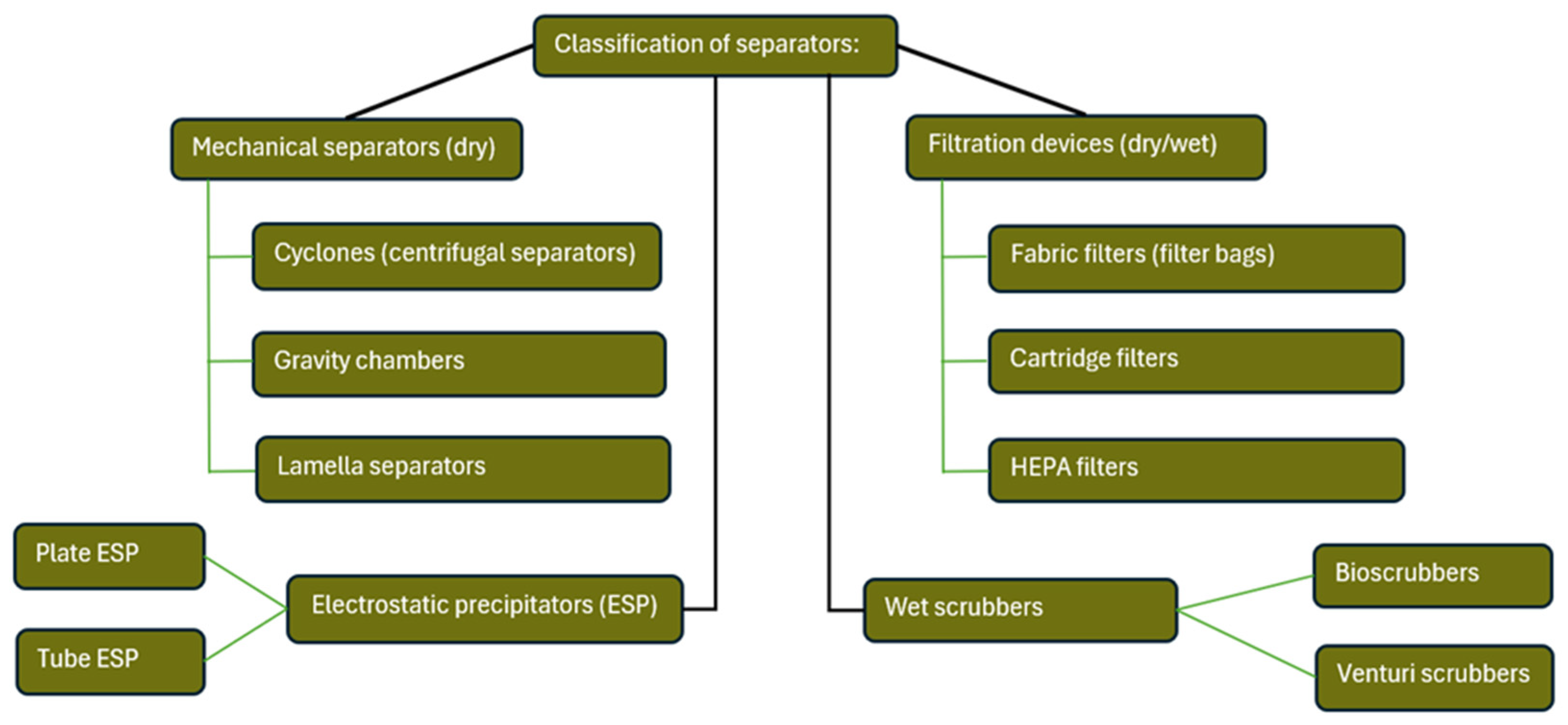
Separators can be divided into four basic groups: (a) dry mechanical separators, which use gravitational, inertial or centrifugal forces; (b) filtration devices (dry/wet), which separate particles by passing them through a porous medium; (c) wet scrubbers, which use a liquid (most often water) to trap particles; (d) electrostatic precipitators, which use an electric field to charge particles, which are then attracted to electrodes with an opposite charge. Each of these basic groups is further subdivided, e.g., by design. A more detailed categorization is shown in Figure 1.
Figure 1.
Classification of separation equipment used in industry.
Separators operate on various separation principles. The basic principles in flue gas cleaning include gravitation, inertial, centrifugal, diffusion, and electrical methods. Gravitational separation relies on the effect of gravity on particle motion, such as in settling chambers. In inertial separation, the velocity field near the separation surface curves, and the particle’s trajectory deviates from the streamline due to inertia. Examples include inertial separators or jet separators. Centrifugal separation is used when gas rotates in cylindrical chambers, such as cyclones. The principle of diffusion is applied in devices designed for low-velocity gas flow around objects. Here, particles from the gas stream diffuse toward the surface of the object. For example, in absorption cleaning and filtration devices, solid impurities are removed from the air: in absorption cleaning, particles are captured on surfaces, while in filtration, particles accumulate on filter fibers and form a filter layer. The electrical principle induces particle movement toward the separation surface by an electric force, as seen in electrostatic precipitators.
2.2. Influence of Particle Properties on the Collection Efficiency in Cyclone Filters
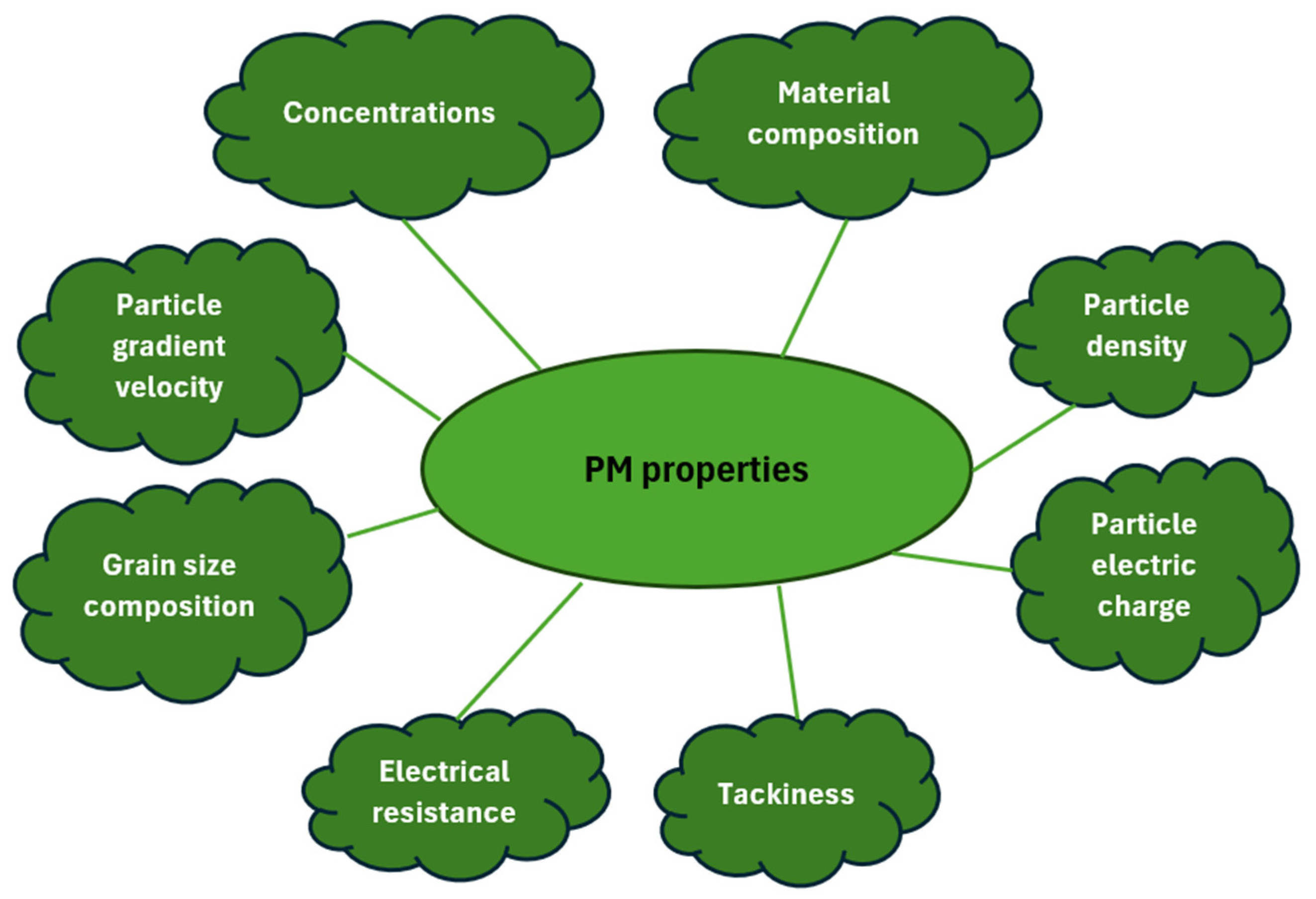
Filtration technologies operate on the principle of filtering waste air containing particles of impurities from industrial processes. One of the most important objectives of this technology is the capture of solids such as dust, fibers, particles, or granules from the air. This includes the disposal of solid pollutants and waste, as well as the recovery of valuable raw materials that can be returned to the production process. The particles captured by such devices are referred to as solid pollutants, consisting mainly of a mixture of carbon, dust, and aerosols. They are called particle matter. Figure 2 illustrates the main properties of the particulate matter that influence the selection of the separation device.
Figure 2.
Essential properties of particulate matter.
Cyclone separators are among the most widely used devices for separating solid or liquid particles from a gas stream. Cyclone efficiency is often interpreted in a simplified way as a function of geometry and gas inlet velocity. However, articles from recent years show that the properties of the particles themselves are equally important. In paint shops, grinding shops, welding workshops, machining lines, and when handling powdered materials, particles with very different properties are created. With the same cyclone and the same flow rate, two dust or aerosol fractions can be separated completely differently if they have different sizes, density, shape, moisture, surface energy, or electrical charge. Therefore, from the point of view of applications in industrial filtration, automotive manufacturing, or process gas cleaning, fractional efficiency as a function of the aerodynamic diameter of the particles is particularly important.
Misiulia et al. developed and validated a high-flow respirable cyclone sampler GK6.27 operating at 20 L.min−1 for workplace aerosol abatement [9]. Experimental measurements and simulations of large eddies and the design of a four-way flow divider confirmed a cut-off size of 4.01 µm, which is in accordance with the EN 481 respirable standard, while bias-map analysis showed good agreement with standard sampling requirements. The study highlights the potential of cyclone samplers for accurate respirable aerosol monitoring and offers an important contribution to the field of aerosol sampling using cyclones, highlighting the relationship between particle size selectivity and measurement bias compared to established respirable standards.
Sardar et al. investigated the influence of inlet velocity, gas temperature, and particle size on the performance of a double cyclone separator. Their study addresses the cyclone as a system in which both the operating parameters and the nature of the particles change. The authors show that particle size is a dominant factor for separation efficiency, with fine particles being particularly problematic at lower centrifugal forces or inappropriate flow distribution. The paper also confirms a well-known problem: conventional cyclones are inefficient for small particles, especially when they are in the micrometer range or smaller [10]. The influence of inlet velocity, gas temperature, and particle size has also been confirmed by other studies. Gimbun et al. showed that increasing inlet velocity generally increases pressure drop and centrifugal acceleration, which can improve particle separation but also raise energy demand and may intensify turbulence [11]. Siadaty et al. further demonstrated that gas temperature affects cyclone performance through changes in gas density and viscosity. At elevated temperatures, the swirling flow may weaken, leading to a reduction in pressure drop, natural vortex length, and separation efficiency [12].
Hu et al. analyzed the transport and deposition of fine particles in the swirling flow of a cyclone separator [13]. The research focuses not only on the resulting overall efficiency but also on the mechanisms of particle transport and deposition on the walls. For fine particles, simple centrifugal separation can no longer be assumed. The resulting trajectory depends on a combination of turbulence, radial pressure gradient, local recirculation areas, particle-wall interaction, and possible re-entrainment of the trapped particle back into the flow. Other studies have also confirmed that the transport and deposition of fine particles in cyclone separators are strongly affected by the internal swirling flow structure. Mothes and Löffler showed in the past that particle deposition is not a simple one-step process, because particles may interact with the wall, move in the near-wall region, or be re-entrained back into the gas flow [14]. Li et al. experimentally measured particle velocity and solid concentration near the cyclone wall and showed that particles can form non-uniform spiral bands moving downward along the wall [15].
Recent numerical studies further indicate that fine particles are more sensitive to turbulent dispersion and local recirculation than larger particles. Nakhaei et al. showed that particles in the range of approximately 1–10 μm tend to follow the gas flow more closely and may be transported toward the inner vortex and vortex finder instead of being collected at the wall [16]. Song et al. also demonstrated that particle deposition near the vortex finder depends strongly on the local flow field and wall interaction [17]. These findings confirm that fine-particle separation in cyclones is governed not only by centrifugal force, but also by turbulence, residence time, near-wall transport, particle–wall interaction, and re-entrainment. In many cyclone models, particles are assumed to be spherical to simplify the calculation of drag force, relaxation time, and aerodynamic diameter, but real industrial particles are often not. They can be fibrous, flaky, flat, sharp, porous, agglomerated, or irregularly fragmented. This is important, for example, for grinding dust, wood dust, fly ash, paint particles, metal chips, soot, or particles from additive manufacturing.
Elshorbagy et al. focused on the effect of the sphericity of solid particles on the tangential velocity in a cyclone separator [18]. The effect of changing the drag force acting on a non-spherical particle on its ability to follow the vortex flow and its radial transport is shown. A non-spherical particle may have a higher aerodynamic drag than a sphere at the same volumetric equivalent diameter, which may reduce its effective inertia in the direction of centrifugal separation. On the other hand, the orientation of the particle in the turbulent vortex may lead to different instantaneous forces and moments.
Particle density is another essential property. In cyclone separation, it is not only the geometric diameter of the particle that is decisive, but especially its aerodynamic diameter, which considers the size, density, and shape factor. Denser particles have a higher inertia at the same size, and therefore a higher probability of capture. On the contrary, low-density, porous, or fibrous particles may have a relatively low aerodynamic response even at a larger geometric size. Metal dust, mineral dust, fly ash, polymer particles, and paint aerosols can behave completely differently at a similar optical diameter.
Mahmoud, in his work on the evaluation of the performance of a cyclone separator under various conditions, states that the capture efficiency depends not only on the operating parameters but also on the properties of the particles, including their size, concentration, and density [19]. The author not only deals with an ideal model but also evaluates the separation of a real polluted air stream under changing conditions.
At low particle concentrations, the gas affects the particles, but the particles do not significantly change the gas flow. At higher loadings, however, the particles start to affect the turbulence, can change the velocity distribution, cause collisions, agglomeration, and increase or decrease the pressure drop. Therefore, the efficiency of the cyclone at low laboratory loadings may not correspond to the efficiency at real industrial flow with high dust content.
Morin et al. analyzed the effect of solid loading and inlet aspect ratio on cyclone efficiency and pressure drop using experiments and CFD simulations [20]. The paper shows that the particle concentration is not only an inlet boundary condition but also a parameter that can change the separation characteristics themselves. At higher loadings, the particles can interact with each other, change the flow structure, and affect the transition of particles between the outer and inner vortex.
The electrostatic charge of particles is another important property from the point of view of the use of electro-cyclone filters. The electrostatic force can be relatively significant for small particles, especially if the particles are pre-charged or if they are in an electric field. Yang et al. proposed a technology combining centrifugal force, electrostatic force, and pre-charging of particles [21]. Their work shows that electrostatic reinforcement can improve the performance of the cyclone, especially in conditions where centrifugal separation alone is insufficient. In terms of particle properties, the ability of the particles to accept and retain an electric charge, their size, electrical conductivity, surface properties, and tendency to agglomerate after charging are particularly important.
3. Current Methods Used for Capturing Solid Particles with Cyclone Filters
3.1. Cyclone Filters
Cyclones are widely implemented across multiple industries, including the automotive sector. An important advantage of their use is not only their simple construction, but also their usability at high temperatures and pressures. No less positive is the fact that they are low maintenance, mostly absent moving parts, their production is simple, and they are cost-effective, especially from the point of view of pre-filtration systems.
A gravity separator is the simplest type of cyclone. Contaminated air enters the cyclone chamber, where it expands and its velocity decreases. This causes solid particles to settle under their own weight. An inertial separator is essentially a rotating cyclone. It includes an impeller that drives the air and simultaneously cleans it of dust. A centrifugal separator is another type of cyclone. Exhaust gas is fed tangentially into the upper part of the chamber, where it moves downward in a spiral pattern. Particles are thrown against the chamber walls and fall to the bottom of the chamber through a sliding motion. Air purified of solid particles exits through a central duct.
When designing a filter for automotive production, it would therefore be appropriate to characterize not only the size distribution but also the morphology of the particles, for example, using optical or electron microscopy.
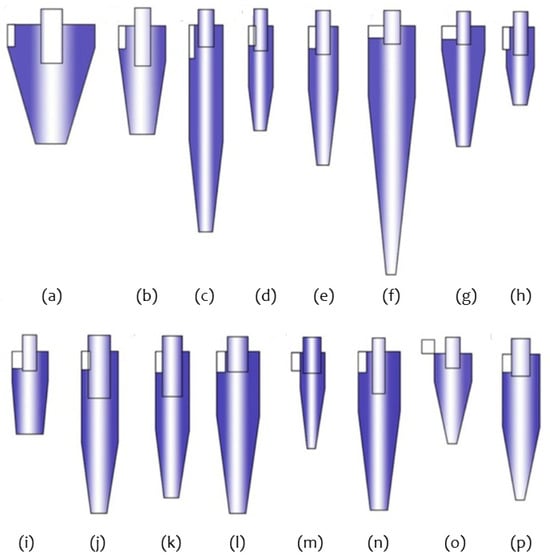
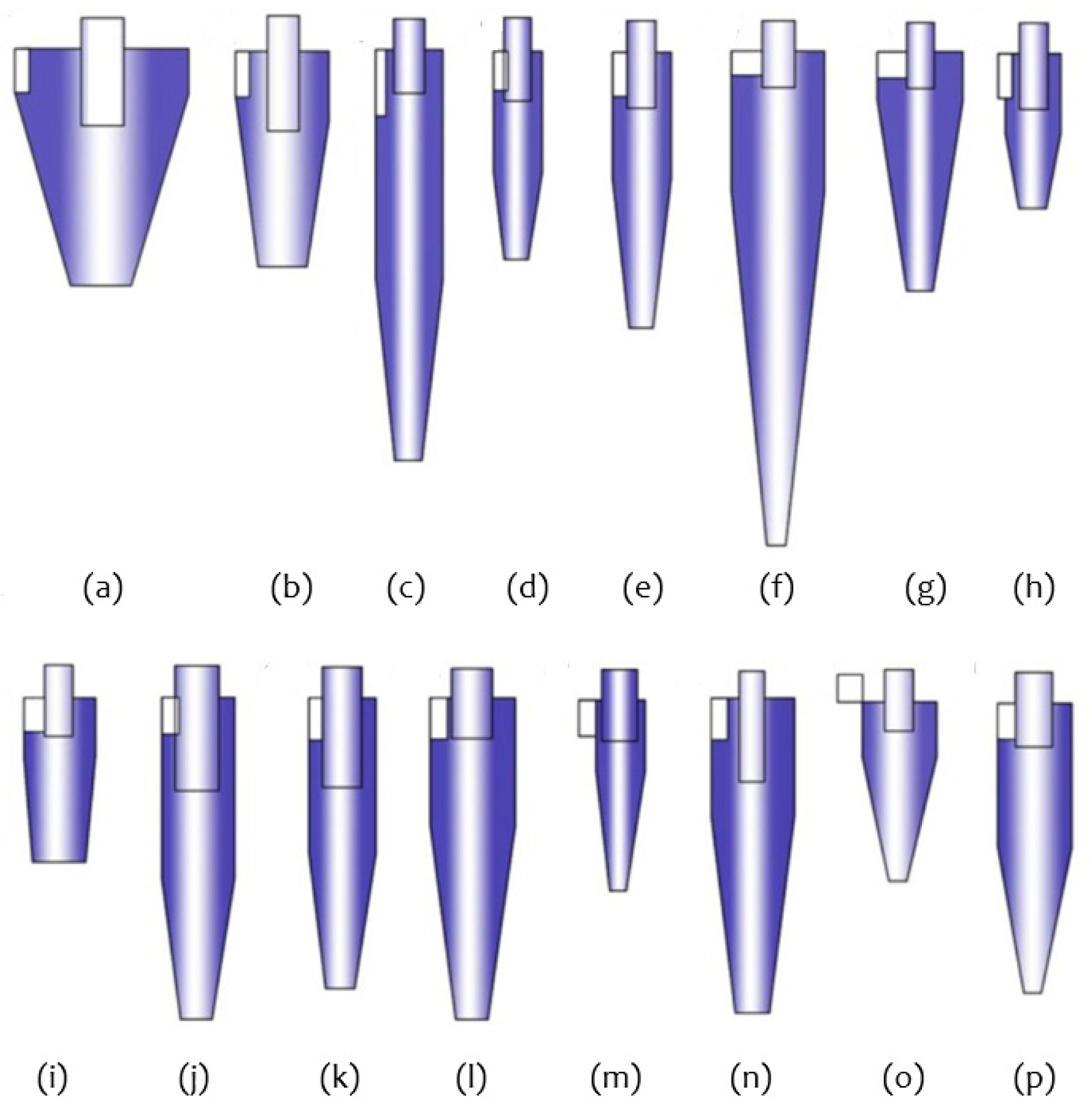
The separation efficiency of a cyclone for gas and particle separation is strongly influenced by the configuration of its geometric structure, as geometric parameters significantly affect the behavior of the internal flow. Based on various experimental calculations and studies, several popular designs of tangential cyclones are known, as shown in Figure 3, where the author of designs Figure 3a,b is Muschelknautz, particularly with significantly different diameters of the cylindrical and conical sections; Figure 3c–f relate to designs by Storch focusing primarily on differences in the lengths of the cylinder and cone; the author of Figure 3g–i is Tengbergen, focusing on inlet dimensions; Figure 3j represents a device design type designated TSN-11 and Figure 3k a type designated TSN-15; Figure 3l shows the Stairmand—High Efficiency cyclone type and Figure 3m Stairmand—High Flow, Figure 3n contains a design for an extended cyclone by VanTongeren, Figure 3o Vibco moves the cyclone inlet to the level of the cylinder lid, and Figure 3p shows the Lapple design [22].
Figure 3.
Schematic illustrating various designs of tangent gas-particle cyclones with the same scaled inlet area [23].
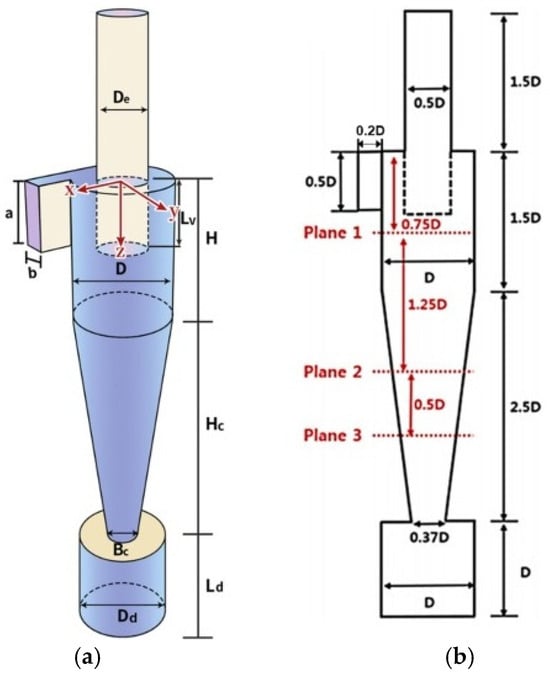
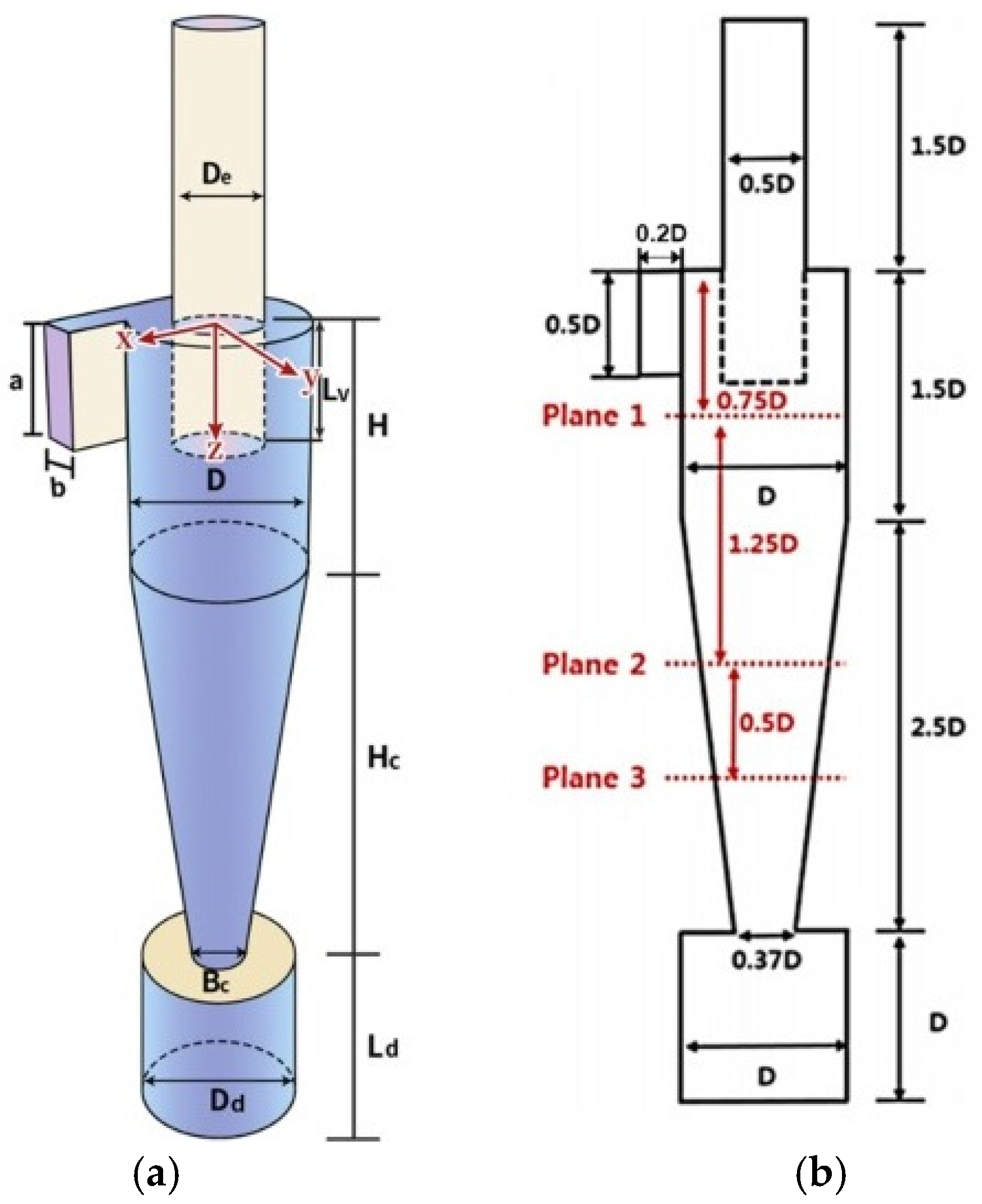
When designing a cyclone, consideration should be given to introducing only a minimum pressure loss into the system. This loss in maximum separation efficiency is largely influenced by the geometry of the cyclone. The most influential parameters for cyclone performance are the diameter of the cylindrical part (D), the height of the cylinder (H), and the height of the cone (HC), shown in Figure 4a. Figure 4b is an example of the design of geometric dimensions based on the diameter of the cylindrical part, along with a comparison of the speed at three levels of the cyclone.
Figure 4.
Schematic of a gas-particle cyclone separator. (a) A general geometry description of a cyclone separator. (b) A typical distribution of geometrical dimensions in a Stairmand cyclone separator [23].
Table 1 provides an overview of the results of selected studies highlighting the influence of local parameters on the performance of cyclone separators for gases and particles.
Table 1.
Effect of local parameters on the performance of a gas-particle cyclone separator.
Previous studies have extensively examined the influence of cyclone geometry on separation performance, with particular attention to the vortex finder, cylindrical and conical sections, inlet configuration, and dust collection region. Brar et al. investigated the effect of varying the vortex finder diameter relative to the cyclone body diameter, together with changes in the heights of the cylindrical and conical sections [24,25]. Similar geometric effects were analyzed by Shastri and Brar, who focused on variations in the cylinder and cone heights [26,27]. The role of the collection vessel height was further examined by Kaya and Karagoz and by Obermair et al. [28,29], while Elsayed and Lacor evaluated the influence of rectangular inlet dimensions and cone height on cyclone performance [30]. Zhang et al. reported that increasing the vortex finder diameter and its immersion depth can improve the separation efficiency of fine particles [31]. Collectively, these studies show that relatively simple dimensional changes can substantially affect the internal swirling flow, residence time, and particle-wall interaction. However, the reported improvements are strongly dependent on the selected particle-size range, operating flow rate, and pressure-drop constraints, which limit the direct transferability of individual optimized geometries to other applications. Dasch et al. characterized fine particles generated during machining in automotive plants and showed that wet machining, grinding, and dry machining produce particles with different size distributions and compositions [32]. Their study included wet machining with water-based metalworking fluids, grinding with straight oils, and dry machining. The authors showed that each process produced a characteristic particle-size distribution. Old-technology wet machining generated a unimodal distribution with the main particle mass mode between 2.5 and 5 μm and a mass median aerodynamic diameter of approximately 3.3 μm. New-technology wet machining with enclosed and vented machines shifted the distribution toward smaller particles, with a mode close to 1 μm and a mass median aerodynamic diameter of about 1.25 μm. Grinding with straight oil produced larger particles, with a reported median particle size of approximately 4.8 μm for old-technology grinding and about 2.5 μm for new-technology grinding. Dry machining of cast iron generated the largest particles, with a median particle size of approximately 10 μm [33]. Similar particle emissions were reported for welding operations in automotive plants, where both coarse metallic fragments and fine particles formed by metal vapor condensation can occur [34]. In such applications, cyclone separators are often used as pre-separators or primary dust collectors, especially when the extracted air contains coarse, abrasive, or high-loading particulate matter. Studies focused on aluminum dust, sawdust, and polluted air streams show that cyclone performance depends on inlet geometry, body dimensions, particle size, solid loading, inlet velocity, and pressure drop [35]. For machining of fiber-reinforced plastics, efficient dust extraction is also required because dry processing generates abrasive and electrically conductive dust particles [36]. These studies indicate that cyclone geometry in manufacturing extraction systems must be selected according to the generated particle type, particle-size distribution, dust concentration, and downstream filtration requirements. Beyond conventional dimensional optimization, several authors have proposed modified cyclone configurations to improve separation efficiency or reduce hydraulic losses. Souza et al. investigated the influence of an outlet pipe bend and found that the pressure drop increased with increasing bend radius, whereas moving the bend farther from the cyclone top tended to reduce the pressure drop [37]. Parvaz et al. analyzed vortex finder deflection inside the cyclone cylinder and showed that eccentricities in the range of 4–10% did not produce a significant performance improvement [38]. In contrast, Kumar et al. demonstrated that dividing the vortex finder into convergent and divergent sections can improve cyclone performance compared with a standard vortex finder [39]. These findings indicate that modifications of the outlet region may influence the balance between separation efficiency and pressure drop, but their effectiveness depends on whether the altered flow structure suppresses or intensifies undesirable phenomena such as short-circuit flow, vortex instability, or particle re-entrainment.
Several studies have also focused on inlet redesign, since the inlet strongly affects swirl intensity, tangential velocity distribution, and particle migration toward the wall. Zhao et al. proposed a spiral inlet configuration without a bend and with integrated 180° and 360° compact bends [40]. Their results showed improved separation of 1–5 µm particles, with efficiency increases of 8.5–8.0% for the 180° bend and 22.7–20.5% for the 360° bend compared with the 0° spiral inlet. Babaoglu et al. numerically compared different inlet cross-sectional shapes for a double cyclone, including circular, elliptical, rectangular, square, and trapezoidal inlets [41]. The highest efficiency, 93.27%, was obtained for cyclones with rectangular and elliptical inlet openings. Chlebnikovas investigated fine-particle removal in next-generation multichannel cyclones with cylindrical and spiral casings [42]. The modified cyclone designs enhanced the separation of glass and clay particles up to 20 µm, achieving a maximum efficiency of 87.3% at a pressure drop of 440 Pa. The study also demonstrated that elevated temperature and humidity significantly influence particle transport and cyclone performance, highlighting the importance of evaluating gas-cleaning systems under realistic operating conditions. These results suggest that inlet geometry can be particularly relevant for fine-particle separation; however, increased swirl intensity may also be associated with higher pressure losses, stronger near-wall turbulence, or more complex manufacturing requirements.
Modifications of the cyclone body and cone have also been investigated. Huang et al. proposed a cyclone design with a slot positioned at different locations in the cone and evaluated its effect on separation efficiency [43]. Although this configuration showed potential for performance improvement, the increased design complexity may limit its practical implementation in industrial systems. Mazyan et al. examined the addition of tangential chambers in the cyclone cone and reported that one such chamber could increase particle separation efficiency by up to 50% compared with conventional cyclone designs [44]. These studies demonstrate that non-standard body modifications may enhance particle capture by altering the secondary flow structure and reducing particle escape. Nevertheless, such designs require further evaluation under realistic operating conditions, particularly with respect to pressure drop, clogging tendency, erosion, scalability, and long-term operational stability. Bikkulov et al. proposed a multivortex separator for air-cleaning systems in paint shops and reported that the separator efficiency increased with particle diameter and density, while a lower swirl degree improved capture; for 2 µm particles, an efficiency above 91% was obtained at a swirl degree of 0.25 [45]. The same research group experimentally evaluated the hydraulic resistance of multivortex separator variants and showed that design changes intended to stabilize the vortex structure can substantially increase pressure loss, with open separation channels giving much lower resistance than a covered configuration with outlet holes [46]. In a paint-drying chamber application, Zinurov et al. found in another study that installing the multivortex separator before ceiling filters was more effective than before floor filters, with calculated average efficiencies of approximately 88% and 45%, respectively, for particles in the 1–10 µm range [47]. Several authors have focused on local geometric features that directly affect the internal vortex structure. Misiulia et al. optimized a deswirler installed in the outlet tube of a cyclone separator and showed that outlet-region geometry can be used to reduce pressure drop without redesigning the whole cyclone body [48]. Wasilewski and Brar investigated the inlet duct angle and demonstrated that inlet orientation strongly affects both separation efficiency and pressure drop under industrial operating conditions [49]. Kumar and Jha optimized vortex finder shape using response surface methodology and genetic algorithms, confirming that the vortex finder is one of the most sensitive components because it directly influences short-circuit flow, pressure loss, and particle escape through the outlet [50]. These results indicate that local modifications of the inlet and outlet regions may provide practical performance improvements, especially when the main cyclone body dimensions are constrained by installation space.
The relevance of geometry optimization is also evident in automotive-related filtration systems, where compactness and low-pressure loss are critical design requirements. Sakin et al. designed and manufactured a cyclone separator for the air-intake system of an automobile and compared its pressure drop and engine-performance parameters with those of a conventional air filter [51]. Dziubak investigated tangential-inlet return cyclones used in off-road vehicle air-filter multicyclones and proposed design modifications such as an asymmetrical inlet, a conical outlet tube, and streamlined inlet edges [52]. These studies suggest that, in automotive-related applications, cyclone optimization must consider not only separation efficiency, but also pressure drop, packaging constraints, dust-loading behavior, maintenance interval, and manufacturability.
The reciprocal relationship between the resistance force of the medium and the force of gravity is also important. The speed of descent increases significantly with increasing grain diameter. Particles smaller than 0.1 µm undergo random Brownian motion, which is the result of collisions with gas particles and only slightly with other dust particles, the movement of which is in turn driven mainly by moving gas particles. Particles between 0.1 and 1 µm have low settling velocities at rest compared to wind speeds. Particles larger than 1 µm have noticeable but low settling velocities. Particles above about 20 µm have high settling velocities and are removed from the air by gravity and other inertial processes. The approximate settling velocities for particles with a density of 1000 kg/m3 are 0.1 µm—4 × 10⁻⁷ m/s, 1 µm—4 × 10⁻⁵ m/s, 10 µm—3 × 10⁻³ m/s, and 100 µm—3 × 10⁻¹ m/s [53].
Some theories predict the cyclone cross-section diameter, d50, the particle size for which efficiency is 50%; however, they may not be directly applicable to particles of other sizes. Theories that predict efficiency for particles of all sizes are available but may be imprecise. The relationship between efficiency and particle size for cyclones has been sigmoidal in some cases. This curve can be approximated by the logistic equation: efficiency η = 1/(1 + (d50/d)β), where d is the particle size and β is the logistic slope parameter.
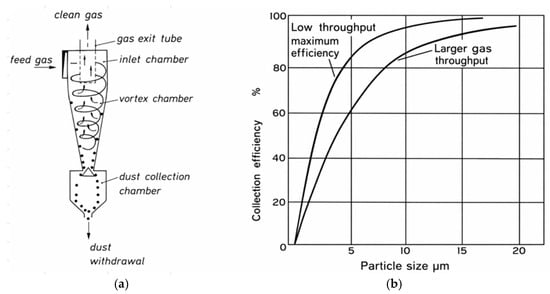
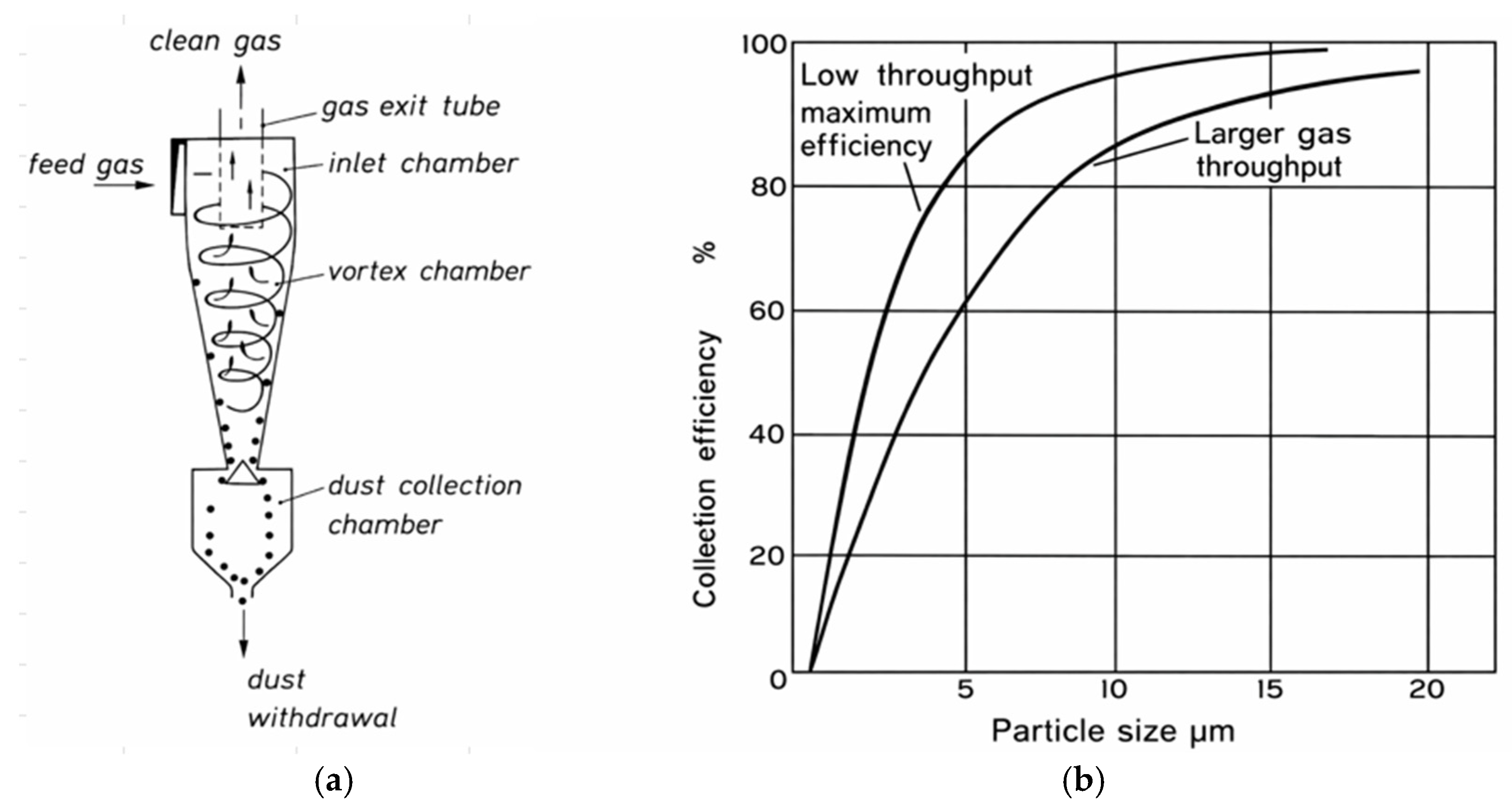
Cyclones are totally weight-dependent when removed. The exhaust gases and particulates are introduced tangentially into the cylinder, thereby achieving rotational movement. Centrifugal forces carry particles towards the wall of the cylinder, into the vortex chamber, and then into the dust collector chamber. The curve that describes the removal efficiency for different particle sizes is called the fractional efficiency curve. Figure 5 illustrates the sketch of a typical cyclone and fractional efficiency curves for two types of cyclones, one with high efficiency and a particle cut diameter of about 2 μm, and another with a particle cut diameter of almost 4 μm and larger gas throughput [54].
Figure 5.
(a) Sketch of a typical cyclone; (b) Fractional efficiency curves for two types of cyclones [54].
Recent studies have increasingly treated cyclone design as a multi-objective geometry optimization problem, rather than as an isolated modification of a single dimension. Safikhani et al. applied CFD together with genetic algorithms to optimize cyclone geometry with respect to pressure drop and cut-off diameter, showing that the improvement of one performance criterion may deteriorate the other [55]. Elsayed and Lacor further demonstrated that inlet height, inlet width, vortex finder diameter, and total cyclone height are among the most influential parameters, with strong interactions between inlet dimensions and vortex finder diameter [56]. Similar conclusions were reported by Sun et al., who optimized a Stairmand cyclone using response surface methodology and CFD, considering several geometrical variables and two conflicting objectives: maximization of collection efficiency and minimization of pressure drop [57]. In a subsequent study, Sun and Yoon used a genetic algorithm coupled with CFD and showed that the optimized cyclone geometry may differ substantially from the standard Stairmand proportions under a given operating condition [58]. El-Emam et al. used CFD-DEM to investigate gas-particle separation in conventional circular and square cyclone geometries with different inlet and vortex-finder designs. Nine configurations were compared. Biogenic and mineral materials with realistic particle shapes and sizes represented heterogeneous mixtures of particles. The results showed that cyclone geometry strongly influences turbulence, particle interactions, and separation performance. The square cyclone configuration C5 achieved the highest efficiency and showed a significant improvement in separation and purification efficiency compared to the reference cyclone [59]. These studies confirm that cyclone geometry cannot be optimized universally; instead, the optimum design depends on the selected objective function, particle-size range, flow rate, and acceptable pressure loss.
Advanced surrogate-based methods have also been introduced to reduce the computational cost of geometry optimization. Singh et al. used triple-fidelity co-kriging surrogate models for multi-objective gas cyclone optimization, demonstrating that a combination of low-, medium-, and high-fidelity CFD data can efficiently approximate the Pareto front [60]. Park et al. compared several surrogate modelling approaches, including response surface methodology, GMDH neural networks, back-propagation artificial neural networks, and genetic algorithms, for predicting and optimizing cyclone separation performance [61]. More recently, Pandey et al. performed multi-objective optimization of cyclone separators based on geometrical parameters and emphasized that pressure drop and collection efficiency must be assessed simultaneously rather than independently [62]. These optimization-based studies are particularly important because they move cyclone design from empirical dimensional scaling toward systematic performance-based design.
3.2. Hybrid Cyclone Filter Systems
3.2.1. Fabric Filters Applied with Cyclones
In dust collection systems, the filter bag collection method is often used in combination with other separation devices. The combination of a filter bag and a cyclone is a highly effective method used in industry. A characteristic feature of this method is that the dust captured in the filter bag remains in a loose state, so it occupies a large volume.
The separation of a solid phase from a liquid by the flow of a dispersion through a porous material is called filtration. The particles of the solid phase are trapped on this material, which creates a filter barrier, and the liquid phase flows through it. The barrier is, for example, fabric, sand, sieve, porous paper, or diatomaceous earth. The trapped particles collect on the surface of the filter barrier during filtration and form a filter cake. If the particles are also trapped inside the porous material, we speak of depth filtration.
In general, filters can be classified as fabric (bag, hose), cartridge, packed, pleated, and belt filters. The basic parameters of filters include separation efficiency, flow capacity, cleanability, and pressure drop. After a certain period, the pores on the front side of the filter become clogged. This causes the separated particles to form a filter layer, which must be removed by regenerating the filter material or the filter itself. There are several known methods of filter regeneration, including shaking, blowing, vibration, backwashing, or a combination thereof.
The difference in pressure in front of the filter cake and behind the filter barrier expresses the flow through the filter layer. The filter material’s flow resistance can be considered constant, but the filter cake’s resistance increases with thickness. The flow of the filtrate is directly proportional to the pressure difference and permeability, and inversely proportional to the resistance (i.e., the thickness of the filter cake layer) and the dynamic viscosity. The filtrate flow rate is expressed by the following relationship:
where K is the permeability of the filter cake for fluid flow [m2], △p is the pressure difference before and after the filter layer [Pa], μ is the dynamic viscosity [Pa.s], and h is the thickness of the filter cake layer [m].
u = K·△p/μ·h [m/s]
Bag filters can remove PM2.5 particles with a mass collection efficiency higher than 99%, but a high pressure drop across the filter, up to 2 kPa, increasing with filter clogging, requires additional energy that increases the operating costs of this type of gas cleaning system. In addition, bag filters operating at higher temperatures can be damaged or clogged by the sintered particles [63].
Wang et al. investigated the resistance characteristics of a new type of cyclone filter, which includes only a straight cylinder section in the separator body and is equipped with an inverted inner cone and a straight cylindrical filter screen [64]. Compared with the case with no filter, the flow resistance of the cyclone filter is significantly reduced by 70%. Since the resistance when the strong swirling flow turns towards the overflow pipe will significantly increase, the resistance without a built-in filter is significantly higher than that with a built-in filter. By extending the inlet profile and making the transition from tangential linear motion to rotational motion of the fluid smoother, the problem of flat particle clogging on the filter was solved.
Zhang et al. applied different principles by installing a cylindrical filter face along the central region of a gas cyclone, from the vortex finder toward the bottom hopper, and reported improved collection efficiency together with a lower pressure drop compared with the original cyclone geometry [65]. Li et al. further developed this concept in a transverse cyclone cartridge filter, where the cyclone-induced flow field is combined with cartridge filtration to improve dust removal performance in compact equipment [66].
Sylvia et al. numerically analyzed a cyclone separator equipped with a bottom-ash filter bed placed in the vortex-finder region and showed that the additional porous filtration zone substantially increased PM2.5 removal efficiency, while the increase in pressure drop remained relatively limited [67]. In a two-stage cyclone–paper filter system for vehicle air filtration, Dziubak demonstrated that the cyclone pre-separator retained most of the supplied dust mass before it reached the filter medium, thereby delaying the pressure-drop rise in the downstream filter [68]. For compact cartridge-type dust collectors, Huang et al. showed that the inlet position, flow distribution around pleated cartridges, and pulse-jet cleaning parameters strongly influence filtration stability and residual pressure drop after cleaning [69]. Li et al. further developed the integrated approach by proposing a transverse cyclone cartridge filter, in which the cyclone-induced flow field was directly coupled with cartridge filtration to enhance dust removal in a compact configuration [54].
3.2.2. Electrostatic Precipitators Combined with Cyclone Filters
To increase the efficiency of solid particle separation, another option is available: the application of an electrostatic precipitator. In combination with a cyclone, coarse and fine filtration is ensured, where both smaller and larger solid particles are effectively separated from the gas stream.
The physical principle of an electrostatic precipitator (ESP) consists of the force action of an electric field on charged particles of fly ash or dust in the gas stream. This process can be briefly described in three steps: (a) charging of particles; (b) their movement or migration; (c) settling and cleaning.
To calculate the theoretical separation efficiency η, the classic Deutsch-Anderson relationship is used worldwide:
where A = collection area [m2]; Q = gas flow rate [m3/s]; w = particle migration velocity [cm/s]; e = Euler number.
η = 1 − e–w (A/Q)
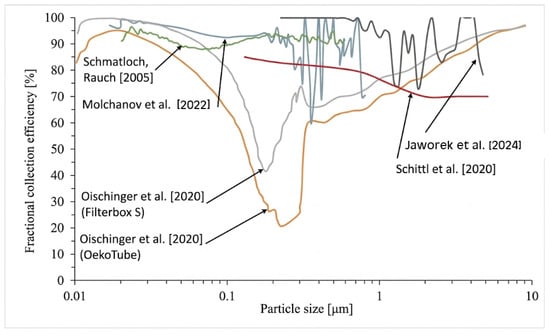
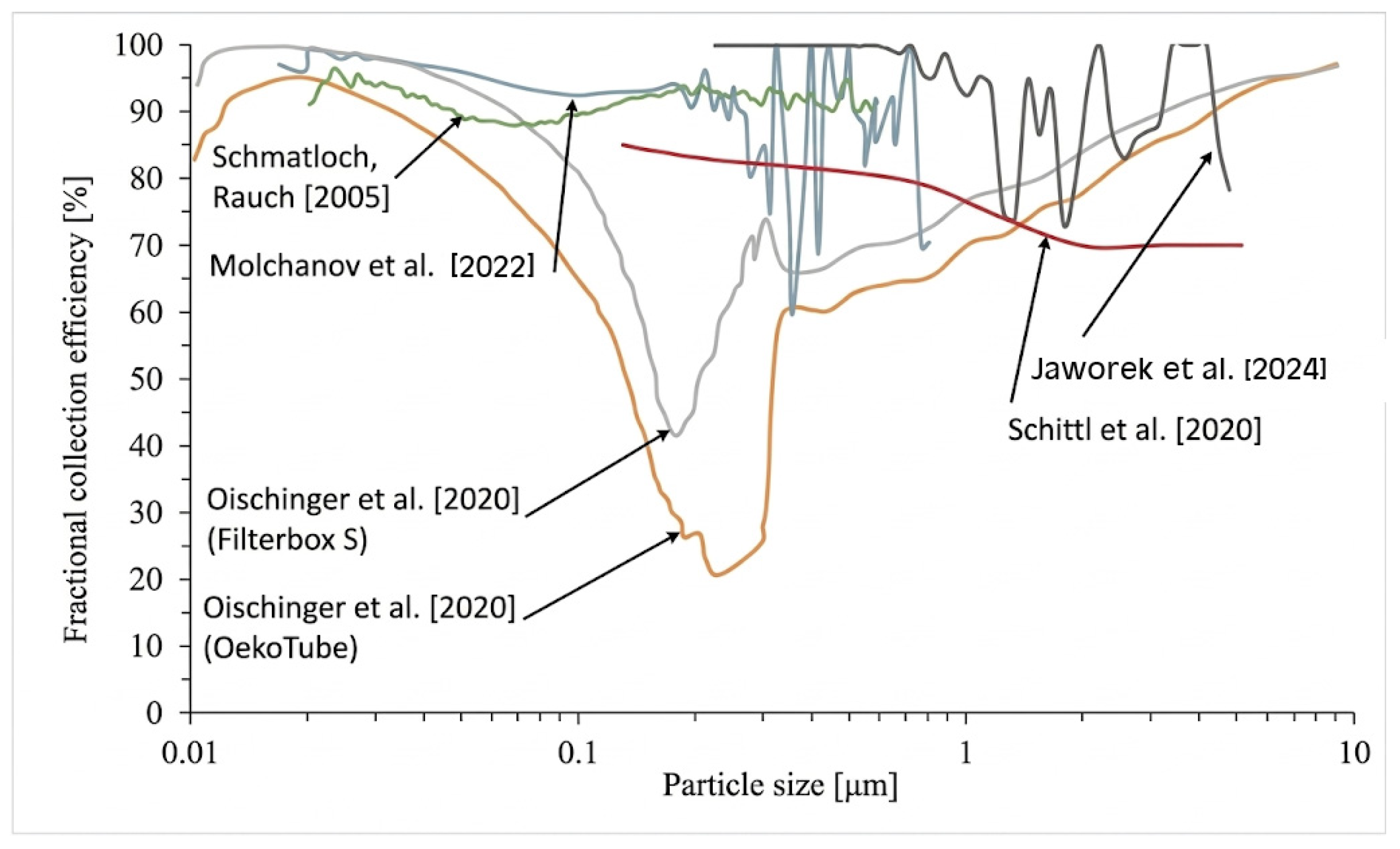
Table 2 provides a brief overview of the results of the application of selected electrostatic precipitators with various properties and operating conditions. Schmatloch and Rauch [70] report a collection efficiency of more than 90% when using a tubular ESP connected to a wood pellet boiler. Molchanov et al. [71] evaluated the efficiency at 98%, where a honeycomb ESP containing 78 tubes placed parallel upwards was connected to a wood pellet boiler. Separation efficiencies below 80% were achieved with a Filterbox S separator connected to a biomass boiler and an OekoTube Inside separator placed vertically at the top of the chimney, as published by Oischinger et al. [72]. Jaworek et al. [73] presented measurement results with efficiencies higher than 90%. In this case, the cleaning of biomass or coal flue gas was performed by a separator consisting of cylindrical channels directed both upwards and downwards. Schittl et al. [74] had an ESP integrated with a boiler located below the heat exchanger, where they burned wood chips and wood pellets. At full load, the efficiency was 55%, while at part load, it exceeded 74%.
Table 2.
Overview of the effectiveness of selected types of ESP.
A comparison of the individual measurement results is graphically shown in Figure 6, where this effect is depicted as a dependence of efficiency on the size of the separated solid particles [75]. The results obtained belong to different types of fuels and different designs of the electrostatic precipitator, as shown in Table 2.
Figure 6.
Comparison of the effectiveness results of different types of ESP from Table 2 [70,71,72,74,75].
The study by Chlebnikovas and Kilikevičius concerns a multi-channel spiral cyclone-electrostatic filter, specifically the influence of gas flow parameters and the efficiency of ultrafine particle capture. The distribution of the optimal flow rate in air volumes was in the range from 165 m3/h to 255 m3/h. The efficiency reached approximately 70%, and the average value of the efficiency of removing finely dispersed particles with a size of 1 µm to 10 µm reached more than 85% [76]. Jeon and Park developed an electric-field-assisted cyclone in which inertial separation was supplemented by electrostatic migration of pre-charged particles; by varying the flow rate, applied voltage, and vortex-finder length, they showed that the removal of 0.3 µm particles could be substantially improved, with the best configuration reported at a normalized vortex-finder length of s/D = 1 and an applied voltage of 25 kV [77]. Wang et al. further combined atomization with electrostatic charging in a gas cyclone, using charged particles and droplets to promote fine-particle enlargement and enhance collection in the cyclonic flow field [78]. Jiang et al. proposed a long-cylinder electrostatic cyclone demister, where the cyclone demister was coupled with an electrostatic demister to improve the capture of small droplets and to reduce the risk of corona blockage in the electrostatic section; the improvement was particularly evident for droplets smaller than 4 µm [79]. Dong et al. introduced a vortex-broken electro cyclone as a combined cyclone–electrostatic precipitator unit and demonstrated experimentally and numerically that the electric field can modify particle trajectories, while the vortex-breaking element reduces pressure drop by disturbing the inner vortex core [80]. More recently, Yang et al. studied a cyclone separator in which centrifugal force, electrostatic force, and particle pre-charging were coupled, confirming that electrostatic assistance is especially relevant for particles that are too small to be efficiently removed by centrifugal action alone [81].
4. Discussion
There is great concern worldwide about particulate emissions, as these emissions harm the environment, health, and cause damage to buildings. Filtration in automotive manufacturing has three main functions: protecting product quality, protecting workers and the working environment, and reducing material and water losses in the process. In daily production operations, processing plants often produce many pollutants, such as exhaust gases. This type of exhaust gas is mixed with many impurities. To prevent the direct release of exhaust gases into the air and atmospheric pollution, harmful particles and other impurities in the exhaust gases are captured and filtered before discharge.
Looking ahead, battery production for electric vehicles is expected to become an increasingly important area of research in relation to health protection, air quality control, and industrial emission reduction. In lithium-ion battery cell manufacturing, filtration will play a critical role in maintaining dry and controlled production environments, particularly during the handling of powdered active materials, electrolyte filling, and particle-sensitive process steps. Plocher et al. report that large parts of battery cell production must take place in areas with strict control of particle concentration, temperature, and humidity. Contamination by molecular and particulate impurities can cause defects, increase turbidity, and reduce product quality [82]. Future battery manufacturing will therefore require not a single filtration solution, but integrated systems combining process filters, air filters, dust separation units, drying and purification filters, and waste-media filtration. These systems will be needed to remove particles, metallic contaminants, gels, moisture, electrolyte aerosols, and solvent vapors throughout the production chain. The relevance of particle contamination is further supported by Grabow et al., who analyzed impurities in commercial lithium-ion cells and showed that metallic particles located between cell layers may be associated with internal short circuits and subsequent thermal runaway [83]. In addition, Duffner et al. demonstrates that large-scale automotive battery cell production is highly cost-sensitive, meaning that environmental control, scrap-rate reduction, and minimization of process losses will remain key technical and economic priorities in future production systems [84].
5. Conclusions
The articles show that cyclone filters and separators cannot be evaluated in isolation from the properties of the particles being collected. The same geometry can achieve very different efficiencies for dry mineral dust, wet agglomerating particles, paint particles, metal aerosols, bioparticles, or ultrafine PM (particulate matter). The size distribution and aerodynamic diameter have the strongest influence, but for real applications, the shape, density, moisture, adhesion, charge, and concentration of the particles are almost equally important. Based on these properties, methods and devices for the effective capture of these particles are designed. For example, small particles PM < 5 μm are not suitable for separation by cyclones. For particles PM < 5 μm, electrostatic precipitators are suitable; for particles PM < 1 μm, fabric filters are effective. Another property is, for example, electrical resistance. The resistivity of the material may be too low, i.e., it is a good conductor, the electrical charge is quickly dissipated, and the material particles are re-captured in the flowing gas. If the resistance is too high, the charge on the collection surfaces does not drain away, and the particles remain strongly attracted to the collection surface. Overall, the literature indicates that cyclone performance can be improved through targeted modification of the inlet, vortex finder, cone, and dust collection region. However, many reported improvements are geometry- and operating-condition-specific, and direct comparison among studies is often difficult because of differences in particle size distribution, gas flow rate, cyclone scale, numerical models, and efficiency evaluation methods. Therefore, further work is needed to assess cyclone modifications not only in terms of peak separation efficiency, but also with respect to pressure drop, fine-particle capture, manufacturability, robustness, and applicability under practical operating conditions.
In automotive manufacturing, cyclones are used mainly in cutting and welding operations, where metal aerosols, metal oxides, and welding fumes are generated. They are often used as the first stage of filtration before a fabric filter. They are also used in the collection of metal particles, abrasive dust, and paint particles during grinding and polishing, but also in paint shops to capture coarser paint particles. Recently, research has focused on the capture of fine graphite dust and dust from lithium materials in the production of batteries for electric vehicles. The safety aspects of explosive dust are also being investigated.
The literature shows that cyclone performance is governed by coupled geometrical effects involving the inlet, vortex finder, cone, outlet tube, and dust-discharge region. Although many optimized geometries improve either collection efficiency or pressure drop, their applicability is often limited by operating conditions, particle-size distribution, available installation volume, and manufacturing complexity. Therefore, further research is needed to develop cyclone geometries that provide improved fine-particle separation while maintaining low pressure loss and practical applicability in compact industrial or automotive-related filtration systems.
An important research direction is the development of multi-objective optimization procedures that include long-term operational criteria. Most cyclone optimization studies still consider collection efficiency and pressure drop as the main objective functions; however, recent work has shown that erosion rate and equipment lifetime can also be incorporated into the optimization process. Future cyclone designs should be evaluated using fractional separation efficiency, cut-off diameter, pressure drop, energy consumption, erosion rate, clogging tendency, and maintenance requirements. Particle-size-dependent collection behavior and long-term fouling performance under real automotive production conditions are not sufficiently documented in the open literature. In practice, many such investigations are likely performed as internal supplier validation, plant commissioning, or proprietary industrial testing and are therefore not published. Future research could include controlled experimental campaigns and CFD-supported modelling for representative automotive sources, to better describe the behavior of such filters, in real-life conditions.
Author Contributions
Conceptualization, K.H. and P.D.; methodology, M.P.; investigation, P.P.; resources P.P.; writing—original draft preparation K.H.; writing—review and editing, M.P. All authors have read and agreed to the published version of the manuscript.
Funding
This research was funded by the Slovak government department of education, research, development and youth with grant UNIVNET. This article was supported by the projects: APVV 21-0452, The impact of using small electrostatic precipitators on reducing the production of solid pollutants during fuel combustion in households.
Institutional Review Board Statement
Not applicable.
Informed Consent Statement
Not applicable.
Data Availability Statement
No new data were created or analyzed in this study. Data sharing is not applicable to this article.
Conflicts of Interest
The authors declare no conflicts of interest.
References
- Akafuah, N.K.; Poozesh, S.; Salaimeh, A.; Patrick, G.; Lawler, K.; Saito, K. Evolution of the Automotive Body Coating Process—A Review. Coatings 2016, 6, 24. [Google Scholar] [CrossRef] [Scilit]
- Lee, J.-R.; Jeon, S.-M.; Hasolli, N.; Lee, K.-S.; Lee, K.-Y.; Park, Y.-O. Removal characteristics of paint particles generated from paint spray booths. J. Mater. Cycles Waste Manag. 2019, 21, 810–817. [Google Scholar] [CrossRef] [Scilit]
- Brinksmeier, E.; Meyer, D.; Huesmann-Cordes, A.G.; Herrmann, C. Metalworking fluids—Mechanisms and performance. CIRP Ann. Manuf. Technol. 2015, 64, 605–628. [Google Scholar] [CrossRef] [Scilit]
- Dasappanavara, A.R.; Bakari, A.R.; Dandin, K.; Patil, Y.K.; Muddebihal, A. Cyclone dust collector for foundry. Int. Adv. Res. J. Sci. Eng. Technol. 2023. [Google Scholar] [CrossRef]
- Knott, P.; Csorba, G.; Benett, D.; Kift, R. Welding Fume: A Comparison Study of Industry Used Control Methods. Safety 2023, 9, 42. [Google Scholar] [CrossRef] [Scilit]
- Yang, B.; Friedrich, S.; Friedrich, B. Advances in non-metallic inclusion removal from aluminum melts towards cleaner and higher-performance materials. J. Mater. Sci. 2025, 60, 12291–12314. [Google Scholar] [CrossRef] [Scilit]
- Hassanabadi, M.; Berto, T.; Akhtar, S.; Aune, R.E. Hydraulic Characterization of Ceramic Foam Filters Used in Aluminum Filtration. Materials 2023, 16, 2805. [Google Scholar] [CrossRef] [Scilit] [PubMed]
- Karchiyappan, T. Studies on treatment of automotive industry wastewater using ozonation, electro-Fenton and chitosan based coagulation process. Curr. Res. Green Sustain. Chem. 2022, 5, 100178. [Google Scholar] [CrossRef] [Scilit]
- Misiulia, D.; Möhlmann, C.; Antonyuk, S. A respirable cyclone sampler for a flow rate of 20 L/min. J. Aerosol Sci. 2026, 196, 106831. [Google Scholar] [CrossRef] [Scilit]
- Sardar, R.; Oh, J.; Mirae, K.; Lee, J.E.; Kim, S.; Kim, K.C. The Effect of Inlet Velocity, Gas Temperature and Particle Size on the Performance of Double Cyclone Separator. Chem. Eng. Process. Process Intensif. 2023, 191, 109469. [Google Scholar] [CrossRef] [Scilit]
- Gimbun, J.; Chuah, T.G.; Fakhru’l-Razi, A.; Choong, T.S.Y. The influence of temperature and inlet velocity on cyclone pressure drop: A CFD study. Chem. Eng. Process. Process Intensif. 2005, 44, 7–12. [Google Scholar] [CrossRef] [Scilit]
- Siadaty, M.; Kheradmand, S.; Ghadiri, F. Study of inlet temperature effect on single and double inlets cyclone performance. Adv. Powder Technol. 2017, 28, 1459–1473. [Google Scholar] [CrossRef] [Scilit]
- Hu, B.; Chen, J.Y.; Yang, L.X.; Wu, X.J.; Wei, Y.D. Experimental study of the processes of transport and deposition of fine particles in the vortex flow of a cyclone separator. Adv. Powder Technol. 2026, 37, 105213. [Google Scholar] [CrossRef] [Scilit]
- Mothes, H.; Löffler, F. Motion and deposition of particles in cyclones. Ger. Chem. Eng. 1985, 8, 223–233. [Google Scholar]
- Li, Y.; Wang, X.; Jin, Y.; Lu, C. Measurements of solid concentration and particle velocity distributions near the wall of a cyclone. Chem. Eng. Process. Process Intensif. 2009, 48, 980–987. [Google Scholar]
- Nakhaei, M.; Wu, Y.; Grévain, D.; Lu, J.; Andersson, B. CFD Modeling of Gas–Solid Cyclone Separators at Ambient and High Temperatures. Processes 2020, 8, 228. [Google Scholar] [CrossRef] [Scilit]
- Song, J.; Wei, Y.; Sun, G.; Chen, J. Experimental and CFD study of particle deposition on the outer surface of vortex finder of a cyclone separator. Chem. Eng. J. 2017, 309, 249–262. [Google Scholar] [CrossRef] [Scilit]
- Elshorbagy, K.; Ashry, Y.E.; Abdelrazek, A.M. On the effect of solid particle sphericity on the tangential velocity in a cyclone separator. Aerosol Sci. Technol. 2022, 56, 323–336. [Google Scholar] [CrossRef] [Scilit]
- Mahmoud, M.A. Performance evaluation of cyclone separator for air pollutant removal under varying conditions. J. Taibah Univ. Sci. 2025, 19, 2506952. [Google Scholar] [CrossRef] [Scilit]
- Morin, M.; Raynal, L.; Karri, S.R.; Cocco, R. Effect of solid loading and inlet aspect ratio on cyclone efficiency and pressure drop: Experimental study and CFD simulations. Powder Technol. 2020, 377, 174–185. [Google Scholar] [CrossRef] [Scilit]
- Yang, X.; Wang, W.; Han, C.; Bing, D.; Chen, G.; Dong, Y.; Cui, L. Enhanced performance of cyclone separator through coupling of centrifugal force, electrostatic force and particle pre-charge. Sep. Purif. Technol. 2025, 358, 130176. [Google Scholar] [CrossRef] [Scilit]
- Hoffmann, A.C.; Stein, L.E. Gas Cyclones and Swirl Tubes. Principles, Design and Operation; Springer: Berlin/Heidelberg, Germany, 2008; pp. 341–342. [Google Scholar] [CrossRef] [Scilit]
- Guo, M.; Yang, L.; Son, H.; Le, D.K.; Manickam, S.; Sun, X.; Yoon, J.Y. An overview of novel geometrical modifications and optimizations of gas-particle cyclone separators. Sep. Purif. Technol. 2024, 329, 125136. [Google Scholar] [CrossRef] [Scilit]
- Brar, L.S.; Sharma, R.P.; Dwivedi, R. Effect of Vortex Finder Diameter on Flow Field and Collection Efficiency of Cyclone Separators. Part. Sci. Technol. 2015, 33, 34–40. [Google Scholar]
- Brar, L.S.; Sharma, R.P.; Elsayed, K. The effect of the cyclone length on the performance of Stairmand high-efficiency cyclone. Powder Technol. 2015, 286, 668–677. [Google Scholar] [CrossRef] [Scilit]
- Shastri, R.; Sharma, R.P.; Brar, L.S. Numerical investigations of cyclone separators with different cylinder-to-cone ratios. Part. Sci. Technol. 2022, 40, 337–345. [Google Scholar] [CrossRef] [Scilit]
- Shastri, R.; Brar, L.S. Numerical investigations of the flow-field inside cyclone separators with different cylinder-to-cone ratios using large-eddy simulation. Sep. Purif. Technol. 2020, 249, 117149. [Google Scholar] [CrossRef] [Scilit]
- Kaya, R.; Karagoz, I. Numerical investigation of performance characteristics of a cyclone prolonged with a dipleg. Chem. Eng. J. 2009, 151, 39–45. [Google Scholar] [CrossRef] [Scilit]
- Obermair, S.; Staudinger, G. The Dust Outlet of a Gas Cyclone and Its Effects on Separation Efficiency. Chem. Eng. Technol. 2001, 24, 1259–1263. [Google Scholar] [CrossRef]
- Elsayed, K.; Lacor, C. The effect of cyclone inlet dimensions on the flow pattern and performance. Appl. Math. Model. 2011, 35, 1952–1968. [Google Scholar] [CrossRef] [Scilit]
- Zhang, Z.W.; Li, Q.; Zhang, Y.H.; Wang, H.L. Simulation and experimental study of effect of vortex finder structural parameters on cyclone separator performance. Sep. Purif. Technol. 2022, 286, 120394. [Google Scholar] [CrossRef] [Scilit]
- Dasch, J.; D’Arcy, J.; Gundrum, A.; Sutherland, J.; Johnson, J.; Carlson, D. Characterization of fine particles from machining in automotive plants. J. Occup. Environ. Hyg. 2005, 2, 609–625. [Google Scholar] [CrossRef] [Scilit] [PubMed]
- Buonanno, G.; Morawska, L.; Stabile, L. Exposure to welding particles in automotive plants. J. Aerosol Sci. 2011, 42, 295–304. [Google Scholar] [CrossRef] [Scilit]
- Wójtowicz, R.; Wolak, P.; Wójtowicz-Wróbel, A. Numerical and Experimental Analysis of Flow Pattern, Pressure Drop and Collection Efficiency in a Cyclone with a Square Inlet and Different Dimensions of a Vortex Finder. Energies 2021, 14, 6959. [Google Scholar] [CrossRef] [Scilit] [PubMed]
- Tan, J.H.; Tong, D.K.T.; Chung, E.C.Y. Design and Analysis of a Separator for Aluminium Dust Particle Collection. MATEC Web Conf. 2021, 335, 03013. [Google Scholar] [CrossRef] [Scilit]
- Denkena, B.; Bergmann, B.; Rahner, B.-H. Energy-efficient control of dust extraction for the machining of fibre-reinforced plastics. Procedia CIRP 2018, 78, 49–54. [Google Scholar] [CrossRef] [Scilit]
- Souza, F.J.; Salvo, R.V.; Martins, D.M. Effects of the gas outlet duct length and shape on the performance of cyclone separators. Sep. Purif. Technol. 2015, 142, 90–100. [Google Scholar] [CrossRef] [Scilit]
- Parvaz, F.; Hosseini, S.H.; Ahmadi, G.; Elsayed, K. Impacts of the vortex finder eccentricity on the flow pattern and performance of a gas cyclone. Sep. Purif. Technol. 2017, 187, 1–13. [Google Scholar] [CrossRef] [Scilit]
- Kumar, V.; Jha, K. Multi-objective shape optimization of vortex finders in cyclone separators using response surface methodology and genetic algorithms. Sep. Purif. Technol. 2015, 215, 25–31. [Google Scholar] [CrossRef] [Scilit]
- Zhao, B.; Wang, D.; Su, Y. Performance improvement of cyclone separator by integrated compact bends. Powder Technol. 2019, 353, 64–71. [Google Scholar] [CrossRef] [Scilit]
- Babaoglu, N.U.; Parvaz, F.; Hosseini, S.H.; Elsayed, K.; Ahmadi, G. Influence of the inlet cross-sectional shape on the performance of a multi-inlet gas cyclone. Powder Technol. 2021, 384, 82–99. [Google Scholar] [CrossRef] [Scilit]
- Chlebnikovas, A. Experimental Study of Fine Particle Separation in a Multichannel Cyclone with Curvilinear Design and Theoretical Assessment Under Harsh Microclimatic Conditions. Separations 2026, 13, 158. [Google Scholar] [CrossRef] [Scilit]
- Huang, A.N.; Ito, K.; Fukasawa, T.; Yoshida, H.; Kuo, H.P.; Fukui, K. Classification performance analysis of a novel cyclone with a slit on the conical part by CFD simulation. Sep. Purif. Technol. 2018, 190, 25–32. [Google Scholar] [CrossRef] [Scilit]
- Mazyan, W.I.; Ahmadi, A.; Brinkerhoff, J.; Ahmed, H.; Hoorfar, M. Enhancement of cyclone solid particle separation performance based on geometrical modification: Numerical analysis. Sep. Purif. Technol. 2018, 191, 276–285. [Google Scholar] [CrossRef] [Scilit]
- Bikkulov, R.Y.; Zinurov, V.E.; Dmitriev, A.V.; Dmitrieva, O.S.; Takhaviev, T.M. Evaluation of the Efficiency of a Multivortex Separator for Capturing Fine Particles from Gas Flows in the Air Preparation System in Paint Booths. Theor. Found. Chem. Eng. 2024, 58, 544–548. [Google Scholar] [CrossRef] [Scilit]
- Zinurov, V.E.; Bikkulov, R.Y.; Dmitrieva, O.S.; Madyshev, I.N.; Abdullina, A.A. Experimental Determination of Hydraulic Resistance of a Multi-Vortex Separator. Theor. Found. Chem. Eng. 2024, 58, 832–837. [Google Scholar] [CrossRef] [Scilit]
- Zinurov, V.E.; Bikkulov, R.Y.; Dmitriev, A.V.; Abdullina, A.A. Capture of Fine Particles by a Multivortex Separator in a Paint Drying Chamber. Theor. Found. Chem. Eng. 2025, 58, 1790–1793. [Google Scholar] [CrossRef] [Scilit]
- Misiulia, D.; Elsayed, K.; Andersson, A.G. Geometry optimization of a deswirler for cyclone separator in terms of pressure drop using CFD and artificial neural network. Sep. Purif. Technol. 2017, 185, 10–23. [Google Scholar] [CrossRef] [Scilit]
- Wasilewski, M.; Brar, L.S. Effect of the inlet duct angle on the performance of cyclone separators. Sep. Purif. Technol. 2019, 213, 19–33. [Google Scholar] [CrossRef] [Scilit]
- Guo, M.; Le, D.K.; Sun, X.; Yoon, J.-Y. Multi-objective optimization of a novel vortex finder for performance improvement of cyclone separator. Powder Technol. 2022, 410, 117856. [Google Scholar] [CrossRef] [Scilit]
- Sakin, A.; Karagoz, I.; Ergul, M.; Demirtas, U.; Savas, F.H. An investigation into the use of a cyclone separator in the intake air system and its influence on the engine performance. Proc. Inst. Mech. Eng. Part D J. Automob. Eng. 2018, 232, 667–678. [Google Scholar] [CrossRef] [Scilit]
- Dziubak, T. Experimental investigation of possibilities to improve filtration efficiency of tangential inlet return cyclones by modification of their design. Energies 2022, 15, 3871. [Google Scholar] [CrossRef] [Scilit]
- Iozia, D.L.; Leith, D. The Logistic Function and Cyclone Fractional Efficiency. Cyclone Fractional Efficiency. Available online: https://www.tandfonline.com/doi/epdf/10.1080/02786829008959373?needAccess=true (accessed on 10 February 2026).
- Carlsson, K. Gas Cleaning in Flue Gas from Combustion of Biomass. Deliverable 2E-3. Available online: https://www.bioenergy.org.nz/documents/resource/thermalnet-gas-cleaning-in-flue-gas-from-combustion-of-biomass.pdf (accessed on 11 February 2026).
- Safikhani, H.; Hajiloo, A.; Ranjbar, M.A. Modeling and multi-objective optimization of cyclone separators using CFD and genetic algorithms. Comput. Chem. Eng. 2011, 35, 1064–1071. [Google Scholar] [CrossRef] [Scilit]
- Elsayed, K.; Lacor, C. CFD modeling and multi-objective optimization of cyclone geometry using desirability function, artificial neural networks and genetic algorithms. Appl. Math. Model. 2013, 37, 5680–5704. [Google Scholar] [CrossRef] [Scilit]
- Sun, X.; Kim, S.; Yang, S.D.; Kim, H.S.; Yoon, J.Y. Multi-objective optimization of a Stairmand cyclone separator using response surface methodology and computational fluid dynamics. Powder Technol. 2017, 320, 51–65. [Google Scholar] [CrossRef] [Scilit]
- Sun, X.; Yoon, J.Y. Multi-objective optimization of a gas cyclone separator using genetic algorithm and computational fluid dynamics. Powder Technol. 2018, 325, 347–360. [Google Scholar] [CrossRef] [Scilit]
- El-Emam, M.A.; Hu, Z.; Zhou, L. Separation enhancement of conventional and square cyclones through the tailored inlet and vortex finder configurations using different particle characteristics. Exp. Comput. Multiph. Flow 2026, 8, 103–138. [Google Scholar] [CrossRef] [Scilit]
- Singh, P.; Couckuyt, I.; Elsayed, K.; Deschrijver, D.; Dhaene, T. Multi-objective geometry optimization of a gas cyclone using triple-fidelity co-kriging surrogate models. J. Optim. Theory Appl. 2017, 175, 172–193. [Google Scholar] [CrossRef] [Scilit]
- Park, D.; Cha, J.; Kim, M.; Go, J.S. Multi-objective optimization and comparison of surrogate models for separation performances of cyclone separator based on CFD, RSM, GMDH-neural network, back propagation-ANN and genetic algorithm. Eng. Appl. Comput. Fluid Mech. 2020, 14, 180–201. [Google Scholar] [CrossRef] [Scilit]
- Pandey, S.; Wasilewski, M.; Mukhopadhyay, A.; Prakash, O.; Ahmad, A.; Brar, L.S. Multi-objective optimization of cyclone separators based on geometrical parameters for performance enhancement. Appl. Sci. 2024, 14, 2034. [Google Scholar] [CrossRef] [Scilit]
- Jaworek, A.; Sobczyk, A.T.; Marchewicz, A.; Krupa, A.; Czech, T. Particulate matter emission control from small residential boilers after biomass combustion. A review. Renew. Sustain. Energy Rev. 2021, 137, 110446. [Google Scholar] [CrossRef] [Scilit]
- Wang, J.; Duan, X.; Wang, S.; Wen, J.; Tu, J. Experimental and numerical investigation on the separation of hydrophilic fine particles using heterogeneous condensation preconditioning technique in gas cyclones. Sep. Purif. Technol. 2021, 259, 118126. [Google Scholar] [CrossRef] [Scilit]
- Zhang, Z.; Dong, S.; Dong, K.; Hou, L.; Wang, W.; Wei, Y.; Wang, B. Experimental and numerical study of a gas cyclone with a central filter. Particuology 2022, 63, 47–59. [Google Scholar] [CrossRef] [Scilit]
- Li, S.; Wei, Y.; Han, M.; Hu, S.; Jin, H.; Huang, Y.; Zhou, G.; Jiang, B.; Li, J.; Hu, P. Research on the dust removal performance of a novel transverse cyclone cartridge filter. Sep. Purif. Technol. 2025, 356, 129994. [Google Scholar] [CrossRef] [Scilit]
- Sylvia, N.; Husin, H.; Muslim, A.; Yunardi; Syahrullah, A.; Purnomo, H.; Dewi, R.; Bindar, Y. Design and performance of a cyclone separator integrated with a bottom ash bed for the removal of fine particulate matter in a palm oil mill: A simulation study. AIMS Environ. Sci. 2023, 10, 341–355. [Google Scholar] [CrossRef] [Scilit]
- Dziubak, T. Research into a Two-Stage Filtration System of Inlet Air to the Internal Combustion Engine of a Motor Vehicle. Energies 2024, 17, 6295. [Google Scholar] [CrossRef] [Scilit]
- Huang, A.N.; Hsu, W.-Y.; Fukasawa, T.; Ishigami, T.; Fukui, K.; Kuo, H.-P. Performance characterization of a novel compact dust collector with pleated filter cartridges. Sep. Purif. Technol. 2023, 305, 122468. [Google Scholar] [CrossRef] [Scilit]
- Schmatloch, V.; Rauch, S. Design and characterisation of an electrostatic precipitator for small heating appliances. J. Electrost. 2005, 63, 85–100. [Google Scholar] [CrossRef] [Scilit]
- Molchanov, O.; Krpec, K.; Horák, J.; Ochodek, T.; Kubanová, L.; Hopan, F.; Ryšový, J. Optimising parameters for improved electrostatic precipitation of fly ash from small-scale biomass combustion. J. Clean. Prod. 2022, 362, 132352. [Google Scholar] [CrossRef] [Scilit]
- Oischinger, J.; Steiner, M.; Meiller, M.; Hebauer, M.; Beer, S.; Daschner, R.; Hornung, A.; Kramb, J. Optimization of the fractional collection efficiencies for electrostatic precipitators used in biomass-fired boilers. Biomass Bioenergy 2020, 141, 105703. [Google Scholar] [CrossRef] [Scilit]
- Lim, M.T.; Phan, A.N.; Roddy, D.; Harvey, A.P. Technologies for measurement and mitigation of particulate emissions from domestic combustion of biomass: A review. Renew. Sustain. Energy Rev. 2015, 49, 574–584. [Google Scholar] [CrossRef] [Scilit]
- Schittl, F.; Jauschnik, G.; Pöttler, M.; Krail, J. Untersuchung eines Elektroabscheiderkonzepts zur Reduktion von Staubemissionen. Technol.-Klimawandel Energ.–Gebäude–Umw. 2020, 24, 321–329. [Google Scholar]
- Jaworek, A.; Marchewicz, A.; Sobczyk, A.T.; Krupa, A.; Czech, T. Recent advances in electrostatic precipitation of particles from flue gases generated by domestic heating appliances. A brief outlook. J. Electrost. 2024, 129, 103922. [Google Scholar] [CrossRef] [Scilit]
- Chlebnikovas, A.; Kilikevicius, A. Study on Gas Flow Parameters and Fractional Removal Efficiency of Ultrafine Particulate Matter in Newly Developed Electro Cyclone-Filter. Atmosphere 2023, 14, 527. [Google Scholar] [CrossRef] [Scilit]
- Jeon, H.; Park, S. Separation of fine particles with electrostatically enhanced cyclone. Sep. Sci. Technol. 2020, 55, 575–582. [Google Scholar] [CrossRef] [Scilit]
- Wang, B.; Liu, H.; Zhou, C.; Huo, H.; Dong, K.; Jiang, Y. Enhancing the collection efficiency of a gas cyclone with atomization and electrostatic charging. Powder Technol. 2020, 364, 562–571. [Google Scholar] [CrossRef] [Scilit]
- Jiang, S.; Yuan, H.; Zhou, F.; Fu, S. Study on the performance of a long cylinder-electrostatic cyclone demister. Chem. Eng. Process. Process Intensif. 2021, 164, 108398. [Google Scholar] [CrossRef] [Scilit]
- Dong, S.; Wei, D.; Cai, Y.; Wang, B.; Cheng, T.; Zhang, Y. Experimental and numerical study on the performance and mechanism of a vortex-broken electrocyclone. Chem. Eng. J. 2023, 455, 140758. [Google Scholar] [CrossRef] [Scilit]
- Lim, K.S.; Lee, K.W.; Kuhlman, M.R. An experimental study of the performance factors affecting particle collection efficiency of the electrocyclone. Aerosol Sci. Technol. 2001, 35, 969–977. [Google Scholar] [CrossRef] [Scilit]
- Plocher, L.; Heller, M.; Ingendoch, B.; Turhan, H.; Burgard, M.; Wennemar, S.; Kampker, A.; Kissling, M. Mini-Environments in Lithium-Ion Battery Cell Production: A Survey on Current State, Challenges and Trends. In Conference on Production Systems and Logistics: Proceedings, Stellenbosch, South Africa, 14–17 November 2023; Herberger, D., Hübner, M., Eds.; Publish-Ing.: Hannover, Germany, 2023; pp. 611–621. [Google Scholar] [CrossRef]
- Grabow, J.; Klink, J.; Benger, R.; Hauer, I.; Beck, H.P. Particle Contamination in Commercial Lithium-Ion Cells—Risk Assessment with Focus on Internal Short Circuits and Replication by Currently Discussed Trigger Methods. Batteries 2023, 9, 496. [Google Scholar] [CrossRef] [Scilit]
- Duffner, F.; Mauler, L.; Wentker, M.; Leker, J.; Winter, M. Large-scale automotive battery cell manufacturing: Analyzing strategic and operational effects on manufacturing costs. Int. J. Prod. Econ. 2020, 232, 107982. [Google Scholar] [CrossRef] [Scilit]

Disclaimer/Publisher’s Note: The statements, opinions and data contained in all publications are solely those of the individual author(s) and contributor(s) and not of MDPI and/or the editor(s). MDPI and/or the editor(s) disclaim responsibility for any injury to people or property resulting from any ideas, methods, instructions or products referred to in the content. |
© 2026 by the authors. Licensee MDPI, Basel, Switzerland. This article is an open access article distributed under the terms and conditions of the Creative Commons Attribution (CC BY) license.