


Featured Application
This pilot study, conducted with a female football goalkeeper, provides applied insights for designing and monitoring goalkeeper-specific training using inertial sensors. By identifying task-dependent external load profiles, variability patterns, and a multidimensional load structure, the findings may help practitioners optimize training prescription, control position-specific demands, and support data-driven decision-making in semi-professional and high-performance women’s football contexts.
Abstract
The integration of wearable inertial sensors into sports performance analysis has enabled the automatic quantification of complex movement patterns, particularly in highly specialized roles such as the goalkeeper. However, the ability of sensor-derived metrics to characterize and differentiate goalkeeper-specific actions across different training contexts remains limited. This pilot study adopted a data-driven, multilevel approach to analyze external load and specific actions in a semi-professional female football goalkeeper across 39 training sessions comprising 148 tasks. The aims were: (i) to characterize external load profiles according to task type, (ii) to identify differences in mechanical demands across training contexts, and (iii) to determine the latent structure of goalkeeper-specific load. Descriptive analyses, coefficient of variation (CV), Kruskal–Wallis tests with post hoc comparisons, and principal component analysis (PCA) were conducted. The results revealed a clear task-dependent load gradient, with goalkeeper-specific tasks showing higher values than small-sided games and full-game situations, particularly for variables such as dives/min, dives load/min, and impacts +8/min. High variability was observed, with coefficient of variation values exceeding 100% in several indicators, reflecting the intermittent nature of goalkeeper involvement. Principal component analysis identified a two-component structure explaining 76.6% of the total variance, associated with specific involvement intensity and postural-control/movement-load demands. In this single-case pilot study, the analyzed goalkeeper’s external load was task-dependent, highly variable, and multidimensional. In comparable women’s football contexts, these findings support the use of task-specific inertial monitoring to verify and adjust female goalkeepers’ exposure to key position-specific actions, such as dives, impacts, accelerations/decelerations, and set-position demands, rather than relying exclusively on full-game tasks or generic locomotor indicators.
1. Introduction
Performance analysis in football has evolved toward increasingly objective, technology-driven, and data-oriented models. This development has been strongly supported by the integration of tracking and monitoring systems, such as Global Navigation Satellite Systems (GNSS), inertial devices, and advanced analytical tools, which allow practitioners and researchers to quantify external load, movement patterns, and sport-specific actions in ecological contexts. As a result, football performance analysis has become an expanding scientific field, characterized by descriptive, comparative, and predictive approaches that help explain the complexity of game behavior and support the optimization of sports performance [1].
In professional football, training load is commonly understood as the interaction between the external stimuli imposed on the athlete and the individual responses that determine adaptation, fatigue, and performance outcomes [2]. From this perspective, training can be conceptualized as a complex input–output system in which external load, recovery, and individual characteristics interact to shape performance and injury-related responses. However, most research on external load, physical demands, and performance in football has focused on outfield players. Consequently, the monitoring of goalkeepers remains less developed, despite the fact that this position presents clearly differentiated functional, biomechanical, and technical–tactical demands [3,4].
The goalkeeper’s activity profile differs markedly from that of outfield players. During competition, goalkeepers cover substantially lower total distances, generally perform fewer high-speed running actions, and spend more time in low-intensity activities [3,5]. Nevertheless, their performance depends on low-frequency but high-impact actions, such as jumps, catches, clearances, short accelerations, abrupt decelerations, dives, lateral saves, and recovery movements [6,7]. Therefore, relying exclusively on traditional locomotor indicators may underestimate the true mechanical and functional demands of the position. Goalkeeper monitoring requires role-specific indicators capable of capturing the nature, intensity, and variability of these decisive actions.
Previous research has progressively highlighted the need to analyze goalkeepers through position-specific indicators. Gonçalves [8] already emphasized the multidimensional nature of goalkeeper performance, integrating physical, technical, and position-specific dimensions. Similarly et al. [3], in a review of performance responses and competitive demands in football goalkeepers, reported that saves, although less frequent than other actions, represent critical episodes of play and should occupy a central role in goalkeeper-specific preparation. In the same vein, Tienza-Valverde et al. [4] showed that relevant goalkeeper performance indicators are not limited to general physical variables but also include specific offensive and defensive actions, such as ball distribution, defensive interventions, and technical–tactical effectiveness.
Studies focused on goalkeeper load have provided important insights into training and match demands. Malone, et al. [9] developed one of the first longitudinal approaches to monitoring load and well-being in a professional goalkeeper using a single-case design over a full season, thereby opening an applied research line for contexts in which the number of available goalkeepers is limited. Moreno-Pérez et al. [6] analyzed the external load of professional goalkeepers during training and match play, showing changes in total distance, metabolic load, and acceleration/deceleration demands across the microcycle. Casamichana, et al. [10] also showed that goalkeeper external load varies according to weekly training session, with higher values in sessions further from match day and lower values close to competition. Other studies have demonstrated that competitive context, player status, fixture congestion, category, and sporting context may influence goalkeeper load, recovery, and performance demands [7,11].
In addition to global load monitoring, goalkeeper-specific actions require particular attention because they involve complex mechanical and coordinative patterns. Horizontal and diving saves combine perception, decision-making, propulsion, aerial displacement, impact, and recovery to the starting position. Pinelli, et al. [12] showed that uncertainty regarding dive direction modifies preparatory posture, center of mass projection, and intersegmental coordination in young goalkeepers. Likewise, data-driven models such as expected goals on target (xGOT) have highlighted the value of integrating spatial, temporal, and contextual information to assess goalkeeper effectiveness beyond the final outcome of the action [13]. These approaches reinforce the idea that goalkeeper performance should not be interpreted only through general load indicators, but also through variables that reflect the functional specificity of the role.
In this context, inertial sensor-based systems offer a relevant methodological opportunity for goalkeeper monitoring. Recent advances in wearable sensing have shown that the integration of mechanical and physiological signals can improve the assessment of motor function and support individualized monitoring systems. In applied football contexts, inertial sensor-derived indicators are especially useful because they allow the quantification of actions such as dives, impacts, accelerations, decelerations, set-position demands, and recovery movements. This enables a shift from generic load monitoring toward a more specific characterization of goalkeeper mechanical behavior.
Despite these advances, important gaps remain in the literature. First, there is still limited evidence on goalkeeper-specific external load using indicators designed for the unique actions of the position, rather than general metrics originally developed for outfield players. Second, the available evidence has been developed predominantly in male goalkeepers, either professional or in development pathways. Consequently, knowledge regarding female goalkeepers remains scarce, even though women’s football has specific contextual, anthropometric, physiological, neuromuscular, and competitive characteristics that may influence how goalkeeper-specific actions are produced, repeated, and tolerated [14]. For this reason, findings obtained in male goalkeepers should be considered useful reference points but should not be directly extrapolated to women’s football without further evidence.
Therefore, the present pilot study adopts an inertial sensor-based approach to characterize the specific training demands of a female football goalkeeper in an ecological training context. The general objective was to comprehensively analyze external load and goalkeeper-specific actions in order to identify mechanical and functional patterns relevant to training optimization. More specifically, the study aimed: (i) to characterize goalkeeper-specific external load profiles across different types of training tasks using inertial sensor-derived metrics, (ii) to identify differences in mechanical load demands according to task type, and (iii) to determine the latent dimensions that structure external load and goalkeeper-specific behavior. This approach is particularly relevant in women’s football, where the scarcity of evidence highlights the need for rigorous exploratory studies that can support training individualization, load management, and position-specific performance development.
2. Materials and Methods
2.1. Design
The present study used an observational single-case design conducted in an ecological training context. No independent variables were manipulated by the researchers, and data were collected during regular training sessions. The design was longitudinal and multidimensional, as one goalkeeper was monitored across repeated sessions and multiple inertial sensor-derived variables were analyzed. The study had an exploratory and descriptive purpose, aiming to identify task-related patterns of external load and goalkeeper-specific behavior without establishing causal inferences [15,16].
2.2. Participants and Sample
The study sample consisted of a single participant: the first-choice goalkeeper of a semi-professional women’s football team competing within the Spanish competitive system. The participant was selected through purposive sampling because of her functional relevance within the team, regular participation in training, and continuous exposure to both goalkeeper-specific and game-based training demands. Therefore, the case was not intended to be statistically representative of all female goalkeepers, but rather to constitute an information-rich applied case suitable for intensive intra-individual analysis in an ecological training context.
A total of 39 training sessions were monitored during the second half of the competitive season, corresponding to a single in-season observation period. This number was not determined through an a priori sample size calculation, as the study followed an observational single-case design. Instead, it corresponded to all valid monitored sessions available during the observation period. After segmenting the monitored sessions according to their methodological structure, 148 training tasks were recorded and included in the analysis after excluding warm-up tasks and records affected by signal loss or recording errors. Of these, 57 (39%) corresponded to goalkeeper-specific tasks (GK tasks), 26 (18%) to small-sided games with numerical inferiority (SSGi), 37 (25%) to small-sided games with numerical equality (SSGe), and 28 (19%) to full-game situations (Full Game).
Records were included when complete and valid inertial-sensor data were available. Sessions or tasks affected by signal loss or recording errors were excluded.
2.3. Variables
The independent variable was the type of training task. Training tasks were classified according to their methodological structure and functional objective. Goalkeeper-specific tasks (GK tasks) were defined as drills involving only the goalkeeper coach and the goalkeeper, without the participation of outfield players. Small-sided games with numerical inferiority (SSGi), small-sided games with numerical equality (SSGe), and Full Game situations were classified according to the numerical structure and tactical organization of each task. Warm-up tasks were identified during session segmentation but were excluded from the analytical task categories according to the operational criteria described in the Procedure subsection. The operational criteria used to classify each training task, together with the number and proportion of tasks included in each category, are presented in Table 1.
Table 1.
Operational description of training task categories.
In addition, control variables related to the session context were recorded, including the number of tasks per session, the total number of sessions analyzed, and the duration of each task.
The dependent variables corresponded to indicators of external load and goalkeeper-specific behavior derived from the original device outputs (Table 2). To standardize comparisons between tasks of different durations, variables were normalized according to exposure time and were predominantly expressed as relative values per minute (e.g., dives/min, GK load/min, acc +3/min), whereas variables that did not require this transformation were retained in their original form. The normalized variables used were: Stance time, Stance time/min, Stance time PL/min, dives/min, right dives/min, left dives/min, Dive G balance (%), GK load/min, dives load/min, acc +3/min, dec +3/min, energy expenditure, and impacts +8/min.
Table 2.
Primary variables reported by the inertial devices.
2.4. Materials and Instruments
External load and goalkeeper-specific actions were recorded using a WIMU PRO™ inertial device (Hudl, Lincoln, NE, USA), a validated wearable system that integrates triaxial accelerometers, gyroscopes, and magnetometers for movement quantification in sports contexts [17]. The device was placed on the goalkeeper’s upper back using a specific vest to ensure recording stability and minimize signal noise during movement. The device was calibrated before each session according to the manufacturer’s instructions.
The analyzed variables were extracted using SPRO™ software (version 990)according to the manufacturer’s standard processing procedures. Therefore, these variables should be interpreted as manufacturer-derived outputs rather than custom-calculated variables. Stance time was defined as the time during which the goalkeeper remained in the set position. GK load was defined as an accelerometer-derived load metric quantifying movement across the three axes of motion. Dives load was defined as the accumulated Player Load associated with detected save/diving actions. Additional variables included the number of dives, right and left dives, accelerations above +3 m/s2, decelerations below −3 m/s2, impacts above 8 G, and energy expenditure.
The complete signal-processing procedures, filtering criteria, and internal thresholds used by the software to automatically detect and classify some goalkeeper-specific actions are proprietary and not publicly available. For this reason, the study reports the operational definitions and exported variables available to practitioners through the commercial system, while relying on previously published validation evidence for the WIMU PRO™ device and on the manufacturer’s documentation for goalkeeper-specific outputs.
2.5. Procedure
Data were collected during regular training sessions without researcher intervention, in order to preserve the ecological validity of the study. The goalkeeper wore the inertial device during all monitored sessions, following the standard procedure established by the coaching staff.
Training sessions were designed by the coaching staff and subsequently segmented into tasks according to their methodological structure. Each task was classified into one of the five predefined categories: goalkeeper-specific tasks (GK tasks), small-sided games with numerical inferiority (SSGi), small-sided games with numerical equality (SSGe), full-game situations (Full Game), and warm-up tasks (Warm up). Warm-up tasks were excluded from the analyses according to predefined operational criteria. During task segmentation, a block was classified as warm-up and excluded only when it consisted of general low-intensity mobility or stretching activities, did not include goalkeeper-specific actions such as dives, saves, shot-stopping situations, high-intensity landings, or game-based involvement, and did not provide sufficient movement content to represent a meaningful goalkeeper-specific external-load stimulus.
Processed device outputs computed by SPRO™ software (Hudl, Lincoln, NE, USA) were exported for analysis. These outputs corresponded to manufacturer-derived metrics provided by the WIMU PRO™ system. To enable comparisons between tasks of different durations, variables were normalized according to exposure time and expressed as relative values per minute (e.g., dives/min, GK load/min, acc +3/min).
A data quality control procedure was conducted to exclude tasks in which signal loss or recording errors were detected. The final dataset included only complete and valid records.
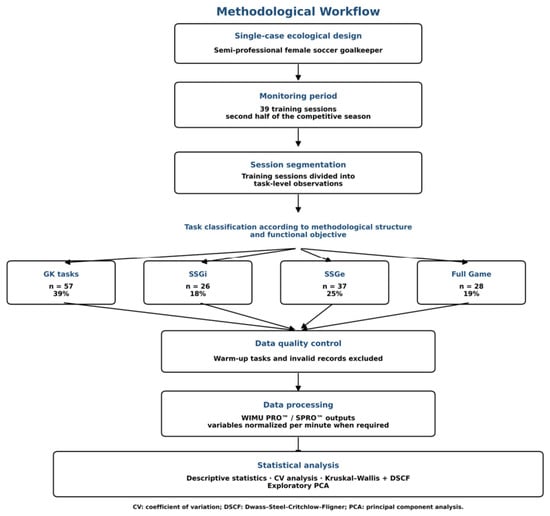
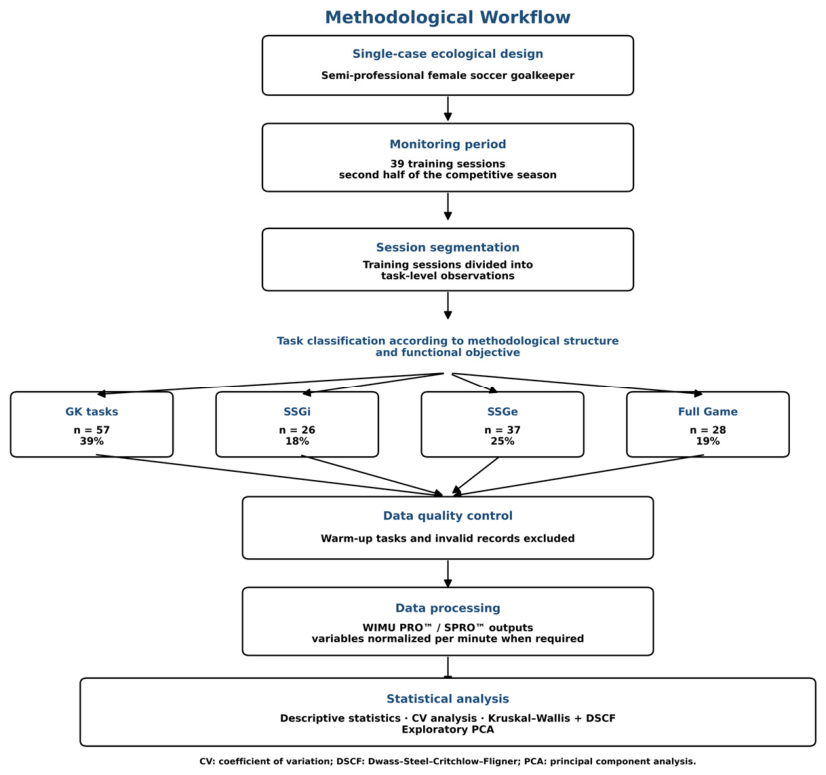
The overall methodological workflow, from data collection to statistical analysis, is summarized in Figure 1.
Figure 1.
Overview of the methodological workflow, including participant monitoring, task classification, data quality control, variable processing, and statistical analyses.
2.6. Statistical Analysis
Data were analyzed using Jamovi (version 2.6) [18]. Descriptive statistics were calculated for all variables and reported as mean ± standard deviation (SD). The normality of the distributions was examined using the Shapiro–Wilk test [19], which revealed deviations from normality for most variables [20]. In addition, the coefficient of variation (CV, %) was calculated to assess the relative variability of each variable across the different task types. CV was interpreted as low (<10%), moderate (10–30%), high (30–100%), and very high (>100%), indicating high relative dispersion with respect to the mean [21,22].
Given the non-normal distribution of most variables and the unequal group sizes, differences between task types were analyzed using the Kruskal–Wallis test [23]. In the present idiographic single-case design, the unit of analysis was the training task, and the test was used as an exploratory non-parametric comparison of task-level distributions rather than as a population-level inferential procedure. When significant differences were detected, pairwise comparisons were performed using the Dwass–Steel–Critchlow–Fligner (DSCF) procedure, with adjusted p-values used to control for multiple-comparison error [24]. Effect sizes were estimated using epsilon squared (ε2), and interpreted as small (≥0.01), moderate (≥0.08), and large (≥0.26) [25]. Because tasks were nested within training sessions and all observations came from a single goalkeeper, the inferential results should be interpreted cautiously as exploratory within-case evidence.
To explore the underlying structure of external load and action-related variables, principal component analysis (PCA) with varimax rotation was performed [26]. Components with eigenvalues greater than 1 were initially retained. Data suitability for factor analysis was assessed using the Kaiser–Meyer–Olkin (KMO) measure and Bartlett’s test of sphericity [27,28]. Individual measures of sampling adequacy (MSA) were also examined. Variables with inadequate individual MSA values (<0.50) were sequentially removed, and the PCA was re-run until all retained variables showed acceptable sampling adequacy. The final PCA solution excluded Stance time, Energy expenditure, and Dive G balance (%). Due to the moderate sampling adequacy, PCA was interpreted as an exploratory technique aimed at identifying latent patterns in the data rather than confirming a predefined structure.
Statistical significance was set at p < 0.05 for all analyses.
3. Results
3.1. Descriptive Analysis of External Load
A descriptive analysis of external load and goalkeeper-specific behavior variables was conducted according to task type, with the aim of characterizing the demand profile of each context. The results shown in Table 3 reveal clearly differentiated patterns across the four task types.
Table 3.
Descriptive statistics of goalkeeper-specific external load variables according to task type.
Goalkeeper-specific tasks (GK tasks) showed the highest values in most variables related to the frequency and intensity of involvement, particularly dives/min ( = 1.42 ± 1.25), as well as lateral actions, impacts, and associated load.
In contrast, full-game situations (Full Game) showed the lowest values in practically all specific indicators (e.g., dives/min = 0.05 ± 0.06), reflecting lower direct involvement of the goalkeeper.
Small-sided game situations (SSGi and SSGe) showed intermediate and relatively similar values, indicating a moderate level of demand.
Overall, the results reveal a clear differentiation between task types, indicating that task design influenced the volume and nature of the actions performed by the goalkeeper.
3.2. Variability Analysis of External Load by Task Type
The variability of external load and goalkeeper-specific action variables was analyzed using the coefficient of variation (CV%) to assess the stability and consistency of demands according to task type.
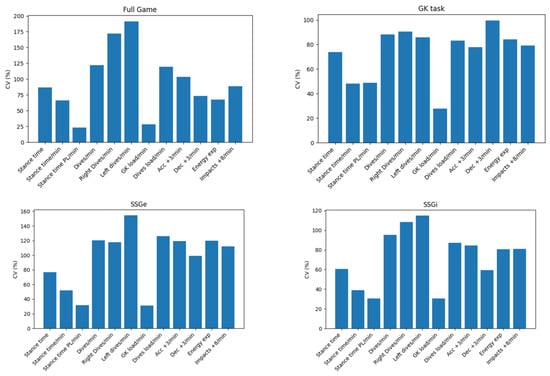
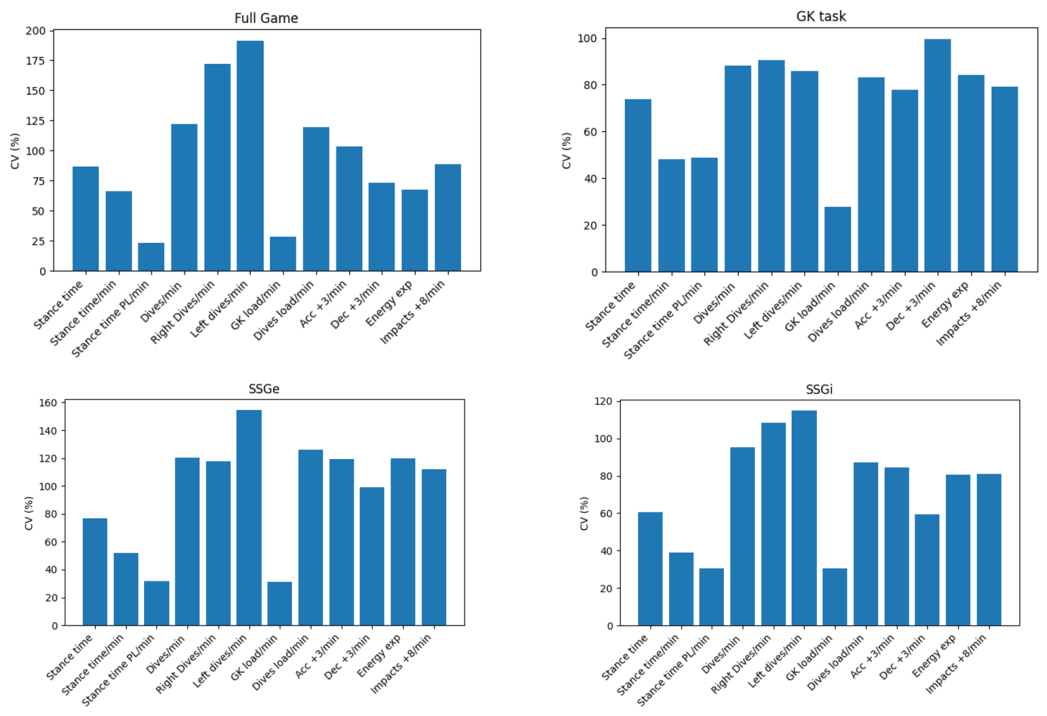
Figure 2 shows the coefficient of variation in external load variables for each task type.
Figure 2.
Coefficient of variation in goalkeeper-specific external load variables according to task type.
The results show clear differences in demand variability according to task type. Goalkeeper-specific tasks (GK tasks) present high CV% values, indicating substantial variability in the execution of actions. Small-sided game situations (SSGi and SSGe) showed moderate variability, reflecting a more stable training environment. In contrast, full-game situations (Full Game) combine low mean values with high variability, highlighting the intermittent involvement of the goalkeeper. These findings indicate that external load consistency was strongly conditioned by task type.
3.3. Analysis of Differences Between Task Types
Differences in external load and goalkeeper-specific action variables according to task type were analyzed using non-parametric tests to identify differential demand patterns across training contexts. The results are shown in Table 4.
Table 4.
Results of the Kruskal–Wallis test for goalkeeper-specific external load variables according to task type.
The results revealed statistically significant differences between task types in most of the variables analyzed. In particular, variables related to the frequency and load of goalkeeper involvement actions showed the largest effect sizes, especially dives/min (χ2 = 54.757; p < 0.001; ε2 = 0.373), and dives load/min (χ2 = 48.993; p < 0.001; ε2 = 0.333), which indicates large-magnitude differences between tasks.
Post hoc analyses are presented in Table 5.
Table 5.
Summary of post hoc comparisons (DSCF).
Post hoc comparisons revealed a consistent pattern in goalkeeper-specific variables, whereby goalkeeper-specific tasks showed significantly higher values than small-sided game situations and, especially, full-game situations, both in the frequency and intensity of involvement actions. Likewise, small-sided games showed higher values than full-game situations in key variables such as dives/min, dives load/min, and impacts +8/min, thereby establishing a clear demand gradient: GK tasks > small-sided games > full-game situations.
Energy expenditure showed a different pattern from the goalkeeper-specific involvement variables. Full-game situations presented significantly higher energy expenditure than GK tasks, SSGi, and SSGe. This result should be interpreted cautiously because energy expenditure was reported as a general accumulated energetic estimate rather than as a goalkeeper-specific action indicator. Therefore, higher values in full-game situations may reflect greater accumulated task duration and continuous low-intensity locomotor activity, despite the lower frequency of specific goalkeeper actions.
Conversely, full-game situations showed significantly lower values in most goalkeeper-specific indicators, confirming lower direct involvement of the goalkeeper. This pattern is consistent across variables, whereas indicators such as the Dive G balance (%) do not show significant differences between tasks.
However, some variables did not follow this pattern. Although the Kruskal–Wallis test was significant for GK load/min, post hoc comparisons did not identify significant pairwise differences, suggesting high within-group variability and lower sensitivity of this indicator to discriminate between contexts. Stance time PL/min did not reach statistical significance in the overall test.
Overall, these findings indicate that task type conditioned the volume, intensity, and nature of goalkeeper involvement, revealing clear functional specificity associated with training design.
3.4. Principal Component Analysis (PCA)
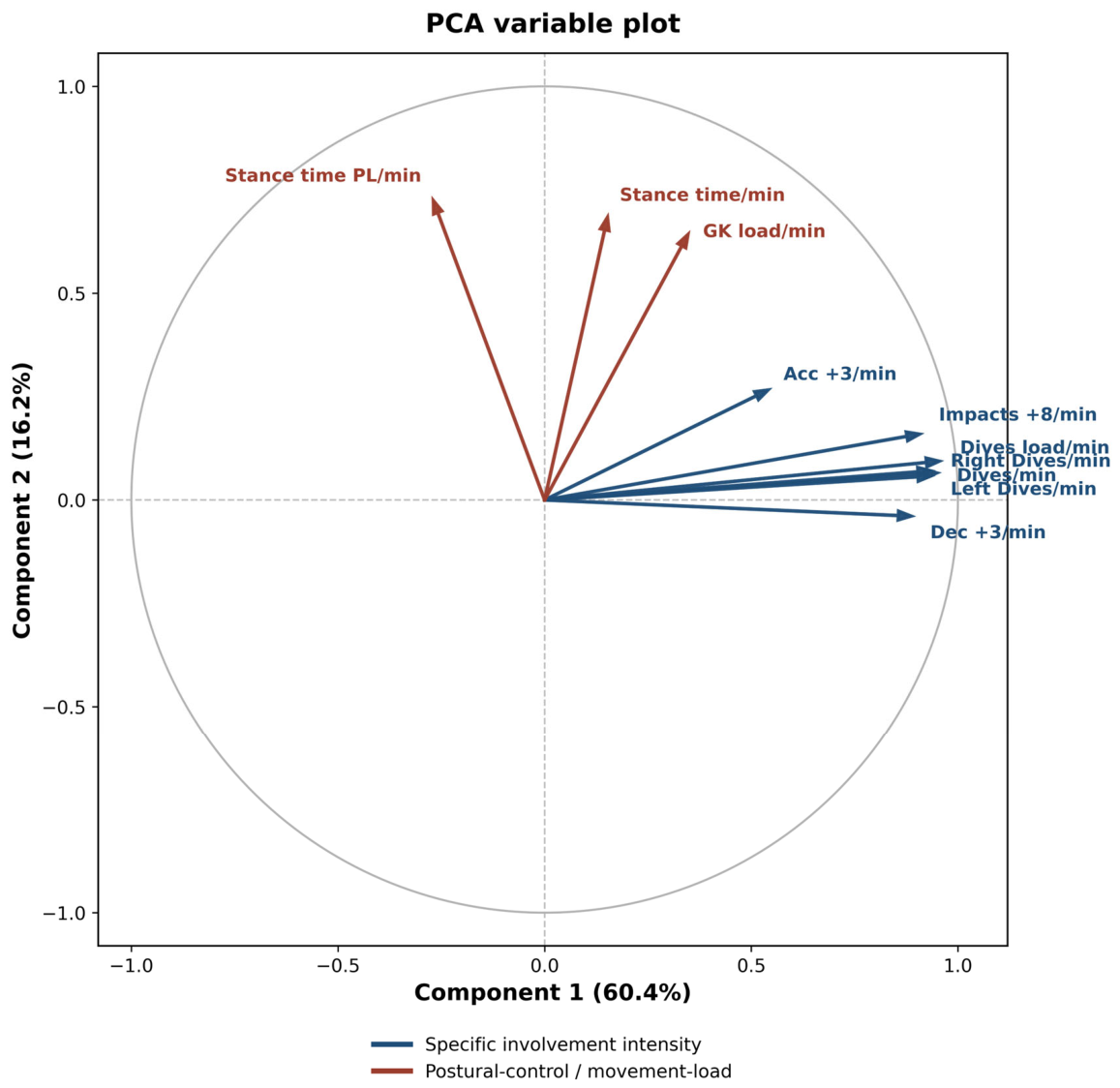
After sequentially excluding variables with individual MSA values below 0.50, the final PCA retained two components explaining 76.6% of the total variance. The first component was the most relevant (SC = 6.04), explaining 60.4% of the variance, followed by the second component (SC = 1.62), which explained 16.2% of the variance (Table 6). Bartlett’s test of sphericity was significant (χ2 = 3041, df = 45, p < 0.001), and the overall sampling adequacy was acceptable (KMO = 0.792), supporting the suitability of the retained variables for exploratory PCA.
Table 6.
Factor loadings of the variables on the principal components.
The first component was characterized by high loadings on variables related to the frequency and intensity of specific involvement actions, such as dives/min, right dives/min, left dives/min, dives load/min, impacts +8/min and dec +3/min. This pattern indicates that the component integrates the volume and mechanical demand of save-related actions, forming a dominant dimension associated with the overall intensity of goalkeeper involvement.
The second component showed loadings on variables related to support time, such as stance time/min and stance time PL/min, reflecting a dimension associated with postural control and stability during involvement.
The revised PCA therefore suggests a bidimensional external-load structure, in which the intensity of goalkeeper-specific involvement constituted the dominant dimension, while postural-control and movement-load variables formed a complementary dimension.
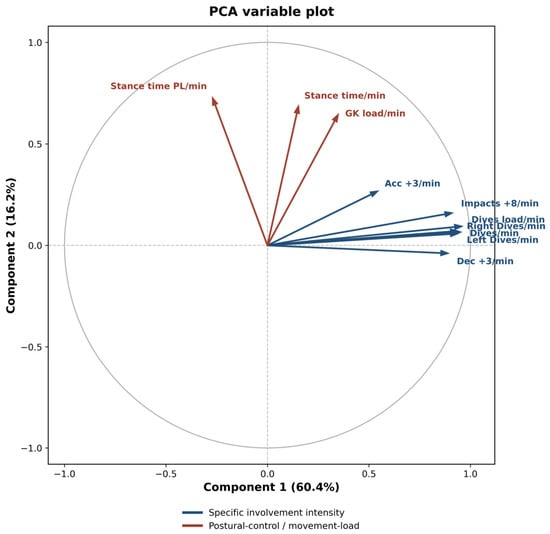
Figure 3 presents the PCA variable plot, showing the distribution of the retained variables across the two components. Variables associated with goalkeeper-specific involvement, such as dives/min, dives load/min, impacts +8/min, and dec +3/min, clustered mainly around the first component, highlighting their dominant weight in the external-load structure. In contrast, variables such as stance time/min and stance time PL/min were positioned mainly on the second component, indicating a differentiated dimension linked to postural control. This distribution reflects a functional separation between specific involvement intensity and stability-related patterns, forming two main axes in the organization of goalkeeper external load.
Figure 3.
PCA variable plot showing the distribution and clustering of the retained variables across the two-component solution.
4. Discussion
The present study analyzed external load and goalkeeper-specific behavior according to task type using inertial sensors in an ecological training context. The results showed that task design clearly conditioned the frequency, intensity, and variability of specific actions. Specifically, goalkeeper-specific tasks showed the highest values in role-specific involvement indicators, small-sided game situations represented an intermediate level of demand, and full-game situations showed lower direct goalkeeper involvement. However, energy expenditure followed a different pattern, with higher values in full-game situations. In addition, the revised exploratory PCA identified a two-component external-load structure. The first and dominant component was associated with the intensity of goalkeeper-specific involvement actions, whereas the second component was related to postural-control and movement-load variables. These findings support, within the present single-case context, the specific and multidimensional nature of the analyzed goalkeeper’s external-load profile [3,4,6].
The task-dependent pattern observed in this study highlights that goalkeeper external load is strongly influenced by training design. This behavior is consistent with previous studies showing low goalkeeper involvement during competition, but with occasional actions of high functional relevance [3,5]. Therefore, representative game-based formats may be useful for contextual and tactical development, but they do not necessarily ensure sufficient exposure to the specific actions required by the position. In this sense, goalkeeper-specific tasks may be necessary to increase exposure to key actions in a controlled manner, whereas small-sided games may provide an intermediate environment combining specificity and tactical interaction [10,29].
These findings should be interpreted within the specific context of women’s football. Although research on training-load monitoring in women’s football has increased in recent years, evidence specifically focused on female goalkeepers remains scarce, particularly when using inertial sensor-derived goalkeeper-specific variables. Therefore, studies conducted with male goalkeepers provide useful position-specific reference points, but their findings should not be directly extrapolated to female goalkeepers. Differences in anthropometric, physiological, neuromuscular, competitive, and contextual characteristics may condition how goalkeeper-specific actions are produced, repeated, and tolerated in women’s football. Consequently, the present results contribute to an underexplored area by providing ecological data from a female goalkeeper using indicators directly related to the functional demands of the position.
Energy expenditure was the only variable that showed a different pattern from the goalkeeper-specific involvement indicators. This apparently counterintuitive result can be explained by the nature of the variable. Unlike relative goalkeeper-specific indicators such as dives/min, dives load/min, or impacts +8/min, energy expenditure was reported as a general accumulated energetic estimate in kcal. Therefore, it is likely to be influenced by task duration and continuous low-intensity locomotor activity rather than by goalkeeper-specific intervention actions alone. In this sense, the higher energy expenditure observed in full-game situations does not necessarily contradict the goalkeeper-specific load pattern, but rather suggests that general accumulated energetic demands and role-specific mechanical involvement capture different dimensions of training load.
A relevant finding was the high variability observed in specific involvement variables, with high coefficients of variation and values exceeding 100% in indicators such as dives/min, impacts +8/min, or acc/dec +3/min. This pattern reflects the intermittent involvement of the goalkeeper, which is characterized by prolonged periods of low activity alternating with occasional high-intensity actions. From a statistical perspective, CV values above 100% indicate that dispersion exceeds the mean, which usually occurs in low-frequency and highly context-dependent events. These results indicate that goalkeeper external load was unstable and task-dependent, being more predictable in structured contexts and more variable in open situations such as full-game play.
Younesi, et al. [30] reported lower variability in global load metrics in football, whereas variability increased in high-intensity actions, such as sprinting or changes in speed, which is consistent with the specific actions performed by goalkeepers. This intermittent and episodic nature has been described in professional football, where goalkeeper performance is associated with discrete actions of high relevance rather than continuous involvement [3,31]. Likewise, recent studies using inertial technologies have highlighted that average indicators may underestimate the real demands of goalkeepers if measures of dispersion and load peaks are not considered. In this sense, the present results reinforce the need to use specific and dispersion-based metrics for adequate monitoring of goalkeeper load [6].
Beyond its descriptive value, the PCA result has practical relevance because it indicates that goalkeeper-specific external load may not be adequately represented by a single aggregated indicator. Instead, the analyzed variables suggested partially differentiated domains related to specific involvement intensity and postural-control/movement-load demands. This interpretation is consistent with previous studies highlighting the multifactorial nature of load monitoring in team sports [32,33,34]. Therefore, goalkeeper monitoring in similar applied contexts may benefit from the use of multiple role-specific indicators rather than relying exclusively on global external-load metrics [10].
The results have practical implications for the planning and monitoring of goalkeeper training. First, they suggest that training tasks should be selected according to the specific objective pursued. Goalkeeper-specific tasks may be useful when the aim is to increase exposure to technical and mechanical actions such as dives, saves, impacts, accelerations, decelerations, or recovery movements. Small-sided game situations may help integrate these actions within a more contextualized environment, whereas full-game situations remain important for tactical representativeness. Jara et al. [14] showed that pitch size in small-sided game situations significantly modifies goalkeeper participation and demands. In particular, smaller contexts favor a higher frequency of specific actions, increasing goalkeeper involvement in the game.
Second, the high variability of external load, particularly in open contexts, suggests the need to combine structured and unstructured tasks according to the training objective, balancing load control and technical repetition with adaptation to uncertainty. In addition, this multidimensional interpretation reinforces the idea that goalkeeper monitoring should be based on multiple indicators capable of capturing different external-load domains. This implies that monitoring systems should be adapted to the position-specific characteristics of the role, prioritizing metrics sensitive to key goalkeeper actions [7]. Such an approach would enable a more integrated model of goalkeeper training, in which task design, specific monitoring, and variability control are used complementarily to optimize performance and adaptation to training.
The temporal context of the monitored sessions should also be considered when interpreting these results. All data were collected during the second half of the competitive season, meaning that the observed load profiles reflect an in-season training context rather than preseason or off-season preparation. In this period, task design is usually influenced by competitive demands, recovery needs, tactical preparation, and match proximity. Therefore, the present findings should be interpreted within this specific period of the season. Future studies should analyze whether goalkeeper-specific load profiles vary across microcycles, mesocycles, and different seasonal phases.
The present study has some limitations that should be considered when interpreting the results. First, the analysis was based on a single participant, which limits the generalizability of the findings to other goalkeeper populations. Nevertheless, this approach allowed for a detailed and ecologically valid analysis of goalkeeper-specific behavior in a real training context. Future research should increase the sample size by including a larger number of goalkeepers, thereby enabling comparative analyses and validation of the observed external-load structure.
Second, the participant’s competitive level, corresponding to a semi-professional context, may have conditioned both the volume and intensity of the recorded actions, limiting extrapolation to elite or developmental levels. Therefore, future research should explore these demands across different competitive levels, allowing more specific load profiles to be established according to the sporting context.
In addition, the present study analyzed only external load and goalkeeper-specific action indicators derived from inertial sensors. Internal load measures, such as heart rate, session rating of perceived exertion, wellness, fatigue, or recovery indicators, were not collected. Therefore, the relationship between the external demands imposed by each task type and the goalkeeper’s individual physiological or perceptual response could not be examined. Future studies should integrate external and internal load measures to better understand how similar external stimuli may produce different individual responses depending on the player’s fitness level, fatigue state, and recovery status.
Finally, although goalkeeper-specific tasks were defined as drills involving only the goalkeeper coach and the goalkeeper, they were not further subdivided according to specific technical–tactical contents such as diving saves, shot-stopping, aerial actions, distribution, or recovery movements. Therefore, the present study compares broad task categories but does not examine within-category differences between specific goalkeeper drills. Future studies should include a more detailed task taxonomy to analyze the load profile of different goalkeeper-specific contents.
5. Conclusions
This single-case pilot study showed that, in the analyzed semi-professional female goalkeeper, external load was strongly conditioned by training task type, revealing a clear functional gradient in which goalkeeper-specific tasks generated the highest demands, followed by small-sided game situations and, finally, full-game situations. This pattern indicates that goalkeeper involvement in open contexts was limited and intermittent, reducing exposure to specific actions when tasks were not specifically designed to target goalkeeper participation.
Likewise, the results showed that the analyzed goalkeeper’s load profile presented high variability, with coefficient of variation values exceeding 100% in several specific variables, highlighting the episodic and context-dependent nature of goalkeeper performance. Therefore, external-load assessment should not be based solely on mean values, but should also incorporate dispersion indicators capable of capturing the instability of the training stimulus.
Finally, the revised exploratory PCA suggested that goalkeeper-specific external load was multidimensional, with two main components: a dominant dimension related to the intensity of specific involvement actions and a complementary dimension associated with postural-control and movement-load demands. This structure suggests that, in this case, goalkeeper-specific external load could not be fully interpreted through global indicators alone, but required a set of role-specific variables capable of capturing different mechanical aspects of involvement.
These findings highlight the need to design goalkeeper training by combining goalkeeper-specific tasks, small-sided game situations, and full-game situations, while using task-specific inertial monitoring to verify exposure to key position-specific actions. In comparable women’s football contexts, this pilot study supports more specific, contextualized, and data-driven training planning aimed at optimizing goalkeeper preparation.
Author Contributions
Conceptualization, S.J.I., I.G.-A., J.M.H.-O. and P.L.-S.; methodology, S.J.I. and I.G.-A.; software, S.J.I. and P.L.-S.; validation, S.J.I., I.G.-A. and J.M.H.-O.; formal analysis, S.J.I. and P.L.-S.; investigation, S.J.I., I.G.-A. and J.M.H.-O.; resources, S.J.I.; data curation, S.J.I. and P.L.-S.; writing—original draft preparation, S.J.I. and I.G.-A.; writing—review and editing, S.J.I., J.M.H.-O. and P.L.-S.; visualization, S.J.I. and J.M.H.-O.; supervision, S.J.I. and P.L.-S.; project administration, S.J.I., P.L.-S. and J.M.H.-O.; funding acquisition, S.J.I. and P.L.-S. All authors have read and agreed to the published version of the manuscript.
Funding
This research was partially funded by the Research Group Support Grant (GR24133). It was co-funded at 85% by the European Union through the European Regional Development Funds (ERDF), and by the Regional Government of Extremadura (Department of Education, Science, and Vocational Training). The Managing Authority is the Ministry of Finance of Spain. The author, Pablo López-Sierra, is a grantee of the “Formación de Profesorado Universitario 2023” of the Ministry of Science, Innovation, and Universities, code FPU23/02997.
Data Availability Statement
The data presented in this study are available on request from the corresponding author due to privacy and ethical restrictions.
Conflicts of Interest
The authors declare no conflicts of interest.
References
- López-Araya, S.; Gutiérrez-Vargas, R.; Ugalde-Ramírez, A.; Ibáñez, S.J. Analysis of the differences in the technical-tactical performance indicators in The FIFA Women’s World Cup 2023 according to the final classification. E-Balonmano Com J. Sports Sci. 2025, 21, 117–130. [Google Scholar] [CrossRef] [Scilit]
- Jaspers, A.; Brink, M.S.; Probst, S.G.; Frencken, W.G.; Helsen, W.F. Relationships Between Training Load Indicators and Training Outcomes in Professional Soccer. Sports Med. 2017, 47, 533–544. [Google Scholar] [CrossRef] [Scilit] [PubMed]
- White, A.; Hills, S.P.; Cooke, C.B.; Batten, T.; Kilduff, L.P.; Cook, C.J.; Roberts, C.; Russell, M. Match-Play and Performance Test Responses of Soccer Goalkeepers: A Review of Current Literature. Sports Med. 2018, 48, 2497–2516. [Google Scholar] [CrossRef] [Scilit] [PubMed]
- Tienza-Valverde, A.; Hernández-Beltrán, V.; Espada, M.C.; Bravo-Sánchez, A.; Santos, F.J.; Gamonales, J.M. Analysis of individual performance indicators of football goalkeeper. Apunt. Sports Med. 2023, 58, 100420. [Google Scholar] [CrossRef] [Scilit]
- Kubayi, A. Analysis of goalkeepers’ game performances at the 2016 European Football Championships. S. Afr. J. Sports Med. 2020, 32, v32i31a8283. [Google Scholar] [CrossRef] [Scilit] [PubMed]
- Moreno-Pérez, V.; Malone, S.; Sala-Pérez, L.; Lapuente-Sagarra, M.; Campos-Vazquez, M.A.; Del Coso, J. Activity monitoring in professional soccer goalkeepers during training and match play. Int. J. Perform. Anal. Sport 2019, 20, 19–30. [Google Scholar] [CrossRef] [Scilit]
- Hernandez-Beltran, V.; Becerra-Patino, B.A.; Perdomo-Alonso, A.; Barguerias-Martinez, J.; Gomez-Carrero, S.; Espada, M.C.; Gamonales, J.M. Characterization of the External Load of Soccer Goalkeepers Depending on the Category and Sports Context. Sports 2024, 12, 318. [Google Scholar] [CrossRef] [Scilit] [PubMed]
- Gonçalves, R.R. Multidisplinary Study of Performance Characteristics in Soccer Goalkeepers; University of Coimbre: Coimbra, Portugal, 2015. [Google Scholar]
- Malone, J.J.; Jaspers, A.; Helsen, W.; Merks, B.; Frencken, W.G.; Brink, M.S. Seasonal training load and wellness monitoring in a professional soccer goalkeeper. Int. J. Sports Physiol. Perform. 2018, 13, 672–675. [Google Scholar] [CrossRef] [Scilit] [PubMed]
- Casamichana, D.; Barba, E.; Martin-Garcia, A.; Ulloa, I.; Nakamura, F.Y.; Castellano, J. Comparison of the external load of professional goalkeepers in different weekly training sessions. Biol. Sport 2024, 41, 67–72. [Google Scholar] [CrossRef] [Scilit] [PubMed]
- Abbott, W.; Thomas, C.; Clifford, T. Effect of playing status and fixture congestion on training load, mental fatigue, and recovery status in premier league academy goalkeepers. J. Strength Cond. Res. 2023, 37, 375–382. [Google Scholar] [CrossRef] [Scilit]
- Pinelli, S.; Zinno, R.; Romano, L.; Scoppolini Massini, M.; Senesi, G.; Bragonzoni, L. Influence of Dive Direction Uncertainty on Preparatory Posture, Coordination, and Kinematics in Elite Youth Goalkeepers. Appl. Sci. 2026, 16, 2879. [Google Scholar] [CrossRef] [Scilit]
- De-la-Cruz-Torres, B.; Navarro-Castro, M.; Ruiz-de-Alarcón-Quintero, A. An Expected Goals on Target (xGOT) Model: Accounting for Goalkeeper Performance in Football. Big Data Cogn. Comput. 2025, 9, 64. [Google Scholar] [CrossRef] [Scilit]
- Jara, D.; Ortega, E.; Gomez-Ruano, M.A.; Weigelt, M.; Nikolic, B.; Sainz de Baranda, P. Physical and Tactical Demands of the Goalkeeper in Football in Different Small-Sided Games. Sensors 2019, 19, 3605. [Google Scholar] [CrossRef] [Scilit] [PubMed]
- Ibáñez, S.J.; Feu, S. Research designs in Sports Science. E-Balonmano Com J. Sports Sci. 2026, 22, 1–44. [Google Scholar] [CrossRef] [Scilit]
- Ato, M.; Lopez, J.J.; Benavente, A. A classification system for research designs in psychology. An. Psicol. 2013, 29, 1038–1059. [Google Scholar] [CrossRef] [Scilit]
- Gomez-Carmona, C.D.; Bastida-Castillo, A.; Gonzalez-Custodio, A.; Olcina, G.; Pino-Ortega, J. Using an Inertial Device (WIMU PRO) to Quantify Neuromuscular Load in Running: Reliability, Convergent Validity, and Influence of Type of Surface and Device Location. J. Strength Cond. Res. 2020, 34, 365–373. [Google Scholar] [CrossRef] [Scilit] [PubMed]
- Jamovi. The Jamovi Project, 2.6. Available online: https://www.scirp.org/reference/referencespapers?referenceid=4044704 (accessed on 8 June 2026).
- Shapiro, S.S.; Wilk, M.B. An analysis of variance test for normality (complete samples). Biometrika 1965, 52, 591–611. [Google Scholar] [CrossRef] [Scilit]
- Vincent, W.J.; Weir, J.P. Statistics in Kinesiology (Fourth Edition); Human Kinetics: Champaign, IL, USA, 2018. [Google Scholar]
- Atkinson, G.; Nevill, A.M. Statistical Methods for Assessing Measurement Error (Reliability) in Variables Relevant to Sports Medicine. Sports Med. 1998, 26, 217–238. [Google Scholar] [CrossRef] [Scilit] [PubMed]
- Hopkins, W.G. Measures of reliability in sports medicine and science. Sports Med. 2000, 30, 1–15. [Google Scholar] [CrossRef] [Scilit] [PubMed]
- Newell, J.; Aitchison, T.; Grant, S. Statistics for Sports and Exercise Science: A practical Approach; Routledge: New York, NY, USA, 2014. [Google Scholar]
- Douglas, C.E.; Michael, F.A. On distribution-free multiple comparisons in the one-way analysis of variance. Commun. Stat.-Theory Methods 1991, 20, 127–139. [Google Scholar] [CrossRef] [Scilit]
- Tomczak, M.; Tomczak, E. The need to report effect size estimates revisited. An overview of some recommended measures of effect size. Trends Sport Sci. 2014, 21, 19–25. [Google Scholar]
- Kaiser, H.F. The Varimax Criterion for Analytic Rotation in Factor Analysis. Psychometrika 1958, 23, 187–200. [Google Scholar] [CrossRef] [Scilit]
- Bartlett, M. A note on the multiplying factors for various chi square approximations. J. R. Stat. Soc. 1954, 16, 296–298. [Google Scholar] [CrossRef] [Scilit]
- O’Donoghue, P. Statistics for Sport and Exercise Studies: An Introduction; Routledge: Abingdon, UK, 2013. [Google Scholar]
- Modena, R.; Togni, A.; Fanchini, M.; Pellegrini, B.; Schena, F. Influence of pitch size and goalkeepers on external and internal load during small-sided games in amateur soccer players. Sport Sci. Health 2021, 17, 797–805. [Google Scholar] [CrossRef] [Scilit]
- Younesi, S.; Rabbani, A.; Clemente, F.M.; Sarmento, H.; Figueiredo, A.J. Session-to-session variations in external load measures during small-sided games in professional soccer players. Biol. Sport 2021, 38, 185–193. [Google Scholar] [CrossRef] [Scilit] [PubMed]
- Malone, J.J.; Di Michele, R.; Morgans, R.; Burgess, D.; Morton, J.P.; Drust, B. Seasonal training-load quantification in elite English premier league soccer players. Int. J. Sports Physiol. Perform. 2015, 10, 489–497. [Google Scholar] [CrossRef] [Scilit] [PubMed]
- Vanrenterghem, J.; Nedergaard, N.J.; Robinson, M.A.; Drust, B. Training Load Monitoring in Team Sports: A Novel Framework Separating Physiological and Biomechanical Load-Adaptation Pathways. Sports Med. 2017, 47, 2135–2142. [Google Scholar] [CrossRef] [Scilit] [PubMed]
- Impellizzeri, F.M.; Marcora, S.M.; Coutts, A.J. Internal and External Training Load: 15 Years On. Int. J. Sports Physiol. Perform. 2019, 14, 270–273. [Google Scholar] [CrossRef] [Scilit] [PubMed]
- Piedra, A.; Caparros, T.; Vicens-Bordas, J.; Pena, J. Internal and External Load Control in Team Sports through a Multivariable Model. J. Sports Sci. Med. 2021, 20, 751–758. [Google Scholar] [CrossRef] [Scilit] [PubMed]

Disclaimer/Publisher’s Note: The statements, opinions and data contained in all publications are solely those of the individual author(s) and contributor(s) and not of MDPI and/or the editor(s). MDPI and/or the editor(s) disclaim responsibility for any injury to people or property resulting from any ideas, methods, instructions or products referred to in the content. |
© 2026 by the authors. Licensee MDPI, Basel, Switzerland. This article is an open access article distributed under the terms and conditions of the Creative Commons Attribution (CC BY) license.