


Abstract
This study investigated the mechanism underlying how the integration of chemical fertilizer and maize straw-derived organic amendments affects different potassium (K) pools, K saturation, K fixation characteristics, and non-exchangeable potassium (NEK) release kinetics in black soil. A field experiment involving five treatments was conducted: no fertilizer (CK), chemical fertilizer alone (NPK), chemical fertilizer plus maize straw (NPK+ST), chemical fertilizer plus straw compost (NPK+CP), and chemical fertilizer plus straw biochar (NPK+BR). The findings demonstrated remarkably increased contents of different K pools and K saturation in the black soil following the combined application of straw-derived organic amendments, with NPK+CP exhibiting the most significant effect. Exogenous K fixation simulation tests indicated that the amount of K fixation in the black soil increased with the incorporation of exogenous K, while the fixation rate showed the opposite trend. The quadratic regression model well fitted the relationship between the amount of K fixation and the addition of exogenous K; the treatments were ranked according to the soil K fixation capacity as follows: CK > NPK > NPK+BR > NPK+ST > NPK+CP. The simplified Elovich model well fitted the NEK release process in the black soil under different treatments. Significant differences in total cumulative NEK release and apparent release rate coefficients were observed among the treatments, which showed an identical trend: NPK+CP > NPK+BR > NPK+ST > NPK > CK. The application of straw-derived organic amendments could effectively reduce the K fixation capacity of black soil and promote NEK release. In this study, chemical fertilizer combined with straw compost was the optimal measure for improving black soil’s potassium availability.
1. Introduction
As one of the world’s four principal black soil zones, Northeast China’s black soil area serves as a central hub for grain production, constituting a critical foundation for guaranteeing the nation’s food security [1]. However, with the enrichment of high-yield crop varieties and the intensive application of nitrogen and phosphorus fertilizers, soil potassium (K) in this region has long remained in a state of imbalance (deficit) [2]. Concurrently, affected by the dual constraints of inorganic K fertilizer’s limited abundance in China as well as its consistently high prices in the global market, farmers generally have low willingness to apply it. This depletion of soil K reserves has threatened the sustainable grain production in this region. Therefore, adopting efficient fertilization strategies is crucial to minimize chemical K inputs and maximize K utilization [3,4].
K represents an essential macronutrient for the growth and development of crops [5,6,7,8]. Furthermore, K holds considerable significance in soil health by stabilizing diverse mineral components [9]. The neutral NH4OAc extraction method is a classic approach for evaluating soil K supply capacity. However, this method has limitations as it only extracts the water-soluble and exchangeable K pools, which are readily available for crop uptake, while neglecting the non-exchangeable K (NEK) pool [10]. NEK functions as a potential mineral K reserve; its progressive release is intrinsically linked to sustaining the medium- and long-term K supply for crop growth [11]. Therefore, determining the content and release characteristics of the NEK is essential for accurately evaluating the soil K supply to plants. K saturation of the exchange complex, defined as the share of K among exchangeable cations, is also an important parameter for assessing soil K supply capacity [12]. Among the numerous mechanisms regulating K availability in soil, K fixation stands out as a particularly critical process governing this nutrient’s accessibility. Soil K fixation is the process of K+ diffusing into the interlayer spaces of clay minerals and forming inner-sphere surface complexes with mineral oxygen atoms [13]. Obtaining reliable data on soil K fixation holds significant practical value in agronomy: not only can it provide data support for clarifying the soil–plant system’s response to K fertilizer utilization, but it can also enable evaluations of the K demand of crops, which holds much guiding value for formulating targeted soil fertility management strategies.
Organic amendments have been regarded as one of the best options for enhancing soil K availability and supply capacity [14]. The notable feature of organic amendments lies in maintaining or increasing soil K pools and K saturation through direct K input and indirect contribution by increasing soil properties and biological properties [15,16,17]. The combined application of chemical fertilizer and organic amendments promoted the release of soil NEK and enhanced the K supply capacity [18,19]. Simultaneously, this fertilization strategy reduced the soil K fixation capacity; as a result, exogenous K fertilizer could more easily satisfy the soil K fixation demand under this strategy, thereby exerting a yield-increasing effect [20,21]. Maize straw is the most readily available local organic amendment in Northeast China’s black soil area [22]. Previous studies have widely demonstrated that maize straw-derived organic amendments are highly beneficial for the preservation of the soil carbon pool, as well as the dynamic transformation and availability of nitrogen and phosphorus [23,24]. However, research on their regulatory effects on soil K availability and transformation dynamics in black soil is still insufficient, especially under the typical continuous maize cropping system in this region, and relevant studies urgently need to be supplemented. Therefore, an in-depth investigation into the response of black soil K supply capacity to various maize straw-derived organic amendments is of great significance for enhancing soil K availability, promoting straw resource utilization, and ultimately achieving sustainable agricultural production.
Our objective was to delve into the influences of the prolonged (10 years) combined utilization of chemical fertilizer as well as multiple maize straw-derived organic amendments (maize straw, straw compost, and straw biochar) on different soil K pools, K saturation, K fixation characteristics, and NEK release kinetics under the typical continuous maize cropping system in black soil. Ultimately, these findings can help identify the optimal straw-derived organic amendment for field application, thereby providing a scientific basis for sustainable K management in black soil agroecosystems. The following hypotheses were proposed: (1) The long-term combined application of maize straw-derived organic amendments increases the contents of multiple K pools and K saturation in black soil, reduces the soil K fixation capacity, and simultaneously increases the total cumulative release of NEK and its release rate. (2) Different maize straw-derived organic amendments have divergent effects on improvements in soil K fertility.
2. Materials and Methods
2.1. Experimental Site Overview
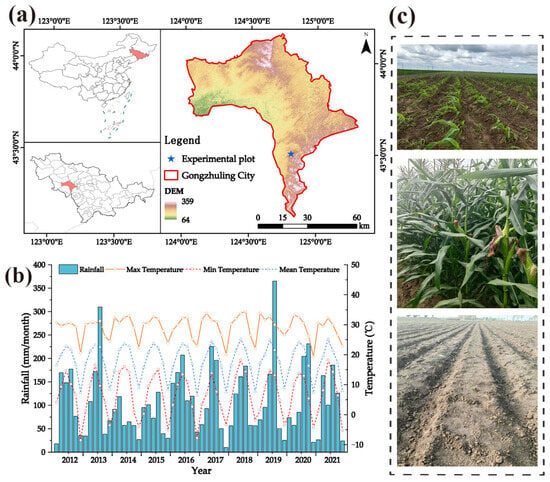
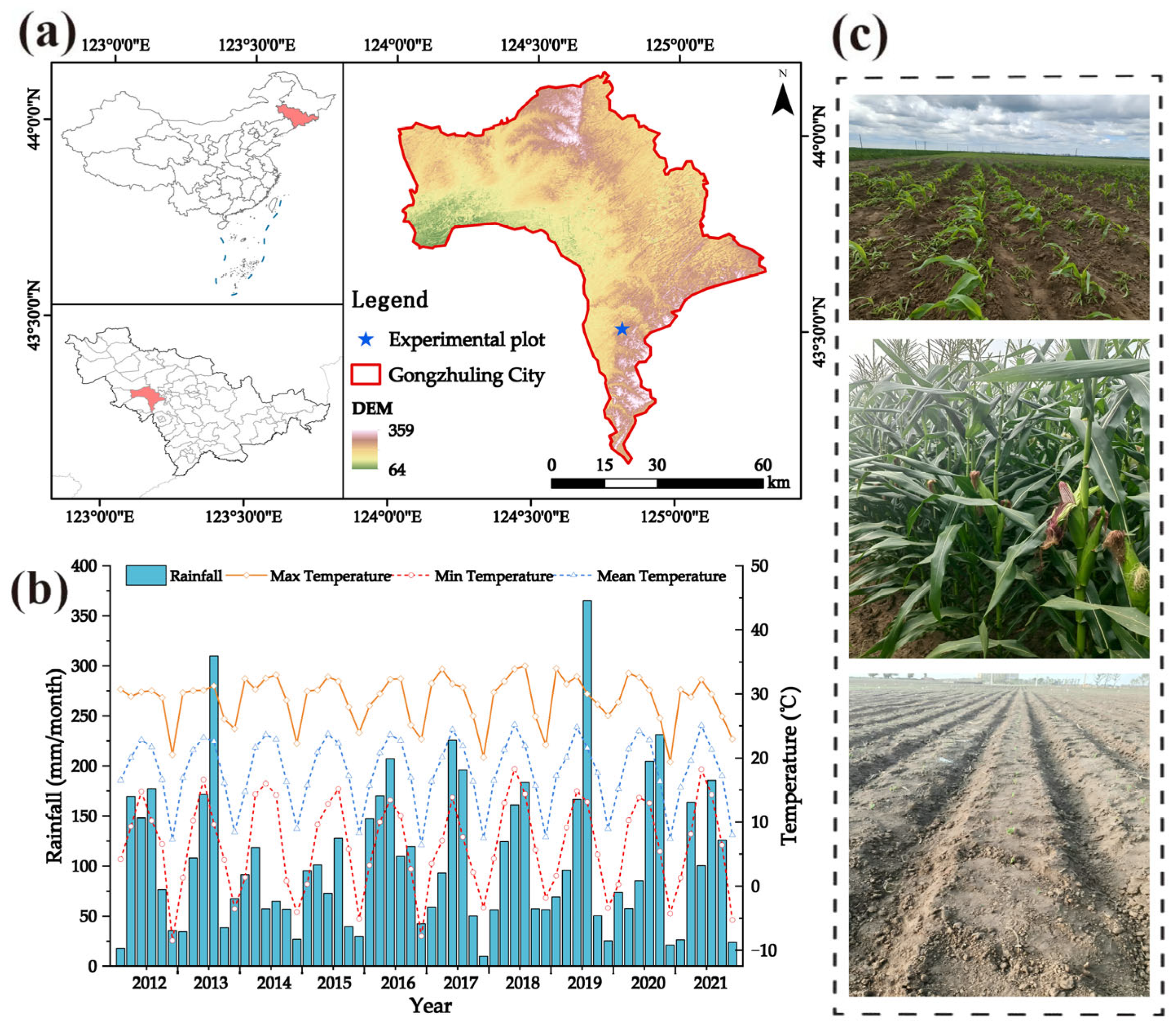
The experiment site is located in Gongzhuling City, Jilin Province, Northeast China (124°48′33.8″ E, 43°30′23″ N), at an altitude of 218 m (Figure 1a). The region features a typical temperate continental climate, with a mean annual temperature of 5.6 °C, annual rainfall of 560 mm, and an annual average effective accumulated temperature (≥10 °C) of 2800–3000 °C·d during the crop growing season [25]. Figure 1b illustrates the meteorological conditions at the study site, detailing the rainfall and the maximum, minimum, and mean air temperatures during the maize growth period (May to October) from 2012 to 2021 (https://data.cma.cn/, accessed date 15 May 2026).
Figure 1.
(a) Geographic location of the experimental field; (b) Rainfall and temperature data during maize growing season at the experimental site (2012–2021); (c) Field photograph of the experimental plot.
Following USDA taxonomy criteria, the soil is identified as mesic, mixed, fine-silty typic Hapludoll, whereas under Chinese Soil Taxonomy, it is designated as typical black soil. Table 1 presents the properties of the topsoil (0–20 cm depth) measured at the beginning of the study [25].
Table 1.
Selected basic soil properties of the topsoil (0–20 cm depth) at the beginning of the experiment in 2012.
2.2. Experimental Design
A field experiment was initiated in 2012. A total of 5 fertilization treatments were designed: (1) CK, no fertilizer; (2) NPK, chemical fertilizer alone; (3) NPK+ST, NPK plus maize straw; (4) NPK+CP, NPK plus straw compost; and (5) NPK+BR, NPK plus straw biochar. All treatments had three replicates. All the experimental plots were arranged with a randomized block design, each covering 104 m2 (10.4 m × 10 m). In each treatment, the chemical fertilizer was applied at the recommended rate: the annual average application rates were 200 kg/hm2 N (supplied as urea), 90 kg/hm2 P2O5 (supplied as diammonium phosphate), and 75 kg/hm2 K2O (supplied as potassium chloride). All the phosphorus and potassium fertilizers, along with 40% of the nitrogen fertilizer, served as the base fertilizer, whereas the remaining 60% functioned as the topdressing fertilizer during the maize jointing. The three maize straw-derived organic amendments were adopted at an identical carbon input rate, and the average carbon input was 3200 kg/hm2 annually. The maize straw utilized in the present investigation was harvested from the exact field and subsequently processed into smaller segments. Maize straw compost was prepared by blending maize straw with pig manure at a fresh mass ratio of 4:1, within managed temperature (50–60 °C) and hydration (40%, v/w) parameters. Maize straw biochar was produced by thermally decomposing maize straw at 450 °C under oxygen-deficient conditions. Table 2 presents the basic attributes of the maize straw-derived organic amendments [25]. To attain the specified amount of applied carbon, the carbon input of each material was calculated. After the autumn harvest, these organic materials were employed by broadcasting on the soil surface, followed by rotary tillage to mix them into the soil layer to 0–15 cm. During the following spring, a no-till fertilization seeder was used for fertilization and sowing. The flat planting method and continuous maize cropping system were adopted, and the planting density was 60,000 plants/hm2, dependent on ambient rainfall for irrigation and consistent field operations adhering to established agronomic norms.
Table 2.
Basic properties of the maize straw-derived organic amendments.
2.3. Soil Sampling and Analysis
Following a decade of experimental operation, topsoil samples were derived from the profile with a 0–20 cm depth after maize harvest in October 2021. Quintuplicate soil cores were systematically taken from each experimental plot and homogenized to generate a representative composite sample. After removing visible plant residue and gravel from the soil samples, these samples were naturally air-dried while passing them through a 2 mm sieve for subsequent use.
2.3.1. Soil Phsicochemical Analysis
The methods used to determine the soil K pools and cation exchange parameters are presented in Table 3.
Table 3.
Measurement methods for soil physicochemical properties.
2.3.2. Soil Potassium Fixation Characteristics
Soil K fixation characteristics were determined by the equilibrium method with minor modifications [29].
Next, a 5 g aliquot of the soil sample was precisely weighed and transferred into a 50 mL centrifuge tube. Then, a 5 mL portion of KCl solution with a K+ concentration of 0, 0.1, 0.4, 0.8, 1.0, 1.6, 2.4, 3.2, or 4.0 g/L was added, equivalent to an amount of added external K of 0, 100, 400, 800, 1000, 1600, 2400, 3200, or 4000 mg/kg soil, respectively. The mixture was fully homogenized and air-dried naturally at 25 ± 2 °C. After the soil sample was air-dried, 50 mL of 1 mol/L neutral NH4OAc solution was incorporated. After shaking for 30 min, the resulting mixture was then filtered, and a flame photometer was used to analyze the K concentration. The amount and rate of K fixation were determined using the following equation [30]:
K fixation amount (mg/kg) = Amount of added external K − (NH4OAc-extractable K with external K addition − NH4OAc-extractable K without external K addition)
K fixation rate (%) = (K fixation amount × 100)/Amount of added external K
2.3.3. Soil Non-Exchangeable Potassium Release Kinetics
The release of soil NEK was determined using a modified continuous exchange method, with the specific steps as follows:
(1) Preparation of Ca2+-saturated soil: 10.00 g of the sample was transferred into a centrifuge tube. Then, 50 mL of 0.25 mol/L CaCl2 solution was introduced; the resulting mixture was completely shaken while being centrifuged, and this operation was repeated 3 times. Next, 50 mL of absolute ethanol was further incorporated; the mixture was thoroughly shaken and then subjected to centrifugation, and this operation was repeated 2 times. Finally, 50 mL of distilled water was introduced, after which the resulting mixture was fully shaken and centrifuged until no Cl− was detected. The soil sample was then dried, ground, and set aside for subsequent use [31].
(2) Soil NEK release test: 2.00 g of the above Ca2+-saturated soil was transferred into a centrifuge tube. Then, 20 mL of 0.01 mol/L CaCl2 solution was added, after which the mixture was subjected to intermittent oscillation at 25 ± 2 °C, followed by centrifugation. The supernatant was poured out and set aside. The above process was repeated with extraction times of 1, 6, 12, 24, 48, 96, 168, 272, 416, 560, 728, 896, 1064, and 1232 h. The K+ concentration in the supernatant was identified utilizing a flame photometer [32].
Six kinetic models were used to describe the cumulative K release curves (Table 4). The applicability of each kinetic equation was compared by using the coefficient of determination (R2) and standard error (SE) obtained from least-squares analysis. The larger the R2 and the smaller the SE, the better the fitting effect. The SE was calculated as follows:
where Kt and Kt′ are, respectively, the measured and predicted cumulative K releases at time t, while n represents the number of observations (n = 14).
Table 4.
Kinetic models used to describe soil non-exchangeable potassium release.
2.4. Statistical Analysis
All data presented are averaged across three replicates for each treatment. Statistical analysis was carried out with SPSS 27.0. Data for soil K pools, cation exchange parameters, average K fixation amount and rate, and total cumulative K released were analyzed using the Shapiro–Wilk and Levene’s test for normality and variance homogeneity. One-way ANOVA with LSD post hoc test was used when assumptions were met; the Kruskal–Wallis test with Dunn’s post hoc test was applied otherwise (Table A1). The significance threshold was set at p < 0.05. Data visualization and model fitting were performed using Origin 2021.
3. Results
3.1. Soil Potassium Pools
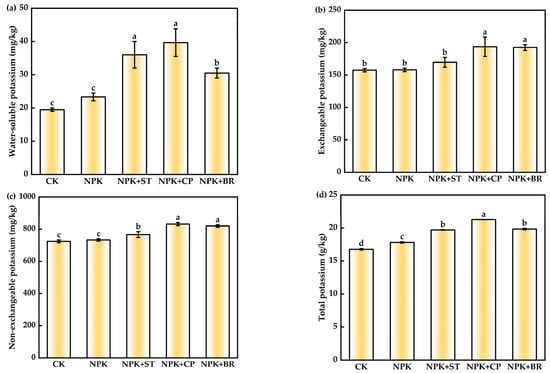
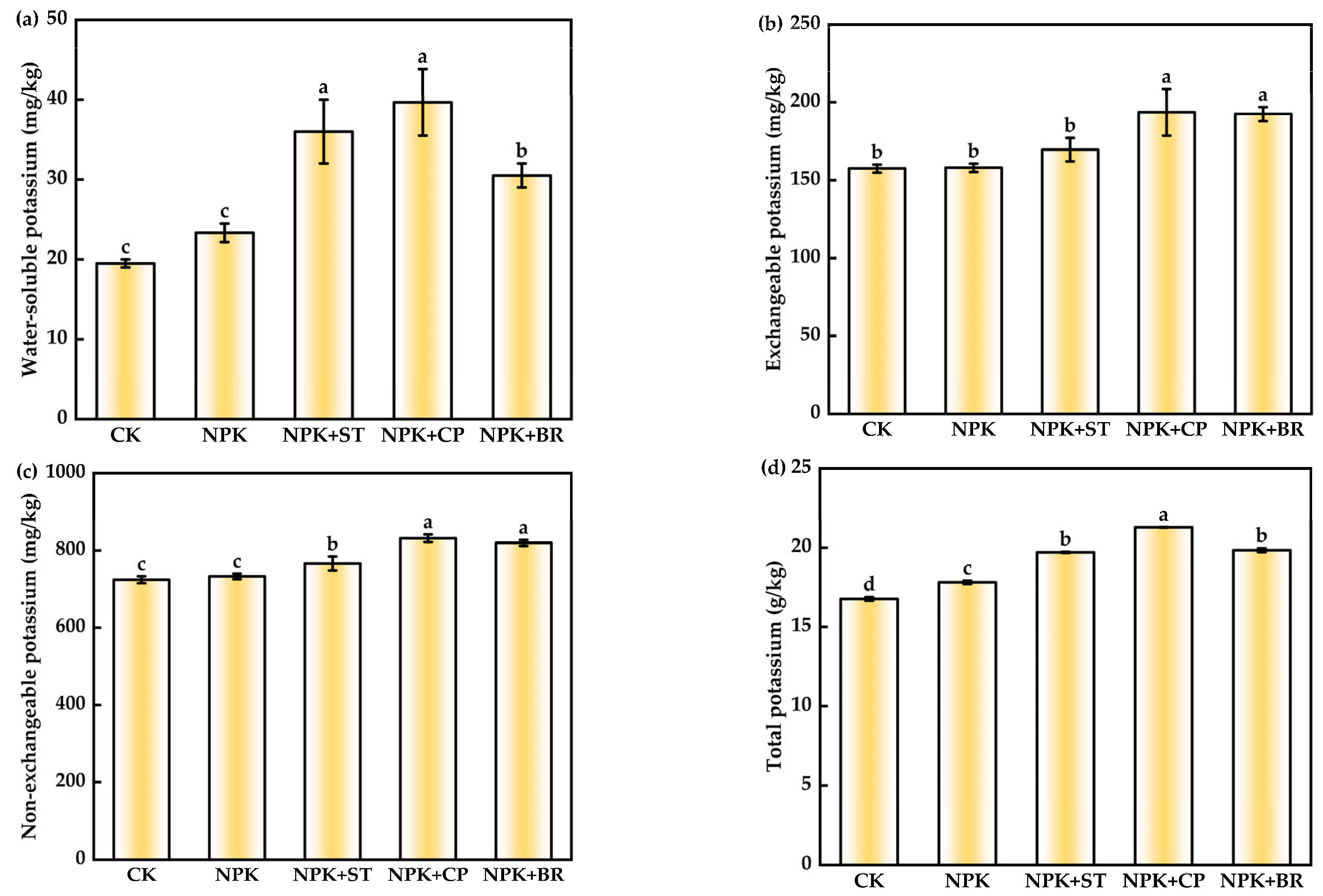
As clearly illustrated in Figure 2, following a decade of sustained differential fertilizer management practices, the soil WSK fell within the range of 19.50 to 39.67 mg/kg, the EK spanned from 157.50 to 193.67 mg/kg, the NEK ranged from 724.33 to 832.00 mg/kg, and the TK was 16.77 to 21.28 g/kg. Relative to CK treatment, the NPK failed to significantly increase the soil WSK, EK, or NEK. However, the additional application of straw-derived organic amendments significantly increased the contents of WSK, EK, NEK, and TK. Compared with the CK treatment, the NPK+ST, NPK+CP, and NPK+BR treatments significantly increased the soil WSK content by 84.62%, 103.42%, and 56.41% (p < 0.05); enhanced the content of soil EK by 7.72%, 22.96%, and 22.22%, respectively; significantly increased the NEK by 5.80%, 14.86%, and 13.16% (p < 0.05); and remarkably increased TK by 17.48%, 26.91%, and 18.29%, respectively (p < 0.05). Among the organic amendment treatments, the NPK+CP treatment exhibited the highest content of all the K pools in the soil.
Figure 2.
Effects of chemical fertilizer combined with different straw-derived organic amendments on soil potassium pools. (a) Water-soluble potassium (mg/kg); (b) Exchangeable potassium (mg/kg); (c) Non-exchangeable potassium (mg/kg); (d) Total potassium (g/kg). Values are means ± SE (n = 3). Different lowercase letters indicate significant differences among treatments at p < 0.05. CK, no fertilizer; NPK, chemical fertilizer alone; NPK+ST, NPK plus maize straw; NPK+CP, NPK plus straw compost; NPK+BR, NPK plus straw biochar.
3.2. Cation Exchange Parameters
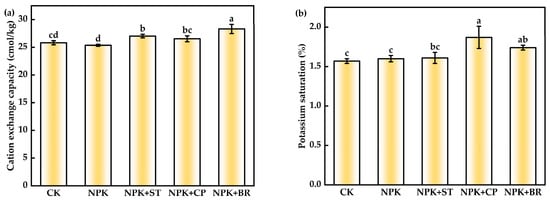
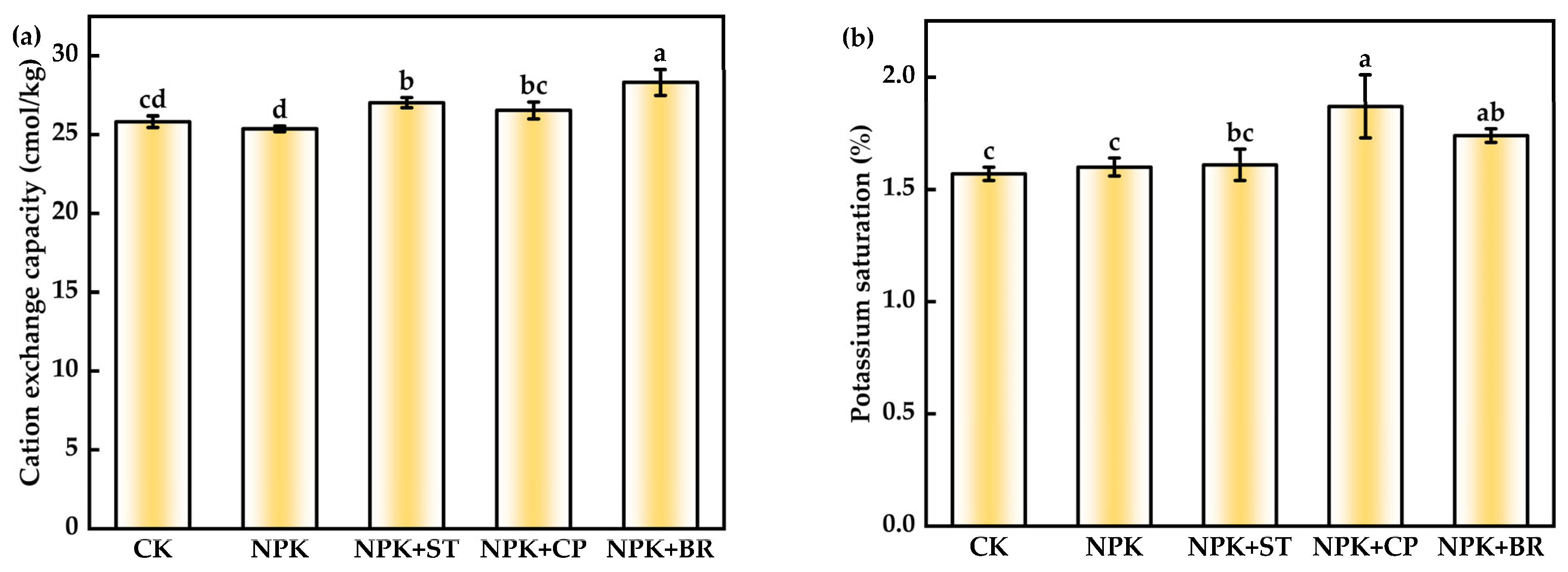
As shown in Figure 3a, after 10 years of long-term different fertilization treatments, the soil CEC ranged from 25.37 to 28.31 cmol/kg. The NPK treatment had the lowest soil CEC, while the treatments with additional straw-derived organic amendments better maintained soil CEC at higher levels, among which the NPK+BR treatment had the highest soil CEC. The soil K saturation ranged from 1.57% to 1.87% (Figure 3b). Relative to CK treatment, NPK failed to significantly increase the soil K saturation; however, the additional application of straw-derived organic amendments better maintained it at higher levels. Compared to the CK treatment, the NPK+ST, NPK+CP, and NPK+BR treatments, respectively, increased the soil K saturation by 2.55%, 19.11%, and 10.83%. Among them, NPK+CP achieved the best soil K saturation.
Figure 3.
Effects of chemical fertilizer combined with different maize straw-derived organic amendments on soil cation exchange parameters. (a) Cation exchange capacity (cmol/kg); (b) Potassium saturation (%). Values are means ± SE (n = 3). Different lowercase letters indicate significant differences among treatments at p < 0.05. CK, no fertilizer; NPK, chemical fertilizer alone; NPK+ST, NPK plus maize straw; NPK+CP, NPK plus straw compost; NPK+BR, NPK plus straw biochar.
3.3. Soil Potassium Fixation Characteristics
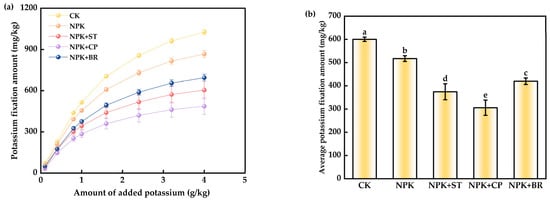
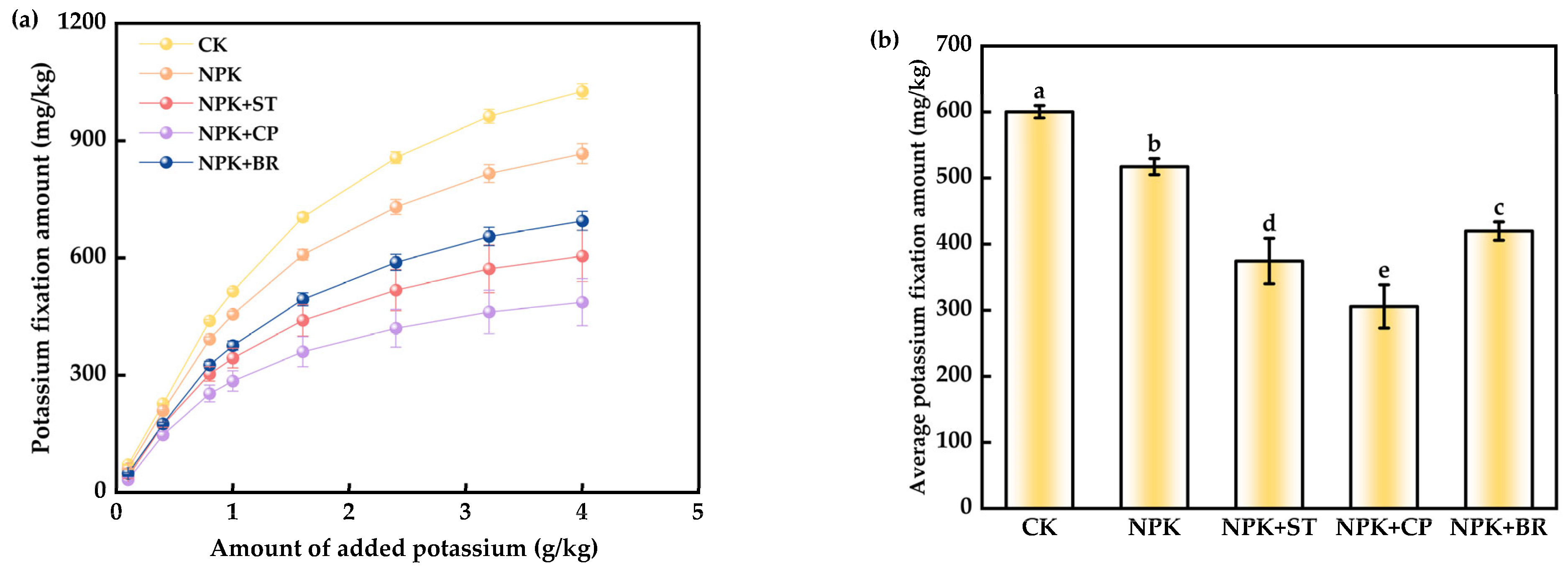
This study then examined the association between the addition of exogenous K and the K fixation amount in soils under different treatments (Figure 4a). In all treatments, the K fixation amount rose as exogenous K was increasingly added within the range of 0.1 to 4.0 g/kg. At most levels of exogenous K addition, the treatments could be roughly ranked according to the amount of potassium fixation as follows: CK > NPK > NPK+BR > NPK+ST > NPK+CP. The same trend was observed for the average amount of K fixation across all levels of exogenous K addition (Figure 4b). The average amount of potassium fixation under CK was the highest, at 600.25 mg/kg. The NPK treatment significantly decreased the average soil K fixation amount (p < 0.05). Meanwhile, the utilization of straw-derived organic amendments further remarkably decreased the average soil K fixation amount. Relative to the NPK, NPK+ST, NPK+CP, and NPK+BR significantly reduced the average amount of soil K fixation by 27.62%, 40.89%, and 18.85%, respectively (p < 0.05).
Figure 4.
Effects of chemical fertilizer combined with different maize straw-derived organic amendments on soil potassium fixation amount and average potassium fixation amount. (a) Potassium fixation amount (mg/kg) vs. amount of added potassium (g/kg); (b) Average potassium fixation amount (mg/kg). Values are means ± SE (n = 3). Different lowercase letters indicate significant differences among treatments at p < 0.05. CK, no fertilizer; NPK, chemical fertilizer alone; NPK+ST, NPK plus maize straw; NPK+CP, NPK plus straw compost; NPK+BR, NPK plus straw biochar.
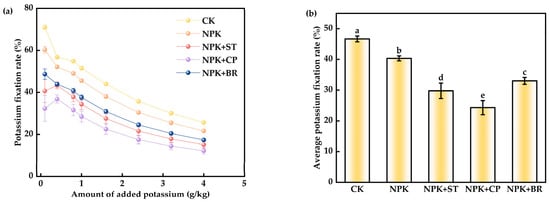
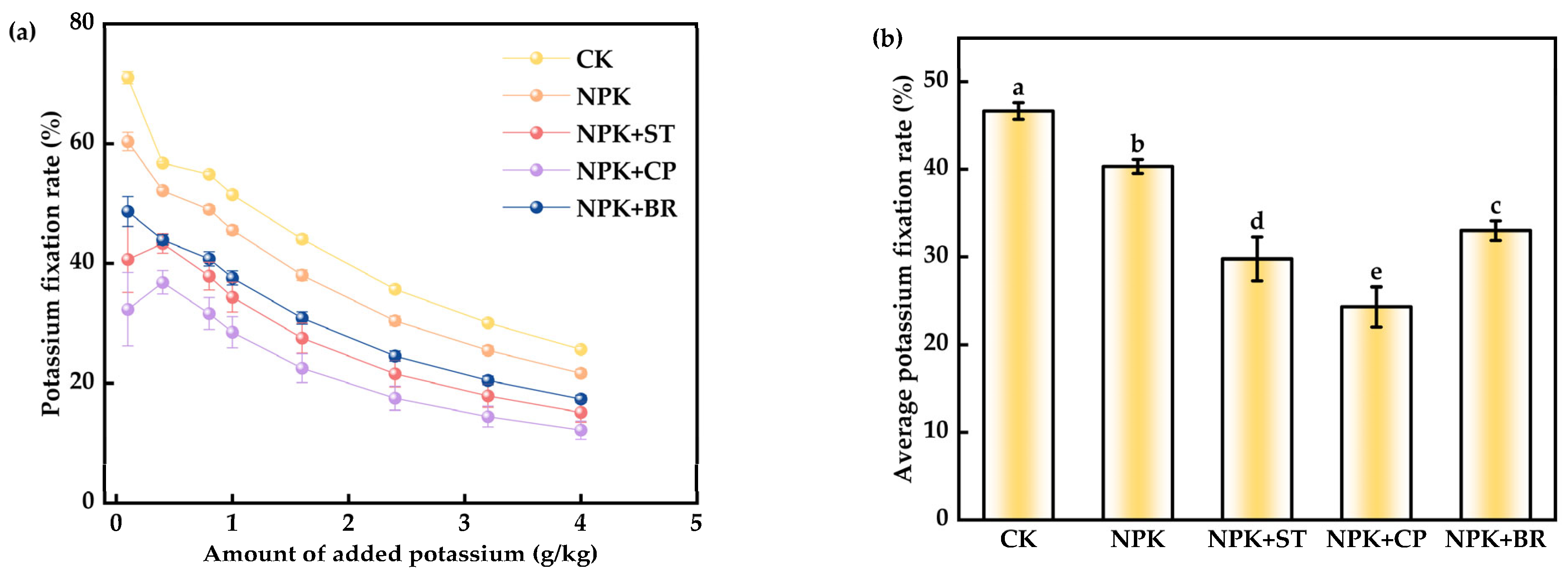
As shown in Figure 5a, the K fixation rates under different treatments showed a consistent trend: the rate of K fixation declined with increasing exogenous K addition. At most levels of exogenous K addition, the treatments could be roughly ranked according to the K fixation rate as follows: CK > NPK > NPK+BR > NPK+ST > NPK+CP. The same trend was observed for the average K fixation rate across all levels of exogenous K addition (Figure 5b). The average K fixation rate under CK was the highest, at 46.66%. The NPK treatment significantly decreased the average K fixation rate (p < 0.05). Meanwhile, the addition of straw-derived organic amendments further significantly decreased the average soil K fixation rate. Relative to the NPK, NPK+ST, NPK+CP, and NPK+BR significantly reduced the average soil K fixation rate by 26.15%, 39.75%, and 18.15%, respectively (p < 0.05).
Figure 5.
Effects of chemical fertilizer combined with different maize straw-derived organic amendments on soil potassium fixation rate and average potassium fixation rate. (a) Potassium fixation rate (%) vs. amount of added potassium (g/kg); (b) Average potassium fixation rate (%). Values are means ± SE (n = 3). Different lowercase letters indicate significant differences among treatments at p < 0.05. CK, no fertilizer; NPK, chemical fertilizer alone; NPK+ST, NPK plus maize straw; NPK+CP, NPK plus straw compost; NPK+BR, NPK plus straw biochar.
As shown in Table 5, the quadratic regression model was used to fit the relationship between the added exogenous K amount and K fixation amount. With R2 ranging from 0.9693 to 0.9932, the model exhibited excellent goodness-of-fit. The model allowed for the calculation of the maximum amount of K fixation (Qmax) in soils under the different treatments. The treatments could be roughly ranked according to Qmax as follows: CK > NPK > NPK+BR > NPK+ST > NPK+CP. This trend is the same as that for the K fixation amount and rate. The Qmax under the CK treatment was the highest, reaching 1009.04 mg/kg. The NPK treatment reduced the soil Qmax; compared with the CK treatment, the NPK treatment Qmax was reduced by 19.05%. Relative to NPK treatment, the integration of chemical fertilizer with straw-derived organic amendments reduced the soil Qmax by 16.26% to 40.95%, with the NPK+CP treatment leading to the largest decrease.
Table 5.
Quadratic regression models of soil potassium fixation and the calculated maximum amounts of potassium fixation under different fertilization treatments.
3.4. Soil Non-Exchangeable Potassium Release Kinetics
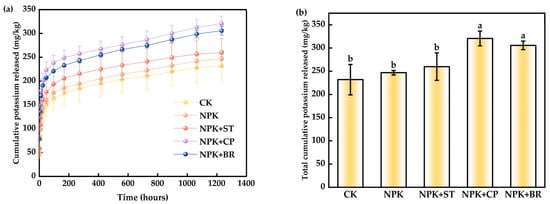
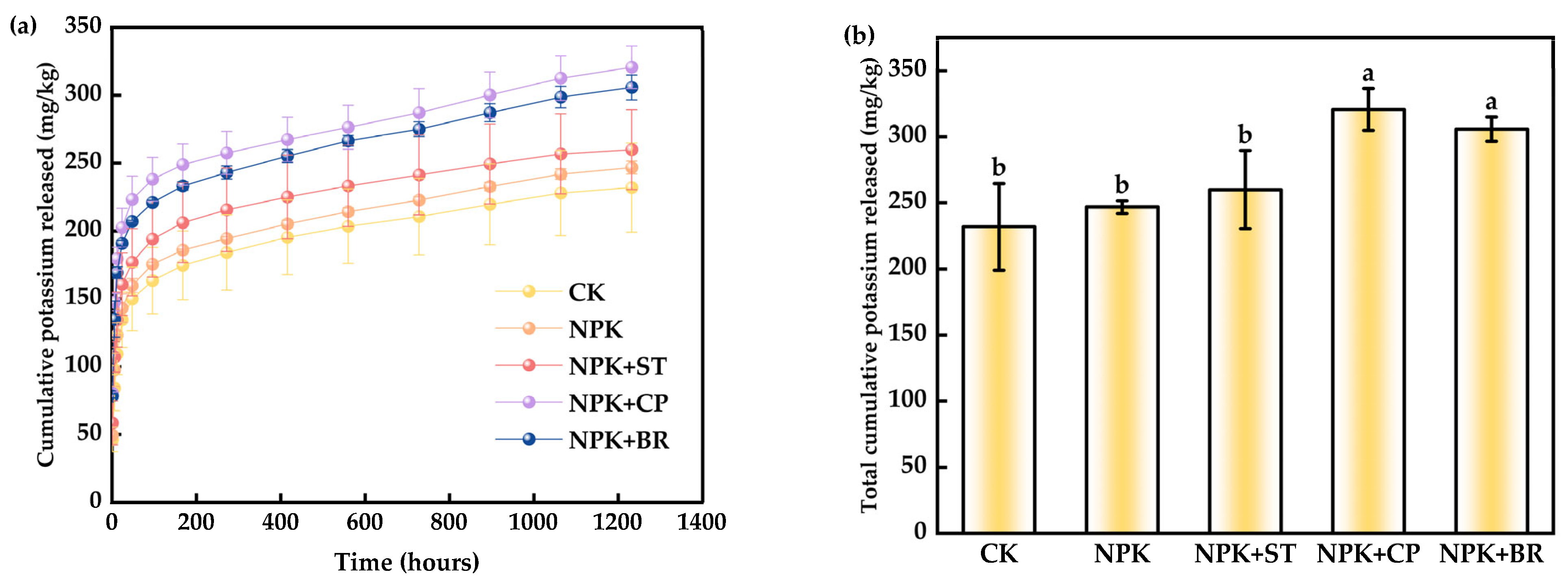
As shown in Figure 6a, under all the experimental conditions, soil NEK release exhibited a biphasic pattern: an initial rapid-release stage spanning 1–168 h, followed by a subsequent slow and steady release phase extending from 168 to 1232 h. The total cumulative NEK release from soils under the different treatments ranged from 231.90 to 320.60 mg/kg, with significant differences among them (Figure 6b). The total cumulative NEK released showed small differences among the CK, NPK, and NPK+ST treatments. Relative to CK treatment, NPK+CP and NPK+BR significantly increased the total cumulative NEK released by 38.25% and 31.82%, respectively (p < 0.05). This suggests that the supplementary application of straw compost as well as straw biochar is more conducive to the release of NEK in the soil.
Figure 6.
Cumulative release kinetics (a) and total cumulative release (b) of soil non-exchangeable potassium under different fertilization treatments. Values are means ± SE (n = 3). Different lowercase letters indicate significant differences among treatments at p < 0.05. CK, no fertilizer; NPK, chemical fertilizer alone; NPK+ST, NPK plus maize straw; NPK+CP, NPK plus straw compost; NPK+BR, NPK plus straw biochar.
Different kinetic models were hereby utilized to characterize the soil NEK’s release process (Table 6). The average coefficients of determination (R2) for the fitting of the six kinetic models were ordered as follows: the simplified Elovich model (0.9883) > power function model (0.9603) > first-order kinetics model (0.8385) > parabolic diffusion model (0.8325) > zero-order kinetics model (0.6670) > exponential model (0.5911). The simplified Elovich model had the smallest standard error (SE); thus, it served as the optimal model for characterizing the NEK release process in black soil under different treatments.
Table 6.
Goodness-of-fit indices for six kinetic models describing soil non-exchangeable potassium release under different fertilization treatments.
The soil NEK release processes under different treatments were fitted using the simplified Elovich model (Table 7). The constant b represents the apparent release rate coefficient, with a range of 25.52–30.46. The treatments were ranked according to the constant b values as follows: NPK+CP > NPK+BR > NPK+ST > NPK > CK.
Table 7.
Parameter of the simplified Elovich model for soil non-exchangeable potassium release under different fertilization treatments.
4. Discussion
Herein, no significant differences in the contents of soil WSK, EK, or NEK were identified between the NPK and CK regimes. The lack of significant differences in soil available K pools between CK and NPK was attributed to lower crop yield and K removal under CK [34]. However, the combined application of chemical fertilizer and straw-derived amendments significantly increased all soil K pools compared to CK. The promoting effect of organic amendments on soil K pools may be attributed to two mechanisms: (i) direct K input and modulation of K pools equilibria [35,36], and (ii) improved soil physicochemical properties that favor microbial communities (e.g., K-solubilizing bacteria) involved in K cycling [15,16,17].
Straw-derived organic amendments supplied substantial organic colloids, which elevated soil CEC in the combined treatments. Generally, K saturation is important because a higher K saturation of the exchange complex minimizes exogenous K adsorption in the solid phase and may promote K release into the soil solution. This parameter should not be ignored when comprehensively assessing soil K dynamics during long-term cropping [12]. The present study found that the lowest K saturation in the CK treatment resulted from long-term insufficient K input, which led to K depletion at soil exchange sites. The integration of chemical fertilizer with straw-derived organic amendments better maintained soil K saturation at a high level, and this finding well aligns with that previously reported [37].
This study found that the soil K fixation amount in black soil rose as more exogenous K was introduced, whereas the K fixation rate showed a decreasing trend. This aligns well with the result reported by Li et al. [38]. However, some studies have found that increasing exogenous K addition did not remarkably affect the soil K fixation rate [39]. Zhang et al. [30] reported significantly greater K fixation capacity in black soil than in purple, gray desert, and fluvo-aquic soils. This was mainly because soil K fixation capacity is closely related to the type and physicochemical properties of clay minerals. The clay minerals of black soil are dominated by expansive 2:1-type minerals, including montmorillonite and vermiculite [40], and such minerals’ K fixation capacity is significantly stronger than that of 1:1-type ones like kaolinite. This serves as the core internal reason that black soil has a higher K fixation capacity than other soil types. Extensive research has confirmed that applying K fertilizer or organic materials in the long term can effectively reduce the soil K fixation capacity [21]. Similar results were obtained in the present study: the different fertilization treatments were ranked according to the Qmax of the black soil as follows: CK > NPK > NPK+BR > NPK+ST > NPK+CP. The highest Qmax in the CK treatment reflects progressive K depletion under a decade of unfertilized maize monoculture, which generated abundant vacant high-energy adsorption sites on soil minerals and consequently enhanced K fixation [21].
Soil NEK release followed a biphasic pattern: an initial rapid phase (1–168 h) followed by a slow, steady phase (168–1232 h). This release pattern is highly consistent with that in previous related studies [41,42]. The high initial release rate was driven by rapid K+–Ca2+ exchange on clay mineral surfaces. After K+ at these exchange sites was depleted, further exchange between K+ and Ca2+ slowed down significantly. This was because the ionic radius of hydrated Ca2+ is larger than that of hydrated K+, making it difficult for it to enter the interlayer spaces of clay minerals in order to complete ion exchange [43]. Six kinetic models were used to fit NEK release kinetics under different treatments. Findings revealed that the simplified Elovich model provided optimal fitting performance, indicating a diffusion-controlled process [44]. Das et al. [37] and Jalali et al. [45] also used the simplified Elovich model to describe K release from Inceptisols, Vertisols, and calcareous soils, supporting its broad applicability for soil K release kinetics. The present study found that total NEK release and apparent release rate coefficients in black soil varied significantly across treatments, ranking as: NPK+CP > NPK+BR > NPK+ST > NPK > CK. Numerous studies have confirmed [18,19] that soils amended with organic materials exhibit higher potassium release-related parameters at all stages of K extraction. Long-term combined application of chemical fertilizer and organic amendments sustained high soil NEK content. Additionally, integrating chemical fertilizer with organic materials could effectively optimize soil physicochemical characteristics, foster a beneficial growth and metabolic environment for soil microbial communities [46], and further promote soil NEK release by regulating soil microecological processes and mineral weathering [47].
This study applied equal carbon inputs across treatments to exclude carbon quantity effects, thereby distinguishing the specific impacts of amendment type and properties on soil K pools and dynamics. Among organic amendment treatments, the NPK+CP treatment was significantly superior in increasing the contents of various K pools and K saturation, as well as in promoting NEK release in black soil. The reasons were mainly twofold: First, the straw compost had undergone partial decomposition, with a low carbon-to-potassium ratio and abundant available K nutrients (Table 2), which could directly supplement K to the soil and thus significantly increase various K pool contents and K saturation in the black soil. Second, the straw compost contained high concentrations of organic acids, which could effectively activate soil mineral K through solubilization and chelation, further enhancing the effective K supply capacity of the soil [48,49]. In addition, the NPK+CP treatment had the lowest soil K fixation capacity, and exogenous K fertilizer could more easily meet the soil K fixation demand under this treatment, thereby exerting a yield-increasing effect [20,21]. Therefore, chemical fertilizer combined with straw compost was the optimal strategy for improving soil K availability under the present experimental conditions.
5. Conclusions
This study demonstrated that co-applying chemical fertilizer with straw-derived amendments significantly enhanced soil K pools and fertility compared with the CK and NPK treatments. This integrated approach reduced soil K fixation capacity, thereby enabling exogenous K fertilizer to more readily satisfy soil K fixation demand and strengthening the yield response to K fertilization. Additionally, it enhanced the release capacity of soil NEK, facilitating the medium- and long-term K supply required for crop growth. Under the present experimental conditions, the combined application of chemical fertilizer with straw compost represents the optimal strategy for improving K supply capacity in black soil. We recommend that agricultural managers make rational use of crop residues following harvest. In conclusion, these findings provide evidence-based guidance for sustainable soil K management and the efficient utilization of maize straw resources in Northeast China’s black soil region.
Author Contributions
Z.Z. and C.W. jointly designed the study; Y.Z., S.F., H.Z., F.G., J.G., N.X., Y.X., J.Z. and W.Z. conducted the study; Y.Z. and Z.Z. wrote the manuscript; Z.Z. and C.W. provided comments. All authors have read and agreed to the published version of the manuscript.
Funding
This work was supported by the Department of Agriculture and Rural Affairs of Jilin Province (Project No. JLARS-2026-010209) and the International Cooperation Project of Science and Technology Department of Jilin Province, China (Project No. 20220402061GH).
Institutional Review Board Statement
Not applicable.
Informed Consent Statement
Not applicable.
Data Availability Statement
The data presented in this study are available upon request from the corresponding authors. The data are not publicly available due to laboratory regulations.
Conflicts of Interest
The authors declare no conflicts of interest.
Abbreviations
The following abbreviations are used in this manuscript:
| CK | Control (no fertilizer) |
| NPK | Chmical fertilizer alone |
| ST | Maize straw |
| CP | Straw compost |
| BR | Straw biochar |
| K | Potassium |
| WSK | Water-soluble potassium |
| EK | Exchangeable potassium |
| NEK | Non-exchangeable potassium |
| TK | Total potassium |
| CEC | Cation exchange capacity |
| Kt | Cumulative non-exchangeable potassium release at time t |
| Kmax | Total cumulative non-exchangeable potassium release |
| a | Kinetic model constant |
| b | The apparent release rate coefficient |
| Qmax | Maximum amount of potassium fixation |
| y | Potassium fixation amount in quadratic regression model |
| x | Amount of added exogenous potassium in quadratic regression model |
| R2 | Coefficient of determination |
| SE | Standard error |
Appendix A
Table A1.
The results of assumption testing and the non-parametric test of selected soil traits.
References
- Lu, E.; Li, C.; Geng, Y.; Liang, T.; Zhang, J. Effects of Long-Term Fertilization on Phosphorus Form and Availability in Black Soil. Appl. Sci. 2024, 14, 11673. [Google Scholar] [CrossRef] [Scilit]
- Zhang, H.; Xu, M.; Zhu, P.; Peng, C. Effect of 15-Year-Long Fertilization on Potassium Quantity/Intensity Relationships in Black Soil in Northeastern China. Commun. Soil Sci. Plant Anal. 2011, 42, 1289–1297. [Google Scholar] [CrossRef] [Scilit]
- Sheldrick, W.F.; Syers, J.K.; Lingard, J. Soil Nutrient Audits for China to Estimate Nutrient Balances and Output/Input Relationships. Agric. Ecosyst. Environ. 2003, 94, 341–354. [Google Scholar] [CrossRef] [Scilit]
- Wang, X.; Hoogmoed, W.B.; Cai, D.; Perdok, U.D.; Oenema, O. Crop Residue, Manure and Fertilizer in Dryland Maize under Reduced Tillage in Northern China: II Nutrient Balances and Soil Fertility. Nutr. Cycl. Agroecosyst. 2007, 79, 17–34. [Google Scholar] [CrossRef] [Scilit]
- Jin, S.H.; Huang, J.Q.; Li, X.Q.; Zheng, B.S.; Wu, J.S.; Wang, Z.J.; Liu, G.H.; Chen, M. Effects of Potassium Supply on Limitations of Photosynthesis by Mesophyll Diffusion Conductance in Carya Cathayensis. Tree Physiol. 2011, 31, 1142–1151. [Google Scholar] [CrossRef] [Scilit]
- Ning, P.; Li, S.; Yu, P.; Zhang, Y.; Li, C. Post-Silking Accumulation and Partitioning of Dry Matter, Nitrogen, Phosphorus and Potassium in Maize Varieties Differing in Leaf Longevity. Field Crops Res. 2013, 144, 19–27. [Google Scholar] [CrossRef] [Scilit]
- Wang, M.; Zheng, Q.; Shen, Q.; Guo, S. The Critical Role of Potassium in Plant Stress Response. Int. J. Mol. Sci. 2013, 14, 7370–7390. [Google Scholar] [CrossRef] [Scilit] [PubMed]
- Battie-Laclau, P.; Laclau, J.-P.; Beri, C.; Mietton, L.; Almeida Muniz, M.R.; Arenque, B.C.; Piccolo, M.d.C.; Jordan-Meille, L.; Bouillet, J.-P.; Nouvellon, Y. Photosynthetic and Anatomical Responses of Eucalyptus Grandis Leaves to Potassium and Sodium Supply in a Field Experiment. Plant Cell Environ. 2014, 37, 70–81. [Google Scholar] [CrossRef] [Scilit]
- Rani, K.; Datta, A.; Jat, H.S.; Choudhary, M.; Sharma, P.C.; Jat, M.L. Assessing the Availability of Potassium and Its Quantity-Intensity Relations under Long Term Conservation Agriculture Based Cereal Systems in North-West India. Soil Tillage Res. 2023, 228, 105644. [Google Scholar] [CrossRef] [Scilit]
- Das, D.; Nayak, A.K.; Thilagam, V.K.; Chatterjee, D.; Shahid, M.; Tripathi, R.; Mohanty, S.; Kumar, A.; Lal, B.; Gautam, P.; et al. Measuring Potassium Fractions Is Not Sufficient to Assess the Long-Term Impact of Fertilization and Manuring on Soil’s Potassium Supplying Capacity. J. Soils Sediments 2018, 18, 1806–1820. [Google Scholar] [CrossRef] [Scilit]
- Bilias, F.; Barbayiannis, N. Contribution of Non-Exchangeable Potassium on Its Quantity-Intensity Relationships under K-Depleted Soils. Arch. Agron. Soil Sci. 2018, 64, 1988–2004. [Google Scholar] [CrossRef] [Scilit]
- Islam, A.; Karim, A.J.M.S.; Solaiman, A.R.M.; Islam, M.S.; Abu Salequea, M. Eight-Year Long Potassium Fertilization Effects on Quantity/Intensity Relationship of Soil Potassium under Double Rice Cropping. Soil Tillage Res. 2017, 169, 99–117. [Google Scholar] [CrossRef] [Scilit]
- Golestanifard, A.; Santner, J.; Aryan, A.; Kaul, H.-P.; Wenzel, W.W. Potassium Fixation in Northern Iranian Paddy Soils. Geoderma 2020, 375, 114475. [Google Scholar] [CrossRef] [Scilit]
- Han, T.; Liu, K.; Huang, J.; Khan, M.N.; Shen, Z.; Li, J.; Zhang, H. Temporal and Spatial Characteristics of Paddy Soil Potassium in China and Its Response to Organic Amendments: A Systematic Analysis. Soil Tillage Res. 2024, 235, 105894. [Google Scholar] [CrossRef] [Scilit]
- Zhang, M.; Riaz, M.; Liu, B.; Xia, H.; El-desouki, Z.; Jiang, C. Two-Year Study of Biochar: Achieving Excellent Capability of Potassium Supply via Alter Clay Mineral Composition and Potassium-Dissolving Bacteria Activity. Sci. Total Environ. 2020, 717, 137286. [Google Scholar] [CrossRef] [Scilit] [PubMed]
- Xia, H.; Riaz, M.; Liu, B.; Li, Y.; El-Desouki, Z.; Jiang, C. Over Two Years Study: Peanut Biochar Promoted Potassium Availability by Mediating the Relationship between Bacterial Community and Soil Properties. Appl. Soil Ecol. 2022, 176, 104485. [Google Scholar] [CrossRef] [Scilit]
- Chen, Y.L.; Huang, L.; Cheng, L.J.; Liu, Z.J.; Xue, B. Straw Returning and Potassium Fertilization Affect Clay Mineralogy and Available Potassium. Nutr. Cycl. Agroecosyst. 2023, 126, 195–211. [Google Scholar] [CrossRef] [Scilit]
- Sanyal, D.; Brar, B.S.; Dheri, G.S. Organic and Inorganic Integrated Fertilization Improves Non-Exchangeable Potassium Release and Potassium Availability in Soil. Commun. Soil Sci. Plant Anal. 2019, 50, 2013–2022. [Google Scholar] [CrossRef] [Scilit]
- Jadhao, S.D.; Muley, P.; Mali, D.V.; Sonune, B.A.; Kharche, V.K.; Bhoyar, S.M.; Kadu, P.R.; Kanase, N.; Wanjari, R.H.; Joshi, T.; et al. Potassium Release Behaviour and Fixation Potential of Vertisol under Continuous Sorghum-Wheat Cropping Sequence. J. Soil Sci. Plant Nutr. 2024, 24, 5518–5533. [Google Scholar] [CrossRef] [Scilit]
- Cassman, K.G.; Bryant, D.C.; Roberts, B.A. Comparison of Soil Test Methods for Predicting Cotton Response to Soil and Fertilizer Potassium on Potassium Fixing Soils. Commun. Soil Sci. Plant Anal. 1990, 21, 1727–1743. [Google Scholar] [CrossRef] [Scilit]
- Tan, D.; Liu, Z.; Jiang, L.; Luo, J.; Li, J. Long-Term Potash Application and Wheat Straw Return Reduced Soil Potassium Fixation and Affected Crop Yields in North China. Nutr. Cycl. Agroecosyst. 2017, 108, 121–133. [Google Scholar] [CrossRef] [Scilit]
- Wang, X.; Yang, L.; Steinberger, Y.; Liu, Z.; Liao, S.; Xie, G. Field Crop Residue Estimate and Availability for Biofuel Production in China. Renew. Sust. Energy Rev. 2013, 27, 864–875. [Google Scholar] [CrossRef] [Scilit]
- Yuan, Y.; Zhang, C.; Liang, Y.; Yuan, J.; Liu, J.; Cai, H.; Zhang, J. Influence of Straw, Compost, and Biochar on Soil Carbon and Aggregates in Chernozem. Plant Soil Environ. 2025, 71, 148–160. [Google Scholar] [CrossRef] [Scilit]
- Li, B.; Zhang, J.; Chang, T.; Wu, Q.; Zheng, H.; Zhang, D. Corn Stover Biochar Amendment Enhances Nitrogen and Phosphorus Transformations, Microbial Community Diversity, and Enzyme Activities in Agricultural Soil. Plants 2025, 14, 2787. [Google Scholar] [CrossRef] [Scilit] [PubMed]
- Liang, Y.; Al-Kaisi, M.; Yuan, J.; Liu, J.; Zhang, H.; Wang, L.; Cai, H.; Ren, J. Effect of Chemical Fertilizer and Straw-Derived Organic Amendments on Continuous Maize Yield, Soil Carbon Sequestration and Soil Quality in a Chinese Mollisol. Agric. Ecosyst. Environ. 2021, 314, 107403. [Google Scholar] [CrossRef] [Scilit]
- Xiong, Z.; Zhu, D.; Lu, Y.; Lu, J.; Liao, Y.; Ren, T.; Li, X. Continuous Potassium Fertilization Combined with Straw Return Increased Soil Potassium Availability and Risk of Potassium Loss in Rice-Upland Rotation Systems. Chemosphere 2023, 344, 140390. [Google Scholar] [CrossRef] [Scilit]
- Kitsopoulos, K.P. Cation-Exchange Capacity (CEC) of Zeolitic Volcaniclastic Materials: Applicability of the Ammonium Acetate Saturation (AMAS) Method. Clays Clay Miner. 1999, 47, 688–696. [Google Scholar] [CrossRef] [Scilit]
- Panda, R.; Patra, S.K. Quantity-Intensity Relations of Potassium in Representative Coastal Soils of Eastern India. Geoderma 2018, 332, 198–206. [Google Scholar] [CrossRef] [Scilit]
- Tran, A.M. Potassium Fixation by Oxidized and Reduced Forms of Different Phyllosilicates. Master’s Thesis, Kansas State University, Manhattan, KS, USA, 2012. [Google Scholar]
- Zhang, H.; Xu, M.; Zhang, W.; He, X. Factors Affecting Potassium Fixation in Seven Soils under 15-Year Long-Term Fertilization. Chin. Sci. Bull. 2009, 54, 1773–1780. [Google Scholar] [CrossRef] [Scilit]
- Martin, H.W.; Sparks, D.L. Kinetics of Nonexchangeable Potassium Release from Two Coastal Plain Soils. Soil Sci. Soc. Am. J. 1983, 47, 883–887. [Google Scholar] [CrossRef] [Scilit]
- Jalali, M. Release Kinetics of Nonexchangeable Potassium in Calcareous Soils. Commun. Soil Sci. Plant Anal. 2005, 36, 1903–1917. [Google Scholar] [CrossRef] [Scilit]
- Havlin, J.L.; Westfall, D.G.; Olsen, S.R. Mathematical Models for Potassium Release Kinetics in Calcareous Soils. Soil Sci. Soc. Am. J. 1985, 49, 371–376. [Google Scholar] [CrossRef] [Scilit]
- Das, D.; Dwivedi, B.S.; Datta, S.P.; Datta, S.C.; Meena, M.C.; Agarwal, B.K.; Shahi, D.K.; Singh, M.; Chakraborty, D.; Jaggi, S. Potassium Supplying Capacity of a Red Soil from Eastern India after Forty-Two Years of Continuous Cropping and Fertilization. Geoderma 2019, 341, 76–92. [Google Scholar] [CrossRef] [Scilit]
- Xiu, L.; Gu, W.; Sun, Y.; Wu, D.; Wang, Y.; Zhang, H.; Zhang, W.; Chen, W. The Fate and Supply Capacity of Potassium in Biochar Used in Agriculture. Sci. Total Environ. 2023, 902, 165969. [Google Scholar] [CrossRef] [Scilit] [PubMed]
- Yin, H.; Zhao, W.; Li, T.; Cheng, X.; Liu, Q. Balancing Straw Returning and Chemical Fertilizers in China: Role of Straw Nutrient Resources. Renew. Sust. Energ. Rev. 2018, 81, 2695–2702. [Google Scholar] [CrossRef] [Scilit]
- Das, D.; Dwivedi, B.S.; Datta, S.P.; Datta, S.C.; Meena, M.C.; Dwivedi, A.K.; Singh, M.; Chakraborty, D.; Jaggi, S. Long-Term Differences in Nutrient Management under Intensive Cultivation Alter Potassium Supplying Ability of Soils. Geoderma 2021, 393, 114983. [Google Scholar] [CrossRef] [Scilit]
- Li, N.; Guo, C.; Wang, Y.; Gao, T.; Yang, J.; Han, X. Effects of Long-Term Fertilization on Potassium Fixation Capacity in Brown Soil. IOP Conf. Ser. Earth Environ. Sci. 2018, 108, 032036. [Google Scholar] [CrossRef] [Scilit]
- Liu, Y.J.; Laird, D.A.; Barak, P. Release and Fixation of Ammonium and Potassium under Long-Term Fertility Management. Soil Sci. Soc. Am. J. 1997, 61, 310–314. [Google Scholar] [CrossRef] [Scilit]
- Zhang, Z.; Luo, X.; Jiang, H.; Li, Q.; Shen, C.; Liu, H.; Zhou, Y.; Zhao, L.; Wang, J. Analysis of XRD Spectral Characteristics of Soil Clay Mineral in Two Typical Cultivated Soils. Spectrosc. Spectr. Anal. 2014, 34, 1963–1968. [Google Scholar] [CrossRef]
- Javan, M.; Abtahi, A.; Zareian, G.; Haghighatnia, H. Soil Mineralogy and Potassium Forms Distribution and Release in Some Salcareous Soils of the Darab Region, Iran. PLoS ONE 2025, 20, e0334155. [Google Scholar] [CrossRef] [Scilit]
- Najafi-Ghiri, M.; Jaberi, H.R. Effect of Soil Minerals on Potassium Release from Soil Fractions by Different Extractants. Arid. Land Res. Manag. 2013, 27, 111–127. [Google Scholar] [CrossRef] [Scilit]
- Jalali, M. Kinetics of Non-Exchangeable Potassium Release and Availability in Some Calcareous Soils of Western Iran. Geoderma 2006, 135, 63–71. [Google Scholar] [CrossRef] [Scilit]
- Jalali, M.; Zarabi, M. Kinetics of Nonexchangeable-Potassium Release and Plant Response in Some Calcareous Soils. J. Plant Nutr. Soil Sci. 2006, 169, 196–204. [Google Scholar] [CrossRef] [Scilit]
- Jalali, M. Spatial Variability in Potassium Release among Calcareous Soils of Western Iran. Geoderma 2007, 140, 42–51. [Google Scholar] [CrossRef] [Scilit]
- Walia, S.S.; Dhaliwal, S.S.; Gill, R.S.; Kaur, T.; Kaur, K.; Randhawa, M.K.; Obročník, O.; Bárek, V.; Brestic, M.; Gaber, A.; et al. Improvement of Soil Health and Nutrient Transformations under Balanced Fertilization with Integrated Nutrient Management in a Rice-Wheat System in Indo-Gangetic Plains—A 34-Year Research Outcomes. Heliyon 2024, 10, e25113. [Google Scholar] [CrossRef] [Scilit]
- Ribeiro, I.D.A.; Volpiano, C.G.; Vargas, L.K.; Granada, C.E.; Lisboa, B.B.; Passaglia, L.M.P. Use of Mineral Weathering Bacteria to Enhance Nutrient Availability in Crops: A Review. Front. Plant Sci. 2020, 11, 590774. [Google Scholar] [CrossRef] [Scilit]
- Simandi, P.; Takayanagi, M.; Inubushi, K. Changes in the pH of Two Different Composts Are Dependent on the Production of Organic Acids. Soil Sci. Plant Nutr. 2005, 51, 771–774. [Google Scholar] [CrossRef] [Scilit]
- Tu, S.-X.; Guo, Z.-F.; Sun, J.-H. Effect of Oxalic Acid on Potassium Release from Typical Chinese Soils and Minerals. Pedosphere 2007, 17, 457–466. [Google Scholar] [CrossRef] [Scilit]

Disclaimer/Publisher’s Note: The statements, opinions and data contained in all publications are solely those of the individual author(s) and contributor(s) and not of MDPI and/or the editor(s). MDPI and/or the editor(s) disclaim responsibility for any injury to people or property resulting from any ideas, methods, instructions or products referred to in the content. |
© 2026 by the authors. Licensee MDPI, Basel, Switzerland. This article is an open access article distributed under the terms and conditions of the Creative Commons Attribution (CC BY) license.