
Article

Research on Surface Damage Detection Model of Steel-Cord Conveyor Belt Based on YOLOv7

1
School of Mechanical Electronic and Information Engineering, China University of Mining and Technology (Beijing), Beijing 100083, China
2
National Center for Materials Service Safety, University of Science and Technology Beijing, Beijing 100083, China
3
China Coal International Engineering Design & Research Institute Co., Ltd., Beijing 100120, China
*
Author to whom correspondence should be addressed.
Appl. Sci. 2026, 16(10), 4617; https://doi.org/10.3390/app16104617
Submission received: 5 January 2026 / Revised: 23 January 2026 / Accepted: 29 January 2026 / Published: 8 May 2026

Abstract

Steel-cord conveyor belts are critical equipment in mining operations, and surface damage can easily lead to safety incidents. Therefore, achieving efficient and accurate damage detection is of significant importance. This study investigates a conveyor belt damage identification method based on the YOLOv7 object detection framework. First, a dedicated dataset of conveyor belt damage is constructed, annotated, and augmented using geometric and pixel-level transformations to support model training. To meet real-time detection requirements, the following two lightweight models are proposed on the basis of YOLOv7: GSConv-YOLOv7, which reconstructs the backbone network using GSConv to reduce parameter size and computational cost, and MobileViTv3-YOLOv7, which replaces the original backbone with MobileViTv3. Experimental results show that GSConv-YOLOv7 achieves an mAP of 84.6%, while reducing parameters and computation by 17.2% and 16.2%, respectively, and improving detection speed by 16FPSs. To further enhance accuracy, the MPDIoU loss function is adopted in place of CIoU, improving convergence and bounding box regression performance. Building upon this, an LSKNet attention mechanism is integrated, and most convolutional layers are replaced with RFAConv, resulting in the proposed YOLOv7-GPLF model. This model achieves an mAP of 88.1%, with parameter size and computational cost of 33.7 M and 94.5 G, respectively, and an inference speed of 54 FPSs. The model thus delivers significantly improved detection performance while remaining lightweight, enabling fast and accurate identification of conveyor belt damage.

1. Introduction

Belt conveyors are important equipment for coal transportation and are widely used in various mining enterprises such as coal mines, metal mines, and non-metal mines, playing an indispensable role in coal production [1]. During the use of steel-cord conveyor belts, there are often significant wear and scratches on their surfaces [2]. If effective preventive and maintenance measures are not taken in time, it is highly likely they will cause the steel-cord conveyor belt to break, which may also lead to a series of chain reactions such as the shutdown of mining equipment and production interruption, and ultimately may cause the entire mining production system to come to a standstill [3]. Therefore, the research on damage identification methods for steel-cord conveyor belts used in mines is of great significance for ensuring the safe operation of industrial equipment.
In recent years, deep learning has become a research focus for scholars worldwide due to its advantages in industrial inspection, including high speed, high accuracy, and non-contact sensing. Wu et al. [4] proposed a chronic wear diagnosis method for steel-cord conveyor belts based on AlexNet and GoogleNet. Wang et al. [5] achieved efficient detection of longitudinal tearing in conveyor belts by improving the YOLOv7 model with the introduction of the EIoU loss function, the SimAM attention module, and the SimSPPFCSPC spatial pyramid pooling structure. Miao et al. [6] presented a technique for detecting longitudinal cracks in steel-cord conveyor belts using acoustic signals, enabling crack-state identification by analyzing the sound waves generated during crack formation. Wang et al. [7] proposed a deep learning–based visual inspection approach, YOLOv4-BELT, which achieved high detection efficiency and accuracy through dedicated dataset construction, an improved CutMix preprocessing strategy, and an enhanced CSPDarknet53 backbone. Zeng et al. [8] developed a steel-cord conveyor belt damage detection method that integrates YOLOv5 with a skeleton-based algorithm. By constructing a dataset of damage images, applying an improved CutMix for data augmentation, and leveraging the CSPDarknet53 network for feature extraction, their approach achieved efficient recognition and localization of belt damage. However, due to the harsh environmental conditions in underground coal mines, these techniques remain in a developmental stage for mining applications and have not yet been deployed at scale. This study aims to refine existing methods to improve detection performance and promote the development of steel-cord conveyor belt damage detection technologies suitable for mining environments.
To address current limitations, this paper proposes an improved method. First, an image dataset of damage on mining steel-cord conveyor belts is constructed from the collected images. Then, the deep learning network is enhanced as follows: GSConv and MobileViTv3 are used to reduce the backbone complexity and reduce model complexity; the WIoU and MPDIoU loss functions are introduced to replace the original CIoU loss, enabling algorithmic optimization of model parameters and reducing the loss value; and the LSKNet and RFAConv attention mechanisms are embedded into the network architecture to strengthen the model’s focus on key features in damaged regions during feature extraction. These improvements collectively enhance detection speed and accuracy, thereby increasing the model’s predictive capability.

2. Image Acquisition and Processing for Conveyor Belts

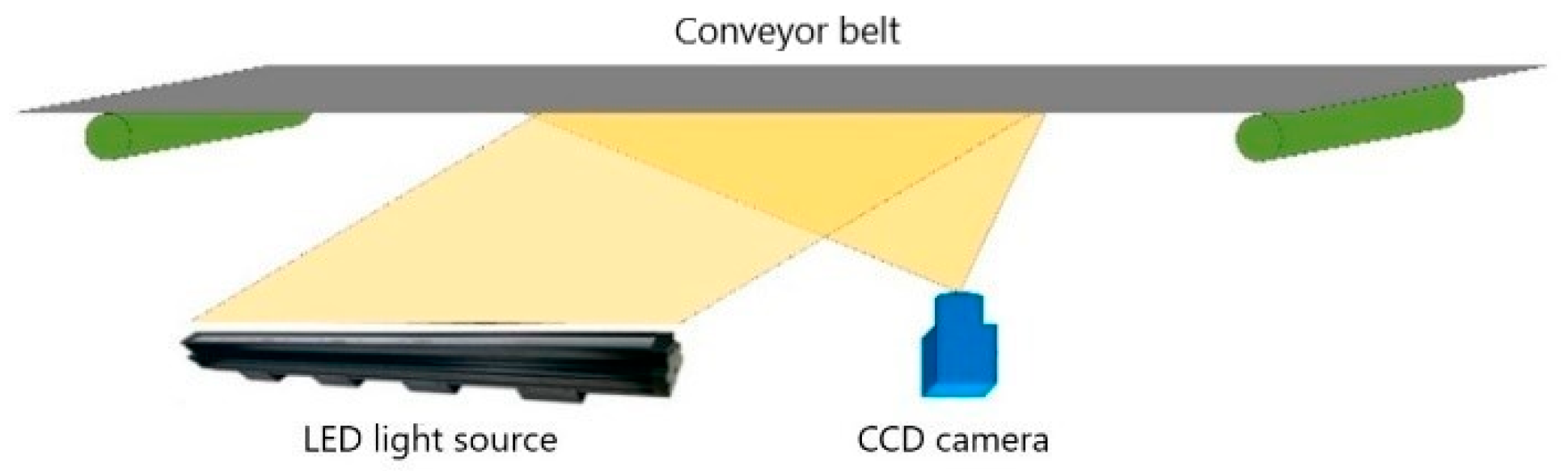
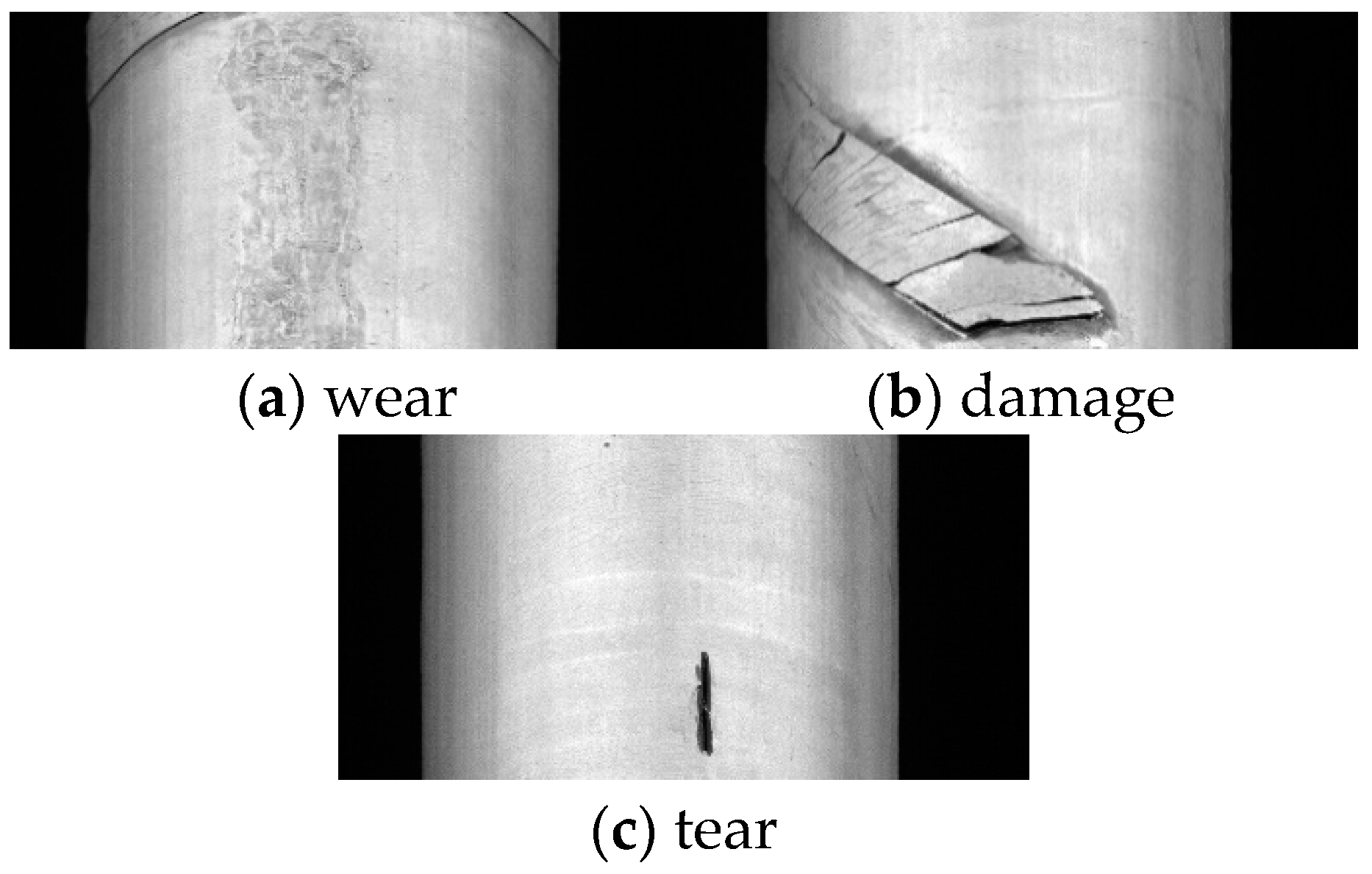
The image acquisition system for detecting damage on mining steel-cord conveyor belts primarily consists of multiple industrial cameras, lenses, light sources, and mounting brackets. High-resolution industrial cameras paired with suitable lenses are used to capture high-quality images, while an array of LED light sources installed beneath the conveyor belt ensures uniform illumination. The CCD industrial cameras [9], equipped with high-pixel sensors, can capture subtle surface defects—such as fine cracks, abrasion marks, and localized breaks—thus providing richer detailed information for subsequent image analysis and damage identification. This significantly enhances the accuracy and reliability of the detection process. Sample images of the captured damage are shown Figure 1 and Figure 2.
To facilitate subsequent training of the damage detection model, a dataset of mining steel-cord conveyor belt damage images was constructed. First, images of different damage types were annotated using the LabelImg tool. The dataset was then divided into training, validation, and test subsets. Data augmentation was subsequently applied to the damage image samples as follows: a series of transformations were performed on the original images to increase the number of samples and enhance the model’s generalization capability. Deep learning models typically rely on large amounts of data to learn and generalize accurately. When the number of training samples is limited, the model is prone to overfitting—performing well on the training dataset but exhibiting significantly reduced predictive performance on unseen test data—thus constraining the model’s practical effectiveness and applicability [10]. A comparison of sample counts before and after augmentation is shown Table 1.
After dividing the dataset, data augmentation is applied only to the training set, while the validation and test sets are left unaugmented. This ensures that the model does not encounter any information from the test set during training, allowing for a more accurate assessment of the model’s generalization capability.

3. Lightweight Design of Damage Detection Models

3.1. Lightweight Design of YOLOv7 Network Based on GSConv

In the field of damage detection for mining steel-cord conveyor belts, depthwise separable convolution layers are widely employed to achieve model lightweighting by reducing parameter count and computational cost. However, while this approach decreases model complexity, it often leads to a decline in detection accuracy. In practical engineering applications, conveyor belt damage detection requires both high detection speed and high accuracy. Integrating GSConv into the YOLOv7 network enables simplification of the model while maintaining a relatively high detection precision.
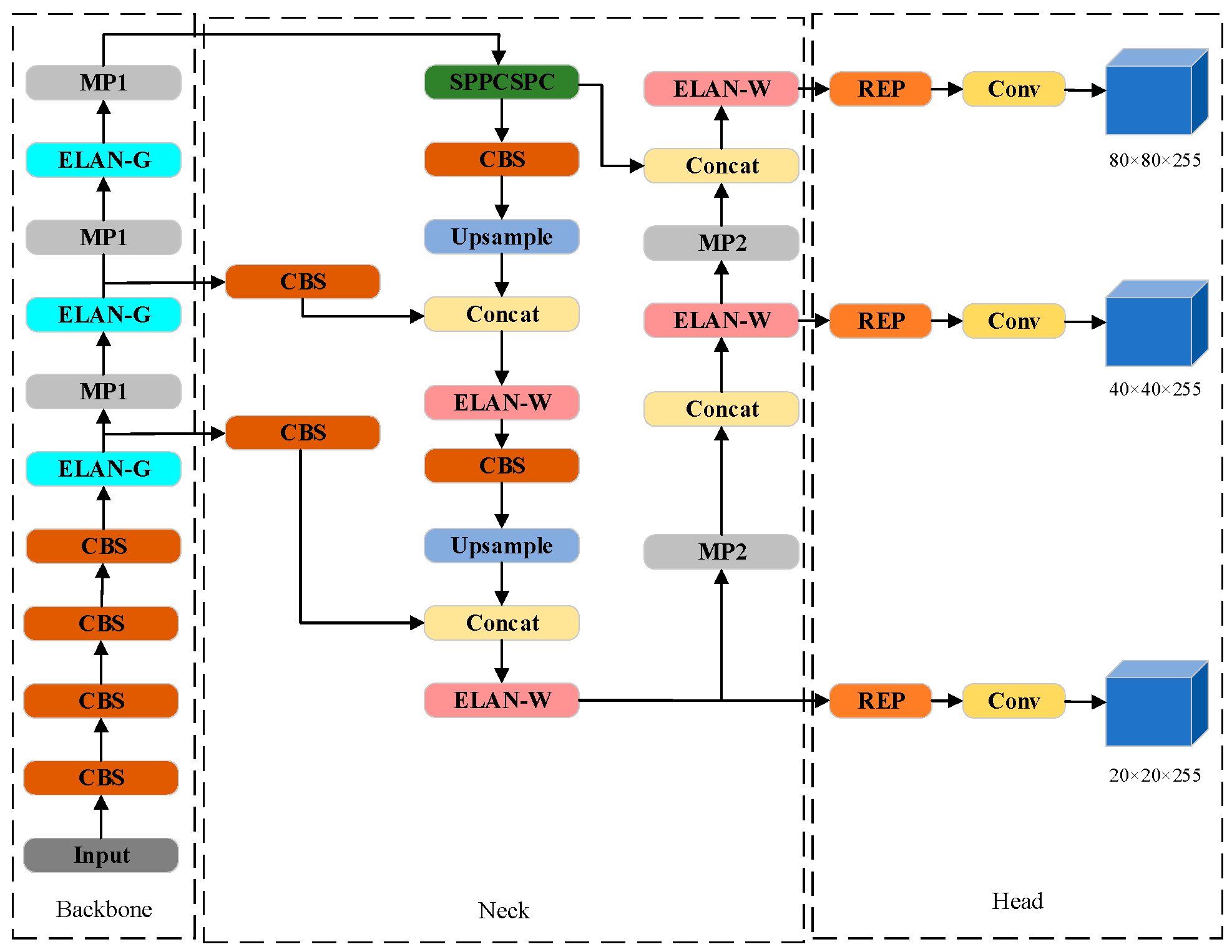
Applying GSConv modules at every stage of the network can enhance performance but also increase network depth, which can obstruct data flow in deeper layers, substantially prolong inference time, and elevate both parameter count and computational cost. To address this, in this study, the GSConv convolution module is incorporated only into the ELAN portion of the YOLOv7 backbone. Specifically, GSConv replaces the four standard convolutions in the first branch of the ELAN structure, forming the ELAN-G module, thereby reducing the model’s parameters and computational requirements and achieving a lightweight design. By introducing the GSConv module into the ELAN module of the YOLOv7 backbone, the improved GSConv-YOLOv7 structure is constructed, as illustrated in Figure 3. This design achieves a better balance between detection speed and accuracy, significantly mitigating false negatives and false positives in the detection task.

3.2. Feature Extraction Network Design for YOLOv7 Based on MobileViT

Damage detection of mining steel-cord conveyor belts via video monitoring must be completed within a very short time to enable timely decision-making and response. In this study, the YOLOv7 model is made lightweight to improve inference speed and achieve faster damage detection, meeting real-time requirements. The MobileViTv3 architecture is integrated into the YOLOv7 framework to construct a hybrid feature extraction mechanism combining convolutional neural networks (CNNs) and transformer-based structures.
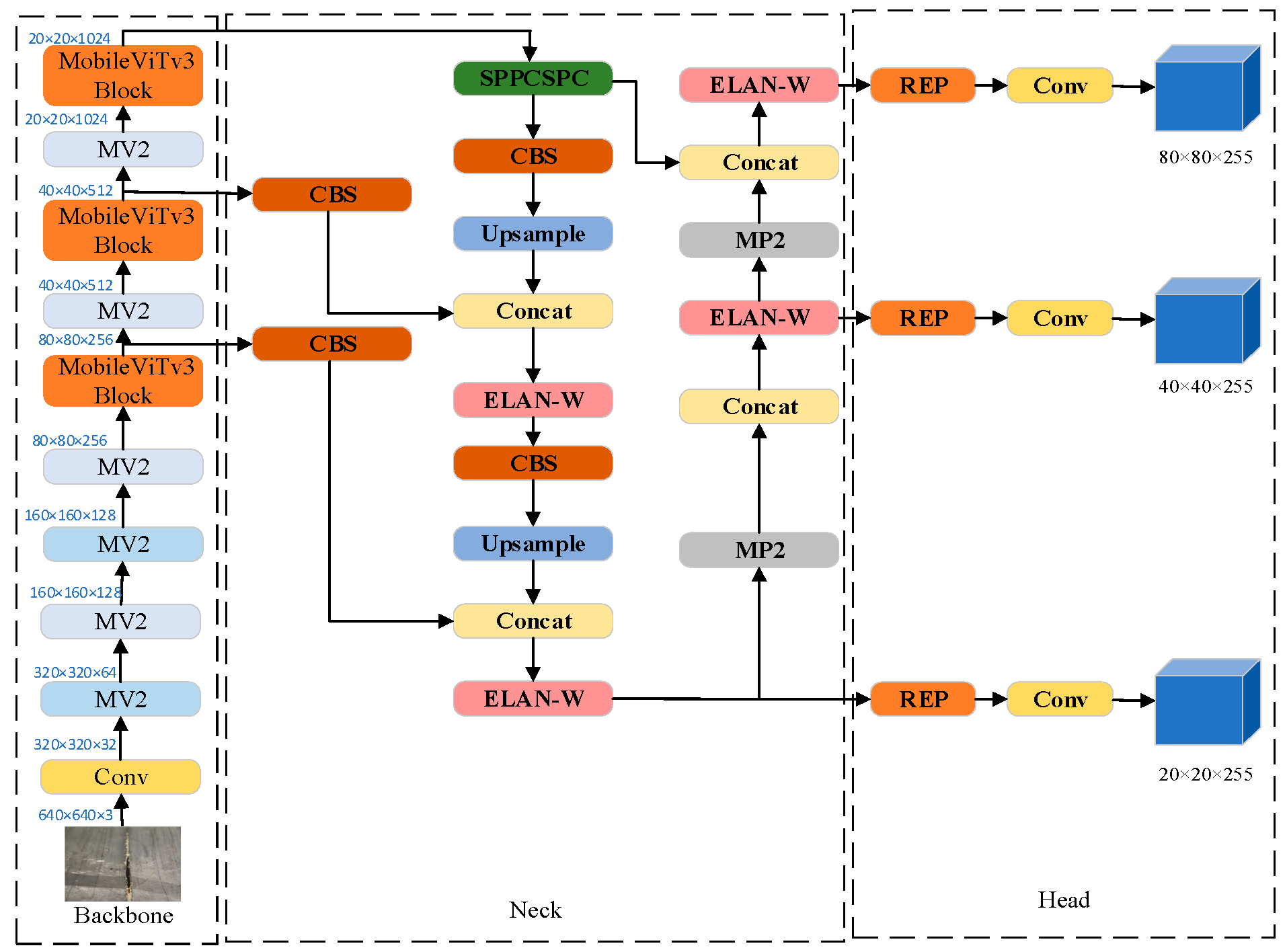
The MobileViTv3 architecture is selected as the feature extraction backbone to replace the core backbone of YOLOv7, as illustrated in Figure 4. In YOLOv7, the interaction between the feature extraction module and the enhanced feature extraction module employs a multi-scale feature propagation mechanism, specifically utilizing feature maps of dimensions 20 × 20, 40 × 40, and 80 × 80 for information exchange. The convolution operations on these feature maps account for a substantial portion of the model’s computational resources.
By replacing YOLOv7’s backbone with the lightweight MobileViTv3 feature extraction network, the model leverages MobileViTv3’s lower-level network to capture global image features, including long-range dependencies and contextual information. This provides richer contextual representation and enhances the model’s feature extraction capability in complex environments. The feature pyramid structure originally built in YOLOv7 is retained to integrate multi-scale features, followed by regression and classification tasks for damage detection.

3.3. Comparative Analysis of Experimental Results for Lightweight Models

The experiments in this chapter are conducted based on the YOLOv7 framework. The evaluation of the lightweight models is performed using metrics including precision (P), recall (R), average precision (AP), F1-score, mean average precision (mAP), as well as computational efficiency indicators such as giga floating-point operations (GFLOPs) and frames per second (FPSs).
To validate the effectiveness of the two proposed lightweight strategies, their impact on the target detection accuracy and processing speed of YOLOv7 is evaluated. YOLOv7 is used as the baseline model, while the two lightweight models are abbreviated as YOLOv7-GS and YOLOv7-MV, respectively. The constructed dataset is used to train all three models under the same training parameters. The performance results are summarized in Table 2.
Compared with the original algorithm, the YOLOv7-GS model achieves a 1.2% increase in mean average precision (mAP) while reducing model parameters and floating-point operations by 17.2% and 16.2%, respectively, and increasing detection speed by 16FPSs. The YOLOv7-MV model reduces parameters and floating-point operations by 27.1% and 26.6%, respectively, and improves detection speed by 22 FPSs compared with the YOLOv7 network. Although YOLOv7-MV has fewer parameters and a lower model complexity than YOLOv7-GS, and achieves the highest detection speed, its detection accuracy decreases by 0.4% relative to the original algorithm.
While the detection speed of YOLOv7-GS is slightly lower than that of YOLOv7-MV, it outperforms YOLOv7-MV in accuracy by 1.6% and still meets real-time detection requirements. Therefore, considering a comprehensive evaluation of accuracy, model size, and detection speed on the dataset constructed in this study, the YOLOv7-GS model demonstrates a superior lightweighting effect.
Table 3 presents the average precision (AP) of each algorithm for different damage types. As shown, the detection accuracy for tearing and damage is higher, indicating better performance compared with abrasion. Based on a comprehensive analysis of the data, the YOLOv7-GS model demonstrates outstanding performance across all types of damage, particularly improving detection accuracy for abrasion, which generally exhibits lower precision. Moreover, this model achieves a balanced detection performance across different damage types, effectively handling diverse damage scenarios.

4. Improved YOLOv7 Damage Detection Model

4.1. Study on Optimization of Bounding Box Loss Functions

YOLOv7 employs the CIoU (complete intersection over union) loss function as its bounding box regression loss [11]. The CIoU loss addresses the shortcomings of traditional IoU by considering the overlap area, the distance between bounding box centers, and aspect ratio similarity in object detection tasks. However, the CIoU loss involves complex computations and can degrade model performance when the dataset contains a large number of low-quality samples, as it overemphasizes regression on these samples.
To address these limitations, this study introduces the weighted IoU (WIoU) bounding box loss and the minimum point distance IoU (MPDIoU) regression loss. By replacing the original CIoU loss in YOLOv7 with WIoU and MPDIoU, three models employing different loss functions are established and comparatively analyzed. This approach mitigates the negative impact of low-quality images on detection performance and addresses the regression challenges associated with YOLOv7’s transition to anchor-free methods.
(1)
WIoU Bounding Box Loss Function
The WIoU (Weighted Intersection over Union) loss function [12] employs a dynamic non-monotonic focusing strategy, replacing IoU with an outlier-based metric to evaluate anchor quality. It also introduces an intelligent gradient enhancement allocation method, which effectively alleviates competition among high-quality anchors and significantly suppresses the adverse gradient effects caused by low-quality samples. By prioritizing anchors of average quality, WIoU enhances the overall performance of the algorithm.
(2)
MPDIoU Bounding Box Loss Function
The MPDIoU (minimum point distance IoU) regression loss [13] improves bounding box localization accuracy by precisely measuring the similarity between predicted and ground-truth boxes, thereby enhancing positional stability in object detection and instance segmentation tasks. MPDIoU evaluates multi-dimensional differences between predicted and true boxes, including center point positions, scale information, and aspect ratios. It considers overlap and non-overlap regions, center distance, and width–height deviations. By minimizing the distance between the top-left and bottom-right points of predicted and ground-truth boxes, MPDIoU fully leverages the geometric properties of bounding box regression, which is particularly effective for targets with identical aspect ratios but varying sizes or positions.

4.2. Network Design Based on Attention Mechanisms

Damage detection for steel-cord conveyor belts is often affected by complex background interference, which reduces both detection accuracy and efficiency. Attention mechanisms allow the model to focus more on critical features in the input data—such as tearing and abrasion on the steel-cord conveyor belt—by assigning different weights to features across channels or spatial locations. This helps the model capture key information more effectively, thereby improving damage detection accuracy.
The traditional YOLOv7 model exhibits clear limitations under challenging conditions such as complex underground environments, diverse damage sizes, noisy images, low imaging resolution, and small target volumes. In such scenarios, relying solely on standard convolutions with shared parameters restricts the model’s ability to learn complex patterns, leading to decreased detection accuracy and increased risks of false positives and false negatives.
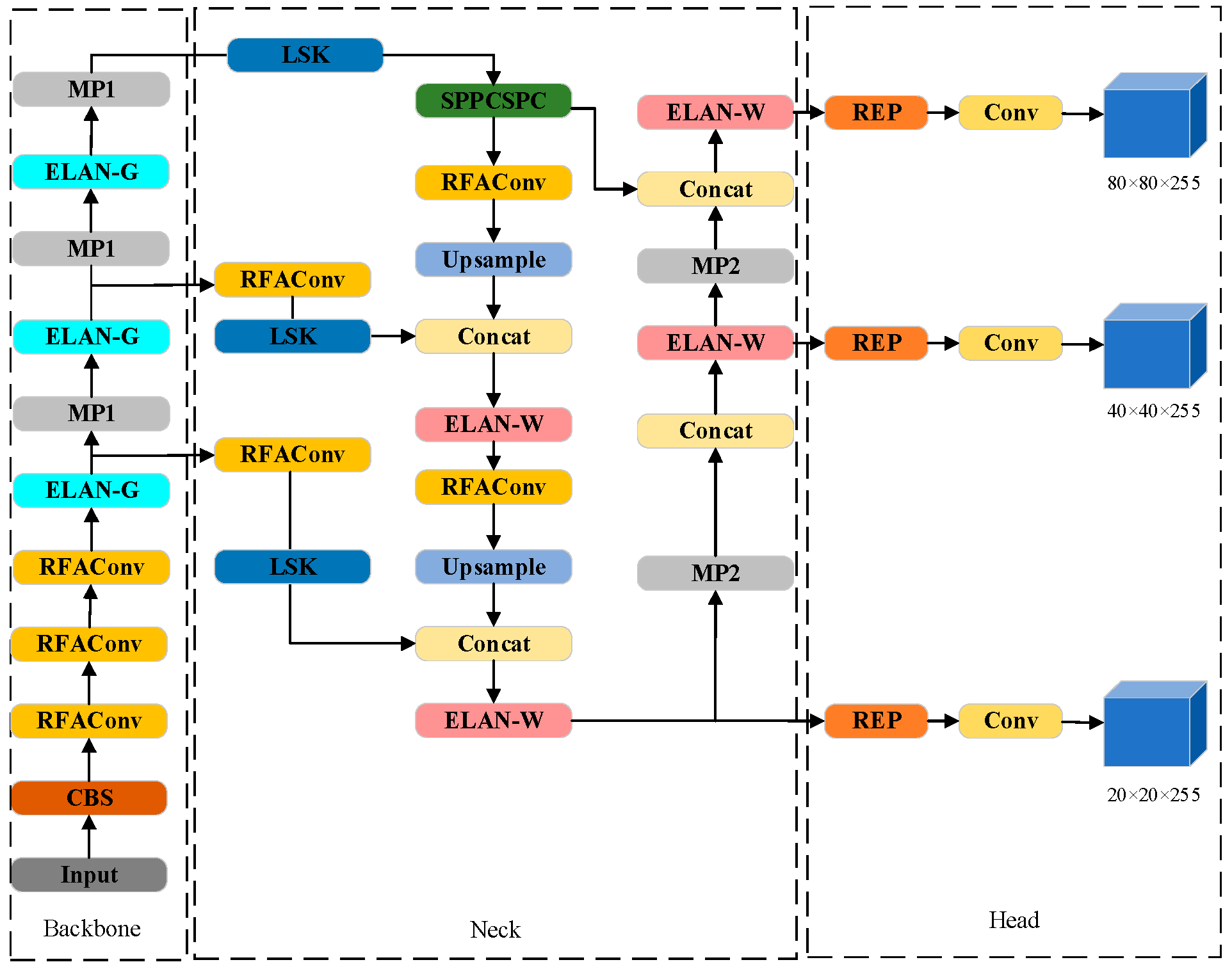
To address these challenges and improve both detection speed and accuracy, an attention mechanism is introduced into the lightweight YOLOv7 model, resulting in the YOLOv7-GLF (the YOLOv7 network structure with attention mechanism introduced) network. This enhanced network improves performance and precision in recognizing steel-cord conveyor belt damage in underground mining environments. Figure 5 illustrates the architecture of YOLOv7-GLF, highlighting its unique design features.
To overcome the limitations of standard convolutions in learning complex targets, RFAConv is used to replace standard convolution layers. Considering that extensive use of RFAConv can increase the processing time per image, in the lightweight YOLOv7 architecture, all standard convolution layers except for the first layer are replaced with RFAConv. The retained first convolution layer processes the original image at the largest scale (640 × 640), after which RFAConv dynamically assigns attention weights to each receptive field in the network. This design enhances overall processing efficiency and feature extraction capability.

4.3. Experiments and Analysis

In this study, a comparative experimental approach was adopted to systematically evaluate the effect of different bounding box regression loss functions on the training performance of deep learning models, based on the performance differences across various IoU loss functions. The aim was to investigate the specific impact of loss functions on model performance. The experimental results are presented in Table 4.
As shown in the table, the model using the SIoU loss function achieves an average precision (AP) of 83.5%, which is very close to the 83.4% AP achieved by the model using the CIoU loss function. In comparison, models using WIoU and MPDIoU loss functions improve AP by 0.5% and 0.9%, respectively, relative to CIoU. Among these, the model employing MPDIoU demonstrates the highest detection accuracy.
Although different loss functions were used, the number of model parameters and floating-point operations remained unchanged, indicating that adjusting the loss function does not affect model size or computational efficiency. Therefore, considering all factors, the MPDIoU loss function can significantly enhance detection accuracy without increasing model complexity.
Based on the analysis of loss function experiments, the MPDIoU loss function outperforms other loss functions. Therefore, for the YOLOv7-GLF network, which incorporates attention mechanisms into the lightweight YOLOv7-GS model, the original CIoU loss function is replaced with MPDIoU to improve model convergence speed and bounding box localization accuracy, resulting in the YOLOv7-GPLF (the YOLOv7 network structure that incorporates the attention mechanism and replaces the MPDIoU loss function) model. To verify the effectiveness of these optimization strategies, ablation experiments were conducted to investigate their impact on the detection performance of the YOLOv7 model. The experimental results are presented in Table 5.
Model A and B are detection models in YOLOv7 that individually incorporate GSConv and the MPDIoU loss function. GSConv significantly improves computational efficiency through a lightweight design while enhancing feature extraction capability, achieving improvements in both accuracy and speed. The MPDIoU loss function optimizes bounding box vertex distance metrics, enhancing localization accuracy. The detection performance of these two models has been detailed previously. Models C and D incorporate the LSKNet and RFAConv attention mechanisms, respectively. Their mean average precision (mAP) increases by 1.5% and 1.7% compared with the baseline model. However, introducing attention mechanisms increases model complexity, with parameters rising by 6.5% and 3.0%, and FPS decreasing by 5 and 3, respectively. Model E combines both GSConv and the MPDIoU loss function. Compared with the lightweight model A, mAP increases by 0.8%, while detection speed remains unchanged. Model F further integrates the LSKNet attention module on top of GSConv and MPDIoU. This module enhances multi-scale feature modeling through a spatial kernel selection mechanism, further improving detection accuracy by 3.3% relative to the original model, though computational overhead increases slightly and detection speed decreases marginally.
Model G incorporates all four improvement strategies. It achieves a precision of 87.3%, recall of 88.5%, and mAP of 88.1%, representing the best overall performance. The average detection speed reaches 54 FPSs, surpassing the original model in both accuracy and real-time performance.
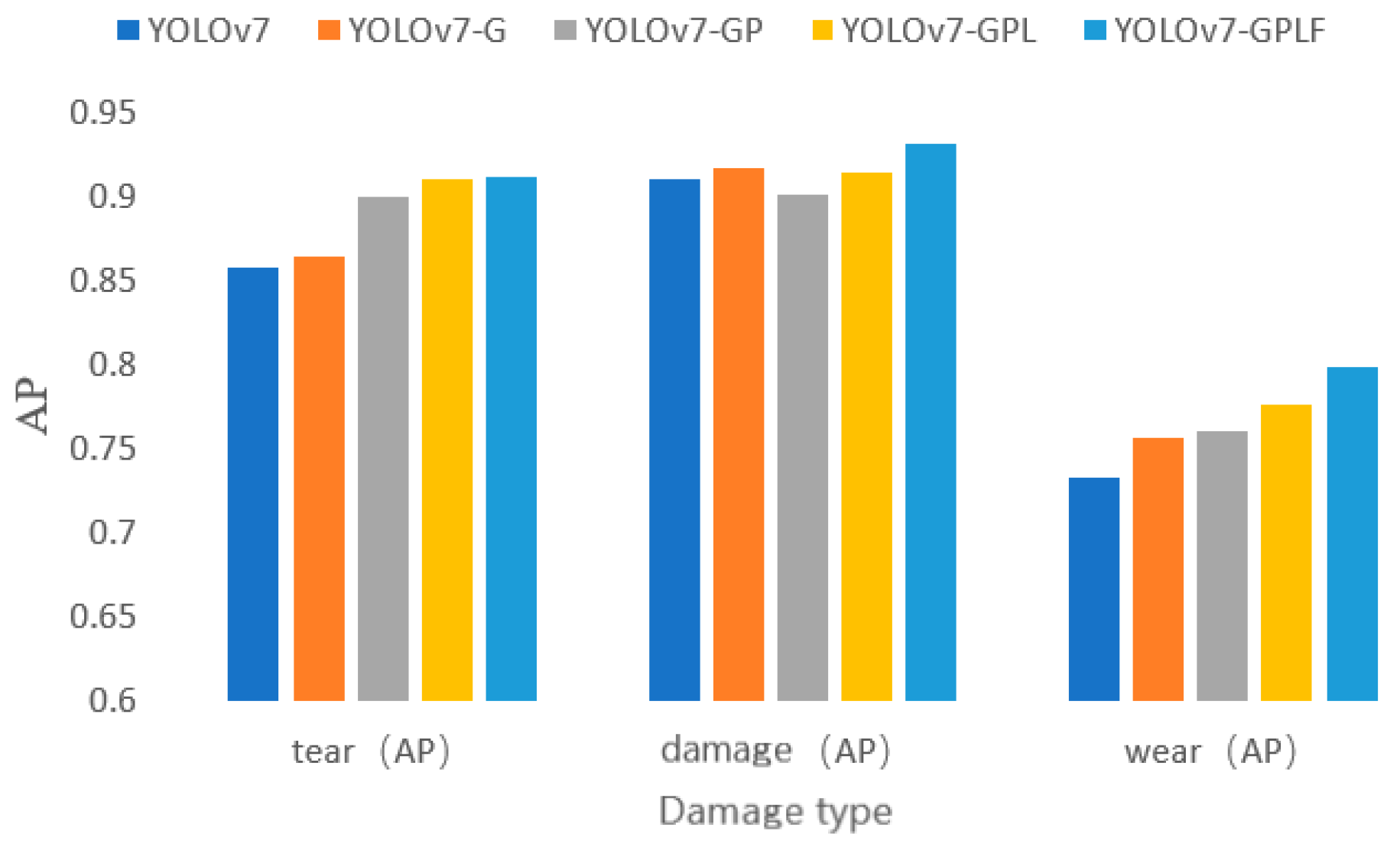
Table 6 presents the average precision (AP) of various algorithms for detecting different types of damage. Compared with the baseline model, the YOLOv7-GPLF model improves the mean detection precision for tearing, damage, and abrasion by 5.4%, 2.1%, and 6.5%, respectively, achieving the highest detection accuracy across all three damage types.
To provide a more intuitive comparison of the detection performance of the improved models across different damage types, Figure 6 was plotted. As shown, with continuous model optimization, the average precision for tearing and abrasion steadily increases, reaching peak values with the introduction of YOLOv7-GPLF. For damage, average precision fluctuates during the optimization process; the YOLOv7-GP model performs slightly worse than the baseline, whereas YOLOv7-GPLF achieves an AP of 0.932, leading all other models.
Although abrasion is generally more challenging to detect than tearing or damage, YOLOv7-GPLF still achieves the best performance, demonstrating a stronger ability to learn complex and subtle damage features. Overall, YOLOv7-GPLF performs exceptionally well across all three damage types, with particularly notable improvements in detecting more complex abrasion damage, indicating that the proposed optimizations have a positive impact on all types of damage.
To comprehensively and objectively demonstrate the advantages of the proposed algorithm, the same experimental dataset was used, and all experiments were conducted in a consistent environment. The proposed model was compared with several mainstream object detection algorithms, including SSD [14], Faster R-CNN [15], YOLOv3 [16], YOLOv5m [17], and YOLOv8. The comparison results are presented in Table 7.
As shown in the table, the SSD and Faster R-CNN detection algorithms exhibit significant limitations in both detection speed and accuracy for mining conveyor belt damage. Their detection precision is only 60.6% and 51.1%, respectively. Additionally, these models are relatively large, consume substantial computational resources, and have low inference speed, making them unsuitable for real-time monitoring. While YOLOv3 achieves a notable improvement in detection accuracy over traditional methods and shows some gains in model complexity and speed, it still falls short of the desired performance. The YOLOv5m model features low complexity and the fastest detection speed, demonstrating its advantages in lightweight design and efficient inference. YOLOv7 (Base) and YOLOv8 achieve mAP values of 83.4% and 83.8%, respectively. Although their speeds are lower than YOLOv5m, they provide clear advantages in accuracy. The proposed improved algorithm achieves 88.1% mean average precision with only 33.7M parameters and maintains a real-time inference speed of 54 FPSs. This represents the highest detection accuracy while achieving a balance between model size, accuracy, and speed, outperforming existing solutions. It overcomes the limitations of lightweight models with insufficient accuracy and avoids the redundant computations of high-precision models. This balance between accuracy, complexity, and speed demonstrates that the proposed algorithm has a high practical value and strong potential for deployment in mining conveyor belt damage detection tasks.

5. Conclusions

(1) This study focuses on surface damage detection of mining steel-cord conveyor belts using deep learning. By applying backbone network lightweighting, optimizing the loss function, and integrating attention mechanisms into the object detection network, the proposed method improves both the detection accuracy and speed for multiple types of surface damage on mining steel-cord conveyor belts.
(2) GSConv and MobileViTv3 networks were used to implement lightweight designs for the YOLOv7 backbone, reducing model complexity. The original CIoU loss function was replaced with WIoU and MPDIoU loss functions to optimize parameter adjustment and reduce the loss value. Additionally, LSKNet and RFAConv attention mechanisms were integrated into the network structure to enhance the model’s focus on key features in damage regions during feature extraction, thereby improving detection speed, accuracy, and overall predictive capability.
(3) The proposed network achieves a mean average precision (mAP) of 88.1%, representing a 4.7% improvement over the original network. The model parameters and floating-point operations are 33.7 M and 94.5 G, respectively, which are reductions of 7.7% and 8.4% compared with the original network. Inference speed reaches 54 FPSs, an improvement of 11 FPSs over the baseline model. The proposed model not only achieves network lightweighting but also enhances detection accuracy, enabling fast and accurate recognition of surface damage on mining steel-cord conveyor belts.

Author Contributions

Supervision, Formal Analysis, Methodology, H.W.; Software, Methodology, Writing—Review and Editing, Y.L.; Data Curation, Validation, Formal Analysis, L.C.; Project Administration, Investigation Resources, S.Z.; Theoretical Support, Formal Analysis, Methodology, L.Z.; Conceptualization, Methodology, Q.Z. All authors have read and agreed to the published version of the manuscript.

Funding

1. Coal-Major Project (No.2025ZD1700600); 2. Opening Project Fund of Materials Service Safety Assessment Facilities (No.MSAF2025003).

Data Availability Statement

The datasets presented in this article are not readily available because the data are part of an ongoing study.

Conflicts of Interest

Author Qiaozhi Zhao was employed by International Engineering Design & Research Institute Co., Ltd., Beijing, 100120, China, the remaining authors declare that the research was conducted in the absence of any commercial or financial relationships that could be construed as a potential conflict of interest.

References

  1. Ji, J.; Miao, C.; Li, X. Research on the energy-saving control strategy of a belt conveyor with variable belt speed based on the material flow rate. PLoS ONE 2020, 15, e0227992. [Google Scholar] [CrossRef] [PubMed]
  2. Kim, J.; Park, S. Magnetic Flux Leakage Sensing and Artificial Neural Network Pattern Recognition-Based Automated Damage Detection and Quantification for Wire Rope Non-Destructive Evaluation. Sensors 2018, 18, 109. [Google Scholar] [CrossRef] [PubMed]
  3. Lun, L.; Li, Y.; Dai, S.; Ma, Z.; Xie, N. A review of belt conveyor lifting device technology. Coal Mine Mach. 2018, 39, 4–6. [Google Scholar]
  4. Wu, W. Research on Wear Fault Diagnosis of Coal Preparation Plant Conveyor Belts Based on Machine Vision. Master’s Thesis, China University of Mining and Technology, Xuzhou, China, 2020. [Google Scholar]
  5. Wang, Y.; Du, Y.; Miao, C.; Miao, D.; Du, X.; Zheng, Y. Longitudinal tear detection of conveyor belt based on improved YOLOv7. IEEE Access 2024, 12, 24453–24464. [Google Scholar] [CrossRef]
  6. Miao, D.; Wang, Y.; Li, S. Sound-based improved densenet conveyor belt longitudinal tear detection. IEEE Access 2022, 10, 123801–123808. [Google Scholar] [CrossRef]
  7. Wang, G.; Rao, Z.; Sun, H.; Zhu, C.; Liu, Z. A belt tearing detection method of YOLOv4-BELT for multi-source interference environment. Measurement 2022, 189, 110469. [Google Scholar] [CrossRef]
  8. Zeng, F.; Zhou, J.; Wu, Q. A conveyor belt characterization information extraction method based on YOLOv5 and the skeleton method. Meas. Sci. Technol. 2023, 34, 115006. [Google Scholar] [CrossRef]
  9. Yu, C. Design of a machine-vision-based longitudinal tear detection system for mining conveyor belts. Equip. Manuf. Technol. 2018, 7, 37–39. [Google Scholar]
  10. Zhang, M.; Shi, H.; Zhang, Y.; Yu, Y.; Zhou, M. Deep learning-based damage detection of mining conveyor belt. Measurement 2021, 175, 109130. [Google Scholar] [CrossRef]
  11. Wang, X.; Song, J. ICIoU: Improved loss based on complete intersection over union for bounding box regression. IEEE Access 2021, 9, 105686–105695. [Google Scholar] [CrossRef]
  12. Tong, Z.; Chen, Y.; Xu, Z.; Yu, R. Wise-IoU: Bounding box regression loss with dynamic focusing mechanism. arXiv 2023, arXiv:2301.10051. [Google Scholar]
  13. Siliang, M.; Yong, X. Mpdiou: A loss for efficient and accurate bounding box regression. arXiv 2023, arXiv:2307.07662. [Google Scholar] [CrossRef]
  14. Yang, F.; Huang, L.; Tan, X.; Yuan, Y. FasterNet-SSD: A small object detection method based on SSD model. Signal Image Video Process. 2024, 18, 173–180. [Google Scholar] [CrossRef]
  15. Wang, Z.; Bai, L.; Song, G.; Zhang, Y.; Zhu, M.; Zhao, M.; Chen, L.; Wang, M. Optimized Faster R-CNN for oil wells detection from high-resolution remote sensing images. Int. J. Remote Sens. 2023, 44, 6897–6928. [Google Scholar] [CrossRef]
  16. Hurtik, P.; Molek, V.; Hula, J.; Vajgl, M.; Vlasanek, P.; Nejezchleba, T. Poly-YOLO: Higher speed, more precise detection and instance segmentation for YOLOv3. Neural Comput. Appl. 2022, 34, 8275–8290. [Google Scholar] [CrossRef]
  17. Qi, J.; Liu, X.; Liu, K.; Xu, F.; Guo, H.; Tian, X.; Li, M.; Bao, Z.; Li, Y. An improved YOLOv5 model based on visual attention mechanism: Application to recognition of tomato virus disease. Comput. Electron. Agric. 2022, 194, 106780. [Google Scholar] [CrossRef]
Figure 1. Schematic diagram of CCD camera and light source installation.
Applsci 16 04617 g001
Figure 2. Types of conveyor belt damage.
Applsci 16 04617 g002
Figure 3. GSConv-YOLOv7 network.
Applsci 16 04617 g003
Figure 4. MobileViTv3-YOLOv7 network.
Applsci 16 04617 g004
Figure 5. YOLOv7-GLF network structure diagram.
Applsci 16 04617 g005
Figure 6. Improvement of the model’s detection accuracy for each damage.
Applsci 16 04617 g006
Table 1. Comparison of sample counts before and after data augmentation.
Damage TypesBefore/CountAfter/Count
Damage4101698
Tear3251350
Wear2851168
Table 2. Comparison of lightweight model test results.
Network ModelP/%R/%mAP/%
YOLOv783.986.783.4
YOLOv7-GS84.487.684.6
YOLOv7-MV83.582.283.0
Network
Model
Parameters
/M
GFLOPs
/G
FPS
/f·s−1
YOLOv736.5103.243
YOLOv7-GS30.286.459
YOLOv7-MV26.675.865
Table 3. Accuracy of YOLOv7 and lightweight model for each damage detection.
Damage TypesYOLOv7YOLOv7-GSYOLOv7-MV
Tear (AP)0.8580.8650.90
Damage (AP)0.9110.9170.933
Wear (AP)0.7330.7570.658
Table 4. Comparison of experimental results with different loss functions.
Loss FunctionsP/%R/%mAP
/%
Params
/M
GFLOPs
/G
CIoU83.986.783.436.5103.2
SIoU84.385.583.5
WIoU85.184.883.9
MPDIoU85.487.384.3
Table 5. Comparison of ablation test results.
ModelsGS
Conv
MP
DIoU
LSK
Net
RFA
Conv
YOLOv7
A
B
C
D
E
F
G
ModelsP%R%mAP
%
Params
/M
GFLO
Ps/G
FPS
YOLOv783.986.783.436.5103.243
A84.487.684.630.286.459
B85.486.384.336.5103.243
C84.687.384.938.9109.738
D84.887.185.137.6106.340
E86.486.985.430.286.459
F85.988.386.732.692.656
G87.388.588.133.794.554
Table 6. Improvement of the model’s detection accuracy for each damage.
Damage TypeYOLOv7YOLOv7-GYOLOv7-GP
Tear (AP)0.8580.8650.90
Damage (AP)0.9110.9170.901
Wear (AP)0.7330.7570.76
Damage TypeYOLOv7-GPLYOLOv7-GPLF
Tear (AP)0.9100.912
Damage (AP)0.9150.932
Wear (AP)0.7760.798
Table 7. Comparative experiments of different algorithms.
ModelsmAP
/%
Parameters
/M
FPS
/f·s−1
SSD60.6120.926
Faster R-CNN51.1189.618
YOLOV378.161.035
YOLOV5m80.421.266
YOLOv7 (Base)83.436.543
YOLOv883.843.740
Improved model (YOLOv7-GPLF)88.133.754
Disclaimer/Publisher’s Note: The statements, opinions and data contained in all publications are solely those of the individual author(s) and contributor(s) and not of MDPI and/or the editor(s). MDPI and/or the editor(s) disclaim responsibility for any injury to people or property resulting from any ideas, methods, instructions or products referred to in the content.