


Featured Application
This work is being used to develop the QA application of agricultural planting and livestock breeding technologies.
Abstract
Retrieval-augmented generation (RAG) addresses the problem of knowledge cutoff and overcomes the inherent limitations of pre-trained language models by retrieving relevant information in real time. However, challenges related to efficiency and accuracy persist in current RAG strategies. A key issue is how to select appropriate methods for user queries of varying complexity dynamically. This study introduces a novel adaptive retrieval-augmented generation framework termed Layered Query Retrieval (LQR). The LQR framework focuses on query complexity classification, retrieval strategies, and relevance analysis, utilizing a custom-built training dataset to train smaller models that aid the large language model (LLM) in efficiently retrieving relevant information. A central technique in LQR is a semantic rule-based approach to distinguish between different levels of multi-hop queries. The process begins by parsing the user’s query for keywords, followed by a keyword-based document retrieval. Subsequently, we employ a natural language inference (NLI) model to assess whether the retrieved document is relevant to the query. We validated our approach on multiple single-hop and multi-hop datasets, demonstrating significant improvements in both accuracy and efficiency compared to existing single-step, multi-step, and adaptive methods. Our method exhibits high accuracy and efficiency, particularly on the HotpotQA dataset, where it outperforms the Adaptive-RAG method by improving accuracy by 9.4% and the F1 score by 16.14%. The proposed approach carefully balances retrieval efficiency with the accuracy of the LLM’s responses.
1. Introduction
Recent large language models (LLMs), e.g., GPT-4 [1], Llama 3 [2], and Gemini [3], have demonstrated remarkable capabilities in natural language understanding, generation, and various downstream applications, such as machine translation, summarization, and question-answering. However, LLMs still encounter notable limitations, particularly in tasks that are domain-specific or knowledge-intensive [4,5]. One major issue is the production of “hallucinations” [6], where the models generate inaccurate information when faced with queries beyond their training data or requiring up-to-date knowledge. Retrieval-augmented generation (RAG) tackles these challenges by enhancing LLMs through the retrieval of relevant document fragments from external knowledge bases, leveraging semantic similarity measures [7]. RAG is designed to dynamically query and retrieve relevant documents or data from external knowledge sources, such as structured databases, web resources, or specialized corpora, during the inference process. By incorporating external knowledge, RAG significantly reduces the generation of factually incorrect content. Its integration into LLMs has led to widespread adoption, positioning RAG as a crucial technology for advancing chatbots and enhancing the real-world applicability of LLMs. By retrieving relevant information in real time, RAG mitigates the problem of knowledge cutoff and helps overcome the inherent limitations of pre-trained language models that rely solely on the static data they were trained on [8].
The architecture of RAG is composed of two key components: a retriever model and a generator model. The retriever selects relevant pieces of external knowledge in response to a query, while the generator combines the retrieved information with the language model’s internal knowledge to generate more accurate and contextually appropriate responses. This architecture enables LLMs to better handle tasks that require up-to-date knowledge or specialized expertise that may not be fully captured during training [9].
RAG integrates external knowledge to mitigate the hallucination phenomenon in LLMs, effectively reducing the generation of inaccurate outputs. In QA tasks, queries can be categorized as either single-hop or multi-hop [10]. Early research on retrieval-augmented LLMs predominantly addresses single-hop queries [11,12]. In these cases, answers are generally located within a single document; thus, the retrieval process involves identifying a relevant document based on the query, which is then incorporated into question-answering models to generate a response. However, unlike single-hop question answering, certain queries require linking and combining information from multiple documents. This task t cannot be accomplished through a straightforward, single-step retrieval and response process. For instance, a query such as “What type of fertilizer should I use at the moment for my crop located in Hubei Province?” requires three distinct reasoning steps to answer (what fertilizer, what crop, and what time). Applying a compatible knowledge-retrieving strategy according to the complexity of user queries is a feasible approach. However, issues regarding retrieving efficiency and accuracy still hinder the complex queries using RAG in such a fashion. The following research question arises: how do we maintain fast knowledge retrieval and high accuracy for queries of various complexity using RAG, especially in multi-turn interactions?
This study contributes the following to address the above issues:
- (1)
- This study proposes a Layered Query Retrieval framework that adaptively handles both simple and complex queries, balancing both efficiency and accuracy in responses.
- (2)
- We designed a relevance classifier to filter out irrelevant documents from the retrieved ones, preventing the large model’s responses from being influenced by too much irrelevant information.
- (3)
- We conducted experiments on multiple public datasets, and the results show that our model improves accuracy and F1 score by over 10% compared to state-of-the-art methods.
2. Related Work
Large models acquire extensive world knowledge during pre-training. However, since the exact data used in pre-training is unknown, it becomes difficult to assess whether the model can reliably answer user queries. To ensure that responses are well grounded, external knowledge is provided beforehand, allowing the model to search for relevant information within that context. In existing research, questions are typically classified by complexity into single-hop and multi-step categories. Single-hop questions require only a single retrieval from an external knowledge base to generate an answer, whereas multi-step questions are more complex, involving multiple retrievals to iteratively refine the response until the final answer is reached.
Recent research has placed growing emphasis on multi-step and multi-reasoning question answering, which requires iterative interactions between LLMs and retrievers. This approach, while effective for handling complex queries, comes with significant computational costs [13,14].
Conventional retrieval-augmented LLM methods often exhibit inefficiencies when handling queries of varying complexity. They tend to be overly complex for simple queries, leading to unnecessary computational overhead, while being insufficiently robust for more complex queries. The current issue arises from the use of a one-size-fits-all approach, where all queries are treated as either single-hop or multi-hop, leading to resource inefficiencies [15]. Such a rigid approach is not sufficient to cover the complexity of diverse queries, as simpler queries may waste resources, and more complex ones may not be adequately addressed in a single pass. Additionally, the process of merging retrieved documents can lead to inconsistencies or contradictions in the information presented, which affects the accuracy of the final response. Multiple documents returned after external knowledge retrieval may contain conflicting data or irrelevant information, making it difficult for the model to synthesize a coherent and accurate answer [16].
Some efforts have been made to filter out inconsistent or irrelevant information [17,18], e.g., RAFT [19]. RAFT trains models to ignore irrelevant distractor documents and focus on citing the correct information from relevant documents to answer questions. This, along with its chain-of-thought (COT)-style responses, improves the model’s reasoning capabilities. Such a solution might mitigate the inconsistencies in response, but it still lacks a mechanism for processing multi-hop queries. Another direction has focused on refining the retrieval process in multi-step QA [20,21]. Trivedi, Balasubramanian, Khot, and Sabharwal [14] proposed IRCoT, which integrates retrieval with the steps in a CoT, using the CoT to guide the retrieval process and incorporating the retrieved information to enhance the CoT reasoning. However, this iterative method can result in efficiency issues due to excessive branching of possible solutions [22]. Tang and Yang [10] highlighted the limitations of current RAG methods, demonstrating that they struggle with multi-hop queries using datasets specifically designed for such tasks.
A key challenge in improving both efficiency and accuracy lies in dynamically selecting appropriate strategies based on the complexity of user queries. Some approaches, e.g., adaptive-RAG [23], have been developed for query classification to optimize resource allocation. The adaptive-RAG classifies queries to optimize resource allocation by selecting the best strategy for simple and complex questions. Despite its potential, adaptive-RAG still faces unresolved issues, such as refining query classification, filtering inconsistent information during multi-turn interactions, and improving strategies for integrating information from multiple sources to ensure reliability. Additionally, this approach has yet to be tested in specialized domains, such as agricultural technology question answering. The limitations of current RAG technologies are listed in Table 1.
Table 1.
Comparison of current RAG methods.
In this work, we address the limitations of query and complexity classification in Adaptive-RAG by proposing a framework for categorizing simple and complex queries, termed Layered Query Retrieval (LQR). Specifically, the framework contains a semantic rule-based approach to distinguish between different levels of multi-hop queries. For multi-hop queries, the process begins by parsing the user’s query for keywords, followed by a keyword-based document retrieval. Subsequently, we employ a natural language inference (NLI) model to assess whether the retrieved document is relevant to the query. The system then locates the next-level document based on the initial findings, again using NLI to verify its relevance before combining all relevant results for final input into the model. We test our RAG approach on an agriculture domain-specific dataset for multi-hop queries and compare it with state-of-the-art RAG methods.
3. Method
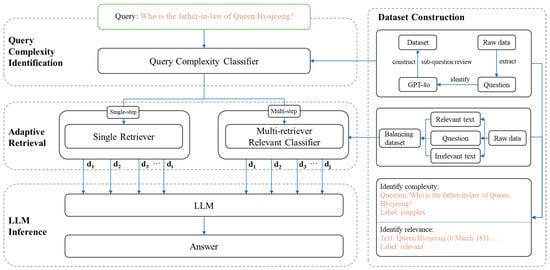
The proposed LQR framework focuses on three key aspects: dataset construction, query complexity identification, and adaptive multi-retrieval. The framework consists of four stages: dataset construction, query complexity identification, adaptive retrieval, and LLM inference, as illustrated in Figure 1. In the dataset construction stage, parallel dataset generation processes were carried out with the assistance of a state-of-the-art LLM GPT-4o to create training data for both the query complexity classifier and the relevant classifier for multi-retriever results. In the query complexity identification stage, we developed a query complexity classifier to determine whether the user query can be decomposed into multiple questions. In the adaptive retrieval stage, either a single-step strategy or a multi-step strategy is applied based on the complexity of the query for document retrieval. Finally, in the LLM inference stage, the input query and the retrieved documents are combined using a specifically designed prompt. Details of each stage are described in the following sections.
Figure 1.
Workflow of the proposed LQR framework.
3.1. Query Complexity Identification
Multi-step questions can typically be decomposed into multiple single-hop questions. To determine the complexity of a user’s query, we need to assess whether the query can be broken down into simpler parts. If it can be decomposed into multiple questions, it is classified as a multi-step question; otherwise, it is considered a single-hop question. We train a complexity classifier, where the input is the user query and the output is the complexity category . Here, 0 indicates that the query cannot be further decomposed, while 1 indicates that the query requires further breakdown.
The classifier is built on top of the model by adding a linear layer followed by a Sigmoid activation function to assess query complexity.
The complexity classifier is a smaller model. Since there is currently no publicly available dataset for complexity assessment, we construct the training dataset using a combination of a large model and manual review. We train the complexity classifier on the automatically generated dataset and use it to identify the complexity of queries during inference.
3.2. Adaptive Retrieval
3.2.1. Single-Step Strategy
We adopt different strategies for different types after identifying the complexity of the query. For simple queries, this can be directly retrieved from an external knowledge base using a retriever. Specifically, let us assume the knowledge base is , the query is , and the retriever is . The retriever uses as input to search the knowledge base and returns relevant documents , as shown in Figure 1.
where is the set of relevant documents, .
The retriever can use any off-the-shelf retrieval model. However, for a fair comparison with other studies, we employed the BM25 retriever. During the retrieving process, documents are ranked according to their BM25 score. For a given document and a query , the BM25 score is calculated as follows:
where:
- : A term in the query .
- : The term frequency of in document .
- : The length of the document (in terms of number of words).
- avgdl: The average document length in the corpus.
- : A tunable parameter that controls the term frequency saturation.
- : A tunable parameter that controls the influence of document length normalization.
- : The inverse document frequency of term .
The inverse document frequency adjusts the weight of terms based on their rarity in the document corpus. It is calculated as follows:
where:
- : The total number of documents in the corpus.
- : The number of documents containing the term .
3.2.2. Multi-Step Strategy
Simple queries are relatively straightforward, but complex queries require more unknown information. If the query is used directly for retrieval, it is difficult to find all the relevant documents. Complex queries can be broken down into multiple simple queries. To retrieve useful knowledge and filter out irrelevant information, we use a small model to break down the complex query into two sub-questions, and , and then perform multi-stage retrieval to gather as many relevant documents as possible.
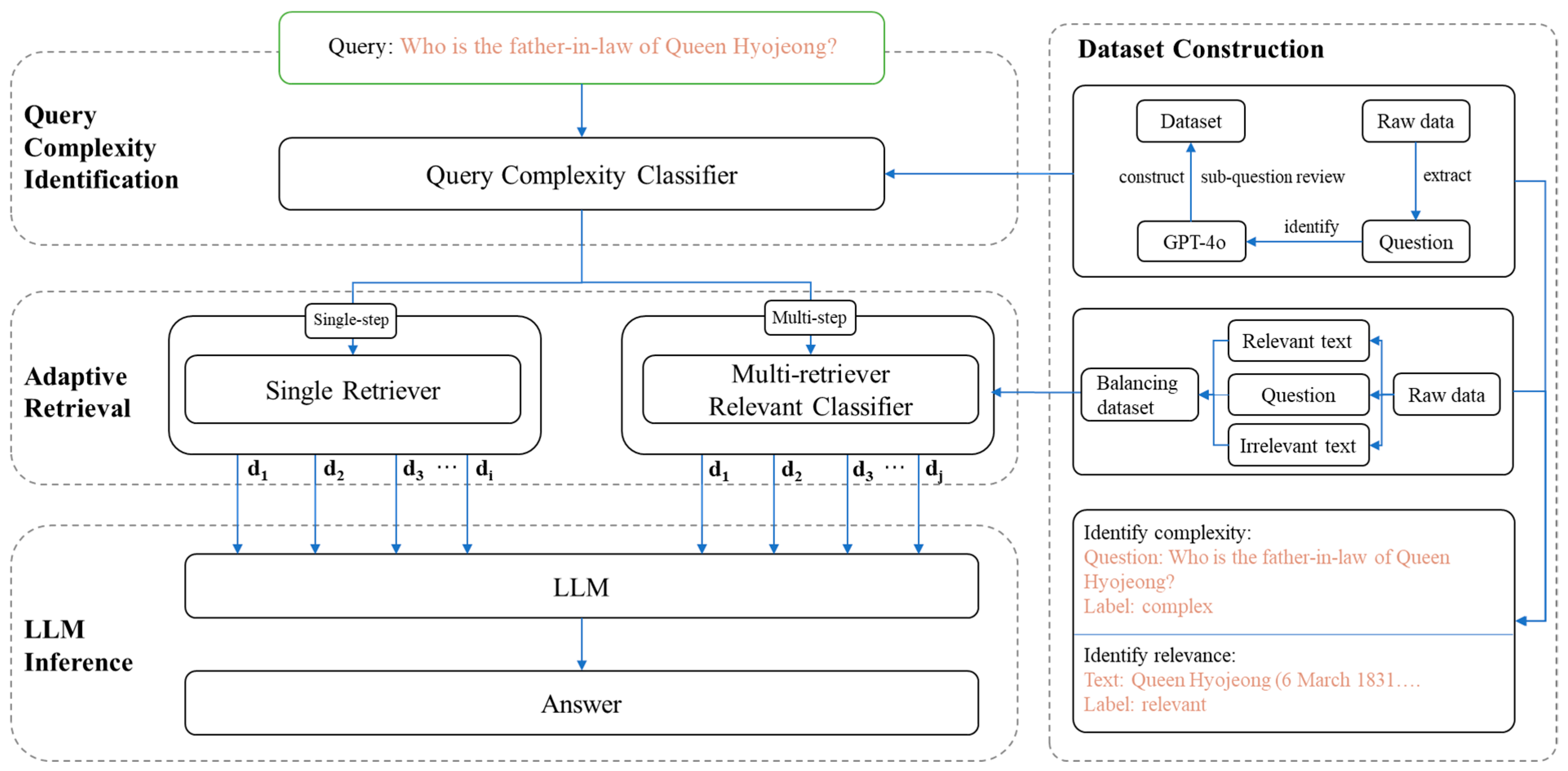
After decomposing the complex query using a small model, two logically progressive simple queries are formed, namely and . For each query, as shown in Figure 2, we first use to retrieve relevant documents, i.e., . At this point, it is still insufficient to answer the query, so we perform a second retrieval using { as a whole to obtain relevant documents, i.e., . Compared to the first, the second retrieval introduces more information and retrieves some documents more closely related to the query, but it also returns irrelevant and redundant documents. Irrelevant information can affect the large model’s ability to find answer clues and impact the question-answering process.
Figure 2.
The complex query process structure. Arrows with solid lines denote the processing step; arrows with dotted lines denote data flow.
To remove irrelevant documents, we filter the relevant documents by calculating whether contributes to answering the query. As illustrated in Figure 1, we have developed a balanced dataset in which each entry comprises a question, relevant texts, and irrelevant texts designed to train the relevance model for information filtering.
where 0 indicates that document djs relevant to q, and 1 indicates it is not relevant. The classifier utilized here adopts the same methodology as the query classifier but is built upon a different base model. Notably, the query classifier and the relevance classifier are designed to fulfill distinct purposes.
3.3. LLM Inference
In the reasoning process, the LLM requires both the input query and the retrieved relevant external documents. Since the LLM is sensitive to the positional information of the text, we place key documents closer to the query, which helps the model find the answer.
As for prompt design, we consider role definition, thought guidance, and output constraints to optimize the prompt, ultimately arriving at a better prompt.
4. Experiment
This section provides a detailed overview of the datasets, evaluation metrics, experimental parameter settings, and baseline models employed in the experiments.
4.1. Dataset
To validate the effectiveness of our proposed method, we employed two types of datasets: single-hop datasets and multi-hop datasets. The single-hop datasets include SQuAD v1.1 [24], Natural Questions [25], and TriviaQA [26]. The multi-hop datasets include MuSiQue [27], HotpotQA [28], and 2WikiMultiHopQA [29].
In addition, we constructed several domain-specific datasets related to grassland sheep to evaluate the performance of the method on these specialized datasets.
Throughout the proposed process, two classifier models were employed. We selected 3000 entries from public datasets and utilized GPT-4 along with manual review methods to create a complexity dataset of 3000 entries and a relevance dataset of 6000 entries. The relevance dataset was balanced, consisting of 3000 positive and 3000 negative samples.
4.2. Evaluation Metrics
In evaluating the models, both retrieval and generation tasks are considered, requiring the assessment of both accuracy and efficiency. We use accuracy and F1 score to measure the models’ effectiveness, while the number of retrievals and the time taken are used to evaluate efficiency. Accuracy reflects whether the predicted results contain the correct answer, while the F1 score assesses the overlap between the predicted results and the correct answers.
4.3. Experiment Details
We follow the experimental protocol outlined by Jeong et al. [23] to ensure a fair comparison with other methods. In our experiments, we use the same retriever, BM25, and maintain consistency between the test set and the retrieval corpus. Since the texts are in English, we conduct the experiments using the Llama3-8B model.
In our overall framework, we employ two classification models. The first classification model is designed to analyze short texts and categorize them based on complexity. For this task, we selected the RoBERTa model, which, after training, achieved accuracy and F1 scores above 85%. The second classification model is focused on processing longer text inputs, for which we selected the Longformer [30] model, capable of handling inputs up to 4096 tokens. After training, this model achieved accuracy and F1 scores exceeding 92%.
This experiment was conducted on a Linux system using an A800 GPU with 80 GB of memory. Both classifiers were trained with a learning rate of 5 × 10⁻⁵ using the AdamW optimizer, over 10 epochs. The learning rate warm-up was performed using cosine scheduling, and the batch size was set to 32. The best-performing models were selected from these training runs.
4.4. Baseline
This study proposes a novel retrieval-augmented generation model strategy. To comprehensively compare the effectiveness of this approach, we use four baseline strategies: the non-retrieval strategy, the single-step retrieval strategy, the adaptive retrieval strategy, and the multi-step retrieval strategy.
The non-retrieval strategy refers to answering queries without retrieving external knowledge, relying solely on the LLM for responses. The single-step retrieval strategy enhances the LLM by retrieving external knowledge once for each query. The adaptive retrieval strategy applies different retrieval methods depending on the complexity of the query. Finally, the multi-step retrieval strategy [14] involves multiple rounds of retrieval for a query until a satisfactory answer is obtained.
The adaptive retrieval strategy methods we explored in this study include adaptive retrieval, self-RAG, and adaptive-RAG. The adaptive retrieval strategy [31] sets a threshold on the validation set to determine whether to employ RAG. The self-RAG strategy [32] introduces special tokens, namely retrieval tokens and reflection tokens, to assess the quality of generated responses and decide whether retrieval is necessary. The adaptive-RAG strategy [23] trains a complexity classifier to evaluate the complexity of the query and, based on this evaluation, selects different processing strategies accordingly.
5. Experimental Results and Analyses
This section is dedicated to the analysis of experimental results, the execution of ablation studies, and the presentation of a case study.
5.1. Main Results
We conducted experiments on three multi-hop datasets and compared the results with those of other methods. We classified previous studies into three groups: simple, complex, and adaptive. Table 2 shows that the accuracy of non-retrieval-augmented methods is low, while multi-hop retrieval methods achieve high accuracy but exhibit low efficiency, requiring considerable processing time. Adaptive retrieval methods, by distinguishing between simple and complex queries, apply different strategies and achieve relatively high accuracy.
Table 2.
The results obtained from our proposed method on the multi-hop datasets using the Llama3-8B model are compared with those of other methods. Our results are highlighted in bold for emphasis.
Our proposed method demonstrates both high accuracy and efficiency, particularly on the HotpotQA dataset, where it surpasses the Adaptive-RAG method, improving accuracy by 9.4% and the F1 score by 16.14%. The step metric reveals that our method involves multiple retrievals. For complex queries, retrieving information just once may not provide sufficient data; hence, our approach conducts multiple queries to address this gap. In contrast, the non-retrieval, single-step retrieval, and multi-step retrieval methods apply a single strategy for any given query. Our adaptive retrieval method, however, enhances model accuracy while only marginally increasing the time spent on retrieval and generation.
We conducted experiments using our proposed research method on three single-hop datasets. Table 3 shows that our method outperforms others by more than 10% in both accuracy and F1 score. Upon analyzing the experimental results, we observed that some single-hop queries are relatively complex and can be decomposed into two sub-queries, allowing for multiple retrievals to gather more relevant information.
Table 3.
The results obtained from the Llama3-8B model on the single-hop datasets are compared with those of other methods. Our results are highlighted in bold for emphasis.
For simple queries, apart from the multi-step retrieval method, all other methods classify them as simple and do not require multiple retrievals. Our proposed research method places greater emphasis on classifying the complexity of queries, demonstrating strong sensitivity to this factor.
Through a comparative analysis of three public datasets, we observed that the LQR method demonstrates superior performance. The following section focuses on examining the contribution of each component within the LQR method.
5.2. Ablation Study
This section analyzes the various modules of the proposed research method to evaluate their contributions to the overall architecture.
- The effect of the complexity classifier
In Table 2 and Table 3, the single-step retrieval and multi-step retrieval methods do not assess the complexity of the queries, applying a single retrieval generation strategy for all cases. Our proposed method demonstrates significant improvements in both performance and efficiency, validating the effectiveness of the adaptive retrieval strategy.
- The effect of the first-stage retriever
We varied the top-k values while keeping other parameters constant. As shown in Table 4, increasing the top-k values results in a decrease in efficiency, accuracy, and F1 score. However, this impact is relatively small. It is hypothesized that as top-k increases, the volume of retrieved information rises, leading to the accumulation of irrelevant and redundant data, which can negatively affect the LLM’s responses. Furthermore, when the LLM receives longer texts, the processing time increases, requiring more time to generate responses.
Table 4.
Experimental results of the Llama3-8B on HotpotQA under different Top-k conditions with the first-stage retriever.
- The effect of different LLMs
We conducted experiments using the GPT-4o model on three multi-hop datasets. Table 5 demonstrates that, compared to the Llama3-8B model, the GPT-4o model improves the F1 score and accuracy by an average of over 10% across the multi-hop datasets. The use of a more powerful model in our proposed method leads to better performance. This also indirectly suggests that our strategy effectively retrieves relevant information, as there may be instances where the LLM alone does not identify relevant clues.
Table 5.
Results of Llama3-8B and GPT-4o on the MusiQue, HotpotQA, and 2Wiki multi-hop datasets.
- The effect of the relevance classifier
Table 4 shows that as the top-k value increases, more information is retrieved, leading to an increase in noisy data. This raises the question: can the relevance classifier help reduce irrelevant information? Table 6 indicates that when the relevance classifier is removed, the F1 score and accuracy decrease by an average of 2.38% and 1.67%, respectively. This highlights the necessity of incorporating the relevance classifier. Enhancing the performance of the relevance classifier will also be one of our key research directions in the future.
Table 6.
Experimental results of Llama3-8B on three datasets without the relevance classifier. “rcls” represents the relevance classifier.
5.3. Case Study
We conducted a case study to observe the results of our proposed method across various datasets. We selected three cases from both single-hop and multi-hop datasets to examine whether the simple queries defined in the data require decomposition and to assess the output performance of the large model. Additionally, we evaluate the effectiveness of the retrieval strategy.
Table 7 presents the inference results using Llama3-8B and GPT-4o on three single-hop datasets. The data in Table 7 indicate that some queries in the single-hop datasets also need to be broken down into multiple simpler query statements. The examples in Table A1 in Appendix A demonstrate that after splitting the user queries, more relevant information can be retrieved.
Table 7.
Examples of responses from our proposed method using Llama3-8B and GPT-4o on three single-hop datasets.
Table 8 presents the inference results using Llama3-8B and GPT-4o on three multi-hop datasets. From Table 8, it can be observed that for complex queries, retrieval can be performed directly without splitting, which helps reduce the impact of irrelevant information. By combining Table 7, Table 8, Table A1, and Table A2, it is evident that GPT-4o is more adept at extracting key information from long contexts. The experiments revealed that contextual information can assist the LLM in leveraging stored world knowledge, thereby enhancing the accuracy of responses.
Table 8.
Examples of responses from our proposed method using Llama3-8B and GPT-4o on three multi-hop datasets.
6. Discussion
The experimental results on both single-hop and multi-hop datasets demonstrate that the adaptive retrieval approach shows promising results in retrieval-augmented generation. Compared to other adaptive retrieval methods, e.g., self-RAG [32], adaptive-RAG [23], and parametric and non-parametric memory-based methods [31], our proposed LQR not only identifies query complexity but also focuses more on finding documents relevant to the query. Specifically for complex queries, we employ multi-step retrieval, relevance recognition, and other techniques to locate pertinent information while simultaneously filtering out irrelevant content.
In the process of retrieval-augmented generation, it is crucial not only to focus on the performance of the generative model but also to retrieve documents that can effectively answer the query. Retrieval-augmented generation must balance the quality of the generated responses with the time consumed throughout the process. In multi-step methods, continuous retrieval and generation cycles eventually lead to the final answer. However, this approach is time-consuming and resource-intensive. On the other hand, single-step retrieval is faster, but the quality of the generated output is often suboptimal. The challenge becomes even more pronounced when dealing with complex queries—how can we ensure that all relevant documents are retrieved?
To further evaluate the model, we conducted a case study using data related to sheep. For instance, when presented with the questions “What is the scientific name of a domestic sheep?” and “Which breed of sheep is native to China and known for producing fine wool?”, the LLM demonstrated its ability to not only retrieve relevant information from the context but also leverage its pre-trained knowledge to provide more comprehensive responses. This highlights the role of the LLM’s pre-trained world knowledge in enhancing answer quality. However, the case study also revealed challenges. Irrelevant information occasionally emerged during the retrieval process, which could affect the quality of the model’s responses. Despite these issues, LQR demonstrated greater flexibility compared to single-step and multi-step retrieval methods. Nonetheless, further optimization of LQR’s individual components remains necessary to fully realize its potential.
This study reveals that for particularly complex queries, the proposed method struggles to retrieve effective documents. How to optimize retrieval and improve document relevance recognition will be key research directions in the future. Our experiments indicate that using larger models yields higher accuracy. There are two reasons for this. First, larger models possess stronger comprehension capabilities, allowing them to find clues in the documents that lead to the correct answer. Interestingly, we observed that certain queries received correct answers even without retrieving all relevant documents. This can be attributed to the second reason: larger models, guided by context and the user’s query, leverage their pre-trained world knowledge to provide answers. An important future research direction will be to explore how to utilize existing knowledge to guide models in responding to queries effectively.
7. Conclusions
This study presents a novel retrieval-augmented generation framework LQR that is designed to accommodate varying query complexities. Specifically, we employ tailored retrieval strategies based on an assessment of query complexity. Our proposed method emphasizes complexity classification, query retrieval strategies, and relevance analysis, utilizing a custom-built training dataset to train smaller models that assist the LLM in efficiently retrieving relevant information. We tested our approach across various single-hop and multi-hop datasets, showing substantial improvements in both accuracy and efficiency compared to existing single-step, multi-step, and adaptive methods. The method we propose achieves notable improvements in both accuracy and efficiency, especially on the HotpotQA dataset, where it outperforms the adaptive-RAG approach with a 9.4% increase in accuracy and a 16.14% boost in the F1 score. The case study revealed that irrelevant information can arise during retrieval, impacting the model’s responses. Still, LQR proves more flexible than single- or multi-step retrieval, though its components require further refinement. In general, the LQR achieves an effective balance between retrieval speed and the precision of the LLM’s generated responses.
Author Contributions
Conceptualization, J.H., M.W., Y.C. and J.L.; Methodology, J.H., M.W., Y.C. and J.L.; Validation, J.H., L.C. and T.W.; Formal analysis, L.C., T.W. and H.L.; Investigation, J.H., M.W. and J.W.; Data curation, J.H. and J.W.; Writing—original draft, J.H. and M.W.; Writing—review and editing, M.W., Y.C. and J.L.; Visualization, J.H., M.W. and L.C.; Supervision, T.W., H.L. and J.W.; funding acquisition, Y.C. and J.L. All authors have read and agreed to the published version of the manuscript.
Funding
This research was funded by the National Key Research and Development Program Project, grant number 2023YFD1600305; the Beijing Smart Agriculture Innovation Consortium Project, grant number BAIC10-2024-E18; the Project of Northern Agriculture and Livestock Husbandry Technical Innovation Center, Chinese Academy of Agricultural Sciences, grant number BFGJ2022006; and the Chinese Academy of Agricultural Sciences Science and Technology Innovation Project Grant, grant number CAAS-ASTIP-2024-AII.
Institutional Review Board Statement
Not applicable.
Informed Consent Statement
Not applicable.
Data Availability Statement
Data available in a publicly accessible repository.
Conflicts of Interest
The authors declare no conflicts of interest.
Appendix A
Table A1.
Examples of retrieval results from the single-step retrieval method and our proposed method on three single-hop datasets. The red font indicates answer clues.
Table A2.
Examples of retrieval results from the single-step retrieval method and our proposed method on three multi-hop datasets. The red font indicates answer clues.
References
- Achiam, J.; Adler, S.; Agarwal, S.; Ahmad, L.; Akkaya, I.; Aleman, F.L.; Almeida, D.; Altenschmidt, J.; Altman, S.; Anadkat, S. Gpt-4 technical report. arXiv 2023, arXiv:2303.08774. [Google Scholar]
- Dubey, A.; Jauhri, A.; Pandey, A.; Kadian, A.; Al-Dahle, A.; Letman, A.; Mathur, A.; Schelten, A.; Yang, A.; Fan, A. The llama 3 herd of models. arXiv 2024, arXiv:2407.21783. [Google Scholar]
- Team, G.; Anil, R.; Borgeaud, S.; Wu, Y.; Alayrac, J.-B.; Yu, J.; Soricut, R.; Schalkwyk, J.; Dai, A.M.; Hauth, A. Gemini: A family of highly capable multimodal models. arXiv 2023, arXiv:2312.11805. [Google Scholar]
- Kandpal, N.; Deng, H.; Roberts, A.; Wallace, E.; Raffel, C. Large language models struggle to learn long-tail knowledge. In Proceedings of the International Conference on Machine Learning, Honolulu, HI, USA, 23–29 July 2023; pp. 15696–15707. [Google Scholar]
- Gao, Y.; Xiong, Y.; Gao, X.; Jia, K.; Pan, J.; Bi, Y.; Dai, Y.; Sun, J.; Wang, H. Retrieval-augmented generation for large language models: A survey. arXiv 2023, arXiv:2312.10997. [Google Scholar]
- Zhang, Y.; Li, Y.; Cui, L.; Cai, D.; Liu, L.; Fu, T.; Huang, X.; Zhao, E.; Zhang, Y.; Chen, Y. Siren’s song in the AI ocean: A survey on hallucination in large language models. arXiv 2023, arXiv:2309.01219. [Google Scholar]
- Lewis, P.; Perez, E.; Piktus, A.; Petroni, F.; Karpukhin, V.; Goyal, N.; Küttler, H.; Lewis, M.; Yih, W.-t.; Rocktäschel, T. Retrieval-augmented generation for knowledge-intensive nlp tasks. Adv. Neural Inf. Process. Syst. 2020, 33, 9459–9474. [Google Scholar]
- Li, H.; Su, Y.; Cai, D.; Wang, Y.; Liu, L. A survey on retrieval-augmented text generation. arXiv 2022, arXiv:2202.01110. [Google Scholar]
- Izacard, G.; Lewis, P.; Lomeli, M.; Hosseini, L.; Petroni, F.; Schick, T.; Dwivedi-Yu, J.; Joulin, A.; Riedel, S.; Grave, E. Atlas: Few-shot learning with retrieval augmented language models. J. Mach. Learn. Res. 2023, 24, 1–43. [Google Scholar]
- Tang, Y.; Yang, Y. Multihop-rag: Benchmarking retrieval-augmented generation for multi-hop queries. arXiv 2024, arXiv:2401.15391. [Google Scholar]
- Lazaridou, A.; Gribovskaya, E.; Stokowiec, W.; Grigorev, N. Internet-augmented language models through few-shot prompting for open-domain question answering. arXiv 2022, arXiv:2203.05115. [Google Scholar]
- Ram, O.; Levine, Y.; Dalmedigos, I.; Muhlgay, D.; Shashua, A.; Leyton-Brown, K.; Shoham, Y. In-context retrieval-augmented language models. Trans. Assoc. Comput. Linguist. 2023, 11, 1316–1331. [Google Scholar] [CrossRef] [Scilit]
- Press, O.; Zhang, M.; Min, S.; Schmidt, L.; Smith, N.A.; Lewis, M. Measuring and narrowing the compositionality gap in language models. arXiv 2022, arXiv:2210.03350. [Google Scholar]
- Trivedi, H.; Balasubramanian, N.; Khot, T.; Sabharwal, A. Interleaving retrieval with chain-of-thought reasoning for knowledge-intensive multi-step questions. arXiv 2022, arXiv:2212.10509. [Google Scholar]
- Vu, T.; Iyyer, M.; Wang, X.; Constant, N.; Wei, J.; Wei, J.; Tar, C.; Sung, Y.-H.; Zhou, D.; Le, Q. Freshllms: Refreshing large language models with search engine augmentation. arXiv 2023, arXiv:2310.03214. [Google Scholar]
- Zhao, P.; Zhang, H.; Yu, Q.; Wang, Z.; Geng, Y.; Fu, F.; Yang, L.; Zhang, W.; Cui, B. Retrieval-augmented generation for ai-generated content: A survey. arXiv 2024, arXiv:2402.19473. [Google Scholar]
- Liu, Y.; Peng, X.; Zhang, X.; Liu, W.; Yin, J.; Cao, J.; Du, T. RA-ISF: Learning to Answer and Understand from Retrieval Augmentation via Iterative Self-Feedback. arXiv 2024, arXiv:2403.06840. [Google Scholar]
- Yoran, O.; Wolfson, T.; Ram, O.; Berant, J. Making retrieval-augmented language models robust to irrelevant context. arXiv 2023, arXiv:2310.01558. [Google Scholar]
- Zhang, T.; Patil, S.G.; Jain, N.; Shen, S.; Zaharia, M.; Stoica, I.; Gonzalez, J.E. Raft: Adapting language model to domain specific rag. arXiv 2024, arXiv:2403.10131. [Google Scholar]
- Shao, Z.; Gong, Y.; Shen, Y.; Huang, M.; Duan, N.; Chen, W. Enhancing retrieval-augmented large language models with iterative retrieval-generation synergy. arXiv 2023, arXiv:2305.15294. [Google Scholar]
- Huang, J.; Ping, W.; Xu, P.; Shoeybi, M.; Chang, K.C.-C.; Catanzaro, B. Raven: In-context learning with retrieval augmented encoder-decoder language models. arXiv 2023, arXiv:2308.07922. [Google Scholar]
- Yu, W.; Zhang, H.; Pan, X.; Ma, K.; Wang, H.; Yu, D. Chain-of-note: Enhancing robustness in retrieval-augmented language models. arXiv 2023, arXiv:2311.09210. [Google Scholar]
- Jeong, S.; Baek, J.; Cho, S.; Hwang, S.J.; Park, J.C. Adaptive-rag: Learning to adapt retrieval-augmented large language models through question complexity. arXiv 2024, arXiv:2403.14403. [Google Scholar]
- Rajpurkar, P. Squad: 100,000+ questions for machine comprehension of text. arXiv 2016, arXiv:1606.05250. [Google Scholar]
- Kwiatkowski, T.; Palomaki, J.; Redfield, O.; Collins, M.; Parikh, A.; Alberti, C.; Epstein, D.; Polosukhin, I.; Devlin, J.; Lee, K. Natural questions: A benchmark for question answering research. Trans. Assoc. Comput. Linguist. 2019, 7, 453–466. [Google Scholar] [CrossRef] [Scilit]
- Joshi, M.; Choi, E.; Weld, D.; Zettlemoyer, L. TriviaQA: A Large Scale Distantly Supervised Challenge Dataset for Reading Comprehension. In Proceedings of the 55th Annual Meeting of the Association for Computational Linguistics, Vancouver, BC, Canada, 30 July–4 August 2017; pp. 1601–1611. [Google Scholar]
- Trivedi, H.; Balasubramanian, N.; Khot, T.; Sabharwal, A. ♫ MuSiQue: Multihop Questions via Single-hop Question Composition. Trans. Assoc. Comput. Linguist. 2022, 10, 539–554. [Google Scholar] [CrossRef] [Scilit]
- Yang, Z.; Qi, P.; Zhang, S.; Bengio, Y.; Cohen, W.; Salakhutdinov, R.; Manning, C.D. HotpotQA: A Dataset for Diverse, Explainable Multi-hop Question Answering. In Proceedings of the 2018 Conference on Empirical Methods in Natural Language Processing, Brussels, Belgium, 31 October–4 November 2018; pp. 2369–2380. [Google Scholar]
- Ho, X.; Nguyen, A.-K.D.; Sugawara, S.; Aizawa, A. Constructing a multi-hop QA dataset for comprehensive evaluation of reasoning steps. arXiv 2020, arXiv:2011.01060. [Google Scholar]
- Beltagy, I.; Peters, M.E.; Cohan, A. Longformer: The long-document transformer. arXiv 2020, arXiv:2004.05150. [Google Scholar]
- Mallen, A.; Asai, A.; Zhong, V.; Das, R.; Khashabi, D.; Hajishirzi, H. When Not to Trust Language Models: Investigating Effectiveness of Parametric and Non-Parametric Memories. In Proceedings of the 61st Annual Meeting of the Association for Computational Linguistics, Toronto, ON, Canada, 9–14 July 2023; pp. 9802–9822. [Google Scholar]
- Asai, A.; Wu, Z.; Wang, Y.; Sil, A.; Hajishirzi, H. Self-rag: Learning to retrieve, generate, and critique through self-reflection. arXiv 2023, arXiv:2310.11511. [Google Scholar]

Disclaimer/Publisher’s Note: The statements, opinions and data contained in all publications are solely those of the individual author(s) and contributor(s) and not of MDPI and/or the editor(s). MDPI and/or the editor(s) disclaim responsibility for any injury to people or property resulting from any ideas, methods, instructions or products referred to in the content. |
© 2024 by the authors. Licensee MDPI, Basel, Switzerland. This article is an open access article distributed under the terms and conditions of the Creative Commons Attribution (CC BY) license (https://creativecommons.org/licenses/by/4.0/).