


Abstract
High-speed rail express is gradually gaining attention due to its low cost and high on-time performance. This paper studied the optimization of high-speed rail express transportation modes considering passenger capacity loss. A spatio-temporal network was constructed that includes the fixed passenger train schedule and the high-speed rail express transportation status. Based on this network, an optimization model for transportation schemes considering passenger capacity loss with non-splittable freight flows was developed. The model aims to minimize passenger loss and maximize net revenue from express transportation while comprehensively considering practical constraints such as transfer, loading and unloading, and carrying capacity. The Gurobi optimization solver was used to solve numerical cases, and the optimization results and solution effectiveness were comparatively analyzed under scenarios of sufficient and insufficient capacity.
1. Introduction
In recent years, high-speed rail express delivery, as an emerging mode of logistics transportation, has gradually entered the public’s view. Railway transportation, while effectively meeting both passenger and freight demands, can also alleviate issues such as traffic congestion, energy shortages, safety concerns, and climate warming due to its high capacity, low energy consumption, low pollution, and high safety characteristics. There are three main reasons for the rapid development of high-speed rail express delivery: (1) the growing demand for logistics, coupled with a shift toward high-value-added products; (2) the continuous improvement in the high-speed rail network and ongoing innovations in high-speed rail technology; (3) compared to traditional road transportation, high-speed rail express delivery is more environmentally friendly, capable of reducing pollutant emissions and lowering carbon emissions.
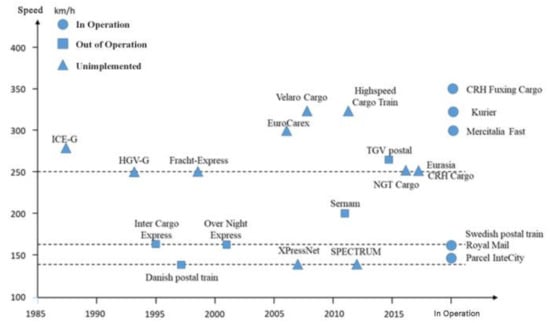
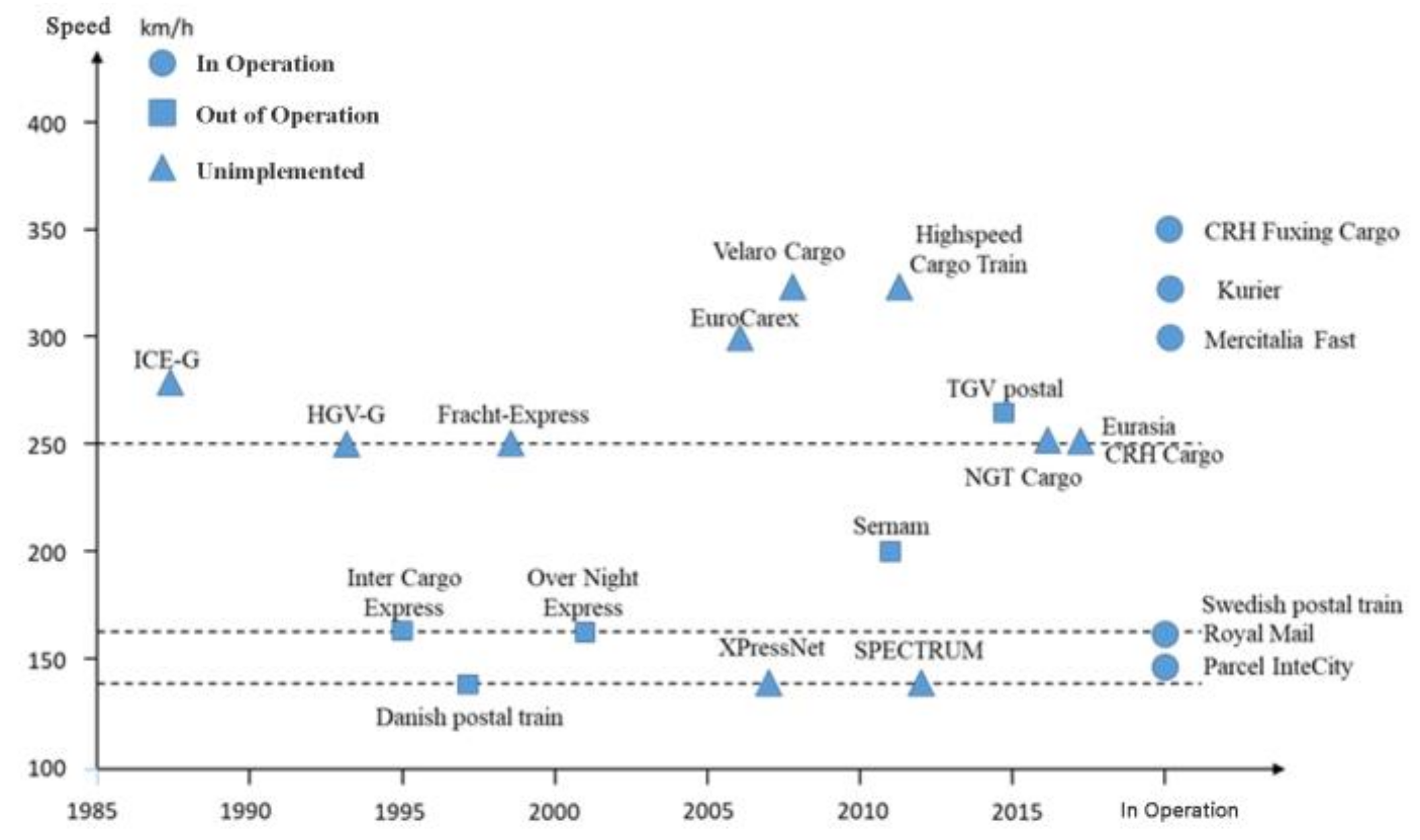
Scholars from various countries have long proposed different types of railway rapid freight products based on the operational status and speed attributes of each product, as shown in Figure 1.
Figure 1.
A comparison of the main railway rapid freight products of several countries.
Even so, high-speed rail express delivery remains in its early stages compared to other transportation modes in the logistics industry and still faces numerous issues and challenges. With the continuously growing demand in the express delivery market, urgent questions include how to closely integrate high-speed rail with express delivery while maintaining passenger transport, and how to optimize the transportation capacity and utilization rate of high-speed rail express delivery.
To address these issues, this paper examines the transport capacity of high-speed rail express delivery and passenger transport, revealing the impact of the high-speed rail express delivery model on passenger transport capacity. This study focuses on optimizing the organization of high-speed rail express delivery to provide theoretical and methodological support for the rational development of high-speed rail express delivery. The main contributions of this paper include the following:
- Fully utilizing the advantages of high-speed rail to diversify the development of express delivery transportation.
- Rational allocation of the remaining capacity of high-speed railways to enhance resource utilization.
- Effectively controlling the impact of high-speed rail express delivery on passenger transport and coordinating the allocation of passenger and freight resources on high-speed rail lines.
- Increasing the market share of railway express delivery, reducing costs, and increasing the revenue of railway transport enterprises.
The remainder of this paper is organized as follows: Section 2 provides a literature review on the current status of high-speed rail express feasibility and optimization of high-speed rail express. Section 3 proposes the non-splittable high-speed rail express transportation scheme model. Section 4 presents a case study that demonstrates that the model is computationally tractable and practicable under different scenarios, and gives the transportation plans. Section 5 concludes the paper and presents future research directions. Section 6 provides a thorough discussion on the results.
2. Literature Review
Early research on high-speed rail express delivery mainly focused on its definition, feasibility, and transportation organization models. In recent years, in-depth studies have primarily explored the competitive and cooperative relationships between high-speed rail express delivery and other transportation modes, as well as transportation organization aspects such as operational plans, schedules, and transportation schemes.
2.1. Feasibility Study of High-Speed Rail Express Delivery
Plotkin [1] analyzed the key factors for applying high-speed technology to freight transport using three train set models: French TGV-SE, less-than-carload transport, and heavy freight transport. These models demonstrated the technical feasibility of conducting high-speed freight and passenger transport under identical route conditions. Additionally, Plotkin estimated the freight volume that could be transported under feasible high-speed rail conditions and proposed the economic potential benefits of high-speed rail freight transport. Troche [2] conducted a feasibility analysis from the perspectives of market segmentation, intermodal transport, loading and unloading operations, and terminal station design. He also provided case studies on high-speed rail freight terminals, operations, and prospects in countries such as Sweden and Denmark. Zeybek [3], focusing on the Ankara–Sivas high-speed rail line primarily used for passenger transport, assessed the future transport potential and estimated the spare capacity for freight, validating the feasibility of using the Ankara–Sivas high-speed rail line for freight transport in Turkey. Watson [4] analyzed the feasibility of shifting freight services from air transport to high-speed rail freight based on operational and technical constraints related to high-speed rail freight. This shift was aimed at improving the economic, environmental, and social sustainability of the transport system. Zhang [5] examined the technical feasibility from the perspectives of infrastructure and operational models and analyzed the economic feasibility in terms of transport costs, efficiency, and timeliness. Ultimately, Zhang concluded that it is feasible to develop express delivery on high-speed railways in China.
2.2. Optimization of High-Speed Rail Express Delivery Organization
In the optimization of high-speed rail express delivery organization, scholars have researched various aspects including transportation plans, operational schemes, and timetables considering different optimization goals. Behiri et al. [6] studied the integration of urban freight and passenger railway networks at strategic, tactical, and operational levels. They proposed optimization methods to address the shared use and scheduling of freight and passenger trains, railways, and stations. This model is crucial for pre-assessing and analyzing the impact of introducing freight services into passenger services. Patrick [7] analyzed key factors affecting intermodal transport between road and rail, focusing on minimizing the transportation distance to reduce overall transport costs and developing specific door-to-door transport solutions for high-speed rail freight under intermodal conditions. Bi [8] constructed an improved arc path model to allocate high-speed rail express delivery volume based on different service levels and capacity utilization, using the high-speed rail network between 27 provinces in China as the study object. The analysis concluded that the transport capacity of high-speed rail express delivery can only meet the demand for five years.
Yu et al. [9,10,11] developed a two-stage high-speed rail express delivery flow distribution model based on the path alternative set concept, with the goal of maximizing economic benefits by considering capacity and OD transport demand. They formulated a high-speed rail freight train travel plan and then constructed an integrated timetable model considering train travel times, operation plans, and freight flow distribution schemes. The model was solved using an exact algorithm based on Lagrangian relaxation. Additionally, they built a logit model considering economic efficiency, timeliness, reliability, convenience, safety, and environmental protection to quantitatively analyze the market competitiveness of high-speed rail express delivery. Zhen [12], using the Nanchang Bureau as a case study, considered the selection of intermodal transfer stations, vehicle allocation for road freight transport, freight flow organization, and capacity uncertainty. They established a two-stage planning model aimed at minimizing total operating costs under stochastic scenarios to study the network planning and freight flow distribution of high-speed rail express delivery.
2.3. Coordinated Optimization of Train Timetables and Passenger/Freight Demand
In the coordinated optimization of train timetables with passenger and freight demand, Carey et al. [13] developed a timetable optimization model aimed at minimizing operating costs. This model incorporates constraints such as departure and arrival times, train continuity, station dwell times, and travel time limitations. They designed a branch-and-bound algorithm to solve the model. Cacchiani et al. [14], utilizing a spatio-temporal network modeling approach, aimed to maximize overall timetable profits. They inserted freight train paths into existing passenger train timetables without altering passenger train paths, achieving coordinated optimization of passenger and freight services. Godwin [15,16] focused on minimizing the total travel time of freight trains within a passenger rail network, ensuring that passenger train schedules remain unchanged and operations are uninterrupted. They constructed a 0–1 integer programming model and proposed a layered heuristic algorithm for the scheduling and timetable planning of freight trains.
2.4. The Optimization Modeling Method for Train Operation Diagrams
Regarding direct modeling, Bababeik [17] created a model with the minimization of weighted travel time and maintenance operation time as the objectives, taking the train arrival and departure times as integer decision variables. Sun [18] aimed to minimize the total waiting time of passengers, setting the train waiting time as a 0–1 variable and coupling it with the number of inbound passengers within the same time interval to achieve the optimization of the operation diagram for coordinated passenger flow control. In terms of spatio-temporal network modeling, considering the two-dimensional characteristics of the train operation diagram, a two-dimensional spatio-temporal network is typically employed for modeling. The safety intervals are transformed into incompatible constraints, and the objective function is transformed into the minimization of network costs, thereby converting this problem into the shortest path problem, and the decision variables are also transformed from integer variables to 0–1 variables. Caprara et al. [19] constructed a spatio-temporal network diagram to depict the spatio-temporal resource occupation relationship of trains and ultimately summarized the solution of the train operation diagram optimization problem as the shortest path problem of trains in the spatio-temporal network.
After reviewing the current research on high-speed rail express delivery both domestically and internationally, we can summarize as follows:
- Scholars have defined and categorized high-speed rail express delivery from multiple perspectives, verifying its feasibility and laying a solid foundation for further studies.
- Research has deeply explored the competitive and cooperative relationships between high-speed rail express delivery and traditional transportation modes such as road and air. Analyses of its competitiveness and cooperative strategies among different transportation modes provide new insights for the sustainable development of high-speed rail express delivery.
- While international studies are limited, domestic scholars have conducted extensive research on predicting high-speed rail express volumes and developing transport organization models. However, these studies often focus on operational plans and timetable formulation, lacking in-depth discussion on dedicated high-speed rail express services. Additionally, optimization models generally consider the perspectives of operators and shippers, without fully addressing the impact on passenger transport.
- Modeling approaches and methods for train timetable optimization are well developed, including direct modeling and spatio-temporal network methods. Research has extended to coordinated optimization with stop plans and passenger and freight transport, providing theoretical and practical support for further studies.
Based on existing research, this paper will consider the impact of high-speed rail express delivery on passenger transport capacity. It will adopt a dual perspective of both passenger and freight transport, comprehensively considering four transport organization models to conduct a more thorough optimization study.
3. Methodology
Due to smaller transport volumes and the lack of specialized operation areas, high-speed rail express delivery involves many unpredictable factors during operations. Consequently, minimizing transfer and splitting operations can effectively ensure reliable freight transport. This paper considers the non-splittable freight flow scenario and constructs a coordinated optimization model for selecting express train transport modes and optimizing express flow paths.
3.1. Model Basis and Assumption
This section will construct an optimization model for a non-splittable high-speed rail express transportation scheme, taking into account the loss of passenger transport capacity. The model is based on the scheduled passenger trains and considers the selection of transport modes for each train and the potential operation of dedicated freight trains. The objective is to maximize operational revenue, minimize operational costs, and minimize the loss of passenger transport capacity. This coordinated optimization integer programming model will determine the transport mode for each train and the transportation scheme for high-speed rail express goods, facilitating model construction and solution.
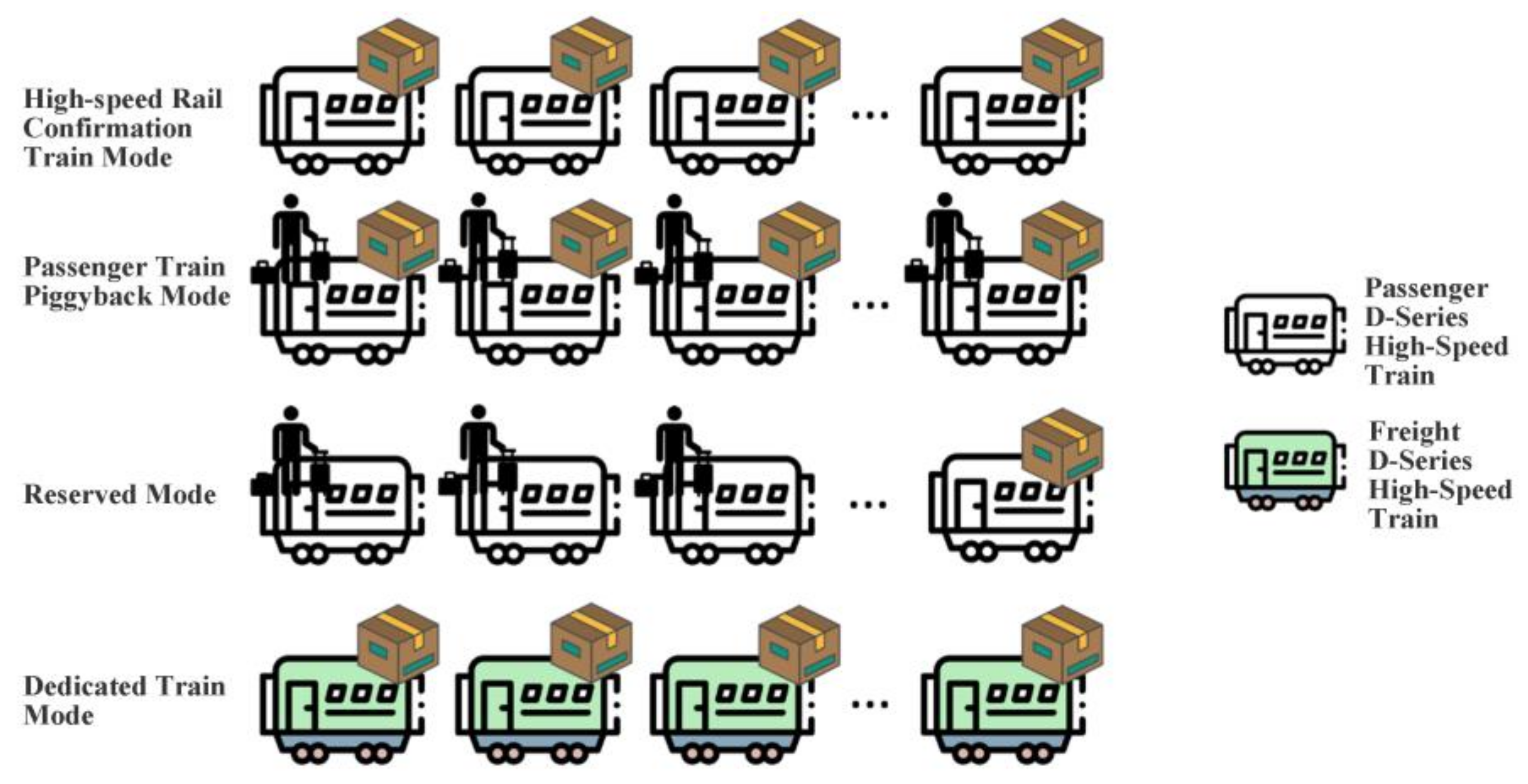
In this paper, transport modes are defined as the confirmation train mode, passenger train piggyback mode, reserved mode, and dedicated train mode (see Figure 2):
- The high-speed rail confirmation train mode involves Electric Multiple Units (EMUs) used by railway departments to check line safety. In express transportation, it is used for point-to-point cargo transport without carrying passengers, utilizing idle capacity with low investment costs. However, this mode faces limitations such as a limited number of operations, insufficient automation equipment, restricted cargo space, and one-directional transport, limiting its market potential. From January 2024, the pilot work of mass transport of confirmed trains on the high-speed railway between Zhengzhou and Chongqing has been officially launched, and two confirmed trains on the high-speed railway will be arranged to run bidirectional from Zhengzhou Airport Station and Chongqing North Station each day, effectively improving the transport efficiency between Zhengzhou and Chongqing.
- Passenger train piggyback mode utilizes the remaining space in passenger trains for express items, offering low cost, high frequency, and flexible timing, making it suitable for urgent small batch cargo. However, it faces insufficient loading schedules and limited volume and is affected by passenger peak times, which restricts its development potential.
- The reserved mode designates specific carriages in passenger EMUs for express delivery, reducing interference with passenger transport and accommodating larger volumes. However, it reduces passenger transport capacity and is suitable for transitional periods with increased express volume, constrained by passenger transport needs.
- The dedicated train mode is ideal for the mature stage of high-speed rail freight transport, offering high reliability, large carrying capacity, and precise timing, providing high-quality service. However, it requires significant investment, long-term cargo sources, and station modifications, making it suitable for direct transport between stations with large cargo volumes where it can demonstrate significant advantages.
Figure 2.
Schematic diagram of high-speed rail express transportation mode.
The cargo capacity and its impact on passenger transport capacity vary under different transport modes, as do the associated costs. Therefore, the selection of transport modes must consider the passenger capacity already occupied by the train and develop train travel modes that meet high-speed rail express transportation needs. This includes determining the transport modes selected by each train and the number of dedicated high-speed rail express freight trains to be operated.
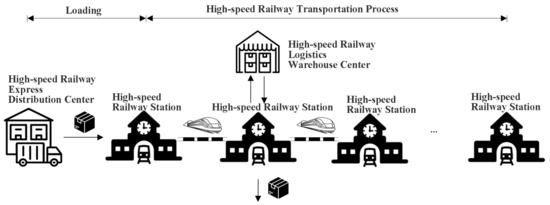
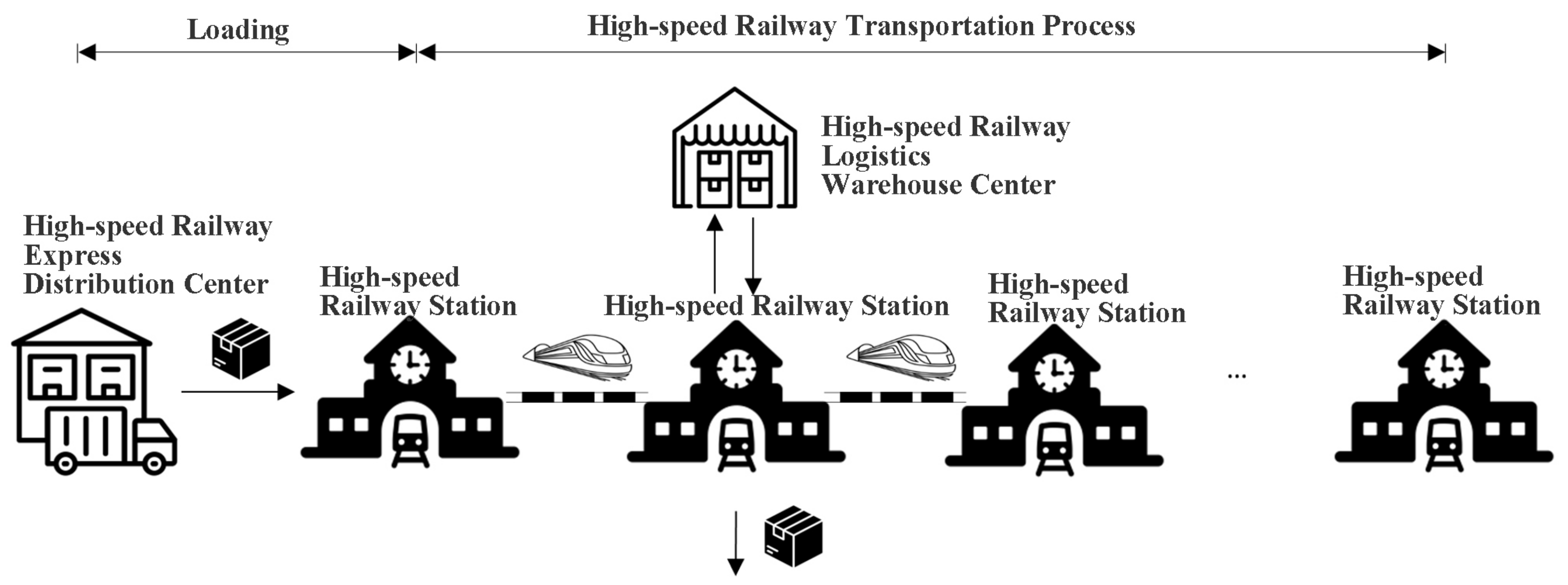
The core of the high-speed rail express transportation scheme involves considering the costs and benefits and efficiently allocating express cargo flows to appropriate loading and unloading stations, transfer stations, and high-speed rail schedules. Essentially, it focuses on selecting transport paths for different OD express cargo flows. The optimization problem discussed in this paper involves several key operational processes: loading operations, high-speed rail transportation, transfer storage, and unloading operations. These processes are illustrated in Figure 3.
Figure 3.
The disassembly diagram of the high-speed rail express transportation process involved in this issue.
Based on the above analysis, it is clear that the cargo flow transportation process involves multiple stages. To better capture the full process of high-speed rail express transportation, this study constructs specific spatio-temporal network arcs for each operational stage, as detailed in Table 1. This comprehensive approach models the entire workflow from collection, loading, transfer storage, and transportation to unloading, thereby enhancing the model’s overall expressiveness.
Table 1.
The correspondence between the process of high-speed rail express transportation and the spatio-temporal network.
Based on the above analysis, this paper makes the following assumptions:
- This study only considers the high-speed rail express transportation process on high-speed rail lines, excluding short-distance urban transportation processes for collection at the origin and delivery at the destination.
- During the decision-making period, the physical high-speed rail network and train schedules are known and remain unchanged, and the ticket sale rates for each train can be obtained in advance.
- Only one high-speed rail station per city is considered for express transportation operations.
- The arcs for high-speed rail express-dedicated trains do not consider parameters such as the running times of dedicated freight trains. The high-speed rail freight-dedicated trains operate along the entire line, and all cities have the conditions to accommodate dedicated train dwells.
- The passenger train carry mode has no impact on passenger transport capacity, and the reserved mode allows at most one train to be reserved for high-speed rail express transportation.
- It is assumed that the operational processes and efficiencies during transfer connections are relatively stable, and external conditions affecting transportation organization are not considered.
3.2. Notation
This section presents the sets, indices, and parameters relevant to the research problem, including those related to trains and express cargo.
3.2.1. Model for Train
The sets and parameters related to the construction of the spatio-temporal network for the train part are described in detail in Table 2.
Table 2.
Explanation of train symbols.
3.2.2. Model for Express Cargo
The sets and parameters related to the construction of the spatio-temporal network for the express cargo part are described in detail in Table 3.
Table 3.
Explanation of symbols for express delivery goods.
3.3. Construction of the Spatio-Temporal Network
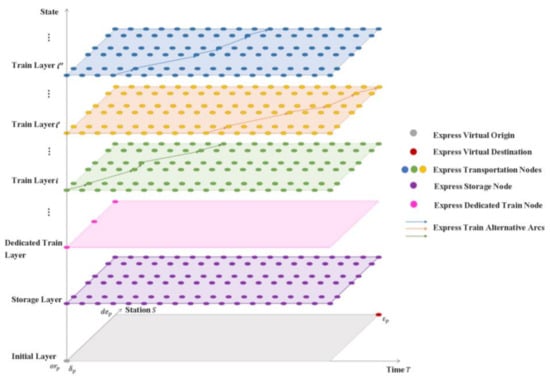
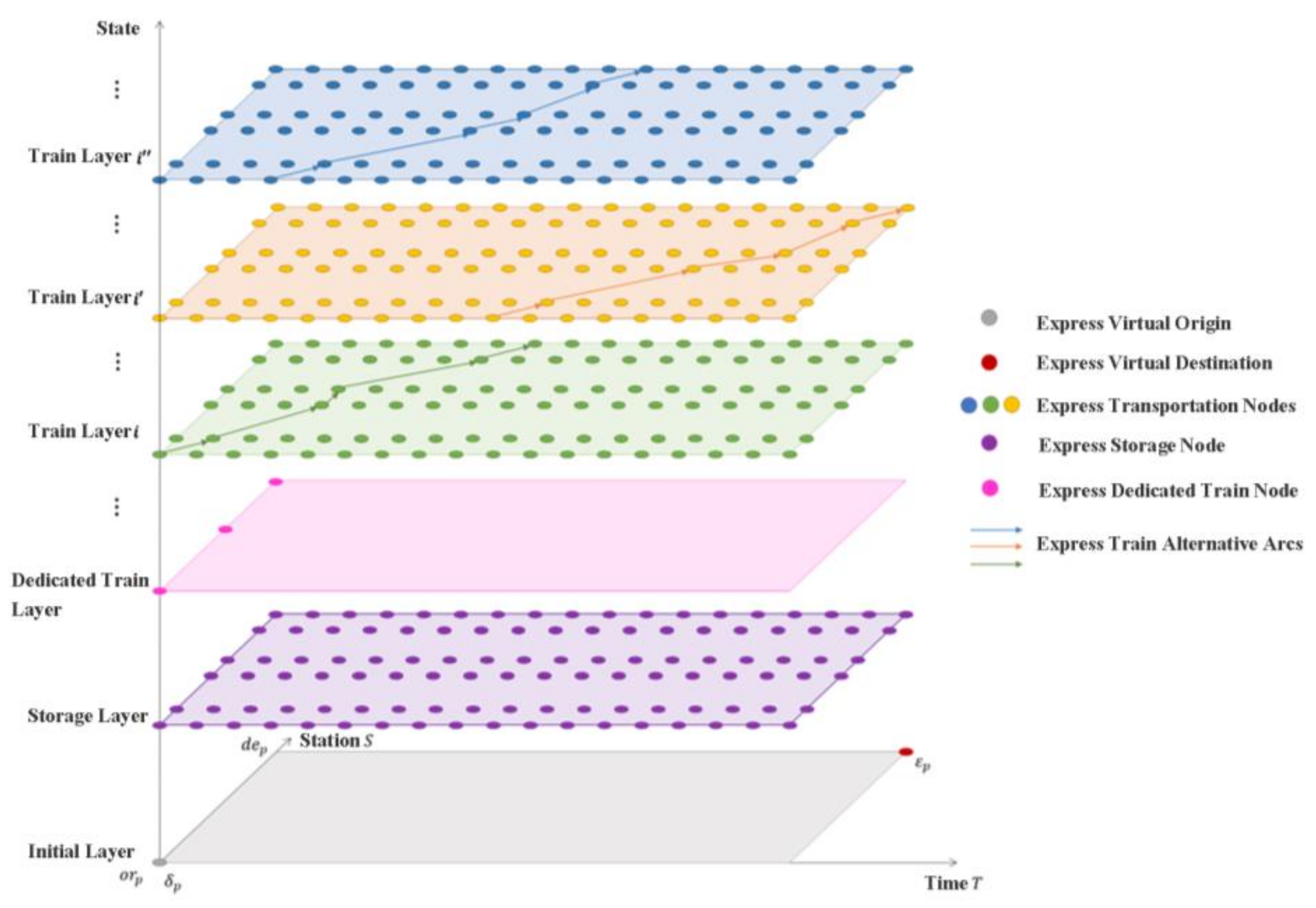
The spatio-temporal network is a three-dimensional network composed of time, space, and state dimensions. Different trains correspond to different routes and arrival and departure times, resulting in various sub-spatio-temporal networks. High-speed rail express, which relies on different trains for transportation, can be viewed as different states of express cargo utilizing these trains. Therefore, this study constructs train sub-spatio-temporal networks for different trains, with each corresponding to different state layers, including the initial layer, storage layer, dedicated train layer, and train state layer. The departure, arrival, transportation on different trains, and transfer between trains can all be represented by this spatio-temporal network.
This model mainly consists of two parts: train modeling and express cargo modeling. Hence, problem representation is achieved by constructing train sub-spatio-temporal networks and express cargo time–space state networks in the following steps.
3.3.1. Construction of Train Spatio-Temporal Network
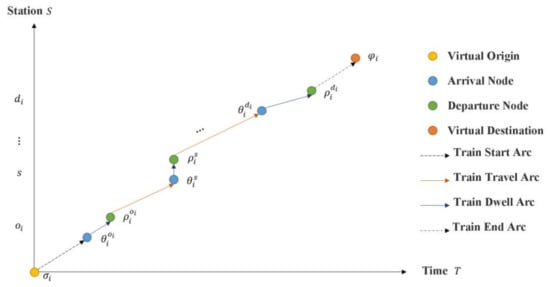
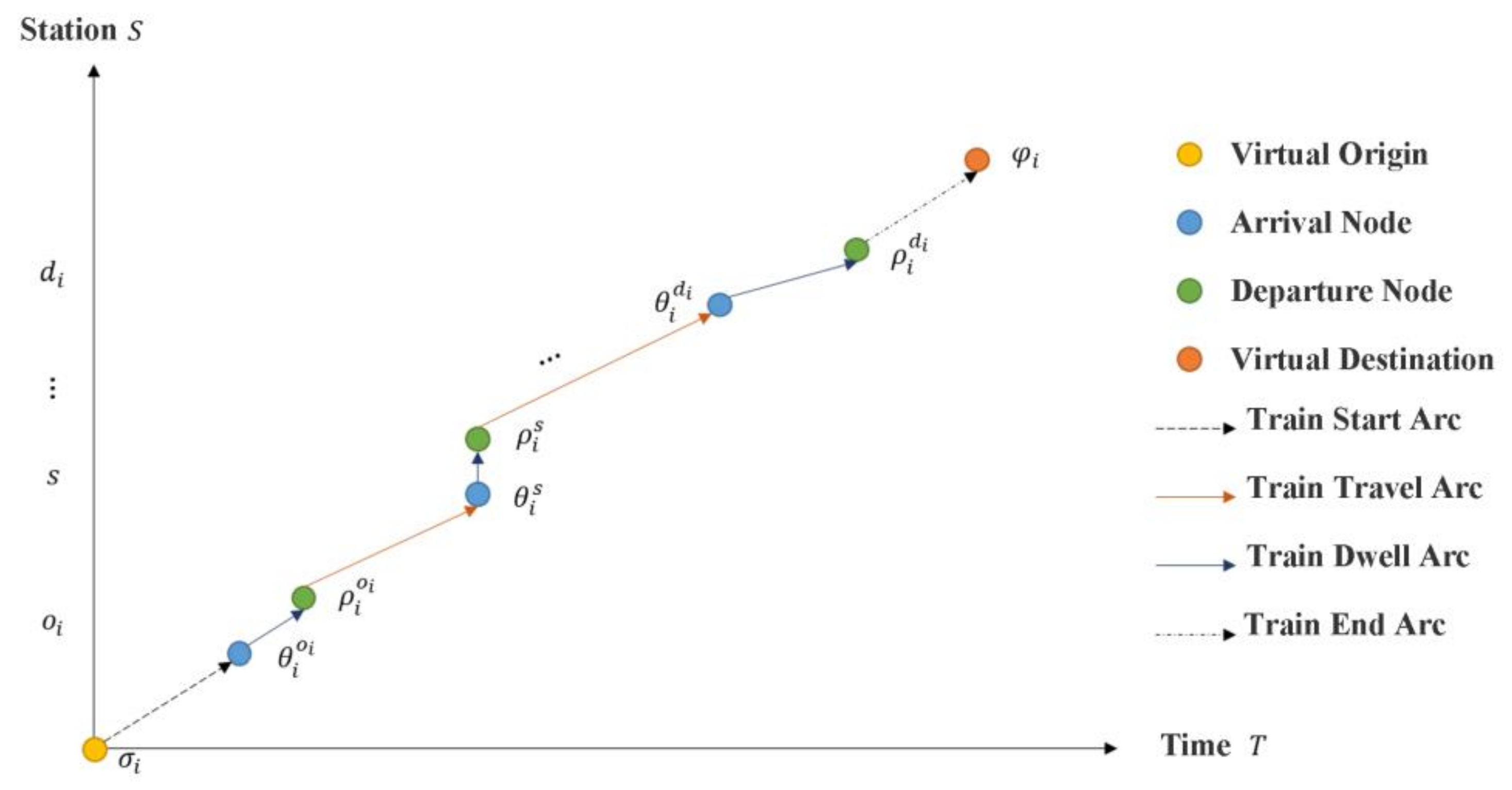
Based on the operational characteristics of trains, the train travel process is divided into train start, train travel, train dwell, and train end. According to the spatio-temporal network construction rules, the train spatio-temporal network arcs are divided into the train start arc set, train travel arc set, train dwell arc set, and train end arc set.
For each train’s operational task, a corresponding train sub-network can be established, where is the set of nodes in the train spatio-temporal network that train can occupy, and is the set of arcs in the train spatio-temporal network that train can occupy. The visual representation of the train sub-spatio-temporal network is shown in Figure 4.
Figure 4.
Train spatio-temporal network diagram.
- Construction of Spatio-temporal network
For each train , its nodes’ spatial attributes depend on the stations it passes through, and the temporal attributes are constructed based on the time window . To ensure the integrity of each path in the train’s spatio-temporal network, virtual starting and ending points are introduced. The train arrival and departure times are determined by the scheduled train arrival and departure times.
Thus, the set of nodes in the train spatio-temporal network includes the virtual starting point , the arrival nodes , the station departure nodes , and the virtual end point , as shown in Table 4. The set of train sub-spatio-temporal network nodes can be expressed as . For any node and (s′, t′, i′) in the spatio-temporal network, we have .
Table 4.
Representation form of train spatio-temporal network nodes.
- 2.
- Network Arc Construction
For any train , the train sub-spatio-temporal network includes four types of arcs: train start arcs , train travel arcs , train dwell arcs , and train end arcs , as shown in Table 5.
Table 5.
Representation form of arcs in train spatio-temporal network.
(1) Train Start Arcs
Train start arcs connect the virtual starting point to the arrival node at the originating station. For any train , at its originating station , there is a train start arc to the originating station arrival node , represented as , as shown in Equation (1).
(2) Train Travel Arcs
Train travel arcs connect departure nodes to arrival nodes. For any train , for its passing station , there is a train travel arc from the departure node of station , , to the arrival node of station (arrival node ), as shown in Equation (2).
(3) Train Dwell Arcs
Train dwell arcs connect arrival nodes to departure nodes. For any train , at each station , there is a train dwell arc from the arrival node at station , , to the departure node at the same station , represented as , as shown in Equation (3).
(4) Train End Arcs
Train end arcs connect the departure node at the terminating station to the virtual end point. For any train , at its terminating station , there is a train end arc from the departure node at the terminating station , , to the virtual end point , represented as , as shown in Equation (4).
3.3.2. Construction of Spatio-Temporal Network for Express Cargo
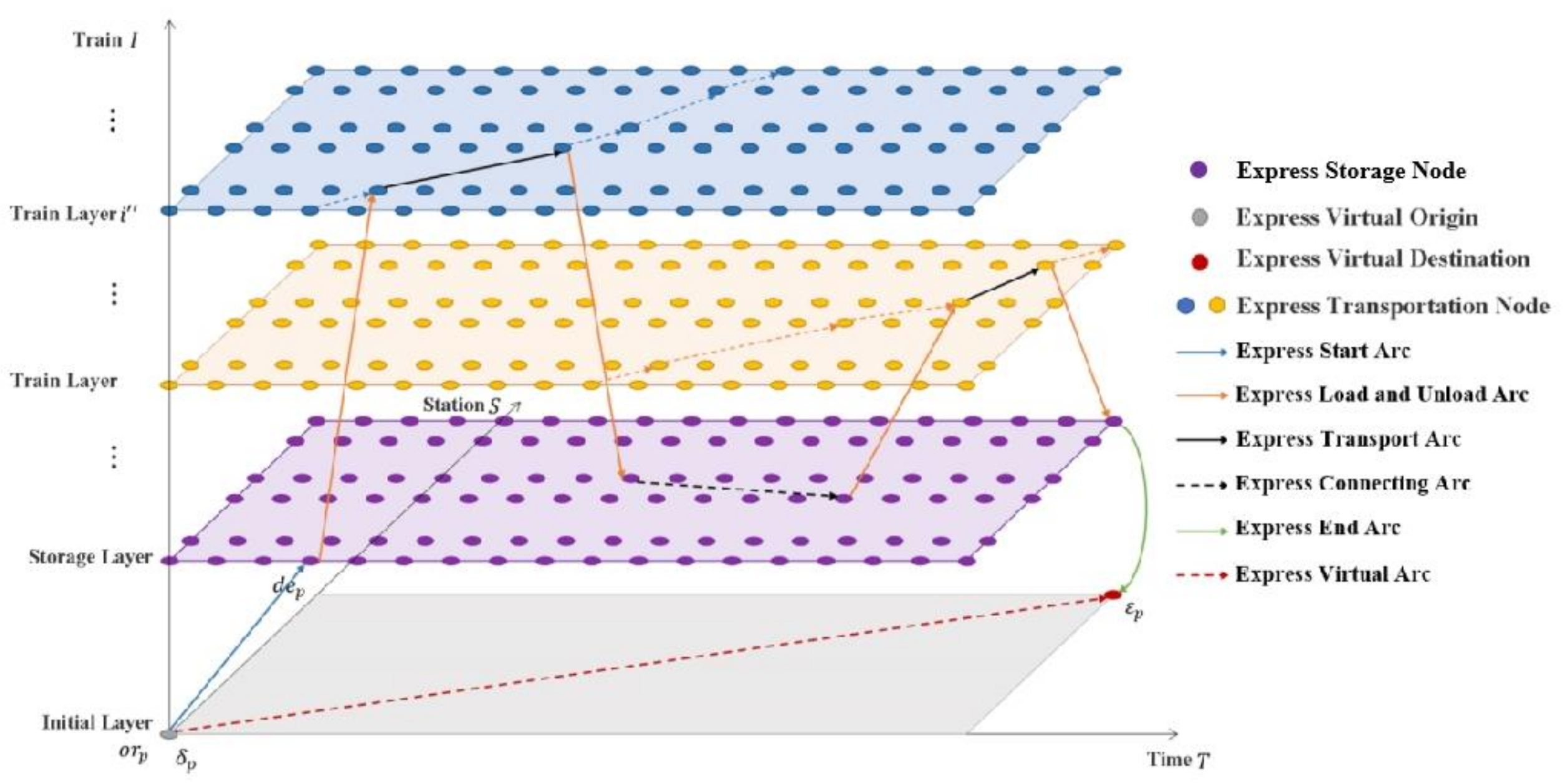
Let represent the spatio-temporal network for express cargo, where denotes the set of nodes in the spatio-temporal network, represents the set of arcs in the spatio-temporal network, and indicates the set of states in the spatio-temporal network, including the initial layer, storage layer, dedicated train layer, and train layer. Each express shipment task can be viewed as a sub-spatio-temporal network for express cargo, , where is the set of nodes in the spatio-temporal network that can be occupied by express cargo , is the set of arcs in the spatio-temporal network that can be occupied by express cargo , and is the set of trains in the spatio-temporal network that can be utilized by express cargo . A visual representation of the express cargo spatio-temporal network is shown in Figure 5.
Figure 5.
Network diagram of spatio-temporal state of express delivery goods.
- Construction of Network Nodes
For each express cargo , its spatial attribute of the nodes depends on the transit stations , the temporal attribute constructed by the time window , and the state attribute built by the train . To ensure the completeness and solvability of the express cargo transport path, virtual origin and destination nodes are introduced. Additionally, considering that express cargo transport relies on train travel, the nodes for express cargo transport include the arrival and departure nodes of the selected trains .
Therefore, the set of nodes in the spatio-temporal network for express cargo includes the virtual origin , the set of express transport nodes , the set of storage nodes , the dedicated train nodes , and the virtual destination . The set of nodes in the sub-spatio-temporal network for express cargo can be expressed as . Thus, for any node and in the spatio-temporal network, .
- 2.
- Construction of Network Arcs
For any express cargo , the sub-spatio-temporal network includes seven types of arcs: express start arcs , express travel arcs , express loading and unloading arcs , express transfer arcs , express end arcs , express dedicated train arcs , and express virtual arcs . Hence, .
(1) Express Start Arcs
Express start arcs connect the virtual origin and the storage node at the origin station. For any express cargo , at its origin station , there exists an express start arc to the storage node at the origin station , , as shown in Equation (5).
(2) Express Loading and Unloading Arcs
Express loading and unloading arcs connect the arrival nodes, departure nodes, and storage nodes at the origin, destination, and intermediate transfer stations. For any express cargo , at its transit station , there exists an express loading and unloading arc from the storage node at the logistics center or warehouse at station to the departure node , as well as from the arrival node to the storage node ; express loading and unloading arcs can be expressed as , as shown in Equation (6).
(3) Express Travel Arcs
Express travel arcs connect the express transport nodes. For any express cargo , there exist corresponding train travel arcs and train dwell arcs that can be occupied by the selected train , as shown in Equation (7).
(4) Express Transfer Arcs
Express transfer arcs connect the storage nodes. For any express cargo , at its passing station , for any train that can be occupied at station , there exists an express transfer arc from the departure node at station , , corresponding to the storage node and the arrival node at station ; express transfer arcs can be expressed as , corresponding to the storage node as shown in Equation (8).
(5) Express End Arc
Express end arcs connect the departure nodes at the destination station and the virtual destination. For any express cargo , at its destination station , there exists an express end arc from the departure node at the destination station , corresponding to the storage node and the virtual destination ; express end arcs can be expressed as , as shown in Equation (9).
(6) Express Virtual Arcs
Express virtual arcs connect the virtual origin and the virtual destination. For any express cargo , when the express cargo is not transported due to network capacity constraints, there exists an express virtual arc from the virtual origin to the virtual destination ; express virtual arcs can be expressed as as shown in Equation (10).
(7) Express Dedicated Train Arcs
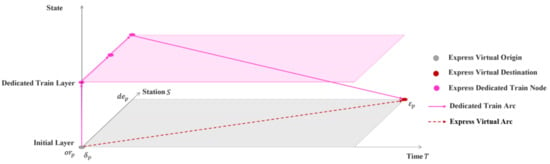
Express dedicated train arcs connect the virtual origin , the virtual destination , and the dedicated train transport nodes . For any express cargo , when the express cargo is transported by a dedicated high-speed train, there exists an express dedicated train arc connecting the virtual origin , the virtual destination , and the dedicated train transport nodes , as well as connecting the dedicated train transport nodes and , as shown in Equation (11).
For , taking express cargo as an example, express cargo can be transported by optional trains , by dedicated express trains, or by remaining at the origin location. The research objective of this model includes determining the number of departures of high-speed rail express trains without specifying the exact departure times. Therefore, when express cargo is transported by a dedicated express train, the nodes passed by are abstract nodes rather than specific departure and arrival nodes at the stations. When express cargo is limited by train capacity, loading/unloading capacity, or loading/unloading time, for the convenience of model construction, express cargo uses a virtual arc to represent its transport path. However, in actual operations, express cargo does not depart and remains in the warehouse at the origin location.
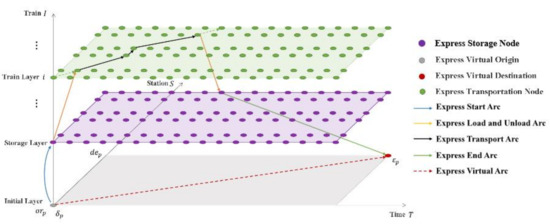
When express cargo can be transported by train, assuming that the optional sub-spatio-temporal network for express cargo is as shown in Figure 6, the starting point of the transport path for express cargo is the virtual origin , and the endpoint of the transport path is the virtual destination . The intermediate optional nodes are , and the optional arcs for the express transport path are . Due to potential constraints on transport capacity or factors such as delivery deadlines and transport costs, the transport path of express cargo from the departure station to the destination station may need to consider whether to transfer at certain stations.
Figure 6.
Spatio-temporal network diagram (no transfer example).
When express cargo is transported directly without any transfer stations, the transport path is as shown in Figure 6. The transport path for express cargo starts from the virtual origin , first undergoes loading operations through the loading and unloading arc, follows the operational path of the selected interval of train ii, undergoes unloading operations at the destination station through the loading and unloading arc, and finally reaches the virtual destination . Express cargo uses only train ii for transportation.
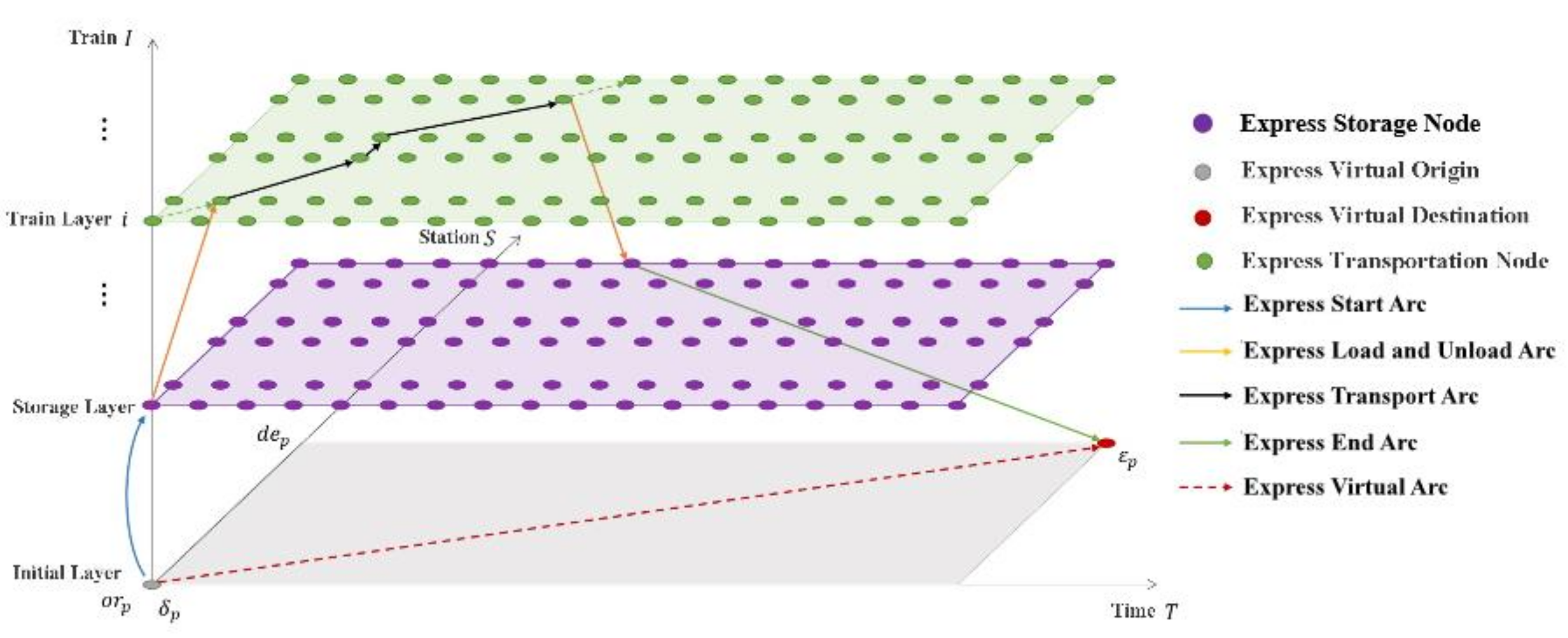
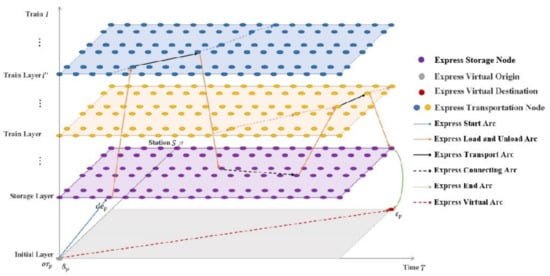
If express cargo has a transfer station during transportation and utilizes both train and train , the transportation path is as shown in Figure 7.
Figure 7.
Spatio-temporal network diagram (with transfer examples).
The transport path of express cargo starts from the virtual origin , undergoes loading operations at the departure station, follows the operational path of the selected interval of train , and undergoes unloading operations at the transfer station. Through the express connection arc, it then connects to the operational path of the selected interval of train , and finally undergoes unloading operations at the destination station, reaching the virtual destination .
However, the choice of the transfer station must consider whether the stopping stations and stop times of the preceding train meet the unloading time requirements, as express transfers are not allowed through non-stopping stations. Similarly, the selection of the subsequent train must consider whether the stopping stations and stop times of train meet the loading time requirements.
When express cargo opts for transportation via the dedicated express train, it is allocated through the express train arc via the dedicated express train layer, as illustrated in Figure 8. The transport path of express cargo starts from the virtual origin , passes through the dedicated express train nodes corresponding to the stations , and reaches the virtual destination .
Figure 8.
Spatio-temporal network diagram (example of freight train).
3.4. Model Construction
This model is constructed based on the integration of the train spatio-temporal network and the express cargo spatio-temporal network. It is divided into three sections: the train transportation organization mode, the express cargo transportation section, and the coupling section between trains and express cargo.
3.4.1. Train Transportation Organization Mode
Based on the previously constructed train sub-spatio-temporal network, an optimization model is established for the train transportation organization mode.
- Decision Variables
The transportation organization mode undertaken by different trains is influenced by the passenger load factor of each train. This section primarily determines the high-speed rail express transportation organization mode undertaken by the trains. The decision variables for this section are shown in Table 6.
Table 6.
Decision variables for train travel.
- 2.
- Objective Function
For different transportation organization modes, the corresponding management costs, transportation capacity, and impacts on passenger transportation vary. Considering the trade-offs between management costs, train express capacity, and the impact on passenger transportation, the objective of this model is to maximize the revenue while minimizing the impact on passenger transportation based on the existing high-speed rail passenger train schedules, taking into account the passenger load factor.
(1) Passenger Transportation Loss Cost
High-speed rail express transportation uses high-speed trains primarily serving passenger transportation. This model considers various train transportation organization modes, including dedicated express trains, passenger-assisted modes, reserved modes, and freight-only modes. The reserved mode requires reserving passenger carriages for express cargo, impacting the number of passengers that can be accommodated, and consequently, reducing passenger transportation revenue. Therefore, considering the passenger transportation demand of different trains, the passenger transportation revenue loss under the selected train travel organization mode is determined. The objective function for passenger transportation loss cost is shown in Equation (12).
(2) Dedicated Train Penalty Cost
Operating a dedicated high-speed rail express train incurs additional penalty costs, which are related to the volume of express cargo transported by the dedicated train. The objective function for the dedicated train penalty cost is shown in Equation (13).
- 3.
- Constraints
(1) Transportation Organization Mode Selection Constraint
To facilitate the convenience of high-speed rail express management and ensure clarity in planning and organization while also reducing the complexity and intersection of loading and unloading operations during transportation, each train can correspond to at most one high-speed rail express transportation organization mode.
Equations (14)–(16) indicate that for any train , the corresponding transportation organization mode is unique. Additionally, due to the specific nature of the transportation time and train schedule, only the first train of the day can choose the high-speed rail confirmation mode for express transportation.
(2) Passenger Loss Constraint
For any train , its seating capacity is influenced by the transportation organization mode it undertakes. Under the reserved mode, train may experience passenger loss. Determining whether passenger loss occurs requires comparing the passenger transportation demand of train with the passenger transportation capacity that train can accommodate under the selected transportation organization mode .
Equation (17) indicates that when the passenger transportation demand of train exceeds the actual passenger transportation capacity that train can accommodate, passenger loss occurs. Consequently, the passenger loss indicator variable is 1; otherwise, it is 0.
(3) Decision Variable Constraints
The decision variables and are binary variables, and is a positive integer variable, as shown in Equations (18)–(20):
3.4.2. Express Cargo Transportation Section
- Decision Variables
The decision variables for the express cargo transportation section of the model are shown in Table 7.
Table 7.
Decision variables for express freight transportation.
- 2.
- Objective Function
The model for the express cargo transportation section primarily focuses on optimizing the assembly of express cargo. The objective is to maximize the railway profit from high-speed express delivery while meeting the cargo transportation demand. The aim is to maximize total express cargo revenue and minimize total costs. In this model, the operational costs of high-speed express delivery include transportation costs, management costs, loading and unloading costs, intermediate storage costs, delay costs, and costs associated with cargo retention. The objective functions for the express cargo transportation section are represented by Equations (21)–(28).
(1) Transportation Revenue
(2) Operation Cost
① Transportation Cost
② Management Cost
③ Loading and Unloading Cost
④ Transfer and Storage Cost
⑤ Delay Cost
⑥ Express Cargo Retention Cost
- 3.
- Constraints
(1) Express Cargo Flow Balance Constraint
Equation (29) represents the fundamental flow balance constraint in network optimization. Given the relatively small demand for high-speed rail express services and the current limited infrastructure for express cargo at high-speed rail stations, the model ensures that the express cargo flow is non-splittable. This approach aims to reduce the risk of lost or missing items during transportation and enhance the reliability of cargo flow, as reflected in Equation (29).
(2) Express Loading and Unloading Time Constraint
Considering that express shipments must undergo loading and unloading operations at the departure, destination, and transfer stations, the time required for these operations is proportional to the volume of express cargo. Additionally, the loading and unloading time is constrained by the dwell time of the transporting and connecting trains.
Equation (30) indicates that the required loading and unloading time for express cargo p is related to the number of express items . The feasibility of performing loading and unloading operations at a station is constrained by the dwell time of the carrying train i at the stopping arc .
(3) The Constraint on the Number of Trans-Shipments for Express Cargo
High-speed rail express transport mainly targets time-sensitive and high-value goods. The number of trans-shipments and the associated loading and unloading operations directly impact the transport efficiency and quality of the express cargo. Therefore, Equation (31) indicates that this model limits the number of trans-shipment operations during the high-speed rail express transport to one, ensuring the quality of service for express shipments.
(4) Delay Determination
The timeliness of high-speed rail express delivery is a primary concern. Thus, the delay rate of express shipments is a crucial factor for companies when evaluating transport route options. Equation (32) determines whether express shipment is delayed. If the total transport time for shipment is less than its corresponding delivery time limit, the delay indicator variable is 0; otherwise, it is 1.
(5) Decision Variable Constraints
The decision variables , , and are binary variables. The specific constraints are shown in Equations (33)–(35).
3.4.3. Train–Express Coupling Section
Given the correlation between express cargo and the transport capacity provided by the train organization mode, the train–express coupling model primarily considers the constraints related to the compatibility between express cargo arcs and the chosen train transport organization mode.
- Train Loading Capacity Constraint
The prerequisite for transporting express cargo via trains is sufficient train capacity. Equation (36) specifies that the total express cargo volume carried by train () is constrained by train ‘s carrying capacity ().
- 2.
- Dedicated Train Capacity Constraint
Equation (37) indicates that the number of dedicated trains to be operated must be determined based on the demand for dedicated train transport along the study route and the carrying capacity of the dedicated trains.
- 3.
- Train Segment Transport Indicator Variable
Equation (38) state that when none of the transport arcs corresponding to the segment are utilized for transport tasks, the train segment transport indicator variable is 0; otherwise, it is 1.
In summary, the model considering the non-splittable freight flow (Model M3-1) is as follows:
3.4.4. Linearization
Nonlinear models are more computationally challenging than linear models. Therefore, this section introduces a large constant to convert nonlinear constraints into linear constraints, where is an arbitrarily large number. Table 8 shows the correspondence between the nonlinear constraints in the model and their converted linear constraints. The transformed constraint equations are given by Equations (61)–(65).
Table 8.
Constrained linearization transformation.
4. Case Study
4.1. Case Description
4.1.1. Case Line and Train Travel Data
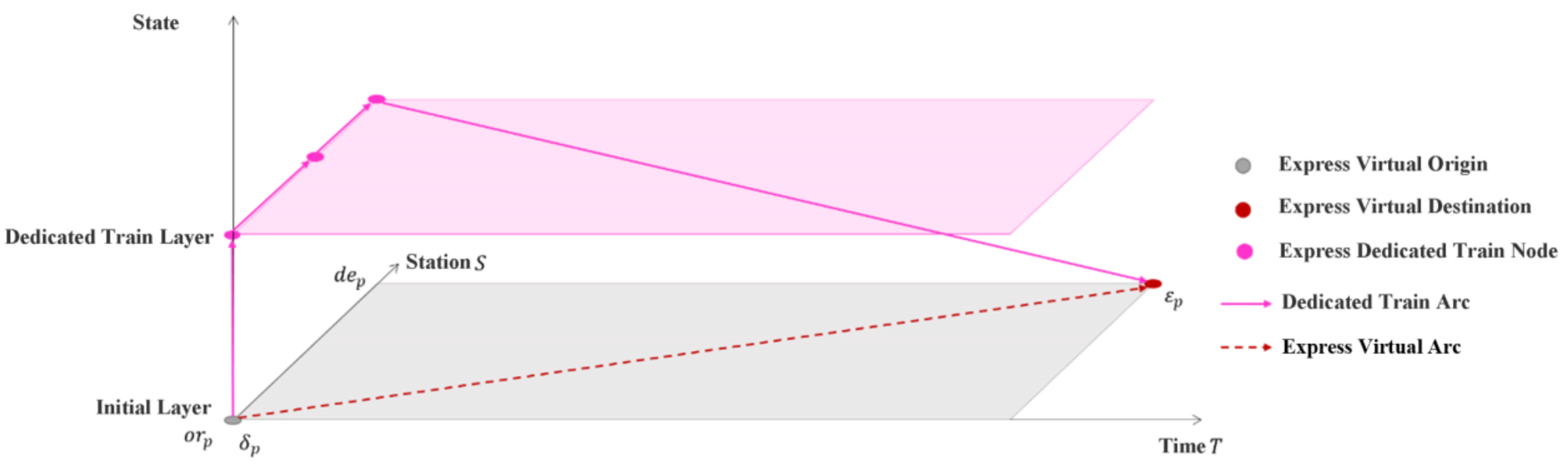
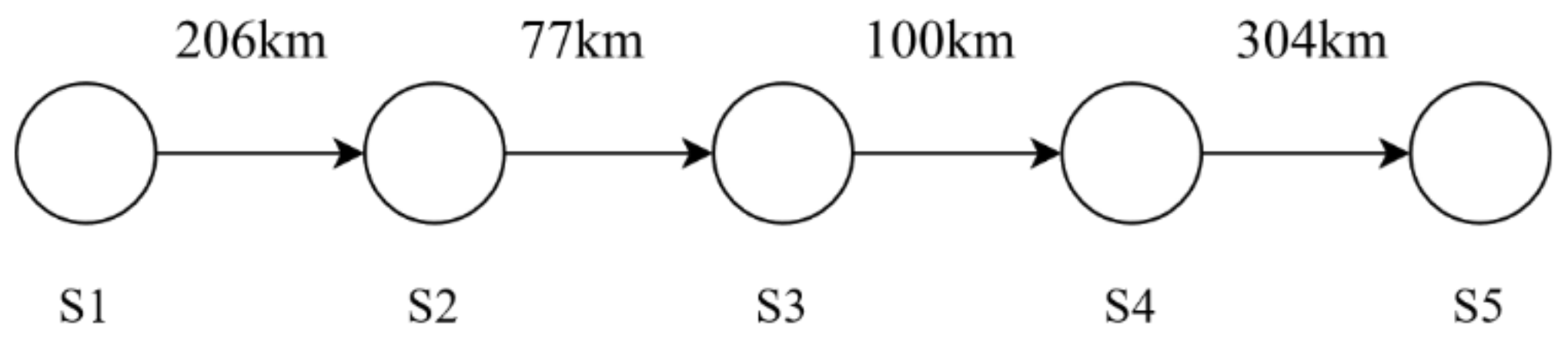
This case study is set against the backdrop of a high-speed rail line with five stations capable of handling high-speed rail express deliveries. These stations are designated as . The distance information between adjacent stations is illustrated in Figure 9.
Figure 9.
Schematic diagram of numerical experiment circuit.
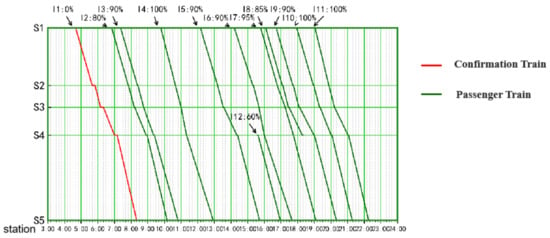
On the line, there are 12 trains, with the train numbers given as . These trains are available for high-speed rail express delivery. The train schedule and the expected passenger transportation demand for each train are illustrated in Figure 10. Among these, train is designated as a confirmation train and can only operate in the confirmation mode. The transportation mode for the remaining trains is not fixed; it can be selected based on the expected passenger information and high-speed rail express demand using the optimization model.
Figure 10.
Numerical experiment train diagram and parameters.
4.1.2. Express Cargo Flow Data
Twenty express cargo flows are set up, with each flow consisting of 400 items. The departure times, origin–destination (OD) stations, and types of express cargo are randomly assigned. Specific data are detailed in Table 9.
Table 9.
Numerical experimental cargo flow data.
4.1.3. Parameter Values
The specific parameter settings are detailed in Table 10 and Table 11. Each high-speed train has a capacity of 551 passengers. The weight of a single express parcel is per item. The loading and unloading time per express parcel unit is 30 s. Each carriage can allocate up to two personnel for handling, with each person able to handle two parcels per instance.
Table 10.
Parameter settings for numerical experiments.
Table 11.
Parameter settings for different transportation modes.
For penalty costs, packages are generally compensated according to their declared value. For packages that are not insured, compensation is set at five times the specific service fee, determining the penalty coefficient for delayed express parcels . The storage cost coefficient is established based on collected data from high-speed express operations. The penalty coefficient for using high-speed trains for express cargo, , is set based on the flexible fee for next-day delivery. For large-scale case analyses, adjustments to these parameters should be made according to the actual line conditions.
4.2. Solution of Non-Splittable Model Under Adequate and Insufficient Capacity Scenarios
This section explores two scenarios—adequate capacity and insufficient capacity—using the non-splittable model to find a solution.
In the adequate capacity scenario, the high-speed express transportation demand does not exceed the transport capacity of the high-speed rail line based on the cargo flow information from Table 9. In the insufficient capacity scenario, the express transportation demand exceeds the rail line’s capacity. Here, the cargo flow volume is multiplied by four, while the volume of each single express parcel remains unchanged, reflecting the constraints such as loading and unloading capacity. This scenario is also based on the cargo flow information from Table 9.
Gurobi is a new generation of large-scale mathematical programming optimizers developed by Gurobi. The non-splittable model (M3) was solved using Gurobi in both scenarios. The parameter MIPGap represents the gap between the optimal solution and the current solution, and is set to 0.0001. When the gap between the target value of the current solution found by the solver and the optimal solution is less than 0.0001, the solver will stop solving and return the optimal solution. The solution time was 6.36 s for the adequate capacity scenario and 40.79 s for the insufficient capacity scenario. The optimization results, including the transportation modes of different train services, the transportation paths of different express cargo flows, and optimization indicators such as cargo flow distribution, train capacity utilization, and passenger capacity loss, were analyzed.
4.2.1. Train Transportation Mode Selection Results
The results of the mode selection for 12 trains and the number of special trains were obtained using the non-splittable model (M3), as shown in Table 12. Under the adequate capacity condition, 11 passenger trains are used with the “passenger carry” mode, no confirmation trains are employed, and no special freight trains are set. This choice is due to the high management costs associated with confirmation, reservation, and special train modes. Additionally, using reservation or special train modes could potentially result in passenger capacity loss. To minimize operating costs and impacts on passenger capacity, the passenger carry mode was chosen when its capacity allows.
Table 12.
Results of train transportation mode selection.
In the insufficient capacity scenario, to meet transportation demand, one additional express freight train was added. The confirmation train mode was used for express delivery, with nine passenger trains operating in the passenger carry mode and two trains in the reservation mode.
4.2.2. Transportation Plan (Cargo Flow Path) Results
In the adequate capacity scenario, the transportation plan from the model (M3) ensures that no cargo flow is split; all express cargo flows are transported directly. The average transportation time for a single express cargo flow is 10:15. In this scenario, the only restriction on path selection from the model (M3) is that the transportation time must not exceed the product’s delivery time limit. Table 13 presents part of the transportation plan for the sufficient-capacity scenario.
Table 13.
Sufficient-capacity scenario model (M3) transportation plan.
In the capacity-constrained scenario, based on the constructed non-splittable model, dedicated trains primarily transport low-timeliness products with next-day delivery. Table 14 presents part of the transportation plan for the capacity-constrained scenario, and the remaining part is shown in Appendix A.
Table 14.
Transportation plan for scenario model of insufficient capacity (M3).
The distribution of cargo flows in both transportation scenarios is presented in Table 15. Overall, in both scenarios, the express cargo flows were transported without delays or retention issues. In the capacity-sufficient scenario, express shipments achieved full direct transport. However, in the capacity-constrained scenario, the volume of cargo transported by dedicated trains was relatively small. This is because the penalty costs associated with operating dedicated trains were lower than the penalties for delays or retention of the cargo. Consequently, considering the system’s overall optimization, the decision was made to operate dedicated express trains.
Table 15.
Cargo flow allocation in sufficient and insufficient transportation capacity scenarios.
4.2.3. Train Load and Capacity Utilization
The train load and capacity utilization under both the capacity-sufficient and capacity-constrained scenarios are presented in Table 16 and Table 17, respectively.
Table 16.
A non-splittable model (M3) for scenarios with sufficient transportation capacity: train loading capacity and capacity utilization rate.
Table 17.
A non-splittable model (M3) for scenarios with insufficient transportation capacity: train loading capacity and capacity utilization rate.
By analyzing the train load and capacity utilization for both transportation scenarios, the following observations are made:
Capacity-Sufficient Scenario: In this scenario, the non-splittable model results show that there are eight train segments where no cargo is carried. These empty segments occur exclusively on trains operating under the passenger carry mode, indicating no wasted express freight capacity.
Capacity-Constrained Scenario: For this scenario, the non-splittable model does not achieve 100% capacity utilization for most passenger carry trains. However, the results indicate that capacity utilization is relatively balanced across the trains.
4.2.4. Comparison of Passenger Capacity Loss
In terms of passenger capacity, the results for both scenarios show a passenger capacity loss of 0. This is because no trains opted for the reserved mode, which would occupy passenger capacity. Both the passenger carry mode and the confirmation train mode are sufficient to meet all express transportation demands; thus, no passenger capacity loss was observed.
5. Discussion
This paper conducts theoretical and empirical research on the selection of organizational models and the dynamic optimization process of transportation plans for high-speed rail express delivery. Theoretically, the selection of organizational models for high-speed rail express delivery and the optimization of transportation plans are two relatively independent issues.
The innovations of this paper lie in the following: constructing a fixed spatio-temporal network of passenger train operation diagrams, which can represent multiple transportation scenarios such as express transfer, direct delivery, non-dispatch, and transportation using special trains. On this basis, the coordinated optimization of train transportation mode selection, the calculation of the number of special train operations, and the formulation of transportation plans is achieved. This effectively avoids the occurrence of locally optimal results caused by the fragmentation of planning links.
Unfortunately, according to the experimental results, at present, the full-load rate of all train sections is not 100%, and the transport capacity of the sections is not fully used, which is due to the shortcomings of the 0–1 model. Therefore, the next step is to build a separable integer model of freight flow. At the same time, future research should explore the integration of high-speed rail express-dedicated trains and passenger trains in timetable planning. This should be based on real-time passenger demand to optimize the allocation of passenger and freight resources, achieving the maximum utilization of spatial–temporal resources. Additionally, further studies could delve into the specific impacts of high-speed rail express services on passenger transportation during various stages such as transport, loading and unloading, and handling. This includes issues like inconvenience to passengers and declines in travel quality. By enhancing the assessment of passenger capacity loss from a micro-level perspective, more comprehensive strategies can be developed to improve passenger travel experience and transportation efficiency. The scenario design aspect will also extend the model to more general cases with more stochastic KPIs.
6. Conclusions
This paper provides a thorough analysis of the problem and modeling approach for optimizing high-speed rail express delivery organization, considering passenger capacity loss. The model is primarily composed of two parts: transportation scheme optimization and transportation organization mode selection. Based on the principle of non-splittable freight flow and the alternative set concept, the non-splittable model aims to optimize a comprehensive objective, which includes passenger transport loss, penalties for operating dedicated express trains, express transportation revenue, and operating costs. The constraints considered in the model include transportation organization mode selection constraints, freight flow balance constraints, transfer constraints, loading and unloading conditions, and carrying capacity constraints. The model is constructed and solved by using Gurobi commercial solver. The model solution results are obtained in the scenario of sufficient transport capacity and insufficient transport capacity, and the feasibility of the model is verified. The conclusions are as follows:
(1) In the scenario of sufficient transport capacity, the model preferentially selects the passenger piggyback mode with the largest passenger transport supply; that is, passenger transport has the least impact. On the basis of the passenger piggyback mode, the model adds a confirmation mode, reservation mode, and express special train.
(2) When designing the transportation scheme, the model gives priority to the freight flow transportation path with express delay and retention, and the direct path without transit cost is preferred; that is, the transportation scheme design gives priority to the transportation path without transit time cost and labor cost.
(3) In the case of insufficient transport capacity, the capacity utilization rate of the model priority interval should be maximized to achieve the maximum utilization of high-speed rail transport capacity.
Therefore, the model can minimize freight flow transportation costs, minimize passenger impact, and maximize capacity utilization in the scenario of sufficient or insufficient transport capacity, which is helpful for the railway logistics department to reduce cost and increase efficiency.
Author Contributions
Conceptualization, Z.W.; funding acquisition, X.X.; methodology, Y.Y.; resources, X.X.; supervision, Z.W.; validation, Y.Y.; visualization, Y.Y.; writing—original draft, Y.Y. and X.X.; writing—review and editing, Y.Y. and Z.W. All authors have read and agreed to the published version of the manuscript.
Funding
This research received no external funding.
Institutional Review Board Statement
Not applicable.
Informed Consent Statement
Not applicable.
Data Availability Statement
The original contributions presented in the study are included in the article, further inquiries can be directed to the corresponding author.
Conflicts of Interest
The authors declare no conflicts of interest.
Appendix A
| First Train | Express Number | Goods Category | Departure Time | Loading Time | Arrival Time | Transport Time |
| I5 | 23 | Same-day delivery | 11:00 | 13:32 | 15:46 | 4:46 |
| I5 | 36 | Delivered the next day | 18:00 | 12:00 | 14:24 | 20:24 |
| I6 | 21 | Same-day delivery | 9:00 | 14:02 | 17:42 | 8:42 |
| I6 | 29 | Delivered the next day | 10:00 | 15:19 | 17:42 | 7:42 |
| I6 | 72 | Delivered the next day | 14:00 | 14:02 | 15:21 | 1:21 |
| I7 | 45 | Delivered the next morning | 9:00 | 15:37 | 19:09 | 10:09 |
| I7 | 61 | Same-day delivery | 9:00 | 15:37 | 19:09 | 10:09 |
| I8 | 2 | Same-day delivery | 10:00 | 17:05 | 18:21 | 8:21 |
| I8 | 64 | Same-day delivery | 12:00 | 15:55 | 17:29 | 5:29 |
| I8 | 70 | Delivered the next day | 12:00 | 15:55 | 18:21 | 6:21 |
| I9 | 22 | Same-day delivery | 10:00 | 17:43 | 19:01 | 9:01 |
| I9 | 32 | Delivered the next day | 14:00 | 16:33 | 17:45 | 3:45 |
| I9 | 43 | Same-day delivery | 11:00 | 18:05 | 20:22 | 9:22 |
| I9 | 44 | Same-day delivery | 12:00 | 16:33 | 18:07 | 6:07 |
| I9 | 53 | Delivered the next day | 15:00 | 18:59 | 20:22 | 5:22 |
| I10 | 4 | Same-day delivery | 12:00 | 17:47 | 19:21 | 7:21 |
| I10 | 12 | Delivered the next day | 14:00 | 17:47 | 18:59 | 4:59 |
| I10 | 42 | Same-day delivery | 10:00 | 18:57 | 20:04 | 10:04 |
| I10 | 63 | Same-day delivery | 11:00 | 19:19 | 21:19 | 10:19 |
| I10 | 73 | Delivered the next day | 15:00 | 20:01 | 21:19 | 6:19 |
| I11 | 34 | Delivered the next day | 16:00 | 18:53 | 22:18 | 6:18 |
| I11 | 74 | Delivered the next day | 16:00 | 18:53 | 22:18 | 6:18 |
| I12 | 13 | Delivered the next day | 15:00 | 15:35 | 17:00 | 2:00 |
| Dedicated train | 3 | Same-day delivery | 11:00 | - | - | - |
| Dedicated train | 7 | Delivered the next morning | 11:00 | - | - | - |
| Dedicated train | 15 | Delivered the next day | 17:00 | - | - | - |
| Dedicated train | 17 | Delivered the next day | 19:00 | - | - | - |
| Dedicated train | 19 | Delivered the next day | 21:00 | - | - | - |
| Dedicated train | 35 | Delivered the next day | 17:00 | - | - | - |
| Dedicated train | 37 | Delivered the next day | 19:00 | - | - | - |
| Dedicated train | 39 | Delivered the next day | 21:00 | - | - | - |
| Dedicated train | 47 | Delivered the next morning | 11:00 | - | - | - |
| Dedicated train | 55 | Delivered the next day | 17:00 | - | - | - |
| Dedicated train | 59 | Delivered the next day | 21:00 | - | - | - |
| Dedicated train | 71 | Delivered the next day | 13:00 | - | - | - |
| Dedicated train | 79 | Delivered the next day | 21:00 | - | - | - |
| Dedicated train | 47 | Delivered the next morning | 11:00 | - | - | - |
References
- Plotkin, D. Carrying Freight on High-Speed Rail Lines. J. Transp. Eng. 1997, 123, 199–201. [Google Scholar] [CrossRef] [Scilit]
- Troche, G. High-Speed Rail Freight: Sub-Report in Efficient Train Systems for Freight Transport; Swedish National Road and Transport Research Institute (VTI): Stockholm, Sweden, 2005. [Google Scholar]
- Zeybek, H. Evaluation of the Possible Use of the Ankara-Sivas High-Speed Railway Line for Freight Transport. J. Transp. Logist. 2021, 6, 17–27. [Google Scholar] [CrossRef] [Scilit]
- Watson, I.; Ali, A.; Bayyati, A. Freight transport using high-speed railways. Int. J. Transp. Dev. Integr. 2019, 3, 103–116. [Google Scholar] [CrossRef] [Scilit]
- Zhang, Y.K.; Qin, S.P. Research on the Feasibility of Express Freight Transport on High-Speed Railway in China. Appl. Mech. Mater. 2013, 397–400, 2647–2650. [Google Scholar] [CrossRef] [Scilit]
- Behiri, W.; Belmokhtar-Berraf, S.; Chu, C. Urban freight transport using passenger rail network: Scientific issues and quantitative analysis. Transp. Res. Part E Logist. Transp. Rev. 2018, 115, 227–245. [Google Scholar] [CrossRef] [Scilit]
- Niérat, P. Market area of rail-truck terminals: Pertinence of the spatial theory. Transp. Res. Part A Policy Pract. 1997, 31, 109–127. [Google Scholar] [CrossRef] [Scilit]
- Bi, M.; He, S.; Xu, W. Express delivery with high-speed railway: Definitely feasible or just a publicity stunt. Transp. Res. Part A Policy Pract. 2019, 120, 165–187. [Google Scholar] [CrossRef] [Scilit]
- Yu, X.; Lang, M.; Gao, Y.; Wang, K.; Su, C.-H.; Tsai, S.-B.; Huo, M.; Yu, X.; Li, S. An Empirical Study on the Design of China High-Speed Rail Express Train travel Plan—From a Sustainable Transport Perspective. Sustainability 2018, 10, 2478. [Google Scholar] [CrossRef] [Scilit]
- Yu, X.; Lang, M.; Zhang, W.; Li, S.; Zhang, M.; Yu, X. An Empirical Study on the Comprehensive Optimization Method of a Train Diagram of the China High Speed Railway Express. Sustainability 2019, 11, 2141. [Google Scholar] [CrossRef] [Scilit]
- Yu, X.; Zhou, L.; Huo, M.; Yu, X. Research on High-Speed Railway Freight Train Organization Method considering Different Transportation Product Demands. Hindawi Ltd. 2021, 2021, 5520867. [Google Scholar] [CrossRef] [Scilit]
- Zhen, L.; Gao, J.; Zhang, N.; Li, H.; Fan, T. A decision model for high-speed railway express systems. Comput. Ind. Eng. 2023, 177, 109087. [Google Scholar] [CrossRef] [Scilit]
- Carey, M.; Lockwood, D. A Model, Algorithms and Strategy for Train Pathing. J. Oper. Res. Soc. 1995, 46, 988–1005. [Google Scholar] [CrossRef] [Scilit]
- Cacchiani, V.; Caprara, A.; Toth, P. Scheduling extra freight trains on railway networks. Transp. Res. Part B Methodol. 2010, 44, 215–231. [Google Scholar] [CrossRef] [Scilit]
- Godwin, T.; Gopalan, R.; Narendran, T.T. Freight Train Routing and Scheduling in a Passenger Rail Network: Computational Complexity and the Stepwise Dispatching Heuristic. Asia-Pac. J. Oper. Res. 2007, 24, 499–533. [Google Scholar] [CrossRef] [Scilit]
- Godwin, T.; Gopalan, R.; Narendran, T.T. A heuristic for routing and scheduling freight trains in a passenger rail network. Int. J. Logist. Syst. Manag. 2007, 3, 101. [Google Scholar] [CrossRef] [Scilit]
- Bababeik, M.; Zerguini, S.; Farjad-Amin, M.; Khademi, N.; Bagheri, M. Developing a train timetable according to track maintenance plans: A stochastic optimization of buffer time schedules. Transp. Res. Procedia 2019, 37, 27–34. [Google Scholar] [CrossRef] [Scilit]
- Sun, L.; Jin, J.G.; Lee, D.-H.; Axhausen, K.W.; Erath, A. Demand-driven timetable design for metro services. Transp. Res. Part C Emerg. Technol. 2014, 46, 284–299. [Google Scholar] [CrossRef] [Scilit]
- Caprara, A.; Monaci, M.; Toth, P.; Guida, P.L. A Lagrangian heuristic algorithm for a real-world train timetabling problem. Discret. Appl. Math. 2006, 154, 738–753. [Google Scholar] [CrossRef] [Scilit]

Disclaimer/Publisher’s Note: The statements, opinions and data contained in all publications are solely those of the individual author(s) and contributor(s) and not of MDPI and/or the editor(s). MDPI and/or the editor(s) disclaim responsibility for any injury to people or property resulting from any ideas, methods, instructions or products referred to in the content. |
© 2024 by the authors. Licensee MDPI, Basel, Switzerland. This article is an open access article distributed under the terms and conditions of the Creative Commons Attribution (CC BY) license (https://creativecommons.org/licenses/by/4.0/).