


Abstract
The perfume industry is a suitable candidate for applying advanced natural language processing techniques, yet most existing studies focus on developing fragrance design systems based on artificial intelligence advances. To meet the increasing demand for analyzing and exploiting descriptive sentences for the fragrance market, we investigate the relationship between descriptive sentences of perfumes and their notes in this paper. Our purpose for this investigation is to build a core idea for a perfume recommendation system of descriptive sentences. To accomplish this, we propose a system for perfume note estimation of descriptive sentences based on several sentence transformer models. In our leave-one-out cross-validation tests using our dataset containing 62 perfumes and 255 perfume notes, we achieved significant performance improvements (from a 37.1∼41.1% to 72.6∼79.0% hit rate with the top five items, and from a 22.1∼31.9% to a 57.3∼63.2% mean reciprocal rank) for perfume note estimation via our fine-tuning process. In addition, some qualitative examples, including query descriptions, estimated perfume notes, and the ground truth perfume notes, are presented. The proposed system improves the perfume note estimation performances using a fine-tuning process on a newly constructed dataset containing descriptive sentences of perfumes and their notes.
1. Introduction
Artificial intelligence (AI) and machine learning (ML) technology have been successfully applied to various fields such as, but not limited to, perfume identification [1], agriculture [2], autonomous driving [3], medicine [4], and factory automation [5]. For example, recent advances such as deep learning (DL) improved the quality of life for people with disabilities and people who are older [6]. Recently, generative AI has been considered a cutting-edge research topic [7], where increasing applications of natural language processing (NLP) and large language models (LLMs) in various domains are evidence of it. In particular, the impact of NLP in analyzing online customer reviews for various applications such as sentiment analysis, opinion mining, and review analysis and management has been demonstrated [8]. ChatGPT [9] is a representative example of active applications. Among diverse application areas, the perfume industry is an attractive field suitable for adopting AI advances.
As a representative study in the perfume industry, Goodwin et al. [10] proposed an AI-based fragrance design system for perfumers. Similarly, AI and ML techniques have been investigated in several studies [11,12,13] to analyze the relationship between a molecular structure and its odor and support unique fragrance design from a chemical engineering point of view. Unlike these studies emphasizing a fragrance formulation and design system, AI and ML techniques have been adopted for perfume selection and recommendation in several studies [14,15,16], which analyzed customer satisfaction questionnaire ratings and textual descriptions. However, these studies handled numeric data such as customers’ ratings and relatively outdated features extracted from textual descriptions. Recent advances in AI and ML techniques, especially in NLP and LLM fields, have demonstrated their usefulness in handling textual descriptions for applications such as chatbots [17] and sentiment analysis [18].
This study proposes an NLP-based perfume note estimation system based on textual descriptions. In this study, we aim to analyze the relationship between textual descriptions and perfume notes. Though our ultimate goal is to handle any type of textual input (e.g., product reviews and those from advertisement) for the analysis, we limit this study to perfume note estimation using general descriptions of perfumes obtainable on a public website. Our study is pioneering because we provide a framework for adopting up-to-date pre-trained sentence transformer models for perfume note estimation, establishing datasets, and proposing a performance metric for the performance assessment.
The paper is organized as follows: several existing studies regarding fragrance design and perfume selection and recommendation are discussed in Section 2. In Section 3, we introduce our brand new dataset containing descriptive sentences of perfumes and their notes. We present the proposed perfume note estimation system based on a sentence transformer architecture in Section 4. In Section 5, experimental setups and both quantitative and qualitative results on our dataset are discussed. Finally, some concluding remarks and our targetted future works are presented in Section 6.
2. Related Works
A perfume, or a fragrance as a synonym, is a substance that diffuses a fragrant and pleasant scent. In more detail, it is an aromatic liquid typically made from essential oils extracted from spices and flowers to impart an agreeable smell to the body and clothes [19]. Generally, a perfume is described as a combination of perfume notes. Though it can be described as a compound of ingredients, the uniqueness of a scent comes from combining perfume notes, according to [10]. The perfume notes are usually classified into three types (top, middle, and base notes) depending on the volatility of notes [20]. The top notes have very high volatility and low tenacity, while the base notes have low volatility and high tenacity. Because the perfume and fragrances market is continuously growing, the perfume industry is a good candidate for applying artificial intelligence and machine learning techniques. Since the early 2000s, AI and ML techniques have been applied to perfume-related research for various purposes. Depending on the purposes of the application, perfume-related studies adopting AI and ML techniques can be categorized into two groups: studies related to (i) perfume and fragrance design and (ii) perfume selection and recommendation.
The studies concerning perfume and fragrance design have employed AI and ML techniques to create and select an alternative fragrance formulation with optimal design objectives. Goodwin et al. [10] proposed a system for designing new fragrances to aid perfumers to be more creative and productive based on a non-linear dimensionality reduction technique. Specifically, it was emphasized that successful fragrance creation comes from the combination of perfume notes, not from the combination of ingredients. For 3319 commercially available perfumes collected from a publicly available website, they achieved accuracies of around for customers’ gender prediction and for rating prediction.
Quantitative structure–odor relationship modeling has been proposed in [11] to predict the relationship between a molecule’s structure and odor. The authors adopted graph neural networks (GNNs) to exploit irregularly shaped inputs, such as molecules with different structures and lengths. In the study, it has been noted that the structural similarity of molecules does not necessarily correspond to the perceptual similarity of them. An area above the receiver operating characteristics curve (AUC) of around , a precision of about , and an F1 score of have been achieved for two publicly available datasets (the GoodScents perfume materials dataset [21] and the Leffingwell PMP 2001 dataset [22]) for training and an unseen test dataset from the DREAM olfaction prediction challenge [23]. In addition, a statistically indistinguishable outcome has been observed in Pearson’s correlation coefficient between the proposed GNN embeddings and the DREAM olfaction prediction challenge.
Santana et al. [12] investigated which perfume composition attains the desirable odor spectrum across time and space. The authors proposed a framework handling the fragrance formulation problem using long short-term memory (LSTM) [24] and particle swarm optimization [25]. In the case study regarding a quaternary perfume formulation with pinene, linalool, tonalide, and ethanol, the proposed perfume formulation successfully minimized ethanol odor intensity and assigned the top and middle notes to become the predominant odors with little discrepancy across time and space. In [13], the authors investigated the relationship between molecular structure and odor perception, where the GNN has been adopted for generating principal odor maps (POMs). The POM model was trained using the training data consisting of approximately 5000 molecules from the GoodScents and Leffingwell flavor and fragrance datasets. For validation data containing 400 novel odorants, the generated model showed a higher rate of matching with the trained panel mean than the median panelists.
The studies regarding perfume selection and recommendation have adopted ML and AI techniques to analyze perfume-related data and suggest the most suitable perfumes. The data for analysis includes customer satisfaction ratings, textual descriptions of product reviews, etc. Kengpol et al. [14] proposed an expert system for assessing customer satisfaction regarding perfume notes based on artificial neural networks (ANNs). They assumed that the same customer group held similar preferences among the 52 main perfume notes, where the customer group was categorized into eight groups concerning gender and age. An accuracy of was achieved using data collected from 2705 customers. Hanafizadeh et al. [15] proposed an expert system for perfume selection based on an ANN. Customer answers to 11 questionnaires regarding demographic and personal information related to 49 perfumes were utilized as data for training and testing an ANN. An accuracy of and a correlation coefficient of 0.68 were achieved from the data collected from 2886 customers. Mazzonello et al. [16] investigated classification methods applied to sentiment analysis, which is defined as data mining concerning the detection of opinions and sentiments in texts. The Naive Bayes classifier [26], the classification association rule, and random indexing were investigated with a word selection technique. They utilized data consisting of 550 reviews of perfumes written in Italian and scores ranging from one to five from two review sites. An accuracy of was obtained for both score and score-group classification problems. Veramendi et al. [27] performed a statistical analysis regarding the relationship between trained perfume assessors’ and customers’ evaluation of fifteen female perfumes. In the study, customer perception was emphasized as a complementary tool to trained assessors for developing categorization systems and descriptions for marketing purposes. Recently, Nikitina et al. [28] conducted a linguistic analysis of online customer reviews on perfumes, which provided additional insight into the role of language in expressing a fragrance scent.
Among the two study groups related to perfume and fragrance design and perfume selection and recommendation, our study belongs to those regarding perfume selection and recommendation. Table 1 shows a summary of the existing works concerning the applied methodologies. We note that most of the recent works adopting AI and ML techniques were investigated for designing new perfumes and fragrances. Furthermore, those works regarding perfume selection and recommendation utilized numeric data or outdated features extracted from textual data. Hence, perfume selection and recommendation is a good candidate to apply recently advanced NLP methods. Unlike the existing studies focused on utilizing product reviews in texts or scores for perfume selection and recommendation, our target is to analyze the relationship between textual descriptions regarding the product (perfume) in general and perfume notes. We suppose that the textual descriptions of the product itself, such as those in the advertisements, convey as critical information for perfume selection and recommendation as those in product reviews. The ultimate goal of our study is to investigate textual descriptions of the product itself and the product reviews together for perfume selection and recommendation. As a preliminary study, we aim to demonstrate the relationship between the textual descriptions of perfumes available from a public website and the perfume notes.
Table 1.
A summary of the existing works.
3. A Brand New Dataset Construction
As previously mentioned, the core idea of this work is to explore the underlying relationships between perfume notes and descriptive sentences of commercial perfumes using NLP techniques. Since this is a brand new problem in NLP-based perfume studies, no public dataset is available. We thus, to achieve the goal, define and collect a new dataset, namely a perfume notes and descriptions (PND) dataset as discussed in the rest of this section.
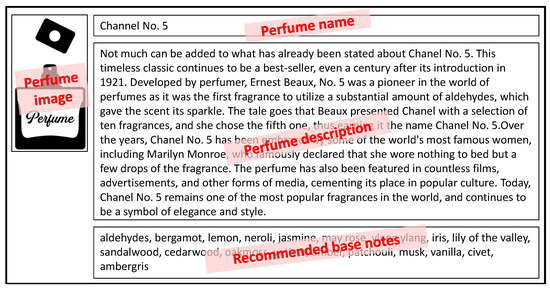
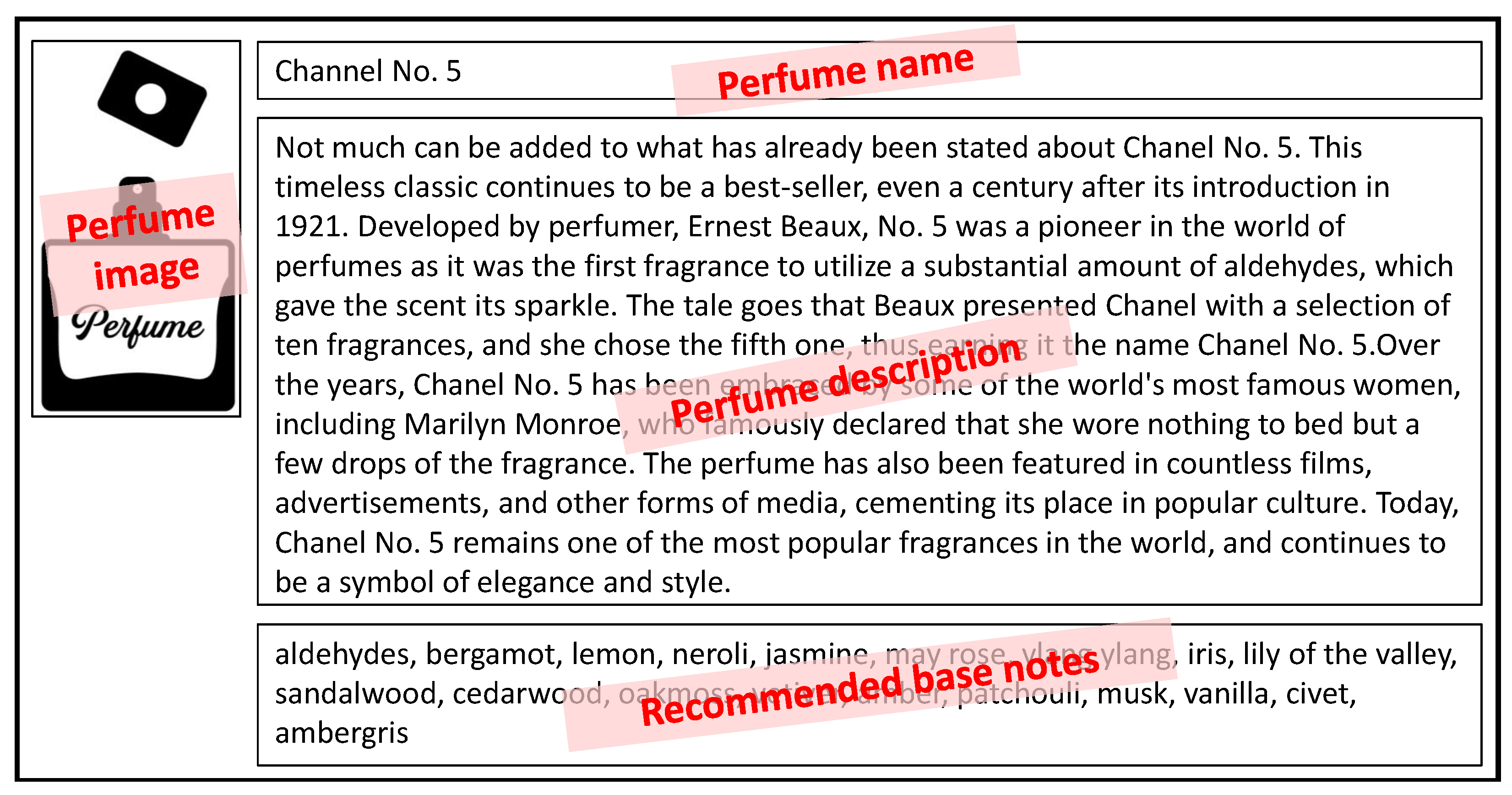
Among the existing online fragrance community websites, Base Notes [29] is chosen as a source for our dataset construction. This is particularly due to its volume, containing over 20,000 commercial perfumes, and accessibility to data by web crawling. Our preliminary study showed that only 62 perfumes out of those over 20K perfumes are provided with rich descriptive texts (see the middle panel of Figure 1, for instance). The remaining perfumes which had insufficient descriptions are thus excluded in this work.
Figure 1.
Abstraction of the website.
As shown in Figure 1 in which an abstracted page view of perfume “Channel No. 5” is provided, for instance, those 62 perfumes are provided with descriptive sentences and the relevant perfume notes. By using the name of the perfume as a unique code (i.e., identifier), both sentences and perfume notes of each perfume are paired and stored as shown in Table 2. In other words, our dataset consists of three attributes: names, descriptive sentences, and perfume notes. Table 2 shows a part of the dataset.
Table 2.
An overview of unique codes and their descriptions and perfume notes.
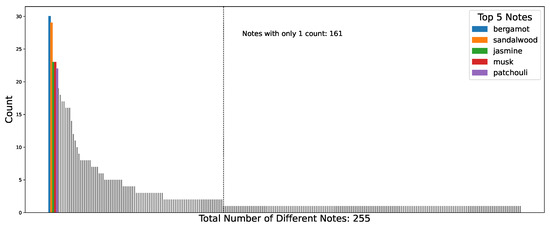
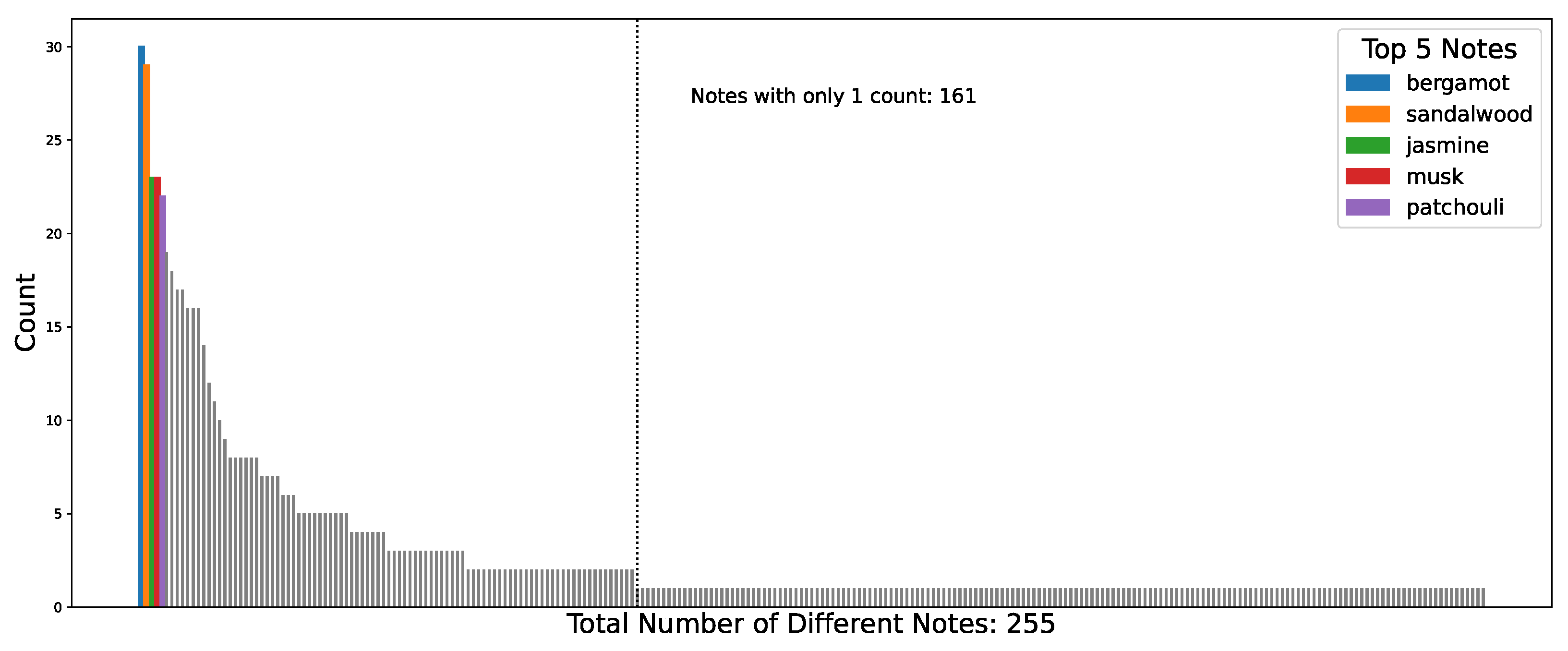
In terms of the perfume notes, our dataset consists of 255 unique perfume notes in total. Particularly, each perfume is associated with 12 notes on average, ranging from the minimum of 2 notes to the maximum of 28 notes. Since 161 notes out of the 255 appear only once from the 62 perfumes, as shown in Figure 2, our dataset is considered highly sparse. The top five most frequently appearing notes are “Bergamot (counted 30 times)”, “Sandalwood (29)”, “Jasmine (23)”, “Musk (23)”, and “Patchouli (22)”. Such sparsity makes our problem highly imbalanced and thus poses difficulties in learning and estimation. The PND dataset can be downloaded from the google spreadsheet: https://buly.kr/CLxqYQP, accessed on 8 October 2024.
Figure 2.
Count description of the perfume notes in the dataset.
4. Proposed Perfume Note Estimation System
In this section, we present an innovative NLP-based approach to estimating perfume notes from query sentences. To facilitate the understanding of the correlation between the descriptive texts and the perfume notes of commercial perfumes, a sentence transformer technique is employed within the NLP framework. This section begins with a brief introduction to sentence transformers, laying the foundation for a comprehensive elucidation of the proposed model’s architecture.
4.1. A Brief Description of the Transformer for Sentence Embedding
The transformer architecture, notably exemplified by the bidirectional encoder representations from the transformer (BERT) model, has achieved significant progress in NLP. Particularly, transformer-based models like BERT have demonstrated superior performance in capturing semantic nuances, making them highly effective for various text classification tasks [30].
The transformer architecture adopts the self-attention mechanism to capture the underlying contextual relationships within sentences. Roughly speaking, each word of the input text sequence is projected onto three learned matrices, , , and , resulting in a query vector , a key vector , and a value vector . The attention score between words i and j is then calculated using the scaled dot-product followed by the softmax function as where is the dimension of the key vectors. Consequently, the output representation for each word is a weighted sum of the value vectors from all words in the sequence: .
The self-attention mechanism enables the model to assess the importance of different words when encoding the context of a particular word. The encoder in the transformer architecture consists of multiple layers of self-attention, known as multi-head attention, where each head focuses on different relationships within the sentence. Following the multi-head attention block, position-wise feed-forward networks further refine these contextualized representations, enhancing their usefulness for downstream tasks.
However, while BERT was initially designed to capture rich contextual information at the word level, it was not optimized for capturing the full semantic meaning of entire sentences. This limitation led to the adoption of Siamese or triplet network structures. Additionally, to enhance the model’s ability to detect semantic similarities and differences, models are often fine-tuned using sentence pairs or triplets during the training phase. These specific learning processes empower transformer models to attain embedding capabilities [31]. In essence, fine-tuning such advanced structures allows us to embed the complete semantic essence of sentences, making them well-suited for tasks that heavily depend on semantic understanding.
4.2. Proposed System Architecture
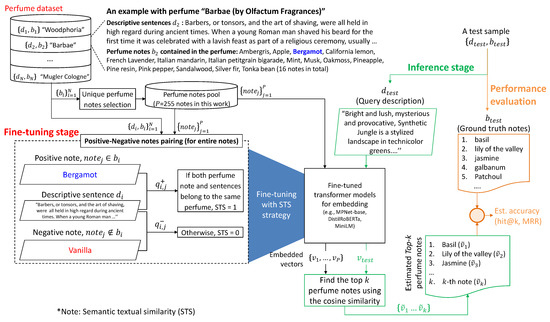
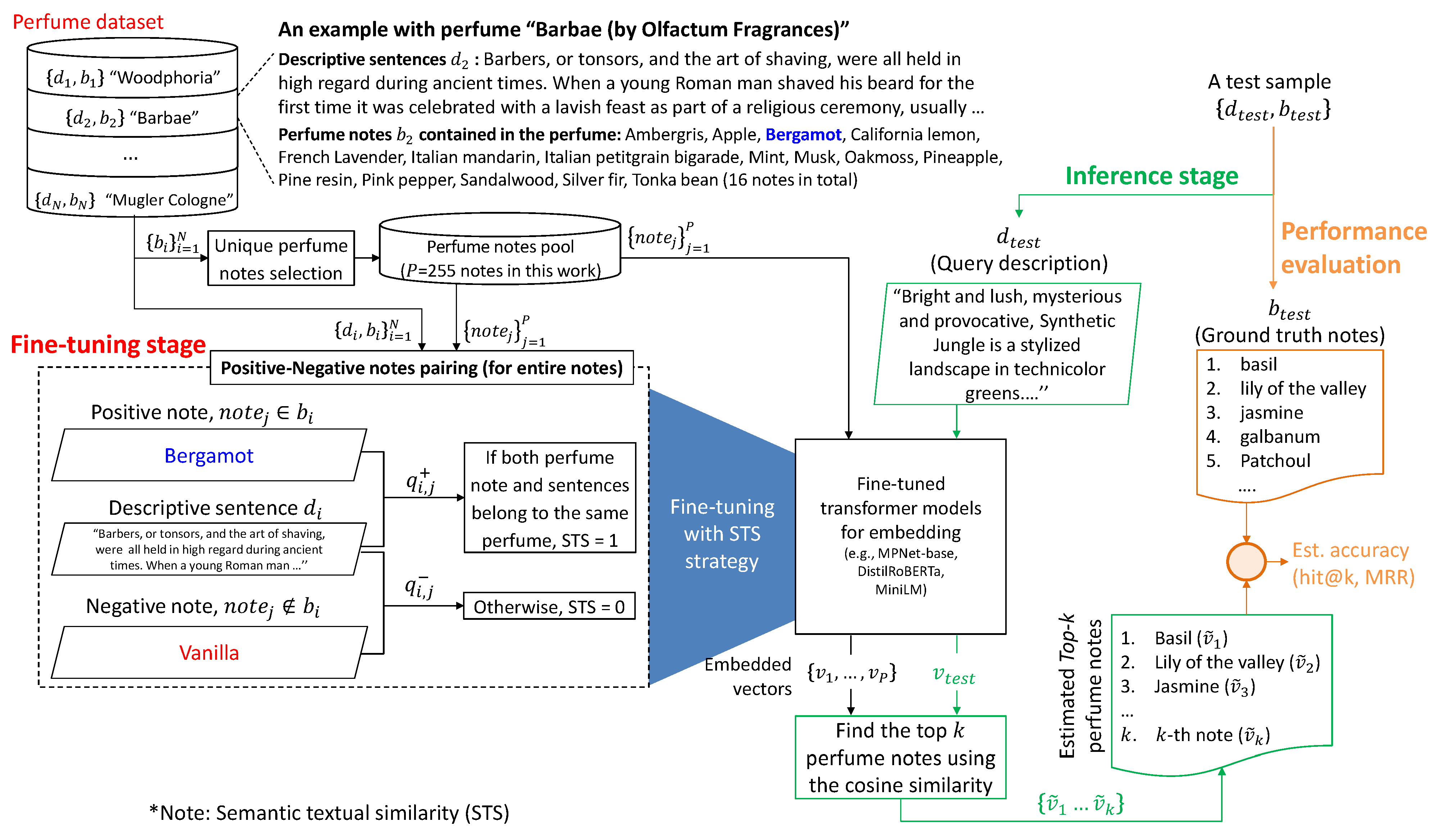
As shown in Figure 3, the proposed perfume note estimation system consists of two stages, namely, (i) a fine-tuning stage and (ii) an inference stage. Similar to the existing approaches [32], the former stage aims at leveraging the power of sentence-based transformers in exploring the relationships between descriptive sentences and perfume notes. The fine-tuned transformer is then used to estimate a set of relevant perfume notes to the input query (i.e., sentences) in the following inference stage.
Figure 3.
An overview of the proposed system with an example of perfume Barbae.
4.2.1. Fine-Tuning Stage
Assume that N pairs of descriptions and perfume notes of commercial perfumes are given for fine-tuning the sentence embedding model. Here, can be a set of sentences while an number of perfume notes constitutes . Unique items of form a perfume note pool of size P. As mentioned in Section 3, our dataset consists of , -28 and . Since both and were provided by each perfume manufacturer, they enable us to understand the semantic relationships between the descriptions and the corresponding notes.
As shown in Figure 3, the fine-tuning process starts with generating positive sentences–note pairs where , and negative sentences–note pairs where for each perfume. For , we assign a semantic textual similarity (STS) score of 1 according to [31]; otherwise, STS for . As a result of the pairing process, positive pairs and negative pairs are generated for the i-th perfume.
Once the fine-tuned transformer model is ready, the entire P perfume notes are encoded into embedding vectors using the fine-tuned transformer model. As an example for perfume ‘Barbae’ shown in Figure 3, we have and , where indices i and j are replaced by the name of perfume and its corresponding perfume notes for easy understanding.
4.2.2. Inference Stage
Assume that an unseen test sample pair is given. This stage aims to retrieve the top k perfume notes that best describe the query description from the perfume note pool. Similar to the vector DB construction process, is encoded into an embedding vector using the fine-tuned model. is then compared with based on the cosine similarity measure. By selecting the top k perfume notes with the highest cosine similarity scores, we obtain . These encoded vectors are then compared with the truth perfume notes as shown in the right panel of Figure 3 (denoted by performance evaluation).
4.2.3. Utilized Transformer Models for Sentence Embedding
To maximize the embedding capability of descriptive sentences into perfume notes, three state-of-the-art transformers, namely, MPNet-base [33], DistilRoBERTa [34], and MiniLM [35], are investigated in this work. These models were selected due to their strong performance in capturing semantic similarities efficiently under resource-constrained environments.
The MPNet-base, which is based on a self-attention mechanism, is chosen due to its embedding capability for highly contextual information. Its permuted language modeling and masked position prediction allow us to better understand the complex sentence structures, and thus outperform the BERT [33]. The DistilRoBERTa which is a distilled variation of the RoBERTa [34] is adopted because the rich linguistic information of its predecessor can be retained at a low computational cost. Lastly, the MiniLM is deployed in our study due to its computational efficiency induced by its lightweight number of parameters while preserving competitive accuracy. The first version we employed contained twelve layers, offering a good balance between computational efficiency and performance. Meanwhile, the six-layer version of MiniLM provided an even more lightweight alternative for our experiments, ensuring faster processing times without a significant loss in embedding quality. By including both versions, we aim to explore the relationship between model size and performance in the context of perfume note estimation.
By implementing the various embedding models, our objective is to verify the possibility of discerning the relationships between the perfume notes and textual descriptions (i.e., sentences) of a perfume based on the power of the natural language processing task.
5. Experiments
The main goal of this experimental study is to evaluate the proposed system quantitatively and qualitatively using the newly collected PND dataset. This section starts with introducing the experimental setup such as data and evaluation protocols followed by the results and discussions as follows.
5.1. Experimental Setup
5.1.1. Evaluation Protocols
As described in Section 3 and Section 4.2.1, the PND dataset consists of pairs of commercial perfumes. Since the data size is relatively small, a leave-one-out cross-validation (LOOCV) protocol is adopted to evaluate the effectiveness of the proposed system thoroughly. To be brief, the LOOCV involves N iterations of training (fine-tuning in our contexts) and testing. For each iteration, one sample is used as the test set, while the remaining samples are used to fine-tune the embedding model. Note that the LOOCV protocol is equal to the -fold cross validation where the number of folds is equal to the number of total samples N. The average accuracy over the N iterations is then recorded.
For all of the four investigated sentence-embedding models (MPNet-base, DistilRoBERTa, MiniLM (6 layers) and MiniLM (12 layers)), pre-trained weights [31] are utilized. As mentioned in Section 4.2 and shown in Figure 3, those weights were fine-tuned using the STS approach, configured with a batch size of 32, spanning three iterations, and leveraging CosineSimilarityLoss to guide the optimization process. We utilized the AdamW optimizer [36] with a learning rate of and a weight decay of 0.01. The parameters of the optimizer were also set to their default values: , , and . Additionally, a linear learning rate scheduler with 100 warm-up steps was implemented to adjust the learning rate during training.
5.1.2. Evaluation Metrics
The capability of the proposed system in perfume note estimation is evaluated using two metrics, namely, the Hit@k [37] and the mean reciprocal rank (MRR) [38]. The , where indicates a count function, calculates the share of test query for which at least one relevant note is contained in the estimated perfume notes . The MRR is the average of the reciprocal ranks (RRs) over all test queries. Here, the RR is equal to where refers to the rank position of the first relevant perfume note in the retrieved list. As we only have one test sample under the LOOCV protocol, the MRR is equal to the RR. However, we still use the MRR instead of the RR because of its popularity in the relevant community.
5.1.3. Evaluation Scenarios
As shown in Table 3, two experiments are designed to evaluate the perfume notes estimation accuracy of the proposed system. Under the first experiment (denoted as Experiment 1 in Table 3), both the Hit@k and the MRR of the four sentence embedding models are evaluated with and without the fine-tuning process. This is to observe how the proposed fine-tuning scheme affects the estimation accuracy. Contrary to Experiment 1, the second experiment (Experiment 2) aims at evaluating the proposed system qualitatively. Particularly, some of perfume notes retrieved using the MPNet-base model with and without the proposed fine-tuning scheme are analyzed.
Table 3.
Evaluation scenario.
5.2. Results and Discussion
5.2.1. Experiment 1: Quantitative Analysis
Table 4 shows both Hit@k at and MRR performances of the investigated sentence embedding models with and without the proposed fine-tuning scheme. From the middle panel of Table 4, denoted by “Without the proposed fine-tuning”, all the four embedding models achieve better (i.e., higher) hit values at than those at . This is because we have more candidates at and thus it is considered an easier problem. Among the four models, MiniLM (12 Layers) and MPNet-base achieve the best and worst Hit@5 values, respectively. Different from the case of , however, MPNet-base yields the highest Hit@10 value. In terms of the MRR measure, similar to the case of Hit@5, MiniLM (12 Layers) produces the highest MRR value.
Table 4.
Comparative analysis of the perfume note estimation performance (Hit@k at and MRR values) with and without the proposed fine-tuning strategy. Note that all the values tabulated are averages taken over N iterations according to the LOOCV protocol. The best performances are denoted by bold-faced letters.
In a similar manner, perfume note estimation performances (Hit@5, Hit@10 and MRR) obtained by applying the proposed fine-tuning strategy are tabulated in the bottom-most panel of Table 4. By directly comparing the values with those shown in the middle panel, it is observed that the estimation capability is largely improved. Particularly, we achieve 0.355%, 0.282% and 0.345% higher Hit@5, Hit@10 and MRR performances on average than those values shown in the middle panel. Moreover, the sample standard deviations are reduced about 0.016% ∼ 0.059%, meaning that the proposed idea is helpful in stabilizing the model performance.
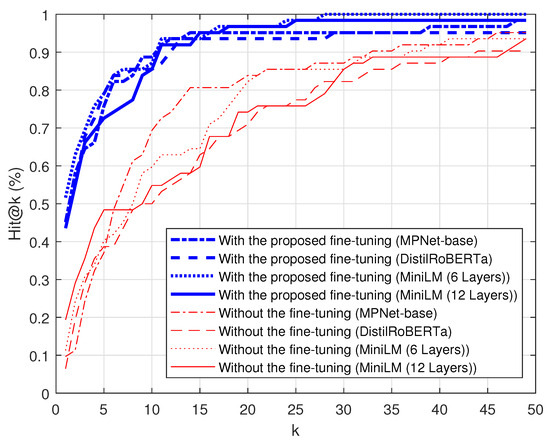
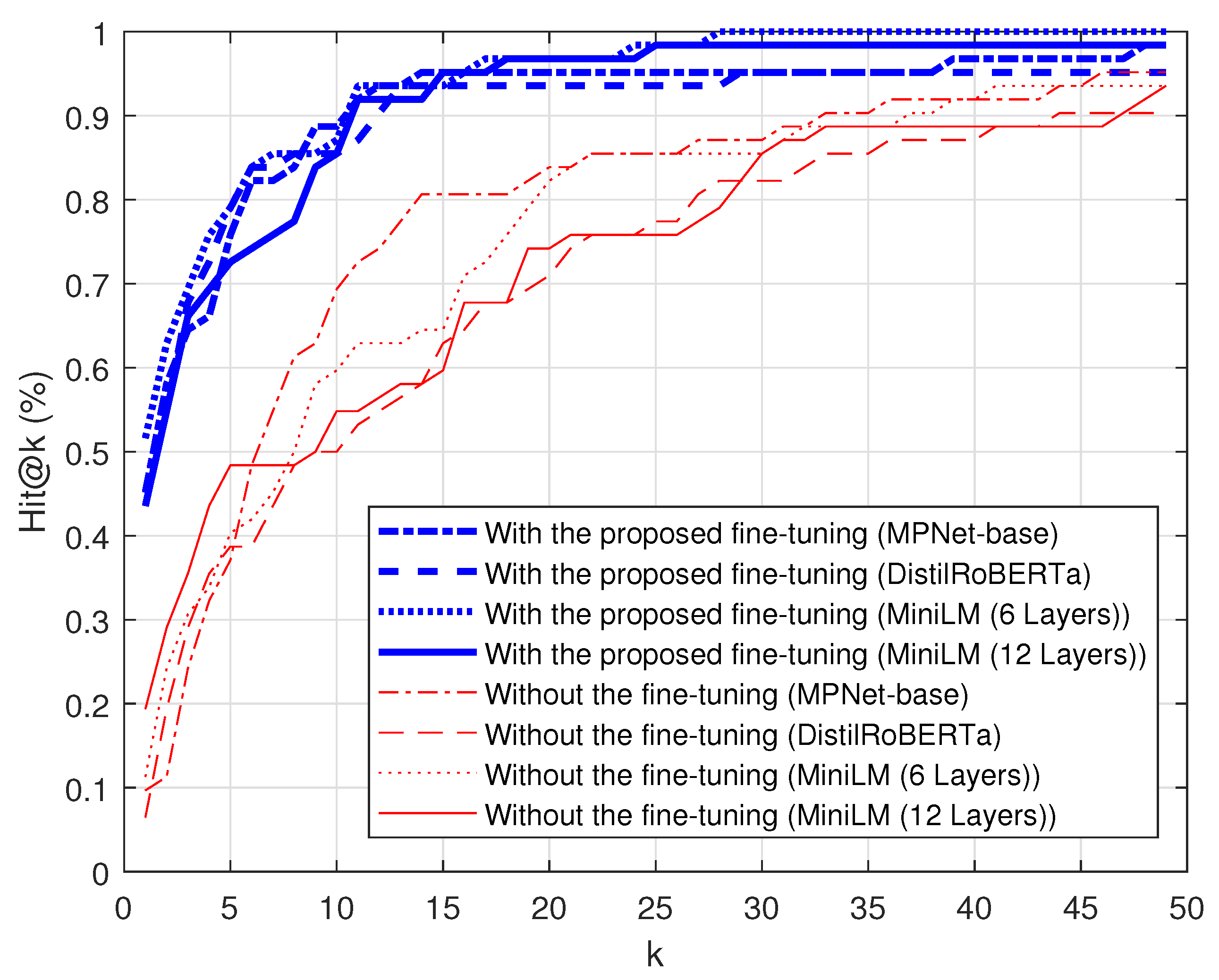
As an extension to the results shown in Table 4, the Hit performance of the investigated embedding models are evaluated over and represented in a form of cumulative match characteristic (CMC) curves as shown in Figure 4. It is observed from Figure 4 that the proposed fine-tuning strategy helps in enhancing the Hit performances with a big gap, particularly at lower k values. At , MiniLM (six Layers) with the proposed fine-tuning achieves 100% of Hit values, while 0.855% ∼ 0.935% of Hit values are resulted at without the fine-tuning.
Figure 4.
CMC curves representing the Hit performances of the investigated sentence embedding models with and without the proposed fine-tuning strategy.
5.2.2. Experiment 2: Qualitative Analysis
Different from Experiment 1, discussed above, Experiment 2 is designed to qualitatively evaluate the proposed system (see Table 3 for details). To this end, the estimated perfume notes using the MiniLM (six Layers) with and without the proposed fine-tuning are shown in Table 5 together with the query descriptions and the relevant ground truth perfume notes . Here, the MiniLM (six Layers) is chosen due to its outstanding estimation performance (see Table 4 and Figure 4). Although we report the estimated results of four test samples only due to page limits, a similar trend in results can be observed from other test samples. Similarly, only the first estimated notes are analyzed.
Table 5.
Examples of the top five predicted notes with and without the proposed fine-tuning to the MiniLM (six layers) model corresponding to descriptions and their true notes. The correctly estimated perfume notes are indicated by red font.
From the first two samples shown in Table 5, it is observed that the MiniLM (six Layers) at and without the fine-tuning has failed to correctly estimate the perfume notes. For the remaining two test samples, the model could estimates one and two perfume notes, respectively. As shown in the last column of Table 5, however, applying the proposed fine-tuning strategy to the MiniLM (six Layers) model has significantly improved the estimation accuracy. The fine-tuned MiniLM (six Layers) correctly estimates one to four perfume notes. Particularly, for the first and third test samples, the fine-tuned model has successfully estimated three and four notes from the first place (at ). However, for the fourth test sample (the bottom-most row of Table 5), the fine-tuned MiniLM (six Layers) estimates one less perfume note correctly than that of the original MiniLM (six Layers).
6. Conclusions and Future Work
The perfume industry is a suitable yet under-examined area for applying cutting-edge natural language processing techniques, where most existing studies lean toward new fragrance design systems. To meet the demand for handling textual descriptions for the perfume industry, we presented a perfume note estimation system for analyzing the relationship between descriptive sentences of perfumes and their notes in this paper. The proposed system adopted sentence transformer models, including MPNet-base, DistilRoBeERTa, and MiniLMs, with the fine-tuning process. To validate the system performance, we constructed and publicized a brand new perfume dataset containing general descriptions of perfumes and their notes (62 perfumes and 255 notes) using information from an online fragrance community website, Base Notes. In our leave-one-out cross-validation tests using our dataset, we achieved significant performance improvements (from a 37.1∼41.1% to 72.6∼79.0% hit rate with the top five items and from a 22.1∼31.9% to a 57.3∼63.2% mean reciprocal rank) with several sentence transformer models via the fine-tuning process. Furthermore, we presented some qualitative examples of the results, including query descriptions, estimated perfume notes, and ground truth perfume notes.
Our study has limitations, including using a relatively small dataset, the absence of online customer reviews as descriptive sentence inputs, and the lack of further processing to incorporate the estimation output. We aim to combine the recommended notes into complete and harmonious perfume formulas in immediate future studies. This will involve understanding the balance of top, middle, and base notes to create personalized and appealing scents. We also plan to expand our dataset by incorporating additional real-world data sources, such as user reviews and expert analyses for each perfume, and to conduct further experiments for validation. This expansion will enable us to explore how a larger dataset impacts model performance. Furthermore, recognizing the impressive performance of Large Language Models (LLMs) on various NLP tasks, we intend not only to compare our proposed method with the latest LLMs but also to fine-tune these models for our specific task to enhance their performance. This approach will strengthen our claims regarding its effectiveness. Ultimately, these advancements will bridge the gap between digital fragrance recommendations and actual perfume creation, offering a comprehensive solution for customized fragrance design.
Author Contributions
Conceptualization, J.K., K.O. and B.-S.O.; methodology, J.K.; software, validation and analysis, J.K.; writing—original draft preparation, J.K. and K.O.; writing—review and editing, B.-S.O.; funding acquisition, B.-S.O. All authors have read and agreed to the published version of the manuscript.
Funding
This study was supported by the Research Program funded by the SeoulTech (Seoul National University of Science and Technology).
Data Availability Statement
The PND dataset can be downloaded from the google spreadsheet: https://buly.kr/CLxqYQP, accessed on 8 October 2024.
Conflicts of Interest
The authors declare no conflicts of interest.
References
- Cao, M.; Ling, X. Quantitative Comparison of Tree Ensemble Learning Methods for Perfume Identification Using a Portable Electronic Nose. Appl. Sci. 2022, 12, 9716. [Google Scholar] [CrossRef] [Scilit]
- Zárate, V.; Hernández, D.C. Simplified Deep Learning for Accessible Fruit Quality Assessment in Small Agricultural Operations. Appl. Sci. 2024, 14, 8243. [Google Scholar] [CrossRef] [Scilit]
- Kiran, B.R.; Sobh, I.; Talpaert, V.; Mannion, P.; Sallab, A.A.A.; Yogamani, S.; Pérez, P. Deep reinforcement learning for autonomous driving: A survey. IEEE Trans. Intell. Transp. Syst. 2021, 23, 4909–4926. [Google Scholar] [CrossRef] [Scilit]
- Rajpurkar, P.; Chen, E.; Banerjee, O.; Topol, E.J. AI in health and medicine. Nat. Med. 2022, 28, 31–38. [Google Scholar] [CrossRef] [Scilit]
- Zhou, L.; Jiang, Z.; Geng, N.; Niu, Y.; Cui, F.; Liu, K.; Qi, N. Production and operations management for intelligent manufacturing: A systematic literature review. Int. J. Prod. Res. 2022, 60, 808–846. [Google Scholar] [CrossRef] [Scilit]
- Ortega-Fernández, A.; Martín-Rojas, R.; García-Morales, V.J. Artificial intelligence in the urban environment: Smart cities as models for developing innovation and sustainability. Sustainability 2020, 12, 7860. [Google Scholar] [CrossRef] [Scilit]
- Stokel-Walker, C.; Noorden, R.V. What ChatGPT and generative AI mean for science. Nature 2023, 614, 214–216. [Google Scholar] [CrossRef] [Scilit]
- Malik, N.; Bilal, M. Natural language processing for analyzing online customer reviews: A survey, taxonomy, and open research challenges. PeerJ Comput. Sci. 2024, 10, e2203. [Google Scholar] [CrossRef] [Scilit]
- Achiam, J.; Adler, S.; Agarwal, S.; Ahmad, L.; Akkaya, I.; Aleman, F.L.; Almeida, D.; Altenschmidt, J.; Altman, S.; Anadkat, S.; et al. GPT-4 Technical Report. arXiv 2023, arXiv:2303.08774. [Google Scholar]
- Goodwin, R.; Maria, J.; Das, P.; Horesh, R.; Segal, R.; Fu, J.; Harris, C. AI for fragrance design. In Proceedings of the Machine Learning for Creativity and Design Workshop at NIPS, Long Beach, CA, USA, 8 December 2017. [Google Scholar]
- Sanchez-Lengeling, B.; Wei, J.N.; Lee, B.K.; Gerkin, R.C.; Aspuru-Guzik, A.; Wiltschko, A.B. Machine learning for scent: Learning generalizable perceptual representations of small molecules. arXiv 2019, arXiv:1910.10685. [Google Scholar]
- Santana, V.V.; Martins, M.A.F.; Loureiro, J.M.; Ribeiro, A.M.; Rodrigues, A.E.; Nogueira, I.B.R. Optimal fragrances formulation using a deep learning neural network architecture: A novel systematic approach. Comput. Chem. Eng. 2021, 150, 107344. [Google Scholar] [CrossRef] [Scilit]
- Lee, B.K.; Mayhew, E.J.; Sanchez-Lengeling, B.; Wei, J.N.; Qian, W.W.; Little, K.; Andres, M.; Nguyen, B.B.; Moloy, T.; Parker, J.K.; et al. A principal odor map unifies diverse tasks in human olfactory perception. Science 2023, 38, 999–1006. [Google Scholar] [CrossRef] [Scilit]
- Kengpol, A.; Wangananon, W. The expert system for assessing customer satisfaction on fragrance notes: Using artificial neural networks. Comput. Ind. Eng. 2006, 51, 567–584. [Google Scholar] [CrossRef] [Scilit]
- Hanafizadeh, P.; Ravasan, A.Z.; Khaki, H.R. An expert system for perfume selection using artificial neural network. Expert Syst. Appl. 2010, 37, 8879–8887. [Google Scholar] [CrossRef] [Scilit]
- Mazzonello, V.; Gaglio, S.; Augello, A.; Pilato, G. A study on classification methods applied to sentiment analysis. In Proceedings of the 2013 IEEE Seventh International Conference on Semantic Computing, Irvine, CA, USA, 16–18 September 2013; pp. 426–431. [Google Scholar]
- Paul, M.; Maglaras, L.; Ferrag, M.A.; Almomani, I. Digitization of healthcare sector: A study on privacy and security concerns. ICT Express 2023, 9, 571–588. [Google Scholar] [CrossRef] [Scilit]
- Suhaeni, C.; Yong, H.S. Enhancing Imbalanced Sentiment Analysis: A GPT-3-Based Sentence-by-Sentence Generation Approach. Appl. Sci. 2024, 14, 622. [Google Scholar] [CrossRef] [Scilit]
- Mata, V.G.; Gomes, P.B.; Rodrigues, A.E. Engineering perfumes. AIChE J. 2005, 51, 2834–2852. [Google Scholar] [CrossRef] [Scilit]
- Carles, J. A method of creation in perfumery. Fafai J. 2006, 8, 43. [Google Scholar]
- The Good Scents Company—Flavor, Fragrance, Food and Cosmetics Ingredients Information. Available online: http://www.thegoodscentscompany.com (accessed on 8 October 2024).
- Associates, L. PMP 2001—Database of Perfumery Materials and Performance. 2005. Available online: https://www.leffingwell.com/bacispmp.htm (accessed on 8 October 2024).
- Keller, A.; Gerkin, R.C.; Guan, Y.; Dhurandhar, A.; Turu, G.; Szalai, B.; Mainland, J.D.; Ihara, Y.; Yu, C.W.; Wolfinger, R.; et al. Predicting human olfactory perception from chemical features of odor molecules. Science 2017, 355, 820–826. [Google Scholar] [CrossRef] [Scilit]
- Hochreiter, S.; Schmidhuber, J. Long short-term memory. Neural Comput. 1997, 9, 1735–1780. [Google Scholar] [CrossRef] [Scilit]
- Kennedy, J.; Eberhart, R. Particle swarm optimization. In Proceedings of the ICNN’95-International Conference on Neural Networks, Perth, WA, Australia, 27 November–1 December 1995; Volume 4, pp. 1942–1948. [Google Scholar]
- Russell, S.J.; Norvig, P. Artificial Intelligence: A Modern Approach; Pearson: London, UK, 2016. [Google Scholar]
- Veramendi, M.; Herencia, P.; Ares, G. Perfume odor categorization: To what extent trained assessors and consumers agree? J. Sens. Stud. 2013, 28, 76–89. [Google Scholar] [CrossRef] [Scilit]
- Nikitina, L.; Furuoka, F. Words of scents: A linguistic analysis of online perfume reviews. Linguist. Vanguard 2024, 9, 205–214. [Google Scholar] [CrossRef] [Scilit]
- Basenotes. Basenotes—Perfume Reviews and Fragrance News. 2023. Available online: https://basenotes.com/ (accessed on 8 October 2024).
- Bilal, M.; Almazroi, A.A. Effectiveness of fine-tuned BERT model in classification of helpful and unhelpful online customer reviews. Electron. Commer. Res. 2023, 23, 2737–2757. [Google Scholar] [CrossRef] [Scilit]
- Reimers, N.; Gurevych, I. Sentence-BERT: Sentence Embeddings using Siamese BERT-Networks. In Proceedings of the 2019 Conference on Empirical Methods in Natural Language Processing and the 9th International Joint Conference on Natural Language Processing, Hong Kong, China, 3–7 November 2019; pp. 3982–3992. [Google Scholar]
- Cer, D.; Diab, M.; Agirre, E.; Lopez-Gazpio, I.; Specia, L. Semeval-2017 task 1: Semantic textual similarity-multilingual and cross-lingual focused evaluation. arXiv 2017, arXiv:1708.00055. [Google Scholar]
- Song, K.; Tan, X.; Qin, T.; Lu, J.; Liu, T.Y. MPNet: Masked and Permuted Pre-training for Language Understanding. Adv. Neural Inf. Process. Syst. 2020, 33, 16857–16867. [Google Scholar]
- Sanh, V.; Debut, L.; Chaumond, J.; Wolf, T. DistilBERT, a distilled version of BERT: Smaller, faster, cheaper and lighter. arXiv 2019, arXiv:1910.01108. [Google Scholar]
- Wang, W.; Wei, F.; Dong, L.; Bao, H.; Yang, N.; Zhou, M. Minilm: Deep self-attention distillation for task-agnostic compression of pre-trained transformers. In Proceedings of the Advances in Neural Information Processing Systems, Vancouver, BC, Canada, 6–12 December 2020; pp. 5776–5788. [Google Scholar]
- Loshchilov, I. Decoupled weight decay regularization. arXiv 2017, arXiv:1711.05101. [Google Scholar]
- Saracevic, T. Evaluation of evaluation in information retrieval. In Proceedings of the 18th Annual International ACM SIGIR Conference on Research and Development in Information Retrieval, Seattle, WD, USA, 9–13 July 1995; pp. 138–146. [Google Scholar]
- Voorhees, E.M. The TREC-8 question answering track report. In Proceedings of the TREC, Gaithersburg, MD, USA, 17–19 November 1999; Volume 99, pp. 77–82. [Google Scholar]

Disclaimer/Publisher’s Note: The statements, opinions and data contained in all publications are solely those of the individual author(s) and contributor(s) and not of MDPI and/or the editor(s). MDPI and/or the editor(s) disclaim responsibility for any injury to people or property resulting from any ideas, methods, instructions or products referred to in the content. |
© 2024 by the authors. Licensee MDPI, Basel, Switzerland. This article is an open access article distributed under the terms and conditions of the Creative Commons Attribution (CC BY) license (https://creativecommons.org/licenses/by/4.0/).