Article

Unmasking Nasality to Assess Hypernasality

by
Ignacio Moreno-Torres
1,*,
Andrés Lozano
2,
Rosa Bermúdez
3,
Josué Pino
4,
María Dolores García Méndez
1 and
Enrique Nava
2
1
Department of Spanish Philology, University of Málaga, 29071 Málaga, Spain
2
Department of Communication Engineering, University of Málaga, 29071 Málaga, Spain
3
Department of Personality, Evaluation and Psychological Treatments, University of Málaga, 29071 Málaga, Spain
4
Department of Speech-Language and Hearing Science, University of Chile, Santiago de Chile 9170022, Chile
*
Author to whom correspondence should be addressed.
Appl. Sci. 2023, 13(23), 12606; https://doi.org/10.3390/app132312606
Submission received: 2 October 2023 / Revised: 15 November 2023 / Accepted: 21 November 2023 / Published: 23 November 2023
(This article belongs to the Special Issue Advances in Speech and Language Processing)

Featured Application

The results of this study provide key information, both linguistic and technical, to use signals recorded close to the nose to evaluate hypernasality automatically. The results may also guide the improvement of the accuracy of hypernasality assessment tools by analyzing nose signals.

Abstract

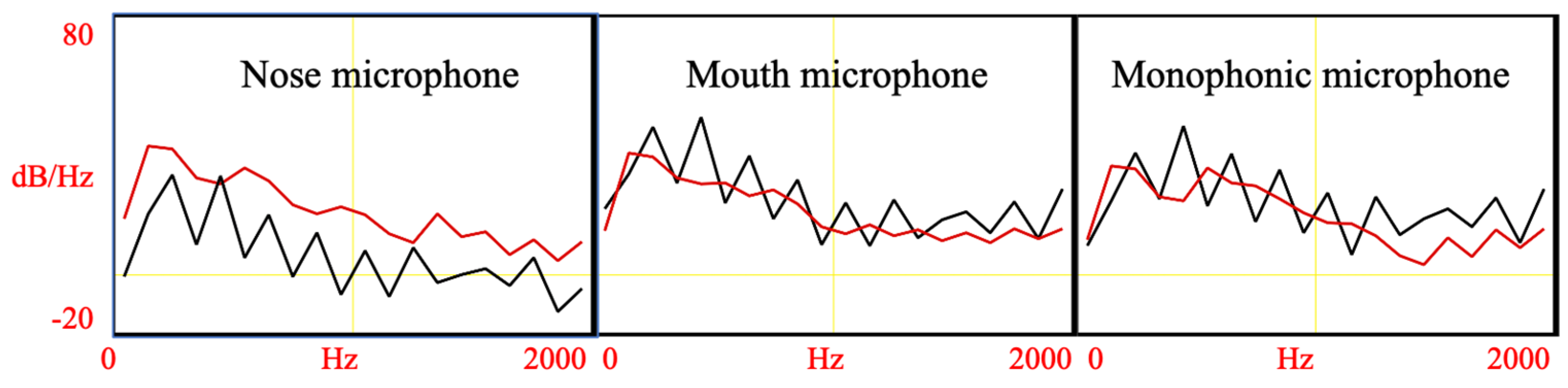
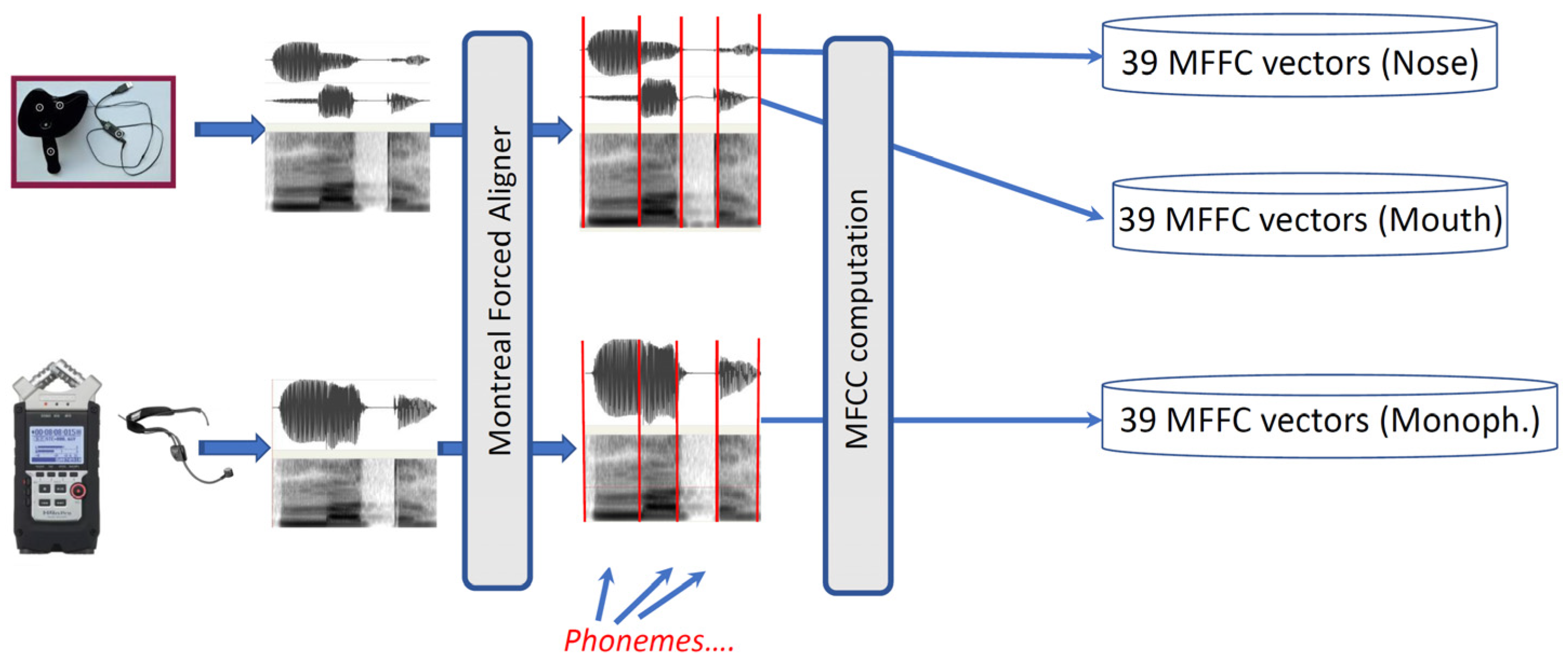
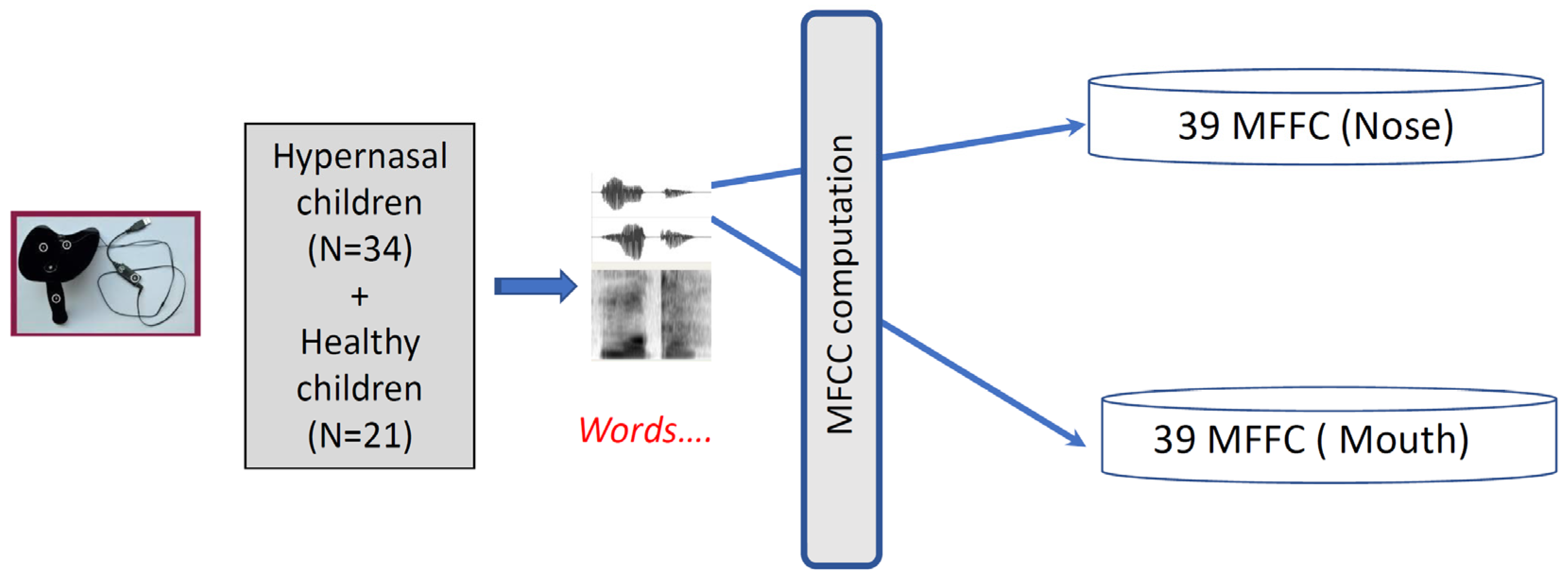
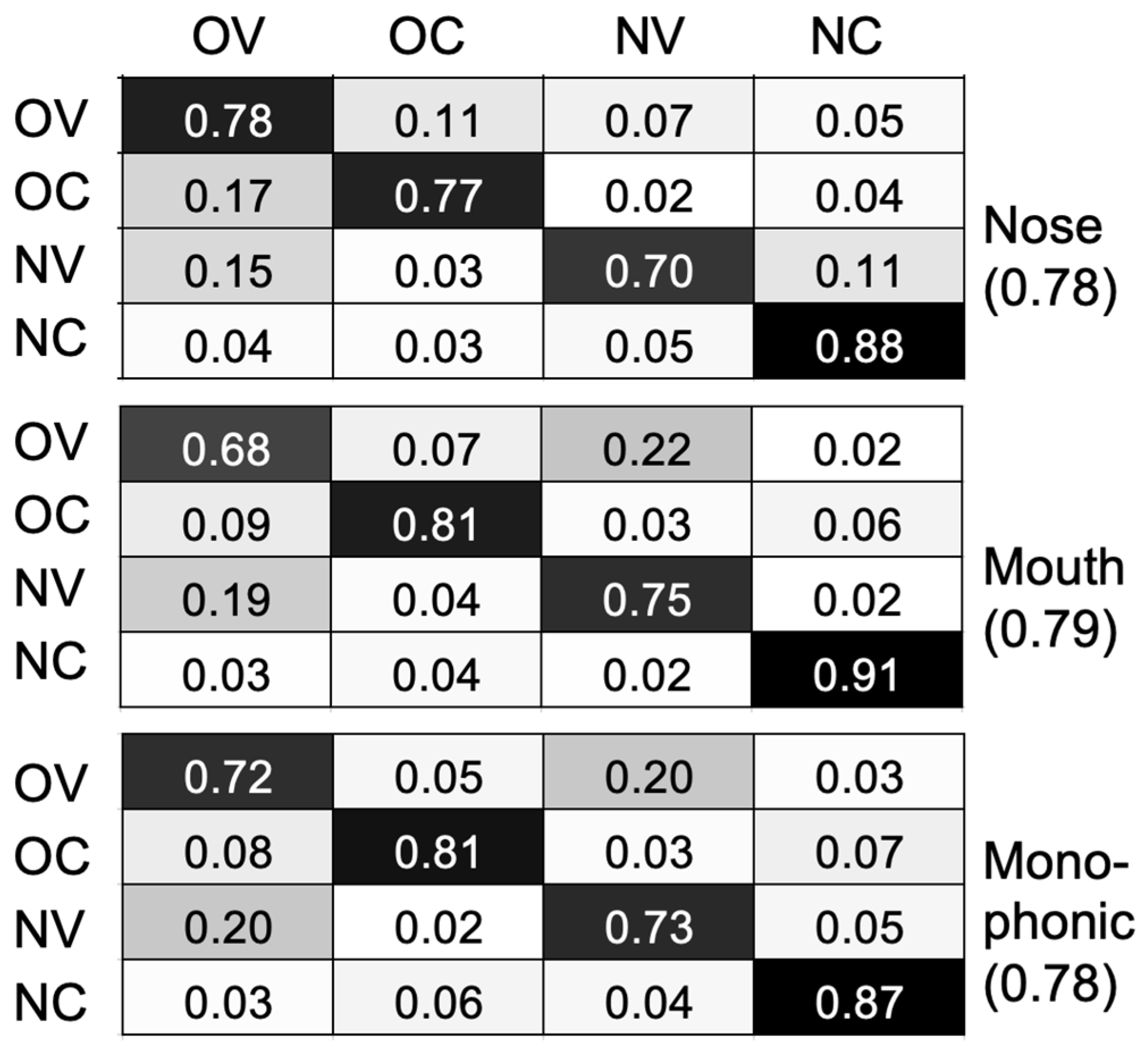
Automatic evaluation of hypernasality has been traditionally computed using monophonic signals (i.e., combining nose and mouth signals). Here, this study aimed to examine if nose signals serve to increase the accuracy of hypernasality evaluation. Using a conventional microphone and a Nasometer, we recorded monophonic, mouth, and nose signals. Three main analyses were performed: (1) comparing the spectral distance between oral/nasalized vowels in monophonic, nose, and mouth signals; (2) assessing the accuracy of Deep Neural Network (DNN) models in classifying oral/nasal sounds and vowel/consonant sounds trained with nose, mouth, and monophonic signals; (3) analyzing the correlation between DNN-derived nasality scores and expert-rated hypernasality scores. The distance between oral and nasalized vowels was the highest in the nose signals. Moreover, DNN models trained on nose signals outperformed in nasal/oral classification (accuracy: 0.90), but were slightly less precise in vowel/consonant differentiation (accuracy: 0.86) compared to models trained on other signals. A strong Pearson’s correlation (0.83) was observed between nasality scores from DNNs trained with nose signals and human expert ratings, whereas those trained on mouth signals showed a weaker correlation (0.36). We conclude that mouth signals partially mask the nasality information carried by nose signals. Significance: the accuracy of hypernasality assessment tools may improve by analyzing nose signals.
Keywords: clinical speech analysis; deep neural networks; hypernasality; speech assessment; vocal biomarkers clinical speech analysis; deep neural networks; hypernasality; speech assessment; vocal biomarkers