


Abstract
This study selects titanium dioxide (TiO2) and multi-walled carbon nanotubes (MWCNTs) as far-infrared materials (FIRMs), and further adds water-based acrylic coatings to prepare far-infrared coatings (FIRCs). FIRCs are uniformly coated on #304 stainless steel sheets to make the test samples, which are then installed between the shell and insulation material of the hot water heater to measure the influences of various FIRCs on the performance of the hot water heater. The research results show no significant difference in the heating rate or heat insulation performance of the hot water heater with or without FIRCs coating. However, the uniformity of the water temperatures of the test samples is significantly improved with FIRCs. Considering that the uniformity of water temperature will inhibit the heating rate and heat insulation performance of the hot water heater, TiO2-FIRC should provide better performance improvement when applied to the hot water heater in this study. The application of TiO2-FIRC to large-scale hot water heaters with a high aspect ratio will effectively improve the quality of hot water supply in the future.
1. Introduction
In recent years, far-infrared rays have attracted considerable attention from the public. Various application fields have different wavelength ranges for the classification of infrared rays. Among them, the wavelength range of far-infrared rays (FIRs) as defined in the medical field is 5.6–1000 μm [1]. As the energy of far-infrared rays can promote blood circulation [2,3,4], cell repair [5], tissue regeneration [3,6], intestinal function [7], diminish inflammation [8], and inhibit cancer [9], it is often used in medical, health, and beauty fields [10]. However, the action mechanisms of FIR on humans are still little known [10]. In addition, FIR is commonly used to promote industrial and civil applications, such as heating, cooling, and combustion. According to their material characteristics, far infrared materials (FIRMs) can resonate at different temperatures and wavelengths, and promote the disturbance of the working fluid or collision with surrounding objects, thereby enhancing energy transfer.
Generally, metal oxides, carbon-based materials, and rare earth elements have high FIR emissivity (ε) and are often selected as candidate materials for FIRs. The ε is the ratio of the emitted energy of the substance to the emitted energy of the black body [11]. These FIRMs can produce resonance effects at different temperatures and wavelengths, as based on their infrared radiation characteristics and according to the Wien displacement law, to promote the working fluid (such as: water, refrigerant, air, fuel, etc.) to produce more severe disturbances of the working fluid itself and collisions with external objects (the tube wall of the heat exchanger or the heater), thereby enhancing energy transfer. The most common application examples of FIR in industry are heating/cooling (heat treatment, boiler, heat exchange, heat preservation, etc.) [12,13,14,15,16,17,18,19,20], internal combustion engines (gasoline and diesel engines) [21,22,23], and other equipment. In order to achieve the purpose of improving system efficiency, the resonance of FIR promotes uniform temperature distribution, thermal convection, working fluid disturbance, thermal radiation, and fuel atomization. In addition, it can reduce fuel consumption and emissions in the field of combustion [14,16,21,22,23].
This study selected titanium dioxide (TiO2) and multi-walled carbon nanotubes (MWCNTs) as FIRMs, which were further added to water-based acrylic coatings to prepare far-infrared coatings (FIRCs). The FIRCs were uniformly coated on #304 stainless steel sheets to make the test samples, which were then installed between the shell and insulation material of the hot water heater, for measuring and analyzing the water temperature, heating rate, and uniformity of water temperature to evaluate the influences of various FIRCs on the performance of the hot water heater.
2. Related Theories and Sample Preparation
2.1. Wien’s Displacement Law
FIRs are electromagnetic waves that can be absorbed by various objects in the same wavelength range to produce a resonance effect, which activates the molecules of the surrounding fluid and promotes disturbance. Generally, manufacturers of FIRMs and FIR equipment use Wien’s displacement law to explain the resonance relationship between the applicable temperature and wavelength of FIRMs. Wien’s displacement law states that the wavelength at the peak of the radiation curve of a black body is inversely proportional to the absolute temperature of the black body, and its mathematical representation is as follows [24]:
where T is the temperature (K) of the black body, b is Wien’s displacement constant (≅2897 μm·K) [25], and λmax is the wavelength (μm) of the maximum radiation energy of the black body; in other words, the maximum radiant energy can be obtained below this wavelength (λmax). The ε is the ratio of the radiation energy of a substance to the black body. The higher the ε of the material, the closer the radiation energy of the material to the black body; in other words, according to Wein’s displacement law, the FIRCs on the outside of working fluid have higher ε at the working temperature corresponding to the wavelength, which means that FIRCs have higher FIR radiation energy at this working temperature to promote the disturbance of the working fluid, and thus, improve the energy transfer of the working fluid itself and the working fluid to outside.
λmax = b/T
2.2. Preparation of FIRCs
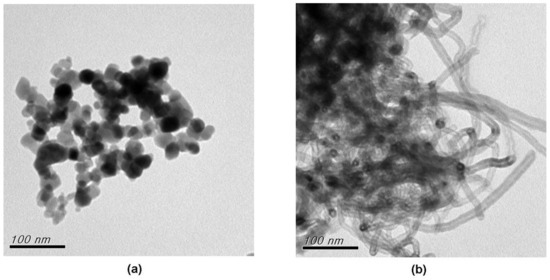
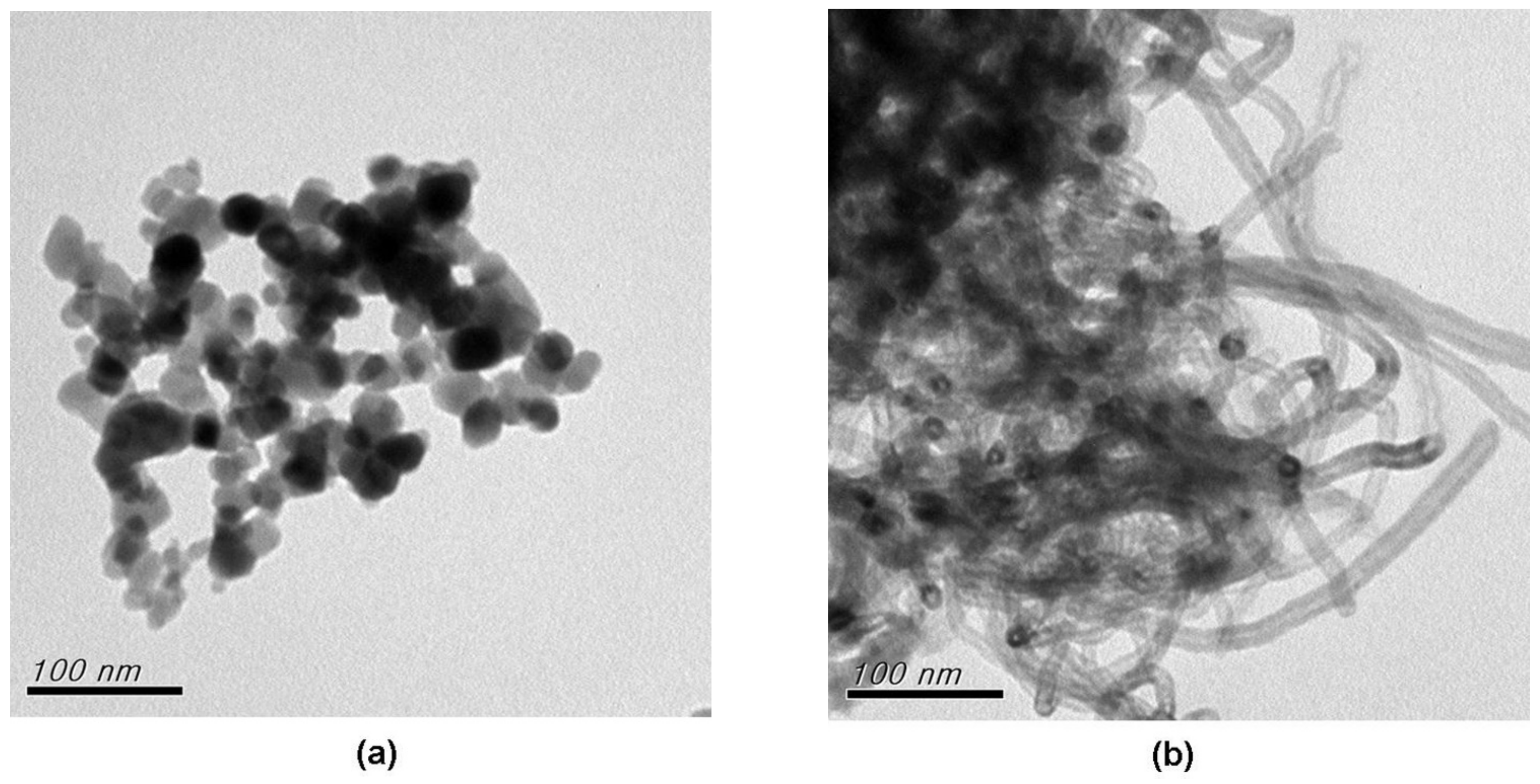
This study used TiO2 (TG-P25, Tokyo, Degussa, Japan) and MWCNTs (OD: 20–30 nm; Cheap Tubes, Grafton, VT, USA) as FIRMs, and the transmission electron microscope (TEM; H-7100, Hitachi, Saitama, Japan) image of these FIRMs are shown in Figure 1. The particle size of TiO2 and the outer diameter of MWCNTs are about 30 nm and are in compliance with the specifications marked by the manufacturer. First, this study added 10 wt % FIRMs to the water and used an electromagnetic stirrer (PC420D with 600 rpm, Corning, Corning, NY, USA), an ultrasonic cleaner (5510R-DTH, Branson, St. Louis, MO, USA), and a high-speed homogenizer (YOM300D Yotec, Taiwan) with 3000 rpm to stir and disperse the FIRMs for 30 min by each dispersion equipment. Finally, the well-dispersed FIRM aqueous suspension was added to water-based acrylic paint (Asahipen, Osaka, Japan) at a ratio of 1:4 (w/w) to form FIRCs with a FIRMs concentration of approximately 2.5 wt %. Then, this study used the above dispersion equipment to alternately disperse FIRCs three times (each equipment is executed for 30 min each time), in order to uniformly disperse the FIRMs in FIRC and maintain superior suspension performance. At this time, the preparation procedure of FIRCs is completed.
Figure 1.
TEM image of FIRMs: (a) TiO2; (b) MWCNTs.
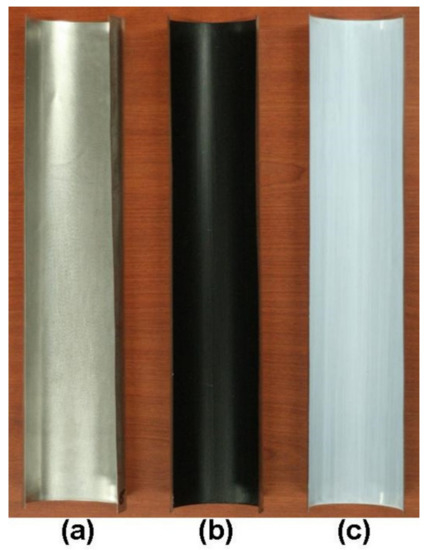
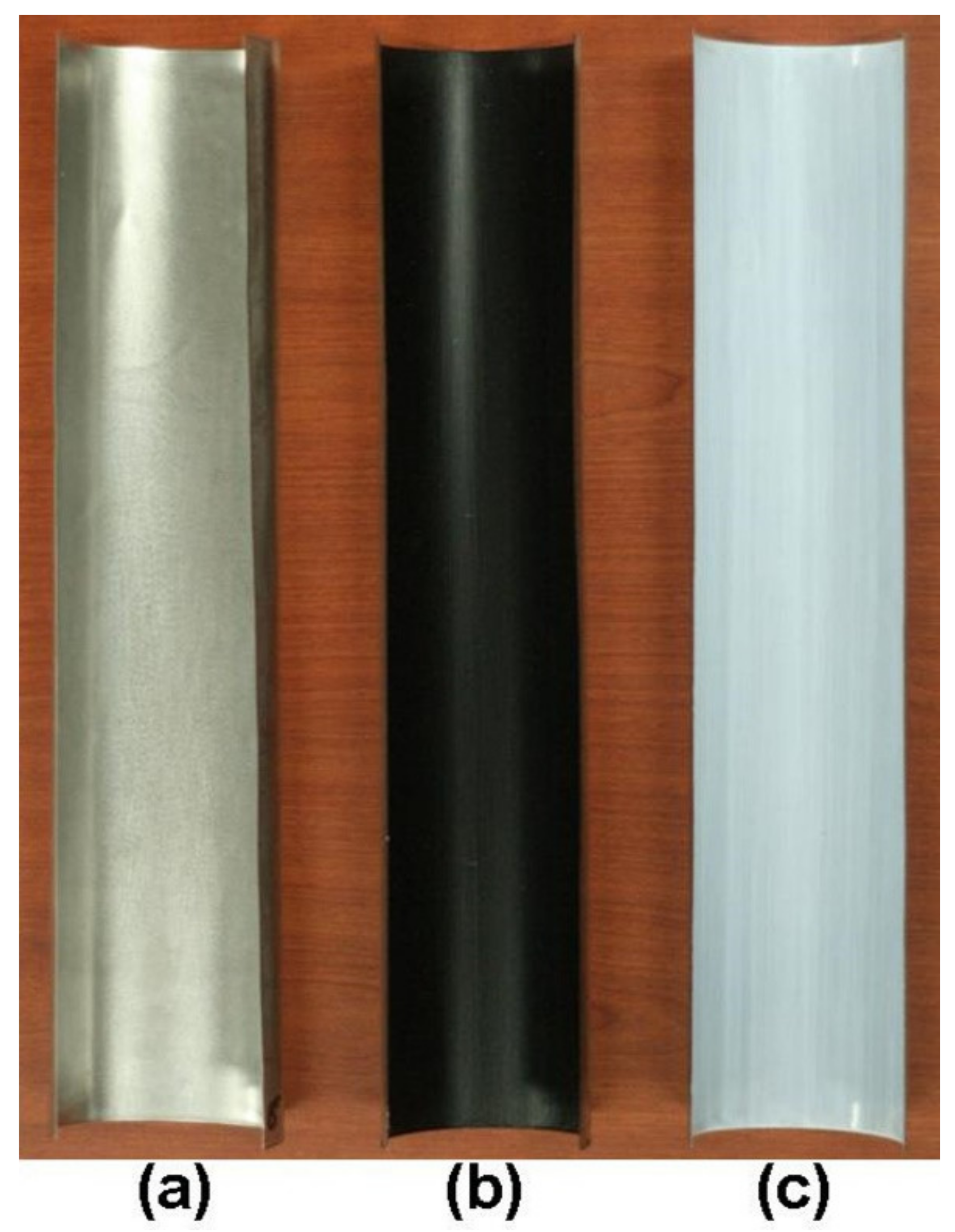
Two FIRCs were evenly coated on the surface (single side) of #304 stainless steel sheets (W × L × T: 160 × 370 × 0.18 mm, weight: 80.02 ± 0.15 g) by the brushing method. After each coating was completed, it was heated and dried (50 °C) by a heating oven and weighed with an electronic balance (GX-6100, A&D, Tokyo, Japan; accuracy of ±0.1 g, resolution of ±0.01 g), and if the weight was insufficient, it was coated again. In order to compare the difference between samples with and without coatings, and coatings with and without FIRMs, the test samples also included uncoated stainless steel plates (Blank) and stainless steel plates coated with 25% water-based acrylic paint (Base). The coating weights of all coated samples (Base, TiO2-FIRC, MWCNTs-FIRC) were controlled within 2.25 ± 0.03 g. Figure 2 shows three coated test samples, where the coating weights of the Base, MWCNTs-FIRC, and TiO2-FIRC are 2.28, 2.24 and 2.23 g, respectively.
Figure 2.
The coated test samples: (a) Base; (b) MWCNTs; (c) TiO2.
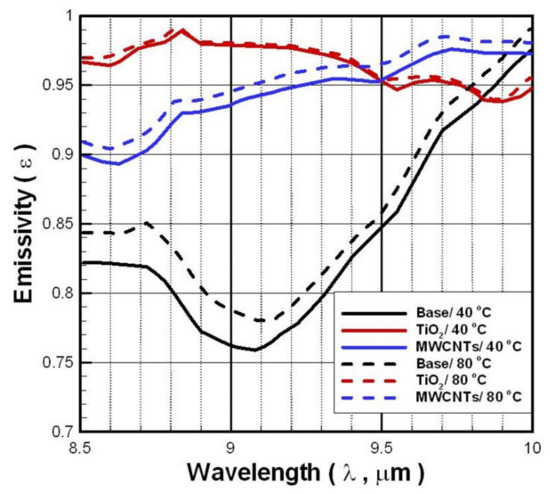
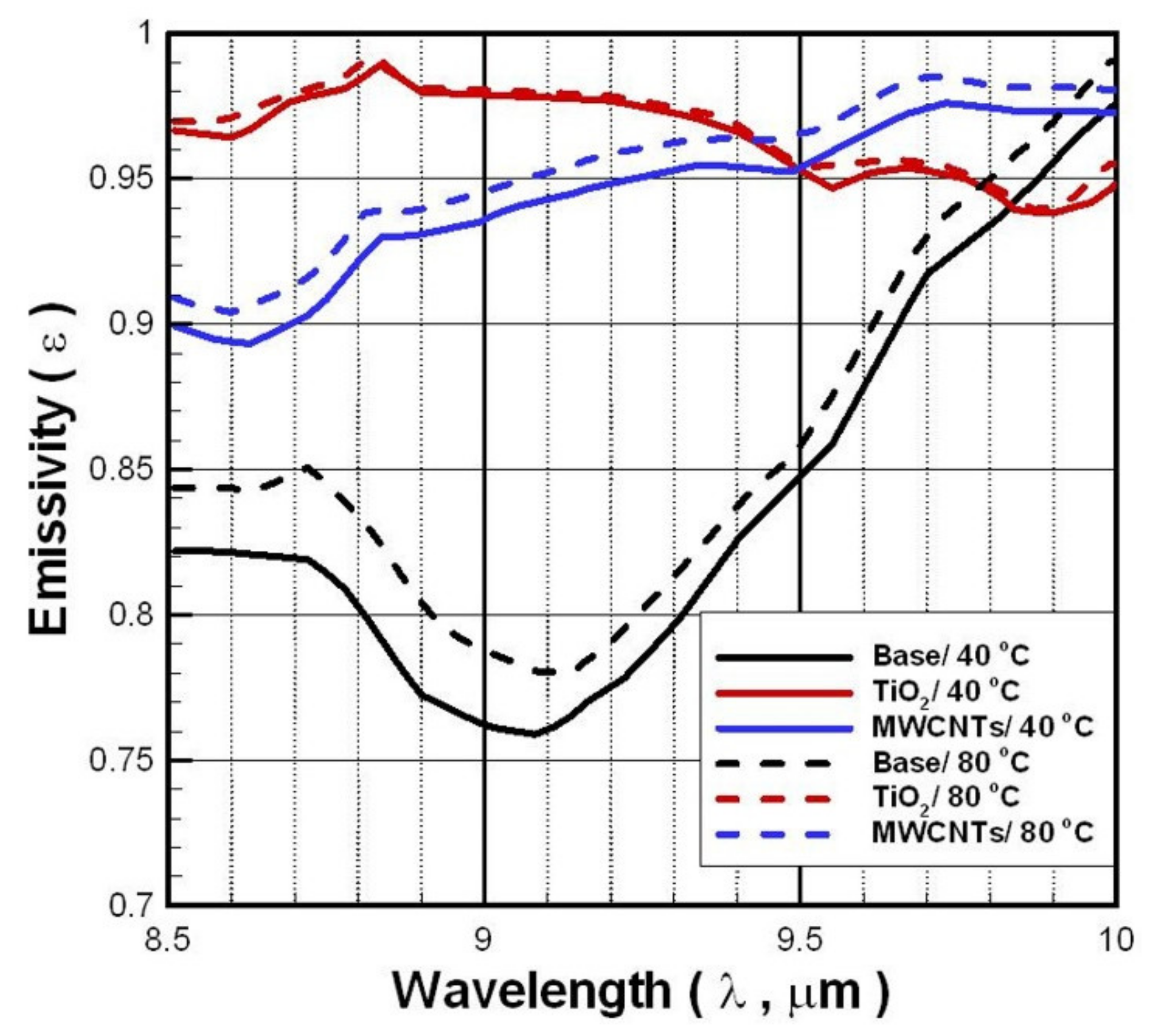
Figure 3 shows the emissivity (ε) of the coated test samples with Base, TiO2-FIRC, and MWCNTs-FIRC at the sample temperatures of 40 and 80 °C. The emissivity of the samples were measured at different wavelengths using an FT-IR spectrometer (VERTEX 70, Bruker, Ettlingen, Germany). According to Wein’s displacement law, the wavelength of the maximum radiation energy corresponding to 25~65 °C (approximate temperature range of hot water heater) is 9.72~8.57 μm. The average ε of the Base, TiO2-FIRC, and MWCNTs-FIRC at wavelengths of 9.72~8.57 μm under the average sample temperature were 0.82, 0.97, and 0.94, respectively.
Figure 3.
The ε of Base, TiO2-FIRC, and MWCNTs-FIRC.
3. Experimental Design and Procedures
3.1. Experiment Apparatus
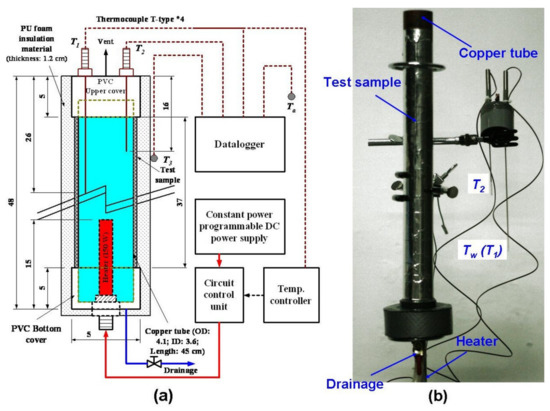
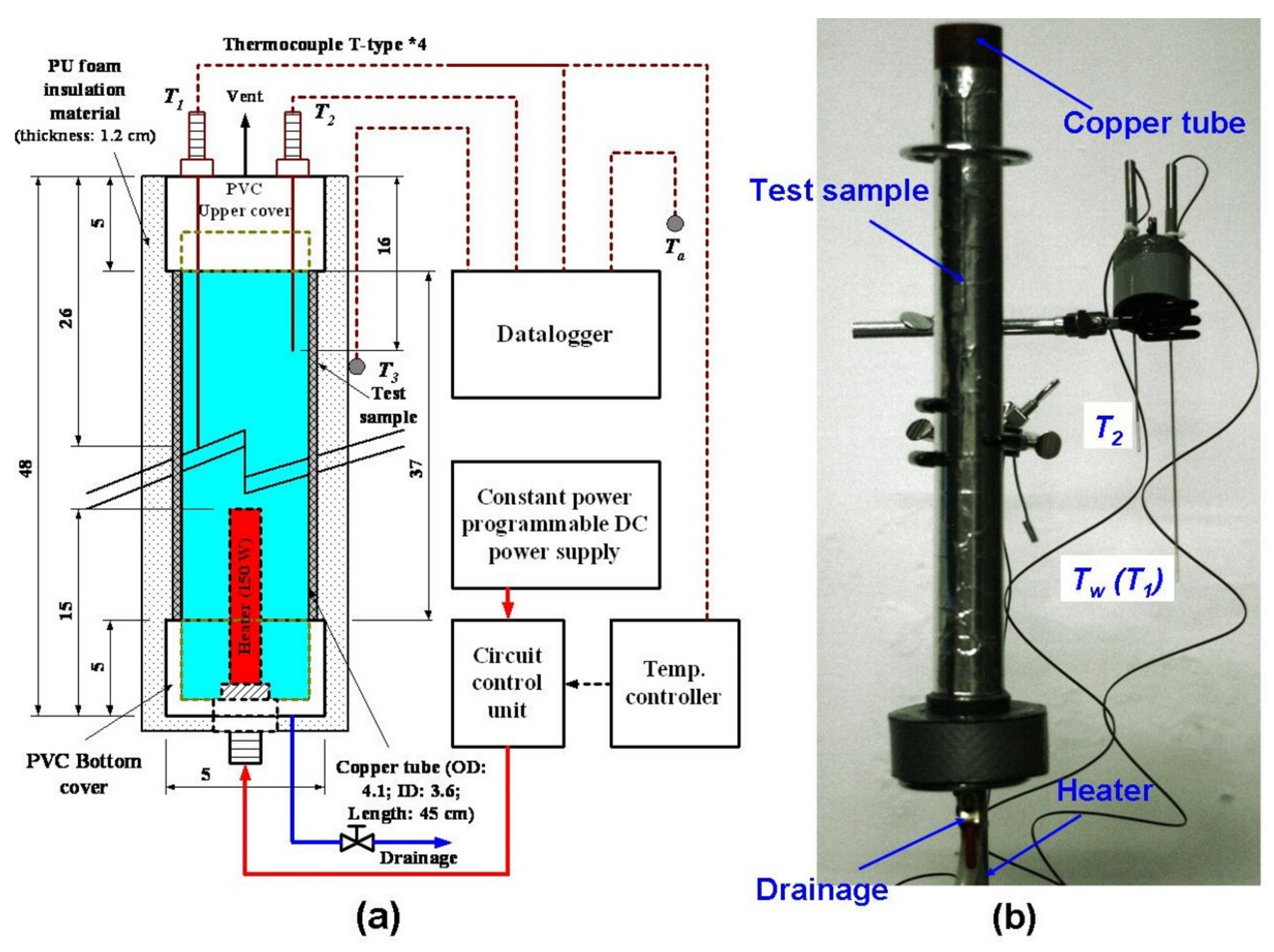
Figure 4 shows the equipment diagram of the hot water heater performance experiments. A copper tube with two PVC tube caps was used to make the outer shell of the hot water heater. A 150 W electric heating tube with a programmable DC power supply (constant power mode; EV202, Consort, Belgium; accuracy of ±1.0 W) was installed on the fixed tube cap at the bottom to provide the heating capacities of 40 and 80 W (different heating rates). Two thermocouples (T-type, ψ = 2 mm, accuracy of ±0.75%) with stainless steel protective tubes of different lengths were installed on the removable tube cap to measure the water temperatures (T1 and T2) in the center and upper parts of the hot water heater, and a recorder (TRM-20, TOHO, Kanagawa, Japan; accuracy of ±0.1%) was used to measure and record temperatures with a sampling interval of 3 s.
Figure 4.
The equipment diagram of the hot water heater performance experiments: (a) detailed structure and (b) actual photograph.
The temperature difference between T1 and T2 is inversely proportional to the uniformity of the water temperature in the hot water heater. Therefore, the temperature difference between the T1 and T2 can be used to evaluate the uniformity of the water temperature of the hot water heater. Although installing multiple thermocouples to measure the temperature at multiple points can more accurately assess the uniformity of the water temperature, it is not easy to stably and accurately install multiple temperature sensors to measure temperature changes of multiple points because of the small internal space of the hot water heater. Furthermore, the distance between the measurement points between T1 and T2 is not large, and it can be expected that the temperature difference between T1 and T2 will not be large, resulting in little practical significance for installing multiple temperature measurement points. Therefore, this study only uses two measuring points to measure the water temperature.
The target temperature setting (TTar) of water for the temperature controller (TTM-i4N, TOHO, Japan; accuracy of ±0.3%) was based on the measurement data of the thermocouple (T1 = Tw = TTar) located in the center of the hot water heater as the control reference. The coating of the test sample was crimped toward the inside to cover the outer layer of the copper tube, then the test sample was tightly affixed to the outside with aluminum foil tape, and then, a PU foam tube with a thickness of 1.2 cm was placed to cover the outer layer of the test sample for insulation to improve the stability of the experiment.
3.2. Experimental Procedure and Calculation
This experiment used an electronic balance (GX-6100, A&D, Japan; accuracy of ±0.1 g, resolution of ±0.01 g) to weigh 480 g of pure water (keep the water temperature at 25 °C with an isothermal unit in advance), placed it in the hot water heater, and then, the upper tube cap was covered and heated with constant power (40 W and 80 W). The TTar was set to 43, 53, and 63 °C, respectively, and when the water temperature reached TTar, the temperature controller and circuit control unit automatically powered off to stop heating. At this time, the recorder continued to record temperature changes until the end of the test time (the total experiment time was 90 min). The temperature and humidity of the experimental environment were controlled by a temperature/humidity control system at 25 °C ±0.5 °C and 60% RH ±5%, respectively. Each experimental parameter (four test samples: Blank, Base, TiO2-FIRC, MWCNTs-FIRC; three TTar: 43, 53, and 63 °C; two heating powers: 40 W and 80 W, for a combination of 24 test parameters in total) were performed four times (96 tests were performed in total, and each experiment time was 90 min). Because the heating load used by the hot water heater in this study is only 480 g of pure water, the experimental results are easily affected by environmental conditions and operating errors. Therefore, it is necessary to control the experimental environmental conditions and repeatedly measure to reduce the deviation of the experiment.
The heating rate (Str, °C/sec) was calculated from the recorded data in each experiment, and this study took the time and water temperature (T1) differences corresponding to 10% to 90% of the TTar, where a high Str meant that the hot water heater had high heating efficiency (a greater temperature rise at the same time). In addition, this study recorded the average water temperature (T1) within 10 min before the end of the experiment (Tla10, °C), where the higher Tla10 represents the better thermal insulation performance of the hot water heater. Furthermore, regarding the standard deviations (STDdTw) of the temperature difference between the upper (T2) and center (T1) water temperatures during the experiment, the lower STDdTw means the water temperature between T2 and T1 is closer, and the water temperature is better distributed in the hot water heater. The Str, Tla10, and STDdTw were taken as the performance indicators to evaluate the influence of FIRC on the performance of the hot water heater. Finally, the calculation results of the four repeated experiments with the same experimental parameters were averaged to obtain the final experimental results.
3.3. Uncertainty and Data Analysis
The relative uncertainty analysis performed in this study involved calculation of the measurement deviations (m). The relative uncertainty ranges, as determined in the hot water heater performance experiments, included those of Str, Tla10, and STDdTw, which reflect the deviations from the relevant temperature controller, temperature sensors, power supply, and data recorder. The maximum relative uncertainty ranges of Str, Tla10, and STDdTw were ±2.84%, ±1.11%, and ±1.34%, respectively. As the same experimental parameters were repeated four times, the relative uncertainty of the final experimental data should be further reduced. The maximum relative uncertainty ranges (um) in the hot water heater performance experiments did not include any deviations caused by using the sample weight and ambient conditions.
um = [(m1)2 + (m2)2 + (m3)2 + ………… + (mn)2]1/2 × 100%
The experimental and calculation results are presented as a change ratio (R) to reveal differences between the experimental data of “Blank” (EDBlank) and those of samples with coatings (EDCoatings), where R can be expressed as:
R = [(EDCoatings − EDBlank)/EDBlank] × 100%
4. Results and Discussion
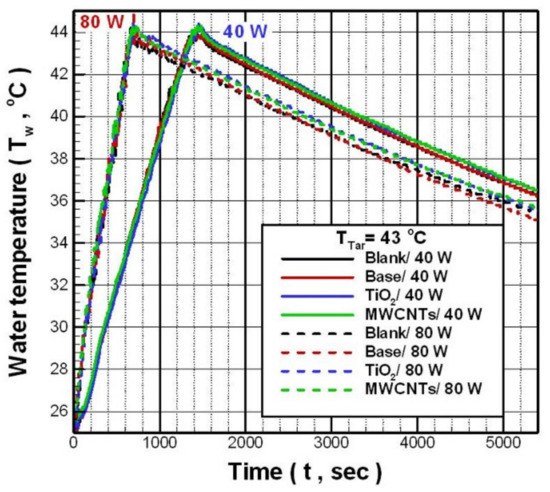
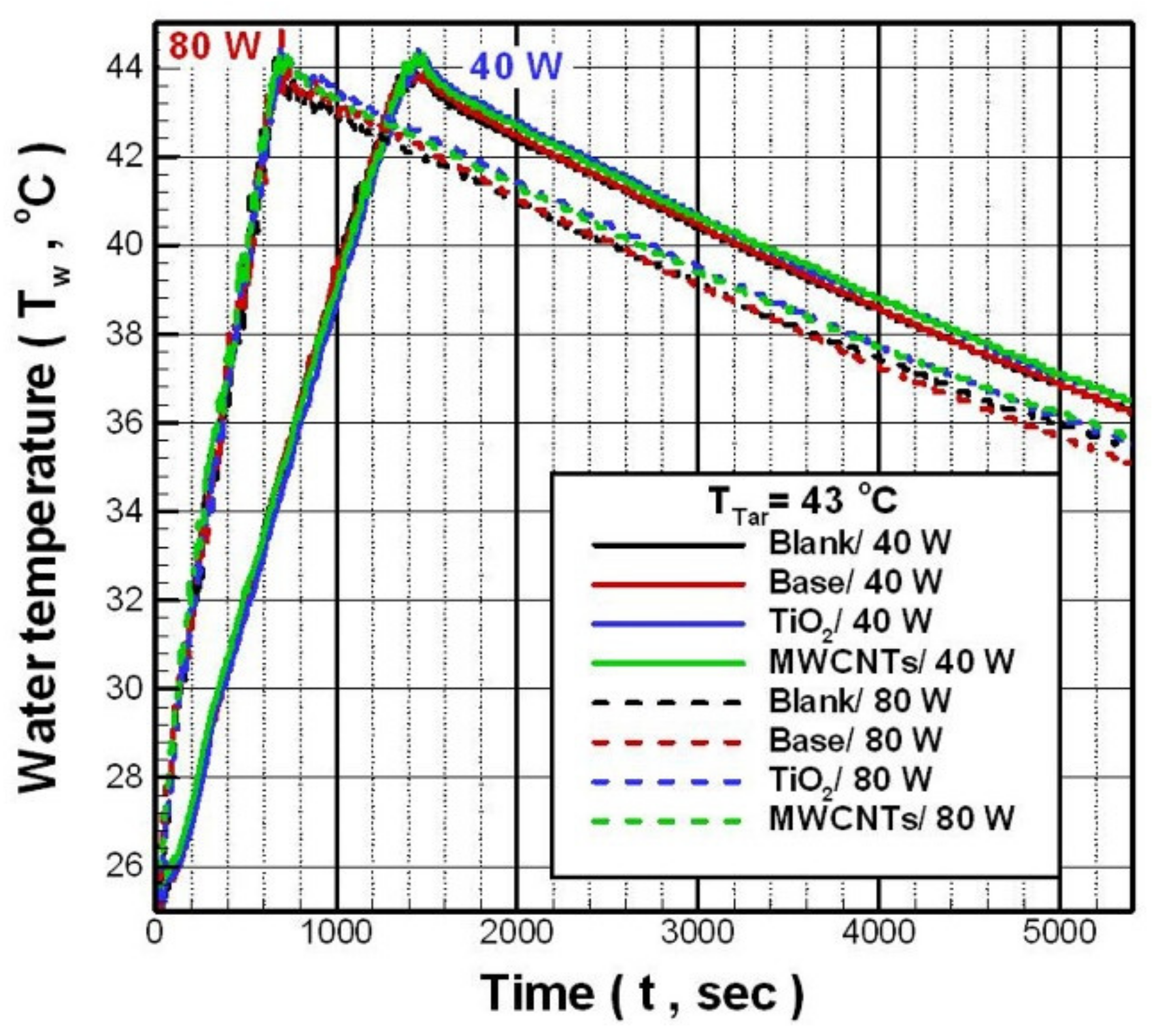
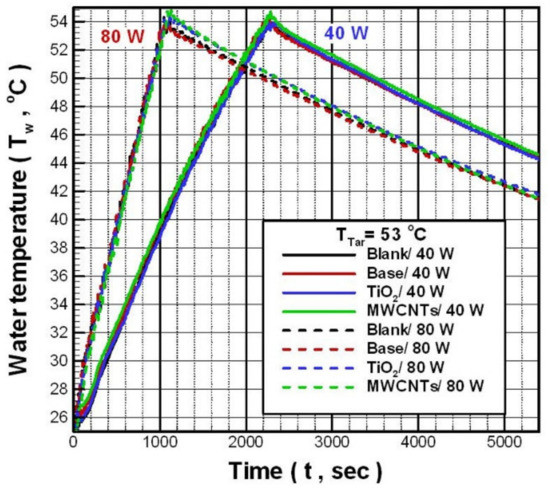
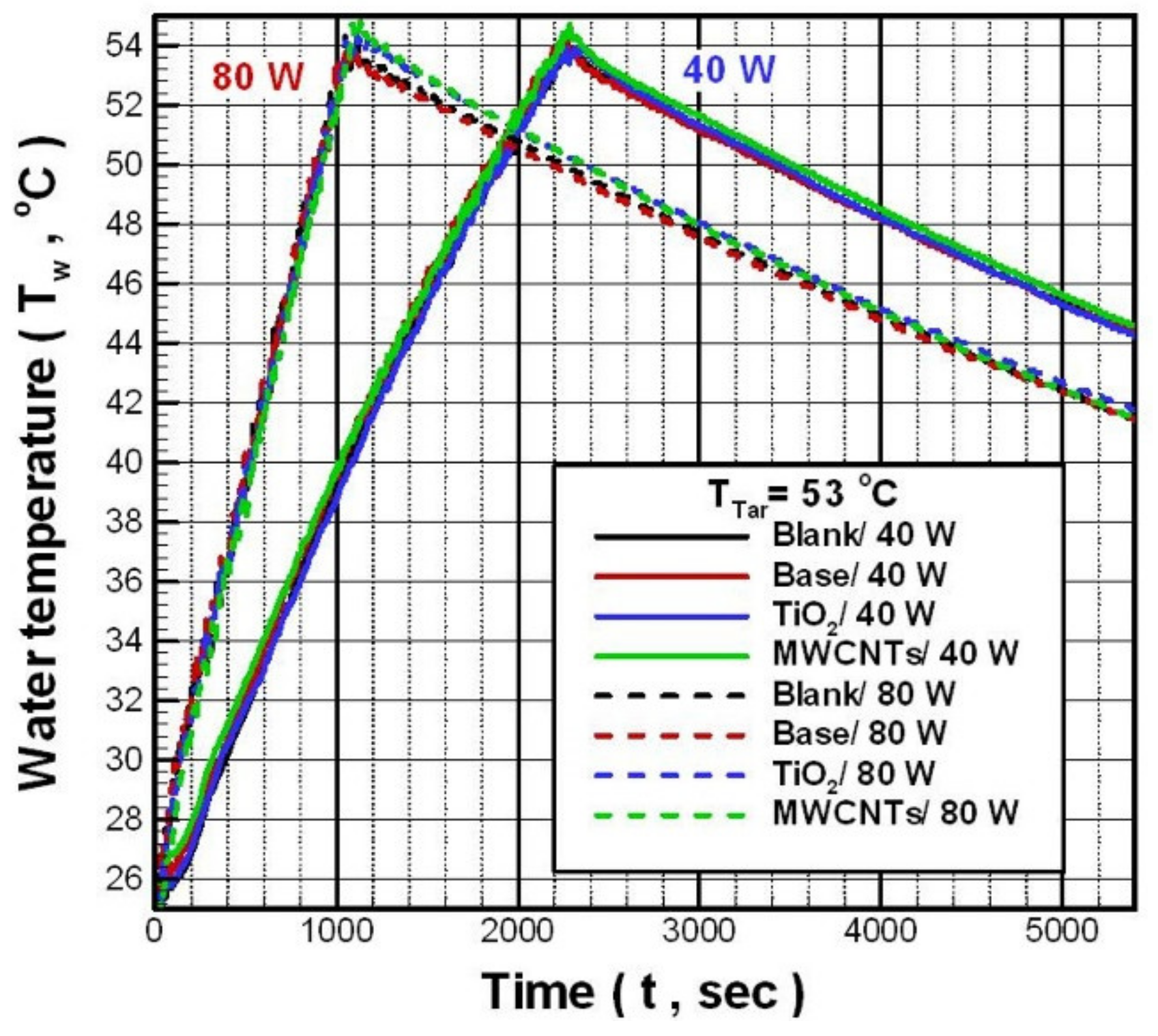
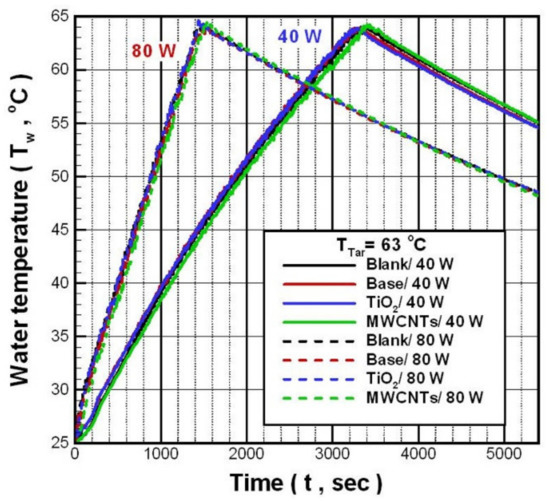
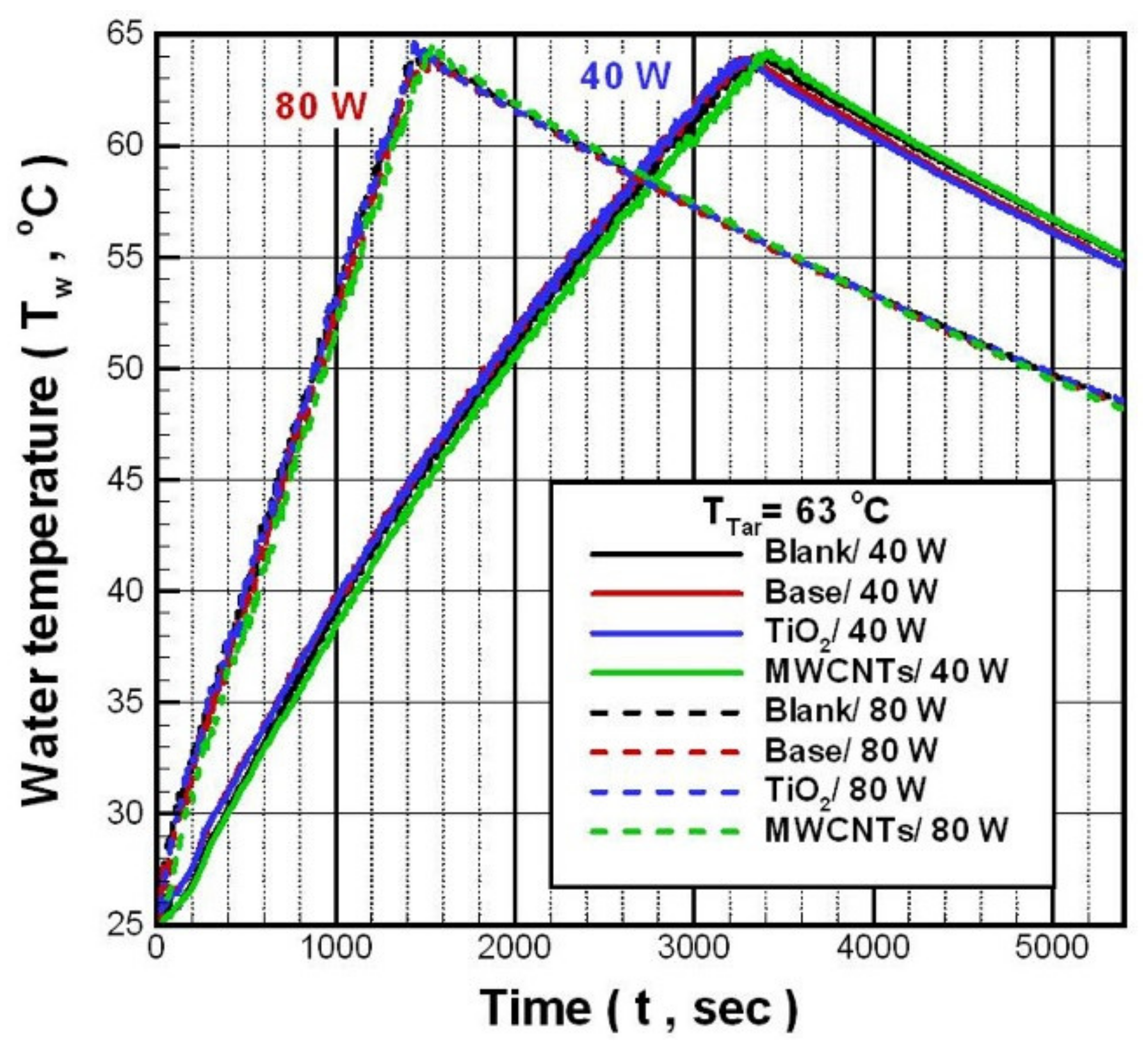
Figure 5, Figure 6, Figure 7 show the average water temperature (from T1) of the four repeated experiments for each test sample under different TTar and heating powers. It can be seen from these figures that there are slight differences between the test samples, and the maximum water temperature (Tmax) under each experimental parameter is slightly higher than the TTar. In this study, the temperature difference between Tmax and TTar is named dTTar (°C). This phenomenon is mainly caused by the continued heating of the water by the residual heat after the heater was turned off, and the residual heat of the heater after the power was turned off should be the same under the same heating power. In addition, the dTTar with heating power of 80 W had a higher residual heat than the 40 W after the power was turned off; therefore, it can be expected that the dTTar with heating power of 80 W was higher than that of the 40 W. The higher dTTar shows the higher heating capacity of the water by the residual heat of the heater that had better thermal insulation performance. However, the residual heat of the heater after the power was turned off should be the same under the same heating power. Therefore, the high dTTar may be caused by the poor natural convection of the water in the hot water heater, which caused the higher local temperature, and this issue can be determined by referring to the temperature difference between T2 and T1. Furthermore, whether the high dTTar comes from the better thermal insulation effect can be determined by referring to Tla10. Moreover, based on the TTar, Str will also affect the overshoot of T1. According to the above analysis, it can be known that dTTar will simultaneously be affected by Str, Tla10, and STDdTw. Therefore, as these performance indicators also consider dTTar, this study only used Str, Tla10, and STDdTw as performance indicators to evaluate the hot water heater performance.
Figure 5.
The T1 for test samples at TTar of 43 °C.
Figure 6.
The T1 for test samples at TTar of 53 °C.
Figure 7.
The T1 for test samples at TTar of 63 °C.
As shown in Table 1, all experimental results are further aggregated into various performance indicators such as the heating rate (Str), the average water temperature (T1) within 10 min before the end of the experiment (Tla10), the standard deviations (STDdTw) of the temperature difference between the upper (T2) and center (T1) water temperatures during the experiment, and its change ratios to facilitate comparison. It can be seen from Table 1 that Str, and Tla10 do not have a certain trend; however, STDdTw presents all the experimental parameters, and shows that the uniform water temperatures of the samples coated with TiO2-FIRC and MWCNTs-FIRC are better. Since the heating load used by the hot water heater in this study is only 480 g of pure water, it is expected that the experimental results of each test sample have little difference under the same experimental parameters. In order to comprehensively evaluate the performance of hot water heaters, the different heating powers are divided into two groups of 40 and 80 W, and the four samples are ranked 1 to 4 according to the sorted order of the performance indicators (Str, Tla10, and STDdTw); the smaller the sorted cumulative number, the better the overall performance. When the accumulated numbers are the same, STDdTw is used to distinguish the difference. The order of the overall performance of the hot water heater at the heating power of 40 W is MWCNTs, TiO2, Base, and Blank; while the order is TiO2, MWCNTs, Blank, and Base for the heating power of 80 W. The results show that the sample with MWCNTs-FIRC has better performance at the low heating power (40 W); while the sample with TiO2-FIRC has better performance at the high heating power (80 W).
Table 1.
List of results of hot water heater performance tests for heating power of 40 and 80 W.
Next, this study conducted a more in-depth discussion on the relationship between the three performance indicators of Str, Tla10, and STDdTw. As shown in Figure 3, the ε of MWCNTs-FIRC is higher than TiO2-FIRC only when the wavelength is greater than 9.43 (sample temperature of 80 °C for ε test) and 9.52 μm (test sample temperature of 40 °C for ε test) at the wavelength range of 9.72~8.57 μm. The temperatures calculated by the two wavelengths, as based on Wein’s displacement law, are 34.2 and 31.3 °C, respectively; in other words, most of the water temperatures of TiO2-FIRC in the experiment had a higher ε corresponding to this range of wavelengths (9.72~8.57 μm) than MWCNTs-FIRC. In theory, when TiO2-FIRC is used in hot water heaters, the improved performance of the hot water heaters should be better than MWCNTs-FIRC, which is because the higher radiation energy of FIR can promote the disturbance of water during heating. However, the ranked results of the performance indicators show that the sample coated with MWCNTs-FIRC is better than the sample coated with TiO2-FIRC under the heating power of 40 W. FIRCs with higher ε should be able to provide higher FIR radiation energy to disturb the water in the hot water heater and make the overall water temperature more uniform (lower STDdTw). Due to the disturbance of the FIR radiation energy (Str is only calculated by T1 without considering T2), the uniformity of T2 and T1 will suppress Str when the overall water temperature is more uniform; in the same way, the more uniform water temperatures at T2 and T1 will also make Tla10 lower (Tla10 calculated only by T1 without considering T2). The STDdTw in Table 1 shows that the sample coated with TiO2-FIRC has only one experimental parameter (TTar = 53 °C, heating power = 80 W), which is slightly higher (within 1%) than the sample coated with MWCNTs-FIRC. The above analysis shows that STDdTw suppresses the two performance indicators of Str and Tla10. Furthermore, it is well known that the thermal conductivity (k) of MWCNTs is much higher than that of TiO2, which makes the k of MWCNTs-FIRC higher than that of TiO2-FIRC. High k material is coated on the outside of hot water heater will be detrimental to the thermal insulation performance of the hot water heater. Therefore, in terms of all the experimental parameters in this study, the sample coated with TiO2-FIRC should be better than the sample coated with MWCNTs-FIRC for improving the performance of the hot water heater in this study. This study suggests that the FIRC with high ε and low k should be selected for the practical application of FIRC to hot water heaters, which should be better for improving the relevant performance of hot water heaters. However, FIRC with high ε and high k can be considered in the field of heat dissipation.
5. Conclusions
This study selected TiO2 and MWCNT as FIRMs, which were added to water-based acrylic coatings to prepare FIRCs. In order to study the influence of FIRCs on the performance of the hot water heater, the two FIRCs were evenly coated on #304 stainless steel sheets and installed on the outer layer of the hot water heater to make test samples. According to the comprehensive performance indicators, such as Str, Tla10, and STDdTw, MWCNTs-FIRC has better performance at the heating power of 40 W; while TiO2-FIRC has better performance at the heating power of 80 W. Considering that the uniformity of water temperature will inhibit the Str and Tla10 of a hot water heater, TiO2-FIRC should have better performance improvement when applied to the hot water heater in this study. The actual use of FIRCs to improve the performance of hot water heaters should select the FIRCs with high ε and low k.
Author Contributions
Conceptualization, T.-P.T., S.-P.Y. and Y.-F.L.; designed the experiment, T.-P.T., S.-P.Y. and Y.-F.L.; carried out the measurements, T.-P.T., Q.-L.X., H.-K.H. and C.-C.H.; analyzed the measurements, T.-P.T., S.-P.Y. and Q.-L.X.; wrote and revised the paper, T.-P.T. All authors have read and agreed to the published version of the manuscript.
Funding
This research received no external funding.
Institutional Review Board Statement
Not applicable.
Informed Consent Statement
Not applicable.
Data Availability Statement
Data available on request.
Acknowledgments
The authors would like to thank the Ministry of Science and Technology of Republic of China (Taiwan) for their financial support to this research under Contract no. MOST 106-2221-E-003 -024 –MY3.
Conflicts of Interest
The authors declare that they have no competing interests.
Nomenclature
| ε | emissivity (dimensionless) |
| λmax | Wavelength of the maximum radiation energy of the black body (μm) |
| k | Thermal conductivity (W/m-K) |
| T | Temperature (K) |
| Tmax | Maximum water temperature (°C) |
| T1 | Center water temperature (°C) |
| T2 | Upper water temperature (°C) |
| Tw | Water temperature (°C) |
| b | Wien’s displacement constant (≅2897 μm·K) |
| Str | Heating rate (°C/s) |
| TTar | Target temperature setting (°C) |
| Tla10 | Average water temperature in the last 10 min (°C) |
| STDdTw | Standard deviations of the temperature difference between the upper and the center water temperature |
| m | Measurement deviations (%) |
| um | Maximum relative uncertainty (%) |
| R | Change ratio (%) |
| ED | Experimental data |
| dTTar | Temperature difference between the Tmax and the TTar (°C) |
References
- Dover, J.S.; Phillips, T.J.; Arndt, K.A. Cutaneous effects and therapeutic uses of heat with emphasis on infrared radiation. J. Am. Acad. Dermatol. 1989, 20, 278–286. [Google Scholar] [CrossRef] [Scilit]
- Choi, S.J.; Cho, E.H.; Jo, H.M.; Min, C.; Ji, Y.S.; Park, M.Y.; Kim, J.K.; Hwang, S.D. Clinical utility of far-infrared therapy for improvement of vascular access blood flow and pain control in hemodialysis patients. Kidney Res. Clin. Pract. 2016, 35, 35–41. [Google Scholar] [CrossRef] [Scilit]
- Ishimaru, K.; Nakajima, T.; Namiki, Y.; Ryotokuji, K. Influences of pinpoint plantar long-wavelength infrared light irradiation (stress-free therapy) on chorioretinal hemodynamics, atherosclerosis factors, and vascular endothelial growth factor. Integr. Med. Res. 2018, 7, 103–107. [Google Scholar] [CrossRef] [Scilit]
- Io, H.; Nakata, J.; Aoyama, R.; Inoshita, H.; Nakano, T.; Ishizaka, M.; Fukui, M.; Tomino, Y.; Suzuki, Y. Far-infrared therapy for secondary vascular access patency of hemodialysis patients. Ren. Replace. Ther. 2019, 5, 31. [Google Scholar] [CrossRef] [Scilit]
- Chen, T.Y.; Yang, Y.C.; Sha, Y.N.; Chou, J.R.; Liu, B.S. Far-infrared therapy promotes nerve repair following end-to-end neurorrhaphy in rat models of sciatic nerve injury. Evid. Based Complement. Altern. Med. 2015, 2015, 207245. [Google Scholar] [CrossRef] [Scilit]
- Ou, S.M.; Hu, F.H.; Yang, W.C.; Lin, C.C. Far-infrared therapy as a novel treatment for encapsulating peritoneal sclerosis. Am. J. Gastroenterol. 2014, 109, 1957–1959. [Google Scholar] [CrossRef] [Scilit]
- Khan, I.; Pathan, S.; Li, X.A.; Leong, W.K.; Liao, W.L.; Wong, V.; Hsiao, W.L.W. Far infrared radiation induces changes in gut microbiota and activates GPCRs in mice. J. Adv. Res. 2020, 22, 145–152. [Google Scholar] [CrossRef] [Scilit] [PubMed]
- Kim, S.H.; Hwang, S.H.; Hong, S.K.; Seo, J.K.; Sung, H.S.; Park, S.W.; Shin, J.H. The clinical efficacy, safety and functionality of anion textile in the treatment of atopic dermatitis. Ann. Dermatol. 2012, 24, 438–443. [Google Scholar] [CrossRef] [Scilit] [PubMed]
- Hamada, Y.; Teraoka, F.; Matsumoto, T.; Madachi, A.; Toki, F.; Uda, E.; Hase, R.; Takahashi, J.; Matsuura, N. Effects of far infrared ray on Hela cells and WI-38 cells. Int. Congr. Ser. 2003, 1255, 339–341. [Google Scholar] [CrossRef] [Scilit]
- Cristiano, L. Use of infrared as a complementary treatment approach in medicine and aesthetic medicine. Asp. J. Biomed. Clin. Case Rep. 2019, 2, 77–81. [Google Scholar]
- Wikipedia. Emissivity. 2020. Available online: https://en.wikipedia.org/wiki/Emissivity (accessed on 6 December 2020).
- Heynderickx, G.J.; Nozawa, M. High-emissivity coatings on reactor tubes and furnace walls in steam cracking furnaces. Chem. Eng. Sci. 2004, 59, 5657–5662. [Google Scholar] [CrossRef] [Scilit]
- Zhu, D.; Ding, Y.; Wang, L.; Liang, G.; Wang, Y. Effect of rare earth composite ceramic materials on oil combustion of oil-burning boiler. J. Rare Earths 2006, 24, 244–247. [Google Scholar]
- Li, F.; Liang, J.; Meng, J.; Ding, Y.; Liang, G.; Xue, G.; Liu, L. Effect of tourmaline/resin composite materials on the combustion of diesel oil for oil-burning boiler. J. Chin. Ceram. Soc. 2007, 35, 517–521. [Google Scholar]
- Zhu, D.; Liang, J.; Liang, G.; Ding, Y.; Xue, G.; Liu, L. Effects on combustion of liquefied petroleum gas of porous ceramic doped with rare earth elements. J. Rare Earths 2007, 25, 212–215. [Google Scholar]
- Liang, J.; Zhu, D.; Meng, J.; Wang, L.; Li, F.; Liu, Z.; Ding, Y.; Liu, L.; Liang, G. Performance and application of far infrared rays emitted from rare earth mineral composite materials. J. Nanosci. Nanotechnol. 2008, 8, 1203–1210. [Google Scholar] [CrossRef] [Scilit]
- Lan, H.L. Research Some Questions of High Temperature Infrared Radiant Coating during the Application. Master’s Thesis, Wuhan University of Technology, Wuhan, China, 2012. [Google Scholar]
- Chen, T.Y.; Cho, H.P.; Jwo, C.S.; Hung, M.H.; Lee, W.S. Analyzing how the ZrO2 far infrared material affects the performance of smooth tube heat exchangers. J. Nanomater. 2015, 2015, 124632. [Google Scholar]
- Maznoy, A.; Kirdyashkin, A.; Pichugin, N.; Zambalov, S.; Petrov, D. Development of a new infrared heater based on an annular cylindrical radiant burner for direct heating applications. Energy 2020, 204, 117965. [Google Scholar] [CrossRef] [Scilit]
- Qiu, K.; Elhassan, A.; Tian, T.; Yin, X.; Yu, J.; Li, Z.; Ding, B. Highly flexible, efficient, and sandwich-structured infrared radiation heating fabric. ACS Appl. Mater. Interfaces 2020, 12, 11016–11025. [Google Scholar] [CrossRef] [Scilit] [PubMed]
- Xue, G.; Wu, X.M.; Liang, J.S.; Ding, Y.; Liu, L.H. Effect of mineral composite materials with far infrared radiation on diesel oil combustion. Adv. Mater. Res. 2008, 58, 47–53. [Google Scholar] [CrossRef] [Scilit]
- Wey, A.C.T. Infrared-Emitting Ceramics for Fuel Activation. U.S. Patent US20110186010 A1, 4 August 2011. [Google Scholar]
- Qin, X.L.; Yang, R.; Wang, Y.F.; Luo, L.; Qiao, S.F. Study of the effect of negative ions on energy efficiency of diesel engines. For. Mach. Wood. Equip. 2013, 41, 29–30. Available online: http://en.cnki.com.cn/Article_en/CJFDTOTAL-LJMG201303007.htm (accessed on 7 July 2020).
- Das, R. Wavelength- and frequency-dependent formulations of Wien’s displacement law. J. Chem. Edu. 2015, 92, 1130–1134. [Google Scholar] [CrossRef] [Scilit]
- NIST. CODATA Value: Wien wavelength displacement law constant. In The NIST Reference on Constants, Units, and Uncertainty; U.S. National Institute of Standards and Technology: Gaithersburg, MA, USA, 2011. [Google Scholar]

Publisher’s Note: MDPI stays neutral with regard to jurisdictional claims in published maps and institutional affiliations. |
© 2021 by the authors. Licensee MDPI, Basel, Switzerland. This article is an open access article distributed under the terms and conditions of the Creative Commons Attribution (CC BY) license (https://creativecommons.org/licenses/by/4.0/).