Article

Post-Innovation: Sustaining Service Innovation in Organizations

1
School of Law and Public Affairs, Jiaying University, Meizhou 514015, China
2
Department of Business Administration, Asia University, Taichung 41354, Taiwan
3
Faculty of Business Administration, Posts and Telecommunications Institute of Technology, Hanoi 12110, Vietnam
*
Author to whom correspondence should be addressed.
Adm. Sci. 2026, 16(9), 453; https://doi.org/10.3390/admsci16090453
Submission received: 9 August 2026 / Revised: 14 September 2026 / Accepted: 14 September 2026 / Published: 17 September 2026

Highlights

What are the main findings?
  • A four-dimensional customer value framework was identified, comprising functional, hedonic, contextual, and relational values.
  • Sixteen service quality indicators were developed, and five post-innovation processes were identified to sustain service innovation.
What are the implications of the main findings?
  • Continuous alignment between customer value and service quality supports post-innovation management.
  • The proposed framework helps organizations allocate resources to sustain service innovation over time.

Abstract

Although developing service innovations is challenging, maintaining their relevance after implementation can be even more difficult, as their attractiveness may decline over time. This makes continued attention to service quality important in the post-innovation stage. However, prior research has rarely examined the integration of service innovation and service quality. Therefore, this study explores service-innovation events through the lens of customer value and discusses their implications for post-innovation management. A case study was conducted using 561 hostels and 66 international tourist hotels, yielding 6216 service-related events for analysis. The data were analyzed using a hybrid approach integrating text analysis and content analysis. The study identified a four-dimensional customer value framework comprising functional, hedonic, contextual, and relational values, from which 16 service quality indicators were derived to support service innovation during the post-innovation period. Drawing on these empirical findings, the study proposes five conceptual processes that may inform understanding of how organizations sustain service innovation after implementation. These findings suggest that maintaining the relevance of service innovation requires continuous attention to service quality as customer value changes. This study provides a conceptual framework for post-innovation service quality management and offers practical guidance for managing service quality after innovation implementation.

1. Introduction

In an increasingly competitive business environment, retaining existing customers has become more important than acquiring new ones, particularly in the service industry (Dubey & Sahu, 2019). This challenge has attracted increasing attention from both the service quality and service innovation literature. Service quality research has long focused on understanding, measuring, and improving service performance to enhance customer satisfaction and loyalty (Arli et al., 2024; Jaakkola & Terho, 2021). Such efforts generally conceptualize service quality as a multidimensional construct comprising multiple service-related attributes (Budianto, 2019). By contrast, service innovation research has primarily focused on developing new services and innovative practices to sustain organizational competitiveness in response to evolving customer needs (Hofmeister et al., 2022; Wang et al., 2022), with studies spanning diverse service contexts and innovation settings (Bäckström & Bengtsson, 2019; J. Chen & Liu, 2024). Despite these different research emphases, service quality and service innovation are inherently interrelated (Kurtmollaiev & Pedersen, 2022; W. L. Lee et al., 2022). Service innovation can improve service quality and encourage repeat patronage (W. L. Lee et al., 2022; Nguyen et al., 2024). However, the competitive advantage generated by service innovation gradually diminishes as customer expectations evolve. At the same time, continuous efforts to improve service quality further raise customer expectations and increase the standards against which existing service innovations are evaluated (Mahavarpour et al., 2023; Kurtmollaiev & Pedersen, 2022). These dynamics create a post-innovation challenge: how can the value associated with implemented service innovations continue to be addressed as customer expectations and service requirements evolve? Although existing service innovation research has primarily focused on innovation generation and implementation, considerably less attention has been paid to how customer value associated with implemented innovations can inform post-innovation management. Accordingly, post-innovation management is conceptualized as an organizational concern with managing the customer value associated with implemented service innovations, rather than as an outcome directly observed in the empirical analysis.
The lodging industry provides an appropriate empirical context for examining this issue because it is characterized by continuous service innovation and high customer expectations regarding service quality. The empirical analysis focuses on 66 legally registered international tourist hotels and 561 hostels in Taiwan region. A total of 6216 documented service innovation events were collected from secondary data sources, including 4192 events from international tourist hotels and 2024 events from hostels. This study adopts a case study approach (Yin, 2018) to analyse the service innovation events through a customer-value framework. The analysis explores the customer-value dimensions associated with these innovations across accommodation categories. These findings provide a basis for understanding post-innovation management.

2. Literature Review

2.1. Service Innovation

Innovation refers to the adoption of new methods, resources, and business approaches in response to dynamic market demands and evolving consumer consumption patterns (Mahavarpour et al., 2023; Schymanietz et al., 2022). Rather than being limited to technological advances or new products, innovation may also arise from organizational needs to create new forms of value (H. Li et al., 2024; Kim, 2023). Within this broader view of innovation, service innovation has emerged as a distinct stream of research focusing on value creation through service offerings, delivery processes, and organizational practices (Blommerde, 2023; Kowalkowski et al., 2024). Consistent with this evolution, the concept of service innovation has also broadened considerably over time. Service innovation was initially defined as the introduction of new or improved services (Knight, 1967; Gustafsson et al., 2020; Shin & Perdue, 2022). As service innovation research has evolved, however, the concept has expanded beyond the development of new service offerings to encompass a broader range of organizational and service-related activities. Existing research suggests that service innovation may involve changes in service concepts, customer interfaces, service delivery processes, and technological applications (Kowalkowski et al., 2024; Vargo et al., 2024; Wirtz & Kowalkowski, 2023). More recently, service innovation has been conceptualized as a dynamic process of resource integration and value co-creation among multiple actors rather than merely the development of new service offerings (Lusch & Nambisan, 2015; Kurtmollaiev & Pedersen, 2022). This evolving understanding highlights that service innovation is not a discrete event but a continuous organizational process through which firms renew service practices and create customer value (Schymanietz et al., 2022; Sklyar et al., 2019).
Within the lodging industry, service innovation is particularly important because competitive advantage depends not only on introducing new services but also on consistently delivering high-quality service experiences. As a highly service-intensive sector, the tourism and hospitality industry views service quality as a fundamental source of customer value and organisational competitiveness (M. Gallarza et al., 2023; Ezeh & Ezeuduji, 2025). From the customer’s perspective, service quality is determined by the comparison between expected and perceived service performance (Oliveras-Villanueva et al., 2020). Consequently, maintaining competitiveness requires lodging firms to continuously improve not only their service offerings but also the organizational activities that support service delivery, including operations, marketing, human resource management, customer relationship management, and other service-related practices (Alnawas & Hemsley-Brown, 2019; Motamedimoghadam et al., 2025; Kowalkowski et al., 2024). Such continuous organizational improvements have been shown to enhance employee satisfaction, service quality, and organizational performance, highlighting the important role of organizational innovation in the lodging industry (W. J. Chen, 2023; Stoffers et al., 2021). Service innovation may also involve the introduction of entirely new services, substantial revisions to existing service delivery processes, and ongoing refinement of incumbent services (Mu et al., 2022; So et al., 2023; Park et al., 2023). Furthermore, service innovations do not necessarily need to be entirely new to the market. Innovations that are new to an organization, its customers, or its business partners may likewise constitute meaningful forms of service innovation (Gustafsson et al., 2020; Mahavarpour et al., 2023). Consistent with this perspective, this study adopts a broader definition of service innovation that encompasses innovations new to the organization, rather than limiting service innovation to market-first innovations.
Existing service innovation research has primarily focused on the generation and implementation of new service innovations (Kurtmollaiev & Pedersen, 2022; Wirtz & Kowalkowski, 2023). Related research on innovation implementation examines how innovations are successfully adopted and integrated into organisational practice (Singh et al., 2020; McGuier et al., 2024), whereas continuous improvement focuses on the incremental enhancement of service processes and operational performance (Hofmeister et al., 2024; Van Assen & Lameijer, 2023). However, neither perspective explicitly addresses how organisations sustain the value of implemented service innovations over time. Accordingly, this study conceptualises post-innovation management as the organisational process through which firms sustain implemented service innovations through service quality management.

2.2. Customer Value

As a highly service-oriented industry, the lodging sector relies on continuous interactions among firms, customers, and other service participants to co-create service experiences. Consequently, customer value has long been regarded as a central concept in understanding service innovation and sustaining competitive advantage (Carvalho & Alves, 2023; M. Gallarza et al., 2023; Kandampully et al., 2023). Rather than being created solely through service delivery, customer value emerges from customers’ evaluations of the benefits they receive relative to the costs they incur. Customer value is widely recognized as customers’ overall evaluation of the benefits obtained relative to the costs incurred when purchasing or using a product or service (Blut et al., 2024; Zeithaml et al., 2020). As customer expectations and market environments continue to evolve, customer value has increasingly become an important source of organizational competitiveness (Carvalho & Alves, 2023; Nejjari & Slaoui, 2024).
Early studies conceptualised customer value predominantly along two dimensions, named functional value and hedonic value. Functional value emphasizes utilitarian benefits, such as effectiveness, efficiency, and economic value, whereas hedonic value reflects customers’ emotional experiences, enjoyment, and other affective responses associated with consumption (Butcher & Chomvilailuk, 2022; Liu et al., 2023; Marjanović, 2024). As consumer preferences and service environments have become increasingly diverse, customer value cannot be fully understood solely in terms of functional and emotional benefits. Instead, customer value has increasingly been viewed as a multidimensional construct. It extends beyond functional and emotional benefits to encompass broader experiential service contexts and the relationships developed throughout the service process (M. G. Gallarza et al., 2022; Kleinaltenkamp et al., 2022). Specifically, relationship value emphasizes the benefits created through ongoing interactions between customers and service providers, whereas contextual value recognizes that customers’ value perceptions are shaped by the service contexts in which value is created and experienced (M. G. Gallarza et al., 2015; Kwon et al., 2020; Wong & Denizci Guillet, 2018).
Moreover, customer value is increasingly understood as a dynamic and continuously evolving construct that emerges throughout the service experience (M. G. Gallarza et al., 2022; M. G. Gallarza & Sánchez-Fernández, 2023). Rather than residing solely within products or services, value is co-created through customers’ interactions with service providers, other actors, and the surrounding service environment, rendering value perceptions highly context-dependent and relational (Holmqvist et al., 2020; Fan et al., 2020; Tran, 2025). Consequently, customer value may evolve over different stages of the service experience as customers continuously reassess the benefits they receive in response to changing service encounters, organizational practices, and contextual conditions (McCullough et al., 2024; H. Y. Lee et al., 2023). This dynamic perspective suggests that customers continuously evaluate service experiences from multiple, interconnected perspectives. Accordingly, functional, hedonic, contextual, and relationship value should be viewed as complementary dimensions that collectively shape customers’ overall value perceptions rather than as independent forms of value. Accordingly, this study adopts these four customer value dimensions as an integrated analytical framework for interpreting service innovation from a customer value perspective.

2.3. Innovation and Quality Management

Service innovation contributes to organizational competitiveness and sustainable growth by enabling firms to continuously respond to changing customer needs and market environments (Cuthbertson & Furseth, 2022). Beyond introducing new services, however, service innovation requires organizations to effectively manage innovation processes to systematically develop, implement, and continuously improve new service ideas (Blommerde, 2023; Zulkefli et al., 2023). Consequently, innovation management has become increasingly recognized as a critical organizational capability for sustaining long-term service innovation performance (Babaei & Aghdassi, 2022; Tang et al., 2025). Despite its significant potential, successfully translating service innovation into superior organizational performance remains a complex managerial challenge. Organizations must simultaneously coordinate operational efficiency, customer requirements, employee involvement, and continuous improvement activities throughout the innovation process (Kandampully et al., 2023; Luu, 2022).
Unlike manufacturing innovation, service innovation is characterized by high customer involvement, process simultaneity, and intensive interactions between organizations and customers (Ostrom et al., 2021). Consequently, effective innovation depends not only on generating new service ideas but also on organizations’ ability to manage service processes systematically, continuously improve service quality, and integrate customer feedback into innovation activities (Blommerde, 2023; Luu, 2022; Sangpikul, 2023). Hospitality innovation is increasingly viewed not merely as the adoption of new technologies but as an integrated management process that aligns organizational capabilities, service quality, and customer value creation (Shin & Perdue, 2022; Park et al., 2023). Within this context, the relationship between quality management and innovation has attracted growing scholarly interest. However, prior research has yielded inconsistent findings, generating two contrasting perspectives on whether quality management facilitates or constrains innovation (Bourke & Roper, 2017; García-Fernández et al., 2022).
First, the positive perspective argues that quality management provides a systematic foundation for innovation by facilitating organizational learning, process improvement, knowledge integration, and customer orientation, thereby enhancing firms’ innovation capabilities (García-Fernández et al., 2022; El Manzani et al., 2025; D. Li et al., 2018). Conversely, the opposing perspective contends that the excessive reliance on standardized procedures and formal control mechanisms may reduce organizational flexibility, constrain experimentation, and limit employees’ creative behaviours, thereby weakening organizations’ capacity to generate novel service innovations (Cândido et al., 2026; Escrig-Tena et al., 2021). These contrasting perspectives suggest that the key issue is not whether quality management promotes or constrains innovation, but how organizations can leverage quality management to sustain continuous service innovation. From this perspective, greater attention should be given to the role of innovation management in sustaining continuous service innovation (Mahavarpour et al., 2023; Schiefer et al., 2024).

3. Materials and Methods

This study adopts a qualitative case study approach (Yin, 2018) because post-innovation management unfolds within real-world service operations and cannot be meaningfully understood apart from its organizational context. The lodging industry provides the empirical context because organizations continuously introduce service innovations while maintaining service quality. The unit of analysis is the individual service innovation event.

3.1. Analytical Framework

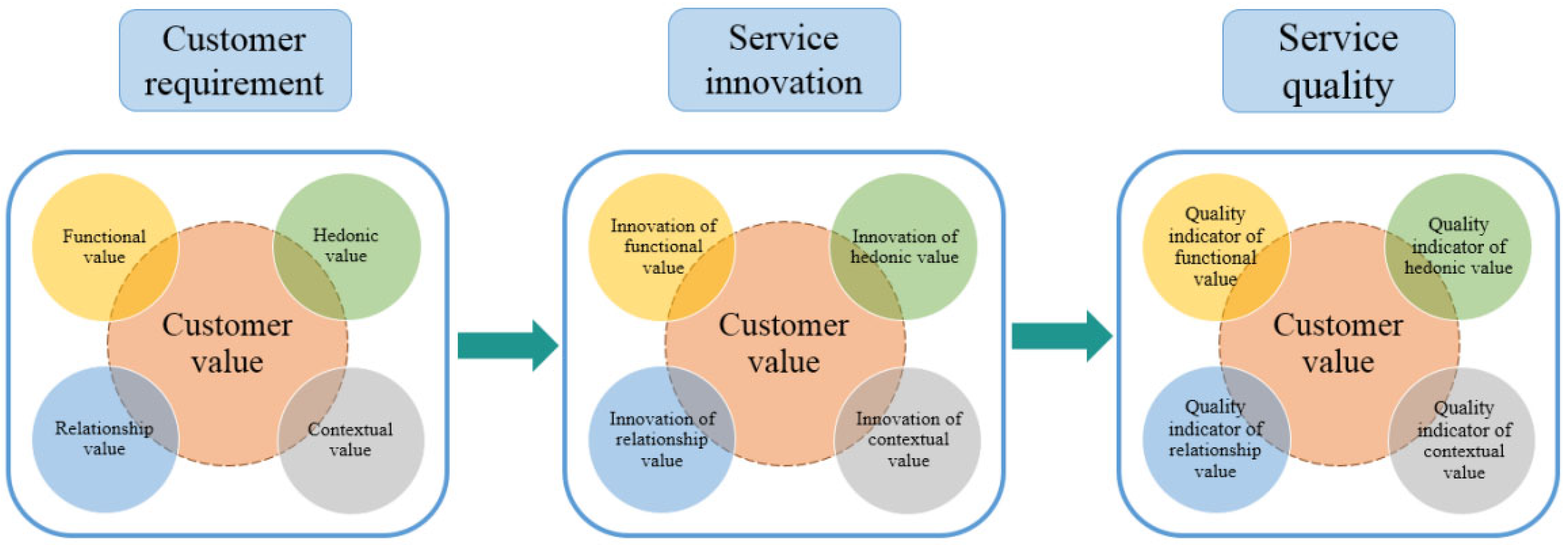
This study adopts a customer value framework comprising four dimensions, named functional value, relationship value, hedonic value, and contextual value, as the analytical framework for examining the customer-value dimensions reflected in service innovation events and informing post-innovation management. As this study focuses on the post-innovation period of service innovation, the framework provides a systematic basis for analysing the customer value associated with implemented service innovations from a service quality perspective. The four customer value dimensions also serve as the coding framework for analysing individual service innovation events. The analytical framework is presented in Figure 1.
To explore the evolution of service innovation over time, the analysis is structured around three development stages. These stages were defined according to changes in the dominant characteristics of service innovation in Taiwan’s accommodation industry. Table 1 summarizes the three stages and their corresponding periods. The digital transformation stage covers 2015–2018 and captures the increasing adoption of digital technologies in accommodation services. The service transformation stage covers 2019–2022 and reflects a broader shift toward service-oriented innovation and customer-facing activities. The intelligent transformation stage covers 2023–2025 and captures the increasing incorporation of intelligent technologies into service provision. The service transformation stage (2019–2022) coincides with the COVID-19 pandemic. The pandemic is therefore considered an important contextual factor in interpreting service transformation during this period, rather than a separate innovation stage. The customer value framework is then applied to service innovation events across the three stages to explore the distribution of service innovation events and their customer-value dimensions and to identify patterns of post-innovation management.
Across the three stages, the four customer value dimensions are further specified through the service innovation events identified in the documentary data. Table 2 presents the three-level qualitative coding structure. The structure links observable service events identified from secondary sources (First-order Event Concepts) to the second-order themes. These themes are further aggregated into the four overarching customer value dimensions (Aggregate Constructs).

3.2. Data Collection

While collecting service innovation events, this study adopts a broader definition of service innovation. A service, service process, or service practice newly introduced or significantly changed by a lodging provider is regarded as a service innovation event, with novelty assessed relative to the focal organisation (Lovea et al., 2011). The empirical context comprised legally registered international tourist hotels and hostels in Taiwan. Legally registered accommodation providers were selected because they maintain publicly available operational records and documented service innovation activities, providing a consistent basis for evidence collection and verification. Unregistered accommodation providers and daily rental suites were excluded because of inconsistent documentation and limited publicly available information.
Following the principles of case study evidence collection proposed by Yin (2018), data were collected from multiple sources to enhance the credibility and robustness of the analysis. Three sources of evidence were used: (1) secondary sources, including official websites, newspapers, magazines, journal articles, and books; (2) public documents obtained from government agencies, including the Taiwan Tourism Administration; and (3) archival data retrieved from the Knowledge Winner database, which integrates news reports from major Taiwanese newspapers, including the China Times, Commercial Times, and China Times Express.
A total of 6216 service-innovation events were collected, comprising 4192 events from international tourist hotels and 2024 from hostels. The event records provided information on various aspects of service innovations, including innovation activities, accommodation establishments involved, and associated outcomes. These records formed the empirical basis for the analysis. With the service-innovation event as the unit of analysis, the analysis explored service-innovation activities across accommodation types and innovation development stages. The resulting dataset included 561 distinct hostels and 66 distinct international tourist hotels. Relative to the 3688 registered hostels and 70 international tourist hotels recorded by the Taiwan Tourism Administration, the 561 hostels and 66 international tourist hotels represented 15.2% and 94.3%, respectively, of the registered populations. To assess the distribution of service-innovation events across establishments, descriptive statistics were also calculated. Across the 66 international tourist hotels, service-innovation events ranged from 1 to 254 per establishment, with a median of 45.5 and a mean of 63.5 events. The five establishments with the highest numbers of events accounted for 26.9% of all hotel events, while the ten establishments with the highest numbers accounted for 46.7%. Across the 561 hostels, service-innovation events ranged from 1 to 22 per establishment, with a median of 3 and a mean of 3.61 events. The five establishments with the highest numbers of events accounted for approximately 4.2% of all hostel events, while the ten establishments with the highest numbers accounted for approximately 7.5%.
Given the substantial differences in sample coverage and documentary visibility between the two accommodation categories, event counts were not interpreted as directly comparable measures of the absolute extent of service innovation. Accordingly, cross-category comparisons emphasised the relative distribution of documented innovation events across stages and customer value dimensions. Moreover, because multiple service innovation events may originate from the same lodging provider, event frequencies reflect the distribution of service innovation events rather than the prevalence of innovation practices across firms.

3.3. Data Analysis

The data were analysed through an iterative qualitative analysis process. The analysis was conducted at the service innovation event level. The collected materials were first reviewed to identify individual service innovation events. These events were then systematically categorised into the four customer value dimensions of functional value, hedonic value, relationship value, and contextual value. To ensure the consistency and accuracy of the categorisation process, each service innovation event was reviewed repeatedly and verified using multiple sources of evidence before being assigned to the appropriate customer value dimension. The coding proceeded through three analytical levels. First-order event concepts captured specific, observable service events. Related events were then consolidated into second-order themes. These themes were subsequently aggregated into the four customer value dimensions specified in the analytical framework (Table 2).
Subsequently, the categorised events were analysed across the three innovation stages to explore changes in the characteristics of service innovation over time. Stage-specific percentages were calculated within each accommodation category to examine changes in the relative distribution of documented service innovation events across the three stages. Therefore, the analytical process focused on exploring how customer value evolved throughout the service innovation process, thereby providing the empirical basis for understanding the role of innovation management in sustaining continuous service innovation.
  • Example of the Analysis Process
For example, Greenfield Villa at Aowanda National Forest Recreation Area renovated and redesigned its guest rooms after being severely damaged by Typhoon Khanun, incorporating local ecological and Indigenous cultural elements into themed room designs.
  • Analysis of the Service Innovation Project
Firstly, the guest-room redesign was a service innovation implemented by the lodging provider within its accommodation facilities following the disaster. The innovation emphasized the creation of distinctive themed spaces by incorporating local ecological and cultural elements into the guest-room environment. Following a bottom-up coding process, the event was categorized as the first-order concept “Designing Themed Spaces.” This first-order concept was then induced into the second-order theme “Atmosphere (Code: b).” Finally, the innovation primarily changed the physical, sensory, and symbolic context in which guests experienced the lodging service. Therefore, the event was categorized as the aggregate customer-value dimension “Contextual Value (Code: D).”

3.4. Reliability and Validity

To establish the reliability and validity of the dataset and analysis, this study employed three complementary procedures. First, data-source triangulation was conducted by cross-referencing evidence from secondary sources, public government documents, and archival data from the Knowledge Winner database to corroborate the occurrence and characteristics of individual service innovation events. This triangulation strategy strengthened the credibility of the analytical findings by reducing potential bias associated with any individual source. Second, investigator triangulation was employed to enhance the reliability of event identification and coding. Members of the research team independently reviewed and coded the source materials based on predefined operational definitions and agreed coding principles. The coding results were then compared across investigators. Any discrepancies were examined against the underlying source materials and resolved through discussion. Finally, event-level verification was conducted to maintain a consistent unit of analysis and avoid duplicate event entries. When multiple sources reported the same service innovation by the same lodging provider, the reports were reconciled and treated as corroborating evidence for a single service innovation event rather than as separate events. Furthermore, all research materials were systematically organised into a case study database to ensure transparency and maintain a clear chain of evidence throughout the research process (Yin, 2018).

4. Results

4.1. Value-Created Service Innovation

After completing data collection, this study analysed 6216 service-innovation events and categorised them across four customer-value dimensions: functional, relational, hedonic, and contextual value. Given the potential for conceptual overlap among these dimensions, this study established the operational definitions and coding rules before data analysis. Table 2 presents the coding structure, showing the first-order event concepts, second-order themes, and aggregate customer-value dimensions. Table 3 presents the frequency analysis of service innovation events across these categories.
Functional value refers to the practical utility, convenience, performance, or functionality that customers derive from lodging services, service processes, or service offerings. It comprises cuisine, cultural education, and integrated services. For example, Urdaniz, part of Muse Hotel, introduced a new menu that reinterpreted Taiwanese local ingredients through Western culinary techniques, which was classified as a cuisine-related service innovation under functional value.
Relationship value refers to customer value arising from interactions and relationships between lodging providers and external stakeholders. It comprises government relationships, local relationships, international relationships, domestic industry exchange, and festivals (only in international tourist hotels). For example, Taipei Regent Hotel collaborated with Island Time Walk to develop guided walking tours that introduced visitors to the local culture and creative businesses in the Zhongshan commercial district.
Hedonic value refers to the pleasure, enjoyment, emotional stimulation, and experiential enrichment associated with the lodging experience. It comprises art and fashion, leisure activities, spiritual cleansing, cultural experiences, and ecological experiences (only in hostels). For example, Kaohsiung Grand Hotel introduced a guided tour of its historic West Tunnel as part of its accommodation offerings, giving guests opportunities to engage with the hotel’s historical and cultural heritage.
Contextual value refers to customer value arising from the physical, sensory, symbolic, and situational context of the lodging experience. It comprises multimedia (only in international tourist hotels), architectural features (only in hostels), and atmosphere. For example, Hyatt Regency Taoyuan International Airport extended China Airlines’ mission of “creating more beautiful moments through flying” by adopting “Encounter Taiwan, Fall in Love with Taiwan” as a core design concept. Its design integrates Taiwan’s landscapes, island scenery, and local cultural elements, creating a distinctive physical and symbolic context for the lodging experience.

4.2. A Frequency Analysis of Service Innovation in the Lodging Industry

Table 3 also reveals the frequency of each customer value category and subcategory. In terms of international tourist hotels, the relationship value is the highest among service innovation events at 45.3%, followed by functional value at 43.7%. This demonstrates that international tourist hotels pay more attention to social events. The two categories account for 89%, a result indicating that international tourist hotels emphasize relationship and functional value, while hedonic and contextual value are neglected. Moreover, functional value in hostels accounts for the highest percentage of service innovation events at 35.8%, followed by hedonic value at 29.8% and relationship value at 24.8%. Thus, hostels rarely focus on contextual value. On the one hand, the sub-categories of Table 3 denote cuisine (25.6%) as the highest proportion among international tourist hotels, followed by domestic industry exchanges (16.9%), integrated services (15.7%) and festivals (10.9%). On the other hand, sub-categories of more than 10% among hostels include integrated services (27.1%), domestic industry exchanges (18.2%) and ecological experiences (12.6%).

4.3. Industry an Analysis of Service Innovation Trends in the Lodging Industry

Regarding the development of service innovation, Table 3 demonstrates that international tourist hotels are clearly more concerned about relationship value (45.3%, the highest percentage), while hostels are more concerned about functional value (the highest percentage). However, Table 4 shows that the proportion of relationship-value events among international tourist hotels decreases across the three development stages, from 48.4% to 46.4% and 42.4%, while the proportion of functional-value events among hostels decreases from 41.3% to 36.8% and 33.9%. In contrast, the proportion of functional-value events among international tourist hotels increases from 38.7% to 41.6% and 48.3%, while that of hedonic-value events among hostels increases from 26.2% to 27.3% and 33.2%. The proportion of relationship-value events among international tourist hotels is lower in the later stages, while relationship value accounts for 90% of service innovation events in this category. For hostels, the proportion of hedonic-value events is higher in the later stages and approaches that of functional value. Additionally, the proportion of contextual-value events among international tourist hotels decreases from 4.4% to 3.1% and 1.6%, while the proportion of relationship-value events among hostels increases from 22.2% to 26.8% and then decreases to 22.8%.

4.4. A Solution for the Post-Innovation Period

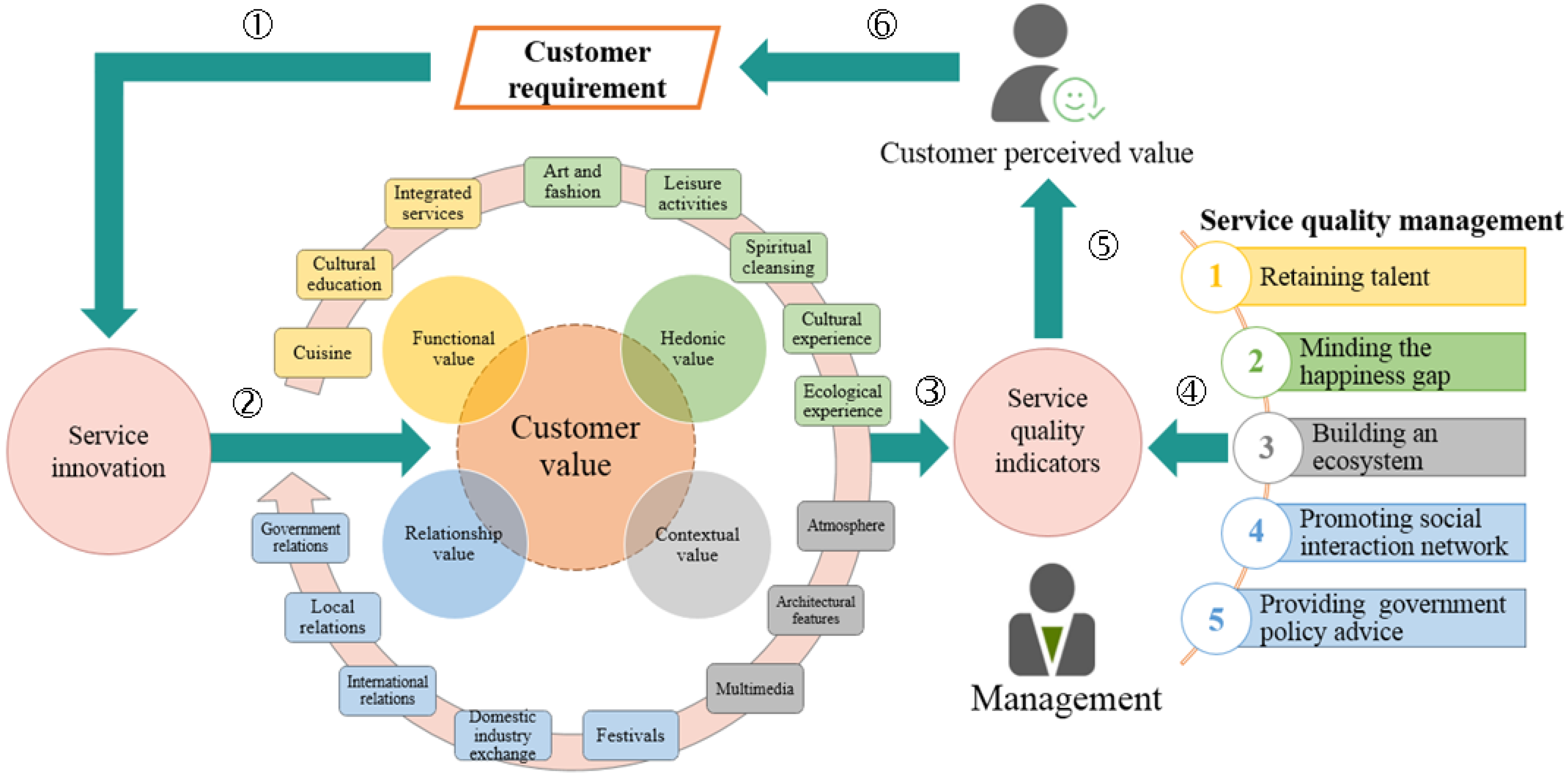
Building on the empirical analysis above, this study develops a conceptual framework for post-innovation management that integrates customer value, service innovation, and service quality into a continuous management process (Figure 2). The framework comprises six interrelated pathways. First, the four customer-value dimensions comprising functional value, relationship value, hedonic value, and contextual value provide a structured basis for understanding the different forms of customer value reflected in service innovation events (Path ①). These dimensions capture distinct aspects of customer value and provide organizations with a basis for understanding customer needs and the value implications of service innovation.
Second, the second-order themes identified from the empirical analysis (Table 2) further describe each of the four customer-value dimensions, providing greater detail on how customer value is expressed in service innovation events (Path ②). These themes capture the specific ways in which the four customer-value dimensions are reflected in lodging service innovations. Third, the empirically identified second-order themes can provide a basis for identifying the aspects of service delivery that may require managerial attention after an innovation has been introduced. In this sense, the 16 second-order themes identified in this study provide a structured framework for developing service quality indicators that reflect different aspects of customer value in lodging services (Path ③).
Fourth, drawing on prior research on tourism and hospitality innovation, service ecosystems, employee-related practices, and institutional support, the framework conceptually incorporates five complementary management practices that may support post-innovation management, including talent retention, supporting employee and customer wellbeing, building and orchestrating service ecosystems, facilitating actor interaction and network development, and leveraging public policy and institutional support (Path ④). In particular, employee-related practices can support creativity and innovative service behaviour, while ecosystem coordination and orchestration can facilitate collaboration, resource integration, and innovation among different actors (Picaud-Bello et al., 2022). Institutional and public policy support can also provide an important external condition for innovation in tourism and hospitality (Lim et al., 2024).
Fifth, the framework suggests that continued managerial attention to customer value and the empirically identified service innovation themes may help organizations identify opportunities to improve service quality and further develop customer value (Path ⑤). This pathway highlights the potential role of customer value-oriented management in using existing service innovations as a basis for continued service improvement and innovation, consistent with the emphasis on continual refinement and innovation in tourism and hospitality organizations (Zhang et al., 2021; Lim et al., 2024).
Sixth, customer feedback may provide an additional source of information for understanding emerging customer needs and informing subsequent service innovation activities (Path ⑥). In this process, customer-generated feedback can reveal customer needs and identify opportunities for hotel service innovation (J. Wu et al., 2023), while feedback on service attributes can help inform service improvement priorities (S. H. Lee et al., 2021). These arguments suggest a potential feedback loop through which organizations can reconsider customer value and identify opportunities for further innovation. In this way, the framework conceptualises post-innovation management as an ongoing process in which customer value provides a basis for service innovation, with feedback from service delivery informing subsequent innovation.
In sum, Figure 2 conceptualises post-innovation management as a value-oriented and iterative process rather than a discrete stage following service innovation. It highlights how organizations can use customer value as an ongoing reference for managing existing innovations, responding to emerging customer needs, and identifying opportunities for further service innovation.

5. Discussion

The proposed post-innovation management mechanism shifts attention from innovation generation to the continuous management of existing service innovations. Previous studies have primarily examined service innovation as the development and implementation of new services to enhance organisational competitiveness (Kurtmollaiev & Pedersen, 2022; Rabetino et al., 2021). Drawing on the empirical analysis of service-innovation events and customer-value dimensions, the long-term sustainability of service innovation may depend on organisations’ ability to maintain the value of existing innovations over time. As customer expectations and market conditions evolve, the attractiveness of service innovations gradually declines. Accordingly, sustaining service innovation should not be viewed solely as generating successive innovations but as a continuous management process that systematically renews customer value through service quality improvement. This perspective extends existing service innovation research by conceptualising post-innovation management as an integral stage of the innovation process rather than treating innovation implementation as its endpoint. Unlike innovation implementation, which focuses on the successful adoption and execution of new service innovations, post-innovation management addresses how implemented innovations continue to create customer value over time. Likewise, it differs from continuous improvement, which primarily emphasises incremental operational enhancement, by focusing on sustaining the strategic value and long-term effectiveness of implemented service innovations through the continuous renewal of customer value. The proposed framework offers a conceptual account of how organisations may sustain service innovation after implementation.
A central feature of the proposed mechanism is the integration of customer value and service quality. Existing studies generally conceptualise customer value as an outcome of service innovation, whereas service quality has largely been examined as an organisational capability for evaluating service performance (Kivijärvi & Virta, 2021; Xie et al., 2021). Drawing on the empirical patterns, we conceptualise customer value as a mechanism linking service innovation and service quality. By translating customer value into measurable service quality indicators, the proposed mechanism enables organisations to continuously monitor changing customer needs while systematically improving existing service innovations. Accordingly, service quality is repositioned from an evaluative tool to a mechanism through which customer value is operationalised in implemented service innovations. This perspective therefore extends existing research by conceptualising service quality management not merely as a means of evaluating service performance but as a potential managerial mechanism through which organisations may sustain implemented service innovations during the post-innovation period. Rather than applying a universal logic of continuous improvement, organisations need value-specific post-innovation management practices that sustain different forms of customer value over time.
The proposed mechanism further conceptualises how different customer value dimensions require different managerial logics to sustain service innovation during the post-innovation period. Functional value relies primarily on organisational capabilities embedded in employees, suggesting that talent retention may be important for maintaining service quality over time (Ibrahim, 2024; Ghani et al., 2022). In contrast, hedonic value is inherently experiential, suggesting a need to continuously address the gap between expected and experienced customer happiness as customer expectations evolve (Ponsignon et al., 2021). Unlike functional and hedonic value, contextual value depends on collaboration beyond organisational boundaries (Gao et al., 2022). This suggests that sustaining this value may involve building broader tourism ecosystems through partnerships with complementary industries. Relationship value similarly extends beyond customer interactions to encompass broader stakeholder relationships within the service ecosystem (Viglia et al., 2023). Consequently, sustaining relationship value may require organisations to facilitate continuous social interaction networks through which knowledge sharing supports ongoing service innovation (Randhawa, 2024; C. M. Wu et al., 2023). Equally important, sustaining relationship value may involve an enabling institutional environment, where government policy supports long-term tourism development and reinforces collaboration across the tourism ecosystem (Dioko, 2024; Loehr & Becken, 2025). Collectively, these findings suggest that sustaining service innovation requires differentiated managerial logics that correspond to the distinct characteristics of each customer value dimension rather than a single management strategy.
Building on these empirical patterns, post-innovation management involves an ongoing cycle rather than a sequential stage following innovation. Customer feedback can therefore be viewed as a means through which organisations identify emerging customer needs, thereby connecting service quality management with subsequent service innovation. In this sense, customer feedback functions as the connecting mechanism between service quality management and subsequent service innovation. Rather than repeatedly introducing new services, organisations may sustain and renew existing innovations by iteratively refining customer value through service quality management. This recursive process distinguishes post-innovation management from conventional innovation models that primarily emphasise innovation generation and implementation. Accordingly, this study conceptualise post-innovation management not simply as the endpoint of the innovation process but as a distinct management stage through which organisations continuously sustain, renew, and extend the value of implemented service innovations. In this sense, an important managerial question is not only how to implement service innovations successfully, but also how to sustain their ability to create customer value over time.

6. Conclusions

Service innovation ultimately depends not only on organisations’ ability to generate new services but also on their capacity to sustain customer value throughout the post-innovation period. The proposed post-innovation management mechanism conceptualises how customer value, service quality, organisational management, and customer feedback can collectively support the sustainability of service innovation beyond its initial implementation. Specifically, customer value provides a conceptual foundation for identifying service innovation opportunities, whereas service quality operationalises customer value into measurable service quality indicators that support continuous quality improvement. Embedded within ongoing organisational management practices, these indicators can support organisations in monitoring changing customer needs, refine existing service innovations, and identify opportunities for subsequent innovation. The mechanism therefore reconceptualises post-innovation management as a continuous organisational process through which firms can manage customer value and service quality associated with implemented service innovations. This perspective shifts the focus of service innovation research from innovation generation to innovation sustainability by emphasising the continuous renewal of customer value. Future research may examine the applicability of the proposed mechanism across different service industries and institutional contexts.

6.1. Theoretical Implications

This study makes three theoretical contributions to understanding post-innovation management through a customer-value perspective. First, it reconceptualises the role of customer value in service innovation by shifting its position from an innovation outcome to a basis for managing customer value beyond initial innovation implementation. Rather than being viewed solely as the result of innovation, customer value is conceptualised as a basis for identifying subsequent service innovation opportunities throughout the post-innovation period. Second, this study extends the customer value literature by demonstrating that the relative importance of different customer value dimensions evolves throughout the service innovation process. Rather than treating functional, relationship, hedonic, and contextual value as equally important, the findings show that their priorities change across different stages of service innovation. This study further shows how evolving customer value dimensions can inform service quality management following initial innovation implementation. Finally, this study advances the service innovation literature by conceptualising post-innovation management as an organisational mechanism for managing customer value associated with implemented service innovations over time. The proposed mechanism explains how customer value dimensions are manifested in measurable service quality indicators and subsequently embedded within organisational management practices, thereby providing a process-based explanation of how organisations continuously sustain service innovation beyond its initial implementation.

6.2. Practical Implications

The findings provide several practical implications for managers seeking to sustain service innovation in the lodging industry. First, managers should recognise that customer value priorities evolve throughout the post-innovation period rather than remaining constant. Organisations should therefore regularly reassess which customer value dimensions require greater managerial attention. This enables service innovation to remain aligned with changing customer needs over time. Second, managers should incorporate customer value into routine service quality management. Customer value dimensions should be translated into measurable service quality indicators that enable organisations to monitor service quality, identify service gaps, and continuously improve existing service innovations. This shifts managerial attention from introducing new services to sustaining the value of existing service innovations. Finally, managers should allocate organisational resources according to the dominant customer value priorities identified through the proposed mechanism. Functional value requires greater emphasis on employee retention to sustain service capabilities. Hedonic value requires organisations to continuously enhance customer experiences. Contextual value depends on developing collaborative tourism ecosystems with complementary industries. Relationship value requires continuous stakeholder engagement supported by favourable policy environments. Together, these practices provide managers with a systematic approach to sustaining service innovation throughout the post-innovation period.

6.3. Limitations and Future Research

This study has several limitations that provide opportunities for future research. First, the empirical evidence was drawn exclusively from the lodging industry in the Taiwan region, which may limit the generalisability of the findings to other service sectors and institutional contexts. Future studies could examine the proposed mechanism across different service industries or conduct cross-country comparisons to assess its broader applicability. Second, this study relied primarily on secondary data to analyse service innovation practices. Because the data collection relied on publicly documented service-innovation events, some service-innovation activities that were not publicly documented or readily accessible for collection may not have been fully captured in the dataset. Future research may incorporate interviews, establishment-level data, or longitudinal data to further examine how post-innovation management evolves over time and how organisations continuously adapt customer value and service quality to sustain service innovation.

Author Contributions

Conceptualization, W.-H.C. and M.-H.W.; methodology, W.-H.C. and M.-H.W.; formal analysis, M.-H.W.; investigation, M.-H.W.; resources, W.-H.C. and C.-Q.L.; data curation, M.-H.W.; writing—original draft preparation, M.-H.W.; writing—review and editing, W.-H.C., M.-H.W., C.C.H., and C.-Q.L.; visualization, M.-H.W.; supervision, W.-H.C., C.C.H., and C.-Q.L.; project administration, C.-Q.L.; funding acquisition, W.-H.C. All authors have read and agreed to the published version of the manuscript.

Funding

This research was funded by [the Department of Science and Technology of Guangdong Province in China], grant number [2024A0505050032], and [the Jiaying University in China], grant number [121-424A1833 and 131-323E0477]. The APC was funded by [the Department of Science and Technology of Guangdong Province in China].

Institutional Review Board Statement

Not applicable.

Informed Consent Statement

Not applicable.

Data Availability Statement

The data supporting the findings of this study are available from the corresponding author upon reasonable request. The data consist of publicly available documentary evidence, archival records, and official documents collected and analysed for the purposes of this study.

Conflicts of Interest

The authors declare no conflicts of interest.

References

  1. Alnawas, I., & Hemsley-Brown, J. (2019). Market orientation and hotel performance: Investigating the role of high-order marketing capabilities. International Journal of Contemporary Hospitality Management, 31(4), 1885–1905. [Google Scholar] [CrossRef] [Scilit]
  2. Arli, D., van Esch, P., & Weaven, S. (2024). The impact of SERVQUAL on consumers’ satisfaction, loyalty, and intention to use online food delivery services. Journal of Promotion Management, 30(7), 1159–1188. [Google Scholar] [CrossRef] [Scilit]
  3. Babaei, M., & Aghdassi, M. (2022). Measuring the dimensions of quality in service innovation: A dynamic capability and organisational competency perspective. Total Quality Management & Business Excellence, 33(3–4), 434–466. [Google Scholar] [CrossRef] [Scilit]
  4. Bäckström, I., & Bengtsson, L. (2019). A mapping study of employee innovation: Proposing a research agenda. European Journal of Innovation Management, 22(3), 468–492. [Google Scholar] [CrossRef] [Scilit]
  5. Blommerde, T. (2023). Service innovation capability: A systematic literature review and research agenda. The Service Industries Journal, 43(15–16), 1197–1227. [Google Scholar] [CrossRef] [Scilit]
  6. Blut, M., Chaney, D., Lunardo, R., Mencarelli, R., & Grewal, D. (2024). Customer perceived value: A comprehensive meta-analysis. Journal of Service Research, 27(4), 501–524. [Google Scholar] [CrossRef] [Scilit]
  7. Bourke, J., & Roper, S. (2017). Innovation, quality management and learning: Short-term and longer-term effects. Research Policy, 46(8), 1505–1518. [Google Scholar] [CrossRef] [Scilit]
  8. Budianto, A. (2019). Customer loyalty: Quality of service. Journal of Management Review, 3(1), 299–305. [Google Scholar] [CrossRef] [Scilit]
  9. Butcher, K., & Chomvilailuk, R. (2022). Guest benefits of hedonic value and perceived community value drive hotel CSR participation. Journal of Sustainable Tourism, 30(6), 1262–1279. [Google Scholar] [CrossRef] [Scilit]
  10. Carvalho, P., & Alves, H. (2023). Customer value co-creation in the hospitality and tourism industry: A systematic literature review. International Journal of Contemporary Hospitality Management, 35(1), 250–273. [Google Scholar] [CrossRef] [Scilit]
  11. Cândido, C. J., Cesário, M. I. S., & de Saboya, L. M. (2026). Standardised innovation management systems: Modelling the antecedents of certification and maintenance benefits. Creativity and Innovation Management. [Google Scholar] [CrossRef] [Scilit]
  12. Chen, J., & Liu, L. (2024). Effectuation, SME service innovation, and business customers’ value perception. The Service Industries Journal, 44(15–16), 1145–1180. [Google Scholar] [CrossRef] [Scilit]
  13. Chen, W. J. (2023). Innovative service behaviors of hotel employees: An internal service perspective. Journal of Quality Assurance in Hospitality & Tourism, 24(4), 380–401. [Google Scholar] [CrossRef] [Scilit]
  14. Cuthbertson, R. W., & Furseth, P. I. (2022). Digital services and competitive advantage: Strengthening the links between RBV, KBV, and innovation. Journal of Business Research, 152, 168–176. [Google Scholar] [CrossRef] [Scilit]
  15. Dioko, L. D. A. (2024). The content and structure of tourism and public policies: A temporal analysis of stability and change. Cornell Hospitality Quarterly, 65(1), 7–33. [Google Scholar] [CrossRef] [Scilit]
  16. Dubey, P., & Sahu, S. K. (2019). Effect of service quality on perceived value, satisfaction and loyalty of customers: A study on selected hospitals of Chhattisgarh. International Journal of Computer Sciences and Engineering, 7(3), 55–62. [Google Scholar]
  17. El Manzani, Y., El Idrissi, M., Chouchane, R., Sony, M., & Antony, J. (2025). A meta-analysis of the relationship between quality management and innovation in small and medium-sized enterprises. Production Planning & Control, 36(7), 905–924. [Google Scholar] [CrossRef] [Scilit]
  18. Escrig-Tena, A. B., Segarra-Ciprés, M., & García-Juan, B. (2021). Incremental and radical product innovation capabilities in a quality management context: Exploring the moderating effects of control mechanisms. International Journal of Production Economics, 232, 107994. [Google Scholar] [CrossRef] [Scilit]
  19. Ezeh, P. C., & Ezeuduji, I. O. (2025). Effects of SERVPERF dimensions on guests’ satisfaction and loyalty to low-cost hotel: Mediating role of satisfaction. Journal of Quality Assurance in Hospitality & Tourism, 26(6), 1115–1137. [Google Scholar] [CrossRef] [Scilit]
  20. Fan, D. X., Hsu, C. H., & Lin, B. (2020). Tourists’ experiential value co-creation through online social contacts: Customer-dominant logic perspective. Journal of Business Research, 108, 163–173. [Google Scholar] [CrossRef] [Scilit]
  21. Gallarza, M., Gil-Saura, I., & Arteaga-Moreno, F. (2023). Bridging service dominant logic and the concept of customer value through higher order indexes: Insights from hospitality experiences. European Journal of Tourism Research, 35, 3510. [Google Scholar] [CrossRef] [Scilit]
  22. Gallarza, M. G., Arteaga, F., Del Chiappa, G., & Gil-Saura, I. (2015). Value dimensions in consumers’ experience: Combining the intra-and inter-variable approaches in the hospitality sector. International Journal of Hospitality Management, 47, 140–150. [Google Scholar] [CrossRef] [Scilit]
  23. Gallarza, M. G., & Sánchez-Fernández, R. (2023). Defining and measuring customer value: Some reflections and new perspectives. Journal of Creating Value, 9(1), 27–45. [Google Scholar] [CrossRef] [Scilit]
  24. Gallarza, M. G., Sánchez-Fernández, R., Arteaga-Moreno, F., & Del Chiappa, G. (2022). Active and reactive value dimensions: A dynamic-based perspective in the hotel sector. Journal of Hospitality & Tourism Research, 46(7), 1436–1473. [Google Scholar] [CrossRef] [Scilit]
  25. Gao, Y., Zhang, Q., Xu, X., Jia, F., & Lin, Z. (2022). Service design for the destination tourism service ecosystem: A review and extension. Asia Pacific Journal of Tourism Research, 27(3), 225–245. [Google Scholar] [CrossRef] [Scilit]
  26. García-Fernández, M., Claver-Cortés, E., & Tarí, J. J. (2022). Relationships between quality management, innovation and performance: A literature systematic review. European Research on Management and Business Economics, 28(1), 100172. [Google Scholar] [CrossRef] [Scilit]
  27. Ghani, B., Zada, M., Memon, K. R., Ullah, R., Khattak, A., Han, H., Ariza-Montes, A., & Araya-Castillo, L. (2022). Challenges and strategies for employee retention in the hospitality industry: A review. Sustainability, 14, 2885. [Google Scholar] [CrossRef] [Scilit]
  28. Gustafsson, A., Snyder, H., & Witell, L. (2020). Service innovation: A new conceptualization and path forward. Journal of Service Research, 23(2), 111–115. [Google Scholar] [CrossRef] [Scilit]
  29. Hofmeister, J., Kanbach, D. K., & Hogreve, J. (2024). Service productivity: A systematic review of a dispersed research area. Management Review Quarterly, 74(3), 1249–1281. [Google Scholar] [CrossRef] [Scilit]
  30. Hofmeister, J., Schneider, M. H., Kanbach, D. K., & Kraus, S. (2022). Combining strategies for high service productivity with successful service innovation. The Service Industries Journal, 42(11–12), 948–971. [Google Scholar] [CrossRef] [Scilit]
  31. Holmqvist, J., Visconti, L. M., Grönroos, C., Guais, B., & Kessous, A. (2020). Understanding the value process: Value creation in a luxury service context. Journal of Business Research, 120, 114–126. [Google Scholar] [CrossRef] [Scilit]
  32. Ibrahim, A. M. (2024). Organisational attachment in hospitality organisations: A review. Research in Hospitality Management, 14(1), 94–99. [Google Scholar] [CrossRef] [Scilit]
  33. Jaakkola, E., & Terho, H. (2021). Service journey quality: Conceptualization, measurement and customer outcomes. Journal of Service Management, 32(6), 1–27. [Google Scholar] [CrossRef] [Scilit]
  34. Kandampully, J., Bilgihan, A., Van Riel, A. C., & Sharma, A. (2023). Toward holistic experience-oriented service innovation: Co-creating sustainable value with customers and society. Cornell Hospitality Quarterly, 64(2), 161–183. [Google Scholar] [CrossRef] [Scilit]
  35. Kim, M. (2023). Connecting artificial intelligence to value creation in services: Mechanism and implications. Service Business, 17(4), 851–878. [Google Scholar] [CrossRef] [Scilit]
  36. Kivijärvi, H., & Virta, A. (2021). Evaluating service quality and service value in manufacturer-distributor settings: A systems approach. Journal of Business-to-Business Marketing, 28(1), 21–46. [Google Scholar] [CrossRef] [Scilit]
  37. Kleinaltenkamp, M., Eggert, A., Kashyap, V., & Ulaga, W. (2022). Rethinking customer-perceived value in business markets from an organizational perspective. Journal of Inter-Organizational Relationships, 28(1–2), 1–18. [Google Scholar] [CrossRef] [Scilit]
  38. Knight, K. E. (1967). A descriptive model of the intra-firm innovation process. The Journal of Business, 40(4), 478–496. [Google Scholar] [CrossRef] [Scilit]
  39. Kowalkowski, C., Wirtz, J., & Ehret, M. (2024). Digital service innovation in B2B markets. Journal of Service Management, 35(2), 280–305. [Google Scholar] [CrossRef] [Scilit]
  40. Kurtmollaiev, S., & Pedersen, P. E. (2022). Bringing together the whats and hows in the service innovation literature: An integrative framework. International Journal of Management Reviews, 24(4), 625–653. [Google Scholar] [CrossRef] [Scilit]
  41. Kwon, W., Lee, M., & Back, K. J. (2020). Exploring the underlying factors of customer value in restaurants: A machine learning approach. International Journal of Hospitality Management, 91, 102643. [Google Scholar] [CrossRef] [Scilit]
  42. Lee, H. Y., Grinevich, V., & Chipulu, M. (2023). How can value co-creation be integrated into a customer experience evaluation? European Management Journal, 41(4), 521–533. [Google Scholar] [CrossRef] [Scilit]
  43. Lee, S. H., Yun, J. J., Díaz, M. M., & Duque, C. M. (2021). Open innovation through customer satisfaction: A logit model to explain customer recommendations in the hotel sector. Journal of Open Innovation: Technology, Market, and Complexity, 7(3), 180. [Google Scholar] [CrossRef] [Scilit]
  44. Lee, W. L., Liu, C. H., & Tseng, T. W. (2022). The multiple effects of service innovation and quality on transitional and electronic word-of-mouth in predicting customer behaviour. Journal of Retailing and Consumer Services, 64, 102791. [Google Scholar] [CrossRef] [Scilit]
  45. Li, D., Zhao, Y., Zhang, L., Chen, X., & Cao, C. (2018). Impact of quality management on green innovation. Journal of Cleaner Production, 170, 462–470. [Google Scholar] [CrossRef] [Scilit]
  46. Li, H., Zhao, J., Cao, Y., Su, L., Zhao, Z., & Zhang, Y. (2024). Servitization and product service system: A literature review on value creation. Technological Forecasting and Social Change, 208, 123724. [Google Scholar] [CrossRef] [Scilit]
  47. Lim, S. E., Ok, C. M., & Yang, Y. (2024). A meta-analytic investigation of innovation predictors in tourism and hospitality organizations. Tourism Management, 105, 104965. [Google Scholar] [CrossRef] [Scilit]
  48. Liu, S., Li, S., Chen, Y., & Zheng, T. (2023). Examining relationships among food’s perceived value, well-being, and tourists’ loyalty. Journal of Vacation Marketing, 29(2), 161–174. [Google Scholar] [CrossRef] [Scilit]
  49. Loehr, J., & Becken, S. (2025). Institutionalised tourism policy goals: Fit to address climate change? Journal of Sustainable Tourism, 33(10), 2075–2093. [Google Scholar] [CrossRef] [Scilit]
  50. Lovea, J. H., Roperb, S., & Brysonc, J. R. (2011). Openness, knowledge, innovation and growth in UK business services. Research Policy, 40(10), 1438–1452. [Google Scholar] [CrossRef] [Scilit]
  51. Lusch, R. F., & Nambisan, S. (2015). Service innovation: A service-dominant logic perspective. MIS Quarterly, 39(1), 155–175. [Google Scholar] [CrossRef] [Scilit]
  52. Luu, T. T. (2022). Fostering green service innovation perceptions through green entrepreneurial orientation: The roles of employee green creativity and customer involvement. International Journal of Contemporary Hospitality Management, 34(7), 2640–2663. [Google Scholar] [CrossRef] [Scilit]
  53. Mahavarpour, N., Marvi, R., & Foroudi, P. (2023). A brief history of service innovation: The evolution of past, present, and future of service innovation. Journal of Business Research, 160, 113795. [Google Scholar] [CrossRef] [Scilit]
  54. Marjanović, B. (2024). Exploring the differences among luxury and budget brands in terms of emotional and functional values applied to the hospitality sector. Academica Turistica-Tourism and Innovation Journal, 17(3), 247–263. [Google Scholar] [CrossRef] [Scilit]
  55. McCullough, H., Padgett, D., Han, S., Lee, K., Martin, D. S., & Bourdeau, B. L. (2024). First impressions vs. the peak-end rule: Episodic evaluations in a service experience and the moderating effect of retrospective delay. Journal of Business Research, 185, 114899. [Google Scholar] [CrossRef] [Scilit]
  56. McGuier, E. A., Kolko, D. J., Aarons, G. A., Schachter, A., Klem, M. L., Diabes, M. A., Weingart, L. R., Salas, E., & Wolk, C. B. (2024). Teamwork and implementation of innovations in healthcare and human service settings: A systematic review. Implementation Science, 19(1), 49. [Google Scholar] [CrossRef] [Scilit] [PubMed]
  57. Motamedimoghadam, M., Mira da Silva, M., & Amaral, M. (2025). Organizational capabilities for digital innovation: A systematic literature review. European Journal of Innovation Management, 28(7), 3024–3048. [Google Scholar]
  58. Mu, Y., Bossink, B., & Vinig, T. (2022). Developing a classification scheme of service innovation: Synthesizing degree and type of change in service innovation. Annals of Tourism Research, 95, 103411. [Google Scholar]
  59. Nejjari, R., & Slaoui, S. (2024). Customer value creation and Moroccan hotels’ performance: A multi-party and multi-phase vision. Journal of Hospitality and Tourism Insights, 7(5), 2504–2524. [Google Scholar] [CrossRef] [Scilit]
  60. Nguyen, H. M., Ho, T. K. T., & Ngo, T. T. (2024). The impact of service innovation on customer satisfaction and customer loyalty: A case in Vietnamese retail banks. Future Business Journal, 10(1), 61. [Google Scholar] [CrossRef] [Scilit]
  61. Oliveras-Villanueva, M., Llach, J., & Perramon, J. (2020). Service quality in hospitality and the sustainability effect: Systematic literature review and future research agenda. Sustainability, 12(19), 8152. [Google Scholar] [CrossRef] [Scilit]
  62. Ostrom, A. L., Field, J. M., Fotheringham, D., Subramony, M., Gustafsson, A., Lemon, K. N., Huang, M. H., & McColl-Kennedy, J. R. (2021). Service research priorities: Managing and delivering service in turbulent times. Journal of Service Research, 24(3), 329–353. [Google Scholar] [CrossRef] [Scilit]
  63. Park, H., Lee, M., & Back, K. J. (2023). A critical review of technology-driven service innovation in hospitality and tourism: Current discussions and future research agendas. International Journal of Contemporary Hospitality Management, 35(12), 4502–4534. [Google Scholar] [CrossRef] [Scilit]
  64. Picaud-Bello, K., Stevens, E., Cloutier, L. M., & Renard, L. (2022). Coordinating service ecosystems for innovation: The case of tourism destination innovation projects. Industrial Marketing Management, 106, 444–460. [Google Scholar] [CrossRef] [Scilit]
  65. Ponsignon, F., Lunardo, R., & Michrafy, M. (2021). Why are international visitors more satisfied with the tourism experience? The role of hedonic value, escapism, and psychic distance. Journal of Travel Research, 60(8), 1771–1786. [Google Scholar] [CrossRef] [Scilit]
  66. Rabetino, R., Kohtamäki, M., Brax, S. A., & Sihvonen, J. (2021). The tribes in the field of servitization: Discovering latent streams across 30 years of research. Industrial Marketing Management, 95, 70–84. [Google Scholar] [CrossRef] [Scilit]
  67. Randhawa, P. (2024). Effects of customer relationship management on service innovation: Moderating role of managers’ risk-taking behavior and interaction frequency. Journal of Hospitality Marketing & Management, 33(2), 190–207. [Google Scholar] [CrossRef] [Scilit]
  68. Sangpikul, A. (2023). Understanding a conceptual framework of spa service quality: An overview approach. Academica Turistica-Tourism and Innovation Journal, 16(3), 277–289. [Google Scholar] [CrossRef] [Scilit]
  69. Schiefer, T., Mahr, D., van Fenema, P. C., & Mennens, K. (2024). A collaborative approach to manage continuous service innovation. Technovation, 134, 103029. [Google Scholar] [CrossRef] [Scilit]
  70. Schymanietz, M., Jonas, J. M., & Möslein, K. M. (2022). Exploring data-driven service innovation—Aligning perspectives in research and practice. The Journal of Business Economics, 92(7), 1167–1205. [Google Scholar] [CrossRef] [Scilit]
  71. Shin, H., & Perdue, R. R. (2022). Hospitality and tourism service innovation: A bibliometric review and future research agenda. International Journal of Hospitality Management, 102, 103176. [Google Scholar] [CrossRef] [Scilit]
  72. Singh, S., Akbani, I., & Dhir, S. (2020). Service innovation implementation: A systematic review and research agenda. The Service Industries Journal, 40(7–8), 491–517. [Google Scholar] [CrossRef] [Scilit]
  73. Sklyar, A., Kowalkowski, C., Tronvoll, B., & Sörhammar, D. (2019). Organizing for digital servitization: A service ecosystem perspective. Journal of Business Research, 104, 450–460. [Google Scholar] [CrossRef] [Scilit]
  74. So, K. K. F., Kim, H., He, Y., & Li, X. (2023). Mapping service innovation research in hospitality and tourism: An integrative bibliometric analysis and research agenda. Cornell Hospitality Quarterly, 64(2), 143–160. [Google Scholar] [CrossRef] [Scilit]
  75. Stoffers, J., Eringa, K., Niks, J., & Kleefstra, A. (2021). Workplace innovation and organizational performance in the hospitality industry. Sustainability, 13(11), 5847. [Google Scholar] [CrossRef] [Scilit]
  76. Tang, X., Wang, M., & Li, H. (2025). Understanding the effects of service innovation capability on firm performance in AEC industry: Mediating role of business model. Engineering, Construction and Architectural Management, 32(2), 893–911. [Google Scholar] [CrossRef] [Scilit]
  77. Tran, T. (2025). Co-creation and destination image: A bibliometric and thematic analysis using CiteSpace. Academica Turistica-Tourism and Innovation Journal, 18(3), 305–324. [Google Scholar] [CrossRef] [Scilit]
  78. Van Assen, M. F., & Lameijer, B. A. (2023). The service concept—A missing link in lean for services. Total Quality Management & Business Excellence, 34(15–16), 2027–2045. [Google Scholar] [CrossRef] [Scilit]
  79. Vargo, S. L., Fehrer, J. A., Wieland, H., & Nariswari, A. (2024). The nature and fundamental elements of digital service innovation. Journal of Service Management, 35(2), 227–252. [Google Scholar] [CrossRef] [Scilit]
  80. Viglia, G., Pera, R., Dyussembayeva, S., Mifsud, M., & Hollebeek, L. D. (2023). Engagement and value cocreation within a multi-stakeholder service ecosystem. Journal of Business Research, 157, 113584. [Google Scholar] [CrossRef] [Scilit]
  81. Wang, Y., Tian, Q., Li, X., & Xiao, X. (2022). Different roles, different strokes: How to leverage two types of digital platform capabilities to fuel service innovation. Journal of Business Research, 144, 1121–1128. [Google Scholar] [CrossRef] [Scilit]
  82. Wirtz, J., & Kowalkowski, C. (2023). Putting the “service” into B2B marketing: Key developments in service research and their relevance for B2B. Journal of Business & Industrial Marketing, 38(2), 272–289. [Google Scholar] [CrossRef] [Scilit]
  83. Wong, A., & Denizci Guillet, B. (2018). Value of a hotel stay: A case study in Hong Kong. Asia Pacific Journal of Tourism Research, 23(8), 780–791. [Google Scholar] [CrossRef] [Scilit]
  84. Wu, C. M., Chen, T. J., & Wang, Y. C. (2023). Formation of hotel employees’ service innovation performance: Mechanism of thriving at work and change-oriented organizational citizenship behavior. Journal of Hospitality and Tourism Management, 54, 178–187. [Google Scholar] [CrossRef] [Scilit]
  85. Wu, J., Yang, T., Zhou, Z., & Zhao, N. (2023). Consumers’ affective needs matter: Open innovation through mining luxury hotels’ online reviews. International Journal of Hospitality Management, 114, 103556. [Google Scholar] [CrossRef] [Scilit]
  86. Xie, X., Wang, H., & García, J. S. (2021). How does customer involvement in service innovation motivate service innovation performance? The roles of relationship learning and knowledge absorptive capacity. Journal of Business Research, 136, 630–643. [Google Scholar] [CrossRef] [Scilit]
  87. Yin, R. K. (2018). Case study research and applications: Design and methods (6th ed.). Sage Publications. [Google Scholar]
  88. Zeithaml, V. A., Verleye, K., Hatak, I., Koller, M., & Zauner, A. (2020). Three decades of customer value research: Paradigmatic roots and future research avenues. Journal of Service Research, 23(4), 409–432. [Google Scholar] [CrossRef] [Scilit]
  89. Zhang, C., Xu, Z., Gou, X., & Chen, S. (2021). An online reviews-driven method for the prioritization of improvements in hotel services. Tourism Management, 87, 104382. [Google Scholar] [CrossRef] [Scilit]
  90. Zulkefli, N. S., Awang, Z., & Suffarruddin, S. H. (2023). The innovation elements of homestay programmes on the east coast of Malaysia. Academica Turistica-Tourism and Innovation Journal, 16(2), 233–246. [Google Scholar] [CrossRef] [Scilit]
Figure 1. Analysis framework.
Admsci 16 00453 g001
Figure 2. Mechanism for post-innovation management.
Admsci 16 00453 g002
Table 1. Service innovation development in the lodging industry.
Innovation Development StagePeriodNumber and Ratio of Innovation Events
International Tourist HotelHostel
Digital transformation2015–2018115727.6%1266.2%
Service transformation2019–2022127230.3%102850.8%
Intelligent transformation2023–2025176342.1%87043%
Total2015–20254192100%2024100%
Table 2. Data structure and coding.
First-order Event ConceptsSecond-Order ThemesAggregate Constructs
Serving Local DishesCuisineFunctional
Demonstrating Food PreparationCuisineFunctional
Explaining Cultural MeaningsCultural EducationFunctional
Visiting Heritage SitesCultural EducationFunctional
Offering Multi-Service PackagesIntegrated ServicesFunctional
Coordinating Service ProvidersIntegrated ServicesFunctional
Providing One-Stop AccessIntegrated ServicesFunctional
Joining Government ProgramsGovernment RelationshipsRelationship
Receiving Government SupportGovernment RelationshipsRelationship
Signing Government AgreementsGovernment RelationshipsRelationship
Collaborating with Local BusinessesLocal RelationshipsRelationship
Engaging Local ResidentsLocal RelationshipsRelationship
Hosting International VisitorsInternational RelationshipsRelationship
Signing International AgreementsInternational RelationshipsRelationship
Participating in International ExchangesInternational RelationshipsRelationship
Sharing Business ExperienceDomestic Industry ExchangeRelationship
Attending Industry EventsDomestic Industry ExchangeRelationship
Organizing Cultural FestivalsFestivalsRelationship
Participating in Cultural FestivalsFestivalsRelationship
Performing at Cultural FestivalsFestivalsRelationship
Displaying ArtworksArt and FashionHedonic
Presenting Fashion DesignsArt and FashionHedonic
Demonstrating Craft TechniquesArt and FashionHedonic
Offering Outdoor ActivitiesLeisure ActivitiesHedonic
Providing Leisure FacilitiesLeisure ActivitiesHedonic
Conducting Religious RitualsSpiritual CleansingHedonic
Offering Meditation SessionsSpiritual CleansingHedonic
Attending Cultural PerformancesCultural ExperienceHedonic
Participating in Traditional ActivitiesCultural ExperienceHedonic
Exploring Natural LandscapesEcological ExperienceHedonic
Visiting Ecological AttractionsEcological ExperienceHedonic
Displaying Digital SignageMultimediaContextual
Showing Tourism VideosMultimediaContextual
Designing Themed SpacesAtmosphereContextual
Using Music and LightingAtmosphereContextual
Deploying Local Architectural FeaturesArchitectural FeaturesContextual
Embedding Traditional Cultural SymbolsArchitectural FeaturesContextual
Table 3. Frequency analysis of service innovation events in the lodging industry.
International Tourist HotelsHostels
Customer ValueItemNumber%Total%ItemNumberRatioTotal%
A. Functionala. Cuisine107625.6183143.7a. Cuisine814.072535.8
b. Cultural education992.3b. Cultural education954.7
c. Integrated services65615.7c. Integrated services54927.1
B. Relationshipa. Government relationships1954.6189945.3a. Government relationships311.550224.8
b. Local relationships2165.0b. Local relationships753.7
c. International relationships3278.1c. International relationships281.4
d. Domestic industry exchange70416.9d. Domestic industry exchange36818.2
e. Festivals45710.9
C. Hedonica. Art and fashion681.63428.1a. Art and fashion542.760329.8
b. Leisure activities1102.6b. Leisure activities954.7
c. Spiritual cleansing691.6c. Spiritual cleansing502.5
d. Cultural experience952.3d. Cultural experience1487.4
e. Ecological experience25612.6
D. Contextuala. Multimedia431.01202.9a. Architectural features1145.61949.6
b. Atmosphere771.8b. Atmosphere804.0
Total 4192100% 2024100%
Table 4. Analysis of trends among service innovation events in the lodging industry.
International Tourist HotelsHostels
Innovation Development Stage Digital transformation
(2015–2018)
Service transformation
(2019–2022)
Intelligent transformation
(2023–2025)
Total Digital transformation
(2015–2018)
Service transformation
(2019–2022)
Intelligent transformation
(2023–2025)
Total
A. Functional Number4485308531831Number52378295725
% 38.7%41.61%48.3% % 41.3%36.8%33.9%
B. Relationship Number5605917481899Number28276198502
% 48.4%46.4%42.4% % 22.2%26.8%22.8%
C. Hedonic Number98111133342Number33281289603
% 8.4%8.7%7.5% % 26.2%27.3%33.2%
D. Contextual Number514029120Number139388194
% 4.4%3.1%1.6% %10.3%9.0%10.1%
TotalTotal1157
(27.6%)
1272
(30.3%)
1763
(42.1%)
4192Total126
(6.2%)
1028
(50.8%)
870
(43%)
2024
Disclaimer/Publisher’s Note: The statements, opinions and data contained in all publications are solely those of the individual author(s) and contributor(s) and not of MDPI and/or the editor(s). MDPI and/or the editor(s) disclaim responsibility for any injury to people or property resulting from any ideas, methods, instructions or products referred to in the content.