How News Media Frame Regulatory Conflict in Emerging Industries: Evidence from Structural Topic Modeling of South Korean Press Coverage, 2018–2022


Abstract
1. Introduction
2. Theoretical Framework
2.1. Regulation and the Asymmetric Distribution of Burdens
2.2. Regulation and Innovative Entrants
2.3. Regulatory Lag and the Hollowing-Out of Regulation
2.4. Why Media Representation Matters
3. Materials and Methods
4. Results
5. Discussion
5.1. Summary of Findings
5.2. Theoretical Interpretation: The Invisible Middle of Regulatory Conflict
5.3. Policy Implications
6. Conclusions
Author Contributions
Funding
Data Availability Statement
Acknowledgments
Conflicts of Interest
References
- Al-Ubaydli, O., & McLaughlin, P. A. (2017). RegData: A numerical database on industry-specific regulations for all United States industries and federal regulations, 1997–2012. Regulation & Governance, 11(1), 109–123. [Google Scholar] [CrossRef] [Scilit]
- Ayres, I., & Braithwaite, J. (1992). Responsive regulation: Transcending the deregulation debate. Oxford University Press. [Google Scholar] [CrossRef] [Scilit]
- Baldwin, R., Cave, M., & Lodge, M. (2011). Understanding regulation: Theory, strategy, and practice. Oxford University Press. [Google Scholar] [CrossRef] [Scilit]
- Black, J. (2002). Critical reflections on regulation. Australian Journal of Legal Philosophy, 27, 1–36. [Google Scholar]
- Brownsword, R., & Goodwin, M. (2012). Law and the technologies of the twenty-first century: Text and materials. Cambridge University Press. [Google Scholar]
- Carpenter, D. (2010). Reputation and power: Organizational image and pharmaceutical regulation at the FDA. Princeton University Press. [Google Scholar]
- Cortez, N. (2014). Regulating disruptive innovation. Berkeley Technology Law Journal, 29(1), 175–228. [Google Scholar]
- Djankov, S., La Porta, R., Lopez-de-Silanes, F., & Shleifer, A. (2002). The regulation of entry. The Quarterly Journal of Economics, 117(1), 1–37. [Google Scholar] [CrossRef] [Scilit]
- Downs, A. (1972). Up and down with ecology—The “Issue-Attention Cycle”. Public Interest, 28, 38–50. [Google Scholar]
- Elster, J. (Ed.). (1998). Deliberation and constitution making. In Deliberative democracy (pp. 97–122). Cambridge University Press. [Google Scholar]
- Entman, R. M. (1993). Framing: Toward clarification of a fractured paradigm. Journal of Communication, 43(4), 51–58. [Google Scholar] [CrossRef] [Scilit]
- Herrada-Lores, S., Palazón, M., Iniesta-Bonillo, M. Á., & Estrella-Ramón, A. (2025). The communication of sustainability on social media: The role of dialogical communication. Journal of Research in Interactive Marketing, 19(2), 307–332. [Google Scholar] [CrossRef] [Scilit]
- Iyengar, S. (1991). Is anyone responsible?: How television frames political issues. The University of Chicago Press. [Google Scholar]
- Kasperson, R. E., Renn, O., Slovic, P., Brown, H. S., Emel, J., Goble, R., Kasperson, J. X., & Ratick, S. (1988). The social amplification of risk: A conceptual framework. Risk Analysis, 8(2), 177–187. [Google Scholar] [CrossRef] [Scilit]
- Koop, C., & Lodge, M. (2017). What is regulation? An interdisciplinary concept analysis. Regulation & Governance, 11(1), 95–108. [Google Scholar] [CrossRef] [Scilit]
- Levi-Faur, D. (Ed.). (2013). Handbook on the politics of regulation. Edward Elgar. [Google Scholar]
- Lowi, T. J. (1964). American business, public policy, case-studies, and political theory. World Politics, 16(4), 677–715. [Google Scholar] [CrossRef] [Scilit]
- Lowi, T. J. (1972). Four systems of policy, politics, and choice. Public Administration Review, 32(4), 298–310. [Google Scholar] [CrossRef] [Scilit] [PubMed]
- Majone, G. (1994). The rise of the regulatory state in Europe. West European Politics, 17(3), 77–101. [Google Scholar] [CrossRef] [Scilit]
- Maor, M. (2014). Theorizing bureaucratic reputation. In A. Wæraas, & M. Maor (Eds.), Organizational reputation in the public sector. Routledge. [Google Scholar]
- Marchant, G. E., Allenby, B. R., & Herkert, J. R. (Eds.). (2011). The growing gap between emerging technologies and legal-ethical oversight: The pacing problem. Springer. [Google Scholar]
- McCombs, M. E., & Shaw, D. L. (1972). The agenda-setting function of mass media. The Public Opinion Quarterly, 36(2), 176–187. [Google Scholar] [CrossRef] [Scilit]
- Mostafa, M. M., Alhur, M., & Moustafa, A. M. (2025). A structural topic modeling of communication research: Insights from over a century of journals’ abstracts. International Journal of Information Management Data Insights, 5(2), 100364. [Google Scholar] [CrossRef] [Scilit]
- Olson, M. (1965). The logic of collective action: Public goods and the theory of groups. Havard University Press. [Google Scholar]
- Peltier, J. W., Dahl, A. J., Drury, L., & Khan, T. (2024). Cutting-edge research in social media and interactive marketing: A review and research agenda. Journal of Research in Interactive Marketing, 18(5), 900–944. [Google Scholar] [CrossRef] [Scilit]
- Ranchordas, S. (2015). Does sharing mean caring? Regulating innovation in the sharing economy. Minnesota Journal of Law, Science & Technology, 16(1), 413–475. [Google Scholar] [CrossRef] [Scilit]
- Roberts, M. E., Stewart, B. M., & Airoldi, E. M. (2016). A model of text for experimentation in the social sciences. Journal of the American Statistical Association, 111(515), 988–1003. [Google Scholar] [CrossRef] [Scilit]
- Roberts, M. E., Stewart, B. M., & Nielsen, R. A. (2020). Adjusting for confounding with text matching. American Journal of Political Science, 64(4), 887–903. [Google Scholar] [CrossRef] [Scilit]
- Roberts, M. E., Stewart, B. M., Tingley, D., & Airoldi, E. M. (2013, December 10). The structural topic model and applied social science. Advances in Neural Information Processing Systems Workshop on Topic Models: Computation, Application, and Evaluation, Lake Tahoe, NV, USA. [Google Scholar]
- Roberts, M. E., Stewart, B. M., Tingley, D., Lucas, C., Leder-Luis, J., Gadarian, S. K., Albertson, B., & Rand, D. G. (2014). Structural topic models for open-ended survey responses. American Journal of Political Science, 58(4), 1064–1082. [Google Scholar] [CrossRef] [Scilit]
- Rodriguez, M. Y., & Storer, H. (2020). A computational social science perspective on qualitative data exploration: Using topic models for the descriptive analysis of social media data. Journal of Technology in Human Services, 38(1), 54–86. [Google Scholar] [CrossRef] [Scilit]
- Stasavage, D. (2004). Open-door or closed-door? Transparency in domestic and international bargaining. International Organization, 58(4), 667–703. [Google Scholar] [CrossRef] [Scilit]
- Stigler, G. J. (1971). The theory of economic regulation. The Bell Journal of Economics and Management Science, 2(1), 3–21. [Google Scholar] [CrossRef] [Scilit] [PubMed]
- Thelen, K. (2018). Regulating uber: The politics of the platform economy in Europe and the United States. Perspectives on Politics, 16(4), 938–953. [Google Scholar] [CrossRef] [Scilit]
- Thompson, F., & Jones, L. R. (1982). Regulatory policy and practices: Regulating better and regulating less. Praeger Publishers. [Google Scholar]
- Uzunca, B., Rigetring, J. P. C., & Ozcan, P. (2018). Sharing and shaping: A cross-country comparison of how sharing economy firms shape their institutional environment to gain legitimacy. Academy of Management Discoveries, 6(3), 248–272. [Google Scholar] [CrossRef] [Scilit]
- Wang, C. L. (2024). Editorial—What is an interactive marketing perspective and what are emerging research areas? Journal of Research in Interactive Marketing, 18(2), 161–165. [Google Scholar] [CrossRef] [Scilit]
- Wilson, J. Q. (1980). The politics of regulation. Basic Books. [Google Scholar]
- Zetzsche, D. A., Buckley, R. P., Barberis, J. N., & Amer, D. W. (2017). Regulating a revolution: From regulatory sandboxes to smart regulation. Fordham Journal of Corporate & Financial Law, 23(1), 31–103. [Google Scholar]



| Year | Number of Documents |
|---|---|
| 2018 | 3266 |
| 2019 | 8430 |
| 2020 | 4154 |
| 2021 | 3808 |
| 2022 | 1608 |
| Topic No. | Proportion in Docs | Key Words | Derived Topic |
|---|---|---|---|
| Topic 5 | 8.30% | Japan, Korea–Japan, our country, government, conflict, bilateral, relations, position, export regulation, measures, prime minister, Moon Jae-in, dialogue, Abe, situation | Tensions in Korea–Japan Relations |
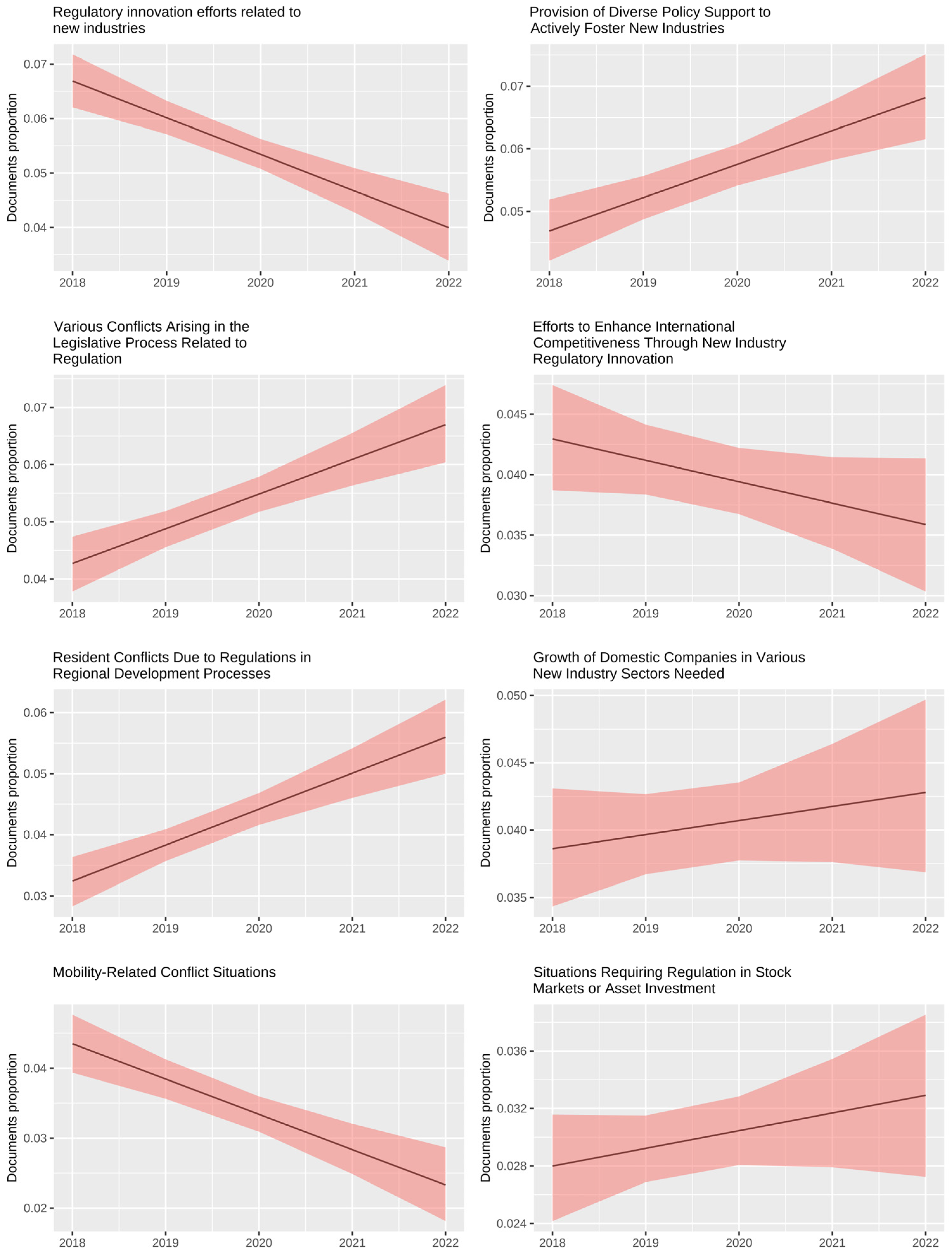
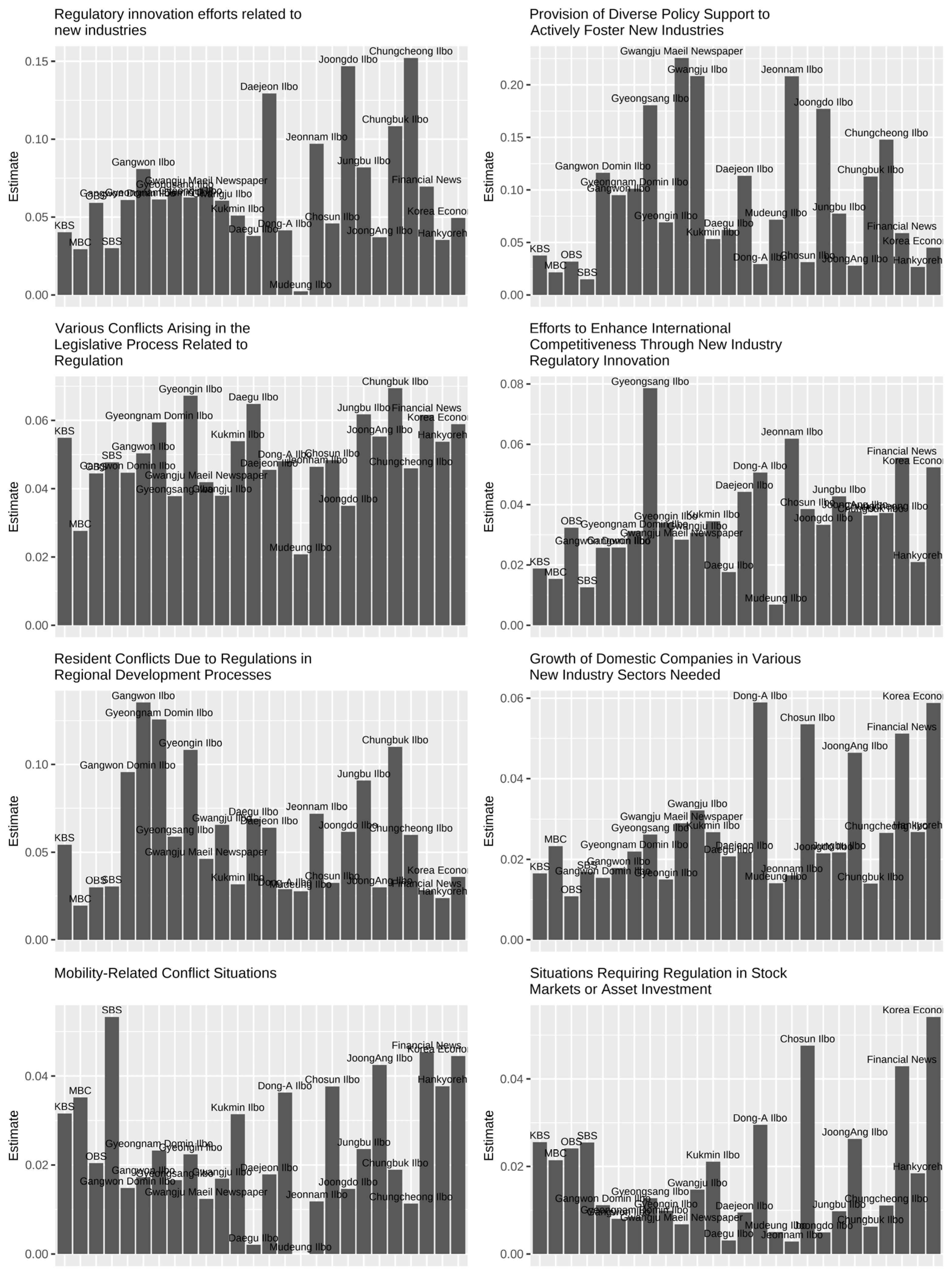
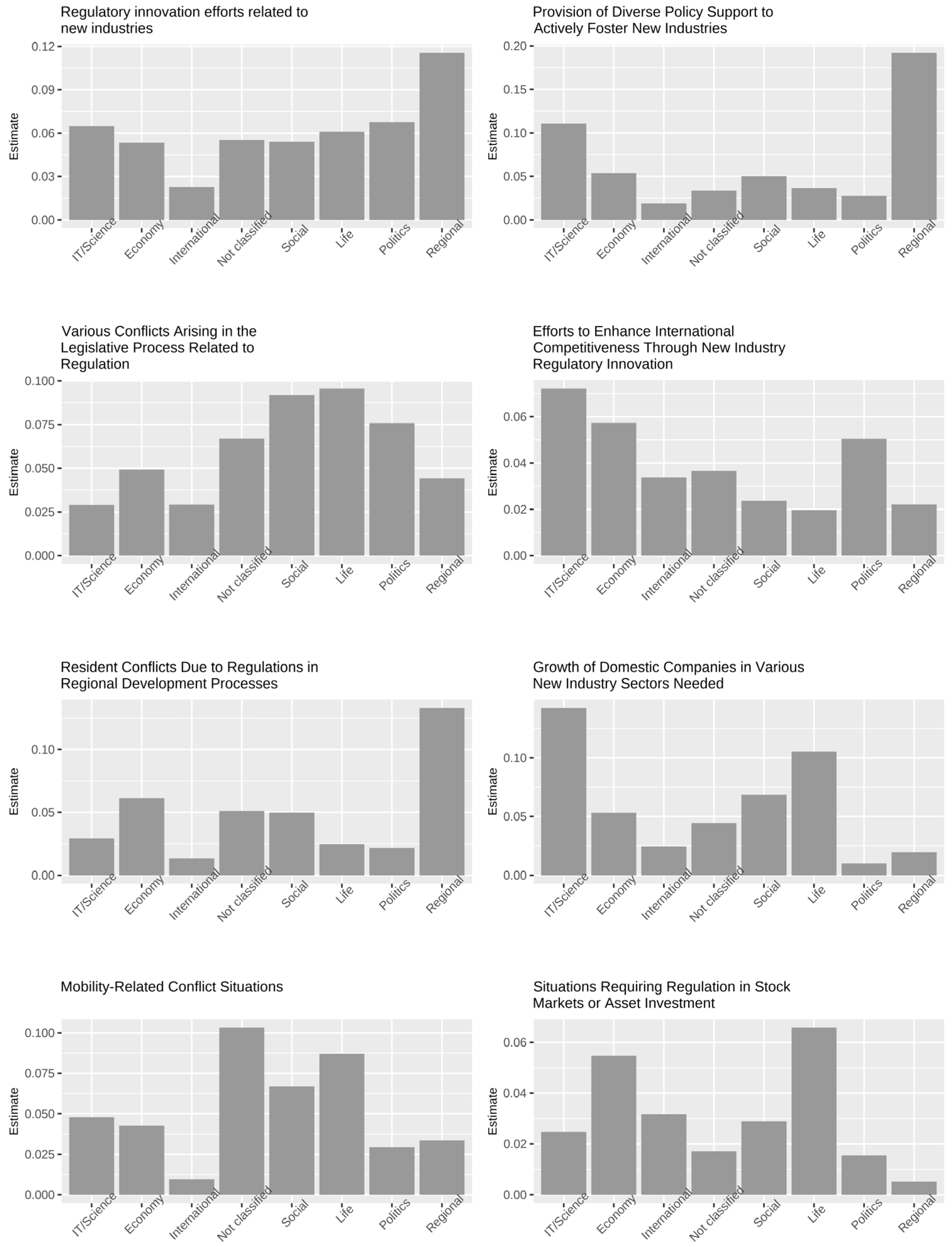
| Topic 17 | 7.00% | regulation, government, minister, measures, Ministry of Economy and Finance, system, new industry, sector, regulatory innovation, ministry, promotion, improvement, relaxation, expansion, support | Regulatory Innovation Efforts Related to New Industries |
| Topic 8 | 6.60% | new industry, industry, build, foster, establish, support, project, enterprise, foundation, sector, development, future, center, region, promote | Provision of Diverse Policy Support to Actively Foster New Industries |
| Topic 6 | 6.10% | Gyeonggi, US–China, outlook, impact, economy, quarter, decline, situation, exports, our country, global, rise, decrease, possibility, growth rate | Heightened Uncertainty and Economic Sluggishness Due to Negative Changes in the International Environment |
| Topic 24 | 5.90% | National Assembly, bill, amendment, regulation, controversy, law, lawmaker, provision, concern, revision, conduct, legislation, government, claim, point | Various Conflicts Arising in the Legislative Process Related to Regulation |
| Topic 1 | 5.40% | Democratic Party, president, Democratic Party of Korea, Moon Jae-in, lawmaker, presidential election, National Assembly, candidate, election, people, opposition, ruling, Blue House, leader, government | Election-Related News |
| Topic 30 | 4.90% | enterprise, economy, government, new industry, regulation, industry, our country, investment, companies, competitiveness, chairman, global, innovation, growth, large enterprise | Efforts to Enhance International Competitiveness Through New Industry Regulatory Innovation |
| Topic 2 | 4.50% | project, region, residents, regulation, conflict, officials, nearby, residents, plan, scale, development, facility, construction, promotion, construction | Resident Conflicts Due to Regulations in Regional Development Processes |
| Topic 14 | 4.50% | Japan, exports, semiconductor, materials, export regulation, our country, Korea–Japan, measures, items, government, regulation, enterprise, conflict, retaliation, economy | Trade-Related Conflict Due to Tensions in Korea–Japan Relations |
| Topic 25 | 4.30% | United States, Trump, China, president, Donald, US–China, administration, world, Biden, government, Xi Jinping, regulation, local time, trade, conflict | US–China Relations Conflict |
| Topic 7 | 4.30% | technology, service, market, United States, enterprise, domestic, world, global, development, artificial intelligence, data, project, platform, sector, our country | Growth of Domestic Companies in Various New Industry Sectors Needed |
| Topic 4 | 4.30% | regulation, COVID, accident, government, conflict, situation, police, one day, Seoul, occurrence, first, nationwide, photo, safety, distance | Social Distancing-Related Situations |
| Topic 3 | 3.50% | service, taxi, industry, project, platform, conflict, taxi industry, government, regulation, vehicle, representative, carpooling, mobility, innovation, startup | Mobility-Related Conflict Situations |
| Topic 10 | 3.40% | region, development, policy, role, metropolitan area, support, conflict, change, resolution, population, center, local, administration, future, citizen | Need for Balanced Regional Development |
| Topic 12 | 3.30% | jobs, minimum wage, employment, increase, policy, income, labor, economy, enterprise, growth, wage, government, fiscal, union, worker | Debate Among Various Disagreements Over Economic Policy |
| Topic 19 | 3.30% | real estate, housing, apartment, housing prices, Seoul, supply, market, price, government, reconstruction, regulation, household, countermeasures, speculation, loan | Real Estate-Related Issues |
| Topic 27 | 2.90% | era, our country, nation, state, history, reality, value, United States, future, century, world, politics, past, world, change | Meaningless Topic |
| Topic 9 | 2.70% | finance, bank, stocks, enterprise, investment, market, funds, regulation, assets, transactions, investors, investor, stock price, stock market, company | Situations Requiring Regulation in Stock Markets or Asset Investment |
| Topic 11 | 1.90% | attendance, Seoul, topic, attended, event, host, held, representative, discussion, attendees, forum, from left, Gwangju, debate, afternoon | Meaningless Topic |
| Topic 15 | 1.80% | production, energy, factory, supply, electric vehicle, China, proportion, automobile, world, demand, price, our country, United States, Europe, product | Growing Demand for Electric Vehicles Due to Interest in Eco-Friendliness |
| Topic 26 | 1.60% | I think, I heard, (speech markers), interview, question, really, first, I think, explanation, me too, let’s do it, really, probably, isn’t it | Meaningless Topic |
| Topic 23 | 1.50% | free, introduction, sponsorship, truth, marginalized, courage, Hankyoreh, persistently, create, always, shadowed, happiness, together, walk, flutter | Meaningless Topic |
| Topic 18 | 1.50% | North Korea, Korean Peninsula, inter-Korean, security, relations, diplomacy, people, politics, political, war, national interest, citizens, necessary, past, itself | Inter-Korean Relations Situation |
| Topic 13 | 1.20% | glass, necessary, effect, expert, impact, experts, aspect, help, interview, role, large, professional, result, possible, predict | Meaningless Topic |
| Topic 21 | 1.10% | allocation, next year, budget, supplementary, small business owners, budget bill, fiscal, vitality, budget, people’s livelihood, people, National Assembly, full-scale, vulnerable, social safety net | Direction of Government Support After COVID-19 |
| Topic 29 | 1.00% | fairness, nation, politics, Republic of Korea, power, respect, regime, people, president, jobs, state, market, taxes, world, vested interests | Meaningless Topic |
| Topic 16 | 0.90% | Korean Peninsula, peace, inter-Korean, Korean laborers, World Cultural Heritage, World Heritage, Sado Mine, concealing, nation, withdraw, forced labor, historical distortion, prosperity, oldest, history | Issues Related to Japan’s Historical Distortion |
| Topic 20 | 0.90% | respect, people, Republic of Korea, Korean Peninsula, era, peace, innovation, hope, nation, economy, cooperation, inter-Korean, sector, jobs, center | Meaningless Topic |
| Topic 28 | 0.70% | art, naturally, visit, work, learn, college student, event, music, splendid, performance, experience, try, creative, exhibition, ordinary | Meaningless Topic |
| Topic 22 | 0.60% | national petition, reason, Blue House, deservedly, lifetime, Joseon, caught, strangled, discernment, tears, democracy, constitution, pain, nation, evaluated | Meaningless Topic |
| Document Content |
|---|
| [Chungbuk Ilbo, Reporter Lee Jong-eok] Boeun County has announced it will identify and improve unreasonable regulations hidden in residents’ daily lives and workplaces. The county announced on the 6th that it will solicit ‘Boeun County People’s Livelihood Regulatory Innovation Proposals’ to receive direct suggestions from residents on regulations that inconvenience or are unreasonable for residents, and improve them. The proposal categories are five fields closely related to residents’ daily lives and economic activities: △social welfare △daily life △employment/jobs △small business/SME support △new industry fields. Accepted proposals will go through review by the Boeun County Regulatory Reform Committee, with outstanding items selected and prize money awarded in March. For proposals that can be resolved independently, the county plans to address them immediately through revision of Boeun County autonomous regulations. For cases requiring legal or institutional improvement, the county plans to actively work to reflect them in civil complaint and administrative systems by formally submitting them to relevant central ministries. |
| [Yesan] Yesan County will hold the ‘2021 Yesan County People’s Livelihood Regulatory Improvement Contest’ to discover and improve unreasonable regulations hidden in daily life and work sites, targeting the entire population. The contest period runs until next month’s 5th, and any interested citizen may apply. Contest categories are five people’s livelihood regulations: △civic welfare △daily life △employment/jobs △small business/SME support △new industries. Entries excluding simple petitions and complaints related to taxes, subsidies, and fines will be selected through a preliminary qualification review and final review by the Yesan County Regulatory Reform Committee, with prizes including certificates and Yesan Love gift certificates (Best Award: 1 person, 500,000 won; Excellence Award: 2 people, 300,000 won each; Encouragement Award: 4 people, 100,000 won each). Applications can be submitted by downloading the form from the Yesan County website’s notices and announcements section and submitting by mail or email. |
| The 2018 Customs Administration Regulatory Reform Public Proposal Contest is accepting entries until the 31st. Contest areas include regulatory reform proposals related to customs administration such as job creation, new technology and new industry promotion matters, and inconveniences for citizens and businesses; anyone including companies, general citizens, and public officials may participate. Applications are accepted until the 31st through the People’s Proposal section of the People’s Shinmungo system and by email, with final results to be announced at the end of July after document screening. The Best Award (1 entry) receives the Commissioner of Korea Customs Service Award and a prize of 1 million won. The Excellence Award (3 entries) receives 500,000 won each, the Encouragement Award (6 entries) receives 300,000 won each, with a total of 10 entries receiving awards. |
| Document Content |
|---|
| Gyeongnam Province announced it plans to invest 142.6 billion won across 7 sectors this year to revitalize the sluggish regional industry. This comes as traditional manufacturing industries such as shipbuilding and machinery in South Gyeongsang Province face a downturn, requiring structural upgrading of existing industries and discovery and cultivation of new industries to respond to the Fourth Industrial Revolution… [content continues with details of investment in smart manufacturing, robotics, aerospace, and other sectors] |
| South Jeolla Province announced that 46 new and ongoing projects totaling 129 billion won in government budget for economic and industrial sectors have been allocated in the 2020 government budget to invigorate new growth industries… [content continues with details of investment in e-mobility, drones, vaccine industry, energy new industries, shipbuilding, and other sectors] |
| Ulsan City has begun in earnest to build smart manufacturing industries fusing Fourth Industrial Revolution technologies with existing major industries such as automobiles, shipbuilding, and petrochemicals, to upgrade existing major industries and foster new industries… [content continues with details of the U-Smart Industry 4.0 roadmap and various strategic projects] |
| Document Content |
|---|
| The Taxi-Carpooling Social Grand Compromise Body signed an agreement allowing carpooling services during commute hours. This came 45 days after the four taxi associations including the National Taxi Transport Business Association, carpooling operator Kakao Mobility, Democratic Party of Korea Taxi-Carpooling TF Chairman Jeon Hyun-hee, and the Ministry of Land, Infrastructure and Transport put their heads together. It is commendable that the taxi industry, which had been conducting hardline struggles demanding ‘abolition of carpooling,’ and the carpooling industry resolved their conflict and opposition to reach some form of agreement. However, it remains uncertain whether this agreement can reignite the Korean-style ride-sharing market. The core of this agreement—allowing carpooling during commute hours—could actually become a constraint regulating the ride-sharing business… [article continues discussing limitations of the agreement and reactions from various stakeholders] |
| Carpooling companies such as Poolus and SOCAR said on the 7th regarding the Taxi-Carpooling Social Grand Compromise Body’s agreement: ‘The seeds of innovation through vehicle sharing have been completely cut. It will remain as a bad precedent going forward.’ Poolus, the largest domestic carpooling company, stated: ‘A conclusion with no practical effect has emerged. Citizens will not agree that late-night hours when taxis are hardest to find cannot use carpooling.’ The most taxi-scarce time is late night after midnight. The essence of carpooling is drivers and passengers with the same destination sharing a ride to reduce costs. Yet the most high-demand late-night hours were excluded… [article continues with reactions from various stakeholders including SOCAR CEO’s criticism of the agreement] |
| The prosecution ruled on the 28th that ‘Tada,’ VCNC’s minivan hailing service, violated the Passenger Transport Service Act. VCNC’s CEO Park Jae-wook and the parent company SOCAR’s CEO Lee Jae-woong were indicted without detention. The government, ruling party, and now prosecution appear to be pressuring Tada. Forecasts suggest the mobility (transportation) industry branded as ‘sharing economy’ will contract. The Seoul Central District Prosecutors’ Office Criminal Division 5 announced it had indicted the two CEOs and two corporations for violating the Passenger Transport Service Act without detention on the 28th… [article continues with details of the prosecution and reactions] |
Disclaimer/Publisher’s Note: The statements, opinions and data contained in all publications are solely those of the individual author(s) and contributor(s) and not of MDPI and/or the editor(s). MDPI and/or the editor(s) disclaim responsibility for any injury to people or property resulting from any ideas, methods, instructions or products referred to in the content. |
© 2026 by the authors. Licensee MDPI, Basel, Switzerland. This article is an open access article distributed under the terms and conditions of the Creative Commons Attribution (CC BY) license.
Share and Cite
Kim, S.-G.; Hong, S.-H. How News Media Frame Regulatory Conflict in Emerging Industries: Evidence from Structural Topic Modeling of South Korean Press Coverage, 2018–2022. Adm. Sci. 2026, 16, 417. https://doi.org/10.3390/admsci16090417
Kim S-G, Hong S-H. How News Media Frame Regulatory Conflict in Emerging Industries: Evidence from Structural Topic Modeling of South Korean Press Coverage, 2018–2022. Administrative Sciences. 2026; 16(9):417. https://doi.org/10.3390/admsci16090417
Chicago/Turabian StyleKim, Sung-Geun, and Seung-Hun Hong. 2026. "How News Media Frame Regulatory Conflict in Emerging Industries: Evidence from Structural Topic Modeling of South Korean Press Coverage, 2018–2022" Administrative Sciences 16, no. 9: 417. https://doi.org/10.3390/admsci16090417
APA StyleKim, S.-G., & Hong, S.-H. (2026). How News Media Frame Regulatory Conflict in Emerging Industries: Evidence from Structural Topic Modeling of South Korean Press Coverage, 2018–2022. Administrative Sciences, 16(9), 417. https://doi.org/10.3390/admsci16090417