Article

Artificial Intelligence Embedding and Enterprise Competitiveness in the Embodied Intelligence Industry: The Mediating Role of Competitive Structure Reconfiguration

School of Management, Hangzhou Dianzi University, Hangzhou 310018, China
*
Author to whom correspondence should be addressed.
Adm. Sci. 2026, 16(7), 352; https://doi.org/10.3390/admsci16070352
Submission received: 24 June 2026 / Revised: 19 July 2026 / Accepted: 21 July 2026 / Published: 22 July 2026

Abstract

Artificial intelligence is increasingly integrated into physical products, industrial scenarios, and innovation ecosystems, yet management research has focused mainly on AI adoption rather than the depth of organizational integration. This study examines how AI embedding affects enterprise competitiveness in China’s embodied intelligence industry and whether competitive structure reconfiguration mediates this relationship. Using survey data from 266 firms and partial least squares structural equation modeling, the analysis shows that AI embedding positively affects both enterprise competitiveness and competitive structure reconfiguration. Competitive structure reconfiguration also improves enterprise competitiveness and partially mediates the focal relationship, with a variance accounted for value of 43.7%. By contrast, the moderating effects of data–computing foundation and scenario openness are not supported. These findings indicate that the competitive value of AI depends not only on adoption but also on its integration into R&D, decision-making, organizational coordination, and scenario development, as well as on the structural changes that follow. The study contributes by distinguishing AI embedding from AI adoption and by identifying competitive structure reconfiguration as a process mechanism linking embedded AI to technological, ecosystem, and rule-based competitiveness.

1. Introduction

Artificial intelligence has become a central issue in management and strategy research. Existing studies have examined how AI reshapes organizational decision-making, innovation processes, human–technology interaction, and firm performance (Raisch & Krakowski, 2021; Berente et al., 2021; Kellogg et al., 2020; Haefner et al., 2021). A growing stream of empirical research further shows that AI capability and AI adoption can improve organizational creativity, innovation performance, and competitive outcomes, especially when firms possess complementary digital resources and managerial capabilities (Mikalef & Gupta, 2021; Baabdullah et al., 2021; Wei & Pardo, 2022; Babina et al., 2024). These studies have substantially advanced our understanding of AI as a strategic resource rather than a purely technical tool.
However, most existing research still treats AI mainly as a general-purpose digital technology adopted by firms. The dominant concern is whether firms adopt AI, how intensively they use it, and whether such adoption improves innovation or performance. This perspective is useful, but it is insufficient for understanding industries in which AI is not merely applied to existing business processes but embedded into products, physical systems, scenario interaction, and industrial ecosystems. In such contexts, the strategic value of AI depends less on isolated adoption and more on whether AI becomes integrated into the firm’s resource base, organizational routines, ecosystem relationships, and control positions (Barney, 1991; Teece et al., 1997; Teece, 2007; Gregory et al., 2021).
The embodied intelligence industry provides a particularly important context for examining this issue. Embodied intelligence refers to AI systems that perceive, learn, decide, and act in the physical world through the integration of algorithms, sensors, actuators, robotic bodies, control systems, and real-world scenarios (Duan et al., 2022; Driess et al., 2023; Brohan et al., 2023; Zitkovich et al., 2023). Unlike many digital industries, embodied intelligence firms do not compete only through software functions or data analytics. Their competitiveness depends on the joint development of AI models, hardware systems, scenario data, engineering delivery, field feedback, and ecosystem coordination. This makes embodied intelligence an appropriate setting for studying how AI embedding generates enterprise competitiveness under high technological uncertainty and strong ecosystem interdependence.
The Chinese embodied intelligence industry provides a theoretically meaningful context for examining this issue. Existing Chinese research has emphasized that AI is moving from a general enabling technology for digital transformation toward a system-level enabling force for future industry formation (Song, 2024). Studies on future industries in China further suggest that AI-driven industrial innovation depends on the interaction among frontier technologies, application scenarios, innovation ecosystems, and policy-supported industrial platforms (Chen et al., 2023; Li et al., 2023; Xue & Jiang, 2025). This context is particularly relevant for embodied intelligence because firms must connect AI algorithms with intelligent hardware, robotic bodies, engineering delivery, real-world scenarios, and ecosystem partners. Therefore, China is not treated merely as an empirical setting in this study. It provides a context in which the interaction among AI embedding, industrial-chain coordination, scenario experimentation, and ecosystem competition can be observed more directly.
Yet the management literature has not sufficiently examined this industry. Studies on AI and management mainly focus on general organizations, SMEs, digital transformation, or platform-based settings (Berente et al., 2021; Mikalef & Gupta, 2021; Chalmers et al., 2021; Feliciano-Cestero et al., 2023). Robotics and embodied AI studies, in contrast, mainly address technical architectures, model training, task generalization, and real-world control (Driess et al., 2023; Brohan et al., 2023; Zitkovich et al., 2023). Ecosystem and platform studies explain value creation, interdependence, and platform governance, but they rarely connect these mechanisms to AI embedding in embodied intelligence firms (Adner & Kapoor, 2010; Adner, 2017; Jacobides et al., 2018; Cennamo, 2021). As a result, we still know little about how AI embedding shapes enterprise competitiveness in an industry where competitive advantage depends simultaneously on technology, scenarios, ecosystems, and control points.
To address this gap, this study shifts the analytical focus from AI adoption to AI embedding. AI embedding refers to the extent to which AI is integrated into the firm’s key value-creation activities, including R&D innovation, decision support, organizational coordination, and scenario development. This distinction is important. AI adoption indicates that a firm uses AI tools or systems; AI embedding indicates that AI has entered the firm’s innovation process, operational routines, cross-functional collaboration, and scenario-based learning mechanisms. Only the latter is likely to generate durable competitiveness because it allows firms to reconfigure resources, adapt to changing environments, and build differentiated capabilities (Teece, 2007, 2018; Mikalef & Gupta, 2021).
This study further argues that AI embedding does not automatically lead to enterprise competitiveness. Its effect is mediated by competitive structure reconfiguration. In the embodied intelligence industry, competition is not limited to product performance or cost efficiency. It is also shaped by changes in entry conditions, scenario-based demand, complementor networks, ecosystem orchestration, and control-point allocation. Firms that embed AI more deeply may lower technical and organizational barriers, identify scenario demand earlier, reorganize relationships with complementors, participate in ecosystem orchestration, and occupy key positions in data, interface, platform, standard, or scenario access. These mechanisms are consistent with dynamic capabilities theory, innovation ecosystem research, and platform competition literature (Adner, 2017; Jacobides et al., 2018; Gawer & Cusumano, 2014; Tiwana et al., 2010).
Accordingly, this study develops and tests a theoretical model linking AI embedding, competitive structure reconfiguration, and enterprise competitiveness in the embodied intelligence industry. Enterprise competitiveness is conceptualized as a multidimensional construct consisting of technological competitiveness, ecosystem competitiveness, and rule-based competitiveness. This definition reflects the industrial features of embodied intelligence: firms must not only improve technological capabilities, but also coordinate ecosystem partners and shape rules, interfaces, standards, and scenario entry points. The model also considers data–computing foundation and scenario openness as boundary conditions, because AI embedding requires data resources, computing infrastructure, and access to real-world scenarios.
Empirically, this study uses survey data from firms in the embodied intelligence industry and applies Partial Least Squares Structural Equation Modeling to test the proposed model. This method is suitable for research contexts involving multidimensional latent variables, mediation mechanisms, moderation effects, and emerging theoretical constructs (Hair et al., 2019, 2021). To enhance methodological reliability, the study follows a structured procedure including questionnaire development, expert review, data screening, reliability and validity assessment, common method bias checks, collinearity assessment, bootstrapping, and mediation and moderation testing (Podsakoff et al., 2003; Henseler et al., 2015; Kock, 2015).
Three contributions follow. First, the paper shifts attention from AI adoption to AI embedding, thereby capturing the integration of AI into R&D innovation, decision support, organizational coordination, and scenario development. Second, it identifies competitive structure reconfiguration as the process through which internal AI integration changes entry conditions, scenario demand, complementor relationships, ecosystem orchestration, and control-point allocation. Third, the Chinese embodied intelligence industry provides a theoretically meaningful setting for showing how AI, manufacturing resources, real-world scenarios, and regional ecosystems jointly shape technological, ecosystem, and rule-based competitiveness.
The remainder of this paper is organized as follows. Section 2 reviews the relevant literature and identifies the theoretical gap. Section 3 develops the theoretical framework and hypotheses. Section 4 describes the research design and methods. Section 5 presents the empirical results. Section 6 discusses the findings. Section 7 concludes the study.

2. Literature Review

This section reviews five streams of literature relevant to this study: AI adoption and AI capability, AI and dynamic capabilities, innovation ecosystems and platform-based competition, embodied AI and robotics, and Chinese research on AI, future industries, and embodied intelligence.

2.1. AI Adoption and AI Capability: From Technology Use to Organizational Integration

Research on artificial intelligence in management has generated important insights into how firms adopt, implement, and derive value from AI. Prior studies show that AI can improve decision-making, innovation management, organizational creativity, and firm performance when firms possess complementary digital resources, managerial support, and organizational readiness (Raisch & Krakowski, 2021; Berente et al., 2021; Mikalef & Gupta, 2021; Haefner et al., 2021). More recent research has moved beyond adoption decisions to examine the organizational conditions required for AI implementation. Lee et al. (2023), for example, identify technological, organizational, information-system, and people-related factors that jointly shape the implementation of AI in organizations. Empirical studies further indicate that AI adoption can enhance B2B practices, SME competitiveness, product innovation, and firm growth (Baabdullah et al., 2021; Wei & Pardo, 2022; Babina et al., 2024). Together, these studies establish AI as a strategic organizational resource rather than a purely operational tool.
However, this stream of research still tends to treat AI as a technology that firms adopt, possess, or implement. The main analytical question is whether firms use AI, how intensively they use it, and whether such use improves innovation or performance. Recent AI-strategy research shows that successful AI initiatives also depend on the creation of data network effects and the alignment of AI with firm-level strategic processes (Vomberg et al., 2023). Research on strategic decision-making further indicates that generative AI can augment the generation and evaluation of strategic alternatives, but its organizational value depends on how it is incorporated into established decision processes (Csaszar et al., 2024). These perspectives deepen the strategic understanding of AI, but they remain less sufficient for explaining how AI becomes embedded across the firm’s complete value-creation architecture. AI adoption captures the presence of AI use; AI embedding captures the depth to which AI is integrated into R&D innovation, decision support, organizational coordination, and scenario development. This distinction matters because AI tools can be purchased or imitated, whereas AI embedding depends on firm-specific data, routines, technical knowledge, engineering experience, and cumulative learning processes.

2.2. AI, Dynamic Capabilities, and Competitiveness: From Internal Capability to Competitive Structure

A second stream of research links AI to dynamic capabilities and firm competitiveness. Dynamic capabilities theory argues that firms achieve advantage not only by possessing valuable resources, but also by sensing opportunities, seizing them, and reconfiguring resources in response to environmental change (Teece et al., 1997; Teece, 2007, 2018). Recent studies have applied this logic to AI research, showing that AI adoption and AI capability may enhance innovation performance, resilience, and competitiveness through dynamic capabilities or related organizational mechanisms (Mikalef & Gupta, 2021; Le & Behl, 2024; Sánchez-Rodríguez et al., 2025).
This literature provides a stronger explanation than simple AI adoption models because it shows how AI affects firm-level capabilities. Recent studies further demonstrate that transforming isolated AI experiments into organization-wide value creation requires proactive leadership, an innovation-supportive culture, strategic process discipline, and the ability to reconfigure organizational resources and business models (Black et al., 2024). Research on industrial firms similarly indicates that AI capabilities must be combined with organizational adaptability and leadership to support data-driven value creation, delivery, and capture (Ghosh, 2025). Nevertheless, these capability-based explanations remain incomplete for the embodied intelligence industry. They mainly focus on how AI improves internal sensing, seizing, adapting, and reconfiguring, but say less about how AI changes the external conditions under which firms compete. In embodied intelligence, competitiveness is not formed only through internal capability improvement. It also depends on access to application scenarios, coordination with complementors, ecosystem positioning, interface control, standard participation, data access, and platform linkage. Therefore, this study extends the capability-based view by introducing competitive structure reconfiguration as the mediating mechanism between AI embedding and enterprise competitiveness.

2.3. Innovation Ecosystems, Platforms, and Control Points: From Value Co-Creation to Value Capture

A third stream of research examines innovation ecosystems, platforms, and technological dominance. Ecosystem research emphasizes that value creation depends on interdependence among multiple actors, complementor alignment, bottleneck resolution, and the focal firm’s position within a broader value structure (Adner & Kapoor, 2010; Adner, 2017; Jacobides et al., 2018). Platform studies further show that firms can shape ecosystem competition by controlling interfaces, architectures, governance rules, and complementor participation (Gawer & Cusumano, 2014; Tiwana et al., 2010; Cennamo, 2021). Research on technological dominance also highlights the importance of standards, installed bases, complementary assets, and control over technological trajectories (Suarez, 2004).
These studies provide essential foundations for understanding ecosystem-based competition, but they do not directly explain how AI embedding changes competition in embodied intelligence firms. Recent research on AI-enabled business model innovation has begun to connect AI capabilities with value creation, value delivery, value capture, and ecosystem collaboration. Sjödin et al. (2023), for example, show that industrial firms require perceptive, predictive, and prescriptive AI capacities, together with dynamic capabilities, to commercialize AI-enabled business models in collaboration with customers and ecosystem partners. Kanbach et al. (2024) further argue that generative AI can reshape multiple components of the business model and alter the ways in which firms create and capture value. These studies demonstrate that AI can affect business architectures and ecosystem relationships, but their primary focus remains business model innovation rather than the competitive structure surrounding firms. Ecosystem and platform studies, however, usually examine interdependence, governance, and value capture at the platform or industry level. They rarely analyze how AI, as a firm-level embedded technology, reshapes entry conditions, scenario demand, complementor networks, ecosystem orchestration, and control-point allocation. This study therefore connects AI management research with ecosystem and platform theory by arguing that AI embedding is not only an internal capability-building process but also a driver of competitive structure reconfiguration.

2.4. Embodied AI and Robotics: From Technical Progress to Enterprise Competitiveness

A fourth stream of research comes from embodied AI and robotics. Technical studies have advanced the understanding of embodied AI systems, including multimodal models, robotic control, real-world task execution, generalist agents, and vision-language-action systems (Duan et al., 2022; Driess et al., 2023; Brohan et al., 2023; Reed et al., 2022; Zitkovich et al., 2023). These studies show that embodied intelligence differs from purely digital AI because it requires the integration of perception, learning, decision-making, action, hardware systems, and real-world feedback. They provide a technological basis for understanding why embodied intelligence depends heavily on scenarios, data, engineering implementation, and continuous field learning.
However, technical studies on embodied AI rarely examine enterprise competitiveness. They explain what embodied AI systems can do, but not how firms in the embodied intelligence industry build competitive advantage. As a result, there is a gap between technical research on embodied AI and management research on AI-enabled competitiveness. The former focuses on models, tasks, and control; the latter focuses on adoption, capability, and performance. What remains underexplored is how AI embedding shapes enterprise competitiveness in an industry where technological development, scenario access, ecosystem coordination, and control-point allocation are deeply intertwined.

2.5. Chinese Research on AI, Future Industries, and Embodied Intelligence

Chinese research on AI and future industries has developed rapidly in recent years. This literature provides an important contextual foundation for the present study because China’s embodied intelligence industry is closely connected with national future-industry strategies, regional innovation ecosystems, manufacturing capabilities, and scenario-based industrial experimentation.
A first stream of Chinese research focuses on the strategic positioning and development logic of future industries. This stream argues that future industries are driven by frontier technologies, emerging application scenarios, innovation-element supply, and policy support. Chen et al. (2023) emphasize that the development of China’s future industries depends on the supply of scientific and technological factors, the cultivation of technological scenarios, and policy guarantees. Li et al. (2023) further conceptualize future industries as innovation ecosystems composed of frontier knowledge creation, application-scenario transformation, and industrial value realization. These studies show that future industries cannot be understood only as technology sectors. They are formed through the interaction among technologies, scenarios, actors, and institutional arrangements.
A second stream examines the role of AI in future industry development. Song (2024) argues that AI is moving from an enabling effect for existing industrial digital transformation toward a system-level enabling effect for future industry cultivation. This distinction is useful for the present study because it suggests that AI should not be viewed only as a tool for efficiency improvement. Xue and Jiang (2025) further argue that generative AI is becoming a key driver of future industrial innovation and that future industries also provide important application fields for testing and refining AI technologies. This perspective highlights the mutual shaping relationship between AI development and industrial scenario experimentation.
A third stream discusses scenario-driven transformation and innovation ecosystem construction in China’s future industries. Chinese studies generally emphasize that future industries depend on the alignment of technological breakthroughs, application scenarios, industrial-chain coordination, platform support, and policy experimentation. This emphasis is particularly relevant to embodied intelligence. Embodied intelligence firms do not only develop AI models or robotic products. They must also obtain scenario feedback, coordinate hardware and software suppliers, work with system integrators, and participate in regional innovation platforms.
However, existing Chinese research still has several limitations. Most studies focus on macro-level industrial cultivation, policy design, future-industry layout, or innovation ecosystem construction. They provide rich insights into why AI and future industries are strategically important, but they say less about how AI is transformed into firm-level competitiveness. In particular, limited attention has been paid to the mechanism through which AI embedding changes entry conditions, scenario demand, complementor networks, ecosystem orchestration, and control-point allocation. Therefore, this study builds on Chinese research on AI and future industries, but shifts the analytical focus from industry cultivation to enterprise competitiveness formation.

2.6. Theoretical Gap and Research Positioning

Taken together, prior research provides important but fragmented explanations. AI adoption and implementation studies explain the technological, organizational, and human conditions under which firms introduce AI. Recent AI strategy research examines data network effects and AI-supported strategic decision-making, while generative-AI and business-model studies analyze how AI may transform value creation, delivery, and capture. Dynamic capability research explains how AI can strengthen internal sensing, seizing, adaptation, and resource reconfiguration. Ecosystem and platform studies explain interdependence, governance, and value capture. Embodied AI studies clarify the technical foundations of physical-world AI systems, while Chinese research on AI and future industries highlights frontier technologies, scenario transformation, innovation ecosystems, and policy-supported industrial platforms.
However, these streams have not been sufficiently integrated to explain how AI embedding affects enterprise competitiveness in the embodied intelligence industry. Recent studies increasingly recognize that AI must be integrated with organizational processes, strategic decision-making, business models, and ecosystem relationships, but they generally treat these outcomes separately. They do not systematically explain how firm-level AI embedding alters the structure of competition itself or how these structural changes are converted into technological, ecosystem, and rule-based competitiveness. International research has also paid limited attention to embodied intelligence as a management and strategy context, whereas Chinese research has concentrated primarily on macro-level future-industry cultivation. The missing link is therefore not simply whether AI improves firm performance, but how embedded AI changes entry conditions, scenario demand, complementor relationships, ecosystem orchestration, and the allocation of strategic control points.
This study addresses this gap by developing an AI embedding-driven competitive structure reconfiguration framework. It advances prior research in three ways. First, it shifts the focus from AI adoption to AI embedding, thereby capturing the deeper integration of AI into core value-creation activities. Second, it introduces competitive structure reconfiguration as the mechanism through which AI embedding affects enterprise competitiveness. Third, it situates the analysis in China’s embodied intelligence industry, where AI technologies, manufacturing supply chains, application scenarios, regional platforms, and ecosystem actors are closely intertwined. This context allows the study to examine how AI-enabled competitiveness is formed not only through internal capabilities, but also through industrial-chain coordination, scenario-based learning, ecosystem orchestration, and control-point competition.

3. Theoretical Framework and Hypotheses

Building on the research gap identified in the literature review, this section develops the theoretical framework and hypotheses of this study.

3.1. Integrated Theoretical Logic: Dynamic Capabilities, Innovation Ecosystem, and Control Points

Based on the literature review, this study uses dynamic capabilities theory, innovation ecosystem research, and the control-point perspective as complementary theoretical lenses. These perspectives are not treated as separate explanations. Instead, they are integrated to explain how AI embedding is transformed into enterprise competitiveness through competitive structure reconfiguration.
Dynamic capabilities theory explains the internal capability logic of AI embedding. In turbulent technological environments, firms need to sense emerging opportunities, seize them through resource mobilization, and reconfigure resources and routines in response to change (Teece et al., 1997; Teece, 2007, 2018). AI embedding strengthens this process because it allows firms to integrate AI into R&D innovation, decision support, organizational coordination, and scenario development. In embodied intelligence firms, AI does not create strategic value merely because it is adopted. Its value depends on whether it becomes connected with firm-specific data, technical knowledge, engineering experience, organizational routines, and scenario feedback. Thus, dynamic capabilities theory explains why AI embedding may improve a firm’s ability to learn, adapt, and reconfigure its internal resource base.
However, the embodied intelligence industry cannot be explained by internal capabilities alone. Embodied intelligence products and solutions depend on the joint development of algorithms, sensors, chips, actuators, robotic bodies, system integration, application scenarios, customers, and service providers. This makes innovation ecosystem research necessary. Ecosystem theory emphasizes interdependence among multiple actors, complementor alignment, and value co-creation around a shared value proposition (Adner & Kapoor, 2010; Adner, 2017; Jacobides et al., 2018). In this study, the ecosystem perspective explains why AI embedding may reshape complementor relationships and ecosystem coordination. As AI becomes embedded in product development and scenario learning, firms may need to reorganize cooperation with model providers, component suppliers, system integrators, scenario owners, and end users. Therefore, AI embedding is expected to influence not only what firms can do internally, but also how they coordinate external actors.
The control-point perspective further explains the value-capture logic. In platform-based and technology-intensive industries, competition often centers on interfaces, standards, data access, platform positions, user entry points, and governance rules (Gawer & Cusumano, 2014; Tiwana et al., 2010; Suarez, 2004; Cennamo, 2021). This logic is especially relevant to embodied intelligence because firms compete not only for better products, but also for positions that shape data flows, hardware–software integration, scenario access, testing environments, and technical standards. AI embedding may help firms occupy such positions by accumulating scenario data, improving system compatibility, strengthening interface integration, and participating in ecosystem governance or standard-setting. The control-point perspective therefore explains how AI embedding may affect value capture, not only value creation.
Together, these three perspectives form the theoretical logic of this study. Dynamic capabilities theory explains internal resource reconfiguration. Innovation ecosystem research explains external relationship reorganization. The control-point perspective explains value-capture position adjustment. These three mechanisms jointly support the concept of competitive structure reconfiguration. In this framework, AI embedding first changes how firms develop technologies, make decisions, coordinate activities, and learn from scenarios. These changes then reshape the competitive structure surrounding the firm, including entry conditions, scenario-based demand, complementor networks, ecosystem orchestration, and control-point allocation. Through this mechanism, AI embedding is expected to influence enterprise competitiveness in the embodied intelligence industry.

3.2. Conceptual Framework: AI Embedding-Driven Competitive Structure Reconfiguration

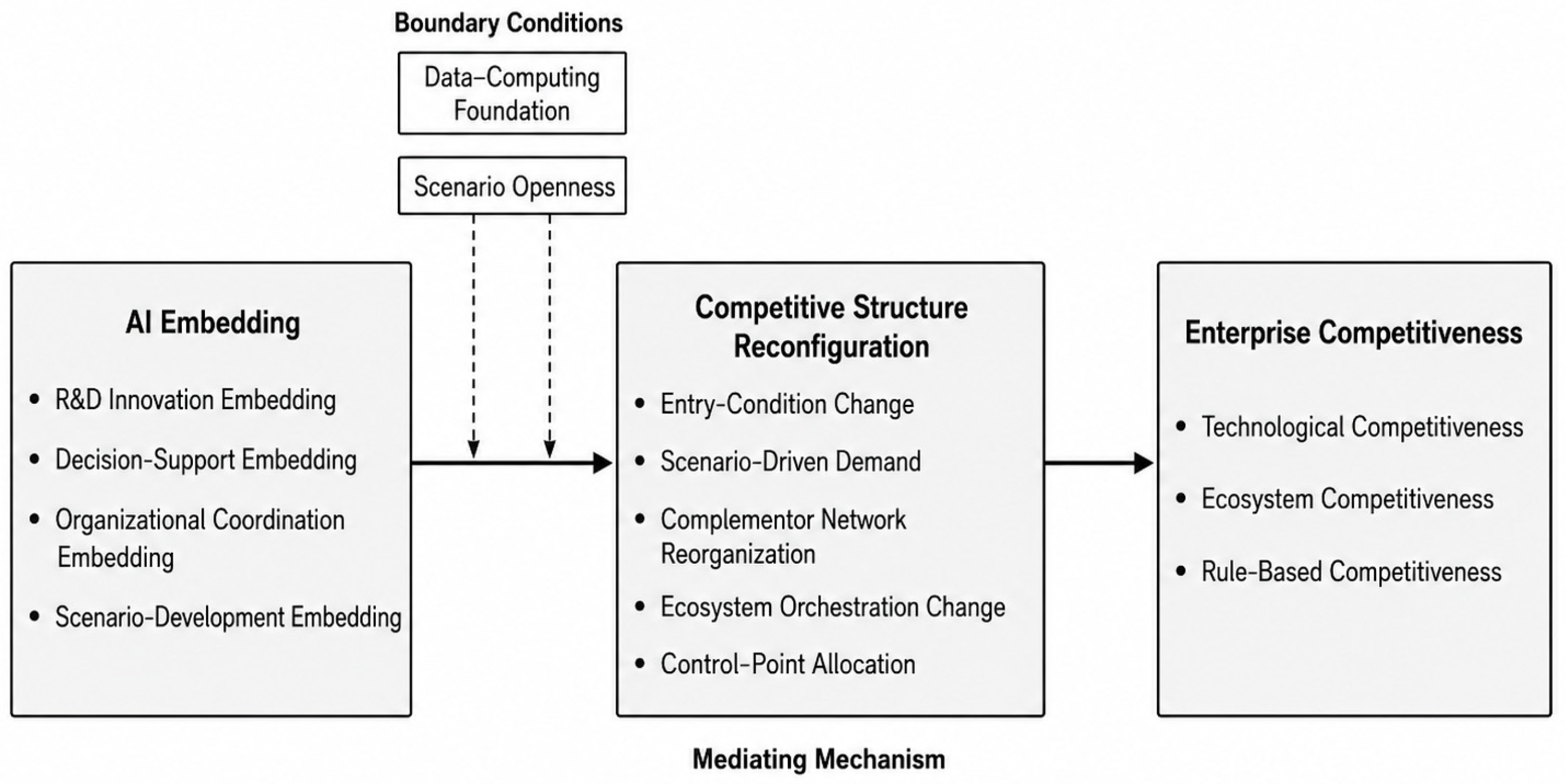
Building on the integrated theoretical logic, this study proposes a conceptual framework linking AI embedding, competitive structure reconfiguration, and enterprise competitiveness in the embodied intelligence industry. The framework argues that AI embedding does not automatically generate competitiveness. Its strategic value is realized when AI becomes integrated into firm-level activities and further changes the conditions, relationships, and positions through which firms compete.
AI embedding is treated as the antecedent variable in this framework. It refers to the extent to which AI is integrated into a firm’s key value-creation activities, including R&D innovation, decision support, organizational coordination, and scenario development. This construct emphasizes the depth of AI integration rather than the simple presence of AI adoption. In the embodied intelligence industry, AI embedding means that AI is not used only as a tool for automation or data analysis. It becomes part of product development, technical iteration, scenario learning, operational decision-making, and cross-functional coordination.
Competitive structure reconfiguration is treated as the mediating mechanism. It refers to the process through which AI embedding changes the competitive conditions and relationships surrounding the firm. This construct captures five types of structural change. First, entry-condition change refers to the shift in the requirements for entering and competing in the industry, such as data resources, AI models, simulation capability, engineering delivery, and system integration ability. Second, scenario-driven demand refers to the increasing role of real-world application scenarios in shaping product development, market opportunities, and commercialization paths. Third, complementor network reorganization refers to changes in how firms cooperate with model providers, component suppliers, hardware manufacturers, system integrators, scenario owners, and end users. Fourth, ecosystem orchestration change refers to changes in how firms coordinate external actors, align complementary activities, and participate in ecosystem-level value creation. Fifth, control-point allocation refers to changes in access to key interfaces, standards, platforms, data resources, testing environments, and scenario entry points.
Enterprise competitiveness is treated as the outcome variable. It refers to the firm’s relative ability to achieve advantages in the embodied intelligence industry. This study conceptualizes enterprise competitiveness through three dimensions: technological competitiveness, ecosystem competitiveness, and rule-based competitiveness. Technological competitiveness refers to a firm’s ability to develop, integrate, and iterate embodied intelligence technologies and solutions. Ecosystem competitiveness refers to a firm’s ability to coordinate partners, participate in ecosystem value creation, and obtain a favorable position within interdependent networks. Rule-based competitiveness refers to a firm’s ability to influence or benefit from interfaces, standards, platforms, scenario access, and other rule-related positions.
The central theoretical novelty of this framework lies in separating competitive structure reconfiguration from enterprise competitiveness. Competitive structure reconfiguration is a process construct that captures how AI embedding changes the external conditions, relationships, and strategic positions through which firms compete. Enterprise competitiveness is an outcome construct that captures the technological, ecosystem, and rule-based advantages obtained from those changes. For example, ecosystem orchestration change describes a shift in the firm’s role in coordinating interdependent actors, whereas ecosystem competitiveness represents the advantage derived from that role. Similarly, control-point allocation describes changes in access to interfaces, standards, platforms, data, and scenarios, whereas rule-based competitiveness captures the firm’s capacity to appropriate value from these positions. This process–outcome distinction prevents the mediating mechanism from being treated as another label for the dependent variable.
The framework therefore specifies a sequential mechanism. AI embedding first alters firm-level routines, resource deployment, and scenario-based learning. These internal changes are subsequently translated into competitive structure reconfiguration, which in turn contributes to technological, ecosystem, and rule-based competitiveness. Data–computing foundation and scenario openness are introduced as potential boundary conditions affecting the first stage of this mechanism.
Figure 1 presents the conceptual framework of this study. AI embedding is positioned as the antecedent variable, competitive structure reconfiguration as the mediating mechanism, and enterprise competitiveness as the outcome variable. Data–computing foundation and scenario openness moderate the relationship between AI embedding and competitive structure reconfiguration.

3.3. Research Objectives and Hypotheses

This study examines how AI embedding affects enterprise competitiveness in the embodied intelligence industry. The core argument is that AI embedding improves competitiveness not only by strengthening internal capabilities, but also by reconfiguring the competitive structure in which firms create, coordinate, and capture value.

3.3.1. Research Objectives

Objective 1: Examine whether AI embedding improves enterprise competitiveness in the embodied intelligence industry.
Objective 2: Test whether competitive structure reconfiguration mediates the relationship between AI embedding and enterprise competitiveness.
Objective 3: Examine whether data–computing foundation and scenario openness strengthen the effect of AI embedding on competitive structure reconfiguration.

3.3.2. Research Hypotheses

AI embedding integrates AI with firms’ core activities and enables more continuous learning, technological iteration, coordination, and resource allocation. In the embodied intelligence industry, these organizational effects should improve firms’ ability to develop and commercialize integrated AI-enabled solutions. Therefore:
H1. 
AI embedding has a positive effect on enterprise competitiveness.
Beyond its internal effects, AI embedding can alter the relationships and strategic positions through which firms compete. Deeper integration of AI may enable firms to respond to scenario demand, coordinate interdependent actors, and influence access to strategically important resources and positions. Accordingly:
H2. 
AI embedding has a positive effect on competitive structure reconfiguration.
Competitive structure reconfiguration can improve firms’ capacity to coordinate interdependencies, access opportunities, and appropriate value from ecosystem and control-point positions. Firms that achieve such structural changes should therefore obtain stronger competitive outcomes. Thus:
H3. 
Competitive structure reconfiguration has a positive effect on enterprise competitiveness.
Taken together, the preceding arguments suggest that AI embedding affects enterprise competitiveness partly by producing changes in the competitive structure surrounding the firm. Competitive structure reconfiguration therefore represents the mechanism through which internal AI integration is translated into external competitive advantage. Accordingly:
H4. 
Competitive structure reconfiguration mediates the relationship between AI embedding and enterprise competitiveness.
Data–computing foundation may strengthen the effect of AI embedding on competitive structure reconfiguration. AI embedding requires usable data, computing resources, data governance, and model-supporting infrastructure. Without these conditions, AI use may remain fragmented or superficial. With a stronger data–computing foundation, firms can train models, accumulate feedback, optimize solutions, and connect AI more effectively with scenario learning and system integration. Therefore, we propose:
H5. 
Data–computing foundation positively moderates the relationship between AI embedding and competitive structure reconfiguration, such that the relationship is stronger when data–computing foundation is higher.
Scenario openness may also strengthen the effect of AI embedding on competitive structure reconfiguration. Embodied intelligence products must be tested, validated, and improved in real-world scenarios. When scenario openness is higher, firms can obtain more opportunities for field testing, user feedback, customer interaction, and ecosystem collaboration. These conditions make it easier for AI embedding to reshape scenario demand, complementor relationships, and control-point access. Therefore, we propose:
H6. 
Scenario openness positively moderates the relationship between AI embedding and competitive structure reconfiguration, such that the relationship is stronger when scenario openness is higher.
Taken together, H1–H6 specify the direct, mediating, and conditional relationships presented in Figure 1.

4. Materials and Methods

4.1. Questionnaire Design and Data Collection

This study used a firm-level questionnaire survey to test the proposed AI embedding–competitive structure reconfiguration–enterprise competitiveness framework. A survey design was appropriate because the core constructs of this study, including AI embedding, competitive structure reconfiguration, enterprise competitiveness, data–computing foundation, and scenario openness, reflect organizational practices and strategic perceptions that cannot be fully captured by public financial, patent, or archival data alone.
The questionnaire was developed based on prior research on AI capability, dynamic capabilities, innovation ecosystems, platform competition, and PLS-SEM measurement design (Teece, 2007; Adner, 2017; Jacobides et al., 2018; Mikalef & Gupta, 2021; Hair et al., 2019, 2021). The initial item pool was designed according to the theoretical framework proposed in Section 3. To improve content validity and industry relevance, the questionnaire was reviewed and revised through expert consultation. Four management scholars and four computer science scholars with expertise in embodied intelligence participated in the review process. Their comments focused on construct boundaries, item wording, industry applicability, and whether the items could be understood by respondents from different positions in the embodied intelligence industry chain. Based on this process, the final questionnaire was revised before formal data collection. The full questionnaire items are reported in Appendix A.
The study adopted criterion-based purposive sampling and a key-informant approach. Eligible firms were required to operate in the embodied intelligence industry or its supporting industrial chain, including AI models and software platforms, intelligent hardware and core components, robotic systems and system integration, scenario applications, and digital infrastructure. The online questionnaire was distributed to one qualified respondent from each participating firm. Eligible respondents included founders or senior executives, R&D managers, product managers, digital transformation managers, operations managers, system integration managers, and scenario application managers who were familiar with the firm’s AI application, technology development, scenario deployment, ecosystem collaboration, or strategic management. Where necessary, respondents were encouraged to verify firm-level information with colleagues responsible for R&D, digitalization, product development, operations, or strategy before submitting the questionnaire.
A total of 266 online questionnaires were formally distributed, and all 266 questionnaires were returned, corresponding to a response rate of 100% based on the formally distributed questionnaires. Each firm contributed one questionnaire. The returned questionnaires were screened for respondent eligibility, completeness, and response-range consistency. All questionnaires contained complete responses to the core measurement items and satisfied the predefined inclusion criteria; therefore, no questionnaire was excluded, leaving a final sample of 266 firm-level observations. To mitigate sampling and informant bias, the study applied explicit firm- and respondent-eligibility criteria, restricted participation to one knowledgeable informant per firm, covered multiple positions in the embodied intelligence industry chain and several major regional clusters, and assured respondents that their responses would be used anonymously for academic research. Because all formally distributed questionnaires were returned, a conventional comparison between respondents and non-respondents was not applicable.
Sample size adequacy was evaluated according to the logic of PLS-SEM model estimation. This study did not aim to estimate a population proportion; therefore, the infinite-population proportion formula commonly used in descriptive surveys was not adopted as the primary criterion. Instead, sample size was assessed according to the minimum sample requirement for PLS-SEM. Following the 10-times rule proposed in the PLS-SEM literature, the minimum sample size should be at least ten times the maximum number of structural paths pointing at any endogenous construct in the model (Barclay et al., 1995; Hair et al., 2019, 2021). The minimum sample size can be expressed as:
n m i n = 10 × m a x ( P CSR , P EC )
where P CSR denotes the maximum number of predictors of competitive structure reconfiguration and P EC denotes the number of predictors of enterprise competitiveness. In this study:
n m i n = 10 × m a x ( 5 , 2 ) = 50
The final sample size of 266 was therefore sufficient for estimating the proposed PLS-SEM model. In addition, bootstrapping with 5000 resamples was used to obtain more stable standard errors, t statistics, p values, and confidence intervals for hypothesis testing.

4.2. Measurement of Constructs

All core constructs were measured using a seven-point Likert scale, ranging from 1 = strongly disagree to 7 = strongly agree. The final dataset contained 45 core indicators: 12 items for AI embedding, 15 items for competitive structure reconfiguration, 9 items for enterprise competitiveness, 4 items for data–computing foundation, and 4 items for scenario openness.
AI embedding was measured by the extent to which AI was integrated into R&D innovation, decision support, organizational coordination, and scenario development. This construct emphasized the depth of AI integration rather than the simple adoption of AI tools.
Competitive structure reconfiguration was measured through five dimensions: entry-condition change, scenario-driven demand, complementor network reorganization, ecosystem orchestration change, and control-point allocation. These items captured changes in the competitive conditions, relationships, and positions surrounding the firm.
Enterprise competitiveness was measured through technological competitiveness, ecosystem competitiveness, and rule-based competitiveness. The items focused on the firm’s relative advantages compared with major competitors.
Data–computing foundation and scenario openness were included as boundary-condition constructs. Data–computing foundation captured data resources, computing resources, data governance, and model-supporting infrastructure. Scenario openness captured scenario access, field testing, user feedback, and ecosystem collaboration.
A key principle in the measurement design was to distinguish the mediating mechanism from the outcome variable. Competitive structure reconfiguration was measured as a process of structural change in the competitive environment, whereas enterprise competitiveness was measured as the firm’s relative competitive advantage. This distinction was necessary for testing the mediating role of competitive structure reconfiguration. Table 1 summarizes the constructs and measurement design.

4.3. Data Processing and Analytical Strategy

Before model estimation, the survey data were coded according to the seven-point Likert scale and screened for completeness. The final dataset contained 266 valid firm-level observations and 45 core indicators. No missing values were found in the core measurement items. All indicators were within the expected response range from 1 to 7. The empirical analysis was conducted in R using the SEMinR package.
Partial Least Squares Structural Equation Modeling was selected rather than covariance-based structural equation modeling (CB-SEM). Although the sample size of 266 would not preclude the use of CB-SEM, sample size was not the decisive criterion for method selection. The present study is prediction-oriented and theory-extending because it integrates AI embedding, competitive structure reconfiguration, and enterprise competitiveness within the emerging context of the embodied intelligence industry. The analytical objective is therefore to explain the variance of the endogenous constructs and estimate the direct, indirect, and interaction effects, rather than to confirm a fully mature covariance structure primarily through global model-fit criteria.
The proposed model also contains multiple latent constructs, a mediating mechanism, and two latent-variable interaction terms. PLS-SEM is well suited to estimating such structurally complex models and is comparatively flexible regarding distributional assumptions. Accordingly, PLS-SEM was more closely aligned with the study’s theory-extension and prediction objectives, whereas CB-SEM would have been more appropriate if the primary purpose had been strict confirmation of a well-established theoretical model (Hair et al., 2019, 2021).
The measurement model links each latent construct to its observed indicators. It can be expressed as:
x i c = λ c η i c + ε i c
where x i c denotes the observed indicators of construct (c) for firm (i), η i c denotes the latent construct score, λ c denotes the indicator loadings, and ε i c denotes the measurement error. The measurement model was assessed using indicator loadings, Cronbach’s alpha, rhoA, composite reliability, average variance extracted, and the heterotrait–monotrait ratio. Common method bias and collinearity were further assessed using Harman’s single-factor test, full collinearity VIF, and inner VIF values.
The structural model was specified according to the hypotheses developed in Section 3. The main model can be expressed as:
C S R i = β 1 A I E i + ζ 1 i
E C i = β 2 A I E i + β 3 C S R i + ζ 2 i
where A I E i denotes AI embedding, C S R i denotes competitive structure reconfiguration, E C i denotes enterprise competitiveness, and ζ 1 i and ζ 2 i denote residual terms. This model was used to test the direct effect of AI embedding on competitive structure reconfiguration, the direct effect of competitive structure reconfiguration on enterprise competitiveness, and the direct effect of AI embedding on enterprise competitiveness.
The mediating effect of competitive structure reconfiguration was tested through the specific indirect effect from AI embedding to enterprise competitiveness:
I E A I E C S R E C = β 1 × β 3
The total effect of AI embedding on enterprise competitiveness was calculated as the sum of the direct effect and the indirect effect:
T E = β 2 + ( β 1 × β 3 )
The variance accounted for was calculated to evaluate the relative size of the mediating mechanism:
V A F = I E T E = β 1 × β 3 β 2 + ( β 1 × β 3 )
where I E denotes the indirect effect and T E denotes the total effect from AI embedding to enterprise competitiveness. A significant indirect effect combined with a significant direct effect indicates partial mediation.
To test the moderating effects of data–computing foundation and scenario openness, two interaction terms were added to the model. The moderation model can be expressed as:
C S R i = γ 1 A I E i + γ 2 D C F i + γ 3 S O i + γ 4 ( A I E i × D C F i ) + γ 5 ( A I E i × S O i ) + ξ 1 i E C i = γ 6 A I E i + γ 7 C S R i + ξ 2 i
where D C F i denotes data–computing foundation and S O i denotes scenario openness. The interaction term A I E i × D C F i was used to test whether data–computing foundation strengthens the relationship between AI embedding and competitive structure reconfiguration. The interaction term A I E i × S O i was used to test whether scenario openness strengthens the same relationship. A two-stage interaction approach was used to estimate the latent-variable moderation effects.
Statistical significance was assessed using bootstrapping with 5000 resamples. Bootstrapping repeatedly draws samples from the original dataset and recalculates the model estimates, thereby producing empirical standard errors and confidence intervals without relying on strict normality assumptions. For a parameter estimate θ ^ , the bootstrap standard error was calculated as:
S E ( θ ^ ) = 1 B 1 b = 1 B   ( θ ^ ( b ) θ ¯ ) 2
where (B = 5000), θ ^ ( b ) denotes the parameter estimate from bootstrap resample (b), and θ ¯ denotes the mean of the bootstrap estimates. The t statistic was calculated as:
t = θ ^ S E ( θ ^ )
The 95% confidence interval was obtained from the 2.5% and 97.5% percentiles of the bootstrap distribution. A direct effect, indirect effect, or interaction effect was considered statistically significant when the confidence interval did not include zero and the p value met the conventional significance threshold.
The empirical procedure therefore followed four steps. First, the measurement model was evaluated to ensure that the latent constructs were measured reliably and could be empirically distinguished from each other. Second, the direct structural paths were tested to examine the relationships among AI embedding, competitive structure reconfiguration, and enterprise competitiveness. Third, the specific indirect effect was tested to evaluate the mediating role of competitive structure reconfiguration. Fourth, the two interaction effects were tested to examine whether data–computing foundation and scenario openness served as boundary conditions.

4.4. Methodological Limitations

Several methodological notes should be considered when interpreting the results. First, this study uses cross-sectional survey data, so the empirical results should be interpreted as evidence of theoretical associations rather than definitive causal proof over time. Second, the data are based on firm-level survey responses. Although respondents were selected based on their knowledge of firm practices, subjective judgment cannot be completely eliminated. Third, the study focuses on firms related to the embodied intelligence industry, so the findings are most applicable to industries characterized by AI–hardware integration, scenario-based learning, ecosystem interdependence, and control-point competition. Fourth, the study adopted criterion-based purposive sampling rather than probability sampling. Although the sample covered multiple industry-chain positions and major regional clusters, it should not be interpreted as statistically representative of the entire population of embodied intelligence firms in China. The generalizability of the findings should therefore be assessed cautiously.

5. Results

5.1. Sample Profile and Data Screening

The final sample consisted of 266 firm-level observations. Each firm provided one valid questionnaire, and all core measurement items were complete. The sampled firms covered the main positions of the embodied intelligence industry chain, including algorithm models and software platforms, core components and sensing/control systems, robot bodies and system integration, and scenario applications and ecosystem services. Geographically, the firms were mainly located in the Hangzhou/Zhejiang area, Suzhou area, and Shanghai area, reflecting the concentration of embodied intelligence-related firms in the Yangtze River Delta. Table 2 reports the sample distribution by industry-chain position and region.

5.2. Measurement Model Assessment

Before testing the structural relationships, the measurement model was assessed to ensure that the latent constructs were measured reliably and could be empirically distinguished from one another. This step was necessary because the research model contains several multi-item constructs, including AI embedding, competitive structure reconfiguration, enterprise competitiveness, data–computing foundation, and scenario openness. The assessment focused on indicator loadings, internal consistency reliability, convergent validity, and discriminant validity.

5.2.1. Indicator Loadings and Item Reliability

Indicator loadings were first examined to assess whether each item adequately reflected its corresponding construct. As shown in Table 3, most indicator loadings exceeded the commonly recommended threshold of 0.708. Several items were slightly below this threshold, such as AIE2, AIE8, AIE10, CSR5, CSR12, DCF4, and SO2. However, these items were retained for two reasons. First, their loadings remained within an acceptable range for exploratory and theory-developing research, except for DCF4, which still captured an important aspect of data governance. Second, the construct-level reliability and AVE values reported in the next subsection were satisfactory. Retaining these items therefore helped preserve the theoretical coverage and content validity of the constructs.
Overall, the loading results indicated that the items were sufficiently associated with their intended constructs. The few relatively lower loadings did not undermine the measurement model because the corresponding constructs still met the criteria for internal consistency and convergent validity.

5.2.2. Internal Consistency and Convergent Validity

Internal consistency reliability was assessed using Cronbach’s alpha, rhoA, and composite reliability. Convergent validity was assessed using average variance extracted. As shown in Table 4, all Cronbach’s alpha values exceeded 0.70, ranging from 0.720 to 0.952. The rhoA values ranged from 0.743 to 0.954, and the composite reliability values ranged from 0.824 to 0.957. These results indicated satisfactory internal consistency.
The AVE values for all constructs exceeded the recommended threshold of 0.50. Specifically, the AVE values were 0.572 for AIE, 0.598 for CSR, 0.649 for EC, 0.573 for DCF, and 0.540 for SO. These results indicated that each construct explained more than half of the variance of its indicators on average. Therefore, the measurement model demonstrated adequate convergent validity.

5.2.3. Discriminant Validity

Discriminant validity was assessed using the heterotrait–monotrait ratio. As shown in Table 5, all HTMT values were below 0.85, indicating satisfactory discriminant validity among the constructs. The highest HTMT value was 0.611 between CSR and EC, which was still well below the recommended threshold.
This result is particularly important for the present study. Competitive structure reconfiguration was designed as a process-oriented mediating construct, whereas enterprise competitiveness was designed as an outcome-oriented construct. The HTMT value between CSR and EC was 0.611, indicating that the mediating mechanism and the outcome variable were empirically distinguishable. This supports the measurement design of the study and reduces the concern that competitive structure reconfiguration and enterprise competitiveness measured the same underlying concept.

5.2.4. Common Method Bias and Collinearity Assessment

Because the data were collected through a single questionnaire, common method bias was assessed using both Harman’s single-factor test and the full collinearity VIF approach. As shown in Table 6, the first unrotated factor in Harman’s single-factor test explained 35.64% of the total variance, which was below the commonly used threshold of 50%. In addition, following Kock (2015), full collinearity VIF values were calculated for all latent constructs. The full collinearity VIF values ranged from 1.309 to 1.765, all below the recommended threshold of 3.3. These results indicate that common method bias was unlikely to seriously affect the empirical results.
Collinearity among the structural predictors was also assessed. The inner VIF values for the predictors of competitive structure reconfiguration ranged from 1.153 to 1.311, while the VIF values for the predictors of enterprise competitiveness were both 1.437. All values were well below the recommended threshold, indicating that multicollinearity was not a serious concern in the structural model.
Taken together, the measurement model assessment showed that the constructs had acceptable indicator reliability, satisfactory internal consistency, adequate convergent validity, clear discriminant validity, and no serious common method bias or multicollinearity concerns. Therefore, the data were suitable for subsequent structural model testing.

5.3. Structural Model Assessment

After confirming the adequacy of the measurement model, the structural model was assessed to test the hypothesized relationships among AI embedding, competitive structure reconfiguration, and enterprise competitiveness. This step examined the explanatory power of the endogenous constructs and the direct effects specified in H1, H2, and H3. The significance of the path coefficients was evaluated using bootstrapping with 5000 resamples.

5.3.1. Explanatory Power of the Endogenous Constructs

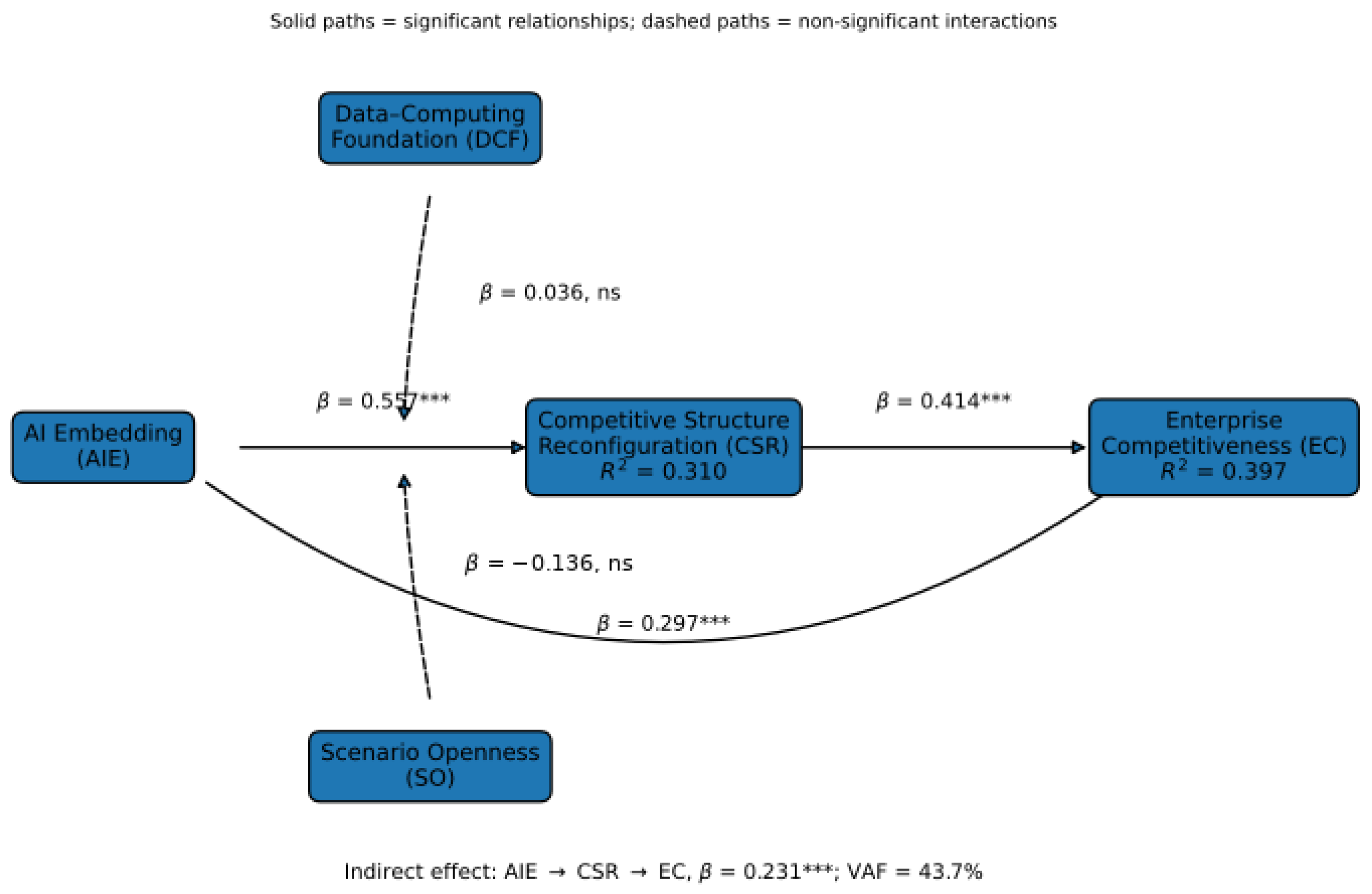
Table 7 reports the explanatory power of the structural model. AI embedding explained 31.0% of the variance in competitive structure reconfiguration, while AI embedding and competitive structure reconfiguration jointly explained 39.7% of the variance in enterprise competitiveness. These results indicate meaningful explanatory capacity for an emerging-industry model, while also suggesting that additional technological, organizational, and environmental factors may account for the remaining variance.

5.3.2. Direct Effects Among AI Embedding, Competitive Structure Reconfiguration, and Enterprise Competitiveness

Table 8 shows that all three direct structural relationships were positive and statistically significant. AI embedding had a stronger association with competitive structure reconfiguration (β = 0.557) than with enterprise competitiveness directly (β = 0.297), while competitive structure reconfiguration also made a substantial contribution to enterprise competitiveness (β = 0.414). Accordingly, H1, H2, and H3 were supported. Full bootstrap statistics and confidence intervals are reported in Table 8.
These direct-effect results establish the structural conditions required for the subsequent mediation analysis; their broader theoretical implications are considered in Section 6.1.

5.4. Mediation Analysis: The Role of Competitive Structure Reconfiguration

The theoretical framework of this study argues that AI embedding affects enterprise competitiveness not only directly, but also indirectly through competitive structure reconfiguration. Therefore, after confirming the direct structural paths, the mediating effect of competitive structure reconfiguration was tested using the specific indirect effect from AI embedding to enterprise competitiveness through competitive structure reconfiguration.
Table 9 shows that the indirect effect of AI embedding on enterprise competitiveness through competitive structure reconfiguration was positive and statistically significant (β = 0.231), supporting H4. The complete bootstrap statistics and confidence interval are reported in Table 9.
The direct effect remained significant after the mediator was included, and the indirect effect accounted for 43.7% of the total effect. Competitive structure reconfiguration therefore represents a partial rather than full mediator. The substantive meaning of this mediation mechanism is discussed in Section 6.1.
VAF = indirect effect/total effect = 0.231/0.528 = 43.7%.

5.5. Moderation Analysis: Data–Computing Foundation and Scenario Openness

This study further examined whether data–computing foundation and scenario openness strengthened the relationship between AI embedding and competitive structure reconfiguration. Two interaction terms were added to the model: AI embedding × data–computing foundation and AI embedding × scenario openness. The moderation model explained 32.9% of the variance in competitive structure reconfiguration and 39.7% of the variance in enterprise competitiveness.
Table 10 shows that neither proposed interaction effect was statistically supported. The interaction between AI embedding and data–computing foundation was small and positive (β = 0.036), whereas the interaction between AI embedding and scenario openness was negative (β = −0.136). Because the corresponding bootstrap confidence intervals included zero, H5 and H6 were not supported. Full statistical results are reported in Table 10, while the theoretical implications of these null findings are discussed in Section 6.1.

5.6. Summary of Hypothesis Testing

Table 11 summarizes the hypothesis-testing results. H1–H4 were supported, confirming the proposed direct and mediating relationships among AI embedding, competitive structure reconfiguration, and enterprise competitiveness. H5 and H6 were not supported, indicating that the two proposed moderating effects were not statistically established.
To facilitate visual interpretation of the empirical findings, Figure 2 summarizes the estimated structural relationships. The figure displays the standardized coefficients for the direct, mediating, and moderating relationships, together with the explained variance of the endogenous constructs. Significant structural paths are represented by solid lines, whereas the unsupported interaction effects are represented by dashed lines.

6. Discussion

6.1. Interpretation of Key Findings

The empirical results yield three principal findings. First, AI embedding is positively associated with enterprise competitiveness. Second, competitive structure reconfiguration partially mediates this relationship. Third, neither data–computing foundation nor scenario openness significantly moderates the relationship between AI embedding and competitive structure reconfiguration. Together, these findings support a process-based explanation of AI-enabled competitiveness while also revealing limits to the proposed boundary conditions.
The positive direct effect of AI embedding is consistent with research linking AI capabilities to innovation, organizational creativity, and firm performance (Mikalef & Gupta, 2021; Haefner et al., 2021; Babina et al., 2024). The contribution, however, is not another general AI adoption–performance relationship. The finding shows that the depth of AI integration into organizational and value-creation activities matters in an industry where algorithms must be combined with hardware, engineering delivery, and real-world interaction. AI embedding therefore captures a form of organizational integration that is more demanding and less readily imitated than the acquisition or isolated use of AI tools.
The mediation finding provides the principal theoretical insight of the study. Competitive structure reconfiguration explains how internally embedded AI is translated into changes in the firm’s external competitive architecture. The partial nature of the mediation is also important: AI embedding retains a direct contribution to competitiveness, while a substantial proportion of its effect operates through changes in competitive relationships and strategic positions. Competitive structure reconfiguration is therefore neither an alternative label for AI capability nor another dimension of competitiveness. It is the intervening process through which internal technological and organizational integration is converted into externally situated advantage. This extends capability-based explanations by incorporating the structural conditions under which firms coordinate interdependencies and capture value.
This mechanism is particularly visible in the Chinese embodied intelligence context. China’s embodied intelligence industry is characterized by dense manufacturing supply chains, active industrial platforms, rapid scenario experimentation, and strong regional clustering. In such a context, enterprise competitiveness is not determined by technological capability alone. Firms must also connect with component suppliers, system integrators, scenario owners, industrial customers, platform organizations, and public innovation infrastructures. The finding on competitive structure reconfiguration shows that AI embedding becomes valuable when it helps firms change their position in this wider industrial structure.
The non-significant moderating effect of data–computing foundation qualifies the assumption that greater digital resources necessarily amplify the benefits of AI embedding. Data and computing resources may operate mainly as threshold conditions: once firms possess a basic operational foundation, additional resources produce limited incremental value unless they improve data quality, model–task alignment, engineering reliability, and organizational learning. Their effect may also depend on complementary capabilities, including technological integration, managerial coordination, and ecosystem orchestration. In this sense, resource deployability and governance quality may matter more than resource quantity. The result therefore suggests that data–computing foundation enables AI use but does not uniformly strengthen the translation of AI embedding into competitive structure reconfiguration.
The non-significant moderating effect of scenario openness likewise suggests that access to application settings does not automatically strengthen the structural consequences of AI embedding. Open scenarios support testing, feedback, and customer interaction, but they may also be available to competitors, reduce exclusivity, and accelerate imitation. Their competitive value depends on whether firms can convert scenario-based learning into proprietary data, repeatable solutions, customer-specific integration capabilities, interface positions, or influence over standards. The effect may also be nonlinear or partly cross-level because scenario openness often reflects regional, platform-level, or institutional conditions. Thus, scenario access creates opportunity, but appropriability and orchestration determine whether that opportunity becomes structural advantage.
Taken together, the unsupported moderation hypotheses suggest that resource availability and environmental opportunity are not sufficient boundary conditions by themselves. The conversion of AI embedding into competitive structure reconfiguration may depend more directly on firms’ capacity to appropriate, orchestrate, and recombine these resources and opportunities. The null findings therefore narrow the theoretical boundary of the proposed model and redirect attention from the quantity of enabling conditions toward the organizational mechanisms through which those conditions are mobilized.
Overall, the findings support a process-based account in which AI embedding generates competitive value both directly and through the reconfiguration of the firm’s competitive structure.

6.2. Theoretical Implications

This study makes three theoretical contributions.
First, the study refines the conceptualization of organizational AI by distinguishing AI embedding from AI adoption. Adoption identifies whether AI technologies are introduced or used, whereas embedding captures the extent to which AI becomes integrated with recurring organizational activities and value-creation processes. This distinction shifts attention from technology possession and usage intensity to the organizational depth of AI integration. It is particularly relevant to embodied intelligence, where competitive outcomes depend on the cumulative combination of AI, physical systems, engineering knowledge, and scenario feedback.
Second, the study introduces competitive structure reconfiguration as a process mechanism between AI embedding and enterprise competitiveness. Existing dynamic capability research primarily explains how firms renew internal resources and routines. The present framework extends this logic by showing that internal AI integration may also alter the external conditions and positions through which firms compete. By separating structural reconfiguration from realized competitiveness, the study provides a clearer explanation of how capability development is translated into competitive advantage.
Third, the study connects AI management research with innovation ecosystem and control-point perspectives. Ecosystem research explains interdependence and complementor coordination, while platform and control-point research explains governance, interfaces, standards, and value-capture positions. The present findings show that firm-level AI embedding can become an antecedent of changes in these relational and positional structures. The theoretical contribution therefore lies not merely in applying ecosystem theory to an AI context, but in explaining how embedded AI may contribute to ecosystem reorganization and the redistribution of value-capture opportunities.
The Chinese context also enriches the theoretical argument. China’s embodied intelligence industry provides a setting in which AI technology, manufacturing capability, scenario experimentation, and regional innovation ecosystems are closely intertwined. This context helps reveal a mechanism that may be less visible in purely software-based AI settings: AI-enabled competitiveness depends on the firm’s ability to connect technology embedding with industrial-chain coordination, scenario learning, and control-point occupation. Thus, China is not only the empirical site of this study; it is also a theoretically meaningful context for understanding how AI generates competitiveness in emerging industries.

6.3. Practical Implications

The findings have several implications for managers and policymakers.
For managers of embodied intelligence firms, the first implication is that AI should not be treated as an isolated technical tool. Firms need to embed AI into R&D, product design, decision-making, internal coordination, scenario development, and field feedback. Fragmented AI use may improve local efficiency, but it is unlikely to generate durable competitiveness.
Second, managers should pay attention to competitive structure reconfiguration. The mediation result shows that AI embedding improves competitiveness partly by changing how firms compete and cooperate. Managers should therefore ask whether AI embedding helps the firm reshape entry conditions, identify scenario demand earlier, reorganize complementor networks, coordinate ecosystem actors, and occupy key control points. These questions are more strategic than simply asking whether AI reduces cost or improves productivity.
Third, firms should not overestimate the automatic value of data and computing resources. Data–computing foundation is important, but the results show that it does not automatically amplify the effect of AI embedding on competitive structure reconfiguration. Firms need to convert data and computing resources into model improvement, product iteration, engineering reliability, customer insight, and scenario-based learning.
Fourth, firms should treat scenario openness as an opportunity that must be transformed into firm-specific advantage. Open scenarios can support testing, validation, and demonstration. However, open scenarios may also be accessible to competitors. Firms need to convert scenario participation into cumulative data, repeatable solutions, customer relationships, delivery capabilities, and positions in standards, interfaces, or platforms. Otherwise, scenario openness may produce experimentation without sustained competitive advantage.
For policymakers and ecosystem organizers, the findings suggest that supporting embodied intelligence firms requires more than providing general infrastructure or opening scenarios. Policy support should help firms build mechanisms for field testing, data feedback, standard alignment, system integration, and cross-actor coordination. Data, computing power, and scenarios create greater value when they are connected with industrial application pathways and ecosystem orchestration mechanisms.

6.4. Limitations and Future Research

This study has several limitations.
First, the study used cross-sectional survey data. Although the theoretical framework specifies directional relationships among AI embedding, competitive structure reconfiguration, and enterprise competitiveness, cross-sectional data cannot fully capture how these relationships evolve over time. Future research could use longitudinal data to examine how firms move from AI adoption to AI embedding, and then to ecosystem positioning and control-point occupation.
Second, the study relied on firm-level survey responses. The questionnaire was completed by key informants familiar with firm practices, and the measurement model showed satisfactory reliability and validity. Nevertheless, subjective evaluation cannot be completely avoided. Future research could combine survey data with objective indicators, such as patents, product deployment records, standard participation, financing events, platform partnerships, customer adoption, or revenue growth.
Third, the sample focused on firms related to the embodied intelligence industry in China, especially firms in the Yangtze River Delta. This focus is appropriate for the research question, but it also limits generalizability. Future research could compare China with other innovation systems to examine whether the AI embedding–competitive structure reconfiguration mechanism operates differently under different institutional, industrial, and ecosystem conditions.
Fourth, the moderating effects of data–computing foundation and scenario openness were not statistically supported. Future research should examine whether these conditions operate through threshold, nonlinear, or configurational mechanisms rather than uniform linear moderation. For data–computing foundation, subsequent studies could distinguish resource quantity from data quality, interoperability, governance maturity, model deployability, and computing-use efficiency. For scenario openness, researchers could separate access breadth, access exclusivity, learning intensity, and the appropriability of scenario-generated knowledge. Multilevel designs could also combine firm-level capabilities with regional, platform-level, or institutional measures of scenario openness. In addition, alternative boundary conditions—including ecosystem orchestration capability, engineering delivery capability, customer co-development intensity, organizational absorptive capacity, platform dependence, and standard-setting participation—may more directly determine when AI embedding produces competitive structure reconfiguration.
Finally, this study conceptualized enterprise competitiveness through technological competitiveness, ecosystem competitiveness, and rule-based competitiveness. Future research could further distinguish short-term commercialization performance, long-term technological leadership, ecosystem centrality, and control over standards or interfaces. Such refinement would help explain different pathways through which AI embedding contributes to firm advantage.
Despite these limitations, this study provides evidence that AI embedding is an important driver of enterprise competitiveness in the embodied intelligence industry and that competitive structure reconfiguration is a key mechanism linking AI embedding to firm-level advantage.

7. Conclusions

This study explains how AI embedding contributes to enterprise competitiveness in the embodied intelligence industry. Based on survey data from 266 firms and PLS-SEM analysis, the results show that AI embedding directly improves enterprise competitiveness and also operates indirectly through competitive structure reconfiguration. The mediation finding indicates that the value of embedded AI arises not only from internal capability enhancement but also from changes in entry conditions, scenario demand, complementor relationships, ecosystem orchestration, and control-point allocation. This process helps firms build technological, ecosystem, and rule-based competitiveness.
The moderating effects of data–computing foundation and scenario openness were not supported. These results suggest that digital resources and open application settings may enable AI use without automatically amplifying its structural consequences. Their value depends on how firms mobilize, govern, and appropriate these resources and opportunities. Overall, the study advances a process-based explanation of AI-enabled competitiveness and provides a foundation for future research on nonlinear, configurational, and multilevel boundary conditions.

Author Contributions

Conceptualization, J.Z.; methodology, J.Z.; software, J.Z.; validation, J.Z.; formal analysis, J.Z.; investigation, J.Z.; resources, J.Z.; data curation, J.Z.; writing—original draft preparation, J.Z.; writing—review and editing, J.Z.; visualization, J.Z.; supervision, J.X.; project administration, N.Z.; funding acquisition, J.X. All authors have read and agreed to the published version of the manuscript.

Funding

This research received no external funding.

Institutional Review Board Statement

The study was reviewed by the Science and Technology Ethics Committee of Hangzhou Dianzi University and was determined to be exempt from full ethical review because it involved an anonymous, non-interventional electronic survey of adult enterprise respondents and did not collect directly identifiable personal information.

Informed Consent Statement

Informed consent was obtained from all subjects involved in the study.

Data Availability Statement

The data are not publicly available because they contain firm-level survey responses collected under confidentiality commitments. The data may be made available from the corresponding author upon reasonable request.

Acknowledgments

The authors thank the scholars and industry experts who provided comments during the questionnaire design and revision process. The authors also thank the participating firms and respondents for their support in the survey.

Conflicts of Interest

The authors declare no conflicts of interest.

Abbreviations

The following abbreviations are used in this manuscript:
AIArtificial intelligence
AIEAI embedding
CSRCompetitive structure reconfiguration
ECEnterprise competitiveness
DCFData–computing foundation
SOScenario openness
PLS-SEMPartial Least Squares Structural Equation Modeling
SEMinRStructural Equation Modeling in R
R&DResearch and development
HTMTHeterotrait–monotrait ratio
AVEAverage variance extracted
VAFVariance accounted for
CIConfidence interval

Appendix A. Survey Questionnaire

Questionnaire on AI Embedding and Enterprise Competitiveness in the Embodied Intelligence Industry

Dear respondent,
Thank you for participating in this survey. This questionnaire aims to understand the actual situation of firms related to the embodied intelligence industry in terms of AI embedding, competitive structure changes, and the formation of enterprise competitiveness. The questionnaire is used only for academic research. All data will be analyzed anonymously, and no firm-level or personal information will be disclosed.
This questionnaire takes the firm as the unit of analysis. In principle, only one valid questionnaire will be retained for each firm. It is recommended that the questionnaire be completed by a person who is familiar with the firm’s AI application, technology R&D, product development, scenario expansion, ecosystem cooperation, or strategic management. Please answer mainly based on the actual situation of your firm over the past three years. There are no right or wrong answers. Please make your judgment according to the actual situation of your firm.
The estimated completion time is approximately 10–12 min. Thank you for your support.
A. Screening Questions and Basic Firm Information
A.1. Screening Questions
S1. Is your firm related to embodied intelligence, robotics, intelligent equipment, AI applications, system integration, intelligent manufacturing, scenario applications, or related industrial services?
A. Yes
B. No
If you choose “No”, please stop filling in the questionnaire.
S2. Are you familiar with your firm’s AI application, technology R&D, product development, scenario expansion, ecosystem cooperation, or competitive strategy?
A. Very familiar
B. Relatively familiar
C. Generally familiar
D. Not very familiar
E. Not familiar at all
If you choose “Not very familiar” or “Not familiar at all”, it is recommended that the questionnaire be completed by another person who is more familiar with the firm’s situation.
S3. Do you agree that the data from this questionnaire may be used anonymously for academic research?
A. Agree
B. Disagree
If you choose “Disagree”, please stop filling in the questionnaire.
S4. To avoid repeated responses from the same firm, please provide an anonymous firm code.
Suggested format: initials of the firm’s abbreviated name + city + any four digits.
Example: YSKJ-HZ-1234. Please do not provide the full name of the firm.
Anonymous firm code: __________
A.2. Basic Firm Information
S5. City where your firm is located:
A. Hangzhou
B. Suzhou
C. Shanghai
D. Other cities in the Yangtze River Delta
E. Other regions
S6. Age of your firm:
A. Less than 3 years
B. 3–5 years
C. 6–10 years
D. 11–20 years
E. More than 20 years
S7. Number of employees in your firm:
A. Fewer than 50 employees
B. 50–99 employees
C. 100–299 employees
D. 300–999 employees
E. 1000 employees or more
S8. Ownership type of your firm:
A. Private enterprise
B. State-owned enterprise
C. Foreign-invested or joint venture enterprise
D. Enterprise incubated by a university or research institute
E. Other
S9. Main position of your firm in the industry chain. Please select the most relevant option.
A. Algorithms, models, software, data platforms, or simulation systems
B. Core components such as sensors, chips, joints, controllers, drivers, or vision systems
C. Robot bodies, intelligent equipment, or intelligent hardware manufacturing
D. Scenario applications, operational services, or industry customer services
S10. Current level of AI application in your firm:
A. No actual application yet; only attention or planning
B. A small number of pilot applications
C. Stable application in some business activities
D. Systematic application in multiple business activities
E. AI has become part of the firm’s core products or core capabilities
S11. Approximate R&D intensity of your firm:
A. R&D expenditure accounts for less than 3% of operating revenue
B. 3–5%
C. 5–10%
D. 10–20%
E. More than 20%
F. Not sure
S12. Main market scope of your firm:
A. Local market
B. Provincial market
C. Yangtze River Delta market
D. National market
E. Overseas market
A.3. Respondent Information
S13. Your position type in the firm:
A. Firm founder, chief executive, or senior manager
B. Technology R&D manager
C. Product or project manager
D. Digitalization, informatization, or data manager
E. Market, business, or ecosystem cooperation manager
F. Production, operations, or supply chain manager
G. Other
S14. Your working years in this firm:
A. Less than 1 year
B. 1–3 years
C. 3–5 years
D. 5–10 years
E. More than 10 years
S15. Do you directly participate in or understand your firm’s AI application, product R&D, scenario implementation, or ecosystem cooperation?
A. Directly participate
B. Relatively familiar but not directly responsible
C. Generally familiar
D. Not very familiar
E. Not familiar at all
B. Core Measurement Items
The following items use a seven-point Likert scale. Please select the option that best reflects the actual situation of your firm over the past three years.
1 = Strongly disagree
2 = Relatively disagree
3 = Slightly disagree
4 = Neutral/uncertain
5 = Slightly agree
6 = Relatively agree
7 = Strongly agree
B.1. AI Embedding Intensity
AI embedding intensity refers to the extent to which AI is integrated into key firm activities such as R&D innovation, business decision-making, organizational coordination, and scenario development.
B.1.1. R&D Innovation Embedding
AIE1. Over the past three years, AI has been used in the core R&D or product development activities of our firm.
AIE2. Our firm uses AI to assist the design and iteration of algorithms, software–hardware systems, or product solutions.
AIE3. Our firm uses AI for simulation testing, prototype validation, performance optimization, or technical trial and error.
B.1.2. Decision-Support Embedding
AIE4. Our firm uses AI to assist in identifying market demand, customer demand, or scenario opportunities.
AIE5. Our firm uses AI to support resource allocation, project selection, operations management, or risk assessment.
AIE6. AI has become an important supporting tool for our firm in judging technology routes, product routes, or market directions.
B.1.3. Organizational Coordination Embedding
AIE7. Our firm uses AI to improve information coordination among R&D, product, production, sales, and service departments.
AIE8. Our firm uses AI to support knowledge sharing, project collaboration, or internal process optimization.
AIE9. Our firm has formed a certain mode of human–AI collaboration, rather than only using AI tools in a scattered manner.
B.1.4. Scenario-Development Embedding
AIE10. Our firm uses AI to identify, develop, or evaluate real application scenarios.
AIE11. Our firm can use scenario data feedback to improve products, algorithms, or solutions.
AIE12. The AI applications of our firm have been integrated with specific industry scenarios, customer scenarios, or on-site tasks.
B.2. Competitive Structure Reconfiguration
Competitive structure reconfiguration refers to the process through which the entry conditions, scenario demand, complementor relationships, ecosystem coordination modes, and key control points in the firm’s competitive environment change during AI embedding.
B.2.1. Entry-Condition Change
CSR1. Over the past three years, the competitive threshold in our business field has increasingly depended on data resources, algorithmic models, simulation testing, and system integration capabilities.
CSR2. Firms lacking AI application capability and engineering implementation capability have found it more difficult to gain customer recognition or project opportunities in this field.
CSR3. The evaluation criteria for competition in this field are shifting from single products, equipment, or prices toward integrated capabilities in technology, scenarios, delivery, and coordination.
B.2.2. Scenario-Driven Demand
CSR4. Feedback from real application scenarios is influencing the technology route and product definition of our firm.
CSR5. Access to, testing of, and validation in scenario resources are becoming important links in product iteration and commercialization for our firm.
CSR6. Customer on-site data, task feedback, and trial operation results are changing the way our firm collaborates with customers or partners.
B.2.3. Complementor Network Reorganization
CSR7. Around AI application and scenario implementation, our firm has developed closer collaboration with algorithm providers, component suppliers, system integrators, platforms, or scenario owners.
CSR8. Our firm adjusts its key partner portfolio according to the needs of scenario development and technology integration.
CSR9. The cooperative relationship between our firm and complementors is shifting from one-time transactions toward joint development, joint testing, or continuous iteration.
B.2.4. Ecosystem Orchestration Change
CSR10. Our firm more frequently coordinates multiple types of external actors in project development or scenario implementation.
CSR11. Platform cooperation, joint R&D, scenario co-construction, or ecosystem alliances are becoming important ways for our firm to participate in competition.
CSR12. The role of our firm in the industrial ecosystem is shifting from a single product or service provider toward a system-solution participant or coordination organizer.
B.2.5. Key Rules and Control-Point Allocation
CSR13. Interfaces, standards, data entry points, platform entry points, or scenario entry points are becoming key positions in competition in this field.
CSR14. Our firm is adjusting resource allocation around key data, platform interfaces, testing and validation resources, or scenario entry points.
CSR15. The acquisition and allocation of key control points are changing the competitive relationships among firms in this field.
B.3. Enterprise Competitiveness
Enterprise competitiveness refers to the relative advantages that a firm develops compared with its main competitors in technology development and iteration, ecosystem cooperation and resource connection, and rule participation and value capture.
B.3.1. Technological Competitiveness
EC1. Compared with major competitors, our firm has stronger capabilities in key algorithms, software–hardware integration, or system performance.
EC2. Compared with major competitors, our firm can complete technology iteration, engineering optimization, and product upgrading more quickly.
EC3. Compared with major competitors, our firm is more capable of integrating algorithms, hardware, software, and real scenario demand into deliverable solutions.
B.3.2. Ecosystem Competitiveness
EC4. Compared with major competitors, our firm is more capable of attracting suppliers, customers, platforms, scenario owners, or research institutions to participate in cooperation.
EC5. Compared with major competitors, our firm has stronger resource-connection capability and cooperation-organization capability in the industrial ecosystem.
EC6. Compared with major competitors, our firm is more capable of achieving product implementation, market expansion, and continuous iteration through ecosystem cooperation.
B.3.3. Rule-Based Competitiveness
EC7. Compared with major competitors, our firm is more capable of participating in or influencing industry standards, technical specifications, interface rules, or application rules.
EC8. Compared with major competitors, our firm has a more favorable position in key data, platform interfaces, scenario entry points, or customer entry points.
EC9. Compared with major competitors, our firm is more capable of obtaining value from standards, interfaces, platforms, data, or scenario entry points.
B.4. Data–Computing Foundation
Data–computing foundation refers to the data resources, computing conditions, and data governance capability required to support AI applications.
DCF1. Our firm has data resources that can be continuously accumulated and accessed.
DCF2. Our firm has computing power, cloud platforms, or computing infrastructure required to support AI applications.
DCF3. The data of our firm can support model training, algorithm optimization, product iteration, or scenario analysis.
DCF4. Our firm has established relatively standardized mechanisms for data collection, management, cleaning, and use.
B.5. Scenario Openness
Scenario openness refers to the degree to which a firm can access real application scenarios, conduct testing and validation, obtain on-site feedback, and carry out demonstration applications.
SO1. Our firm can access real application scenarios for testing, validation, or demonstration.
SO2. Customers, industrial parks, government platforms, or industry partners are willing to open application scenarios to our firm.
SO3. Our firm can obtain continuous data feedback, task feedback, or user feedback in real scenarios.
SO4. Our firm has opportunities to conduct testing, pilots, or demonstration applications in different types of scenarios.
C. Supplementary Control Variables and Extended Items
The following items are used to control for differences in external position, institutional environment, and resource base. They mainly serve follow-up robustness tests, subgroup analyses, or extended analyses, and are not treated as core latent variables in the main model of this study.
C.1. Ecosystem Position
Ecosystem position refers to the role position of a firm in the industry chain, innovation ecosystem, or project cooperation network.
EP1. Our firm has a clear role position in the industry chain or innovation ecosystem.
EP2. Our firm maintains relatively stable cooperative relationships with key customers, suppliers, platforms, scenario owners, or research institutions.
EP3. Our firm frequently participates in joint development, testing and validation, or project implementation across firms, institutions, or scenarios.
EP4. In major cooperative projects, our firm usually undertakes a clear role in technology, product, integration, scenario, or service activities.
C.2. Institutional Support
Institutional support refers to the degree to which a firm receives policy, project, funding, resource-connection, or industrial-service support from governments, industrial parks, industry platforms, or public service systems.
IS1. Over the past three years, our firm has received policy, project, funding, or service support from governments, industrial parks, or industry platforms.
IS2. The region where our firm is located provides good industrial service conditions for firms related to AI, robotics, or embodied intelligence.
IS3. Our firm can obtain external resource-connection opportunities through policy projects, industrial activities, industrial-park platforms, or industry organizations.
IS4. The institutional environment in the region where our firm is located supports the R&D, testing, and implementation of AI products or embodied intelligence applications.
C.3. Firm Resource Base
Firm resource base refers to the talent, technology, and funding conditions on which a firm relies to carry out AI application, technology R&D, product iteration, and market expansion.
FRB1. Our firm has R&D, engineering, or digital talent to support AI applications or embodied intelligence business development.
FRB2. Our firm has technological accumulation related to AI, robotics, intelligent equipment, or scenario applications.
FRB3. Our firm has the financial conditions to continuously invest in R&D, product iteration, and market expansion.
FRB4. Our firm has an organizational foundation for integrating technology, products, and market demand.
D. Quality Control Questions
To ensure the quality of the questionnaire, please answer carefully according to the actual situation. There are no right or wrong answers. All information will be used only for anonymous statistical analysis.
QC1. To ensure questionnaire quality, please select “5 = Slightly agree” for this item.
1 = Strongly disagree
2 = Relatively disagree
3 = Slightly disagree
4 = Neutral/uncertain
5 = Slightly agree
6 = Relatively agree
7 = Strongly agree
QC2. How familiar are you with the AI application, technology R&D, scenario expansion, ecosystem cooperation, and competitive situation of the firm covered by this questionnaire?
A. Very familiar
B. Relatively familiar
C. Generally familiar
D. Not very familiar
E. Not familiar at all
QC3. When completing this questionnaire, your answers were mainly based on:
A. Actual business operations and project experience of the firm
B. Internal firm materials or work records
C. Personal overall impression
D. External public information
E. Not very sure
E. Open-Ended Questions
O1. What do you think is the biggest obstacle currently restricting the deeper application of AI in your firm?
O2. What do you think is the most important source of competition for your firm in embodied intelligence-related business?
O3. In your view, how do real application scenarios mainly influence your firm’s technology R&D, product iteration, or commercialization?
F. Closing Statement
Thank you for your support. All information in this questionnaire will be used only for academic research. The research results will be presented in an anonymous statistical form, and no firm-level or personal identity information will be disclosed. If you would like to receive a summary of the research results, you may leave your contact information separately on the questionnaire submission page. Contact information will be stored separately from the questionnaire data and will not be included in the statistical analysis.


References

  1. Adner, R. (2017). Ecosystem as structure: An actionable construct for strategy. Journal of Management, 43(1), 39–58. [Google Scholar]
  2. Adner, R., & Kapoor, R. (2010). Value creation in innovation ecosystems: How the structure of technological interdependence affects firm performance in new technology generations. Strategic Management Journal, 31(3), 306–333. [Google Scholar]
  3. Baabdullah, A. M., Alalwan, A. A., Slade, E. L., Raman, R., & Khatatneh, K. F. (2021). SMEs and artificial intelligence: Antecedents and consequences of AI-based B2B practices. Industrial Marketing Management, 98, 255–270. [Google Scholar] [CrossRef] [Scilit]
  4. Babina, T., Fedyk, A., He, A., & Hodson, J. (2024). Artificial intelligence, firm growth, and product innovation. Journal of Financial Economics, 151, 103745. [Google Scholar] [CrossRef] [Scilit]
  5. Barclay, D., Higgins, C., & Thompson, R. (1995). The partial least squares approach to causal modeling: Personal computer adoption and use as an illustration. Technology Studies, 2(2), 285–309. [Google Scholar]
  6. Barney, J. (1991). Firm resources and sustained competitive advantage. Journal of Management, 17(1), 99–120. [Google Scholar] [CrossRef] [Scilit]
  7. Berente, N., Gu, B., Recker, J., & Santhanam, R. (2021). Managing artificial intelligence. MIS Quarterly, 45(3), 1433–1450. [Google Scholar] [CrossRef] [Scilit]
  8. Black, S., Samson, D., & Ellis, A. (2024). Moving beyond ‘proof points’: Factors underpinning AI-enabled business model transformation. International Journal of Information Management, 77, 102796. [Google Scholar] [CrossRef] [Scilit]
  9. Brohan, A., Brown, N., Carbajal, J., Chebotar, Y., Dabis, J., Finn, C., Gopalakrishnan, K., Hausman, K., Herzog, A., Hsu, J., Ibarz, J., Ichter, B., Irpan, A., Jackson, T., Jesmonth, S., Joshi, N. J., Julian, R., Kalashnikov, D., Kuang, Y., … Zitkovich, B. (2023, July 10–14). RT-1: Robotics transformer for real-world control at scale. Robotics: Science and Systems XIX, Daegu, Republic of Korea. [Google Scholar] [CrossRef] [Scilit]
  10. Cennamo, C. (2021). Competing in digital markets: A platform-based perspective. Academy of Management Perspectives, 35(2), 265–291. [Google Scholar] [CrossRef] [Scilit]
  11. Chalmers, D., MacKenzie, N. G., & Carter, S. (2021). Artificial intelligence and entrepreneurship: Implications for venture creation in the fourth industrial revolution. Entrepreneurship Theory and Practice, 45(5), 1028–1053. [Google Scholar]
  12. Chen, K., Feng, Z., Kang, J., & Yang, J. (2023). Strategy choices of science and technology development of China’s industries of future. Bulletin of Chinese Academy of Sciences, 38(10), 1459–1467. (In Chinese) [Google Scholar] [CrossRef]
  13. Csaszar, F. A., Ketkar, H., & Kim, H. (2024). Artificial intelligence and strategic decision-making: Evidence from entrepreneurs and investors. Strategy Science, 9(4), 322–345. [Google Scholar] [CrossRef] [Scilit]
  14. Driess, D., Xia, F., Sajjadi, M. S. M., Lynch, C., Chowdhery, A., Ichter, B., Wahid, A., Tompson, J., Vuong, Q., Yu, T., Huang, W., Chebotar, Y., Sermanet, P., Duckworth, D., Levine, S., Vanhoucke, V., Hausman, K., Toussaint, M., Greff, K., … Florence, P. (2023). PaLM-E: An embodied multimodal language model. In Proceedings of the 40th international conference on machine learning (Vol. 202, pp. 8469–8488). ACM. [Google Scholar]
  15. Duan, J., Yu, S., Tan, H. L., Zhu, H., & Tan, C. (2022). A survey of embodied AI: From simulators to research tasks. IEEE Transactions on Emerging Topics in Computational Intelligence, 6(2), 230–244. [Google Scholar] [CrossRef] [Scilit]
  16. Feliciano-Cestero, M. M., Ameen, N., Kotabe, M., Paul, J., & Signoret, M. (2023). Is digital transformation threatened? A systematic literature review of the factors influencing firms’ digital transformation and internationalization. Journal of Business Research, 157, 113546. [Google Scholar] [CrossRef] [Scilit]
  17. Gawer, A., & Cusumano, M. A. (2014). Industry platforms and ecosystem innovation. Journal of Product Innovation Management, 31(3), 417–433. [Google Scholar]
  18. Ghosh, S. (2025). Developing artificial intelligence (AI) capabilities for data-driven business model innovation: Roles of organizational adaptability and leadership. Journal of Engineering and Technology Management, 75, 101851. [Google Scholar] [CrossRef] [Scilit]
  19. Gregory, R. W., Henfridsson, O., Kaganer, E. A., & Kyriakou, H. (2021). The role of artificial intelligence and data network effects for creating user value. Academy of Management Review, 46(3), 534–551. [Google Scholar] [CrossRef] [Scilit]
  20. Haefner, N., Wincent, J., Parida, V., & Gassmann, O. (2021). Artificial intelligence and innovation management: A review, framework, and research agenda. Technological Forecasting and Social Change, 162, 120392. [Google Scholar] [CrossRef] [Scilit]
  21. Hair, J. F., Hult, G. T. M., Ringle, C. M., Sarstedt, M., Danks, N. P., & Ray, S. (2021). Partial least squares structural equation modeling (PLS-SEM) using R: A workbook. Springer. [Google Scholar]
  22. Hair, J. F., Risher, J. J., Sarstedt, M., & Ringle, C. M. (2019). When to use and how to report the results of PLS-SEM. European Business Review, 31(1), 2–24. [Google Scholar] [CrossRef] [Scilit]
  23. Henseler, J., Ringle, C. M., & Sarstedt, M. (2015). A new criterion for assessing discriminant validity in variance-based structural equation modeling. Journal of the Academy of Marketing Science, 43(1), 115–135. [Google Scholar]
  24. Jacobides, M. G., Cennamo, C., & Gawer, A. (2018). Towards a theory of ecosystems. Strategic Management Journal, 39(8), 2255–2276. [Google Scholar] [CrossRef] [Scilit]
  25. Kanbach, D. K., Heiduk, L., Blueher, G., Schreiter, M., & Lahmann, A. (2024). The GenAI is out of the bottle: Generative artificial intelligence from a business model innovation perspective. Review of Managerial Science, 18, 1189–1220. [Google Scholar]
  26. Kellogg, K. C., Valentine, M. A., & Christin, A. (2020). Algorithms at work: The new contested terrain of control. Academy of Management Annals, 14(1), 366–410. [Google Scholar] [CrossRef] [Scilit]
  27. Kock, N. (2015). Common method bias in PLS-SEM: A full collinearity assessment approach. International Journal of e-Collaboration, 11(4), 1–10. [Google Scholar] [CrossRef] [Scilit]
  28. Le, T. T., & Behl, A. (2024). Linking artificial intelligence and supply chain resilience: Roles of dynamic capabilities mediator and open innovation moderator. IEEE Transactions on Engineering Management, 71, 8577–8590. [Google Scholar] [CrossRef] [Scilit]
  29. Lee, M. C. M., Scheepers, H., Lui, A. K. H., & Ngai, E. W. T. (2023). The implementation of artificial intelligence in organizations: A systematic literature review. Information & Management, 60(5), 103816. [Google Scholar] [CrossRef] [Scilit]
  30. Li, J., Gao, F., & Gong, Y. (2023). Innovation ecosystem of future industry: Structure and path. Bulletin of Chinese Academy of Sciences, 38(6), 887–894. (In Chinese) [Google Scholar] [CrossRef]
  31. Mikalef, P., & Gupta, M. (2021). Artificial intelligence capability: Conceptualization, measurement calibration, and empirical study on its impact on organizational creativity and firm performance. Information & Management, 58(3), 103434. [Google Scholar] [CrossRef] [Scilit]
  32. Podsakoff, P. M., MacKenzie, S. B., Lee, J.-Y., & Podsakoff, N. P. (2003). Common method biases in behavioral research: A critical review of the literature and recommended remedies. Journal of Applied Psychology, 88(5), 879–903. [Google Scholar] [CrossRef] [Scilit] [PubMed]
  33. Raisch, S., & Krakowski, S. (2021). Artificial intelligence and management: The automation–augmentation paradox. Academy of Management Review, 46(1), 192–210. [Google Scholar] [CrossRef] [Scilit]
  34. Reed, S., Zolna, K., Parisotto, E., Colmenarejo, S. G., Novikov, A., Barth-Maron, G., Gimenez, M., Sulsky, Y., Kay, J., Springenberg, J. T., Eccles, T., Bruce, J., Razavi, A., Edwards, A., Heess, N., Chen, Y., Hadsell, R., Vinyals, O., Bordbar, M., & de Freitas, N. (2022). A generalist agent. Transactions on machine learning research. arXiv. [Google Scholar] [CrossRef] [Scilit]
  35. Sánchez-Rodríguez, A., García-Vidal, G., Fernández-Ochoa, Y., Martínez-Vivar, R., Gavilanes-Venegas, A. E., & Pérez-Campdesuñer, R. (2025). Navigating uncertainty through AI adoption: Dynamic capabilities, strategic innovation performance, and competitiveness in Ecuadorian SMEs. Administrative Sciences, 15(12), 468. [Google Scholar] [CrossRef] [Scilit]
  36. Sjödin, D., Parida, V., & Kohtamäki, M. (2023). Artificial intelligence enabling circular business model innovation in digital servitization: Conceptualizing dynamic capabilities, AI capacities, business models and effects. Technological Forecasting and Social Change, 197, 122903. [Google Scholar] [CrossRef] [Scilit]
  37. Song, X. (2024). From empowerment to enablement: AI-driven future industry cultivation. Frontiers, 2024(12), 78–89. (In Chinese) [Google Scholar] [CrossRef]
  38. Suarez, F. F. (2004). Battles for technological dominance: An integrative framework. Research Policy, 33(2), 271–286. [Google Scholar] [CrossRef] [Scilit]
  39. Teece, D. J. (2007). Explicating dynamic capabilities: The nature and microfoundations of enterprise performance. Strategic Management Journal, 28(13), 1319–1350. [Google Scholar] [CrossRef] [Scilit]
  40. Teece, D. J. (2018). Business models and dynamic capabilities. Long Range Planning, 51(1), 40–49. [Google Scholar] [CrossRef] [Scilit]
  41. Teece, D. J., Pisano, G., & Shuen, A. (1997). Dynamic capabilities and strategic management. Strategic Management Journal, 18(7), 509–533. [Google Scholar] [CrossRef] [Scilit]
  42. Tiwana, A., Konsynski, B., & Bush, A. A. (2010). Platform evolution: Coevolution of platform architecture, governance, and environmental dynamics. Information Systems Research, 21(4), 675–687. [Google Scholar] [CrossRef] [Scilit]
  43. Vomberg, A., Schauerte, N., Krakowski, S., Ingram Bogusz, C., Gijsenberg, M. J., & Bleier, A. (2023). The cold-start problem in nascent AI strategy: Kickstarting data network effects. Journal of Business Research, 168, 114236. [Google Scholar] [CrossRef] [Scilit]
  44. Wei, R., & Pardo, C. (2022). Artificial intelligence and SMEs: How can B2B SMEs leverage AI platforms to integrate AI technologies? Industrial Marketing Management, 107, 466–483. [Google Scholar] [CrossRef] [Scilit]
  45. Xue, L., & Jiang, L. (2025). Generative AI-driven paradigm shift for future industrial innovation. Bulletin of Chinese Academy of Sciences, 40(5), 820–827. (In Chinese) [Google Scholar] [CrossRef] [Scilit]
  46. Zitkovich, B., Yu, T., Xu, S., Xu, P., Xiao, T., Xia, F., Wu, J., Wohlhart, P., Welker, S., Wahid, A., Vuong, Q., Vanhoucke, V., Tran, H., Soricut, R., Singh, A., Singh, J., Sermanet, P., Sanketi, P. R., Salazar, G., … Gonzalez, M. (2023). RT-2: Vision-language-action models transfer web knowledge to robotic control. In J. Tan, M. Toussaint, & K. Darvish (Eds.), Proceedings of the 7th conference on robot learning, Atlanta, GA, USA, 6–9 November 2023 (Vol. 229, pp. 2165–2183). PMLR. [Google Scholar]
Figure 1. Conceptual framework. Note Solid arrows indicate statistically significant relationships, whereas dashed arrows indicate non-significant interaction effects.
Admsci 16 00352 g001
Figure 2. Final structural model with standardized path coefficients. Note: Standardized path coefficients are reported. Solid paths represent statistically significant relationships, whereas dashed paths represent non-significant interaction effects. *** p < 0.001; ns = not significant. The indirect effect of AI embedding on enterprise competitiveness through competitive structure reconfiguration was 0.231 (p < 0.001), with a VAF of 43.7%.
Admsci 16 00352 g002
Table 1. Constructs, abbreviations, and measurement dimensions.
ConstructAbbreviationModel RoleMeasurement DimensionsItems
AI embeddingAIEIndependent variableR&D innovation embedding3
decision-support embedding3
organizational coordination embedding3
scenario-development embedding3
Competitive structure reconfigurationCSRMediating variableEntry-condition change3
scenario-driven demand3
complementor network reorganization3
ecosystem orchestration change3
control-point allocation3
Enterprise competitivenessECDependent variableTechnological competitiveness3
ecosystem competitiveness3
rule-based competitiveness3
Data–computing foundationDCFModerating variableData resources1
computing resources1
data governance1
model-supporting infrastructure1
Scenario opennessSOModerating variableScenario access1
field testing1
user feedback1
ecosystem collaboration1
Table 2. Sample distribution by industry-chain position and region.
CategorySubcategoryNumberPercentage
Industry-chain positionAlgorithm models, software platforms, simulation systems, and data platforms5922.2%
Core components, sensors, controllers, chips, drives, and vision systems5922.2%
Robot bodies, intelligent equipment, and system integration9435.3%
Scenario applications, industrial platforms, pilot-scale platforms, and ecosystem services5420.3%
Total266100.0%
RegionHangzhou/Zhejiang area9234.6%
Suzhou area8431.6%
Shanghai area8933.5%
Other region10.4%
Total266100.0%
Table 3. Indicator loadings.
ConstructItemLoading
AIEAIE10.740
AIEAIE20.660
AIEAIE30.826
AIEAIE40.820
AIEAIE50.721
AIEAIE60.758
AIEAIE70.805
AIEAIE80.706
AIEAIE90.783
AIEAIE100.702
AIEAIE110.746
AIEAIE120.788
CSRCSR10.740
CSRCSR20.794
CSRCSR30.828
CSRCSR40.843
CSRCSR50.691
CSRCSR60.752
CSRCSR70.767
CSRCSR80.747
CSRCSR90.851
CSRCSR100.842
CSRCSR110.790
CSRCSR120.697
CSRCSR130.734
CSRCSR140.721
CSRCSR150.779
ECEC10.821
ECEC20.817
ECEC30.817
ECEC40.820
ECEC50.797
ECEC60.809
ECEC70.784
ECEC80.781
ECEC90.800
DCFDCF10.849
DCFDCF20.829
DCFDCF30.738
DCFDCF40.583
SOSO10.716
SOSO20.690
SOSO30.792
SOSO40.735
Table 4. Internal consistency and convergent validity.
ConstructCronbach’s AlpharhoAComposite ReliabilityAVE
AIE0.9310.9350.9410.572
CSR0.9520.9540.9570.598
EC0.9320.9330.9430.649
DCF0.7720.8590.8400.573
SO0.7200.7430.8240.540
Table 5. Discriminant validity based on HTMT.
ConstructAIEDCFSOCSREC
AIE-
DCF0.372-
SO0.3700.598-
CSR0.5860.1760.116-
EC0.5610.2150.1750.611-
Table 6. Common method bias and collinearity assessment.
AssessmentIndicatorValueRecommended ThresholdConclusion
Harman’s single-factor testVariance explained by the first unrotated factor35.64%<50%Acceptable
Full collinearity VIFAIE1.765<3.3Acceptable
Full collinearity VIFCSR1.734<3.3Acceptable
Full collinearity VIFEC1.645<3.3Acceptable
Full collinearity VIFDCF1.312<3.3Acceptable
Full collinearity VIFSO1.309<3.3Acceptable
Inner VIF: predictors of CSRAIE1.153<3.3Acceptable
Inner VIF: predictors of CSRDCF1.311<3.3Acceptable
Inner VIF: predictors of CSRSO1.299<3.3Acceptable
Inner VIF: predictors of ECAIE1.437<3.3Acceptable
Inner VIF: predictors of ECCSR1.437<3.3Acceptable
Table 7. Explanatory power of endogenous constructs.
Endogenous ConstructPredictor(s)R2Adjusted R2
Competitive structure reconfigurationAI embedding0.3100.308
Enterprise competitivenessAI embedding; competitive structure reconfiguration0.3970.392
Table 8. Direct structural path results.
HypothesisPathStandardized Coefficient (β)t-Value95% CIp-ValueResult
H1AIE → EC0.2975.822[0.202, 0.400]<0.001Supported
H2AIE → CSR0.55713.267[0.474, 0.639]<0.001Supported
H3CSR → EC0.4148.141[0.312, 0.511]<0.001Supported
Note: Standardized coefficients are reported. Bootstrapping was performed using 5000 resamples. CI = confidence interval.
Table 9. Mediation effect of competitive structure reconfiguration.
HypothesisIndirect PathIndirect EffectBootstrap Meant-Value95% CIp-ValueResult
H4AIE → CSR → EC0.2310.2327.247[0.171, 0.297]<0.001Supported
Note: The indirect effect was assessed using bootstrapping with 5000 resamples. CI = confidence interval; VAF = variance accounted for.
Table 10. Moderation effect results.
HypothesisInteraction PathStandardized Coefficient (β)t-Value95% CIp-ValueResult
H5AIE × DCF → CSR0.0360.653[−0.091, 0.128]0.700Not supported
H6AIE × SO → CSR−0.136−2.090[−0.235, 0.019]0.097Not supported
Note: Standardized interaction coefficients are reported. Bootstrapping was performed using 5000 resamples. CI = confidence interval.
Table 11. Summary of hypothesis testing.
HypothesisStatementResult
H1AI embedding has a positive effect on enterprise competitiveness.Supported
H2AI embedding has a positive effect on competitive structure reconfiguration.Supported
H3Competitive structure reconfiguration has a positive effect on enterprise competitiveness.Supported
H4Competitive structure reconfiguration mediates the relationship between AI embedding and enterprise competitiveness.Supported
H5Data–computing foundation positively moderates the relationship between AI embedding and competitive structure reconfiguration.Not supported
H6Scenario openness positively moderates the relationship between AI embedding and competitive structure reconfiguration.Not supported
Disclaimer/Publisher’s Note: The statements, opinions and data contained in all publications are solely those of the individual author(s) and contributor(s) and not of MDPI and/or the editor(s). MDPI and/or the editor(s) disclaim responsibility for any injury to people or property resulting from any ideas, methods, instructions or products referred to in the content.