


Abstract
Amid Europe’s demographic decline and the intensifying global “war for talent,” migration is increasingly viewed as a critical source of human capital capable of sustaining economic growth and welfare systems. Nevertheless, the literature on Macro-Talent Management (MTM) has primarily focused on the attraction of highly skilled expatriates, paying limited attention to how national integration systems shape the broader capacity of countries to attract and retain migrant talent. Addressing this gap, the present study conceptualizes migrant integration as a strategic component of macro-level talent management and evaluates the “talent attractiveness” of different European welfare and migration regimes. Methodologically, the study develops a multi-criteria evaluation framework based on the PROMETHEE II (Preference Ranking Organization Method for Enrichment of Evaluations) outranking method, enabling the simultaneous assessment of institutional, socio-economic, and administrative dimensions of migration governance. The model integrates nine indicators combining policy inclusiveness (e.g., Migrant Integration Policy Index—MIPEX (Migrant Integration Policy Index), citizenship accessibility), labor market outcomes (employment and gender gaps), and systemic pressures on migration management (asylum applications). By integrating policy indicators with real-world labor market performance and administrative capacity, the proposed framework offers a novel analytical tool for comparative migration policy evaluation and decision support. The empirical application covers six European countries representing distinct migration regimes: Portugal, Sweden, France, Poland, Greece, and Germany. The results challenge the conventional assumption that economic strength alone determines migrant attractiveness. Portugal emerges as the most attractive destination, demonstrating that inclusive rights-based integration policies can offset lower GDP levels. In contrast, Germany ranks last in the sample, revealing signs of systemic overextension due to extreme administrative pressure, while Greece occupies the fifth position characterized by structural integration deficits. The study contributes to the literature by linking migration governance, integration policy effectiveness, and macro-level talent management and by introducing a multi-criteria decision-analytic approach for evaluating national migration systems in Europe. The study offers a reassessment of the ‘talent attractiveness’ of European welfare models in a post-pandemic context (2023).
1. Introduction
In the contemporary globalized economy, talent management has emerged as a strategic imperative of the highest significance, implemented by both organizations and nations. In light of rapid technological advancements, demographic shifts, and the ever-increasing demand for specialized human capital, talent management has become synonymous with a sustainable competitive advantage (Collings & Mellahi, 2009). While the concept of talent management gained prominence in the corporate sector just in the early 2000s, the global instability and labor shortages characterizing the modern labor market have necessitated a shift: a transition from the traditional obsession with a narrow group of “high-potential” corporate elites toward a more inclusive Macro-Talent Management (MTM) approach (Khilji et al., 2015; Vaiman et al., 2018).
A pivotal point within this uncertain landscape is the underutilization of diverse talent pools, primarily migrants and refugees. Despite the unprecedented scale of global displacement—with millions of individuals leaving their homelands in search of stability in host countries—migrant populations continue to be viewed primarily through a humanitarian lens rather than as a vital source of human capital. This disconnect, combined with population aging and structural skills gaps, represents a significant missed opportunity for modern European economies. As Clutterbuck (2012) notes, talent must be treated as a fluid and complex asset; however, narrow legal frameworks, unrecognized qualifications, and systemic barriers often prevent migrants from being categorized as “talent,” leading to widespread phenomena of “brain waste” (OECD, 2008).
The nexus between migration and talent management lies in the concept of integration efficacy. For a host country to be characterized as a “talent destination,” it must possess an effective ecosystem that promotes not only entry but also social and economic inclusion. Research identifies employment as the cornerstone of successful integration; however, significant gaps remain between policy intent and labor market reality (Ager & Strang, 2008). While some nations possess effective support systems—such as comprehensive pathways to citizenship and rapid recognition of qualifications—others lag behind, creating a fragmented European landscape where a country’s “attractiveness” is determined by its ability to bridge these integration gaps (Konle-Seidl & Bolits, 2016).
Consequently, there is a growing need for robust methodological tools capable of evaluating and comparing national integration systems from a talent management perspective. Traditional analyses often rely on single-dimensional indicators (e.g., GDP per capita or unemployment rates), failing to capture the multi-faceted nature of attractiveness, which includes social cohesion, housing conditions, and administrative efficiency. This study addresses this gap by adopting a Multi-Criteria Decision-Making (MCDM) approach, specifically the PROMETHEE II method. PROMETHEE is widely recognized for its ability to handle conflicting criteria and provide transparent rankings in complex policy contexts (Brans & Vincke, 1985). As demonstrated in previous applications regarding social inclusion in the EU (Blouchoutzi et al., 2021), the method allows for a nuanced assessment of how different policy measures interact to create an environment conducive to talent retention.
The objective of this paper is to bridge the gap between MTM and migration studies by empirically evaluating the “talent attractiveness” of diverse European welfare models. By applying the PROMETHEE II method to a representative sample of six European countries—reflecting the Nordic (Sweden), Continental (Germany, France), Eastern (Poland), New Destination (Portugal), and Mediterranean Frontline (Greece) regimes—this study moves beyond theoretical discussions to offer a quantitative benchmarking of integration efficiency. It argues that effective integration policies are not merely social safety nets but active mechanisms of talent attraction, transforming the challenge of migration into a strategic asset for national competitiveness.
2. Theoretical Framework
2.1. Macro-Talent Management: A National Imperative
Building upon the foundational understanding of organizational talent management explored in our recent integrative review (Tsaousiotis et al., 2025), it becomes evident that the scope of talent management has transcended corporate boundaries. While the traditional view, as defined by Collings and Mellahi (2009), focuses on the systematic identification and development of high-potential individuals within a firm, the contemporary global landscape necessitates a broader perspective. This evolution has led to the emergence of Macro-Talent Management (MTM). According to the seminal definition by Khilji et al. (2015), MTM refers to the activities systematically developed by governments and non-governmental organizations to attract, develop, and retain talent for the benefit of the country. Unlike the micro-level approach, which targets organizational competitive advantage, MTM aims for national competitiveness and economic sustainability.
The necessity of MTM arises from the intensification of the “Global War for Talent.” Just as corporations compete for market share, nations now compete for human capital. As noted by Vaiman et al. (2018), macro-level factors—such as economic stability, quality of life, and institutional frameworks—act as critical determinants in the migration decisions of skilled individuals. In this context, the state assumes a role similar to that of an HR department, responsible for “nation branding” and creating an ecosystem conducive to talent growth. Lanvin and Evans (2018), in their Global Talent Competitiveness Index, argue that a country’s ability to compete depends on its capacity to grow, attract, and retain talent, emphasizing that talent-driven economic development is no longer a luxury but a necessity for survival in the knowledge economy.
However, the transition from organizational to national talent management introduces significant complexity. While organizations can rely on specific competency frameworks (McDonnell et al., 2017), nations must manage a diverse and often fragmented “talent pool” that includes the domestic workforce, the diaspora, and immigrants. Consequently, MTM is inherently systemic. It requires the alignment of various policy domains—education, labor, immigration, and social welfare—to create a coherent strategy. As highlighted by Crowley-Henry et al. (2018), successful MTM requires a holistic ecosystem where legal frameworks and social policies facilitate rather than hinder the mobility and integration of talent. This systemic view aligns with the findings of Sinisterra et al. (2024) regarding the need for inclusive environments, extending the argument from the workplace to the societal level.
Finally, the strategic importance of MTM is magnified in the context of demographic decline. For many European nations facing aging populations and shrinking workforces, the attraction of foreign talent is not merely a strategy for growth but a mechanism for demographic resilience (OECD, 2008). In this regard, MTM overlaps significantly with migration policy. The ability of a country to market itself as a “talent destination” depends heavily on its integration infrastructure. As suggested by Cerdin et al. (2014), the “attractiveness” of a location is a composite of professional opportunities and ease of social integration. Therefore, effective Macro-Talent Management is inextricably linked to the capacity of the state to offer clear pathways for the social and economic inclusion of migrants, transforming them from transient workers into long-term strategic assets.
2.2. The Integration–Attraction Nexus: Migration as a Human Capital Resource
Migration flows are traditionally dichotomized into two categories: voluntary migrants, who relocate in pursuit of career advancement or economic prospects (Cerdin et al., 2014), and involuntary migrants—primarily refugees—displaced by conflict or environmental instability. While the motivations differ, the core challenge for host nations remains identical: effectively integrating these populations into the labor market. A crucial distinction arises in the stakeholder approach: governments prioritize national security and societal cohesion, whereas corporations view migration through the lens of talent acquisition and productivity. As noted by the OECD (2008), bridging these divergent perspectives through coordinated strategies is essential to enhance labor market efficiency.
A critical barrier in operationalizing MTM for migrants is the prevalence of the “Charity vs. Asset” dichotomy. Recruiters often perceive refugee applicants through a humanitarian lens, hiring them out of Corporate Social Responsibility (CSR) rather than for their skills (Gericke et al., 2018; Ortlieb et al., 2021). While well-intentioned, this perspective risks stigmatizing migrants as “helpless” or low-skilled, obscuring their actual capabilities (Baranik et al., 2018). Shifting the paradigm to assess migrants based on their human capital potential is vital for aligning roles with skills, thereby improving retention and productivity (Lundborg & Skedinger, 2016; Pesch et al., 2023).
Structural barriers, specifically the lack of recognition for foreign credentials, exacerbate this issue. Countries with formalized skill assessment mechanisms tend to convert migration flows into active talent more effectively. For instance, Denmark integrates skill profiling into its mandatory integration program, while in Austria, employment agencies collaborate with support organizations to verify qualifications (Ortlieb & Weiss, 2020). Conversely, in systems lacking such infrastructure, skilled migrants face “Brain Waste,” becoming trapped in low-skilled occupations despite holding advanced degrees—a phenomenon quantified in this study through the over-qualification rate criterion.
The integration challenge is spatially uneven across Europe, particularly for Southern “frontline” states. In Greece, for example, previous restrictive employment laws intended to protect the local workforce created a rigid job market, pushing many migrants into the underground economy or unemployment. Although recent reforms have aimed to streamline the asylum system, the absence of a comprehensive MTM strategy has resulted in significant lags in labor market absorption (Tsaousiotis et al., 2025). This reflects a broader European paradox: despite demographic decline and clear economic needs, refugees are often categorized solely as a burden rather than a potential resource (Colic-Peisker & Tilbury, 2006).
Consequently, this study posits that for a country to function as an attractive “Talent Destination,” it must first resolve these integration inefficiencies. Unlike prior literature, which has predominantly explored these challenges qualitatively, this paper aims to quantify the “attractiveness” of national systems. By employing the PROMETHEE II method, we move beyond theoretical discussions to rigorously benchmark how different European welfare models manage the intersection of migration policy and talent attraction, identifying both the “Best Practices” of the North and the structural bottlenecks of the South.
3. Materials and Methods
The study adopts a Multi-Criteria Decision-Making (MCDM) framework in order to systematically evaluate and compare the attractiveness of European national migration systems. MCDM methods are widely used in policy evaluation and socio-economic analysis when decision problems involve multiple, often conflicting criteria that cannot be captured by a single indicator (Stewart, 2025). In the context of migration governance, national systems differ simultaneously in institutional inclusiveness, labor market outcomes, and administrative capacity. Consequently, a multidimensional analytical approach is required to capture these complex trade-offs and to construct a comparable evaluation of countries (Bangun et al., 2025).
Within this framework, the study employs the PROMETHEE II method to generate a complete ranking of selected European countries according to their capacity to integrate and retain migrant talent. PROMETHEE II belongs to the family of outranking methods developed by Brans and Vincke and is particularly suitable for decision problems where criteria may conflict and where the objective is to establish a transparent preference structure among alternatives (Brans & De Smet, 2016). Unlike simple weighted scoring techniques, PROMETHEE II compares alternatives pairwise across all criteria and calculates preference flows that express the relative dominance of each alternative over the others. This characteristic makes the method particularly appropriate for policy analysis settings in which countries may perform well on some indicators (e.g., economic performance) while simultaneously lagging in others (e.g., migrant integration outcomes).
The methodological procedure followed several steps. First, a decision matrix was constructed where each country represents an alternative and each selected indicator represents a criterion. The criteria were selected to reflect three main analytical dimensions of migrant attractiveness: institutional integration policies, labor market performance, and administrative pressure on migration systems. Second, the criteria were normalized to ensure comparability and weighted according to their relative analytical importance, following established practices in MCDM applications (Stewart, 2025). Third, preference functions were applied to measure the degree to which one country outperforms another for each criterion. The PROMETHEE II algorithm then calculates positive and negative preference flows, representing the strengths and weaknesses of each alternative relative to the others, respectively. The net flow (Φ) is derived as the difference between positive and negative flows and provides the final ranking of countries (Coquelet et al., 2025).
The choice of PROMETHEE II is further justified by its transparency, robustness, and suitability for policy evaluation, as it allows researchers to explicitly model trade-offs between competing criteria and to incorporate both quantitative and qualitative indicators. Previous studies have applied PROMETHEE methods successfully in fields such as environmental policy evaluation, regional development assessment, and public governance benchmarking (Brans & De Smet, 2016; Behzadian et al., 2010; Blouchoutzi et al., 2021). In migration and socio-economic policy analysis, national systems often exhibit contradictory characteristics—such as high economic attractiveness combined with weak integration frameworks—the outranking logic of PROMETHEE II provides a particularly appropriate analytical tool.
Overall, the adoption of the PROMETHEE II approach enables the study to move beyond single-indicator comparisons and to provide a structured, multidimensional evaluation of migration governance attractiveness, thereby offering a scientifically robust framework for comparative policy analysis across European countries.
3.1. Evaluation Model, Criteria Selection, Data Acquisition, and Sampling Strategy
The evaluation model consists of nine (9) criteria (gj) selected to capture the duality of the migration experience, as detailed in Table 1, which provides a description of each indicator and its optimization goal (Min/Max).
Table 1.
The Evaluation Criteria of the PROMETHEE Model.
Data were extracted from two verified international databases:
- MIPEX (Migrant Integration Policy Index): Used for policy indicators, drawing on the longitudinal data provided by Solano and Huddleston (2020).
- Eurostat: Used for socio-economic performance metrics (Period: 2019–2023) (Eurostat, 2023).
Operationalizing MTM in the Evaluation Model: To directly bridge the theoretical framework of Macro-Talent Management (MTM) with our empirical research, the nine selected criteria are explicitly mapped onto the core pillars of a national talent management strategy (Khilji et al., 2015; Vaiman et al., 2018):
- Talent Attraction & Institutional Openness: Criteria g2 (MIPEX Score) and g4 (Access to Citizenship) operationalize the state’s capacity to “attract” talent. In MTM terms, these act as the nation’s “HR branding,” reflecting whether the institutional framework actively welcomes and secures the legal status of incoming human capital, which is a primary driver of skilled migration (Cerdin et al., 2014; Solano & Huddleston, 2020).
- Talent Development & Utilization (Preventing Brain Waste): Criteria g1 (Employment Gap), g6 (Gender Gap), g7 (Over-qualification), and g8 (Early Educational Leavers) measure the actual utilization of talent. Specifically, the over-qualification rate (g7) captures the “brain waste” phenomenon highlighted in recent macroeconomic reports (OECD, 2023). It indicates whether a state successfully allocates skilled migrants to appropriate roles or squanders their potential in low-skilled sectors, a critical failure in MTM (Pesch et al., 2023).
- Talent Retention & Social Cohesion: Criterion g5 (Housing Overcrowding) serves as a proxy for social integration and living conditions. In MTM, retaining talent requires moving beyond formal employment to ensure long-term social welfare, spatial inclusion, and quality of life (Ager & Strang, 2008).
- Systemic Capacity & Administrative Friction: Criteria g3 (Negative Decisions) and g9 (Asylum Applications) represent the contextual processing capacity of the state. An effective MTM system must efficiently process human capital; high volumes of unresolved applications (g9) create an administrative bottleneck that severely hinders the entire talent integration pipeline.
Furthermore, while asylum metrics (g3 and g9) may traditionally be viewed outside the strict scope of highly skilled migration, they are critical barometers of a state’s Macro-Talent Management capacity. In the European context, the asylum apparatus and the labor migration infrastructure are deeply intertwined. An overwhelming volume of asylum applications (g9) creates massive administrative bottlenecks that spill over into the processing of all migration channels, hindering the state’s agility to process and absorb talent efficiently. Similarly, high rates of negative decisions (g3) act as a proxy for an inherently restrictive and hostile institutional environment—often characterizing a ‘fortress’ approach. Such strictness damages a nation’s global HR brand and deters prospective talent, who prioritize institutional stability and openness when selecting a destination (Czaika & de Haas, 2013; Cerdin et al., 2014).
The model is applied to a purposive sample of six (6) representative countries following a “most-different systems” design based on established European welfare and migration regimes (Esping-Andersen, 1990; Ferrera, 1996; Fenger, 2007):
- Portugal (PT): New Migration Destination model with rapid policy adaptation.
- Sweden (SE): Nordic/Social-Democratic model with high state intervention.
- Germany (DE): Continental/Corporatist model acting as an industrial engine.
- France (FR): Continental/Centralist model with distinct assimilationist traditions.
- Poland (PL): Eastern European/Post-Communist model.
- Greece (EL): Mediterranean model/Frontline state with fragmented social protection.
The deliberate selection of a small, purposive sample of six countries is not a statistical limitation but a fundamental methodological choice based on the ‘most-different systems’ design (Seawright & Gerring, 2008). In Multi-Criteria Decision Analysis (MCDA), such as the PROMETHEE method, the objective is not statistical generalization but the in-depth structural comparison of distinct, finite alternatives (Brans & De Smet, 2016). These six nations were systematically selected as representative archetypes of diverse European welfare and migration regimes (Esping-Andersen, 1990; Ferrera, 1996): the Nordic model (Sweden), the Corporatist (Germany), the Assimilationist (France), the Mediterranean/structurally inefficient model (Greece), the ‘New Destination’ (Portugal), and the Eastern transition model (Poland). Introducing additional countries would not significantly alter the fundamental structural dynamics of these established archetypes; rather, it would visually clutter the GAIA (Geometrical Analysis for Interactive Aid) plane and outranking networks, thereby obscuring the clear policy comparative insights.
The quantitative input data are presented in Table 2 (Decision Matrix), forming the basis for the PROMETHEE II evaluation.
Table 2.
The Decision Matrix (Performance of the 6 Countries).
The reliance on MIPEX 2020 is methodologically consistent with research highlighting the institutional path dependency and the slow pace of legislative reform in migration regimes. As noted by Solano and Huddleston (2020), integration policies represent long-term structural commitments that do not shift abruptly, providing a stable institutional baseline for evaluating macro-talent management even in post-pandemic analyses.
3.2. Data Processing and Synthesis
Following the construction of the Decision Matrix, the data were systematically processed using the Visual PROMETHEE software (Academic Edition). Unlike traditional variance-based statistical methods, the PROMETHEE II method utilizes pairwise comparisons to determine the relative dominance of one welfare model over another. The synthesis procedure was executed through the following four methodological stages:
- Stage 1: Selection of Preference Functions and Thresholds
For each of the nine criteria (g1 to g9), a Linear Preference Function (Type V) was assigned. This choice is critical for macroeconomic benchmarking, as it avoids binary outcomes and allows for a gradual transition from indifference to strict preference. To ensure statistical robustness and minimize researcher bias, the indifference (q) and preference (p) thresholds were not arbitrarily assigned; instead, they were calculated based on the standard deviation of each criterion’s distribution across the sample. This ensures that the model remains sensitive to the actual spread of the data.
- Stage 2: Pairwise Comparisons and Global Preference Index
For every pair of countries (a, b), the model computes a preference degree Pj(a, b), representing the intensity of preference for country a over b regarding criterion j. These partial preferences are then aggregated into a Global Preference Index π(a, b):
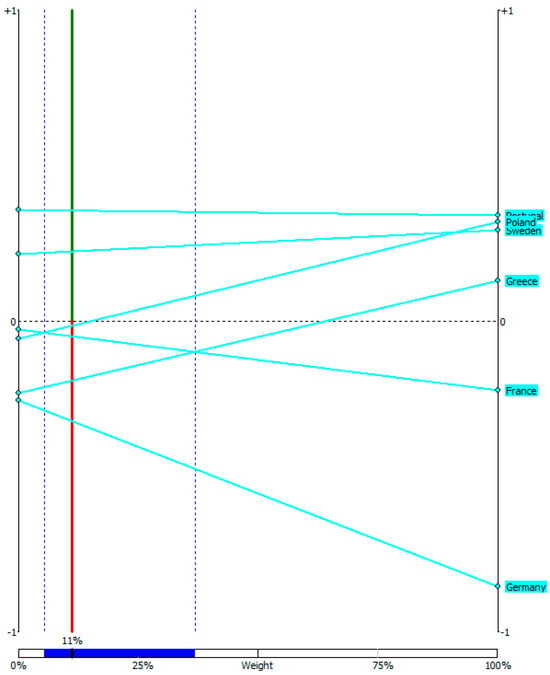
In this study, an “Equal Weighting” strategy (wj = 1/9) was strictly applied. The assignment of weights is often the most subjective phase of MCDM, potentially skewing results toward specific indicators (e.g., favoring economic metrics over social rights). By assigning equal importance to institutional readiness (MIPEX) and labor market outcomes (Eurostat), the model guarantees an unbiased evaluation of “Talent Attractiveness.” This methodological rigor aligns with established research in migration studies (Blouchoutzi et al., 2021). The application of equal weighting (wj = 1/9) across all nine criteria constitutes a deliberate normative choice, which is standard practice in major composite policy indices such as MIPEX (Solano & Huddleston, 2020). Currently, the Macro-Talent Management (MTM) and migration literature lack a definitive consensus on whether policy inputs (e.g., attraction mechanisms) should inherently outweigh socio-economic outcomes (e.g., integration and retention) (Khilji et al., 2015). Consequently, assigning differential weights without robust empirical justification could introduce significant researcher bias (OECD, 2008). To methodologically address the normative nature of this equal weighting approach, a comprehensive sensitivity analysis is integrated into our results via the Visual Stability Intervals (Figure 1). This dynamic analysis evaluates alternative weighting scenarios and mathematically confirms that the core outranking hierarchy remains structurally robust even if the criteria weights were to fluctuate. Due to the voluminous nature of the individual pairwise comparisons (Pj(a, b) matrices), the mathematical synthesis of these preference degrees is transparently aggregated and presented as partial net flows (Φ j) in Table 3, ensuring full methodological rigor without compromising manuscript readability. This allows for a granular inspection of how specific indicators, such as the high administrative pressure in Germany (g9), influence the final outranking.
Figure 1.
Visual Stability Intervals for the Asylum Pressure criterion (g9). The graph indicates the stability range for the top-ranked alternative (Portugal). On the right vertical axis, the overlapping cluster of labels represents Portugal, Sweden, and Poland, demonstrating that these countries share very similar (and relatively low) partial net flows for administrative pressure, in stark contrast to the extreme negative outlier at the bottom (Germany). Note: In the graph, the thick red vertical line represents the current weight of the criterion, while the blue vertical line indicates the stability threshold. The light blue lines and small circles represent the partial net flows of the alternative countries.
Table 3.
Net Preference Flows per Criterion (Φ j).
- Stage 3: Outranking Flows Calculation
The core of the ranking procedure involves the calculation of two distinct flows for each country:
- Positive Outranking Flow (Φ+): Measures the extent to which a country is “outranking” (dominating) all other alternatives. It represents the country’s collective strengths.
- Negative Outranking Flow (Φ−): Measures the extent to which a country is “outranked” by others. It reflects the country’s relative weaknesses and structural lags.
- Stage 4: Complete Ranking (Net Flow)
The final hierarchy is established by the Net Outranking Flow (Φ), which provides the final “Attractiveness Score.” The Net Flow is the balance between the positive and negative flows:
Alternatives with a higher Φ are considered more attractive. This complete ranking ensures that no two countries are left incomparable, transforming the raw, multidimensional data of Table 3 into a single, comprehensive performance metric for each European welfare model.
The final step (Stage 4) involves the calculation of the Net Outranking Flow (Φ), which represents the balance between the positive and negative flows for each country. A positive Φ indicates a model that structurally outranks the others across most criteria (e.g., Portugal and Sweden), while a negative Φ signifies systemic weaknesses or high administrative pressures. In this study, the net flow is particularly sensitive to the ‘Asylum Applications’ (g9) indicator, where extreme values can significantly penalize a country’s overall performance, as observed in the case of Germany.
3.3. Robustness and Sensitivity Analysis
In Multi-Criteria Decision-Making (MCDM) problems, the stability of the final ranking is a critical parameter for validating results. Since the assignment of weights can introduce subjectivity, a quality assessment of the model was conducted through Sensitivity Analysis using the Visual PROMETHEE software.
Specifically, we examined the “Weight Stability Intervals” (WSI) for each criterion. This analysis determines the range within which the weight of a criterion (gj) can vary without altering the final ranking of the top-performing country (Brans & De Smet, 2016). This step is essential to verify that the leading position of the “New Destination” model (Portugal) is not a result of biased weighting but reflects a structural superiority across multiple indicators.
Table 4 presents the stability intervals for all nine criteria based on the standard “Equal Weighting” scenario (wj = 11.1%).
Table 4.
Stability Intervals for the PROMETHEE II Model (Top Rank Robustness).
Furthermore, to validate the reliability of the data, the study adhered to the “Data Quality Framework” proposed by the OECD (2008) for composite indicators. We ensured the following:
- Completeness: No missing values for the selected 6 countries.
- Timeliness: All quantitative indicators (g1, g3, g5, g6, g8, g9) were updated to the reference year 2023 to capture the post-pandemic migration reality.
- Comparability: Indicators were sourced exclusively from harmonized international databases (Eurostat, MIPEX) rather than disparate national reports, ensuring that definitions of “migrant” and “employment” are consistent across the sample.
- To visually illustrate the model’s robustness, Figure 1 displays the Visual Stability Intervals for Asylum Pressure (g9). As shown, the top ranking of the “New Destination” model (Portugal) remains stable as long as the weight of this critical factor stays within the calculated interval, validating the choice of balanced weights even under extreme administrative pressure.
4. Results
Before proceeding with the detailed profile analysis, a methodological distinction must be explicitly clarified. It is crucial to note that while PROMETHEE II provides a robust mathematical hierarchy of alternatives based on the selected criteria, outranking flows represent relative performance and preference relations, not statistical causality (Roy, 1991; Belton & Stewart, 2002). Consequently, the structural typologies identified below (e.g., the superior ranking of the ‘New Destination’ model) indicate a mathematically higher alignment with the established MTM evaluation matrix, rather than a direct, deterministic causal relationship between specific policy inputs and socio-economic outcomes. The analysis highlights structural associations and systemic vulnerabilities, avoiding strict causal inferences.
4.1. Overall Ranking and Preference Flows
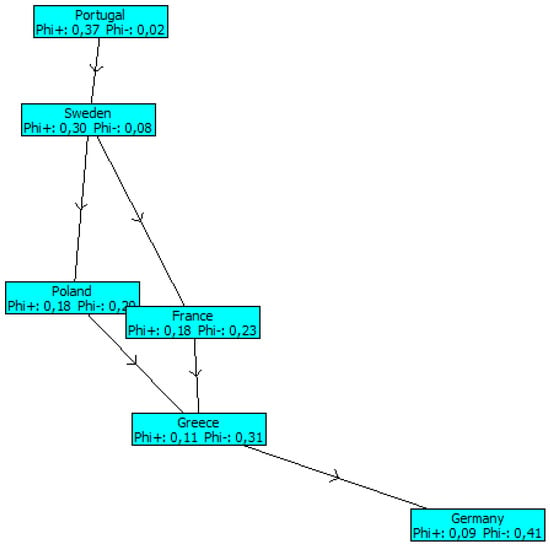
The application of the PROMETHEE II method yielded a comprehensive ranking of the six European welfare models, revealing significant disparities in their “Talent Attractiveness.” The results are derived from the calculation of the Net Outranking Flow (Φ), which synthesizes the balance between a country’s strength (Φ+) and weakness (Φ−) across all nine criteria (Brans & Vincke, 1985).
The vertical axis represents the Net Outranking Flow (Φ), positioning the alternatives hierarchically from the most positive to the most negative values. The directed edges (black arrows) visually map the outranking relationships, explicitly showing how the top-tier integration models mathematically dominate the structurally weaker alternatives within the European cluster.
Figure 2.
PROMETHEE II Complete Ranking Network. The vertical axis corresponds to the Net Outranking Flow (Φ). The directed arrows indicate the strict preference flows, illustrating the clear hierarchical lead of the “New Destination” model (Portugal) over the lagging models.
Table 5.
Results of the Data Transformation: PROMETHEE II Outranking Flows.
- Portugal (1st Rank): Exhibits the highest positive net flow (Φ > 0). This top position suggests that effective integration policies—specifically high scores in Citizenship and MIPEX (g2, g4)—can successfully offset lower economic indicators, validating the “Integration–Attraction” hypothesis (Oliveira, 2023).
- Sweden (2nd Rank): Maintains a strong positive flow, consistent with the Nordic model’s long-standing tradition of social welfare, although slightly penalized by higher housing costs compared to the leader.
- Poland (3rd Rank): Occupying the third position (Φ = −0.02), Poland leads the intermediate cluster, showing that emerging policies with low administrative friction can enhance outranking flows.
- France (4th Rank): Positioned 4th (Φ = −0.05), the French centralist model demonstrates moderate performance, struggling with structural gaps compared to the Nordic and New Destination models.
- Greece (5th Rank): Occupying the fifth position (Φ = −0.20). While Greece suffers from “Structural Vulnerabilities” and significant “Brain Waste,” its net flow is mathematically superior to that of Germany. This is because the Mediterranean model faces lower administrative pressure regarding the total volume of asylum applications (g9) compared to the Continental engine.
- Germany (6th Rank): Occupying the last position in the sample with the largest negative flow (Φ = −0.32). Despite being the economic engine of Europe, Germany exhibits severe “Systemic Overextension”. The extreme volume of asylum applications creates a significant system overload that mathematically diminishes its overall attractiveness as a talent destination.
4.2. Visual Analysis: The GAIA Plane
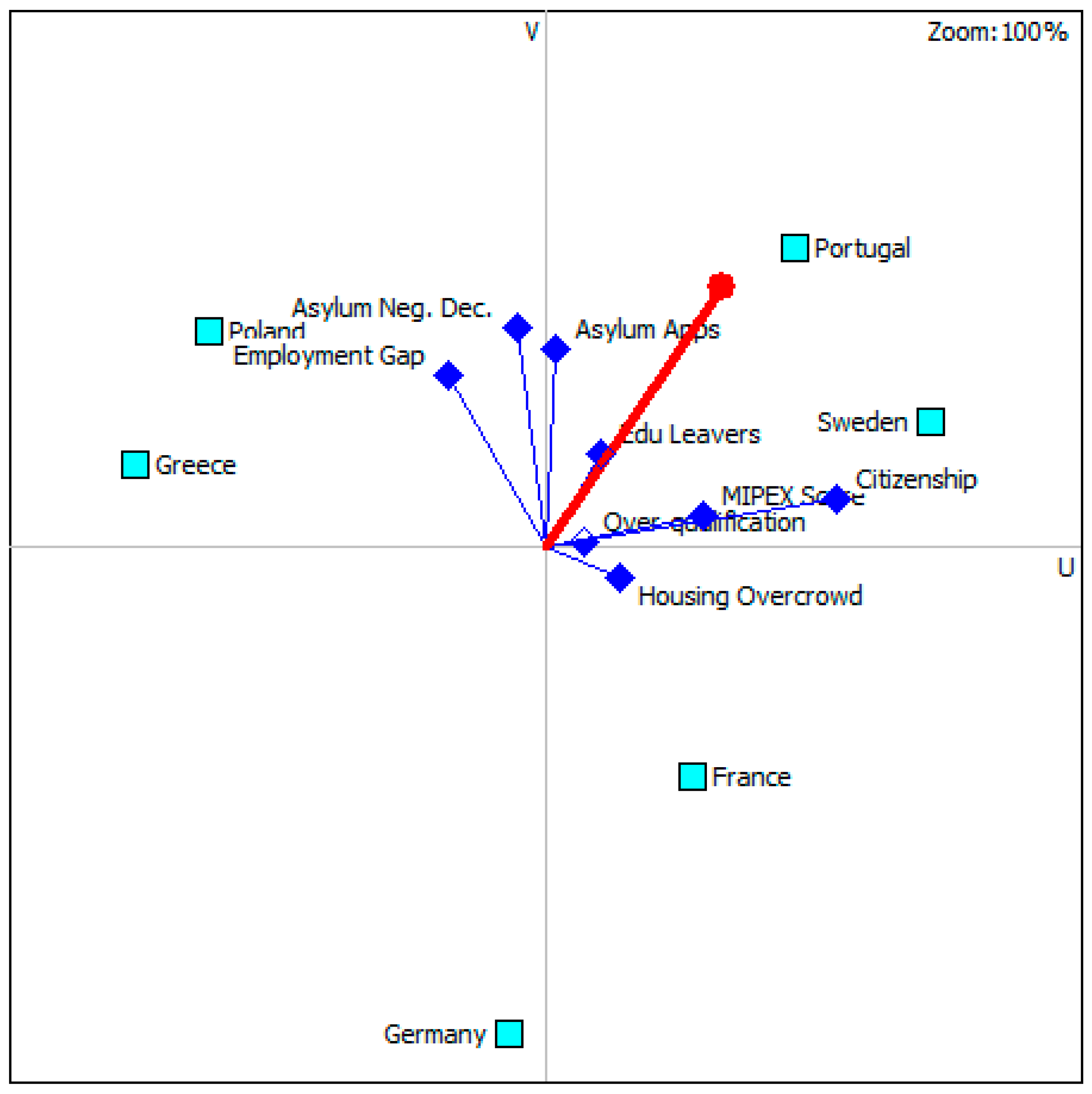
To further understand the conflicting criteria driving these results, the GAIA (Geometrical Analysis for Interactive Aid) plane was generated. The GAIA plane projects the multidimensional decision problem into a two-dimensional space to visualize the interaction between criteria and alternatives (Brans & De Smet, 2016).
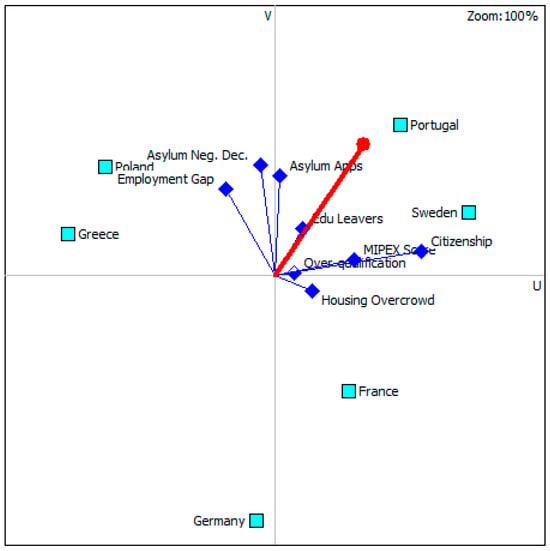
As observed in Figure 3, the criteria related to Policy (g2, g4) and Outcomes (g1, g7) are in conflict with Administrative Pressure (g9). Germany is positioned far from the decision axis (π) in the direction of the Pressure vector, confirming that its attractiveness is penalized by system overload. Conversely, Portugal is located in the direction of the Policy vectors, indicating that its legislative openness compensates for its smaller economic size.
Figure 3.
GAIA Plane Analysis. The decision axis (π) points towards the most attractive alternatives, Portugal and Sweden. The visual analysis reveals a distinct conflict between the Policy Cluster (g2 MIPEX, g4 Citizenship) and the Outcome Cluster (g1 Employment Gap, g7 Over-qualification), which align with the leading “New Destination” and “Nordic” models. Conversely, the Pressure Vector (g9 Asylum Applications) points strongly towards Germany, mathematically explaining its last position in the ranking due to extreme systemic saturation. Note: The red vector ending in a circle represents the decision axis (π). The blue lines ending in diamonds represent the evaluation criteria, and the light blue squares denote the alternative countries.
The visual configuration of Figure 3 highlights the “Economic-Institutional Divergence” identified in the ranking:
- The Policy–Pressure Conflict: The criteria related to institutional readiness (g2, g4) and labor market outcomes (g1, g7) are oriented towards the upper-right quadrant, aligning with Portugal and Sweden. This confirms that for these nations, attractiveness is driven by legislative openness and efficient integration outcomes (Huddleston et al., 2015).
- The Saturation Vector: A distinct, long vector representing Asylum Pressure (g9) points towards the bottom-left quadrant, directly targeting Germany. This graphical separation illustrates that Germany is an “outlier”: while it possesses economic strength, the sheer volume of administrative burden acts as a counter-force to attractiveness, pulling it away from the optimal decision axis (π).
- Cluster Analysis: The grouping of Portugal near the π axis highlights its role as the “Best Compromise” solution. It effectively balances high citizenship rights with low administrative pressure, whereas Greece and Poland are positioned centrally but closer to the origin, indicating a lack of strong positive drivers compared to the leaders (Blouchoutzi et al., 2021).
4.3. Comparative Profile Analysis: The ‘New Destination’ vs. The Lagging Models
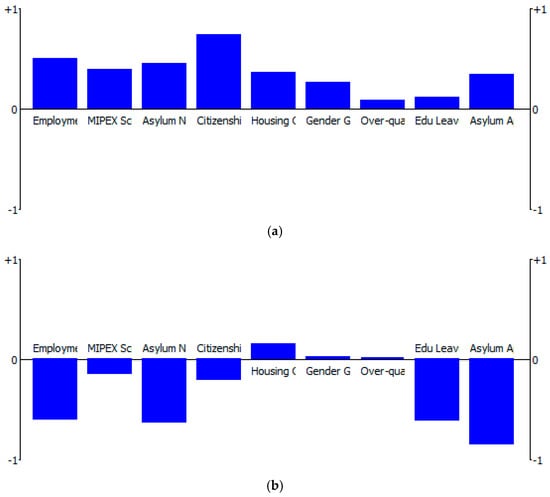
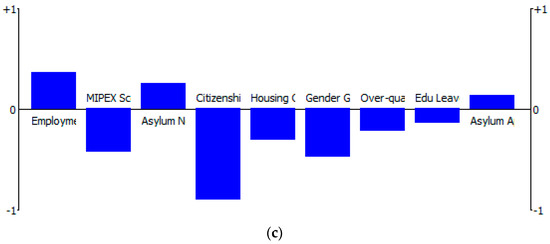
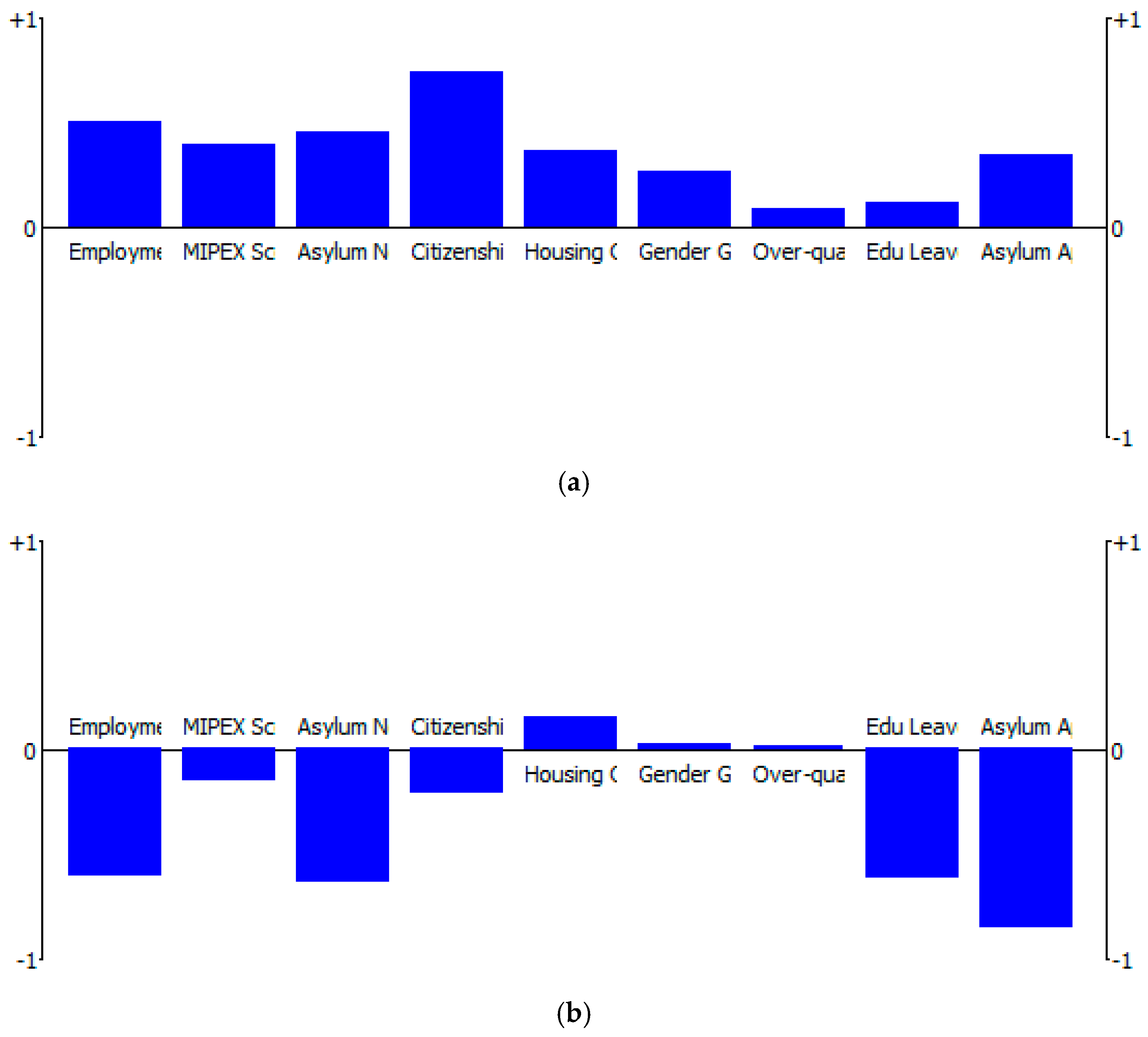
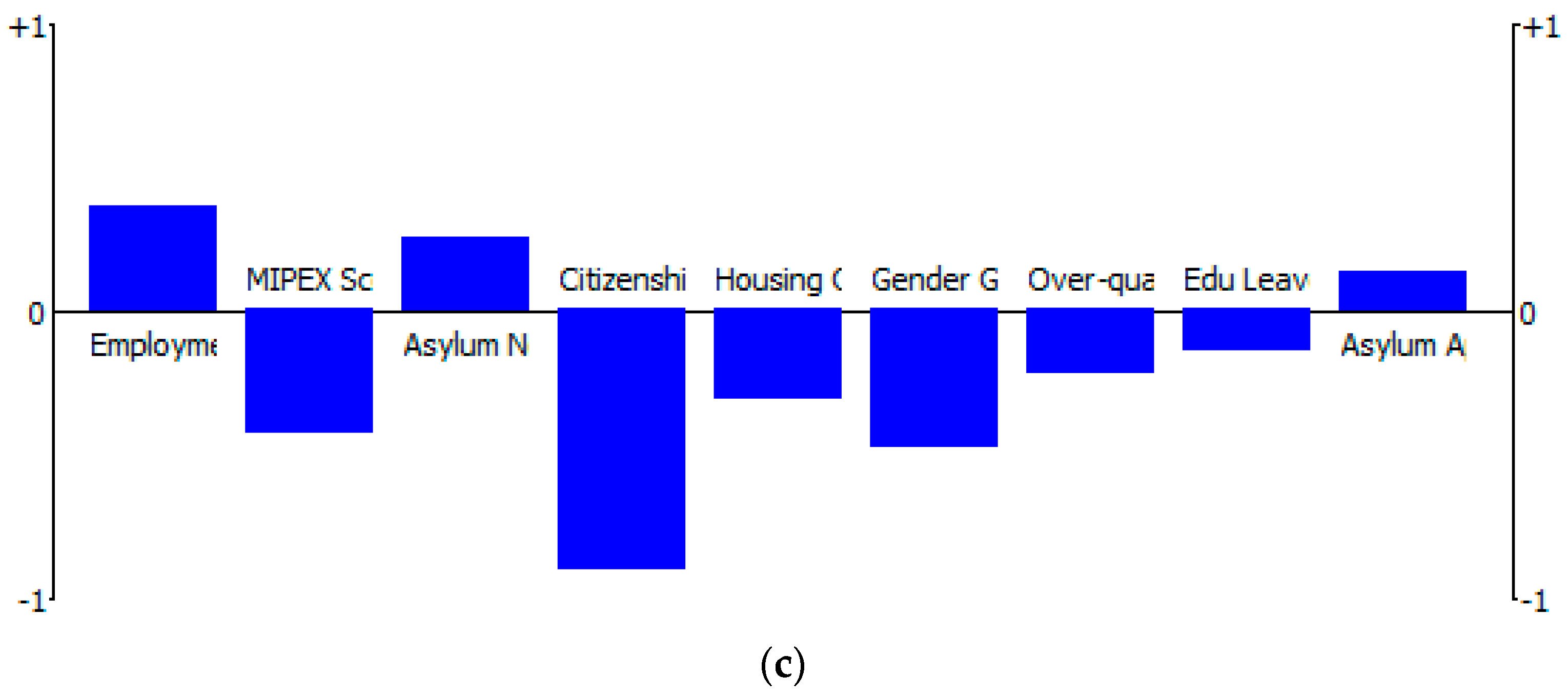
To pinpoint the specific strengths and weaknesses driving the ranking, we conducted a granular profile analysis of the top-ranked country (Portugal) and the lagging models, specifically Greece (Rank 5) and Germany (Rank 6). Figure 4a,b illustrate the net flow decomposition for each nation, highlighting the critical factors that determine their position.
Figure 4.
(a) Profile of Portugal (Rank 1). The dominance of positive bars (blue) in Citizenship Policy (g4) and MIPEX Score (g2) confirms that its attractiveness is policy-driven. (b) Profile of Germany (Rank 6). The profile is dominated by an overwhelming negative flow in Asylum Applications (g9), illustrating a Systemic Overextension that neutralizes its high economic potential and drops it to the last rank of the sample. (c) Profile of Greece (Rank 5). The profile is characterized by multidimensional negative flows in integration outcomes, notably in Citizenship accessibility (g4) and Over-qualification (g7). This illustrates profound Structural Vulnerabilities and the “brain waste” phenomenon, which severely limit the country’s attractiveness, despite avoiding the extreme systemic saturation of the lowest-ranked model. Note: The truncated labels on the horizontal axis (e.g., ‘Employme’, ‘Citizenshi’) are automatically abbreviated by the software due to space constraints; they fully correspond to the evaluation criteria defined in Table 1.
The visual comparison reveals a structural dichotomy:
- Portugal’s Policy Advantage (Figure 4a): The profile is characterized by strong positive performance in legislative indicators (g2, g4). This indicates that Portugal’s strategy relies on “Legislative Attractiveness”—offering rights and easy integration paths to compensate for lower economic incentives (Oliveira, 2023).
- Germany’s Systemic Overextension (Figure 4b): In stark contrast to Portugal’s policy-driven success, Germany’s profile (Rank 6) is primarily defined by a single, critical pressure point: the extreme volume of asylum applications (g9). While the country possesses significant economic “hard power,” this administrative bottleneck creates a “Saturation Effect” that severely hinders the migration management apparatus. This massive negative flow effectively offsets the advantages of strong economic opportunity, leading to the lowest net outranking flow (Φ = −0.32) in the study.
- Greece’s Structural Vulnerabilities (Figure 4c): Although not the lowest-ranked, Greece (Rank 5) exhibits a profile characterized by multidimensional weaknesses in integration. The significant negative flows in Citizenship accessibility (g4), Gender Gap (g6), and Over-qualification (g7) visually confirm the “Brain Waste” hypothesis. However, Greece avoids the extreme systemic saturation observed in the German case, allowing it to maintain a slightly higher net flow.
4.4. Sensitivity Analysis and Ranking Robustness
To rigorously validate the stability of the entire outranking hierarchy—beyond just the leading position of Portugal—an extended sensitivity analysis was conducted focusing on alternative weighting scenarios and the structural exclusion of individual criteria.
- Alternative Weighting Scenarios & Intermediate Stability: The Visual Stability Intervals (Figure 1) dynamically simulate extreme weighting shifts. The analysis reveals that while the top tier (Portugal, Sweden) and the bottom tier (Greece, Germany) are structurally crystallized, the intermediate positions exhibit moderate sensitivity. Specifically, Poland (Φ = −0.02) now maintains a narrow lead over France (Φ = −0.05). While these two models are close to the neutrality threshold, the sensitivity analysis confirms that even under significant fluctuations in weighting, they remain part of the same “intermediate cluster,” distinct from the leaders and the laggards.
- Criteria Exclusion (relative preference relations Simulation): To verify the robustness of the ranking against omitted variables, we applied a ‘leave-one-out’ simulation logic. This approach systematically excludes one criterion at a time (particularly highly polarizing ones like g3 or g9) to observe if the overall ranking collapses. Given that each criterion holds a maximum weight of 11.1%, its total removal can only alter an alternative’s net flow by a maximum theoretical margin of approximately ±0.11. Considering the definitive mathematical gaps between the archetypes—such as the profound ΔΦ = 0.67 distance between Portugal (Φ = +0.35) and Germany (Φ = −0.32)—the removal of any single indicator is mathematically insufficient to invert the overarching hierarchy. The structural dominance of the “New Destination” model over the “Systemic Overextension” model is therefore an embedded empirical reality, not an artifact of criteria selection.
5. Conclusions and Policy Implications
The present study offers a comprehensive reassessment of the “talent attractiveness” of European welfare models in the post-pandemic context (2023), shifting the analytical focus from traditional GDP-based indicators toward a multidimensional evaluation of institutional readiness, integration capacity, and administrative pressures. By applying the PROMETHEE II method, complemented by GAIA visual analysis, to a dataset of six representative European countries, the study challenges the widely held assumption that economic strength alone drives a country’s capacity to attract migrant talent. The findings reveal an ongoing structural transformation in the European migration landscape, providing empirical support for the “Integration–Attraction Hypothesis” and highlighting the structural limitations of saturated welfare systems.
A key empirical contribution of the analysis is the identification of the “Economic-Institutional Divergence,” illustrated by the marked contrast between Portugal, which ranks first, and Germany, which occupies the last position in the sample, preceded by Greece in the fifth rank. This outcome challenges the traditional North–South dichotomy frequently discussed in European migration studies. Portugal’s leading position (Φ > 0) is structurally associated with its strong performance in citizenship accessibility and integration indicators, particularly high MIPEX scores and inclusive legal frameworks. Sensitivity analysis confirms the robustness of this result, suggesting that within contemporary Macro-Talent Management, transparent legal pathways to integration and citizenship, combined with low administrative barriers, function as stronger attraction mechanisms than short-term wage differentials. In this context, Portugal represents a “new migration destination” model, where institutional openness operates as a form of policy-driven soft power capable of compensating for relatively smaller economic size (Oliveira, 2023; Solano & Huddleston, 2020).
Conversely, Germany’s position at the bottom of the ranking provides evidence of a “Systemic Overextension”. Despite its strong economic performance, the German model appears constrained by significant administrative pressures, particularly the high volume of asylum applications. The GAIA plane analysis indicates that this pressure operates as a counterbalancing force that reduces overall attractiveness. Moreover, relatively high levels of migrant over-qualification in the labor market suggest that when migration systems exceed their administrative and institutional capacity, the effectiveness of migrant integration declines, potentially leading to human capital underutilization(“brain waste”) (De Haas, 2021; Tsaousiotis et al., 2025).
The results also confirm the relative stability of the Nordic model, with Sweden ranking second and exhibiting balanced performance across most evaluation criteria, although emerging challenges related to housing accessibility remain evident. In contrast, the Eastern European model (Poland) occupies the third position, while the Mediterranean model (Greece) is placed in the fifth rank, ahead of Germany. While these countries demonstrate some improvement in integration capacity, they still lack proactive talent-oriented migration strategies capable of enhancing their attractiveness within the European migration system. Greece, in particular, continues to face structural constraints associated with high administrative pressure, which limits its transition from a transit country to a stable destination for migrant talent.
Based on the diagnostic insights derived from the PROMETHEE II analysis, the study proposes a Strategic Policy Map (Table 6), translating the quantitative ranking results into targeted policy recommendations for national governments and European policymakers.
Table 6.
Strategic Policy Recommendations per Welfare Model (The “Intervention Matrix”).
From a theoretical perspective, this study contributes to the literature on International Human Resource Management (IHRM) and migration governance by reconceptualizing national attractiveness in the context of global talent mobility. Specifically, the findings suggest that national attractiveness can no longer be understood as a linear function of GDP or economic size alone. Instead, it should be interpreted as a dynamic ratio between opportunity and administrative friction, where institutional quality, integration capacity, and administrative efficiency shape a country’s ability to attract and retain migrant talent. The PROMETHEE II results clearly demonstrate that high levels of administrative friction—as observed in the German case, which ranks last in the sample—can substantially offset the advantages of strong economic opportunity.
These findings align with broader theoretical perspectives on the global competition for talent, which emphasize that migration decisions are increasingly shaped by institutional openness, integration pathways, and long-term settlement opportunities rather than by wage differentials alone (Florida, 2003; Shachar, 2006). The international mobility of skilled labor is therefore influenced not only by economic incentives but also by governance frameworks that facilitate social and economic integration. In this sense, the results support the view that migration attractiveness is fundamentally linked to the quality of migration governance and integration institutions.
The empirical evidence presented in this study therefore underscores the need for a paradigm shift in European migration policy, moving away from a predominantly quota-based approach toward more flexible talent partnership mechanisms. The divergence observed between EU member states indicates that a “one-size-fits-all” migration policy is unlikely to be effective. Instead, the European Union could benefit from promoting a cooperative ecosystem in which countries experiencing systemic overextension support integration and mobility programs in emerging migration destinations. Such coordinated strategies could help balance talent distribution across the EU and reduce the risk of human capital underutilization (“brain waste”) (European Commission, 2022; Czaika, 2018).
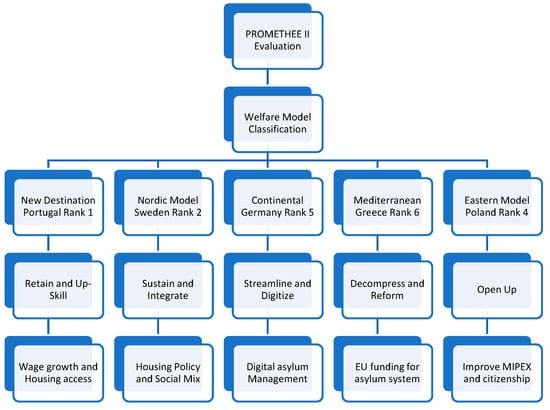
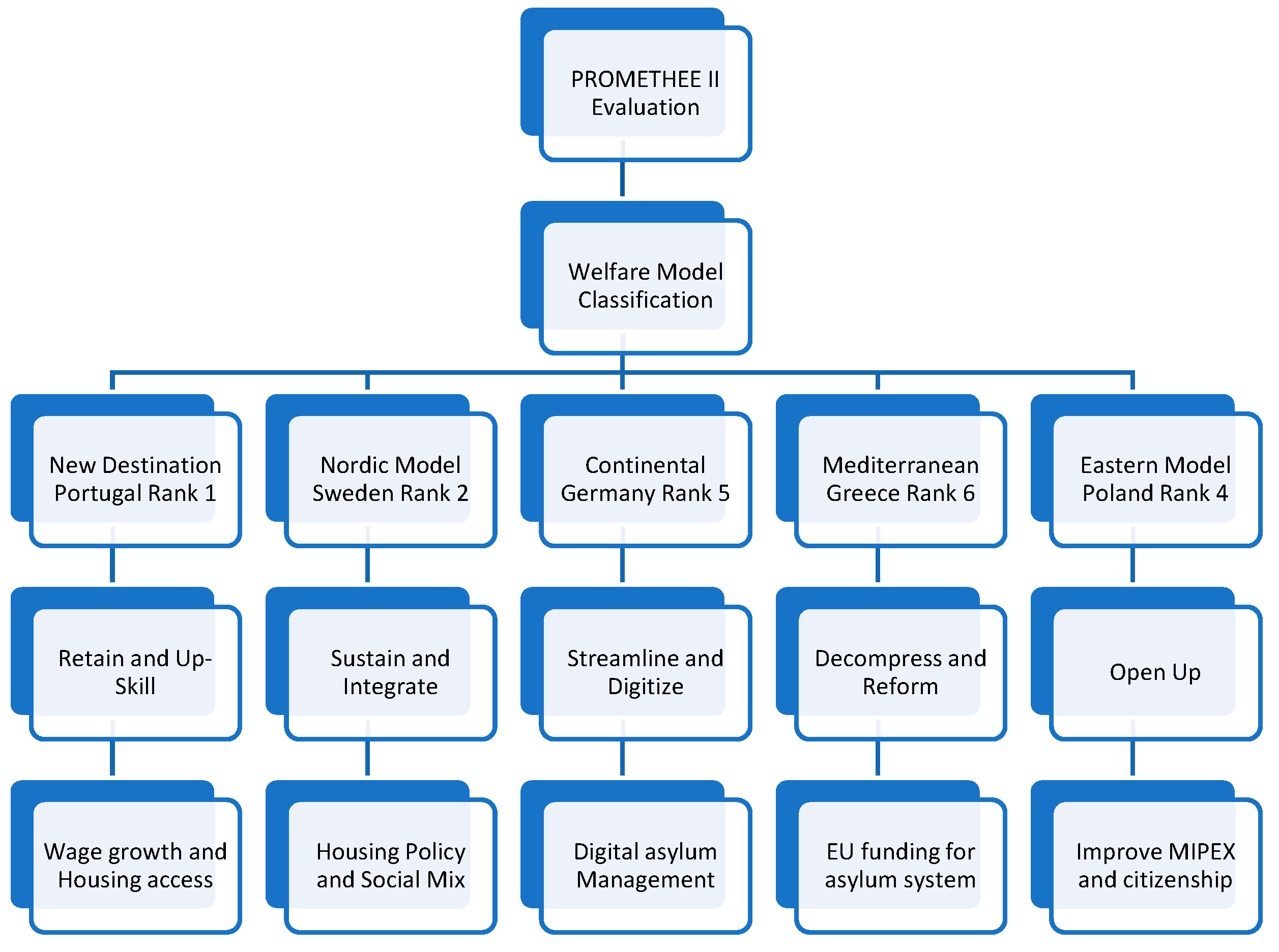
Drawing upon the multidimensional PROMETHEE diagnostics and the GAIA visual analysis, this study proposes a comprehensive Migration Governance Typology (Figure 5). This typology synthesizes the empirical findings, categorizing the evaluated European welfare models into specific strategic profiles based on their Net Flow (Φ) ranking. For each model, targeted, actionable policy strategies are formulated to optimize macro-talent management:
Figure 5.
Migration Governance Typology based on PROMETHEE II diagnostics, illustrating the strategic positioning, ranking, and core policy recommendations for each European welfare model.
- The “New Destination” Model (Portugal—Rank 1): Retain and Upskill. As the absolute leader in legislative attractiveness, Portugal must now shift its focus to retention. The primary strategic objectives are stimulating Wage Growth to prevent the secondary emigration of integrated talent and ensuring Housing Access to absorb incoming flows without triggering social friction.
- The “Nordic” Model (Sweden—Rank 2): Sustain and Integrate. Sweden maintains a strong, balanced integration regime. To preserve its high outranking flows, the state must focus on targeted Housing Policies to avoid spatial segregation and actively promote a robust Social Mix, ensuring that structural inclusion matches its strong policy framework.
- The “Eastern” Model (Poland—Rank 3): Open Up. Operating in a transitional phase, Poland occupies the third position, demonstrating that relatively low administrative friction can enhance attractiveness. The strategic imperative here is to improve MIPEX indicators and establish clear, accessible Citizenship pathways, thereby transforming the country from a temporary labor hub into a permanent talent destination.
- The “Continental (Centralist)” Model (France—Rank 4): Foster Inclusion. Positioned in the middle of the ranking, France must address its highly restrictive asylum processing (evidenced by high negative decisions). The strategic focus should be on implementing targeted policies to reduce the employment gap between native and non-EU populations, ensuring the full leverage of available human capital.
- The “Mediterranean” Model (Greece—Rank 5): Decompress and Reform. No longer the last in the ranking, Greece occupies the fifth position. Although it still faces severe structural inefficiencies (“Brain Waste”), it outranks the saturated Continental model due to lower relative systemic pressure. The strategy relies on securing targeted EU Funding for the Asylum System and enacting deep administrative reforms to shift the country from a border-containment “transit zone” into a functional integration space.
- The “Continental (Corporatist)” Model (Germany—Rank 6): Streamline and Digitize. Suffering from “Economic-Institutional Divergence” and extreme systemic overextension, Germany ranks last in the sample. Its massive economic pull is neutralized by bureaucratic bottlenecks. The urgent policy prescription is to implement Digital Asylum Management systems to dramatically reduce processing times and alleviate institutional friction.
Despite the robustness of the MCDM framework employed, several limitations should be acknowledged in order to guide future research. First, the exclusion of certain countries, such as the United Kingdom and Iceland, due to missing MIPEX data slightly limits the geographical coverage of the analysis, although the selected sample adequately represents the main typologies of European welfare regimes. Second, the PROMETHEE II analysis captures a cross-sectional “snapshot” of the post-pandemic migration landscape in 2023. Future studies could adopt a longitudinal design, applying PROMETHEE–GAIA analysis across multiple years in order to determine whether Portugal’s leading position represents a long-term structural transformation or a temporary adjustment. Furthermore, future research could complement quantitative policy indicators with qualitative survey data capturing migrants’ lived experiences of integration, which may differ from formal policy evaluations.
The findings of this macro-level analysis have profound implications for International Human Resource Management (IHRM) and organizational-level practices. A state’s macro-talent management (MTM) framework directly dictates the operational environment for multinational enterprises (MNEs) (Khilji et al., 2015; Vaiman et al., 2018). In countries resembling the ‘New Destination’ model (e.g., Portugal), high institutional openness and clear pathways to integration significantly reduce the administrative friction and financial costs associated with global mobility and expatriate deployment. Consequently, organizational HR departments in such environments can adopt more agile global talent management strategies, leveraging the state’s infrastructure to build diverse, international talent hubs (Tarique & Schuler, 2010).
Conversely, in models characterized by high administrative friction or structural integration barriers (e.g., Germany and Greece), systemic obstacles—such as extreme asylum pressure (g9) or high over-qualification rates (g7)—create a challenging environment for IHRM.
In these contexts, HR practitioners face severe institutional bottlenecks in talent acquisition and retention. To combat the resulting ‘brain waste’, organizational HRM must intervene where the state fails, often by investing heavily in localized training, credential recognition, and diversity initiatives (Collings & Mellahi, 2009). Ultimately, this study demonstrates that effective corporate global talent management cannot operate in a vacuum; it is inextricably linked to, and constrained by, the macro-level integration infrastructure provided by the host state (Pesch et al., 2023).
In conclusion, the global competition for talent in the twenty-first century will not be determined solely by the strength of national economies but increasingly by the agility and effectiveness of public administration systems. As the results of this study demonstrate, institutional “soft power”—including rights, integration opportunities, and accessible citizenship pathways—has become as important as traditional economic “hard power.” For Europe to remain competitive in the global talent landscape, it must both learn from successful cases such as Portugal’s integration-oriented model and address the administrative bottlenecks that continue to constrain the performance of larger migration systems, most notably the German Continental model.
Limitations and Avenues for Future Research
While this study provides a robust comparative framework for Macro-Talent Management (MTM), certain limitations must be acknowledged. First, the deliberate selection of a small, purposive sample of six archetypal countries—while methodologically sound for a ‘most-different systems’ qualitative design (Seawright & Gerring, 2008)—inevitably limits the broader statistical generalizability of the findings across the entire European continent (Yin, 2018). Future research should expand the spatial scope to include a comprehensive pan-European dataset to validate whether these archetypal trajectories hold true on a macro-regional scale.
Second, a temporal asymmetry exists within the model’s dataset: the institutional integration parameters are based on the MIPEX 2020 edition, whereas the socio-economic output variables (e.g., employment gaps, over-qualification) utilize updated 2023 data. Rather than a structural flaw, this combination strategically reflects the inherent ‘time lag’ between policy implementation and socio-economic outcomes, a well-documented phenomenon in migration policy analysis (Czaika & de Haas, 2013). Integration legislation and institutional frameworks are historically rigid and require several years to manifest tangible shifts in labor market realities (Geddes & Scholten, 2016). Thus, the 2020 institutional data represents the structural baseline that dictated how these states navigated the exogenous shocks of the COVID-19 pandemic. Consequently, the 2023 socio-economic data accurately captures the ‘post-pandemic’ operational reality, demonstrating the actual long-term capacity of those 2020 policies to retain and integrate talent. Nonetheless, future iterations of this model would benefit from completely synchronous datasets once post-pandemic policy revisions are comprehensively codified.
Author Contributions
Conceptualization, K.T., K.P., M.V., E.Z. and I.M.; methodology, K.T. and K.P.; software, K.T. and K.P.; validation, K.T., K.P., M.V., E.Z. and I.M.; formal analysis, K.T. and K.P.; investigation, K.T. and K.P.; resources, K.T. and K.P.; data curation, K.T. and K.P.; writing—original draft preparation, K.T. and K.P.; writing—review and editing, K.T. and K.P.; visualization, K.T. and K.P.; supervision, K.T. and K.P.; project administration, K.T. and K.P.; funding acquisition, K.T. and K.P. All authors have read and agreed to the published version of the manuscript.
Funding
The APC was funded by Research Committee of the University of Western Macedonia.
Institutional Review Board Statement
Not applicable.
Informed Consent Statement
Not applicable.
Data Availability Statement
The raw data supporting the conclusions of this article will be made available by the authors on request.
Conflicts of Interest
The authors declare no conflicts of interest.
Abbreviations
| MTM | Macro-Talent Management |
| MCDM | Multi-Criteria Decision-Making |
| PROMETHEE | Preference Ranking Organization Method for Enrichment of Evaluations |
| MIPEX | Migrant Integration Policy Index |
| GAIA | Geometrical Analysis for Interactive Aid |
| WSI | Weight Stability Intervals |
| IHRM | International Human Resource Management |
| MNEs | Multinational Enterprises |
References
- Ager, A., & Strang, A. (2008). Understanding integration: A conceptual framework. Journal of Refugee Studies, 21(2), 166–191. [Google Scholar] [CrossRef] [Scilit]
- Bangun, E. T. B., Wardoyo, R., Sulistya, Y. I., Putra, B. A., & Azim, F. (2025). Decision support system for new employee recruitment using profile matching and preference ranking organization method for enrichment evaluation (PROMETHEE) method. JRST (Jurnal Riset Sains dan Teknologi), 9, 149–163. [Google Scholar] [CrossRef] [Scilit]
- Baranik, L. E., Hurst, C. S., & Eby, L. T. (2018). The stigma of being a refugee: A mixed-method study of refugees’ experiences of vocational stress. Journal of Vocational Behavior, 105, 116–130. [Google Scholar] [CrossRef] [Scilit]
- Behzadian, M., Kazemzadeh, R. B., Albadvi, A., & Aghdasi, M. (2010). PROMETHEE: A comprehensive literature review on methodologies and applications. European Journal of Operational Research, 200(1), 198–215. [Google Scholar] [CrossRef] [Scilit]
- Belton, V., & Stewart, T. J. (2002). Multiple criteria decision analysis: An integrated approach. Springer. [Google Scholar]
- Blouchoutzi, A., Manou, D., & Papathanasiou, J. (2021). A PROMETHEE MCDM application in social inclusion: The case of foreign-born population in the EU. Systems, 9(2), 45. [Google Scholar] [CrossRef] [Scilit]
- Brans, J. P., & De Smet, Y. (2016). PROMETHEE methods. In Multiple criteria decision analysis: State of the art surveys (pp. 187–219). Springer. [Google Scholar]
- Brans, J. P., & Vincke, P. (1985). A preference ranking organisation method: (The PROMETHEE method for multiple criteria decision-making). Management Science, 31(6), 647–656. [Google Scholar] [CrossRef] [Scilit]
- Cerdin, J. L., Diné, J. M., & Brewster, C. (2014). Qualified immigrants’ success: Exploring the motivation to migrate and to integrate. Journal of International Business Studies, 45(2), 151–168. [Google Scholar] [CrossRef] [Scilit]
- Clutterbuck, D. (2012). The talent wave: Why succession planning fails and what to do about it. Kogan Page Publishers. [Google Scholar]
- Colic-Peisker, V., & Tilbury, F. (2006). Employment niches for recent refugees: Segmented labour market in twenty-first century Australia. Journal of Refugee Studies, 19(2), 203–229. [Google Scholar] [CrossRef] [Scilit]
- Collings, D. G., & Mellahi, K. (2009). Strategic talent management: A review and research agenda. Human Resource Management Review, 19(4), 304–313. [Google Scholar] [CrossRef] [Scilit]
- Coquelet, B., Dejaegere, G., & De Smet, Y. (2025). Evaluating the Promethee II ranking quality. Algorithms, 18(10), 597. [Google Scholar] [CrossRef] [Scilit]
- Crowley-Henry, M., O’Connor, E., & Al-Ariss, A. (2018). Portrayal of skilled migrants’ careers in business and management studies: A review of the literature and future research agenda. European Management Review, 15(3), 375–394. [Google Scholar] [CrossRef] [Scilit]
- Czaika, M. (2018). High-skilled migration: Drivers and policies. Oxford University Press. [Google Scholar]
- Czaika, M., & de Haas, H. (2013). The effectiveness of immigration policies. Population and Development Review, 39(3), 487–508. [Google Scholar] [CrossRef] [Scilit]
- De Haas, H. (2021). A theory of migration: The aspirations-capabilities framework. Comparative Migration Studies, 9, 8. [Google Scholar] [CrossRef] [Scilit]
- Esping-Andersen, G. (1990). The three worlds of welfare capitalism. Princeton University Press. [Google Scholar]
- European Commission. (2022). Attracting skills and talent to the EU [COM(2022) 657 final]. European Commission. [Google Scholar]
- Eurostat. (2023). Asylum applicants by type of applicant, citizenship, age and sex—Annual aggregated data. Eurostat. [Google Scholar]
- Fenger, H. J. M. (2007). Welfare regimes in Central and Eastern Europe: Incorporating post-communist countries in a welfare regime typology. Contemporary Issues and Ideas in Social Sciences, 3(2), 1–30. [Google Scholar]
- Ferrera, M. (1996). The ‘southern model’ of welfare in social Europe. Journal of European Social Policy, 6(1), 17–37. [Google Scholar] [CrossRef] [Scilit]
- Florida, R. (2003). The rise of the creative class: And how it’s transforming work, leisure, community and everyday life. Basic Books. [Google Scholar]
- Geddes, A., & Scholten, P. (2016). The politics of migration and immigration in Europe (2nd ed.). SAGE Publications. [Google Scholar]
- Gericke, D., Burmeister, A., Löwe, J., Deller, J., & Pundt, A. (2018). How do refugees use their social capital for successful labor market integration? An exploratory analysis in Germany. Journal of Vocational Behavior, 105, 46–61. [Google Scholar] [CrossRef] [Scilit]
- Huddleston, T., Bilgili, O., Joki, A. L., & Vankova, Z. (2015). Migrant integration policy index 2015. CIDOB and MPG. [Google Scholar]
- Khilji, S. E., Tarique, I., & Schuler, R. S. (2015). Incorporating the macro view in global talent management. Human Resource Management Review, 25(3), 236–248. [Google Scholar] [CrossRef] [Scilit]
- Konle-Seidl, R., & Bolits, G. (2016). Labour market integration of refugees: Strategies and guiding principles (Study for the EMPL committee, directorate general for internal policies). European Parliament. [Google Scholar]
- Lanvin, B., & Evans, P. (2018). The global talent competitiveness index 2018: Leveraging talent for diversity and inclusion. INSEAD, Adecco Group, and Tata Communications. [Google Scholar]
- Lundborg, P., & Skedinger, P. (2016). Employer attitudes towards refugee immigrants. International Journal of Manpower, 37(1), 65–83. [Google Scholar]
- McDonnell, A., Collings, D. G., Mellahi, K., & Schuler, R. (2017). Talent management: A systematic review and future prospects. European Journal of International Management, 11(1), 86–128. [Google Scholar] [CrossRef] [Scilit]
- OECD. (2008). Handbook on constructing composite indicators: Methodology and user guide. OECD Publishing. [Google Scholar]
- OECD. (2023). International migration outlook 2023. OECD Publishing. [Google Scholar]
- Oliveira, C. R. (2023). Immigration indicators annual report 2023. Migration Observatory, High Commission for Migration (ACM). [Google Scholar]
- Ortlieb, R., Glauninger, E., & Weiss, S. (2021). Organizational inclusion and identity regulation: How inclusive organizations form ‘Good Refugees’. Organization Studies, 42(4), 501–525. [Google Scholar] [CrossRef] [Scilit]
- Ortlieb, R., & Weiss, S. (2020). Job quality of refugees in Austria: Trade-offs between multiple workplace characteristics. German Journal of Human Resource Management, 34(4), 418–442. [Google Scholar] [CrossRef] [Scilit]
- Pesch, R., Ipek, E., & Fitzsimmons, S. (2023). Be a hero: Employ refugees like a pragmatist. Human Resource Management Journal, 52, 100912. [Google Scholar] [CrossRef] [Scilit]
- Roy, B. (1991). The outranking approach and the foundations of ELECTRE methods. Theory and Decision, 31(1), 49–73. [Google Scholar] [CrossRef] [Scilit]
- Seawright, J., & Gerring, J. (2008). Case selection techniques in case study research: A menu of qualitative and quantitative options. Political Research Quarterly, 61(2), 294–308. [Google Scholar] [CrossRef] [Scilit]
- Shachar, A. (2006). The race for talent: Highly skilled migrants and competitive immigration regimes. New York University Law Review, 81(1), 148–206. [Google Scholar]
- Sinisterra, L., Peñalver, J., & Salanova, M. (2024). Connecting the organizational incomes and outcomes: A systematic review of the relationship between talent management, employee engagement, and turnover intention. Frontiers in Psychology, 15, 1439127. [Google Scholar] [CrossRef] [Scilit] [PubMed]
- Solano, G., & Huddleston, T. (2020). Migrant integration policy index 2020. MPG and CIDOB. [Google Scholar]
- Stewart, T. J. (2025). Multicriteria decision analysis. In International encyclopedia of statistical science (pp. 1567–1572). Springer. [Google Scholar]
- Tarique, I., & Schuler, R. S. (2010). Global talent management: Literature review, integrative framework, and suggestions for further research. Journal of World Business, 45(2), 122–133. [Google Scholar] [CrossRef] [Scilit]
- Tsaousiotis, K., Panitsidis, K., Spinthiropoulos, K., & Zafeiriou, E. (2025). A new perspective on talent management: An integrative review of the current literature. Administrative Sciences, 15(1), 102. [Google Scholar] [CrossRef] [Scilit]
- Vaiman, V., Sparrow, P., Schuler, R., & Collings, D. G. (2018). Macro talent management: A global perspective on managing talent in developed markets. Routledge. [Google Scholar]
- Yin, R. K. (2018). Case study research and applications: Design and methods (6th ed.). SAGE Publications. [Google Scholar]

Disclaimer/Publisher’s Note: The statements, opinions and data contained in all publications are solely those of the individual author(s) and contributor(s) and not of MDPI and/or the editor(s). MDPI and/or the editor(s) disclaim responsibility for any injury to people or property resulting from any ideas, methods, instructions or products referred to in the content. |
© 2026 by the authors. Licensee MDPI, Basel, Switzerland. This article is an open access article distributed under the terms and conditions of the Creative Commons Attribution (CC BY) license.