


Abstract
Background: Organizations across sectors routinely place individuals into managerial roles without assessed, criteria-based selection and without structured preparation for the role; a phenomenon this article terms Management by Accident (MGA). MGA is characterized by two constitutive facets, appointment deficiency and preparation deficiency, that together describe an appointment made without assessed selection and occupied without prior managerial development. Despite its prevalence in higher education, healthcare, technology, and public sector institutions, MGA remains theoretically fragmented and poorly distinguished from related constructs such as the Peter Principle, reactive leadership, or crisis management. Methods: This paper employs an integrative theoretical review, synthesizing seven research streams, accidental manager literature, the Peter Principle, role theory, human capital theory, organizational inertia, managerial competency frameworks, and succession planning research, to construct a unified conceptual framework. Results: The resulting framework identifies five organizational antecedents (weak succession systems, technical-merit promotion criteria, absent leadership development infrastructure, rapid organizational growth, and regulatory compliance pressures) that produce five characteristic MGA manifestations (role ambiguity, reactive decision-making, risk avoidance, micromanagement, and lack of strategic ownership), generating consequences at individual, team, and organizational levels. Four moderating factors are identified, and a set of testable propositions is advanced. Conclusions: MGA is proposed as a candidate organizational construct with tentatively delineated conceptual boundaries that remain to be empirically validated. The framework offers provisional diagnostic criteria for identifying MGA and suggests multilevel interventions, while providing a foundation for future empirical investigation across organizational contexts.
1. Introduction
Consider a pattern familiar to anyone who has worked in a university. A productive scholar is appointed department chair or program director, or dean, because a vacancy opened, the appointment rotated to them, or their publication record made them the obvious internal candidate. No one assessed whether they could manage budgets, resolve staff conflicts, or set direction for an academic unit; often, no one asked whether they wanted to. Some grow into the role. Many spend their term reacting to crises, deferring decisions, and counting the semesters until they can return to their research. The same story plays out when a hospital promotes its best clinician to medical director, or a software firm makes its strongest engineer a team lead. The individual changes; the organizational script does not.
These are not isolated misjudgments. Organizations across sectors exhibit a persistent, undertheorized pattern: individuals assuming managerial roles without intentional selection, adequate preparation, or strategic design. Unlike crisis management or reactive leadership, which describe responses to external shocks, this phenomenon reflects systematic organizational failures in succession planning, promotion practices, and leadership development (Conger & Fulmer, 2003; Groves, 2007). Technical professionals promoted based on domain expertise rather than managerial potential, long-tenured employees elevated through seniority systems, and individuals thrust into leadership vacuums created by rapid growth exemplify this pattern (Silverman, 1996; Benson et al., 2019; Mallaby et al., 2017). Nor is the pattern marginal: a Chartered Management Institute survey of more than 4500 UK workers and managers found that 82% of those entering management positions had received no formal management or leadership training (Chartered Management Institute, 2023).
Despite prevalence in higher education, technology firms, healthcare, and public sector institutions, the phenomenon lacks theoretical integration. Existing research addresses fragments through disconnected lenses: accidental manager literature documents technical specialists’ struggles (Silverman, 1996; Oliveira et al., 2015), the Peter Principle explains promotion-to-incompetence dynamics (Peter & Hull, 1969; Benson et al., 2019; Dickinson & Villeval, 2007), and succession planning research identifies organizational failures (Groves, 2007, 2017; Conger & Fulmer, 2003; Lynn, 2001). However, no integrated framework explains how organizational conditions systematically produce unintentional managerial role assumption, how this differs from related phenomena, or what consequences emerge.
This theoretical gap has practical implications. Organizations invest substantially in leadership development yet continue promoting individuals unprepared for managerial responsibilities (Groves, 2007; Cacioppe, 1998; Seibert et al., 2017). The resulting costs; diminished innovation, staff disengagement, strategic drift, remain poorly understood because the phenomenon itself lacks conceptual clarity (Mallaby et al., 2017; Furnham, 2018; Aronson, 2022). Without theoretical foundations, organizations cannot diagnose root causes, distinguish MGA from other leadership failures, or design effective interventions.
This article develops a comprehensive theoretical framework for MGA, defined as a state of managerial role occupancy in which an individual holds managerial authority without having been intentionally selected for leadership on the basis of assessed readiness and without having been deliberately prepared for the role prior to assuming it. These two conditions, appointment deficiency and preparation deficiency, are the constitutive facets of MGA and are developed more fully in Section 4.1 and Section 7.6. The framework integrates seven theoretical streams to explain MGA’s antecedents, manifestations, and consequences while distinguishing it from related constructs.
Three research questions guide this inquiry:
- RQ1: What organizational conditions and systemic factors give rise to MGA?
- RQ2: How does MGA affect employee morale, team performance, and institutional effectiveness?
- RQ3: How does MGA differ from intentional but underperforming leadership and related phenomena?
The intended contribution is threefold, though the parts are unequal in ambition. The most important is integrative: bringing seven historically disconnected research streams into a single framework that explains how ordinary organizational conditions, not individual failings, produce unintentional managerial role assumption. The second is definitional, drawing the conceptual boundaries that separate MGA from the Peter Principle, crisis management, reactive leadership, and intentional underperformance. The third is generative: a set of testable propositions intended to move the construct from description toward measurement and empirical scrutiny.
2. Theoretical Framework
2.1. Theoretical Development Approach
This article adopts an integrative theoretical review methodology (Torraco, 2005; Whittemore & Knafl, 2005), appropriate for consolidating fragmented literature and constructing new conceptual frameworks. Rather than a systematic review of a single literature body, the integrative approach synthesizes contributions from multiple, historically disconnected theoretical traditions to generate novel theoretical insights. Consistent with integrative-review guidance, the aim of the search was not exhaustive coverage of any single body of work but the purposive assembly of the theoretical traditions needed to construct the MGA framework (Torraco, 2005; Whittemore & Knafl, 2005; Snyder, 2019).
Search sources and period. Literature was identified through structured searches of three peer-reviewed databases (PsycINFO, Business Source Complete, and Web of Science), supplemented by backward and forward citation tracing (“snowballing”) from key sources and by targeted hand-searching of leading management and organizational-behavior journals. Searches were conducted between September 2024 and June 2025 and were not restricted by publication year, so as to capture foundational contributions (e.g., Peter & Hull, 1969; Katz & Kahn, 1978) alongside recent work (e.g., Palatnik, 2025); the most recent searches were run in June 2025.
Search strategy. Searches combined terms for the phenomenon of interest with terms for its presumed organizational and psychological correlates, using Boolean operators. Representative strings included (“accidental manager*” OR “unintentional* promot*” OR “reluctant manager*”), (“Peter Principle” OR “promot* to incompetence”), (“succession planning” OR “leadership pipeline”), (“role ambiguity” OR “role identit*” OR “role transition”), (“managerial competenc*” OR “leadership development”), (“human capital” AND manager*), and (“organizational inertia” OR “path dependen*”). Terms were searched in titles, abstracts, and keywords and adapted to the indexing conventions of each database.
Inclusion and exclusion criteria. Sources were eligible if they were peer-reviewed journal articles, scholarly books or book chapters, or authoritative practitioner reports (e.g., Chartered Management Institute, 2023) written in English, and if they addressed at least one of the following: the antecedents of managerial appointment, the preparation or development of managers, the behavioral consequences of unprepared or ill-suited leadership, or the theoretical mechanisms linking these. Sources were excluded if they addressed leadership only tangentially, were not retrievable in full text, duplicated a prior contribution without adding conceptual content, or concerned exclusively individual-level clinical or personality constructs unrelated to organizational role assumption. No formal quality-appraisal instrument was applied, consistent with the interpretive rather than aggregative aims of an integrative review.
Screening and volume. The initial searches returned several hundred records (in the order of 400–500 across the three databases before de-duplication). After removing duplicates and screening titles and abstracts against the criteria above, approximately 90–110 sources were retained for full-text reading, of which 49 are cited here as the works most central to constructing and bounding the framework. The remainder informed the synthesis as background but were not individually cited.
Deriving the seven streams. The seven theoretical streams were not specified in advance; they emerged from an iterative, interpretive coding of the retained literature. Working from the full-text set, each source was first tagged with the theoretical tradition it drew on and the part of the phenomenon it illuminated (why appointments occur, what unprepared managers do, and what follows). These tags were then grouped into candidate clusters. The clusters were compared, merged, and refined until each was internally coherent and distinct from the others, and until every element required by the guiding research questions (organizational antecedents, behavioral manifestations, multilevel consequences, and moderating conditions) was covered by at least one stream. Clusters that proved redundant or peripheral were collapsed or set aside. This process produced the seven streams reported below: accidental-managers research, the Peter Principle, role theory, human capital theory, organizational inertia and path dependency, managerial competency frameworks, and succession-planning and leadership-pipeline research. The synthesis then followed established procedures for conceptual framework development: concept identification, theoretical boundary setting, proposition generation, and construct differentiation (Jaakkola, 2020). This approach is well suited to emerging constructs lacking sufficient empirical density for meta-analytic treatment, and the resulting framework is explicitly designed to catalyze and guide subsequent quantitative and qualitative inquiry. Because the selection of streams was purposive and interpretive rather than exhaustive, it carries a risk of selection bias, a limitation considered explicitly in Section 8.
Several neighboring or competing studies were examined but not retained as separate streams, either because their explanatory contribution was already carried by a retained stream or because they fell outside the construct’s boundary. Transformational and full-range leadership theories concern leadership style among appointed leaders rather than the circumstances of appointment. Person–job and person–organization fit are subsumed here under the misalignment that role theory and human capital theory already supply. The derailment literature is retained only insofar as Furnham’s work informs the manifestations. Burnout and job-demands–resources models are treated as consequence mechanisms rather than as a defining stream. These exclusions are reported to make the boundary of the review visible, not to claim it is the only defensible one. The retained literature was then translated into the framework’s components. Sources describing why appointments occur populated the antecedents (Section 4.2); sources describing what unprepared incumbents do populated the manifestations (Section 4.3); sources documenting downstream effects populated the consequences (Section 4.4); and sources identifying conditions that strengthen or weaken these links populated the moderators (Section 4.5). Table 1 compares the central emphasis of each perspective while identifying the limitations in what each is able to explain.
2.2. Positioning MGA Within Existing Theory
Although several streams of research address aspects of managerial failure and leadership emergence, none fully explain the phenomenon of unintentional managerial role assumption resulting from systemic organizational deficiencies. The Peter Principle explains promotion to incompetence but assumes a formal promotion process. Role theory explains the psychological consequences of role transitions but does not explain the organizational conditions that create such transitions. Succession planning research identifies leadership pipeline deficiencies but does not theorize the behavioral manifestations of unprepared managers. The accidental manager literature documents the experiences of technically competent individuals promoted into leadership positions but lacks an integrated organizational framework.
MGA can be further clarified by distinguishing it from four related notions. First, it is not unsuccessful promotion. Unsuccessful promotion presupposes a genuine promotion decision that turned out badly, whereas MGA describes appointments in which no substantive selection decision was made at all and the individual was rotated, defaulted, or drafted into the role. Second, it is not the transition to a managerial role as such. Role-transition research (Nicholson, 1984; Ibarra, 1999) treats the transition as a developmental passage that may be well or poorly supported, whereas MGA specifies the organizational configuration of absent selection, absent preparation, and absent role design under which that passage is systematically mishandled. Third, it is not unpreparedness treated as an individual trait. Unpreparedness in MGA is not a property the incumbent brought with them but a predictable product of identifiable organizational omissions. Fourth, it is not role ambiguity. Role ambiguity (Rizzo et al., 1970) is one manifestation of MGA rather than the construct itself; the framework specifies the antecedents that generate that ambiguity and the consequences that follow from it. MGA adds three things to these perspectives. It is causal and organizational rather than descriptive and individual, naming the systemic conditions that produce unintentional managerial emergence instead of cataloguing the difficulties of those who experience it. It is integrative, linking organizational antecedents, individual manifestations, and multilevel consequences that the source studies treat separately. And it is diagnostic, locating the problem in selection, preparation, and role-design systems and directing intervention toward organizational causes rather than the remediation of individuals. MGA therefore represents not merely managerial incompetence, but a broader organizational phenomenon characterized by unintentional managerial emergence resulting from failures in selection, preparation, and leadership development systems. Table 1 summarizes where each perspective concentrates its attention and what each leaves unexplained.
Table 1.
Positioning management by accident (MGA) within existing theoretical perspectives.
3. Literature Review and Theoretical Foundations
3.1. Accidental Manager Literature
The accidental managers’ literature documents challenges faced by technical specialists promoted to supervisory roles without preparation. Silverman (1996) identified this pattern in engineering and IT contexts, where technical excellence becomes the primary promotion criterion despite weak correlation with managerial effectiveness. Mallaby et al. (2017), interviewing senior South African executives about their transitions from functional specialist to general manager, found that even those who ultimately succeeded described the move as overwhelming and lonely, marked by insecurity and a persistent temptation to retreat into familiar technical work. Palatnik (2025) argues that technology SMBs systematically promote top performers into management without assessing leadership potential, creating widespread competency gaps. Oliveira et al. (2015) found that technical specialists in telecommunications were promoted primarily based on technical performance, with organizations lacking continuous development programs for new leaders.
This literature establishes that technical expertise does not transfer to managerial competence, yet organizations persist in expertise-based promotion (Silverman, 1996; Rockwell, 2023; Walker, 2014). However, research remains fragmented across disciplines and lacks integration with broader organizational theories.
3.2. The Peter Principle
Peter and Hull (1969) proposed that hierarchical organizations promote employees based on current performance until reaching incompetence levels. Benson et al. (2019) provided empirical validation using sales organization data, demonstrating that top performers promoted to management showed worse managerial performance than moderate performers. Dickinson and Villeval (2007) experimentally confirmed the Peter Principle, finding that promotion based on current performance leads to regression toward the mean in subsequent roles. Romaine (2014, 2015) extended the principle by showing promotion systems can be rational when considering total organizational productivity despite individual-level incompetence. Aronson (2022) applied the Peter Principle to healthcare contexts, noting that incompetence becomes unavoidable in hierarchical systems and that affected individuals often lose the ability to recognize their own limitations.
The Peter Principle explains promotion-to-incompetence but does not address unintentional role assumption, absence of selection processes, or systematic organizational failures producing MGA (Moens, 2013). MGA encompasses broader organizational dynamics beyond individual promotion decisions.
3.3. Role Theory
Role theory explains how individuals develop understanding of position requirements and behavioral expectations (Katz & Kahn, 1978). Role ambiguity emerges when expectations are unclear or conflicting, producing stress and performance degradation (Rizzo et al., 1970). Role identity reflects internalization of role requirements into self-concept (Ashforth, 2001; Ashforth & Mael, 1989). Role transitions require individuals to relinquish previous identities and adopt new ones, a process that can be particularly challenging without adequate preparation or support (Ibarra, 1999; Nicholson, 1984).
Rockwell (2023) demonstrated that managers promoted without preparation experience role identity misalignment, maintaining technical specialist identities while occupying managerial positions. This misalignment produces reactive decision-making and delegation failure. Role theory provides mechanisms explaining how MGA produces characteristic behavioral patterns.
3.4. Human Capital Theory
Human capital theory posits that individuals’ knowledge, skills, and abilities determine productivity (Becker, 1964; Schultz, 1961). Organizations invest in human capital development to enhance performance. However, Groves (2007) found that organizations systematically underinvest in leadership development despite recognizing its importance, creating competency gaps when individuals assume managerial roles. Seibert et al. (2017) demonstrated that developmental experiences, including formal programs, job challenges, and developmental supervision, enhance leadership effectiveness and promotability through leadership self-efficacy and mentor networks.
This theoretical lens explains why MGA produces performance degradation: individuals lack managerial human capital (strategic thinking, people management, decision-making under uncertainty) required for effectiveness (Boyatzis, 1982; Goleman, 1998). Technical human capital does not substitute for managerial human capital (Silverman, 1996; Mallaby et al., 2017).
3.5. Organizational Inertia and Path Dependency
Organizational inertia theory explains resistance to change despite environmental pressures (Hannan & Freeman, 1984; Kelly & Amburgey, 1991). Path dependency describes how historical decisions constrain future options (Sydow et al., 2009; David, 1985). Organizations develop promotion practices, succession systems, and cultural norms that become institutionalized, resisting modification even when producing suboptimal outcomes (DiMaggio & Powell, 1983).
MGA emerges from path-dependent promotion systems emphasizing technical merit or seniority rather than leadership potential. Once established, these systems persist through institutional inertia, continuously producing accidental managers despite negative consequences (Groves, 2017; Hannan & Freeman, 1984).
3.6. Managerial Competency Frameworks
Managerial competency research identifies capabilities required for effective leadership: strategic thinking, people management, communication, decision-making, change management, and emotional intelligence (Boyatzis, 1982; Goleman, 1998; Yukl, 2012). Cacioppe (1998) demonstrated that systematic competency assessment and development improve leadership effectiveness. Church et al. (2022) identified learning agility as a key driver of leadership potential for talent identification and succession planning.
However, organizations frequently promote individuals lacking these competencies. Furnham (2018) identified management failure patterns including inability to delegate, poor communication, and strategic myopia, characteristics manifested in MGA. This literature provides criteria for assessing MGA consequences and designing interventions.
3.7. Succession Planning and Leadership Pipeline Research
Succession planning research emphasizes systematic identification, assessment, and development of future leaders (Conger & Fulmer, 2003; Groves, 2007; Rothwell, 2010). Effective systems include talent identification, competency assessment, developmental experiences, and planned transitions (Charan et al., 2001; Lynn, 2001). Groves (2017) found that hospitals with formal succession management practices showed superior organizational performance. Joshi et al. (2021) demonstrated that CEO generativity mindsets, focusing on developing future leaders, positively influence succession outcomes.
However, many organizations lack systematic succession planning. Conger and Fulmer (2003) observed that in many companies, succession planning amounts to little more than a list of high-potential names and the slots they might fill, a mechanical exercise divorced from any effort to develop leaders. Cadmus (2006) emphasized that succession planning requires commitment, vigilance, and engagement across organizational levels. This absence creates leadership vacuums filled through ad hoc processes, producing MGA. Succession planning literature identifies organizational conditions enabling MGA while providing intervention frameworks.
3.8. Synthesis and Theoretical Integration
These seven streams provide complementary perspectives on MGA. Accidental manager literature documents the phenomenon; the Peter Principle explains promotion dynamics; role theory provides psychological mechanisms; human capital theory explains performance gaps; organizational inertia explains persistence; competency frameworks provide assessment criteria; succession planning research identifies organizational failures and solutions. Integration of these streams enables comprehensive MGA theorization.
4. Theoretical Framework Development
4.1. Defining Management by Accident
MGA is defined as a state of managerial role occupancy in which an individual holds formal managerial authority without having been intentionally selected for leadership on the basis of assessed readiness and without having been deliberately prepared for the role prior to assuming it. So defined, MGA is a property of the appointment and incumbency itself. It is the joint condition of unassessed selection and undeveloped preparation attaching to a particular manager in a particular role, and not a property of the organizational systems that produce it or of the behaviors that occur as a result.
Drawing this boundary precisely matters, because deficiencies in succession planning, leadership development, and selection could be read either as part of MGA or as its causes. In this framework they are treated strictly as causes. The antecedents in Section 4.2 are organization-level conditions (e.g., weak succession systems, technical-merit promotion rules) that raise the probability that any given appointment will be made without assessment or preparation; MGA is the resulting appointment-level state; and the manifestations in Section 4.3 are the behavioral and role-related patterns that tend to follow once an unassessed, unprepared incumbent is in place. The three levels can be separated by location. An antecedent is a feature of the organization that can be present even in roles that are filled well. MGA is a feature of a specific filled role. A manifestation is an observable behavior of the incumbent that can, in principle, be measured without reference to how the appointment was made. The operationalization proposed in Section 7.6 is therefore confined to the two definitional facets, appointment deficiency and preparation deficiency, while the behavioral facet is retained only as a downstream indicator to be validated against rather than as part of the construct’s definition.
Unlike traditional leadership failure constructs, MGA emphasizes the organizational processes that produce unintentional managerial emergence rather than the individual performance outcomes that follow.
4.2. Antecedents of MGA
Within the proposed framework, five organizational conditions are expected to give rise to MGA:
Antecedent 1: Weak or Absent Succession Planning Systems. Organizations lacking formal succession planning create leadership vacuums filled through reactive, ad hoc processes (Conger & Fulmer, 2003; Groves, 2007; Rothwell, 2010). Without systematic talent identification and development, organizations default to promoting available individuals regardless of readiness. Groves (2017) demonstrated that succession planning absence correlates with leadership quality degradation and organizational performance decline. Lynn (2001) emphasized that succession management strategies must be systematically linked to organizational culture and leadership development initiatives.
Antecedent 2: Technical-Merit and Seniority-Based Promotion Criteria. Promotion systems prioritizing technical excellence or tenure over leadership potential are expected to produce MGA (Silverman, 1996; Benson et al., 2019; Arikewuyo, 2009). Organizations assume technical competence transfers to managerial effectiveness despite evidence to the contrary. The logic is understandable, technical excellence is visible, measurable, and already rewarded, but it conflates two different jobs. Palatnik (2025) describes the result in technology firms, where top technical performers move into management without any assessment of leadership potential. Oliveira et al. (2015) documented that telecommunications specialists were promoted primarily due to technical performance, with few preparing academically for leadership roles beforehand.
Antecedent 3: Absent Leadership Development Infrastructure. Organizations lacking systematic leadership development programs fail to build managerial human capital (Groves, 2007; Cacioppe, 1998; Pergola, 2022). Without training, mentoring, or developmental assignments, individuals promoted to management lack required competencies. The Chartered Management Institute (2023) found that 82% of those entering management positions had received no formal management or leadership training, and, tellingly, that trained managers reported far greater confidence in their own abilities than untrained ones. Seibert et al. (2017) demonstrated that developmental experiences, formal programs, job challenges, and developmental supervision, are essential for building leadership effectiveness and promotability.
Antecedent 4: Rapid Organizational Growth. Rapid growth produces MGA through a mismatch in rates. Systematic leadership development is slow, since competence is built over months and years of training, mentoring, and graduated responsibility. Rapid expansion, by contrast, creates managerial vacancies quickly and often unpredictably (Conger & Fulmer, 2003; Charan et al., 2001). When positions open faster than prepared candidates can be developed, the pipeline empties faster than it can be replenished, and the organization is repeatedly forced to choose between leaving positions vacant and filling them with whoever is available. This produces MGA rather than merely delayed appointments, and the distinction matters. A delayed appointment leaves the role unfilled while a deliberate search proceeds, so the selection process is preserved and only postponed. Rapid growth instead tends to remove the selection process. The costs of a vacant managerial position during expansion are immediate and visible: unsupervised new hires, stalled projects, coordination failures, and lost momentum in the units the organization is counting on. The costs of appointing an unprepared manager are diffuse and deferred. Decision-makers resolve this imbalance by appointing the nearest plausible internal candidate on the basis of technical standing or availability rather than assessed leadership readiness. Delay is chosen only when a vacancy can be tolerated, and under growth pressure it usually cannot. The accidental appointment, not the postponement, becomes the default. Growth-driven MGA is thus particularly prevalent in technology startups and expanding healthcare systems, where headcount can outrun development infrastructure for sustained periods.
Antecedent 5: Regulatory Compliance and Credentialing Pressures. Regulatory requirements mandating specific credentials for managerial positions can produce MGA when organizations prioritize compliance over leadership capability (Kim, 2020; Arikewuyo, 2009). Credentialed individuals may be promoted solely to satisfy regulations despite lacking managerial competence or interest.
4.3. Manifestations of MGA
Within the framework, MGA is expected to manifest through five characteristic behavioral and organizational patterns:
Manifestation 1: Role Ambiguity and Identity Confusion. Individuals promoted without preparation experience unclear role expectations and identity misalignment (Rockwell, 2023; Ashforth, 2001). They maintain technical specialist identities while occupying managerial positions, producing confusion about responsibilities and authority. This ambiguity generates stress, reduces effectiveness, and creates organizational dysfunction (Rizzo et al., 1970; Katz & Kahn, 1978).
Manifestation 2: Reactive Decision-Making. MGA managers lack strategic frameworks for proactive planning, defaulting to reactive responses to immediate problems (Mallaby et al., 2017; Furnham, 2018). Without training in strategic thinking or long-term planning, they focus on short-term crisis management rather than systematic organizational development. This pattern produces strategic drift and missed opportunities.
Manifestation 3: Risk Avoidance and Procedural Compliance. Lacking confidence in managerial judgment, MGA managers default to rigid procedural compliance and risk avoidance (Furnham, 2018; Moens, 2013). They prioritize following established protocols over adaptive decision-making, stifling innovation and organizational agility. This manifestation is particularly problematic in dynamic environments requiring flexibility.
Manifestation 4: Micromanagement and Delegation Failure. MGA managers struggle to delegate effectively, often reverting to hands-on technical work rather than developing team capabilities (Silverman, 1996; Furnham, 2018; Mallaby et al., 2017). This reversion reflects a retreat to a domain of demonstrated competence and control at a point when the managerial role offers neither (Ibarra, 1999; Rockwell, 2023). Time spent on individual task execution is time not spent developing the team. Close involvement in subordinates’ work is also frequently read as low trust, which is associated with reduced subordinate engagement and elevated managerial strain (Furnham, 2018).
Manifestation 5: Lack of Managerial Ownership and Strategic Vision. MGA managers view positions as temporary technical assignments rather than leadership roles requiring strategic vision (Rockwell, 2023; Joshi et al., 2021). They lack ownership of organizational outcomes, focusing on task completion rather than team development, culture building, or strategic direction. This produces leadership voids despite formal authority.
4.4. Consequences of MGA
Within the framework, MGA is expected to generate consequences at three organizational levels:
Individual-Level Consequences. MGA managers experience stress, burnout, and career dissatisfaction from role-competency misalignment (Mallaby et al., 2017; Rizzo et al., 1970). Subordinates experience reduced job satisfaction, increased stress, and career stagnation under ineffective leadership (Furnham, 2018; Aronson, 2022). These individual impacts accumulate into team and organizational effects.
Team-Level Consequences. Teams led by MGA managers show performance degradation, reduced innovation, and increased turnover (Benson et al., 2019; Dickinson & Villeval, 2007). Micromanagement and delegation failure limit team autonomy and development. Risk avoidance stifles creativity. Lack of strategic vision produces directionless effort. These patterns degrade team effectiveness and morale.
Organizational-Level Consequences. MGA produces strategic drift as reactive decision-making replaces proactive planning (Groves, 2017; Hannan & Freeman, 1984). Innovation declines when risk avoidance dominates. Leadership pipeline degradation occurs as MGA managers fail to develop successors, perpetuating the cycle (Conger & Fulmer, 2003; Joshi et al., 2021). Organizational culture shifts toward procedural compliance over adaptive problem-solving. Cumulative effects include competitive disadvantage and institutional decline.
4.5. Moderators
Four factors moderate MGA emergence and consequences:
Moderator 1: Organizational Culture. Cultures emphasizing leadership development and managerial excellence reduce MGA likelihood and mitigate consequences (Groves, 2007; Schein, 2010). Cultures prioritizing technical excellence over leadership amplify MGA emergence and negative effects. Lynn (2001) demonstrated that organizational culture directly influences succession management effectiveness.
Moderator 2: Governance Maturity. Organizations with mature governance systems, including systematic succession planning, performance accountability, and leadership oversight, experience less MGA and better containment of negative consequences (Groves, 2017; Rothwell, 2010). Weak governance enables MGA proliferation.
Moderator 3: Leadership Accountability Systems. Formal accountability mechanisms, including performance expectations, feedback systems, and development support, moderate MGA consequences by providing structure and support for accidental managers (Cacioppe, 1998; Church et al., 2022). Absent accountability allows MGA patterns to persist unchecked.
Moderator 4: Individual Learning Agility. Individual learning agility may moderate the relationship between MGA and managerial outcomes. Learning agility reflects an individual’s ability to acquire new competencies, adapt to unfamiliar situations, and apply lessons from experience. Managers who assume leadership positions accidentally but possess high learning agility may develop managerial effectiveness more rapidly than those with lower adaptability. Consequently, learning agility may reduce the negative consequences associated with MGA and partially offset deficiencies in preparation and leadership development.
5. Conceptual Model
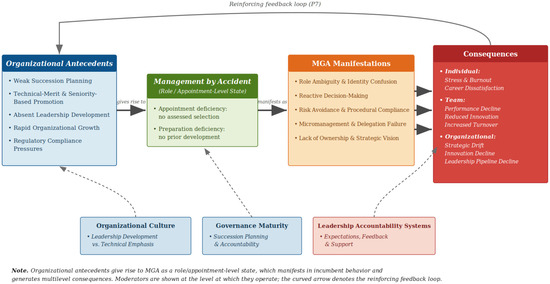
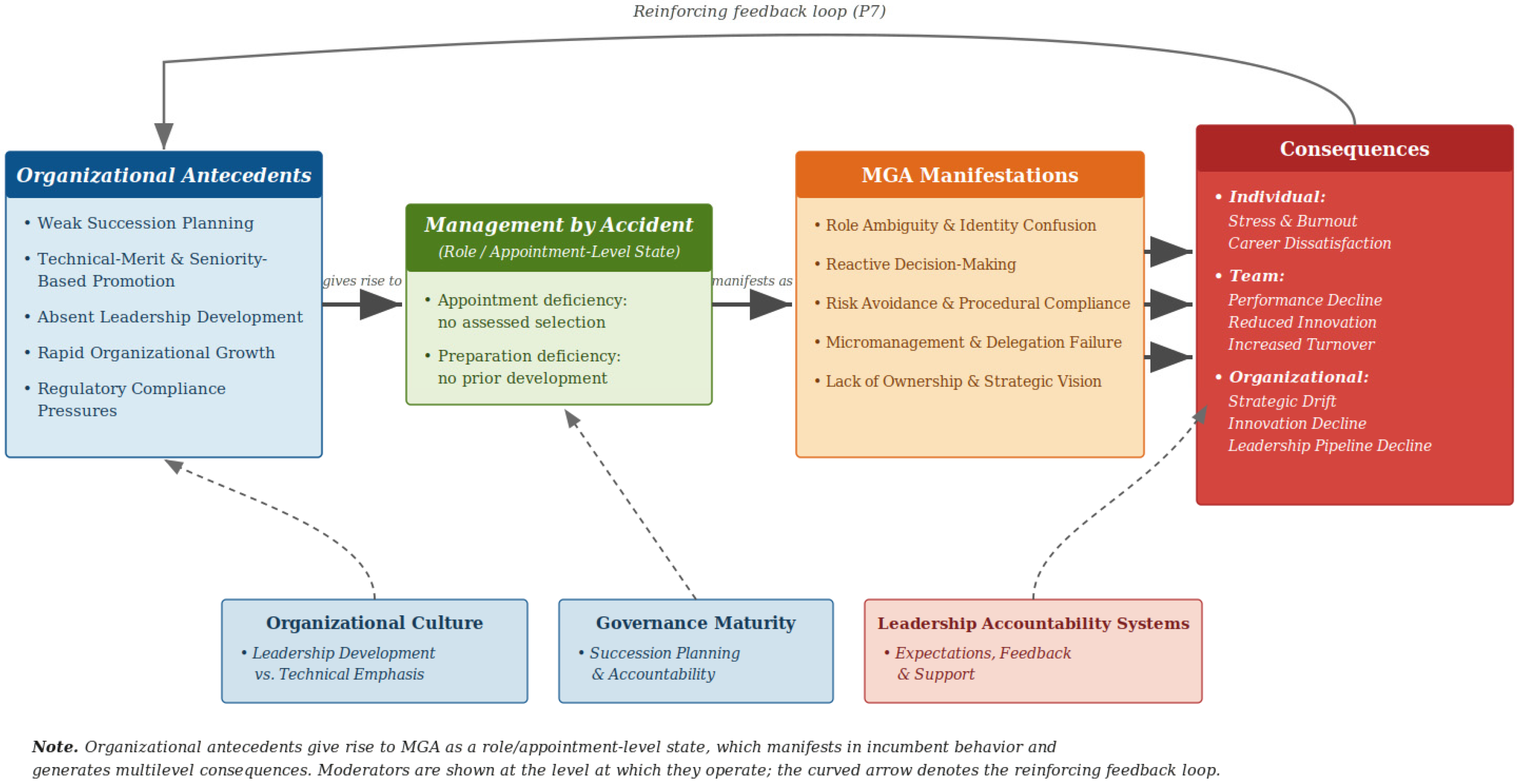
Figure 1 depicts the integrated MGA framework across three levels. Five organizational antecedents (weak succession planning, technical-merit promotion, absent leadership development, rapid growth, and compliance pressures) are proposed to give rise to MGA as a role/appointment-level state, defined by appointment deficiency and preparation deficiency. This state is in turn expected to manifest through five characteristic patterns (role ambiguity, reactive decision-making, risk avoidance, micromanagement, and lack of ownership) that distinguish it from related constructs. These manifestations are expected to generate consequences at individual, team, and organizational levels.
Figure 1.
Integrated Theoretical Framework of Management by Accident. Note. The framework is organized at three levels: organizational antecedents give rise to MGA as a role/appointment-level state, defined by appointment deficiency and preparation deficiency, which in turn manifests in incumbent behavior and generates consequences at the individual, team, and organizational levels. Solid lines represent direct relationships; dashed lines represent moderating relationships shown at the level at which each moderator operates; the curved arrow represents the reinforcing feedback loop (Proposition 7).
Four moderators affect these relationships. Organizational culture moderates antecedent–manifestation relationships, governance maturity and leadership accountability systems moderate manifestation–consequence relationships, while individual learning agility moderates the relationship between MGA and managerial outcomes.
The framework spans three levels of analysis, and its logic is cross-level. The antecedents are organizational-level conditions. MGA is a property of a particular appointment and role. The manifestations are behaviors of the individual incumbent. The consequences arise first at the individual and team levels and then aggregate to the organizational level. Two directions of influence run through the model. The dominant path is bottom-up: organizational conditions produce role-level MGA, MGA produces individual behavior, and that behavior, repeated across many roles and units, aggregates into team and organizational outcomes. A top-down path runs alongside it, in which organizational context conditions the lower-level relationships. Culture shapes whether antecedents translate into MGA (Proposition 5), and governance and accountability systems shape whether an incumbent’s behavior translates into collective harm (Proposition 6). Each moderator is placed at the level at which it operates: culture, governance, and accountability at the organizational level, and learning agility at the individual level. The feedback loop (Proposition 7) closes the system by carrying organizational-level consequences back down to regenerate the organizational-level antecedents. Separating these levels and directions prevents the common conflation of organizational causes with individual symptoms. It also clarifies, for subsequent empirical work, which relationships require organizational-level data, which require individual- or team-level data, and which require multilevel designs.
Table 2 records the specific sources on which each component draws, so the correspondence between the reviewed literature and the proposed structure can be inspected directly. It sets out the components of the framework and the literature supporting each element.
Table 2.
Components of the management by accident (MGA) framework: antecedents, manifestations, consequences, and moderators.
6. Theoretical Propositions
The framework yields a set of propositions linking its elements. Two conventions govern how they are stated. First, the propositions are stated as relationships between conceptually and empirically separable variables, not as restatements of what MGA means. Claims that merely unpack the definition, such as the claim that an unassessed and unprepared appointment is unassessed and unprepared, are definitional entailments rather than propositions, and are excluded. The behavioral signature of MGA is therefore framed as an empirical prediction to be tested against independent behavioral measurement, not as a defining feature. Second, each proposition specifies the level of analysis at which its variables operate: organizational (Org), the appointment or role (Role), the team (Team), or the individual incumbent (Indiv). This makes the cross-level relationships explicit. Several earlier compound statements have also been separated into single-relationship propositions so that each can be tested independently.
Proposition 1a (Org → Role).
The weaker an organization’s succession planning system, the higher the rate of MGA appointments within it. Mechanism: absent a pipeline of assessed, developed candidates, vacancies are filled reactively from whoever is available.
Proposition 1b (Org → Role).
The more an organization’s promotion criteria weight technical merit or seniority relative to assessed leadership potential, the higher its rate of MGA appointments. Mechanism: technical/seniority signals are visible and already rewarded, so they substitute for a leadership-readiness assessment that is never performed.
Proposition 1c (Org → Role).
The weaker an organization’s leadership-development infrastructure, the higher its rate of MGA appointments. Mechanism: without training, mentoring, or developmental assignments, candidates cannot be prepared in advance, so appointments default to the preparation-deficient state.
Proposition 2a (Org → Role, moderated).
Rapid organizational growth increases the rate of MGA appointments, and this effect is stronger where succession planning is weak. Mechanism (developed in Section 4.2): growth opens roles faster than prepared candidates can be developed, and the immediate, visible costs of vacancy lead decision-makers to appoint the nearest available candidate rather than wait.
Proposition 2b (Org → Role).
Regulatory and credentialing requirements increase the rate of MGA appointments to the extent that credential-holding substitutes for leadership assessment. Mechanism: where credentials are mandated for a role, organizations may appoint on the basis of the credential rather than assessed readiness, which corresponds to Antecedent 5. P2a and P2b are stated separately, in keeping with the sub-proposition structure used for P1 and P4, so that each of the five antecedents maps to at least one testable relationship.
Proposition 3 (Role → Indiv/Team).
Incumbents in MGA roles will exhibit the behavioral signature of role ambiguity, reactive decision-making, risk avoidance, micromanagement, and weak strategic ownership at higher rates than incumbents who were assessed and prepared, holding tenure and task performance constant. This is framed as an empirical prediction rather than a definitional entailment. Because MGA is defined by the circumstances of appointment and preparation (Section 4.1), the behavioral signature can be measured independently, and its association with MGA can in principle fail. That is what makes the proposition testable, and what distinguishes MGA behaviorally from deliberately chosen reactive or hands-off leadership styles.
Proposition 4a (Role → Indiv).
MGA increases incumbent strain (stress, burnout, role dissatisfaction) via sustained role-competency misalignment.
Proposition 4b (Role → Team).
Teams led by MGA incumbents show lower performance, reduced innovation, and higher turnover than comparable teams led by assessed, prepared managers, mediated by the behavioral signature in Proposition 3 (notably micromanagement and risk avoidance).
Proposition 4c (Team → Org).
As the share of MGA-led units in an organization rises, organization-level strategic drift and innovation decline increase. This proposition makes the cross-level aggregation explicit: organizational consequences are modeled as the accumulation of team-level effects across many MGA roles, not as a direct organizational-level effect of any single appointment.
Proposition 5 (Org-level moderator).
Organizational culture that prizes leadership development weakens the link between the antecedents in Propositions 1–2 and the rate of MGA appointments; a culture prizing technical excellence above leadership strengthens it. Both the moderator and the relationship it acts on are located at the organizational level.
Proposition 6 (Org-level moderators on Role/Team → outcome links).
Governance maturity and leadership-accountability systems weaken the link between the MGA behavioral signature (Proposition 3) and its team- and organization-level consequences (Propositions 4b–4c). Governance maturity and leadership accountability are combined in a single proposition because they operate through the same mechanism, namely the oversight and correction of managerial behavior before it produces collective harm; researchers may test them jointly as a control-systems construct or separately as two indicators. Here organizational-level structures moderate relationships whose focal path runs from the individual incumbent’s behavior to team and organizational outcomes; the cross-level direction is top-down (context shaping how individual behavior translates into collective results).
Proposition 7 (Role/Team → Org, reinforcing over time).
The consequences of MGA feed back to reproduce the organizational antecedents that generated it, producing a self-reinforcing cycle in the absence of deliberate intervention. Three mechanisms drive this reproduction. The first is pipeline non-reproduction. MGA incumbents, lacking preparation and ownership, do not identify or develop successors (Proposition 4; Conger & Fulmer, 2003; Joshi et al., 2021). The succession pipeline therefore stays empty and the next vacancy is again filled accidentally, which regenerates Antecedent 1. The second is normative entrenchment. As accidental appointments accumulate and are tolerated, they become the taken-for-granted way roles are filled. This shifts culture toward technical merit and away from leadership development (Schein, 2010; DiMaggio & Powell, 1983), regenerating Antecedents 2 and 3 and moving the culture moderator in Proposition 5 in the adverse direction. The third is capability erosion. Risk avoidance and strategic drift (Proposition 4) depress investment in leadership-development infrastructure, both because resources contract and because managers who never experienced structured development do not champion it. This further weakens Antecedent 3. Each mechanism increases the probability of the conditions that produced the initial MGA appointment, so the system exhibits path dependence (Sydow et al., 2009), and the longer the cycle runs unbroken the more costly it becomes to reverse. The proposition can be tested through longitudinal designs that track whether organizations with higher baseline MGA show subsequent declines in succession-pipeline strength and leadership-development investment relative to comparable organizations.
Proposition 8 (Indiv-level moderator on Role → Indiv/Team links).
Individual learning agility weakens the link between MGA and its adverse individual- and team-level consequences (Propositions 4a–4b), such that high-agility incumbents close the preparation gap faster through on-the-job learning and thus show fewer negative consequences and higher effectiveness than low-agility incumbents in otherwise-similar MGA roles. This is explicitly a bottom-up cross-level moderator: an individual-difference variable conditions how far a role-level state (MGA) propagates into individual strain and team outcomes. It does not moderate the organization-level antecedent relationships in Propositions 1–2, which learning agility, as a property of the incumbent rather than the system, cannot affect. Distinguishing P8 from the organizational moderators in Propositions 5–6 in this way keeps the individual and organizational levels analytically separate while showing how they jointly shape outcomes.
7. Discussion
7.1. Theoretical Contributions
The most obvious objection to this framework deserves to be addressed first: is MGA anything more than the Peter Principle wearing a new label? The answer turns on where the explanatory weight sits. The Peter Principle is a theory of promotion, it assumes a functioning selection process and explains why that process predictably overshoots (Peter & Hull, 1969; Benson et al., 2019). MGA is a theory of organizational omission. It explains what happens when there is, in effect, no genuine selection process at all: no assessment of leadership readiness, no preparation, no deliberate role design. Many accidental managers were never promoted to their level of incompetence in Peter’s sense; they were simply the person standing nearest the vacancy.
Table 3 summarizes this and the other boundary distinctions. Crisis management is externally triggered and episodic, where MGA is internally produced and chronic. Reactive leadership is a chosen style; MGA is an unchosen condition of role occupancy. Intentional underperformance is a motivational problem, whereas the accidental manager typically tries hard but lacks preparation. Beyond boundary-drawing, the framework changes what each contributing literature can see. For the accidental manager literature, it relocates the problem: what has been studied as an individual career predicament becomes the downstream output of identifiable organizational systems. The accidental-manager literature is the closest neighbor to MGA, and the difference between them is instructive. That literature is largely descriptive and case-based. It documents that particular technical specialists struggled after promotion (Silverman, 1996; Oliveira et al., 2015; Mallaby et al., 2017). MGA converts this description into a specified construct in three ways that the descriptive literature does not. It explains the phenomenon by naming the organizational antecedents (Section 4.2) that generate accidental managers, so that it is no longer treated as a recurring but unexplained career accident. It supports prediction, because the antecedents are organization-level and measurable. The framework yields directional, falsifiable expectations, for instance that MGA prevalence rises with weak succession systems and rapid growth (Propositions 1–2) and that its behavioral signature is observable independently of promotion history (Proposition 3), where a case literature can only report what happened after the fact. And it makes the phenomenon observable in a comparable way. By fixing the two definitional facets of appointment and preparation deficiency (Section 7.6), MGA can in principle be measured across roles and organizations and its prevalence compared, which a collection of individual narratives cannot support. The accidental-manager literature establishes that the phenomenon exists; MGA specifies what it is, where it comes from, and how to measure it. For succession planning research, it supplies the behavioral half of the story, pipeline deficiencies have been well documented (Conger & Fulmer, 2003; Groves, 2007), but not what unprepared incumbents actually do once installed. For role theory, it identifies a class of organizational conditions that mass-produce the difficult transitions the theory describes (Nicholson, 1984; Ashforth, 2001).
Table 3.
Conceptual boundaries between management by accident (MGA) and related constructs.
Finally, the propositions are intended to make the framework falsifiable rather than merely descriptive. They invite quantitative studies linking succession planning quality to MGA prevalence, qualitative work on how accidental managers experience and navigate their roles, and intervention studies testing whether leadership development reduces MGA emergence or blunts its consequences.
7.2. Relationship with Existing Theories
None of the seven source studies is left quite where the framework found it. The Peter Principle gains a boundary case it was not built to handle: appointments that involve no genuine promotion decision at all (Peter & Hull, 1969; Romaine, 2014). Human capital theory, usually invoked to explain why investments in development pay off, is here made to do the opposite work, accounting for what it costs an organization to decline building managerial human capital in the first place (Becker, 1964; Groves, 2007; Seibert et al., 2017). And succession planning research, which has long documented pipeline deficiencies, acquires a name for the condition those deficiencies produce.
The framework also bridges levels of analysis that these studies ordinarily keep apart. Role theory and human capital theory work at the level of the individual: the psychology of an ambiguous transition, the competencies a new manager holds or lacks. Organizational inertia and succession planning research work at the level of the system. Held together, each level explains the other. Systemic failures in selection and development produce the individual experiences the micro theories describe, and those individual manifestations, repeated across enough roles and units, aggregate into the organizational consequences the macro theories predict. Neither level alone accounts for the full pattern.
7.3. Practical Implications
The framework offers actionable guidance for organizational practice. First, it identifies diagnostic criteria for detecting MGA: absence of intentional selection, lack of preparation, reactive appointment, technical/seniority-based promotion, and systematic organizational patterns. Organizations can assess promotion practices, succession planning systems, and leadership development infrastructure against these criteria.
Second, the framework suggests multilevel interventions. At the organizational level, implementing systematic succession planning and leadership development infrastructure addresses root causes (Groves, 2007; Conger & Fulmer, 2003; Rothwell, 2010). Revising promotion criteria to assess leadership potential alongside technical competence prevents MGA emergence (Benson et al., 2019; Church et al., 2022). At the individual level, providing training, mentoring, and developmental support for current MGA managers can mitigate negative consequences (Cacioppe, 1998; Mallaby et al., 2017; Seibert et al., 2017).
Third, the framework highlights the importance of cultural and governance factors. Organizations must cultivate cultures valuing leadership development alongside technical excellence and establish governance systems ensuring accountability for leadership quality (Groves, 2017; Lynn, 2001; Schein, 2010). Without these contextual supports, interventions targeting specific antecedents may prove insufficient.
7.4. Boundary Conditions
The MGA framework applies most directly to hierarchical organizations with formal managerial roles and promotion systems. Applicability may vary across organizational contexts. In highly professionalized settings (healthcare, higher education, professional services), credentialing requirements and professional norms may amplify MGA through compliance pressures while simultaneously providing some baseline competence (Arikewuyo, 2009; Pergola, 2022). In flat or agile organizations with distributed leadership, MGA may manifest itself differently or be less prevalent.
The framework assumes organizational interest in effective leadership. In contexts where managerial positions serve primarily symbolic or compliance functions, MGA may be less problematic. Additionally, the framework focuses on formal authority assumption; informal leadership emergence follows different dynamics not addressed here.
Temporal dynamics also matter. MGA consequences may not emerge immediately; some accidental managers develop competence through experience (Walker, 2014). The framework addresses systematic patterns rather than individual trajectories, recognizing that some accidental managers eventually succeed while others do not.
MGA may be particularly prevalent in higher education institutions, where faculty members are frequently appointed to leadership positions such as department chair, program director, dean, or research center director primarily on the basis of academic achievement, seniority, or disciplinary expertise rather than formal leadership preparation, the pattern with which this article opened. Similar patterns may be observed in healthcare organizations, professional service firms, and technology companies, where technical competence often serves as the primary criterion for managerial advancement.
7.5. Potential Positive Outcomes of MGA
Although MGA is primarily associated with negative organizational outcomes, accidental managerial emergence may occasionally generate positive effects. Individuals entering management through non-traditional pathways may introduce fresh perspectives, challenge entrenched assumptions, and contribute to leadership diversity. In highly supportive organizational environments, accidental managers possessing strong learning agility may successfully transition into effective leaders. Future research should investigate conditions under which MGA may produce beneficial organizational outcomes.
7.6. Toward Measurement of Management by Accident
Future research should focus on developing and validating a Management by Accident (MGA) measurement scale. Consistent with the boundary drawn in Section 4.1, MGA is constituted by two definitional facets: appointment deficiency, the absence of intentional and criteria-based selection, and preparation deficiency, the absence of managerial development prior to role assumption. These two facets, shown in the upper panel of Table 4, are what a measure of MGA should capture, because they can be assessed from the circumstances of the appointment itself and independently of how the incumbent later behaves. The third row of Table 4, managerial misalignment, is therefore presented not as a constitutive dimension but as a set of downstream behavioral indicators, drawn from the manifestations in Section 4.3, against which a valid MGA measure should correlate. Keeping the two separate avoids building the presumed consequences of MGA into its definition, which would make the proposition that MGA produces those behaviors circular and untestable. The definitional facets provide an initial foundation for instrument development, and the behavioral indicators provide criterion evidence for validation. A validated MGA scale would enable researchers to assess the prevalence of MGA, examine its antecedents and consequences, and test the theoretical propositions advanced in this framework.
Table 4.
Proposed dimensions for operationalizing management by accident (MGA). The first two rows (appointment deficiency and preparation deficiency) are the constitutive facets of the construct; the third row is a downstream behavioral outcome retained as a criterion for validating the measure, not as part of its definition.
8. Limitations and Future Research
This theoretical framework has limitations suggesting future research directions. One set of limitations concerns the integrative review on which the framework rests. Because the streams of literature were assembled purposively rather than through an exhaustive systematic protocol, the synthesis is exposed to selection bias. The decision to organize the field around seven particular traditions, and the choice of which sources within each to foreground, reflect the author’s prior reading and theoretical commitments, and a differently anchored search might have surfaced additional traditions or weighted the existing ones differently. Integrative reviews also do not apply formal quality appraisal or aggregate effect sizes, so the framework inherits whatever biases exist in the underlying primary studies. These include a likely over-representation of Anglophone, high-income organizational settings and of contexts such as technology, healthcare, and higher education in which the phenomenon has already attracted attention, which risks confirming the pattern the review set out to describe. Publication and language bias may further mean that null findings, or evidence of accidental managers who succeed, are underrepresented in the retained sources. A further limitation is the absence of a second independent coder in deriving and grouping the seven streams, since the clustering was interpretive; independent replication of that coding would strengthen confidence in the resulting structure. These constraints do not undermine the conceptual contribution, but they do mean the framework should be read as a theoretically motivated proposal to be tested rather than as an established mapping of the field. Further limitations bear on the framework’s empirical status. First, as conceptual development without empirical validation, propositions require testing. Quantitative studies should examine relationships between succession planning quality, promotion criteria, leadership development investment, and MGA prevalence across organizations. Longitudinal designs could assess whether MGA produces predicted consequences and whether interventions reduce MGA or mitigate effects.
Second, qualitative research should explore MGA manager experiences, investigating how individuals navigate role ambiguity, develop (or fail to develop) managerial competence, and experience career consequences. Comparative case studies could examine organizational contexts where MGA is prevalent versus rare, identifying protective factors.
Third, the framework requires refinement regarding boundary conditions. Research should examine MGA manifestations across organizational types (public/private, large/small, hierarchical/flat), industries (technology, healthcare, education, manufacturing), and cultural contexts (individualist/collectivist, high/low power distance). Cross-cultural studies could assess whether MGA antecedents and consequences vary internationally.
Fourth, intervention research should test whether proposed solutions effectively prevent or mitigate MGA. Experimental or quasi-experimental designs could assess whether implementing succession planning systems, revising promotion criteria, or providing leadership development reduces MGA emergence or improves outcomes for current MGA managers.
Fifth, the framework focuses on formal managerial roles; future research should examine whether similar dynamics occur in informal leadership, project management, or distributed leadership contexts. Additionally, research should investigate individual differences: do some individuals thrive despite accidental promotion while others struggle, and what factors explain these differences?
Finally, the framework emphasizes negative consequences, but research should also examine potential positive aspects. Does MGA sometimes produce beneficial outcomes, such as fresh perspectives from non-traditional leaders or increased diversity in leadership ranks? Under what conditions might MGA be less problematic or even advantageous?
9. Conclusions
This article advances MGA as an integrative framework for understanding unintentional managerial emergence within organizations. Rather than viewing managerial ineffectiveness solely as an individual deficiency, the MGA framework highlights how organizational systems, promotion practices, succession planning failures, and leadership development deficiencies collectively produce managerial roles occupied by individuals who were never intentionally prepared for leadership responsibilities.
The framework addresses critical gaps in organizational theory and practice. Theoretically, it consolidates fragmented research, proposes MGA as a candidate construct with provisional conceptual boundaries, and provides testable propositions for empirical investigation. Practically, it offers diagnostic criteria and multilevel intervention strategies for organizations seeking to prevent MGA or mitigate its consequences.
As organizations face increasing complexity and rapid change, effective leadership becomes ever more critical. Yet many organizations continue promoting individuals into management without intentional selection, preparation, or support. This framework provides conceptual foundations for understanding and addressing this persistent challenge, contributing to improved organizational effectiveness, leadership quality, and long-term institutional sustainability.
Funding
This research received no external funding.
Institutional Review Board Statement
Not applicable.
Informed Consent Statement
Not applicable.
Data Availability Statement
The original contributions presented in this study are included in the article. Further inquiries can be directed to the corresponding author.
Acknowledgments
During the preparation of this manuscript, the author used Grammarly v1.2.265.1895 for the purposes of writing the manuscript. The author has reviewed and edited the output and take full responsibility for the content of this publication.
Conflicts of Interest
The author declares no conflicts of interest.
Abbreviations
The following abbreviations are used in this manuscript:
| MGA | Management by Accident |
| SMB | Small- and Medium-sized Business |
References
- Arikewuyo, M. O. (2009). Professional training of secondary school principals in Nigeria: A neglected area in the educational system. Florida Journal of Educational Administration & Policy, 2(2), 73–84. [Google Scholar]
- Aronson, J. K. (2022). When I use a word… too much healthcare—Incompetence and hierarchiology. BMJ, 379, o2424. [Google Scholar] [CrossRef] [Scilit]
- Ashforth, B. E. (2001). Role transitions in organizational life: An identity-based perspective. Lawrence Erlbaum Associates. [Google Scholar]
- Ashforth, B. E., & Mael, F. (1989). Social identity theory and the organization. Academy of Management Review, 14(1), 20–39. [Google Scholar] [CrossRef] [Scilit]
- Becker, G. S. (1964). Human capital: A theoretical and empirical analysis, with special reference to education. University of Chicago Press. [Google Scholar]
- Benson, A., Li, D., & Shue, K. (2019). Promotions and the peter principle. Quarterly Journal of Economics, 134(4), 2085–2134. [Google Scholar] [CrossRef] [Scilit]
- Boyatzis, R. E. (1982). The competent manager: A model for effective performance. John Wiley & Sons. [Google Scholar]
- Cacioppe, R. (1998). An integrated model and approach for the design of effective leadership development programs. Leadership & Organization Development Journal, 19(1), 44–53. [Google Scholar] [CrossRef] [Scilit]
- Cadmus, E. (2006). Succession planning: Multilevel organizational strategies for the new workforce. Journal of Nursing Administration, 36(6), 298–303. [Google Scholar] [CrossRef] [Scilit]
- Charan, R., Drotter, S., & Noel, J. (2001). The leadership pipeline: How to build the leadership-powered company. Jossey-Bass. [Google Scholar]
- Chartered Management Institute. (2023). Taking responsibility: Why UK plc needs better managers [Research report]. Chartered Management Institute/YouGov. [Google Scholar]
- Church, A. H., Rotolo, C. T., Margulies, A., & Shull, A. C. (2022). Learning agility as a key driver of leadership potential for talent identification, pipeline development, and succession planning in organizations. Consulting Psychology Journal: Practice and Research, 74(4), 279–306. [Google Scholar] [CrossRef] [Scilit]
- Conger, J. A., & Fulmer, R. M. (2003). Developing your leadership pipeline. Harvard Business Review, 81(12), 76–84. [Google Scholar]
- David, P. A. (1985). Clio and the economics of QWERTY. American Economic Review, 75(2), 332–337. [Google Scholar]
- Dickinson, D. L., & Villeval, M. C. (2007). The Peter Principle: An Experiment (IZA Discussion Papers No. 3205). IZA. [Google Scholar]
- DiMaggio, P. J., & Powell, W. W. (1983). The iron cage revisited: Institutional isomorphism and collective rationality in organizational fields. American Sociological Review, 48(2), 147–160. [Google Scholar] [CrossRef] [Scilit]
- Furnham, A. (2018). Management failure and derailment. In Bad apples: Identify, prevent & manage negative behavior at work (pp. 85–110). Palgrave Macmillan. [Google Scholar] [CrossRef] [Scilit]
- Goleman, D. (1998). Working with emotional intelligence. Bantam Books. [Google Scholar]
- Groves, K. S. (2007). Integrating leadership development and succession planning best practices. Journal of Management Development, 26(3), 239–260. [Google Scholar] [CrossRef] [Scilit]
- Groves, K. S. (2017). Examining the impact of succession management practices on organizational performance: A national study of U.S. hospitals. Health Care Management Review, 42(4), 348–359. [Google Scholar] [CrossRef] [Scilit]
- Hannan, M. T., & Freeman, J. (1984). Structural inertia and organizational change. American Sociological Review, 49(2), 149–164. [Google Scholar] [CrossRef] [Scilit]
- Ibarra, H. (1999). Provisional selves: Experimenting with image and identity in professional adaptation. Administrative Science Quarterly, 44(4), 764–791. [Google Scholar] [CrossRef] [Scilit]
- Jaakkola, E. (2020). Elaborating services research using the conceptual framework approach. Journal of Services Marketing, 34(3), 403–413. [Google Scholar]
- Joshi, A., Inceoglu, I., Bartram, D., & Deller, J. (2021). The generativity mindsets of chief executive officers: A new perspective on succession outcomes. Academy of Management Review, 46(3), 489–509. [Google Scholar] [CrossRef] [Scilit]
- Katz, D., & Kahn, R. L. (1978). The social psychology of organizations (2nd ed.). John Wiley & Sons. [Google Scholar]
- Kelly, D., & Amburgey, T. L. (1991). Organizational inertia and momentum: A dynamic model of strategic change. Academy of Management Journal, 34(3), 591–612. [Google Scholar] [CrossRef] [Scilit]
- Kim, S. (2020). New development: A new principle—The higher the position, the broader the view. Public Money & Management, 40(3), 238–241. [Google Scholar] [CrossRef] [Scilit]
- Lynn, D. B. (2001). Succession management strategies in public sector organizations: Building leadership capital. Review of Public Personnel Administration, 21(2), 114–132. [Google Scholar] [CrossRef] [Scilit]
- Mallaby, S. J., Price, G., & Hofmeyr, K. (2017). The transition to general management in South Africa. SA Journal of Human Resource Management, 15, 846. [Google Scholar] [CrossRef] [Scilit]
- Moens, G. (2013). How to mismanage organisations: A lawyer’s perspective. Global Journal of Business and Social Science Review, 1(1), 1–10. [Google Scholar] [CrossRef] [Scilit]
- Nicholson, N. (1984). A theory of work role transitions. Administrative Science Quarterly, 29(2), 172–191. [Google Scholar] [CrossRef] [Scilit]
- Oliveira, M. A., Bitencourt, C. C., Santos, A. C. M. Z., & Teixeira, E. K. (2015). The transformation of specialist in leader: A case study in a telecommunications company. Revista de Gestão e Projetos, 6(3), 1–15. [Google Scholar] [CrossRef] [Scilit]
- Palatnik, A. (2025, April 24–26). Evolution of the Peter Principle in technology SMBs: The transition from technical roles to managers. Proceedings of the First International Conference—MIT LIFT Lab Research Fest—South America: Empowering the Foundations of the Latin American Economy to Tackle Regional and Global Challenges (pp. 136–137), Buenos Aires, Argentina. [Google Scholar] [CrossRef] [Scilit]
- Pergola, P. (2022). The next generation of leaders: Support and education must be intentional. Journal of Medical Imaging and Radiation Sciences, 53(4), S1–S3. [Google Scholar] [CrossRef] [Scilit]
- Peter, L. J., & Hull, R. (1969). The peter principle: Why things always go wrong. William Morrow. [Google Scholar]
- Rizzo, J. R., House, R. J., & Lirtzman, S. I. (1970). Role conflict and ambiguity in complex organizations. Administrative Science Quarterly, 15(2), 150–163. [Google Scholar] [CrossRef] [Scilit]
- Rockwell, D. (2023). Aligning leaders and organizations during role transitions: Addressing issues of competency, role identity, and authentic prototypicality. International Journal of Business and Management, 18(2), 1–15. [Google Scholar] [CrossRef] [Scilit]
- Romaine, J. (2014). The Peter Principle resuscitated: Are promotion systems useless? Human Resource Management Journal, 24(4), 410–423. [Google Scholar] [CrossRef] [Scilit]
- Romaine, J. (2015). Promotion incentives and the Peter Principle. Economics Letters, 136, 103–105. [Google Scholar] [CrossRef] [Scilit]
- Rothwell, W. J. (2010). Effective succession planning: Ensuring leadership continuity and building talent from within (4th ed.). AMACOM. [Google Scholar]
- Schein, E. H. (2010). Organizational culture and leadership (4th ed.). Jossey-Bass. [Google Scholar]
- Schultz, T. W. (1961). Investment in human capital. American Economic Review, 51(1), 1–17. [Google Scholar]
- Seibert, S. E., Sargent, L. D., Kraimer, M. L., & Kiazad, K. (2017). Linking developmental experiences to leader effectiveness and promotability: The mediating role of leadership self-efficacy and mentor network. Personnel Psychology, 70(2), 357–397. [Google Scholar] [CrossRef] [Scilit]
- Silverman, M. (1996). Technical management: Who and what we are. In The technical manager’s handbook (pp. 3–18). Springer. [Google Scholar] [CrossRef] [Scilit]
- Snyder, H. (2019). Literature review as a research methodology: An overview and guidelines. Journal of Business Research, 104, 333–339. [Google Scholar] [CrossRef] [Scilit]
- Sydow, J., Schreyögg, G., & Koch, J. (2009). Organizational path dependence: Opening the black box. Academy of Management Review, 34(4), 689–709. [Google Scholar] [CrossRef] [Scilit]
- Torraco, R. J. (2005). Writing integrative literature reviews: Guidelines and examples. Human Resource Development Review, 4(3), 356–367. [Google Scholar] [CrossRef] [Scilit]
- Walker, B. D. (2014). Workplace evolution without practitioners. ERIC. Available online: https://eric.ed.gov/?id=ED555569 (accessed on 20 July 2026).
- Whittemore, R., & Knafl, K. (2005). The integrative review: Updated methodology. Journal of Advanced Nursing, 52(5), 546–553. [Google Scholar] [CrossRef] [Scilit]
- Yukl, G. (2012). Effective leadership behavior: What we know and what questions need more attention. Academy of Management Perspectives, 26(4), 66–85. [Google Scholar] [CrossRef] [Scilit]

Disclaimer/Publisher’s Note: The statements, opinions and data contained in all publications are solely those of the individual author(s) and contributor(s) and not of MDPI and/or the editor(s). MDPI and/or the editor(s) disclaim responsibility for any injury to people or property resulting from any ideas, methods, instructions or products referred to in the content. |
© 2026 by the author. Licensee MDPI, Basel, Switzerland. This article is an open access article distributed under the terms and conditions of the Creative Commons Attribution (CC BY) license.