


Abstract
Wastewater treatment plants (WWTPs) are key nodes in the environmental dissemination of antimicrobial resistance (AMR), although their net role as sources or barriers of antibiotic-resistant bacteria (ARB) and antibiotic resistance genes (ARG) under full-scale conditions remains insufficiently understood. This study evaluated the occurrence and dynamics of ARB and ARG in a full-scale urban WWTP and its receiving river over a two-year monitoring campaign. Samples were collected from the WWTP influent and effluent, and from river water upstream and downstream of the discharge point, enabling an integrated assessment of treatment performance and potential environmental dissemination. Wastewater treatment markedly reduced AMR indicators, with ARG concentrations decreasing by at least 90% from influent to effluent. No consistent increase in ARB or ARG levels was observed downstream compared with upstream, indicating no measurable dissemination attributable to the WWTP discharge. Multidrug-resistant bacteria were prevalent across all compartments, highlighting widespread background resistance in the urban water cycle. Temporal analysis revealed higher ARG abundances in 2021 and 2022 than 2020, consistent with possible changes in antibiotic consumption during the COVID-19 pandemic. Overall, the investigated WWTP did not act as a net AMR source, highlighting its potential role as a control point and the value of integrated monitoring for assessing AMR dynamics and environmental risk.
1. Introduction
Antimicrobial resistance (AMR) is one of the most significant global health challenges of the present era, largely driven by the overuse and misuse of antibiotics in humans, animals, and agricultural and livestock practices. When microorganisms like bacteria, viruses, or fungi become resistant to antimicrobial drugs, conventional treatments may prove ineffective and infections that were once easily treatable can become harder to manage, requiring the use of more potent drugs, or they may even become lethal. AMR may result in prolonged illnesses and increased mortality [1]. According to a 2021 study published in The Lancet [2], the number of deaths attributable to AMR between 1990 and 2021 was more than one million each year, a figure the authors forecast could increase to nearly 2 million by 2050. This issue has implications that extend beyond the clinical setting. In 2019, the World Health Organization (WHO) [3] declared antimicrobial resistance one of the top ten global health threats that humanity faces, and it has also become a significant environmental concern, particularly in aquatic ecosystems such as drinking water sources and wastewaters [4]. Particularly, the presence of antibiotic-resistant bacteria (ARB) and antibiotic-resistance genes (ARGs) in water systems poses severe threats to human health and ecological safety. These elements facilitate the dissemination of resistance traits across microbial communities, which, when acquired by pathogens, may ultimately render antibiotics ineffective [5,6]. Wastewater plays a crucial role in AMR dissemination. When antibiotics are consumed, the fraction that is not completely metabolized results in unaltered active antibiotic residues that may end up in wastewater treatment plants (WWTPs). In this way, wastewater, particularly from hospitals, pharmaceutical industries, livestock, agricultural run-off, and domestic sewage can contain significant concentrations of antibiotics, ARB, and ARGs. Since in biological WWTPs, these residues encounter an enormous number of bacteria, new AMRs may emerge as bacterial survival mechanisms in response to the selective pressure exerted [7]. For this reason, WWTPs have long been considered hotspots for AMR emergence and dissemination into the surrounding environment [8], although their potential role as effective control points remains less clearly defined.
Currently, conventional wastewater treatment processes are not fully efficient with regard to ARB and ARG elimination [9]. Consequently, when treated effluents are discharged into natural water bodies or are reused for irrigation, they can serve as reservoirs for these resistant factors. Moreover, natural water bodies may be used as catchment areas for drinking water, thus completing a circle where ARB and ARGs can re-enter human and animal systems. The presence of AMR in drinking water, documented both in natural sources [10] and treated drinking water [11], poses a direct threat to human health by several mechanisms, including direct infection by antibiotic resistant pathogens, human-to-human transmission after direct infection of one individual, and transfer of ARGs present in drinking water to human pathogenic bacteria via horizontal gene transfer (HGT) [12].
From an ecological perspective, the spread of ARB and ARGs in aquatic ecosystems can disrupt local microbial communities’ structure and functions. ARB can outcompete native bacteria, alter nutrient cycling processes, and affect all the organisms that depend on those processes for survival [13]. Additionally, ARGs can be incorporated in bacteria via mutations, due to selective pressure and HGT, spreading resistances even among bacteria that have not been directly exposed to antibiotics [14].
In light of the threat that AMR poses, surveillance of AMR in wastewater and its receiving water bodies appears crucial for several reasons. Since contaminated water can disseminate ARB and ARGs, AMR monitoring in water sources can facilitate the identification of potential health risks. Moreover, environmental surveillance provides valuable evidence for researchers that can help explain the mechanisms of AMR dissemination, thereby enabling the development of strategies to mitigate its impact on ecosystems [15].
Against this background, the present study investigated the net role of an urban WWTP in the environmental dissemination of AMR in a receiving river under full-scale operating conditions. Although the occurrence and removal of ARB and ARGs in wastewater treatment systems have been extensively investigated, studies integrating long-term monitoring of phenotypic and genotypic resistance indicators across both wastewater and receiving-water compartments remain comparatively scarce. The main contribution of the present study lies in the combination of (i) a two-year monitoring campaign, (ii) the simultaneous assessment of ARB and ARG as complementary phenotypic and genotypic indicators, and (iii) the integrated evaluation of WWTP influent and effluent together with upstream and downstream river waters. This design enabled a more comprehensive evaluation of the net environmental role of a full-scale WWTP under real operating conditions, compared with studies focusing exclusively on treatment performance or environmental occurrence. Phenotypic resistance was evaluated in aerobic bacteria and Escherichia coli isolated from water samples, the latter used as an indicator of faecal contamination in the aquatic environment. In parallel, five ARGs associated with widely used antibiotic families were quantified: blaTEM (β-lactams), qnrS (quinolones), tetA (tetracyclines), sul2 (sulfonamides), and ermB (macrolides). By integrating phenotypic and genotypic indicators across wastewater and receiving-water compartments, this study aimed to determine whether the investigated WWTP acted as a net source or an effective barrier for AMR dissemination and to assess the value of full-scale environmental surveillance for AMR risk assessment. This integrated approach provided evidence that, although AMR was widespread across the urban water cycle, the WWTP substantially reduced ARG concentrations and no consistent increase in ARB or ARGs was observed downstream of the discharge. These findings support the role of properly operated WWTPs as relevant control points within aquatic systems and underscore the value of integrated wastewater and environmental monitoring for improving the understanding of AMR dynamics and supporting environmental risk assessment.
2. Materials and Methods
2.1. Sample Collection
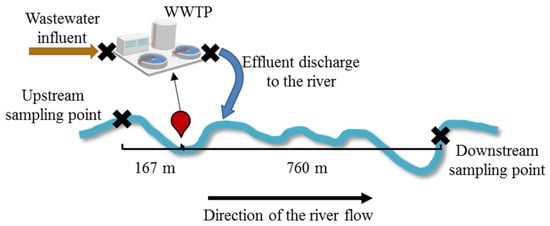
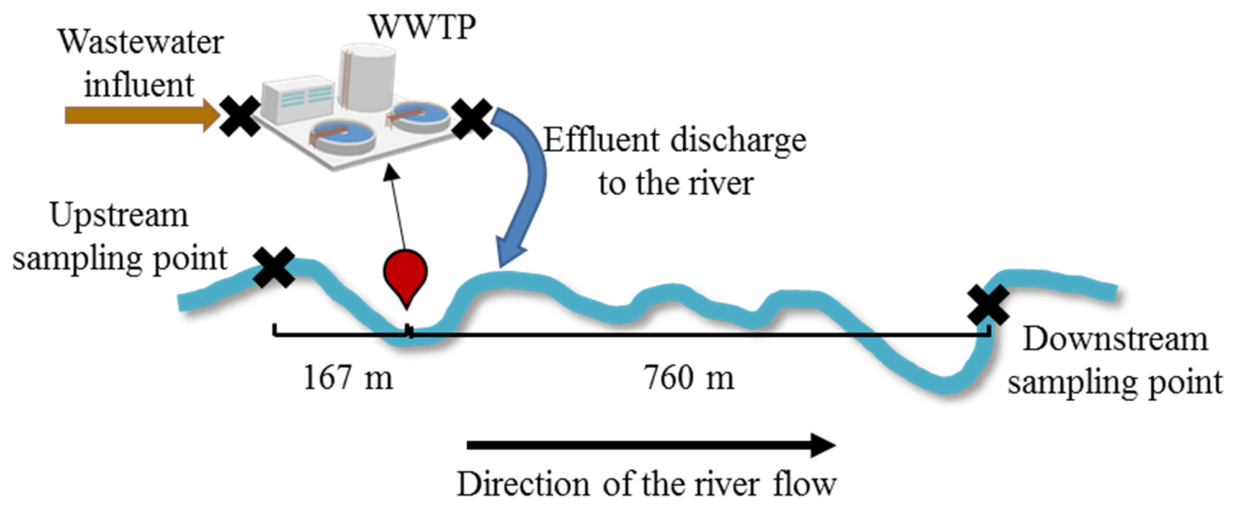
Ten sampling campaigns were conducted from July 2020 to May 2022. In 2020, sampling was carried out in July, September and November; in 2021, in February, May, July, September and November and, in 2022, in February and May. In each campaign, four water samples were collected: influent and effluent samples from an urban full-scale WWTP, and upstream and downstream samples from the river adjacent to the WWTP (Figure 1).
Figure 1.
Schematic representation with the location of the WWTP and the sampling points (black crosses) in the adjacent river and at the inlet (influent) and outlet (effluent) of the WWTP.
The WWTP, located in the province of Biscay (Spain) and designed to serve a population of 10,500 inhabitants, operates a treatment train including primary clarification, secondary biological treatment, and a final ultraviolet disinfection process.
Samples were collected in sterile flasks, transported to the laboratory and processed within 6 h for antimicrobial susceptibility testing and DNA extraction.
2.2. Antimicrobial Susceptibility Testing (AST)
AST was performed for ARB surveillance, based on the disk diffusion method. Isolates of aerobic bacteria and E. coli were tested against 15 antibiotics, selected for their common clinical and veterinary use.
For aerobic bacteria isolates, 101 to 103 dilutions of the water samples were prepared in sterile Ringer solution (Oxoid, Hampshire, UK). One hundred microliters of raw water samples and each prepared dilution were plated in Plate Count Agar (Oxoid) at 22 °C for 48 h. After incubation, ten colonies were subcultured in the same medium to obtain pure colonies. For E. coli isolates, 100 mL of 101 to 103 dilutions of the upstream, downstream and effluent samples and 104 to 106 dilutions of the influent samples were filtered through sterile 0.45 µm nitrocellulose membranes filters (Millipore, Burlington, MA, USA). Filters were transferred to Rapid’E coli 2 agar (Bio-Rad, Hercules, CA, USA), a selective and differential medium for the isolation of E. coli (violet colonies) and other coliforms (blue colonies). After 24 h incubation at 37 °C, ten violet colonies were subcultured in the same medium. Violet colonies were considered presumptive E. coli according to the manufacturer’s instructions and the intended use of the medium. No further taxonomic confirmation was performed, as the objective was comparative environmental surveillance rather than definitive species identification. Finally, five pure aerobic colonies and five pure E. coli colonies from each water sample were selected for AST, resulting in a total of 200 aerobic and 200 E. coli isolates.
Bacterial suspensions of the isolates, prepared in Ringer solution to the equivalent of 0.5 McFarland standard, were uniformly spread on Mueller–Hinton agar plates (Oxoid). Then, antibiotic discs (Bio-Rad) were placed onto the surface of inoculated media and plates were incubated at 25 °C for 48 h for aerobic bacteria and at 35 °C for 24 h for E. coli. Afterwards, inhibition zone diameters were measured and interpreted as susceptible or resistant according to the Clinical & Laboratory Standards Institute (CLSI) breakpoint standards for Enterobacterales, Enterococcus spp., and Staphyloccocus sp. [16] (Table 1). Since the aerobic bacterial isolates were not taxonomically identified, CLSI breakpoints were used as reference criteria to enable comparative assessment of resistance occurrence across samples and locations. Zone diameters corresponding to intermediate resistance were considered as susceptible in this study.
Table 1.
Disk content and Clinical & Laboratory Standards Institute (CLSI) (2020) breaking points of each antibiotic tested.
In the context of this study, multi-resistance was defined as resistance to 3 or more antibiotics. This definition was used for comparative ecological purposes and should not be interpreted as equivalent to clinical multi-resistance classifications, which require taxonomic identification and consideration of intrinsic resistance mechanisms.
2.3. DNA Extraction
In each sampling campaign, the four water samples collected were concentrated before DNA extraction. In this process, 250 mL of the upstream and downstream river samples and the effluent from the WWTP were filtrated through a 0.22 μm pore-size membrane (Millipore) in sterile conditions and DNA was extracted from the filter. For influent samples, 10 mL were concentrated by centrifugation at 4500 rpm and DNA was extracted from the resulting pellet. DNA extraction was carried out in duplicate, using the DNeasy Power Soil Kit (Qiagen, Hilden, Germany) according to the manufacturer’s instructions, and the extracts were stored at −20 °C. The quality and abundance of DNA were measured with a NanoDrop® ND1000 spectrophotometer (ThermoFisher, Waltham, MA, USA).
2.4. ARG Quantification
Real-time quantitative polymerase chain reaction (qPCR) assays were performed to quantify five ARGs selected as molecular markers of resistance to antibiotic classes of high clinical, veterinary, and environmental relevance, namely, blaTEM for β-lactams, qnrS for quinolones, tetA for tetracyclines, sul2 for sulfonamides, and ermB for macrolides. The selected targets represented major antibiotic families included in antimicrobial consumption surveillance and/or environmental monitoring frameworks [17].
The primer sequences used can be found in Table 2. The amplification was developed in a QuantStudio 5 thermal cycler (Applied Byosystems, South San Francisco, CA, USA) with a total reaction volume of 20 µL containing 25 ng of DNA, 10 µL of qPCR master mix and 0.5 µL of each primer (10 µM). Luna® Universal qPCR Master Mix (New England BioLabs, Ipswich, MA, USA) was used for qnrS gen, and SsoFast™ EvaGreen® Supermix (Bio-Rad) for blaTEM, tetA, sul2, and ermB genes. Melt curves were run to confirm PCR product identity. PCR products (10 µL) were confirmed by electrophoresis in 2% (w/v) agarose gels at 90 V with a DNA electrophoresis sample loading dye (Bio-Rad) using a VersaDoc (Bio-Rad) imaging system.
Table 2.
Primers used for antibiotic resistance gene (ARG) quantification.
Standard curves were generated using ten-fold serial dilutions of purified PCR amplicons containing the target genes, ranging from 101 to 107 gene copies reaction−1. Amplification efficiencies ranged from 84.7% to 91.2%, with coefficients of determination (R2) between 0.998 and 0.999 (Table 2). Although some efficiencies were slightly below the MIQE recommended range of 90–110%, all standard curves showed excellent linearity over seven orders of magnitude and reproducible amplification at the lowest standard concentration tested, supporting the reliability of the quantification approach applied in this study. Operational limits of detection (LODs) and quantification (LOQs) were determined from these standard curves. The LOD was defined as the lowest concentration yielding amplification in all triplicate reactions, whereas the LOQ corresponded to the lowest concentration showing both consistent amplification and acceptable repeatability, assessed through the standard deviation of Ct values among technical replicates. Based on these criteria, the operational LODs and LOQs for all target genes were 10 gene copies/reaction, corresponding to an analytical sensitivity of 2 gene copies/μL DNA extract. Purified amplicons were used as positive controls and were also spiked with DNA extracts from samples to evaluate potential PCR inhibition caused by environmental matrices. In addition, extraction blanks and non-template controls (NTCs) were included in each run to verify the absence of contamination. ARG concentrations (gene copies/mL) were calculated by normalizing the gene copy numbers obtained per qPCR reaction to the amount of template DNA analyzed, extrapolating the resulting values to the total DNA recovered after extraction, and finally dividing by the volume of the water sample processed for DNA extraction (1).
2.5. Statistical Analyses
Statistical analysis was performed using GraphPad Prism version 10.3.1 (GraphPad Software, Boston, MA, USA). Normality of data was verified using the Shapiro–Wilk test. Afterwards, results obtained in the ARB study were analyzed using Fisher’s exact test and χ2 test in order to establish any possible dependence on location. A t-test and Wilcoxon signed-rank test were used to compare ARG detection and sampling site. Statistical differences in the detection of ARGs across the years of the study were assessed using a t-test when data met normality assumptions and the Mann–Whitney test when they did not. Statistical significance was always defined by 95% confidence intervals (p < 0.05).
3. Results and Discussion
3.1. Antibiotic Resistant Bacteria (ARB)
Resistance to all 15 selected antibiotics was found among the water samples collected in this study. According to the results, 98.8% of the bacteria isolates showed resistance to at least one of the target antibiotics and 80.5% exhibited multi-resistance, defined in the context of this study as resistance to 3 or more antibiotics. This definition was used for comparative ecological purposes and should not be interpreted as equivalent to clinical multi-resistance classifications, which require taxonomic identification and consideration of intrinsic resistance mechanisms. Therefore, multi-resistance was prevalent, and, in fact, only 5 out of the total 400 isolates analyzed, all of them aerobic isolates, were found to be sensitive to all antibiotics. Three of them were detected upstream of the WWTP, one in an effluent sample and one downstream (Table 3).
Table 3.
Percentage of bacteria isolates resistant to a determined number of antibiotics in each sampling site.
Considering the sampling site, a higher percentage of multi-resistant bacteria was found in the WWTP (89% of the isolates in the influent and 83% in the effluent) than in the river (74% of the isolates upstream and 76% downstream). The most multi-resistant isolates showed resistance to up to 11 antibiotics downstream in the river and up to 12 antibiotics in the influent to the WWTP (one isolate in both cases).
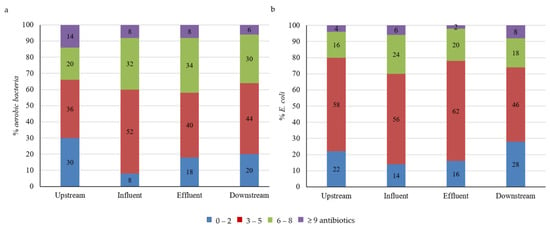
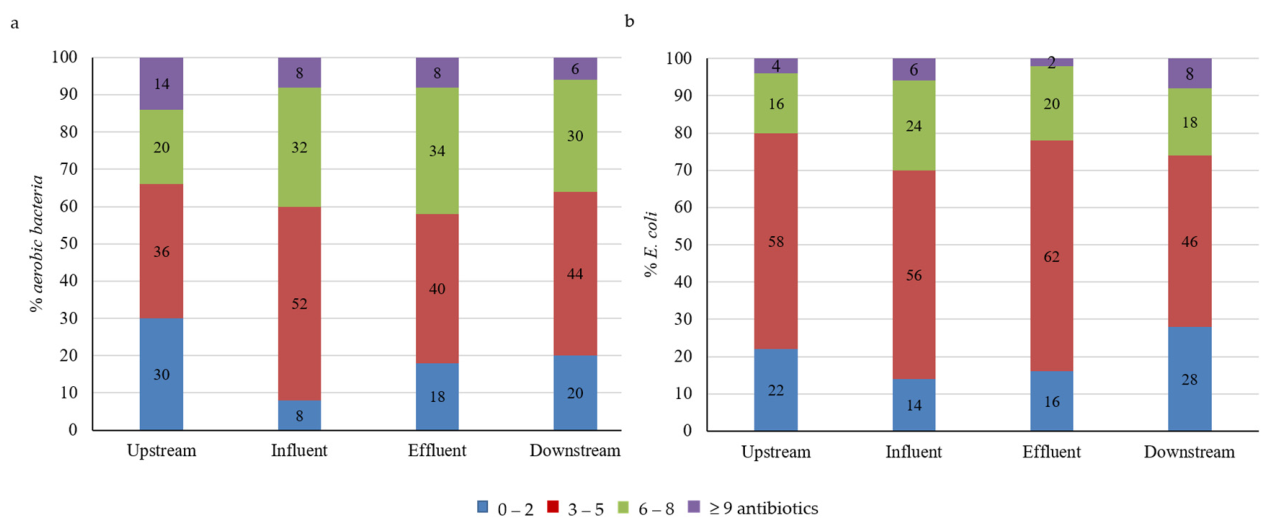
Among the multi-resistant isolates, resistance to three to five antibiotics was more frequently observed for both E. coli and aerobic isolates (Figure 2). It should be noted that at the WWTP, no significantly higher percentage of multi-resistant bacteria was detected in the effluent than in the influent. In fact, the number of multi-resistant aerobic bacteria in the effluent was lower than in the influent (82% and 92% respectively) and in the case of E. coli, the number was similar (84% and 86%, respectively). In contrast, in the river, multi-resistant aerobic bacteria found downstream (80%) outnumbered those upstream (70%) but fewer multi-resistant E. coli were found downstream than upstream (72% and 78%, respectively). In terms of all the isolates analyzed, numbers of multi-resistant strains were similar both upstream and downstream of the WWTP (74% and 76%, respectively) and in the influent and effluent of the plant (89% and 83%, respectively). Moreover, the statistical analysis revealed no significant differences (p value > 0.05) among the numbers of multi-resistant isolates detected at the different sampling points.
Figure 2.
Percentage of aerobic (a) and E. coli (b) isolates showing resistance to a determined number of antibiotics.
The high prevalence of antibiotic resistance across all sampling sites is consistent with previous studies reporting widespread occurrence of multi-resistant bacteria in both wastewater and natural aquatic environments [23,24]. However, the similar levels of multi-resistance observed upstream and downstream suggest that the receiving river was already impacted by diffuse sources of resistance, and that the WWTP discharge did not result in a measurable increase in ARB prevalence under the investigated conditions.
The aforementioned results do not provide evidence that the investigated WWTP acted as a promoter of antibiotic resistance or significantly contributed to the spread of resistance to the close environment, as no consistent increase in resistance prevalence among the analyzed isolates was observed between upstream and downstream river sites.
With regard to the resistance observed for each of the antibiotics under study, 100% of the water samples analyzed contained isolates resistant to penicillin, clarithromycin, and erythromycin (Table 4). Isolates resistant to ampicillin and cefalexin were amongst the most widespread, as they were observed in all the influent, effluent, and upstream samples. In contrast, resistance to minocycline was amongst the least frequently observed.
Table 4.
Frequency of resistance to the target antibiotics in the water samples in each sampling site. AMO: amoxicillin; AMP: ampicillin; PEN: penicillin; CLE: cefalexin; CTA: cefotaxime; CTZ: ceftazidime; CEP: cefepime; CLA: clarithromycin; ERY: erythromycin; CIP: ciprofloxacin; DOX: doxycycline; MIN: minocycline; TET: tetracycline; TRI: trimethoprim; TRS: trimethoprim/sulfamethoxazole.
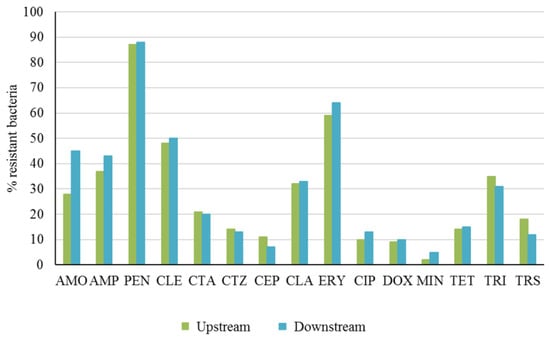
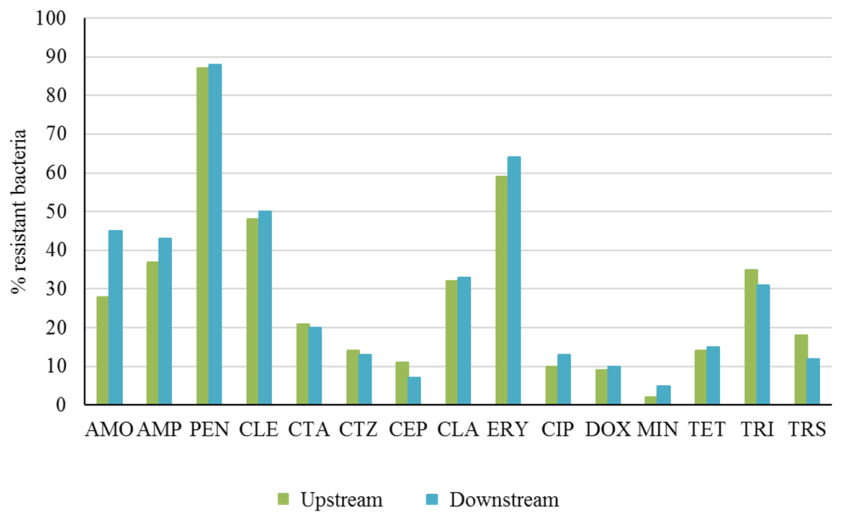
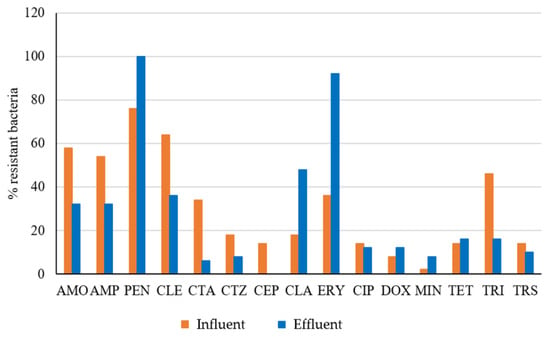
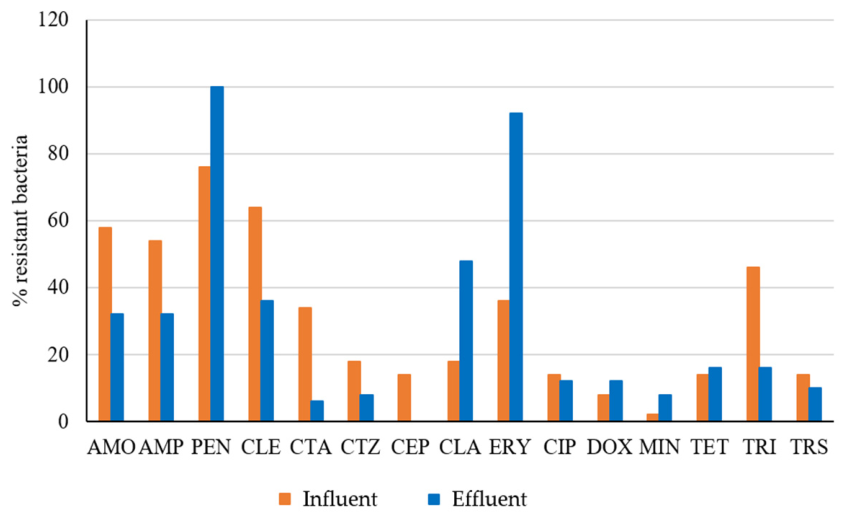
This widespread occurrence of resistance to β-lactams and macrolides in the water samples was also observed in the analysis of the resistant isolates (Figure 3 and Figure 4). Penicillin and erythromycin were the two antibiotics for which the highest number of resistant strains were found. Penicillin belongs to the β-lactam family of antibiotics, and since its commercialization in 1944, it has been one of the most widely prescribed antibiotics in both human and veterinary medicine, which explains the widespread occurrence of resistance to this antibiotic [25]. In the river, 87% of the strains isolated from samples upstream of the WWTP showed resistance to this antibiotic, and 88% downstream, while in the WWTP, 95% of the strains in the influent and 94% in the effluent were found to be resistant.
Figure 3.
Percentage of bacteria isolated in the river resistant to the selected antibiotics. AMO: amoxicillin; AMP: ampicillin; PEN: penicillin; CLE: cefalexin; CTA: cefotaxime; CTZ: ceftazidime; CEP: cefepime; CLA: clarithromycin; ERY: erythromycin; CIP: ciprofloxacin; DOX: doxycycline; MIN: minocycline; TET: tetracycline; TRI: trimethoprim; TRS: trimethoprim/sulfamethoxazole.
Figure 4.
Percentage of bacteria isolated in the WWTP resistant to the selected antibiotics. AMO: amoxicillin; AMP: ampicillin; PEN: penicillin; CLE: cefalexin; CTA: cefotaxime; CTZ: ceftazidime; CEP: cefepime; CLA: clarithromycin; ERY: erythromycin; CIP: ciprofloxacin; DOX: doxycycline; MIN: minocycline; TET: tetracycline; TRI: trimethoprim; TRS: trimethoprim/sulfamethoxazole.
Erythromycin, together with clarithromycin, belongs to the macrolide family of antibiotics used as alternatives to penicillin and its derivatives [26]. These are commonly prescribed for various pathologies such as pneumonia, sinusitis, pharyngitis, conjunctivitis, and some sexually transmitted diseases. With regard to erythromycin, 59% and 64% of the strains tested upstream and downstream in the river, respectively, showed resistance, and 70% and 73% in the influent and effluent of the WWTP, respectively.
The penicillin-derived antibiotics analyzed, including amoxicillin, ampicillin, and cephalexin, a first-generation cephalosporin, were also among the antibiotics for which a significant number of resistant bacteria were found. These antibiotics have been extensively used for years, which explains the widespread development of resistance to this group of antibiotics, as in the case of penicillin.
In addition to the previously mentioned cephalexin, three other cephalosporins were analyzed: cefotaxime and ceftazidime, both third-generation cephalosporines, and cefepime, a fourth-generation type. Cephalosporins are β-lactam antibiotics, whose classification into different generations is based on their molecular structure and antimicrobial characteristics, with increasing potential in successive generations [27]. These are prescribed for various bacterial infections such as meningitis, pneumonia, skin and urinary tract infections, etc. The later generations of cephalosporins are less frequently utilized than their predecessors, especially those belonging to the fourth generation, which are reserved for severe infections. This explains why resistance to these antibiotics is not as widespread as it is for first- and second-generation cephalosporins or penicillin derivatives. Among the third- and fourth-generation cephalosporins analyzed, the highest prevalence of resistance was observed for cefotaxime, with 20% and 21% of strains upstream and downstream of the WWTP, respectively, identified as resistant, and 20% and 29% of bacteria observed in the influent and effluent of the WWTP, respectively, identified as resistant.
The only quinolone antibiotic tested was ciprofloxacin, a broad-spectrum fluoroquinolone that acts on certain bacteria by preventing DNA replication and thus, bacterial growth [28]. In the river, only 10% and 13% of the strains tested upstream and downstream, respectively, showed resistance to this antibiotic, compared to 24% and 12% of the strains isolated in the influent and effluent of the WWTP.
Another important group of antibiotics studied were the tetracyclines. These antibiotics are among the most economically viable on the market and have been widely used in prophylaxis and treatment of human and animal infections, as well as at sub-therapeutic levels in animal feed as growth promoters [29]. Currently, their efficacy and use have been reduced due to the widespread emergence of bacteria resistant to these antibiotics. Of the antibiotics that belong to this family, doxycycline, minocycline, and tetracycline were analyzed in this study. The latter was the one for which the highest number of resistant bacteria was found both in the river (14% and 15% upstream and downstream, respectively) and in the WWTP (20% in the influent and 12% in the effluent).
Regarding trimethoprim, this is an antibiotic that can be administered alone, commonly for the treatment of urinary tract infections, or together with sulfamethoxazole, for the treatment of urinary tract infections, toxoplasmosis, and pneumonia, among other conditions [30]. In this study, trimethoprim was studied both alone and in combination with sulfamethoxazole. Of the two cases, a higher number of bacteria resistant to trimethoprim alone was found, both in the river, with 31% of resistant strains upstream and 35% downstream, and in the WWTP, with 20% of resistant strains in the influent and 34% in the effluent.
Considering the overall resistance patterns observed for the antibiotics analyzed, the results do not provide evidence that WWTP acted as a significant source of antibiotic resistance, as no consistent increase in resistance was observed either in the effluent compared with the influent or downstream compared with upstream river samples. Nevertheless, these conclusions are limited to the bacterial isolates and antibiotic resistance profiles investigated in this study. While the selected isolates allowed comparison of resistance patterns among locations and sampling campaigns, they may not fully capture the diversity and heterogeneity of bacterial communities present in wastewater and river water. Consequently, low-frequency resistance phenotypes or spatially and temporally variable resistant populations may have remained undetected.
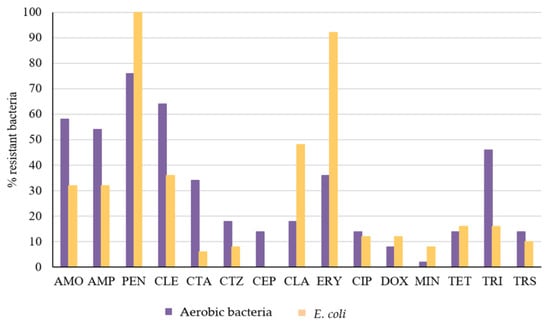
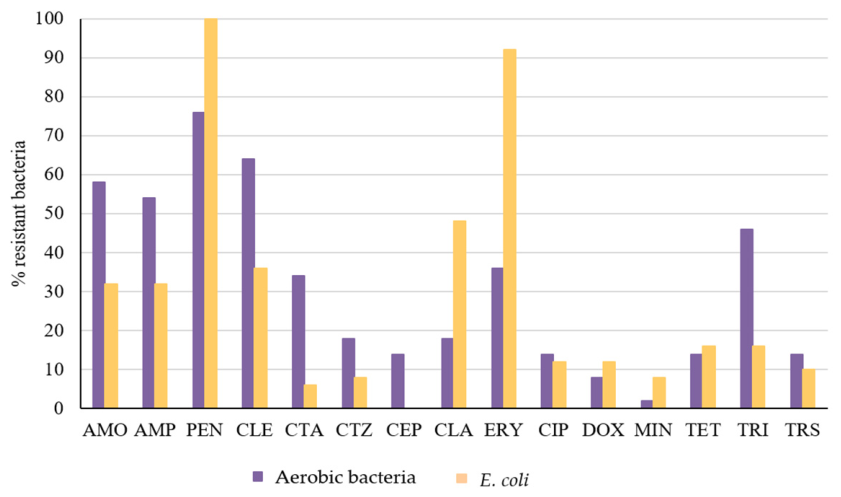
In terms of the two bacterial groups analyzed, total aerobes and E. coli, the resistance profiles to the different antibiotics were similar in the four sampling points in the WWTP and the river (Figure 5). For most antibiotics, more resistant aerobic bacteria were isolated than E. coli strains, except for the widely used antibiotics penicillin, erythromycin, and clarithromycin, for which the high percentage of resistant E. coli strains compared to aerobic bacteria was notable.
Figure 5.
Percentage of aerobic and E. coli strains resistant to the analysed antibiotics in this study. AMO: amoxicillin; AMP: ampicillin; PEN: penicillin; CLE: cefalexin; CTA: cefotaxime; CTZ: ceftazidime; CEP: cefepime; CLA: clarithromycin; ERY: erythromycin; CIP: ciprofloxacin; DOX: doxycycline; MIN: minocycline; TET: tetracycline; TRI: trimethoprim; TRS: trimethoprim/sulfamethoxazole.
Finally, it should be noted that the interpretation of resistance patterns in the aerobic bacterial community should be considered with caution, as isolates were not taxonomically identified and CLSI breakpoints were used as reference criteria for comparative purposes. Therefore, these results provide a general indication of resistance occurrence within environmental bacterial populations rather than clinically validated susceptibility classifications. Likewise, this ARB assessment was based on a fixed number of isolates selected from each sample and therefore provides information on the frequency of resistance phenotypes among the recovered isolates rather than on the absolute abundance of resistant bacteria in the original water matrices.
3.2. Antibiotic Resistance Genes (ARGs)
In the ARG study, the occurrence and abundance of the resistance genes analyzed in the different water samples and locations was determined. Regarding their occurrence, the sul2 gene was detected in the highest percentage of water samples (90%), whereas blaTEM showed the lower frequency (75%) (Table 5). Among all locations, only the influent to the WWTP showed the presence of all five target genes in 100% of samples. The high detection frequency of all target genes across sampling sites confirms the widespread distribution of ARGs in both wastewater and receiving environments. Similar findings have been reported in previous studies [31,32], supporting the view that aquatic systems act as reservoirs of resistance genes under anthropogenic influence.
Table 5.
Frequency of ARG detection in water samples from each sampling site.
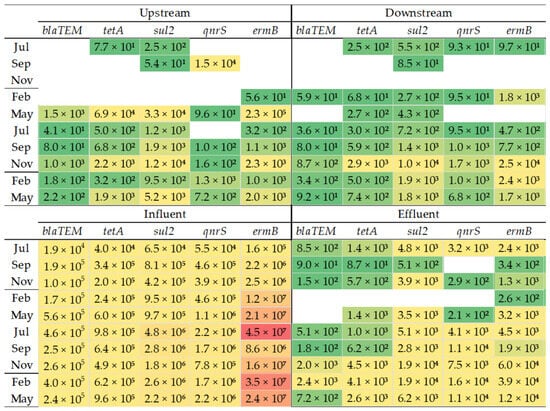
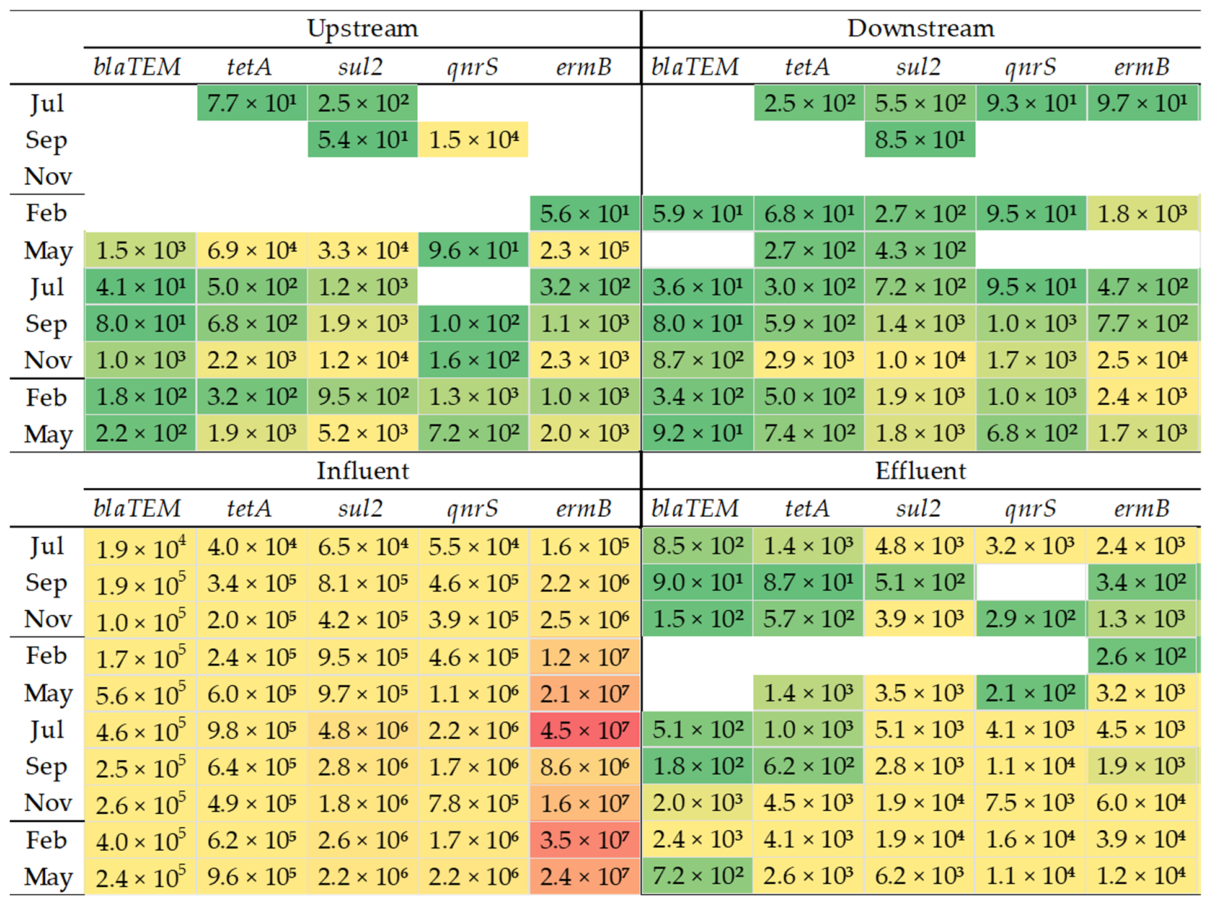
The ARG distribution was different in the four locations, as can be seen in Figure 6. In the river, upstream of the WWTP, the highest abundance was found among ermB, tetA, and sul2 genes, while downstream, ermB and sul2 genes prevailed. In the case of the WWTP, the abundance of the different genes was similar in the influent, although the ermB gene was predominant in all samples. In the effluent, the main genes were ermB, sul2, and qnrS.
Figure 6.
Heat map representing ARG mean abundances, in genomic copies/mL, in sampling dates and sites across the study. The color gradient from green to red indicates increasing concentration. Cells in white indicate values below the limit of quantification.
Given the results obtained in the ARB analysis, which revealed the β-lactam antibiotic family to be the group with the highest number of resistances in the bacterial isolates analyzed, a prevalence of the abundance of blaTEM gene could be expected. Additionally, β-lactams are among the most widely used antimicrobial agents globally [33] and resistance to β-lactam antibiotics is one of the most abundant [34]. It should be noted that the ARB analysis carried out in this study was quite limited, as only a small number of isolates were analyzed in each sample. Nevertheless, the findings of the ARG analysis demonstrated that the blaTEM gene was not the most prevalent in any of the locations, being outnumbered by the other ARG.
β-lactam antibiotics can degrade more easily in aquatic environments than other antibiotics [35]. This degradation may be driven by abiotic mechanisms, such as hydrolysis of the β-lactam ring, their key functional group [36]. The hydrolytic reaction is influenced by environmental parameters (i.e., pH, temperature, metal ion presence) and can proceed relatively rapidly under natural conditions. Consequently, an attenuation of β-lactam compounds in the water may potentially reduce the selective pressure for resistance emergence, diminish their antimicrobial activity, and thus reduce the spread of antibiotic resistance traits.
Furthermore, the present ARG study may have underestimated the presence of the blaTEM gene due to several factors. Although blaTEM is one of the most widely reported β-lactam resistance genes, it may not have been the predominant determinant in the analyzed samples, as other genes such as blaOXA, blaSHV, or blaCTX-M also confer resistance to this antibiotic family and were not included in the present analysis. Consequently, the abundance of blaTEM alone may not fully reflect the overall burden of β-lactam resistance genes in the investigated environments. Moreover, while the selected ARGs cover resistance to several of the most widely used antibiotic classes, they do not encompass the full diversity of clinically relevant resistance determinants present in environmental systems. Genes associated with resistance to other high-priority antimicrobials, including carbapenems, aminoglycosides, vancomycin, and extended-spectrum β-lactams, were not included in the present study. Consequently, the observed patterns should be interpreted as representative of the selected resistance markers, and they may not necessarily reflect the behavior of other clinically important resistance determinants that were not investigated. Taken together, these methodological limitations highlight the complexity of linking phenotypic resistance with specific genetic markers and suggest that multiple resistance genes or mechanisms not targeted in this study may be involved.
As expected, for all genes, the highest abundances were observed in the WWTP influent samples. Comparison of ARG concentrations in influent and effluent samples revealed a reduction equal to or above 99% at the outlet of the WWTP in 90% of the sampling campaigns for all genes, while reductions above 90% were observed in all samples. Although the use of grab samples without temporal alignment based on hydraulic retention time may have introduced additional uncertainty when comparing individual influent-effluent sampling events, these concentration-based results should be interpreted as reflecting overall WWTP performance rather than exact removal efficiencies for specific wastewater parcels. Nevertheless, the consistent reductions observed across ten sampling campaigns over a two-year period support the effectiveness of the WWTP treatment in minimizing the presence of resistance genes in treated effluents under routine operating conditions. The observed reduction in ARG concentrations is likely to have been the result of combined treatment processes, including biological degradation, biomass removal, and UV disinfection. These mechanisms contribute to decreasing both viable bacteria and extracellular genetic material, although they may not completely eliminate resistance determinants. Concerning the river, no clear trend was seen between samples taken upstream and downstream of the WWTP, but the samples taken downstream of the WWTP showed lower concentrations of the target resistance genes than the effluent samples, with a few exceptions. The hypothesis that the WWTP is a source of emergence and dissemination of antibiotic resistance to the environment would lead us to expect a higher number of ARGs being found downstream compared with upstream in the river, with the latter location being free of the influence of this WWTP. However, this pattern was not observed in the present study, as a higher or lower presence of ARGs was found upstream and downstream, respectively, without a constant pattern. Nevertheless, these findings are restricted to the resistance genes investigated and should not be interpreted as representative of the entire environmental resistome.
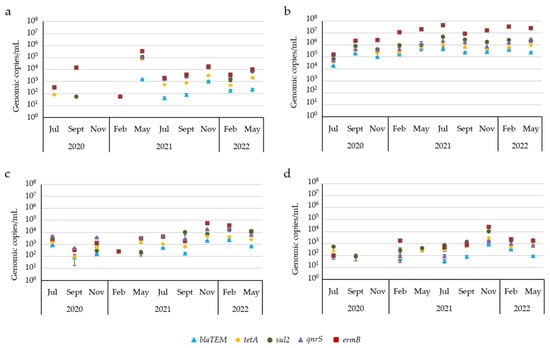
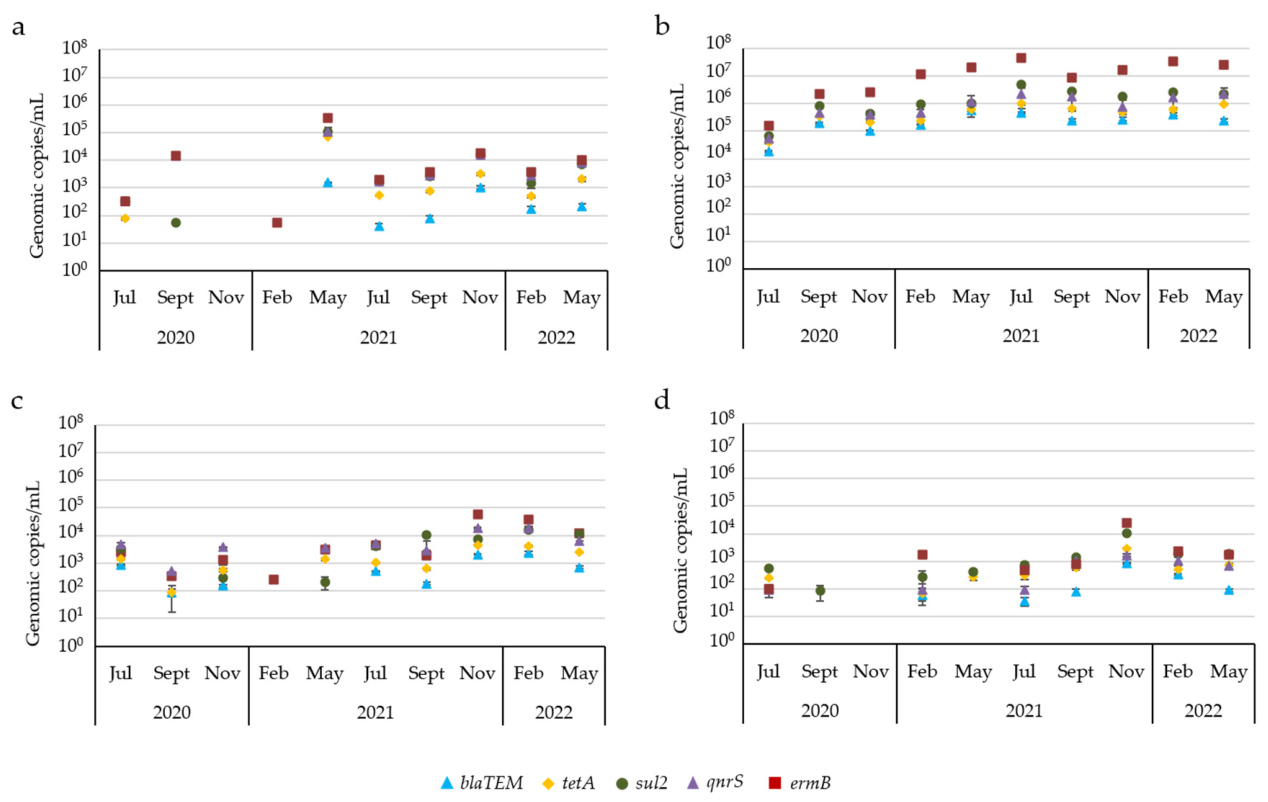
Another noteworthy observation was the lower abundance of the ARGs studied in the samples collected in 2020 compared to those from subsequent years, a difference that was statistically significant (p < 0.05) for all the genes except qnrS (Figure 7). As 2020 was the first year of the COVID-19 pandemic, when there was a widespread antibiotic reduction in the community sector across Europe [37], this decline was likely to have been due to the reduction in primary care services and a potential decrease in respiratory infections resulting from lockdown measures and social distancing [38]. However, during the following years, consumption of antibiotics increased, returning to pre-pandemic levels. This trend, seen at European level, was likewise observed in Spain, as several post-pandemic studies examining antibiotic use in both the primary care and hospital settings have reported [39,40,41].
Figure 7.
ARG concentrations throughout the study in the four sampling sites ((a) upstream; (b) influent, (c) effluent; (d) downstream).
Variations in antibiotic consumptions during pandemic and post-pandemic periods may have contributed to changes in selective pressures on bacterial communities, potentially influencing ARG occurrence. In this study, a significant increase in ARG levels (except for qnrS gene, which showed a not statistically significant increase in abundance) was observed in 2021 and 2022 compared to 2020, which would be consistent with the variations in antibiotic consumption in the studied period. However, as neither antibiotic consumption data from the studied population nor antibiotic residue concentrations were assessed, no direct relationship can be established. Therefore, this observation should be regarded as a hypothesis-generating finding, suggesting that temporal changes in antibiotic use may have contributed to the observed ARG dynamics. Future studies integrating AMR monitoring with antibiotic consumption and residue data would be required to evaluate this potential association.
Overall, the results highlight the widespread occurrence of antimicrobial resistance across both wastewater and river compartments, together with the substantial reduction of ARGs during treatment. Despite the high prevalence of multi-resistant bacteria, no consistent increase in ARB or ARG levels was observed downstream of the WWTP discharge. These findings emphasize the need to consider background environmental contamination and site-specific factors when evaluating AMR dynamics in aquatic systems. Temporal variations further suggest a link with changes in antibiotic consumption patterns. However, these observations should be interpreted in light of the methodological limitations, including the limited number of isolates analyzed and the targeted assessment of only five ARGs. Therefore, the conclusions drawn apply specifically to the resistance markers investigated and do not necessarily reflect the behavior of the entire environmental resistome.
Finally, in the present study, ARGs were quantified and reported as gene copies/mL to characterize their environmental occurrence and dynamics across wastewater and river compartments. Therefore, the results should be interpreted as concentration-based indicators of resistance genes present in the analyzed water matrices rather than as measures of their relative representation within the microbial community. As a consequence, variations in total microbial biomass among samples may have contributed to part of the observed variability in ARG concentrations.
4. Conclusions
In this study, antibiotic resistance was systematically monitored in a full-scale urban WWTP and its receiving river over a two-year period. A high prevalence of multi-resistant bacteria is a cause for great concern as it could potentially lead to an emergence of untreatable infections; such a prevalence was consistently observed across all compartments, confirming the widespread occurrence of antimicrobial resistance within the urban water cycle. Despite this, wastewater treatment resulted in a substantial reduction of ARGs, and no consistent increase in ARB or ARG levels was detected downstream of the discharge, indicating limited impact on the receiving environment under the investigated conditions.
Resistance in ARB was most frequently observed for β-lactams and macrolides in all sampling sites, with penicillin and erythromycin showing the highest prevalence. In the genotypic analysis, the genes that confer resistance to sulfonamides and macrolides, sul2 and ermB, were the most abundant both in the river and the WWTP. The discrepancies observed between the prevalence of ARB resistant to β-lactam antibiotics and the blaTEM gene abundance could be attributable to limitations in both phenotypic and genotypic analysis. Furthermore, an increase in ARG concentrations was observed in 2021 and 2022 compared to 2020. This temporal pattern may be consistent with COVID-19 pandemic-associated changes in antibiotic consumption reported in the literature, although this hypothesis is not directly evaluated in the present study.
These findings suggest that with regard to the antibiotic resistance markers investigated in this study, the data do not provide evidence that the studied WWTP acted as a net source of antimicrobial resistance, and they indicate that it may function as an effective control point within the aquatic system. However, these conclusions are restricted to the ARG and bacterial resistance profiles evaluated in this study and should not be interpreted as representative of the entire environmental resistome.
The temporal variability observed in ARG concentrations further points to a potential link between environmental resistance patterns and changes in antibiotic consumption at the population level, highlighting the sensitivity of wastewater-based indicators to broader societal trends.
From an environmental perspective, the results emphasize the importance of considering background contamination and site-specific factors when assessing AMR dynamics in natural waters. They also support the relevance of integrating wastewater and environmental monitoring approaches to improve the understanding of resistance dissemination and to inform risk assessment and water management strategies. Such integrated approaches may also help to better elucidate the complex relationships between antibiotic use, resistance selection, and the environmental dissemination of AMR. In this context, properly operated WWTPs, particularly those including disinfection processes, may play a key role in mitigating the environmental release of antimicrobial resistance.
Author Contributions
Conceptualization, V.B., M.C. and S.P.; methodology, V.B. and A.R.-M.; validation, V.B.; formal analysis, V.B., N.L.-H. and I.A.-M.; investigation, V.B., N.L.-H. and I.A.-M.; resources, V.B., M.C. and S.P.; writing—original draft preparation, V.B.; writing—review and editing, V.B., N.L.-H., M.C., S.P., A.R.-M., I.A.-M., M.S. and F.G.-d.-C.; visualization, V.B.; supervision, M.S. and F.G.-d.-C.; project administration, V.B.; funding acquisition, M.C., S.P. and F.G.-d.-C. All authors have read and agreed to the published version of the manuscript.
Funding
This research was supported and funded by the Bilbao Bizkaia Water Consortium.
Data Availability Statement
The raw data supporting the conclusions of this article will be made available by the authors on request.
Conflicts of Interest
The authors declare no conflicts of interest.
Abbreviations
The following abbreviations are used in this manuscript:
| WWTP | Wastewater treatment plant |
| AMR | Antimicrobial resistance |
| ARB | Antibiotic-resistant bacteria |
| ARG | Antibiotic resistance genes |
| WHO | World Health Organization |
| HGT | Horizontal gene transfer |
| CLSI | Clinical & Laboratory Standards Institute |
| qPCR | Quantitative polymerase chain reaction |
References
- Sharma, S.; Chauhan, A.; Ranjan, A.; Mathkor, D.M.; Haque, S.; Ramniwas, S.; Tuli, H.S.; Jindal, T.; Yadav, V. Emerging challenges in antimicrobial resistance: Implications for pathogenic microorganisms, novel antibiotics, and their impact on sustainability. Front. Microbiol. 2024, 15, 1403168. [Google Scholar] [CrossRef] [Scilit] [PubMed]
- GBD 2021 Antimicrobial Resistance Collaborators. Global burden of bacterial antimicrobial resistance 1990–2021: A systematic analysis with forecasts to 2050. Lancet 2024, 404, 1199–1226. [Google Scholar] [CrossRef] [Scilit] [PubMed]
- World Health Organization (WHO). Ten Threats to Global Health in 2019. 2019. Available online: https://www.who.int/news-room/spotlight/ten-threats-to-global-health-in-2019 (accessed on 14 May 2025).
- World Health Organization (WHO). Technical Brief on Water, Sanitation, Hygiene (WASH) and Wastewater Management to Prevent Infections and Reduce the Spread of Antimicrobial Resistance (AMR); World Health Organization: Geneva, Switzerland; Food and Agriculture Organization: Rome, Italy; World Organization for Animal Health: Paris, France, 2020; Available online: https://iris.who.int/bitstream/handle/10665/332243/9789240006416-eng.pdf?sequence=1 (accessed on 14 May 2025).
- Mohamad, Z.; Mohamad, J.; Bakon, S. From Rivers to Tap: The Spread of Antimicrobial Resistance in Drinking Water Systems. In Antimicrobial Resistance—New Insights; IntechOpen: London, UK, 2025. [Google Scholar] [CrossRef] [Scilit]
- Yang, Y.; Cai, S.; Mo, C.; Dong, J.; Che, S.; Weng, Z. Profiles of antibiotic resistome risk in diverse water environments. Commun. Earth Environ. 2025, 6, 158. [Google Scholar] [CrossRef] [Scilit]
- Flach, K.A.; Bones, U.A.; Wolff, D.B.; de Oliveira Silveira, A.; da Rosa, G.M.; Carissimi, E.; Silvestri, S. Antibiotic resistant bacteria and genes (ARB and ARG) in water and sewage treatment units: A review. Environ. Nanotechnol. Monit. Manag. 2024, 21, 100941. [Google Scholar] [CrossRef] [Scilit]
- Godinho, O.; Lage, O.M.; Quinteira, S. Antibiotic-Resistant Bacteria across a Wastewater Treatment Plant. Appl. Microbiol. 2024, 4, 364–375. [Google Scholar] [CrossRef] [Scilit]
- Gao, Y.-X.; Li, X.; Fan, X.-Y.; Zhao, J.-R.; Zhang, Z.-X. Wastewater treatment plants as reservoirs and sources for antibiotic resistance genes: A review on occurrence, transmission and removal. J. Water Process. Eng. 2022, 46, 102539. [Google Scholar] [CrossRef] [Scilit]
- Li, S.; Ondon, B.S.; Ho, S.-H.; Zhou, Q.; Li, F. Drinking water sources as hotspots of antibiotic-resistant bacteria (ARB) and antibiotic resistance genes (ARG): Occurrence, spread, and mitigation strategies. J. Water Process. Eng. 2023, 53, 103907. [Google Scholar] [CrossRef] [Scilit]
- Federigi, I.; Bonetta, S.; Tesauro, M.; De Giglio, O.; Oliveri Conti, G.; Atomsa, N.T.; Bagordo, F.; Bonetta, S.; Consonni, M.; Diella, G.; et al. A systematic scoping review of antibiotic-resistance in drinking tap water. Environ. Res. 2024, 263, 120075. [Google Scholar] [CrossRef] [Scilit] [PubMed]
- Sanganyado, E.; Gwenzi, W. Antibiotic resistance in drinking water systems: Occurrence, removal, and human health risks. Sci. Total Environ. 2019, 669, 785–797. [Google Scholar] [CrossRef] [Scilit] [PubMed]
- Gomes, M.P. The Convergence of Antibiotic Contamination, Resistance, and Climate Dynamics in Freshwater Ecosystems. Water 2024, 16, 2606. [Google Scholar] [CrossRef] [Scilit]
- Munita, J.M.; Arias, C.A. Mechanisms of Antibiotic Resistance. Microbiol. Spectr. 2016, 4, 464–473. [Google Scholar] [CrossRef] [Scilit] [PubMed]
- Grehs, B.W.N.; Linton, M.A.O.; Clasen, B.; de Oliveira Silveira, A.; Carissimi, E. Antibiotic resistance in wastewater treatment plants: Understanding the problem and future perspectives. Arch. Microbiol. 2021, 203, 1009–1020. [Google Scholar] [CrossRef] [Scilit] [PubMed]
- CLSI M100S; Performance Standards for Antimicrobial Susceptibility Testing. 30th ed. Clinical and Laboratory Standards Institute: Malvern, PA, USA, 2020.
- Agencia Española de Medicamentos y Productos Sanitarios (AEMPS). Plan Nacional Frente a la Resistencia a los Antibióticos (PRAN). Mapas de Consumo de Antibióticos. Available online: https://www.resistenciaantibioticos.es/es/lineas-de-accion/vigilancia/mapas-de-consumo (accessed on 21 June 2025).
- Devarajan, N.; Laffite, A.; Mulaji, C.K.; Otamonga, J.P.; Mpiana, P.T.; Mubedi, J.I.; Prabakar, K.; Ibelings, B.W.; Poté, J. Occurrence of Antibiotic Resistance Genes and Bacterial Markers in a Tropical River Receiving Hospital and Urban Wastewaters. PLoS ONE 2016, 11, e0149211. [Google Scholar] [CrossRef] [Scilit] [PubMed]
- Rodríguez-Mozaz, S.; Chamorro, S.; Marti, E.; Huerta, B.; Gros, M.; Sànchez-Melsió, A.; Borrego, C.M.; Barceló, D.; Balcázar, J.L. Occurrence of antibiotics and antibiotic resistance genes in hospital and urban wastewaters and their impact on the receiving river. Water Res. 2014, 69, 234–242. [Google Scholar] [CrossRef] [Scilit] [PubMed]
- Zhang, X.; Wu, B.; Zhang, Y.; Zhang, T.; Yang, L.; Fang, H.H.; Ford, T.; Cheng, S. Class 1 integronase gene and tetracycline resistance genes tetA and tetC in different water environments of Jiangsu Province, China. Ecotoxicology 2009, 18, 652–660. [Google Scholar] [CrossRef] [Scilit] [PubMed]
- Pei, R.; Kim, S.C.; Carlson, K.H.; Pruden, A. Effect of river landscape on the sediment concentrations of antibiotics and corresponding antibiotic resistance genes (ARG). Water Res. 2006, 40, 2427–2435. [Google Scholar] [CrossRef] [Scilit] [PubMed]
- Naquin, A.; Shrestha, A.; Sherpa, M.; Nathaniel, R.; Boopathy, R. Presence of antibiotic resistance genes in a sewage treatment plant in Thibodaux, Louisiana, USA. Bioresour. Technol. 2015, 188, 79–83. [Google Scholar] [CrossRef] [Scilit] [PubMed]
- Lajqi, N.; Poceva, A.; Hajrulai-Musliu, Z. Antibiotic Resistance and Aquatic Systems: Importance in Public Health. Water 2024, 16, 2362. [Google Scholar] [CrossRef] [Scilit]
- Pérez-Etayo, L.; González, D.; Leiva, J.; Vitas, A.I. Multidrug-Resistant Bacteria Isolated from Different Aquatic Environments in the North of Spain and South of France. Microorganisms 2020, 8, 1425. [Google Scholar] [CrossRef] [Scilit] [PubMed]
- Rowe, D. Penicillin and the Antibiotic Revolution. Global History of Capitalism Project. Case Study #18. University of Oxford. 2020. Available online: https://globalcapitalism.history.ox.ac.uk/files/case18penicillinv2pdf (accessed on 4 June 2025).
- Pavda, M.; Kumirska, J.; Stepnowski, P.; Mulkiewicz, E. Antibiotic resistance genes identified in wastewater treatment plant systems—A review. Sci. Total Environ. 2019, 697, 134023. [Google Scholar] [CrossRef] [Scilit] [PubMed]
- Arumugham, V.B.; Gujarathi, R.; Cascella, M. Third-Generation Cephalosporins. [Updated 2023 Jun 4]. In StatPearls [Internet]; StatPearls Publishing: Treasure Island, FL, USA, 2023. Available online: https://www.ncbi.nlm.nih.gov/sites/books/NBK549881/ (accessed on 5 June 2025).
- Bush, N.G.; Diez-Santos, I.; Abbott, L.R.; Maxwell, A. Quinolones: Mechanism, Lethality and Their Contributions to Antibiotic Resistance. Molecules 2020, 25, 5662. [Google Scholar] [CrossRef] [Scilit] [PubMed]
- Chopra, I.; Roberts, M. Tetracycline antibiotics: Mode of action, applications, molecular biology, and epidemiology of bacterial resistance. Microbiol. Mol. Biol. Rev. 2001, 65, 232–260. [Google Scholar] [CrossRef] [Scilit] [PubMed]
- Vademecum. Sulfametoxazol y Trimetoprima (J01EE01). Available online: https://www.vademecum.es/principios-activos-sulfametoxazol+y+trimetoprima-j01ee01 (accessed on 5 June 2025).
- Agboro, H.; Iyiola, A.T.; Ohaekwe, C.C.; Adebowale, M.T.; Lawal, M.; Ali, V.E.; Philips, O.A. Antibiotic resistance genes (ARGs) in wastewater: Environmental fate and risk mitigation strategies. World J. Biol. Pharm. Health Sci. 2025, 22, 047–063. [Google Scholar] [CrossRef] [Scilit]
- Garcia-Torné, M.; Falcó, I.; Borrell, X.; Bautista, A.; Mazigh, R.; Aznar, R.; Sánchez, G.; Farré, M.; Llorca, M. Comprehensive Study of Antibiotics and Antibiotic Resistance Genes in Wastewater and Impacted Mediterranean Water Environments. Antibiotics 2025, 14, 341. [Google Scholar] [CrossRef] [Scilit] [PubMed]
- World Health Organization (WHO). Global Antimicrobial Resistance and Use Surveillance System (GLASS) Report. Antibiotic Use Data for 2022; IGO: Geneva, Switzerland, 2025; Available online: https://www.who.int/publications/i/item/9789240108127 (accessed on 23 June 2025).
- Waśko, I.; Kozińska, A.; Kotlarska, E.; Baraniak, A. Clinically Relevant β-Lactam Resistance Genes in Wastewater Treatment Plants. Int. J. Environ. Res. Public Health 2022, 19, 13829. [Google Scholar] [CrossRef] [Scilit] [PubMed]
- Addis, T.Z.; Adu, J.T.; Kumarasamy, M.; Demlie, M. Assessment of Existing Fate and Transport Models for Predicting Antibiotic Degradation and Transport in the Aquatic Environment: A Review. Water 2023, 15, 1511. [Google Scholar] [CrossRef] [Scilit]
- Mitchell, S.M.; Ullman, J.L.; Teel, A.L.; Watts, R.J. PH and temperature effects on the hydrolysis of three β-lactam antibiotics: Ampicillin, cefalotin and cefoxitin. Sci. Total Environ. 2014, 466–467, 547–555. [Google Scholar] [CrossRef] [Scilit] [PubMed]
- Ventura-Gabarró, C.; Leung, V.H.; Vlahović-Palčevski, V.; Machowska, A.; Monnet, D.L.; Högberg, L.D.; ESAC-Net study group, & ESAC-Net study group participants 2023. Rebound in community antibiotic consumption after the observed decrease during the COVID-19 pandemic, EU/EEA, 2022. Eurosurveillance 2023, 28, 2300604. [Google Scholar] [CrossRef] [Scilit] [PubMed]
- Ruiz-Garbajosa, P.; Cantón, R. COVID-19: Impact on prescribing and antimicrobial resistance. Rev. Esp. Quimioter. 2021, 34, 63–68. [Google Scholar] [CrossRef] [Scilit] [PubMed]
- Padullés, A.; Hernàndez, S.; Fernández-Polo, A.; Grau, S.; Almendral, A.; Melendo, S.; Limón, E.; Pujol, M.; Pablo Horcajada, J. on behalf of VINCat-PROA Hospital, Pediatric Group, Pharmacy Department members of the participating hospitals in VINCat-PROA. Trends in antimicrobial consumption at 72 adult and pediatric hospitals in Catalonia. Results of the VINCat Program 2008–2022. Enferm. Infecc. Microbiol. Clin. (Engl. Ed.) 2025, 43, S69–S79. [Google Scholar] [CrossRef] [Scilit] [PubMed]
- Plan Nacional Frente a la Resistencia a los Antibióticos (PRAN). Informe Anual del PRAN 2022–2023. 2025. Available online: https://www.resistenciaantibioticos.es/sites/default/files/2025-06/Informe%20anual%20PRAN%202022-2023_.pdf (accessed on 21 June 2025).
- Sánchez-Herrero, H.; Solaz-García, Á.; Pinilla-González, A.; Martínez-Sánchez, E.V.; Santágueda-Balader, P.; Cernada-Badía, M. Epidemiological characteristics of antimicrobial use in Primary Care in Spain: A nationwide study. Rev. Esp. Quimioter. 2025, 38, 115–125. [Google Scholar] [CrossRef] [Scilit] [PubMed]

Disclaimer/Publisher’s Note: The statements, opinions and data contained in all publications are solely those of the individual author(s) and contributor(s) and not of MDPI and/or the editor(s). MDPI and/or the editor(s) disclaim responsibility for any injury to people or property resulting from any ideas, methods, instructions or products referred to in the content. |
© 2026 by the authors. Licensee MDPI, Basel, Switzerland. This article is an open access article distributed under the terms and conditions of the Creative Commons Attribution (CC BY) license.