


Abstract
The increasing prevalence of cancer in Thailand over the past decade has resulted in a substantial rise in the use of anticancer drugs, which are eventually discharged into municipal wastewater through hospital and domestic effluents. The inability of conventional wastewater treatment systems to completely remove these pharmaceuticals has been widely reported. The continuous release of these emerging anticancer agents into aquatic environments reduces water quality and threatens biodiversity. Even at trace levels, these compounds may act as persistent pollutants capable of impairing ecosystem. This study investigated the occurrence and concentration levels of three widely used chemotherapeutic agents including cyclophosphamide (COP), doxorubicin (DOX), and vincristine (VIN) in Bangkok’s municipal wastewater to evaluate their potential environmental risks. Thirty-two influent and effluent wastewater samples were collected from eight large-scale wastewater treatment plants (WWTPs) from October 2024 to January 2025. Samples were processed using solid-phase extraction (SPE) and analyzed by liquid chromatography–triple quadrupole mass spectrometry (LC–MS/MS). The analytical method demonstrated high precision and reproducibility, with relative standard deviations (%RSD) below the 20% acceptance limit for all compounds. Method accuracy ranged from 81.84% to 107.21%. Results showed the presence of only COP in almost influent and effluent at levels ranging from 0.26 to 2.06 µg/L. In contrast, DOX and VIN levels remained consistently below the limits of quantitation (LOQ) in all WWTP samples. This study establishes the first baseline for COP, DOX, and VIN contamination in Bangkok’s municipal wastewater. Notably, the residue of COP in wastewater suggests that current wastewater treatment facilities in Thailand are insufficient for its removal, posing a potential long-term risk to local aquatic ecosystems.
1. Introduction
Pharmaceuticals are essential chemical and biological active substances increasingly utilized in the treatment of both humans and animals. This widespread usage is driven by rapid global population growth and ongoing advancements in public health systems. Consequently, the extensive use and improper disposal of these compounds have led to their common detection within municipal wastewater systems globally. Within the pharmaceutical sector, the global market for anticancer drugs is experiencing the most significant expansion among all therapeutic categories. This growth, coupled with their potent biological activity at low concentrations, establishes them as a high-priority group of emerging environmental contaminants [1]. This trend directly correlates with global health data from both the World Health Organization and the International Agency for Research on Cancer classify cancer as one of the leading causes of mortality worldwide [2]. In Thailand, this public health challenge is particularly acute, with cancer consistently ranking as the leading cause of death for several decades [3]. Similarly, the Veterinary Cancer Society estimates that around 25% of dogs and cats worldwide are diagnosed with cancer during their lifespan, making it a leading cause of death among older pets [4]. This high clinical demand has led to the increased use of cytostatic agents such as cyclophosphamide (COP), doxorubicin (DOX), and vincristine (VIN), three prominent compounds within this expanding class of emerging contaminants that are frequently employed in combination protocols for both human and veterinary oncology [5,6,7]. The therapeutic effects of these agents are achieved through potent mechanisms, such as damaging deoxyribonucleic acid (DNA) and disrupting normal cellular processes in proliferating cells [8,9]. Due to their characteristic potency and chemical activity, their presence in the environment is a concern. The release of these agents into the aquatic environment occurs primarily through the discharge of untreated or inadequately treated wastewater originating from both hospitals and municipal sources. Although conventional wastewater treatment plants such as standard activated sludge are in place, the reported removal efficiency for these drugs is consistently low. These agents can negatively impact both human health and the aquatic environment even at trace concentrations [10]. These residues are hazardous to aquatic organisms due to their mutagenicity, teratogenicity, genotoxicity, and carcinogenicity as well as the potential for bioaccumulation through the food chain [11,12]. Thus, the widespread and persistent contamination of these compounds is an emerging concern and a significant global environmental risk. For instance, COP has been widely detected in hospital effluents, municipal wastewater, surface water, and even groundwater across continents, with the concentrations ranging from 0.0011 to 0.45 µg/L in Spain, Germany, Japan, China, as well as Thailand [13,14,15,16,17]. Similarly, DOX has been found in hospital wastewater effluent in Austria at concentrations ranging from 0.26 to 1.35 µg/L [18]. VIN has also been detected in hospital effluents and wastewater treatment plant influents in Spain, with levels documented up to 1.85 µg/L [19,20]. Furthermore, the presence of multiple contaminants at low concentrations can lead to unexpected toxicity through synergistic effects, where the combined impact of various chemical residues exceeds the toxicity of each individual substance. Such interactions represent a significant concern for environmental and public health [21,22]. Consequently, the management of emerging pollutants remains a significant global challenge due to their complex structures, low biodegradability, and potential for bioaccumulation, which can lead to genotoxicity and endocrine disruption even at trace concentrations. Incomplete removal of pharmaceutical residues during conventional wastewater treatment processes makes wastewater treatment plant (WWTP) effluent a significant source of these contaminants in natural ecosystems. To address these issues, recent environmental strategies emphasize transitioning wastewater treatment plants from simple treatment systems into biofactories within a sustainable circular economy, while mitigating the carbon footprint associated with energy-intensive operations. This shift prioritizes the more effective removal of recalcitrant substances to ensure the protection of both aquatic ecosystems and public health [23,24]. Despite the high usage of these potent cytostatic agents and their recognized environmental toxicity, there is a distinct lack of data regarding the occurrence and fate of COP, DOX, and VIN in the specific context of Bangkok’s municipal wastewater system.
Therefore, this study aims to fill this critical research gap by evaluating the prevalence and removal efficiency of anticancer agents across eight major municipal wastewater treatment plants. The specific objectives were to establish the concentration profiles of COP, DOX, and VIN in both influent and effluent streams, and assess the removal performance of existing treatment systems. This work provides essential baseline data to inform future environmental policies and the development of sustainable water reclamation strategies in rapidly growing metropolitan areas. To the best of our knowledge, this study provides the first systematic assessment of the presence of COP, DOX, and VIN in Bangkok’s municipal wastewater system. By investigating residues originating from both human and veterinary healthcare sources, this research offers a unique perspective on the environmental persistence of high-priority contaminants in Thailand
2. Materials and Methods
2.1. Chemicals and Reagents
Pure reference compounds of 98% purity, including cyclophosphamide monohydrate, doxorubicin hydrochloride, and vincristine sulfate were purchased from Tokyo Chemical Industry Co., Ltd. (Tokyo, Japan). Although isotope-labelled analogues of analytes were not available for this study, acetamiprid-d3, thiacloprid-d4 and pioglitazone were used as internal standards (ISTDs) based on their compatibility with the analytical conditions and ionization behavior. They were obtained from Hayashi Pure Chemical Ind., Ltd. (Osaka, Japan). LC–MS grades of 0.1% formic acid-distilled water, methanol, and acetonitrile were obtained from Kanto Chemical Co., Inc, (Tokyo, Japan). Formic acid 99% for LC/MS was obtained from FUJIFILM Wako Pure Chemical Co. (Osaka, Japan).
2.2. Sampling Sites and Approach
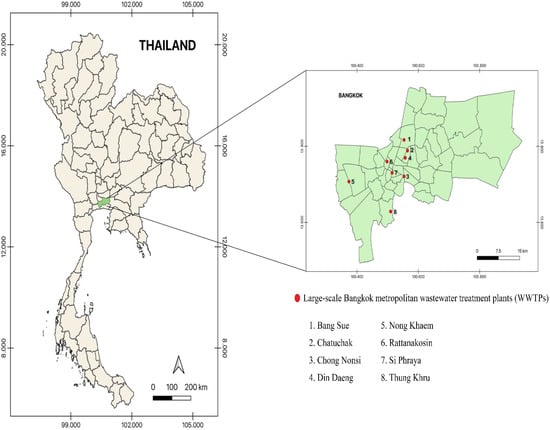
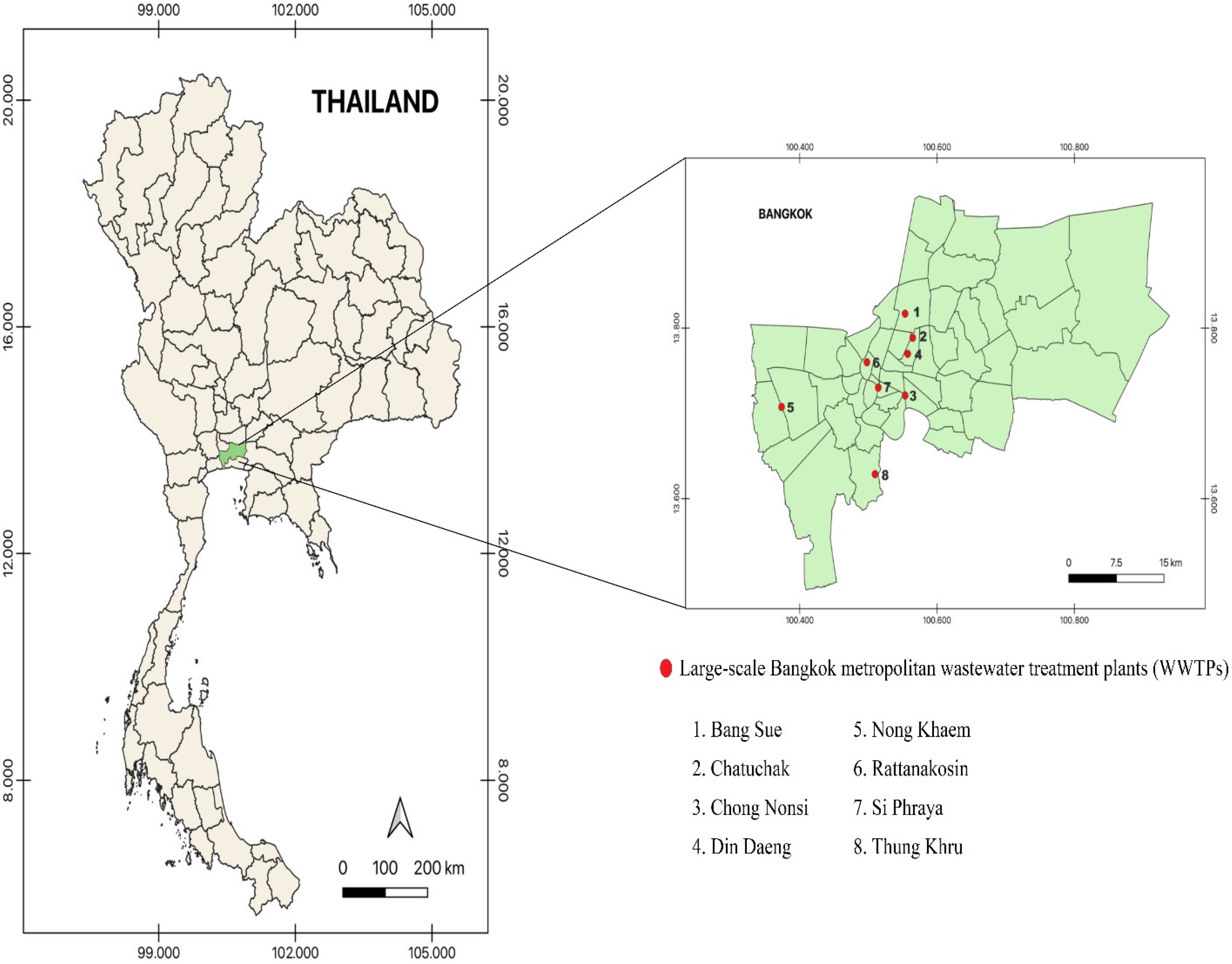
In this study, water samples were collected from eight large-scale Bangkok metropolitan wastewater treatment plants (WWTPs) including Bang Sue, Chatuchak, Chong Nonsi, Din Daeng, Nong Khaem, Rattanakosin, Si Phraya, and Thung Khru WWTPs (Figure 1) in two sampling periods (from October 2024 to January 2025). All WWTPs are operated by the Bangkok Metropolitan Administration with a combined treatment capacity of approximately 1,136,800 m3/day. All investigated facilities utilize cyclic activated sludge (CAS) technology. The typical process flow at these WWTPs involves preliminary screening for debris removal, followed by biological treatment within CAS basins, and final chlorination for disinfection prior to environmental discharge. Approximately 2 L of influent and effluent samples from WWTPs were collected by manual grab sampling in the sterile polyethylene bottle container. The influent and effluent pairs were collected simultaneously as snapshot samples under steady-state operating conditions. To maintain sample integrity, all containers were preserved at 4 °C during transit to the laboratory. After arriving at the laboratory, the samples were immediately vacuum-filtered through 1-μm glass fiber filters 2 times followed by 0.45 μm nylon membrane filters (Cytiva, Whatman, Little Chalfont, UK) and were kept in amber polyethylene terephthalate containers at −20 °C until analysis.
Figure 1.
Study sites of eight large-scale Bangkok metropolitan wastewater treatment plants (WWTPs).
2.3. Solid-Phase Extraction Optimization
Water samples were first centrifuged at 10,000 rpm for 5 min, followed by filtration through Whatman No. 1 filter paper to remove suspended particulate matter. A 20 mL aliquot of the filtrate was then acidified to pH 2 using hydrochloric acid and then spiked with ISTDs at a final amount of 10 ng in preparation for solid phase extraction (SPE). The SPE procedure was modified based on Gomez-Canela et al. [25] and Goueia et al. [26]. The Oasis® HLB cartridges (200 mg, 6 cc; Waters Corp., Milford, MA, USA) were conditioned with 6 mL of methanol followed by 6 mL of acidified distilled water. Thereafter, the 20 mL acidified water samples were passed through the cartridge at a flow rate of approximately 1 mL/min. After sample loading, the cartridges were washed with 1 mL of acidified distilled water and dried under vacuum for about 20 min. Analytes were eluted with 6 mL of 5% formic acid in methanol. The eluates were evaporated to dryness using a centrifugal vaporizer CVE-200D (EYELA®, Tokyo, Japan) under controlled temperature. The resulting residue was reconstituted in 200 μL of 0.1% formic acid in methanol, vortexed for complete dissolution and transferred into an autosampler vial for subsequent liquid chromatography–triple quadrupole mass spectrometry (LC-MS/MS) analysis.
2.4. LC-MS/MS Conditions
The quantification and confirmation of COP, DOX, and VIN were performed using a LC-MS/MS (Ultivo Triple Quadrupole LC-MS/MS; Agilent Technologies, Santa Clara, CA, USA) equipped with a LC column (Kinetex Biphenyl, 150 × 2.1 mm, φ 2.6 μm, 100 Å A; Phenomenex Inc., Torrance, CA, USA). The physicochemical properties of the targeted compounds are provided in Table S1. For analysis, mobile phase A and B consisted of 0.1% formic acid in distilled water and methanol, respectively. An injection volume of 3 μL, flow rate of 0.4 mL/min with gradient elution, and a column temperature of 45 °C were used for all experiments. The gradient for B was 20% (0–30 s), increased to 100% (30 s–10 min), 100% (10.01–13.00 min), and 20% (13.01–15.00 min), followed by a 1 min post-run at 20%.
2.5. Mass Spectrometric Conditions
The optimization of LC-MS/MS parameters for the target compounds was performed using an electrospray ionization (ESI) source. Method development initially involved an evaluation of the analytical signals in both positive and negative ESI modes. However, all target analytes including COP, DOX, and VIN exhibited superior sensitivity and cleaner precursor ion formation in the positive ionization mode ([M + H]+). For each compound, multiple reaction monitoring (MRM) transitions were established to ensure high selectivity and sensitivity in the complex wastewater matrix. The precursor ions were fragmented to identify the most stable and abundant product ions. As shown in Table 1, the primary MRM transitions (MRM 1) were utilized for quantification, while additional transitions (MRM 2 and MRM 3) served as qualifier ions for unambiguous identification. ISTDs including acetamiprid, thiacloprid, and pioglitazone were selected based on their compatibility with the analytical conditions and ionization behavior. These compounds were employed to compensate for matrix effects and variations in instrument response during the analysis.
Table 1.
MS/MS parameters for the analysis of target compounds and their ISTD by multiple reaction monitoring (MRM) positive ionization mode.
2.6. Method Validation
The analytical performance of the method for COP, DOX, and VIN was validated through various parameters such as linearity, the limits of detection (LODs), the limits of quantification (LOQs), extraction recovery, and signal suppression. For LC-MS/MS quantification, the ISTD method was used to compensate for the matrix effect during the determination of pharmaceuticals in wastewater. The calibration curves were created using 10-point calibration standards ranging from 0.1 to 20 µg/L. Calibration curves were plotted using the standard peak area/internal standard peak area ratios, and average coefficients of determination (r2) were ≥0.991 for all calibration curves as shown in Table 2 and Figure S1. Precision, expressed as the relative standard deviation (%RSD), was determined from five replicates at low, middle, and high concentration levels. The measured % RSD values for COP, DOX, and VIN ranged from 3.17% to 17.39%, all of which were within the acceptance limit of <20%. These results confirm the method’s high precision and reproducibility. The accuracy of the method was determined by recovery percentages, which ranged from 81.84% to 107.21%. These values fall within acceptable limits, indicating the method is both reliable and accurate. The LOD and LOQ were determined by spiking samples at the lowest validated level for each target analyte. The criteria used were a signal-to-noise ratio (S/N) greater than 3 for the LOD and a S/N greater than 10 for the LOQ, respectively. In this method, the LOD values for COP, DOX, and VIN were 0.07, 0.12, and 0.15 µg/L, respectively, while the LOQ values were 0.21, 0.39, and 0.50 µg/L. Detailed validation data are provided in Table 2.
Table 2.
Compounds, linearity range, coefficients of determination (r2), limit of detection (LOD), limit of qualification (LOQ), mean % recovery, and % relative standard deviations (%RSD) of targeted compounds.
2.7. Water Quality Parameters
The water quality data, including ammonia-nitrogen (NH3-N, mg/L), biological oxygen demand (BOD, mg/L), and chemical oxygen demand (COD, mg/L) were provided by the Information Division, Department of Drainage and Sewerage, Bangkok Metropolitan Administration [27]. Physicochemical water quality parameters were analyzed in accordance with the Standard Methods for the Examination of Water and Wastewater [28]. The concentration of NH3-N was determined via preliminary distillation followed by Nesslerization (APHA 4500-NH3 B and C). BOD was measured using the 5-day incubation test with azide modification (APHA 5210 B) and COD was determined using the closed reflux colorimetric method (APHA 5220 D).
3. Results and Discussion
For this study, a total of thirty-two influent and effluent wastewater samples were collected from eight large-scale WWTPs in Bangkok city. These eight WWTPs cover an area of 216 km2 and 22 districts of Bangkok city, which serves an approximate registered population of 2,520,700 people. The treated volume accounts for approximately 45% of the total generated wastewater in the metropolitan area. All surveyed utilized a CAS process for disinfection. The operational characteristics of the eight large-scale WWTPs are detailed in Table 3. The characteristics of the WWTPs include the populations serviced, average flow rates, and influent and effluent concentrations of NH3-N, BOD, and COD at the sampling sites [29]. The treatment performance demonstrates general compliance with typical regulatory standards for municipal wastewater discharge. All treated wastewater effluent samples exhibited typical NH3-N concentrations, generally falling below 5 mg/L [30]. The effluent samples consistently showed typical BOD values, which for well-treated municipal effluent is expected to be 25 mg/L. The effluent COD values were also within the typical range, with concentrations generally below 90 mg/L [31]. These results confirm that these eight large-scale WWTPs are performing their primary function of conventional pollutant removal effectively. In the analysis of targeted chemotherapy compounds in municipal wastewater, samples are further measured in both positive ion modes during LC-MS/MS analysis.
Table 3.
Properties of the WWTPs in the study area.
Occurrence of Target Chemotherapy Agents in WWTPs
In this study, COP was the only target compound detected in all the WWTP influent samples. Concentrations ranged from 0.26 to 2.06 µg/L. This compound was detected across the sampled sites, with concentrations ranked in descending order as follows: the Din Daeng, Chong Nonsi, Chatuchak, Si Praya, Bang Sue, Thung Kru, Nong Kaem, and Rattanakosin WWTPs, respectively (Table 4). Notably, the four highest average concentrations were observed in facilities serving inner Bangkok. These differences between locations show clear patterns of contamination hotspots, specifically at the four highest-load WWTPs. These areas are characterized by dense residential populations and a high concentration of medical facilities. Specifically, the National Cancer Institute, alongside major public and private hospitals for both human and veterinary care, likely serves as a primary contributor for the elevated COP levels observed. The presence of veterinary oncology centers is a particularly noteworthy contributor, as COP is frequently utilized in multi-agent chemotherapy protocols for small animals. The convergence of these high-density medical and residential sources, coupled with the drug’s inherent resistance to conventional degradation, creates the distinct contamination hotspots identified in the inner-city wastewater network. Moreover, COP was detected in nearly all effluent samples across the surveyed WWTPs. No significant difference was observed between influent and effluent concentrations, indicating that the conventional wastewater treatment processes employed at these facilities are consistently poor at removing these specific anticancer drugs. Although removal efficiencies ranging from 33.16% to 63% were calculated for COP at the Din Daeng and Chatuchak WWTPs, these values should be interpreted with caution. The samples were collected at a single point in time rather than through time-lagged sampling that accounts for the plants’ hydraulic retention time [32]. Consequently, the observed efficiency likely reflects instantaneous treatment performance and temporal variability rather than consistent, long-term removal efficiency. Furthermore, COP is recognized as a recalcitrant cytostatic agent with low biodegradability and poor adsorption to activated sludge [33]. Our findings are consistent with literature indicating that conventional biological treatments are often insufficient for the total elimination of such compounds, leading to their persistent discharge into aquatic ecosystems.
Table 4.
Levels of the targeted compounds in large-scale Bangkok metropolitan WWTPs influent and effluent samples.
In the present study, the concentrations of COP in municipal wastewater influent were considerably higher than those previously reported in the surface waters of the Chao Phraya River in Bangkok, Thailand [34]. This finding underscores the role of the urban wastewater system as a significant concentrated point source of pollution before environmental dilution occurs. These findings align with global observations; for instance, COP has been frequently detected in wastewater at concentrations ranging from 0.004–0.01 µg/L in Spain [25], 0.017–0.022 µg/L in Canada [35] and 0.006–2 µg/L in China [36]. This environmental persistence of COP is governed by its physicochemical properties and local water chemistry. With a low predicted log Kow (0.63), COP is highly hydrophilic, exhibiting minimal partitioning into organic matter or sediments and remaining primarily in the aqueous phase [37]. Furthermore, the persistence of COP is also heavily influenced by local water chemistry, including pH, ionic strength, and dissolved organic matter. In environments characterized by high turbidity or dark, carbon-rich conditions, COP degradation is significantly attenuated, with persistence extending to over a month. This is primarily due to the scavenging of reactive oxygen species by organic matter and the limitation of photolytic pathways [38,39]. However, DOX and VIN were not detected in any of the samples collected during this study. Consequently, these compounds were excluded from Table 4. Similar to findings in previous literature, DOX was consistently below the limit of detection in samples from municipal WWTPs [40]. This is primarily attributed to its physicochemical characteristics, specifically its large, complex molecular structure with a moderate predicted log Kow (1.27) and its strong tendency for adsorption onto organic solids, such as suspended particulate matter and sewage sludge [41]. In contrast, VIN has been identified at low concentrations in the wastewater samples in other studies [42,43], although it was not consistently detected in the present survey. This result may be attributed to several factors, including degradation via hydrolysis or dilution during sewage transport [44]. Furthermore, the efficacy of specific treatment methods, such as cyclic activated sludge and aerobic activated sludge processes, may be sufficient to facilitate the biotransformation of VIN into various transformation products [45].
Numerous studies have established that COP poses a significant risk to aquatic ecosystems. For example, acute exposure to COP has been shown to induce significant micronucleus formation and other nuclear abnormalities, as well as mutagenic damage, in Mollusca (18–180 mg/L) [46] and fish (20 mg/kg) in acute exposure [47]. Chronic exposure to COP at environment relevant concentrations (0.5–1 µg/L) triggers significant cytotoxicity in the polychaeta worm Nereis diversicolor by disrupting antioxidant homeostasis, ultimately impairing essential cellular proliferation processes [48]. In zebrafish (Danio rerio), chronic exposure to COP at concentrations of approximately 2–5 µg/L has been shown to disrupt neurotransmitter homeostasis. These effects are primarily mediated through alterations in the glutamatergic and GABAergic signaling pathways, suggesting potential neurotoxic impacts even at low-microgram levels [49]. Based on the literature review, the peak COP concentration detected in the influent of Bangkok WWTPs in this study (2.06 µg/L) falls within the range documented to induce significant ecological and physiological disruptions. Specifically, this concentration exceeds the thresholds for neurochemical shifts in vertebrates, DNA damage in macroinvertebrates, and community-level sensitivity in zooplankton. Consequently, the implementation of consistent monitoring programs, the adoption of advanced removal technologies, and the promotion of public awareness regarding emerging contaminants are essential strategies to mitigate the long-term environmental risks to Thailand’s aquatic ecosystem and the health of the Thai population.
4. Conclusions
This study successfully developed and validated an optimized LC-MS/MS method for the simultaneous quantification of three major antineoplastic agents including COP, DOX, and VIN within the complex matrices of urban wastewater. The analytical method demonstrated high accuracy, precision, and specificity, enabling the first comprehensive assessment of these residues in the influents and effluents of eight large-scale WWTPs across the Bangkok metropolitan region. These results emphasize the effectiveness of this analytical approach for robust environmental monitoring. Crucially, the findings confirm only the widespread presence of COP, which was detected in nearly all influent and effluent samples, reaching a peak concentration of 2.06 µg/L. In contrast, DOX and VIN were not detected in any of the analyzed samples, suggesting that their concentrations remained below the LOD in wastewater. This persistent occurrence of COP in local wastewater plant systems highlights an urgent need for specialized treatment and long-term ecological surveillance.
In conclusion, the preliminary results presented in this study provide a critical foundation for future research and a comprehensive baseline of anticancer drug occurrence within Bangkok’s municipal wastewater infrastructure. This baseline is essential for developing targeted environmental monitoring. However, several limitations must be acknowledged including the use of point-in-time sampling, which may not capture diurnal fluctuations. Addressing these limitations in future research is essential for monitoring environmental fluctuations and developing more reliable models to estimate the total mass load and distribution of anticancer drugs within the Thai aquatic environment. Such data will be vital for a comprehensive One Health risk assessment that accounts for both human and veterinary pharmaceutical contributions. From an engineering standpoint, the viability of future treatment upgrades should not only be measured by concentration removal but by the reduction in biological potency and the prevention of adverse effects on non-target aquatic species. Furthermore, toxicity assessments using environmentally relevant concentrations on local aquatic species are required to accurately evaluate the specific ecological risks within Thailand’s unique ecosystems. These assessments should be conducted in parallel with investigations into seasonal variability and pharmaceutical consumption rates as the fluctuating load of anticancer drugs throughout the year significantly influences the actual exposure levels and subsequent biological impact on the environment.
Supplementary Materials
The following supporting information can be downloaded at: https://www.mdpi.com/article/10.3390/environments13050246/s1, Table S1: The physicochemical properties of the targeted compounds; Figure S1: Chromatograms (a), MS peak spectra (b) and calibration curves (c) for cyclophosphamide, vincristine, and doxorubicin.
Author Contributions
Conceptualization, U.J.; methodology, U.J., A.S., Y.B.Y. and S.S.; software, U.J., A.S. and Y.B.Y.; validation, U.J., A.S., Y.B.Y. and Y.I.; formal analysis, U.J., A.S. and Y.B.Y.; investigation, U.J., A.S. and Y.B.Y.; resources, Y.I., S.M.M.N. and M.I.; data curation, U.J. and A.S.; writing—original draft preparation, U.J. and A.S.; writing—review and editing, U.J., A.S., Y.B.Y. and Y.I.; visualization, U.J. and A.S.; supervision, Y.I., S.M.M.N. and M.I.; project administration, U.J.; funding acquisition, U.J. All authors have read and agreed to the published version of the manuscript.
Funding
This research was financially supported by the Kasetsart Veterinary Development Fund of the Faculty of Veterinary Medicine, Kasetsart University, Thailand.
Institutional Review Board Statement
Not applicable.
Informed Consent Statement
Not applicable.
Data Availability Statement
The data that support the findings of this study are available from the corresponding author upon reasonable request.
Acknowledgments
The authors gratefully acknowledge the Drainage and Sewerage Department, Bangkok Metropolitan Administration, for their essential cooperation and generous provision of access to the WWTP study sites. During the preparation of this manuscript, the author used Grammarly (v.1.2.229) to improve the grammar and clarity of the text. After using this tool, the authors reviewed and revised the content as needed and take full responsibility for the final content of the publication.
Conflicts of Interest
The authors declare no conflicts of interest.
References
- González-Burciaga, L.A.; Silerio-Vázquez, F.d.J.; Antileo, C.; Rosales-Castro, M.; Núñez-Núñez, C.M.; Proal-Nájera, J.B. A review on cytotoxic antibiotics: Occurrence in water matrices, degradation by advanced oxidation processes, and by-product formation. Water 2025, 17, 628. [Google Scholar] [CrossRef] [Scilit]
- Bizuayehu, H.M.; Ahmed, K.Y.; Kibret, G.D.; Dadi, A.F.; Belachew, S.A.; Bagade, T.; Tegegne, T.K.; Venchiarutti, R.L.; Kibret, K.T.; Hailegebireal, A.H. Global disparities of cancer and its projected burden in 2050. JAMA Netw. Open 2024, 7, e2443198. [Google Scholar] [CrossRef] [Scilit]
- Insamran, W.; Sangrajrang, S. National cancer control program of Thailand. Asian Pac. J. Cancer Prev. 2020, 21, 577–582. [Google Scholar] [CrossRef] [Scilit] [PubMed]
- Sarver, A.L.; Makielski, K.M.; DePauw, T.A.; Schulte, A.J.; Modiano, J.F. Increased risk of cancer in dogs and humans: A consequence of recent extension of lifespan beyond evolutionarily-determined limitations? Aging Cancer 2022, 3, 3–19. [Google Scholar] [CrossRef] [Scilit] [PubMed]
- Pui Yung Anna, L.; Horta, R.; Sze, C.N.; Giuliano, A. Use of cyclophosphamide, vincristine, prednisolone and vinblastine for the treatment of large cell lymphoma in cats. J. Vet. Intern. Med. 2025, 39, e70066. [Google Scholar] [CrossRef] [Scilit] [PubMed]
- Gradishar, W.J.; Moran, M.S.; Abraham, J.; Aft, R.; Agnese, D.; Allison, K.H.; Blair, S.L.; Burstein, H.J.; Dang, C.; Elias, A.D. Nccn guidelines® insights: Breast cancer, version 4.2021: Featured updates to the nccn guidelines. J. Natl. Compr. Cancer Netw. 2021, 19, 484–493. [Google Scholar] [CrossRef] [Scilit]
- Bartlett, N.L.; Wilson, W.H.; Jung, S.-H.; Hsi, E.D.; Maurer, M.J.; Pederson, L.D.; Polley, M.-Y.C.; Pitcher, B.N.; Cheson, B.D.; Kahl, B.S. Dose-adjusted EPOCH-R compared with R-CHOP as frontline therapy for diffuse large B-cell lymphoma: Clinical outcomes of the phase III intergroup trial alliance/calgb 50303. J. Clin. Oncol. 2019, 37, 1790–1799. [Google Scholar] [CrossRef] [Scilit]
- Andrés, C.M.C.; Pérez de la Lastra, J.M.; Munguira, E.B.; Andrés Juan, C.; Pérez-Lebeña, E. Dual-action therapeutics: DNA alkylation and antimicrobial peptides for cancer therapy. Cancers 2024, 16, 3123. [Google Scholar] [CrossRef] [Scilit]
- Garg, N.; Farhat, J.; Dhankhar, S.; Chauhan, S.; Bala, R.; Madaan, R.; Sharma, H.; Saini, M.; Singh, T.G.; Aldahish, A.A.; et al. Vincristine in cancer therapy: Mechanisms, efficacy, and future perspectives. Curr. Med. Chem. 2025, 32, 6941–6959. [Google Scholar] [CrossRef] [Scilit]
- Białk-Bielińska, A.; Mulkiewicz, E.; Stokowski, M.; Stolte, S.; Stepnowski, P. Acute aquatic toxicity assessment of six anti-cancer drugs and one metabolite using biotest battery–biological effects and stability under test conditions. Chemosphere 2017, 189, 689–698. [Google Scholar] [CrossRef] [Scilit]
- Kayode-Afolayan, S.D.; Ahuekwe, E.F.; Nwinyi, O.C. Impacts of pharmaceutical effluents on aquatic ecosystems. Sci. Afr. 2022, 17, e01288. [Google Scholar] [CrossRef] [Scilit]
- Guzel, E.Y.; Cevik, F.; Daglioglu, N. Determination of pharmaceutical active compounds in Ceyhan River, Turkey: Seasonal, spatial variations and environmental risk assessment. Hum. Ecol. Risk Assess. 2019, 25, 1980–1995. [Google Scholar] [CrossRef] [Scilit]
- Franquet-Griell, H.; Gómez-Canela, C.; Ventura, F.; Lacorte, S. Anticancer drugs: Consumption trends in spain, prediction of environmental concentrations and potential risks. Environ. Pollut. 2017, 229, 505–515. [Google Scholar] [CrossRef] [Scilit] [PubMed]
- Johnson, A.C.; Oldenkamp, R.; Dumont, E.; Sumpter, J.P. Predicting concentrations of the cytostatic drugs cyclophosphamide, carboplatin, 5-fluorouracil, and capecitabine throughout the sewage effluents and surface waters of europe. Environ. Toxicol. Chem. 2013, 32, 1954–1961. [Google Scholar] [CrossRef] [Scilit]
- Duarte, D.J.; Niebaum, G.; Lämmchen, V.; van Heijnsbergen, E.; Oldenkamp, R.; Hernández-Leal, L.; Schmitt, H.; Ragas, A.M.J.; Klasmeier, J. Ecological risk assessment of pharmaceuticals in the transboundary Vecht River (Germany and The Netherlands). Environ. Toxicol. Chem. 2022, 41, 648–662. [Google Scholar] [CrossRef] [Scilit]
- Azuma, T. Distribution of anticancer drugs in river waters and sediments of the Yodo River Basin, Japan. Appl. Sci. 2018, 8, 2043. [Google Scholar] [CrossRef] [Scilit]
- Castellano-Hinojosa, A.; Gallardo-Altamirano, M.J.; González-López, J.; González-Martínez, A. Anticancer drugs in wastewater and natural environments: A review on their occurrence, environmental persistence, treatment, and ecological risks. J. Hazard. Mater 2023, 447, 130818. [Google Scholar] [CrossRef] [Scilit]
- Lenz, K.; Mahnik, S.N.; Weissenbacher, N.; Mader, R.M.; Krenn, P.; Hann, S.; Koellensperger, G.; Uhl, M.; Knasmüller, S.; Ferk, F.; et al. Monitoring, removal and risk assessment of cytostatic drugs in hospital wastewater. Water Sci. Technol. 2007, 56, 141–149. [Google Scholar] [CrossRef] [Scilit]
- Jureczko, M.; Krawczyk, T.; López de Alda, M.; Garcia-Vara, M.; Banach-Wiśniewska, A.; Przystaś, W. Removal of the cytostatic drugs bleomycin and vincristine by white-rot fungi under various conditions, and determination of enzymes involved, degradation by-products, and toxicity. Sci. Total Environ. 2024, 954, 176420. [Google Scholar] [CrossRef] [Scilit]
- Santana-Viera, S.; Hernández-Arencibia, P.; Sosa-Ferrera, Z.; Santana-Rodríguez, J.J. Simultaneous and systematic analysis of cytostatic drugs in wastewater samples by ultra-high performance liquid chromatography tandem mass spectrometry. J. Chromatogr. B 2019, 1110, 124–132. [Google Scholar] [CrossRef] [Scilit]
- Pomati, F.; Orlandi, C.; Clerici, M.; Luciani, F.; Zuccato, E. Effects and interactions in an environmentally relevant mixture of pharmaceuticals. Toxicol. Sci. 2008, 102, 129–137. [Google Scholar] [CrossRef] [Scilit]
- Al, S.; Kul, A.; Sagirli, O. Detection of cytotoxic antimetabolites in water: Current analytical methods. Crit. Rev. Anal. Chem. 2025, 47, 1–13. [Google Scholar] [CrossRef] [Scilit]
- Derco, J.; Guľašová, P.; Legan, M.; Zakhar, R.; Žgajnar Gotvajn, A. Sustainability strategies in municipal wastewater treatment. Sustainability 2024, 16, 9038. [Google Scholar] [CrossRef] [Scilit]
- Boiocchi, R.; Viotti, P.; Lancione, D.; Stracqualursi, N.; Torretta, V.; Ragazzi, M.; Ionescu, G.; Rada, E.C. A Study on the carbon footprint contributions from a large wastewater treatment plant. Energy Rep. 2023, 9, 274–286. [Google Scholar] [CrossRef] [Scilit]
- Gómez-Canela, C.; Ventura, F.; Caixach, J.; Lacorte, S. Occurrence of cytostatic compounds in hospital effluents and wastewaters, determined by liquid chromatography coupled to high-resolution mass spectrometry. Anal. Bioanal. Chem. 2014, 406, 3801–3814. [Google Scholar] [CrossRef] [Scilit] [PubMed]
- Gouveia, T.I.A.; Cristóvão, M.B.; Pereira, V.J.; Crespo, J.G.; Alves, A.; Ribeiro, A.R.; Silva, A.; Santos, M.S.F. Antineoplastic drugs in urban wastewater: Occurrence, nanofiltration treatment and toxicity screening. Environ. Pollut. 2023, 332, 121944. [Google Scholar] [CrossRef] [Scilit]
- Water Quality Management Office. Average Canal Water Quality Information (1997–Present). 2025. Available online: https://wqmo.blogspot.com/p/blog-page_28.html (accessed on 1 November 2025).
- APHA; AWWA; WEF. Standard Methods for the Examination of Water and Wastewater, 24th ed.; Lipps, W.C., Braun-Howland, E.B., Baxter, T.E., Eds.; APHA Press: Washington, DC, USA, 2023. [Google Scholar]
- Sian-oon, N.; Okadera, T.; Yoochatchaval, W. Performance assessment of the onsite wastewater treatment system at high-rise condominium in bangkok: A case study. Thai Environ. Eng. J. 2024, 38, 91–100. [Google Scholar]
- Thi My Hanh, N.; Thi Hien Hoa, T. Kinetics of ammonium removal from domestic wastewater by partial nitrification and anammox process. Desalin. Water Treat. 2024, 318, 100366. [Google Scholar] [CrossRef] [Scilit]
- Council Directive 91/271/EEC of 21 May 1991 concerning urban waste-water treatment. Off. J. Eur. Commun. 1991, L135, 40–52.
- Ort, C.; Lawrence, M.G.; Rieckermann, J.; Joss, A. Sampling for pharmaceuticals and personal care products (PPCPs) and illicit drugs in sewers and sewage treatment plants: Are your conclusions valid? A critical review. Environ. Sci. Technol. 2010, 44, 6024–6035. [Google Scholar] [CrossRef] [Scilit]
- Nassour, C.; Barton, S.J.; Nabhani-Gebara, S.; Saab, Y.; Barker, J. Occurrence of anticancer drugs in the aquatic environment: A systematic review. Environ. Sci. Pollut. Res. 2020, 27, 1339–1347. [Google Scholar] [CrossRef] [Scilit] [PubMed]
- Usawanuwat, J.; Boontanon, N. Analysis of three anticancer drugs (5-fluorouracil, cyclophosphamide and hydroxyurea) in water samples by HPLC-MS/MS. Int. J. Adv. Agric. Environ. Eng. 2014, 1, 72–76. [Google Scholar] [CrossRef] [Scilit]
- Rabii, F.W.; Segura, P.A.; Fayad, P.B.; Sauvé, S. Determination of six chemotherapeutic agents in municipal wastewater using online solid-phase extraction coupled to liquid chromatography-tandem mass spectrometry. Sci. Total Environ. 2014, 487, 792–800. [Google Scholar] [CrossRef] [Scilit] [PubMed]
- Yin, J.; Shao, B.; Zhang, J.; Li, K. A preliminary study on the occurrence of cytostatic drugs in hospital effluents in Beijing, China. Bull. Environ. Contam. Toxicol. 2010, 84, 39–45. [Google Scholar] [CrossRef] [Scilit]
- Li, D.; Chen, H.; Liu, H.; Schlenk, D.; Mu, J.; Lacorte, S.; Ying, G.-G.; Xie, L. Anticancer drugs in the aquatic ecosystem: Environmental occurrence, ecotoxicological effect and risk assessment. Environ. Int. 2021, 153, 106543. [Google Scholar] [CrossRef] [Scilit]
- Lin, A.Y.-C.; Wang, X.-H.; Lee, W.-N. Phototransformation determines the fate of 5-fluorouracil and cyclophosphamide in natural surface waters. Environ. Sci. Technol. 2013, 47, 4104–4112. [Google Scholar] [CrossRef] [Scilit]
- Van de Perre, D.; Li, D.; Yao, K.-S.; Lei, H.-J.; Van den Brink, P.J.; Ying, G.-G. The effects of the chemotherapy drug cyclophosphamide on the structure and functioning of freshwater communities under sub-tropical conditions: A mesocosm study. Sci. Total. Environ. 2022, 806, 150678. [Google Scholar] [CrossRef] [Scilit]
- Negreira, N.; de Alda, M.L.; Barceló, D. On-line solid phase extraction–liquid chromatography–tandem mass spectrometry for the determination of 17 cytostatics and metabolites in waste, surface and ground water samples. J. Chromatogr. A 2013, 1280, 64–74. [Google Scholar] [CrossRef] [Scilit]
- Ferreira Garcia, L.; Gonçalves Moreno, E.K.; Barroso Brito, L.; Rodrigues de Oliveira, G.A.; Linares, J.J.; de Souza Gil, E. Effective degradation of the antineoplastic doxorubicin by electrochemical oxidation on boron doped diamond. J. Electroanal. Chem. 2020, 870, 114252. [Google Scholar] [CrossRef] [Scilit]
- Ferrando-Climent, L.; Rodriguez-Mozaz, S.; Barceló, D. Development of a UHPLC-MS/MS method for the determination of ten anticancer drugs in hospital and urban wastewaters, and its application for the screening of human metabolites assisted by information-dependent acquisition tool (IDA) in sewage samples. Anal. Bioanal. Chem. 2013, 405, 5937–5952. [Google Scholar] [CrossRef] [Scilit]
- Booker, V.; Halsall, C.; Llewellyn, N.; Johnson, A.; Williams, R. Prioritising anticancer drugs for environmental monitoring and risk assessment purposes. Sci. Total Environ. 2014, 473, 159–170. [Google Scholar] [CrossRef] [Scilit] [PubMed]
- Negreira, N.; López de Alda, M.; Barceló, D. Study of the stability of 26 cytostatic drugs and metabolites in wastewater under different conditions. Sci. Total Environ. 2014, 482–483, 389–398. [Google Scholar] [CrossRef] [Scilit]
- Kosjek, T.; Negreira, N.; Heath, E.; López de Alda, M.; Barceló, D. Aerobic activated sludge transformation of vincristine and identification of the transformation products. Sci. Total Environ. 2018, 610–611, 892–904. [Google Scholar] [CrossRef] [Scilit]
- Canty, M.N.; Hutchinson, T.H.; Brown, R.J.; Jones, M.B.; Jha, A.N. Linking genotoxic responses with cytotoxic and behavioural or physiological consequences: Differential sensitivity of echinoderms (Asterias rubens) and marine molluscs (Mytilus edulis). Aquat. Toxicol. 2009, 94, 68–76. [Google Scholar] [CrossRef] [Scilit]
- Nassour, C.; Nabhani-Gebara, S.; Barton, S.J.; Barker, J. Aquatic ecotoxicology of anticancer drugs: A systematic review. Sci. Total Environ. 2021, 800, 149598. [Google Scholar] [CrossRef] [Scilit]
- Fonseca, T.G.; Auguste, M.; Ribeiro, F.; Cardoso, C.; Mestre, N.C.; Abessa, D.M.S.; Bebianno, M.J. Environmental relevant levels of the cytotoxic drug cyclophosphamide produce harmful effects in the polychaete Nereis diversicolor. Sci. Total Environ. 2018, 636, 798–809. [Google Scholar] [CrossRef] [Scilit]
- Li, D.; Sun, W.; Lei, H.; Li, X.; Hou, L.; Wang, Y.; Chen, H.; Schlenk, D.; Ying, G.-G.; Mu, J.; et al. Cyclophosphamide alters the behaviors of adult zebrafish via neurotransmitters and gut microbiota. Aquat. Toxicol. 2022, 250, 106246. [Google Scholar] [CrossRef] [Scilit]

Disclaimer/Publisher’s Note: The statements, opinions and data contained in all publications are solely those of the individual author(s) and contributor(s) and not of MDPI and/or the editor(s). MDPI and/or the editor(s) disclaim responsibility for any injury to people or property resulting from any ideas, methods, instructions or products referred to in the content. |
© 2026 by the authors. Licensee MDPI, Basel, Switzerland. This article is an open access article distributed under the terms and conditions of the Creative Commons Attribution (CC BY) license.